Cambridge IGCSE Science - Combined 0653 — 2018 Oct/Nov Paper 2 · Variant 2
0653/22/O/N/18 · 40 questions · 40 marks · ≈45 min
The question paper and its mark scheme, free to read here and free to download. This is Cambridge’s own paper, exactly as it was sat.
Question paper16 pages
Mark scheme3 pages
Answers below. Sit the paper first if you are practising.
Questions as text
Q1 · The diagram shows a typical plant cell
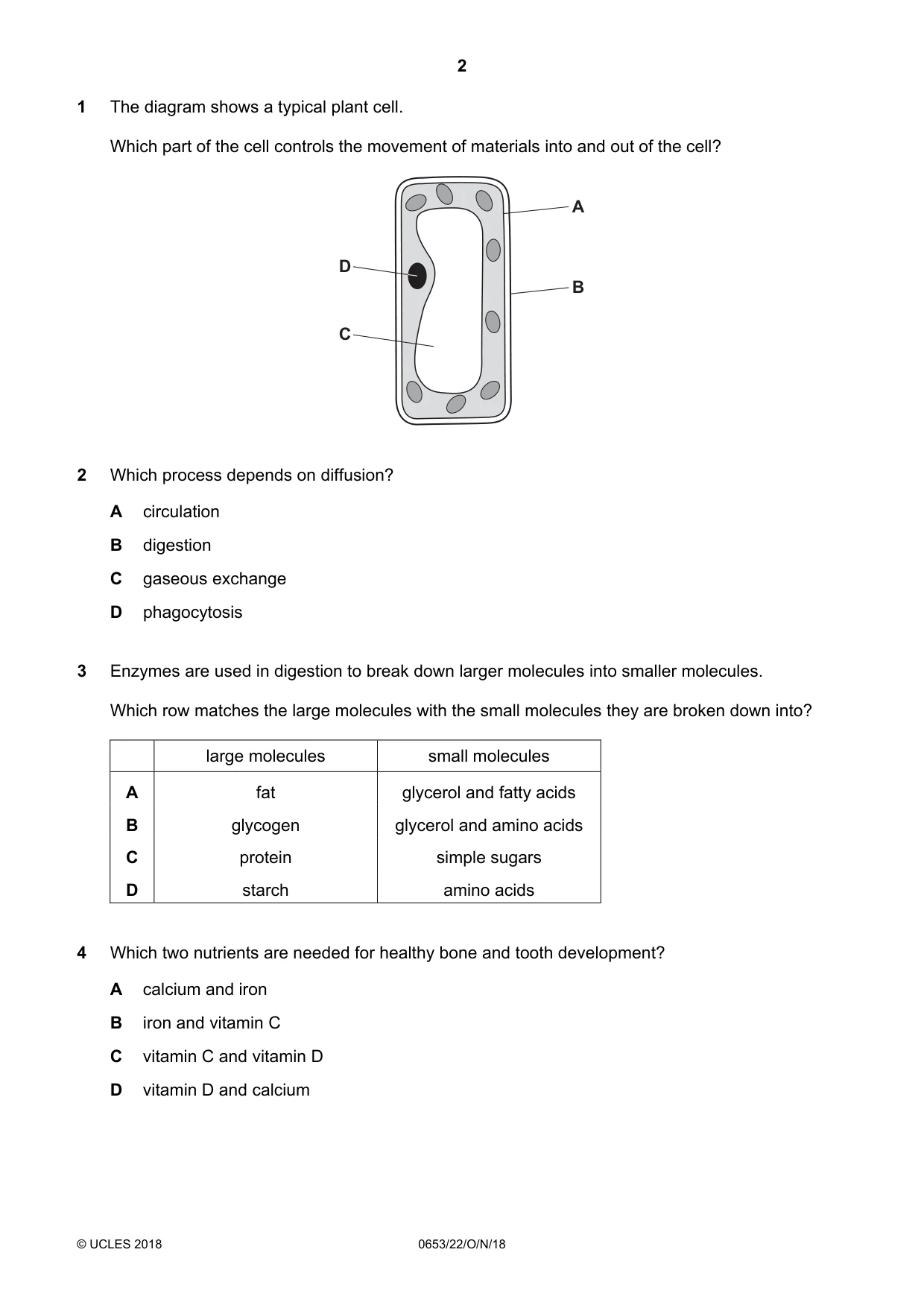
1 The diagram shows a typical plant cell. Which part of the cell controls the movement of materials into and out of the cell? A D B C
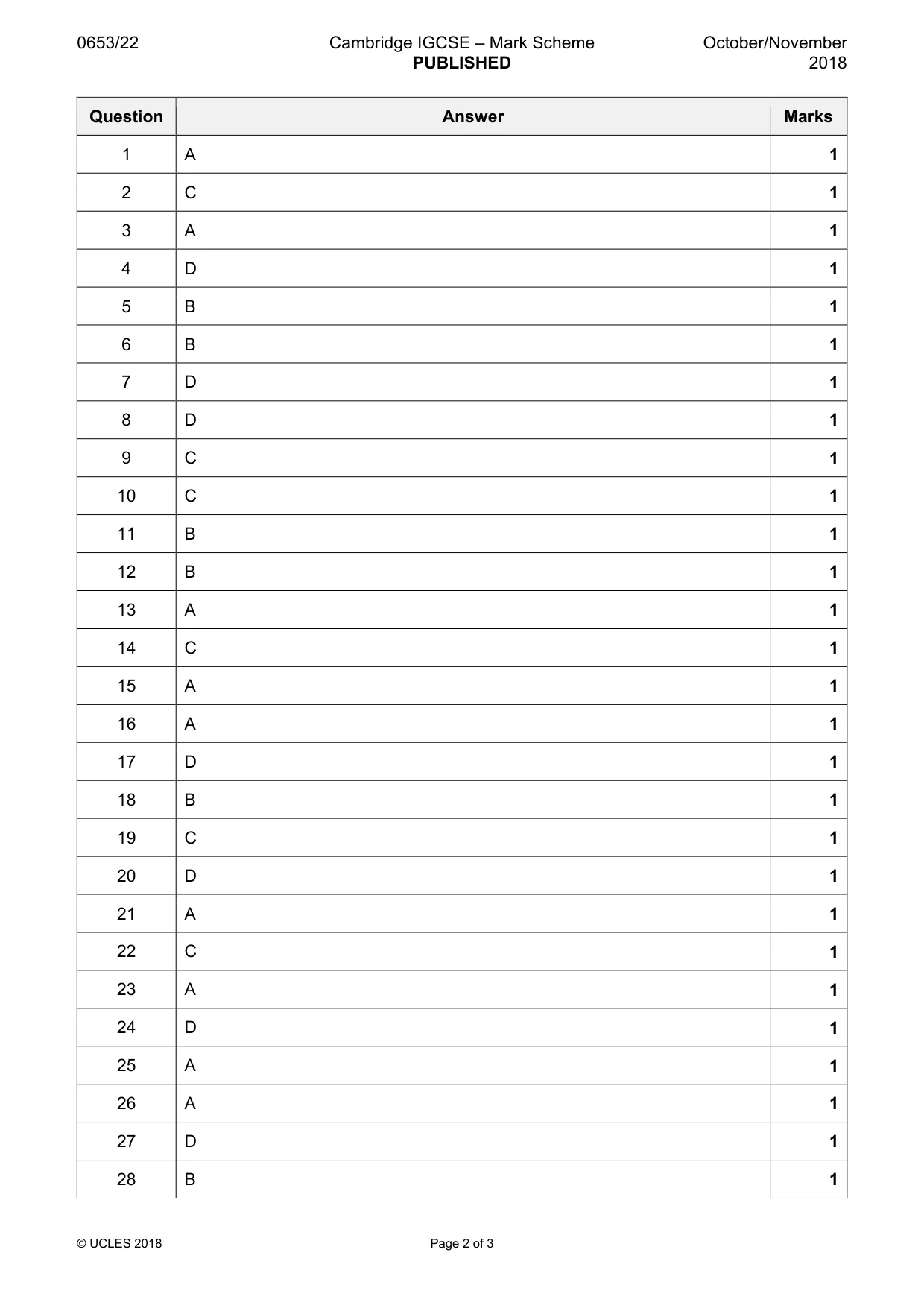
Mark scheme: A
Q2 · Which process depends on diffusion?
2 Which process depends on diffusion? A circulation B digestion C gaseous exchange D phagocytosis
Mark scheme: C
Q3 · Enzymes are used in digestion to break down larger molecules into smaller molecules
3 Enzymes are used in digestion to break down larger molecules into smaller molecules. Which row matches the large molecules with the small molecules they are broken down into? large molecules small molecules A fat glycerol and fatty acids B glycogen glycerol and amino acids C protein simple sugars D starch amino acids
Mark scheme: A
Q4 · Which two nutrients are needed for healthy bone and tooth development?
4 Which two nutrients are needed for healthy bone and tooth development? A calcium and iron B iron and vitamin C C vitamin C and vitamin D D vitamin D and calcium
Mark scheme: D
Q5 · The diagram shows a leaf that was tested for starch using iodine solution
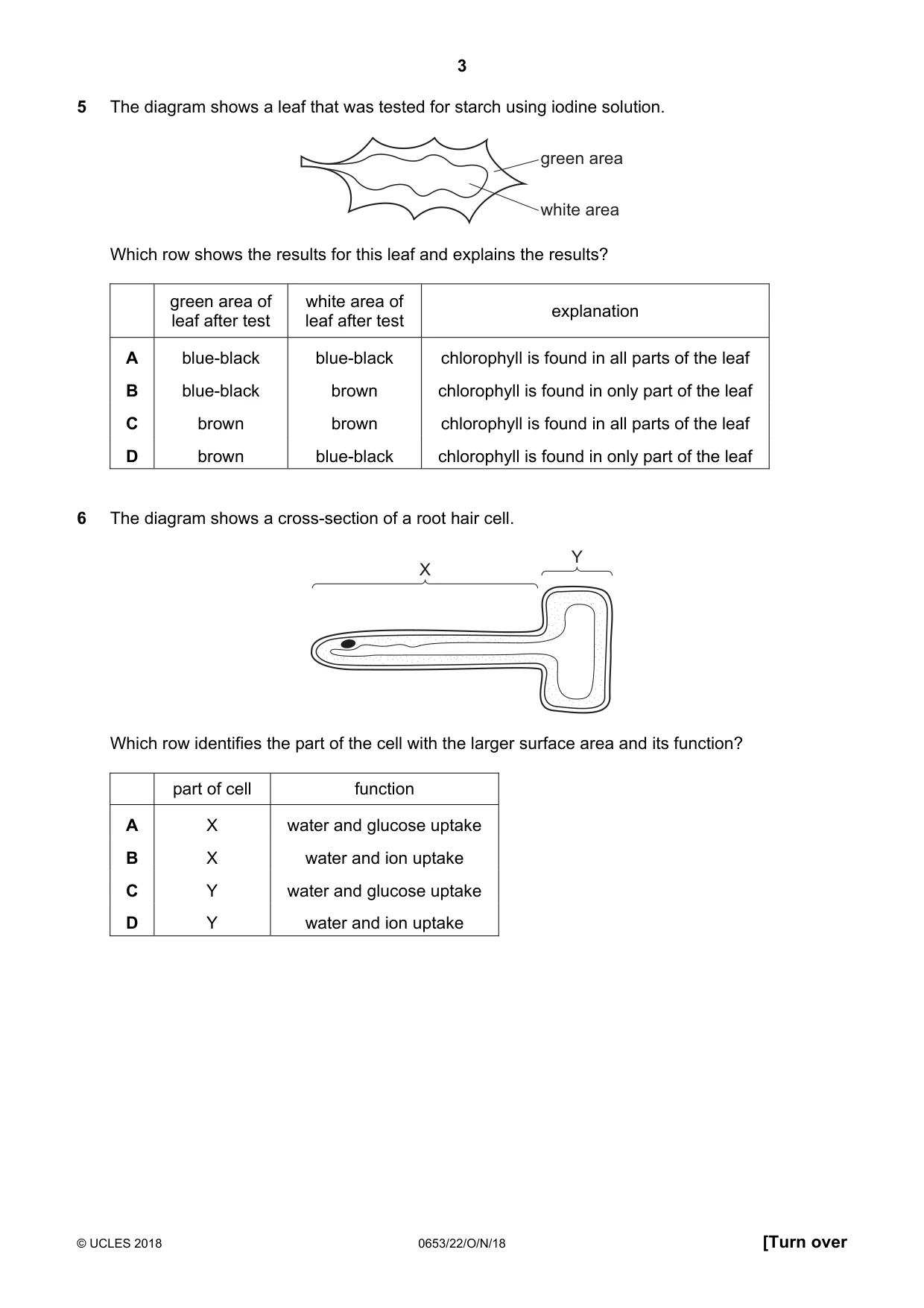
5 The diagram shows a leaf that was tested for starch using iodine solution. green area white area Which row shows the results for this leaf and explains the results? green area of white area of explanation leaf after test leaf after test A blue-black blue-black chlorophyll is found in all parts of the leaf B blue-black brown chlorophyll is found in only part of the leaf C brown brown chlorophyll is found in all parts of the leaf D brown blue-black chlorophyll is found in only part of the leaf
Mark scheme: B
Q6 · The diagram shows a cross-section of a root hair cell
6 The diagram shows a cross-section of a root hair cell. Y X Which row identifies the part of the cell with the larger surface area and its function? part of cell function A X water and glucose uptake B X water and ion uptake C Y water and glucose uptake D Y water and ion uptake
Mark scheme: B
Q7 · The diagram shows the external surface of the heart
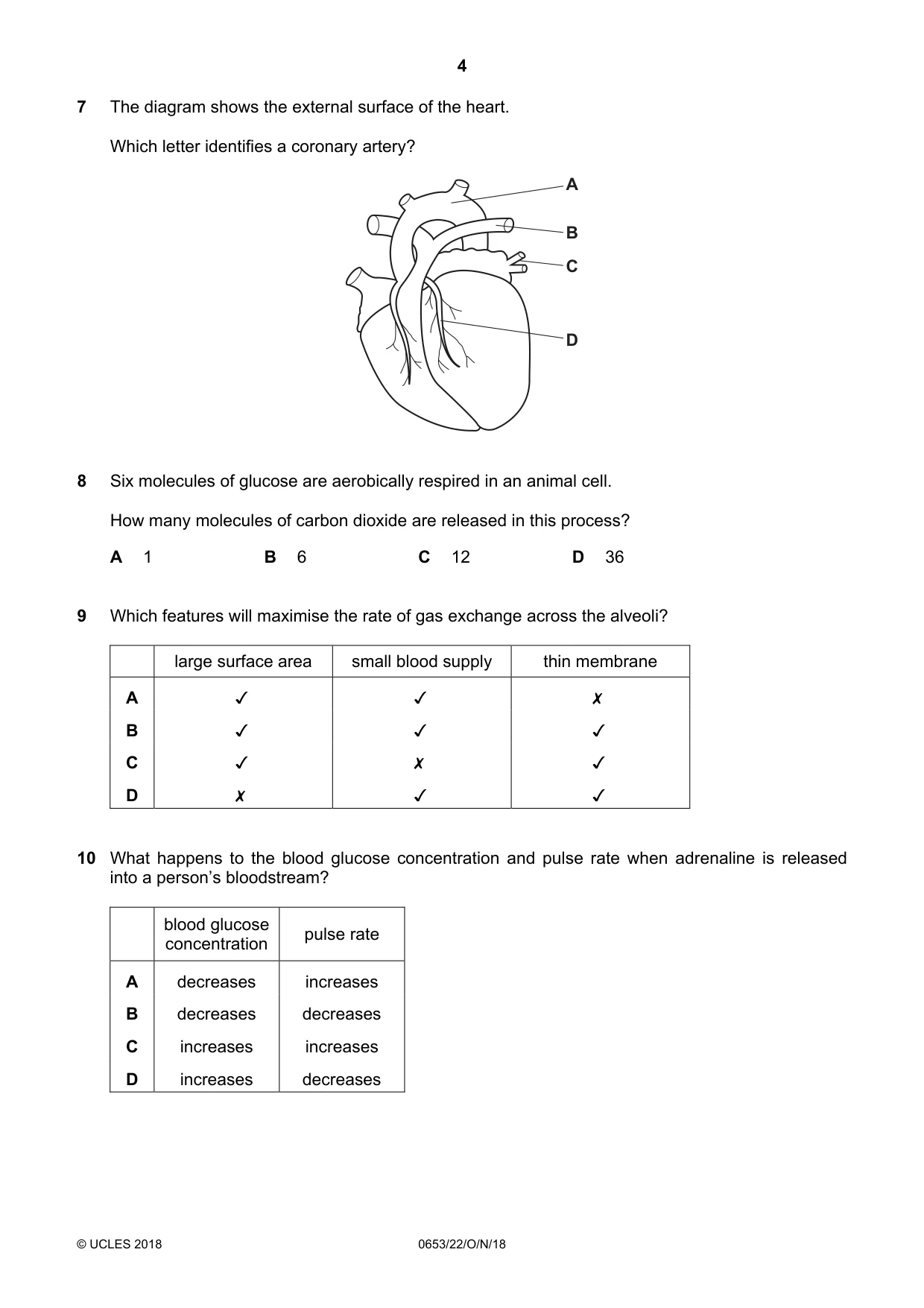
7 The diagram shows the external surface of the heart. Which letter identifies a coronary artery? A B C D
Mark scheme: D
Q8 · Six molecules of glucose are aerobically respired in an animal cell
8 Six molecules of glucose are aerobically respired in an animal cell. How many molecules of carbon dioxide are released in this process? A 1 B 6 C 12 D 36
Mark scheme: D
Q9 · Which features will maximise the rate of gas exchange across the alveoli?
9 Which features will maximise the rate of gas exchange across the alveoli? large surface area small blood supply thin membrane v v x 0 0O WwW > v v v v Xx v x v v
Mark scheme: C
Q10 · What happens to the blood glucose concentration and pulse rate when adrenaline is…
10 What happens to the blood glucose concentration and pulse rate when adrenaline is released into a person’s bloodstream? blood glucose pulse rate concentration A decreases increases B decreases decreases C increases increases D increases decreases
Mark scheme: C
Q11 · Which row describes the net diffusion of substances between the fetus and the mother…
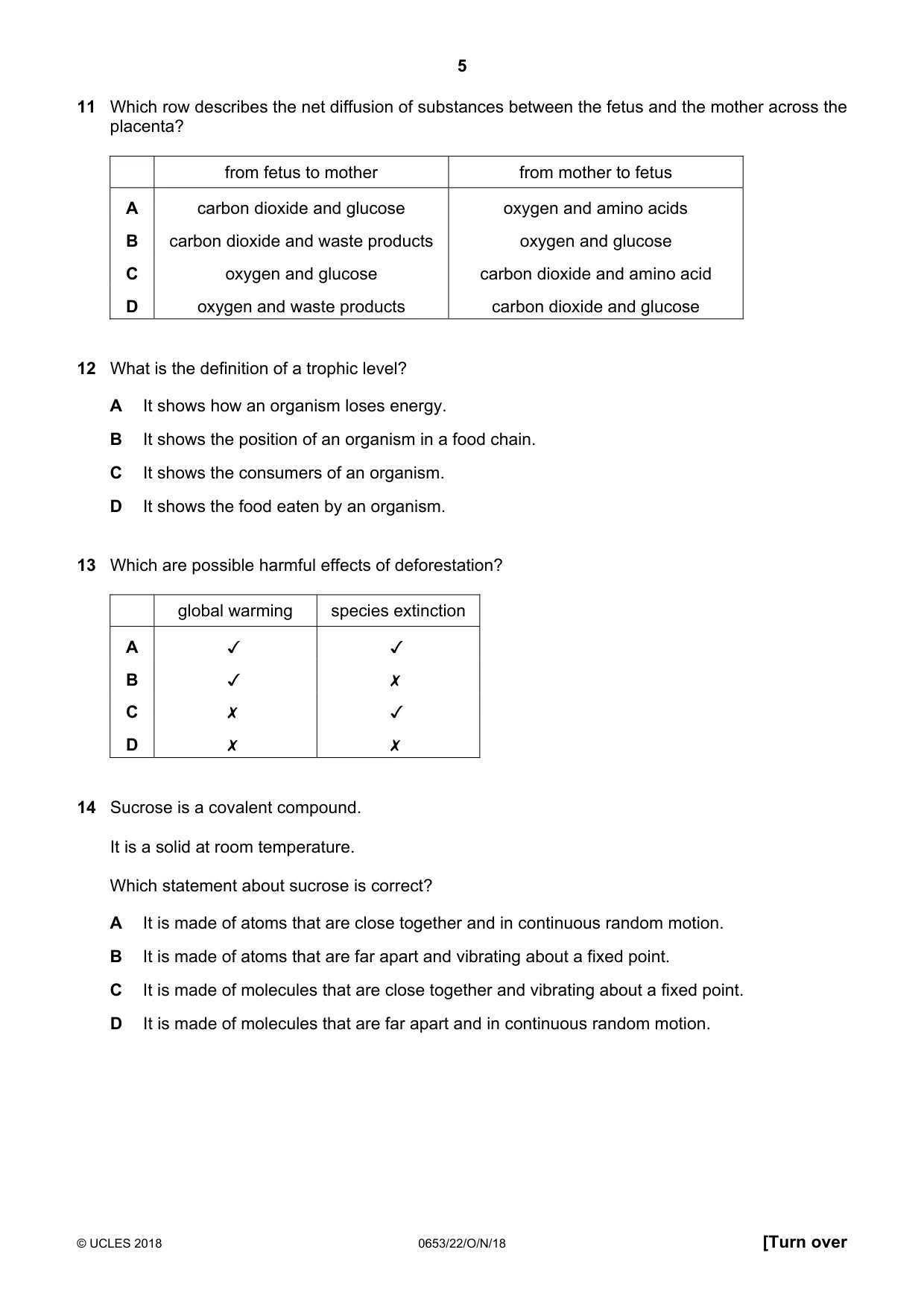
11 Which row describes the net diffusion of substances between the fetus and the mother across the placenta? from fetus to mother from mother to fetus A carbon dioxide and glucose oxygen and amino acids B carbon dioxide and waste products oxygen and glucose C oxygen and glucose carbon dioxide and amino acid D oxygen and waste products carbon dioxide and glucose
Mark scheme: B
Q12 · What is the definition of a trophic level?
12 What is the definition of a trophic level? A It shows how an organism loses energy. B It shows the position of an organism in a food chain. C It shows the consumers of an organism. D It shows the food eaten by an organism.
Mark scheme: B
Q13 · Which are possible harmful effects of deforestation?
13 Which are possible harmful effects of deforestation? global warming species extinction A v v B v x Cc x v D x x
Mark scheme: A
Q14 · Sucrose is a covalent compound
14 Sucrose is a covalent compound. It is a solid at room temperature. Which statement about sucrose is correct? A It is made of atoms that are close together and in continuous random motion. B It is made of atoms that are far apart and vibrating about a fixed point. C It is made of molecules that are close together and vibrating about a fixed point. D It is made of molecules that are far apart and in continuous random motion.
Mark scheme: C
Q15 · The apparatus used for chromatography is shown
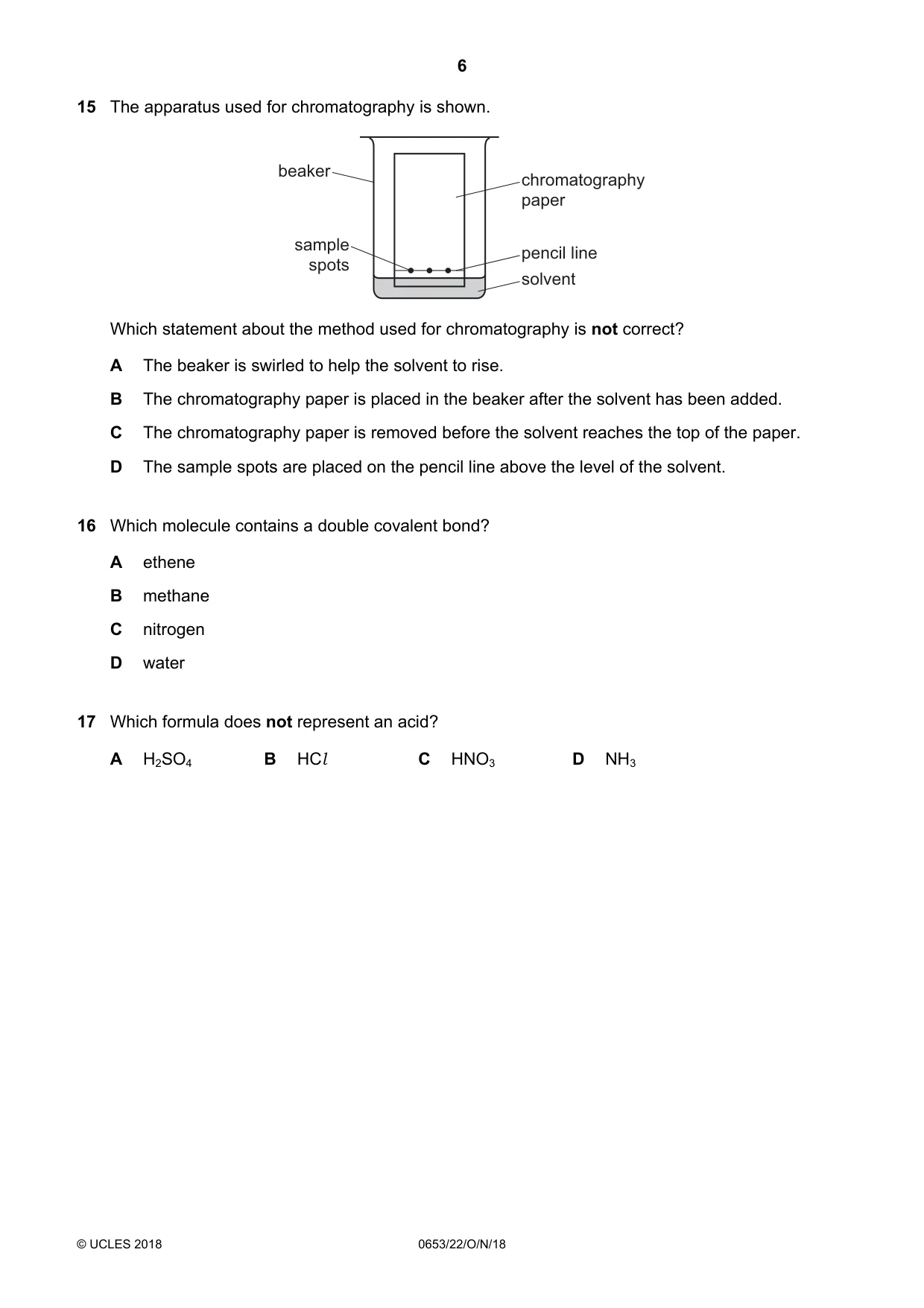
15 The apparatus used for chromatography is shown. beaker chromatography paper sample pencil line spots solvent Which statement about the method used for chromatography is not correct? A The beaker is swirled to help the solvent to rise. B The chromatography paper is placed in the beaker after the solvent has been added. C The chromatography paper is removed before the solvent reaches the top of the paper. D The sample spots are placed on the pencil line above the level of the solvent.
Mark scheme: A
Q16 · Which molecule contains a double covalent bond?
16 Which molecule contains a double covalent bond? A ethene B methane C nitrogen D water
Mark scheme: A
Q17 · Which formula does not represent an acid?
17 Which formula does not represent an acid? A H2SO4 B HCl C HNO3 D NH3
Mark scheme: D
More questions on The characteristic properties of acids and bases
Q18 · During the electrolysis of aqueous copper chloride, ions move
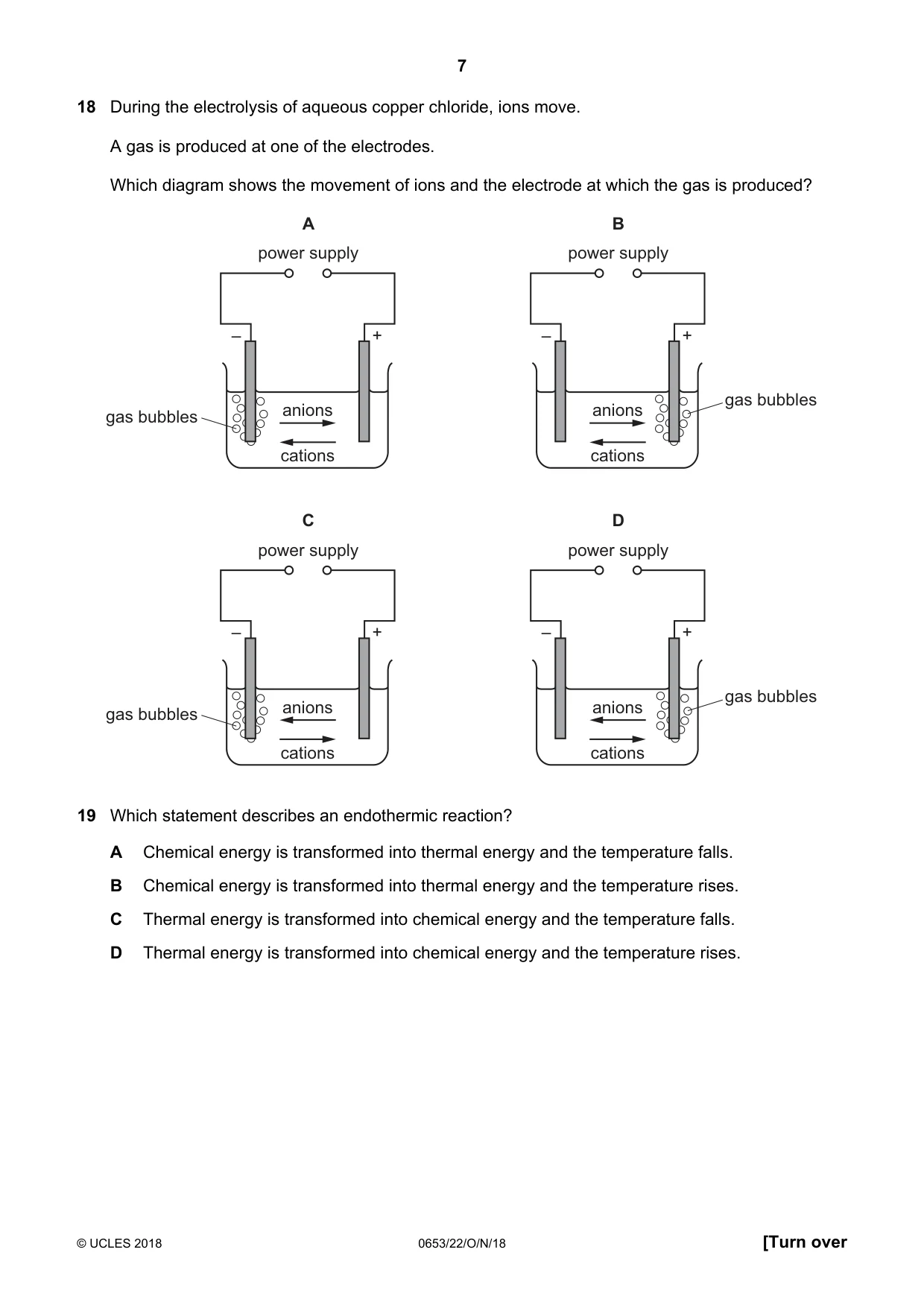
18 During the electrolysis of aqueous copper chloride, ions move. A gas is produced at one of the electrodes. Which diagram shows the movement of ions and the electrode at which the gas is produced? A B power supply power supply – + – + gas bubbles gas bubbles anions anions cations cations C D power supply power supply – + – + gas bubbles gas bubbles anions anions cations cations
Mark scheme: B
Q19 · Which statement describes an endothermic reaction?
19 Which statement describes an endothermic reaction? A Chemical energy is transformed into thermal energy and the temperature falls. B Chemical energy is transformed into thermal energy and the temperature rises. C Thermal energy is transformed into chemical energy and the temperature falls. D Thermal energy is transformed into chemical energy and the temperature rises.
Mark scheme: C
Q20 · Hydrogen peroxide decomposes to form oxygen and water
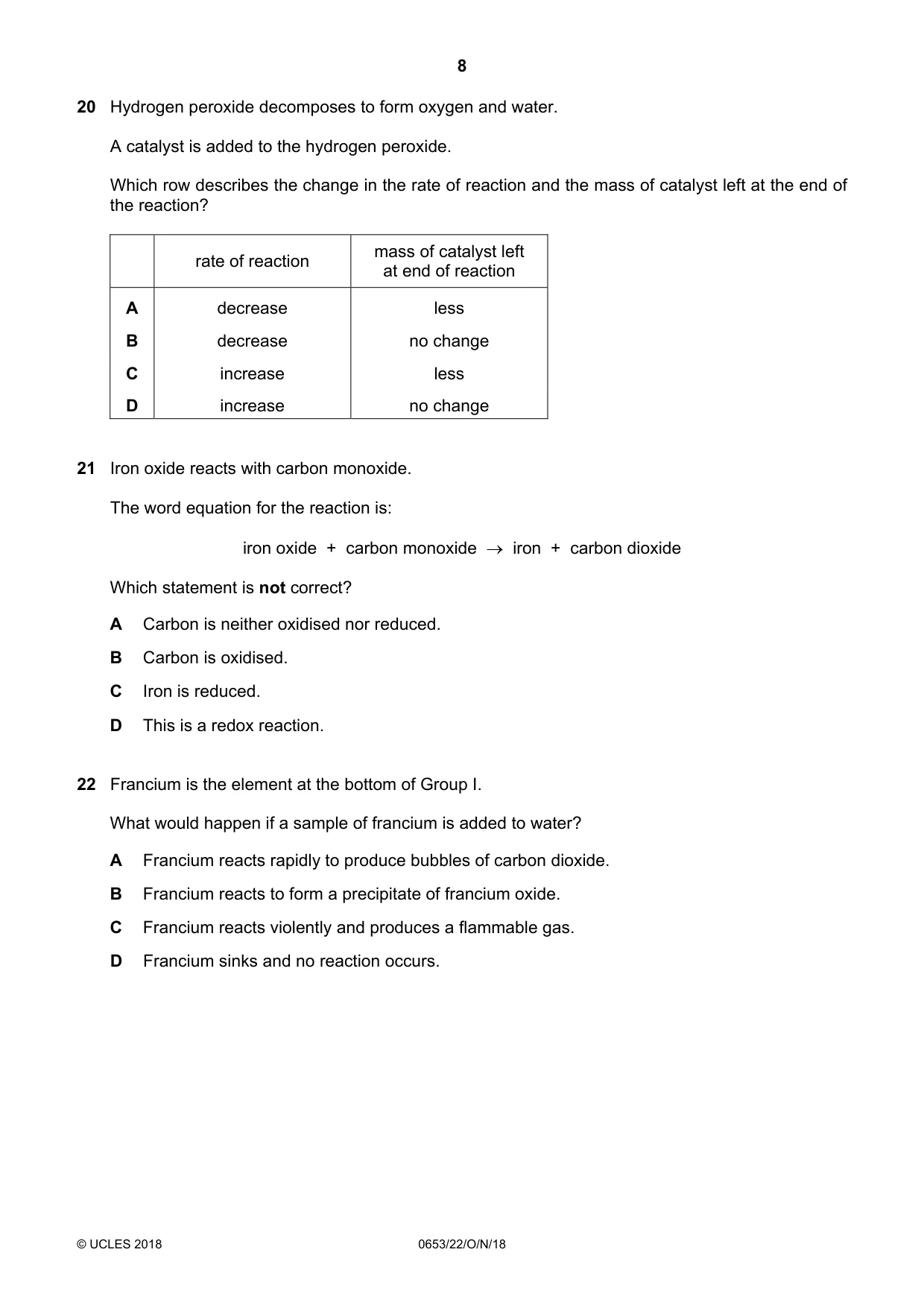
20 Hydrogen peroxide decomposes to form oxygen and water. A catalyst is added to the hydrogen peroxide. Which row describes the change in the rate of reaction and the mass of catalyst left at the end of the reaction? mass of catalyst left rate of reaction at end of reaction A decrease less B decrease no change C increase less D increase no change
Mark scheme: D
Q21 · Iron oxide reacts with carbon monoxide
21 Iron oxide reacts with carbon monoxide. The word equation for the reaction is: iron oxide + carbon monoxide → iron + carbon dioxide Which statement is not correct? A Carbon is neither oxidised nor reduced. B Carbon is oxidised. C Iron is reduced. D This is a redox reaction.
Mark scheme: A
Q22 · Francium is the element at the bottom of Group I
22 Francium is the element at the bottom of Group I. What would happen if a sample of francium is added to water? A Francium reacts rapidly to produce bubbles of carbon dioxide. B Francium reacts to form a precipitate of francium oxide. C Francium reacts violently and produces a flammable gas. D Francium sinks and no reaction occurs.
Mark scheme: C
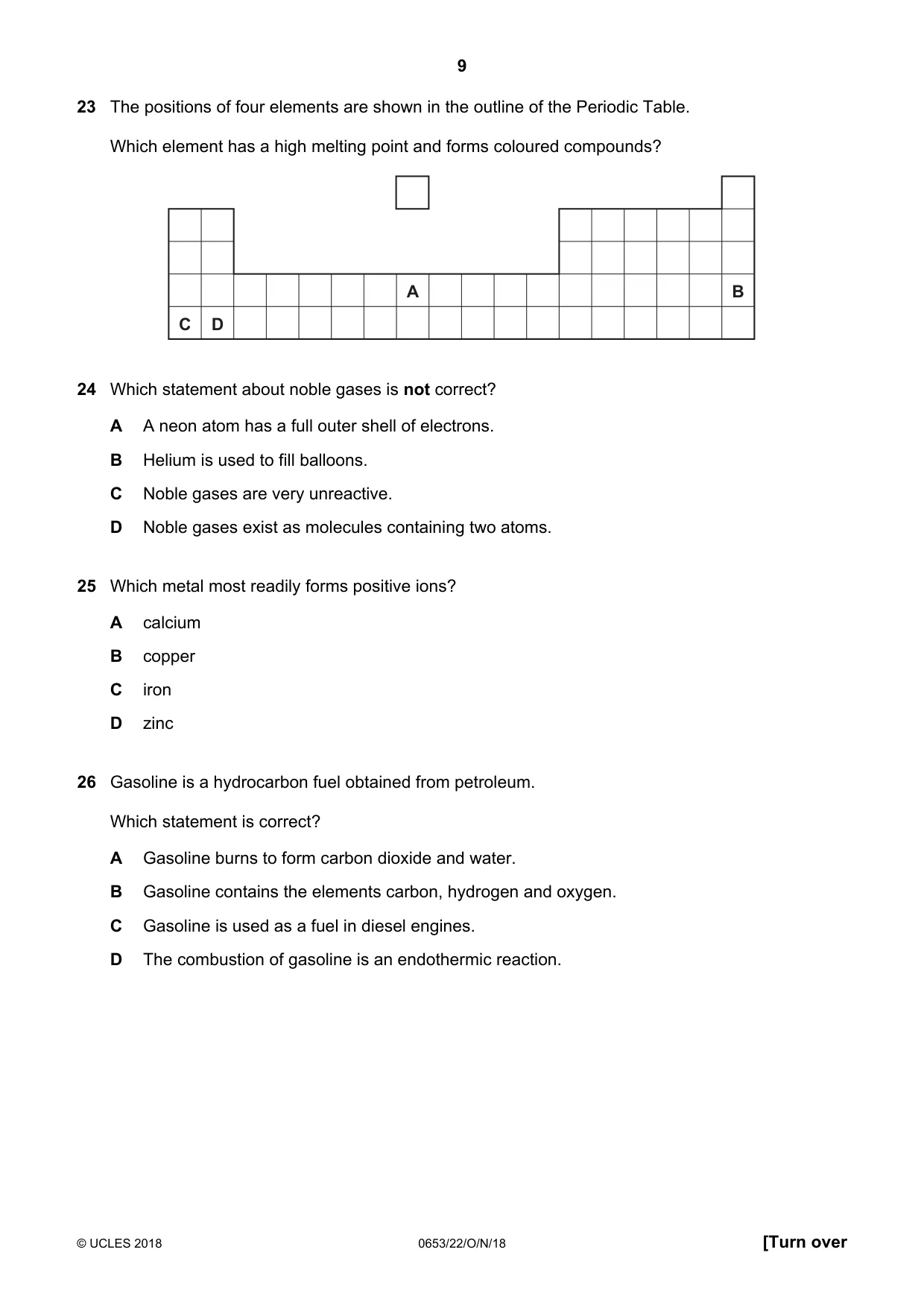
Q23 · The positions of four elements are shown in the outline of the Periodic Table
23 The positions of four elements are shown in the outline of the Periodic Table. Which element has a high melting point and forms coloured compounds? A B C D
Mark scheme: A
Q24 · Which statement about noble gases is not correct?
24 Which statement about noble gases is not correct? A A neon atom has a full outer shell of electrons. B Helium is used to fill balloons. C Noble gases are very unreactive. D Noble gases exist as molecules containing two atoms.
Mark scheme: D
Q25 · Which metal most readily forms positive ions?
25 Which metal most readily forms positive ions? A calcium B copper C iron D zinc
Mark scheme: A
Q26 · Gasoline is a hydrocarbon fuel obtained from petroleum
26 Gasoline is a hydrocarbon fuel obtained from petroleum. Which statement is correct? A Gasoline burns to form carbon dioxide and water. B Gasoline contains the elements carbon, hydrogen and oxygen. C Gasoline is used as a fuel in diesel engines. D The combustion of gasoline is an endothermic reaction.
Mark scheme: A
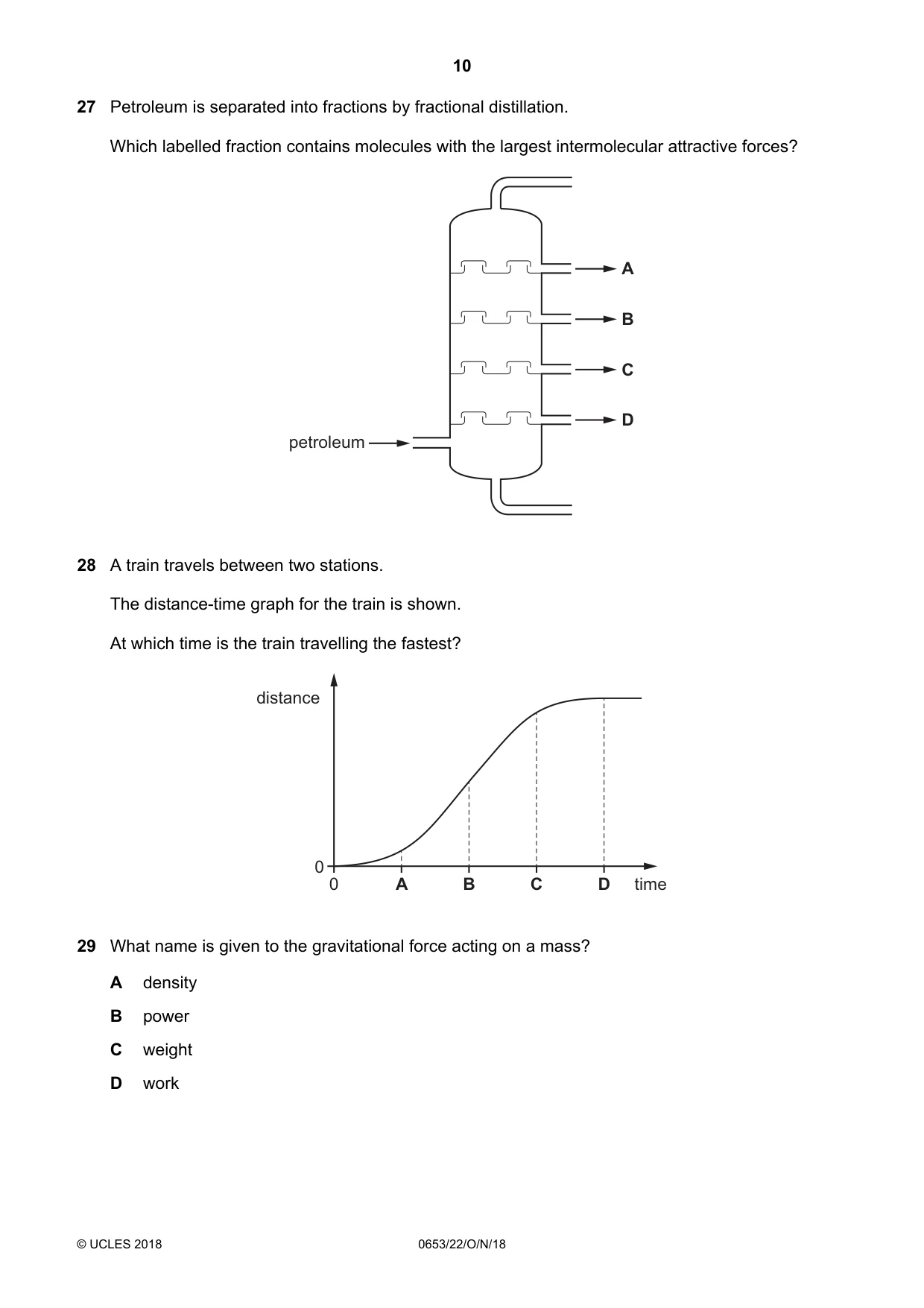
Q27 · Petroleum is separated into fractions by fractional distillation
27 Petroleum is separated into fractions by fractional distillation. Which labelled fraction contains molecules with the largest intermolecular attractive forces? A B C D petroleum
Mark scheme: D
Q28 · A train travels between two stations
28 A train travels between two stations. The distance-time graph for the train is shown. At which time is the train travelling the fastest? distance 0 0 A B C D time
Mark scheme: B
Q29 · What name is given to the gravitational force acting on a mass?
29 What name is given to the gravitational force acting on a mass? A density B power C weight D work
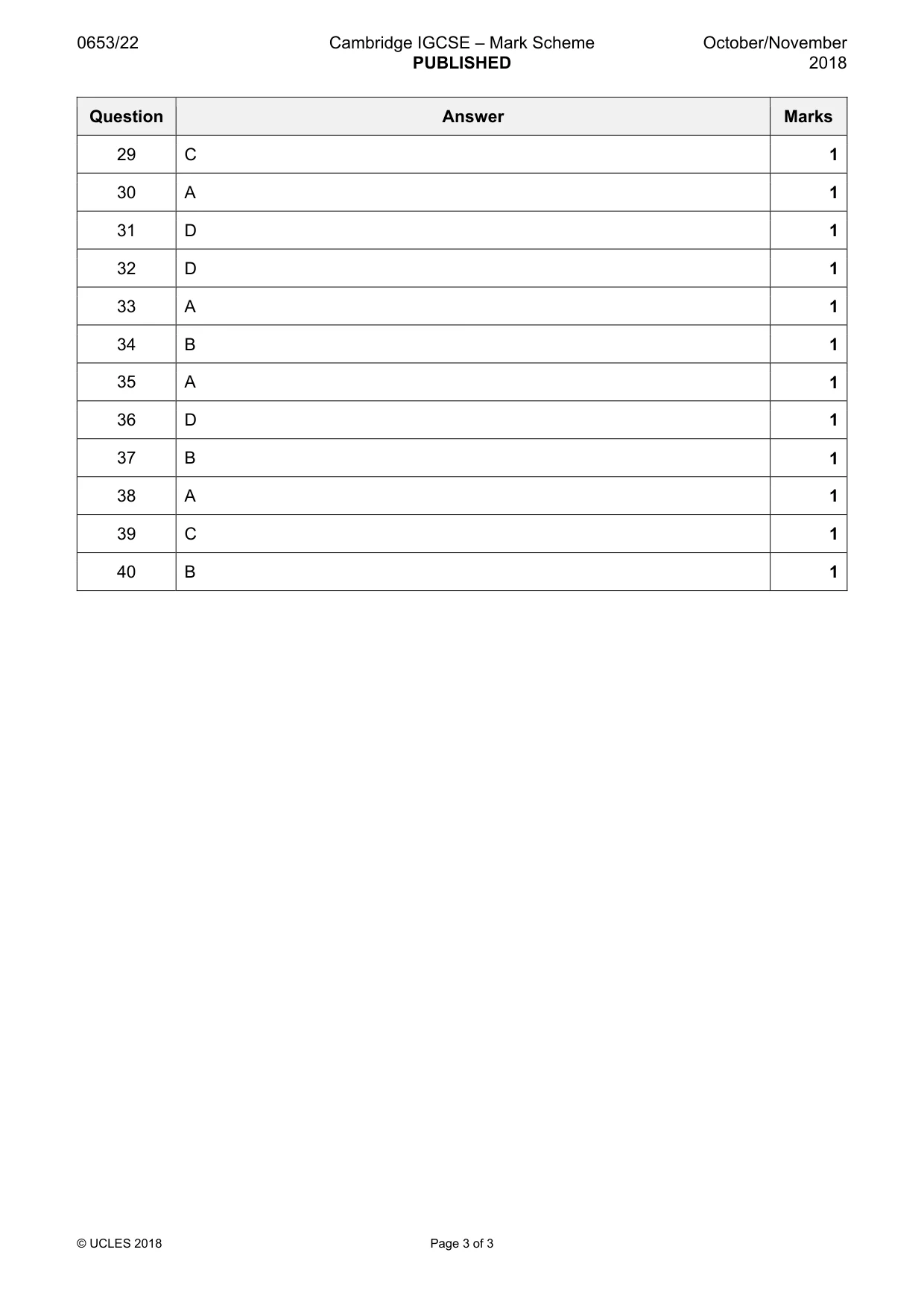
Mark scheme: C
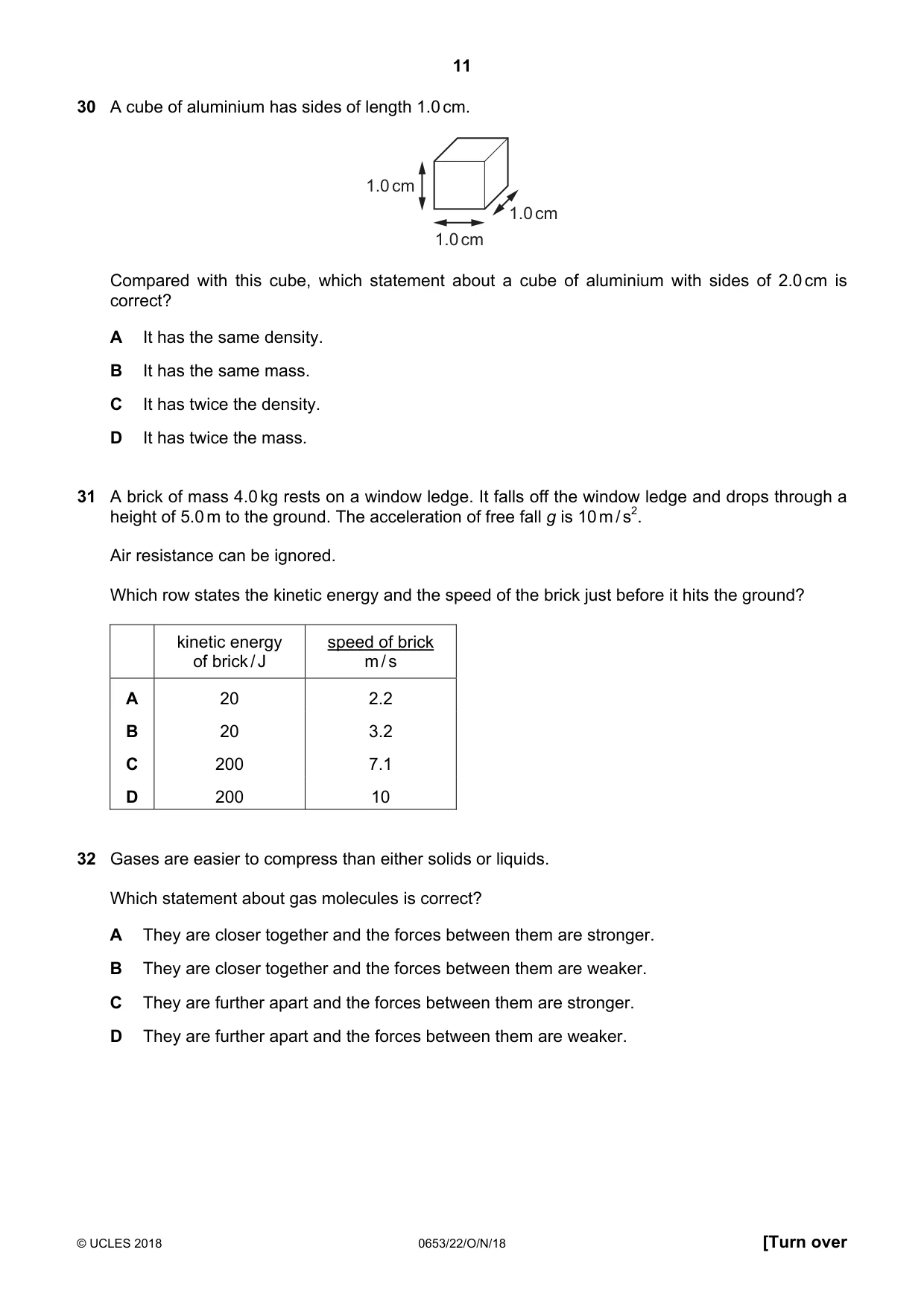
Q30 · A cube of aluminium has sides of length 1.0 cm
30 A cube of aluminium has sides of length 1.0 cm. 1.0 cm 1.0 cm 1.0 cm Compared with this cube, which statement about a cube of aluminium with sides of 2.0 cm is correct? A It has the same density. B It has the same mass. C It has twice the density. D It has twice the mass.
Mark scheme: A
Q31 · A brick of mass 4.0 kg rests on a window ledge
31 A brick of mass 4.0 kg rests on a window ledge. It falls off the window ledge and drops through a height of 5.0 m to the ground. The acceleration of free fall g is 10 m / s2. Air resistance can be ignored. Which row states the kinetic energy and the speed of the brick just before it hits the ground? kinetic energy speed of brick of brick / J m / s A 20 2.2 B 20 3.2 C 200 7.1 D 200 10
Mark scheme: D
Q32 · Gases are easier to compress than either solids or liquids
32 Gases are easier to compress than either solids or liquids. Which statement about gas molecules is correct? A They are closer together and the forces between them are stronger. B They are closer together and the forces between them are weaker. C They are further apart and the forces between them are stronger. D They are further apart and the forces between them are weaker.
Mark scheme: D
Q33 · A liquid evaporates when molecules leave its surface
33 A liquid evaporates when molecules leave its surface. Which molecules leave the surface, and what happens to the temperature of the remaining liquid? A The more energetic molecules leave and the temperature falls. B The more energetic molecules leave and the temperature rises. C The less energetic molecules leave and the temperature falls. D The less energetic molecules leave and the temperature rises.
Mark scheme: A
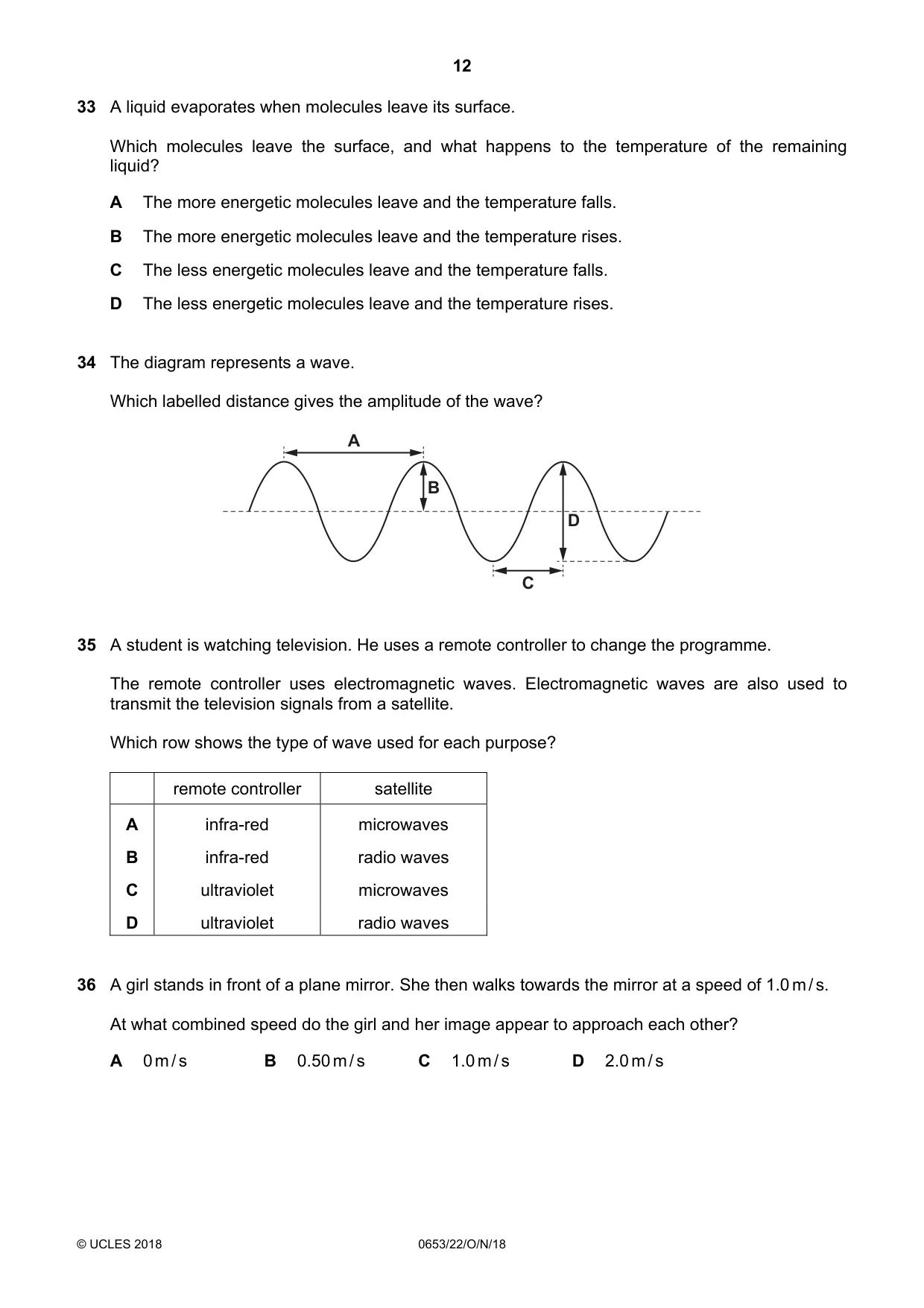
Q34 · The diagram represents a wave
34 The diagram represents a wave. Which labelled distance gives the amplitude of the wave? A B D C
Mark scheme: B
Q35 · A student is watching television
35 A student is watching television. He uses a remote controller to change the programme. The remote controller uses electromagnetic waves. Electromagnetic waves are also used to transmit the television signals from a satellite. Which row shows the type of wave used for each purpose? remote controller satellite A infra-red microwaves B infra-red radio waves C ultraviolet microwaves D ultraviolet radio waves
Mark scheme: A
Q36 · A girl stands in front of a plane mirror
36 A girl stands in front of a plane mirror. She then walks towards the mirror at a speed of 1.0 m / s. At what combined speed do the girl and her image appear to approach each other? A 0 m / s B 0.50 m / s C 1.0 m / s D 2.0 m / s
Mark scheme: D
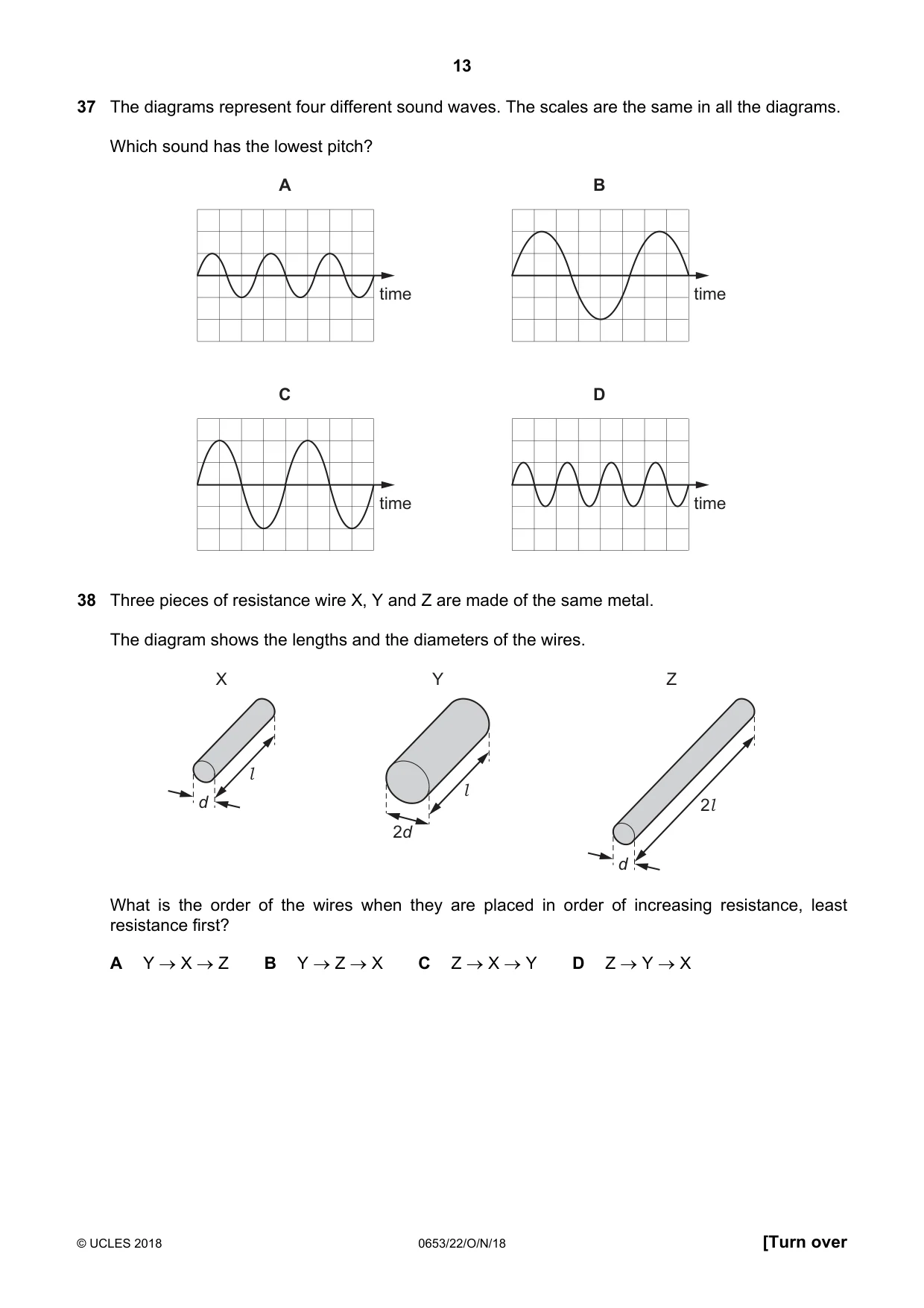
Q37 · The diagrams represent four different sound waves
37 The diagrams represent four different sound waves. The scales are the same in all the diagrams. Which sound has the lowest pitch? A B time time C D time time
Mark scheme: B
Q38 · Three pieces of resistance wire X, Y and Z are made of the same metal
38 Three pieces of resistance wire X, Y and Z are made of the same metal. The diagram shows the lengths and the diameters of the wires. X Y Z l l d 2l 2d d What is the order of the wires when they are placed in order of increasing resistance, least resistance first? A Y → X → Z B Y → Z → X C Z → X → Y D Z → Y → X
Mark scheme: A
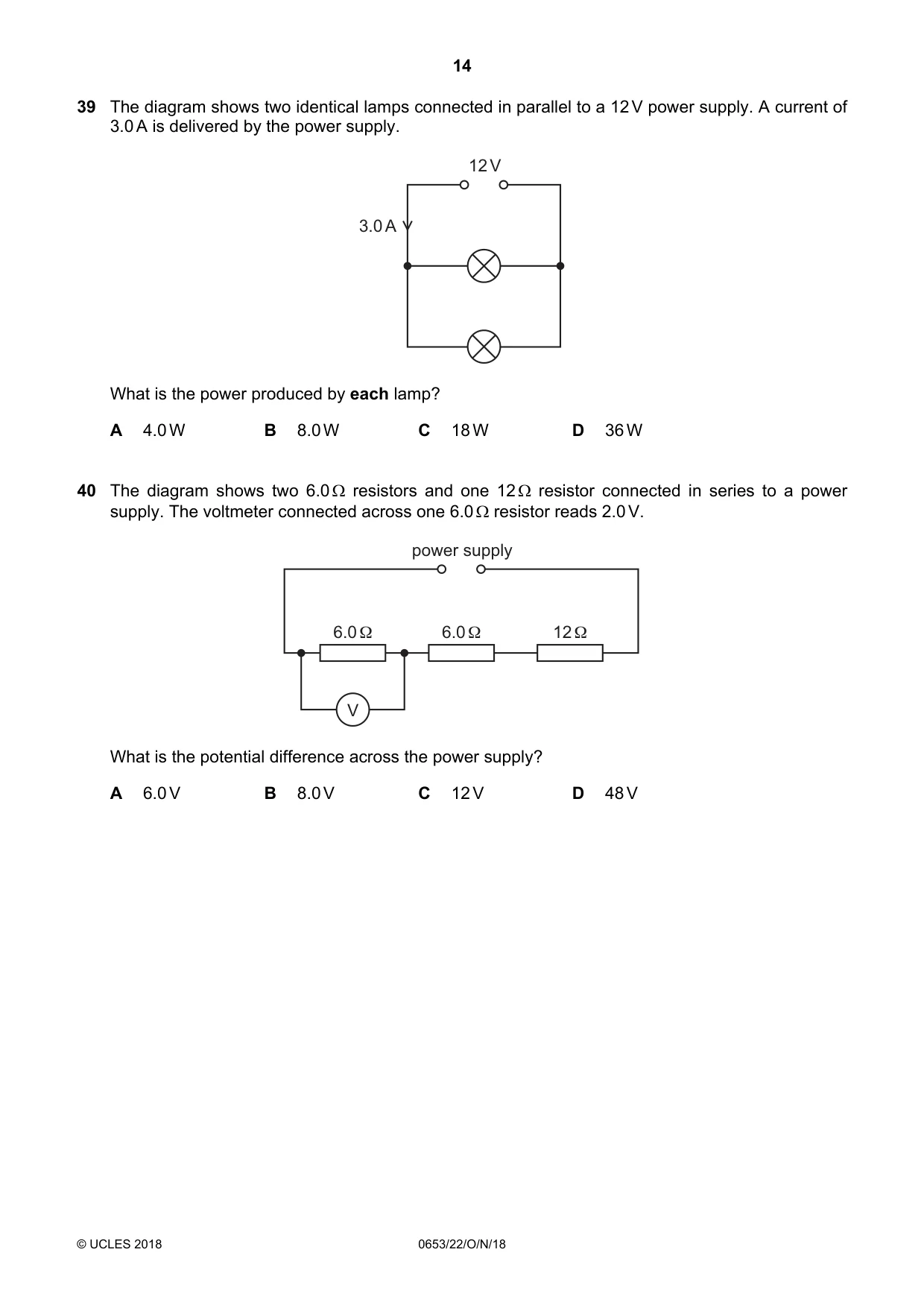
Q39 · The diagram shows two identical lamps connected in parallel to a 12 V power supply
39 The diagram shows two identical lamps connected in parallel to a 12 V power supply. A current of 3.0 A is delivered by the power supply. 12 V 3.0 A What is the power produced by each lamp? A 4.0 W B 8.0 W C 18 W D 36 W
Mark scheme: C
Q40 · The diagram shows two 6.0 Ω resistors and one 12 Ω resistor connected in series to a…
40 The diagram shows two 6.0 Ω resistors and one 12 Ω resistor connected in series to a power supply. The voltmeter connected across one 6.0 Ω resistor reads 2.0 V. power supply 6.0 Ω 6.0 Ω 12 Ω V What is the potential difference across the power supply? A 6.0 V B 8.0 V C 12 V D 48 V
Mark scheme: B
What was in this paper
The subtopics covered by these 40 questions, and how many questions each got. Open one in a new tab to see every Cambridge question on it.
2Fuels2Alkenes1Cell structure1Chromatography1Density1Diet1Diffusion1Digestion1Drugs1Electrical circuits1Electrolysis1Electromagnetic spectrum1Energy, work and power1Exothermic and endothermic reactions1Food chains and food webs1Gas exchange in humans1General properties of waves1Group I properties1Habitat destruction1Heart1Kinetic particle model of matter1Light1Mass and weight1Motion1Noble gases1Photosynthesis1Rate of reaction1Reactivity series1Redox1Respiration1Sexual reproduction in humans1Solids, liquids and gases1Sound1The characteristic properties of acids and bases1Transfer of thermal energy1Transition elements1Water uptake1What you needed in this session
Cambridge’s own grade thresholds for 2018 Oct/Nov, Paper 2 · Variant 2. A higher threshold means an easier paper — the bar moves with how the cohort did.