Questions as text
Q1 · A boat sailing near a lighthouse at night 0653/32 Feb/March 2017
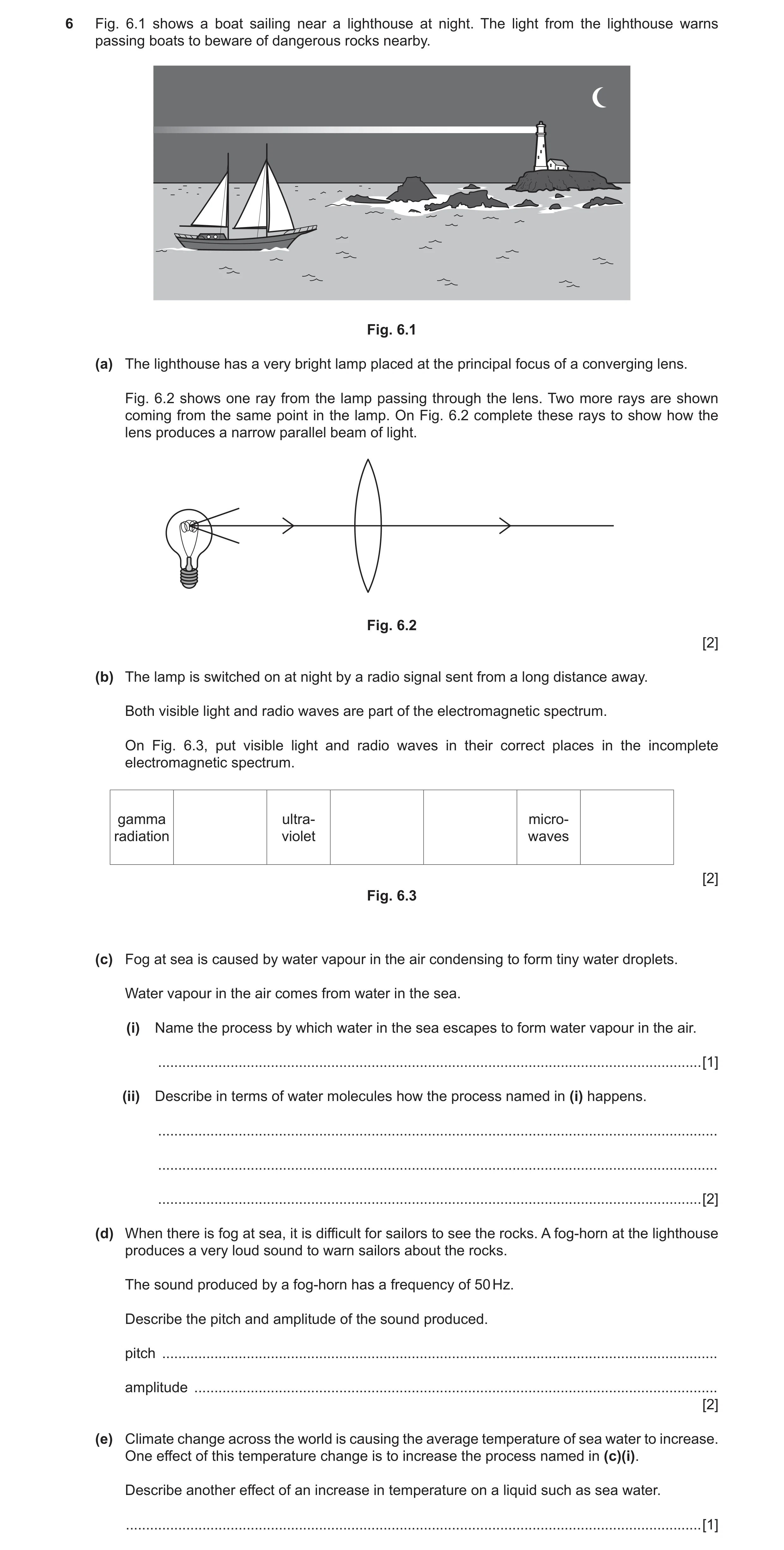
6 Fig. 6.1 shows a boat sailing near a lighthouse at night. The light from the lighthouse warns passing boats to beware of dangerous rocks nearby. Fig. 6.1 (a) The lighthouse has a very bright lamp placed at the principal focus of a converging lens. Fig. 6.2 shows one ray from the lamp passing through the lens. Two more rays are shown coming from the same point in the lamp. On Fig. 6.2 complete these rays to show how the lens produces a narrow parallel beam of light. Fig. 6.2 [2] (b) The lamp is switched on at night by a radio signal sent from a long distance away. Both visible light and radio waves are part of the electromagnetic spectrum. On Fig. 6.3, put visible light and radio waves in their correct places in the incomplete electromagnetic spectrum. gamma ultra- micro- radiation violet waves [2] Fig. 6.3 (c) Fog at sea is caused by water vapour in the air condensing to form tiny water droplets. Water vapour in the air comes from water in the sea. (i) Name the process by which water in the sea escapes to form water vapour in the air. … [1] (ii) Describe in terms of water molecules how the process named in (i) happens. … … … [2] (d) When there is fog at sea, it is difficult for sailors to see the rocks. A fog-horn at the lighthouse produces a very loud sound to warn sailors about the rocks. The sound produced by a fog-horn has a frequency of 50 Hz. Describe the pitch and amplitude of the sound produced. pitch … amplitude … [2] (e) Climate change across the world is causing the average temperature of sea water to increase. One effect of this temperature change is to increase the process named in (c)(i). Describe another effect of an increase in temperature on a liquid such as sea water. … [1]
10 marks
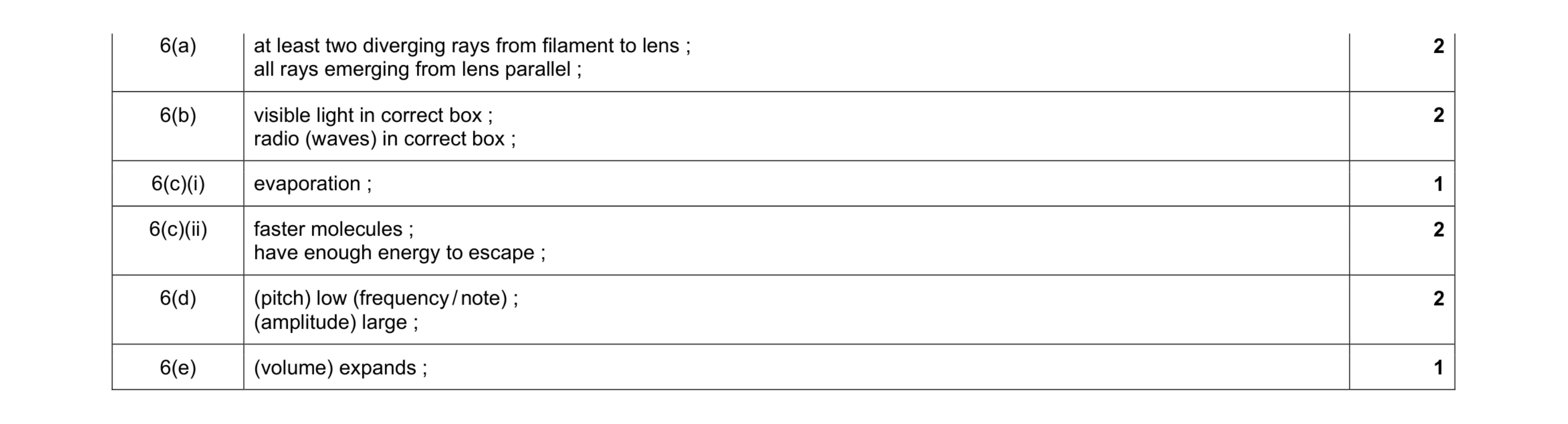
Mark scheme: 6(a) at least two diverging rays from filament to lens ; all rays emerging from lens parallel ; 2 6(b) visible light in correct box ; radio (waves) in correct box ; 2 6(c)(i) evaporation ; 1 6(c)(ii) faster molecules ; have enough energy to escape ; 2 6(d) (pitch) low (frequency / note) ; (amplitude) large ; 2 6(e) (volume) expands ; 1
This question in 0653/32 Feb/March 2017
Q2 · An aircraft is flying at a height of 10 000 m 0653/33 May/June 2017
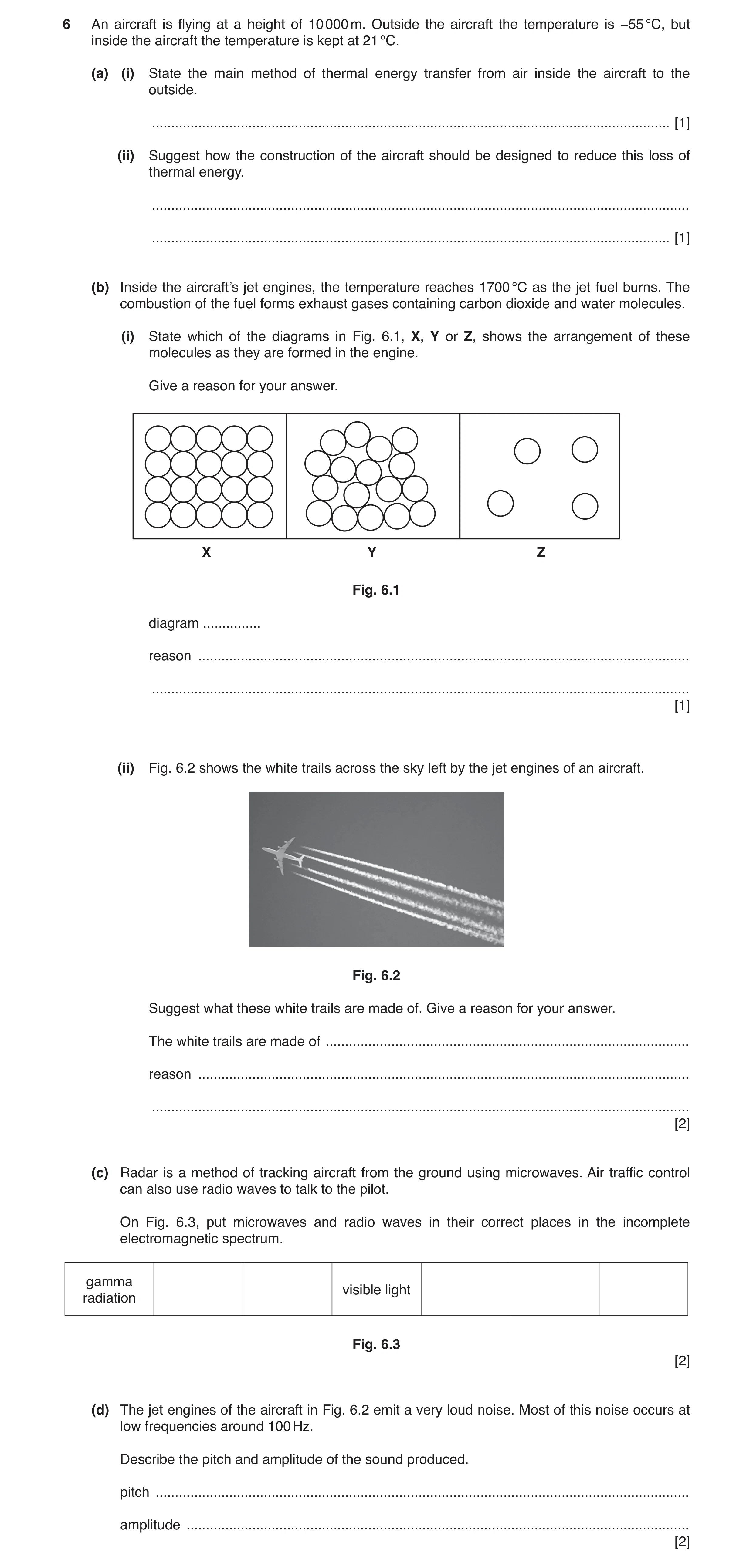
6 An aircraft is flying at a height of 10 000 m. Outside the aircraft the temperature is −55 °C, but inside the aircraft the temperature is kept at 21 °C. (a) (i) State the main method of thermal energy transfer from air inside the aircraft to the outside. … [1] (ii) Suggest how the construction of the aircraft should be designed to reduce this loss of thermal energy. … … [1] (b) Inside the aircraft’s jet engines, the temperature reaches 1700 °C as the jet fuel burns. The combustion of the fuel forms exhaust gases containing carbon dioxide and water molecules. (i) State which of the diagrams in Fig. 6.1, X, Y or Z, shows the arrangement of these molecules as they are formed in the engine. Give a reason for your answer. X Y Z Fig. 6.1 diagram … reason … … [1] (ii) Fig. 6.2 shows the white trails across the sky left by the jet engines of an aircraft. Fig. 6.2 Suggest what these white trails are made of. Give a reason for your answer. The white trails are made of … reason … … [2] (c) Radar is a method of tracking aircraft from the ground using microwaves. Air traffic control can also use radio waves to talk to the pilot. On Fig. 6.3, put microwaves and radio waves in their correct places in the incomplete electromagnetic spectrum. gamma visible lightradiation Fig. 6.3 [2] (d) The jet engines of the aircraft in Fig. 6.2 emit a very loud noise. Most of this noise occurs at low frequencies around 100 Hz. Describe the pitch and amplitude of the sound produced. pitch … amplitude … [2]
9 marks
Mark scheme: 6(a)(i) conduction ; 1 6(a)(ii) insulation (in outer layer of aircraft) / make aircraft out of bad (thermal) conductor / owtte ; 1 6(b)(i) (Z – no mark) gas molecules far apart / not touching ; 1 6(b)(ii) ice / (frozen) water ; water from fuel combustion freezing / condensing in very cold air ; 2 6(c) gamma radiation visible light micro- waves ; radio waves ; 2 6(d) (pitch) low ; (amplitude) (very) high ; 2
This question in 0653/33 May/June 2017
Q3 · Two horizontal forces acting on a car driving along a road 0653/31 Oct/Nov 2017
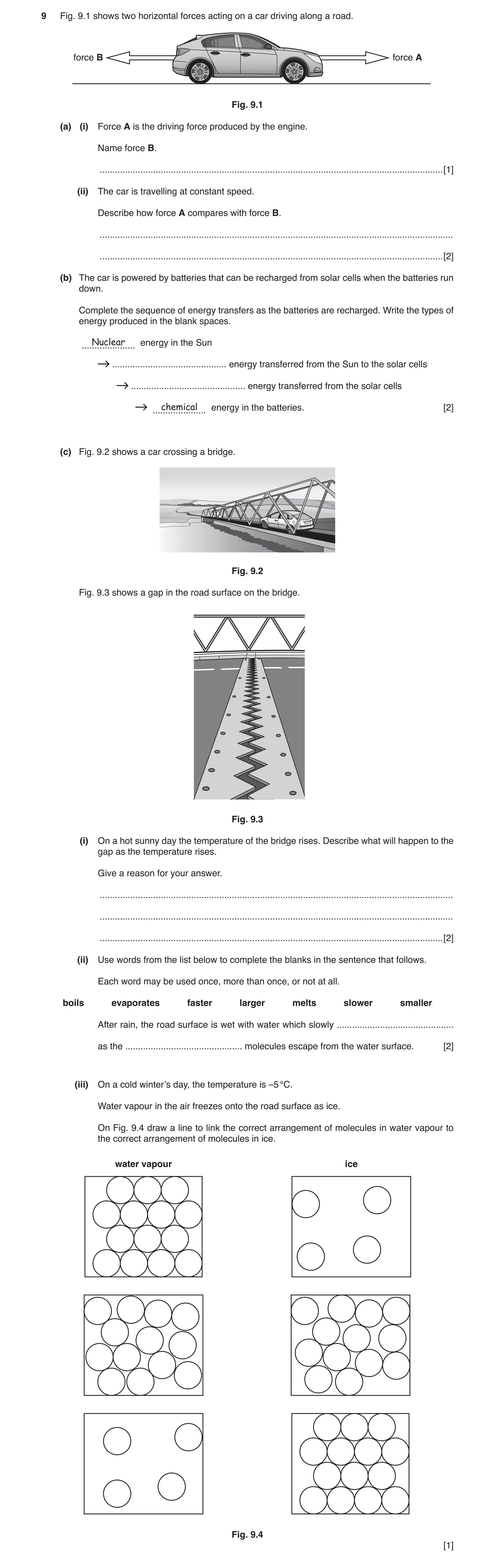
9 Fig. 9.1 shows two horizontal forces acting on a car driving along a road. force B force A Fig. 9.1 (a) (i) Force A is the driving force produced by the engine. Name force B. … [1] (ii) The car is travelling at constant speed. Describe how force A compares with force B. … … [2] (b) The car is powered by batteries that can be recharged from solar cells when the batteries run down. Complete the sequence of energy transfers as the batteries are recharged. Write the types of energy produced in the blank spaces. Nuclear energy in the Sun … … energy transferred from the Sun to the solar cells … energy transferred from the solar cells chemical energy in the batteries. [2] … (c) Fig. 9.2 shows a car crossing a bridge. Fig. 9.2 Fig. 9.3 shows a gap in the road surface on the bridge. Fig. 9.3 (i) On a hot sunny day the temperature of the bridge rises. Describe what will happen to the gap as the temperature rises. Give a reason for your answer. … … … [2] (ii) Use words from the list below to complete the blanks in the sentence that follows. Each word may be used once, more than once, or not at all. boils evaporates faster larger melts slower smaller After rain, the road surface is wet with water which slowly … as the … molecules escape from the water surface. [2] (iii) On a cold winter’s day, the temperature is –5 °C. Water vapour in the air freezes onto the road surface as ice. On Fig. 9.4 draw a line to link the correct arrangement of molecules in water vapour to the correct arrangement of molecules in ice. water vapour ice Fig. 9.4 [1]
10 marks
Mark scheme: 9(a)(i) friction / frictional force / resistance force ; 1 9(a)(ii) equal (magnitude) ; opposite (direction) ; 2 9(b) light ; electrical ; 2 Question Answer Marks 9(c)(i) gap will close : (thermal) expansion (of bridge structure) owtte ; 2 9(c)(ii) evaporates ; faster ; 2 9(c)(iii) line drawn between the two bottom boxes ; 1
This question in 0653/31 Oct/Nov 2017
Q4 · The bathroom in a house has an electric heater under the floor 0653/32 Feb/March 2019
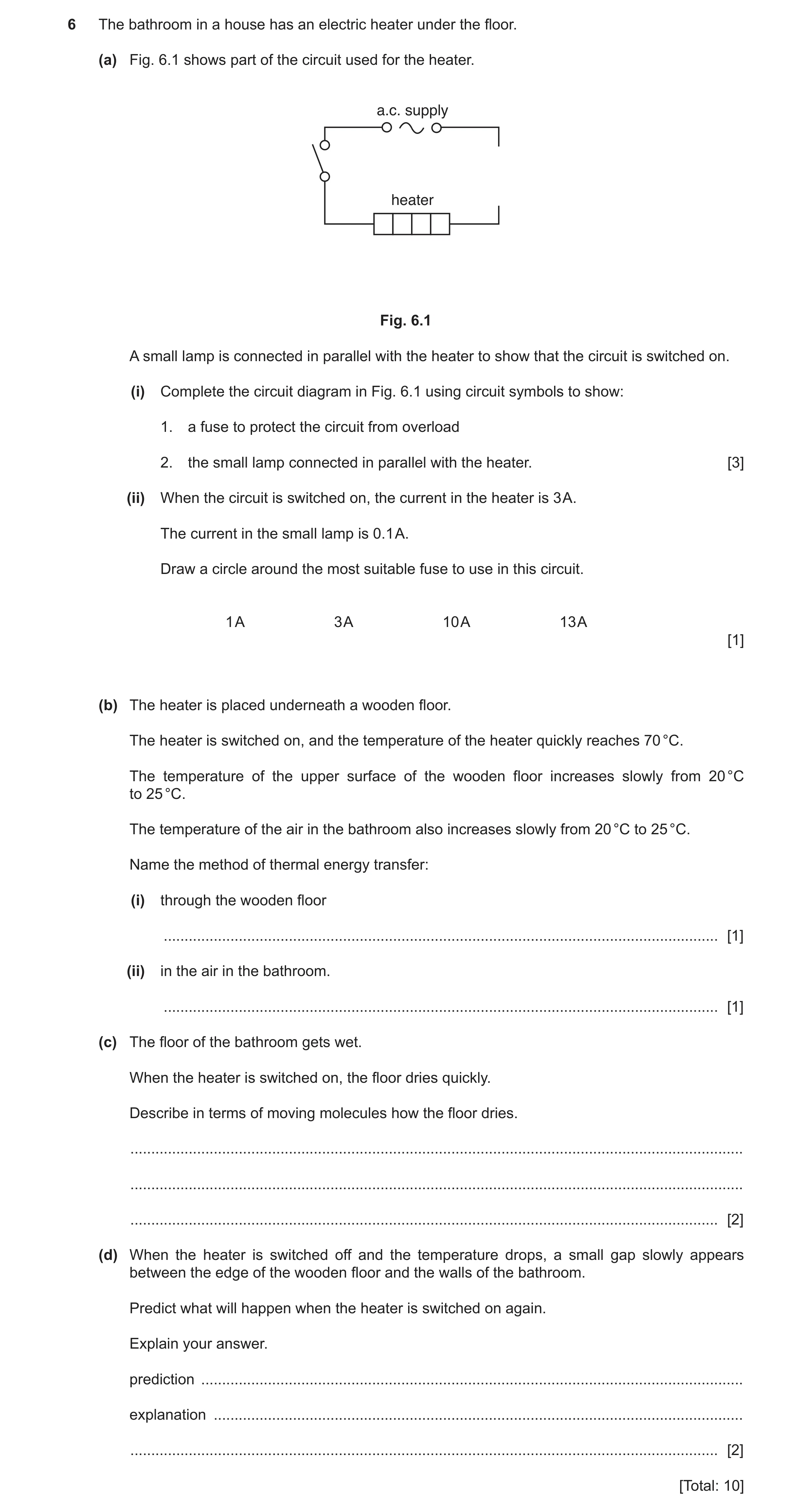
6 The bathroom in a house has an electric heater under the floor. (a) Fig. 6.1 shows part of the circuit used for the heater. a.c. supply heater Fig. 6.1 A small lamp is connected in parallel with the heater to show that the circuit is switched on. (i) Complete the circuit diagram in Fig. 6.1 using circuit symbols to show: 1. a fuse to protect the circuit from overload 2. the small lamp connected in parallel with the heater. [3] (ii) When the circuit is switched on, the current in the heater is 3 A. The current in the small lamp is 0.1 A. Draw a circle around the most suitable fuse to use in this circuit. 1 A 3 A 10 A 13 A [1] (b) The heater is placed underneath a wooden floor. The heater is switched on, and the temperature of the heater quickly reaches 70 °C. The temperature of the upper surface of the wooden floor increases slowly from 20 °C to 25 °C. The temperature of the air in the bathroom also increases slowly from 20 °C to 25 °C. Name the method of thermal energy transfer: (i) through the wooden floor … [1] (ii) in the air in the bathroom. … [1] (c) The floor of the bathroom gets wet. When the heater is switched on, the floor dries quickly. Describe in terms of moving molecules how the floor dries. … … … [2] (d) When the heater is switched off and the temperature drops, a small gap slowly appears between the edge of the wooden floor and the walls of the bathroom. Predict what will happen when the heater is switched on again. Explain your answer. prediction … explanation … … [2] [Total: 10]
10 marks
Mark scheme: 6(a)(i) correct symbols ; fuse in series ; lamp in parallel ; 3 6(a)(ii) 10 A ; 1 Question Answer Marks 6(b)(i) conduction ; 1 6(b)(ii) convection ; 1 6(c) faster moving molecules / molecules with greater kinetic energy ; escape surface / leave the liquid / reference to evaporation ; 2 6(d) gap closes (again) ; wooden floor / wood expands on heating ; 2
This question in 0653/32 Feb/March 2019
Q5 · Complete the sentences using words from the list 0653/33 May/June 2019
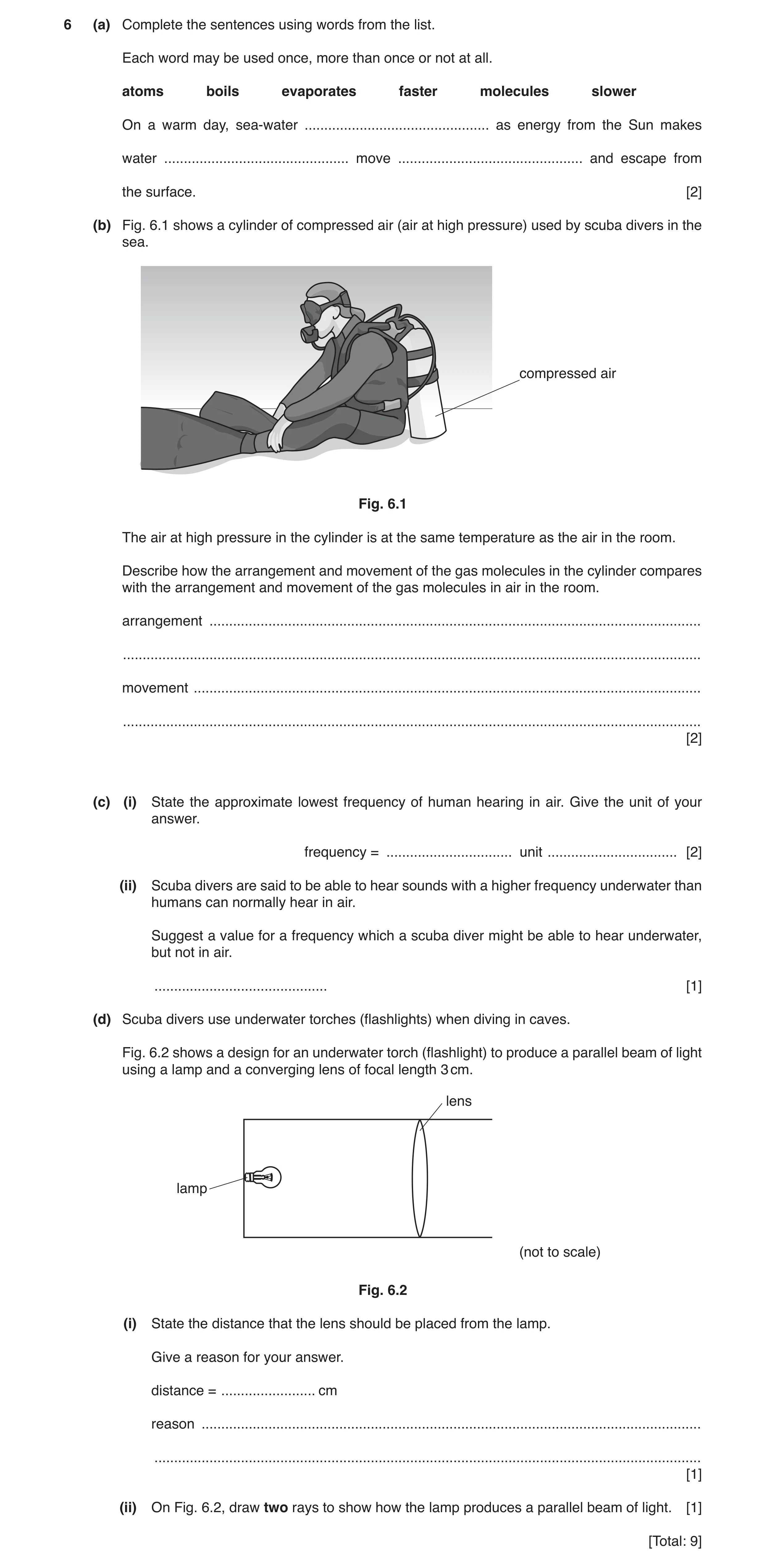
6 (a) Complete the sentences using words from the list. Each word may be used once, more than once or not at all. atoms boils evaporates faster molecules slower On a warm day, sea-water … as energy from the Sun makes water … move … and escape from the surface. [2] (b) Fig. 6.1 shows a cylinder of compressed air (air at high pressure) used by scuba divers in the sea. compressed air Fig. 6.1 The air at high pressure in the cylinder is at the same temperature as the air in the room. Describe how the arrangement and movement of the gas molecules in the cylinder compares with the arrangement and movement of the gas molecules in air in the room. arrangement … … movement … … [2] (c) (i) State the approximate lowest frequency of human hearing in air. Give the unit of your answer. frequency = … unit … [2] (ii) Scuba divers are said to be able to hear sounds with a higher frequency underwater than humans can normally hear in air. Suggest a value for a frequency which a scuba diver might be able to hear underwater, but not in air. … [1] (d) Scuba divers use underwater torches (flashlights) when diving in caves. Fig. 6.2 shows a design for an underwater torch (flashlight) to produce a parallel beam of light using a lamp and a converging lens of focal length 3 cm. lens lamp (not to scale) Fig. 6.2 (i) State the distance that the lens should be placed from the lamp. Give a reason for your answer. distance = … cm reason … … [1] (ii) On Fig. 6.2, draw two rays to show how the lamp produces a parallel beam of light. [1] [Total: 9]
9 marks
Mark scheme: 6(a) «evaporates« molecules « faster« ; ; any 2 correct for 1 mark all three correct for 2 marks 2 6(b) (molecules in the cylinder are) close together / less far apart ORA / random in both / arrangement irregular ; same speed (at same temperature) / both free to move around ; 2 6(c)(i) 20 ; Hz / hertz ; 2 6(c)(ii) any sensible value above 20 000 (Hz) ; 1 6(d)(i) (3 cm) no mark (to produce a parallel beam) must come from (principal) focus ; 1 6(d)(ii) ; 1
This question in 0653/33 May/June 2019
Q6 · An electric hair dryer 0653/32 Oct/Nov 2019
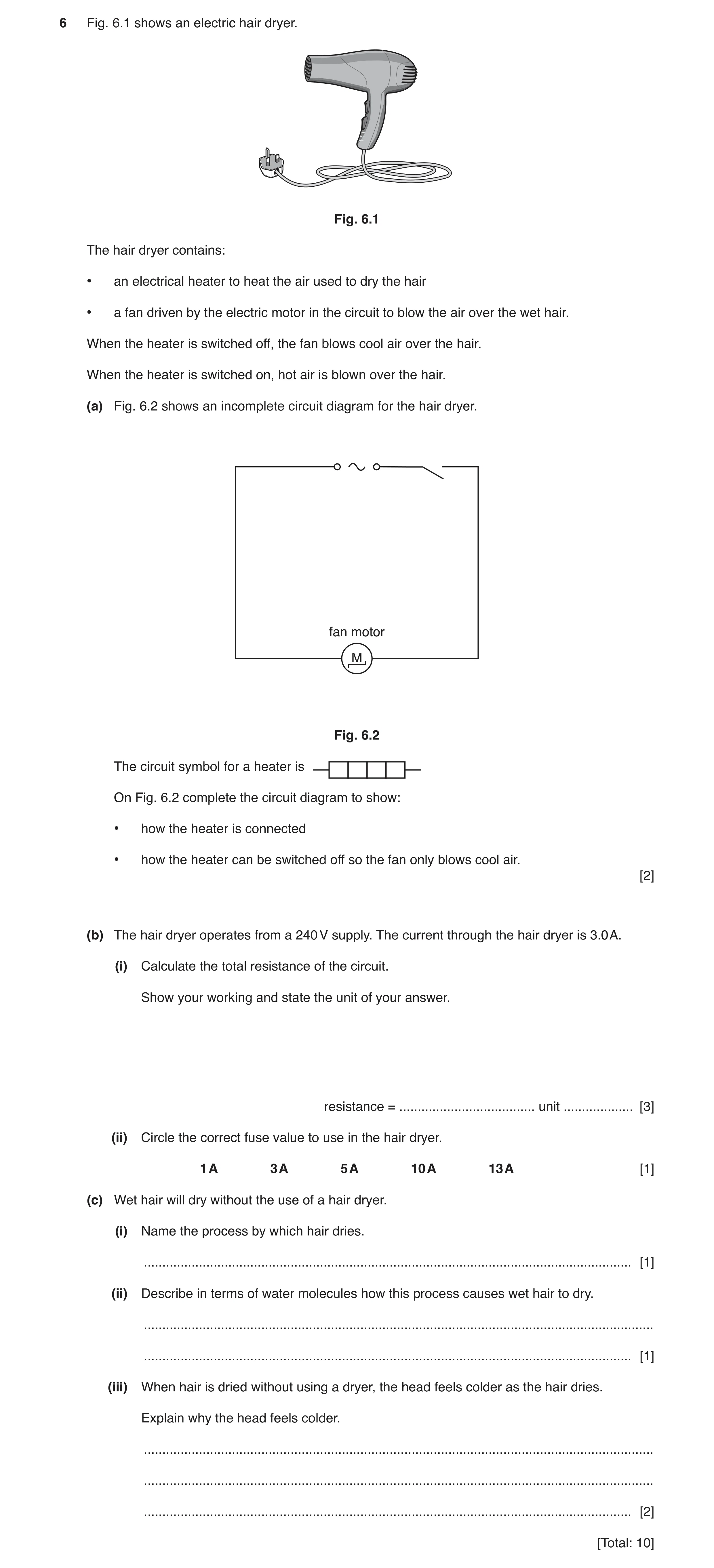
6 Fig. 6.1 shows an electric hair dryer. Fig. 6.1 The hair dryer contains: • an electrical heater to heat the air used to dry the hair • a fan driven by the electric motor in the circuit to blow the air over the wet hair. When the heater is switched off, the fan blows cool air over the hair. When the heater is switched on, hot air is blown over the hair. (a) Fig. 6.2 shows an incomplete circuit diagram for the hair dryer. fan motor M Fig. 6.2 The circuit symbol for a heater is On Fig. 6.2 complete the circuit diagram to show: • how the heater is connected • how the heater can be switched off so the fan only blows cool air. [2] (b) The hair dryer operates from a 240 V supply. The current through the hair dryer is 3.0 A. (i) Calculate the total resistance of the circuit. Show your working and state the unit of your answer. resistance = … unit … [3] (ii) Circle the correct fuse value to use in the hair dryer. 1 A 3 A 5 A 10 A 13 A [1] (c) Wet hair will dry without the use of a hair dryer. (i) Name the process by which hair dries. … [1] (ii) Describe in terms of water molecules how this process causes wet hair to dry. … … [1] (iii) When hair is dried without using a dryer, the head feels colder as the hair dries. Explain why the head feels colder. … … … [2] [Total: 10]
10 marks
Mark scheme: 6(a) 2 6(b)(i) use of R = V / I or R = 240 / 3 ; = 80 ; Ω / ohm(s) ; 3 6(b)(ii) 5 A ; 1 6(c)(i) evaporation ; 1 6(c)(ii) escape of faster (water) molecules ; 1 6(c)(iii) any two from: thermal energy transferred from body (to water molecules) ; remaining molecules slower (on average) ; slower molecules means lower temperature ; 2 heater inserted in a parallel branch ; second switch in series with heater in same branch ;
This question in 0653/32 Oct/Nov 2019
Q7 · An electric hair dryer 0653/33 Oct/Nov 2019
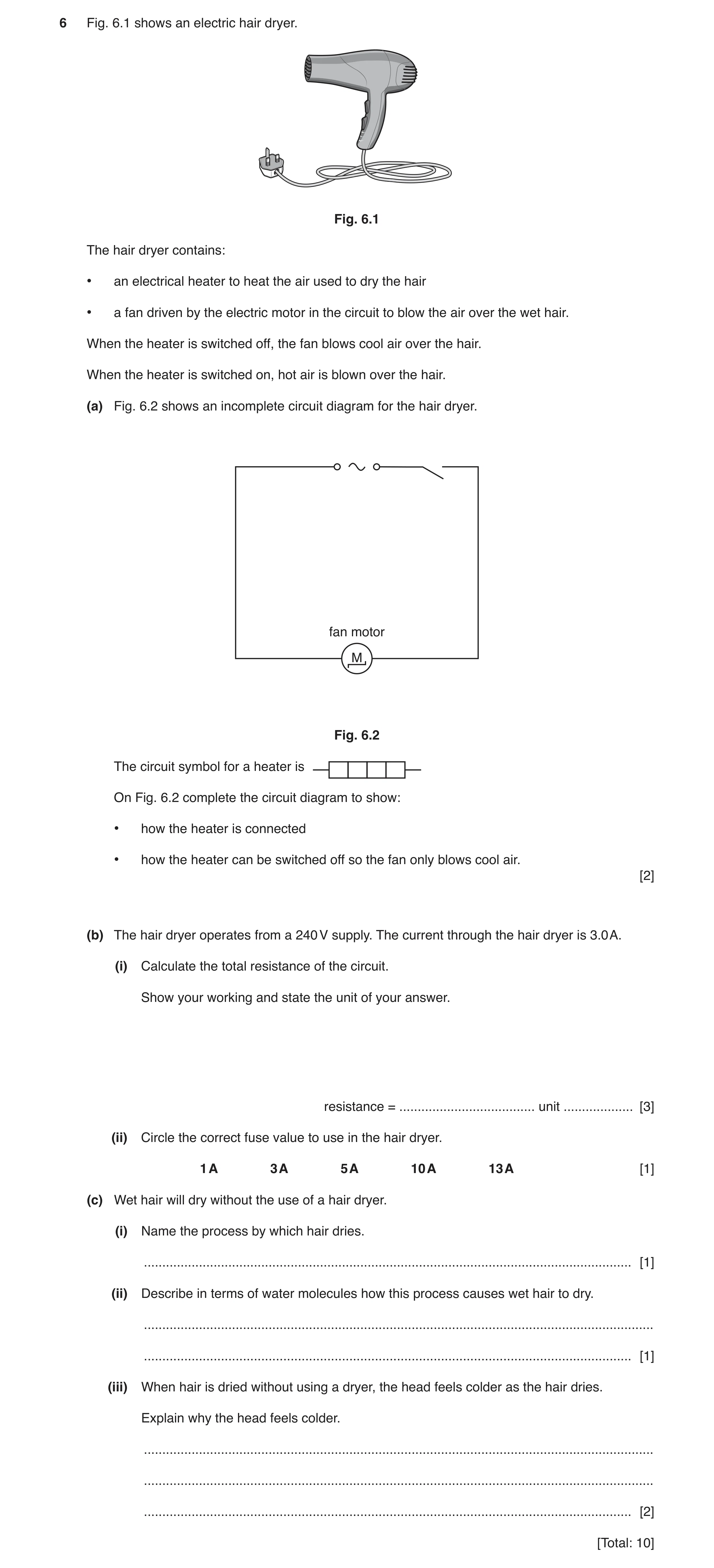
6 Fig. 6.1 shows an electric hair dryer. Fig. 6.1 The hair dryer contains: • an electrical heater to heat the air used to dry the hair • a fan driven by the electric motor in the circuit to blow the air over the wet hair. When the heater is switched off, the fan blows cool air over the hair. When the heater is switched on, hot air is blown over the hair. (a) Fig. 6.2 shows an incomplete circuit diagram for the hair dryer. fan motor M Fig. 6.2 The circuit symbol for a heater is On Fig. 6.2 complete the circuit diagram to show: • how the heater is connected • how the heater can be switched off so the fan only blows cool air. [2] (b) The hair dryer operates from a 240 V supply. The current through the hair dryer is 3.0 A. (i) Calculate the total resistance of the circuit. Show your working and state the unit of your answer. resistance = … unit … [3] (ii) Circle the correct fuse value to use in the hair dryer. 1 A 3 A 5 A 10 A 13 A [1] (c) Wet hair will dry without the use of a hair dryer. (i) Name the process by which hair dries. … [1] (ii) Describe in terms of water molecules how this process causes wet hair to dry. … … [1] (iii) When hair is dried without using a dryer, the head feels colder as the hair dries. Explain why the head feels colder. … … … [2] [Total: 10]
10 marks
Mark scheme: 6(a) 2 6(b)(i) use of R = V / I or R = 240 / 3 ; = 80 ; Ω / ohm(s) ; 3 6(b)(ii) 5 A ; 1 6(c)(i) evaporation ; 1 6(c)(ii) escape of faster (water) molecules ; 1 6(c)(iii) any two from: thermal energy transferred from body (to water molecules) ; remaining molecules slower (on average) ; slower molecules means lower temperature ; 2 heater inserted in a parallel branch ; second switch in series with heater in same branch ;
This question in 0653/33 Oct/Nov 2019
Q8 · Liquid (molten) iron being poured from a furnace into a mould to form a rectangular block… 0653/32 Feb/March 2020
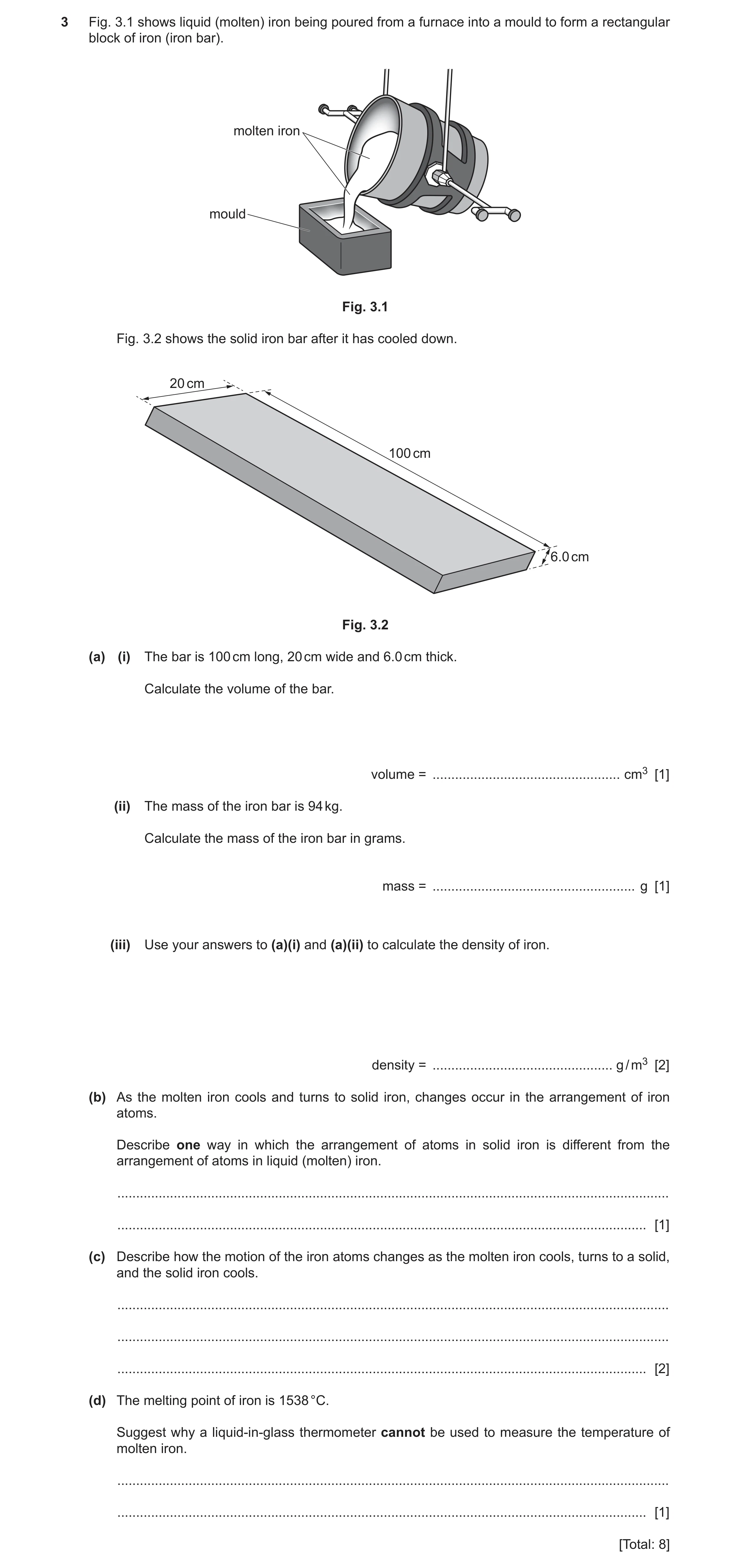
3 Fig. 3.1 shows liquid (molten) iron being poured from a furnace into a mould to form a rectangular block of iron (iron bar). molten iron mould Fig. 3.1 Fig. 3.2 shows the solid iron bar after it has cooled down. 20 cm 100 cm 6.0 cm Fig. 3.2 (a) (i) The bar is 100 cm long, 20 cm wide and 6.0 cm thick. Calculate the volume of the bar. volume = … cm3 [1] (ii) The mass of the iron bar is 94 kg. Calculate the mass of the iron bar in grams. mass = … g [1] (iii) Use your answers to (a)(i) and (a)(ii) to calculate the density of iron. density = … g / m3 [2] (b) As the molten iron cools and turns to solid iron, changes occur in the arrangement of iron atoms. Describe one way in which the arrangement of atoms in solid iron is different from the arrangement of atoms in liquid (molten) iron. … … [1] (c) Describe how the motion of the iron atoms changes as the molten iron cools, turns to a solid, and the solid iron cools. … … … [2] (d) The melting point of iron is 1538 °C. Suggest why a liquid-in-glass thermometer cannot be used to measure the temperature of molten iron. … … [1] [Total: 8]
8 marks
Mark scheme: 3(a)(i) (volume = 100 × 20 × 6.0 =) 12 000 (cm3) ; 1 3(a)(ii) 94 000 (g) ; 1 3(a)(iii) mass 94000 density = = ; volume 12000 = 7.8 (g / m3) ; 2 3(b) solid iron: more closely packed / liquid iron: further apart ; OR solid iron: regular arrangement / liquid iron: random arrangement ; 1 3(c) fast moving atoms in molten iron slow down as it cools ; atoms slow down again as solid iron cools ; 2 Question Answer Marks 3(d) glass would melt or break / mercury or liquid would boil ; 1
This question in 0653/32 Feb/March 2020
Q9 · A girl using a bicycle pump to add air to a bicycle tyre 0653/31 Oct/Nov 2020
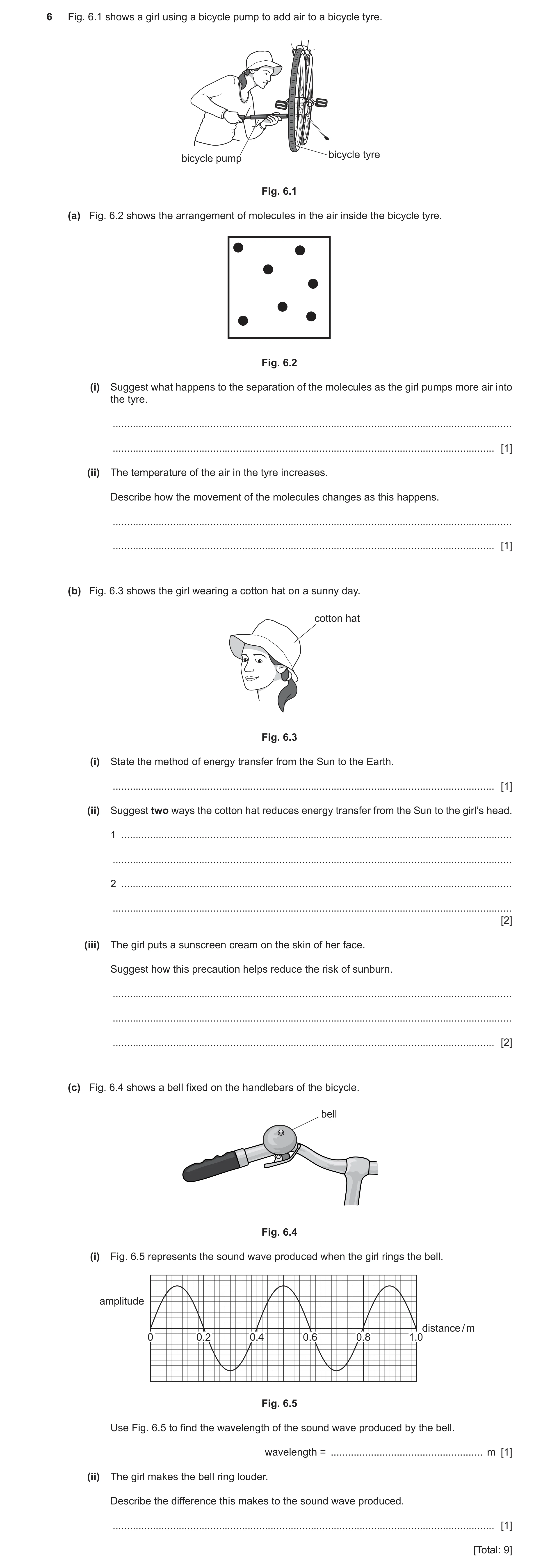
6 Fig. 6.1 shows a girl using a bicycle pump to add air to a bicycle tyre. bicycle tyre bicycle pump Fig. 6.1 (a) Fig. 6.2 shows the arrangement of molecules in the air inside the bicycle tyre. Fig. 6.2 (i) Suggest what happens to the separation of the molecules as the girl pumps more air into the tyre. … … [1] (ii) The temperature of the air in the tyre increases. Describe how the movement of the molecules changes as this happens. … … [1] (b) Fig. 6.3 shows the girl wearing a cotton hat on a sunny day. cotton hat Fig. 6.3 (i) State the method of energy transfer from the Sun to the Earth. … [1] (ii) Suggest two ways the cotton hat reduces energy transfer from the Sun to the girl’s head. 1 … … 2 … … [2] (iii) The girl puts a sunscreen cream on the skin of her face. Suggest how this precaution helps reduce the risk of sunburn. … … … [2] (c) Fig. 6.4 shows a bell fixed on the handlebars of the bicycle. bell Fig. 6.4 (i) Fig. 6.5 represents the sound wave produced when the girl rings the bell. amplitude distance / m 0 0.2 0.4 0.6 0.8 1.0 Fig. 6.5 Use Fig. 6.5 to find the wavelength of the sound wave produced by the bell. wavelength = … m [1] (ii) The girl makes the bell ring louder. Describe the difference this makes to the sound wave produced. … [1] [Total: 9]
9 marks
Mark scheme: 6(a)(i) (separation) decreases ; 1 6(a)(ii) (move) faster / speed up ; 1 6(b)(i) radiation ; 1 6(b)(ii) any two from: radiation reflected (off sun hat) ; cotton/hat is bad conductor / good insulator ; air (trapped) between hat and head is bad conductor / good insulator ; 2 6(b)(iii) ultraviolet / UV (radiation) (causes sunburn) ; (sunscreen,) filters out / reduces absorption (of UV) ; 2 6(c)(i) 0.4 (m) ; 1 6(c)(ii) larger amplitude / description of larger amplitude ; 1
This question in 0653/31 Oct/Nov 2020
Q10 · A device called a ‘solar still’ 0653/32 Oct/Nov 2020
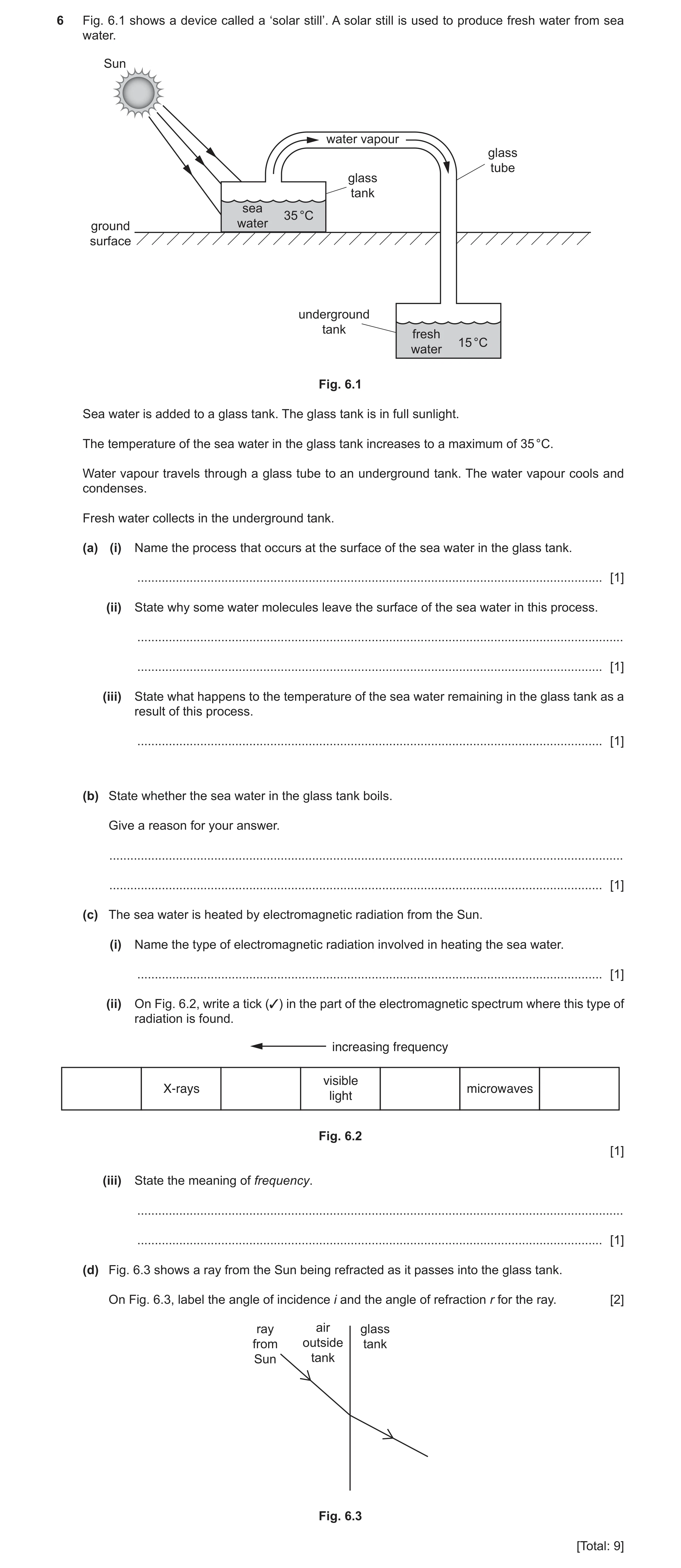
6 Fig. 6.1 shows a device called a ‘solar still’. A solar still is used to produce fresh water from sea water. Sun water vapour glass tube glass tank sea 35 °C ground water surface underground tank fresh 15 °C water Fig. 6.1 Sea water is added to a glass tank. The glass tank is in full sunlight. The temperature of the sea water in the glass tank increases to a maximum of 35 °C. Water vapour travels through a glass tube to an underground tank. The water vapour cools and condenses. Fresh water collects in the underground tank. (a) (i) Name the process that occurs at the surface of the sea water in the glass tank. … [1] (ii) State why some water molecules leave the surface of the sea water in this process. … … [1] (iii) State what happens to the temperature of the sea water remaining in the glass tank as a result of this process. … [1] (b) State whether the sea water in the glass tank boils. Give a reason for your answer. … … [1] (c) The sea water is heated by electromagnetic radiation from the Sun. (i) Name the type of electromagnetic radiation involved in heating the sea water. … [1] (ii) On Fig. 6.2, write a tick (3) in the part of the electromagnetic spectrum where this type of radiation is found. increasing frequency visible X-rays microwaves light Fig. 6.2 [1] (iii) State the meaning of frequency. … … [1] (d) Fig. 6.3 shows a ray from the Sun being refracted as it passes into the glass tank. On Fig. 6.3, label the angle of incidence i and the angle of refraction r for the ray. [2] ray air glass from outside tank Sun tank Fig. 6.3 [Total: 9]
9 marks
Mark scheme: 6(a)(i) evaporation ; 1 6(a)(ii) faster / more energetic molecules have enough energy to (break their bonds and) escape ; 1 6(a)(iii) (temperature) decreases / (sea water) cools down ; 1 Question Answer Marks 6(b) No AND (because) maximum temperature is below boiling point of (sea) water ; 1 6(c)(i) infrared ; 1 6(c)(ii) increasing frequency X-rays visible light microwaves ; 1 6(c)(iii) the number of complete waves per second / the number of waves that pass a fixed point in unit time ; 1 6(d) angle i correctly located ; angle r correctly located ; 2
This question in 0653/32 Oct/Nov 2020
Q11 · A flask containing gas being heated in a water-bath 0653/32 Feb/March 2021
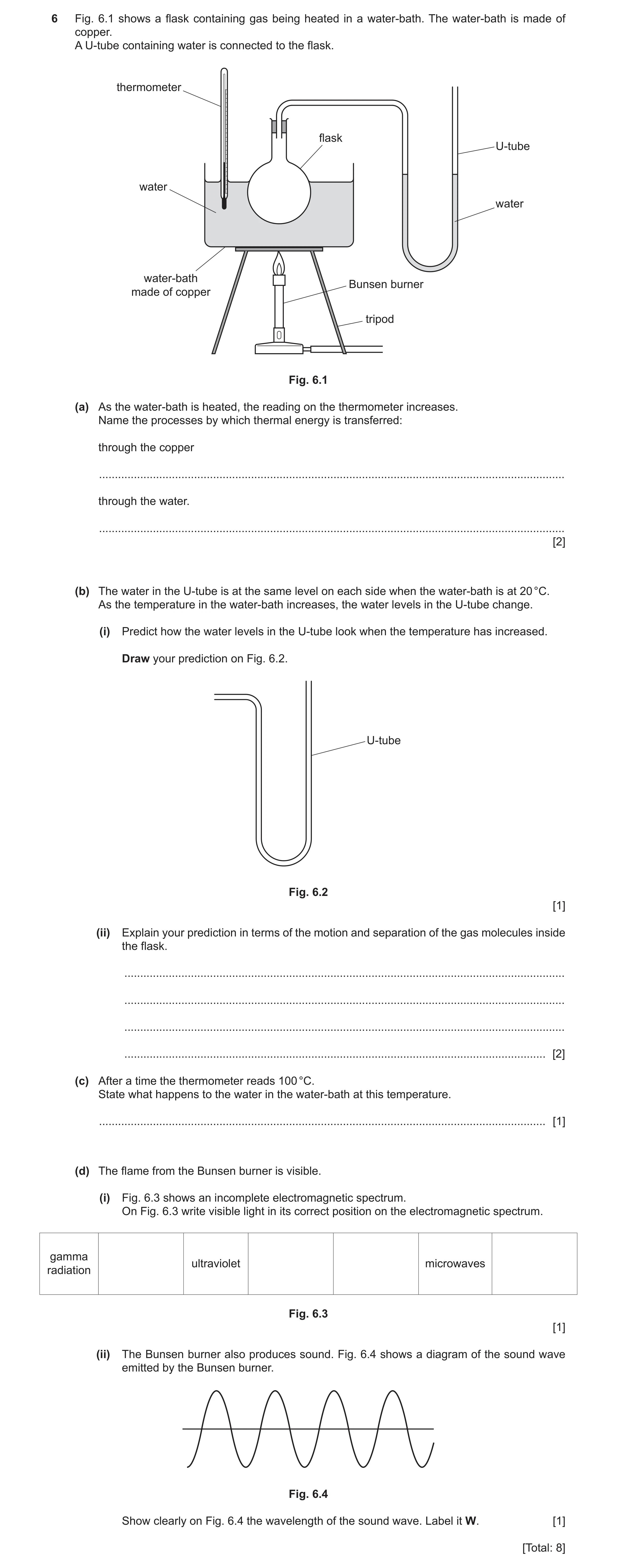
6 Fig. 6.1 shows a flask containing gas being heated in a water-bath. The water-bath is made of copper. A U-tube containing water is connected to the flask. thermometer flask U-tube water water water-bath Bunsen burner made of copper tripod Fig. 6.1 (a) As the water-bath is heated, the reading on the thermometer increases. Name the processes by which thermal energy is transferred: through the copper … through the water. … [2] (b) The water in the U-tube is at the same level on each side when the water-bath is at 20 °C. As the temperature in the water-bath increases, the water levels in the U-tube change. (i) Predict how the water levels in the U-tube look when the temperature has increased. Draw your prediction on Fig. 6.2. U-tube Fig. 6.2 [1] (ii) Explain your prediction in terms of the motion and separation of the gas molecules inside the flask. … … … … [2] (c) After a time the thermometer reads 100 °C. State what happens to the water in the water-bath at this temperature. … [1] (d) The flame from the Bunsen burner is visible. (i) Fig. 6.3 shows an incomplete electromagnetic spectrum. On Fig. 6.3 write visible light in its correct position on the electromagnetic spectrum. gamma ultraviolet microwavesradiation Fig. 6.3 [1] (ii) The Bunsen burner also produces sound. Fig. 6.4 shows a diagram of the sound wave emitted by the Bunsen burner. Fig. 6.4 Show clearly on Fig. 6.4 the wavelength of the sound wave. Label it W. [1] [Total: 8]
8 marks
Mark scheme: 6(a) conduction ; convection ; 2 6(b)(i) down in left side of U-tube / up in right side of U-tube ; 1 6(b)(ii) molecules move faster (as temperature increases) ; distance between molecules increases / volume increases ; 2 6(c) (it) boils ; 1 Question Answer Marks 6(d)(i) visible light in centre box (right of ultraviolet) ; 1 6(d)(ii) correct wavelength indicated on diagram ; 1
This question in 0653/32 Feb/March 2021
Q12 · A thermometer in a beaker of water 0653/32 Feb/March 2022
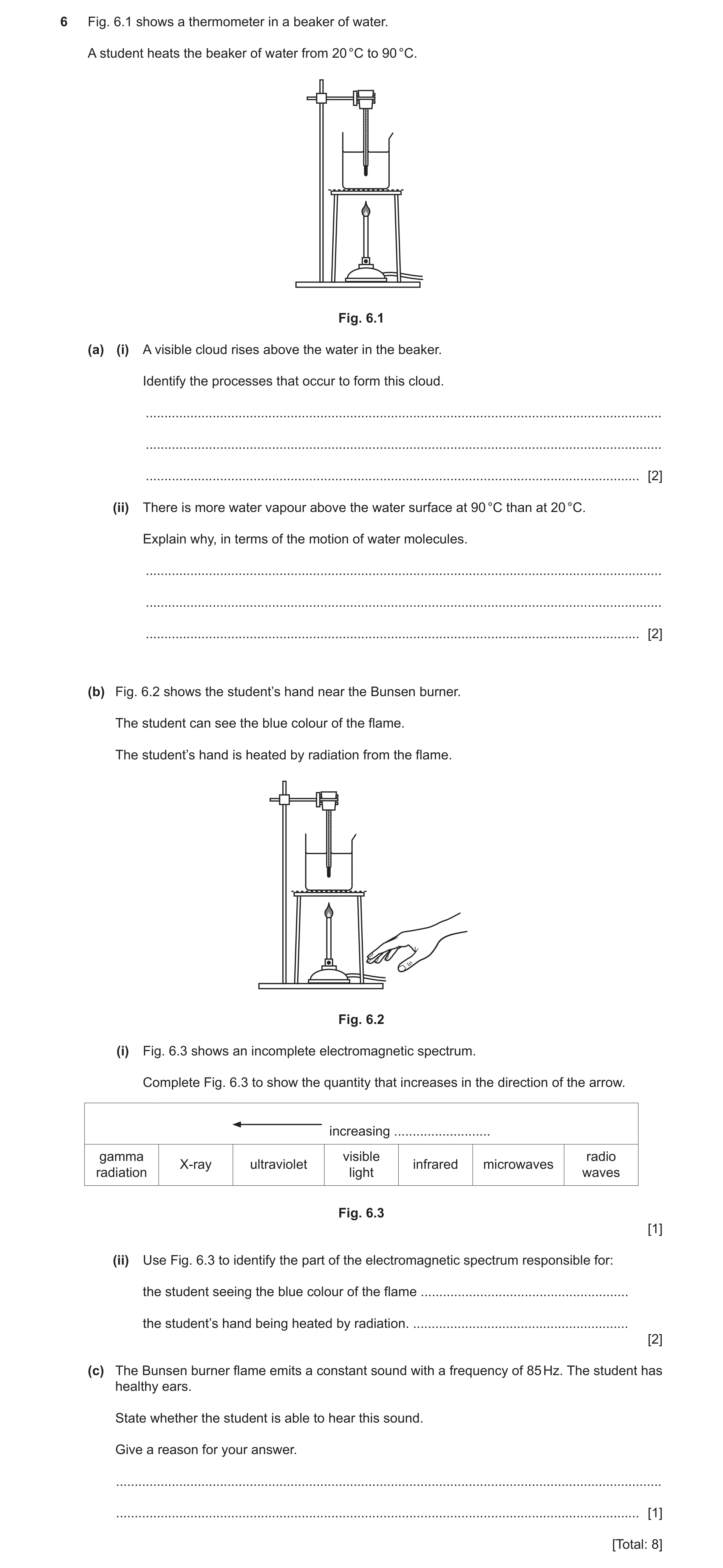
6 Fig. 6.1 shows a thermometer in a beaker of water. A student heats the beaker of water from 20 °C to 90 °C. Fig. 6.1 (a) (i) A visible cloud rises above the water in the beaker. Identify the processes that occur to form this cloud. … … … [2] (ii) There is more water vapour above the water surface at 90 °C than at 20 °C. Explain why, in terms of the motion of water molecules. … … … [2] (b) Fig. 6.2 shows the student’s hand near the Bunsen burner. The student can see the blue colour of the flame. The student’s hand is heated by radiation from the flame. Fig. 6.2 (i) Fig. 6.3 shows an incomplete electromagnetic spectrum. Complete Fig. 6.3 to show the quantity that increases in the direction of the arrow. increasing … gamma visible radio X-ray ultraviolet infrared microwaves radiation light waves Fig. 6.3 [1] (ii) Use Fig. 6.3 to identify the part of the electromagnetic spectrum responsible for: the student seeing the blue colour of the flame … the student’s hand being heated by radiation. … [2] (c) The Bunsen burner flame emits a constant sound with a frequency of 85 Hz. The student has healthy ears. State whether the student is able to hear this sound. Give a reason for your answer. … … [1] [Total: 8]
8 marks
Mark scheme: 6(a)(i) evaporation / water in beaker evaporates (from surface) ; condensation / water vapour condenses to form visible cloud ; 2 6(a)(ii) molecules moving faster / more energetic at 90 °C ; more (have sufficient energy to) escape ; 2 6(b)(i) frequency ; 1 6(b)(ii) visible light ; infrared (radiation) ; 2 6(c) (yes – no mark) frequency lies between 20 Hz and 20 kHz ; 1
This question in 0653/32 Feb/March 2022
Q13 · Electromagnetic waves transfer energy through space from the Sun to the Earth 0653/31 May/June 2022
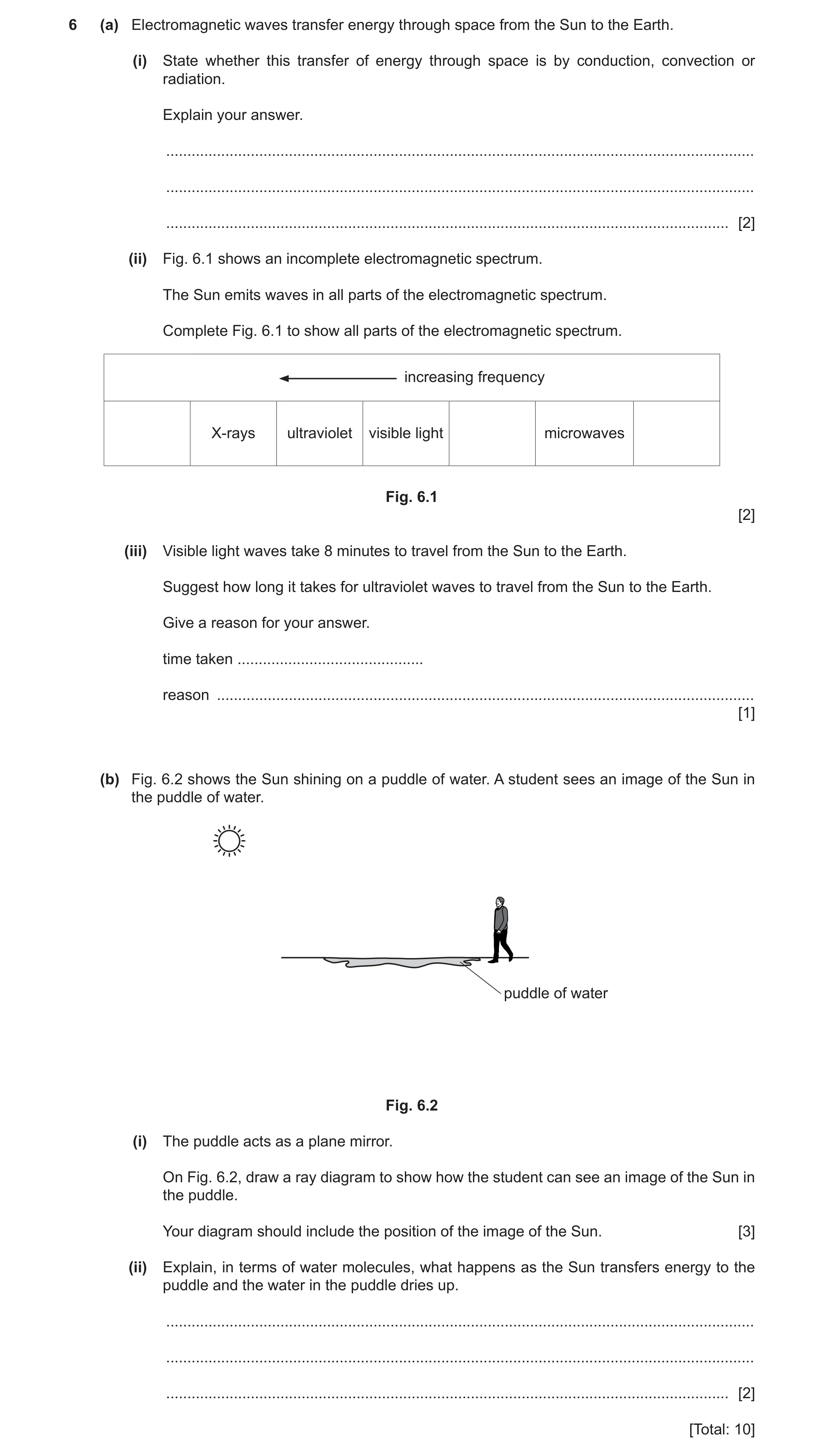
6 (a) Electromagnetic waves transfer energy through space from the Sun to the Earth. (i) State whether this transfer of energy through space is by conduction, convection or radiation. Explain your answer. … … … [2] (ii) Fig. 6.1 shows an incomplete electromagnetic spectrum. The Sun emits waves in all parts of the electromagnetic spectrum. Complete Fig. 6.1 to show all parts of the electromagnetic spectrum. increasing frequency X-rays ultraviolet visible light microwaves Fig. 6.1 [2] (iii) Visible light waves take 8 minutes to travel from the Sun to the Earth. Suggest how long it takes for ultraviolet waves to travel from the Sun to the Earth. Give a reason for your answer. time taken … reason … [1] (b) Fig. 6.2 shows the Sun shining on a puddle of water. A student sees an image of the Sun in the puddle of water. puddle of water Fig. 6.2 (i) The puddle acts as a plane mirror. On Fig. 6.2, draw a ray diagram to show how the student can see an image of the Sun in the puddle. Your diagram should include the position of the image of the Sun. [3] (ii) Explain, in terms of water molecules, what happens as the Sun transfers energy to the puddle and the water in the puddle dries up. … … … [2] [Total: 10]
10 marks
Mark scheme: 6(a)(i) radiation ; (explanation) only method to transfer without a medium / other methods require a (material) medium to travel / transmit / space is a vacuum ; 2 6(a)(ii) gamma (radiation) (X- rays) (ultra- violet) (visible light) infrared (radiation) (micro- waves) radio (waves) 1 or 2 correct ; 3 correct ; 2 6(a)(iii) 8 minutes AND all electromagnetic waves travel at same (high) speed (in vacuum / in air) ; 1 6(b)(i) solid line to show ray from Sun to puddle reflected to man’s eye/head ; angles of incidence and reflection equal (judged by eye) ; reflected ray extended back to show image in correct apparent location (judged by eye) ; 3 6(b)(ii) molecules (at surface) gain kinetic energy ; molecules gain enough energy to escape ; 2
This question in 0653/31 May/June 2022
Q14 · A student measures the melting point of some salty water and some pure water 0653/31 May/June 2023
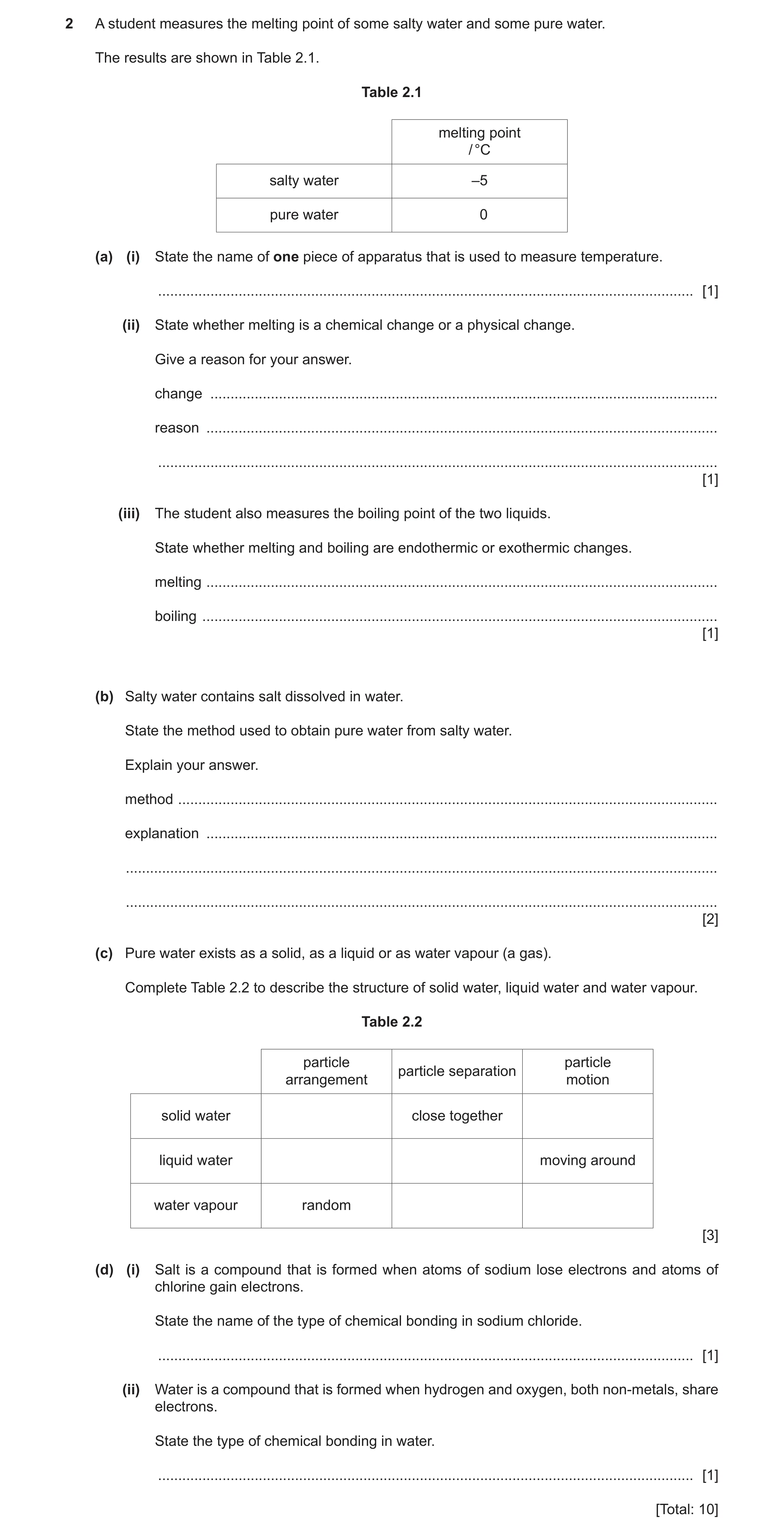
2 A student measures the melting point of some salty water and some pure water. The results are shown in Table 2.1. Table 2.1 melting point / °C salty water –5 pure water 0 (a) (i) State the name of one piece of apparatus that is used to measure temperature. … [1] (ii) State whether melting is a chemical change or a physical change. Give a reason for your answer. change … reason … … [1] (iii) The student also measures the boiling point of the two liquids. State whether melting and boiling are endothermic or exothermic changes. melting … boiling … [1] (b) Salty water contains salt dissolved in water. State the method used to obtain pure water from salty water. Explain your answer. method … explanation … … … [2] (c) Pure water exists as a solid, as a liquid or as water vapour (a gas). Complete Table 2.2 to describe the structure of solid water, liquid water and water vapour. Table 2.2 particle particle particle separation arrangement motion solid water close together liquid water moving around water vapour random [3] (d) (i) Salt is a compound that is formed when atoms of sodium lose electrons and atoms of chlorine gain electrons. State the name of the type of chemical bonding in sodium chloride. … [1] (ii) Water is a compound that is formed when hydrogen and oxygen, both non-metals, share electrons. State the type of chemical bonding in water. … [1] [Total: 10]
10 marks
Mark scheme: 2(a)(i) thermometer ; 1 2(a)(ii) (change) physical AND (reason) no new substance is made ; 1 2(a)(iii) (melting) endothermic AND (boiling) endothermic ; 1 2(b) (method) distillation ; (explanation) water evaporates and leaves the salt behind ; 2 Question Answer Marks 2(c) particle arrangement particle separation particle motion solid water regular / ordered close together vibrate / move about a fixed point liquid water random close together moving around water vapour random far apart / spread out moving rapidly ;;; 6 correct = 3 marks 3 – 5 correct = 2 marks 1 – 2 correct = 1 mark 3 2(d)(i) ionic ; 1 2(d)(ii) covalent ; 1
This question in 0653/31 May/June 2023
Q15 · Methane, CH4, is the main constituent of natural gas 0653/32 May/June 2023
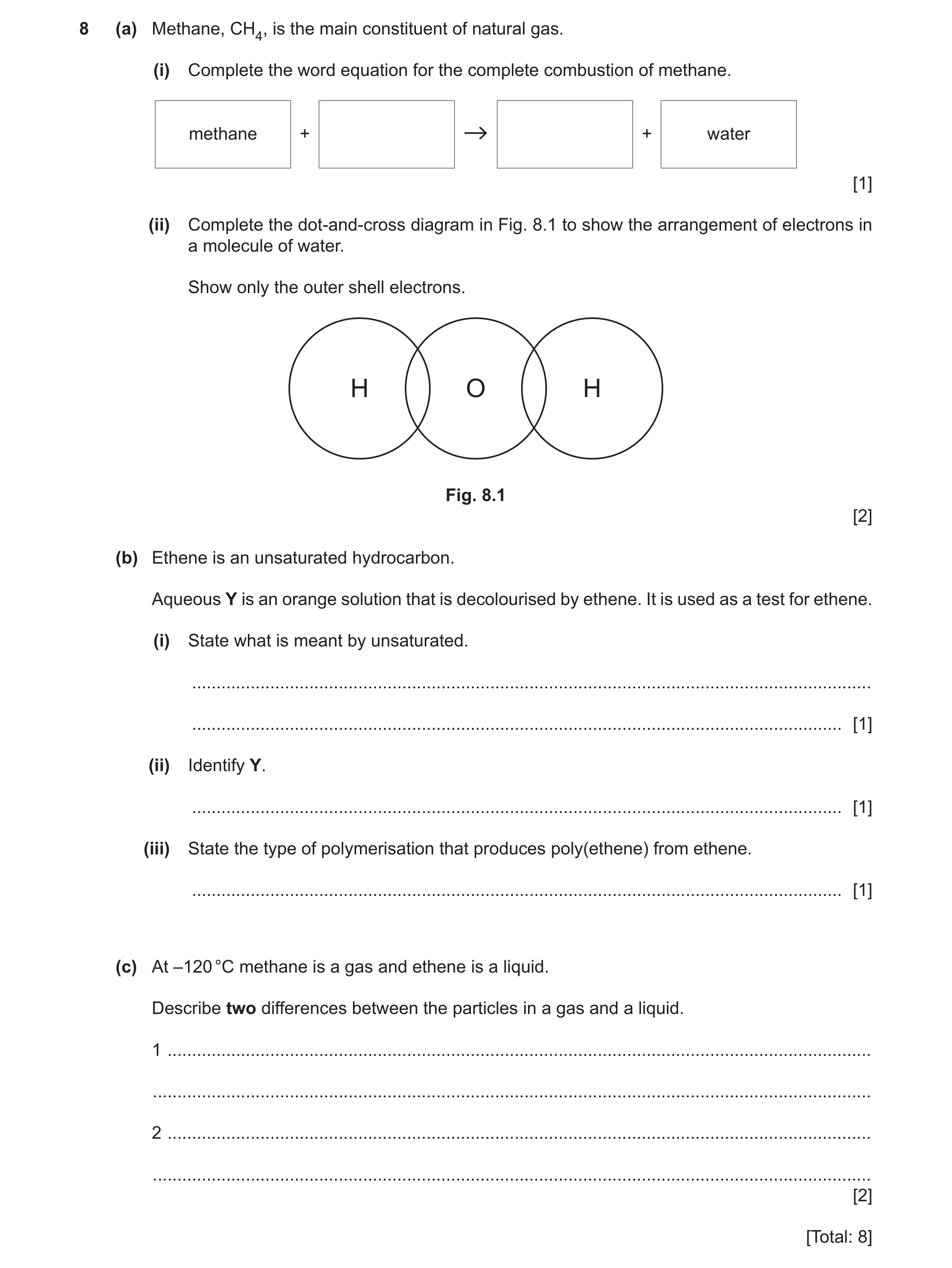
8 (a) Methane, CH4, is the main constituent of natural gas. (i) Complete the word equation for the complete combustion of methane. methane + + water [1] (ii) Complete the dot‑and‑cross diagram in Fig. 8.1 to show the arrangement of electrons in a molecule of water. Show only the outer shell electrons. H O H Fig. 8.1 [2] (b) Ethene is an unsaturated hydrocarbon. Aqueous Y is an orange solution that is decolourised by ethene. It is used as a test for ethene. (i) State what is meant by unsaturated. … … [1] (ii) Identify Y. … [1] (iii) State the type of polymerisation that produces poly(ethene) from ethene. … [1] (c) At –120 °C methane is a gas and ethene is a liquid. Describe two differences between the particles in a gas and a liquid. 1 … … 2 … … [2] [Total: 8]
8 marks
Mark scheme: 8(a)(i) methane + oxygen carbon dioxide + water ; 1 8(a)(ii) both correct bonding pairs ; molecule fully correct, i.e. four additional electrons on O and no extra electrons ; 2 8(b)(i) contains a double bond ; 1 8(b)(ii) (aqueous) bromine / Br2 ; 1 8(b)(iii) addition ; 1 8(c) any two from: separation: gas particles are, far apart / separated / not touching / spread out / liquid particles are, close together / touching / not spread out / not separated ; movement: gas particles, move fast(er) / move freely / move in all directions / move randomly / liquid particles, move (more) slowly / move over each other ; forces: gas particles have, no / weak forces of attraction between particles / liquids particles have stronger forces of attraction ; 2
This question in 0653/32 May/June 2023
Q16 · An aluminium pan containing water, being heated on a hotplate of a cooker 0653/31 May/June 2024
3 Fig. 3.1 shows an aluminium pan containing water, being heated on a hotplate of a cooker. There is a glass lid on the pan and a thermometer dips into the water. glass lid thermometer water droplets on underside of glass lid aluminium pan hotplate of cooker Fig. 3.1 (a) The thermometer reads 60 °C. Water droplets can be seen condensing on the underside of the glass lid. (i) State the process that forms water vapour at 60 °C. … [1] (ii) State the process that happens when the temperature of the water reaches 100 °C. … [1] (b) (i) State the process that transfers thermal energy from the cooker to the water through the aluminium pan. … [1] (ii) Another pan on the cooker has the same shape but is made of glass. The pan contains the same volume of water as the aluminium pan, has a lid and is heated on an identical hotplate. Explain why the water in the glass pan takes a longer time to reach 100 °C. … … [1] (c) A thermometer is placed in another pan of water. Fig. 3.2 shows what an observer sees when viewing the pan from the side. Fig. 3.2 State the property of light that makes the thermometer appear bent. … [1] (d) A person reads the thermometer when it is reflected in a plane mirror. Fig. 3.3 shows a ray of light from the thermometer reading to the mirror. The normal at the mirror is also shown. thermometer mirror Fig. 3.3 (i) On Fig. 3.3, complete the ray diagram to show the ray of light reflected by the mirror. Draw an X in a correct place for an eye to see the reflection of the thermometer reading. [2] (ii) The thermometer reading on the scale is 30 °C as shown in Fig. 3.4. Complete the right-hand box in Fig. 3.4 to show the image of the reading as seen reflected in the mirror. 30 Fig. 3.4 [1] (e) Visible light is part of the electromagnetic spectrum. State one part of the electromagnetic spectrum with a higher frequency than visible light. … [1] (f) Microwaves are part of the electromagnetic spectrum. State one use of microwaves. … [1] [Total: 10]
10 marks
Mark scheme: 3(a)(i) evaporation ; 1 3(a)(ii) boiling ; 1 3(b)(i) conduction ; 1 3(b)(ii) glass is a poor (thermal) conductor ; 1 3(c) refraction ; 1 Question Answer Marks 3(d)(i) angle of reflection equal to angle of incidence judged by inspection ; centre of X drawn reflected ray ; 2 3(d)(ii) ; 1 3(e) ultraviolet / X-ray / gamma (ray) ; 1 3(f) mobile phone signals / cooking / satellite TV / radar ; 1 0ɛ
This question in 0653/31 May/June 2024
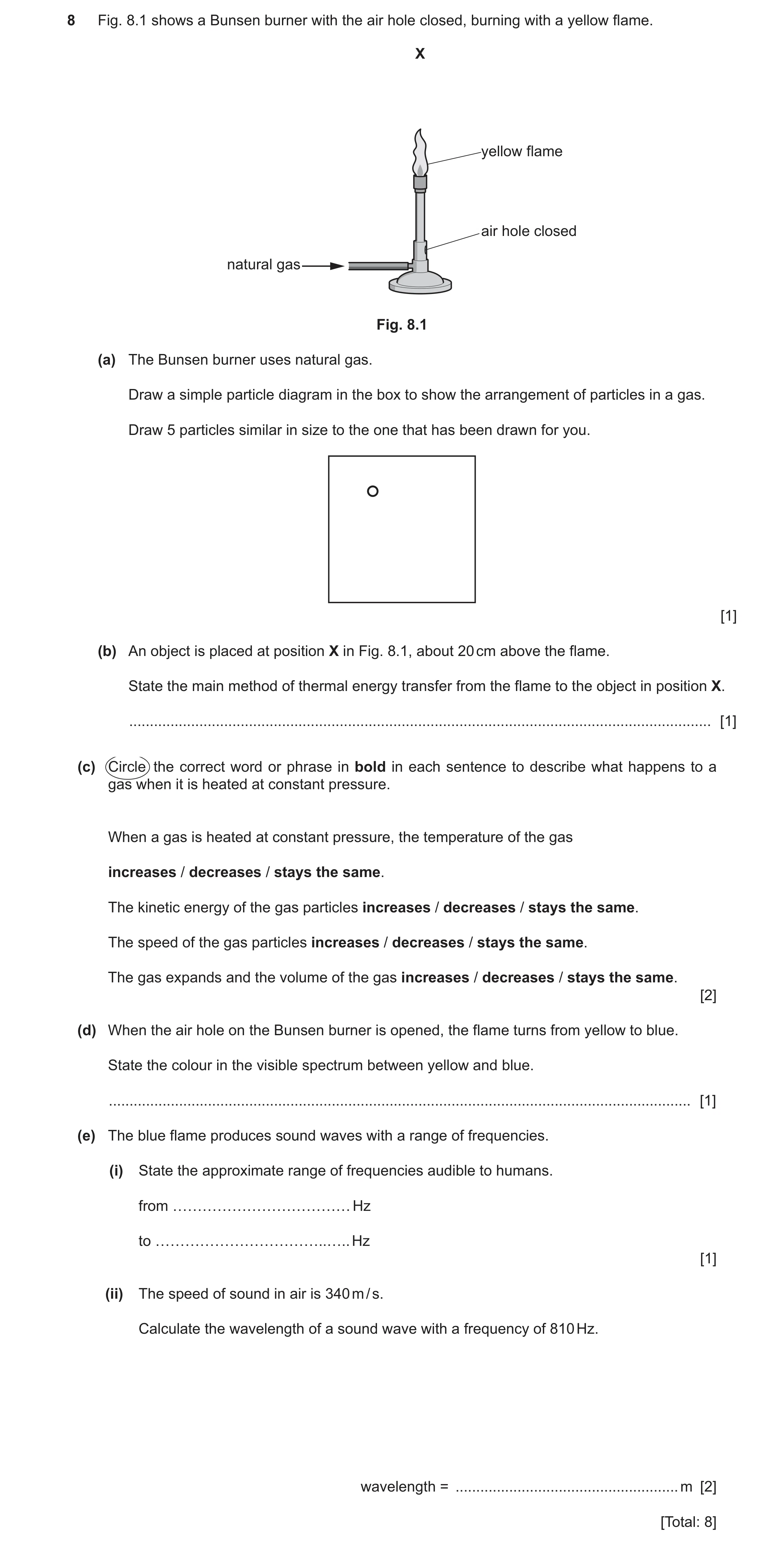
Q17 · A Bunsen burner with the air hole closed, burning with a yellow flame 0653/33 May/June 2025
8 Fig. 8.1 shows a Bunsen burner with the air hole closed, burning with a yellow flame. X yellow flame air hole closed natural gas Fig. 8.1 (a) The Bunsen burner uses natural gas. Draw a simple particle diagram in the box to show the arrangement of particles in a gas. Draw 5 particles similar in size to the one that has been drawn for you. [1] (b) An object is placed at position X in Fig. 8.1, about 20 cm above the flame. State the main method of thermal energy transfer from the flame to the object in position X. … [1] (c) Circle the correct word or phrase in bold in each sentence to describe what happens to a gas when it is heated at constant pressure. When a gas is heated at constant pressure, the temperature of the gas increases / decreases / stays the same. The kinetic energy of the gas particles increases / decreases / stays the same. The speed of the gas particles increases / decreases / stays the same. The gas expands and the volume of the gas increases / decreases / stays the same. [2] (d) When the air hole on the Bunsen burner is opened, the flame turns from yellow to blue. State the colour in the visible spectrum between yellow and blue. … [1] (e) The blue flame produces sound waves with a range of frequencies. (i) State the approximate range of frequencies audible to humans. from ……………………………… Hz to ……………………………..….. Hz [1] (ii) The speed of sound in air is 340 m / s. Calculate the wavelength of a sound wave with a frequency of 810 Hz. wavelength = … m [2] [Total: 8]
8 marks
Mark scheme: 8(a) 5 additional particles shown in an irregular arrangement AND clearly separated ; 1 8(b) convection ; 1 8(c) When a gas is heated at constant pressure, the temperature of the gas 2 increases / decreases / stays the same. The kinetic energy of the gas particles increases / decreases / stays the same. The speed of the gas particles increases / decreases/stays the same. The gas expands and the volume of the gas increases / decreases / stays the same. ;; any two correct = 1 mark all four correct = 2 marks 8(d) green ; 1 8(e)(i) from 20 to 20 000 (Hz) ; 1 8(e)(ii) λ= v ÷ f / wavelength = speed ÷ frequency / λ= 340 ÷ 810 ; 2 0.41975 / 0.42 (m) ;
This question in 0653/33 May/June 2025
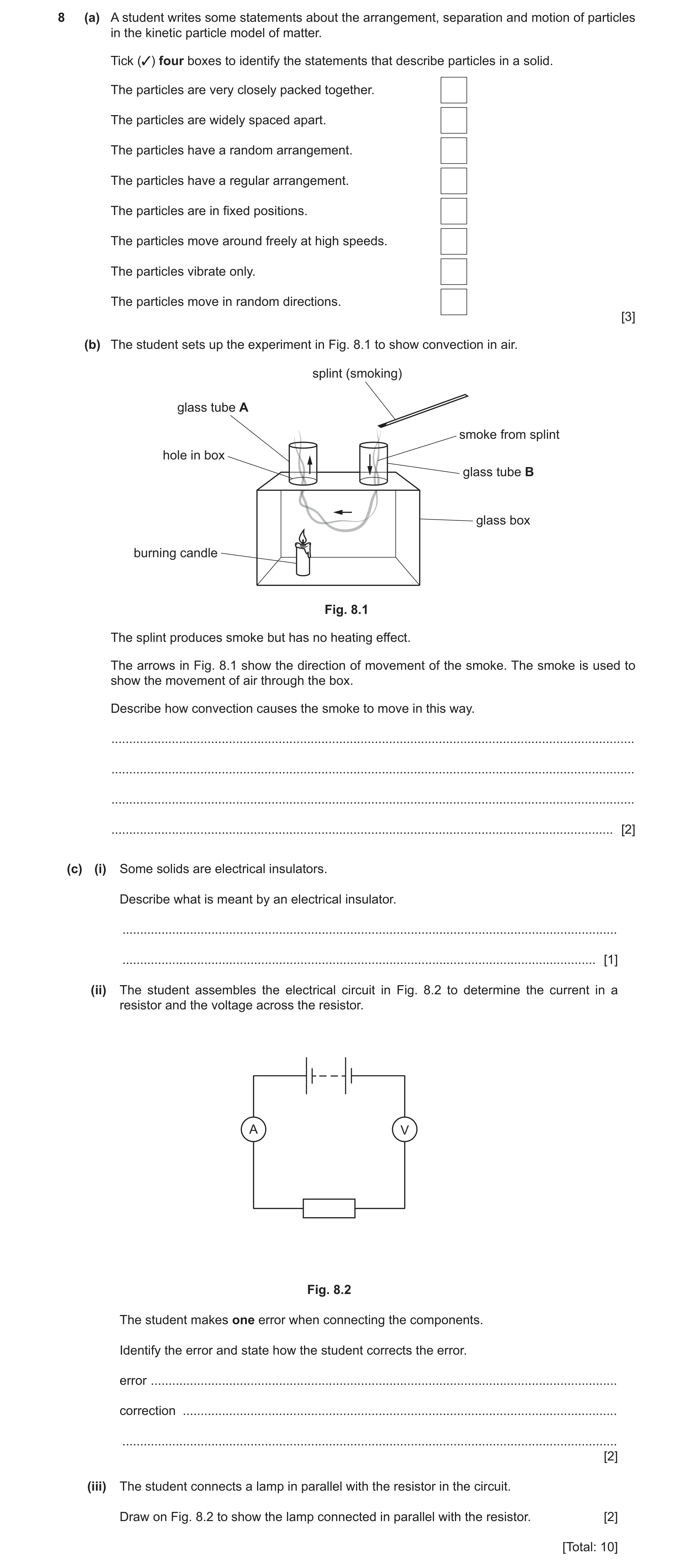
Q18 · A student writes some statements about the arrangement, separation and motion of… 0653/31 Oct/Nov 2025
8 (a) A student writes some statements about the arrangement, separation and motion of particles in the kinetic particle model of matter. Tick (✓) four boxes to identify the statements that describe particles in a solid. The particles are very closely packed together. The particles are widely spaced apart. The particles have a random arrangement. The particles have a regular arrangement. The particles are in fixed positions. The particles move around freely at high speeds. The particles vibrate only. The particles move in random directions. [3] (b) The student sets up the experiment in Fig. 8.1 to show convection in air. splint (smoking) glass tube A smoke from splint hole in box glass tube B glass box burning candle Fig. 8.1 The splint produces smoke but has no heating effect. The arrows in Fig. 8.1 show the direction of movement of the smoke. The smoke is used to show the movement of air through the box. Describe how convection causes the smoke to move in this way. … … … … [2] (c) (i) Some solids are electrical insulators. Describe what is meant by an electrical insulator. … … [1] (ii) The student assembles the electrical circuit in Fig. 8.2 to determine the current in a resistor and the voltage across the resistor. A V Fig. 8.2 The student makes one error when connecting the components. Identify the error and state how the student corrects the error. error … correction … … [2] (iii) The student connects a lamp in parallel with the resistor in the circuit. Draw on Fig. 8.2 to show the lamp connected in parallel with the resistor. [2] [Total: 10]
10 marks
Mark scheme: 8(a) The particles are very closely packed together. 3 The particles have a regular arrangement. The particles are in fixed positions. The particles vibrate only. 1 correct = 1 mark; 2 correct or 3 correct = 2 marks ; 4 correct = 3 marks ; 8(b) any two from: 2 (burning candle) warms the air (above it) ; the warm(er) air / smoke rises ; the cold(er) air / smoke sinks ; convection current set up ; 8(c)(i) idea that, does not allow charge / current to flow / pass ; 1 8(c)(ii) error voltmeter position / connection (is in series) ; 2 correction connect voltmeter in parallel (with the resistor) ; 8(c)(iii) correct symbol for lamp ; 2 connected in parallel across resistor ;
This question in 0653/31 Oct/Nov 2025
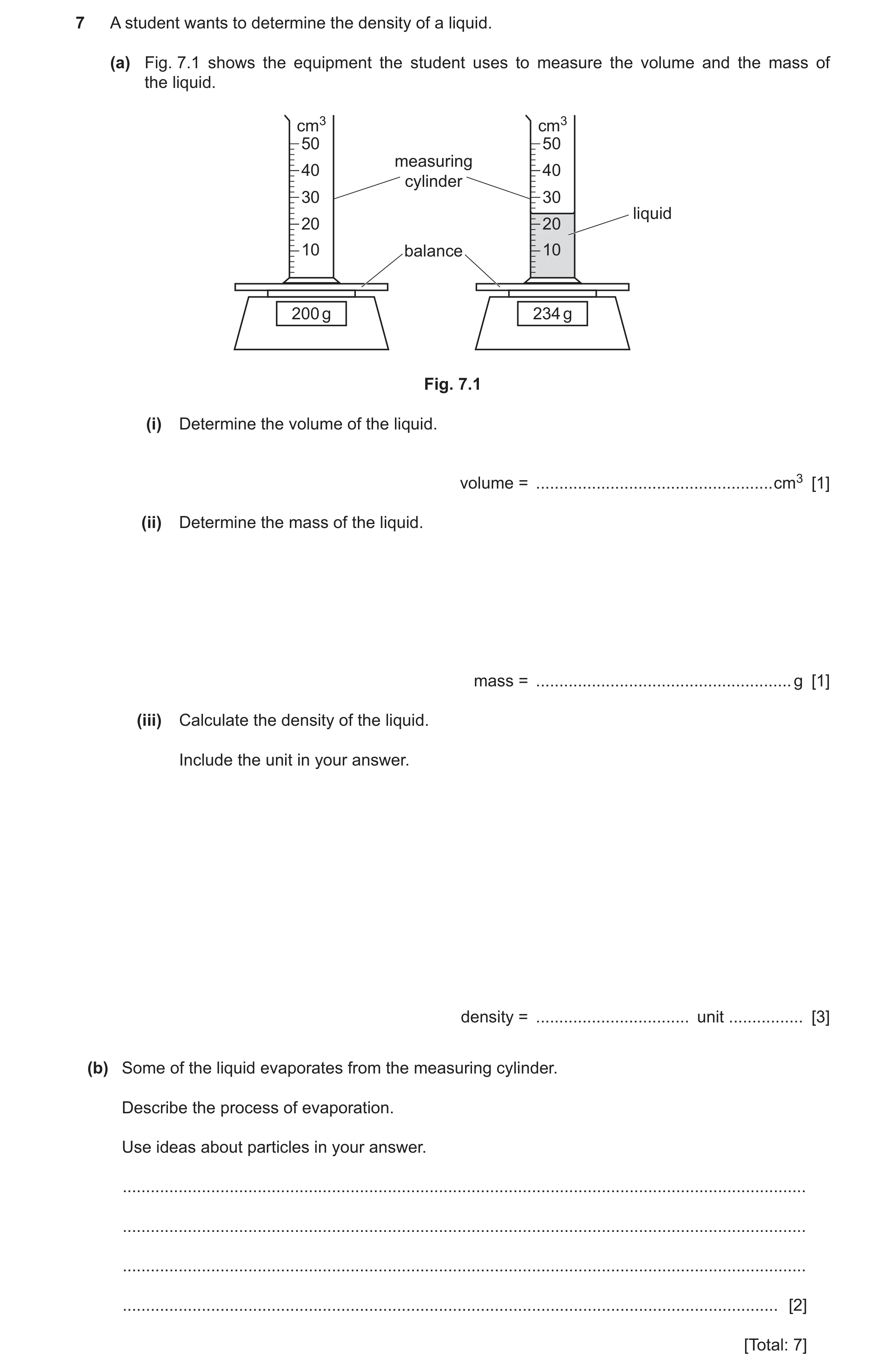
Q19 · A student wants to determine the density of a liquid 0653/32 Oct/Nov 2025
7 A student wants to determine the density of a liquid. (a) Fig. 7.1 shows the equipment the student uses to measure the volume and the mass of the liquid. cm3 cm3 50 50 measuring 40 40 cylinder 30 30 liquid 20 20 10 balance 10 200 g 234 g Fig. 7.1 (i) Determine the volume of the liquid. volume = … cm3 [1] (ii) Determine the mass of the liquid. mass = … g [1] (iii) Calculate the density of the liquid. Include the unit in your answer. density = … unit … [3] (b) Some of the liquid evaporates from the measuring cylinder. Describe the process of evaporation. Use ideas about particles in your answer. … … … … [2] [Total: 7]
7 marks
Mark scheme: 7(a)(i) 24 (.0) (cm3) ; 1 7(a)(ii) (234 – 200 =) 34 (g) ; 1 7(a)(iii) density = mass ÷ volume / 34 ÷ 24 ; 3 1.4 ; g / cm3 ; 7(b) the (more) energetic particles escape / fast(er) particles escape / particles with more (kinetic) energy escape ; 2 from the surface (of the liquid) ;
This question in 0653/32 Oct/Nov 2025
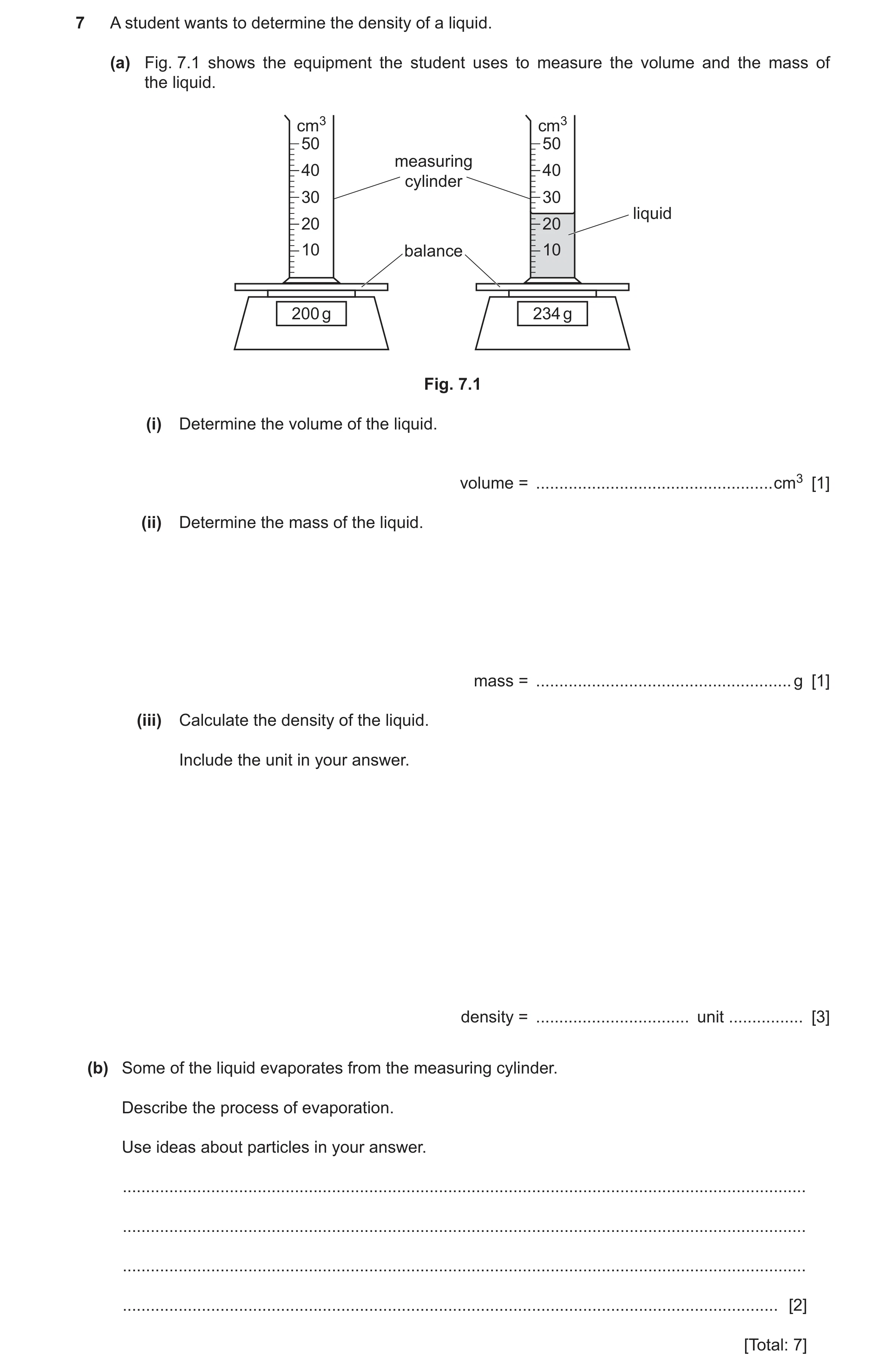
Q20 · A student wants to determine the density of a liquid 0653/33 Oct/Nov 2025
7 A student wants to determine the density of a liquid. (a) Fig. 7.1 shows the equipment the student uses to measure the volume and the mass of the liquid. cm3 cm3 50 50 measuring 40 40 cylinder 30 30 liquid 20 20 10 balance 10 200 g 234 g Fig. 7.1 (i) Determine the volume of the liquid. volume = … cm3 [1] (ii) Determine the mass of the liquid. mass = … g [1] (iii) Calculate the density of the liquid. Include the unit in your answer. density = … unit … [3] (b) Some of the liquid evaporates from the measuring cylinder. Describe the process of evaporation. Use ideas about particles in your answer. … … … … [2] [Total: 7]
7 marks
Mark scheme: 7(a)(i) 24 (.0) (cm3) ; 1 7(a)(ii) (234 – 200 =) 34 (g) ; 1 7(a)(iii) density = mass ÷ volume / 34 ÷ 24 ; 3 1.4 ; g / cm3 ; 7(b) the (more) energetic particles escape / fast(er) particles escape / particles with more (kinetic) energy escape ; 2 from the surface (of the liquid) ;
This question in 0653/33 Oct/Nov 2025
 25 / 34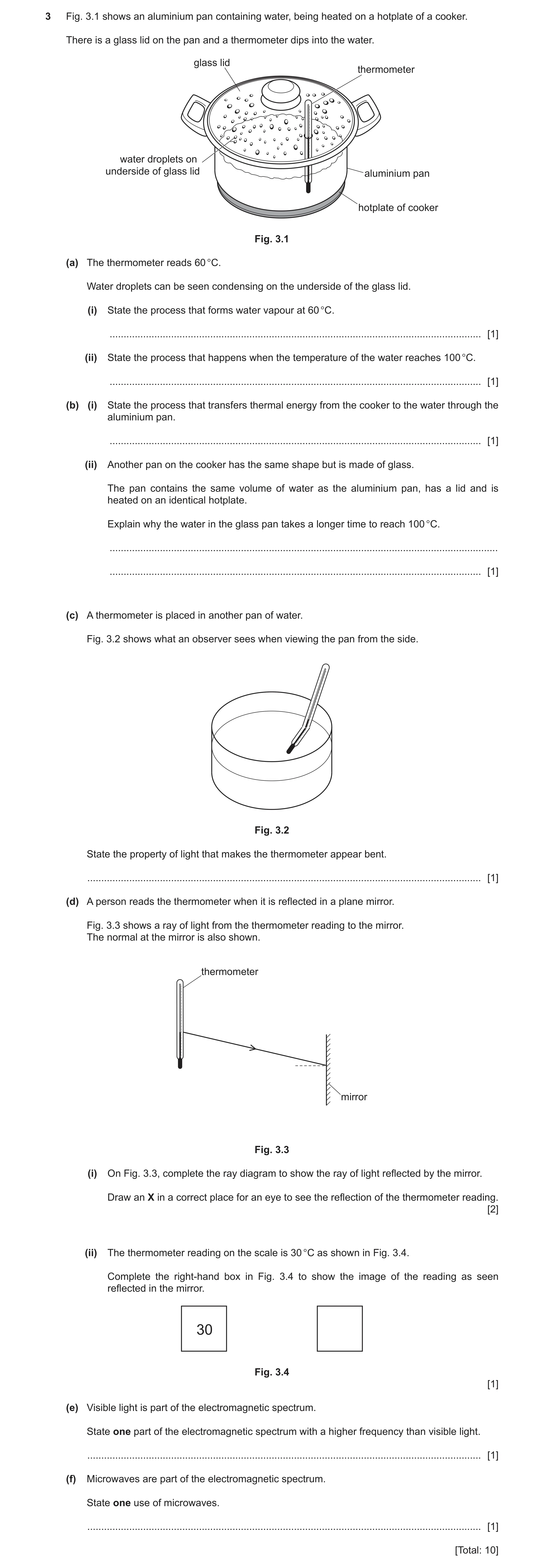
 10
10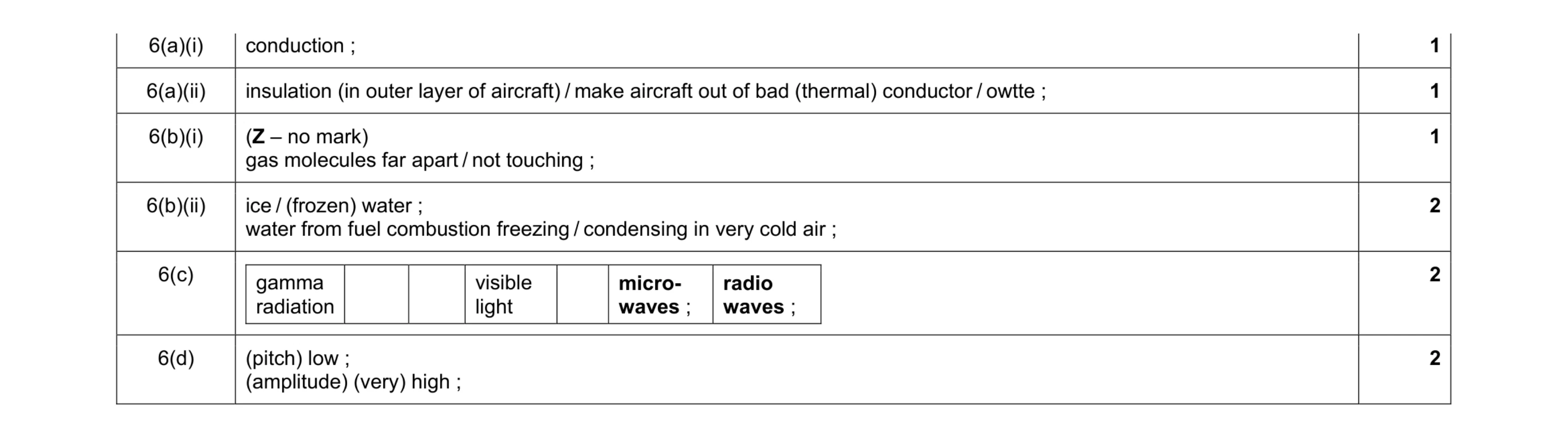 9
9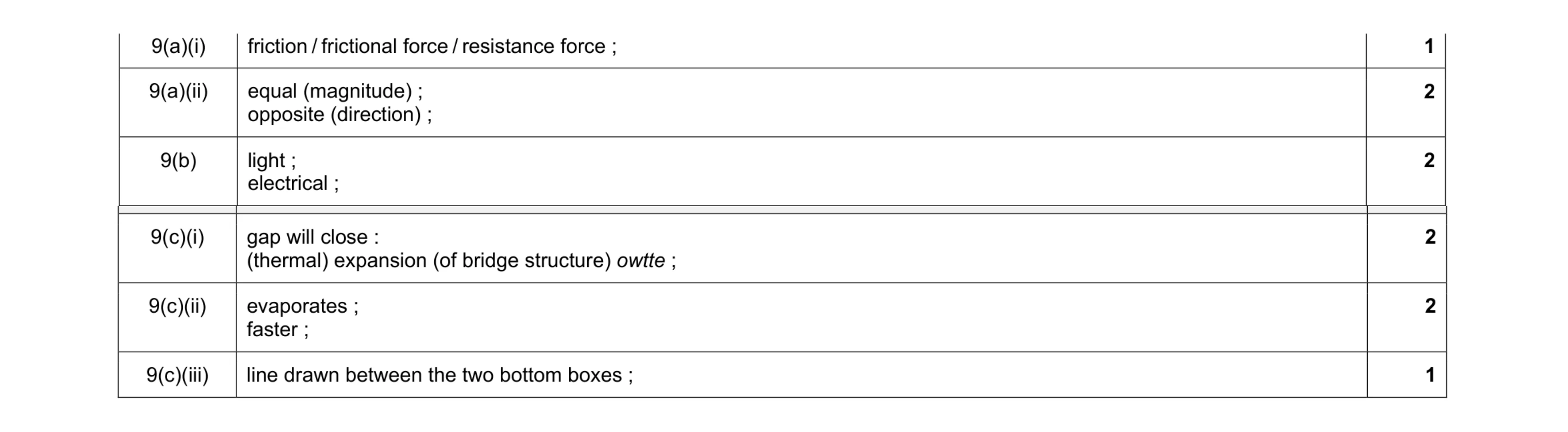 10
10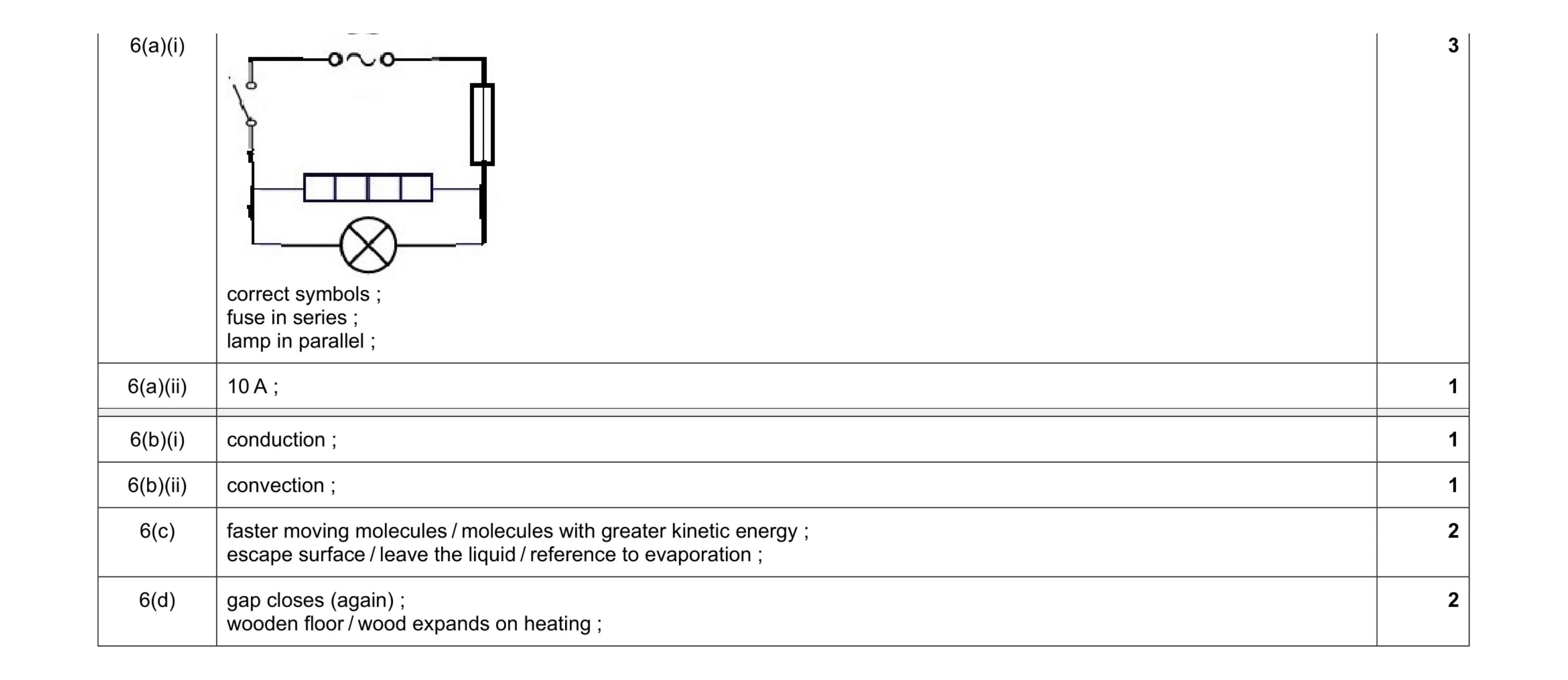 10
10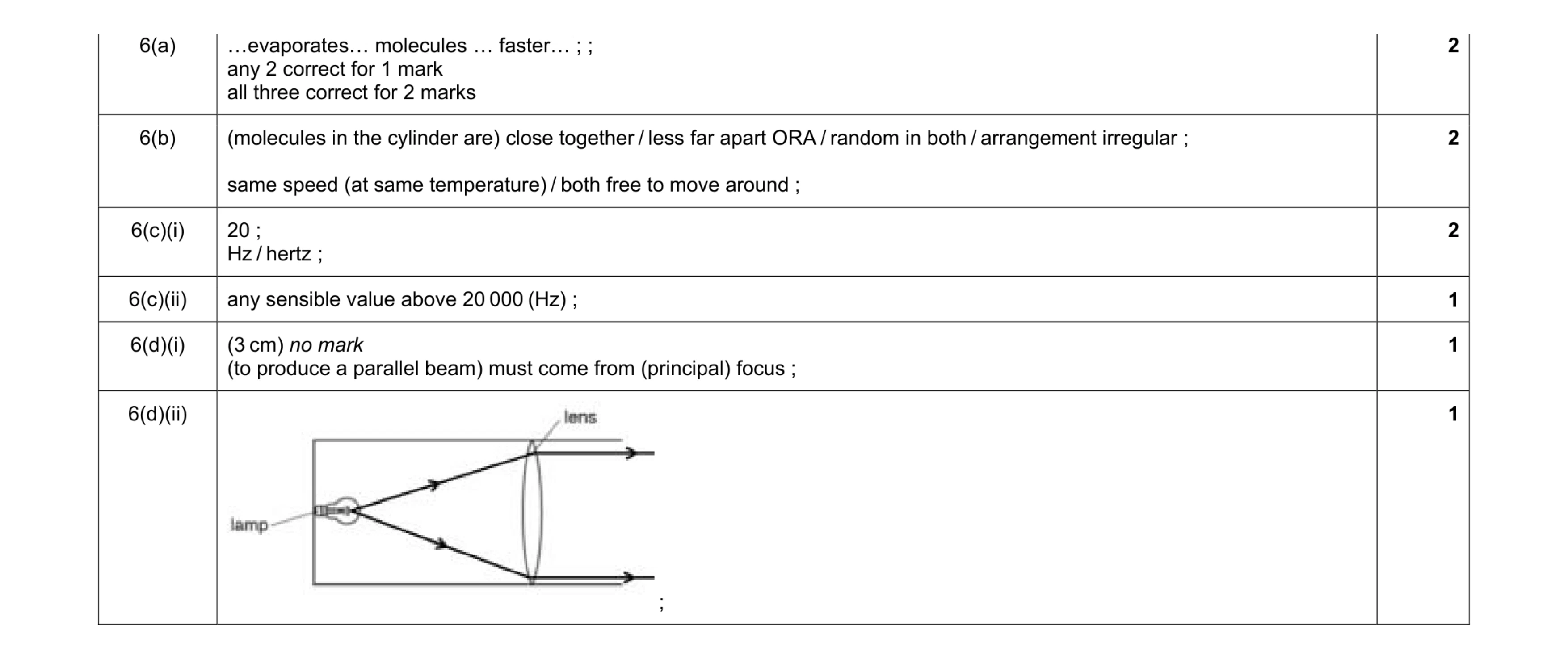 9
9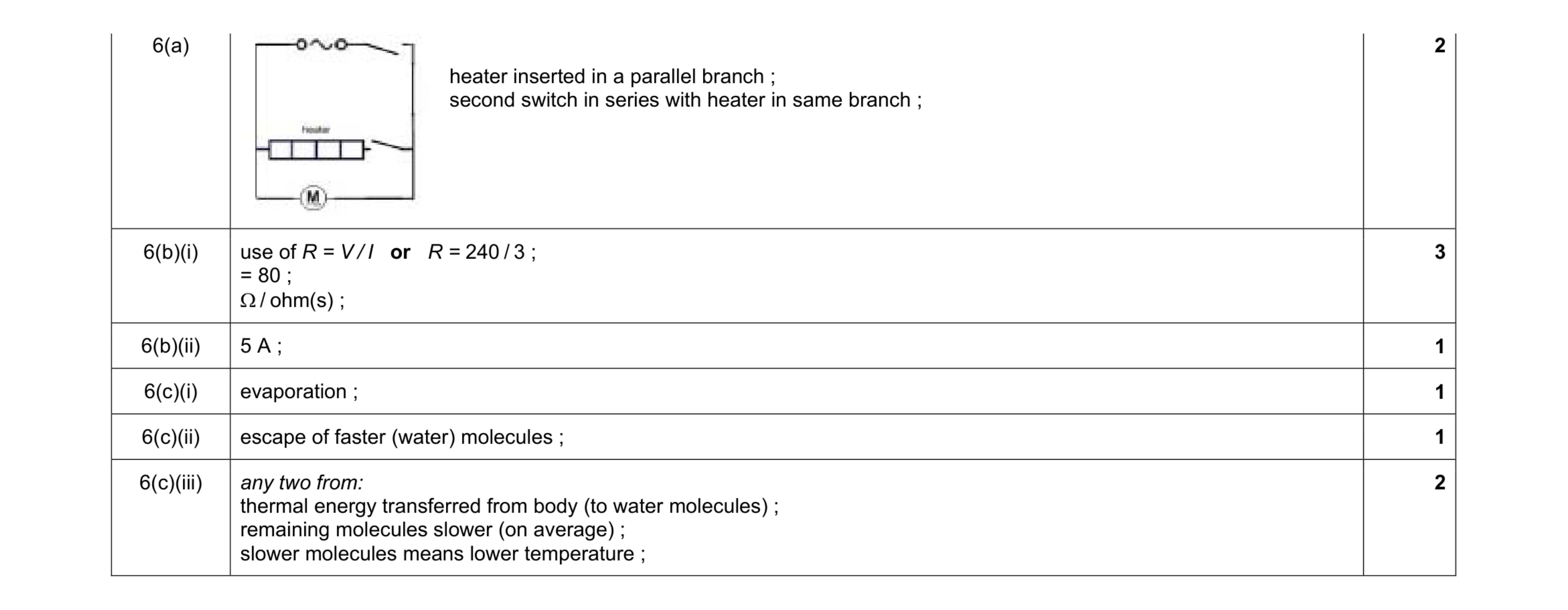 10
10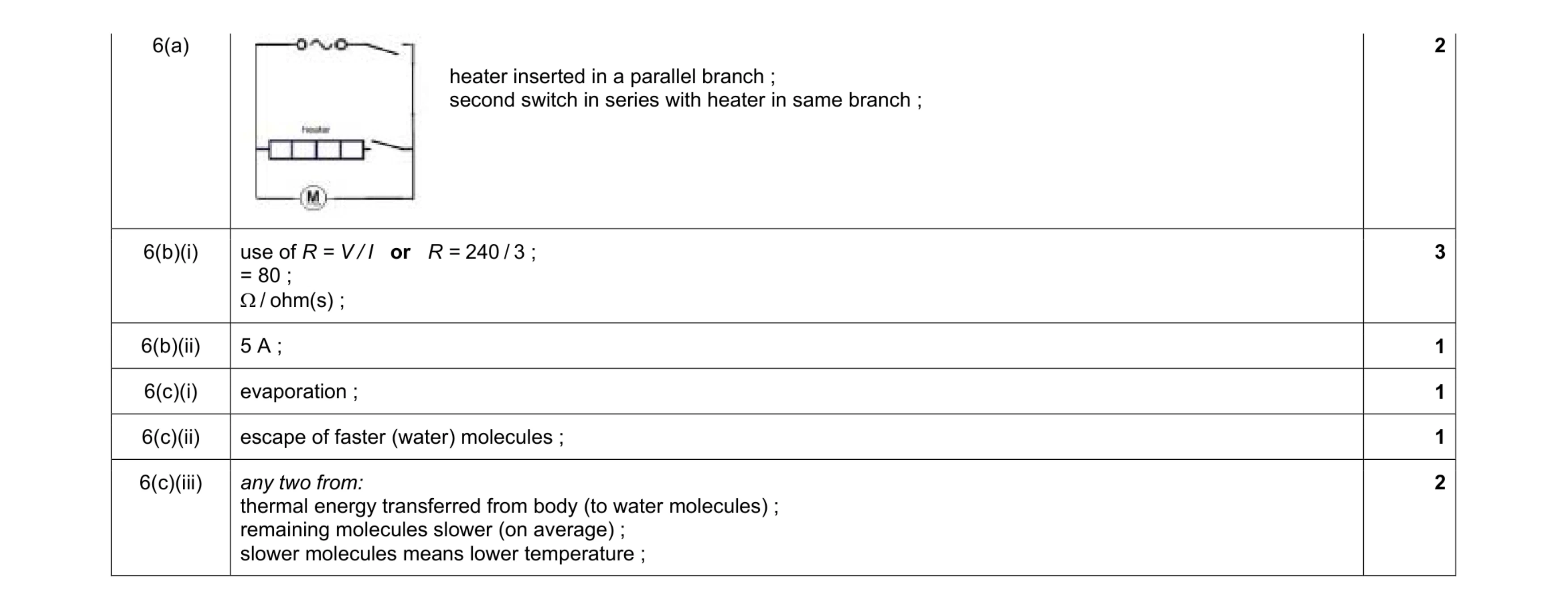 10
10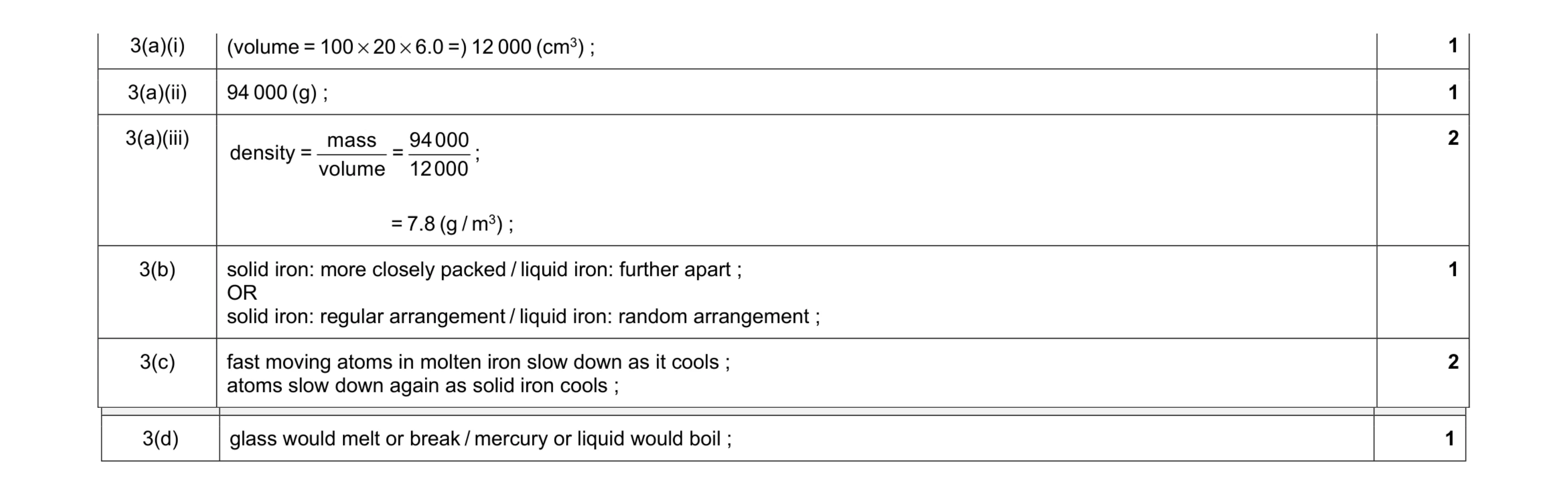 8
8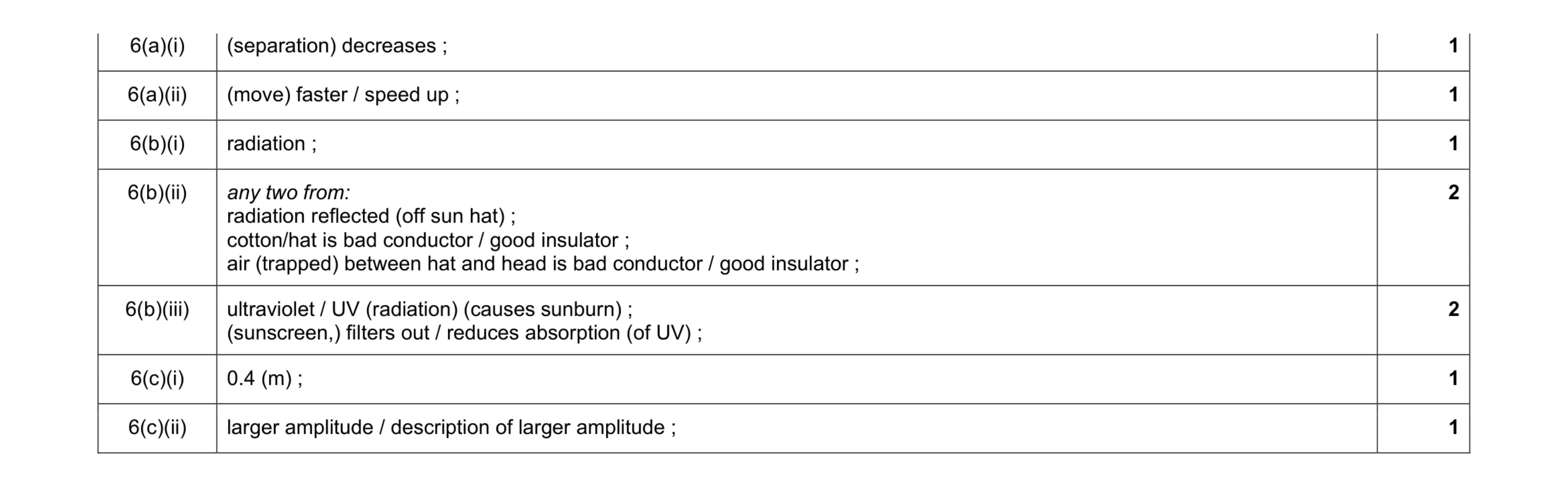 9
9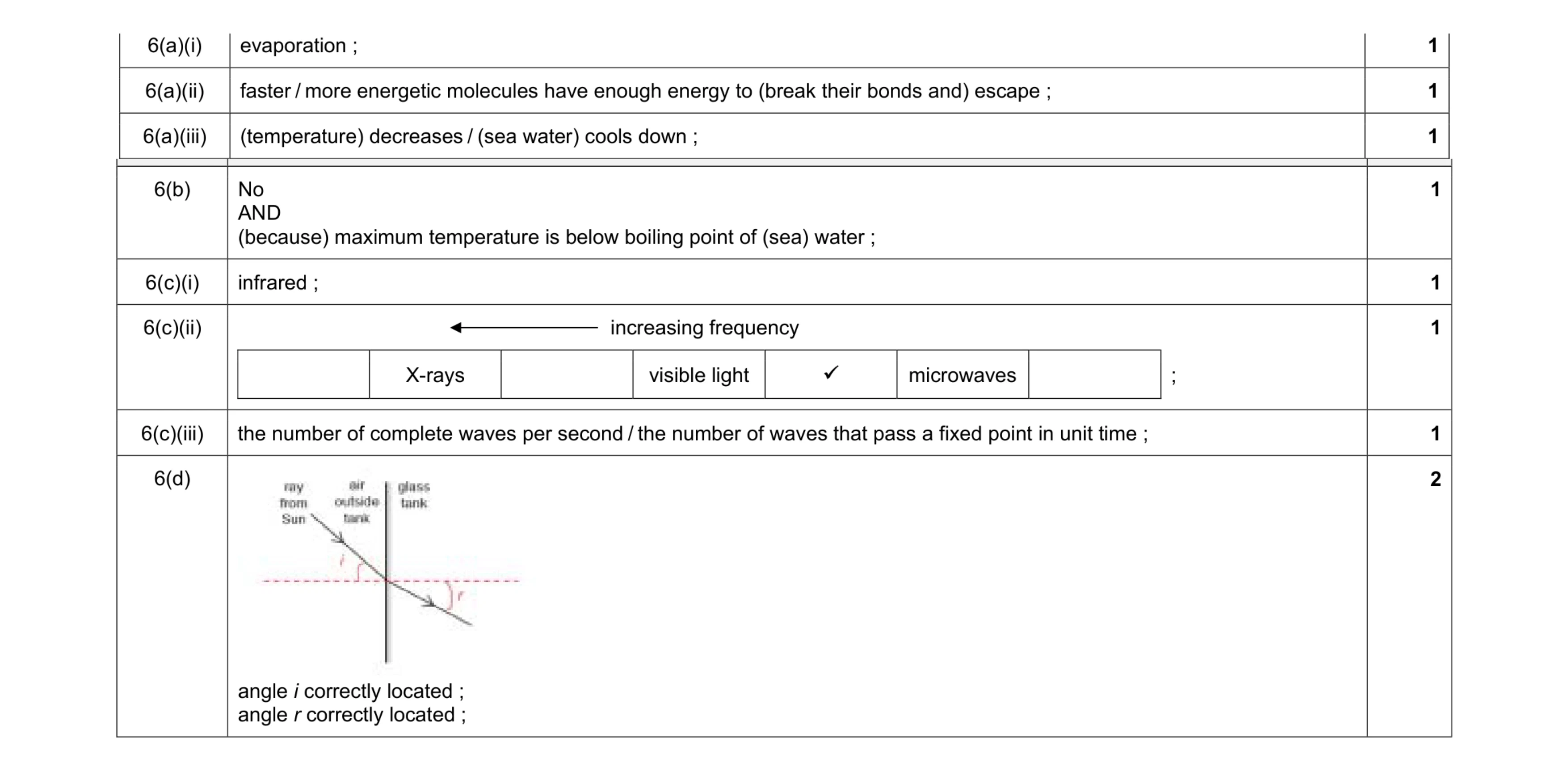 9
9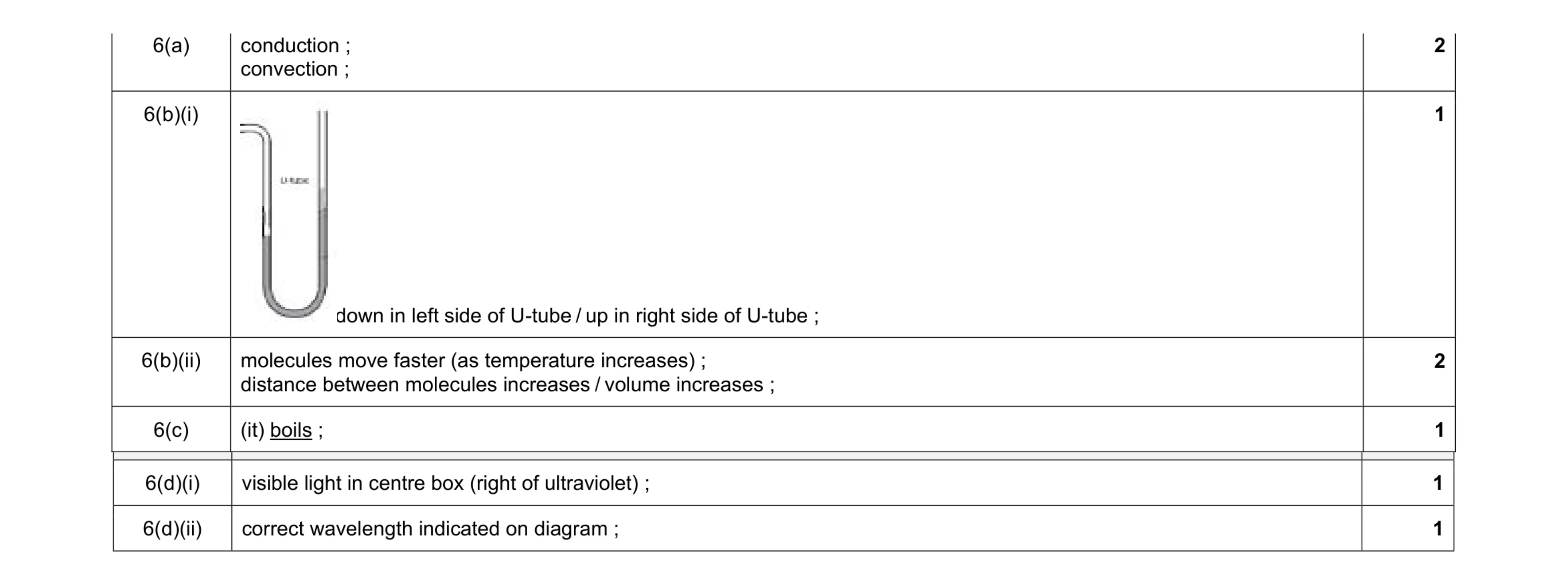 8
8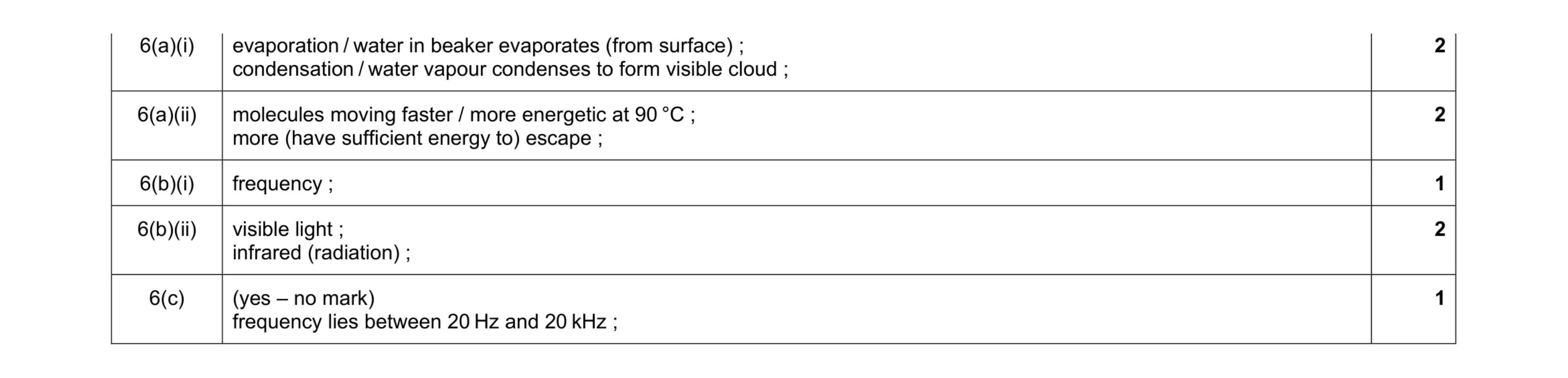 8
8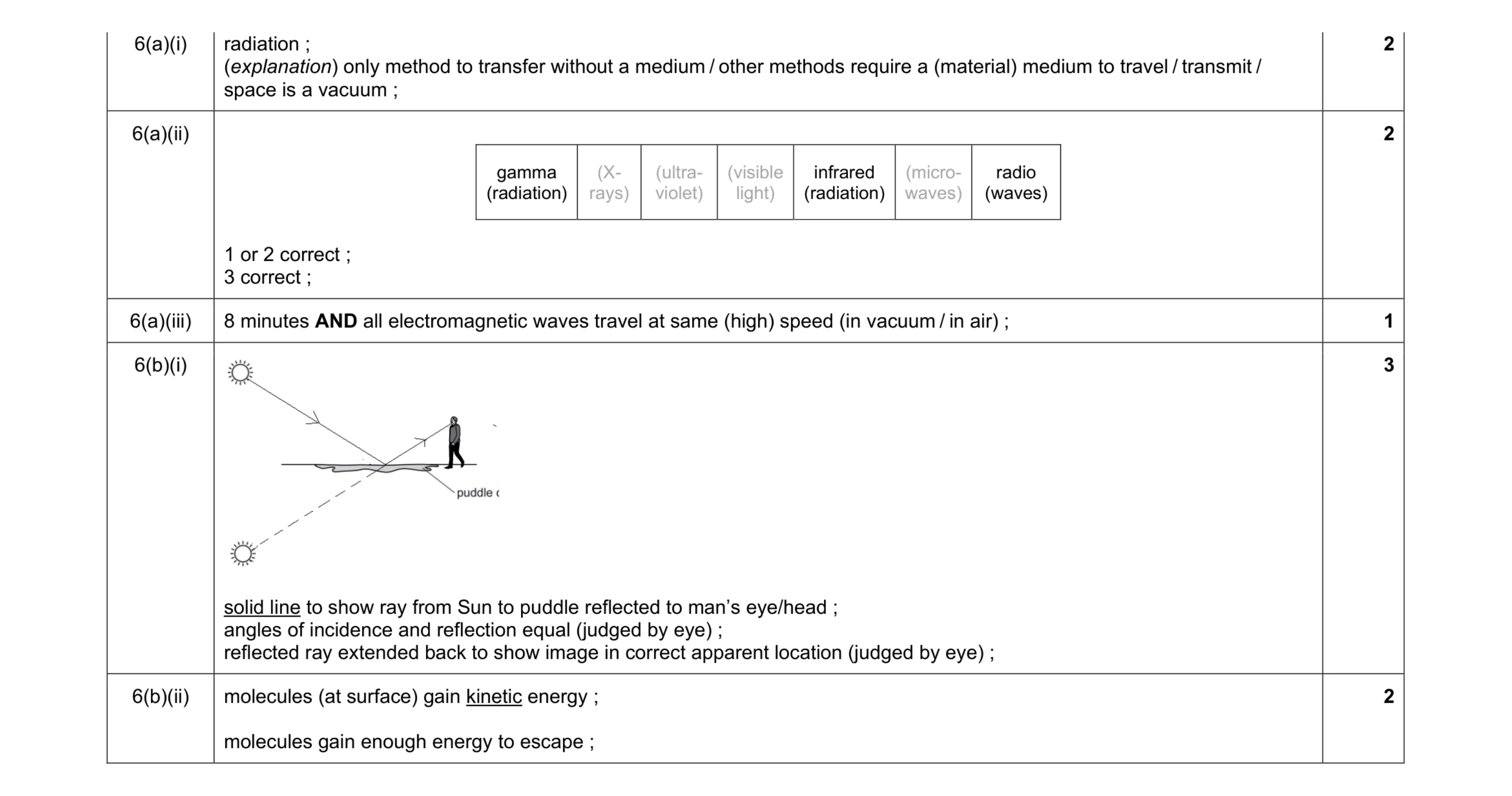 10
10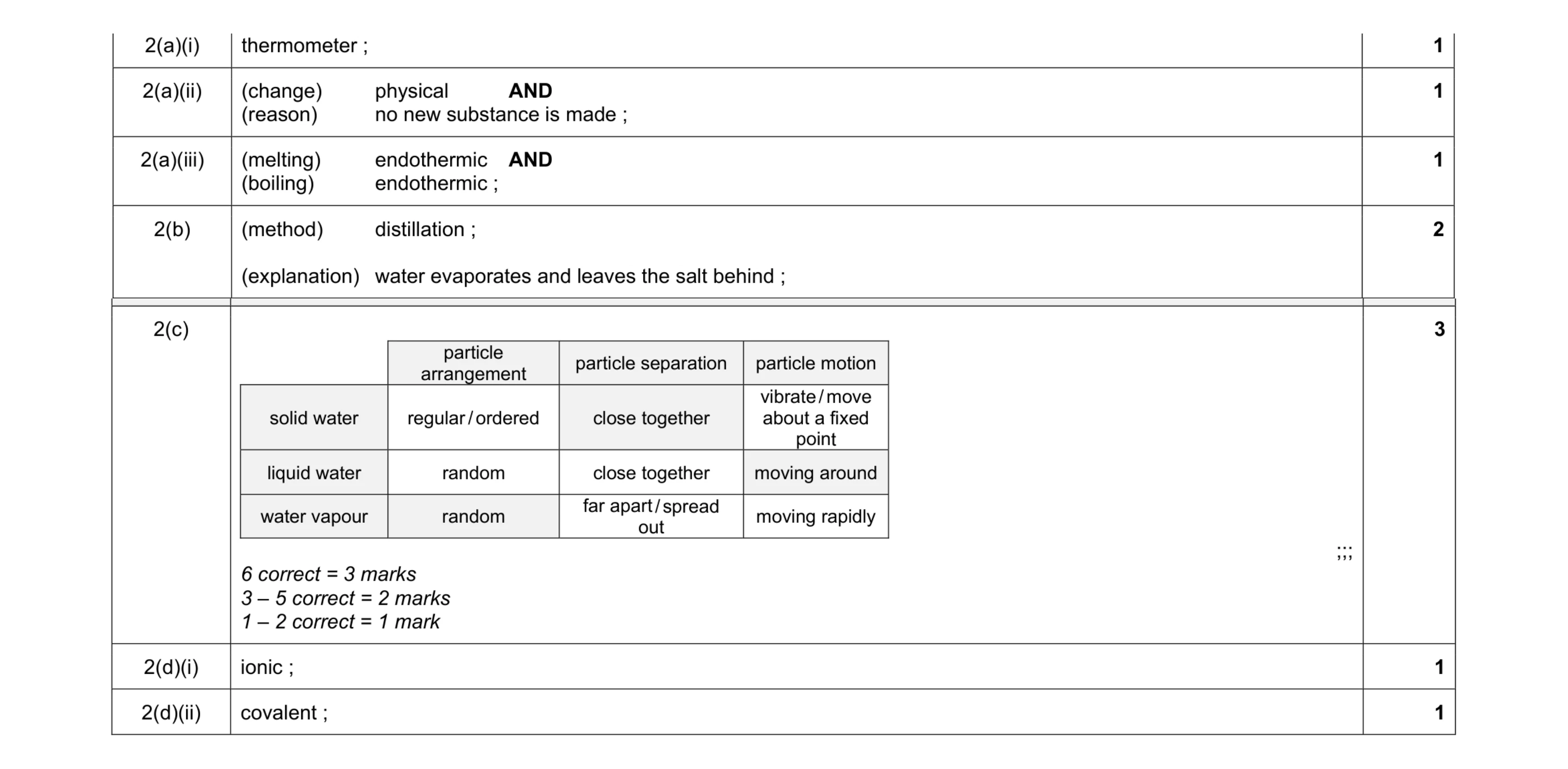 10
10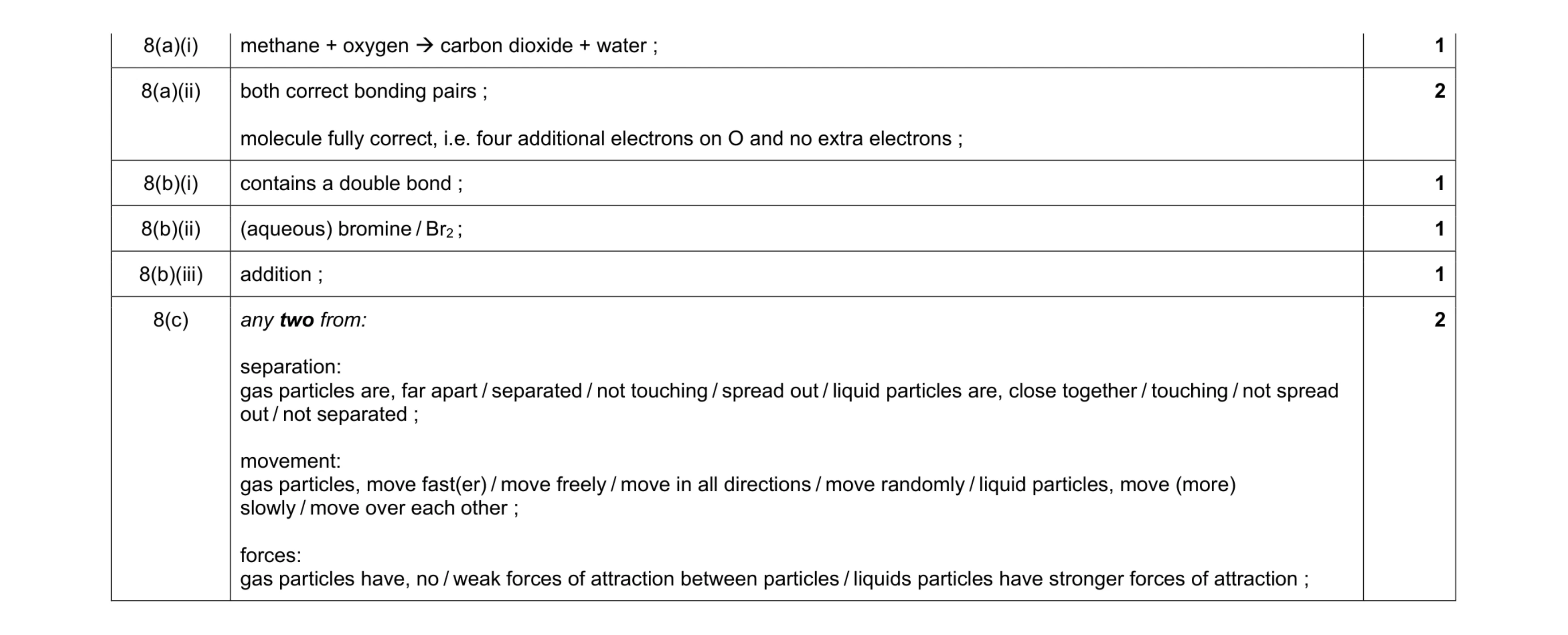 8
8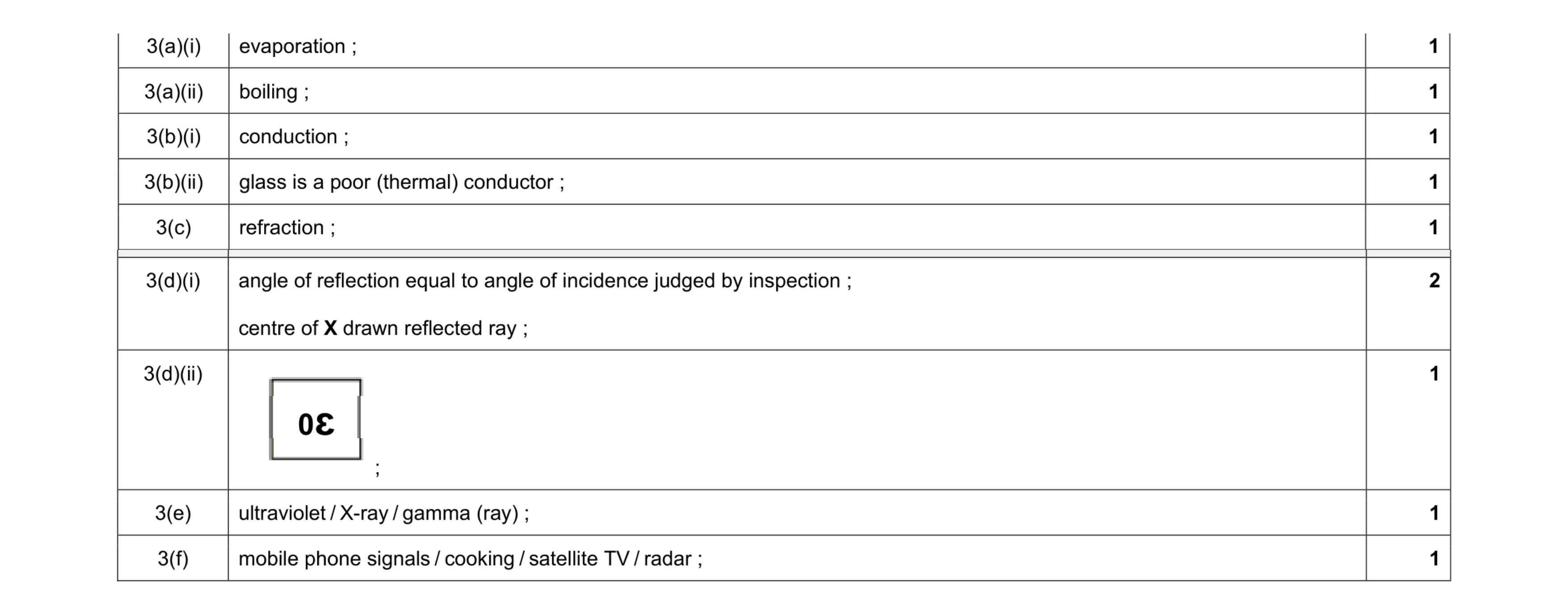 10
10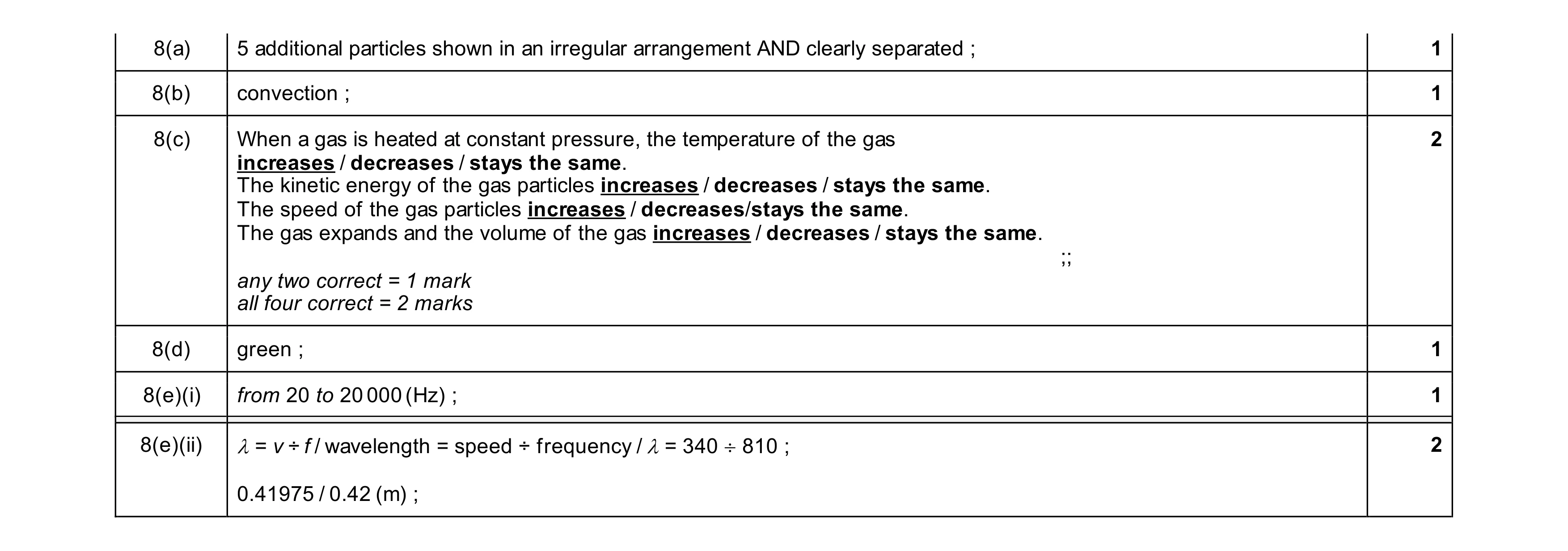 8
8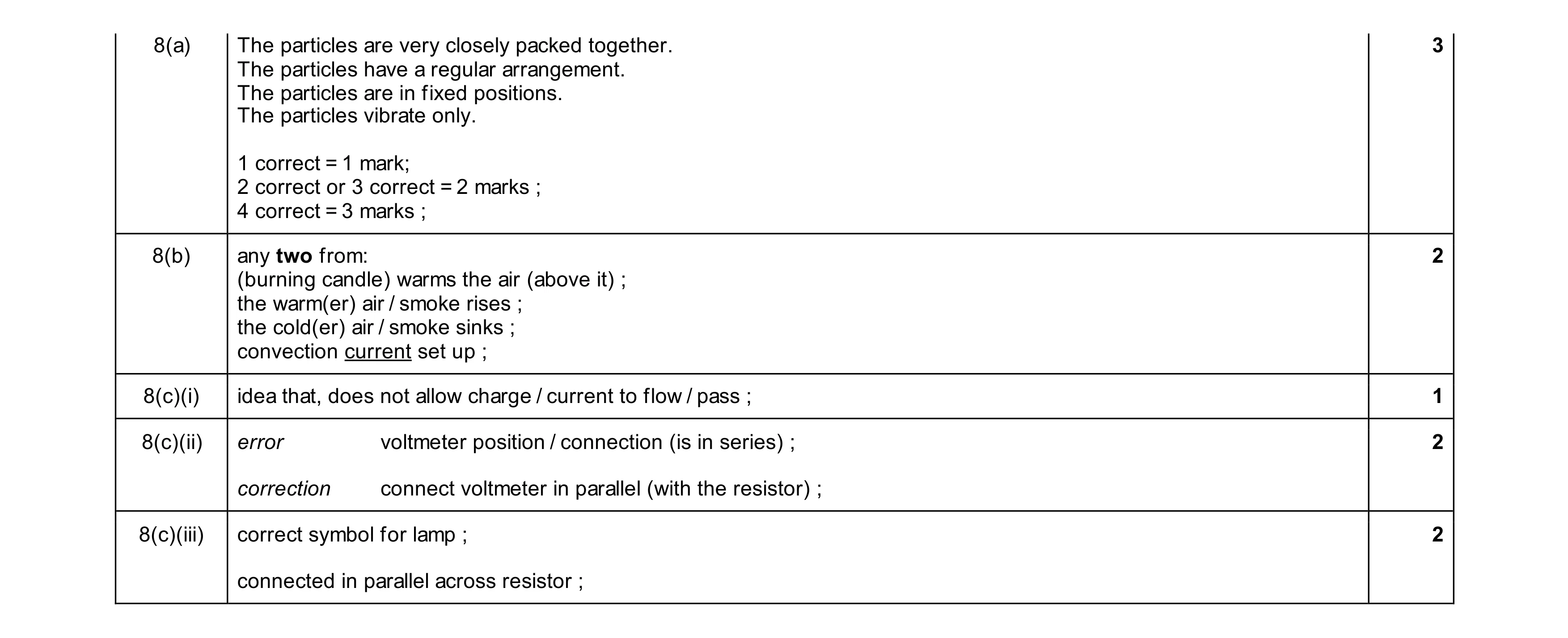 10
10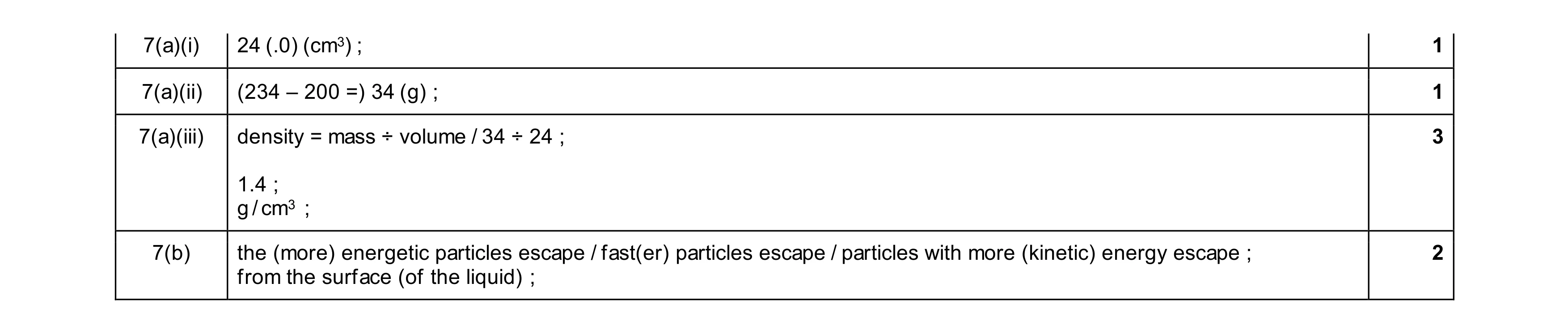 7
7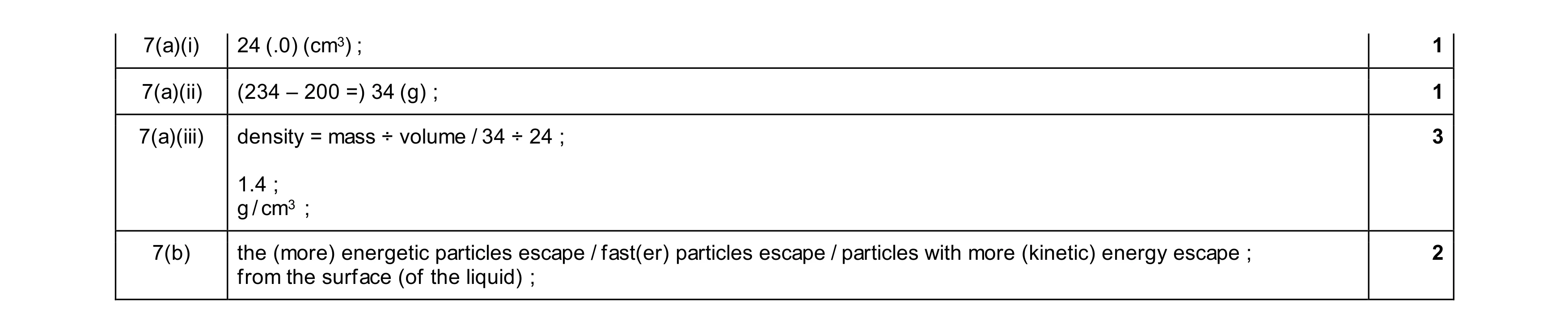 7
7