Cambridge IGCSE Science - Combined 0653 — 2019 May/June Paper 2 · Variant 2
0653/22/M/J/19 · 40 questions · 40 marks · ≈45 min
The question paper and its mark scheme, free to read here and free to download. This is Cambridge’s own paper, exactly as it was sat.
Question paper16 pages
Mark scheme3 pages
Answers below. Sit the paper first if you are practising.
Questions as text
Q1 · A student is reading a text book
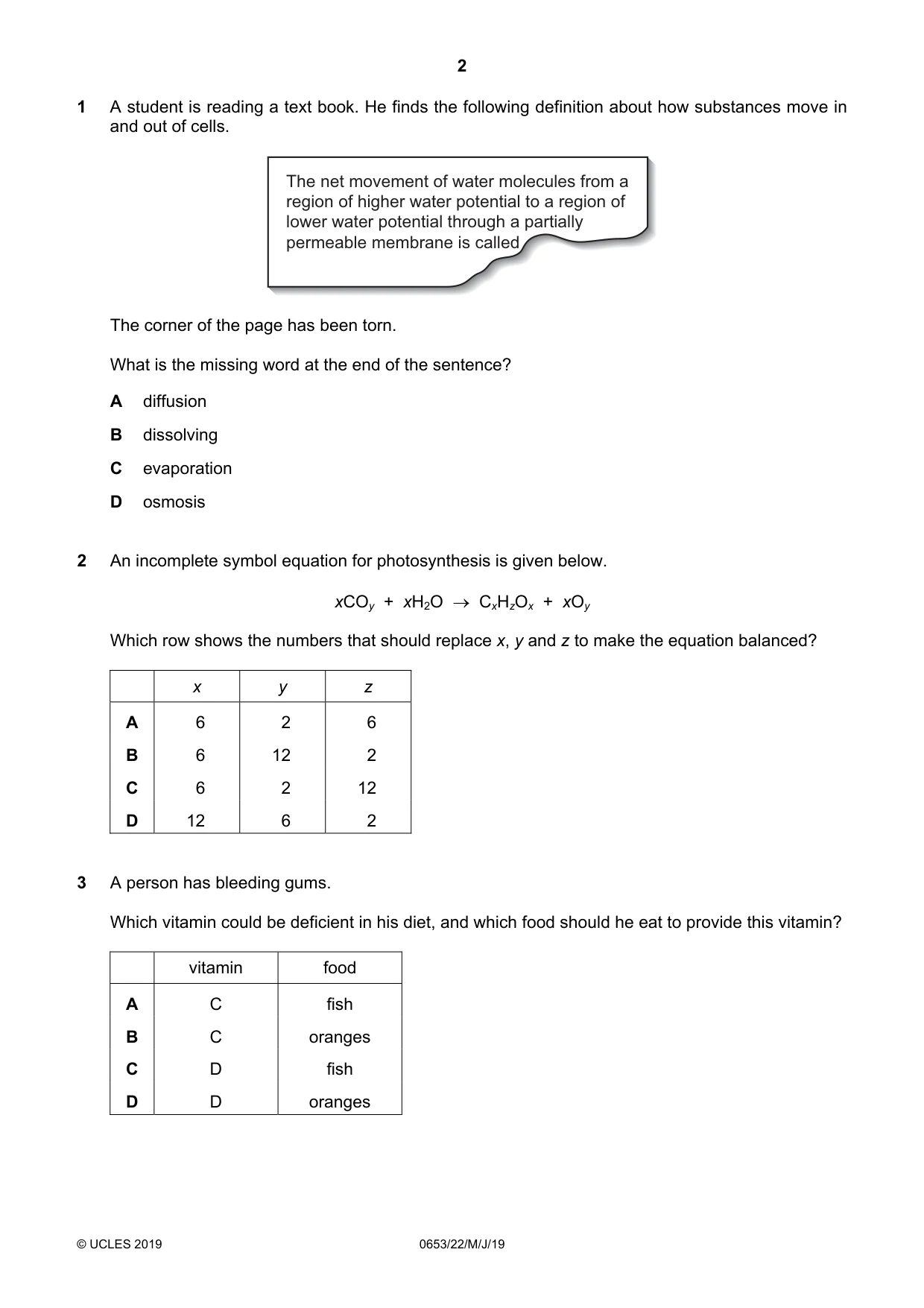
1 A student is reading a text book. He finds the following definition about how substances move in and out of cells. The net movement of water molecules from a region of higher water potential to a region of lower water potential through a partially permeable membrane is called The corner of the page has been torn. What is the missing word at the end of the sentence? A diffusion B dissolving C evaporation D osmosis
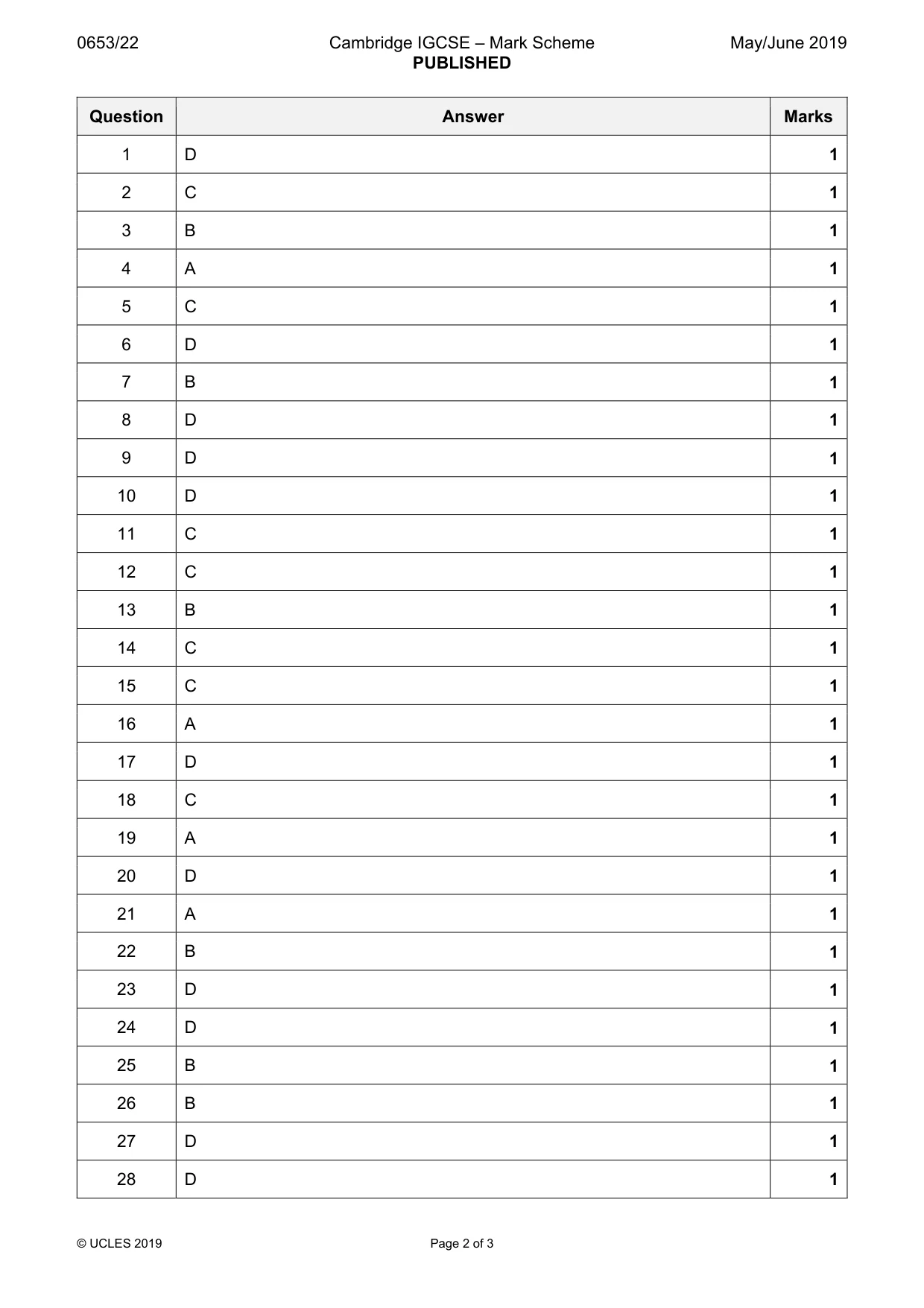
Mark scheme: D
Q2 · An incomplete symbol equation for photosynthesis is given below
2 An incomplete symbol equation for photosynthesis is given below. xCOy + xH2O → CxHzOx + xOy Which row shows the numbers that should replace x, y and z to make the equation balanced? x y z A 6 2 6 B 6 12 2 C 6 2 12 D 12 6 2
Mark scheme: C
Q3 · A person has bleeding gums
3 A person has bleeding gums. Which vitamin could be deficient in his diet, and which food should he eat to provide this vitamin? vitamin food A C fish B C oranges C D fish D D oranges
Mark scheme: B
Q4 · What is the purpose of mechanical digestion?
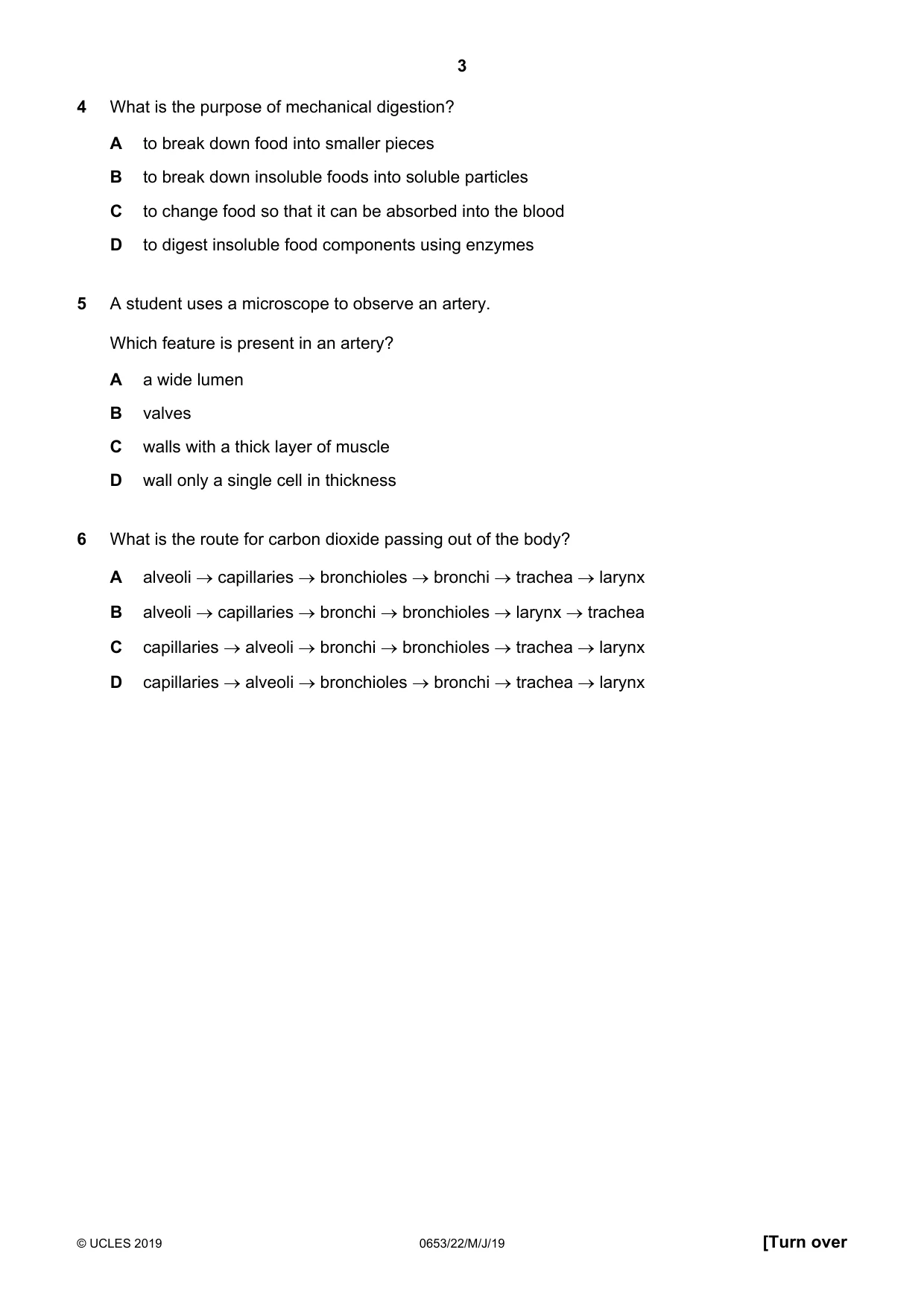
4 What is the purpose of mechanical digestion? A to break down food into smaller pieces B to break down insoluble foods into soluble particles C to change food so that it can be absorbed into the blood D to digest insoluble food components using enzymes
Mark scheme: A
Q5 · A student uses a microscope to observe an artery
5 A student uses a microscope to observe an artery. Which feature is present in an artery? A a wide lumen B valves C walls with a thick layer of muscle D wall only a single cell in thickness
Mark scheme: C
Q6 · What is the route for carbon dioxide passing out of the body?
6 What is the route for carbon dioxide passing out of the body? A alveoli → capillaries → bronchioles → bronchi → trachea → larynx B alveoli → capillaries → bronchi → bronchioles → larynx → trachea C capillaries → alveoli → bronchi → bronchioles → trachea → larynx D capillaries → alveoli → bronchioles → bronchi → trachea → larynx
Mark scheme: D
Q7 · The diagram shows the female reproductive system
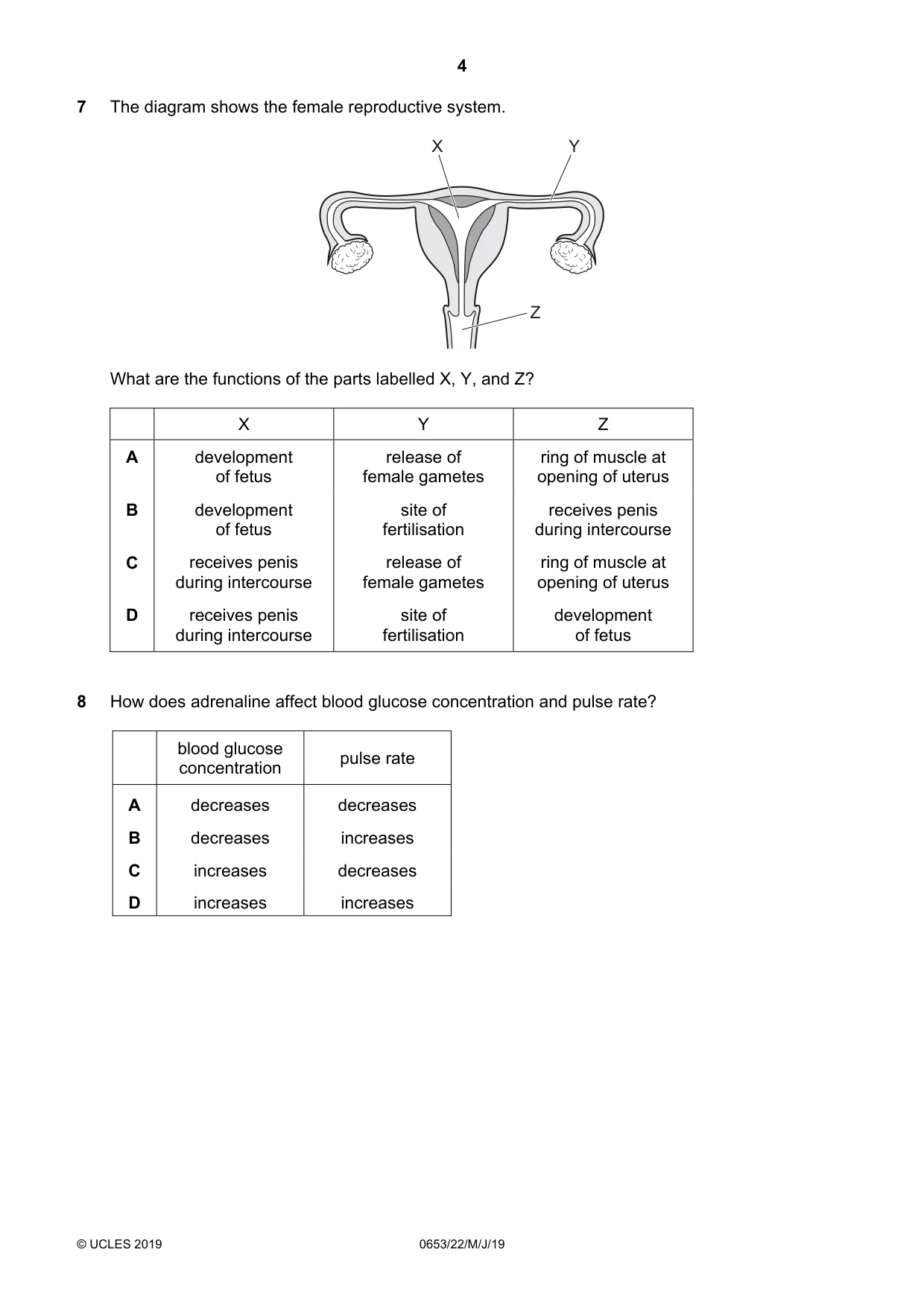
7 The diagram shows the female reproductive system. X Y Z What are the functions of the parts labelled X, Y, and Z? X Y Z A development release of ring of muscle at of fetus female gametes opening of uterus B development site of receives penis of fetus fertilisation during intercourse C receives penis release of ring of muscle at during intercourse female gametes opening of uterus D receives penis site of development during intercourse fertilisation of fetus
Mark scheme: B
Q8 · How does adrenaline affect blood glucose concentration and pulse rate?
8 How does adrenaline affect blood glucose concentration and pulse rate? blood glucose pulse rate concentration A decreases decreases B decreases increases C increases decreases D increases increases
Mark scheme: D
Q9 · A germinating bean seed placed horizontally
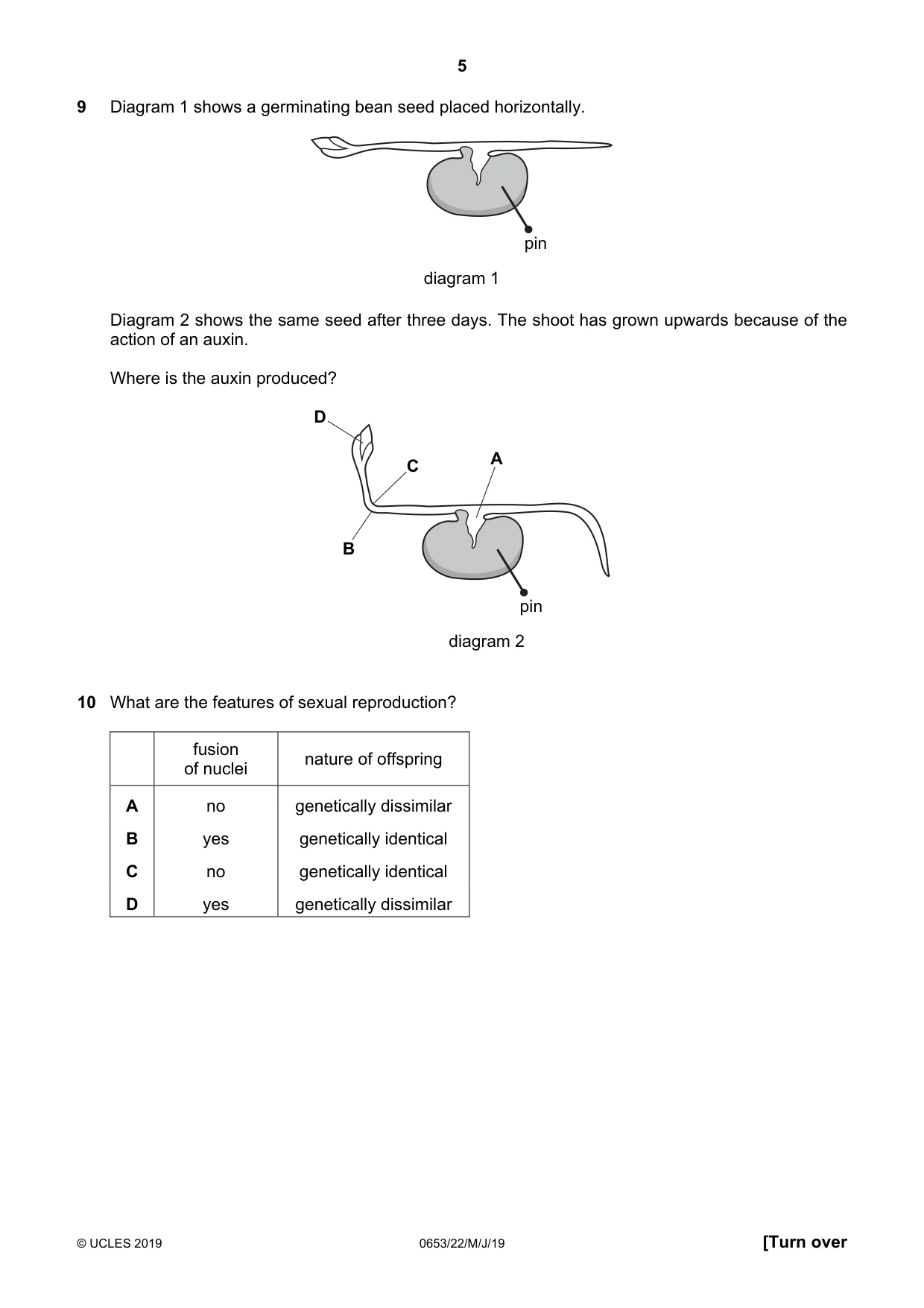
9 Diagram 1 shows a germinating bean seed placed horizontally. pin diagram 1 Diagram 2 shows the same seed after three days. The shoot has grown upwards because of the action of an auxin. Where is the auxin produced? D C A B pin diagram 2
Mark scheme: D
Q10 · What are the features of sexual reproduction?
10 What are the features of sexual reproduction? fusion nature of offspring of nuclei A no genetically dissimilar B yes genetically identical C no genetically identical D yes genetically dissimilar
Mark scheme: D
Q11 · The diagram represents several food chains in a food web
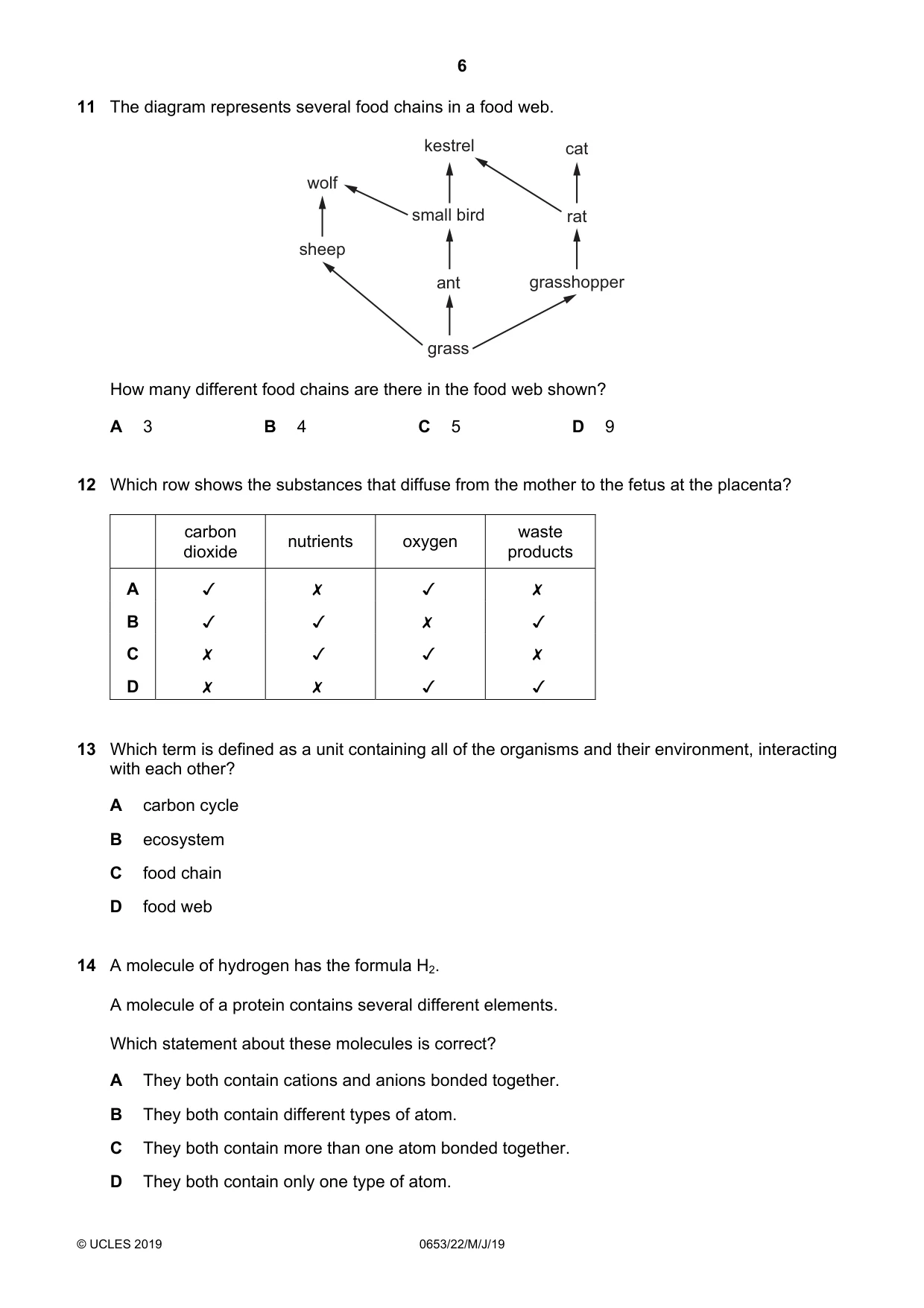
11 The diagram represents several food chains in a food web. kestrel cat wolf small bird rat sheep ant grasshopper grass How many different food chains are there in the food web shown? A 3 B 4 C 5 D 9
Mark scheme: C
Q12 · Which row shows the substances that diffuse from the mother to the fetus at the placenta?
12 Which row shows the substances that diffuse from the mother to the fetus at the placenta? career nutrients oxygen oroduts A v x v x B v v x v Cc x v v x D x x v v
Mark scheme: C
Q13 · Which term is defined as a unit containing all of the organisms and their environment…
13 Which term is defined as a unit containing all of the organisms and their environment, interacting with each other? A carbon cycle B ecosystem C food chain D food web
Mark scheme: B
Q14 · A molecule of hydrogen has the formula H2
14 A molecule of hydrogen has the formula H2. A molecule of a protein contains several different elements. Which statement about these molecules is correct? A They both contain cations and anions bonded together. B They both contain different types of atom. C They both contain more than one atom bonded together. D They both contain only one type of atom.
Mark scheme: C
Q15 · The diagram shows apparatus used for filtration
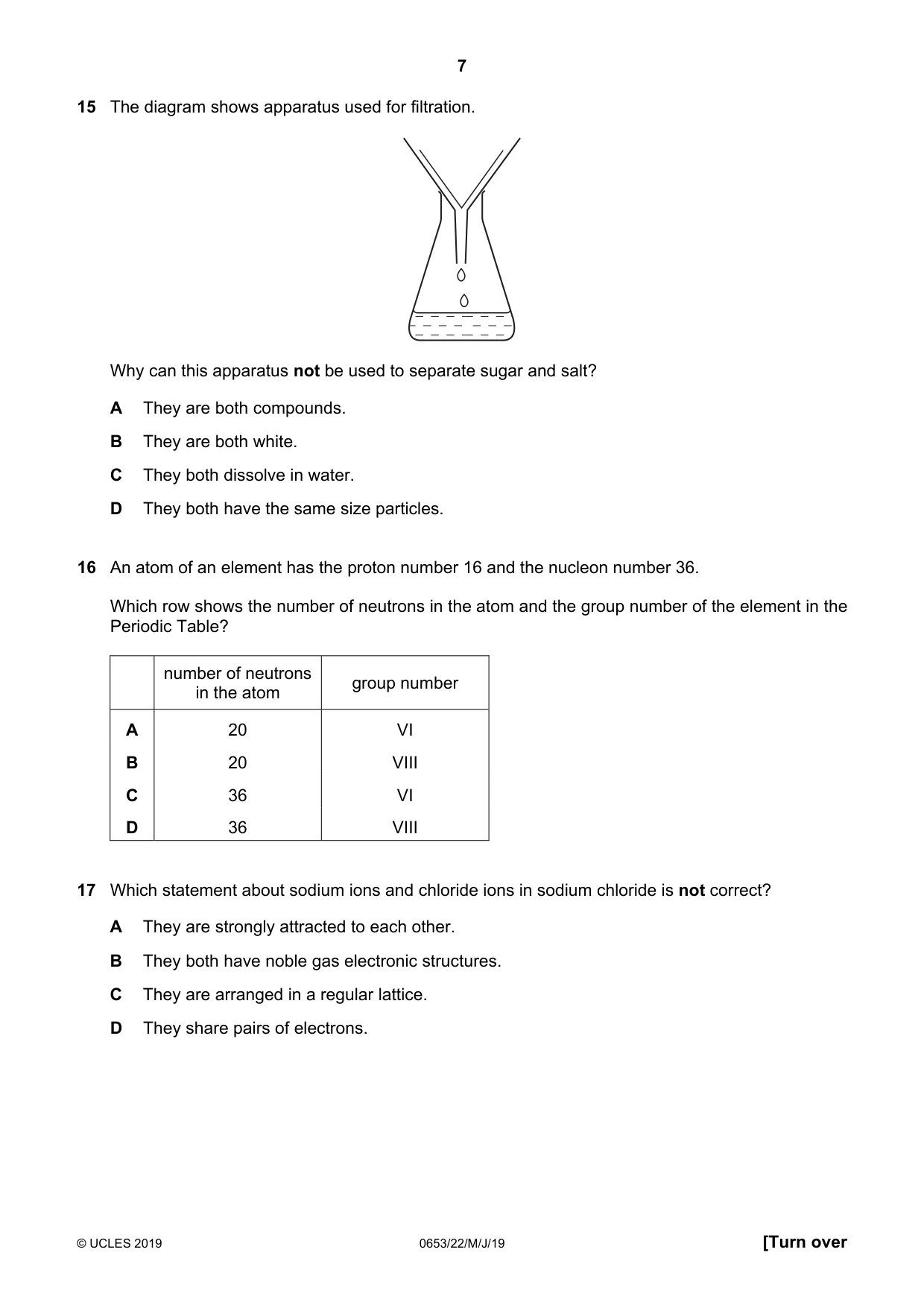
15 The diagram shows apparatus used for filtration. Why can this apparatus not be used to separate sugar and salt? A They are both compounds. B They are both white. C They both dissolve in water. D They both have the same size particles.
Mark scheme: C
Q16 · An atom of an element has the proton number 16 and the nucleon number 36
16 An atom of an element has the proton number 16 and the nucleon number 36. Which row shows the number of neutrons in the atom and the group number of the element in the Periodic Table? number of neutrons group number in the atom A 20 VI B 20 VIII C 36 VI D 36 VIII
Mark scheme: A
Q17 · Which statement about sodium ions and chloride ions in sodium chloride is not correct?
17 Which statement about sodium ions and chloride ions in sodium chloride is not correct? A They are strongly attracted to each other. B They both have noble gas electronic structures. C They are arranged in a regular lattice. D They share pairs of electrons.
Mark scheme: D
Q18 · Which statement about the electrolysis of molten magnesium chloride is correct?
18 Which statement about the electrolysis of molten magnesium chloride is correct? A Cations form atoms by losing electrons. B Chlorine atoms gain electrons to form chloride ions. C Magnesium ions gain electrons to form magnesium atoms. D Magnesium is produced at the anode and chlorine is formed at the cathode.
Mark scheme: C
Q19 · The graph shows the volume of hydrogen gas produced when dilute hydrochloric acid reacts…
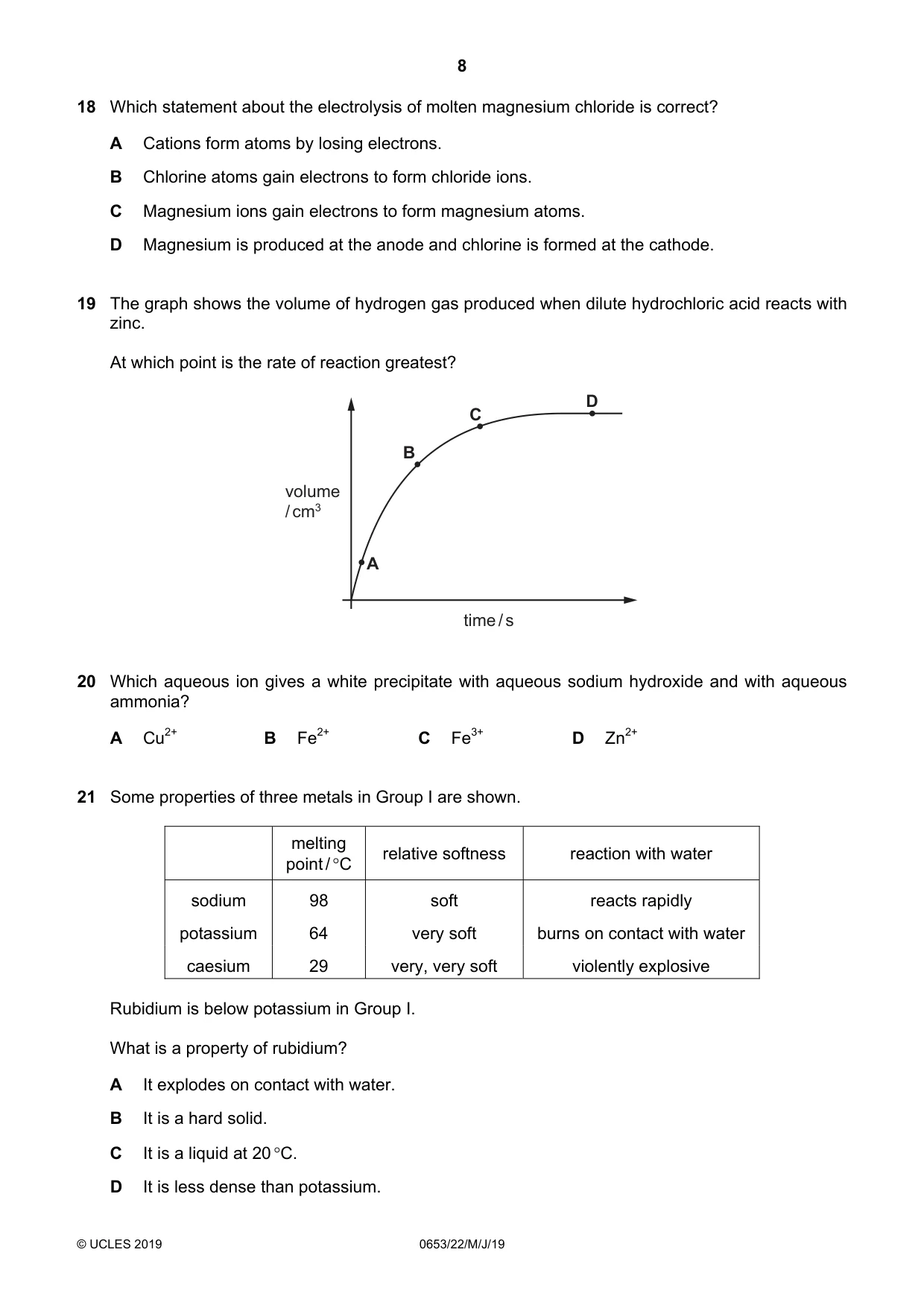
19 The graph shows the volume of hydrogen gas produced when dilute hydrochloric acid reacts with zinc. At which point is the rate of reaction greatest? D C B volume / cm3 A time / s
Mark scheme: A
Q20 · Which aqueous ion gives a white precipitate with aqueous sodium hydroxide and with…
20 Which aqueous ion gives a white precipitate with aqueous sodium hydroxide and with aqueous ammonia? A Cu2+ B Fe2+ C Fe3+ D Zn2+
Mark scheme: D
Q21 · Some properties of three metals in Group I are shown
21 Some properties of three metals in Group I are shown. melting relative softness reaction with water point / °C sodium 98 soft reacts rapidly potassium 64 very soft burns on contact with water caesium 29 very, very soft violently explosive Rubidium is below potassium in Group I. What is a property of rubidium? A It explodes on contact with water. B It is a hard solid. C It is a liquid at 20 °C. D It is less dense than potassium.
Mark scheme: A
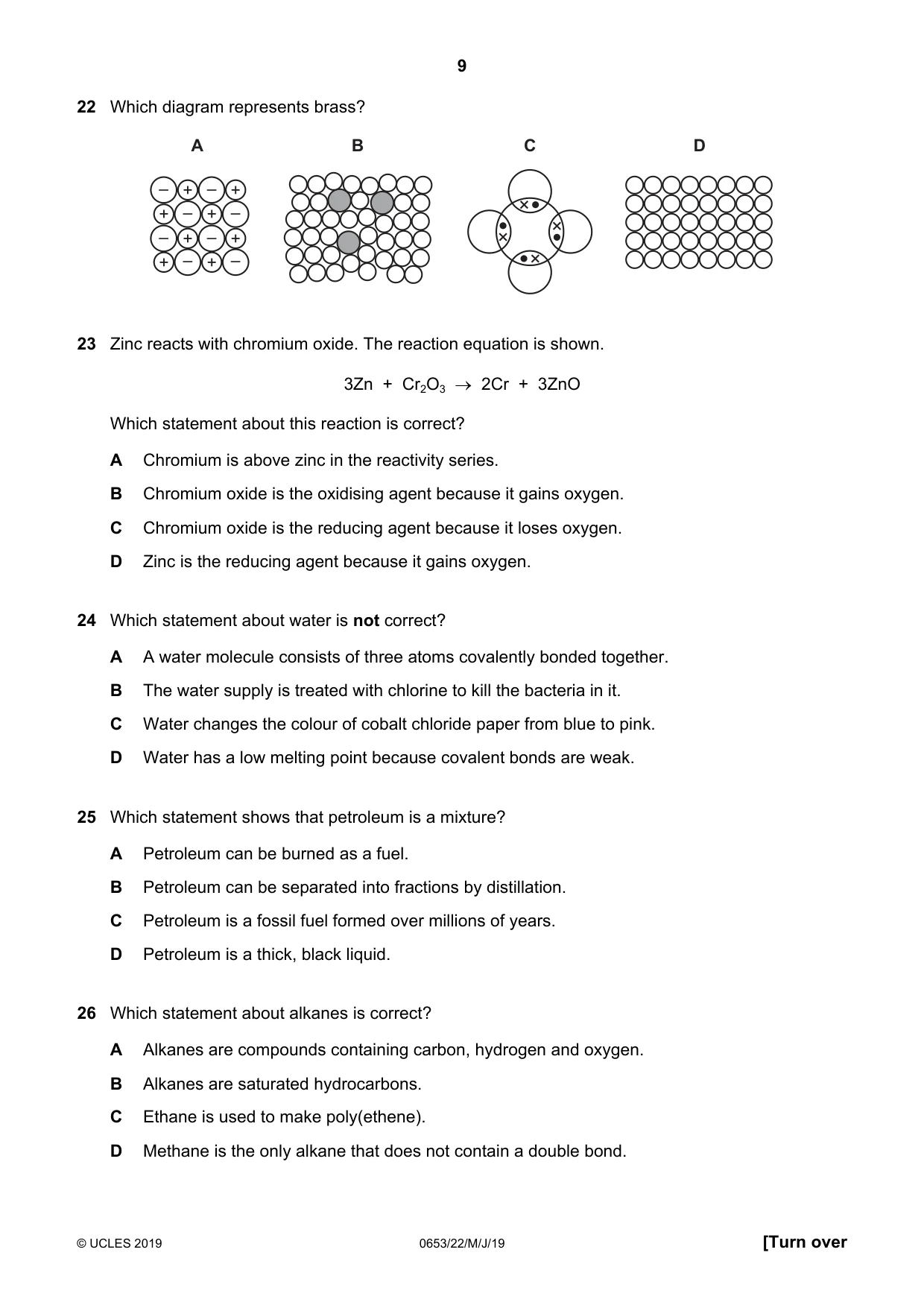
Q22 · Which diagram represents brass?
22 Which diagram represents brass? A B C D – + – + + – + – – + – + + – + –
Mark scheme: B
Q23 · Zinc reacts with chromium oxide
23 Zinc reacts with chromium oxide. The reaction equation is shown. 3Zn + Cr2O3 → 2Cr + 3ZnO Which statement about this reaction is correct? A Chromium is above zinc in the reactivity series. B Chromium oxide is the oxidising agent because it gains oxygen. C Chromium oxide is the reducing agent because it loses oxygen. D Zinc is the reducing agent because it gains oxygen.
Mark scheme: D
Q24 · Which statement about water is not correct?
24 Which statement about water is not correct? A A water molecule consists of three atoms covalently bonded together. B The water supply is treated with chlorine to kill the bacteria in it. C Water changes the colour of cobalt chloride paper from blue to pink. D Water has a low melting point because covalent bonds are weak.
Mark scheme: D
Q25 · Which statement shows that petroleum is a mixture?
25 Which statement shows that petroleum is a mixture? A Petroleum can be burned as a fuel. B Petroleum can be separated into fractions by distillation. C Petroleum is a fossil fuel formed over millions of years. D Petroleum is a thick, black liquid.
Mark scheme: B
Q26 · Which statement about alkanes is correct?
26 Which statement about alkanes is correct? A Alkanes are compounds containing carbon, hydrogen and oxygen. B Alkanes are saturated hydrocarbons. C Ethane is used to make poly(ethene). D Methane is the only alkane that does not contain a double bond.
Mark scheme: B
Q27 · Which row identifies the temperature used and describes the change to the alkane…
27 Which row identifies the temperature used and describes the change to the alkane molecules during the cracking process? temperature change to the / °C alkane molecules A 100 become larger B 100 become smaller C 500 become larger D 500 become smaller
Mark scheme: D
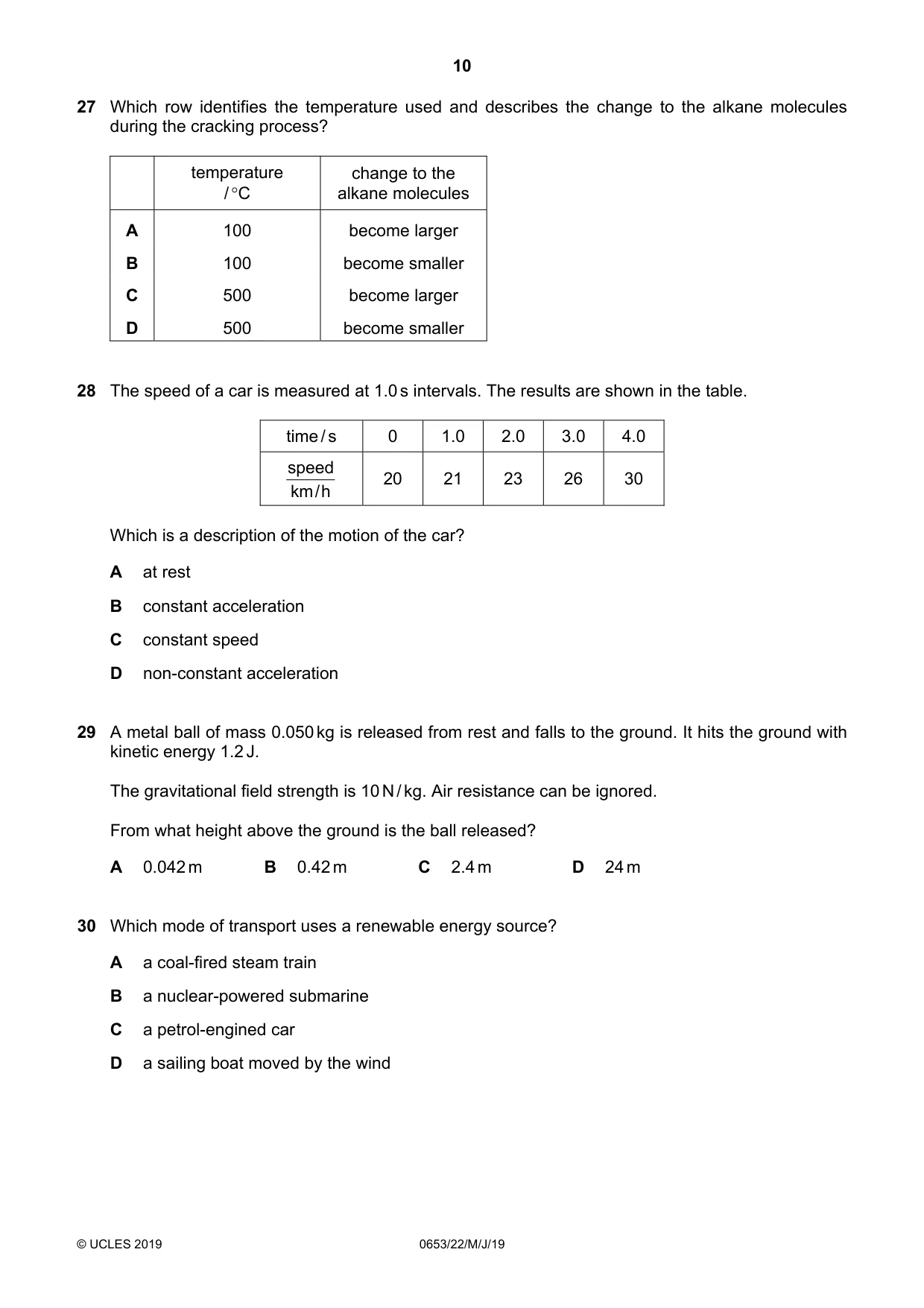
Q28 · The speed of a car is measured at 1.0 s intervals
28 The speed of a car is measured at 1.0 s intervals. The results are shown in the table. time / s 0 1.0 2.0 3.0 4.0 speed 20 21 23 26 30 km / h Which is a description of the motion of the car? A at rest B constant acceleration C constant speed D non-constant acceleration
Mark scheme: D
Q29 · A metal ball of mass 0.050 kg is released from rest and falls to the ground
29 A metal ball of mass 0.050 kg is released from rest and falls to the ground. It hits the ground with kinetic energy 1.2 J. The gravitational field strength is 10 N / kg. Air resistance can be ignored. From what height above the ground is the ball released? A 0.042 m B 0.42 m C 2.4 m D 24 m
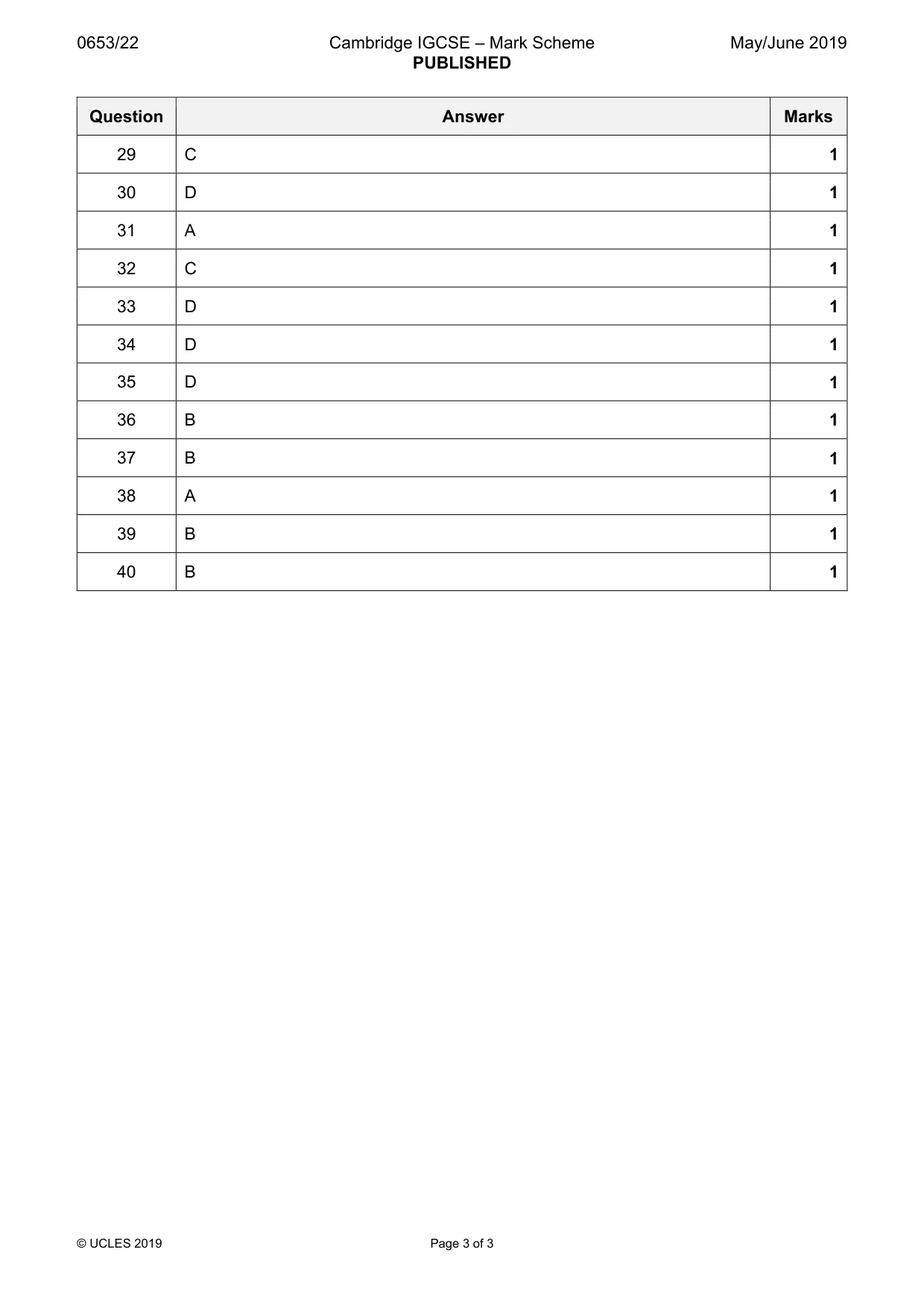
Mark scheme: C
Q30 · Which mode of transport uses a renewable energy source?
30 Which mode of transport uses a renewable energy source? A a coal-fired steam train B a nuclear-powered submarine C a petrol-engined car D a sailing boat moved by the wind
Mark scheme: D
Q31 · A solid is heated
31 A solid is heated. Which two properties of the solid both change as a result? A density and volume B density and weight C mass and volume D mass and weight
Mark scheme: A
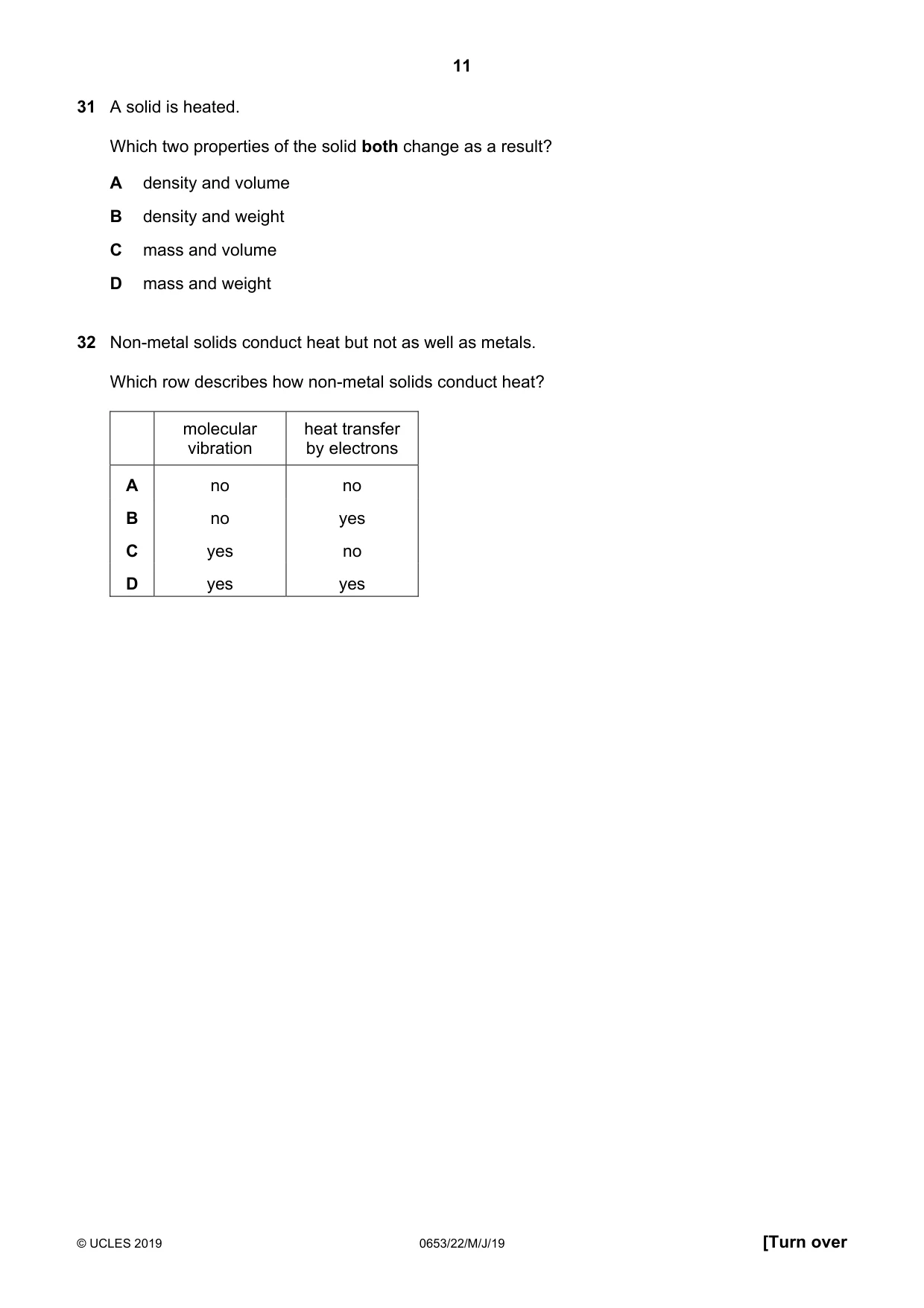
Q32 · Non-metal solids conduct heat but not as well as metals
32 Non-metal solids conduct heat but not as well as metals. Which row describes how non-metal solids conduct heat? molecular heat transfer vibration by electrons A no no B no yes C yes no D yes yes
Mark scheme: C
Q33 · The diagram shows a vacuum flask containing a hot liquid in a cold room
33 The diagram shows a vacuum flask containing a hot liquid in a cold room. X and Y are points on the inside surfaces of the walls of the flask. cold room X Y hot liquid vacuum How is thermal energy transferred through the vacuum between X and Y? A by conduction and convection B by conduction only C by radiation and convection D by radiation only
Mark scheme: D
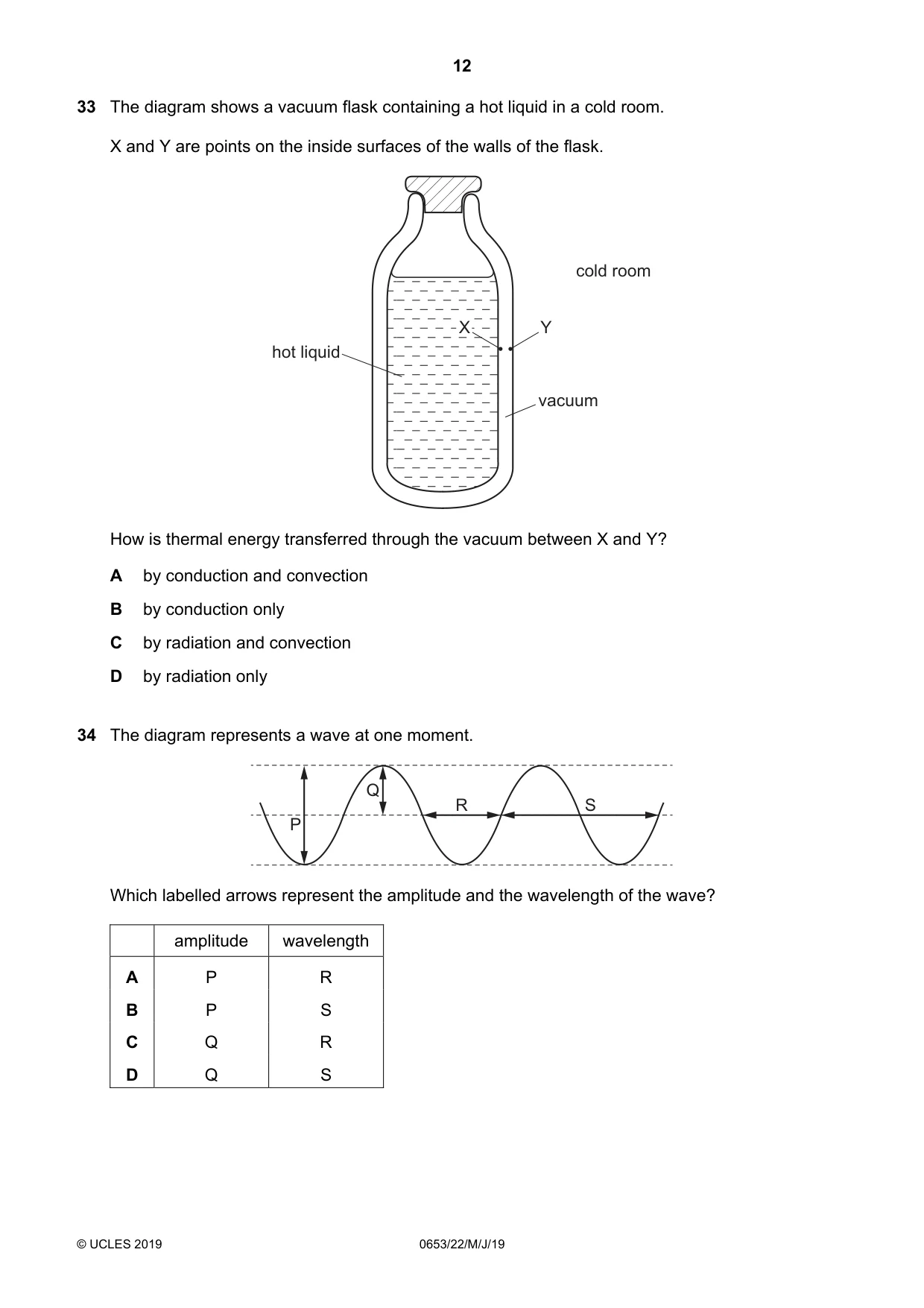
Q34 · The diagram represents a wave at one moment
34 The diagram represents a wave at one moment. Q R S P Which labelled arrows represent the amplitude and the wavelength of the wave? amplitude wavelength A P R B P S C Q R D Q S
Mark scheme: D
Q35 · Which wave is longitudinal?
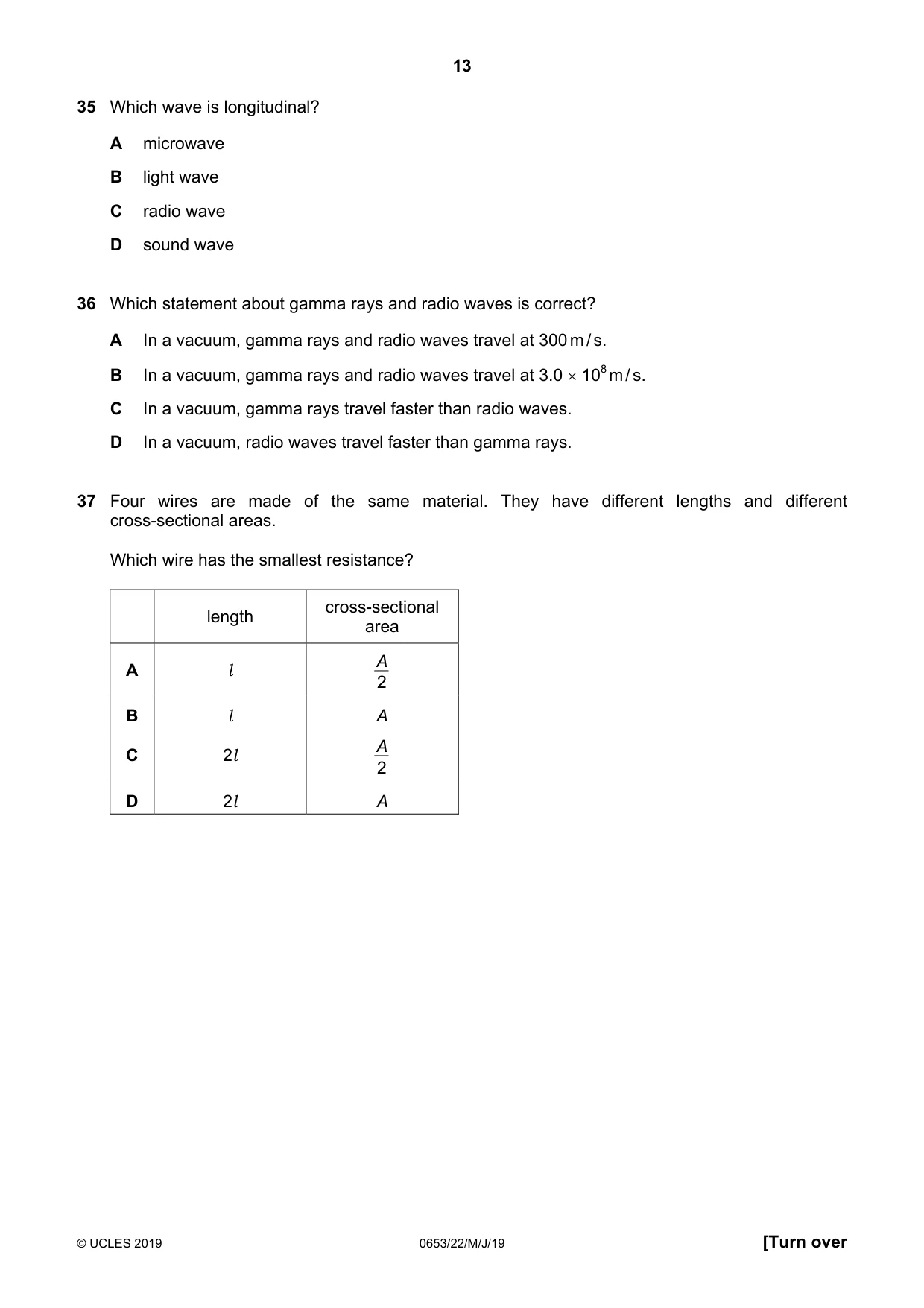
35 Which wave is longitudinal? A microwave B light wave C radio wave D sound wave
Mark scheme: D
Q36 · Which statement about gamma rays and radio waves is correct?
36 Which statement about gamma rays and radio waves is correct? A In a vacuum, gamma rays and radio waves travel at 300 m / s. B In a vacuum, gamma rays and radio waves travel at 3.0 × 10⁸ m / s. C In a vacuum, gamma rays travel faster than radio waves. D In a vacuum, radio waves travel faster than gamma rays.
Mark scheme: B
Q37 · Four wires are made of the same material
37 Four wires are made of the same material. They have different lengths and different cross-sectional areas. Which wire has the smallest resistance? cross-sectional length area A A l 2 B l A A C 2l 2 D 2l A
Mark scheme: B
Q38 · Three resistors, one resistor has resistance 4.0 Ω and two have resistance 2.0 Ω, are…
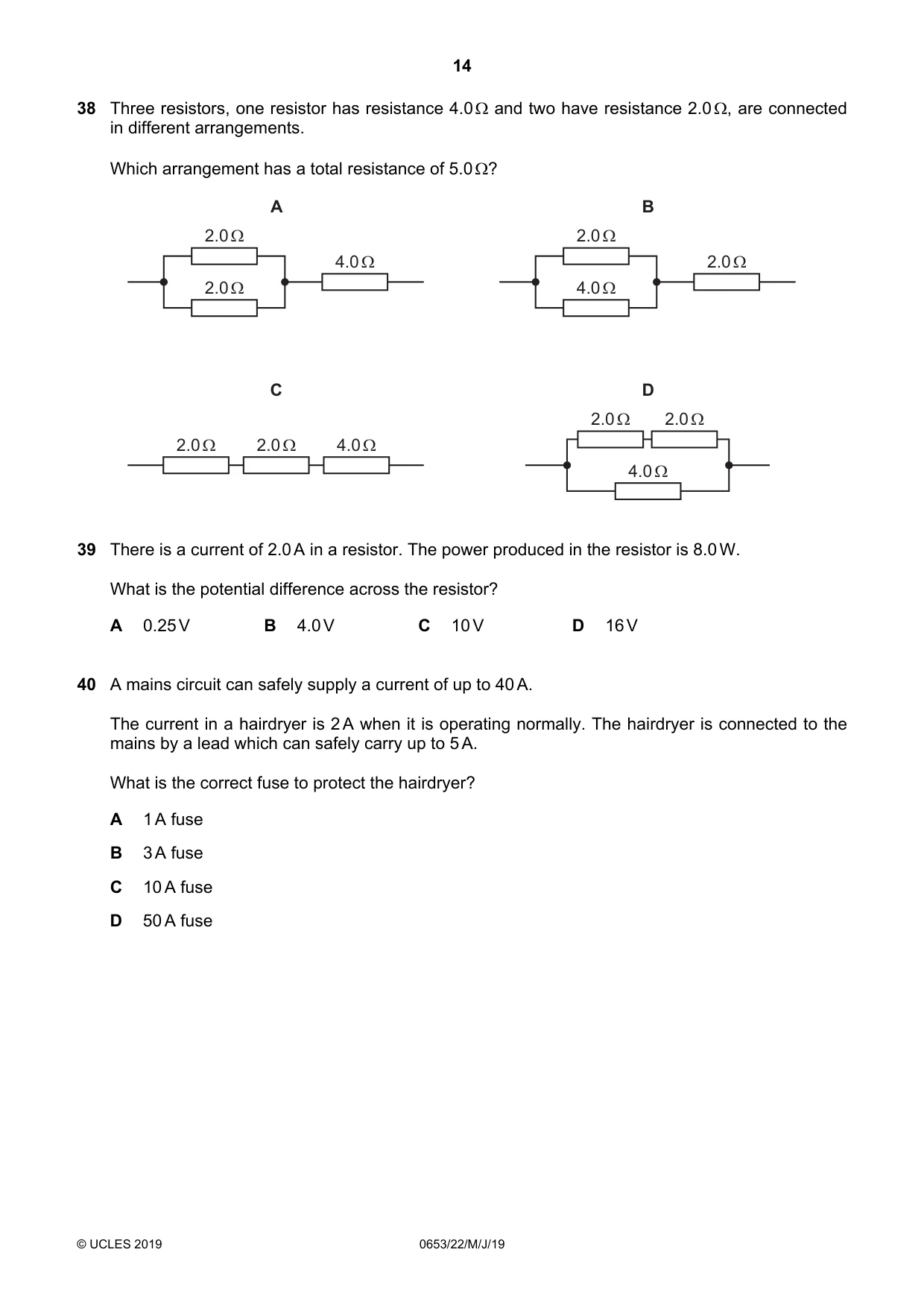
38 Three resistors, one resistor has resistance 4.0 Ω and two have resistance 2.0 Ω, are connected in different arrangements. Which arrangement has a total resistance of 5.0 Ω? A B 2.0 Ω 2.0 Ω 4.0 Ω 2.0 Ω 2.0 Ω 4.0 Ω C D 2.0 Ω 2.0 Ω 2.0 Ω 2.0 Ω 4.0 Ω 4.0 Ω
Mark scheme: A
Q39 · There is a current of 2.0 A in a resistor
39 There is a current of 2.0 A in a resistor. The power produced in the resistor is 8.0 W. What is the potential difference across the resistor? A 0.25 V B 4.0 V C 10 V D 16 V
Mark scheme: B
Q40 · A mains circuit can safely supply a current of up to 40 A
40 A mains circuit can safely supply a current of up to 40 A. The current in a hairdryer is 2 A when it is operating normally. The hairdryer is connected to the mains by a lead which can safely carry up to 5 A. What is the correct fuse to protect the hairdryer? A 1 A fuse B 3 A fuse C 10 A fuse D 50 A fuse
Mark scheme: B
What was in this paper
The subtopics covered by these 40 questions, and how many questions each got. Open one in a new tab to see every Cambridge question on it.
2Energy, work and power2Separation and purification2Sexual reproduction in humans2Transfer of thermal energy2Alkanes1Alloys and their properties1Atomic structure and the Periodic Table1Blood vessels1Characteristics of living organisms1Diet1Digestion1Drugs1Electrical circuits1Electrical safety1Electrolysis1Electromagnetic spectrum1Elements, compounds and mixtures1Energy flow1Food chains and food webs1Fuels1Gas exchange in humans1General properties of waves1Group I properties1Identification of ions and gases1Ions and ionic bonds1Kinetic particle model of matter1Motion1Osmosis1Photosynthesis1Rate of reaction1Reactivity series1Sexual reproduction in plants1Sound1Water1What you needed in this session
Cambridge’s own grade thresholds for 2019 May/June, Paper 2 · Variant 2. A higher threshold means an easier paper — the bar moves with how the cohort did.