Questions as text
Q1 · A boat sailing near a lighthouse at night 0653/42 Feb/March 2017
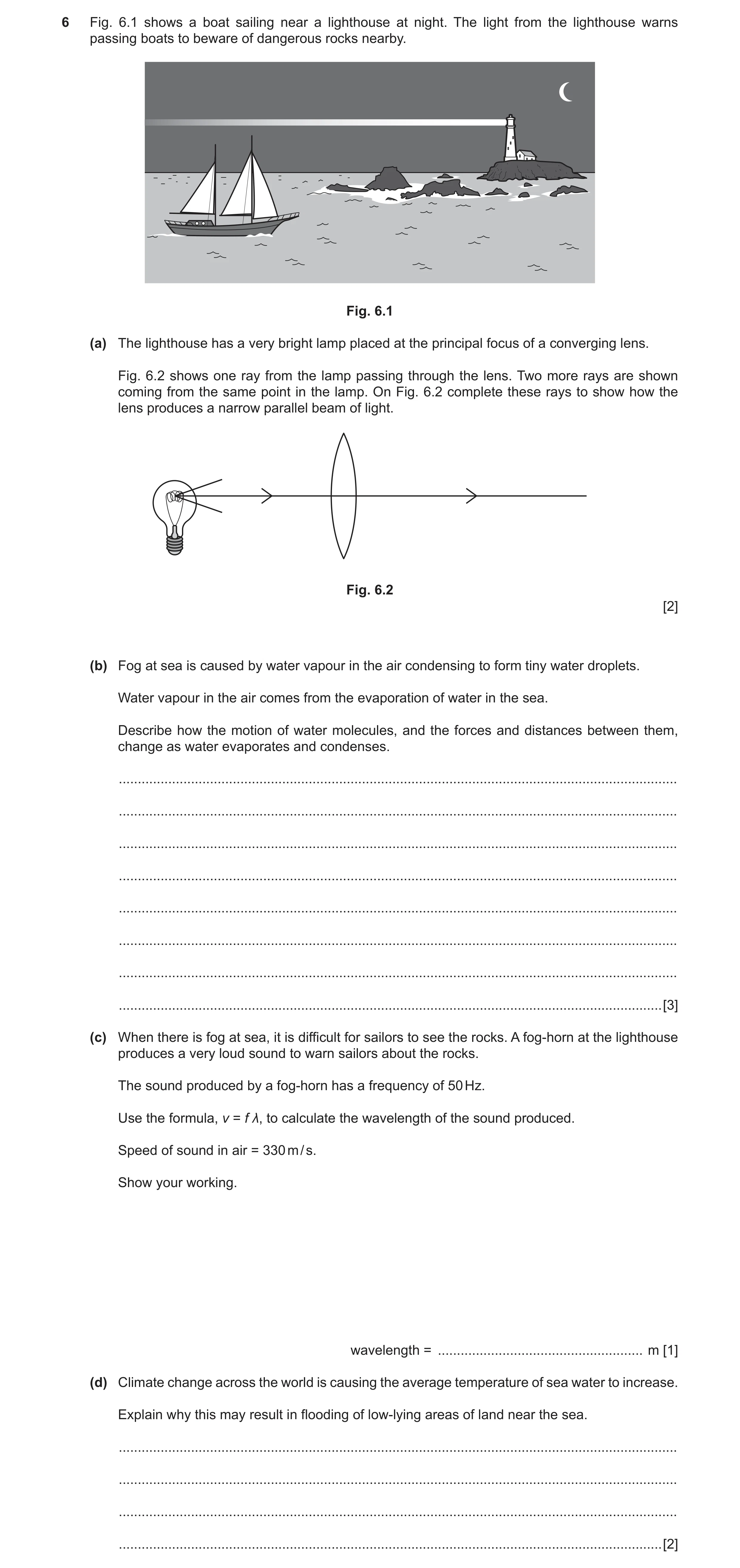
6 Fig. 6.1 shows a boat sailing near a lighthouse at night. The light from the lighthouse warns passing boats to beware of dangerous rocks nearby. Fig. 6.1 (a) The lighthouse has a very bright lamp placed at the principal focus of a converging lens. Fig. 6.2 shows one ray from the lamp passing through the lens. Two more rays are shown coming from the same point in the lamp. On Fig. 6.2 complete these rays to show how the lens produces a narrow parallel beam of light. Fig. 6.2 [2] (b) Fog at sea is caused by water vapour in the air condensing to form tiny water droplets. Water vapour in the air comes from the evaporation of water in the sea. Describe how the motion of water molecules, and the forces and distances between them, change as water evaporates and condenses. … … … … … … … … [3] (c) When there is fog at sea, it is difficult for sailors to see the rocks. A fog-horn at the lighthouse produces a very loud sound to warn sailors about the rocks. The sound produced by a fog-horn has a frequency of 50 Hz. Use the formula, v = f λ, to calculate the wavelength of the sound produced. Speed of sound in air = 330 m / s. Show your working. wavelength = … m [1] (d) Climate change across the world is causing the average temperature of sea water to increase. Explain why this may result in flooding of low-lying areas of land near the sea. … … … … [2]
8 marks
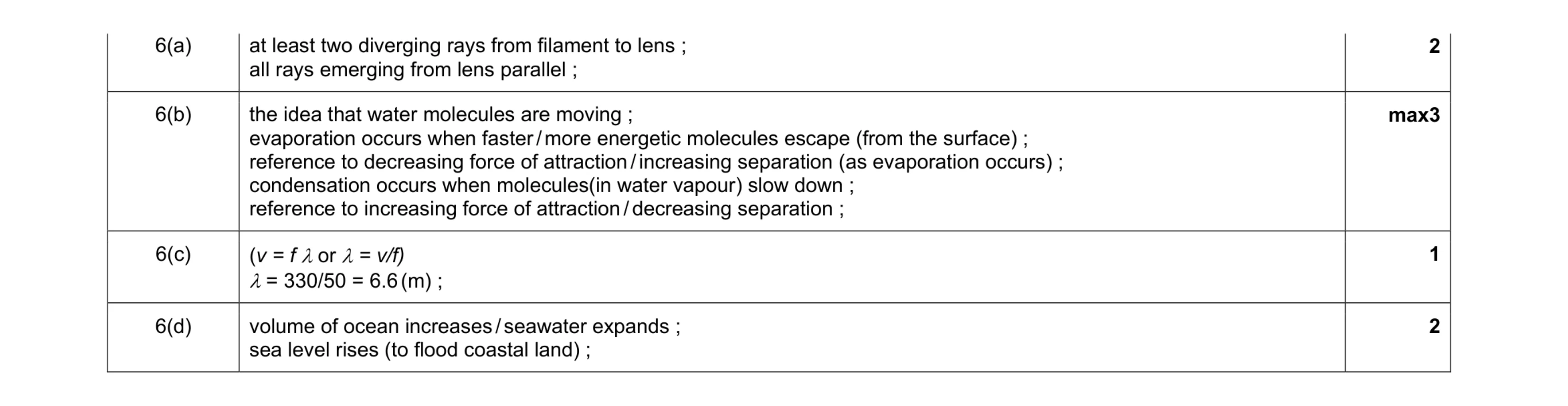
Mark scheme: 6(a) at least two diverging rays from filament to lens ; all rays emerging from lens parallel ; 2 6(b) the idea that water molecules are moving ; evaporation occurs when faster / more energetic molecules escape (from the surface) ; reference to decreasing force of attraction / increasing separation (as evaporation occurs) ; condensation occurs when molecules(in water vapour) slow down ; reference to increasing force of attraction / decreasing separation ; max3 6(c) (v = f λ or λ = v/f) λ = 330/50 = 6.6 (m) ; 1 6(d) volume of ocean increases / seawater expands ; sea level rises (to flood coastal land) ; 2
This question in 0653/42 Feb/March 2017
Q2 · The International Space Station orbiting the Earth 0653/42 Feb/March 2018
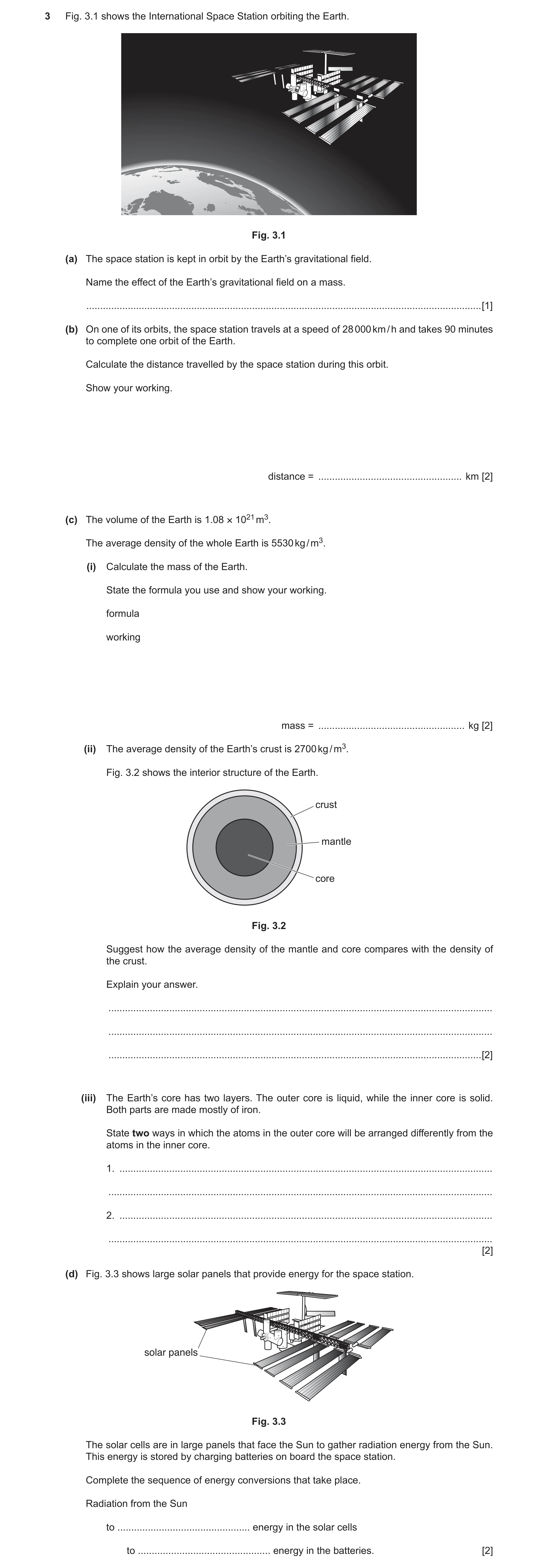
3 Fig. 3.1 shows the International Space Station orbiting the Earth. Fig. 3.1 (a) The space station is kept in orbit by the Earth’s gravitational field. Name the effect of the Earth’s gravitational field on a mass. … [1] (b) On one of its orbits, the space station travels at a speed of 28 000 km / h and takes 90 minutes to complete one orbit of the Earth. Calculate the distance travelled by the space station during this orbit. Show your working. distance = … km [2] (c) The volume of the Earth is 1.08 × 10²¹ m3. The average density of the whole Earth is 5530 kg / m3. (i) Calculate the mass of the Earth. State the formula you use and show your working. formula working mass = … kg [2] (ii) The average density of the Earth’s crust is 2700 kg / m3. Fig. 3.2 shows the interior structure of the Earth. crust mantle core Fig. 3.2 Suggest how the average density of the mantle and core compares with the density of the crust. Explain your answer. … … … [2] (iii) The Earth’s core has two layers. The outer core is liquid, while the inner core is solid. Both parts are made mostly of iron. State two ways in which the atoms in the outer core will be arranged differently from the atoms in the inner core. 1. … … 2. … … [2] (d) Fig. 3.3 shows large solar panels that provide energy for the space station. solar panels Fig. 3.3 The solar cells are in large panels that face the Sun to gather radiation energy from the Sun. This energy is stored by charging batteries on board the space station. Complete the sequence of energy conversions that take place. Radiation from the Sun to … energy in the solar cells to … energy in the batteries. [2]
11 marks
Mark scheme: 3(a) weight ; 1 3(b) speed = distance / time (or rearranged) ; distance (= speed × time) = 28 000 × 90 / 60 = 42 000 (km) ; 2 3(c)(i) density = mass / volume (or rearranged) ; mass (= volume × density) = 1.08 × 1021 × 5530 = 5.97 × 1024 (kg) ; 2 3(c)(ii) (average) density of mantle and core is higher (than 2700 kg / m3) ; in order to give an average density higher than the density of the crust / owtte ; 2 3(c)(iii) atoms in outer core randomly arranged / inner core regular arrangement / owtte ; atoms in outer core able to move freely / inner core fixed positions / orderly pattern / owtte ; 2 3(d) electrical ; chemical (potential) ; 2
This question in 0653/42 Feb/March 2018
Q3 · An incomplete electromagnetic spectrum linked to some uses of different parts of the… 0653/42 May/June 2018
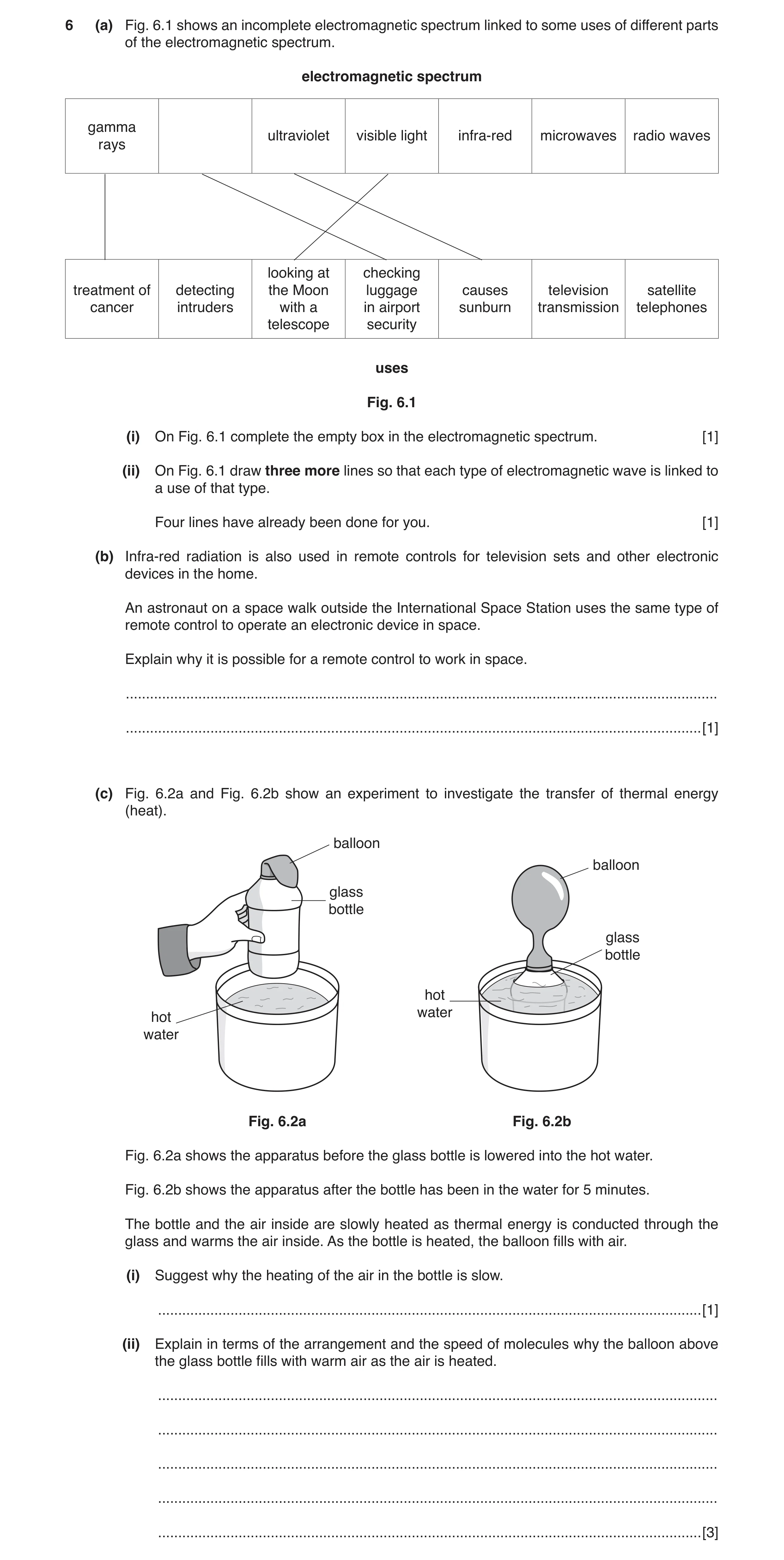
6 (a) Fig. 6.1 shows an incomplete electromagnetic spectrum linked to some uses of different parts of the electromagnetic spectrum. electromagnetic spectrum gamma ultraviolet visible light infra-red microwaves radio waves rays looking at checking treatment of detecting the Moon luggage causes television satellite cancer intruders with a in airport sunburn transmission telephones telescope security uses Fig. 6.1 (i) On Fig. 6.1 complete the empty box in the electromagnetic spectrum. [1] (ii) On Fig. 6.1 draw three more lines so that each type of electromagnetic wave is linked to a use of that type. Four lines have already been done for you. [1] (b) Infra-red radiation is also used in remote controls for television sets and other electronic devices in the home. An astronaut on a space walk outside the International Space Station uses the same type of remote control to operate an electronic device in space. Explain why it is possible for a remote control to work in space. … … [1] (c) Fig. 6.2a and Fig. 6.2b show an experiment to investigate the transfer of thermal energy (heat). balloon balloon glass bottle glass bottle hot water hot water Fig. 6.2a Fig. 6.2b Fig. 6.2a shows the apparatus before the glass bottle is lowered into the hot water. Fig. 6.2b shows the apparatus after the bottle has been in the water for 5 minutes. The bottle and the air inside are slowly heated as thermal energy is conducted through the glass and warms the air inside. As the bottle is heated, the balloon fills with air. (i) Suggest why the heating of the air in the bottle is slow. … [1] (ii) Explain in terms of the arrangement and the speed of molecules why the balloon above the glass bottle fills with warm air as the air is heated. … … … … … [3]
7 marks
Mark scheme: 6 6( 6 6 6( (a)(i) X-rays (a)(ii) all thre 6(b) electro (c)(i) glass i (c)(ii) air / ga molecu separa s ; ee correct ; omagnetic / infra is a bad / poor co as expands / volu ules move faste ation / distance b -red waves can onductor (of the ume increases ; r / gain kinetic e between molecu travel through a rmal energy) ; nergy ; les increases ; a vacuum / do no ot need a medium m to travel through ; 1 1 1 1 3
This question in 0653/42 May/June 2018
Q4 · A liquid is able to flow and will take the shape of its container 0653/42 Oct/Nov 2018
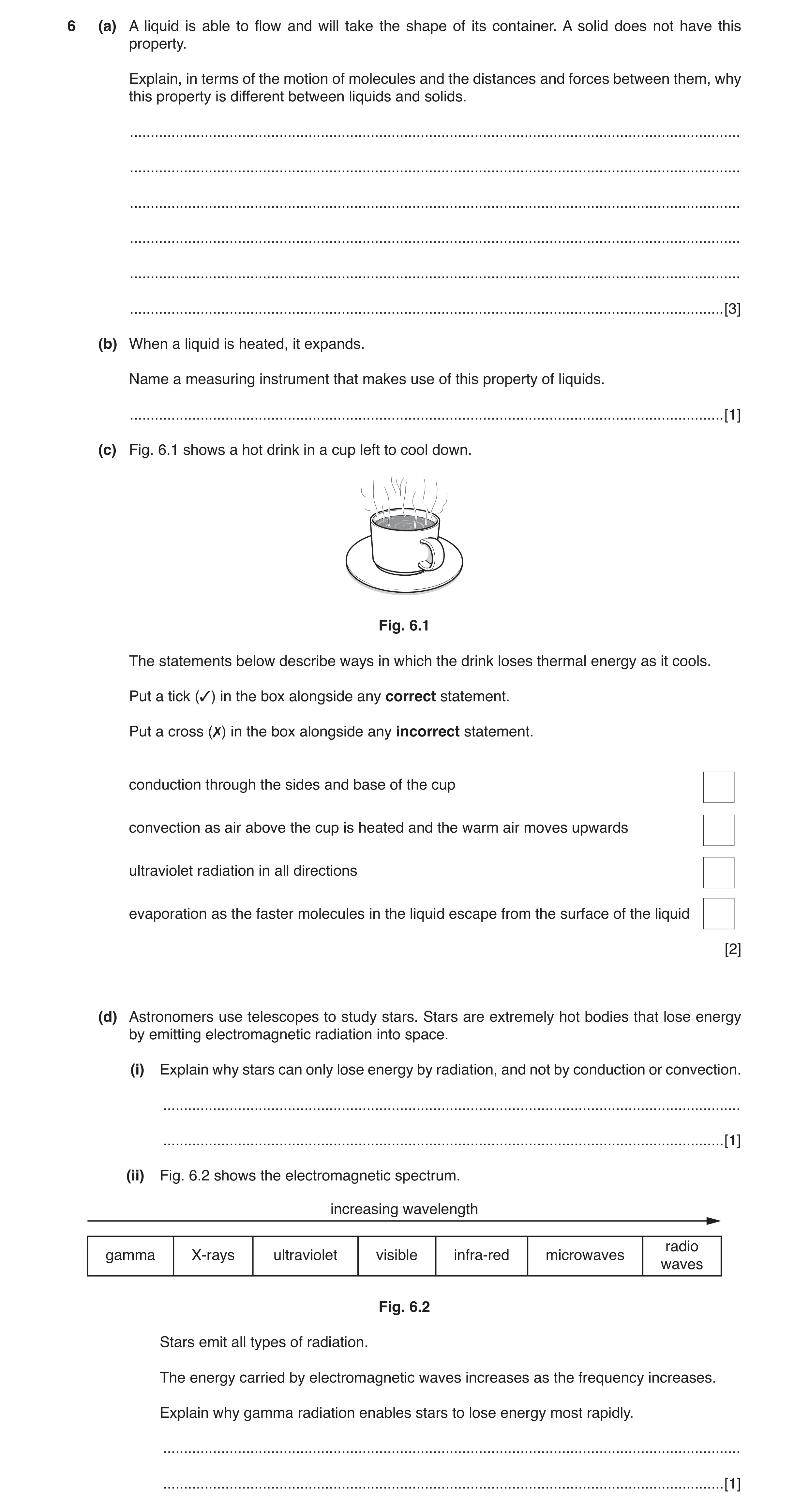
6 (a) A liquid is able to flow and will take the shape of its container. A solid does not have this property. Explain, in terms of the motion of molecules and the distances and forces between them, why this property is different between liquids and solids. … … … … … … [3] (b) When a liquid is heated, it expands. Name a measuring instrument that makes use of this property of liquids. … [1] (c) Fig. 6.1 shows a hot drink in a cup left to cool down. Fig. 6.1 The statements below describe ways in which the drink loses thermal energy as it cools. Put a tick (3) in the box alongside any correct statement. Put a cross (7) in the box alongside any incorrect statement. conduction through the sides and base of the cup convection as air above the cup is heated and the warm air moves upwards ultraviolet radiation in all directions evaporation as the faster molecules in the liquid escape from the surface of the liquid [2] (d) Astronomers use telescopes to study stars. Stars are extremely hot bodies that lose energy by emitting electromagnetic radiation into space. (i) Explain why stars can only lose energy by radiation, and not by conduction or convection. … … [1] (ii) Fig. 6.2 shows the electromagnetic spectrum. increasing wavelength radio gamma X-rays ultraviolet visible infra-red microwaves waves Fig. 6.2 Stars emit all types of radiation. The energy carried by electromagnetic waves increases as the frequency increases. Explain why gamma radiation enables stars to lose energy most rapidly. … … [1]
8 marks
Mark scheme: 6(a) In liquids: in liquids molecules further apart / not tightly packed / in solids molecules are tightly packed ; in liquids attractive forces are low / in solids attractive forces are high ; in liquids molecules are able to move around / slide past each other / in solids molecules (only) vibrate (around a fixed point) ; 3 6(b) thermometer ; 1 6(c) ticks in first, second, and fourth box, cross in 3rd box ; 2 6(d)(i) Conduction and convection require a medium / can’t travel though a vacuum / radiation can travel through a vacuum ; 1 6(d)(ii) highest frequency ; 1
This question in 0653/42 Oct/Nov 2018
Q5 · A cylinder of compressed air (air at high pressure) used by a scuba diver in the sea 0653/43 May/June 2019
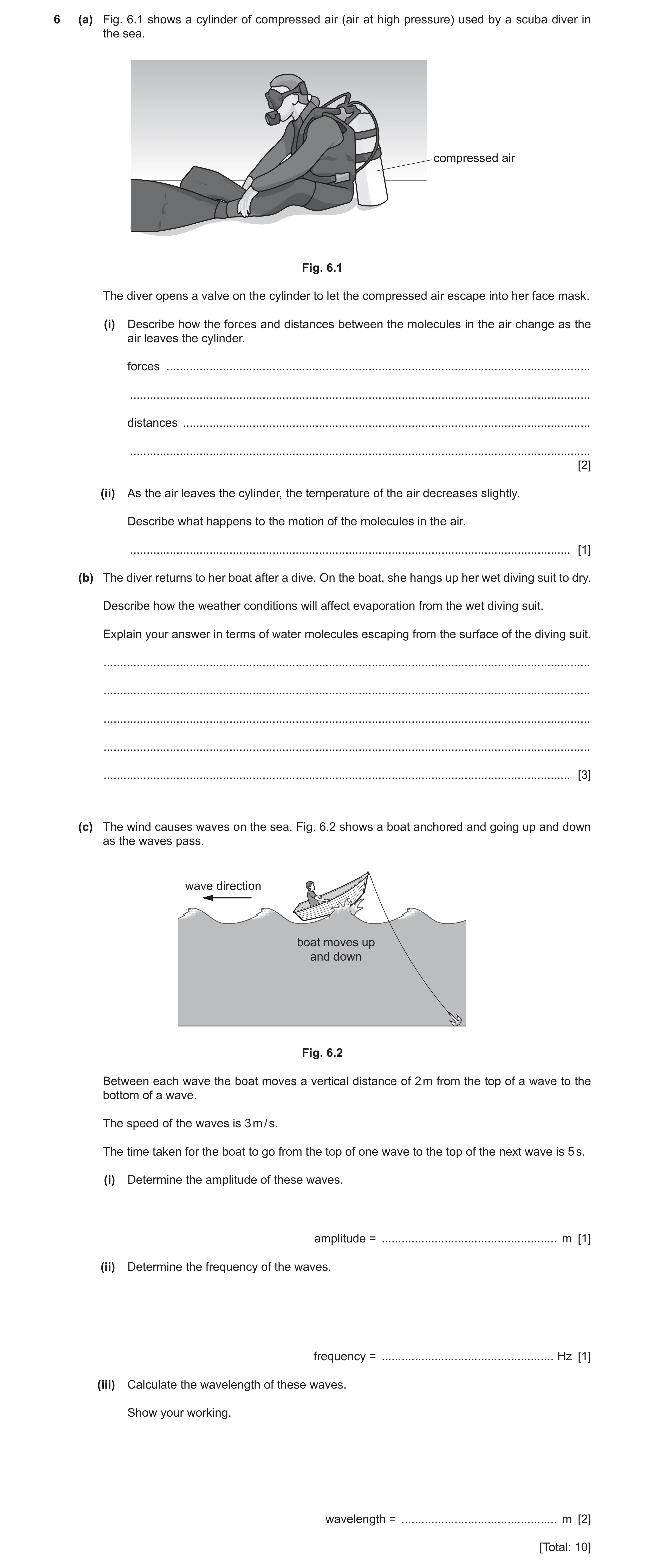
6 (a) Fig. 6.1 shows a cylinder of compressed air (air at high pressure) used by a scuba diver in the sea. compressed air Fig. 6.1 The diver opens a valve on the cylinder to let the compressed air escape into her face mask. (i) Describe how the forces and distances between the molecules in the air change as the air leaves the cylinder. forces … … distances … … [2] (ii) As the air leaves the cylinder, the temperature of the air decreases slightly. Describe what happens to the motion of the molecules in the air. … [1] (b) The diver returns to her boat after a dive. On the boat, she hangs up her wet diving suit to dry. Describe how the weather conditions will affect evaporation from the wet diving suit. Explain your answer in terms of water molecules escaping from the surface of the diving suit. … … … … … [3] (c) The wind causes waves on the sea. Fig. 6.2 shows a boat anchored and going up and down as the waves pass. wave direction boat moves up and down Fig. 6.2 Between each wave the boat moves a vertical distance of 2 m from the top of a wave to the bottom of a wave. The speed of the waves is 3 m / s. The time taken for the boat to go from the top of one wave to the top of the next wave is 5 s. (i) Determine the amplitude of these waves. amplitude = … m [1] (ii) Determine the frequency of the waves. frequency = … Hz [1] (iii) Calculate the wavelength of these waves. Show your working. wavelength = … m [2] [Total: 10]
10 marks
Mark scheme: 6(a)(i) forces decrease ; distances increase ; 2 6(a)(ii) (average) speed (of molecules) decreases ; 1 6(b) the higher the wind speed the higher the rate of evaporation / drying ; increased wind speed increases the rate at which molecules move away from suit / decreases the chances that escaped molecules return / owtte ; the higher the temperature the higher the rate of evaporation / drying ; increased temperature increases the energy / speed of molecules so they leave the surface at a higher rate / owtte ; max 3 6(c)(i) 1 (m) 1 6(c)(ii) f = (1 ÷ time between waves = 1 ÷ 5 ) = 0.2 (Hz) ; 1 6(c)(iii) v = f λ or λ = v / f or λ = 3 / 0.2 ; = 15 (m) ; 2
This question in 0653/43 May/June 2019
Q6 · An electric hair dryer 0653/42 Oct/Nov 2019
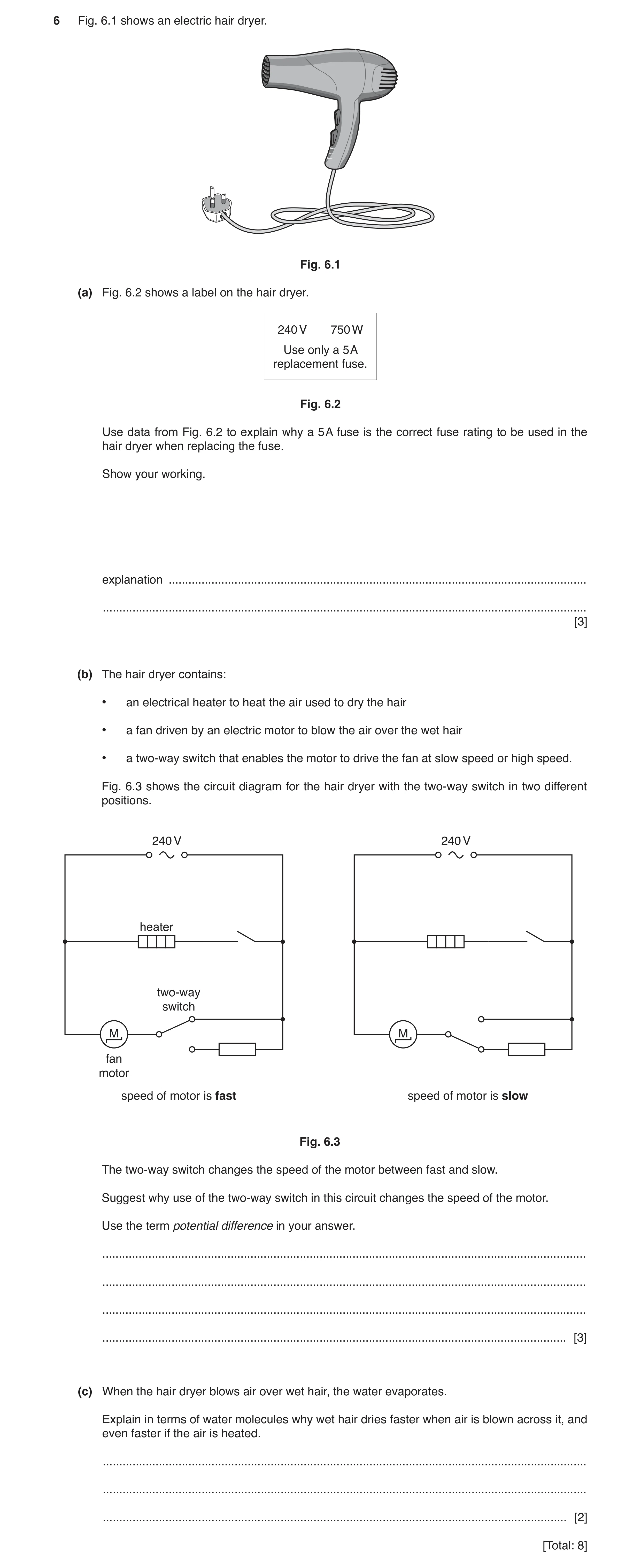
6 Fig. 6.1 shows an electric hair dryer. Fig. 6.1 (a) Fig. 6.2 shows a label on the hair dryer. 240 V 750 W Use only a 5 A replacement fuse. Fig. 6.2 Use data from Fig. 6.2 to explain why a 5 A fuse is the correct fuse rating to be used in the hair dryer when replacing the fuse. Show your working. explanation … … [3] (b) The hair dryer contains: • an electrical heater to heat the air used to dry the hair • a fan driven by an electric motor to blow the air over the wet hair • a two-way switch that enables the motor to drive the fan at slow speed or high speed. Fig. 6.3 shows the circuit diagram for the hair dryer with the two-way switch in two different positions. 240 V 240 V heater two-way switch M M fan motor speed of motor is fast speed of motor is slow Fig. 6.3 The two-way switch changes the speed of the motor between fast and slow. Suggest why use of the two-way switch in this circuit changes the speed of the motor. Use the term potential difference in your answer. … … … … [3] (c) When the hair dryer blows air over wet hair, the water evaporates. Explain in terms of water molecules why wet hair dries faster when air is blown across it, and even faster if the air is heated. … … … [2] [Total: 8]
8 marks
Mark scheme: 6(a) Use of P = IV ; (750 / 240 =) I = 3.1 (25) (A) ; 5 A fuse just higher than required operating current so appropriate / 3 A fuse too low and would blow under normal working conditions / 13 A fuse too high and would not blow until much higher than operating current ; 3 6(b) (when the switch is down) additional resistor (in motor branch of circuit) ; potential difference across motor decreases (because some p.d. across resistor) ; current (in motor) decreases (so motor speed is slow) ; ora 3 6(c) hairdryer blows evaporated water molecules away so they cannot fall back onto the hair again ; hairdryer heats the water molecules on the hair so they have increased KE and can evaporate faster ; 2
This question in 0653/42 Oct/Nov 2019
Q7 · In hot climates, some foods such as milk must be kept cool to ensure they stay fresh 0653/43 Oct/Nov 2019
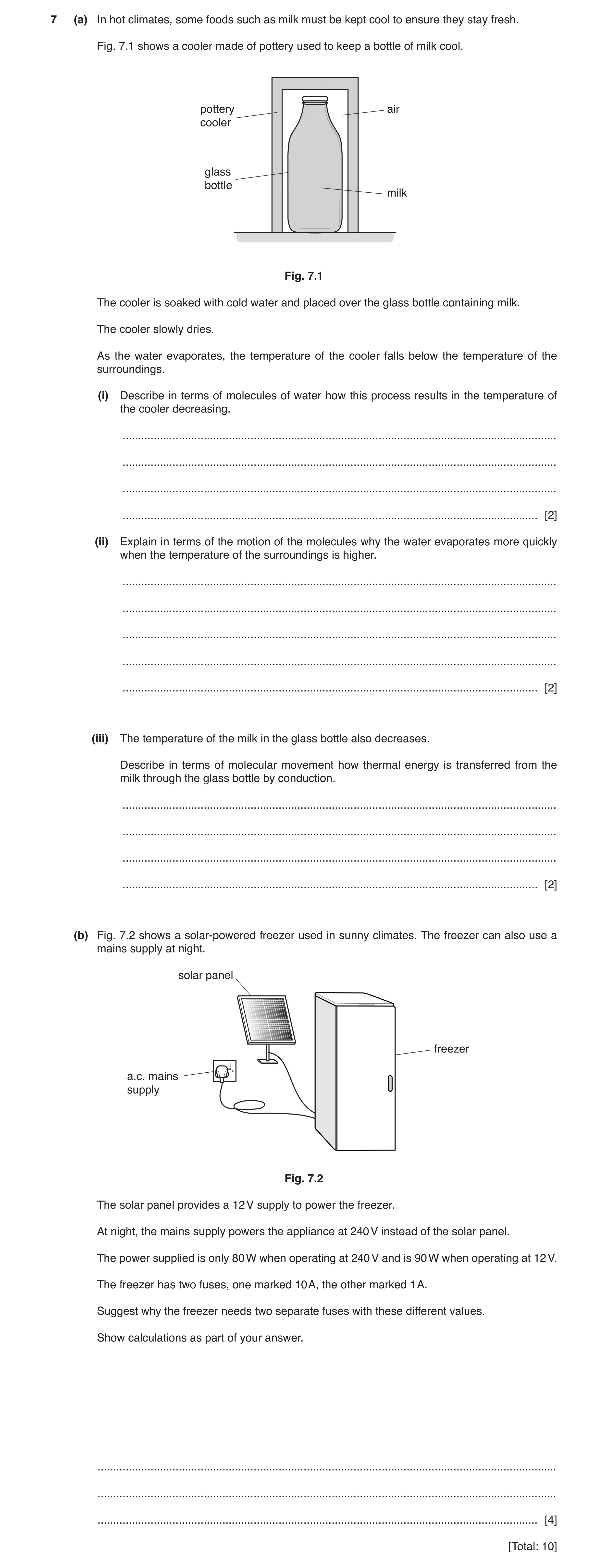
7 (a) In hot climates, some foods such as milk must be kept cool to ensure they stay fresh. Fig. 7.1 shows a cooler made of pottery used to keep a bottle of milk cool. pottery air cooler glass bottle milk Fig. 7.1 The cooler is soaked with cold water and placed over the glass bottle containing milk. The cooler slowly dries. As the water evaporates, the temperature of the cooler falls below the temperature of the surroundings. (i) Describe in terms of molecules of water how this process results in the temperature of the cooler decreasing. … … … … [2] (ii) Explain in terms of the motion of the molecules why the water evaporates more quickly when the temperature of the surroundings is higher. … … … … … [2] (iii) The temperature of the milk in the glass bottle also decreases. Describe in terms of molecular movement how thermal energy is transferred from the milk through the glass bottle by conduction. … … … … [2] (b) Fig. 7.2 shows a solar-powered freezer used in sunny climates. The freezer can also use a mains supply at night. solar panel freezer a.c. mains supply Fig. 7.2 The solar panel provides a 12 V supply to power the freezer. At night, the mains supply powers the appliance at 240 V instead of the solar panel. The power supplied is only 80 W when operating at 240 V and is 90 W when operating at 12 V. The freezer has two fuses, one marked 10 A, the other marked 1 A. Suggest why the freezer needs two separate fuses with these different values. Show calculations as part of your answer. … … … [4] [Total: 10]
10 marks
Mark scheme: 7(a)(i) faster / more energetic molecules escape ; (average) speed / KE of remaining molecules is lower (results in lower temperature) ; 2 7(a)(ii) molecules in air moving faster / more KE ; transfer more energy to water molecules by collision (so more escape) ; 2 7(a)(iii) collisions of faster milk molecules with slower glass molecules causes glass molecules to gain energy and vibrate faster ; energy then passed from molecule to molecule through glass ; 2 7(b) use of P = V × I ; 12 V circuit current = 90 / 12 = 7.5 A ; 240 V circuit current = 80 / 240 = 0.33 A ; 10 A fuse appropriate for 12 V circuit, 1 A fuse for 240 V circuit ; 4
This question in 0653/43 Oct/Nov 2019
Q8 · Naphthalene is a solid that melts at 80 °C to form a liquid 0653/41 May/June 2020
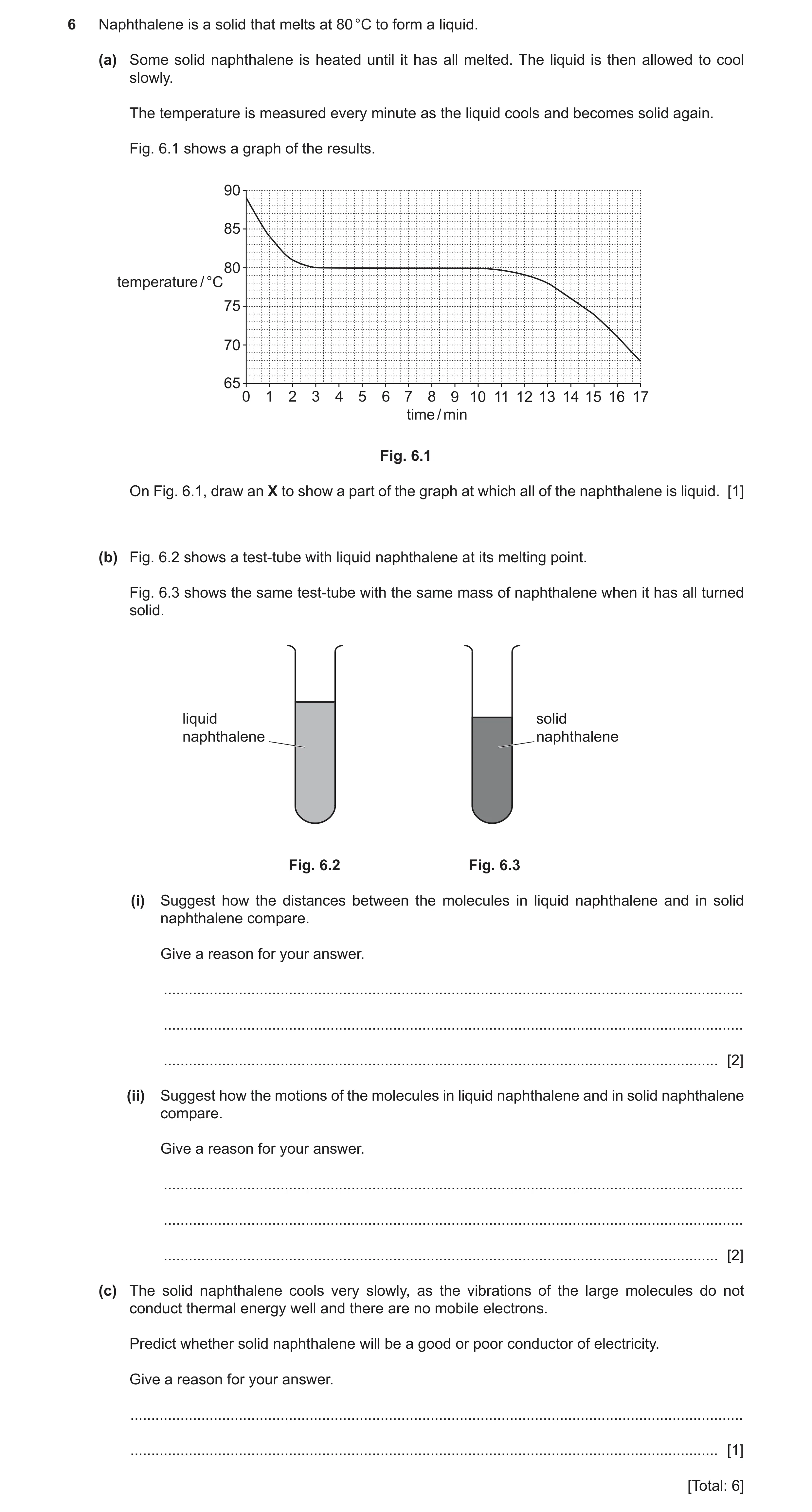
6 Naphthalene is a solid that melts at 80 °C to form a liquid. (a) Some solid naphthalene is heated until it has all melted. The liquid is then allowed to cool slowly. The temperature is measured every minute as the liquid cools and becomes solid again. Fig. 6.1 shows a graph of the results. 90 85 80 temperature / °C 75 70 65 0 1 2 3 4 5 6 7 8 9 10 11 12 13 14 15 16 17 time / min Fig. 6.1 On Fig. 6.1, draw an X to show a part of the graph at which all of the naphthalene is liquid. [1] (b) Fig. 6.2 shows a test-tube with liquid naphthalene at its melting point. Fig. 6.3 shows the same test-tube with the same mass of naphthalene when it has all turned solid. liquid solid naphthalene naphthalene Fig. 6.2 Fig. 6.3 (i) Suggest how the distances between the molecules in liquid naphthalene and in solid naphthalene compare. Give a reason for your answer. … … … [2] (ii) Suggest how the motions of the molecules in liquid naphthalene and in solid naphthalene compare. Give a reason for your answer. … … … [2] (c) The solid naphthalene cools very slowly, as the vibrations of the large molecules do not conduct thermal energy well and there are no mobile electrons. Predict whether solid naphthalene will be a good or poor conductor of electricity. Give a reason for your answer. … … [1] [Total: 6]
6 marks
Mark scheme: 6(a) X drawn anywhere on curve between 0s and 3s ; 1 6(b)(i) (molecules) closer in solid / further apart in liquid ; the idea that the regular arrangement of molecules in solid means that molecules more efficiently packed / owtte ; or in liquid, random arrangement so molecules less efficiently packed / owtte ; 2 6(b)(ii) slower in solid / faster in liquid ; in solid less (thermal / kinetic) energy / in liquid more (thermal / kinetic) energy ; 2 6(c) (poor conductor – no mark) good conductors of electricity require free electrons ; 1
This question in 0653/41 May/June 2020
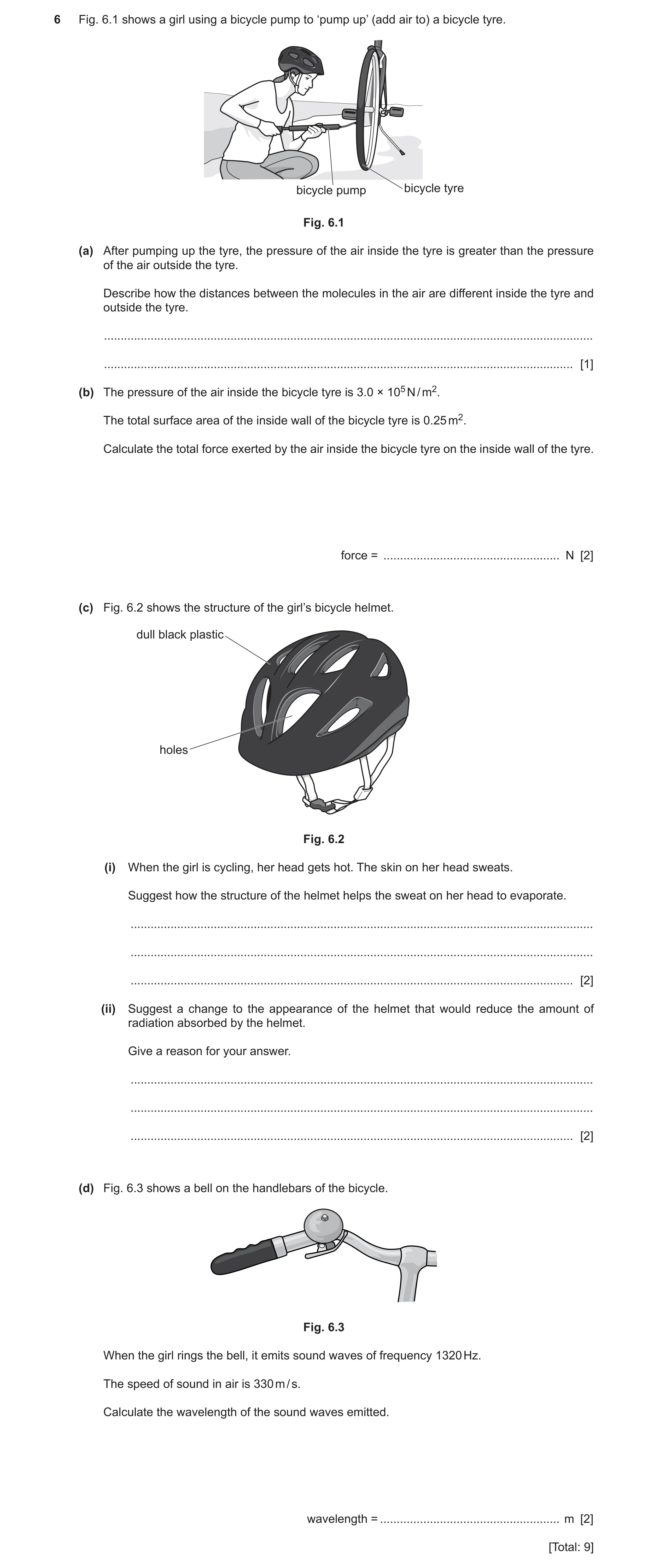
Q9 · A girl using a bicycle pump to ‘pump up’ (add air to) a bicycle tyre 0653/41 Oct/Nov 2020
6 Fig. 6.1 shows a girl using a bicycle pump to ‘pump up’ (add air to) a bicycle tyre. bicycle pump bicycle tyre Fig. 6.1 (a) After pumping up the tyre, the pressure of the air inside the tyre is greater than the pressure of the air outside the tyre. Describe how the distances between the molecules in the air are different inside the tyre and outside the tyre. … … [1] (b) The pressure of the air inside the bicycle tyre is 3.0 × 10⁵ N / m2. The total surface area of the inside wall of the bicycle tyre is 0.25 m2. Calculate the total force exerted by the air inside the bicycle tyre on the inside wall of the tyre. force = … N [2] (c) Fig. 6.2 shows the structure of the girl’s bicycle helmet. dull black plastic holes Fig. 6.2 (i) When the girl is cycling, her head gets hot. The skin on her head sweats. Suggest how the structure of the helmet helps the sweat on her head to evaporate. … … … [2] (ii) Suggest a change to the appearance of the helmet that would reduce the amount of radiation absorbed by the helmet. Give a reason for your answer. … … … [2] (d) Fig. 6.3 shows a bell on the handlebars of the bicycle. Fig. 6.3 When the girl rings the bell, it emits sound waves of frequency 1320 Hz. The speed of sound in air is 330 m / s. Calculate the wavelength of the sound waves emitted. wavelength = … m [2] [Total: 9]
9 marks
Mark scheme: 6(a) distances between molecules inside the tyre are smaller / molecules inside tyre are closer together / ora ; 1 6(b) use of P = F / A ; (F = P × A = 3 × 105 × 0.25 =) 0.75 × 10⁵ / 75 000 (N) ; 2 6(c)(i) any two from: holes help air flow (over the surface of the skin on her head) ; holes allow water to escape ; which increases rate of evaporation ; 2 6(c)(ii) make, shiny / white / light in colour ; reflects (the Sun’s radiation) ; 2 6(d) v = f λ in any form / 330 ÷ 1320 ; 0.25 (m) ; 2
This question in 0653/41 Oct/Nov 2020
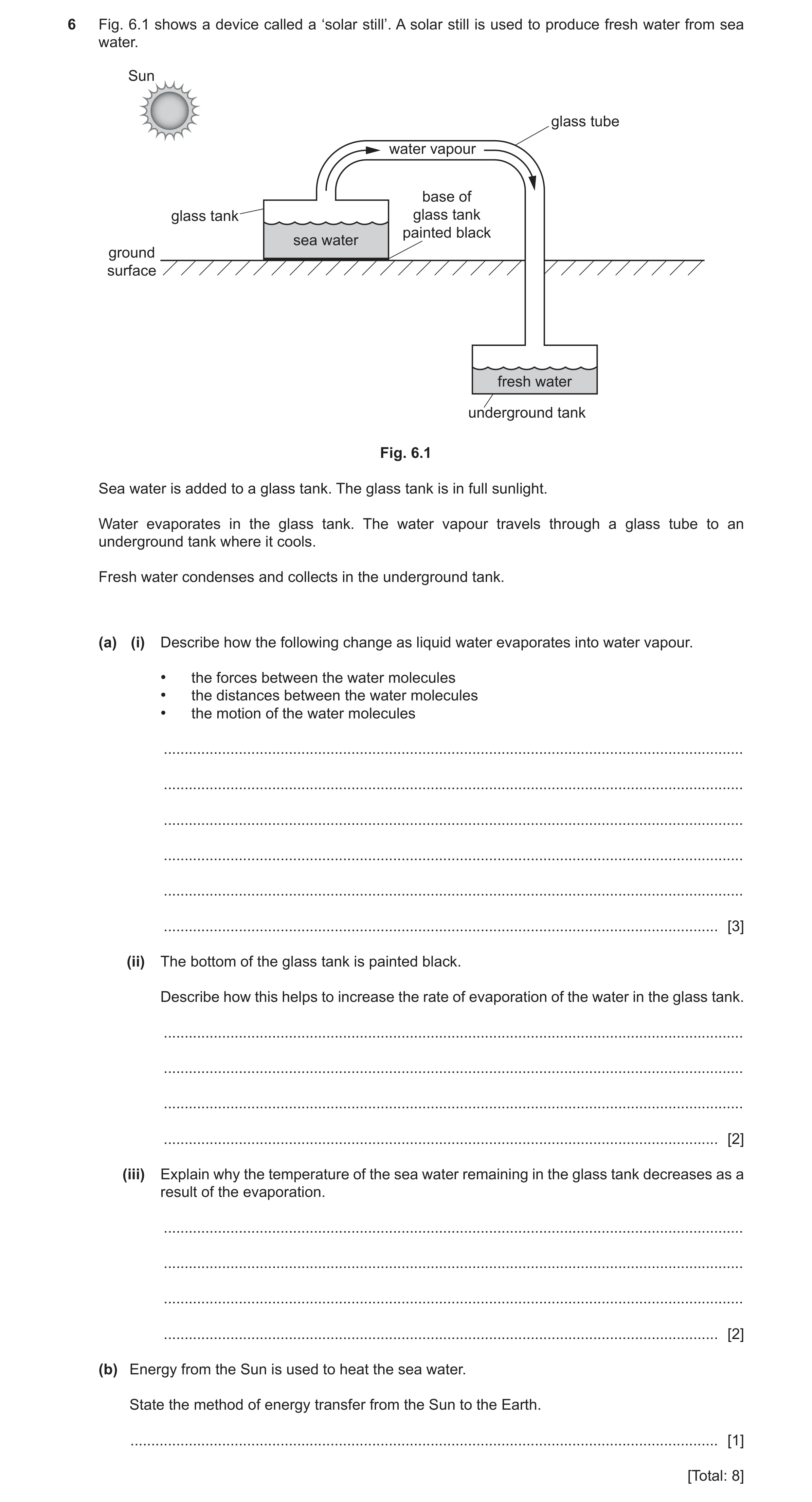
Q10 · A device called a ‘solar still’ 0653/42 Oct/Nov 2020
6 Fig. 6.1 shows a device called a ‘solar still’. A solar still is used to produce fresh water from sea water. Sun glass tube water vapour base of glass tank glass tank painted black sea water ground surface fresh water underground tank Fig. 6.1 Sea water is added to a glass tank. The glass tank is in full sunlight. Water evaporates in the glass tank. The water vapour travels through a glass tube to an underground tank where it cools. Fresh water condenses and collects in the underground tank. (a) (i) Describe how the following change as liquid water evaporates into water vapour. • the forces between the water molecules • the distances between the water molecules • the motion of the water molecules … … … … … … [3] (ii) The bottom of the glass tank is painted black. Describe how this helps to increase the rate of evaporation of the water in the glass tank. … … … … [2] (iii) Explain why the temperature of the sea water remaining in the glass tank decreases as a result of the evaporation. … … … … [2] (b) Energy from the Sun is used to heat the sea water. State the method of energy transfer from the Sun to the Earth. … [1] [Total: 8]
8 marks
Mark scheme: 6(a)(i) forces decrease / weaken ; distances increase ; move, (more) freely / away from surface (of liquid water) ; 3 6(a)(ii) black is a good absorber (of radiation) ; warm base of pool transfers thermal energy to water / increase in temperature of water (increases rate of evaporation) ; 2 6(a)(iii) more-energetic molecules escape ; remaining molecules are less energetic (so lower temperature) ; 2 6(b) radiation ; 1
This question in 0653/42 Oct/Nov 2020
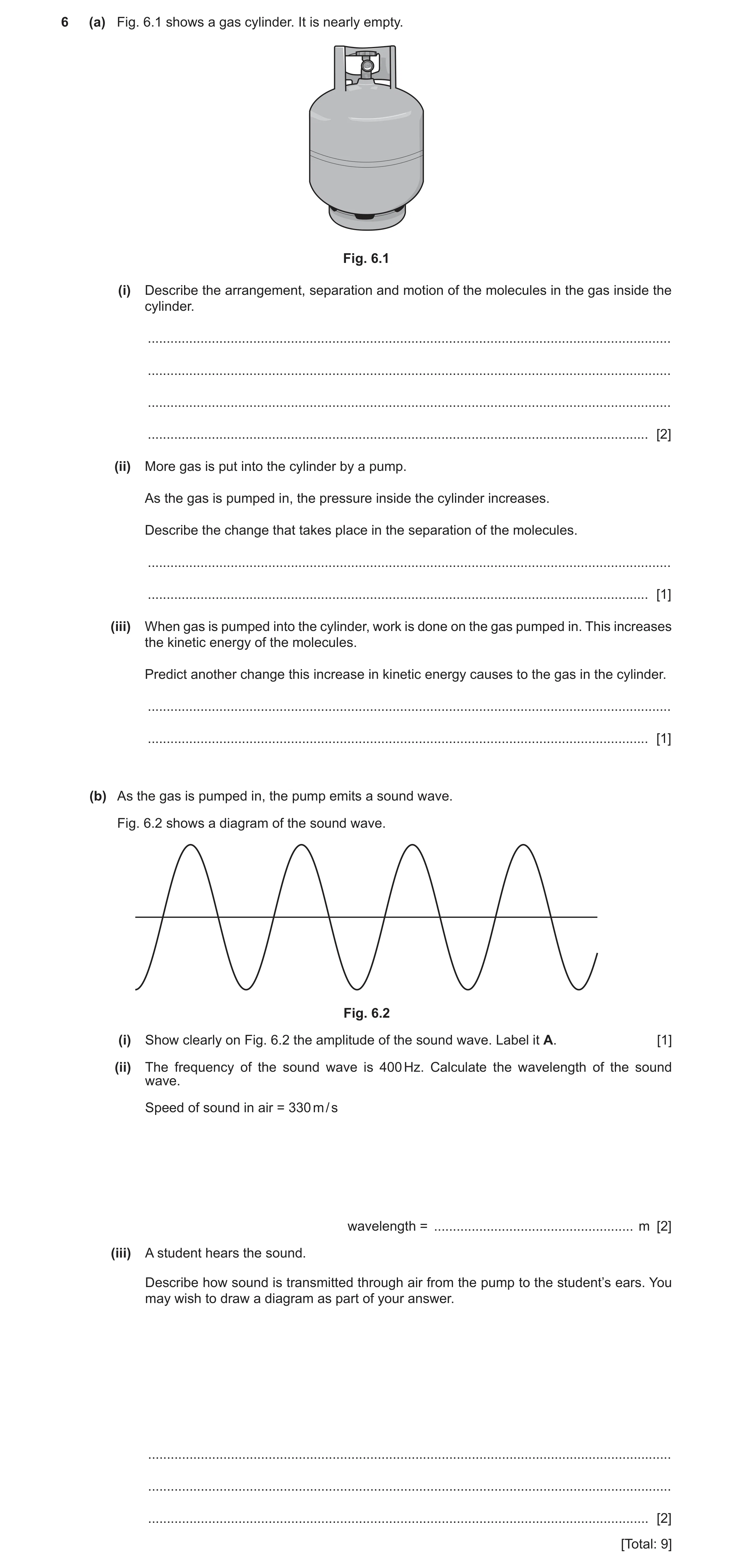
Question 11 0653/42 Feb/March 2021
6 (a) Fig. 6.1 shows a gas cylinder. It is nearly empty. Fig. 6.1 (i) Describe the arrangement, separation and motion of the molecules in the gas inside the cylinder. … … … … [2] (ii) More gas is put into the cylinder by a pump. As the gas is pumped in, the pressure inside the cylinder increases. Describe the change that takes place in the separation of the molecules. … … [1] (iii) When gas is pumped into the cylinder, work is done on the gas pumped in. This increases the kinetic energy of the molecules. Predict another change this increase in kinetic energy causes to the gas in the cylinder. … … [1] (b) As the gas is pumped in, the pump emits a sound wave. Fig. 6.2 shows a diagram of the sound wave. Fig. 6.2 (i) Show clearly on Fig. 6.2 the amplitude of the sound wave. Label it A. [1] (ii) The frequency of the sound wave is 400 Hz. Calculate the wavelength of the sound wave. Speed of sound in air = 330 m / s wavelength = … m [2] (iii) A student hears the sound. Describe how sound is transmitted through air from the pump to the student’s ears. You may wish to draw a diagram as part of your answer. … … … [2] [Total: 9]
9 marks
Mark scheme: 6(a)(i) any two from: random (arrangement) ; the idea of far apart ; moving, freely / around / quickly / randomly ; 2 6(a)(ii) closer / not as far apart ; 1 6(a)(iii) increase in temperature ; 1 6(b)(i) amplitude correctly indicated on Fig. 6.2 ; 1 6(b)(ii) v = f λ / λ = v ÷ f / 330 ÷ 400 ; = 0.825 / 0.83 (m) ; 2 Question Answer Marks 6(b)(iii) (series of) compressions and rarefactions ; description of what these terms mean by reference to air pressure or distance between molecules / diagram such as one of those below, ; 2
This question in 0653/42 Feb/March 2021
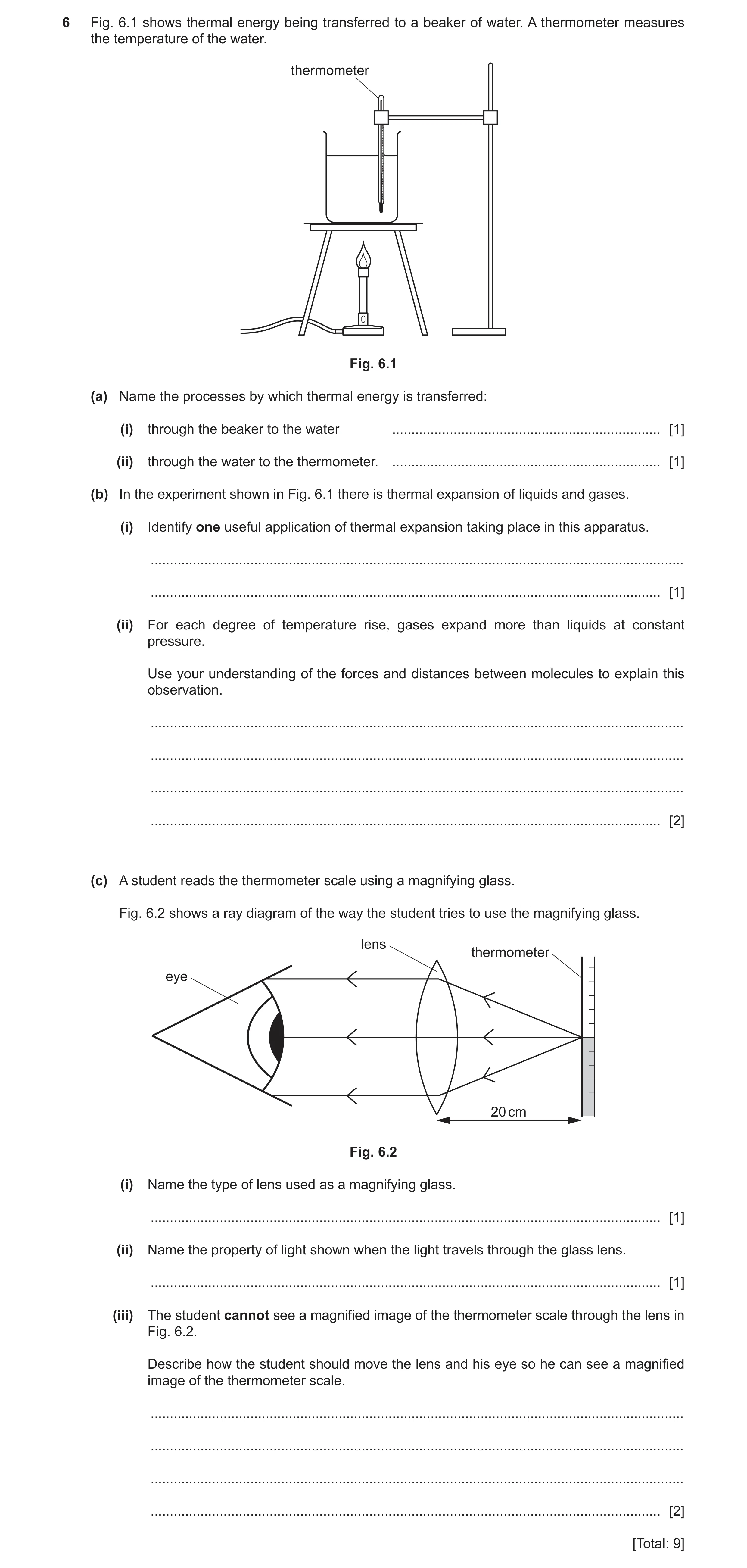
Q12 · Thermal energy being transferred to a beaker of water 0653/42 May/June 2021
6 Fig. 6.1 shows thermal energy being transferred to a beaker of water. A thermometer measures the temperature of the water. thermometer Fig. 6.1 (a) Name the processes by which thermal energy is transferred: (i) through the beaker to the water … [1] (ii) through the water to the thermometer. … [1] (b) In the experiment shown in Fig. 6.1 there is thermal expansion of liquids and gases. (i) Identify one useful application of thermal expansion taking place in this apparatus. … … [1] (ii) For each degree of temperature rise, gases expand more than liquids at constant pressure. Use your understanding of the forces and distances between molecules to explain this observation. … … … … [2] (c) A student reads the thermometer scale using a magnifying glass. Fig. 6.2 shows a ray diagram of the way the student tries to use the magnifying glass. lens thermometer eye 20 cm Fig. 6.2 (i) Name the type of lens used as a magnifying glass. … [1] (ii) Name the property of light shown when the light travels through the glass lens. … [1] (iii) The student cannot see a magnified image of the thermometer scale through the lens in Fig. 6.2. Describe how the student should move the lens and his eye so he can see a magnified image of the thermometer scale. … … … … [2] [Total: 9]
9 marks
Mark scheme: 6(a)(i) conduction ; 1 6(a)(ii) convection ; 1 6(b)(i) thermometer / description of liquid expanding / rising to show temperature ; 1 6(b)(ii) forces between gas molecules weaker OR distances between molecules in gas are greater ; so less energy needed to separate gas molecules ; 2 6(c)(i) converging ; 1 6(c)(ii) refraction ; 1 6(c)(iii) lens closer to thermometer ; eye closer to lens ; (in either order) 2
This question in 0653/42 May/June 2021
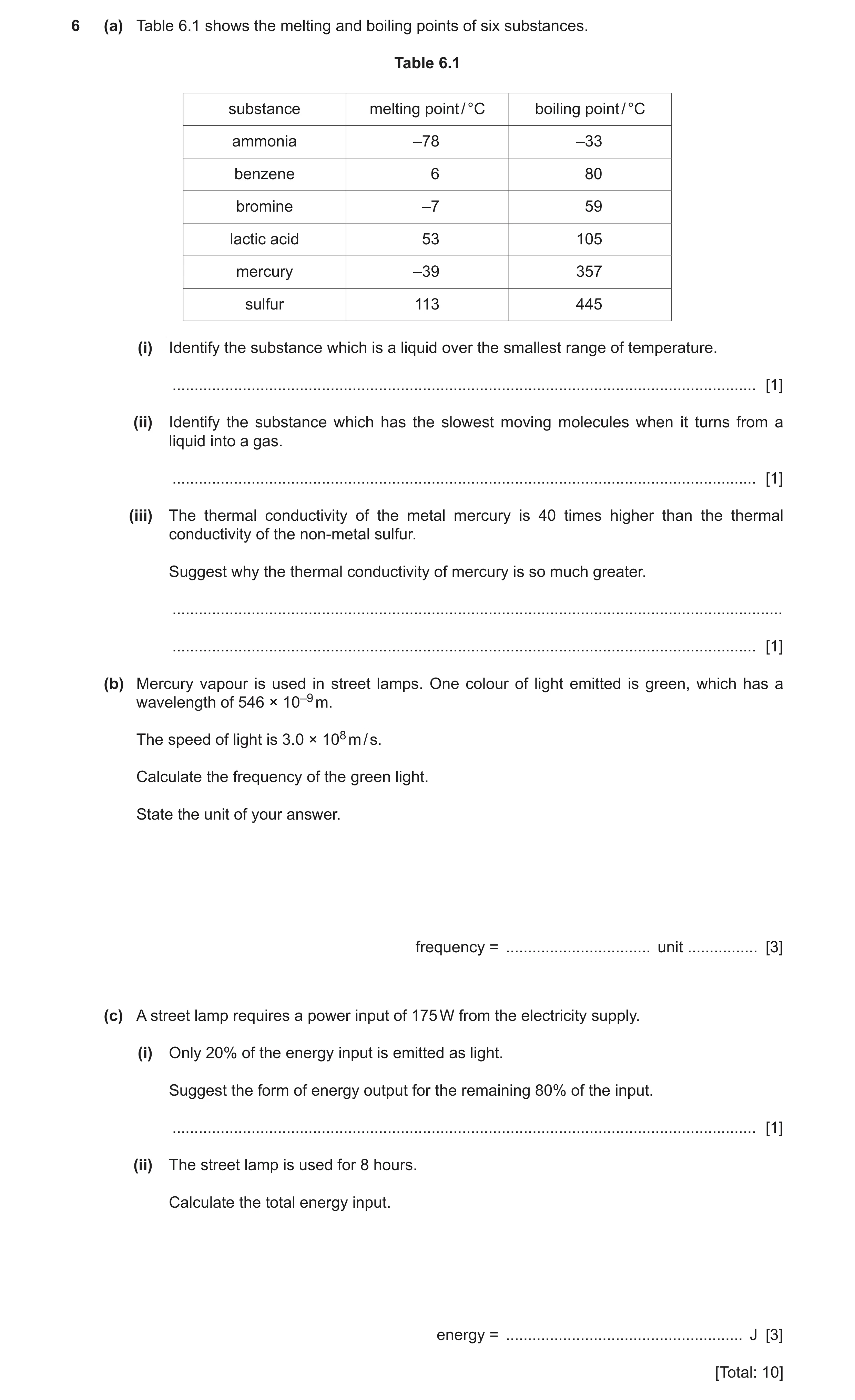
Q13 · The melting and boiling points of six substances 0653/43 May/June 2021
6 (a) Table 6.1 shows the melting and boiling points of six substances. Table 6.1 substance melting point / °C boiling point / °C ammonia –78 –33 benzene 6 80 bromine –7 59 lactic acid 53 105 mercury –39 357 sulfur 113 445 (i) Identify the substance which is a liquid over the smallest range of temperature. … [1] (ii) Identify the substance which has the slowest moving molecules when it turns from a liquid into a gas. … [1] (iii) The thermal conductivity of the metal mercury is 40 times higher than the thermal conductivity of the non-metal sulfur. Suggest why the thermal conductivity of mercury is so much greater. … … [1] (b) Mercury vapour is used in street lamps. One colour of light emitted is green, which has a wavelength of 546 × 10–9 m. The speed of light is 3.0 × 10⁸ m / s. Calculate the frequency of the green light. State the unit of your answer. frequency = … unit … [3] (c) A street lamp requires a power input of 175 W from the electricity supply. (i) Only 20% of the energy input is emitted as light. Suggest the form of energy output for the remaining 80% of the input. … [1] (ii) The street lamp is used for 8 hours. Calculate the total energy input. energy = … J [3] [Total: 10]
10 marks
Mark scheme: 6(a)(i) ammonia ; 1 6(a)(ii) ammonia ; 1 6(a)(iii) (thermal conductivity greater due to) transfer by (delocalised) electrons ; 1 6(b) f = v / λ = 3 × 10⁸ / 546 × 10–9 ; = 5.49 × 10¹⁴ / 5.5 × 10¹⁴ ; Hz ; 3 6(c)(i) thermal ; 1 6(c)(ii) 175 W = 175 J / s / energy = power × time ; 8 hrs = 8 × 3600 = 28 800 s ; (total energy =) 175 × 28 800 = 5 040 000 (J) ; 3
This question in 0653/43 May/June 2021
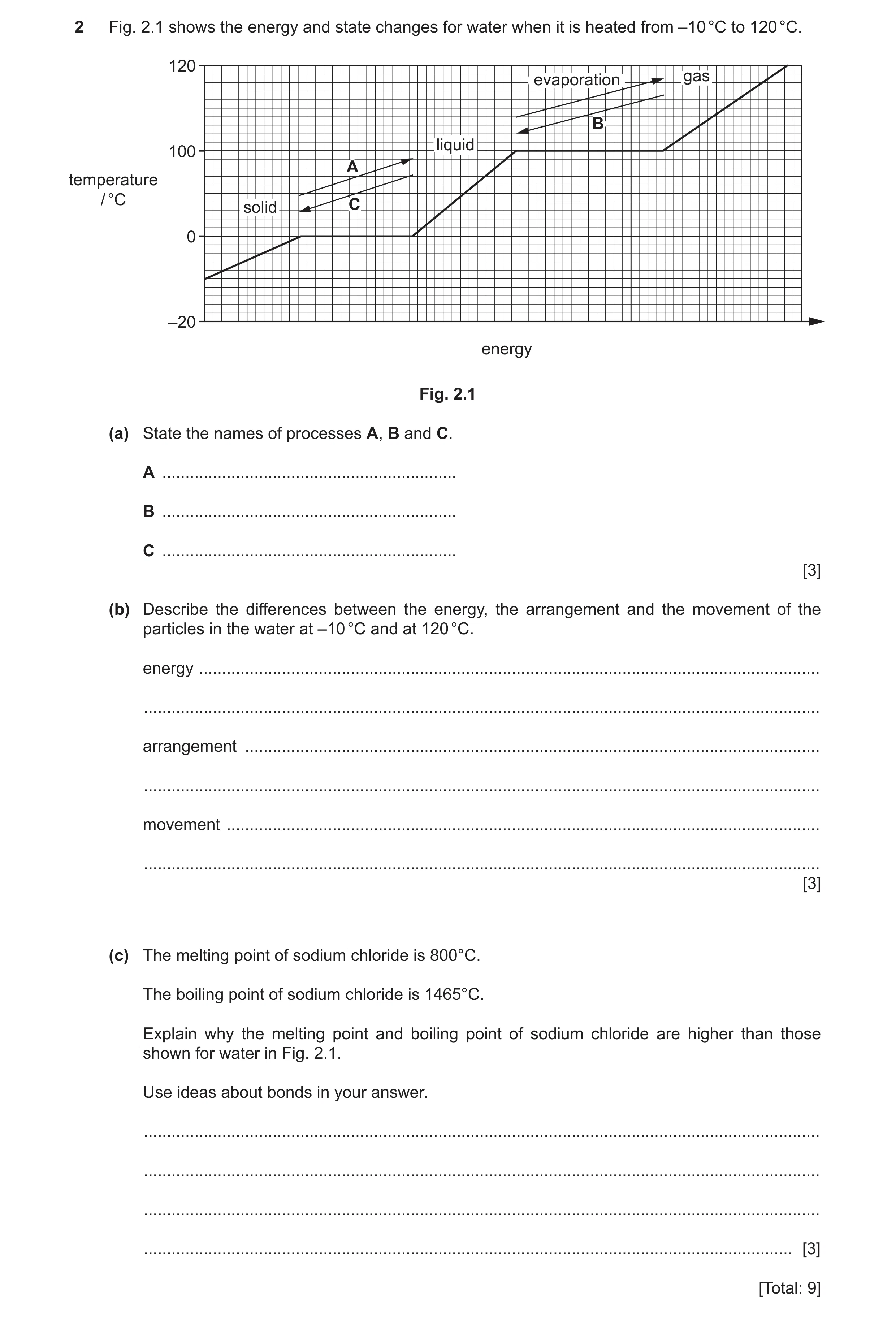
Q14 · The energy and state changes for water when it is heated from –10 °C to 120 °C 0653/41 Oct/Nov 2021
2 Fig. 2.1 shows the energy and state changes for water when it is heated from –10 °C to 120 °C. 120 evaporation gas B liquid 100 A temperature / °C solid C 0 –20 energy Fig. 2.1 (a) State the names of processes A, B and C. A … B … C … [3] (b) Describe the differences between the energy, the arrangement and the movement of the particles in the water at –10 °C and at 120 °C. energy … … arrangement … … movement … … [3] (c) The melting point of sodium chloride is 800°C. The boiling point of sodium chloride is 1465°C. Explain why the melting point and boiling point of sodium chloride are higher than those shown for water in Fig. 2.1. Use ideas about bonds in your answer. … … … … [3] [Total: 9]
9 marks
Mark scheme: 2(a) A melting ; B condensation ; C freezing ; 3 2(b) energy: particles have more (kinetic) energy at 120 °C ; arrangement: particles close / regular / lattice at –10 °C but random / spread out at 120 °C ; movement: particles (vibrate) in fixed positions at –10 °C but move around freely at 120 °C ; 3 2(c) any three from: more (thermal) energy needed to break bonds (in sodium chloride) ; sodium chloride, contains ionic bonds / is ionic ; the bonds between ions are stronger than between (water) molecules ; attraction between ions is high due to opposite electrical charges / strong electrostatic attraction between ions ; 3
This question in 0653/41 Oct/Nov 2021
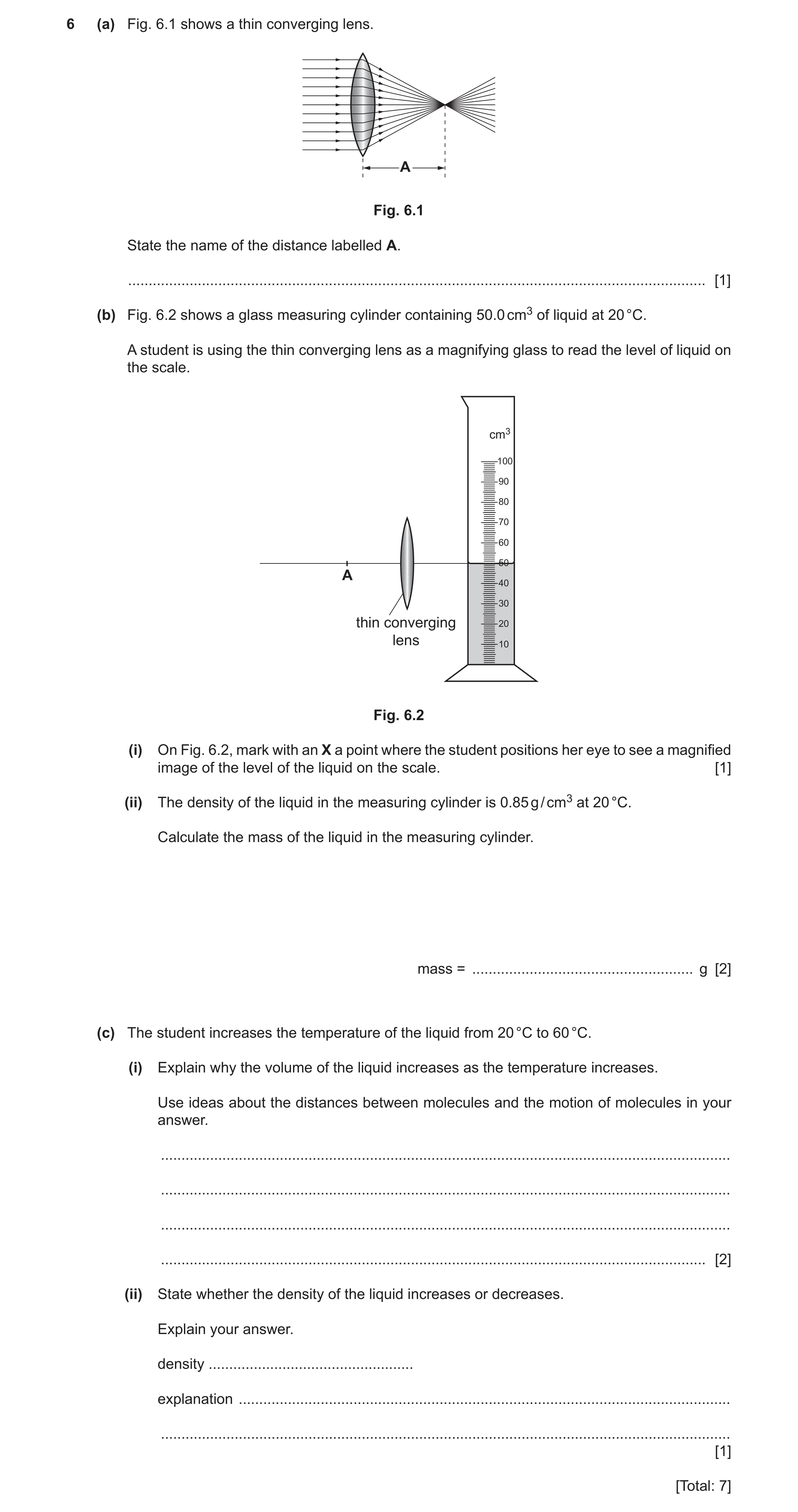
Q15 · A thin converging lens 0653/42 Feb/March 2022
6 (a) Fig. 6.1 shows a thin converging lens. A Fig. 6.1 State the name of the distance labelled A. … [1] (b) Fig. 6.2 shows a glass measuring cylinder containing 50.0 cm3 of liquid at 20 °C. A student is using the thin converging lens as a magnifying glass to read the level of liquid on the scale. cm3 100 90 80 70 60 50 A 40 30 thin converging 20 lens 10 Fig. 6.2 (i) On Fig. 6.2, mark with an X a point where the student positions her eye to see a magnified image of the level of the liquid on the scale. [1] (ii) The density of the liquid in the measuring cylinder is 0.85 g / cm3 at 20 °C. Calculate the mass of the liquid in the measuring cylinder. mass = … g [2] (c) The student increases the temperature of the liquid from 20 °C to 60 °C. (i) Explain why the volume of the liquid increases as the temperature increases. Use ideas about the distances between molecules and the motion of molecules in your answer. … … … … [2] (ii) State whether the density of the liquid increases or decreases. Explain your answer. density … explanation … … [1] [Total: 7]
7 marks
Mark scheme: 6(a) focal length ; 1 6(b)(i) X located between A and lens ; 1 6(b)(ii) density = mass ÷ volume (in any form) / m = V × ρ = 50.0 × 0.85 ; 42.5 (g) ; 2 6(c)(i) kinetic energy of molecules increases ; distance between molecules increases / molecules further apart ; 2 6(c)(ii) (decreases – no mark) higher volume but same mass / the idea that m ÷ V decreases ; 1
This question in 0653/42 Feb/March 2022
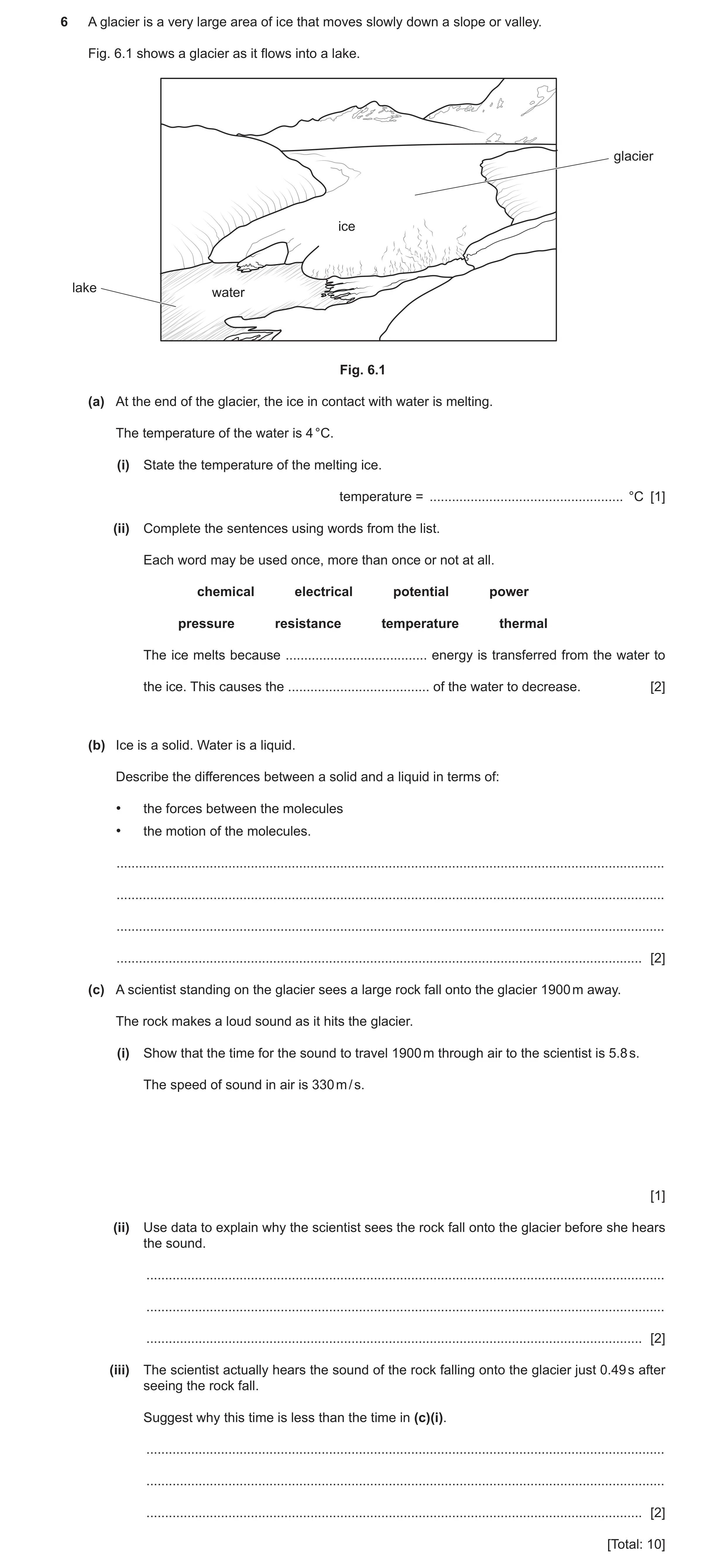
Q16 · A glacier is a very large area of ice that moves slowly down a slope or valley 0653/43 May/June 2022
6 A glacier is a very large area of ice that moves slowly down a slope or valley. Fig. 6.1 shows a glacier as it flows into a lake. glacier ice lake water Fig. 6.1 (a) At the end of the glacier, the ice in contact with water is melting. The temperature of the water is 4 °C. (i) State the temperature of the melting ice. temperature = … °C [1] (ii) Complete the sentences using words from the list. Each word may be used once, more than once or not at all. chemical electrical potential power pressure resistance temperature thermal The ice melts because … energy is transferred from the water to the ice. This causes the … of the water to decrease. [2] (b) Ice is a solid. Water is a liquid. Describe the differences between a solid and a liquid in terms of: • the forces between the molecules • the motion of the molecules. … … … … [2] (c) A scientist standing on the glacier sees a large rock fall onto the glacier 1900 m away. The rock makes a loud sound as it hits the glacier. (i) Show that the time for the sound to travel 1900 m through air to the scientist is 5.8 s. The speed of sound in air is 330 m / s. [1] (ii) Use data to explain why the scientist sees the rock fall onto the glacier before she hears the sound. … … … [2] (iii) The scientist actually hears the sound of the rock falling onto the glacier just 0.49 s after seeing the rock fall. Suggest why this time is less than the time in (c)(i). … … … [2] [Total: 10]
10 marks
Mark scheme: 6(a)(i) 0 (° C) ; 1 6(a)(ii) thermal ; temperature ; 2 6(b) weaker forces between molecules in liquid than in solid ; molecules able to move around in liquid / not able to move around in solid ; 2 6(c)(i) (time = distance / speed =) 1900 / 330 = 5.76 s (= 5.8 s) ; 1 6(c)(ii) speed of light 3 108 m / s (greater than 330 m / s for sound) ; light travels faster than sound ORA ; 2 6(c)(iii) (takes less time) so (sound) travelled at a higher speed (than 330 m / s) ; (sound) travelled through ice ; 2
This question in 0653/43 May/June 2022
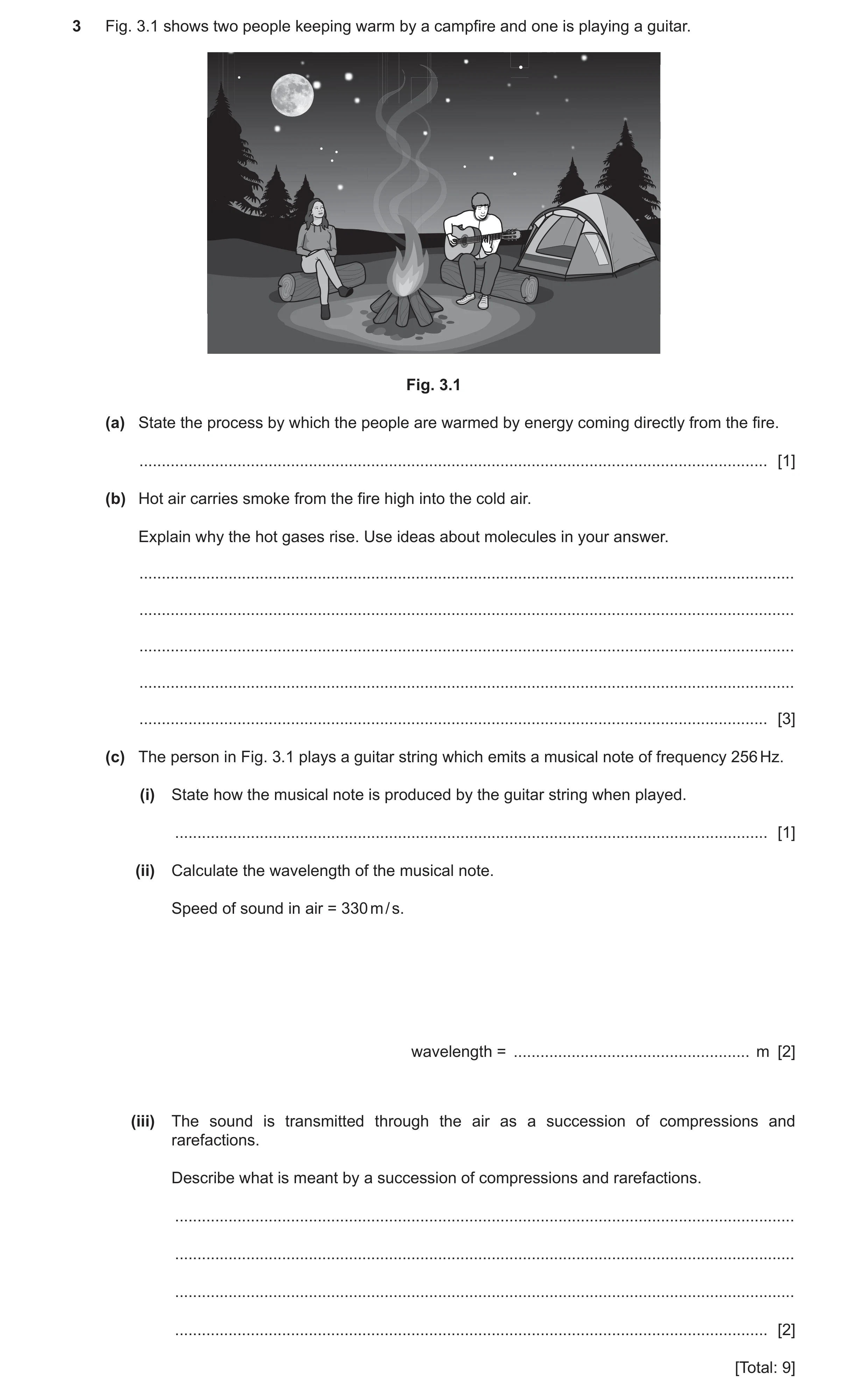
Q17 · Two people keeping warm by a campfire and one is playing a guitar 0653/41 May/June 2023
3 Fig. 3.1 shows two people keeping warm by a campfire and one is playing a guitar. Fig. 3.1 (a) State the process by which the people are warmed by energy coming directly from the fire. … [1] (b) Hot air carries smoke from the fire high into the cold air. Explain why the hot gases rise. Use ideas about molecules in your answer. … … … … … [3] (c) The person in Fig. 3.1 plays a guitar string which emits a musical note of frequency 256 Hz. (i) State how the musical note is produced by the guitar string when played. … [1] (ii) Calculate the wavelength of the musical note. Speed of sound in air = 330 m / s. wavelength = … m [2] (iii) The sound is transmitted through the air as a succession of compressions and rarefactions. Describe what is meant by a succession of compressions and rarefactions. … … … … [2] [Total: 9]
9 marks
Mark scheme: 3(a) radiation ; 1 3(b) reference to molecules moving faster ; reference to expansion of air or gases / gases or air occupy greater volume / molecules move further apart ; the idea that lower density (air) rises / hot air displaced by heavier or denser cool air ; 3 3(c)(i) vibrating (string) ; 1 3(c)(ii) speed = frequency wavelength / v = f (in any form) / = 330 ÷ 256 ; 1.29 (m) ; 2 3(c)(iii) compression means, particles or molecules are close together / (air) density is greater / air pressure is greater / ORA for rarefaction ; succession refers to the idea that compressions and rarefactions form a repeating, pattern / (longitudinal) wave ; 2
This question in 0653/41 May/June 2023
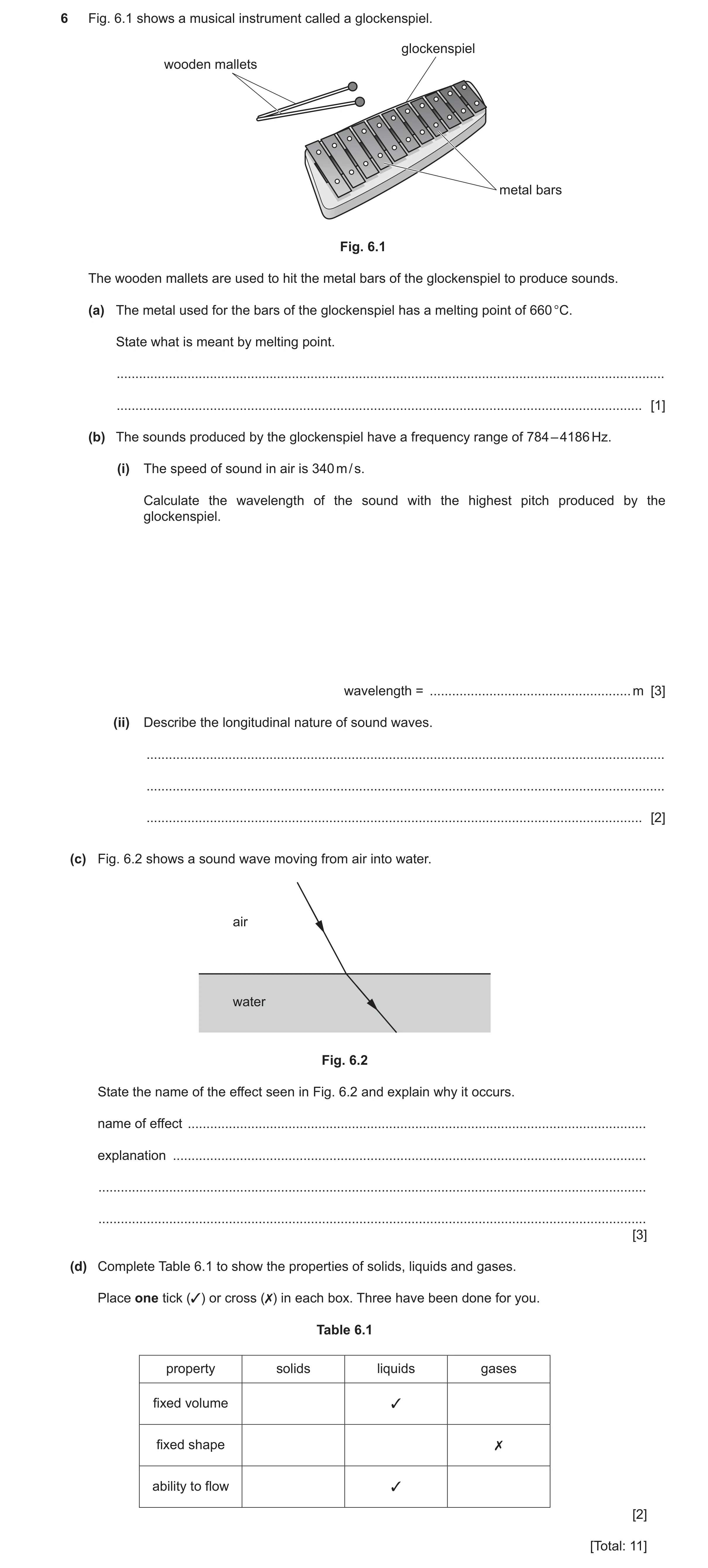
Q18 · A musical instrument called a glockenspiel 0653/41 Oct/Nov 2024
6 Fig. 6.1 shows a musical instrument called a glockenspiel. glockenspiel wooden mallets metal bars Fig. 6.1 The wooden mallets are used to hit the metal bars of the glockenspiel to produce sounds. (a) The metal used for the bars of the glockenspiel has a melting point of 660 °C. State what is meant by melting point. … … [1] (b) The sounds produced by the glockenspiel have a frequency range of 784 – 4186 Hz. (i) The speed of sound in air is 340 m / s. Calculate the wavelength of the sound with the highest pitch produced by the glockenspiel. wavelength = … m [3] (ii) Describe the longitudinal nature of sound waves. … … … [2] (c) Fig. 6.2 shows a sound wave moving from air into water. air water Fig. 6.2 State the name of the effect seen in Fig. 6.2 and explain why it occurs. name of effect … explanation … … … [3] (d) Complete Table 6.1 to show the properties of solids, liquids and gases. Place one tick (✓) or cross (✗) in each box. Three have been done for you. Table 6.1 property solids liquids gases fixed volume ✓ fixed shape ✗ ability to flow ✓ [2] [Total: 11]
11 marks
Mark scheme: 6(a) the temperature at which a substance changes state from solid to liquid / AW ; 1 6(b)(i) highest pitch = highest frequency / 4186 Hz ; 3 evidence of v = f / 340 ÷ 4186 ; 0.081(2) (m) ; 6(b)(ii) oscillations / vibrations (of the air / particles / molecules) ; 2 (motion of air / particles / molecules is) parallel to the direction of, energy transfer / travel / the wave ; 6(c) refraction ; 3 caused by change in speed / medium / density (of medium) ; sound wave moves faster in water / liquid / denser medium / ORA ; 6(d) 2 property solids liquids gases fixed volume ✓ (✓) × fixed shape ✓ × (✗) ability to flow × (✓) ✓ solids column correct ; liquids AND gases columns correct ;
This question in 0653/41 Oct/Nov 2024
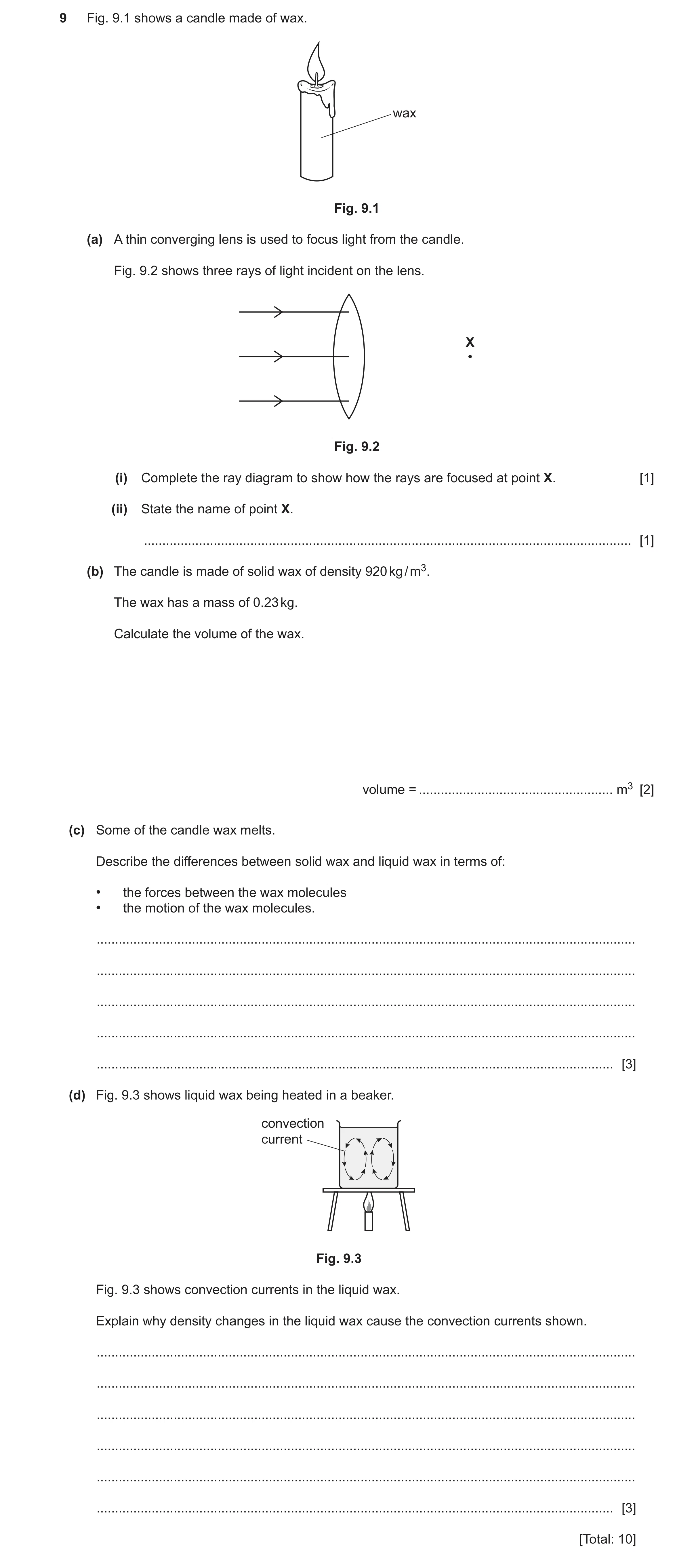
Q19 · A candle made of wax 0653/42 Oct/Nov 2024
9 Fig. 9.1 shows a candle made of wax. wax Fig. 9.1 (a) A thin converging lens is used to focus light from the candle. Fig. 9.2 shows three rays of light incident on the lens. X Fig. 9.2 (i) Complete the ray diagram to show how the rays are focused at point X. [1] (ii) State the name of point X. … [1] (b) The candle is made of solid wax of density 920 kg / m3. The wax has a mass of 0.23 kg. Calculate the volume of the wax. volume = … m3 [2] (c) Some of the candle wax melts. Describe the differences between solid wax and liquid wax in terms of: • the forces between the wax molecules • the motion of the wax molecules. … … … … … [3] (d) Fig. 9.3 shows liquid wax being heated in a beaker. convection current Fig. 9.3 Fig. 9.3 shows convection currents in the liquid wax. Explain why density changes in the liquid wax cause the convection currents shown. … … … … … … [3] [Total: 10]
10 marks
Mark scheme: 9(a)(i) continuation of the three straight rays to converge at X ; 1 9(a)(ii) focal point / (principal) focus ; 1 9(b) evidence of, = m ÷ V / 0.23 ÷ 920 ; 2 0.00025 / 2.5 10–4 (m3) ; 9(c) (intermolecular) forces are strong(er) in solid / weak(er) in liquid ; 3 molecules / they (only) vibrate, in solid ; molecules / they move around / move freely / flow / slide over each other, in liquid ; 9(d) any three from: 3 heated wax, expands / increases in volume / particles move further apart / ORA ; hot wax has lower density / cool wax has higher density ; hot wax rises ; cool wax sinks ;
This question in 0653/42 Oct/Nov 2024
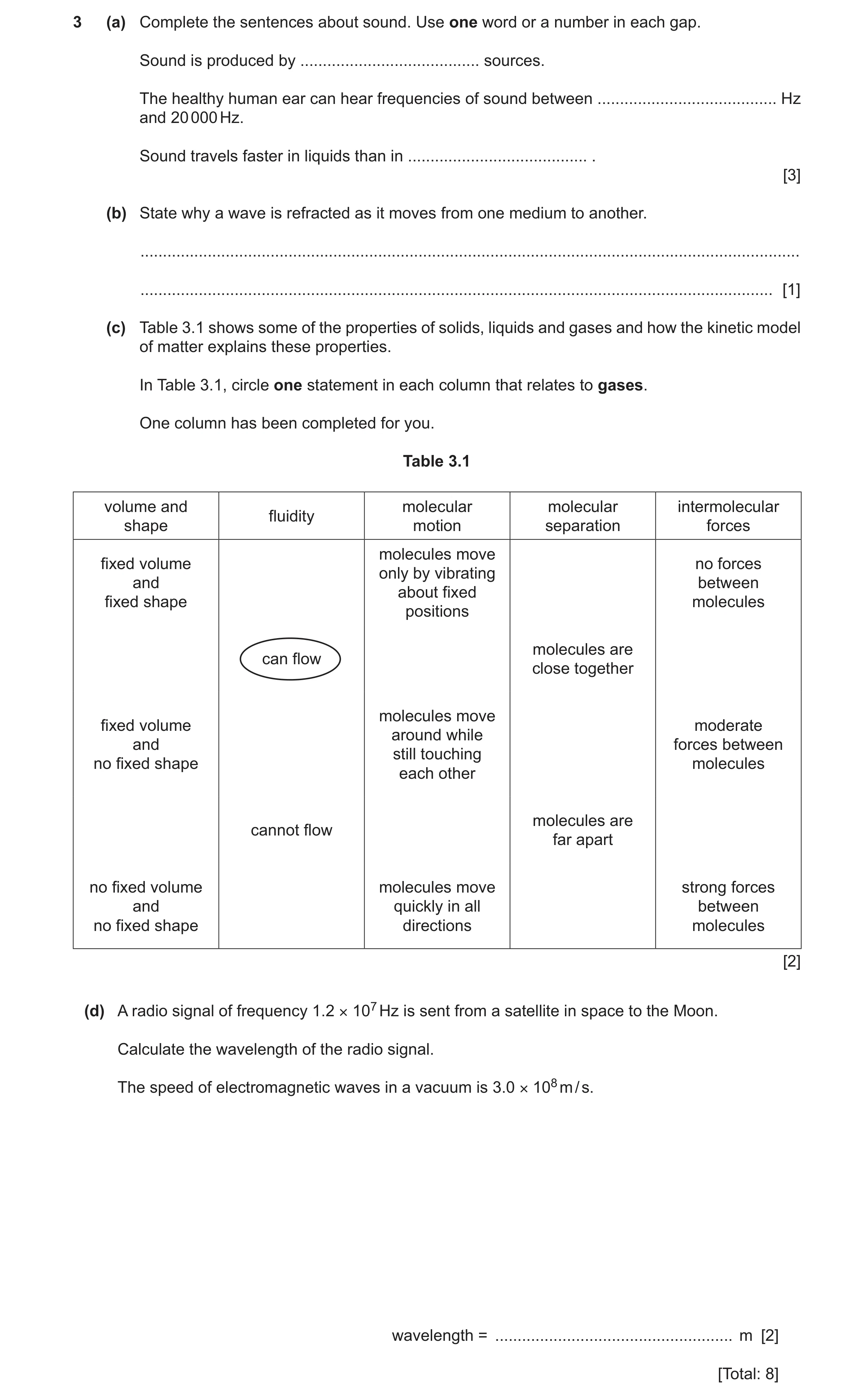
Q20 · Complete the sentences about sound 0653/43 Oct/Nov 2024
3 (a) Complete the sentences about sound. Use one word or a number in each gap. Sound is produced by … sources. The healthy human ear can hear frequencies of sound between … Hz and 20 000 Hz. Sound travels faster in liquids than in … . [3] (b) State why a wave is refracted as it moves from one medium to another. … … [1] (c) Table 3.1 shows some of the properties of solids, liquids and gases and how the kinetic model of matter explains these properties. In Table 3.1, circle one statement in each column that relates to gases. One column has been completed for you. Table 3.1 volume and molecular molecular intermolecular fluidity shape motion separation forces molecules move fixed volume no forces only by vibrating and between about fixed fixed shape molecules positions molecules are can flow close together molecules move fixed volume moderate around while and forces between still touching no fixed shape molecules each other molecules are cannot flow far apart no fixed volume molecules move strong forces and quickly in all between no fixed shape directions molecules [2] (d) A radio signal of frequency 1.2 × 10⁷ Hz is sent from a satellite in space to the Moon. Calculate the wavelength of the radio signal. The speed of electromagnetic waves in a vacuum is 3.0 × 10⁸ m / s. wavelength = … m [2] [Total: 8]
8 marks
Mark scheme: 3(a) vibrating ; 3 20 ; gases ; 3(b) (because of its) change in speed / different speeds ; 1 3(c) 2 two columns correct ; four columns correct ; 3(d) evidence of, v = f / 3.0 10 8 ÷ 1.2 10 7 ; 2 25 (m) ;
This question in 0653/43 Oct/Nov 2024
Q21 · A helicopter hovering above the ground 0653/42 Feb/March 2025
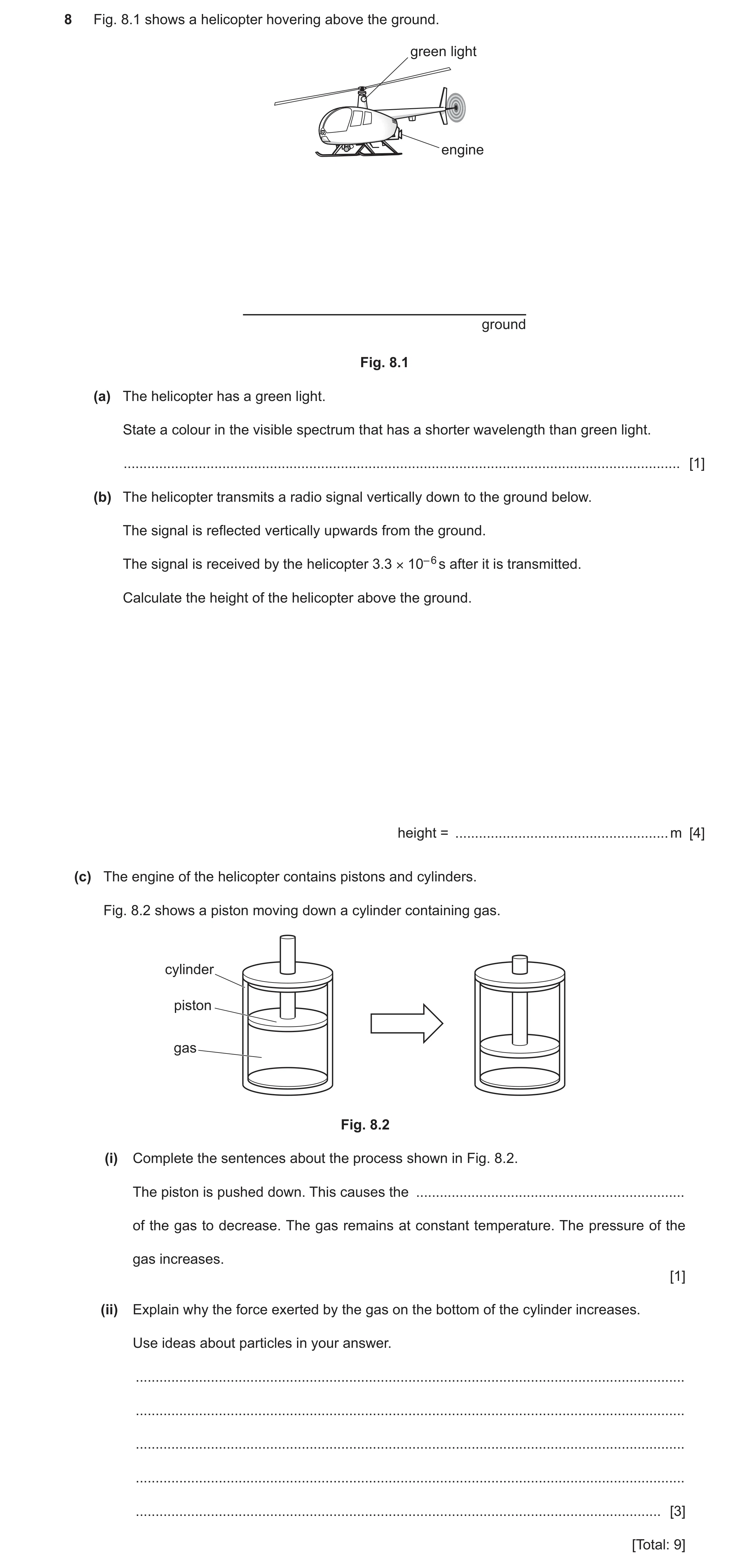
8 Fig. 8.1 shows a helicopter hovering above the ground. green light engine ground Fig. 8.1 (a) The helicopter has a green light. State a colour in the visible spectrum that has a shorter wavelength than green light. … [1] (b) The helicopter transmits a radio signal vertically down to the ground below. The signal is reflected vertically upwards from the ground. The signal is received by the helicopter 3.3 × 10– 6 s after it is transmitted. Calculate the height of the helicopter above the ground. height = … m [4] (c) The engine of the helicopter contains pistons and cylinders. Fig. 8.2 shows a piston moving down a cylinder containing gas. cylinder piston gas Fig. 8.2 (i) Complete the sentences about the process shown in Fig. 8.2. The piston is pushed down. This causes the … of the gas to decrease. The gas remains at constant temperature. The pressure of the gas increases. [1] (ii) Explain why the force exerted by the gas on the bottom of the cylinder increases. Use ideas about particles in your answer. … … … … … [3] [Total: 9]
9 marks
Mark scheme: 8(a) blue / indigo / violet ; 1 8(b) speed of radio waves stated as 3.0 108 m / s ; 4 recognition that radio signal travels down and back (i.e. divide time or distance by 2) ; v = s ÷ t / 3.0 108 1.65 10–6 ; 495 (m) ; 8(c)(i) volume ; 1 8(c)(ii) three from: 3 mp1 idea that force = P A / higher pressure causes higher force (on bottom) ; mp2 reference to force / pressure, created by collisions between particles and wall ; mp3 (when piston moves / volume decreases) the number of wall particle collisions increases / frequency of wall particle collisions increases ; mp4 (if mp3 is awarded) (reason for more collisions / higher collision rate) the idea that particle concentration increases / idea of more particles in smaller volume / particles are closer together ;
This question in 0653/42 Feb/March 2025
Q22 · Iron is a metal 0653/41 May/June 2025
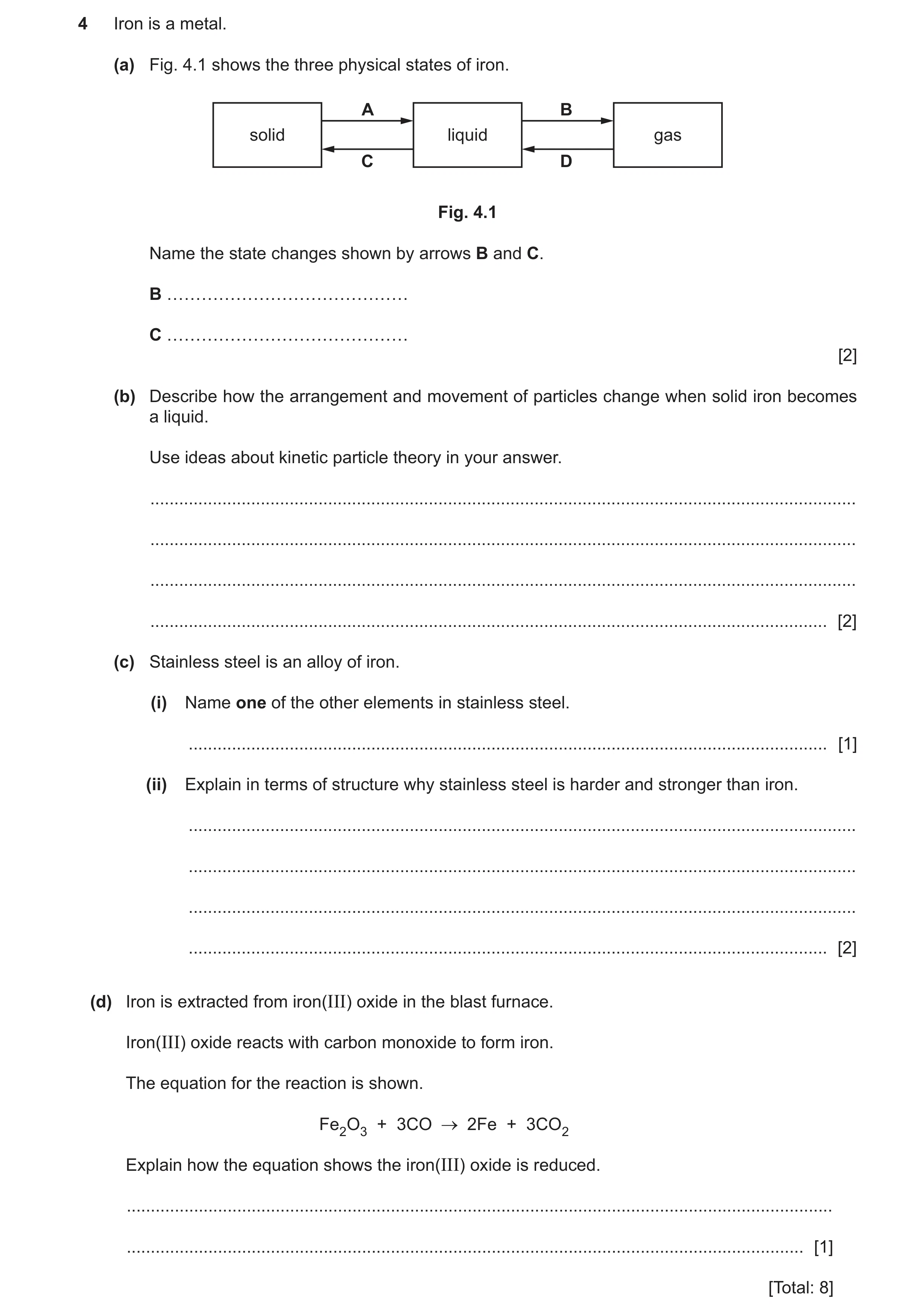
4 Iron is a metal. (a) Fig. 4.1 shows the three physical states of iron. A B solid liquid gas C D Fig. 4.1 Name the state changes shown by arrows B and C. B …………………………………… C …………………………………… [2] (b) Describe how the arrangement and movement of particles change when solid iron becomes a liquid. Use ideas about kinetic particle theory in your answer. … … … … [2] (c) Stainless steel is an alloy of iron. (i) Name one of the other elements in stainless steel. … [1] (ii) Explain in terms of structure why stainless steel is harder and stronger than iron. … … … … [2] (d) Iron is extracted from iron(III) oxide in the blast furnace. Iron(III) oxide reacts with carbon monoxide to form iron. The equation for the reaction is shown. Fe2O3 + 3CO 2Fe + 3CO2 Explain how the equation shows the iron(III) oxide is reduced. … … [1] [Total: 8]
8 marks
Mark scheme: 4(a) evaporation ; 2 freezing ; 4(b) (changing arrangement) from regular / fixed, to irregular / random ; 2 (changing movement) from (particle) vibration to idea of, moving / sliding over each / move more freely ; 4(c)(i) chromium / nickel / carbon ; 1 4(c)(ii) different sized atoms ; 2 (layers/atoms) can no longer slide over each other (in an alloy) / owtte; 4(d) (Fe2O3) loses oxygen ; 1
This question in 0653/41 May/June 2025
 35 / 35
 8
8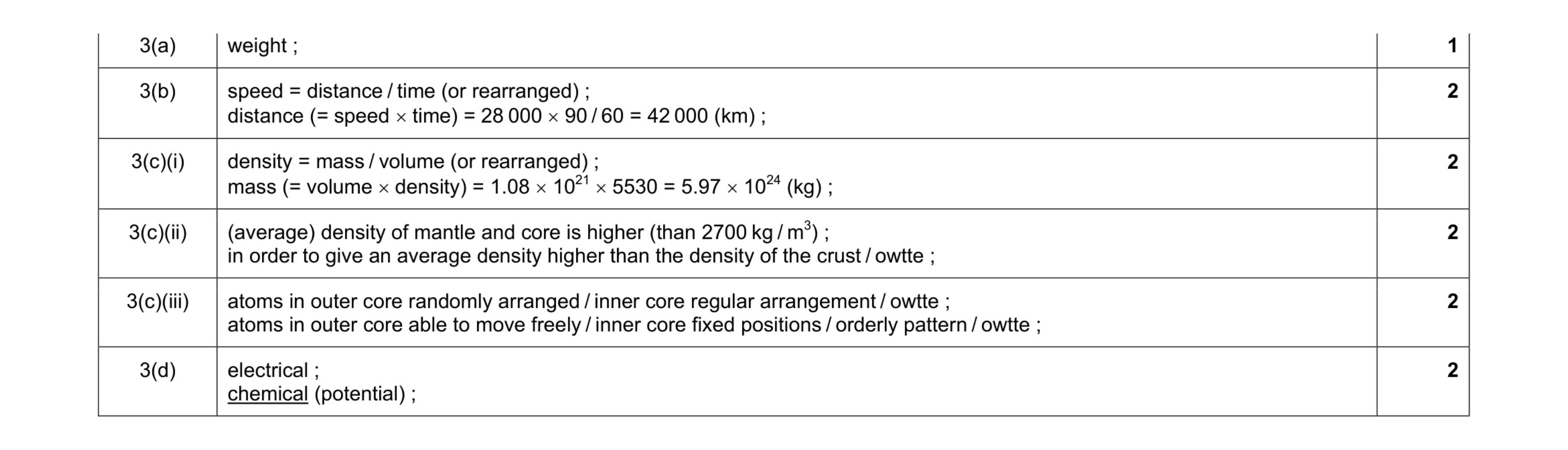 11
11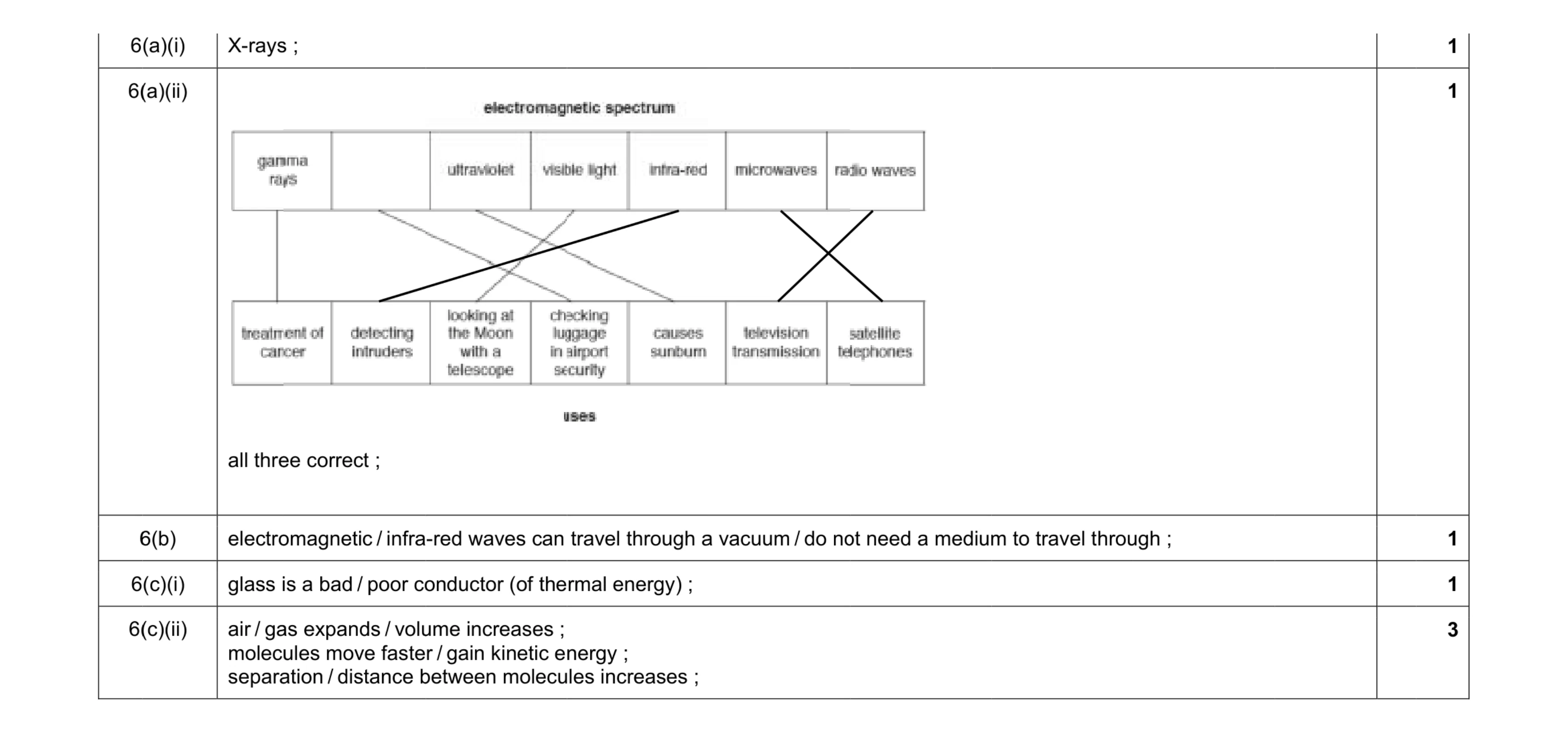 7
7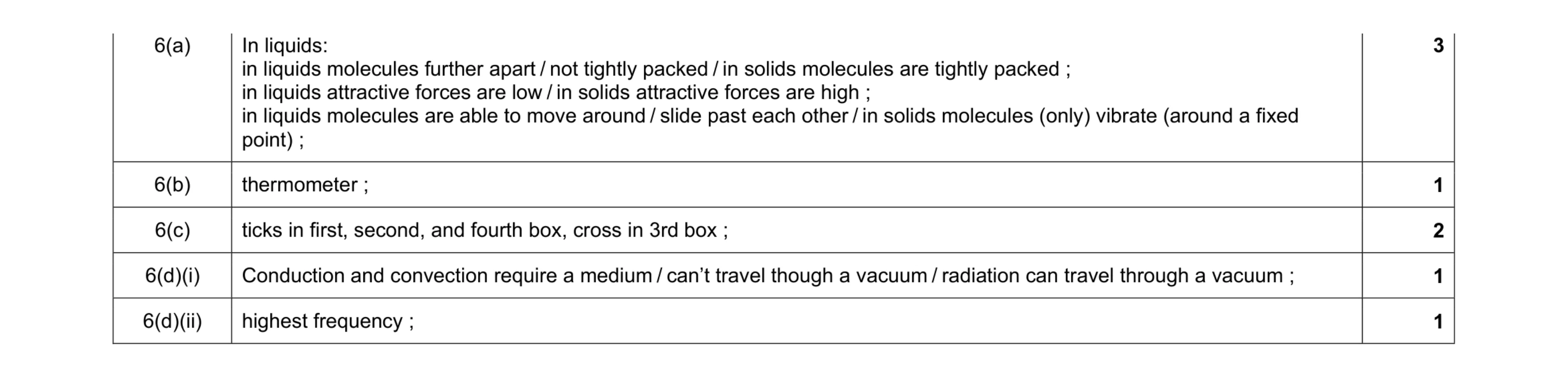 8
8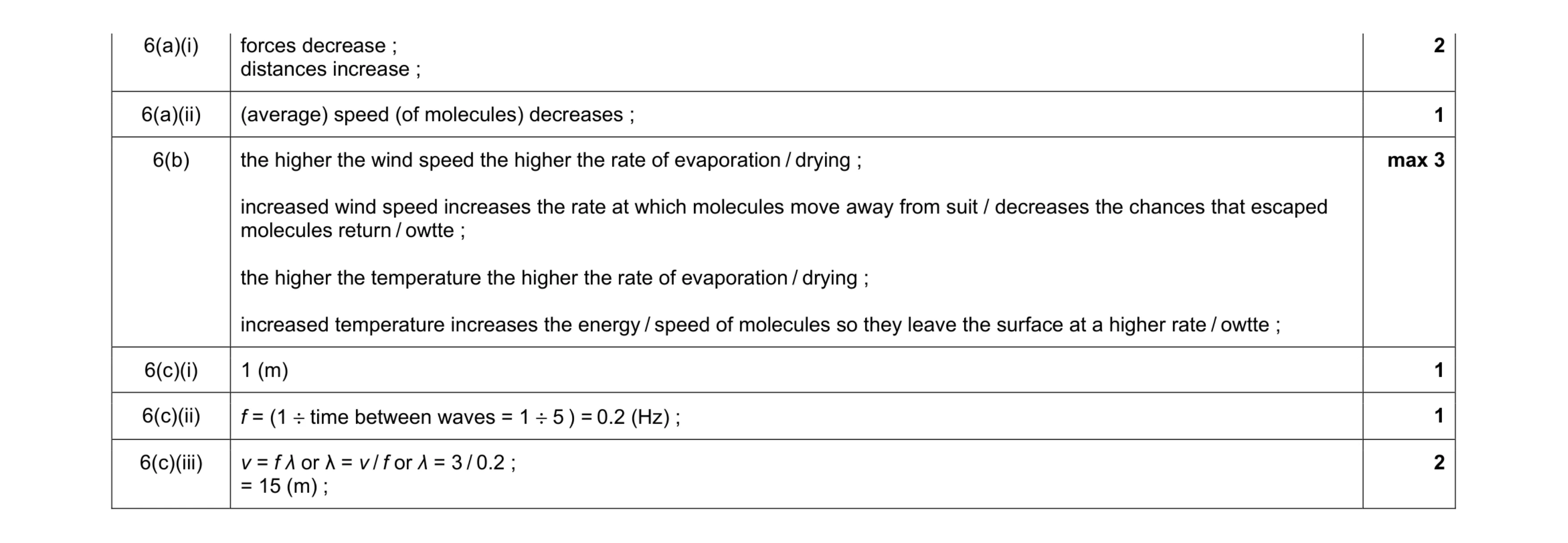 10
10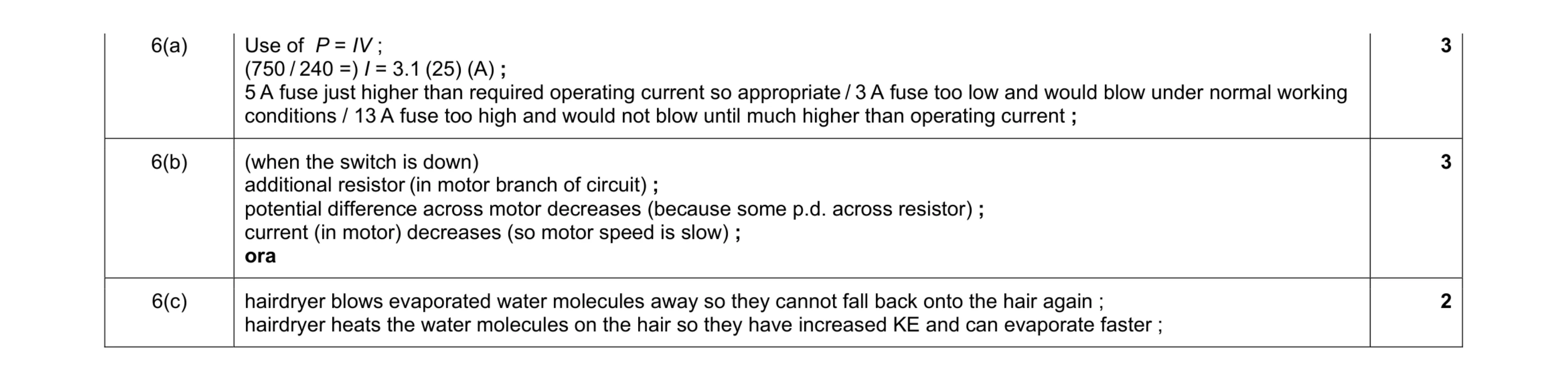 8
8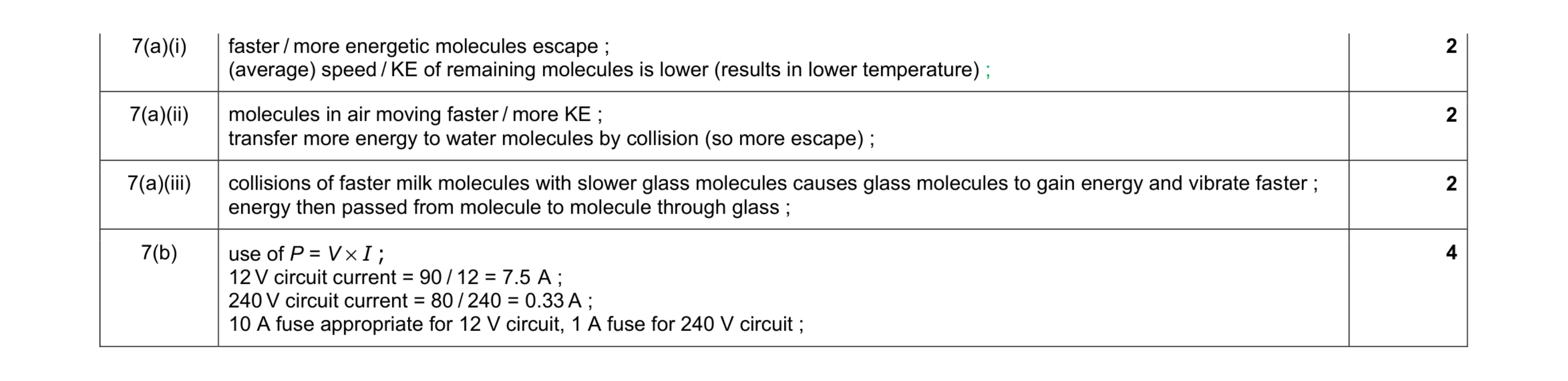 10
10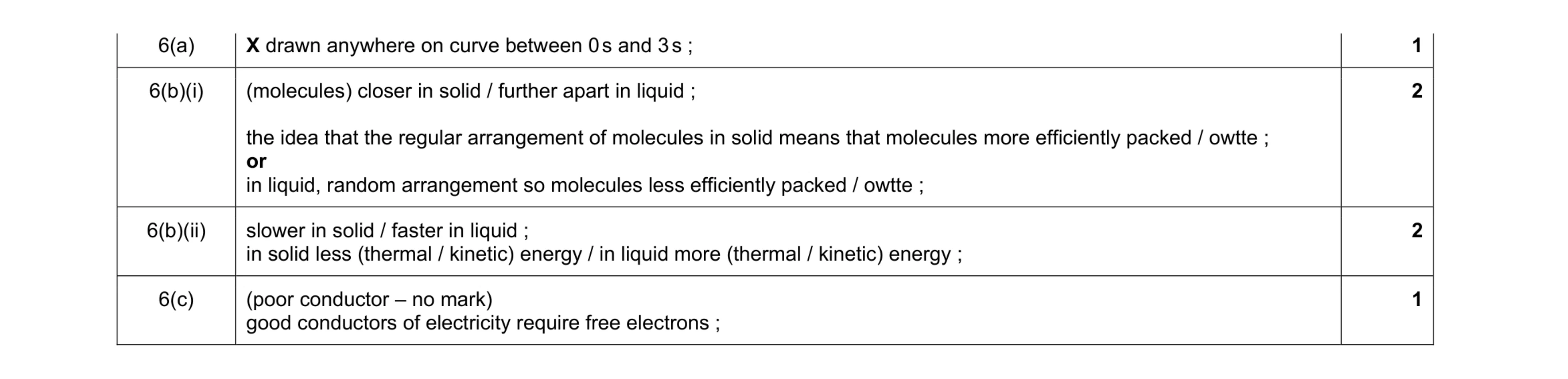 6
6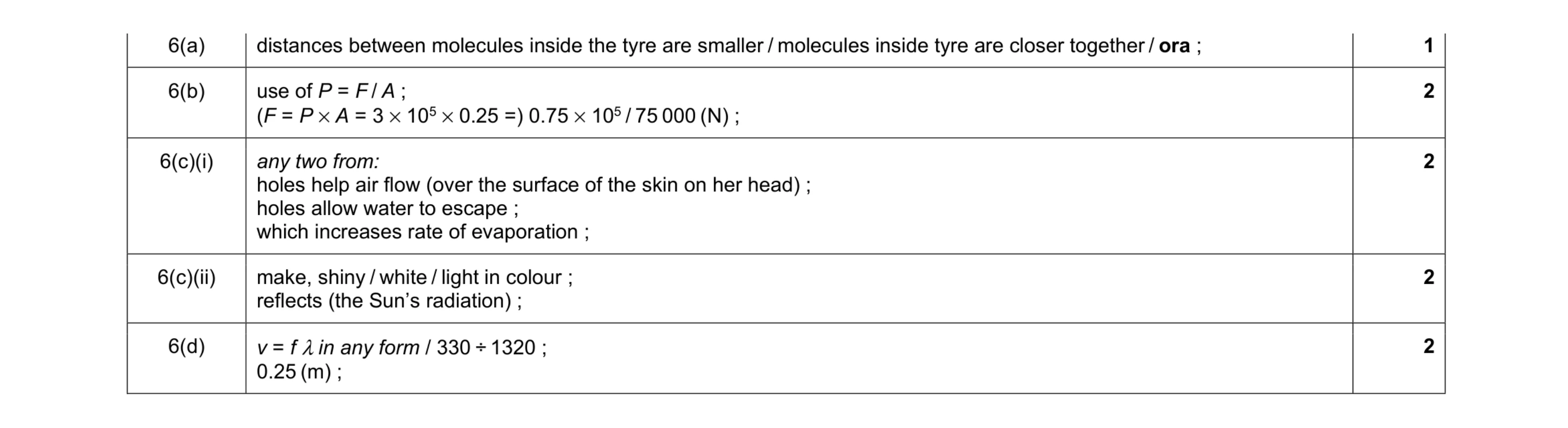 9
9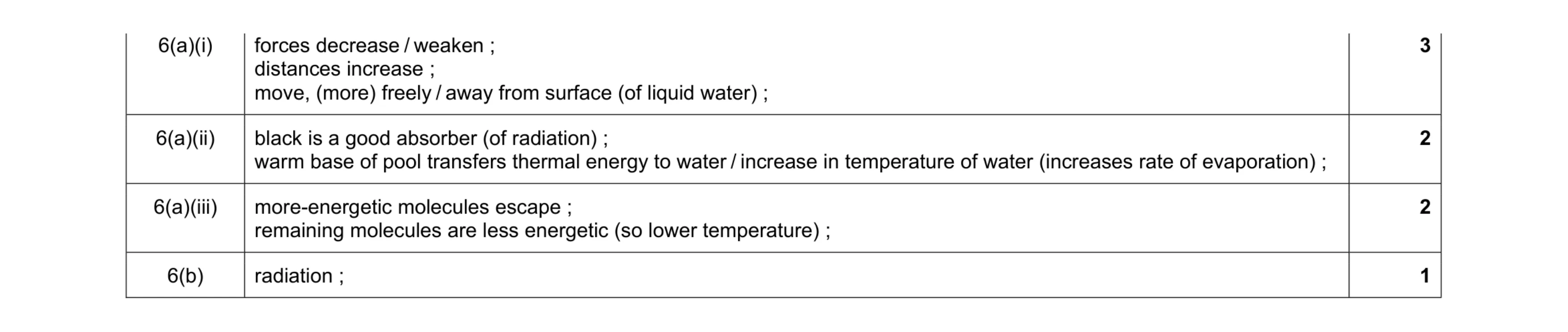 8
8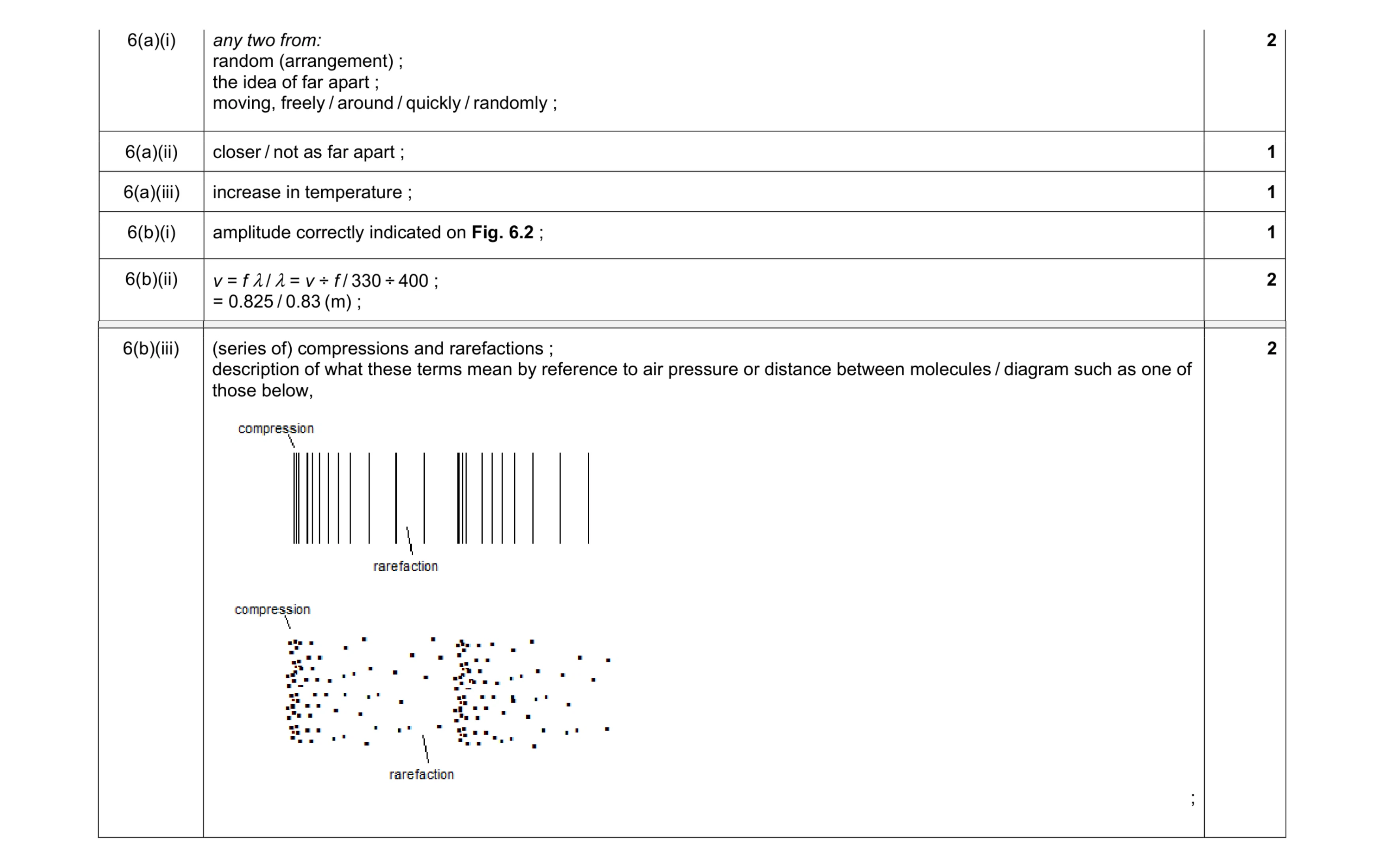 9
9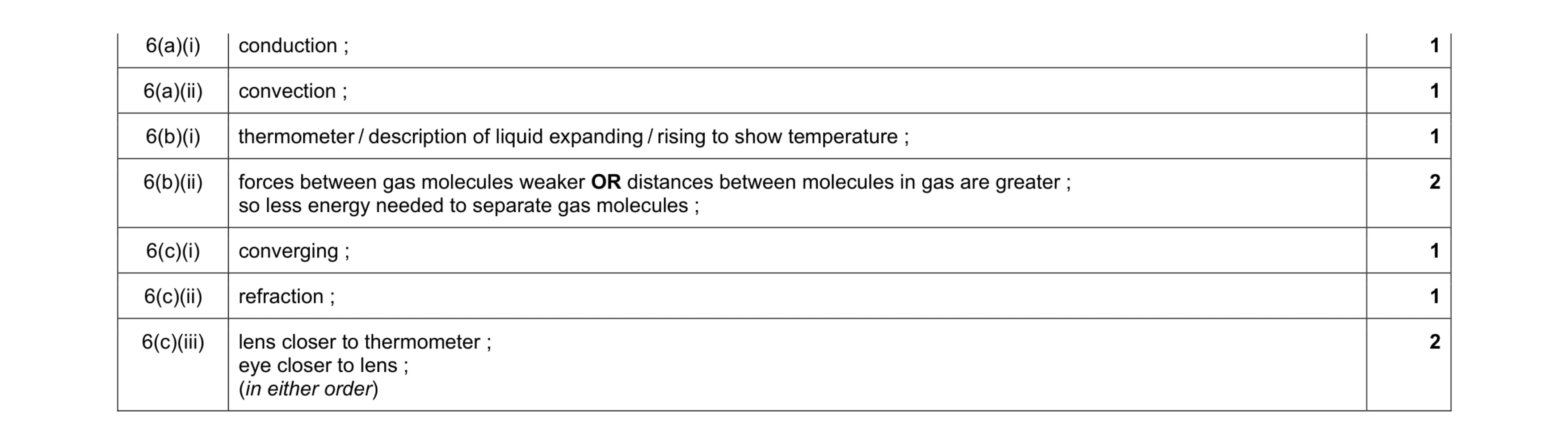 9
9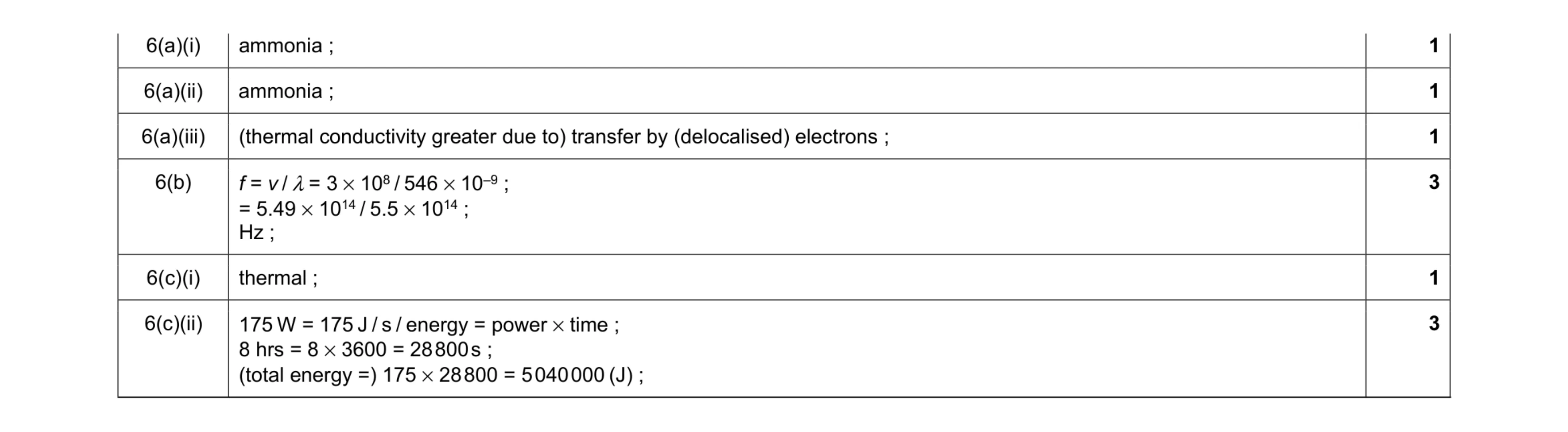 10
10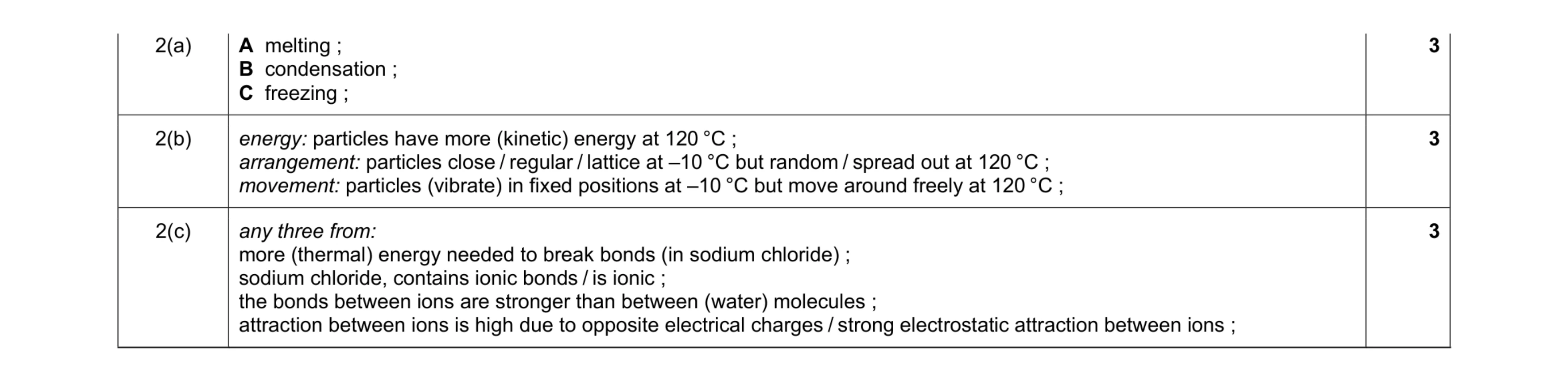 9
9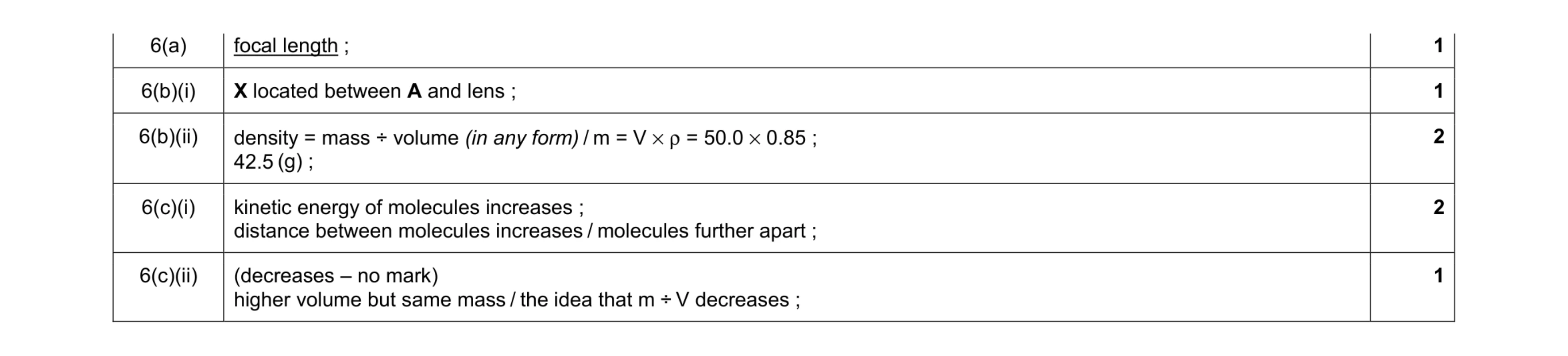 7
7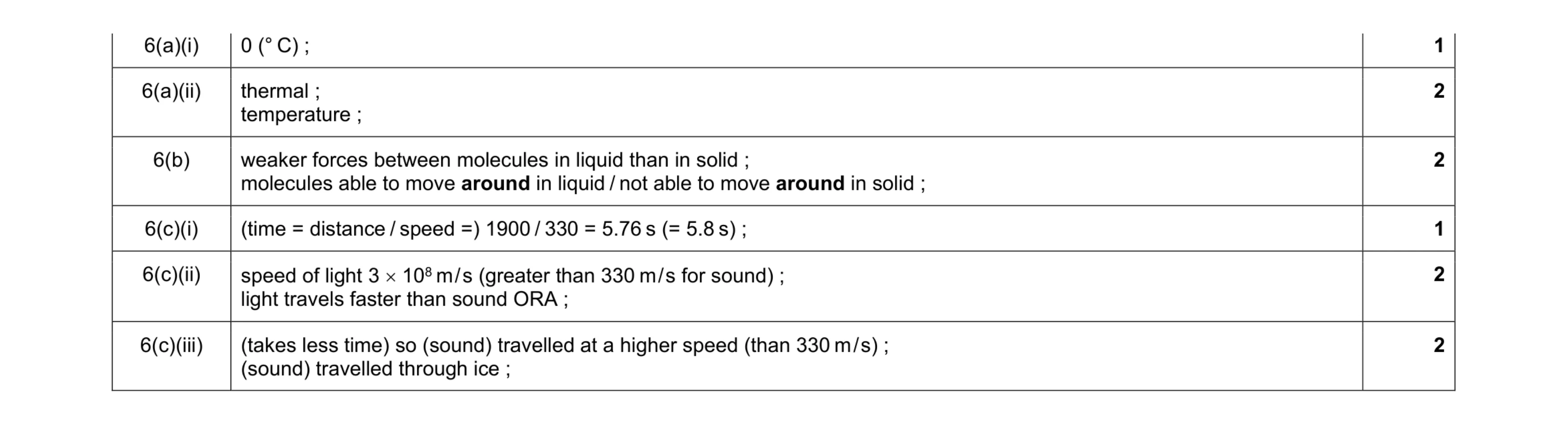 10
10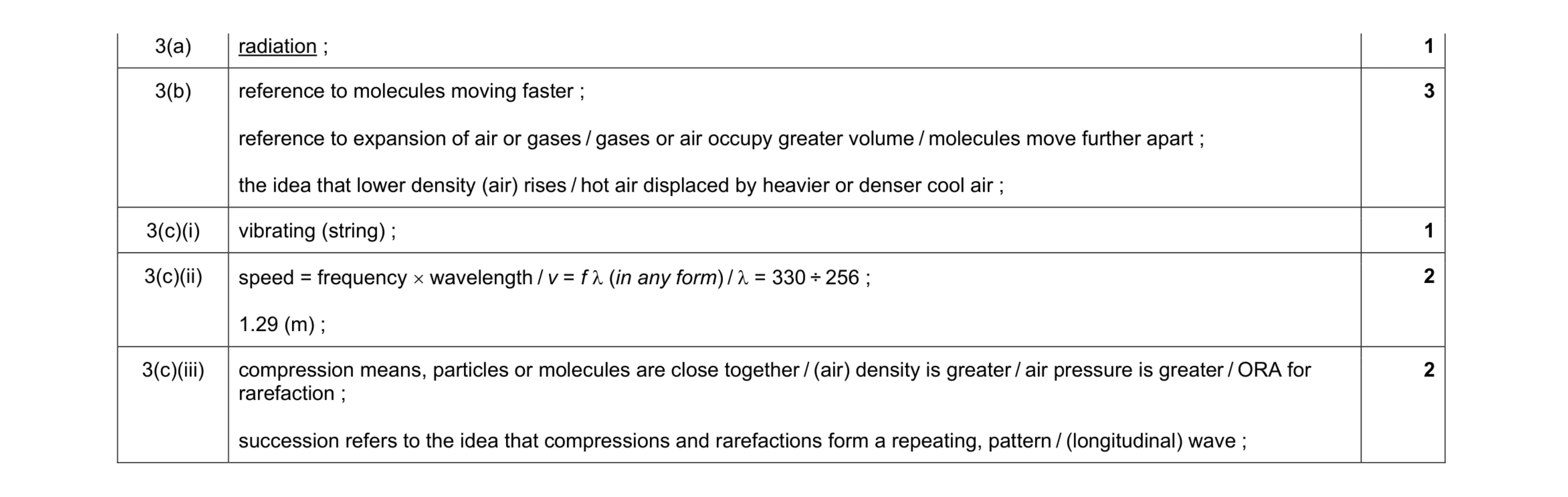 9
9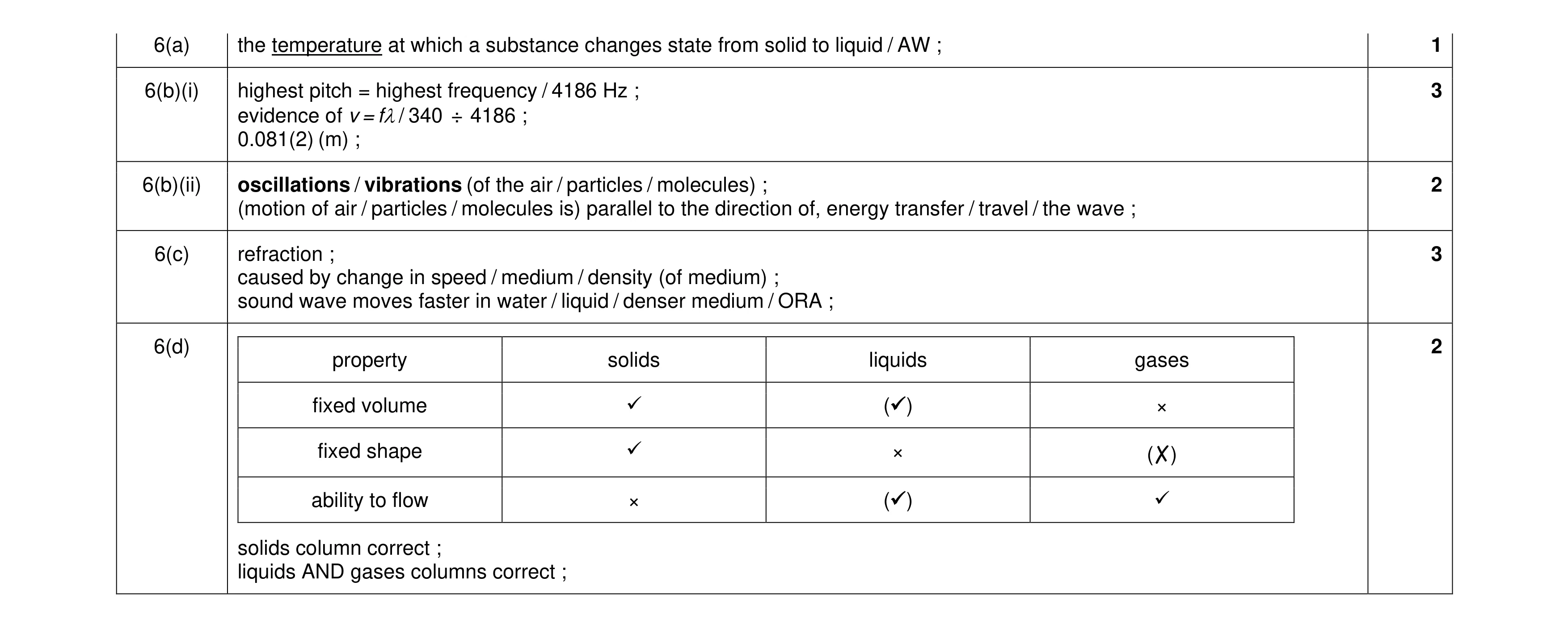 11
11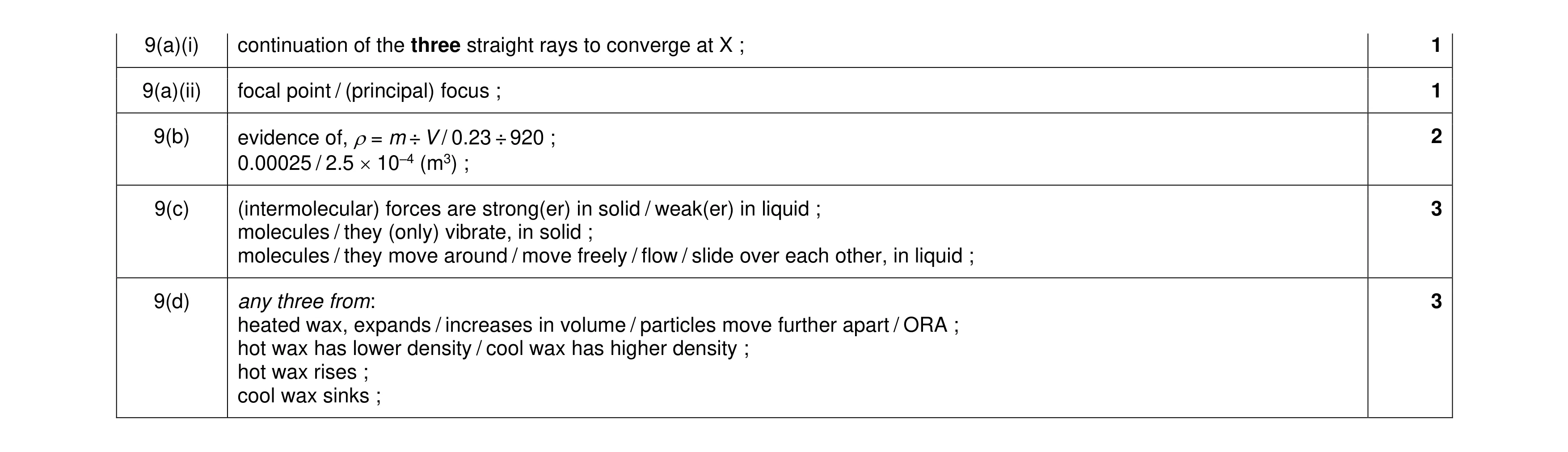 10
10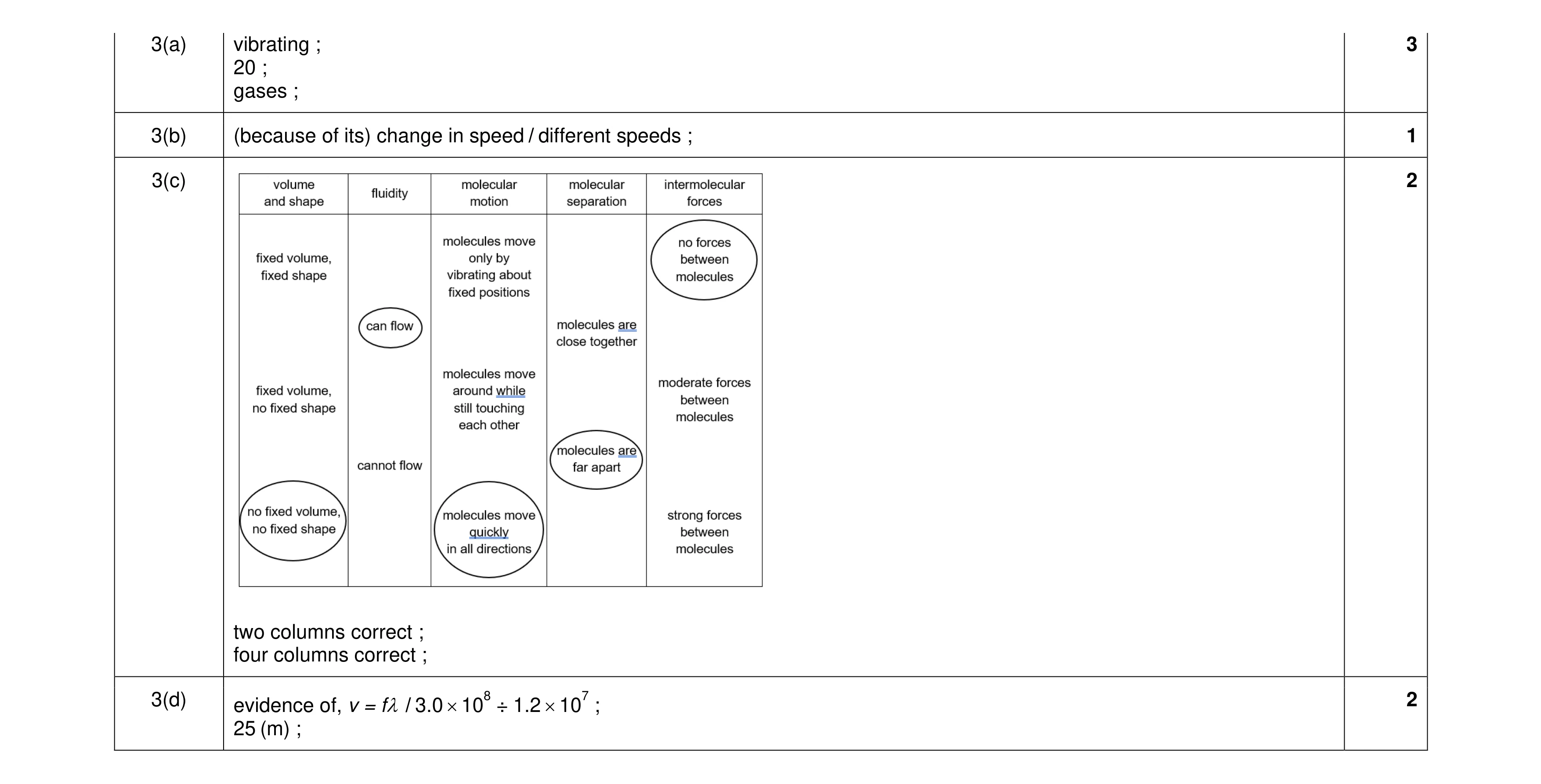 8
8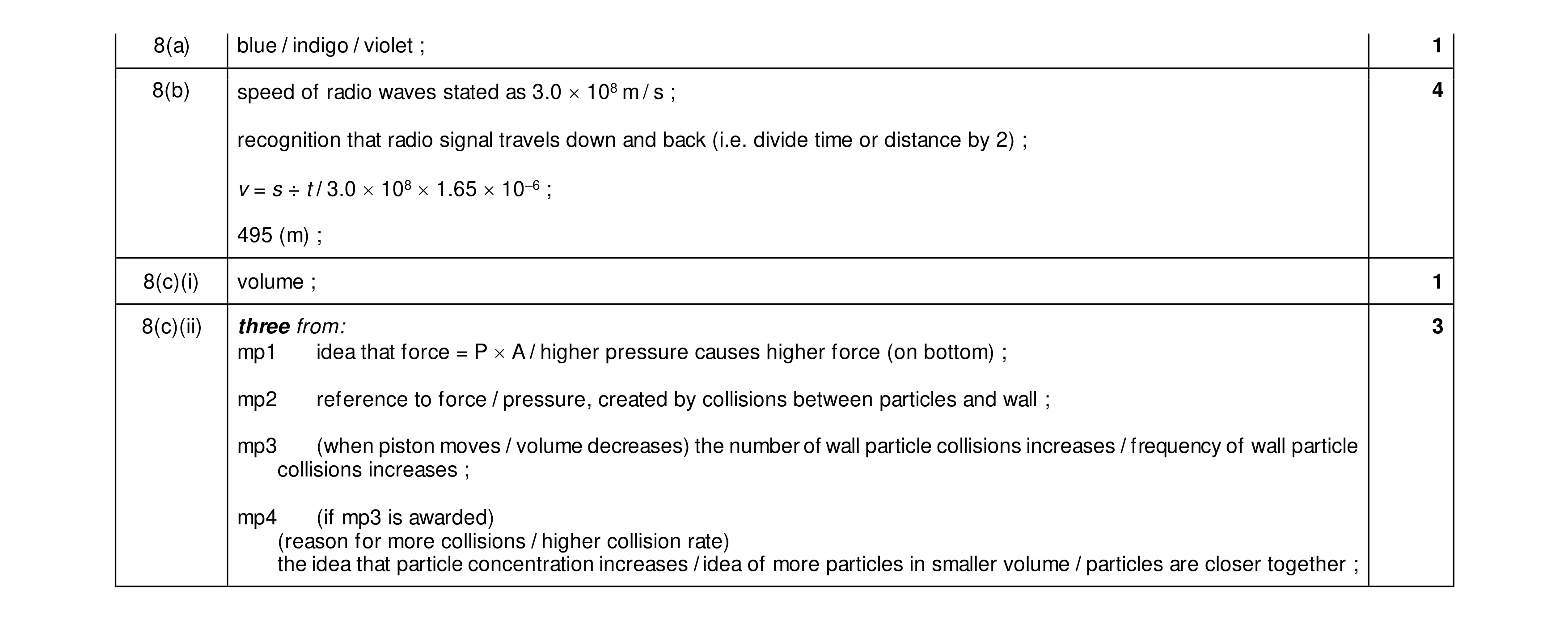 9
9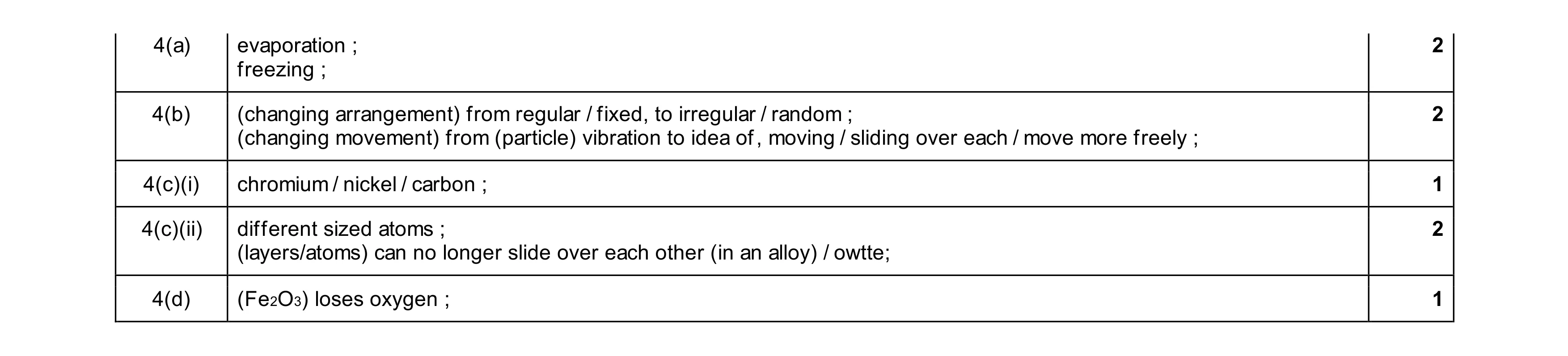 8
8