Cambridge IGCSE Science - Combined 0653 — 2022 Oct/Nov Paper 2 · Variant 1
0653/21/O/N/22 · 40 questions · 40 marks · ≈45 min
The question paper and its mark scheme, free to read here and free to download. This is Cambridge’s own paper, exactly as it was sat.
Question paper16 pages
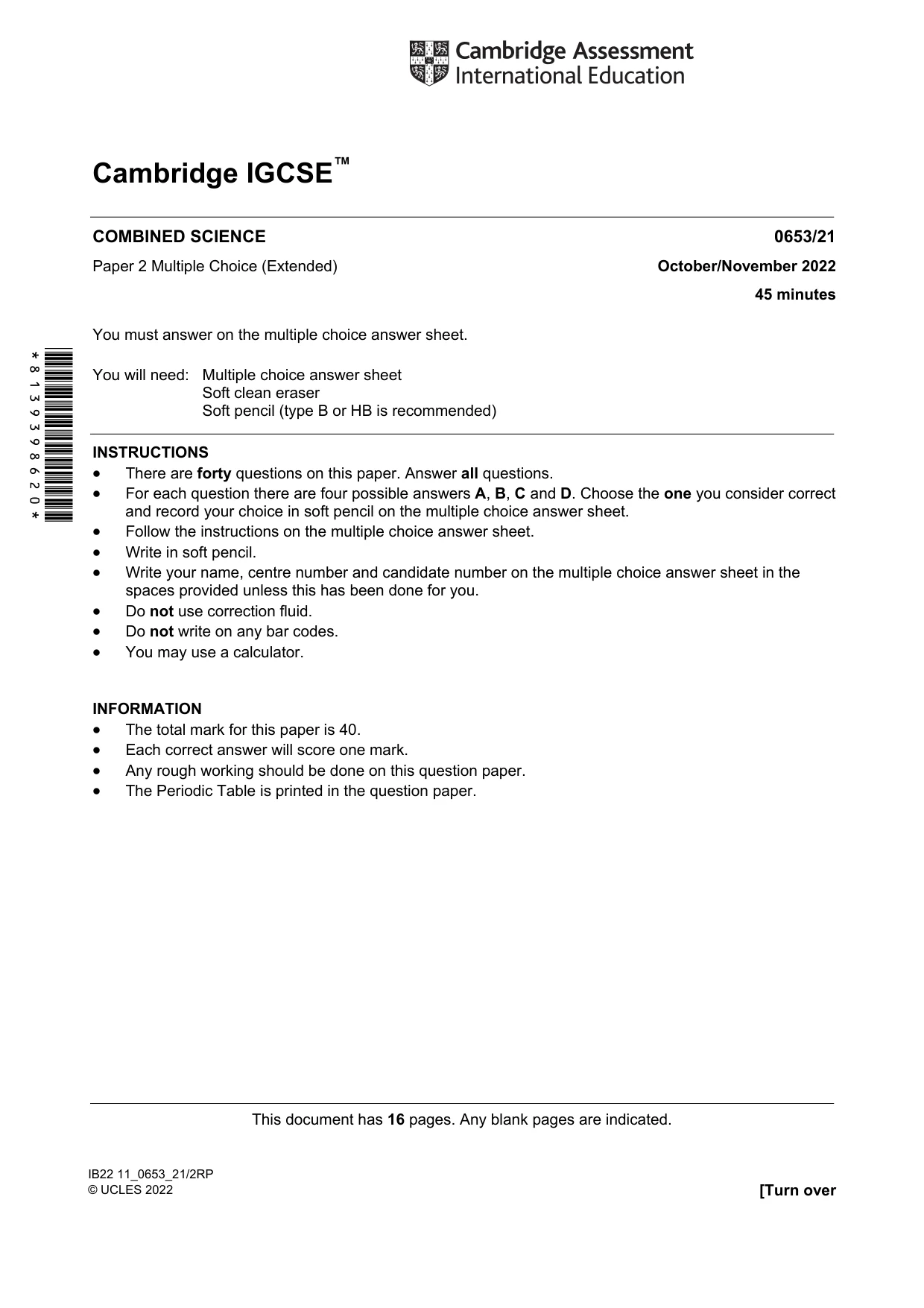

Mark scheme3 pages
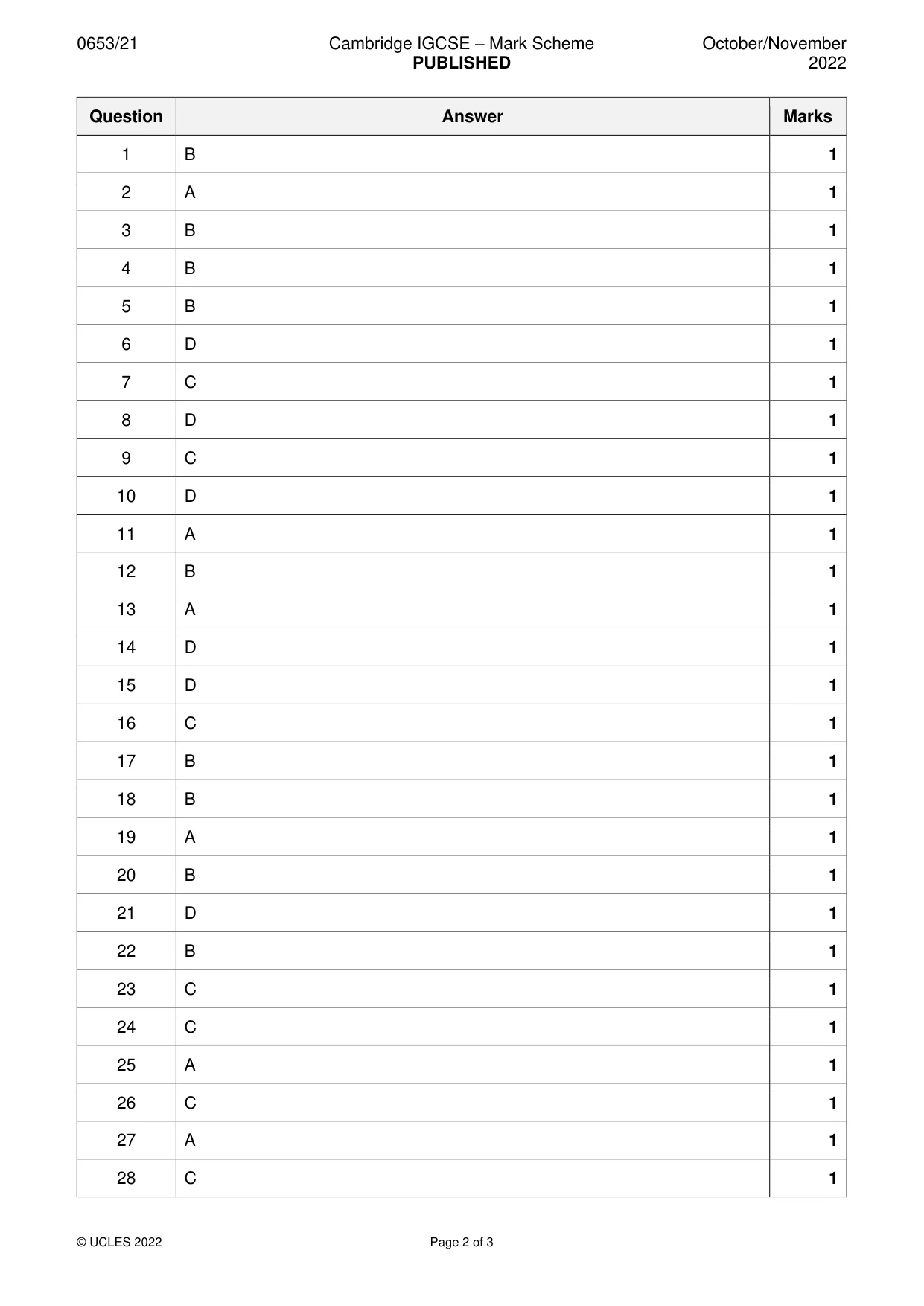
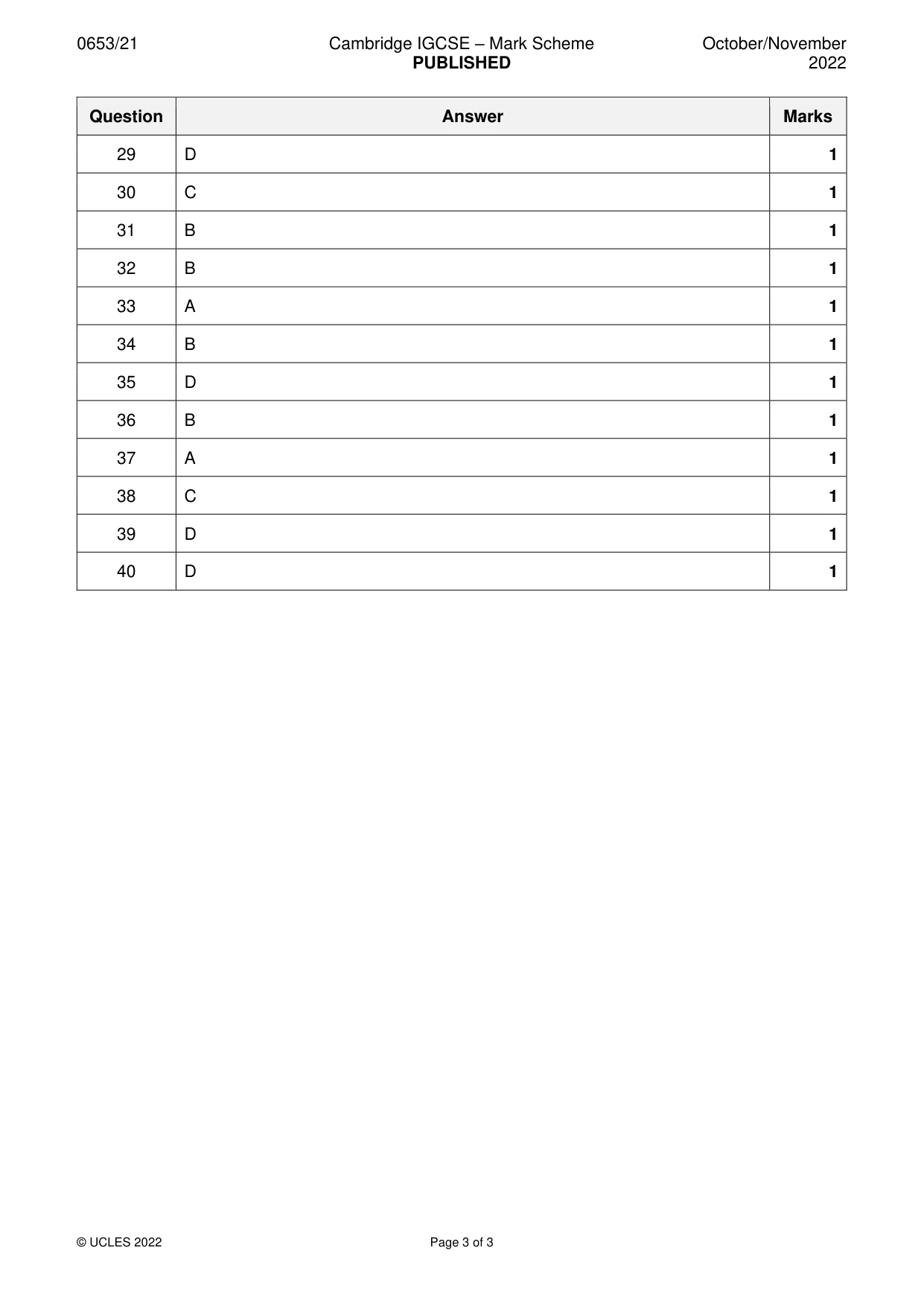
Answers below. Sit the paper first if you are practising.
Questions as text
Q1 · What are characteristics of all living organisms?
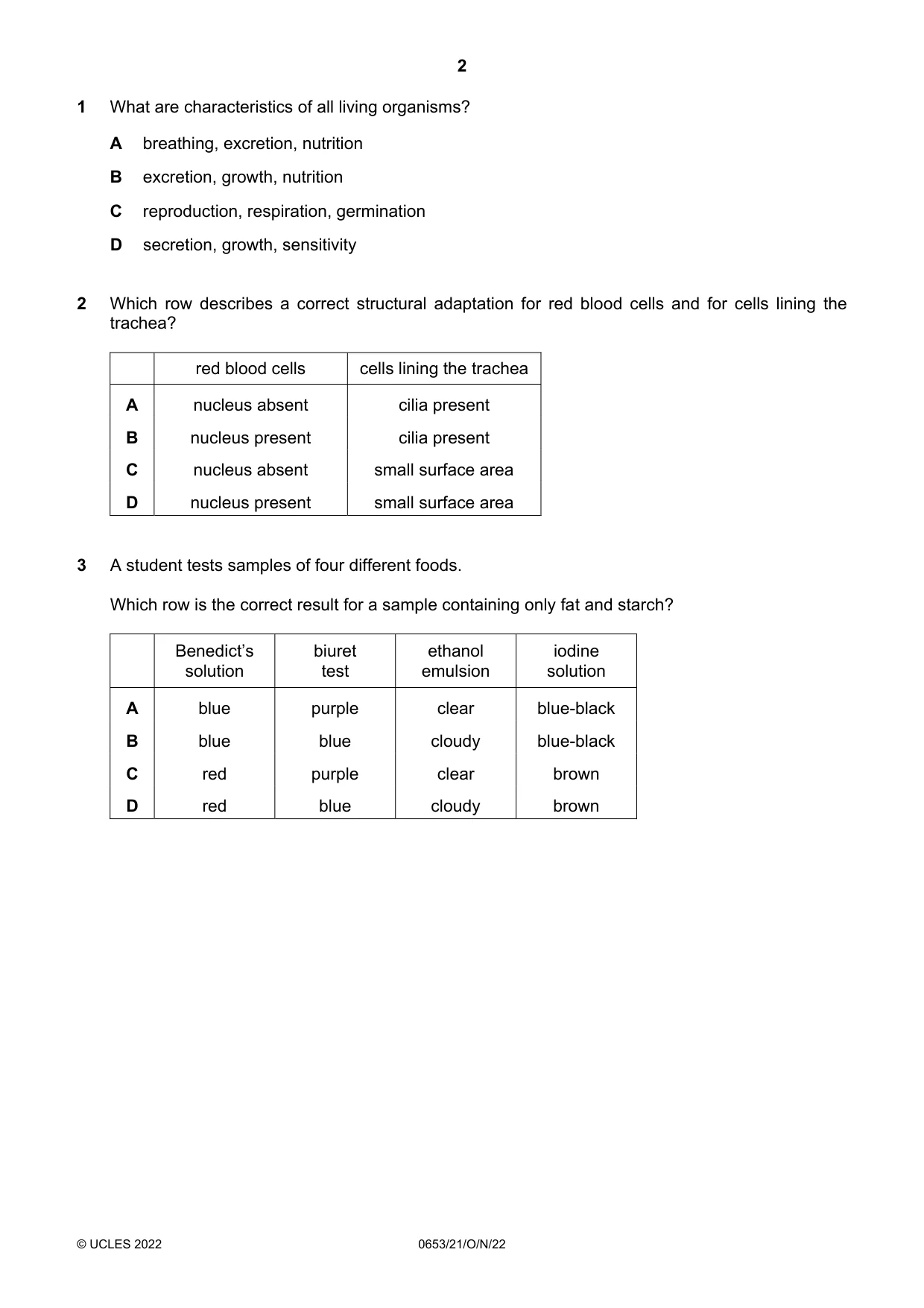
1 What are characteristics of all living organisms? A breathing, excretion, nutrition B excretion, growth, nutrition C reproduction, respiration, germination D secretion, growth, sensitivity
Mark scheme: B
Q2 · Which row describes a correct structural adaptation for red blood cells and for cells…
2 Which row describes a correct structural adaptation for red blood cells and for cells lining the trachea? red blood cells cells lining the trachea A nucleus absent cilia present B nucleus present cilia present C nucleus absent small surface area D nucleus present small surface area
Mark scheme: A
Q3 · A student tests samples of four different foods
3 A student tests samples of four different foods. Which row is the correct result for a sample containing only fat and starch? Benedict’s biuret ethanol iodine solution test emulsion solution A blue purple clear blue-black B blue blue cloudy blue-black C red purple clear brown D red blue cloudy brown
Mark scheme: B
Q4 · Which graph correctly shows the effect of varying light intensity on the rate of…
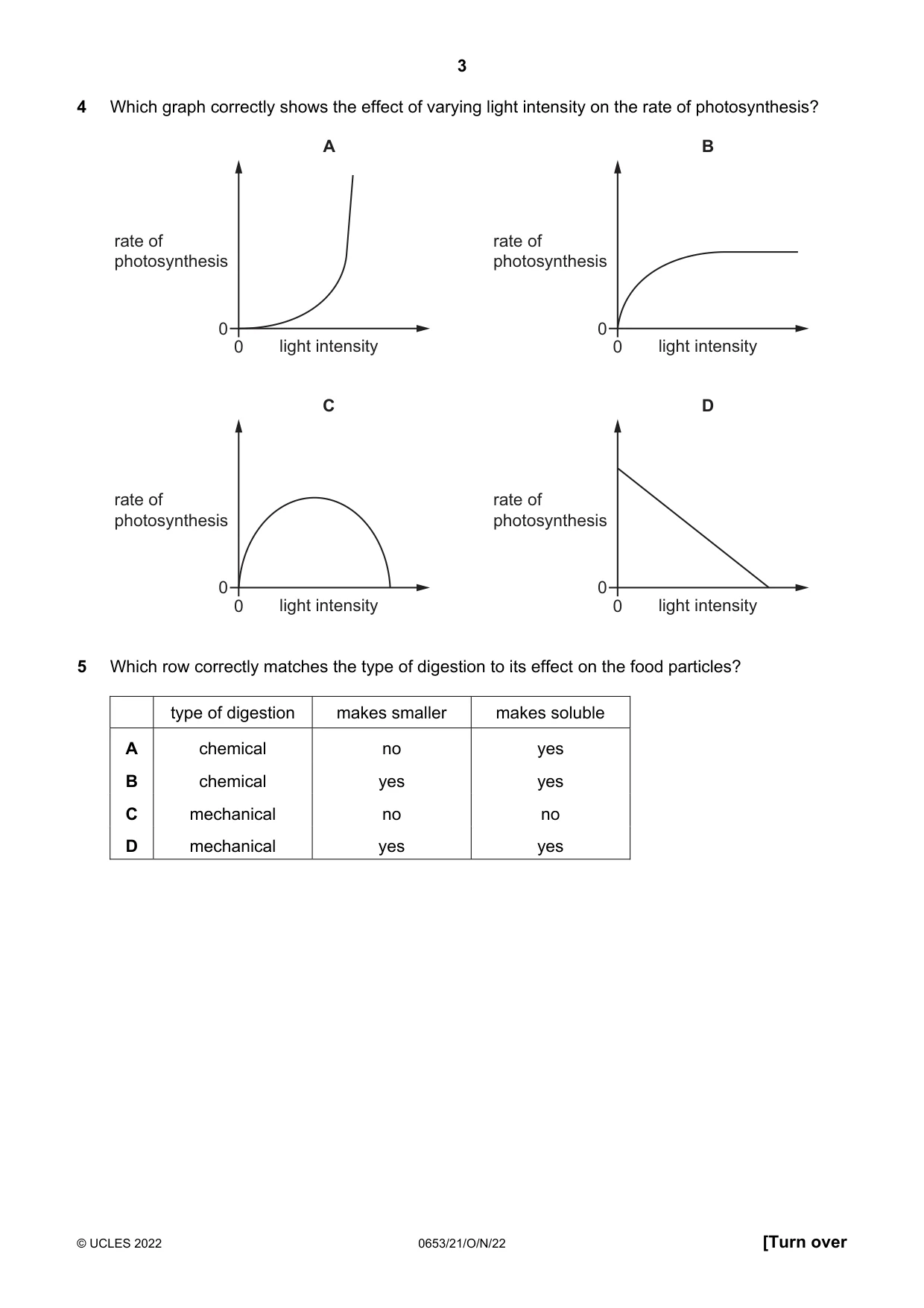
4 Which graph correctly shows the effect of varying light intensity on the rate of photosynthesis? A B rate of rate of photosynthesis photosynthesis 0 0 0 light intensity 0 light intensity C D rate of rate of photosynthesis photosynthesis 0 0 0 light intensity 0 light intensity
Mark scheme: B
Q5 · Which row correctly matches the type of digestion to its effect on the food particles?
5 Which row correctly matches the type of digestion to its effect on the food particles? type of digestion makes smaller makes soluble A chemical no yes B chemical yes yes C mechanical no no D mechanical yes yes
Mark scheme: B
Q6 · A student investigates factors affecting the rate of transpiration in a plant
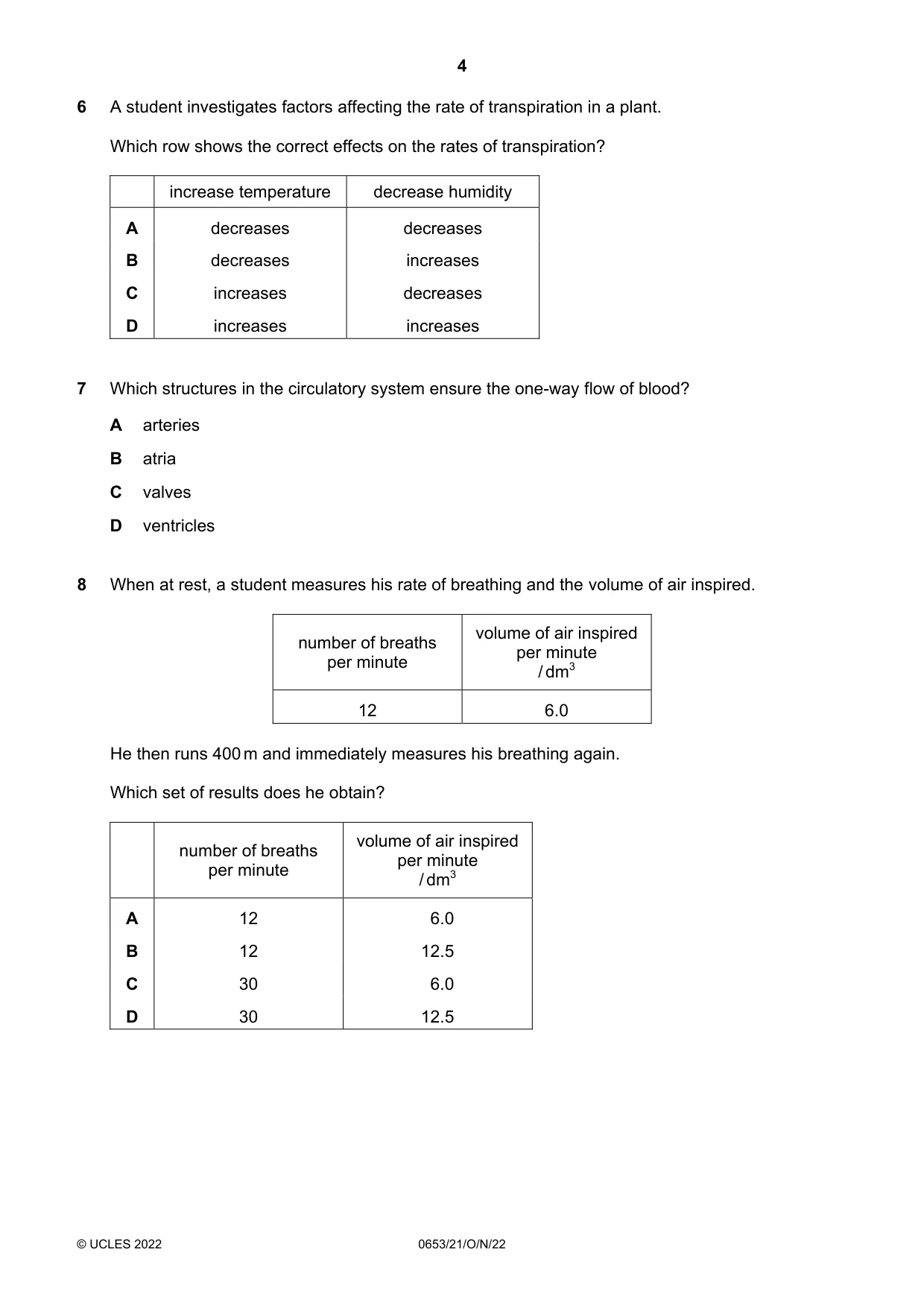
6 A student investigates factors affecting the rate of transpiration in a plant. Which row shows the correct effects on the rates of transpiration? increase temperature decrease humidity A decreases decreases B decreases increases C increases decreases D increases increases
Mark scheme: D
Q7 · Which structures in the circulatory system ensure the one-way flow of blood?
7 Which structures in the circulatory system ensure the one-way flow of blood? A arteries B atria C valves D ventricles
Mark scheme: C
Q8 · When at rest, a student measures his rate of breathing and the volume of air inspired
8 When at rest, a student measures his rate of breathing and the volume of air inspired. volume of air inspired number of breaths per minute per minute / dm3 12 6.0 He then runs 400 m and immediately measures his breathing again. Which set of results does he obtain? volume of air inspired number of breaths per minute per minute / dm3 A 12 6.0 B 12 12.5 C 30 6.0 D 30 12.5
Mark scheme: D
Q9 · What is the word equation for aerobic respiration?
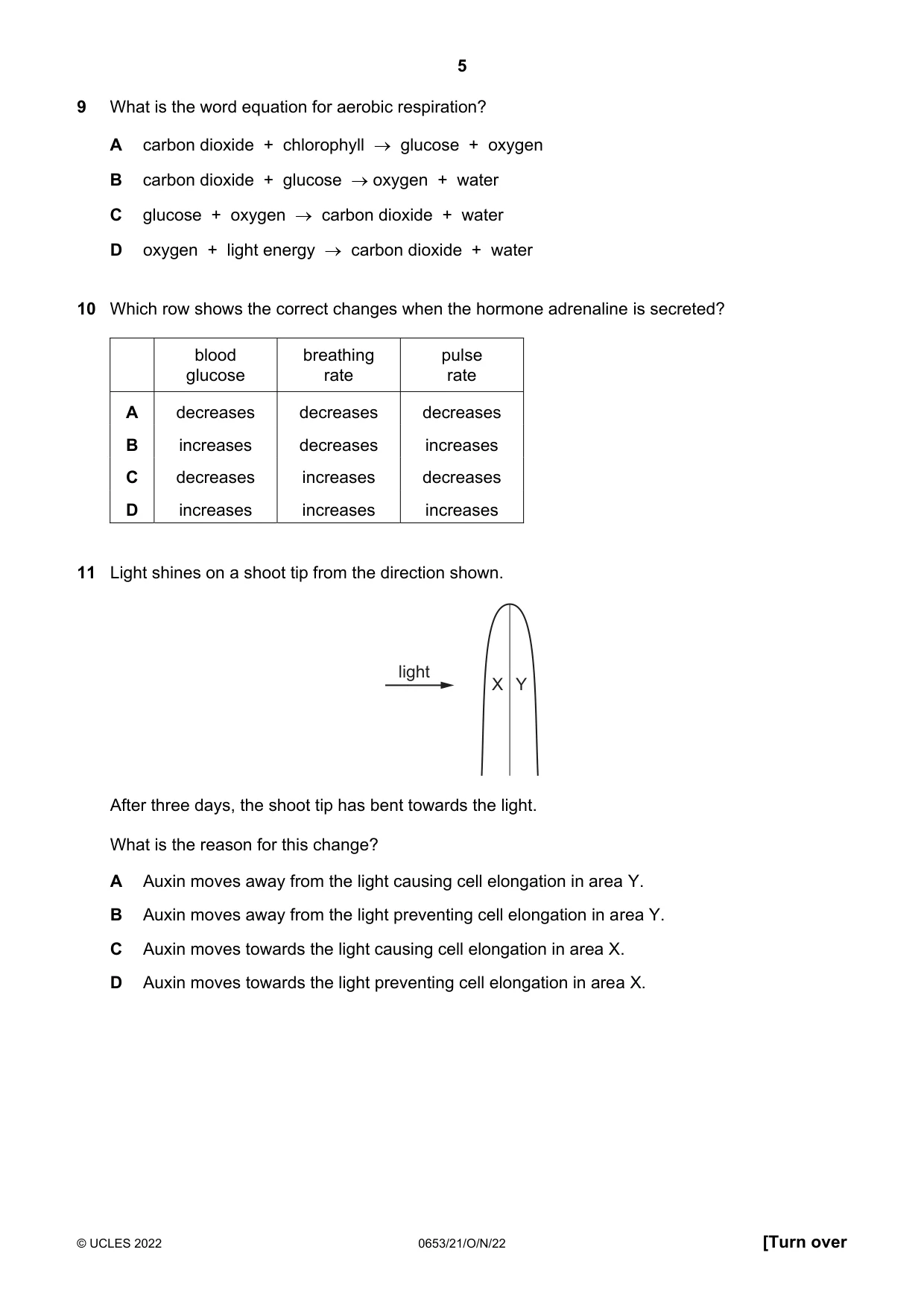
9 What is the word equation for aerobic respiration? A carbon dioxide + chlorophyll glucose + oxygen B carbon dioxide + glucose oxygen + water C glucose + oxygen carbon dioxide + water D oxygen + light energy carbon dioxide + water
Mark scheme: C
Q10 · Which row shows the correct changes when the hormone adrenaline is secreted?
10 Which row shows the correct changes when the hormone adrenaline is secreted? blood breathing pulse glucose rate rate A decreases decreases decreases B increases decreases increases C decreases increases decreases D increases increases increases
Mark scheme: D
Q11 · Light shines on a shoot tip from the direction shown
11 Light shines on a shoot tip from the direction shown. light X Y After three days, the shoot tip has bent towards the light. What is the reason for this change? A Auxin moves away from the light causing cell elongation in area Y. B Auxin moves away from the light preventing cell elongation in area Y. C Auxin moves towards the light causing cell elongation in area X. D Auxin moves towards the light preventing cell elongation in area X.
Mark scheme: A
Q12 · Which environmental conditions are necessary for seeds to germinate?
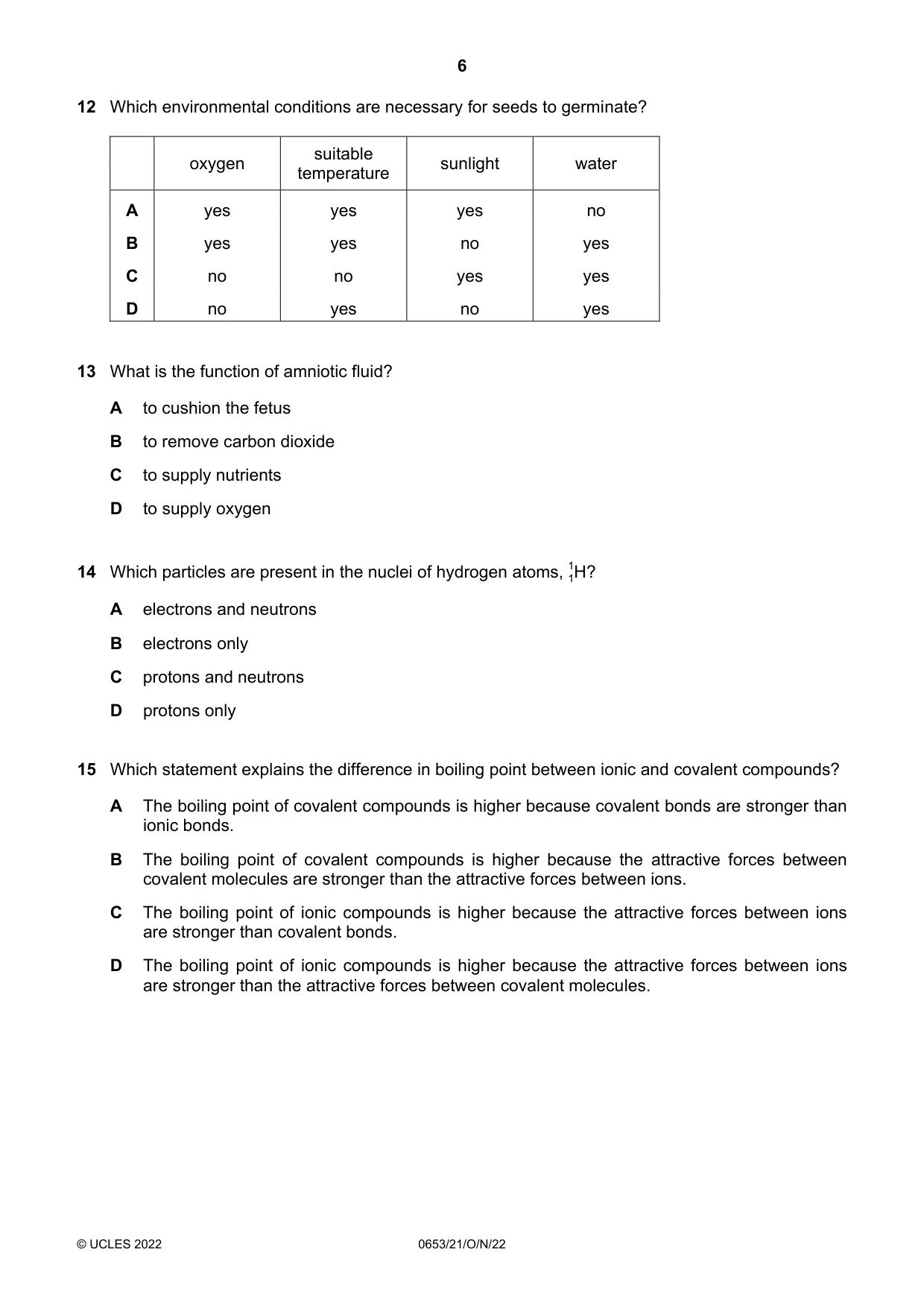
12 Which environmental conditions are necessary for seeds to germinate? suitable oxygen sunlight water temperature A yes yes yes no B yes yes no yes C no no yes yes D no yes no yes
Mark scheme: B
Q13 · What is the function of amniotic fluid?
13 What is the function of amniotic fluid? A to cushion the fetus B to remove carbon dioxide C to supply nutrients D to supply oxygen
Mark scheme: A
Q14 · Which particles are present in the nuclei of hydrogen atoms, H?
14 Which particles are present in the nuclei of hydrogen atoms, H? 1 1 A electrons and neutrons B electrons only C protons and neutrons D protons only
Mark scheme: D
Q15 · Which statement explains the difference in boiling point between ionic and covalent…
15 Which statement explains the difference in boiling point between ionic and covalent compounds? A The boiling point of covalent compounds is higher because covalent bonds are stronger than ionic bonds. B The boiling point of covalent compounds is higher because the attractive forces between covalent molecules are stronger than the attractive forces between ions. C The boiling point of ionic compounds is higher because the attractive forces between ions are stronger than covalent bonds. D The boiling point of ionic compounds is higher because the attractive forces between ions are stronger than the attractive forces between covalent molecules.
Mark scheme: D
Q16 · Aqueous sodium hydroxide is added to aqueous aluminium sulfate
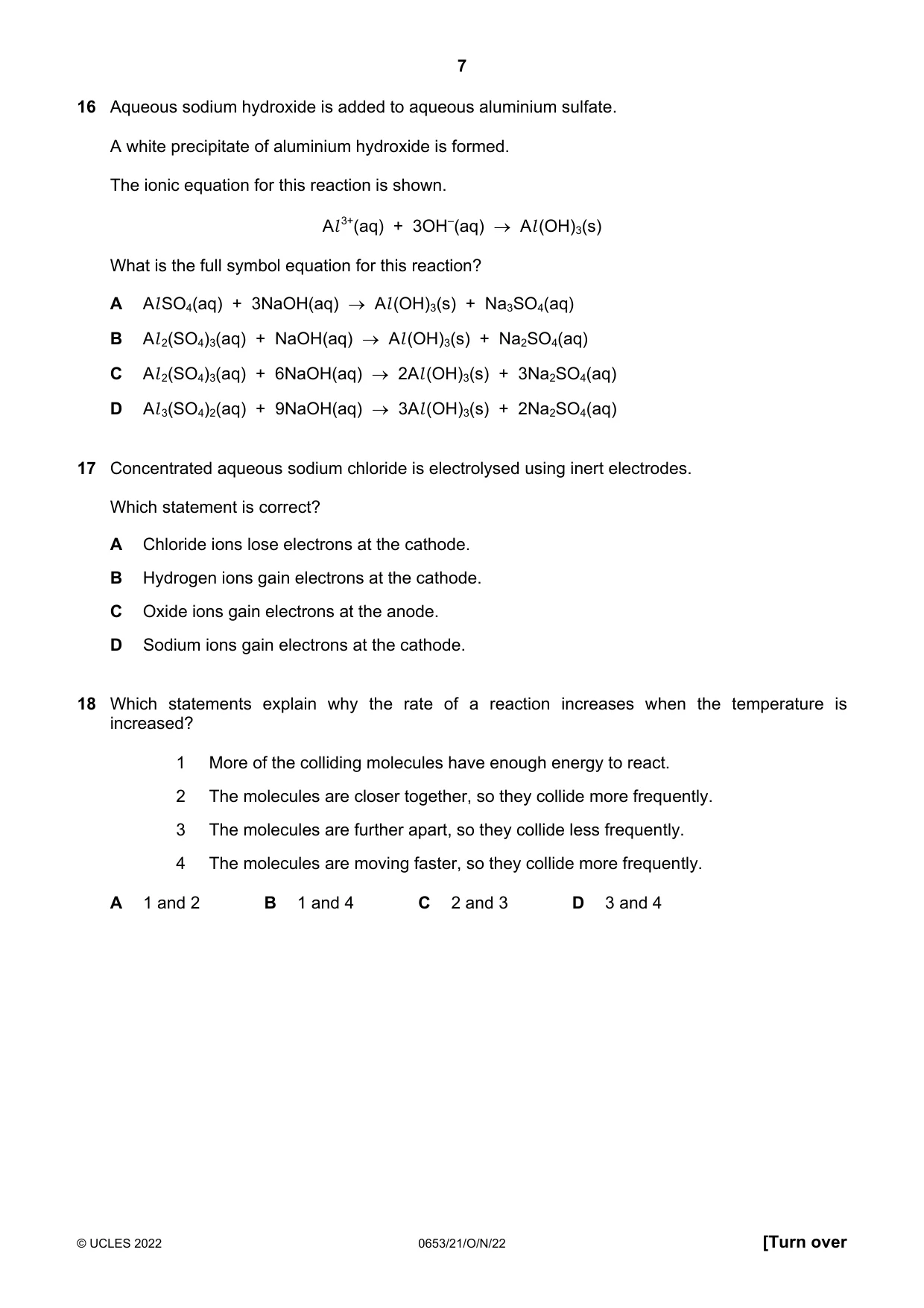
16 Aqueous sodium hydroxide is added to aqueous aluminium sulfate. A white precipitate of aluminium hydroxide is formed. The ionic equation for this reaction is shown. Al 3+(aq) + 3OH–(aq) Al (OH)3(s) What is the full symbol equation for this reaction? A Al SO4(aq) + 3NaOH(aq) Al (OH)3(s) + Na3SO4(aq) B Al 2(SO4)3(aq) + NaOH(aq) Al (OH)3(s) + Na2SO4(aq) C Al 2(SO4)3(aq) + 6NaOH(aq) 2Al (OH)3(s) + 3Na2SO4(aq) D Al 3(SO4)2(aq) + 9NaOH(aq) 3Al (OH)3(s) + 2Na2SO4(aq)
Mark scheme: C
Q17 · Concentrated aqueous sodium chloride is electrolysed using inert electrodes
17 Concentrated aqueous sodium chloride is electrolysed using inert electrodes. Which statement is correct? A Chloride ions lose electrons at the cathode. B Hydrogen ions gain electrons at the cathode. C Oxide ions gain electrons at the anode. D Sodium ions gain electrons at the cathode.
Mark scheme: B
Q18 · Which statements explain why the rate of a reaction increases when the temperature is…
18 Which statements explain why the rate of a reaction increases when the temperature is increased? 1 More of the colliding molecules have enough energy to react. 2 The molecules are closer together, so they collide more frequently. 3 The molecules are further apart, so they collide less frequently. 4 The molecules are moving faster, so they collide more frequently. A 1 and 2 B 1 and 4 C 2 and 3 D 3 and 4
Mark scheme: B
Q19 · The word equation represents the reaction between substance J and hydrochloric acid
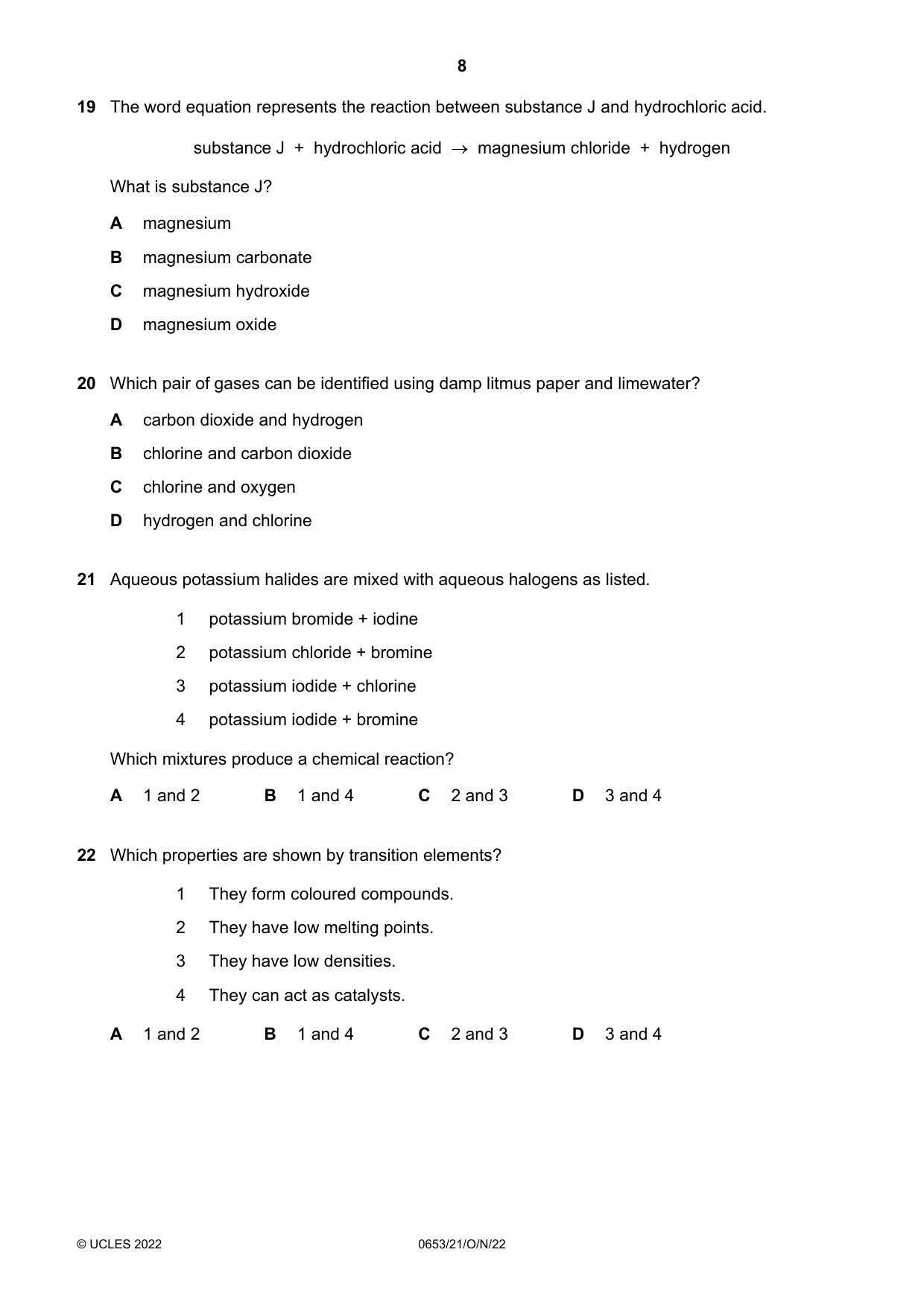
19 The word equation represents the reaction between substance J and hydrochloric acid. substance J + hydrochloric acid magnesium chloride + hydrogen What is substance J? A magnesium B magnesium carbonate C magnesium hydroxide D magnesium oxide
Mark scheme: A
More questions on The characteristic properties of acids and bases
Q20 · Which pair of gases can be identified using damp litmus paper and limewater?
20 Which pair of gases can be identified using damp litmus paper and limewater? A carbon dioxide and hydrogen B chlorine and carbon dioxide C chlorine and oxygen D hydrogen and chlorine
Mark scheme: B
Q21 · Aqueous potassium halides are mixed with aqueous halogens as listed
21 Aqueous potassium halides are mixed with aqueous halogens as listed. 1 potassium bromide + iodine 2 potassium chloride + bromine 3 potassium iodide + chlorine 4 potassium iodide + bromine Which mixtures produce a chemical reaction? A 1 and 2 B 1 and 4 C 2 and 3 D 3 and 4
Mark scheme: D
Q22 · Which properties are shown by transition elements?
22 Which properties are shown by transition elements? 1 They form coloured compounds. 2 They have low melting points. 3 They have low densities. 4 They can act as catalysts. A 1 and 2 B 1 and 4 C 2 and 3 D 3 and 4
Mark scheme: B
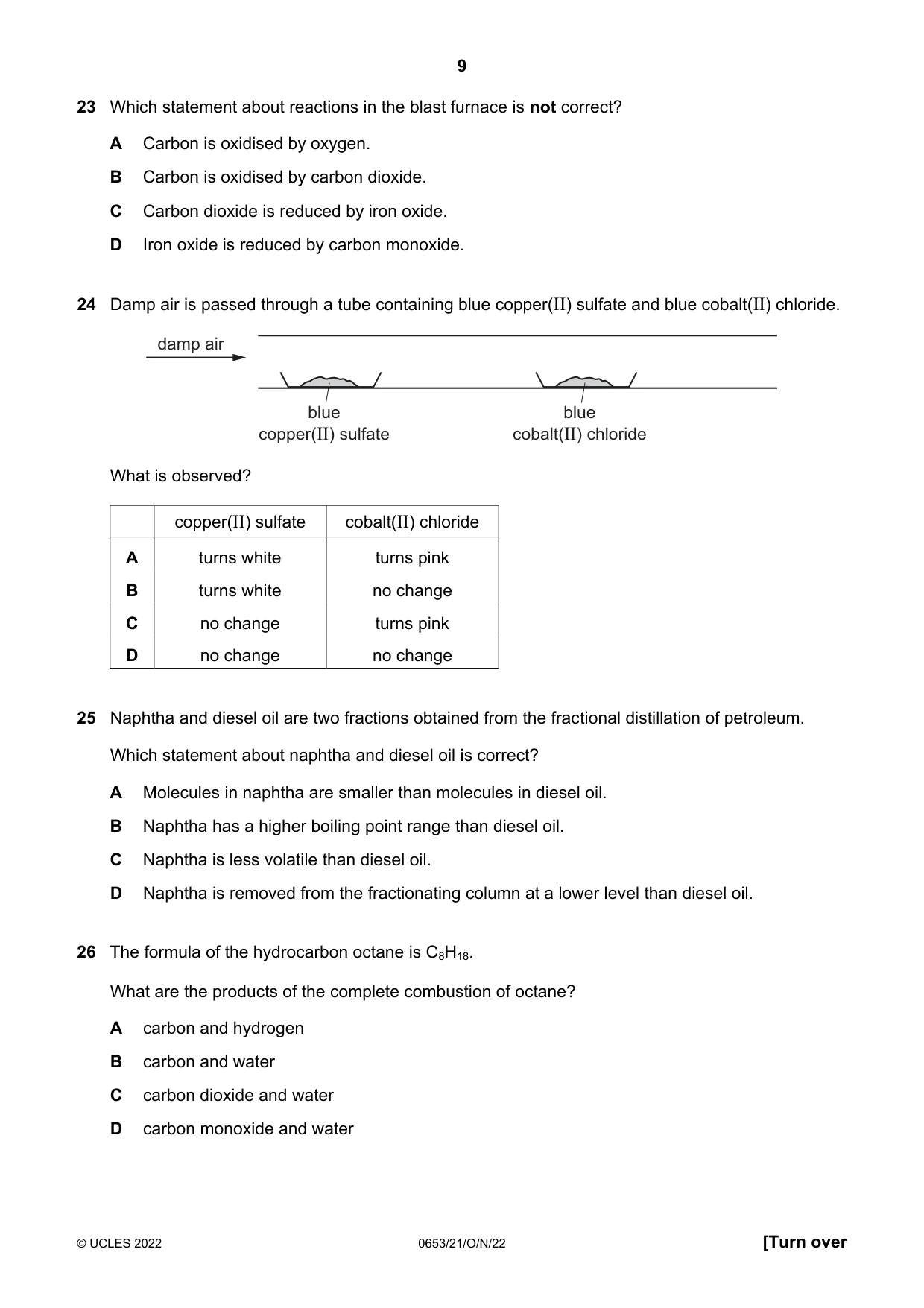
Q23 · Which statement about reactions in the blast furnace is not correct?
23 Which statement about reactions in the blast furnace is not correct? A Carbon is oxidised by oxygen. B Carbon is oxidised by carbon dioxide. C Carbon dioxide is reduced by iron oxide. D Iron oxide is reduced by carbon monoxide.
Mark scheme: C
Q24 · Damp air is passed through a tube containing blue copper(II) sulfate and blue cobalt(II)…
24 Damp air is passed through a tube containing blue copper(II) sulfate and blue cobalt(II) chloride. damp air blue blue copper(II) sulfate cobalt(II) chloride What is observed? copper(II) sulfate cobalt(II) chloride A turns white turns pink B turns white no change C no change turns pink D no change no change
Mark scheme: C
Q25 · Naphtha and diesel oil are two fractions obtained from the fractional distillation of…
25 Naphtha and diesel oil are two fractions obtained from the fractional distillation of petroleum. Which statement about naphtha and diesel oil is correct? A Molecules in naphtha are smaller than molecules in diesel oil. B Naphtha has a higher boiling point range than diesel oil. C Naphtha is less volatile than diesel oil. D Naphtha is removed from the fractionating column at a lower level than diesel oil.
Mark scheme: A
Q26 · The formula of the hydrocarbon octane is C8H18
26 The formula of the hydrocarbon octane is C8H18. What are the products of the complete combustion of octane? A carbon and hydrogen B carbon and water C carbon dioxide and water D carbon monoxide and water
Mark scheme: C
Q27 · Which process is an example of thermal decomposition?
27 Which process is an example of thermal decomposition? A cracking an alkane B electrolysis of molten lead(II) bromide C extraction of iron in the blast furnace D fractional distillation of petroleum
Mark scheme: A
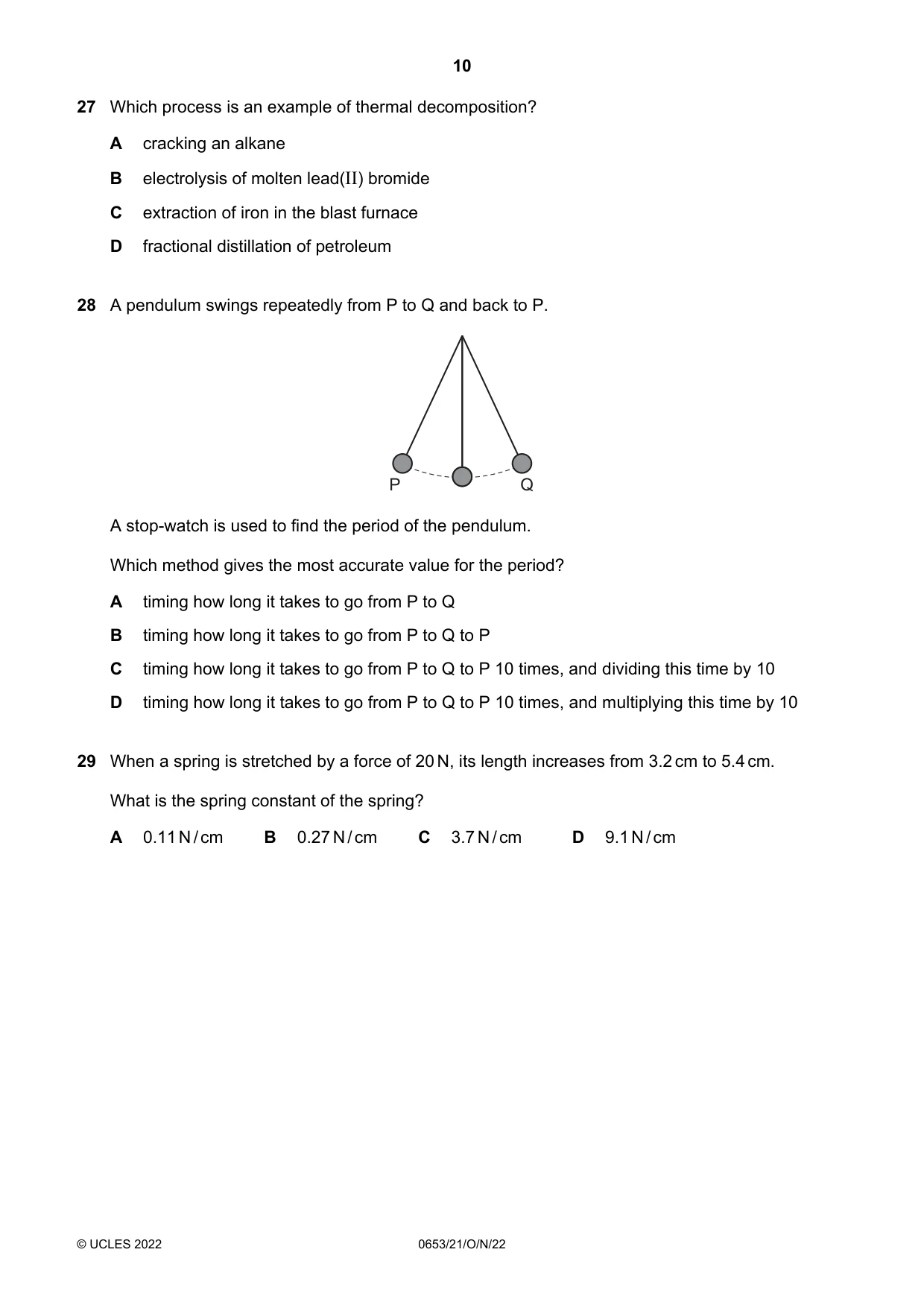
Q28 · A pendulum swings repeatedly from P to Q and back to P
28 A pendulum swings repeatedly from P to Q and back to P. P Q A stop-watch is used to find the period of the pendulum. Which method gives the most accurate value for the period? A timing how long it takes to go from P to Q B timing how long it takes to go from P to Q to P C timing how long it takes to go from P to Q to P 10 times, and dividing this time by 10 D timing how long it takes to go from P to Q to P 10 times, and multiplying this time by 10
Mark scheme: C
More questions on Physical quantities and measurement techniques
Q29 · When a spring is stretched by a force of 20 N, its length increases from 3.2 cm to 5.4 cm
29 When a spring is stretched by a force of 20 N, its length increases from 3.2 cm to 5.4 cm. What is the spring constant of the spring? A 0.11 N / cm B 0.27 N / cm C 3.7 N / cm D 9.1 N / cm
Mark scheme: D
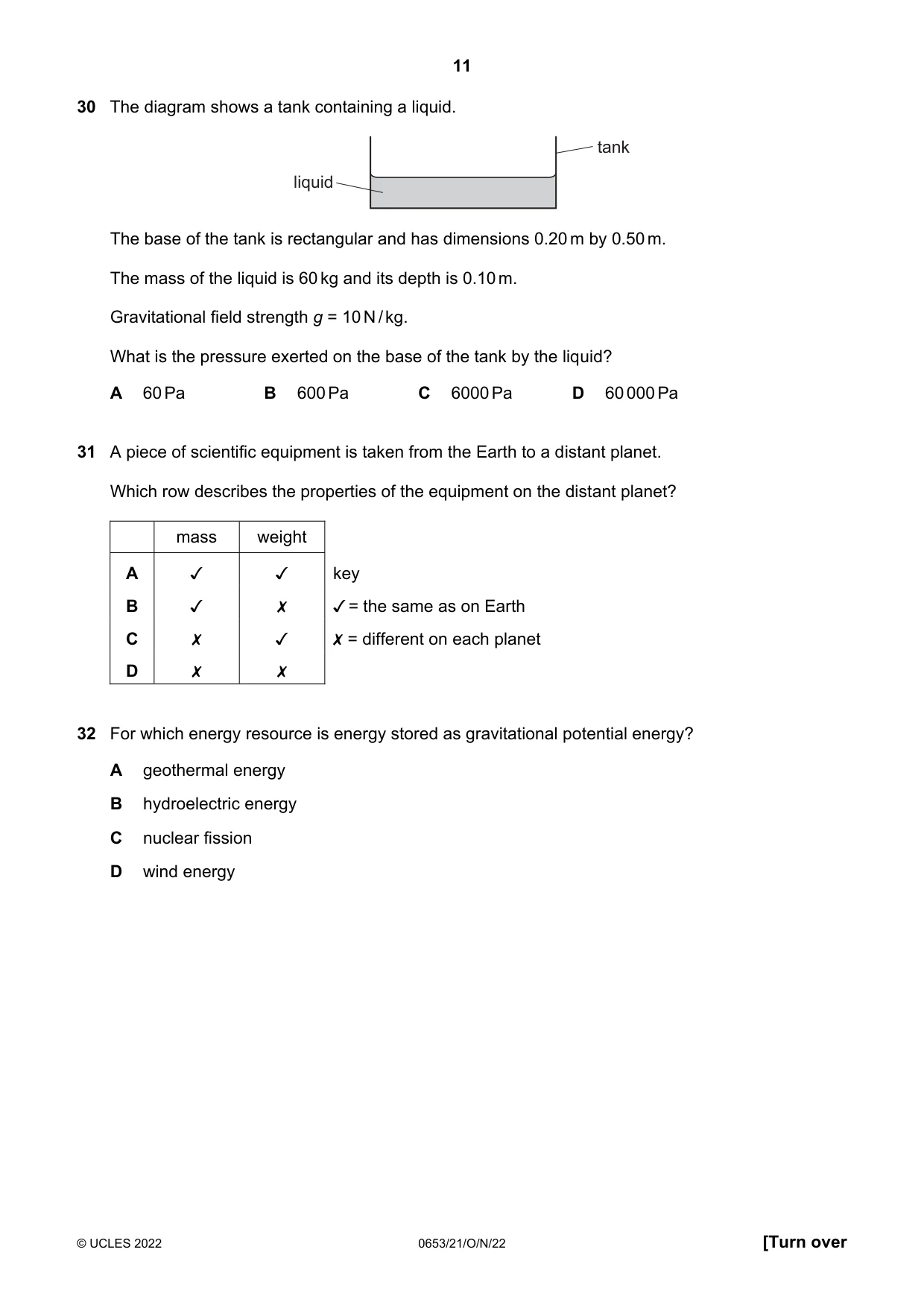
Q30 · The diagram shows a tank containing a liquid
30 The diagram shows a tank containing a liquid. tank liquid The base of the tank is rectangular and has dimensions 0.20 m by 0.50 m. The mass of the liquid is 60 kg and its depth is 0.10 m. Gravitational field strength g = 10 N / kg. What is the pressure exerted on the base of the tank by the liquid? A 60 Pa B 600 Pa C 6000 Pa D 60 000 Pa
Mark scheme: C
Q31 · A piece of scientific equipment is taken from the Earth to a distant planet
31 A piece of scientific equipment is taken from the Earth to a distant planet. Which row describes the properties of the equipment on the distant planet? key / =the same as on Earth X = different on each planet
Mark scheme: B
Q32 · For which energy resource is energy stored as gravitational potential energy?
32 For which energy resource is energy stored as gravitational potential energy? A geothermal energy B hydroelectric energy C nuclear fission D wind energy
Mark scheme: B
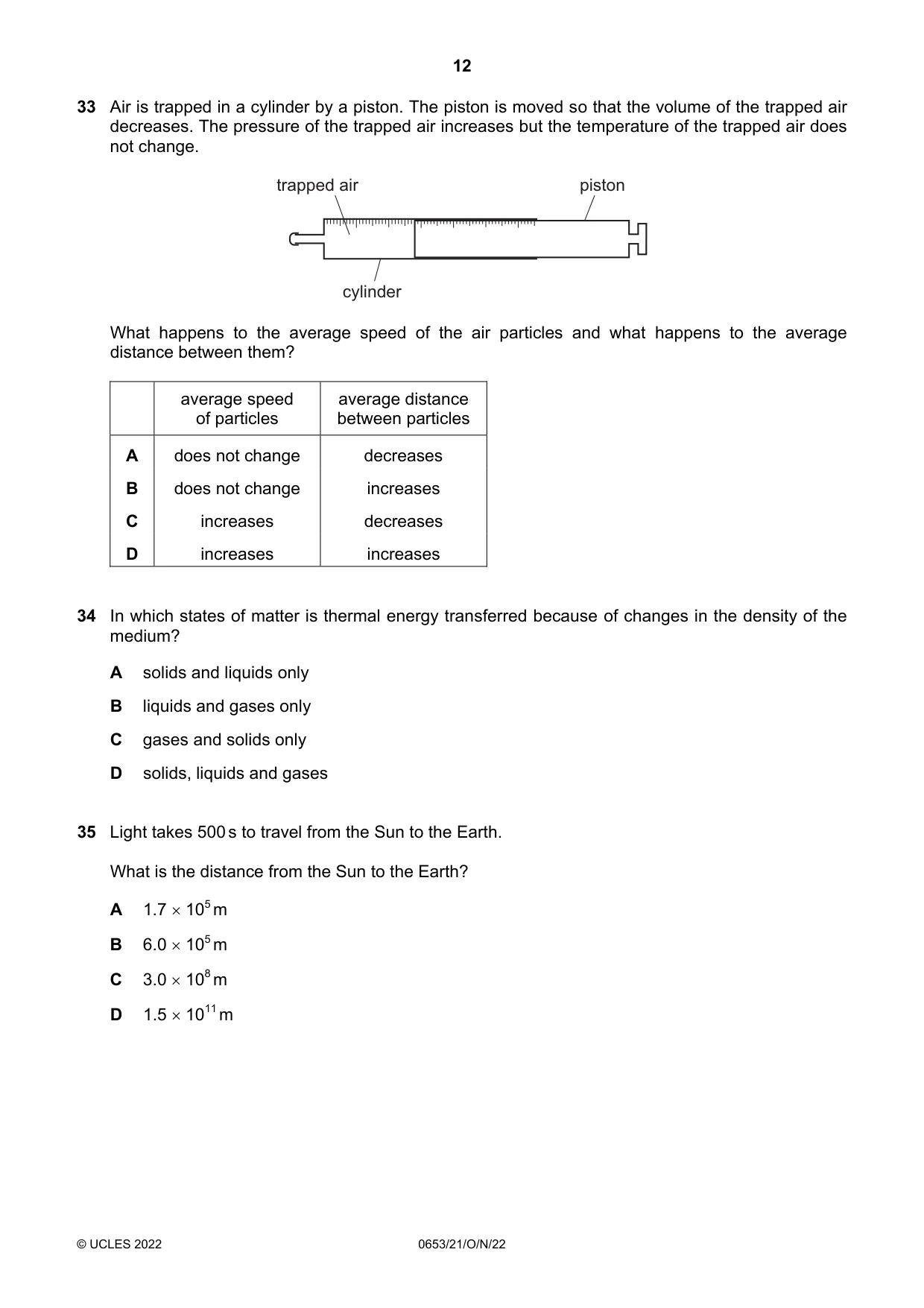
Q33 · Air is trapped in a cylinder by a piston
33 Air is trapped in a cylinder by a piston. The piston is moved so that the volume of the trapped air decreases. The pressure of the trapped air increases but the temperature of the trapped air does not change. trapped air piston cylinder What happens to the average speed of the air particles and what happens to the average distance between them? average speed average distance of particles between particles A does not change decreases B does not change increases C increases decreases D increases increases
Mark scheme: A
Q34 · In which states of matter is thermal energy transferred because of changes in the density…
34 In which states of matter is thermal energy transferred because of changes in the density of the medium? A solids and liquids only B liquids and gases only C gases and solids only D solids, liquids and gases
Mark scheme: B
Q35 · Light takes 500 s to travel from the Sun to the Earth
35 Light takes 500 s to travel from the Sun to the Earth. What is the distance from the Sun to the Earth? A 1.7 105 m B 6.0 105 m C 3.0 108 m D 1.5 1011 m
Mark scheme: D
Q36 · A sound wave passes through air
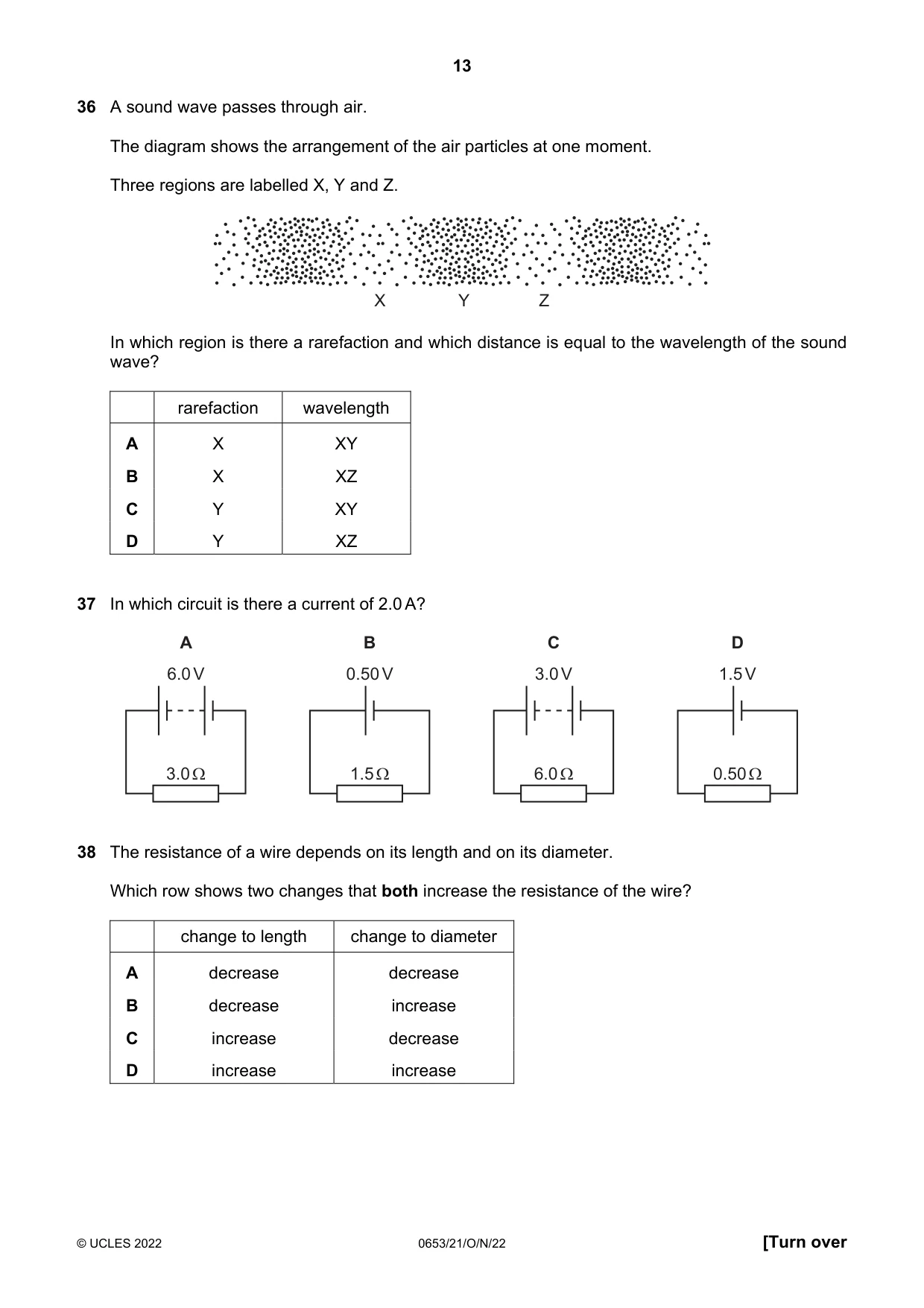
36 A sound wave passes through air. The diagram shows the arrangement of the air particles at one moment. Three regions are labelled X, Y and Z. X Y Z In which region is there a rarefaction and which distance is equal to the wavelength of the sound wave? rarefaction wavelength A X XY B X XZ C Y XY D Y XZ
Mark scheme: B
Q37 · In which circuit is there a current of 2.0A?
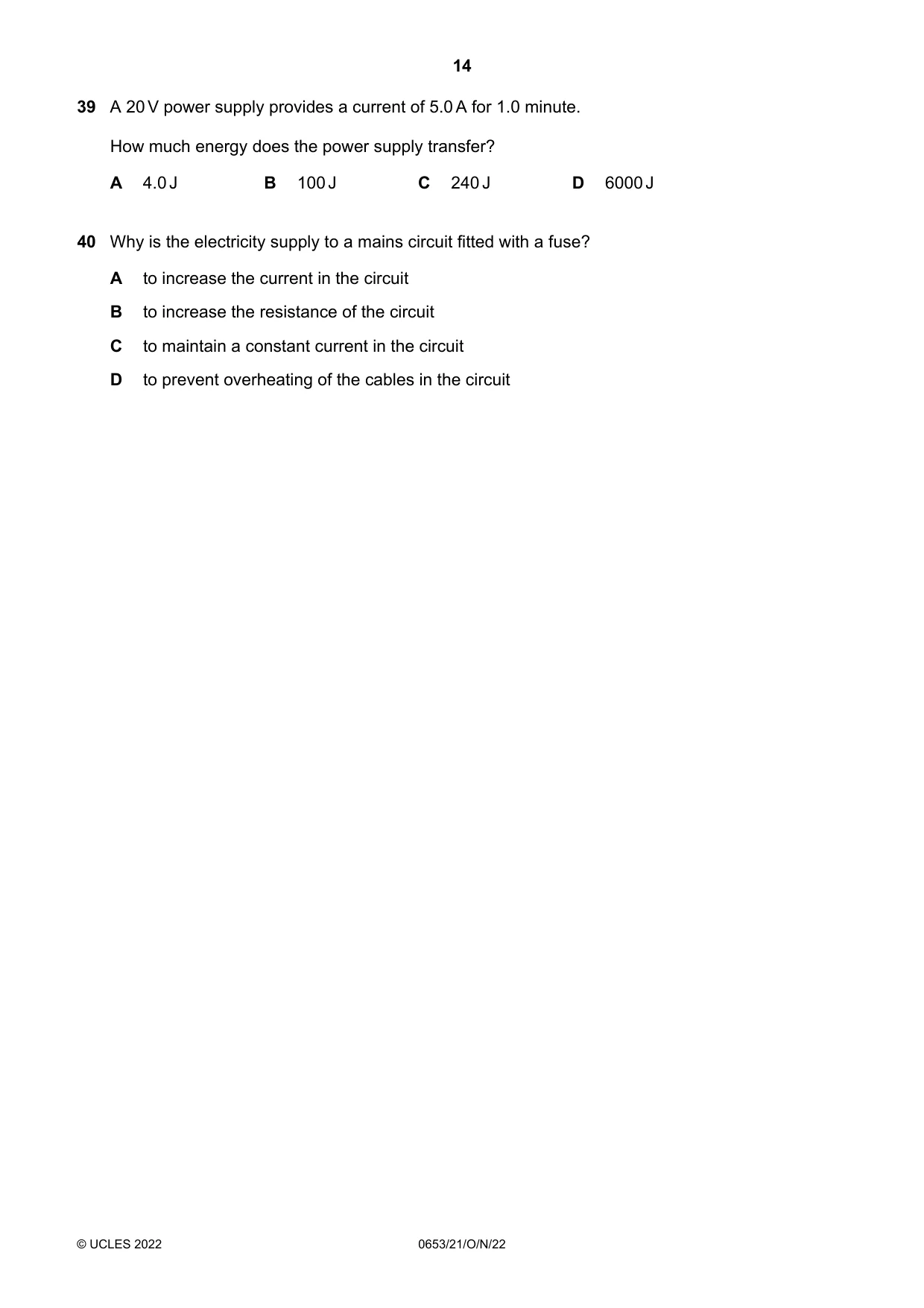
37 In which circuit is there a current of 2.0A? A B Cc D 6.0V 0.50V 3.0V 1.5V 3.0Q 1.50 6.0Q 0.50Q
Mark scheme: A
Q38 · The resistance of a wire depends on its length and on its diameter
38 The resistance of a wire depends on its length and on its diameter. Which row shows two changes that both increase the resistance of the wire? change to length change to diameter A decrease decrease B decrease increase C increase decrease D increase increase
Mark scheme: C
Q39 · A 20 V power supply provides a current of 5.0 A for 1.0 minute
39 A 20 V power supply provides a current of 5.0 A for 1.0 minute. How much energy does the power supply transfer? A 4.0 J B 100 J C 240 J D 6000 J
Mark scheme: D
Q40 · Why is the electricity supply to a mains circuit fitted with a fuse?
40 Why is the electricity supply to a mains circuit fitted with a fuse? A to increase the current in the circuit B to increase the resistance of the circuit C to maintain a constant current in the circuit D to prevent overheating of the cables in the circuit
Mark scheme: D
What was in this paper
The subtopics covered by these 40 questions, and how many questions each got. Open one in a new tab to see every Cambridge question on it.
2Gas exchange in humans2Sexual reproduction in plants2Alkanes1Atomic structure and the Periodic Table1Biological molecules1Characteristics of living organisms1Digestion1Drugs1Electrical circuits1Electrical quantities1Electrical safety1Electrolysis1Extraction of metals1Forces1Formulas1Fuels1General properties of waves1Group VII properties1Heart1Identification of ions and gases1Ions and ionic bonds1Kinetic particle model of matter1Mass and weight1Motion1Photosynthesis1Physical and chemical changes1Physical quantities and measurement techniques1Pressure1Rate of reaction1Respiration1Sexual reproduction in humans1The characteristic properties of acids and bases1Transfer of thermal energy1Transition elements1Transpiration1Water1What you needed in this session
Cambridge’s own grade thresholds for 2022 Oct/Nov, Paper 2 · Variant 1. A higher threshold means an easier paper — the bar moves with how the cohort did.