Cambridge IGCSE Science - Combined 0653 — 2017 Oct/Nov Paper 2 · Variant 3
0653/23/O/N/17 · 40 questions · 40 marks · ≈45 min
The question paper and its mark scheme, free to read here and free to download. This is Cambridge’s own paper, exactly as it was sat.
Question paper20 pages


Mark scheme3 pages
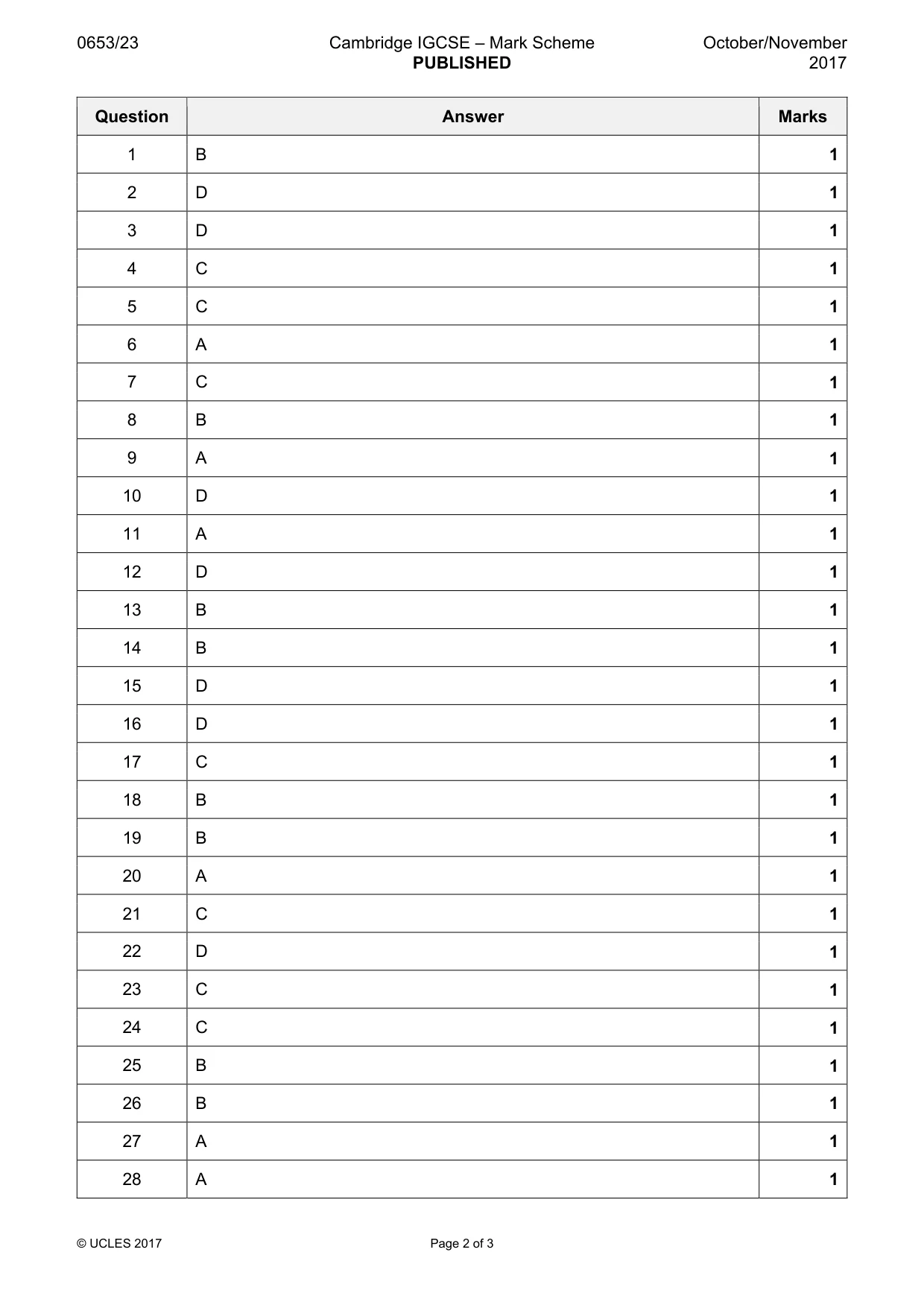
Answers below. Sit the paper first if you are practising.
Questions as text
Q1 · Which characteristics help to define a living organism?
1 Which characteristics help to define a living organism? A diffusion, movement, respiration B excretion, nutrition, sensitivity C excretion, reproduction, transpiration D growth, inspiration, nutrition
Mark scheme: B
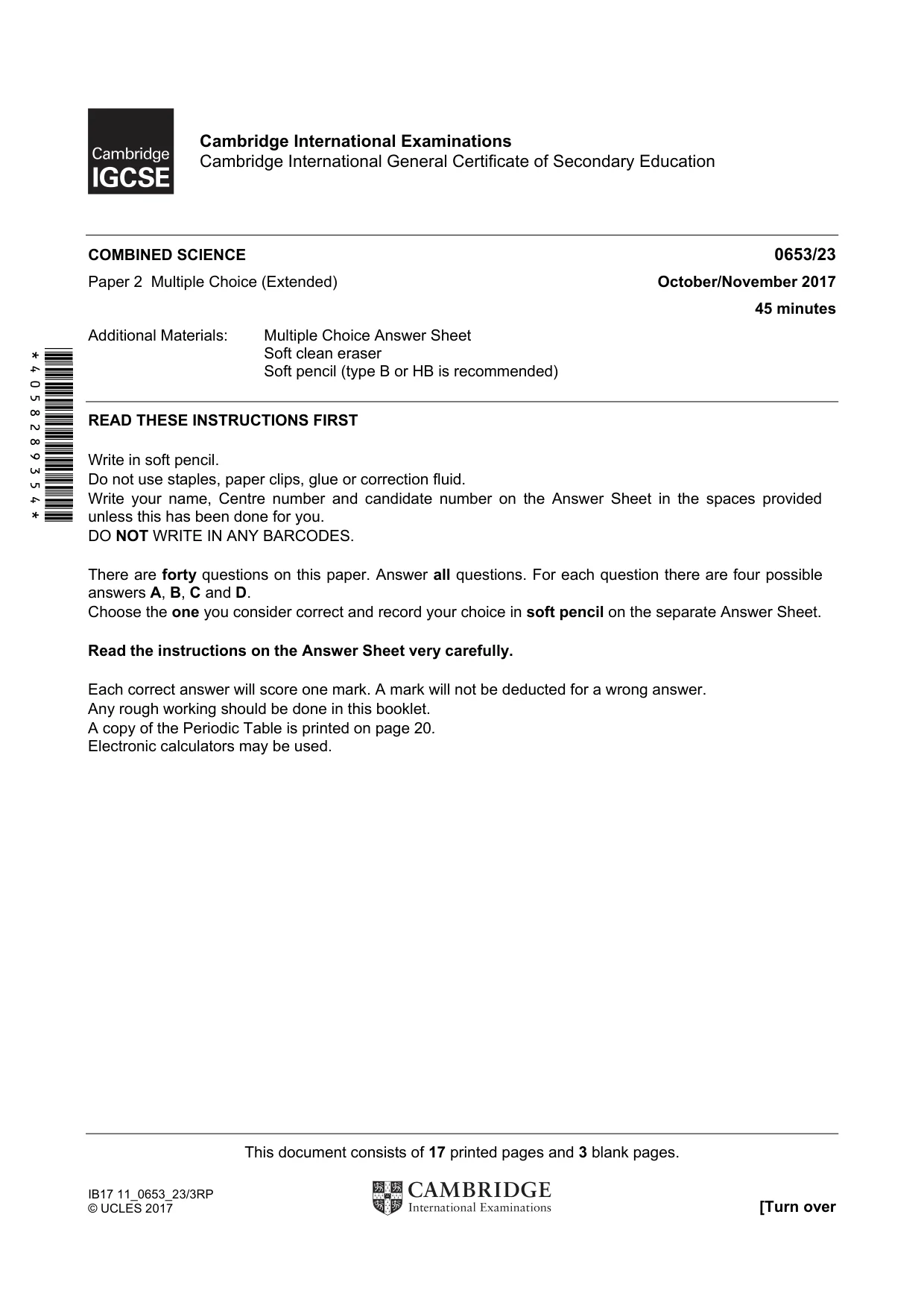
Q2 · The diagram shows a palisade cell
2 The diagram shows a palisade cell. Which structure converts energy from light into chemical energy? D C A B
Mark scheme: D
Q3 · Which substance is produced by respiration in microorganisms during yoghurt making?
3 Which substance is produced by respiration in microorganisms during yoghurt making? A amino acids B fatty acids C hydrochloric acid D lactic acid
Mark scheme: D
Q4 · The list shows chemicals that are important to a plant
4 The list shows chemicals that are important to a plant. 1 carbon dioxide 2 nitrates 3 oxygen 4 water Which chemicals does a plant use in photosynthesis? A 1, 2 and 4 B 1 and 2 only C 1 and 4 only D 3 and 4 only
Mark scheme: C
Q5 · In which order does food pass through parts of the alimentary canal?
5 In which order does food pass through parts of the alimentary canal? A oesophagus → colon → small intestine B small intestine → oesophagus → rectum C small intestine → rectum → anus D stomach → colon → small intestine
Mark scheme: C
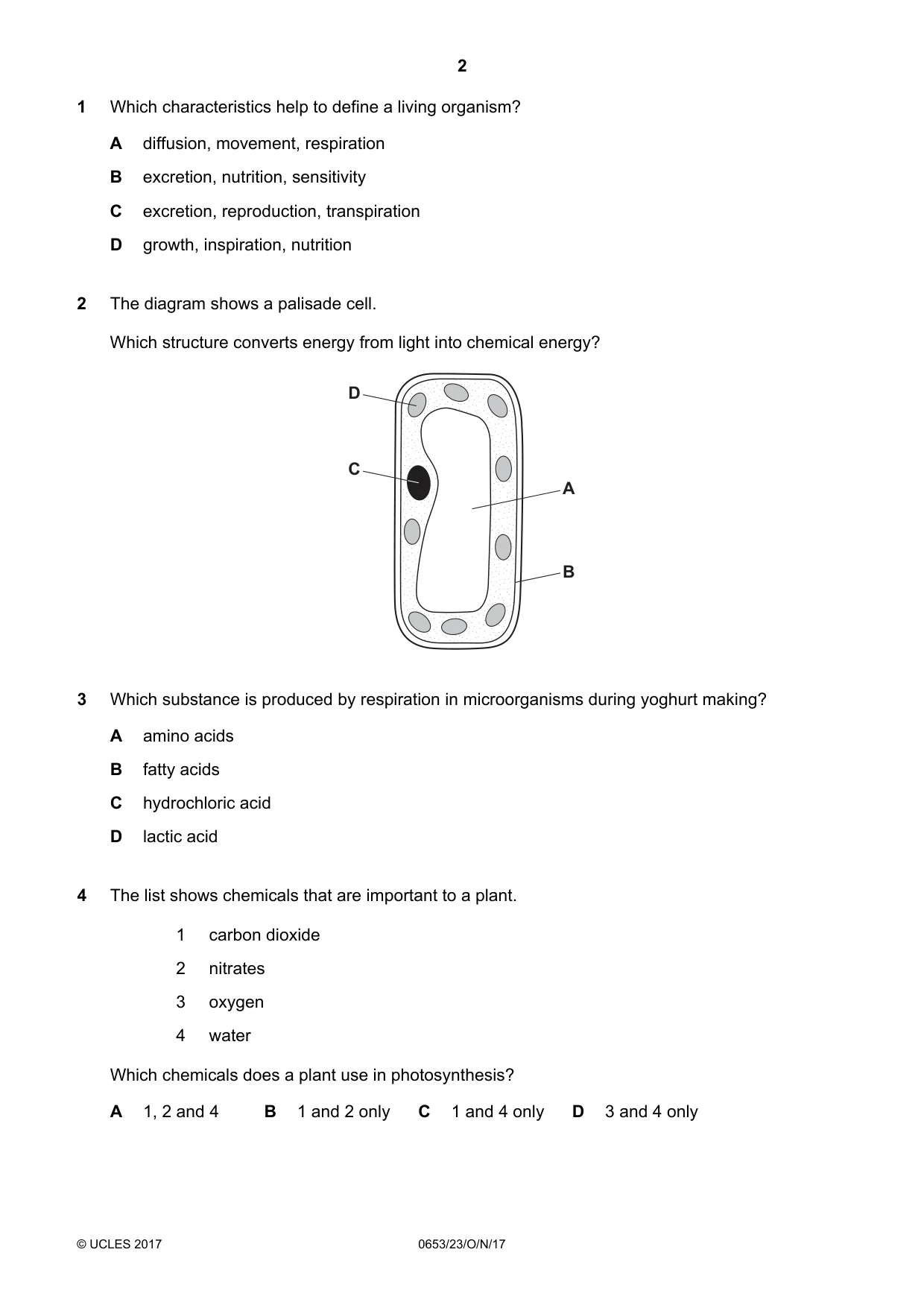
Q6 · The graph shows the uptake of water by root hair cells over many hours during a day
6 The graph shows the uptake of water by root hair cells over many hours during a day. T water uptake by root hair cells 0 0 time What could have caused the change in the rate of uptake at T? A decrease in temperature B decrease in humidity C increase in light intensity D increase in temperature
Mark scheme: A
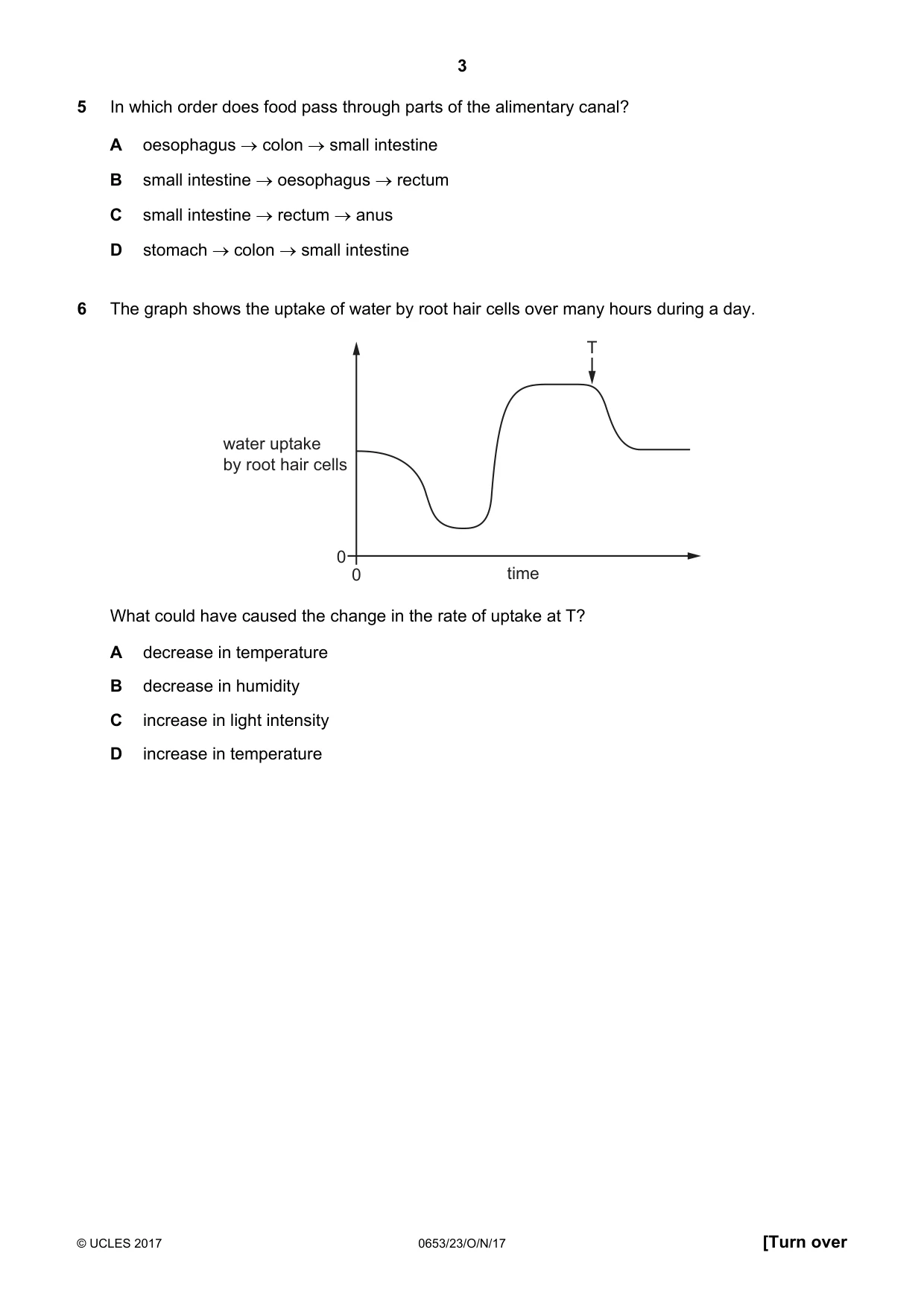
Q7 · Which row correctly matches the cell to its function?
7 Which row correctly matches the cell to its function? cell function A blood clotting B blood clotting C oxygen transport D oxygen transport
Mark scheme: C
Q8 · Dust particles and pathogens may be inhaled from the air
8 Dust particles and pathogens may be inhaled from the air. These can cause damage to the airways if they are not removed. Which features work together to remove them from the airways? A cilia and enzymes B mucus and cilia C mucus and saliva D saliva and enzymes
Mark scheme: B
Q9 · How does auxin cause a plant shoot to bend to the right?
9 How does auxin cause a plant shoot to bend to the right? A Cells elongate more on the left side of the shoot than on the right side. B Cells elongate more on the right side of the shoot than on the left side. C Cells shrink on the left side of the shoot. D Cells shrink on the right side of the shoot.
Mark scheme: A
Q10 · The table shows features of four flowers
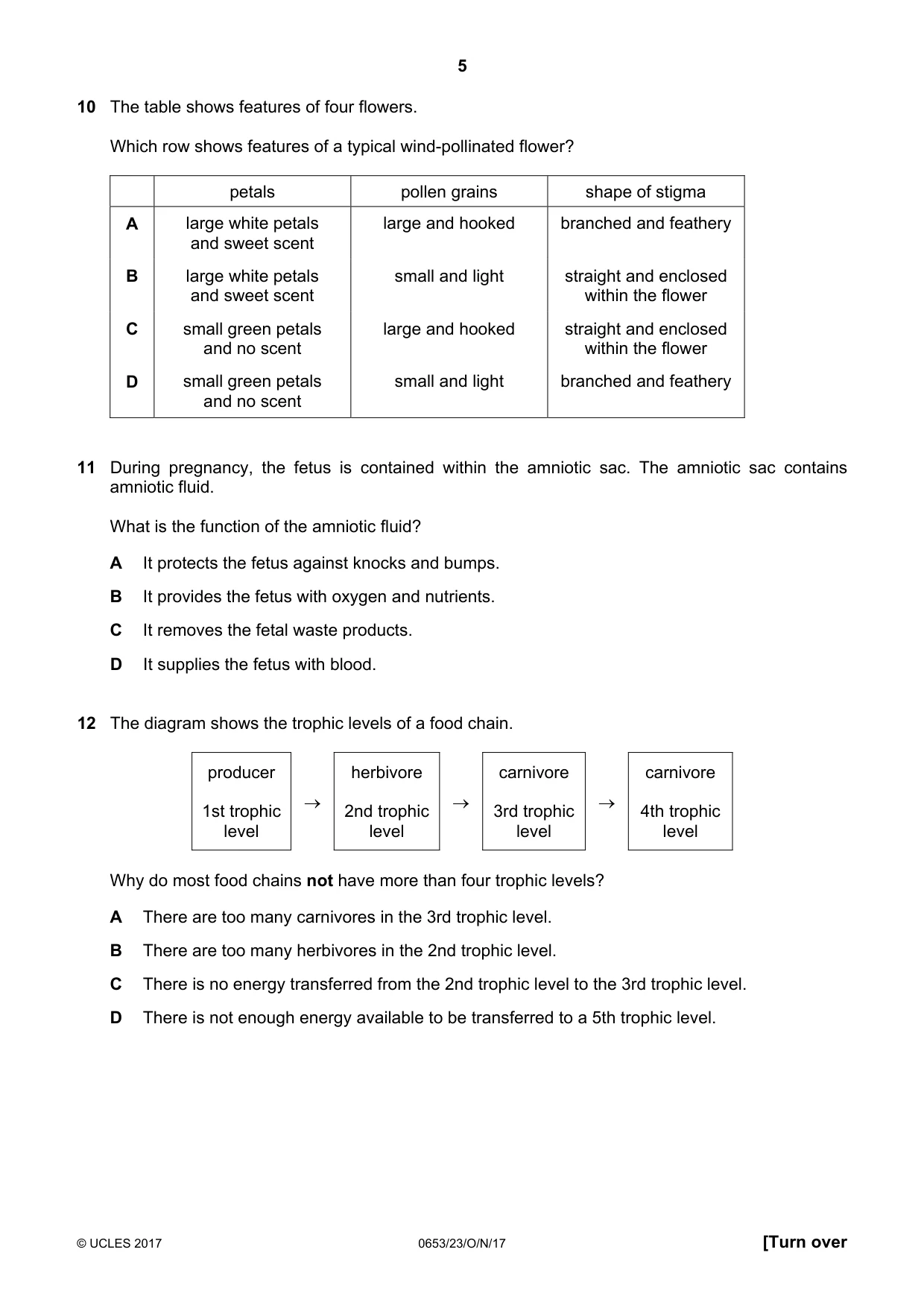
10 The table shows features of four flowers. Which row shows features of a typical wind-pollinated flower? petals pollen grains shape of stigma A large white petals large and hooked branched and feathery and sweet scent B large white petals small and light straight and enclosed and sweet scent within the flower C small green petals large and hooked straight and enclosed and no scent within the flower D small green petals small and light branched and feathery and no scent
Mark scheme: D
Q11 · During pregnancy, the fetus is contained within the amniotic sac
11 During pregnancy, the fetus is contained within the amniotic sac. The amniotic sac contains amniotic fluid. What is the function of the amniotic fluid? A It protects the fetus against knocks and bumps. B It provides the fetus with oxygen and nutrients. C It removes the fetal waste products. D It supplies the fetus with blood.
Mark scheme: A
Q12 · The diagram shows the trophic levels of a food chain
12 The diagram shows the trophic levels of a food chain. producer herbivore carnivore carnivore → → → 1st trophic 2nd trophic 3rd trophic 4th trophic level level level level Why do most food chains not have more than four trophic levels? A There are too many carnivores in the 3rd trophic level. B There are too many herbivores in the 2nd trophic level. C There is no energy transferred from the 2nd trophic level to the 3rd trophic level. D There is not enough energy available to be transferred to a 5th trophic level.
Mark scheme: D
Q13 · The graph shows changes in the number of different species in the water flowing along a…
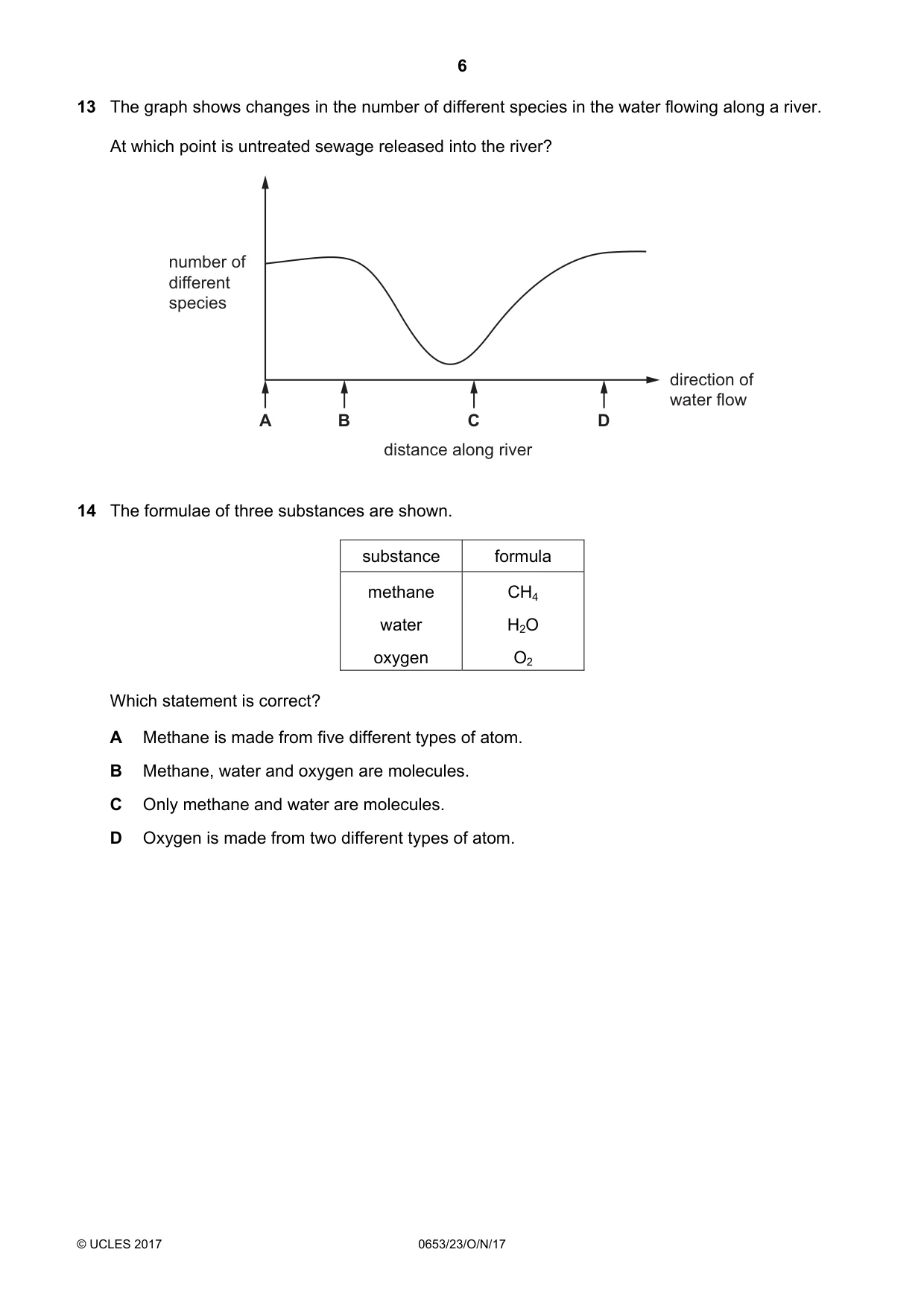
13 The graph shows changes in the number of different species in the water flowing along a river. At which point is untreated sewage released into the river? number of different species direction of water flow A B C D distance along river
Mark scheme: B
Q14 · The formulae of three substances are shown
14 The formulae of three substances are shown. substance formula methane CH4 water H2O oxygen O2 Which statement is correct? A Methane is made from five different types of atom. B Methane, water and oxygen are molecules. C Only methane and water are molecules. D Oxygen is made from two different types of atom.
Mark scheme: B
Q15 · Chromatography separates ink into different colours
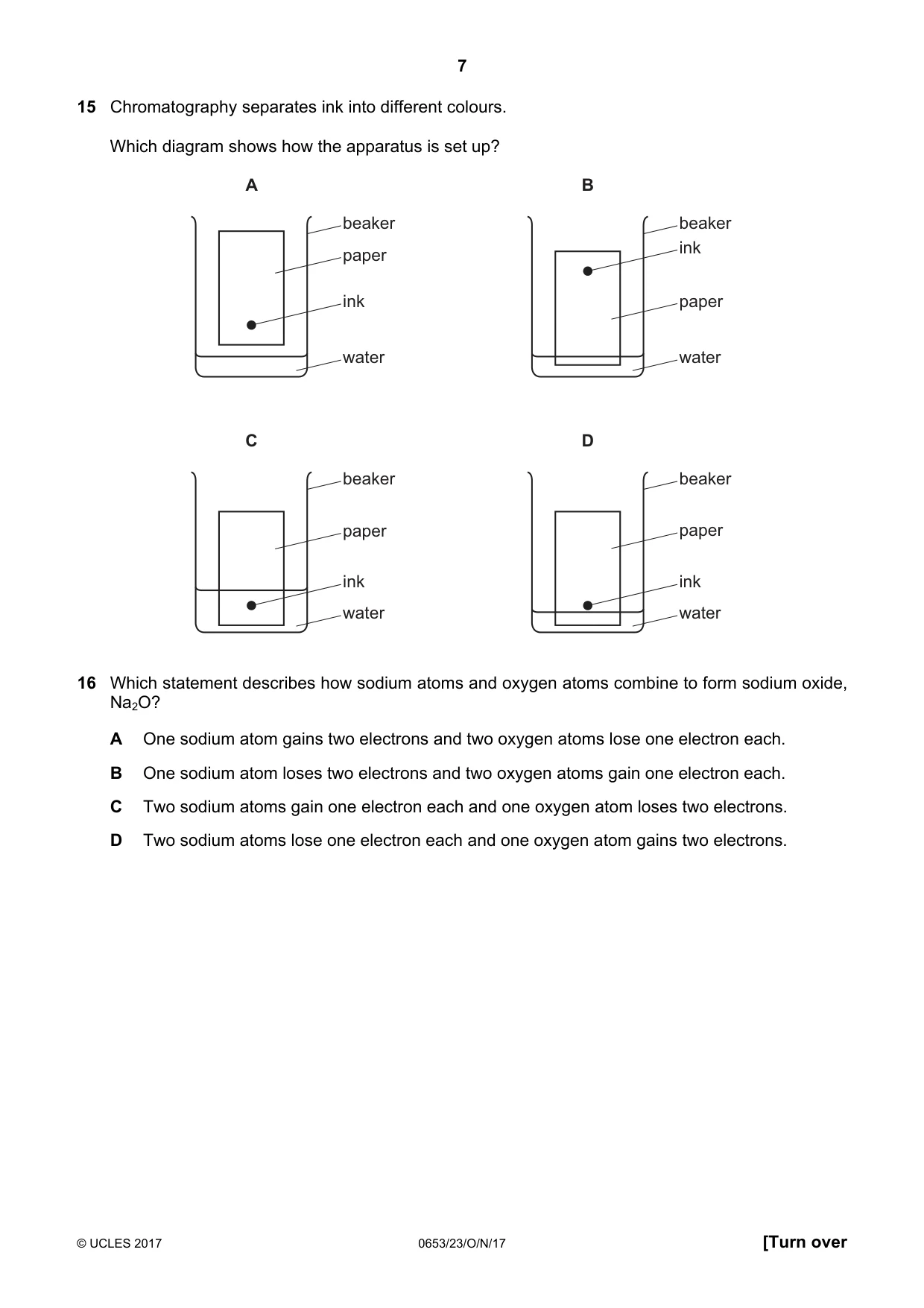
15 Chromatography separates ink into different colours. Which diagram shows how the apparatus is set up? A B beaker beaker paper ink ink paper water water C D beaker beaker paper paper ink ink water water
Mark scheme: D
Q16 · Which statement describes how sodium atoms and oxygen atoms combine to form sodium oxide…
16 Which statement describes how sodium atoms and oxygen atoms combine to form sodium oxide, Na2O? A One sodium atom gains two electrons and two oxygen atoms lose one electron each. B One sodium atom loses two electrons and two oxygen atoms gain one electron each. C Two sodium atoms gain one electron each and one oxygen atom loses two electrons. D Two sodium atoms lose one electron each and one oxygen atom gains two electrons.
Mark scheme: D
Q17 · Which dot-and-cross diagrams show the outer-shell electrons in molecules of water and of…
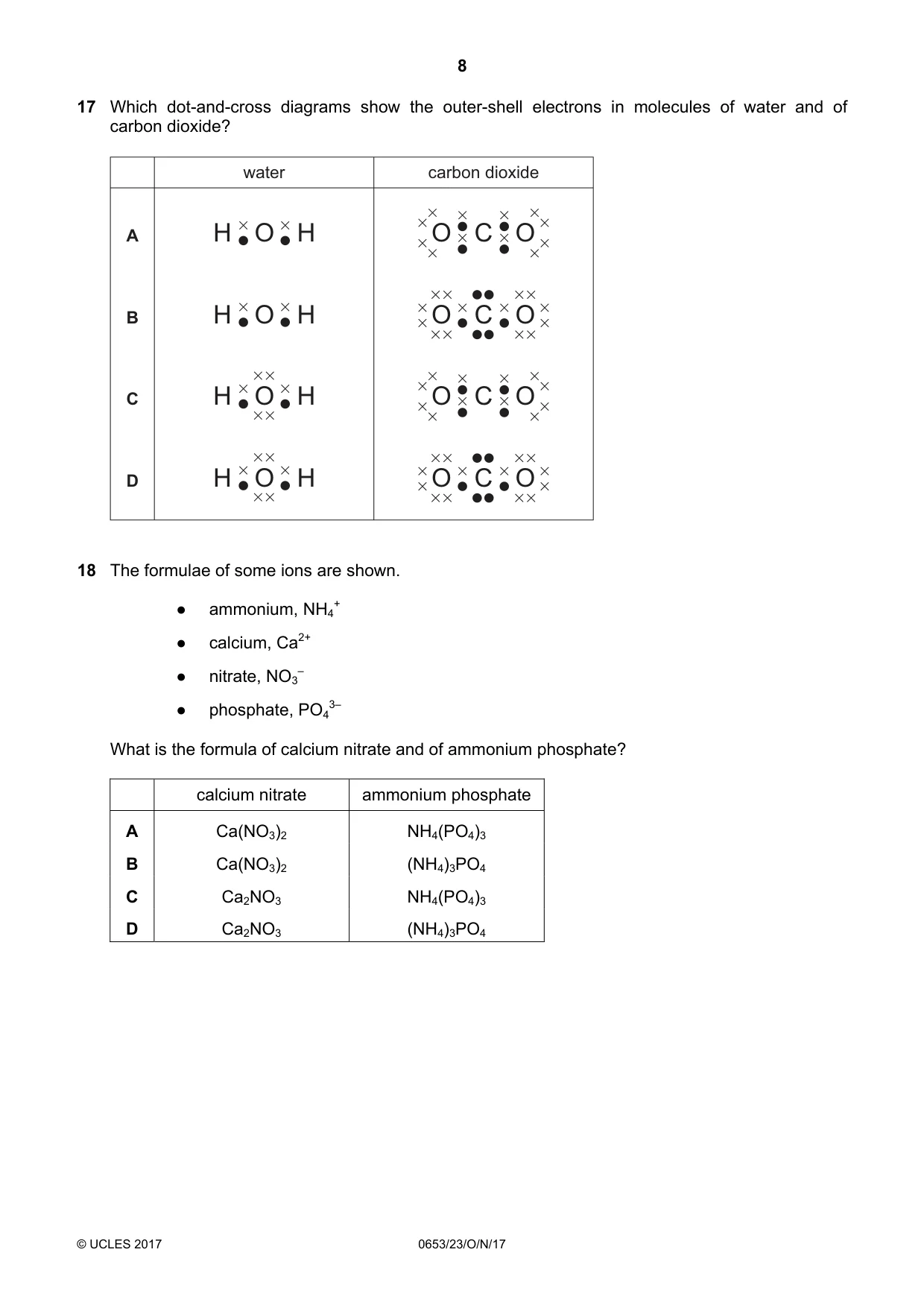
17 Which dot-and-cross diagrams show the outer-shell electrons in molecules of water and of carbon dioxide? water carbon dioxide A H O H O C O B H O H O C O C H O H O C O D H O H O C O
Mark scheme: C
Q18 · The formulae of some ions are shown
18 The formulae of some ions are shown. ● ammonium, NH4 + ● calcium, Ca2+ ● nitrate, NO3 – ● phosphate, PO4 3– What is the formula of calcium nitrate and of ammonium phosphate? calcium nitrate ammonium phosphate A Ca(NO3)2 NH4(PO4)3 B Ca(NO3)2 (NH4)3PO4 C Ca2NO3 NH4(PO4)3 D Ca2NO3 (NH4)3PO4
Mark scheme: B
Q19 · Which row describes an ionic compound?
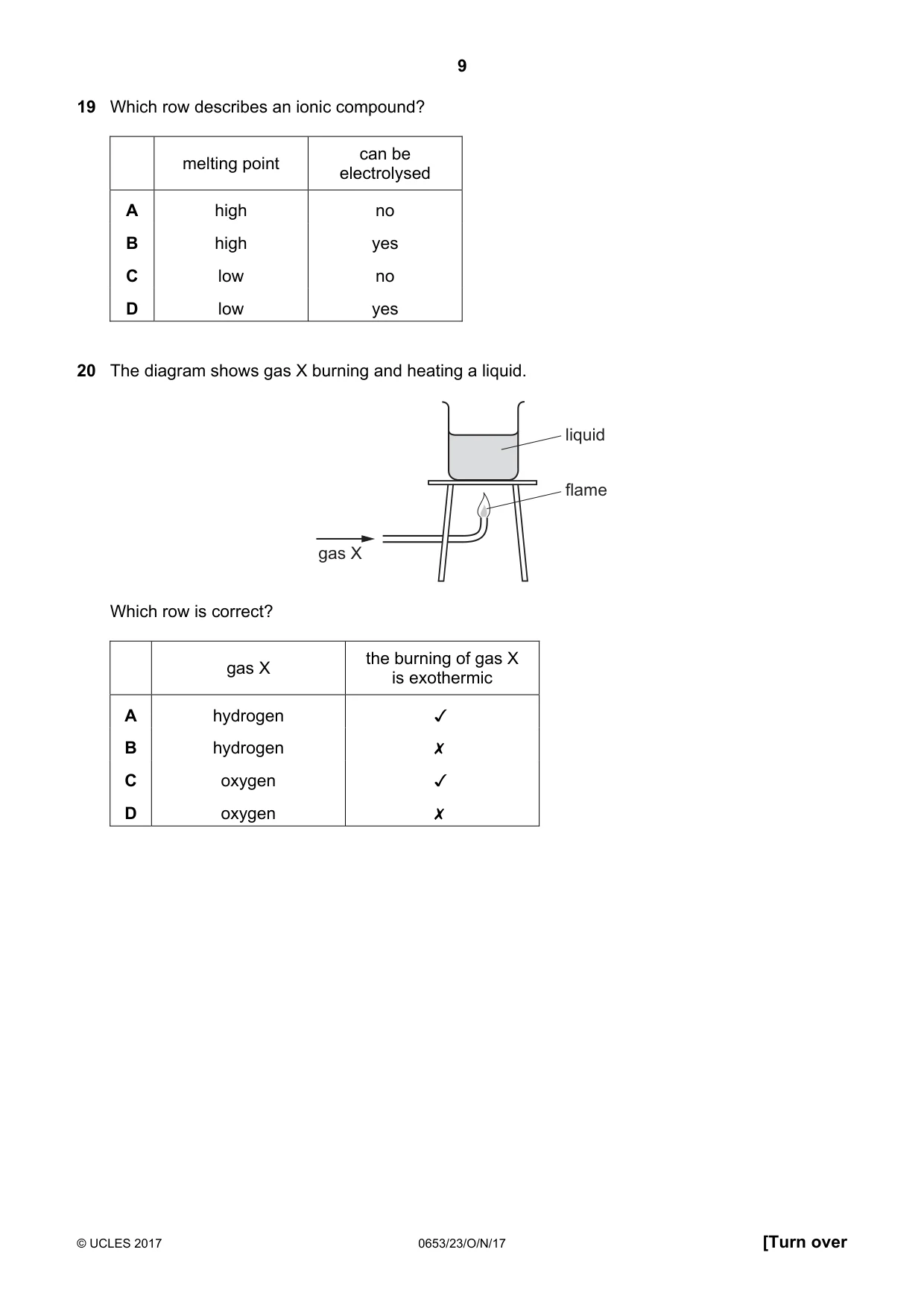
19 Which row describes an ionic compound? can be melting point electrolysed A high no B high yes C low no D low yes
Mark scheme: B
Q20 · The diagram shows gas X burning and heating a liquid
20 The diagram shows gas X burning and heating a liquid. Which row is correct? gas X A hydrogen v B hydrogen x Cc oxygen v D oxygen x liquid flame
Mark scheme: A
Q21 · Dilute hydrochloric acid reacts with marble pieces to produce carbon dioxide
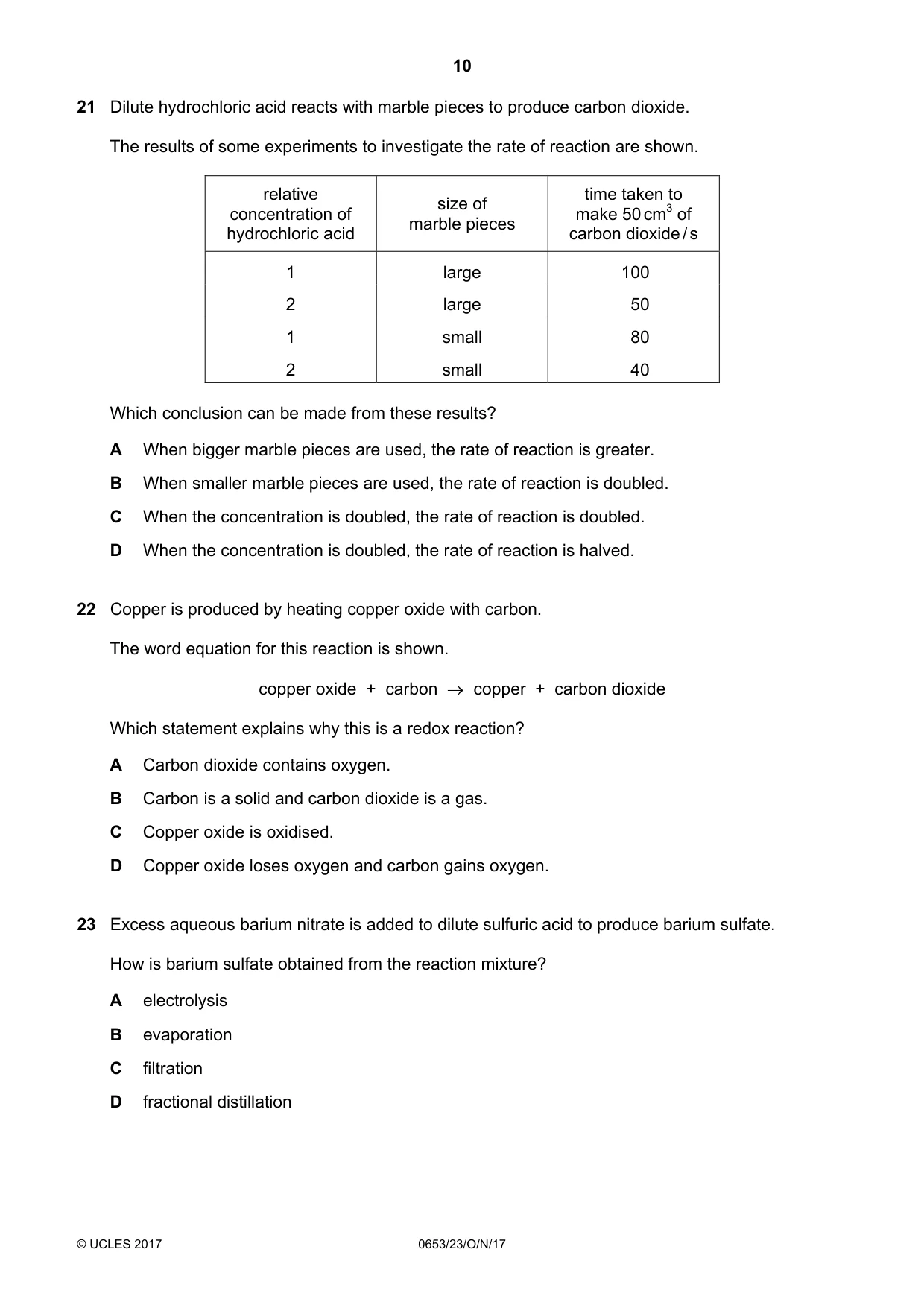
21 Dilute hydrochloric acid reacts with marble pieces to produce carbon dioxide. The results of some experiments to investigate the rate of reaction are shown. relative time taken to size of make 50 cm3 of concentration of marble pieces hydrochloric acid carbon dioxide / s 1 large 100 2 large 50 1 small 80 2 small 40 Which conclusion can be made from these results? A When bigger marble pieces are used, the rate of reaction is greater. B When smaller marble pieces are used, the rate of reaction is doubled. C When the concentration is doubled, the rate of reaction is doubled. D When the concentration is doubled, the rate of reaction is halved.
Mark scheme: C
Q22 · Copper is produced by heating copper oxide with carbon
22 Copper is produced by heating copper oxide with carbon. The word equation for this reaction is shown. copper oxide + carbon → copper + carbon dioxide Which statement explains why this is a redox reaction? A Carbon dioxide contains oxygen. B Carbon is a solid and carbon dioxide is a gas. C Copper oxide is oxidised. D Copper oxide loses oxygen and carbon gains oxygen.
Mark scheme: D
Q23 · Excess aqueous barium nitrate is added to dilute sulfuric acid to produce barium sulfate
23 Excess aqueous barium nitrate is added to dilute sulfuric acid to produce barium sulfate. How is barium sulfate obtained from the reaction mixture? A electrolysis B evaporation C filtration D fractional distillation
Mark scheme: C
Q24 · What is a use for argon?
24 What is a use for argon? A as a fuel B filling balloons C providing an inert atmosphere D the extraction of copper
Mark scheme: C
Q25 · Which diagram shows the arrangements of atoms in an alloy?
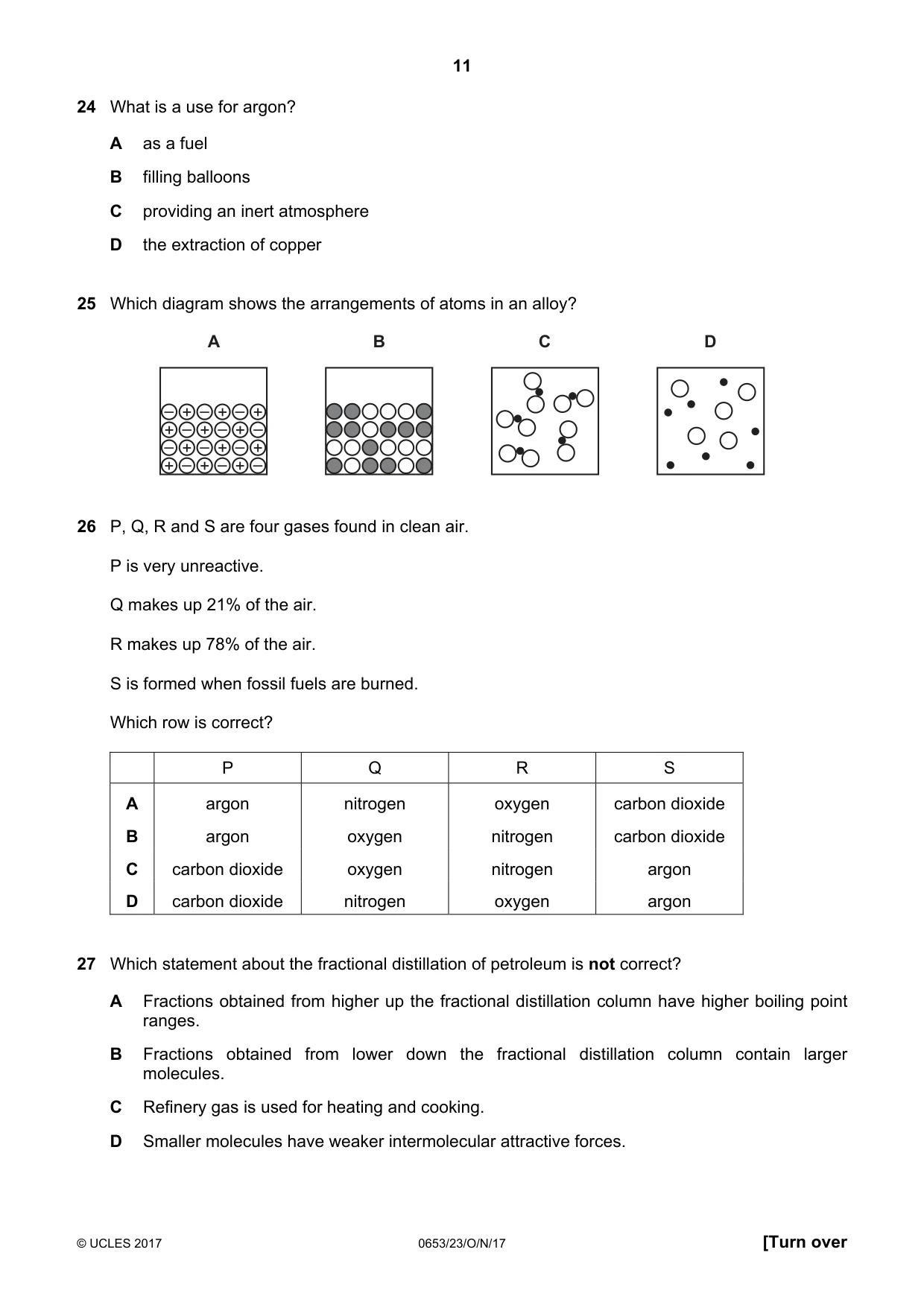
25 Which diagram shows the arrangements of atoms in an alloy? A B C D – + – + – + + – + – + – – + – + – + + – + – + –
Mark scheme: B
Q26 · P, Q, R and S are four gases found in clean air
26 P, Q, R and S are four gases found in clean air. P is very unreactive. Q makes up 21% of the air. R makes up 78% of the air. S is formed when fossil fuels are burned. Which row is correct? P Q R S A argon nitrogen oxygen carbon dioxide B argon oxygen nitrogen carbon dioxide C carbon dioxide oxygen nitrogen argon D carbon dioxide nitrogen oxygen argon
Mark scheme: B
Q27 · Which statement about the fractional distillation of petroleum is not correct?
27 Which statement about the fractional distillation of petroleum is not correct? A Fractions obtained from higher up the fractional distillation column have higher boiling point ranges. B Fractions obtained from lower down the fractional distillation column contain larger molecules. C Refinery gas is used for heating and cooking. D Smaller molecules have weaker intermolecular attractive forces.
Mark scheme: A
Q28 · The diagram shows the speed-time graph for a car
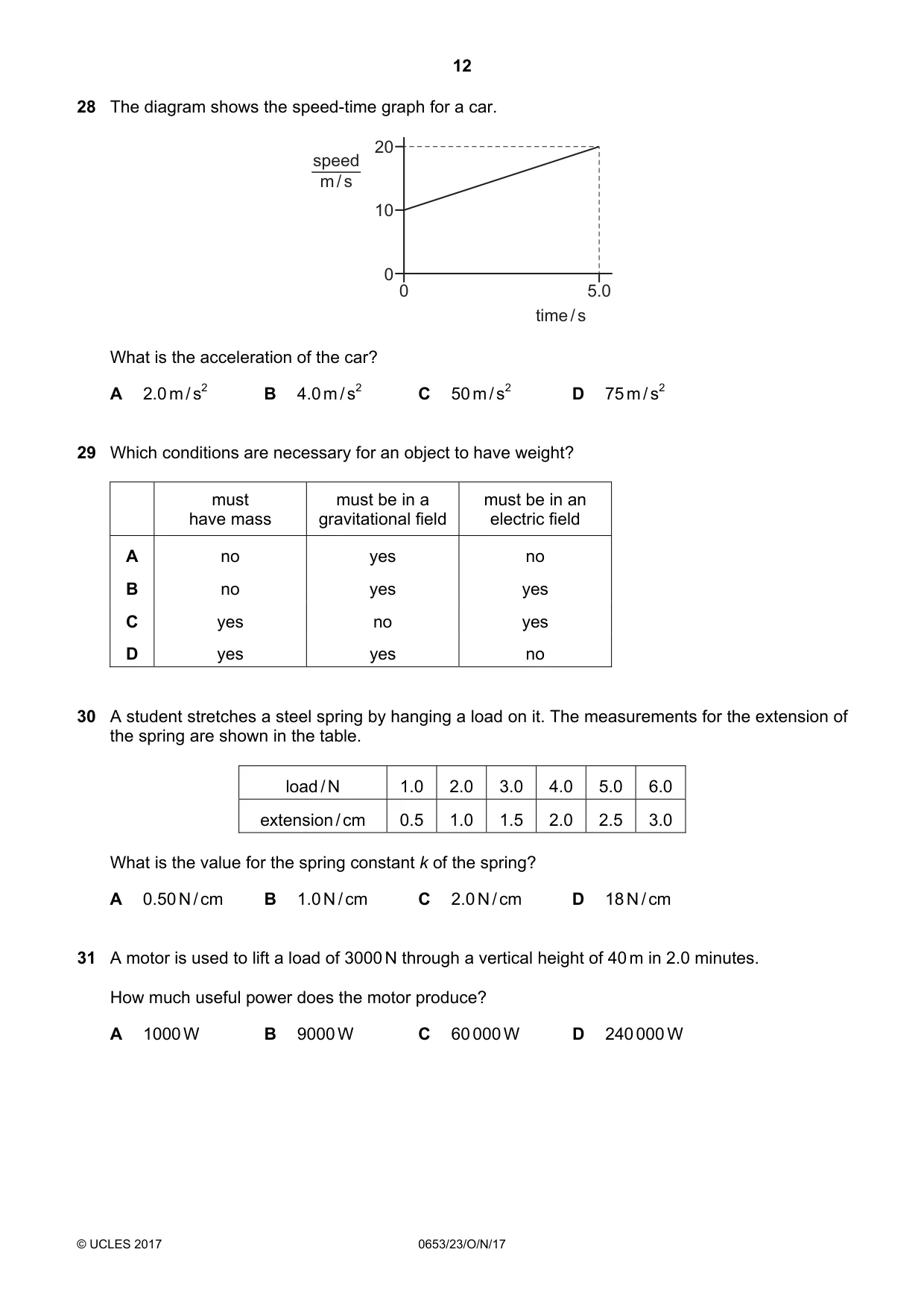
28 The diagram shows the speed-time graph for a car. 20 speed m / s 10 0 0 5.0 time / s What is the acceleration of the car? A 2.0 m / s2 B 4.0 m / s2 C 50 m / s2 D 75 m / s2
Mark scheme: A
Q29 · Which conditions are necessary for an object to have weight?
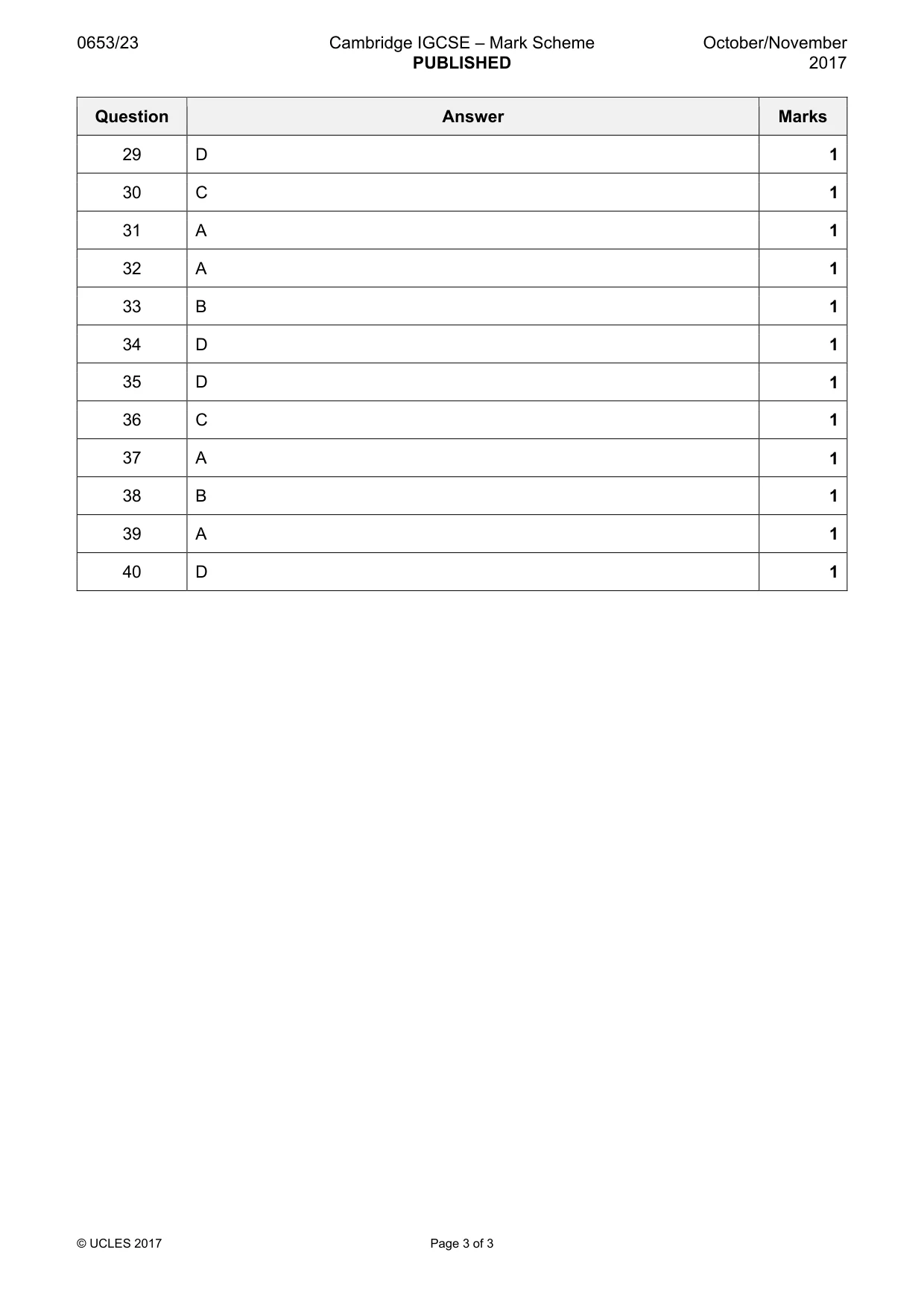
29 Which conditions are necessary for an object to have weight? must must be in a must be in an have mass gravitational field electric field A no yes no B no yes yes C yes no yes D yes yes no
Mark scheme: D
Q30 · A student stretches a steel spring by hanging a load on it
30 A student stretches a steel spring by hanging a load on it. The measurements for the extension of the spring are shown in the table. load / N 1.0 2.0 3.0 4.0 5.0 6.0 extension / cm 0.5 1.0 1.5 2.0 2.5 3.0 What is the value for the spring constant k of the spring? A 0.50 N / cm B 1.0 N / cm C 2.0 N / cm D 18 N / cm
Mark scheme: C
Q31 · A motor is used to lift a load of 3000 N through a vertical height of 40 m in 2.0 minutes
31 A motor is used to lift a load of 3000 N through a vertical height of 40 m in 2.0 minutes. How much useful power does the motor produce? A 1000 W B 9000 W C 60 000 W D 240 000 W
Mark scheme: A
Q32 · The molecules of a substance are far apart and moving at high speeds in straight lines
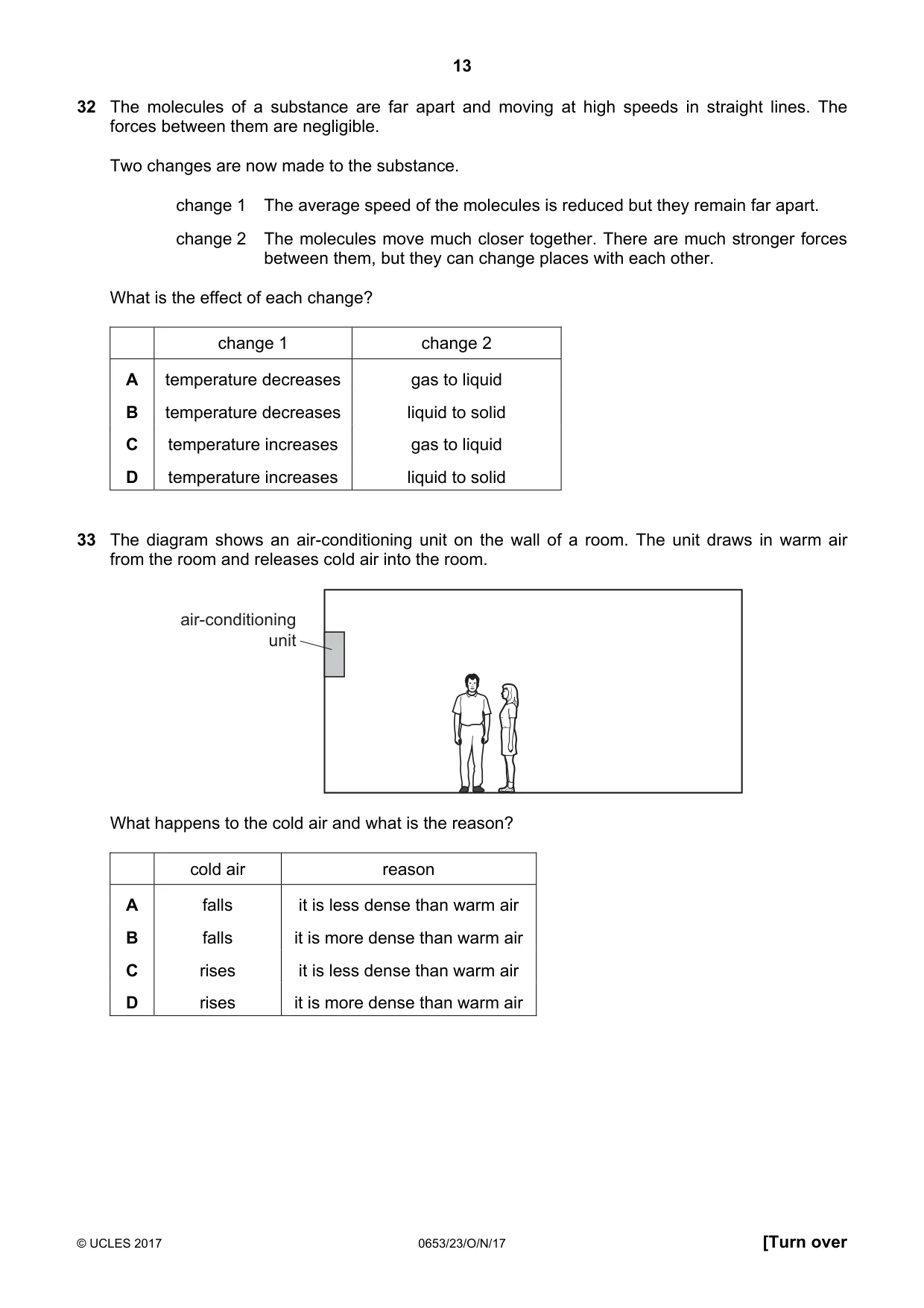
32 The molecules of a substance are far apart and moving at high speeds in straight lines. The forces between them are negligible. Two changes are now made to the substance. change 1 The average speed of the molecules is reduced but they remain far apart. change 2 The molecules move much closer together. There are much stronger forces between them, but they can change places with each other. What is the effect of each change? change 1 change 2 A temperature decreases gas to liquid B temperature decreases liquid to solid C temperature increases gas to liquid D temperature increases liquid to solid
Mark scheme: A
Q33 · The diagram shows an air-conditioning unit on the wall of a room
33 The diagram shows an air-conditioning unit on the wall of a room. The unit draws in warm air from the room and releases cold air into the room. air-conditioning unit What happens to the cold air and what is the reason? cold air reason A falls it is less dense than warm air B falls it is more dense than warm air C rises it is less dense than warm air D rises it is more dense than warm air
Mark scheme: B
Q34 · The diagram shows a section of a rope
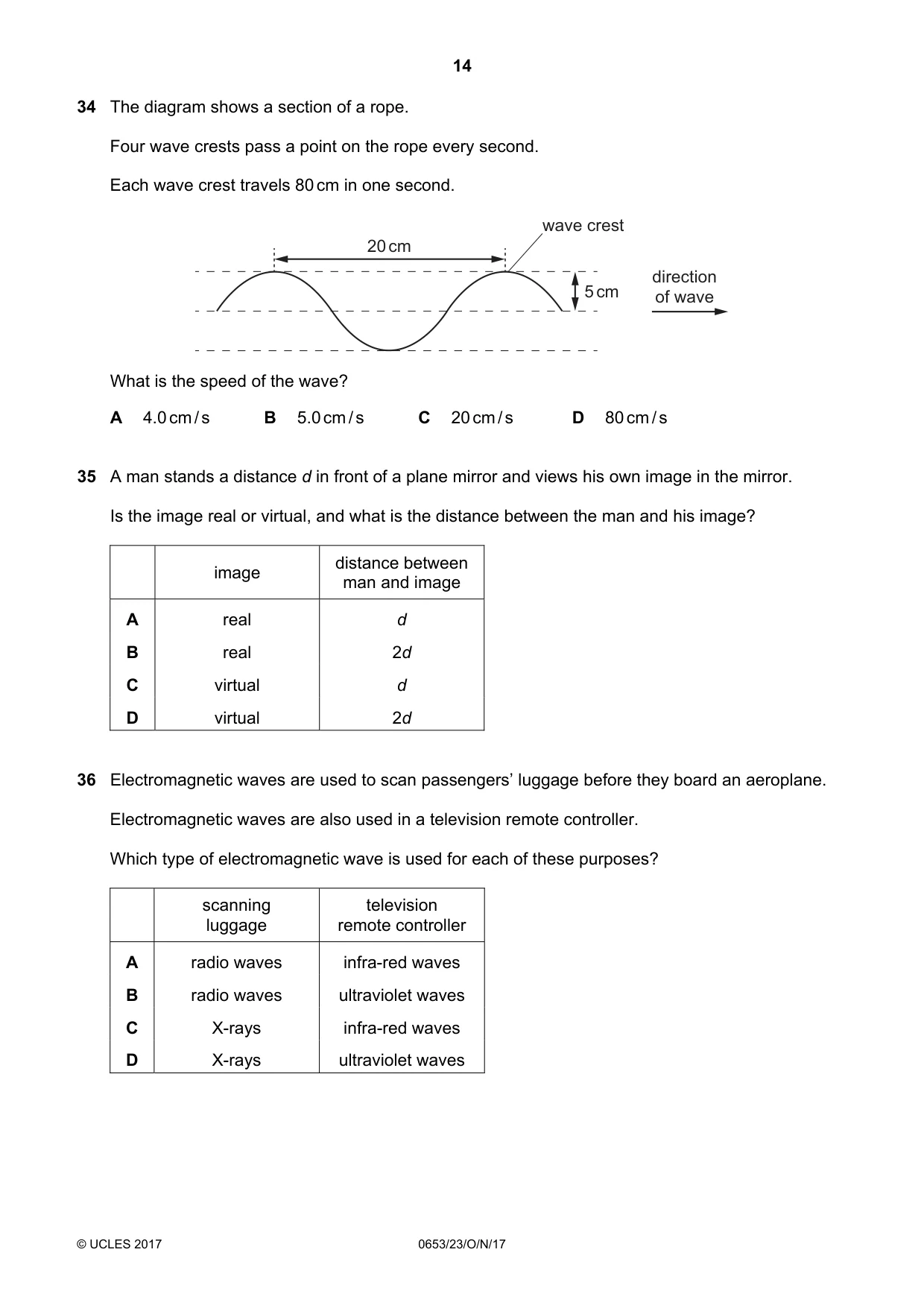
34 The diagram shows a section of a rope. Four wave crests pass a point on the rope every second. Each wave crest travels 80 cm in one second. wave crest 20 cm direction 5 cm of wave What is the speed of the wave? A 4.0 cm / s B 5.0 cm / s C 20 cm / s D 80 cm / s
Mark scheme: D
Q35 · A man stands a distance d in front of a plane mirror and views his own image in the mirror
35 A man stands a distance d in front of a plane mirror and views his own image in the mirror. Is the image real or virtual, and what is the distance between the man and his image? distance between image man and image A real d B real 2d C virtual d D virtual 2d
Mark scheme: D
Q36 · Electromagnetic waves are used to scan passengers’ luggage before they board an aeroplane
36 Electromagnetic waves are used to scan passengers’ luggage before they board an aeroplane. Electromagnetic waves are also used in a television remote controller. Which type of electromagnetic wave is used for each of these purposes? scanning television luggage remote controller A radio waves infra-red waves B radio waves ultraviolet waves C X-rays infra-red waves D X-rays ultraviolet waves
Mark scheme: C
Q37 · The diagram represents a wave in air
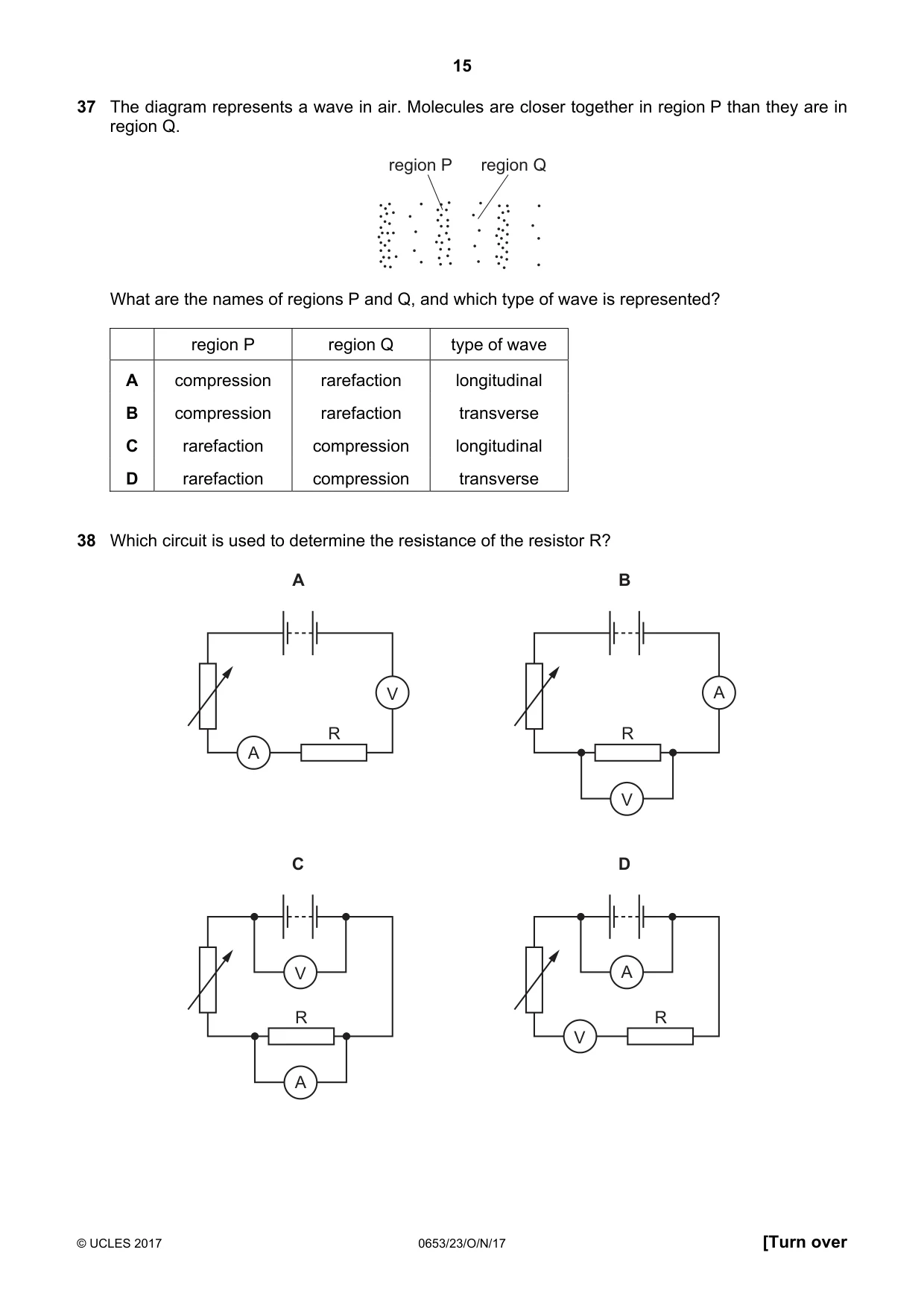
37 The diagram represents a wave in air. Molecules are closer together in region P than they are in region Q. region P region Q What are the names of regions P and Q, and which type of wave is represented? region P region Q type of wave A compression rarefaction longitudinal B compression rarefaction transverse C rarefaction compression longitudinal D rarefaction compression transverse
Mark scheme: A
Q38 · Which circuit is used to determine the resistance of the resistor R?
38 Which circuit is used to determine the resistance of the resistor R? A B V A R R A V C D V A R R V A
Mark scheme: B
Q39 · The device Z in this circuit is designed to cut off the electricity supply automatically…
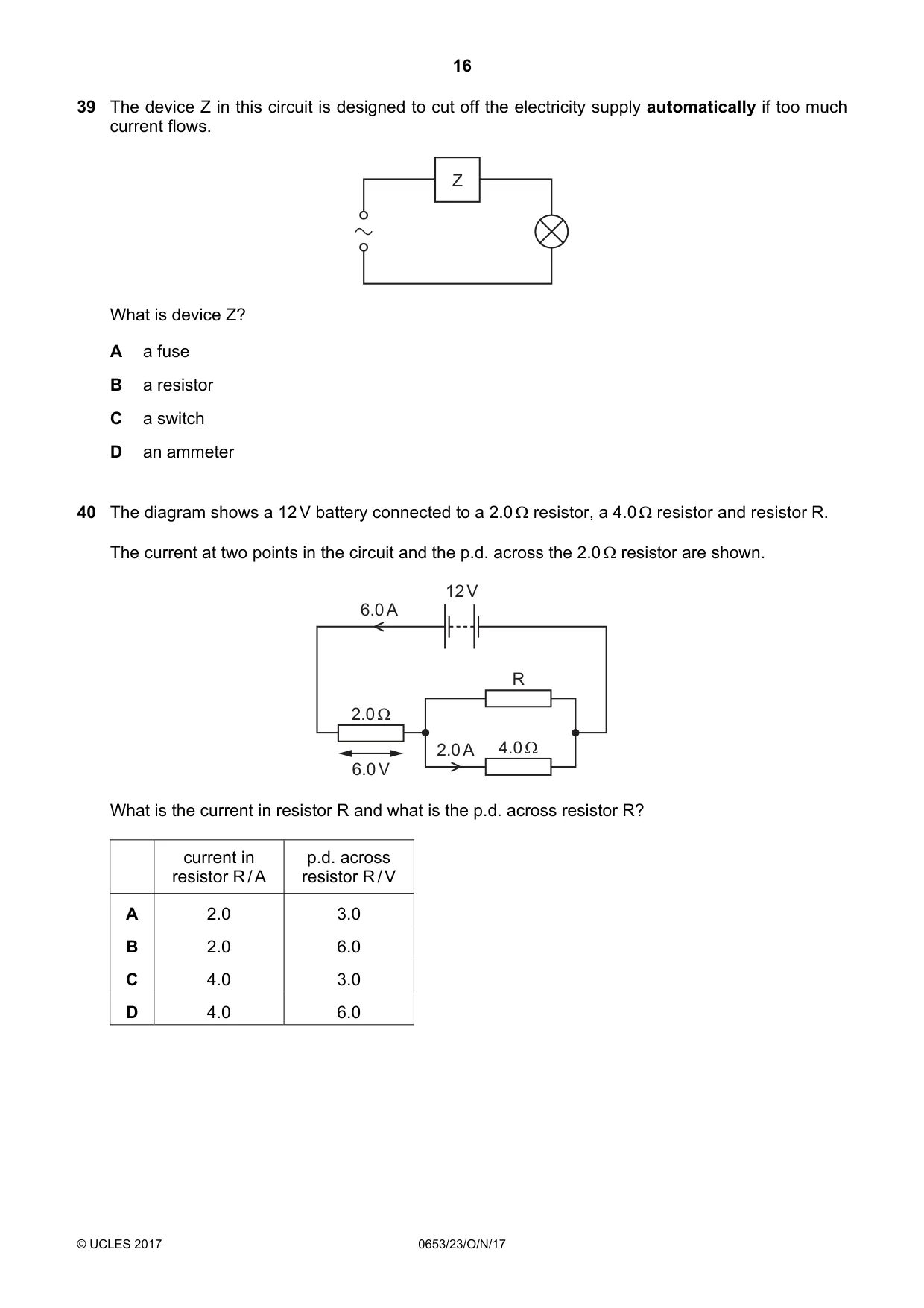
39 The device Z in this circuit is designed to cut off the electricity supply automatically if too much current flows. Z What is device Z? A a fuse B a resistor C a switch D an ammeter
Mark scheme: A
Q40 · The diagram shows a 12 V battery connected to a 2.0 Ω resistor, a 4.0 Ω resistor and…
40 The diagram shows a 12 V battery connected to a 2.0 Ω resistor, a 4.0 Ω resistor and resistor R. The current at two points in the circuit and the p.d. across the 2.0 Ω resistor are shown. 12 V 6.0 A R 2.0 Ω 2.0 A 4.0 Ω 6.0 V What is the current in resistor R and what is the p.d. across resistor R? current in p.d. across resistor R / A resistor R / V A 2.0 3.0 B 2.0 6.0 C 4.0 3.0 D 4.0 6.0
Mark scheme: D
What was in this paper
The subtopics covered by these 40 questions, and how many questions each got. Open one in a new tab to see every Cambridge question on it.
2Photosynthesis2Sexual reproduction in plants2Air quality and climate1Alloys and their properties1Blood1Characteristics of living organisms1Chromatography1Digestive system1Electrical circuits1Electrical quantities1Electrical safety1Electromagnetic spectrum1Elements, compounds and mixtures1Energy flow1Energy, work and power1Forces1Formulas1Fuels1Gas exchange in humans1General properties of waves1Habitat destruction1Kinetic particle model of matter1Light1Mass and weight1Motion1Noble gases1Rate of reaction1Redox1Respiration1Separation and purification1Sexual reproduction in humans1Simple molecules and covalent bonds1Sound1Transfer of thermal energy1Transpiration1Water1What you needed in this session
Cambridge’s own grade thresholds for 2017 Oct/Nov, Paper 2 · Variant 3. A higher threshold means an easier paper — the bar moves with how the cohort did.