Cambridge IGCSE Science - Combined 0653 — 2022 Oct/Nov Paper 2 · Variant 2
0653/22/O/N/22 · 40 questions · 40 marks · ≈45 min
The question paper and its mark scheme, free to read here and free to download. This is Cambridge’s own paper, exactly as it was sat.
Question paper16 pages
Mark scheme3 pages
Answers below. Sit the paper first if you are practising.
Questions as text
Q1 · What are characteristics of all living organisms?
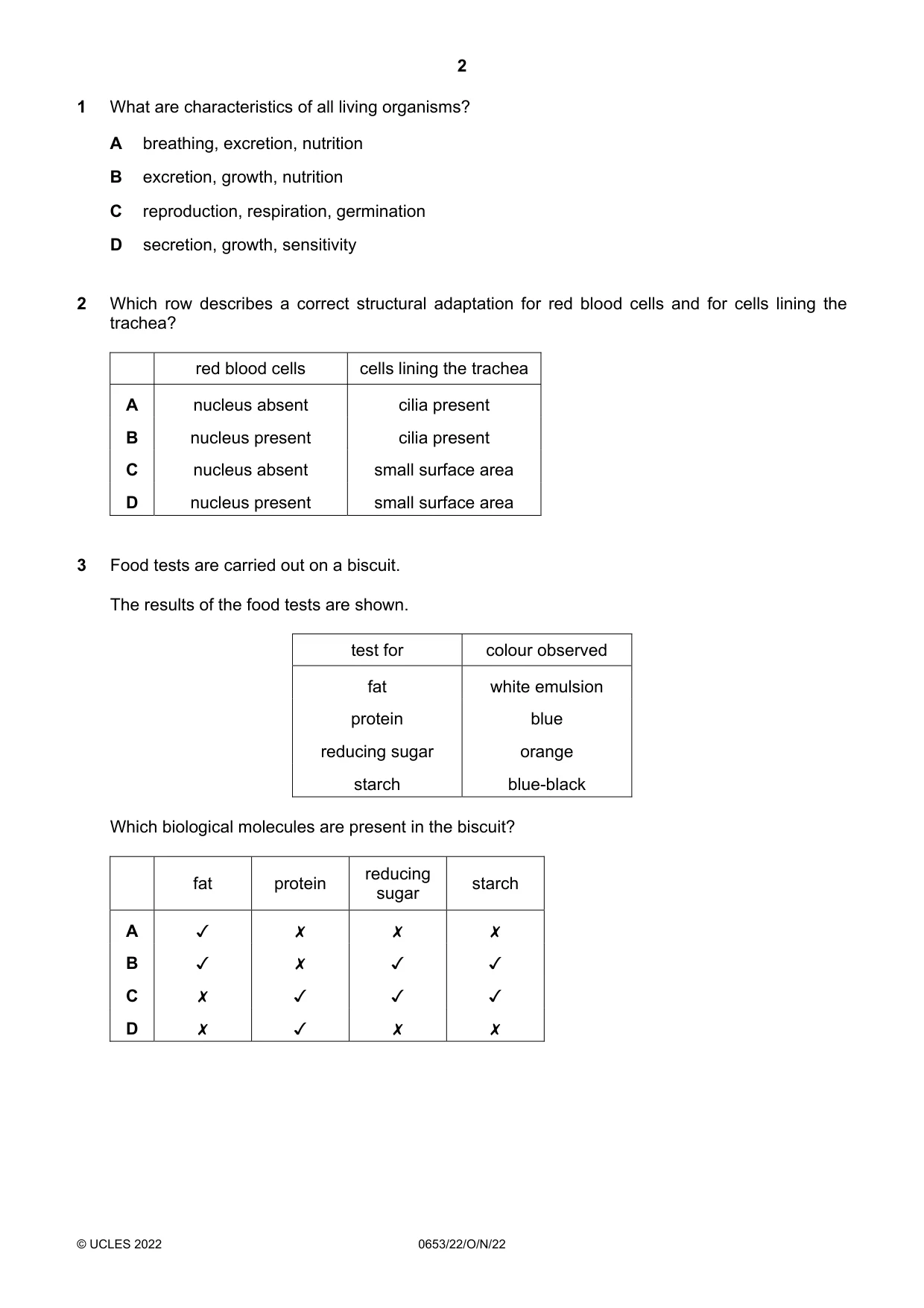
1 What are characteristics of all living organisms? A breathing, excretion, nutrition B excretion, growth, nutrition C reproduction, respiration, germination D secretion, growth, sensitivity
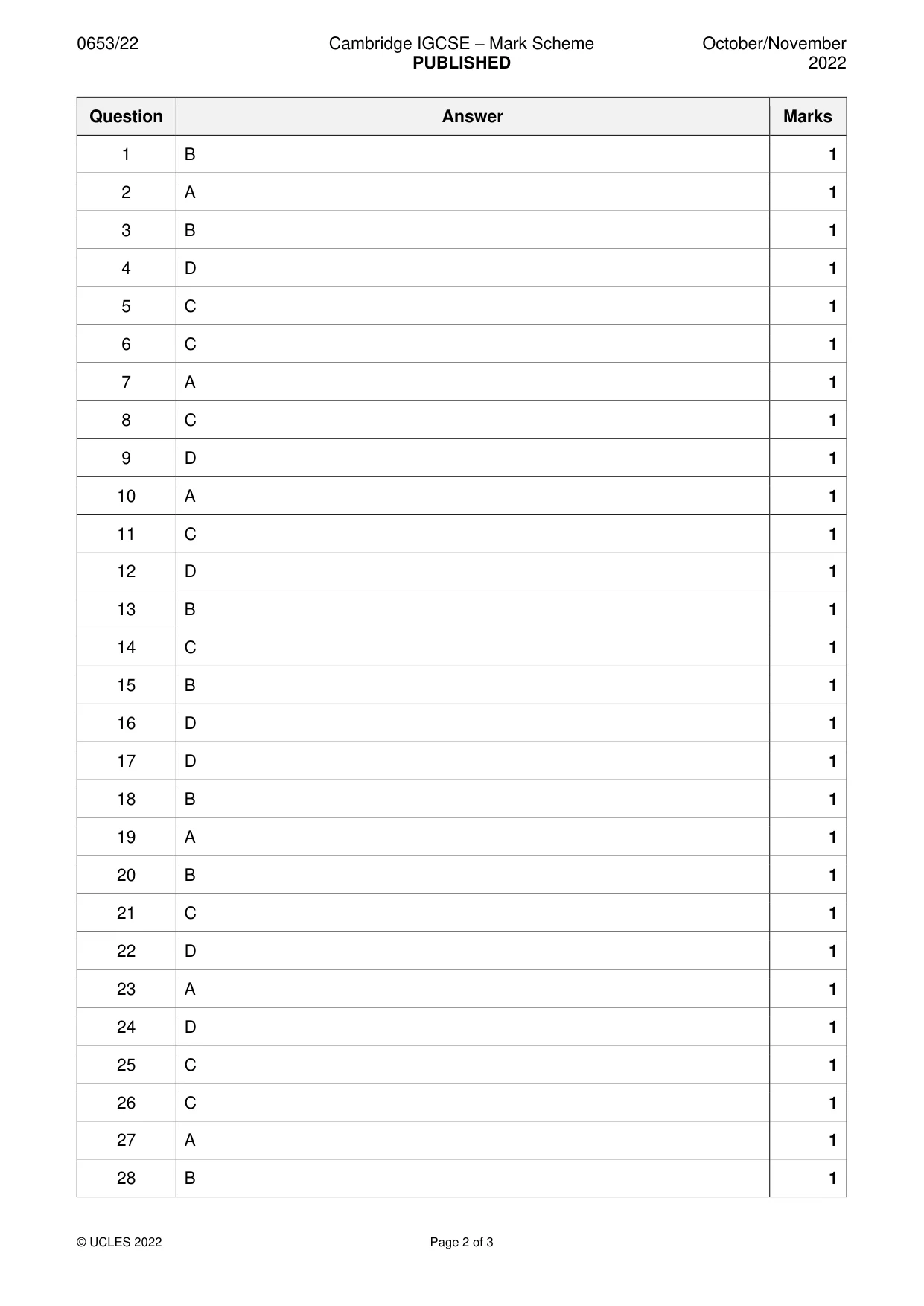
Mark scheme: B
Q2 · Which row describes a correct structural adaptation for red blood cells and for cells…
2 Which row describes a correct structural adaptation for red blood cells and for cells lining the trachea? red blood cells cells lining the trachea A nucleus absent cilia present B nucleus present cilia present C nucleus absent small surface area D nucleus present small surface area
Mark scheme: A
Q3 · Food tests are carried out on a biscuit
3. Food tests are carried out on a biscuit. The results of the food tests are shown. test for colour observed fat white emulsion protein blue reducing sugar orange starch blue-black Which biological molecules are present in the biscuit? fat protein sugar starch A Jv x x x B v x v v Cc x v v v D x v x x
Mark scheme: B
Q4 · Which substance in leaves traps light energy for use in photosynthesis?
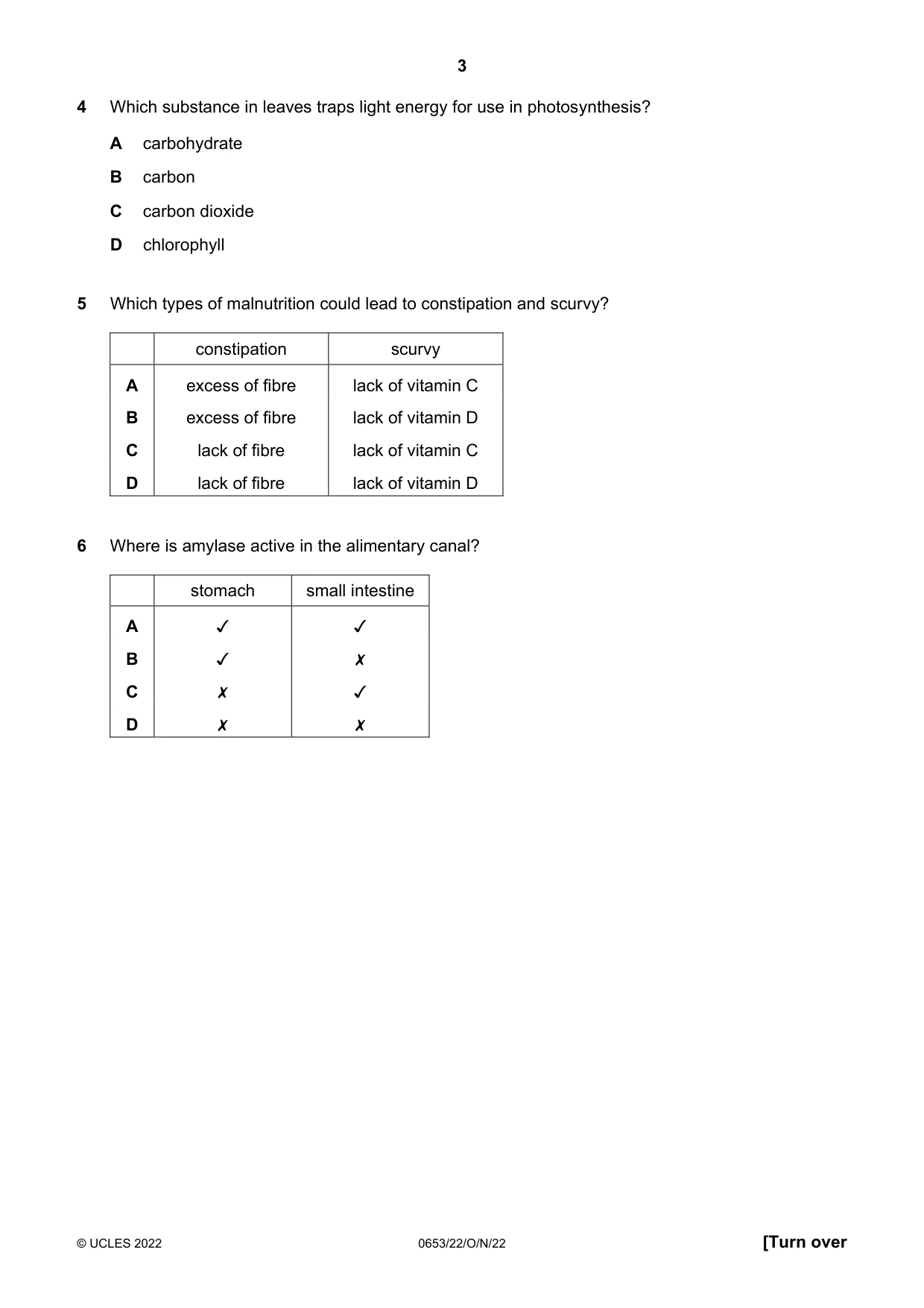
4 Which substance in leaves traps light energy for use in photosynthesis? A carbohydrate B carbon C carbon dioxide D chlorophyll
Mark scheme: D
Q5 · Which types of malnutrition could lead to constipation and scurvy?
5 Which types of malnutrition could lead to constipation and scurvy? constipation scurvy A excess of fibre lack of vitamin C B excess of fibre lack of vitamin D C lack of fibre lack of vitamin C D lack of fibre lack of vitamin D
Mark scheme: C
Q6 · Where is amylase active in the alimentary canal?
6 Where is amylase active in the alimentary canal? stomach small intestine v v 0 0O WwW > v x x v x x
Mark scheme: C
Q7 · A student tests her exhaled breath by blowing through a straw into some limewater
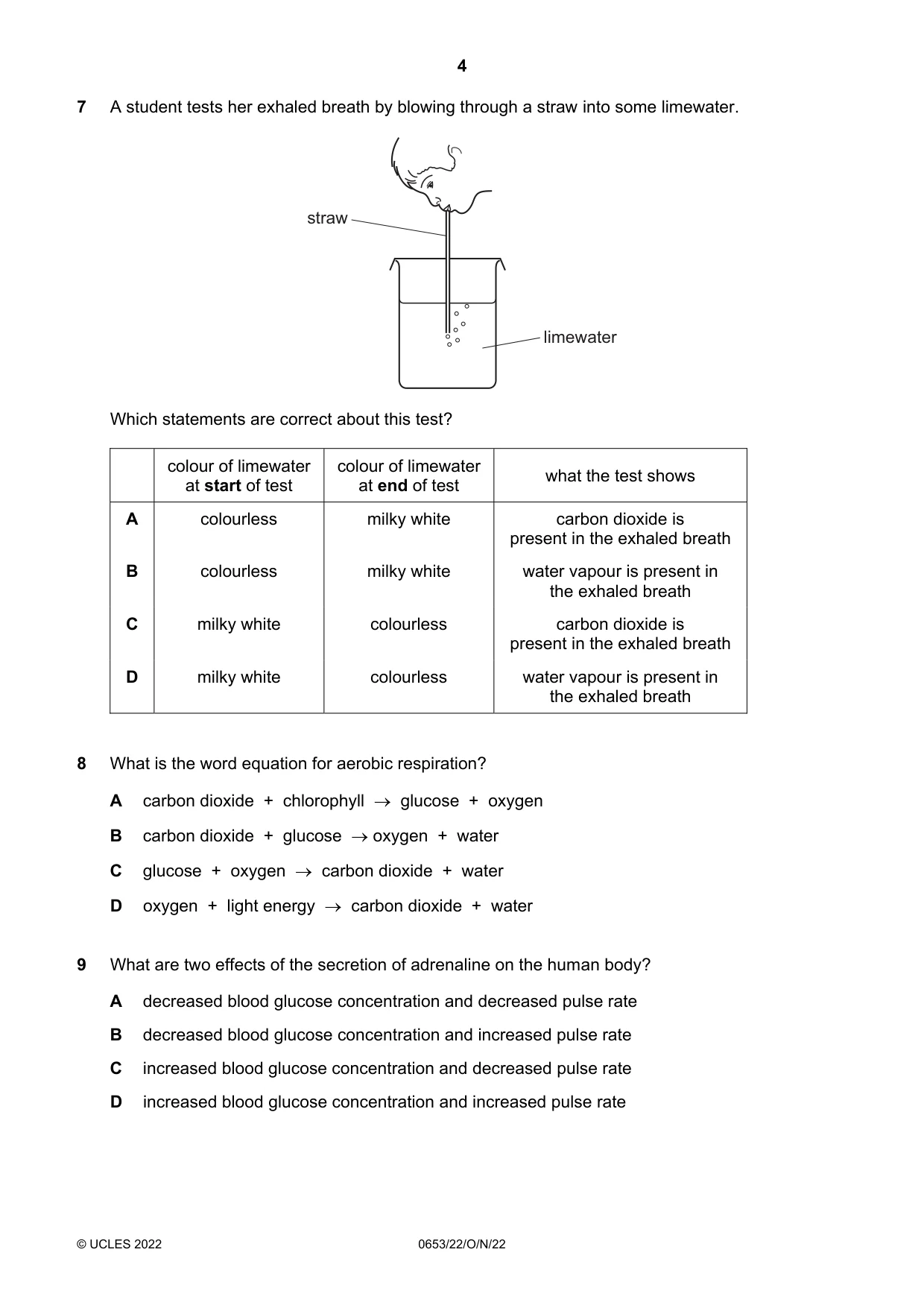
7 A student tests her exhaled breath by blowing through a straw into some limewater. straw limewater Which statements are correct about this test? colour of limewater colour of limewater what the test shows at start of test at end of test A colourless milky white carbon dioxide is present in the exhaled breath B colourless milky white water vapour is present in the exhaled breath C milky white colourless carbon dioxide is present in the exhaled breath D milky white colourless water vapour is present in the exhaled breath
Mark scheme: A
Q8 · What is the word equation for aerobic respiration?
8 What is the word equation for aerobic respiration? A carbon dioxide + chlorophyll glucose + oxygen B carbon dioxide + glucose oxygen + water C glucose + oxygen carbon dioxide + water D oxygen + light energy carbon dioxide + water
Mark scheme: C
Q9 · What are two effects of the secretion of adrenaline on the human body?
9 What are two effects of the secretion of adrenaline on the human body? A decreased blood glucose concentration and decreased pulse rate B decreased blood glucose concentration and increased pulse rate C increased blood glucose concentration and decreased pulse rate D increased blood glucose concentration and increased pulse rate
Mark scheme: D
Q10 · Light shines on a shoot tip from the direction shown
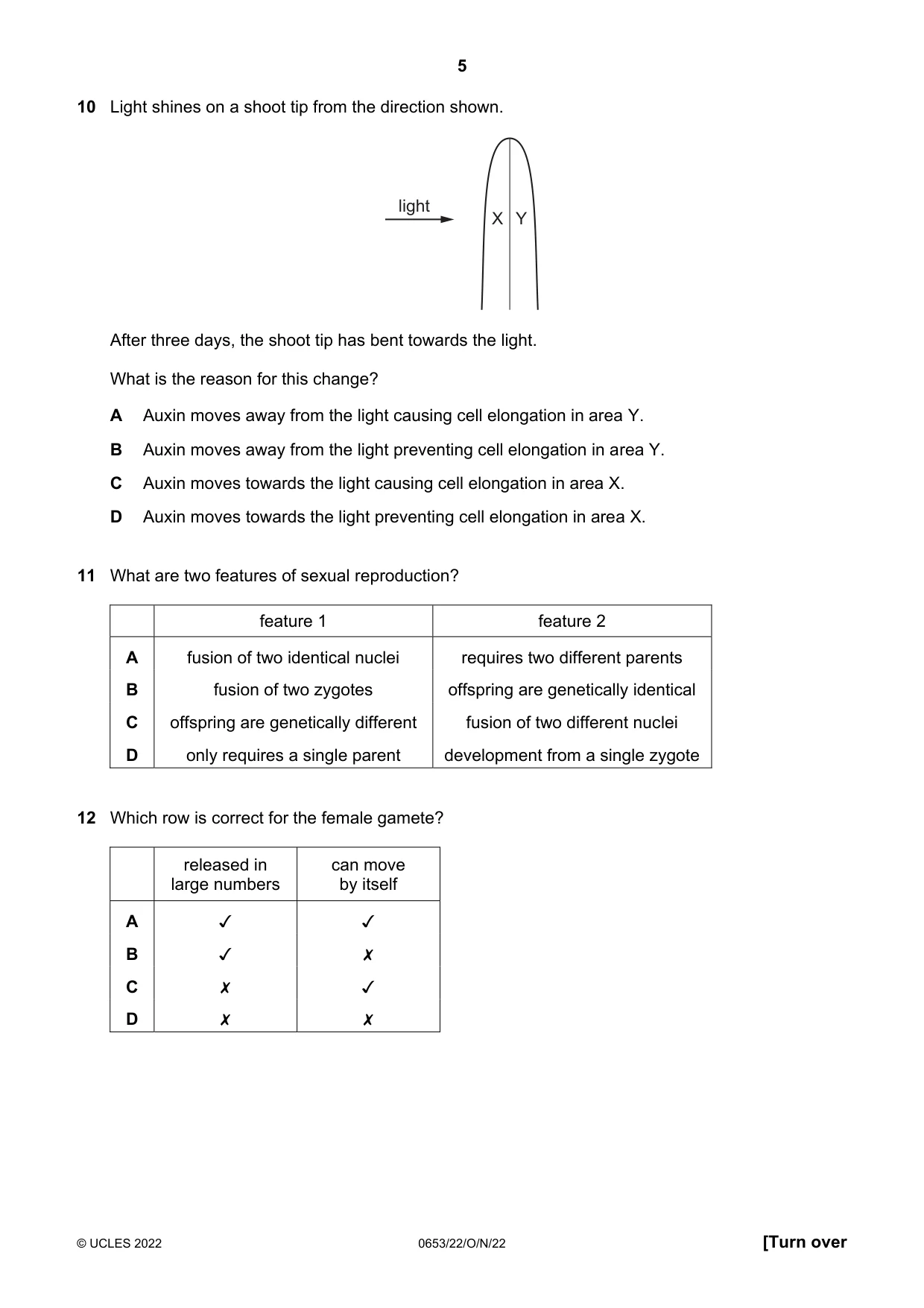
10 Light shines on a shoot tip from the direction shown. light X Y After three days, the shoot tip has bent towards the light. What is the reason for this change? A Auxin moves away from the light causing cell elongation in area Y. B Auxin moves away from the light preventing cell elongation in area Y. C Auxin moves towards the light causing cell elongation in area X. D Auxin moves towards the light preventing cell elongation in area X.
Mark scheme: A
Q11 · What are two features of sexual reproduction?
11 What are two features of sexual reproduction? feature 1 feature 2 A fusion of two identical nuclei requires two different parents B fusion of two zygotes offspring are genetically identical C offspring are genetically different fusion of two different nuclei D only requires a single parent development from a single zygote
Mark scheme: C
Q12 · Which row is correct for the female gamete?
12 Which row is correct for the female gamete? released in can move large numbers by itself WA J 0 0O WwW D> v x x v x x
Mark scheme: D
Q13 · The diagram shows a food web
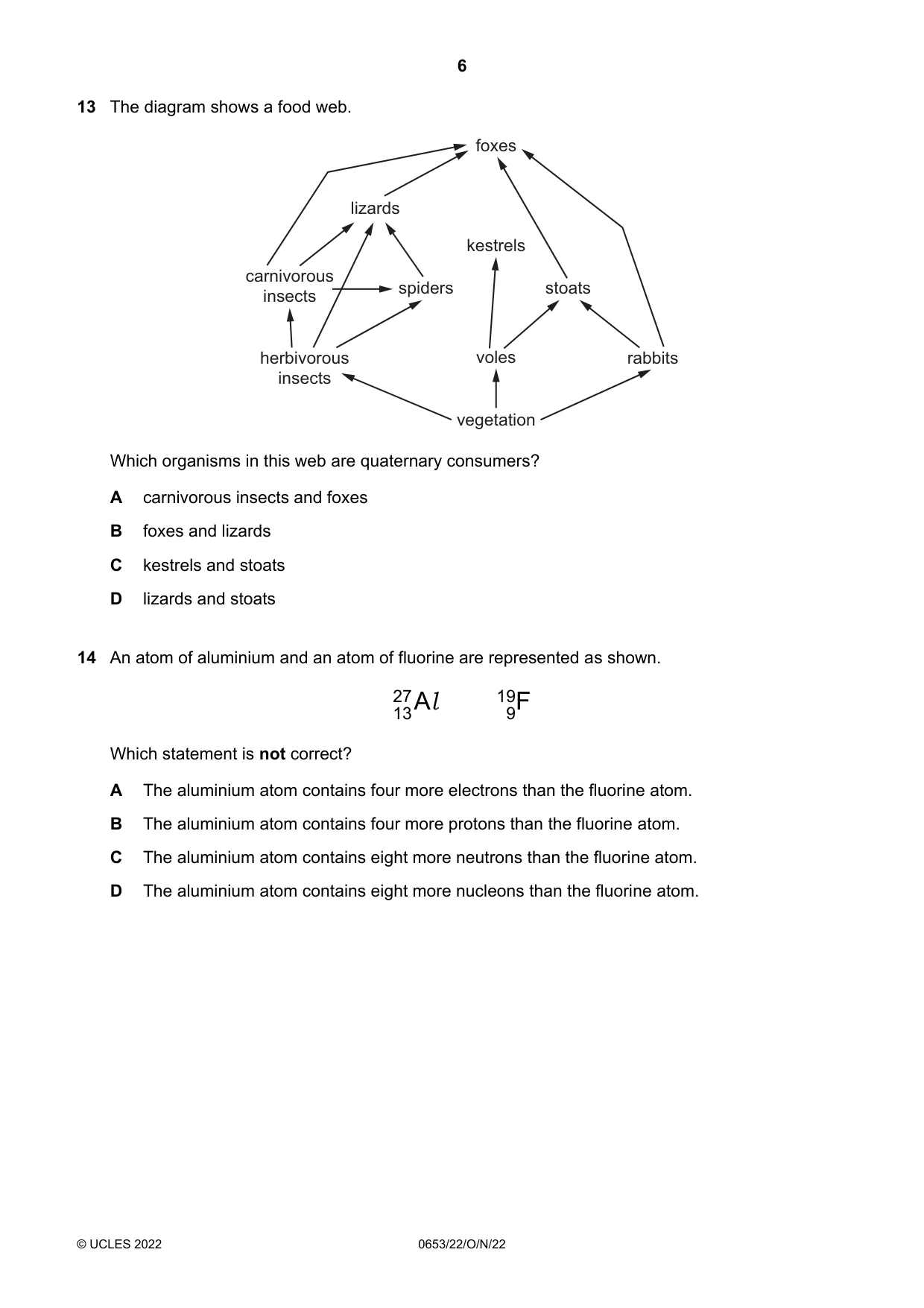
13 The diagram shows a food web. foxes lizards kestrels carnivorous spiders stoats insects herbivorous voles rabbits insects vegetation Which organisms in this web are quaternary consumers? A carnivorous insects and foxes B foxes and lizards C kestrels and stoats D lizards and stoats
Mark scheme: B
Q14 · An atom of aluminium and an atom of fluorine are represented as shown
14 An atom of aluminium and an atom of fluorine are represented as shown. 13Al 19 27 9F Which statement is not correct? A The aluminium atom contains four more electrons than the fluorine atom. B The aluminium atom contains four more protons than the fluorine atom. C The aluminium atom contains eight more neutrons than the fluorine atom. D The aluminium atom contains eight more nucleons than the fluorine atom.
Mark scheme: C
Q15 · Which row describes and explains the difference in melting points between ionic and…
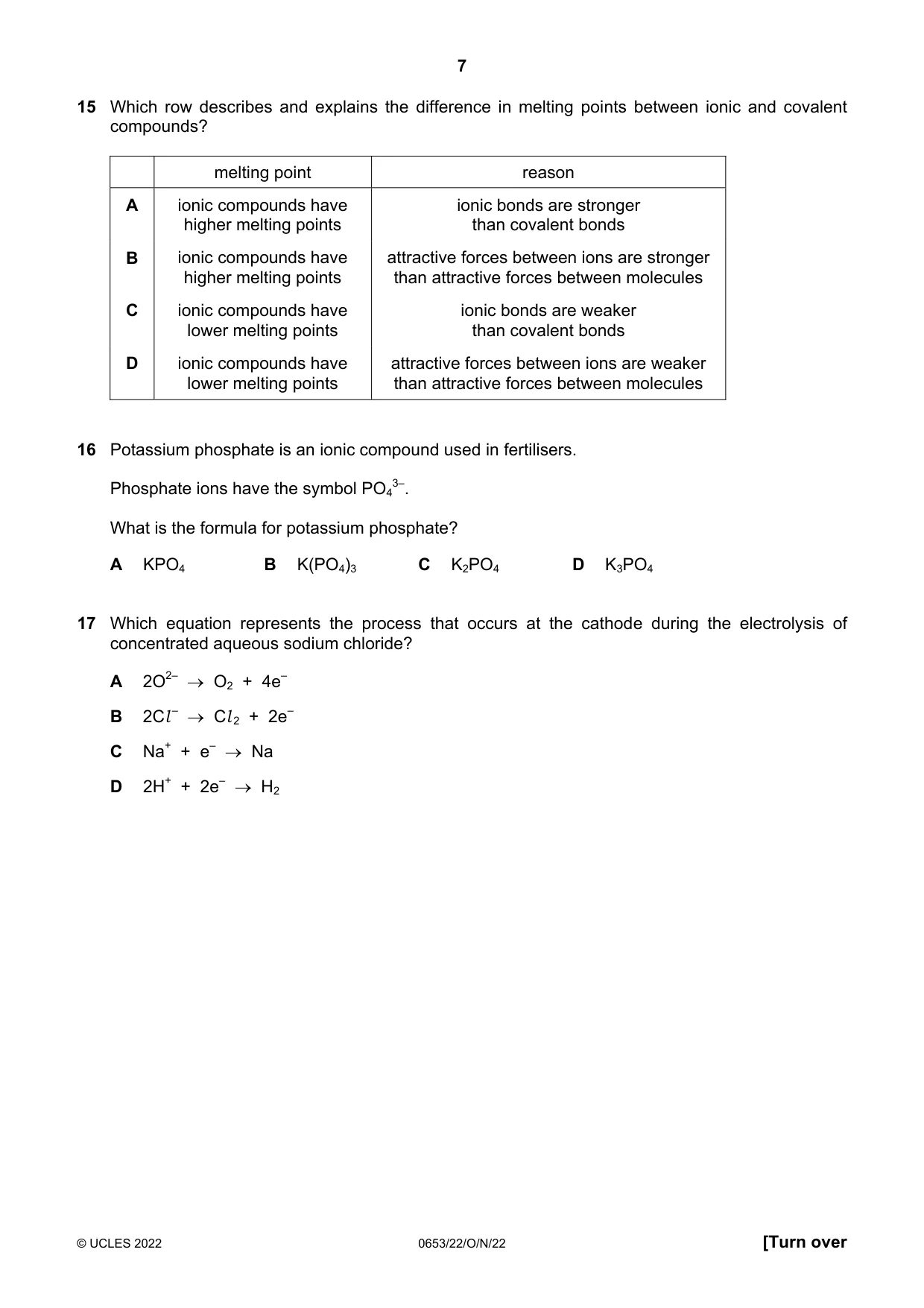
15 Which row describes and explains the difference in melting points between ionic and covalent compounds? melting point reason A ionic compounds have ionic bonds are stronger higher melting points than covalent bonds B ionic compounds have attractive forces between ions are stronger higher melting points than attractive forces between molecules C ionic compounds have ionic bonds are weaker lower melting points than covalent bonds D ionic compounds have attractive forces between ions are weaker lower melting points than attractive forces between molecules
Mark scheme: B
Q16 · Potassium phosphate is an ionic compound used in fertilisers
16 Potassium phosphate is an ionic compound used in fertilisers. Phosphate ions have the symbol PO4 3–. What is the formula for potassium phosphate? A KPO4 B K(PO4)3 C K2PO4 D K3PO4
Mark scheme: D
Q17 · Which equation represents the process that occurs at the cathode during the electrolysis…
17 Which equation represents the process that occurs at the cathode during the electrolysis of concentrated aqueous sodium chloride? A 2O2– O2 + 4e– B 2Cl – Cl 2 + 2e– C Na+ + e– Na D 2H+ + 2e– H2
Mark scheme: D
Q18 · The reaction between two aqueous reactants, P and Q, is carried out in two different…
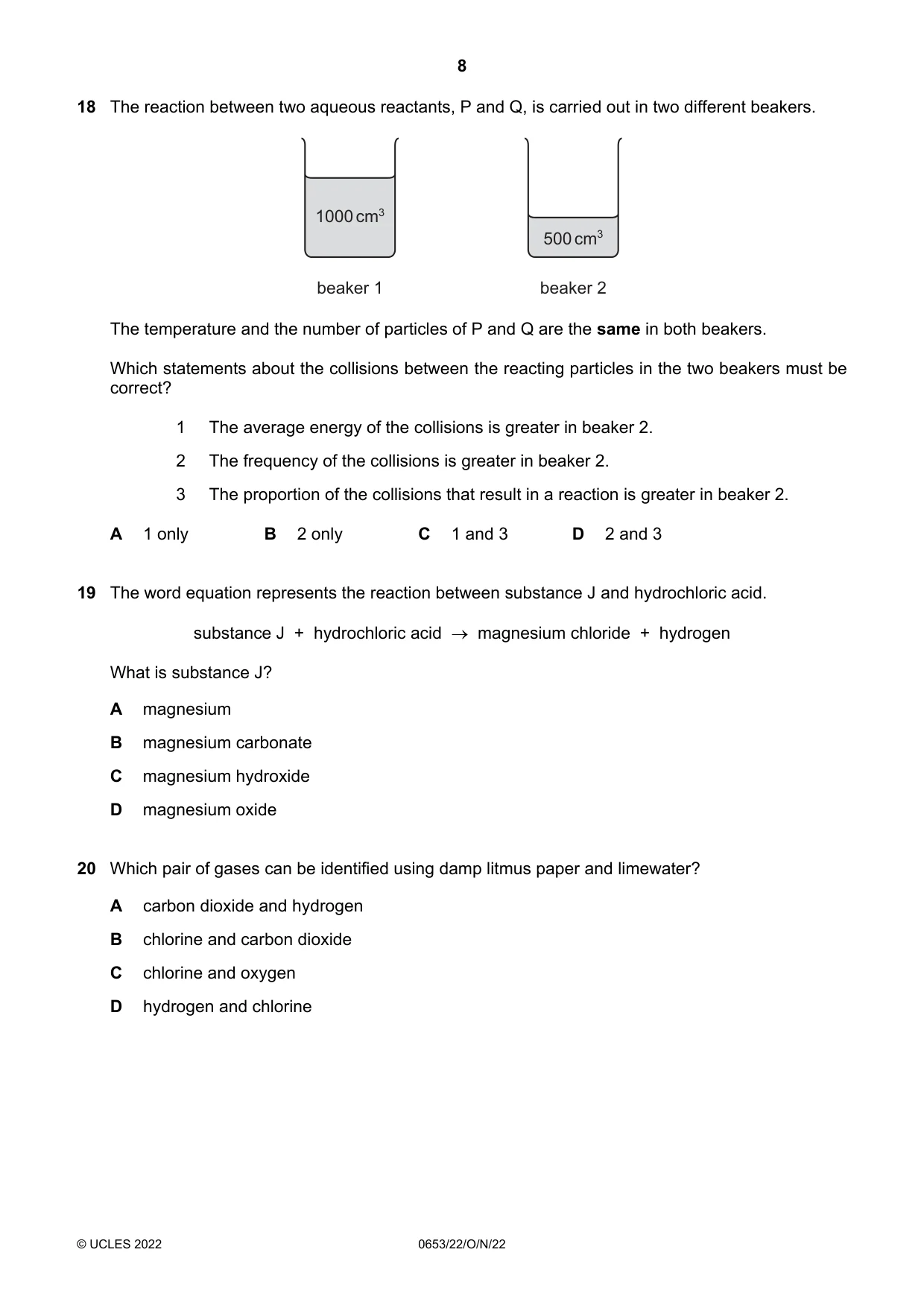
18 The reaction between two aqueous reactants, P and Q, is carried out in two different beakers. 1000 cm3 500 cm3 beaker 1 beaker 2 The temperature and the number of particles of P and Q are the same in both beakers. Which statements about the collisions between the reacting particles in the two beakers must be correct? 1 The average energy of the collisions is greater in beaker 2. 2 The frequency of the collisions is greater in beaker 2. 3 The proportion of the collisions that result in a reaction is greater in beaker 2. A 1 only B 2 only C 1 and 3 D 2 and 3
Mark scheme: B
Q19 · The word equation represents the reaction between substance J and hydrochloric acid
19 The word equation represents the reaction between substance J and hydrochloric acid. substance J + hydrochloric acid magnesium chloride + hydrogen What is substance J? A magnesium B magnesium carbonate C magnesium hydroxide D magnesium oxide
Mark scheme: A
More questions on The characteristic properties of acids and bases
Q20 · Which pair of gases can be identified using damp litmus paper and limewater?
20 Which pair of gases can be identified using damp litmus paper and limewater? A carbon dioxide and hydrogen B chlorine and carbon dioxide C chlorine and oxygen D hydrogen and chlorine
Mark scheme: B
Q21 · Which statement about the elements in Group VII is correct?
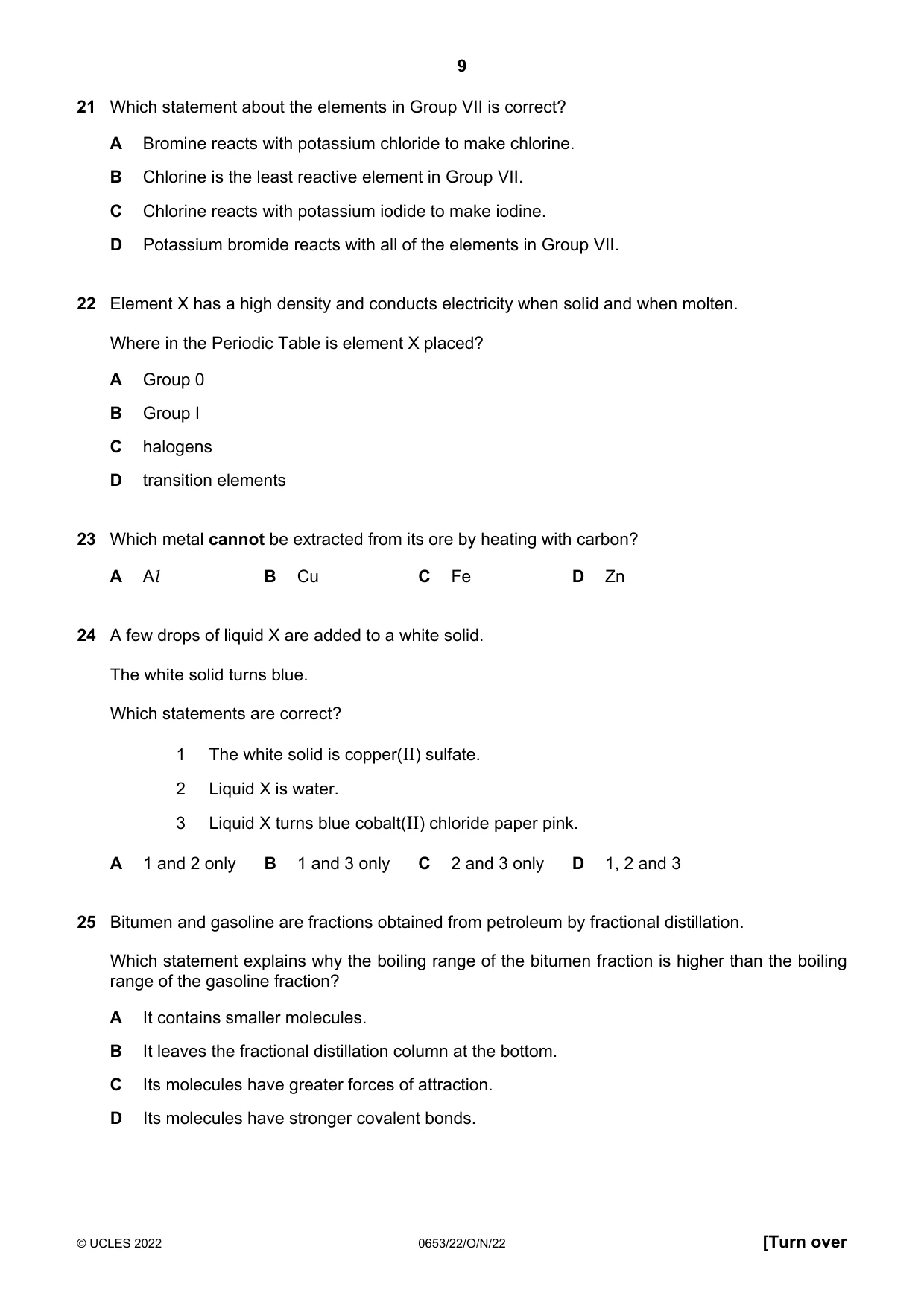
21 Which statement about the elements in Group VII is correct? A Bromine reacts with potassium chloride to make chlorine. B Chlorine is the least reactive element in Group VII. C Chlorine reacts with potassium iodide to make iodine. D Potassium bromide reacts with all of the elements in Group VII.
Mark scheme: C
Q22 · Element X has a high density and conducts electricity when solid and when molten
22 Element X has a high density and conducts electricity when solid and when molten. Where in the Periodic Table is element X placed? A Group 0 B Group I C halogens D transition elements
Mark scheme: D
Q23 · Which metal cannot be extracted from its ore by heating with carbon?
23 Which metal cannot be extracted from its ore by heating with carbon? A Al B Cu C Fe D Zn
Mark scheme: A
Q24 · A few drops of liquid X are added to a white solid
24 A few drops of liquid X are added to a white solid. The white solid turns blue. Which statements are correct? 1 The white solid is copper(II) sulfate. 2 Liquid X is water. 3 Liquid X turns blue cobalt(II) chloride paper pink. A 1 and 2 only B 1 and 3 only C 2 and 3 only D 1, 2 and 3
Mark scheme: D
Q25 · Bitumen and gasoline are fractions obtained from petroleum by fractional distillation
25 Bitumen and gasoline are fractions obtained from petroleum by fractional distillation. Which statement explains why the boiling range of the bitumen fraction is higher than the boiling range of the gasoline fraction? A It contains smaller molecules. B It leaves the fractional distillation column at the bottom. C Its molecules have greater forces of attraction. D Its molecules have stronger covalent bonds.
Mark scheme: C
Q26 · The formula of the hydrocarbon octane is C8H18
26 The formula of the hydrocarbon octane is C8H18. What are the products of the complete combustion of octane? A carbon and hydrogen B carbon and water C carbon dioxide and water D carbon monoxide and water
Mark scheme: C
Q27 · Which process is an example of thermal decomposition?
27 Which process is an example of thermal decomposition? A cracking an alkane B electrolysis of molten lead(II) bromide C extraction of iron in the blast furnace D fractional distillation of petroleum
Mark scheme: A
Q28 · The diagram shows a speed–time graph for a car
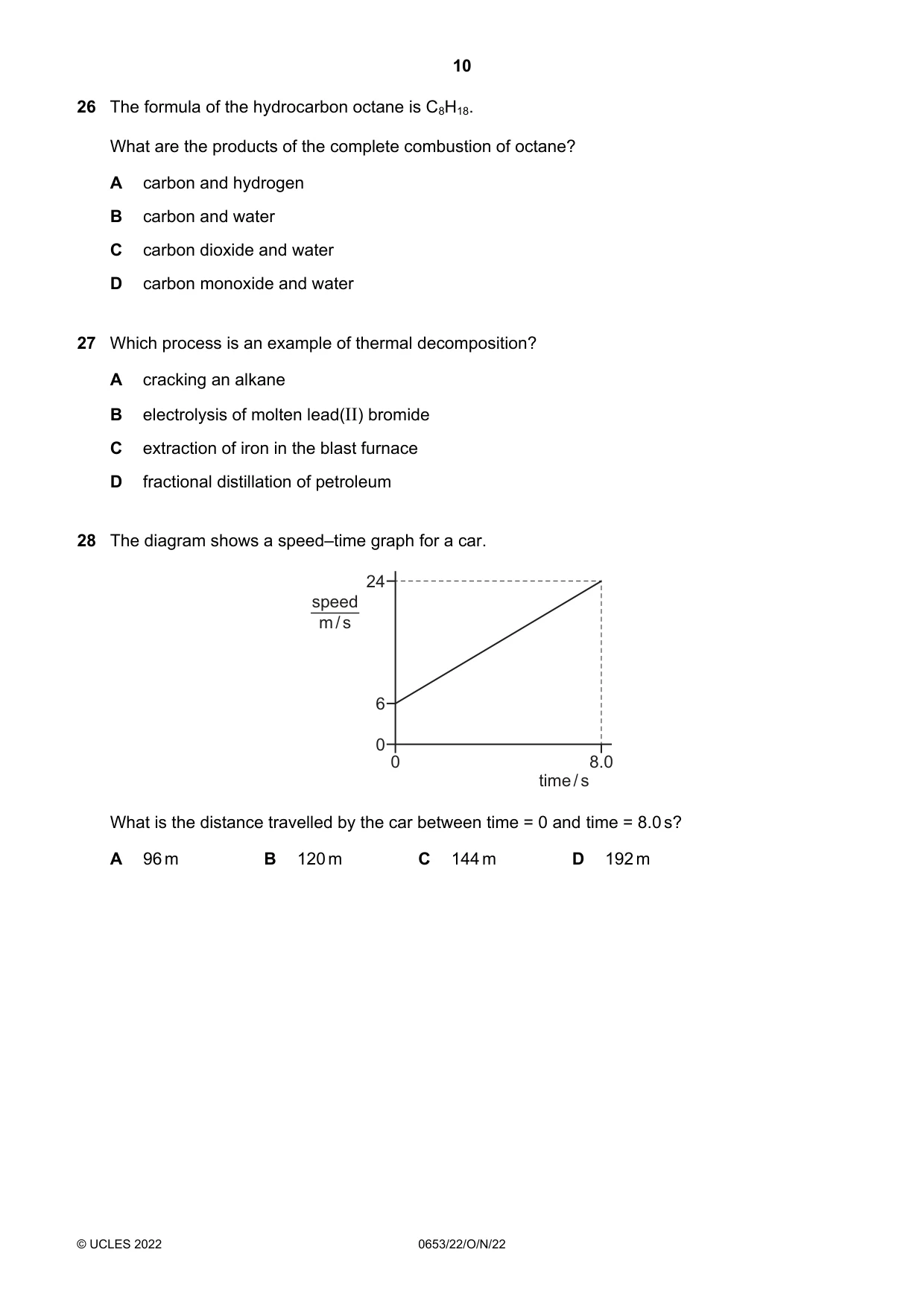
28 The diagram shows a speed–time graph for a car. 24 speed m / s 6 0 0 8.0 time / s What is the distance travelled by the car between time = 0 and time = 8.0 s? A 96 m B 120 m C 144 m D 192 m
Mark scheme: B
Q29 · A spring is stretched by a force F
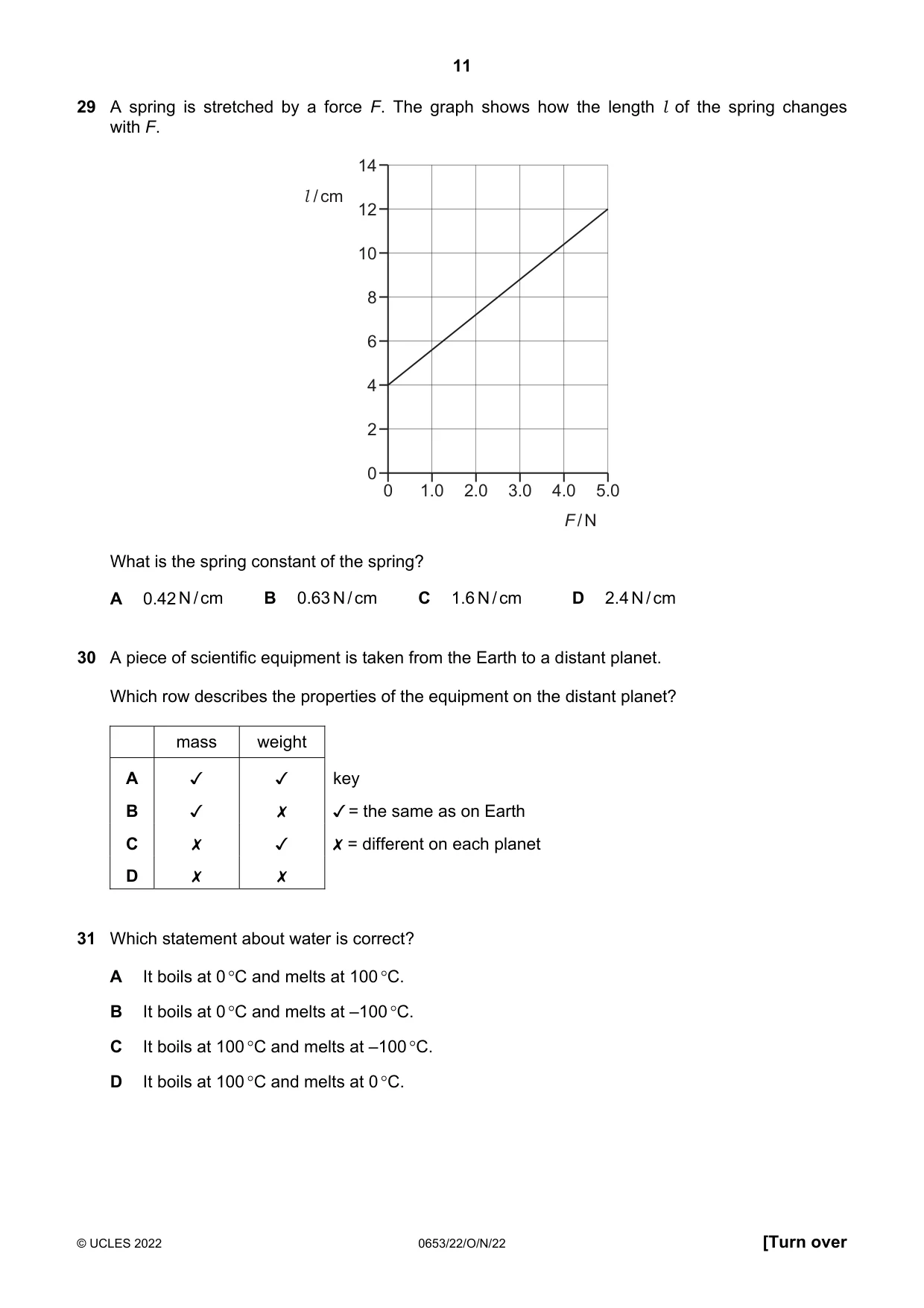
29 A spring is stretched by a force F. The graph shows how the length l of the spring changes with F. 14 l / cm 12 10 8 6 4 2 0 0 1.0 2.0 3.0 4.0 5.0 F / N What is the spring constant of the spring? A 0.42 N / cm B 0.63 N / cm C 1.6 N / cm D 2.4 N / cm
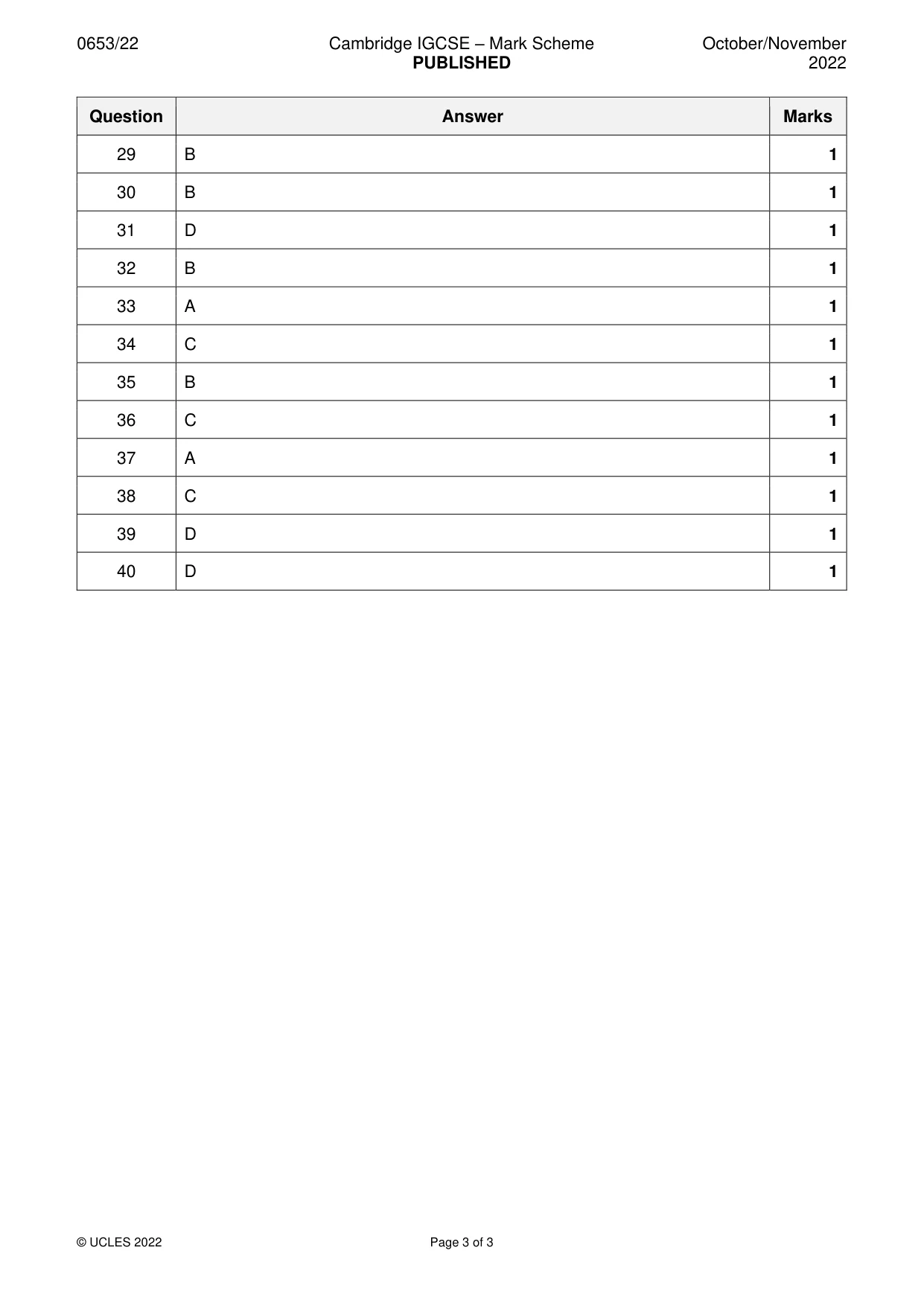
Mark scheme: B
Q30 · A piece of scientific equipment is taken from the Earth to a distant planet
30 A piece of scientific equipment is taken from the Earth to a distant planet. Which row describes the properties of the equipment on the distant planet? key / =the same as on Earth X = different on each planet
Mark scheme: B
Q31 · Which statement about water is correct?
31 Which statement about water is correct? A It boils at 0 C and melts at 100 C. B It boils at 0 C and melts at –100 C. C It boils at 100 C and melts at –100 C. D It boils at 100 C and melts at 0 C.
Mark scheme: D
Q32 · The volume of a gas is increased but its temperature remains the same
32 The volume of a gas is increased but its temperature remains the same. What happens to the molecules of the gas? A They move closer together. B They move further apart. C They move more quickly. D They move more slowly.
Mark scheme: B
Q33 · Which row compares how well a dull, black surface and a shiny, white surface emit and…
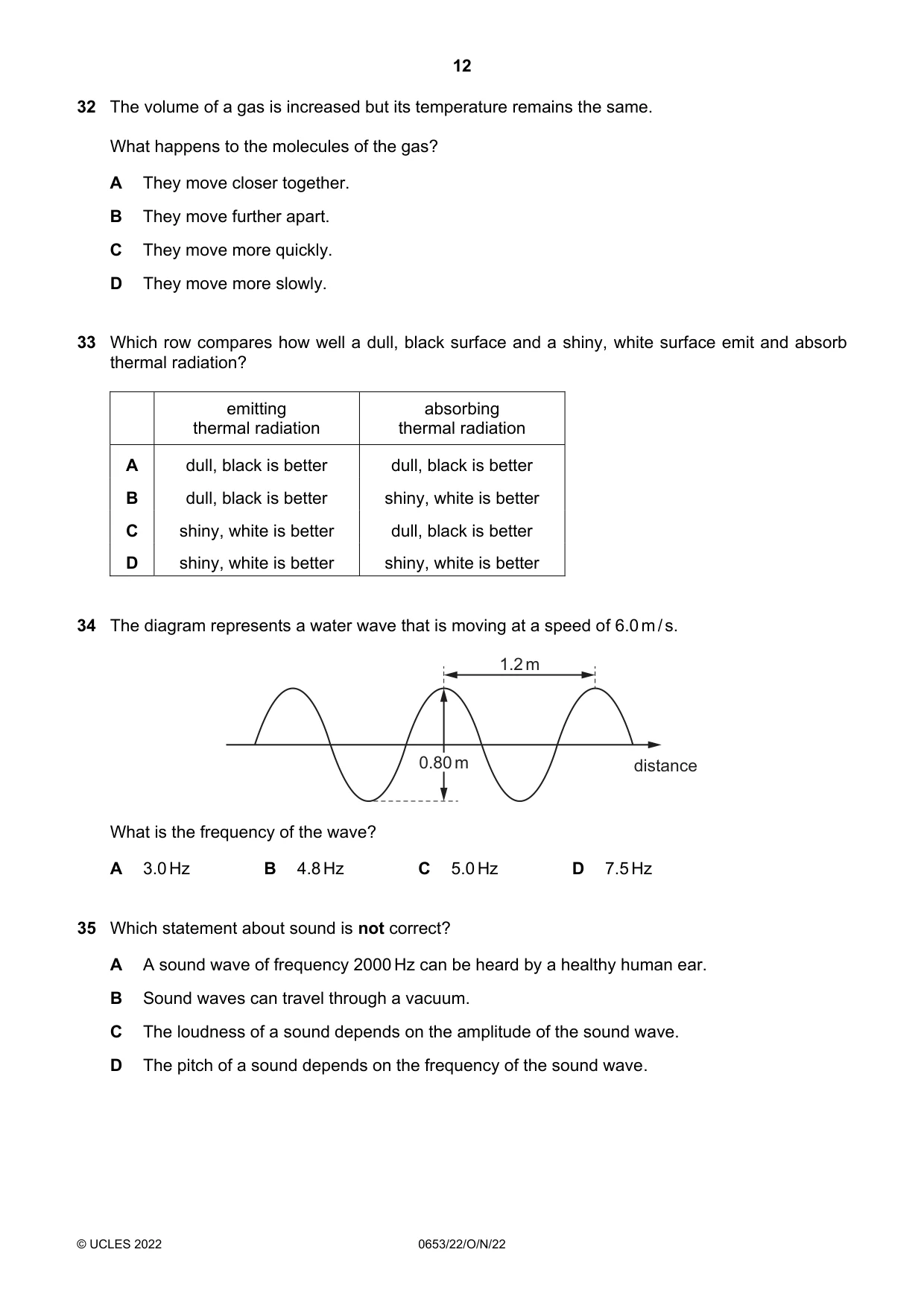
33 Which row compares how well a dull, black surface and a shiny, white surface emit and absorb thermal radiation? emitting absorbing thermal radiation thermal radiation A dull, black is better dull, black is better B dull, black is better shiny, white is better C shiny, white is better dull, black is better D shiny, white is better shiny, white is better
Mark scheme: A
Q34 · The diagram represents a water wave that is moving at a speed of 6.0 m / s
34 The diagram represents a water wave that is moving at a speed of 6.0 m / s. 1.2 m 0.80 m distance What is the frequency of the wave? A 3.0 Hz B 4.8 Hz C 5.0 Hz D 7.5 Hz
Mark scheme: C
Q35 · Which statement about sound is not correct?
35 Which statement about sound is not correct? A A sound wave of frequency 2000 Hz can be heard by a healthy human ear. B Sound waves can travel through a vacuum. C The loudness of a sound depends on the amplitude of the sound wave. D The pitch of a sound depends on the frequency of the sound wave.
Mark scheme: B
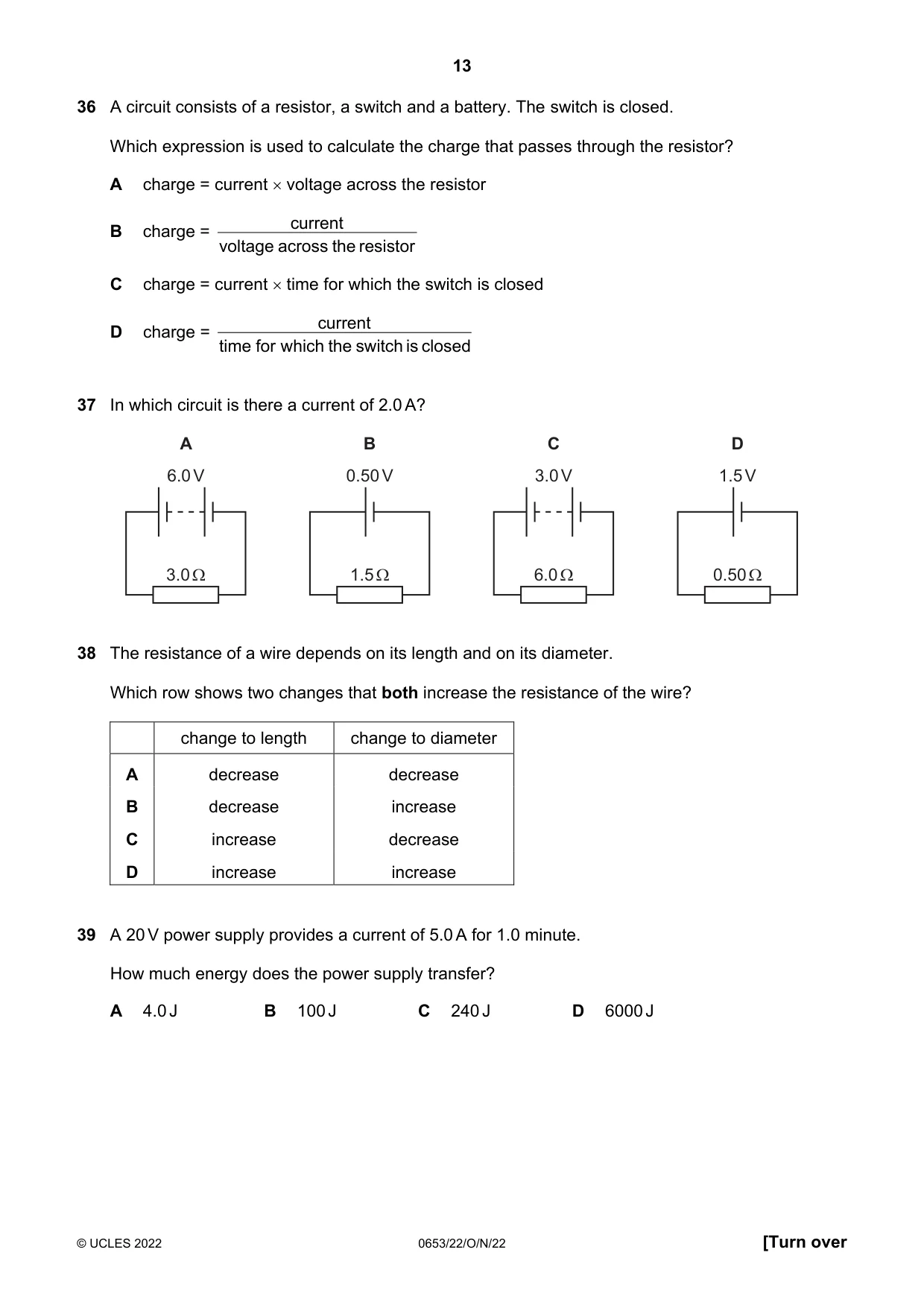
Q36 · A circuit consists of a resistor, a switch and a battery
36 A circuit consists of a resistor, a switch and a battery. The switch is closed. Which expression is used to calculate the charge that passes through the resistor? A charge = current voltage across the resistor current B charge = voltage across the resistor C charge = current time for which the switch is closed current D charge = time for which the switch is closed
Mark scheme: C
Q37 · In which circuit is there a current of 2.0 A?
37 In which circuit is there a current of 2.0 A? A B Cc D 6.0V 0.50V 3.0V 1.5V 3.00 1.50 6.0Q 0.50Q
Mark scheme: A
Q38 · The resistance of a wire depends on its length and on its diameter
38 The resistance of a wire depends on its length and on its diameter. Which row shows two changes that both increase the resistance of the wire? change to length change to diameter A decrease decrease B decrease increase C increase decrease D increase increase
Mark scheme: C
Q39 · A 20 V power supply provides a current of 5.0 A for 1.0 minute
39 A 20 V power supply provides a current of 5.0 A for 1.0 minute. How much energy does the power supply transfer? A 4.0 J B 100 J C 240 J D 6000 J
Mark scheme: D
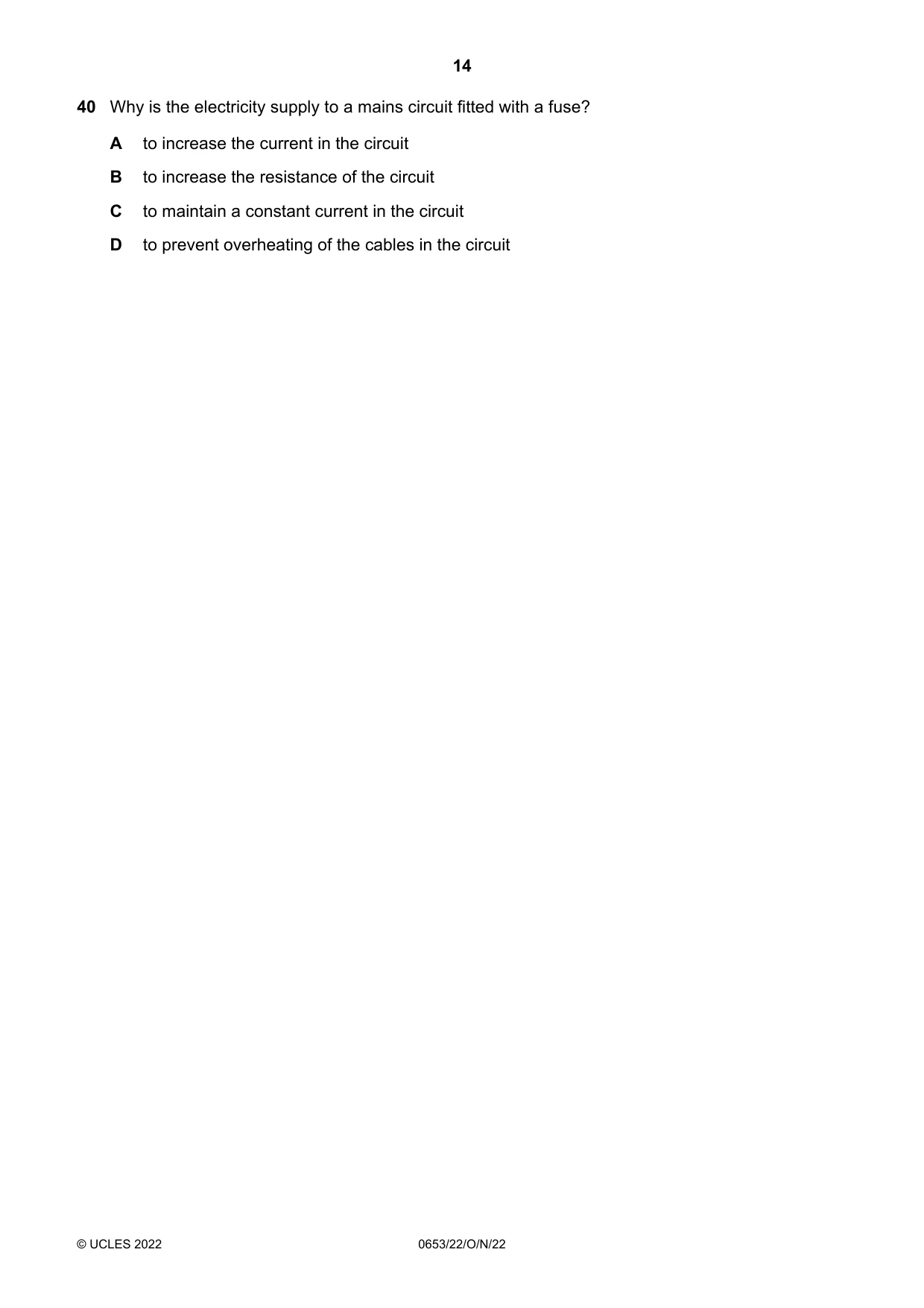
Q40 · Why is the electricity supply to a mains circuit fitted with a fuse?
40 Why is the electricity supply to a mains circuit fitted with a fuse? A to increase the current in the circuit B to increase the resistance of the circuit C to maintain a constant current in the circuit D to prevent overheating of the cables in the circuit
Mark scheme: D
What was in this paper
The subtopics covered by these 40 questions, and how many questions each got. Open one in a new tab to see every Cambridge question on it.
2Electrical quantities2Fuels2Identification of ions and gases2Alkenes1Atomic structure and the Periodic Table1Biological molecules1Cell structure1Diet1Digestion1Drugs1Electrical circuits1Electrical safety1Electrolysis1Energy, work and power1Extraction of metals1Food chains and food webs1Forces1Formulas1Gas exchange in humans1General properties of waves1Group VII properties1Kinetic particle model of matter1Mass and weight1Motion1Photosynthesis1Rate of reaction1Respiration1Sexual reproduction in humans1Sexual reproduction in plants1Simple molecules and covalent bonds1Sound1The characteristic properties of acids and bases1Thermal properties and temperature1Transfer of thermal energy1Transition elements1What you needed in this session
Cambridge’s own grade thresholds for 2022 Oct/Nov, Paper 2 · Variant 2. A higher threshold means an easier paper — the bar moves with how the cohort did.