Cambridge IGCSE Science - Combined 0653 — 2024 May/June Paper 2 · Variant 3
0653/23/M/J/24 · 40 questions · 40 marks · ≈45 min
The question paper and its mark scheme, free to read here and free to download. This is Cambridge’s own paper, exactly as it was sat.
Question paper16 pages
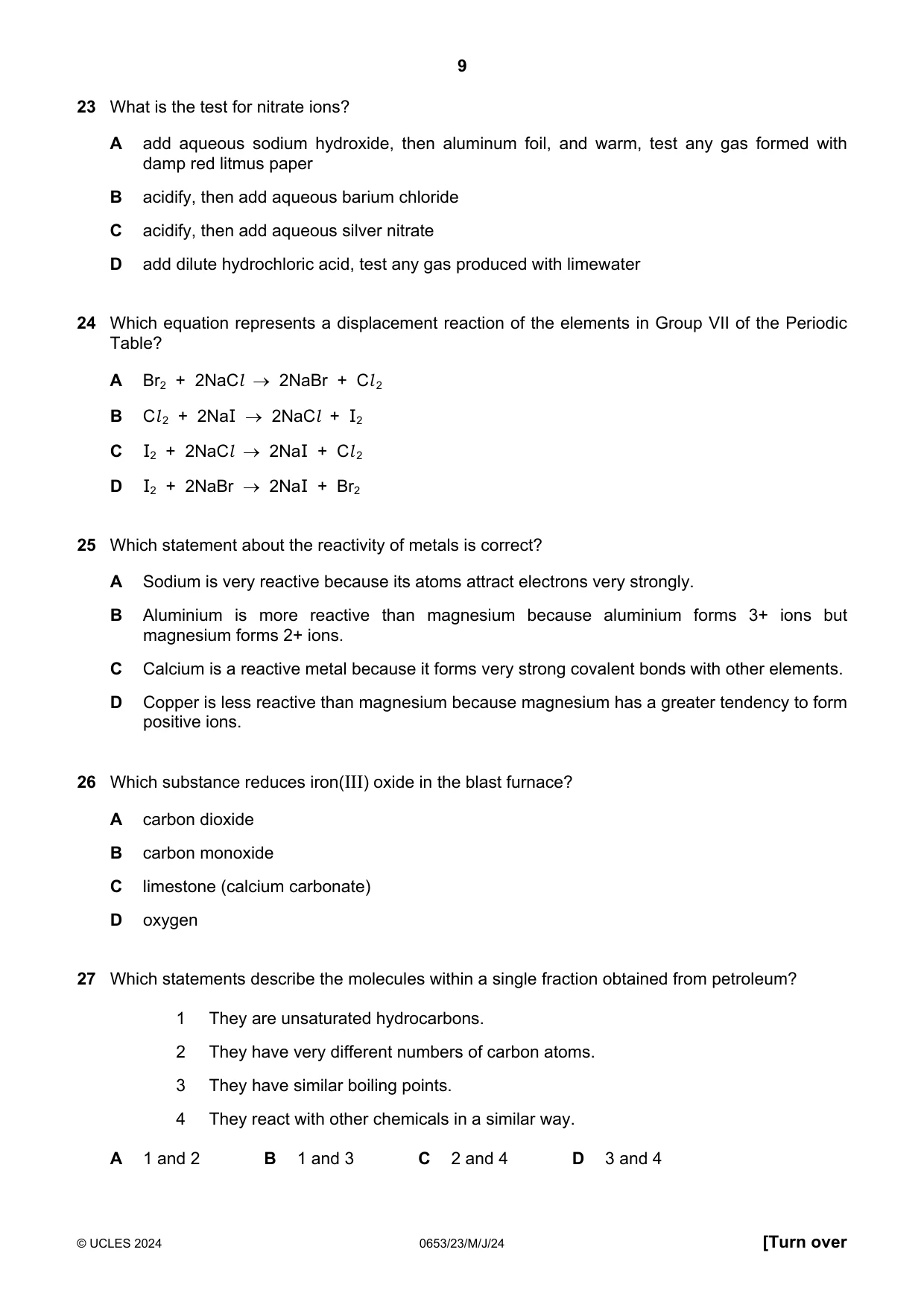
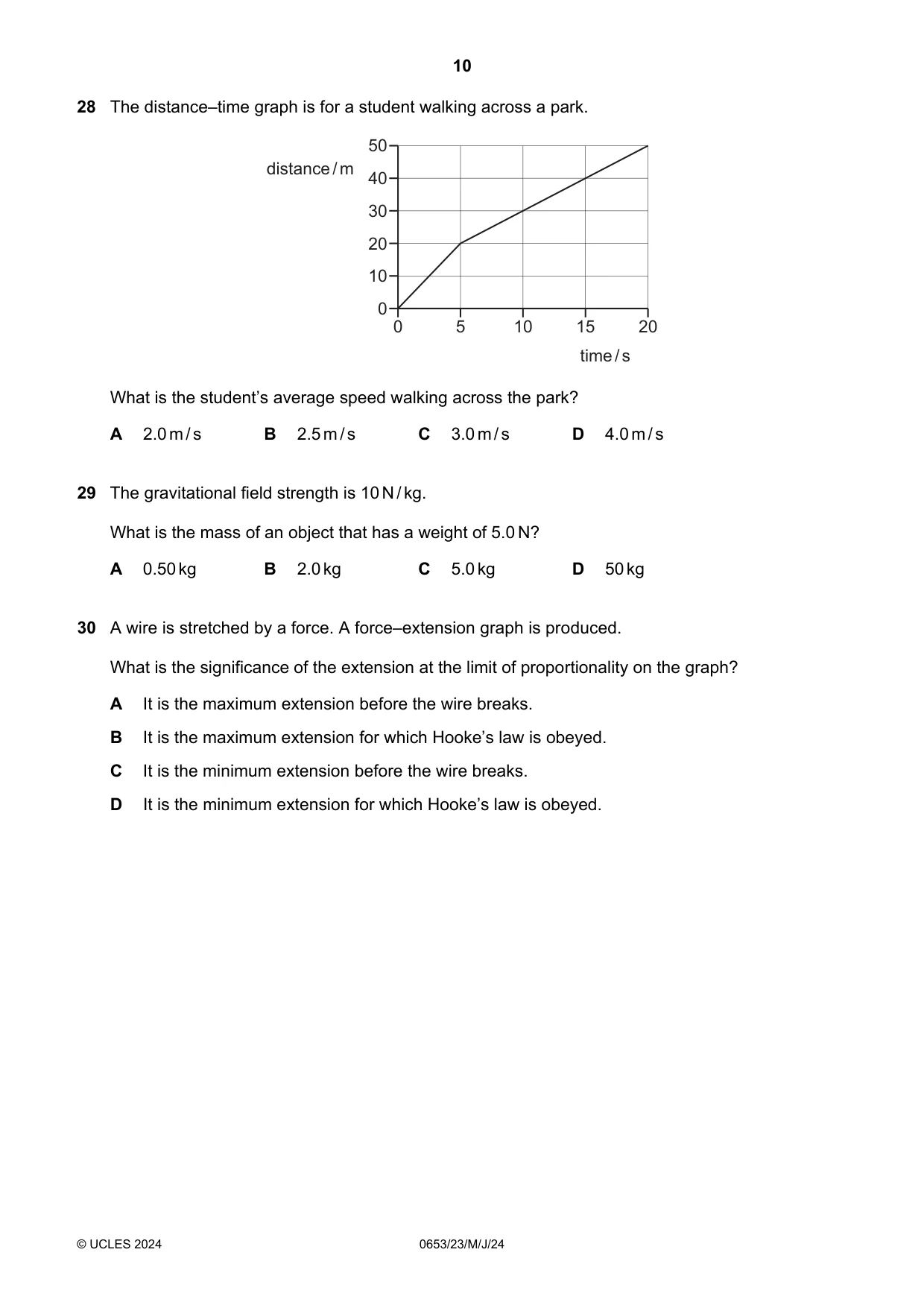
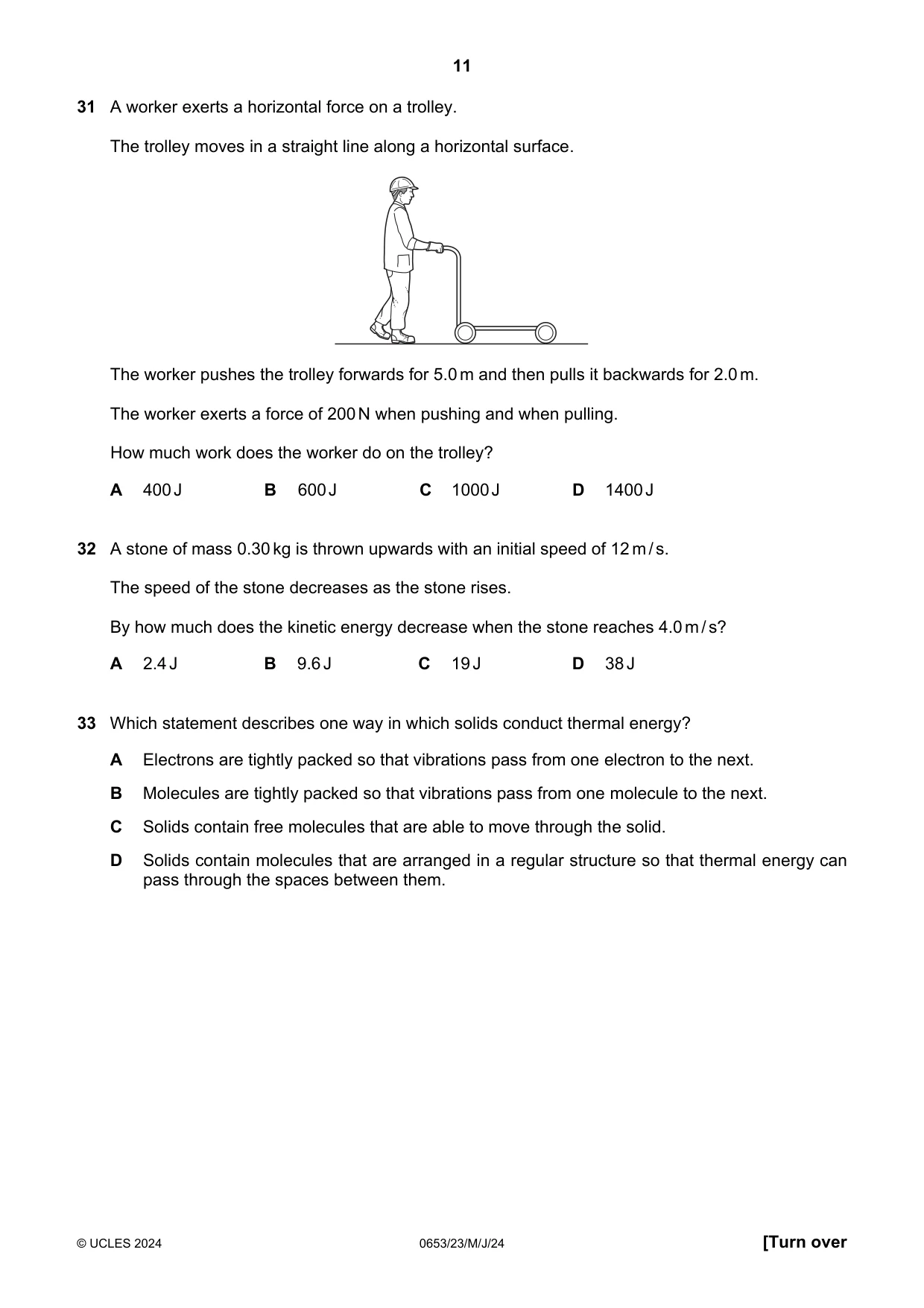
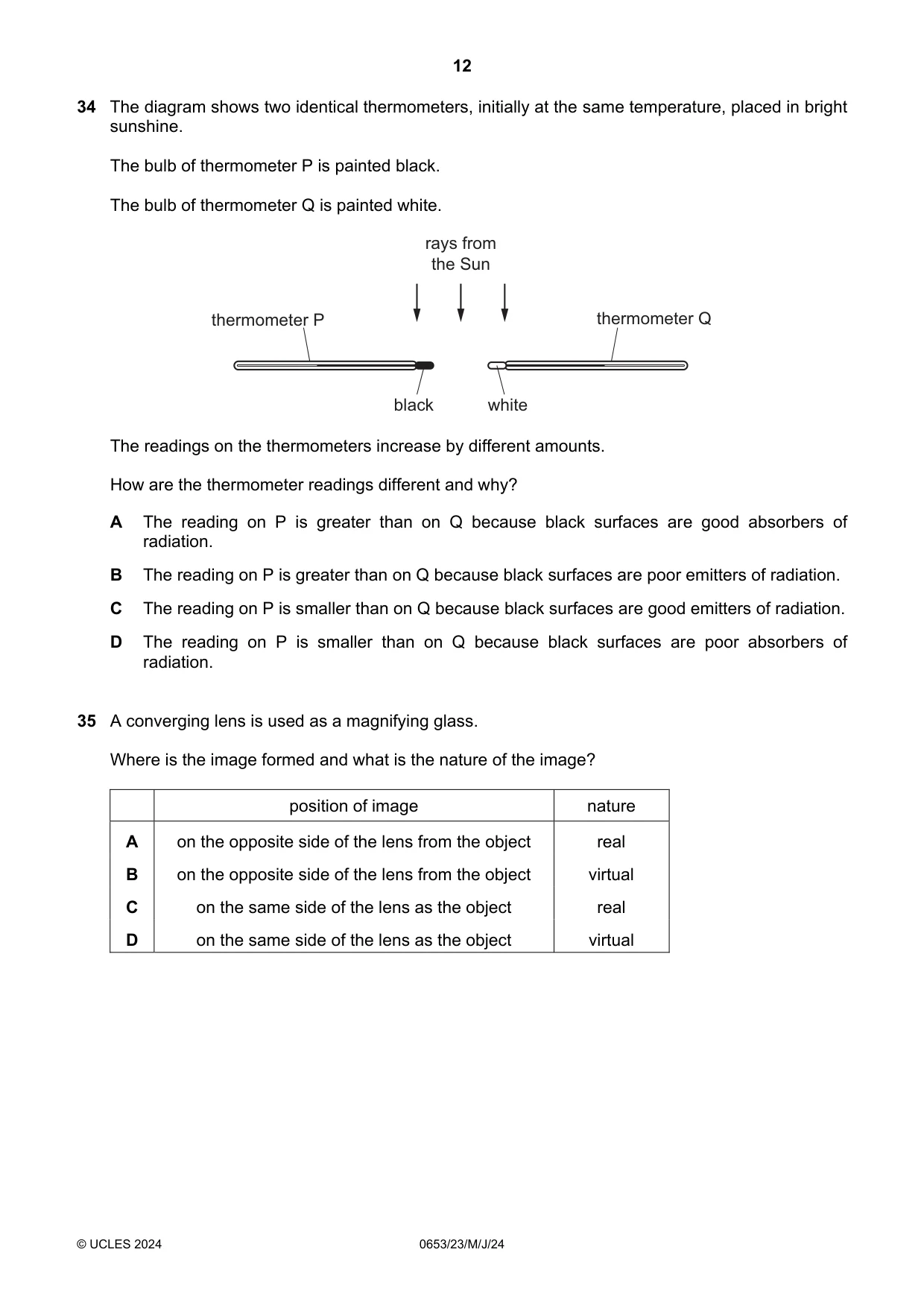
Mark scheme3 pages
Answers below. Sit the paper first if you are practising.
Questions as text
Question 1
1 ......1...... is the ability to detect and respond to changes in the environment. Which word completes gap 1? A Excretion B Movement C Sensitivity D Reproduction
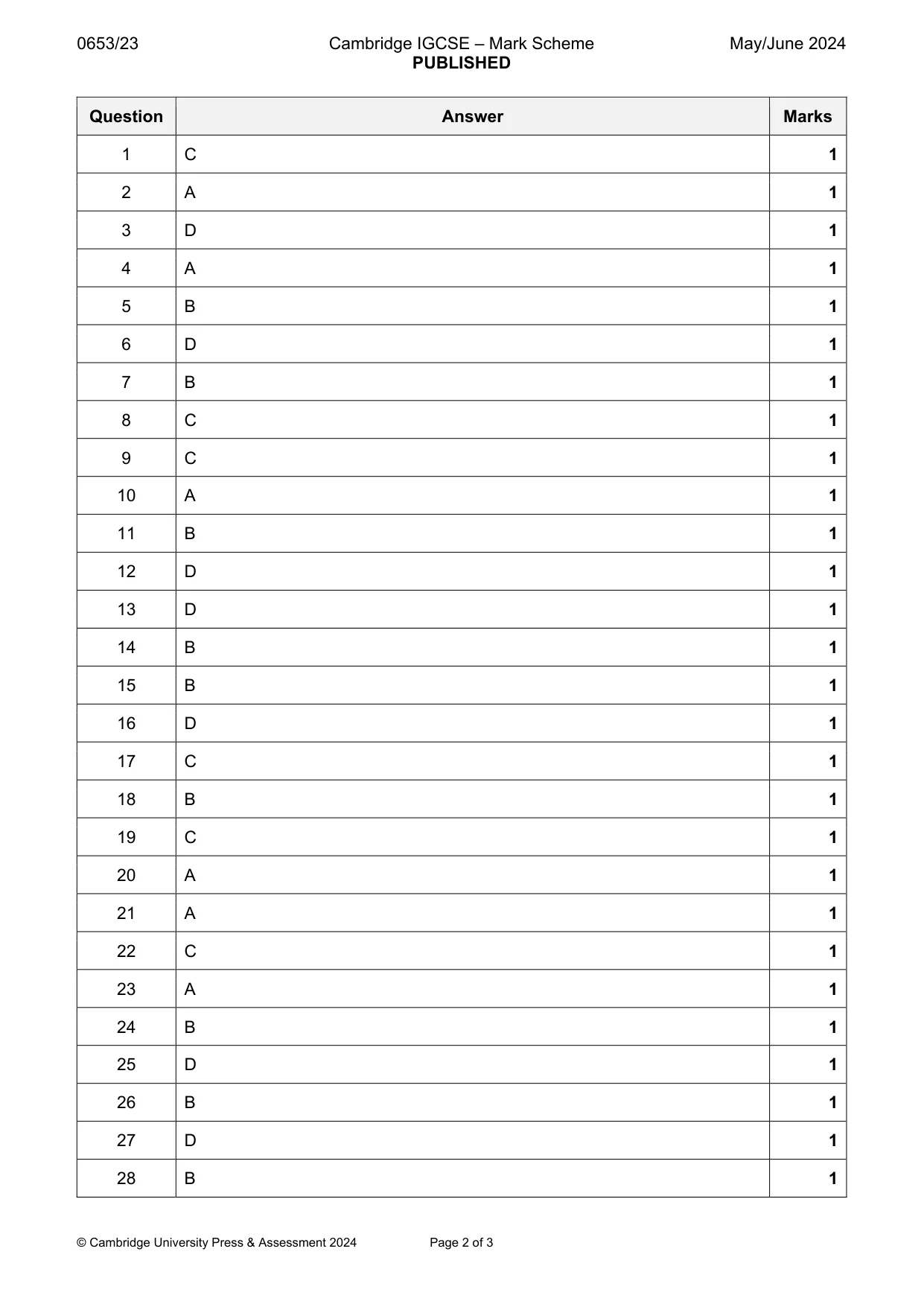
Mark scheme: C
Q2 · The diagram shows a ciliated cell
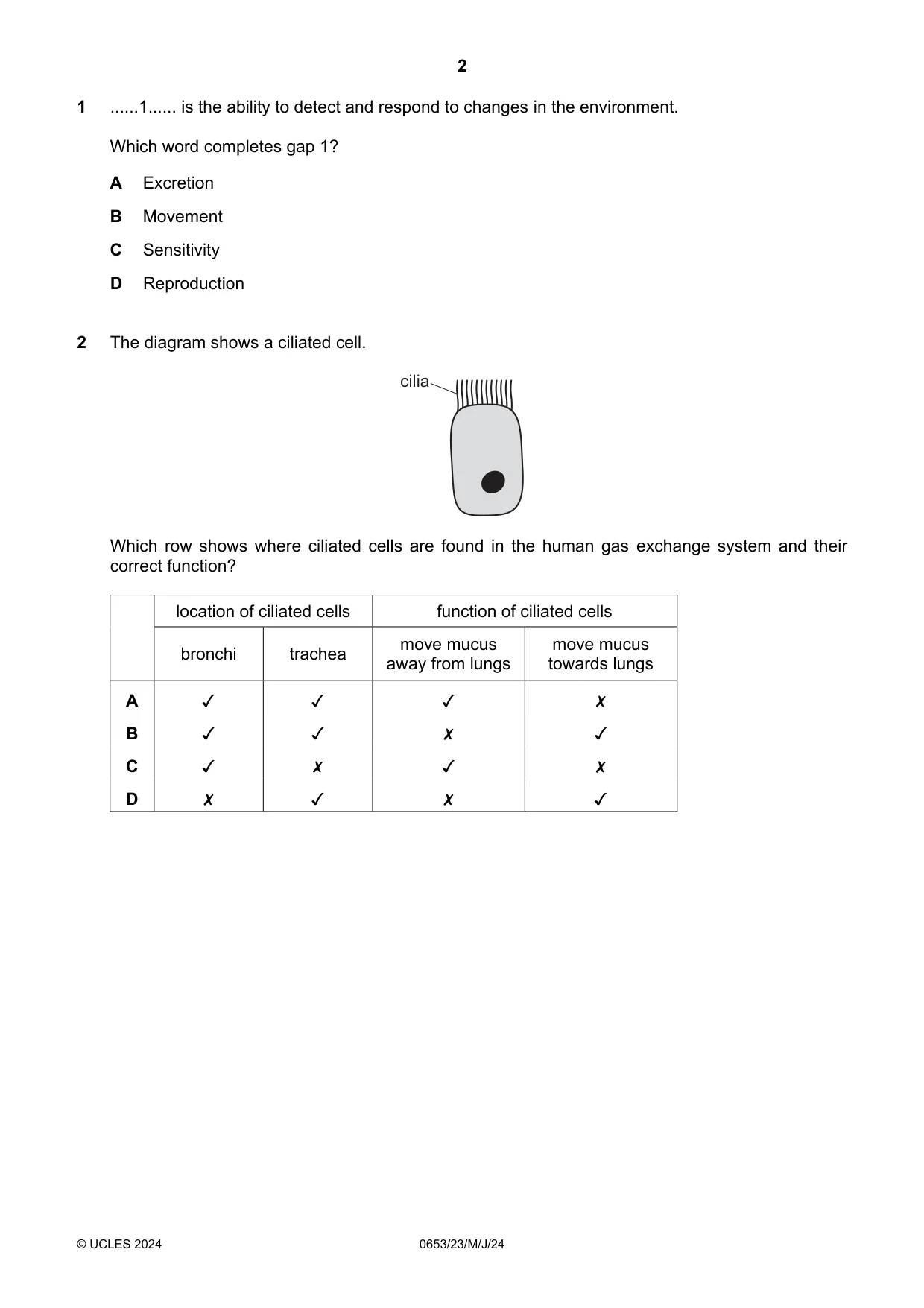
2 The diagram shows a ciliated cell. cilia Which row shows where ciliated cells are found in the human gas exchange system and their correct function? location of ciliated cells function of ciliated cells bronchi trachea move mucus move mucus away from lungs towards lungs A J Jv Jv x B J Jv x J Cc Jv x Jv x D x Jv x Jv
Mark scheme: A
Q3 · A plant cell was placed in a solution with a lower water potential than the cell
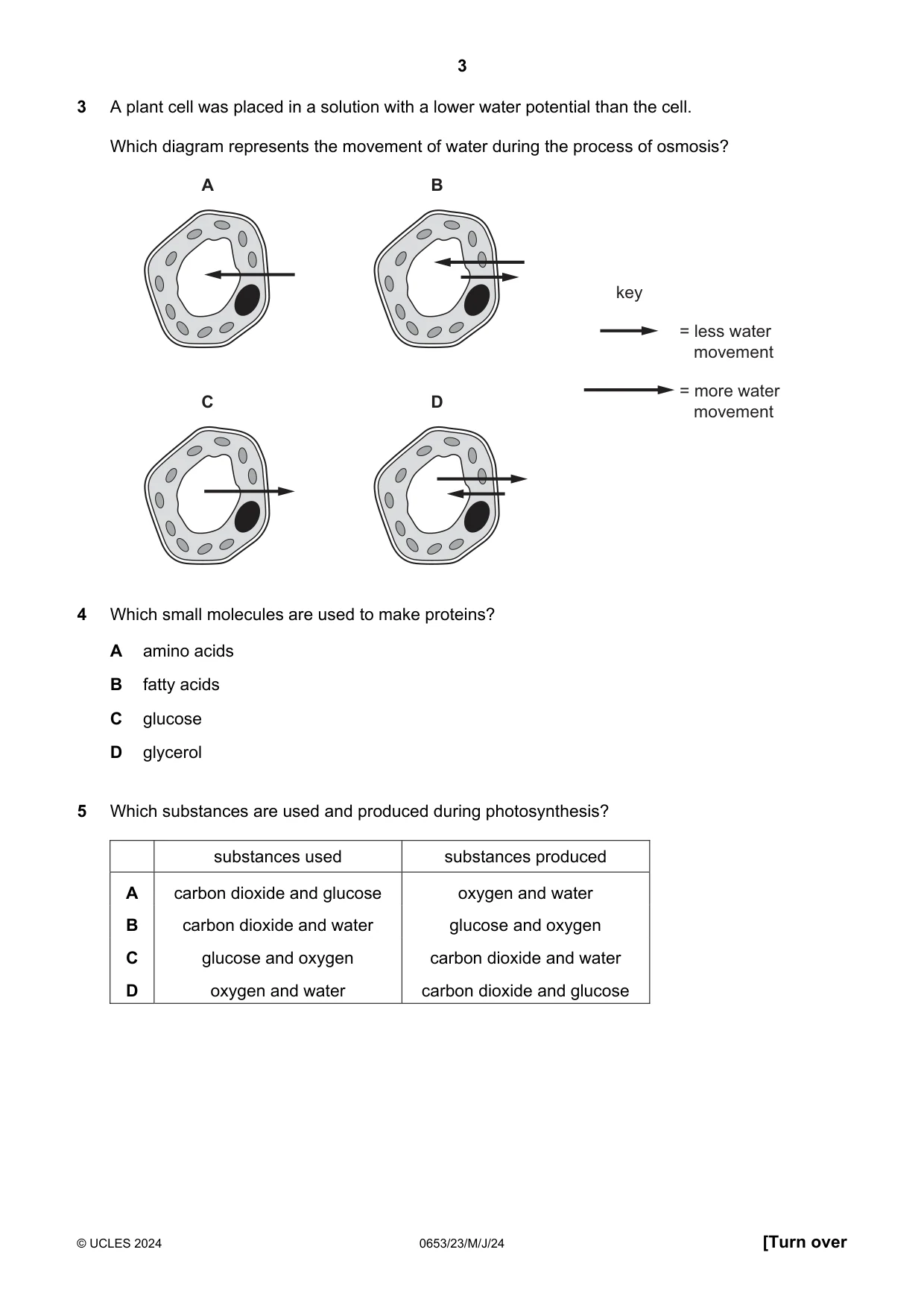
3 A plant cell was placed in a solution with a lower water potential than the cell. Which diagram represents the movement of water during the process of osmosis? A B key = less water movement C D = more water movement
Mark scheme: D
Q4 · Which small molecules are used to make proteins?
4 Which small molecules are used to make proteins? A amino acids B fatty acids C glucose D glycerol
Mark scheme: A
Q5 · Which substances are used and produced during photosynthesis?
5 Which substances are used and produced during photosynthesis? substances used substances produced A carbon dioxide and glucose oxygen and water B carbon dioxide and water glucose and oxygen C glucose and oxygen carbon dioxide and water D oxygen and water carbon dioxide and glucose
Mark scheme: B
Q6 · Which process is defined as the taking of substances, for example food and drink, into…
6 Which process is defined as the taking of substances, for example food and drink, into the body through the mouth? A absorption B digestion C egestion D ingestion
Mark scheme: D
Q7 · Which changes will increase transpiration rate?
7 Which changes will increase transpiration rate? humidity temperature A decrease decrease B decrease increase C increase decrease D increase increase
Mark scheme: B
Q8 · A diagram of the human heart is shown
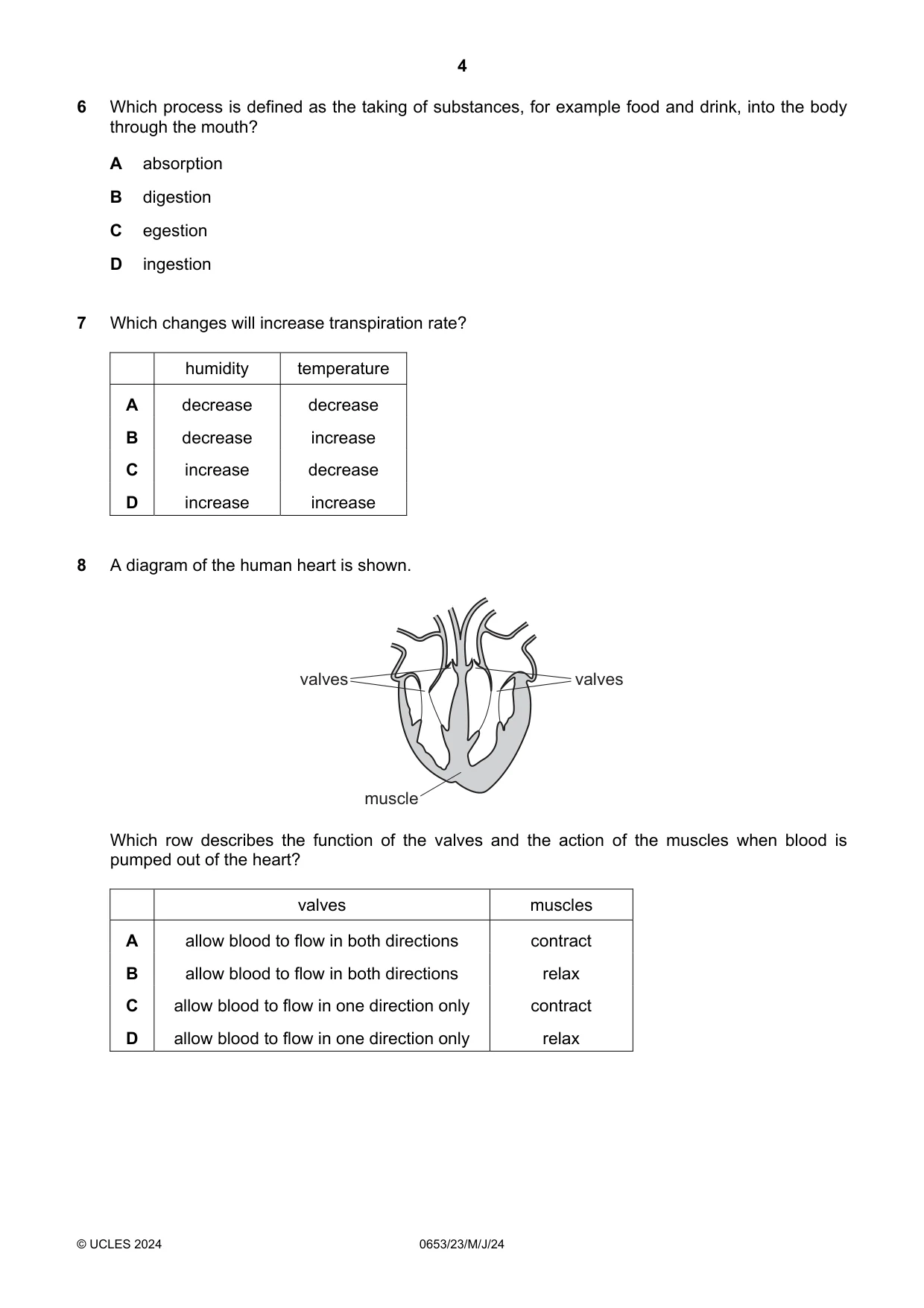
8 A diagram of the human heart is shown. valves valves muscle Which row describes the function of the valves and the action of the muscles when blood is pumped out of the heart? valves muscles A allow blood to flow in both directions contract B allow blood to flow in both directions relax C allow blood to flow in one direction only contract D allow blood to flow in one direction only relax
Mark scheme: C
Q9 · Why do cells respire?
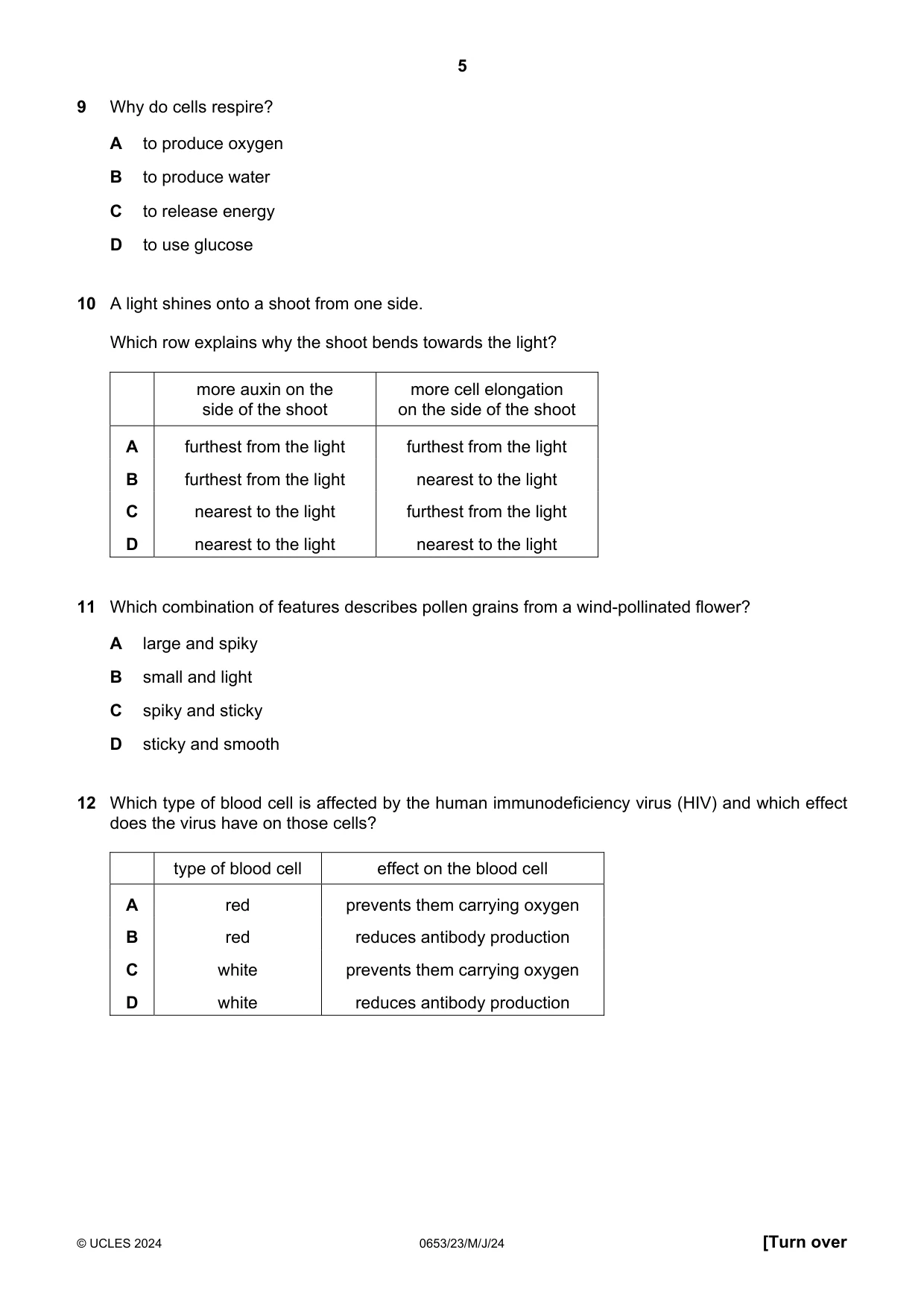
9 Why do cells respire? A to produce oxygen B to produce water C to release energy D to use glucose
Mark scheme: C
Q10 · A light shines onto a shoot from one side
10 A light shines onto a shoot from one side. Which row explains why the shoot bends towards the light? more auxin on the more cell elongation side of the shoot on the side of the shoot A furthest from the light furthest from the light B furthest from the light nearest to the light C nearest to the light furthest from the light D nearest to the light nearest to the light
Mark scheme: A
Q11 · Which combination of features describes pollen grains from a wind-pollinated flower?
11 Which combination of features describes pollen grains from a wind-pollinated flower? A large and spiky B small and light C spiky and sticky D sticky and smooth
Mark scheme: B
Q12 · Which type of blood cell is affected by the human immunodeficiency virus (HIV) and which…
12 Which type of blood cell is affected by the human immunodeficiency virus (HIV) and which effect does the virus have on those cells? type of blood cell effect on the blood cell A red prevents them carrying oxygen B red reduces antibody production C white prevents them carrying oxygen D white reduces antibody production
Mark scheme: D
Q13 · Some effects that may happen in an ecosystem are listed
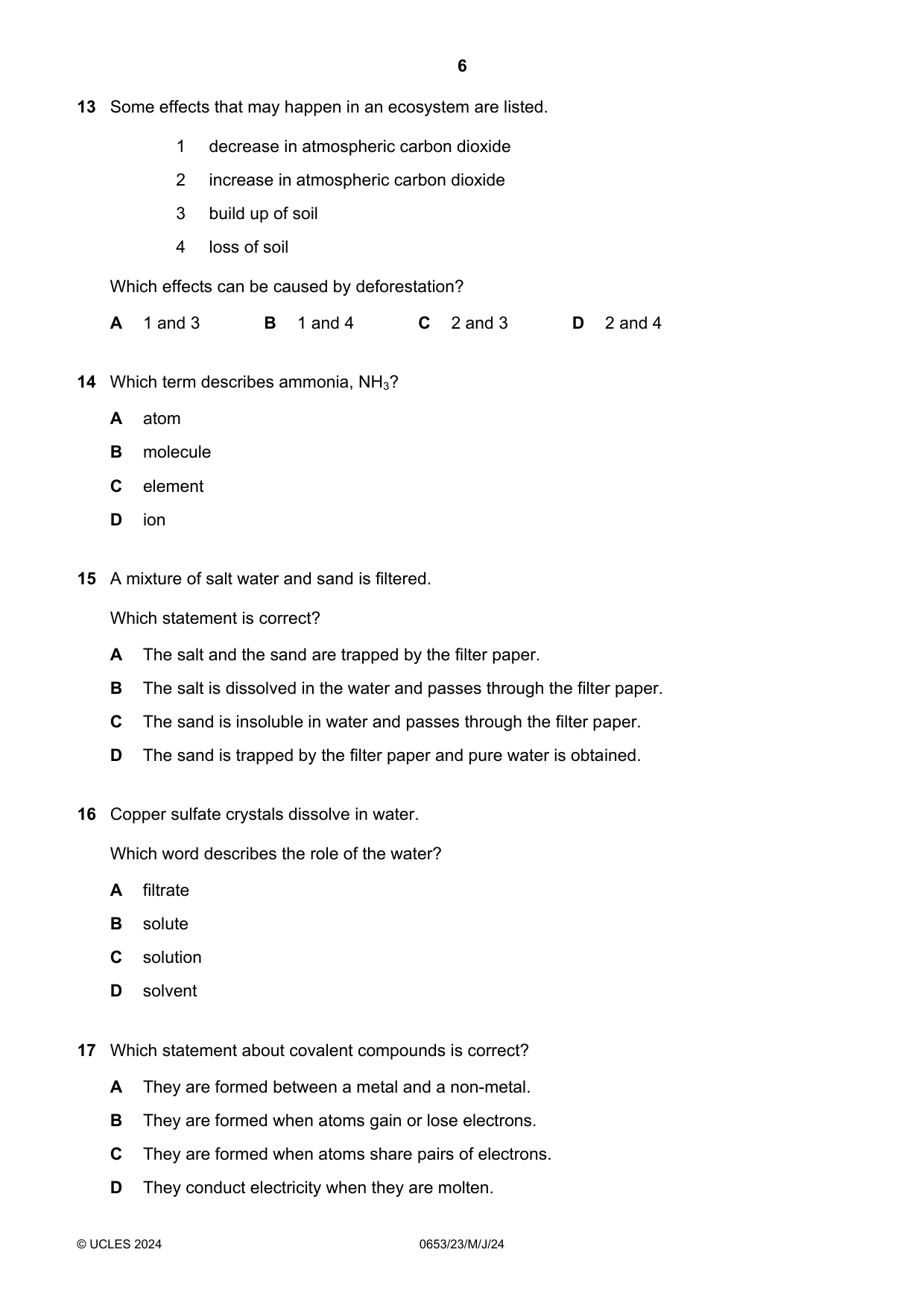
13 Some effects that may happen in an ecosystem are listed. 1 decrease in atmospheric carbon dioxide 2 increase in atmospheric carbon dioxide 3 build up of soil 4 loss of soil Which effects can be caused by deforestation? A 1 and 3 B 1 and 4 C 2 and 3 D 2 and 4
Mark scheme: D
Q14 · Which term describes ammonia, NH3?
14 Which term describes ammonia, NH3? A atom B molecule C element D ion
Mark scheme: B
Q15 · A mixture of salt water and sand is filtered
15 A mixture of salt water and sand is filtered. Which statement is correct? A The salt and the sand are trapped by the filter paper. B The salt is dissolved in the water and passes through the filter paper. C The sand is insoluble in water and passes through the filter paper. D The sand is trapped by the filter paper and pure water is obtained.
Mark scheme: B
Q16 · Copper sulfate crystals dissolve in water
16 Copper sulfate crystals dissolve in water. Which word describes the role of the water? A filtrate B solute C solution D solvent
Mark scheme: D
Q17 · Which statement about covalent compounds is correct?
17 Which statement about covalent compounds is correct? A They are formed between a metal and a non-metal. B They are formed when atoms gain or lose electrons. C They are formed when atoms share pairs of electrons. D They conduct electricity when they are molten.
Mark scheme: C
Q18 · Magnesium reacts with dilute hydrochloric acid forming magnesium chloride and hydrogen
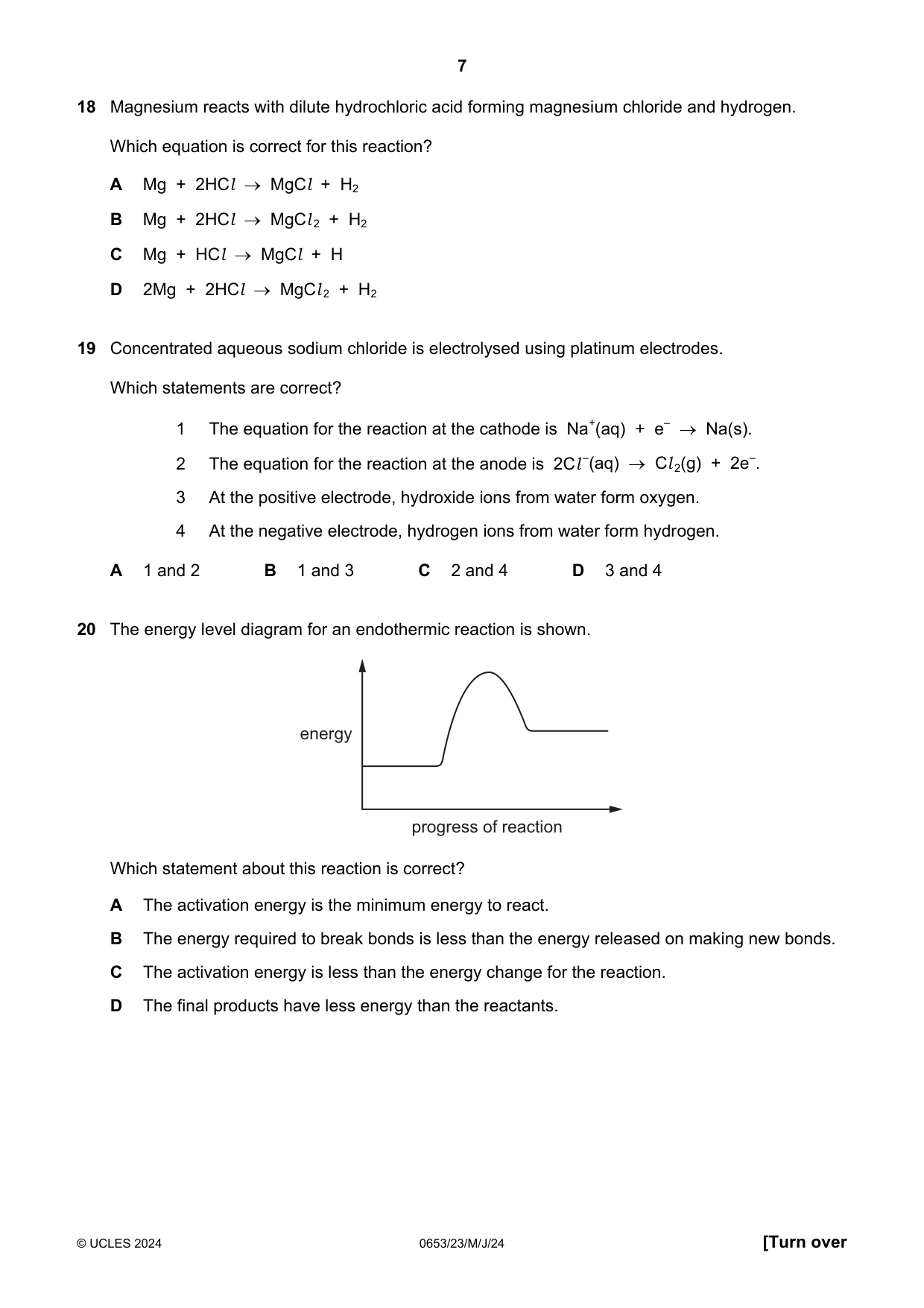
18 Magnesium reacts with dilute hydrochloric acid forming magnesium chloride and hydrogen. Which equation is correct for this reaction? A Mg + 2HCl MgCl + H2 B Mg + 2HCl MgCl 2 + H2 C Mg + HCl MgCl + H D 2Mg + 2HCl MgCl 2 + H2
Mark scheme: B
Q19 · Concentrated aqueous sodium chloride is electrolysed using platinum electrodes
19 Concentrated aqueous sodium chloride is electrolysed using platinum electrodes. Which statements are correct? 1 The equation for the reaction at the cathode is Na+(aq) + e– Na(s). 2 The equation for the reaction at the anode is 2Cl –(aq) Cl 2(g) + 2e–. 3 At the positive electrode, hydroxide ions from water form oxygen. 4 At the negative electrode, hydrogen ions from water form hydrogen. A 1 and 2 B 1 and 3 C 2 and 4 D 3 and 4
Mark scheme: C
Q20 · The energy level diagram for an endothermic reaction is shown
20 The energy level diagram for an endothermic reaction is shown. energy progress of reaction Which statement about this reaction is correct? A The activation energy is the minimum energy to react. B The energy required to break bonds is less than the energy released on making new bonds. C The activation energy is less than the energy change for the reaction. D The final products have less energy than the reactants.
Mark scheme: A
Q21 · Magnesium is reacted with dilute hydrochloric acid
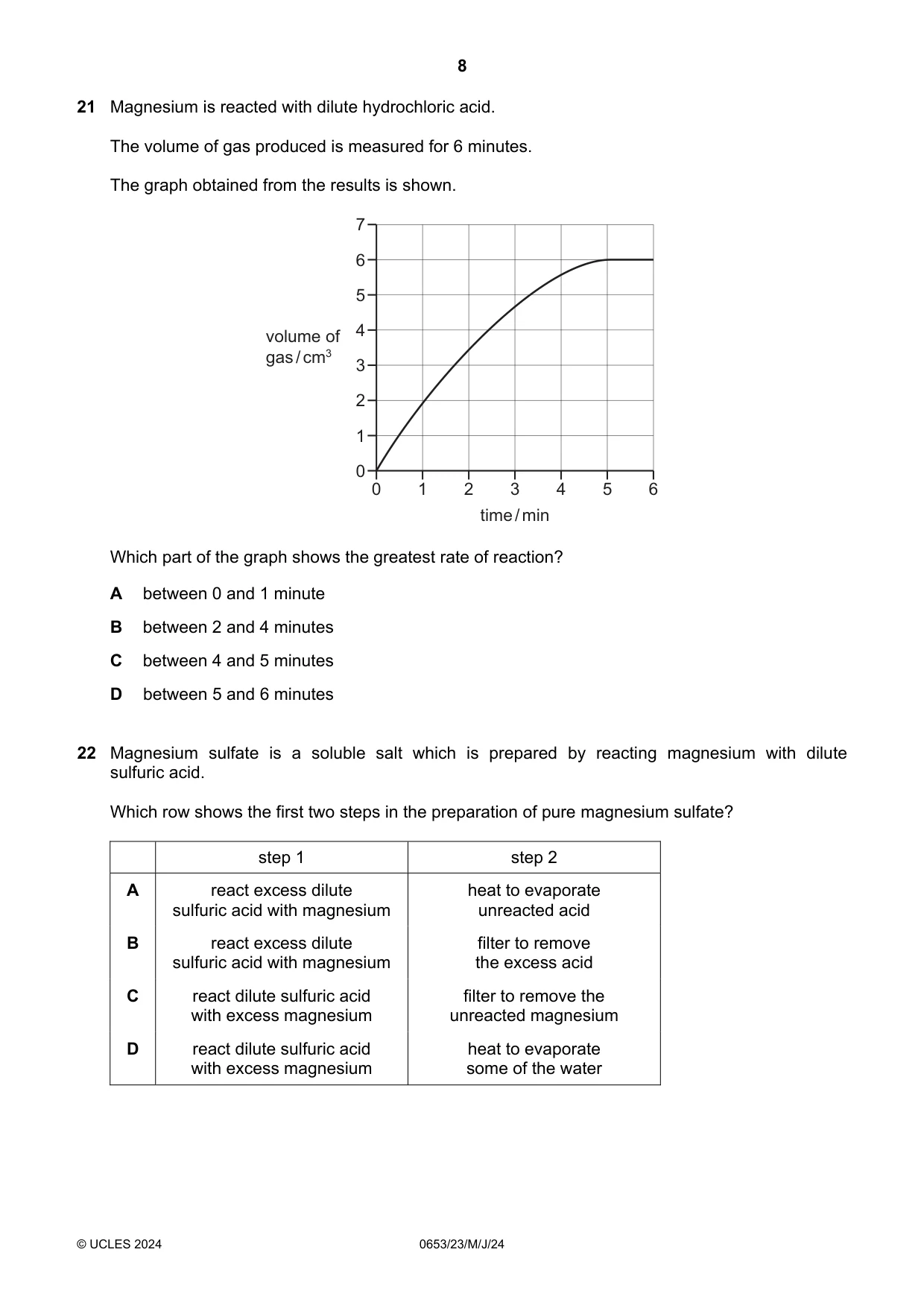
21 Magnesium is reacted with dilute hydrochloric acid. The volume of gas produced is measured for 6 minutes. The graph obtained from the results is shown. 7 6 5 volume of 4 gas / cm3 3 2 1 0 0 1 2 3 4 5 6 time / min Which part of the graph shows the greatest rate of reaction? A between 0 and 1 minute B between 2 and 4 minutes C between 4 and 5 minutes D between 5 and 6 minutes
Mark scheme: A
Q22 · Magnesium sulfate is a soluble salt which is prepared by reacting magnesium with dilute…
22 Magnesium sulfate is a soluble salt which is prepared by reacting magnesium with dilute sulfuric acid. Which row shows the first two steps in the preparation of pure magnesium sulfate? step 1 step 2 A react excess dilute heat to evaporate sulfuric acid with magnesium unreacted acid B react excess dilute filter to remove sulfuric acid with magnesium the excess acid C react dilute sulfuric acid filter to remove the with excess magnesium unreacted magnesium D react dilute sulfuric acid heat to evaporate with excess magnesium some of the water
Mark scheme: C
Q23 · What is the test for nitrate ions?
23 What is the test for nitrate ions? A add aqueous sodium hydroxide, then aluminum foil, and warm, test any gas formed with damp red litmus paper B acidify, then add aqueous barium chloride C acidify, then add aqueous silver nitrate D add dilute hydrochloric acid, test any gas produced with limewater
Mark scheme: A
Q24 · Which equation represents a displacement reaction of the elements in Group VII of the…
24 Which equation represents a displacement reaction of the elements in Group VII of the Periodic Table? A Br2 + 2NaCl 2NaBr + Cl 2 B Cl 2 + 2NaI 2NaCl + I2 C I2 + 2NaCl 2NaI + Cl 2 D I2 + 2NaBr 2NaI + Br2
Mark scheme: B
Q25 · Which statement about the reactivity of metals is correct?
25 Which statement about the reactivity of metals is correct? A Sodium is very reactive because its atoms attract electrons very strongly. B Aluminium is more reactive than magnesium because aluminium forms 3+ ions but magnesium forms 2+ ions. C Calcium is a reactive metal because it forms very strong covalent bonds with other elements. D Copper is less reactive than magnesium because magnesium has a greater tendency to form positive ions.
Mark scheme: D
Q26 · Which substance reduces iron(III) oxide in the blast furnace?
26 Which substance reduces iron(III) oxide in the blast furnace? A carbon dioxide B carbon monoxide C limestone (calcium carbonate) D oxygen
Mark scheme: B
Q27 · Which statements describe the molecules within a single fraction obtained from petroleum?
27 Which statements describe the molecules within a single fraction obtained from petroleum? 1 They are unsaturated hydrocarbons. 2 They have very different numbers of carbon atoms. 3 They have similar boiling points. 4 They react with other chemicals in a similar way. A 1 and 2 B 1 and 3 C 2 and 4 D 3 and 4
Mark scheme: D
Q28 · The distance–time graph is for a student walking across a park
28 The distance–time graph is for a student walking across a park. 50 distance / m 40 30 20 10 0 0 5 10 15 20 time / s What is the student’s average speed walking across the park? A 2.0 m / s B 2.5 m / s C 3.0 m / s D 4.0 m / s
Mark scheme: B
Q29 · The gravitational field strength is 10 N / kg
29 The gravitational field strength is 10 N / kg. What is the mass of an object that has a weight of 5.0 N? A 0.50 kg B 2.0 kg C 5.0 kg D 50 kg
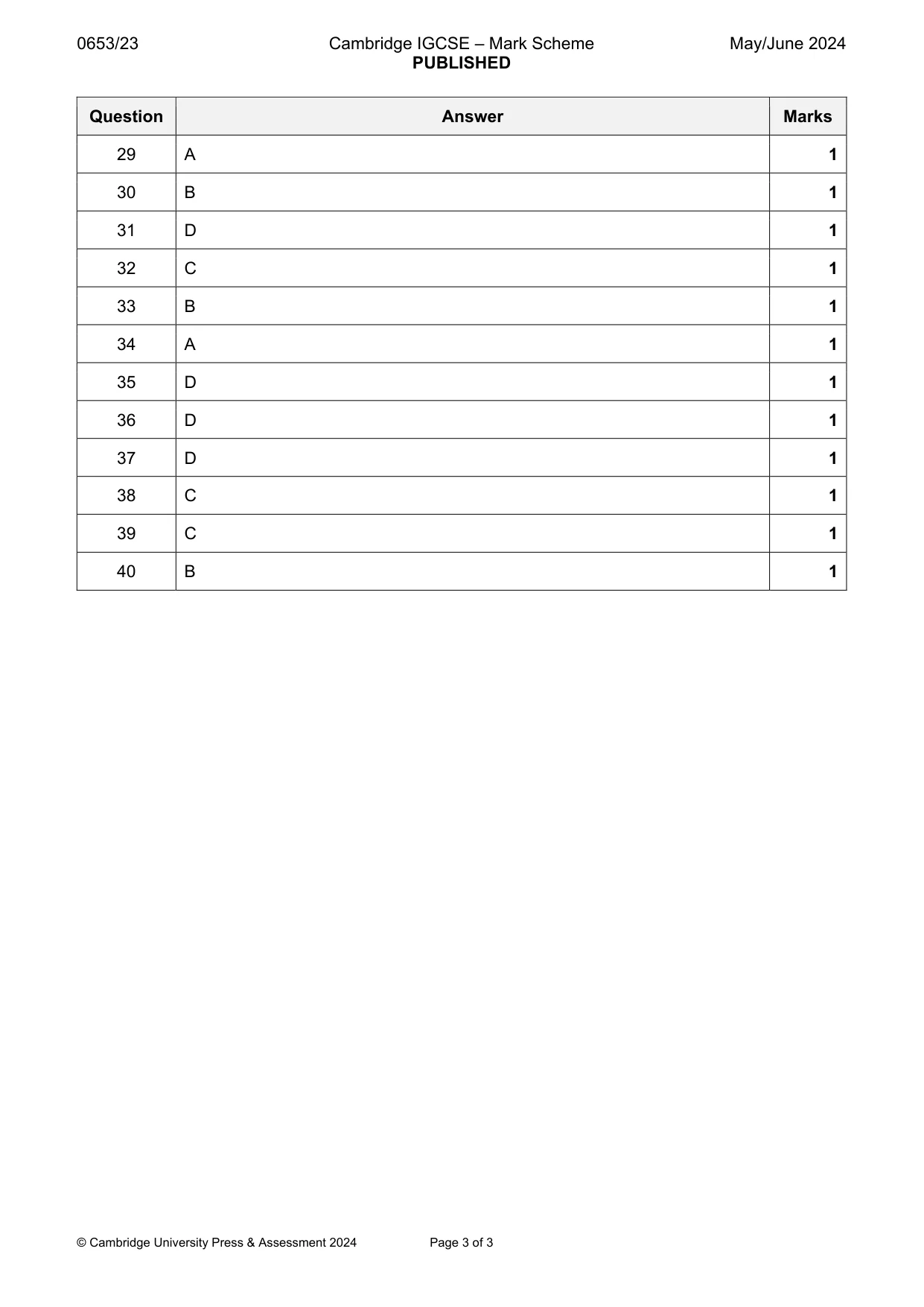
Mark scheme: A
Q30 · A wire is stretched by a force
30 A wire is stretched by a force. A force–extension graph is produced. What is the significance of the extension at the limit of proportionality on the graph? A It is the maximum extension before the wire breaks. B It is the maximum extension for which Hooke’s law is obeyed. C It is the minimum extension before the wire breaks. D It is the minimum extension for which Hooke’s law is obeyed.
Mark scheme: B
Q31 · A worker exerts a horizontal force on a trolley
31 A worker exerts a horizontal force on a trolley. The trolley moves in a straight line along a horizontal surface. The worker pushes the trolley forwards for 5.0 m and then pulls it backwards for 2.0 m. The worker exerts a force of 200 N when pushing and when pulling. How much work does the worker do on the trolley? A 400 J B 600 J C 1000 J D 1400 J
Mark scheme: D
Q32 · A stone of mass 0.30 kg is thrown upwards with an initial speed of 12 m / s
32 A stone of mass 0.30 kg is thrown upwards with an initial speed of 12 m / s. The speed of the stone decreases as the stone rises. By how much does the kinetic energy decrease when the stone reaches 4.0 m / s? A 2.4 J B 9.6 J C 19 J D 38 J
Mark scheme: C
Q33 · Which statement describes one way in which solids conduct thermal energy?
33 Which statement describes one way in which solids conduct thermal energy? A Electrons are tightly packed so that vibrations pass from one electron to the next. B Molecules are tightly packed so that vibrations pass from one molecule to the next. C Solids contain free molecules that are able to move through the solid. D Solids contain molecules that are arranged in a regular structure so that thermal energy can pass through the spaces between them.
Mark scheme: B
Q34 · The diagram shows two identical thermometers, initially at the same temperature, placed…
34 The diagram shows two identical thermometers, initially at the same temperature, placed in bright sunshine. The bulb of thermometer P is painted black. The bulb of thermometer Q is painted white. rays from the Sun thermometer P thermometer Q black white The readings on the thermometers increase by different amounts. How are the thermometer readings different and why? A The reading on P is greater than on Q because black surfaces are good absorbers of radiation. B The reading on P is greater than on Q because black surfaces are poor emitters of radiation. C The reading on P is smaller than on Q because black surfaces are good emitters of radiation. D The reading on P is smaller than on Q because black surfaces are poor absorbers of radiation.
Mark scheme: A
Q35 · A converging lens is used as a magnifying glass
35 A converging lens is used as a magnifying glass. Where is the image formed and what is the nature of the image? position of image nature A on the opposite side of the lens from the object real B on the opposite side of the lens from the object virtual C on the same side of the lens as the object real D on the same side of the lens as the object virtual
Mark scheme: D
Q36 · A telescope in the vacuum of space has an infrared detector, an ultraviolet detector and…
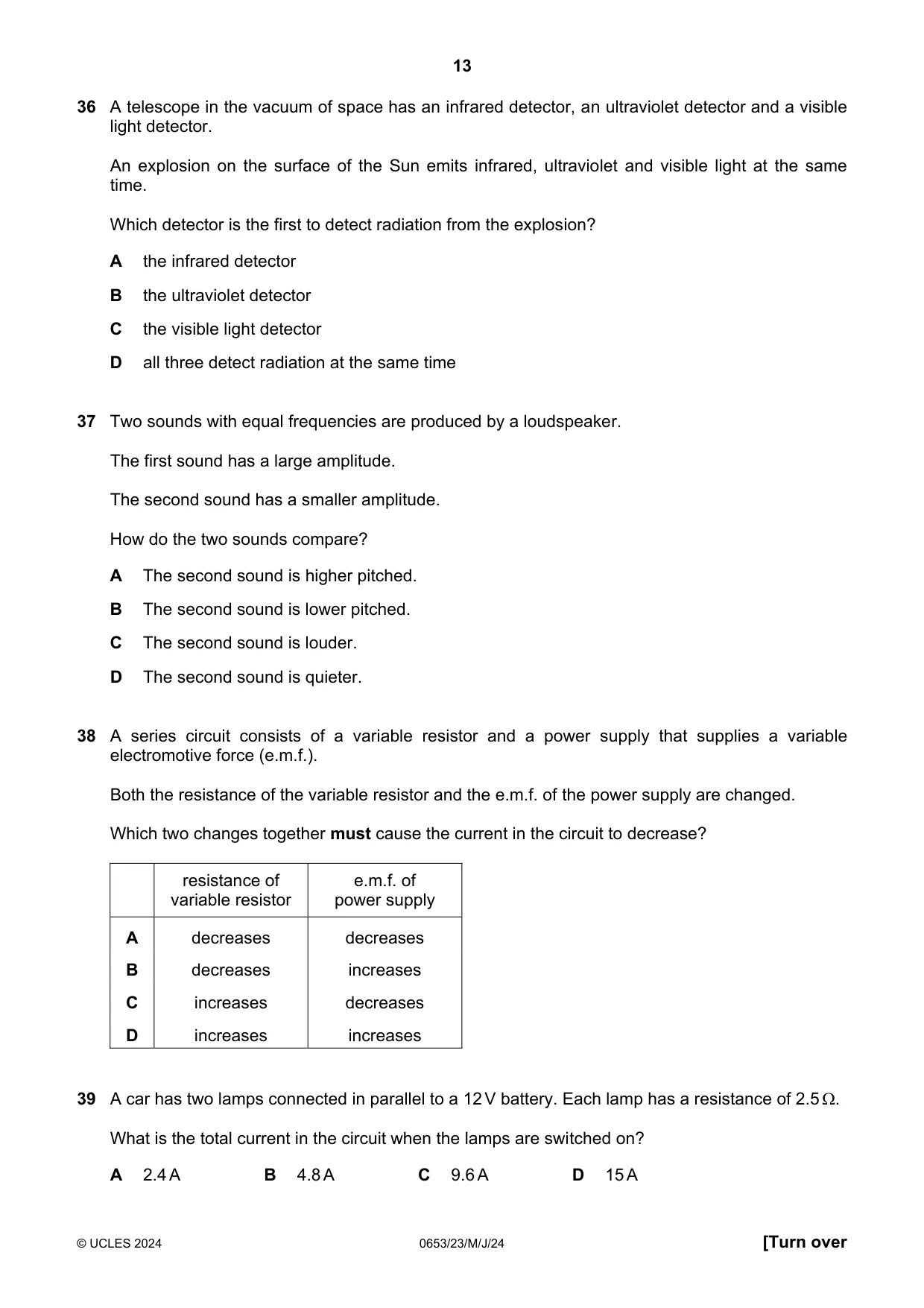
36 A telescope in the vacuum of space has an infrared detector, an ultraviolet detector and a visible light detector. An explosion on the surface of the Sun emits infrared, ultraviolet and visible light at the same time. Which detector is the first to detect radiation from the explosion? A the infrared detector B the ultraviolet detector C the visible light detector D all three detect radiation at the same time
Mark scheme: D
Q37 · Two sounds with equal frequencies are produced by a loudspeaker
37 Two sounds with equal frequencies are produced by a loudspeaker. The first sound has a large amplitude. The second sound has a smaller amplitude. How do the two sounds compare? A The second sound is higher pitched. B The second sound is lower pitched. C The second sound is louder. D The second sound is quieter.
Mark scheme: D
Q38 · A series circuit consists of a variable resistor and a power supply that supplies a…
38 A series circuit consists of a variable resistor and a power supply that supplies a variable electromotive force (e.m.f.). Both the resistance of the variable resistor and the e.m.f. of the power supply are changed. Which two changes together must cause the current in the circuit to decrease? resistance of e.m.f. of variable resistor power supply A decreases decreases B decreases increases C increases decreases D increases increases
Mark scheme: C
Q39 · A car has two lamps connected in parallel to a 12 V battery
39 A car has two lamps connected in parallel to a 12 V battery. Each lamp has a resistance of 2.5 . What is the total current in the circuit when the lamps are switched on? A 2.4 A B 4.8 A C 9.6 A D 15 A
Mark scheme: C
Q40 · What is the relationship between energy E transferred in a component, current I through…
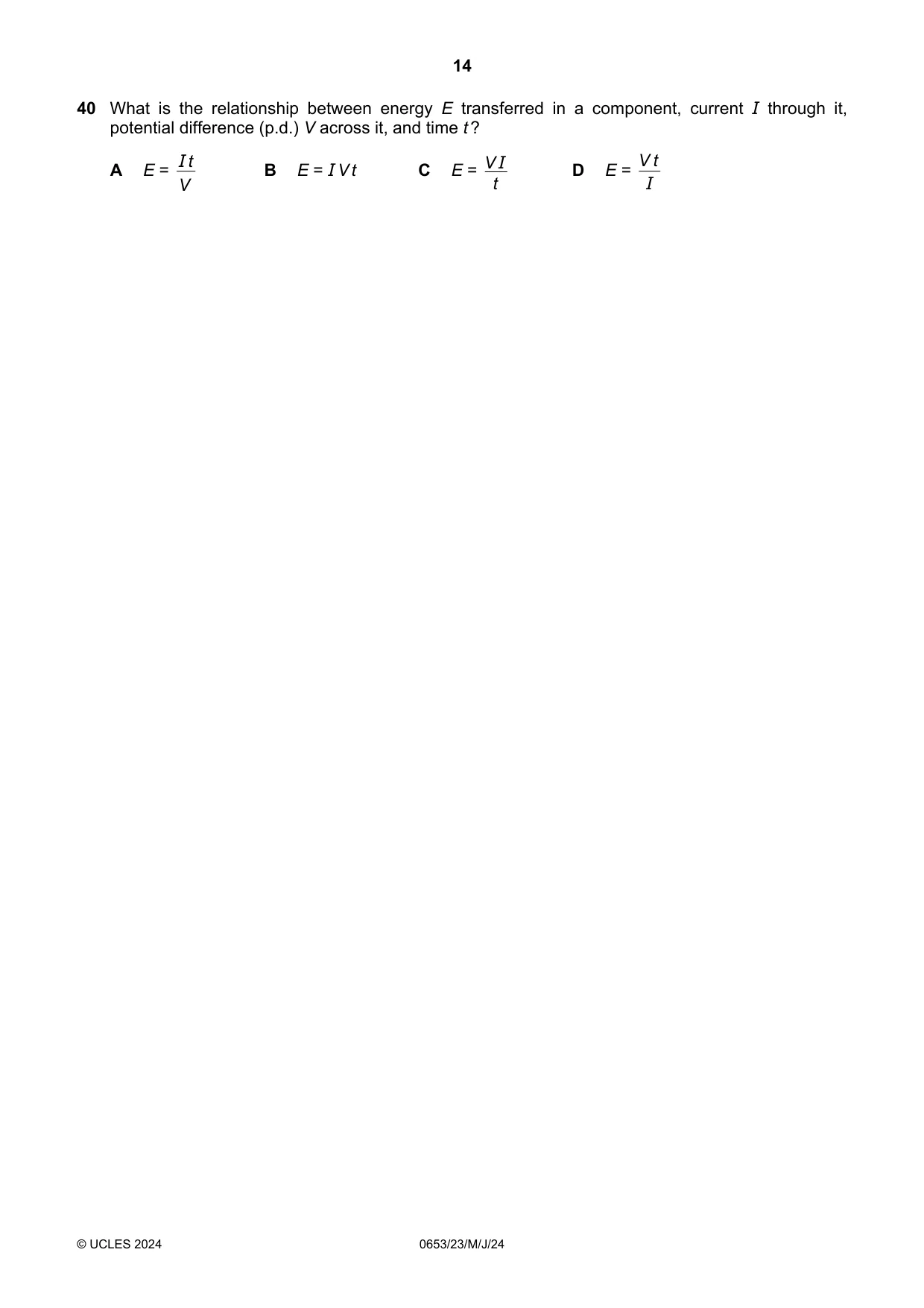
40 What is the relationship between energy E transferred in a component, current I through it, potential difference (p.d.) V across it, and time t ? t I E = V I V t A E = B E = I V t C D E = I V t
Mark scheme: B
What was in this paper
The subtopics covered by these 40 questions, and how many questions each got. Open one in a new tab to see every Cambridge question on it.
3Electrical circuits2Photosynthesis2Transfer of thermal energy2Biological molecules1Characteristics of living organisms1Digestive system1Diseases and immunity1Electrolysis1Electromagnetic spectrum1Elements, compounds and mixtures1Exothermic and endothermic reactions1Extraction of metals1Forces1Formulas1Gas exchange in humans1Group VII properties1Habitat destruction1Heart1Identification of ions and gases1Light1Mass and weight1Motion1Osmosis1Preparation of salts1Rate of reaction1Reactivity series1Respiration1Separation and purification1Sexual reproduction in plants1Simple molecules and covalent bonds1Solids, liquids and gases1Sound1Terminology1Transpiration1What you needed in this session
Cambridge’s own grade thresholds for 2024 May/June, Paper 2 · Variant 3. A higher threshold means an easier paper — the bar moves with how the cohort did.