Questions as text
Q1 · A radiation detector is placed near a sample of radioactive material and is used to… 0653/11 Oct/Nov 2005
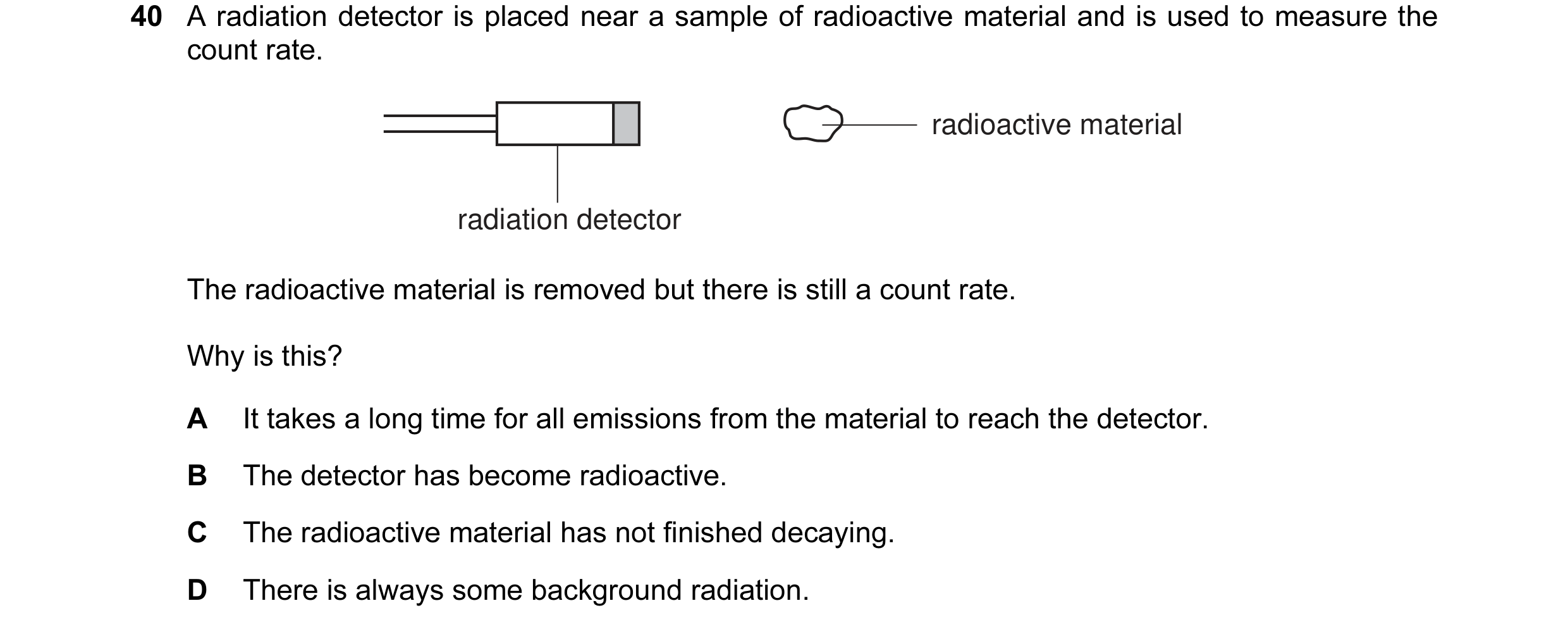
40 A radiation detector is placed near a sample of radioactive material and is used to measure the count rate. radioactive material radiation detector The radioactive material is removed but there is still a count rate. Why is this? A It takes a long time for all emissions from the material to reach the detector. B The detector has become radioactive. C The radioactive material has not finished decaying. D There is always some background radiation.
1 marks
Answer: D
This question in 0653/11 Oct/Nov 2005
Q2 · The diagram represents an atom 0653/11 May/June 2006
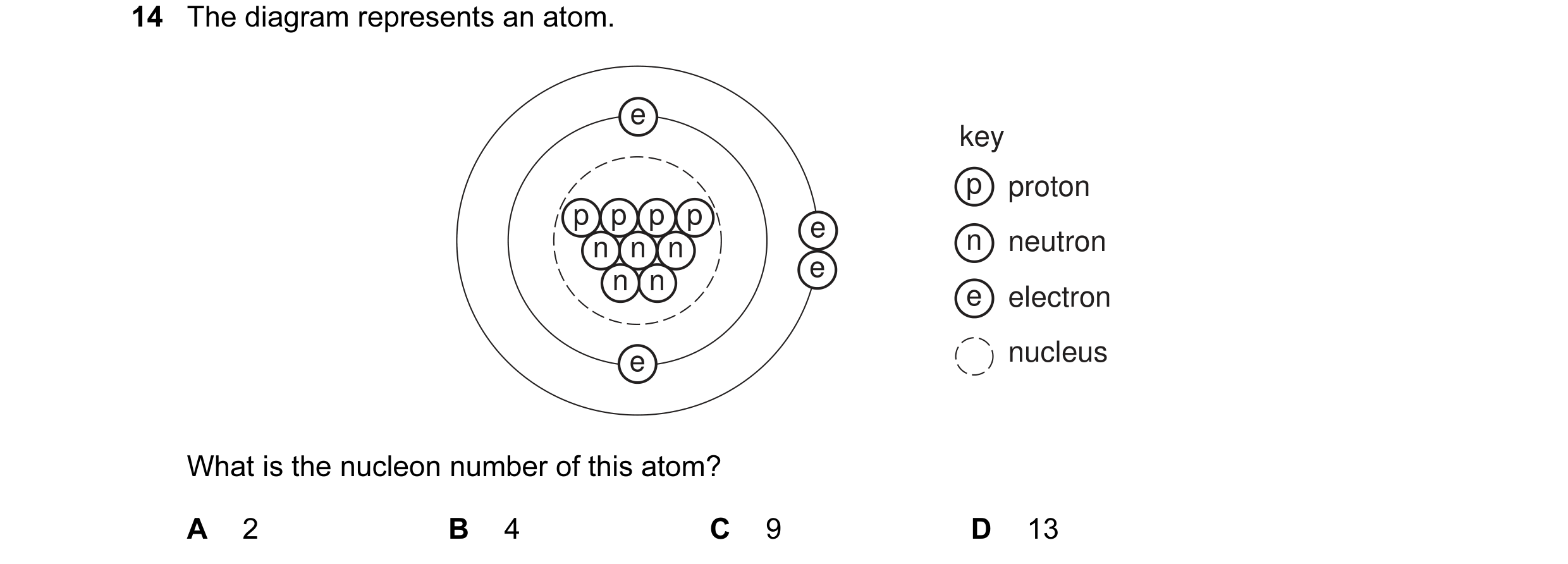
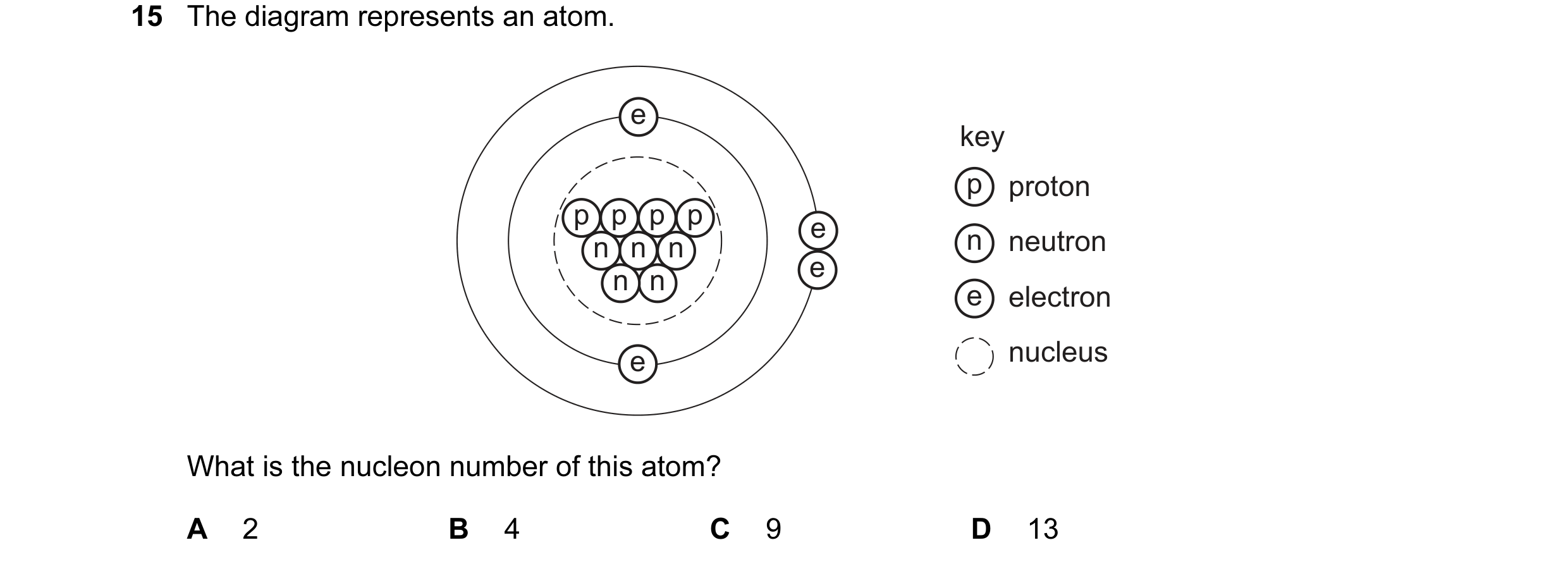
14 The diagram represents an atom. e key p proton p p p p e n n n n neutron e n n e electron e nucleus What is the nucleon number of this atom? A 2 B 4 C 9 D 13
1 marks
Answer: C
This question in 0653/11 May/June 2006
Q3 · Atoms of four different elements are shown 0653/11 Oct/Nov 2006
15 Atoms of four different elements are shown. Which atom contains six neutrons? A 4 He B 6 iL C 11 B D 14 C 2 3 5 6
1 marks
Answer: C
This question in 0653/11 Oct/Nov 2006
Q4 · Which property of an element cannot be predicted from its position in the Periodic Table? 0653/11 Oct/Nov 2006
17 Which property of an element cannot be predicted from its position in the Periodic Table? A the charge on its ion B the melting point of the element C the metallic / non-metallic character of the element D the number of protons in its nucleus
1 marks
Answer: B
This question in 0653/11 Oct/Nov 2006
Q5 · The diagram shows some elements in Groups Ill, IV and V of the Periodic Table 0653/11 Oct/Nov 2006
18 The diagram shows some elements in Groups Ill, IV and V of the Periodic Table.
III IV V
Al Si
Ga Ge As
In Sn Sb
Tl Pb Bi
Which two elements would be expected to form an oxide of the type XO2?
0 0O WwW >
In and Sn
x «KX
Sn and Pb
x < x
1 marks
Answer: C
This question in 0653/11 Oct/Nov 2006
Q6 · The symbols, nucleon numbers and proton numbers of three elements are shown 0653/11 May/June 2007
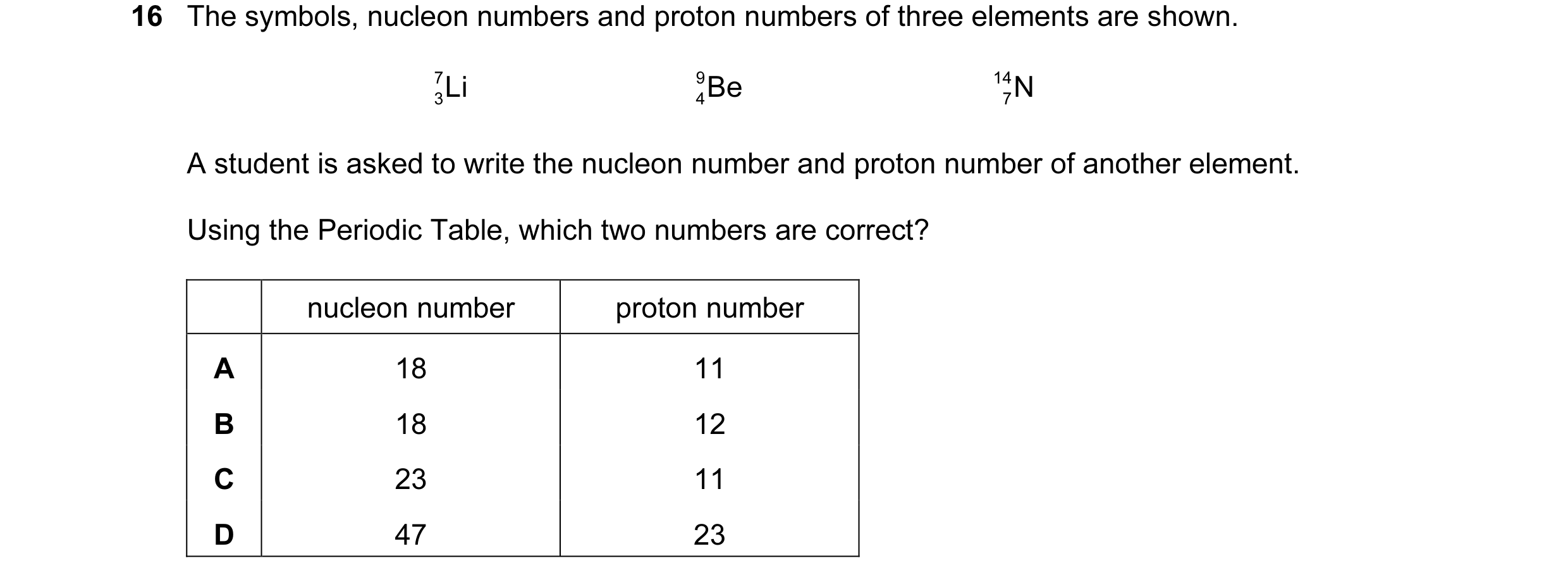
16 The symbols, nucleon numbers and proton numbers of three elements are shown. 7 3Li 9 4Be 14 7N A student is asked to write the nucleon number and proton number of another element. Using the Periodic Table, which two numbers are correct? nucleon number proton number A 18 11 B 18 12 C 23 11 D 47 23
1 marks
Answer: C
This question in 0653/11 May/June 2007
Q7 · Why are noble gases unreactive? 0653/11 May/June 2007
17 Why are noble gases unreactive? A They have a complete outer shell of electrons. B They have an even number of electrons. C They have an even number of shells of electrons. D They have two electrons in the first shell.
1 marks
Answer: A
This question in 0653/11 May/June 2007
Q8 · The numbers of neutrons and protons present in the nuclei of four atoms are shown 0653/11 May/June 2008
16 The numbers of neutrons and protons present in the nuclei of four atoms are shown. number of number of atom neutrons protons 1 11 12 2 12 11 3 13 13 4 13 11 Which two atoms are of the same element? A 1 and 2 B 2 and 3 C 2 and 4 D 3 and 4
1 marks
Answer: C
This question in 0653/11 May/June 2008
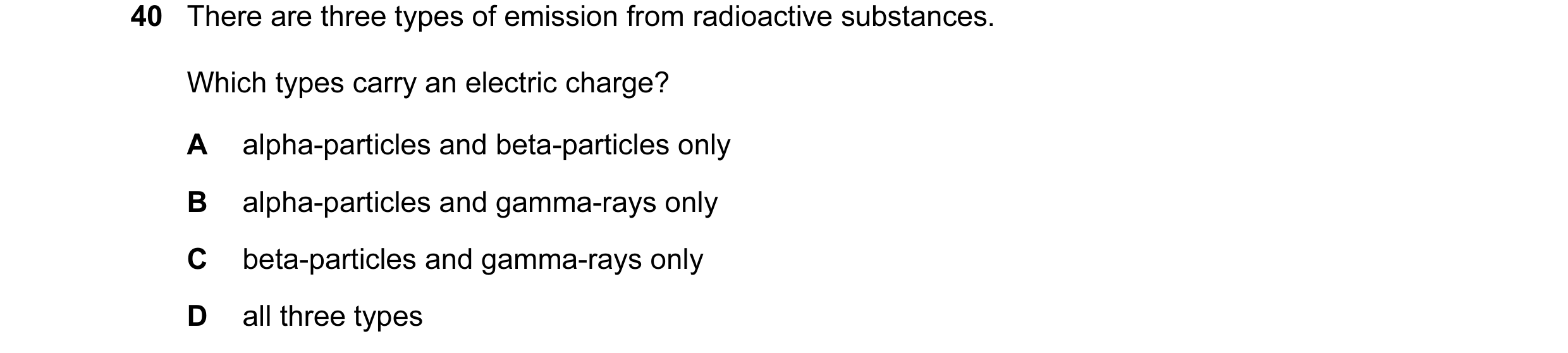
Q9 · There are three types of emission from radioactive substances 0653/11 May/June 2008
40 There are three types of emission from radioactive substances. Which types carry an electric charge? A alpha-particles and beta-particles only B alpha-particles and gamma-rays only C beta-particles and gamma-rays only D all three types
1 marks
Answer: A
This question in 0653/11 May/June 2008
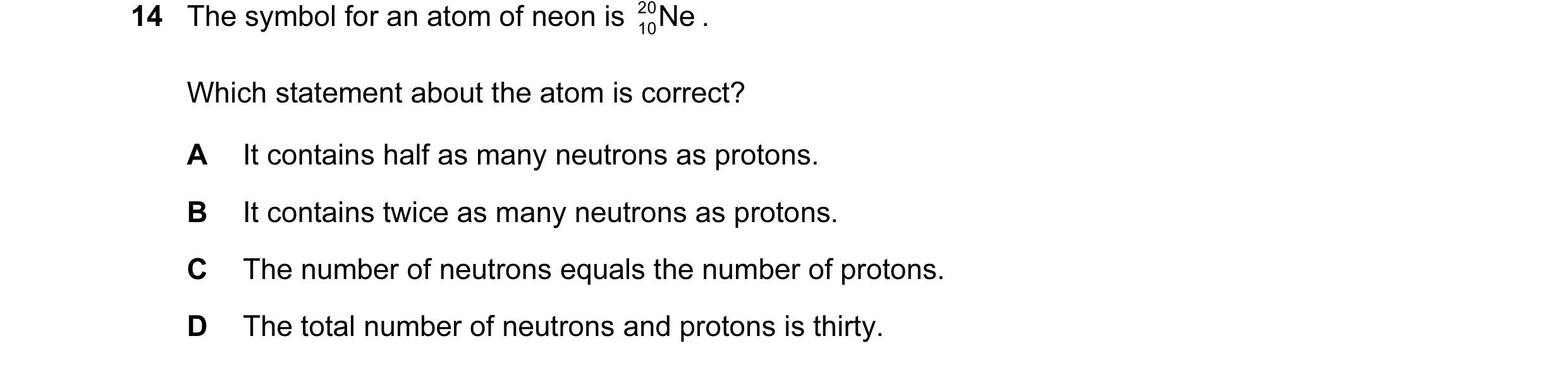
Q10 · The symbol for an atom of neon is 20 10Ne 0653/11 Oct/Nov 2008
14 The symbol for an atom of neon is 20 10Ne . Which statement about the atom is correct? A It contains half as many neutrons as protons. B It contains twice as many neutrons as protons. C The number of neutrons equals the number of protons. D The total number of neutrons and protons is thirty.
1 marks
Answer: C
This question in 0653/11 Oct/Nov 2008
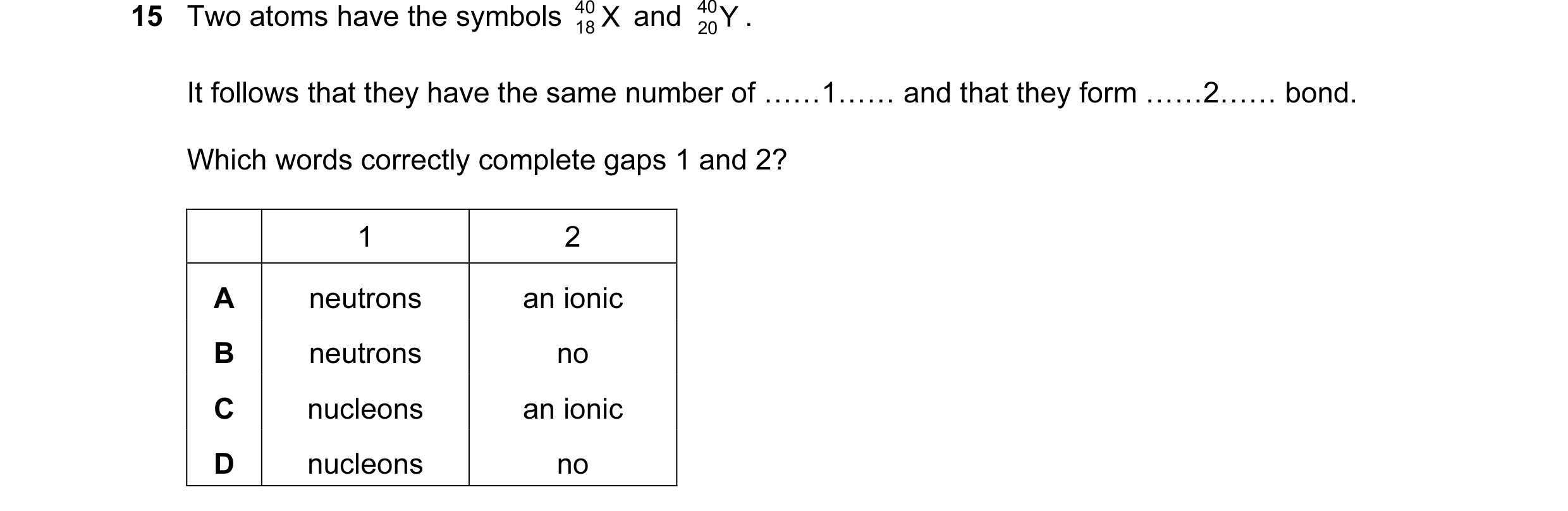
Q11 · Two atoms have the symbols 40 X and 40 Y 0653/11 May/June 2009
15 Two atoms have the symbols 40 X and 40 Y . 18 20 It follows that they have the same number of ……1…… and that they form ……2…… bond. Which words correctly complete gaps 1 and 2? 1 2 A neutrons an ionic B neutrons no C nucleons an ionic D nucleons no
1 marks
Answer: D
This question in 0653/11 May/June 2009
Q12 · Which row in the table describes alpha-particles? 0653/11 Oct/Nov 2010
40 Which row in the table describes alpha-particles? penetrates 1 cm electric charge of aluminium? A negative yes B negative no C positive yes D positive no
1 marks
Answer: D
This question in 0653/11 Oct/Nov 2010
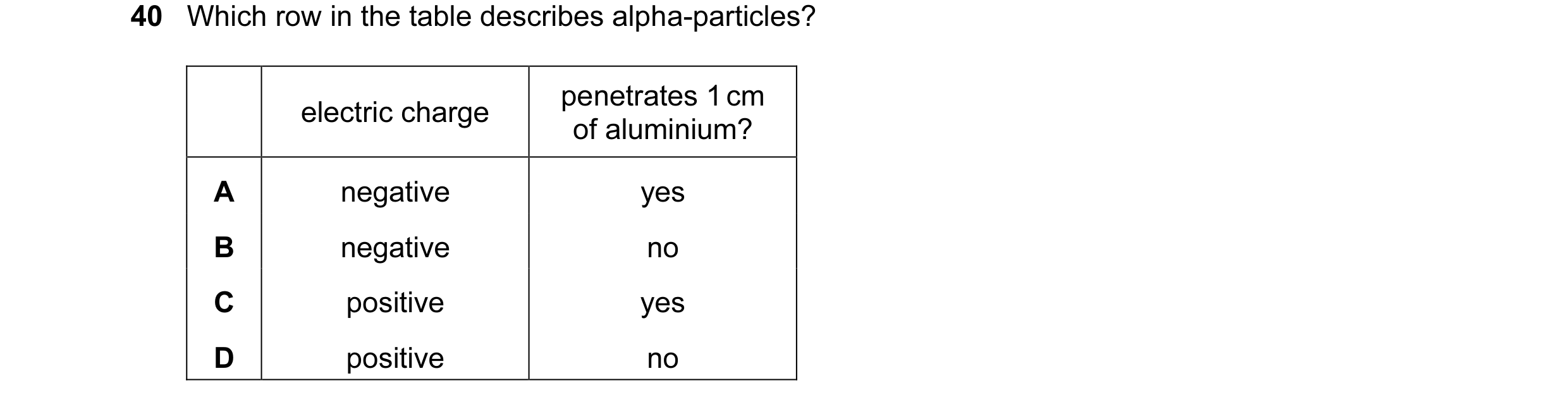
Q13 · Which row in the table describes alpha-particles? 0653/13 Oct/Nov 2010
40 Which row in the table describes alpha-particles? penetrates 1 cm electric charge of aluminium? A negative yes B negative no C positive yes D positive no
1 marks
Answer: D
This question in 0653/13 Oct/Nov 2010
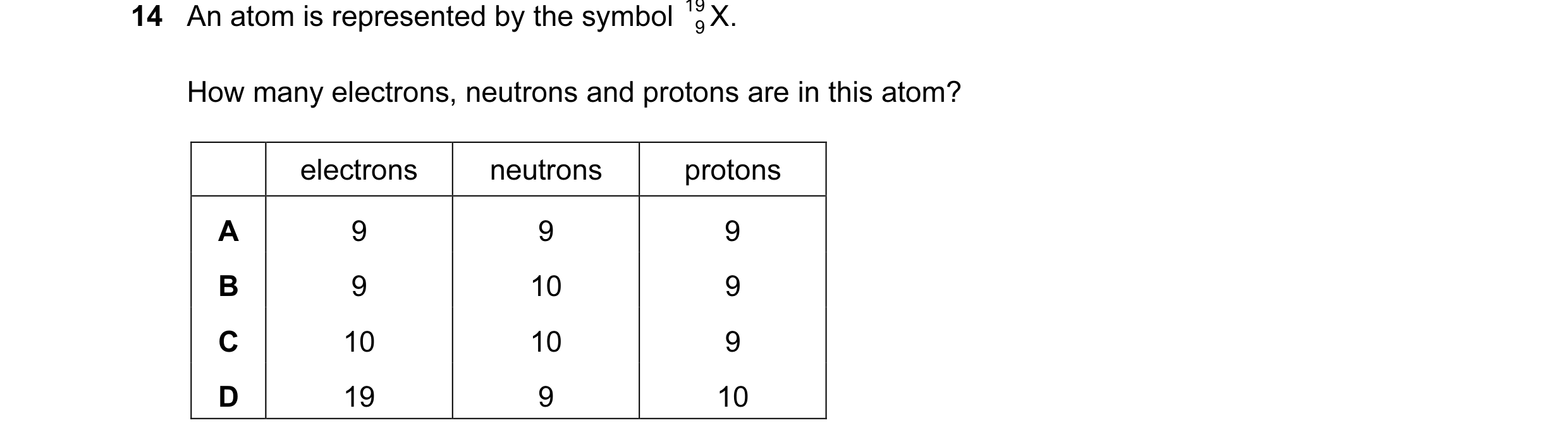
Q14 · An atom is represented by the symbol 19 9 X 0653/11 May/June 2011
14 An atom is represented by the symbol 19 9 X. How many electrons, neutrons and protons are in this atom? electrons neutrons protons A 9 9 9 B 9 10 9 C 10 10 9 D 19 9 10
1 marks
Answer: B
This question in 0653/11 May/June 2011
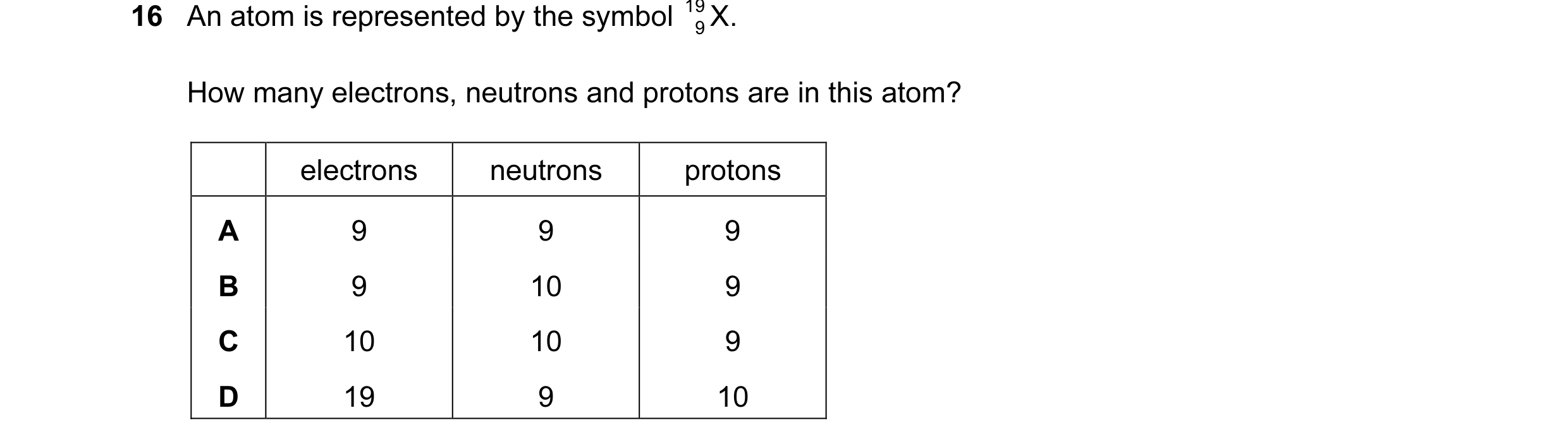
Q15 · An atom is represented by the symbol 19 9 X 0653/12 May/June 2011
16 An atom is represented by the symbol 19 9 X. How many electrons, neutrons and protons are in this atom? electrons neutrons protons A 9 9 9 B 9 10 9 C 10 10 9 D 19 9 10
1 marks
Answer: B
This question in 0653/12 May/June 2011
Q16 · Element X has a nucleon number of 40 0653/11 Oct/Nov 2011
14 Element X has a nucleon number of 40. The electron arrangement of element X is 2,8,8. Which statements about element X are correct? 1 It has 40 neutrons in its nucleus. 2 It has 2 electrons in its outer shell. 3 It is unreactive. 4 It is in Group 0 of the Periodic Table. A 1 and 2 B 1 and 3 C 2 and 4 D 3 and 4
1 marks
Answer: D
This question in 0653/11 Oct/Nov 2011
Q17 · Element X has a nucleon number of 40 0653/12 Oct/Nov 2011
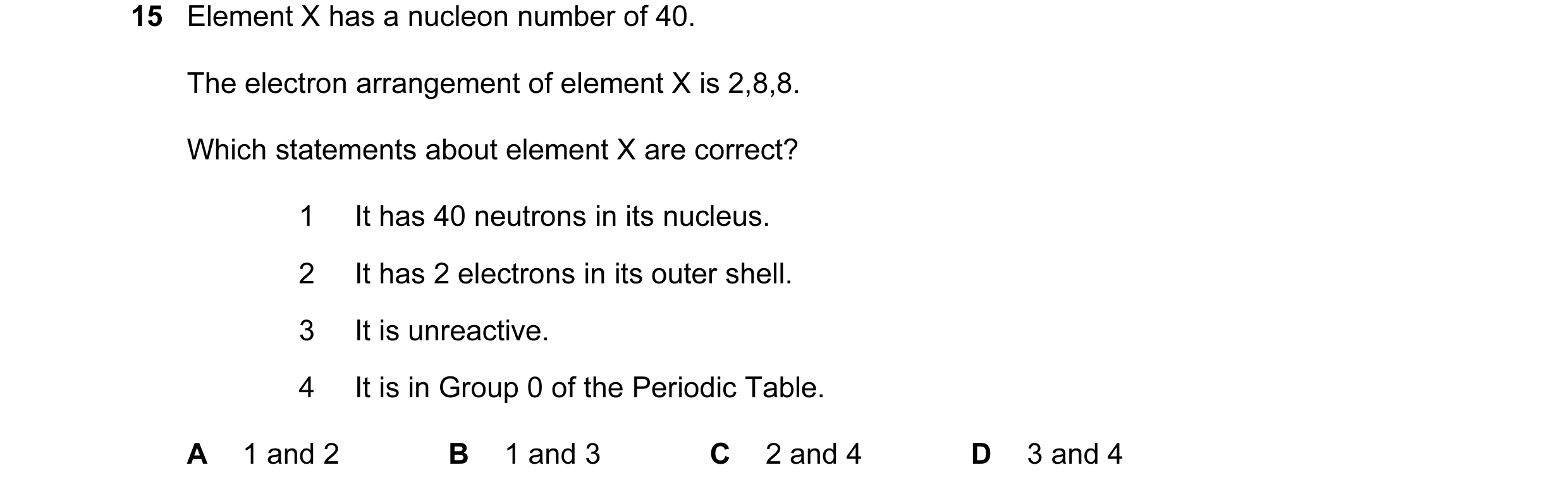
15 Element X has a nucleon number of 40. The electron arrangement of element X is 2,8,8. Which statements about element X are correct? 1 It has 40 neutrons in its nucleus. 2 It has 2 electrons in its outer shell. 3 It is unreactive. 4 It is in Group 0 of the Periodic Table. A 1 and 2 B 1 and 3 C 2 and 4 D 3 and 4
1 marks
Answer: D
This question in 0653/12 Oct/Nov 2011
Q18 · A soft metal reacts vigorously with cold water 0653/12 Oct/Nov 2011
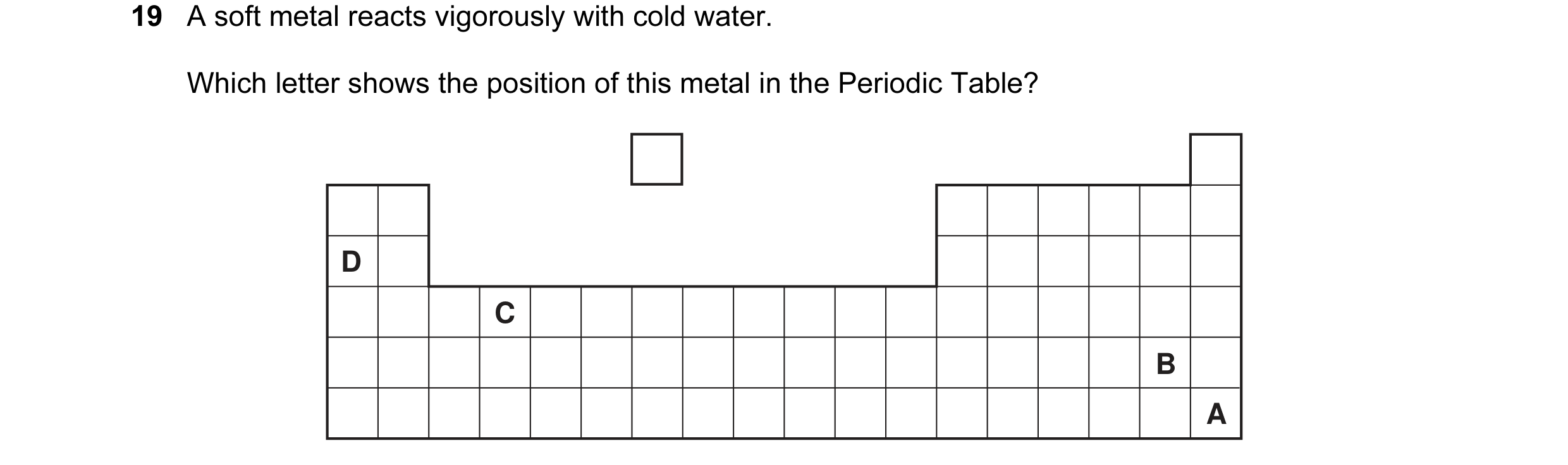
19 A soft metal reacts vigorously with cold water. Which letter shows the position of this metal in the Periodic Table? D C B A
1 marks
Answer: D
This question in 0653/12 Oct/Nov 2011
Q19 · Element X has a nucleon number of 40 0653/13 Oct/Nov 2011
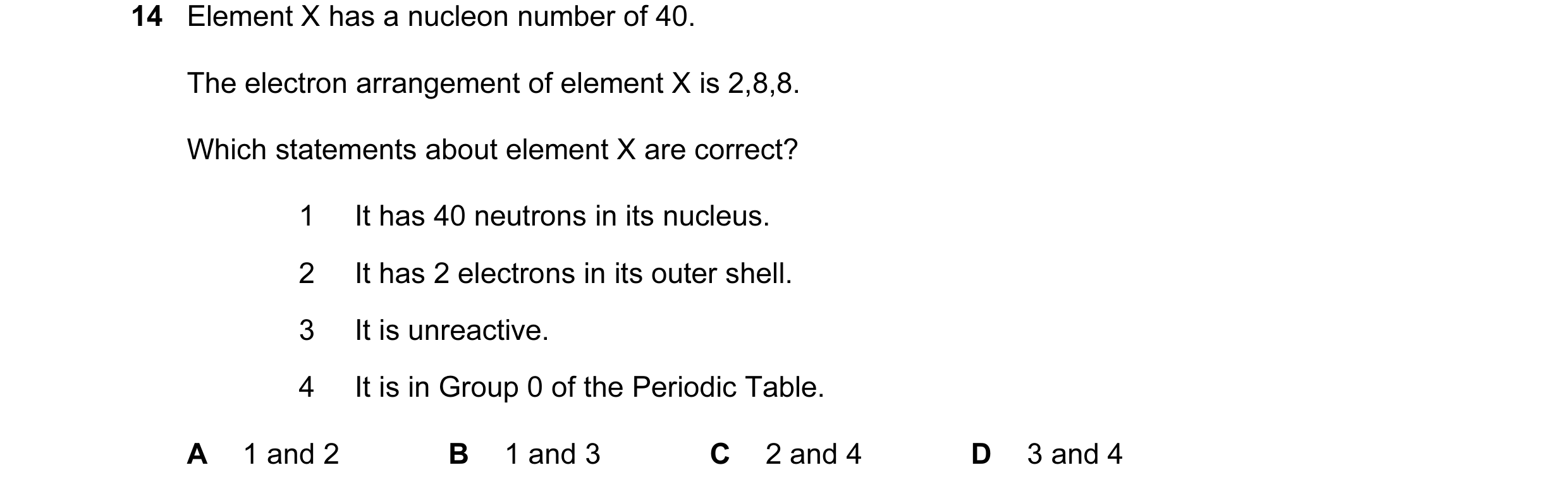
14 Element X has a nucleon number of 40. The electron arrangement of element X is 2,8,8. Which statements about element X are correct? 1 It has 40 neutrons in its nucleus. 2 It has 2 electrons in its outer shell. 3 It is unreactive. 4 It is in Group 0 of the Periodic Table. A 1 and 2 B 1 and 3 C 2 and 4 D 3 and 4
1 marks
Answer: D
This question in 0653/13 Oct/Nov 2011
Q20 · A soft metal reacts vigorously with cold water 0653/13 Oct/Nov 2011
20 A soft metal reacts vigorously with cold water. Which letter shows the position of this metal in the Periodic Table? D C B A
1 marks
Answer: D
This question in 0653/13 Oct/Nov 2011
Q21 · The diagram shows the electronic structure of an atom of element X 0653/12 May/June 2013
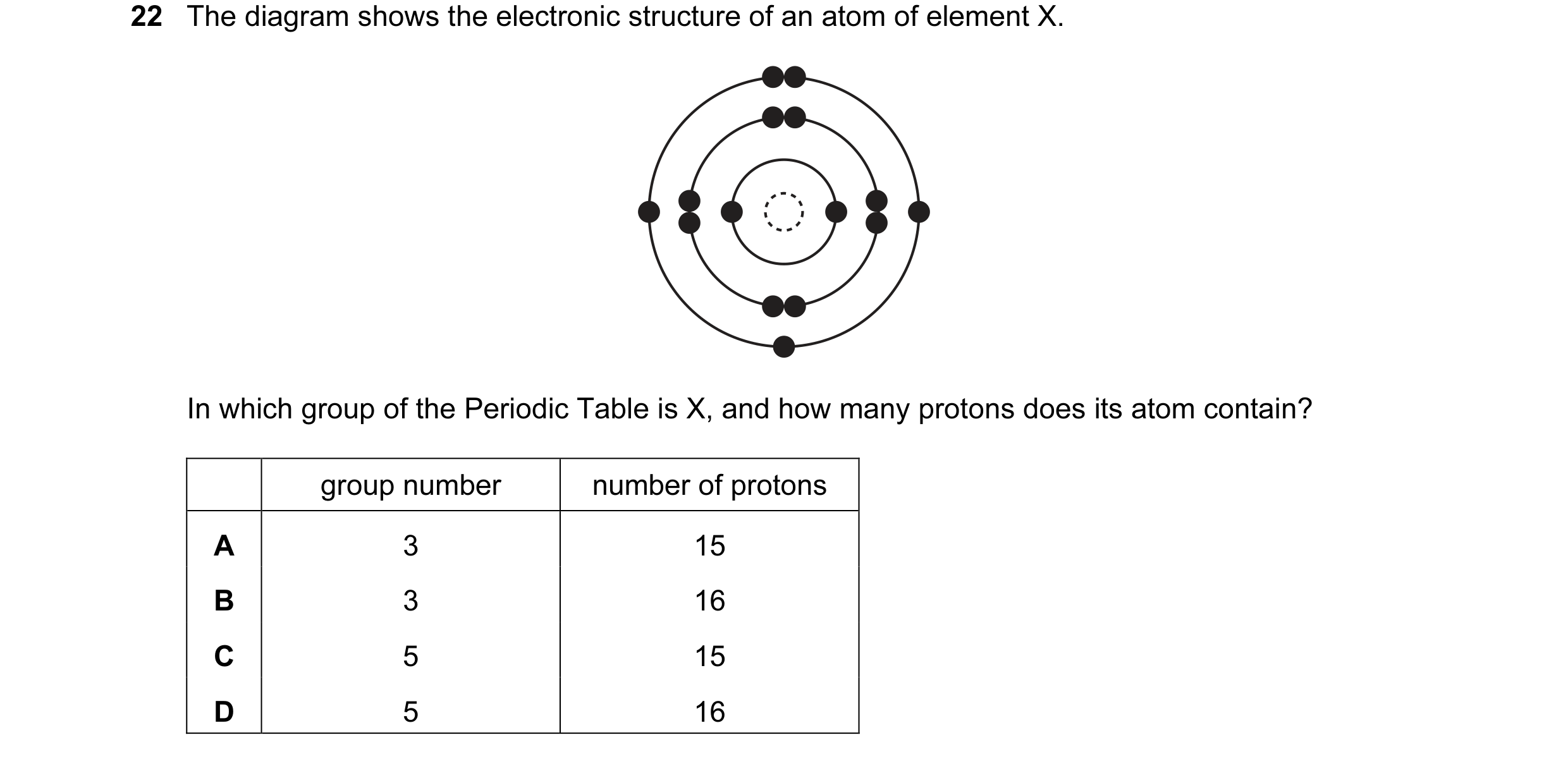
22 The diagram shows the electronic structure of an atom of element X. In which group of the Periodic Table is X, and how many protons does its atom contain? group number number of protons A 3 15 B 3 16 C 5 15 D 5 16
1 marks
Answer: C
This question in 0653/12 May/June 2013
Q22 · A sodium atom has a proton number of 11 and a nucleon number of 23 0653/13 Oct/Nov 2013
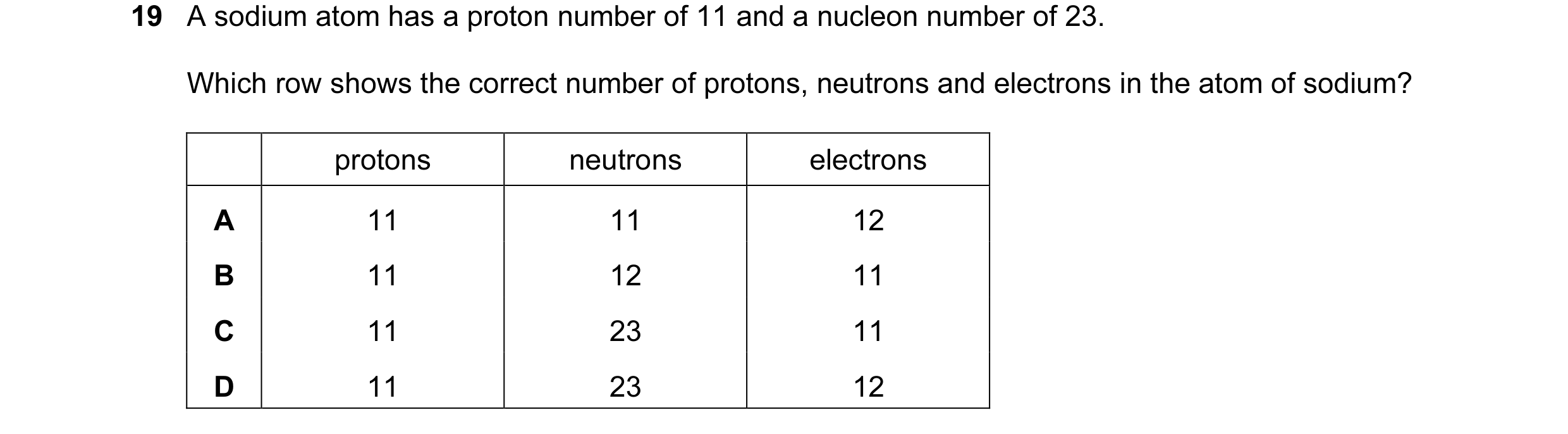
19 A sodium atom has a proton number of 11 and a nucleon number of 23. Which row shows the correct number of protons, neutrons and electrons in the atom of sodium? protons neutrons electrons A 11 11 12 B 11 12 11 C 11 23 11 D 11 23 12
1 marks
Answer: B
This question in 0653/13 Oct/Nov 2013
Q23 · The diagram represents an atom 0653/11 May/June 2014
16 The diagram represents an atom. e key p proton p p p p e n n n n neutron e n n e electron e nucleus What is the nucleon number of this atom? A 2 B 4 C 9 D 13
1 marks
Answer: C
This question in 0653/11 May/June 2014
Q24 · The diagram represents an atom 0653/12 May/June 2014
15 The diagram represents an atom. e key p proton p p p p e n n n n neutron e n n e electron e nucleus What is the nucleon number of this atom? A 2 B 4 C 9 D 13
1 marks
Answer: C
This question in 0653/12 May/June 2014
Q25 · An uncharged metal rod is held by an insulating handle 0653/12 May/June 2014
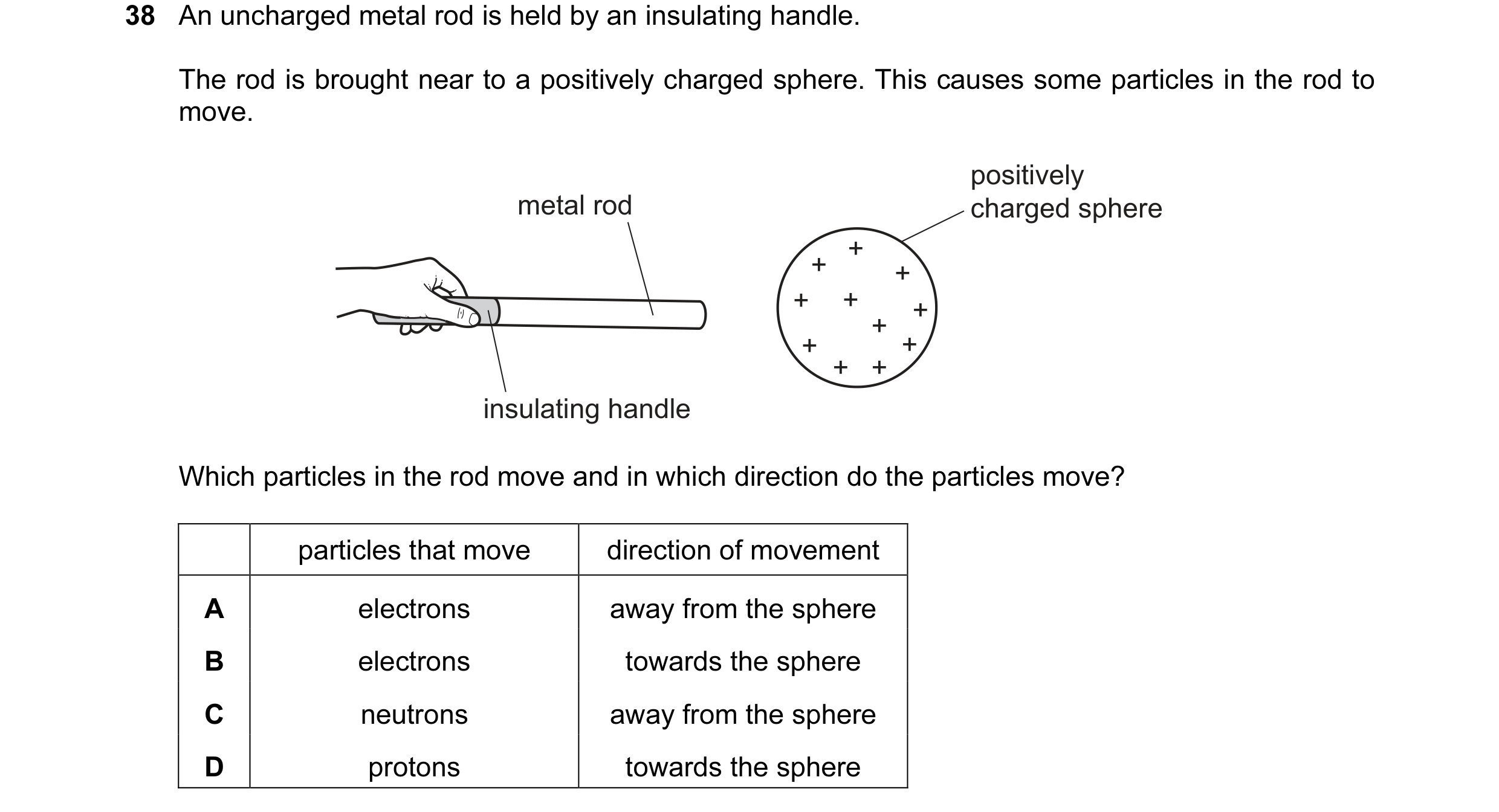
38 An uncharged metal rod is held by an insulating handle. The rod is brought near to a positively charged sphere. This causes some particles in the rod to move. positively metal rod charged sphere + + + + + + + + + + + insulating handle Which particles in the rod move and in which direction do the particles move? particles that move direction of movement A electrons away from the sphere B electrons towards the sphere C neutrons away from the sphere D protons towards the sphere
1 marks
Answer: B
This question in 0653/12 May/June 2014
Q26 · The diagram represents an atom 0653/13 May/June 2014
15 The diagram represents an atom. e key p proton p p p p e n n n n neutron e n n e electron e nucleus What is the nucleon number of this atom? A 2 B 4 C 9 D 13
1 marks
Answer: C
This question in 0653/13 May/June 2014
Q27 · Fluorine and chlorine are in Group VII of the Periodic Table 0653/11 May/June 2015
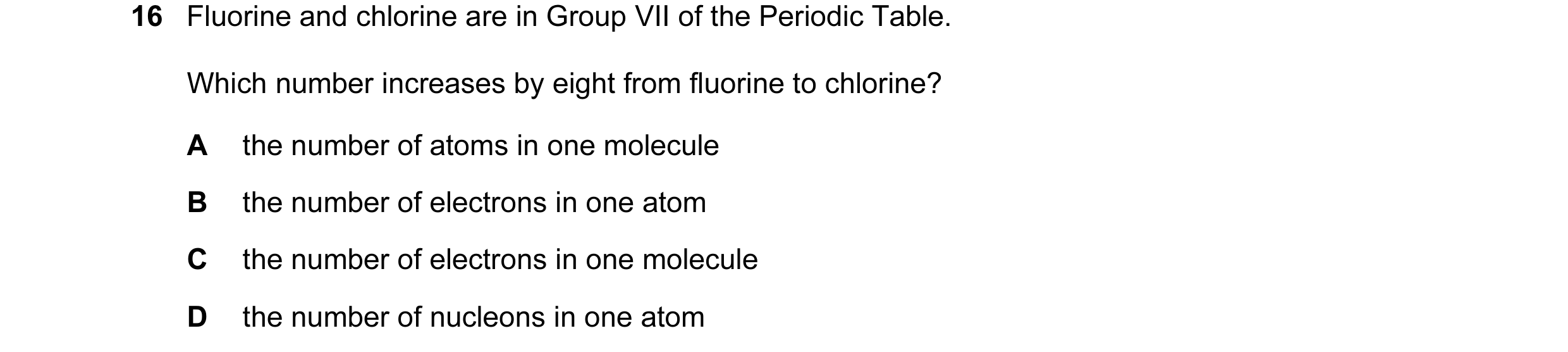
15 Fluorine and chlorine are in Group VII of the Periodic Table. Which number increases by eight from fluorine to chlorine? A the number of atoms in one molecule B the number of electrons in one atom C the number of electrons in one molecule D the number of nucleons in one atom
1 marks
Answer: B
This question in 0653/11 May/June 2015
Q28 · Fluorine and chlorine are in Group VII of the Periodic Table 0653/12 May/June 2015
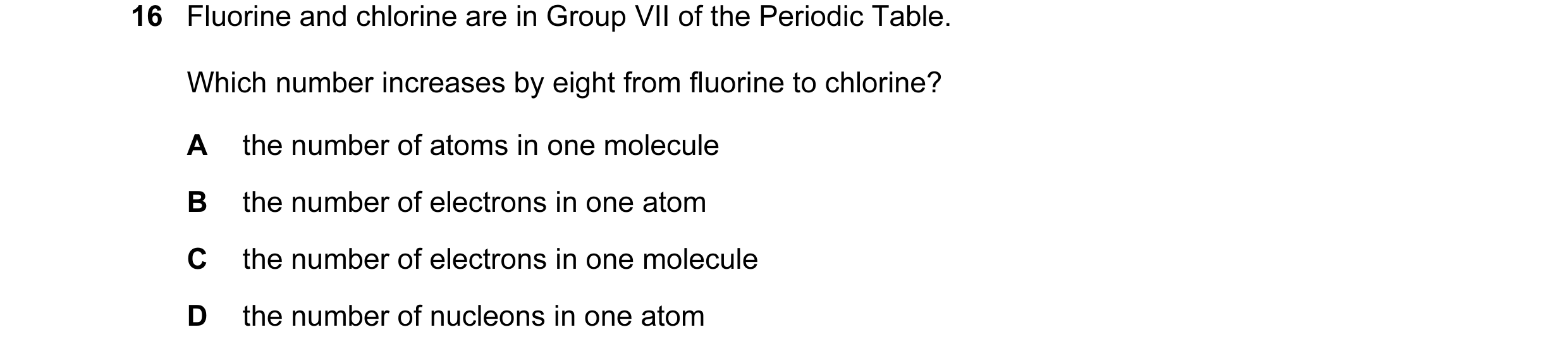
16 Fluorine and chlorine are in Group VII of the Periodic Table. Which number increases by eight from fluorine to chlorine? A the number of atoms in one molecule B the number of electrons in one atom C the number of electrons in one molecule D the number of nucleons in one atom
1 marks
Answer: B
This question in 0653/12 May/June 2015
Q29 · Fluorine and chlorine are in Group VII of the Periodic Table 0653/13 May/June 2015
16 Fluorine and chlorine are in Group VII of the Periodic Table. Which number increases by eight from fluorine to chlorine? A the number of atoms in one molecule B the number of electrons in one atom C the number of electrons in one molecule D the number of nucleons in one atom
1 marks
Answer: B
This question in 0653/13 May/June 2015
Q30 · Element Y has a proton number of 18 and a nucleon number of 40 0653/11 Oct/Nov 2015
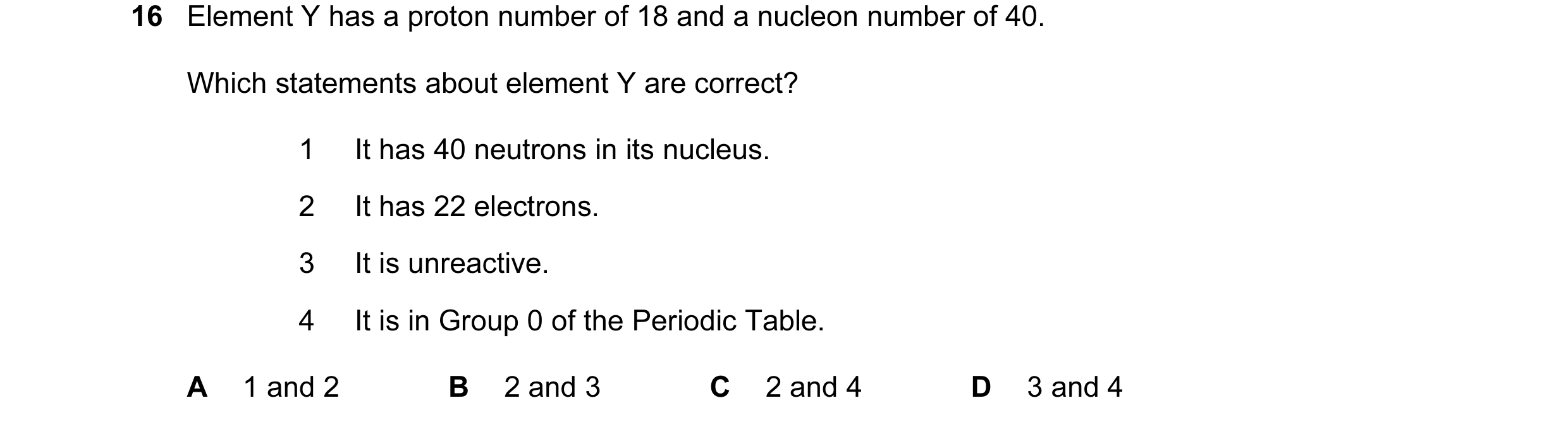
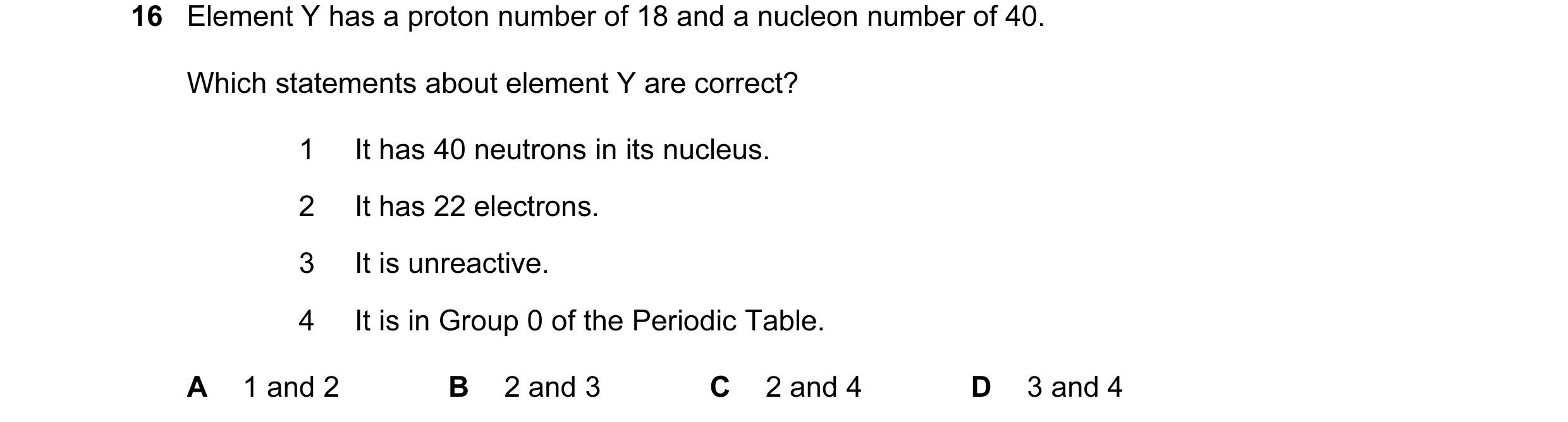
16 Element Y has a proton number of 18 and a nucleon number of 40. Which statements about element Y are correct? 1 It has 40 neutrons in its nucleus. 2 It has 22 electrons. 3 It is unreactive. 4 It is in Group 0 of the Periodic Table. A 1 and 2 B 2 and 3 C 2 and 4 D 3 and 4
1 marks
Answer: D
This question in 0653/11 Oct/Nov 2015
Q31 · Element Y has a proton number of 18 and a nucleon number of 40 0653/12 Oct/Nov 2015
16 Element Y has a proton number of 18 and a nucleon number of 40. Which statements about element Y are correct? 1 It has 40 neutrons in its nucleus. 2 It has 22 electrons. 3 It is unreactive. 4 It is in Group 0 of the Periodic Table. A 1 and 2 B 2 and 3 C 2 and 4 D 3 and 4
1 marks
Answer: D
This question in 0653/12 Oct/Nov 2015
Q32 · Element Y has a proton number of 18 and a nucleon number of 40 0653/13 Oct/Nov 2015
16 Element Y has a proton number of 18 and a nucleon number of 40. Which statements about element Y are correct? 1 It has 40 neutrons in its nucleus. 2 It has 22 electrons. 3 It is unreactive. 4 It is in Group 0 of the Periodic Table. A 1 and 2 B 2 and 3 C 2 and 4 D 3 and 4
1 marks
Answer: D
This question in 0653/13 Oct/Nov 2015
Q33 · The positions of elements P, Q, R, S and T in the Periodic Table are shown 0653/12 May/June 2016
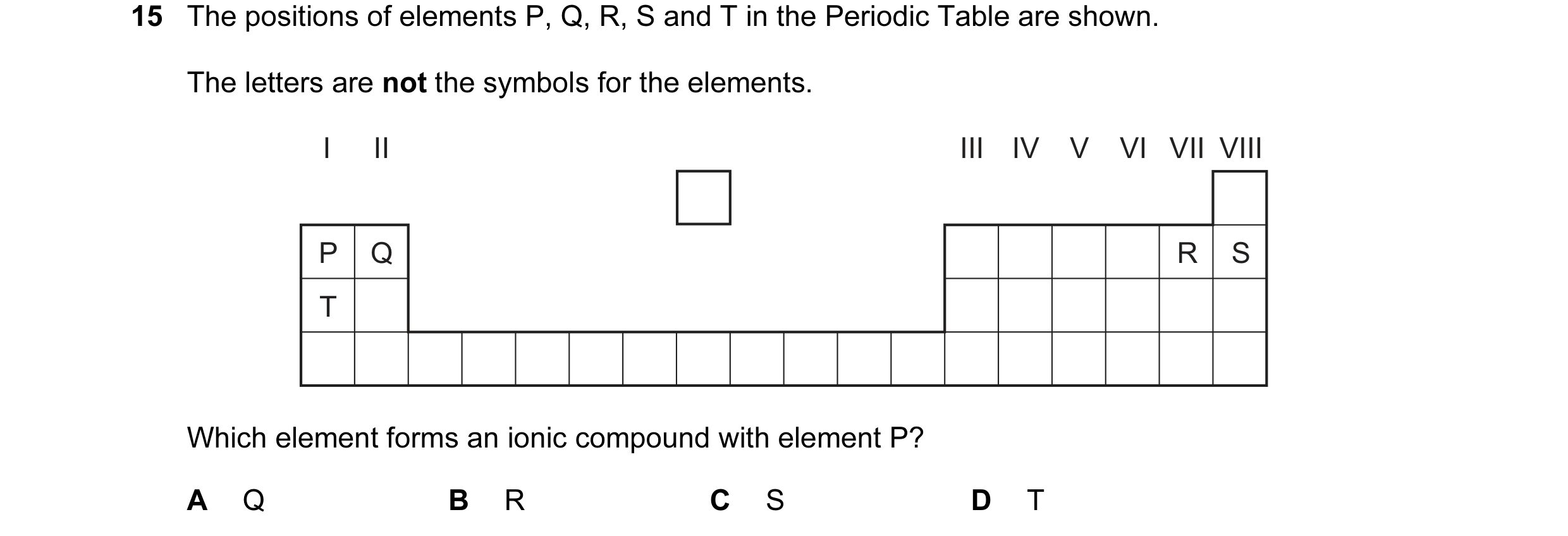
15 The positions of elements P, Q, R, S and T in the Periodic Table are shown. The letters are not the symbols for the elements. I II III IV V VI VII VIII P Q R S T Which element forms an ionic compound with element P? A Q B R C S D T
1 marks
Answer: B
This question in 0653/12 May/June 2016
Q34 · Which particle has the smallest mass? 0653/11 Oct/Nov 2016
16 Which particle has the smallest mass? A atom B electron C neutron D proton
1 marks
Answer: B
This question in 0653/11 Oct/Nov 2016
Q35 · Which number determines the order of elements in the Periodic Table? 0653/13 Oct/Nov 2016
16 Which number determines the order of elements in the Periodic Table? A neutron number B nucleon number C proton number D relative atomic mass
1 marks
Answer: C
This question in 0653/13 Oct/Nov 2016
Q36 · Period 3 of the Periodic Table is shown 0653/13 Oct/Nov 2016
24 Period 3 of the Periodic Table is shown. Na Mg Al Si P S Cl Ar Which statement about these elements is correct? A All the elements are metals. B All the elements are non-metals. C Metallic character decreases from Na to Ar. D Proton number decreases from Na to Ar.
1 marks
Answer: C
This question in 0653/13 Oct/Nov 2016
Q37 · The atomic (proton) number of potassium is 19 0653/12 Feb/March 2017
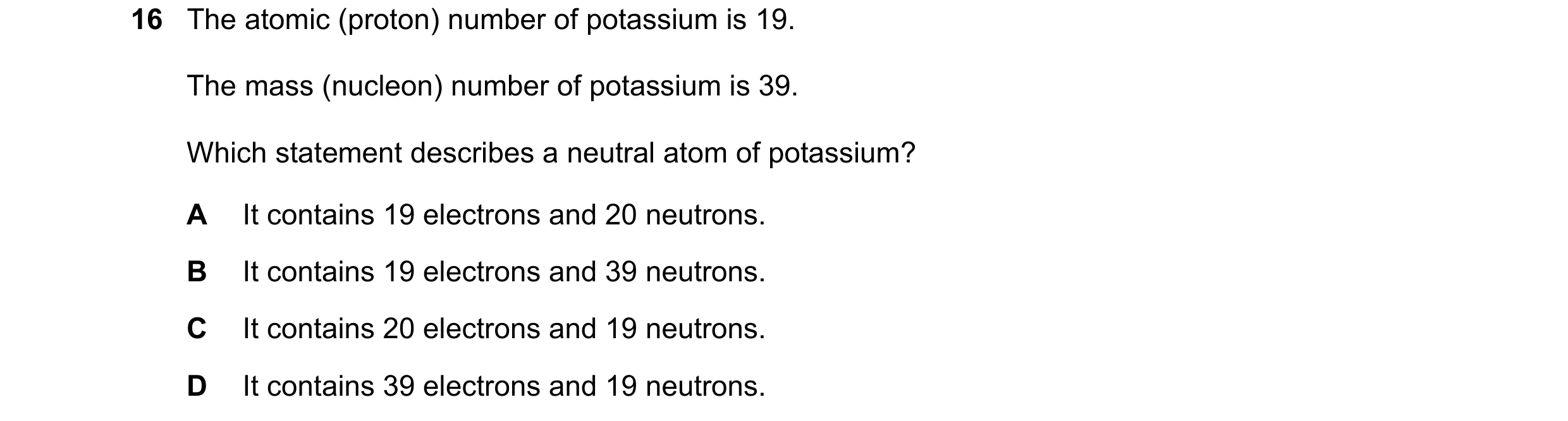
16 The atomic (proton) number of potassium is 19. The mass (nucleon) number of potassium is 39. Which statement describes a neutral atom of potassium? A It contains 19 electrons and 20 neutrons. B It contains 19 electrons and 39 neutrons. C It contains 20 electrons and 19 neutrons. D It contains 39 electrons and 19 neutrons.
1 marks
Answer: A
This question in 0653/12 Feb/March 2017
Q38 · A neutral atom of chlorine contains 17 electrons and 18 neutrons 0653/12 May/June 2017
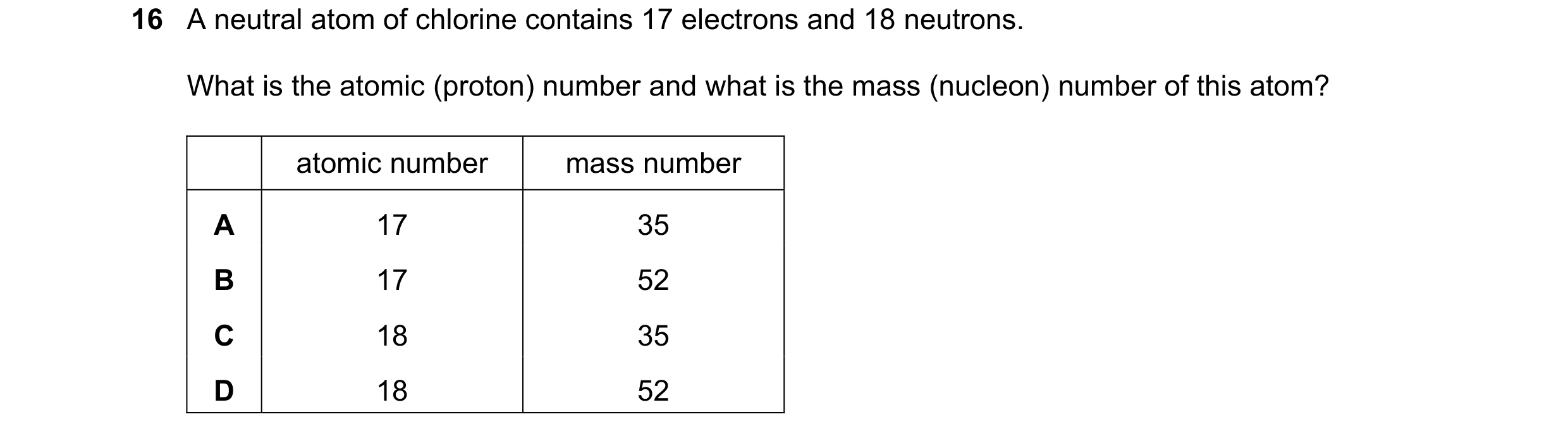
16 A neutral atom of chlorine contains 17 electrons and 18 neutrons. What is the atomic (proton) number and what is the mass (nucleon) number of this atom? atomic number mass number A 17 35 B 17 52 C 18 35 D 18 52
1 marks
Answer: A
This question in 0653/12 May/June 2017
Q39 · A neutral atom of chlorine contains 17 electrons and 18 neutrons 0653/13 May/June 2017
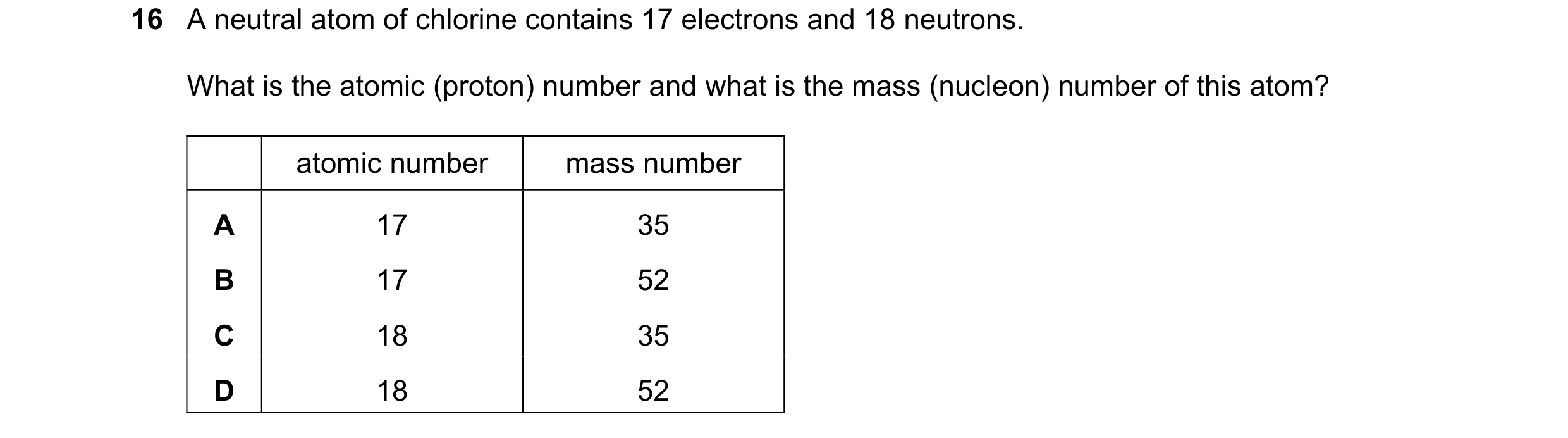
16 A neutral atom of chlorine contains 17 electrons and 18 neutrons. What is the atomic (proton) number and what is the mass (nucleon) number of this atom? atomic number mass number A 17 35 B 17 52 C 18 35 D 18 52
1 marks
Answer: A
This question in 0653/13 May/June 2017
Q40 · Which statement describes the arrangement of elements from sodium to argon in the… 0653/13 Oct/Nov 2017
23 Which statement describes the arrangement of elements from sodium to argon in the Periodic Table? A They are in neutron number order and change from metallic to non-metallic. B They are in neutron number order and change from non-metallic to metallic. C They are in proton number order and change from metallic to non-metallic. D They are in proton number order and change from non-metallic to metallic.
1 marks
Answer: C
This question in 0653/13 Oct/Nov 2017
Q41 · Which statement about atoms and molecules is correct? 0653/12 Feb/March 2018
14 Which statement about atoms and molecules is correct? A Atoms gain or lose electrons to become molecules. B Atoms of the same element contain the same number of molecules. C Molecules are the simplest unit of an atom. D Molecules contain atoms which are covalently bonded.
1 marks
Answer: D
This question in 0653/12 Feb/March 2018
Q42 · The atomic number of argon is 18 0653/12 Feb/March 2018
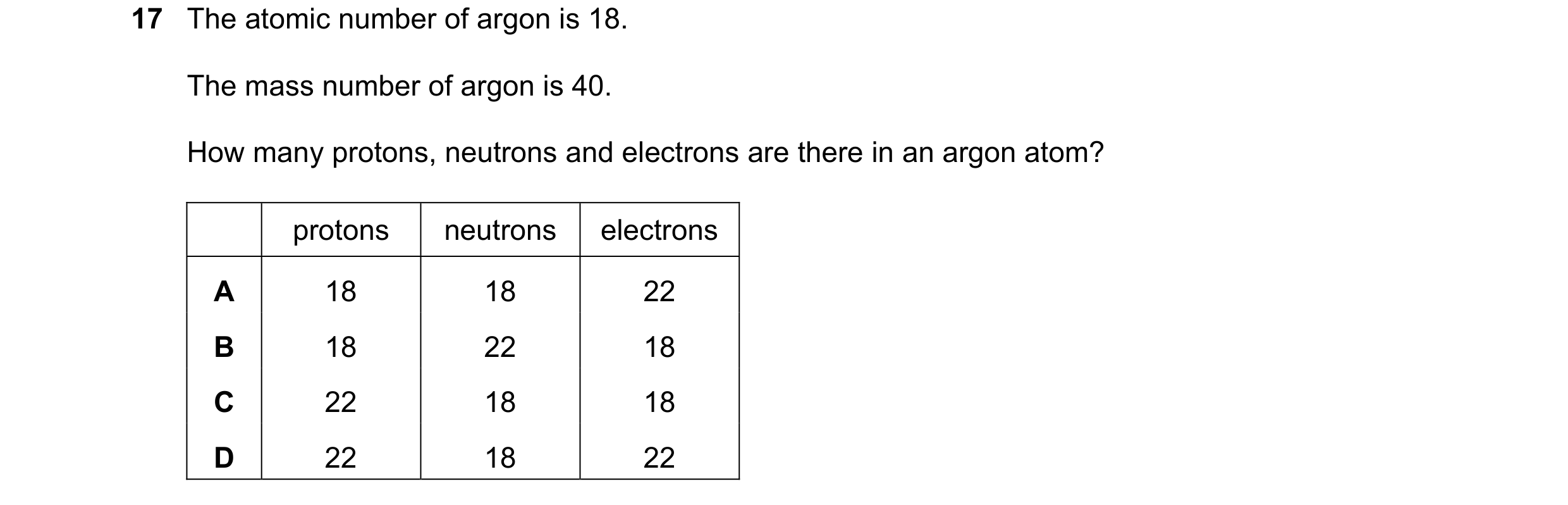
17 The atomic number of argon is 18. The mass number of argon is 40. How many protons, neutrons and electrons are there in an argon atom? protons neutrons electrons A 18 18 22 B 18 22 18 C 22 18 18 D 22 18 22
1 marks
Answer: B
This question in 0653/12 Feb/March 2018
Q43 · Which statement about the formation of ions is correct? 0653/12 May/June 2018
17 Which statement about the formation of ions is correct? A Anions are formed when atoms gain electrons. B Anions are formed when atoms lose electrons. C Cations are formed when atoms gain protons. D Cations are formed when atoms lose protons.
1 marks
Answer: A
This question in 0653/12 May/June 2018
Q44 · Part of the Periodic Table is shown 0653/12 May/June 2018
23 Part of the Periodic Table is shown. I II III IV V VI VII VIII V W X Which element forms an anion and which element forms a cation? forms an anion forms a cation A V W B V X C W V D X W
1 marks
Answer: C
This question in 0653/12 May/June 2018
Q45 · Part of the Periodic Table is shown 0653/13 May/June 2018
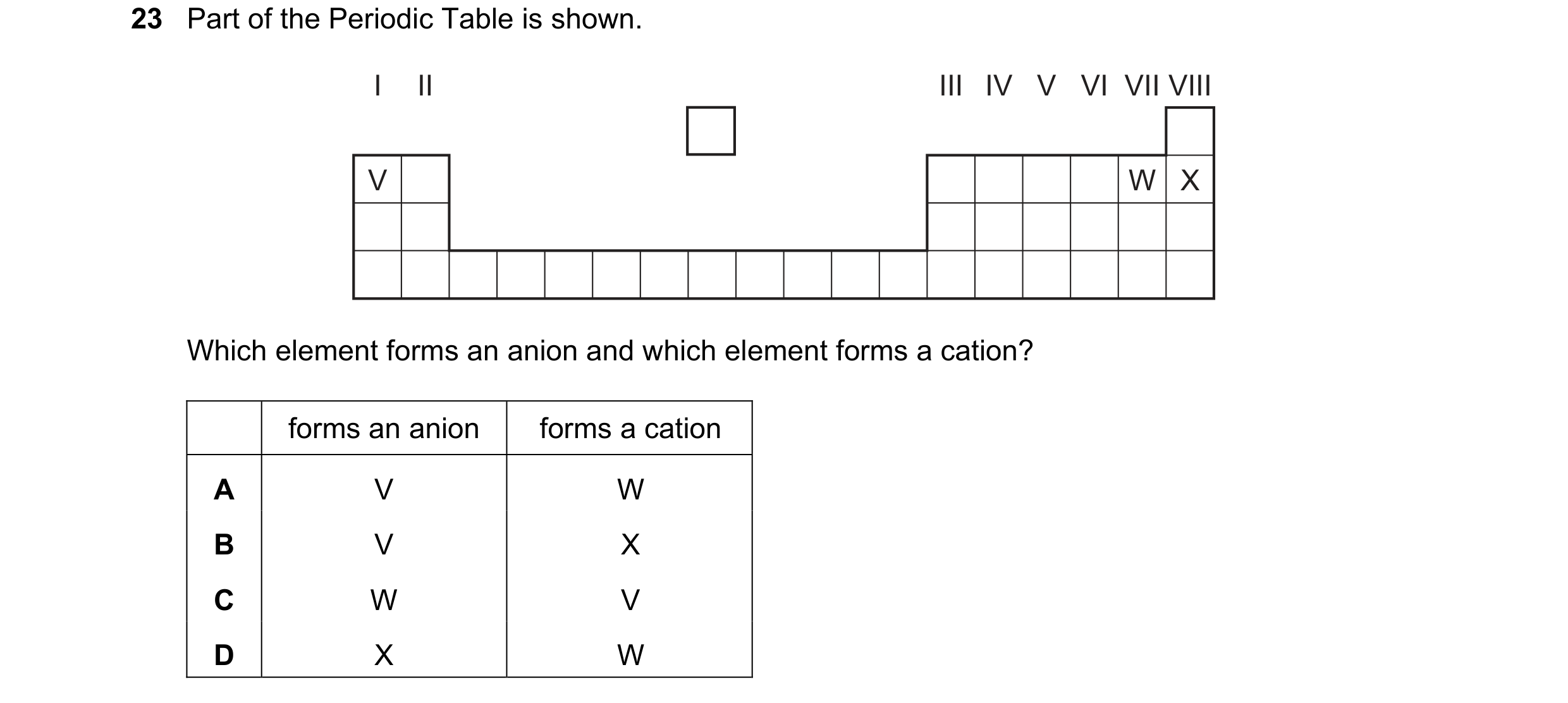
23 Part of the Periodic Table is shown. I II III IV V VI VII VIII V W X Which element forms an anion and which element forms a cation? forms an anion forms a cation A V W B V X C W V D X W
1 marks
Answer: C
This question in 0653/13 May/June 2018
Q46 · The atomic number of element X is 11 0653/12 Oct/Nov 2018
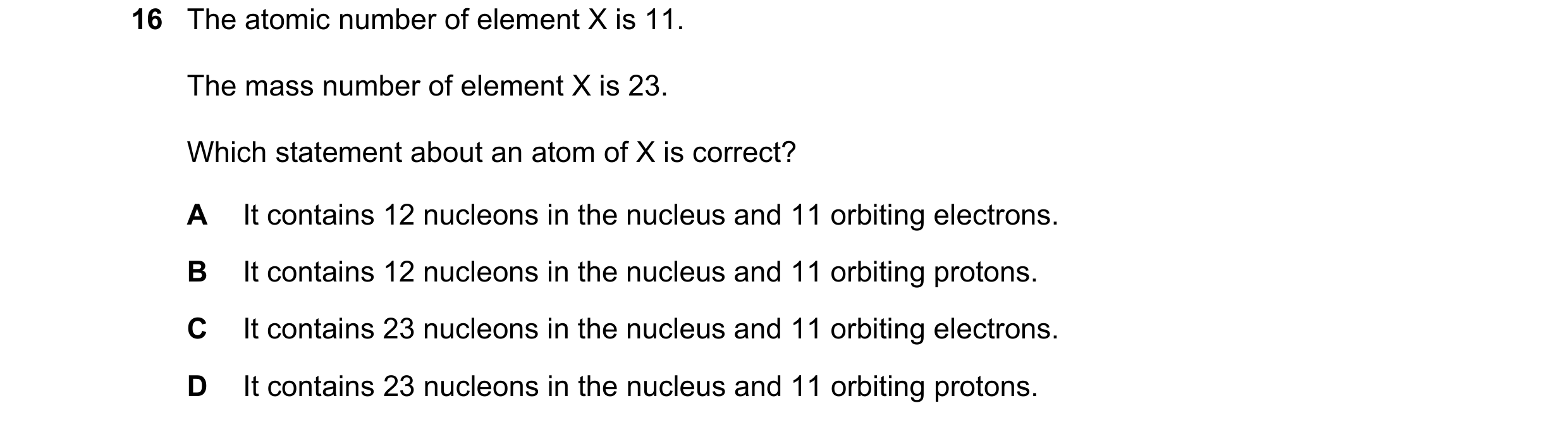
16 The atomic number of element X is 11. The mass number of element X is 23. Which statement about an atom of X is correct? A It contains 12 nucleons in the nucleus and 11 orbiting electrons. B It contains 12 nucleons in the nucleus and 11 orbiting protons. C It contains 23 nucleons in the nucleus and 11 orbiting electrons. D It contains 23 nucleons in the nucleus and 11 orbiting protons.
1 marks
Answer: C
This question in 0653/12 Oct/Nov 2018
Q47 · P, Q and R are three particles 0653/11 Oct/Nov 2019
16 P, Q and R are three particles. Particle P contains 6 protons, 6 neutrons and 6 electrons. Particle Q contains 1 proton, 2 neutrons and no electrons. Particle R contains 11 protons, 12 neutrons and 10 electrons. Which row about P, Q and R is correct? P Q R A has atomic number 6 has a mass number of 2 has a positive charge B has no overall electrical charge has an atomic number of 1 has a mass number of 23 C is a carbon atom is a nucleus has a negative charge D is a carbon nucleus has a positive charge is a particle of sodium
1 marks
Answer: B
This question in 0653/11 Oct/Nov 2019
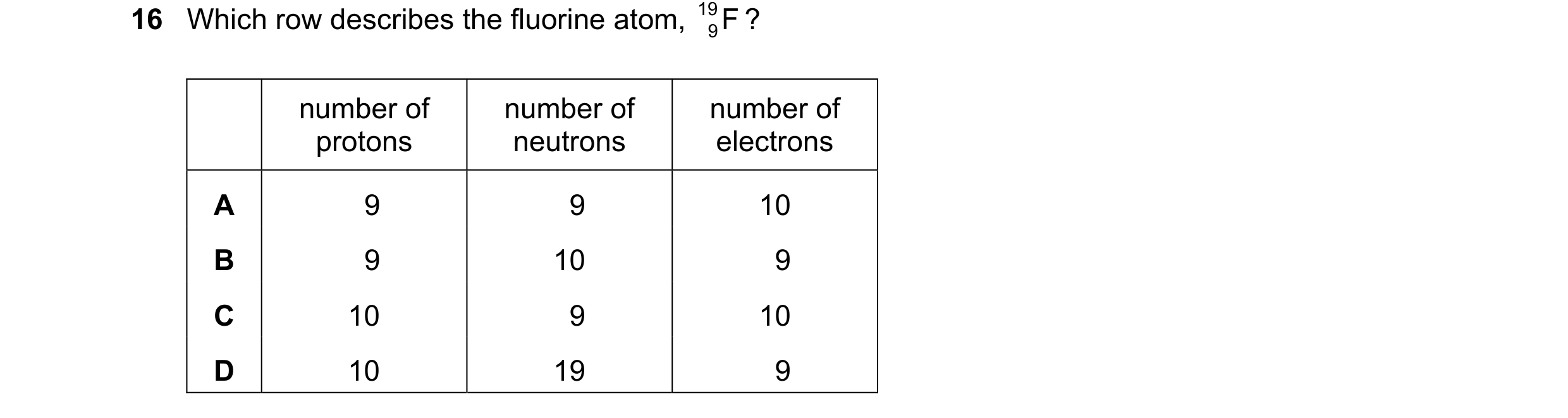
Q48 · Which row describes the fluorine atom, 19 F ? 0653/12 Oct/Nov 2019
16 Which row describes the fluorine atom, 19 F ? 9 number of number of number of protons neutrons electrons A 9 9 10 B 9 10 9 C 10 9 10 D 10 19 9
1 marks
Answer: B
This question in 0653/12 Oct/Nov 2019
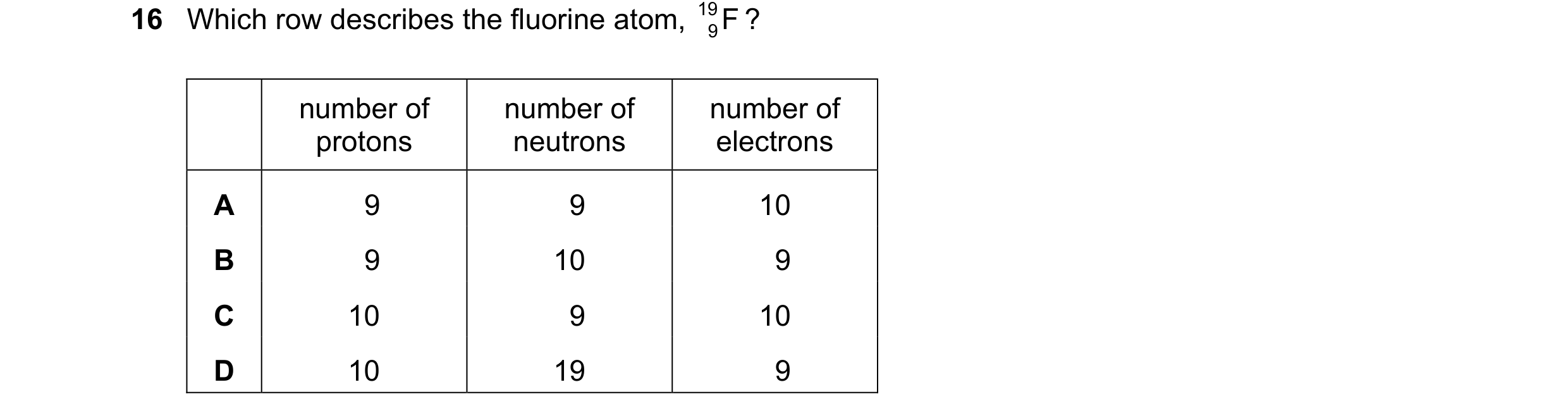
Q49 · Which row describes the fluorine atom, 19 F ? 0653/13 Oct/Nov 2019
16 Which row describes the fluorine atom, 19 F ? 9 number of number of number of protons neutrons electrons A 9 9 10 B 9 10 9 C 10 9 10 D 10 19 9
1 marks
Answer: B
This question in 0653/13 Oct/Nov 2019
Q50 · Some information about a sodium ion is shown 0653/12 Feb/March 2020
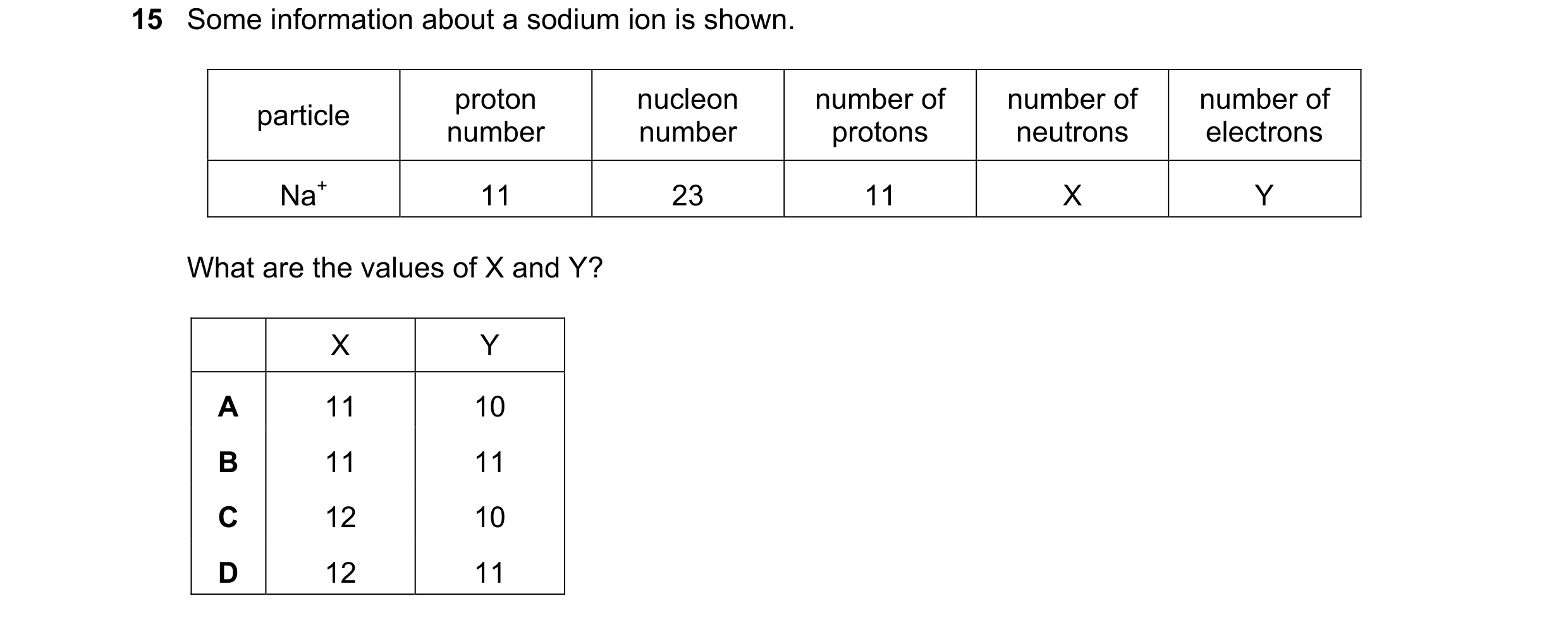
15 Some information about a sodium ion is shown. proton nucleon number of number of number of particle number number protons neutrons electrons Na+ 11 23 11 X Y What are the values of X and Y? X Y A 11 10 B 11 11 C 12 10 D 12 11
1 marks
Answer: C
This question in 0653/12 Feb/March 2020
Q51 · An uncharged metal ball becomes negatively charged 0653/12 Feb/March 2021
37 An uncharged metal ball becomes negatively charged. Which particles have been transferred to the ball? A atoms B electrons C neutrons D protons
1 marks
Answer: B
This question in 0653/12 Feb/March 2021
Q52 · Which statement about the particles is correct? 0653/12 May/June 2021
16 Which statement about the particles is correct? A 1 1H has the same number of protons as neutrons. B 2 H + has the same number of electrons as neutrons. 1 C OH– contains more protons than electrons. D NH3 has the same number of protons as electrons.
1 marks
Answer: D
This question in 0653/12 May/June 2021
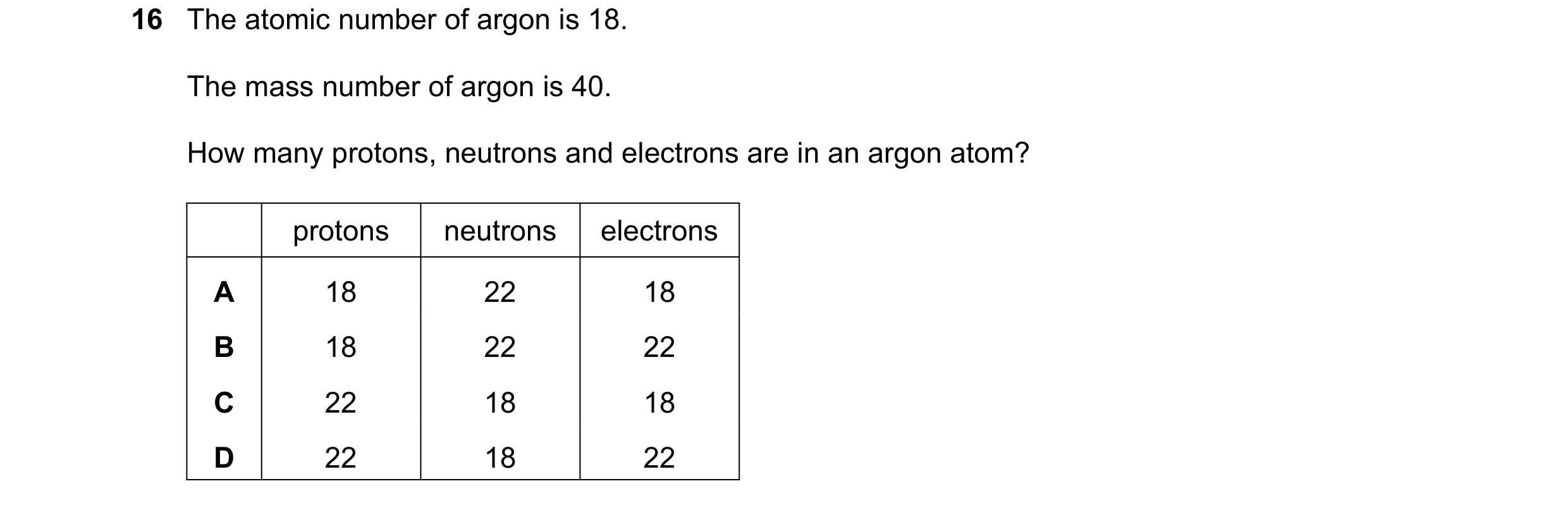
Q53 · The atomic number of argon is 18 0653/12 Feb/March 2022
16 The atomic number of argon is 18. The mass number of argon is 40. How many protons, neutrons and electrons are in an argon atom? protons neutrons electrons A 18 22 18 B 18 22 22 C 22 18 18 D 22 18 22
1 marks
Answer: A
This question in 0653/12 Feb/March 2022
Q54 · Which particles are present in the nuclei of hydrogen atoms, H? 0653/11 Oct/Nov 2022
14 Which particles are present in the nuclei of hydrogen atoms, H? 1 1 A electrons and neutrons B electrons only C protons and neutrons D protons only
1 marks
Answer: D
This question in 0653/11 Oct/Nov 2022
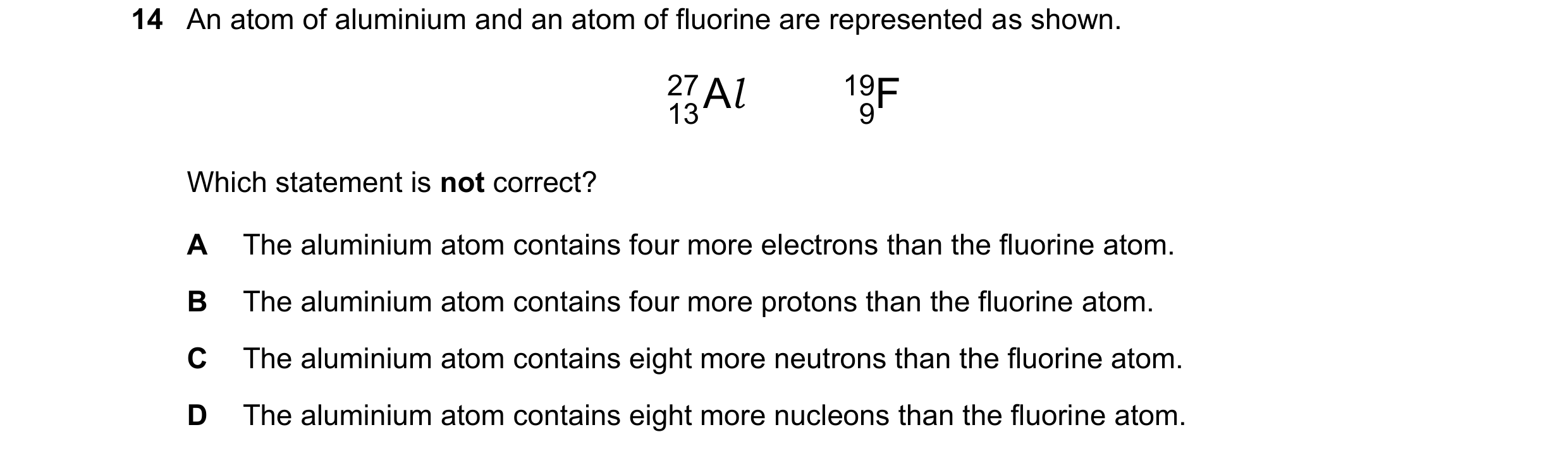
Q55 · An atom of aluminium and an atom of fluorine are represented as shown 0653/12 Oct/Nov 2022
14 An atom of aluminium and an atom of fluorine are represented as shown. 13Al 19 27 9F Which statement is not correct? A The aluminium atom contains four more electrons than the fluorine atom. B The aluminium atom contains four more protons than the fluorine atom. C The aluminium atom contains eight more neutrons than the fluorine atom. D The aluminium atom contains eight more nucleons than the fluorine atom.
1 marks
Answer: C
This question in 0653/12 Oct/Nov 2022
Q56 · An atom of aluminium and an atom of fluorine are represented as shown 0653/13 Oct/Nov 2022
14 An atom of aluminium and an atom of fluorine are represented as shown. 13Al 19 27 9F Which statement is not correct? A The aluminium atom contains four more electrons than the fluorine atom. B The aluminium atom contains four more protons than the fluorine atom. C The aluminium atom contains eight more neutrons than the fluorine atom. D The aluminium atom contains eight more nucleons than the fluorine atom.
1 marks
Answer: C
This question in 0653/13 Oct/Nov 2022
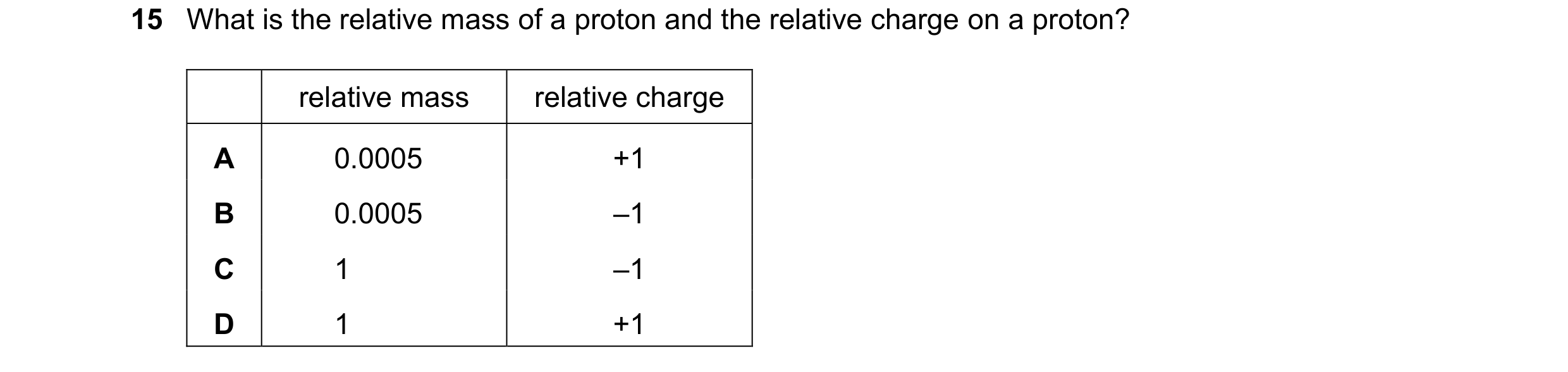
Q57 · What is the relative mass of a proton and the relative charge on a proton? 0653/11 May/June 2023
15 What is the relative mass of a proton and the relative charge on a proton? relative mass relative charge A 0.0005 +1 B 0.0005 –1 C 1 –1 D 1 +1
1 marks
Answer: D
This question in 0653/11 May/June 2023
Q58 · What is the definition of nucleon number? 0653/12 May/June 2023
15 What is the definition of nucleon number? A the number of protons in an atom B the number of electrons in an atom C the total number of electrons and neutrons in an atom D the total number of neutrons and protons in an atom
1 marks
Answer: D
This question in 0653/12 May/June 2023
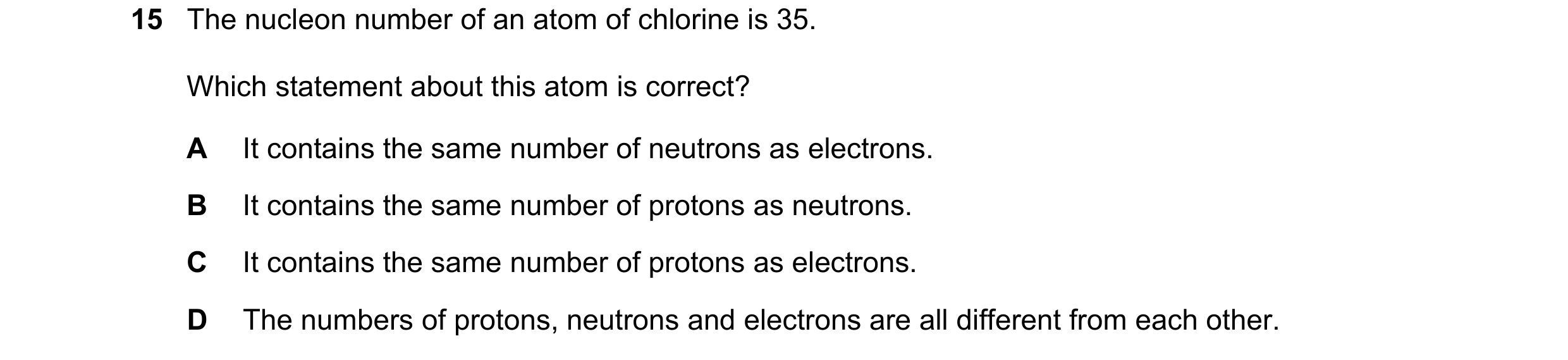
Q59 · The nucleon number of an atom of chlorine is 35 0653/13 May/June 2023
15 The nucleon number of an atom of chlorine is 35. Which statement about this atom is correct? A It contains the same number of neutrons as electrons. B It contains the same number of protons as neutrons. C It contains the same number of protons as electrons. D The numbers of protons, neutrons and electrons are all different from each other.
1 marks
Answer: C
This question in 0653/13 May/June 2023
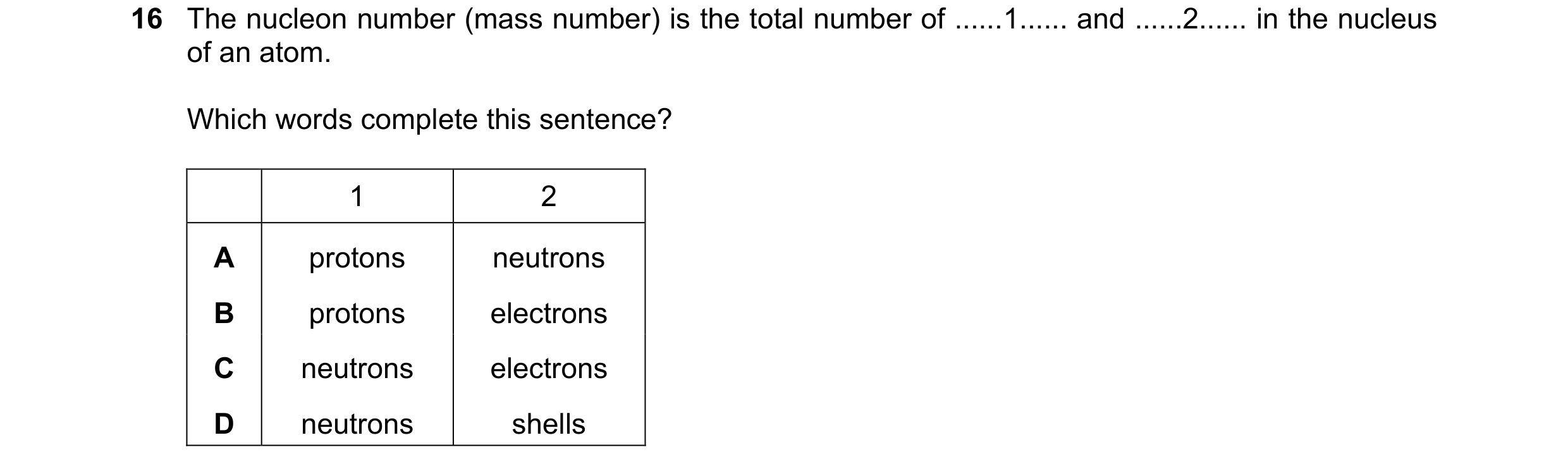
Q60 · The nucleon number (mass number) is the total number of … 1 … and … 2 … in the nucleus of… 0653/11 May/June 2024
16 The nucleon number (mass number) is the total number of … 1 … and … 2 … in the nucleus of an atom. Which words complete this sentence? 1 2 A protons neutrons B protons electrons C neutrons electrons D neutrons shells
1 marks
Answer: A
This question in 0653/11 May/June 2024
Q61 · What is the electronic structure of a noble gas? 0653/12 Oct/Nov 2024
22 What is the electronic structure of a noble gas? A 2 B 2,1 C 2,8,2 D 2,8,7
1 marks
Answer: A
This question in 0653/12 Oct/Nov 2024
Q62 · What is the electronic structure of a noble gas? 0653/13 Oct/Nov 2024
22 What is the electronic structure of a noble gas? A 2 B 2,1 C 2,8,2 D 2,8,7
1 marks
Answer: A
This question in 0653/13 Oct/Nov 2024
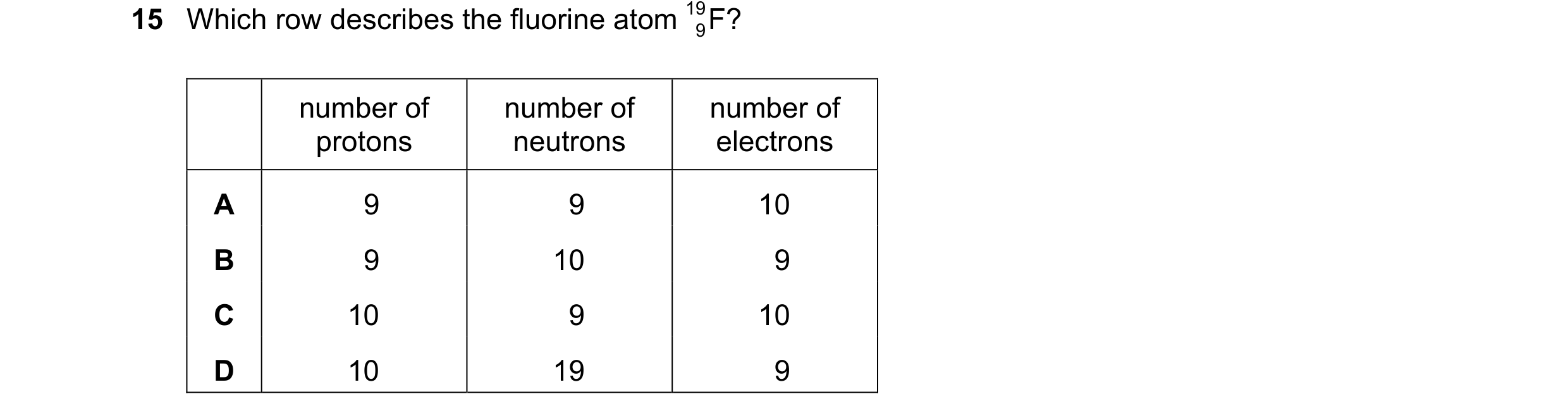
Q63 · Which row describes the fluorine atom 19 F? 0653/12 Feb/March 2025
15 Which row describes the fluorine atom 19 F? 9 number of number of number of protons neutrons electrons A 9 9 10 B 9 10 9 C 10 9 10 D 10 19 9
1 marks
Answer: B
This question in 0653/12 Feb/March 2025
Q64 · Which property is used to arrange elements in order in the Periodic Table? 0653/12 Feb/March 2025
18 Which property is used to arrange elements in order in the Periodic Table? A the number of neutrons in each atom B the number of neutrons + protons in each atom C the number of protons in each atom D the number of protons + electrons in each atom
1 marks
Answer: C
This question in 0653/12 Feb/March 2025
Q65 · Which number determines the order of elements in the Periodic Table? 0653/11 May/June 2025
22 Which number determines the order of elements in the Periodic Table? A neutron number B nucleon number C proton number D relative atomic mass
1 marks
Answer: C
This question in 0653/11 May/June 2025
Q66 · What is the nucleon number of an atom? 0653/11 Oct/Nov 2025
14 What is the nucleon number of an atom? A the total number of protons, neutrons and electrons B the total number of protons and neutrons C the number of protons only D the number of neutrons only
1 marks
Answer: B
This question in 0653/11 Oct/Nov 2025
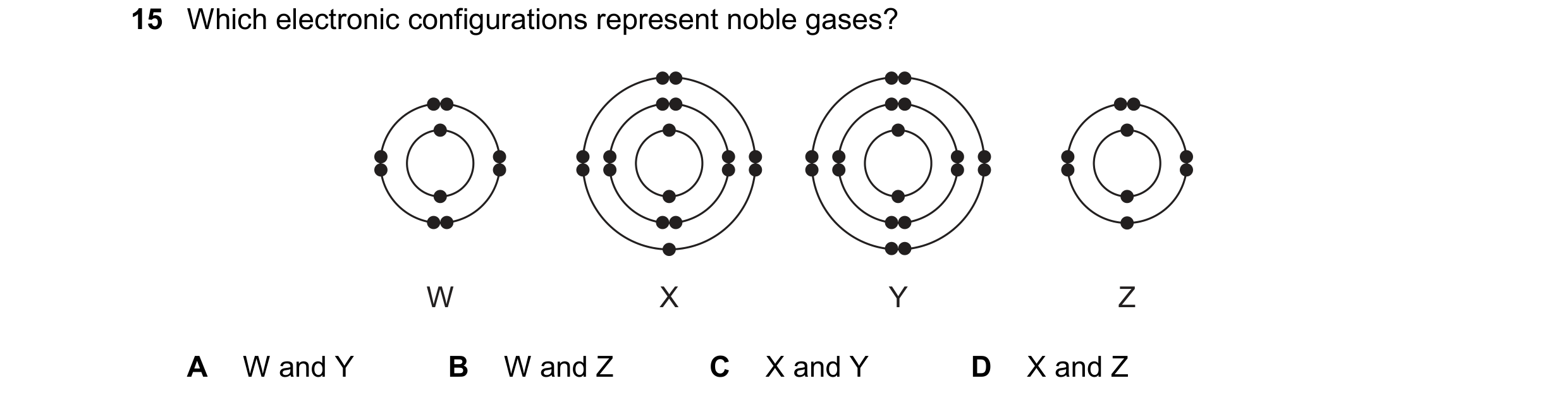
Q67 · Which electronic configurations represent noble gases? 0653/11 Oct/Nov 2025
15 Which electronic configurations represent noble gases? W X Y Z A W and Y B W and Z C X and Y D X and Z
1 marks
Answer: A
This question in 0653/11 Oct/Nov 2025
Q68 · Element Y has a proton number of 18 and a nucleon number of 40 0653/12 Oct/Nov 2025
14 Element Y has a proton number of 18 and a nucleon number of 40. Which statements about an atom of element Y are correct? 1 It has 40 neutrons in its nucleus. 2 It has 22 electrons. 3 It is unreactive. 4 It is in Group VIII of the Periodic Table. A 1 and 2 B 2 and 3 C 2 and 4 D 3 and 4
1 marks
Answer: D
This question in 0653/12 Oct/Nov 2025
Q69 · Element Y has a proton number of 18 and a nucleon number of 40 0653/13 Oct/Nov 2025
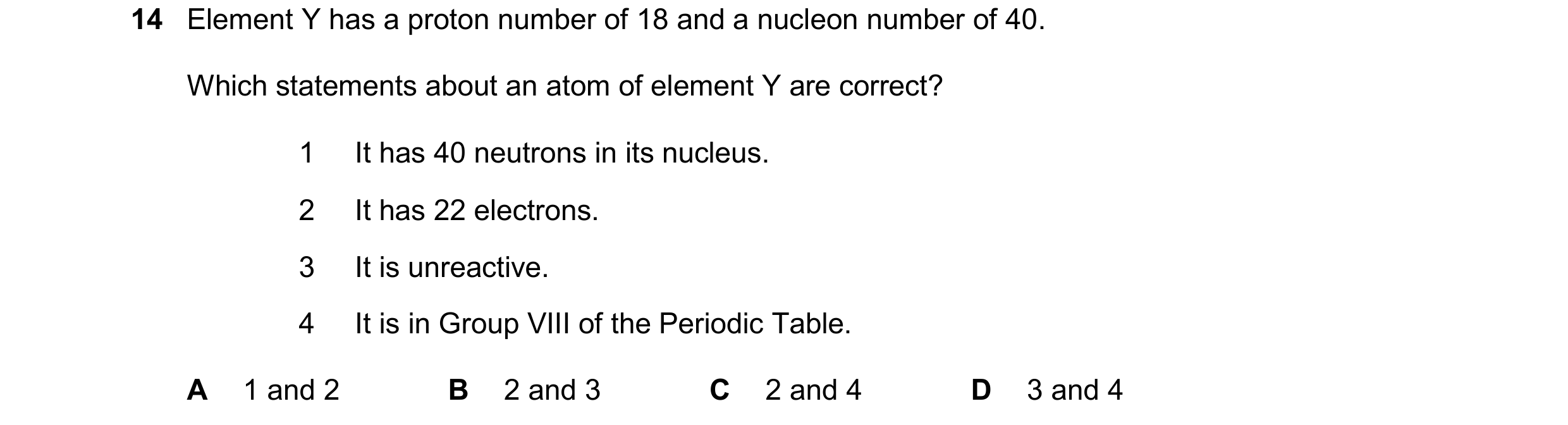
14 Element Y has a proton number of 18 and a nucleon number of 40. Which statements about an atom of element Y are correct? 1 It has 40 neutrons in its nucleus. 2 It has 22 electrons. 3 It is unreactive. 4 It is in Group VIII of the Periodic Table. A 1 and 2 B 2 and 3 C 2 and 4 D 3 and 4
1 marks
Answer: D
This question in 0653/13 Oct/Nov 2025

 1 / 17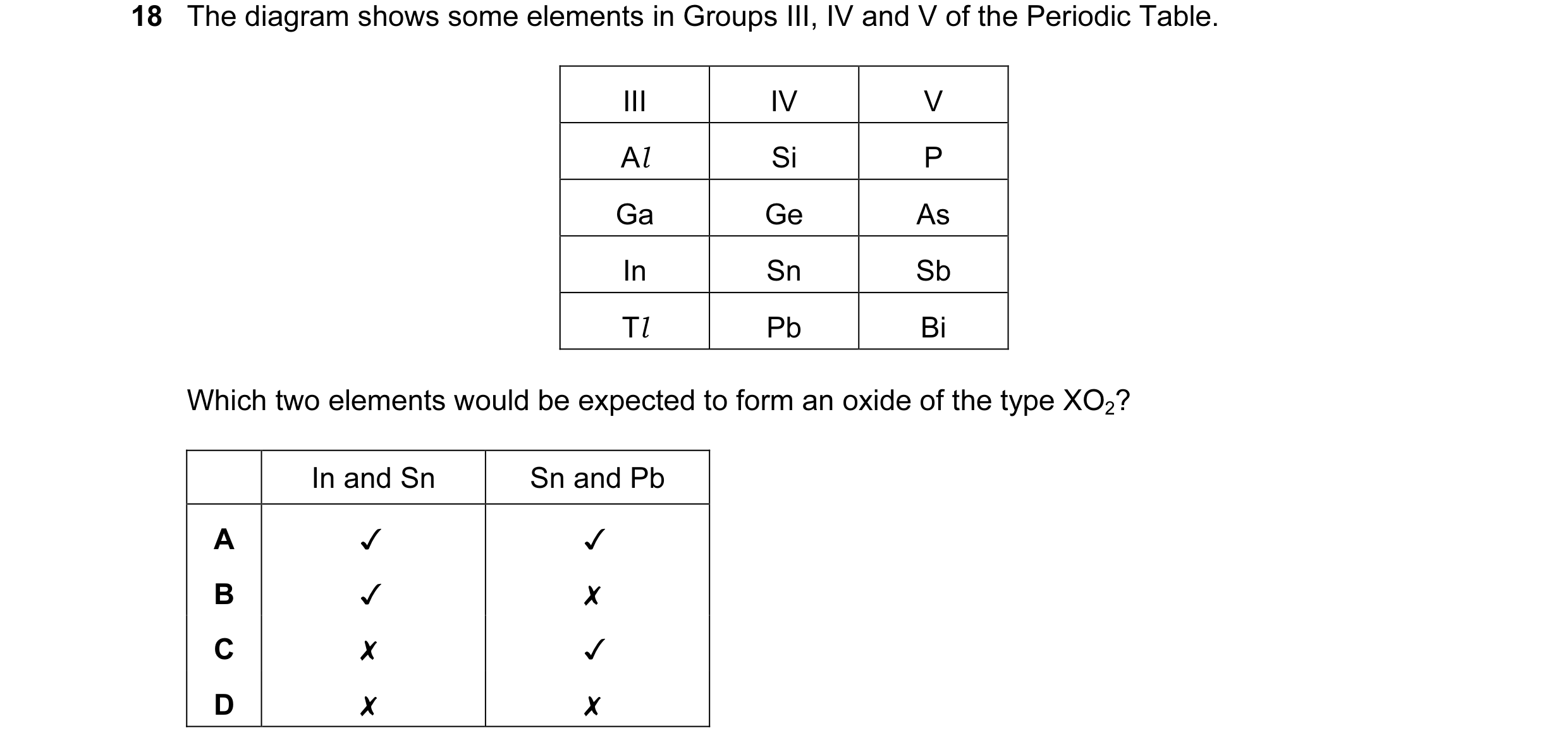
 2 / 17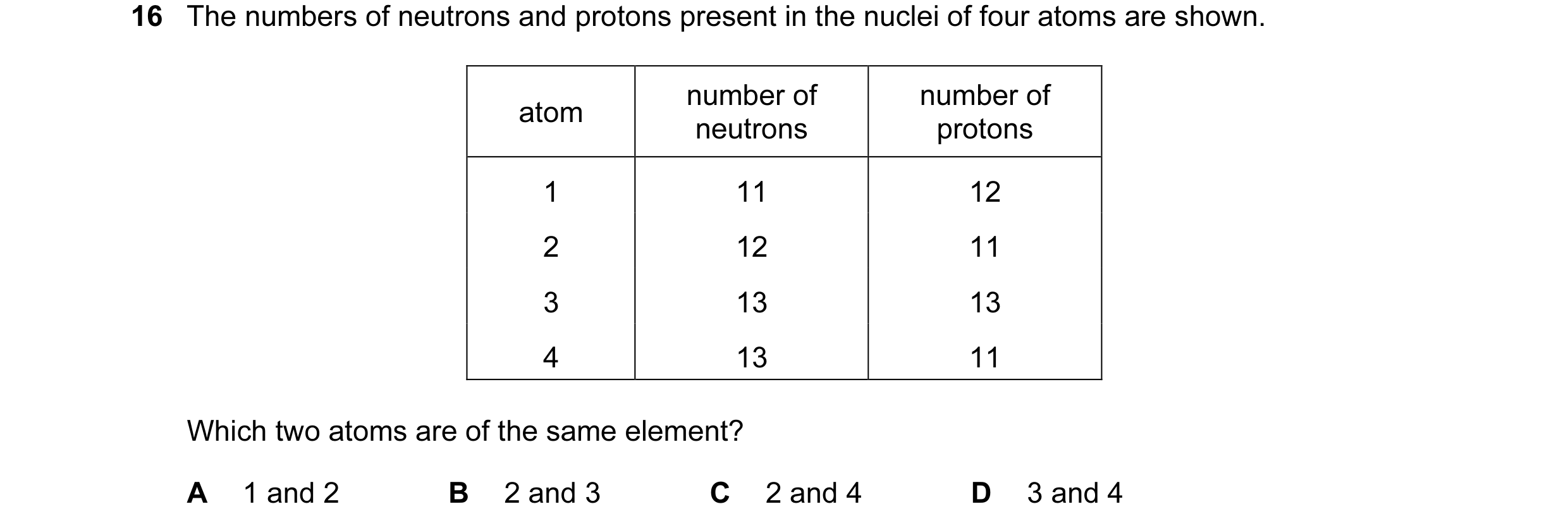
 3 / 17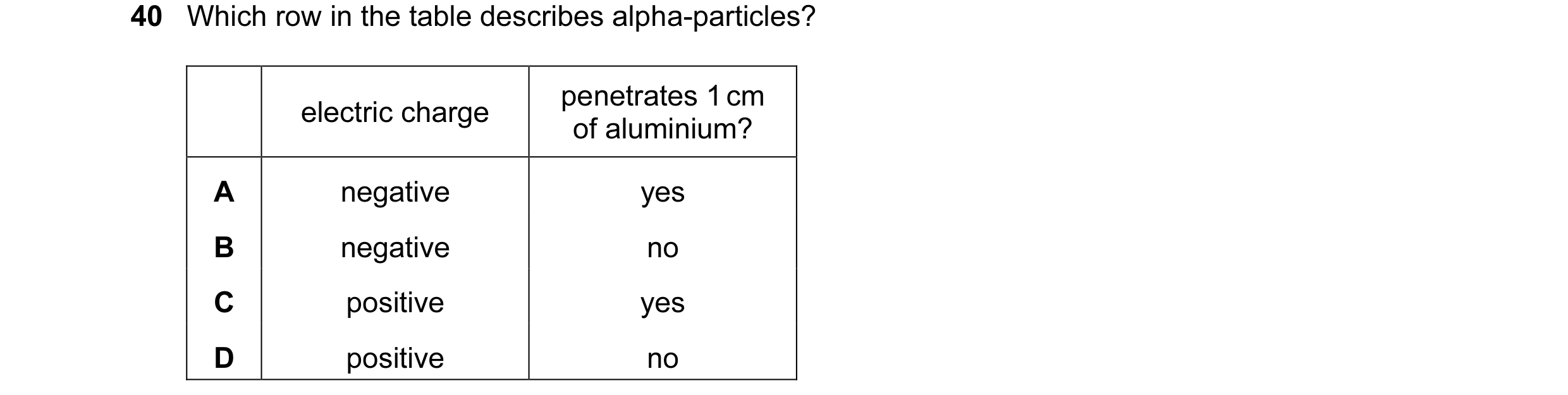
 4 / 17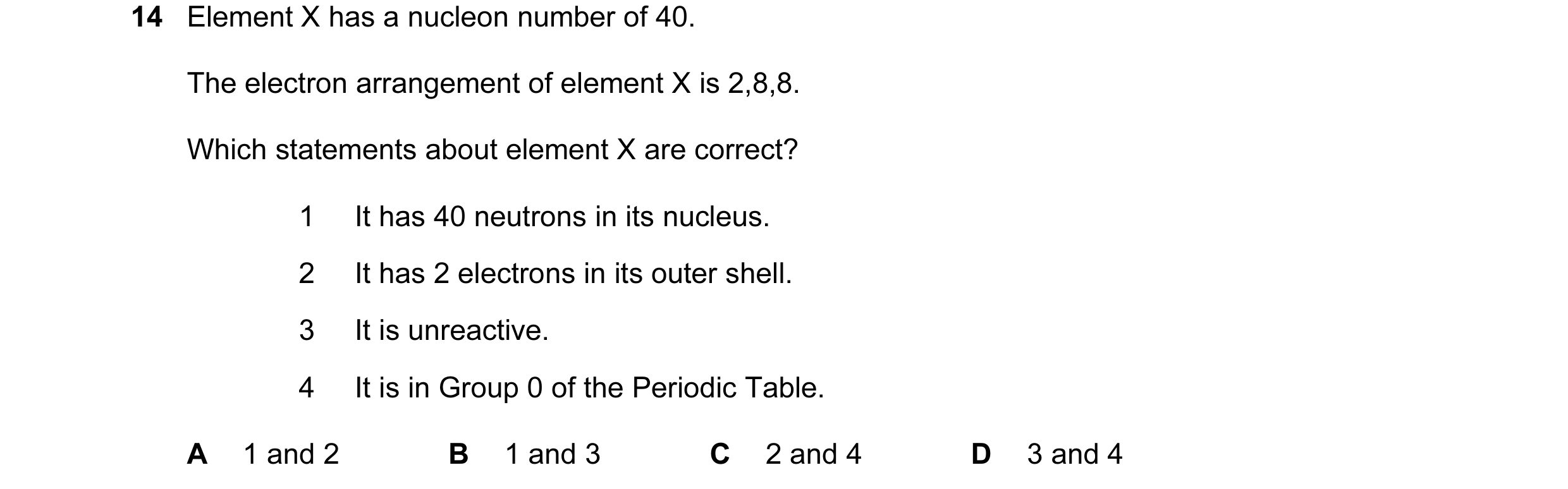
 5 / 17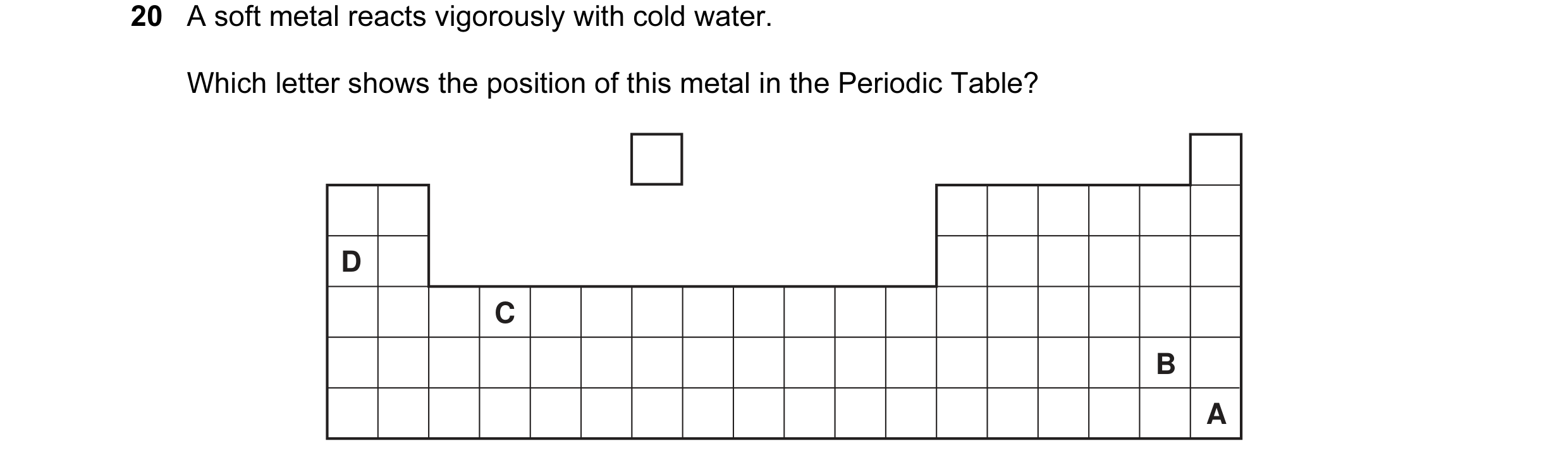
 6 / 17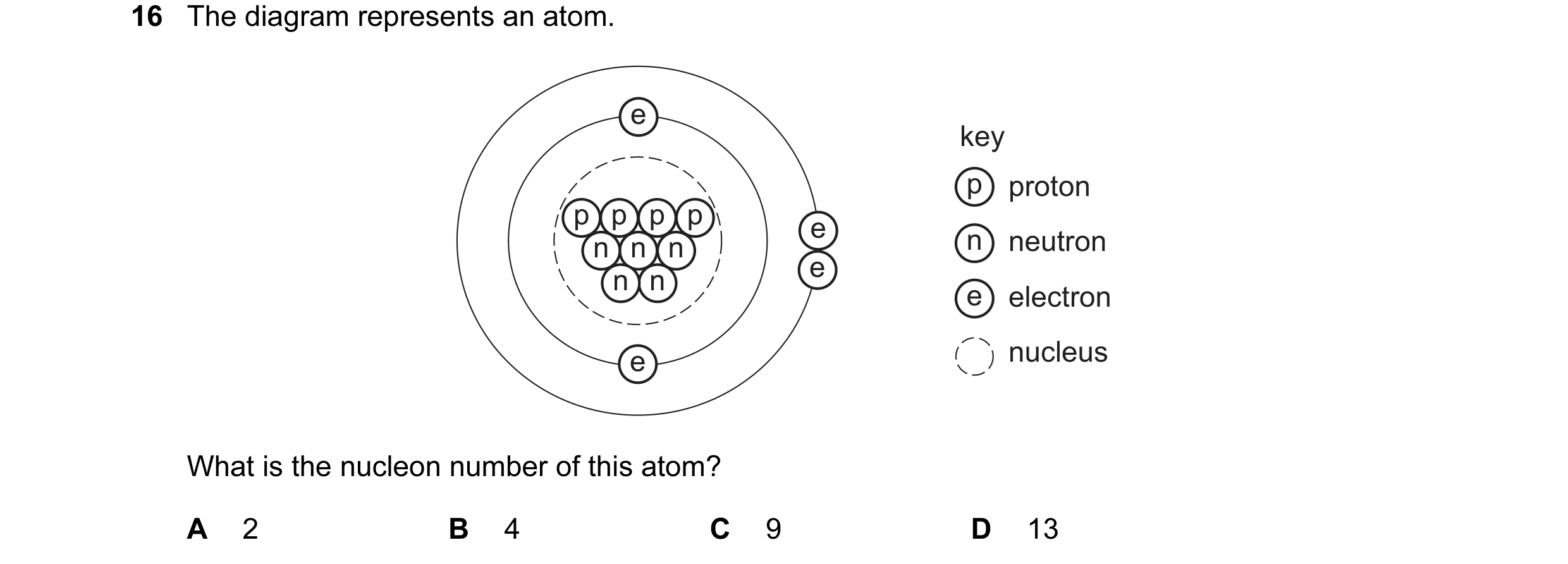
 7 / 17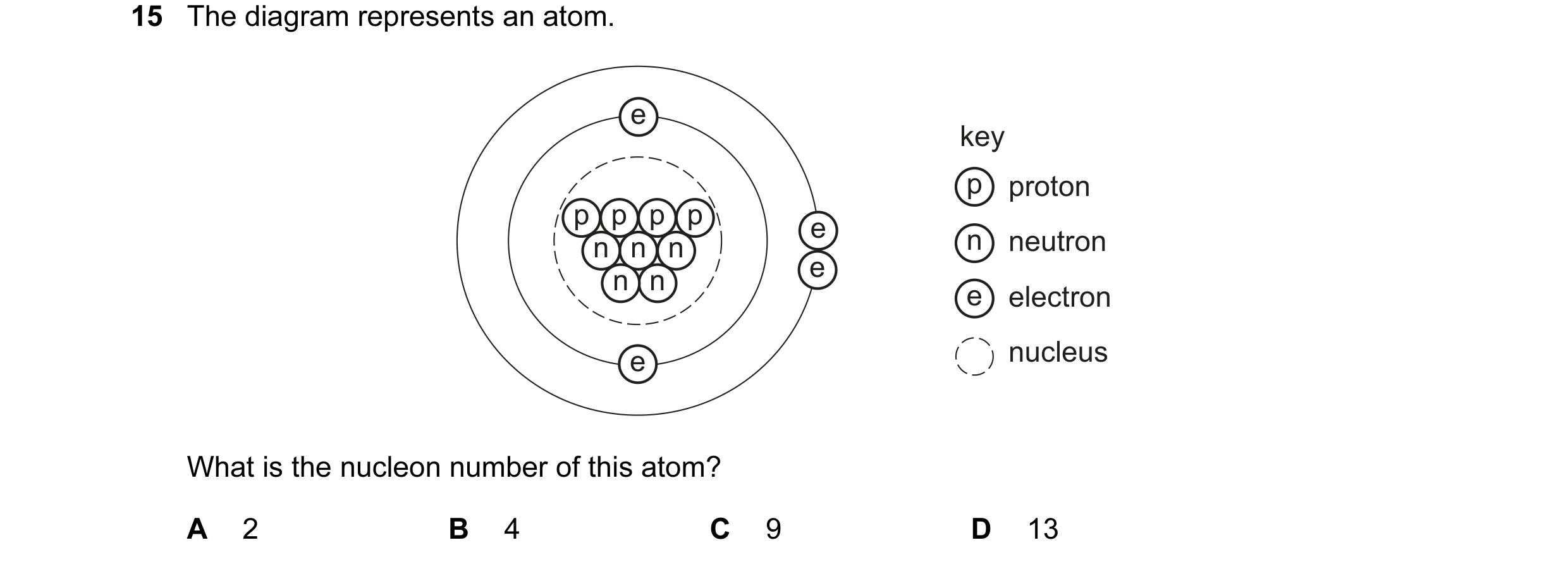
 8 / 17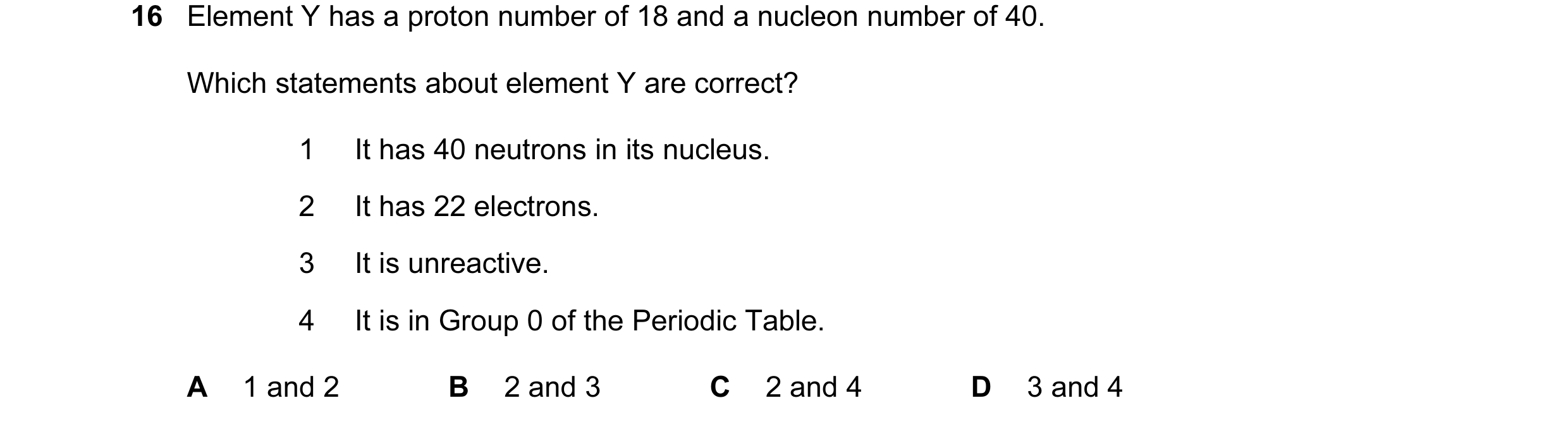

 9 / 17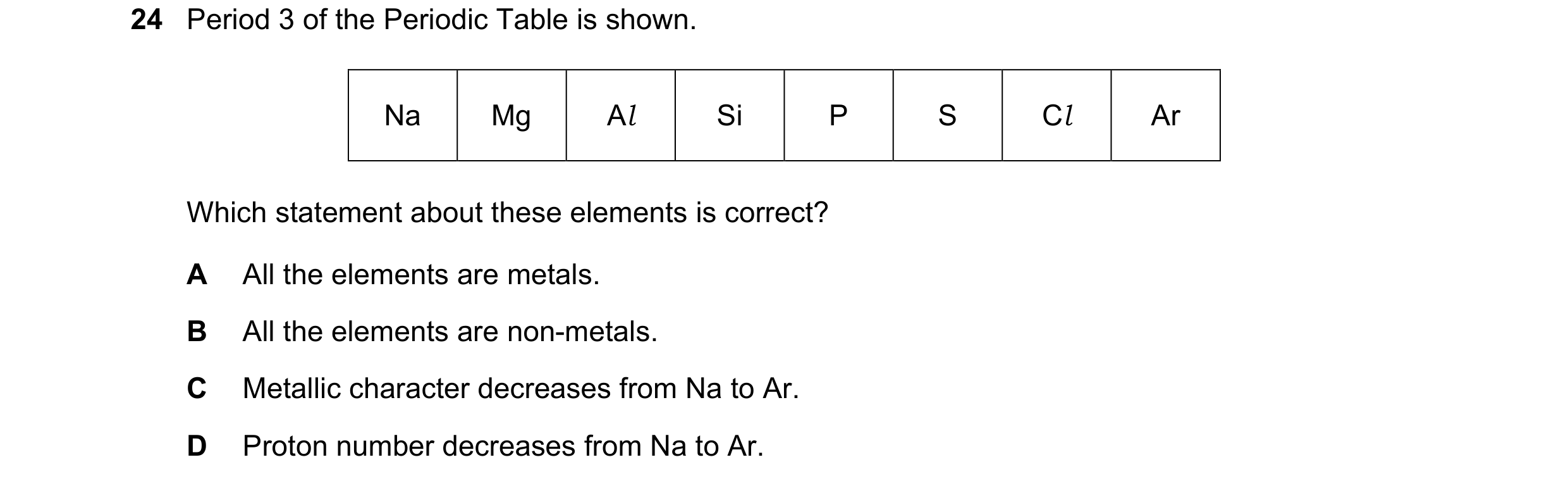
 10 / 17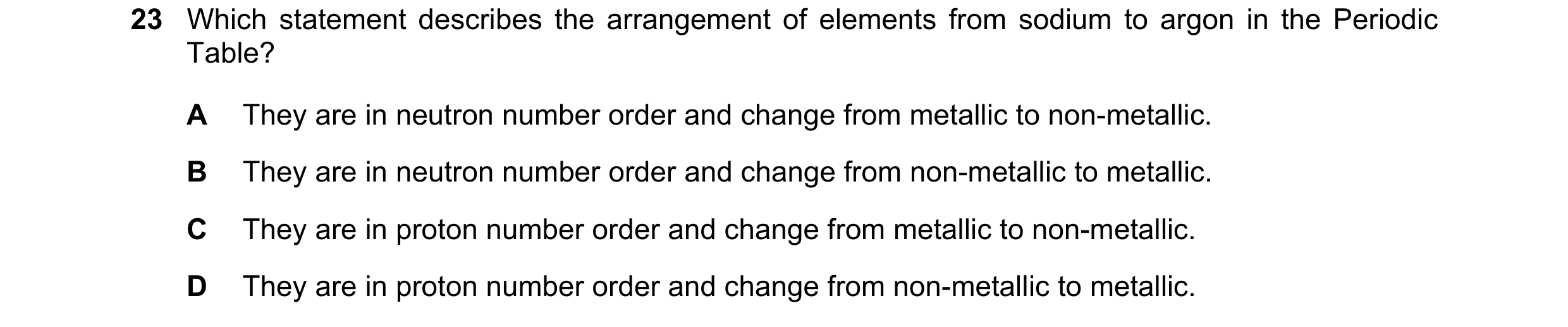

 11 / 17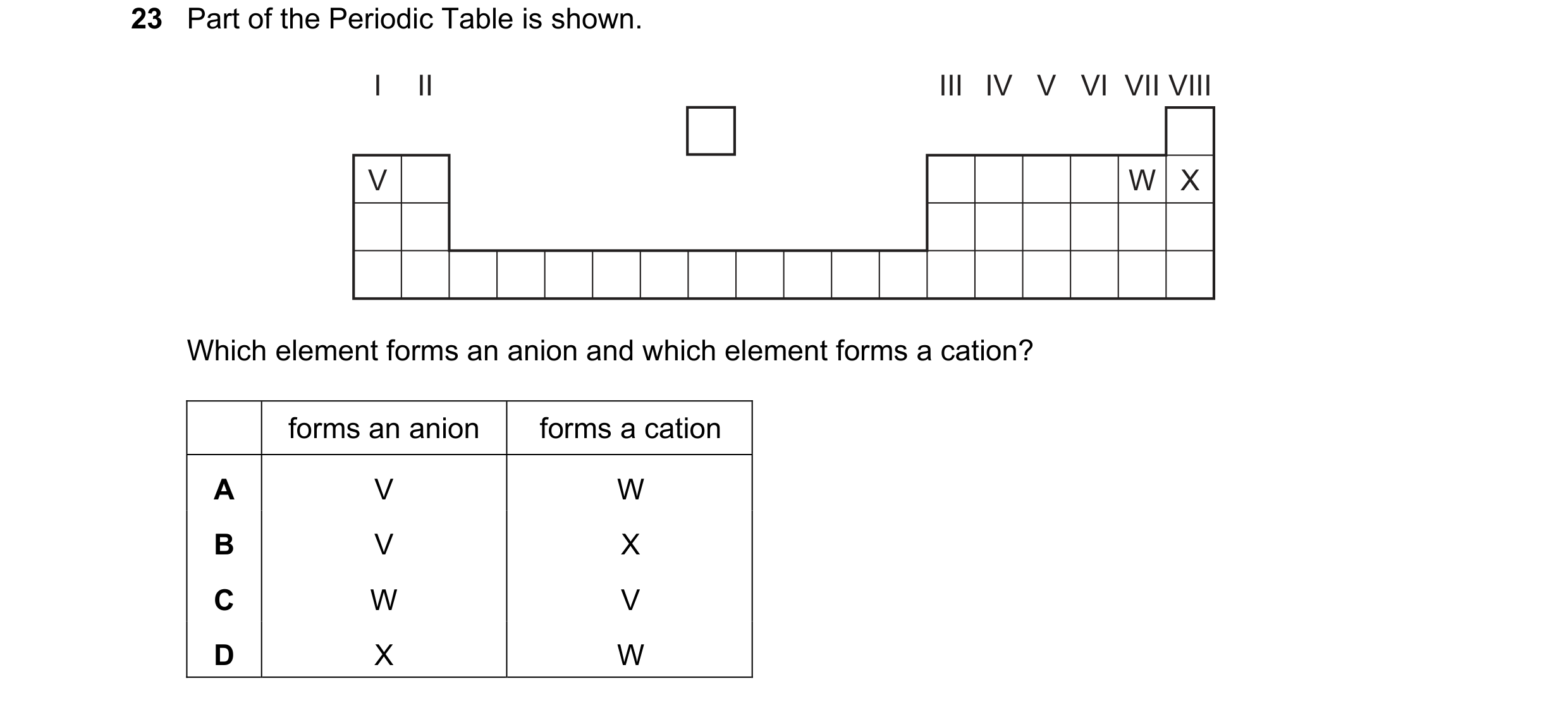
 12 / 17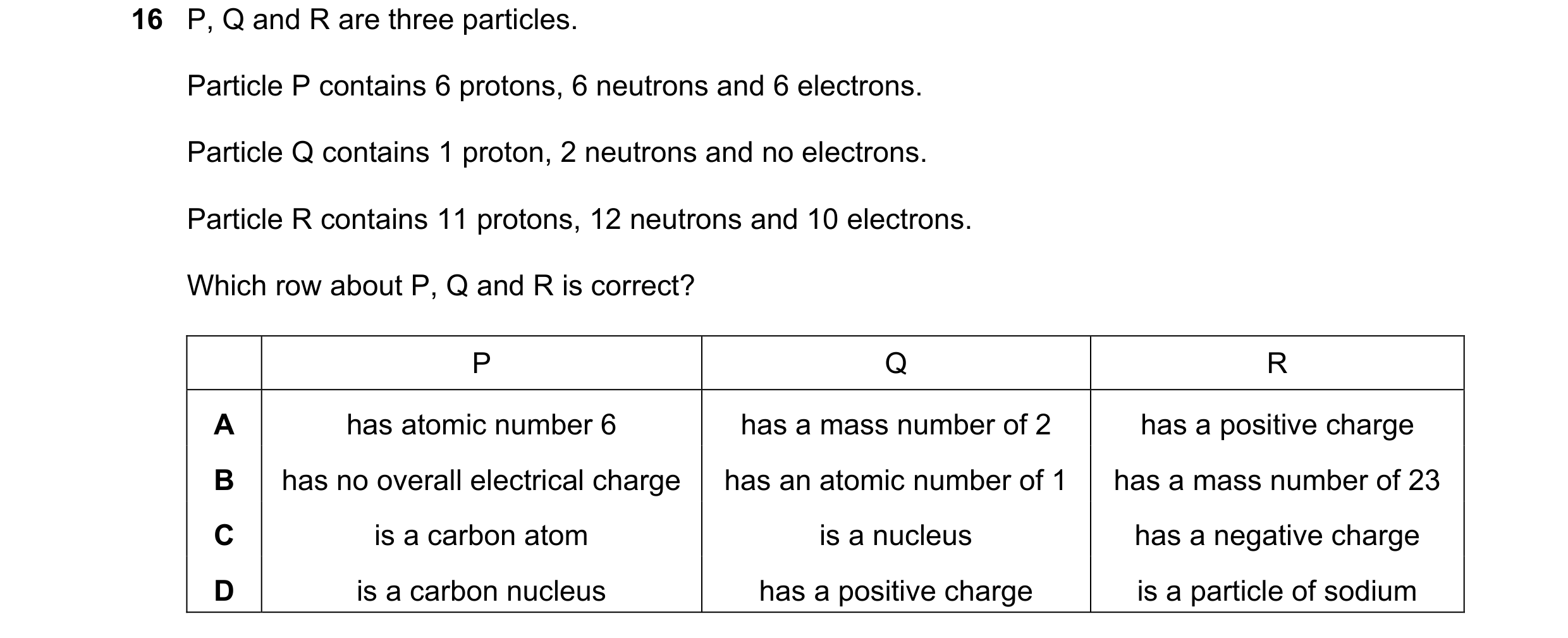
 13 / 17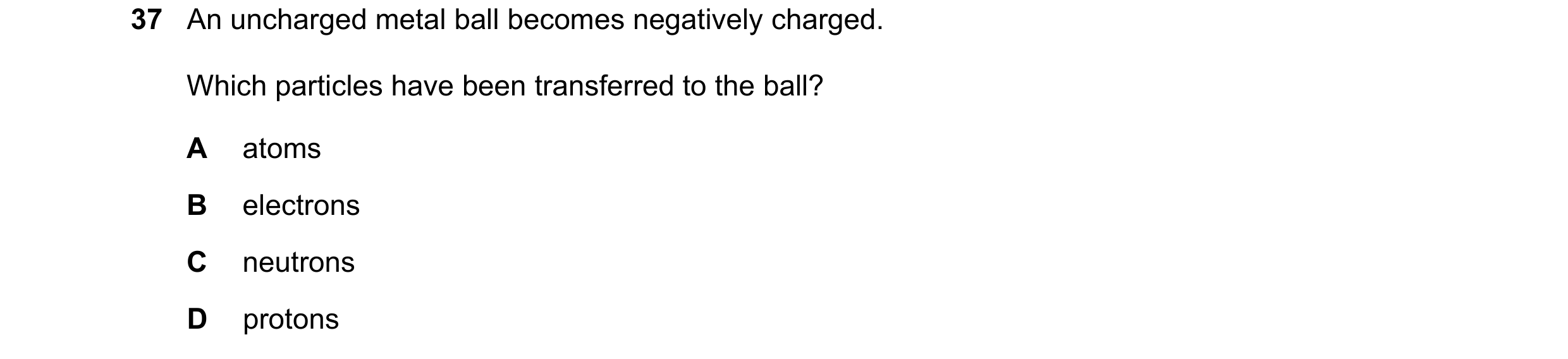


 14 / 17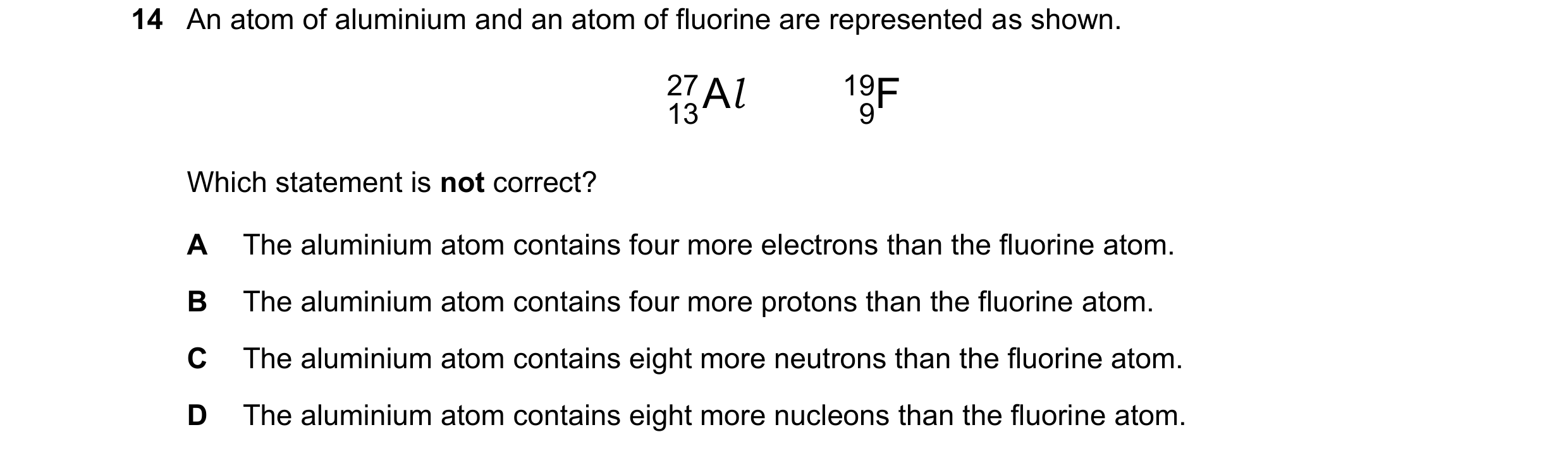

 15 / 17




 16 / 17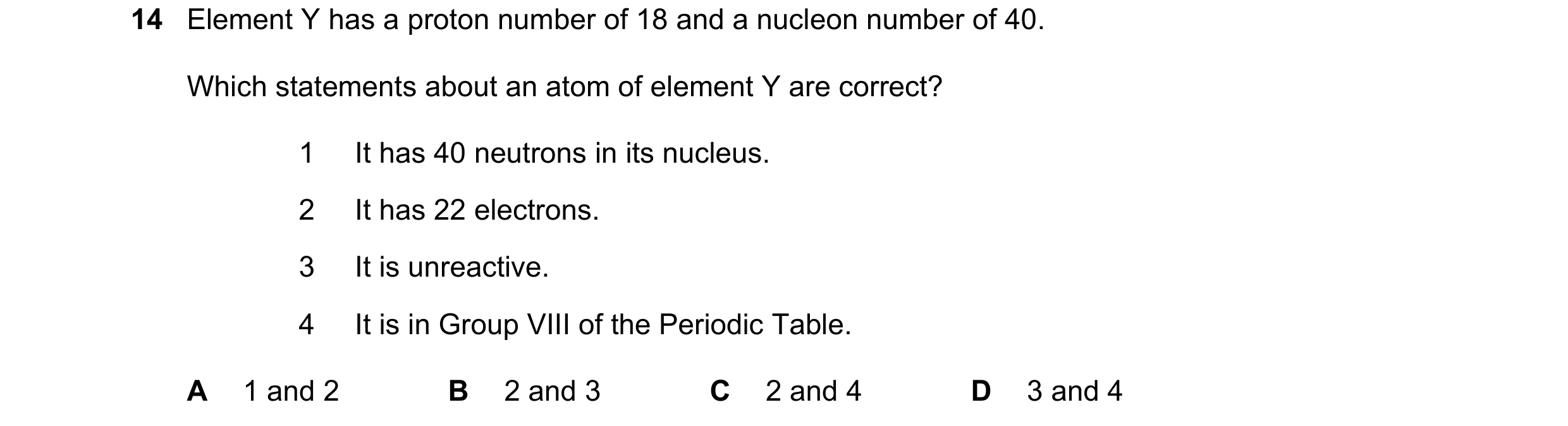
 17 / 17