Questions as text
Q1 · Use the Periodic Table on page 24 to determine the electronic structure of an aluminium… 0653/41 May/June 2017
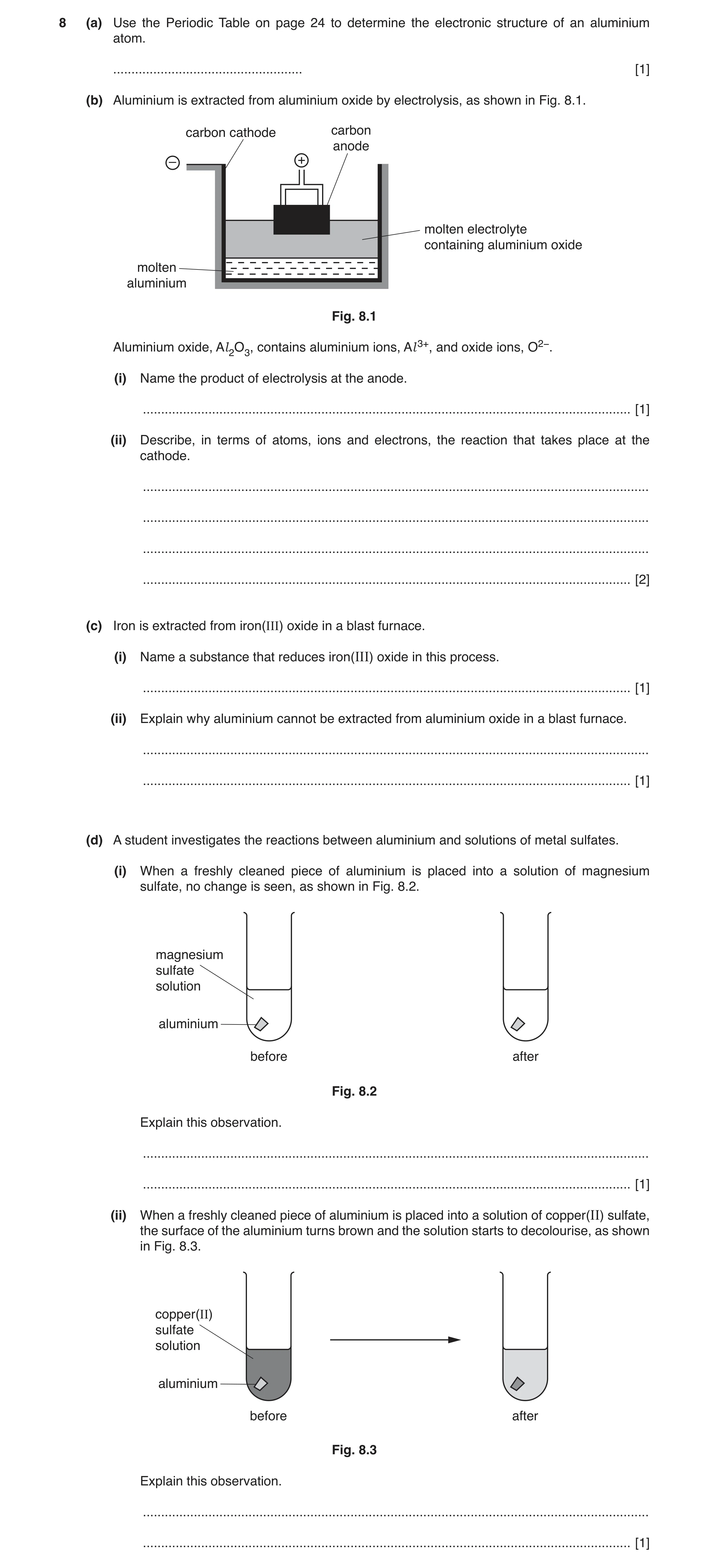
8 (a) Use the Periodic Table on page 24 to determine the electronic structure of an aluminium atom. … [1] (b) Aluminium is extracted from aluminium oxide by electrolysis, as shown in Fig. 8.1. carbon cathode carbon anode – + molten electrolyte containing aluminium oxide molten aluminium Fig. 8.1 Aluminium oxide, Al2O3, contains aluminium ions, Al 3+, and oxide ions, O2−. (i) Name the product of electrolysis at the anode. … [1] (ii) Describe, in terms of atoms, ions and electrons, the reaction that takes place at the cathode. … … … … [2] (c) Iron is extracted from iron(III) oxide in a blast furnace. (i) Name a substance that reduces iron(III) oxide in this process. … [1] (ii) Explain why aluminium cannot be extracted from aluminium oxide in a blast furnace. … … [1] (d) A student investigates the reactions between aluminium and solutions of metal sulfates. (i) When a freshly cleaned piece of aluminium is placed into a solution of magnesium sulfate, no change is seen, as shown in Fig. 8.2. magnesium sulfate solution aluminium before after Fig. 8.2 Explain this observation. … … [1] (ii) When a freshly cleaned piece of aluminium is placed into a solution of copper(II) sulfate, the surface of the aluminium turns brown and the solution starts to decolourise, as shown in Fig. 8.3. copper(II) sulfate solution aluminium before after Fig. 8.3 Explain this observation. … … [1]
8 marks
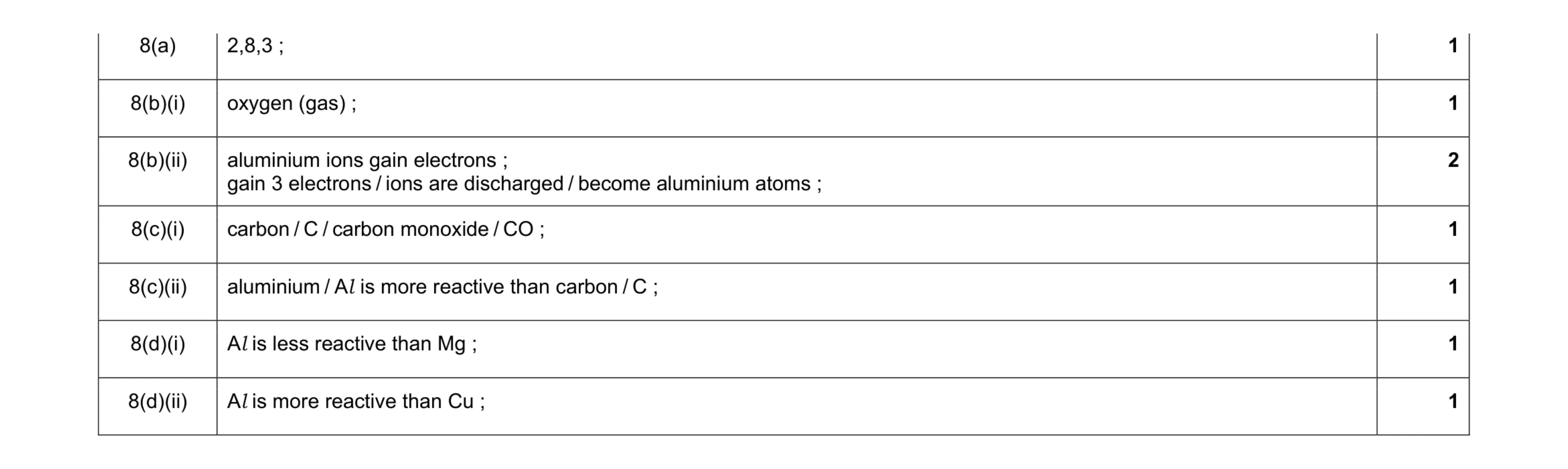
Mark scheme: 8(a) 1 8(b)(i) oxygen (gas) ; 1 8(b)(ii) aluminium ions gain electrons ; gain 3 electrons / ions are discharged / become aluminium atoms ; 2 8(c)(i) carbon / C / carbon monoxide / CO ; 1 8(c)(ii) aluminium / Al is more reactive than carbon / C ; 1 8(d)(i) Al is less reactive than Mg ; 1 8(d)(ii) Al is more reactive than Cu ; 1
This question in 0653/41 May/June 2017
Q2 · The atomic number of magnesium is 12 0653/43 May/June 2017
5 (a) The atomic number of magnesium is 12. Complete Fig. 5.1 to show the electronic structure of a magnesium atom. X X Fig. 5.1 [2] (b) A student investigates the reaction between magnesium and dilute hydrochloric acid. The student uses the apparatus shown in Fig. 5.2 for the investigation. cotton wool conical flask dilute magnesium hydrochloric powder acid balance Fig. 5.2 Fig. 5.3 shows the mass of the conical flask and its contents during the reaction. mass time Fig. 5.3 (i) Explain why at first the mass decreases, … … later on the mass does not change. … … [2] (ii) Complete and balance the symbolic equation for this reaction. Mg + … … + MgCl2 [2] (c) (i) State the effect, if any, of using a higher temperature on the rate of a reaction. Explain your answer in terms of particle collisions. effect … explanation … … … [2] (ii) State the effect of using a catalyst on the rate of a reaction. Describe the change, if any, to the catalyst at the end of the reaction. effect … change to catalyst … [2]
10 marks
Mark scheme: 5(a) 2 electrons 3rd shell ; 2 5(b)(i) gas / H2 produced / lost ; reaction ends / over ; 2 5(b)(ii) (Mg) + 2HCl Î H2 + (MgCl2) 2HCl ; H2 ; 2 5(c)(i) increases ; particles collide more often / forcefully / energetically / successfully ; 2 5(c)(ii) increases / changes ; no change ; 2
This question in 0653/43 May/June 2017
Q3 · An atom of phosphorus is represented as shown 0653/41 Oct/Nov 2017
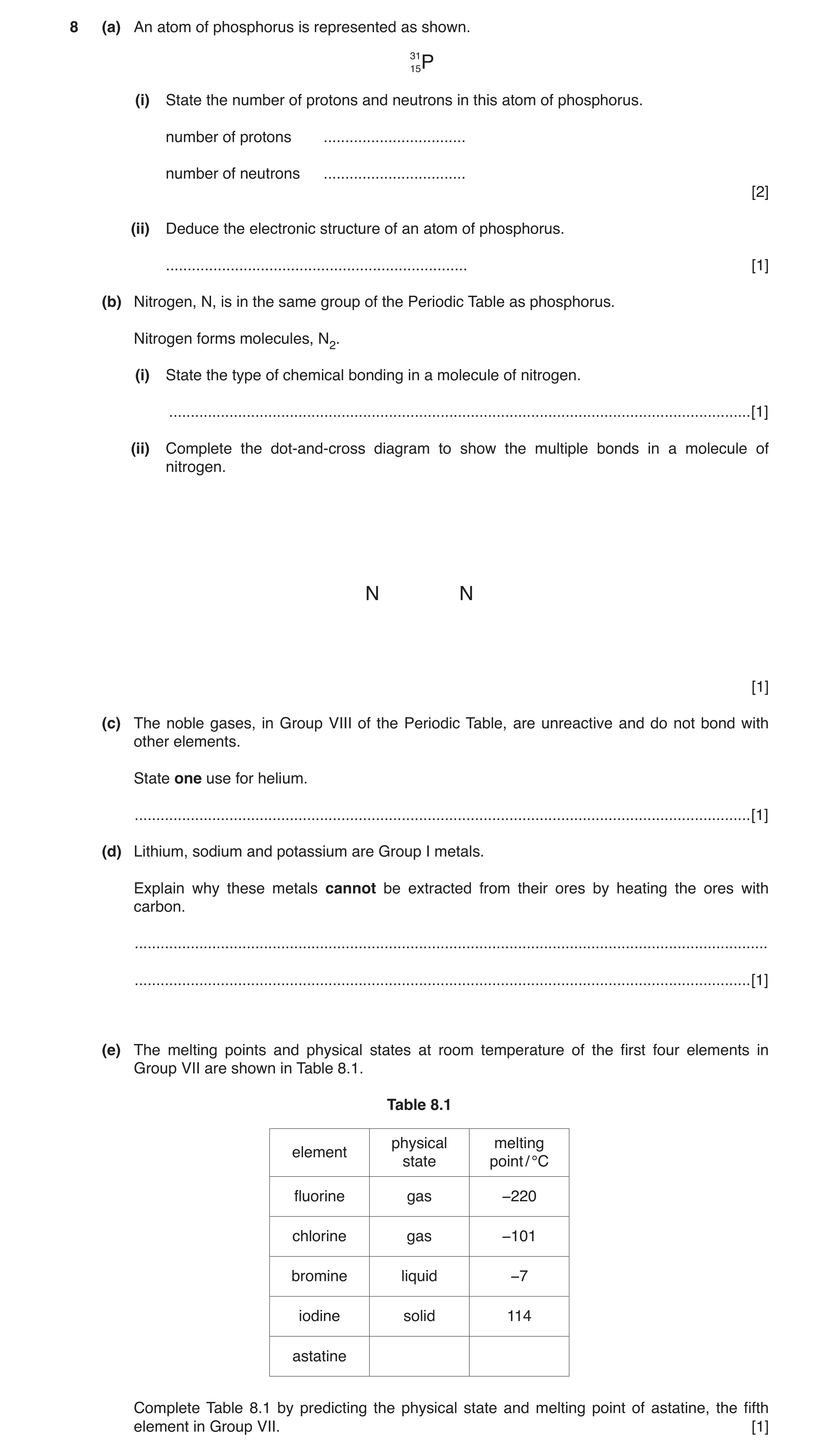
8 (a) An atom of phosphorus is represented as shown. 3115P (i) State the number of protons and neutrons in this atom of phosphorus. number of protons … number of neutrons … [2] (ii) Deduce the electronic structure of an atom of phosphorus. … [1] (b) Nitrogen, N, is in the same group of the Periodic Table as phosphorus. Nitrogen forms molecules, N2. (i) State the type of chemical bonding in a molecule of nitrogen. … [1] (ii) Complete the dot-and-cross diagram to show the multiple bonds in a molecule of nitrogen. N N [1] (c) The noble gases, in Group VIII of the Periodic Table, are unreactive and do not bond with other elements. State one use for helium. … [1] (d) Lithium, sodium and potassium are Group I metals. Explain why these metals cannot be extracted from their ores by heating the ores with carbon. … … [1] (e) The melting points and physical states at room temperature of the first four elements in Group VII are shown in Table 8.1. Table 8.1 physical melting element state point / °C fluorine gas −220 chlorine gas −101 bromine liquid −7 iodine solid 114 astatine Complete Table 8.1 by predicting the physical state and melting point of astatine, the fifth element in Group VII. [1]
8 marks
Mark scheme: 8(a)(i) 15 ; 16 ; 2 8(a)(ii) 2, 8, 5 ; 1 8(b)(i) covalent / triple ; 1 8(b)(ii) ; 1 8(c) (helium) balloons / avp ; 1 8(d) (Group I metals are) more reactive than carbon ; 1 8(e) solid and 165–310 (actual 302) ; 1
This question in 0653/41 Oct/Nov 2017
Q4 · The atomic number of oxygen is 8 0653/43 Oct/Nov 2017
8 (a) (i) The atomic number of oxygen is 8. Complete Fig. 8.1 to show the electronic structure of an oxygen atom. nucleus Fig. 8.1 [1] (ii) Complete the dot-and-cross diagram of a molecule of water. Show all the outer shell electrons. H O H [2] (b) Element Z has two electrons in its outer shell. Z is not the symbol for this element. (i) Predict the group number of element Z in the Periodic Table. … [1] (ii) An atom of element Z forms an ion. State the charge of this ion. Explain how this ion forms. charge … explanation … … … [2] (c) Potassium, copper and iron are extracted by different methods. Complete Table 8.1 to show the order of reactivity of these three metals. State the method of extraction of each metal from its ore. Table 8.1 order of reactivity metal method of extraction most reactive least reactive [3]
9 marks
Mark scheme: 8(a)(i) 2 electrons in 1st shell and 6 electrons in 2nd shell ; 1 8(a)(ii) 2 bonding pairs ; 2 lone pairs and no extra electrons anywhere ; 2 8(b)(i) II / 2 / two ; 1 8(b)(ii) 2+ ; loses two electrons ; 2 8(c) order of reactivity metal method of extraction most reactive least reactive potassium / K electrolysis ; iron / Fe blast furnace / reduction by C / CO ; copper / Cu ; carbon reduction / heat with carbon ; order of reactivity ; electrolysis linked to potassium ; carbon reduction owtte for both Fe and Cu ; 3
This question in 0653/43 Oct/Nov 2017
Q5 · An atom of bromine is represented by the symbol 3579Br (i) State the number of electrons… 0653/42 Feb/March 2018
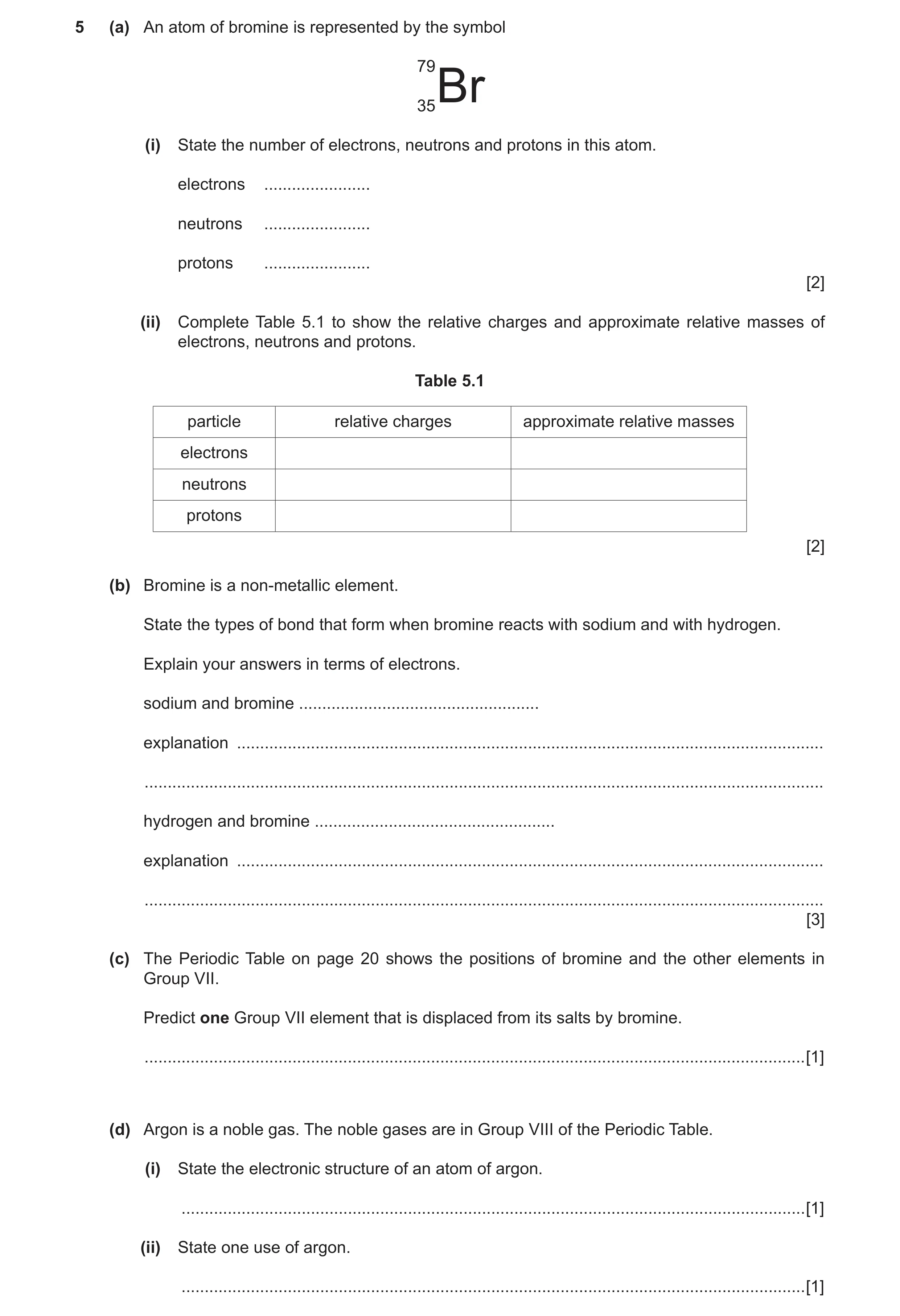
5 (a) An atom of bromine is represented by the symbol 3579Br (i) State the number of electrons, neutrons and protons in this atom. electrons … neutrons … protons … [2] (ii) Complete Table 5.1 to show the relative charges and approximate relative masses of electrons, neutrons and protons. Table 5.1 particle relative charges approximate relative masses electrons neutrons protons [2] (b) Bromine is a non-metallic element. State the types of bond that form when bromine reacts with sodium and with hydrogen. Explain your answers in terms of electrons. sodium and bromine … explanation … … hydrogen and bromine … explanation … … [3] (c) The Periodic Table on page 20 shows the positions of bromine and the other elements in Group VII. Predict one Group VII element that is displaced from its salts by bromine. … [1] (d) Argon is a noble gas. The noble gases are in Group VIII of the Periodic Table. (i) State the electronic structure of an atom of argon. … [1] (ii) State one use of argon. … [1]
10 marks
Mark scheme: 5(a)(i) (electrons) 35 (neutrons) 44 (protons) 35 ;; all three correct (2) one or two correct (1) 2 5(a)(ii) (particle) (relative charges) (approximate relative masses) (electrons) –1 / negative / –ve negligible / 1 / 2000 (neutrons) 0 / none / neutral 1 (protons) +1 / positive / +ve 1 each column correct ;; 2 5(b) (sodium) ionic / electrovalent and (hydrogen) covalent ; (ionic) idea of gain / loss / transfer of electrons ; (covalent) electrons are shared ; 3 5(c) iodine / astatine ; 1 5(d)(i) 2, 8, 8 ; 1 5(d)(ii) lamps / inert atmosphere / other valid answers ; 1
This question in 0653/42 Feb/March 2018
Q6 · A student investigates the relative reactivity of different metals 0653/41 May/June 2018
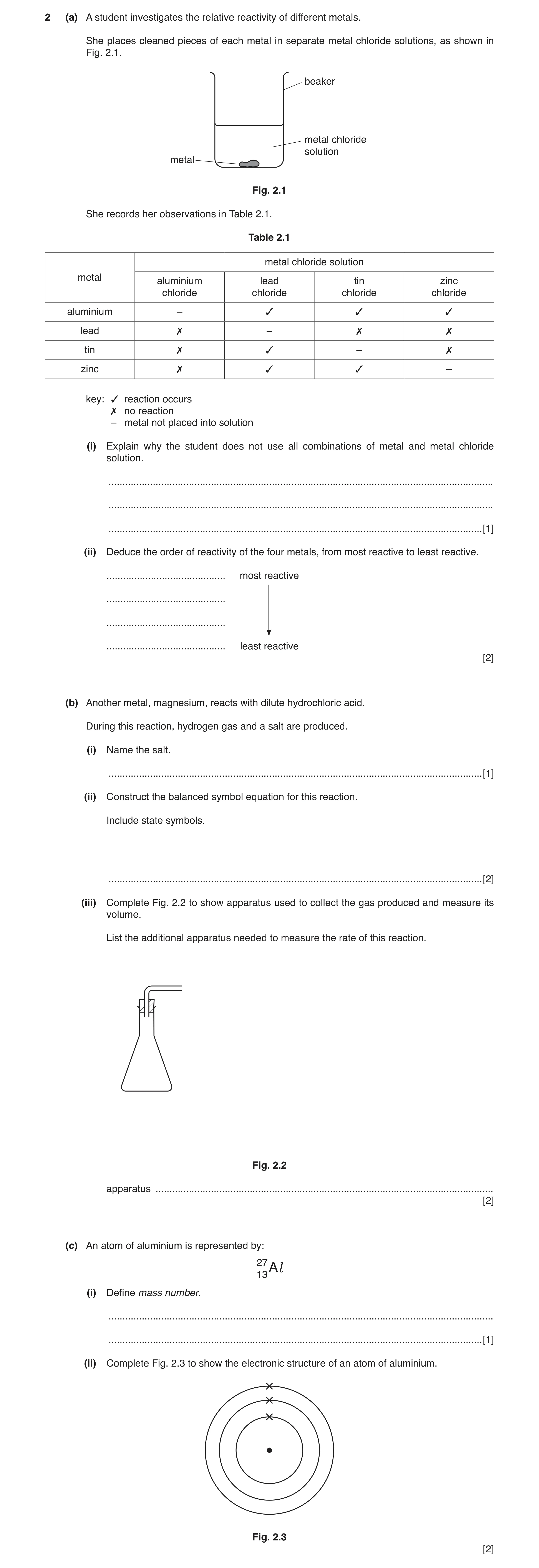
2 (a) A student investigates the relative reactivity of different metals. She places cleaned pieces of each metal in separate metal chloride solutions, as shown in Fig. 2.1. beaker metal chloride solution metal Fig. 2.1 She records her observations in Table 2.1. Table 2.1 metal chloride solution metal aluminium lead tin zinc chloride chloride chloride chloride 3 3 3 aluminium – 7 7 7 lead – 7 3 7 tin – 7 3 3 zinc – key: 3 reaction occurs 7 no reaction – metal not placed into solution (i) Explain why the student does not use all combinations of metal and metal chloride solution. … … … [1] (ii) Deduce the order of reactivity of the four metals, from most reactive to least reactive. … most reactive … … … least reactive [2] (b) Another metal, magnesium, reacts with dilute hydrochloric acid. During this reaction, hydrogen gas and a salt are produced. (i) Name the salt. … [1] (ii) Construct the balanced symbol equation for this reaction. Include state symbols. … [2] (iii) Complete Fig. 2.2 to show apparatus used to collect the gas produced and measure its volume. List the additional apparatus needed to measure the rate of this reaction. Fig. 2.2 apparatus … [2] (c) An atom of aluminium is represented by: 2713Al (i) Define mass number. … … [1] (ii) Complete Fig. 2.3 to show the electronic structure of an atom of aluminium. Fig. 2.3 [2]
11 marks
Mark scheme: 2(a)(i) No reaction expected / will take place / experiment has to compare different metals ; 1 2(a)(ii) aluminium / Al zinc / Zn tin / Sn lead / Pb ;; aluminium and lead correctly located = 1 all correct = 2 2 2(b)(i) magnesium chloride ; 1 2(b)(ii) Mg(s) + 2HCl (aq) → MgCl2 (aq) + H2(g) all formulae and balanced (dependent on formulae) ; 3 or 4 correct state symbols (dependent on correct species) ; 2 2(b)(iii) feasible method of collection ; timing device listed or shown in diagram ; 2 2(c)(i) (Number of) protons + neutrons (in an atom) ; 1 2(c)(ii) 13 electrons shown ; arranged 2, 8, 3 ; 2
This question in 0653/41 May/June 2018
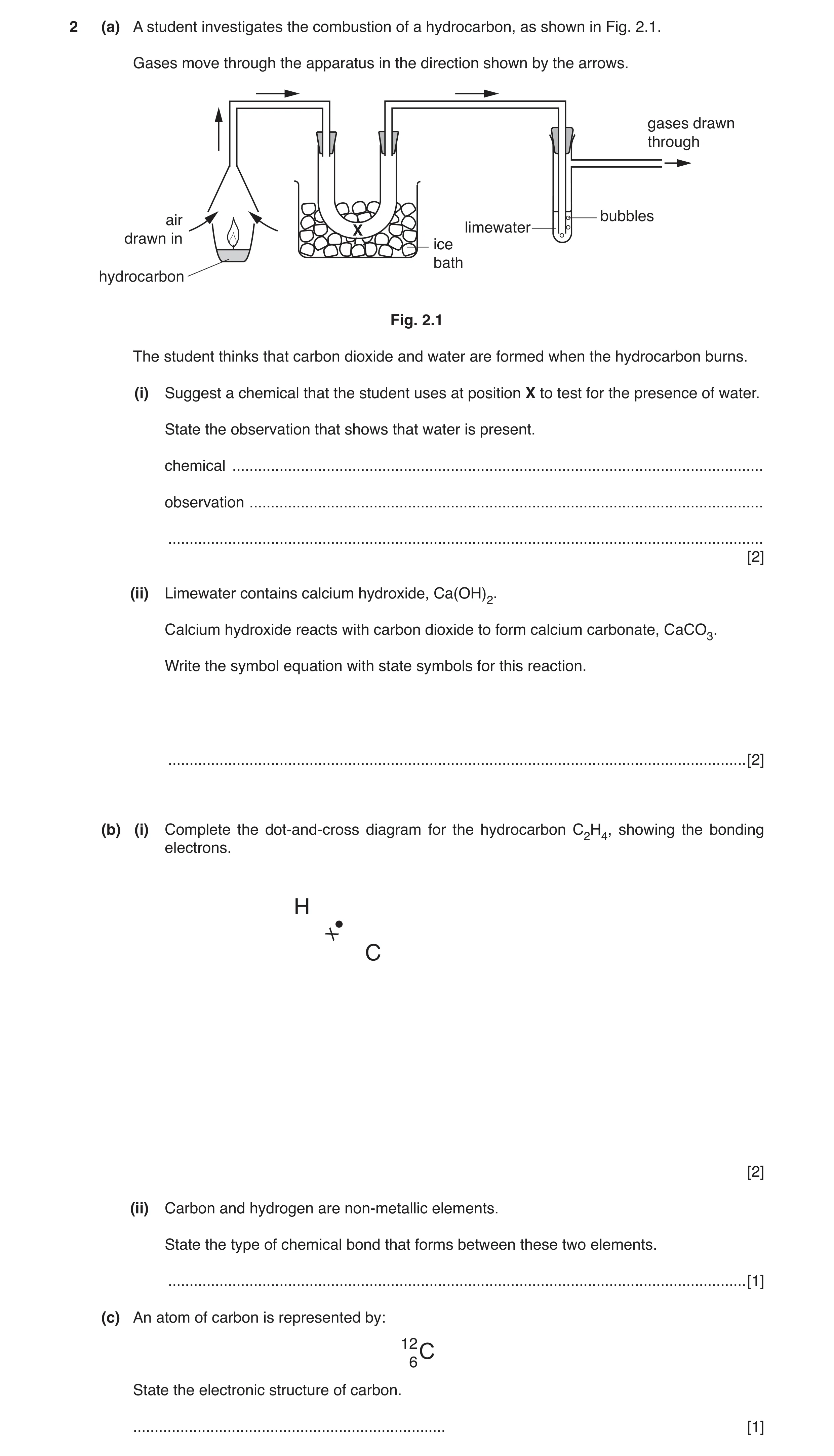
Q7 · A student investigates the combustion of a hydrocarbon, as shown in Fig 0653/42 May/June 2018
2 (a) A student investigates the combustion of a hydrocarbon, as shown in Fig. 2.1. Gases move through the apparatus in the direction shown by the arrows. gases drawn through X air bubbles X limewater drawn in ice bath hydrocarbon Fig. 2.1 The student thinks that carbon dioxide and water are formed when the hydrocarbon burns. (i) Suggest a chemical that the student uses at position X to test for the presence of water. State the observation that shows that water is present. chemical … observation … … [2] (ii) Limewater contains calcium hydroxide, Ca(OH)2. Calcium hydroxide reacts with carbon dioxide to form calcium carbonate, CaCO3. Write the symbol equation with state symbols for this reaction. … [2] (b) (i) Complete the dot-and-cross diagram for the hydrocarbon C2H4, showing the bonding electrons. H X C [2] (ii) Carbon and hydrogen are non-metallic elements. State the type of chemical bond that forms between these two elements. … [1] (c) An atom of carbon is represented by: 126C State the electronic structure of carbon. … [1]
8 marks
Mark scheme: 2(a)(i) anhydrous / blue cobalt chloride ; turns (blue to ) pink ; OR anhydrous / white copper sulfate ; turns (white to ) blue ; 2 2(a)(ii) Ca(OH)2(aq) + CO2(g) → CaCO3(g) + H2O(l) correct species both sides ; 3 or 4 correct states ; 2 Question Answer Marks 2(b)(i) (circles not essential) 4 electrons between two C atoms ; 2 electrons between each of 4 pairs of C and H atoms ; 2 2(b)(ii) covalent ; 1 2(c) 2, 4 ; 1
This question in 0653/42 May/June 2018
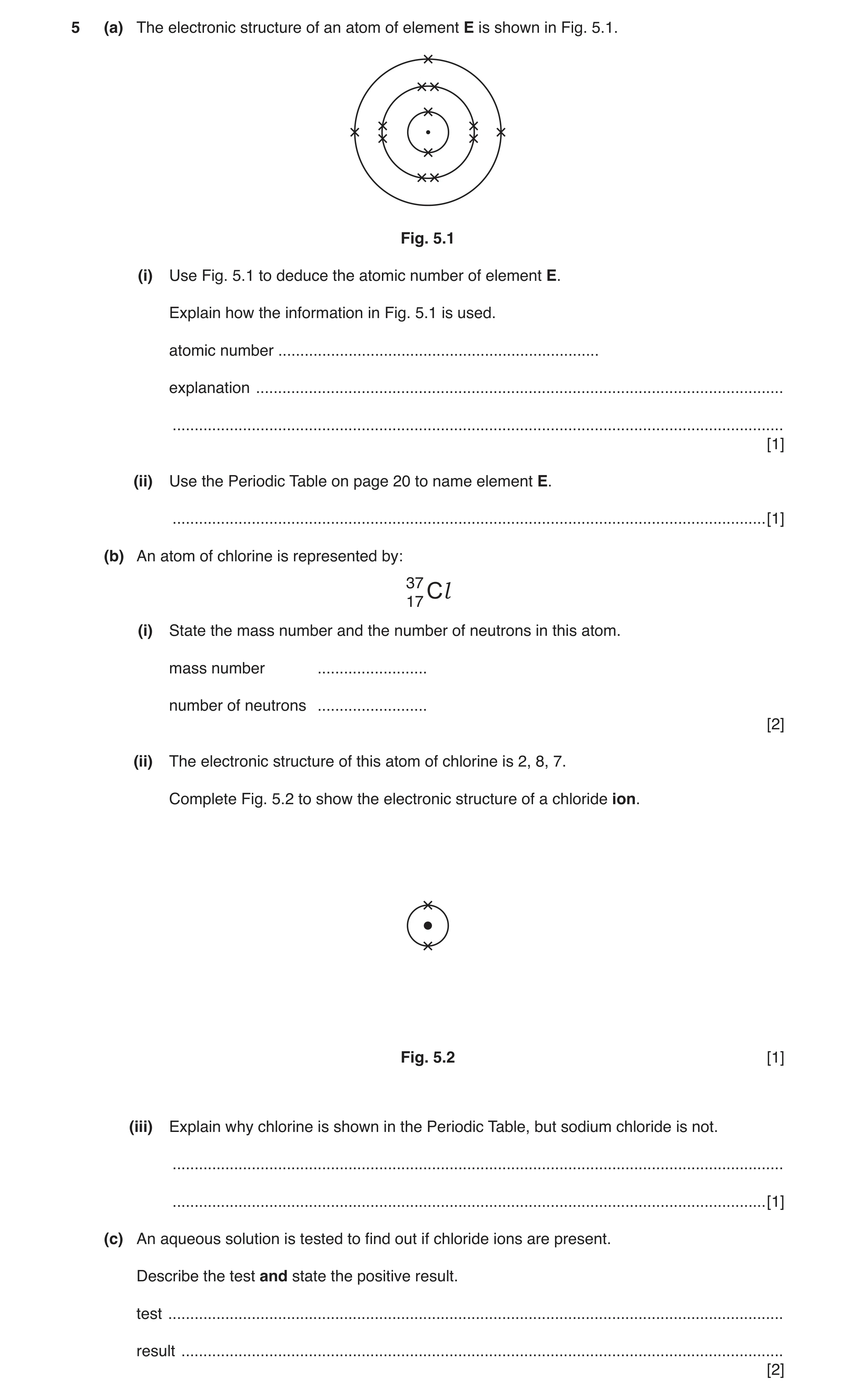
Q8 · The electronic structure of an atom of element E is shown in Fig 0653/43 May/June 2018
5 (a) The electronic structure of an atom of element E is shown in Fig. 5.1. Fig. 5.1 (i) Use Fig. 5.1 to deduce the atomic number of element E. Explain how the information in Fig. 5.1 is used. atomic number … explanation … … [1] (ii) Use the Periodic Table on page 20 to name element E. … [1] (b) An atom of chlorine is represented by: 3717Cl (i) State the mass number and the number of neutrons in this atom. mass number … number of neutrons … [2] (ii) The electronic structure of this atom of chlorine is 2, 8, 7. Complete Fig. 5.2 to show the electronic structure of a chloride ion. Fig. 5.2 [1] (iii) Explain why chlorine is shown in the Periodic Table, but sodium chloride is not. … … [1] (c) An aqueous solution is tested to find out if chloride ions are present. Describe the test and state the positive result. test … result … [2]
8 marks
Mark scheme: 5(a)(i) (13) 13 electrons so 13 protons / same no. electrons and protons ; 1 5(a)(ii) aluminium ; 1 5(b)(i) (mass no.) 37 ; (neutron no.) 20 ; 2 5(b)(ii) 2, 8, 8 shown on a diagram with concentric shells ; 1 5(b)(iii) (chlorine is an element but) sodium chloride is a compound / not an element ; 1 5(c) (test) silver nitrate / aqueous/solution (acidic conditions) ; (result) white precipitate ; 2
This question in 0653/43 May/June 2018
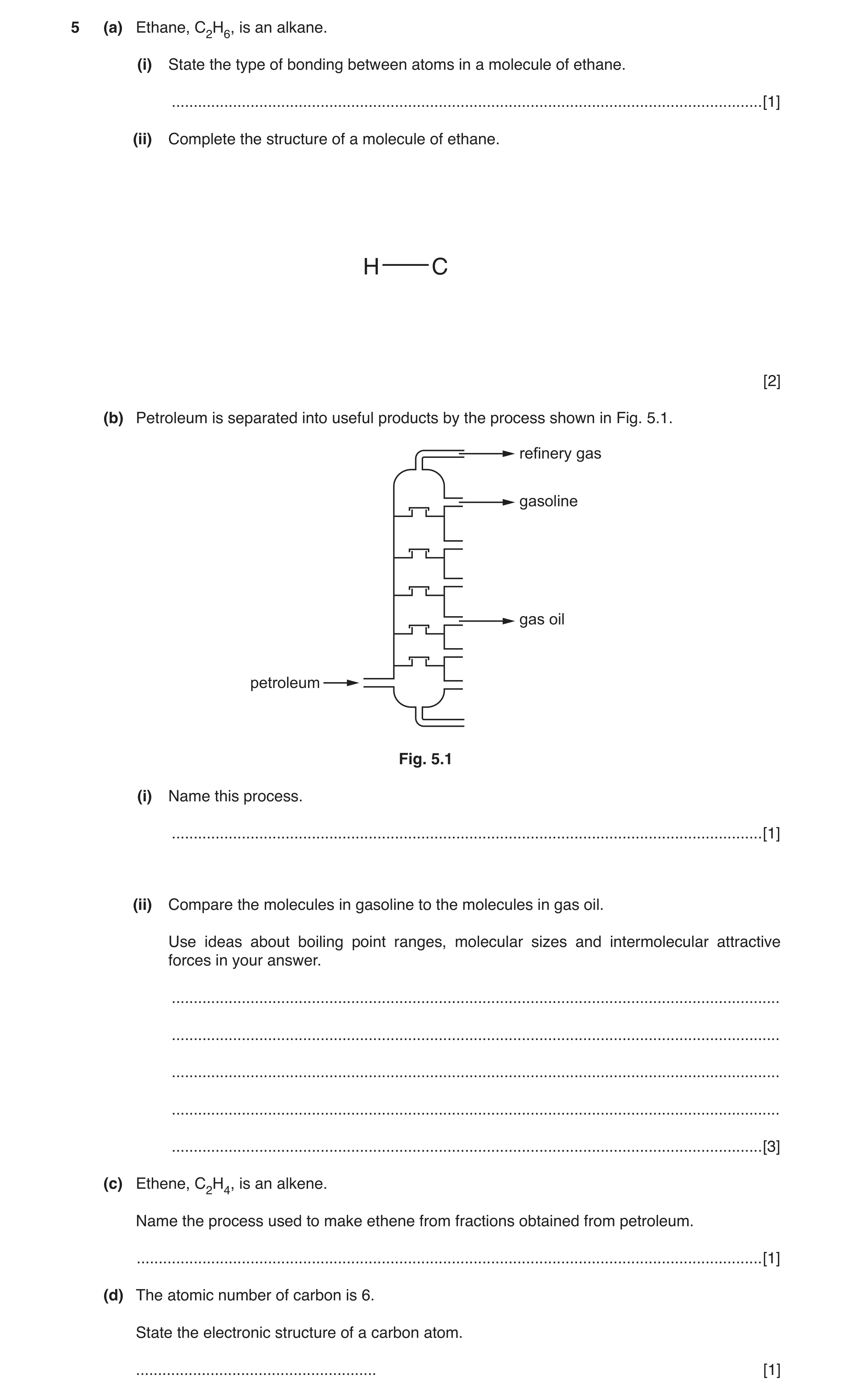
Q9 · Ethane, C2H6, is an alkane 0653/42 Oct/Nov 2018
5 (a) Ethane, C2H6, is an alkane. (i) State the type of bonding between atoms in a molecule of ethane. … [1] (ii) Complete the structure of a molecule of ethane. H C [2] (b) Petroleum is separated into useful products by the process shown in Fig. 5.1. refinery gas gasoline gas oil petroleum Fig. 5.1 (i) Name this process. … [1] (ii) Compare the molecules in gasoline to the molecules in gas oil. Use ideas about boiling point ranges, molecular sizes and intermolecular attractive forces in your answer. … … … … … [3] (c) Ethene, C2H4, is an alkene. Name the process used to make ethene from fractions obtained from petroleum. … [1] (d) The atomic number of carbon is 6. State the electronic structure of a carbon atom. … [1]
9 marks
Mark scheme: 5(a)(i) covalent ; 1 5(a)(ii) C – C single bond ; six correctly located C-H single bonds ; 2 5(b)(i) fractional distillation ; 1 5(b)(ii) gasoline molecules • are smaller ; • have lower boiling points ; • have weaker intermolecular attractive forces ; 3 5(c) cracking ; 1 5(d) 2,4 ; 1
This question in 0653/42 Oct/Nov 2018
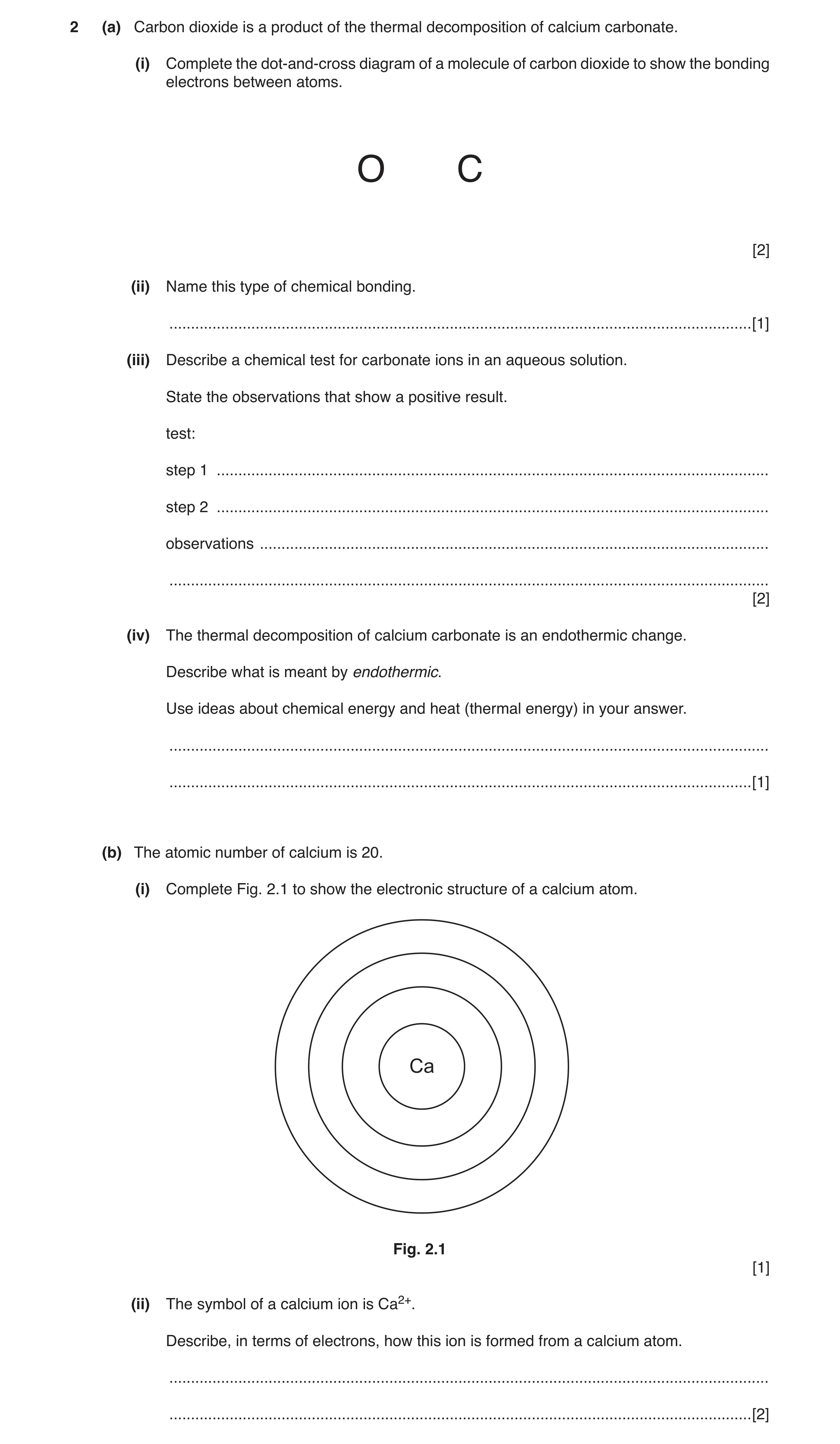
Q10 · Carbon dioxide is a product of the thermal decomposition of calcium carbonate 0653/43 Oct/Nov 2018
2 (a) Carbon dioxide is a product of the thermal decomposition of calcium carbonate. (i) Complete the dot-and-cross diagram of a molecule of carbon dioxide to show the bonding electrons between atoms. O C [2] (ii) Name this type of chemical bonding. … [1] (iii) Describe a chemical test for carbonate ions in an aqueous solution. State the observations that show a positive result. test: step 1 … step 2 … observations … … [2] (iv) The thermal decomposition of calcium carbonate is an endothermic change. Describe what is meant by endothermic. Use ideas about chemical energy and heat (thermal energy) in your answer. … … [1] (b) The atomic number of calcium is 20. (i) Complete Fig. 2.1 to show the electronic structure of a calcium atom. Ca Fig. 2.1 [1] (ii) The symbol of a calcium ion is Ca2+. Describe, in terms of electrons, how this ion is formed from a calcium atom. … … [2]
9 marks
Mark scheme: 2(a)(i) Two bonding pairs between C atom and each O atom ; correct non-bonding electrons on each O atom ; 2 2(a)(ii) covalent ; 1 2(a)(iii) (test) (step 1) add acid and (step 2) reference to use of limewater ; (observations) (limewater turns) milky / cloudy / white ppt. / solid ; 2 2(a)(iv) the idea that thermal (energy) / heat (changes) to chemical (energy) ; 1 2(b)(i) 2, 8, 8, 2 shown as crosses or clear dots ; 1 2(b)(ii) loss of electrons ; (reference to loss of) two electrons ; 2
This question in 0653/43 Oct/Nov 2018
Q11 · Use the Periodic Table on page 24 to deduce the electronic structure of a calcium atom 0653/41 May/June 2019
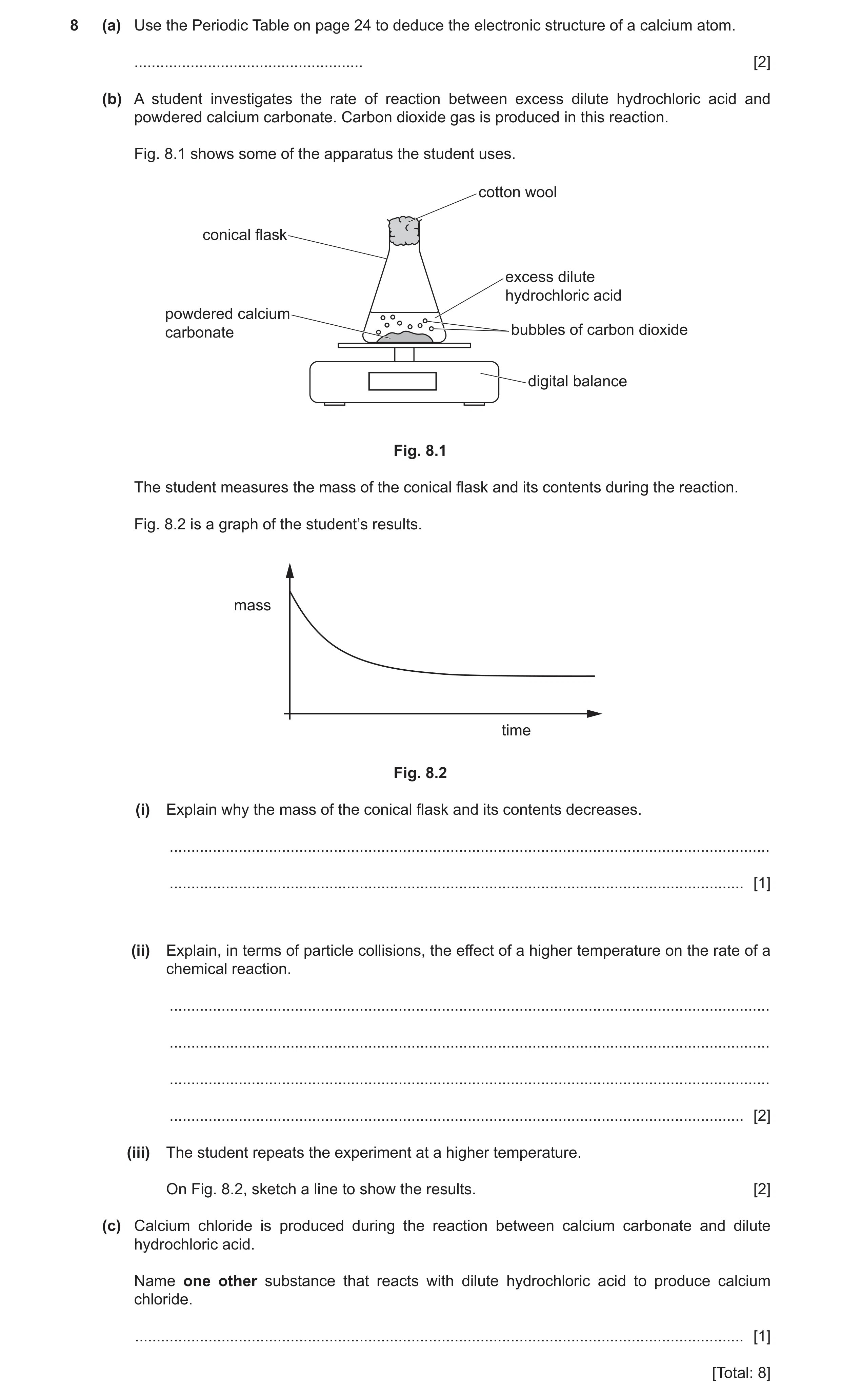
8 (a) Use the Periodic Table on page 24 to deduce the electronic structure of a calcium atom. … [2] (b) A student investigates the rate of reaction between excess dilute hydrochloric acid and powdered calcium carbonate. Carbon dioxide gas is produced in this reaction. Fig. 8.1 shows some of the apparatus the student uses. cotton wool conical flask excess dilute hydrochloric acid powdered calcium carbonate bubbles of carbon dioxide digital balance Fig. 8.1 The student measures the mass of the conical flask and its contents during the reaction. Fig. 8.2 is a graph of the student’s results. mass time Fig. 8.2 (i) Explain why the mass of the conical flask and its contents decreases. … … [1] (ii) Explain, in terms of particle collisions, the effect of a higher temperature on the rate of a chemical reaction. … … … … [2] (iii) The student repeats the experiment at a higher temperature. On Fig. 8.2, sketch a line to show the results. [2] (c) Calcium chloride is produced during the reaction between calcium carbonate and dilute hydrochloric acid. Name one other substance that reacts with dilute hydrochloric acid to produce calcium chloride. … [1] [Total: 8]
8 marks
Mark scheme: 8(a) 20 electrons ; 2,8,8,2 ; 2 8(b)(i) (carbon dioxide) gas released from the apparatus ; 1 8(b)(ii) particles have more energy/kinetic energy / move faster ; more successful collisions / collisions with enough energy ; greater frequency of collisions ; max 2 8(b)(iii) curved portion steeper ; horizontal line at same mass ; 2 8(c) calcium oxide / calcium hydroxide / calcium hydrogencarbonate / calcium ; 1
This question in 0653/41 May/June 2019
Q12 · Magnesium is an element in Group II of the Periodic Table, shown on page 20 0653/43 May/June 2019
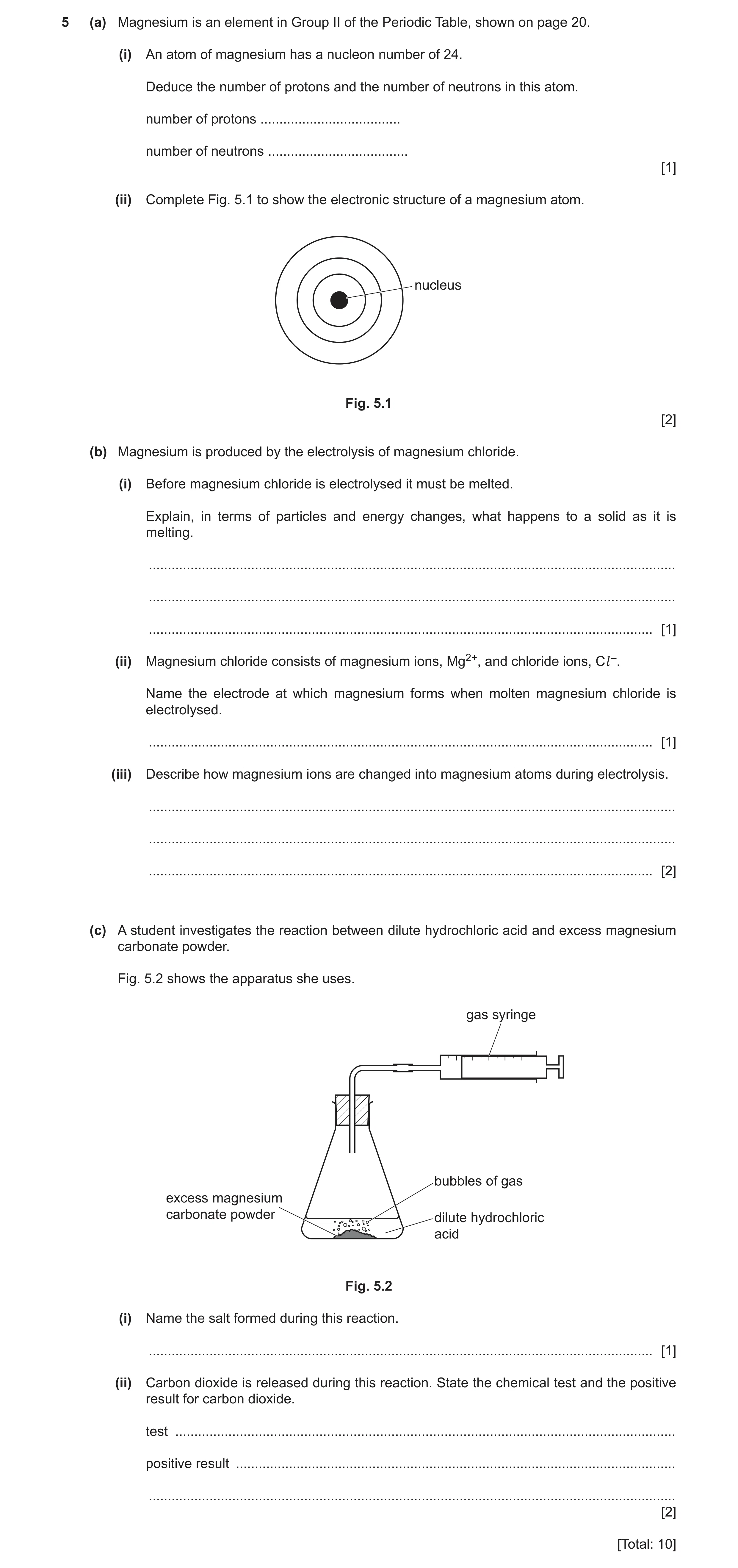
5 (a) Magnesium is an element in Group II of the Periodic Table, shown on page 20. (i) An atom of magnesium has a nucleon number of 24. Deduce the number of protons and the number of neutrons in this atom. number of protons … number of neutrons … [1] (ii) Complete Fig. 5.1 to show the electronic structure of a magnesium atom. nucleus Fig. 5.1 [2] (b) Magnesium is produced by the electrolysis of magnesium chloride. (i) Before magnesium chloride is electrolysed it must be melted. Explain, in terms of particles and energy changes, what happens to a solid as it is melting. … … … [1] (ii) Magnesium chloride consists of magnesium ions, Mg2+, and chloride ions, Cl –. Name the electrode at which magnesium forms when molten magnesium chloride is electrolysed. … [1] (iii) Describe how magnesium ions are changed into magnesium atoms during electrolysis. … … … [2] (c) A student investigates the reaction between dilute hydrochloric acid and excess magnesium carbonate powder. Fig. 5.2 shows the apparatus she uses. gas syringe bubbles of gas excess magnesium carbonate powder dilute hydrochloric acid Fig. 5.2 (i) Name the salt formed during this reaction. … [1] (ii) Carbon dioxide is released during this reaction. State the chemical test and the positive result for carbon dioxide. test … positive result … … [2] [Total: 10]
10 marks
Mark scheme: 5(a)(i) number of protons = 12 and number of neutrons = 12 ; 1 5(a)(ii) 12 electrons shown ; 2,8,2 configuration shown ; 2 5(b)(i) (thermal) energy absorbed which decreases inter-particle forces / allows particles to separate / move around freely ; 1 5(b)(ii) cathode ; 1 5(b)(iii) gain electrons ; (gain) two (electrons) ; 2 Question Answer Marks 5(c)(i) magnesium chloride ; 1 5(c)(ii) limewater ; goes cloudy / milky ; 2
This question in 0653/43 May/June 2019
Q13 · Rubidium and caesium are Group I metals 0653/43 May/June 2019
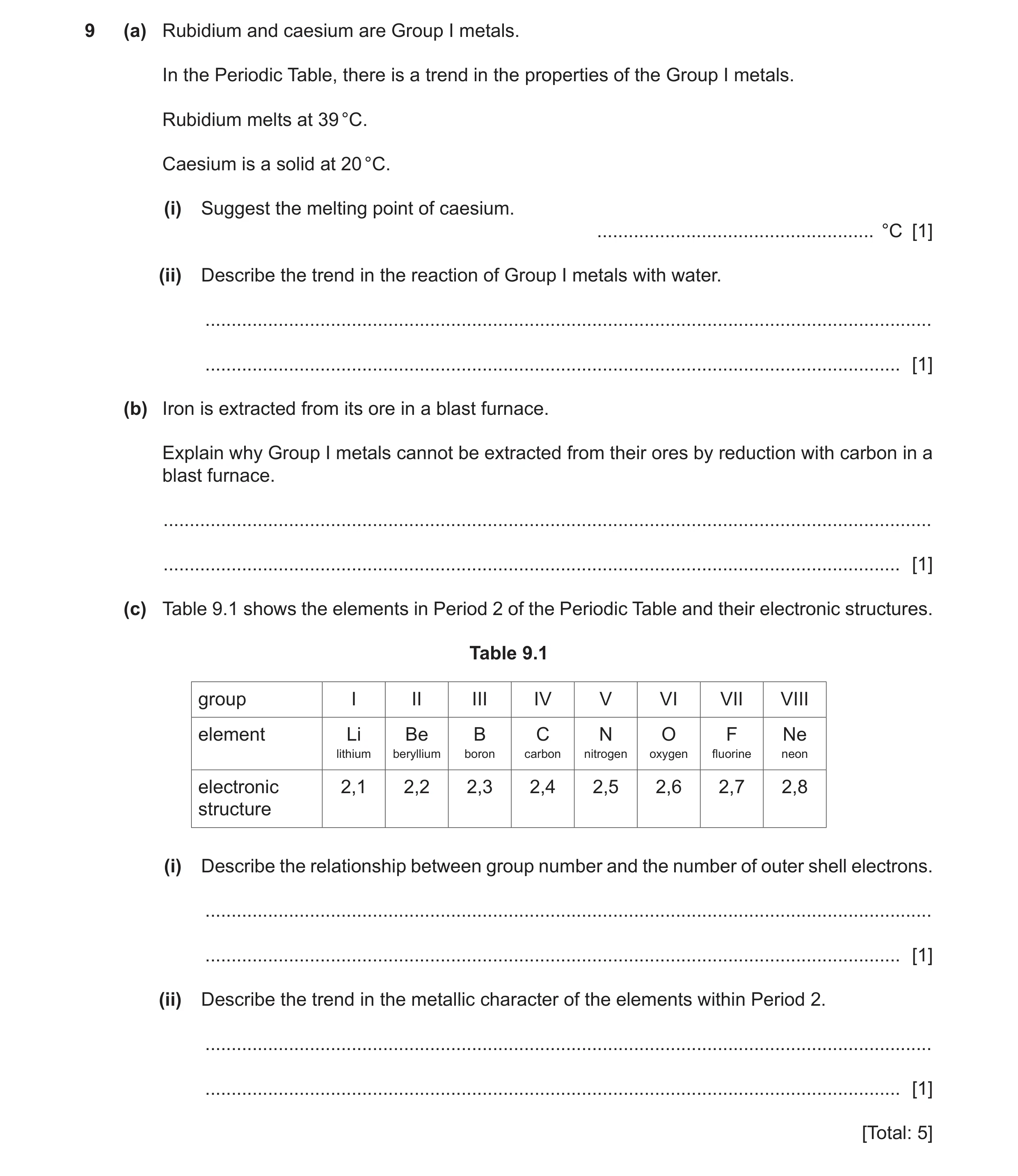
9 (a) Rubidium and caesium are Group I metals. In the Periodic Table, there is a trend in the properties of the Group I metals. Rubidium melts at 39 °C. Caesium is a solid at 20 °C. (i) Suggest the melting point of caesium. … °C [1] (ii) Describe the trend in the reaction of Group I metals with water. … … [1] (b) Iron is extracted from its ore in a blast furnace. Explain why Group I metals cannot be extracted from their ores by reduction with carbon in a blast furnace. … … [1] (c) Table 9.1 shows the elements in Period 2 of the Periodic Table and their electronic structures. Table 9.1 group I II III IV V VI VII VIII element Li Be B C N O F Ne lithium beryllium boron carbon nitrogen oxygen fluorine neon electronic 2,1 2,2 2,3 2,4 2,5 2,6 2,7 2,8 structure (i) Describe the relationship between group number and the number of outer shell electrons. … … [1] (ii) Describe the trend in the metallic character of the elements within Period 2. … … [1] [Total: 5]
5 marks
Mark scheme: 9(a)(i) in range 21 °C to 38 °C ; 1 9(a)(ii) increases as group is descended ; 1 9(b) metals are too reactive / more reactive than carbon ; 1 9(c)(i) The group number is equal to the number of outer shell electrons ; 1 9(c)(ii) metallic character decreases going from left to right ; 1
This question in 0653/43 May/June 2019
Q14 · Chlorine and astatine are two Group VII elements 0653/42 Oct/Nov 2019
8 Chlorine and astatine are two Group VII elements. (a) Fig. 8.1 shows Group VII of the Periodic Table. VII 9 F Fluorine 19 17 Cl Chlorine 35.5 35 Br Bromine 80 53 I Iodine 127 85 At Astatine — Fig. 8.1 (i) Use Fig. 8.1 to determine the number of electrons in an astatine atom. … [1] (ii) State the number of electrons in the outer shell of an astatine atom. Explain your answer. number of electrons … explanation … … [2] (iii) Deduce the formula of potassium astatide. … [1] (b) Chlorine combines with sodium in an exothermic reaction to produce sodium chloride. (i) Describe what is meant by an exothermic reaction. Use ideas about energy, bond breaking and bond forming in your answer. … … … … [2] (ii) Solid sodium chloride contains sodium ions, Na+, and chloride ions, Cl –. Fig. 8.2 represents part of an ionic lattice of sodium chloride. Cl – Fig. 8.2 [1] Complete Fig. 8.2 to show the arrangement of sodium ions and chloride ions. (iii) The boiling point of chlorine is –34 °C. The boiling point of sodium chloride is 1465 °C. Explain the difference in these boiling points. … … … … … [2] [Total: 9]
9 marks
Mark scheme: 8(a)(i) 85 ; 1 8(a)(ii) 7 ; group VII element / halogen ; 2 8(a)(iii) KAt ; 1 8(b)(i) thermal energy released / temperature increased / chemical energy converted to thermal energy ; more energy released during bond formation than energy required for bond breaking ; 2 8(b)(ii) alternating Cl – and Na+ ions ; 1 8(b)(iii) (NaCl) or (chlorine) ionic so attractive forces between ions are strong covalent so attractive forces between molecules are weak ; more thermal energy (heat) needed to separate ions less thermal energy (heat) needed to separate molecules ; 2
This question in 0653/42 Oct/Nov 2019
Q15 · A lightning bolt, which is a form of electrostatic discharge 0653/42 Oct/Nov 2019
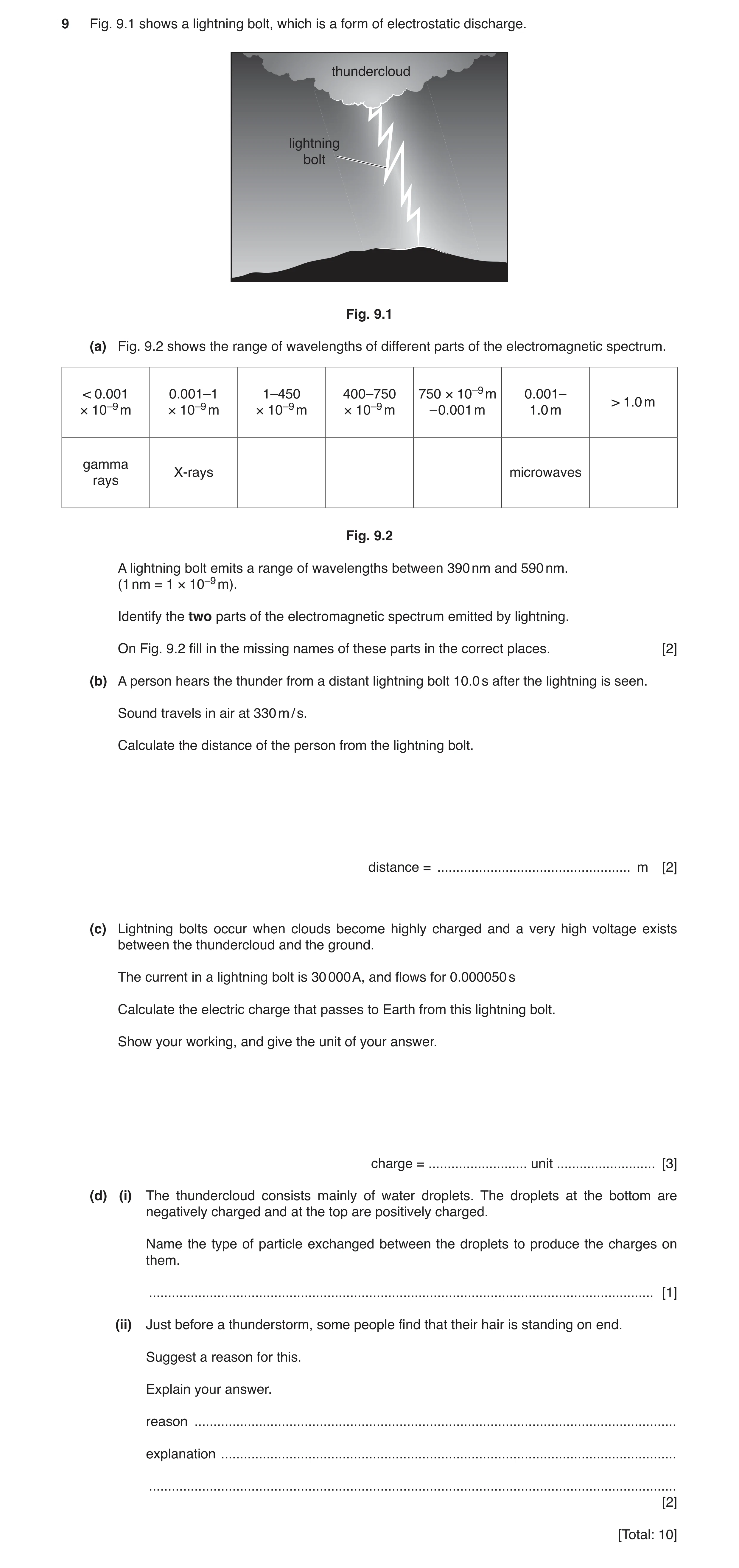
9 Fig. 9.1 shows a lightning bolt, which is a form of electrostatic discharge. thundercloud lightning bolt Fig. 9.1 (a) Fig. 9.2 shows the range of wavelengths of different parts of the electromagnetic spectrum. < 0.001 0.001–1 1–450 400–750 750 × 10–9 m 0.001– > 1.0 m × 10–9 m × 10–9 m × 10–9 m × 10–9 m – 0.001 m 1.0 m gamma X-rays microwaves rays Fig. 9.2 A lightning bolt emits a range of wavelengths between 390 nm and 590 nm. (1 nm = 1 × 10⁻⁹ m). Identify the two parts of the electromagnetic spectrum emitted by lightning. On Fig. 9.2 fill in the missing names of these parts in the correct places. [2] (b) A person hears the thunder from a distant lightning bolt 10.0 s after the lightning is seen. Sound travels in air at 330 m / s. Calculate the distance of the person from the lightning bolt. distance = … m [2] (c) Lightning bolts occur when clouds become highly charged and a very high voltage exists between the thundercloud and the ground. The current in a lightning bolt is 30 000 A, and flows for 0.000050 s Calculate the electric charge that passes to Earth from this lightning bolt. Show your working, and give the unit of your answer. charge = … unit … [3] (d) (i) The thundercloud consists mainly of water droplets. The droplets at the bottom are negatively charged and at the top are positively charged. Name the type of particle exchanged between the droplets to produce the charges on them. … [1] (ii) Just before a thunderstorm, some people find that their hair is standing on end. Suggest a reason for this. Explain your answer. reason … explanation … … [2] [Total: 10]
10 marks
Mark scheme: 9(a) visible light in correct position ; ultraviolet in correct position ; 2 9(b) use of distance = speed × time ; (330 × 10) = 3300 m ; 2 9(c) use of Q = I t ; (30 000 × 0.00005) = 1.5 ; coulombs / C ; 3 9(d)(i) electron(s) ; 1 9(d)(ii) hair becomes (electrostatically) charged (due to transfer of electrons) ; like charges repel (causing hair to stand on end) ; 2
This question in 0653/42 Oct/Nov 2019
Q16 · Iron is extracted from iron oxide in a blast furnace 0653/42 Oct/Nov 2020
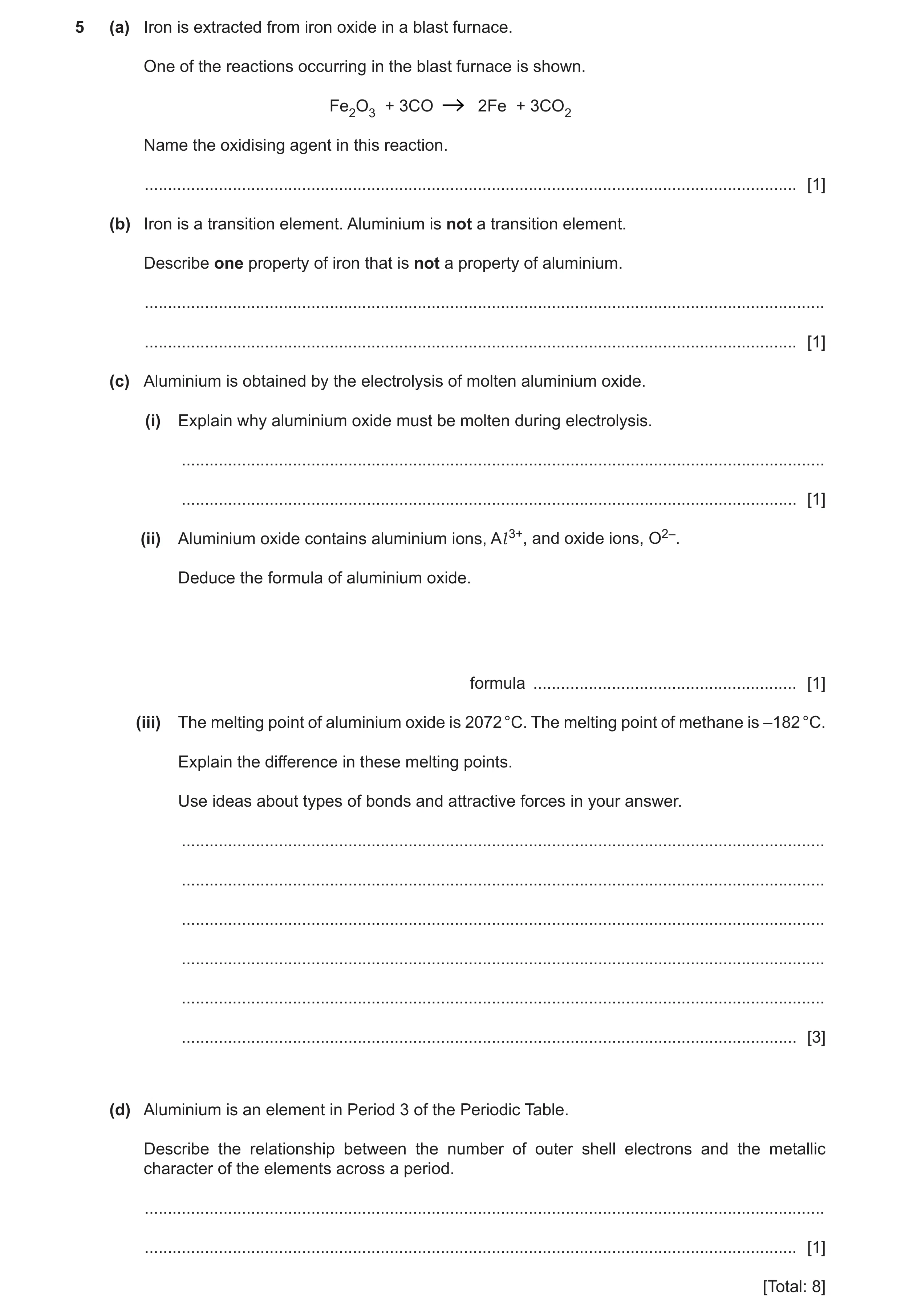
5 (a) Iron is extracted from iron oxide in a blast furnace. One of the reactions occurring in the blast furnace is shown. Fe2O3 + 3CO 2Fe + 3CO2 Name the oxidising agent in this reaction. … [1] (b) Iron is a transition element. Aluminium is not a transition element. Describe one property of iron that is not a property of aluminium. … … [1] (c) Aluminium is obtained by the electrolysis of molten aluminium oxide. (i) Explain why aluminium oxide must be molten during electrolysis. … … [1] (ii) Aluminium oxide contains aluminium ions, Al 3+, and oxide ions, O2–. Deduce the formula of aluminium oxide. formula … [1] (iii) The melting point of aluminium oxide is 2072 °C. The melting point of methane is –182 °C. Explain the difference in these melting points. Use ideas about types of bonds and attractive forces in your answer. … … … … … … [3] (d) Aluminium is an element in Period 3 of the Periodic Table. Describe the relationship between the number of outer shell electrons and the metallic character of the elements across a period. … … [1] [Total: 8]
8 marks
Mark scheme: 5(a) iron oxide ; 1 5(b) any one from: forms coloured compounds ; has high melting point ; has high density ; reference to use as a catalyst ; 1 5(c)(i) ions must be mobile ; 1 5(c)(ii) Al2O3 ; 1 5(c)(iii) (type of bonding) aluminium oxide is ionic AND methane is covalent ; stronger forces of attraction (between oppositely charged ions) in aluminium oxide / weaker forces of attraction (between molecules) in methane ; so more energy needed to separate particles / overcome attraction (hence higher melting point) / ora ; 3 5(d) as number of (outer shell) electrons increases, element changes from metallic to non-metallic ; 1
This question in 0653/42 Oct/Nov 2020
Q17 · Magnesium is an element in Group II and Period 3 of the Periodic Table 0653/43 Oct/Nov 2020
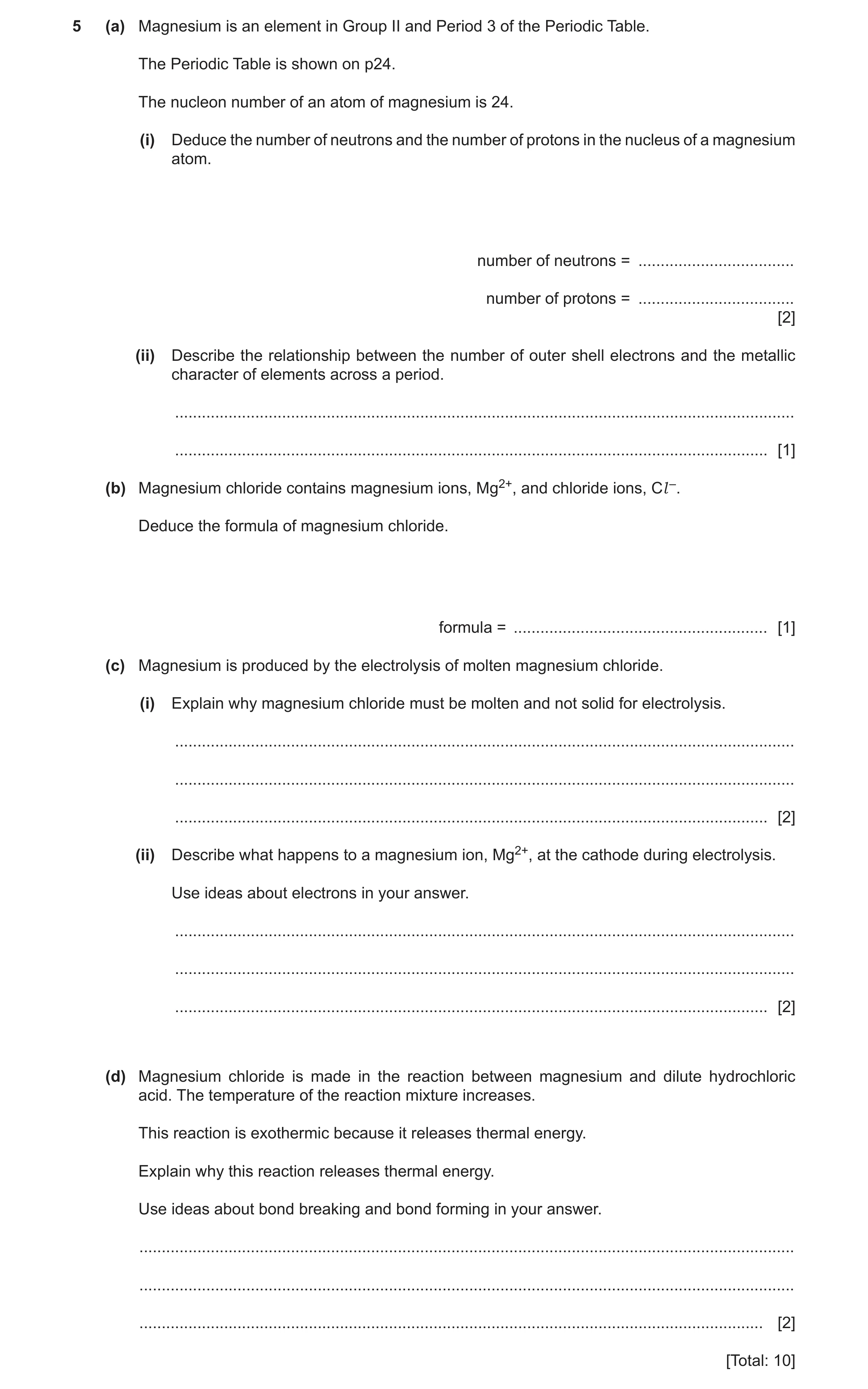
5 (a) Magnesium is an element in Group II and Period 3 of the Periodic Table. The Periodic Table is shown on p24. The nucleon number of an atom of magnesium is 24. (i) Deduce the number of neutrons and the number of protons in the nucleus of a magnesium atom. number of neutrons = … number of protons = … [2] (ii) Describe the relationship between the number of outer shell electrons and the metallic character of elements across a period. … … [1] (b) Magnesium chloride contains magnesium ions, Mg2+, and chloride ions, Cl –. Deduce the formula of magnesium chloride. formula = … [1] (c) Magnesium is produced by the electrolysis of molten magnesium chloride. (i) Explain why magnesium chloride must be molten and not solid for electrolysis. … … … [2] (ii) Describe what happens to a magnesium ion, Mg2+, at the cathode during electrolysis. Use ideas about electrons in your answer. … … … [2] (d) Magnesium chloride is made in the reaction between magnesium and dilute hydrochloric acid. The temperature of the reaction mixture increases. This reaction is exothermic because it releases thermal energy. Explain why this reaction releases thermal energy. Use ideas about bond breaking and bond forming in your answer. … … … [2] [Total: 10]
10 marks
Mark scheme: 5(a)(i) neutrons: 12 ; protons: 12 ; 2 5(a)(ii) as the number of electrons increases the element becomes less metallic ; 1 5(b) MgCl2 ; 1 5(c)(i) ions must be mobile / ions in a solid cannot move ; ions can move to the electrodes / for conduction of electricity 2 5(c)(ii) gains electrons ; (gains) two electrons / is discharged ; 2 5(d) energy is taken in for bond breaking / energy is released when bonds are formed / owtte ; (reaction is exothermic because) more energy released than taken in ; 2
This question in 0653/43 Oct/Nov 2020
Q18 · Carbon and oxygen are two elements in Period 2 of the Periodic Table 0653/42 Feb/March 2021
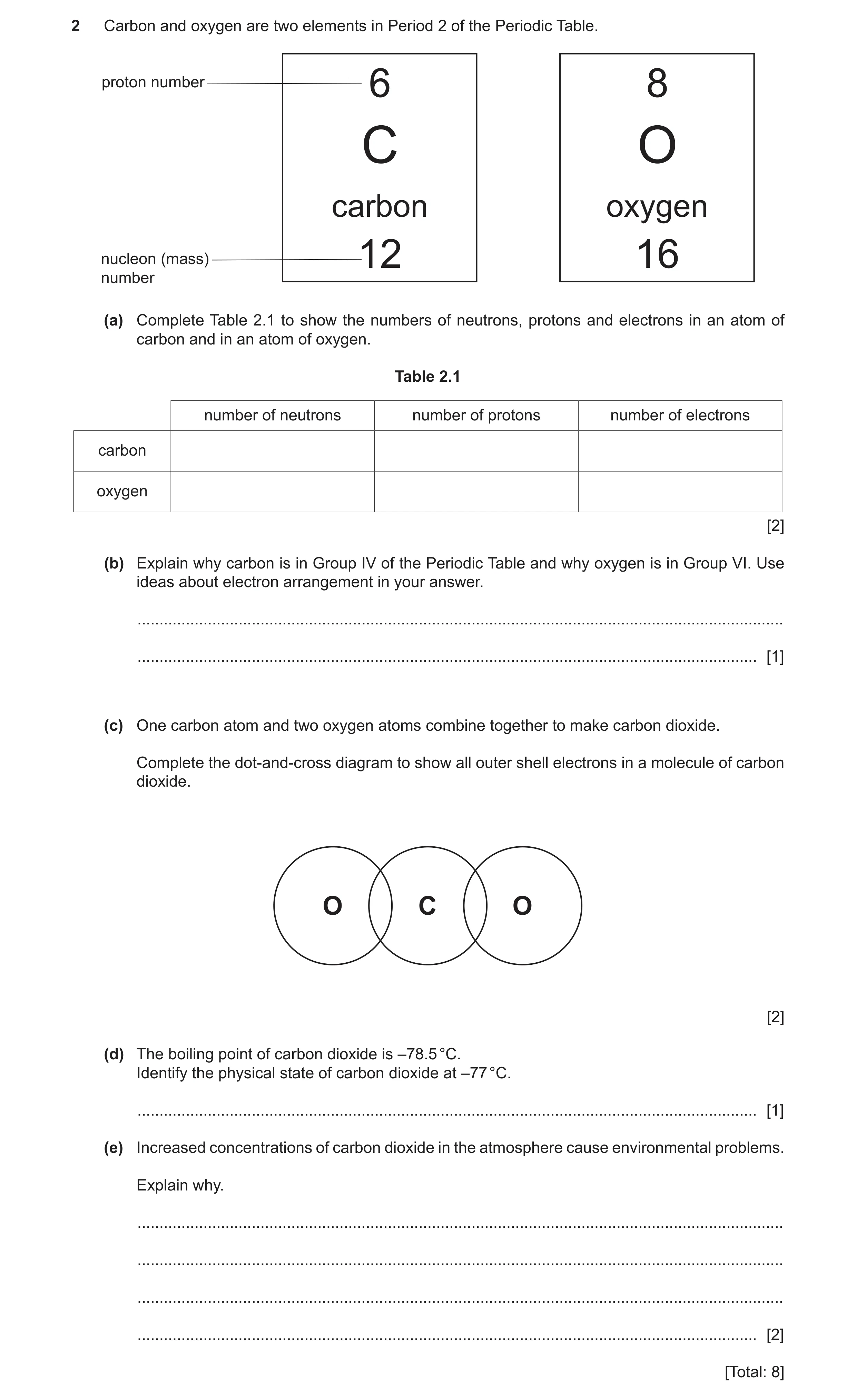
2 Carbon and oxygen are two elements in Period 2 of the Periodic Table. proton number 6 8 C O carbon oxygen nucleon (mass) 12 16 number (a) Complete Table 2.1 to show the numbers of neutrons, protons and electrons in an atom of carbon and in an atom of oxygen. Table 2.1 number of neutrons number of protons number of electrons carbon oxygen [2] (b) Explain why carbon is in Group IV of the Periodic Table and why oxygen is in Group VI. Use ideas about electron arrangement in your answer. … … [1] (c) One carbon atom and two oxygen atoms combine together to make carbon dioxide. Complete the dot-and-cross diagram to show all outer shell electrons in a molecule of carbon dioxide. O C O [2] (d) The boiling point of carbon dioxide is –78.5 °C. Identify the physical state of carbon dioxide at –77 °C. … [1] (e) Increased concentrations of carbon dioxide in the atmosphere cause environmental problems. Explain why. … … … … [2] [Total: 8]
8 marks
Mark scheme: 2(a) number of neutrons number of protons number of electrons 6 6 6 8 8 8 ;; one mark neutrons correct second mark protons and electrons correct 2 2(b) carbon has 4 outer shell electrons and oxygen has 6 ; 1 Question Answer Marks 2(c) four bonding electrons shown between carbon and each oxygen ; (dependent on MP1) rest of molecule correct ; 2 2(d) gas ; 1 2(e) one point from: CO2 is a greenhouse gas / causes enhanced greenhouse effect / causes atmosphere to heat up / traps excess heat in atmosphere / causes global warming ; and one point from: climate change ; extreme weather events / named example, e.g. hurricanes ; sea level rise / flooding (of coastal areas) ; polar ice caps melt ; 2
This question in 0653/42 Feb/March 2021
Q19 · Information about the electrons in atoms of elements V, W, X, Y and Z 0653/43 May/June 2021
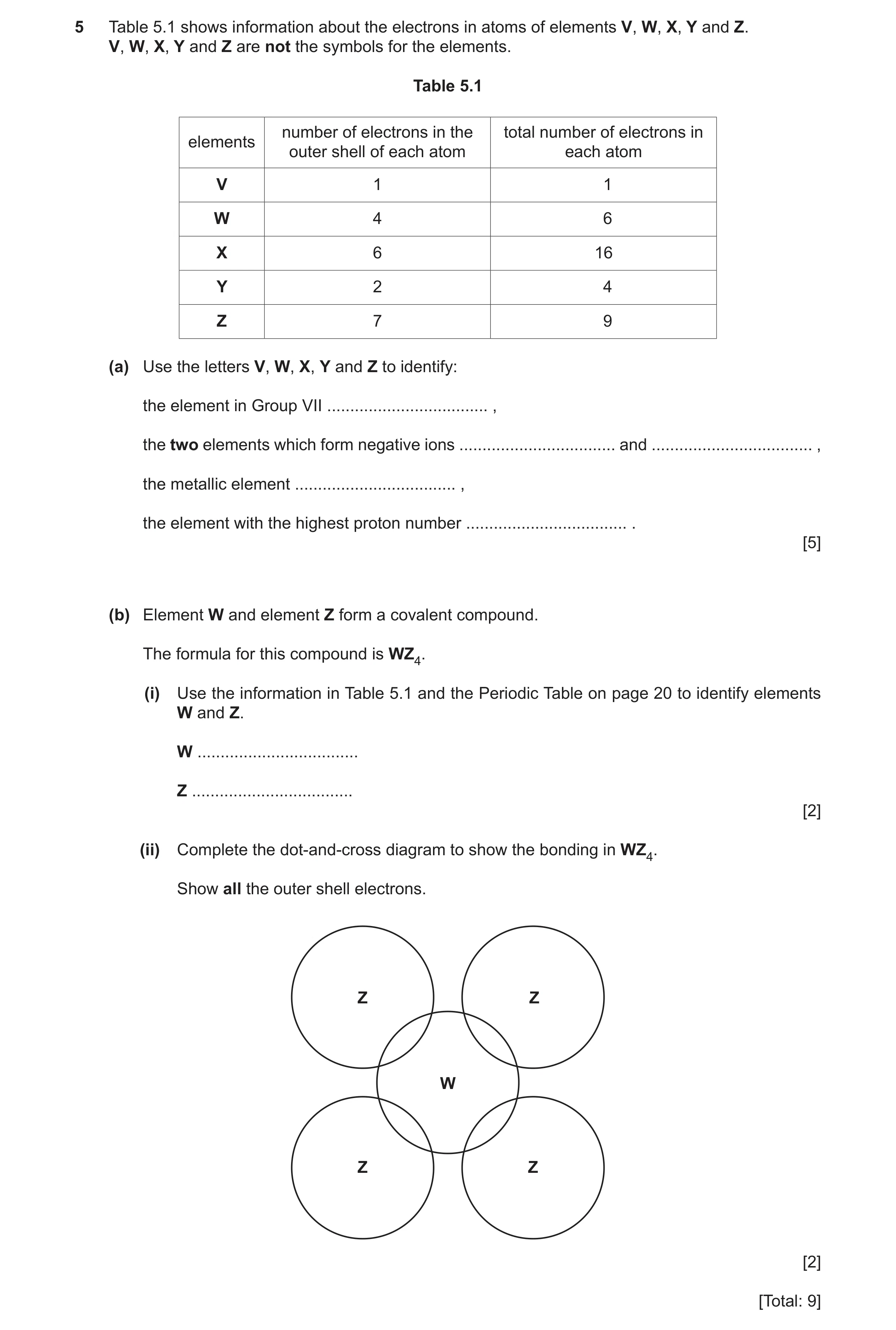
5 Table 5.1 shows information about the electrons in atoms of elements V, W, X, Y and Z. V, W, X, Y and Z are not the symbols for the elements. Table 5.1 number of electrons in the total number of electrons in elements outer shell of each atom each atom V 1 1 W 4 6 X 6 16 Y 2 4 Z 7 9 (a) Use the letters V, W, X, Y and Z to identify: the element in Group VII … , the two elements which form negative ions … and … , the metallic element … , the element with the highest proton number … . [5] (b) Element W and element Z form a covalent compound. The formula for this compound is WZ4. (i) Use the information in Table 5.1 and the Periodic Table on page 20 to identify elements W and Z. W … Z … [2] (ii) Complete the dot-and-cross diagram to show the bonding in WZ4. Show all the outer shell electrons. Z Z W Z Z [2] [Total: 9]
9 marks
Mark scheme: 5(a) the element in Group VII Z ; the two elements which form negative ions X ; and Z ; (either order) the metallic element Y ; the element with the highest proton number X ; 5(b)(i) W = carbon ; Z = fluorine ; 2 5(b)(ii) two shared electrons in each of four bonds ; three lone pairs on each atom of Z ; 2
This question in 0653/43 May/June 2021
Q20 · The outer shell electrons in atoms of elements X, Y and Z are shown in Fig 0653/41 May/June 2022
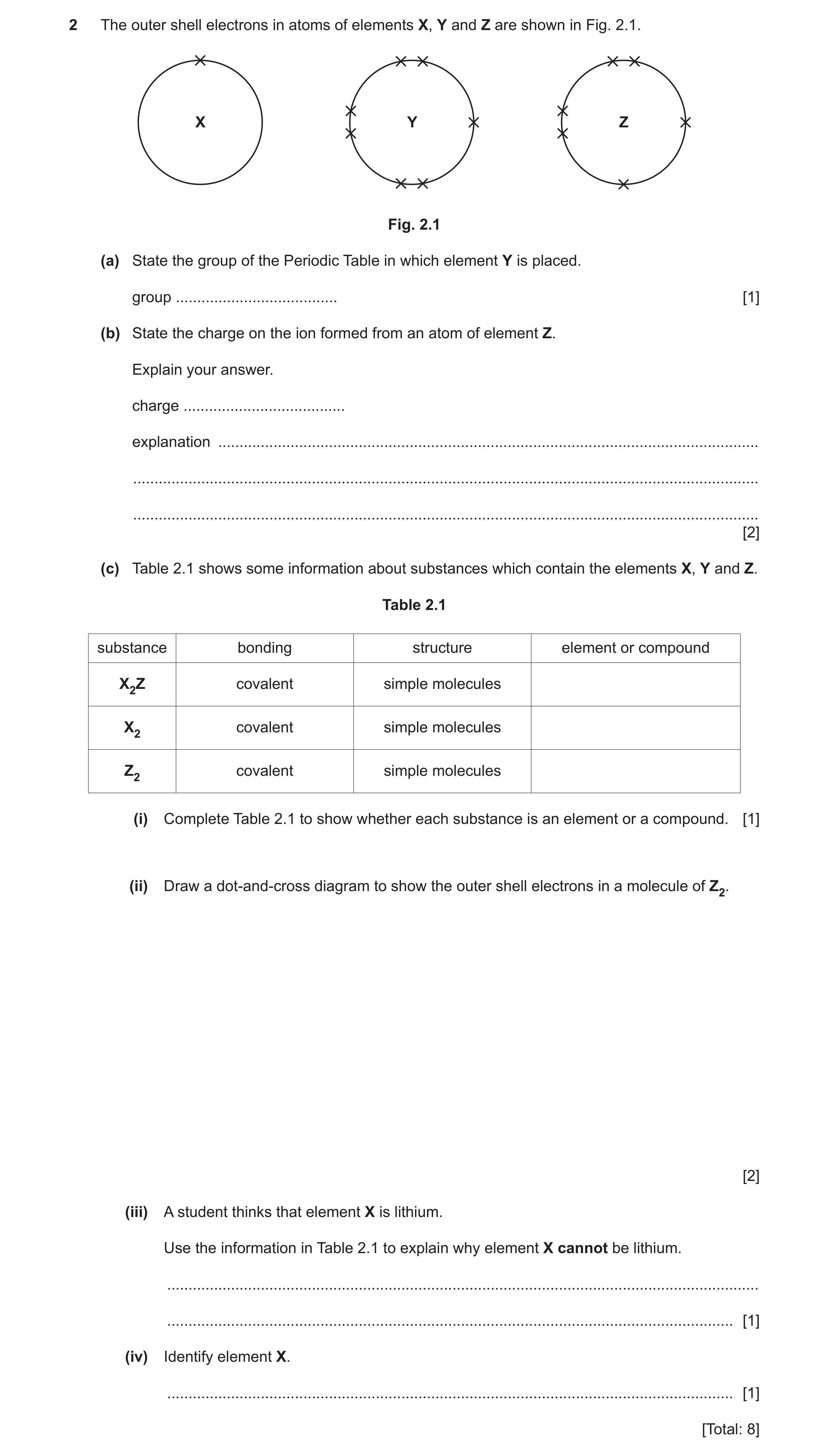
2 The outer shell electrons in atoms of elements X, Y and Z are shown in Fig. 2.1. X Y Z Fig. 2.1 (a) State the group of the Periodic Table in which element Y is placed. group … [1] (b) State the charge on the ion formed from an atom of element Z. Explain your answer. charge … explanation … … … [2] (c) Table 2.1 shows some information about substances which contain the elements X, Y and Z. Table 2.1 substance bonding structure element or compound X2Z covalent simple molecules X2 covalent simple molecules Z2 covalent simple molecules (i) Complete Table 2.1 to show whether each substance is an element or a compound. [1] (ii) Draw a dot-and-cross diagram to show the outer shell electrons in a molecule of Z2. [2] (iii) A student thinks that element X is lithium. Use the information in Table 2.1 to explain why element X cannot be lithium. … … [1] (iv) Identify element X. … [1] [Total: 8]
8 marks
Mark scheme: 2(a) 7 / VII / halogens ; 1 2(b) –2 ; gains (two) electrons to give a full outer shell ; 2 Question Answer Marks 2(c)(i) Formula Type of structure Element or compound? X2Z simple covalent molecules compound X2 simple covalent molecules element Z2 simple covalent molecules element ; ; 1 2(c)(ii) fully correct (2) double bond correct (1) 2 2(c)(iii) X2 has a covalent bond ; 1 2(c)(iv) hydrogen ; 1
This question in 0653/41 May/June 2022
Q21 · Period 3 of the Periodic Table is shown in Fig 0653/41 Oct/Nov 2022
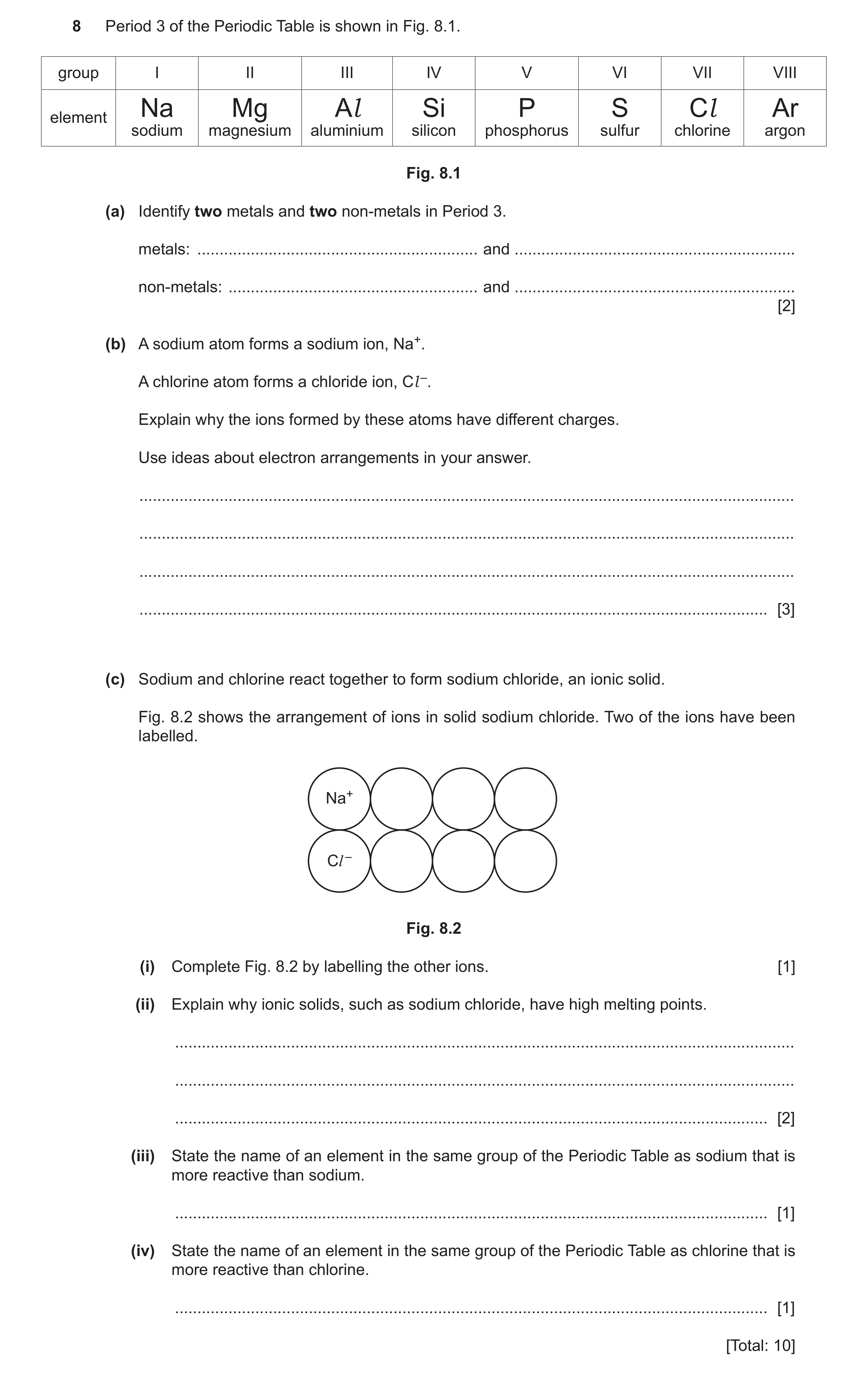
8 Period 3 of the Periodic Table is shown in Fig. 8.1. group I II III IV V VI VII VIII element Na Mg Al Si P S Cl Ar sodium magnesium aluminium silicon phosphorus sulfur chlorine argon Fig. 8.1 (a) Identify two metals and two non-metals in Period 3. metals: … and … non-metals: … and … [2] (b) A sodium atom forms a sodium ion, Na+. A chlorine atom forms a chloride ion, Cl –. Explain why the ions formed by these atoms have different charges. Use ideas about electron arrangements in your answer. … … … … [3] (c) Sodium and chlorine react together to form sodium chloride, an ionic solid. Fig. 8.2 shows the arrangement of ions in solid sodium chloride. Two of the ions have been labelled. Na+ Cl – Fig. 8.2 (i) Complete Fig. 8.2 by labelling the other ions. [1] (ii) Explain why ionic solids, such as sodium chloride, have high melting points. … … … [2] (iii) State the name of an element in the same group of the Periodic Table as sodium that is more reactive than sodium. … [1] (iv) State the name of an element in the same group of the Periodic Table as chlorine that is more reactive than chlorine. … [1] [Total: 10]
10 marks
Mark scheme: 8(a) any two metals from: sodium, magnesium, aluminium ; 2 any two non-metals from: silicon, phosphorus, sulfur, chlorine, argon ; 8(b) idea of achieving a full outer shell (for stability) ; 3 sodium atom has one outer electron and chlorine atom has seven ; sodium atom loses one electron and chlorine atom gains one electron ; 8(c)(i) 1 alternating arrangement as shown ; 8(c)(ii) any two from: 2 ions, have opposite charges / are positive and negative ; strong attraction (between ions) ; so high energy needed to break bonds ; 8(c)(iii) potassium / rubidium / caesium / francium ; 1 8(c)(iv) fluorine ; 1
This question in 0653/41 Oct/Nov 2022
Q22 · The electronic structures of a chlorine atom and a chloride ion are shown in Fig 0653/43 Oct/Nov 2022
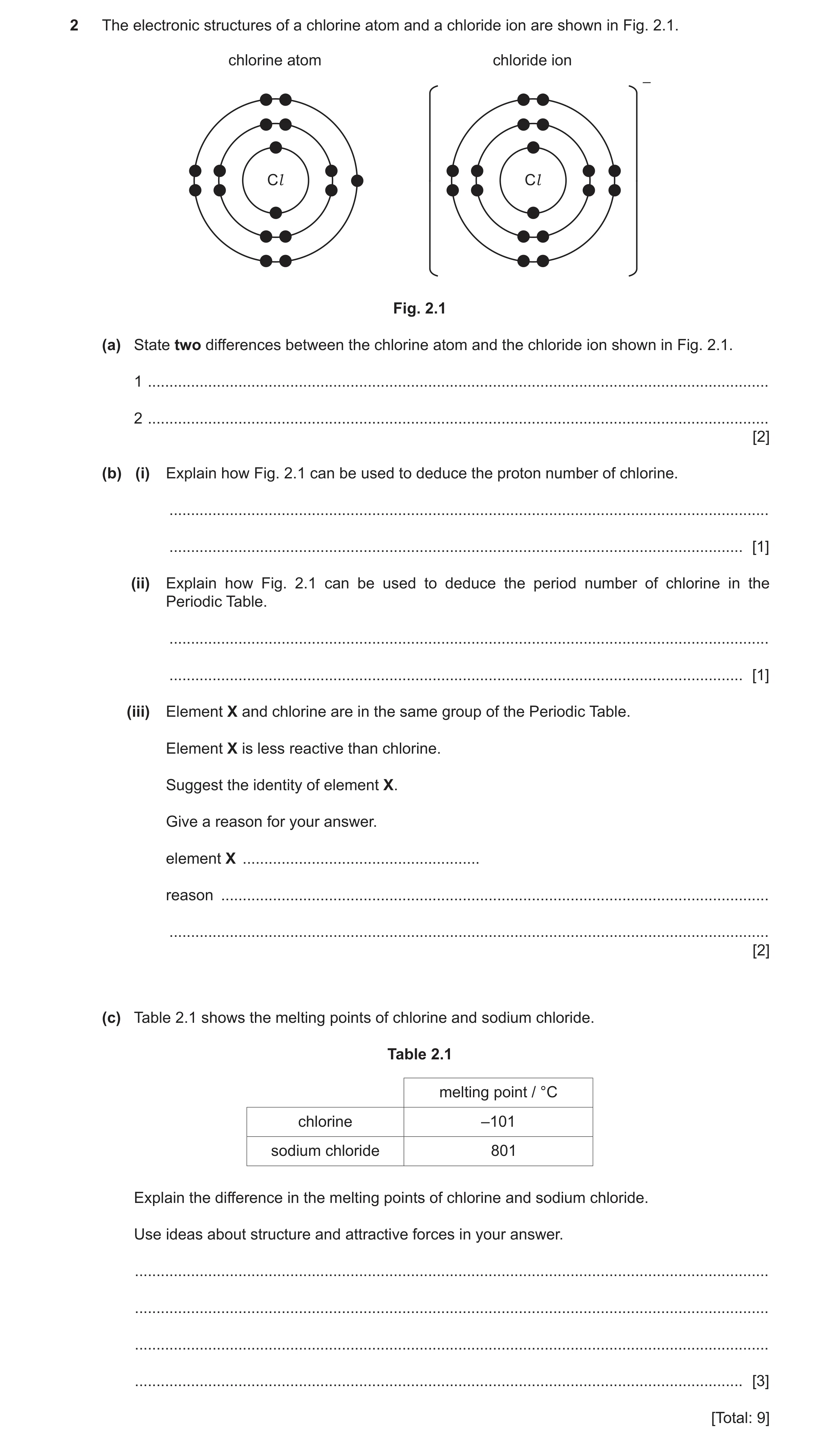
2 The electronic structures of a chlorine atom and a chloride ion are shown in Fig. 2.1. chlorine atom chloride ion – Cl Cl Fig. 2.1 (a) State two differences between the chlorine atom and the chloride ion shown in Fig. 2.1. 1 … 2 … [2] (b) (i) Explain how Fig. 2.1 can be used to deduce the proton number of chlorine. … … [1] (ii) Explain how Fig. 2.1 can be used to deduce the period number of chlorine in the Periodic Table. … … [1] (iii) Element X and chlorine are in the same group of the Periodic Table. Element X is less reactive than chlorine. Suggest the identity of element X. Give a reason for your answer. element X … reason … … [2] (c) Table 2.1 shows the melting points of chlorine and sodium chloride. Table 2.1 melting point / °C chlorine –101 sodium chloride 801 Explain the difference in the melting points of chlorine and sodium chloride. Use ideas about structure and attractive forces in your answer. … … … … [3] [Total: 9]
9 marks
Mark scheme: 2(a) chloride ion has: (ORA chloride atom) 2 (one) more electron / a full (outer) shell of electrons / 8 electrons in outer shell / 18 electrons ; a negative (charge) / charge of –1 ; 2(b)(i) the number of electrons in the atom (17) is the same as the proton number ; 1 2(b)(ii) the number of shells is the same as the period / AW ; 1 2(b)(iii) element X bromine / iodine / astatine ; 2 reason further down the group (so less reactive) ; 2(c) chlorine has simple, molecules / covalent structure OR sodium chloride has, (giant) ionic structure / ionic lattice ; 3 attractive forces between ions in sodium chloride are strong(er) than (attractive forces between) molecules in chlorine / attraction between ions is high due to opposite electrical charges / strong electrostatic attraction between ions ; more energy is required to separate ions in sodium chloride (hence higher melting point) / ORA ;
This question in 0653/43 Oct/Nov 2022
Q23 · Information on the percentage composition of the atmosphere of the planet Mars 0653/43 Oct/Nov 2023
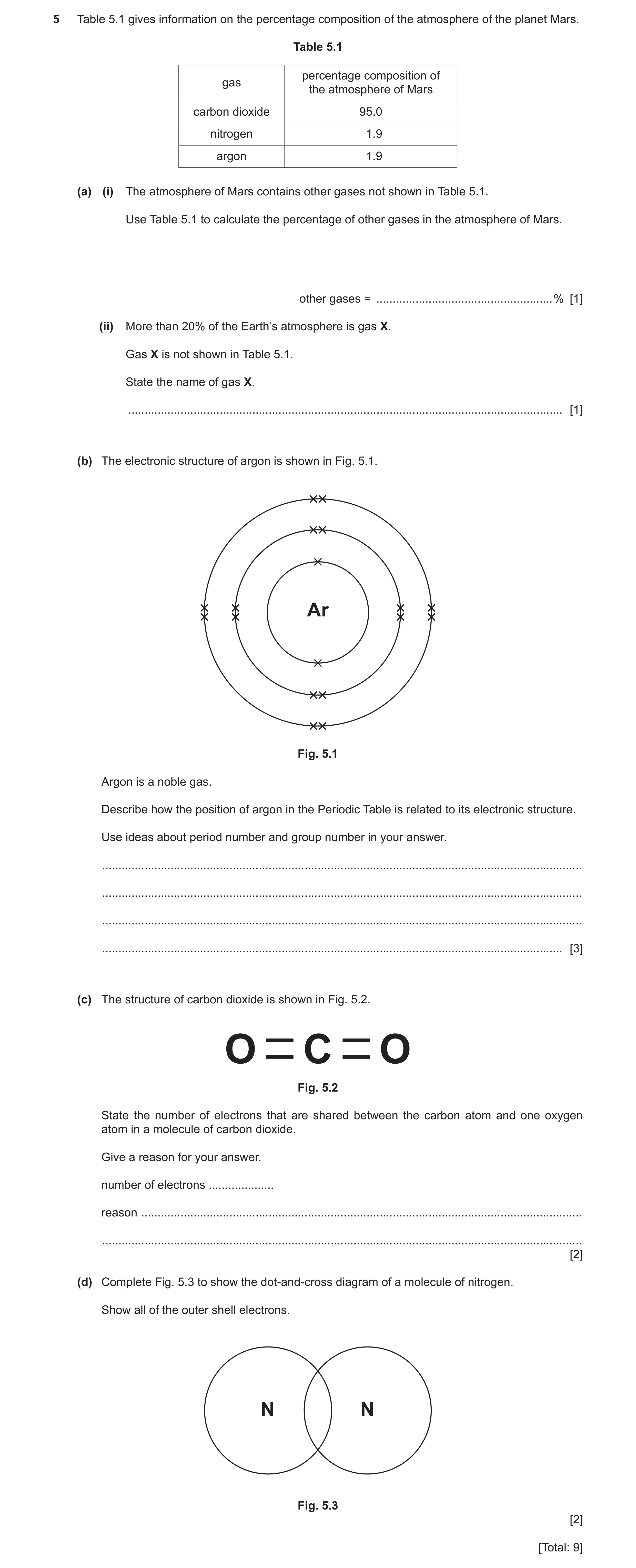
5 Table 5.1 gives information on the percentage composition of the atmosphere of the planet Mars. Table 5.1 percentage composition of gas the atmosphere of Mars carbon dioxide 95.0 nitrogen 1.9 argon 1.9 (a) (i) The atmosphere of Mars contains other gases not shown in Table 5.1. Use Table 5.1 to calculate the percentage of other gases in the atmosphere of Mars. other gases = … % [1] (ii) More than 20% of the Earth’s atmosphere is gas X. Gas X is not shown in Table 5.1. State the name of gas X. … [1] (b) The electronic structure of argon is shown in Fig. 5.1. Ar Fig. 5.1 Argon is a noble gas. Describe how the position of argon in the Periodic Table is related to its electronic structure. Use ideas about period number and group number in your answer. … … … … [3] (c) The structure of carbon dioxide is shown in Fig. 5.2. Fig. 5.2 State the number of electrons that are shared between the carbon atom and one oxygen atom in a molecule of carbon dioxide. Give a reason for your answer. number of electrons … reason … … [2] (d) Complete Fig. 5.3 to show the dot‑and‑cross diagram of a molecule of nitrogen. Show all of the outer shell electrons. N N Fig. 5.3 [2] [Total: 9]
9 marks
Mark scheme: 5(a)(i) 1.2 (%) ; 1 5(a)(ii) oxygen ; 1 5(b) in Group VIII AND period 3 ; 3 in VIII because 8 electrons in outer shell ; period 3 because 3 shells ; 5(c) 4 ; 2 it has a double bond / 2 electrons in each bond / 2 pairs of electrons are shared / oxygen shares 2 electrons and carbon shares 2 electrons ; 5(d) 2 bonding electrons correct ; non-bonding electons correct ;
This question in 0653/43 Oct/Nov 2023
Q24 · The position of an element in the Periodic Table is related to its atomic structure 0653/41 Oct/Nov 2024
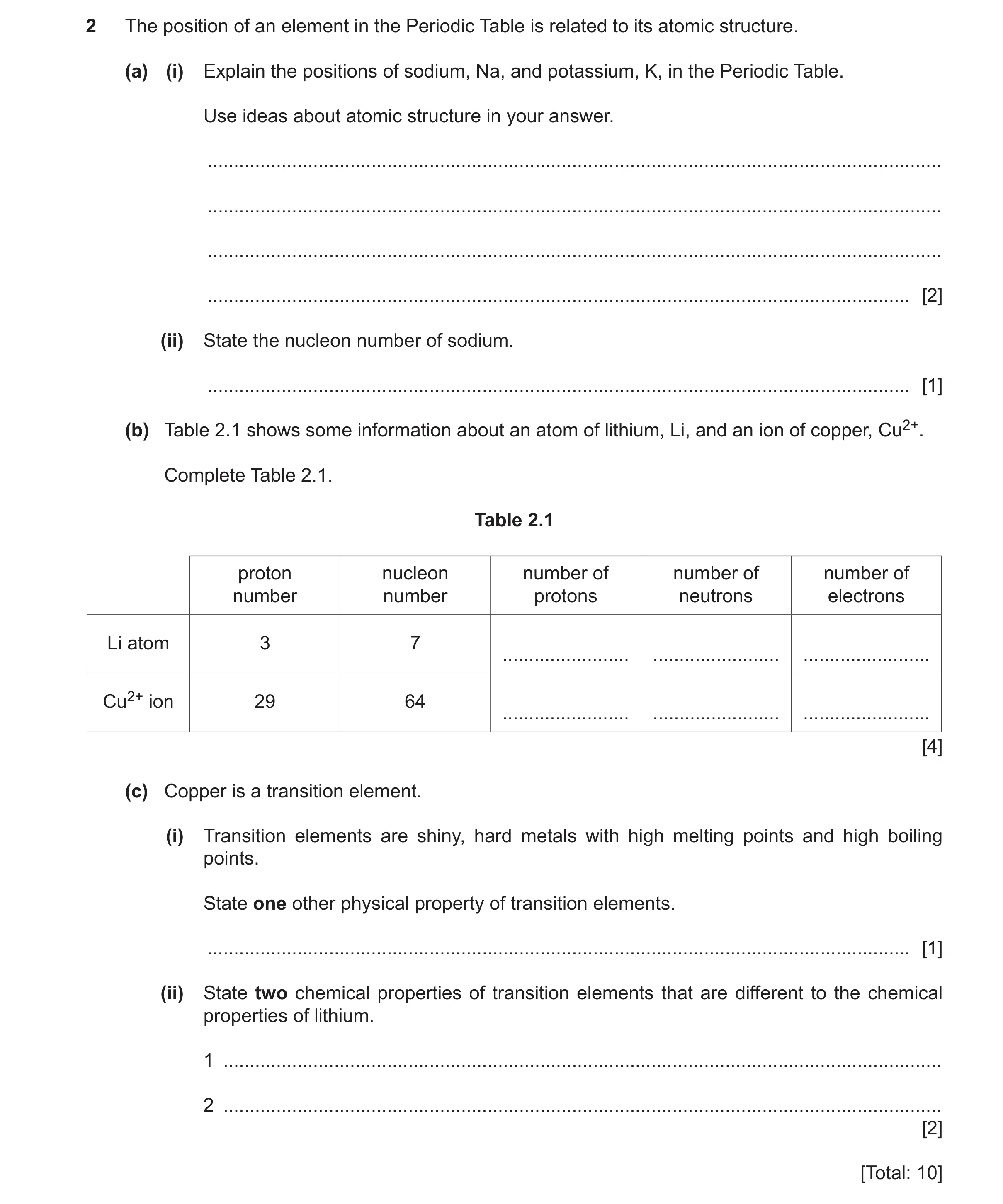
2 The position of an element in the Periodic Table is related to its atomic structure. (a) (i) Explain the positions of sodium, Na, and potassium, K, in the Periodic Table. Use ideas about atomic structure in your answer. … … … … [2] (ii) State the nucleon number of sodium. … [1] (b) Table 2.1 shows some information about an atom of lithium, Li, and an ion of copper, Cu2+. Complete Table 2.1. Table 2.1 proton nucleon number of number of number of number number protons neutrons electrons Li atom 3 7 … … … Cu2+ ion 29 64 … … … [4] (c) Copper is a transition element. (i) Transition elements are shiny, hard metals with high melting points and high boiling points. State one other physical property of transition elements. … [1] (ii) State two chemical properties of transition elements that are different to the chemical properties of lithium. 1 … 2 … [2] [Total: 10]
10 marks
Mark scheme: 2(a)(i) idea that: 2 both have one electron in their outer shell so are in Group 1 ; K is lower in group because it has one more electron shell than Na ; 2(a)(ii) 23 ; 1 2(b) 4 proton number nucleon number number of protons number of number of neutrons electrons Li atom 3 7 3 4 3 Cu2+ ion 29 64 29 35 27 number of protons column correct ; number of neutrons column correct ; number of electrons for Li atom correct ; number of electrons for Cu2+ ion correct ; 2(c)(i) high density / malleable / good conductors of heat / good conductors of electricity ; 1 2(c)(ii) form coloured compounds ; 2 act as catalysts ;
This question in 0653/41 Oct/Nov 2024
![Question 2: (a) The atomic number of magnesium is 12. Complete Fig. 5.1 to show the electronic structure of a magnesium atom. X X Fig. 5.1 [2] (b) A st…](https://img.pastlit.com/crops/1ad10e71-80c8-457d-87cf-4dd0f1d09859/q5.webp)
![Question 4: (a) (i) The atomic number of oxygen is 8. Complete Fig. 8.1 to show the electronic structure of an oxygen atom. nucleus Fig. 8.1 [1] (ii) C…](https://img.pastlit.com/crops/dd8e93b1-797b-4e9c-bf64-1ae7704e8796/q8.webp)
 19 / 34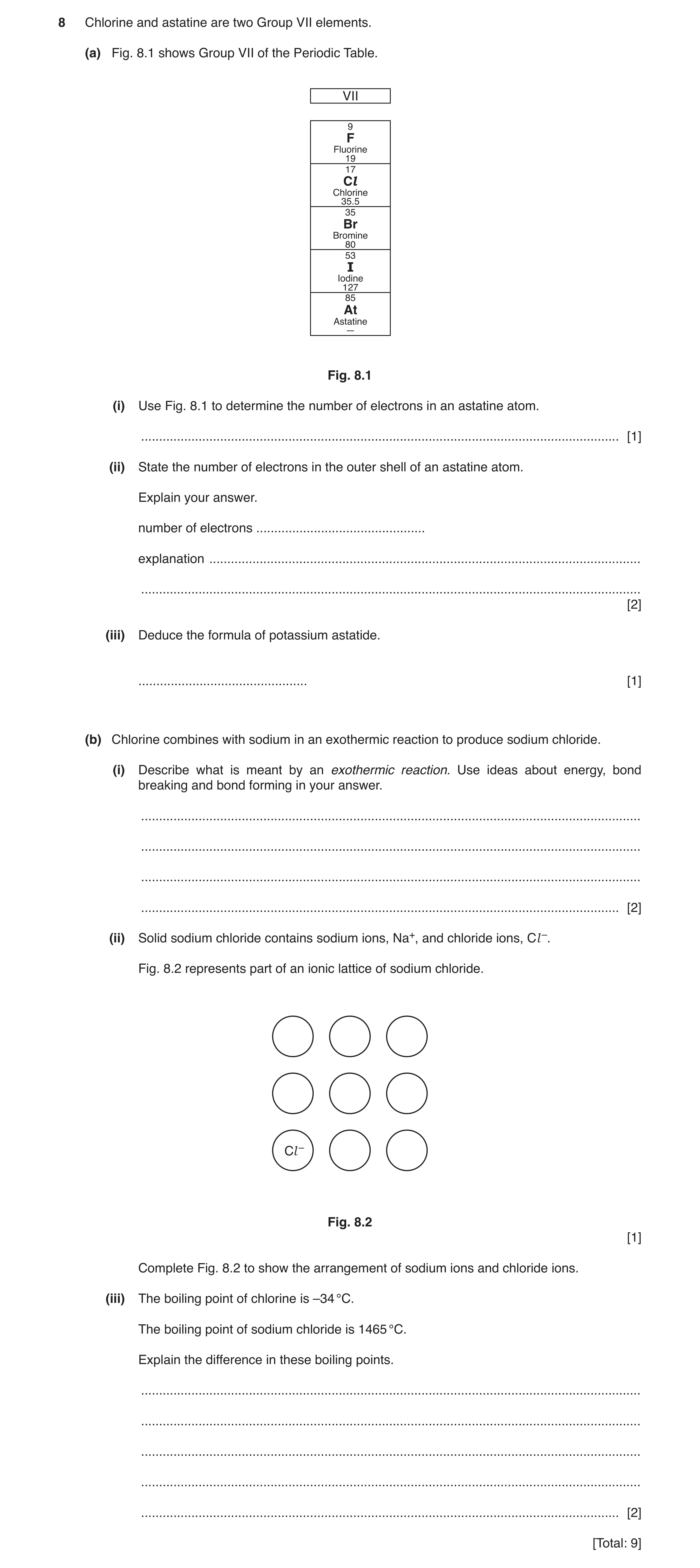
 34 / 34
 8
8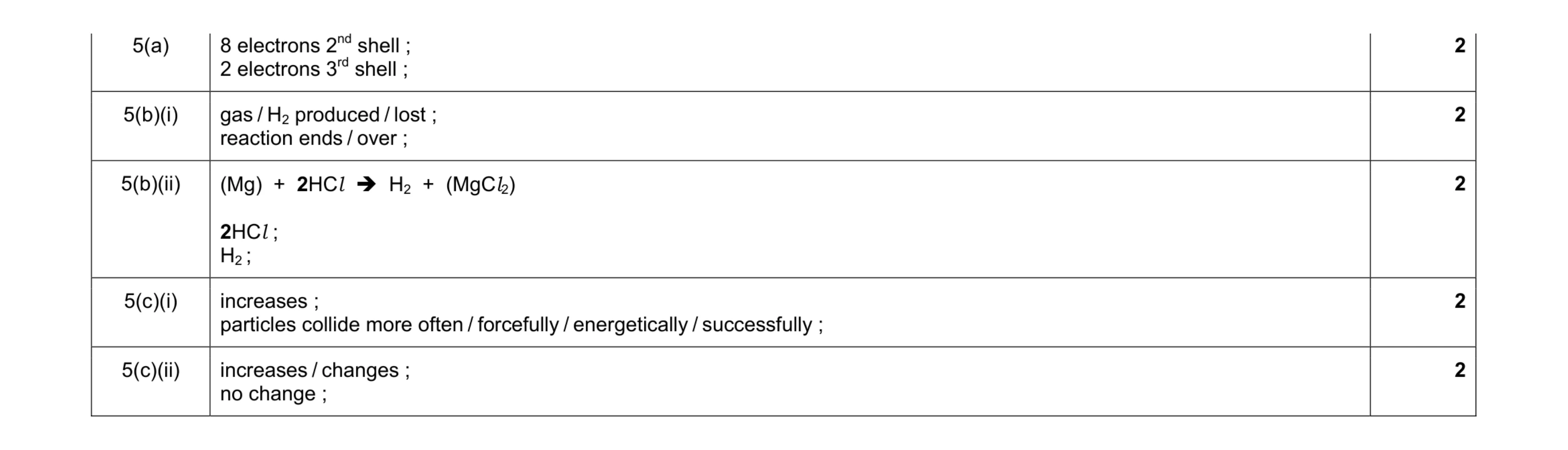 10
10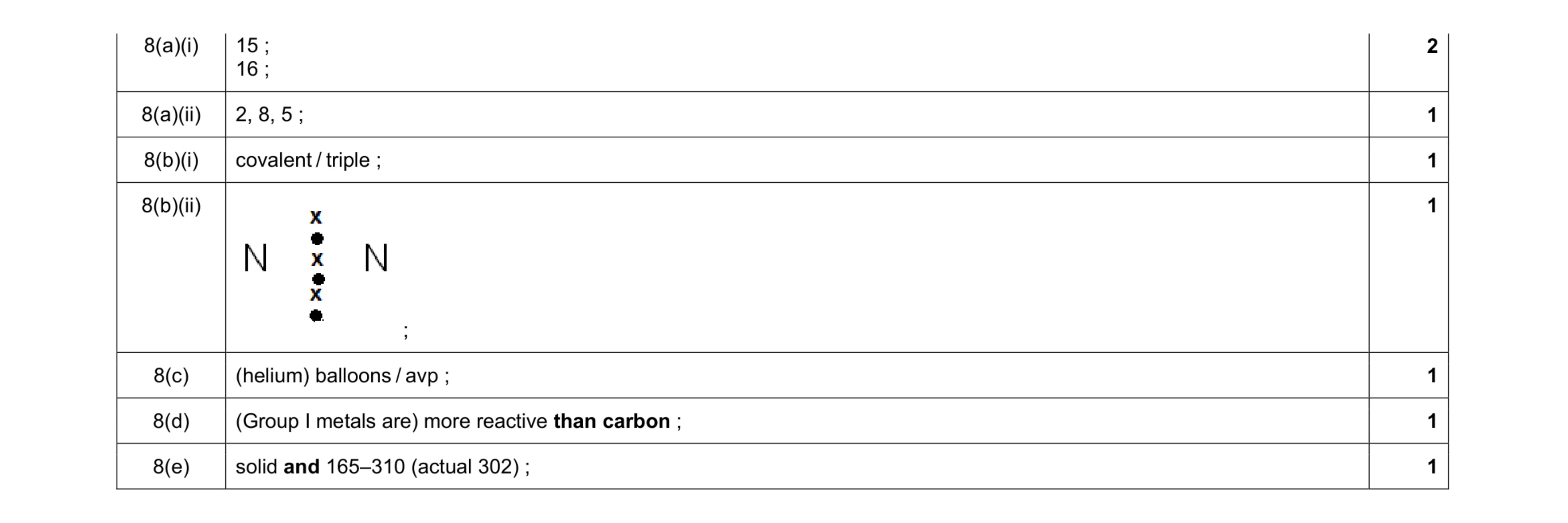 8
8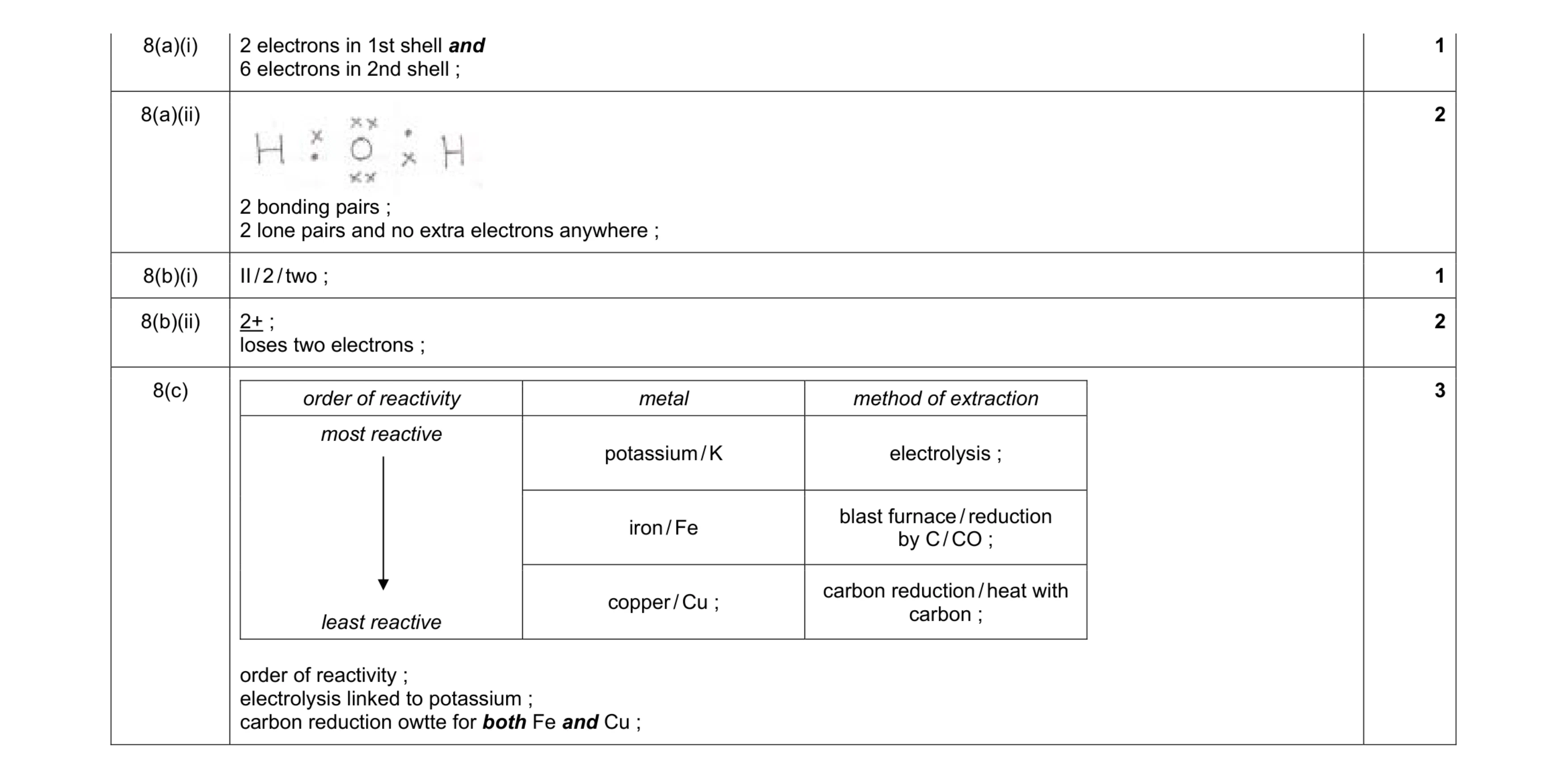 9
9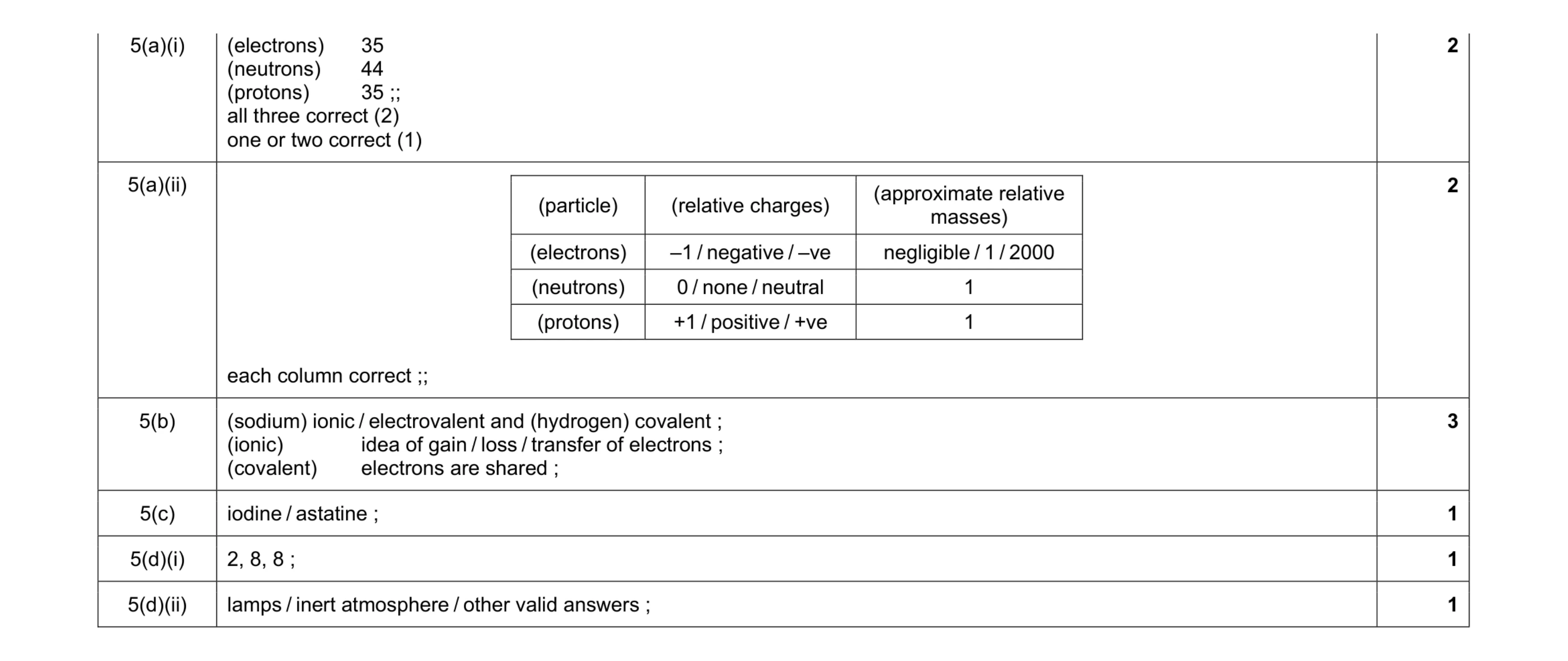 10
10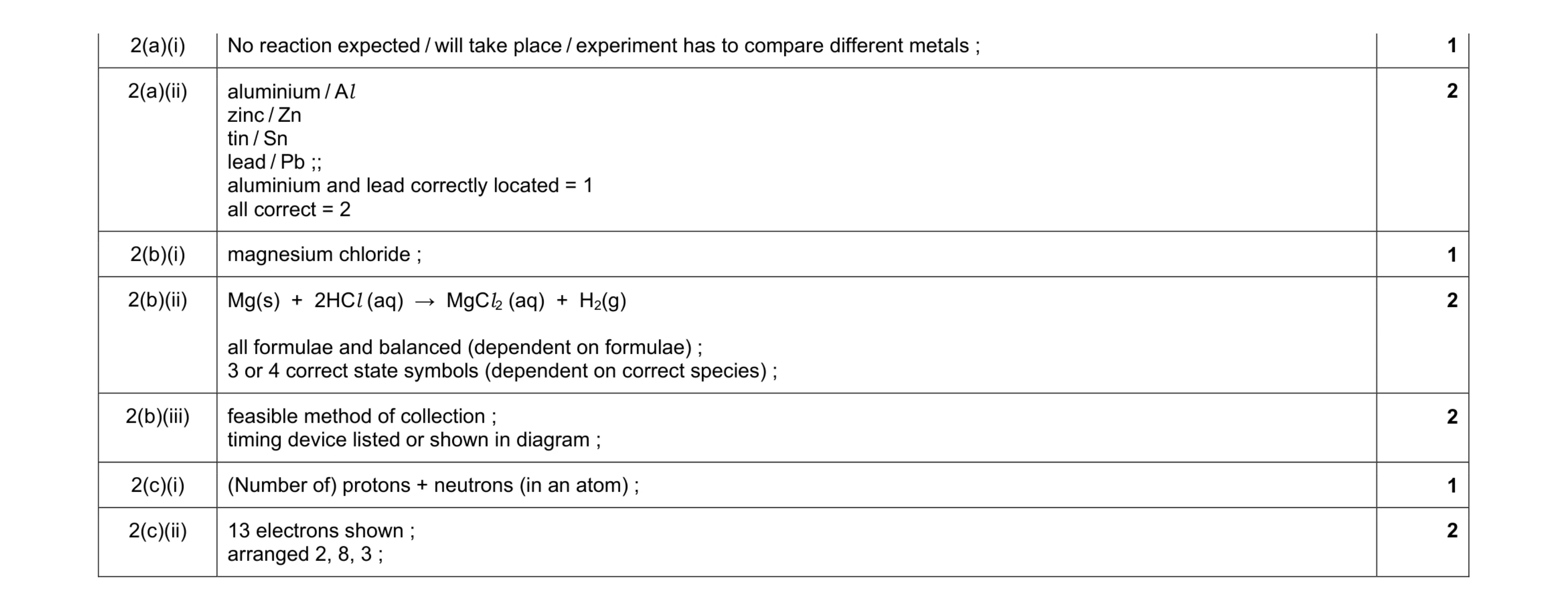 11
11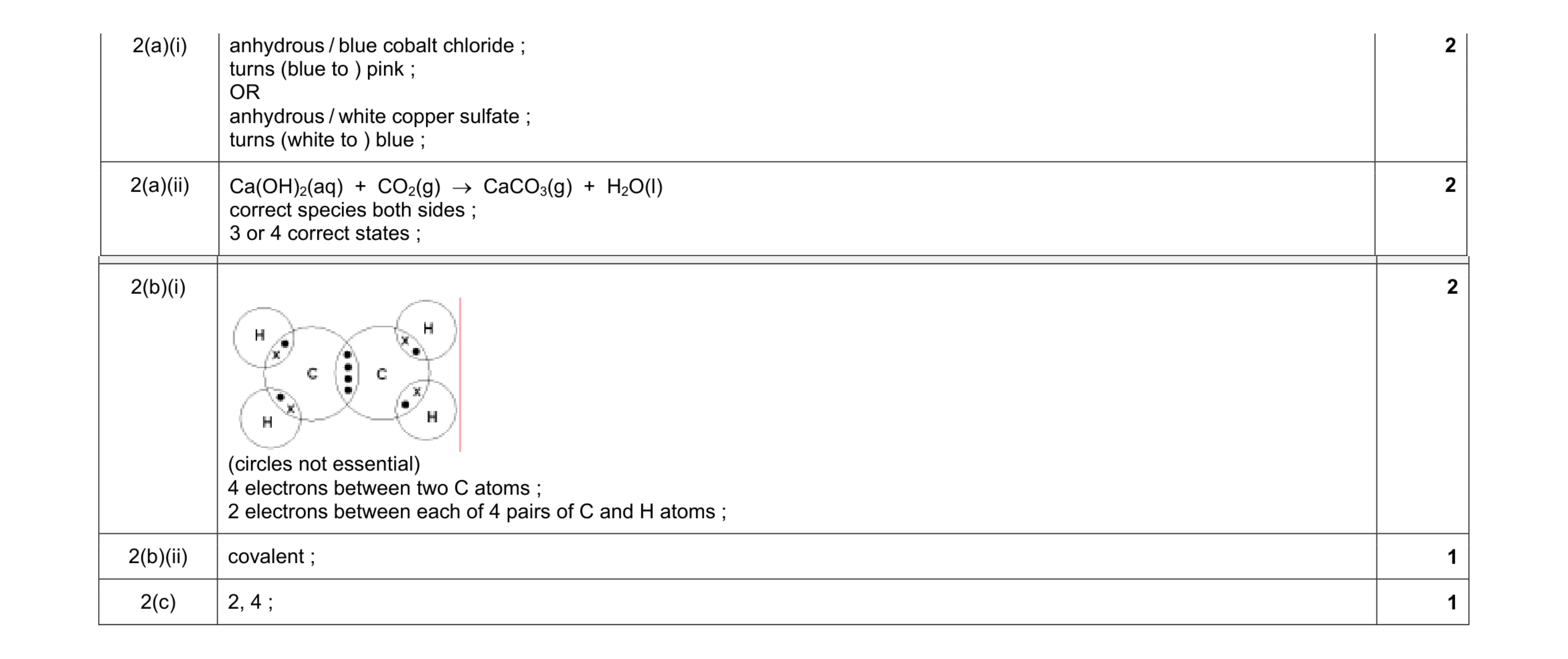 8
8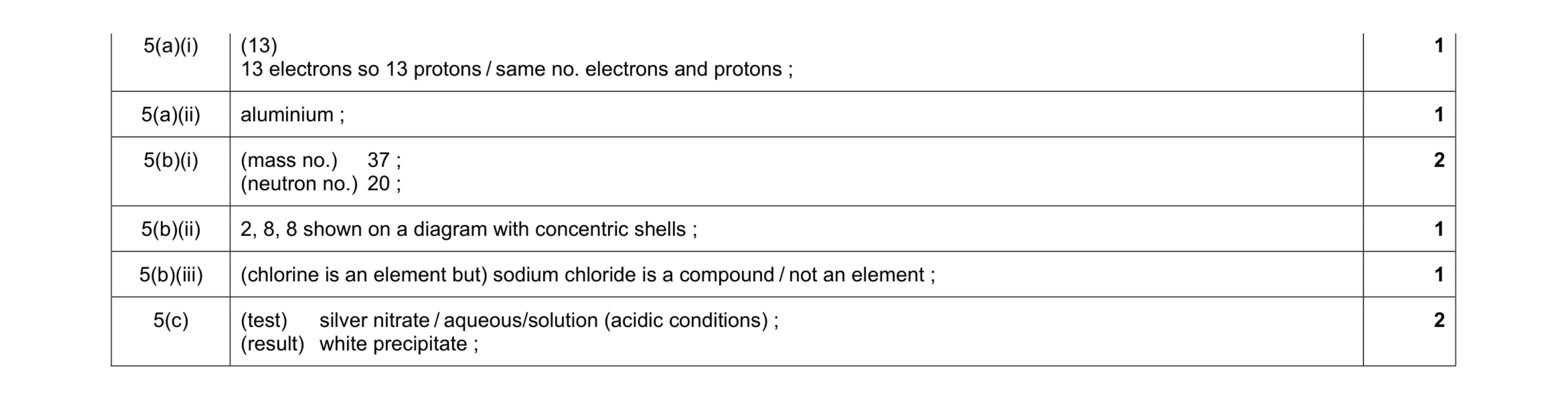 8
8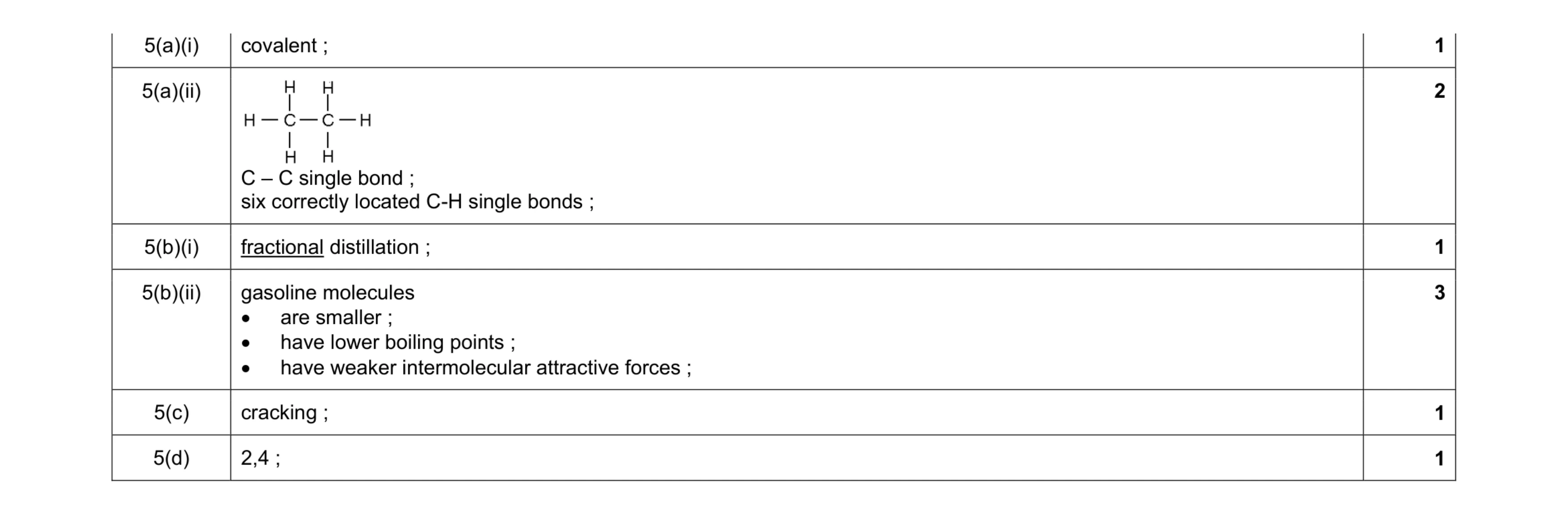 9
9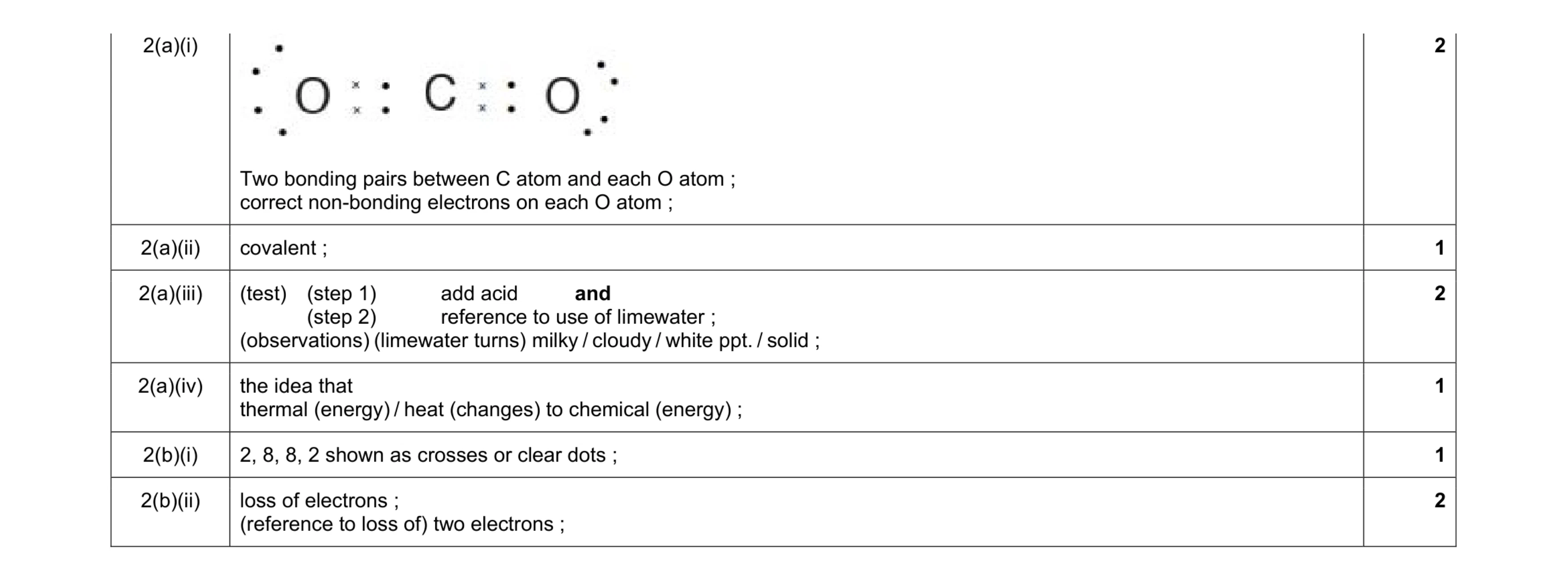 9
9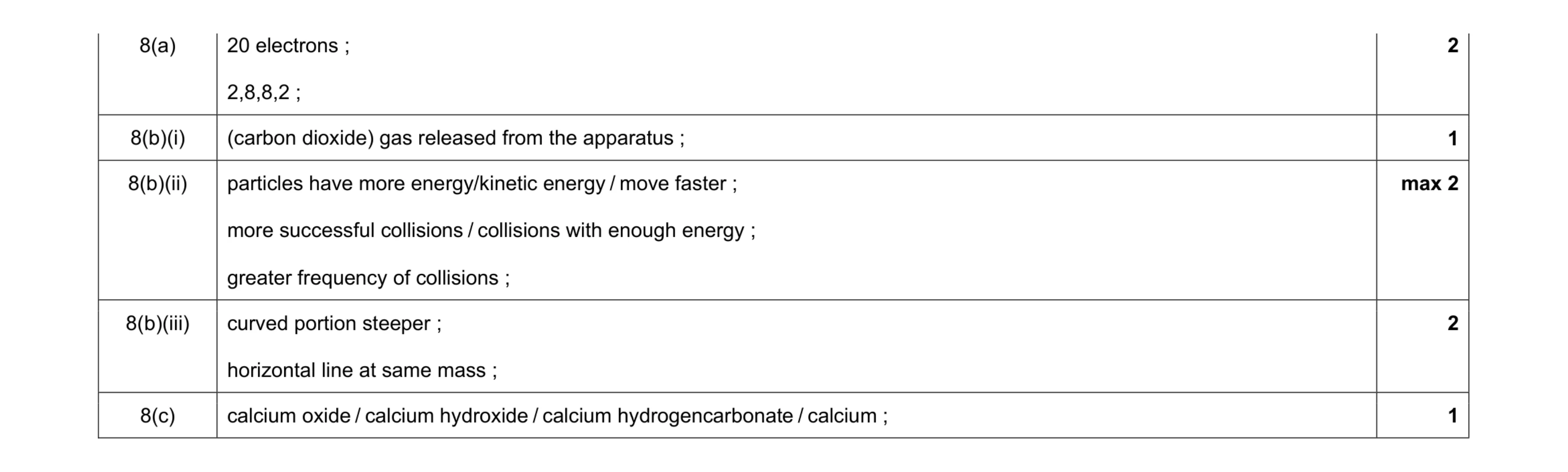 8
8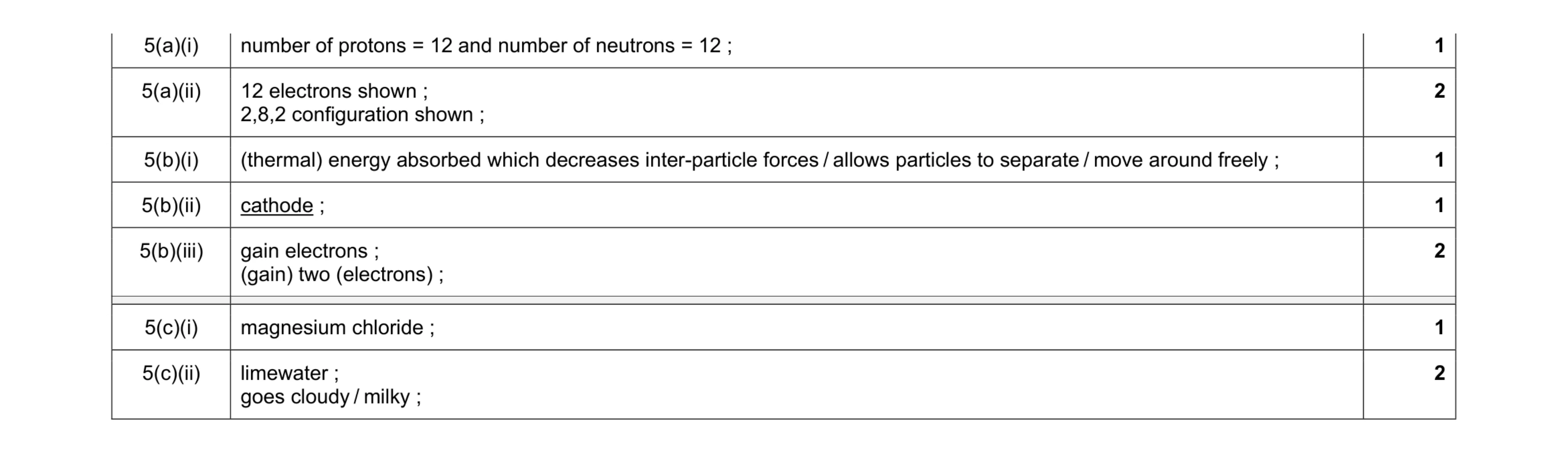 10
10 5
5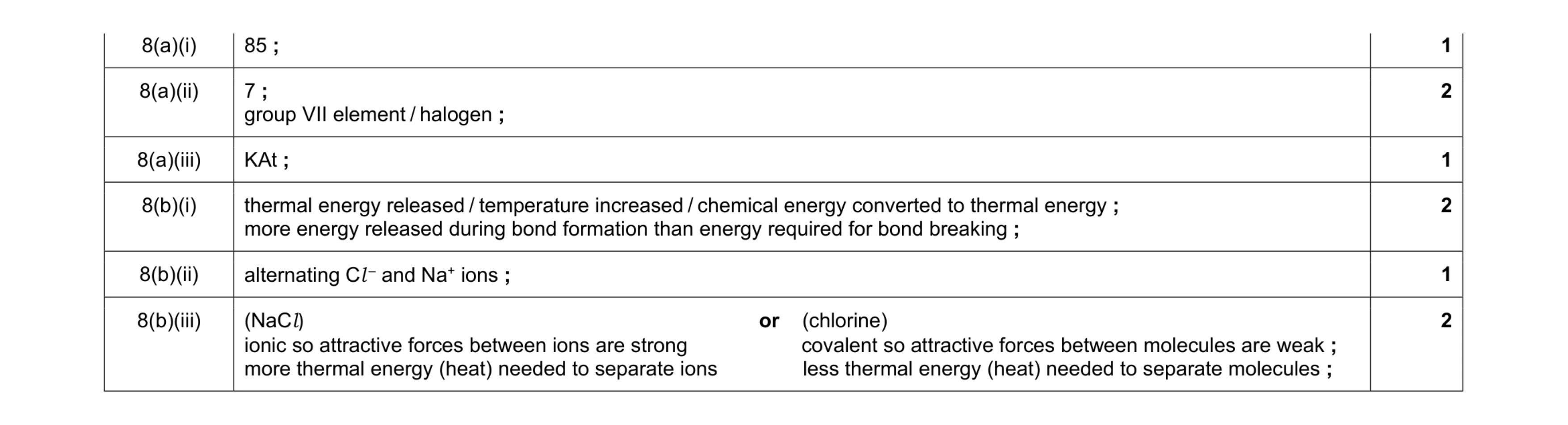 9
9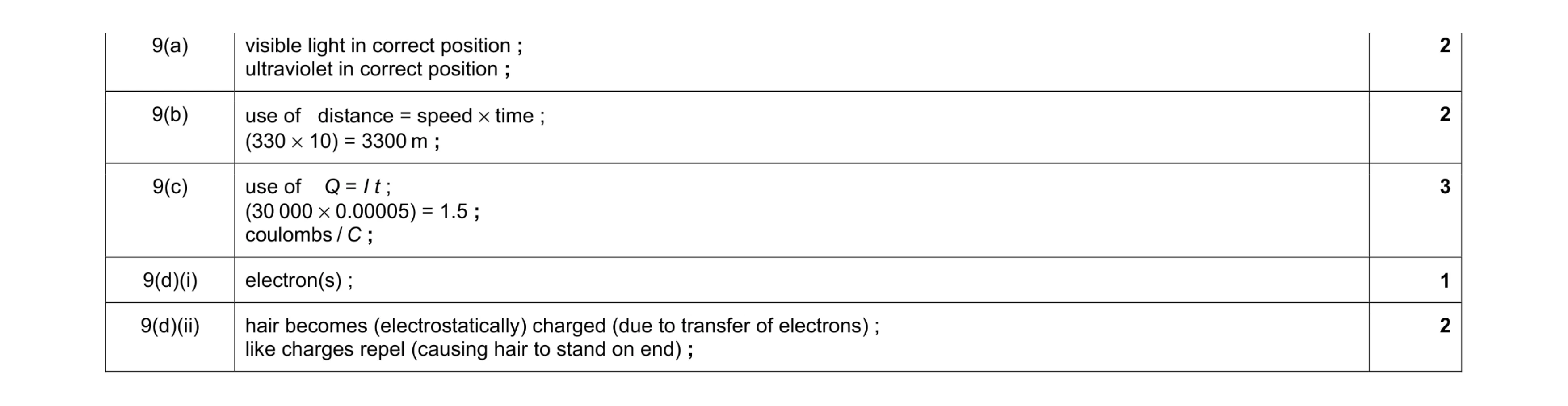 10
10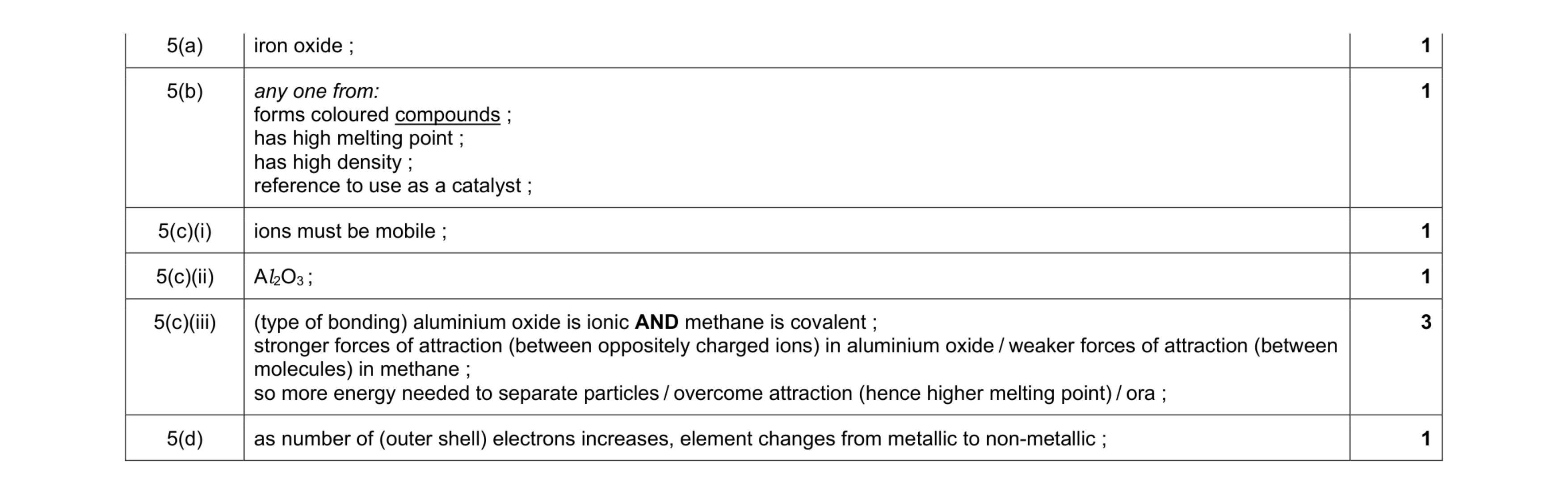 8
8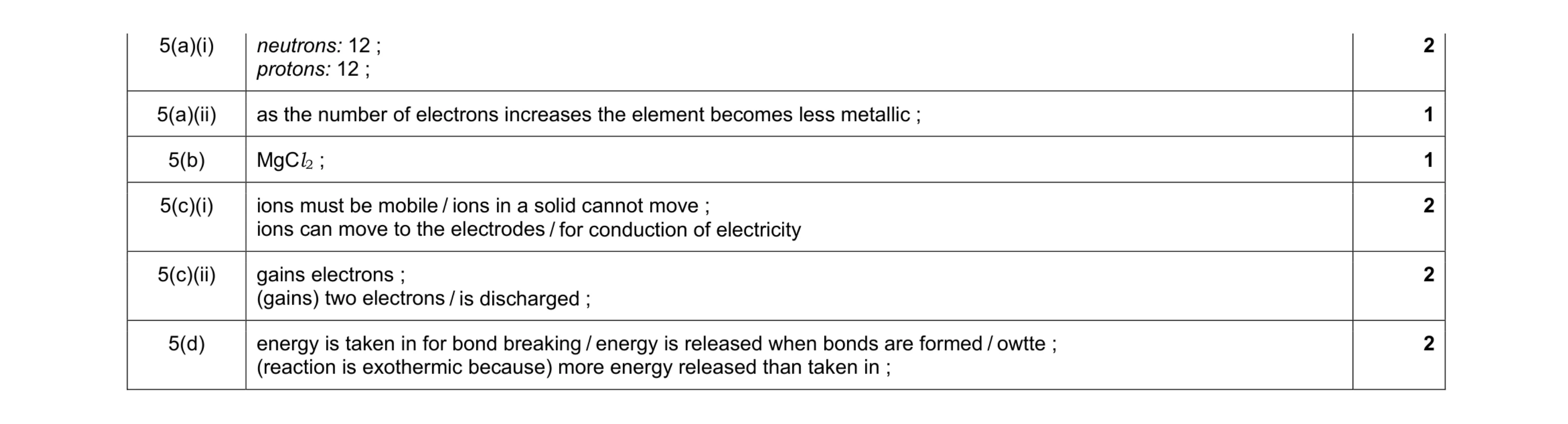 10
10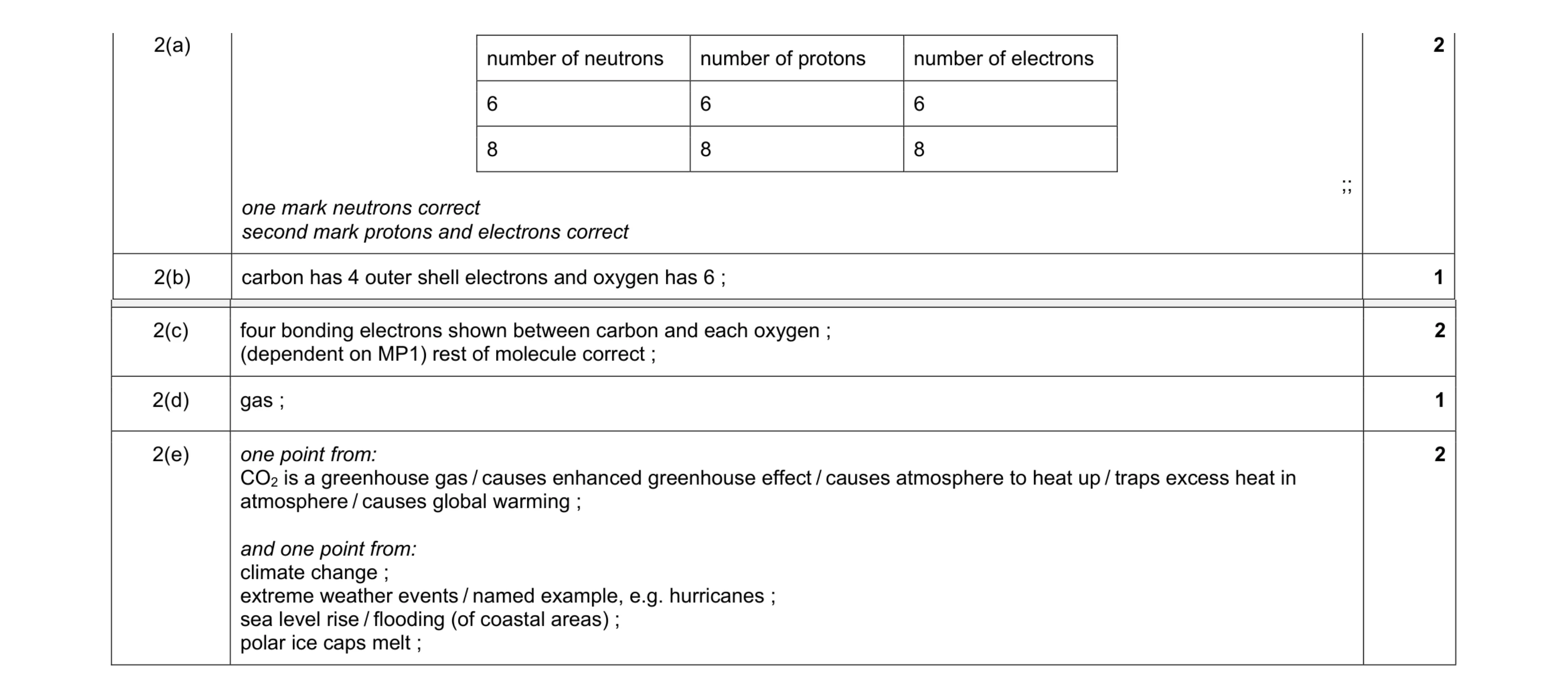 8
8 9
9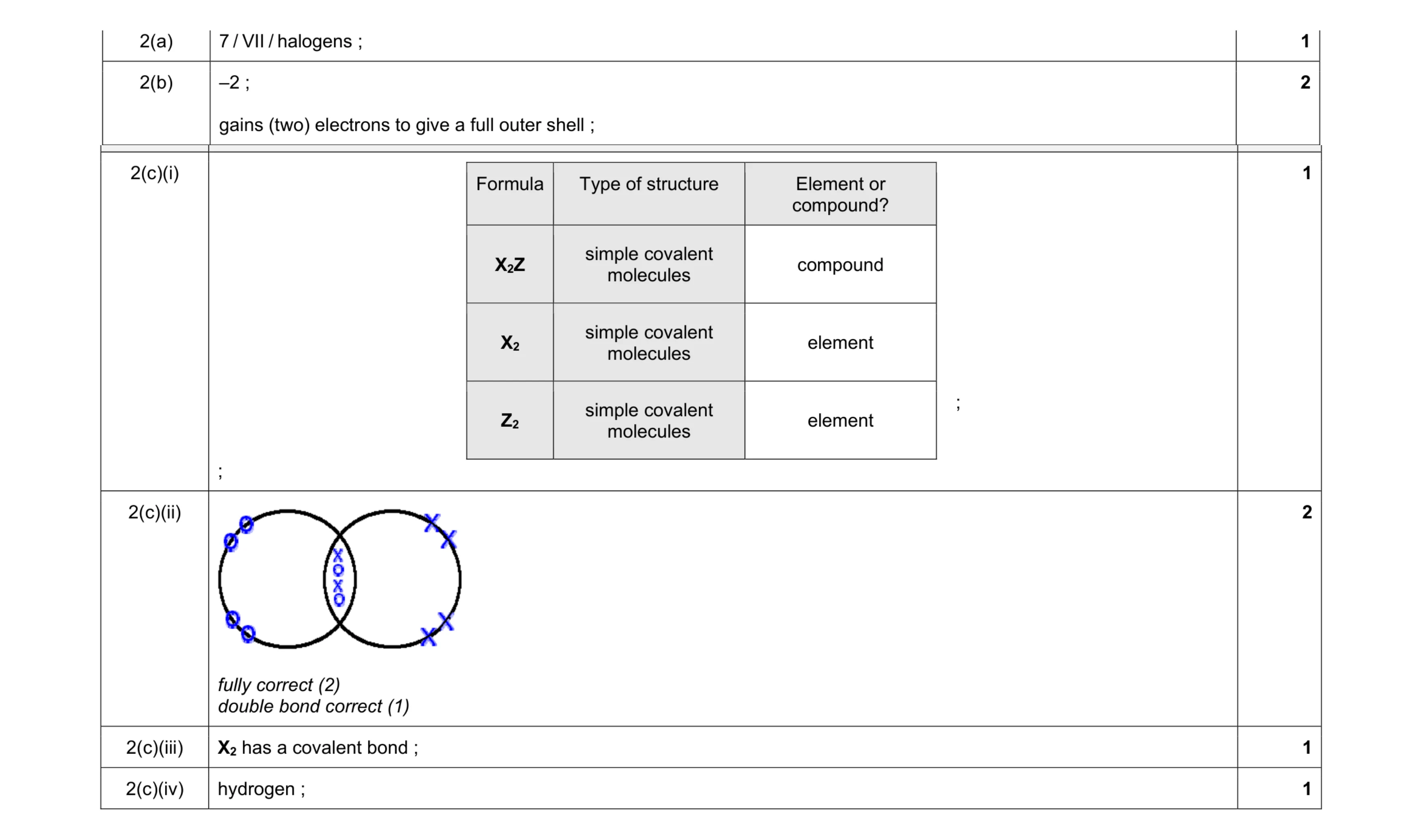 8
8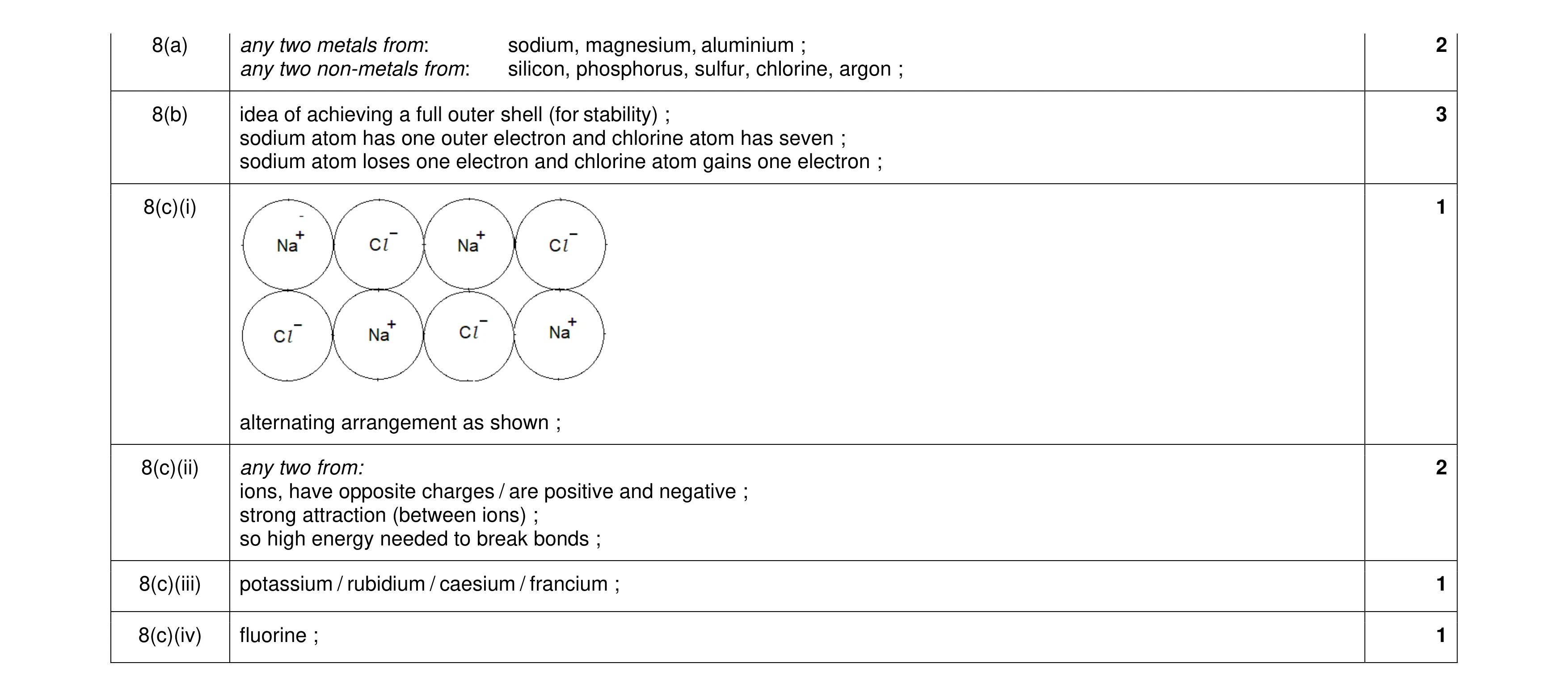 10
10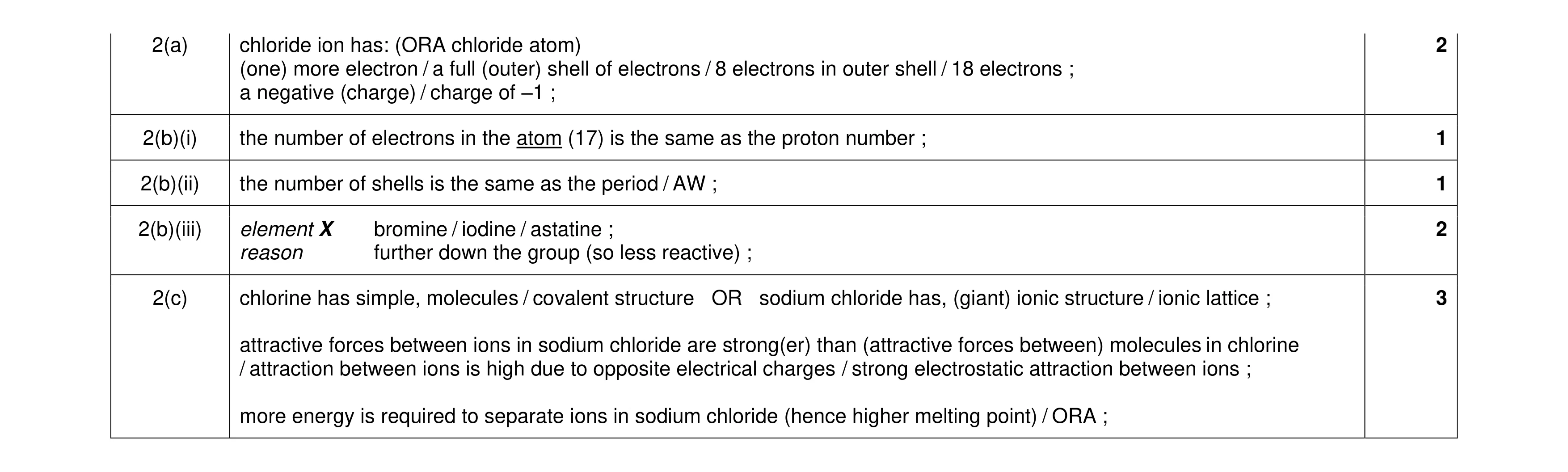 9
9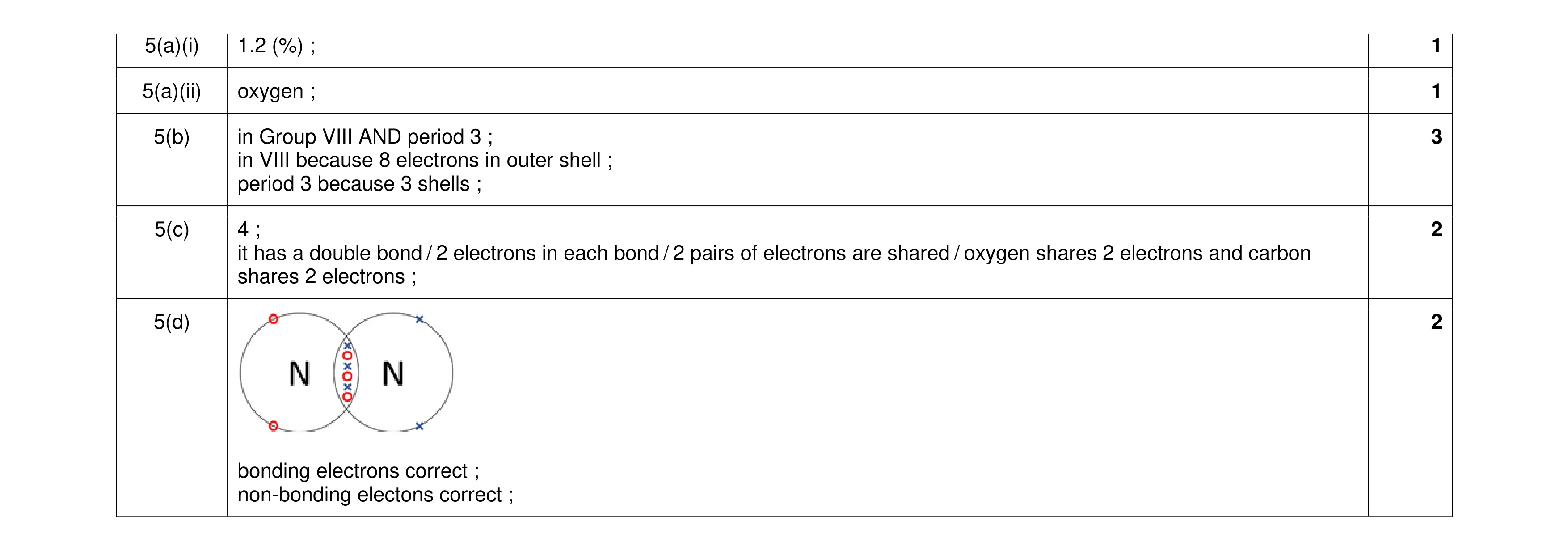 9
9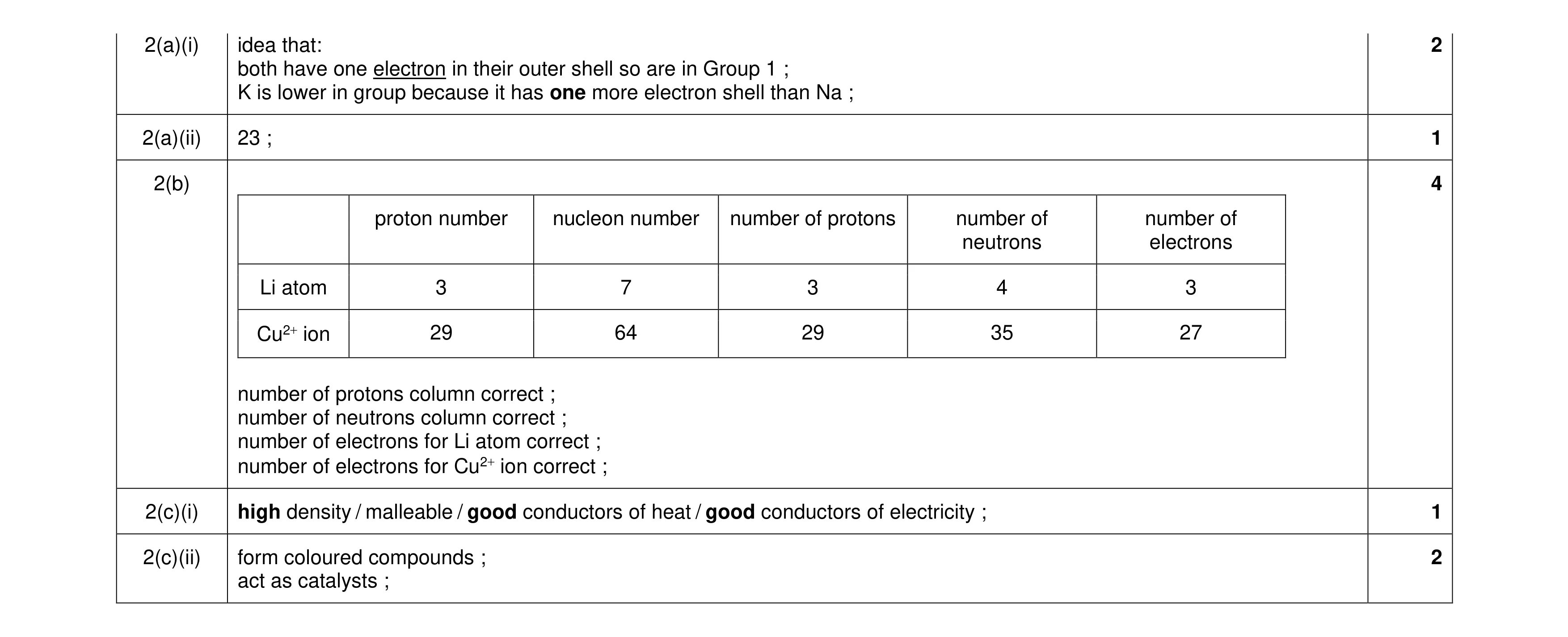 10
10