Questions as text
Q1 · The Periodic Table lists all of the elements in atomic number order 0653/32 Oct/Nov 2017
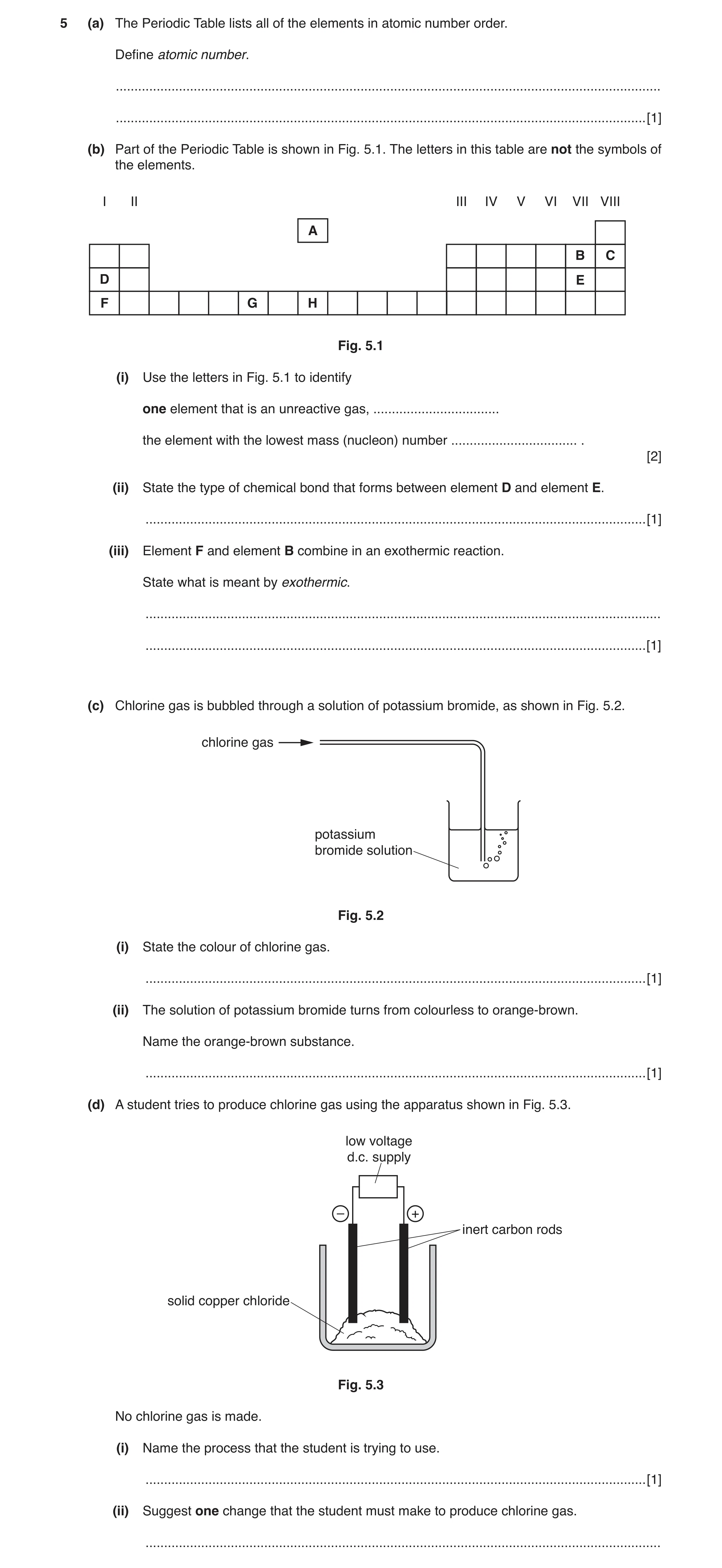
5 (a) The Periodic Table lists all of the elements in atomic number order. Define atomic number. … … [1] (b) Part of the Periodic Table is shown in Fig. 5.1. The letters in this table are not the symbols of the elements. I II III IV V VI VII VIII A B C D E F G H Fig. 5.1 (i) Use the letters in Fig. 5.1 to identify one element that is an unreactive gas, … the element with the lowest mass (nucleon) number … . [2] (ii) State the type of chemical bond that forms between element D and element E. … [1] (iii) Element F and element B combine in an exothermic reaction. State what is meant by exothermic. … … [1] (c) Chlorine gas is bubbled through a solution of potassium bromide, as shown in Fig. 5.2. chlorine gas potassium bromide solution Fig. 5.2 (i) State the colour of chlorine gas. … [1] (ii) The solution of potassium bromide turns from colourless to orange-brown. Name the orange-brown substance. … [1] (d) A student tries to produce chlorine gas using the apparatus shown in Fig. 5.3. low voltage d.c. supply – + inert carbon rods solid copper chloride Fig. 5.3 No chlorine gas is made. (i) Name the process that the student is trying to use. … [1] (ii) Suggest one change that the student must make to produce chlorine gas. …
9 marks
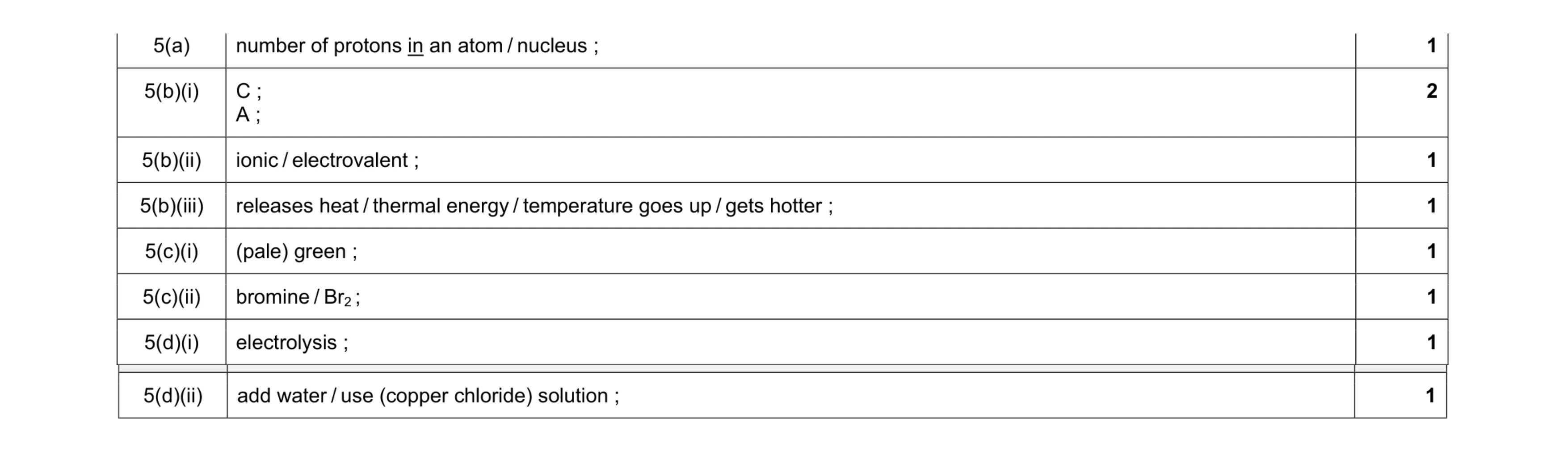
Mark scheme: 5(a) number of protons in an atom / nucleus ; 1 5(b)(i) C ; A ; 2 5(b)(ii) ionic / electrovalent ; 1 5(b)(iii) releases heat / thermal energy / temperature goes up / gets hotter ; 1 5(c)(i) (pale) green ; 1 5(c)(ii) bromine / Br2 ; 1 5(d)(i) electrolysis ; 1 Question Answer Marks 5(d)(ii) add water / use (copper chloride) solution ; 1
This question in 0653/32 Oct/Nov 2017
Q2 · Some iron objects are shown in Fig 0653/33 Oct/Nov 2017
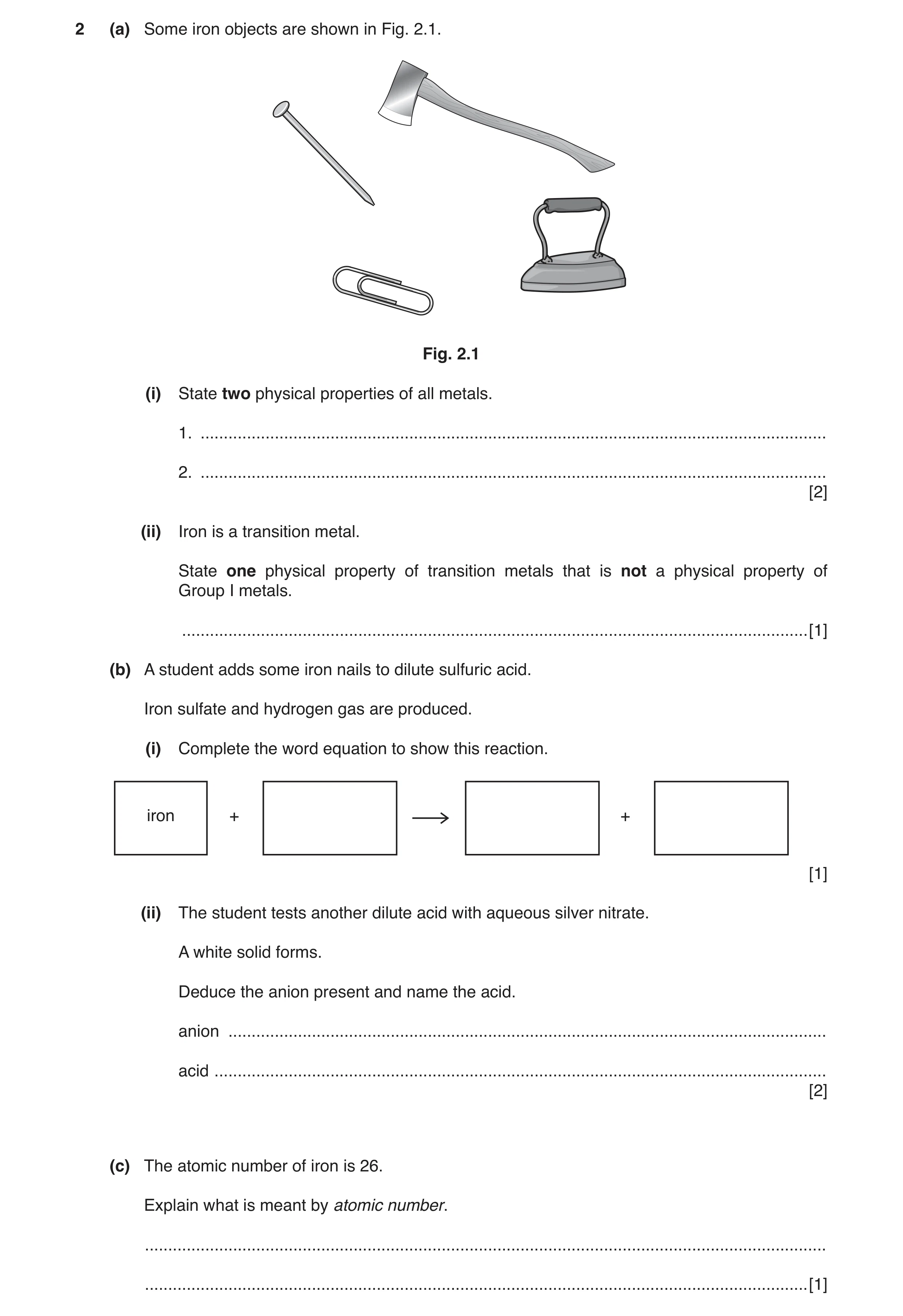
2 (a) Some iron objects are shown in Fig. 2.1. Fig. 2.1 (i) State two physical properties of all metals. 1. … 2. … [2] (ii) Iron is a transition metal. State one physical property of transition metals that is not a physical property of Group I metals. … [1] (b) A student adds some iron nails to dilute sulfuric acid. Iron sulfate and hydrogen gas are produced. (i) Complete the word equation to show this reaction. iron + + [1] (ii) The student tests another dilute acid with aqueous silver nitrate. A white solid forms. Deduce the anion present and name the acid. anion … acid … [2] (c) The atomic number of iron is 26. Explain what is meant by atomic number. … … [1]
7 marks
Mark scheme: 2(a)(i) Any two from electrical conductor ; thermal / heat conductor ; malleable ; ductile ; sonorous ; max 2 2(a)(ii) high density / high melting point / coloured compounds ; 1 2(b)(i) (iron) + sulfuric acid Î iron sulfate + hydrogen ; 1 2(b)(ii) (anion) chloride ; (acid) hydrochloric (acid) ; 2 2(c) number of protons in an atom / nucleus ; 1
This question in 0653/33 Oct/Nov 2017
Q3 · An atom of chlorine is represented by the symbol: 1735Cl (i) State the number of… 0653/32 Feb/March 2018
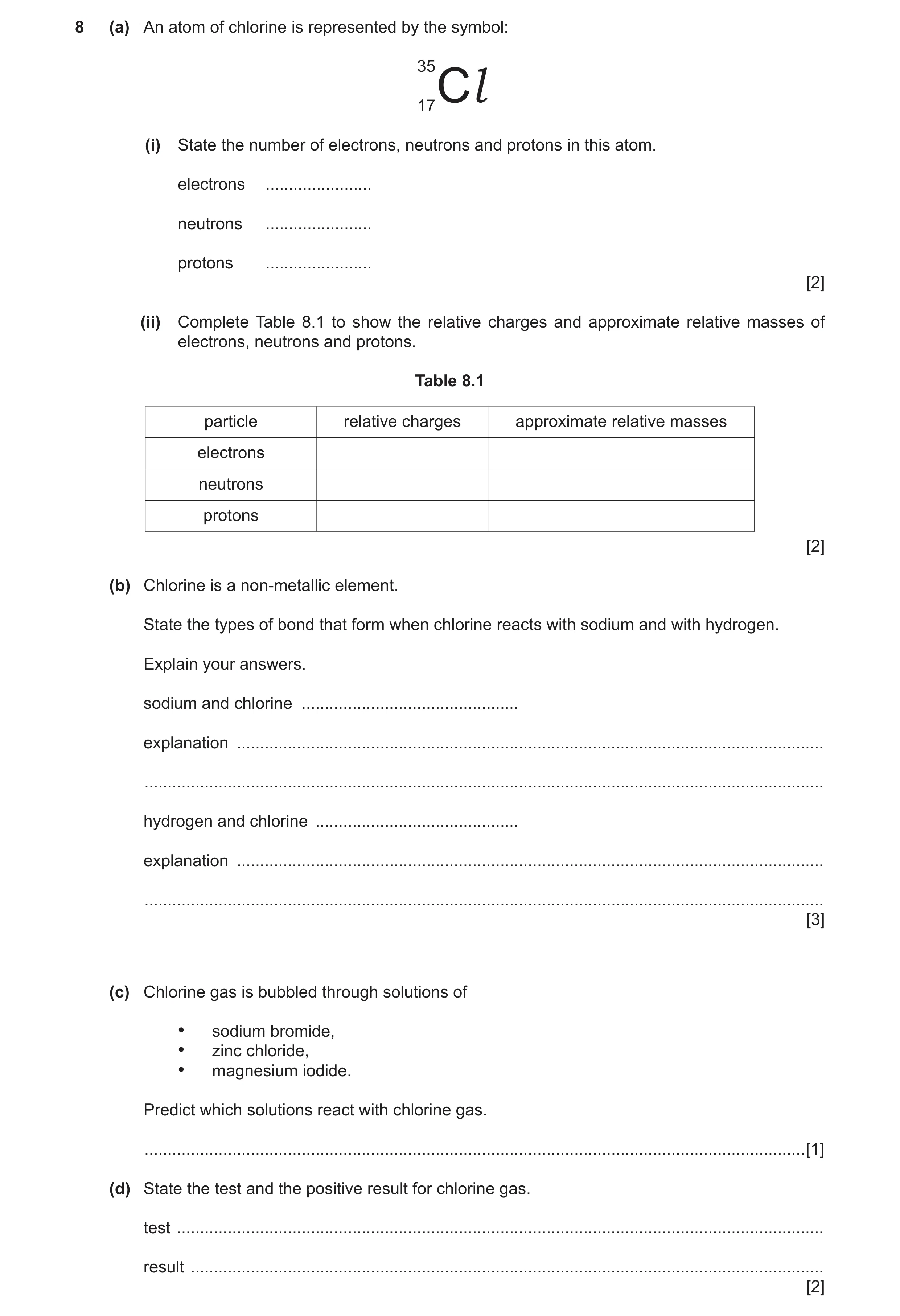
8 (a) An atom of chlorine is represented by the symbol: 1735Cl (i) State the number of electrons, neutrons and protons in this atom. electrons … neutrons … protons … [2] (ii) Complete Table 8.1 to show the relative charges and approximate relative masses of electrons, neutrons and protons. Table 8.1 particle relative charges approximate relative masses electrons neutrons protons [2] (b) Chlorine is a non-metallic element. State the types of bond that form when chlorine reacts with sodium and with hydrogen. Explain your answers. sodium and chlorine … explanation … … hydrogen and chlorine … explanation … … [3] (c) Chlorine gas is bubbled through solutions of • sodium bromide, • zinc chloride, • magnesium iodide. Predict which solutions react with chlorine gas. … [1] (d) State the test and the positive result for chlorine gas. test … result … [2]
10 marks
Mark scheme: 8(a)(i) (electrons) 17 (neutrons) 18 (protons) 17 ;; all three correct (2) one or two correct (1) 2 8(a)(ii) (particle) (relative charges) (approximate relative masses) (electrons) –1 negligible / 1/2000 (neutrons) 0 / none 1 (protons) +1 1 ;; all three relative charges (1) all three approximate relative masses (1) 2 8(b) (sodium and chlorine) ionic and (hydrogen and chlorine) covalent ; (sodium explanation) metal and non-metal / loss gain of electrons ; (hydrogen explanation) two non-metals / shared electrons ; 3 Question Answer Marks 8(c) (sodium) bromide AND (magnesium) iodide ; 1 8(d) (test) (damp) litmus paper ; (result) bleaches / turns white ; 2
This question in 0653/32 Feb/March 2018
Q4 · A student investigates the reactivity of four different metals 0653/31 May/June 2018
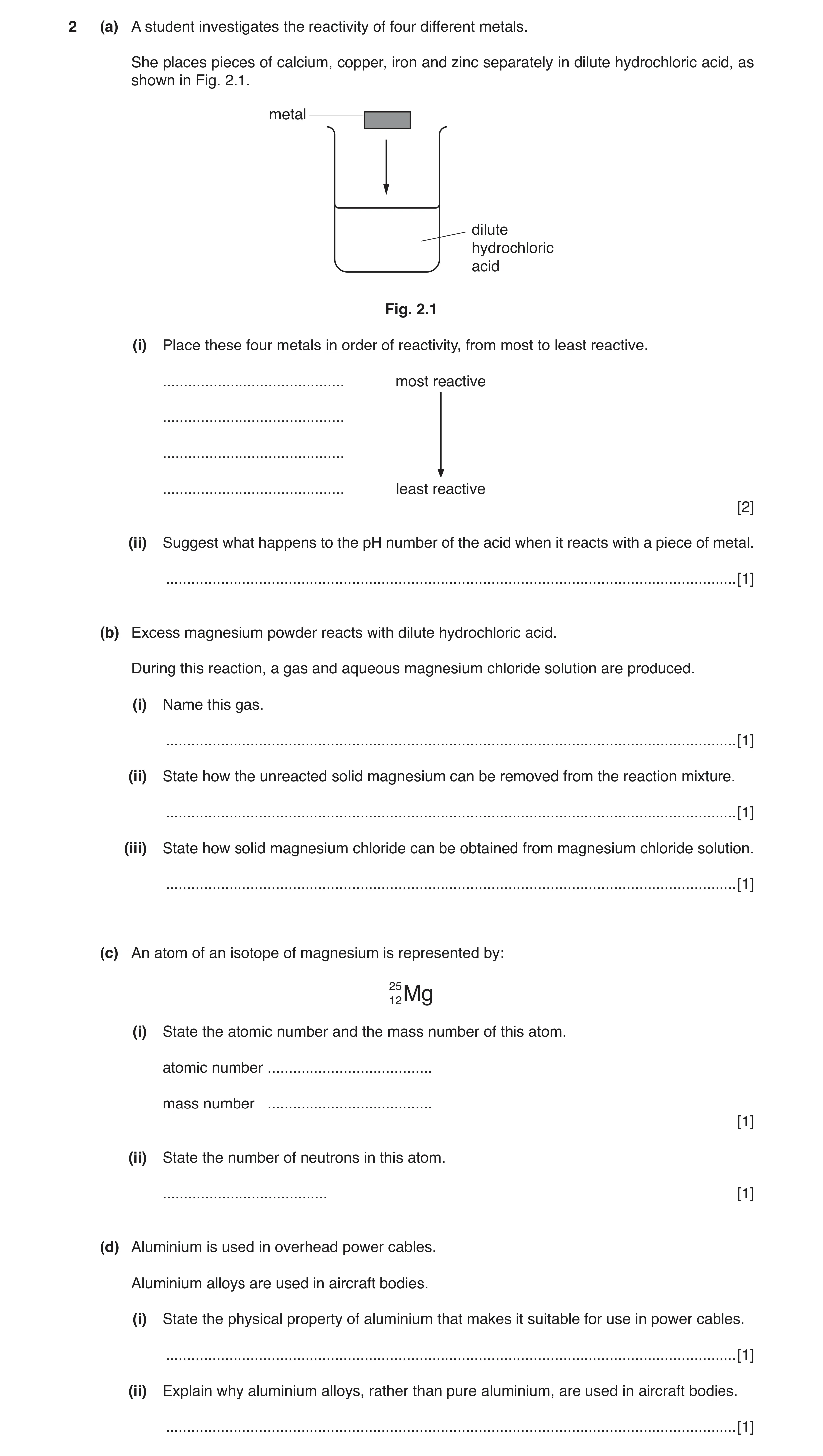
2 (a) A student investigates the reactivity of four different metals. She places pieces of calcium, copper, iron and zinc separately in dilute hydrochloric acid, as shown in Fig. 2.1. metal dilute hydrochloric acid Fig. 2.1 (i) Place these four metals in order of reactivity, from most to least reactive. … most reactive … … … least reactive [2] (ii) Suggest what happens to the pH number of the acid when it reacts with a piece of metal. … [1] (b) Excess magnesium powder reacts with dilute hydrochloric acid. During this reaction, a gas and aqueous magnesium chloride solution are produced. (i) Name this gas. … [1] (ii) State how the unreacted solid magnesium can be removed from the reaction mixture. … [1] (iii) State how solid magnesium chloride can be obtained from magnesium chloride solution. … [1] (c) An atom of an isotope of magnesium is represented by: 2512Mg (i) State the atomic number and the mass number of this atom. atomic number … mass number … [1] (ii) State the number of neutrons in this atom. … [1] (d) Aluminium is used in overhead power cables. Aluminium alloys are used in aircraft bodies. (i) State the physical property of aluminium that makes it suitable for use in power cables. … [1] (ii) Explain why aluminium alloys, rather than pure aluminium, are used in aircraft bodies. … [1]
10 marks
Mark scheme: 2(a)(i) calcium Ca zinc / Zn iron / Fe copper / Cu ;; 1 mark for calcium first and copper last 2 marks for all four correct 2 2(a)(ii) increases / goes up / gets (closer) to 7 ; 1 2(b)(i) hydrogen ; 1 2(b)(ii) filter / filtering / filtration ; 1 2(b)(iii) crystallisation / evaporation / heat ; 1 2(c)(i) (atomic no.) 12 and (mass no.) 25 ; 1 2(c)(ii) 13 ; 1 2(d)(i) (electrical) conductor ; 1 2(d)(ii) higher strength ; 1
This question in 0653/31 May/June 2018
Q5 · Complete the following sentences using words from the list 0653/31 Oct/Nov 2018
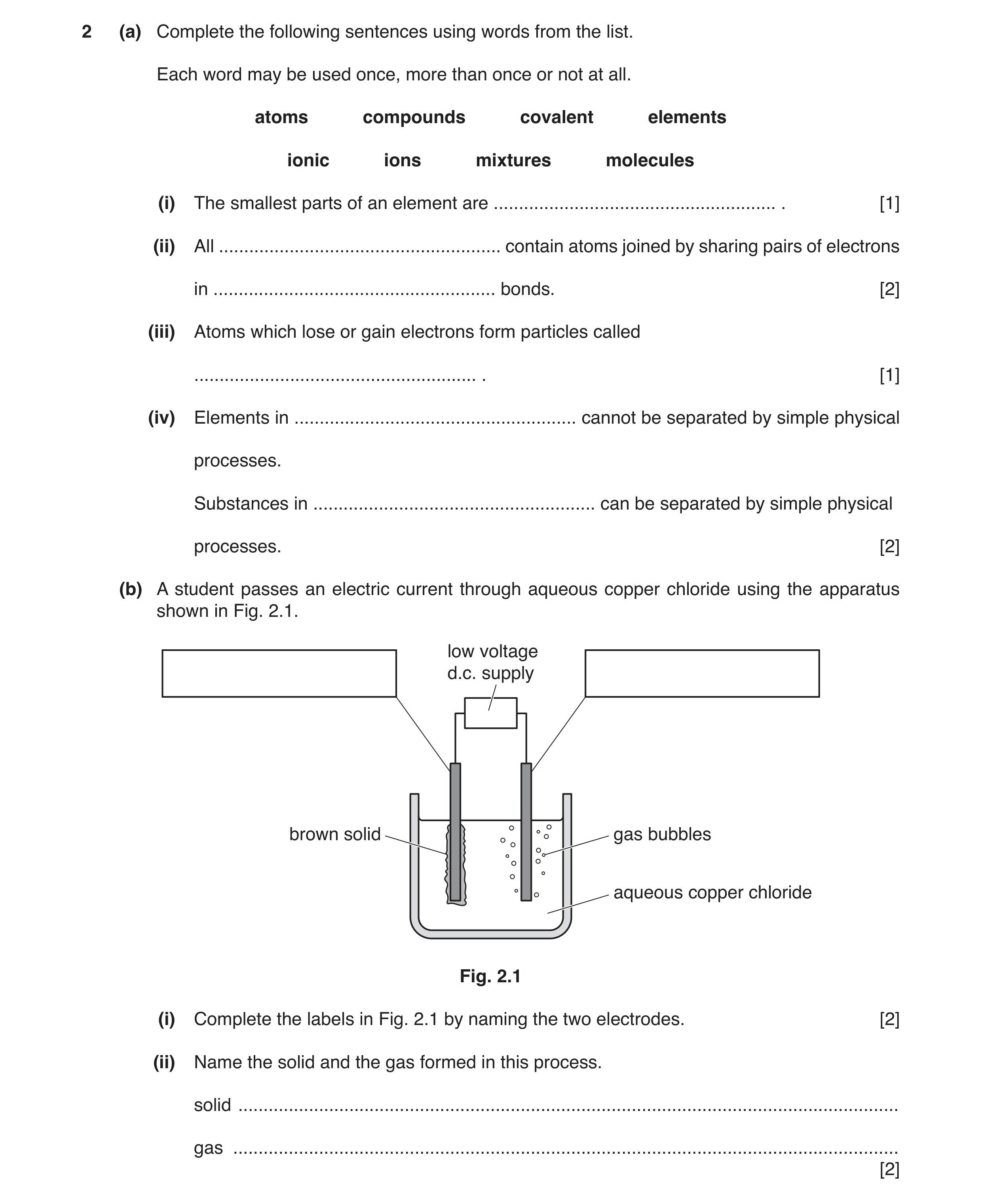
2 (a) Complete the following sentences using words from the list. Each word may be used once, more than once or not at all. atoms compounds covalent elements ionic ions mixtures molecules (i) The smallest parts of an element are … . [1] (ii) All … contain atoms joined by sharing pairs of electrons in … bonds. [2] (iii) Atoms which lose or gain electrons form particles called … . [1] (iv) Elements in … cannot be separated by simple physical processes. Substances in … can be separated by simple physical processes. [2] (b) A student passes an electric current through aqueous copper chloride using the apparatus shown in Fig. 2.1. low voltage d.c. supply brown solid gas bubbles aqueous copper chloride Fig. 2.1 (i) Complete the labels in Fig. 2.1 by naming the two electrodes. [2] (ii) Name the solid and the gas formed in this process. solid … gas … [2]
10 marks
Mark scheme: 2(a)(i) atoms ; 1 2(a)(ii) molecules ; covalent ; 2 2(a)(iii) ions ; 1 2(a)(iv) compounds/molecules ; mixture ; 2 Question Answer Marks 2(b)(i) (left electrode) cathode ; (right electrode) anode ; 2 2(b)(ii) (solid) copper / Cu ; (gas) chlorine / Cl2 ; 2
This question in 0653/31 Oct/Nov 2018
Q6 · Natural gas and coal are fossil fuels 0653/32 Oct/Nov 2018
5 (a) Natural gas and coal are fossil fuels. (i) Name one other fossil fuel. … [1] (ii) Name the main constituent of natural gas. … [1] (b) Ethane, C2H6, is an alkane. (i) Describe the chemical properties of alkanes. … … [1] (ii) Complete the structure of a molecule of ethane. H C [2] (c) The atomic numbers and mass numbers of carbon and of hydrogen are shown in Table 5.1. Table 5.1 atomic number mass number carbon 6 12 hydrogen 1 1 (i) Define atomic number. … … [1] (ii) Complete Table 5.2 to describe the particles in an atom. Table 5.2 particle position in atom relative charge relative mass electron –1 neutron in nucleus proton 1 [3]
9 marks
Mark scheme: 5(a)(i) petroleum ; 1 5(a)(ii) methane ; 1 5(b)(i) unreactive / (only) burn / combust ; 1 5(b)(ii) C – C single bond ; All else correct ; 2 5(c)(i) number of protons (in an atom / nucleus) ; 1 5(c)(ii) 2 or 3 correct entries = 1 mark 4 or 5 correct entries = 2 marks All correct = 3 marks 3
This question in 0653/32 Oct/Nov 2018
Q7 · The Periodic Table contains the symbols of all of the elements 0653/33 Oct/Nov 2018
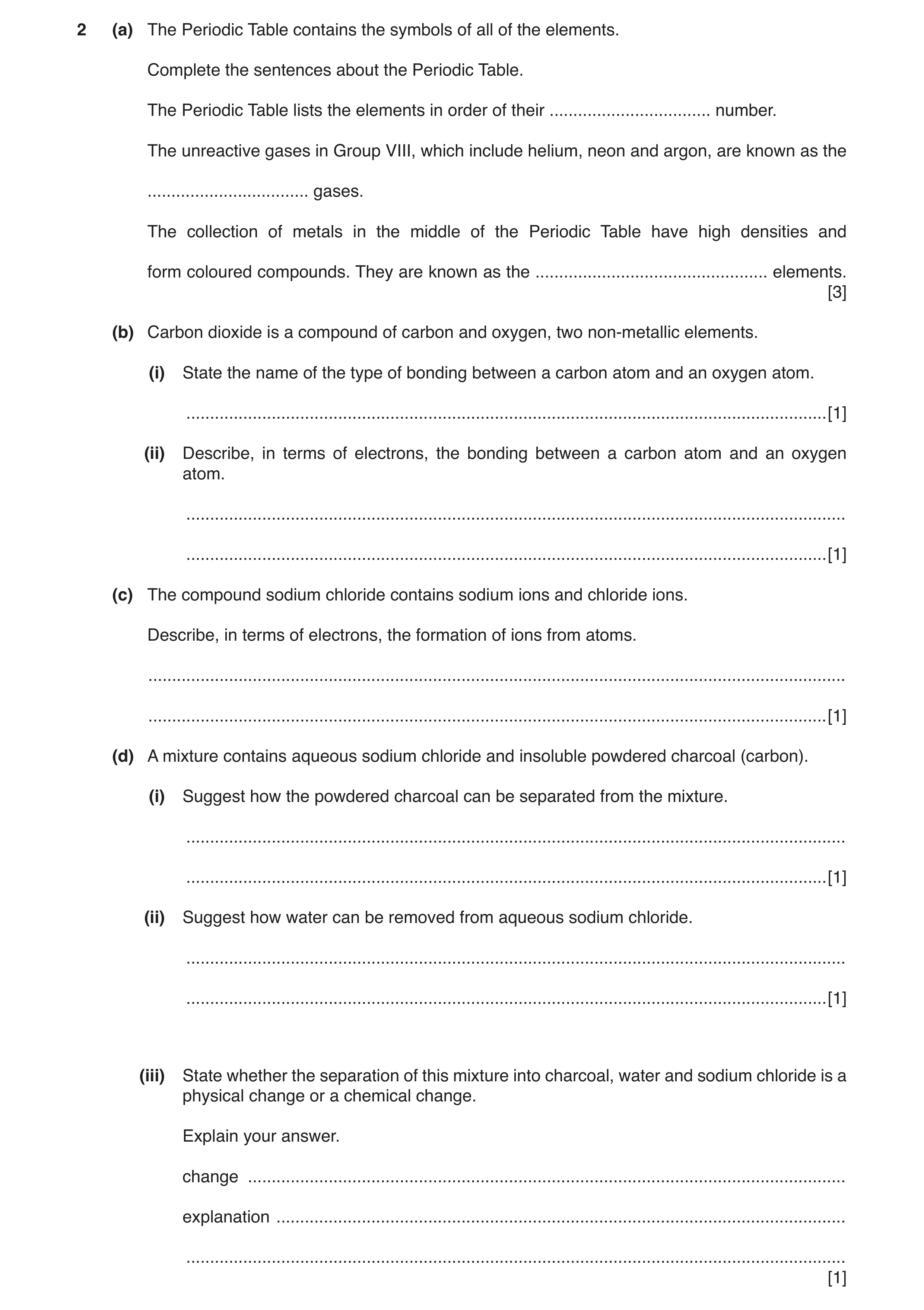
2 (a) The Periodic Table contains the symbols of all of the elements. Complete the sentences about the Periodic Table. The Periodic Table lists the elements in order of their … number. The unreactive gases in Group VIII, which include helium, neon and argon, are known as the … gases. The collection of metals in the middle of the Periodic Table have high densities and form coloured compounds. They are known as the … elements. [3] (b) Carbon dioxide is a compound of carbon and oxygen, two non-metallic elements. (i) State the name of the type of bonding between a carbon atom and an oxygen atom. … [1] (ii) Describe, in terms of electrons, the bonding between a carbon atom and an oxygen atom. … … [1] (c) The compound sodium chloride contains sodium ions and chloride ions. Describe, in terms of electrons, the formation of ions from atoms. … … [1] (d) A mixture contains aqueous sodium chloride and insoluble powdered charcoal (carbon). (i) Suggest how the powdered charcoal can be separated from the mixture. … … [1] (ii) Suggest how water can be removed from aqueous sodium chloride. … … [1] (iii) State whether the separation of this mixture into charcoal, water and sodium chloride is a physical change or a chemical change. Explain your answer. change … explanation … … [1]
9 marks
Mark scheme: 2(a) atomic / proton ; noble ; transition ; 3 2(b)(i) covalent ; 1 2(b)(ii) (electrons are) shared ; 1 2(c) (electrons are) lost / gained / lost and gained ; 1 Question Answer Marks 2(d)(i) filter / filtering / filtration ; 1 2(d)(ii) evaporation ; 1 2(d)(iii) physical and no new substance(s) is / are made ; 1
This question in 0653/33 Oct/Nov 2018
Q8 · Sodium is a Group I metal 0653/32 Feb/March 2019
5 (a) Sodium is a Group I metal. An atom of sodium is represented by the symbol 23Na11 (i) State the numbers of electrons, neutrons and protons in this atom. electrons … neutrons … protons … [2] (ii) The electronic structure of a sodium atom is shown in Fig. 5.1a. Fig. 5.1a Fig. 5.1b Complete Fig. 5.1b to show the electronic structure of a sodium ion. [1] (b) Apparatus used in the electrolysis of concentrated aqueous sodium chloride is shown in Fig. 5.2. low voltage d.c. supply – + concentrated aqueous sodium chloride Fig. 5.2 Complete the sentences about the electrolysis of concentrated aqueous sodium chloride. The concentrated aqueous sodium chloride is known as the … . The positive electrode is called the … , and the negative electrode is called the … . At the positive electrode … forms and at the negative electrode … forms. [5] (c) When a teacher adds a piece of sodium to a bowl of water, an exothermic reaction occurs. The teacher uses Universal Indicator to test the solution in the bowl after the reaction. (i) Describe a simple method that the teacher can use to show that the reaction is exothermic. … … … [2] (ii) Describe and explain the effect of the solution in the bowl on the Universal Indicator. effect … explanation … … [2] [Total: 12]
12 marks
Mark scheme: 5(a)(i) (electrons) 11 AND (protons) 11 ; (neutrons) 12 ; 2 5(a)(ii) 2, 8 ; 1 5(b) electrolyte ; anode ; cathode ; chlorine (gas) ; hydrogen (gas) ; 5 5(c)(i) uses a thermometer to measure temperature (before and after) ; temperature should show an increase / idea that heat is given out ; 2 5(c)(ii) (effect) (turns) blue ; (explanation) (forms) (sodium) hydroxide / alkaline (solution) ; 2
This question in 0653/32 Feb/March 2019
Q9 · An atom of aluminium is represented by the symbol: 2 1 37Al State the number of protons… 0653/31 May/June 2019
8 (a) An atom of aluminium is represented by the symbol: 2 1 37Al State the number of protons and the number of neutrons in this atom. protons … neutrons … [2] (b) Aluminium is extracted from aluminium oxide. Aluminium oxide is obtained from the ore bauxite. (i) State the method of extraction used. … [1] (ii) State the type of bonding in aluminium oxide. … [1] (iii) Suggest one reason, other than cost, why aluminium is recycled. … … [1] (c) Copper forms coloured compounds, but aluminium does not. Explain this observation. … … [1] (d) Copper is extracted from copper oxide by heating with a non-metallic element. (i) Name this non-metallic element. … [1] (ii) State whether the copper oxide is oxidised or reduced during this process. Explain your answer. copper oxide is … explanation … … [1] [Total: 8]
8 marks
Mark scheme: 8(a) (protons) 13 ; (neutrons) 14 ; 2 8(b)(i) electrolysis ; 1 8(b)(ii) ionic ; 1 8(b)(iii) It is a finite resource / (they’re) running out / will run out / more energy used for extraction / less energy to recycle (than extract) / no need to mine / does not go into landfill ; 1 8(c) copper / Cu is a transition metal / aluminium is not a transition metal ; 1 8(d)(i) carbon ; 1 8(d)(ii) (copper oxide is) reduced and (explanation) (CuO) loses oxygen ; 1
This question in 0653/31 May/June 2019
Q10 · The electrolysis of concentrated aqueous sodium chloride is shown in Fig 0653/32 Oct/Nov 2019
5 (a) The electrolysis of concentrated aqueous sodium chloride is shown in Fig. 5.1. low voltage d.c. supply … … – + … Fig. 5.1 (i) Complete Fig. 5.1 by adding the labels anode, cathode and electrolyte. [2] (ii) One of the products of this electrolysis is chlorine gas. Identify the two other products. 1. … 2. … [2] (iii) Describe a chemical test for chlorine gas and state the positive result. test … … result … [2] (b) An atom of sodium has atomic number 11 and nucleon number 23. State the number of protons and the number of neutrons in this atom of sodium. protons … neutrons … [2] (c) A chlorine atom has 17 electrons. A chloride ion has the symbol Cl –. Complete Fig. 5.2 to show the electron arrangements in a chlorine atom and in a chloride ion. × × × × chlorine atom chloride ion Fig. 5.2 [2] [Total: 10]
10 marks
Mark scheme: 5(a)(i) all three correct = 2 marks one or two correct = 1 mark 2 5(a)(ii) sodium hydroxide / NaOH ; hydrogen / H2 ; 2 5(a)(iii) (test) damp litmus paper ; (result) (blue / red to) white ; 2 5(b) (protons) 11 ; (neutrons) 12 ; 2 5(c) (chlorine atom) 2, 8, 7 drawn ; (chloride ion) 2, 8, 8 drawn ; 2
This question in 0653/32 Oct/Nov 2019
Q11 · The electrolysis of concentrated aqueous sodium chloride is shown in Fig 0653/33 Oct/Nov 2019
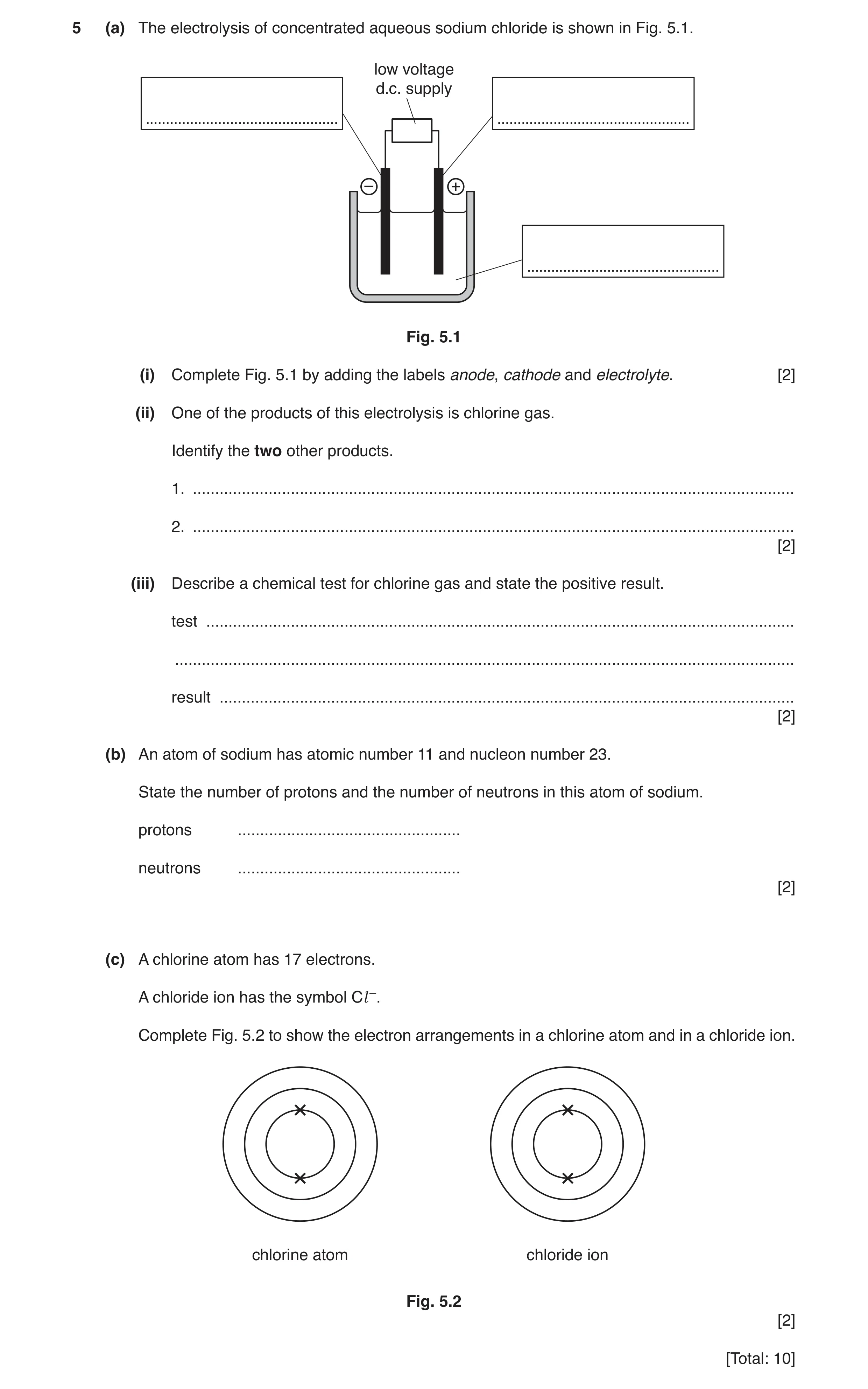
5 (a) The electrolysis of concentrated aqueous sodium chloride is shown in Fig. 5.1. low voltage d.c. supply … … – + … Fig. 5.1 (i) Complete Fig. 5.1 by adding the labels anode, cathode and electrolyte. [2] (ii) One of the products of this electrolysis is chlorine gas. Identify the two other products. 1. … 2. … [2] (iii) Describe a chemical test for chlorine gas and state the positive result. test … … result … [2] (b) An atom of sodium has atomic number 11 and nucleon number 23. State the number of protons and the number of neutrons in this atom of sodium. protons … neutrons … [2] (c) A chlorine atom has 17 electrons. A chloride ion has the symbol Cl –. Complete Fig. 5.2 to show the electron arrangements in a chlorine atom and in a chloride ion. × × × × chlorine atom chloride ion Fig. 5.2 [2] [Total: 10]
10 marks
Mark scheme: 5(a)(i) all three correct = 2 marks one or two correct = 1 mark 2 5(a)(ii) sodium hydroxide / NaOH ; hydrogen / H2 ; 2 5(a)(iii) (test) damp litmus paper ; (result) (blue / red to) white ; 2 5(b) (protons) 11 ; (neutrons) 12 ; 2 5(c) (chlorine atom) 2, 8, 7 drawn ; (chloride ion) 2, 8, 8 drawn ; 2
This question in 0653/33 Oct/Nov 2019
Q12 · A lightning flash, which is a form of electrostatic discharge 0653/33 Oct/Nov 2019
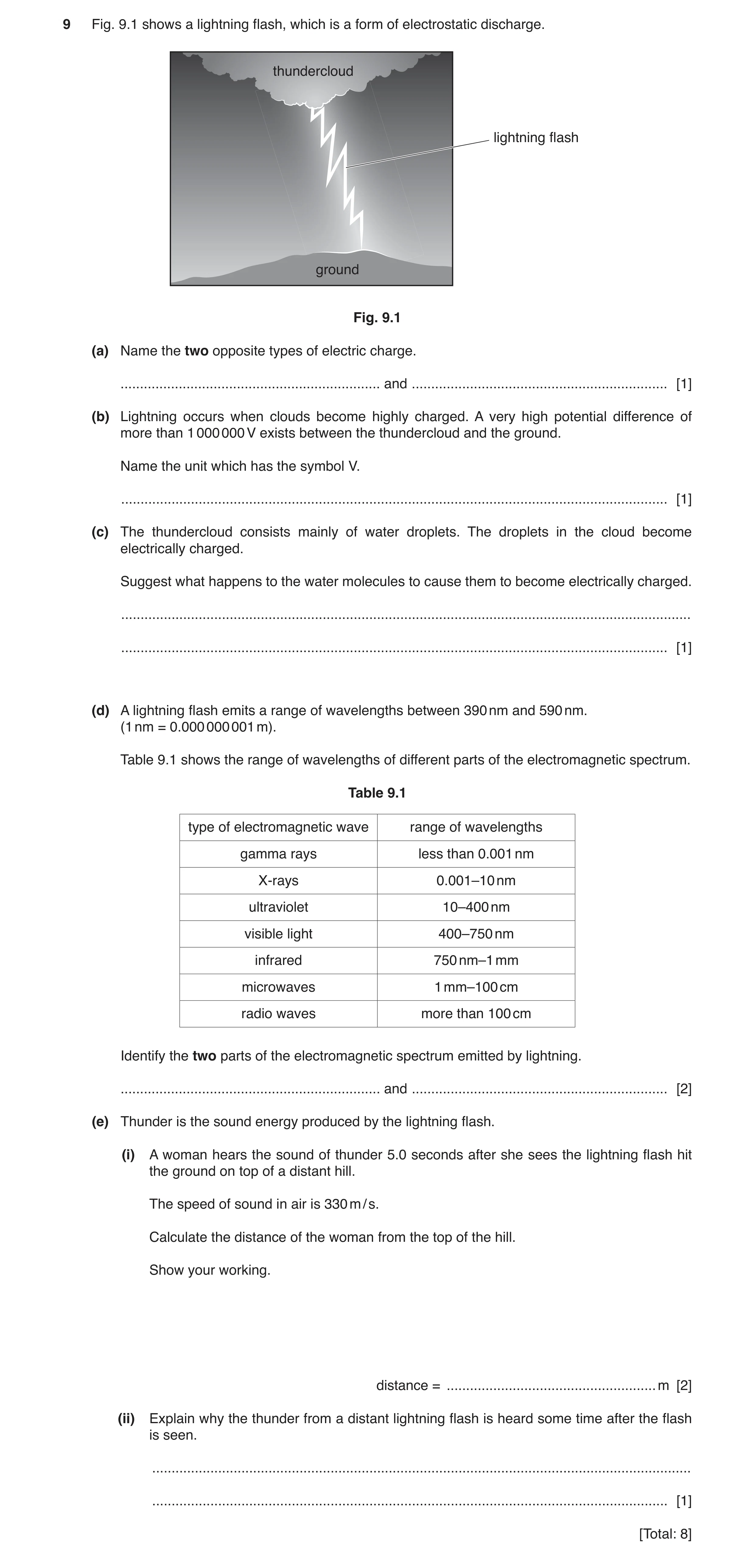
9 Fig. 9.1 shows a lightning flash, which is a form of electrostatic discharge. thundercloud lightning flash ground Fig. 9.1 (a) Name the two opposite types of electric charge. … and … [1] (b) Lightning occurs when clouds become highly charged. A very high potential difference of more than 1 000 000 V exists between the thundercloud and the ground. Name the unit which has the symbol V. … [1] (c) The thundercloud consists mainly of water droplets. The droplets in the cloud become electrically charged. Suggest what happens to the water molecules to cause them to become electrically charged. … … [1] (d) A lightning flash emits a range of wavelengths between 390 nm and 590 nm. (1 nm = 0.000 000 001 m). Table 9.1 shows the range of wavelengths of different parts of the electromagnetic spectrum. Table 9.1 type of electromagnetic wave range of wavelengths gamma rays less than 0.001 nm X‑rays 0.001–10 nm ultraviolet 10–400 nm visible light 400–750 nm infrared 750 nm–1 mm microwaves 1 mm–100 cm radio waves more than 100 cm Identify the two parts of the electromagnetic spectrum emitted by lightning. … and … [2] (e) Thunder is the sound energy produced by the lightning flash. (i) A woman hears the sound of thunder 5.0 seconds after she sees the lightning flash hit the ground on top of a distant hill. The speed of sound in air is 330 m / s. Calculate the distance of the woman from the top of the hill. Show your working. distance = … m [2] (ii) Explain why the thunder from a distant lightning flash is heard some time after the flash is seen. … … [1] [Total: 8]
8 marks
Mark scheme: 9(a) positive and negative ; 1 9(b) volt(s); 1 9(c) loss / gain / transfer of electrons (between molecules) ; 1 9(d) visible light; ultraviolet ; 2 9(e)(i) speed = distance / time or d = speed × time = 330 × 5.0 ; = 1650 (m) ; 2 9(e)(ii) light travels (much) faster than sound ; 1
This question in 0653/33 Oct/Nov 2019
Q13 · A teacher uses the apparatus shown in Fig 0653/31 May/June 2020
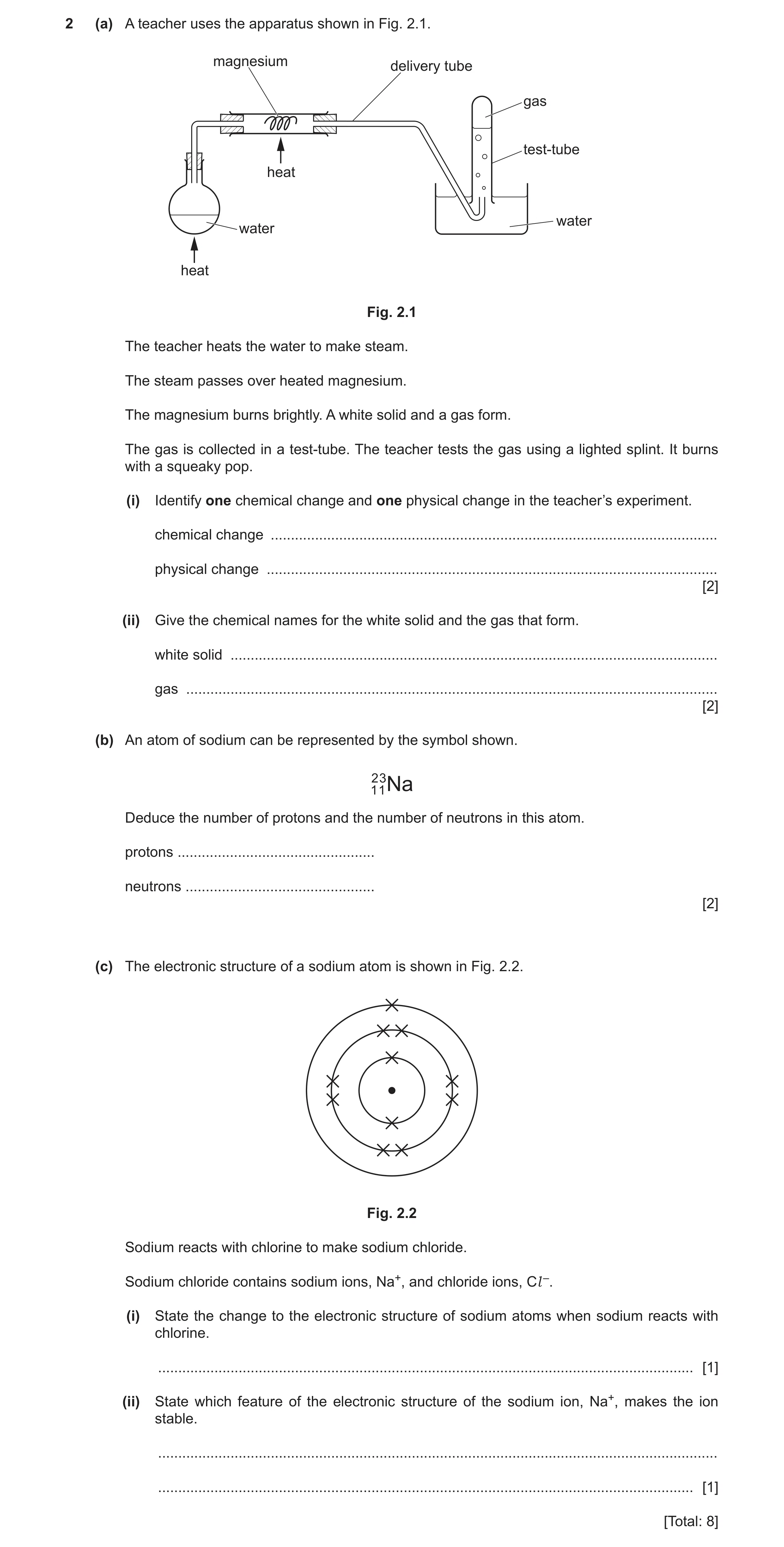
2 (a) A teacher uses the apparatus shown in Fig. 2.1. magnesium delivery tube gas test-tube heat water water heat Fig. 2.1 The teacher heats the water to make steam. The steam passes over heated magnesium. The magnesium burns brightly. A white solid and a gas form. The gas is collected in a test-tube. The teacher tests the gas using a lighted splint. It burns with a squeaky pop. (i) Identify one chemical change and one physical change in the teacher’s experiment. chemical change … physical change … [2] (ii) Give the chemical names for the white solid and the gas that form. white solid … gas … [2] (b) An atom of sodium can be represented by the symbol shown. 2 1 13Na Deduce the number of protons and the number of neutrons in this atom. protons … neutrons … [2] (c) The electronic structure of a sodium atom is shown in Fig. 2.2. Fig. 2.2 Sodium reacts with chlorine to make sodium chloride. Sodium chloride contains sodium ions, Na+, and chloride ions, Cl –. (i) State the change to the electronic structure of sodium atoms when sodium reacts with chlorine. … [1] (ii) State which feature of the electronic structure of the sodium ion, Na+, makes the ion stable. … … [1] [Total: 8]
8 marks
Mark scheme: 2(a)(i) (chemical change) burning / combustion / gas test ; (physical change) boiling / water to steam ; 2 2(a)(ii) (white solid) magnesium oxide ; (gas) hydrogen ; 2 2(b) (protons) 11 ; (neutrons) 12 ; 2 2(c)(i) loses one electron / loses outer electron ; 1 2(c)(ii) full outer shell / same as noble gas (electronic structure) ; 1
This question in 0653/31 May/June 2020
Q14 · Brass is a mixture of copper and zinc 0653/32 Oct/Nov 2020
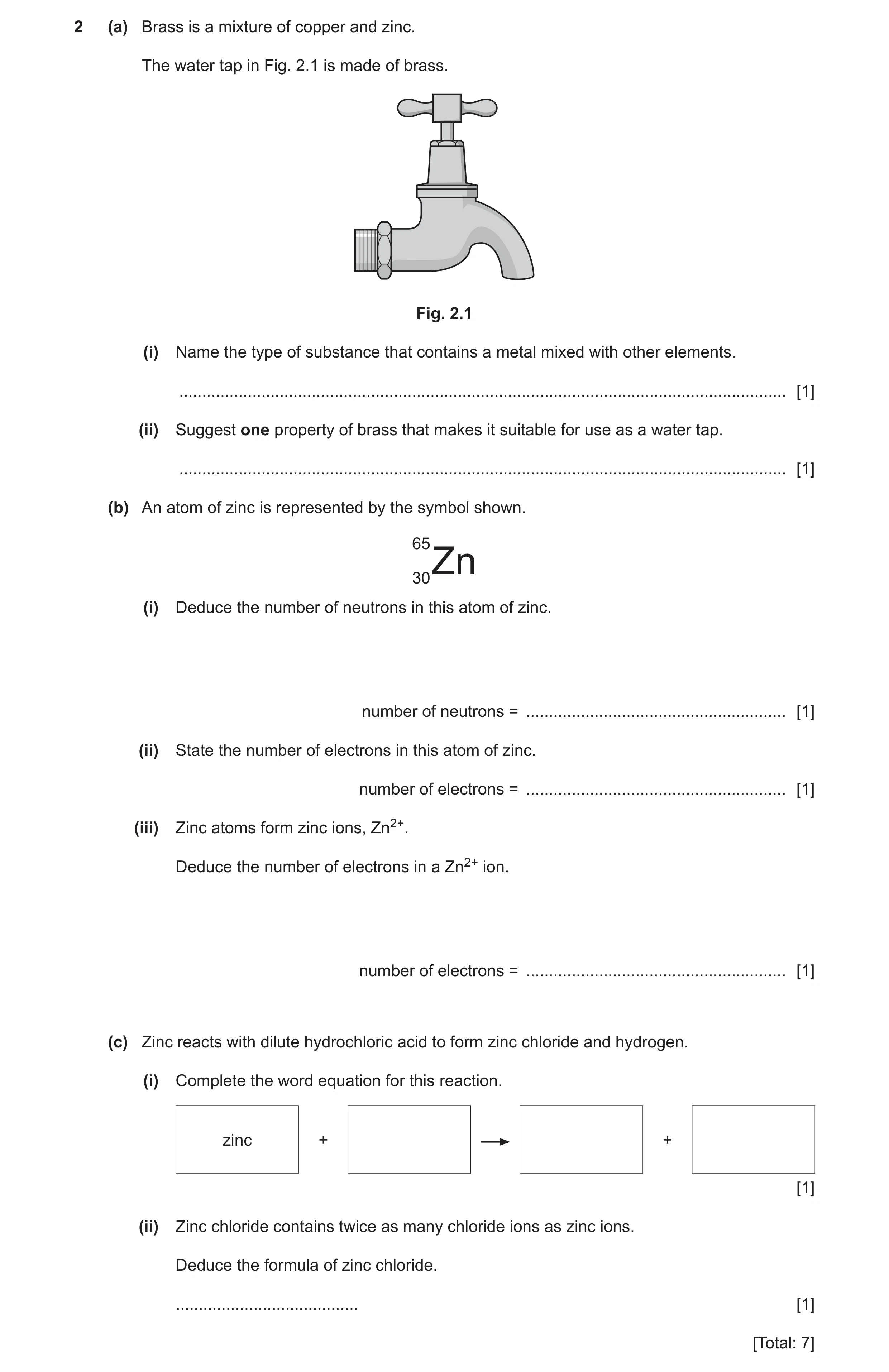
2 (a) Brass is a mixture of copper and zinc. The water tap in Fig. 2.1 is made of brass. Fig. 2.1 (i) Name the type of substance that contains a metal mixed with other elements. … [1] (ii) Suggest one property of brass that makes it suitable for use as a water tap. … [1] (b) An atom of zinc is represented by the symbol shown. 6530Zn (i) Deduce the number of neutrons in this atom of zinc. number of neutrons = … [1] (ii) State the number of electrons in this atom of zinc. number of electrons = … [1] (iii) Zinc atoms form zinc ions, Zn2+. Deduce the number of electrons in a Zn2+ ion. number of electrons = … [1] (c) Zinc reacts with dilute hydrochloric acid to form zinc chloride and hydrogen. (i) Complete the word equation for this reaction. zinc + + [1] (ii) Zinc chloride contains twice as many chloride ions as zinc ions. Deduce the formula of zinc chloride. … [1] [Total: 7]
7 marks
Mark scheme: 2(a)(i) alloy ; 1 2(a)(ii) unreactive / does not react (with water) ; 1 2(b)(i) (65 – 30 =) 35 ; 1 2(b)(ii) 30 ; 1 2(b)(iii) (30 – 2 =) 28 ; 1 2(c)(i) ; (zinc) + (dilute) hydrochloric acid → zinc chloride + hydrogen 1 2(c)(ii) ZnCl2 ; 1 Question Answer Marks
This question in 0653/32 Oct/Nov 2020
Q15 · The water tap shown in Fig 0653/33 Oct/Nov 2020
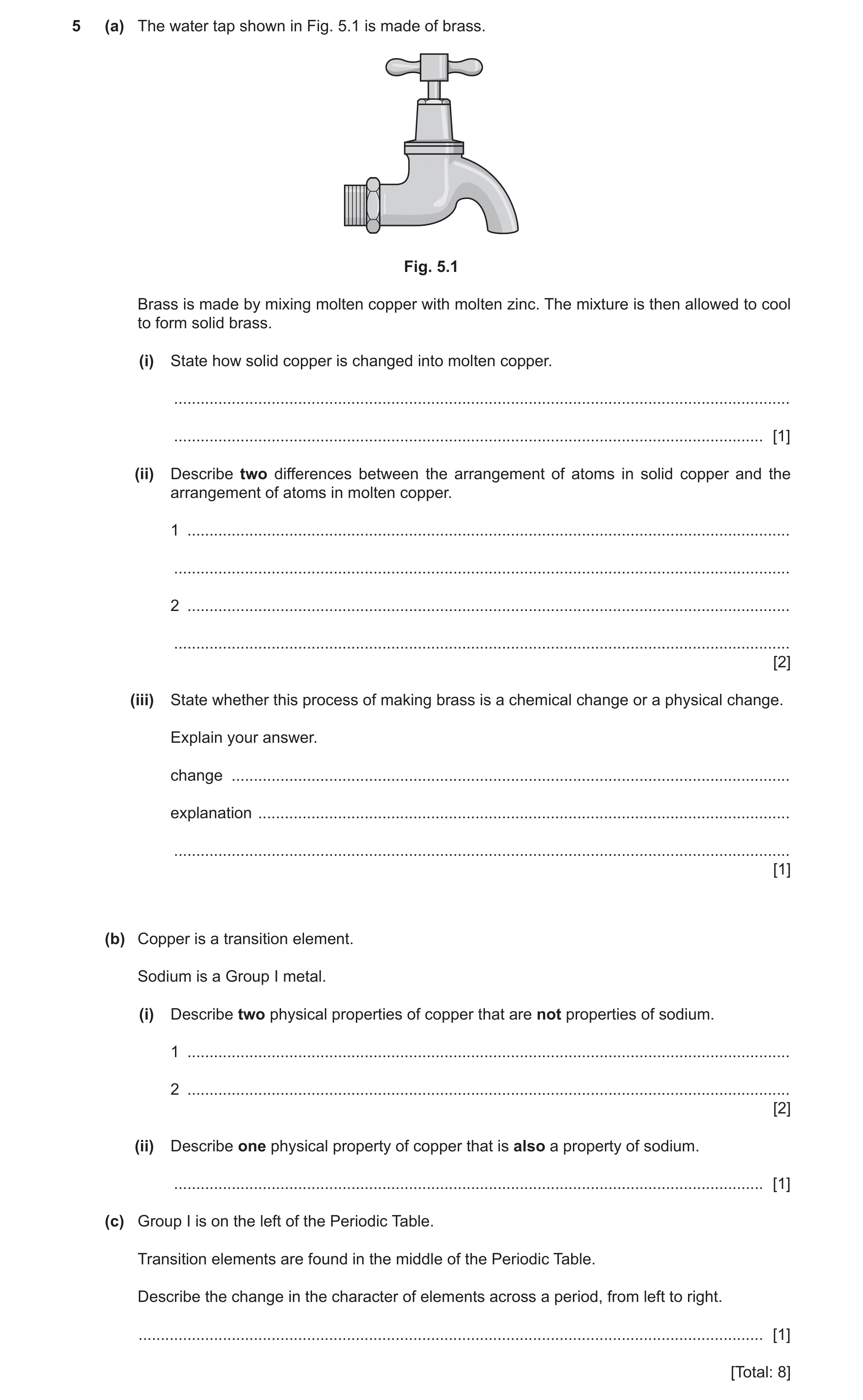
5 (a) The water tap shown in Fig. 5.1 is made of brass. Fig. 5.1 Brass is made by mixing molten copper with molten zinc. The mixture is then allowed to cool to form solid brass. (i) State how solid copper is changed into molten copper. … … [1] (ii) Describe two differences between the arrangement of atoms in solid copper and the arrangement of atoms in molten copper. 1 … … 2 … … [2] (iii) State whether this process of making brass is a chemical change or a physical change. Explain your answer. change … explanation … … [1] (b) Copper is a transition element. Sodium is a Group I metal. (i) Describe two physical properties of copper that are not properties of sodium. 1 … 2 … [2] (ii) Describe one physical property of copper that is also a property of sodium. … [1] (c) Group I is on the left of the Periodic Table. Transition elements are found in the middle of the Periodic Table. Describe the change in the character of elements across a period, from left to right. … [1] [Total: 8]
8 marks
Mark scheme: 5(a)(i) heat / heating ; 1 5(a)(ii) (in solid copper, atoms are) in fixed position ; regular (arrangement) ; 2 5(a)(iii) (change) physical AND (explanation) no new substance is made / no chemical reaction ; 5(b)(i) high density ; high melting point ; 2 5(b)(ii) any one from: high boiling point ; malleable ; (good) conductor (of heat / electricity) ; 1 5(c) metallic to non-metallic ; 1
This question in 0653/33 Oct/Nov 2020
Q16 · An atom of lead is represented by the symbol shown 0653/32 Feb/March 2021
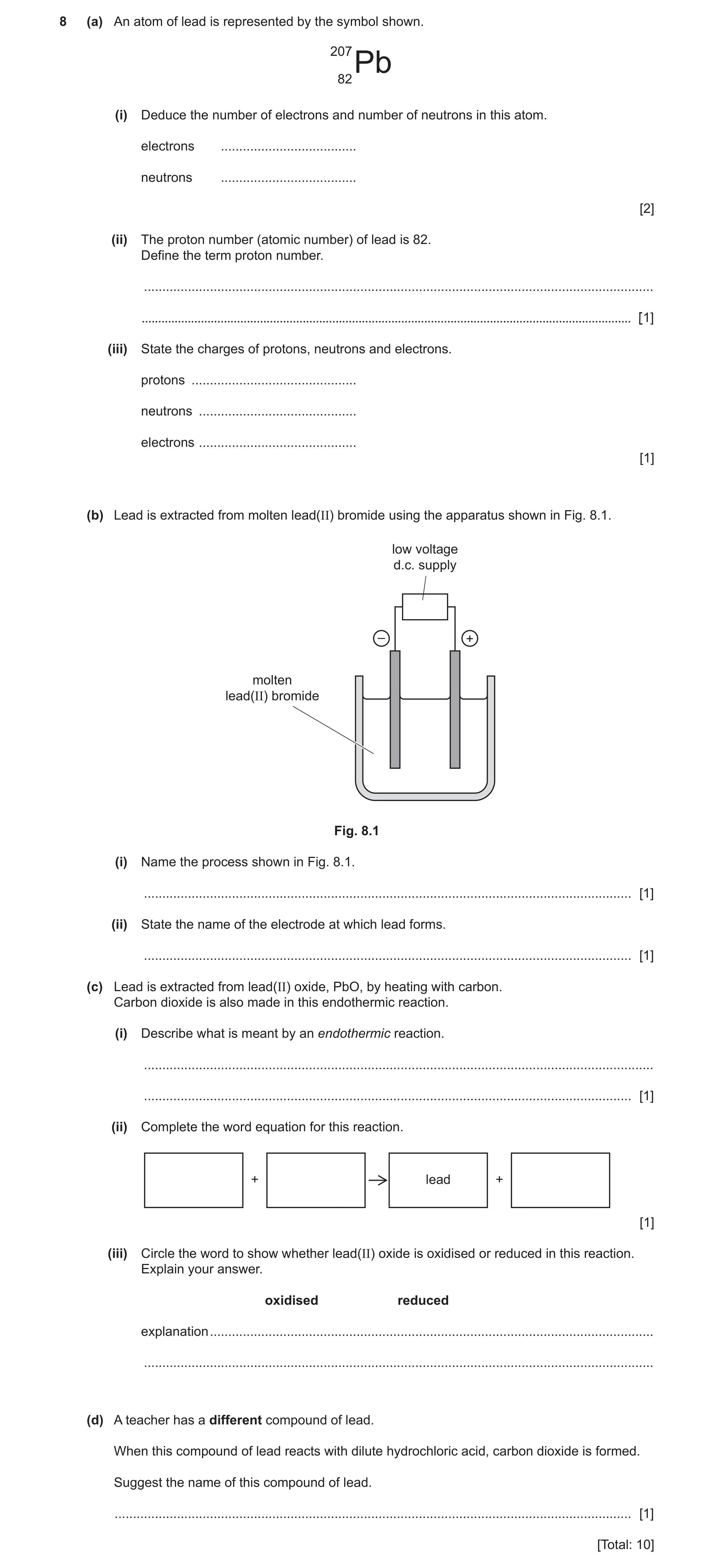
8 (a) An atom of lead is represented by the symbol shown. 207 Pb 82 (i) Deduce the number of electrons and number of neutrons in this atom. electrons … neutrons … [2] (ii) The proton number (atomic number) of lead is 82. Define the term proton number. … … [1] (iii) State the charges of protons, neutrons and electrons. protons … neutrons … electrons … [1] (b) Lead is extracted from molten lead(II) bromide using the apparatus shown in Fig. 8.1. low voltage d.c. supply – + molten lead(II) bromide Fig. 8.1 (i) Name the process shown in Fig. 8.1. … [1] (ii) State the name of the electrode at which lead forms. … [1] (c) Lead is extracted from lead(II) oxide, PbO, by heating with carbon. Carbon dioxide is also made in this endothermic reaction. (i) Describe what is meant by an endothermic reaction. … … [1] (ii) Complete the word equation for this reaction. + lead + [1] (iii) Circle the word to show whether lead(II) oxide is oxidised or reduced in this reaction. Explain your answer. oxidised reduced explanation … … (d) A teacher has a different compound of lead. When this compound of lead reacts with dilute hydrochloric acid, carbon dioxide is formed. Suggest the name of this compound of lead. … [1] [Total: 10]
10 marks
Mark scheme: 8(a)(i) (electrons) 82 ; (neutrons) 125 ; 2 8(a)(ii) the number of protons in the nucleus of an atom ; 1 8(a)(iii) (protons) +1 (neutrons) no charge (electrons) -1 ; all three needed for one mark 1 Question Answer Marks 8(b)(i) electrolysis ; 1 8(b)(ii) cathode ; 1 8(c)(i) takes in, heat / energy ; 1 8(c)(ii) ; 1 8(c)(iii) reduced (circled) AND (explanation) loses oxygen ; 1 8(d) lead carbonate / PbCO3 ; 1
This question in 0653/32 Feb/March 2021
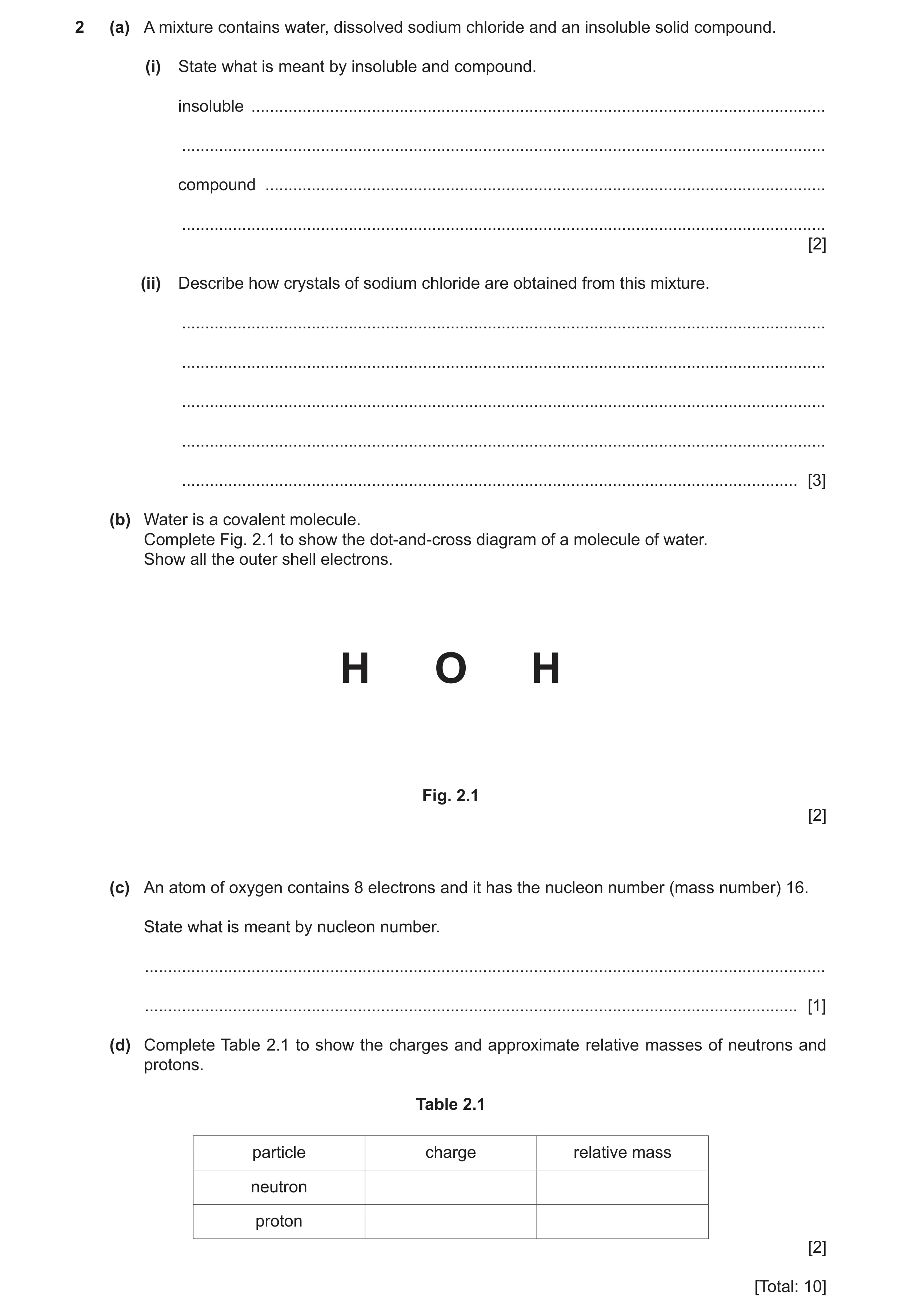
Q17 · A mixture contains water, dissolved sodium chloride and an insoluble solid compound 0653/32 May/June 2021
2 (a) A mixture contains water, dissolved sodium chloride and an insoluble solid compound. (i) State what is meant by insoluble and compound. insoluble … … compound … … [2] (ii) Describe how crystals of sodium chloride are obtained from this mixture. … … … … … [3] (b) Water is a covalent molecule. Complete Fig. 2.1 to show the dot-and-cross diagram of a molecule of water. Show all the outer shell electrons. H O H Fig. 2.1 [2] (c) An atom of oxygen contains 8 electrons and it has the nucleon number (mass number) 16. State what is meant by nucleon number. … … [1] (d) Complete Table 2.1 to show the charges and approximate relative masses of neutrons and protons. Table 2.1 particle charge relative mass neutron proton [2] [Total: 10]
10 marks
Mark scheme: 2(a)(i) insoluble: cannot / does not, dissolve (in water) ; compound: two (or more) elements (chemically) combined ; 2 Question Answer Marks 2(a)(ii) any three from: filter (at the start) / filter (off the insoluble solid) ; evaporate / heat (the NaCl solution) ; leave to (cool and) crystallise ; filter off the crystals / dry between folds of filter paper ; 3 2(b) two bond pairs ; two lone pairs on O ; 2 2(c) (the total number of) protons and neutrons (in the nucleus of an atom) ; 1 2(d) particle charge relative mass neutron 0 1 proton +1 1 ;; neutron row correct ; proton row correct ; 2
This question in 0653/32 May/June 2021
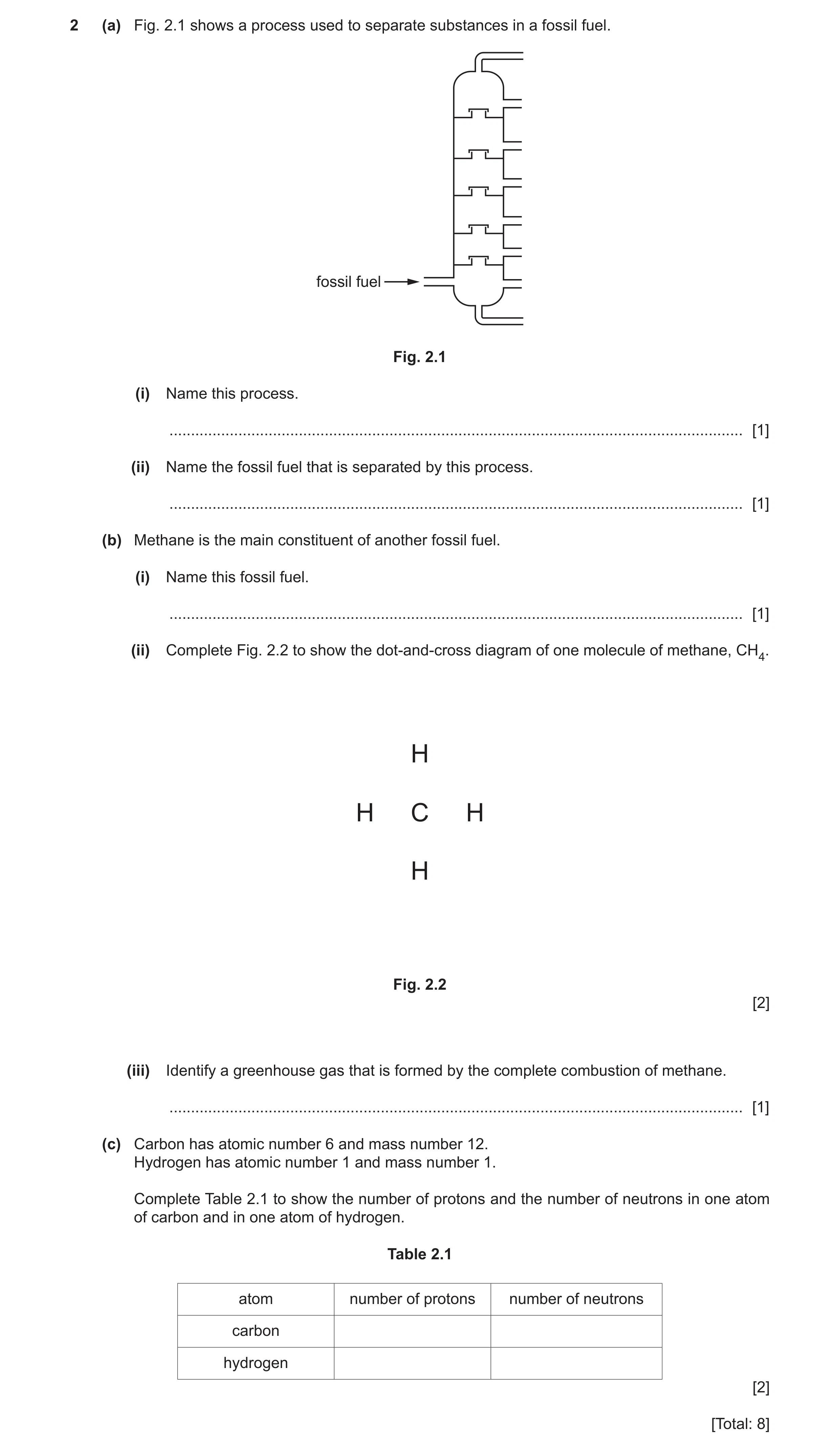
Q18 · A process used to separate substances in a fossil fuel 0653/33 May/June 2021
2 (a) Fig. 2.1 shows a process used to separate substances in a fossil fuel. fossil fuel Fig. 2.1 (i) Name this process. … [1] (ii) Name the fossil fuel that is separated by this process. … [1] (b) Methane is the main constituent of another fossil fuel. (i) Name this fossil fuel. … [1] (ii) Complete Fig. 2.2 to show the dot-and-cross diagram of one molecule of methane, CH4. H H C H H Fig. 2.2 [2] (iii) Identify a greenhouse gas that is formed by the complete combustion of methane. … [1] (c) Carbon has atomic number 6 and mass number 12. Hydrogen has atomic number 1 and mass number 1. Complete Table 2.1 to show the number of protons and the number of neutrons in one atom of carbon and in one atom of hydrogen. Table 2.1 atom number of protons number of neutrons carbon hydrogen [2] [Total: 8]
8 marks
Mark scheme: 2(a)(i) fractional distillation ; 1 2(a)(ii) petroleum ; 1 2(b)(i) natural gas ; 1 2(b)(ii) ;; four bonding pairs of electrons = 2 marks one bonding pair correct = 1 mark 2 2(b)(iii) carbon dioxide / CO2 ; 1 Question Answer Marks 2(c) number of protons number of neturons carbon 6 6 hydrogen 1 0 carbon row correct ; hydrogen row correct ; 2
This question in 0653/33 May/June 2021
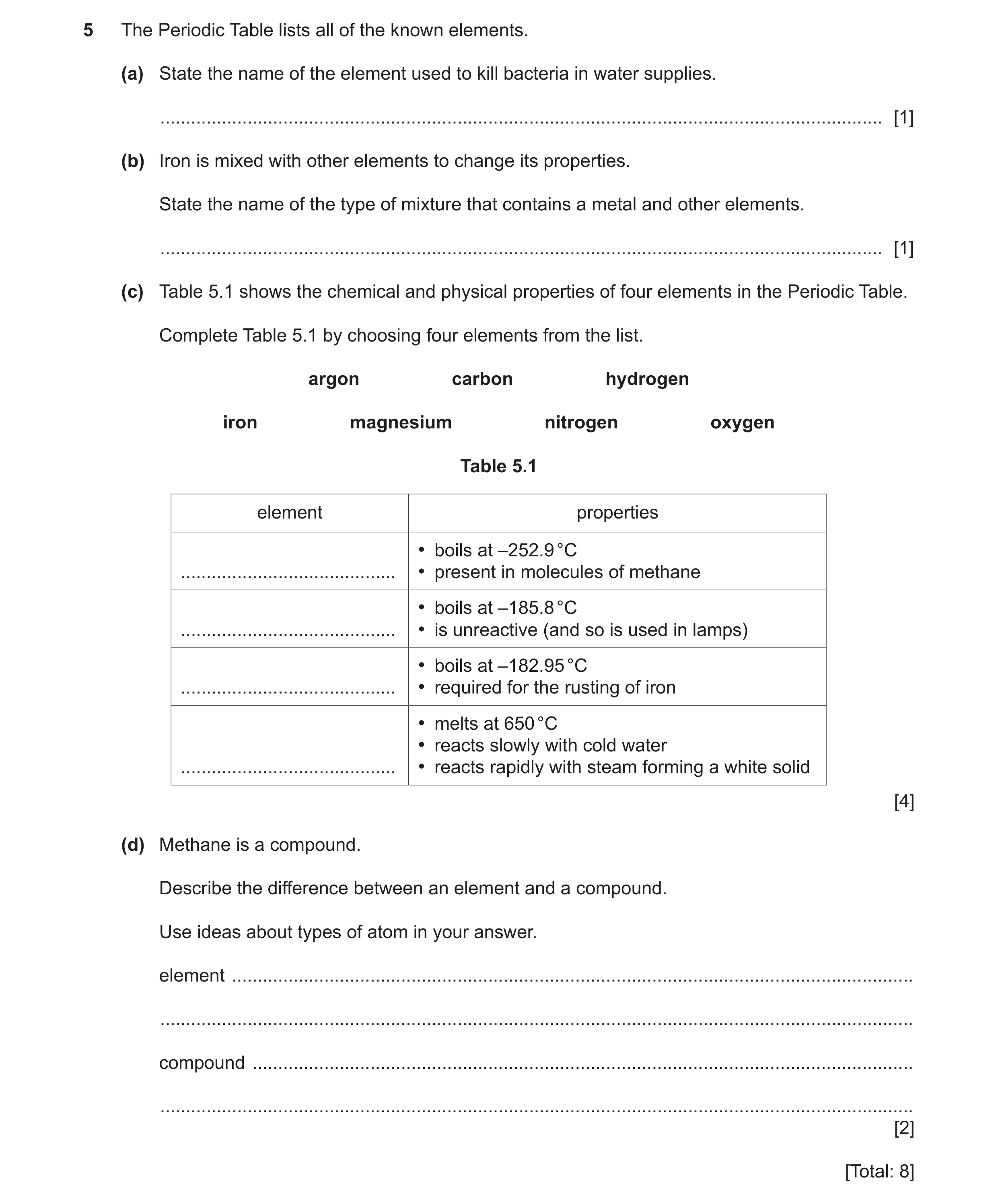
Q19 · The Periodic Table lists all of the known elements 0653/32 Oct/Nov 2021
5 The Periodic Table lists all of the known elements. (a) State the name of the element used to kill bacteria in water supplies. … [1] (b) Iron is mixed with other elements to change its properties. State the name of the type of mixture that contains a metal and other elements. … [1] (c) Table 5.1 shows the chemical and physical properties of four elements in the Periodic Table. Complete Table 5.1 by choosing four elements from the list. argon carbon hydrogen iron magnesium nitrogen oxygen Table 5.1 element properties • boils at –252.9 °C … • present in molecules of methane • boils at –185.8 °C … • is unreactive (and so is used in lamps) • boils at –182.95 °C … • required for the rusting of iron • melts at 650 °C • reacts slowly with cold water … • reacts rapidly with steam forming a white solid [4] (d) Methane is a compound. Describe the difference between an element and a compound. Use ideas about types of atom in your answer. element … … compound … … [2] [Total: 8]
8 marks
Mark scheme: 5(a) chlorine ; 1 5(b) alloy(s) ; 1 5(c) hydrogen ; argon ; oxygen ; magnesium ; 4 5(d) element: contains only one type of atom ; compound: contains two (or more) types of atom ; 2 Question Answer Marks
This question in 0653/32 Oct/Nov 2021
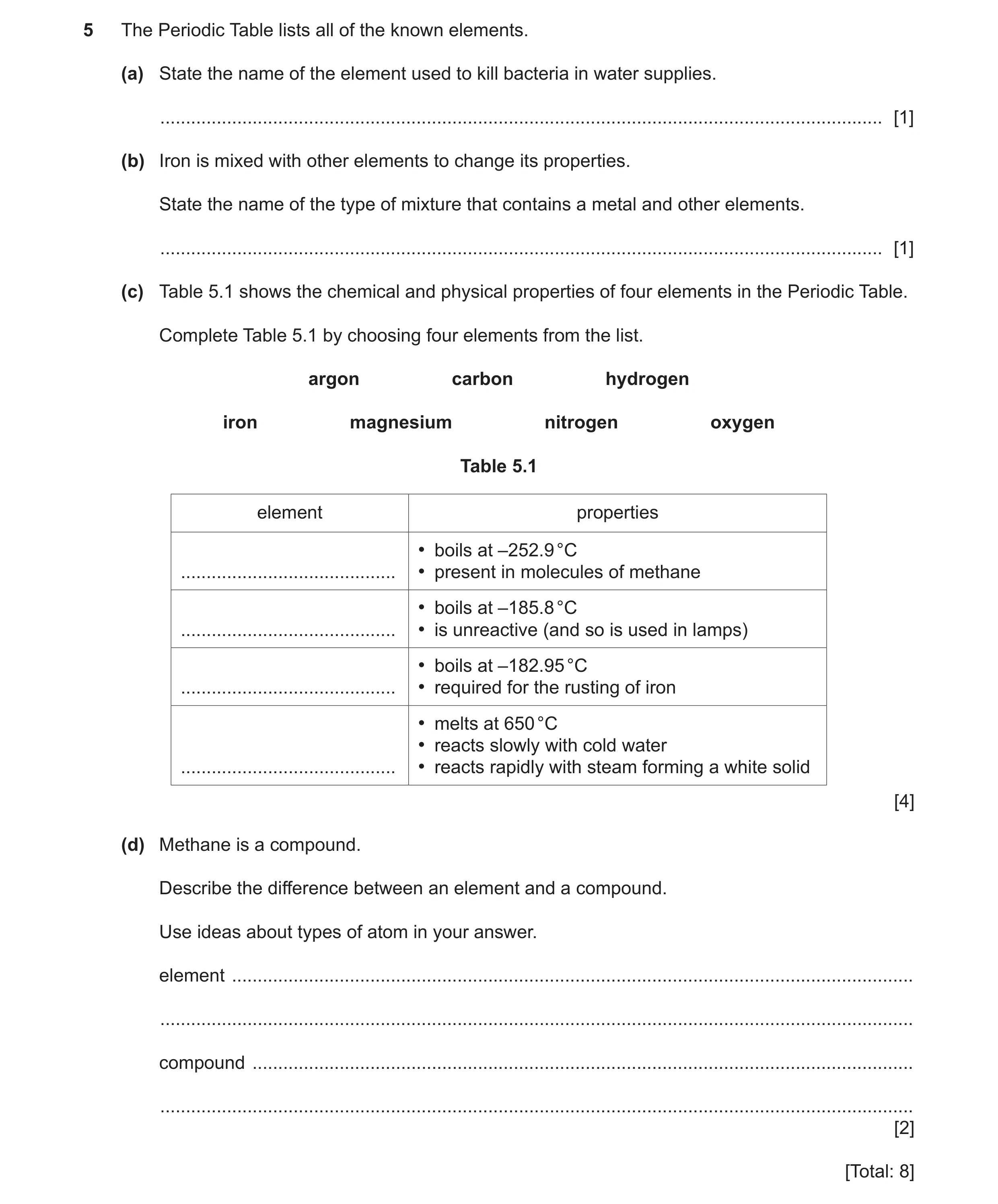
Q20 · The Periodic Table lists all of the known elements 0653/33 Oct/Nov 2021
5 The Periodic Table lists all of the known elements. (a) State the name of the element used to kill bacteria in water supplies. … [1] (b) Iron is mixed with other elements to change its properties. State the name of the type of mixture that contains a metal and other elements. … [1] (c) Table 5.1 shows the chemical and physical properties of four elements in the Periodic Table. Complete Table 5.1 by choosing four elements from the list. argon carbon hydrogen iron magnesium nitrogen oxygen Table 5.1 element properties • boils at –252.9 °C … • present in molecules of methane • boils at –185.8 °C … • is unreactive (and so is used in lamps) • boils at –182.95 °C … • required for the rusting of iron • melts at 650 °C • reacts slowly with cold water … • reacts rapidly with steam forming a white solid [4] (d) Methane is a compound. Describe the difference between an element and a compound. Use ideas about types of atom in your answer. element … … compound … … [2] [Total: 8]
8 marks
Mark scheme: 5(a) chlorine ; 1 5(b) alloy(s) ; 1 5(c) hydrogen ; argon ; oxygen ; magnesium ; 4 5(d) element: contains only one type of atom ; compound: contains two (or more) types of atom ; 2 Question Answer Marks
This question in 0653/33 Oct/Nov 2021
Q21 · Lithium, sodium and potassium are metals in Group I of the Periodic Table 0653/31 May/June 2022
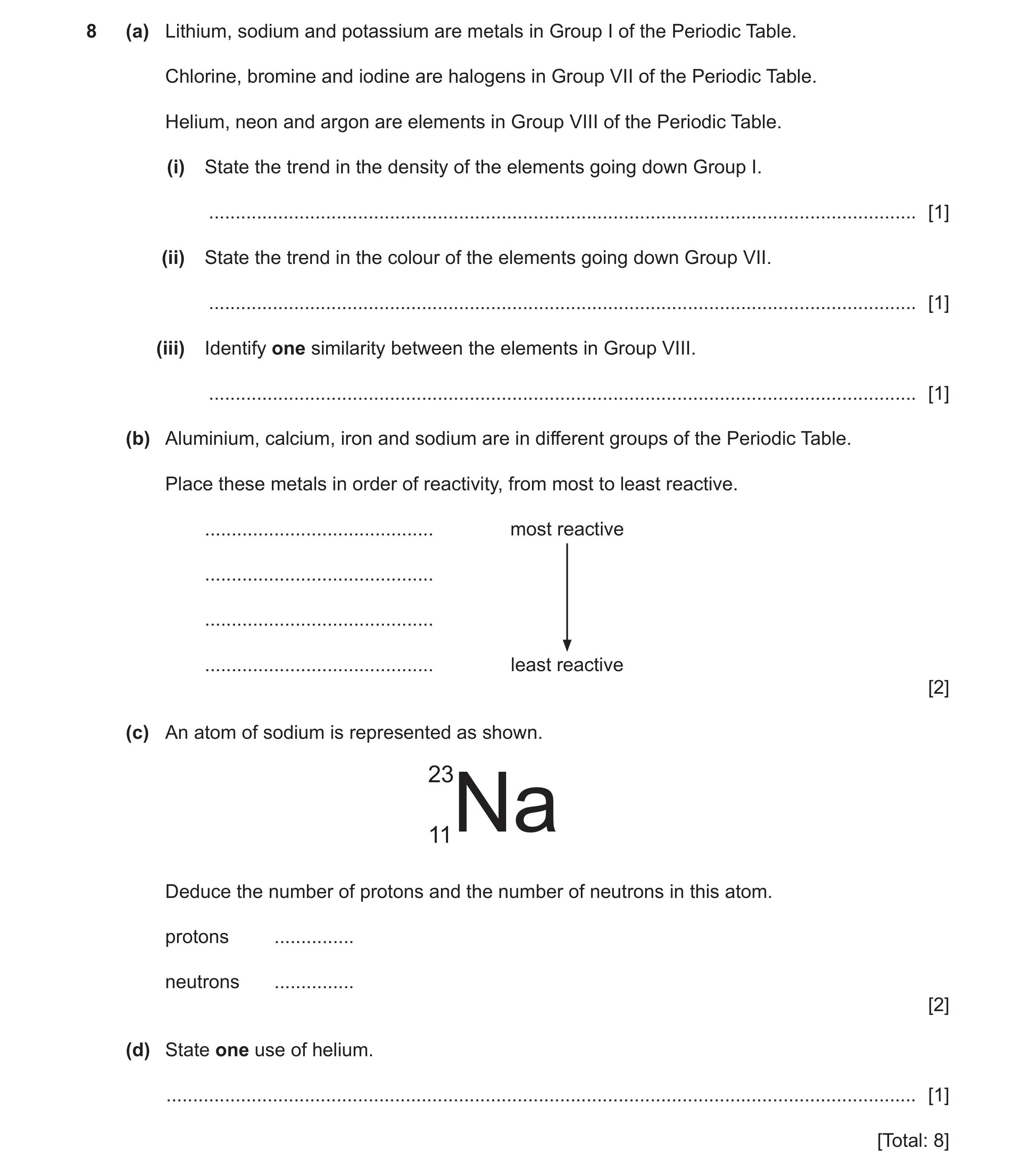
8 (a) Lithium, sodium and potassium are metals in Group I of the Periodic Table. Chlorine, bromine and iodine are halogens in Group VII of the Periodic Table. Helium, neon and argon are elements in Group VIII of the Periodic Table. (i) State the trend in the density of the elements going down Group I. … [1] (ii) State the trend in the colour of the elements going down Group VII. … [1] (iii) Identify one similarity between the elements in Group VIII. … [1] (b) Aluminium, calcium, iron and sodium are in different groups of the Periodic Table. Place these metals in order of reactivity, from most to least reactive. … most reactive … … … least reactive [2] (c) An atom of sodium is represented as shown. 23 11Na Deduce the number of protons and the number of neutrons in this atom. protons … neutrons … [2] (d) State one use of helium. … [1] [Total: 8]
8 marks
Mark scheme: 8(a)(i) increases (down the group) ; 1 8(a)(ii) (they get) darker ; 1 8(a)(iii) unreactive / inert ; 1 Question Answer Marks 8(b) sodium calcium aluminium iron ;; all correct (2) sodium is most reactive (1) 2 8(c) (protons) 11 ; (neutrons) 12 ; 2 8(d) filling balloons ; 1
This question in 0653/31 May/June 2022
Q22 · A beaker contains a mixture of sodium chloride dissolved in water and iron filings, as… 0653/32 Oct/Nov 2022
2 (a) A beaker contains a mixture of sodium chloride dissolved in water and iron filings, as shown in Fig. 2.1. sodium chloride dissolved in water iron filings Fig. 2.1 (i) Identify the solute and the solvent in this mixture. solute … solvent … [2] (ii) Identify one compound in the mixture. … [1] (iii) State one method of removing the iron filings from the mixture. … [1] (b) When a dilute solution of sodium chloride dissolved in water is heated, evaporation occurs and the solution becomes more concentrated. State what is meant by more concentrated. Use ideas about particles in your answer. … … [1] (c) State the products at the anode and at the cathode when concentrated aqueous sodium chloride is electrolysed using inert electrodes. anode … cathode … [2] (d) An atom of iron is represented as shown. 5626Fe Deduce the number of electrons, protons and neutrons in this atom. electrons … protons … neutrons … [2] [Total: 9]
9 marks
Mark scheme: 2(a)(i) solute sodium chloride / salt / NaCl ; 2 solvent water / H2O; 2(a)(ii) water / H2O / sodium chloride / NaCl ; 1 2(a)(iii) filtration / filter / magnet; 1 2(b) a greater number of (sodium chloride) particles per unit volume ; 1 2(c) anode chlorine (gas) / Cl2 ; 2 cathode hydrogen (gas) / H2 ; 2(d) electrons 26 AND 2 protons 26 ; neutrons 30 ;
This question in 0653/32 Oct/Nov 2022
Q23 · A beaker contains a mixture of sodium chloride dissolved in water and iron filings, as… 0653/33 Oct/Nov 2022
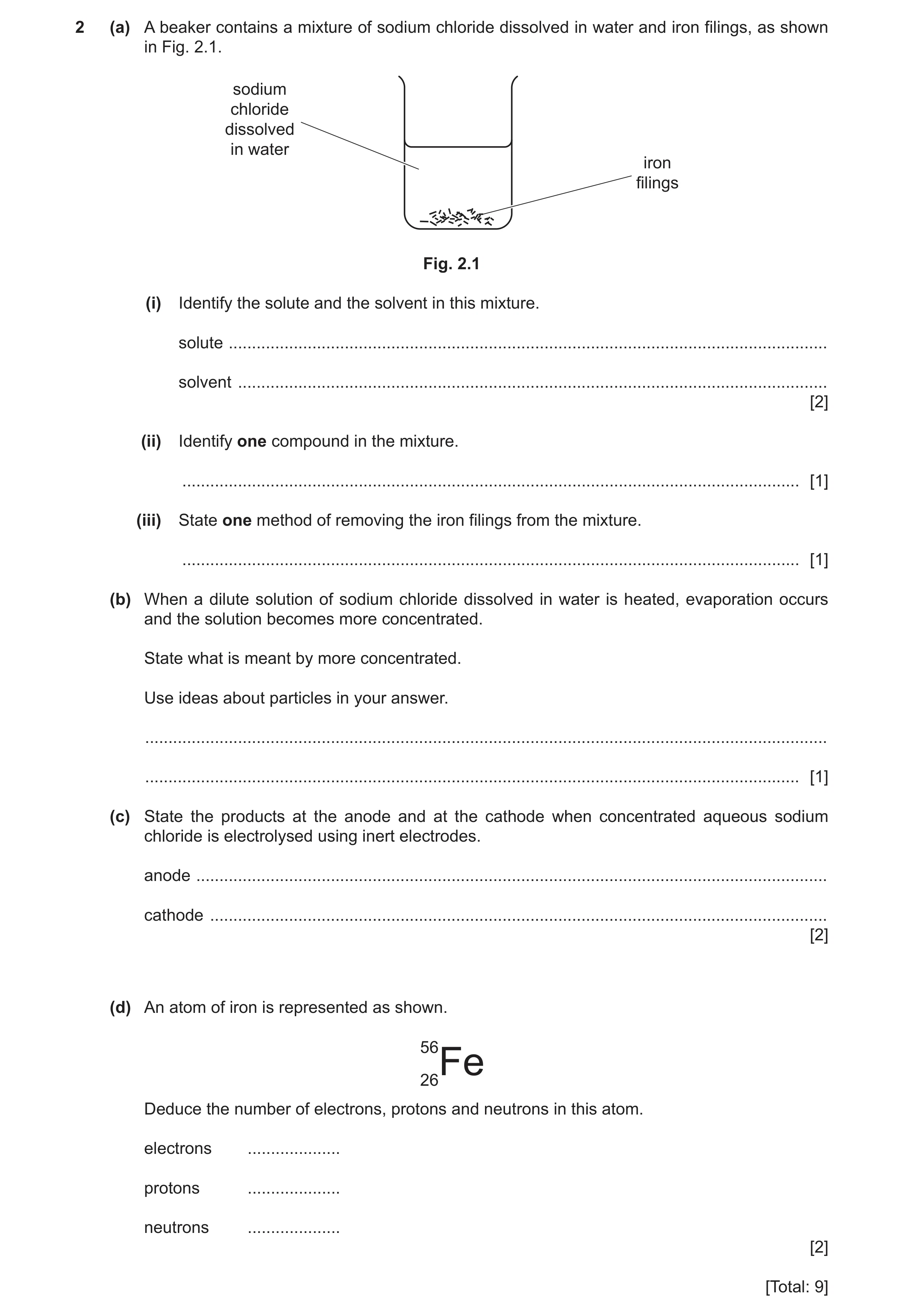
2 (a) A beaker contains a mixture of sodium chloride dissolved in water and iron filings, as shown in Fig. 2.1. sodium chloride dissolved in water iron filings Fig. 2.1 (i) Identify the solute and the solvent in this mixture. solute … solvent … [2] (ii) Identify one compound in the mixture. … [1] (iii) State one method of removing the iron filings from the mixture. … [1] (b) When a dilute solution of sodium chloride dissolved in water is heated, evaporation occurs and the solution becomes more concentrated. State what is meant by more concentrated. Use ideas about particles in your answer. … … [1] (c) State the products at the anode and at the cathode when concentrated aqueous sodium chloride is electrolysed using inert electrodes. anode … cathode … [2] (d) An atom of iron is represented as shown. 5626Fe Deduce the number of electrons, protons and neutrons in this atom. electrons … protons … neutrons … [2] [Total: 9]
9 marks
Mark scheme: 2(a)(i) solute sodium chloride / salt / NaCl ; 2 solvent water / H2O; 2(a)(ii) water / H2O / sodium chloride / NaCl ; 1 2(a)(iii) filtration / filter / magnet; 1 2(b) a greater number of (sodium chloride) particles per unit volume ; 1 2(c) anode chlorine (gas) / Cl2 ; 2 cathode hydrogen (gas) / H2 ; 2(d) electrons 26 AND 2 protons 26 ; neutrons 30 ;
This question in 0653/33 Oct/Nov 2022
Q24 · A student adds excess magnesium to dilute sulfuric acid 0653/32 Feb/March 2023
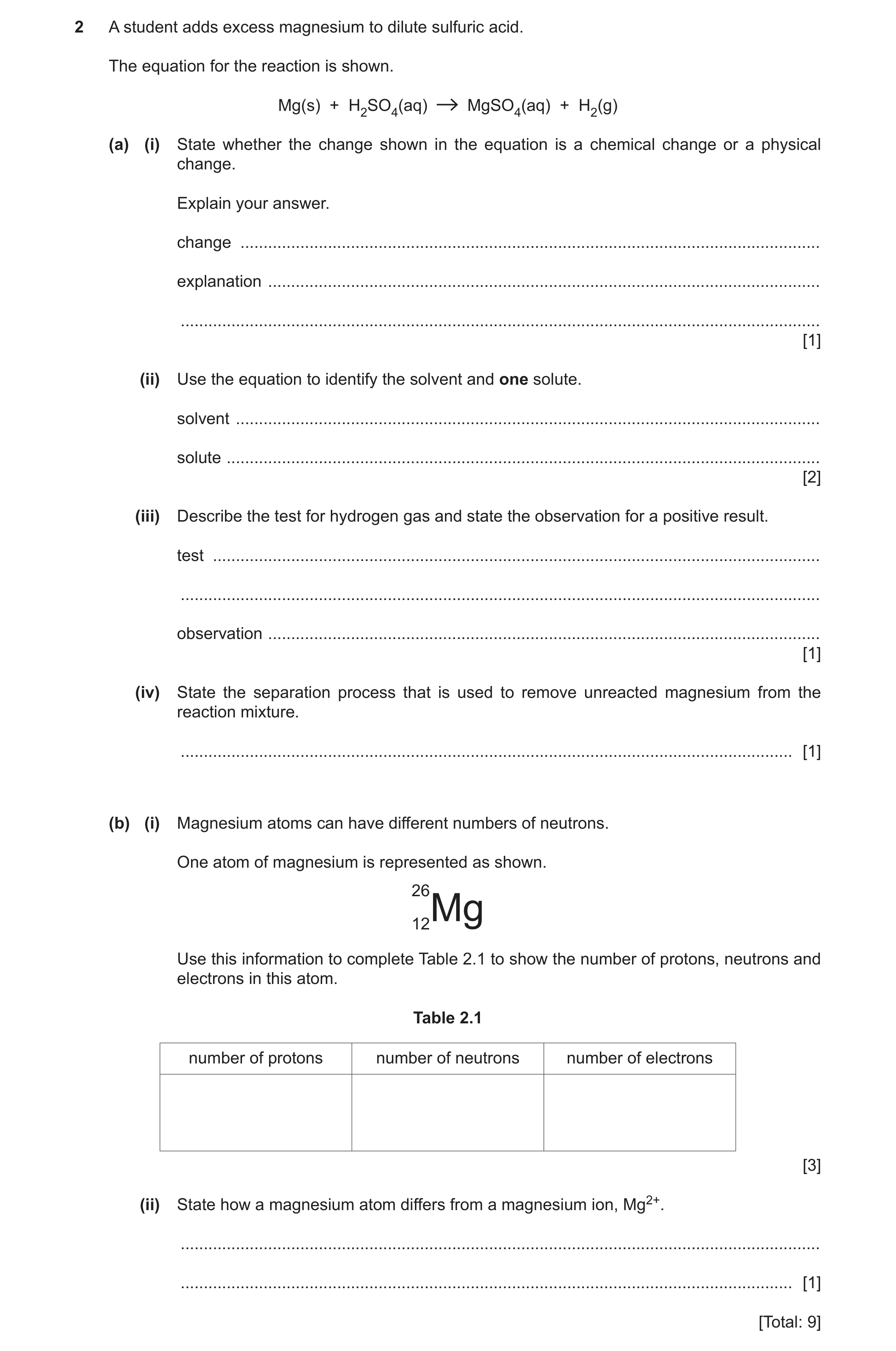
2 A student adds excess magnesium to dilute sulfuric acid. The equation for the reaction is shown. Mg(s) + H2SO4(aq) MgSO4(aq) + H2(g) (a) (i) State whether the change shown in the equation is a chemical change or a physical change. Explain your answer. change … explanation … … [1] (ii) Use the equation to identify the solvent and one solute. solvent … solute … [2] (iii) Describe the test for hydrogen gas and state the observation for a positive result. test … … observation … [1] (iv) State the separation process that is used to remove unreacted magnesium from the reaction mixture. … [1] (b) (i) Magnesium atoms can have different numbers of neutrons. One atom of magnesium is represented as shown. 2612Mg Use this information to complete Table 2.1 to show the number of protons, neutrons and electrons in this atom. Table 2.1 number of protons number of neutrons number of electrons [3] (ii) State how a magnesium atom differs from a magnesium ion, Mg2+. … … [1] [Total: 9]
9 marks
Mark scheme: 2(a)(i) (change) chemical AND 1 (explanation) new substances are made ; 2(a)(ii) (solvent) water ; 2 (solute) sulfuric acid / H2SO4 / magnesium sulfate / MgSO4 ; 2(a)(iii) (test) lighted splint / flame AND 1 (result) ‘pops’ ; 2(a)(iv) filtration ; 1 2(b)(i) 3 number of protons number of neutrons number of electrons 12 14 12 ;;; 2(b)(ii) ion contains fewer electrons than the atom / magnesium atom loses two electrons (to form the ion) ; 1
This question in 0653/32 Feb/March 2023
Q25 · A student investigates sodium chloride, NaCl 0653/32 May/June 2023
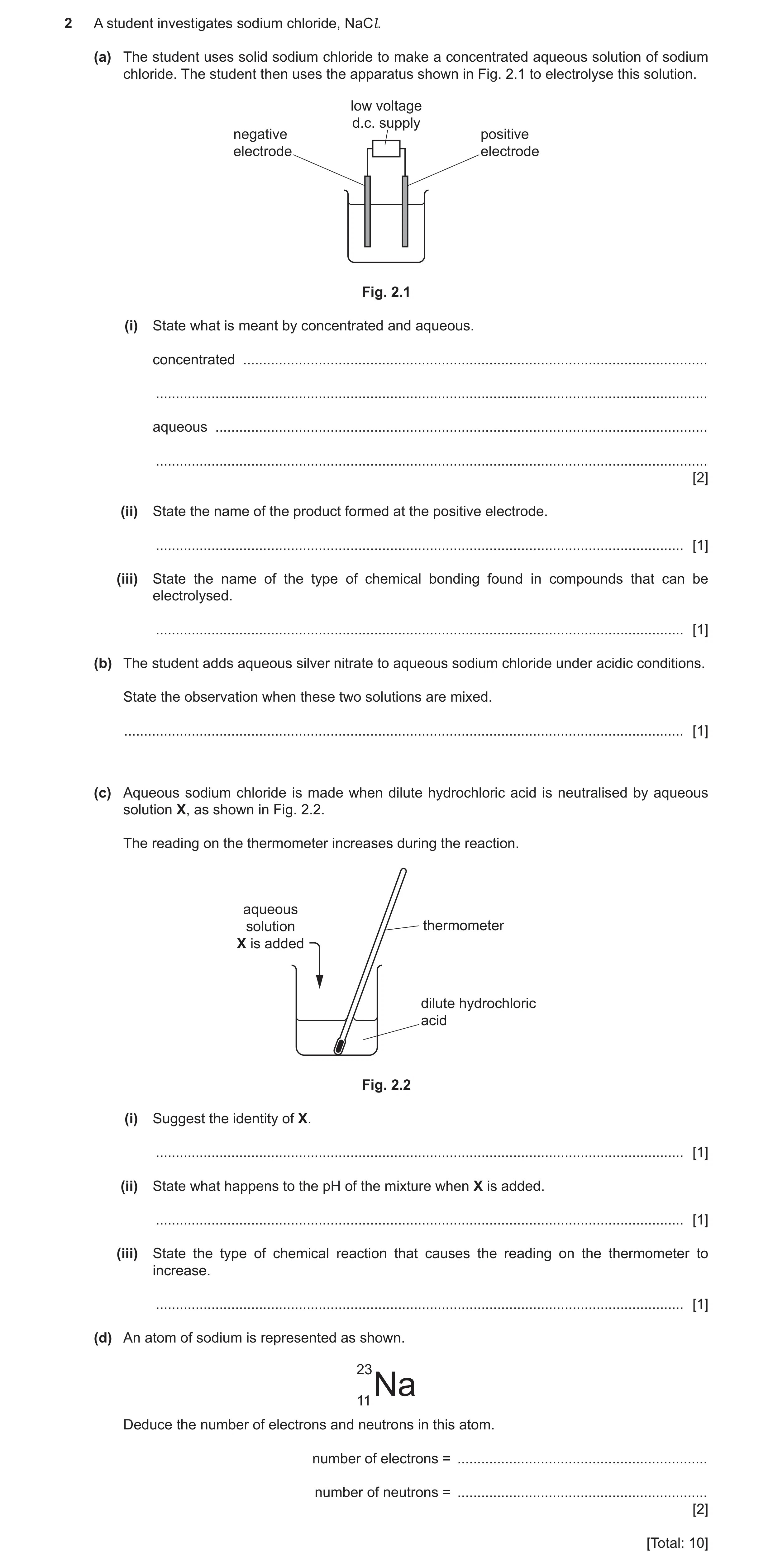
2 A student investigates sodium chloride, NaCl. (a) The student uses solid sodium chloride to make a concentrated aqueous solution of sodium chloride. The student then uses the apparatus shown in Fig. 2.1 to electrolyse this solution. low voltage d.c. supply negative positive electrode electrode Fig. 2.1 (i) State what is meant by concentrated and aqueous. concentrated … … aqueous … … [2] (ii) State the name of the product formed at the positive electrode. … [1] (iii) State the name of the type of chemical bonding found in compounds that can be electrolysed. … [1] (b) The student adds aqueous silver nitrate to aqueous sodium chloride under acidic conditions. State the observation when these two solutions are mixed. … [1] (c) Aqueous sodium chloride is made when dilute hydrochloric acid is neutralised by aqueous solution X, as shown in Fig. 2.2. The reading on the thermometer increases during the reaction. aqueous solution thermometer X is added dilute hydrochloric acid Fig. 2.2 (i) Suggest the identity of X. … [1] (ii) State what happens to the pH of the mixture when X is added. … [1] (iii) State the type of chemical reaction that causes the reading on the thermometer to increase. … [1] (d) An atom of sodium is represented as shown. 2311Na Deduce the number of electrons and neutrons in this atom. number of electrons = … number of neutrons = … [2] [Total: 10]
10 marks
Mark scheme: 2(a)(i) (concentrated) high ratio of, solute / sodium chloride / ions, to solvent / water OR large (relative) amount of, solute / sodium chloride / ions ; (aqueous) (dissolved) in water / the solvent is water ; 2(a)(ii) chlorine (gas) ; 1 2(a)(iii) ionic ; 1 2(b) white, precipitate / solid ; 1 Question Answer Marks 2(c)(i) sodium hydroxide / NaOH / sodium carbonate / Na2CO3 / sodium hydrogen carbonate / NaHCO3 ; 1 2(c)(ii) increases / rises / goes up to 7 ; 1 2(c)(iii) exothermic ; 1 2(d) (electrons) 11 ; (neutrons) 12 ; 2
This question in 0653/32 May/June 2023
Q26 · Chlorine is in Group VII of the Periodic Table 0653/31 Oct/Nov 2023
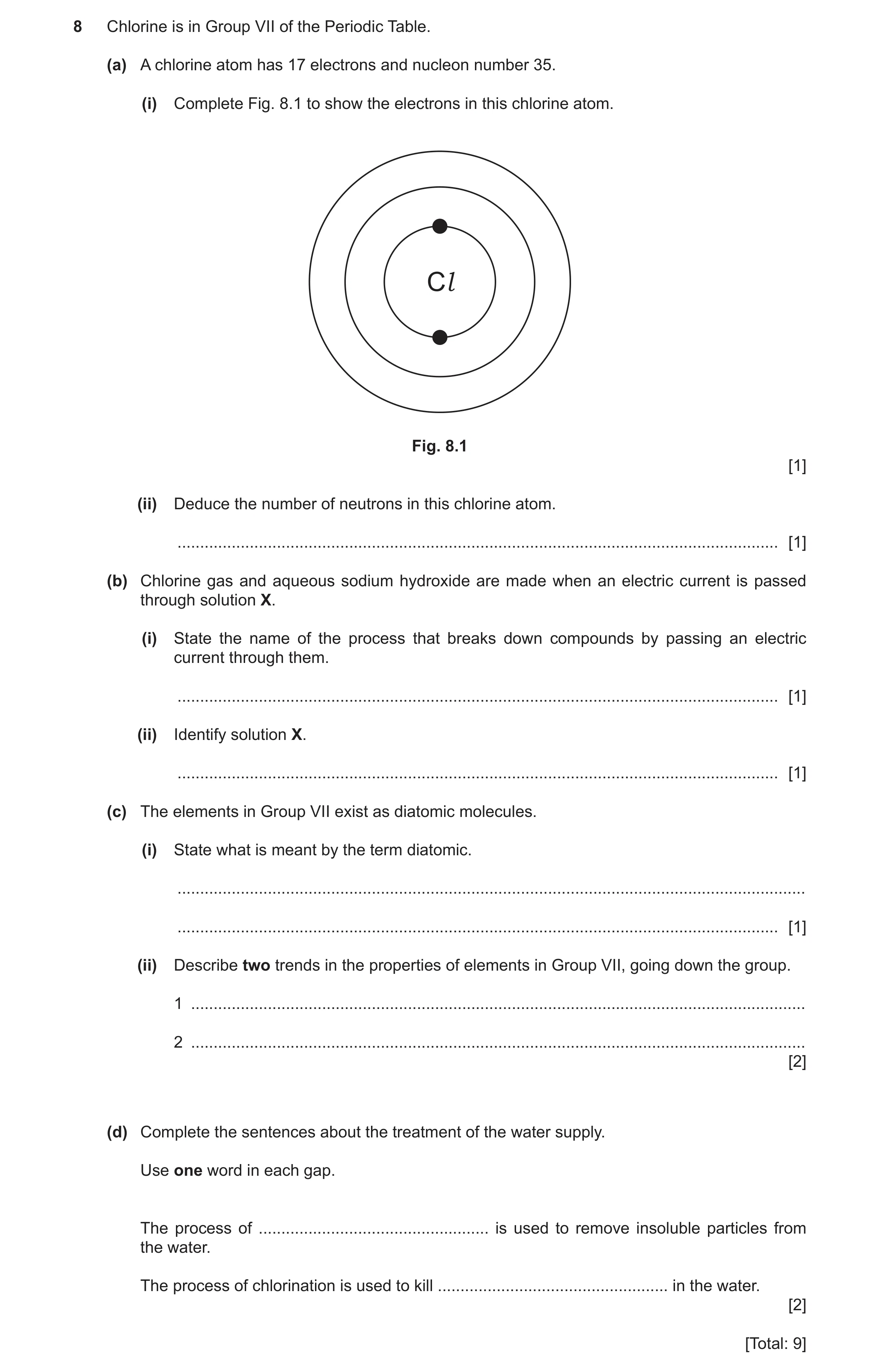
8 Chlorine is in Group VII of the Periodic Table. (a) A chlorine atom has 17 electrons and nucleon number 35. (i) Complete Fig. 8.1 to show the electrons in this chlorine atom. Cl Fig. 8.1 [1] (ii) Deduce the number of neutrons in this chlorine atom. … [1] (b) Chlorine gas and aqueous sodium hydroxide are made when an electric current is passed through solution X. (i) State the name of the process that breaks down compounds by passing an electric current through them. … [1] (ii) Identify solution X. … [1] (c) The elements in Group VII exist as diatomic molecules. (i) State what is meant by the term diatomic. … … [1] (ii) Describe two trends in the properties of elements in Group VII, going down the group. 1 … 2 … [2] (d) Complete the sentences about the treatment of the water supply. Use one word in each gap. The process of … is used to remove insoluble particles from the water. The process of chlorination is used to kill … in the water. [2] [Total: 9]
9 marks
Mark scheme: 8(a)(i) (2,) 8, 7 ; 1 8(a)(ii) 18 ; 1 8(b)(i) electrolysis ; 1 8(b)(ii) (concentrated, aqueous) sodium chloride / NaCl ; 1 8(c)(i) (consisting of) two atoms ; 1 8(c)(ii) (become) darker in colour ; 2 change from gas to liquid to solid ; 8(d) filtration ; 2 bacteria / microorganisms / microbes ;
This question in 0653/31 Oct/Nov 2023
Q27 · Lithium is an element in Group I of the Periodic Table 0653/32 Feb/March 2024
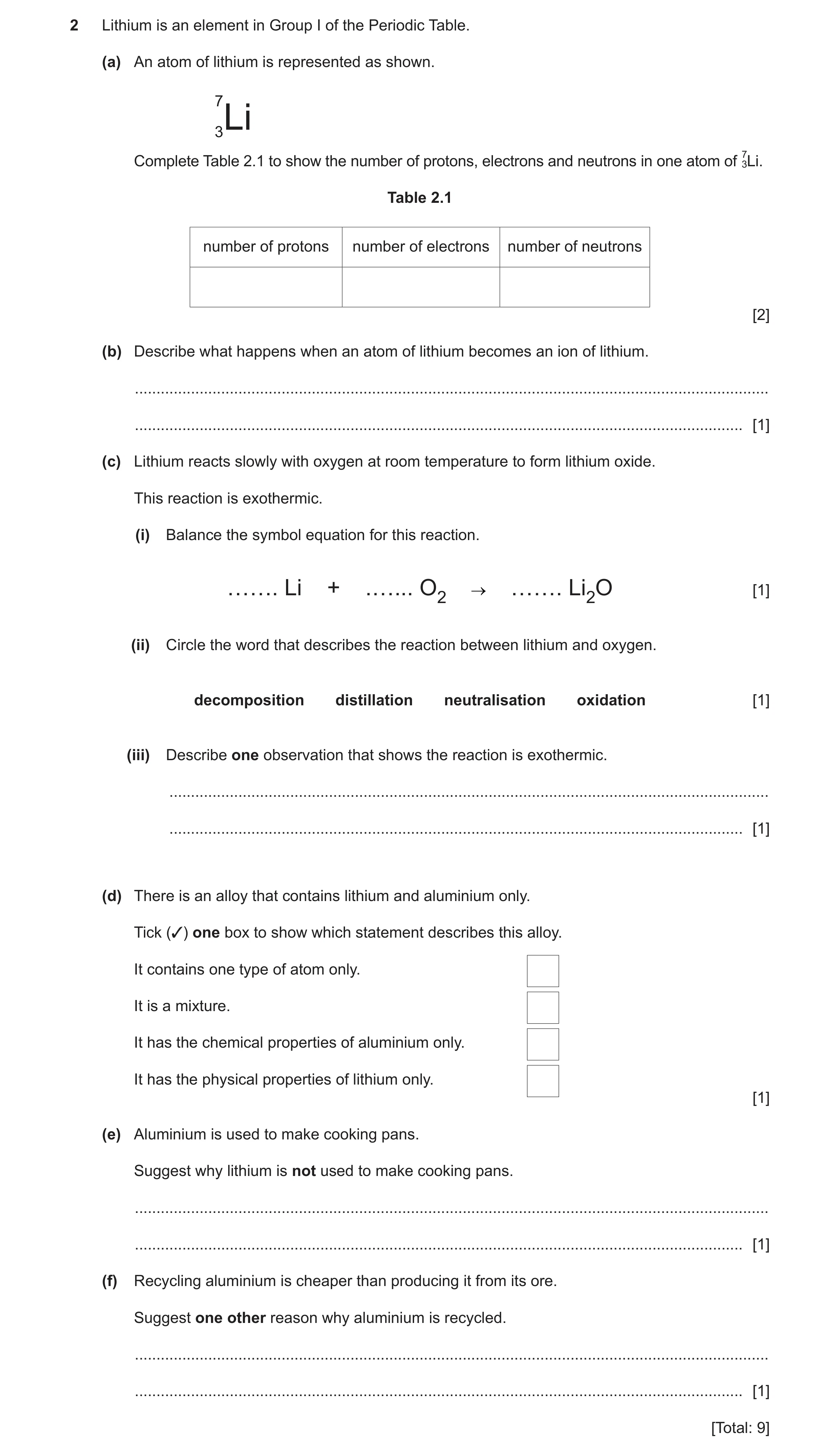
2 Lithium is an element in Group I of the Periodic Table. (a) An atom of lithium is represented as shown. 73Li Complete Table 2.1 to show the number of protons, electrons and neutrons in one atom of 73Li. Table 2.1 number of protons number of electrons number of neutrons [2] (b) Describe what happens when an atom of lithium becomes an ion of lithium. … … [1] (c) Lithium reacts slowly with oxygen at room temperature to form lithium oxide. This reaction is exothermic. (i) Balance the symbol equation for this reaction. [1] ……. Li + .…... O2 ……. Li2O (ii) Circle the word that describes the reaction between lithium and oxygen. decomposition distillation neutralisation oxidation [1] (iii) Describe one observation that shows the reaction is exothermic. … … [1] (d) There is an alloy that contains lithium and aluminium only. Tick (3) one box to show which statement describes this alloy. It contains one type of atom only. It is a mixture. It has the chemical properties of aluminium only. It has the physical properties of lithium only. [1] (e) Aluminium is used to make cooking pans. Suggest why lithium is not used to make cooking pans. … … [1] (f) Recycling aluminium is cheaper than producing it from its ore. Suggest one other reason why aluminium is recycled. … … [1] [Total: 9]
9 marks
Mark scheme: 2(a) 2 number of protons number of electrons number of neutrons 3 3 4 ;; 3 correct = [2] 1–2 correct = [1] 2(b) loss of one electron (from its outer shell) ; 1 2(c)(i) 4Li + O2 → 2Li2O ; 1 2(c)(ii) oxidation circled ; 1 2(c)(iii) idea that heat is transferred from reactants / temperature (of reaction mixture) increases ; 1 2(d) second box ticked (It is a mixture.) ; 1 2(e) too reactive / melting point too low / too soft ; 1 2(f) (aluminium is a) finite resource / will run out / non-renewable ; 1
This question in 0653/32 Feb/March 2024
Q28 · Aluminium ore contains aluminium oxide 0653/32 May/June 2024
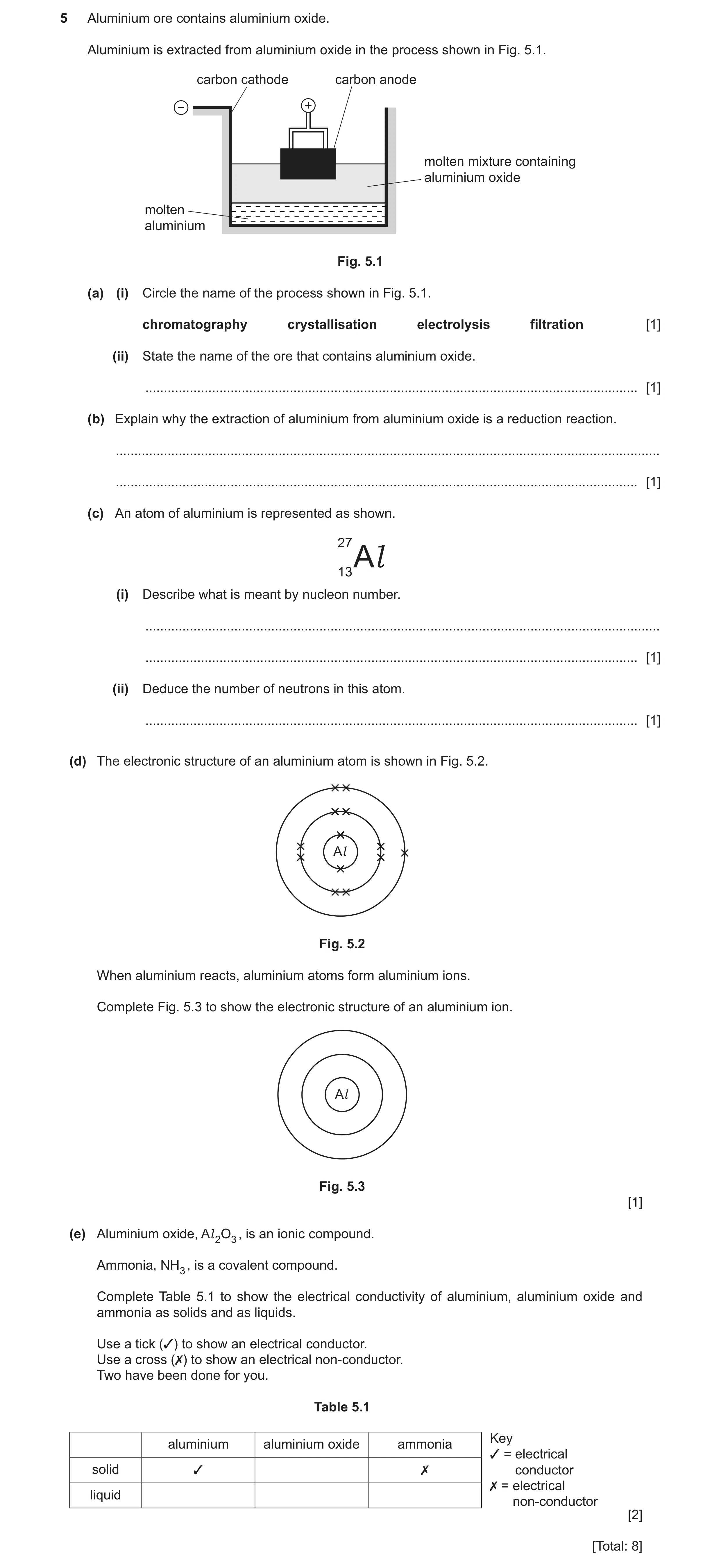
5 Aluminium ore contains aluminium oxide. Aluminium is extracted from aluminium oxide in the process shown in Fig. 5.1. carbon cathode carbon anode – + molten mixture containing aluminium oxide molten aluminium Fig. 5.1 (a) (i) Circle the name of the process shown in Fig. 5.1. chromatography crystallisation electrolysis filtration [1] (ii) State the name of the ore that contains aluminium oxide. … [1] (b) Explain why the extraction of aluminium from aluminium oxide is a reduction reaction. … … [1] (c) An atom of aluminium is represented as shown. 27 13Al (i) Describe what is meant by nucleon number. … … [1] (ii) Deduce the number of neutrons in this atom. … [1] (d) The electronic structure of an aluminium atom is shown in Fig. 5.2. Al Fig. 5.2 When aluminium reacts, aluminium atoms form aluminium ions. Complete Fig. 5.3 to show the electronic structure of an aluminium ion. Al Fig. 5.3 [1] (e) Aluminium oxide, Al2O3 , is an ionic compound. Ammonia, NH3 , is a covalent compound. Complete Table 5.1 to show the electrical conductivity of aluminium, aluminium oxide and ammonia as solids and as liquids. Use a tick (✓) to show an electrical conductor. Use a cross (✗) to show an electrical non‑conductor. Two have been done for you. Table 5.1 Key aluminium aluminium oxide ammonia ✓ = electrical solid ✓ ✗ conductor ✗ = electrical liquid non‑conductor [2] [Total: 8]
8 marks
Mark scheme: 5(a)(i) electrolysis (circled) ; 1 5(a)(ii) bauxite ; 1 5(b) oxygen is lost ; 1 5(c)(i) the (total) number of protons and neutrons ; 1 5(c)(ii) 14 ; 1 5(d) 2 electrons in inner shell, 8 in second shell and none in third shell ; 1 5(e) ;; four correct = (2) two or three correct = (1) 2
This question in 0653/32 May/June 2024
Q29 · A student investigates the reactions of iron using iron nails 0653/33 May/June 2024
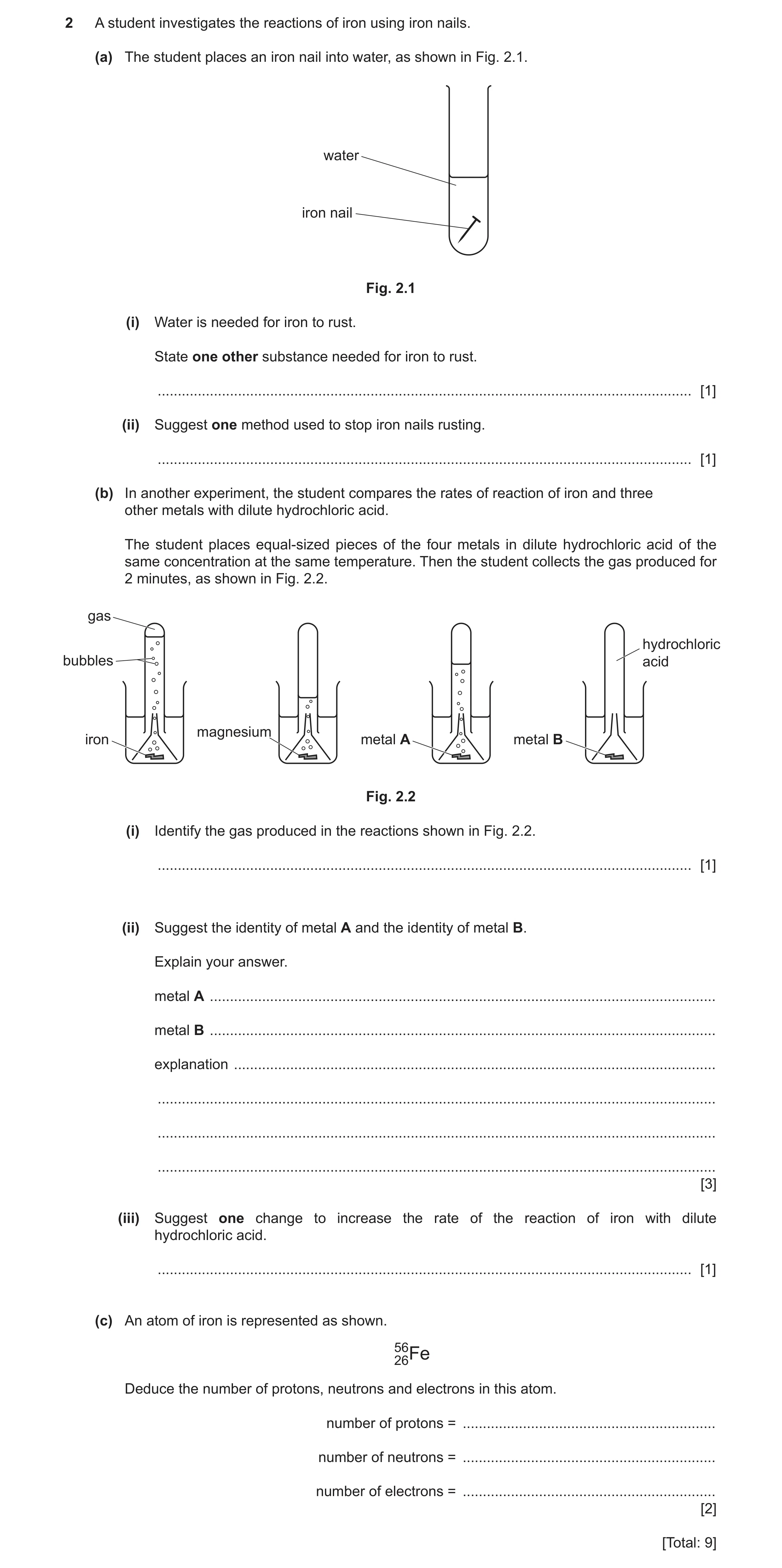
2 A student investigates the reactions of iron using iron nails. (a) The student places an iron nail into water, as shown in Fig. 2.1. water iron nail Fig. 2.1 (i) Water is needed for iron to rust. State one other substance needed for iron to rust. … [1] (ii) Suggest one method used to stop iron nails rusting. … [1] (b) In another experiment, the student compares the rates of reaction of iron and three other metals with dilute hydrochloric acid. The student places equal-sized pieces of the four metals in dilute hydrochloric acid of the same concentration at the same temperature. Then the student collects the gas produced for 2 minutes, as shown in Fig. 2.2. gas hydrochloric bubbles acid magnesium iron metal A metal B Fig. 2.2 (i) Identify the gas produced in the reactions shown in Fig. 2.2. … [1] (ii) Suggest the identity of metal A and the identity of metal B. Explain your answer. metal A … metal B … explanation … … … … [3] (iii) Suggest one change to increase the rate of the reaction of iron with dilute hydrochloric acid. … [1] (c) An atom of iron is represented as shown. 5626Fe Deduce the number of protons, neutrons and electrons in this atom. number of protons = … number of neutrons = … number of electrons = … [2] [Total: 9]
9 marks
Mark scheme: 2(a)(i) oxygen ; 1 2(a)(ii) any one from: paint ; grease / oil ; plastic coating ; 1 2(b)(i) hydrogen / H2 ; 1 2(b)(ii) (metal A) zinc / aluminium ; (metal B) copper ; (explanation) metal A is, more reactive than iron / less reactive than magnesium / metal B is, less reactive than iron / is unreactive ; 3 2(b)(iii) any one from: increase temperature ; increase (acid) concentration ; increase (iron / metal / solid) surface area / use a powder ; 1 2(c) (protons) 26 (neutrons) 30 (electrons) 26 ;; all three correct = 2 marks one or two correct = 1 mark 2
This question in 0653/33 May/June 2024
Q30 · The first four periods of the Periodic Table with the data for the elements removed 0653/31 Oct/Nov 2024
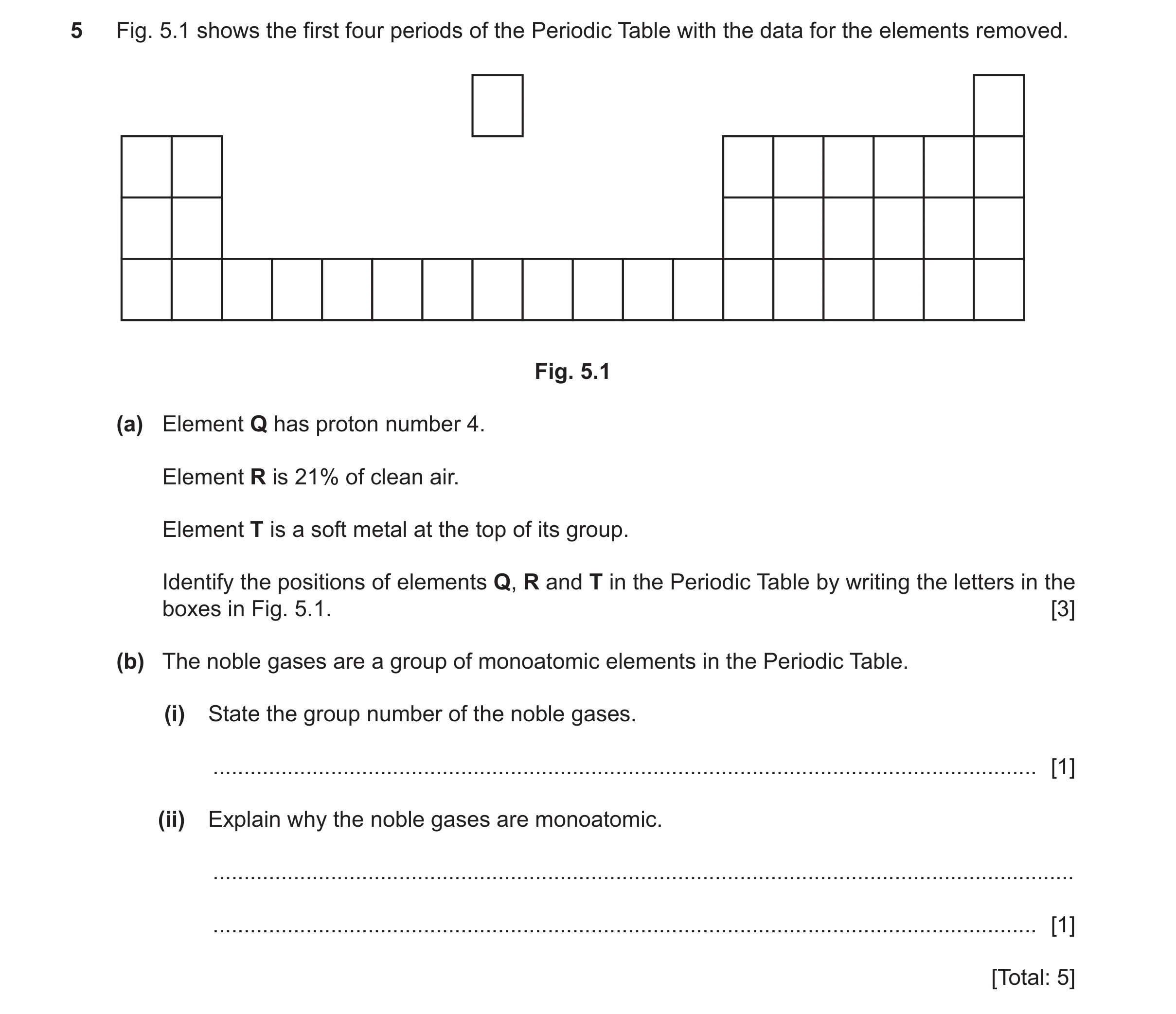
5 Fig. 5.1 shows the first four periods of the Periodic Table with the data for the elements removed. Fig. 5.1 (a) Element Q has proton number 4. Element R is 21% of clean air. Element T is a soft metal at the top of its group. Identify the positions of elements Q, R and T in the Periodic Table by writing the letters in the boxes in Fig. 5.1. [3] (b) The noble gases are a group of monoatomic elements in the Periodic Table. (i) State the group number of the noble gases. … [1] (ii) Explain why the noble gases are monoatomic. … … [1] [Total: 5]
5 marks
Mark scheme: 5(a) 3 Q in correct position ; R in correct position ; T in correct position ; 5(b)(i) VIII / 8 / eight ; 1 5(b)(ii) full outer shell ; 1
This question in 0653/31 Oct/Nov 2024
Q31 · Lithium, sodium and potassium are elements in Group I of the Periodic Table 0653/32 Feb/March 2025
4 Lithium, sodium and potassium are elements in Group I of the Periodic Table. (a) Melting point and boiling point are properties of the elements in Group I. These properties show a trend down Group I. State two other properties that show a trend down Group I. 1 … 2 … [2] (b) A mixture of sodium and potassium is used as a coolant in nuclear reactors. (i) Circle the word that describes a mixture of metals. alloy brass compound element [1] (ii) The melting point and boiling point of a mixture of sodium and potassium are shown in Table 4.1. Table 4.1 melting point boiling point / °C / °C mixture of sodium and potassium –13 785 Room temperature is 25 °C. Deduce whether the mixture of sodium and potassium is a solid, a liquid or a gas at room temperature. Use Table 4.1 to explain your answer. solid, liquid or gas … explanation … … [2] (c) The arrangement of particles in an atom of lithium is shown in Fig. 4.1. – – + + + – Fig. 4.1 Complete the labels in Fig. 4.1 with the name of each particle in the atom. [3] [Total: 8]
8 marks
Mark scheme: 4(a) density ; 2 reactivity with water ; 4(b)(i) alloy ; 1 more than one answer circled = 0 marks 4(b)(ii) liquid ; 2 melting point is below room temperature and / or boiling point is above room temperature / owtte ; 4(c) electron ; 3 neutron ; proton ;
This question in 0653/32 Feb/March 2025
Q32 · Lithium fluoride, LiF, is an ionic compound 0653/33 May/June 2025
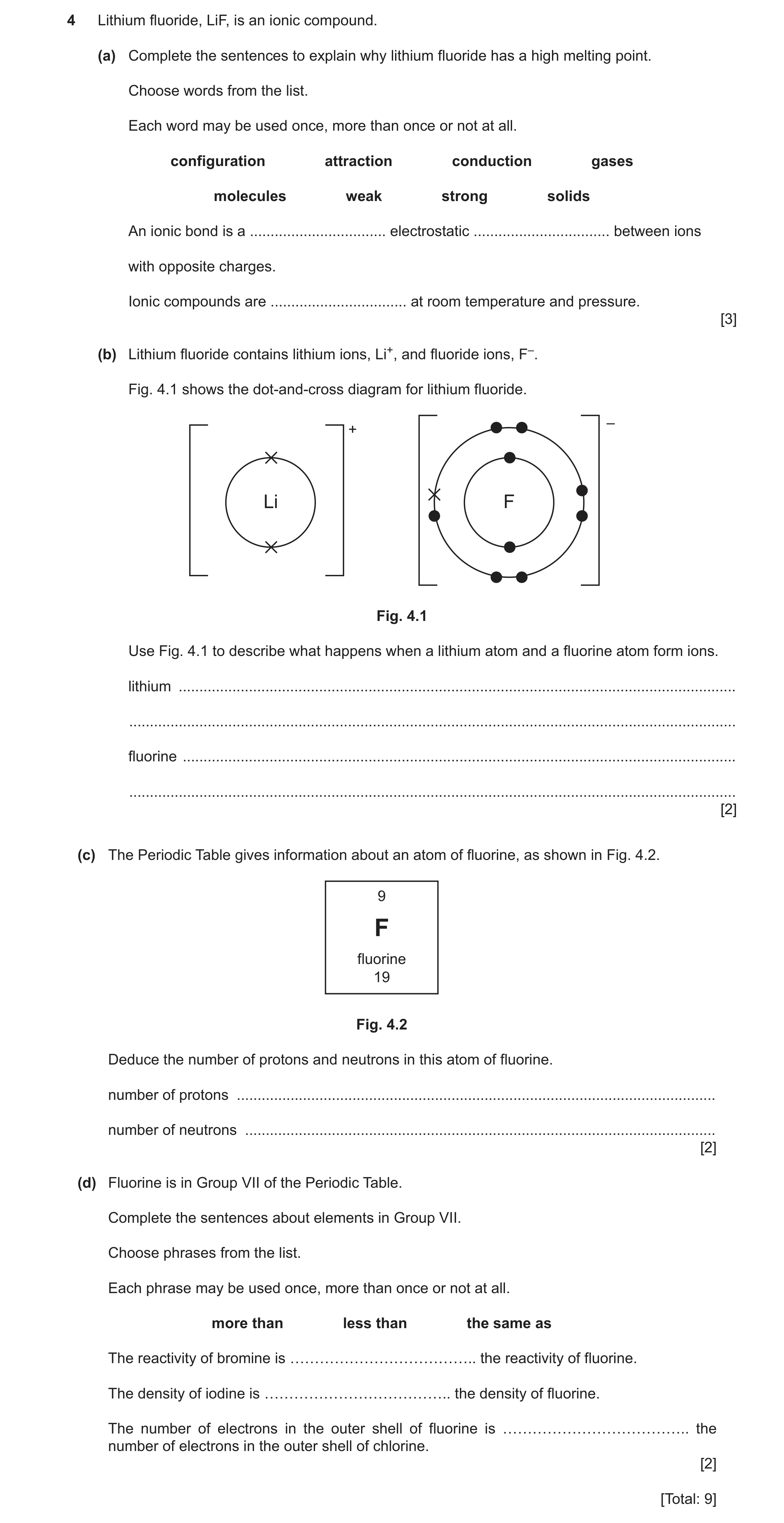
4 Lithium fluoride, LiF, is an ionic compound. (a) Complete the sentences to explain why lithium fluoride has a high melting point. Choose words from the list. Each word may be used once, more than once or not at all. configuration attraction conduction gases molecules weak strong solids An ionic bond is a … electrostatic … between ions with opposite charges. Ionic compounds are … at room temperature and pressure. [3] (b) Lithium fluoride contains lithium ions, Li+, and fluoride ions, F–. Fig. 4.1 shows the dot-and-cross diagram for lithium fluoride. – + Li F Fig. 4.1 Use Fig. 4.1 to describe what happens when a lithium atom and a fluorine atom form ions. lithium … … fluorine … … [2] (c) The Periodic Table gives information about an atom of fluorine, as shown in Fig. 4.2. 9 F fluorine 19 Fig. 4.2 Deduce the number of protons and neutrons in this atom of fluorine. number of protons … number of neutrons … [2] (d) Fluorine is in Group VII of the Periodic Table. Complete the sentences about elements in Group VII. Choose phrases from the list. Each phrase may be used once, more than once or not at all. more than less than the same as The reactivity of bromine is ……………………………….. the reactivity of fluorine. The density of iodine is ……………………………….. the density of fluorine. The number of electrons in the outer shell of fluorine is ……………………………….. the number of electrons in the outer shell of chlorine. [2] [Total: 9]
9 marks
Mark scheme: 4(a) strong ; 3 attraction ; solids ; 4(b) lithium atom loses one electron ; 2 fluorine atom gains one electron ; 4(c) 9 protons ; 2 10 neutrons ; 4(d) less than 2 more than the same as ;; all three correct = 2 marks one or two correct = 1 mark
This question in 0653/33 May/June 2025
Q33 · Group I of the Periodic Table 0653/32 Oct/Nov 2025
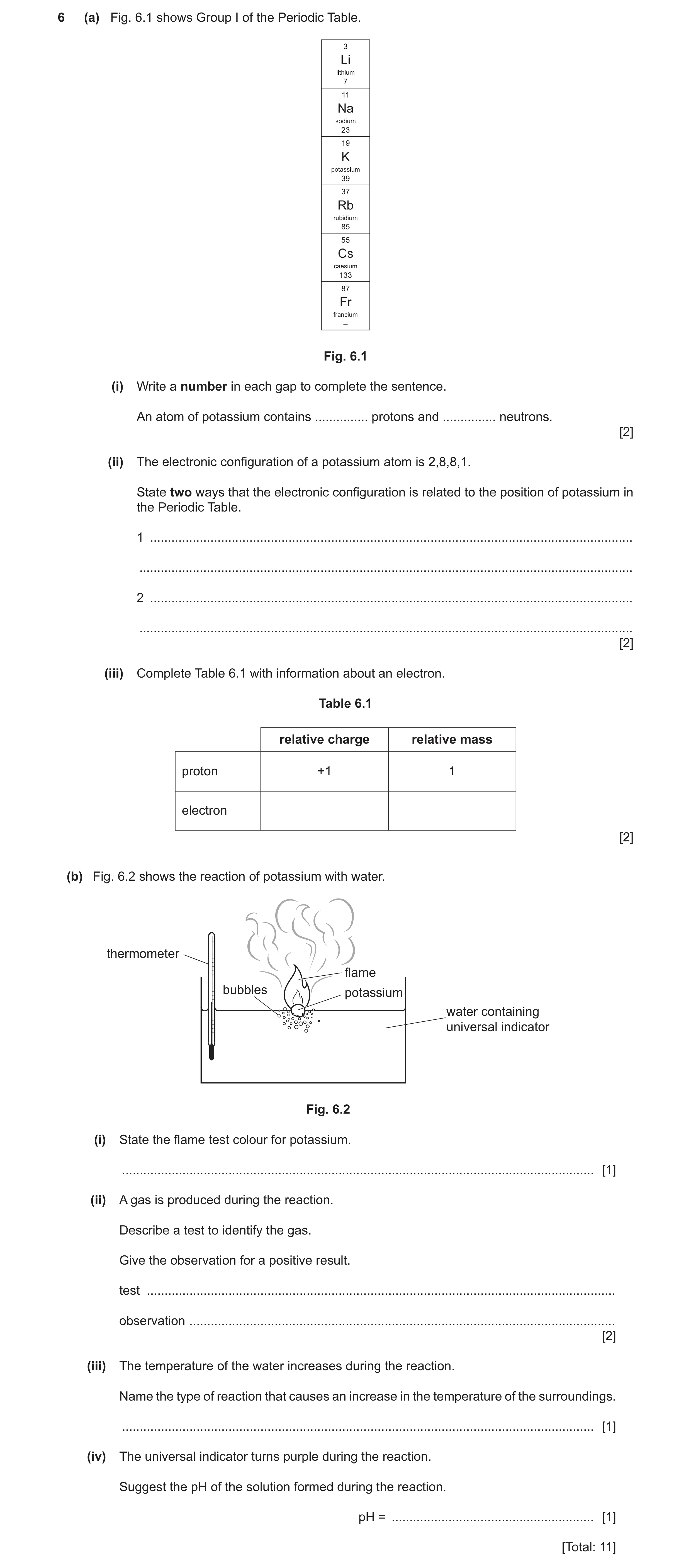
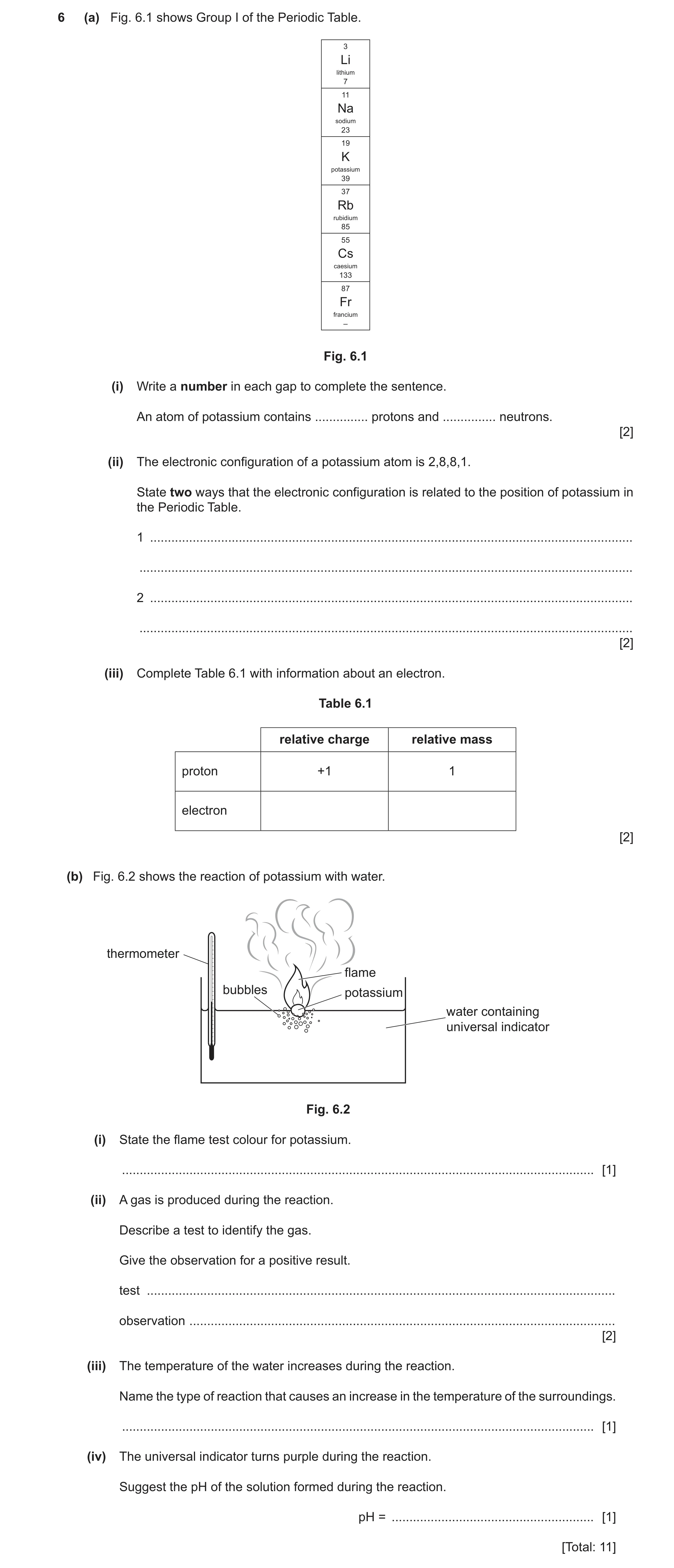
6 (a) Fig. 6.1 shows Group I of the Periodic Table. 3 Li lithium 7 11 Na sodium 23 19 K potassium 39 37 Rb rubidium 85 55 Cs caesium 133 87 Fr francium – Fig. 6.1 (i) Write a number in each gap to complete the sentence. An atom of potassium contains … protons and … neutrons. [2] (ii) The electronic configuration of a potassium atom is 2,8,8,1. State two ways that the electronic configuration is related to the position of potassium in the Periodic Table. 1 … … 2 … … [2] (iii) Complete Table 6.1 with information about an electron. Table 6.1 relative charge relative mass proton +1 1 electron [2] (b) Fig. 6.2 shows the reaction of potassium with water. thermometer flame bubbles potassium water containing universal indicator Fig. 6.2 (i) State the flame test colour for potassium. … [1] (ii) A gas is produced during the reaction. Describe a test to identify the gas. Give the observation for a positive result. test … observation … [2] (iii) The temperature of the water increases during the reaction. Name the type of reaction that causes an increase in the temperature of the surroundings. … [1] (iv) The universal indicator turns purple during the reaction. Suggest the pH of the solution formed during the reaction. pH = … [1] [Total: 11]
11 marks
Mark scheme: 6(a)(i) 19 ; 2 20 ; 6(a)(ii) potassium is in the fourth period / row because it has 4 shells ; 2 potassium has 1 electron in its outer shell so that makes it group 1 ; 6(a)(iii) relative charge: –1 ; 2 relative mass: 1 / 1835 ; 6(b)(i) lilac ; 1 6(b)(ii) lighted splint ; 2 pops ; 6(b)(iii) exothermic ; 1 6(b)(iv) answer within range 10–14 ; 1
This question in 0653/32 Oct/Nov 2025
Q34 · Group I of the Periodic Table 0653/33 Oct/Nov 2025
6 (a) Fig. 6.1 shows Group I of the Periodic Table. 3 Li lithium 7 11 Na sodium 23 19 K potassium 39 37 Rb rubidium 85 55 Cs caesium 133 87 Fr francium – Fig. 6.1 (i) Write a number in each gap to complete the sentence. An atom of potassium contains … protons and … neutrons. [2] (ii) The electronic configuration of a potassium atom is 2,8,8,1. State two ways that the electronic configuration is related to the position of potassium in the Periodic Table. 1 … … 2 … … [2] (iii) Complete Table 6.1 with information about an electron. Table 6.1 relative charge relative mass proton +1 1 electron [2] (b) Fig. 6.2 shows the reaction of potassium with water. thermometer flame bubbles potassium water containing universal indicator Fig. 6.2 (i) State the flame test colour for potassium. … [1] (ii) A gas is produced during the reaction. Describe a test to identify the gas. Give the observation for a positive result. test … observation … [2] (iii) The temperature of the water increases during the reaction. Name the type of reaction that causes an increase in the temperature of the surroundings. … [1] (iv) The universal indicator turns purple during the reaction. Suggest the pH of the solution formed during the reaction. pH = … [1] [Total: 11]
11 marks
Mark scheme: 6(a)(i) 19 ; 2 20 ; 6(a)(ii) potassium is in the fourth period / row because it has 4 shells ; 2 potassium has 1 electron in its outer shell so that makes it group 1 ; 6(a)(iii) relative charge: –1 ; 2 relative mass: 1 / 1835 ; 6(b)(i) lilac ; 1 6(b)(ii) lighted splint ; 2 pops ; 6(b)(iii) exothermic ; 1 6(b)(iv) answer within range 10–14 ; 1
This question in 0653/33 Oct/Nov 2025
 6 / 45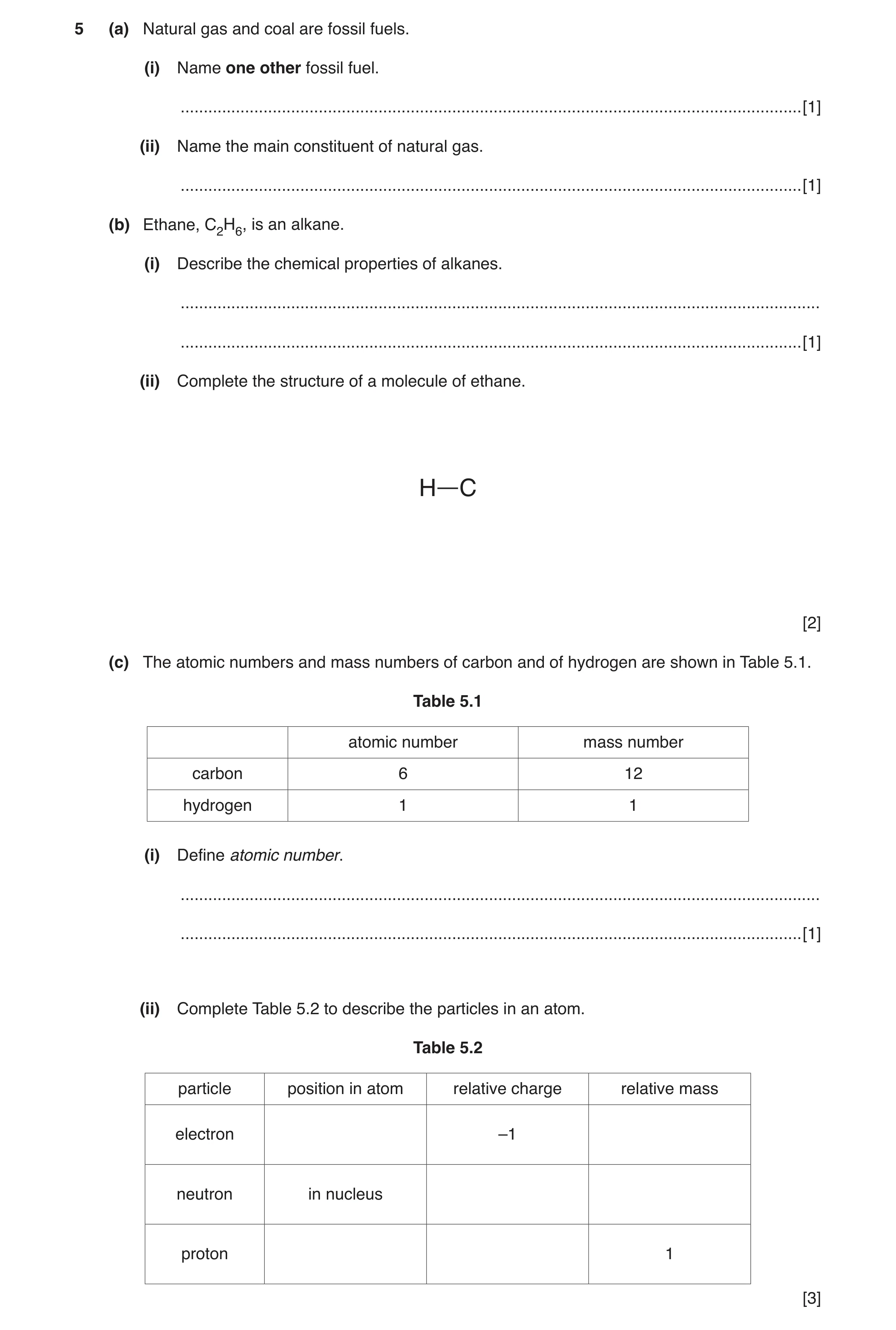
 9 / 45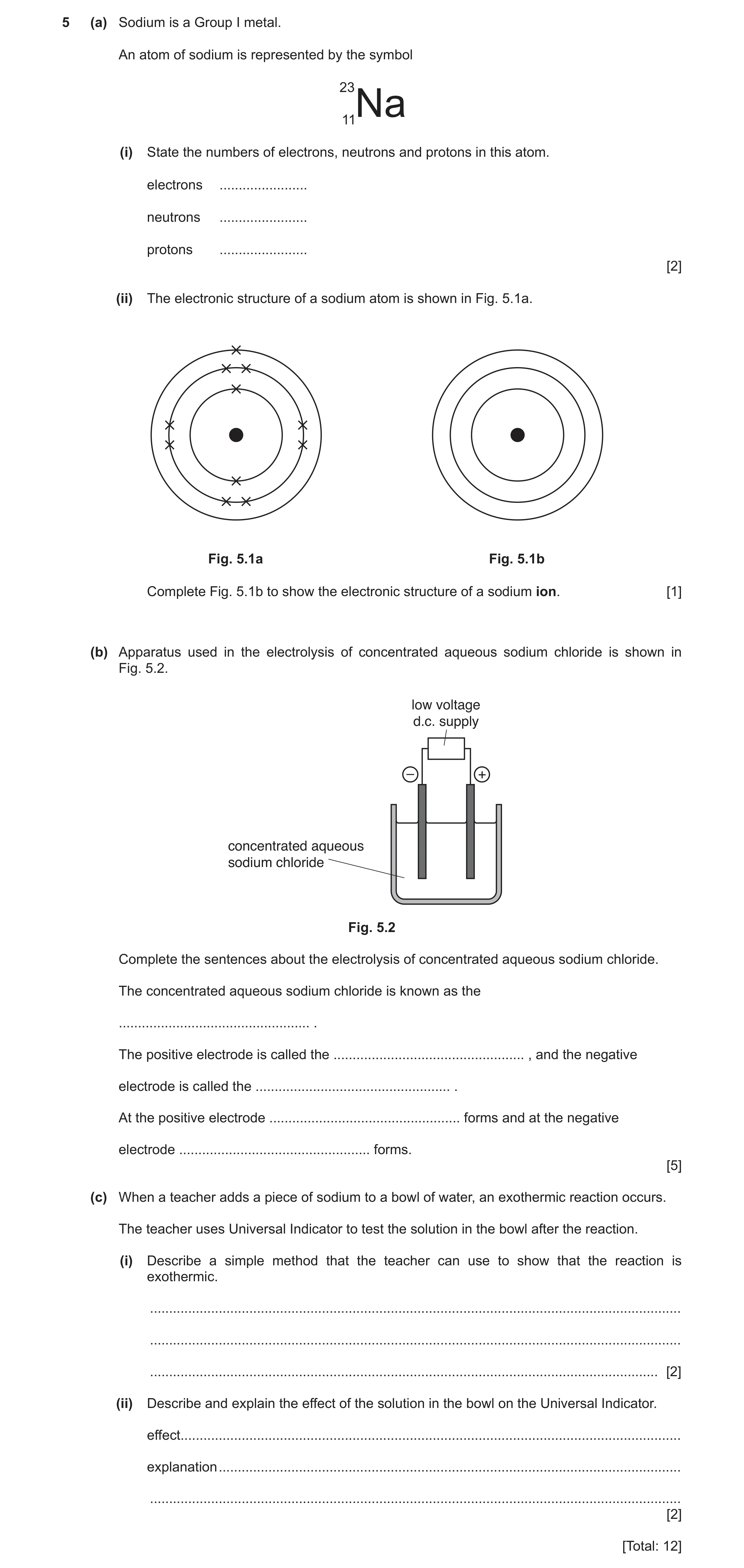
 12 / 45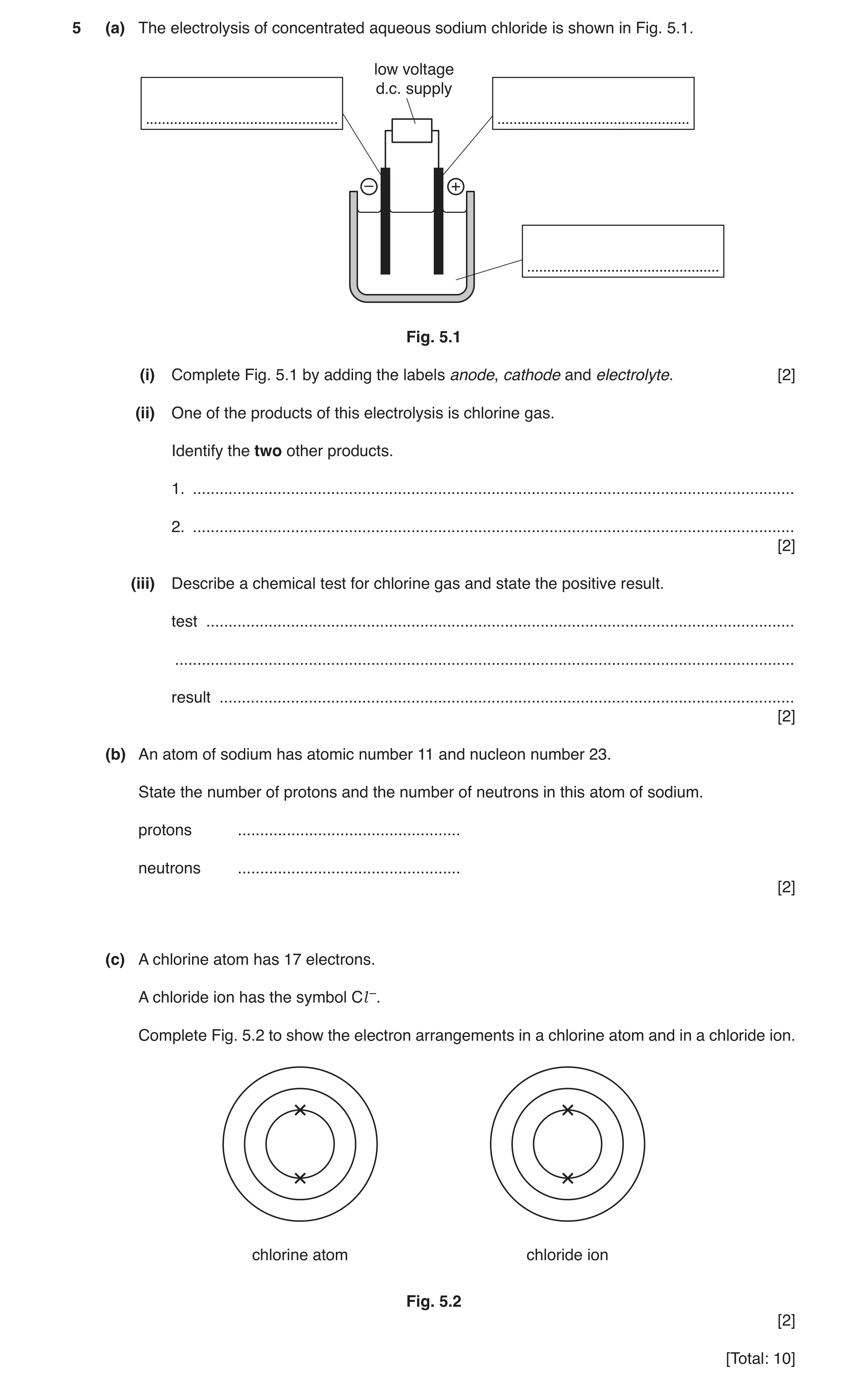
 25 / 45
 26 / 45
 27 / 45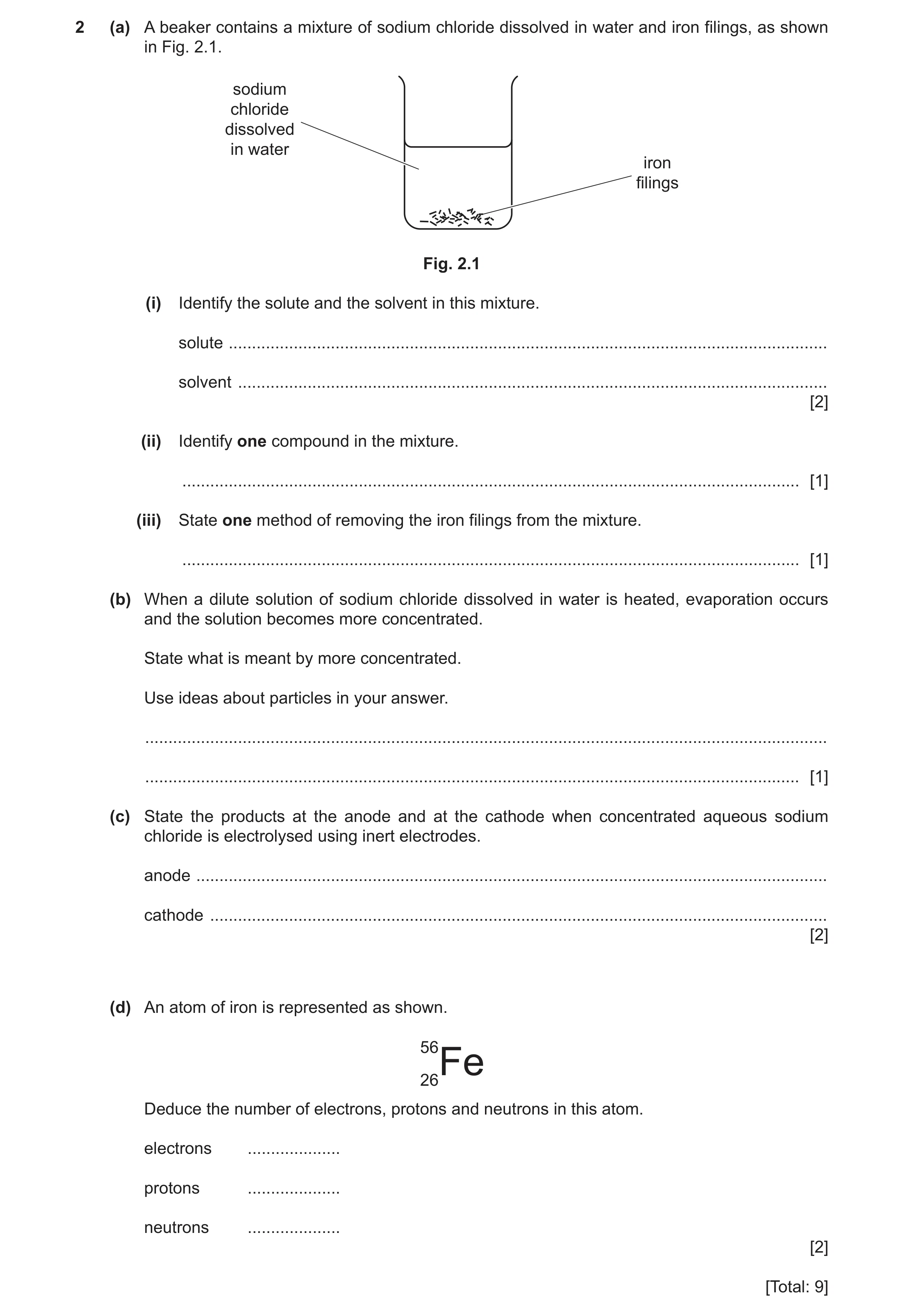
 39 / 45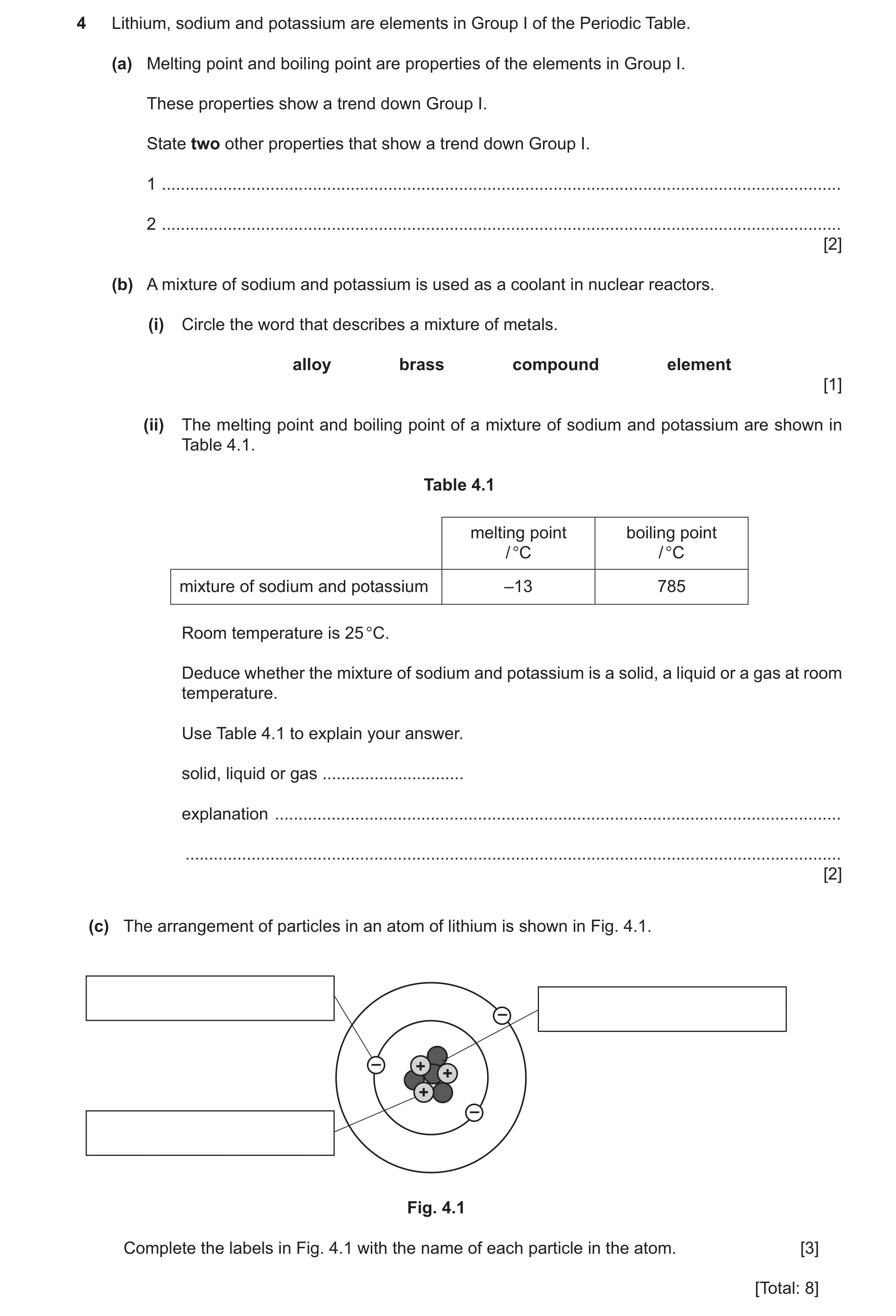
 9
9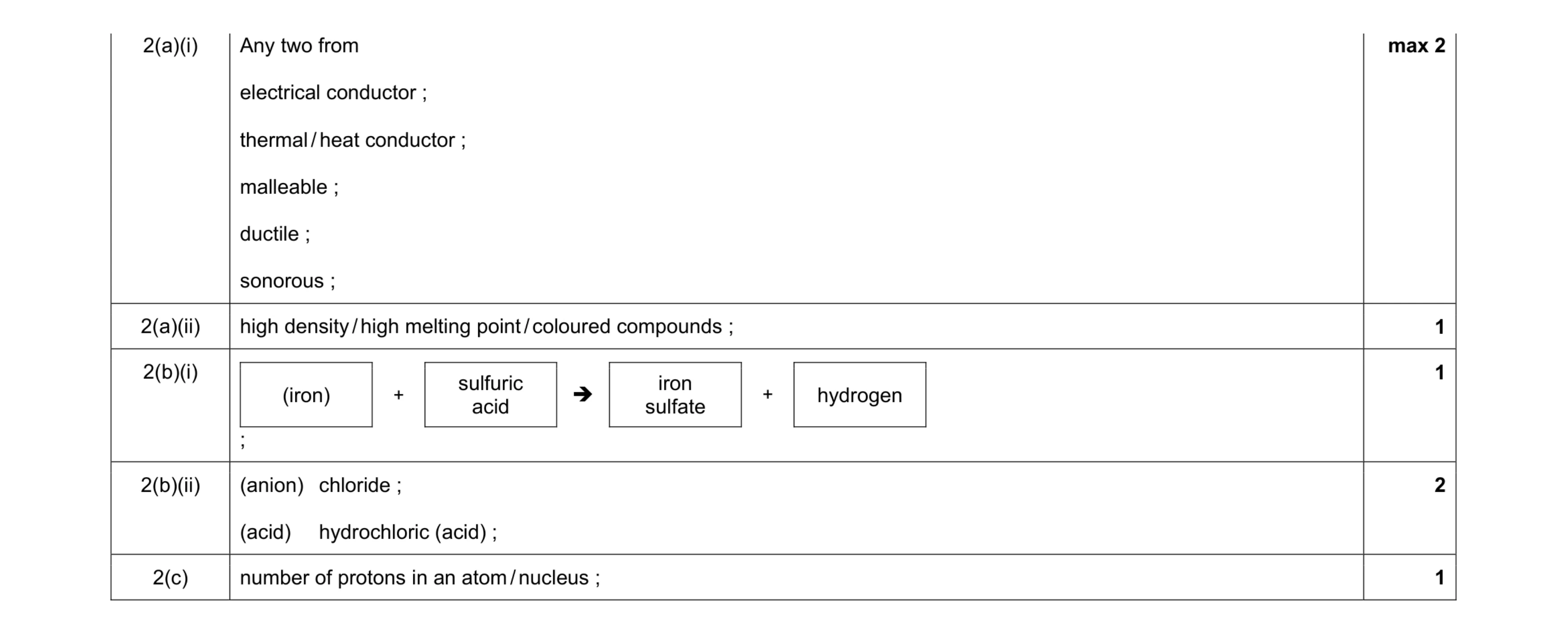 7
7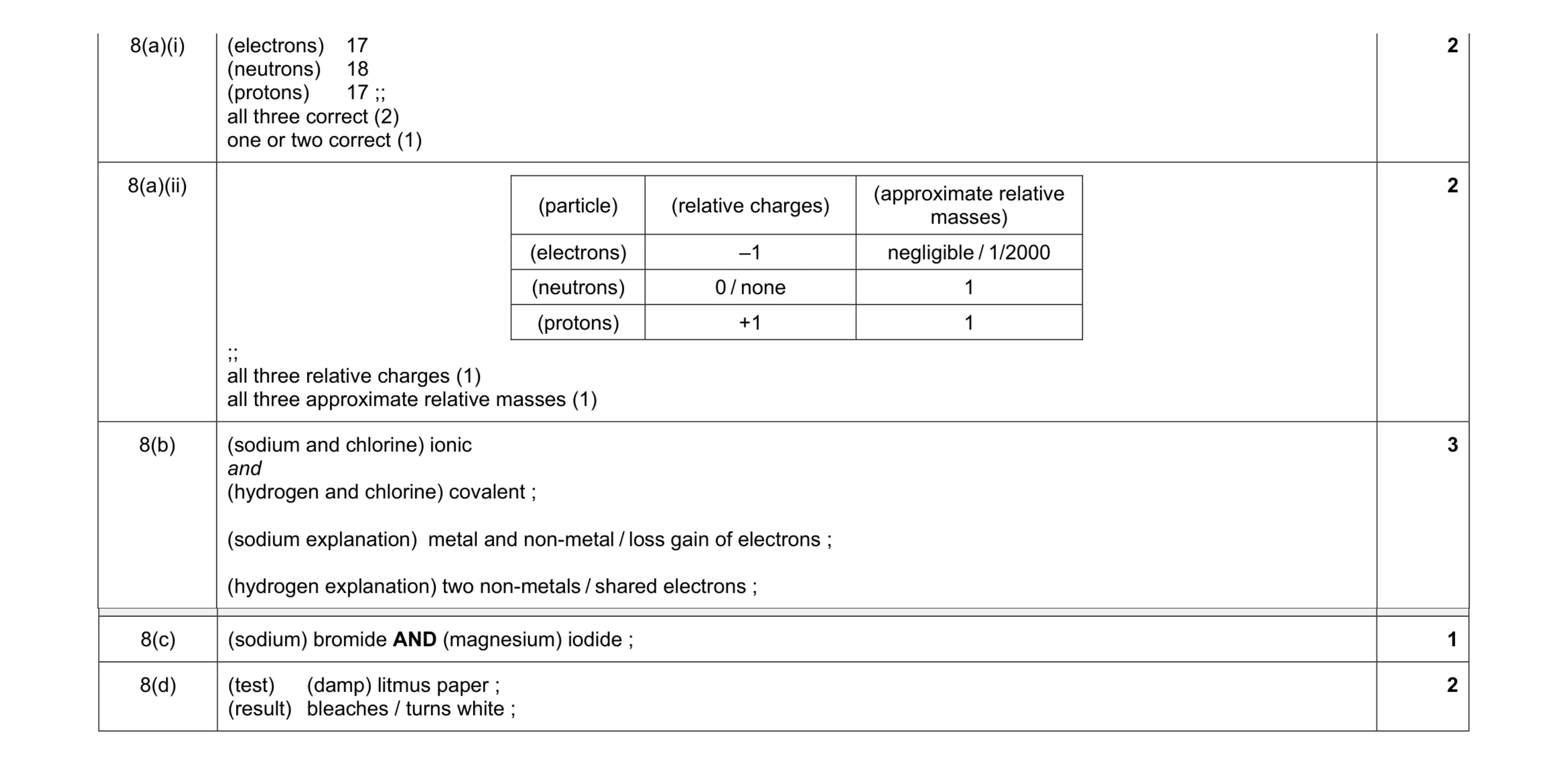 10
10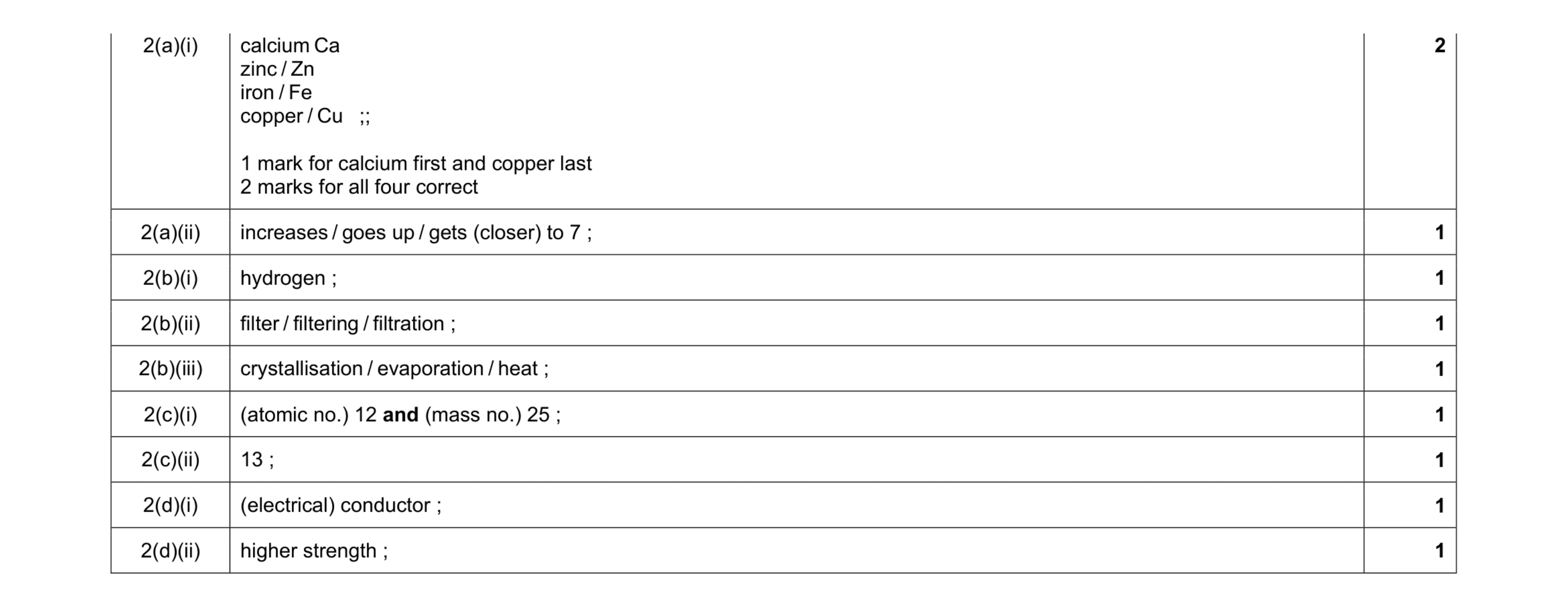 10
10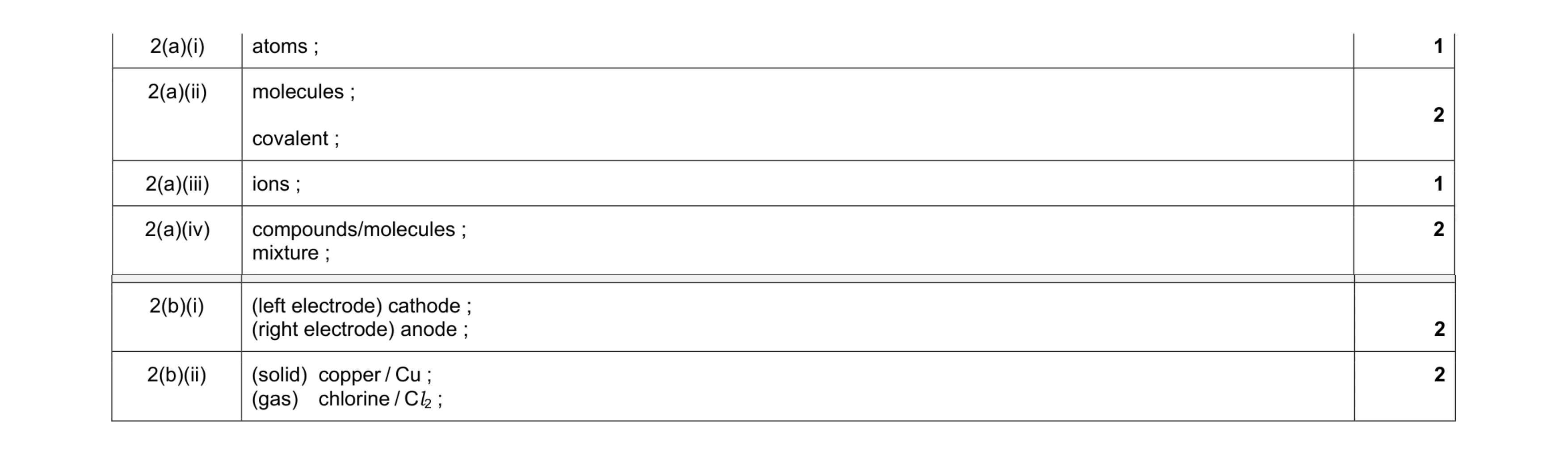 10
10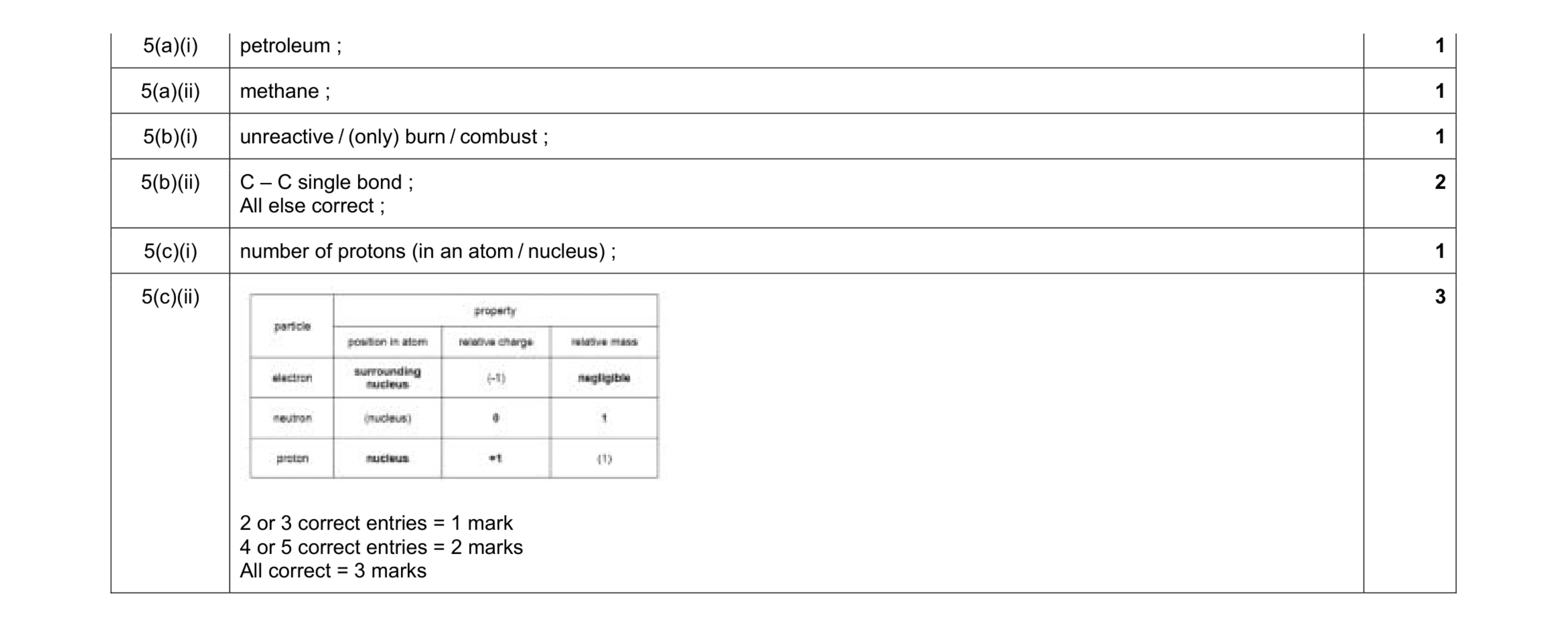 9
9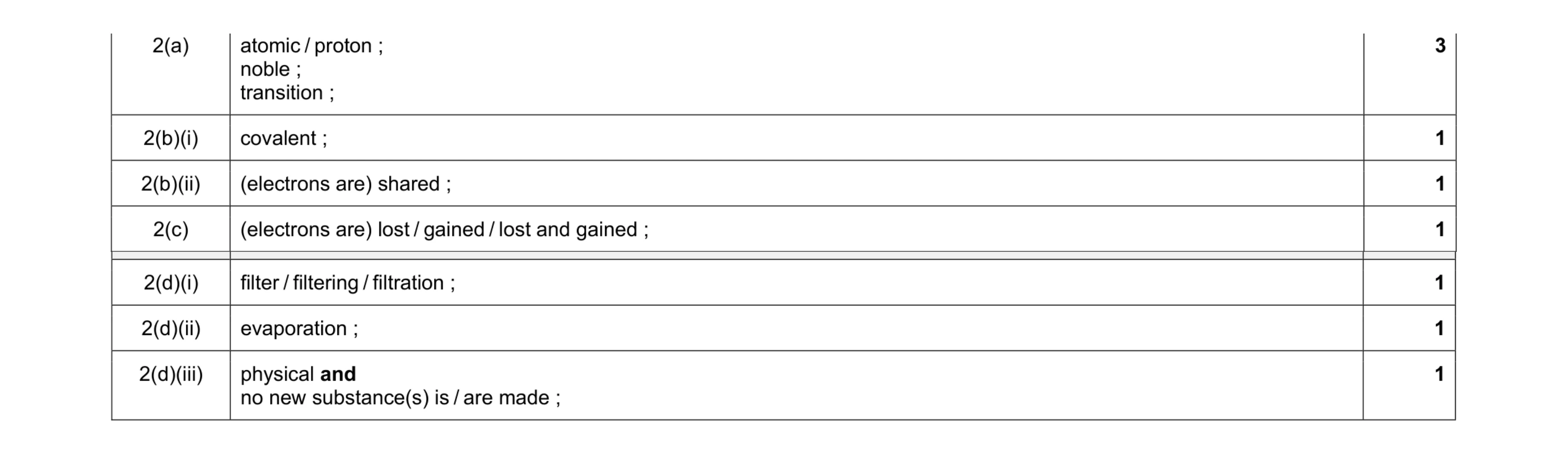 9
9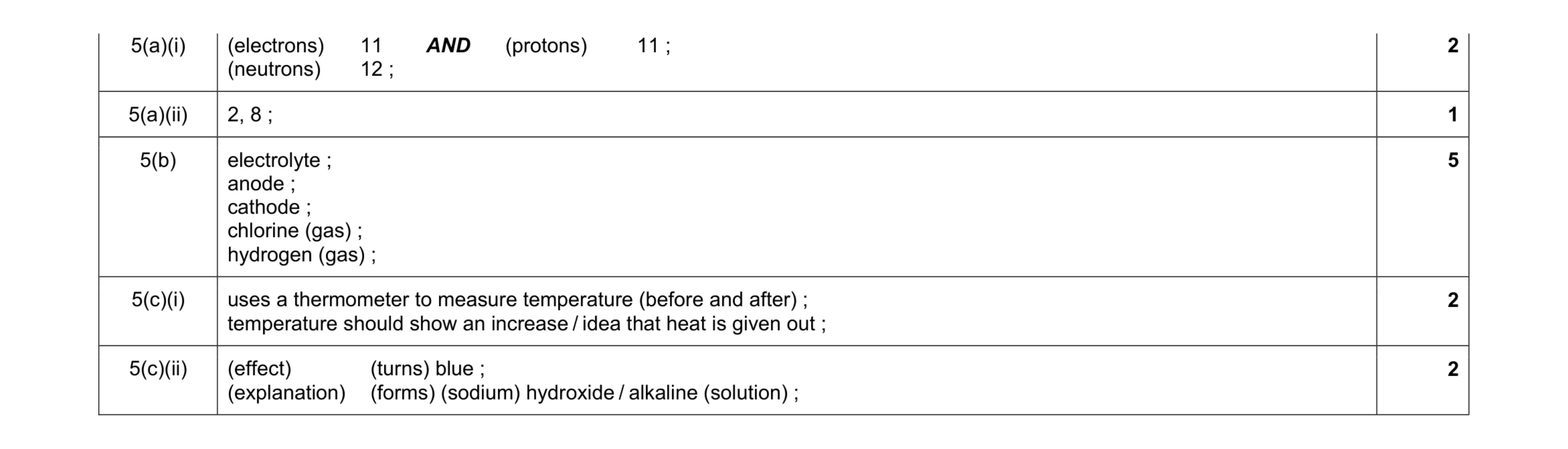 12
12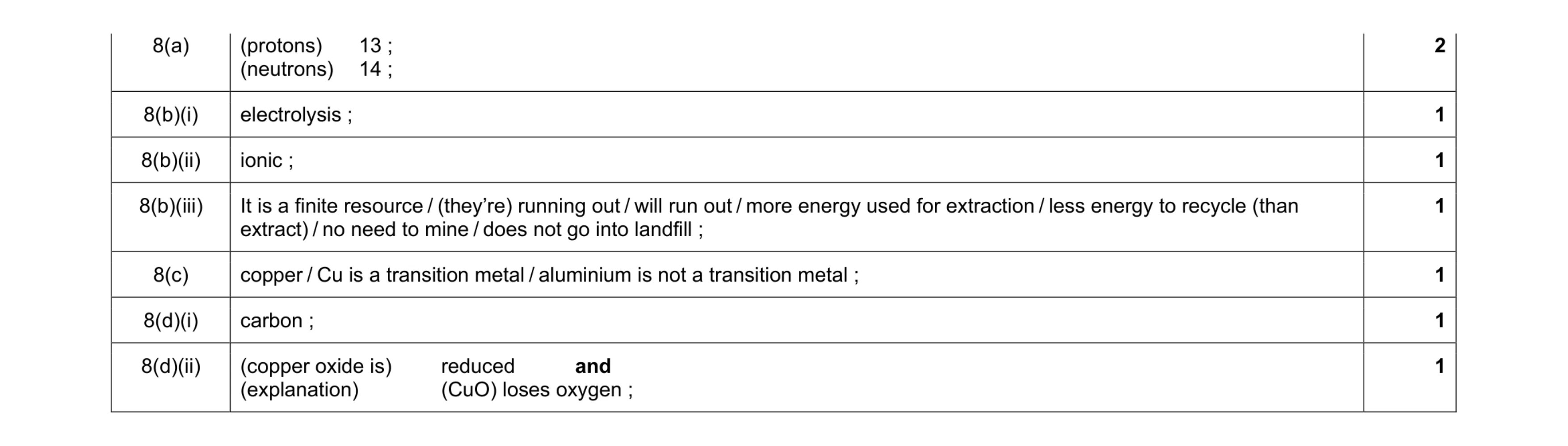 8
8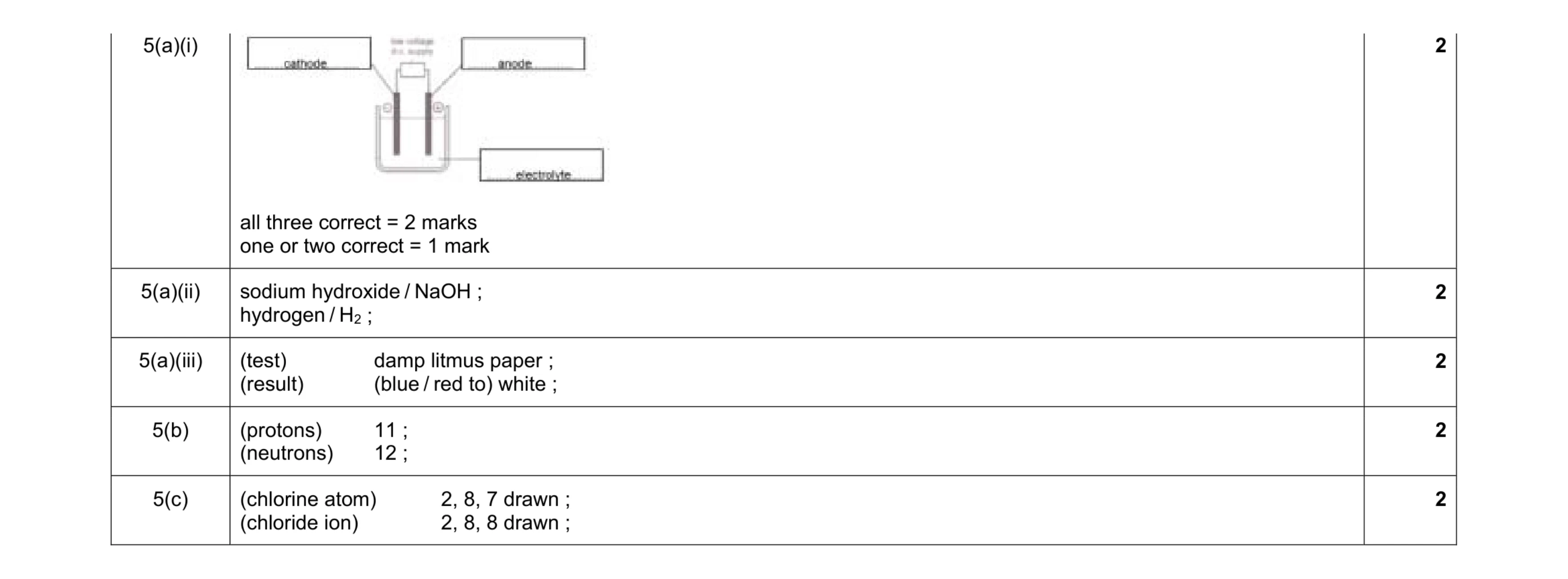 10
10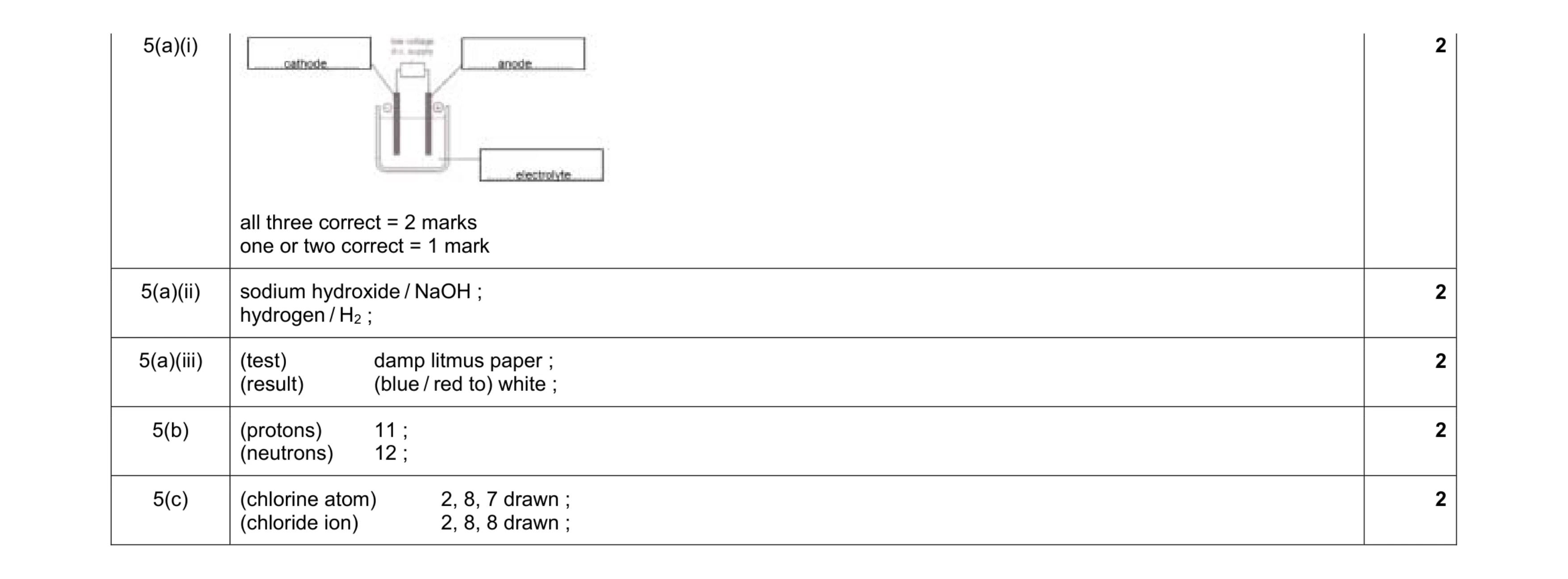 10
10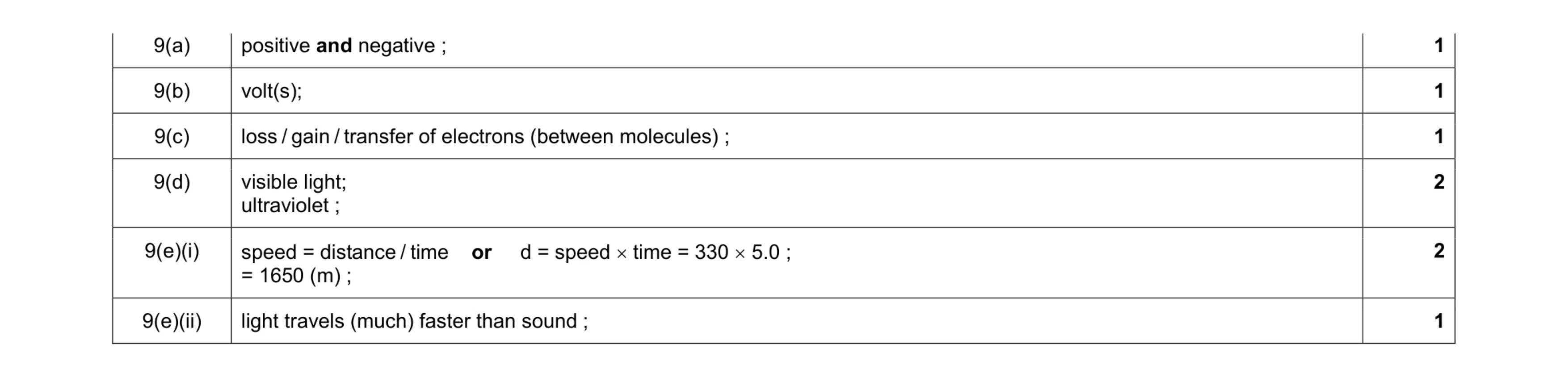 8
8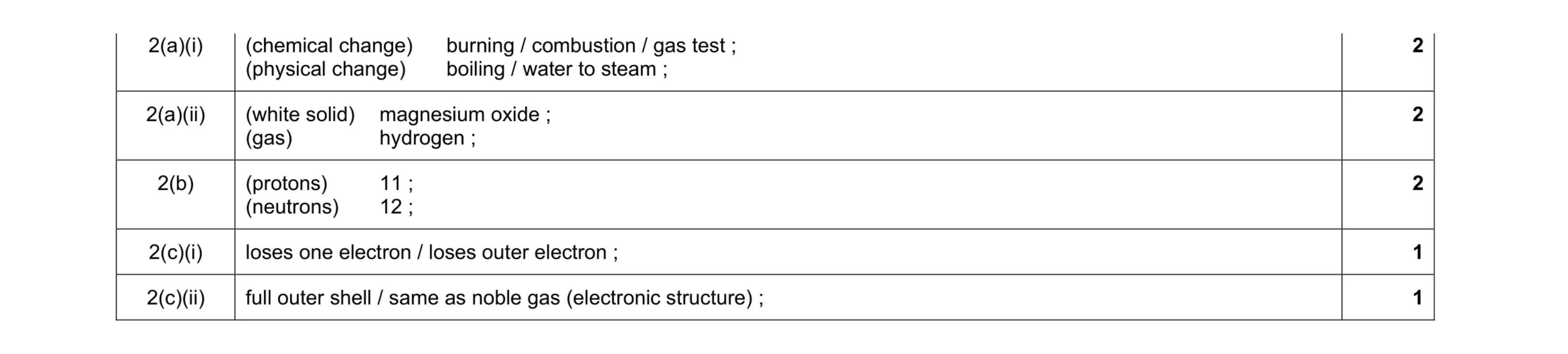 8
8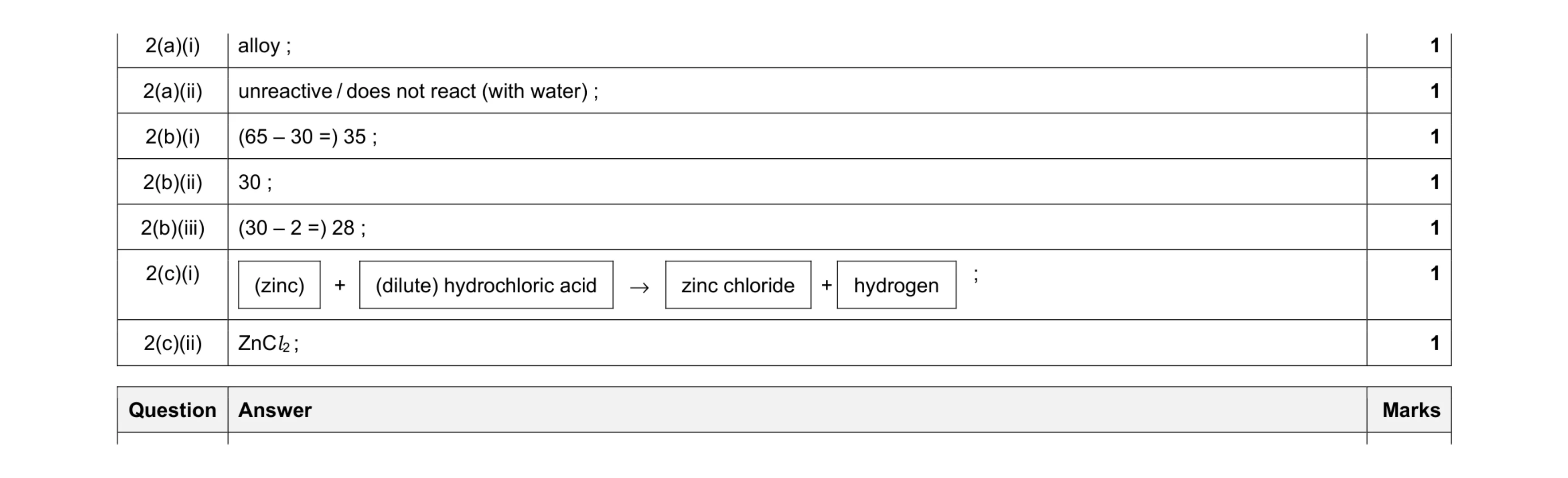 7
7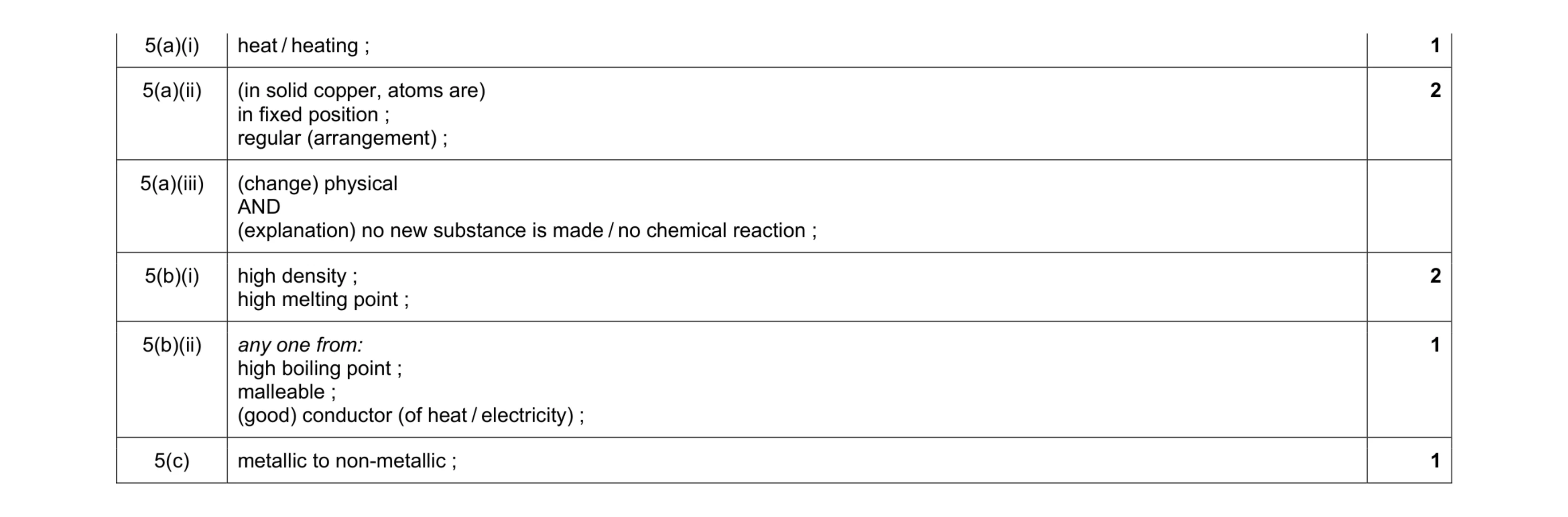 8
8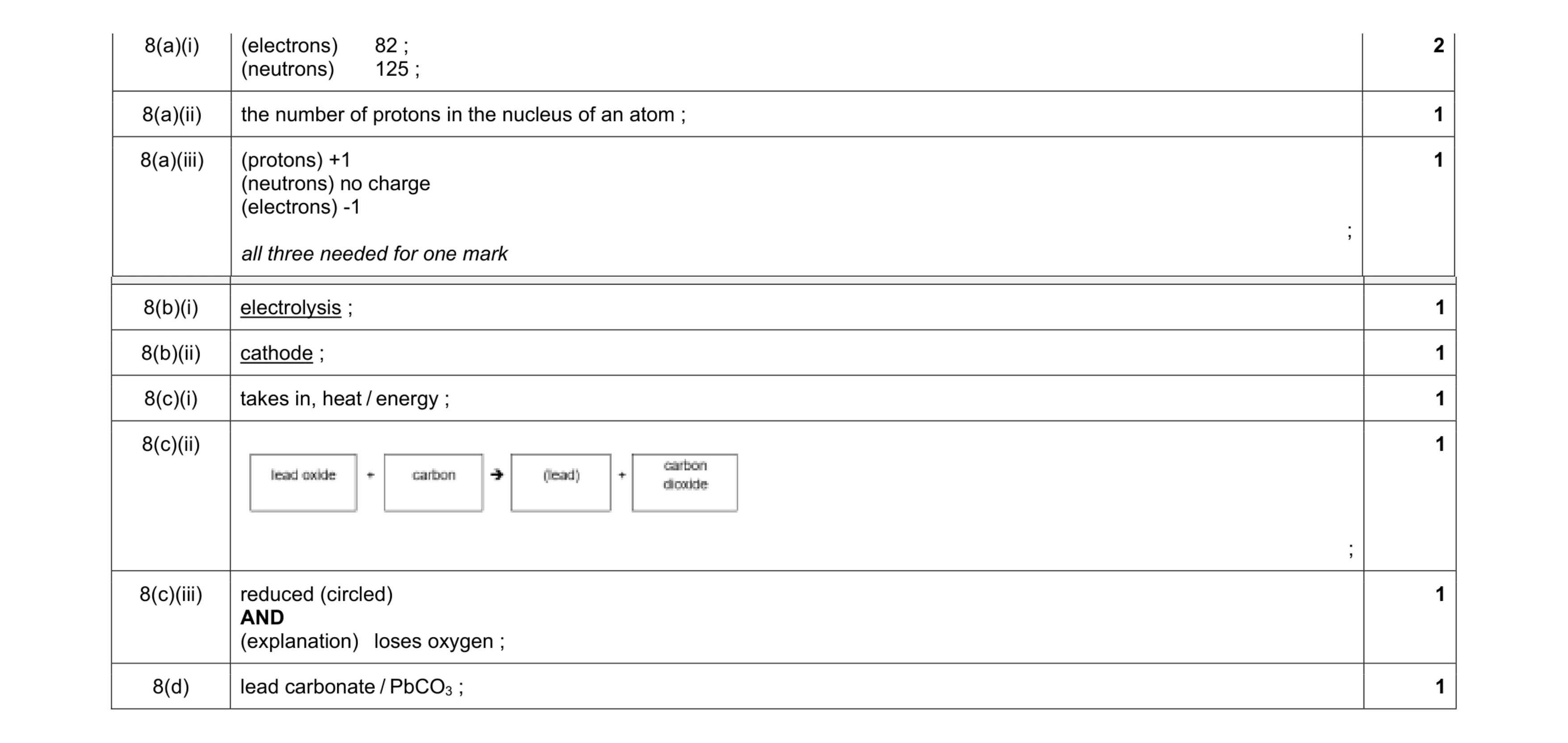 10
10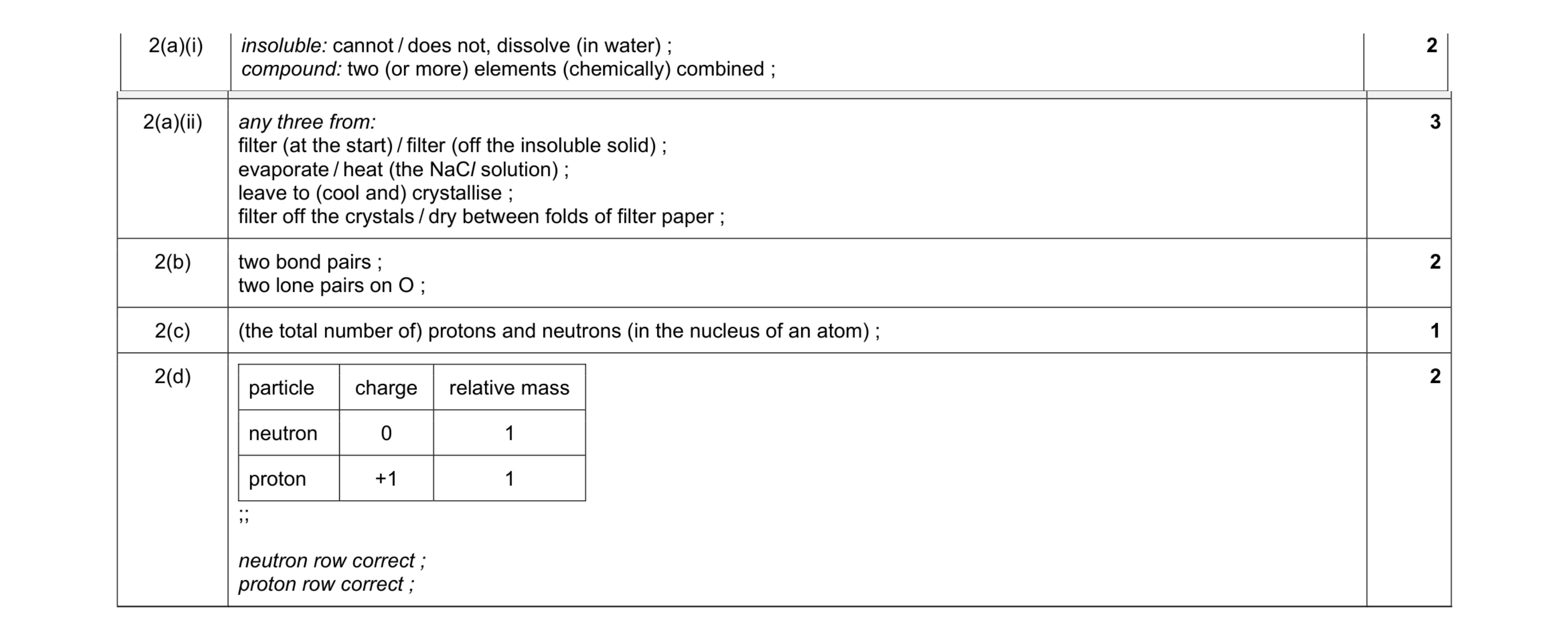 10
10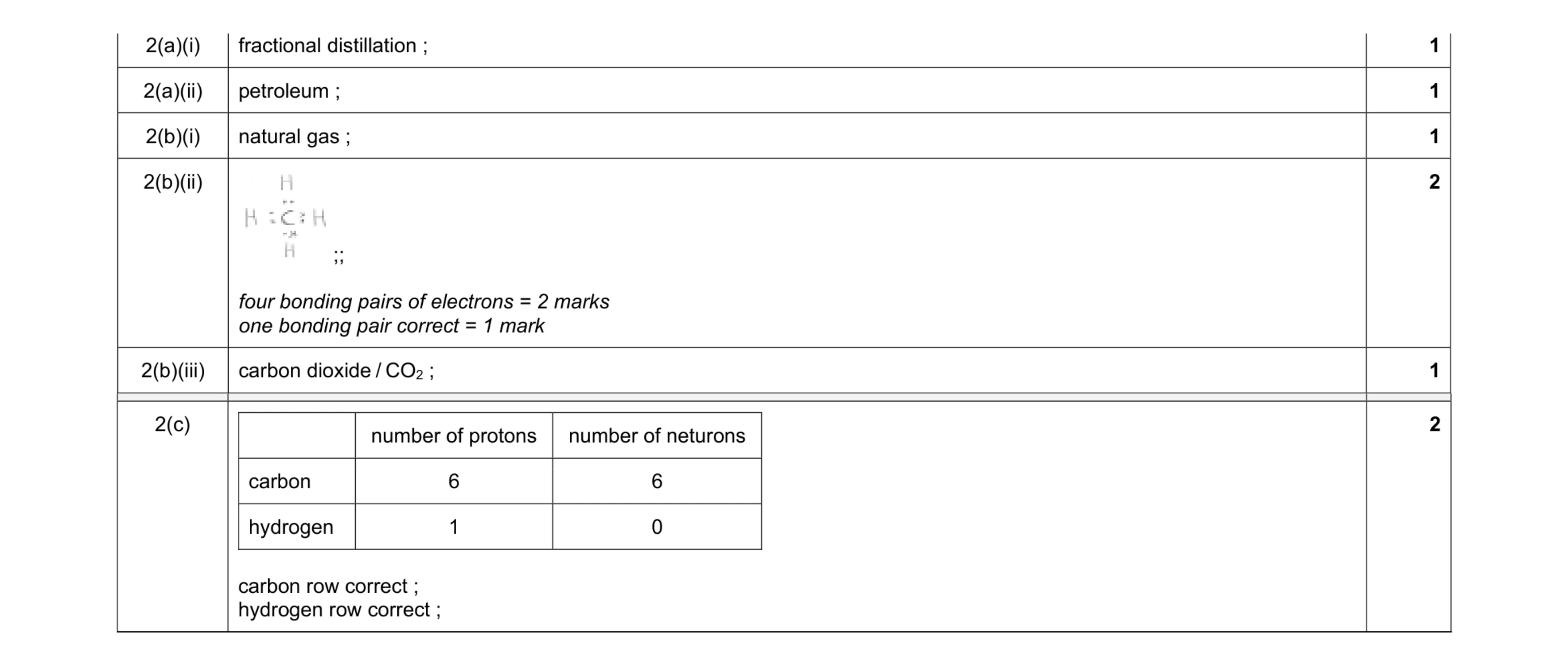 8
8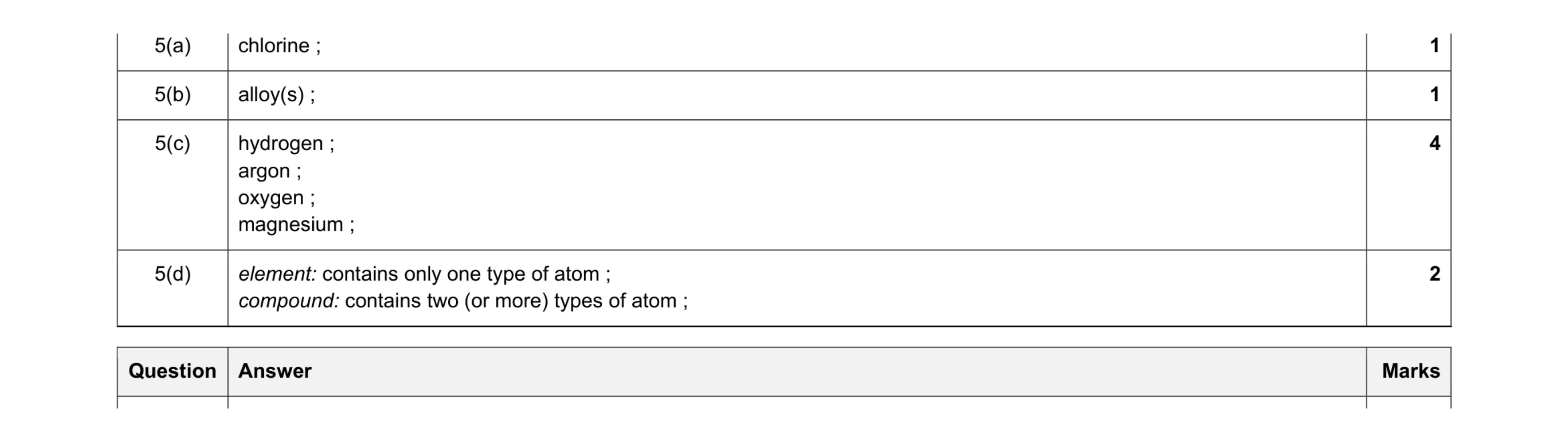 8
8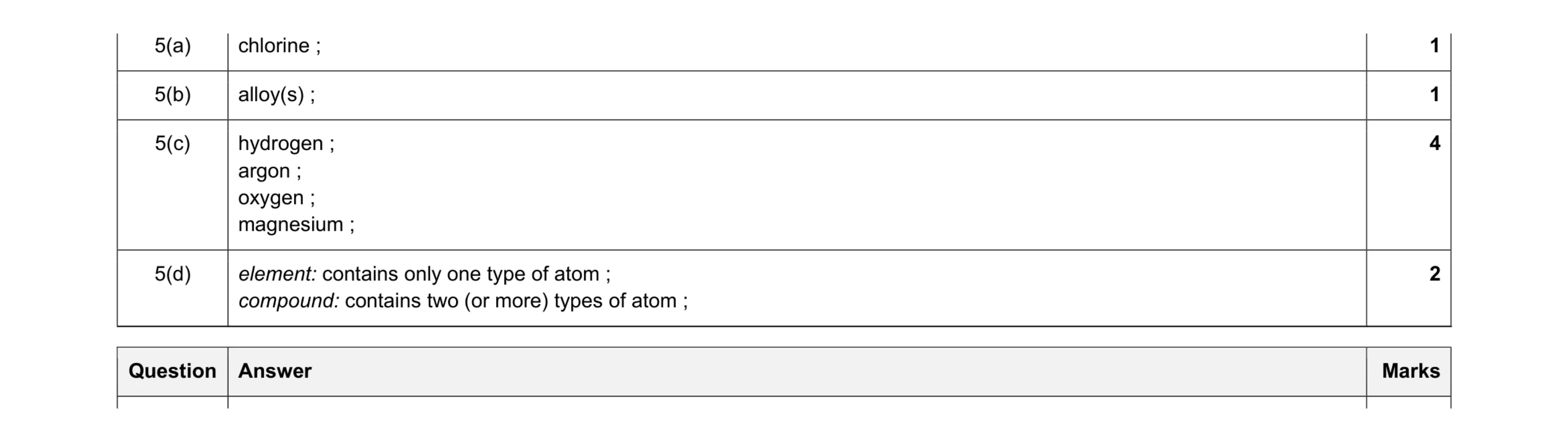 8
8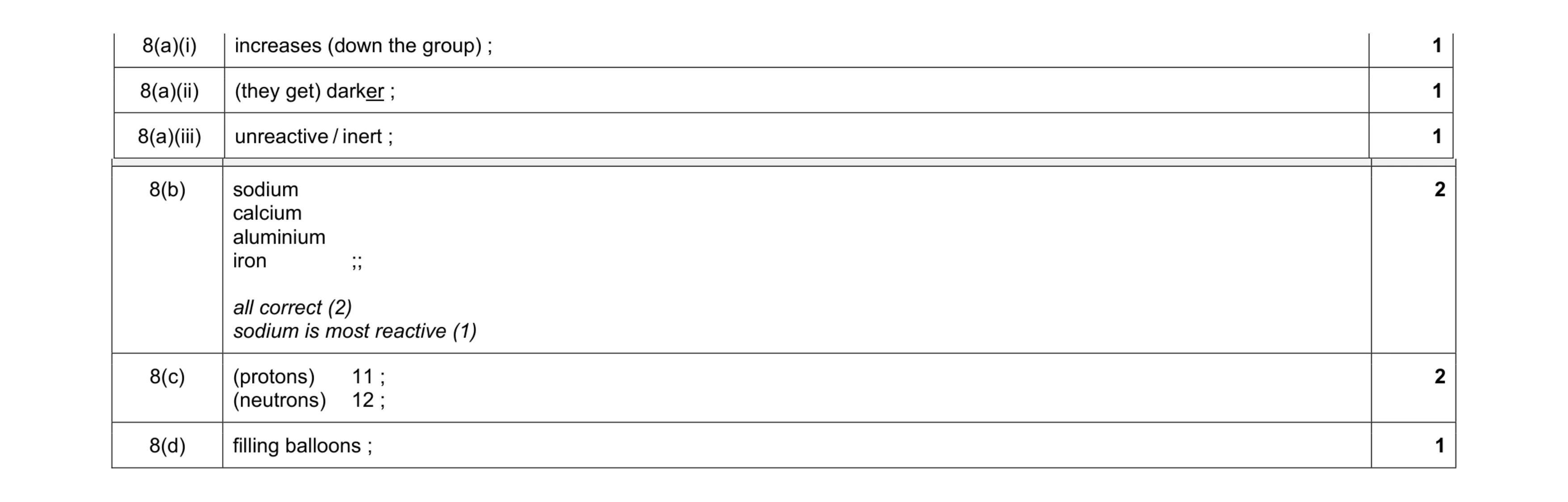 8
8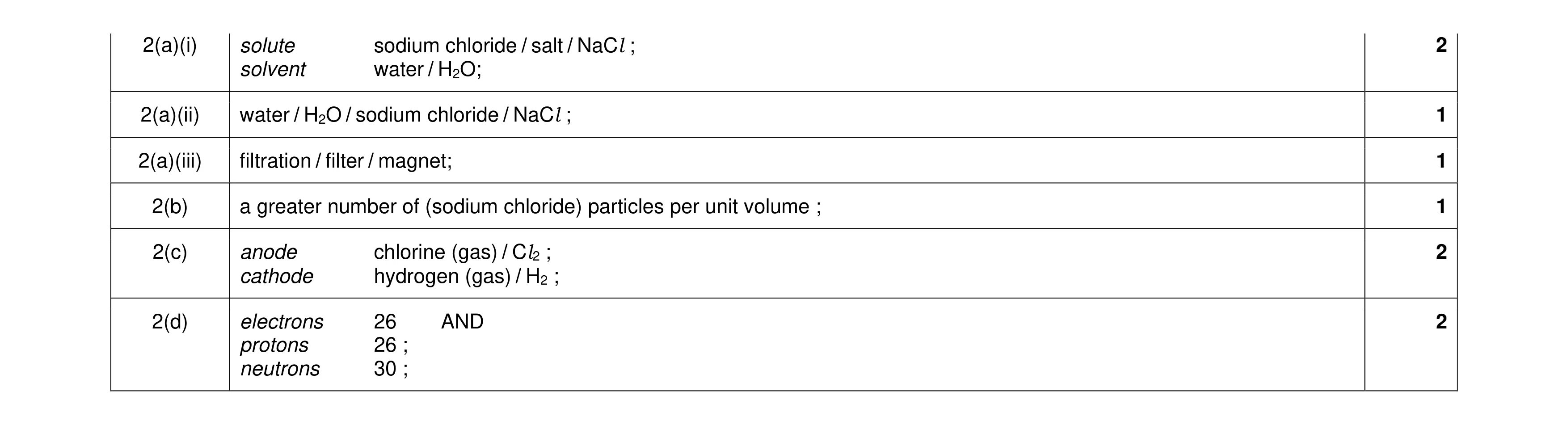 9
9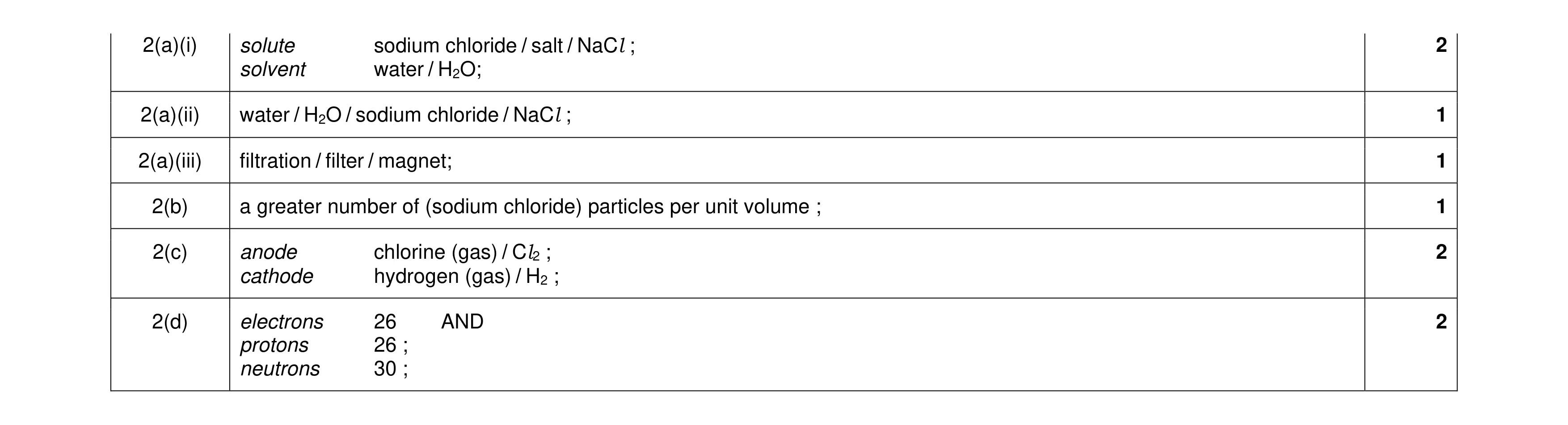 9
9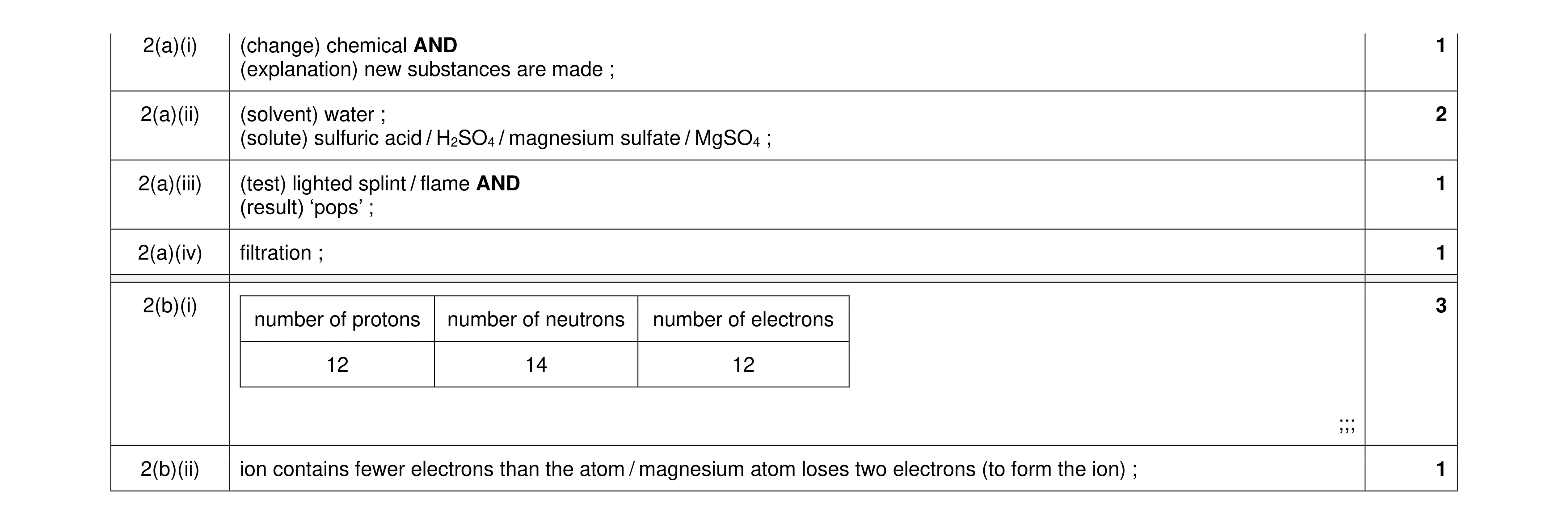 9
9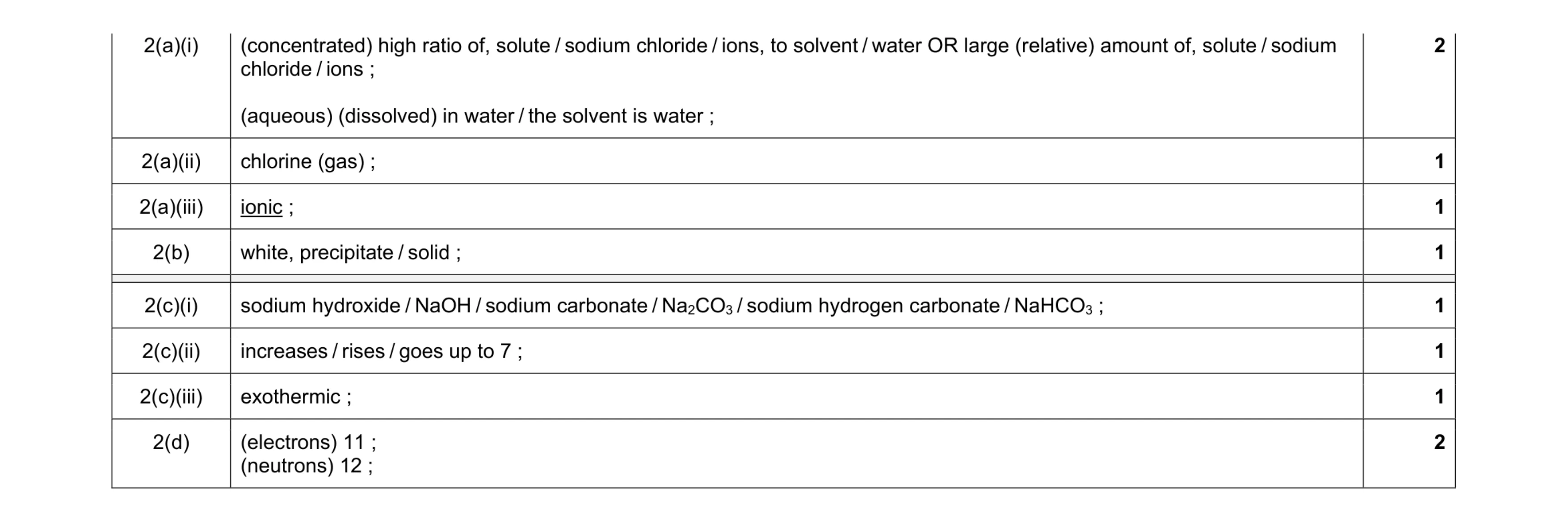 10
10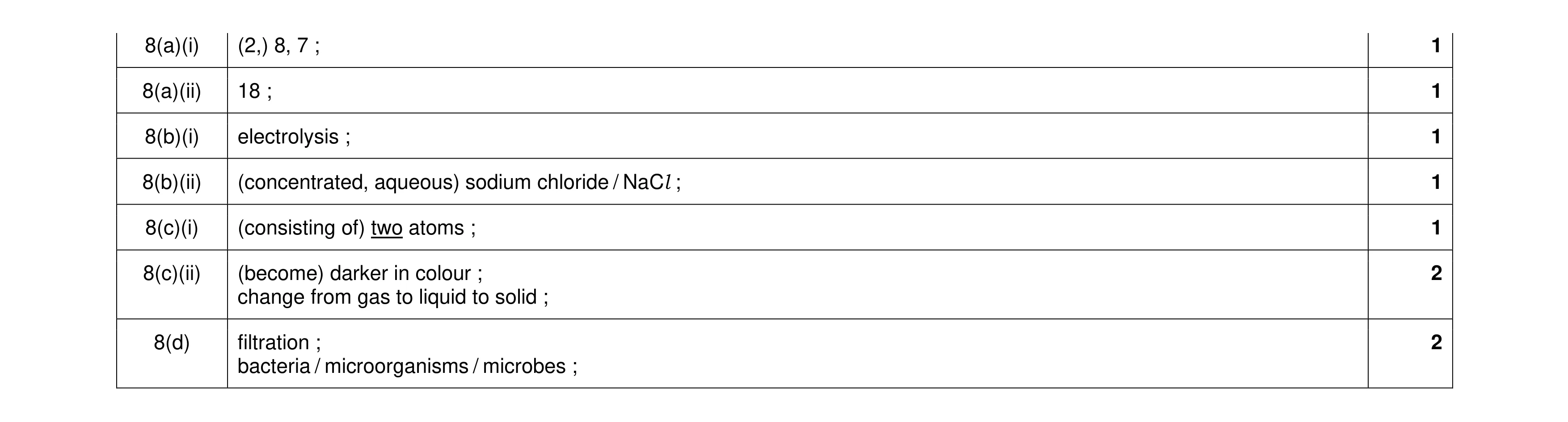 9
9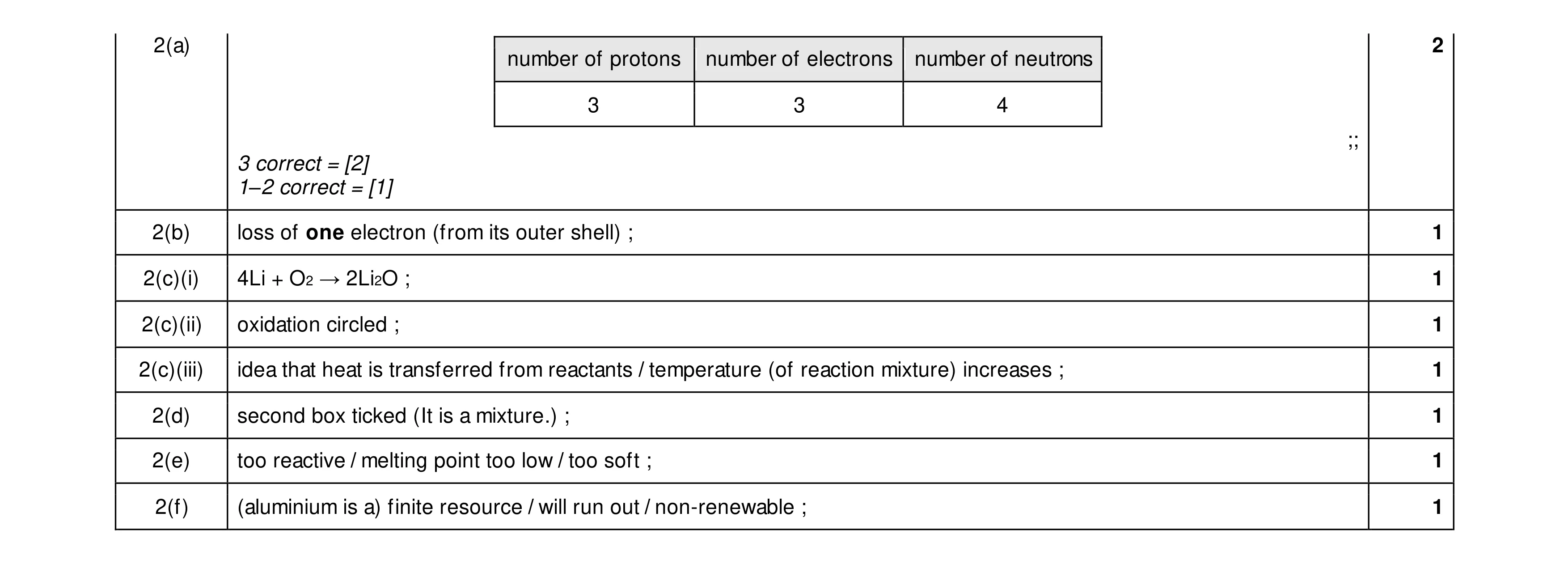 9
9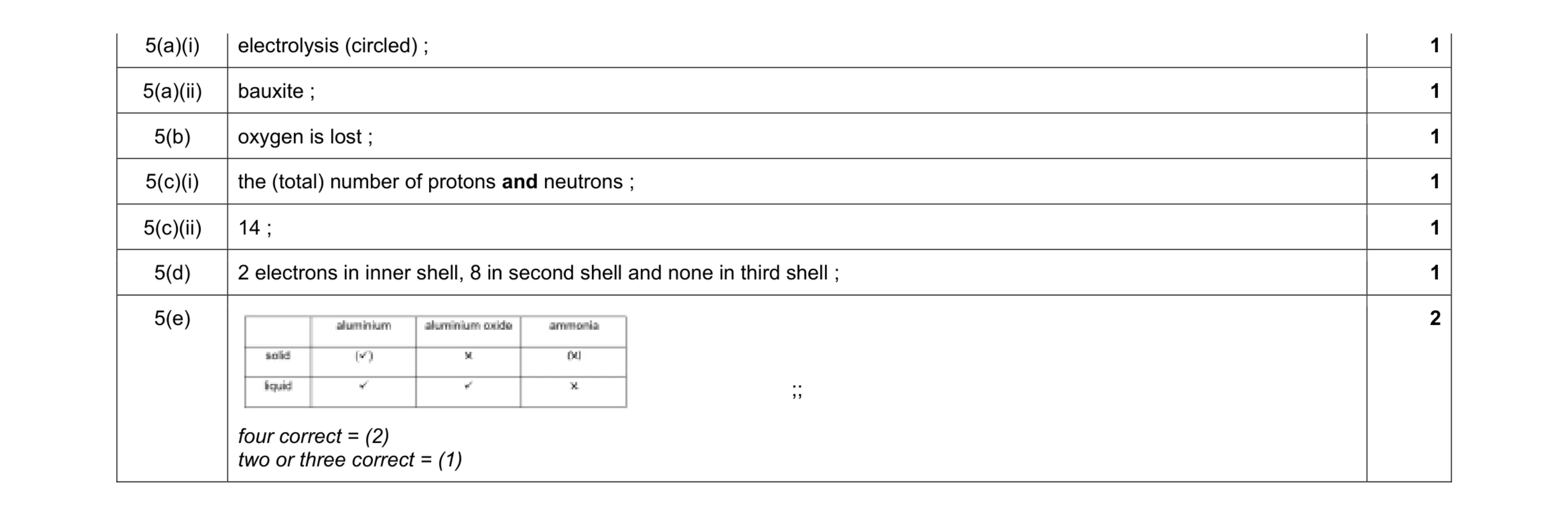 8
8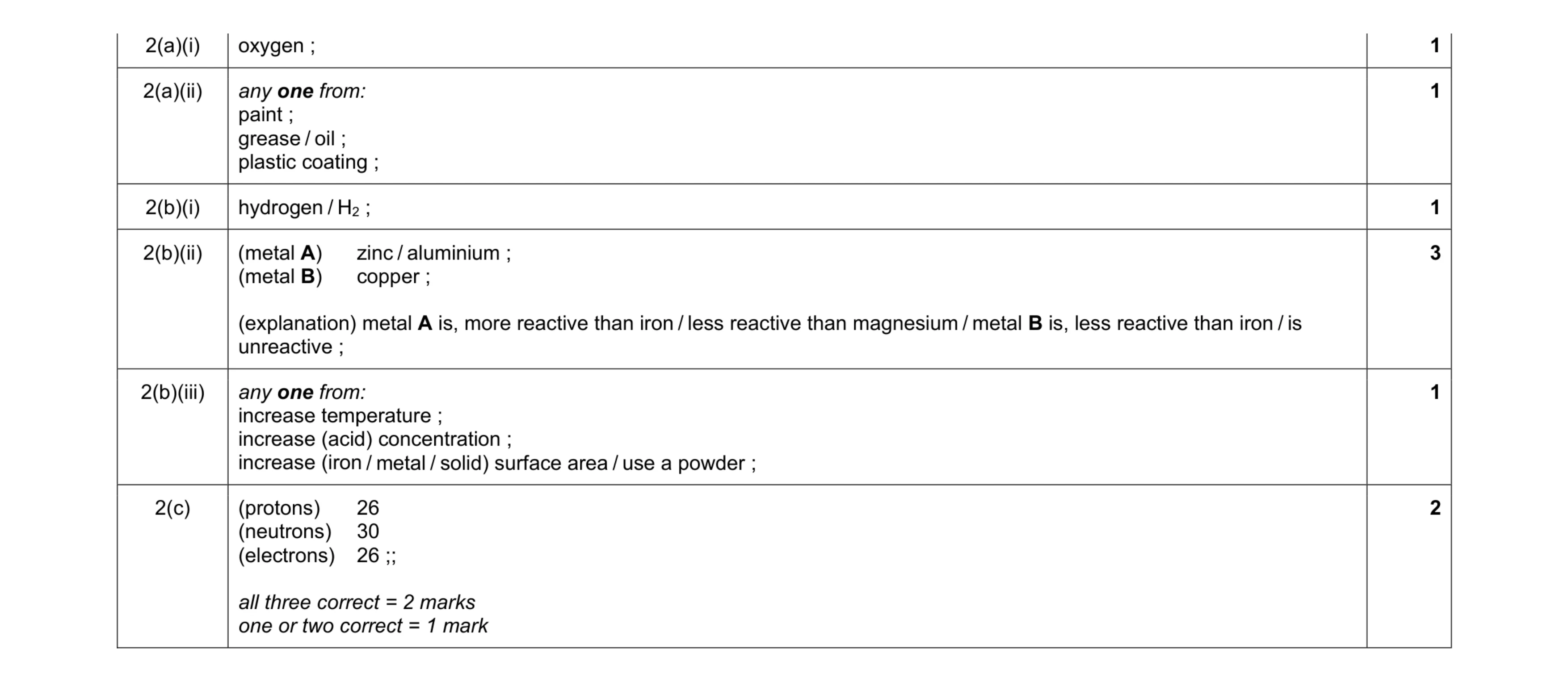 9
9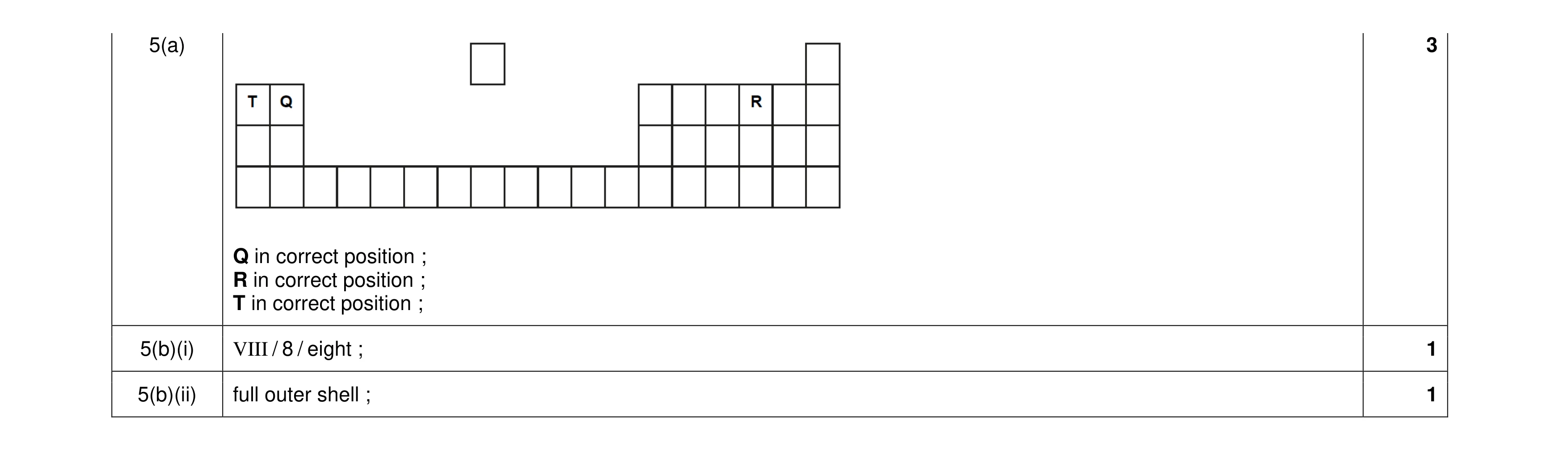 5
5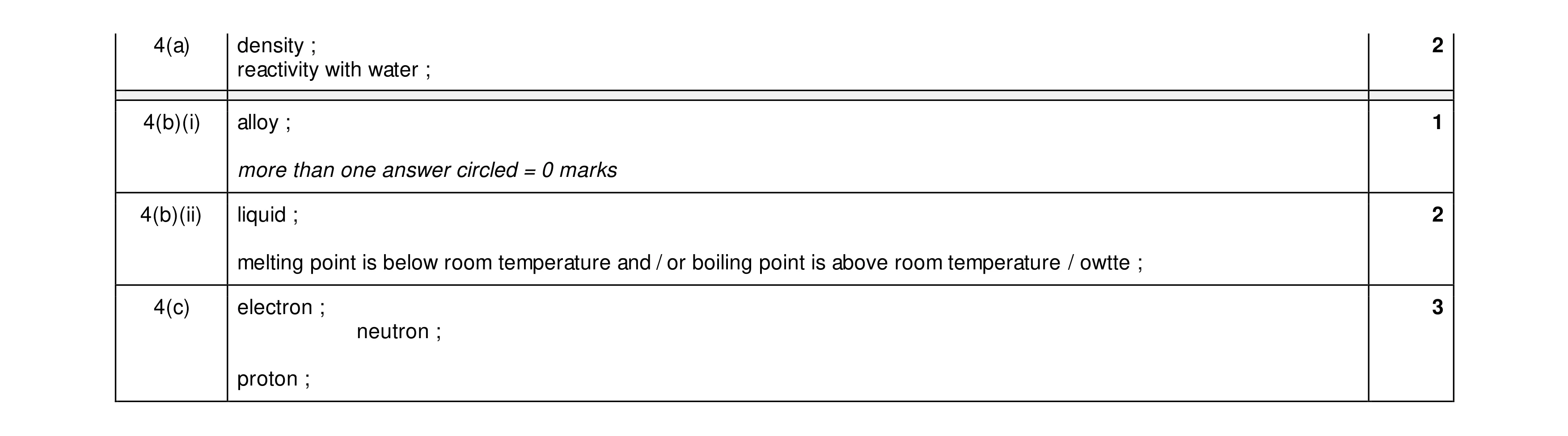 8
8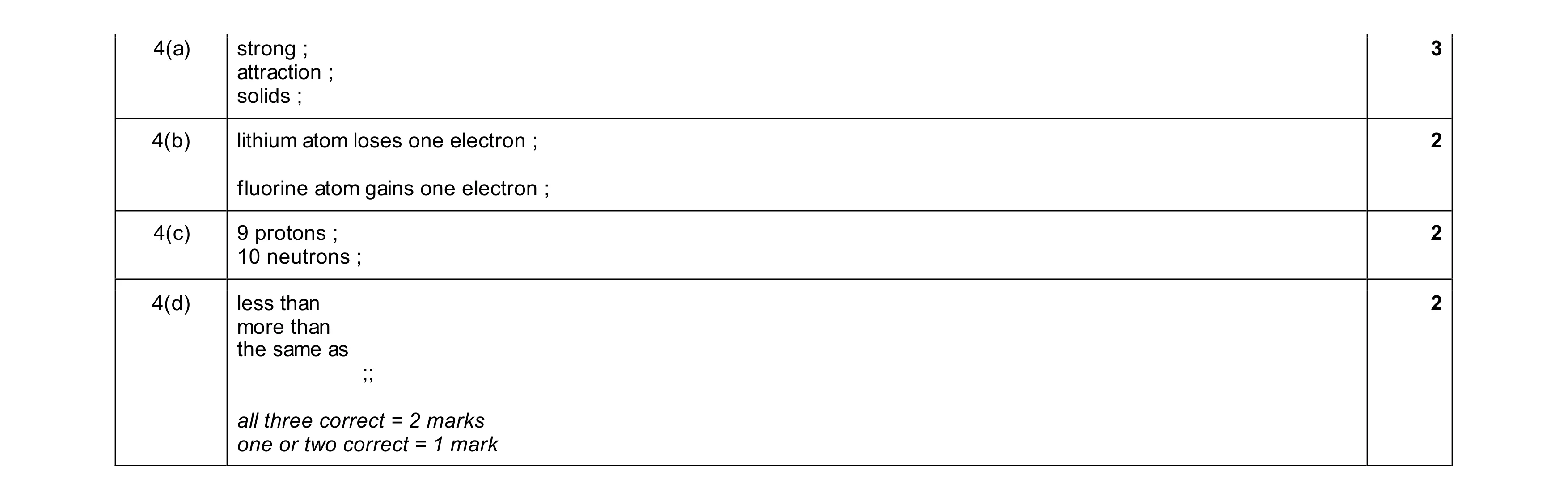 9
9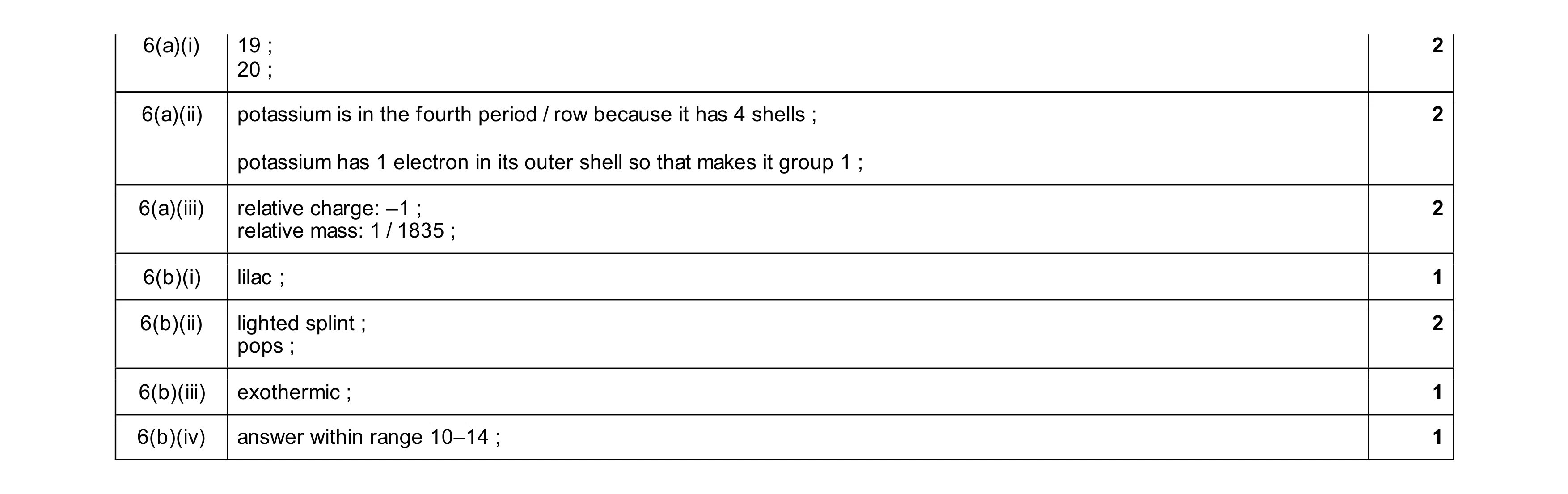 11
11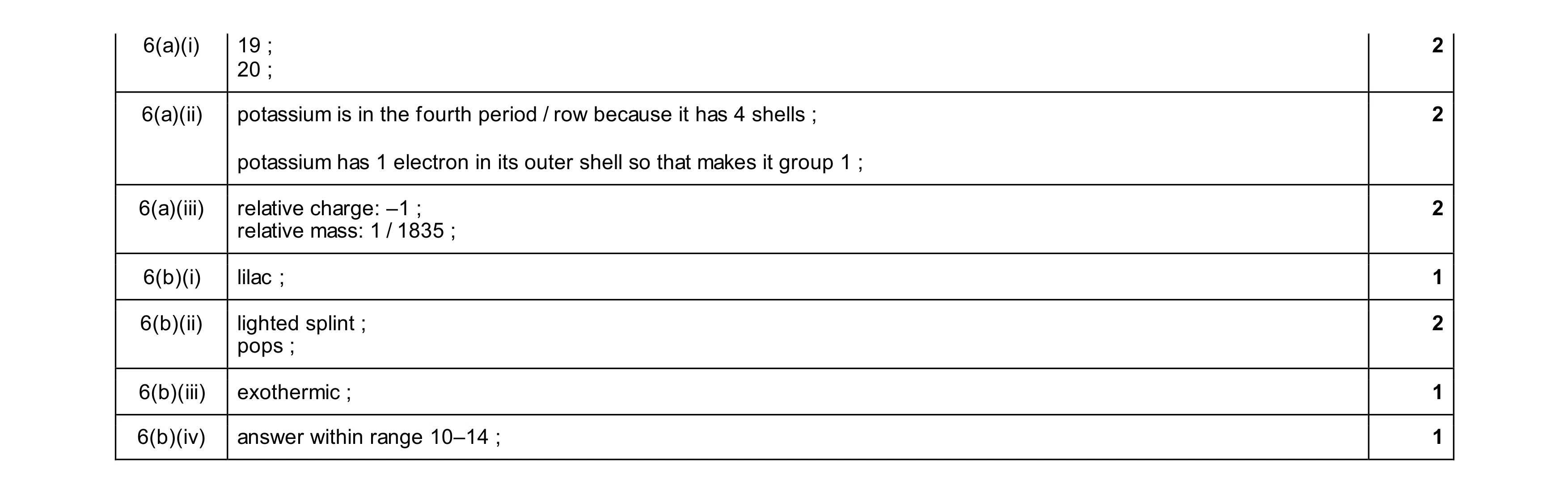 11
11