Questions as text
Q1 · Which aim of government policy is most likely to be achieved by a decrease in government… 0455/11 Oct/Nov 2004
29 Which aim of government policy is most likely to be achieved by a decrease in government spending? A economic growth B equality of income C full employment D price stability
1 marks
Answer: D
This question in 0455/11 Oct/Nov 2004
Q2 · Which of the following is the most obvious sign of inflation? 0455/11 Oct/Nov 2004
33 Which of the following is the most obvious sign of inflation? A an increase in imports B a rise in the national debt C a rise in the rate of interest D a rise in retail prices
1 marks
Answer: D
This question in 0455/11 Oct/Nov 2004
Q3 · Which aim of government policy is most likely to be achieved by an increase in interest… 0455/11 May/June 2006
25 Which aim of government policy is most likely to be achieved by an increase in interest rates? A economic growth B greater equality of income C full employment D price stability
1 marks
Answer: D
This question in 0455/11 May/June 2006
Q4 · The table shows some data about an economy 0455/11 May/June 2006
29 The table shows some data about an economy. Year 1 Year 2 rate of inflation 2 % 3.5 % personal incomes +2 % +2.5 % What happened between Year 1 and Year 2? A Both prices and real incomes fell. B Both prices and real incomes rose. C Prices rose but real incomes fell. D Prices fell but real incomes rose.
1 marks
Answer: C
This question in 0455/11 May/June 2006
Q5 · A person receives annual interest of 4 % on their saving 0455/11 Oct/Nov 2006
31 A person receives annual interest of 4 % on their saving. Inflation is 5 % per annum. What is the change in the real value of their saving? A It falls 1 %. B It rises 4 %. C It falls 5 %. D It rises 9 %.
1 marks
Answer: A
This question in 0455/11 Oct/Nov 2006
Q6 · Which situation would definitely cause a fall in real incomes? 0455/11 Oct/Nov 2007
27 Which situation would definitely cause a fall in real incomes? price level money income level A falls rises B falls unchanged C rises rises D rises unchanged
1 marks
Answer: D
This question in 0455/11 Oct/Nov 2007
Q7 · What would not be required in the construction of an index of consumer prices (retail… 0455/11 Oct/Nov 2007
28 What would not be required in the construction of an index of consumer prices (retail price index)? A the selection of a base year B the selection of a representative range of items C the calculation of average wage levels D the weighting of each item in the index
1 marks
Answer: C
This question in 0455/11 Oct/Nov 2007
Q8 · The table shows the rates of inflation in four countries over a period of four years 0455/11 Oct/Nov 2008
32 The table shows the rates of inflation in four countries over a period of four years. Which country had the highest average rate of inflation over the four year period? rate of inflation % country year 1 year 2 year 3 year 4 A 3 3 4 4 B 4 8 4 2 C 2 3 3 4 D 5 5 6 3
1 marks
Answer: D
This question in 0455/11 Oct/Nov 2008
Q9 · What is not an important step in the construction of an accurate Retail Price Index? 0455/11 May/June 2009
21 What is not an important step in the construction of an accurate Retail Price Index? A choosing a base year with normal economic conditions B comparing price rises with those of international competitors C sampling prices from a wide range of retail outlets D selecting a typical basket of goods consumed by the average citizen
1 marks
Answer: B
This question in 0455/11 May/June 2009
Q10 · The table shows the percentage changes in earnings and consumer prices for four countries… 0455/11 May/June 2009
22 The table shows the percentage changes in earnings and consumer prices for four countries for one year. Which country is likely to have experienced the greatest increase in real income during the year? country earnings consumer prices A France +12.5 +9.5 B Japan +4.0 +2.0 C UK +8.5 +5.0 D Germany +4.0 +4.0
1 marks
Answer: C
This question in 0455/11 May/June 2009
Q11 · The retail price index of a country rose during a year from 200 to 240 0455/11 May/June 2010
23 The retail price index of a country rose during a year from 200 to 240. What was the annual rate of inflation? A 20 % B 40 % C 240 % D 440 %
1 marks
Answer: A
This question in 0455/11 May/June 2010
Q12 · A government achieves a high rate of economic growth 0455/12 May/June 2010
21 A government achieves a high rate of economic growth. How may this conflict with other government aims? A It may increase government income. B It may increase incomes for the lower paid. C It may increase the supply of exports. D It may increase the volume of imports.
1 marks
Answer: D
This question in 0455/12 May/June 2010
Q13 · The retail price index of a country rose during a year from 200 to 240 0455/12 May/June 2010
24 The retail price index of a country rose during a year from 200 to 240. What was the annual rate of inflation? A 20 % B 40 % C 240 % D 440 %
1 marks
Answer: A
This question in 0455/12 May/June 2010
Q14 · ‘Savers suffer as inflation rises to 4.4 %.’ Which function of money is most involved in… 0455/11 Oct/Nov 2010
10 ‘Savers suffer as inflation rises to 4.4 %.’ Which function of money is most involved in this statement? A means of deferred payments B medium of exchange C store of value D unit of account
1 marks
Answer: C
This question in 0455/11 Oct/Nov 2010
Q15 · In Germany’s 2007 retail price index, transport received a higher weighting than clothing… 0455/11 Oct/Nov 2010
23 In Germany’s 2007 retail price index, transport received a higher weighting than clothing and footwear. What does this difference indicate? A Households spent more on transport than on clothing and footwear. B The price of transport rose by more than the price of clothing and footwear. C Transport is more of a luxury good than clothing and footwear. D Wage rises in the transport industry were higher than wage rises in the clothing and footwear industry.
1 marks
Answer: A
This question in 0455/11 Oct/Nov 2010
Q16 · ‘Savers suffer as inflation rises to 4.4 %.’ Which function of money is most involved in… 0455/12 Oct/Nov 2010
11 ‘Savers suffer as inflation rises to 4.4 %.’ Which function of money is most involved in this statement? A means of deferred payments B medium of exchange C store of value D unit of account
1 marks
Answer: C
This question in 0455/12 Oct/Nov 2010
Q17 · In Germany’s 2007 retail price index, transport received a higher weighting than clothing… 0455/12 Oct/Nov 2010
24 In Germany’s 2007 retail price index, transport received a higher weighting than clothing and footwear. What does this difference indicate? A Households spent more on transport than on clothing and footwear. B The price of transport rose by more than the price of clothing and footwear. C Transport is more of a luxury good than clothing and footwear. D Wage rises in the transport industry were higher than wage rises in the clothing and footwear industry.
1 marks
Answer: A
This question in 0455/12 Oct/Nov 2010
Q18 · ‘Savers suffer as inflation rises to 4.4 %.’ Which function of money is most involved in… 0455/13 Oct/Nov 2010
12 ‘Savers suffer as inflation rises to 4.4 %.’ Which function of money is most involved in this statement? A means of deferred payments B medium of exchange C store of value D unit of account
1 marks
Answer: C
This question in 0455/13 Oct/Nov 2010
Q19 · In Germany’s 2007 retail price index, transport received a higher weighting than clothing… 0455/13 Oct/Nov 2010
25 In Germany’s 2007 retail price index, transport received a higher weighting than clothing and footwear. What does this difference indicate? A Households spent more on transport than on clothing and footwear. B The price of transport rose by more than the price of clothing and footwear. C Transport is more of a luxury good than clothing and footwear. D Wage rises in the transport industry were higher than wage rises in the clothing and footwear industry.
1 marks
Answer: A
This question in 0455/13 Oct/Nov 2010
Q20 · The central bank of Mexico set its rate of interest to try to keep the rise in the price… 0455/11 May/June 2011
20 The central bank of Mexico set its rate of interest to try to keep the rise in the price level to only 3 %. Which government aim was it directly trying to achieve? A balance of payments equilibrium B economic growth C full employment D low inflation
1 marks
Answer: D
This question in 0455/11 May/June 2011
Q21 · The central bank of Mexico set its rate of interest to try to keep the rise in the price… 0455/12 May/June 2011
23 The central bank of Mexico set its rate of interest to try to keep the rise in the price level to only 3 %. Which government aim was it directly trying to achieve? A balance of payments equilibrium B economic growth C full employment D low inflation
1 marks
Answer: D
This question in 0455/12 May/June 2011
Q22 · The central bank of Mexico set its rate of interest to try to keep the rise in the price… 0455/13 May/June 2011
23 The central bank of Mexico set its rate of interest to try to keep the rise in the price level to only 3 %. Which government aim was it directly trying to achieve? A balance of payments equilibrium B economic growth C full employment D low inflation
1 marks
Answer: D
This question in 0455/13 May/June 2011
Q23 · What would be most likely to reduce the rate of inflation? 0455/11 May/June 2012
20 What would be most likely to reduce the rate of inflation? A an increase in direct taxes B an increase in government expenditure C an increase in indirect taxes D an increase in the budget deficit
1 marks
Answer: A
This question in 0455/11 May/June 2012
Q24 · A government has a target of keeping inflation between 2 % and 3 % 0455/11 May/June 2012
25 A government has a target of keeping inflation between 2 % and 3 %. The diagram shows the rate of inflation over a four year period. 5 4 3 inflation rate of inflation 2 target % 1 0 1 2 3 4 –1 year What can be deduced from the diagram? A The government target was missed in two years. B The price level fell in two years. C The price level was at its highest in the first year. D The real value of money fell in three years.
1 marks
Answer: D
This question in 0455/11 May/June 2012
Q25 · What would be most likely to reduce the rate of inflation? 0455/12 May/June 2012
20 What would be most likely to reduce the rate of inflation? A an increase in direct taxes B an increase in government expenditure C an increase in indirect taxes D an increase in the budget deficit
1 marks
Answer: A
This question in 0455/12 May/June 2012
Q26 · The diagram shows a country’s inflation rate in four successive years 0455/12 May/June 2012
25 The diagram shows a country’s inflation rate in four successive years. +15 +10 +5 inflation rate % 0 –5 1 2 3 4 year In which year was the country’s general price level lowest and highest? lowest general price highest general price level year level year A 1 3 B 3 2 C 3 4 D 4 2
1 marks
Answer: A
This question in 0455/12 May/June 2012
Q27 · What would be most likely to reduce the rate of inflation? 0455/13 May/June 2012
20 What would be most likely to reduce the rate of inflation? A an increase in direct taxes B an increase in government expenditure C an increase in indirect taxes D an increase in the budget deficit
1 marks
Answer: A
This question in 0455/13 May/June 2012
Q28 · The inhabitants of an economy experience an increase in their cost of living, their… 0455/13 May/June 2012
24 The inhabitants of an economy experience an increase in their cost of living, their living standards and their leisure time. Which combination of events could explain these changes? average price level real GDP working week A decrease decrease increase B decrease increase decrease C increase decrease increase D increase increase decrease
1 marks
Answer: D
This question in 0455/13 May/June 2012
Q29 · The diagram shows a country’s inflation rate in four successive years 0455/13 May/June 2012
25 The diagram shows a country’s inflation rate in four successive years. +15 +10 +5 inflation rate % 0 –5 1 2 3 4 year In which year was the country’s general price level lowest and highest? lowest general price highest general price level year level year A 1 3 B 3 2 C 3 4 D 4 2
1 marks
Answer: A
This question in 0455/13 May/June 2012
Q30 · In the measurement of the UK’s Retail Prices Index, a greater weight was given to bottled… 0455/11 Oct/Nov 2012
30 In the measurement of the UK’s Retail Prices Index, a greater weight was given to bottled water in 2010 than 2009. What does this change indicate? A Government statisticians checked the price change of a greater range of bottled water in 2010 than in 2009. B People spent a higher proportion of their total spending on bottled water in 2010 than in 2009. C The price of bottled water increased more in 2010 than in 2009. D There was an improvement in the quality of bottled water in 2010 compared with 2009.
1 marks
Answer: B
This question in 0455/11 Oct/Nov 2012
Q31 · In the measurement of the UK’s Retail Prices Index, a greater weight was given to bottled… 0455/12 Oct/Nov 2012
25 In the measurement of the UK’s Retail Prices Index, a greater weight was given to bottled water in 2010 than 2009. What does this change indicate? A Government statisticians checked the price change of a greater range of bottled water in 2010 than in 2009. B People spent a higher proportion of their total spending on bottled water in 2010 than in 2009. C The price of bottled water increased more in 2010 than in 2009. D There was an improvement in the quality of bottled water in 2010 compared with 2009.
1 marks
Answer: B
This question in 0455/12 Oct/Nov 2012
Q32 · A government reduces the interest rate to encourage economic growth 0455/12 May/June 2013
22 A government reduces the interest rate to encourage economic growth. Which other aim of government policy might now become more difficult to achieve? A reducing a balance of trade in goods surplus B reducing a government budget deficit C reducing the level of unemployment D reducing the rate of inflation
1 marks
Answer: D
This question in 0455/12 May/June 2013
Q33 · In the United States (US) Consumer Price Index (CPI), food has a weighting of 13.7% 0455/12 May/June 2013
25 In the United States (US) Consumer Price Index (CPI), food has a weighting of 13.7%. In the Indian CPI, food’s weighting is 46.2%. What can be concluded from this? A Consumers in India spend more on food than US consumers. B Food is a bigger proportion of consumer spending in India than in the US. C The farming sector’s output of food is higher in India than in the US. D The price of food is rising more rapidly in India than in the US.
1 marks
Answer: B
This question in 0455/12 May/June 2013
Q34 · The table gives information about some economic indicators in a number of countries 0455/13 May/June 2013
30 The table gives information about some economic indicators in a number of countries. inflation interest rates unemployment % % % country W 1.4 3.4 10.2 country X 3.7 8.7 12.3 country Y 3.6 7.3 14.2 country Z 2.1 6.0 7.7 What may be concluded from this information? A Countries with higher inflation have higher interest rates. B Countries with higher interest rates have lower inflation. C The country with the lowest inflation had the highest unemployment. D The country with the lowest unemployment had the highest inflation.
1 marks
Answer: A
This question in 0455/13 May/June 2013
Q35 · Which aim of government policy is most likely to be achieved by an increase in interest… 0455/11 Oct/Nov 2013
6 Which aim of government policy is most likely to be achieved by an increase in interest rates? A economic growth B greater equality of income C full employment D price stability
1 marks
Answer: D
This question in 0455/11 Oct/Nov 2013
Q36 · Which aim of government policy is most likely to be achieved by an increase in interest… 0455/12 Oct/Nov 2013
20 Which aim of government policy is most likely to be achieved by an increase in interest rates? A economic growth B greater equality of income C full employment D price stability
1 marks
Answer: D
This question in 0455/12 Oct/Nov 2013
Q37 · Which aim of government policy is most likely to be achieved by an increase in interest… 0455/13 Oct/Nov 2013
20 Which aim of government policy is most likely to be achieved by an increase in interest rates? A economic growth B greater equality of income C full employment D price stability
1 marks
Answer: D
This question in 0455/13 Oct/Nov 2013
Q38 · Governments aim to encourage stable prices because inflation can result in a current… 0455/11 May/June 2014
18 Governments aim to encourage stable prices because inflation can result in a current account deficit on the balance of payments. How does high inflation contribute to a current account deficit? A Countries have to barter manufactured goods for raw materials. B Goods manufactured for export lose their competitiveness. C Numbers of foreign visitors increase. D Spending on imported goods is reduced.
1 marks
Answer: B
This question in 0455/11 May/June 2014
Q39 · What is the definition of inflation? 0455/11 May/June 2014
20 What is the definition of inflation? A an increase in demand B an increase in output C an increase in the general price level D an increase in wages
1 marks
Answer: C
This question in 0455/11 May/June 2014
Q40 · In 2013 there was a period of low interest rates and high inflation in an economy 0455/12 May/June 2014
22 In 2013 there was a period of low interest rates and high inflation in an economy. Who would be most likely to benefit and who most likely to lose during such a period? benefit lose A borrowers savers B consumers on fixed incomes firms wishing to invest C credit card companies sellers of luxury goods D exporters banks
1 marks
Answer: A
This question in 0455/12 May/June 2014
Q41 · What is the definition of inflation? 0455/13 May/June 2014
19 What is the definition of inflation? A an increase in demand B an increase in output C an increase in the general price level D an increase in wages
1 marks
Answer: C
This question in 0455/13 May/June 2014
Q42 · Governments aim to encourage stable prices because inflation can result in a current… 0455/13 May/June 2014
21 Governments aim to encourage stable prices because inflation can result in a current account deficit on the balance of payments. How does high inflation contribute to a current account deficit? A Countries have to barter manufactured goods for raw materials. B Goods manufactured for export lose their competitiveness. C Numbers of foreign visitors increase. D Spending on imported goods is reduced.
1 marks
Answer: B
This question in 0455/13 May/June 2014
Q43 · When might rapid inflation together with low interest rates be a source of concern for a… 0455/11 Oct/Nov 2014
9 When might rapid inflation together with low interest rates be a source of concern for a consumer? A when a consumer lives on a pension linked to the consumer price index B when a consumer needs to use savings for regular expenditure C when a consumer pays a fixed rent for their accommodation D when a consumer wishes to buy a good on credit
1 marks
Answer: B
This question in 0455/11 Oct/Nov 2014
Q44 · What must be a consequence of deflation in a country? 0455/11 Oct/Nov 2014
23 What must be a consequence of deflation in a country? A a decrease in its exports B a decrease in its saving C an increase in its employment D an increase in the real value of its money
1 marks
Answer: D
This question in 0455/11 Oct/Nov 2014
Q45 · When might rapid inflation together with low interest rates be a source of concern for a… 0455/12 Oct/Nov 2014
10 When might rapid inflation together with low interest rates be a source of concern for a consumer? A when a consumer lives on a pension linked to the consumer price index B when a consumer needs to use savings for regular expenditure C when a consumer pays a fixed rent for their accommodation D when a consumer wishes to buy a good on credit
1 marks
Answer: B
This question in 0455/12 Oct/Nov 2014
Q46 · A government aims to keep domestic prices stable in a fully employed economy 0455/12 Oct/Nov 2014
16 A government aims to keep domestic prices stable in a fully employed economy. Which policy should it use? A increase expenditure on defence B increase indirect taxes C increase the rate of interest D increase the wages of government workers
1 marks
Answer: C
This question in 0455/12 Oct/Nov 2014
Q47 · What must be a consequence of deflation in a country? 0455/12 Oct/Nov 2014
20 What must be a consequence of deflation in a country? A a decrease in its exports B a decrease in its saving C an increase in its employment D an increase in the real value of its money
1 marks
Answer: D
This question in 0455/12 Oct/Nov 2014
Q48 · In 2008, economic conditions in the UK were uncertain and the rate of inflation increased 0455/13 Oct/Nov 2014
10 In 2008, economic conditions in the UK were uncertain and the rate of inflation increased. It was reported that consumers had increased their purchases of rare stamps which continued to rise in value. What is not a reason for such purchases? A to avoid risk B to diversify their investments C to overcome the effects of inflation D to switch from spending to borrowing
1 marks
Answer: D
This question in 0455/13 Oct/Nov 2014
Q49 · Which combination of changes could cause a fall in the purchasing power of workers in a… 0455/13 Oct/Nov 2014
20 Which combination of changes could cause a fall in the purchasing power of workers in a country? % change in % change in wages rates the price level A –2 –4 B 0 –2 C 4 4 D 4 6
1 marks
Answer: D
This question in 0455/13 Oct/Nov 2014
Q50 · What will increase when there is a period of deflation during which the general price… 0455/13 Oct/Nov 2014
21 What will increase when there is a period of deflation during which the general price level continues to fall? A confidence of investors B consumer demand C unemployment D wage rates
1 marks
Answer: C
This question in 0455/13 Oct/Nov 2014
Q51 · The information below relates to selected countries in 2012 0455/13 Oct/Nov 2014
22 The information below relates to selected countries in 2012. consumer prices unemployment rate (annual % change) (%) India +10.0 9.8 Sweden +1.4 8.8 Switzerland –0.4 2.9 Venezuela +22.8 7.4 What can be concluded from this information? A Inflation is a possible cause of unemployment. B Inflation is the only cause of unemployment. C Low unemployment is linked to high inflation. D There is a uniform link between the rate of inflation and unemployment.
1 marks
Answer: A
This question in 0455/13 Oct/Nov 2014
Q52 · A worker earns $250 each week, which leaves a disposable income of $175 0455/11 May/June 2015
21 A worker earns $250 each week, which leaves a disposable income of $175. What will affect the real value of the worker’s $250 earned income? A a change in government spending B a change in interest rates C a change in the price level D a change in the tax rate
1 marks
Answer: C
This question in 0455/11 May/June 2015
Q53 · What is most likely to cause a fall in the rate of inflation? 0455/12 May/June 2015
16 What is most likely to cause a fall in the rate of inflation? A an increase in consumer spending B an increase in import prices C an increase in income tax D an increase in wage rates
1 marks
Answer: C
This question in 0455/12 May/June 2015
Q54 · A government increases expenditure on infrastructure to stimulate an economy 0455/12 May/June 2015
19 A government increases expenditure on infrastructure to stimulate an economy. With which of the other government aims for an economy might this conflict? A a decrease in income inequality B a higher rate of economic growth C a lower level of unemployment D a steady price level
1 marks
Answer: D
This question in 0455/12 May/June 2015
Q55 · Who is most likely to benefit during a period of inflation? 0455/12 May/June 2015
20 Who is most likely to benefit during a period of inflation? A creditors (lenders) B debtors (borrowers) C fixed income earners D holders of cash
1 marks
Answer: B
This question in 0455/12 May/June 2015
Q56 · When would an increase in aggregate demand be least likely to result in inflation in an… 0455/12 May/June 2015
23 When would an increase in aggregate demand be least likely to result in inflation in an economy? A when it is the result of an increase in government expenditure B when it is the result of an increase in expenditure on consumer goods C when there are substantial unemployed resources in the economy D when there is a substantial increase in expenditure on imports
1 marks
Answer: C
This question in 0455/12 May/June 2015
Q57 · The following information was published by an economy’s central bank 0455/13 May/June 2015
23 The following information was published by an economy’s central bank. In which case was real GDP growth highest? rate of nominal rate of GDP growth (%) inflation (%) A 2.0 1.0 B 7.0 5.0 C 9.0 13.0 D 10.0 11.0
1 marks
Answer: B
This question in 0455/13 May/June 2015
Q58 · What is not involved in the construction of a retail price index? 0455/11 Oct/Nov 2015
21 What is not involved in the construction of a retail price index? A a base year B a basket of goods C the income tax rate D the weighting of products
1 marks
Answer: C
This question in 0455/11 Oct/Nov 2015
Q59 · The table shows the percentage change in earnings and consumer prices for four countries… 0455/11 Oct/Nov 2015
23 The table shows the percentage change in earnings and consumer prices for four countries for one year. Which country will have experienced a constant level of real income during the year? consumer earnings prices A 7.5 6 B 5 4 C 3 3 D 0 2
1 marks
Answer: C
This question in 0455/11 Oct/Nov 2015
Q60 · How is a sharp rise in the price of oil likely to be seen by different oil-consuming… 0455/11 Oct/Nov 2015
26 How is a sharp rise in the price of oil likely to be seen by different oil-consuming countries? oil-consuming countries with oil-consuming countries with a low standard of living a high standard of living A desirable and manageable desirable and unmanageable B desirable and unmanageable desirable and manageable C undesirable and manageable undesirable and unmanageable D undesirable and unmanageable undesirable and manageable
1 marks
Answer: D
This question in 0455/11 Oct/Nov 2015
Q61 · In 2009, a country had an inflation rate of 2% 0455/12 Oct/Nov 2015
22 In 2009, a country had an inflation rate of 2%. The table shows the inflation rate in the following years. inflation rate year (%) 2010 2 2011 1 2012 0 2013 –1 In which year did deflation start? A 2010 B 2011 C 2012 D 2013
1 marks
Answer: D
This question in 0455/12 Oct/Nov 2015
Q62 · What is involved in the construction of a retail price index? 0455/12 Feb/March 2016
20 What is involved in the construction of a retail price index? A a basket of goods B average incomes C economic growth rate D income tax rate
1 marks
Answer: A
This question in 0455/12 Feb/March 2016
Q63 · The table shows the percentage changes in earnings and consumer prices for four countries… 0455/12 Feb/March 2016
22 The table shows the percentage changes in earnings and consumer prices for four countries for one year. Which country is likely to have experienced the greatest increase in real income during the year? country earnings consumer prices A France +6.5 +3.5 B Germany +4.0 +4.0 C Japan +4.0 –1.0 D UK +6.5 –2.0
1 marks
Answer: D
This question in 0455/12 Feb/March 2016
Q64 · In the US Consumer Price Index (CPI), food has a weighting of 13.7% 0455/12 Feb/March 2016
23 In the US Consumer Price Index (CPI), food has a weighting of 13.7%. In India food has a weighting of 46.2% in the CPI. What can be concluded from this? A Consumers in India spend more on food than US consumers. B Food is a bigger proportion of consumer spending in India than in the US. C The farming sector’s output of food is higher in India than in the US. D The price of food is rising more rapidly in India than in the US.
1 marks
Answer: B
This question in 0455/12 Feb/March 2016
Q65 · Who is made worse off during a period of deflation? 0455/11 May/June 2016
21 Who is made worse off during a period of deflation? A cash holders B creditors C debtors D fixed income earners
1 marks
Answer: C
This question in 0455/11 May/June 2016
Q66 · The weight for a product in the consumer price index was increased 0455/12 May/June 2016
23 The weight for a product in the consumer price index was increased. What is most likely to have caused this adjustment? A The product has become more expensive to produce. B The product has been offered for sale in more retail outlets. C The product has improved in quality and performance. D The product has taken a bigger share of consumers’ income.
1 marks
Answer: D
This question in 0455/12 May/June 2016
Q67 · What is most likely to lead to a rise in the rate of inflation? 0455/13 May/June 2016
20 What is most likely to lead to a rise in the rate of inflation? A a decrease in consumer spending B a decrease in unemployment benefits C an increase in import prices D an increase in income tax
1 marks
Answer: C
This question in 0455/13 May/June 2016
Q68 · What is involved in the construction of a Retail Price Index? 0455/12 Oct/Nov 2016
20 What is involved in the construction of a Retail Price Index? A a base year B incomes C price elasticity of products D quantity supplied
1 marks
This question in 0455/12 Oct/Nov 2016
Q69 · Why is nominal Gross Domestic Product not a good measure to compare the standard of… 0455/12 Oct/Nov 2016
21 Why is nominal Gross Domestic Product not a good measure to compare the standard of living in a country between two years? A It does not account for inflation. B It does not allow for savings. C It does not include government expenditure. D It only compares export prices with import prices.
1 marks
This question in 0455/12 Oct/Nov 2016
Q70 · Some goods take a greater percentage of a typical household’s total spending than others 0455/12 Oct/Nov 2016
23 Some goods take a greater percentage of a typical household’s total spending than others. How is this accounted for in the construction of a Retail Price Index? A by deducting the goods and services B by giving a weight to the goods C by taking an average of price fluctuations during a year D by using the price elasticity of demand for the goods
1 marks
This question in 0455/12 Oct/Nov 2016
Q71 · The table shows the Consumer Price Index (CPI) of an economy over five years 0455/12 Feb/March 2017
22 The table shows the Consumer Price Index (CPI) of an economy over five years. year CPI 1 100 2 103 3 105 4 107 5 110 Between which years was the rate of inflation the greatest? A from year 1 to year 2 B from year 2 to year 3 C from year 3 to year 4 D from year 4 to year 5
1 marks
Answer: A
This question in 0455/12 Feb/March 2017
Q72 · In a year the rate of inflation in a country was 3% 0455/12 Feb/March 2017
23 In a year the rate of inflation in a country was 3%. During that year company managers’ salaries rose by 6% and office workers’ wages rose by 2%. What happened to real income (purchasing power)? company office managers workers A fell fell B fell rose C rose fell D rose rose
1 marks
Answer: C
This question in 0455/12 Feb/March 2017
Q73 · In trying to achieve one of its aims a government may make it difficult to achieve… 0455/11 May/June 2017
18 In trying to achieve one of its aims a government may make it difficult to achieve another aim. What is an example of this conflict? A Achieving a more even distribution of income may prevent a rise in the average standard of living. B Achieving an increase in economic growth may prevent full employment. C Achieving full employment may prevent stable prices. D Achieving stable prices may prevent a current account surplus on the balance of payments.
1 marks
Answer: C
This question in 0455/11 May/June 2017
Q74 · In a developing country real incomes have risen 0455/11 May/June 2017
23 In a developing country real incomes have risen. Which situation would definitely have caused this? money price level incomes A fell fell B fell rose C rose unchanged D rose fell
1 marks
Answer: B
This question in 0455/11 May/June 2017
Q75 · What is meant by deflation? 0455/12 May/June 2017
21 What is meant by deflation? A a fall in the general price level B a fall in the international value of a currency C a fall in the rate of inflation D a fall in the real value of money
1 marks
Answer: A
This question in 0455/12 May/June 2017
Q76 · The table shows some information from a developing country 0455/13 May/June 2017
23 The table shows some information from a developing country. consumer prices: % change on previous year percentage change year on previous year (%) 2011 4 2012 5 2013 3 2014 2 Which statement must be correct? A Prices fell between 2013 and 2014. B The cost of living was lowest in 2014. C The purchasing power of money rose between 2012 and 2013. D Those on fixed incomes became worse off between 2011 and 2012.
1 marks
Answer: D
This question in 0455/13 May/June 2017
Q77 · What, when increased, will help a government to reduce the rate of inflation? 0455/11 Oct/Nov 2017
16 What, when increased, will help a government to reduce the rate of inflation? A budget deficit B consumer spending C income tax D pensions
1 marks
Answer: C
This question in 0455/11 Oct/Nov 2017
Q78 · Which policy aims to maintain low inflation over a period of time? 0455/11 Oct/Nov 2017
23 Which policy aims to maintain low inflation over a period of time? A imposing a minimum wage to be paid to workers B reducing interest rates to encourage borrowing C restricting the supply of money through the central bank D writing off the debts of low-income countries
1 marks
Answer: C
This question in 0455/11 Oct/Nov 2017
Q79 · What, when increased, will help a government to reduce the rate of inflation? 0455/12 Oct/Nov 2017
16 What, when increased, will help a government to reduce the rate of inflation? A budget deficit B consumer spending C income tax D pensions
1 marks
Answer: C
This question in 0455/12 Oct/Nov 2017
Q80 · A finance minister reported that the economy was experiencing inflation and economic… 0455/12 Oct/Nov 2017
21 A finance minister reported that the economy was experiencing inflation and economic growth. What would be evidence that both of these had occurred? A increased exports and increased output B increased imports and increased income tax C increased interest rates and increased net migration D increased prices and increased employment
1 marks
Answer: D
This question in 0455/12 Oct/Nov 2017
Q81 · What would be a cause of cost-push inflationary pressure in an industry which supplies… 0455/12 Oct/Nov 2017
23 What would be a cause of cost-push inflationary pressure in an industry which supplies mobile (cell) phones? A an increase in advertising expenses for mobile phones B an increase in export duties on mobile phones C an increase in income taxes on wages of employees D an increase in world demand for mobile phones
1 marks
Answer: A
This question in 0455/12 Oct/Nov 2017
Q82 · What, when increased, will help a government to reduce the rate of inflation? 0455/13 Oct/Nov 2017
16 What, when increased, will help a government to reduce the rate of inflation? A budget deficit B consumer spending C income tax D pensions
1 marks
Answer: C
This question in 0455/13 Oct/Nov 2017
Q83 · The table shows the Consumer Prices Index (CPI) for selected cities for August 2015… 0455/13 Oct/Nov 2017
26 The table shows the Consumer Prices Index (CPI) for selected cities for August 2015 relative to New York, USA at 100. city CPI Geneva, Switzerland 137 Oslo, Norway 105 Sydney, Australia 89 Singapore 88 Istanbul, Turkey 48 Johannesburg, South Africa 48 Lima, Peru 44 What can be concluded from the table? A Geneva had the highest average price level. B Living standards were highest in Lima. C Singapore was more expensive than Oslo. D The annual rate of inflation was the same in Istanbul and Johannesburg.
1 marks
Answer: A
This question in 0455/13 Oct/Nov 2017
Q84 · What is included in the calculation of a consumer prices index (CPI)? 0455/11 May/June 2018
21 What is included in the calculation of a consumer prices index (CPI)? A the price of a basket of goods and services B the price of exports and the price of imports C the value of the currency on international markets D the wages of consumers
1 marks
Answer: A
This question in 0455/11 May/June 2018
Q85 · What determines the weights in the consumer prices index (CPI)? 0455/12 May/June 2018
21 What determines the weights in the consumer prices index (CPI)? A the average income received by the various households B the average increase in the prices of the different goods C the proportion of income spent by the average household on particular goods D the proportion of income that the average household saves
1 marks
Answer: C
This question in 0455/12 May/June 2018
Q86 · A basket of goods is used to calculate a country’s rate of inflation 0455/13 May/June 2018
21 A basket of goods is used to calculate a country’s rate of inflation. What is included in the basket of goods? A a representative sample of current household spending B all goods bought in the country C the spending on an unchanging group of necessities D the 50 most popular items of household spending
1 marks
Answer: A
This question in 0455/13 May/June 2018
Q87 · What is likely to assist a government’s policy of reducing inflation? 0455/11 Oct/Nov 2018
11 What is likely to assist a government’s policy of reducing inflation? A allowing businesses to borrow money for longer periods B encouraging the public to spend more money C increasing lending to members of the public D raising the interest rate on credit card borrowing
1 marks
Answer: D
This question in 0455/11 Oct/Nov 2018
Q88 · What is used to measure inflation? 0455/11 Oct/Nov 2018
21 What is used to measure inflation? A the consumer prices index (CPI) B the exchange rate C the gross domestic product (GDP) D the index of workers’ wages
1 marks
Answer: A
This question in 0455/11 Oct/Nov 2018
Q89 · Four groups who are affected by changing economic conditions are creditors, debtors… 0455/12 Oct/Nov 2018
21 Four groups who are affected by changing economic conditions are creditors, debtors, exporters and importers. Which pair is most likely to be disadvantaged by a high rate of inflation? A creditors and exporters B creditors and importers C debtors and exporters D debtors and importers
1 marks
Answer: A
This question in 0455/12 Oct/Nov 2018
Q90 · What is most likely to encourage the immediate purchase of an expensive item such as a… 0455/13 Oct/Nov 2018
11 What is most likely to encourage the immediate purchase of an expensive item such as a new car? A anticipating a fall in the rate of inflation B expecting interest rates to fall C making it easier to obtain a loan D needing to plan for unexpected emergencies
1 marks
Answer: C
This question in 0455/13 Oct/Nov 2018
Q91 · Which country is suffering from the worst deflation? 0455/13 Oct/Nov 2018
21 Which country is suffering from the worst deflation? annual change in indicator real GDP unemployment inflation per capita rate % (US$) % % A –5 +3 –3 B –2 –2 –2 C +2 –3 +1 D +12 +10 +3
1 marks
Answer: A
This question in 0455/13 Oct/Nov 2018
Q92 · What would be least likely to act as a store of value during a period of rapid inflation? 0455/12 Feb/March 2019
9 What would be least likely to act as a store of value during a period of rapid inflation? A cash B gold C property D shares
1 marks
Answer: A
This question in 0455/12 Feb/March 2019
Q93 · A government lowers interest rates to encourage more borrowing and spending by households… 0455/12 Feb/March 2019
18 A government lowers interest rates to encourage more borrowing and spending by households to increase economic growth. Why could this lead to a conflict with other government aims? A It could cause uncertainty and lead to lower demand. B It could encourage more savings and lead to higher unemployment. C It could lead to lower prices of consumer goods and result in deflation. D It could stimulate consumer demand and lead to inflation.
1 marks
Answer: D
This question in 0455/12 Feb/March 2019
Q94 · An economy experienced deflation 0455/12 Feb/March 2019
23 An economy experienced deflation. Which combination shows the likely outcome of this? consumer price investor confidence level confidence A decrease decrease decrease B decrease increase decrease C increase decrease increase D increase increase increase
1 marks
Answer: A
This question in 0455/12 Feb/March 2019
Q95 · The table shows the change in real incomes for a number of occupations between 1985 and… 0455/11 May/June 2019
11 The table shows the change in real incomes for a number of occupations between 1985 and 2015. change in occupation real income % doctors 153 lawyers 114 accountants 60 bricklayers 37 bus and coach drivers 19 fork-lift truck drivers –5 What can be concluded from the table? A All occupations were better off in 2015 than in 1985. B Fork-lift truck drivers earned the lowest wages in 2015. C Doctors have earned more than lawyers since 1985. D Professionals received higher percentage increases in income than manual workers.
1 marks
Answer: D
This question in 0455/11 May/June 2019
Q96 · Which statement about interest rate changes is accurate? 0455/11 May/June 2019
19 Which statement about interest rate changes is accurate? A A fall in interest rates will always increase inflation. B A rise in interest rates may increase cost-push inflation. C A rise in interest rates will raise the level of investment in a country. D Interest rate changes have no impact on the level of production.
1 marks
Answer: B
This question in 0455/11 May/June 2019
Q97 · In Uganda, the rate of inflation fell from 5% in 2014 to 2% in 2015 0455/11 May/June 2019
20 In Uganda, the rate of inflation fell from 5% in 2014 to 2% in 2015. Which conclusion can be drawn from this information? A Prices were higher in 2015 than in 2014. B The cost of living fell between 2014 and 2015. C The standard of living fell between 2014 and 2015. D Ugandan citizens were better off in 2015 than 2014.
1 marks
Answer: A
This question in 0455/11 May/June 2019
Q98 · A country is experiencing a period of full employment 0455/11 May/June 2019
22 A country is experiencing a period of full employment. What is most likely to lead to an increase in demand-pull inflation? A an increase in government spending B an increase in imports C an increase in income tax rates D an increase in sales tax
1 marks
Answer: A
This question in 0455/11 May/June 2019
Q99 · The table shows the percentage change from 2015–2016 in gross domestic product (GDP) and… 0455/11 May/June 2019
23 The table shows the percentage change from 2015–2016 in gross domestic product (GDP) and consumer prices for selected countries. Which country was suffering from economic recession and inflation? country GDP consumer prices A Australia +1.8 +1.3 B Brazil –2.9 +8.3 C China +6.7 +2.0 D Japan +1.1 –0.2
1 marks
Answer: B
This question in 0455/11 May/June 2019
Q100 · What is most likely to cause a rise in the rate of inflation in an economy? 0455/12 May/June 2019
16 What is most likely to cause a rise in the rate of inflation in an economy? A a fall in import prices B a fall in wage rates C a rise in the level of government spending D a rise in the level of unemployment
1 marks
Answer: C
This question in 0455/12 May/June 2019
Q101 · In January 2016 the rate of inflation in a country changed from 3% to 2% 0455/12 May/June 2019
23 In January 2016 the rate of inflation in a country changed from 3% to 2%. In March 2016 the rate of inflation was 4%. What happened to the price level in January and March? January March A fell fell B fell rose C rose fell D rose rose
1 marks
Answer: D
This question in 0455/12 May/June 2019
Q102 · The diagram shows percentage (%) changes in prices and wages over time 0455/13 May/June 2019
19 The diagram shows percentage (%) changes in prices and wages over time. 2.0 prices % change in wages 1.5 and prices 1.0 0.5 wages 0 2000 2005 2010 2015 year What does the diagram indicate? A Inflation is proportionately related to wage levels. B The gap between wages and prices is constant. C Wages are highest in 2010. D Wage earners have increasingly less purchasing power.
1 marks
Answer: D
This question in 0455/13 May/June 2019
Q103 · What might cause prices to rise because of cost-push inflation? 0455/13 May/June 2019
23 What might cause prices to rise because of cost-push inflation? A an increase in government spending on education B an increase in household consumption C an increase in the balance of payments surplus D an increase in wages and salaries
1 marks
Answer: D
This question in 0455/13 May/June 2019
Q104 · An African government has abandoned its own dollar and now uses the US dollar as its… 0455/11 Oct/Nov 2019
9 An African government has abandoned its own dollar and now uses the US dollar as its currency. Why would such a policy have been necessary? A Commercial banks restricted their lending. B Consumers only used credit cards rather than paper money. C Its own dollar no longer acted as a store of value. D The central bank controlled the issue of money too tightly.
1 marks
Answer: C
This question in 0455/11 Oct/Nov 2019
Q105 · Rates of inflation and deflation are measured using a consumer prices index (CPI) over a… 0455/11 Oct/Nov 2019
23 Rates of inflation and deflation are measured using a consumer prices index (CPI) over a period of time. The table shows average rates of CPI for Japan from 2010–2014. year change in CPI 2010 –0.72 2011 –0.28 2012 –0.03 2013 0.36 2014 2.75 In which period did Japan experience deflation followed by inflation? A 2010–2011 B 2011–2012 C 2012–2013 D 2013–2014
1 marks
Answer: C
This question in 0455/11 Oct/Nov 2019
Q106 · Venezuela, a leading world oil producer, has experienced hyperinflation of over 400% per… 0455/12 Oct/Nov 2019
23 Venezuela, a leading world oil producer, has experienced hyperinflation of over 400% per annum in recent years. How does hyperinflation affect an economy? prices effect A fluctuate up and down consumers are uncertain about future price levels B fluctuate up and down consumers can anticipate future price levels C rise very rapidly value of fixed assets remains stable D rise very rapidly money has limited worth as a medium of exchange
1 marks
Answer: D
This question in 0455/12 Oct/Nov 2019
Q107 · The graph shows the rate of inflation in a country between 2000 and 2014 0455/13 Oct/Nov 2019
23 The graph shows the rate of inflation in a country between 2000 and 2014. 8 inflation rate 7 % 6 5 4 3 2 1 0 2000 2010 2014 year What can be concluded about average prices? A They fell throughout the period. B They peaked in 2000. C They rose each year. D They were lower in 2014 than they were in 2010.
1 marks
Answer: C
This question in 0455/13 Oct/Nov 2019
Q108 · A person receives annual interest of 4% on their savings 0455/12 Feb/March 2020
22 A person receives annual interest of 4% on their savings. Inflation is 5% per annum. What is the approximate change in the real value of their savings? A – 5% B – 1% C + 4% D + 9%
1 marks
This question in 0455/12 Feb/March 2020
Q109 · An increase in which of the following is least likely to cause inflation? 0455/12 Feb/March 2020
23 An increase in which of the following is least likely to cause inflation? A consumer spending B government spending C income tax D wages
1 marks
This question in 0455/12 Feb/March 2020
Q110 · What would not be required in the construction of an index of consumer prices? 0455/11 May/June 2020
22 What would not be required in the construction of an index of consumer prices? A the selection of a base year B the selection of a representative range of items C the calculation of average wage levels D the weighting of each item in the index
1 marks
Answer: C
This question in 0455/11 May/June 2020
Q111 · What would not be required in the construction of an index of consumer prices? 0455/12 May/June 2020
22 What would not be required in the construction of an index of consumer prices? A the selection of a base year B the selection of a representative range of items C the calculation of average wage levels D the weighting of each item in the index
1 marks
Answer: C
This question in 0455/12 May/June 2020
Q112 · A government has a contractionary fiscal policy to reduce inflation 0455/13 May/June 2020
21 A government has a contractionary fiscal policy to reduce inflation. What will the government increase? A expenditure on infrastructure B income tax rates C personal tax allowances D unemployment benefits
1 marks
Answer: B
This question in 0455/13 May/June 2020
Q113 · What would not be required in the construction of an index of consumer prices? 0455/13 May/June 2020
22 What would not be required in the construction of an index of consumer prices? A the selection of a base year B the selection of a representative range of items C the calculation of average wage levels D the weighting of each item in the index
1 marks
Answer: C
This question in 0455/13 May/June 2020
Q114 · The table gives information about three economic indicators in four countries 0455/13 May/June 2020
23 The table gives information about three economic indicators in four countries. rate of rate of rate of inflation interest unemployment % % % country W 1.4 3.4 10.2 country X 3.7 8.7 12.3 country Y 3.6 7.3 14.2 country Z 2.1 6.0 7.7 What may be concluded from this information? A Countries with higher inflation have higher interest rates. B Countries with higher interest rates have lower unemployment. C The country with the lowest inflation had the highest unemployment. D The country with the lowest unemployment had the lowest inflation.
1 marks
Answer: A
This question in 0455/13 May/June 2020
Q115 · Real incomes have risen in a country 0455/13 May/June 2020
24 Real incomes have risen in a country. Which situation would definitely have caused this? money price level incomes A fell fell B fell rose C rose rose D rose fell
1 marks
Answer: B
This question in 0455/13 May/June 2020
Q116 · Some goods take a greater percentage of a typical household’s total spending than others 0455/11 Oct/Nov 2020
23 Some goods take a greater percentage of a typical household’s total spending than others. How is this accounted for in the construction of a consumer prices index? A by deducting the goods B by giving a weight to the goods C by taking an average of price fluctuations during a year D by using the price elasticity of demand for the goods
1 marks
Answer: B
This question in 0455/11 Oct/Nov 2020
Q117 · Some goods take a greater percentage of a typical household’s total spending than others 0455/12 Oct/Nov 2020
23 Some goods take a greater percentage of a typical household’s total spending than others. How is this accounted for in the construction of a consumer prices index? A by deducting the goods B by giving a weight to the goods C by taking an average of price fluctuations during a year D by using the price elasticity of demand for the goods
1 marks
Answer: B
This question in 0455/12 Oct/Nov 2020
Q118 · An economy is experiencing rising prices 0455/13 Oct/Nov 2020
22 An economy is experiencing rising prices. Which government policy will help reduce consumer expenditure? A introducing compulsory saving for income earners B investing more in building infrastructure C issuing more banknotes and coins D reducing indirect taxes
1 marks
Answer: A
This question in 0455/13 Oct/Nov 2020
Q119 · Some goods take a greater percentage of a typical household’s total spending than others 0455/13 Oct/Nov 2020
23 Some goods take a greater percentage of a typical household’s total spending than others. How is this accounted for in the construction of a consumer prices index? A by deducting the goods B by giving a weight to the goods C by taking an average of price fluctuations during a year D by using the price elasticity of demand for the goods
1 marks
Answer: B
This question in 0455/13 Oct/Nov 2020
Q120 · A country has rapidly increasing inflation 0455/12 Feb/March 2021
17 A country has rapidly increasing inflation. What is an example of a monetary policy measure to reduce this problem? A increasing income tax B increasing interest rates C introducing maximum prices for some products D subsidising key industries
1 marks
Answer: B
This question in 0455/12 Feb/March 2021
Q121 · The table shows the Consumer Prices Index (CPI) of an economy 0455/12 Feb/March 2021
19 The table shows the Consumer Prices Index (CPI) of an economy. year 1 100 2 101 3 104 4 108 5 106 What can be concluded from the data? A Prices fell between years 4 and 5. B Prices rose in every year. C The rate of inflation rose 5% in year 4. D There was a fall in living standards by year 5.
1 marks
Answer: A
This question in 0455/12 Feb/March 2021
Q122 · Deflation is a sustained fall in the general price level 0455/12 Feb/March 2021
20 Deflation is a sustained fall in the general price level. What might cause deflation? A insufficient private capital investment B loss of confidence in the government’s economic policies C rising oil prices D shortages of skilled labour in relation to demand
1 marks
Answer: B
This question in 0455/12 Feb/March 2021
Q123 · The table shows some data about an economy 0455/12 Feb/March 2021
22 The table shows some data about an economy. year 1 rate of inflation (%) 3.5 change in personal incomes (%) 2.5 What happened in year 1? A Both prices and real incomes fell. B Both prices and real incomes rose. C Prices fell but real incomes rose. D Prices rose but real incomes fell.
1 marks
Answer: D
This question in 0455/12 Feb/March 2021
Q124 · What is included in the construction of the Consumer Prices Index (CPI)? 0455/12 Feb/March 2021
23 What is included in the construction of the Consumer Prices Index (CPI)? A a base year B incomes C price elasticity of demand D quantity supplied
1 marks
Answer: A
This question in 0455/12 Feb/March 2021
Q125 · A country’s inflation rate, measured by the Consumer Prices Index (CPI), was 3% in year 1 0455/11 May/June 2021
19 A country’s inflation rate, measured by the Consumer Prices Index (CPI), was 3% in year 1. Three years later it was 0.8%. What can be concluded from this information? A Prices are falling. B The rate of price increases is falling. C The real rate of interest is negative. D There is increased purchasing power for those on fixed incomes.
1 marks
Answer: B
This question in 0455/11 May/June 2021
Q126 · What will deflation most likely lead to? 0455/11 May/June 2021
20 What will deflation most likely lead to? A a fall in the real value of debts B an increase in the exchange rate C an increase in the rate of interest D an increase in the real purchasing power of money
1 marks
Answer: D
This question in 0455/11 May/June 2021
Q127 · In a year, two changes occurred in a company 0455/11 May/June 2021
23 In a year, two changes occurred in a company. Company directors’ salaries increased by 15%. Office workers’ wages increased by 5%. The rate of inflation was 3.4%. What happened to real income? company directors’ office workers’ real income real income A fell fell B fell rose C rose fell D rose rose
1 marks
Answer: D
This question in 0455/11 May/June 2021
Q128 · Gross Domestic Product (GDP) is a better measure of comparative living standards when it… 0455/11 May/June 2021
26 Gross Domestic Product (GDP) is a better measure of comparative living standards when it is adjusted for the effects of A exports and inflation. B imports and exports. C population change and exports. D population change and inflation.
1 marks
Answer: D
This question in 0455/11 May/June 2021
Q129 · The table shows changes in the Consumer Prices Index (CPI) from the base year, 1, and for… 0455/12 May/June 2021
19 The table shows changes in the Consumer Prices Index (CPI) from the base year, 1, and for the next three years. year 1 2 3 4 CPI 100 101.1 101.8 102.1 Which statement is correct? A Consumer prices were highest in year 3. B The rate of inflation was 2.1% in year 4. C The rate of inflation was highest in year 2. D The rate of inflation was lowest in year 1.
1 marks
Answer: C
This question in 0455/12 May/June 2021
Q130 · What is likely to happen when a country is experiencing deflation? 0455/12 May/June 2021
20 What is likely to happen when a country is experiencing deflation? A Consumers delay spending. B Governments raise interest rates. C The level of imports increases. D The real value of money falls.
1 marks
Answer: A
This question in 0455/12 May/June 2021
Q131 · In a year, two changes occurred in a company 0455/12 May/June 2021
23 In a year, two changes occurred in a company. Company directors’ salaries increased by 15%. Office workers’ wages increased by 5%. The rate of inflation was 3.4%. What happened to real income? company directors’ office workers’ real income real income A fell fell B fell rose C rose fell D rose rose
1 marks
Answer: D
This question in 0455/12 May/June 2021
Q132 · The table shows the Consumer Prices Index (CPI) of a country for five years 0455/13 May/June 2021
19 The table shows the Consumer Prices Index (CPI) of a country for five years. year CPI 1 100 2 120 3 135 4 140 5 138 Which statement about the country is correct? A It faced deflation in year 2. B It faced deflation in year 3. C It faced inflation in year 4. D It faced inflation in year 5.
1 marks
Answer: C
This question in 0455/13 May/June 2021
Q133 · What may cause deflation? 0455/13 May/June 2021
20 What may cause deflation? A advances in technology and increases in labour productivity B government using a policy of very low interest rates C increases in the costs of production that reduce firms’ profits D increases in the rate of inflation as measured by the CPI
1 marks
Answer: A
This question in 0455/13 May/June 2021
Q134 · In a year, two changes occurred in a company 0455/13 May/June 2021
23 In a year, two changes occurred in a company. Company directors’ salaries increased by 15%. Office workers’ wages increased by 5%. The rate of inflation was 3.4%. What happened to real income? company directors’ office workers’ real income real income A fell fell B fell rose C rose fell D rose rose
1 marks
Answer: D
This question in 0455/13 May/June 2021
Q135 · An economy is operating with all resources fully employed 0455/11 Oct/Nov 2021
17 An economy is operating with all resources fully employed. Which would be an outcome of a significant increase in government expenditure? A deflation B demand-pull inflation C falling output D increased employment
1 marks
Answer: B
This question in 0455/11 Oct/Nov 2021
Q136 · Why is weighting used in the Consumer Prices Index (CPI)? 0455/11 Oct/Nov 2021
21 Why is weighting used in the Consumer Prices Index (CPI)? A to ensure that all items in the index are treated equally B to ensure that all price changes are included in the index C to ensure that the index includes changes in the quantity consumed D to ensure that the index reflects the spending patterns of consumers Due to an issue with Question 22, the question has been removed from the question paper.
1 marks
Answer: D
This question in 0455/11 Oct/Nov 2021
Q137 · An economy recorded a second month of deflation 0455/12 Oct/Nov 2021
16 An economy recorded a second month of deflation. What does this mean? A It was facing a recession. B Price levels were falling. C Total demand was rising. D Unemployment was falling.
1 marks
Answer: B
This question in 0455/12 Oct/Nov 2021
Q138 · What is a cause of demand-pull inflation? 0455/12 Oct/Nov 2021
17 What is a cause of demand-pull inflation? A a surplus of skilled labour B higher government expenditure C higher tax rates D lower net exports
1 marks
Answer: B
This question in 0455/12 Oct/Nov 2021
Q139 · How is the rate of inflation measured? 0455/12 Oct/Nov 2021
21 How is the rate of inflation measured? A by calculating the change in the price of goods and services from one year to the next B by calculating the real value of all output of goods and services in an economy C by calculating the total number of people willing and able to work but cannot find work D by calculating the total value of exports minus the total value of imports Due to an issue with Question 22, the question has been removed from the question paper.
1 marks
Answer: A
This question in 0455/12 Oct/Nov 2021
Q140 · Why might measures to reduce unemployment also make inflation rise? 0455/13 Oct/Nov 2021
17 Why might measures to reduce unemployment also make inflation rise? A They encourage cheap imports. B They increase demand. C They reduce firms’ costs. D They require wages to fall.
1 marks
Answer: B
This question in 0455/13 Oct/Nov 2021
Q141 · What is always indicated by an increase in the Consumer Prices Index (CPI)? 0455/13 Oct/Nov 2021
21 What is always indicated by an increase in the Consumer Prices Index (CPI)? A an increase in consumer spending in an economy B an increase in living standards C an increase in the average cost of living D an increase in the purchasing power of money Due to an issue with Question 22, the question has been removed from the question paper.
1 marks
Answer: C
This question in 0455/13 Oct/Nov 2021
Q142 · Which combination is necessary for the construction of a consumer prices index? 0455/11 May/June 2022
14 Which combination is necessary for the construction of a consumer prices index? a base year price stability weights A yes yes yes B yes no yes C yes no no D no yes yes
1 marks
Answer: B
This question in 0455/11 May/June 2022
Q143 · Why would an increase in the interest rate potentially lead to lower inflation? 0455/11 May/June 2022
18 Why would an increase in the interest rate potentially lead to lower inflation? A Consumers will be more willing to save when interest rates are high. B Consumers will be more willing to spend when interest rates are high. C Producers will be more willing to borrow from banks when interest rates are high. D Producers will be more willing to invest when interest rates are high.
1 marks
Answer: A
This question in 0455/11 May/June 2022
Q144 · A country wishes to reduce the level of inflation 0455/12 May/June 2022
22 A country wishes to reduce the level of inflation. Which combination of policy measures will be most successful? policy measure 1 policy measure 2 A decrease exchange rates increase interest rates B decrease interest rates increase exchange rates C increase government spending decrease interest rates D increase interest rates decrease government spending
1 marks
Answer: D
This question in 0455/12 May/June 2022
Q145 · A government significantly increases its spending on education and training over several… 0455/13 May/June 2022
19 A government significantly increases its spending on education and training over several years. What will be the likely effect of this policy measure on the rate of inflation in both the short run and the long run? short-run effect long-run effect A decreases decreases B decreases increases C increases decreases D increases increases
1 marks
Answer: C
This question in 0455/13 May/June 2022
Q146 · Why might the macroeconomic aim of full employment conflict with the aim of stable prices? 0455/13 May/June 2022
21 Why might the macroeconomic aim of full employment conflict with the aim of stable prices? A Full employment leads to higher cost of imports. B Full employment leads to increased income inequality. C Full employment leads to increases in wages. D Full employment leads to lower exports.
1 marks
Answer: C
This question in 0455/13 May/June 2022
Q147 · In a country, inflation is 10% and nominal interest rates are 7% 0455/13 May/June 2022
22 In a country, inflation is 10% and nominal interest rates are 7%. Which group is most likely to benefit from this situation? A borrowers B employers C lenders D savers
1 marks
Answer: A
This question in 0455/13 May/June 2022
Q148 · A decrease in which variable is most likely to cause the rate of inflation to increase? 0455/11 Oct/Nov 2022
22 A decrease in which variable is most likely to cause the rate of inflation to increase? A the average wage rate B the budget deficit C the interest rate D the money supply
1 marks
Answer: C
This question in 0455/11 Oct/Nov 2022
Q149 · The table shows the percentage changes in earnings and consumer prices for four countries… 0455/11 Oct/Nov 2022
24 The table shows the percentage changes in earnings and consumer prices for four countries for one year. Which country is likely to have experienced the greatest increase in real income during the year? country earnings consumer prices A France +6.5 +3.5 B Germany +4.0 +4.0 C Japan +4.0 –1.0 D UK +6.5 –2.0
1 marks
Answer: D
This question in 0455/11 Oct/Nov 2022
Q150 · A central bank reduces interest rates 0455/12 Oct/Nov 2022
18 A central bank reduces interest rates. What would not be a consequence of this action? A a benefit for borrowers receiving loans B a fall in the international value of the currency C a reduction in inflation D an increase in GDP
1 marks
Answer: C
This question in 0455/12 Oct/Nov 2022
Q151 · What is most likely to cause inflation? 0455/12 Oct/Nov 2022
22 What is most likely to cause inflation? A a reduction in exports B a reduction in government spending C an increase in the rate of interest D an increase in trade union power
1 marks
Answer: D
This question in 0455/12 Oct/Nov 2022
Q152 · The table shows the percentage changes in earnings and consumer prices for four countries… 0455/12 Oct/Nov 2022
24 The table shows the percentage changes in earnings and consumer prices for four countries in one year. Which country is likely to have experienced the greatest increase in real income during the year? country earnings consumer prices A France +6.5 +3.5 B Germany +4.0 +4.0 C Japan +4.0 –1.0 D UK +6.5 –2.0
1 marks
Answer: D
This question in 0455/12 Oct/Nov 2022
Q153 · A trade union states that its members have experienced a loss in real income over the… 0455/13 Oct/Nov 2022
13 A trade union states that its members have experienced a loss in real income over the past five years. What must have happened for this to be true? A Income tax rates have increased. B Prices have risen. C Savings have fallen. D Wages adjusted for inflation have fallen.
1 marks
Answer: D
This question in 0455/13 Oct/Nov 2022
Q154 · What would the government reduce to decrease inflation? 0455/13 Oct/Nov 2022
18 What would the government reduce to decrease inflation? A income tax B its foreign exchange rate C the money supply D the rate of interest
1 marks
Answer: C
This question in 0455/13 Oct/Nov 2022
Q155 · Why is deflation undesirable for an economy? 0455/13 Oct/Nov 2022
22 Why is deflation undesirable for an economy? A It reduces business confidence. B It reduces export competitiveness. C It reduces purchasing power. D It reduces real incomes.
1 marks
Answer: A
This question in 0455/13 Oct/Nov 2022
Q156 · The table shows the percentage changes in earnings and consumer prices for four countries… 0455/13 Oct/Nov 2022
24 The table shows the percentage changes in earnings and consumer prices for four countries in one year. Which country is likely to have experienced the greatest increase in real income during the year? country earnings consumer prices A France +6.5 +3.5 B Germany +4.0 +4.0 C Japan +4.0 –1.0 D UK +6.5 –2.0
1 marks
Answer: D
This question in 0455/13 Oct/Nov 2022
Question 157 0455/12 Feb/March 2023
18 What is deflation? A a decrease in the claimant count B a decrease in the Consumer Prices Index C a decrease in the Human Development Index D a decrease in the real Gross Domestic Product
1 marks
Answer: B
This question in 0455/12 Feb/March 2023
Q158 · A government has a target of keeping inflation between 2% and 3% 0455/12 Feb/March 2023
24 A government has a target of keeping inflation between 2% and 3%. The diagram shows the rate of inflation over a four-year period. 5 rate of inflation 4 % 3 inflation 2 target 1 0 1 2 3 4 –1 year What can be deduced from the diagram? A The government target was missed in two years. B The price level fell in two years. C The price level was at its highest in the first year. D The real value of money fell in three years.
1 marks
Answer: D
This question in 0455/12 Feb/March 2023
Q159 · What would be least likely to act as a store of value during a period of rapid inflation? 0455/11 May/June 2023
11 What would be least likely to act as a store of value during a period of rapid inflation? A cash B gold C property D shares
1 marks
Answer: A
This question in 0455/11 May/June 2023
Q160 · The government of a country operating at full employment increases its spending on… 0455/11 May/June 2023
20 The government of a country operating at full employment increases its spending on education and training. How does this affect the likelihood of achieving low inflation in the short run and the long run? short run long run A less likely less likely B less likely more likely C more likely less likely D more likely more likely
1 marks
Answer: B
This question in 0455/11 May/June 2023
Q161 · Which citizens are most likely to benefit in a period of rapid inflation? 0455/11 May/June 2023
23 Which citizens are most likely to benefit in a period of rapid inflation? A citizens who are receiving fixed state benefits B citizens who earn fixed incomes C citizens who have lent money at a fixed rate of interest D citizens who have borrowed money at a fixed rate of interest
1 marks
Answer: D
This question in 0455/11 May/June 2023
Q162 · Savers suffer as inflation rises to 4.4% 0455/12 May/June 2023
11 Savers suffer as inflation rises to 4.4%. Which function of money is most involved in this statement? A means of deferred payments B medium of exchange C store of value D unit of account
1 marks
Answer: C
This question in 0455/12 May/June 2023
Q163 · Which people are most likely to gain at a time of inflation? 0455/12 May/June 2023
19 Which people are most likely to gain at a time of inflation? A companies who sell abroad B foreign tourists visiting the country C those living on their savings D those who are repaying borrowed money
1 marks
Answer: D
This question in 0455/12 May/June 2023
Q164 · A country is experiencing high economic growth caused by an increase in consumer spending 0455/13 May/June 2023
21 A country is experiencing high economic growth caused by an increase in consumer spending. What are the most likely effects on inflation and unemployment? A inflation falls and unemployment falls B inflation falls and unemployment rises C inflation rises and unemployment falls D inflation rises and unemployment rises
1 marks
Answer: C
This question in 0455/13 May/June 2023
Q165 · An economy is experiencing a sustained fall in the general price level 0455/13 May/June 2023
23 An economy is experiencing a sustained fall in the general price level. Which term is used to describe this? A deflation B depreciation C market disequilibrium D recession
1 marks
Answer: A
This question in 0455/13 May/June 2023
Q166 · Which group is most likely to benefit during a period of rapid inflation? 0455/11 Oct/Nov 2023
23 Which group is most likely to benefit during a period of rapid inflation? A exporters B pensioners C people with debts D savers
1 marks
Answer: C
This question in 0455/11 Oct/Nov 2023
Q167 · What must have happened in a country when it experienced an annual rate of inflation of… 0455/12 Oct/Nov 2023
23 What must have happened in a country when it experienced an annual rate of inflation of 100%? A The money supply doubled. B The price level halved. C The purchasing power of money halved. D The real value of money doubled.
1 marks
Answer: C
This question in 0455/12 Oct/Nov 2023
Q168 · Who is most likely to benefit during a period of inflation? 0455/13 Oct/Nov 2023
23 Who is most likely to benefit during a period of inflation? A creditors (lenders) B debtors (borrowers) C fixed income earners D holders of cash
1 marks
Answer: B
This question in 0455/13 Oct/Nov 2023
Q169 · The table shows the weights attached to four items in the Consumer Prices Index of a… 0455/12 Feb/March 2024
23 The table shows the weights attached to four items in the Consumer Prices Index of a country in year 1 and in year 2. item year 1 year 2 food 33 33.5 transport 18 17.5 rent 11 10.5 clothing 9 10 Which conclusion can be drawn? A food prices were higher in year 2 than in year 1 B people spent less on transport in year 2 than in year 1 C people spent more on food in year 2 than in year 1 D a greater proportion of income was spent on clothing in year 2 than in year 1
1 marks
Answer: D
This question in 0455/12 Feb/March 2024
Q170 · Which item is least likely to be included in the Consumer Prices Index (CPI)? 0455/12 May/June 2024
23 Which item is least likely to be included in the Consumer Prices Index (CPI)? A domestic cooking oil B homemade clothes C milk D personal mobile phones
1 marks
Answer: B
This question in 0455/12 May/June 2024
Q171 · Why might measures to reduce unemployment also make inflation rise? 0455/13 May/June 2024
17 Why might measures to reduce unemployment also make inflation rise? A They encourage cheap imports. B They increase demand. C They reduce firms’ costs. D They require wages to fall.
1 marks
Answer: B
This question in 0455/13 May/June 2024
Q172 · The table shows the annual change in Gross Domestic Product (GDP) before adjustments for… 0455/13 May/June 2024
21 The table shows the annual change in Gross Domestic Product (GDP) before adjustments for inflation have been made and the annual rate of inflation in four countries. Which country has the highest rate of growth in real GDP? change in GDP inflation rate % % A 5 6 B 10 7 C 15 14 D 20 40
1 marks
Answer: B
This question in 0455/13 May/June 2024
Q173 · The Consumer Prices Index (CPI) for a country rose during one year from 125 to 150 0455/13 May/June 2024
23 The Consumer Prices Index (CPI) for a country rose during one year from 125 to 150. What was the country's rate of inflation? A 20% B 25% C 125% D 150%
1 marks
Answer: A
This question in 0455/13 May/June 2024
Q174 · The central bank of Mexico set its rate of interest to try to keep the rise in the price… 0455/11 Oct/Nov 2024
17 The central bank of Mexico set its rate of interest to try to keep the rise in the price level to only 3%. Which government aim was it directly trying to achieve? A balance of payments equilibrium B economic growth C full employment D low inflation
1 marks
Answer: D
This question in 0455/11 Oct/Nov 2024
Q175 · The table shows the percentage changes in earnings and consumer prices for four countries… 0455/11 Oct/Nov 2024
23 The table shows the percentage changes in earnings and consumer prices for four countries in one year. Which country has experienced the greatest increase in real income during the year? earnings consumer prices (% change) (% change) A +12.5 +9.5 B +4.0 +2.0 C +8.5 +5.0 D +4.0 +4.0
1 marks
Answer: C
This question in 0455/11 Oct/Nov 2024
Q176 · The table shows the weights allocated to the three items in a Consumer Prices Index (CPI)… 0455/13 Oct/Nov 2024
23 The table shows the weights allocated to the three items in a Consumer Prices Index (CPI) for two years. weights item year 1 year 2 food 30 35 clothing 20 15 housing 50 50 total 100 100 What can be concluded from this data? A Clothing prices have fallen. B Living standards remain unchanged. C The average price level is unchanged. D The proportion of income spent on food has risen.
1 marks
Answer: D
This question in 0455/13 Oct/Nov 2024
Q177 · The table shows the weights attached to various categories of goods in a Consumer Prices… 0455/12 Feb/March 2025
23 The table shows the weights attached to various categories of goods in a Consumer Prices Index (CPI) in two years. CPI category year 1 year 2 clothing 100 200 food 400 300 energy 100 100 household goods 200 100 motoring 200 300 total 1000 1000 What can be concluded from the table when comparing year 1 and year 2? A Real income spent by the average consumer on motoring increased. B The cost of producing food has fallen. C The CPI has not changed over the two years. D The proportion of income spent on clothing has increased.
1 marks
Answer: D
This question in 0455/12 Feb/March 2025
Q178 · A Consumer Prices Index (CPI) consists of four items 0455/11 May/June 2025
24 A Consumer Prices Index (CPI) consists of four items. The table shows the percentage price change for each item over a period of a year and the weight of each item. Which price change will affect the level of the CPI most? % price change item weight over 1 year A food +5 0.30 B housing +6 0.20 C recreation +3 0.40 D transport +4 0.10
1 marks
Answer: A
This question in 0455/11 May/June 2025
Q179 · An economy that is fully employed is forecast to have an increase in total demand 0455/12 May/June 2025
21 An economy that is fully employed is forecast to have an increase in total demand. What is most likely to increase? A the rate of absolute poverty B the government budget deficit C the level of unemployment D the rate of inflation
1 marks
Answer: D
This question in 0455/12 May/June 2025
Q180 · Which changes are likely to lead to the biggest increase in inflation in country X? 0455/12 May/June 2025
24 Which changes are likely to lead to the biggest increase in inflation in country X? demand for goods supply of goods and services in and services in country X country X A 5% decrease 5% decrease B 5% decrease 5% increase C 5% increase 5% decrease D 5% increase 5% increase
1 marks
Answer: C
This question in 0455/12 May/June 2025
Q181 · What is the most likely reason for a government to aim for price stability? 0455/13 May/June 2025
17 What is the most likely reason for a government to aim for price stability? A to improve international competitiveness B to increase workers' wage demands C to reduce consumer spending D to reduce spending on employment-related benefits
1 marks
Answer: A
This question in 0455/13 May/June 2025
Q182 · What is likely to cause deflation? 0455/13 May/June 2025
24 What is likely to cause deflation? A higher employment B higher production costs C increased money supply D technological advances
1 marks
Answer: D
This question in 0455/13 May/June 2025
Question 183 0455/11 Oct/Nov 2025
24 What is deflation? A a sustained fall in total demand B a sustained fall in the general price level C a sustained fall in the rate of inflation D a sustained fall in the value of money
1 marks
Answer: B
This question in 0455/11 Oct/Nov 2025
Q184 · The graph shows changes in the average price level 0455/12 Oct/Nov 2025
24 The graph shows changes in the average price level. 5 price 4 change (%) 3 2 1 0 1 2 3 4 5 6 –1 year –2 –3 When did the country experience deflation? A year 2 to year 5 B year 2 to year 3 C year 2 to year 4 D year 4 to year 5
1 marks
Answer: D
This question in 0455/12 Oct/Nov 2025
Q185 · A country experiences a significant fall in unemployment 0455/13 Oct/Nov 2025
23 A country experiences a significant fall in unemployment. What is a possible advantage and a possible disadvantage of such a fall? possible advantage possible disadvantage A fall in government spending fall in labour disputes on unemployment benefits B fall in tax revenue fall in poverty C rise in living standards rise in inflation rate D rise in output rise in labour mobility
1 marks
Answer: C
This question in 0455/13 Oct/Nov 2025
Q186 · A country’s Consumer Prices Index (CPI) falls from 120 to 110 in a year 0455/13 Oct/Nov 2025
24 A country’s Consumer Prices Index (CPI) falls from 120 to 110 in a year. What will be a likely effect of this fall? A incomes will fall in real terms B savings will fall in real terms C the rate of interest will rise D the real value of debt will rise
1 marks
Answer: D
This question in 0455/13 Oct/Nov 2025


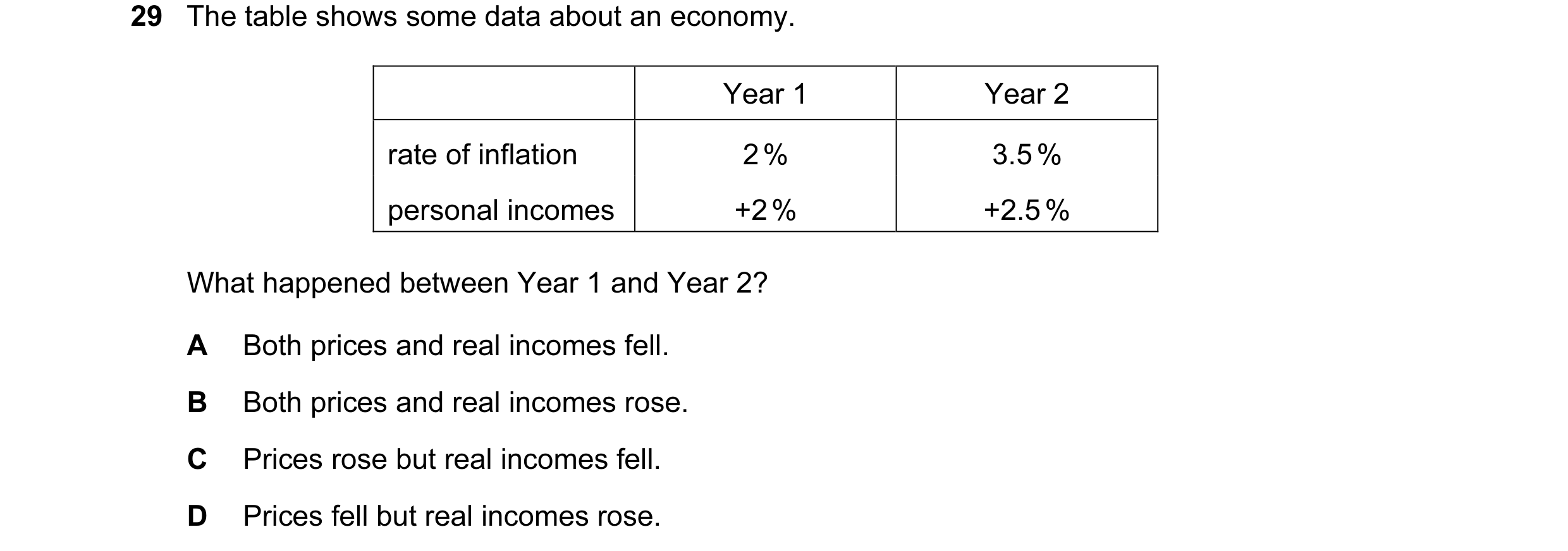
 1 / 42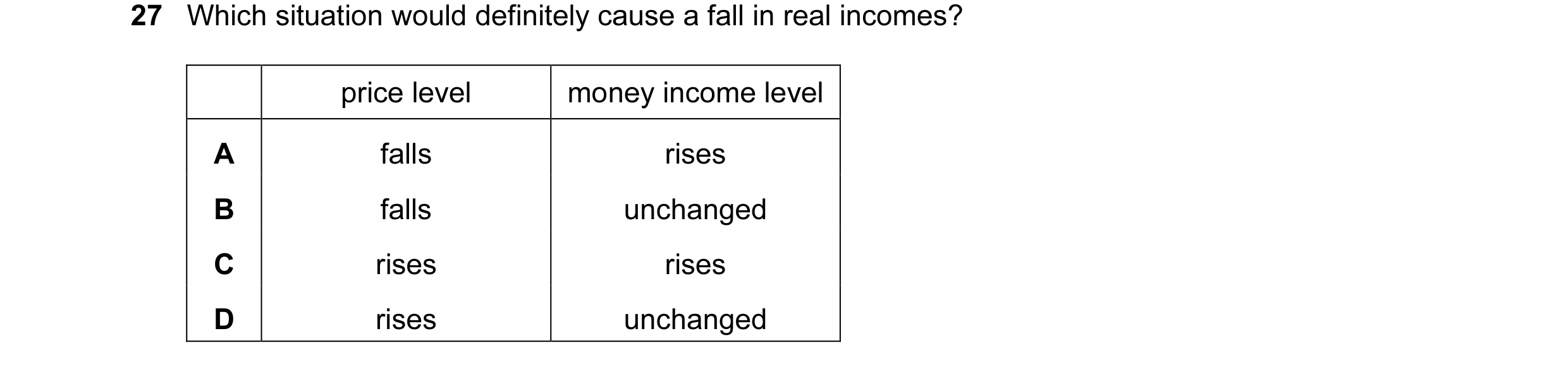
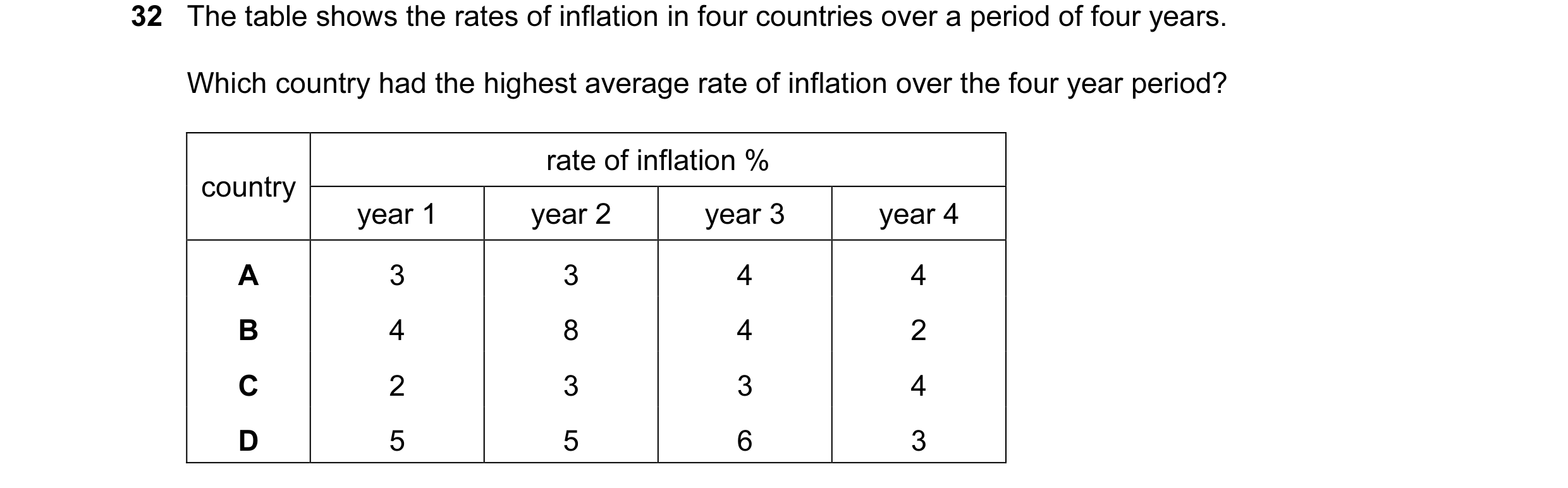

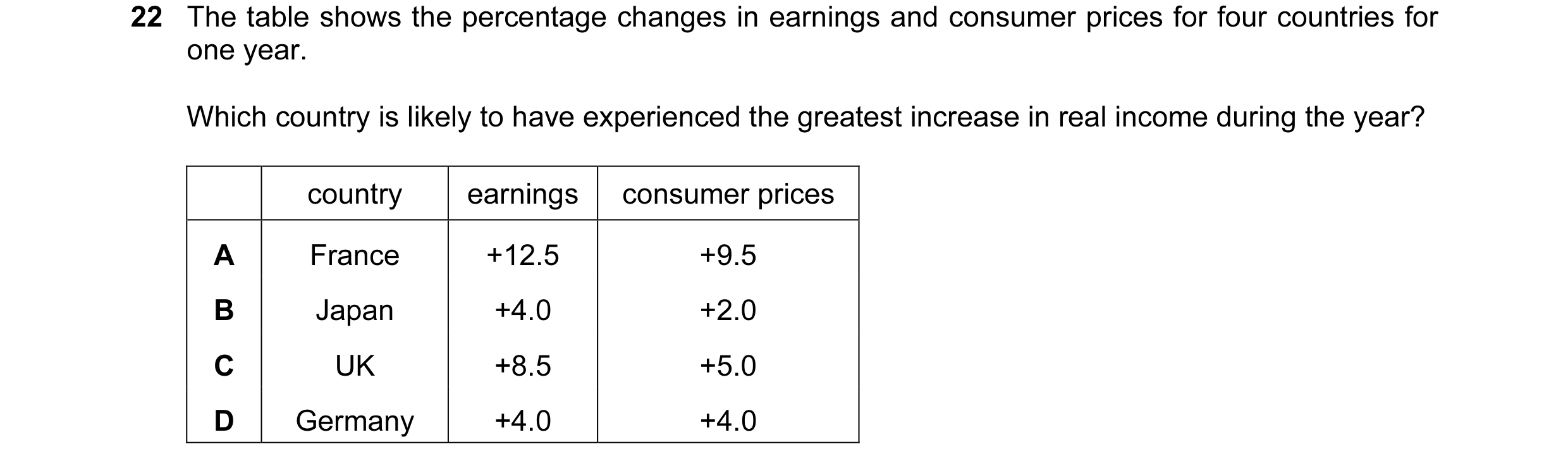 2 / 42

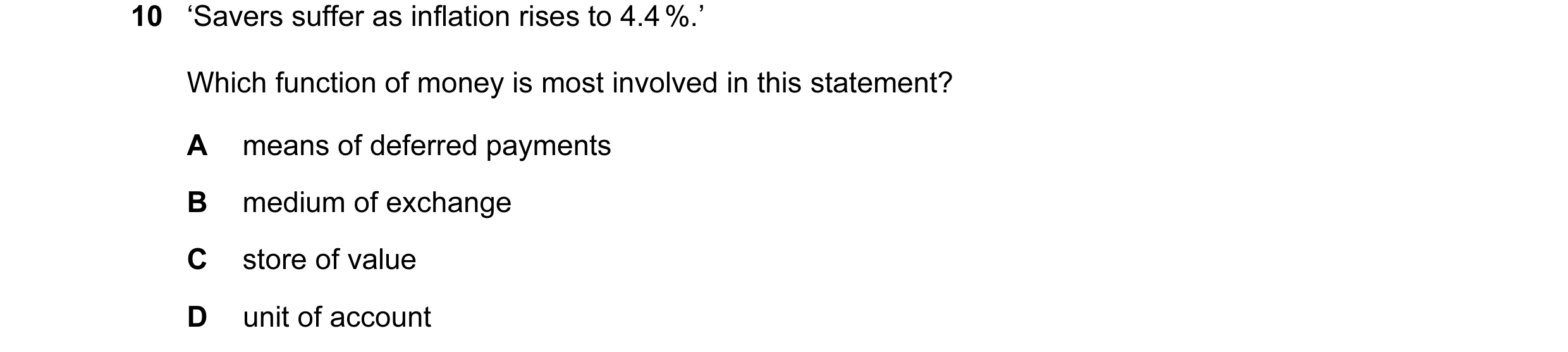
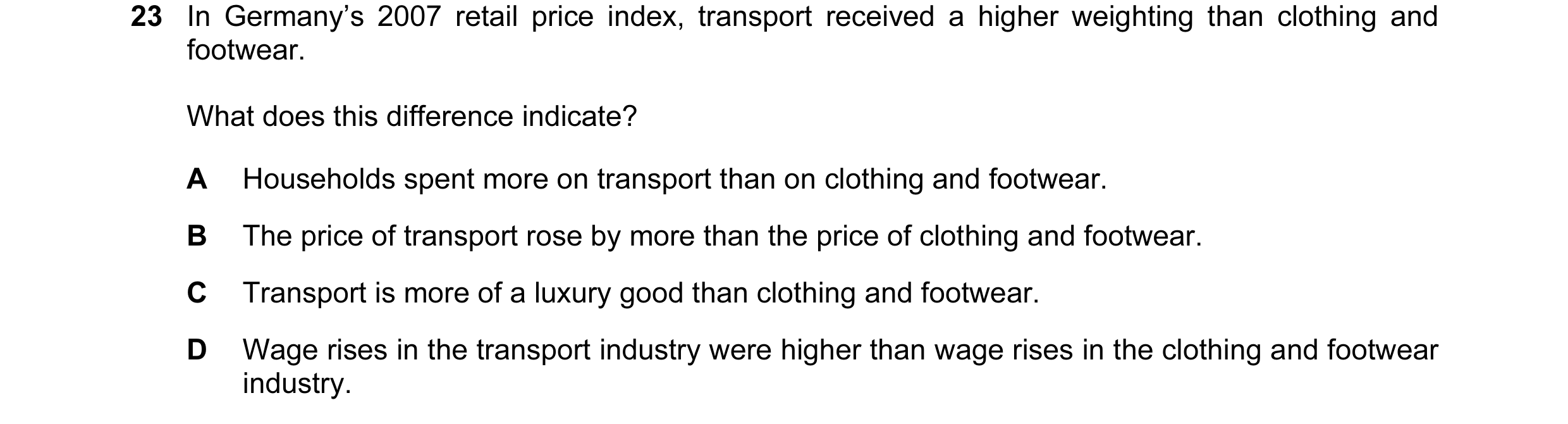
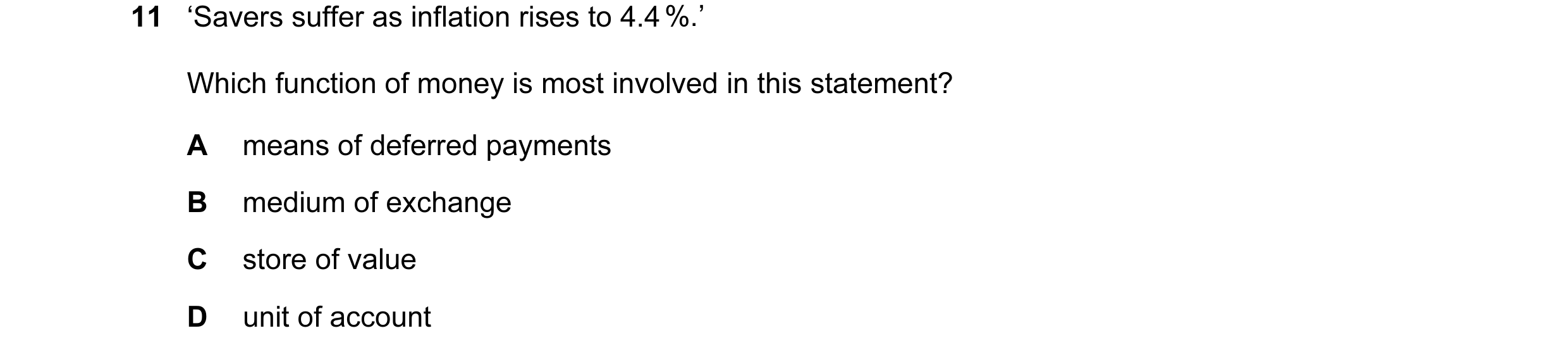 3 / 42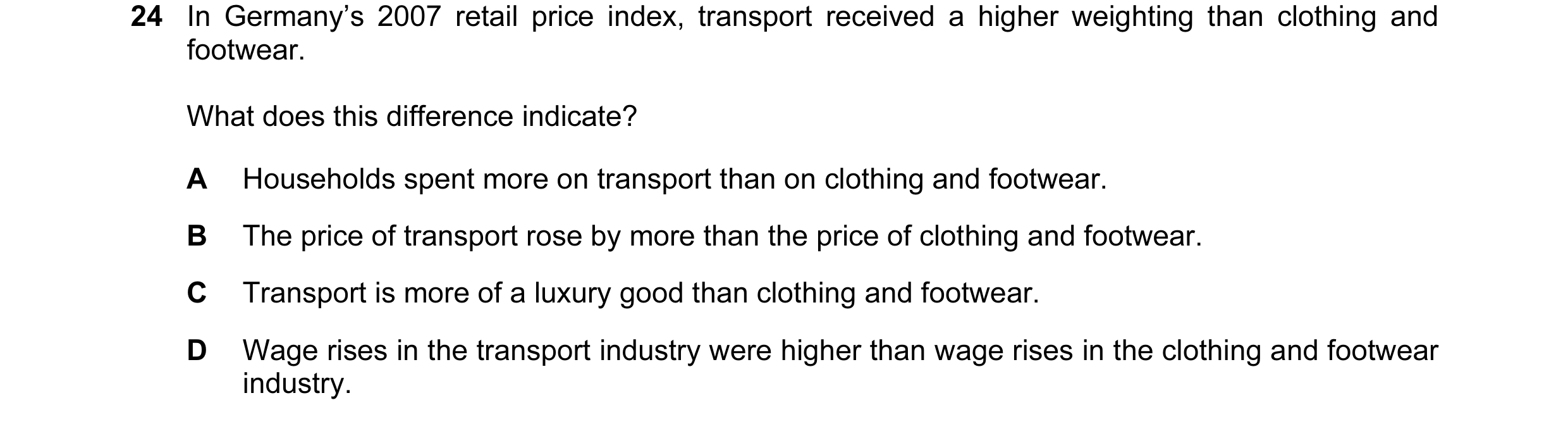
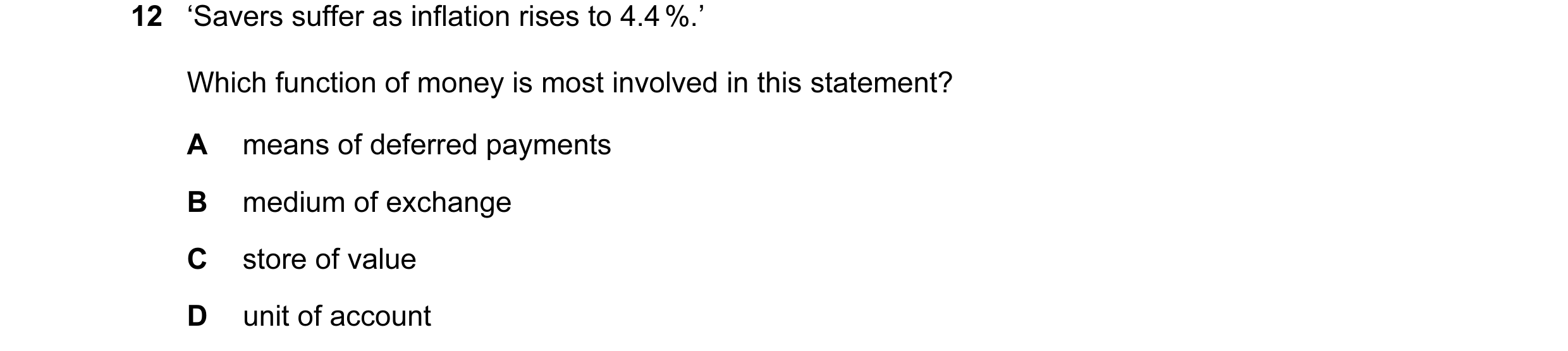
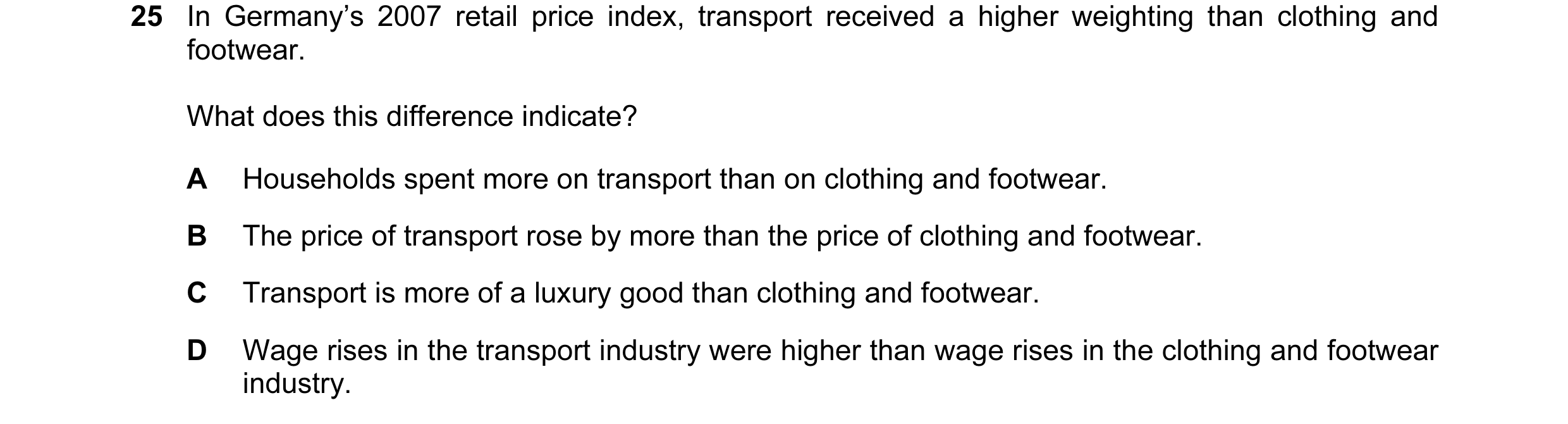
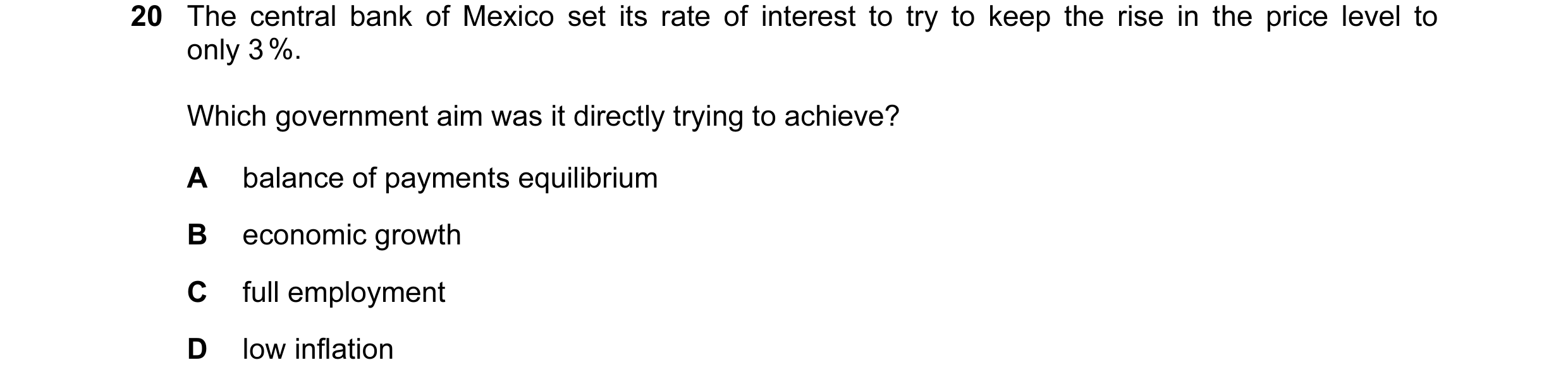
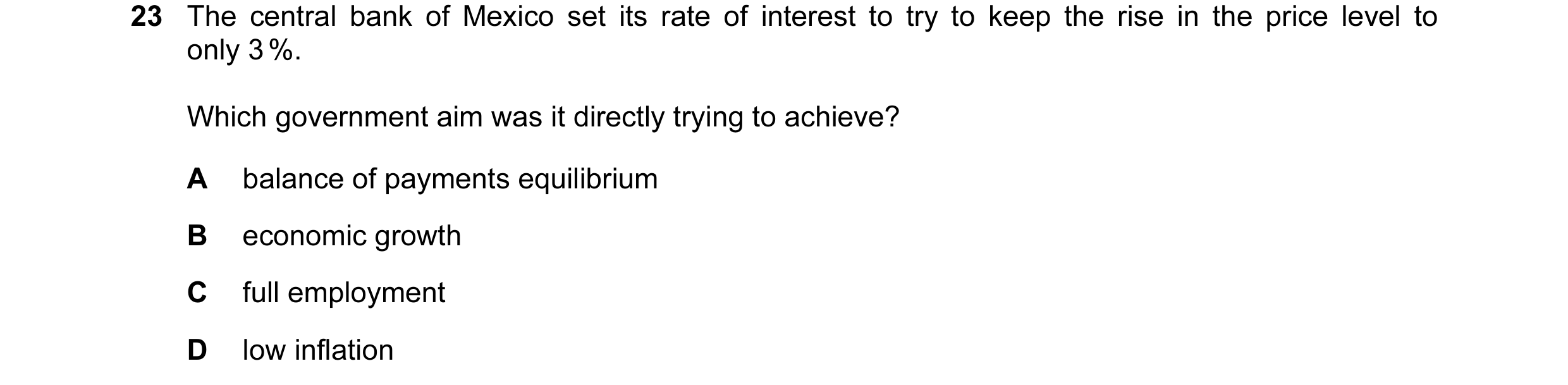 4 / 42

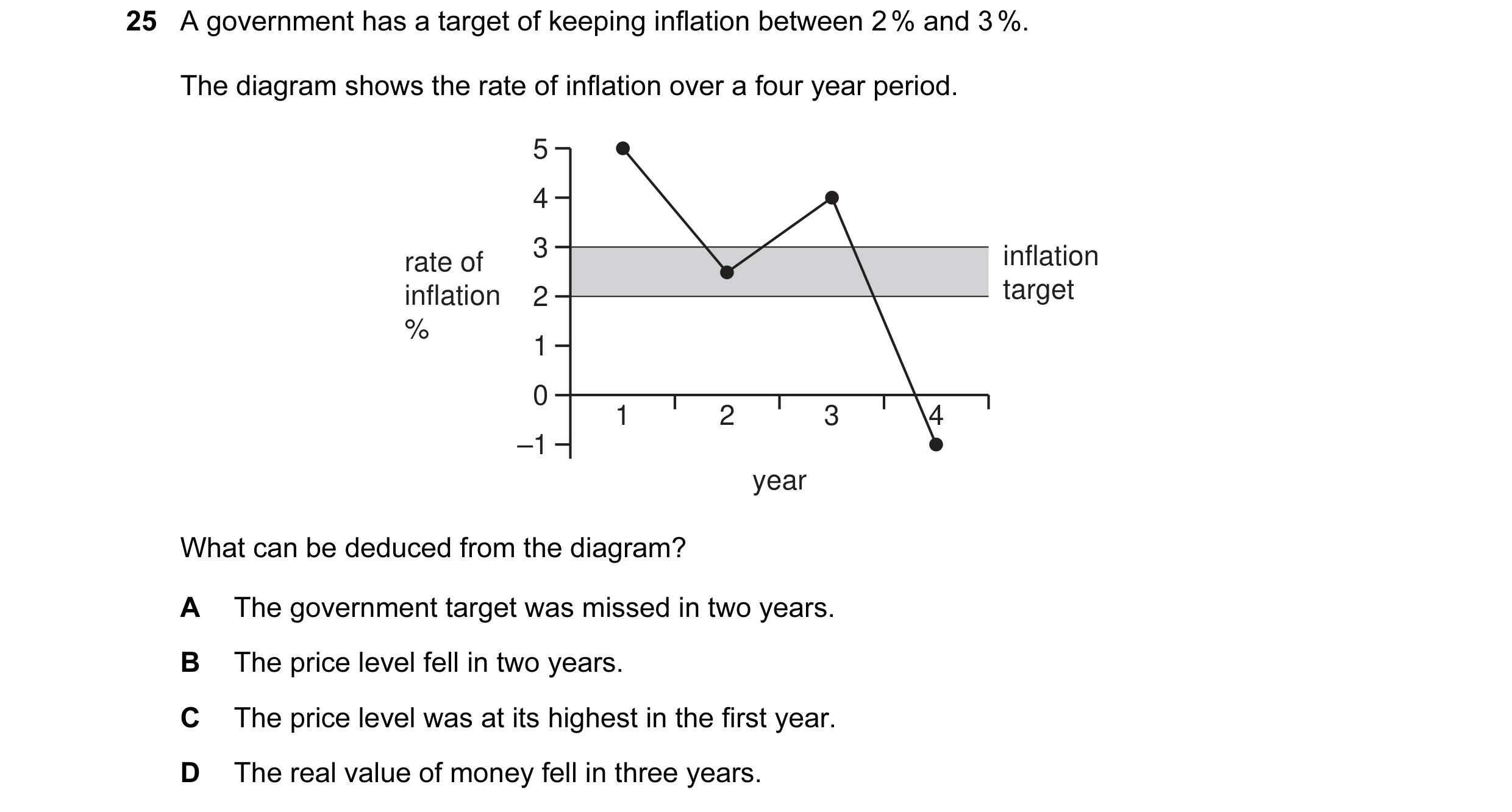
 5 / 42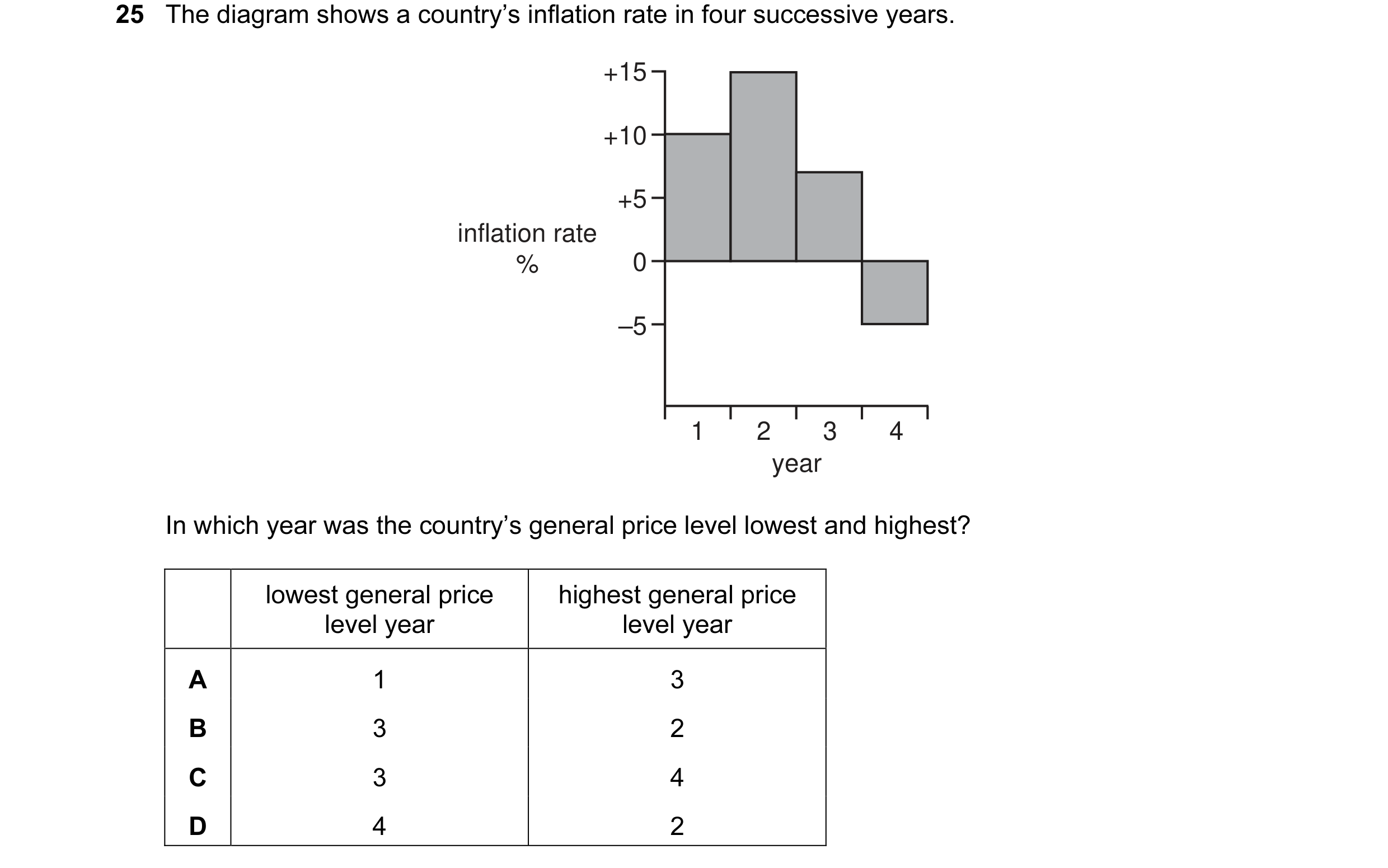

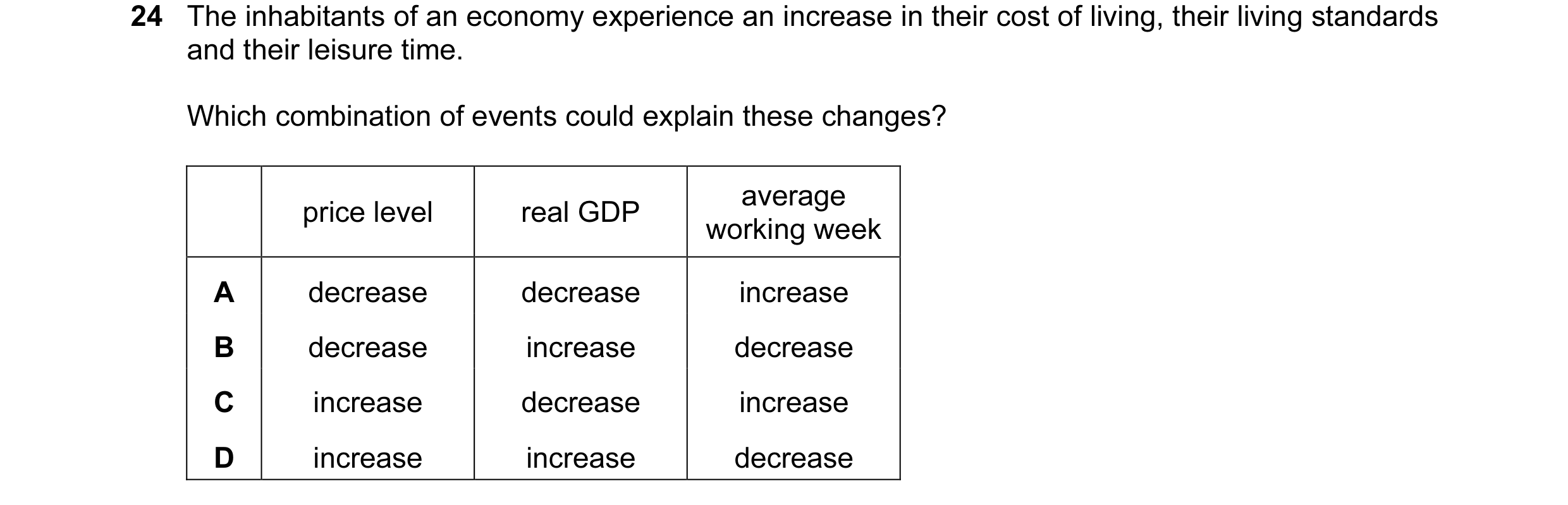 6 / 42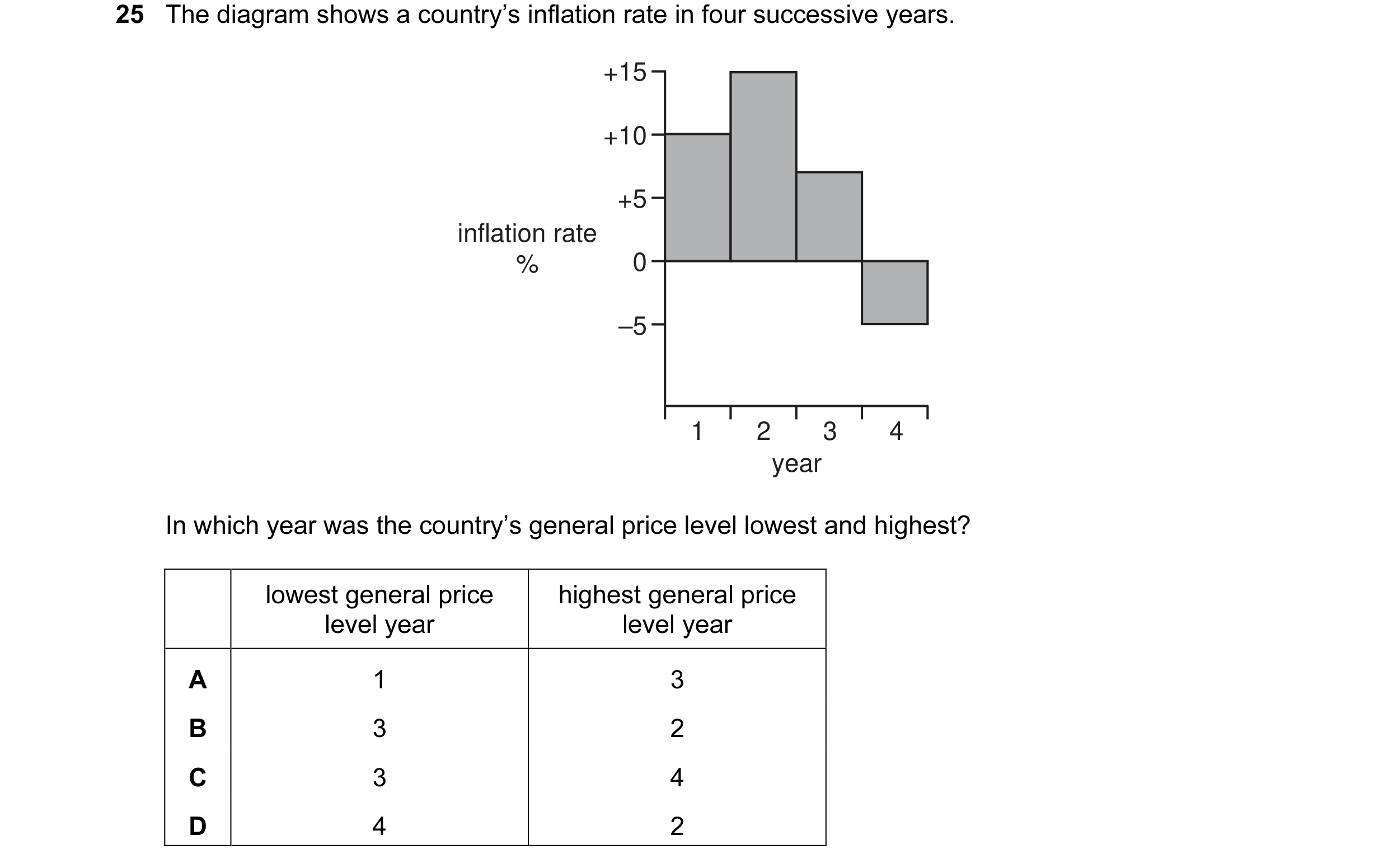
 7 / 42
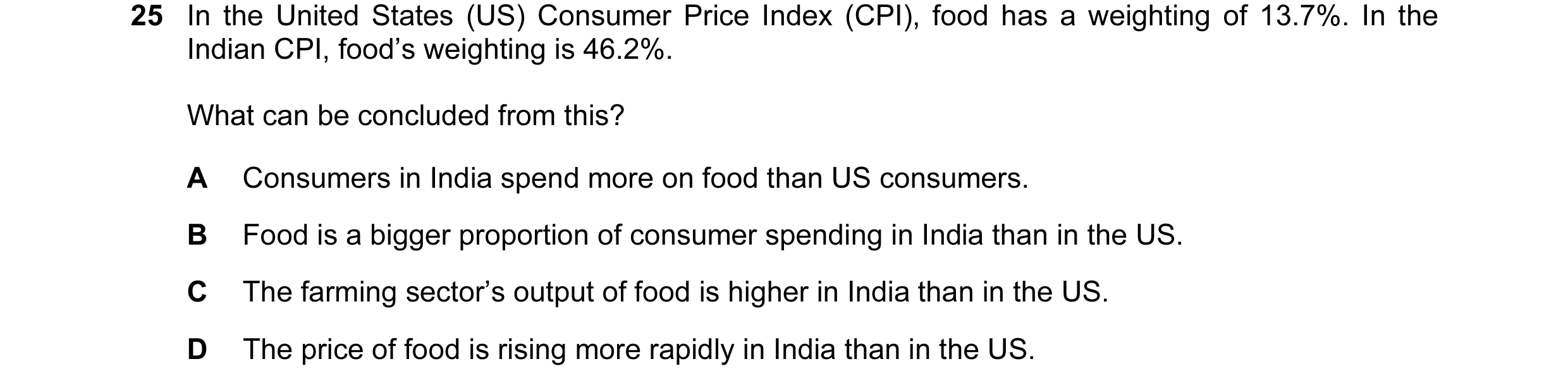
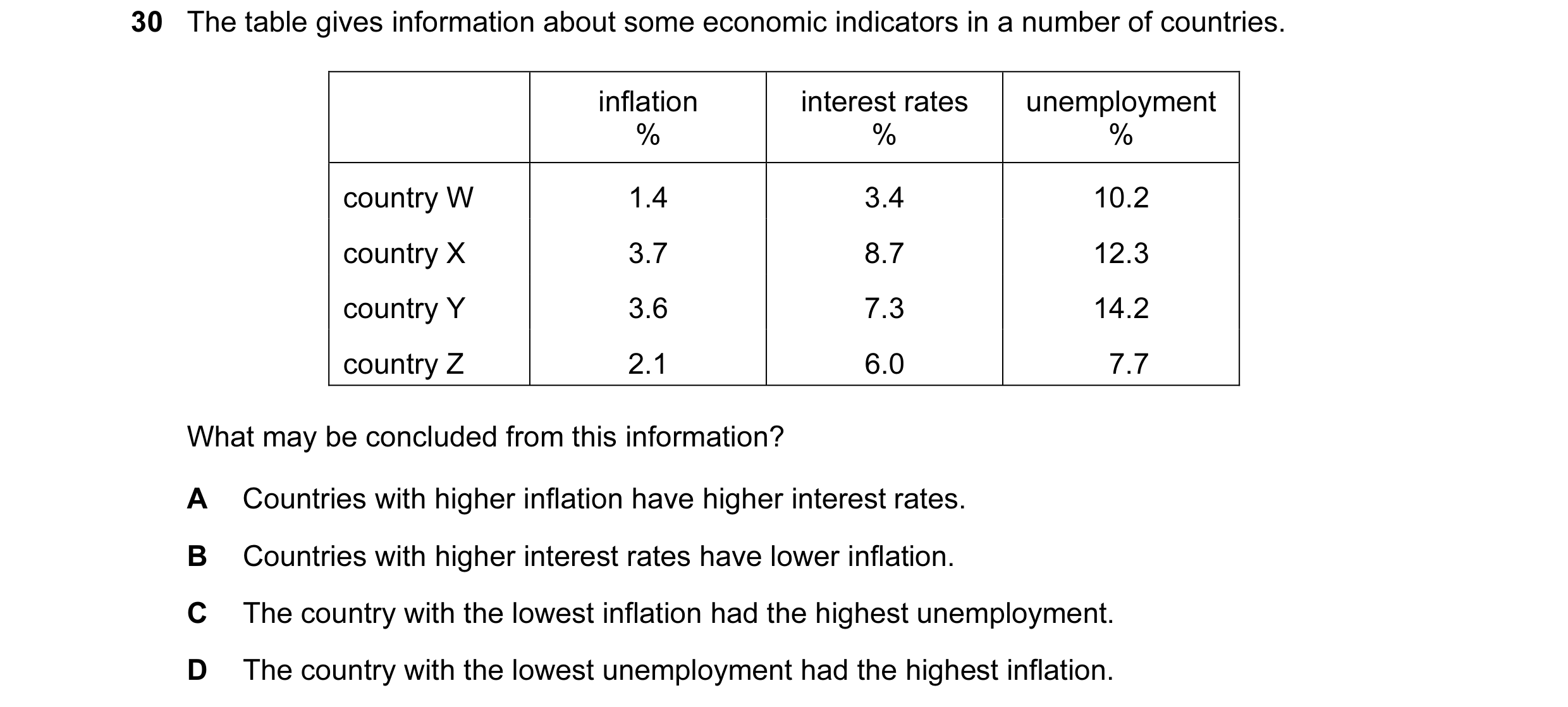

 8 / 42
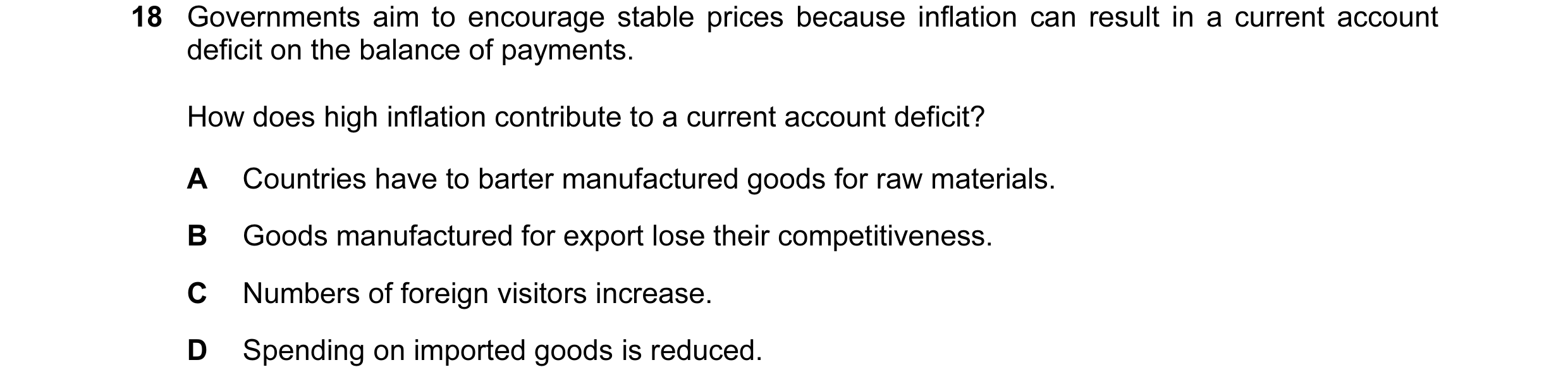

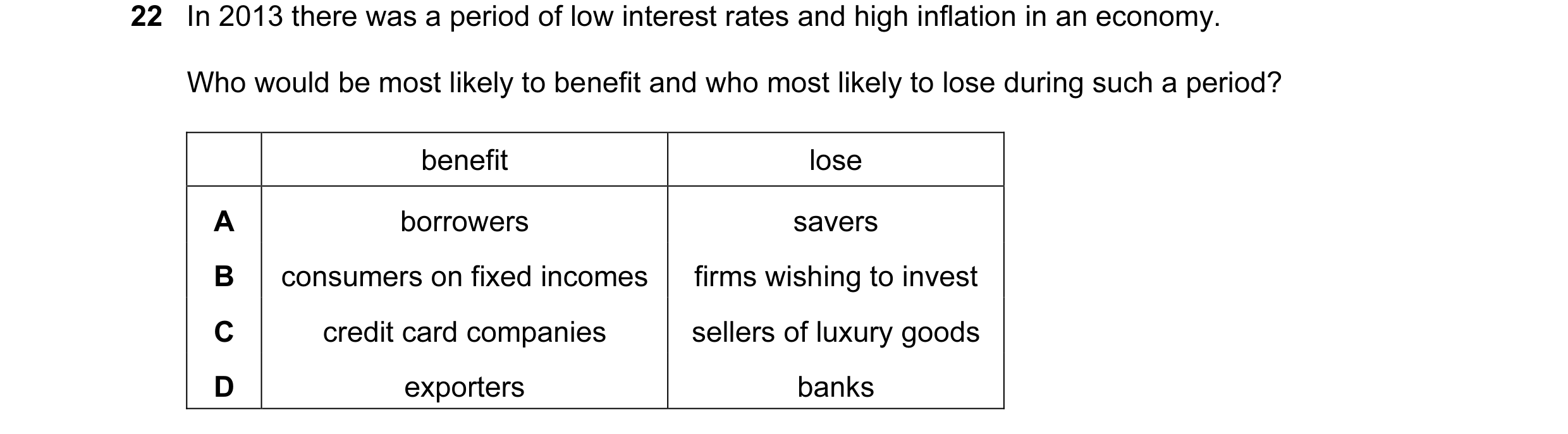
 9 / 42

 10 / 42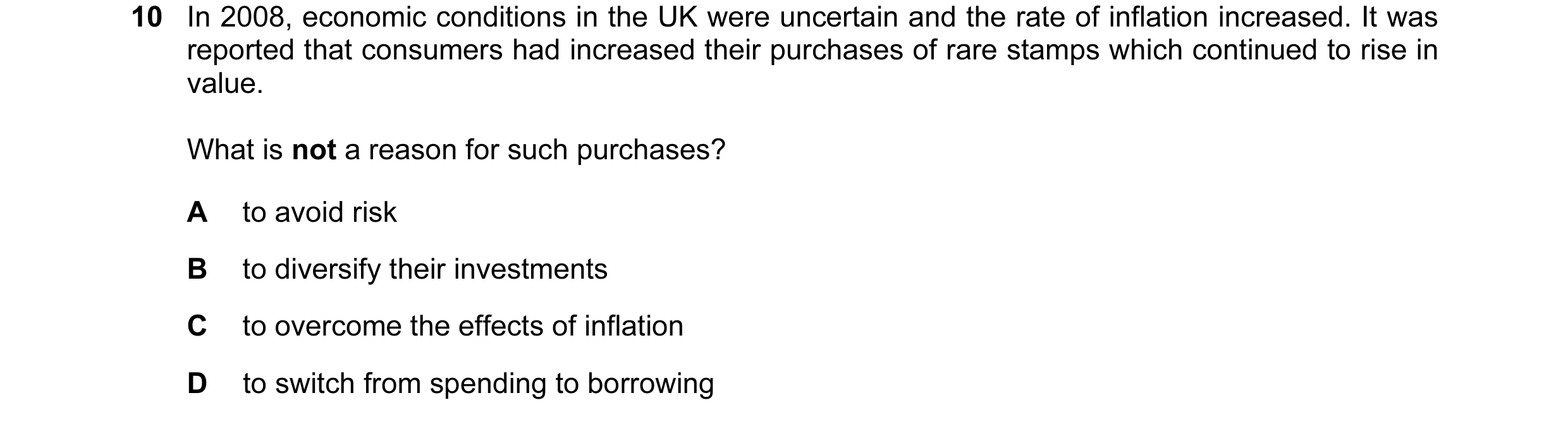
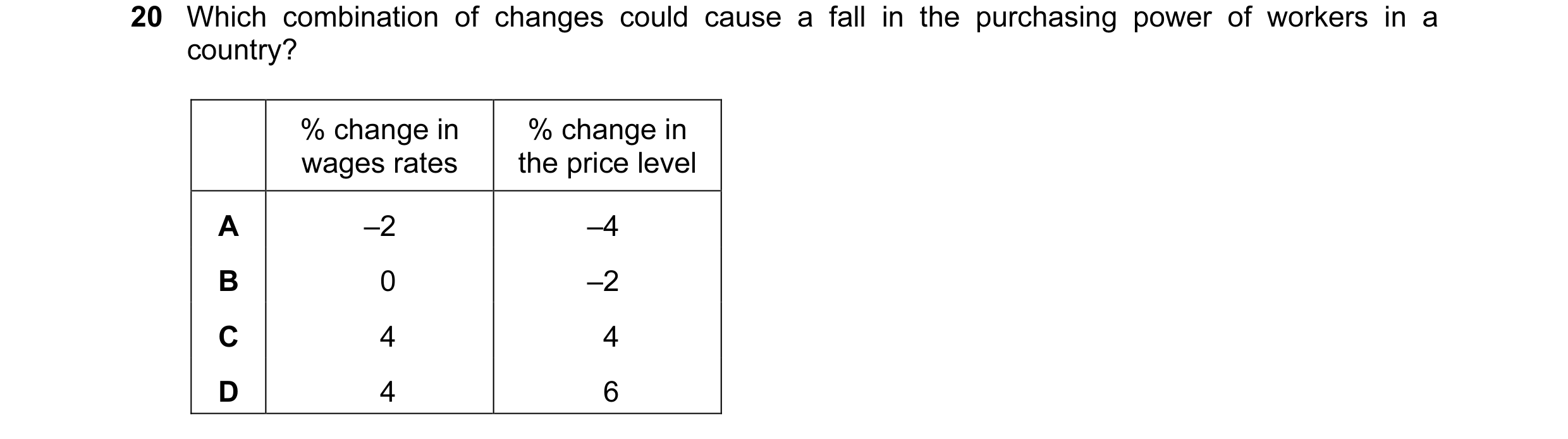
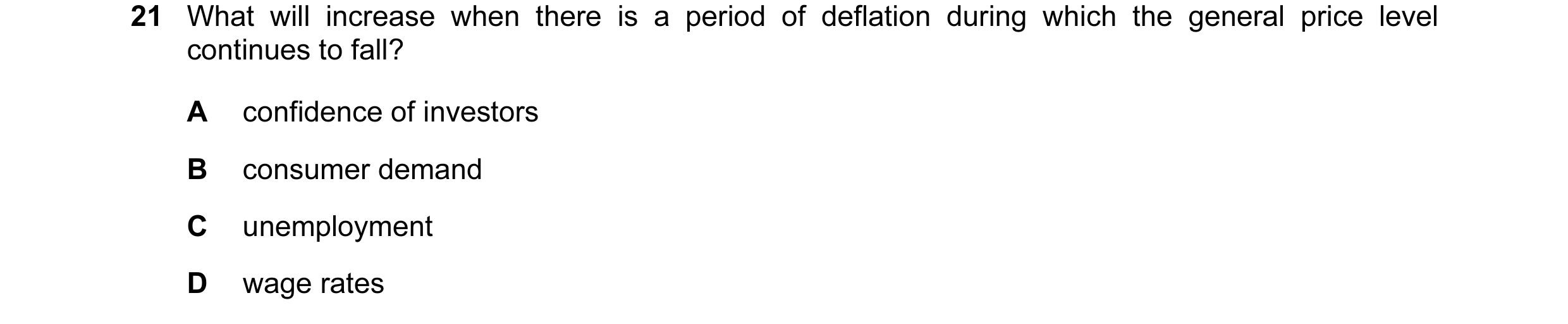
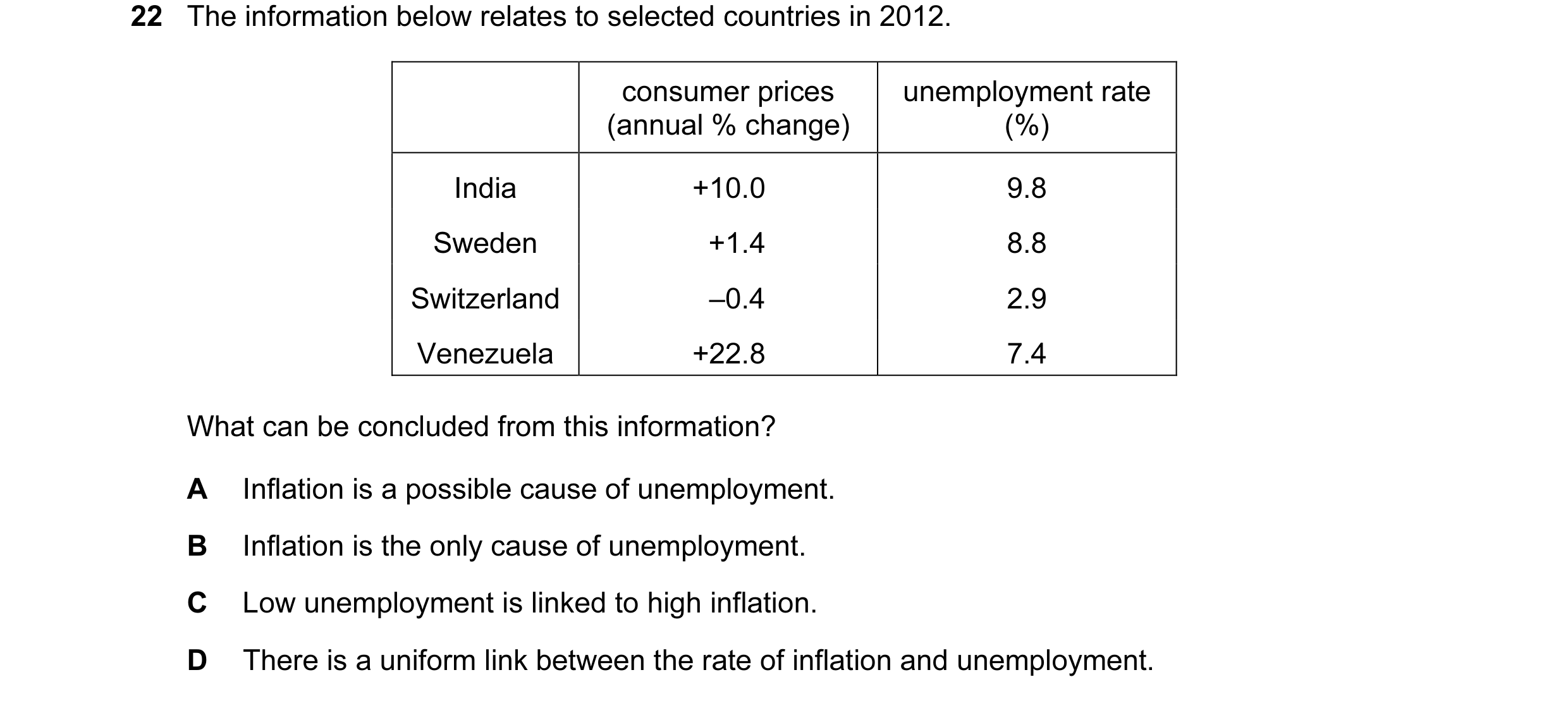 11 / 42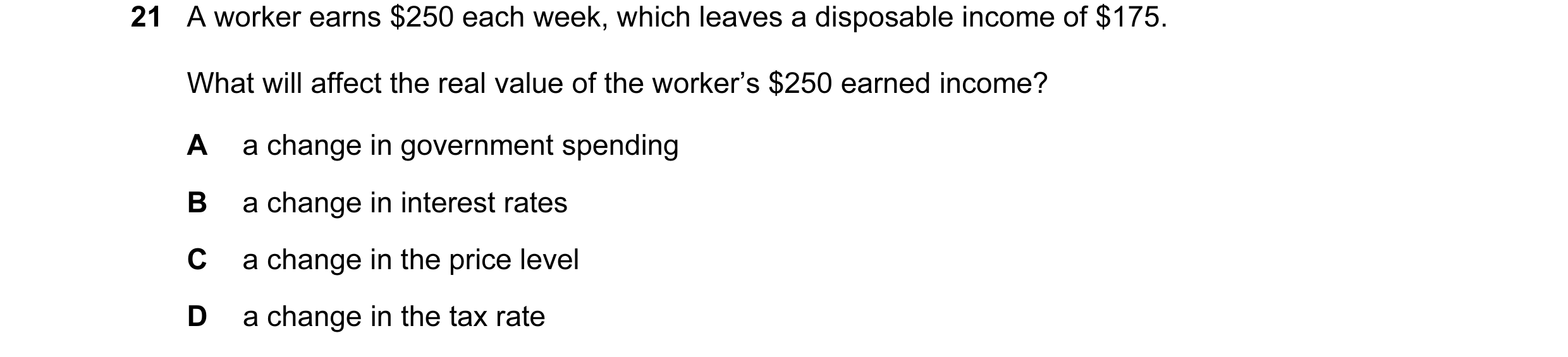

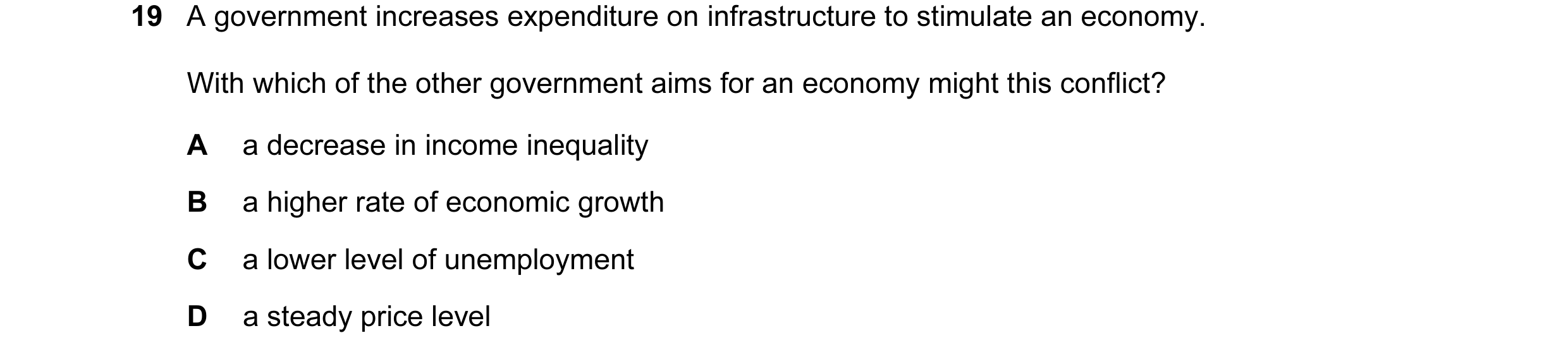

 12 / 42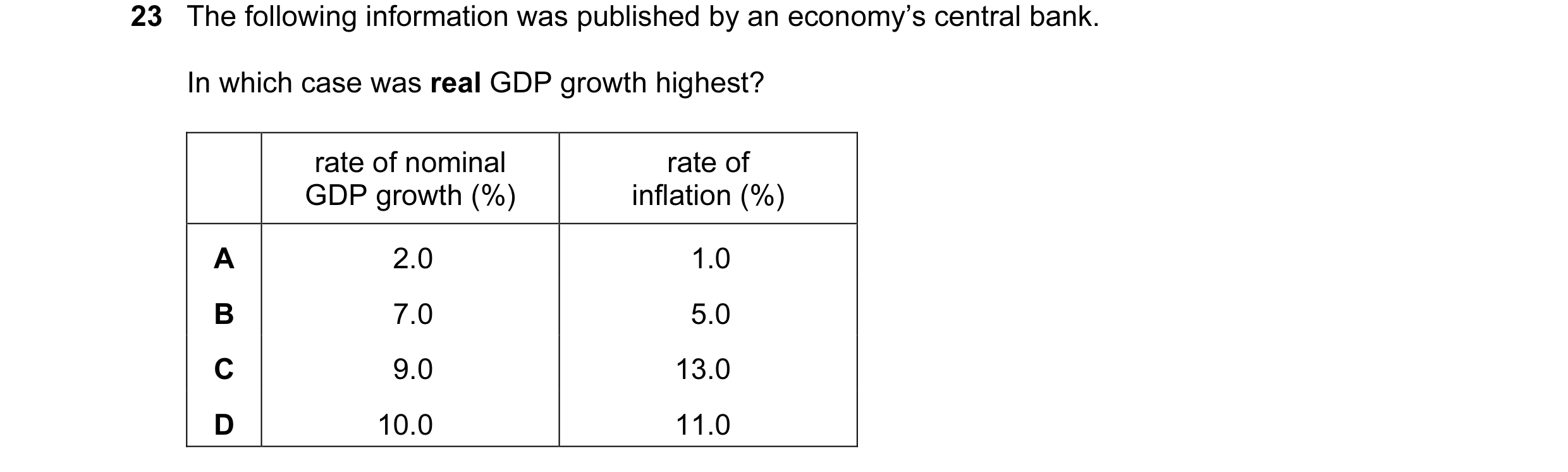

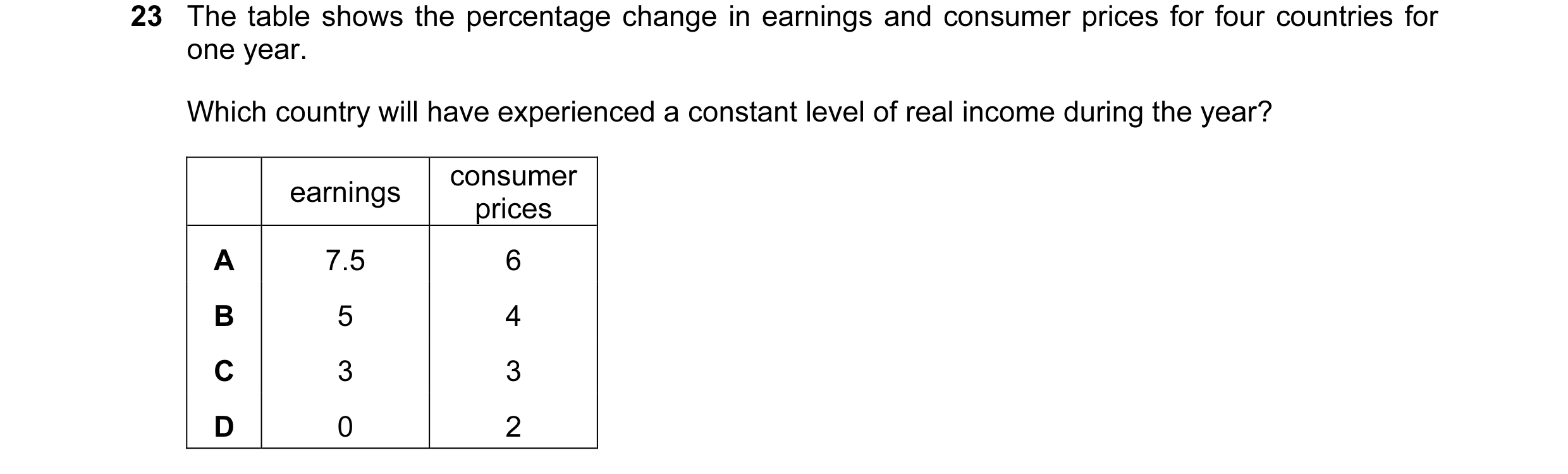
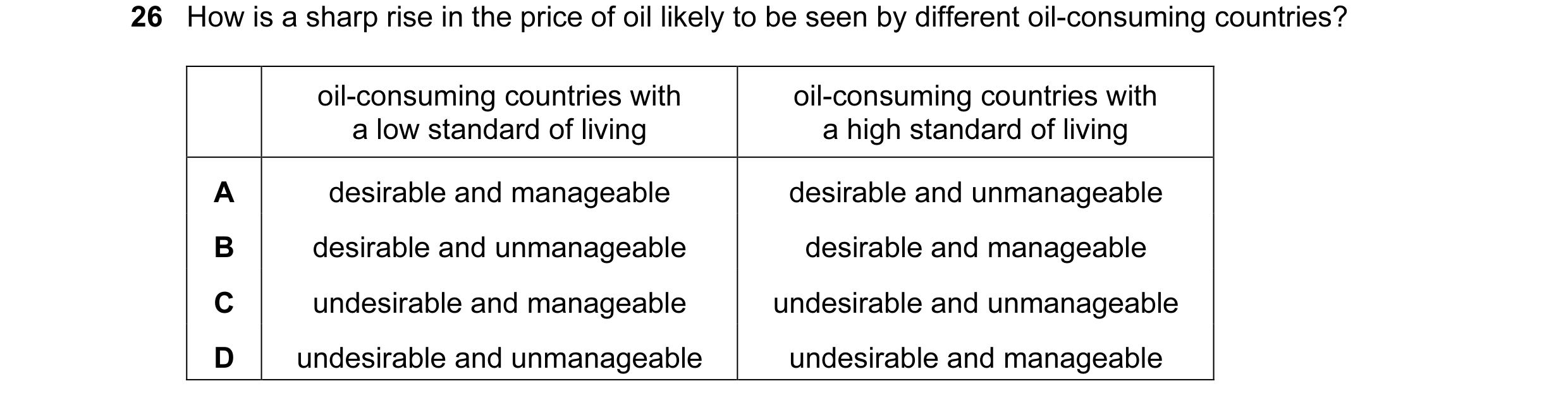 13 / 42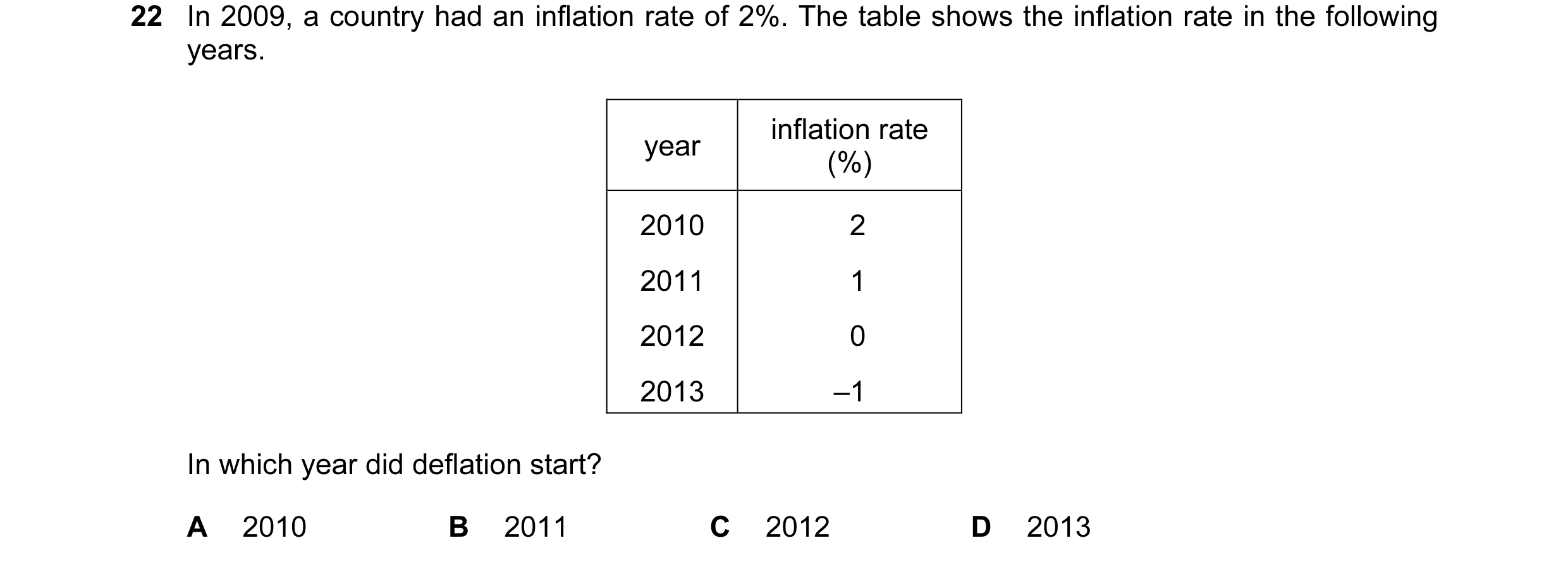

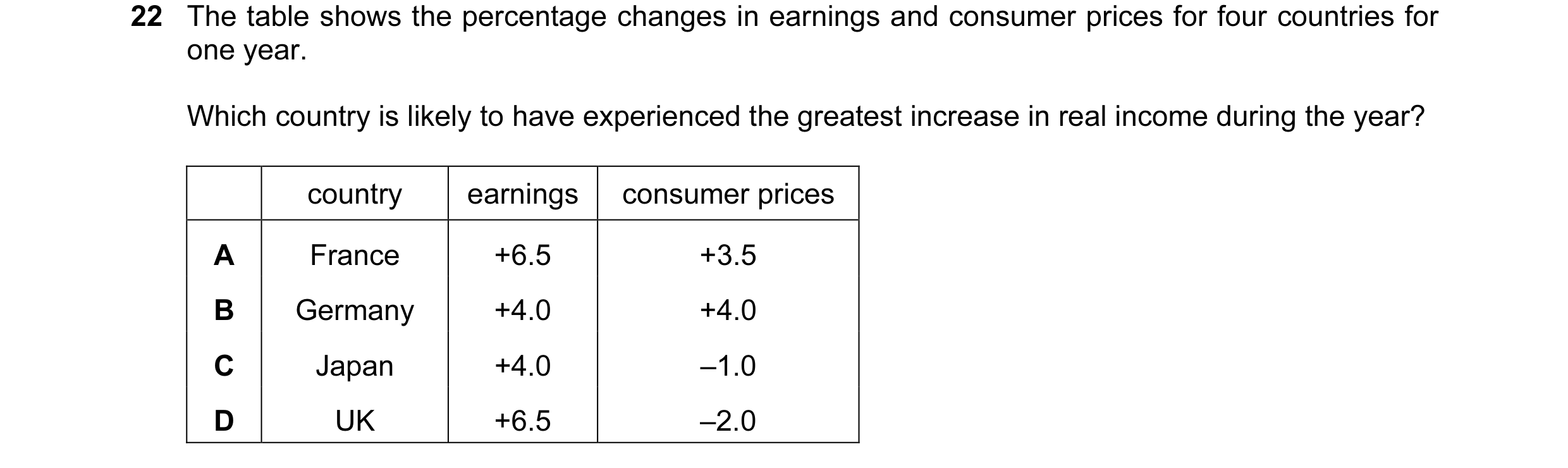
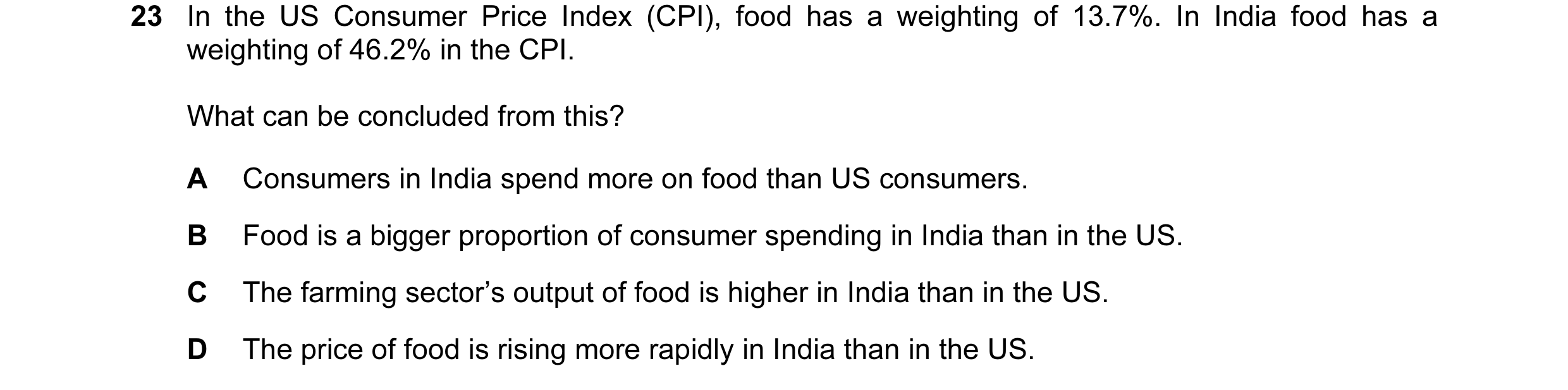
 14 / 42


 15 / 42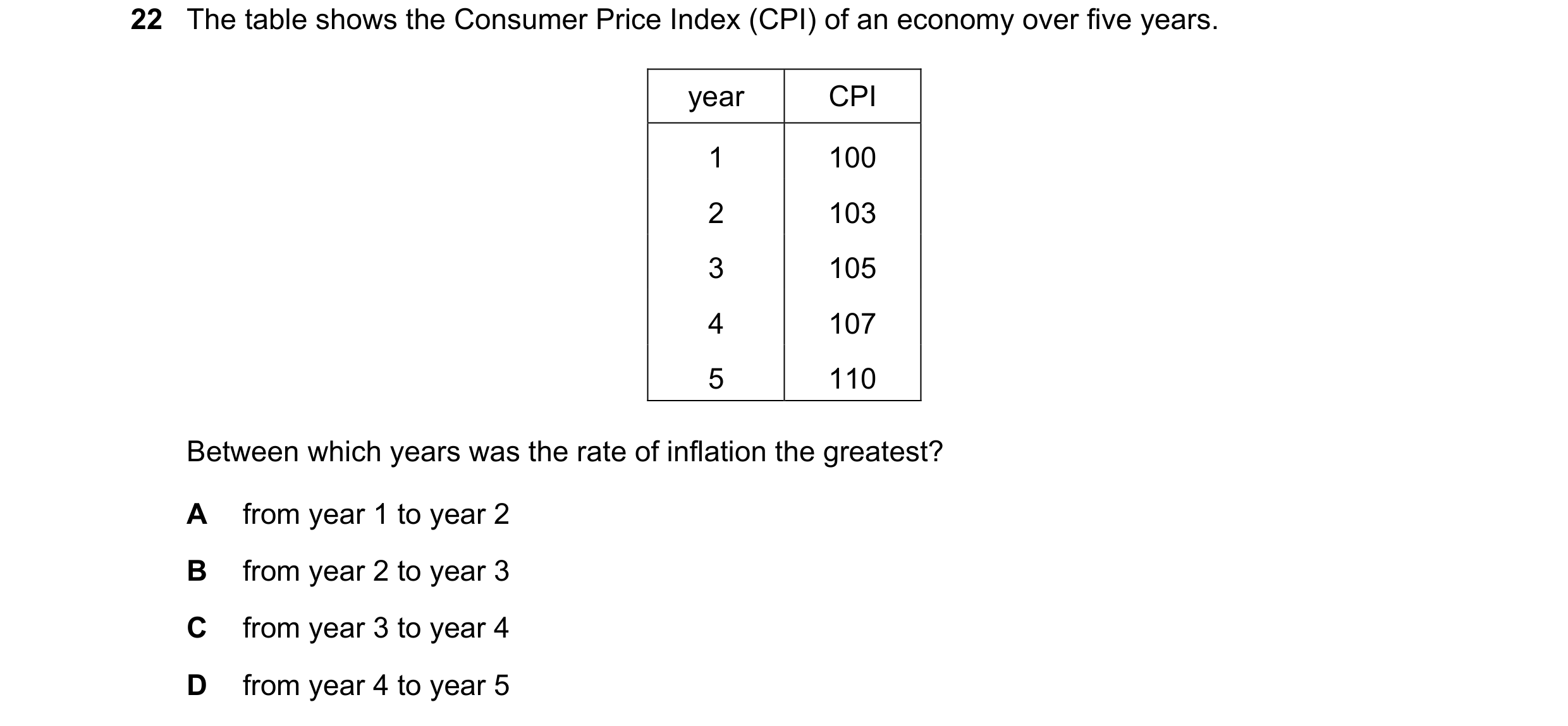
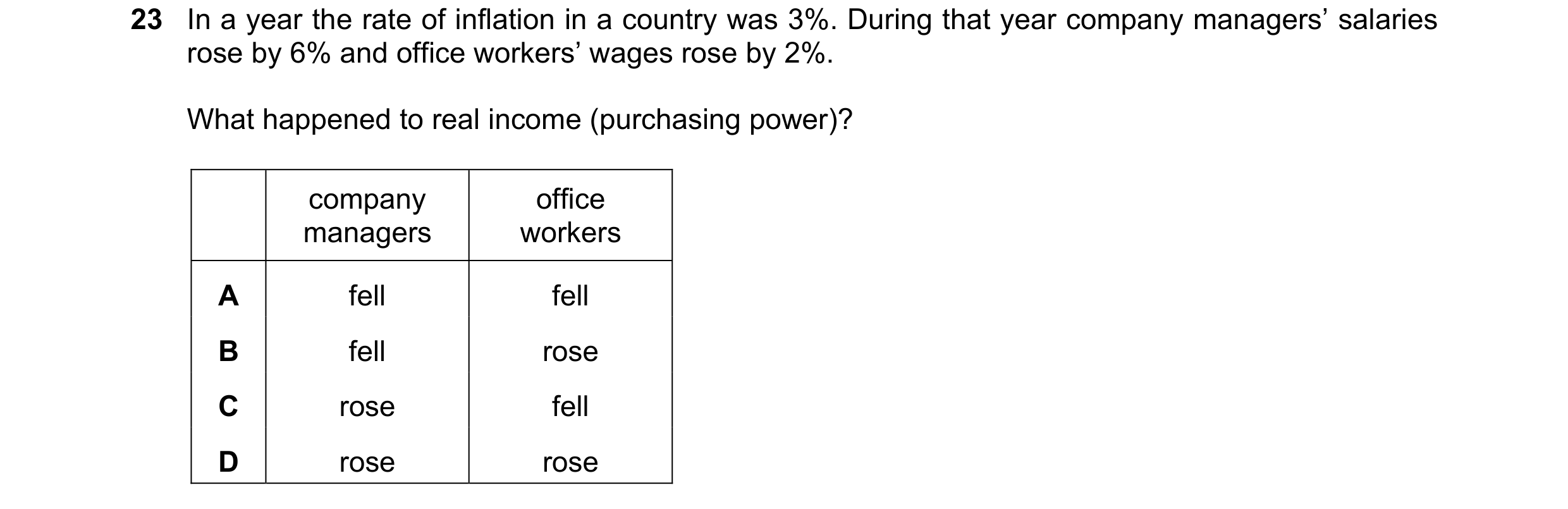
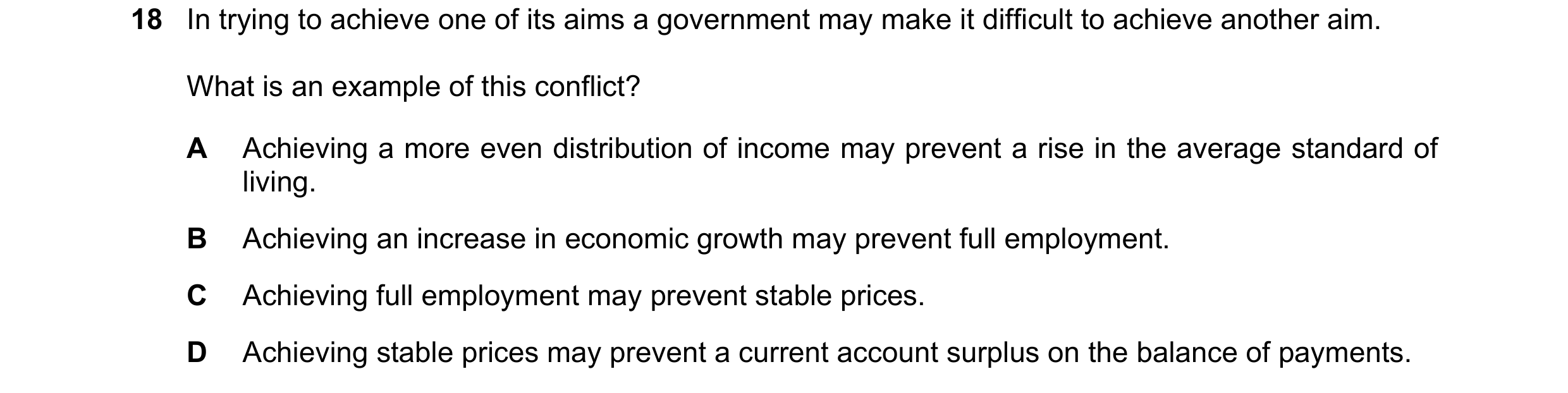
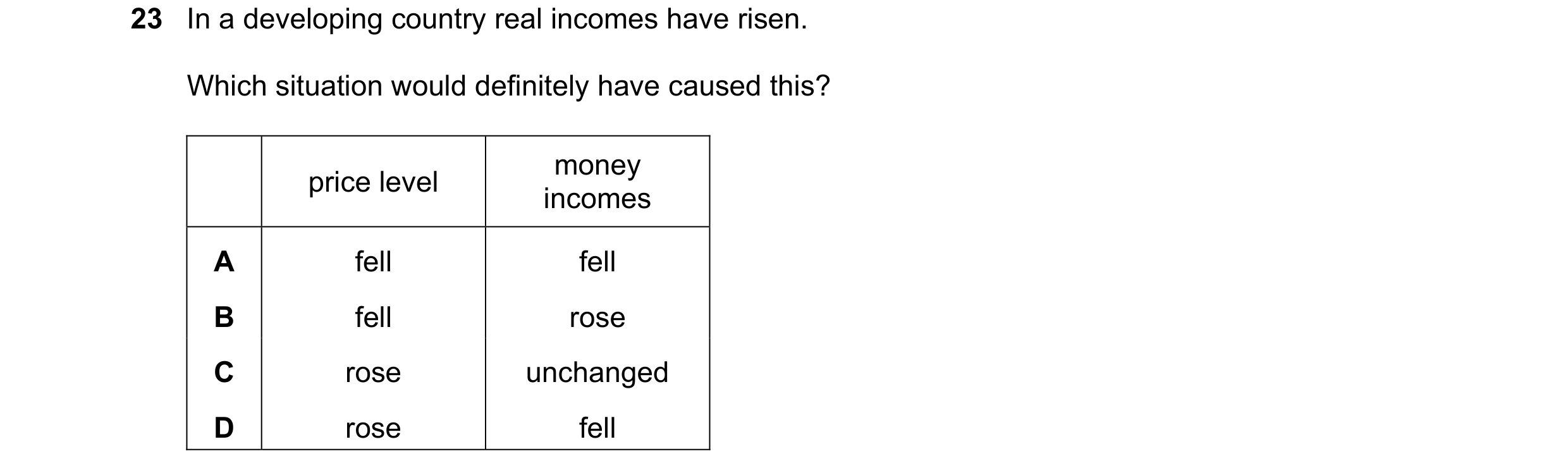 16 / 42
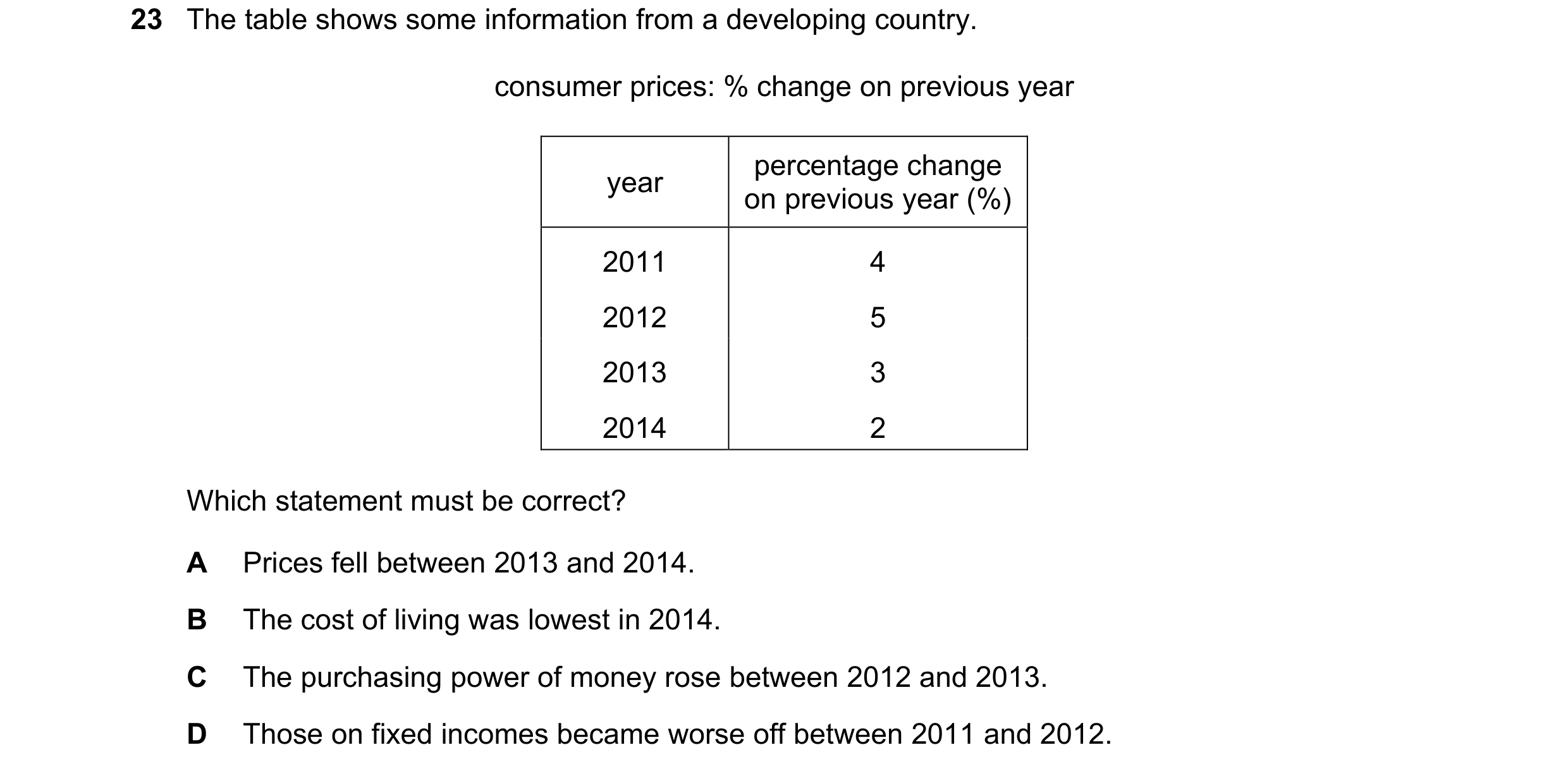


 17 / 42

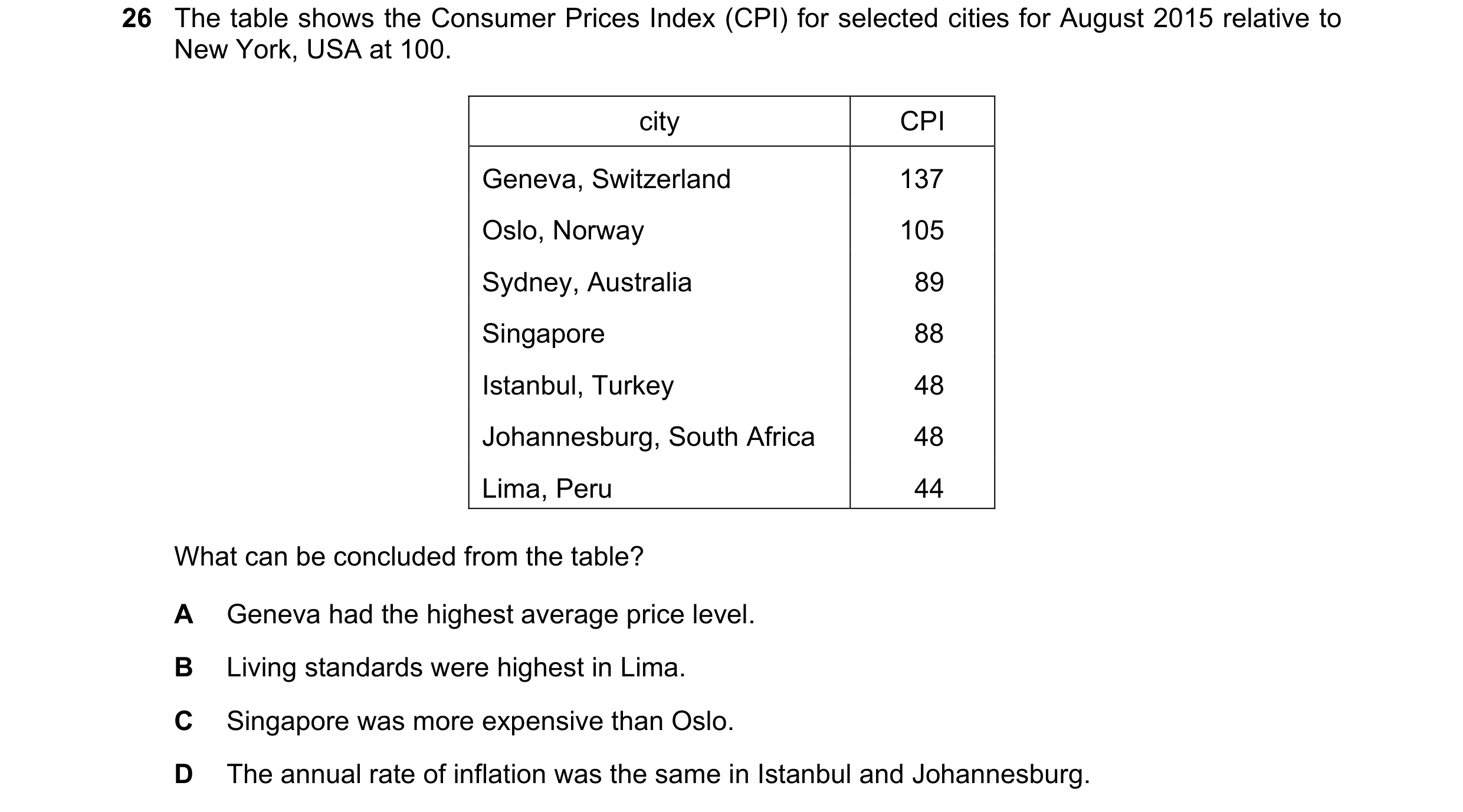 18 / 42



 19 / 42
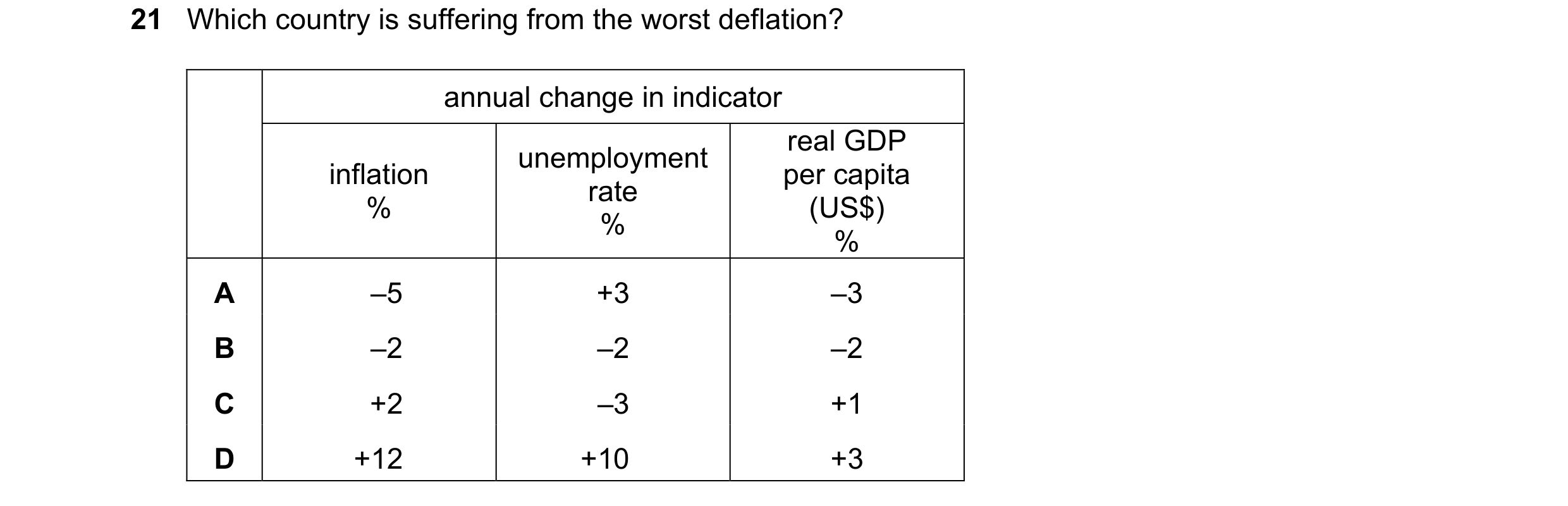

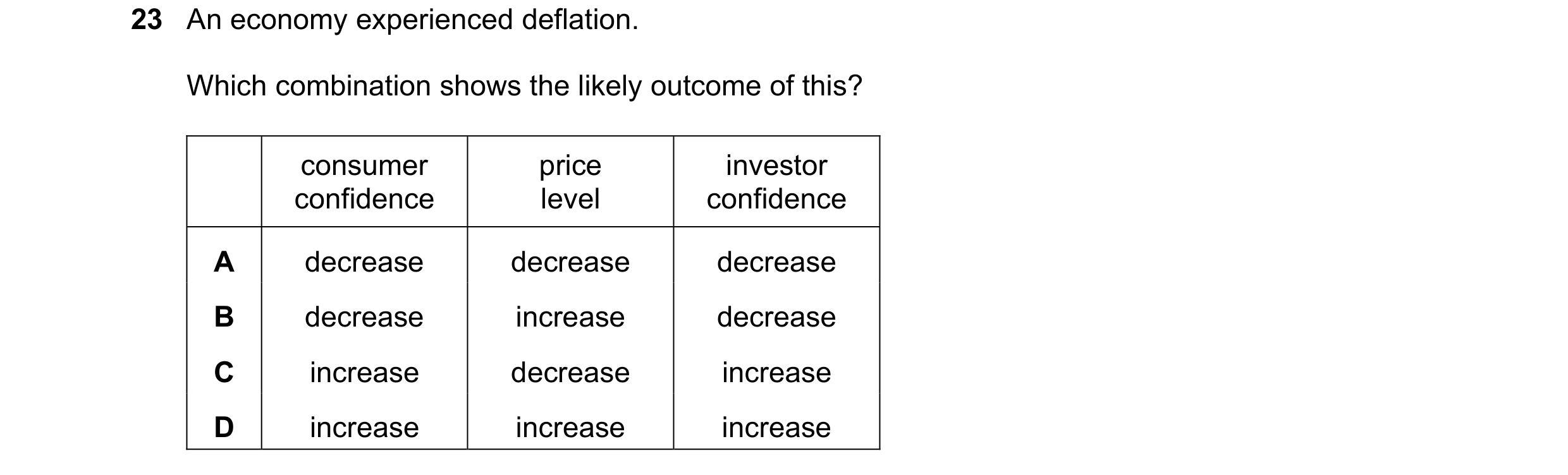 20 / 42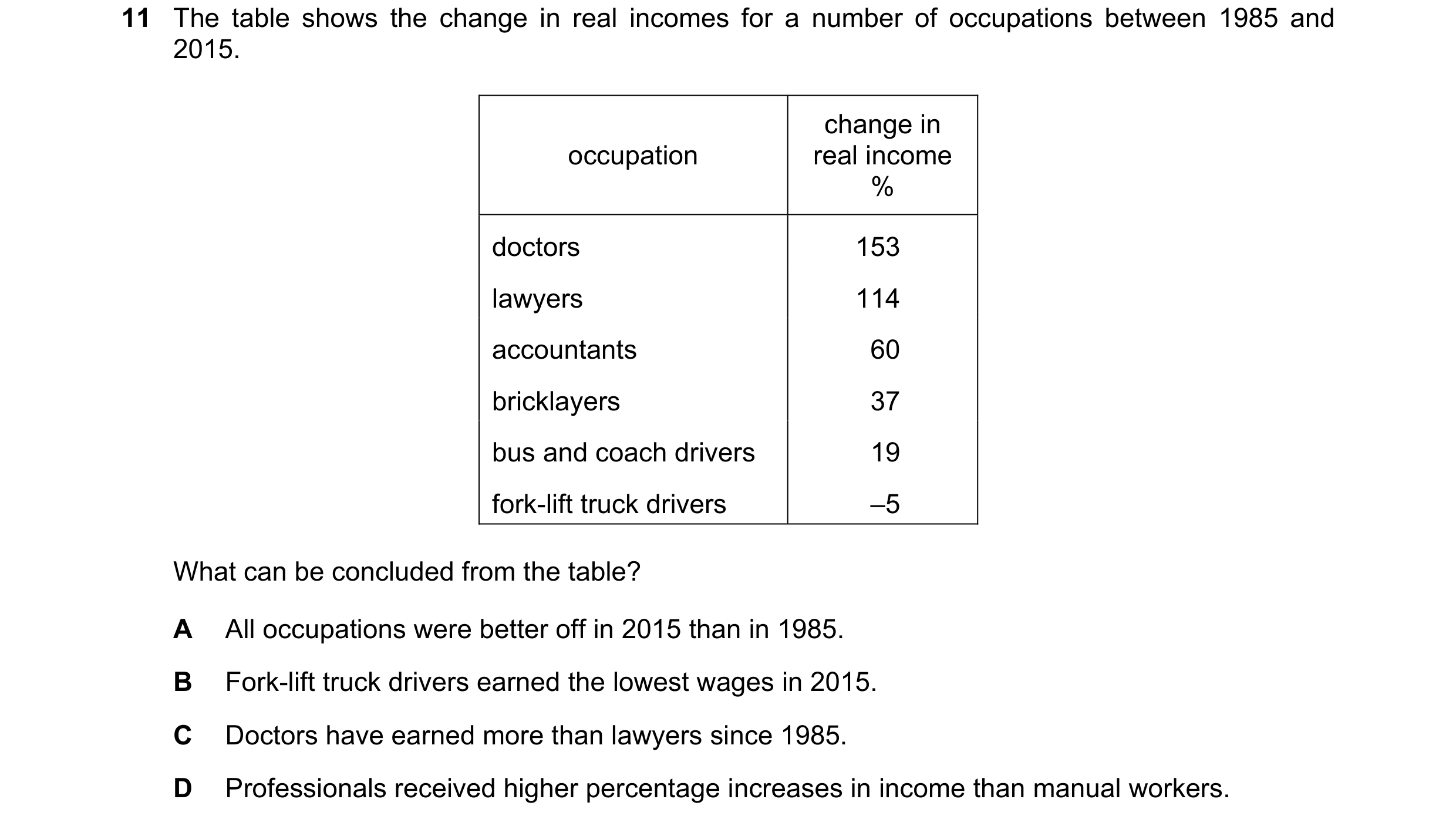

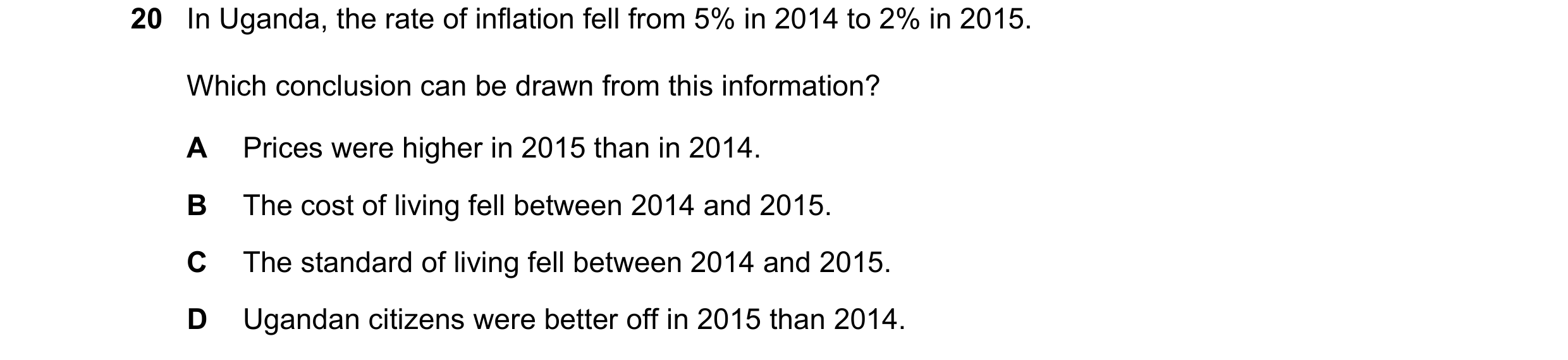
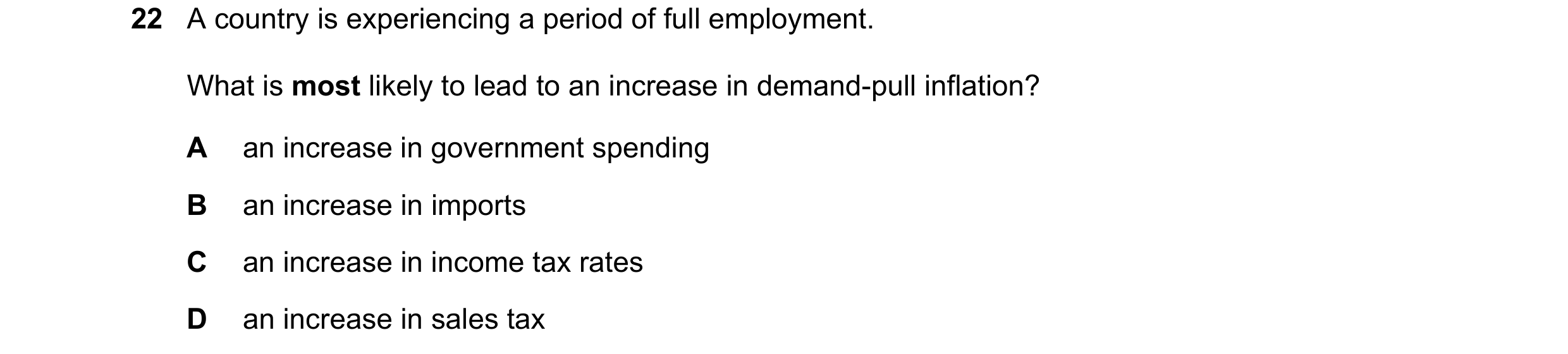 21 / 42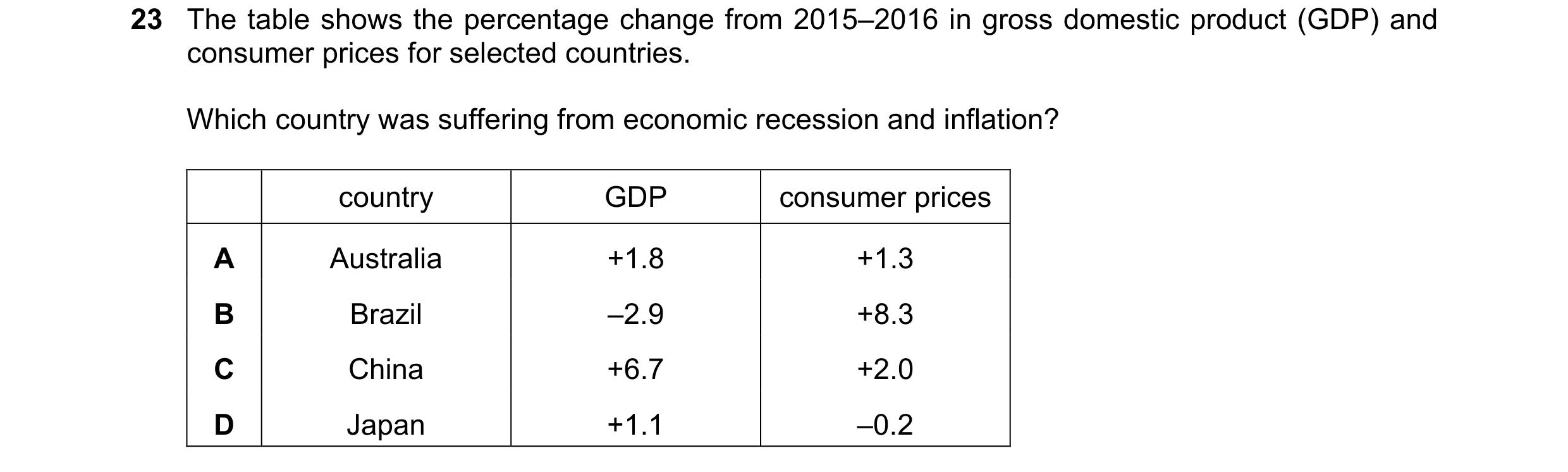

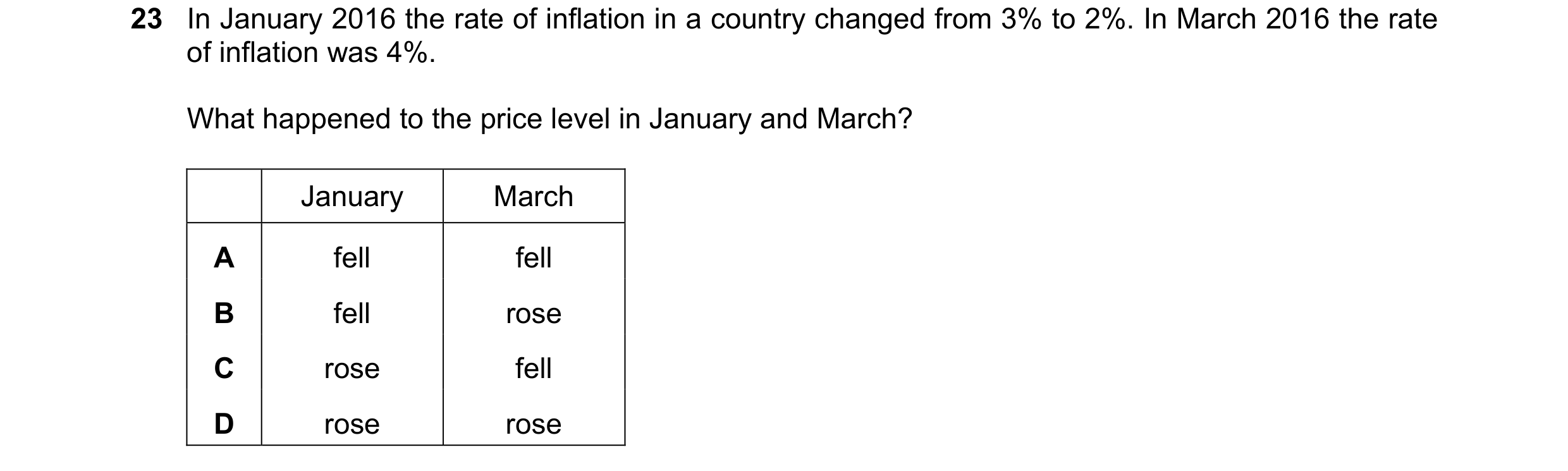
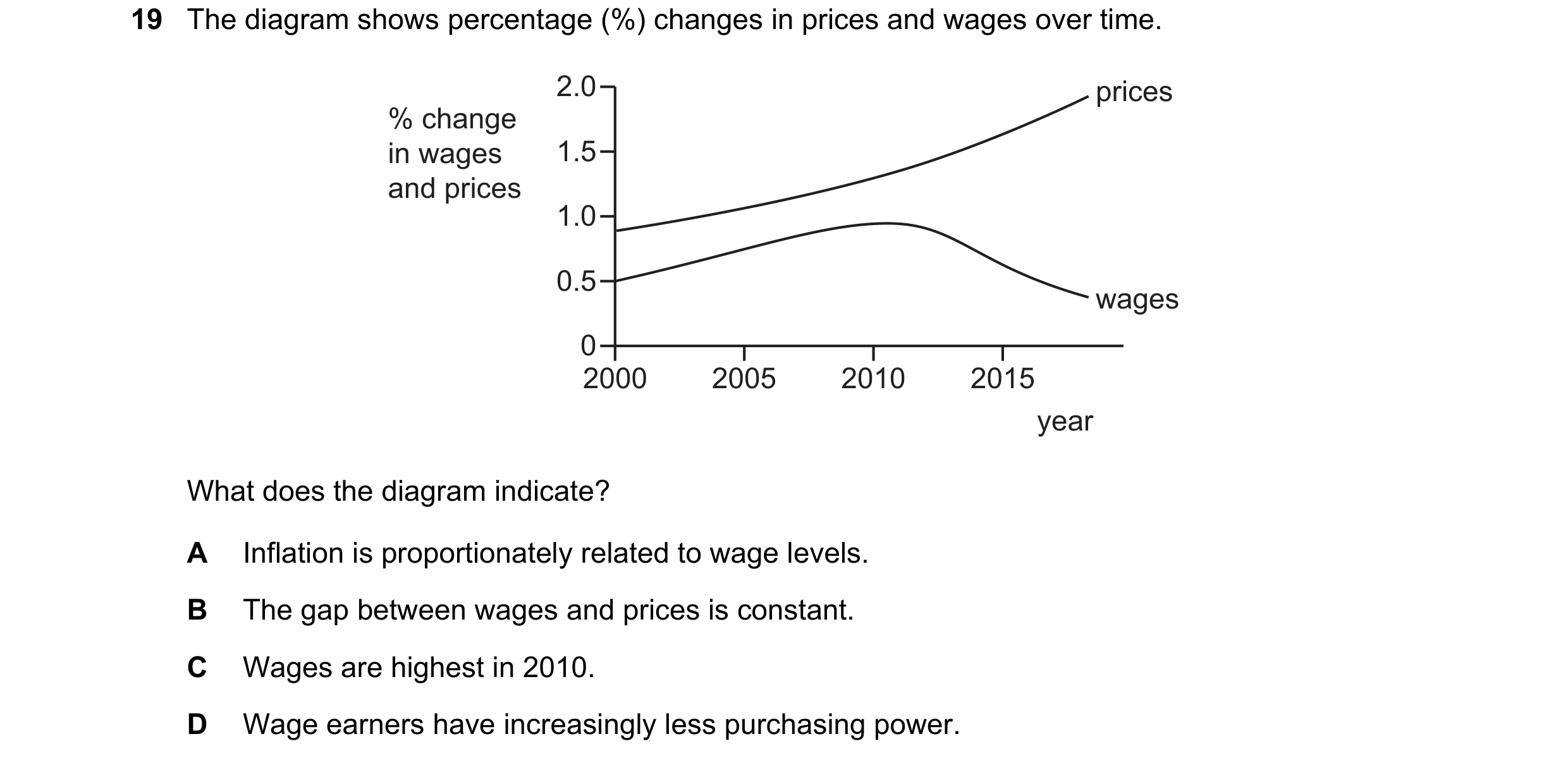 22 / 42
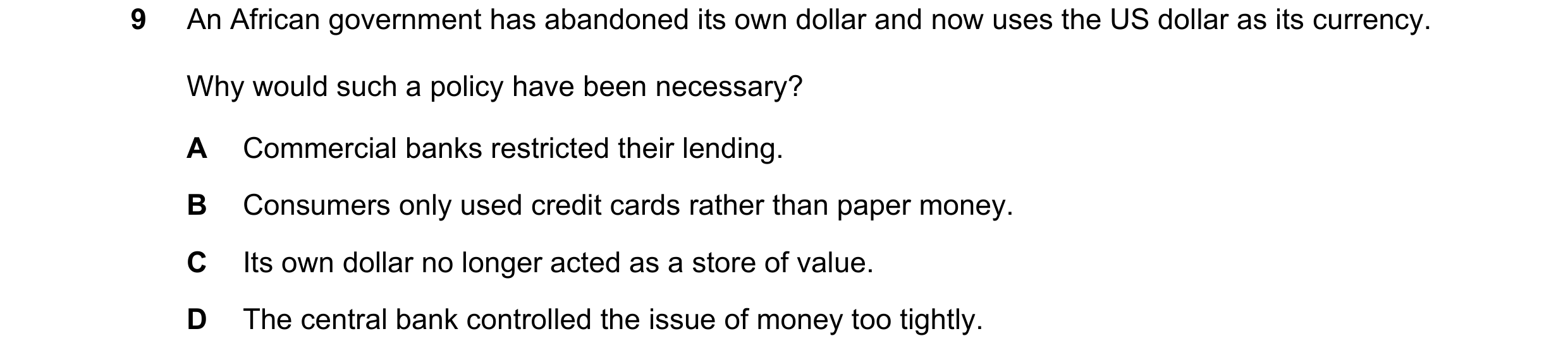
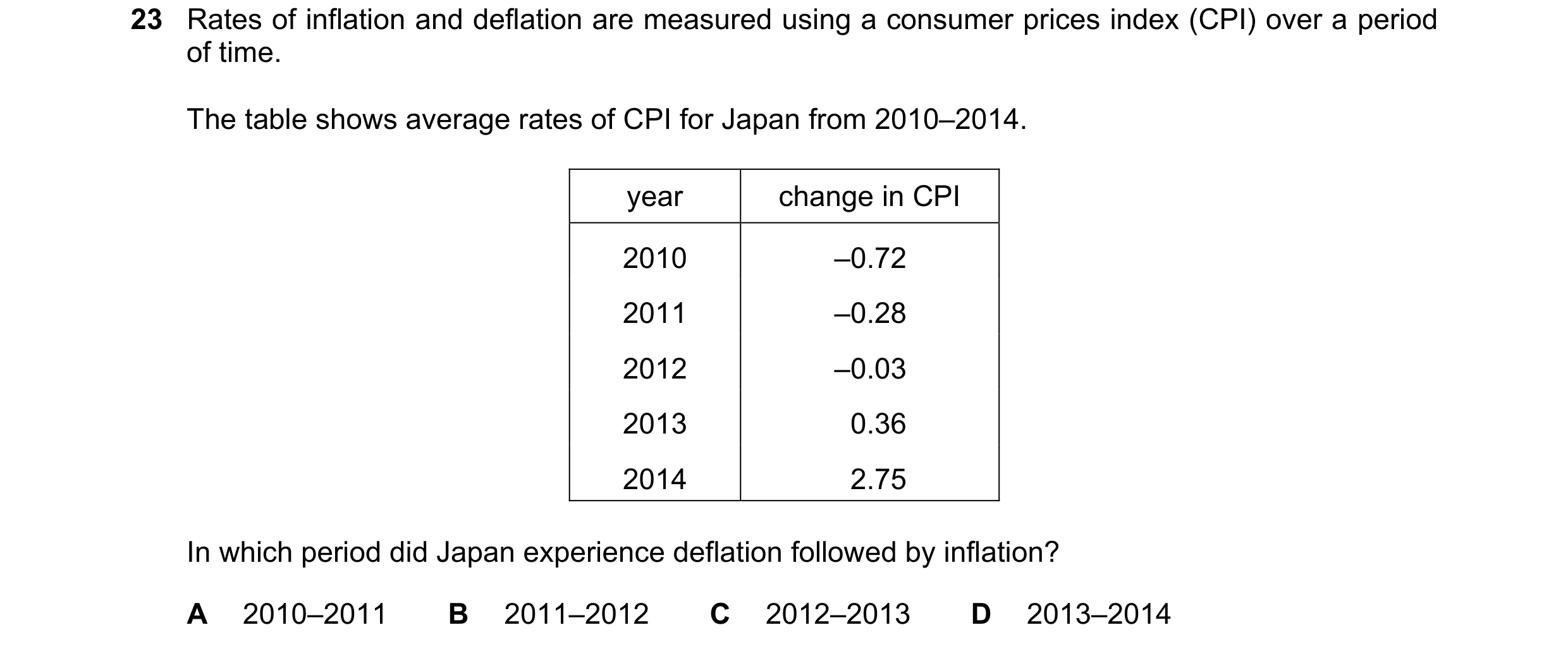
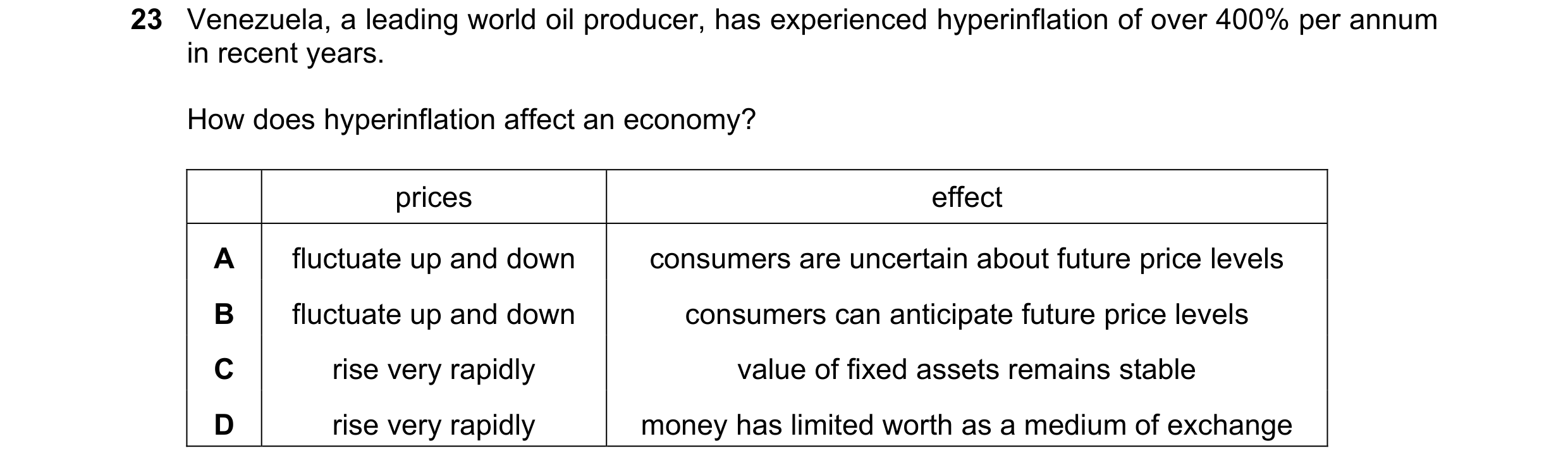 23 / 42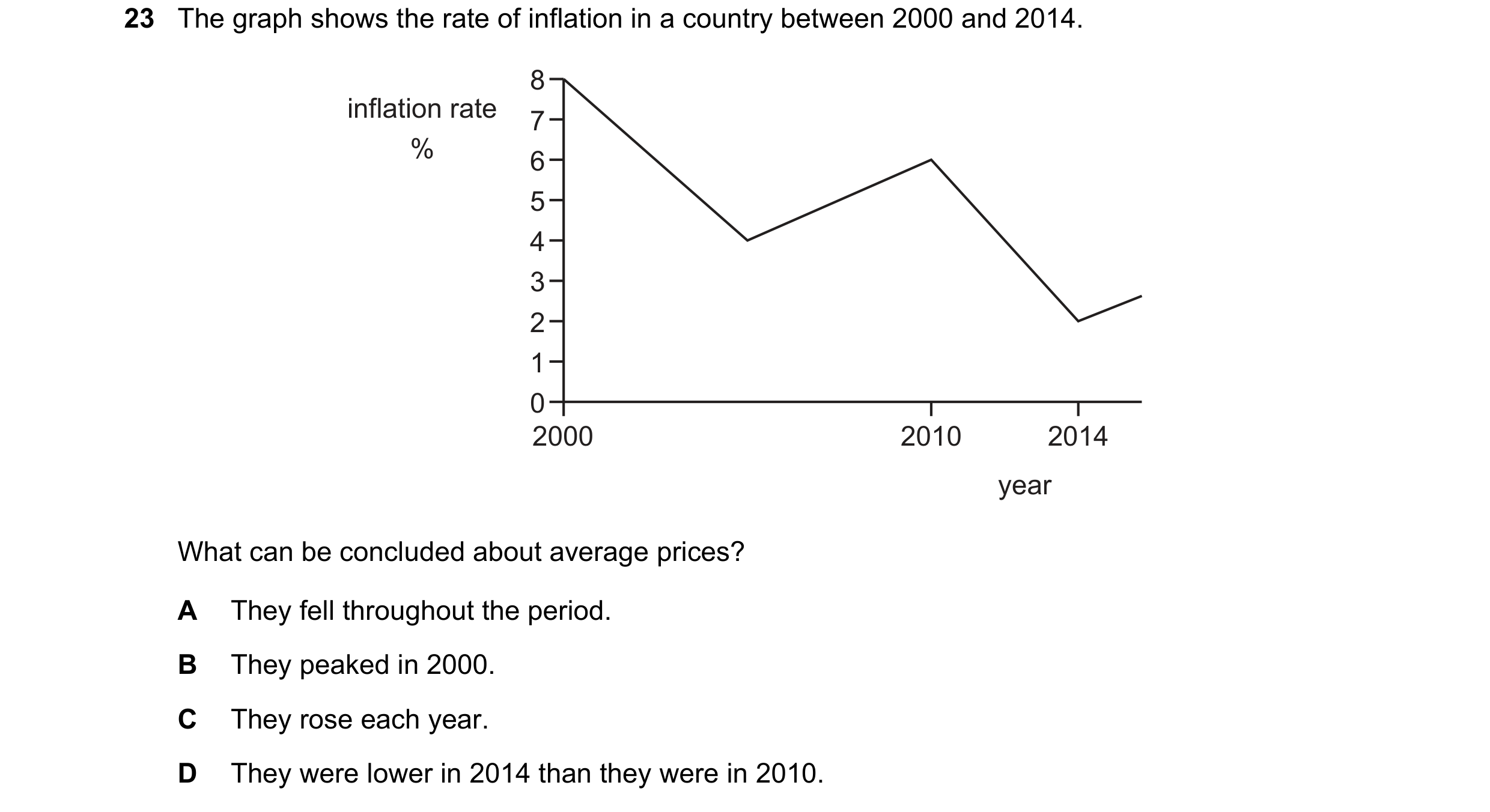



 24 / 42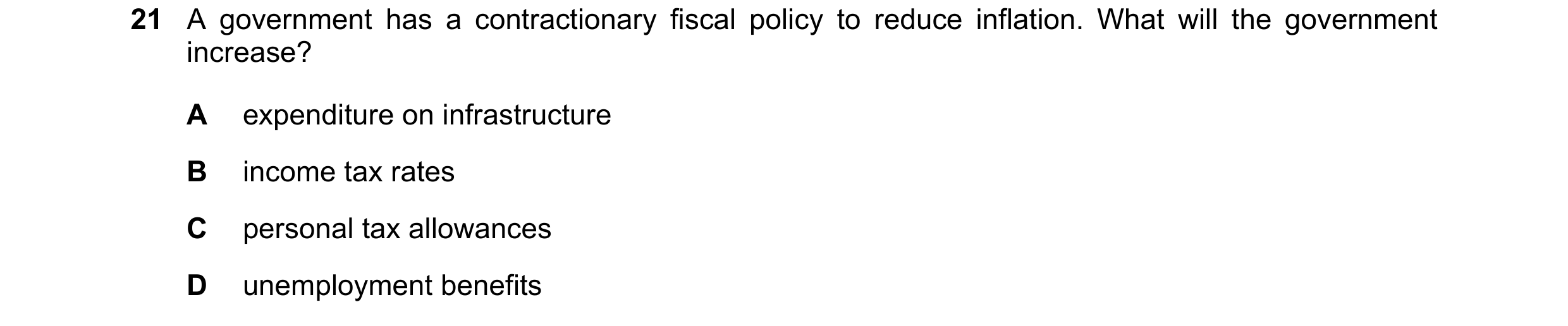

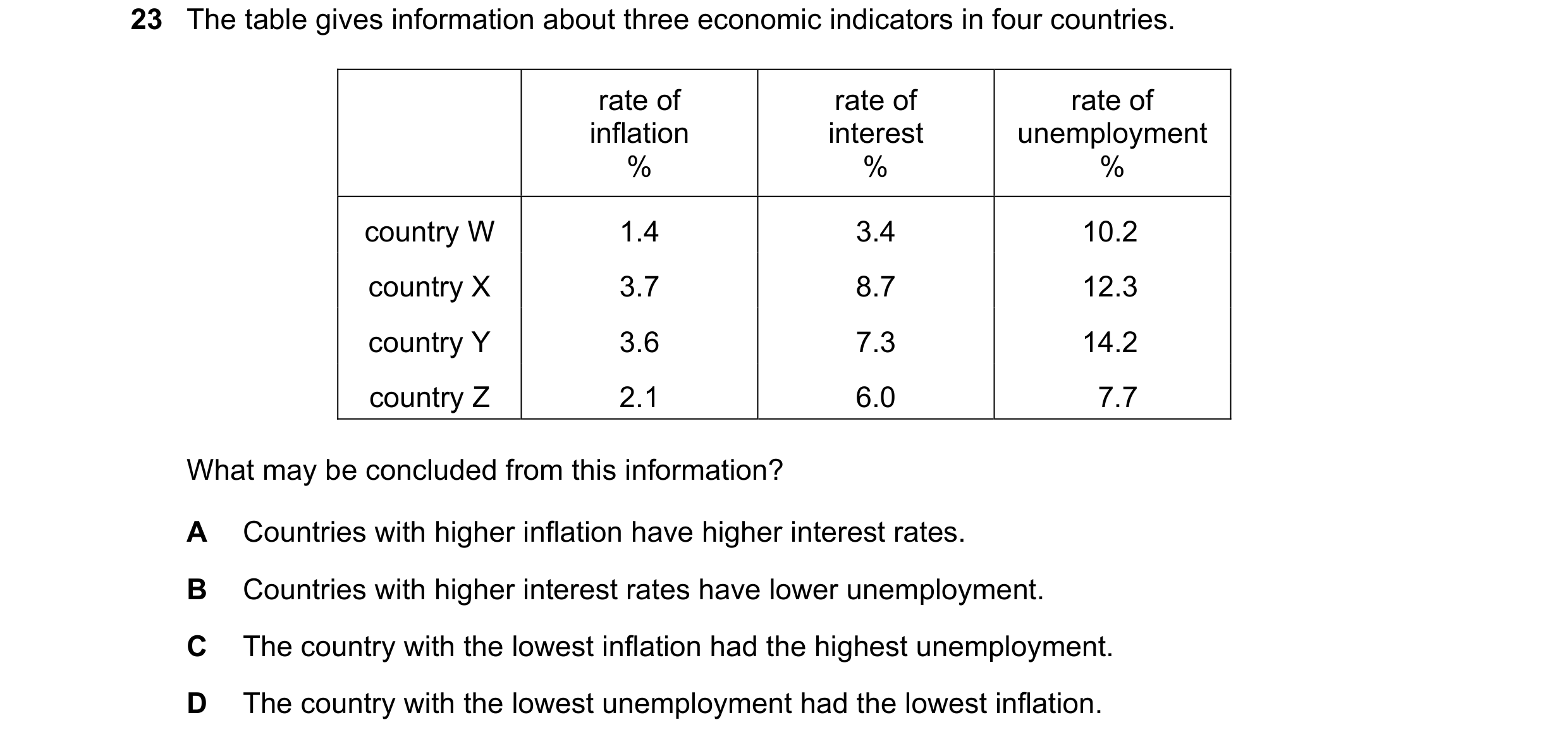
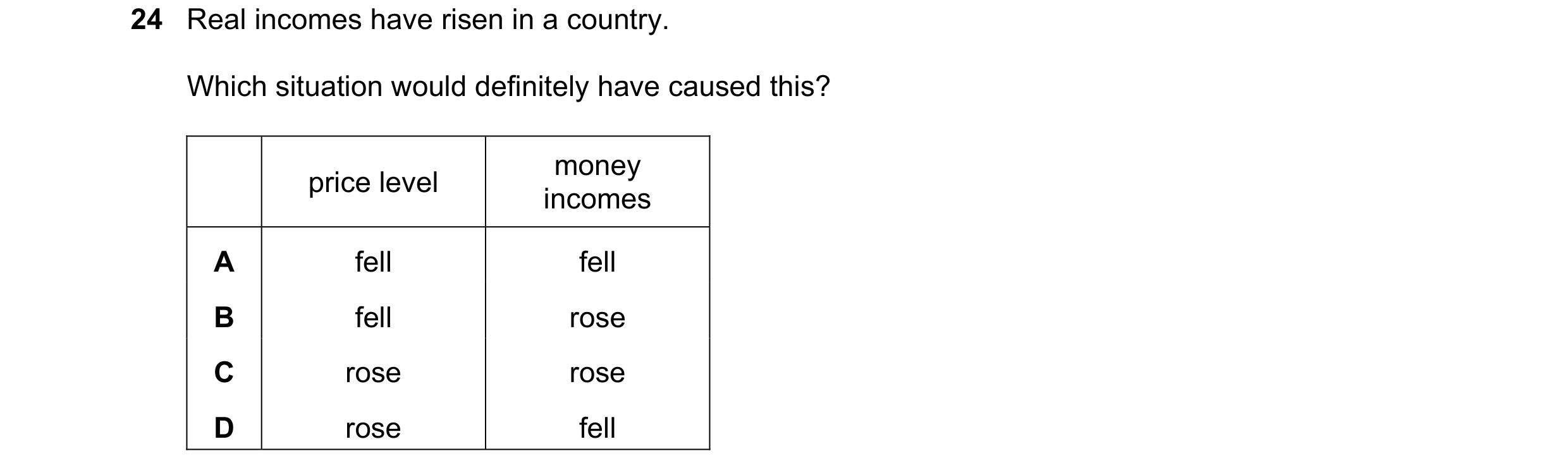 25 / 42
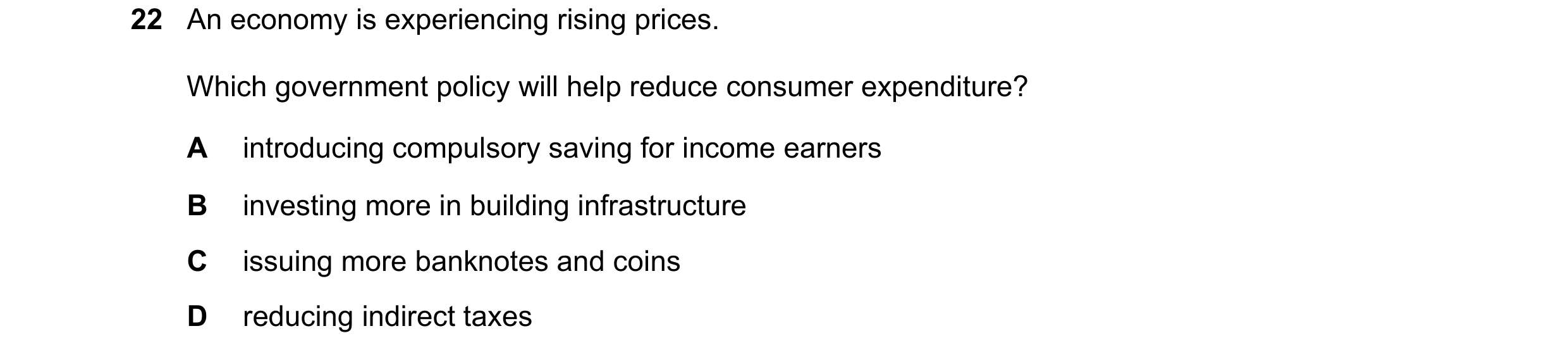
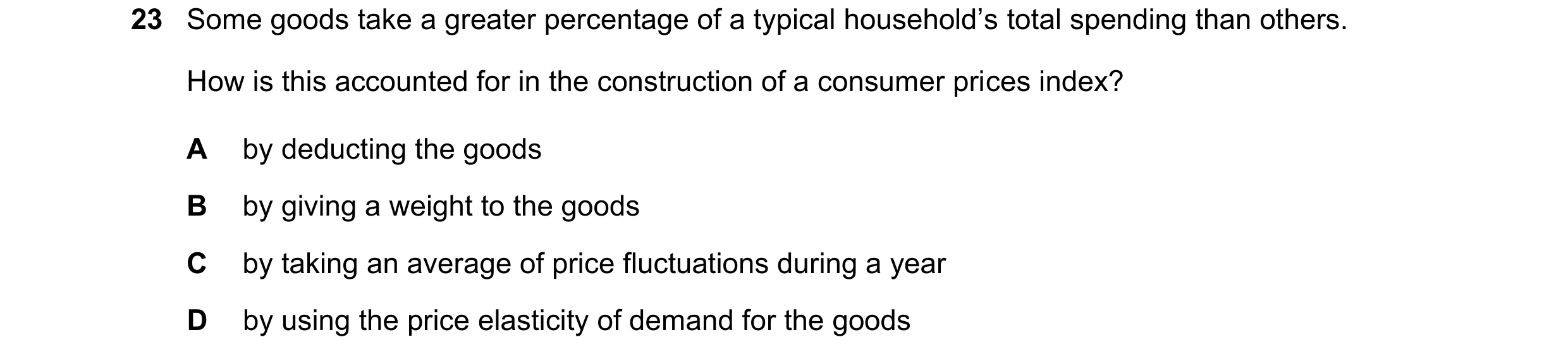
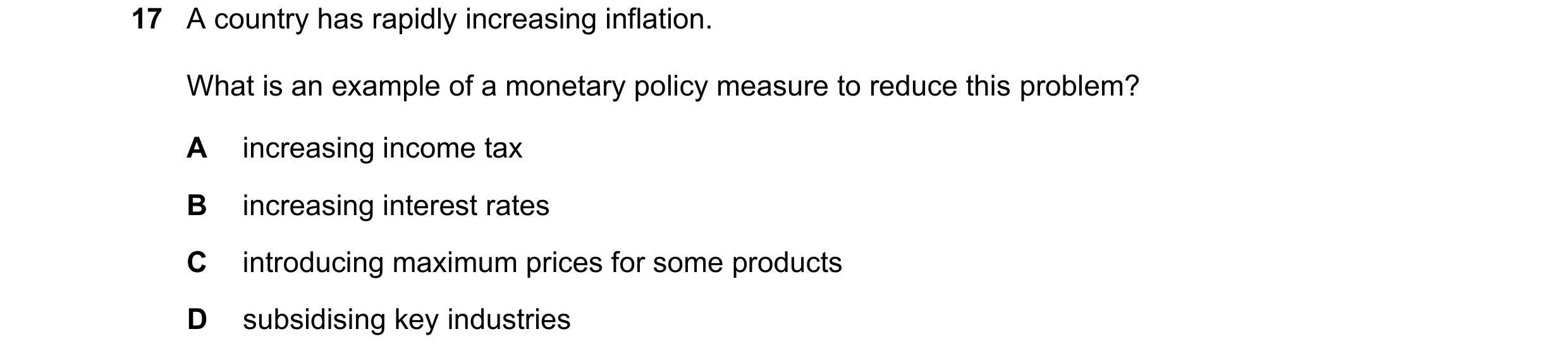 26 / 42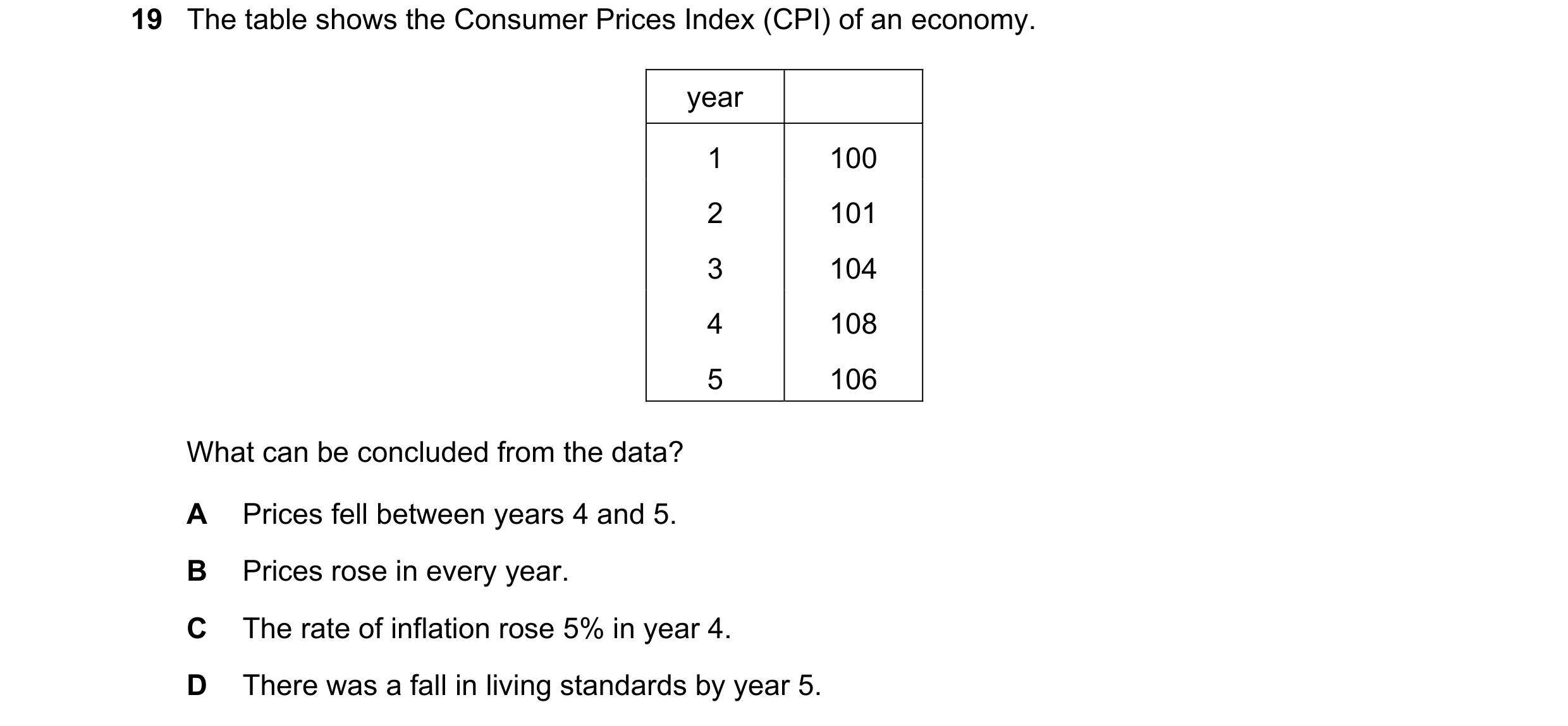
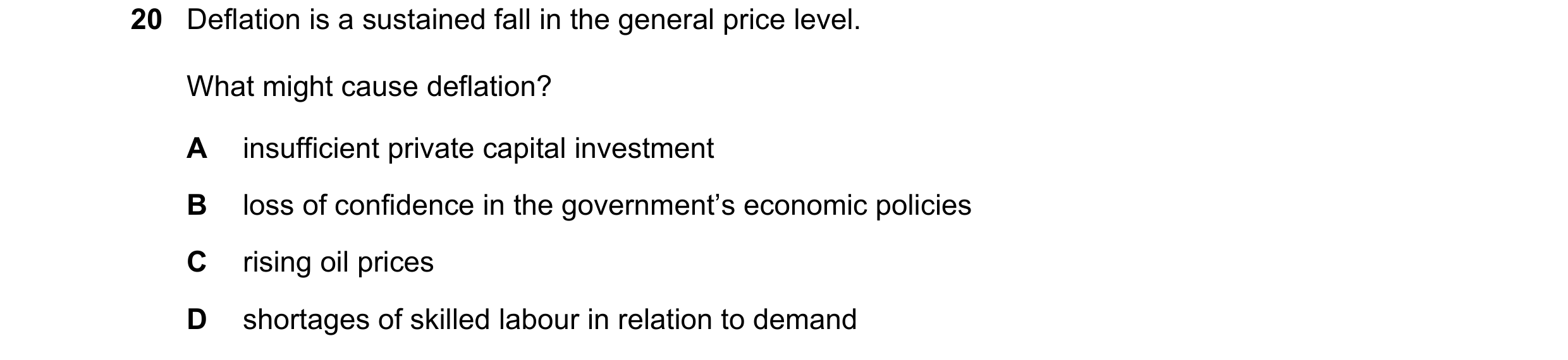
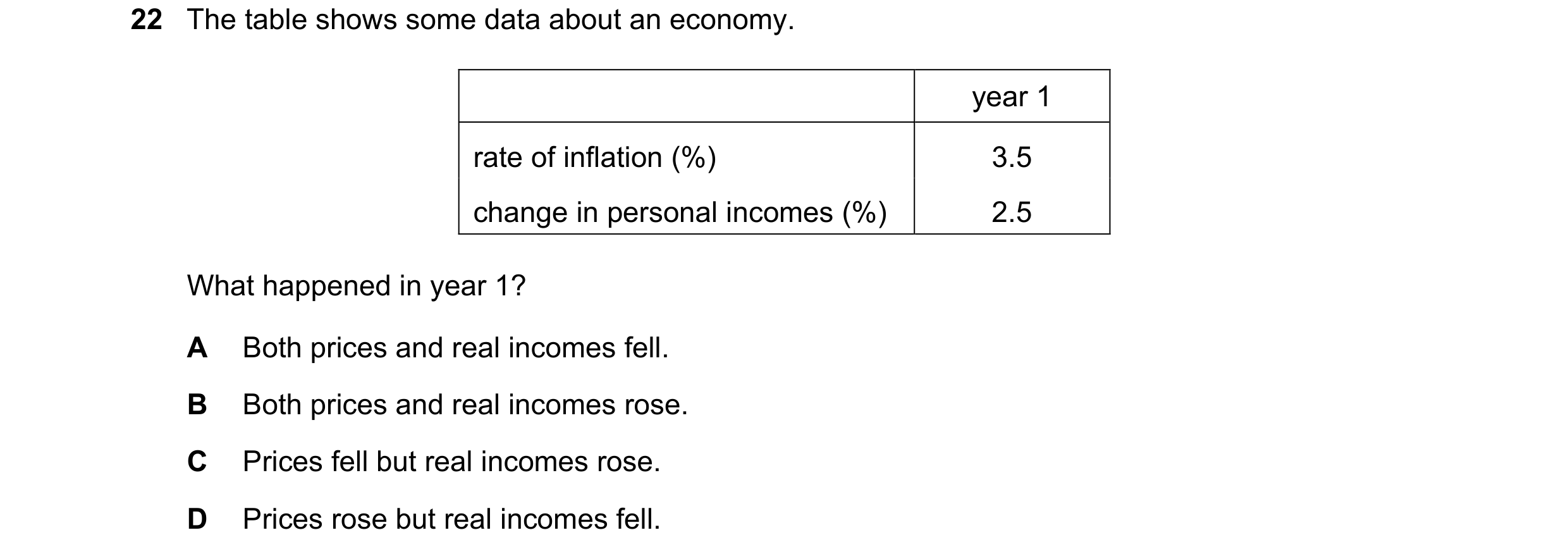
 27 / 42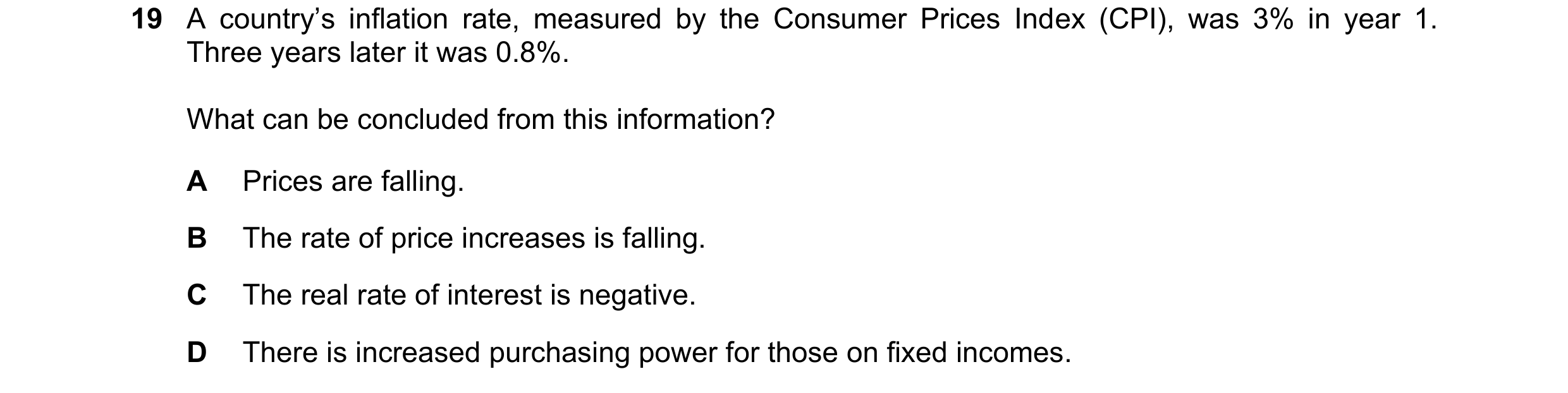

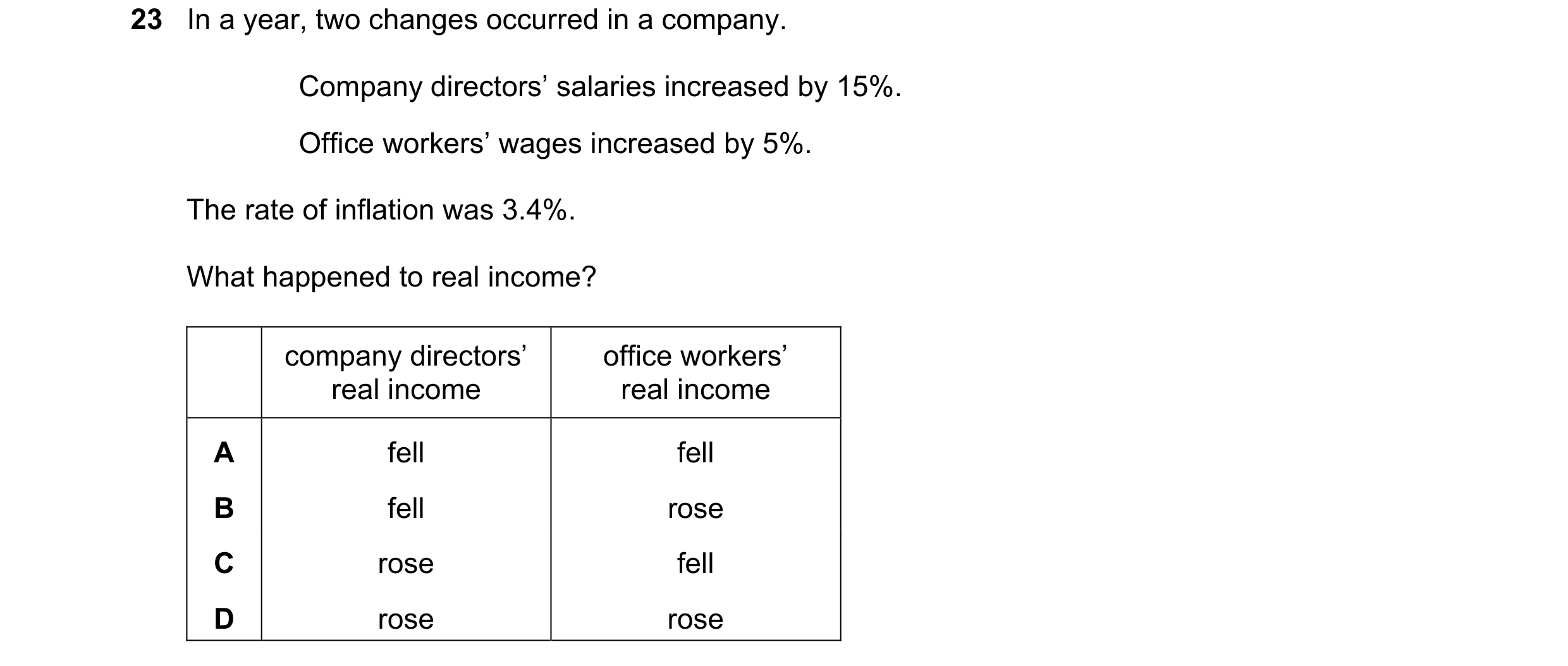
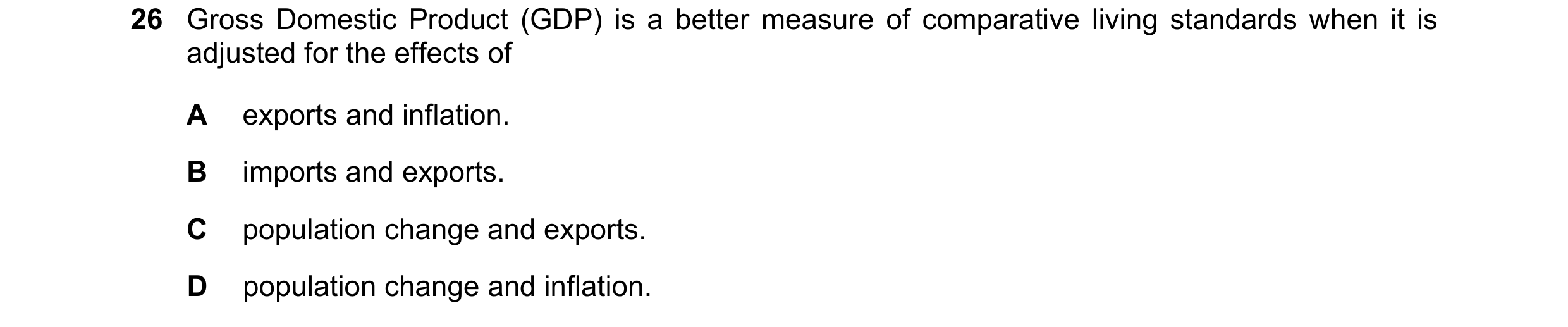 28 / 42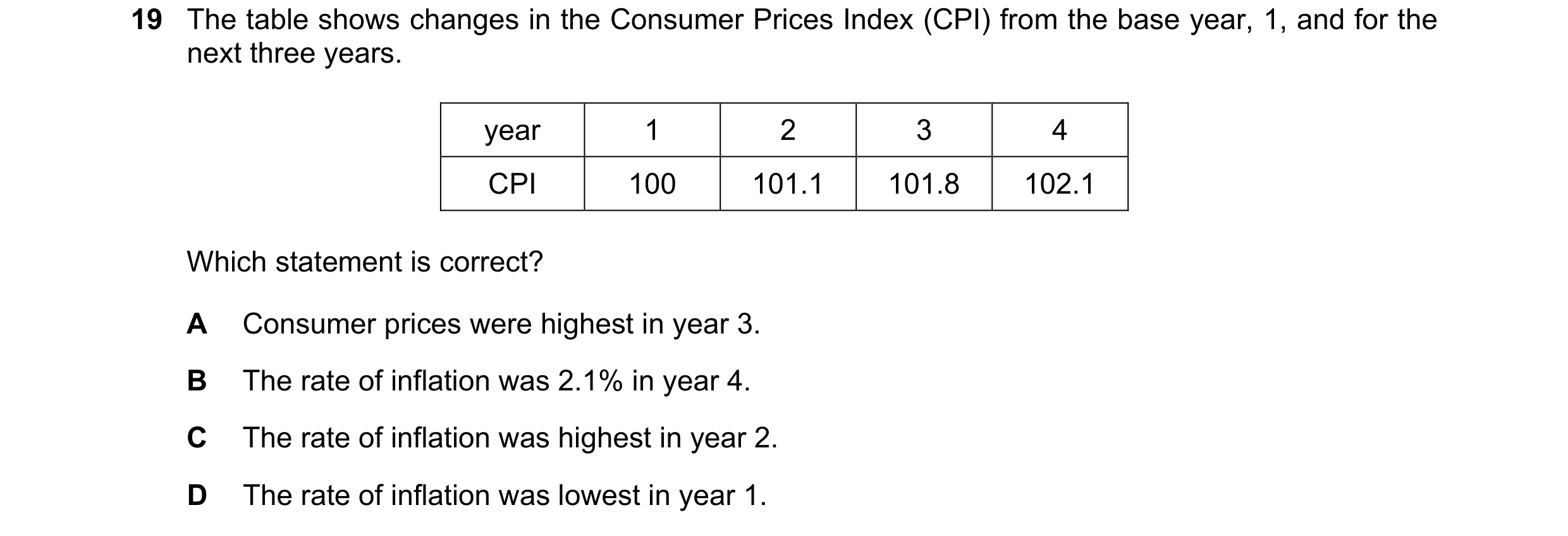

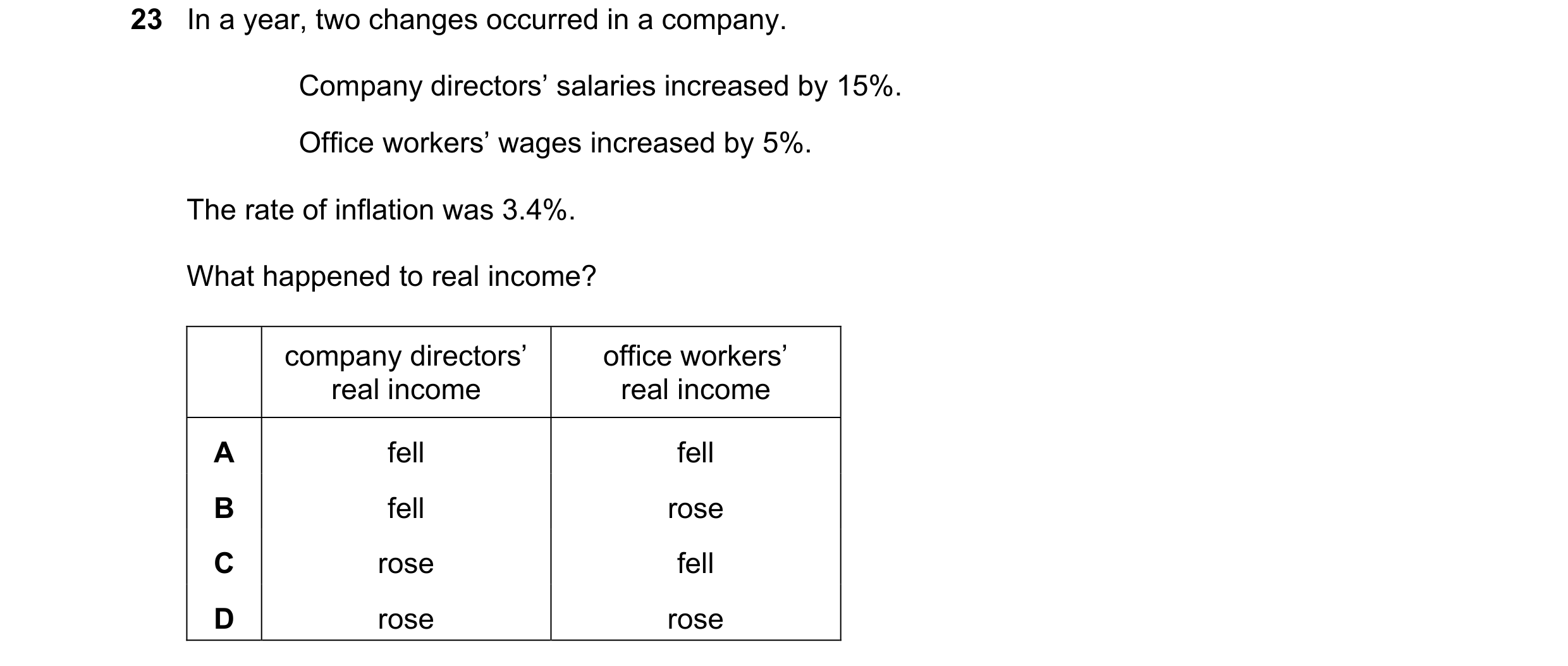 29 / 42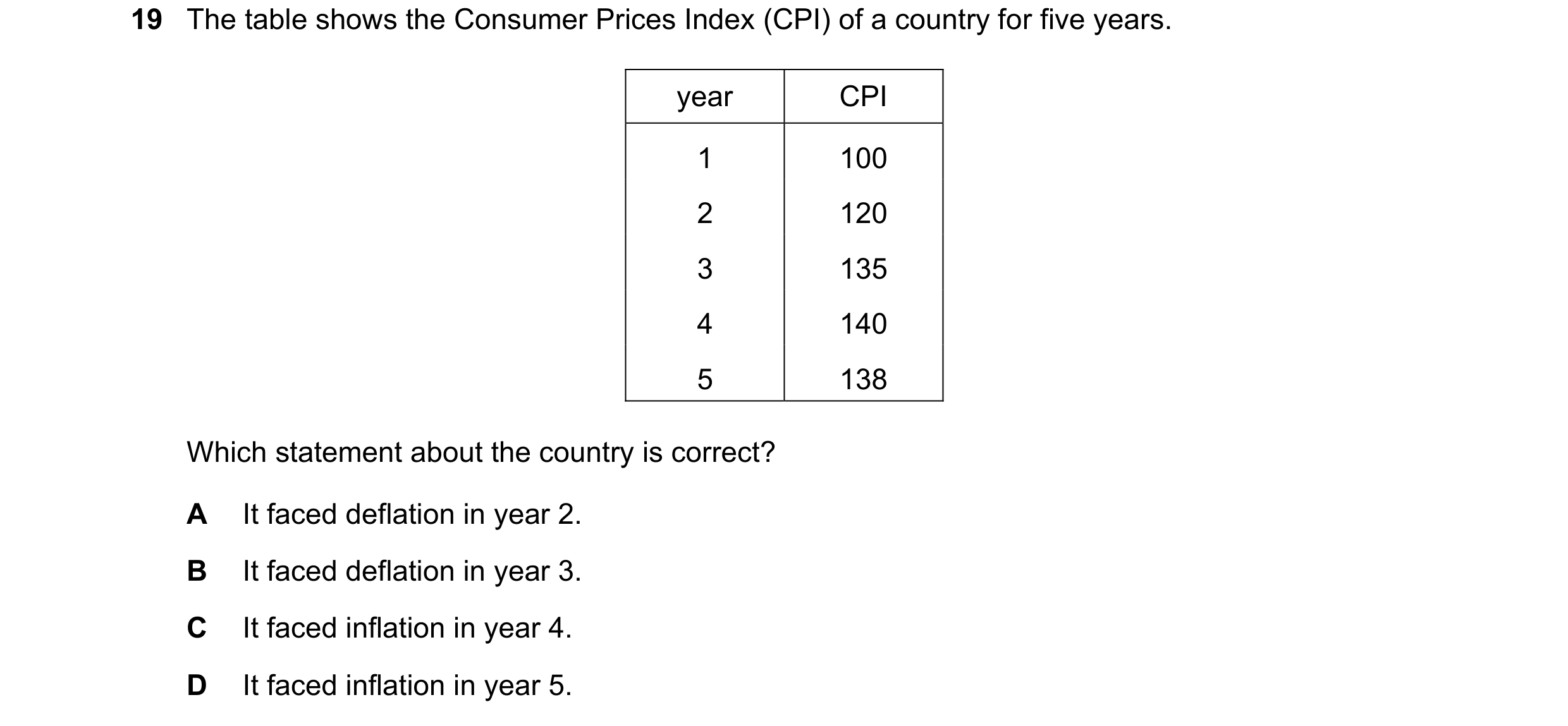

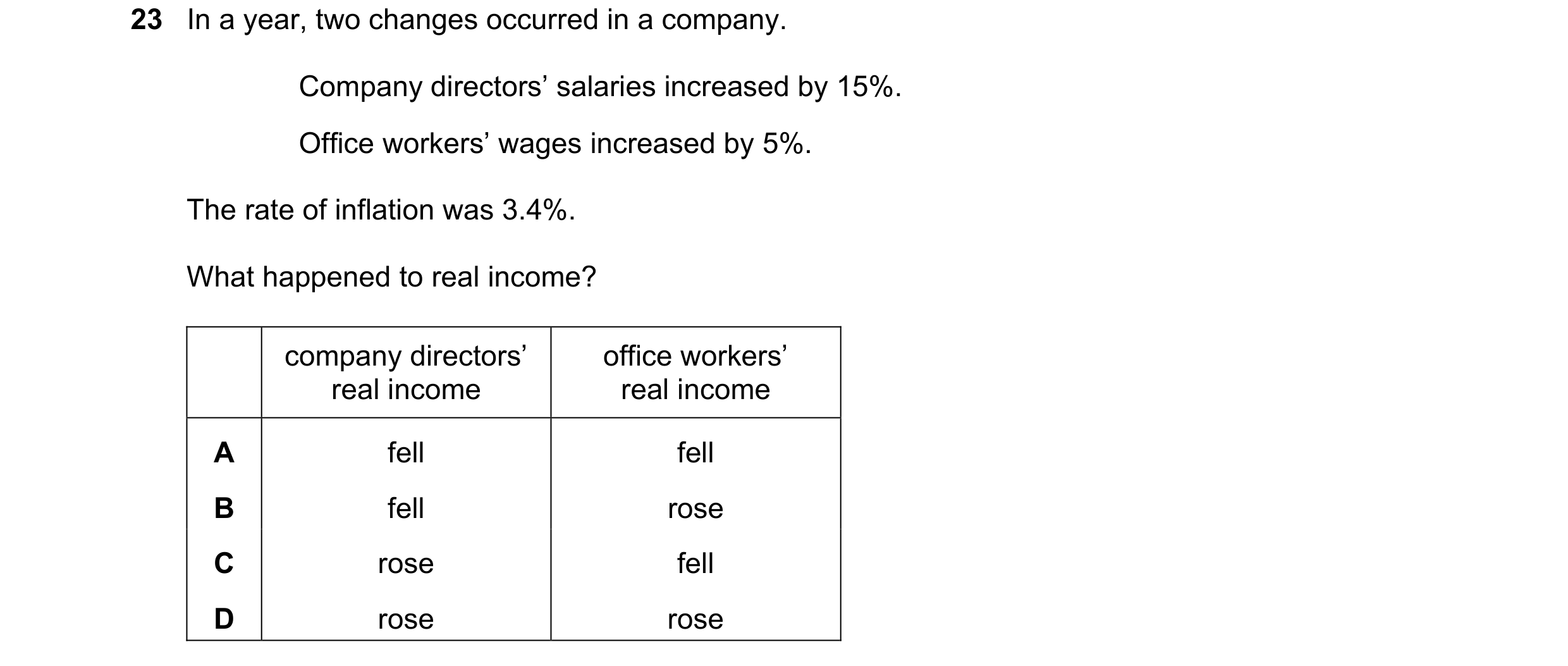
 30 / 42

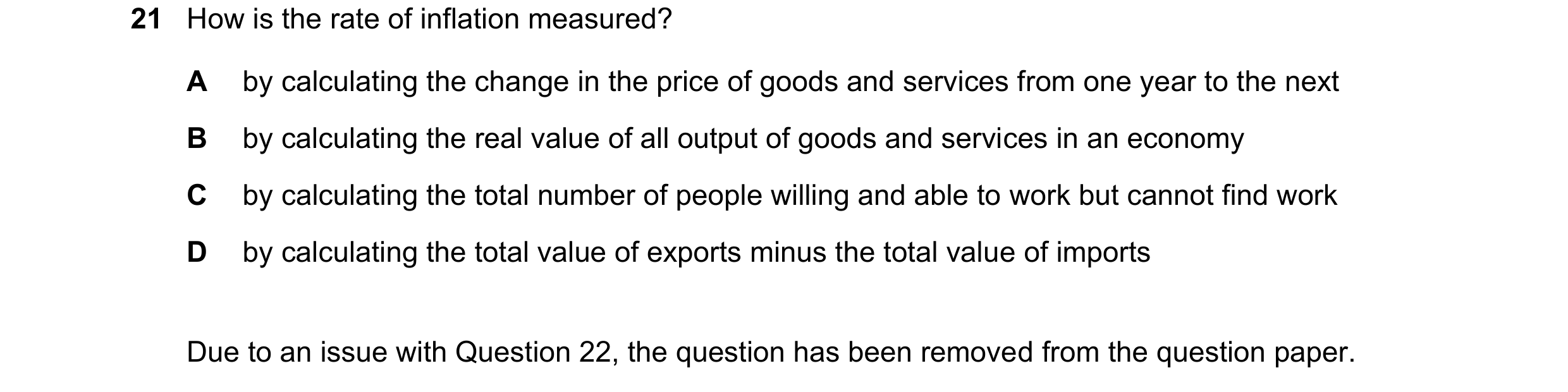
 31 / 42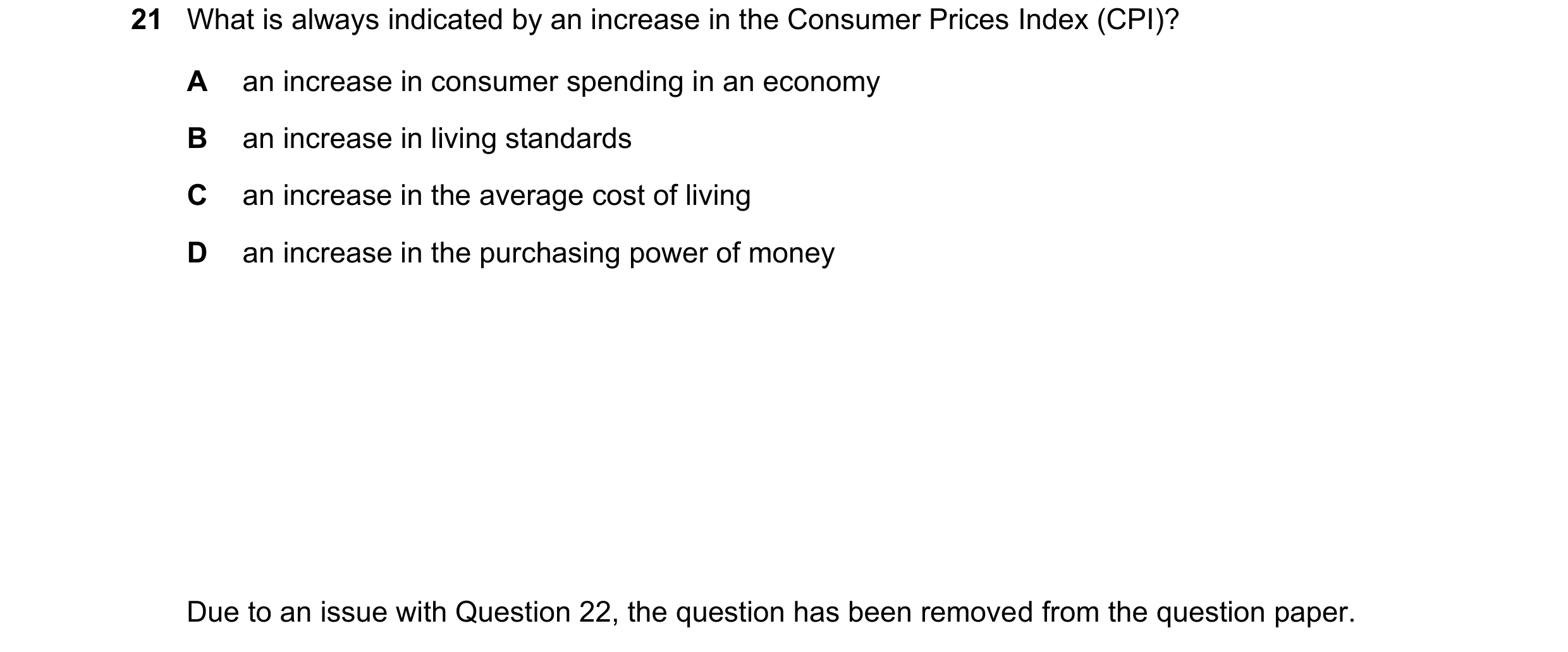
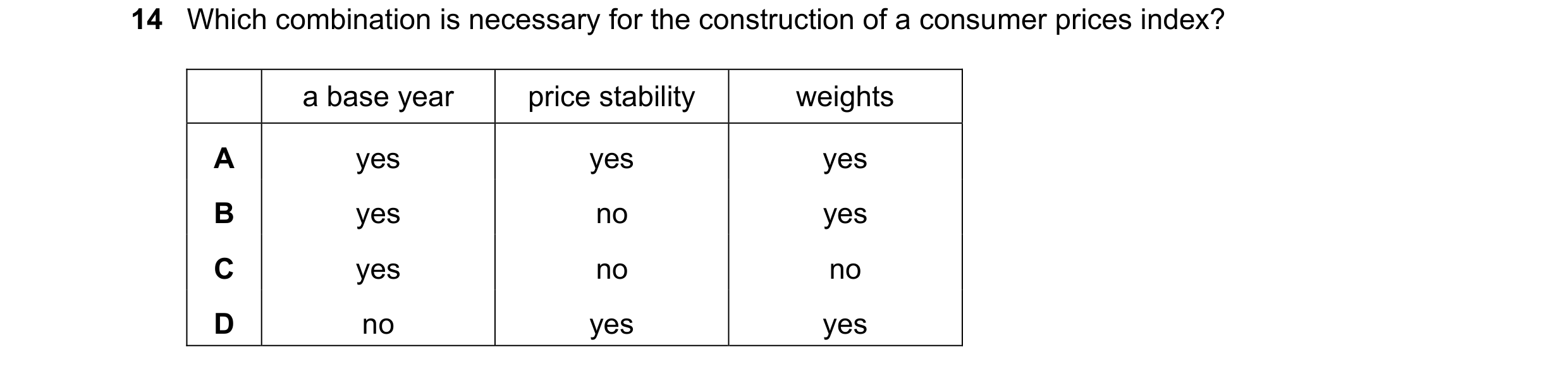

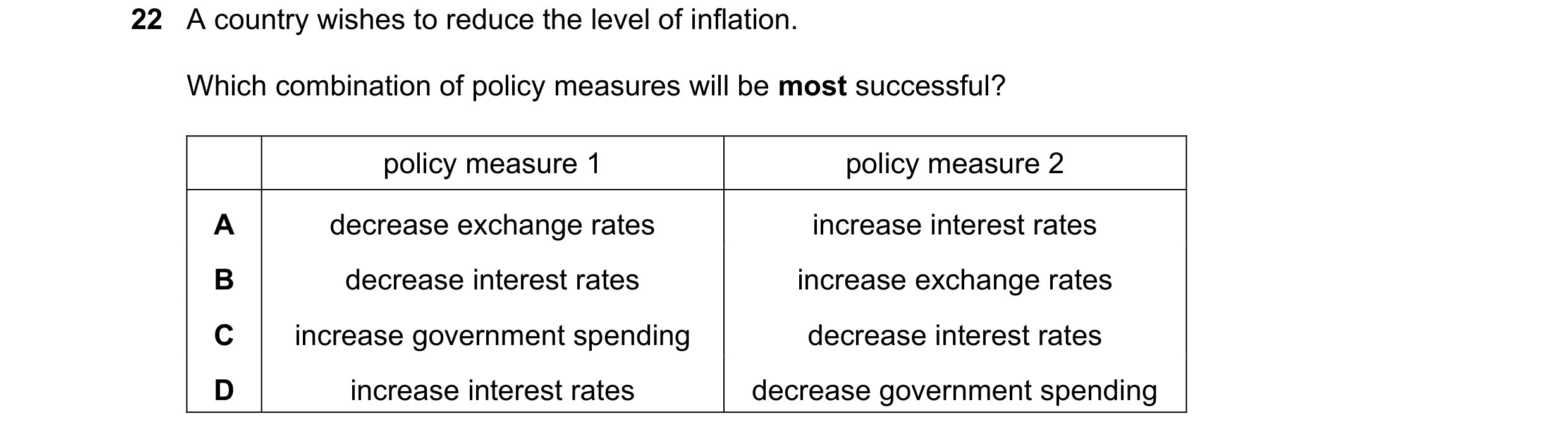 32 / 42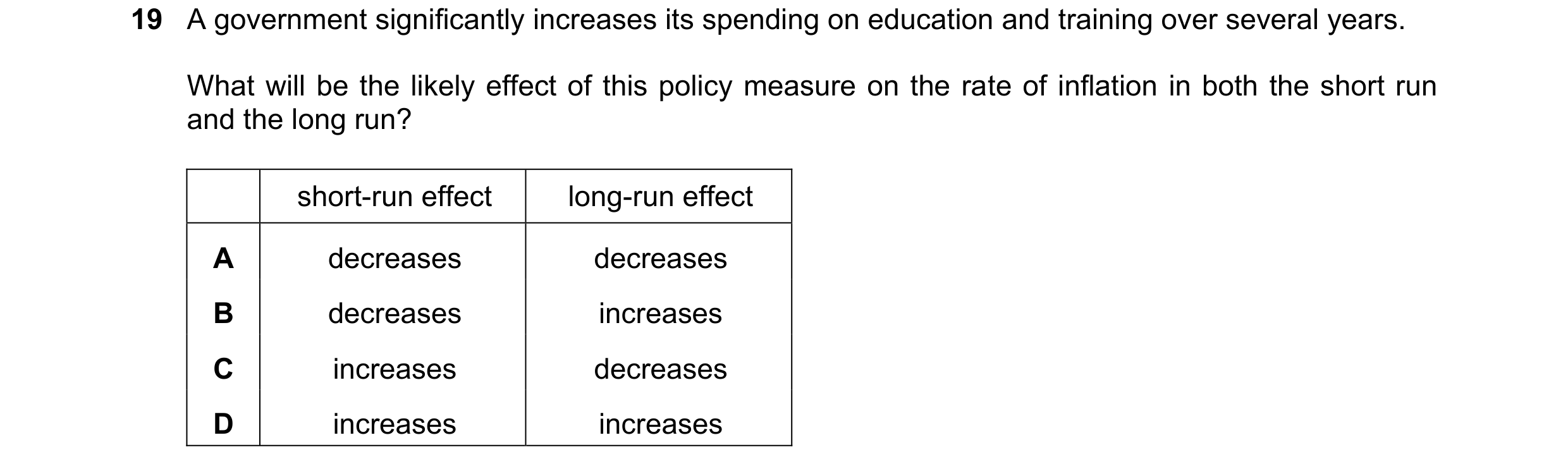

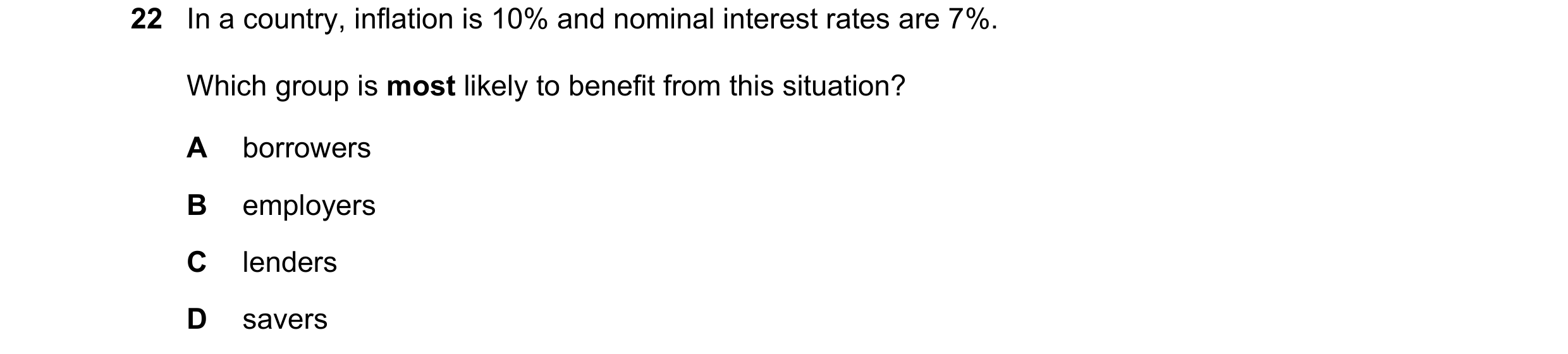

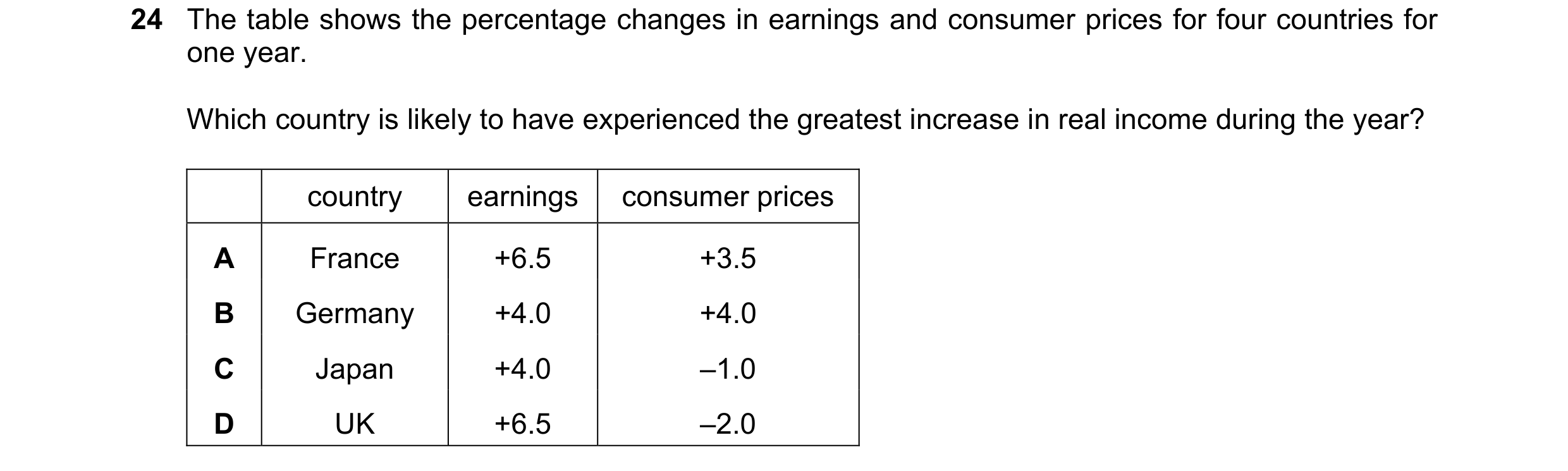 33 / 42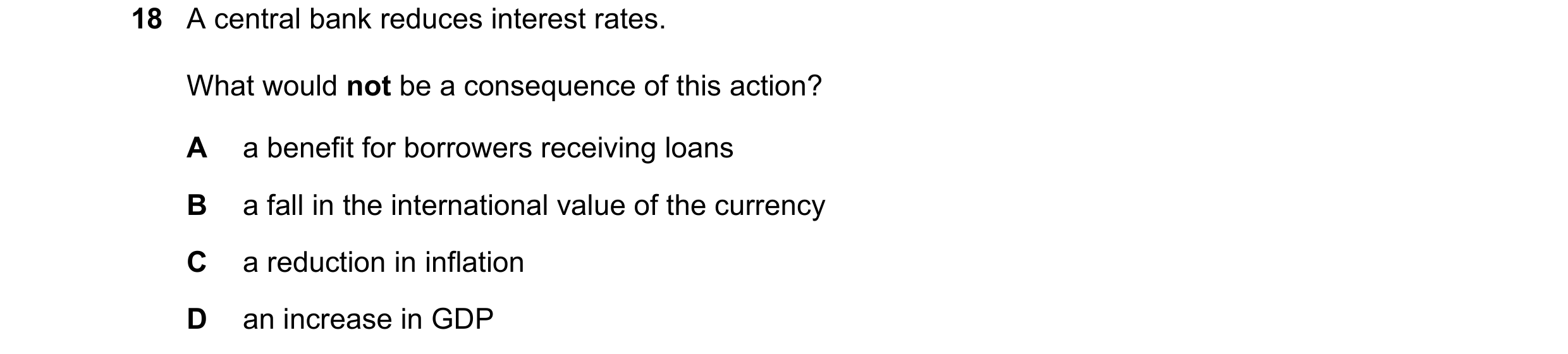

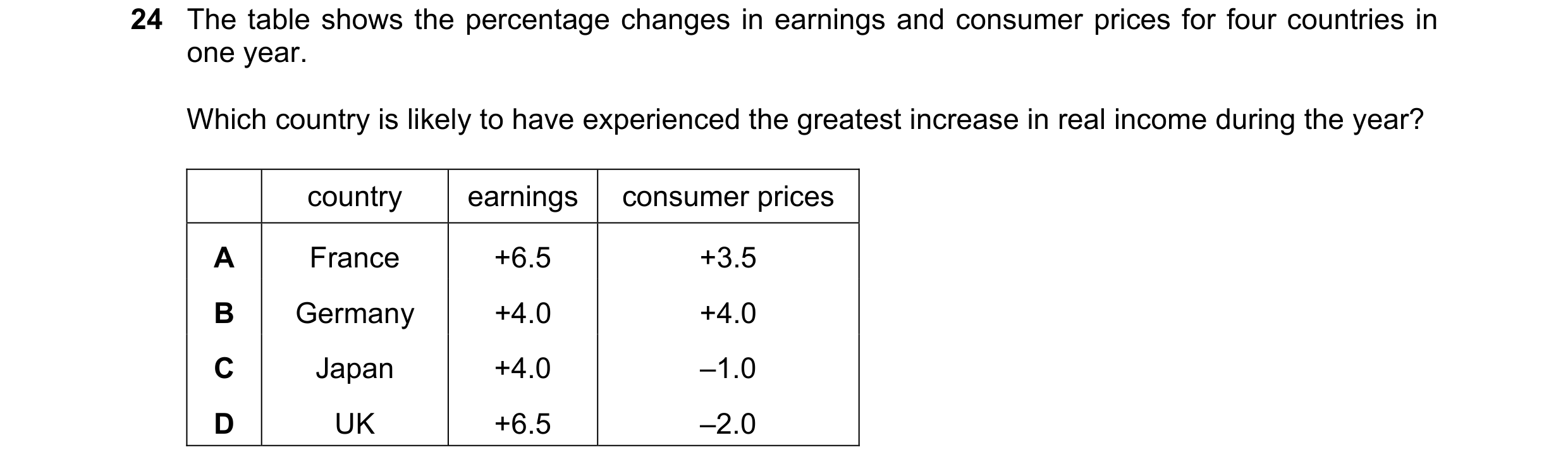
 34 / 42
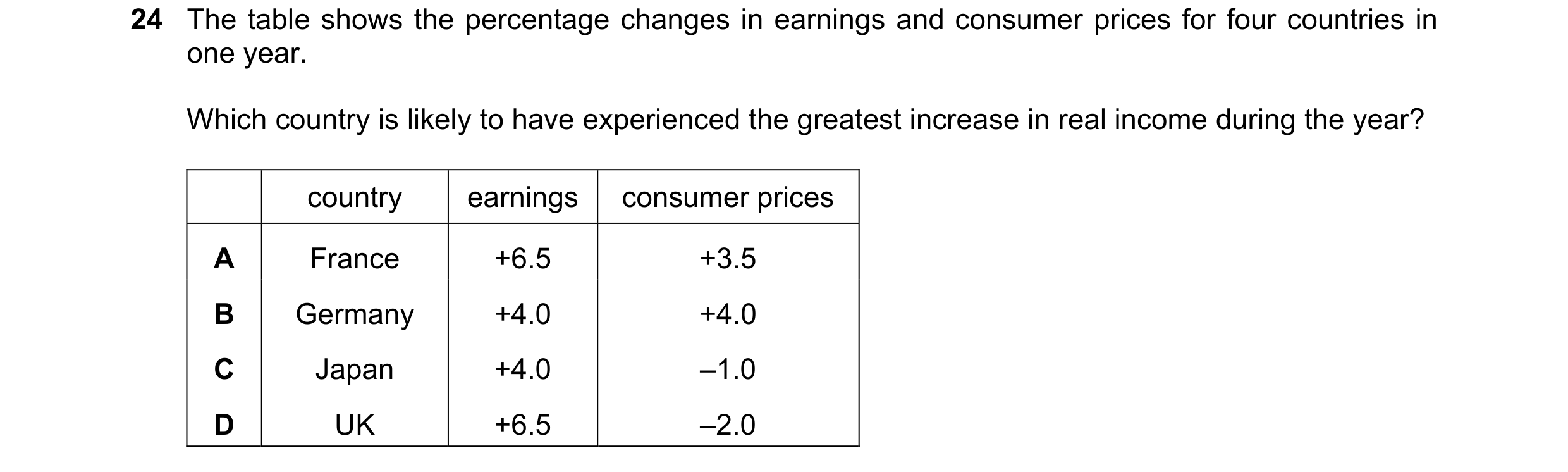

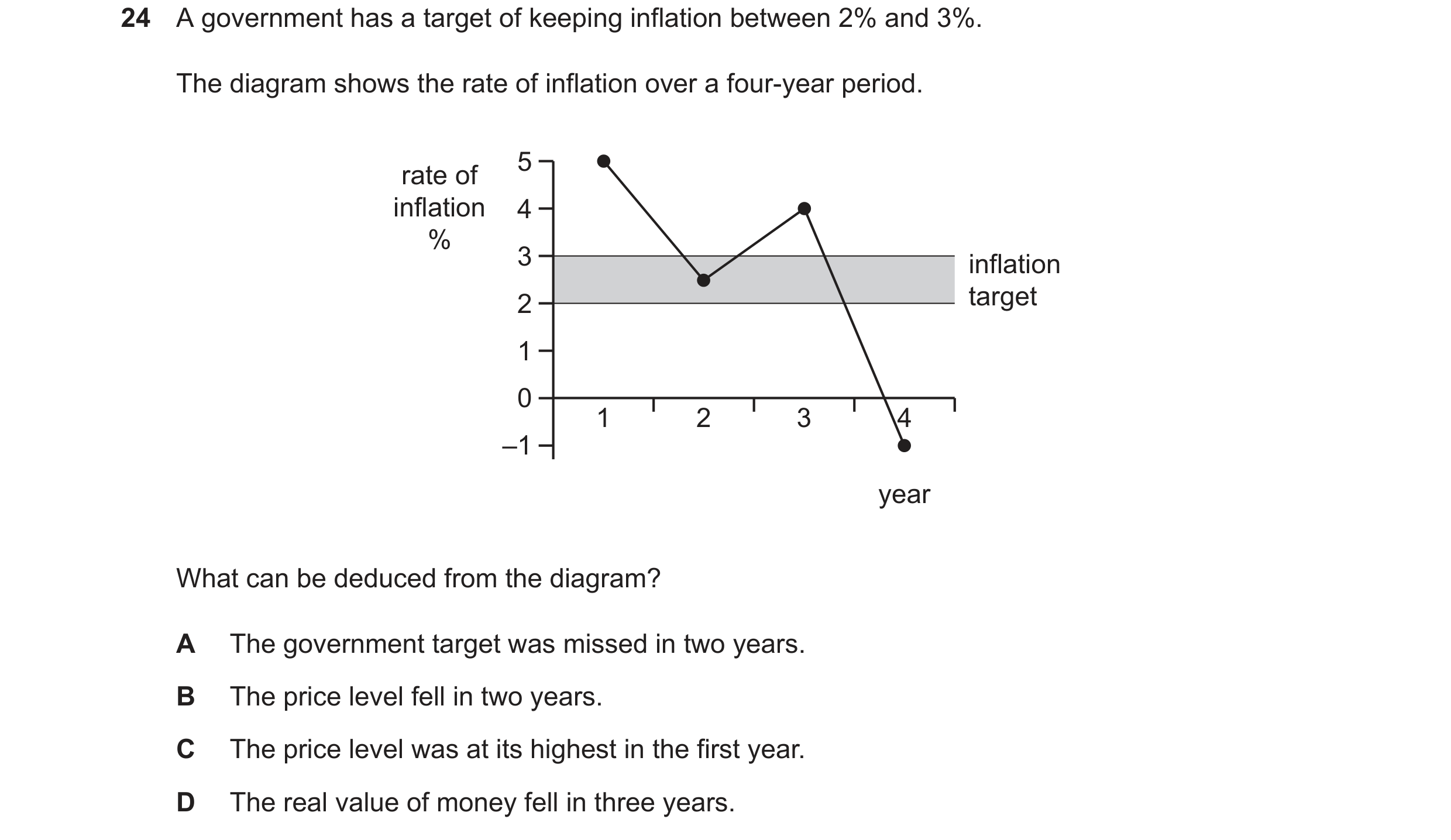 35 / 42
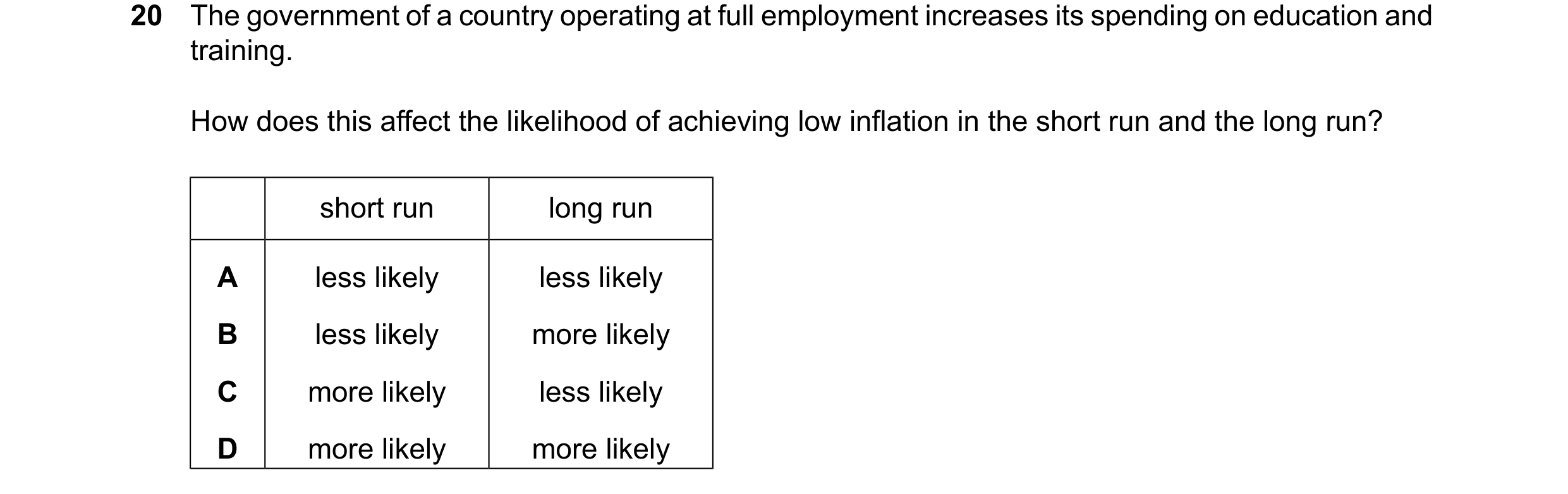

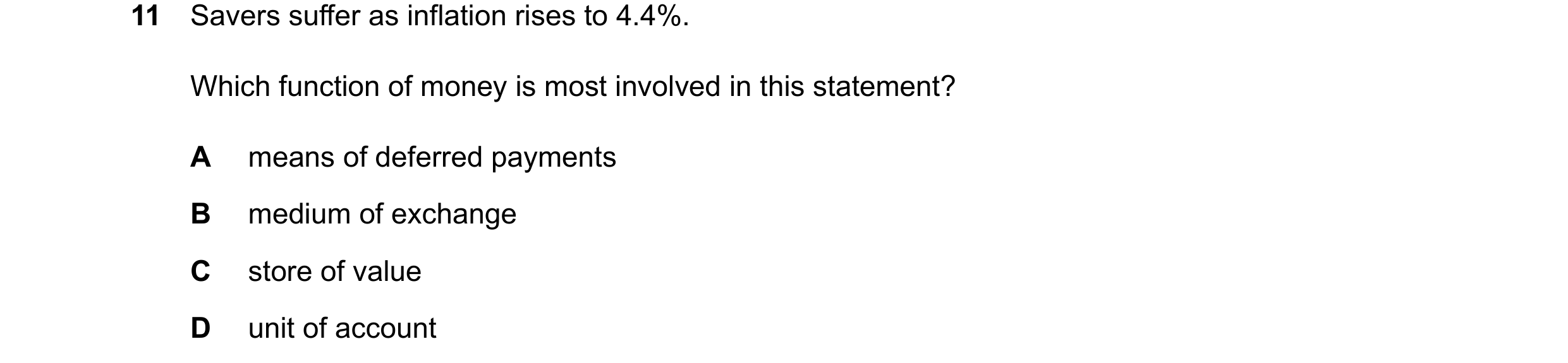
 36 / 42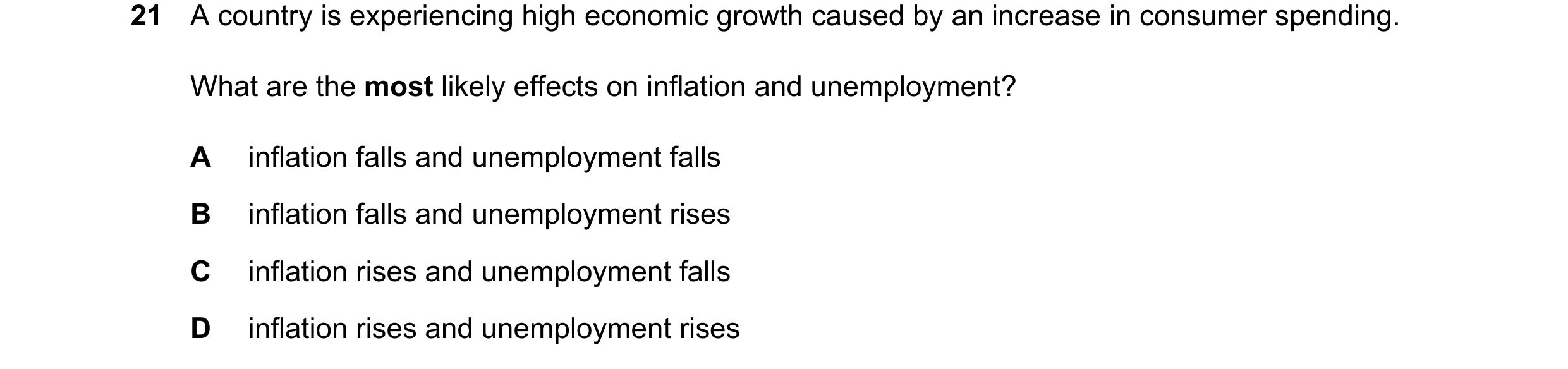
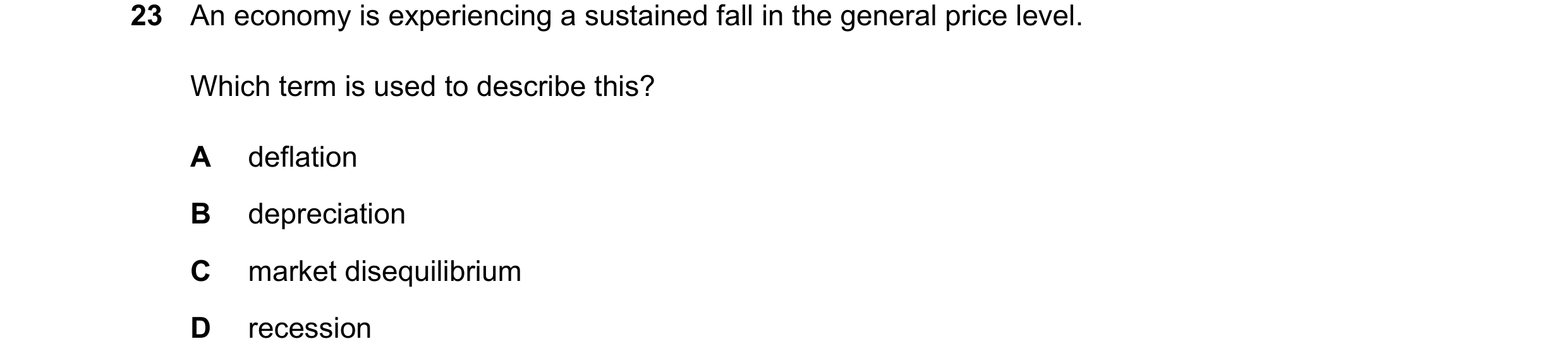


 37 / 42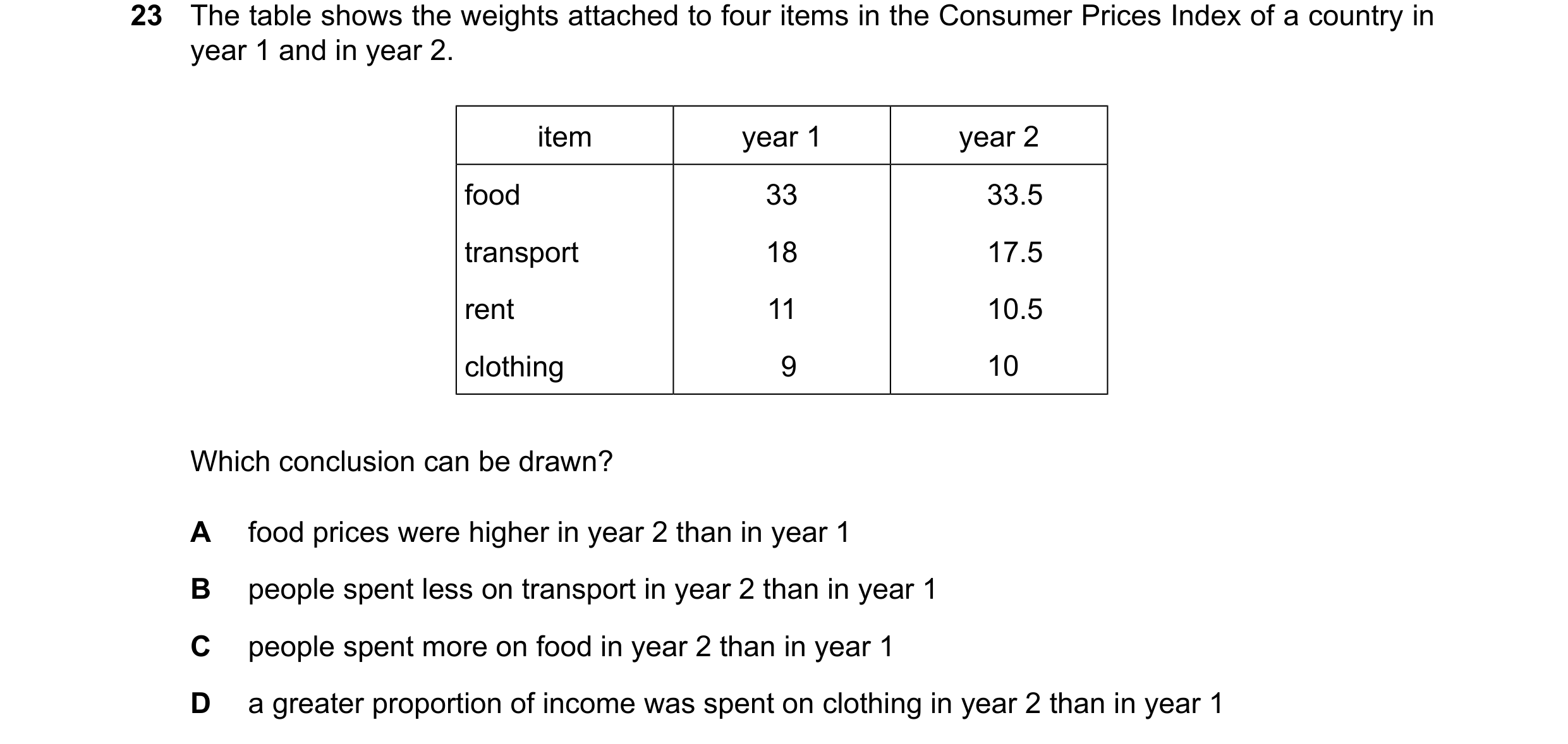


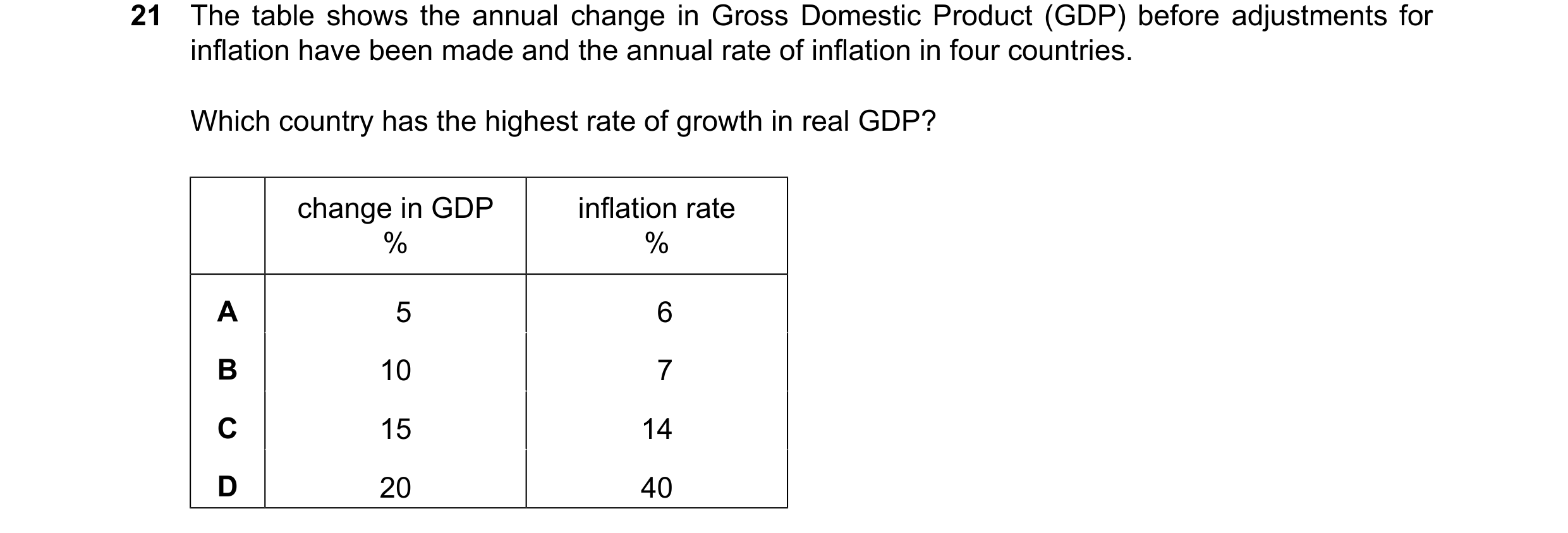
 38 / 42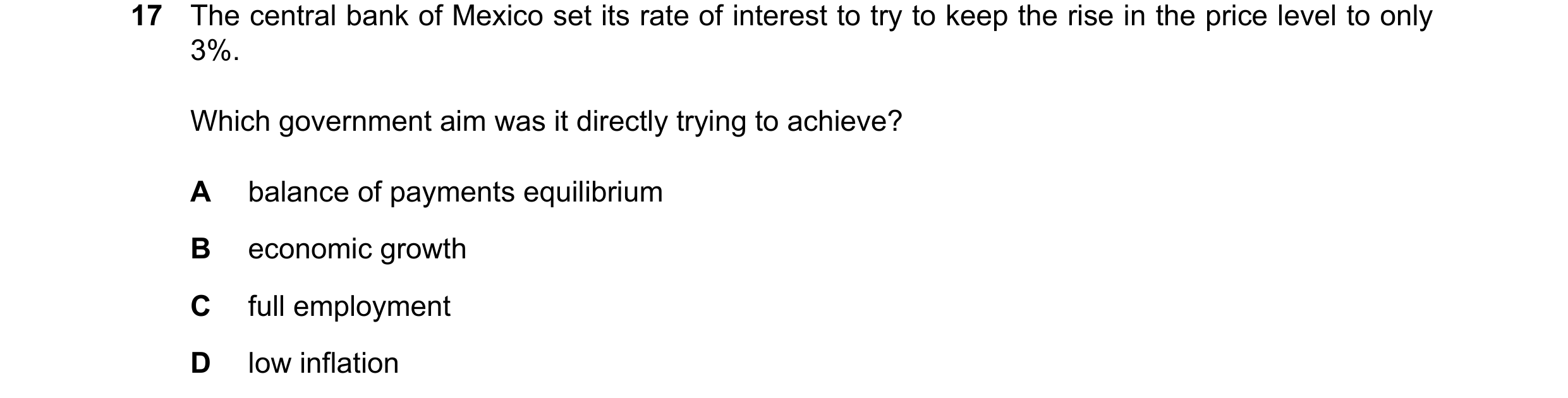
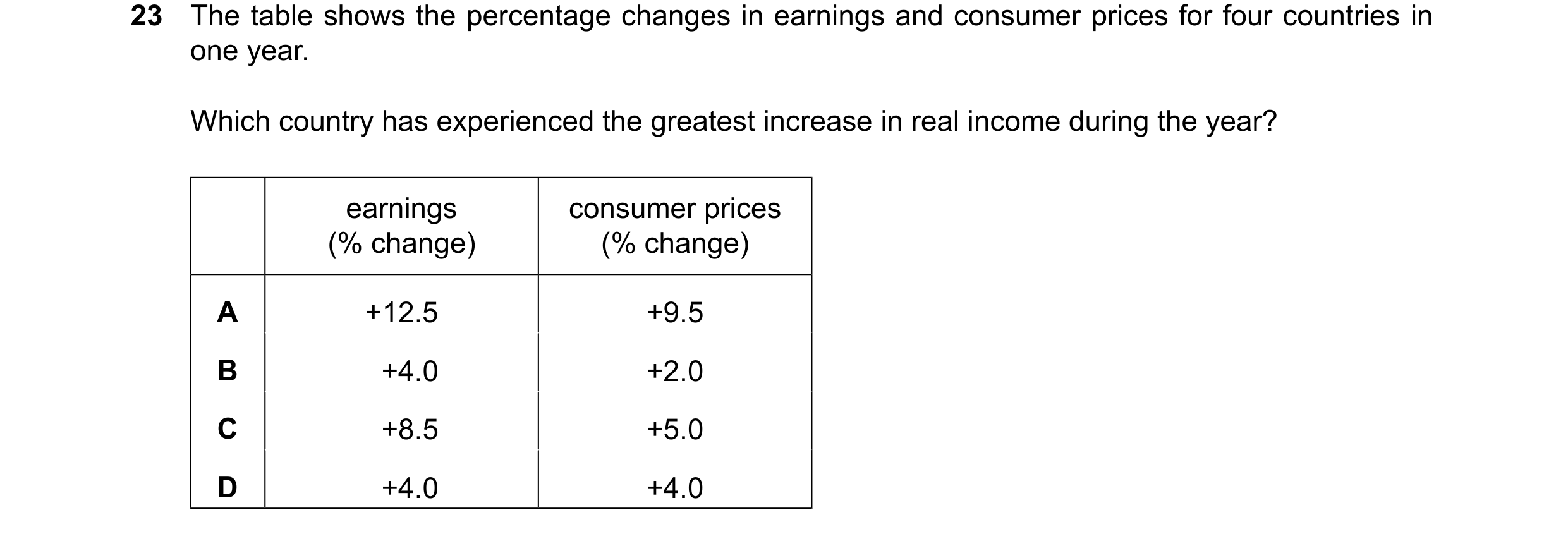
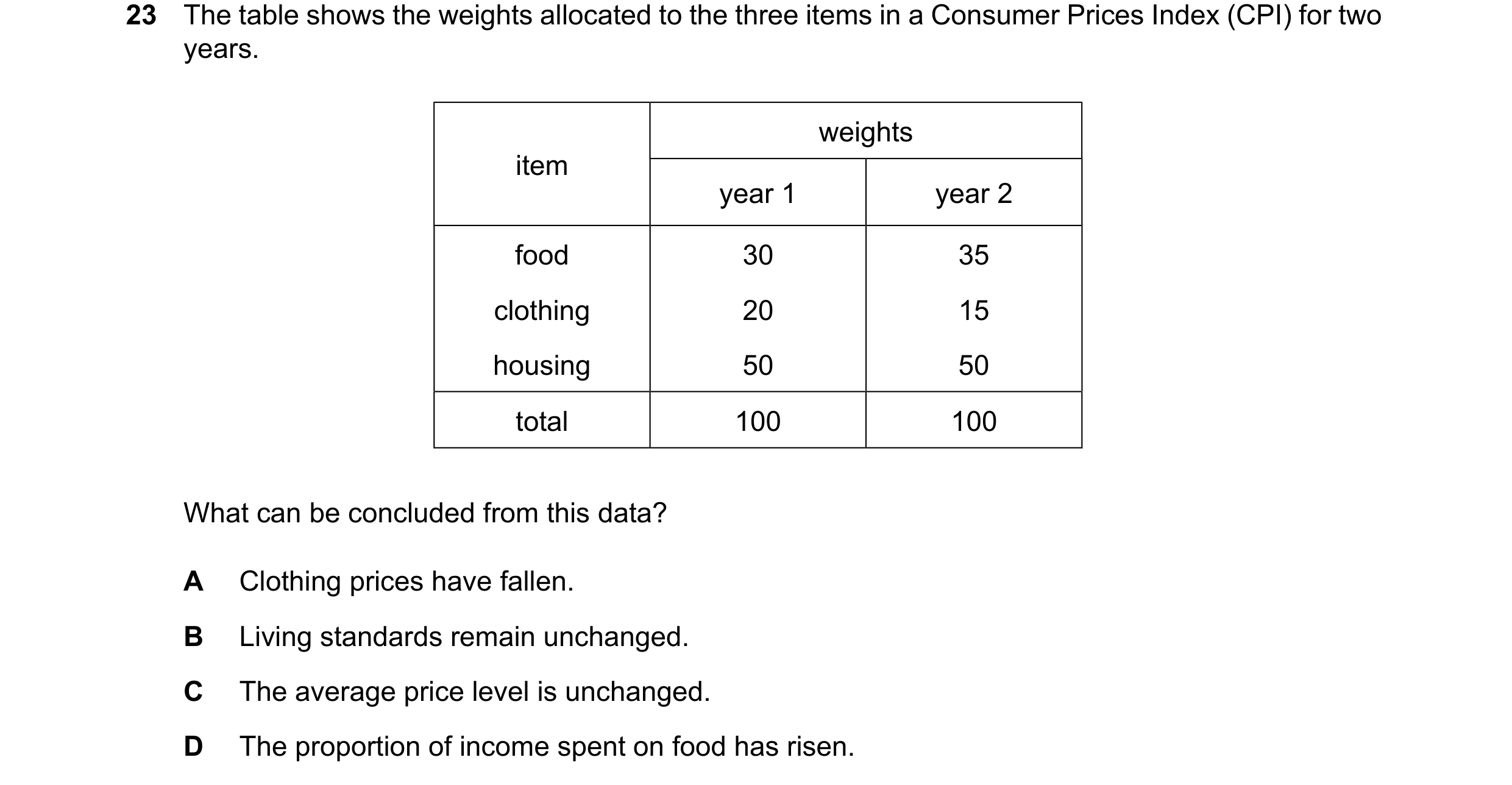 39 / 42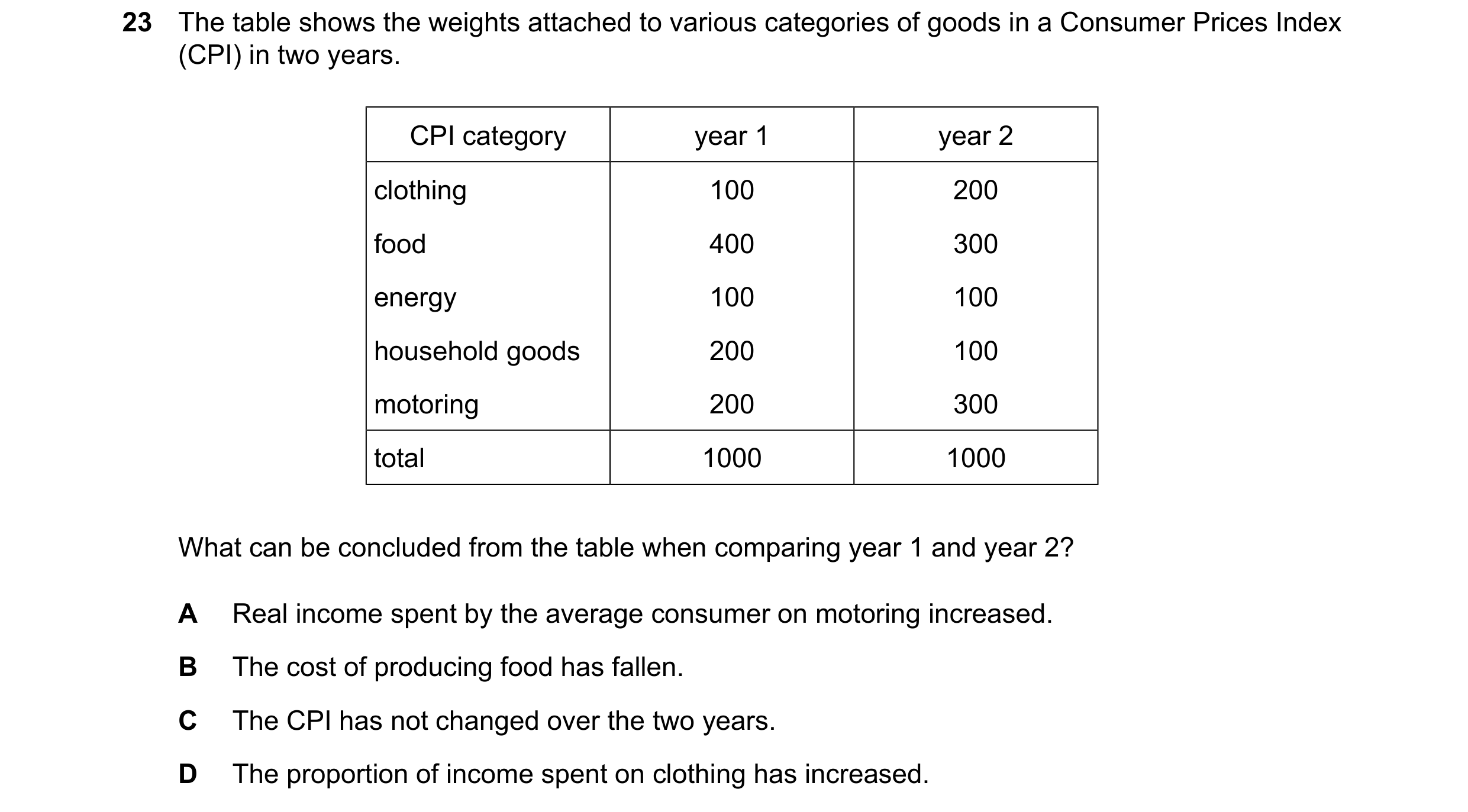
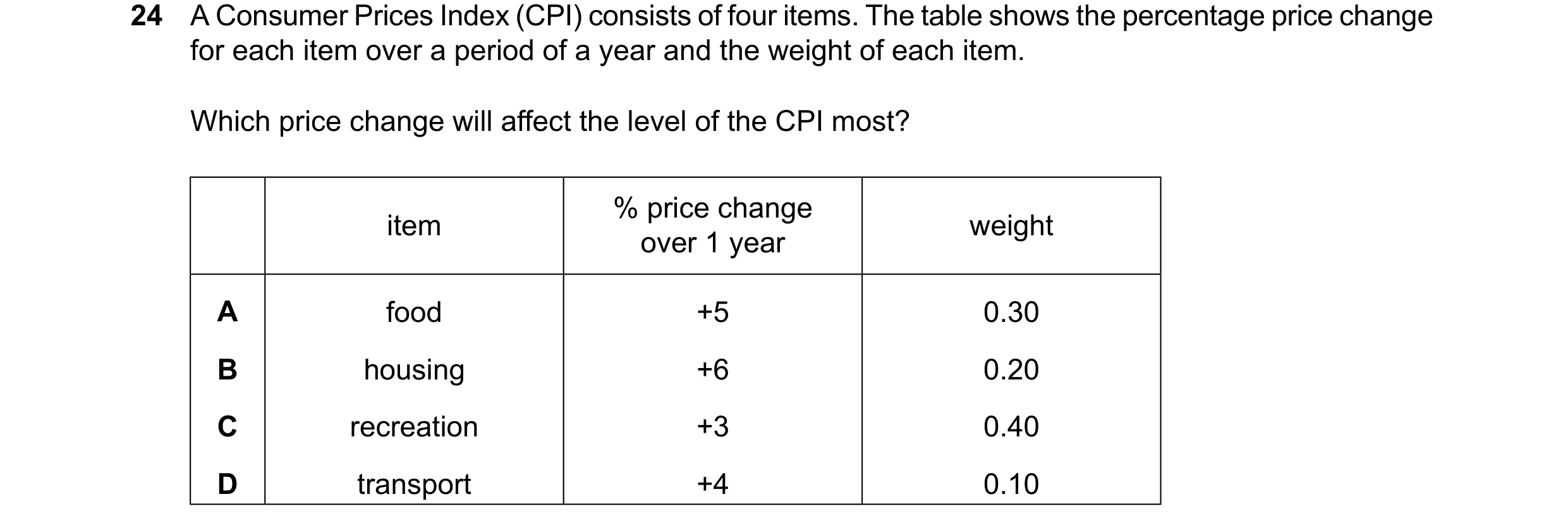
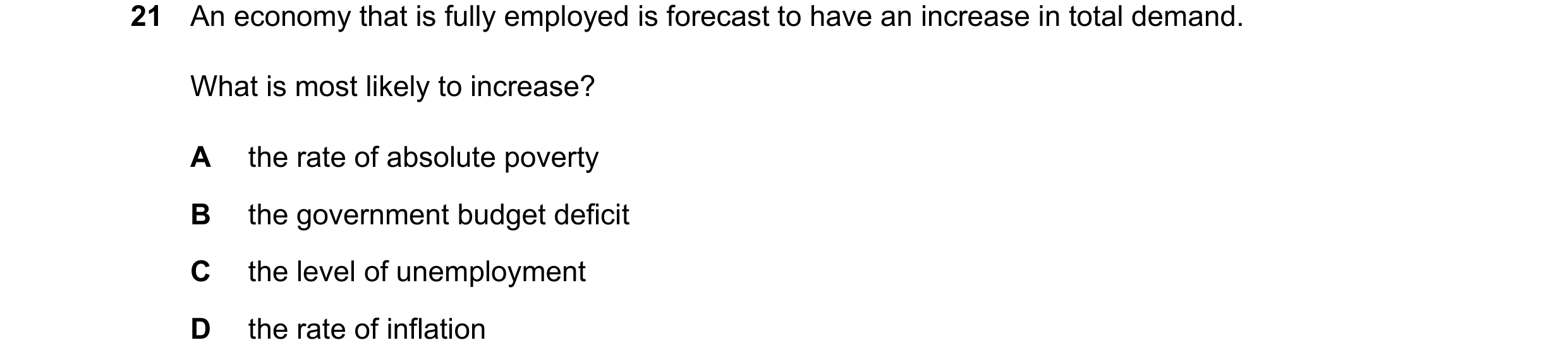 40 / 42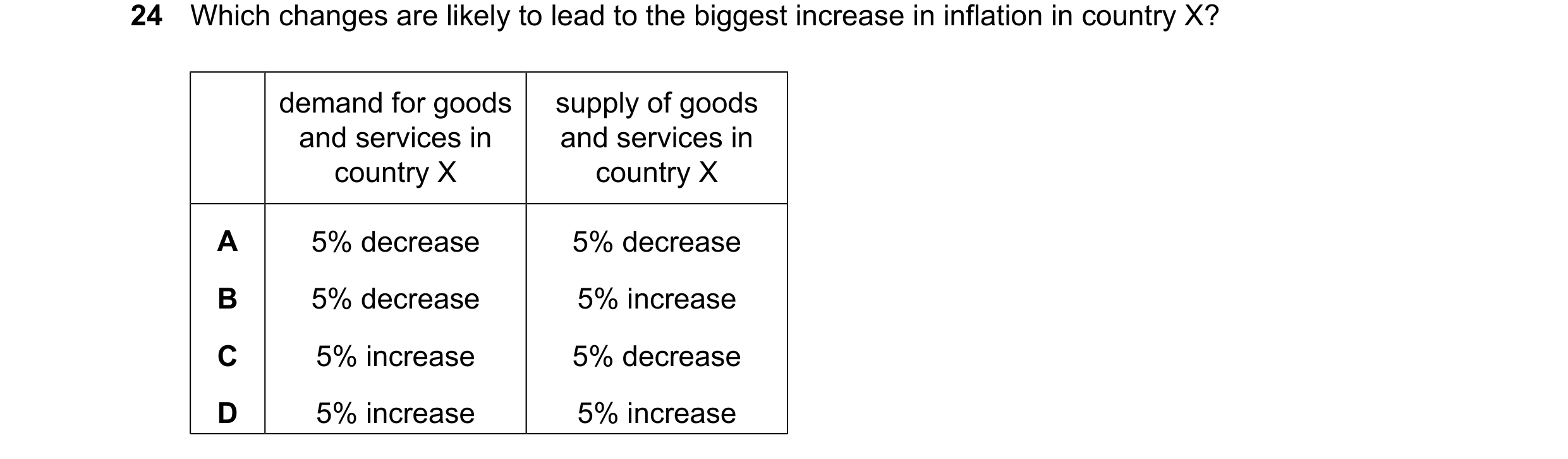


 41 / 42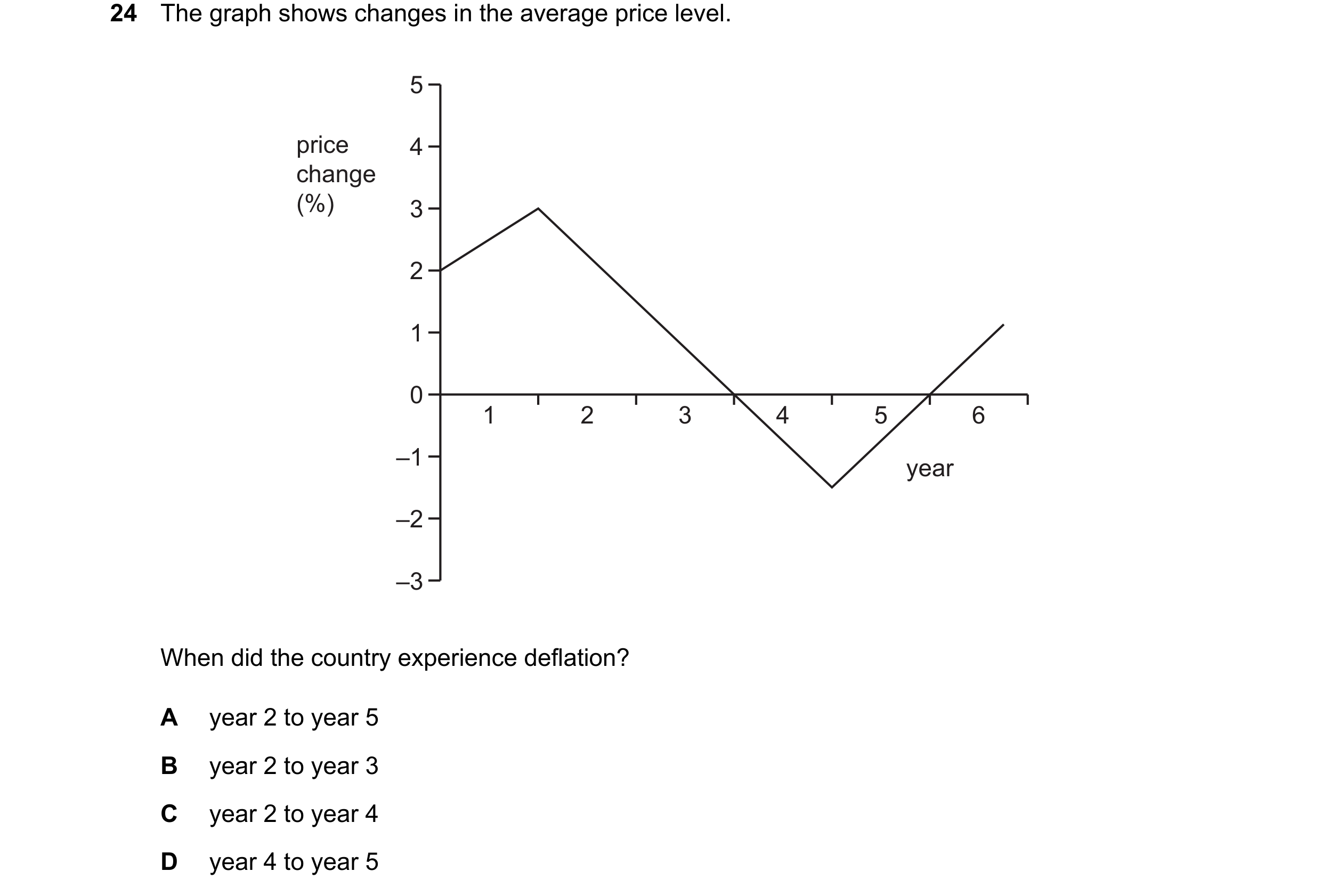
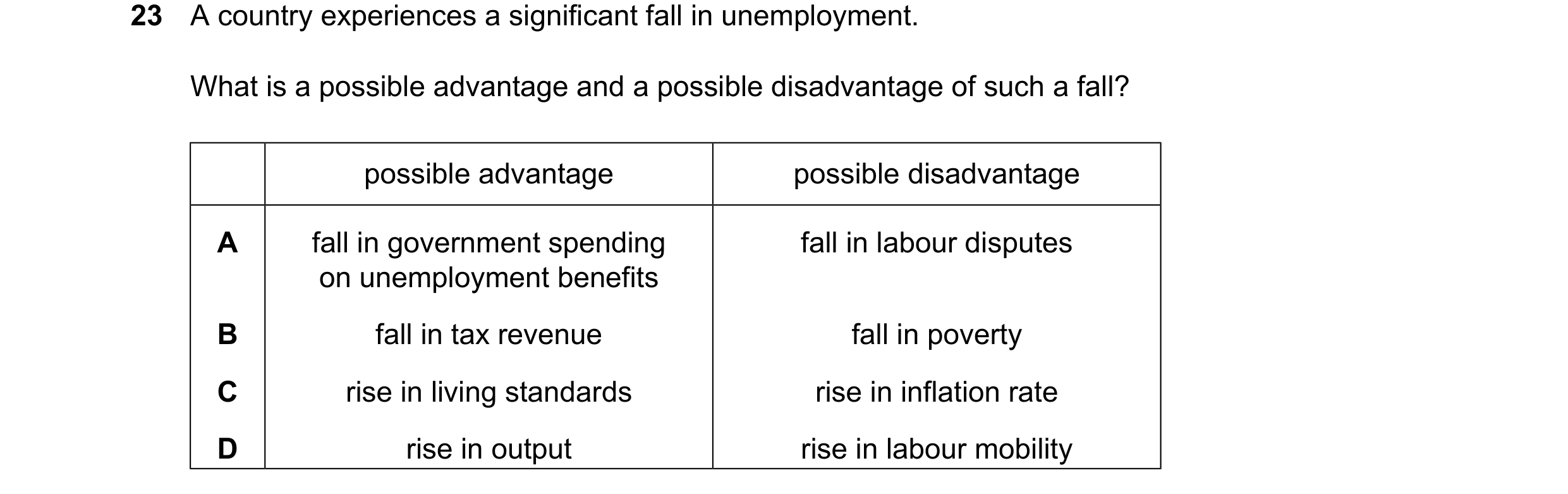
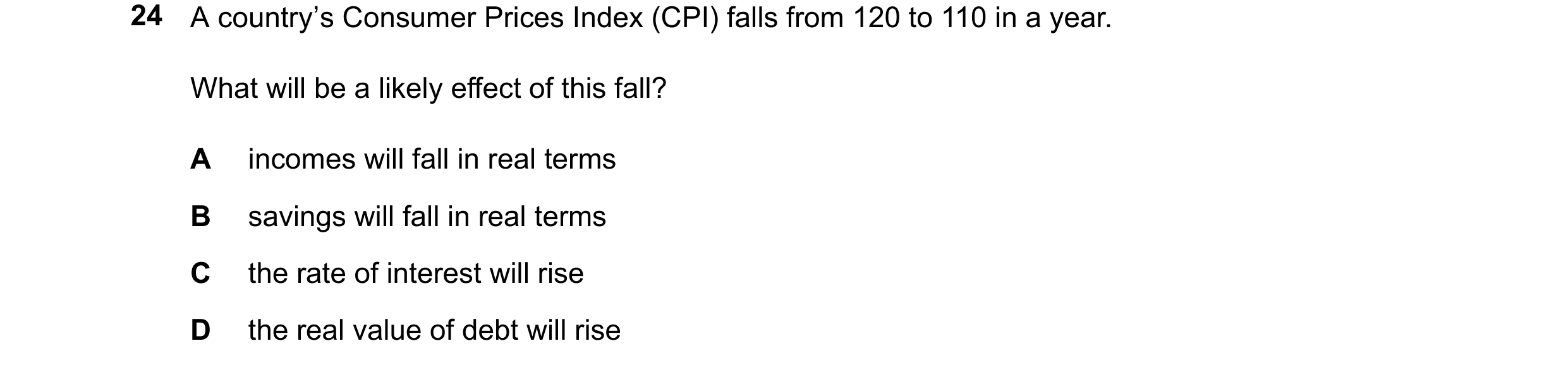 42 / 42