Questions as text
Q1 · Use 7 (a) Evidence for the nuclear atom was provided by the α-particle scattering… 9702/21 Oct/Nov 2007
Use 7 (a) Evidence for the nuclear atom was provided by the α-particle scattering experiment. State the results of this experiment. … … … … [2] (b) Give estimates for the diameter of (i) an atom, … [1] (ii) a nucleus. … [1]
4 marks
Mark scheme: 7 (a) most α-particles deviated through small angles B1 (accept ‘undeviated’) few α-particles deviated through angles greater than 90° B1 [2] (b) (i) allow 10–9 m → 10–11 m B1 [1] (ii) allow 10–13 m → 10–15 m B1 [1] (if (i) and (ii) out of range but (ii) = 10–4(i), then allow 1 mark) (if no units or wrong units but (ii) = 10–4(i), then allow 1 mark)
This question in 9702/21 Oct/Nov 2007
Q2 · Uranium-236 (23692U) and Uranium-237 (2392U)7 are both radioactive 9702/21 May/June 2008
7 Uranium-236 (23692U) and Uranium-237 (2392U)7 are both radioactive. For Uranium-236 is an α-emitter and Uranium-237 is a β-emitter. Examiner’s Use (a) Distinguish between an α-particle and a β-particle. … … … … … … [4] (b) The grid of Fig. 7.1 shows some proton numbers Z on the x-axis and the number N of neutrons in the nucleus on the y-axis. 149 148 number of neutrons N 147 146 145 236U92U 144 143 142 141 140 88 89 90 91 92 93 94 95 96 97 proton number Z Fig. 7.1 The α-decay of Uranium-236 (23692U) is represented on the grid. This decay produces a For nucleus of thorium (Th). Examiner’s Use (i) Write down the nuclear equation for this α-decay. … [2] (ii) On Fig. 7.1, mark the position for a nucleus of 1. Uranium-237 (mark this position with the letter U), 2. Neptunium, the nucleus produced by the β-decay of Uranium-237 (mark this position with the letters Np). [2]
8 marks
Mark scheme: 7 (a) α-particle: either helium nucleus or contains 2 protons + 2 neutrons or 42 He B1 β-particle: either electron or −01 e B1 α speed < β speed (1) α discrete values of speed/energy, β continuous spectrum (1) either α ionising power >> β ionising power or α range << β range (1) α positive, β negative (only if first two B marks not scored) (1) α mass > β mass (only if first two B marks not scored) (1) (any two sensible pairs of statements relevant to differences, – do not allow statements relevant to only α or β, 1 each, max 2) B2 [4] (b) (i) 23692 U → 23290 Th M1 + 42 He A1 [2] (ii) 1. correct position for U at Z = 92, N = 145 B1 2. correct position for Np relative to U i.e. Z + 1 and N – 1 B1 [2]
This question in 9702/21 May/June 2008
Q3 · An α-particle A approaches and passes by a stationary gold nucleus N 9702/21 Oct/Nov 2009
7 An α-particle A approaches and passes by a stationary gold nucleus N. The path is illustrated For in Fig. 7.1. Examiner’s Use α-particle B α-particle A N Fig. 7.1 (a) On Fig. 7.1, mark the angle of deviation D of this α-particle as a result of passing the nucleus N. [1] (b) A second α-particle B has the same initial direction and energy as α-particle A. On Fig. 7.1, complete the path of α-particle B as it approaches and passes by the nucleus N. [2] (c) State what can be inferred about atoms from the observation that very few α-particles experience large deviations. … … … [2] (d) The nucleus N could be one of several different isotopes of gold. Suggest, with an explanation, whether different isotopes of gold would give rise to different deviations of a particular α-particle. … … … [2]
7 marks
Mark scheme: 7 (a) deviation shown correctly … B1 [1] (b) smaller deviation (not zero deviation) … M1 acceptable path wrt position of N … A1 [2] (c) the nucleus is (very) small … M1 in comparison to the atom … A1 [2] (special case: ‘atom is mostly empty space’ scores 1 mark) (d) deviation depends on charge on the nucleus / N / electrostatic repulsion … B1 same charge so no change in deviation … B1 [2] [Total: 7]
This question in 9702/21 Oct/Nov 2009
Q4 · For7 Tungsten-184 (18474 W) and tungsten-185 (18574 W) are two isotopes of tungsten 9702/22 Oct/Nov 2009
For7 Tungsten-184 (18474 W) and tungsten-185 (18574 W) are two isotopes of tungsten. Examiner’s Use Tungsten-184 is stable but tungsten-185 undergoes -decay to form rhenium (Re). (a) Explain what is meant by isotopes. … … … … [2] (b) The -decay of nuclei of tungsten-185 is spontaneous and random. State what is meant by (i) spontaneous decay, … … [1] (ii) random decay. … … [1] (c) Complete the nuclear equation for the -decay of a tungsten-185 nucleus. 185 74 W [2]
6 marks
Mark scheme: 7 (a) either forms of same element or atoms / nuclei with same number of protons … M1 atoms / nuclei contain different numbers of neutrons … A1 [2] (use of ‘element’ rather than atoms / nuclei scores max 1 mark) (b) (i) decay is not affected by environmental factors … B1 [1] (allow two named factors) (ii) either time of decay (of a nucleus) cannot be predicted or nucleus has constant probability in a given time … B1 [1] (c) 18575 Re … B1 either −01 e or −β01 … B1 [2] [Total: 6]
This question in 9702/22 Oct/Nov 2009
Q5 · For7 One of the isotopes of uranium is uranium-238 ( 23892U) 9702/21 May/June 2010
For7 One of the isotopes of uranium is uranium-238 ( 23892U). Examiner’s (a) State what is meant by isotopes. Use … … … [2] (b) For a nucleus of uranium-238, state (i) the number of protons, number = … [1] (ii) the number of neutrons. number = … [1] (c) A uranium-238 nucleus has a radius of 8.9 × 10⁻¹⁵ m. Calculate, for a uranium-238 nucleus, (i) its mass, mass = … kg [2] (ii) its mean density. density = … kg m–3 [2] (d) The density of a lump of uranium is 1.9 × 10⁴ kg m–3. For Using your answer to (c)(ii), suggest what can be inferred about the structure of the Examiner’s atom. Use … … … [2]
10 marks
Mark scheme: 7 (a) nuclei/atoms with same proton number/atomic number …...………………………. B1 nuclei/atoms contain different numbers of neutrons/different atomic mass ..……. B1 [2] (b) (i) 92 …………………………………………………………………………………… A1 [1] (ii) 146 ………………………………..………………………………………………… A1 [1] (c) (i) mass = 238 × 1.66 × 10–27 …..……………………….…………………………… C1 = 3.95 × 10⁻²⁵ kg ………………….………………………………………… A1 [2] 4 (ii) volume = π × (8.9 × 10⁻¹⁵)3 (= 2.95 × 10–42) ……..………………………… C1 3 density = (3.95 × 10⁻²⁵)/(2.95 × 10–42) = 1.3 × 10¹⁷ kg m–3 …………………………………………… … A1 [2] (d) nucleus contains most of mass of atom ……………………………………………… B1 either nuclear diameter/volume very much less than that of atom or atom is mostly (empty) space … …………… B1 [2]
This question in 9702/21 May/June 2010
Q6 · The radioactive decay of some nuclei gives rise to the emission of α-particles 9702/22 May/June 2010
7 (a) The radioactive decay of some nuclei gives rise to the emission of α-particles. For State Examiner’s Use (i) what is meant by an α-particle, … [1] (ii) two properties of α-particles. 1. … … 2. … … [2] (b) One possible nuclear reaction involves the bombardment of a stationary nitrogen-14 nucleus by an α-particle to form oxygen-17 and another particle. (i) Complete the nuclear equation for this reaction. 14 … 17 N + O + … [2] 7 8 … α (ii) The total mass-energy of the nitrogen-14 nucleus and the α-particle is less than that of the particles resulting from the reaction. This mass-energy difference is 1.1 MeV. 1. Suggest how it is possible for mass-energy to be conserved in this reaction. … … [1] 2. Calculate the speed of an α-particle having kinetic energy of 1.1 MeV. speed = … m s–1 [4]
10 marks
Mark scheme: 7 (a) (i) either helium nucleus or contains 2 protons and 2 neutrons ………………………………… B1 [1] (ii) e.g. range is a few cm in air/sheet of thin paper speed up to 0.1 c causes dense ionisation in air positively charged or deflected in magnetic or electric fields (any two, 1 each to max 2) ………………………………………………….. B2 [2] (b) (i) 42 α ……………………………………………………………………………… B1 either 11 p or 11 H ……………………………………………………………….. B1 [2] (ii) 1 initially, α-particle must have some kinetic energy ………………….. B1 [1] (ii) 2 1.1 MeV = 1.1 × 1.6 × 10–13 = 1.76 × 10⁻¹³ J …………………………. C1 EK = ½mv 2 ……………………………………………………………….. C1 1.76 × 10–13 = ½ × 4 × 1.66 × 10–27 × v 2 ……………………………… C1 v = 7.3 × 10⁶ m s–1 …………………………………………………… … A1 [4] use of 1.67 × 10⁻²⁷ kg for mass is a maximum of 3/4
This question in 9702/22 May/June 2010
Q7 · One property of α-particles is that they produce a high density of ionisation of air at… 9702/23 May/June 2010
7 One property of α-particles is that they produce a high density of ionisation of air at For atmospheric pressure. In this ionisation process, a neutral atom becomes an ion pair. The Examiner’s ion pair is a positively-charged particle and an electron. Use (a) State (i) what is meant by an α-particle, … … [1] (ii) an approximate value for the range of α-particles in air at atmospheric pressure. range = … cm [1] (b) The energy required to produce an ion pair in air at atmospheric pressure is 31 eV. An α-particle has an initial kinetic energy of 8.5 × 10⁻¹³ J. (i) Show that 8.5 × 10⁻¹³ J is equivalent to 5.3 MeV. [1] (ii) Calculate, to two significant figures, the number of ion pairs produced as the α-particle is stopped in air at atmospheric pressure. number = … [2] (iii) Using your answer in (a)(ii), estimate the average number of ion pairs produced For per unit length of the track of the α-particle as it is brought to rest in air. Examiner’s Use number per unit length = … [2]
7 marks
Mark scheme: 7 (a) (i) either helium nucleus or particle containing two protons and two neutrons B1 [1] (ii) allow any value between 1 cm and 10 cm B1 [1] (b) (i) energy = (8.5 × 10⁻¹³)/(1.6 × 10–13) M1 = 5.3 MeV A0 [1] (ii) number = (5.3 × 10⁶)/31 C1 = 1.7 × 10⁵ (allow 2 s.f. only) A1 [2] (iii) number per unit length = (1.7 × 10⁵) / (a)(ii) correct numerical value A1 correct unit B1 [2]
This question in 9702/23 May/June 2010
Q8 · Uranium (U) has at least fourteen isotopes 9702/21 Oct/Nov 2010
7 (a) Uranium (U) has at least fourteen isotopes. For Explain what is meant by isotopes. Examiner’s Use … … … [2] (b) One possible nuclear reaction involving uranium is 23592U + 10n 14156Ba + 92ZKr + x 10n + energy. (i) State three quantities that are conserved in a nuclear reaction. 1. … … 2. … … 3. … … [3] (ii) For this reaction, determine the value of 1. Z, Z = … [1] 2. x. x = … [1]
7 marks
Mark scheme: 7 (a) either different forms of same element or nuclei have same number of protons M1 different numbers of neutrons (in the nucleus) A1 [2] (b) (i) proton number conserved B1 nucleon number conserved B1 mass-energy conserved B1 [3] (ii) 1. Z = 36 A1 [1] 2. x = 3 A1 [1]
This question in 9702/21 Oct/Nov 2010
Q9 · The results of the a-particle scattering experiment provided evidence for the existence… 9702/22 Oct/Nov 2010
7 The results of the a-particle scattering experiment provided evidence for the existence and For small size of the nucleus. Examiner’s Use (a) State the result that provided evidence for (i) the small size of the nucleus, compared with the atom, … … … [2] (ii) the nucleus being charged and containing the majority of the mass of the atom. … … … [2] (b) The a-particles in this experiment originated from the decay of a radioactive nuclide. Suggest two reasons why b-particles from a radioactive source would be inappropriate for this type of scattering experiment. 1. … … 2. … … [2]
6 marks
Mark scheme: 7 (a) (i) most α-particles were deviated through small angles B2 [2] (allow 1 mark for ‘straight through’ / undeviated) (ii) small fraction of α-particles deviated through large angles M1 greater than 90° (allow rebound back) A1 [2] (b) e.g. β-particles have a range of energies β-particles deviated by (orbital) electrons β-particle has (very) small mass (any two sensible suggestions, 1 each, max 2) B2 [2] Do not allow β-particles have negative charge or β-particles have high speed
This question in 9702/22 Oct/Nov 2010
Q10 · Explain what is meant by radioactive decay 9702/23 Oct/Nov 2010
9 (a) Explain what is meant by radioactive decay. For Examiner’s … Use … … [2] (b) (i) State how the random nature of radioactive decay may be inferred from observations of the count rate. … … [1] (ii) A radioactive source has a long half-life so that, over a period of several days, its rate of decay remains constant. State the effect, if any, of a rise in temperature on this decay rate. … [1] (iii) Suggest why some radioactive sources are found to contain traces of helium gas. … … … [2]
6 marks
Mark scheme: 9 (a) nucleus emits α-particles or β-particles and/or γ-radiation B1 to form a different / more stable nucleus B1 [2] (b) (i) fluctuations in count rate (not ‘count rate is not constant’) B1 [1] (ii) no effect B1 [1] (iii) if the source is an α-emitter B1 either α-particles stopped within source (and gain electrons) or α-particles are helium nuclei B1 [2] allow 1/2 for ‘parent nucleus gives off radiation to form daughter nucleus’
This question in 9702/23 Oct/Nov 2010
Q11 · Two isotopes of the element uranium are 23592U and 23892U 9702/21 Oct/Nov 2011
7 (a) Two isotopes of the element uranium are 23592U and 23892U. For Examiner’s Explain the term isotope. Use … … … [2] (b) (i) In a nuclear reaction, proton number and neutron number are conserved. Other than proton number and neutron number, state a quantity that is conserved in a nuclear reaction. … [1] (ii) When a nucleus of uranium-235 absorbs a neutron, the following reaction may take place. 23592U + ab n 141x Ba + 36y Kr + 3 ab n State the values of a, b, x and y. a = … b = … x = … y = … [3] (c) When the nucleus of 23892U absorbs a neutron, the nucleus decays, emitting an α-particle. State the proton number and nucleon number of the nucleus that is formed as a result of the emission of the α-particle. proton number = … nucleon number = … [2]
8 marks
Mark scheme: 7 (a) nuclei with the same number of protons B1 and a different number of neutrons B1 [2] (b) (i) (mass + energy) (taken together) is conserved (B1) momentum is conserved (B1) one point required max. 1 B1 [1] (ii) a = 1 and b = 0 B1 x = 56 B1 y = 92 B1 [3] (c) proton number = 90 B1 nucleon number = 235 B1 [2]
This question in 9702/21 Oct/Nov 2011
Q12 · State the experimental observations that show radioactive decay is For Examiner’s (i)… 9702/22 Oct/Nov 2011
7 (a) State the experimental observations that show radioactive decay is For Examiner’s (i) spontaneous, Use … … [1] (ii) random. … … [1] (b) On Fig. 7.1, complete the charge and mass of α-particles, β-particles and γ-radiation. Give example speeds of α-particles and γ-radiation emitted by a laboratory source. α-particle β-particle γ-radiation charge 0 mass 4u speed up to 0.99c Fig. 7.1 [3] (c) Explain the process by which α-particles lose energy when they pass through air. … … … [2]
7 marks
Mark scheme: 7 (a) (i) the half life / count rate / rate of decay / activity is the same no matter what external factors / environmental factors or two named factors such as temperature and pressure changes are applied B1 [1] (ii) the observations of the count rate / count rate / rate of decay / activity / radioactivity during decay shows variations / fluctuations B1 [1] (b) property α-particle β-particle γ-radiation charge (+)2e –e 0 mass 4u 9.11 × 10⁻³¹ kg 0 speed 0.01 to 0.1 c up to 0.99 c c one mark for each correct line B3 [3] (c) collision with molecules B1 causes ionisation (of the molecule) / electron is removed B1 [2]
This question in 9702/22 Oct/Nov 2011
Q13 · The spontaneous decay of polonium is shown by the nuclear equation For Examiner’s 210 84… 9702/21 May/June 2012
7 (a) The spontaneous decay of polonium is shown by the nuclear equation For Examiner’s 210 84 Po ➞ 20682 Pb + X . Use (i) State the composition of the nucleus of X. … … [1] (ii) The nuclei X are emitted as radiation. State two properties of this radiation. 1. … … 2. … … [2] (b) The mass of the polonium (Po) nucleus is greater than the combined mass of the nuclei of lead (Pb) and X. Use a conservation law to explain qualitatively how this decay is possible. … … … [3]
6 marks
Mark scheme: 7 (a) (i) 2 protons and 2 neutrons B1 [1] (ii) e.g. positively charged 2e mass 4u constant energy absorbed by thin paper or few cm of air (3 cm → 8 cm) (not low penetration) highly ionizing deflected in electric/magnetic fields (One mark for each property, max 2) B2 [2] (b) mass-energy is conserved B1 difference in mass ‘changed’ into a form of energy B1 energy in the form of kinetic energy of the products / γ-radiation photons / e.m. radiation B1 [3]
This question in 9702/21 May/June 2012
Q14 · A nuclear reaction occurs when a uranium-235 nucleus absorbs a neutron 9702/22 May/June 2012
7 (a) A nuclear reaction occurs when a uranium-235 nucleus absorbs a neutron. The reaction For may be represented by the equation: Examiner’s Use 235 U + W n 93 Rb + 141 Cs + YW n 92 X 37 Z X State the number represented by the letter W … X … Y … Z … [3] (b) The sum of the masses on the left-hand side of the equation in (a) is not the same as the sum of the masses on the right-hand side. Explain why mass seems not to be conserved. … … … [2]
5 marks
Mark scheme: 7 (a) W = 1 and X = 0 A1 [1] Y = 2 A1 [1] Z = 55 A1 [1] (b) explanation in terms of mass – energy conservation B1 energy released as gamma or photons or kinetic energy of products or em radiation B1 [2]
This question in 9702/22 May/June 2012
Q15 · A radioactive source emits α-radiation and γ-radiation 9702/23 May/June 2012
7 A radioactive source emits α-radiation and γ-radiation. For Examiner’s Explain how it may be shown that the source does not emit β-radiation using Use (a) the absorption properties of the radiation, … … … … … [2] (b) the effects of a magnetic field on the radiation. … … … … … [2]
4 marks
Mark scheme: 7 (a) thin paper reduces count rate hence α B1 addition of 1 cm of aluminium causes little more count rate reduction hence only other radiation is γ B1 [2] (b) magnetic field perpendicular to direction of radiation B1 look for a count rate in expected direction / area if there were negatively charged radiation present. If no count rate recorded then β not present. B1 [2]
This question in 9702/23 May/June 2012
Q16 · Describe the structure of an atom of the nuclide 23592U 9702/21 Oct/Nov 2012
6 (a) Describe the structure of an atom of the nuclide 23592U. For Examiner’s … Use … … … [2] (b) The deflection of α-particles by a thin metal foil is investigated with the arrangement shown in Fig. 6.1. All the apparatus is enclosed in a vacuum. vacuum detector of _-particles D W _ source path of deflected X _-particles Y Fig. 6.1 The detector of α-particles, D, is moved around the path labelled WXY. (i) Explain why the apparatus is enclosed in a vacuum. … … [1] (ii) State and explain the readings detected by D when it is moved along WXY. … … … … … … [3] Question 6 continues on page 16. (c) A beam of α-particles produces a current of 1.5 pA. Calculate the number of α-particles For per second passing a point in the beam. Examiner’s Use number = … s–1 [3]
9 marks
Mark scheme: 6 (a) 92 protons in the nucleus and 92 electrons around nucleus B1 143 neutrons (in the nucleus) B1 [2] (b) (i) α-particle travels short distance in air B1 [1] (ii) very small proportion in backwards direction / large angles B1 majority pass through with no /small deflections B1 either most of mass is in very small volume (nucleus) and is charged or most of atom is empty space B1 [3] (c) I = Q / t C1 n / t = (1.5 × 10⁻¹²) /( 2 × 1.6 × 10–19) C1 n / t = 4.7 × 10⁶ s–1 A1 [3]
This question in 9702/21 Oct/Nov 2012
Q17 · A nuclear reaction between two helium nuclei produces a second isotope of helium, two For… 9702/22 Oct/Nov 2012
7 A nuclear reaction between two helium nuclei produces a second isotope of helium, two For protons and 13.8 MeV of energy. The reaction is represented by the following equation. Examiner’s Use … … 3 3 2He + 2He … He + 2 … p + 13.8 MeV (a) Complete the nuclear equation. [2] (b) By reference to this reaction, explain the meaning of the term isotope. … … … [2] (c) State the quantities that are conserved in this nuclear reaction. … … … … … [2] (d) Radiation is produced in this nuclear reaction. State (i) a possible type of radiation that may be produced, … [1] (ii) why the energy of this radiation is less than the 13.8 MeV given in the equation. … [1] (e) Calculate the minimum number of these reactions needed per second to produce power of 60 W. number = … s–1 [2]
10 marks
Mark scheme: 7 (a) 32 He + 32 He → 42 He + 2 11 p + Q A numbers correct (4 and 1) B1 Z numbers correct (2 and 1) B1 [2] (b) both nuclei have 2 protons B1 the two isotopes have 1 neutron and two neutrons B1 [2] [allow 1 for ‘same number of protons but different number of neutrons’] (c) proton number and neutron number B1 energy – mass B1 momentum B1 [2] (d) (i) γ radiation B1 [1] (ii) product(s) must have kinetic energy B1 [1] (e) 13.8 MeV = 13.8 × 1.6 × 10–19 × 106 (= 2.208 × 10⁻¹²) C1 60 = n × 13.8 × 1.6 × 10–13 n = 2.7(2) × 1013 s–1 A1 [2]
This question in 9702/22 Oct/Nov 2012
Q18 · Β-radiation is emitted during the spontaneous radioactive decay of an unstable nucleus 9702/23 Oct/Nov 2012
6 (a) β-radiation is emitted during the spontaneous radioactive decay of an unstable nucleus. For Examiner’s (i) State the nature of a β-particle. Use … [1] (ii) State two properties of β-radiation. 1. … 2. … [2] (iii) Explain the meaning of spontaneous radioactive decay. … … [1] (b) The following equation represents the decay of a nucleus of hydrogen-3 by the emission of a β-particle. Complete the equation. … … 31H He + β [2] … … (c) The β-particle is emitted with an energy of 5.7 × 10³ eV. Calculate the speed of the β-particle. speed = … m s–1 [3] (d) A different isotope of hydrogen is hydrogen-2 (deuterium). Describe the similarities and differences between the atoms of hydrogen-2 and hydrogen-3. … … … [2]
11 marks
Mark scheme: 6 (a) (i) electron B1 [1] (ii) any two: can be deflected by electric and magnetic fields or negatively charged / absorbed by few (1 – 4) mm of aluminum / 0.5 to 2 m or metres for range in air / speed up to 0.99c / range of speeds / energies B2 [2] (iii) decay occurs and cannot be affected by external / environmental factors or two stated factors such as chemical / pressure / temperature / humidity B1 [1] (b) 3 and 0 for superscript numbers B1 2 and –1 for subscript numbers B1 [2] (c) energy = 5.7 × 103 × 1.6 × 10–19 (= 9.12 × 10⁻¹⁶ J) C1 2 × 9.12 × 10 −16 v2 = C1 9.11 × 10 − 31 v = 4.5 × 10⁷ m s–1 A1 [3] (d) both have 1 proton and 1 electron B1 1 neutron in hydrogen-2 and 2 neutrons in hydrogen-3 B1 [2] (special case: for one mark ‘same number of protons / atomic number different number of neutrons’)
This question in 9702/23 Oct/Nov 2012
Q19 · Describe the two main results of the α-particle scattering experiment 9702/21 May/June 2013
7 (a) Describe the two main results of the α-particle scattering experiment. For Examiner’s result 1: … Use … result 2: … … [3] (b) Relate each of the results in (a) with the conclusions that were made about the nature of atoms. result 1: … … result 2: … … [3]
6 marks
Mark scheme: 7 (a) the majority/most went straight through or were deviated by small angles B1 a very small proportion/a few were deviated by large angles B1 small angles described as < 10° and large angles described as >90° B1 [3] (b) most of the atom is empty space/nucleus very small compared with atom B1 mass and charge concentrated in (very small) nucleus B1 correct links made with statements in (a) B1 [3]
This question in 9702/21 May/June 2013
Q20 · For7 (a) Two isotopes of uranium are uranium-235 ( 23592U) and uranium-238 ( 23892U) 9702/23 May/June 2013
For7 (a) Two isotopes of uranium are uranium-235 ( 23592U) and uranium-238 ( 23892U). Examiner’s Use (i) Describe in detail an atom of uranium-235. … … … … … [4] (ii) With reference to the two forms of uranium, explain the term isotopes. … … … [2] (b) When a uranium-235 nucleus absorbs a neutron, the following reaction may occur: 235 92 U + WX n 14857 La + YZ Q + 3WX n (i) Determine the values of Y and Z. Y = … Z = … [2] (ii) Explain why the sum of the masses of the uranium nucleus and of the neutron does not equal the total mass of the products of the reaction. … … … [2]
10 marks
Mark scheme: 7 (a) (i) nucleus contains 92 protons B1 nucleus contains 143 neutrons (missing ‘nucleus’ 1/2) B1 outside / around nucleus 92 electrons (B1) most of atom is empty space / mass concentrated in nucleus (B1) total charge is zero (B1) diameter of atom ~ 10–10 m or size of nucleus ~ 10–15 m (B1) any two of (B1) marks [4] (ii) nucleus has same number / 92 protons B1 nuclei have 143 and 146 neutrons (missing ‘nucleus’ 1/2) B1 [2] (b) (i) Y = 35 A1 Z = 85 A1 [2] (ii) mass-energy is conserved in the reaction B1 mass on rhs of reaction is less so energy is released explained in terms of E = mc2 B1 [2]
This question in 9702/23 May/June 2013
Q21 · State what is meant by α-particle: … β-particle: … γ-radiation: … [2] (b) Describe the… 9702/21 May/June 2014
7 (a) State what is meant by α-particle: … β-particle: … γ-radiation: … [2] (b) Describe the changes to the proton number and the nucleon number of a nucleus when emission occurs of (i) an α-particle, … … [1] (ii) a β-particle, … … [1] (iii) γ-radiation. … … [1]
5 marks
Mark scheme: 7 (a) α: helium nucleus β: electron γ: electromagnetic radiation / wave / ray or photon three correct 2 / 2, two correct 1 / 2 B2 [2] (b) (i) atomic number / proton number / Z –2, nucleon / mass number / A –4 B1 [1] (ii) atomic number / proton number / Z +1 nucleon / mass number / A no change B1 [1] (iii) no change in proton or mass number or “no change” B1 [1]
This question in 9702/21 May/June 2014
Q22 · 0 7 In the decay of a nucleus of 84 Po, an α-particle is emitted with energy 5.3 MeV 9702/22 Oct/Nov 2014
210 7 In the decay of a nucleus of 84 Po, an α-particle is emitted with energy 5.3 MeV. The emission is represented by the nuclear equation 210 A 84 Po B X + α + energy (a) (i) On Fig. 7.1, complete the number and name of the particle, or particles, represented by A and B in the nuclear equation. number name of particle or particles A B Fig. 7.1 [1] 210 (ii) State the form of energy given to the α-particle in the decay of 84 Po. … [1] 210 (b) A sample of polonium 84 Po emits 7.1 × 10¹⁸ α-particles in one day. Calculate the mean power output from the energy of the α-particles. power = … W [2]
4 marks
Mark scheme: 7 (a) (i) A: 206, nucleon(s) or neutron(s) and proton(s) } B: 82, proton(s) } all correct A1 [1] (ii) kinetic / EK / KE B1 [1] (b) energy = 5.3 × 1.6 × 10–13 (J) [= 8.48 × 10⁻³ (J)] C1 power = (7.1 × 1018 × 5.3 × 1.6 × 10–13) / (3600 × 24) = 70 (69.7) W A1 [2]
This question in 9702/22 Oct/Nov 2014
Q23 · A uranium-235 nucleus absorbs a neutron and then splits into two nuclei 9702/22 May/June 2015
7 A uranium-235 nucleus absorbs a neutron and then splits into two nuclei. A possible nuclear reaction is given by 23592U + abn 9337Rb + dXc + 2abn + energy. (a) State the constituent particles of the uranium-235 nucleus. … [1] (b) Complete Fig. 7.1 for this reaction. value a b c d [3] Fig. 7.1 (c) Suggest a possible form of energy released in this reaction. … [1] (d) Explain, using the law of mass-energy conservation, how energy is released in this reaction. … … … [2]
7 marks
Mark scheme: 7 (a) 92 protons and 143 neutrons B1 [1] (b) value a 1 b 0 (a and b both required) B1 c 141 B1 d 55 B1 [3] (c) kinetic energy (of products) or gamma/γ (radiation or photon) B1 [1] (d) (total) mass on left-hand side/reactants is greater than (total) mass on right-hand side/products M1 difference in mass is (converted to) energy A1 [2]
This question in 9702/22 May/June 2015
Q24 · The equation represents the spontaneous radioactive decay of a nucleus of bismuth-212 9702/23 May/June 2015
7 The equation represents the spontaneous radioactive decay of a nucleus of bismuth-212. 212 208 83 Bi X + 81 Tl + 6.2 MeV (a) (i) Explain the meaning of spontaneous radioactive decay. … … [1] (ii) State the constituent particles of X. … [1] (b) (i) Use the conservation of mass-energy to explain the release of 6.2 MeV of energy in this reaction. … … … [2] (ii) Calculate the energy, in joules, released in this reaction. energy = … J [1]
5 marks
Mark scheme: 7 (a) (i) (rate of decay) not affected by any external factors or changes in temperature and pressure etc. B1 [1] (ii) two protons and two neutrons B1 [1] (b) (i) (total) mass before decay/on left-hand side is greater than (total) mass M1 on right-hand side/after the decay the difference in mass is released as kinetic energy of the products A1 [2] (may also be some γ radiation) (to conserve mass-energy) (ii) (6.2 × 106 × 1.6 × 10−19 =) 9.9(2) × 10−13 J A1 [1]
This question in 9702/23 May/June 2015
Q25 · The results of the α-particle scattering experiment gave evidence for the structure of… 9702/22 Oct/Nov 2015
8 (a) The results of the α-particle scattering experiment gave evidence for the structure of the atom. State two results and the associated conclusions. result 1: … … conclusion 1: … … result 2: … … conclusion 2: … … [4] 63 (b) In a model of a copper atom of the isotope 29 Cu, the atom and its nucleus are assumed to be spherical. The diameter of the nucleus is 2.8 × 10⁻¹⁴ m. The diameter of the atom is 2.3 × 10⁻¹⁰ m. Calculate the ratio density of the nucleus . density of the atom ratio = … [3]
7 marks
Mark scheme: 8 (a) result: majority / most (of the α-particles) went straight through/were deviated by small angles M1 conclusion: most of the atom is (empty) space or size/volume of nucleus very small compared with atom A1 result: a small proportion were deflected through large angles or >90° or came straight back M1 conclusion: the mass or majority of mass is in a (very) small charged volume/region/nucleus A1 [4] (b) ρ = m / V C1 mass of atom and mass of nucleus (approx.) equal stated or cancelled or values given e.g. 63 u or 63 × 1.66 × 10–27 C1 ratio = (rA)3 / (rN)3 = (1.15 × 10⁻¹⁰)3 / (1.4 × 10⁻¹⁴)3 or ratio = (dA)3 / (dN)3 = (2.3 × 10⁻¹⁰)3 / (2.8 × 10⁻¹⁴)3 = 5.5 × 10¹¹ A1 [3]
This question in 9702/22 Oct/Nov 2015
Q26 · A neutron decays by emitting a β− particle 9702/22 Feb/March 2016
6 A neutron decays by emitting a β− particle. (a) Complete the equation below for this decay. … … … 1 ν 0 n … … + … β− + … [2] (b) State the name of the particle represented by the symbol ν. … [1] (c) State the name of the class (group) of particles that includes β− and ν. … [1] (d) State (i) the quark structure of the neutron, … [1] (ii) the change to the quark structure when the neutron decays. … … [1] [Total: 6]
6 marks
Mark scheme: 6 (a) 11 p B1 0 − 1 β− and 00 ν B1 (b) an (electron) antineutrino B1 (c) lepton(s) B1 (d) (i) down, down, up / ddu B1 (ii) a down / d (quark) changes to an up / u (quark) or ddu → uud B1
This question in 9702/22 Feb/March 2016
Q27 · Give one example of a hadron: … a lepton: … [1] (b) Describe, in terms of the simple… 9702/21 May/June 2016
7 (a) Give one example of a hadron: … a lepton: … [1] (b) Describe, in terms of the simple quark model, (i) a proton, … [1] (ii) a neutron. … [1] (c) Beta particles may be emitted during the decay of an unstable nucleus of an atom. The emission of a beta particle is due to the decay of a neutron. (i) Complete the following word equation for the particles produced in this reaction. neutron … + … + … [1] (ii) State the change in quark composition of the particles during this reaction. … [1] [Total: 5]
5 marks
Mark scheme: 7 (a) hadron: neutron/proton and lepton: electron/(electron) neutrino B1 [1] (allow other correct particles) (b) (i) proton: up up down or uud B1 [1] (ii) neutron: up down down or udd B1 [1] (c) (i) neutron → proton + electron + (electron) antineutrino B1 [1] (ii) up down down (quarks) change to up up down (quarks) or down (quark) changes to up (quark) B1 [1]
This question in 9702/21 May/June 2016
Q28 · Distinguish between an α-particle and a β+-particle 9702/23 May/June 2016
8 (a) Distinguish between an α-particle and a β+-particle. … … … … … [3] (b) State the equation that shows the decay of a particle in a nucleus that results in β+ emission. All particles in the equation should be shown in the notation that is usually used for the representation of nuclides. [2] (c) (i) State the quark composition of 1. a proton, … 2. a neutron. … [2] (ii) Use the quark model to explain the charge on a proton. … … … [1] [Total: 8]
8 marks
Mark scheme: 8 (a) α-particle is 2 protons and 2 neutrons; β+-particle is positive electron/positron α-particle has charge +2e; β+-particle has +e charge α-particle has mass 4u; β-particle has mass (1/2000)u α-particle made up of hadrons; β+-particle a lepton any three B3 [3] (b) 11p → 10 n + 01β + 00ν all terms correct M1 all numerical values correct (ignore missing values on ν) A1 [2] (c) (i) 1. proton: up, up, down / uud B1 2. neutron: up, down, down / udd B1 [2] (ii) up quark has charge +2 / 3 (e) and down quark has charge –1 / 3 (e) total is +1(e) B1 [1]
This question in 9702/23 May/June 2016
Q29 · State one difference between a hadron and a lepton 9702/21 Oct/Nov 2016
7 (a) State one difference between a hadron and a lepton. … … [1] (b) (i) State the quark composition of a proton and of a neutron. proton: … neutron: … [2] (ii) Use your answer in (i) to determine the quark composition of an α-particle. quark composition: … [1] (c) The results of the α-particle scattering experiment provide evidence for the structure of the atom. result 1: The vast majority of α-particles pass straight through the metal foil or are deviated by small angles. result 2: A very small minority of α-particles are scattered through angles greater than 90°. State what may be inferred from (i) result 1, … … [1] (ii) result 2. … … … … [2] [Total: 7]
7 marks
Mark scheme: 7 (a) hadron not a fundamental particle/lepton is fundamental particle or hadron made of quarks/lepton not made of quarks or strong force/interaction acts on hadrons/does not act on leptons B1 [1] (b) (i) proton: up, up, down / uud B1 neutron: up, down, down / udd B1 [2] (ii) composition: 2(uud) + 2(udd) = 6 up, 6 down / 6u, 6d B1 [1] (c) (i) most of the atom is empty space or the nucleus (volume) is (very) small compared to the atom B1 [1] (ii) nucleus is (positively) charged B1 the mass is concentrated in (very small) nucleus/small region/small volume/small core or the majority of mass in (very small) nucleus/small region/small volume/small core B1 [2]
This question in 9702/21 Oct/Nov 2016
Q30 · State one difference between a hadron and a lepton 9702/22 Oct/Nov 2016
6 (a) State one difference between a hadron and a lepton. … … [1] (b) A proton within a nucleus decays to form a neutron and two other particles. A partial equation to represent this decay is … … + 11p 10n + … … … (i) Complete the equation. [2] (ii) State the name of the interaction or force that gives rise to this decay. … [1] (iii) State three quantities that are conserved in the decay. 1. … 2. … 3. … [3] (c) Use the quark composition of a proton to show that it has a charge of +e, where e is the elementary charge. Explain your working. [3] [Total: 10]
10 marks
Mark scheme: 6 (a) hadron not a fundamental particle/lepton is fundamental particle or hadron made of quarks/lepton not made of quarks or strong force/interaction acts on hadrons/does not act on leptons B1 [1] (b) (i) 01 e (+ ) or 01(β + ) B1 0ν0 (e ) B1 [2] (ii) weak (nuclear force / interaction) B1 [1] (iii) • mass-energy • momentum • proton number • nucleon number • charge Any three of the above quantities, 1 mark each B3 [3] (c) (quark structure of proton is) up, up, down or uud B1 up/u (quark charge) is (+)⅔(e), down/d (quark charge) is –⅓(e) C1 ⅔e + ⅔e – ⅓e = (+)e A1 [3]
This question in 9702/22 Oct/Nov 2016
Q31 · State one difference between a hadron and a lepton 9702/23 Oct/Nov 2016
7 (a) State one difference between a hadron and a lepton. … … [1] (b) (i) State the quark composition of a proton and of a neutron. proton: … neutron: … [2] (ii) Use your answer in (i) to determine the quark composition of an α-particle. quark composition: … [1] (c) The results of the α-particle scattering experiment provide evidence for the structure of the atom. result 1: The vast majority of α-particles pass straight through the metal foil or are deviated by small angles. result 2: A very small minority of α-particles are scattered through angles greater than 90°. State what may be inferred from (i) result 1, … … [1] (ii) result 2. … … … … [2] [Total: 7]
7 marks
Mark scheme: 7 (a) hadron not a fundamental particle/lepton is fundamental particle or hadron made of quarks/lepton not made of quarks or strong force/interaction acts on hadrons/does not act on leptons B1 [1] (b) (i) proton: up, up, down / uud B1 neutron: up, down, down / udd B1 [2] (ii) composition: 2(uud) + 2(udd) = 6 up, 6 down / 6u, 6d B1 [1] (c) (i) most of the atom is empty space or the nucleus (volume) is (very) small compared to the atom B1 [1] (ii) nucleus is (positively) charged B1 the mass is concentrated in (very small) nucleus/small region/small volume/small core or the majority of mass in (very small) nucleus/small region/small volume/small core B1 [2]
This question in 9702/23 Oct/Nov 2016
Q32 · A nucleus of bismuth-212 (21823Bi) decays by the emission of an α-particle and γ-radiation 9702/22 Feb/March 2017
7 A nucleus of bismuth-212 (21823Bi) decays by the emission of an α-particle and γ-radiation. (a) State the number of protons and the number of neutrons in the nucleus of bismuth-212. number of protons = … number of neutrons = … [1] (b) The γ-radiation emitted from the nucleus has a wavelength of 3.8 pm. Calculate the frequency of this radiation. frequency = … Hz [3] (c) Explain how a single beam of α-particles and γ-radiation may be separated into a beam of α-particles and a beam of γ-radiation. … … … … [2] (d) The α-particle emitted from the bismuth nucleus has an initial kinetic energy of 9.3 × 10⁻¹³ J. As the α-particle moves through air it causes the removal of electrons from atoms. The α-particle loses energy and is stopped after removing 1.8 × 10⁵ electrons as it moved through the air. Determine the energy, in eV, needed to remove one electron. energy = … eV [2] [Total: 8]
8 marks
Mark scheme: 7(a) number of protons = 83 and number of neutrons = 129 A1 7(b) λ = 3.8 × 10⁻¹² C1 f = 3.0 × 10⁸ / 3.8 × 10⁻¹² C1 f = 7.9 × 10¹⁹ (7.89 × 10¹⁹) Hz A1 7(c) use an electric field (at an angle to the beam) M1 α is deflected and γ is undeflected A1 7(d) either energy = 9.3 × 10⁻¹³ / 1.8 × 10⁵ (= 5.17 × 10⁻¹⁸ J) C1 = 5.17 × 10⁻¹⁸ / 1.6 × 10–19 = 32 (32.3) eV A1 or energy = 9.3 × 10⁻¹³ / 1.6 × 10⁻¹⁹ (= 5.81 × 10⁶ eV) (C1) = 5.81 × 10⁶ / 1.8 × 105 = 32 (32.3) eV (A1)
This question in 9702/22 Feb/March 2017
Q33 · Describe two differences between the decay of a nucleus that emits a β– particle and the… 9702/22 May/June 2017
8 (a) Describe two differences between the decay of a nucleus that emits a β– particle and the decay of a nucleus that emits a β+ particle. 1. … … 2. … … [2] (b) In a simple quark model there are three types of quark. State the composition of the proton and of the neutron in terms of these three quarks. proton: … neutron: … [1] [Total: 3]
3 marks
Mark scheme: 8(a) and β+ emission: proton changes to neutron (+ beta+/positron) B1 β– emission: (electron) antineutrino also emitted and β+ emission: (electron) neutrino also emitted B1 8(b) proton: up up down (and zero strange) neutron: up down down (and zero strange) B1
This question in 9702/22 May/June 2017
Q34 · A stationary nucleus X decays by emitting a β+ particle to form a nucleus of carbon-13 (… 9702/22 Oct/Nov 2017
7 A stationary nucleus X decays by emitting a β+ particle to form a nucleus of carbon-13 ( 136 C). An incomplete equation to represent this decay is X 136 C + β+. (a) State the name of the class (group) of particles that includes β+. … [1] (b) For nucleus X, state the number of protons, … neutrons. … [1] (c) The carbon-13 nucleus has a mass of 2.2 × 10⁻²⁶ kg. Its kinetic energy as a result of the decay process is 0.80 MeV. Calculate the speed of this nucleus. speed = … m s–1 [3] (d) Explain why the sum of the kinetic energies of the carbon-13 nucleus and the β+ particle cannot be equal to the total energy released by the decay process. … … [1] [Total: 6]
6 marks
Mark scheme: 7(a) lepton(s) B1 7(b) protons: 7 and neutrons: 6 A1 7(c) E = ½mv2 C1 = 0.80 × 106 × 1.60 × 10–19 C1 = 1.28 × 10⁻¹³ (J) v2 = 2 × 1.28 × 10–13 / 2.2 × 10⁻²⁶ v = 3.4 × 10⁶ m s–1 A1 7(d) an (electron) neutrino/ν(e) is also produced (and this has energy) B1
This question in 9702/22 Oct/Nov 2017
Q35 · A nucleus X decays by emitting a β+ particle to form a new nucleus, 2311Na 9702/23 Oct/Nov 2017
7 (a) A nucleus X decays by emitting a β+ particle to form a new nucleus, 2311Na. State the number of nucleons and the number of neutrons in nucleus X. number of nucleons = … number of neutrons = … [2] (b) State one similarity and one difference between a β+ particle and a β– particle. similarity: … difference: … [2] [Total: 4]
4 marks
Mark scheme: 7(a) nucleons = 23 B1 neutrons = 11 B1 7(b) similarity: same (rest) mass or equal (magnitude of) charge B1 difference: opposite (sign of) charge or one is matter and one is antimatter or one is an electron and one is an antielectron B1
This question in 9702/23 Oct/Nov 2017
Q36 · A stationary nucleus X decays to form nucleus Y, as shown by the equation X Y + β– + ν 9702/22 May/June 2018
7 A stationary nucleus X decays to form nucleus Y, as shown by the equation X Y + β– + ν. (a) In the above equation, draw a circle around all symbols that represent a lepton. [1] (b) State the name of the particle represented by the symbol ν. … [1] (c) Energy is released during the decay process. State the form of the energy that is gained by nucleus Y. … [1] (d) By comparing the compositions of X and Y, state and explain whether they are isotopes. … … … [2] (e) The quark composition of one nucleon in X is changed during the emission of a β– particle. Describe this change to the quark composition. … … [1] [Total: 6]
6 marks
Mark scheme: 7(a) B1 7(b) (electron) antineutrino B1 7(c) kinetic (energy) B1 7(d) Y has one more proton (and one less neutron)/X has one less proton (and one more neutron) or Y has more protons (and fewer neutrons)/X has fewer protons (and more neutrons) or a neutron changes to a proton or the number of protons increases M1 (so) not isotopes A1 7(e) up down down changes to up up down or udd → uud or down changes to up or d → u B1
This question in 9702/22 May/June 2018
Q37 · A particle of mass m and charge q is in a uniform electric field of strength E 9702/23 Oct/Nov 2018
5 A particle of mass m and charge q is in a uniform electric field of strength E. The particle has acceleration a due to the field. (a) Show that q a = . m E [2] (b) The particle has a charge of 4e where e is the elementary charge. The electric field strength is 3.5 × 10⁴ V m–1. The acceleration of the particle is 1.5 × 10¹² m s–2. Use the expression in (a) to show that the mass of the particle is 9.0 u. [2] (c) The particle is a nucleus. State the number of protons and the number of neutrons in the nucleus. number of protons = … number of neutrons = … [1] (d) A second nucleus that is an isotope of the nucleus in (c) is in the same uniform electric field. State and explain whether the electric field produces, for the two nuclei, the same magnitudes of (i) force, … … [1] (ii) acceleration. … … [1] [Total: 7]
7 marks
Mark scheme: 5(a) E = F / Q M1 F = ma and (so) q / m = a / E A1 5(b) m = (4 × 1.60 × 10–19 × 3.5 × 104) / 1.5 × 10¹² (= 1.49 × 10⁻²⁶kg) B1 = 1.49 × 10⁻²⁶ / 1.66 × 10–27 = 9.0 (u) A1 5(c) protons: 4 and neutrons: 5 A1 5(d)(i) nuclei have the same charge and so same (magnitudes of) force B1 5(d)(ii) nuclei have different masses and same force and so different (magnitudes of) acceleration B1
This question in 9702/23 Oct/Nov 2018
Q38 · One of the results of the α-particle scattering experiment is that a very small minority… 9702/21 May/June 2019
7 (a) One of the results of the α-particle scattering experiment is that a very small minority of the α-particles are scattered through angles greater than 90°. State what may be inferred about the structure of the atom from this result. … … … … [2] (b) A hadron has an overall charge of +e, where e is the elementary charge. The hadron contains three quarks. One of the quarks is a strange (s) quark. (i) State the charge, in terms of e, of the strange (s) quark. charge = … [1] (ii) The other two quarks in the hadron have the same charge as each other. By considering charge, determine a possible type (flavour) of the other two quarks. Explain your working. … … [2] [Total: 5]
5 marks
Mark scheme: 7(a) nucleus is charged B1 the mass is concentrated in (very small) nucleus or the majority of the mass is in (very small) nucleus B1 7(b)(i) –(1 / 3)e B1 7(b)(ii) 2q – (1 / 3)e = e so q = (2 / 3)e M1 up / u (quarks) (allow charm or top quarks) A1
This question in 9702/21 May/June 2019
Q39 · A sample of a radioactive substance may decay by the emission of either α-radiation or… 9702/23 May/June 2019
7 A sample of a radioactive substance may decay by the emission of either α-radiation or β-radiation and/or γ-radiation. State the type of radiation, one in each case, that: (a) consists of leptons … [1] (b) contains quarks … [1] (c) cannot be deflected by an electric field … [1] (d) has a continuous range of energies, rather than discrete values of energy. … [1] [Total: 4]
4 marks
Mark scheme: 7(a) B1 7(b) alpha/α B1 7(c) gamma/γ B1 7(d) beta/β B1
This question in 9702/23 May/June 2019
Q40 · A stationary nucleus of a radioactive isotope X decays by emitting an α-particle to… 9702/23 Oct/Nov 2019
7 A stationary nucleus of a radioactive isotope X decays by emitting an α-particle to produce a nucleus of neptunium-237 and 5.5 MeV of energy. The decay is represented by α + 5.5 MeV. X 23973Np + (a) Calculate the number of protons and the number of neutrons in a nucleus of X. number of protons = … number of neutrons = … [2] (b) Explain why the energy transferred to the α-particle as kinetic energy is less than the 5.5 MeV of energy released in the decay process. … … [1] (c) A sample of X is used to produce a beam of α-particles in a vacuum. The number of α-particles passing a fixed point in the beam in a time of 30 s is 6.9 × 10¹¹. (i) Calculate the average current produced by the beam of α-particles. current = … A [2] (ii) Determine the total power, in W, that is produced by the decay of 6.9 × 10¹¹ nuclei of X in a time of 30 s. power = … W [2] [Total: 7]
7 marks
Mark scheme: 7(a) number of protons = 95 A1 number of neutrons = 146 A1 7(b) Np/neptunium (nucleus) has kinetic energy or gamma/γ-radiation produced B1 7(c)(i) I = NQ / t C1 I = (6.9 × 1011 × 2 × 1.60 × 10–19) / 30 = 7.4 × 10⁻⁹ A A1 7(c)(ii) P = (6.9 × 1011 × 5.5 × 106 × 1.60 × 10–19) / 30 C1 = 0.020 W A1
This question in 9702/23 Oct/Nov 2019
Q41 · Two horizontal metal plates are separated by a distance of 2.0 cm in a vacuum, as shown… 9702/21 May/June 2020
6 (a) Two horizontal metal plates are separated by a distance of 2.0 cm in a vacuum, as shown in Fig. 6.1. horizontal plate +180 V 2.0 cm –120 V horizontal plate Fig. 6.1 The top plate has an electric potential of +180 V and the bottom plate has an electric potential of –120 V. (i) Determine the magnitude of the electric field strength between the plates. electric field strength = … N C–1 [2] (ii) State the direction of the electric field. … [1] (b) An uncharged atom of uranium-238 (23892U) has a change made to its number of orbital electrons. This causes the atom to change into a new particle (ion) X that has an overall charge of +2e, where e is the elementary charge. (i) Determine the number of protons, neutrons and electrons in the particle (ion) X. number of protons = … number of neutrons = … number of electrons = … [3] (ii) The particle (ion) X is in the electric field in (a) at a point midway between the plates. Determine the magnitude of the electric force acting on X. force = … N [2] (iii) The nucleus of uranium-238 (23892U) decays in stages, by emitting α-particles and β– particles, to form a nucleus of thorium-230 (23090Th). Calculate the total number of α-particles and the total number of β– particles that are emitted during the decay of uranium-238 to thorium-230. number of α-particles = … number of β– particles = … [2] [Total: 10]
10 marks
Mark scheme: 6(a)(i) E = ΔV / Δd C1 E = (180 + 120) / (2.0 × 10⁻²) = 1.5 × 10⁴ N C–1 A1 6(a)(ii) vertically downwards B1 6(b)(i) number of protons = 92 A1 number of neutrons = 146 A1 number of electrons = 90 A1 6(b)(ii) F = EQ C1 = 1.5 × 104 × 2 × 1.60 × 10–19 = 4.8 × 10⁻¹⁵ N A1 6(b)(iii) number of α-particles = 2 A1 number of β– particles = 2 A1
This question in 9702/21 May/June 2020
Q42 · A nucleus of an element X decays by emitting a β+ particle to produce a nucleus of… 9702/22 May/June 2020
7 (a) A nucleus of an element X decays by emitting a β+ particle to produce a nucleus of potassium-39 (3919K) and a neutrino. The decay is represented by QSX 3919K + Rβ+P + 00ν. (i) State the number represented by each of the following letters. P … Q … R … S … [2] (ii) State the name of the interaction (force) that gives rise to β+ decay. … [1] (b) A hadron is composed of three identical quarks and has a charge of +2e, where e is the elementary charge. Determine a possible type (flavour) of the quarks. Explain your working. … … [2] [Total: 5]
5 marks
Mark scheme: 7(a)(i) P = 0 and Q = 39 A1 R = (+)1 and S = 20 A1 7(a)(ii) weak (nuclear force/interaction) B1 7(b) charge of quark(s) = (+) 2e / 3 B1 up/u (quarks) B1
This question in 9702/22 May/June 2020
Q43 · State a similarity and a difference between a down quark and a down antiquark 9702/21 Oct/Nov 2020
8 (a) State a similarity and a difference between a down quark and a down antiquark. similarity: … difference: … [2] (b) For a nucleus of aluminium-25 (2513Al ): (i) state the number of protons and the number of neutrons number of protons = … number of neutrons = … [1] (ii) show that the charge is 2.1 × 10⁻¹⁸ C. [1] (c) The nucleus in (b) is moved along a straight line from point A to point B in a uniform horizontal electric field in a vacuum, as shown in Fig. 8.1. 4.0 cm B 3.0 cm electric field lines A Fig. 8.1 The electric field strength is 11 kV m–1. Calculate the work done to move the charge from A to B. work done = … J [3] [Total: 7]
7 marks
Mark scheme: 8(a) similarity: same/equal mass or same/equal (magnitude of) charge or both fundamental (particles) B1 difference: opposite (sign of) charge or one is matter and the other is antimatter B1 8(b)(i) number of protons = 13 and number of neutrons = 12 A1 8(b)(ii) (charge =) 13 × 1.60 × 10–19 (C) = 2.1 × 10⁻¹⁸ (C) A1 8(c) force = 11 × 103 × 2.1 × 10–18 C1 work done = 11 × 103 × 2.1 × 10–18 × 0.04 C1 = 9.2 × 10⁻¹⁶ J A1
This question in 9702/21 Oct/Nov 2020
Q44 · The results of the α-particle scattering experiment provide evidence for the structure of… 9702/22 Feb/March 2021
7 (a) The results of the α-particle scattering experiment provide evidence for the structure of the atom. Result 1: The vast majority of the α-particles pass straight through the metal foil or are deviated by small angles. Result 2: A very small minority of α-particles is scattered through angles greater than 90°. State what may be inferred (deduced) from: (i) result 1 … … [1] (ii) result 2. … … … [2] (b) A radioactive decay sequence contains four nuclei, P, Q, R and S, as shown. 21884 P 21482 Q 21483 R S Nucleus S is an isotope of nucleus P. (i) Determine the proton number and the nucleon number of nucleus S. proton number = … nucleon number = … [2] (ii) The quark composition of a nucleon in Q changes as Q decays to form R. Describe this change to the quark composition of the nucleon. … … [1] [Total: 6]
6 marks
Mark scheme: 7(a)(i) most of the atom is empty space or the nucleus (volume) is very small compared to the atom B1 7(a)(ii) the nucleus is charged B1 the mass is concentrated in nucleus / small region / small volume / small core or the majority of the mass is in nucleus / small region / small volume / small core B1 7(b)(i) proton number = 84 A1 nucleon number = 214 A1 7(b)(ii) up down down changes to up up down / udd → uud or down changes to up / d → u B1
This question in 9702/22 Feb/March 2021
Q45 · State Kirchhoff’s second law 9702/21 May/June 2021
5 (a) State Kirchhoff’s second law. … … … [2] (b) A battery has electromotive force (e.m.f.) 4.0 V and internal resistance 0.35 Ω. The battery is connected to a uniform resistance wire XY and a fixed resistor of resistance R, as shown in Fig. 5.1. 4.0 V 0.35 Ω R X Y uniform resistance wire Fig. 5.1 Wire XY has resistance 0.90 Ω. The potential difference across wire XY is 1.8 V. Calculate: (i) the current in wire XY current = … A [1] (ii) the number of free electrons that pass a point in the battery in a time of 45 s number = … [2] (iii) resistance R. R = … Ω [2] (c) A cell of e.m.f. 1.2 V is connected to the circuit in (b), as shown in Fig. 5.2. 4.0 V 0.35 Ω R P X Y 1.2 V Fig. 5.2 The connection P is moved along the wire XY. The galvanometer reading is zero when distance XP is 0.30 m. (i) Calculate the total length L of wire XY. L = … m [2] (ii) The fixed resistor is replaced by a different fixed resistor of resistance greater than R. State and explain the change, if any, that must be made to the position of P on wire XY so that the galvanometer reading is zero. … … … … [2] [Total: 11]
11 marks
Mark scheme: 5(a) sum of e.m.f.(s) = sum of p.d.(s) or (algebraic) sum of e.m.f.(s) and p.d.(s) is zero M1 around a loop/around a closed circuit A1 5(b)(i) I = 1.8 / 0.90 = 2.0 A A1 5(b)(ii) Q = It C1 number = (2.0 × 45) / 1.60 × 10–19 = 5.6 × 10²⁰ A1 5(b)(iii) 4.0 = 1.8 + [2.0 × (0.35 + R)] or 4.0 = 2.0 × (0.90 + 0.35 + R) C1 R = 0.75 Ω A1 5(c)(i) 1.2 / 1.8 = 0.30 / L C1 L = 0.45 m A1 5(c)(ii) p.d. across XY decreases/p.d. across XP decreases B1 (so) P is moved towards Y/away from X/to the right B1
This question in 9702/21 May/June 2021
Q46 · A proton in a nucleus decays to form a neutron and a β+ particle 9702/21 May/June 2021
6 (a) A proton in a nucleus decays to form a neutron and a β+ particle. (i) State the name of another lepton that is produced in the decay. … [1] (ii) State the name of the interaction (force) that gives rise to this decay. … [1] (iii) State which of the three particles (proton, neutron or β+ particle) has the largest ratio of charge to mass. … [1] (iv) Use the quark model to show that the charge on the proton is +e, where e is the elementary charge. [2] (v) The quark composition of the proton is changed during the decay. Describe the change to the quark composition. … … [1] (b) A nucleus X (126X) and a nucleus Y (168Y) are accelerated by the same uniform electric field. (i) Determine the ratio electric force acting on nucleus X . electric force acting on nucleus Y ratio = … [2] (ii) Determine the ratio acceleration of nucleus X due to the field . acceleration of nucleus Y due to the field ratio = … [1] (iii) Nucleus X is at rest in the uniform electric field at time t = 0. The field causes nucleus X to accelerate so that it moves through the field. On Fig. 6.1, sketch the variation with time t of the acceleration a of nucleus X due to the field. a 0 0 t Fig. 6.1 [1] [Total: 10]
10 marks
Mark scheme: 6(a)(i) (electron) neutrino B1 6(a)(ii) weak (nuclear force/interaction) B1 6(a)(iii) β+ (particle) B1 6(a)(iv) (quark structure is) up up down or uud B1 (2 / 3)e + (2 / 3)e – (1 / 3)e = (+)e B1 6(a)(v) up up down changes to up down down or uud → udd or up changes to down or u → d B1 6(b)(i) F = Eq C1 ratio = 6 / 8 = 0.75 A1 6(b)(ii) ratio = 0.75 × (16 / 12) = 1.0 A1 6(b)(iii) horizontal straight line at a non-zero value of a B1
This question in 9702/21 May/June 2021
Q47 · One of the results of the α-particle scattering experiment is that a very small minority… 9702/22 May/June 2021
6 (a) One of the results of the α-particle scattering experiment is that a very small minority of the α-particles are scattered through angles greater than 90°. State what may be inferred about the structure of the atom from this result. … … … … [2] (b) An α-particle is made up of other particles. One of these particles is a proton. State and explain whether a proton is a fundamental particle. … … [1] (c) A radioactive source produces a beam of α-particles in a vacuum. The average current produced by the beam is 6.9 × 10⁻⁹ A. Calculate the average number of α-particles passing a fixed point in the beam in a time of 1.0 minute. number = … [3] (d) The α-particles in the vacuum in (c) enter a uniform electric field. The α-particles enter the field with their velocity in the same direction as the field. State and explain whether the magnitude of the acceleration of an α-particle due to the field decreases, increases or stays constant as the α-particle moves through the field. … … … [2] (e) A nucleus X is an isotope of a nucleus Y. The mass of nucleus X is greater than that of Y. Both of the nuclei are in the same uniform electric field. State and explain whether the magnitude of the electric force acting on nucleus X is greater than, less than or the same as that acting on nucleus Y. … … … [2] [Total: 10]
10 marks
Mark scheme: 6(a) the nucleus is charged B1 the majority of the mass (of atom) is in the nucleus B1 6(b) made up of quarks (so) not a fundamental particle B1 6(c) (Q =) 6.9 × 10–9 × 60 C1 number = (6.9 × 10–9 × 60) / (2 × 1.60 × 10–19) C1 = 1.3 × 10¹² A1 6(d) (magnitude of electric) force is constant B1 (so magnitude of) acceleration is constant B1 6(e) (nuclei have) same charge/same number of protons B1 (so) same (magnitude of) force B1
This question in 9702/22 May/June 2021
Q48 · State the quark composition of: (i) a proton … [1] (ii) a neutron … [1] (iii) an… 9702/23 May/June 2021
6 (a) State the quark composition of: (i) a proton … [1] (ii) a neutron … [1] (iii) an alpha-particle. … … [2] (b) In the alpha-particle scattering experiment, alpha-particles were directed at a thin gold foil. State what may be inferred from: (i) the observation that most alpha-particles pass through the foil … [1] (ii) the observation that some alpha-particles are scattered through angles greater than 90°. … … … [2] (c) A proton and an alpha-particle are moving in the same uniform electric field. Determine the ratio acceleration of proton due to the electric field . acceleration of alpha-particle due to the electric field ratio = … [2] [Total: 9]
9 marks
Mark scheme: 6(a)(i) up up down B1 6(a)(ii) up down down B1 6(a)(iii) (alpha-particle is) 2 protons and 2 neutrons C1 6 up, 6 down A1 6(b)(i) most of an atom is empty space or the nucleus (volume) is (very) small compared with the atom B1 6(b)(ii) the nucleus is charged B1 the majority of the mass of atom is in the nucleus B1 6(c) F = Eq and a = F / m C1 a = Eq / m ratio = (e / m) / (2e / 4m) = 2 A1
This question in 9702/23 May/June 2021
Q49 · Complete Table 6.1 to show the masses (in terms of the unified atomic mass unit u) and… 9702/21 Oct/Nov 2021
6 (a) Complete Table 6.1 to show the masses (in terms of the unified atomic mass unit u) and charges (in terms of the elementary charge e) of α, β+ and β– particles. Table 6.1 mass / u charge / e α-particle β+ particle β– particle [4] (b) Carbon-14 is radioactive and decays by emission of β– particles. (i) Nuclei do not contain β– particles. Explain the origin of the β– particle that is emitted from the nucleus during β– decay. … … … [1] (ii) State the change in the quark composition of a carbon-14 nucleus when it emits a β– particle. … [1] (iii) Suggest why the β– particles are emitted with a range of different energies. … … … … [2] [Total: 8]
8 marks
Mark scheme: 6(a) α-particle mass given as 4u B1 α-particle charge given as (+)2e B1 both β-particles mass given as 0.0005 u B1 β+ charge given as (+)e and β– charge given as –e (Completed table: mass / u charge / e α 4 (+)2 β+ 0.0005 (+)1 β– 0.0005 –1 ) B1 6(b)(i) neutron decays into proton and an electron / β– particle B1 6(b)(ii) down to up B1 6(b)(iii) (electron) antineutrino(s) emitted B1 energy (released in decay)/momentum shared between antineutrino and β– particle B1
This question in 9702/21 Oct/Nov 2021
Q50 · A nucleus of sodium-22 (2211Na) decays by emitting a β+ particle 9702/22 Feb/March 2022
7 (a) A nucleus of sodium-22 (2211Na) decays by emitting a β+ particle. A different nucleus is formed by the decay. (i) State the name of another lepton that is produced by the decay. … [1] (ii) Determine the nucleon number and the proton number of the nucleus that is formed by the decay. nucleon number = … proton number = … [2] (iii) The quark composition of a nucleon in the sodium-22 nucleus is changed during the decay. Describe the change to the quark composition of the nucleon. … … [1] (b) A baryon consists of quarks that are the same flavour (type). The charge of the baryon is –2e, where e is the elementary charge. (i) Calculate, in terms of e, the charge of each quark. charge = … e [1] (ii) State a possible flavour (type) of the quarks. … [1] [Total: 6]
6 marks
Mark scheme: 7(a)(i) (electron) neutrino B1 7(a)(ii) nucleon number = 22 A1 proton number = 10 A1 7(a)(iii) up up down changes to up down down or up changes to down B1 7(b)(i) charge = – ⅔ e A1 7(b)(ii) antiup / anticharm / antitop B1
This question in 9702/22 Feb/March 2022
Q51 · An unstable nucleus AZX decays by emitting a β– particle 9702/21 May/June 2022
7 (a) An unstable nucleus AZX decays by emitting a β– particle. (i) Determine quantitatively the changes, if any, in A and Z when X decays. change in A = … change in Z = … [2] (ii) In addition to the β– particle, another lepton is emitted during the decay. State the name of the other lepton that is emitted. … [1] (b) A particle P is composed of an up quark (u) and a down antiquark (d). (i) Calculate the charge q of particle P in terms of e, where e is the elementary charge. Show your working. q = … e [2] (ii) Particle P belongs to two classes (groups) of particles. State the names of these two classes. 1 … 2 … [2] [Total: 7]
7 marks
Mark scheme: 7(a)(i) change in A = 0 A1 change in Z = (+)1 A1 7(a)(ii) (electron) antineutrino B1 7(b)(i) up / u (charge) = 2 3 e or antidown / dത = 1 3 e or (q )= 2 1 3 3 e e M1 q = (+)1e A1 7(b)(ii) hadron(s) B1 meson(s) B1
This question in 9702/21 May/June 2022
Q52 · A nucleus of caesium-137 (13755Cs) decays by emitting a β– particle to produce a nucleus… 9702/22 May/June 2022
7 (a) A nucleus of caesium-137 (13755Cs) decays by emitting a β– particle to produce a nucleus of an element X and an antineutrino. The decay is represented by 13755Cs QSX + RP β– + 00ν. (i) State the number represented by each of the following letters. P … Q … R … S … [2] (ii) State the name of the class (group) of particles that includes the β– particle and the antineutrino. … [1] (b) A particle Y has a quark composition of ddd where d represents a down quark. A particle Z has a quark composition of u̅ d where u̅ represents an up antiquark. (i) Show that the charges of particles Y and Z are equal. [2] (ii) State and explain which particle is a meson and which particle is a baryon. meson: … … baryon: … … [2] [Total: 7]
7 marks
Mark scheme: 7(a)(i) P = 0 and Q = 137 A1 R = –1 and S = 56 A1 7(a)(ii) lepton(s) B1 7(b)(i) (charge of ddd / Y =) 1 3 e 1 3 e 1 3 e = –1(e) B1 (charge of ud / Z =) 1 3 e 2 3 e = –1(e) B1 7(b)(ii) meson: Z / u d because consists of a quark and an antiquark B1 baryon: Y / ddd because consists of three quarks B1
This question in 9702/22 May/June 2022
Q53 · Describe the structure of an atom of uranium-238, 23892U 9702/22 Oct/Nov 2022
7 (a) Describe the structure of an atom of uranium-238, 23892U. … … … [2] (b) The decay of uranium-238 is shown by the equation 23892U 23490Th + X. For nucleus X, calculate the ratio, in C kg–1, of charge . mass ratio = … C kg–1 [3] (c) Two particles P and Q each consist of three quarks. These quarks are up (u) or down (d) quarks. Particle P has no overall charge. Particle Q has an overall charge of +2e, where e is the elementary charge. State the quark composition of: (i) particle P … [1] (ii) particle Q. … [1] [Total: 7]
7 marks
Mark scheme: 7(a) 92 protons and 146 neutrons (in nucleus) B1 92 (orbital) electrons B1 7(b) charge = 2e C1 ( = 2 1.60 10–19 C) mass = 4u C1 ( = 4 1.66 10–27 kg) ratio = (2 1.60 10–19) / (4 1.66 10–27) A1 = 4.8 107 C kg–1 7(c)(i) up down down / udd B1 7(c)(ii) up up up / uuu B1
This question in 9702/22 Oct/Nov 2022
Q54 · Nuclei X and Y are different isotopes of the same element 9702/22 Feb/March 2023
7 (a) Nuclei X and Y are different isotopes of the same element. Nucleus X is unstable and emits a β+ particle to form nucleus Z. By comparing the number of protons in each nucleus, state and explain whether the charge of nucleus X is less than, the same as or greater than the charge of: (i) nucleus Y … … [1] (ii) nucleus Z. … … … [2] (b) Hadrons can be divided into two groups (classes), P and Q. Group P is baryons. (i) State the name of group Q. … [1] (ii) Describe, in general terms, the quark structure of hadrons that belong to group Q. … … [1] [Total: 5]
5 marks
Mark scheme: 7(a)(i) X has same number of protons as Y (and so) charge of X is the same as the charge of Y B1 7(a)(ii) X has (one) more proton (than Z) M1 (so) X has greater charge (than Z) A1 7(b)(i) meson(s) B1 7(b)(ii) one quark and one antiquark B1
This question in 9702/22 Feb/March 2023
Q55 · An isolated stationary nucleus X decays by emitting an α‑particle to form a nucleus Y 9702/21 May/June 2023
8 An isolated stationary nucleus X decays by emitting an α‑particle to form a nucleus Y. Nucleus Y and nucleus Z are isotopes of the same element. (a) By comparing the number of protons in each nucleus, state and explain whether the charge of nucleus Y is less than, greater than or the same as the charge of: (i) nucleus Z … … [1] (ii) nucleus X. … … … [2] (b) Use the principle of conservation of momentum to explain why nucleus Y cannot be stationary immediately after the decay of nucleus X. … … … … [2] [Total: 5]
5 marks
Mark scheme: 8(a)(i) Y and Z have equal numbers of protons and (so) they have the same charge B1 8(a)(ii) Y has (two) fewer protons (than X) M1 (so) Y has less charge (than X) A1 8(b) (total) momentum before decay is zero or X has zero / no momentum B1 (total momentum after decay must be zero so) Y must have equal (and opposite) momentum to -particle (so cannot be stationary / must have speed/velocity) B1
This question in 9702/21 May/June 2023
Q56 · Nucleus P and nucleus Q are isotopes of the same element 9702/22 May/June 2023
8 (a) Nucleus P and nucleus Q are isotopes of the same element. Nucleus Q is unstable and emits a β– particle to form nucleus R. (i) For nuclei P and Q, compare: the number of protons • … the number of neutrons. • … [2] (ii) When nucleus Q decays to form nucleus R, the quark composition of a nucleon changes. State the change to the quark composition of the nucleon. … [1] (iii) State the name of another particle that must be emitted from nucleus Q in addition to the β– particle. … [1] (b) A hadron consists of two charm quarks and one bottom quark. Determine, in terms of the elementary charge e, the charge of the hadron. charge = … e [2] [Total: 6]
6 marks
Mark scheme: 8(a)(i) number of protons: equal/same B1 number of neutrons: unequal/different B1 8(a)(ii) down (quark) changes to up (quark) or up down down (quarks) change to up up down (quarks) B1 8(a)(iii) (electron) antineutrino B1 8(b) charm (quark charge) is ()2/3(e) or 2 charm (quark charges) is ()4/3(e) or bottom (quark charge) is –1/3(e) C1 charge = 2/3(e) 2/3(e) –1/3(e) = (+)1(e) A1
This question in 9702/22 May/June 2023
Q57 · The results of the α-particle scattering experiment led to the development of the nuclear… 9702/21 Oct/Nov 2023
7 (a) The results of the α-particle scattering experiment led to the development of the nuclear model for the atom. State the results that suggested that most of the mass of the atom is concentrated in a very small region and most of the atom is empty space. … … … … [2] (b) State the composition of γ-radiation. … [1] (c) Table 7.1 lists the names of three particles and possible classifications for them. Table 7.1 classification particle name baryon hadron lepton neutrino neutron positron Complete Table 7.1 by placing ticks (3) in the boxes to indicate the classifications that apply to each particle. [2] (d) The discovery of a particle with an unusual charge was an important step in the development of the theory of quarks. The particle is a hadron with a mass of 2.19 × 10⁻²⁷ kg and a charge of +2e, where e is the elementary charge. (i) Calculate the mass, in u, of the particle. Give your answer to three significant figures. mass = … u [1] (ii) Determine a possible quark composition of a hadron with a charge of +2e. Explain your reasoning. [2] [Total: 8]
8 marks
Mark scheme: 7(a) a (very) small proportion of (alpha) particles are deflected (back) through large angles / angles greater than 90° B1 a large proportion of (alpha) particles pass straight through / deflected by small angles B1 7(b) electromagnetic wave / electromagnetic radiation A1 7(c) neutrino classified as a lepton only and positron classified as a lepton only B1 neutron classified as a baryon and a hadron and not as a lepton B1 7(d)(i) 1.32 u A1 7(d)(ii) working states or implies 3 quarks and each quark has a charge of (+) ⅔(e) B1 any combination of 3 quarks comprised of one or more of up / charm / top B1
This question in 9702/21 Oct/Nov 2023
Q58 · In the following list, underline all the particles that are not fundamental 9702/22 Oct/Nov 2023
7 (a) In the following list, underline all the particles that are not fundamental. antineutrino baryon nucleon positron [1] (b) A nucleus of thorium‑230 (23090Th) decays in stages, by emitting α‑particles and β– particles, to form a nucleus of lead‑206 (20682Pb). Determine the total number of α‑particles and the total number of β– particles that are emitted during the sequence of decays that form the nucleus of lead‑206 from the nucleus of thorium‑230. number of α‑particles = … number of β– particles = … [2] (c) A meson has a charge of –1e, where e is the elementary charge. The quark composition of the meson includes a charm antiquark. State and explain a possible flavour (type) of the other quark in the meson. … … [2] [Total: 5]
5 marks
Mark scheme: 7(a) only baryon and nucleon underlined B1 7(b) number of -particles = 6 B1 number of – particles = 4 B1 7(c) charm antiquark (charge) = –⅔(e) B1 or –⅔(e) + q = –1(e) (other quark q = –⅓(e) so) down / strange / bottom B1
This question in 9702/22 Oct/Nov 2023
Q59 · The nuclide 2312Mg is an isotope of magnesium that undergoes β+ decay to form a new… 9702/23 Oct/Nov 2023
8 (a) The nuclide 2312Mg is an isotope of magnesium that undergoes β+ decay to form a new nuclide X according to the equation 23 … … 0 12Mg … X + … β+ + 0ν. Four numbers are missing from the equation. (i) For the nuclide 2312Mg, state what is represented by the numbers 23 and 12. 23 represents: … 12 represents: … [2] (ii) Complete the equation by inserting the missing numbers. [2] (iii) State the name of the group (class) of fundamental particles to which the positron and neutrino belong. … [1] (b) A radioactive source emits particles from its nuclei when it decays. Fig. 8.1 shows, for the source, the variation with kinetic energy of the number of particles emitted. number of particles emitted 0 0 kinetic energy of emitted particles Fig. 8.1 State how Fig. 8.1 shows that these nuclei do not undergo beta‑decay. … … [1] [Total: 6]
6 marks
Mark scheme: 8(a)(i) 23: nucleon number or number of neutrons and protons B1 12: proton number or number of protons B1 8(a)(ii) both numbers correct for X: 2311 X B1 both numbers correct for beta-plus: 01β+ B1 8(a)(iii) lepton(s) A1 8(b) (the emitted particles) have a single (kinetic) energy B1 or beta particles / decay have a (continuous) range of (kinetic) energies
This question in 9702/23 Oct/Nov 2023
Q60 · Nuclei of an isotope of copper (Cu) each have 29 protons and 37 neutrons 9702/21 May/June 2024
7 Nuclei of an isotope of copper (Cu) each have 29 protons and 37 neutrons. This isotope is a β– emitter. A (a) State the nuclide notation in the form ZX for this nucleus of copper. [1] (b) The energy spectrum of the β– radiation emitted by a sample of this isotope is shown in Fig. 7.1. number of β– particles 0 0 kinetic energy of β– particle Fig. 7.1 (i) Use Fig. 7.1 to explain why other particles apart from the β– particles must be emitted during this decay. … … … … … [3] (ii) State the name of the other particle emitted during the decay of this isotope. … [1] (iii) The copper isotope decays to an isotope of zinc (Zn). Give the radioactive decay equation for this decay. Include the nucleon and proton numbers of all the particles involved. [3] [Total: 8]
8 marks
Mark scheme: 7(a) 66 29Cu B1 7(b)(i) the energy of the decay is fixed / constant B1 the energies of the beta particles have a (continuous) range of values / varies / not constant B1 another particle / an (anti)neutrino must possess the extra / remaining energy (difference between energy of the decay and the kinetic energy) B1 7(b)(ii) (electron) antineutrino B1 7(b)(iii) 0 66 66 0 29 30 1 e 0 Cu Zn values for Cu and Zn correct with no other extra particles on either side of the equation B1 second term correct ( 0 1 ) B1 third term correct ( 0 e 0 ) B1
This question in 9702/21 May/June 2024
Q61 · Nuclei of an isotope of samarium (Sm) each contain 62 protons and 85 neutrons 9702/23 May/June 2024
6 Nuclei of an isotope of samarium (Sm) each contain 62 protons and 85 neutrons. (a) State the nuclide notation in the form AZX for this isotope of samarium. [1] (b) This isotope of samarium is radioactive and decays by emitting particles. Gamma-radiation is not emitted. The energy spectrum of the emitted particles is shown in Fig. 6.1. number of particles 0 0 kinetic energy of particle Fig. 6.1 (i) Explain how Fig. 6.1 shows that this isotope of samarium emits α-particles and does not emit β-particles. … … … … [2] (ii) This isotope of samarium decays to an isotope of neodymium (Nd). Give the radioactive decay equation for this decay. Include the nucleon and proton numbers of all the particles involved. [2] (c) A baryon is composed of three quarks which all have different flavours. The baryon has a charge of 0. Two of the quarks in the baryon are an up quark and a bottom quark. (i) Determine, in terms of the elementary charge e, the charge on the third quark in the baryon. charge = … e [2] (ii) State a possible flavour for the third quark in the baryon. … [1] [Total: 8]
8 marks
Mark scheme: 6(a) 147 62Sm 6(b)(i) the (kinetic) energy of the particles is discrete / has only one value (so must be alpha) B1 and beta particles have a (continuous) range of (kinetic) energies (so can’t be beta) B1 6(b)(ii) 147 143 4 62 60 2 Sm Nd values for Sm and Nd correct with no other extra particles on either side of the equation A1 4 2 correct A1 6(c)(i) up quark charge is +(2 / 3) (e) or bottom quark charge is –(1 / 3) (e) C1 0 = +(2 / 3) (e) – (1 / 3) (e) + q (so) charge (on third quark must be) –(1 / 3) (e) A1 6(c)(ii) down or strange A1
This question in 9702/23 May/June 2024
Q62 · Potassium-40 (4019K) undergoes β– decay to form a nuclide of element X 9702/21 Oct/Nov 2024
5 (a) Potassium-40 (4019K) undergoes β– decay to form a nuclide of element X. Particle Z is emitted during the decay. The equation for the decay is shown. 4019K Q XP + RS β– + Z (i) State the values of P, Q, R and S. P = … R = … Q = … S = … [2] (ii) State the name of particle Z. … [1] (iii) State the name of the class of fundamental particle to which both the β– particle and particle Z belong. … [1] (b) Determine the quark composition of an alpha-particle. quark composition … [3] [Total: 7]
7 marks
Mark scheme: 5(a)(i) P = 40 and R = 0 A1 Q = 20 and S = –1 A1 5(a)(ii) (electron) antineutrino B1 5(a)(iii) leptons B1 5(b) (alpha particle consists of) 2 protons and 2 neutrons C1 quark composition of proton = up up down C1 or quark composition of neutron = up down down quark composition (of alpha particle) = 6 up, 6 down A1
This question in 9702/21 Oct/Nov 2024
Q63 · Compare an α‑particle with a β+ particle in terms of their masses and charges 9702/22 Oct/Nov 2024
6 (a) Compare an α‑particle with a β+ particle in terms of their masses and charges. … … … … … [3] (b) Nucleus P undergoes α‑decay to form nucleus Q. Nucleus Q then undergoes a further decay to form nucleus R. The proton and nucleon numbers of P and R are shown in Fig. 6.1. 220 218 nucleon number 216 P 214 212 R 210 78 80 82 84 86 88 proton number Fig. 6.1 (i) On Fig. 6.1, draw a cross (×) to show the proton number and nucleon number of Q. Label your cross Q. [1] (ii) State the names of the particles emitted as Q decays to form R. … … [2] (c) Before the α‑decay, P is travelling at a constant velocity. After the decay, Q has a velocity of 1.3 × 10⁵ m s–1 at an angle of 68° to the original path of P. The α‑particle has a velocity of 150 × 105 m s–1 at an angle of θ to the original path of P, as shown in Fig. 6.2. 150 × 105 m s–1 α θ P original path of P 68° Q 1.3 × 10⁵ m s–1 before decay after decay Fig. 6.2 (not to scale) (i) Use the principle of conservation of momentum to determine θ. θ = … ° [3] (ii) Calculate the kinetic energy of the α‑particle. kinetic energy = … J [2] [Total: 11]
11 marks
Mark scheme: 6(a) mass of (particle) is much greater (than + particle) B1 both particles are positively charged B1 (magnitude of) charge on (particle) is twice the charge (on + particle) B1 6(b)(i) cross labelled Q at (82, 212) B1 6(b)(ii) particles emitted are: B1 • beta-minus (particle) / electron • (electron) antineutrino either particle named both particles named and no incorrect particles named B1 6(c)(i) 212(u) 1.3 ( 105) sin 68° or 4(u) 150 ( 105) sin C1 4(u) 150 (105) sin = 212(u) 1.3 ( 105) sin 68° C1 sin = 0.426 A1 = 25° 6(c)(ii) E = ½mv2 C1 = ½ 4 u (150 105)2 A1 = ½ 4 1.66 10–27 (150 105)2 = 7.5 10–13 J
This question in 9702/22 Oct/Nov 2024
Q64 · State what is meant by a fundamental particle 9702/22 May/June 2025
7 (a) State what is meant by a fundamental particle. … … [1] (b) A nucleus X has 14 nucleons and p protons. The ratio of charge to mass for nucleus X is 4.1 × 10⁷ C kg–1. (i) Determine p. p = … [3] (ii) Nucleus X undergoes β– decay to form nucleus Z. Complete the equation representing this decay. 14 … … … … X … Z + … … + … … [3] (c) A sample of a radioactive substance emits particles that are positively charged and have a continuous range of kinetic energies. State and explain whether the nuclei in the sample are undergoing α-decay, β+ decay or β– decay. … … … … … … [2] [Total: 9]
9 marks
Mark scheme: 7(a) (a particle that) cannot be divided/subdivided (into smaller particles) B1 7(b)(i) (p e) / (14u) = 4.1 107 C1 p = (4.1 107 14 1.66 10–27) / (1.60 10–19) C1 p = 6 (answer should be an integer) A1 7(b)(ii) 14 6 X → 147 Z B1 0 ( − ) 0 ( − ) B1 − 1e or −1 00v ( e ) B1 7(c) (the nuclei are undergoing) + decay B1 A correct explanation in terms of charge and a correct explanation in terms of energy B1 Explanations in terms of charge: • (particles / decay) positively charged so cannot be – • (particles / decay) positively charged so could be / is + • – (particles / decay) are negatively charged • + (particles / decay) are positively charged Explanations in terms of energy: • range of energies so not (particles / decay) • range of energies so is (particles / decay) • (particles / decay) have a range of energies • (particles / decay) have discrete energies / not range of energies
This question in 9702/22 May/June 2025
Q65 · State what is meant by a fundamental particle 9702/22 Oct/Nov 2025
6 (a) State what is meant by a fundamental particle. … … [1] (b) (i) Particle Q is a meson with a charge of 0. Determine a possible quark composition for Q. … [2] (ii) Particle Q has a mass of 0.67 u and a kinetic energy of 2.1 × 10⁻¹⁶ J. Calculate the speed of particle Q. speed = … m s–1 [3] (c) Radium-228 (22888Ra) is a radioactive nuclide. (i) State the number of electrons in a neutral atom of radium-228. number of electrons = … [1] (ii) A nucleus of radium-228 undergoes a series of decays to form nucleus X. During the process, 5 α-particles and 4 β– particles are emitted. Determine the number of protons and the number of neutrons in nucleus X. number of protons = … number of neutrons = … [2] [Total: 9]
9 marks
Mark scheme: 6(a) (a particle that) cannot be divided / subdivided (into smaller particles) B1 6(b)(i) any combination of one quark and one antiquark C1 up / charm / top and antiup / anticharm / antitop A1 or down / strange / bottom and antidown / antistrange / antibottom 6(b)(ii) 1 C1 E(K) = mv2 2 1 2 C1 2.1 10–16 = 0.67 1.66 10–27 v 2 v = 6.1 105 m s–1 A1 6(c)(i) number of electrons = 88 A1 6(c)(ii) (number of nucleons = 228 – 5 × 4 = 208) A1 number of protons = 88 – (5 × 2) + 4 = 82 number of neutrons= 208 – 82 = 126 A1 = 126
This question in 9702/22 Oct/Nov 2025
Q66 · The nuclide 1H is an isotope of hydrogen that is called tritium 9702/23 Oct/Nov 2025
6 The nuclide 1H is an isotope of hydrogen that is called tritium. (a) (i) Determine the numbers of protons, neutrons and electrons in a neutral atom of tritium. number of protons = … number of neutrons = … number of electrons = … [2] (ii) Draw a labelled diagram to represent a simple model of the arrangement of the protons, neutrons and electrons in a tritium atom. [2] (b) Tritium is radioactive and undergoes β– decay to form an isotope of helium (He). Gamma radiation is not emitted during this decay. (i) Complete the equation to represent the radioactive decay of tritium. 3 … … 0 1H … He + … β + 0X [2] (ii) State the name of particle X. … [1] (c) Determine the quark composition of a tritium nucleus. … … [2] [Total: 9]
9 marks
Mark scheme: 6(a)(i) numbers of protons and electrons both = 1 A1 number of neutrons = 2 A1 6(a)(ii) diagram shows 2 neutrons and 1 proton labelled and forming a nucleus B1 diagram shows 1 electron labelled and separated from the nucleus (not touching the proton and neutrons) B1 6(b)(i) helium nucleus: top line = 3 and bottom line = 2 A1 beta particle: top line = 0 and bottom line = –1 A1 6(b)(ii) (electron) antineutrino B1 6(c) proton: up up down C1 or neutron: up down down (tritium:) 4 up, 5 down A1
This question in 9702/23 Oct/Nov 2025
Q67 · Four alpha particles W, X, Y and Z moving towards a gold nucleus that is in thin gold foil 9702/24 Oct/Nov 2025
6 Fig. 6.1 shows four alpha particles W, X, Y and Z moving towards a gold nucleus that is in thin gold foil. gold nucleus W X Y Z Fig. 6.1 (not to scale) (a) (i) The paths of particles X and Z are shown. Complete Fig. 6.1 to show possible paths for particles W and Y. [3] (ii) Describe what may be inferred about the structure of an atom from the path of particle X. … … … [1] (iii) When a beam containing many alpha particles is incident on thin gold foil, nearly all of the alpha particles follow paths that are similar to the path of particle Z. Describe what may be inferred from this about the structure of an atom. … … … [1] (b) State the mass and the charge, in terms of the atomic mass unit u and the elementary charge e, of an alpha particle. mass = … u charge = … e [2] (c) There are two types of hadron. The hadrons that are in alpha particles are each composed of three quarks. (i) State the name of this type of hadron. … [1] (ii) Show, by reference to their constituent quarks, that the hadrons in an alpha particle have charges of either zero or +1e. [2] [Total: 10]
10 marks
Mark scheme: 6(a)(i) W deflects upwards B1 W has deflection that is the mirror image of X B1 Y deflects downwards less than X B1 or path of Y is parallel to particle Z 6(a)(ii) nucleus has most of the mass of the atom B1 or nucleus is charged 6(a)(iii) atom is mostly empty space B1 or nucleus occupies a very small proportion of the space in the atom 6(b) mass = 4 u A1 charge = (+)2e A1 6(c)(i) baryon B1 6(c)(ii) 2 1 C1 charge on up quark = (+) (e) and charge on down quark = − (e) 3 3 (proton is up up down and neutron is up down down) A1 2 1 2 1 2 e − 1 = 1e and 1 e − 2 e = 0 3 3 3 3
This question in 9702/24 Oct/Nov 2025
 1 / 68
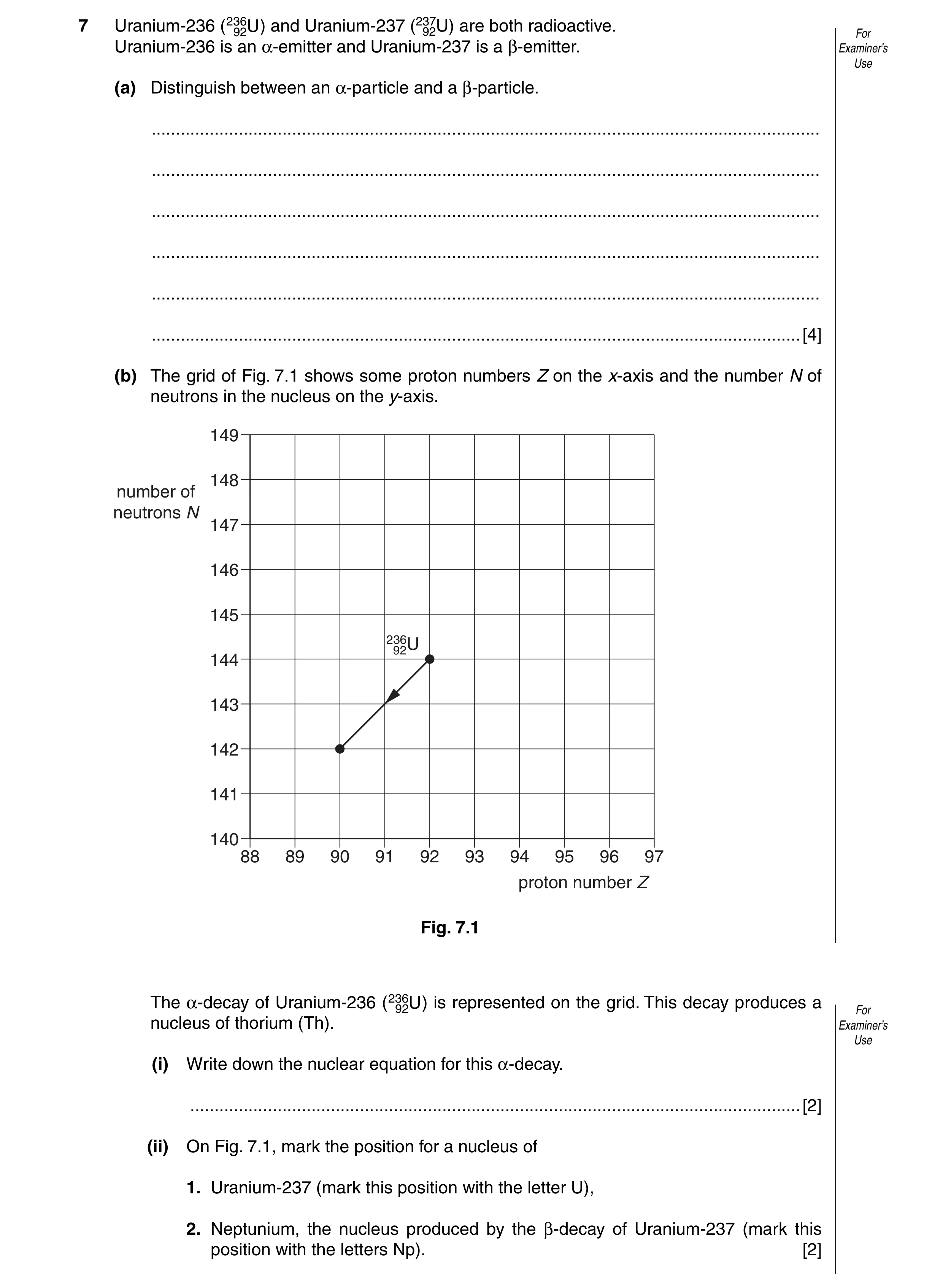 2 / 68
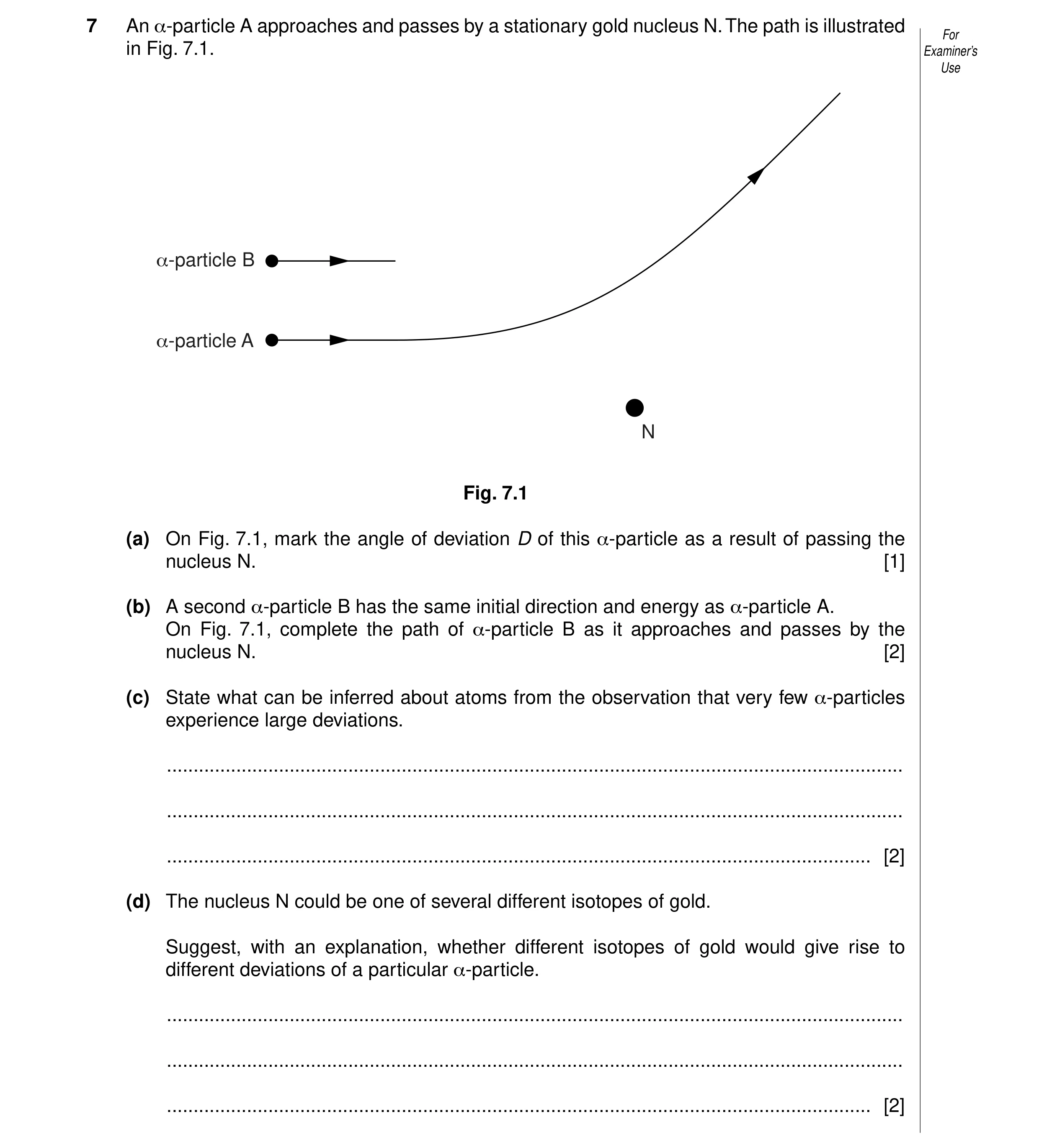 3 / 68
 4 / 68
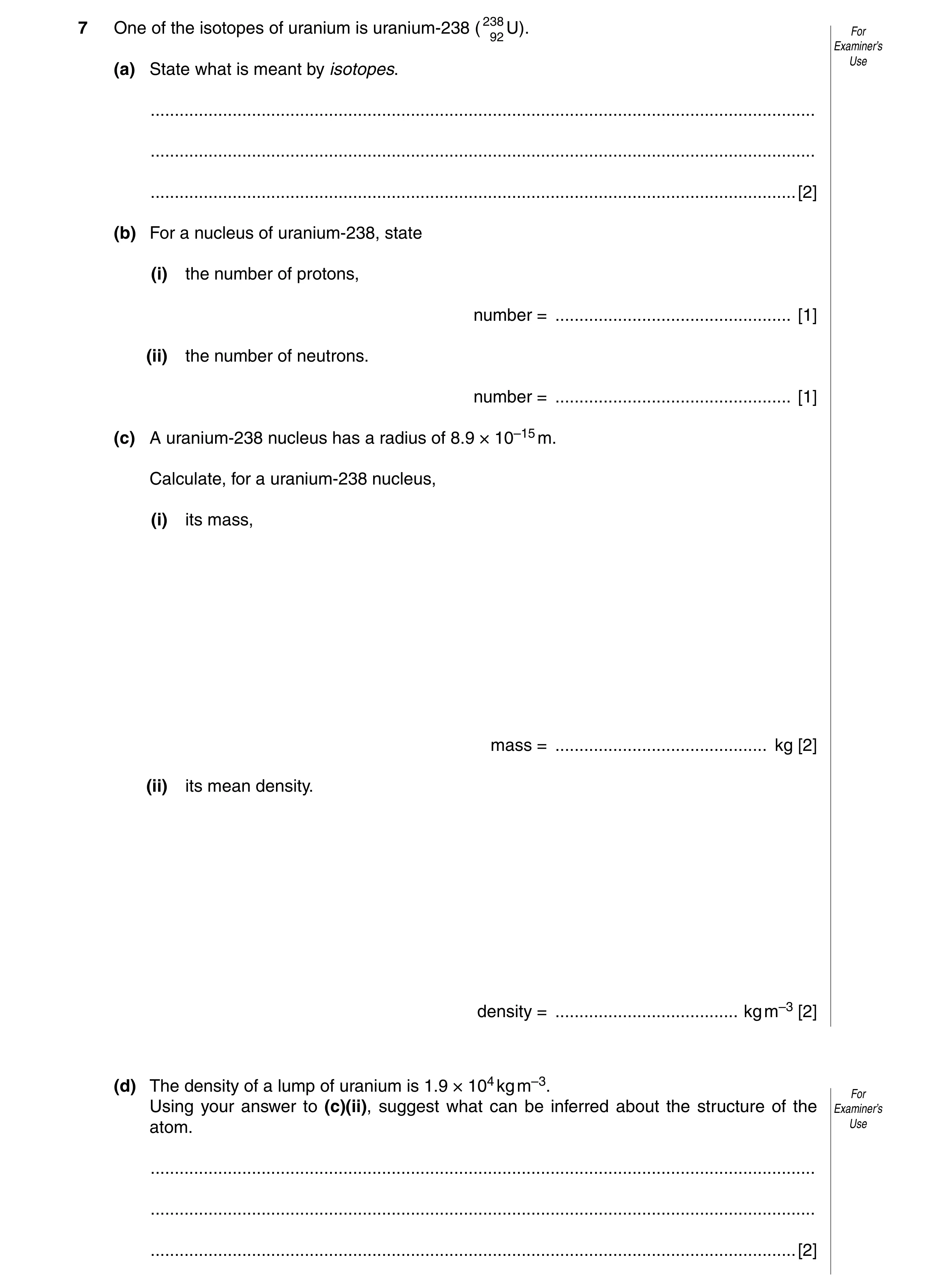 5 / 68
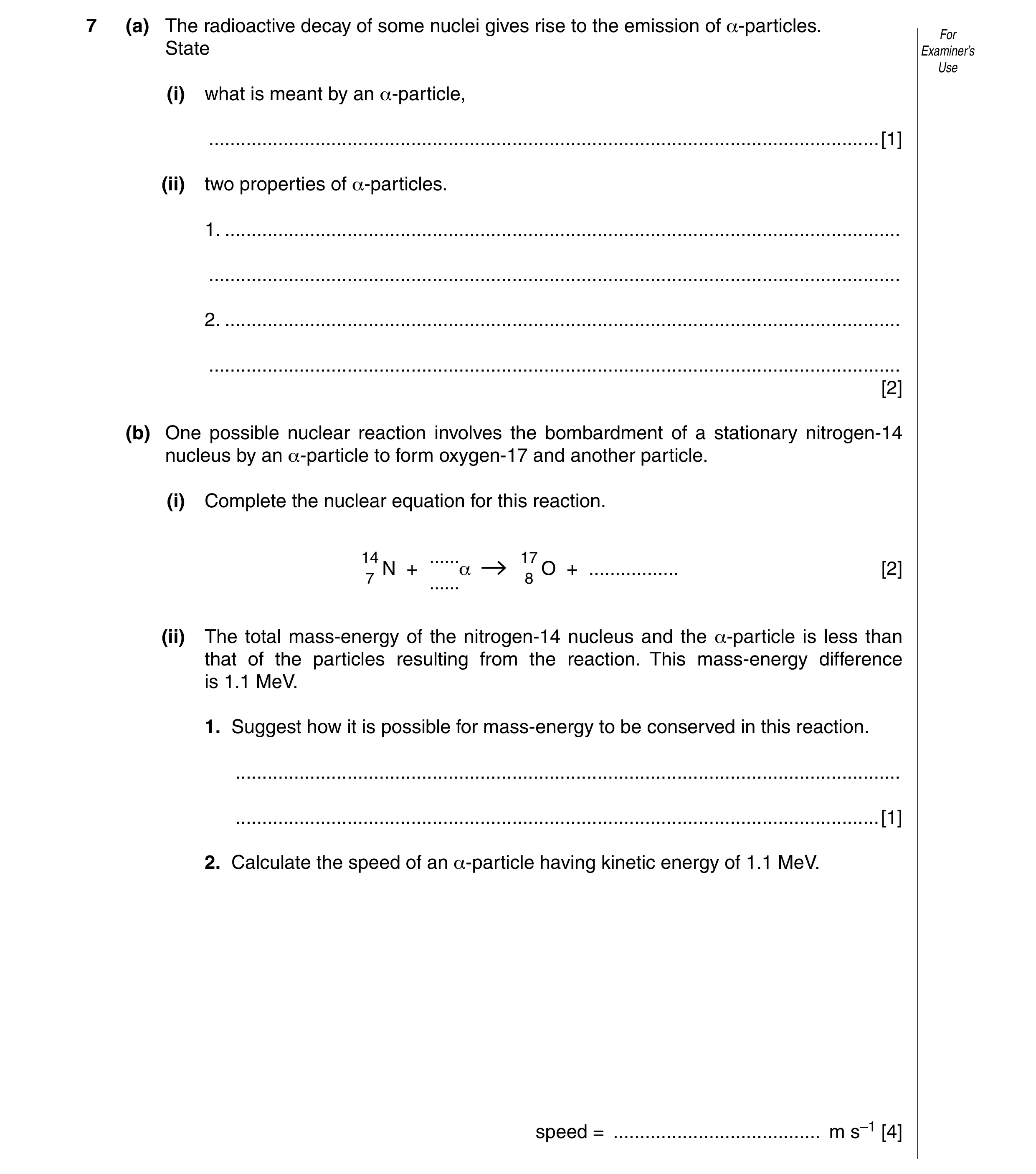 6 / 68
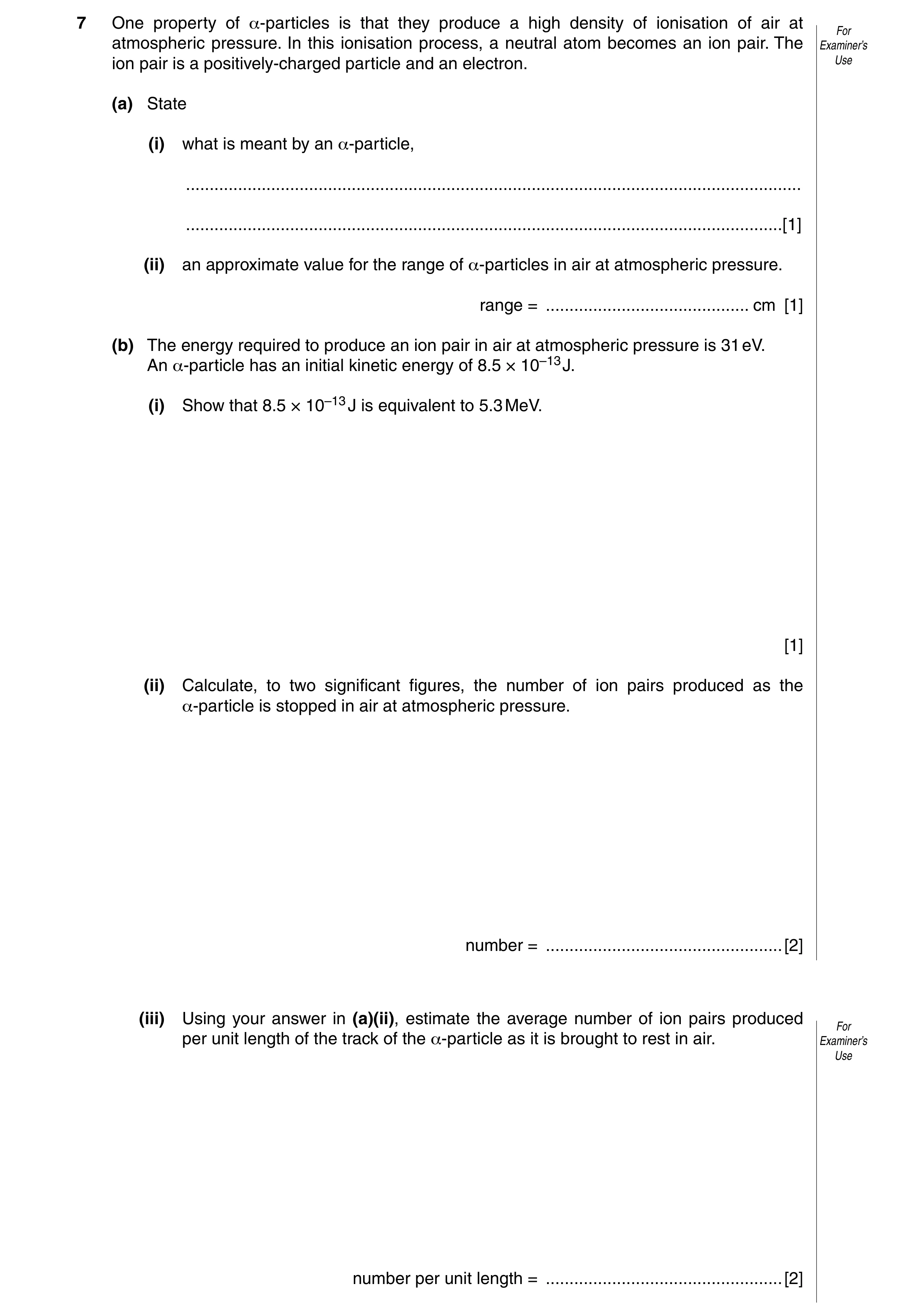 7 / 68
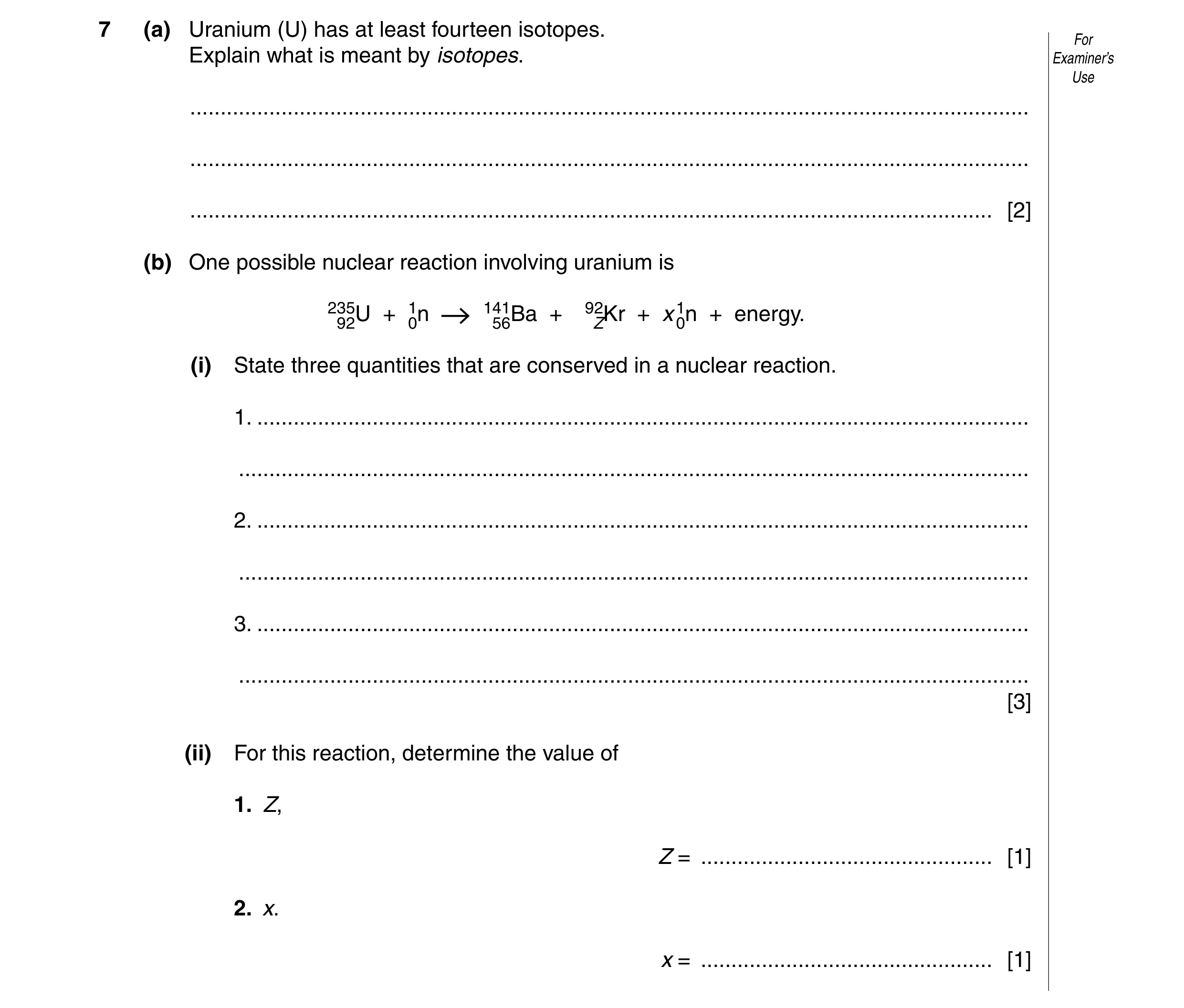 8 / 68
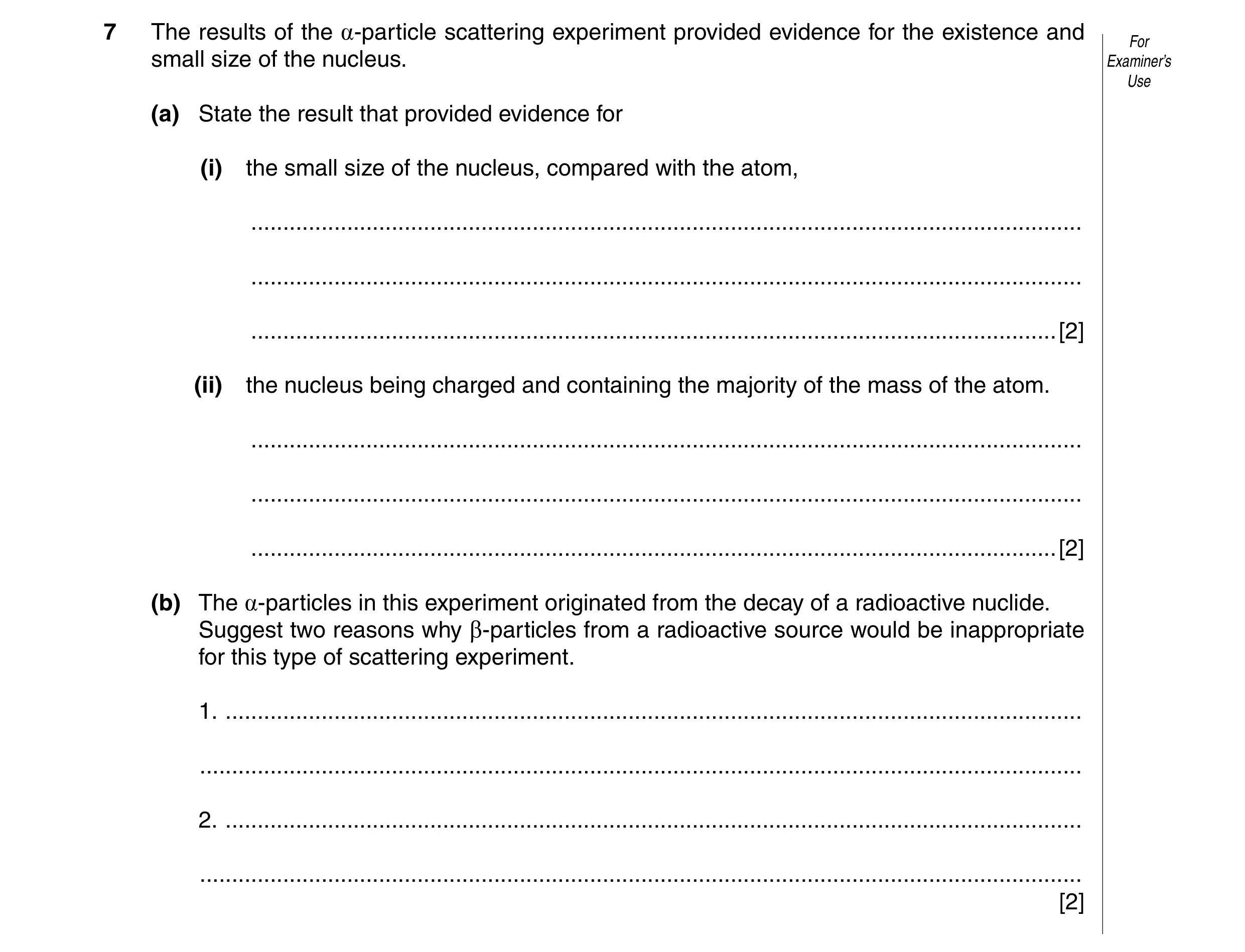 9 / 68
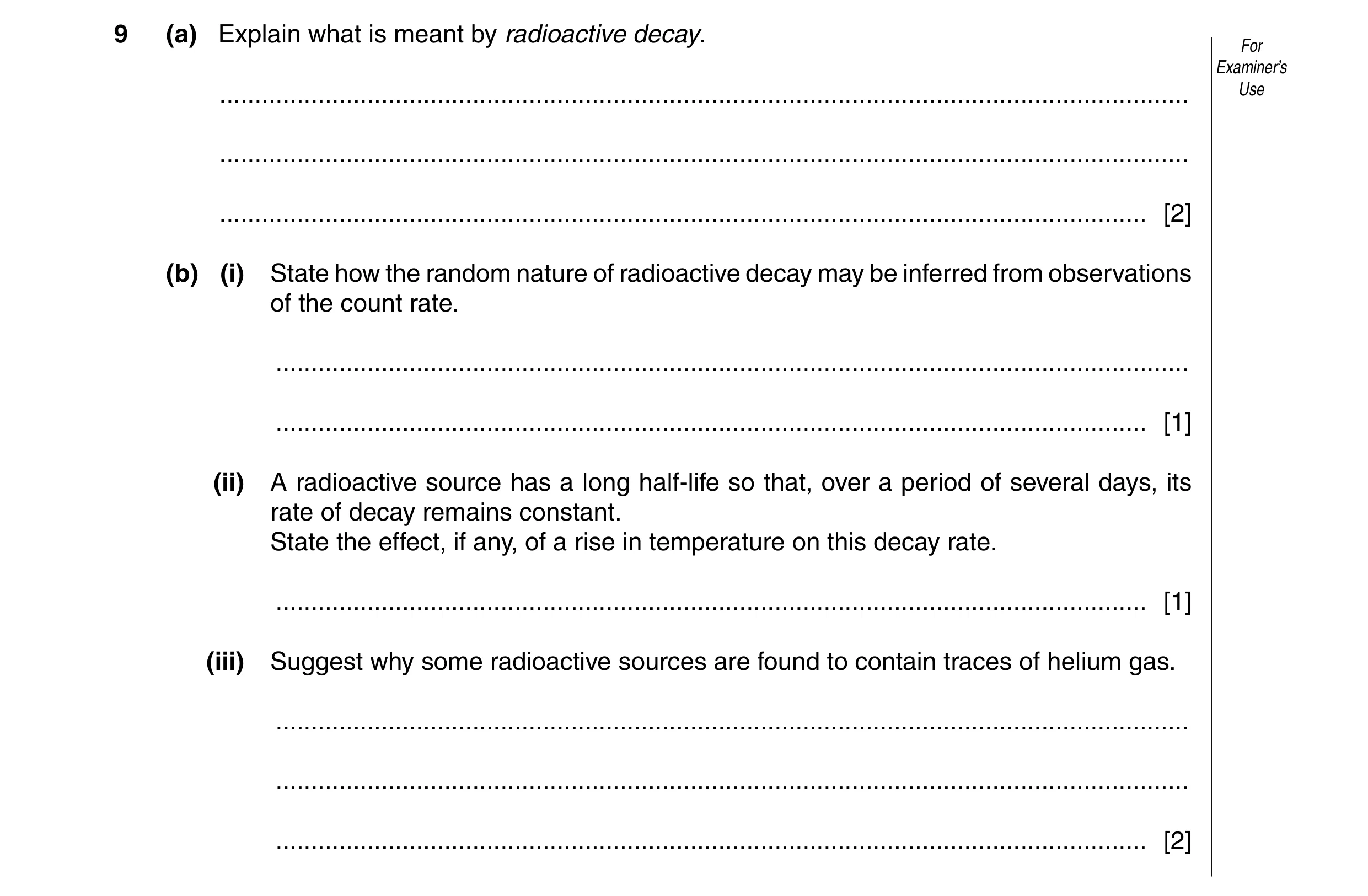 10 / 68
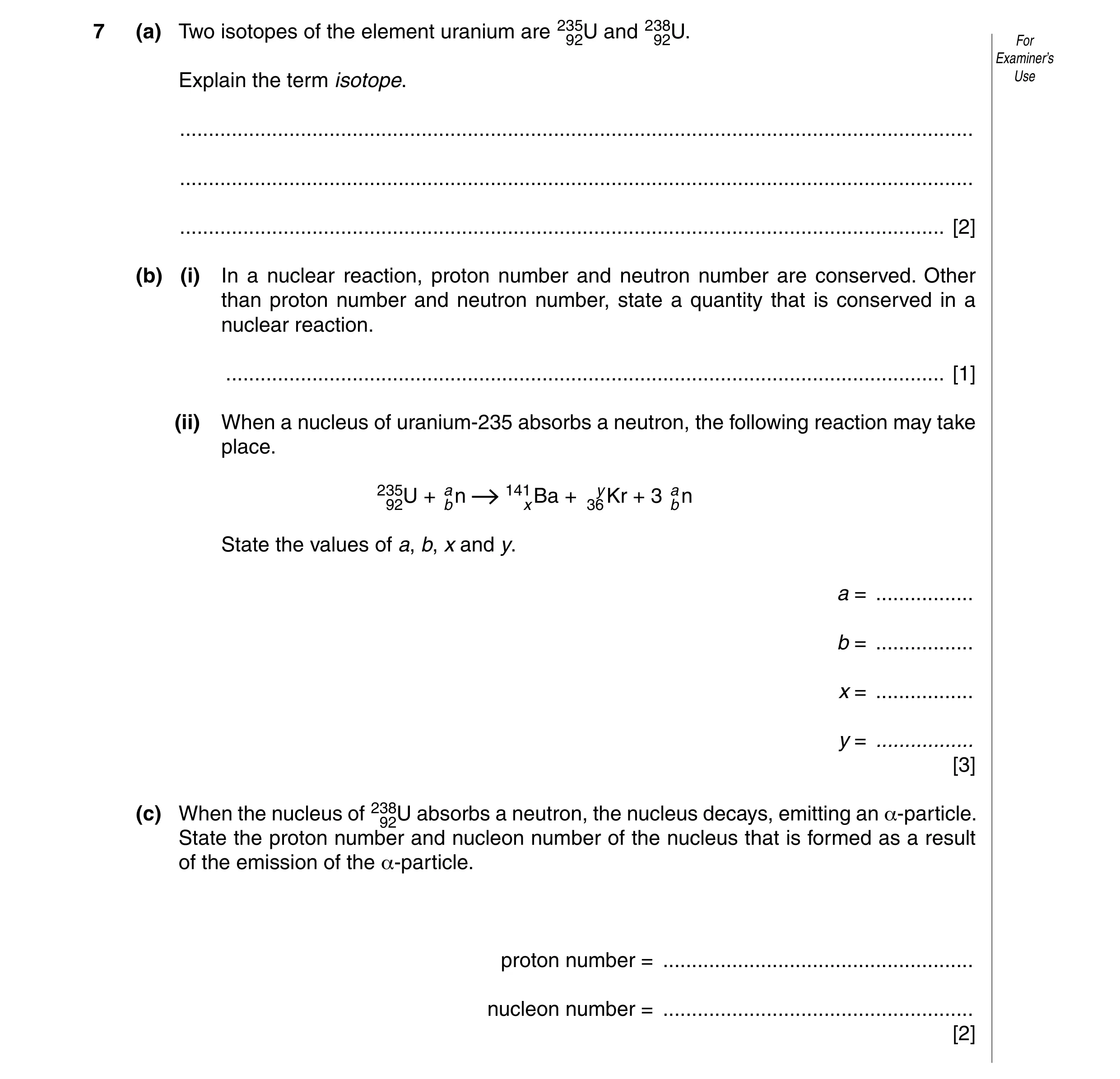 11 / 68
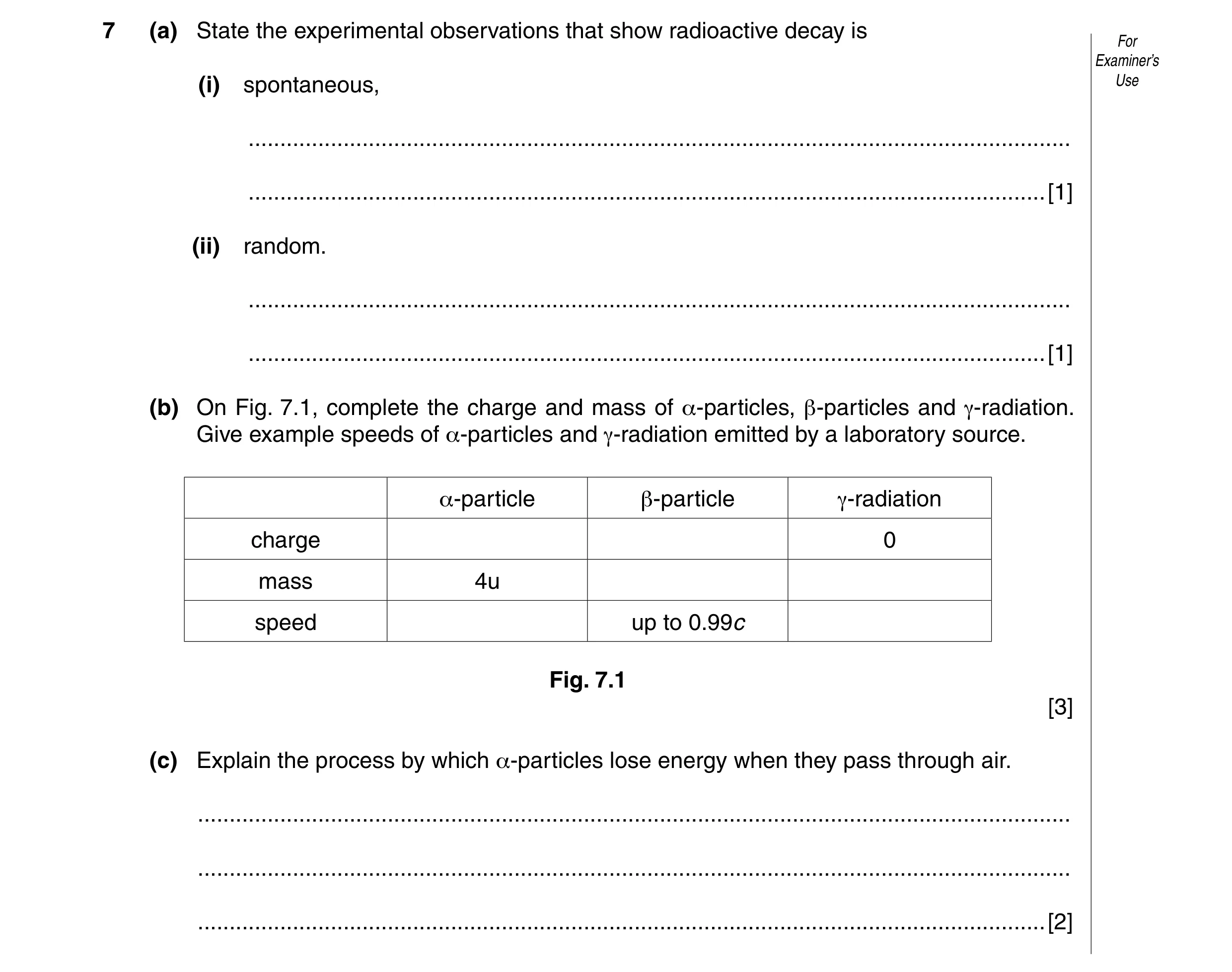 12 / 68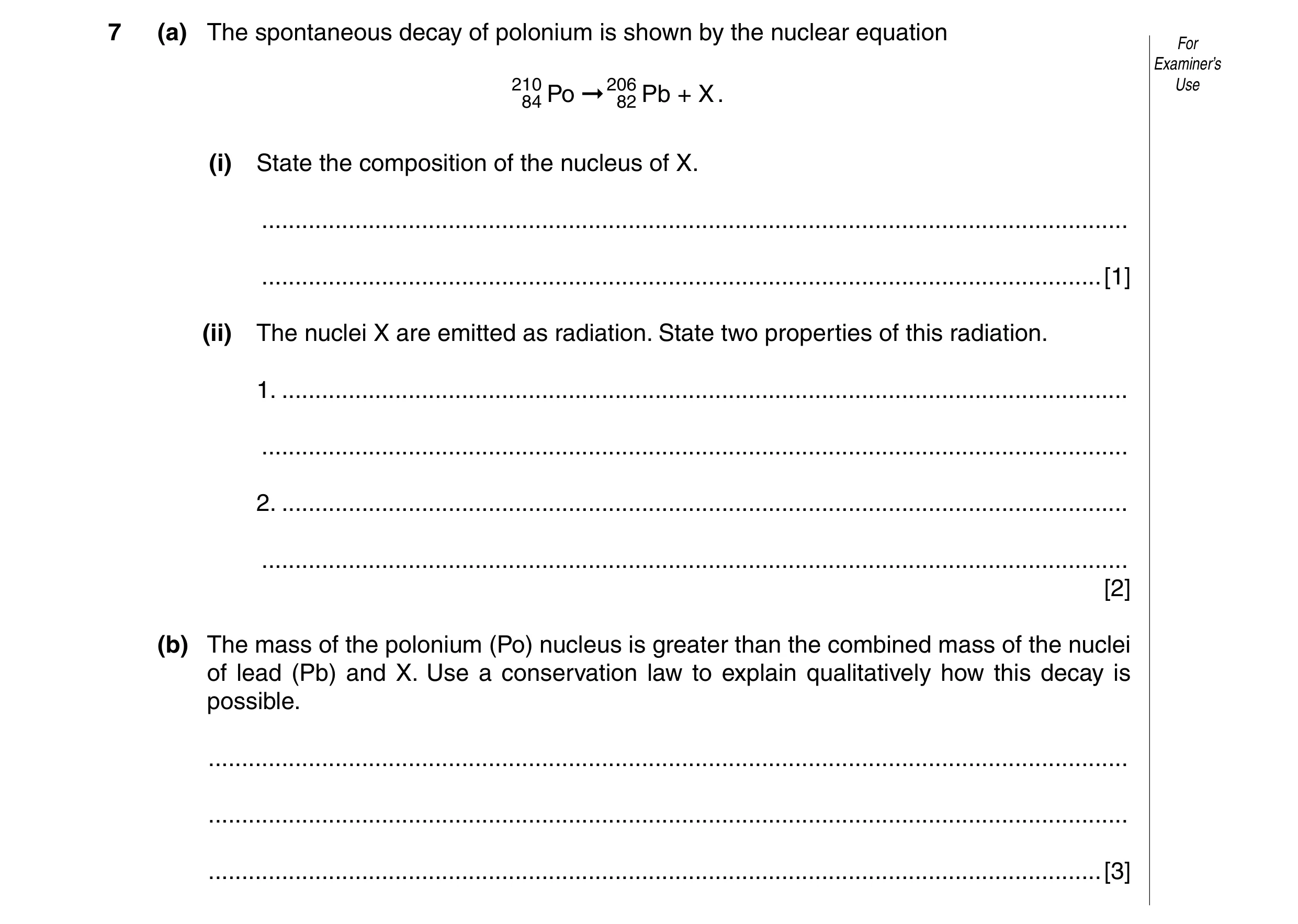
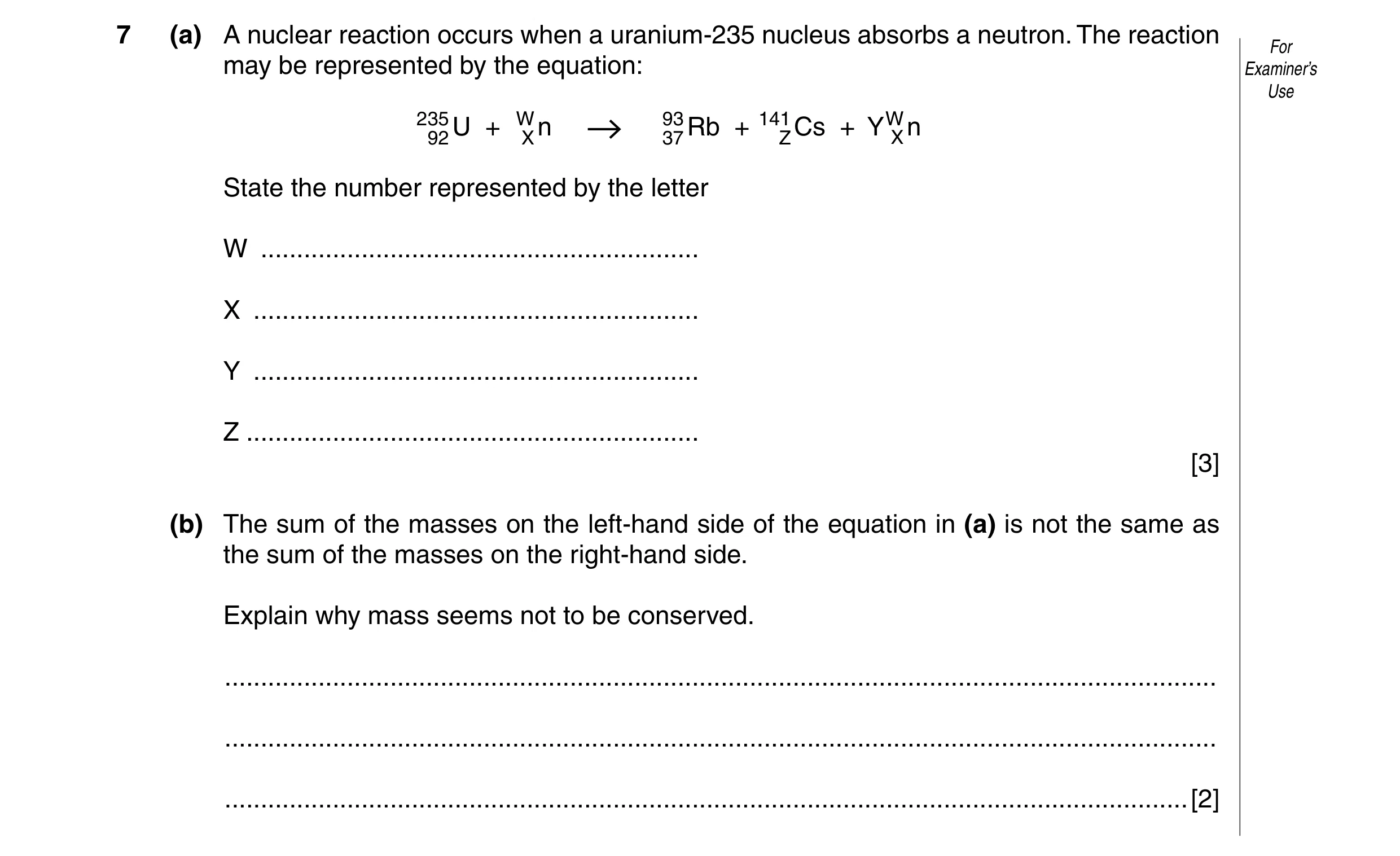 13 / 68
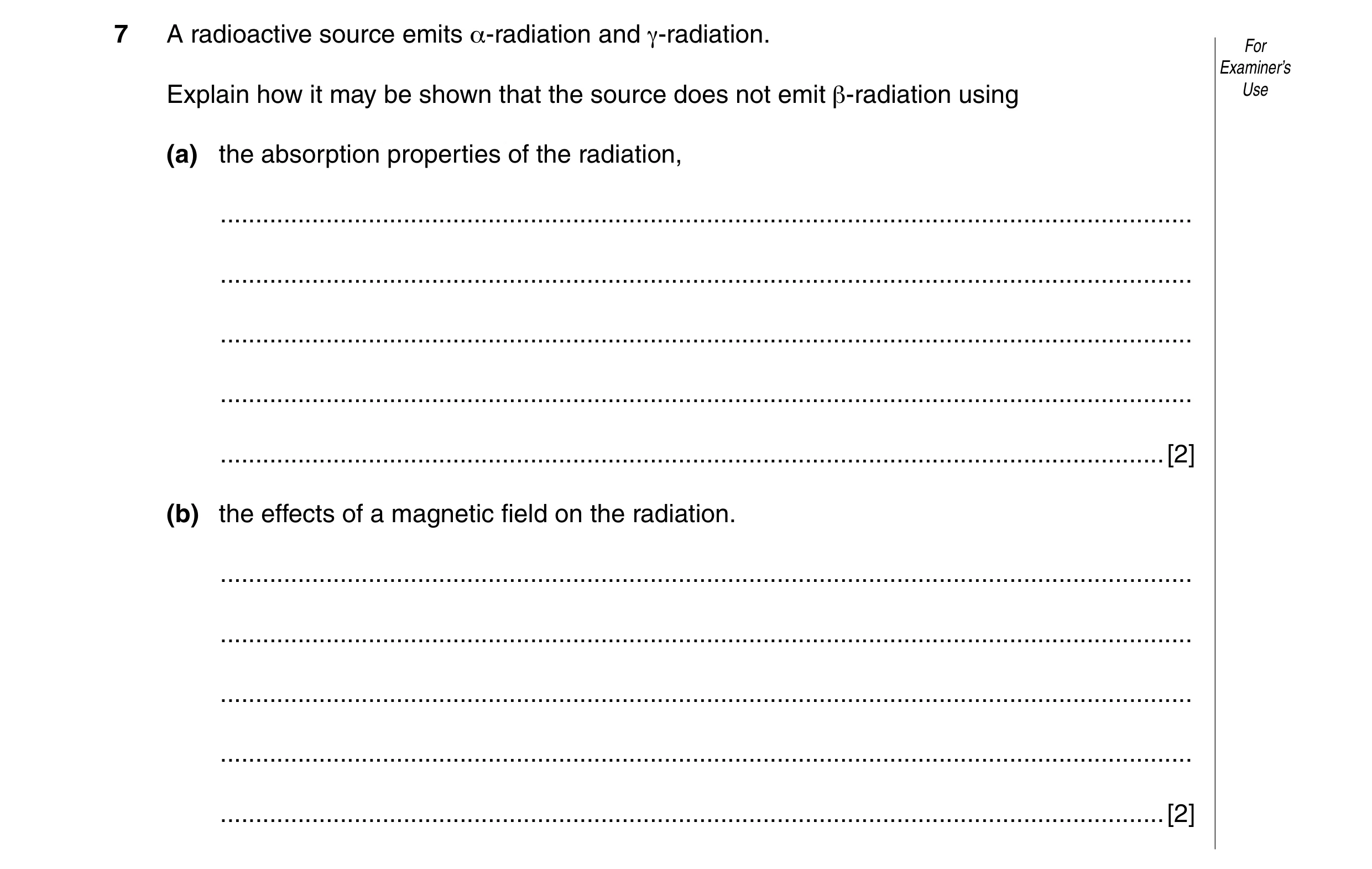 14 / 68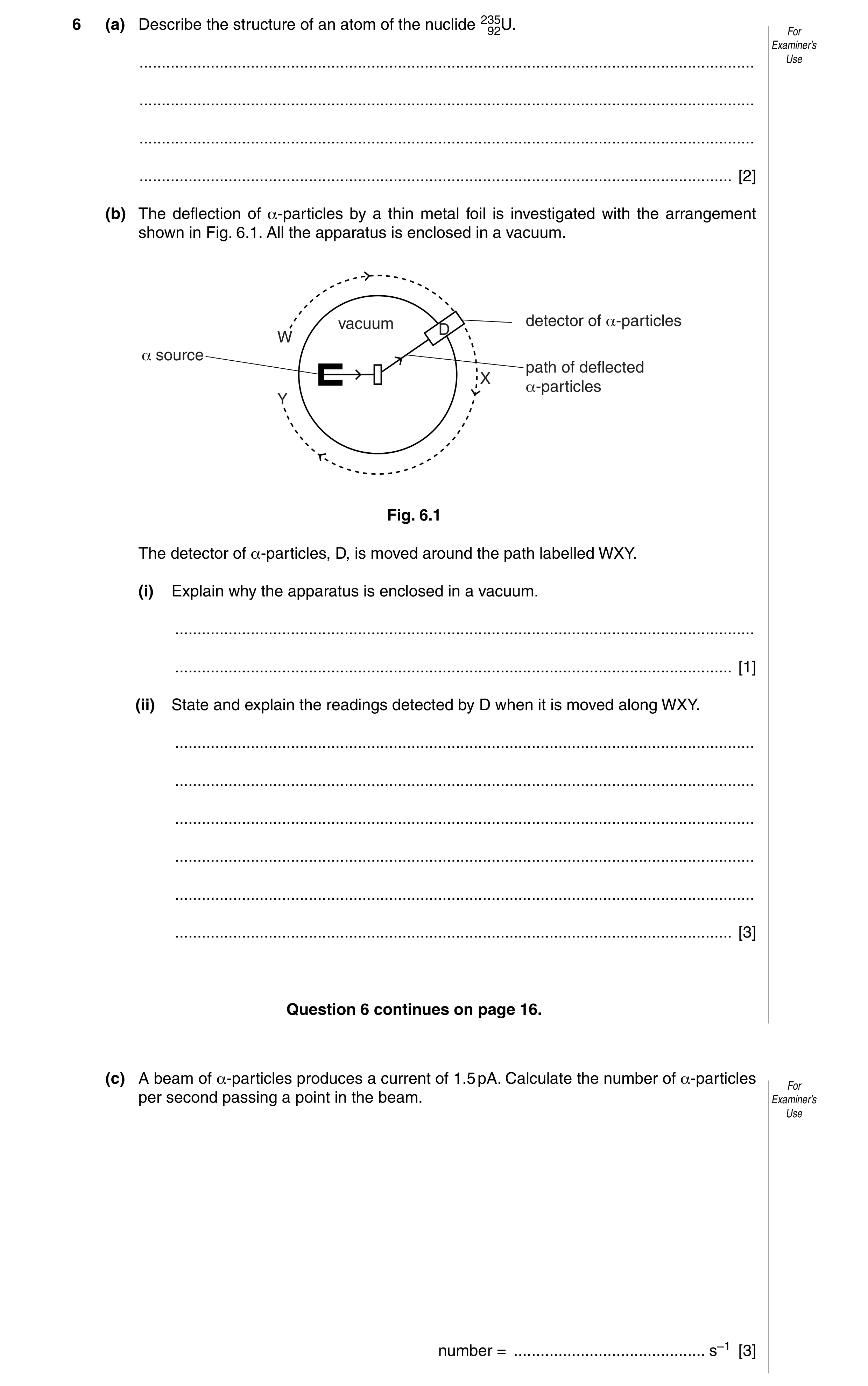
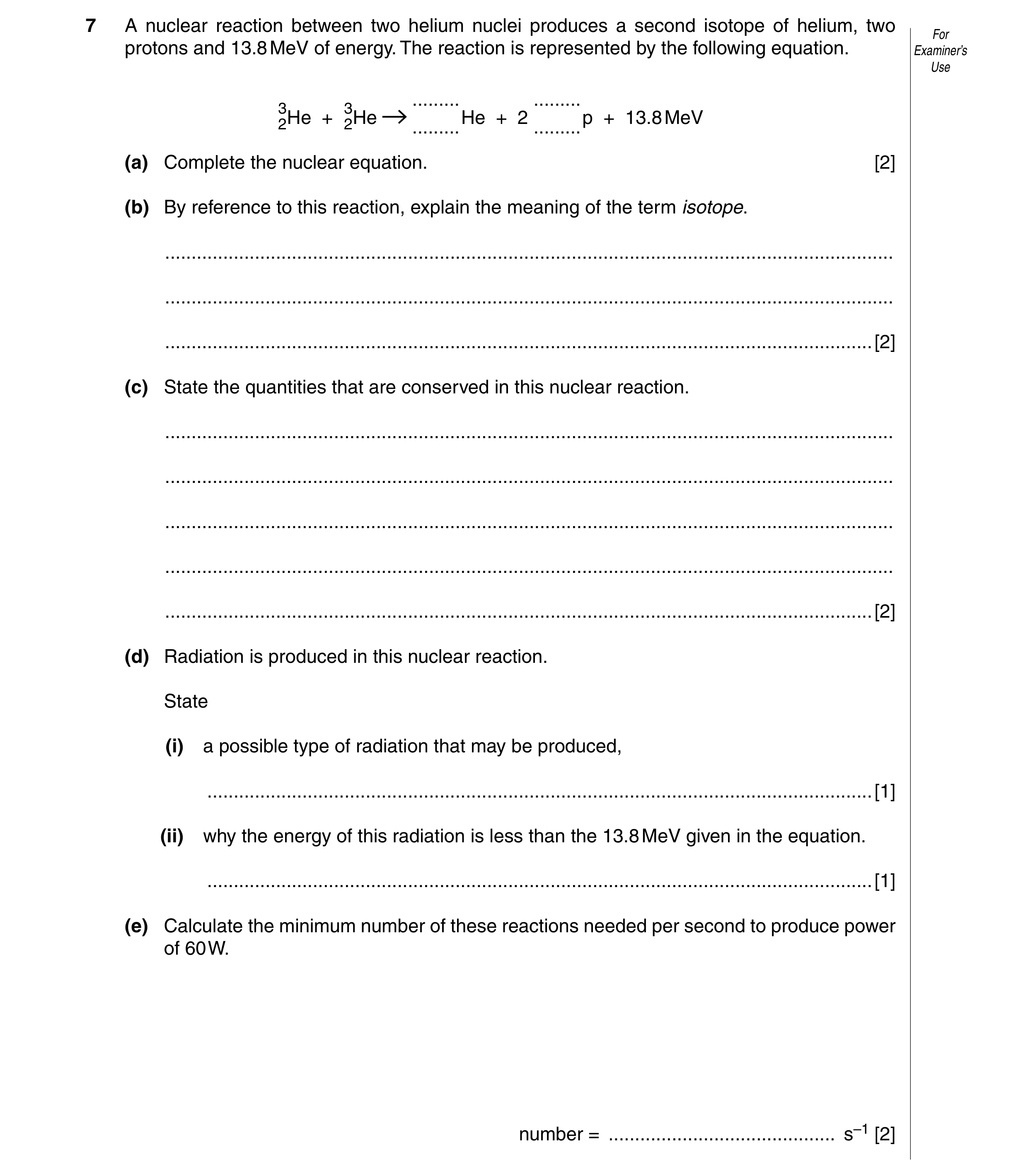 17 / 68
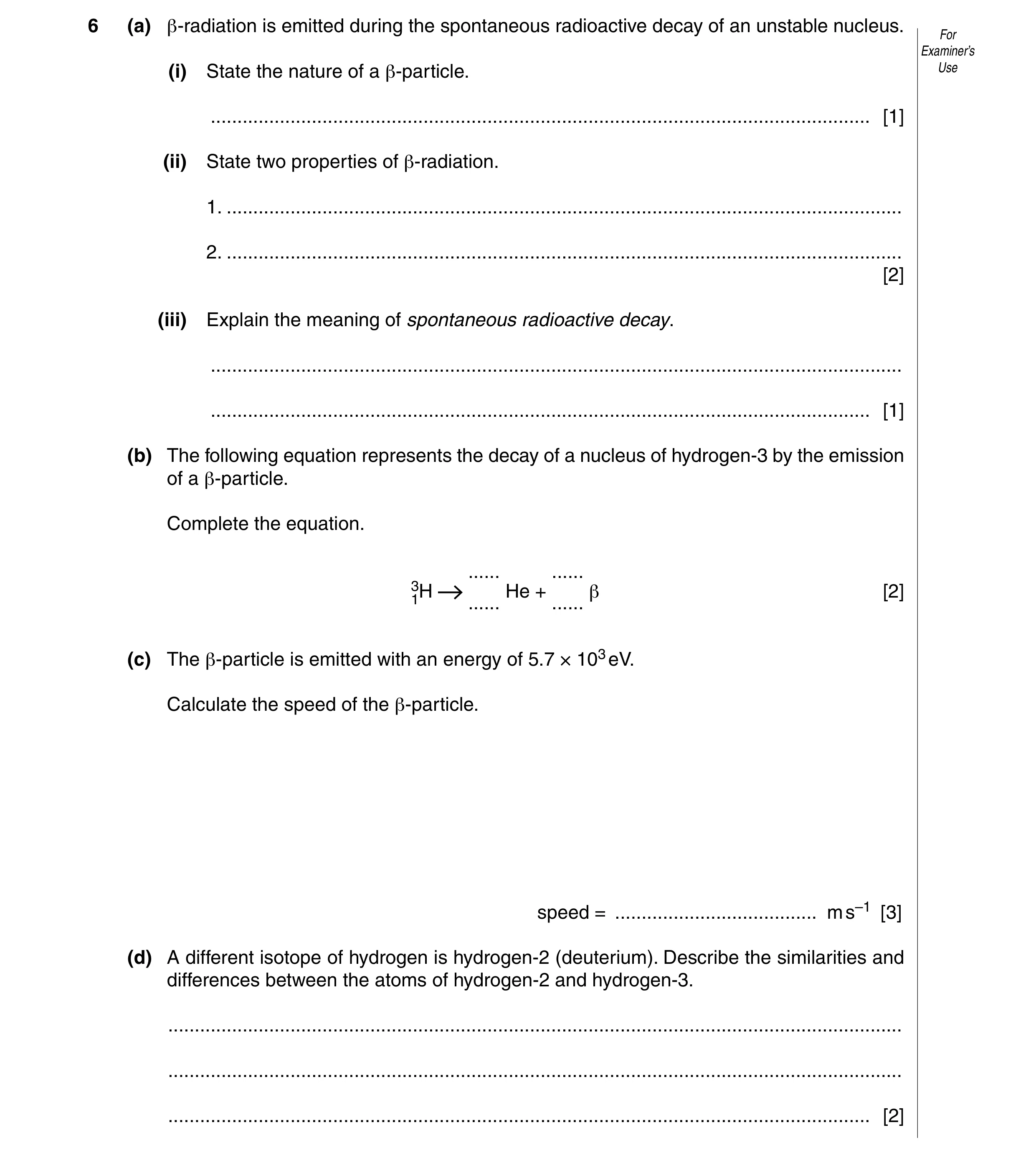 18 / 68
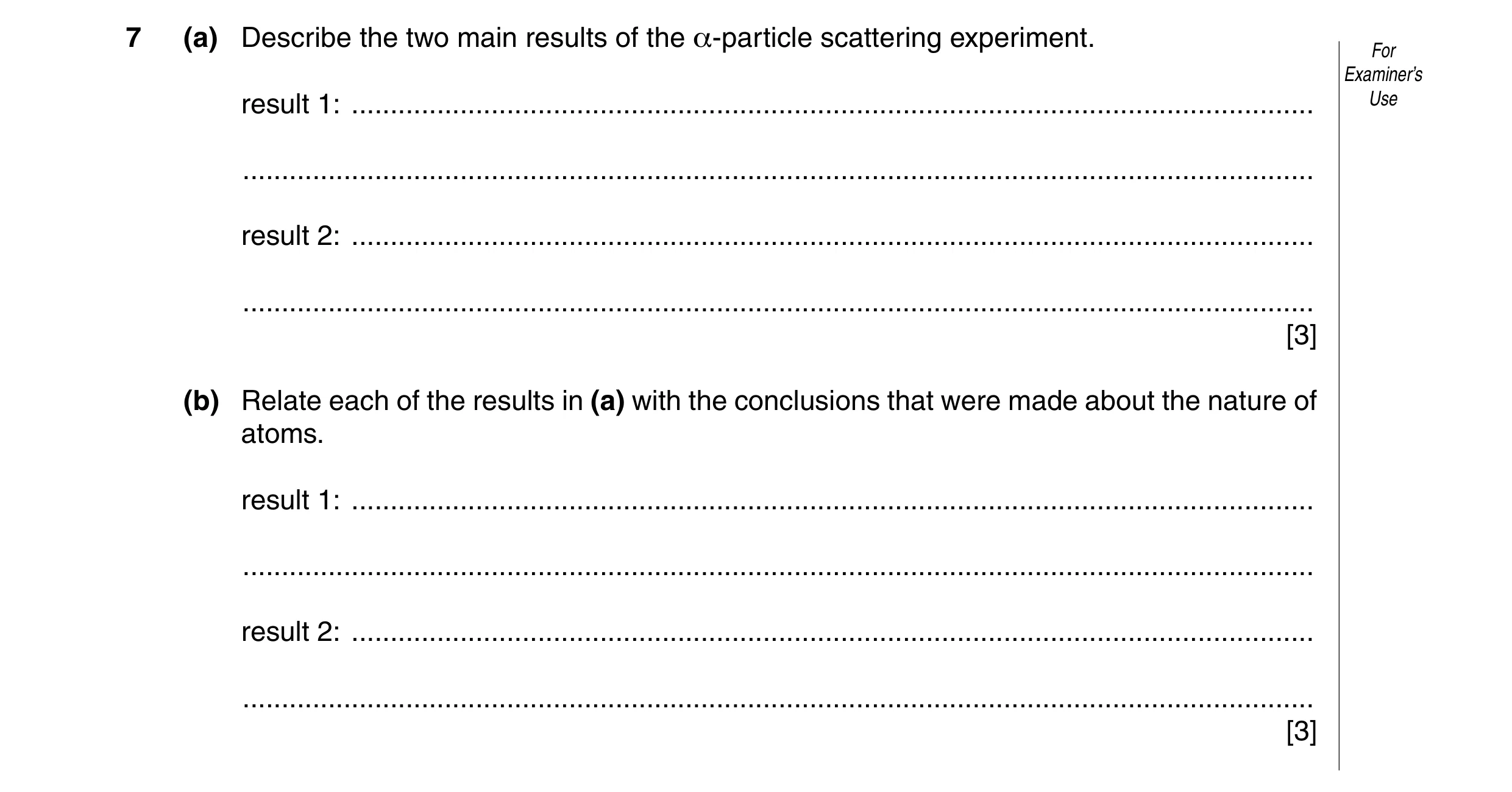 19 / 68
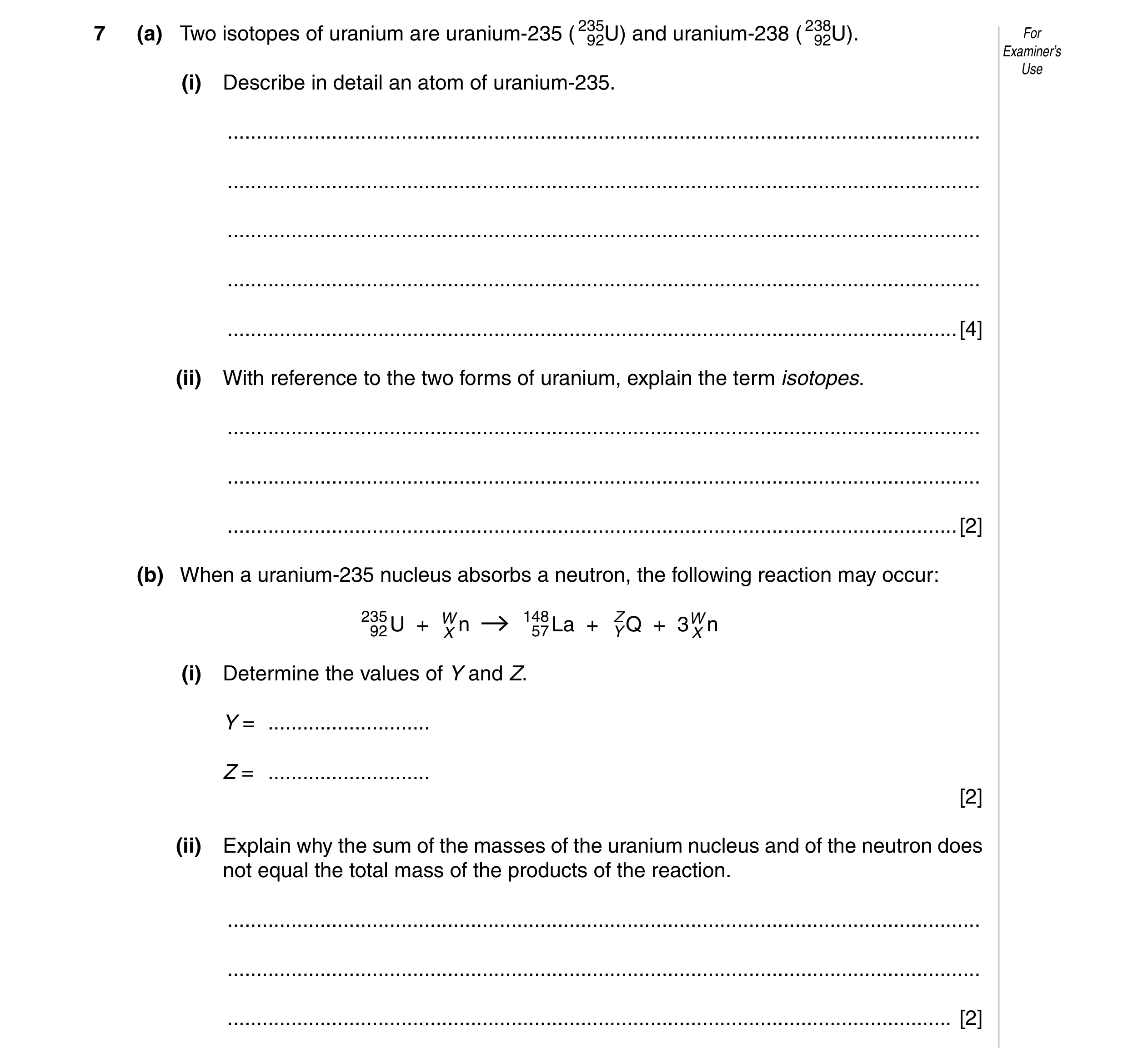 20 / 68
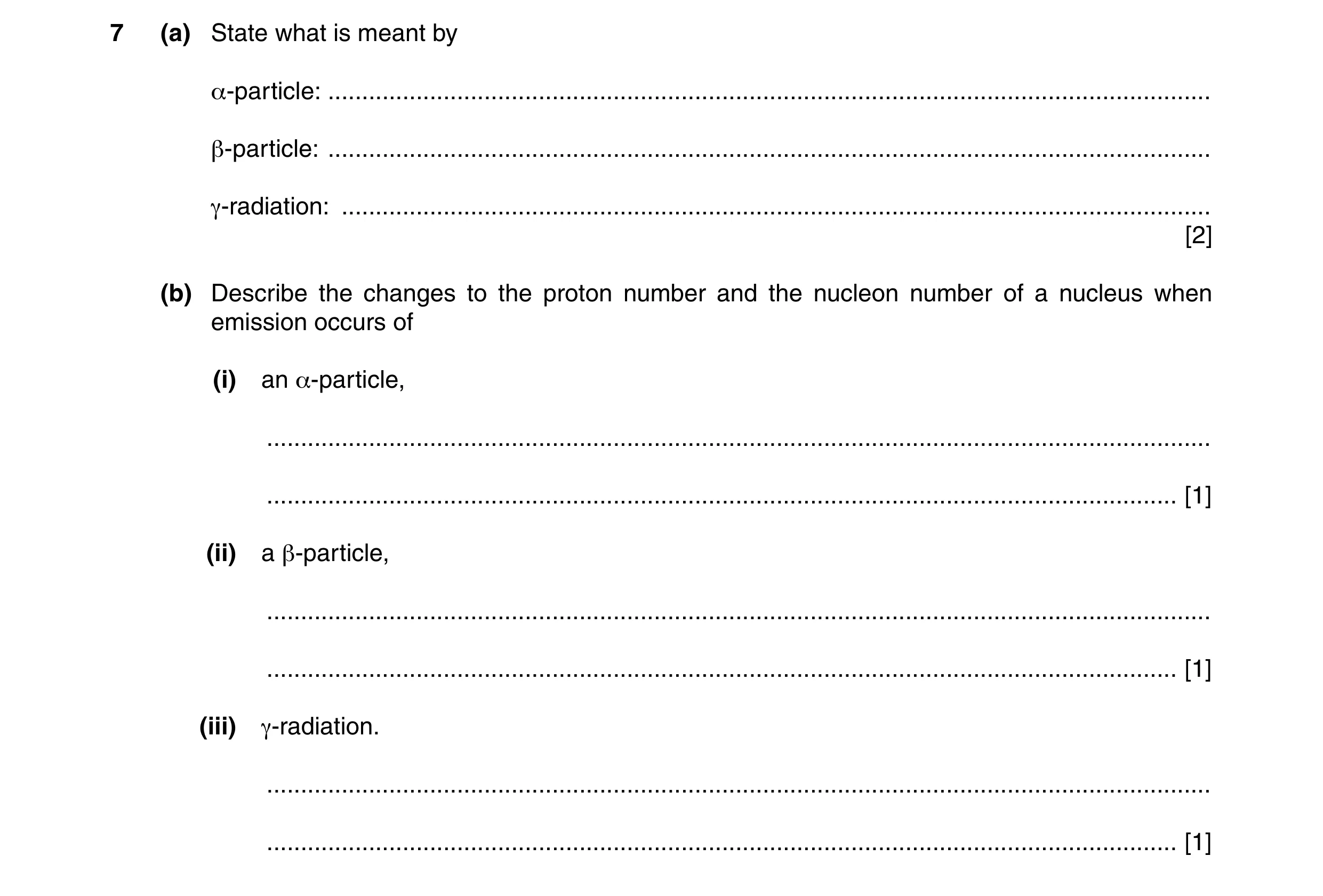 21 / 68
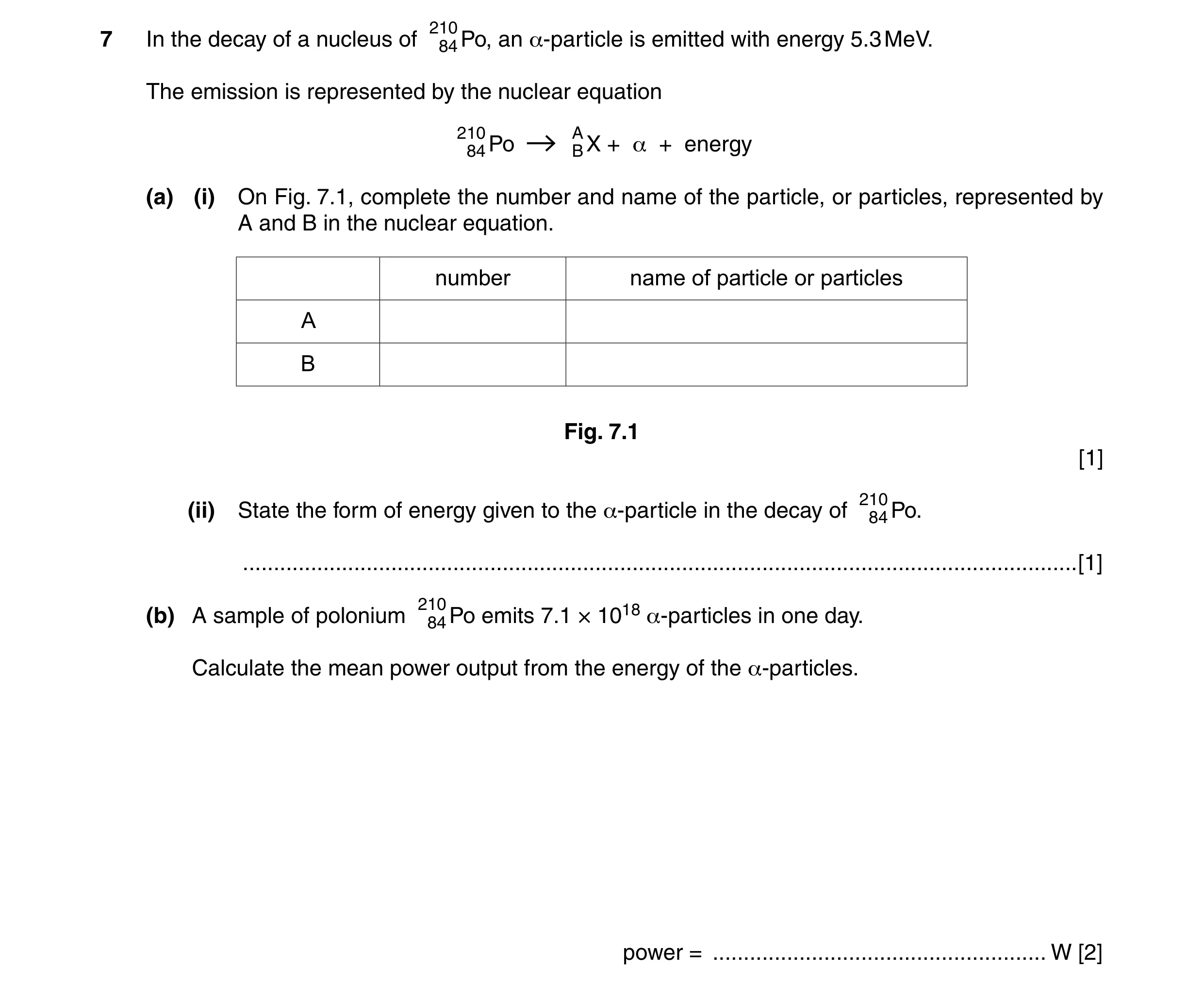 22 / 68
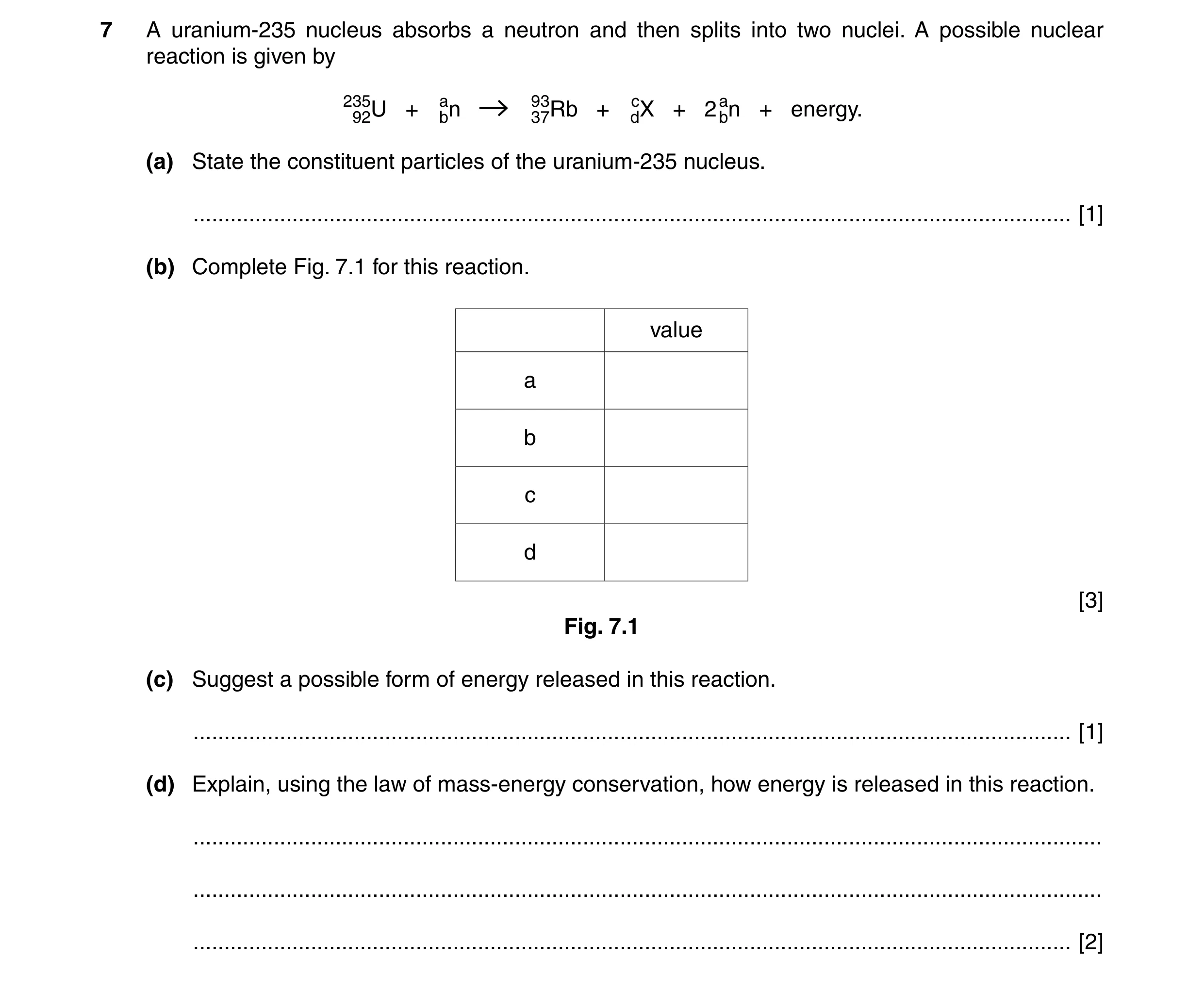 23 / 68
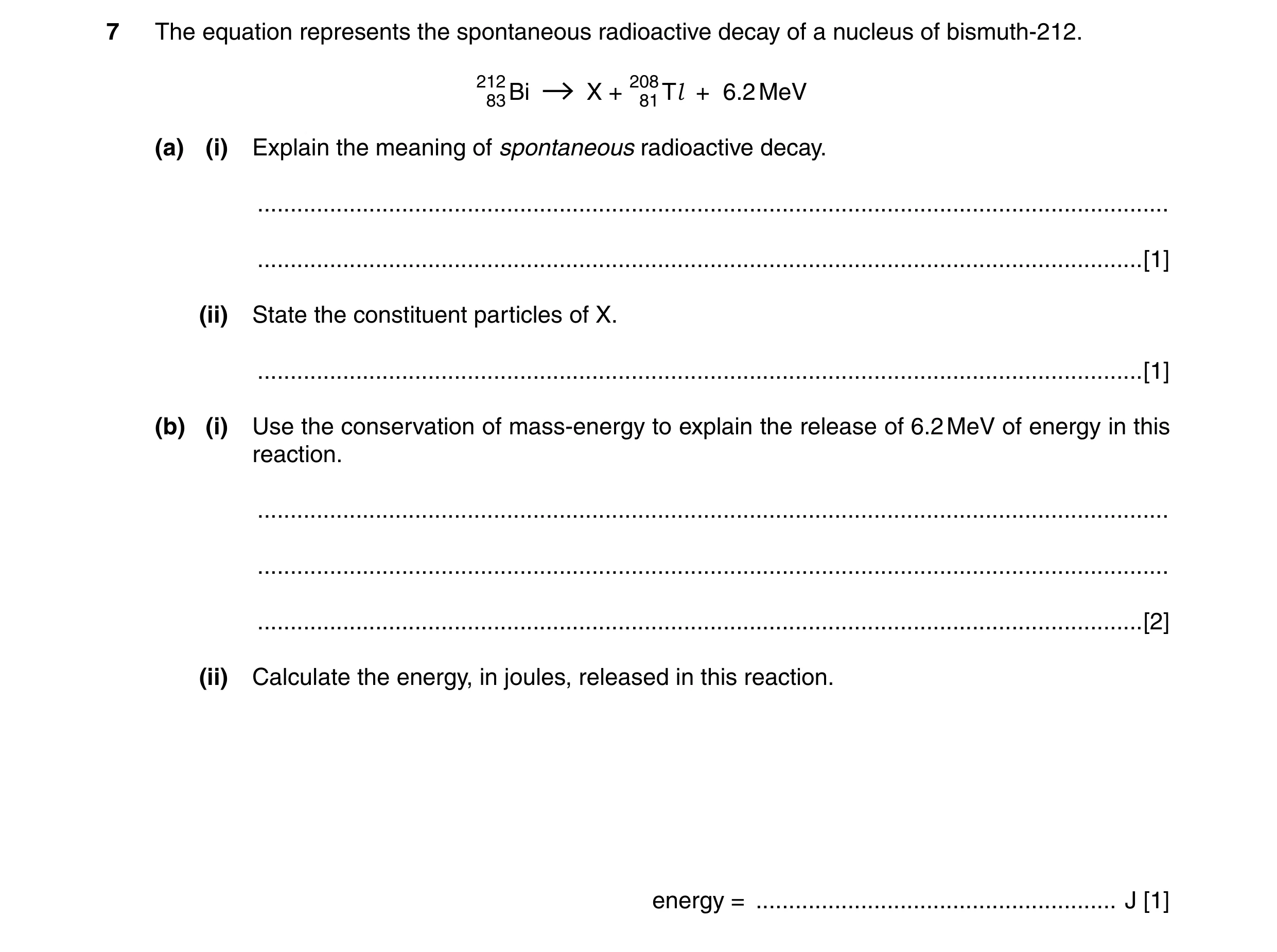 24 / 68
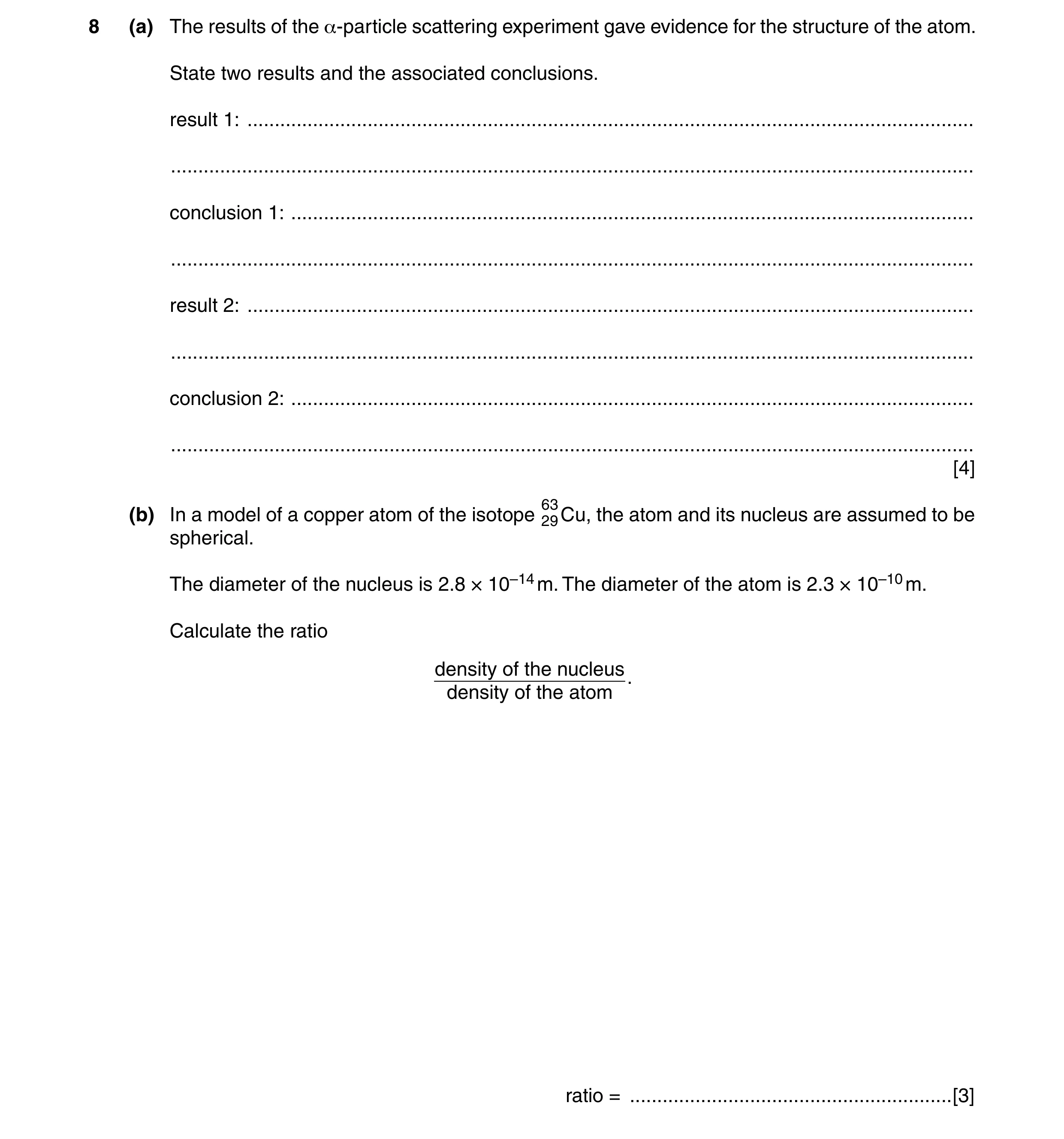 25 / 68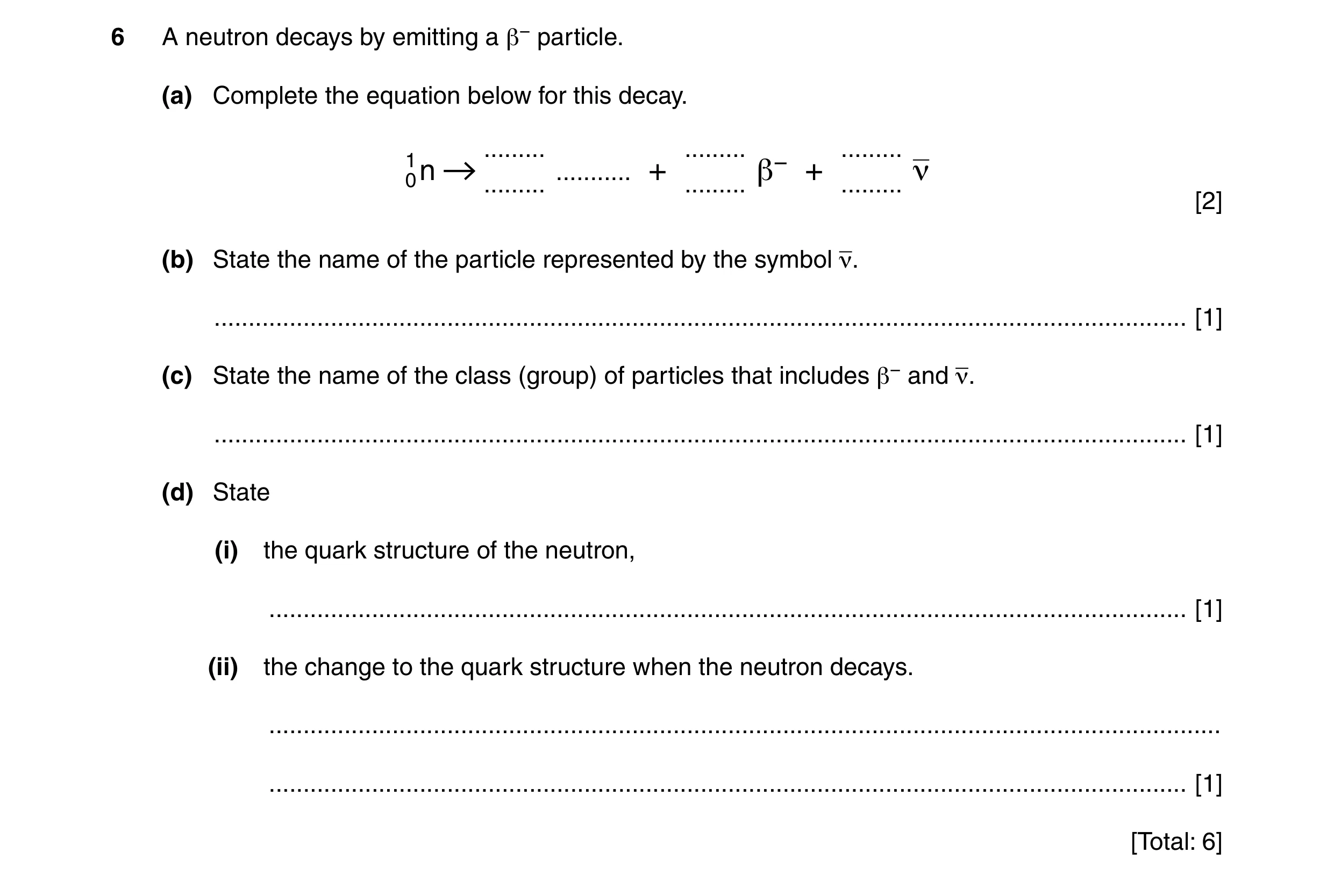
 26 / 68
 27 / 68
 28 / 68
 29 / 68
 30 / 68
 31 / 68
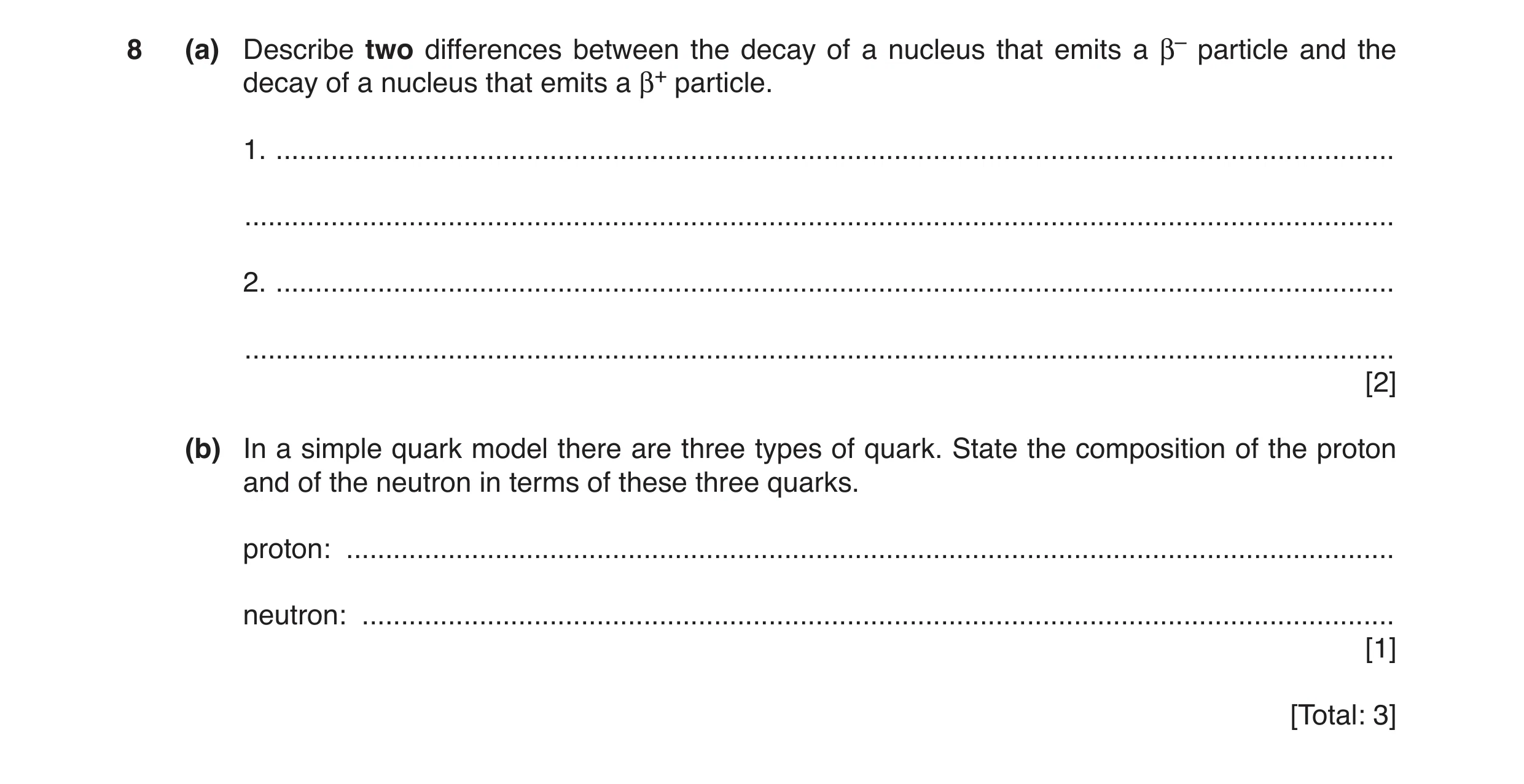 32 / 68
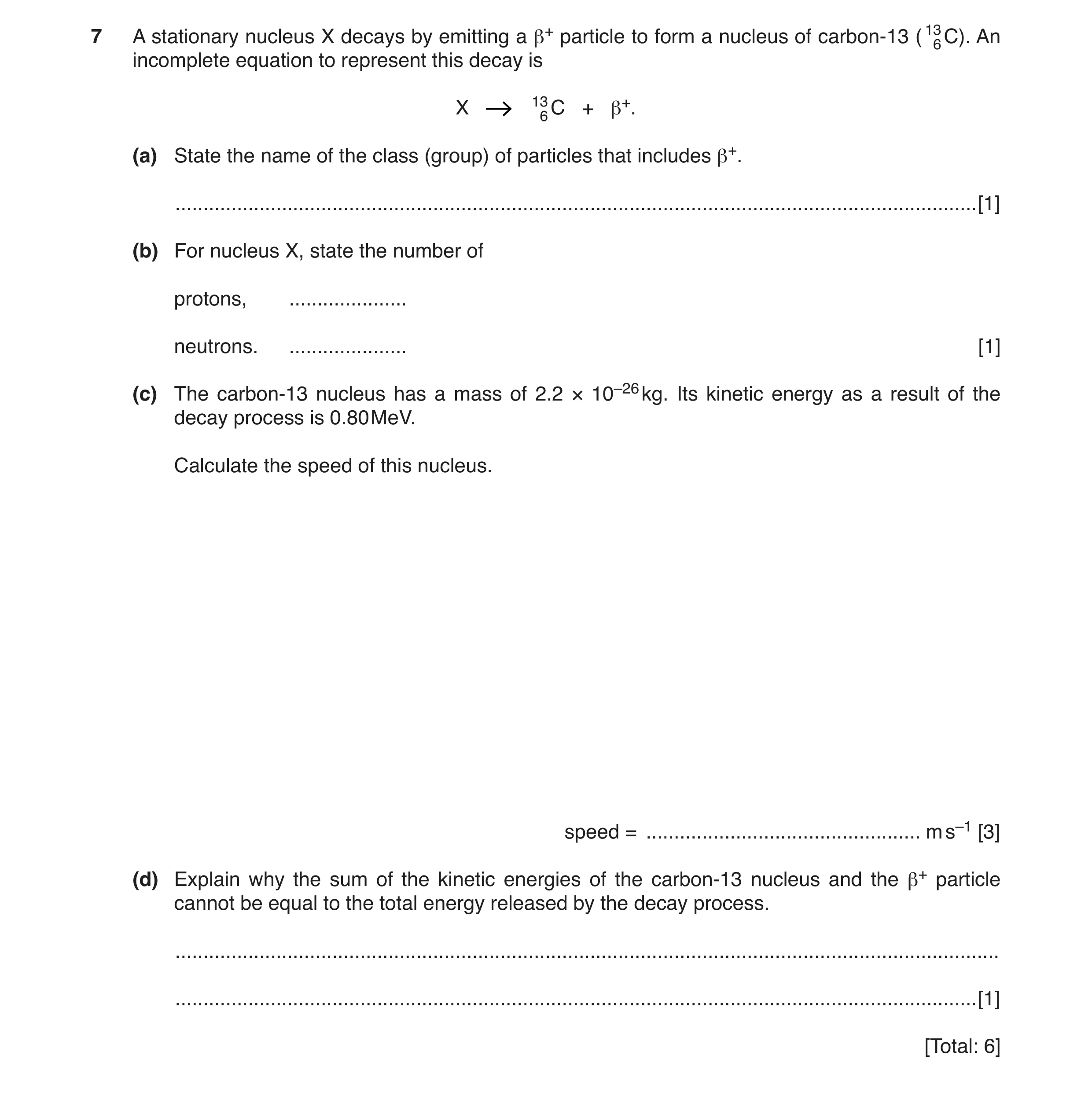 33 / 68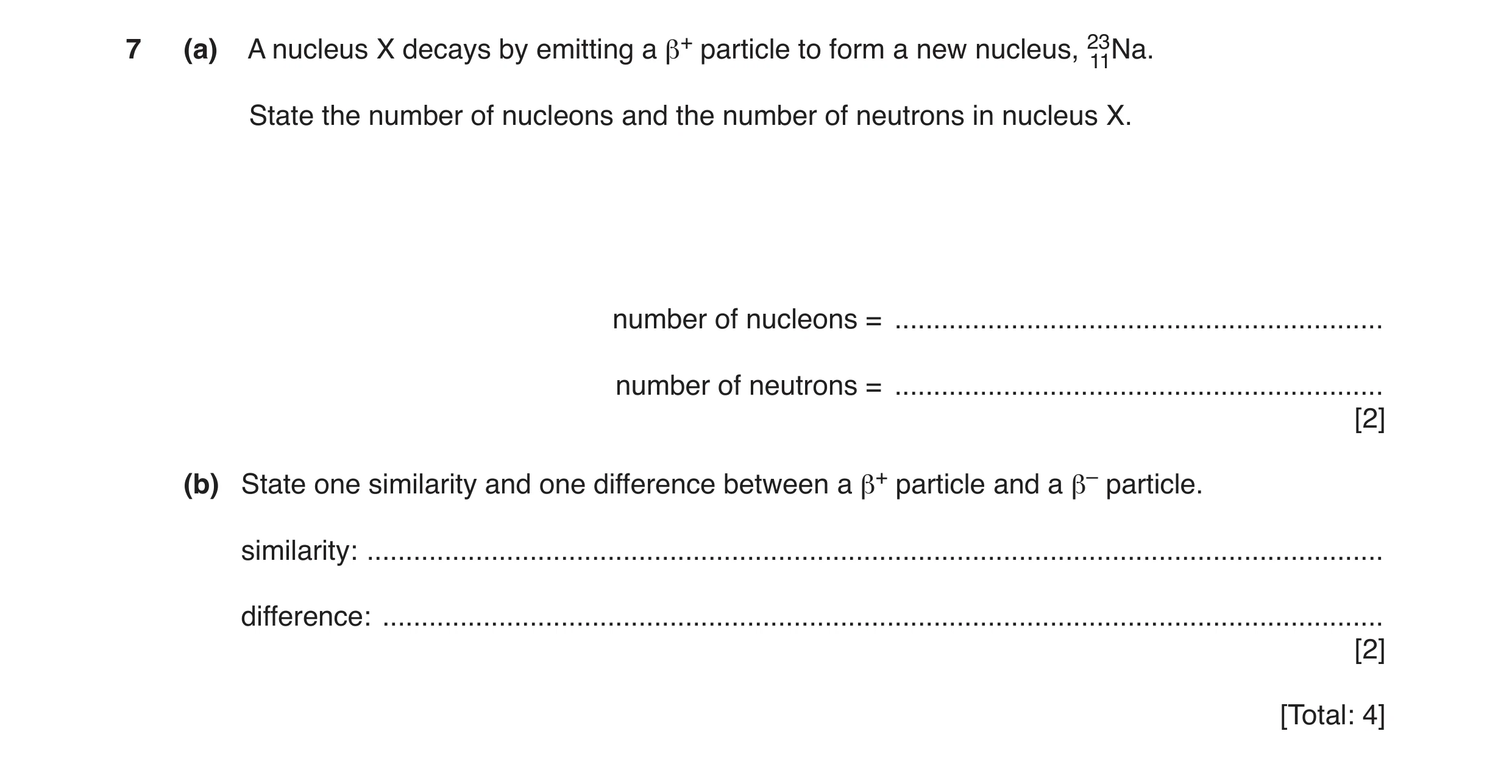
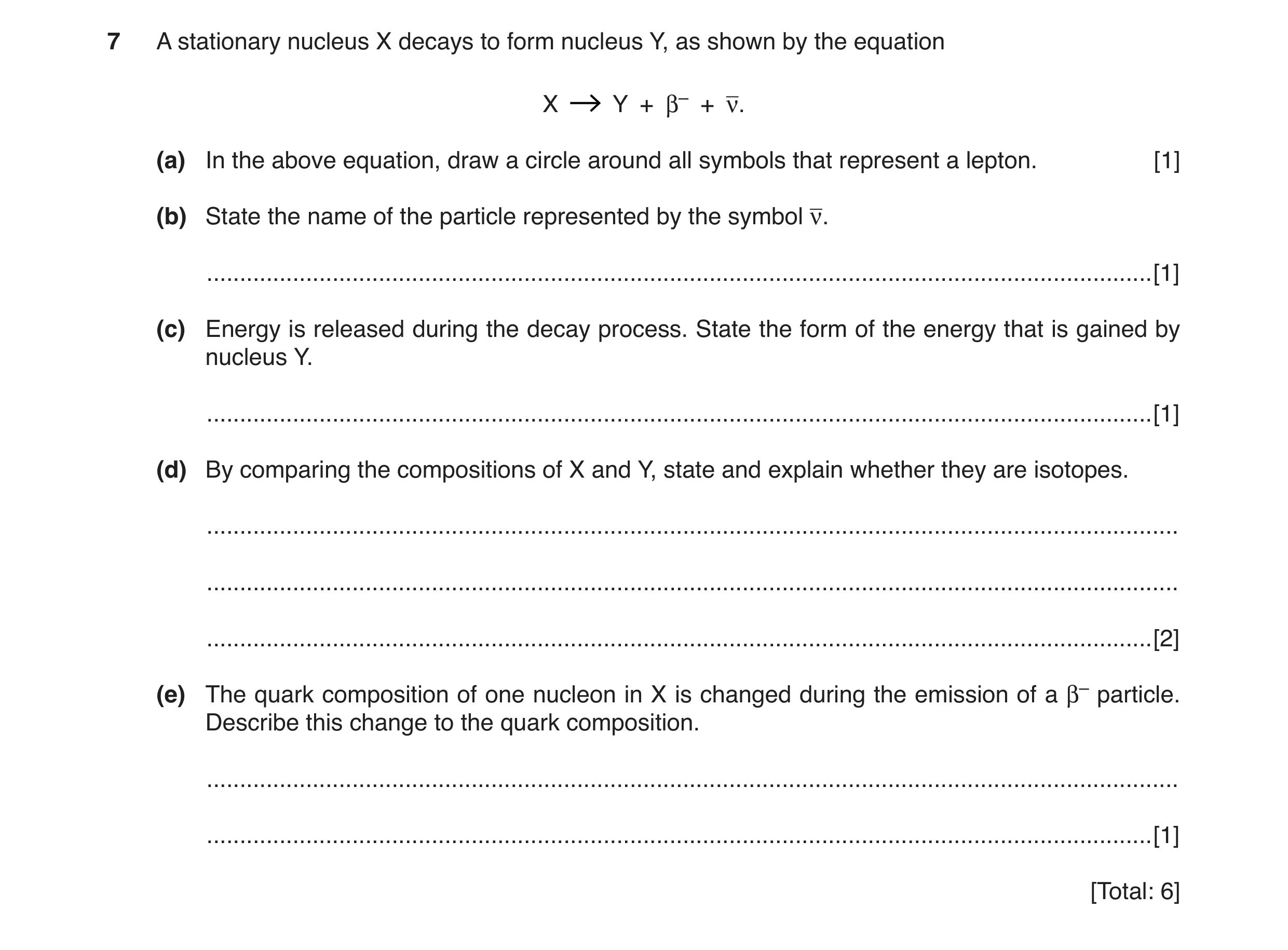 34 / 68
 35 / 68
 36 / 68
 37 / 68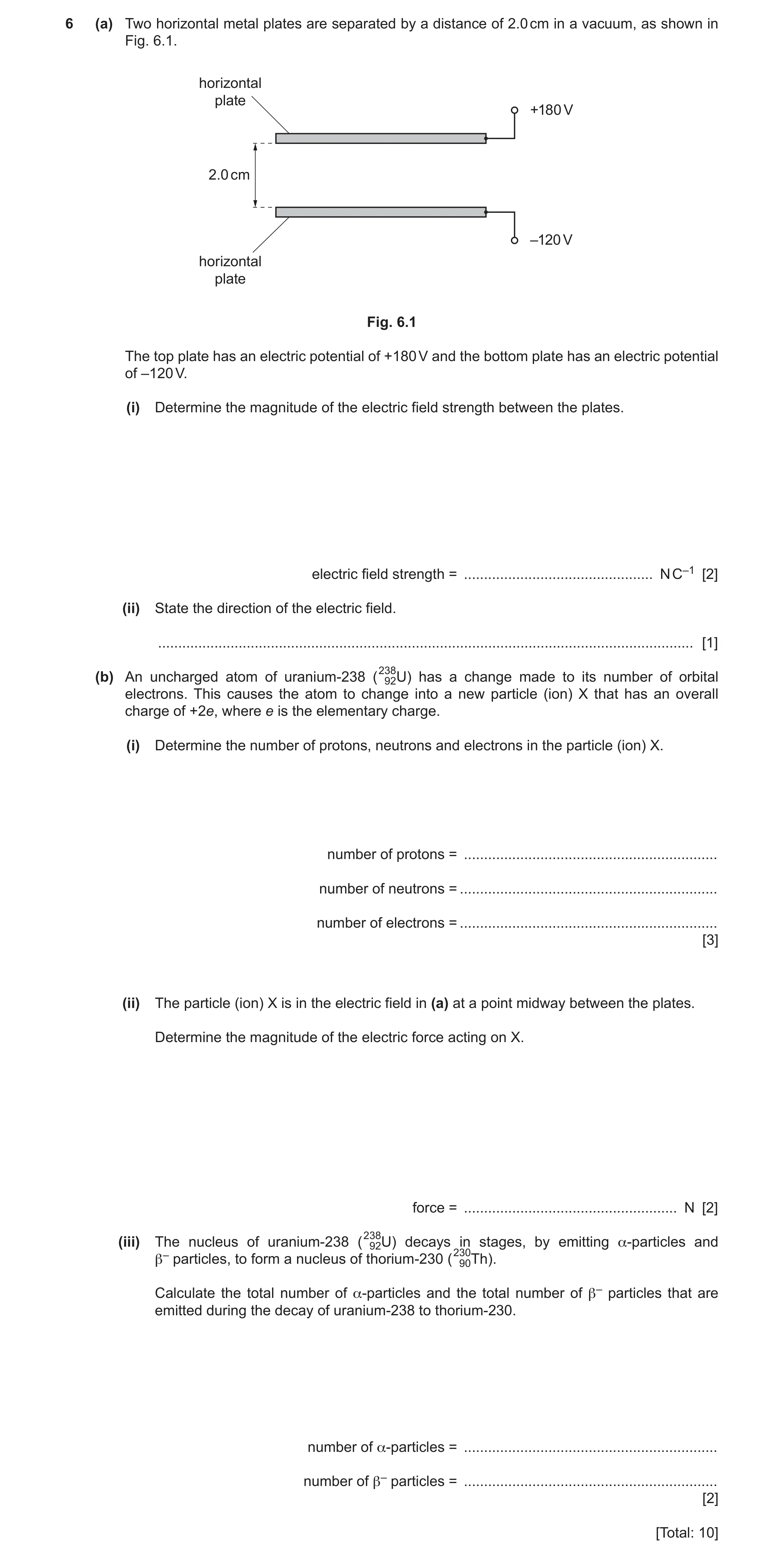
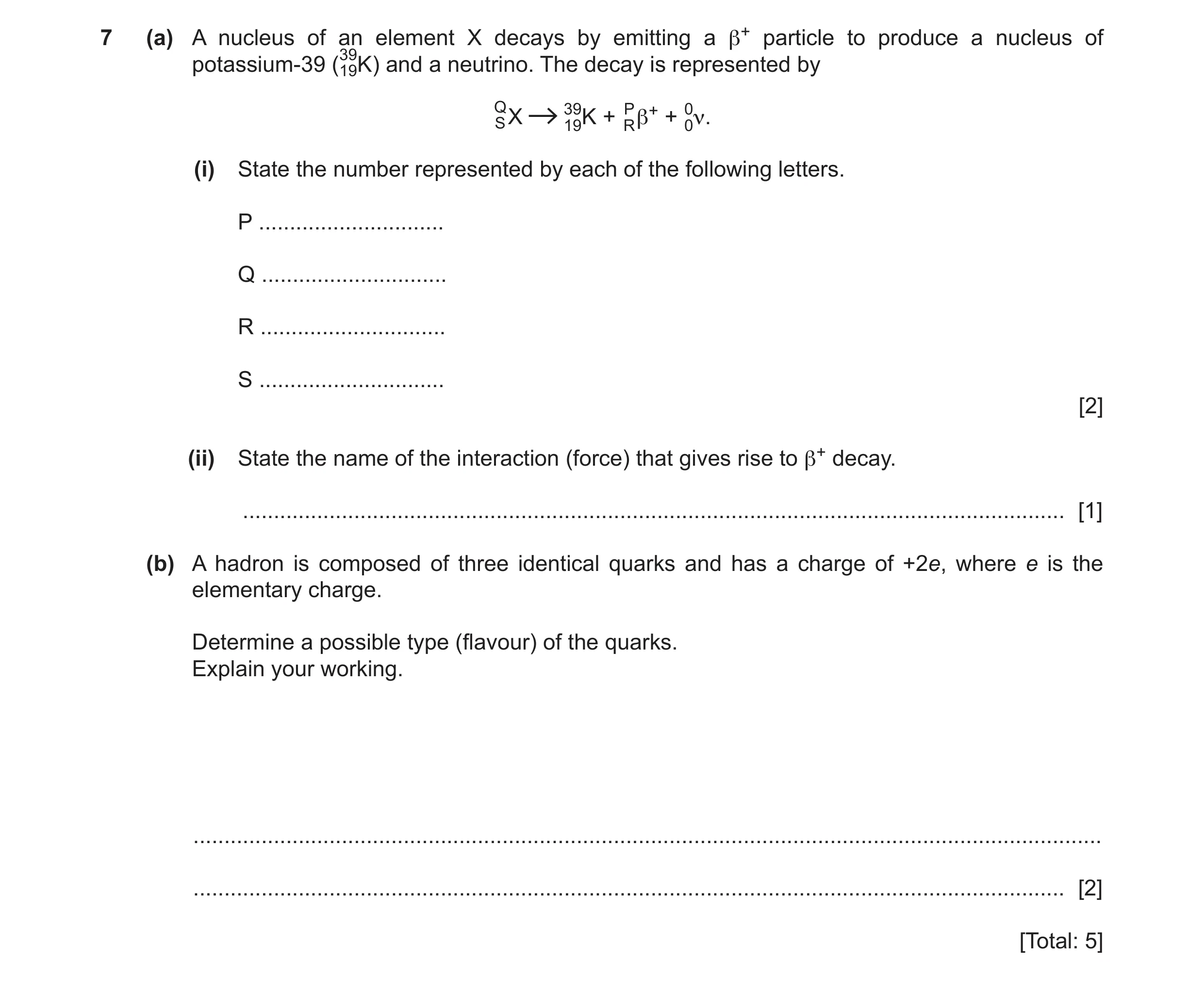 39 / 68
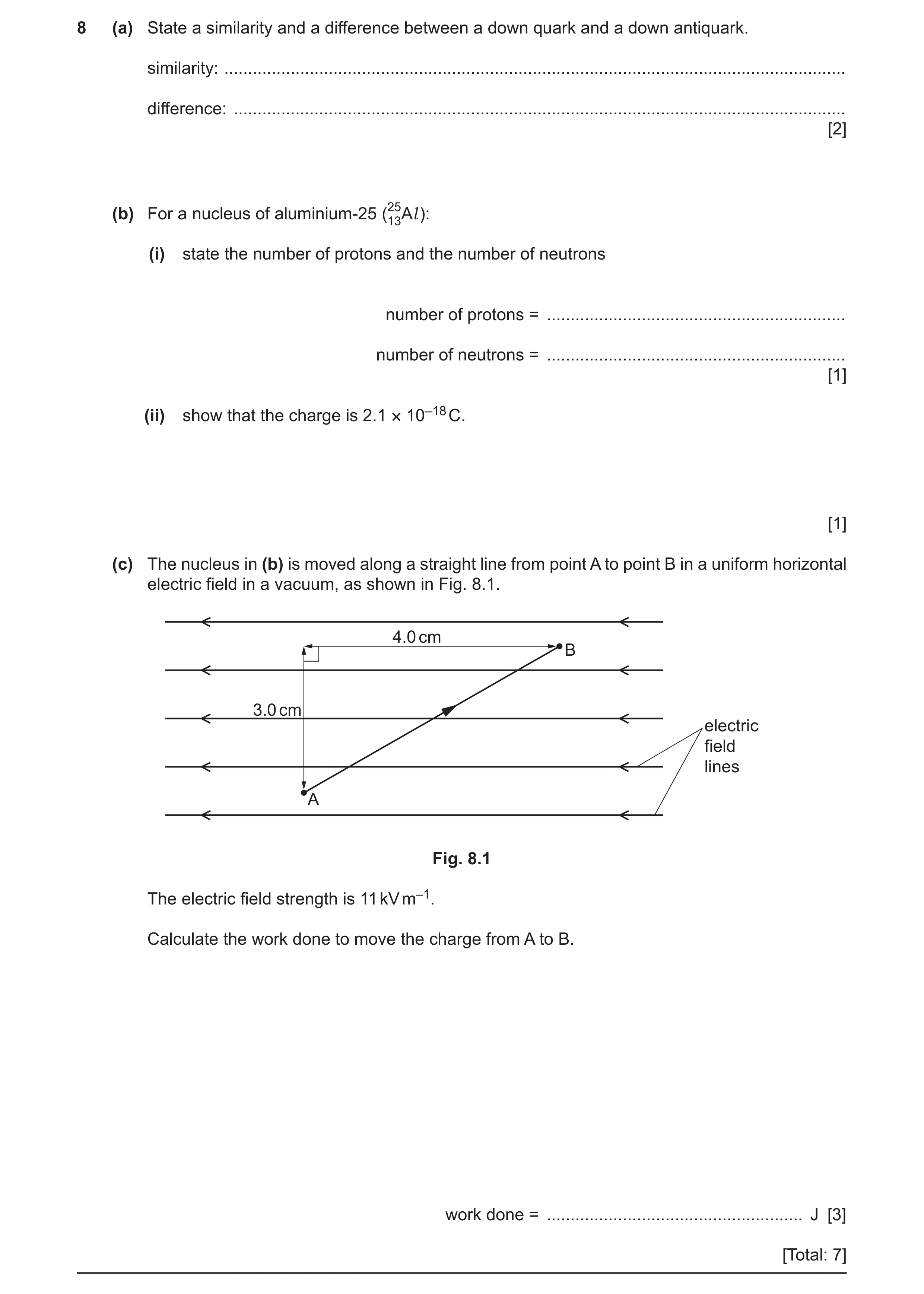 40 / 68
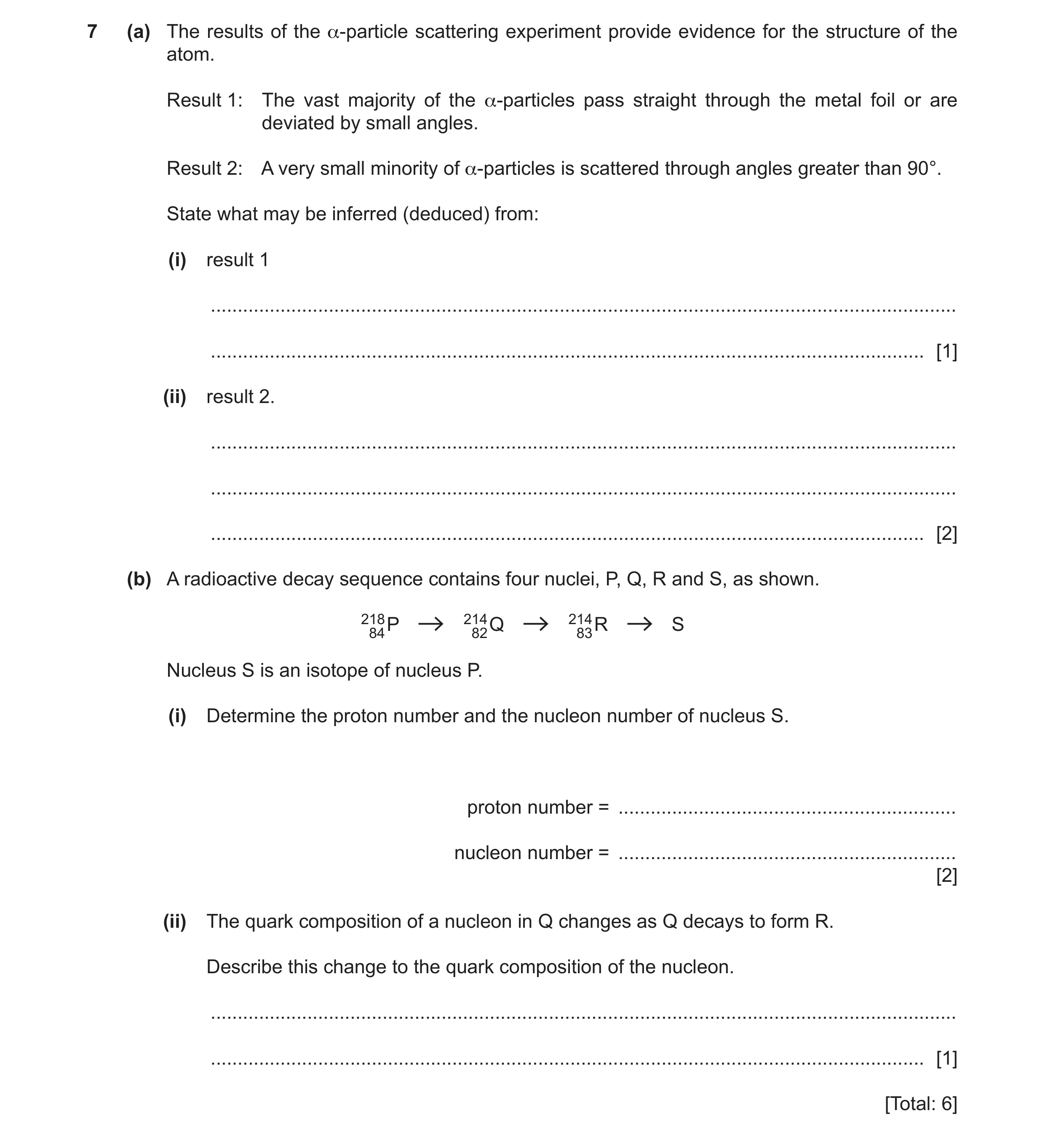 41 / 68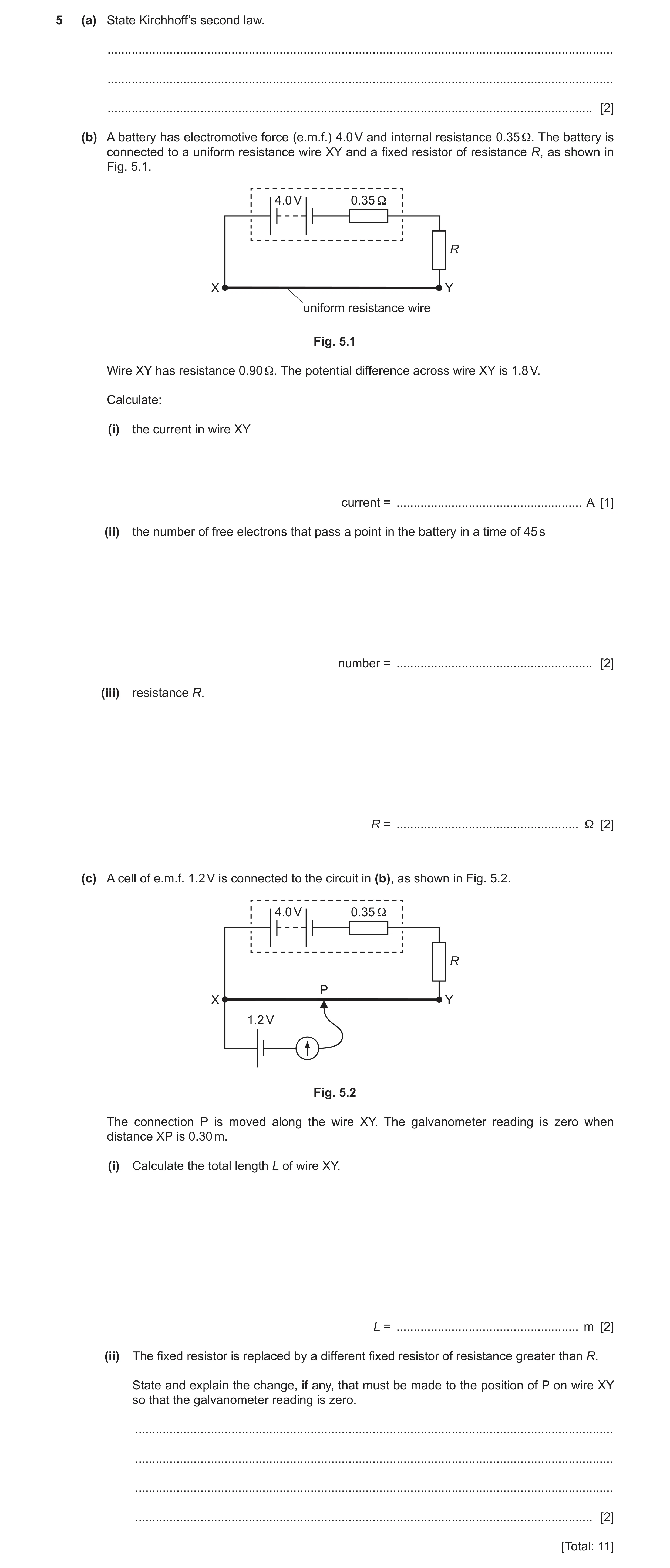
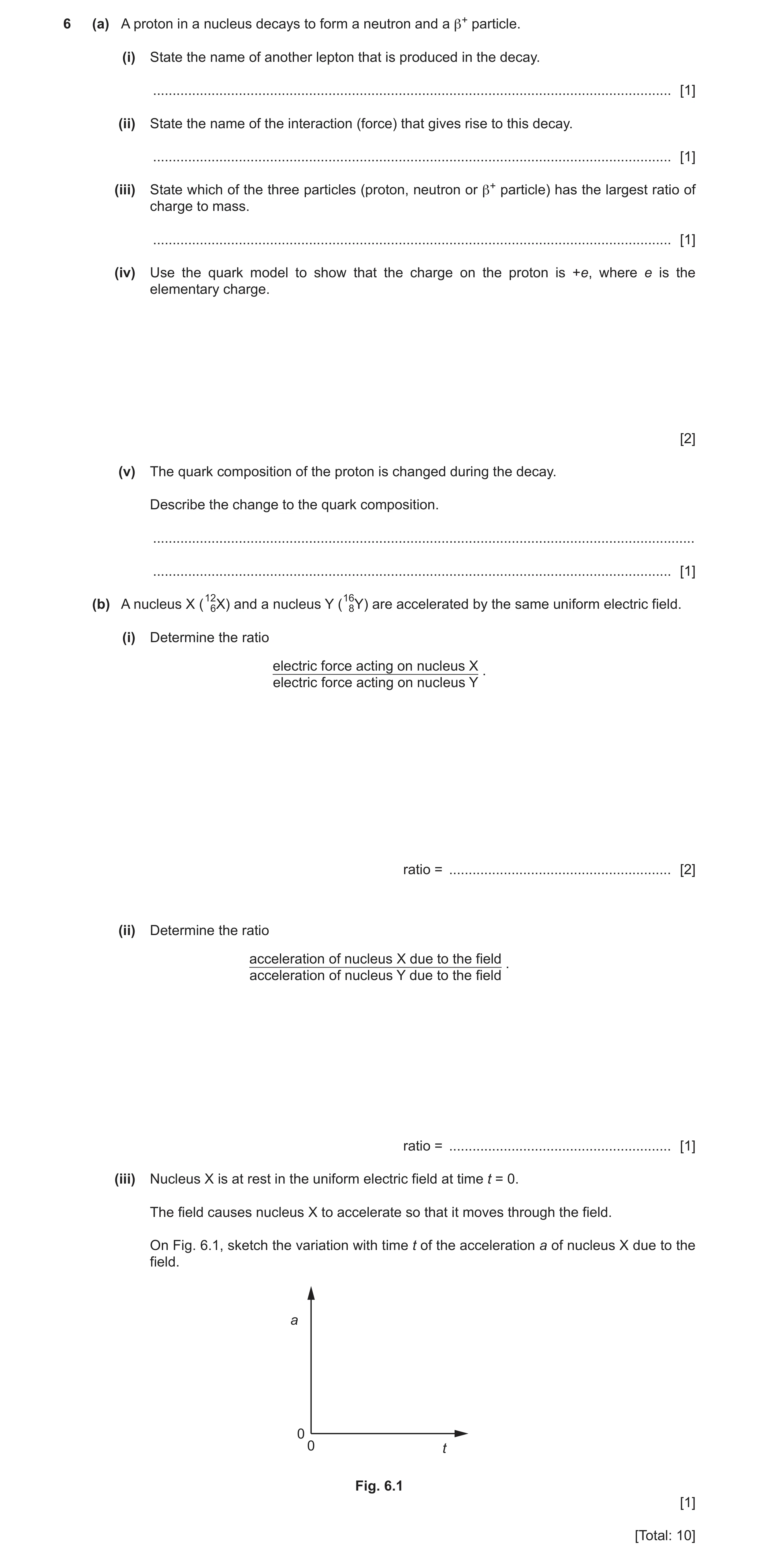
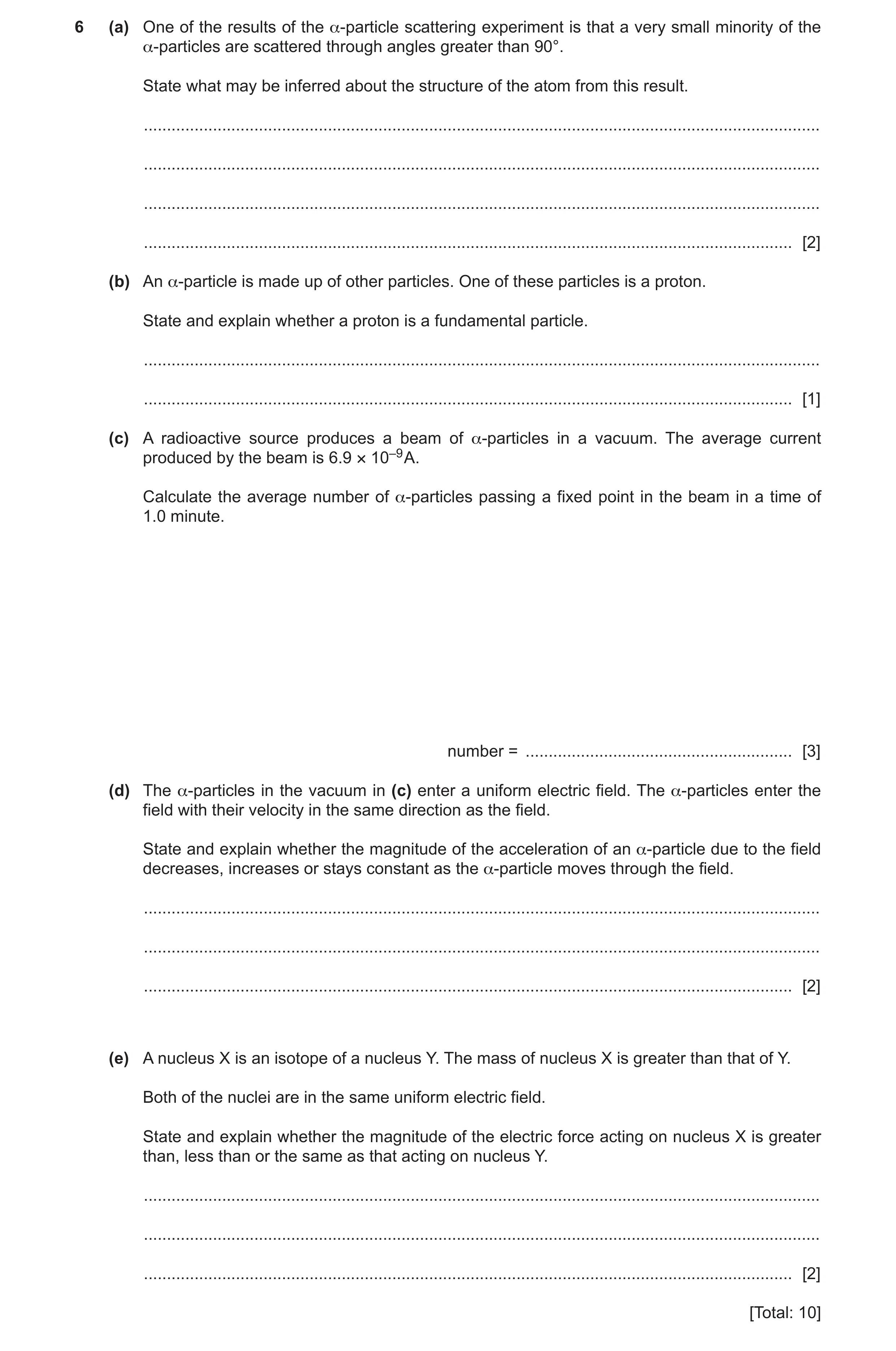
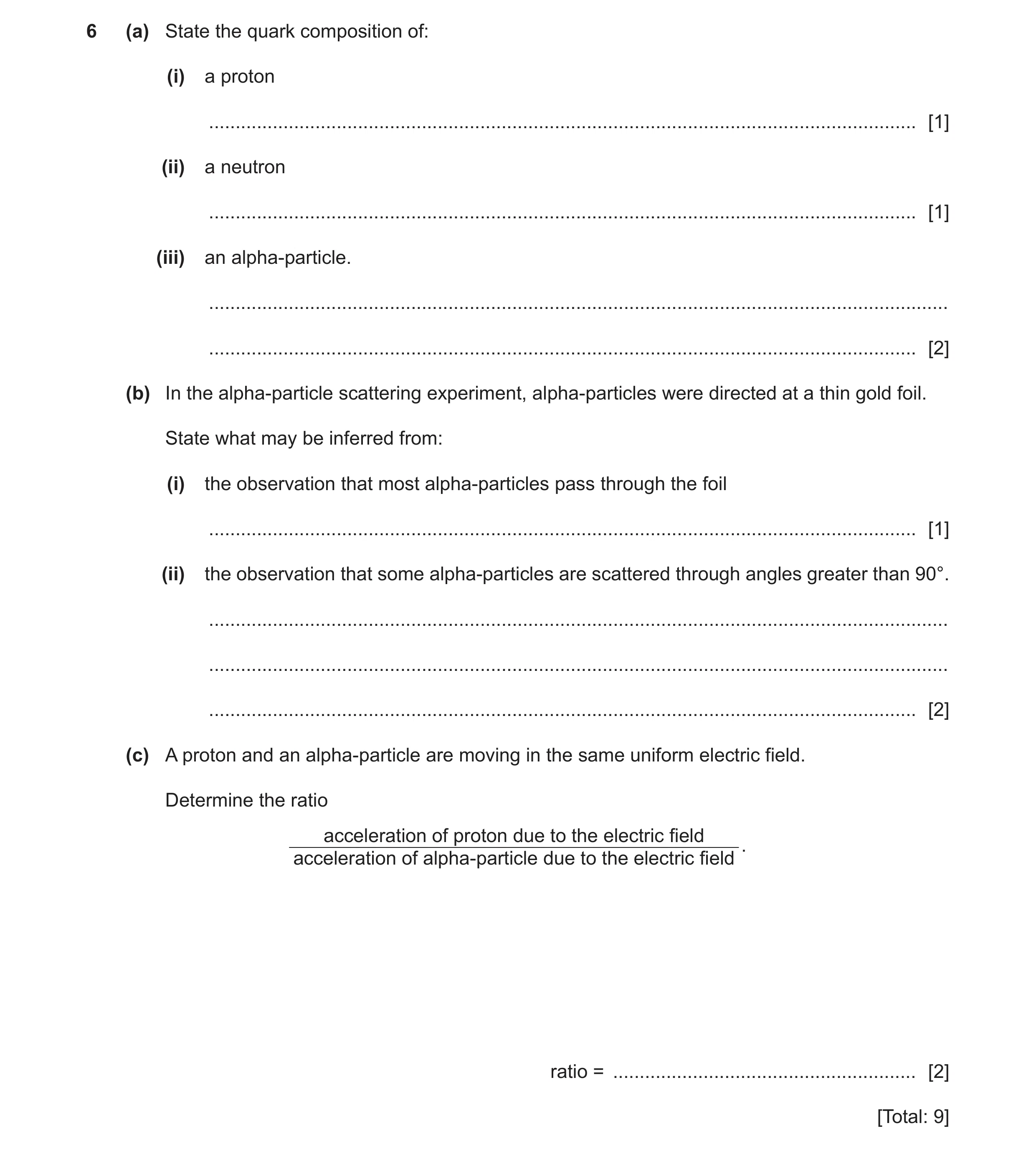 47 / 68
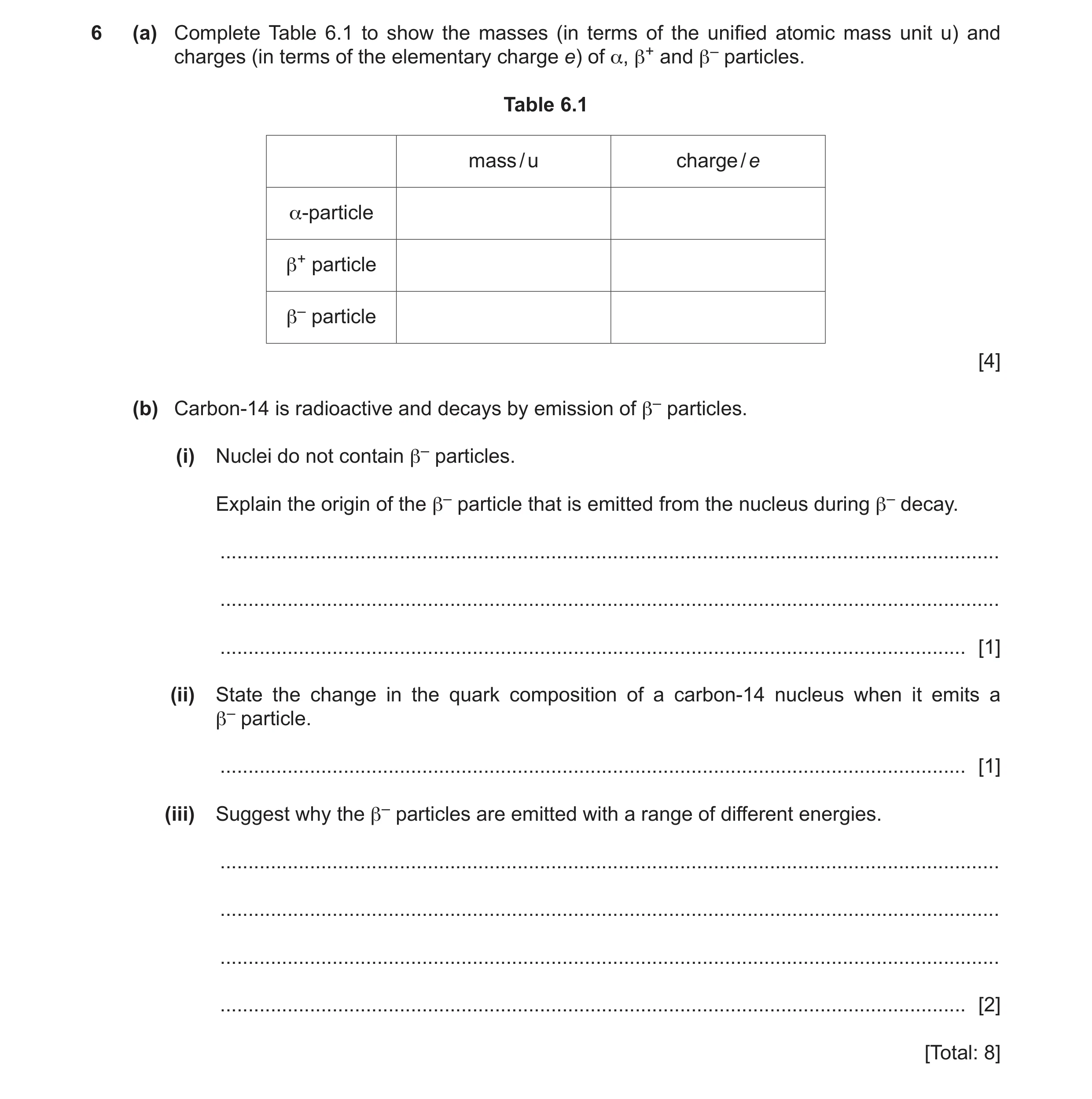 48 / 68
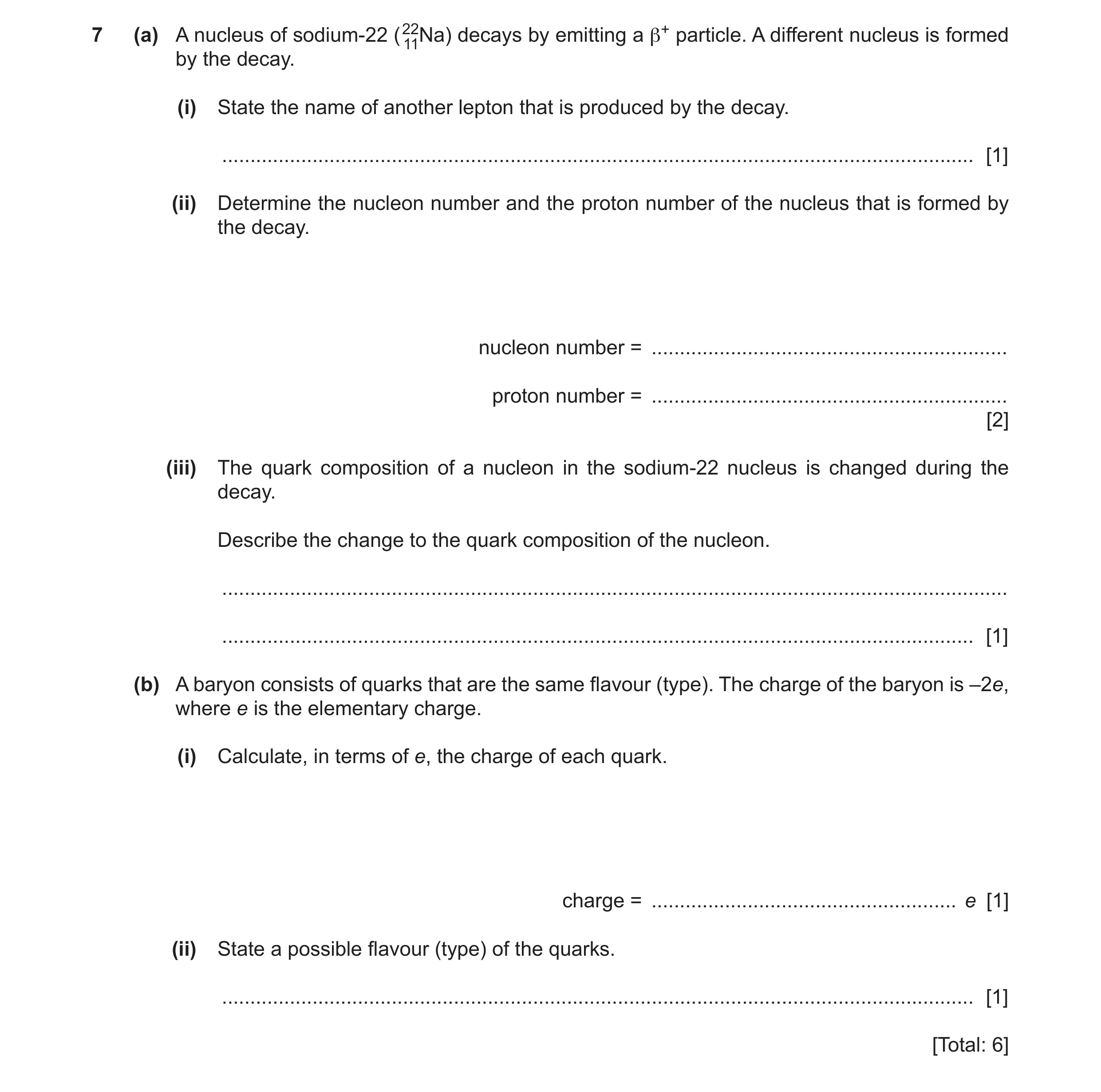 49 / 68
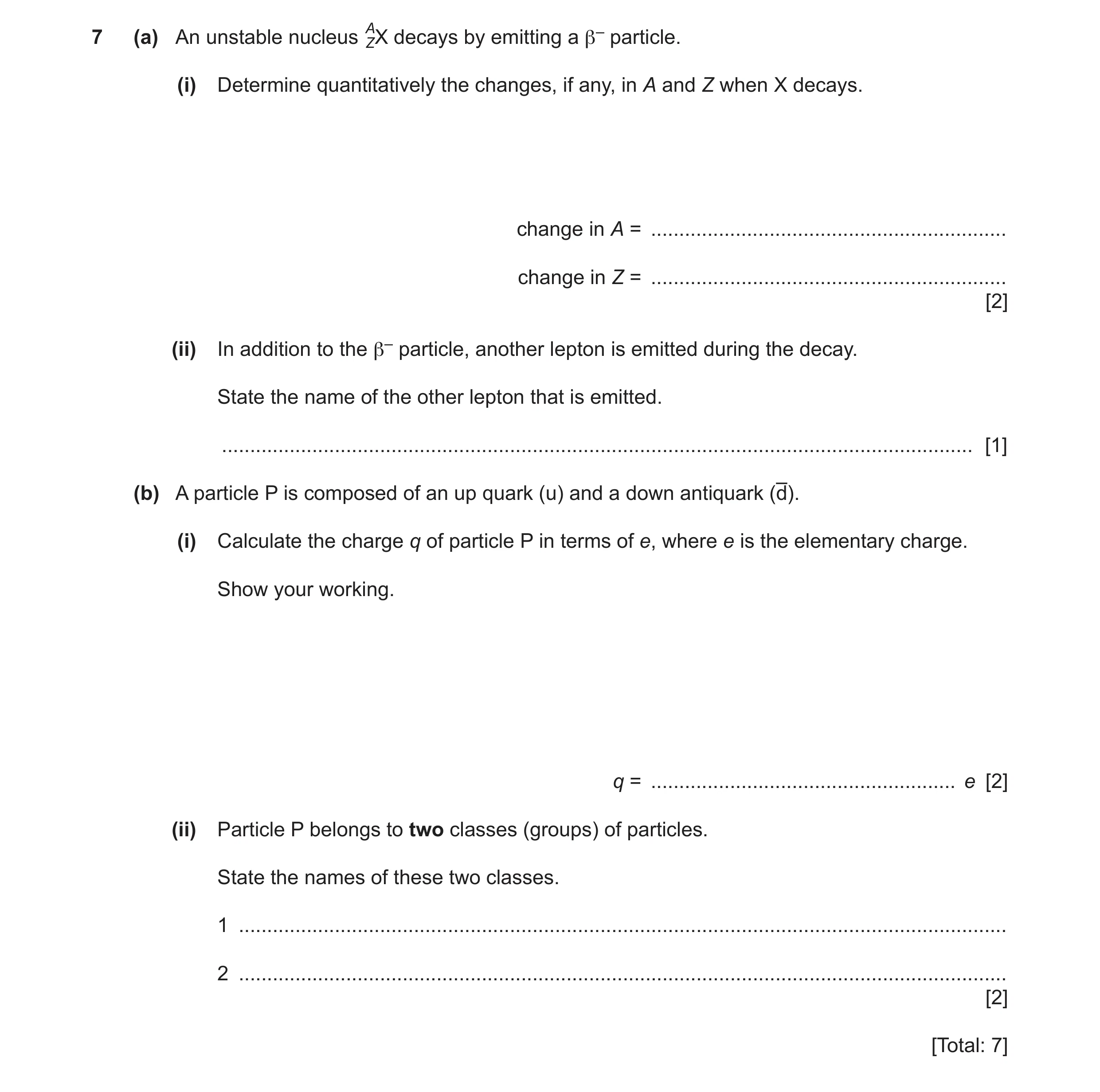 50 / 68
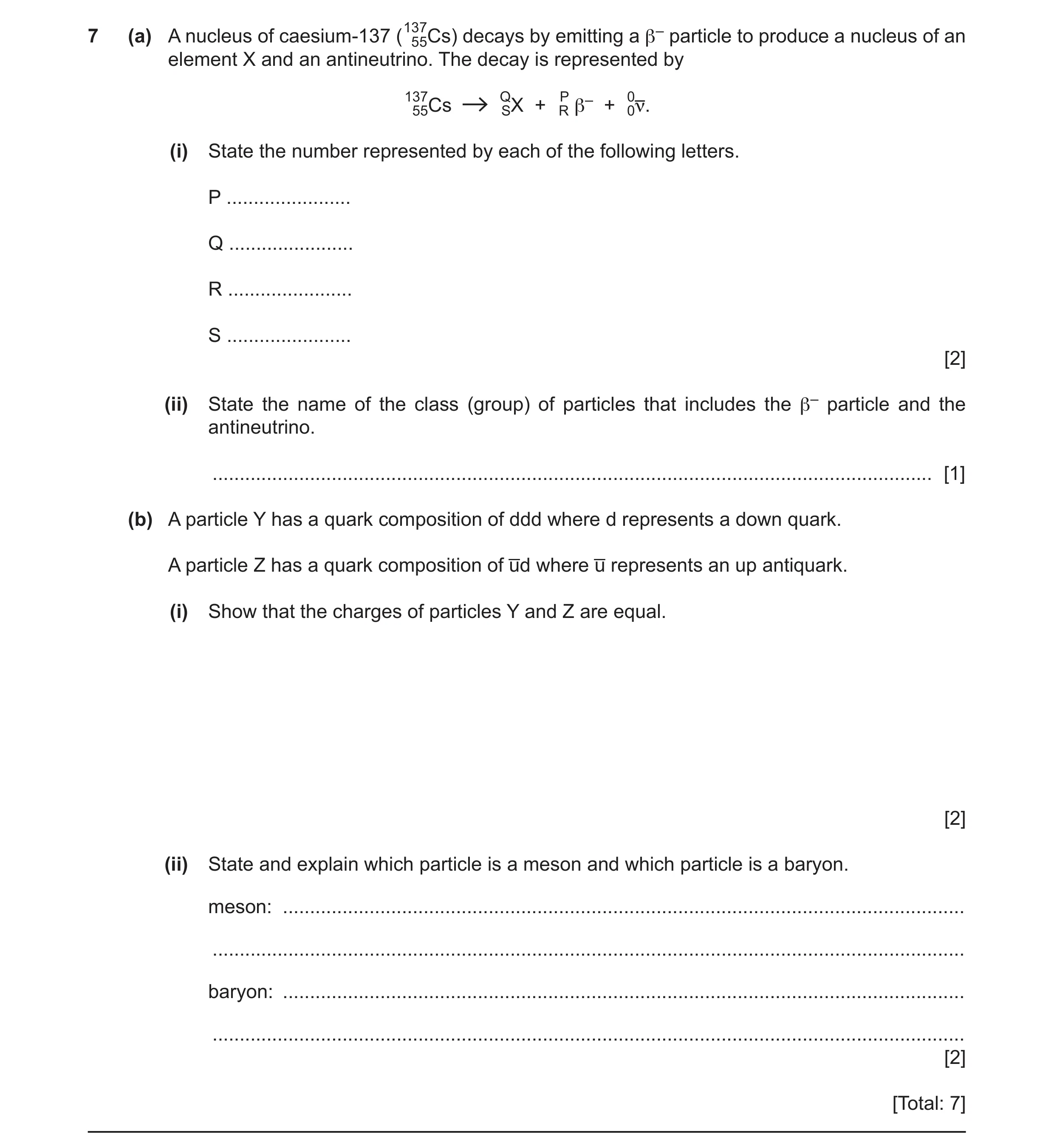 51 / 68
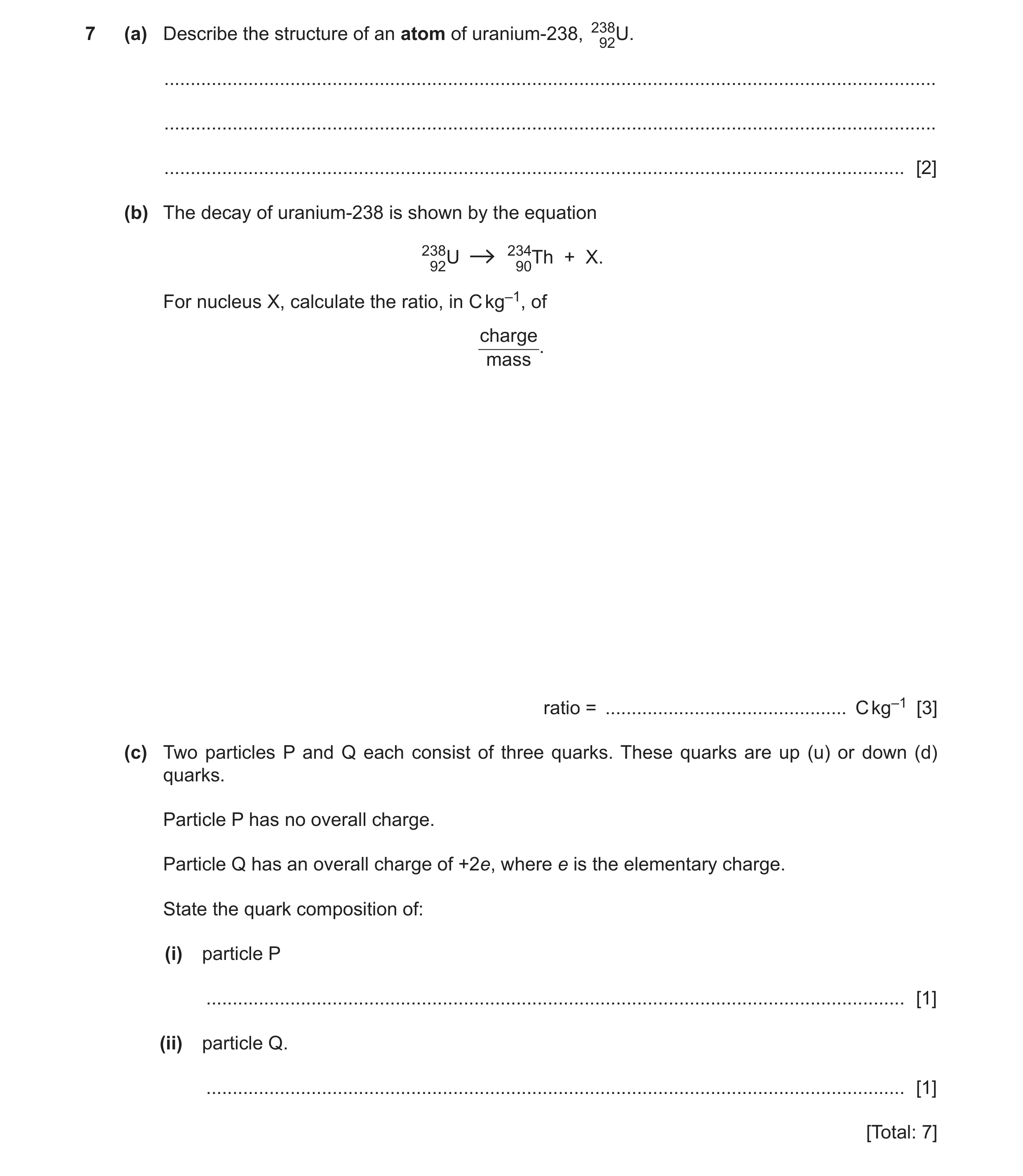 52 / 68
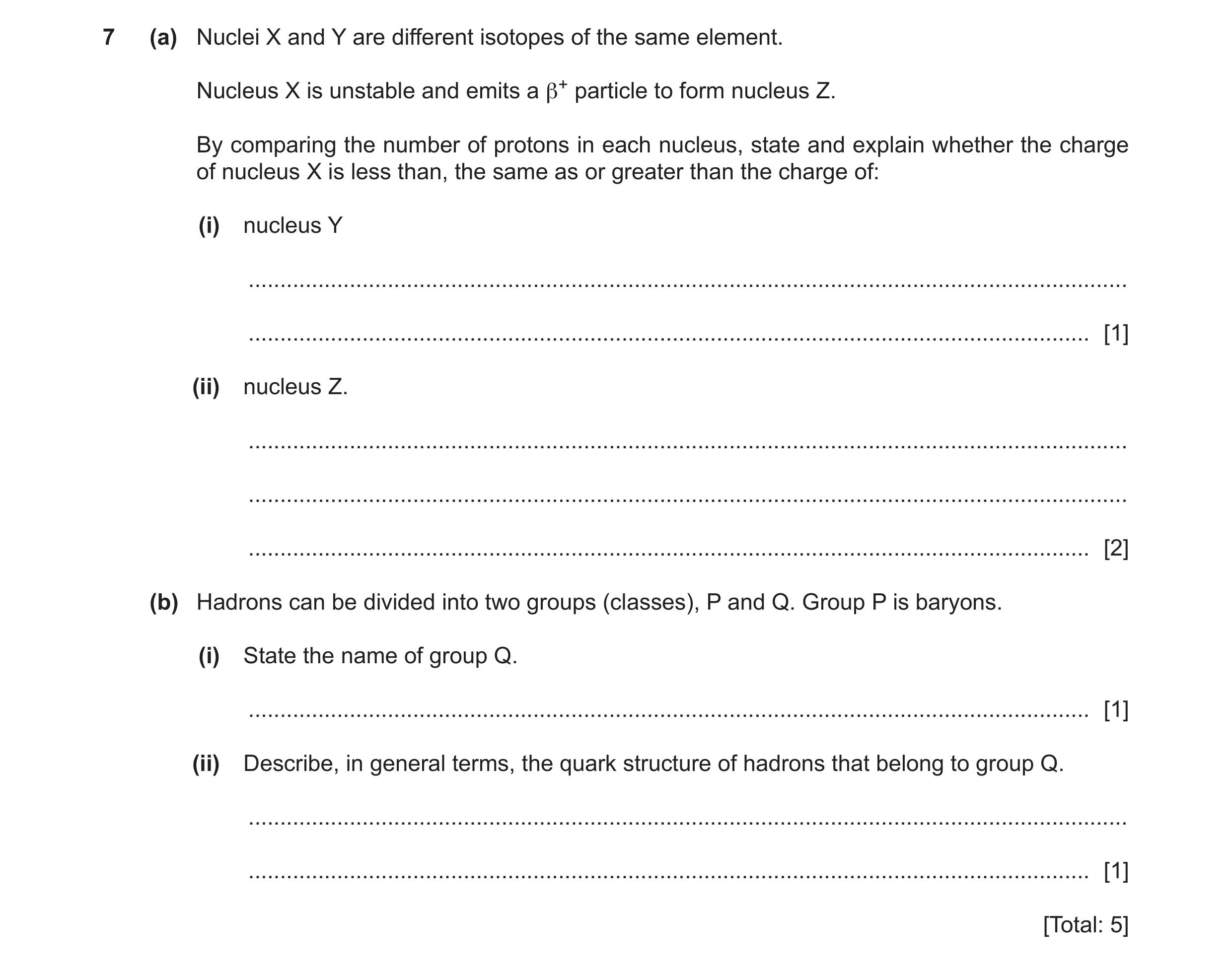 53 / 68
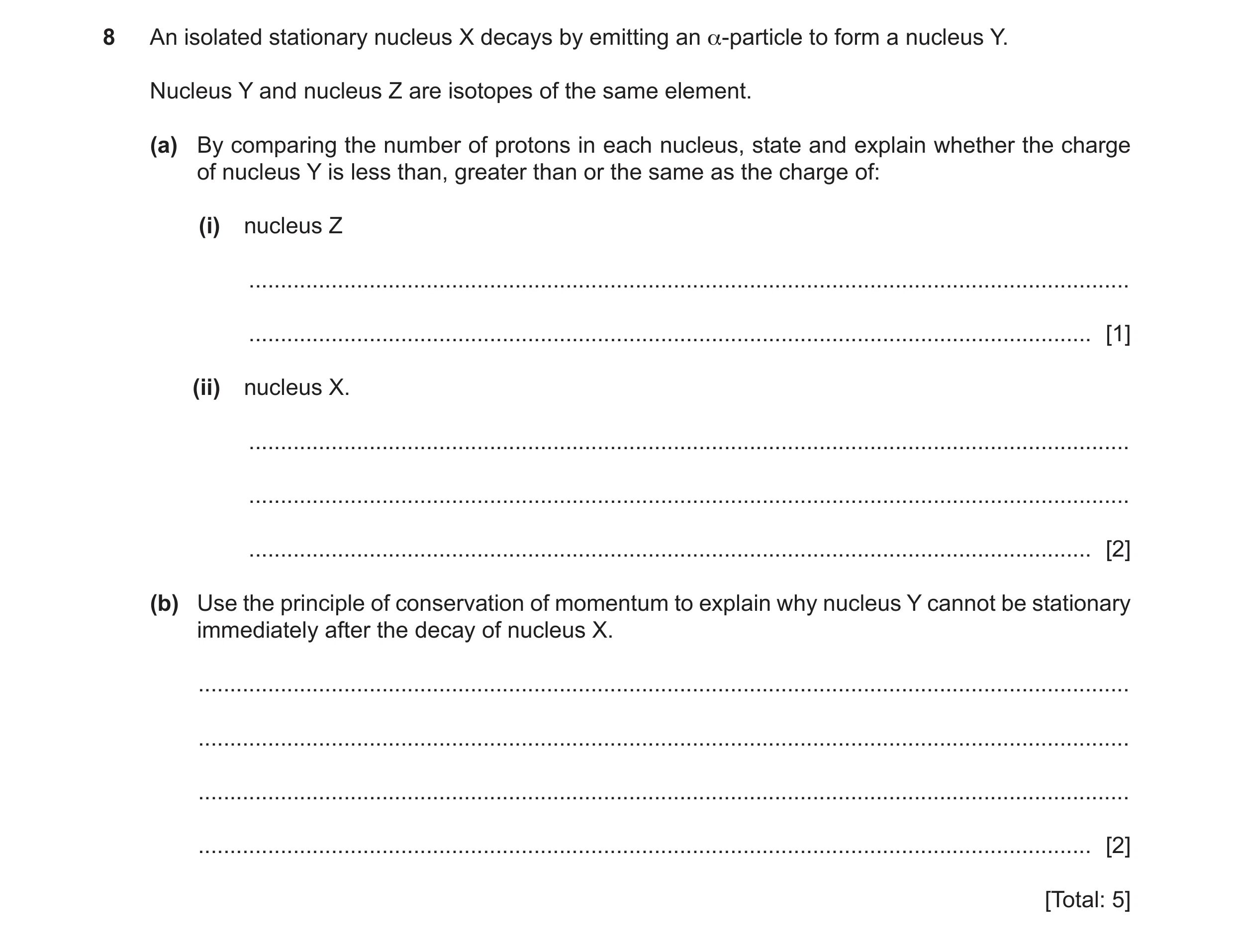 54 / 68
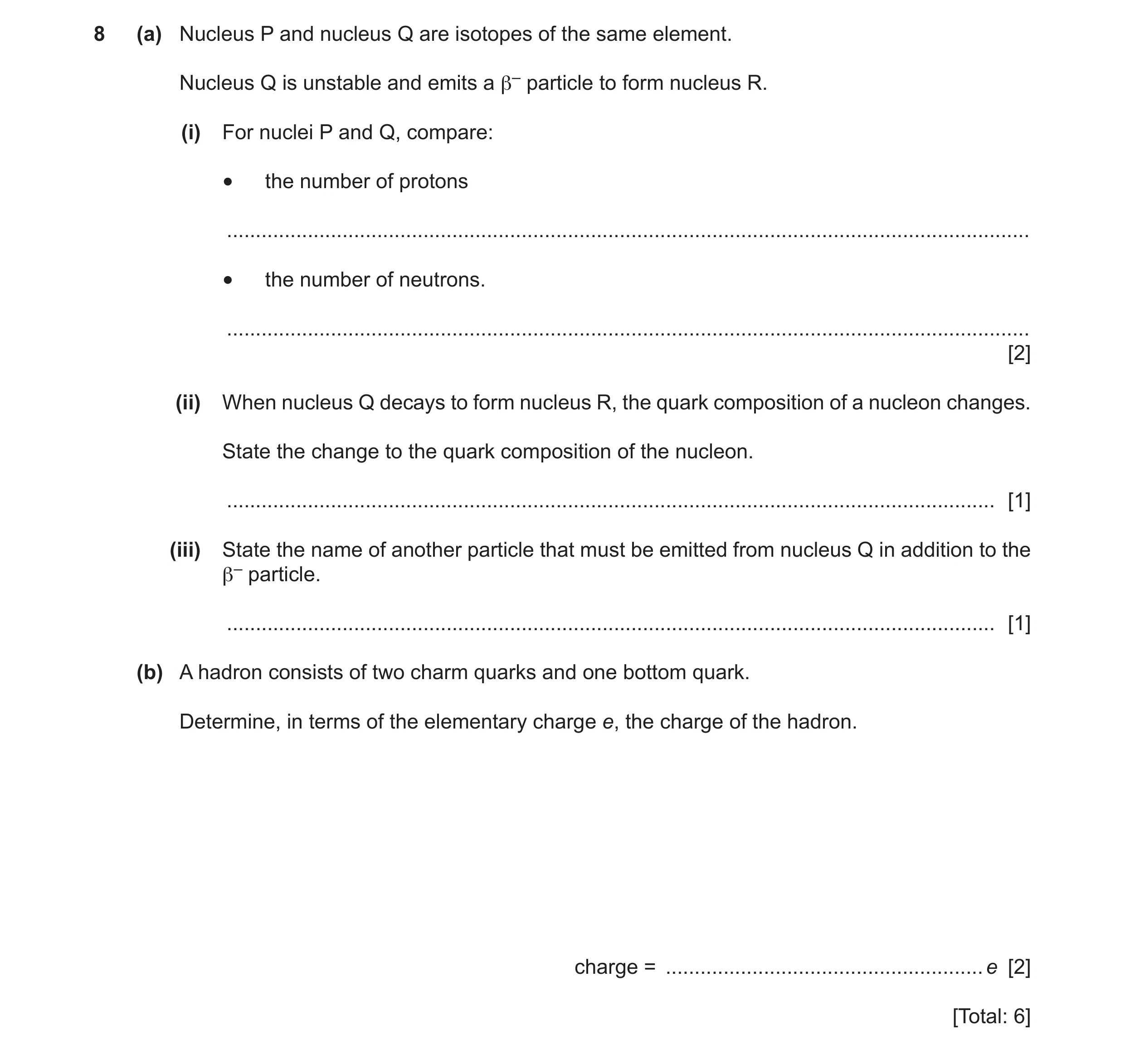 55 / 68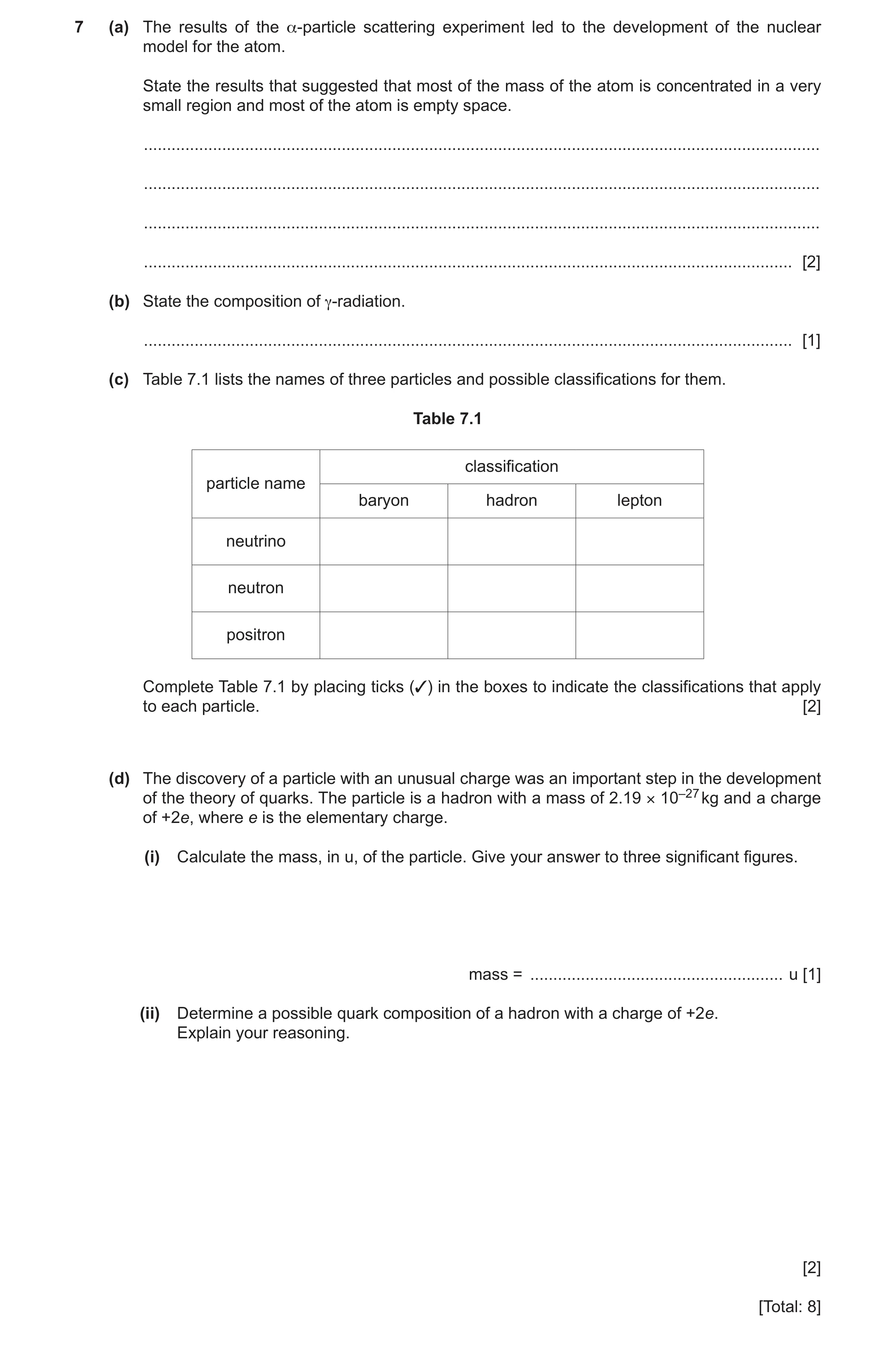
![Question 58: (a) In the following list, underline all the particles that are not fundamental. antineutrino baryon nucleon positron [1] (b) A nucleus of …](https://img.pastlit.com/crops/ee6fe4c9-4759-4acb-b5db-0c62efe9419b/q7.webp) 57 / 68
57 / 68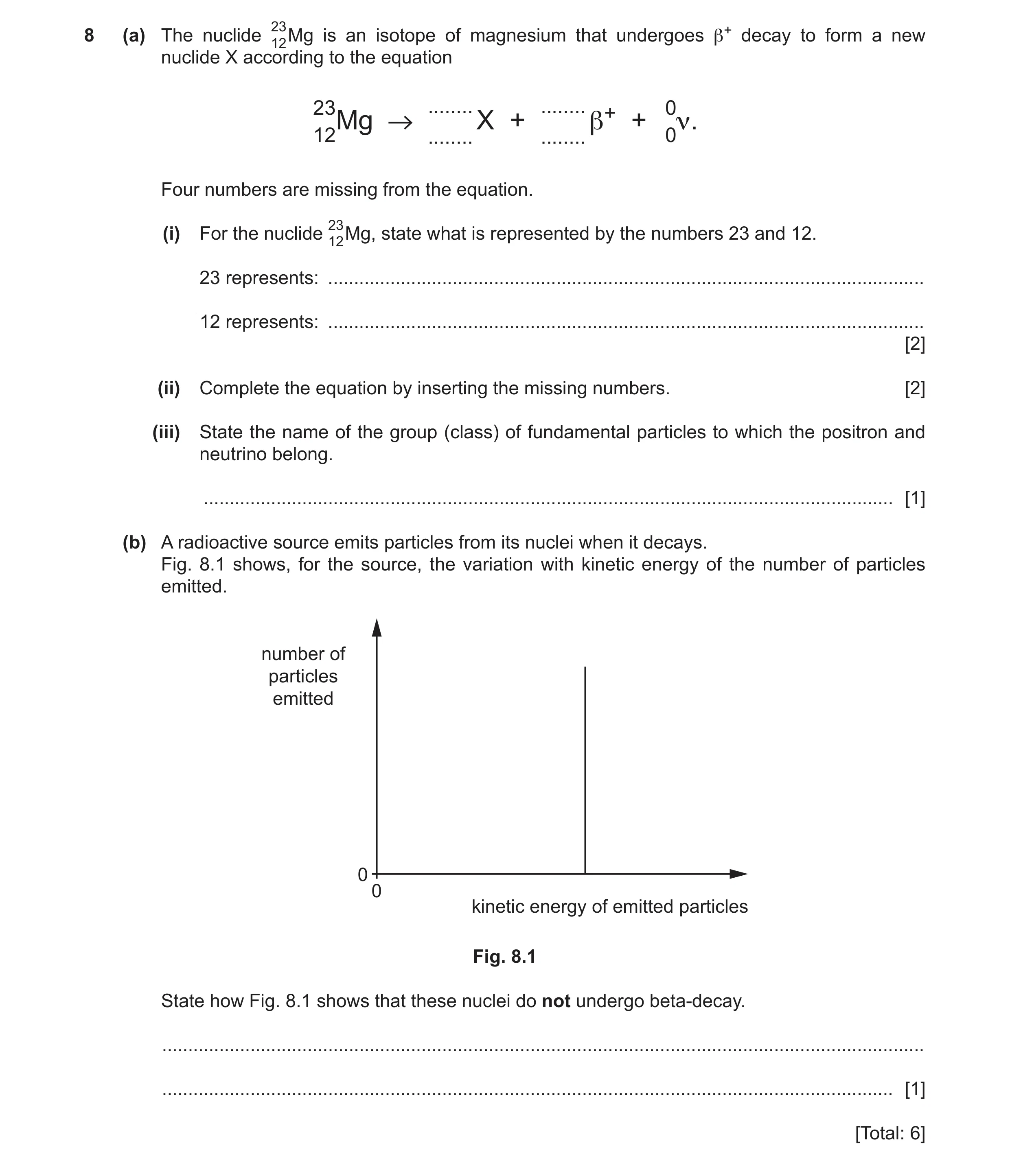 58 / 68
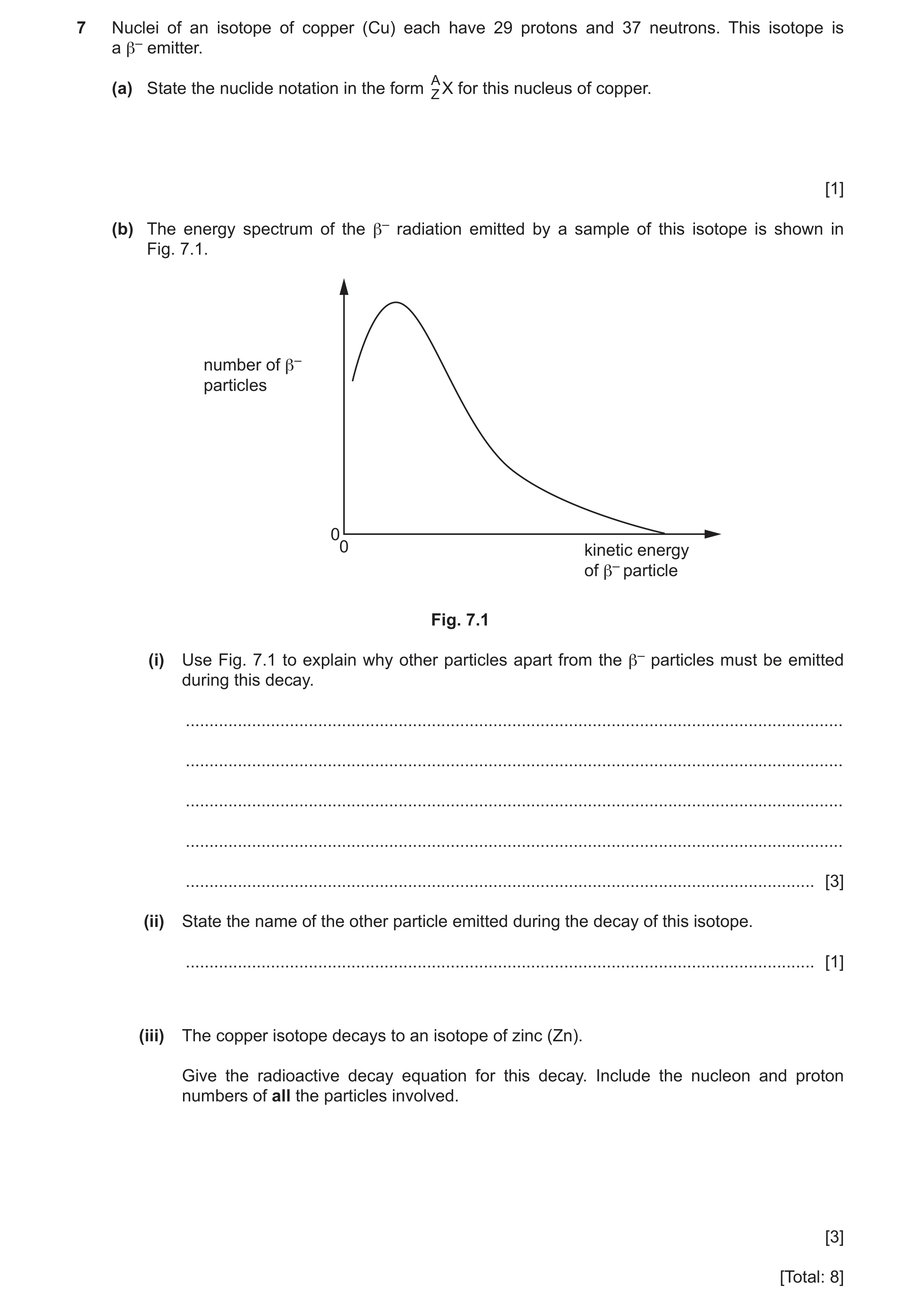 59 / 68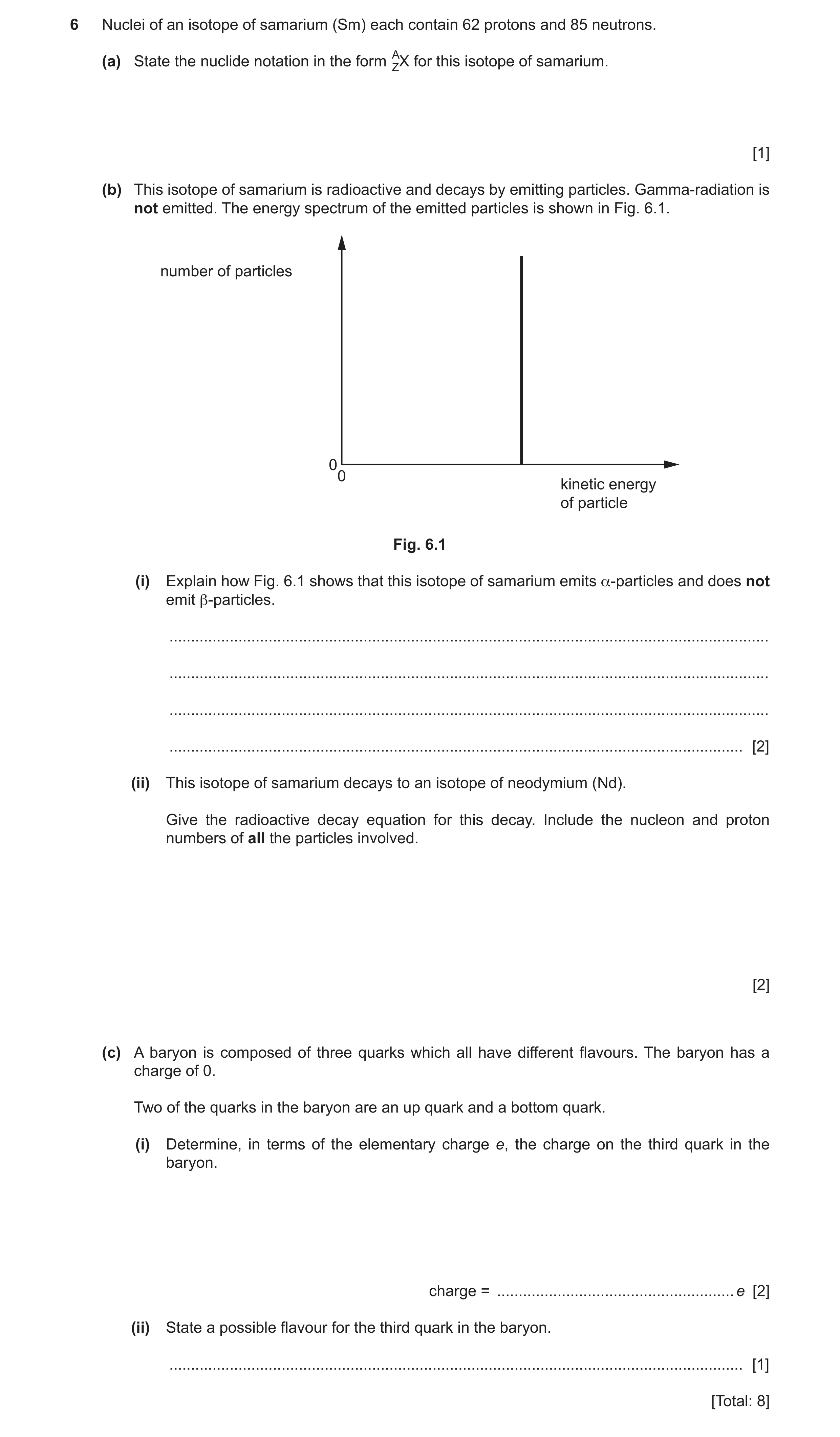
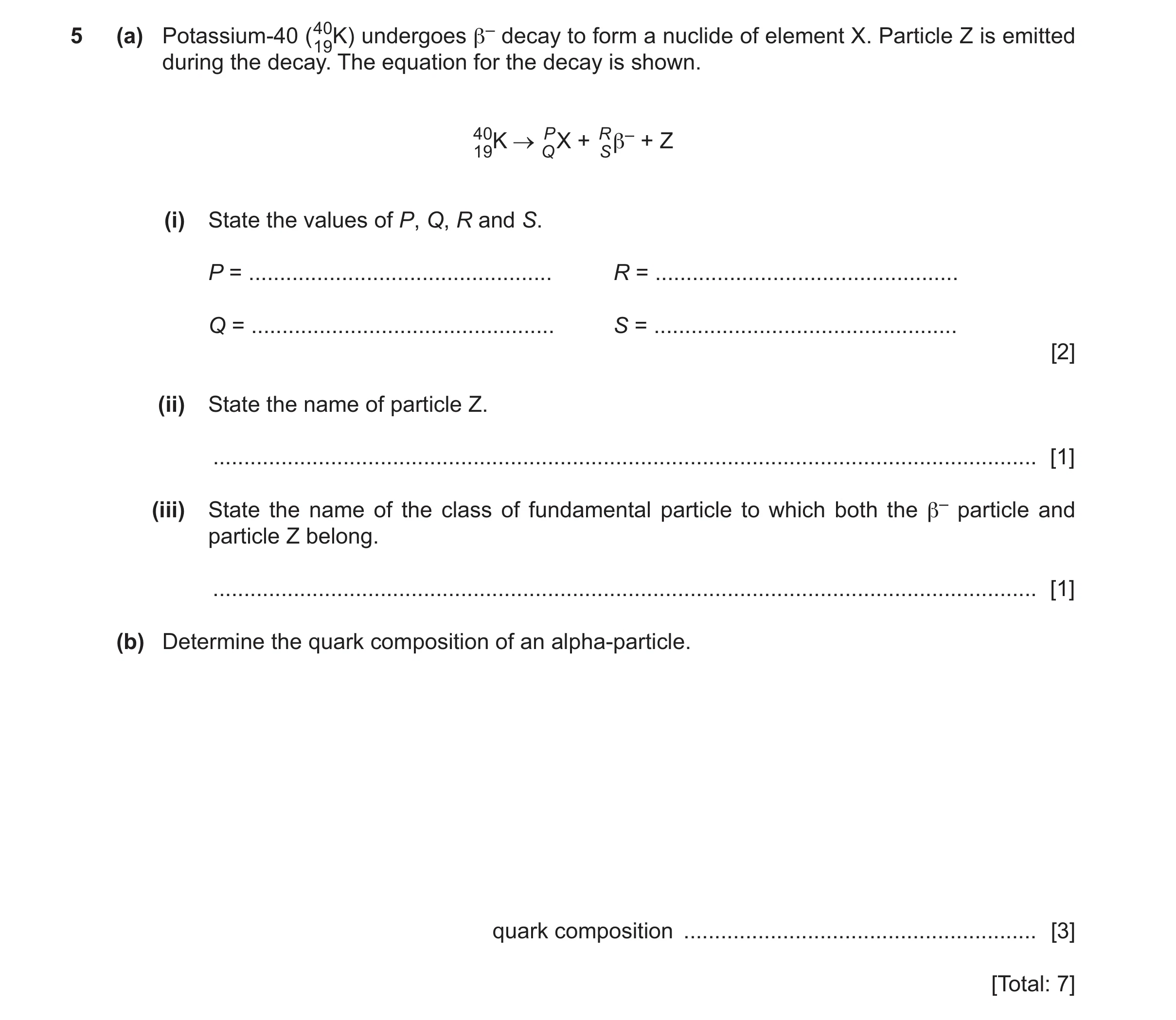 61 / 68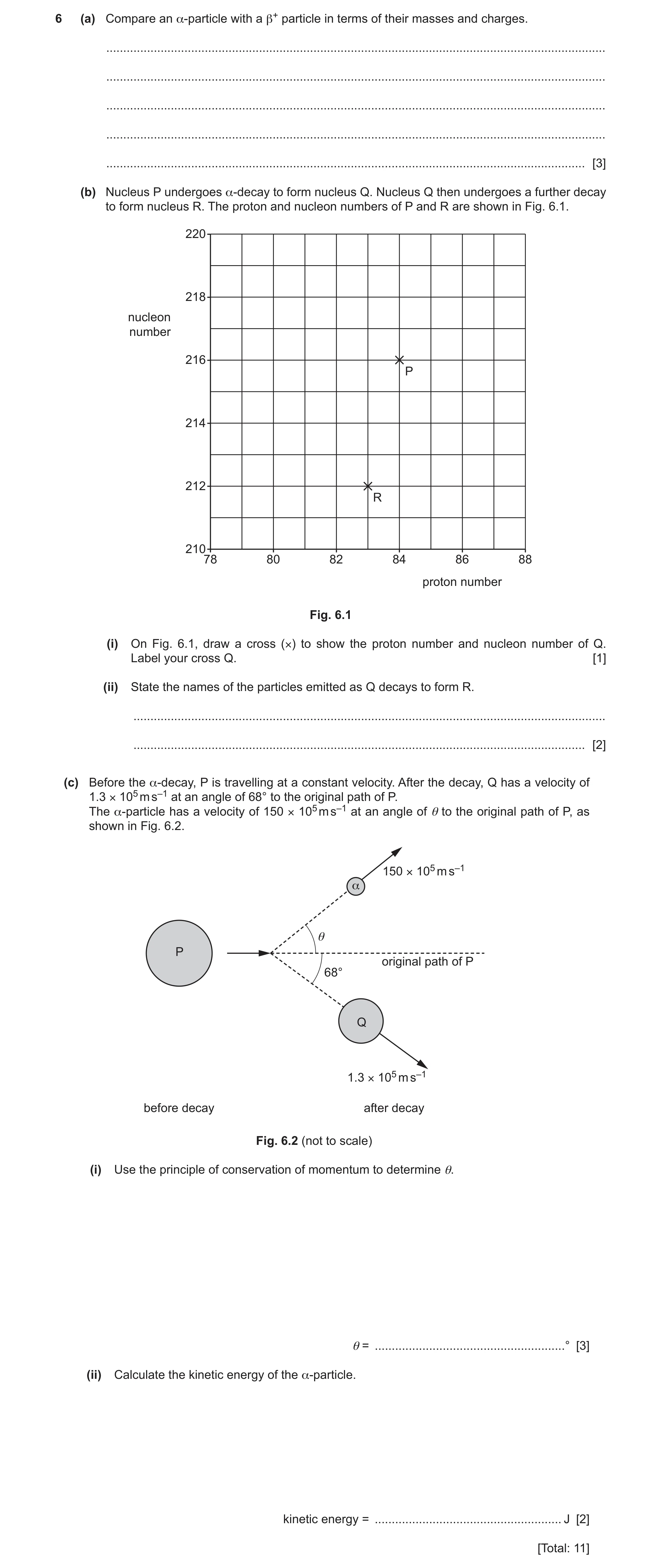
 64 / 68
 65 / 68
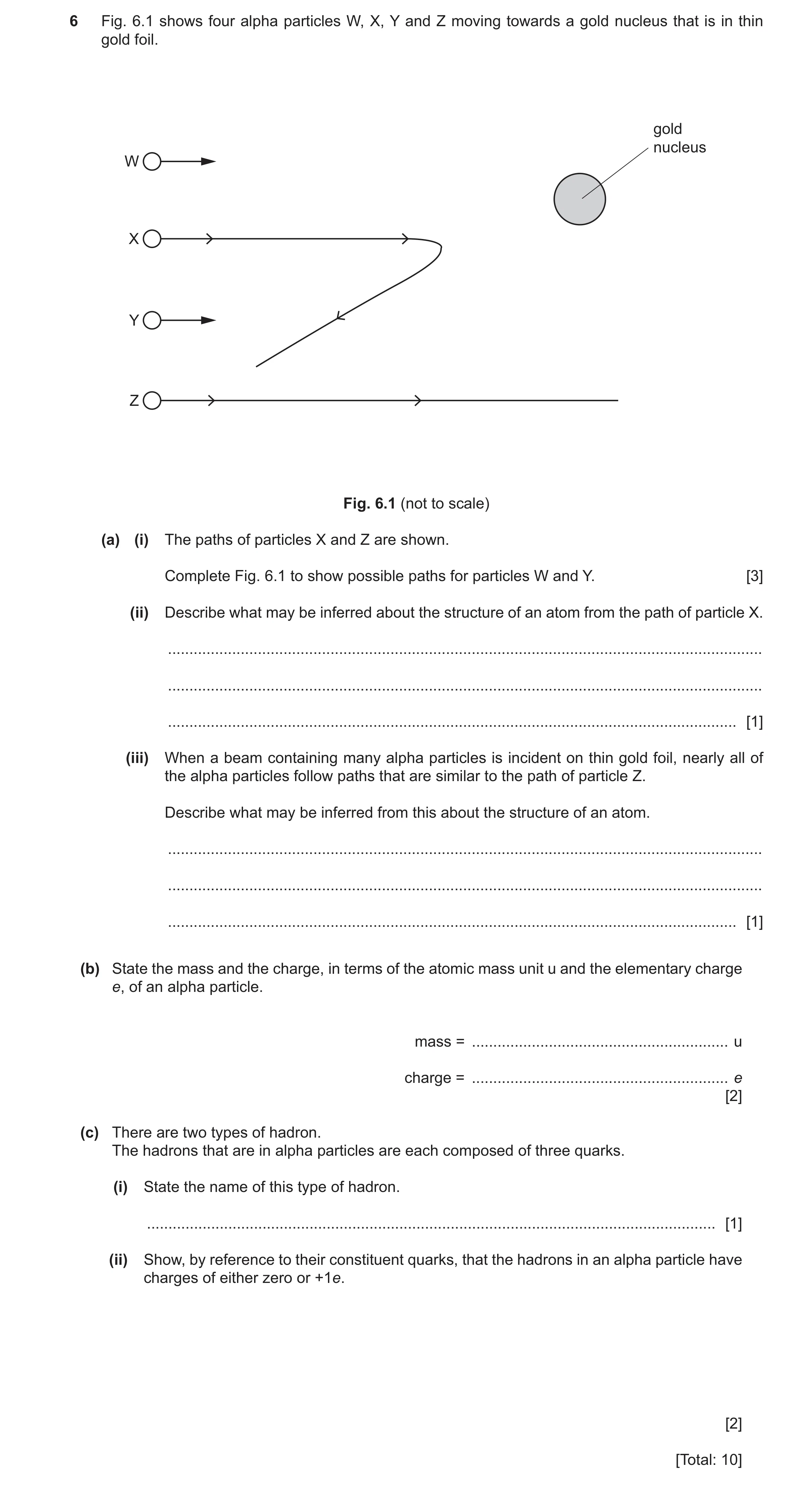
 4
4 8
8 7
7 6
6 10
10 10
10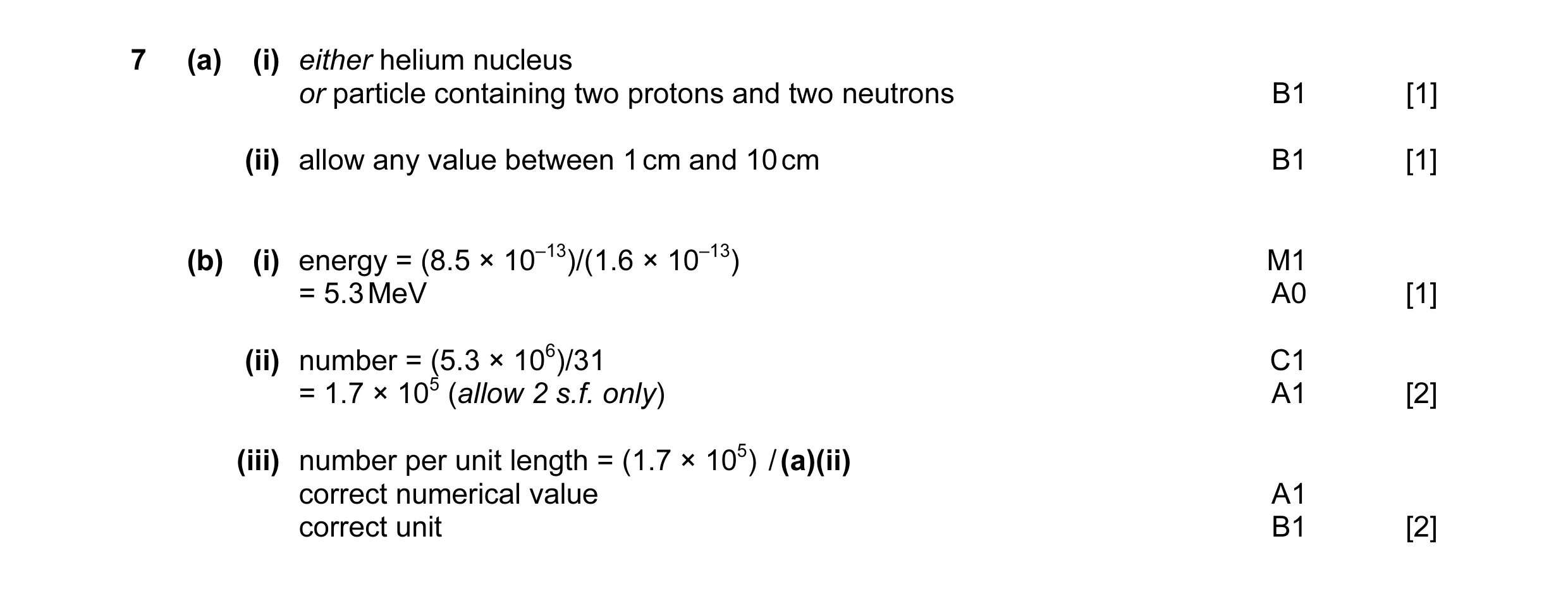 7
7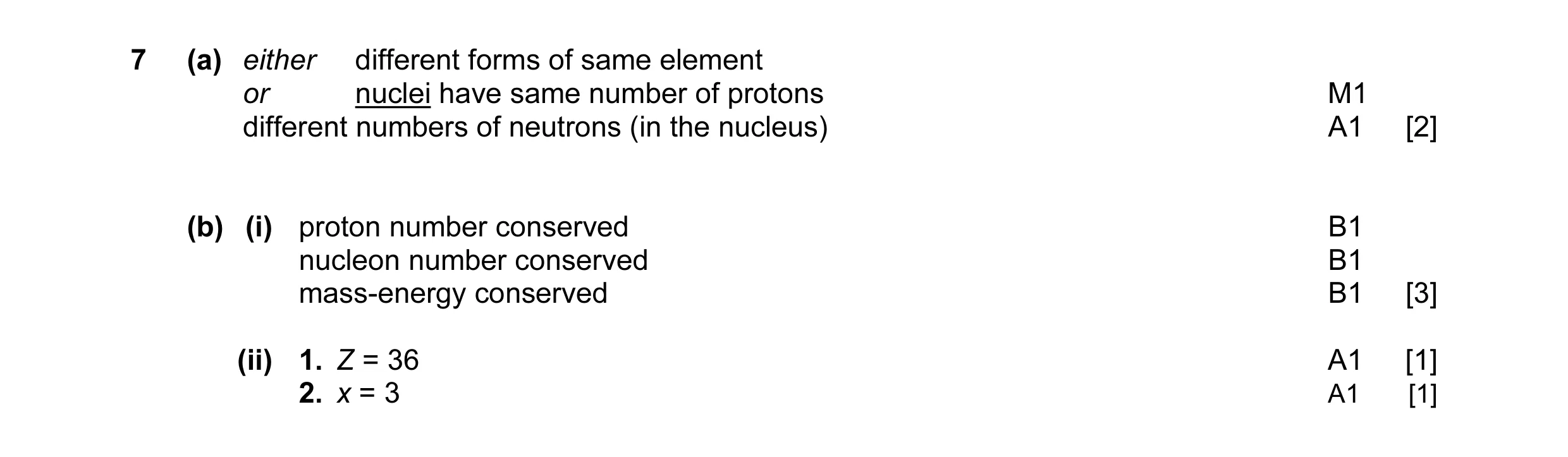 7
7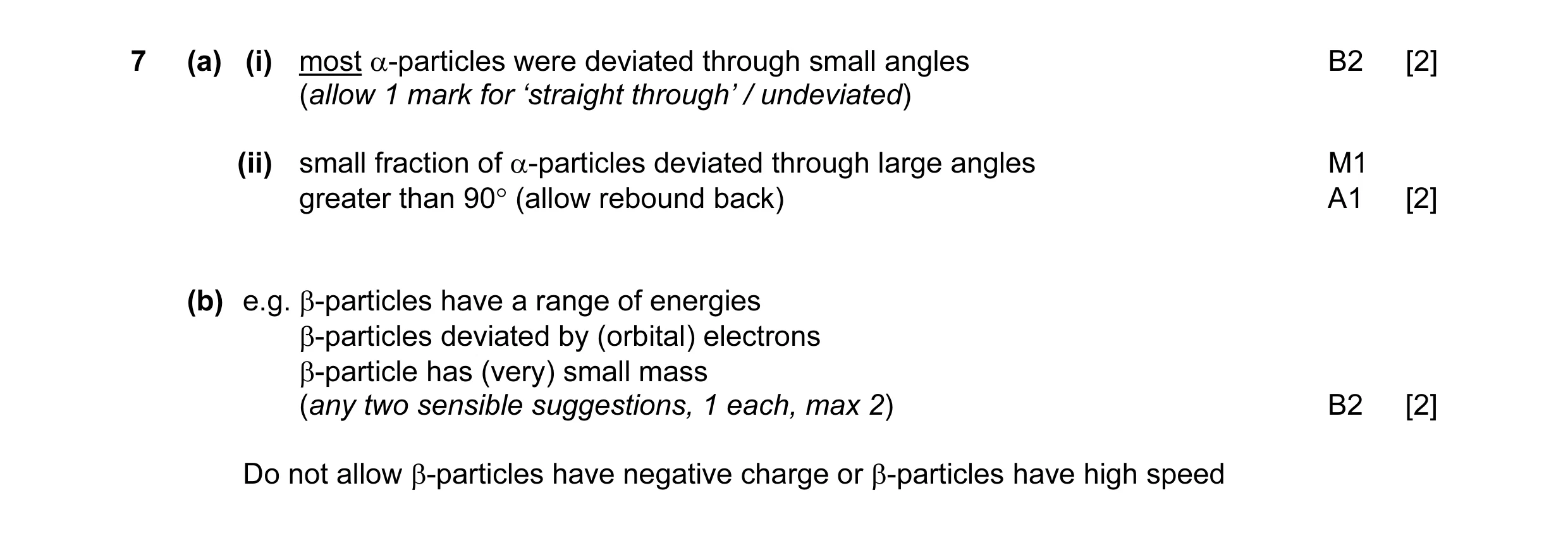 6
6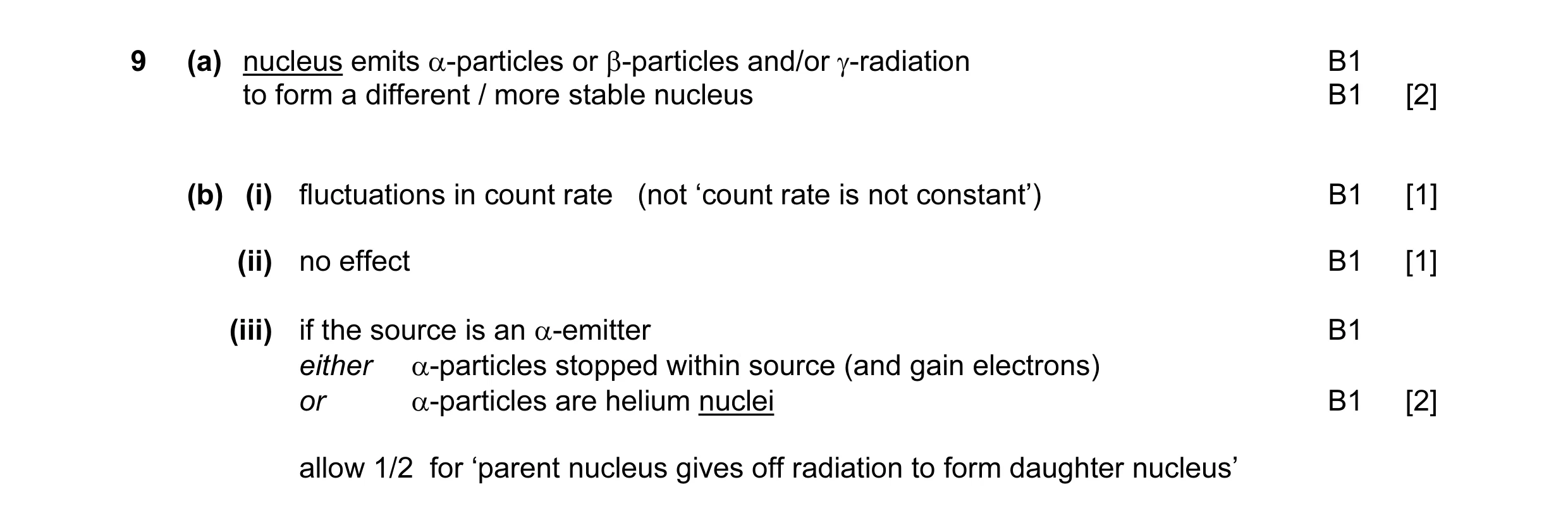 6
6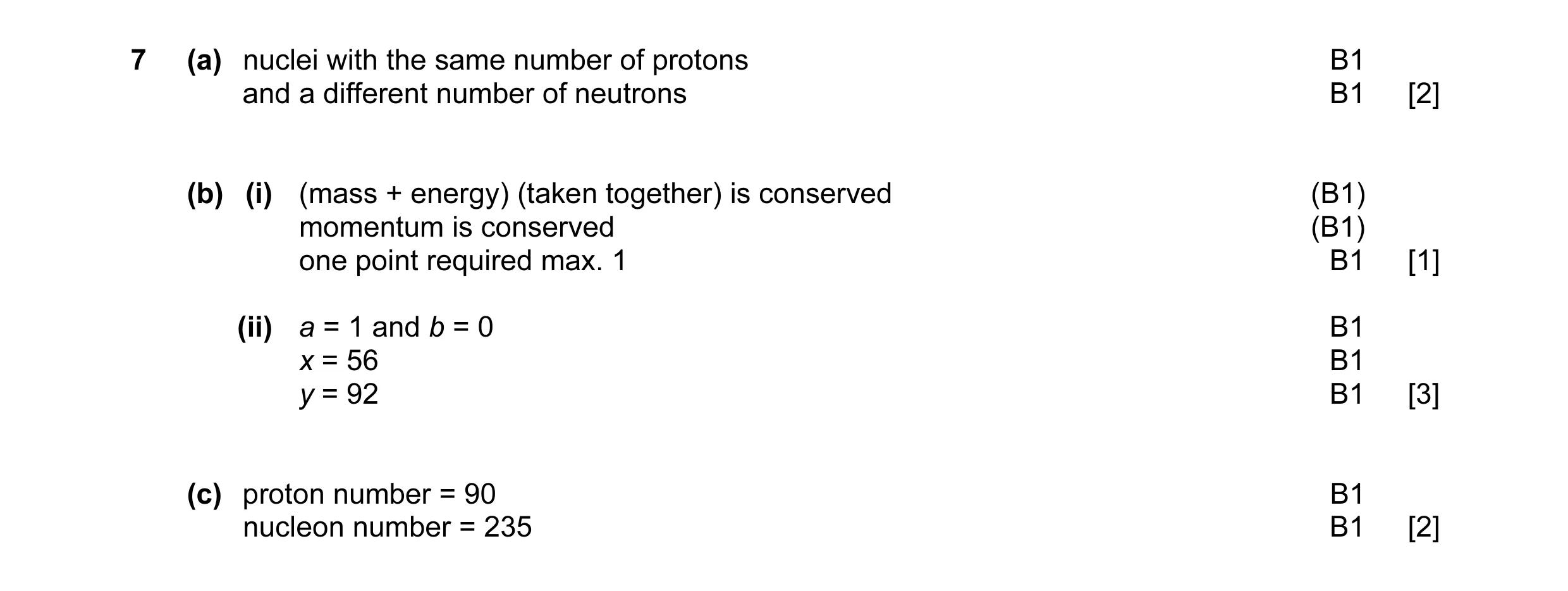 8
8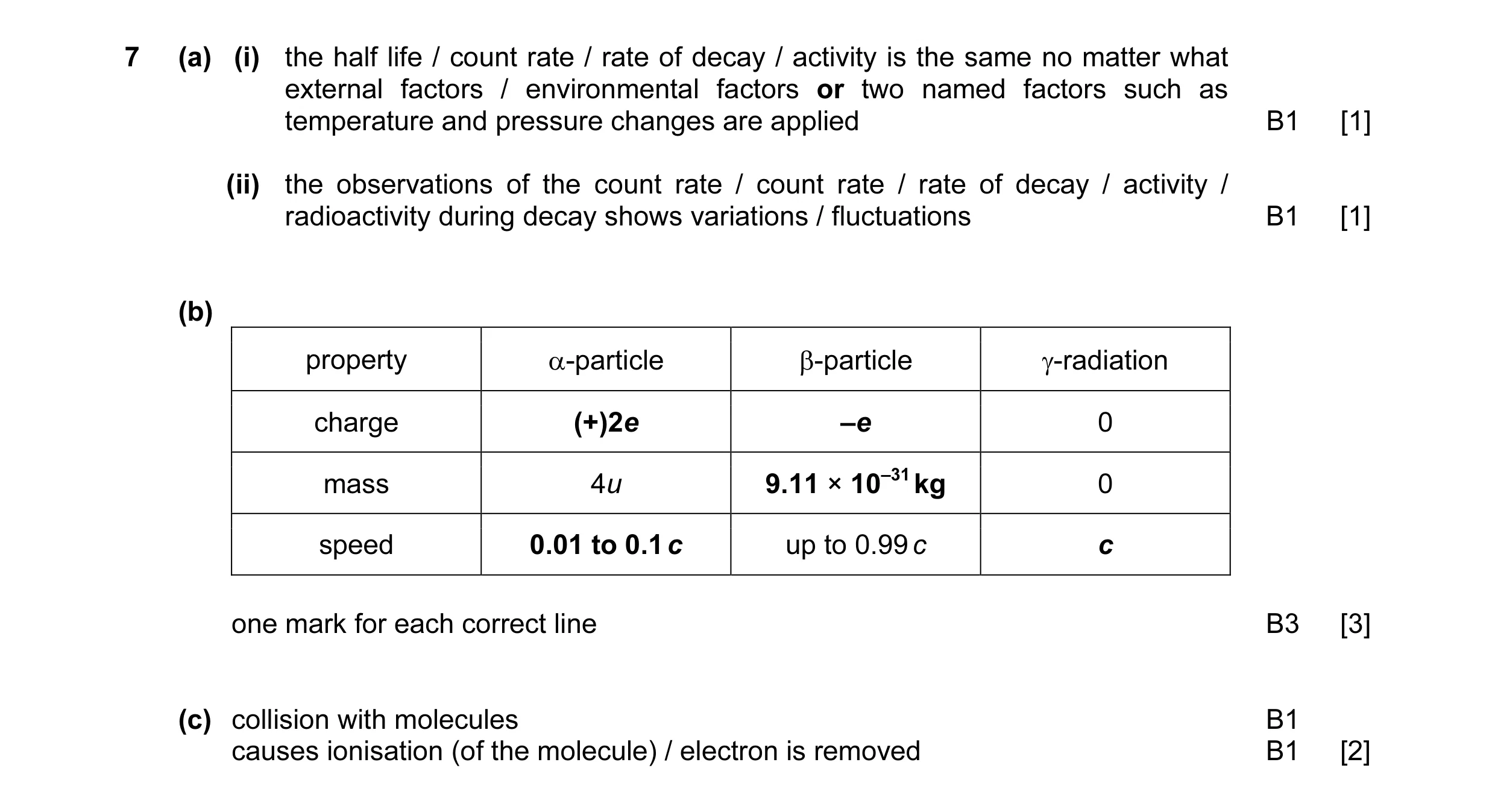 7
7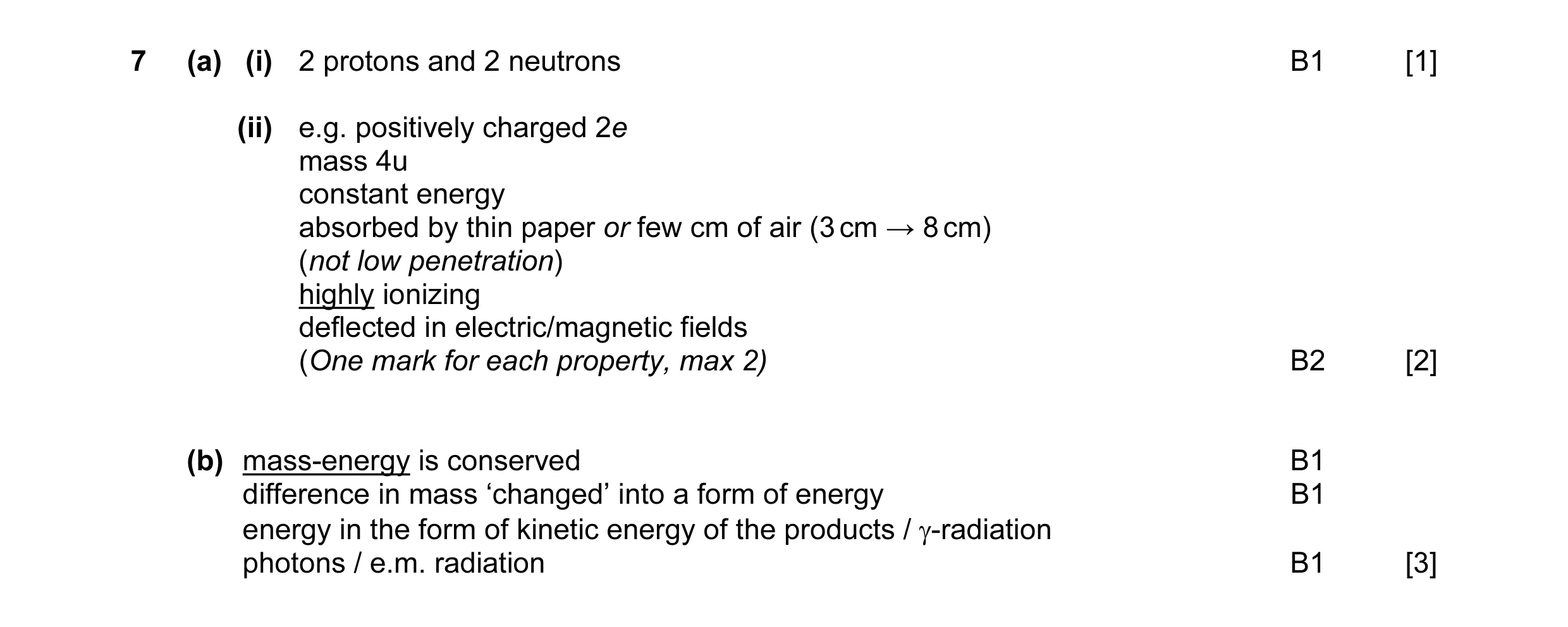 6
6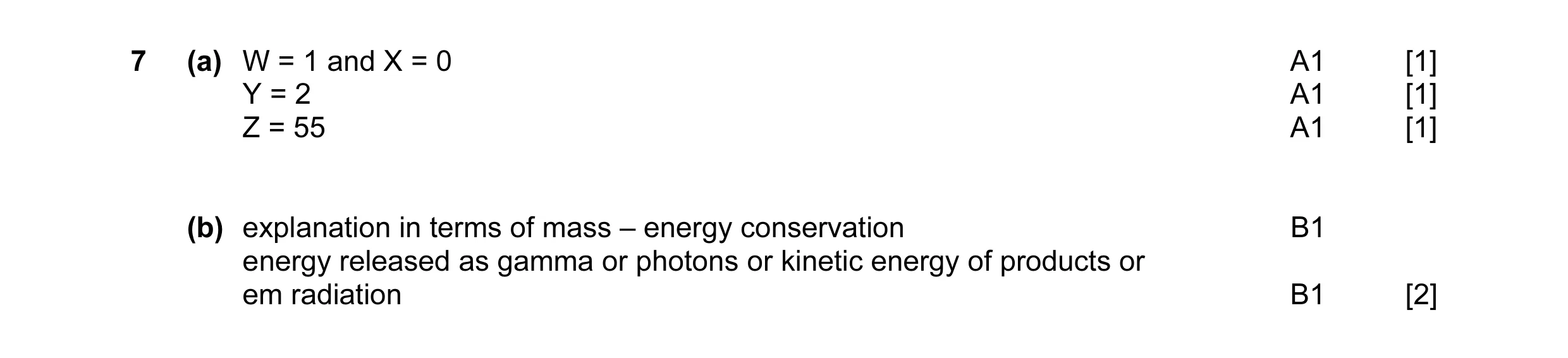 5
5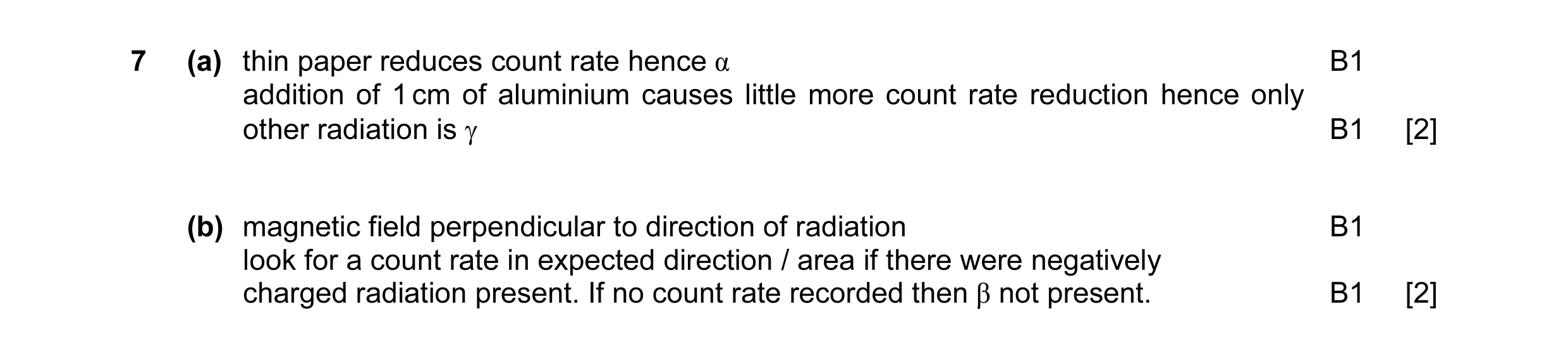 4
4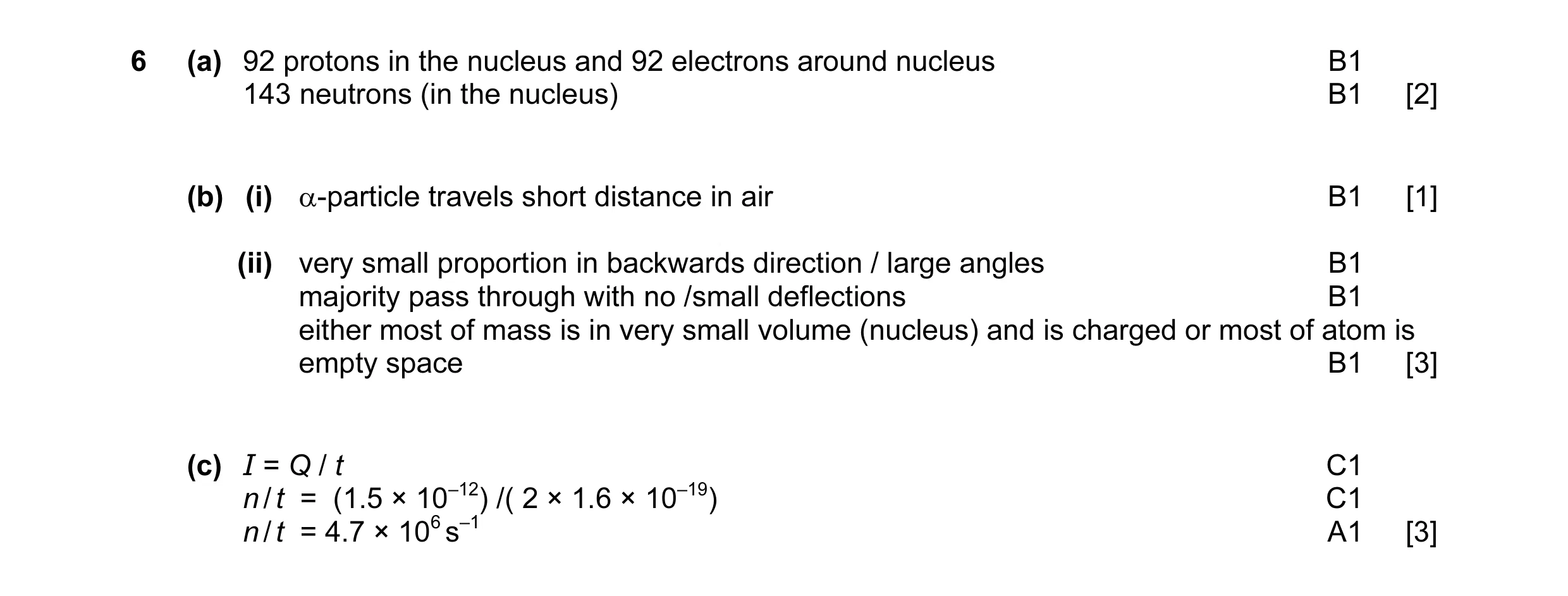 9
9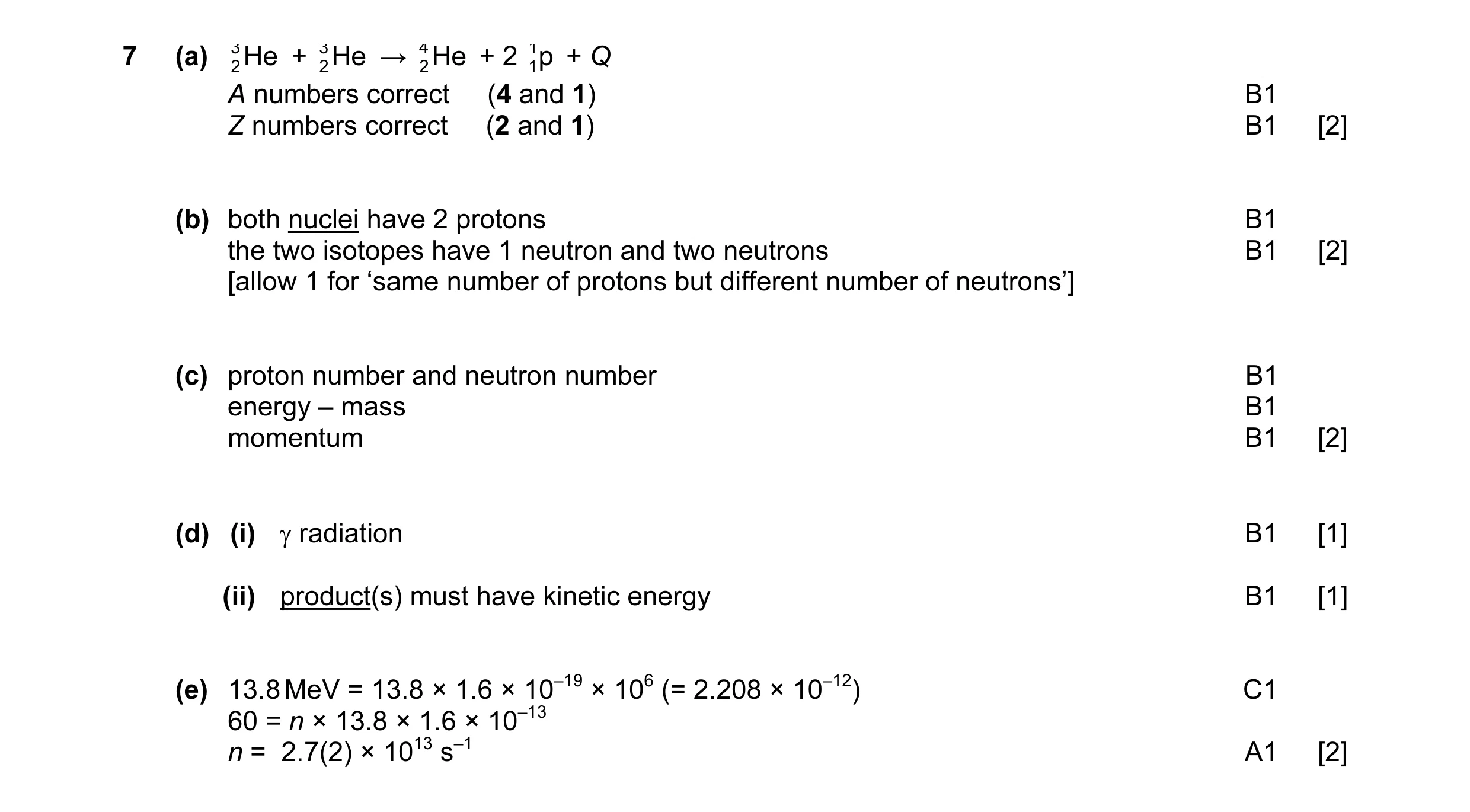 10
10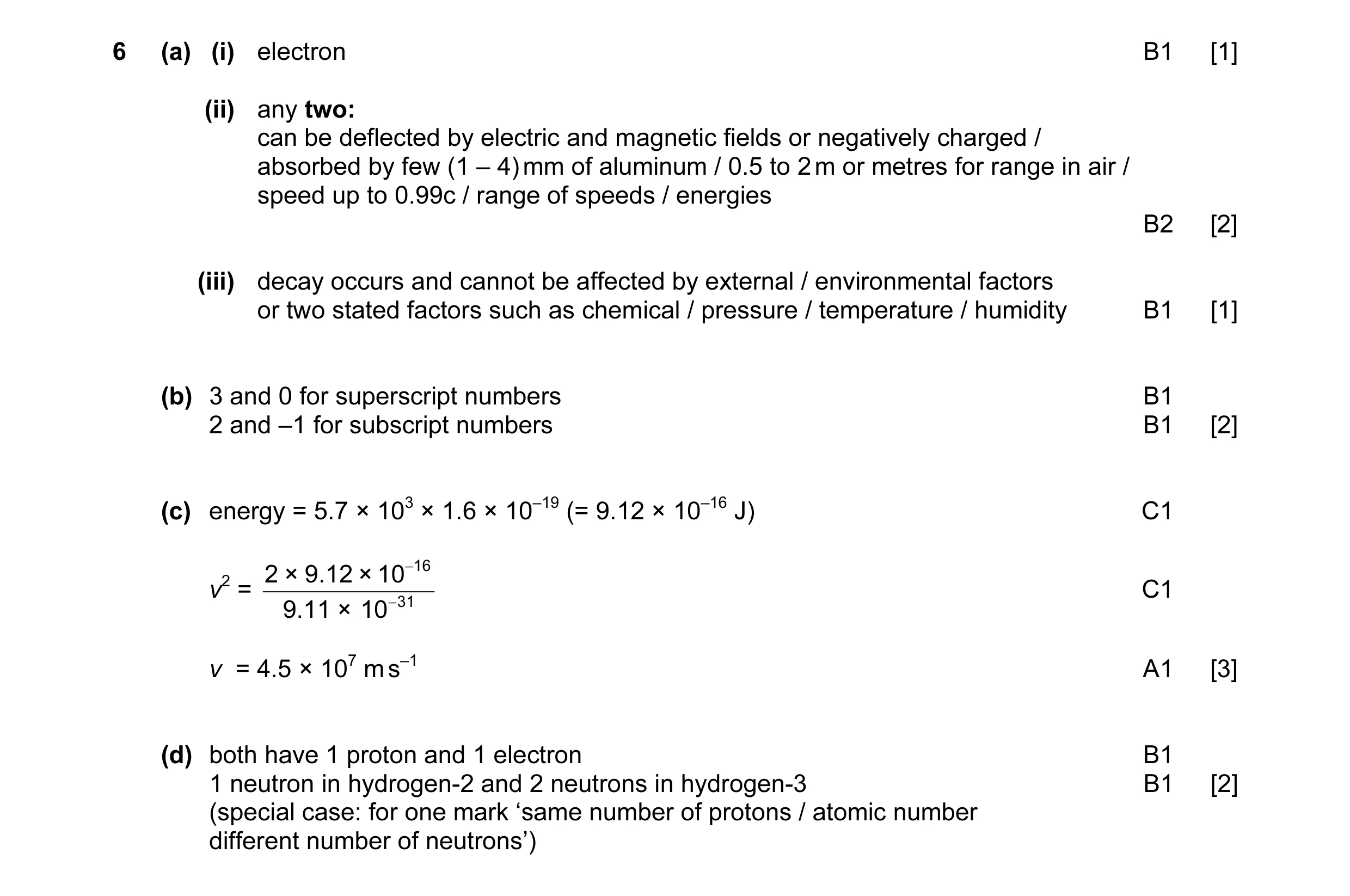 11
11 6
6 10
10 5
5 4
4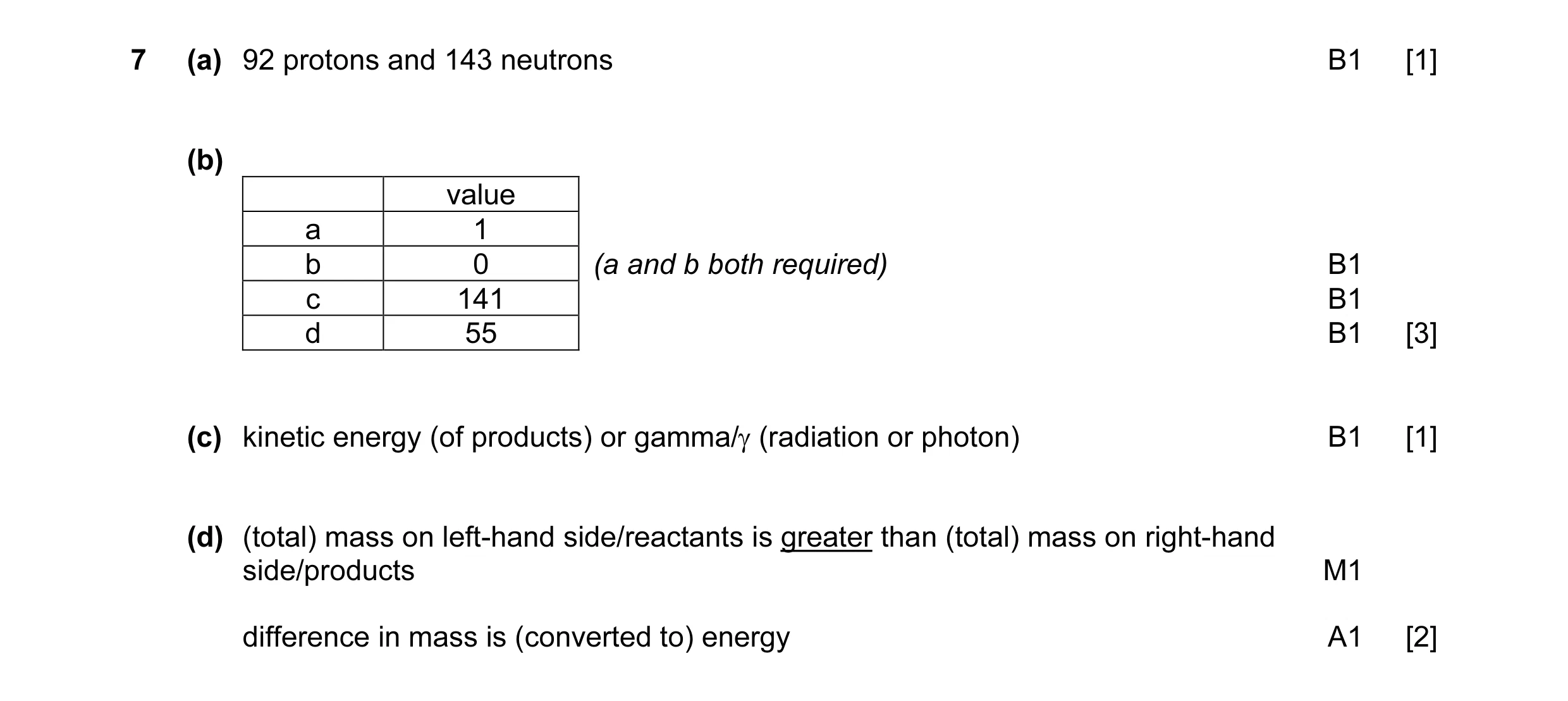 7
7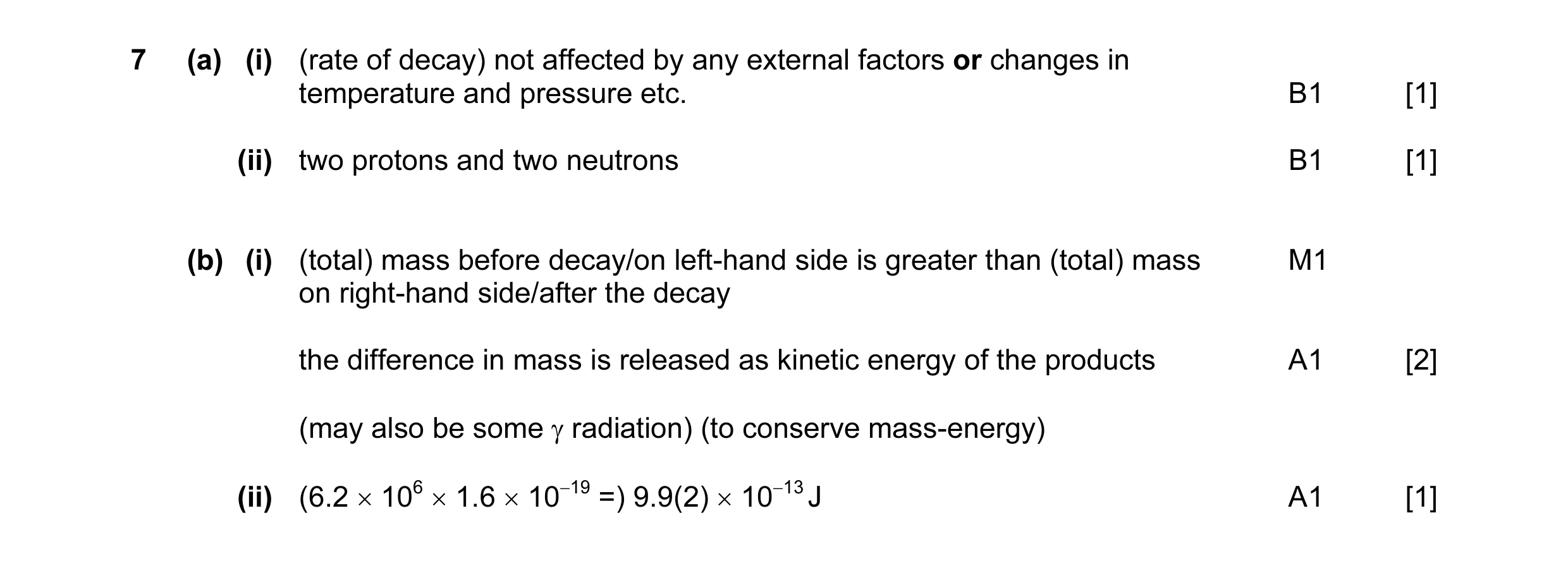 5
5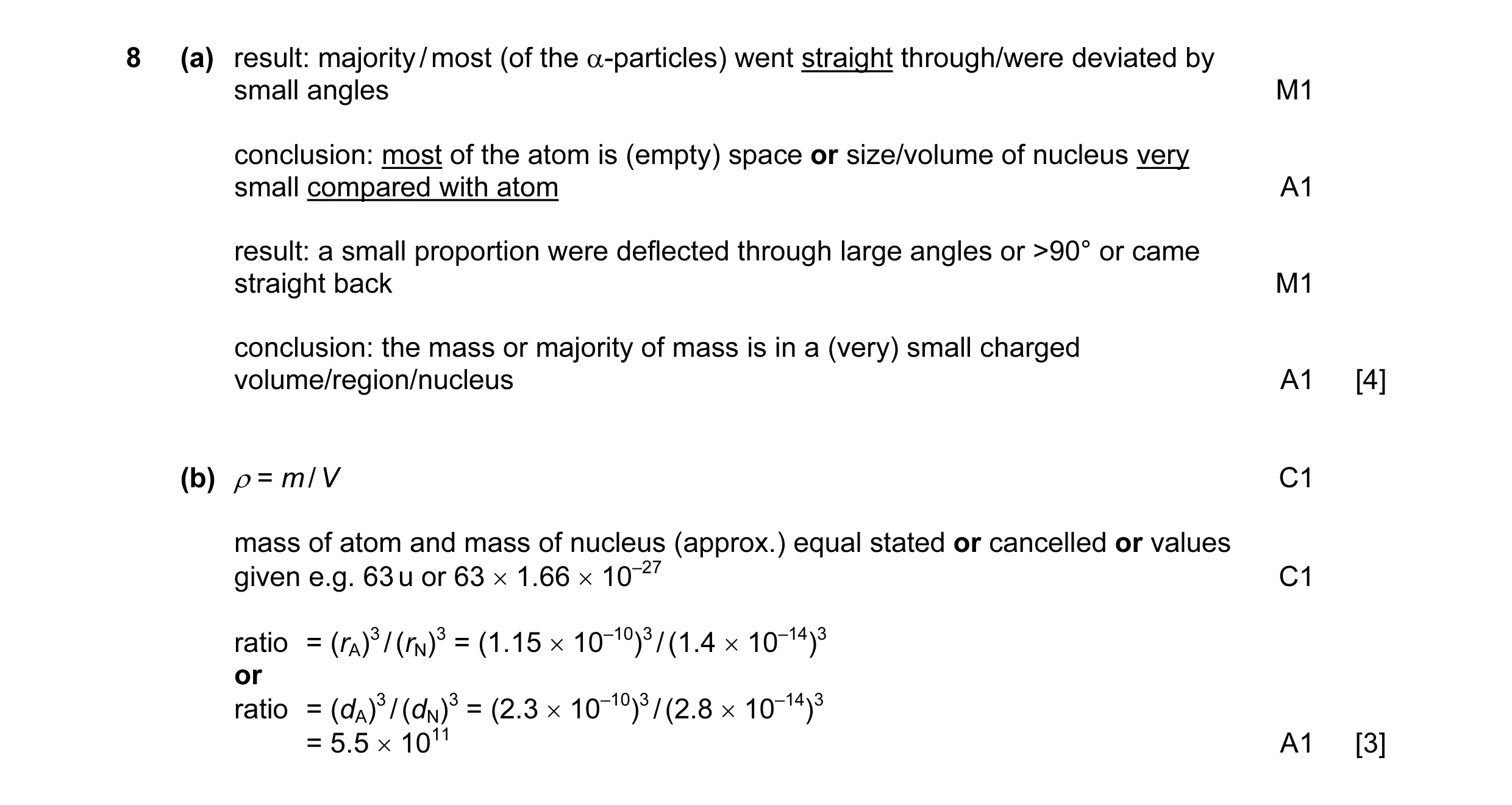 7
7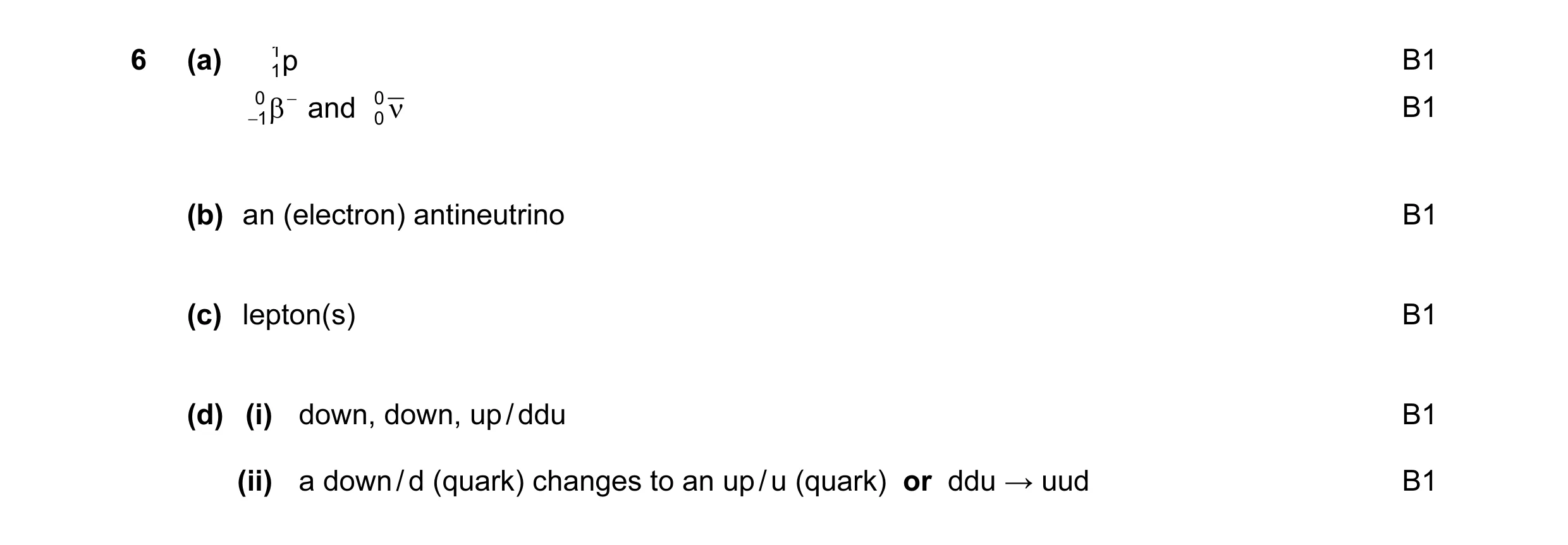 6
6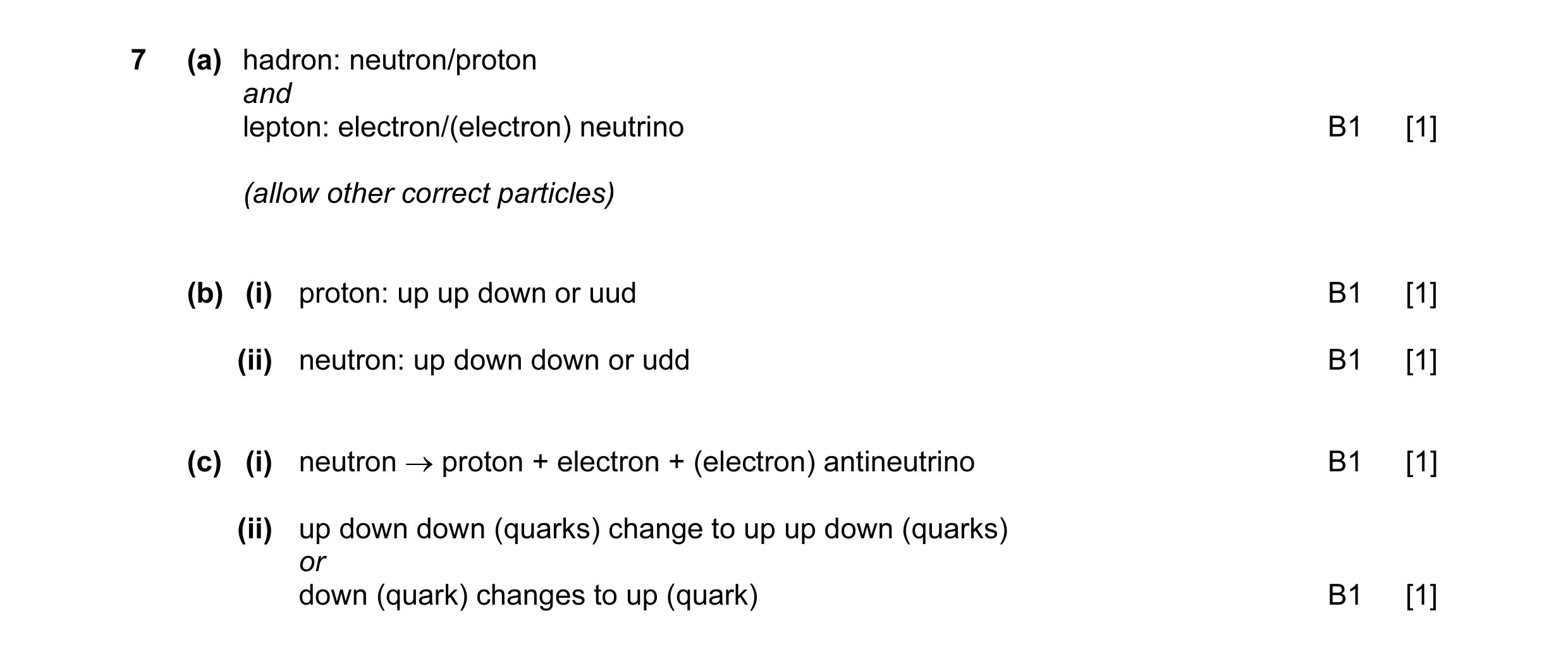 5
5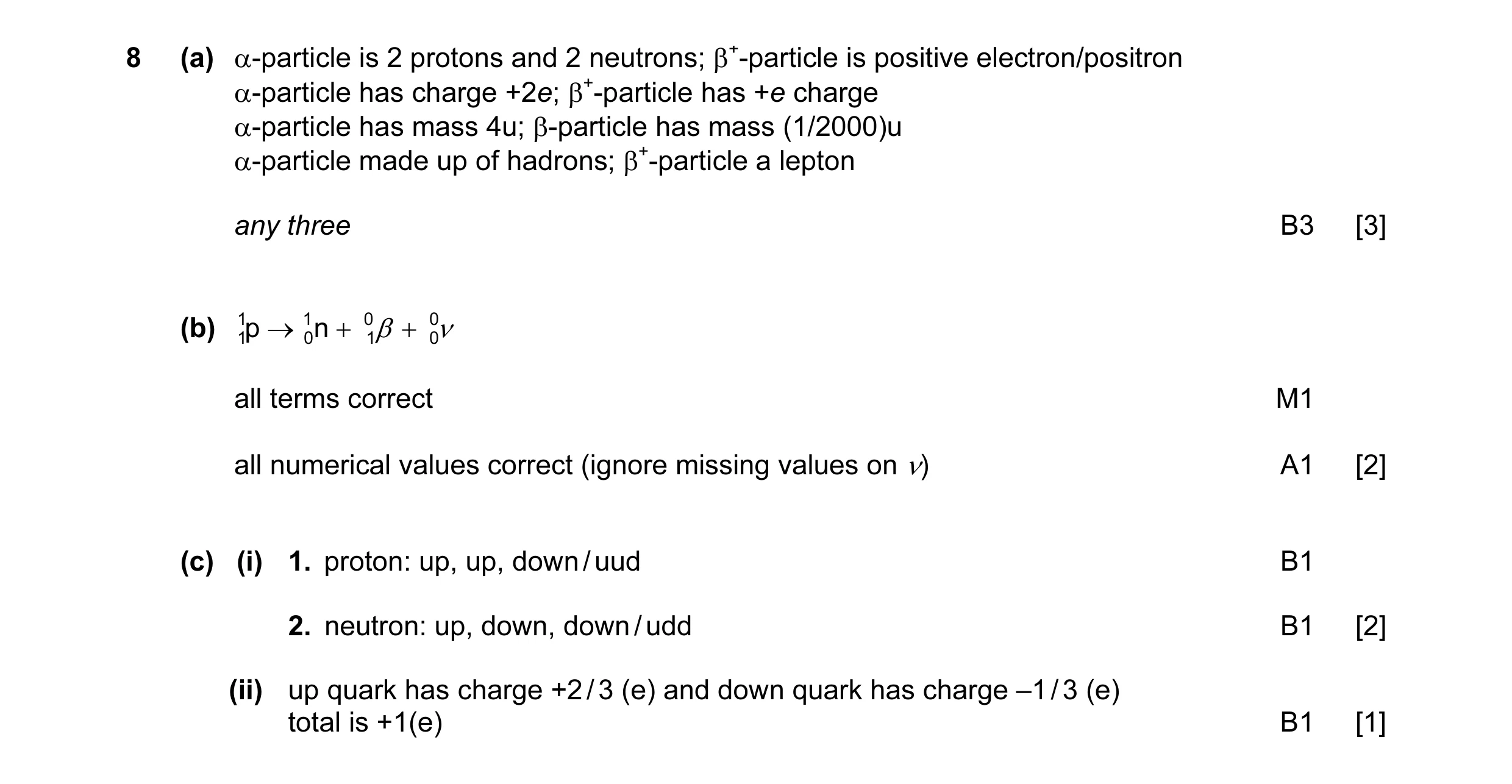 8
8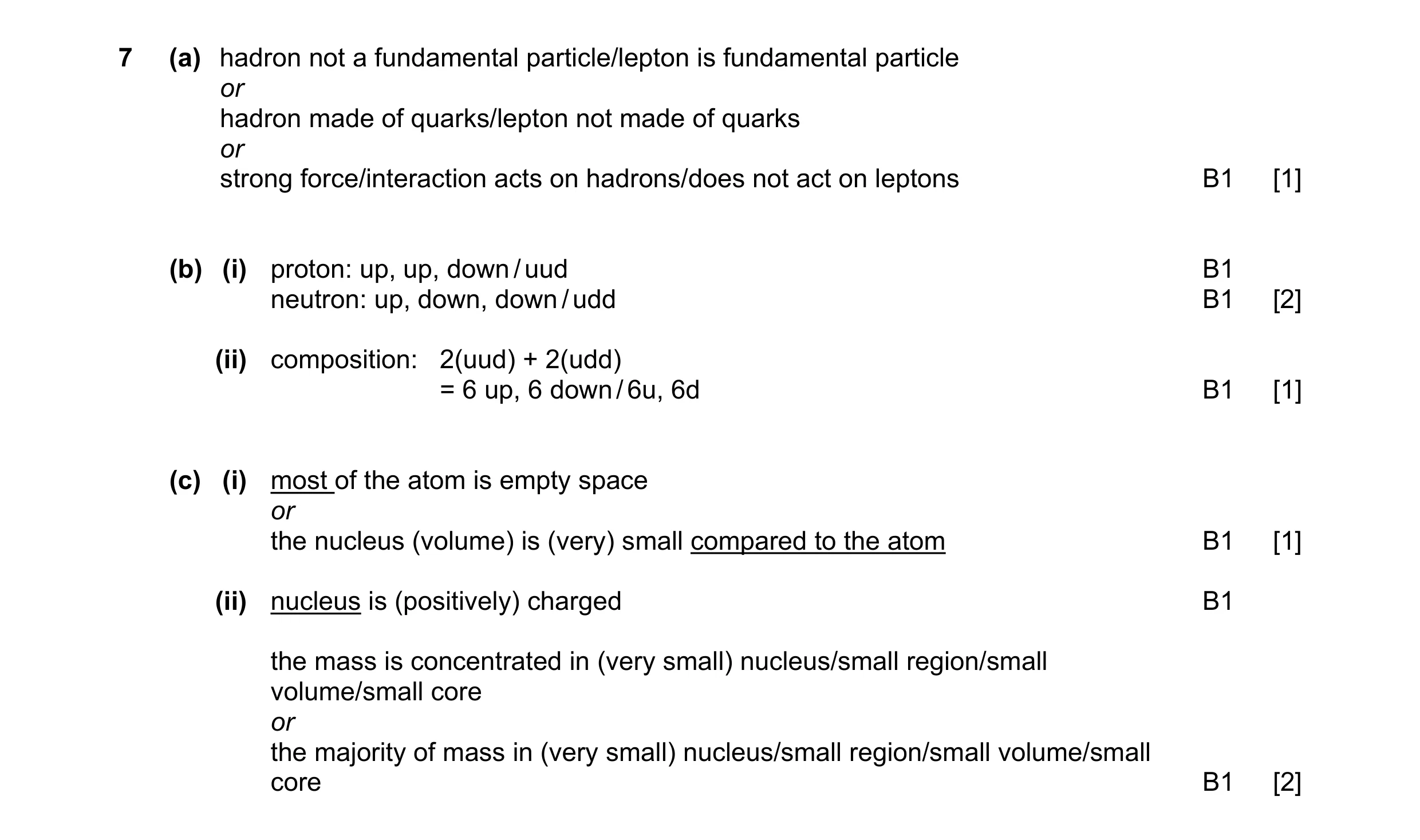 7
7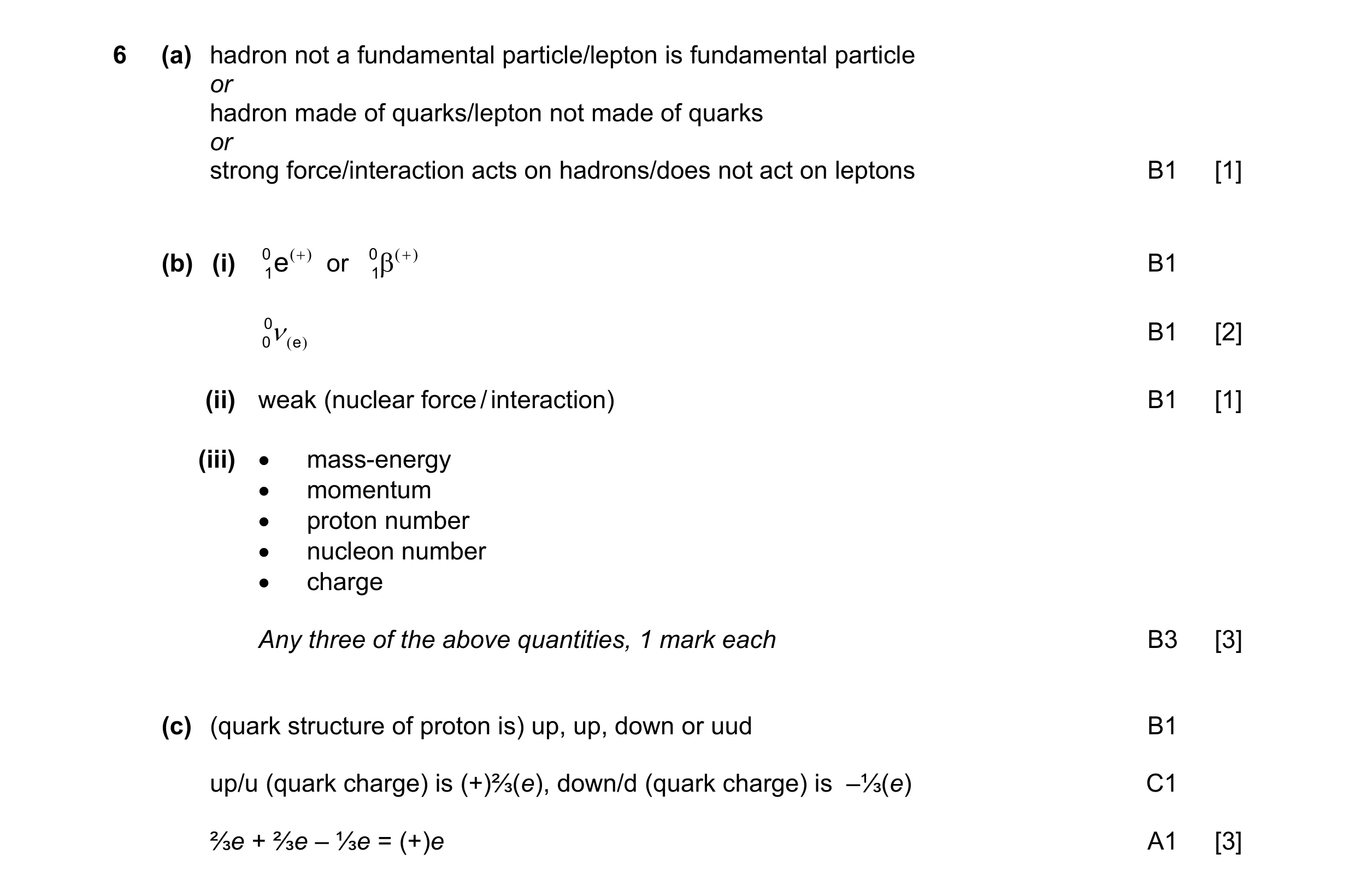 10
10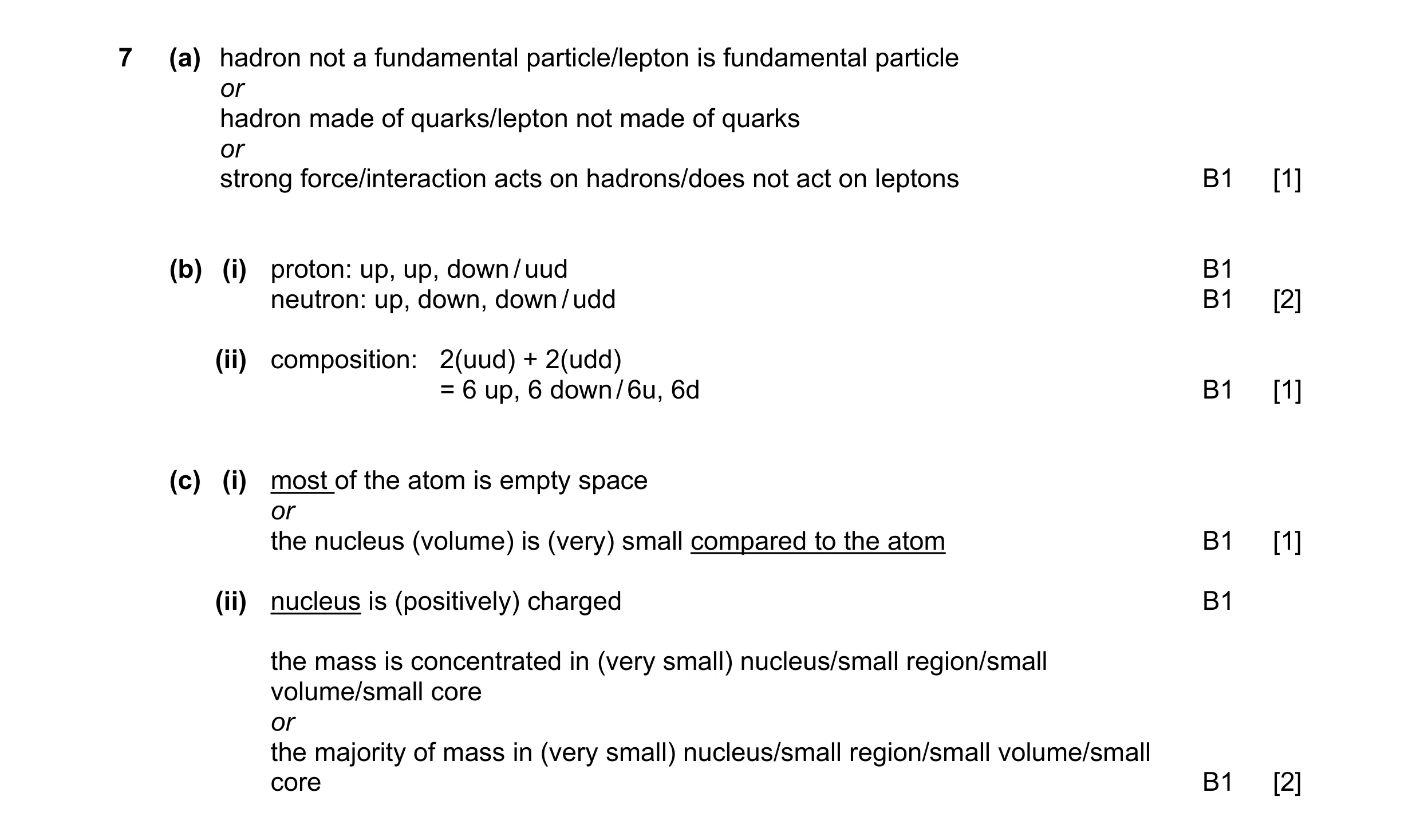 7
7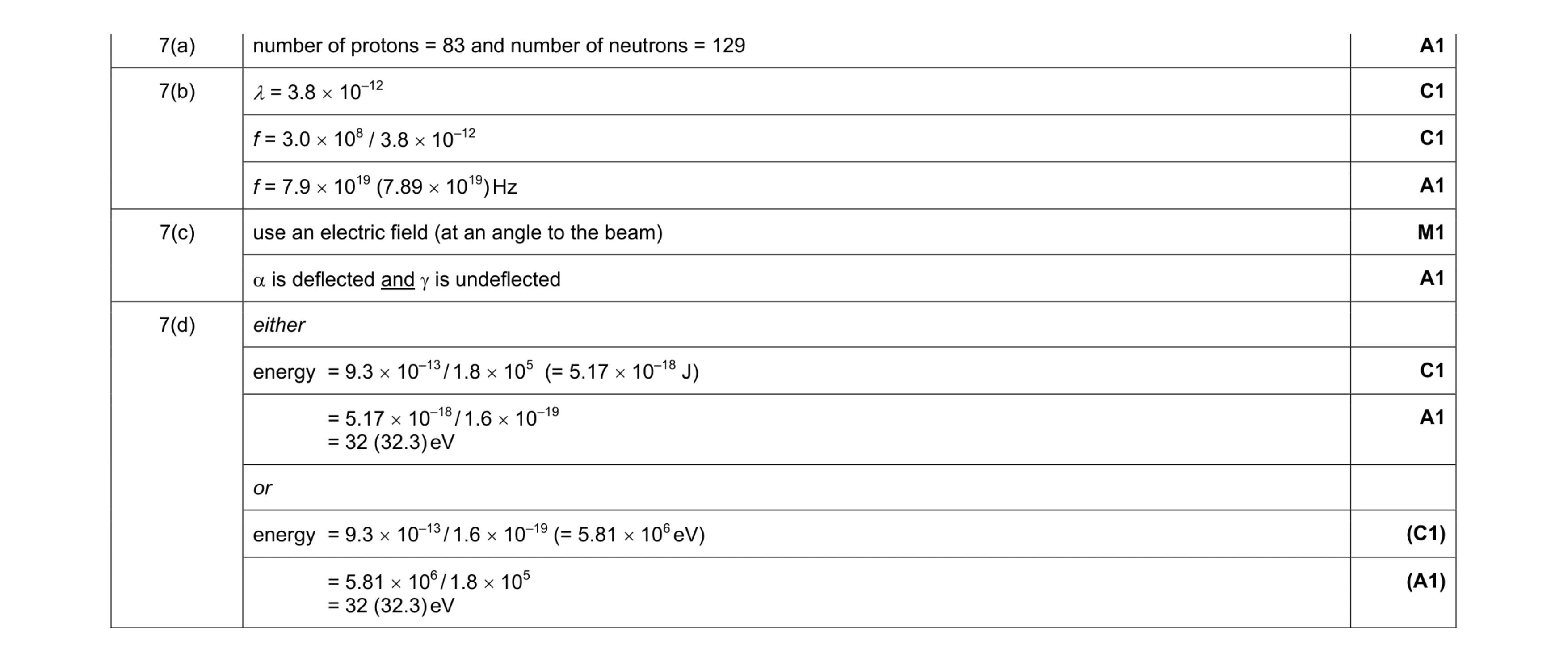 8
8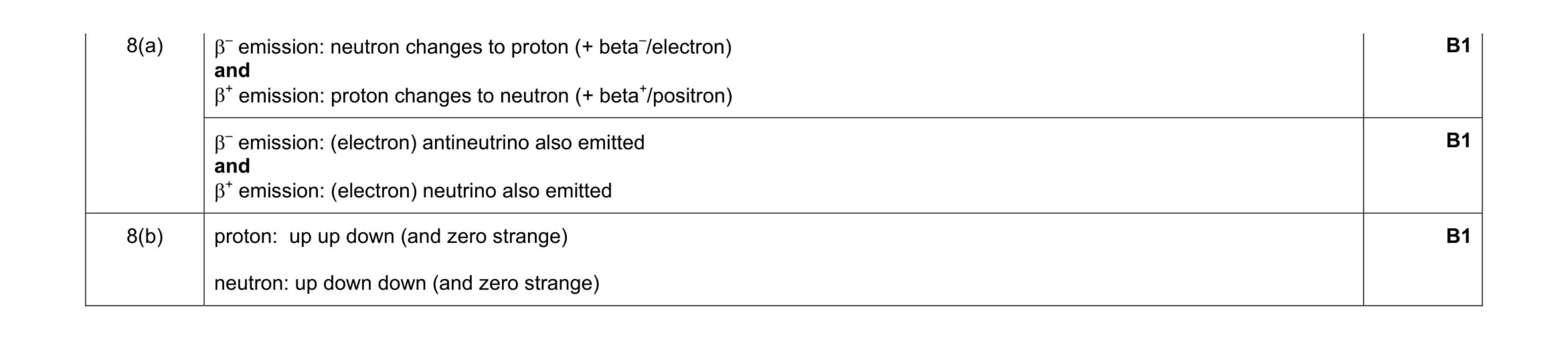 3
3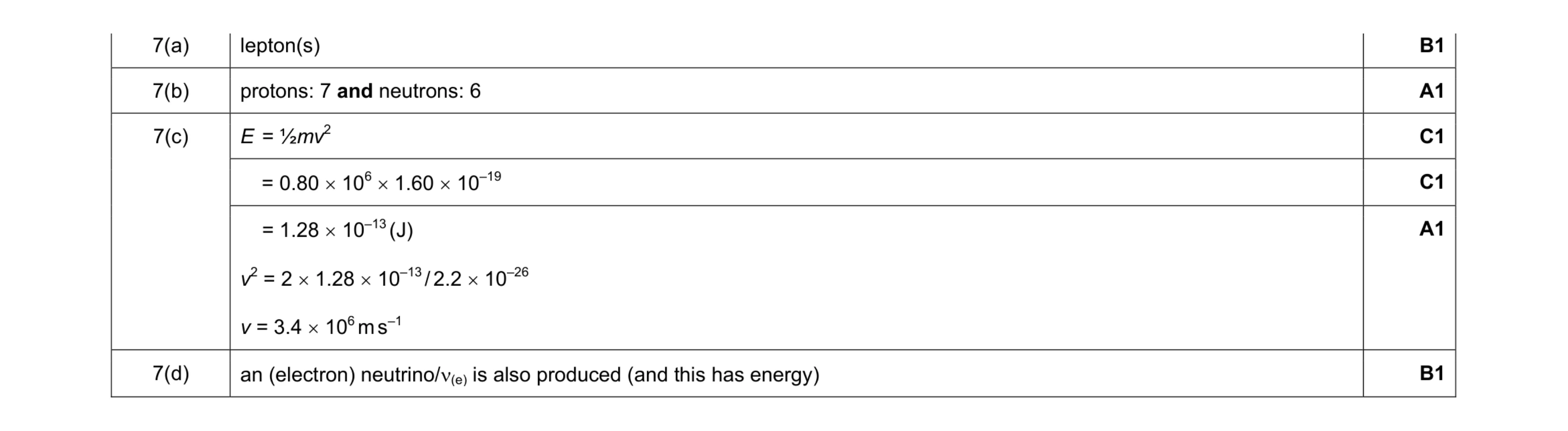 6
6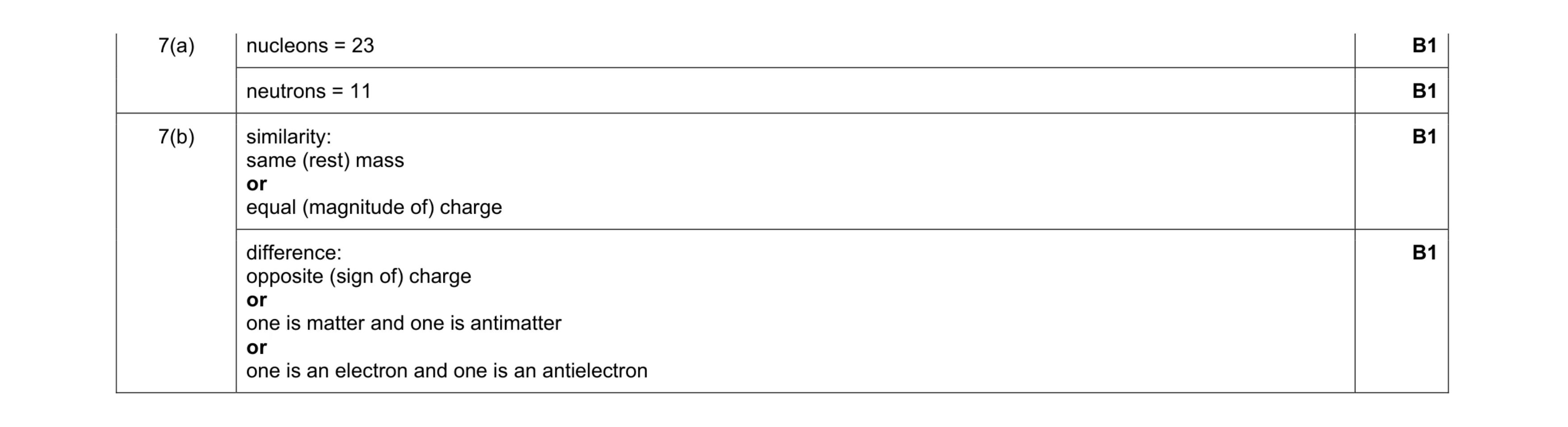 4
4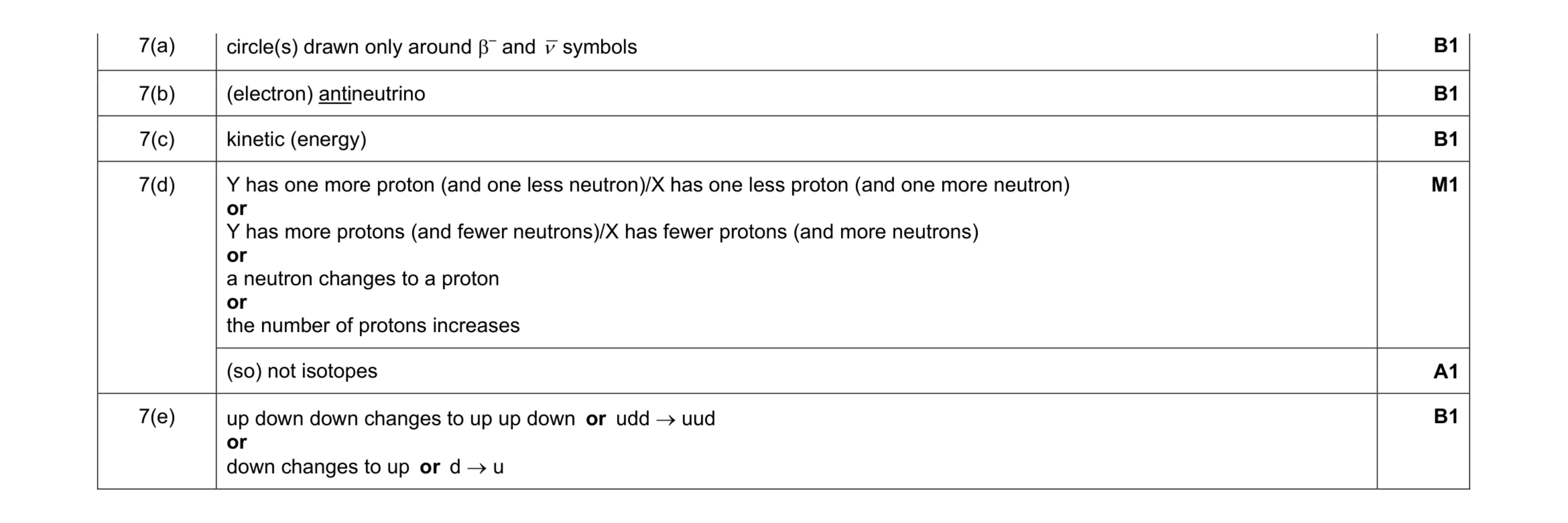 6
6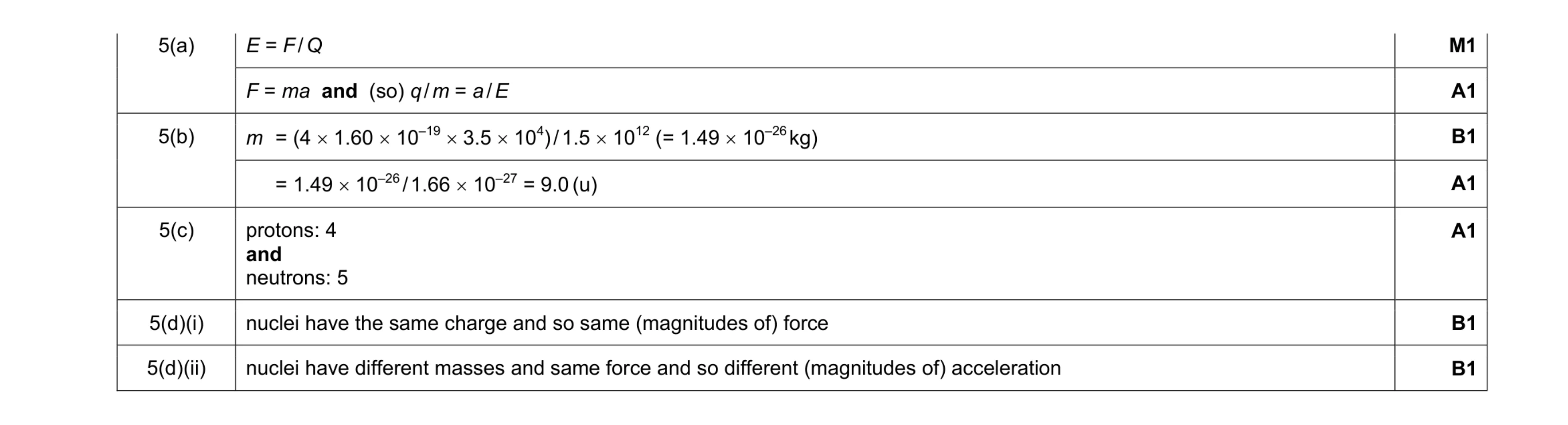 7
7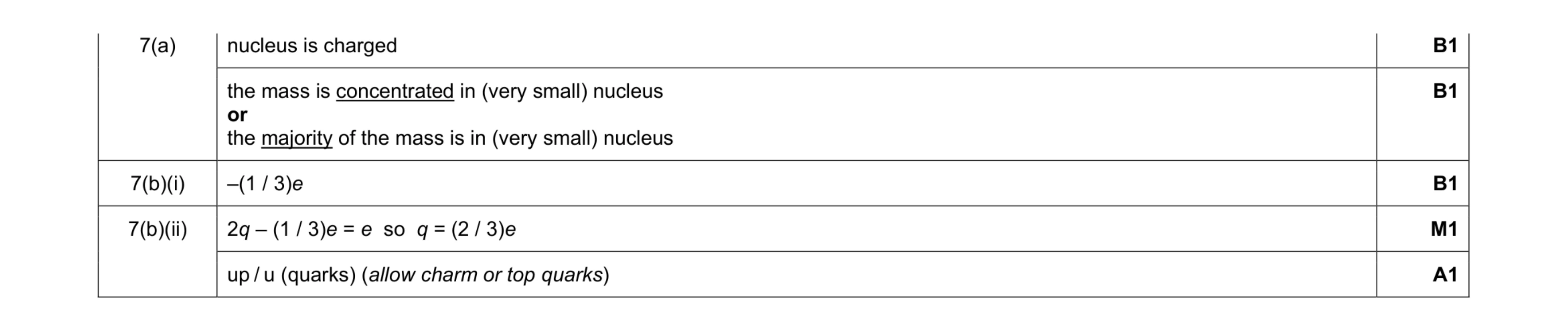 5
5 4
4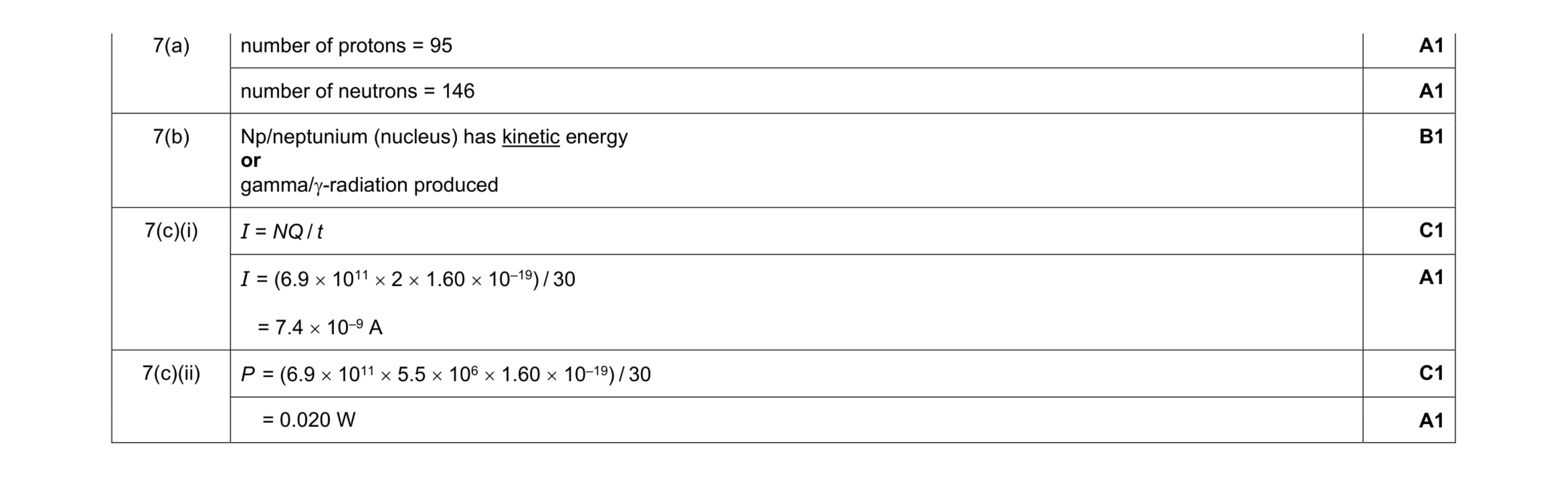 7
7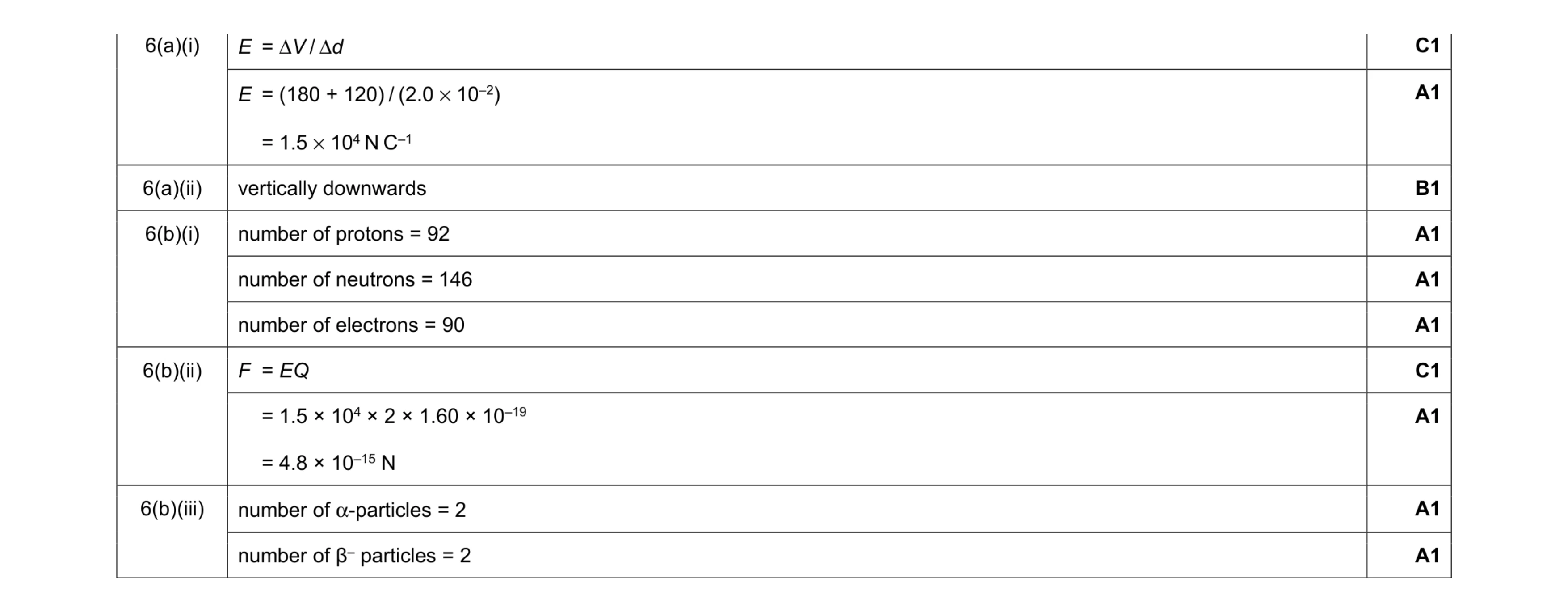 10
10 5
5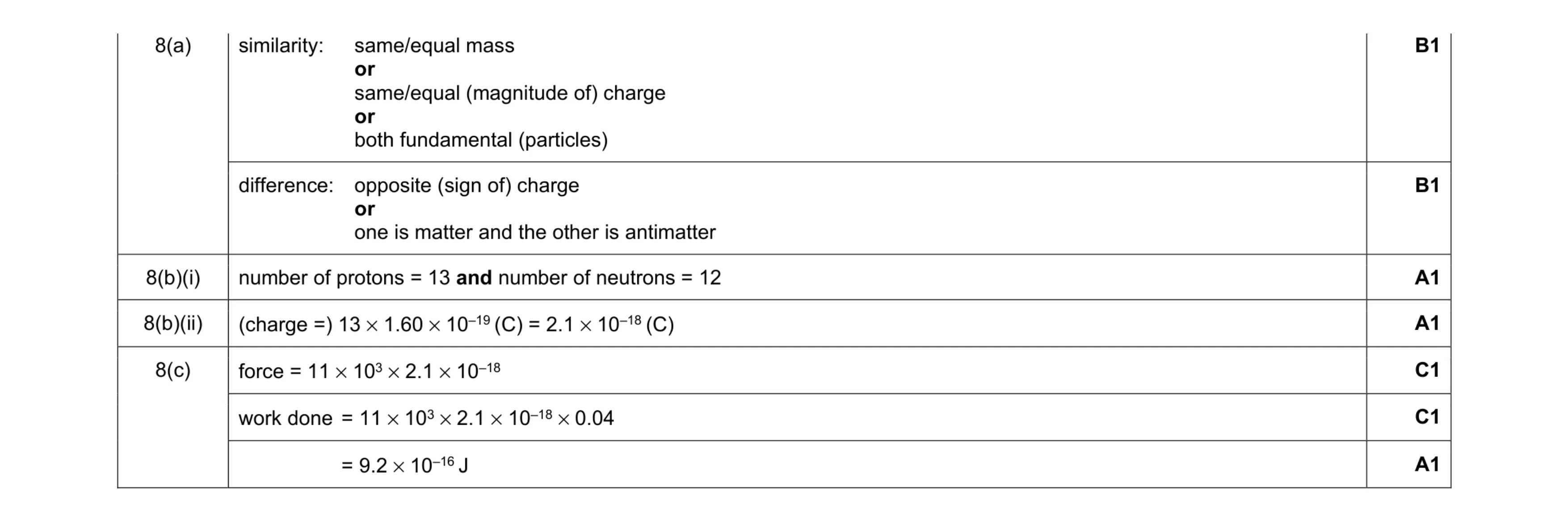 7
7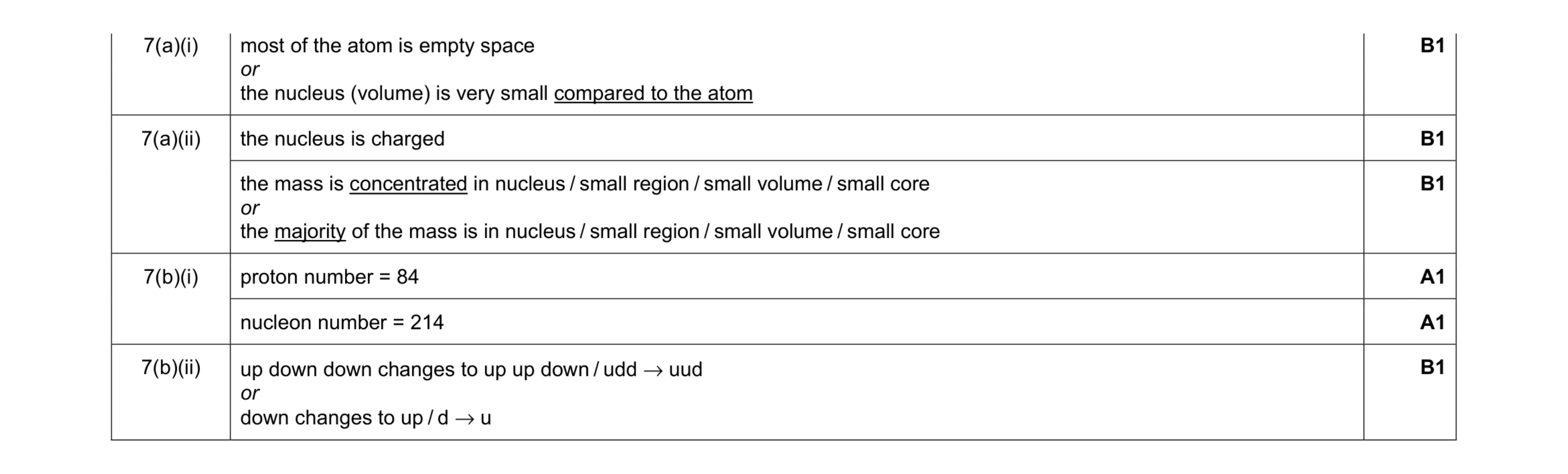 6
6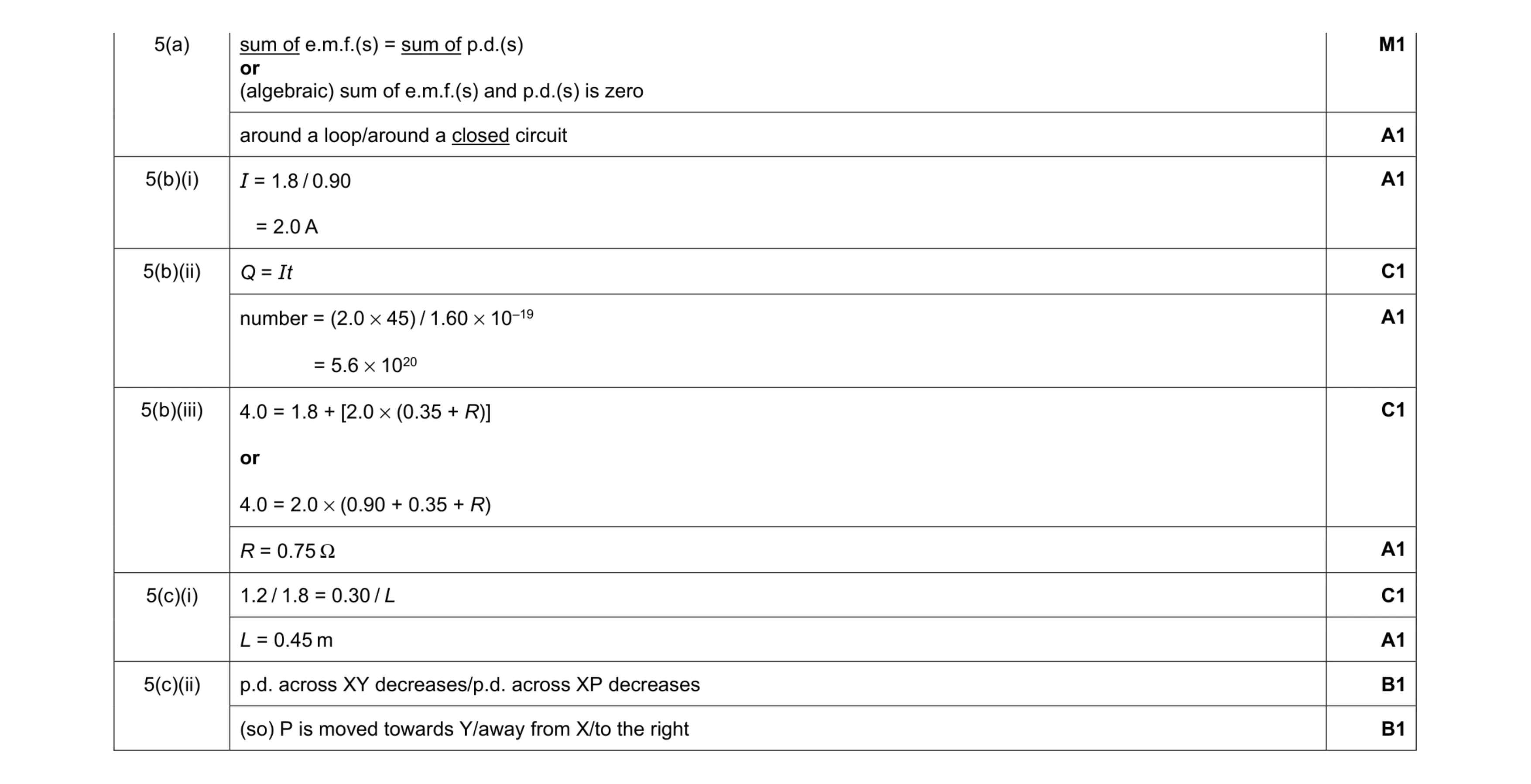 11
11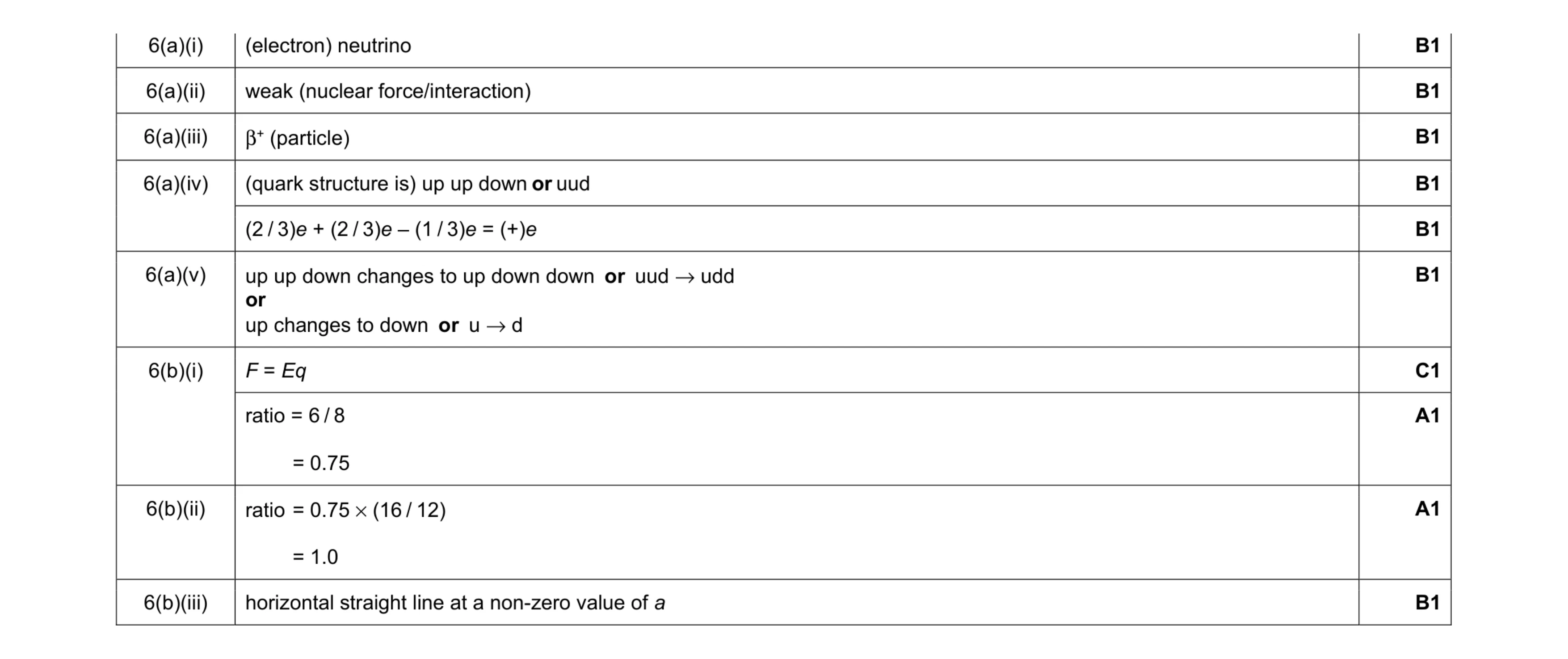 10
10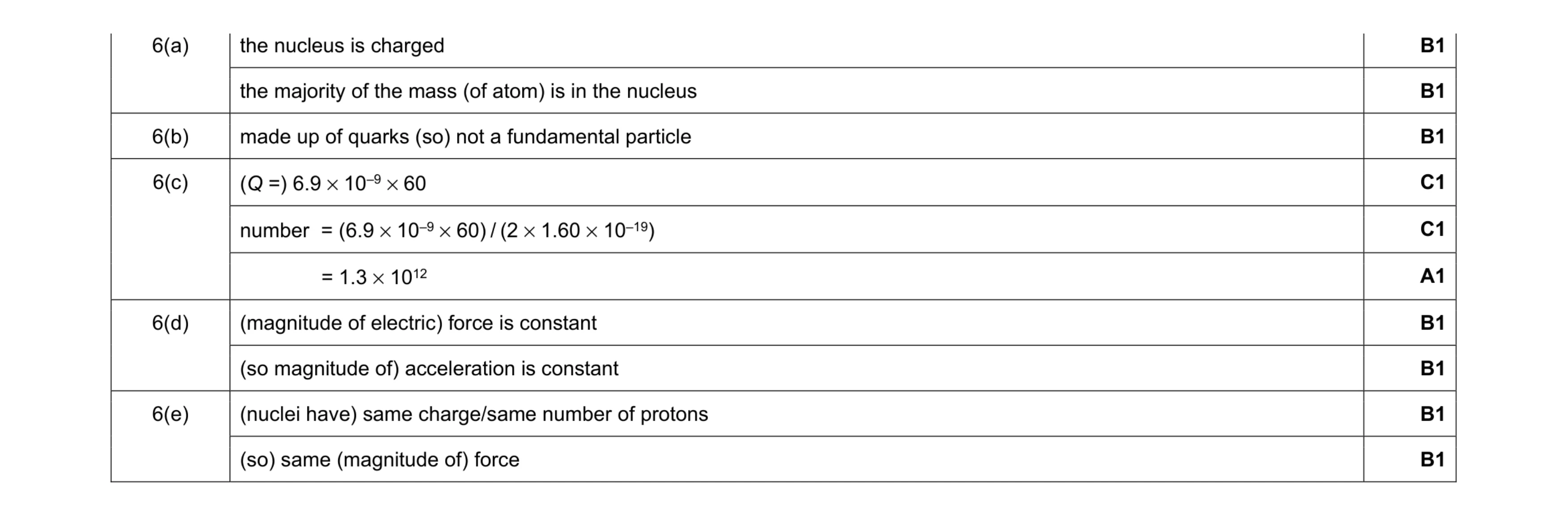 10
10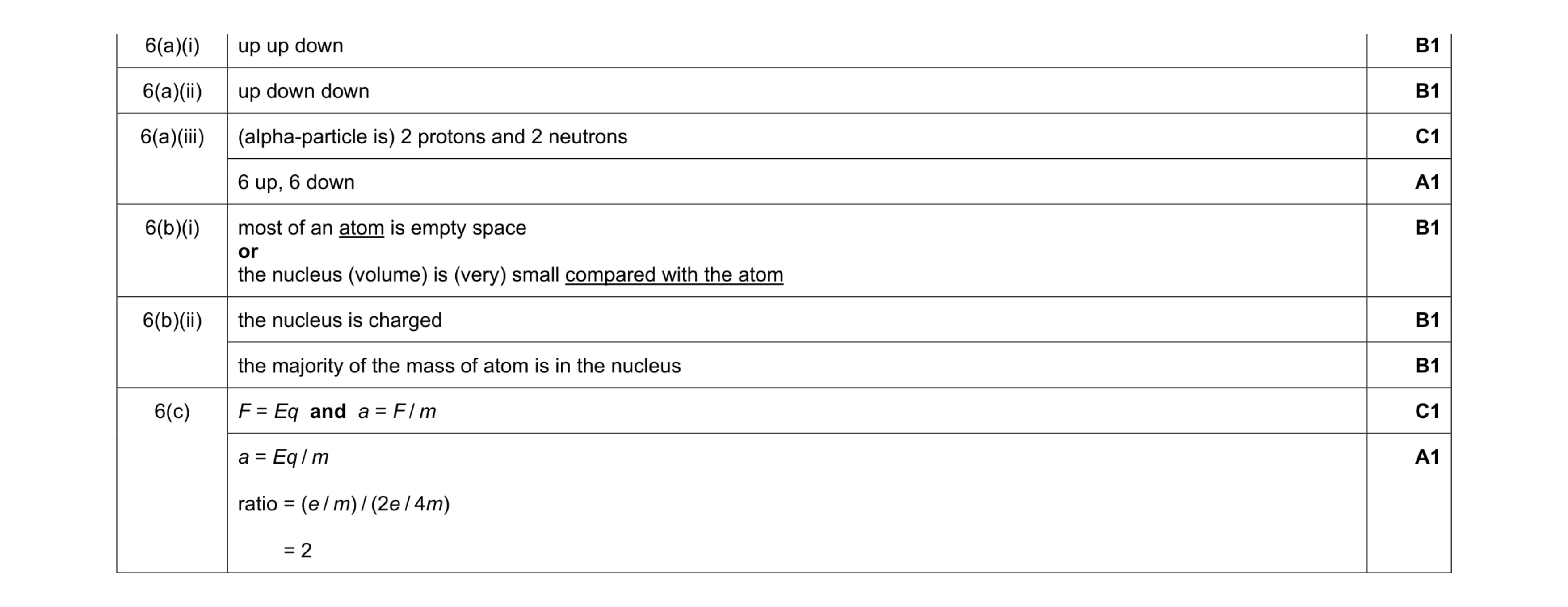 9
9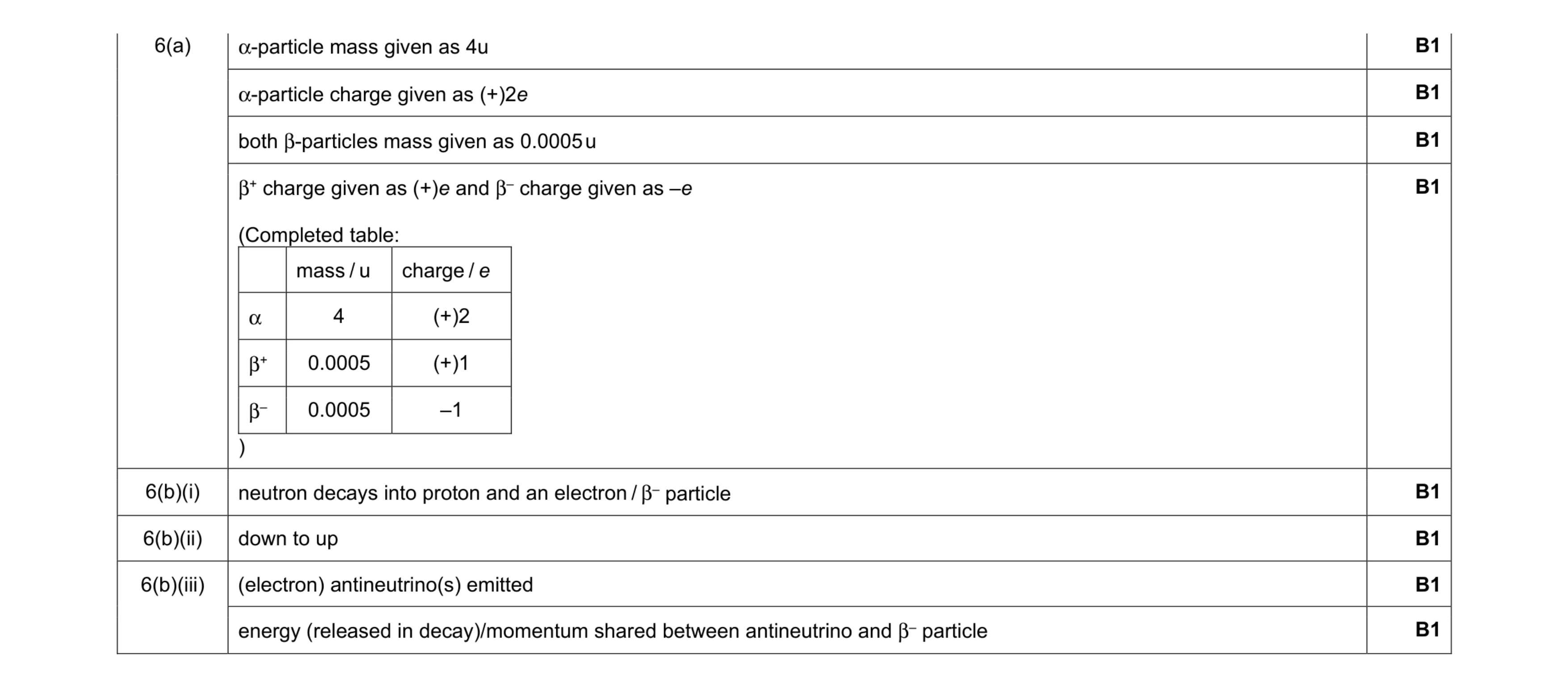 8
8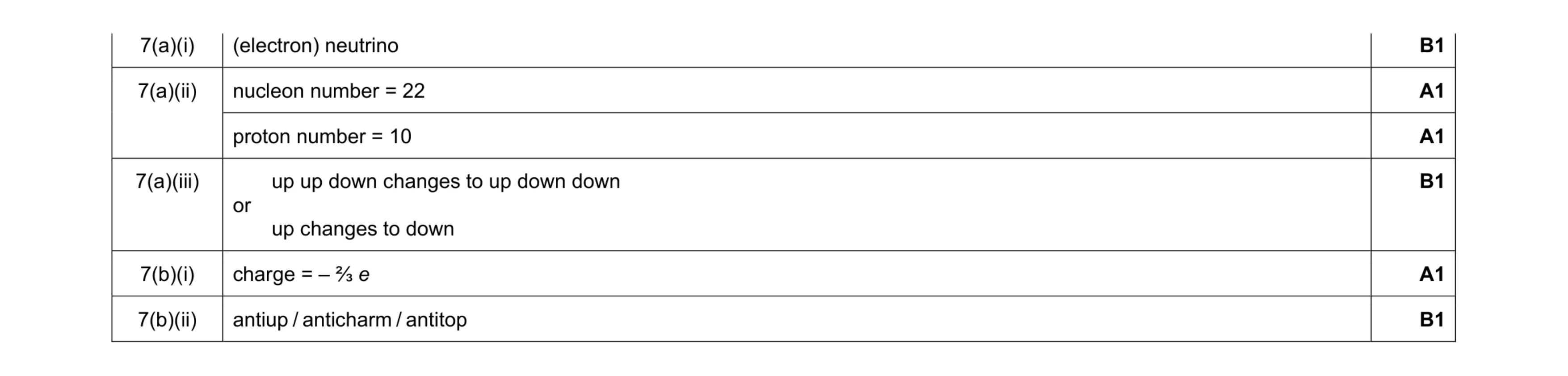 6
6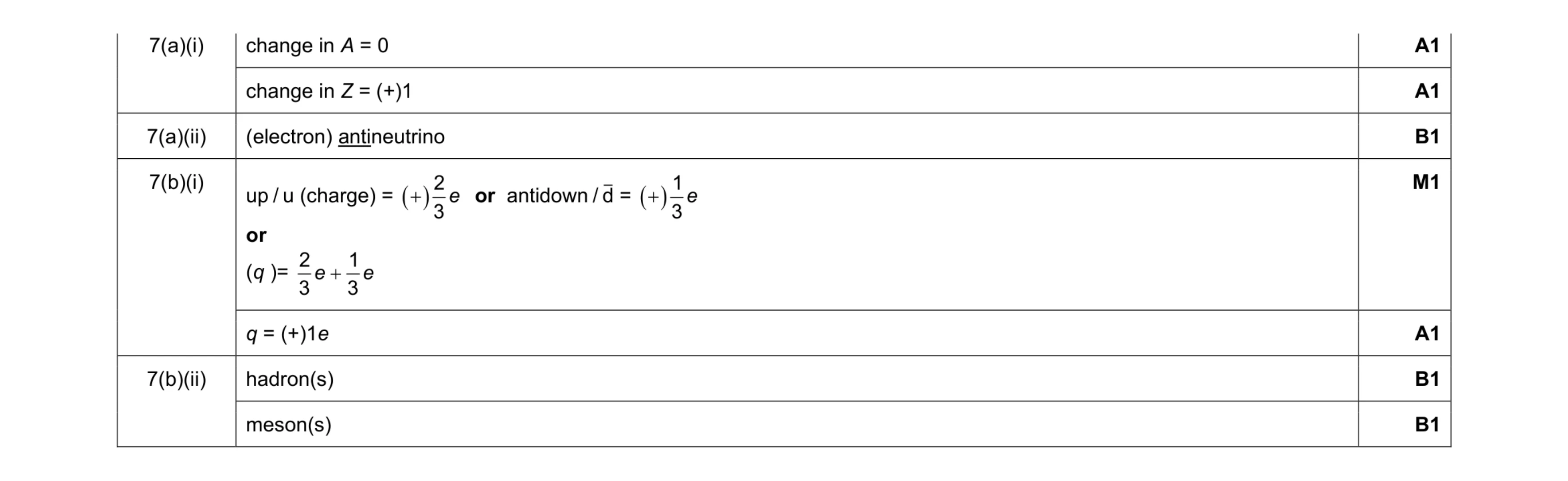 7
7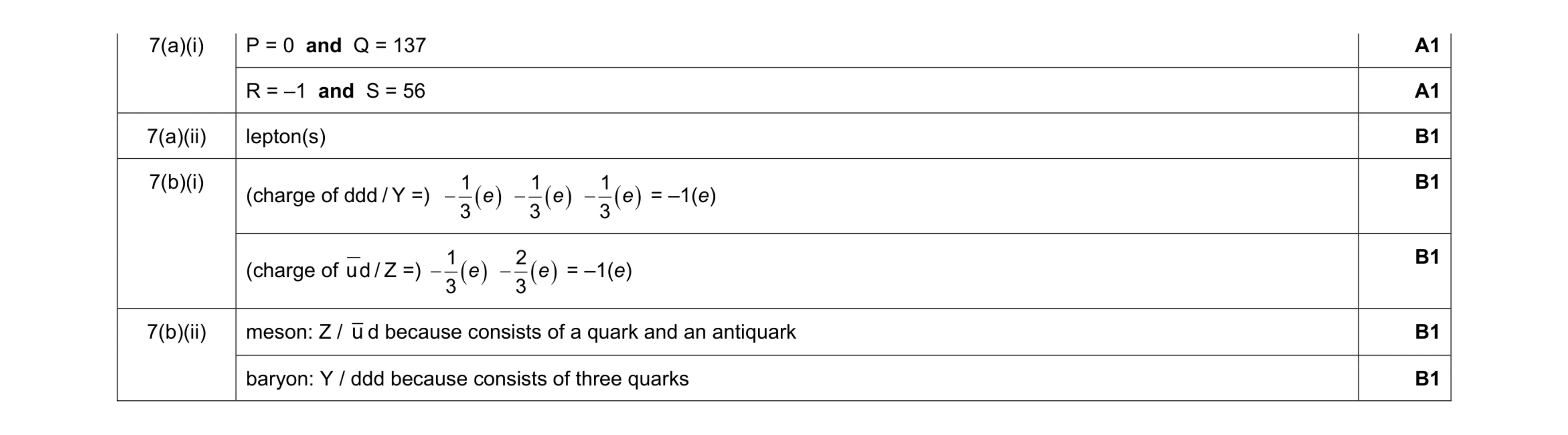 7
7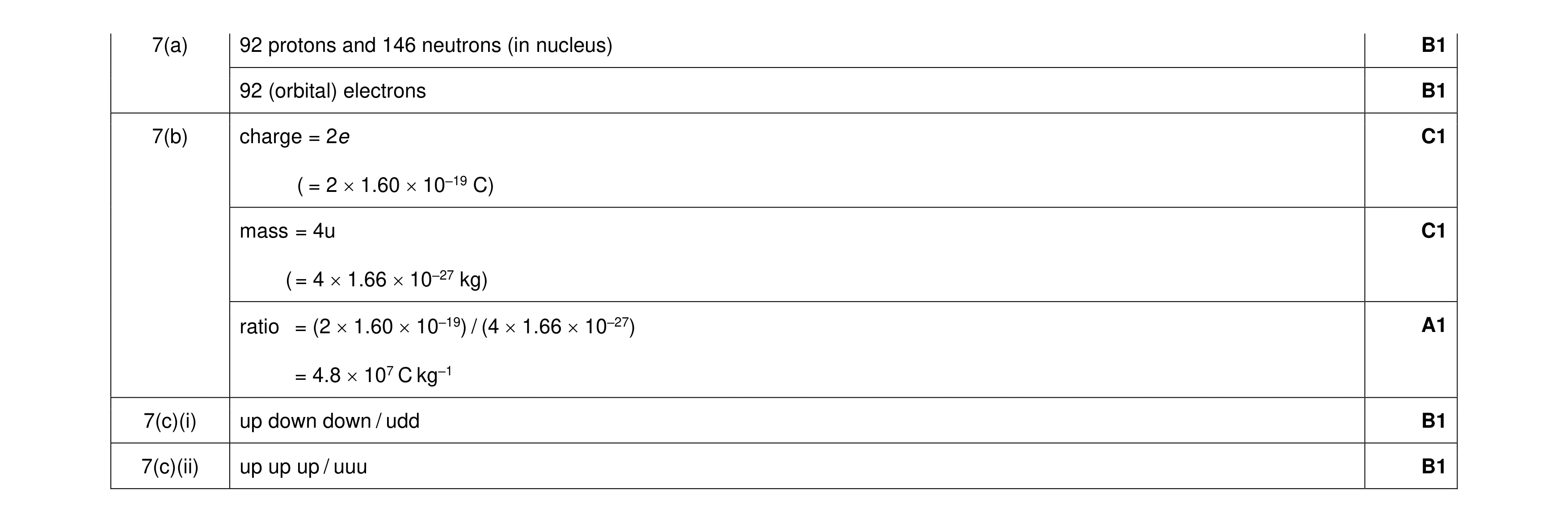 7
7 5
5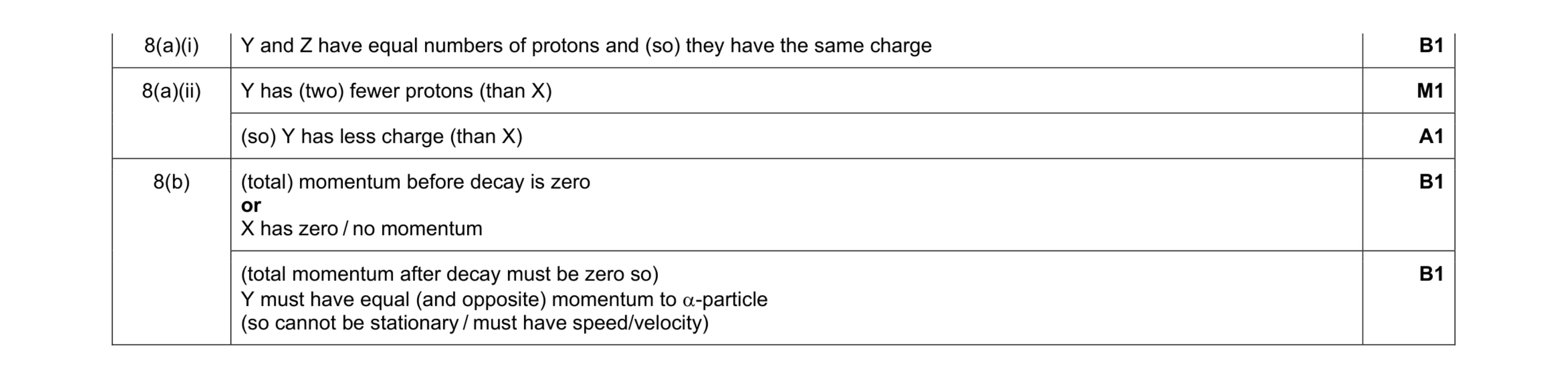 5
5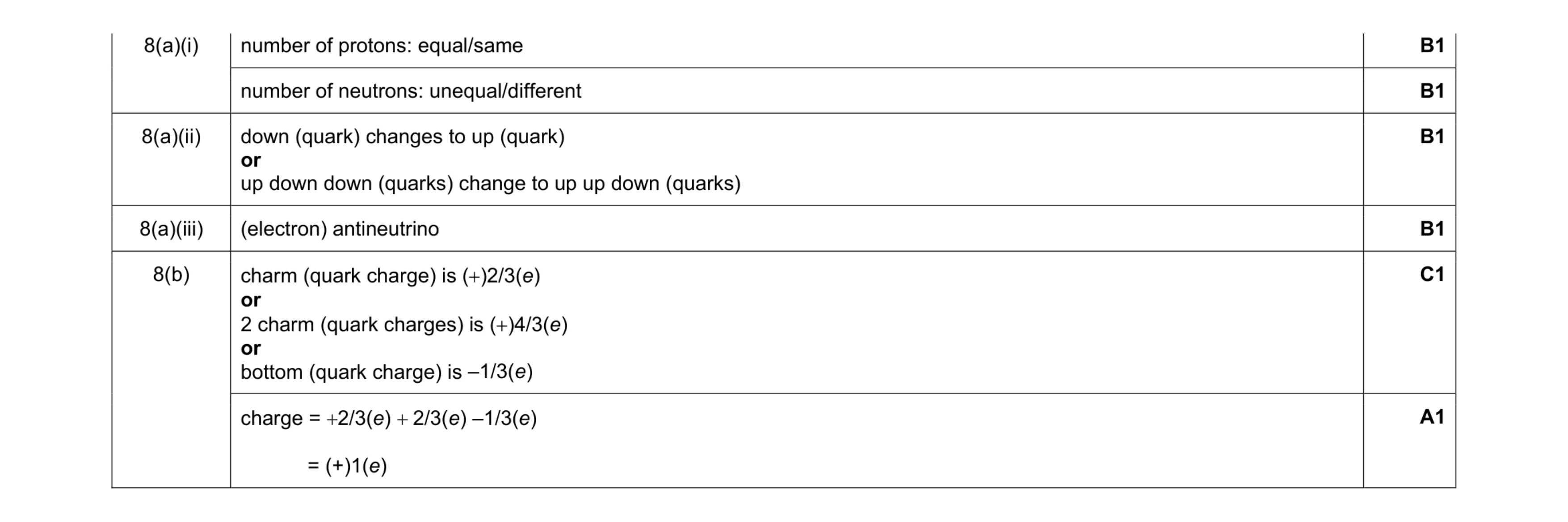 6
6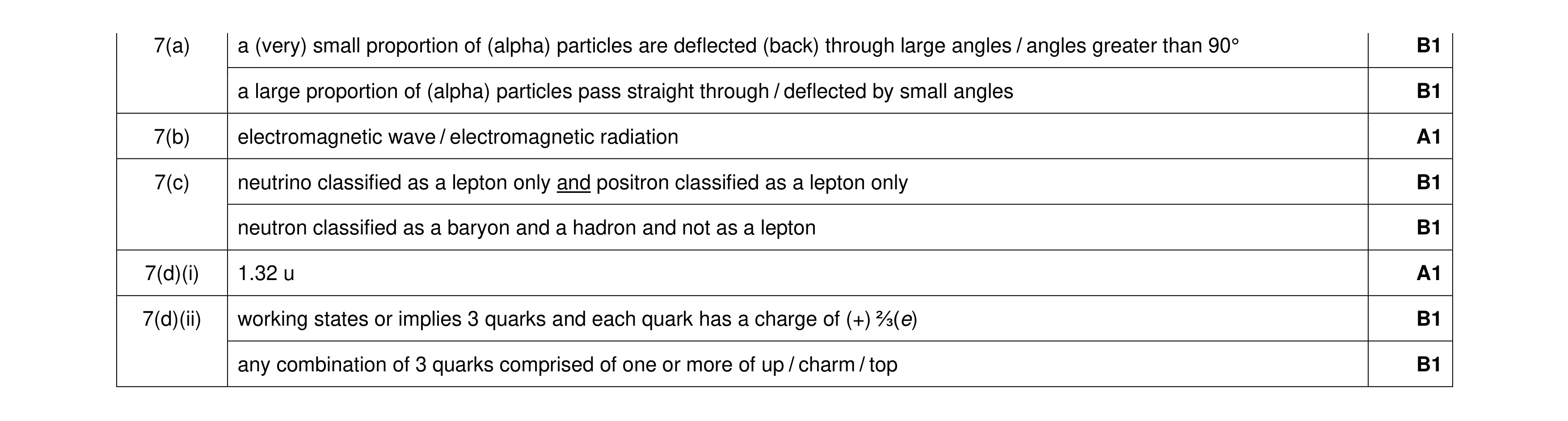 8
8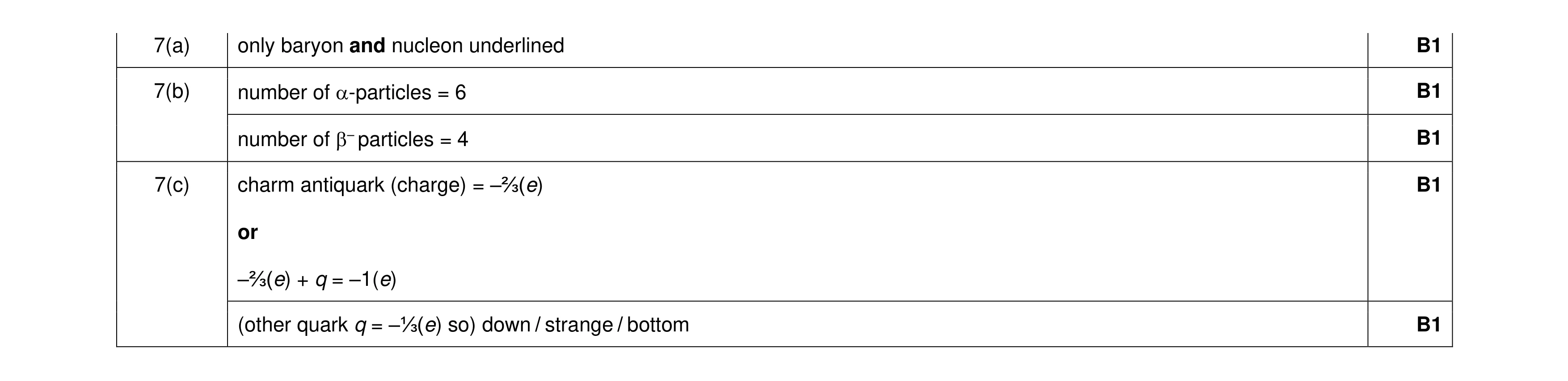 5
5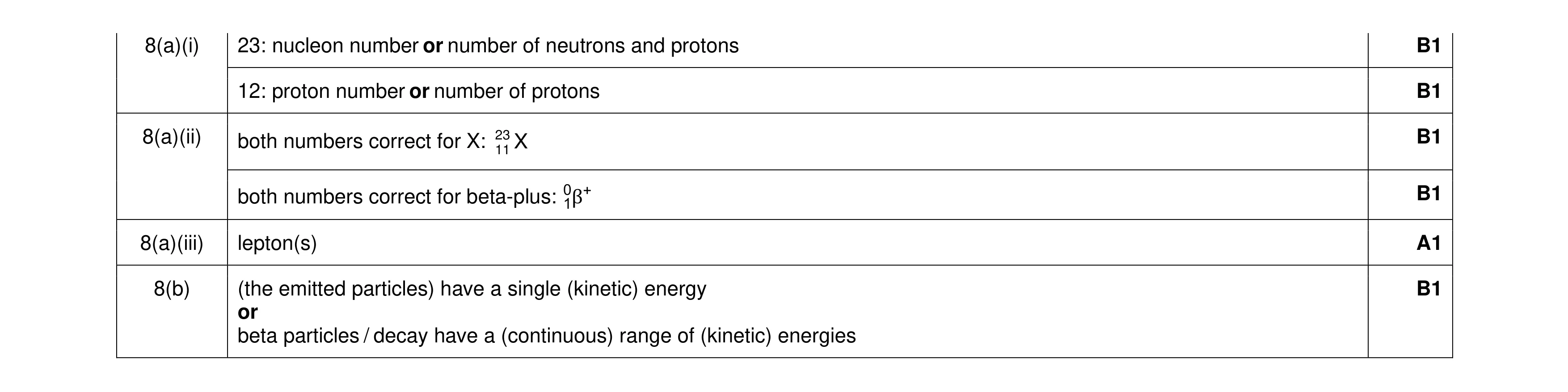 6
6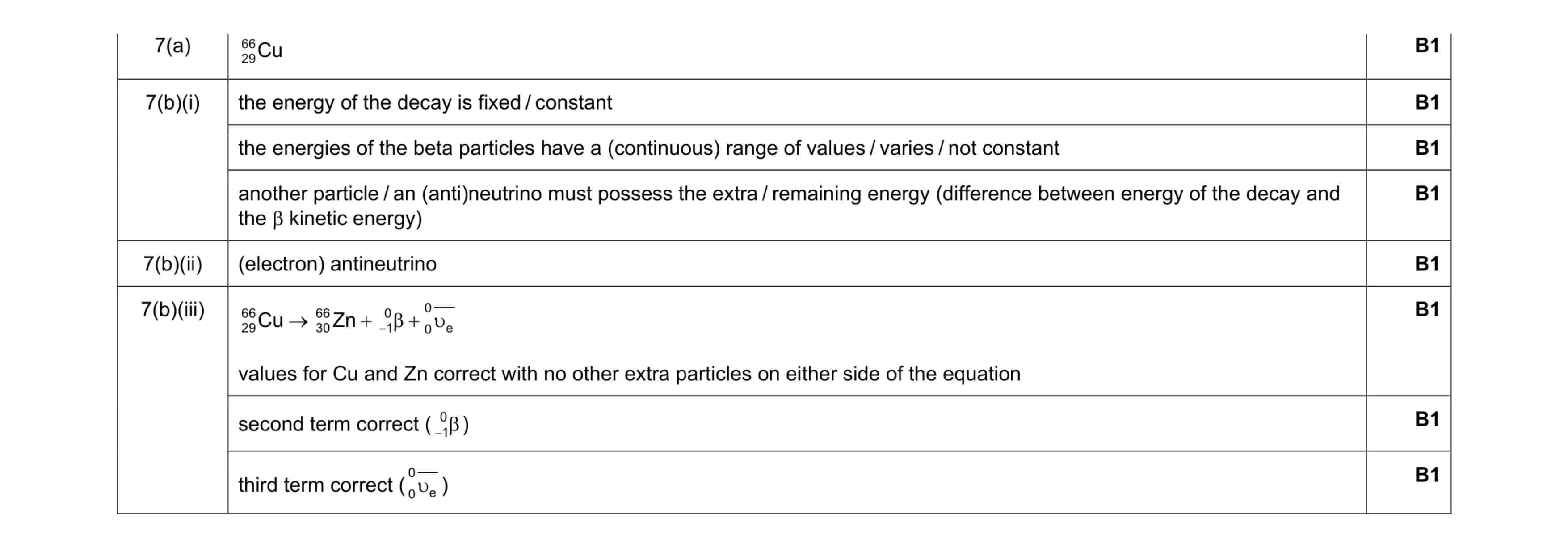 8
8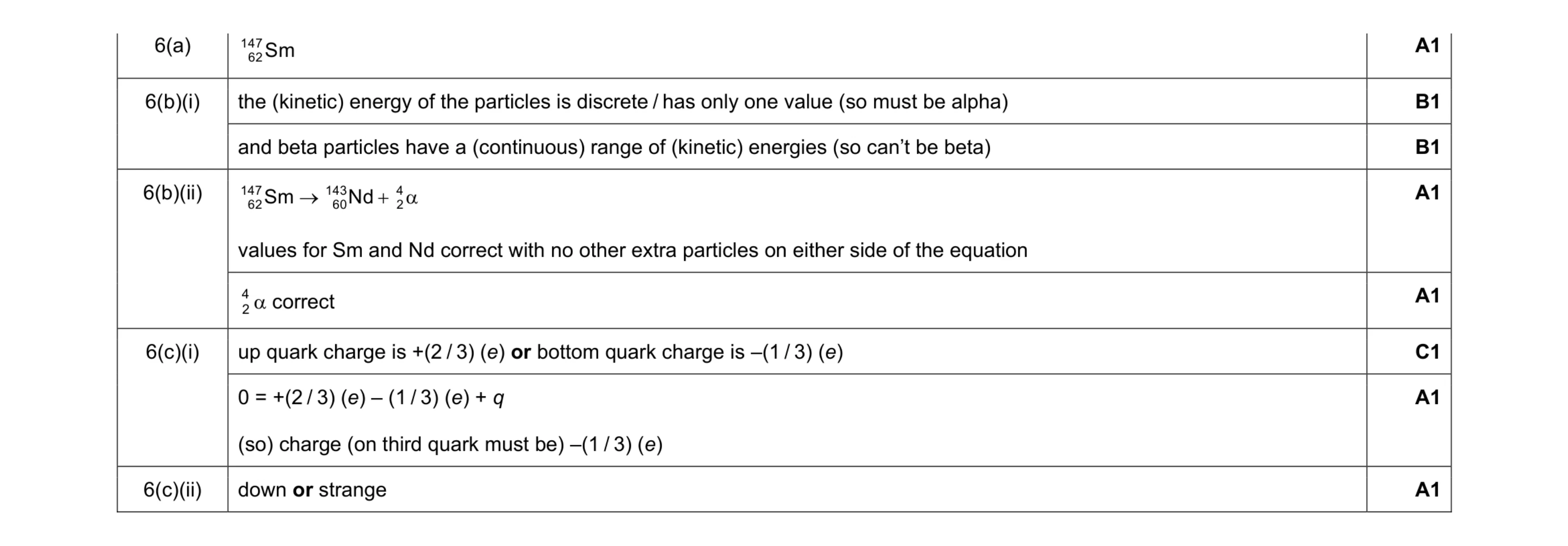 8
8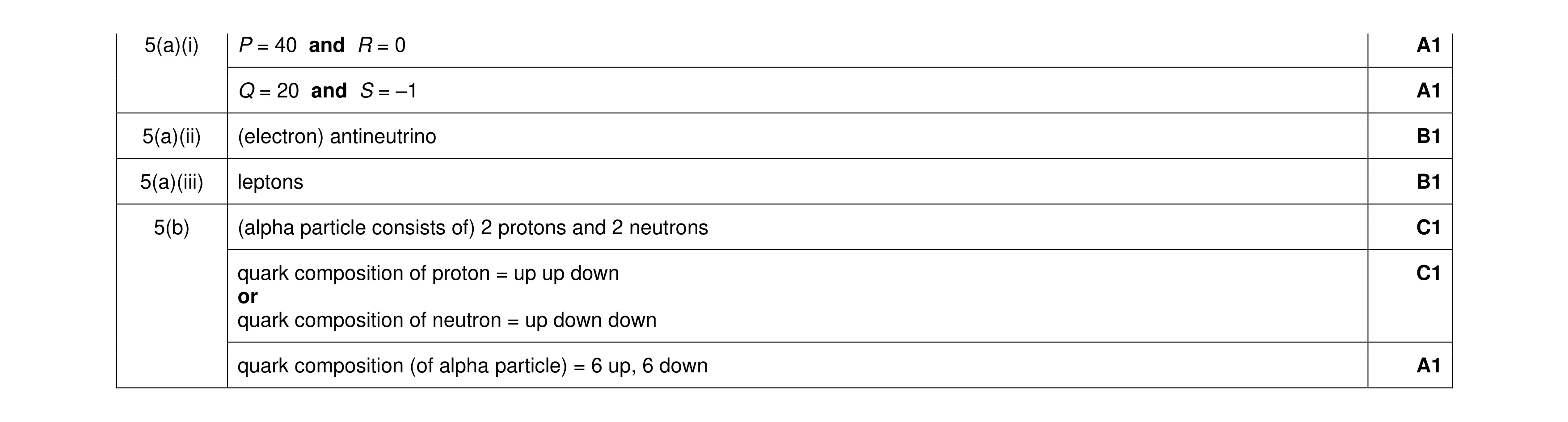 7
7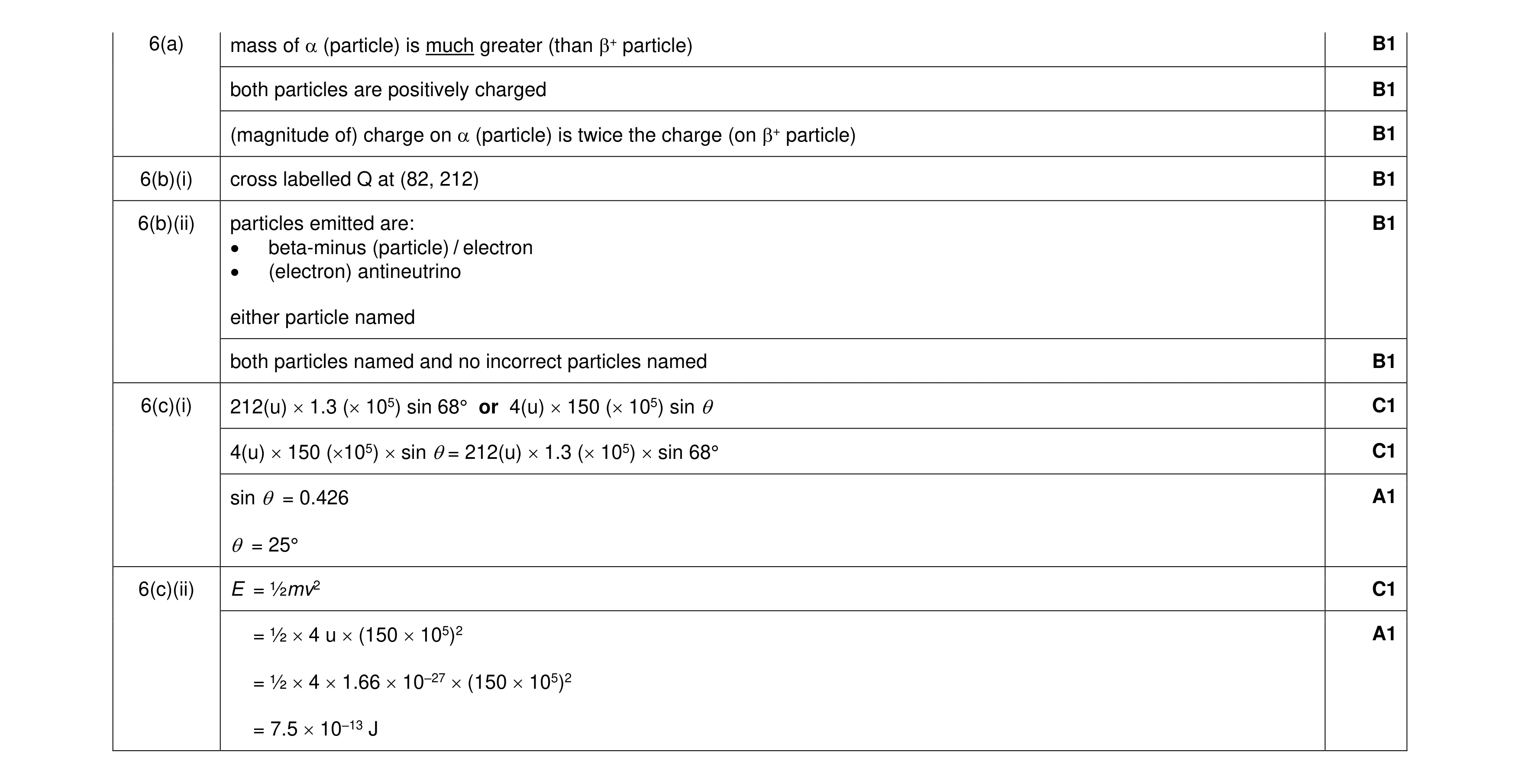 11
11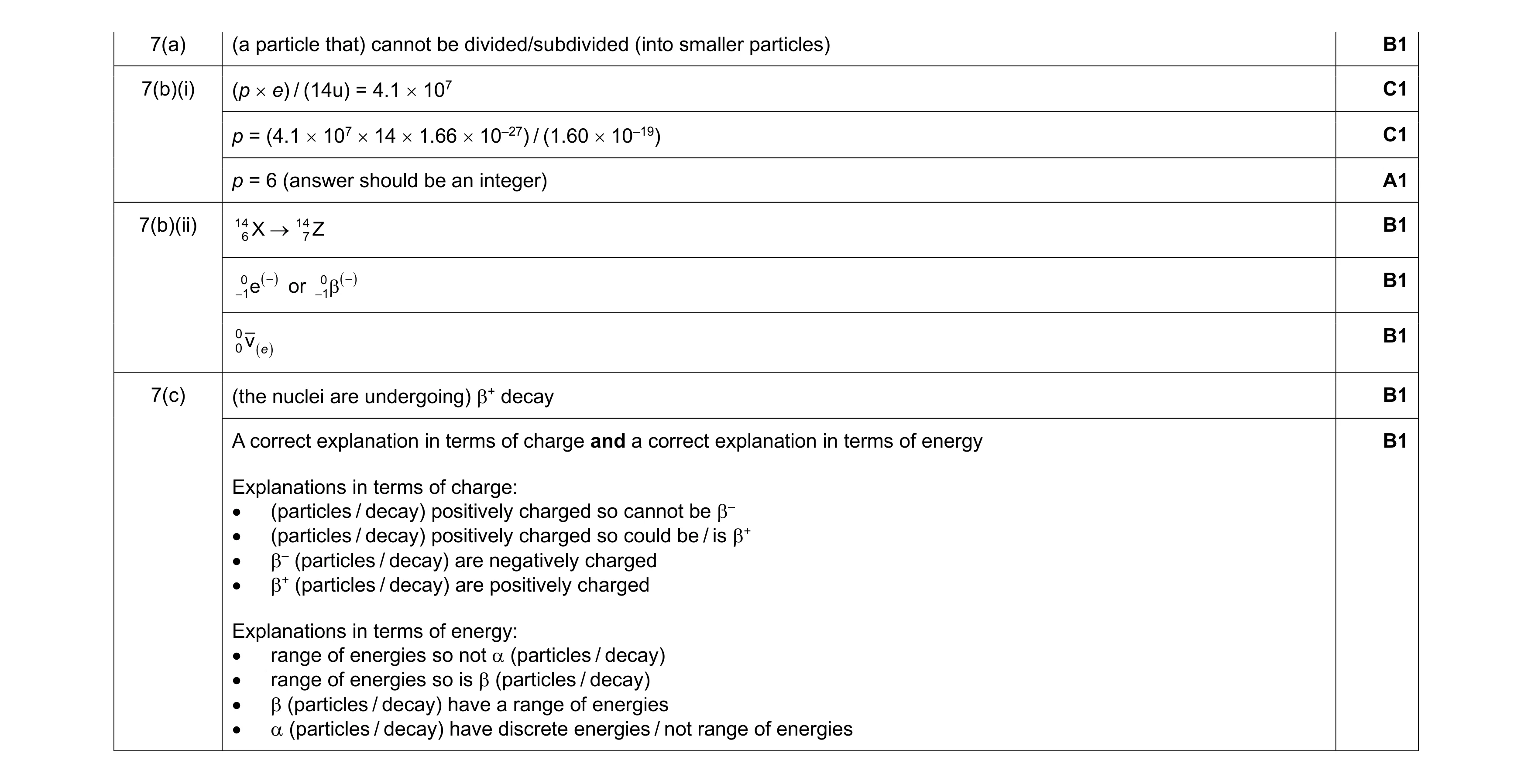 9
9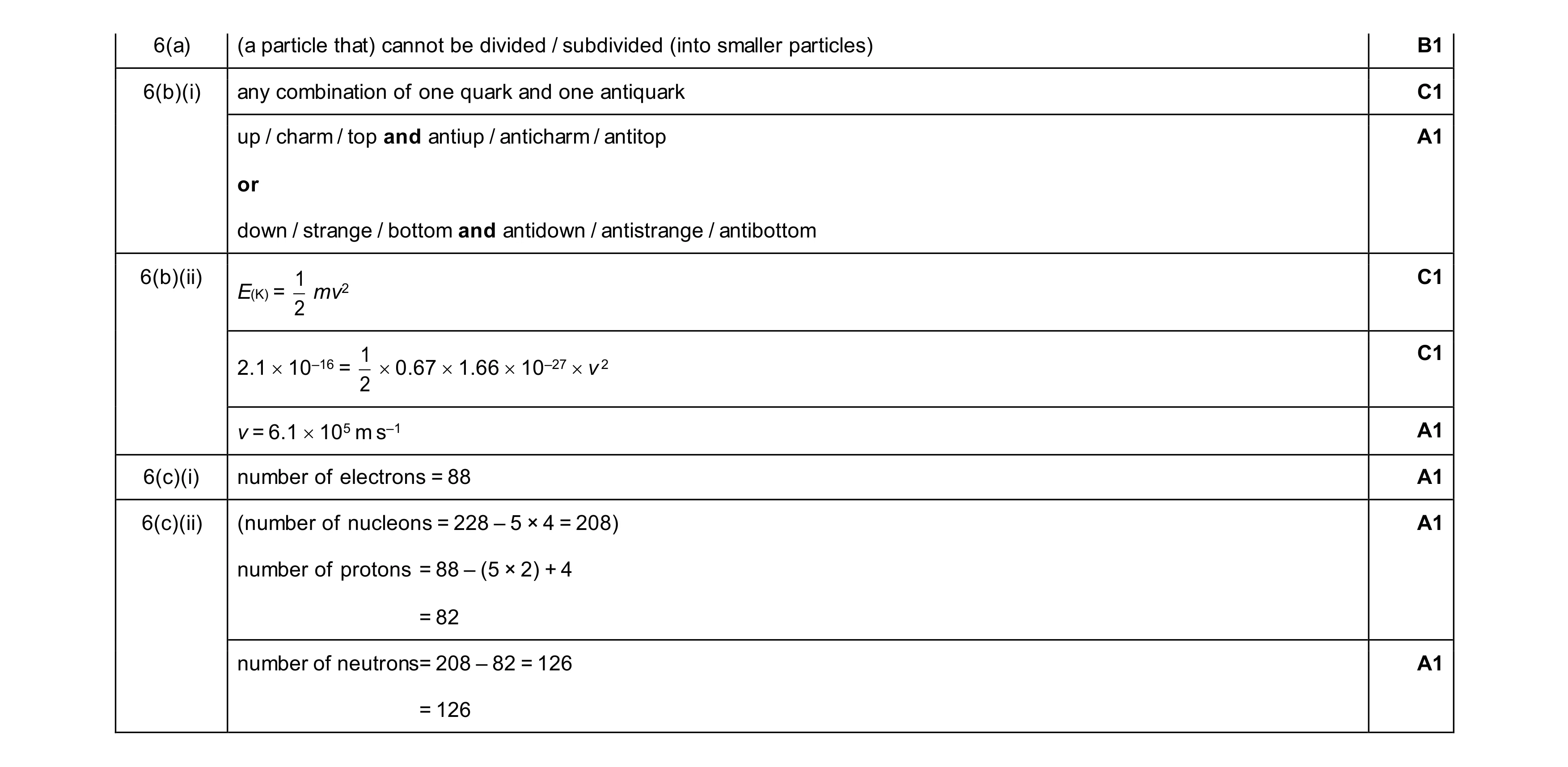 9
9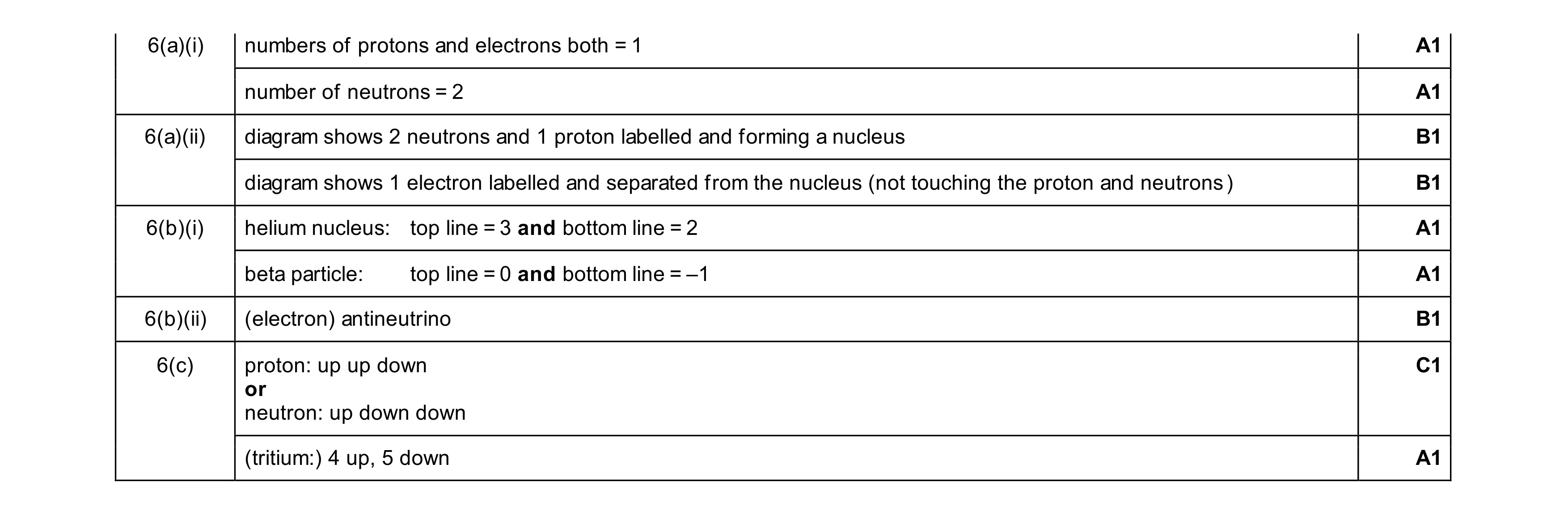 9
9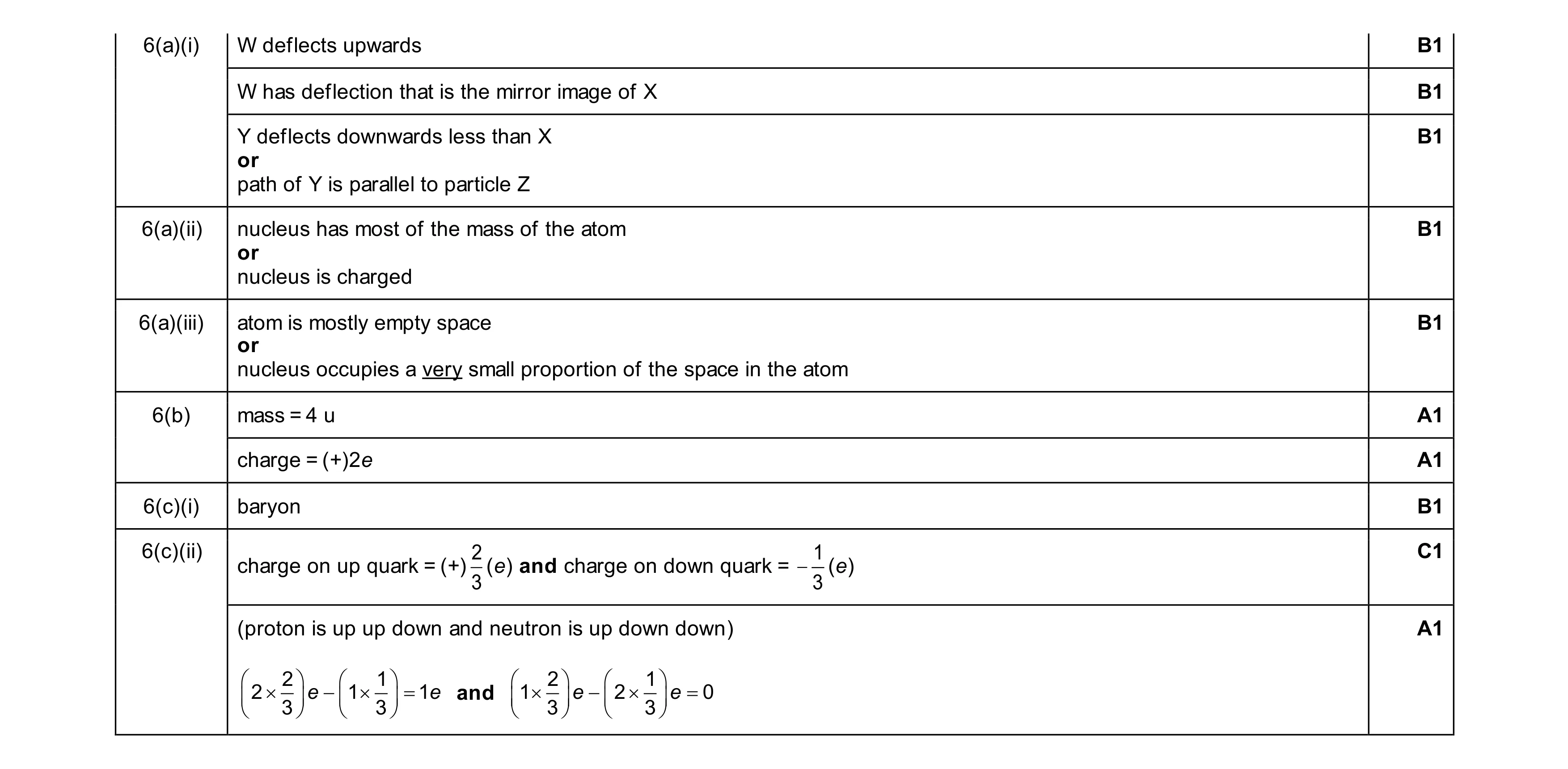 10
10