Cambridge A Level Physics 9702 — 2016 Oct/Nov Paper 2 · Variant 2
9702/22/O/N/16 · 6 questions · 60 marks · ≈68 min
The question paper and its mark scheme, free to read here and free to download. This is Cambridge’s own paper, exactly as it was sat.
Question paper16 pages

Mark scheme5 pages
Answers below. Sit the paper first if you are practising.
Questions as text
Question 1
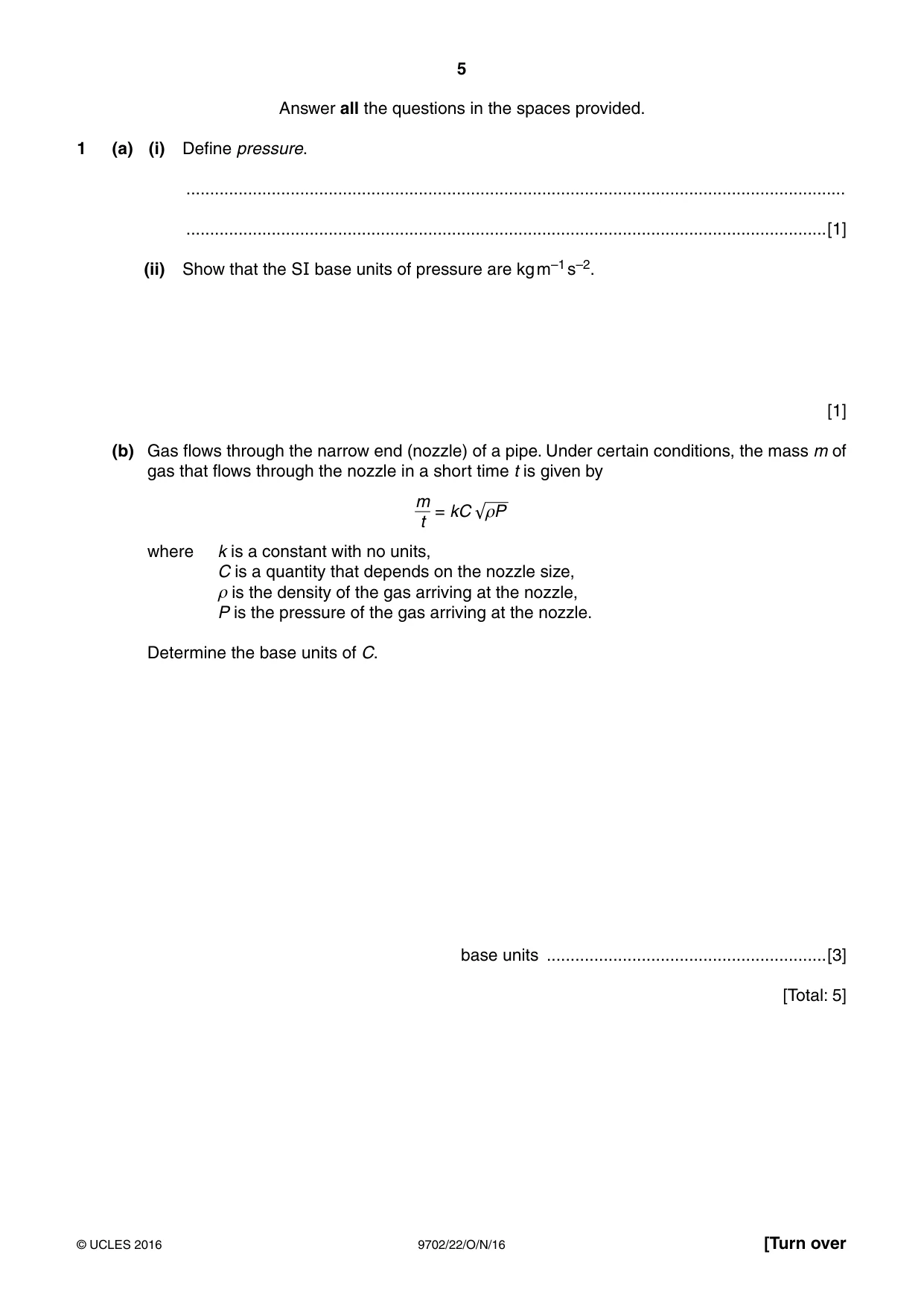
1 (a) (i) Define pressure. ........................................................................................................................................... .......................................................................................................................................[1] (ii) Show that the SI base units of pressure are kg m–1 s–2. [1] (b) Gas flows through the narrow end (nozzle) of a pipe. Under certain conditions, the mass m of gas that flows through the nozzle in a short time t is given by m = kC ρP t where k is a constant with no units, C is a quantity that depends on the nozzle size, ρ is the density of the gas arriving at the nozzle, P is the pressure of the gas arriving at the nozzle. Determine the base units of C. base units ...........................................................[3] [Total: 5]
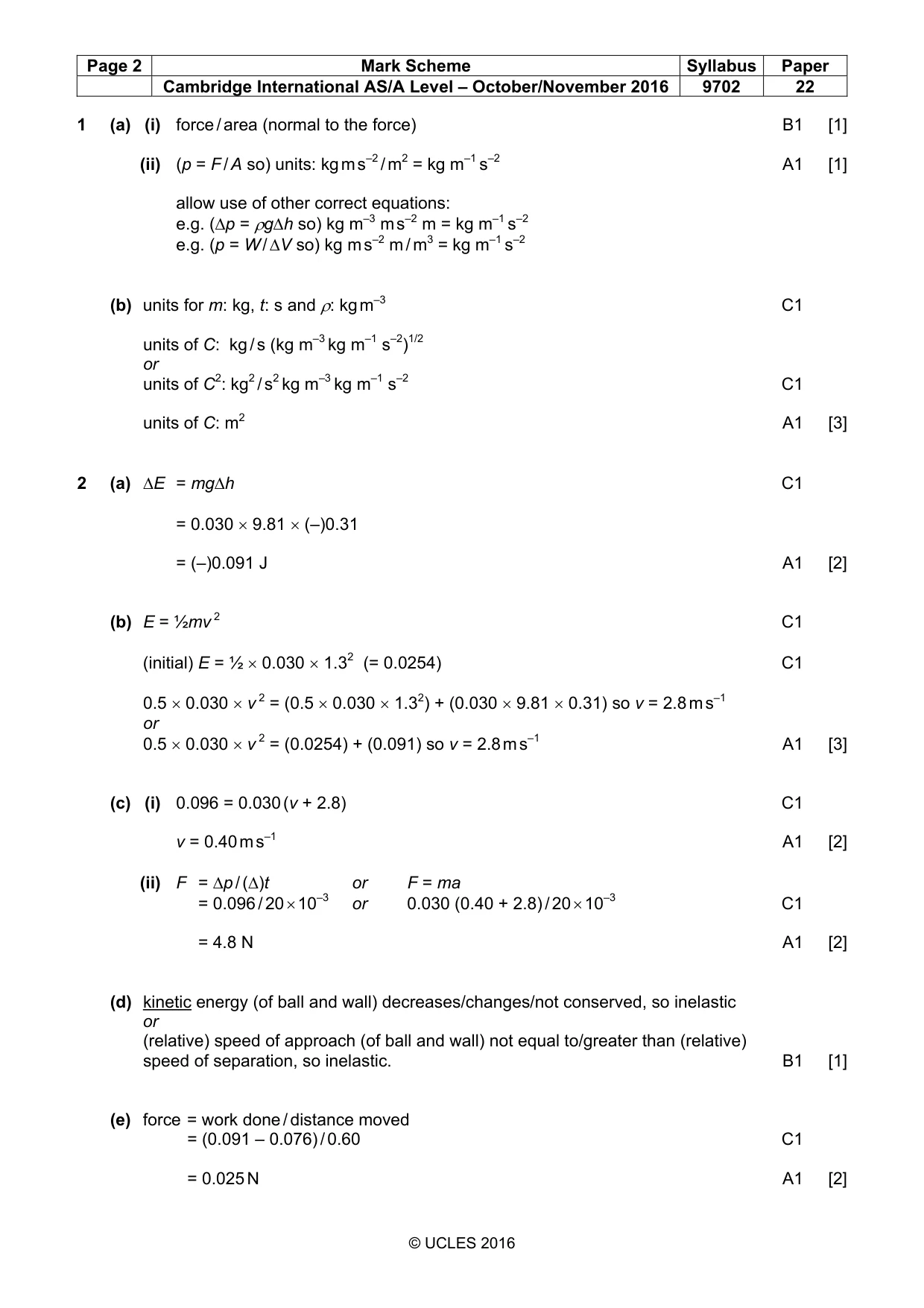
Mark scheme: 1 (a) (i) force / area (normal to the force) B1 [1] (ii) (p = F / A so) units: kg m s–2 / m2 = kg m–1 s–2 A1 [1] allow use of other correct equations: e.g. (∆p = ρg∆h so) kg m–3 m s–2 m = kg m–1 s–2 e.g. (p = W / ∆V so) kg m s–2 m / m3 = kg m–1 s–2 (b) units for m: kg, t: s and ρ: kg m–3 C1 units of C: kg / s (kg m–3 kg m–1 s–2)1/2 or units of C2: kg2 / s2 kg m–3 kg m–1 s–2 C1 units of C: m2 A1 [3]
Q2 · A ball of mass 0.030 kg moves along a curved track, as shown in Fig
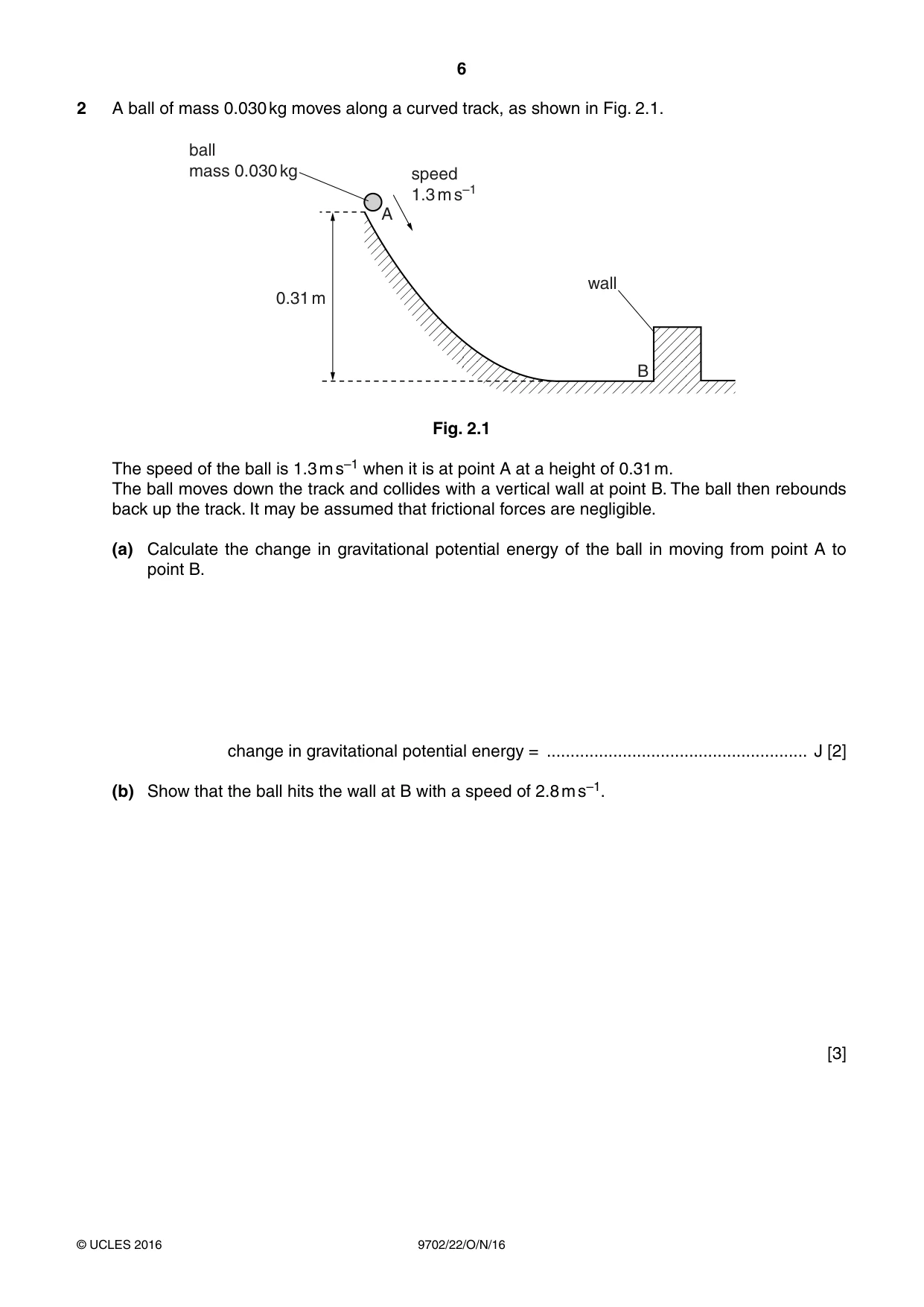
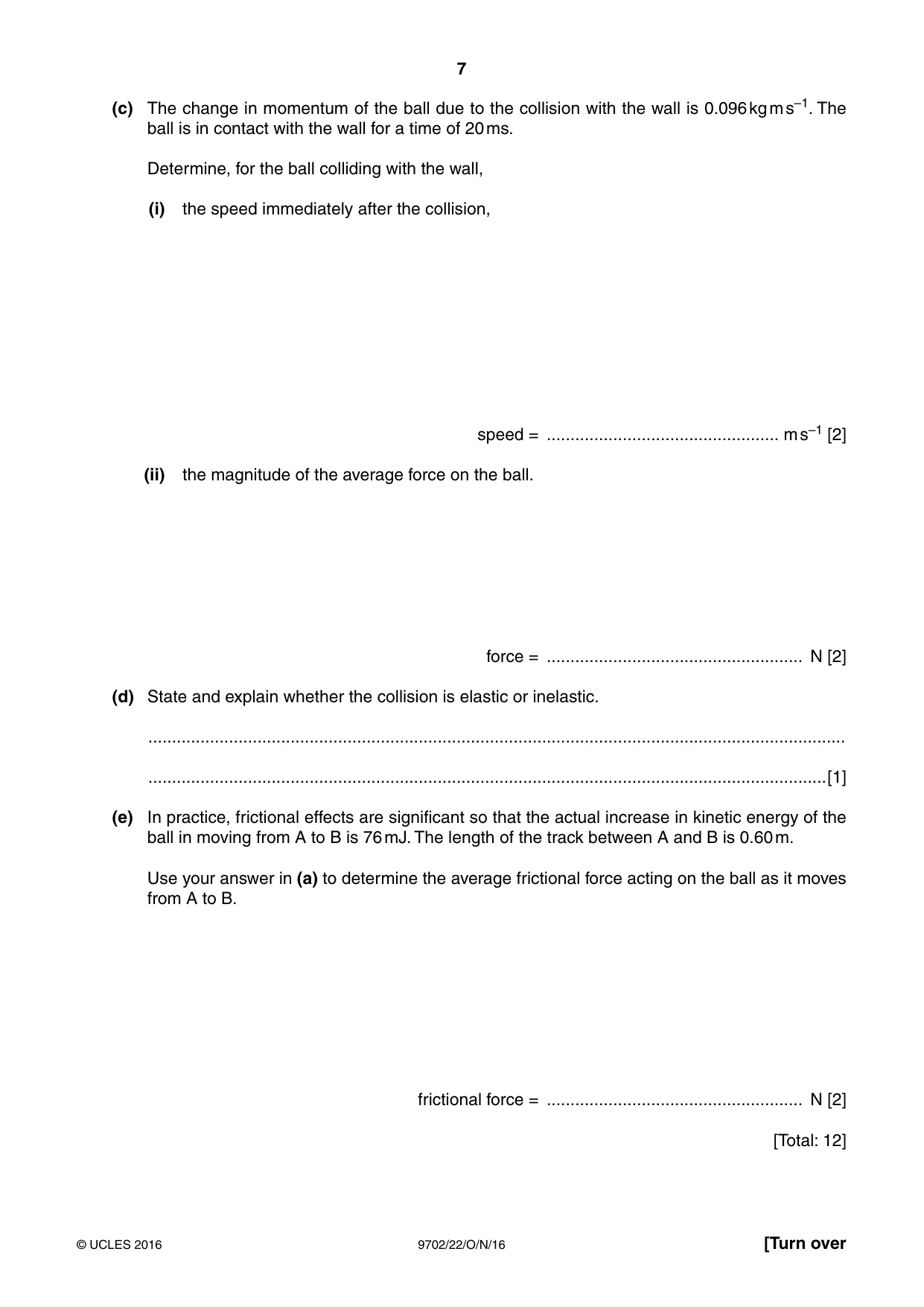
2 A ball of mass 0.030 kg moves along a curved track, as shown in Fig. 2.1. ball mass 0.030 kg speed 1.3 m s–1 A wall 0.31 m B Fig. 2.1 The speed of the ball is 1.3 m s–1 when it is at point A at a height of 0.31 m. The ball moves down the track and collides with a vertical wall at point B. The ball then rebounds back up the track. It may be assumed that frictional forces are negligible. (a) Calculate the change in gravitational potential energy of the ball in moving from point A to point B. change in gravitational potential energy = ....................................................... J [2] (b) Show that the ball hits the wall at B with a speed of 2.8 m s–1. [3] (c) The change in momentum of the ball due to the collision with the wall is 0.096 kg m s–1. The ball is in contact with the wall for a time of 20 ms. Determine, for the ball colliding with the wall, (i) the speed immediately after the collision, speed = ................................................. m s–1 [2] (ii) the magnitude of the average force on the ball. force = ...................................................... N [2] (d) State and explain whether the collision is elastic or inelastic. ................................................................................................................................................... ...............................................................................................................................................[1] (e) In practice, frictional effects are significant so that the actual increase in kinetic energy of the ball in moving from A to B is 76 mJ. The length of the track between A and B is 0.60 m. Use your answer in (a) to determine the average frictional force acting on the ball as it moves from A to B. frictional force = ...................................................... N [2] [Total: 12]
Mark scheme: 2 (a) ∆E = mg∆h C1 = 0.030 × 9.81 × (–)0.31 = (–)0.091 J A1 [2] (b) E = ½mv 2 C1 (initial) E = ½ × 0.030 × 1.32 (= 0.0254) C1 0.5 × 0.030 × v 2 = (0.5 × 0.030 × 1.32) + (0.030 × 9.81 × 0.31) so v = 2.8 m s–1 or 0.5 × 0.030 × v 2 = (0.0254) + (0.091) so v = 2.8 m s–1 A1 [3] (c) (i) 0.096 = 0.030 (v + 2.8) C1 v = 0.40 m s–1 A1 [2] (ii) F = ∆p / (∆)t or F = ma = 0.096 / 20 × 10–3 or 0.030 (0.40 + 2.8) / 20 × 10–3 C1 = 4.8 N A1 [2] (d) kinetic energy (of ball and wall) decreases/changes/not conserved, so inelastic or (relative) speed of approach (of ball and wall) not equal to/greater than (relative) speed of separation, so inelastic. B1 [1] (e) force = work done / distance moved = (0.091 – 0.076) / 0.60 C1 = 0.025 N A1 [2]
Q3 · State the two conditions for an object to be in equilibrium
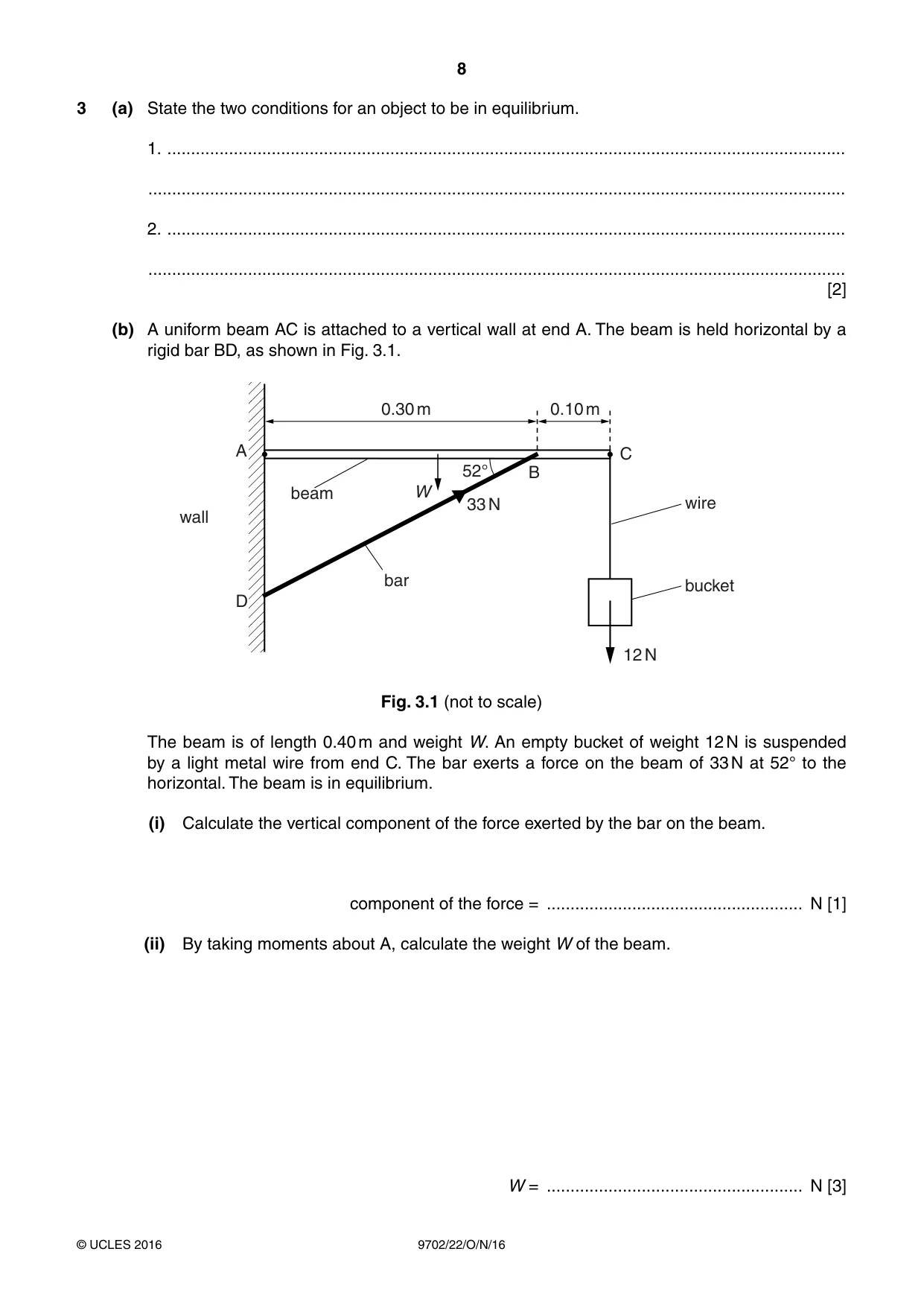
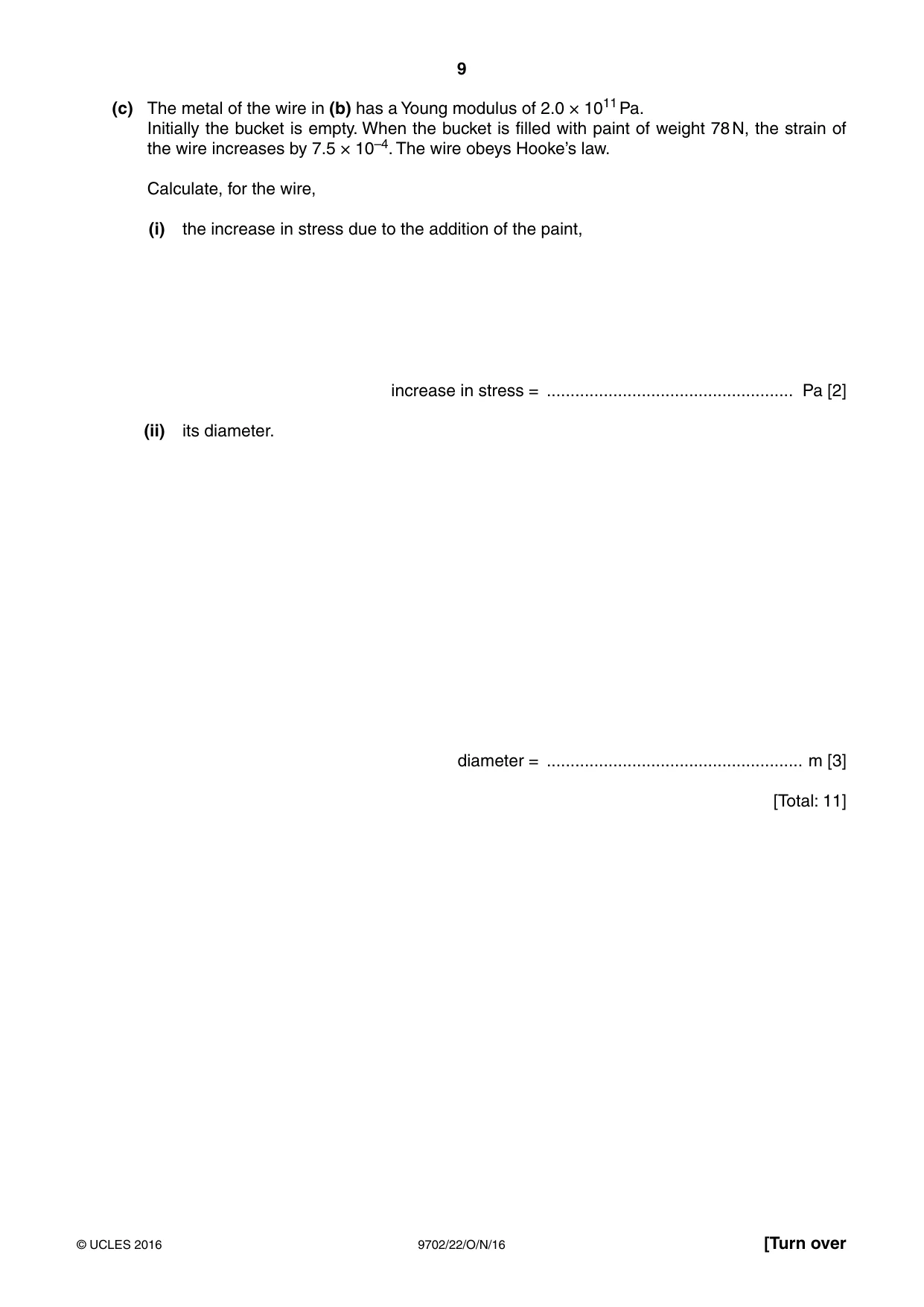
3 (a) State the two conditions for an object to be in equilibrium. 1. ............................................................................................................................................... ................................................................................................................................................... 2. ............................................................................................................................................... ................................................................................................................................................... [2] (b) A uniform beam AC is attached to a vertical wall at end A. The beam is held horizontal by a rigid bar BD, as shown in Fig. 3.1. 0.30 m 0.10 m A C 52° B beam : 33 N wire wall bar bucket D 12 N Fig. 3.1 (not to scale) The beam is of length 0.40 m and weight W. An empty bucket of weight 12 N is suspended by a light metal wire from end C. The bar exerts a force on the beam of 33 N at 52° to the horizontal. The beam is in equilibrium. (i) Calculate the vertical component of the force exerted by the bar on the beam. component of the force = ...................................................... N [1] (ii) By taking moments about A, calculate the weight W of the beam. W = ...................................................... N [3] (c) The metal of the wire in (b) has a Young modulus of 2.0 × 10¹¹ Pa. Initially the bucket is empty. When the bucket is filled with paint of weight 78 N, the strain of the wire increases by 7.5 × 10⁻⁴. The wire obeys Hooke’s law. Calculate, for the wire, (i) the increase in stress due to the addition of the paint, increase in stress = .................................................... Pa [2] (ii) its diameter. diameter = ...................................................... m [3] [Total: 11]
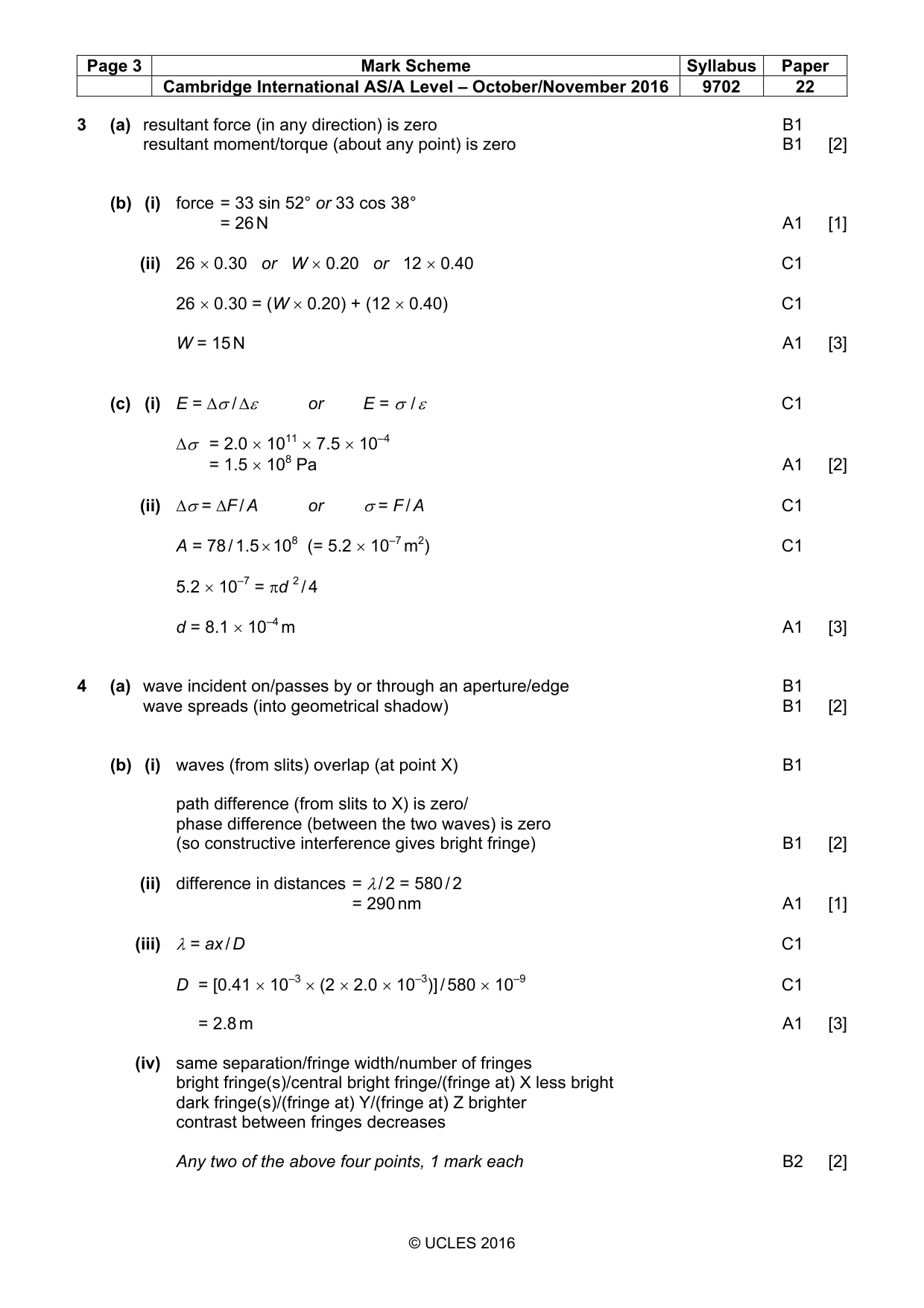
Mark scheme: 3 (a) resultant force (in any direction) is zero B1 resultant moment/torque (about any point) is zero B1 [2] (b) (i) force = 33 sin 52° or 33 cos 38° = 26 N A1 [1] (ii) 26 × 0.30 or W × 0.20 or 12 × 0.40 C1 26 × 0.30 = (W × 0.20) + (12 × 0.40) C1 W = 15 N A1 [3] (c) (i) E = ∆σ/ ∆ε or E = σ / ε C1 ∆σ = 2.0 × 1011 × 7.5 × 10–4 = 1.5 × 10⁸ Pa A1 [2] (ii) ∆σ= ∆F / A or σ= F / A C1 A = 78 / 1.5 × 10⁸ (= 5.2 × 10⁻⁷ m2) C1 5.2 × 10–7 = πd 2 / 4 d = 8.1 × 10⁻⁴ m A1 [3]
Q4 · State what is meant by the diffraction of a wave
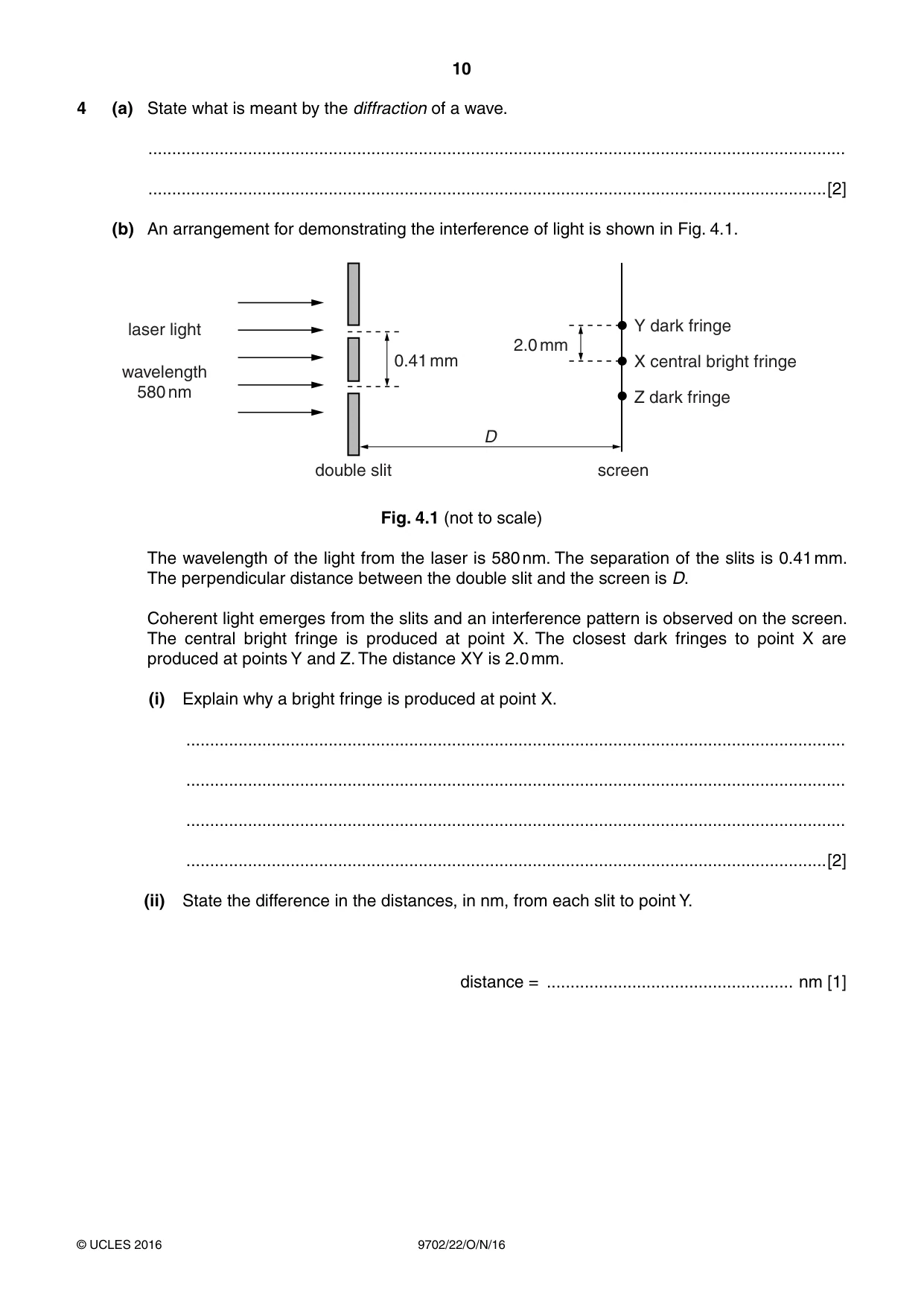
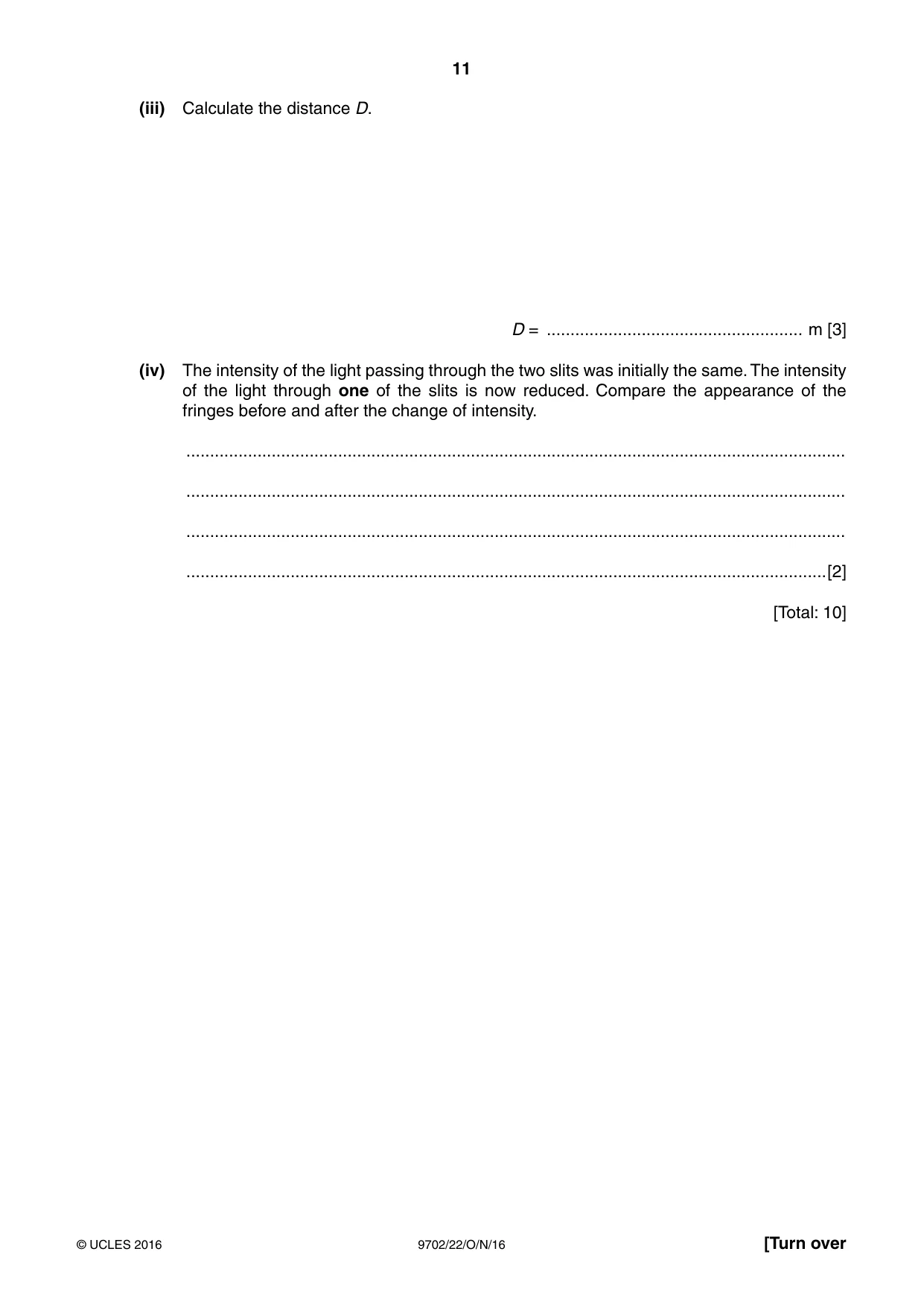
4 (a) State what is meant by the diffraction of a wave. ................................................................................................................................................... ...............................................................................................................................................[2] (b) An arrangement for demonstrating the interference of light is shown in Fig. 4.1. laser light Y dark fringe 2.0 mm 0.41 mm X central bright fringe wavelength 580 nm Z dark fringe ' double slit screen Fig. 4.1 (not to scale) The wavelength of the light from the laser is 580 nm. The separation of the slits is 0.41 mm. The perpendicular distance between the double slit and the screen is D. Coherent light emerges from the slits and an interference pattern is observed on the screen. The central bright fringe is produced at point X. The closest dark fringes to point X are produced at points Y and Z. The distance XY is 2.0 mm. (i) Explain why a bright fringe is produced at point X. ........................................................................................................................................... ........................................................................................................................................... ........................................................................................................................................... .......................................................................................................................................[2] (ii) State the difference in the distances, in nm, from each slit to point Y. distance = .................................................... nm [1] (iii) Calculate the distance D. D = ...................................................... m [3] (iv) The intensity of the light passing through the two slits was initially the same. The intensity of the light through one of the slits is now reduced. Compare the appearance of the fringes before and after the change of intensity. ........................................................................................................................................... ........................................................................................................................................... ........................................................................................................................................... .......................................................................................................................................[2] [Total: 10]
Mark scheme: 4 (a) wave incident on/passes by or through an aperture/edge B1 wave spreads (into geometrical shadow) B1 [2] (b) (i) waves (from slits) overlap (at point X) B1 path difference (from slits to X) is zero/ phase difference (between the two waves) is zero (so constructive interference gives bright fringe) B1 [2] (ii) difference in distances = λ/ 2 = 580 / 2 = 290 nm A1 [1] (iii) λ= ax / D C1 D = [0.41 × 10–3 × (2 × 2.0 × 10–3)] / 580 × 10–9 C1 = 2.8 m A1 [3] (iv) same separation/fringe width/number of fringes bright fringe(s)/central bright fringe/(fringe at) X less bright dark fringe(s)/(fringe at) Y/(fringe at) Z brighter contrast between fringes decreases Any two of the above four points, 1 mark each B2 [2]
Q5 · State Kirchhoff’s second law
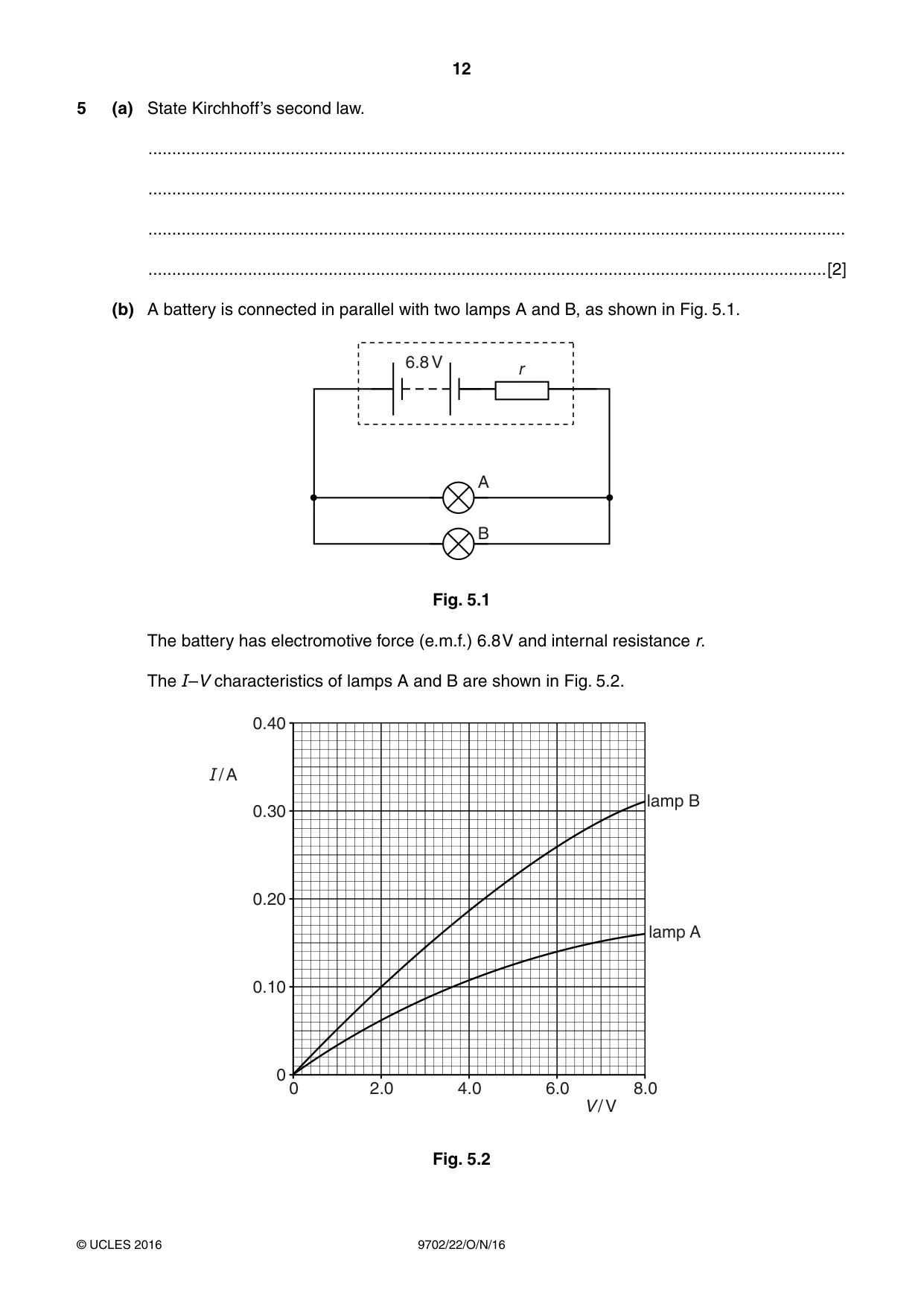
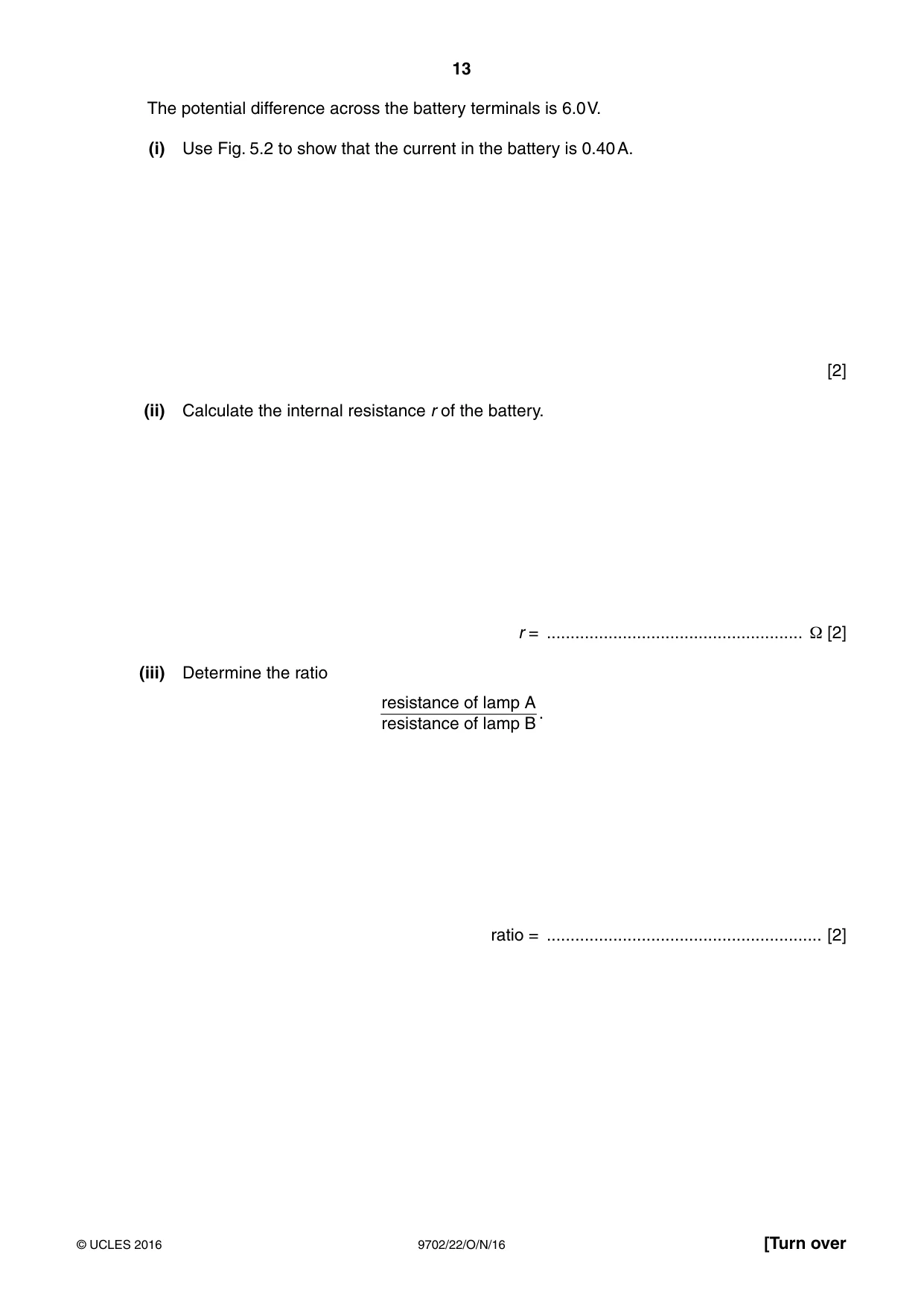
5 (a) State Kirchhoff’s second law. ................................................................................................................................................... ................................................................................................................................................... ................................................................................................................................................... ...............................................................................................................................................[2] (b) A battery is connected in parallel with two lamps A and B, as shown in Fig. 5.1. 6.8 V U A B Fig. 5.1 The battery has electromotive force (e.m.f.) 6.8 V and internal resistance r. The I–V characteristics of lamps A and B are shown in Fig. 5.2. 0.40 I / A ODPS % 0.30 0.20 ODPS $ 0.10 0 0 2.0 4.0 6.0 8.0 9 / V Fig. 5.2 The potential difference across the battery terminals is 6.0 V. (i) Use Fig. 5.2 to show that the current in the battery is 0.40 A. [2] (ii) Calculate the internal resistance r of the battery. r = ...................................................... Ω [2] (iii) Determine the ratio resistance of lamp A . resistance of lamp B ratio = .......................................................... [2] (iv) Determine 1. the total power produced by the battery, power = ..................................................... W [2] 2. the efficiency of the battery in the circuit. efficiency = .......................................................... [2] [Total: 12]
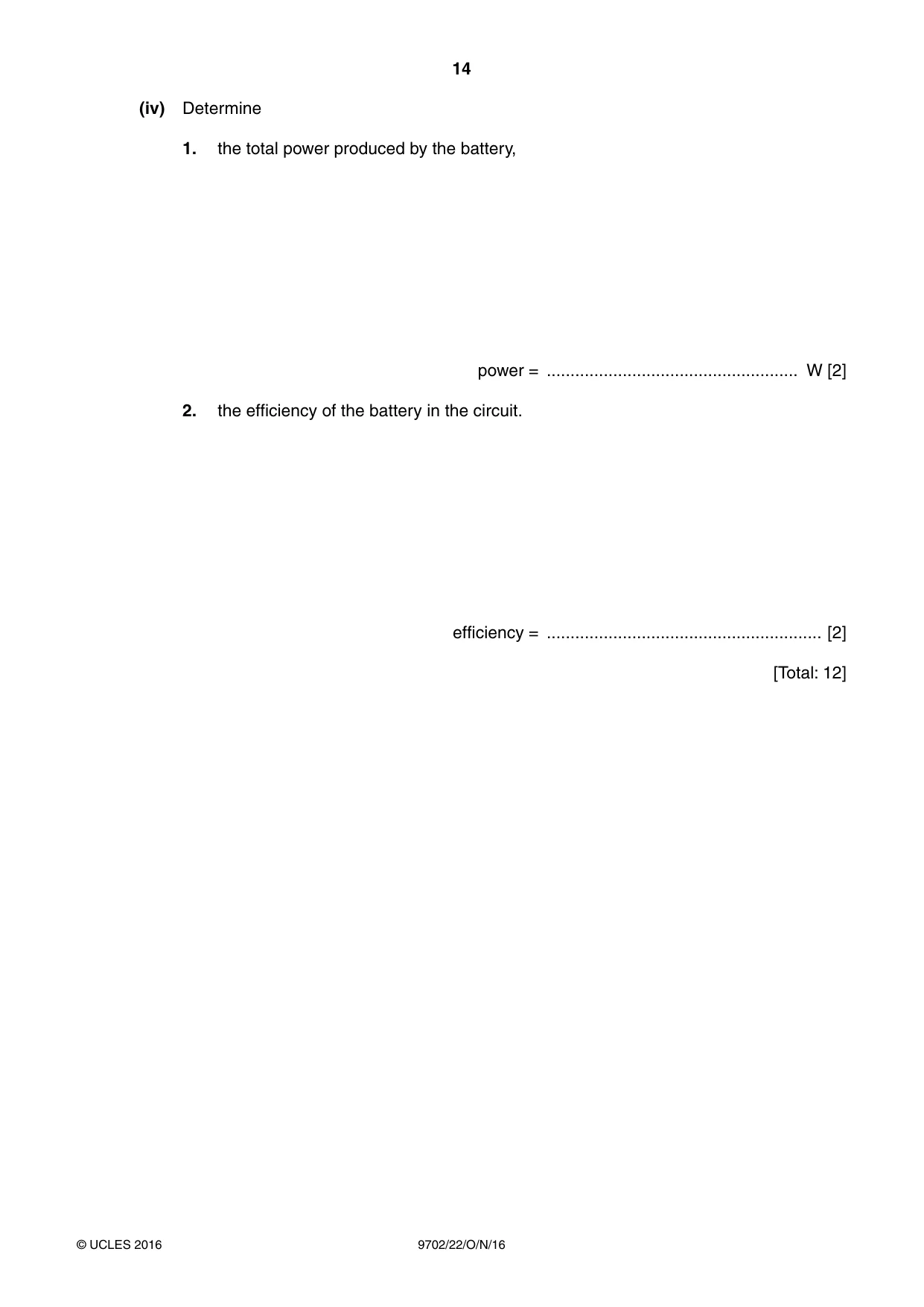
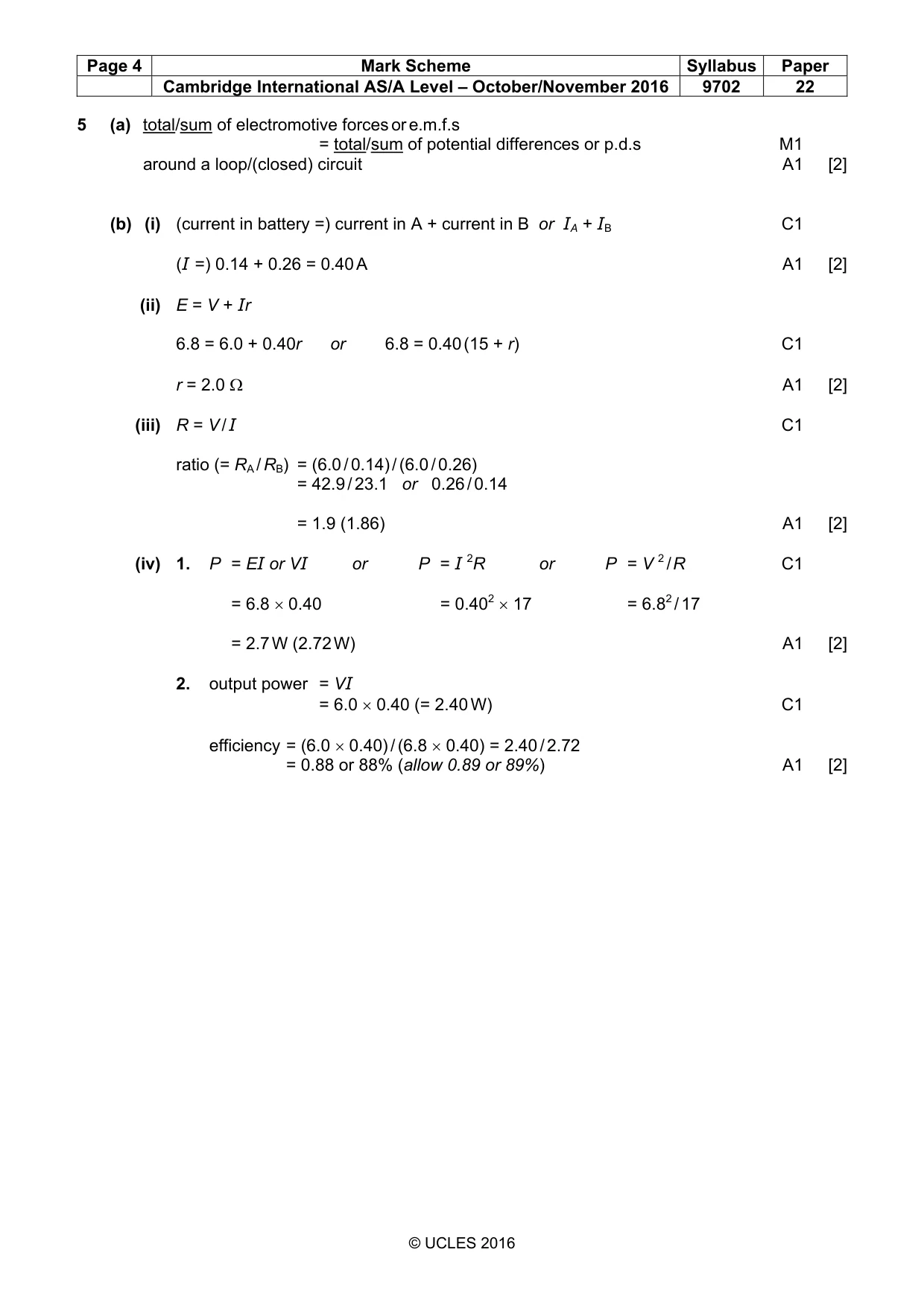
Mark scheme: 5 (a) total/sum of electromotive forces or e.m.f.s = total/sum of potential differences or p.d.s M1 around a loop/(closed) circuit A1 [2] (b) (i) (current in battery =) current in A + current in B or IA + IB C1 (I =) 0.14 + 0.26 = 0.40 A A1 [2] (ii) E = V + Ir 6.8 = 6.0 + 0.40r or 6.8 = 0.40 (15 + r) C1 r = 2.0 Ω A1 [2] (iii) R = V / I C1 ratio (= RA / RB) = (6.0 / 0.14) / (6.0 / 0.26) = 42.9 / 23.1 or 0.26 / 0.14 = 1.9 (1.86) A1 [2] (iv) 1. P = EI or VI or P = I 2R or P = V 2 / R C1 = 6.8 × 0.40 = 0.402 × 17 = 6.82 / 17 = 2.7 W (2.72 W) A1 [2] 2. output power = VI = 6.0 × 0.40 (= 2.40 W) C1 efficiency = (6.0 × 0.40) / (6.8 × 0.40) = 2.40 / 2.72 = 0.88 or 88% (allow 0.89 or 89%) A1 [2]
Q6 · State one difference between a hadron and a lepton
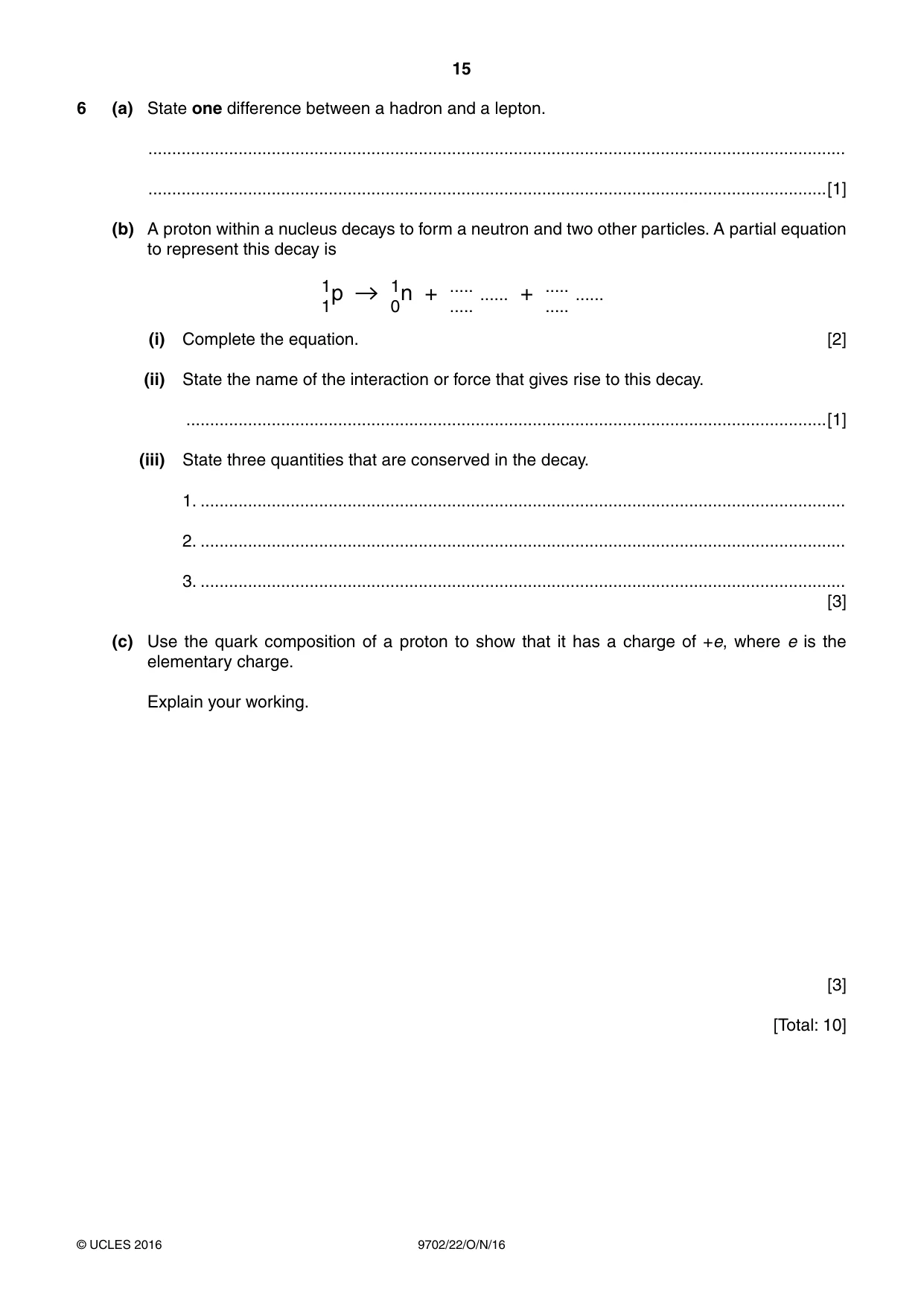
6 (a) State one difference between a hadron and a lepton. ................................................................................................................................................... ...............................................................................................................................................[1] (b) A proton within a nucleus decays to form a neutron and two other particles. A partial equation to represent this decay is ...... ...... + 11p 10n + .......... ..... ..... (i) Complete the equation. [2] (ii) State the name of the interaction or force that gives rise to this decay. .......................................................................................................................................[1] (iii) State three quantities that are conserved in the decay. 1. ........................................................................................................................................ 2. ........................................................................................................................................ 3. ........................................................................................................................................ [3] (c) Use the quark composition of a proton to show that it has a charge of +e, where e is the elementary charge. Explain your working. [3] [Total: 10]
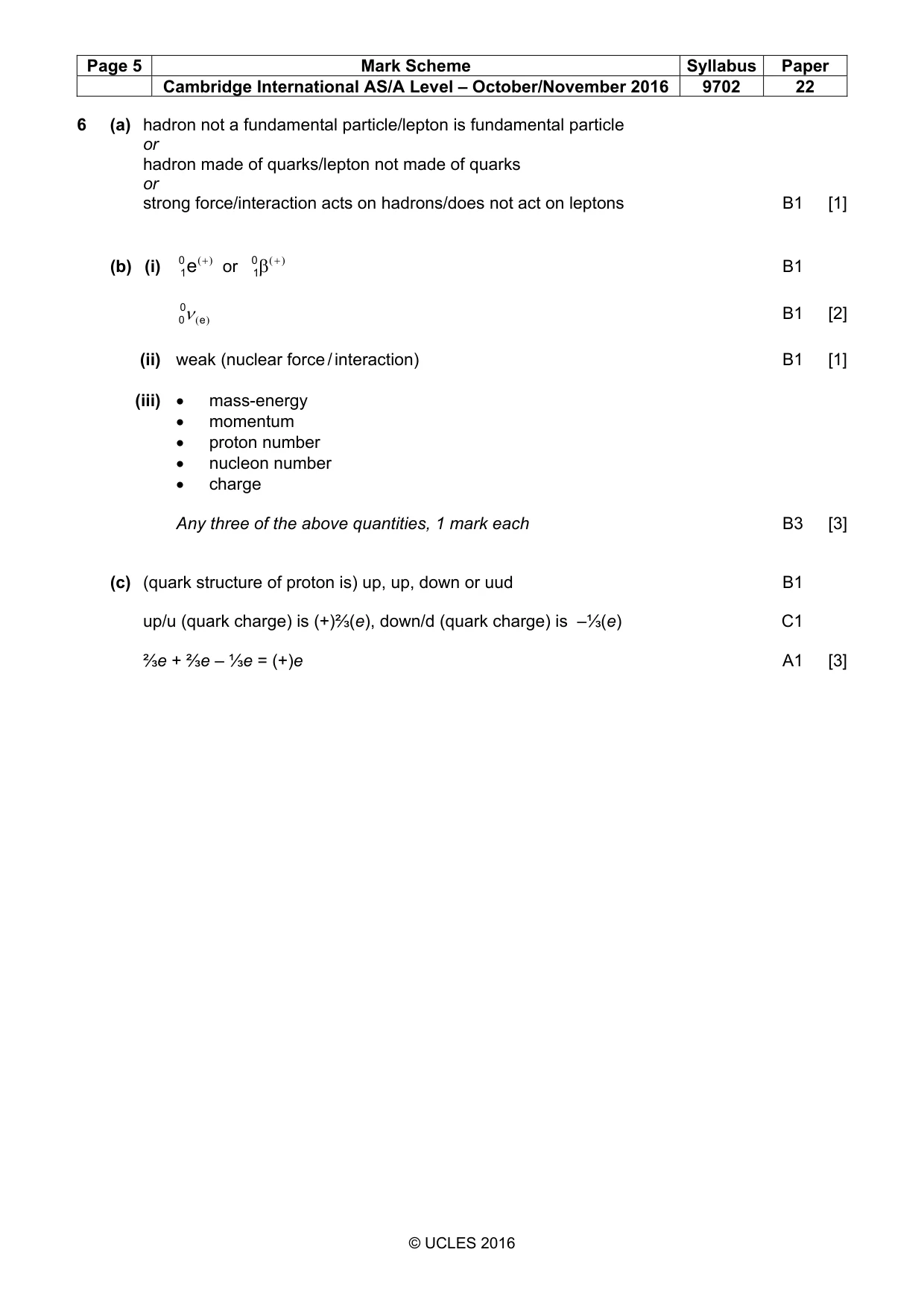
Mark scheme: 6 (a) hadron not a fundamental particle/lepton is fundamental particle or hadron made of quarks/lepton not made of quarks or strong force/interaction acts on hadrons/does not act on leptons B1 [1] (b) (i) 01 e (+ ) or 01(β + ) B1 0ν0 (e ) B1 [2] (ii) weak (nuclear force / interaction) B1 [1] (iii) • mass-energy • momentum • proton number • nucleon number • charge Any three of the above quantities, 1 mark each B3 [3] (c) (quark structure of proton is) up, up, down or uud B1 up/u (quark charge) is (+)⅔(e), down/d (quark charge) is –⅓(e) C1 ⅔e + ⅔e – ⅓e = (+)e A1 [3]
What was in this paper
The subtopics covered by these 6 questions, and how many questions each got. Open one in a new tab to see every Cambridge question on it.
What you needed in this session
Cambridge’s own grade thresholds for 2016 Oct/Nov, Paper 2 · Variant 2. A higher threshold means an easier paper — the bar moves with how the cohort did.