Questions as text
Q1 · Uranium-234 is radioactive and emits α-particles at what appears to be a constant rate 9702/41 Oct/Nov 2006
8 Uranium-234 is radioactive and emits α-particles at what appears to be a constant rate. A sample of Uranium-234 of mass 2.65 µg is found to have an activity of 604 Bq. (a) Calculate, for this sample of Uranium-234, (i) the number of nuclei, number = ………………………… [2] (ii) the decay constant, decay constant = ………………………… s–1 [2] (iii) the half-life in years. half-life = ………………………… years [2] Use (b) Suggest why the activity of the Uranium-234 appears to be constant. … … [1] (c) Suggest why a measurement of the mass and the activity of a radioactive isotope is not an accurate means of determining its half-life if the half-life is approximately one hour. … … [1]
8 marks
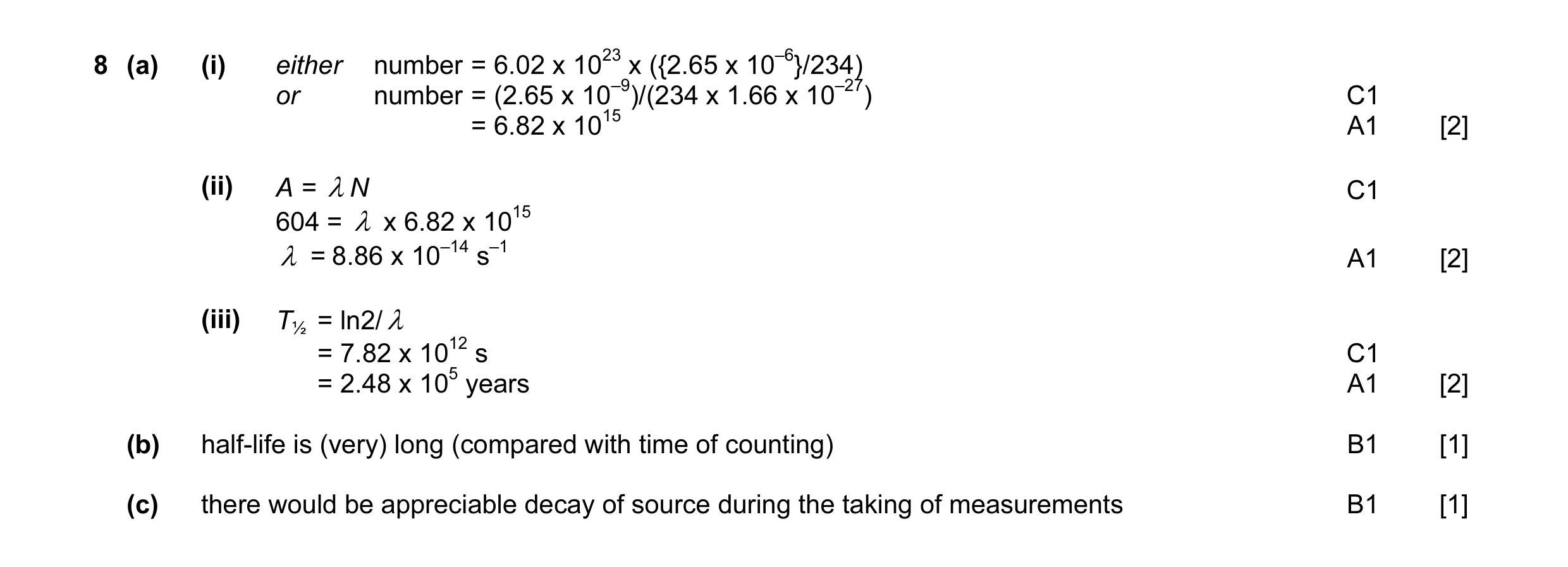
Mark scheme: 8 (a) (i) either number = 6.02 x 10²³ x ({2.65 x 10⁻⁶}/234) or number = (2.65 x 10⁻⁹)/(234 x 1.66 x 10–27) C1 = 6.82 x 10¹⁵ A1 [2] (ii) A = λ N C1 604 = λ x 6.82 x 10¹⁵ λ = 8.86 x 10⁻¹⁴ s–1 A1 [2] (iii) T½ = ln2/ λ = 7.82 x 10¹² s C1 = 2.48 x 10⁵ years A1 [2] (b) half-life is (very) long (compared with time of counting) B1 [1] (c) there would be appreciable decay of source during the taking of measurements B1 [1]
This question in 9702/41 Oct/Nov 2006
Q2 · A block diagram showing part of a mobile phone handset used for sending a signal to a… 9702/41 May/June 2007
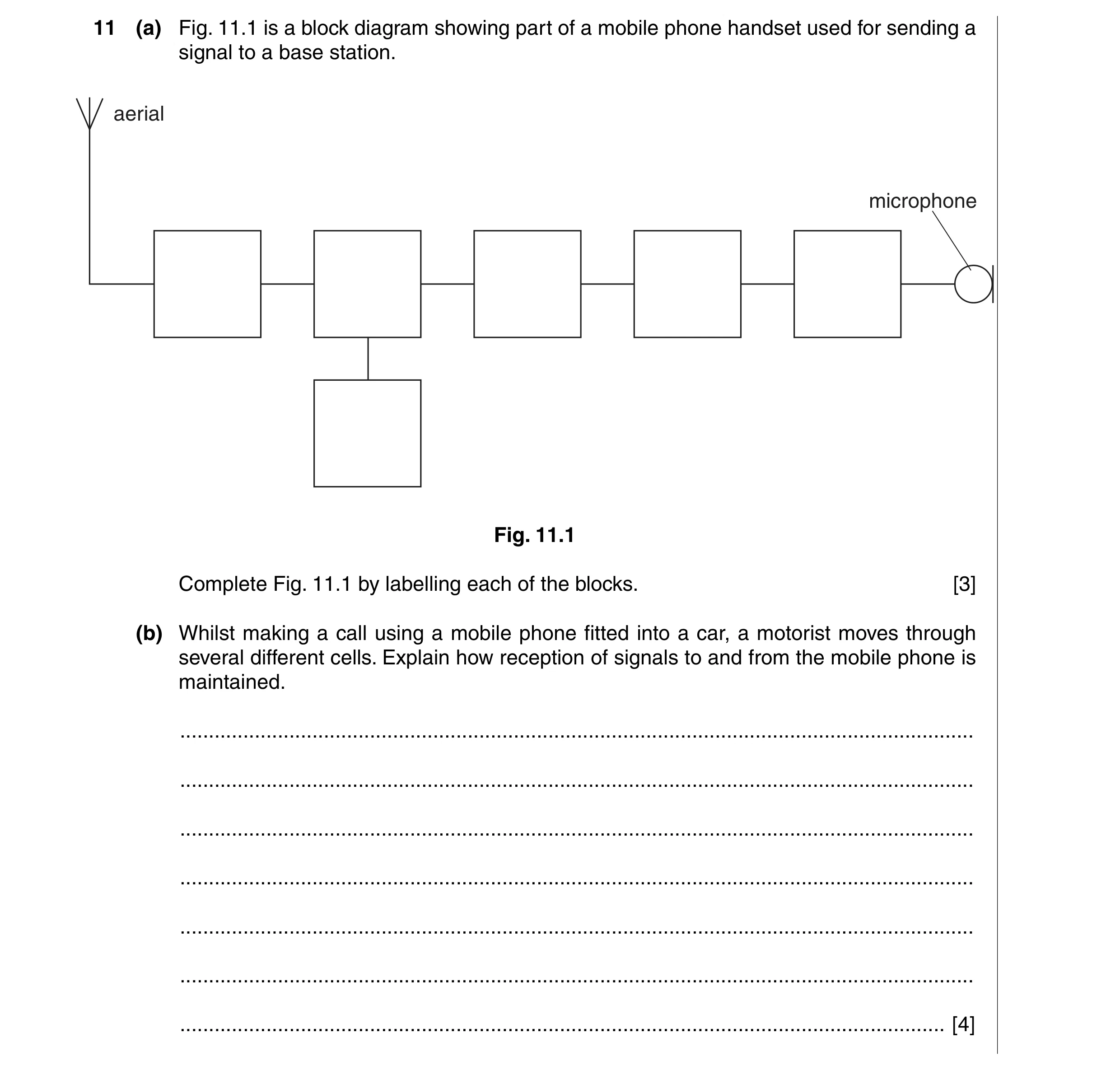
11 (a) Fig. 11.1 is a block diagram showing part of a mobile phone handset used for sending a signal to a base station. aerial microphone Fig. 11.1 Complete Fig. 11.1 by labelling each of the blocks. [3] (b) Whilst making a call using a mobile phone fitted into a car, a motorist moves through several different cells. Explain how reception of signals to and from the mobile phone is maintained. … … … … … … … [4]
7 marks
Mark scheme: 11 (a) modulator and oscillator identified B1 both amplifiers identified correctly B1 ADC and parallel-to serial converter identified B1 [3] (b) computer at cellular exchange B1 monitors signal strength B1 switches call from one base station to another B1 to maintain maximum signal strength B1 [4]
This question in 9702/41 May/June 2007
Q3 · The Millikan oil-drop experiment enabled the charge on the electron to be determined 9702/41 May/June 2008
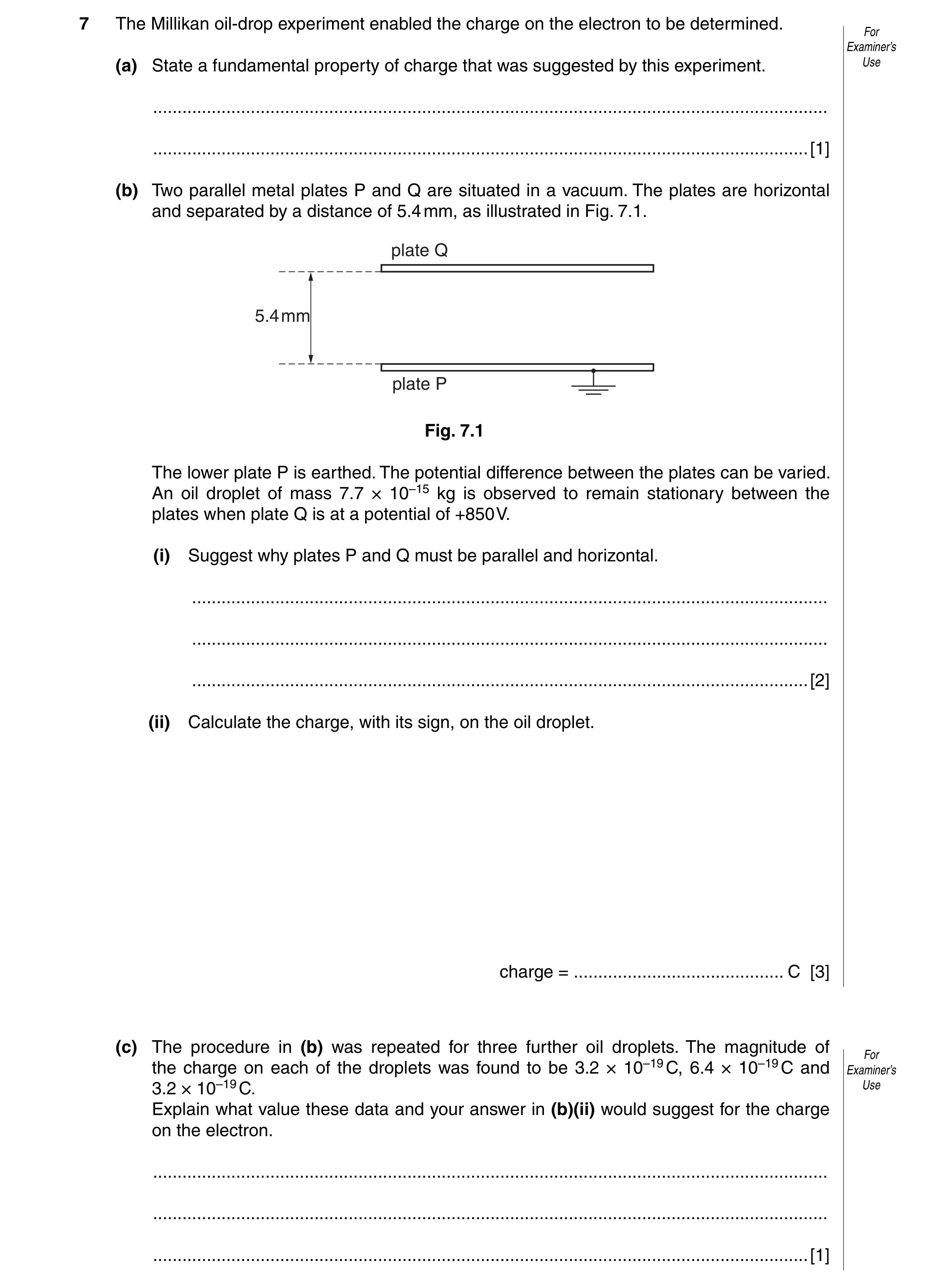
7 The Millikan oil-drop experiment enabled the charge on the electron to be determined. For Examiner’s (a) State a fundamental property of charge that was suggested by this experiment. Use … … [1] (b) Two parallel metal plates P and Q are situated in a vacuum. The plates are horizontal and separated by a distance of 5.4 mm, as illustrated in Fig. 7.1. plate Q 5.4mm plate P Fig. 7.1 The lower plate P is earthed. The potential difference between the plates can be varied. An oil droplet of mass 7.7 × 10⁻¹⁵ kg is observed to remain stationary between the plates when plate Q is at a potential of +850 V. (i) Suggest why plates P and Q must be parallel and horizontal. … … … [2] (ii) Calculate the charge, with its sign, on the oil droplet. charge = … C [3] (c) The procedure in (b) was repeated for three further oil droplets. The magnitude of For the charge on each of the droplets was found to be 3.2 × 10⁻¹⁹ C, 6.4 × 10⁻¹⁹ C and Examiner’s 3.2 × 10⁻¹⁹ C. Use Explain what value these data and your answer in (b)(ii) would suggest for the charge on the electron. … … … [1]
7 marks
Mark scheme: 7 (a) charge is quantised / discrete quantities B1 [1] (b) (i) parallel so that the electric field is uniform / constant B1 horizontal so that either oil drop will not drift sideways or field is vertical or electric force is equal to weight B1 [2] (ii) qE = mg C1 q × 850 / (5.4 × 10⁻³) = 7.7 × 10–15 × 9.8 C1 q = 4.8 × 10⁻¹⁹ C and is negative A1 [3] (c) charge changes by 1.6 × 10⁻¹⁹ C between droplets / integral multiples M1 so charge on electron is 1.6 × 10⁻¹⁹ C A0 [1]
This question in 9702/41 May/June 2008
Q4 · In some power stations, nuclear fission is used as a source of energy 9702/42 Oct/Nov 2010
8 In some power stations, nuclear fission is used as a source of energy. For Examiner’s (a) State what is meant by nuclear fission. Use … … … [2] (b) The nuclear fission reaction produces neutrons. In the power station, the neutrons may be absorbed by rods made of boron-10. Complete the nuclear equation for the absorption of a single neutron by a boron-10 nucleus with the emission of an a-particle. 10 … 5B + … 3Li + … [3] (c) Suggest why, when neutrons are absorbed in the boron rods, the rods become hot as a result of this nuclear reaction. … … … … [3]
8 marks
Mark scheme: 8 (a) splitting of a heavy nucleus (not atom/nuclide) M1 into two (lighter) nuclei of approximately same mass A1 [2] (b) 01 n 4 2 He (allow 42 α ) M2 7 3 Li A1 [3] (c) emitted particles have kinetic energy B1 range of particles in the control rods is short / particles stopped in rods / lose kinetic energy in rods B1 kinetic energy of particles converted to thermal energy B1 [3] GCE AS/A LEVEL – October/November 2010 9702 42 Section B
This question in 9702/42 Oct/Nov 2010
Q5 · The element strontium has at least 16 isotopes 9702/42 May/June 2012
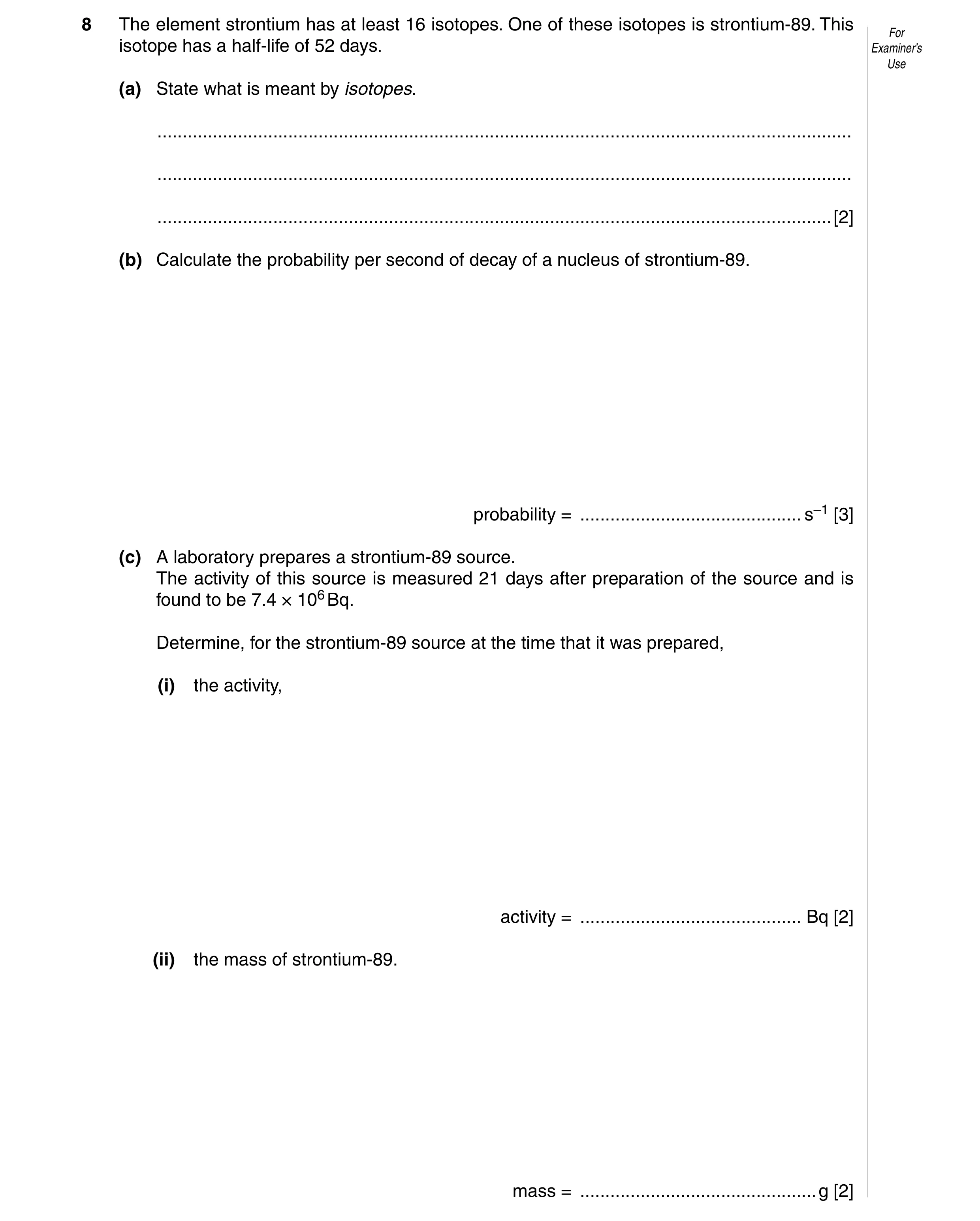
8 The element strontium has at least 16 isotopes. One of these isotopes is strontium-89. This For isotope has a half-life of 52 days. Examiner’s Use (a) State what is meant by isotopes. … … … [2] (b) Calculate the probability per second of decay of a nucleus of strontium-89. probability = … s–1 [3] (c) A laboratory prepares a strontium-89 source. The activity of this source is measured 21 days after preparation of the source and is found to be 7.4 × 10⁶ Bq. Determine, for the strontium-89 source at the time that it was prepared, (i) the activity, activity = … Bq [2] (ii) the mass of strontium-89. mass = … g [2]
9 marks
Mark scheme: 8 (a) nuclei having same number of protons/proton (atomic) number B1 different numbers of neutrons/neutron number B1 [2] (allow second mark for nucleons/nucleon number/mass number/atomic mass if made clear that same number of protons/proton number) (b) probability of decay per unit time is the decay constant C1 λ = ln 2 / t½ = 0.693 / (52 × 24 × 3600) C1 = 1.54 × 10⁻⁷ s–1 A1 [3] (c) (i) A = A0 exp(–λt) 7.4 × 106 = A0 exp(–1.54 × 10–7 × 21 × 24 × 3600) C1 A0 = 9.8 × 10⁶ Bq A1 [2] (alternative method uses 21 days as 0.404 half-lives) (ii) A = λN and mass = N × 89 / NA C1 mass = (9.8 × 106 × 89) / (1.54 × 10–7 × 6.02 × 1023) = 9.4 × 10⁻⁹ g A1 [2] GCE AS/A LEVEL – May/June 2012 9702 42 Section B
This question in 9702/42 May/June 2012
Q6 · When a neutron is captured by a uranium-235 nucleus, the outcome may be represented by… 9702/43 Oct/Nov 2012
8 When a neutron is captured by a uranium-235 nucleus, the outcome may be represented by For the nuclear equation shown below. Examiner’s Use 235 1 95 139 1 0 U + n Mo + La + x n + 7 e 92 0 42 57 0 –1 (a) (i) Use the equation to determine the value of x. x = … [1] 0 (ii) State the name of the particle represented by the symbol e. –1 … [1] (b) Some data for the nuclei in the reaction are given in Fig. 8.1. mass / u binding energy per nucleon / MeV 235 uranium-235 ( U) 235.123 92 95 molybdenum-95 ( Mo) 94.945 8.09 42 139 lanthanum-139 ( La) 138.955 7.92 57 1 proton ( p) 1.007 1 1 neutron ( n) 1.009 0 Fig. 8.1 Use data from Fig. 8.1 to (i) determine the binding energy, in u, of a nucleus of uranium-235, binding energy = … u [3] (ii) show that the binding energy per nucleon of a nucleus of uranium-235 is 7.18 MeV. For Examiner’s Use [3] (c) The kinetic energy of the neutron before the reaction is negligible. Use data from (b) to calculate the total energy, in MeV, released in this reaction. energy = … MeV [2]
10 marks
Mark scheme: 8 (a) (i) x = 2 A1 [1] (ii) either beta particle or electron B1 [1] (b) (i) mass of separate nucleons = {(92 × 1.007) + (143 × 1.009)} u C1 = 236.931 u C1 binding energy = 236.931 u – 235.123 u = 1.808 u A1 [3] GCE AS/A LEVEL – October/November 2012 9702 43 (ii) E = mc2 C1 energy = 1.808 × 1.66 × 10–27 × (3.0 × 108)2 = 2.7 × 10⁻¹⁰ J C1 binding energy per nucleon = (2.7 × 10⁻¹⁰) / (235 × 1.6 × 10–13) M1 = 7.18 MeV A0 [3] (c) energy released = (95 × 8.09) + (139 × 7.92) – (235 × 7.18) C1 = 1869.43 – 1687.3 = 182 MeV A1 [2] (allow calculation using mass difference between products and reactants) Section B
This question in 9702/43 Oct/Nov 2012
Q7 · State what is meant by a nuclear fusion reaction 9702/41 May/June 2013
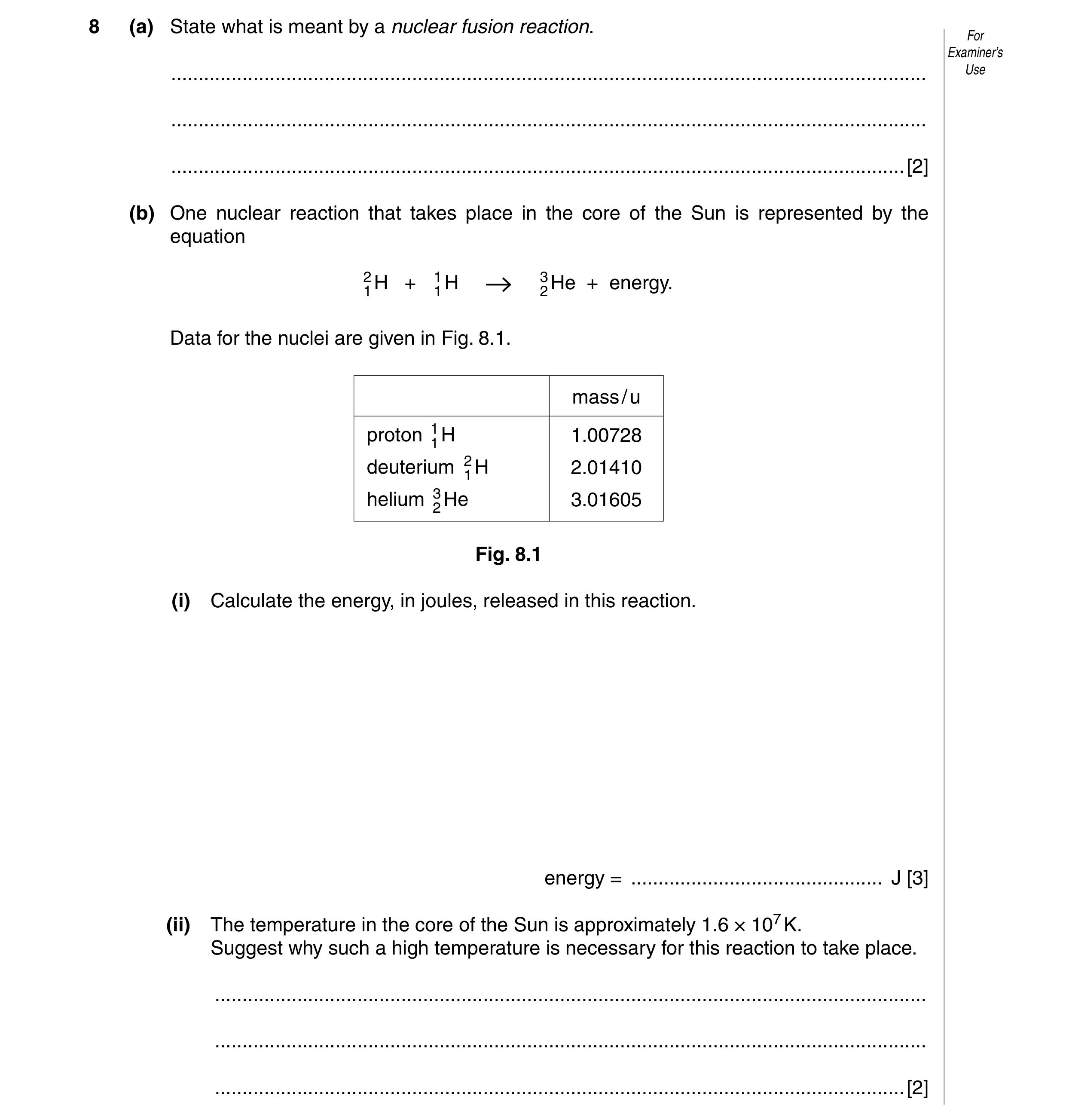
8 (a) State what is meant by a nuclear fusion reaction. For Examiner’s … Use … … [2] (b) One nuclear reaction that takes place in the core of the Sun is represented by the equation 2 H + 1 H 3 He + energy. 1 1 2 Data for the nuclei are given in Fig. 8.1. mass / u proton 1 H 1.00728 1 deuterium 2 H 2.01410 1 helium 3 He 3.01605 2 Fig. 8.1 (i) Calculate the energy, in joules, released in this reaction. energy = … J [3] (ii) The temperature in the core of the Sun is approximately 1.6 × 10⁷ K. Suggest why such a high temperature is necessary for this reaction to take place. … … … [2]
7 marks
Mark scheme: 8 (a) two (light) nuclei combine M1 to form a more massive nucleus A1 [2] (b) (i) ∆m = (2.01410 u + 1.00728 u) – 3.01605 u = 5.33 × 10⁻³ u C1 energy = c2 × ∆m C1 = 5.33 × 10–3 × 1.66 × 10–27 × (3.00 × 108)2 = 8.0 × 10⁻¹³ J A1 [3] (ii) speed/kinetic energy of proton and deuterium must be very large B1 so that the nuclei can overcome electrostatic repulsion B1 [2] Section B
This question in 9702/41 May/June 2013
Q8 · State what is meant by a nuclear fusion reaction 9702/43 May/June 2013
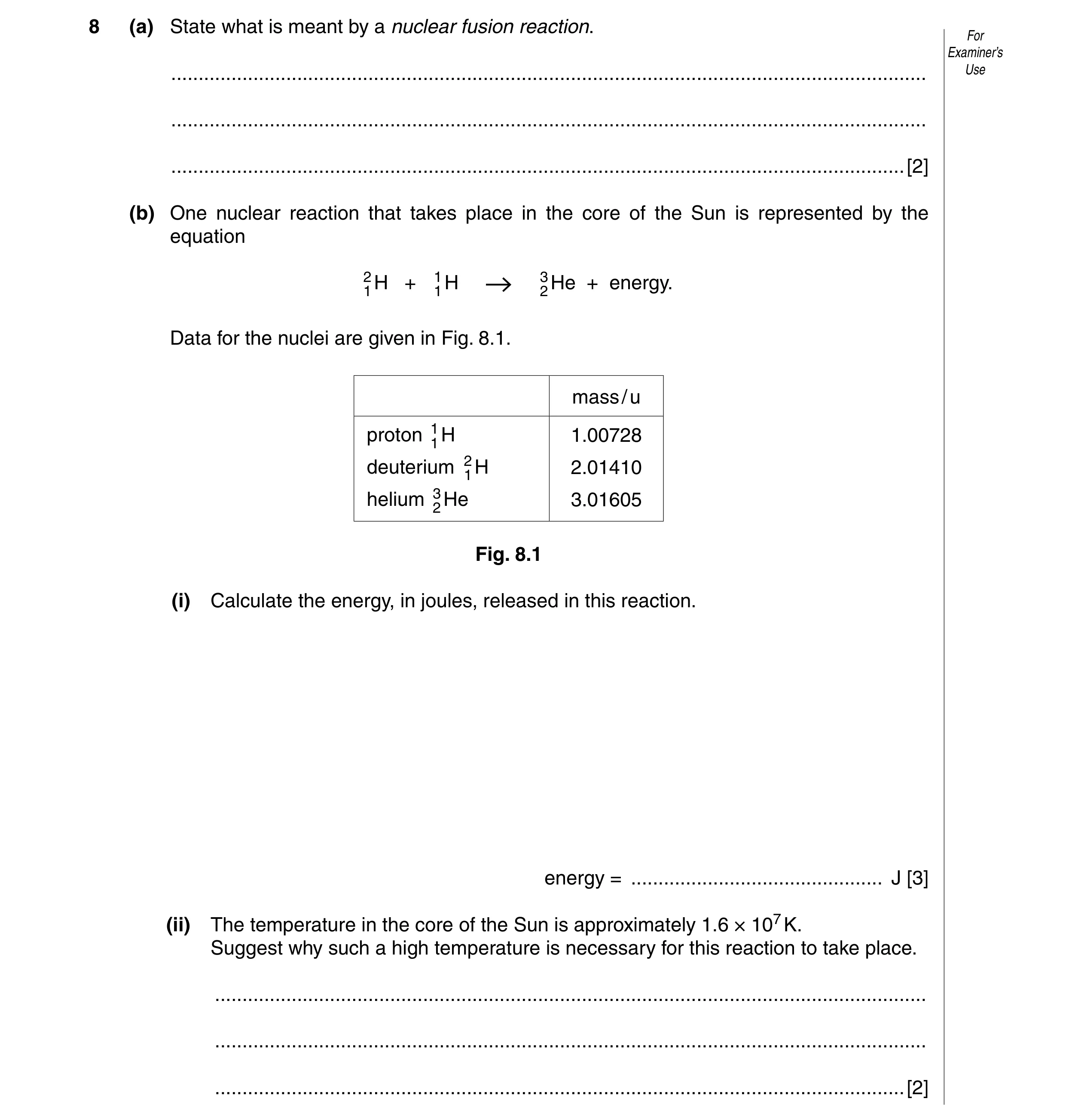
8 (a) State what is meant by a nuclear fusion reaction. For Examiner’s … Use … … [2] (b) One nuclear reaction that takes place in the core of the Sun is represented by the equation 2 H + 1 H 3 He + energy. 1 1 2 Data for the nuclei are given in Fig. 8.1. mass / u proton 1 H 1.00728 1 deuterium 2 H 2.01410 1 helium 3 He 3.01605 2 Fig. 8.1 (i) Calculate the energy, in joules, released in this reaction. energy = … J [3] (ii) The temperature in the core of the Sun is approximately 1.6 × 10⁷ K. Suggest why such a high temperature is necessary for this reaction to take place. … … … [2]
7 marks
Mark scheme: 8 (a) two (light) nuclei combine M1 to form a more massive nucleus A1 [2] (b) (i) ∆m = (2.01410 u + 1.00728 u) – 3.01605 u = 5.33 × 10⁻³ u C1 energy = c2 × ∆m C1 = 5.33 × 10–3 × 1.66 × 10–27 × (3.00 × 108)2 = 8.0 × 10⁻¹³ J A1 [3] (ii) speed/kinetic energy of proton and deuterium must be very large B1 so that the nuclei can overcome electrostatic repulsion B1 [2] Section B
This question in 9702/43 May/June 2013
Q9 · One likely means by which nuclear fusion may be achieved on a practical scale is the D-T… 9702/41 Oct/Nov 2014
9 One likely means by which nuclear fusion may be achieved on a practical scale is the D-T reaction. (a) State what is meant by nuclear fusion. … … [1] (b) In the D-T reaction, a deuterium (21H) nucleus fuses with a tritium (31H) nucleus to form a helium-4 (42He) nucleus. The nuclear equation for the reaction is 21H + 31H 42He + 10n + energy Some data for this reaction are given in Fig. 9.1. mass / u deuterium (21H) 2.01356 tritium (31H) 3.01551 helium-4 (42He) 4.00151 neutron (10n) 1.00867 Fig. 9.1 (i) Calculate the energy, in MeV, equivalent to 1.00 u. Explain your working. energy = … MeV [3] (ii) Use data from Fig. 9.1 and your answer in (i) to determine the energy released in this D-T reaction. energy = … MeV [2] (iii) Suggest why, for the D-T reaction to take place, the temperature of the deuterium and the tritium must be high. … … … [2]
8 marks
Mark scheme: 9 (a) ‘light’ nuclei combine to form ‘heavier’ nuclei B1 [1] (b) (i) either energy = c2∆m or energy = (3.00 × 10⁸)2 × 1.66 × 10–27 C1 energy = 1.494 × 10⁻¹⁰ J C1 = (1.494 × 10⁻¹⁰) / (1.60 × 10⁻¹³) = 934 MeV (3 s.f.) A1 [3] (ii) ∆m = (2.01356 + 3.01551) – (4.00151 + 1.00867) = 5.02907 – 5.01018 = 0.01889 u C1 energy = 0.01889 × 934 = 17.6 MeV (allow 2 s.f.) A1 [2] (iii) high temperature means high speeds / kinetic energy of nuclei B1 D and T nuclei collide despite repelling one another B1 [2] Section B
This question in 9702/41 Oct/Nov 2014
Q10 · One likely means by which nuclear fusion may be achieved on a practical scale is the D-T… 9702/42 Oct/Nov 2014
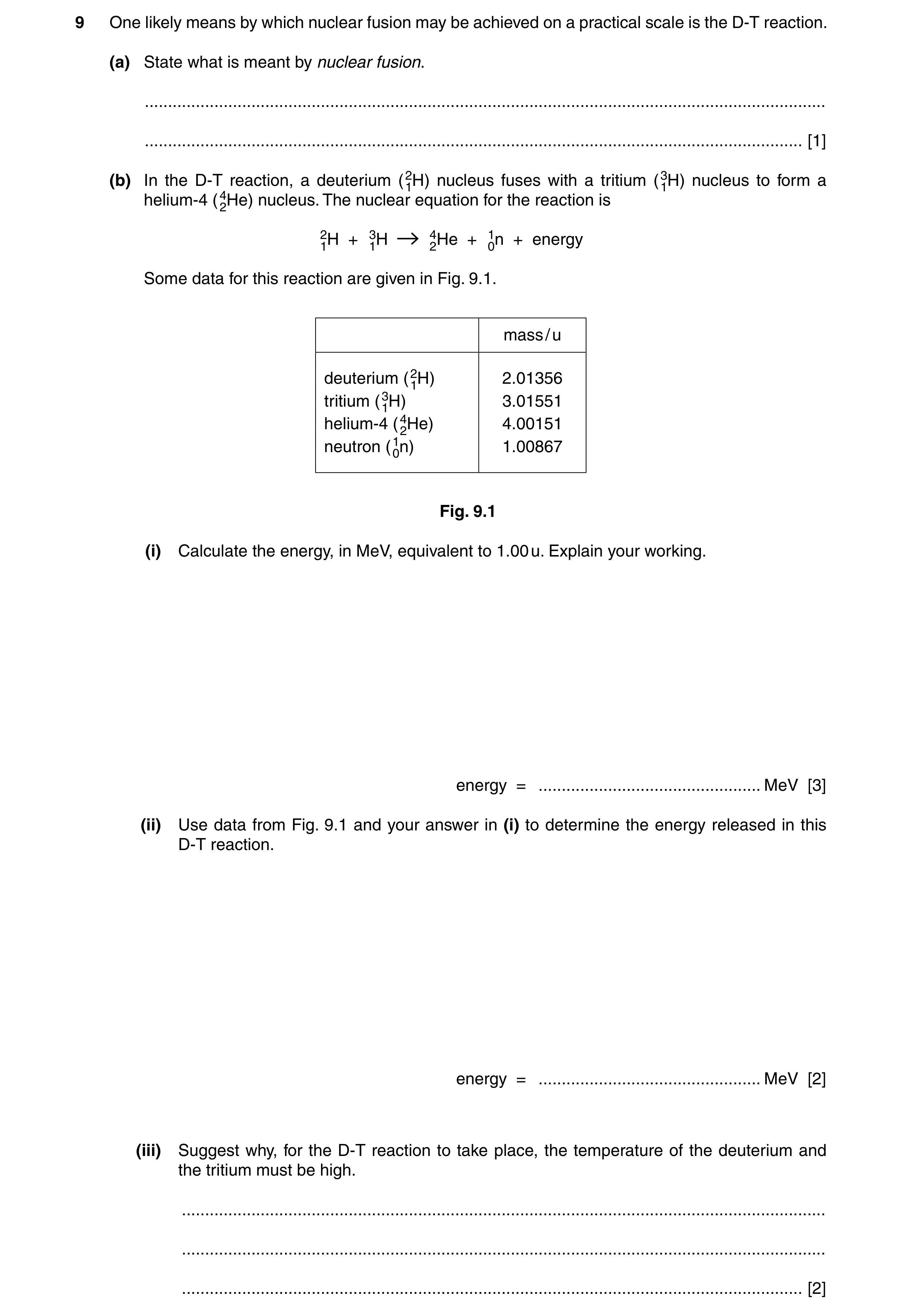
9 One likely means by which nuclear fusion may be achieved on a practical scale is the D-T reaction. (a) State what is meant by nuclear fusion. … … [1] (b) In the D-T reaction, a deuterium (21H) nucleus fuses with a tritium (31H) nucleus to form a helium-4 (42He) nucleus. The nuclear equation for the reaction is 21H + 31H 42He + 10n + energy Some data for this reaction are given in Fig. 9.1. mass / u deuterium (21H) 2.01356 tritium (31H) 3.01551 helium-4 (42He) 4.00151 neutron (10n) 1.00867 Fig. 9.1 (i) Calculate the energy, in MeV, equivalent to 1.00 u. Explain your working. energy = … MeV [3] (ii) Use data from Fig. 9.1 and your answer in (i) to determine the energy released in this D-T reaction. energy = … MeV [2] (iii) Suggest why, for the D-T reaction to take place, the temperature of the deuterium and the tritium must be high. … … … [2]
8 marks
Mark scheme: 9 (a) ‘light’ nuclei combine to form ‘heavier’ nuclei B1 [1] (b) (i) either energy = c2∆m or energy = (3.00 × 10⁸)2 × 1.66 × 10–27 C1 energy = 1.494 × 10⁻¹⁰ J C1 = (1.494 × 10⁻¹⁰) / (1.60 × 10⁻¹³) = 934 MeV (3 s.f.) A1 [3] (ii) ∆m = (2.01356 + 3.01551) – (4.00151 + 1.00867) = 5.02907 – 5.01018 = 0.01889 u C1 energy = 0.01889 × 934 = 17.6 MeV (allow 2 s.f.) A1 [2] (iii) high temperature means high speeds / kinetic energy of nuclei B1 D and T nuclei collide despite repelling one another B1 [2] Section B
This question in 9702/42 Oct/Nov 2014
Q11 · Distinguish, for an atom, between a nucleus and a nucleon 9702/41 Oct/Nov 2015
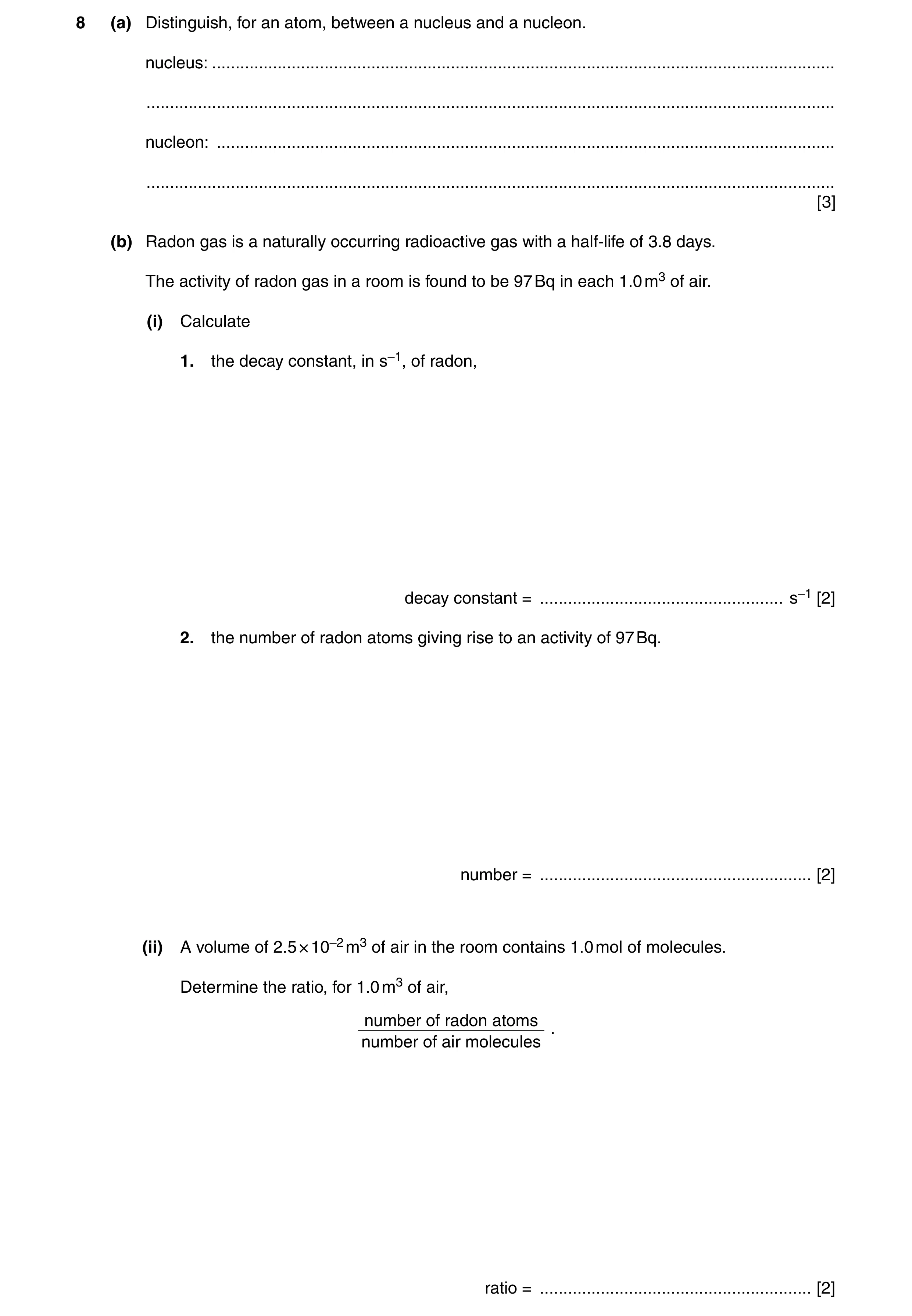
8 (a) Distinguish, for an atom, between a nucleus and a nucleon. nucleus: … … nucleon: … … [3] (b) Radon gas is a naturally occurring radioactive gas with a half-life of 3.8 days. The activity of radon gas in a room is found to be 97 Bq in each 1.0 m3 of air. (i) Calculate 1. the decay constant, in s–1, of radon, decay constant = … s–1 [2] 2. the number of radon atoms giving rise to an activity of 97 Bq. number = … [2] (ii) A volume of 2.5 × 10⁻² m3 of air in the room contains 1.0 mol of molecules. Determine the ratio, for 1.0 m3 of air, number of radon atoms . number of air molecules ratio = … [2]
9 marks
Mark scheme: 8 (a) nucleus: small central part/core of an atom B1 nucleon: proton or a neutron B1 particle contained within a nucleus B1 [3] (b) (i) 1. decay constant = ln 2 / (3.8 × 24 × 3600) C1 = 2.1 × 10⁻⁶ s–1 A1 [2] 2. A = λN 97 = 2.1 × 10⁻⁶ × N C1 N = 4.6 × 10⁷ A1 [2] (ii) 1.0 m3 contains (6.02 × 10²³) / (2.5 × 10⁻²) air molecules C1 ratio = (4.6 × 107 × 2.5 × 10–2) / (6.02 × 10²³) = 1.9 × 10⁻¹⁸ A1 [2] Section B
This question in 9702/41 Oct/Nov 2015
Q12 · Distinguish, for an atom, between a nucleus and a nucleon 9702/42 Oct/Nov 2015
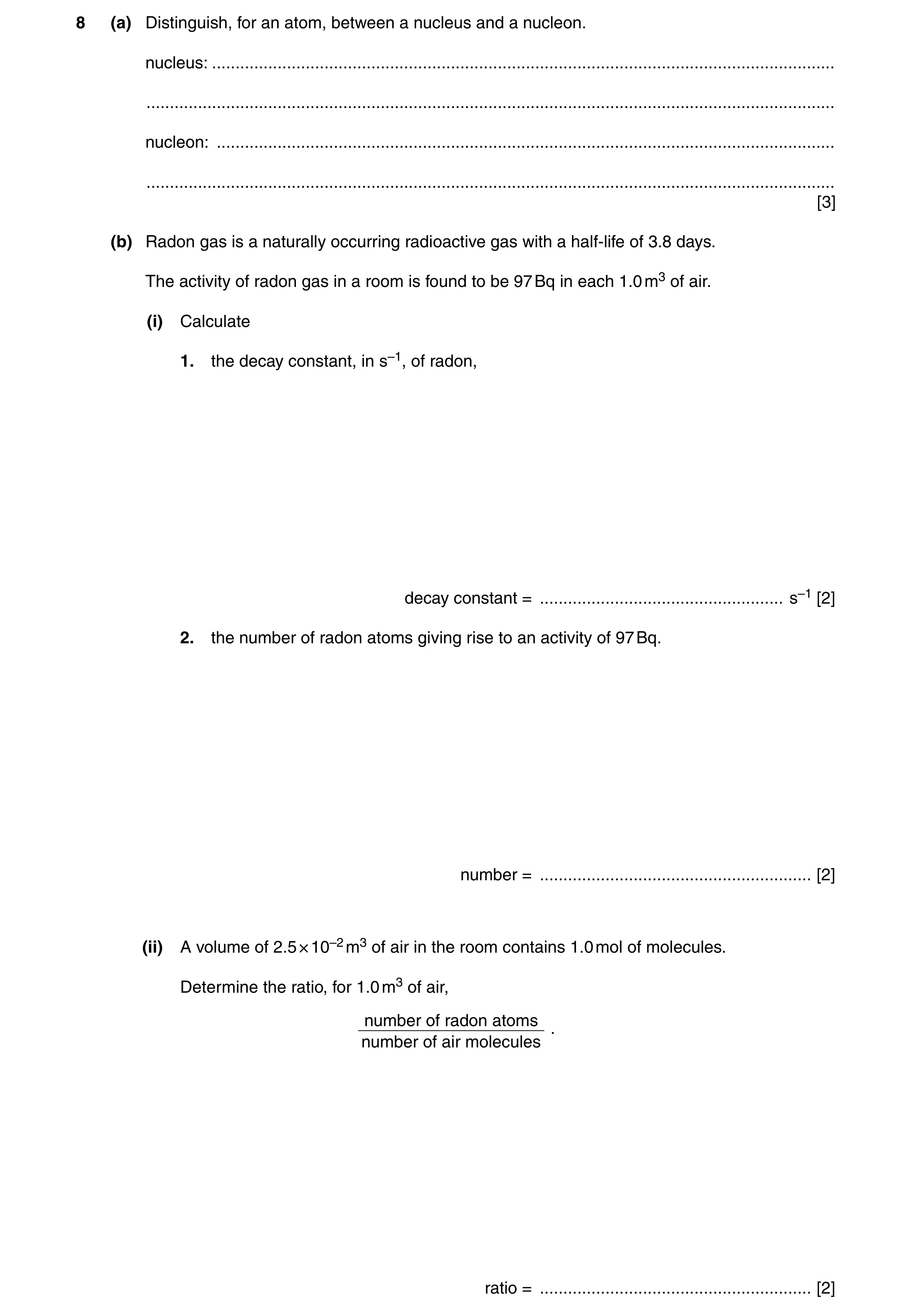
8 (a) Distinguish, for an atom, between a nucleus and a nucleon. nucleus: … … nucleon: … … [3] (b) Radon gas is a naturally occurring radioactive gas with a half-life of 3.8 days. The activity of radon gas in a room is found to be 97 Bq in each 1.0 m3 of air. (i) Calculate 1. the decay constant, in s–1, of radon, decay constant = … s–1 [2] 2. the number of radon atoms giving rise to an activity of 97 Bq. number = … [2] (ii) A volume of 2.5 × 10⁻² m3 of air in the room contains 1.0 mol of molecules. Determine the ratio, for 1.0 m3 of air, number of radon atoms . number of air molecules ratio = … [2]
9 marks
Mark scheme: 8 (a) nucleus: small central part/core of an atom B1 nucleon: proton or a neutron B1 particle contained within a nucleus B1 [3] (b) (i) 1. decay constant = ln 2 / (3.8 × 24 × 3600) C1 = 2.1 × 10⁻⁶ s–1 A1 [2] 2. A = λN 97 = 2.1 × 10⁻⁶ × N C1 N = 4.6 × 10⁷ A1 [2] (ii) 1.0 m3 contains (6.02 × 10²³) / (2.5 × 10⁻²) air molecules C1 ratio = (4.6 × 107 × 2.5 × 10–2) / (6.02 × 10²³) = 1.9 × 10⁻¹⁸ A1 [2] Section B
This question in 9702/42 Oct/Nov 2015
Q13 · State what is meant by the binding energy of a nucleus 9702/43 Oct/Nov 2015
9 (a) State what is meant by the binding energy of a nucleus. … … … [2] (b) Data for two isotopes of uranium are given in Fig. 9.1. isotope binding energy per nucleon / MeV binding energy / MeV uranium-235 7.59 … uranium-238 … 1802 Fig. 9.1 (i) State what is meant by isotopes. … … … [2] (ii) Complete Fig. 9.1. [2] (c) Uranium-235 has a half-life of 7.1 × 10⁸ years. (i) Show that the decay constant λ of uranium-235 is 3.1 × 10⁻¹⁷ s−1. [1] (ii) A sample of uranium-235 has an activity of 5.0 × 10³ Bq. Calculate the mass of the sample. mass = … g [3]
10 marks
Mark scheme: 9 (a) energy required to separate the nucleons (in a nucleus) or energy required to separate the protons and neutrons in a nucleus M1 (or energy released when nucleons combine (to form a nucleus)/energy released when protons and neutrons combine to form a nucleus) either completely or to infinity A1 [2] (either free protons and neutrons or from infinity) (b) (i) either different forms of same element or nuclei having same number of M1 protons with different numbers of neutrons A1 [2] (ii) 1784 MeV (accept min. 3 s.f.) A1 7.57 MeV A1 [2] (c) (i) λ = ln 2 / (7.1 × 108 × 365 × 24 × 3600) = 3.1 × 10⁻¹⁷ s–1 B1 [1] (ii) A = λN 5000 = 3.1 × 10⁻¹⁷ × N C1 N = 1.61 × 10²⁰ mass = 235 × (1.61 × 1020) / (6.02 × 10²³) C1 = 0.063 g (accept min. 2 s.f.) A1 [3] Section B
This question in 9702/43 Oct/Nov 2015
Q14 · A particle of charge +q and mass m is travelling with a constant speed of 1.6 × 10⁵ m s–1… 9702/42 Feb/March 2016
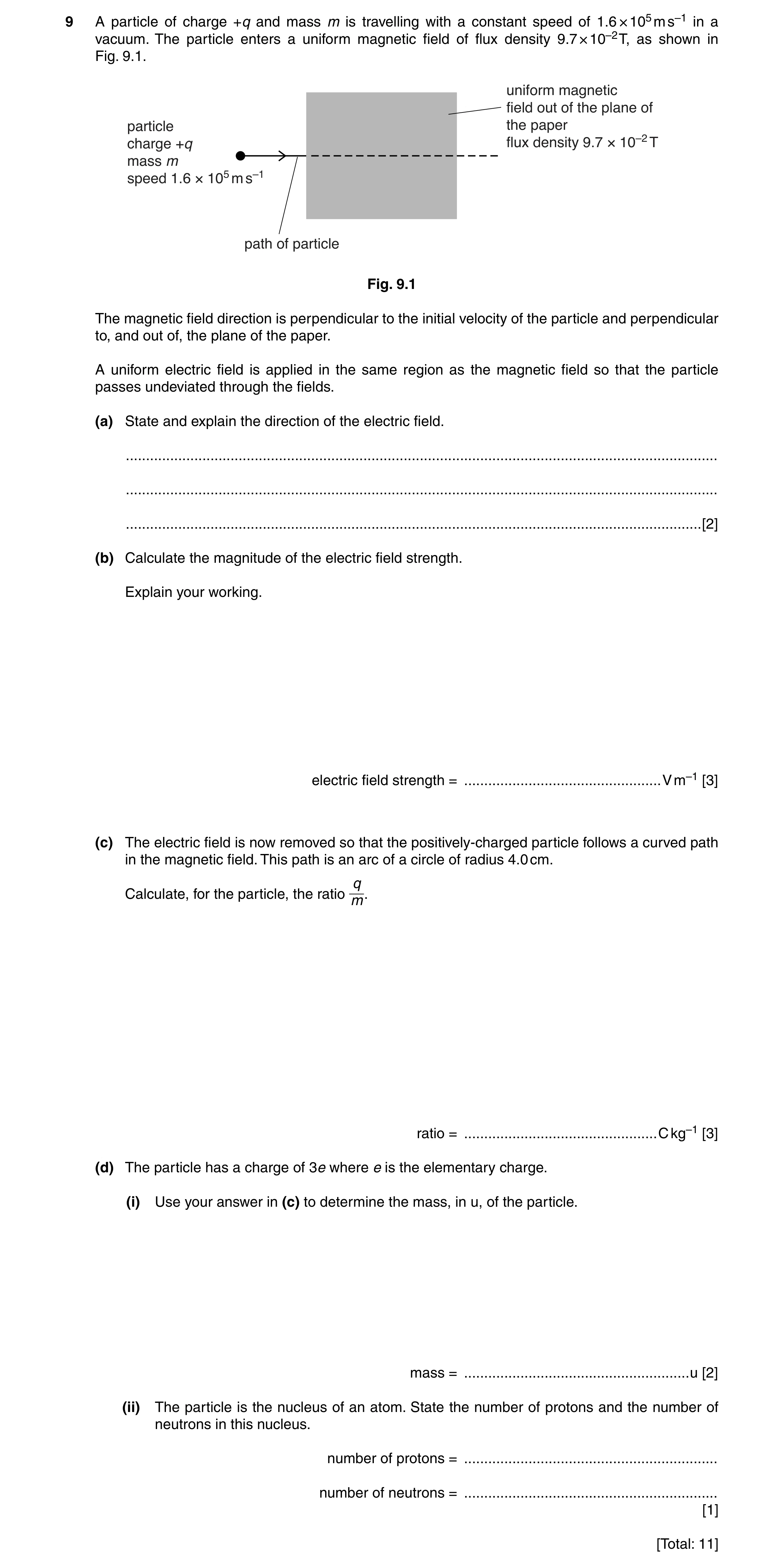
9 A particle of charge +q and mass m is travelling with a constant speed of 1.6 × 10⁵ m s–1 in a vacuum. The particle enters a uniform magnetic field of flux density 9.7 × 10⁻² T, as shown in Fig. 9.1. uniform magnetic field out of the plane of particle the paper charge +q flux density 9.7 × 10⁻² T mass m speed 1.6 × 10⁵ m s–1 path of particle Fig. 9.1 The magnetic field direction is perpendicular to the initial velocity of the particle and perpendicular to, and out of, the plane of the paper. A uniform electric field is applied in the same region as the magnetic field so that the particle passes undeviated through the fields. (a) State and explain the direction of the electric field. … … … [2] (b) Calculate the magnitude of the electric field strength. Explain your working. electric field strength = … V m–1 [3] (c) The electric field is now removed so that the positively-charged particle follows a curved path in the magnetic field. This path is an arc of a circle of radius 4.0 cm. q Calculate, for the particle, the ratio m. ratio = … C kg–1 [3] (d) The particle has a charge of 3e where e is the elementary charge. (i) Use your answer in (c) to determine the mass, in u, of the particle. mass = … u [2] (ii) The particle is the nucleus of an atom. State the number of protons and the number of neutrons in this nucleus. number of protons = … number of neutrons = … [1] [Total: 11]
11 marks
Mark scheme: 9 (a) direction of force due to electric field opposite to force due to magnetic field B1 electric field is up the page B1 [2] (b) force due to electric field = force due to magnetic field or Eq = Bqv B1 E = Bv C1 = 9.7 × 10–2 × 1.6 × 105 = 1.6 (1.55) × 104 V m–1 A1 [3] (c) q / m = v / Br C1 = 1.6 × 10⁵ / (9.7 ×10–2 × 4.0 × 10–2) C1 = 4.1 (4.12) × 107 C kg–1 A1 [3] (d) (i) m = (3 × 1.60 × 10–19) / (4.12 × 10⁷) C1 m = 1.16 × 10⁻²⁶ / 1.66 × 10–27 = 7(.0) u (allow 7.1 u) A1 [2] (ii) 3 protons, 4 neutrons A1 [1]
This question in 9702/42 Feb/March 2016
Q15 · Some of the electron energy bands in a solid are illustrated in Fig 9702/41 May/June 2016
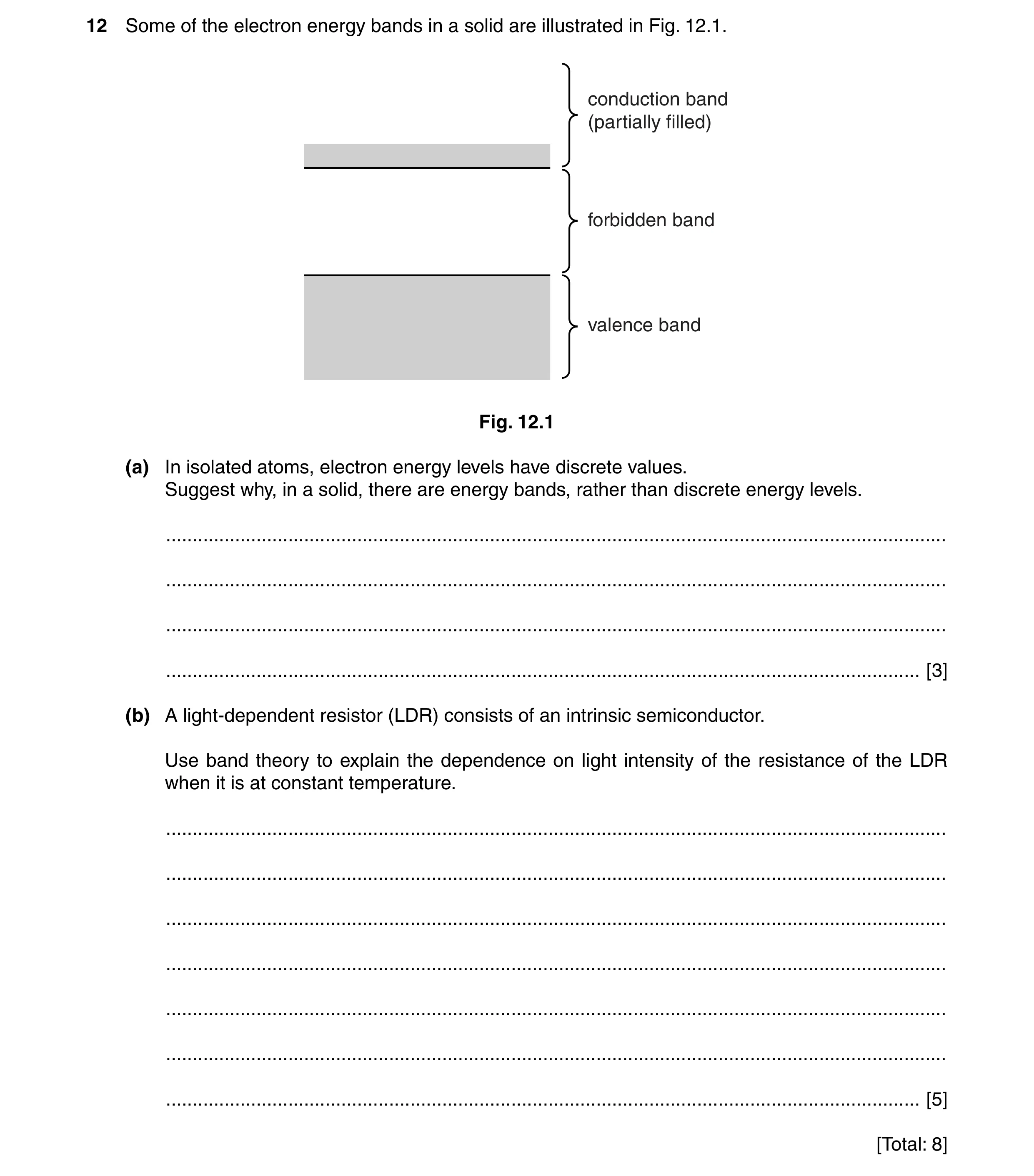
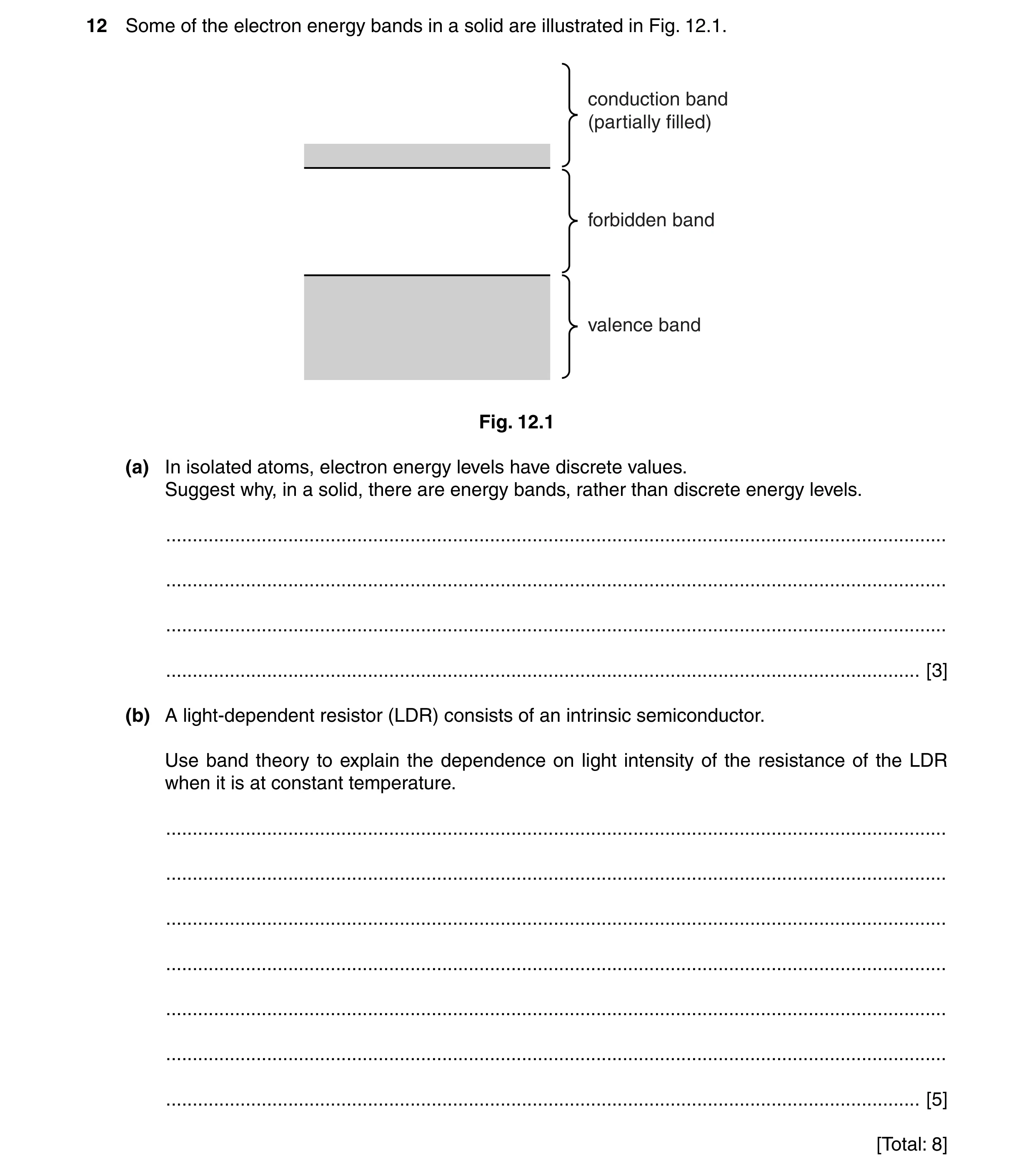
12 Some of the electron energy bands in a solid are illustrated in Fig. 12.1. conduction band (partially filled) forbidden band valence band Fig. 12.1 (a) In isolated atoms, electron energy levels have discrete values. Suggest why, in a solid, there are energy bands, rather than discrete energy levels. … … … … [3] (b) A light-dependent resistor (LDR) consists of an intrinsic semiconductor. Use band theory to explain the dependence on light intensity of the resistance of the LDR when it is at constant temperature. … … … … … … … [5] [Total: 8]
8 marks
Mark scheme: 12 (a) (in a solid electrons in) neighbouring atoms are close together (and influence/interact with each other) M1 this changes their electron energy levels M1 (many atoms in lattice) cause a spread of energy levels into a band A1 [3] (b) photons of light give energy to electrons in valence band B1 electrons move into the conduction band M1 leaving holes in the valence band A1 these electrons and holes are charge carriers B1 increased number/increased current, hence reduced resistance B1 [5]
This question in 9702/41 May/June 2016
Q16 · Explain what is meant by gamma radiation (γ-radiation) 9702/42 May/June 2016
13 (a) Explain what is meant by gamma radiation (γ-radiation). … … … [2] (b) A source of gamma radiation is placed a fixed distance away from a detector and counter, as illustrated in Fig. 13.1. WR FRXQWHU GHWHFWRU OHDG VKHHW [ VKLHOGLQJ VRXUFH Fig. 13.1 A sheet of lead of thickness x is placed between the source and the detector. The average count rate C, corrected for background, is recorded. This is repeated for different values of x. The variation with thickness x of ln C is shown in Fig. 13.2. 4.00 3.75 ln (& / s–1) 3.50 3.25 3.00 2.75 0 2 4 6 8 10 12 14 16 [ / mm Fig. 13.2 The absorption of gamma radiation in lead may be represented by the equation C = C0 e−μx where C0 is the count rate for x = 0 and μ is the linear attenuation (absorption) coefficient. Use Fig. 13.2 to determine the linear attenuation coefficient μ for this gamma radiation in lead. μ = … mm−1 [4] Question 13 continues on the next page. (c) The value of μ calculated in (b) is for gamma radiation in lead. Suggest and explain whether the value of μ for aluminium would be the same, greater or smaller. … … … [2] [Total: 8]
8 marks
Mark scheme: 13 (a) (photons of) electromagnetic radiation M1 emitted from nuclei A1 [2] (b) line of best fit drawn B1 recognises µ as given by the gradient of best-fit line or ln C = ln C0 – µx B1 µ = 0.061 mm–1 (within ±0.004 mm–1, 1 mark; within ±0.002 mm–1, 2 marks) A2 [4] (c) aluminium is less absorbing (than lead) or gradient of graph would be less M1 so µ is smaller A1 [2]
This question in 9702/42 May/June 2016
Q17 · Some of the electron energy bands in a solid are illustrated in Fig 9702/43 May/June 2016
12 Some of the electron energy bands in a solid are illustrated in Fig. 12.1. conduction band (partially filled) forbidden band valence band Fig. 12.1 (a) In isolated atoms, electron energy levels have discrete values. Suggest why, in a solid, there are energy bands, rather than discrete energy levels. … … … … [3] (b) A light-dependent resistor (LDR) consists of an intrinsic semiconductor. Use band theory to explain the dependence on light intensity of the resistance of the LDR when it is at constant temperature. … … … … … … … [5] [Total: 8]
8 marks
Mark scheme: 12 (a) (in a solid electrons in) neighbouring atoms are close together (and influence/interact with each other) M1 this changes their electron energy levels M1 (many atoms in lattice) cause a spread of energy levels into a band A1 [3] (b) photons of light give energy to electrons in valence band B1 electrons move into the conduction band M1 leaving holes in the valence band A1 these electrons and holes are charge carriers B1 increased number/increased current, hence reduced resistance B1 [5]
This question in 9702/43 May/June 2016
Q18 · Phosphorus-30 (3015P) was the first artificial radioactive nuclide to be produced in a… 9702/42 Oct/Nov 2016
14 Phosphorus-30 (3015P) was the first artificial radioactive nuclide to be produced in a laboratory. This was achieved by bombarding aluminium-27 (2713Al) with α-particles. A partial nuclear equation to represent this reaction is Φ 2713Al + 30 α → 15P + (a) State the full nuclear notation for (i) the α-particle, … [1] (ii) the particle represented by the symbol Φ. … [1] (b) Data for the rest masses of the particles in the reaction are given in Fig. 14.1. particle mass / u 2713Al 26.98153 α 4.00260 3015P 29.97830 Φ 1.00867 Fig. 14.1 Calculate, for this reaction, (i) the change in the total rest mass of the particles, mass change = … u [2] (ii) the energy, in joule, equivalent to the mass change calculated in (i). energy = … J [2] (c) With reference to your answer in (b)(i), comment on the energy of the α-particle such that the reaction can take place. … … … … [2] [Total: 8]
8 marks
Mark scheme: 14 (a) (i) 42 He or 42 α B1 [1] (ii) 01n B1 [1] (b) (i) ∆m = (29.97830 +1.00867) – (26.98153 + 4.00260) C1 = 30.98697 – 30.98413 = 2.84 × 10⁻³ u C1 [2] (ii) E = c2∆m or mc2 C1 = (3.0 × 10⁸)2 × 2.84 × 10–3 × 1.66 × 10–27 = 4.2 × 10⁻¹³ J A1 [2] (c) mass of products is greater than mass of Al plus α or reaction causes (net) increase in (rest) mass (of the system) B1 α-particle must have at least this amount of kinetic energy B1 [2]
This question in 9702/42 Oct/Nov 2016
Q19 · Some of the electron energy bands in a solid are illustrated in Fig 9702/43 Oct/Nov 2016
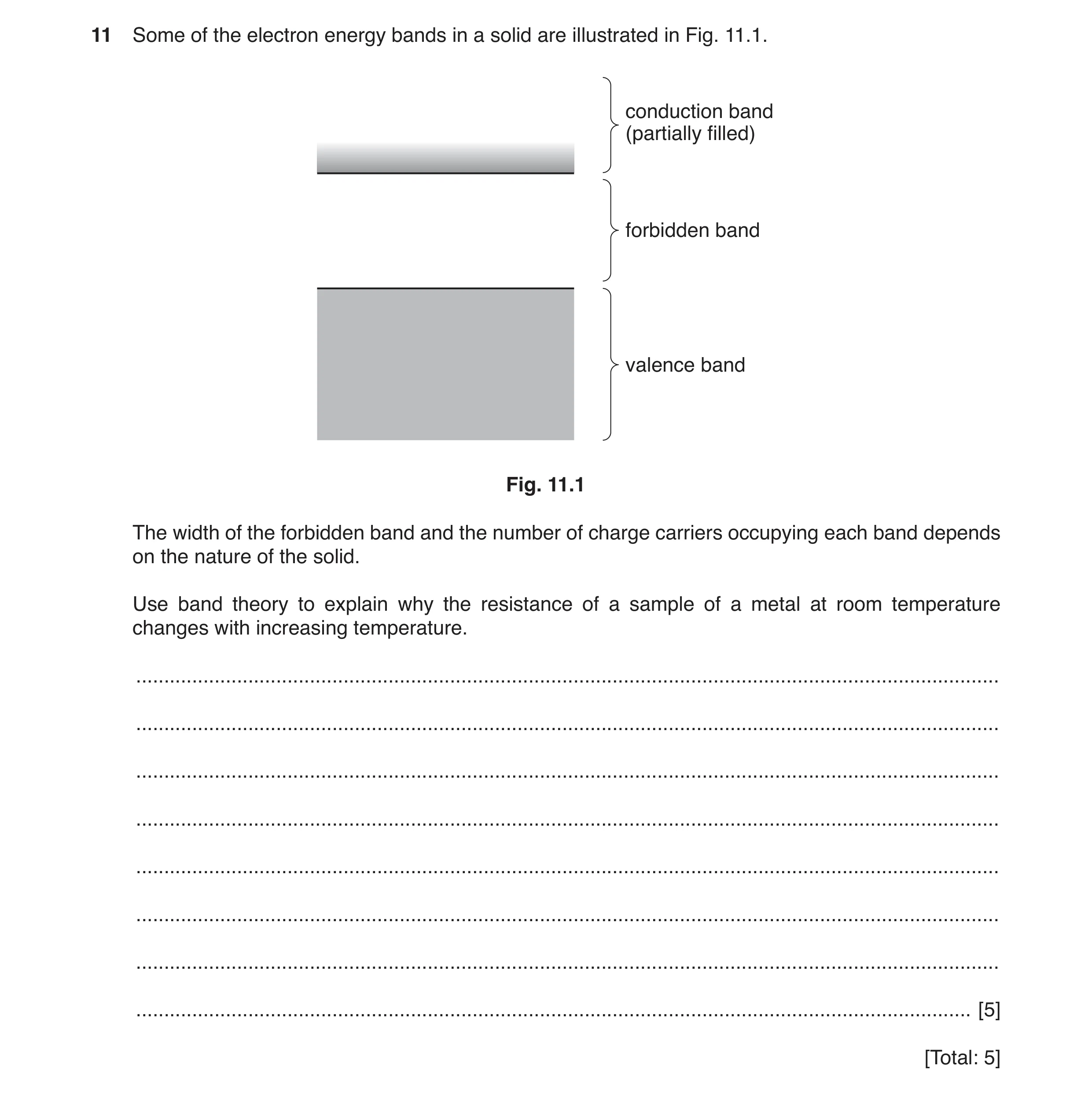
11 Some of the electron energy bands in a solid are illustrated in Fig. 11.1. conduction band (partially filled) forbidden band valence band Fig. 11.1 The width of the forbidden band and the number of charge carriers occupying each band depends on the nature of the solid. Use band theory to explain why the resistance of a sample of a metal at room temperature changes with increasing temperature. … … … … … … … … [5] [Total: 5]
5 marks
Mark scheme: 11 in metal, conduction band overlaps valence band/no forbidden band/no band gap B1 as temperature rises, no increase in number of free electrons/charge carriers B1 as temperature rises, lattice vibrations increase M1 (lattice) vibrations restrict movement of electrons/charge carriers M1 (current decreases) so resistance increases A1 [5]
This question in 9702/43 Oct/Nov 2016
Q20 · An α-particle is travelling in a vacuum towards the centre of a gold nucleus, as… 9702/41 May/June 2017
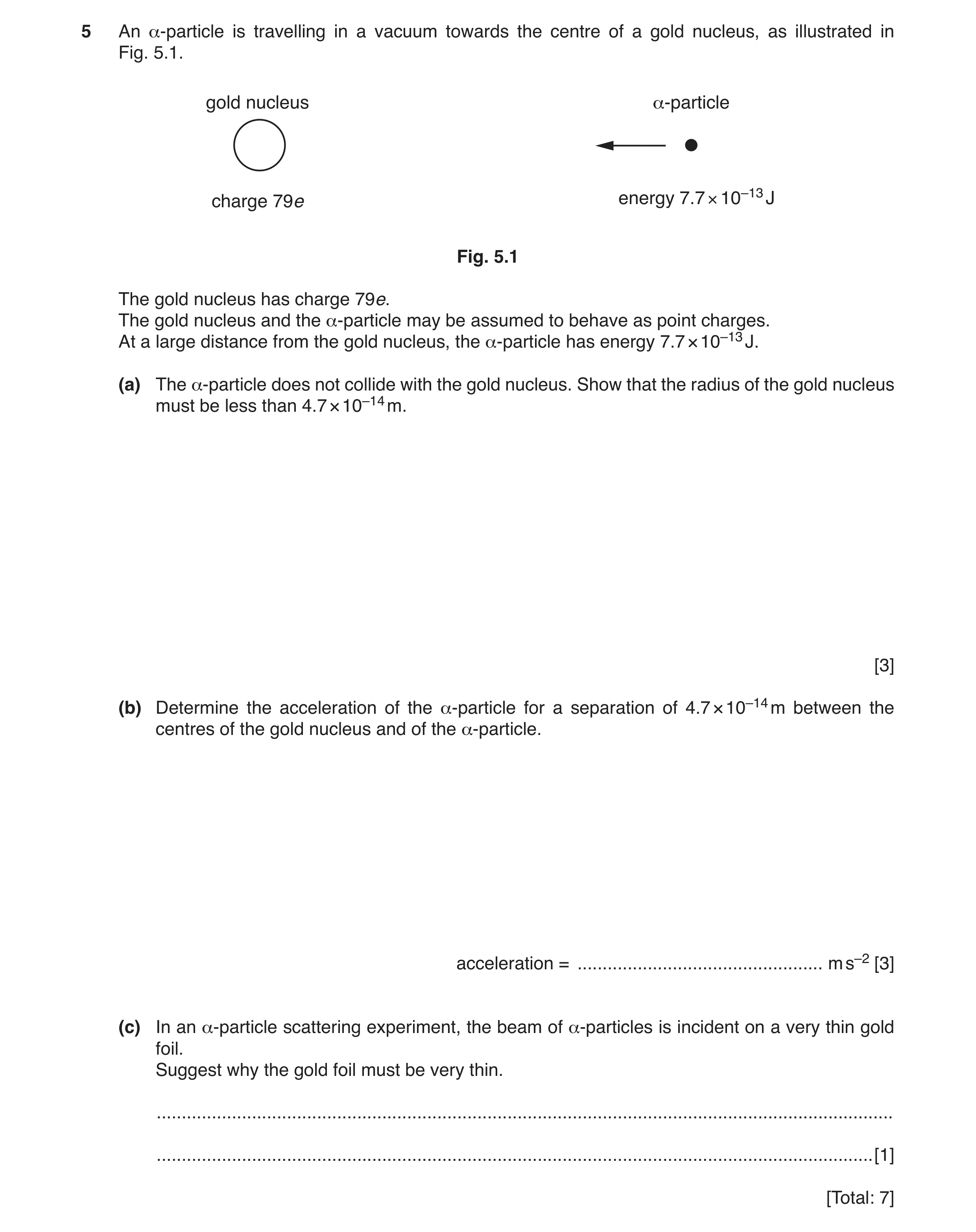
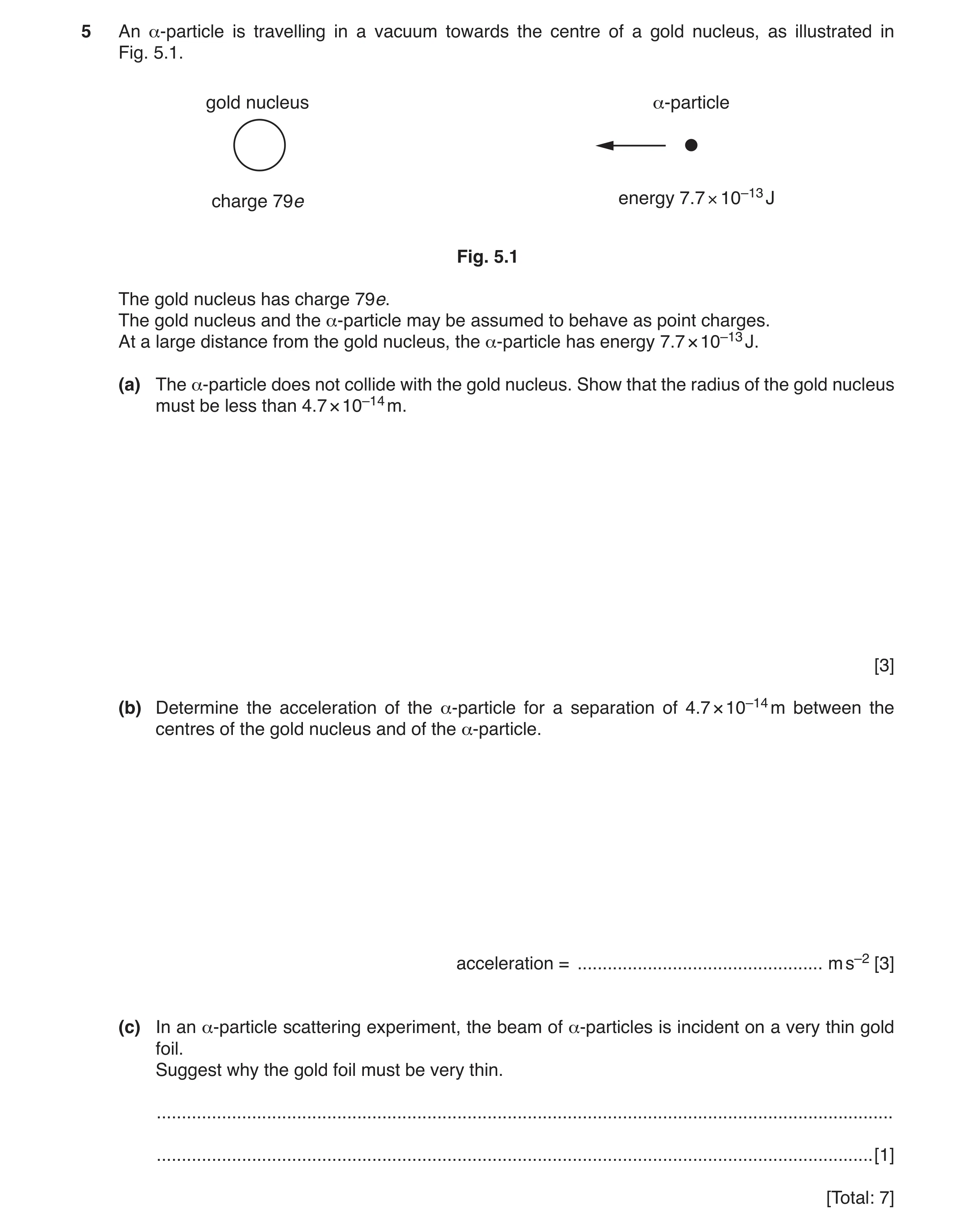
5 An α-particle is travelling in a vacuum towards the centre of a gold nucleus, as illustrated in Fig. 5.1. gold nucleus α-particle × 10–13 J charge 79e energy 7.7 Fig. 5.1 The gold nucleus has charge 79e. The gold nucleus and the α-particle may be assumed to behave as point charges. At a large distance from the gold nucleus, the α-particle has energy 7.7 × 10⁻¹³ J. (a) The α-particle does not collide with the gold nucleus. Show that the radius of the gold nucleus must be less than 4.7 × 10⁻¹⁴ m. [3] (b) Determine the acceleration of the α-particle for a separation of 4.7 × 10⁻¹⁴ m between the centres of the gold nucleus and of the α-particle. acceleration = … m s–2 [3] (c) In an α-particle scattering experiment, the beam of α-particles is incident on a very thin gold foil. Suggest why the gold foil must be very thin. … … [1] [Total: 7]
7 marks
Mark scheme: 5(a) or 7.7 × 10–13 = Qq / 4πε0r C1 7.7 × 10–13 = 8.99 × 109 × 79 × 2 × (1.60 × 10–19)2/ r M1 r = 4.7 × 10⁻¹⁴ m r is closest distance of approach so radius less than this A1 5(b) force = Qq / 4πε0r 2 = 4u × a C1 8.99 × 109 × 79 × 2 × (1.60 × 10–19)2/ (4.7 × 10⁻¹⁴)2 = 4 × 1.66 × 10–27 × a C1 a = 2.5 × 1027 m s–2 A1 5(c) so that single interactions between nucleus and α-particle can be studied or so that multiple deflections with nucleus do not occur B1
This question in 9702/41 May/June 2017
Q21 · An α-particle is travelling in a vacuum towards the centre of a gold nucleus, as… 9702/43 May/June 2017
5 An α-particle is travelling in a vacuum towards the centre of a gold nucleus, as illustrated in Fig. 5.1. gold nucleus α-particle × 10–13 J charge 79e energy 7.7 Fig. 5.1 The gold nucleus has charge 79e. The gold nucleus and the α-particle may be assumed to behave as point charges. At a large distance from the gold nucleus, the α-particle has energy 7.7 × 10⁻¹³ J. (a) The α-particle does not collide with the gold nucleus. Show that the radius of the gold nucleus must be less than 4.7 × 10⁻¹⁴ m. [3] (b) Determine the acceleration of the α-particle for a separation of 4.7 × 10⁻¹⁴ m between the centres of the gold nucleus and of the α-particle. acceleration = … m s–2 [3] (c) In an α-particle scattering experiment, the beam of α-particles is incident on a very thin gold foil. Suggest why the gold foil must be very thin. … … [1] [Total: 7]
7 marks
Mark scheme: 5(a) or 7.7 × 10–13 = Qq / 4πε0r C1 7.7 × 10–13 = 8.99 × 109 × 79 × 2 × (1.60 × 10–19)2/ r M1 r = 4.7 × 10⁻¹⁴ m r is closest distance of approach so radius less than this A1 5(b) force = Qq / 4πε0r 2 = 4u × a C1 8.99 × 109 × 79 × 2 × (1.60 × 10–19)2/ (4.7 × 10⁻¹⁴)2 = 4 × 1.66 × 10–27 × a C1 a = 2.5 × 1027 m s–2 A1 5(c) so that single interactions between nucleus and α-particle can be studied or so that multiple deflections with nucleus do not occur B1
This question in 9702/43 May/June 2017
Q22 · A helium atom may be modelled as a nucleus surrounded by two electrons in diametrically… 9702/41 May/June 2025
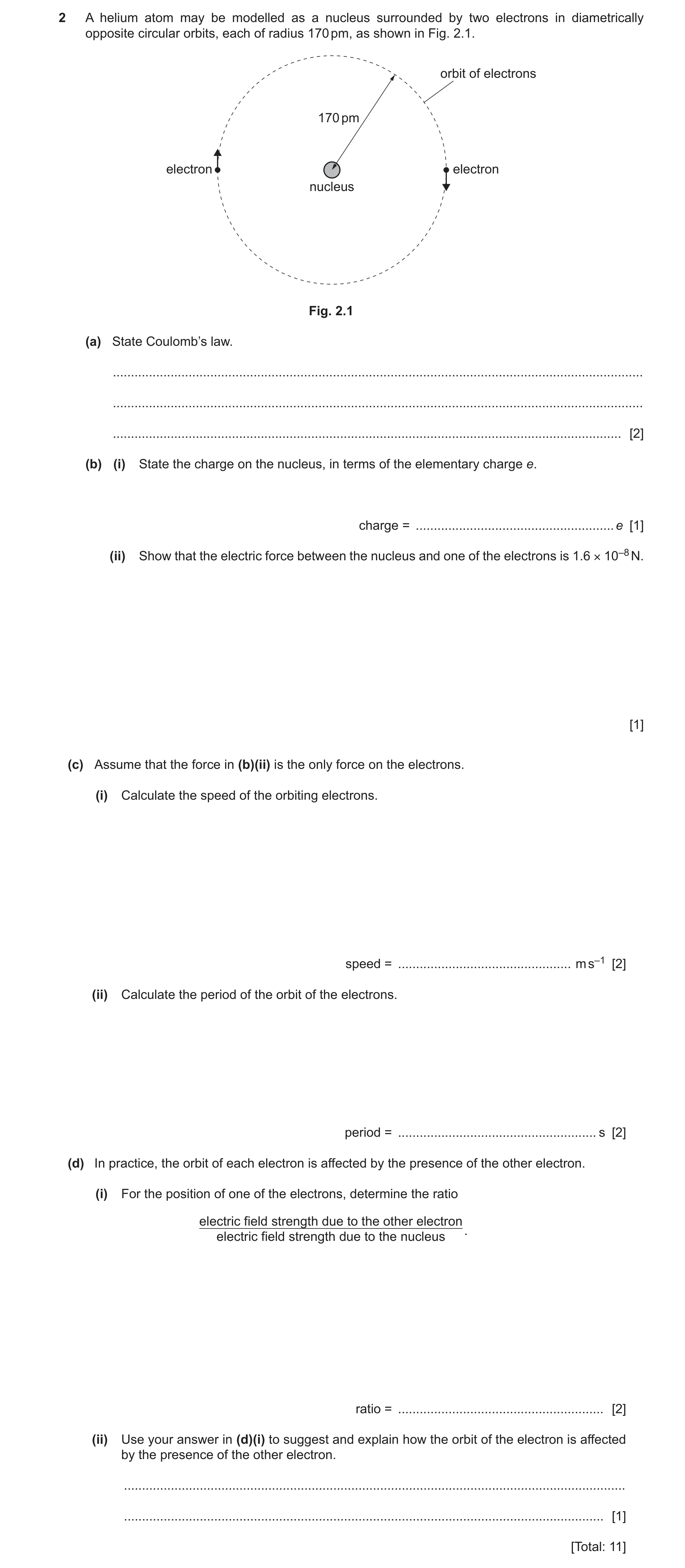
2 A helium atom may be modelled as a nucleus surrounded by two electrons in diametrically opposite circular orbits, each of radius 170 pm, as shown in Fig. 2.1. orbit of electrons 170 pm electron electron nucleus Fig. 2.1 (a) State Coulomb’s law. … … … [2] (b) (i) State the charge on the nucleus, in terms of the elementary charge e. charge = … e [1] (ii) Show that the electric force between the nucleus and one of the electrons is 1.6 × 10⁻⁸ N. [1] (c) Assume that the force in (b)(ii) is the only force on the electrons. (i) Calculate the speed of the orbiting electrons. speed = … m s–1 [2] (ii) Calculate the period of the orbit of the electrons. period = … s [2] (d) In practice, the orbit of each electron is affected by the presence of the other electron. (i) For the position of one of the electrons, determine the ratio electric field strength due to the other electron . electric field strength due to the nucleus ratio = … [2] (ii) Use your answer in (d)(i) to suggest and explain how the orbit of the electron is affected by the presence of the other electron. … … [1] [Total: 11]
11 marks
Mark scheme: 2(a) (electric) force is (directly) proportional to product of charges B1 force (between point charges) is inversely proportional to the square of their separation B1 2(b)(i) charge = (+)2e A1 2(b)(ii) F = 2 × (1.60 × 10–19)2 / [4 × 8.85 × 10–12 × (170 × 10–12)2] = 1.6 × 10⁻⁸ N A1 2(c)(i) F = mv2 / r C1 v = [ (1.6 × 10–8 × 170 × 10–12) / (9.11 × 10⁻³¹) ]½ A1 = 1.7 × 10⁶ m s–1 2(c)(ii) F = mr2 and = 2 / T C1 F = 42mr / T2 T = [ (42 × 9.11 × 10–31 × 170 × 10–12) / (1.6 × 10⁻⁸) ]½ A1 = 6.2 × 10⁻¹⁶ s or v = 2r / T (C1) T = (2 × 170 × 10–12) / (1.73 × 10⁶) (A1) = 6.2 × 10⁻¹⁶ s 2(d)(i) E Q / r2 C1 ratio = [1.60 × 10–19 × (170 × 10–12)2] / [3.2 × 10–19 × (340 × 10–12)2] A1 = 0.13 2(d)(ii) resultant force slightly less (than 1.6 × 10⁻⁸ N) so speed lower B1 or resultant force slightly less (than 1.6 × 10⁻⁸ N) so period greater
This question in 9702/41 May/June 2025
Q23 · A helium atom may be modelled as a nucleus surrounded by two electrons in diametrically… 9702/43 May/June 2025
2 A helium atom may be modelled as a nucleus surrounded by two electrons in diametrically opposite circular orbits, each of radius 170 pm, as shown in Fig. 2.1. orbit of electrons 170 pm electron electron nucleus Fig. 2.1 (a) State Coulomb’s law. … … … [2] (b) (i) State the charge on the nucleus, in terms of the elementary charge e. charge = … e [1] (ii) Show that the electric force between the nucleus and one of the electrons is 1.6 × 10⁻⁸ N. [1] (c) Assume that the force in (b)(ii) is the only force on the electrons. (i) Calculate the speed of the orbiting electrons. speed = … m s–1 [2] (ii) Calculate the period of the orbit of the electrons. period = … s [2] (d) In practice, the orbit of each electron is affected by the presence of the other electron. (i) For the position of one of the electrons, determine the ratio electric field strength due to the other electron . electric field strength due to the nucleus ratio = … [2] (ii) Use your answer in (d)(i) to suggest and explain how the orbit of the electron is affected by the presence of the other electron. … … [1] [Total: 11]
11 marks
Mark scheme: 2(a) (electric) force is (directly) proportional to product of charges B1 force (between point charges) is inversely proportional to the square of their separation B1 2(b)(i) charge = (+)2e A1 2(b)(ii) F = 2 × (1.60 × 10–19)2 / [4 × 8.85 × 10–12 × (170 × 10–12)2] = 1.6 × 10⁻⁸ N A1 2(c)(i) F = mv2 / r C1 v = [ (1.6 × 10–8 × 170 × 10–12) / (9.11 × 10⁻³¹) ]½ A1 = 1.7 × 10⁶ m s–1 2(c)(ii) F = mr2 and = 2 / T C1 F = 42mr / T2 T = [ (42 × 9.11 × 10–31 × 170 × 10–12) / (1.6 × 10⁻⁸) ]½ A1 = 6.2 × 10⁻¹⁶ s or v = 2r / T (C1) T = (2 × 170 × 10–12) / (1.73 × 10⁶) (A1) = 6.2 × 10⁻¹⁶ s 2(d)(i) E Q / r2 C1 ratio = [1.60 × 10–19 × (170 × 10–12)2] / [3.2 × 10–19 × (340 × 10–12)2] A1 = 0.13 2(d)(ii) resultant force slightly less (than 1.6 × 10⁻⁸ N) so speed lower B1 or resultant force slightly less (than 1.6 × 10⁻⁸ N) so period greater
This question in 9702/43 May/June 2025
 2 / 29
 3 / 29
 4 / 29
 5 / 29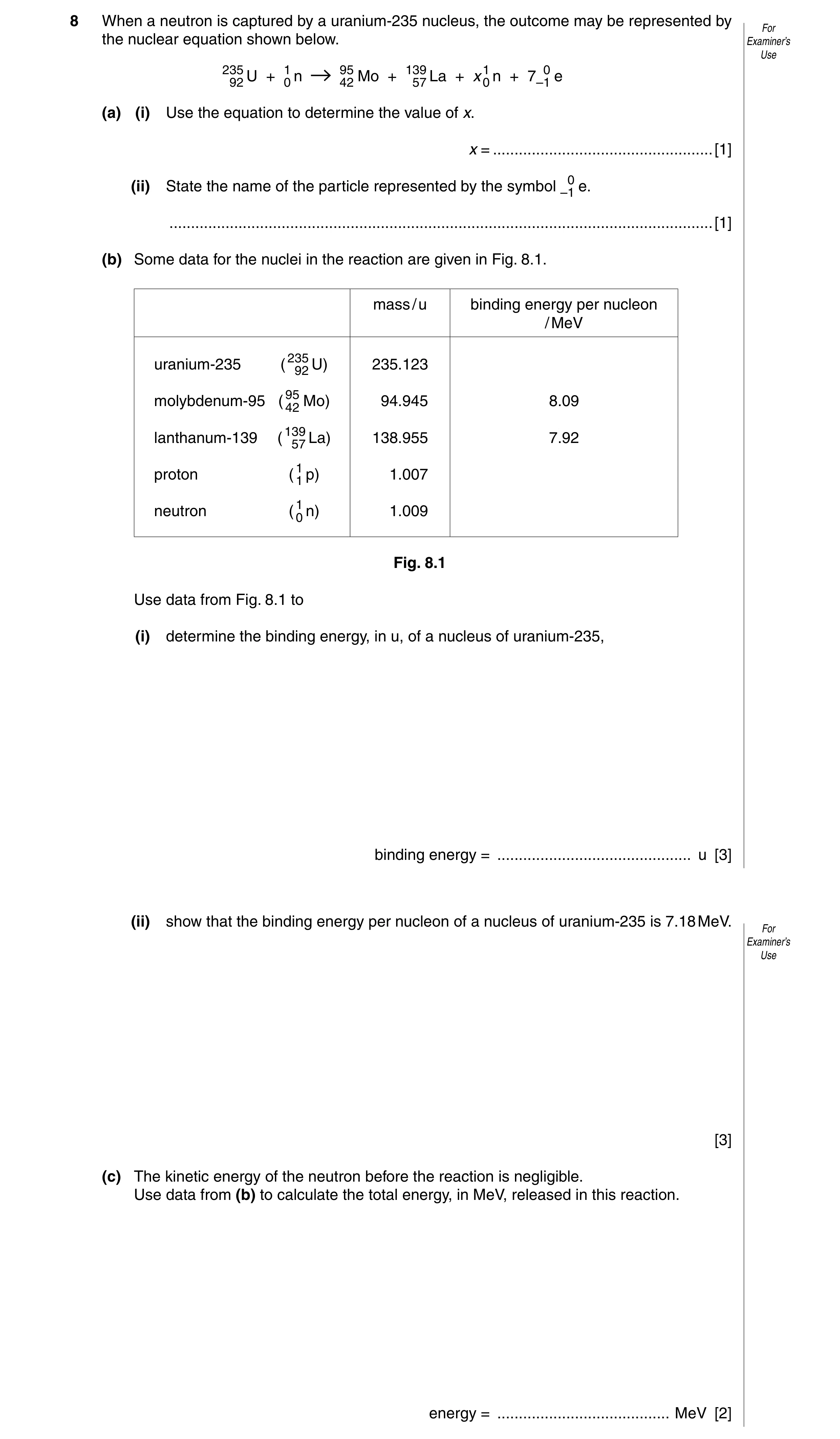
 8 / 29
 9 / 29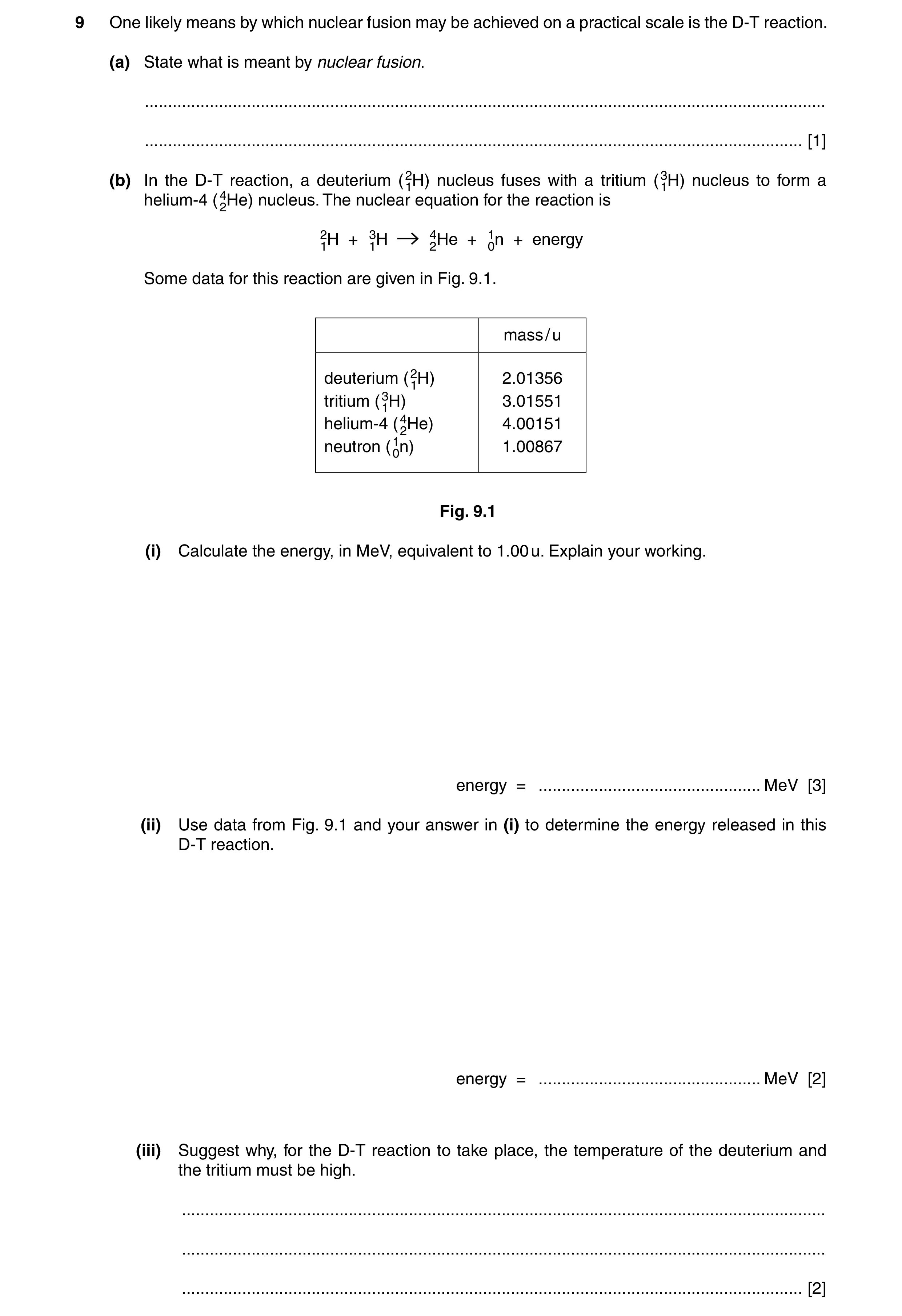
 13 / 29
 14 / 29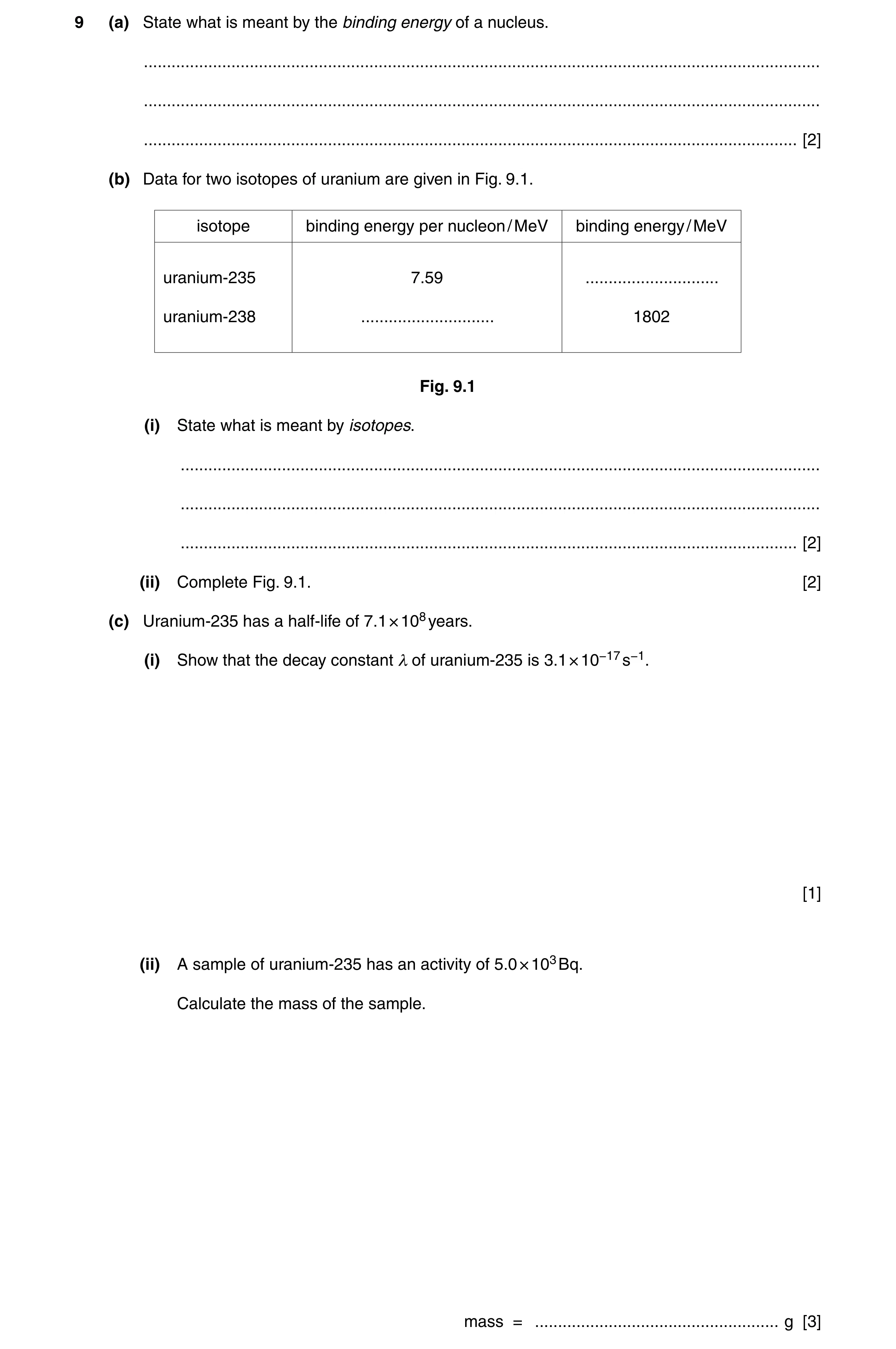
 18 / 29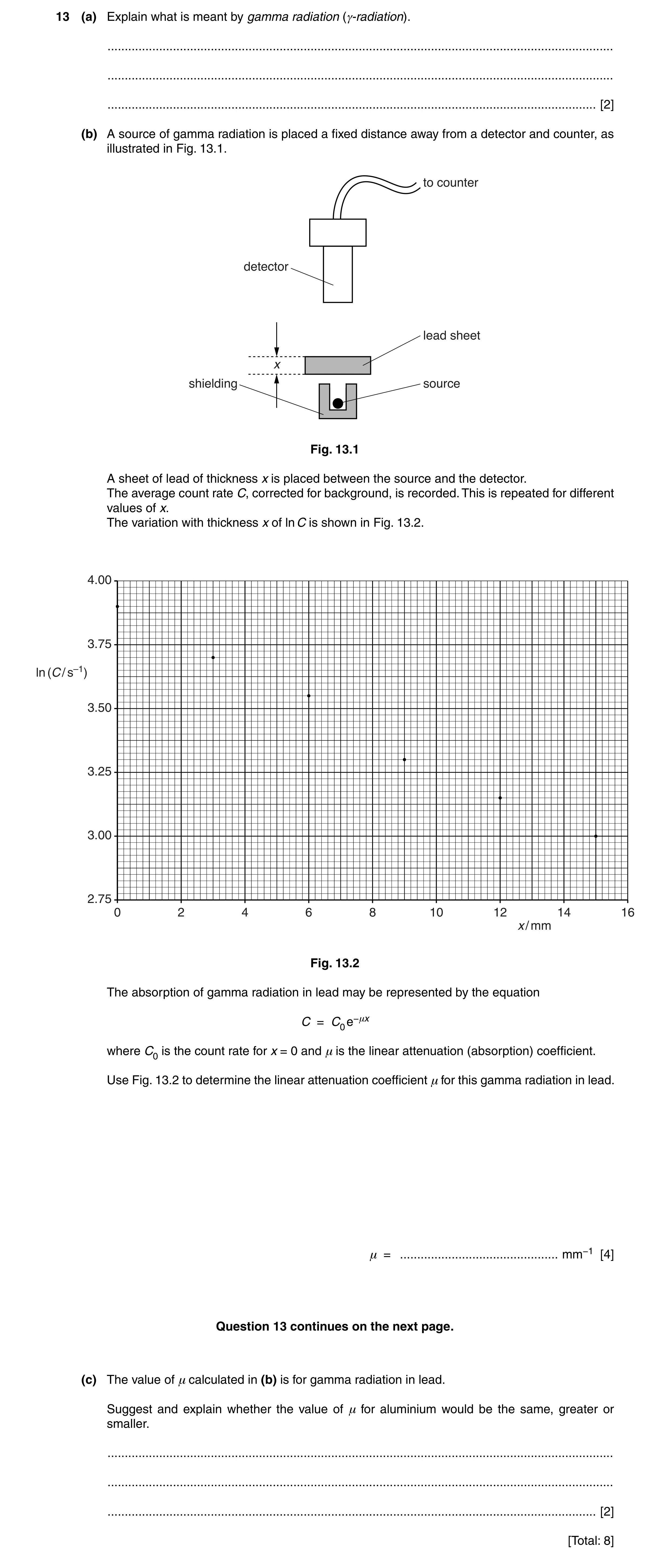
 21 / 29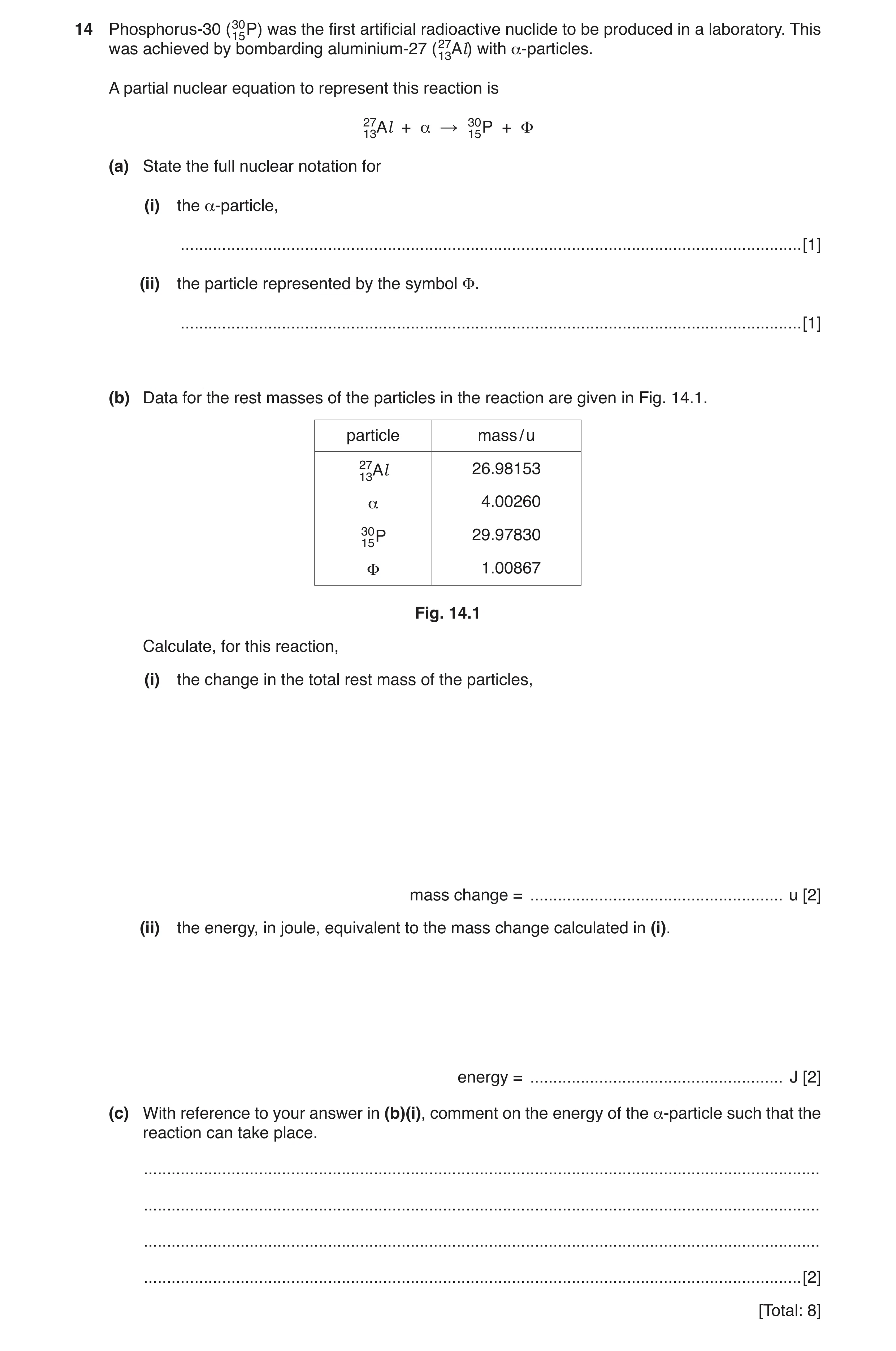
 23 / 29
 24 / 29
 25 / 29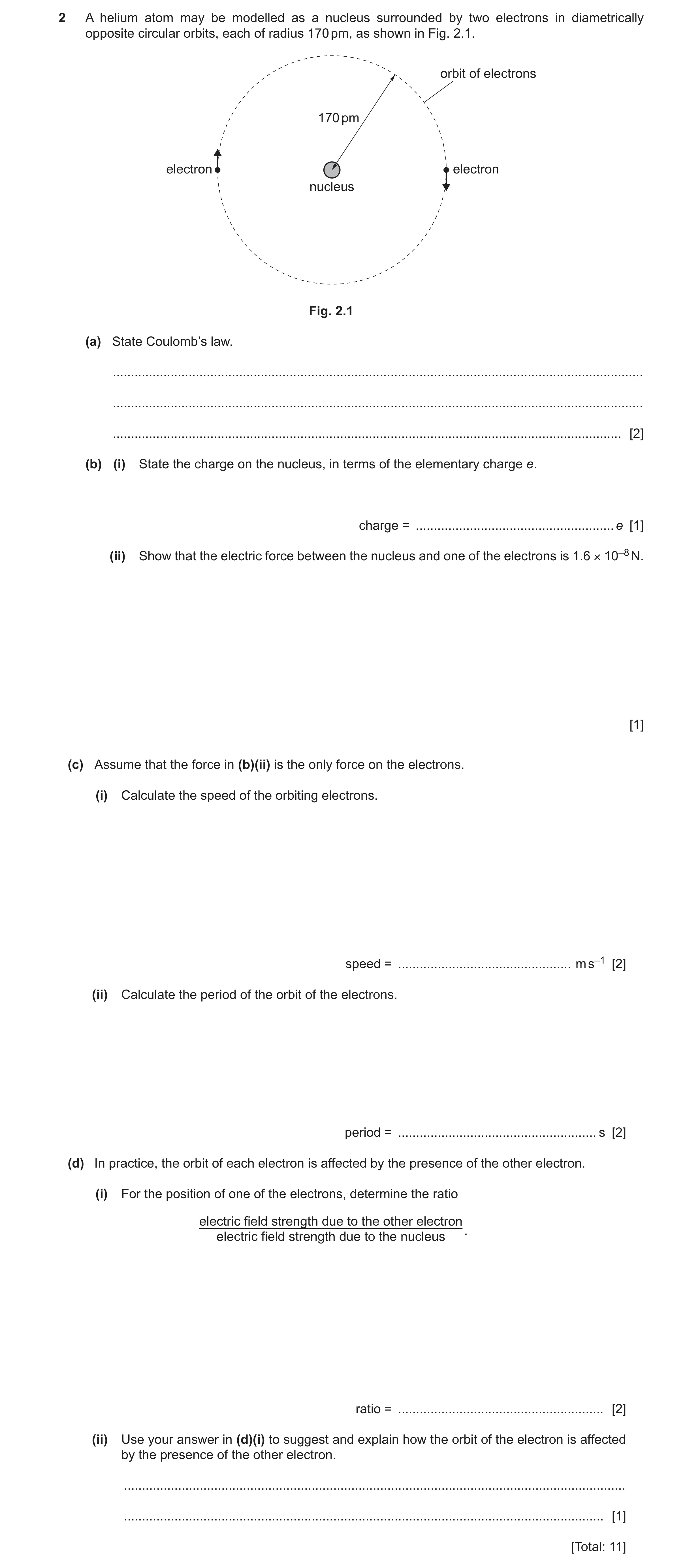
 8
8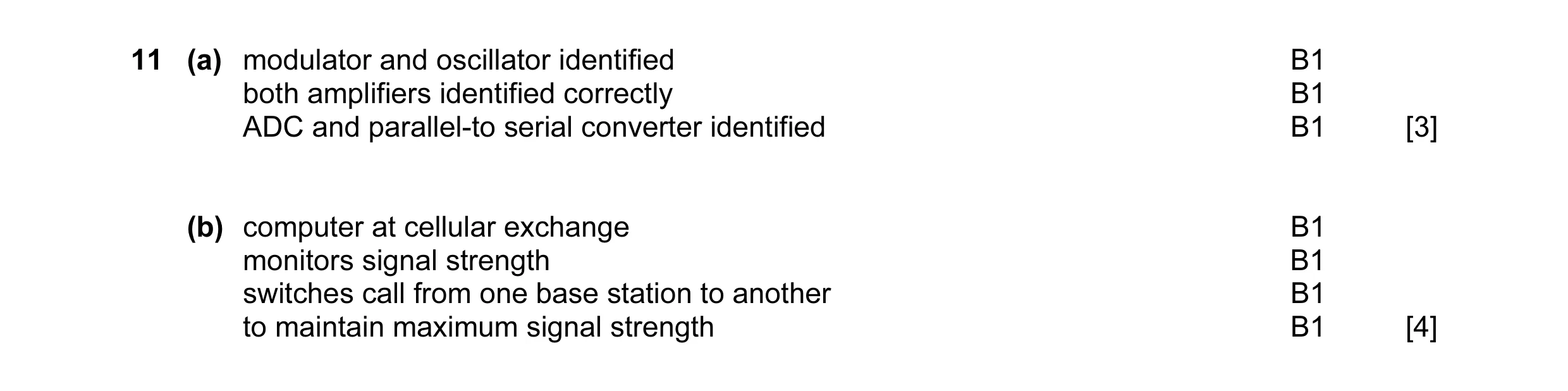 7
7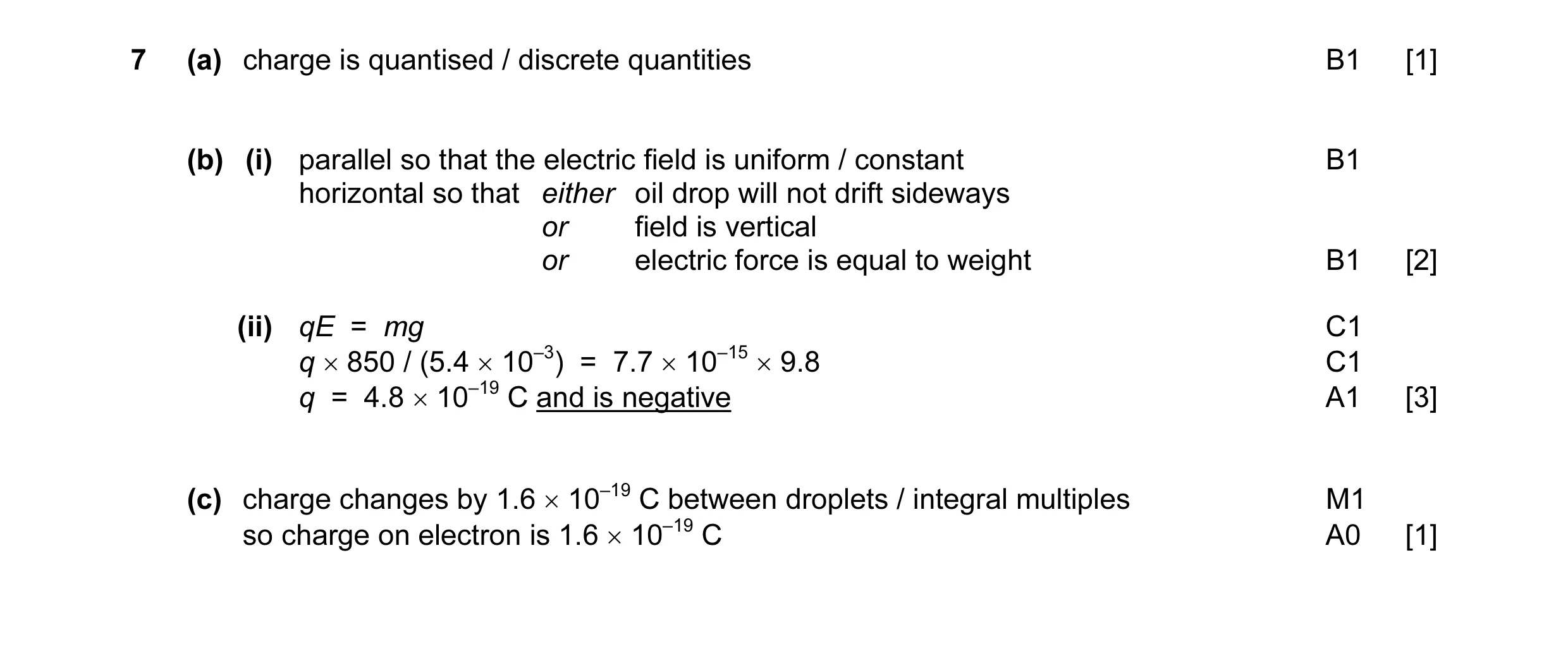 7
7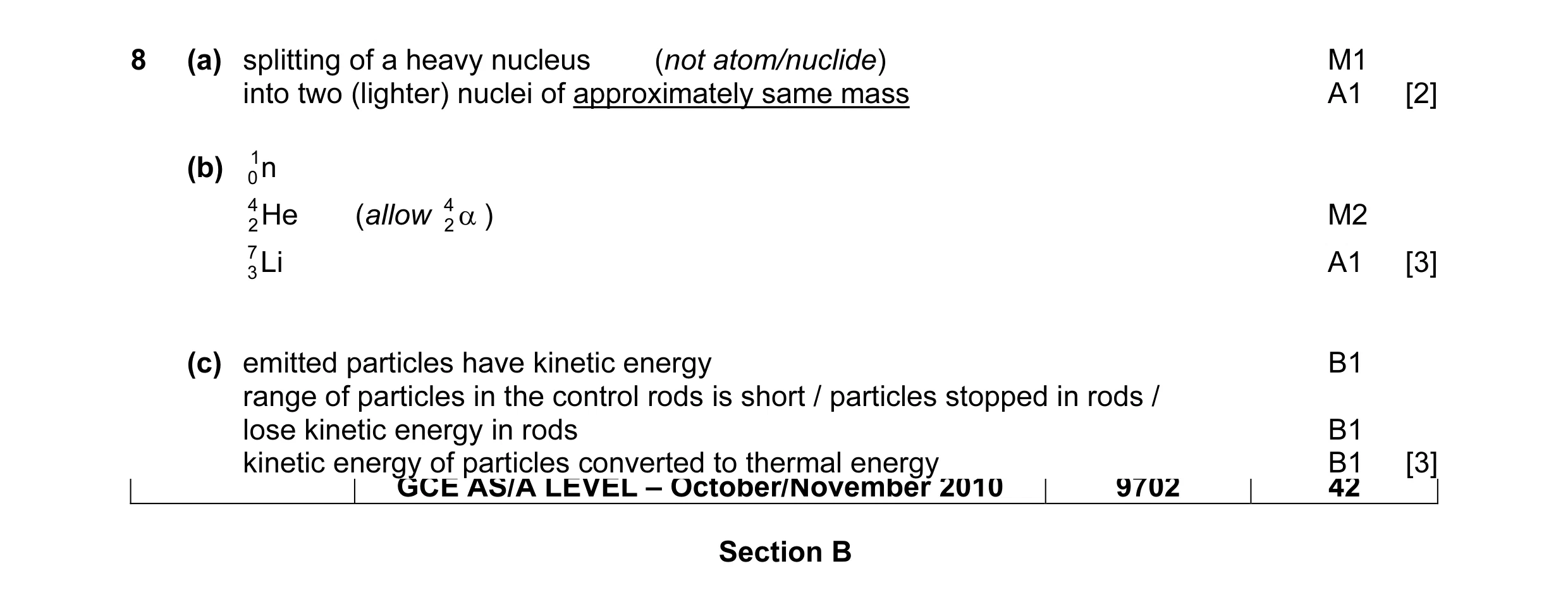 8
8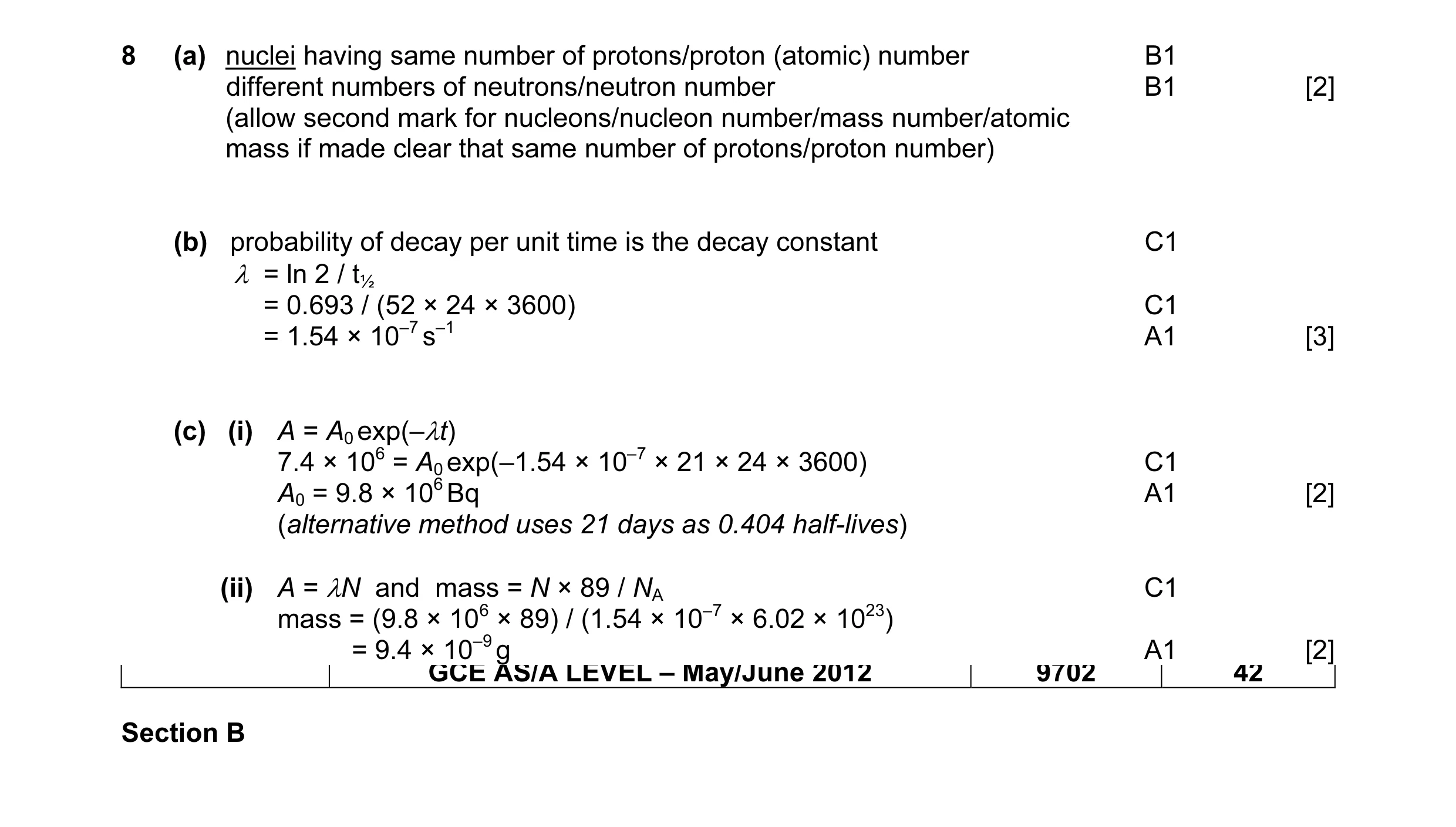 9
9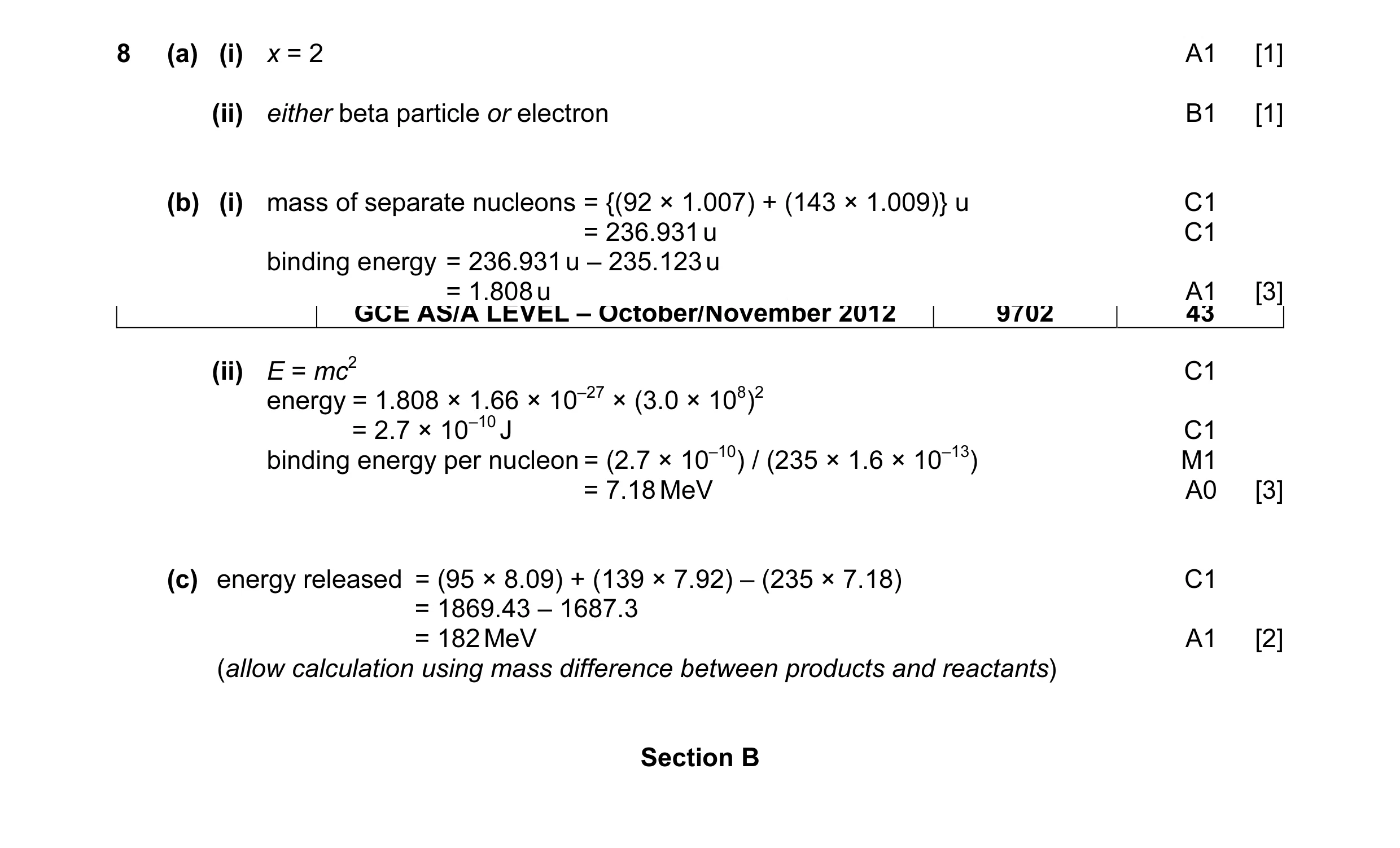 10
10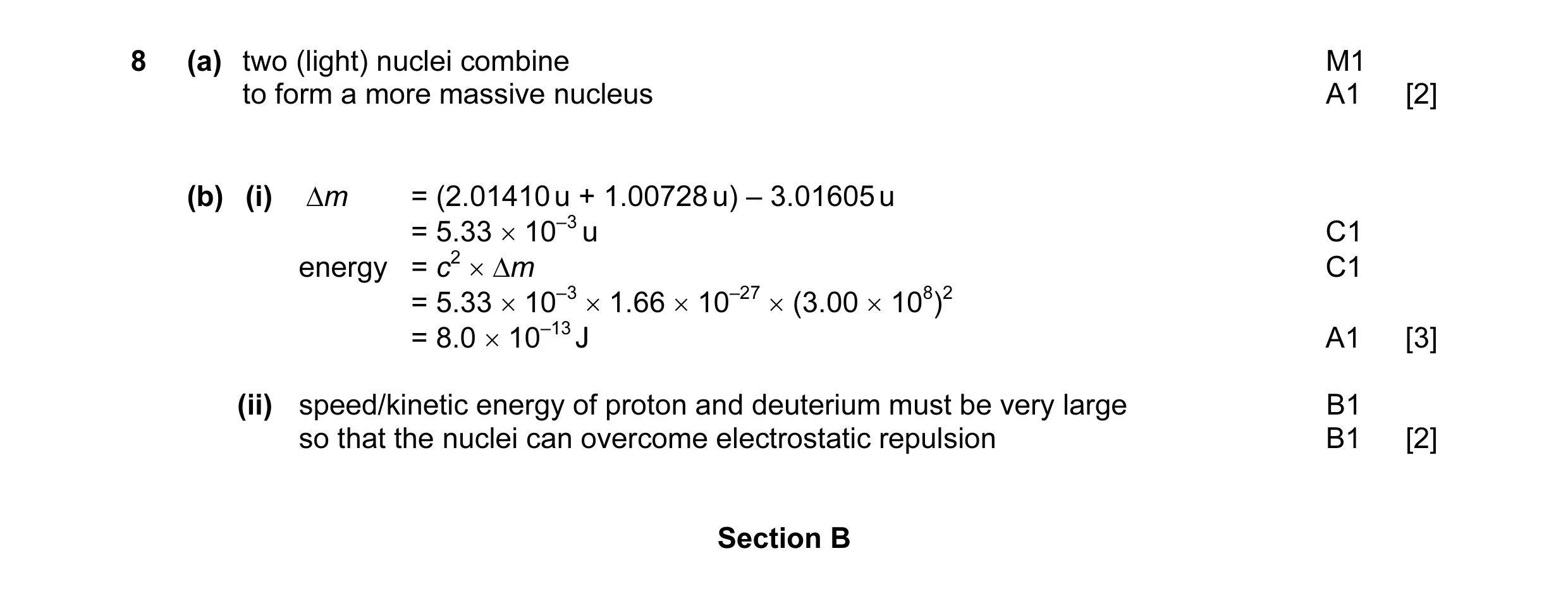 7
7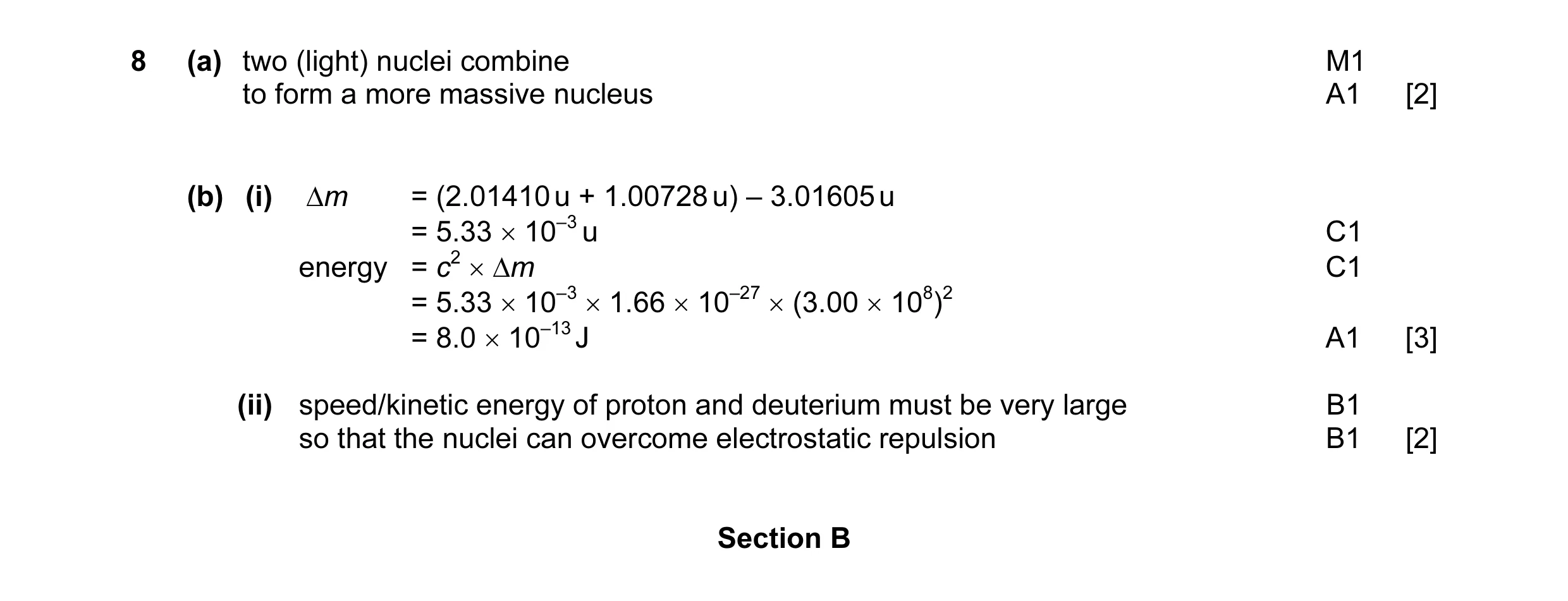 7
7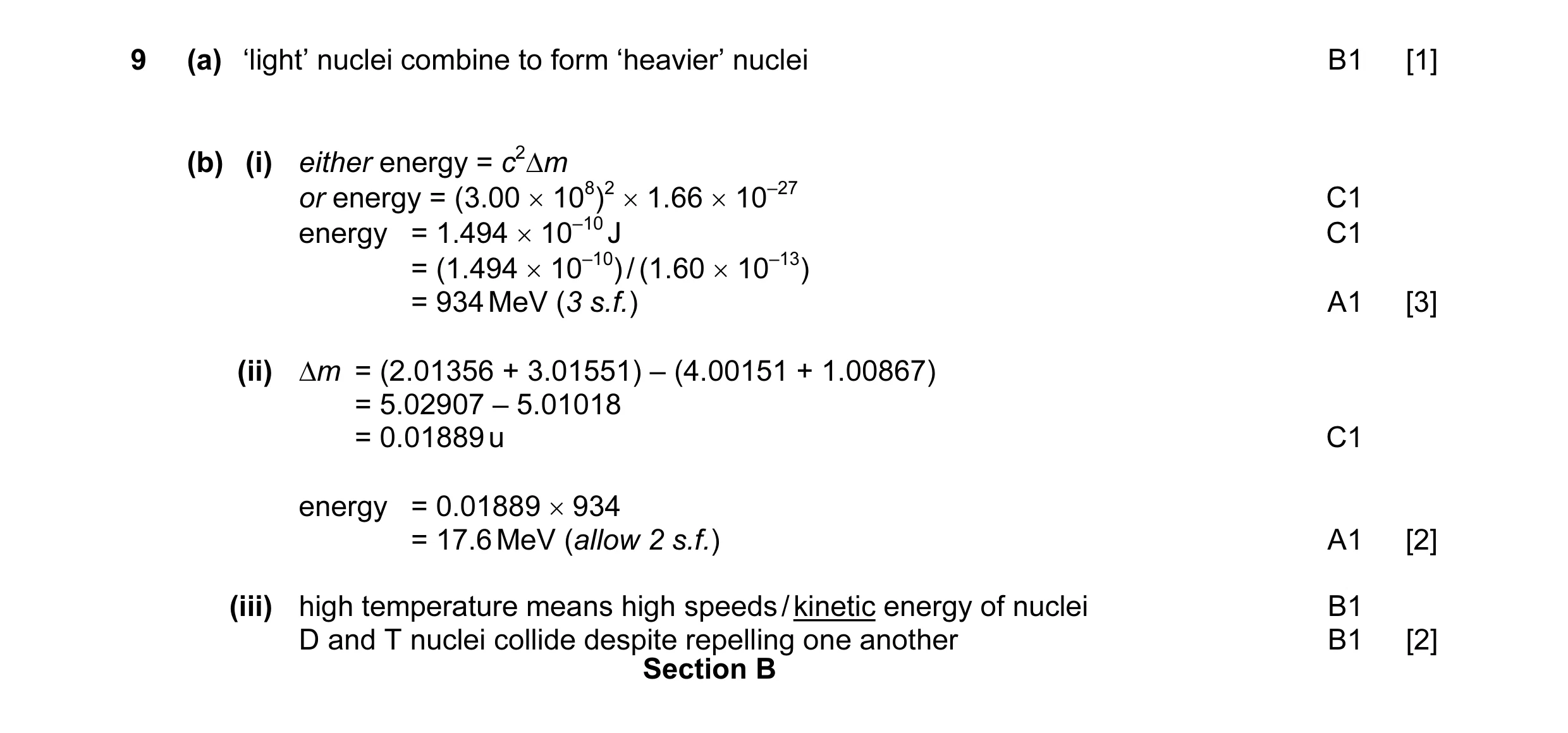 8
8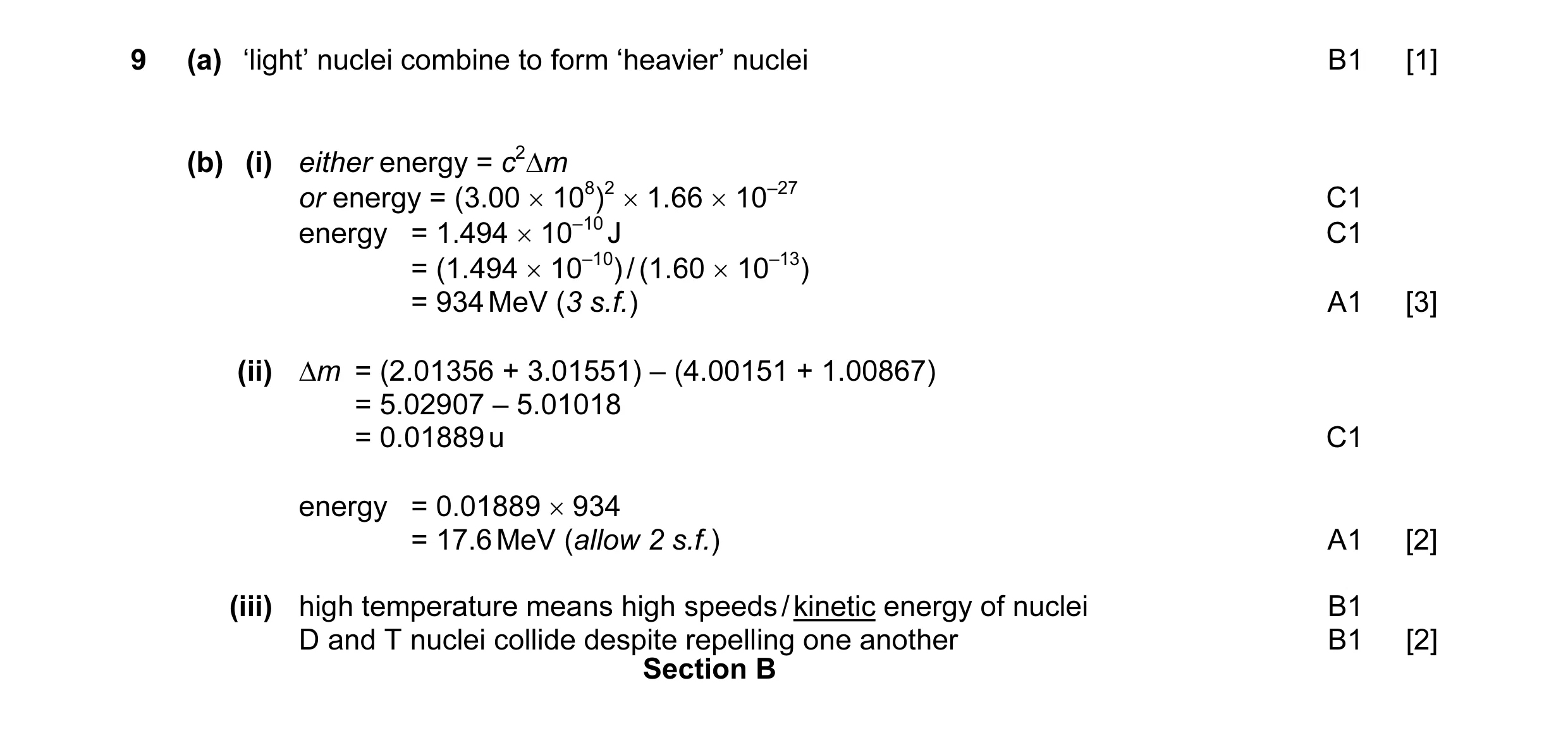 8
8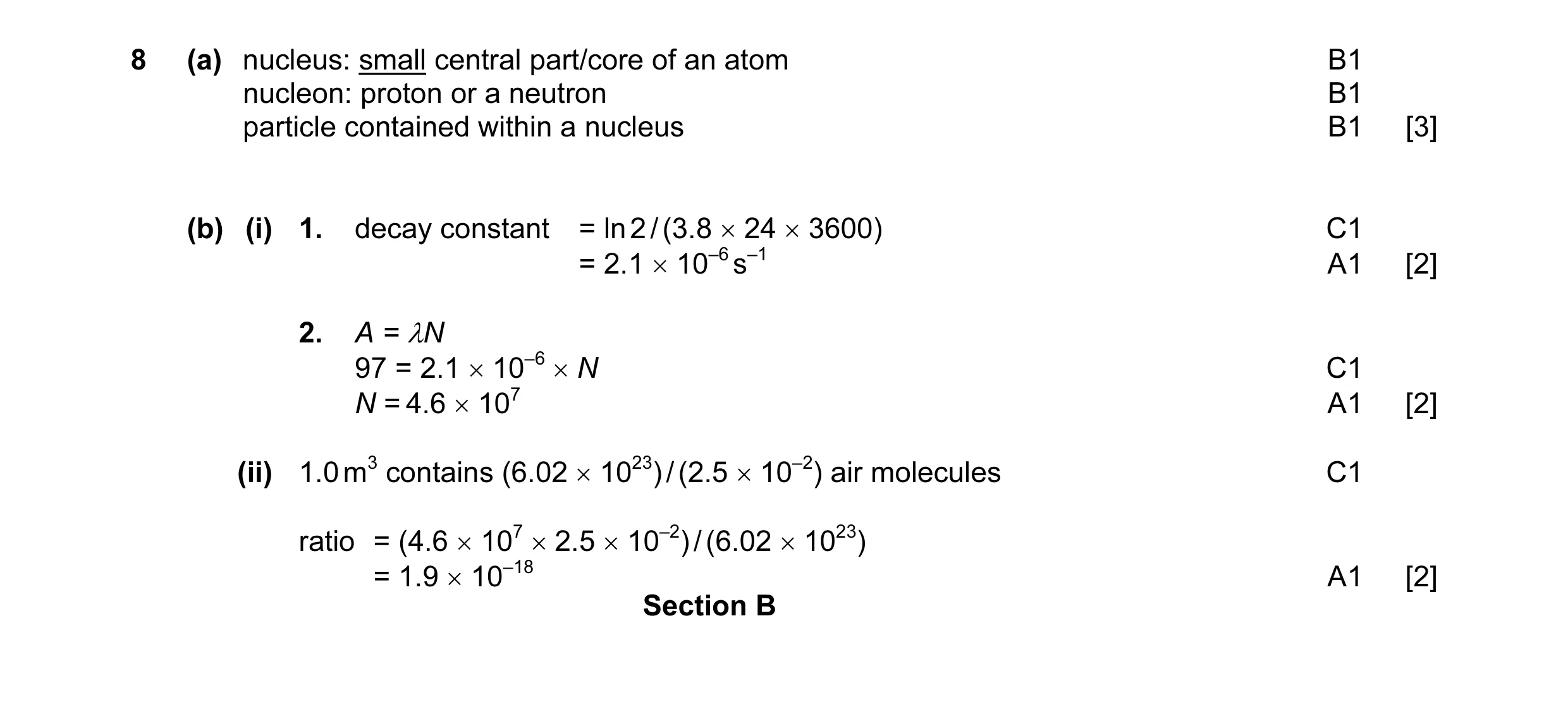 9
9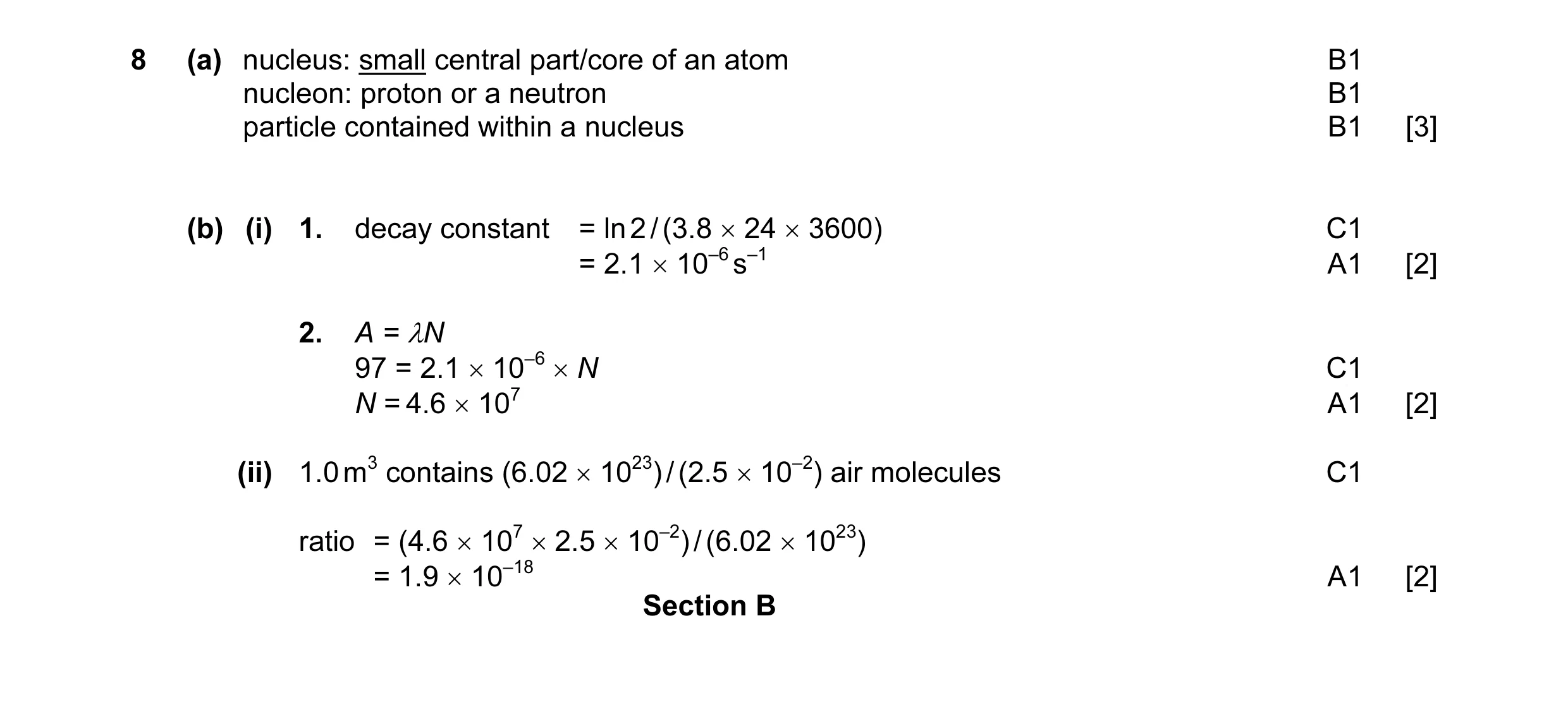 9
9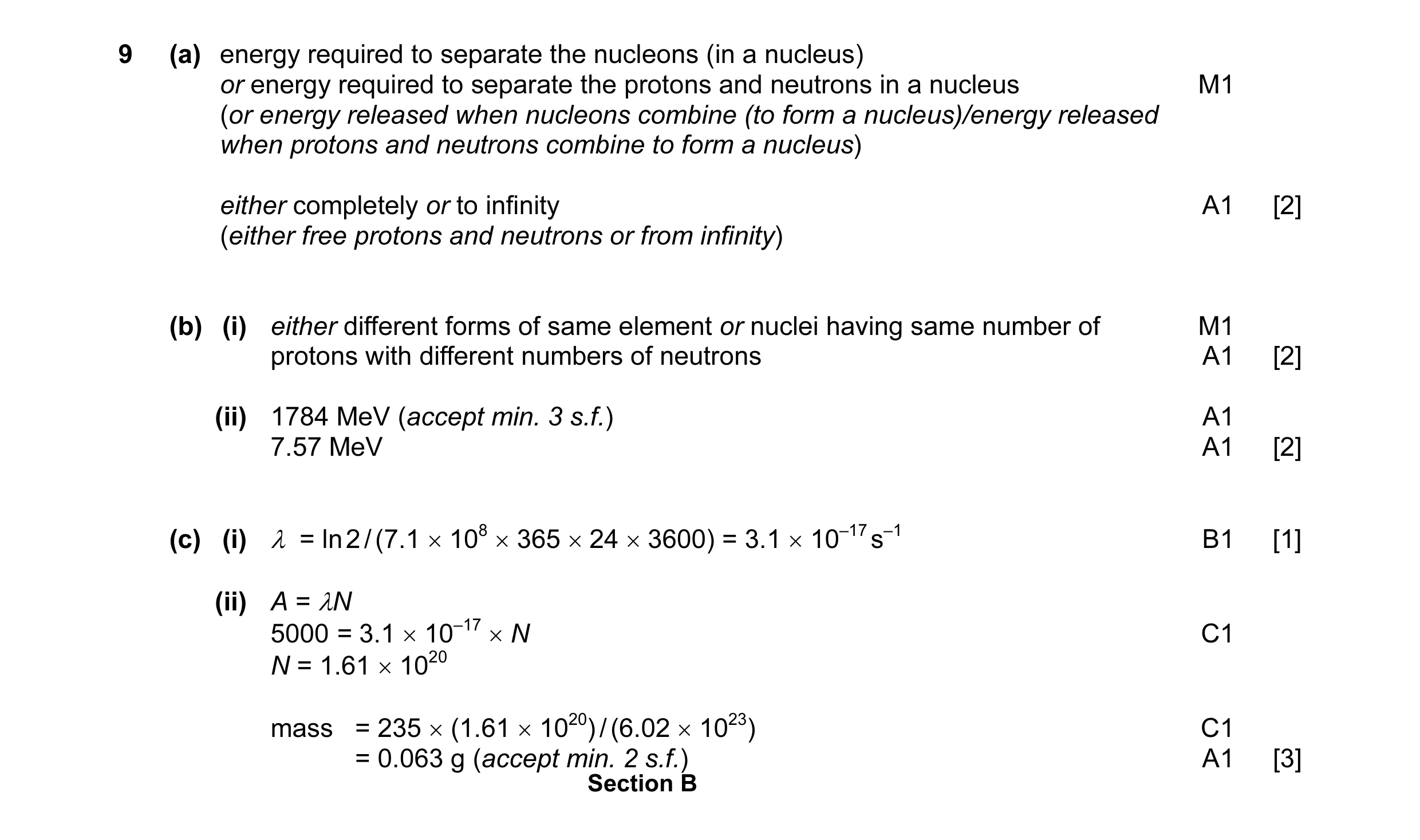 10
10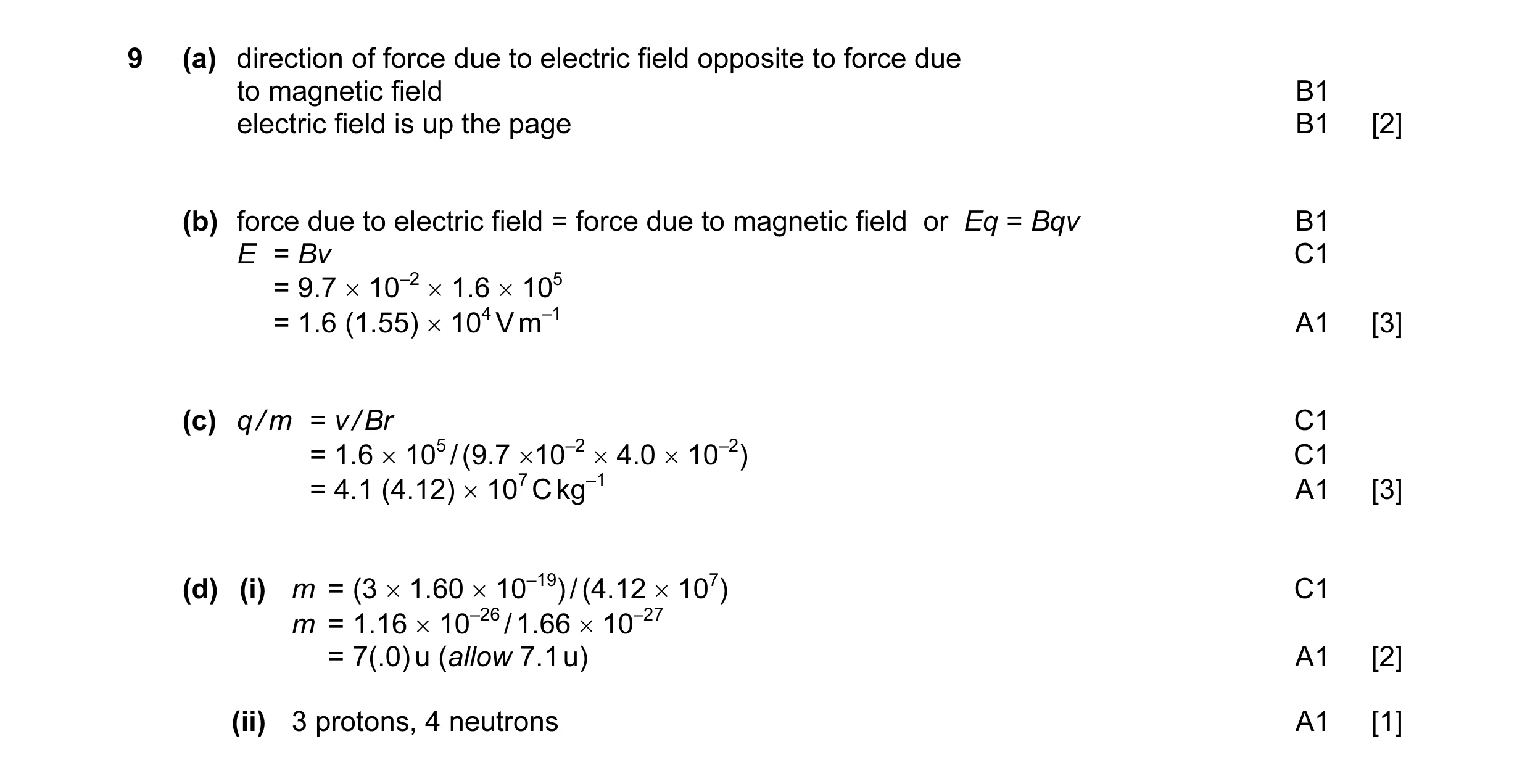 11
11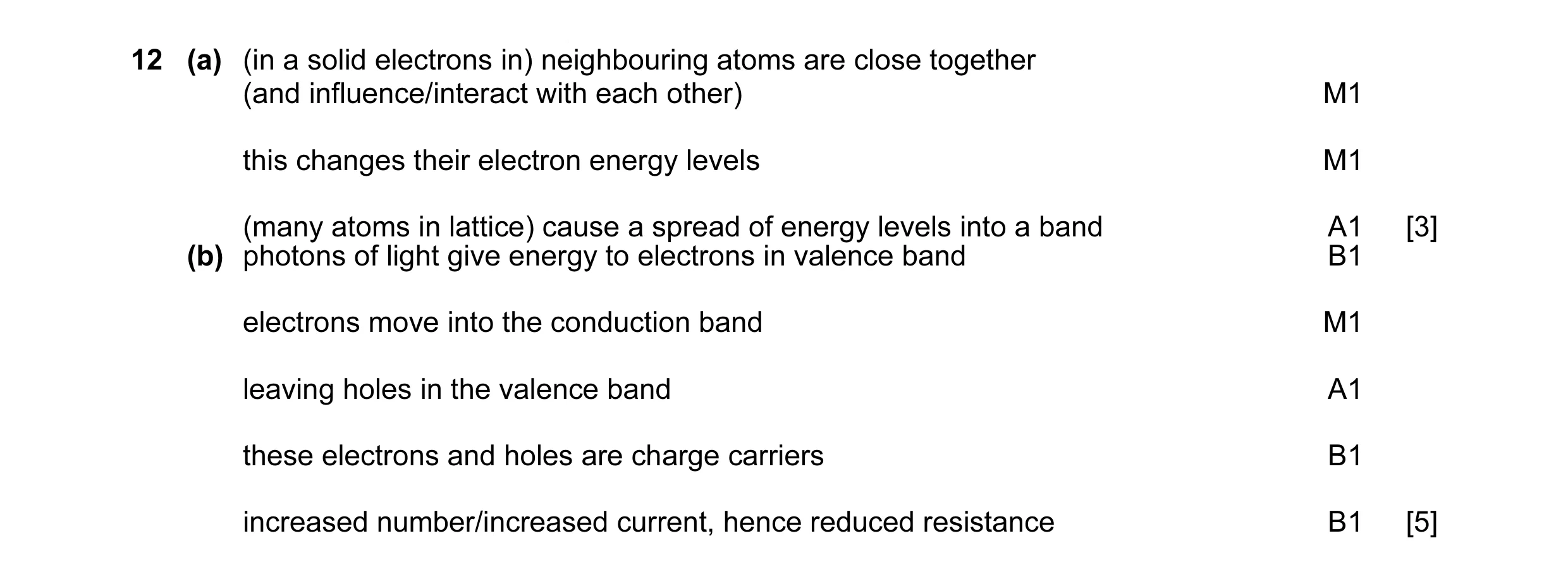 8
8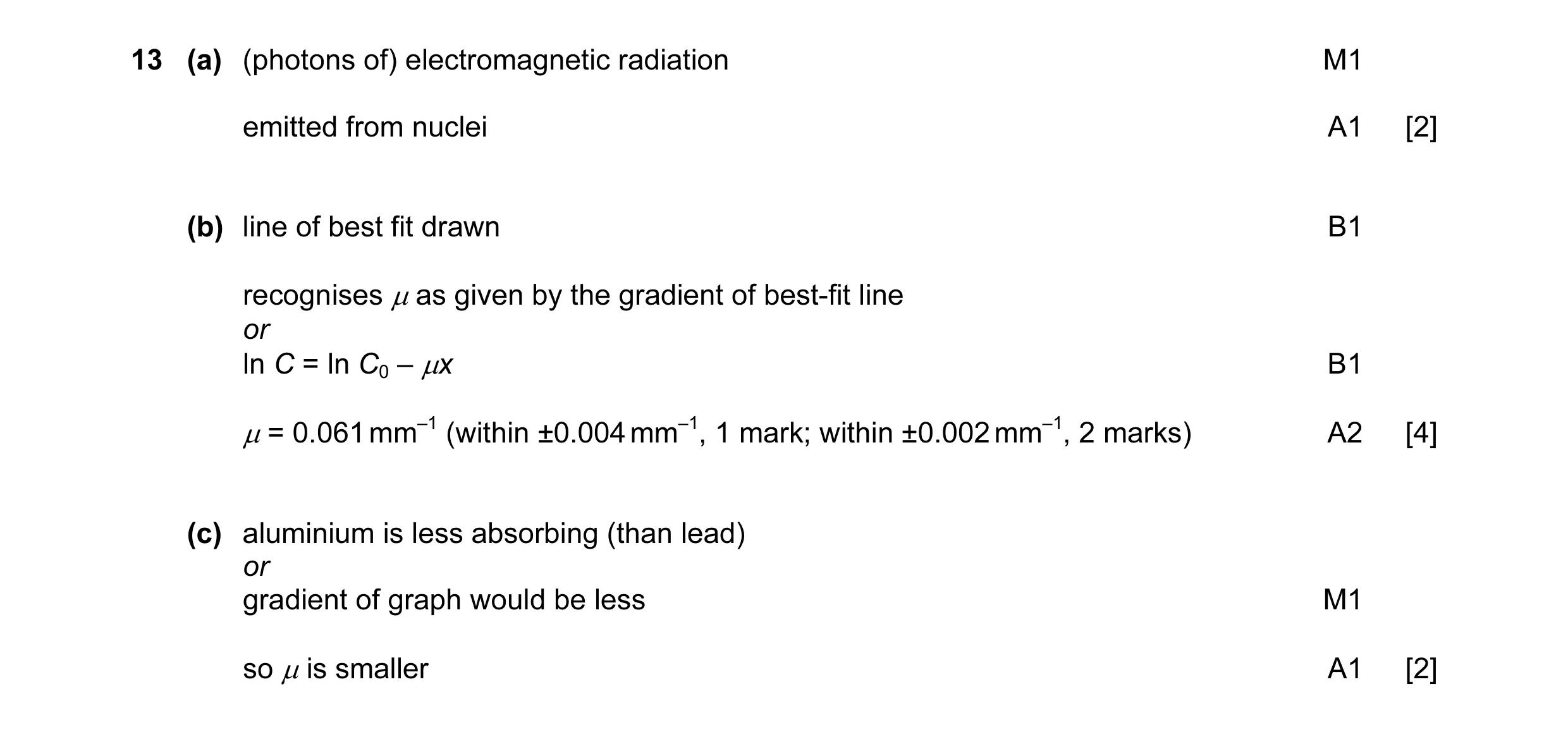 8
8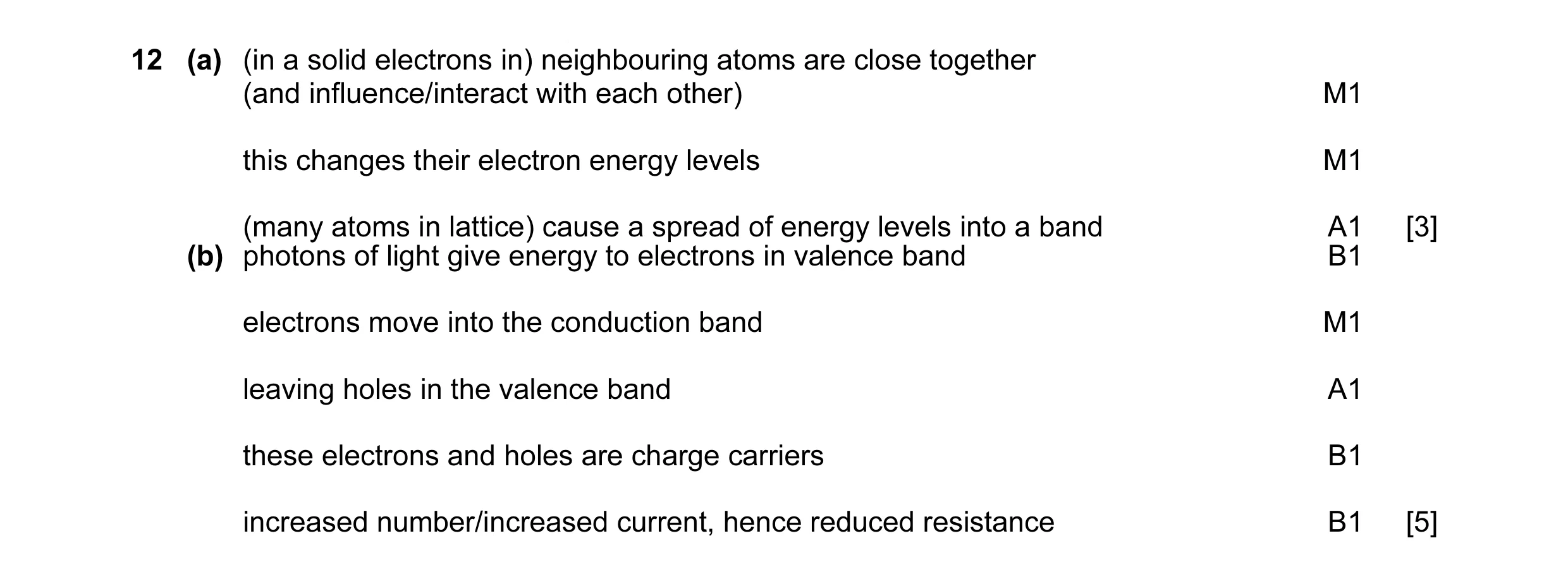 8
8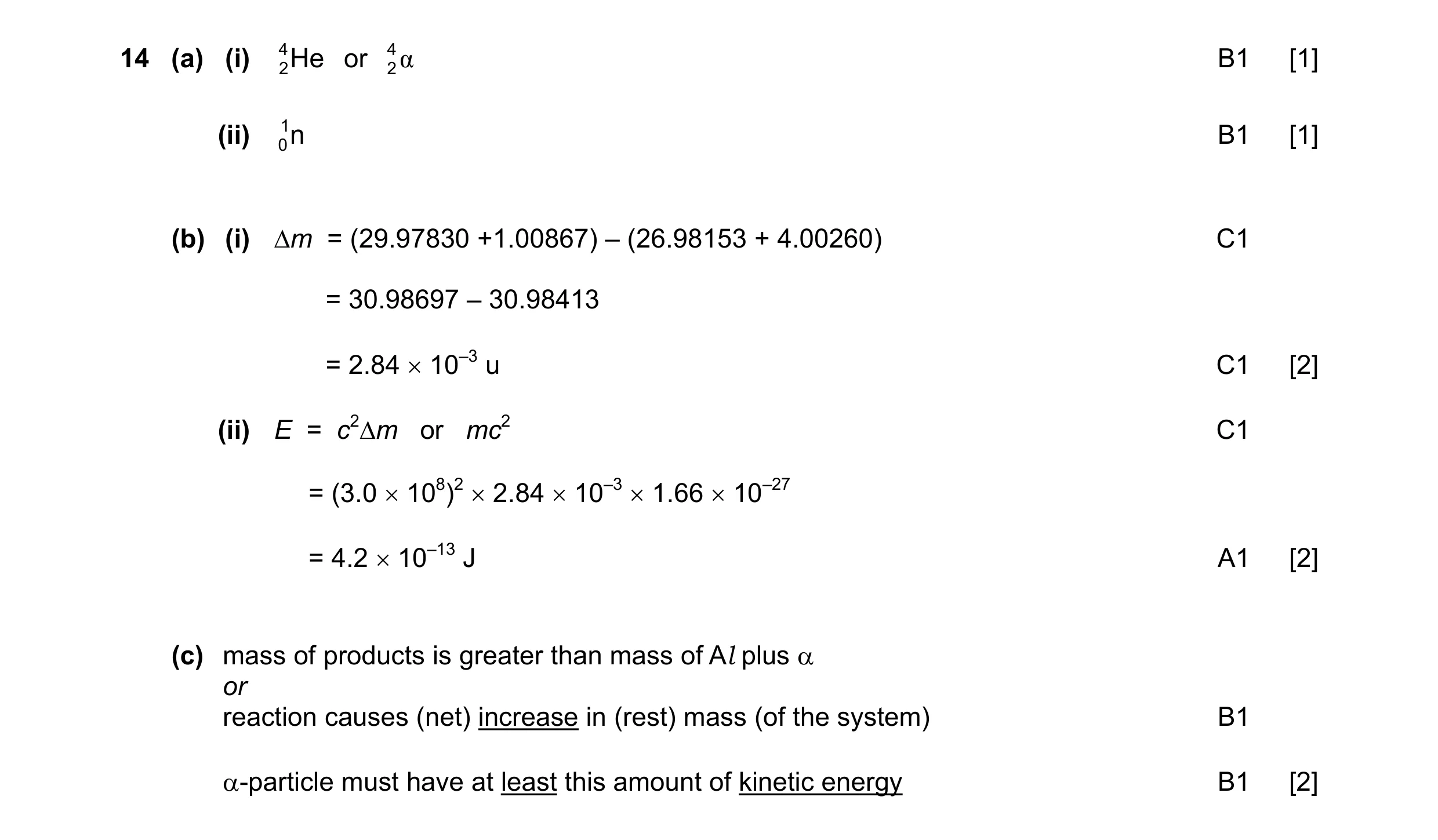 8
8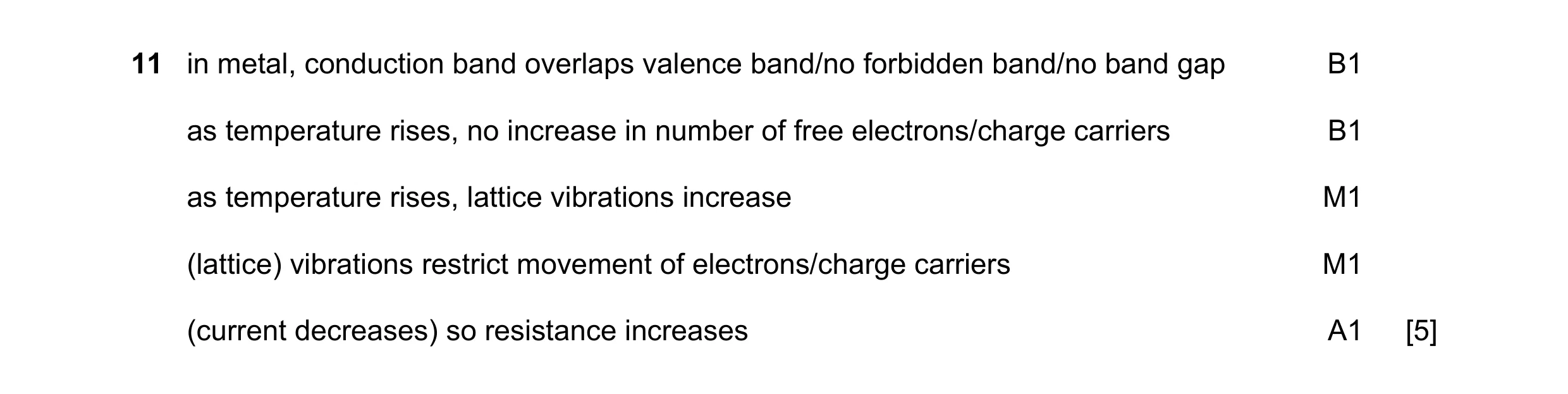 5
5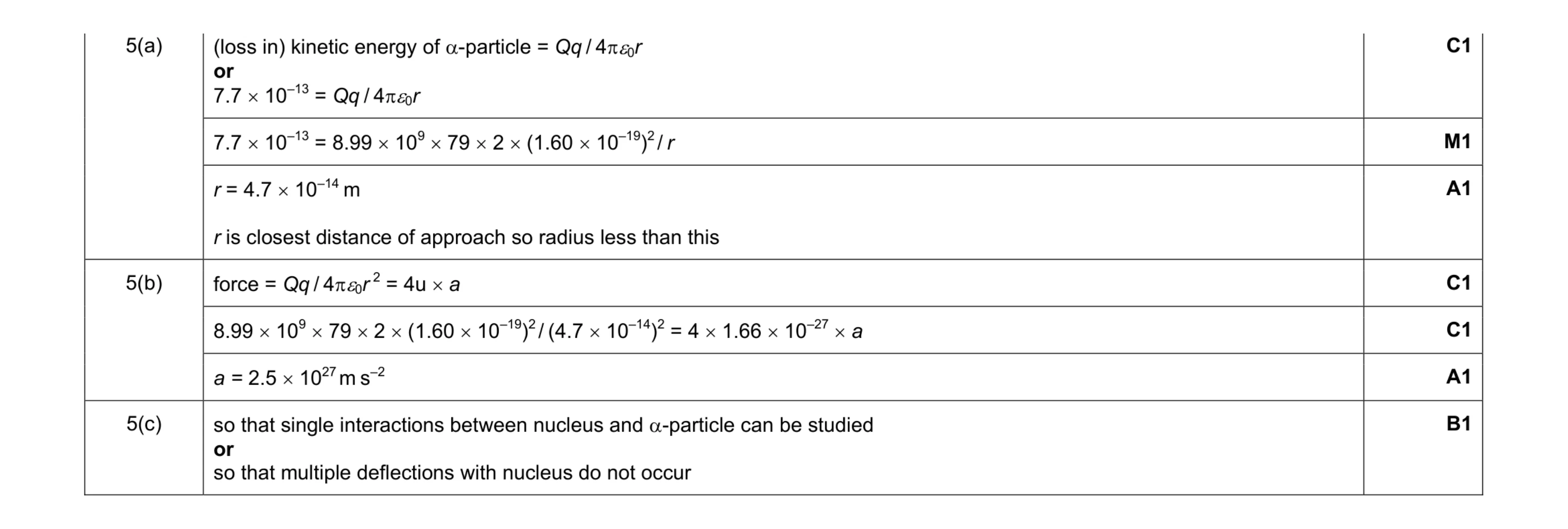 7
7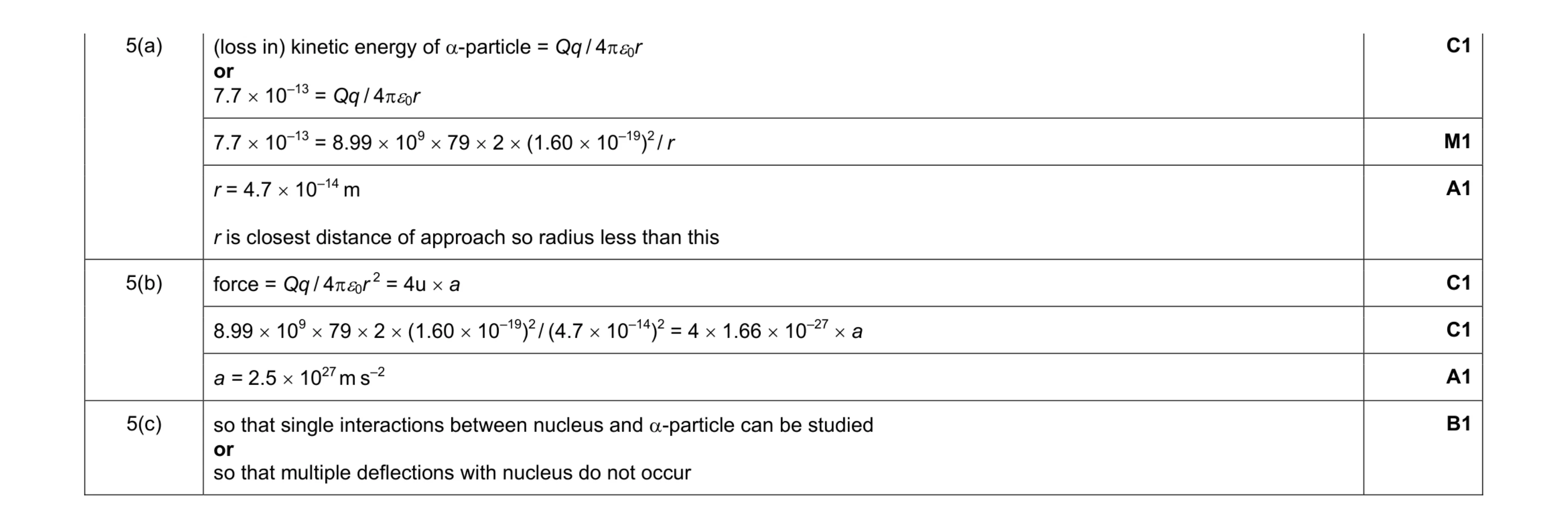 7
7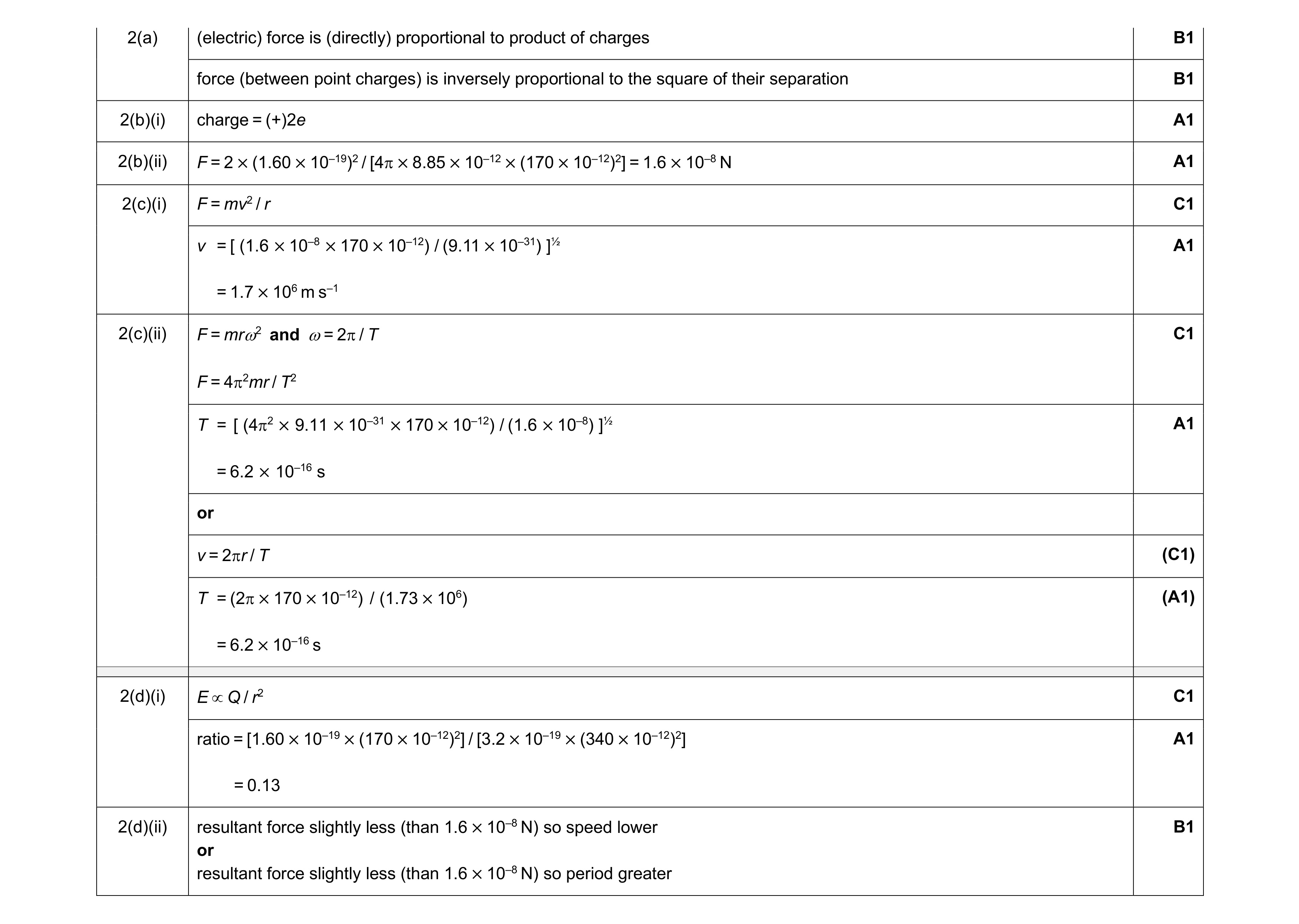 11
11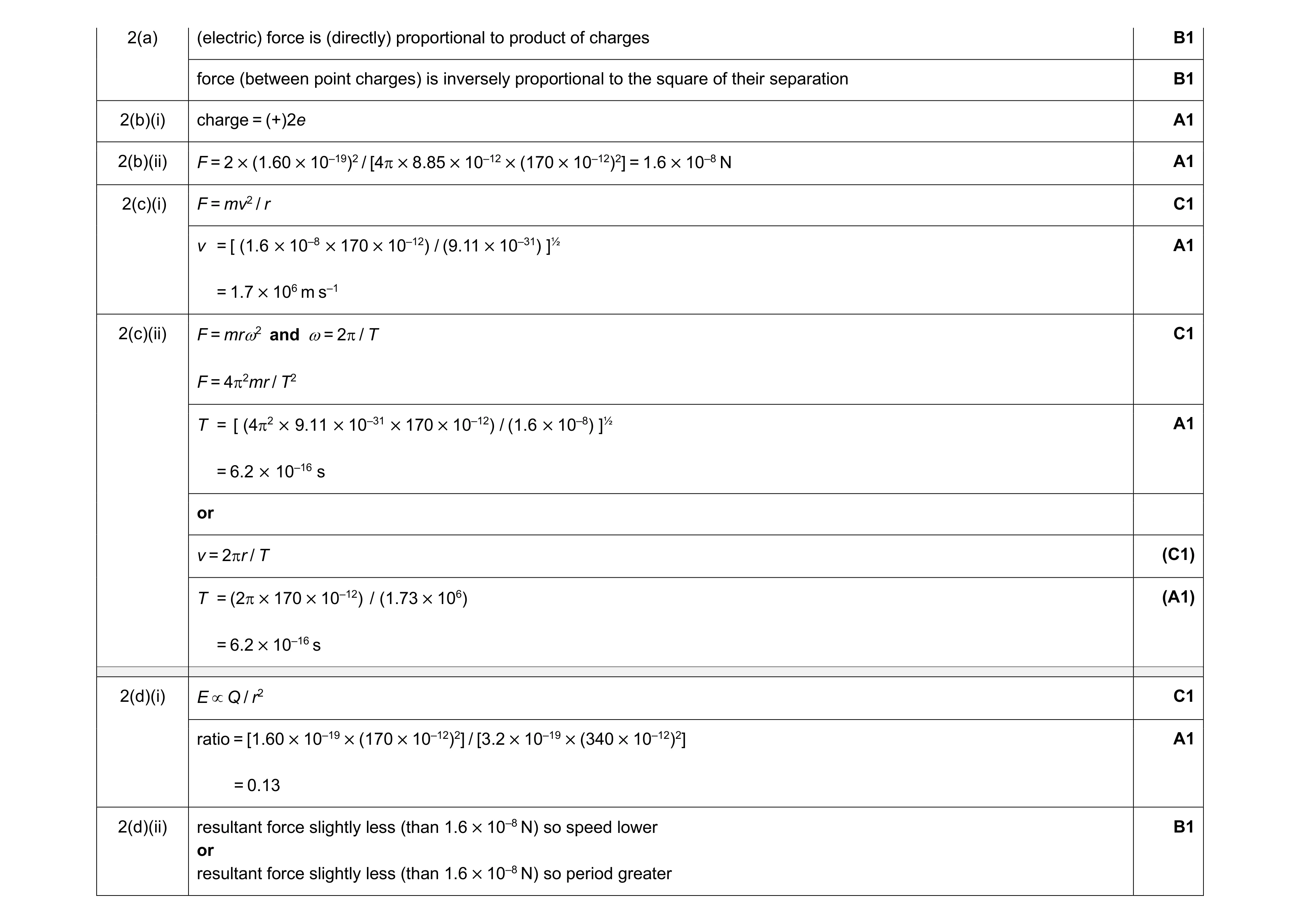 11
11