Cambridge A Level Physics 9702 — 2024 May/June Paper 2 · Variant 1
9702/21/M/J/24 · 7 questions · 60 marks · ≈68 min
The question paper and its mark scheme, free to read here and free to download. This is Cambridge’s own paper, exactly as it was sat.
Question paper20 pages



Mark scheme15 pages
Answers below. Sit the paper first if you are practising.
Questions as text
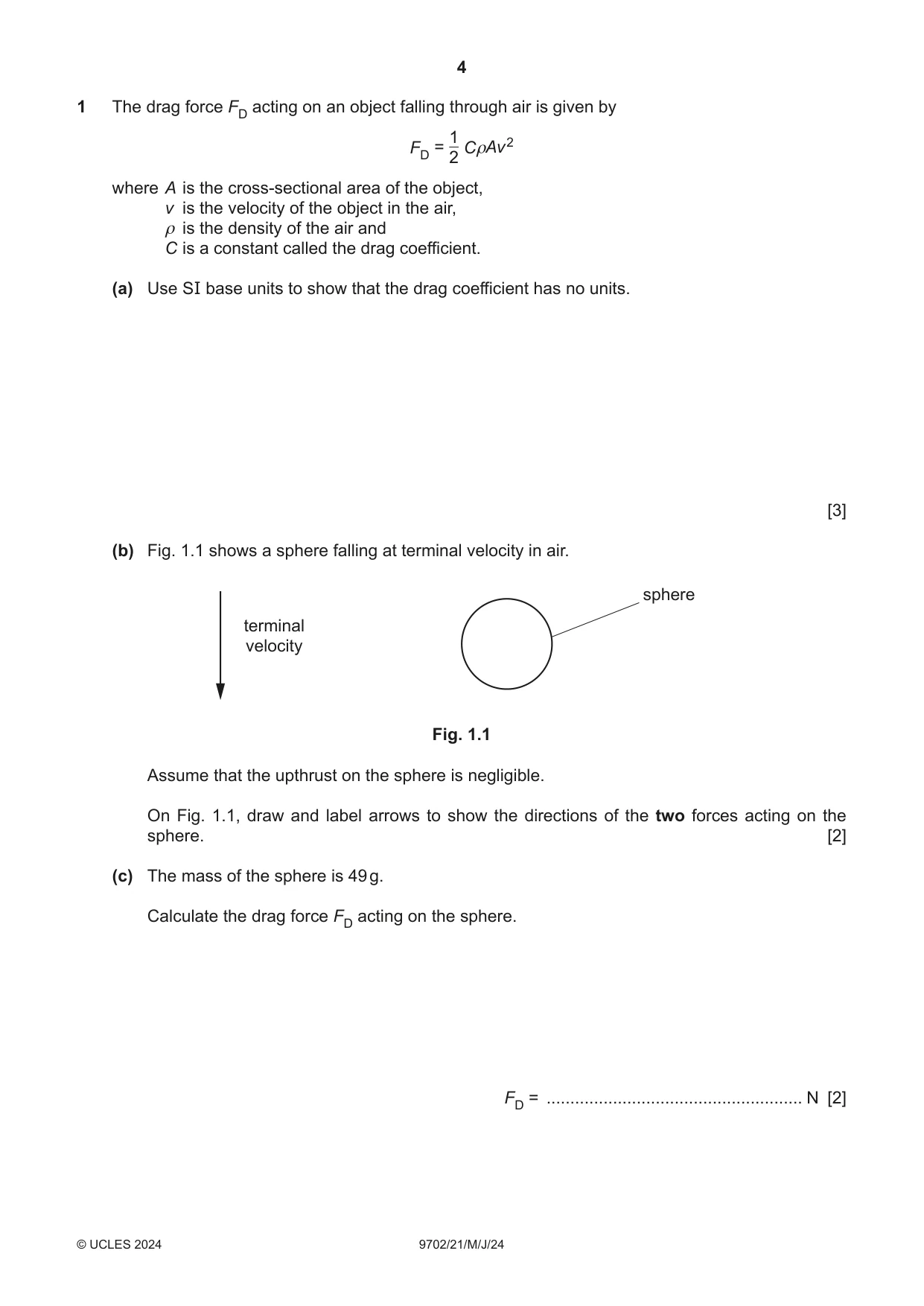
Q1 · The drag force FD acting on an object falling through air is given by 1 FD = CρAv 2 2…
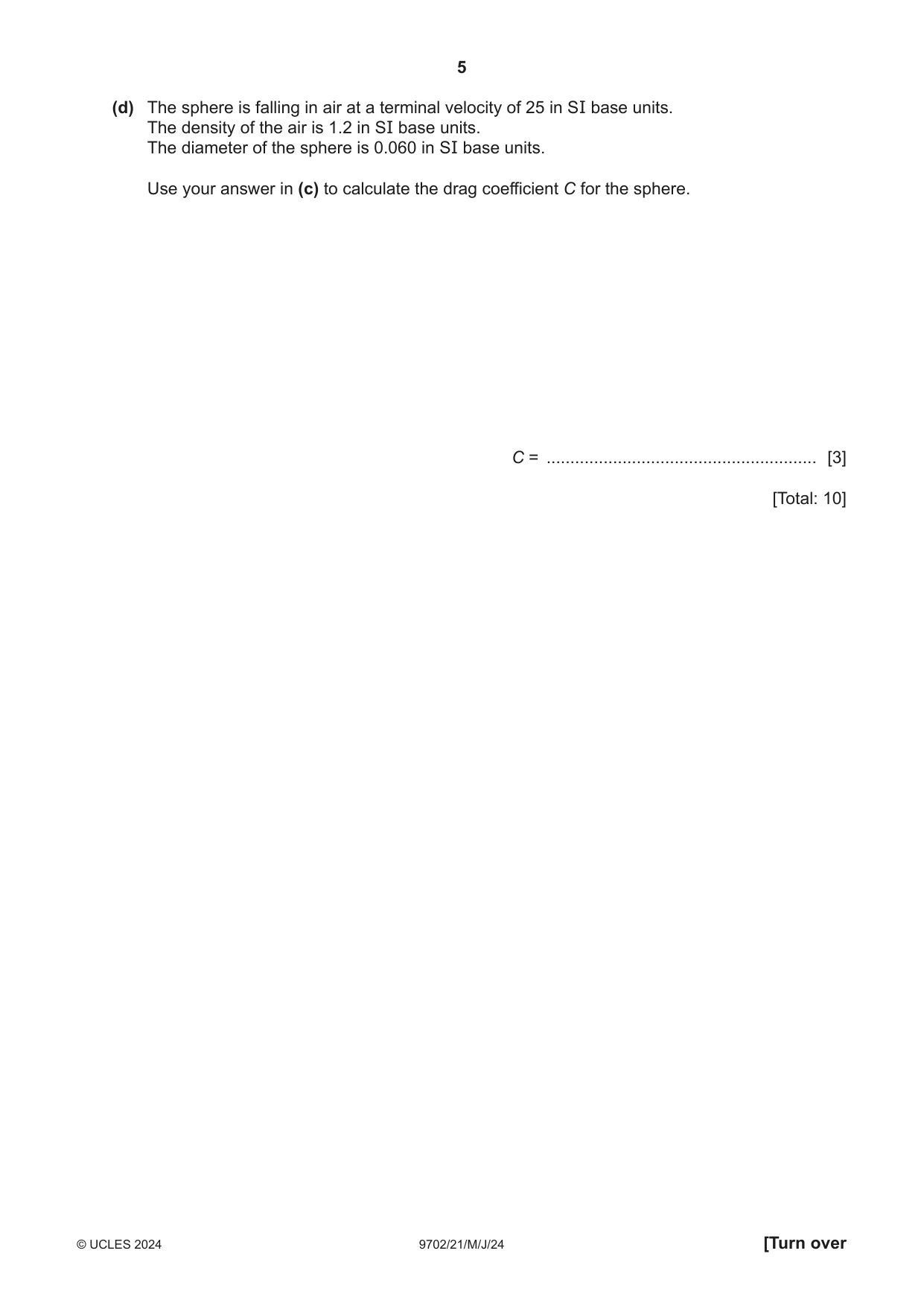
1 The drag force FD acting on an object falling through air is given by 1 FD = CρAv 2 2 where A is the cross-sectional area of the object, v is the velocity of the object in the air, ρ is the density of the air and C is a constant called the drag coefficient. (a) Use SI base units to show that the drag coefficient has no units. [3] (b) Fig. 1.1 shows a sphere falling at terminal velocity in air. sphere terminal velocity Fig. 1.1 Assume that the upthrust on the sphere is negligible. On Fig. 1.1, draw and label arrows to show the directions of the two forces acting on the sphere. [2] (c) The mass of the sphere is 49 g. Calculate the drag force FD acting on the sphere. FD = ...................................................... N [2] (d) The sphere is falling in air at a terminal velocity of 25 in SI base units. The density of the air is 1.2 in SI base units. The diameter of the sphere is 0.060 in SI base units. Use your answer in (c) to calculate the drag coefficient C for the sphere. C = ......................................................... [3] [Total: 10]
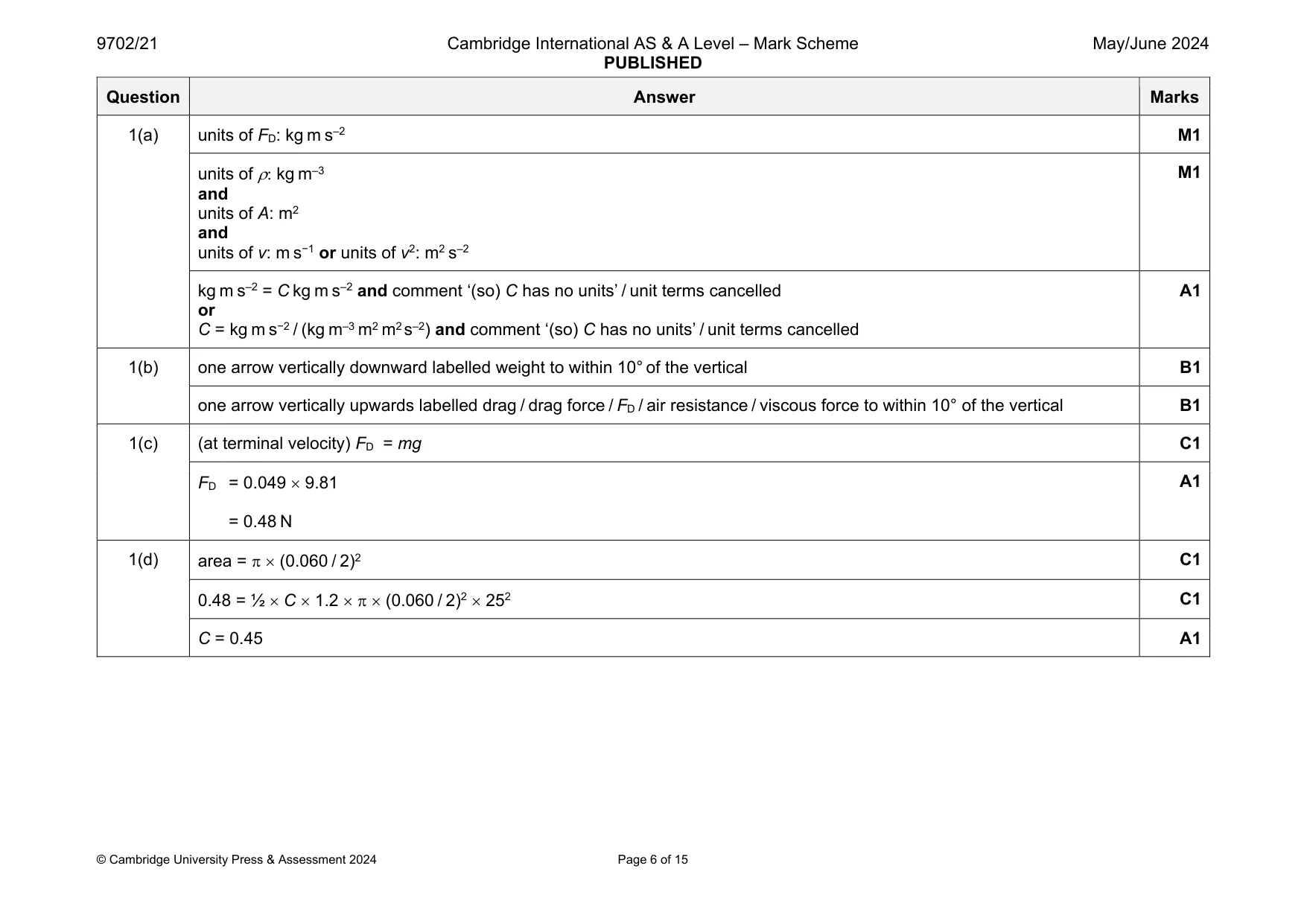
Mark scheme: 1(a) units of FD: kg m s–2 M1 units of kg m–3 and units of A: m2 and units of v: m s−1 or units of v2: m2 s–2 M1 kg m s–2 = C kg m s–2 and comment ‘(so) C has no units’ / unit terms cancelled or C = kg m s−2 / (kg m–3 m2 m2 s–2) and comment ‘(so) C has no units’ / unit terms cancelled A1 1(b) one arrow vertically downward labelled weight to within 10° of the vertical B1 one arrow vertically upwards labelled drag / drag force / FD / air resistance / viscous force to within 10° of the vertical B1 1(c) (at terminal velocity) FD = mg C1 FD = 0.049 9.81 = 0.48 N A1 1(d) area = (0.060 / 2)2 C1 0.48 = ½ C 1.2 (0.060 / 2)2 252 C1 C = 0.45 A1
Question 2
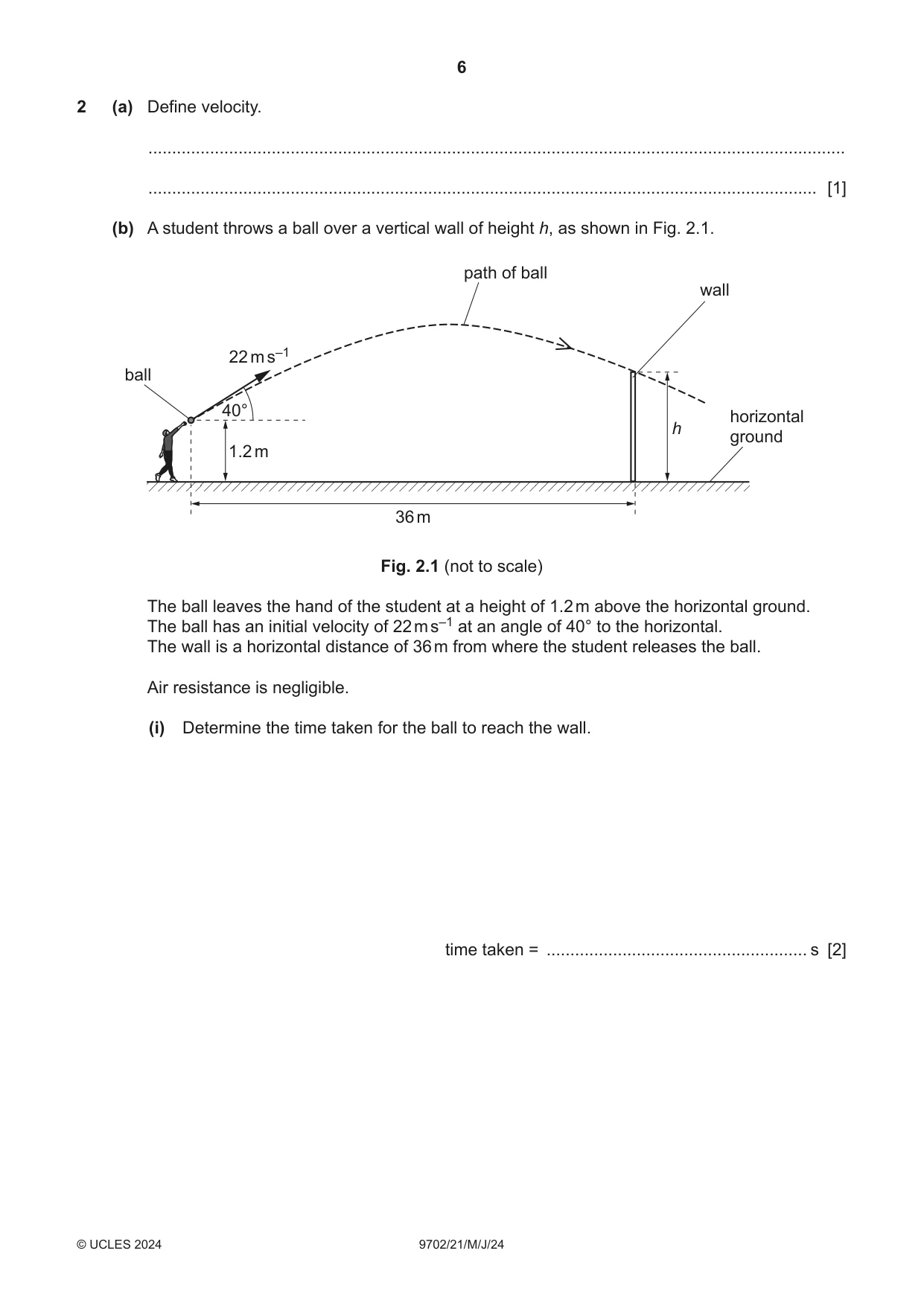
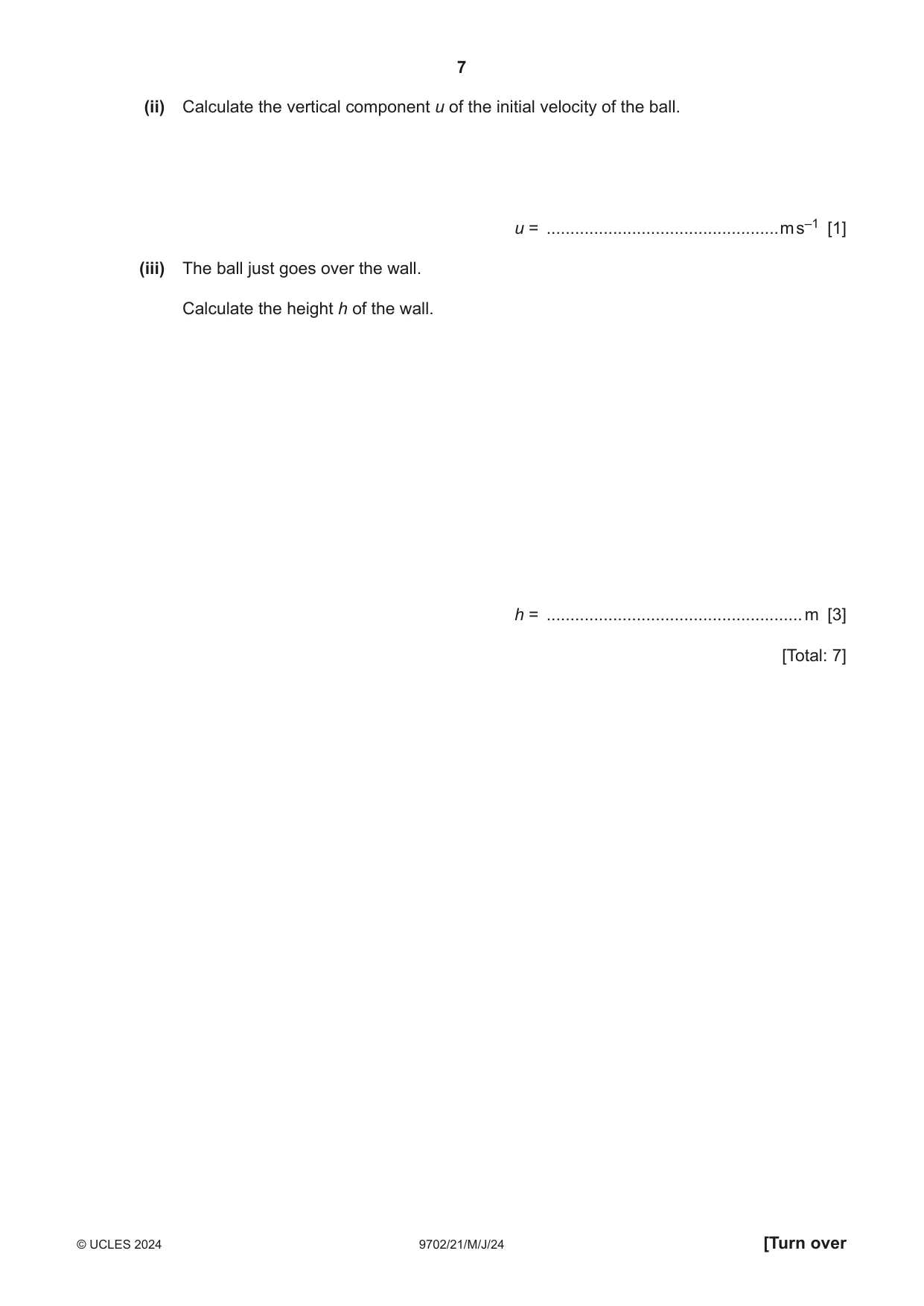
2 (a) Define velocity. ................................................................................................................................................... ............................................................................................................................................. [1] (b) A student throws a ball over a vertical wall of height h, as shown in Fig. 2.1. path of ball wall 22 m s–1 ball 40° horizontal h ground 1.2 m 36 m Fig. 2.1 (not to scale) The ball leaves the hand of the student at a height of 1.2 m above the horizontal ground. The ball has an initial velocity of 22 m s–1 at an angle of 40° to the horizontal. The wall is a horizontal distance of 36 m from where the student releases the ball. Air resistance is negligible. (i) Determine the time taken for the ball to reach the wall. time taken = ....................................................... s [2] (ii) Calculate the vertical component u of the initial velocity of the ball. u = .................................................m s–1 [1] (iii) The ball just goes over the wall. Calculate the height h of the wall. h = ......................................................m [3] [Total: 7]
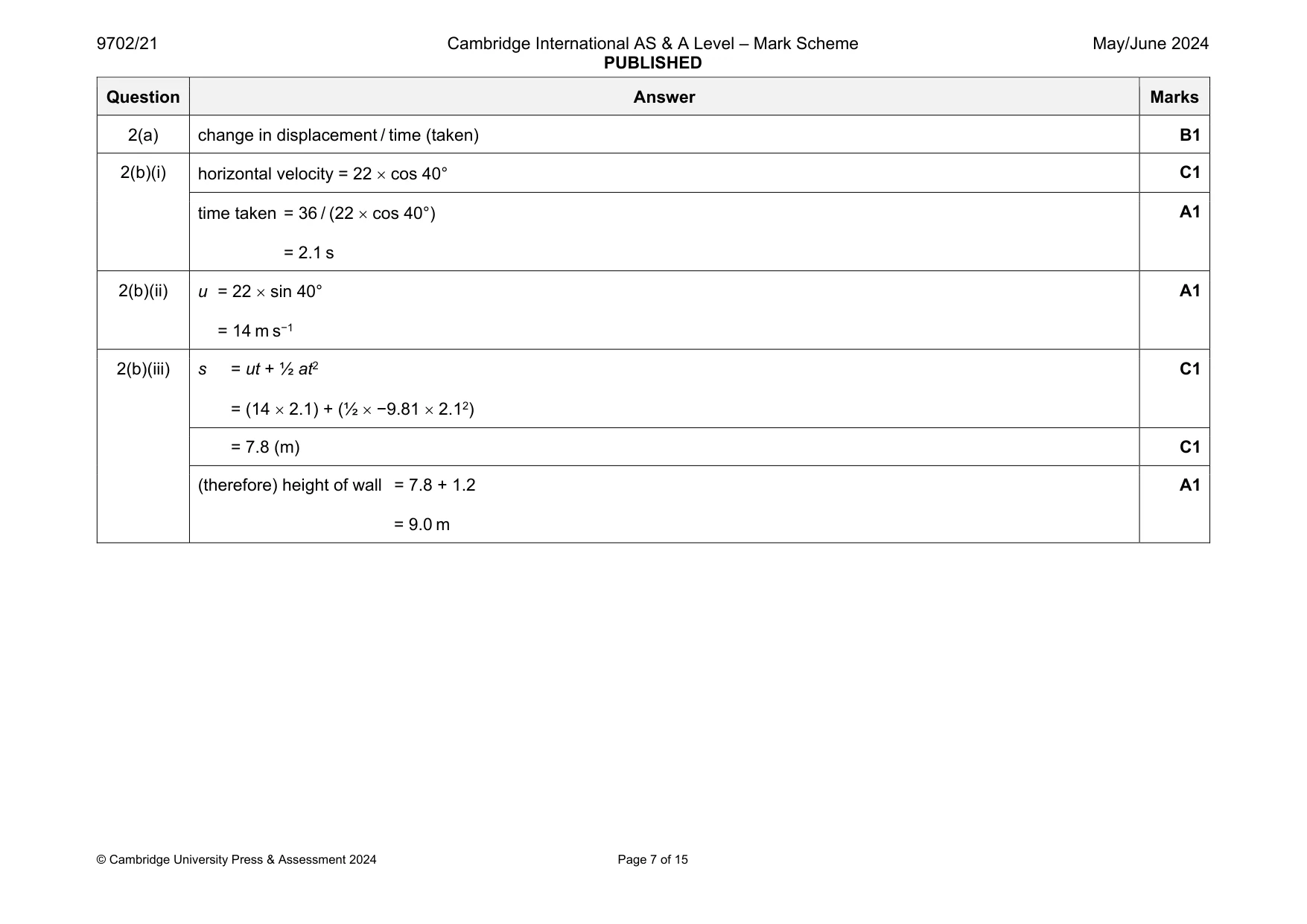
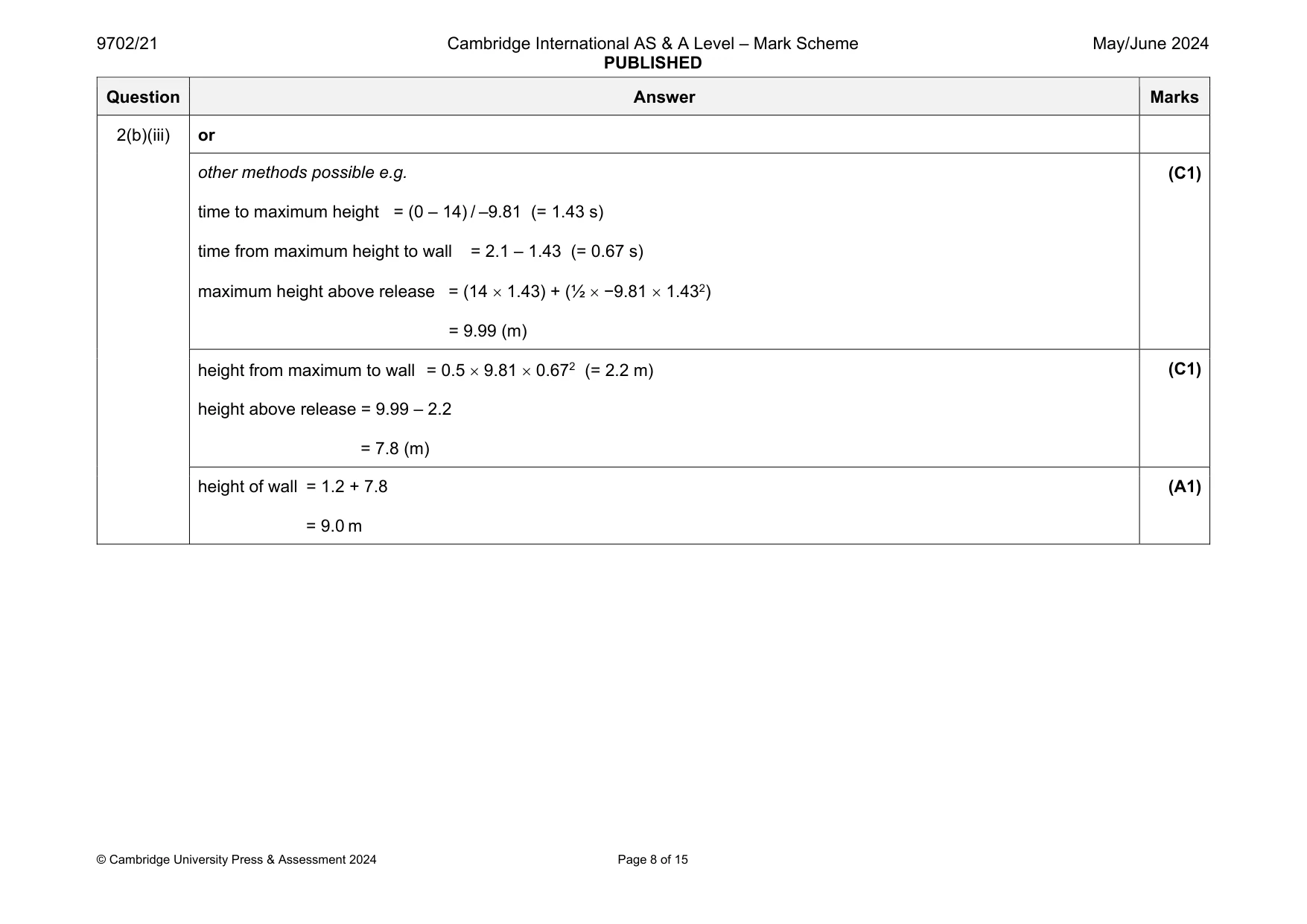
Mark scheme: 2(a) change in displacement / time (taken) B1 2(b)(i) horizontal velocity = 22 cos 40° C1 time taken = 36 / (22 cos 40°) = 2.1 s A1 2(b)(ii) u = 22 sin 40° = 14 m s−1 A1 2(b)(iii) s = ut + ½ at2 = (14 2.1) + (½ −9.81 2.12) C1 = 7.8 (m) C1 (therefore) height of wall = 7.8 + 1.2 = 9.0 m A1 Question Answer Marks 2(b)(iii) or other methods possible e.g. time to maximum height = (0 – 14) / –9.81 (= 1.43 s) time from maximum height to wall = 2.1 – 1.43 (= 0.67 s) maximum height above release = (14 1.43) + (½ −9.81 1.432) = 9.99 (m) (C1) height from maximum to wall = 0.5 9.81 0.672 (= 2.2 m) height above release = 9.99 – 2.2 = 7.8 (m) (C1) height of wall = 1.2 + 7.8 = 9.0 m (A1)
Q3 · State the principle of conservation of momentum
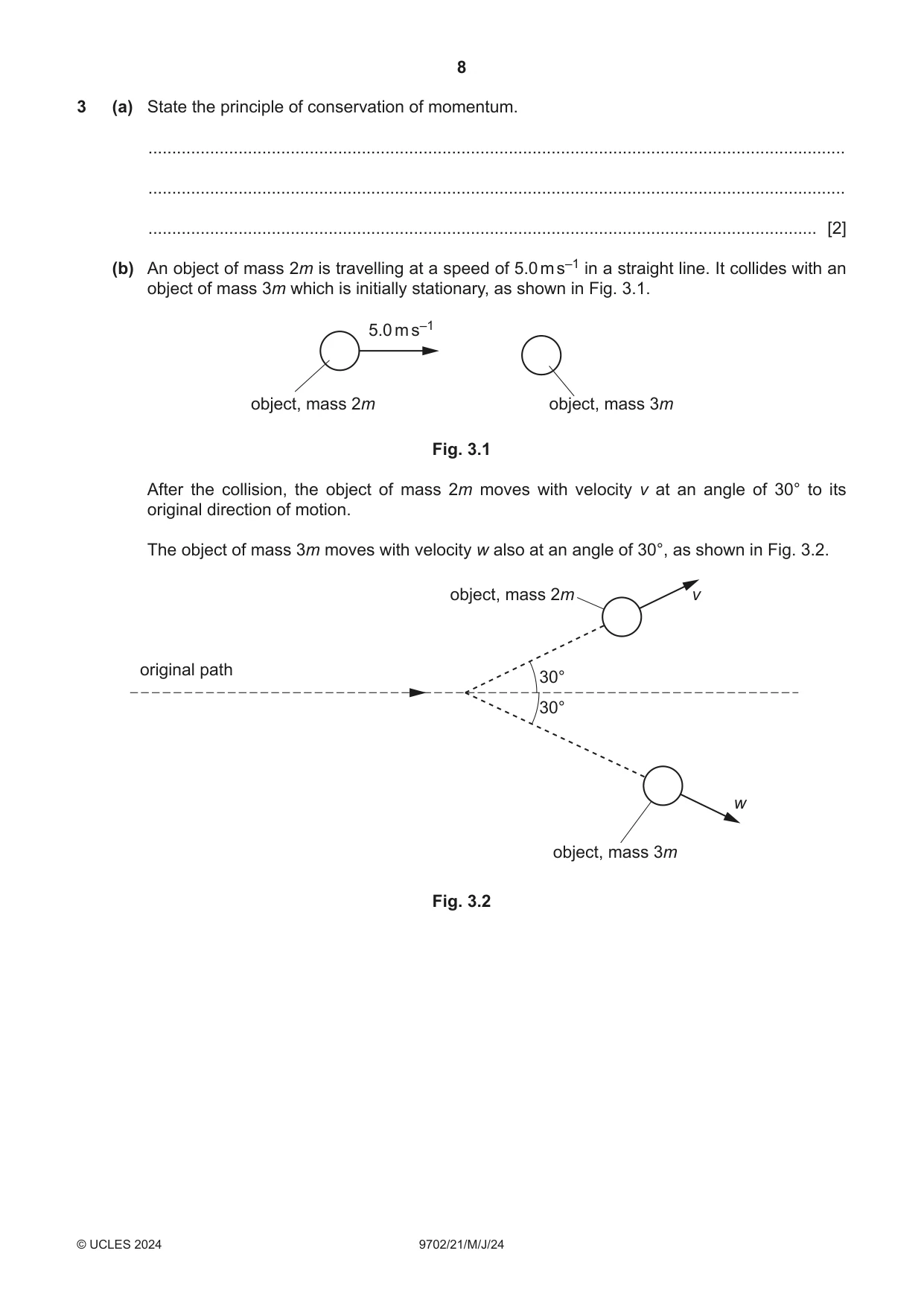
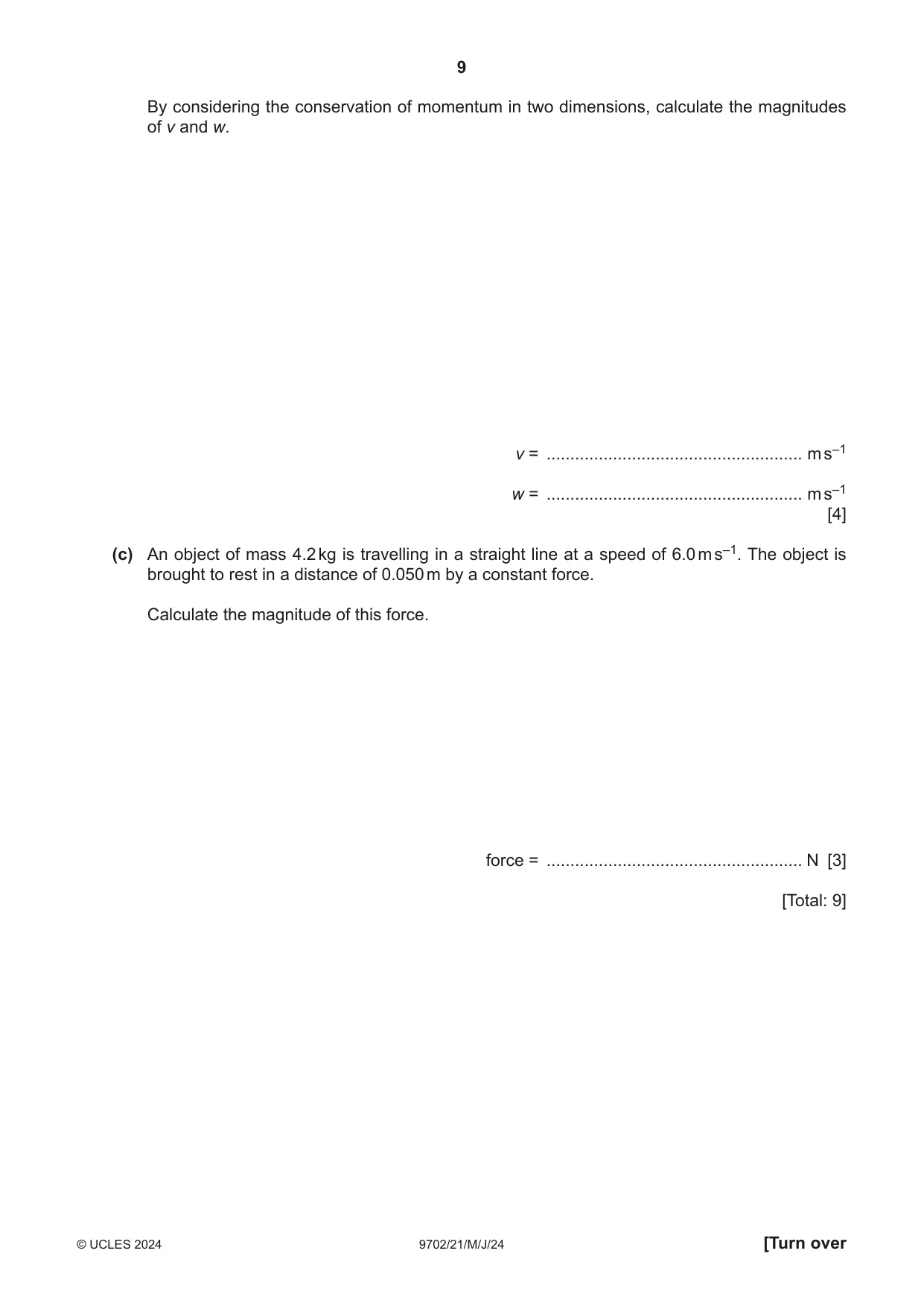
3 (a) State the principle of conservation of momentum. ................................................................................................................................................... ................................................................................................................................................... ............................................................................................................................................. [2] (b) An object of mass 2m is travelling at a speed of 5.0 m s–1 in a straight line. It collides with an object of mass 3m which is initially stationary, as shown in Fig. 3.1. 5.0 m s–1 object, mass 2m object, mass 3m Fig. 3.1 After the collision, the object of mass 2m moves with velocity v at an angle of 30° to its original direction of motion. The object of mass 3m moves with velocity w also at an angle of 30°, as shown in Fig. 3.2. object, mass 2m v original path 30° 30° w object, mass 3m Fig. 3.2 By considering the conservation of momentum in two dimensions, calculate the magnitudes of v and w. v = ...................................................... m s–1 w = ...................................................... m s–1 [4] (c) An object of mass 4.2 kg is travelling in a straight line at a speed of 6.0 m s–1. The object is brought to rest in a distance of 0.050 m by a constant force. Calculate the magnitude of this force. force = ...................................................... N [3] [Total: 9]
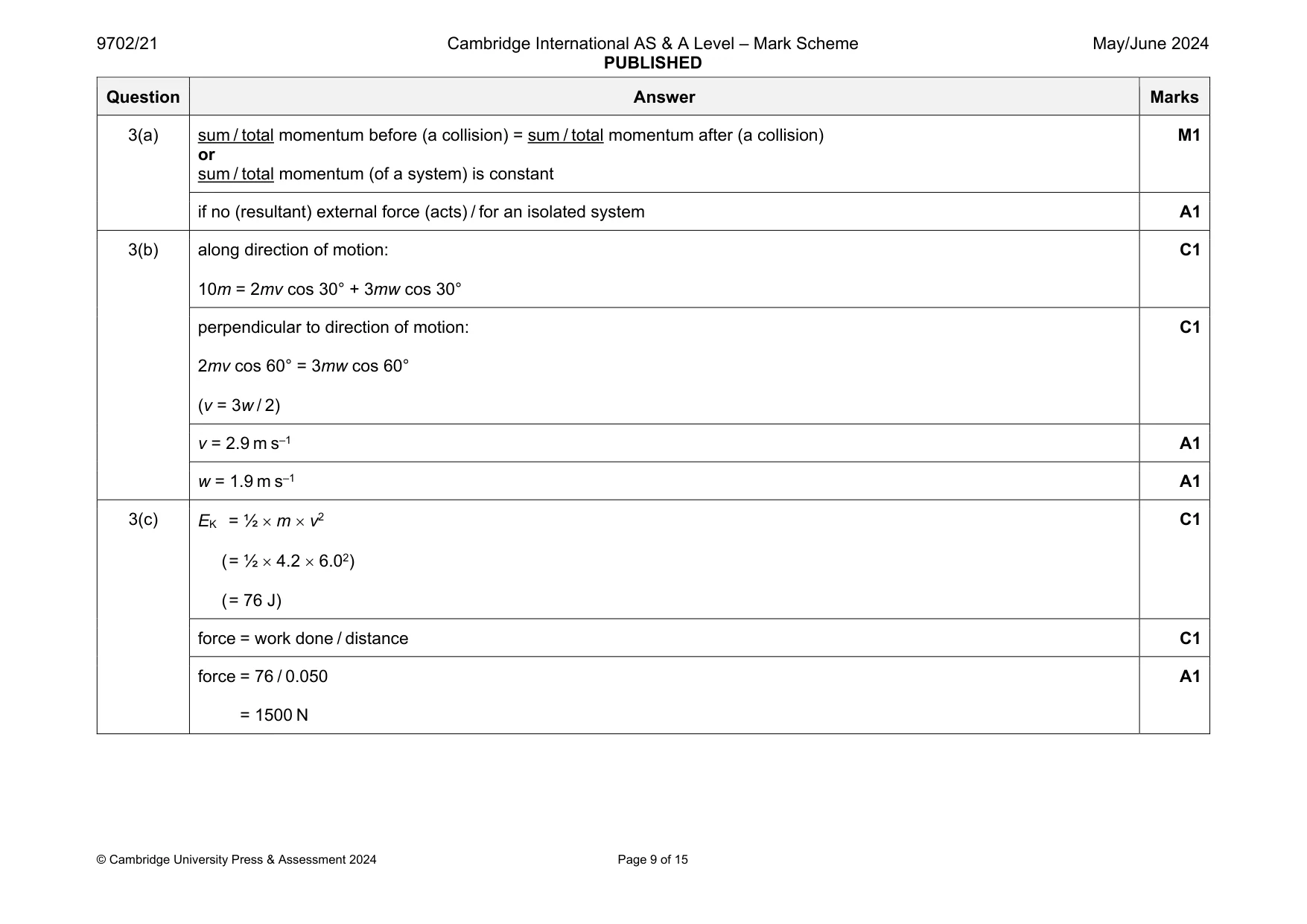
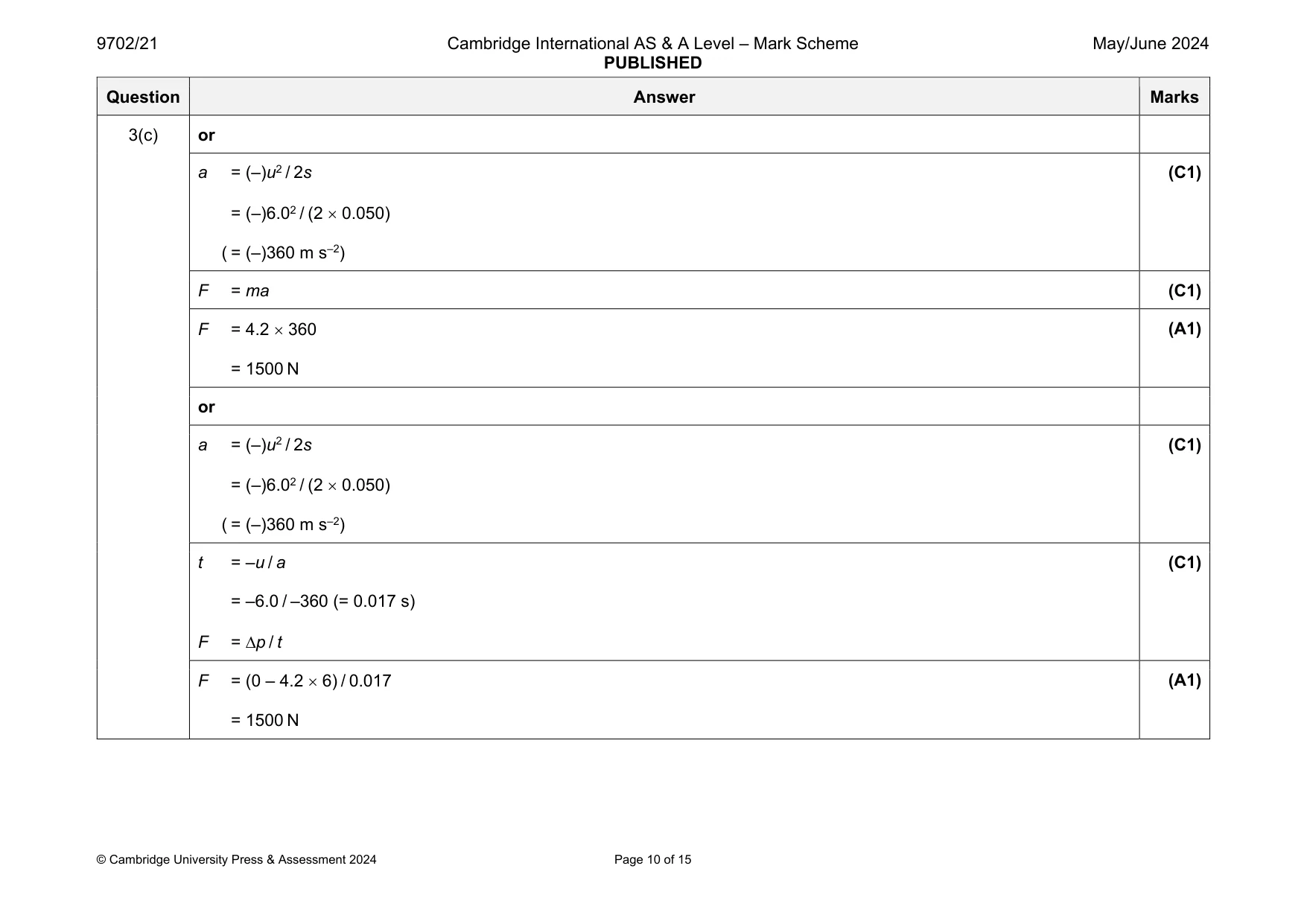
Mark scheme: 3(a) sum / total momentum before (a collision) = sum / total momentum after (a collision) or sum / total momentum (of a system) is constant M1 if no (resultant) external force (acts) / for an isolated system A1 3(b) along direction of motion: 10m = 2mv cos 30° + 3mw cos 30° C1 perpendicular to direction of motion: 2mv cos 60° = 3mw cos 60° (v = 3w / 2) C1 v = 2.9 m s–1 A1 w = 1.9 m s–1 A1 3(c) EK = ½ m v2 ( = ½ 4.2 6.02) ( = 76 J) C1 force = work done / distance C1 force = 76 / 0.050 = 1500 N A1 Question Answer Marks 3(c) or a = (–)u2 / 2s = (–)6.02 / (2 0.050) ( = (–)360 m s–2) (C1) F = ma (C1) F = 4.2 360 = 1500 N (A1) or a = (–)u2 / 2s = (–)6.02 / (2 0.050) ( = (–)360 m s–2) (C1) t = –u / a = –6.0 / –360 (= 0.017 s) F = p / t (C1) F = (0 – 4.2 6) / 0.017 = 1500 N (A1)
Question 4
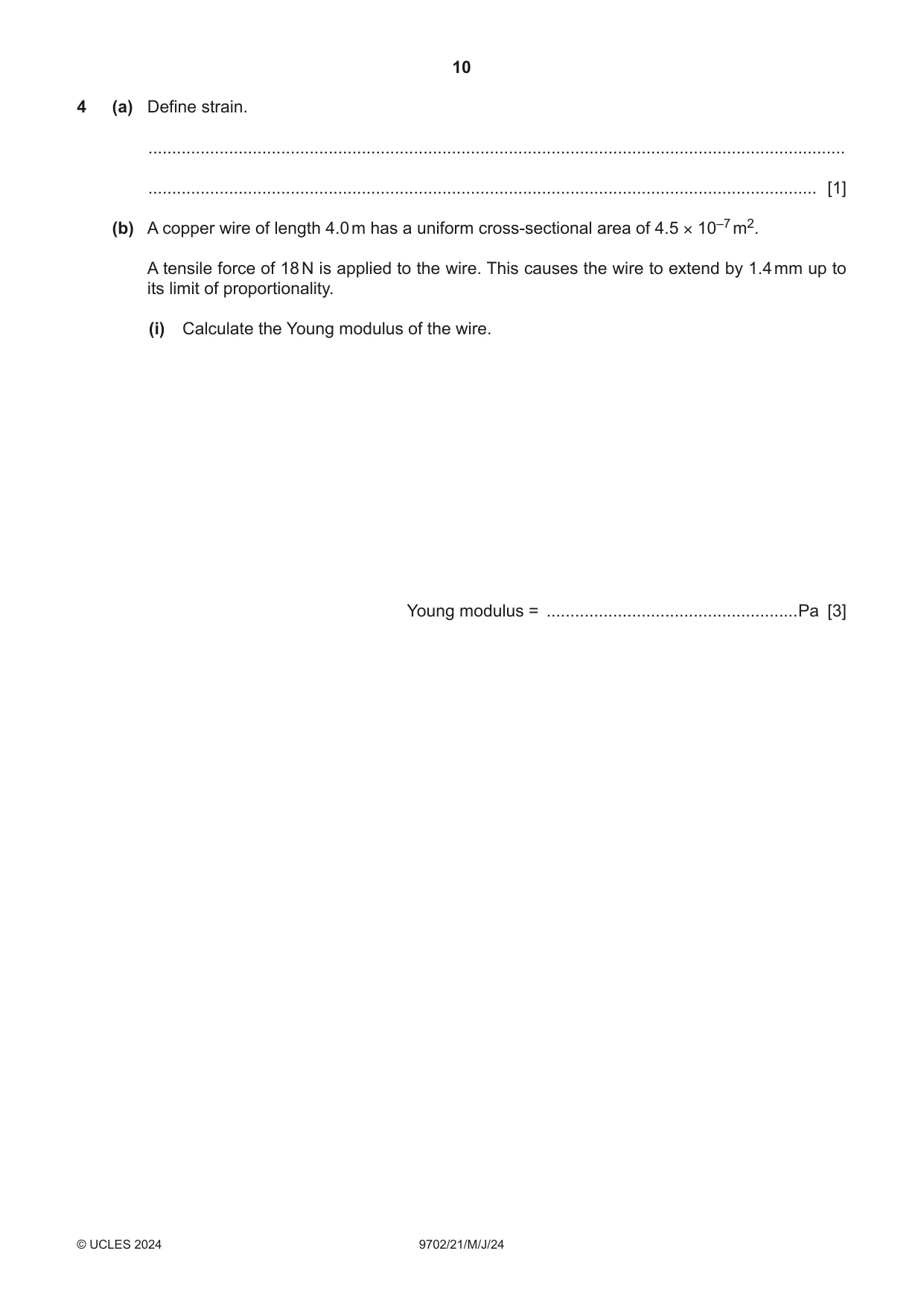
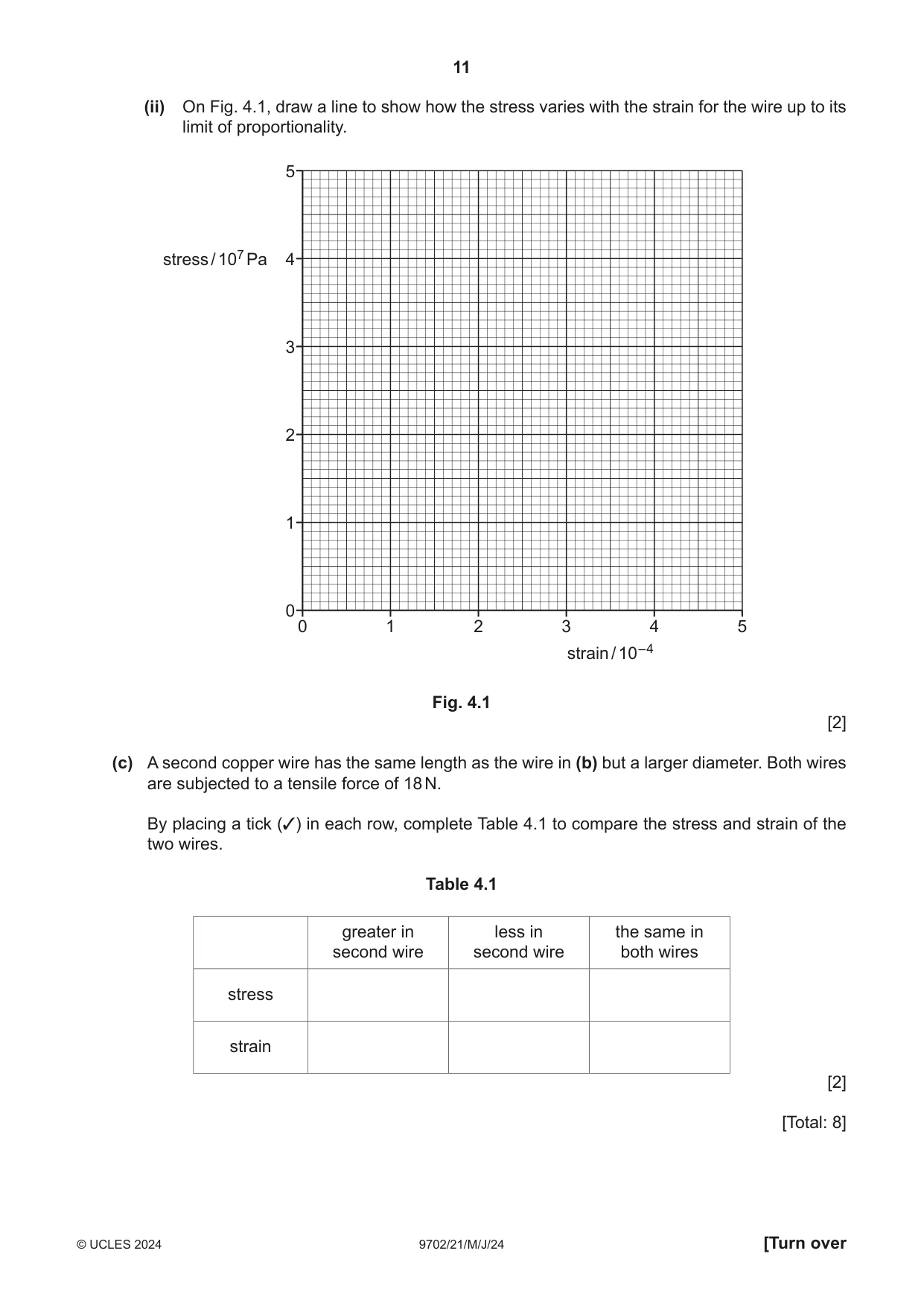
4 (a) Define strain. ................................................................................................................................................... ............................................................................................................................................. [1] (b) A copper wire of length 4.0 m has a uniform cross-sectional area of 4.5 × 10⁻⁷ m2. A tensile force of 18 N is applied to the wire. This causes the wire to extend by 1.4 mm up to its limit of proportionality. (i) Calculate the Young modulus of the wire. Young modulus = .....................................................Pa [3] (ii) On Fig. 4.1, draw a line to show how the stress varies with the strain for the wire up to its limit of proportionality. 5 stress / 107 Pa 4 3 2 1 0 0 1 2 3 4 5 strain / 10 – 4 Fig. 4.1 [2] (c) A second copper wire has the same length as the wire in (b) but a larger diameter. Both wires are subjected to a tensile force of 18 N. By placing a tick (3) in each row, complete Table 4.1 to compare the stress and strain of the two wires. Table 4.1 greater in less in the same in second wire second wire both wires stress strain [2] [Total: 8]
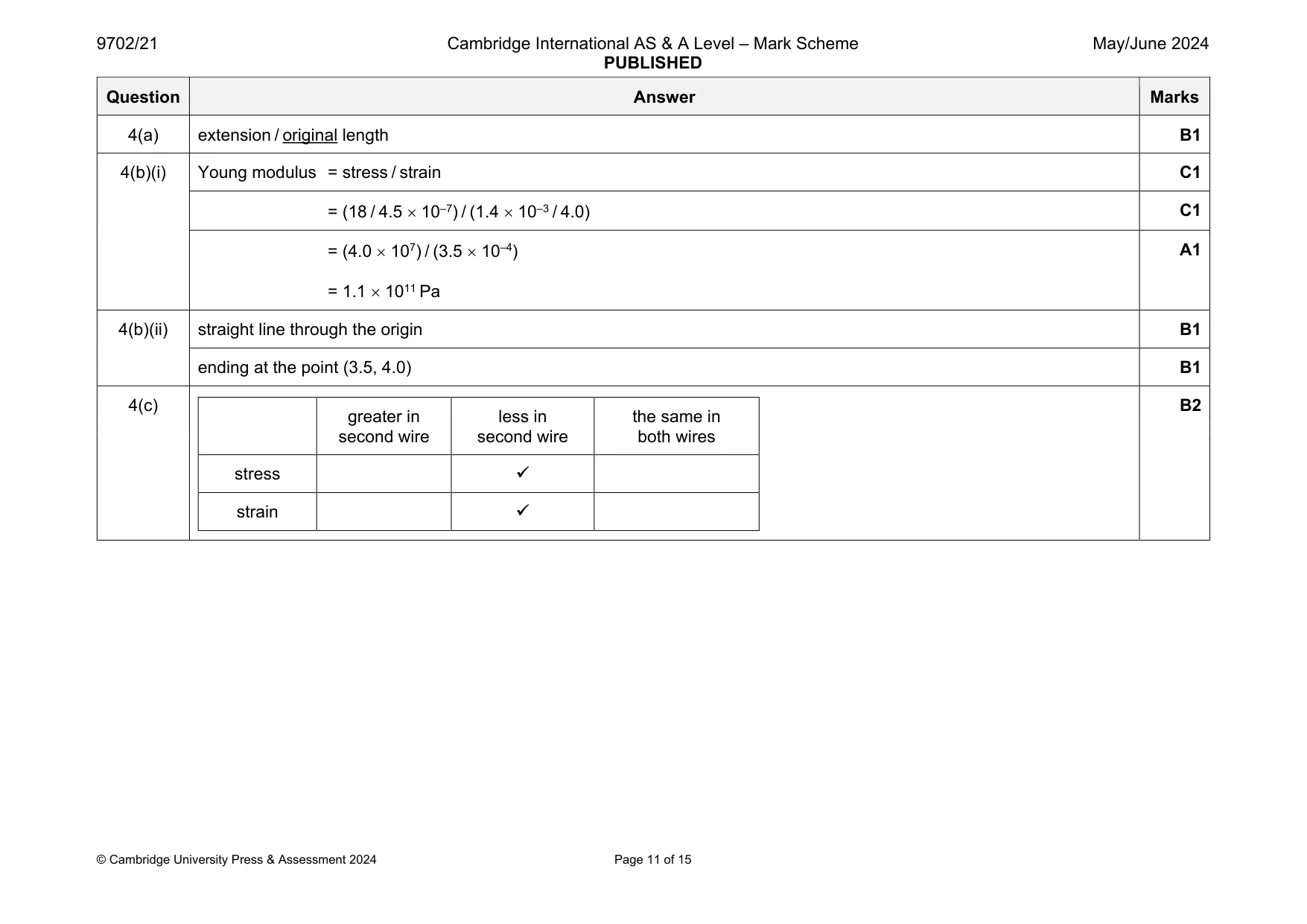
Mark scheme: 4(a) extension / original length B1 4(b)(i) Young modulus = stress / strain C1 = (18 / 4.5 10–7) / (1.4 10–3 / 4.0) C1 = (4.0 107) / (3.5 10–4) = 1.1 1011 Pa A1 4(b)(ii) straight line through the origin B1 ending at the point (3.5, 4.0) B1 4(c) greater in second wire less in second wire the same in both wires stress strain B2
Q5 · A stretched string PQ has length 1.2 m
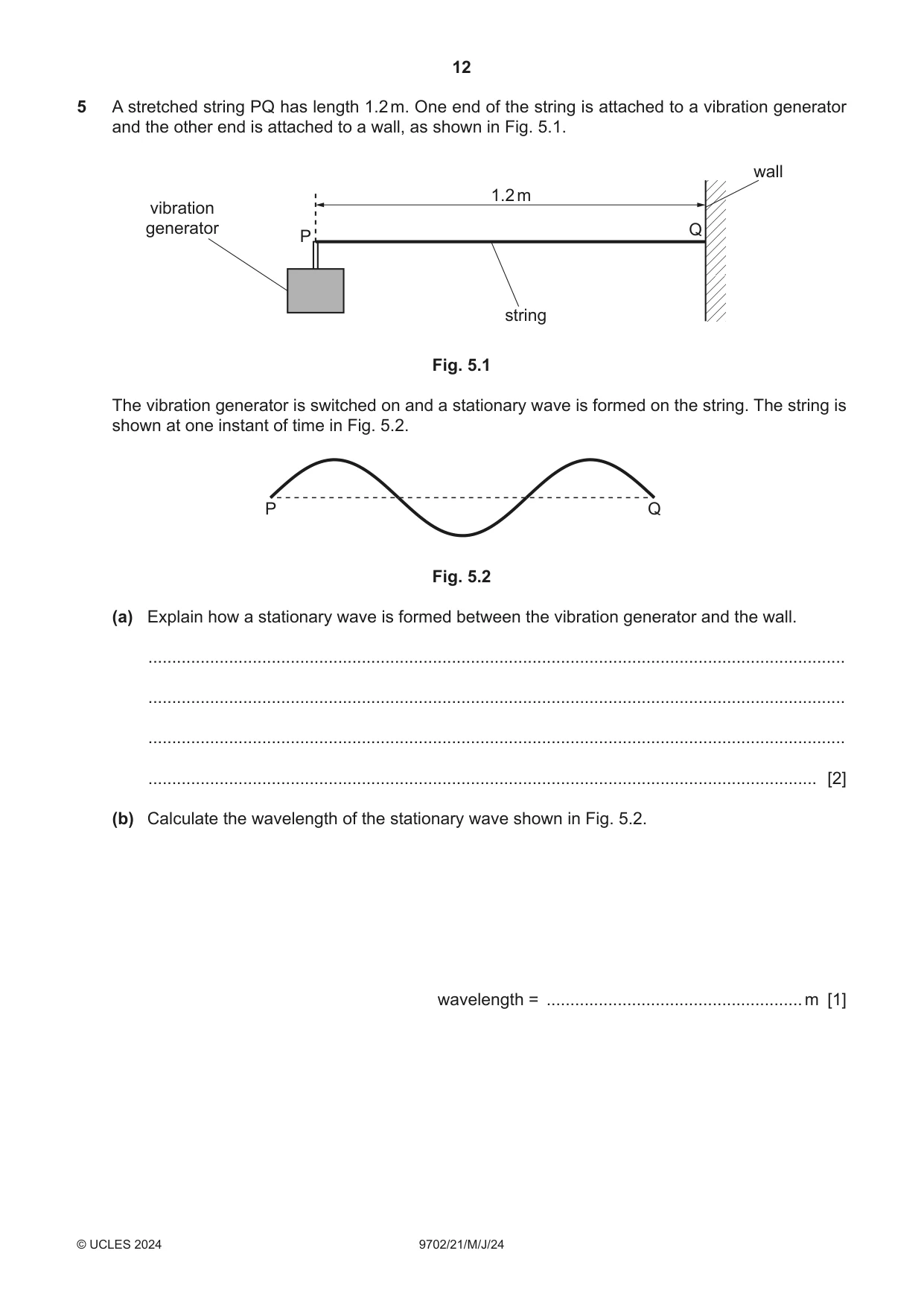
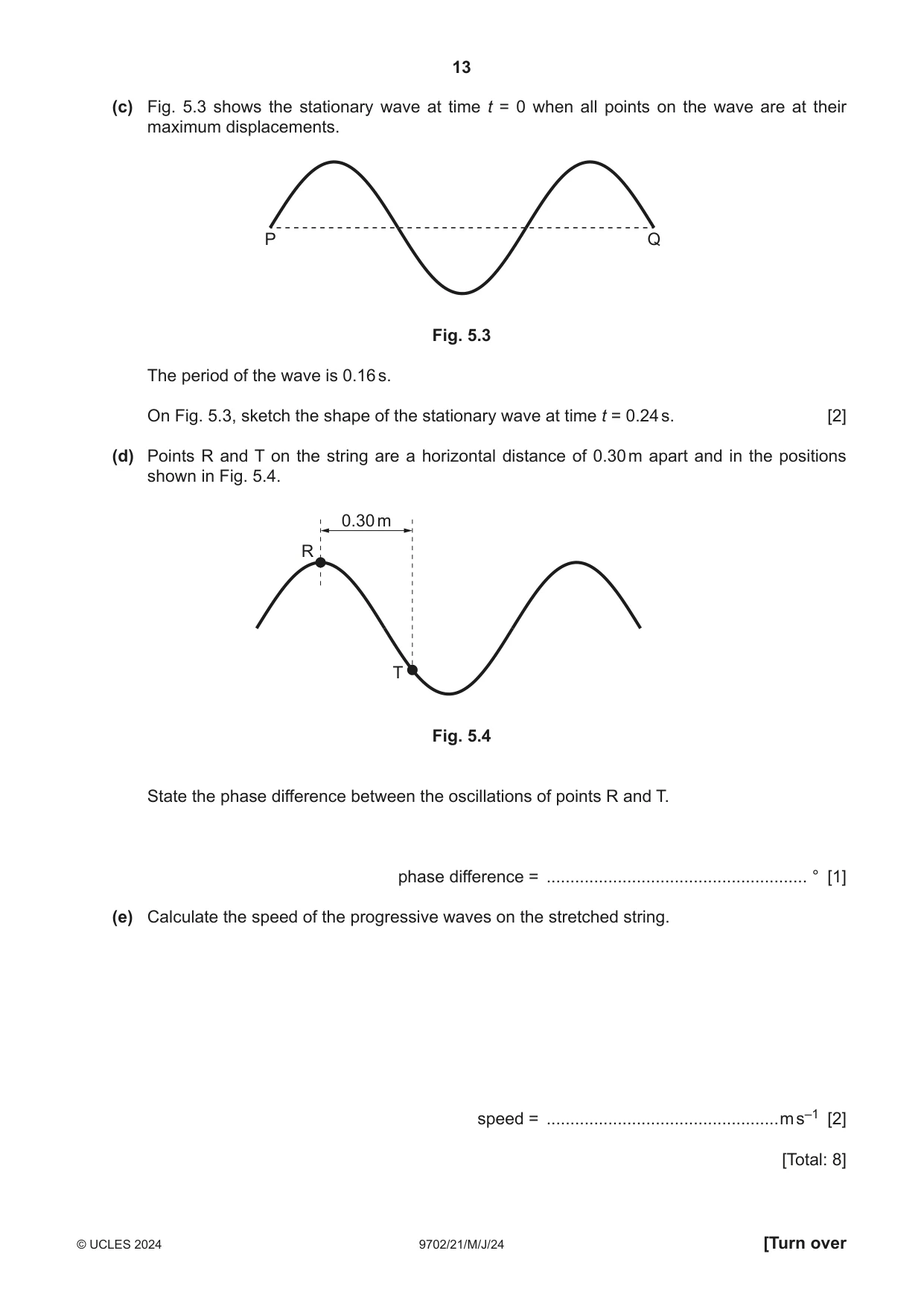
5 A stretched string PQ has length 1.2 m. One end of the string is attached to a vibration generator and the other end is attached to a wall, as shown in Fig. 5.1. wall 1.2 m vibration generator Q P string Fig. 5.1 The vibration generator is switched on and a stationary wave is formed on the string. The string is shown at one instant of time in Fig. 5.2. P Q Fig. 5.2 (a) Explain how a stationary wave is formed between the vibration generator and the wall. ................................................................................................................................................... ................................................................................................................................................... ................................................................................................................................................... ............................................................................................................................................. [2] (b) Calculate the wavelength of the stationary wave shown in Fig. 5.2. wavelength = ......................................................m [1] (c) Fig. 5.3 shows the stationary wave at time t = 0 when all points on the wave are at their maximum displacements. P Q Fig. 5.3 The period of the wave is 0.16 s. On Fig. 5.3, sketch the shape of the stationary wave at time t = 0.24 s. [2] (d) Points R and T on the string are a horizontal distance of 0.30 m apart and in the positions shown in Fig. 5.4. 0.30 m R T Fig. 5.4 State the phase difference between the oscillations of points R and T. phase difference = ....................................................... ° [1] (e) Calculate the speed of the progressive waves on the stretched string. speed = .................................................m s–1 [2] [Total: 8]
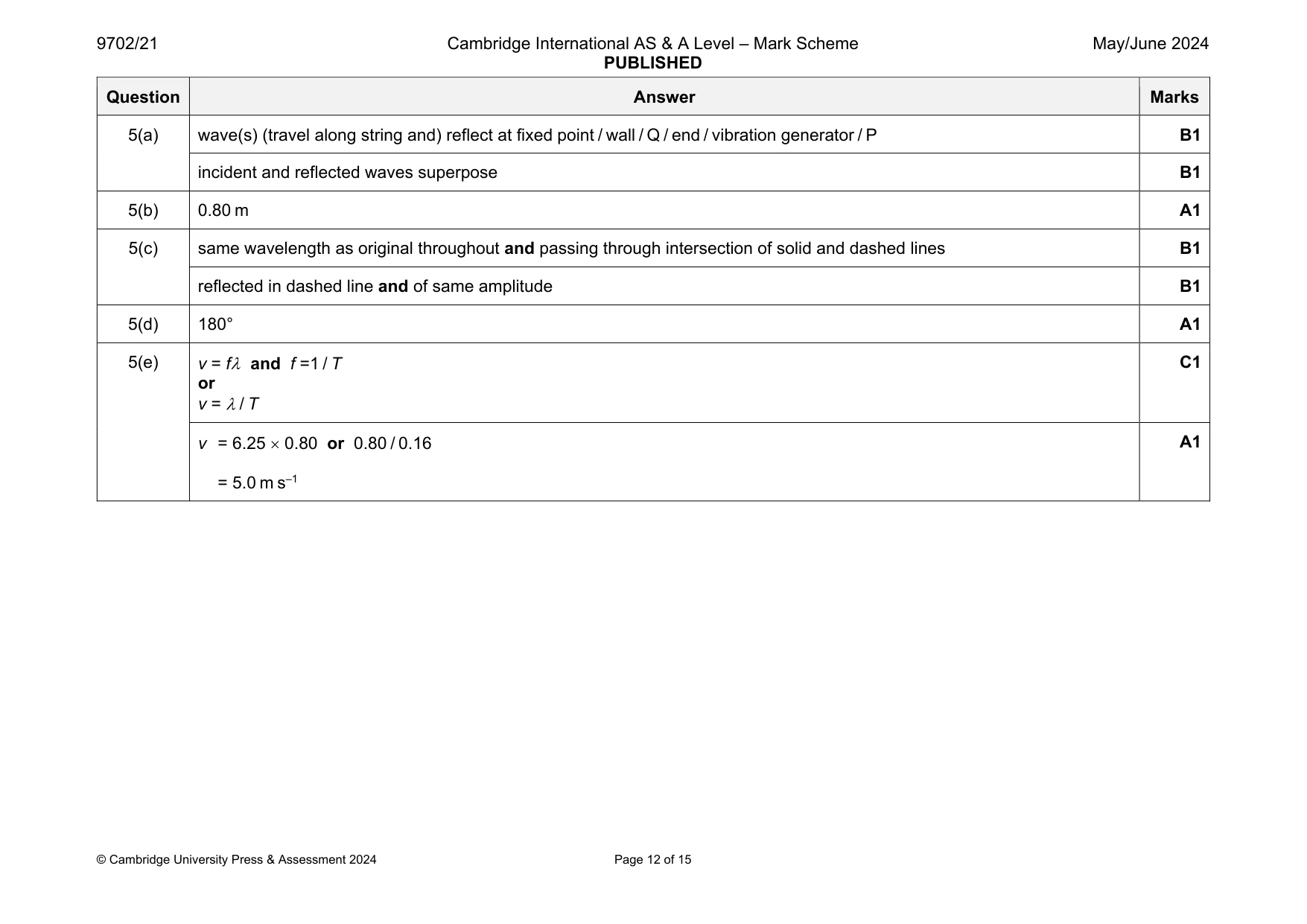
Mark scheme: 5(a) wave(s) (travel along string and) reflect at fixed point / wall / Q / end / vibration generator / P B1 incident and reflected waves superpose B1 5(b) 0.80 m A1 5(c) same wavelength as original throughout and passing through intersection of solid and dashed lines B1 reflected in dashed line and of same amplitude B1 5(d) 180° A1 5(e) v = fand f =1 / T or v = / T C1 v = 6.25 0.80 or 0.80 / 0.16 = 5.0 m s–1 A1
Q6 · State Kirchhoff’s first law
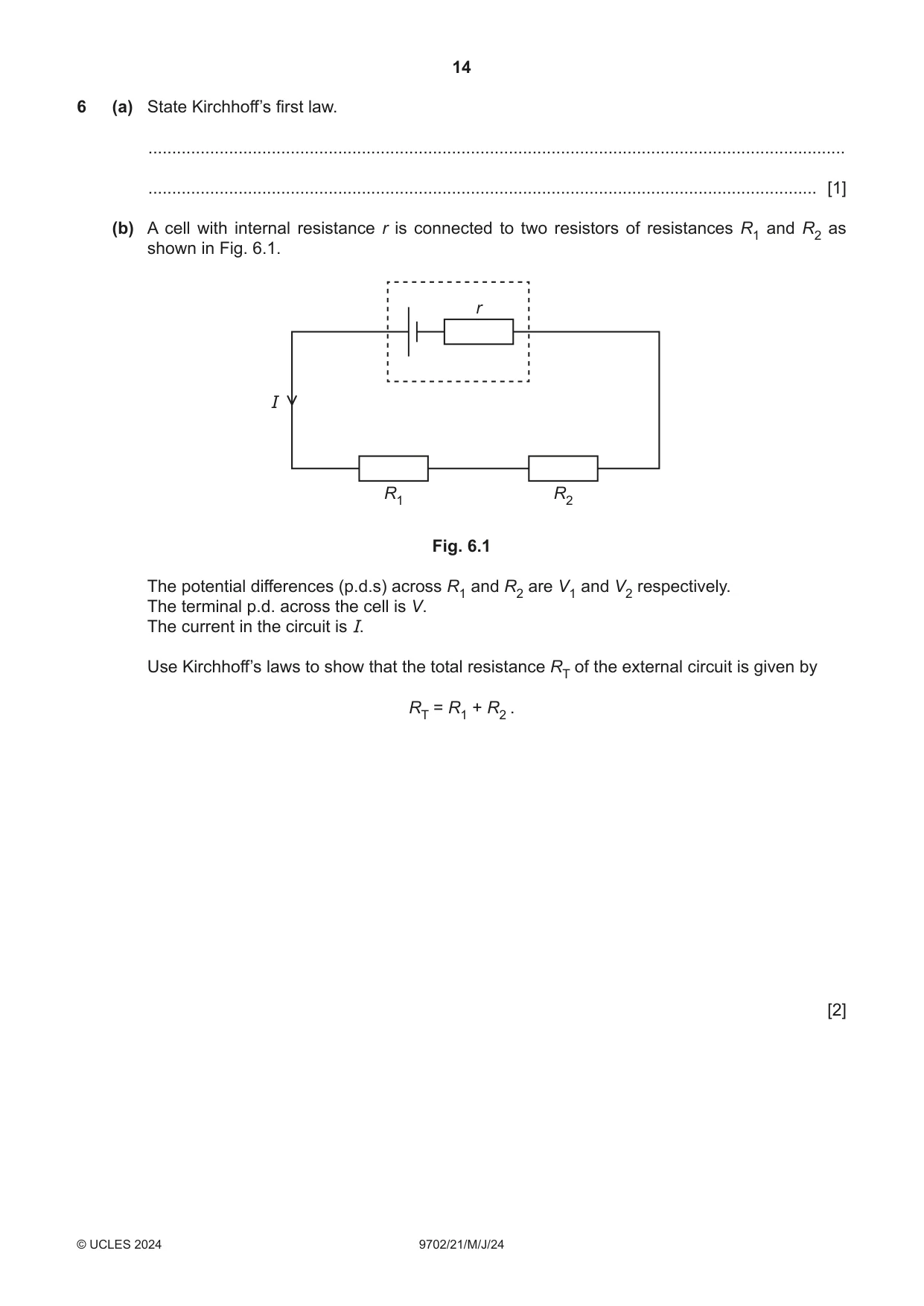
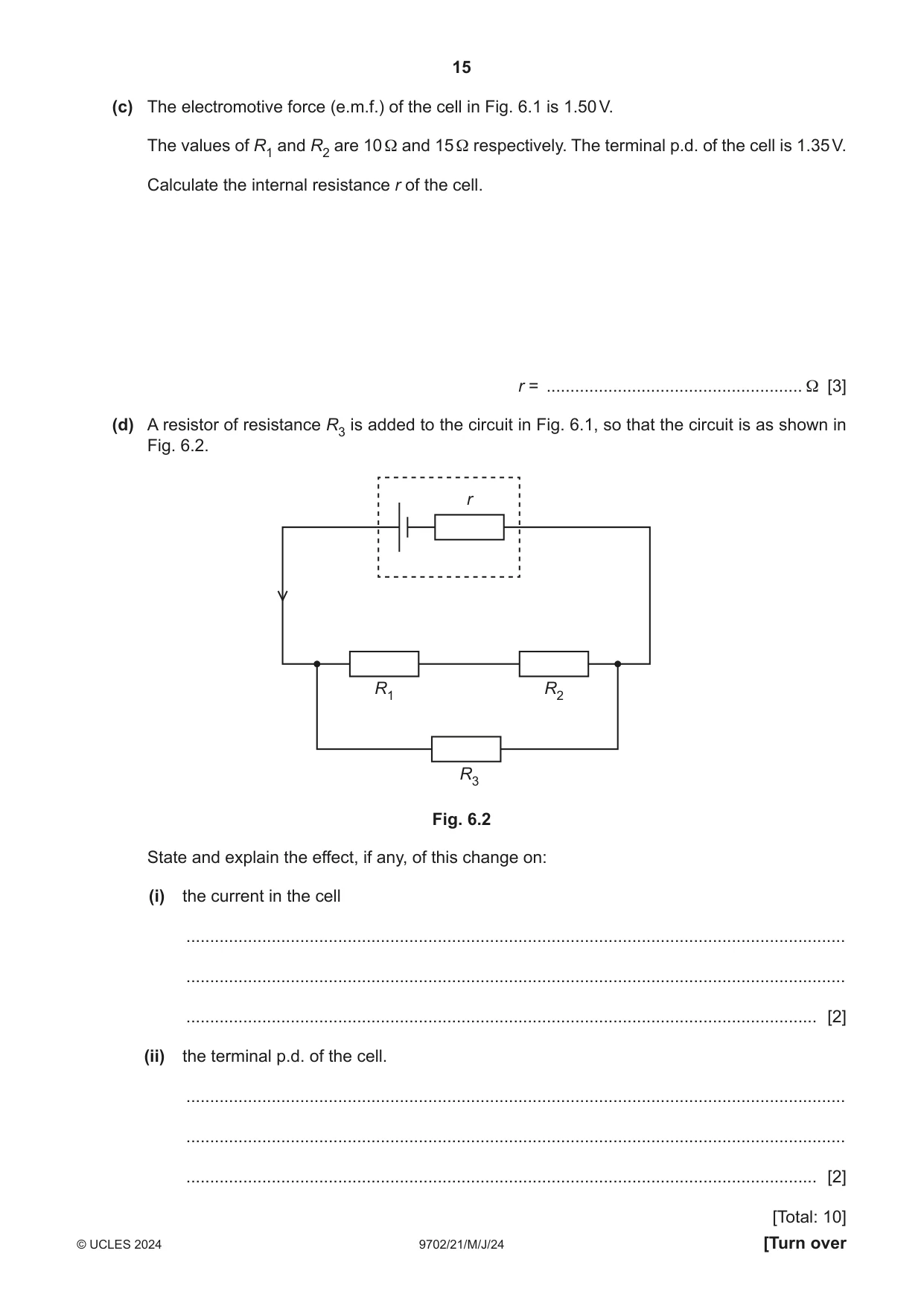
6 (a) State Kirchhoff’s first law. ................................................................................................................................................... ............................................................................................................................................. [1] (b) A cell with internal resistance r is connected to two resistors of resistances R1 and R2 as shown in Fig. 6.1. r I R1 R2 Fig. 6.1 The potential differences (p.d.s) across R1 and R2 are V1 and V2 respectively. The terminal p.d. across the cell is V. The current in the circuit is I. Use Kirchhoff’s laws to show that the total resistance RT of the external circuit is given by RT = R1 + R2 . [2] (c) The electromotive force (e.m.f.) of the cell in Fig. 6.1 is 1.50 V. The values of R1 and R2 are 10 Ω and 15 Ω respectively. The terminal p.d. of the cell is 1.35 V. Calculate the internal resistance r of the cell. r = ...................................................... Ω [3] (d) A resistor of resistance R3 is added to the circuit in Fig. 6.1, so that the circuit is as shown in Fig. 6.2. r R1 R2 R3 Fig. 6.2 State and explain the effect, if any, of this change on: (i) the current in the cell ........................................................................................................................................... ........................................................................................................................................... ..................................................................................................................................... [2] (ii) the terminal p.d. of the cell. ........................................................................................................................................... ........................................................................................................................................... ..................................................................................................................................... [2] [Total: 10]
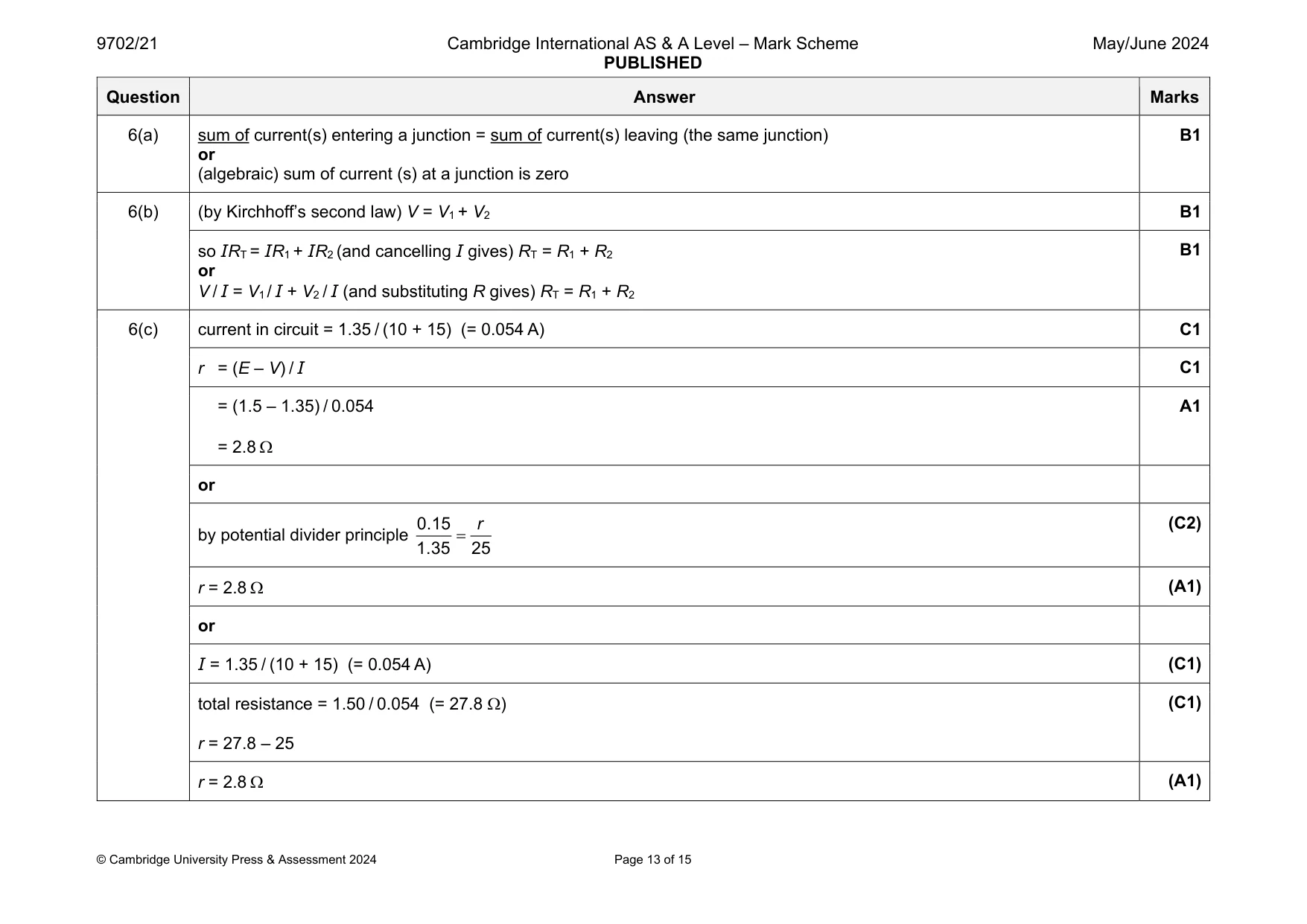
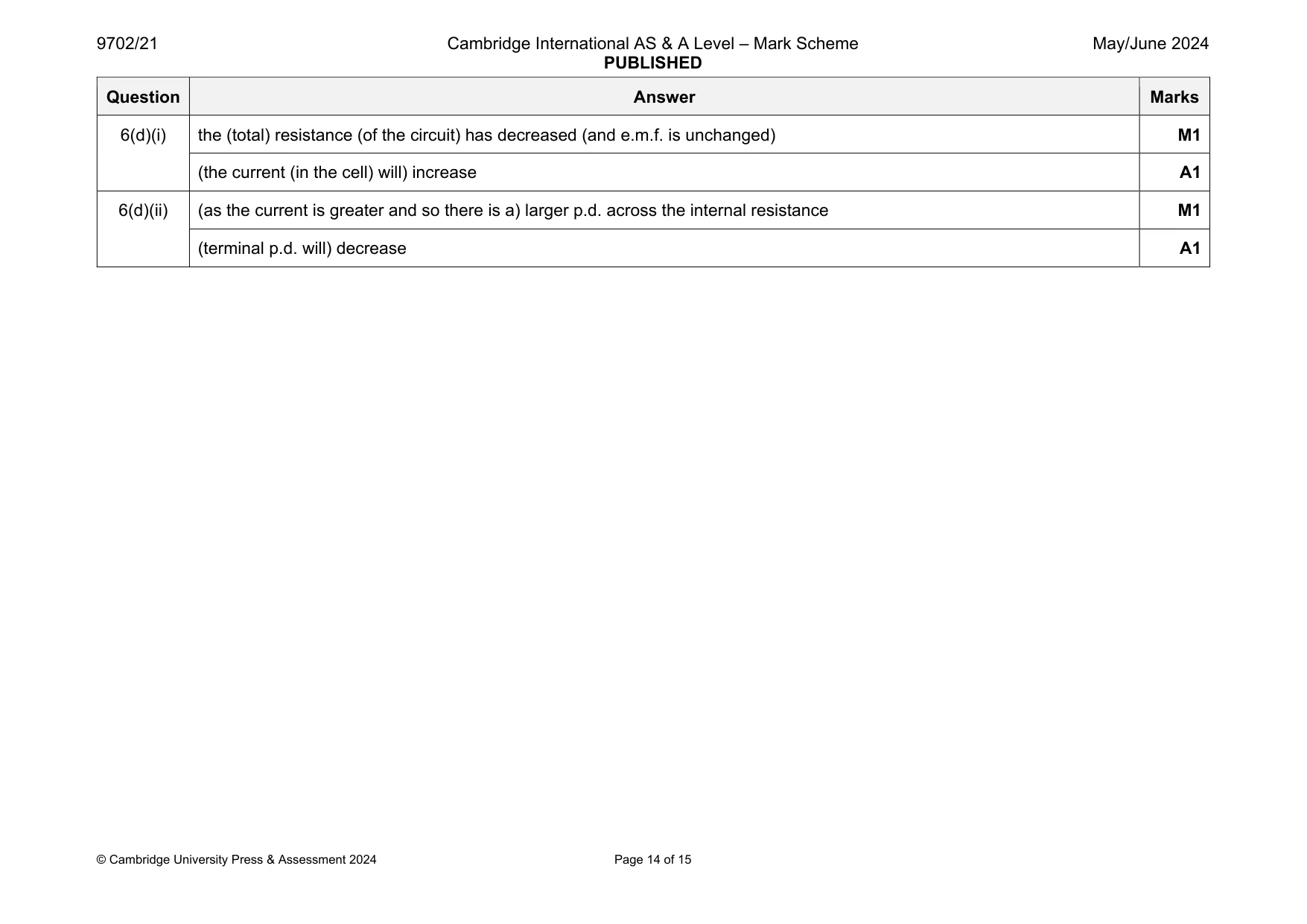
Mark scheme: 6(a) sum of current(s) entering a junction = sum of current(s) leaving (the same junction) or (algebraic) sum of current (s) at a junction is zero B1 6(b) (by Kirchhoff’s second law) V = V1 + V2 B1 so IRT = IR1 + IR2 (and cancelling I gives) RT = R1 + R2 or V / I = V1/ I + V2 / I (and substituting R gives) RT = R1 + R2 B1 6(c) current in circuit = 1.35 / (10 + 15) (= 0.054 A) C1 r = (E – V) / I C1 = (1.5 – 1.35) / 0.054 = 2.8 A1 or by potential divider principle 0.15 1.35 25 r (C2) r = 2.8 (A1) or I = 1.35 / (10 + 15) (= 0.054 A) (C1) total resistance = 1.50 / 0.054 (= 27.8 ) r = 27.8 – 25 (C1) r = 2.8 (A1) Question Answer Marks 6(d)(i) the (total) resistance (of the circuit) has decreased (and e.m.f. is unchanged) M1 (the current (in the cell) will) increase A1 6(d)(ii) (as the current is greater and so there is a) larger p.d. across the internal resistance M1 (terminal p.d. will) decrease A1
Q7 · Nuclei of an isotope of copper (Cu) each have 29 protons and 37 neutrons
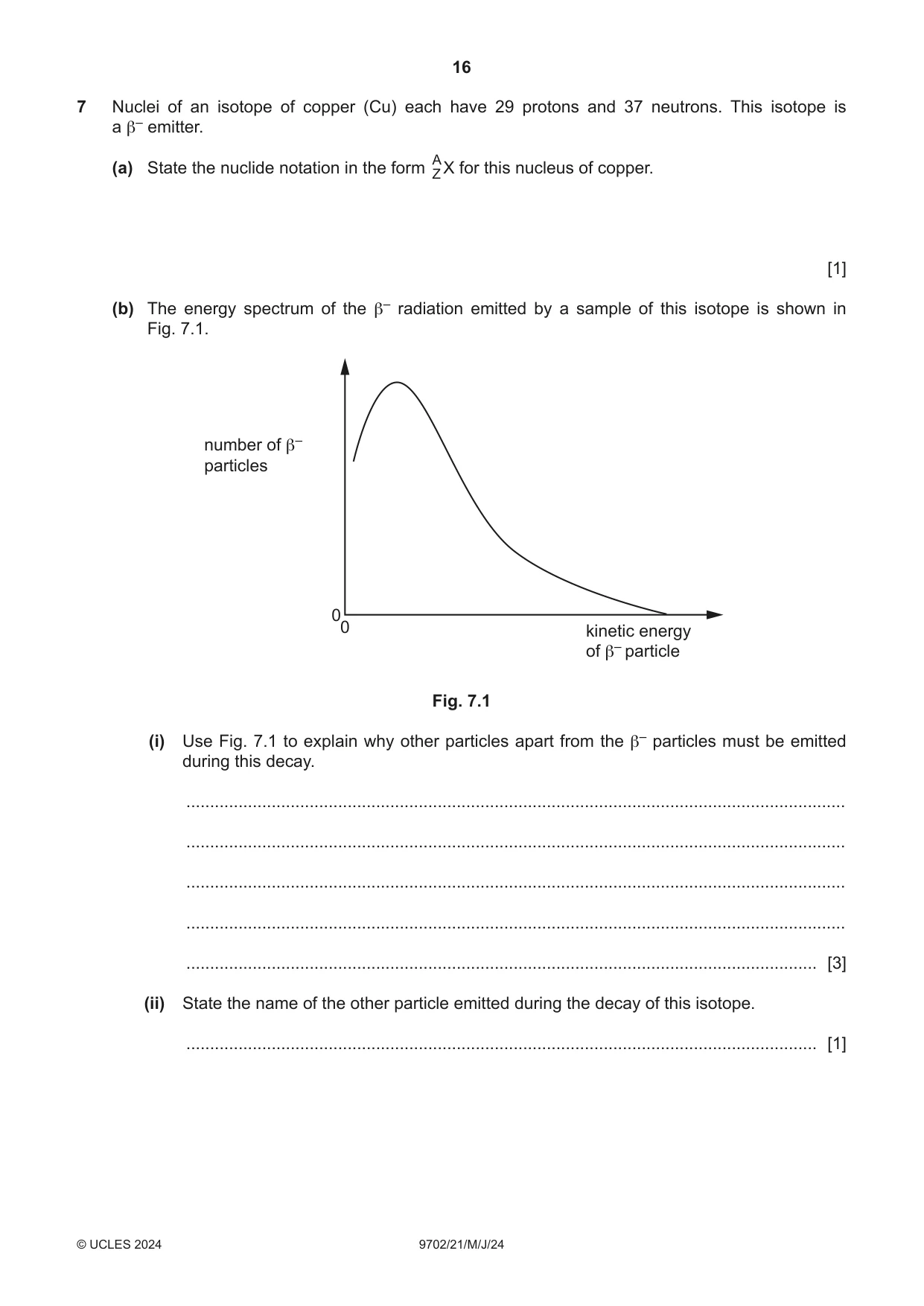
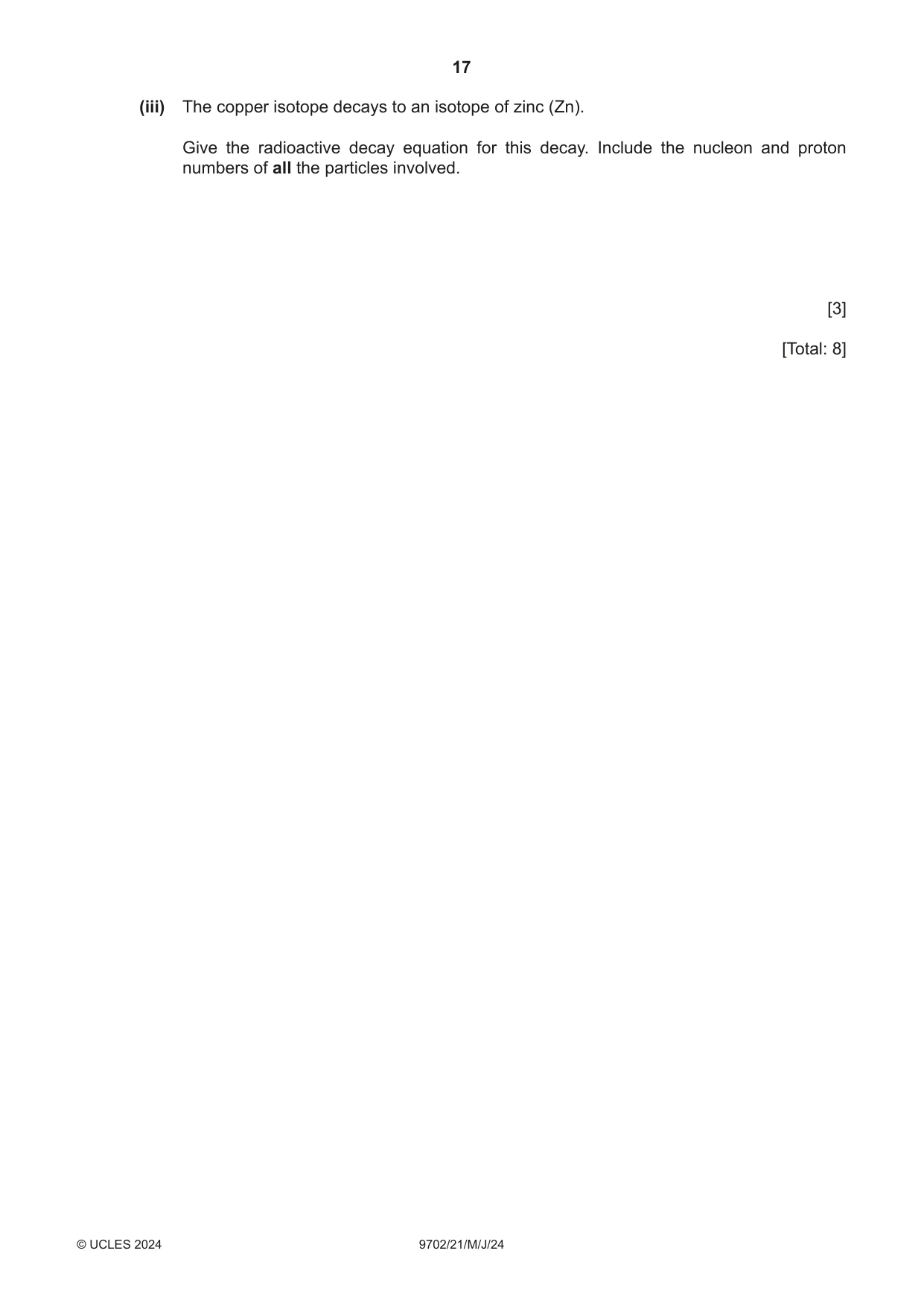
7 Nuclei of an isotope of copper (Cu) each have 29 protons and 37 neutrons. This isotope is a β– emitter. A (a) State the nuclide notation in the form ZX for this nucleus of copper. [1] (b) The energy spectrum of the β– radiation emitted by a sample of this isotope is shown in Fig. 7.1. number of β– particles 0 0 kinetic energy of β– particle Fig. 7.1 (i) Use Fig. 7.1 to explain why other particles apart from the β– particles must be emitted during this decay. ........................................................................................................................................... ........................................................................................................................................... ........................................................................................................................................... ........................................................................................................................................... ..................................................................................................................................... [3] (ii) State the name of the other particle emitted during the decay of this isotope. ..................................................................................................................................... [1] (iii) The copper isotope decays to an isotope of zinc (Zn). Give the radioactive decay equation for this decay. Include the nucleon and proton numbers of all the particles involved. [3] [Total: 8]
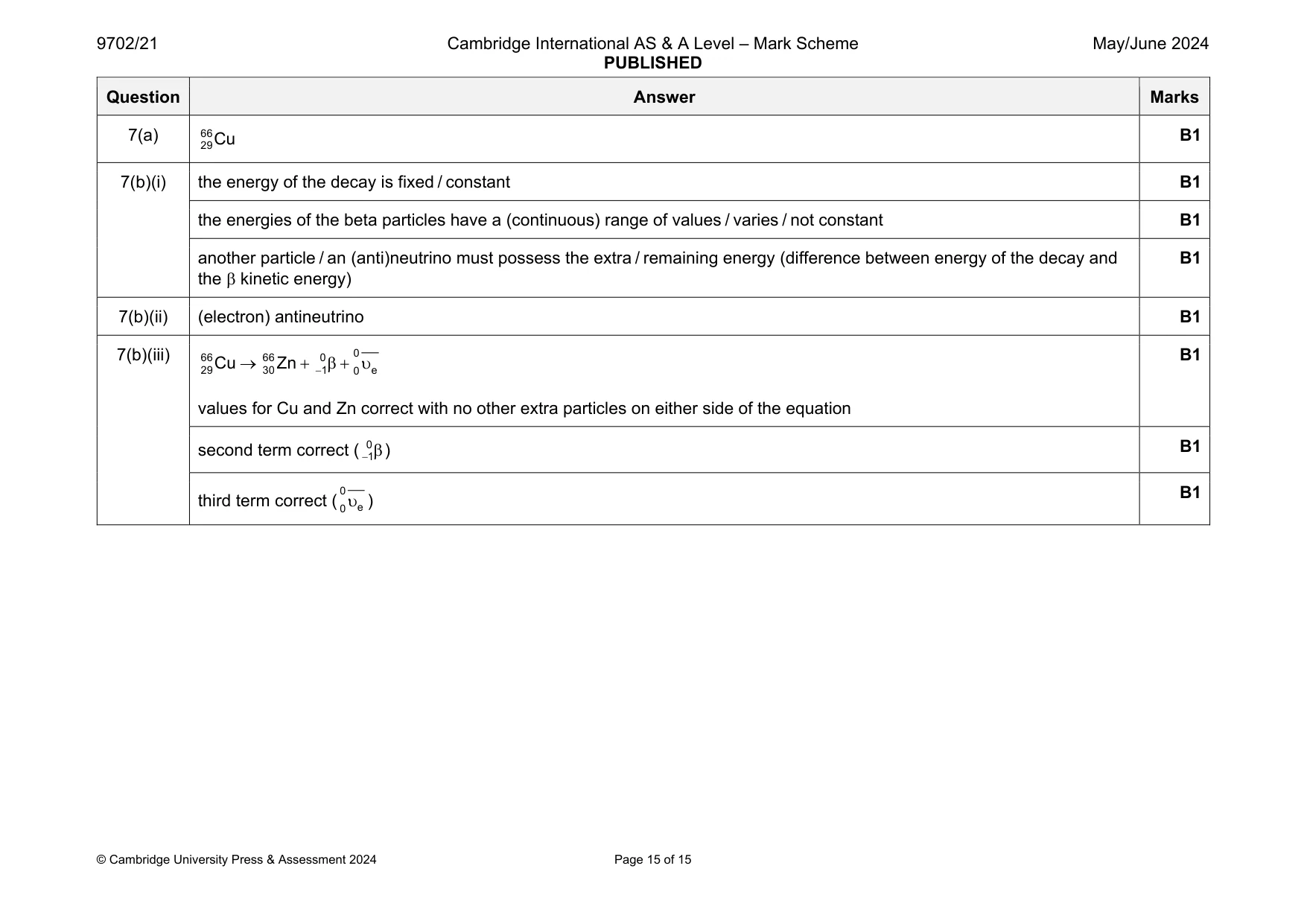
Mark scheme: 7(a) 66 29Cu B1 7(b)(i) the energy of the decay is fixed / constant B1 the energies of the beta particles have a (continuous) range of values / varies / not constant B1 another particle / an (anti)neutrino must possess the extra / remaining energy (difference between energy of the decay and the kinetic energy) B1 7(b)(ii) (electron) antineutrino B1 7(b)(iii) 0 66 66 0 29 30 1 e 0 Cu Zn values for Cu and Zn correct with no other extra particles on either side of the equation B1 second term correct ( 0 1 ) B1 third term correct ( 0 e 0 ) B1
What was in this paper
The subtopics covered by these 7 questions, and how many questions each got. Open one in a new tab to see every Cambridge question on it.
What you needed in this session
Cambridge’s own grade thresholds for 2024 May/June, Paper 2 · Variant 1. A higher threshold means an easier paper — the bar moves with how the cohort did.