Cambridge A Level Physics 9702 — 2016 May/June Paper 2 · Variant 1
9702/21/M/J/16 · 7 questions · 60 marks · ≈68 min
The question paper and its mark scheme, free to read here and free to download. This is Cambridge’s own paper, exactly as it was sat.
Question paper16 pages

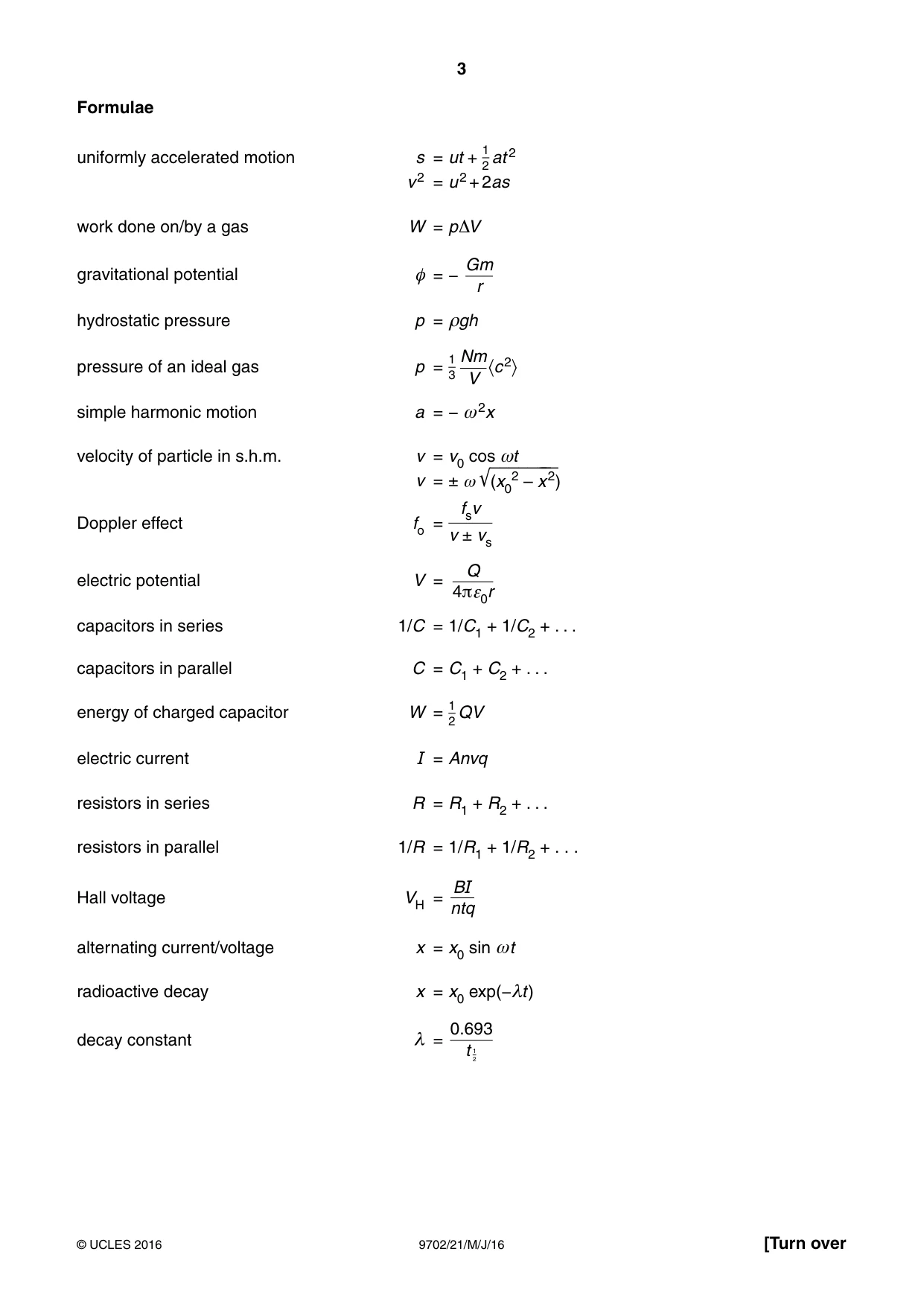

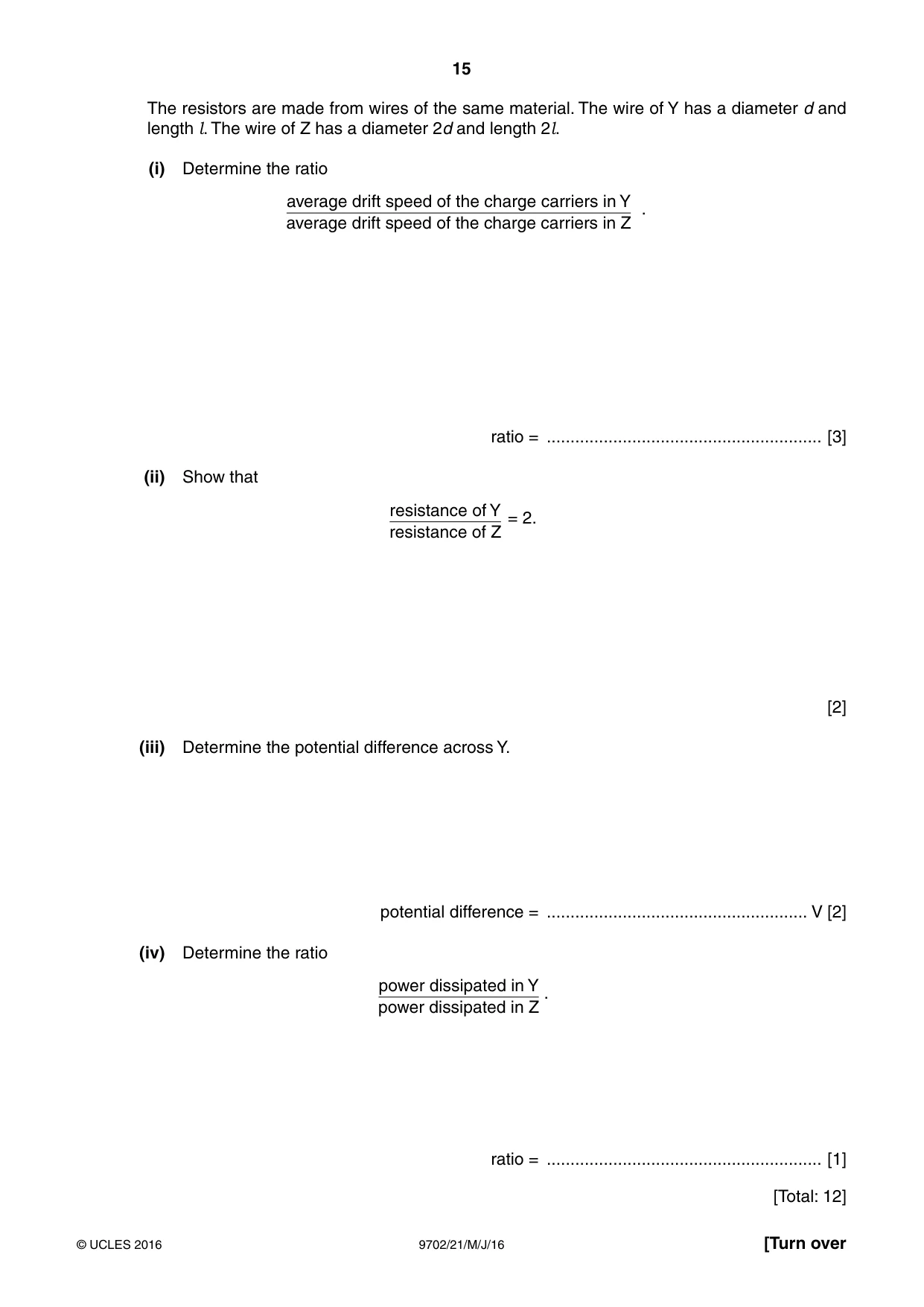
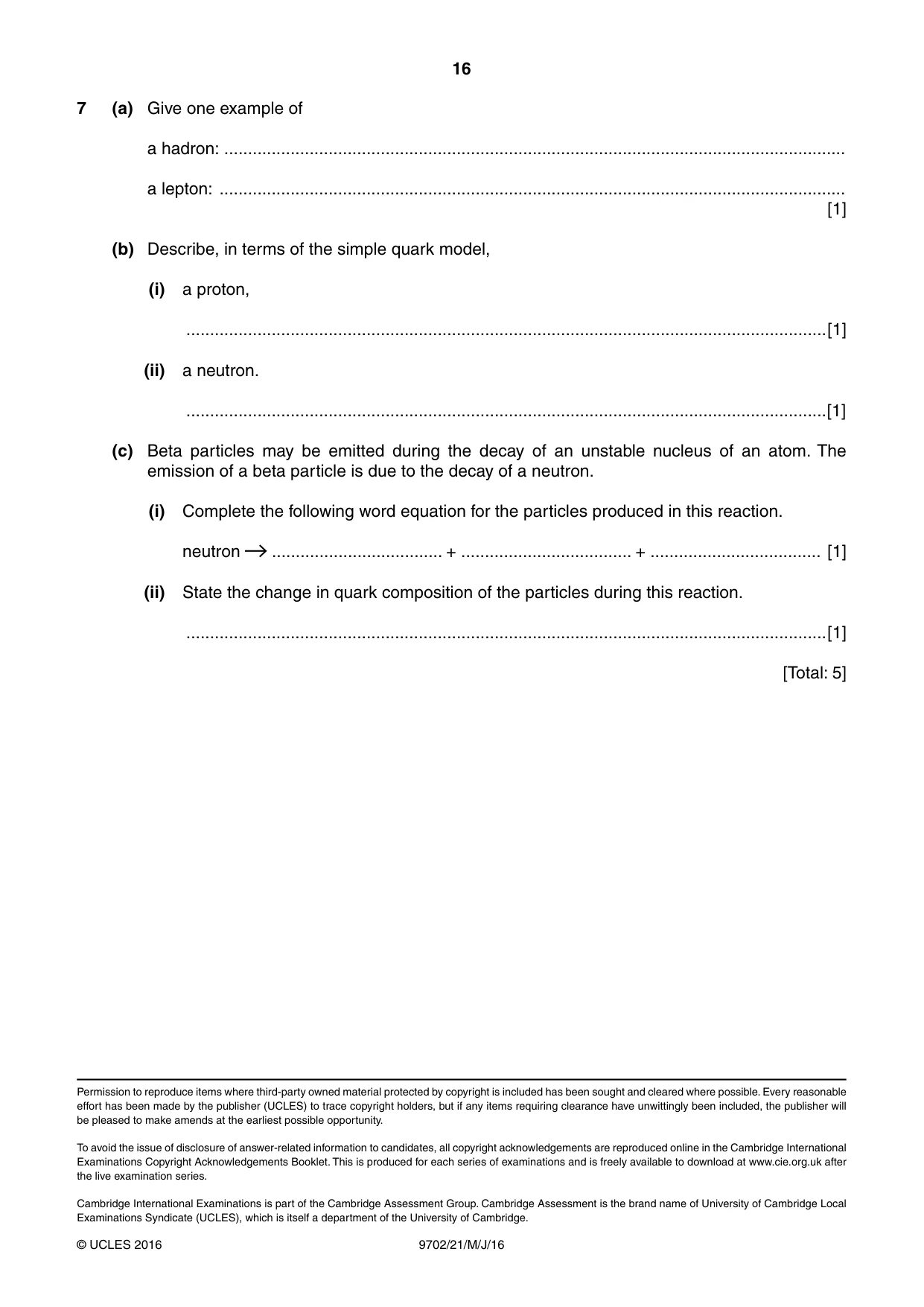
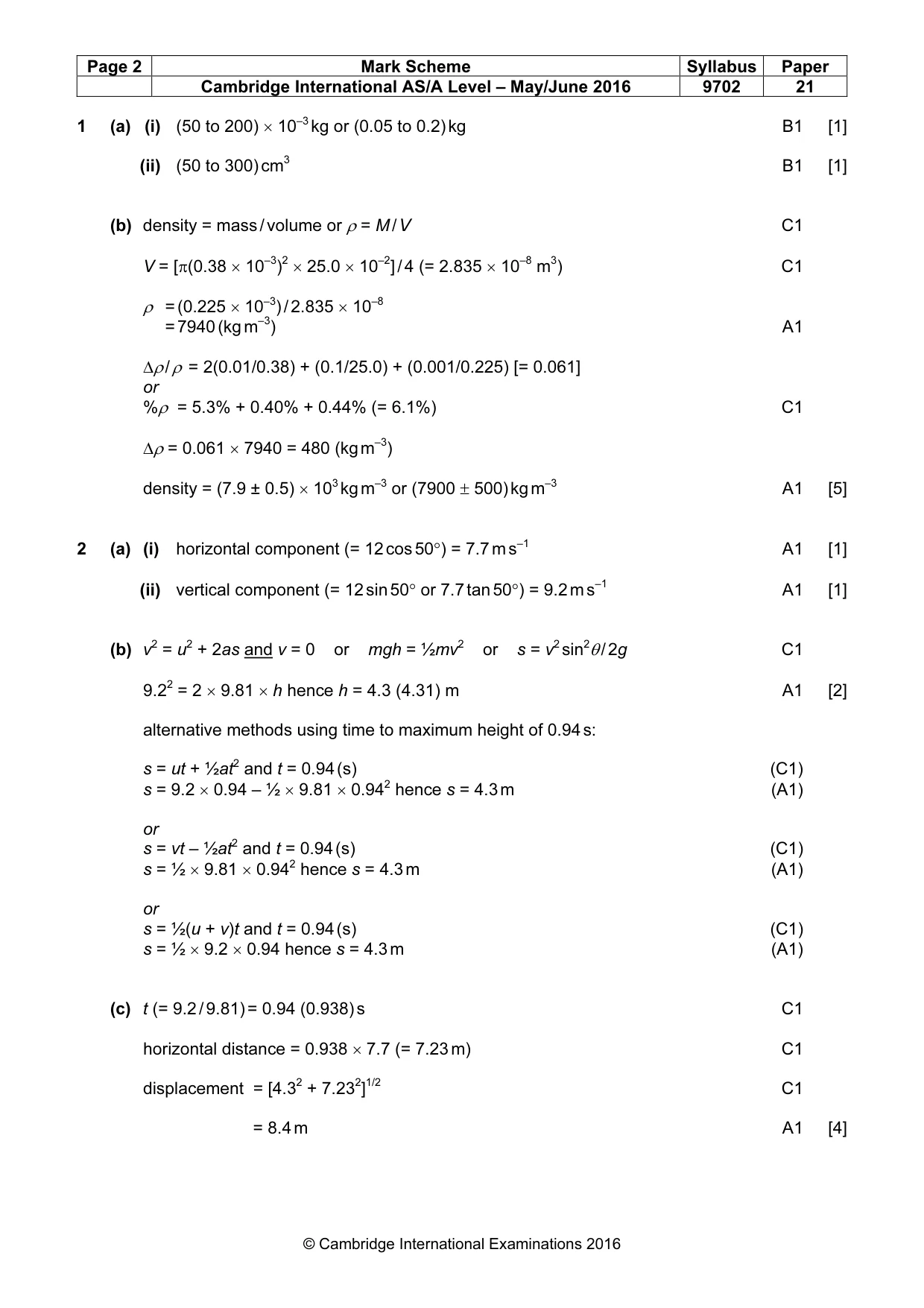
Mark scheme6 pages
Answers below. Sit the paper first if you are practising.
Questions as text
Q1 · Make estimates of (i) the mass, in kg, of a wooden metre rule, mass =…
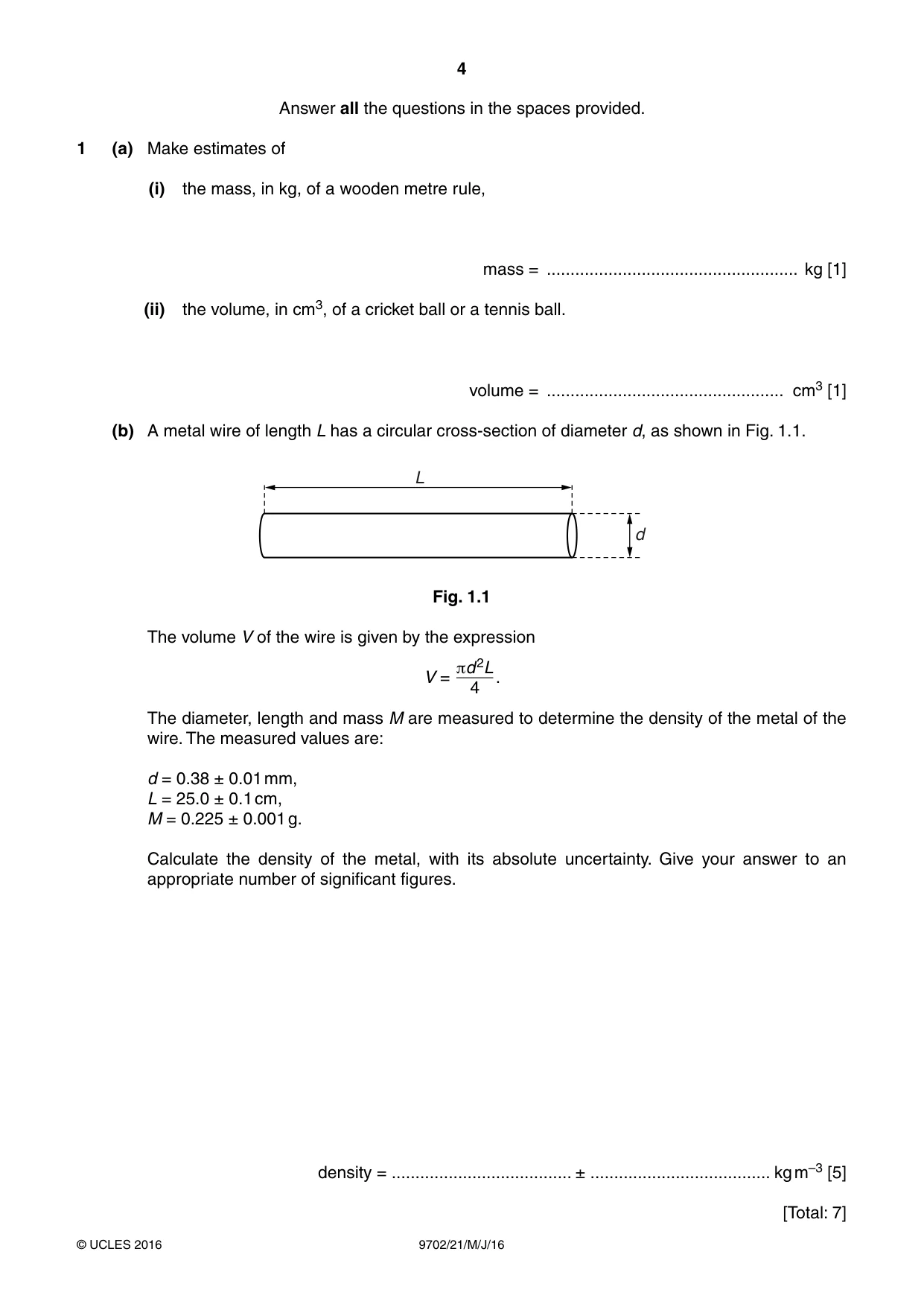
1 (a) Make estimates of (i) the mass, in kg, of a wooden metre rule, mass = ..................................................... kg [1] (ii) the volume, in cm3, of a cricket ball or a tennis ball. volume = .................................................. cm3 [1] (b) A metal wire of length L has a circular cross-section of diameter d, as shown in Fig. 1.1. / G Fig. 1.1 The volume V of the wire is given by the expression πd 2L V = . 4 The diameter, length and mass M are measured to determine the density of the metal of the wire. The measured values are: d = 0.38 ± 0.01 mm, L = 25.0 ± 0.1 cm, M = 0.225 ± 0.001 g. Calculate the density of the metal, with its absolute uncertainty. Give your answer to an appropriate number of significant figures. density = ...................................... ± ...................................... kg m–3 [5] [Total: 7]
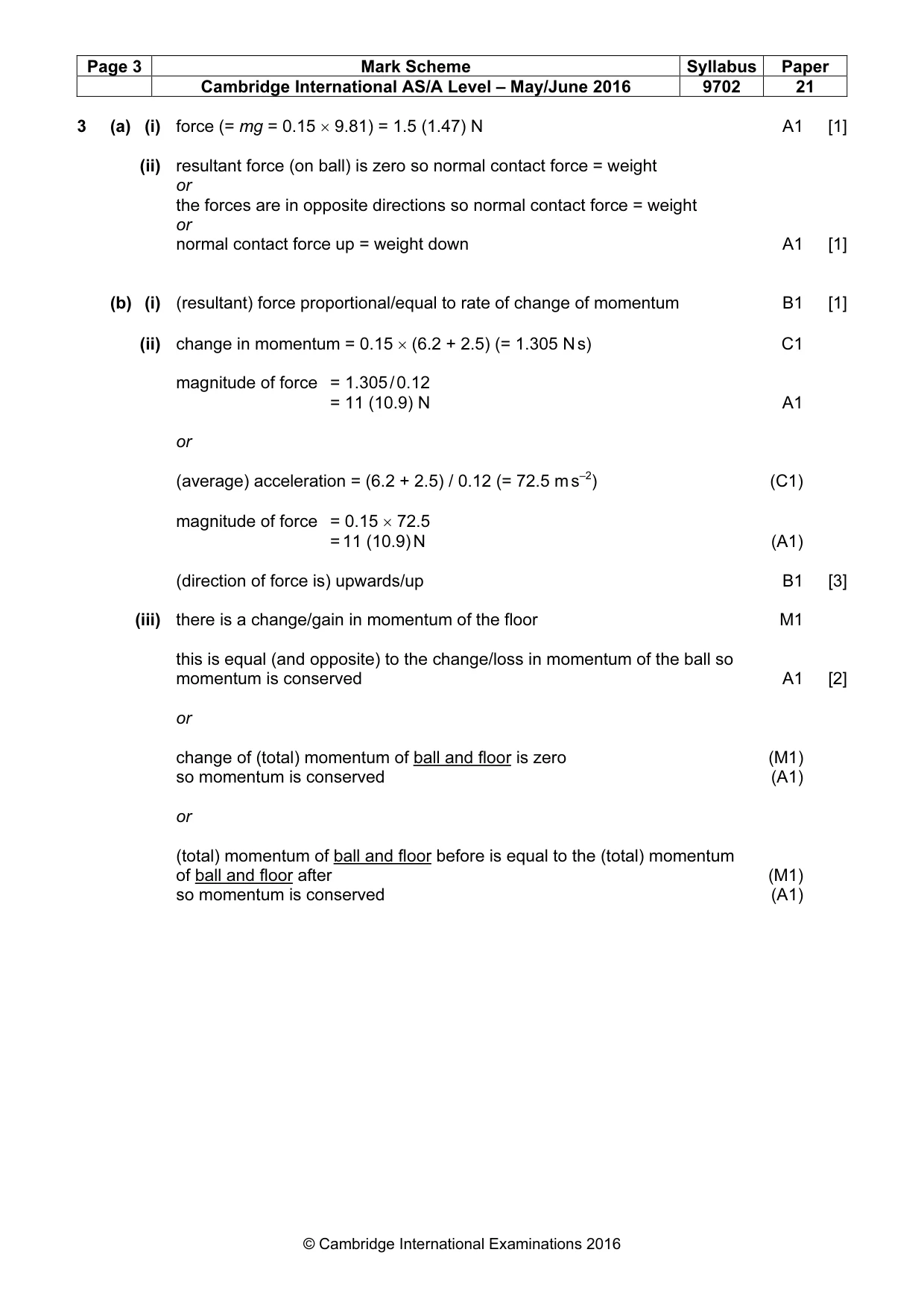
Mark scheme: 1 (a) (i) (50 to 200) × 10–3 kg or (0.05 to 0.2) kg B1 [1] (ii) (50 to 300) cm3 B1 [1] (b) density = mass / volume or ρ = M / V C1 V = [π(0.38 × 10⁻³)2 × 25.0 × 10–2] / 4 (= 2.835 × 10⁻⁸ m3) C1 ρ = (0.225 × 10⁻³) / 2.835 × 10–8 = 7940 (kg m–3) A1 ∆ρ / ρ = 2(0.01/0.38) + (0.1/25.0) + (0.001/0.225) [= 0.061] or %ρ = 5.3% + 0.40% + 0.44% (= 6.1%) C1 ∆ρ = 0.061 × 7940 = 480 (kg m–3) density = (7.9 ± 0.5) × 103 kg m–3 or (7900 ± 500) kg m–3 A1 [5] 1
Q2 · A ball is thrown from a point P with an initial velocity u of 12 m s–1 at 50° to the…
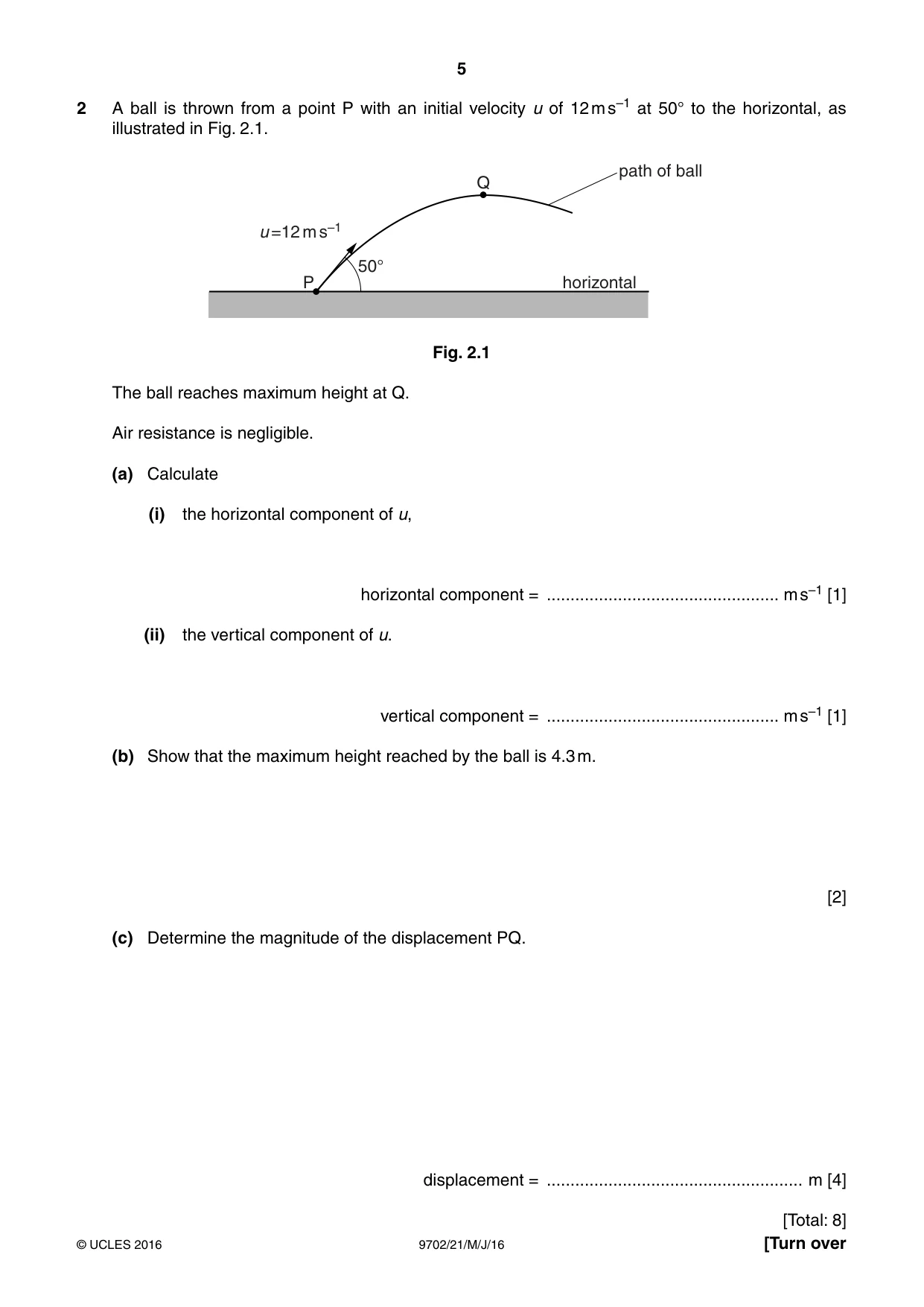
2 A ball is thrown from a point P with an initial velocity u of 12 m s–1 at 50° to the horizontal, as illustrated in Fig. 2.1. path of ball Q X =12 m s–1 50° P horizontal Fig. 2.1 The ball reaches maximum height at Q. Air resistance is negligible. (a) Calculate (i) the horizontal component of u, horizontal component = ................................................. m s–1 [1] (ii) the vertical component of u. vertical component = ................................................. m s–1 [1] (b) Show that the maximum height reached by the ball is 4.3 m. [2] (c) Determine the magnitude of the displacement PQ. displacement = ...................................................... m [4] [Total: 8]
Mark scheme: 2 (a) (i) horizontal component (= 12 cos 50°) = 7.7 m s–1 A1 [1] (ii) vertical component (= 12 sin 50° or 7.7 tan 50°) = 9.2 m s–1 A1 [1] (b) v2 = u2 + 2as and v = 0 or mgh = ½mv2 or s = v2 sin2θ / 2g C1 9.22 = 2 × 9.81 × h hence h = 4.3 (4.31) m A1 [2] alternative methods using time to maximum height of 0.94 s: s = ut + ½at2 and t = 0.94 (s) (C1) s = 9.2 × 0.94 – ½ × 9.81 × 0.942 hence s = 4.3 m (A1) or s = vt – ½at2 and t = 0.94 (s) (C1) s = ½ × 9.81 × 0.942 hence s = 4.3 m (A1) or s = ½(u + v)t and t = 0.94 (s) (C1) s = ½ × 9.2 × 0.94 hence s = 4.3 m (A1) (c) t (= 9.2 / 9.81) = 0.94 (0.938) s C1 horizontal distance = 0.938 × 7.7 (= 7.23 m) C1 displacement = [4.32 + 7.232]1/2 C1 = 8.4 m A1 [4]
Q3 · A ball of mass 150 g is at rest on a horizontal floor, as shown in Fig
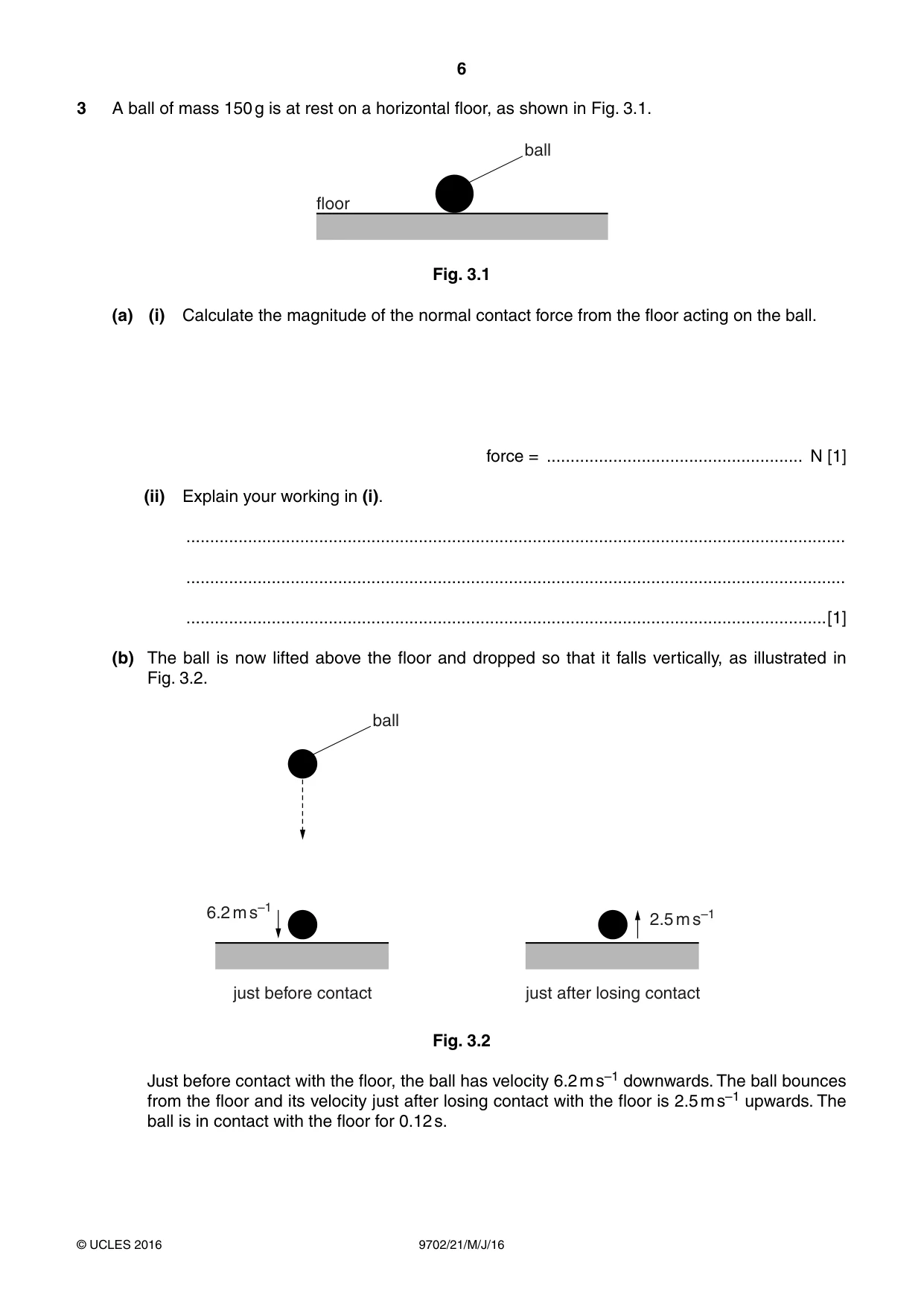
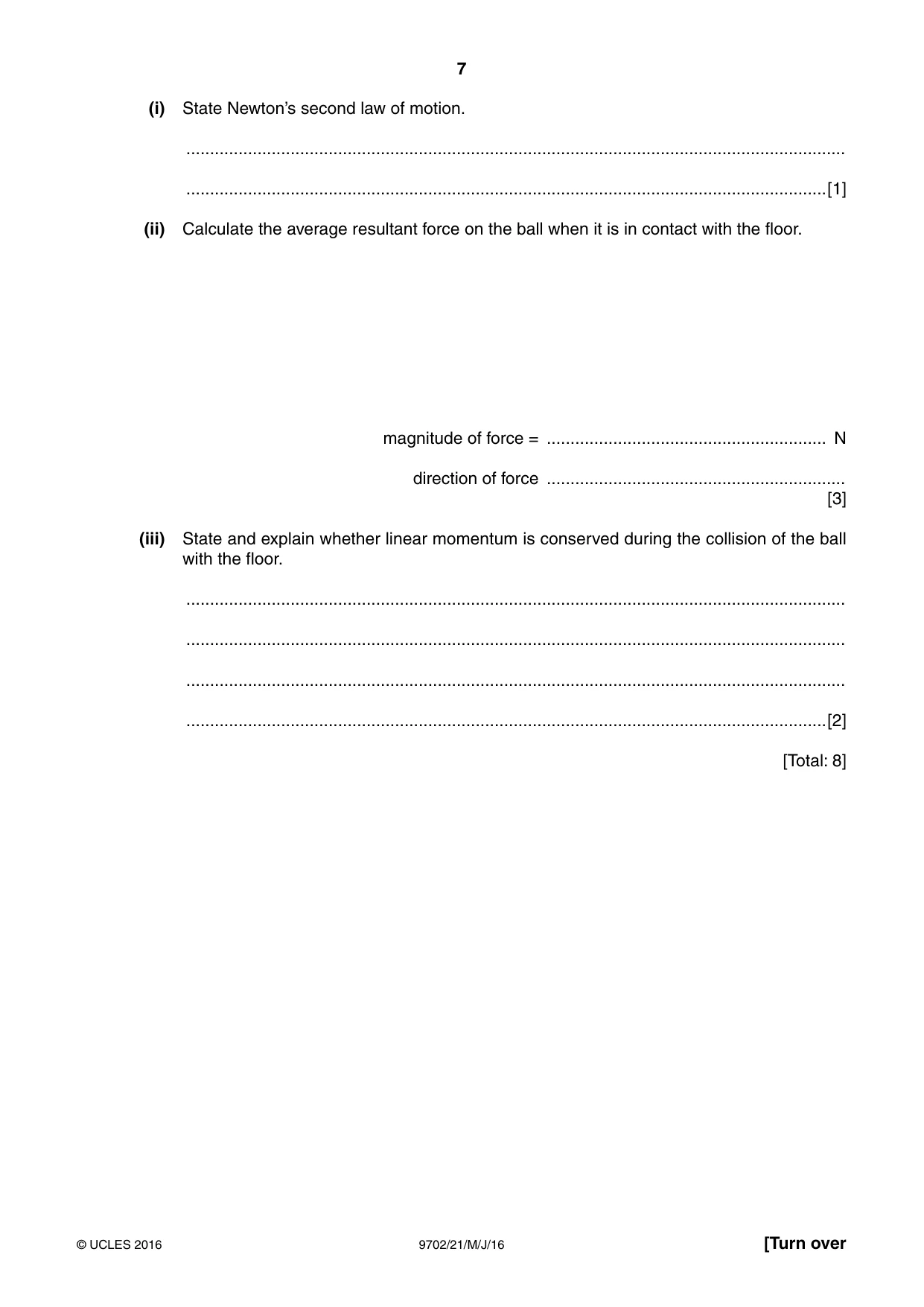
3 A ball of mass 150 g is at rest on a horizontal floor, as shown in Fig. 3.1. ball floor Fig. 3.1 (a) (i) Calculate the magnitude of the normal contact force from the floor acting on the ball. force = ...................................................... N [1] (ii) Explain your working in (i). ........................................................................................................................................... ........................................................................................................................................... .......................................................................................................................................[1] (b) The ball is now lifted above the floor and dropped so that it falls vertically, as illustrated in Fig. 3.2. ball 6.2 m s–1 2.5 m s–1 just before contact just after losing contact Fig. 3.2 Just before contact with the floor, the ball has velocity 6.2 m s–1 downwards. The ball bounces from the floor and its velocity just after losing contact with the floor is 2.5 m s–1 upwards. The ball is in contact with the floor for 0.12 s. (i) State Newton’s second law of motion. ........................................................................................................................................... .......................................................................................................................................[1] (ii) Calculate the average resultant force on the ball when it is in contact with the floor. magnitude of force = ........................................................... N direction of force ............................................................... [3] (iii) State and explain whether linear momentum is conserved during the collision of the ball with the floor. ........................................................................................................................................... ........................................................................................................................................... ........................................................................................................................................... .......................................................................................................................................[2] [Total: 8]
Mark scheme: 3 (a) (i) force (= mg = 0.15 × 9.81) = 1.5 (1.47) N A1 [1] (ii) resultant force (on ball) is zero so normal contact force = weight or the forces are in opposite directions so normal contact force = weight or normal contact force up = weight down A1 [1] (b) (i) (resultant) force proportional/equal to rate of change of momentum B1 [1] (ii) change in momentum = 0.15 × (6.2 + 2.5) (= 1.305 N s) C1 magnitude of force = 1.305 / 0.12 = 11 (10.9) N A1 or (average) acceleration = (6.2 + 2.5) / 0.12 (= 72.5 m s–2) (C1) magnitude of force = 0.15 × 72.5 = 11 (10.9) N (A1) (direction of force is) upwards/up B1 [3] (iii) there is a change/gain in momentum of the floor M1 this is equal (and opposite) to the change/loss in momentum of the ball so momentum is conserved A1 [2] or change of (total) momentum of ball and floor is zero (M1) so momentum is conserved (A1) or (total) momentum of ball and floor before is equal to the (total) momentum of ball and floor after (M1) so momentum is conserved (A1)
Q4 · State what is meant by elastic potential energy
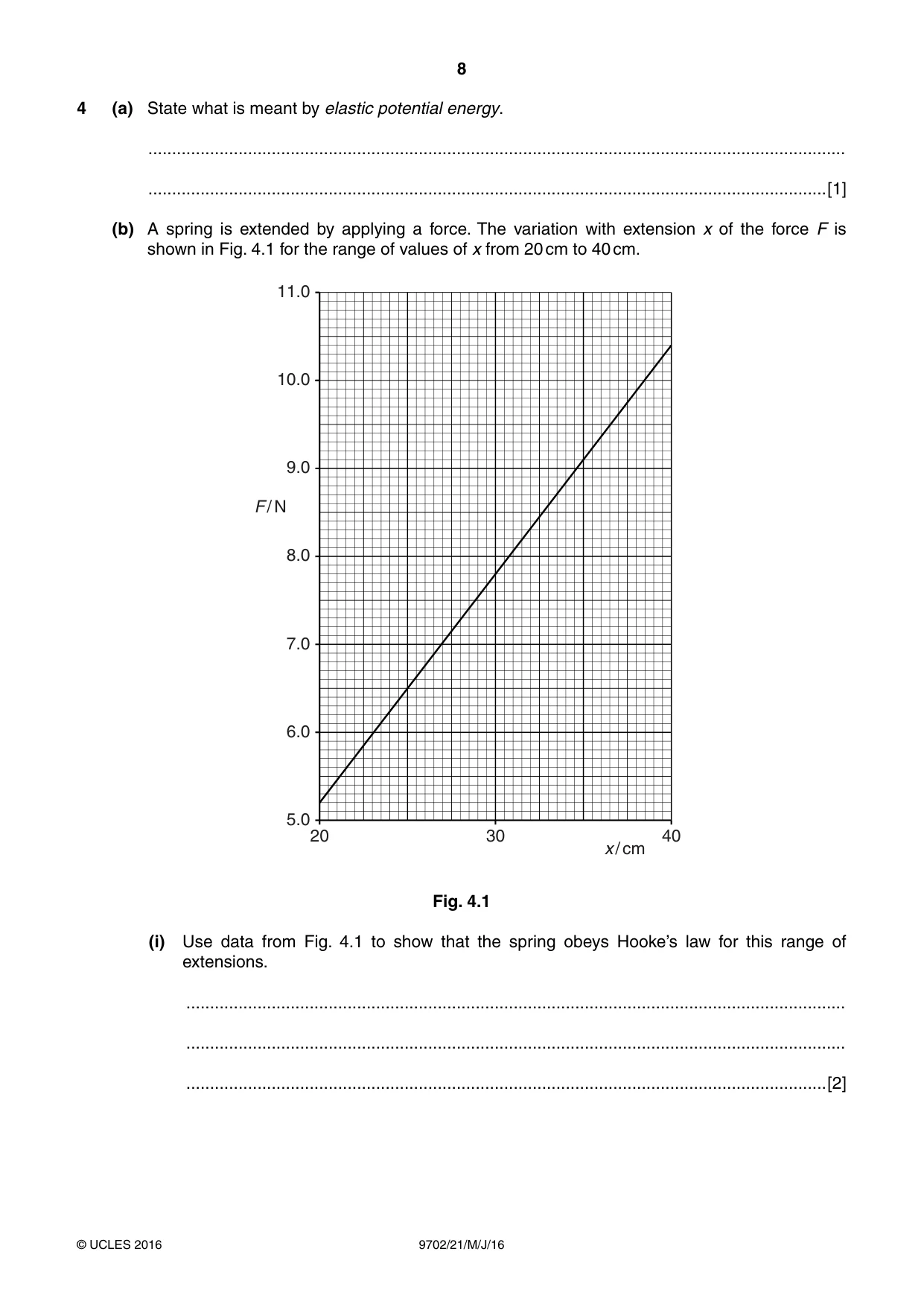
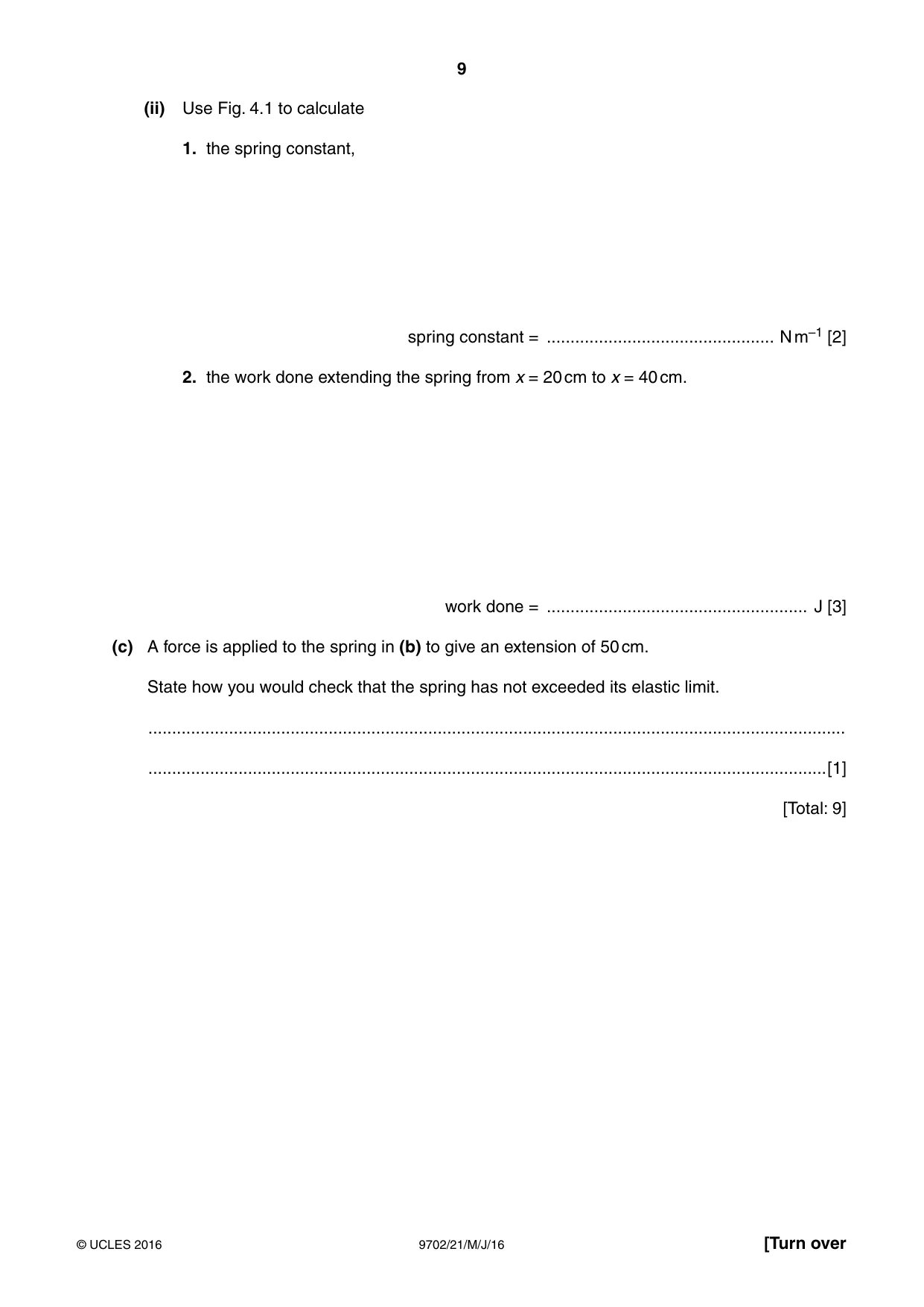
4 (a) State what is meant by elastic potential energy. ................................................................................................................................................... ...............................................................................................................................................[1] (b) A spring is extended by applying a force. The variation with extension x of the force F is shown in Fig. 4.1 for the range of values of x from 20 cm to 40 cm. 11.0 10.0 9.0 ) / N 8.0 7.0 6.0 5.0 20 30 40 [ / cm Fig. 4.1 (i) Use data from Fig. 4.1 to show that the spring obeys Hooke’s law for this range of extensions. ........................................................................................................................................... ........................................................................................................................................... .......................................................................................................................................[2] (ii) Use Fig. 4.1 to calculate 1. the spring constant, spring constant = ................................................ N m–1 [2] 2. the work done extending the spring from x = 20 cm to x = 40 cm. work done = ....................................................... J [3] (c) A force is applied to the spring in (b) to give an extension of 50 cm. State how you would check that the spring has not exceeded its elastic limit. ................................................................................................................................................... ...............................................................................................................................................[1] [Total: 9]
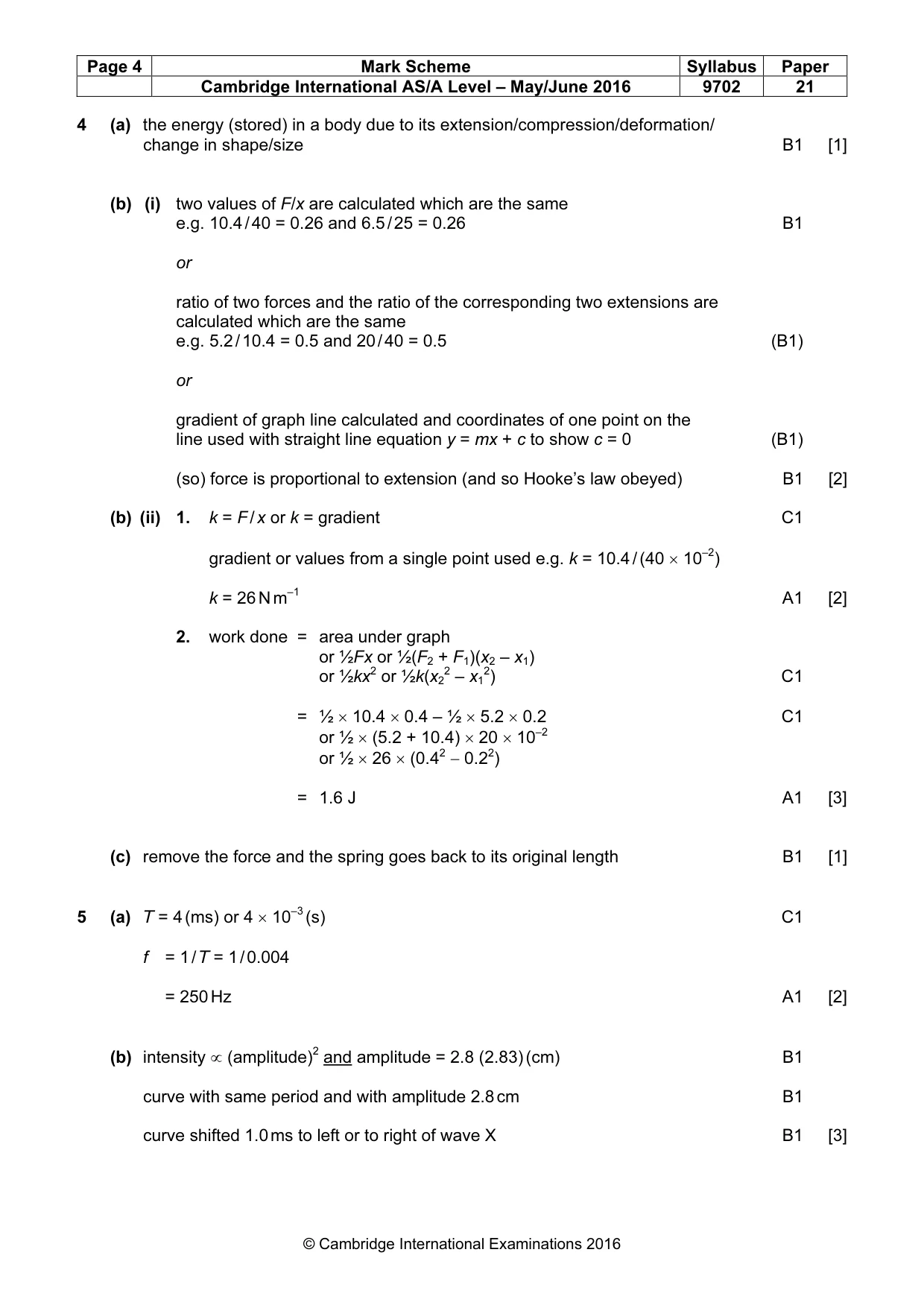
Mark scheme: 4 (a) the energy (stored) in a body due to its extension/compression/deformation/ change in shape/size B1 [1] (b) (i) two values of F/x are calculated which are the same e.g. 10.4 / 40 = 0.26 and 6.5 / 25 = 0.26 B1 or ratio of two forces and the ratio of the corresponding two extensions are calculated which are the same e.g. 5.2 / 10.4 = 0.5 and 20 / 40 = 0.5 (B1) or gradient of graph line calculated and coordinates of one point on the line used with straight line equation y = mx + c to show c = 0 (B1) (so) force is proportional to extension (and so Hooke’s law obeyed) B1 [2] (b) (ii) 1. k = F / x or k = gradient C1 gradient or values from a single point used e.g. k = 10.4 / (40 × 10–2) k = 26 N m–1 A1 [2] 2. work done = area under graph or ½Fx or ½(F2 + F1)(x2 – x1) or ½kx2 or ½k(x22 – x12) C1 = ½ × 10.4 × 0.4 – ½ × 5.2 × 0.2 C1 or ½ × (5.2 + 10.4) × 20 × 10–2 or ½ × 26 × (0.42 − 0.22) = 1.6 J A1 [3] (c) remove the force and the spring goes back to its original length B1 [1] 3
Q5 · The variation with time t of the displacement y of a wave X, as it passes a point P, is…
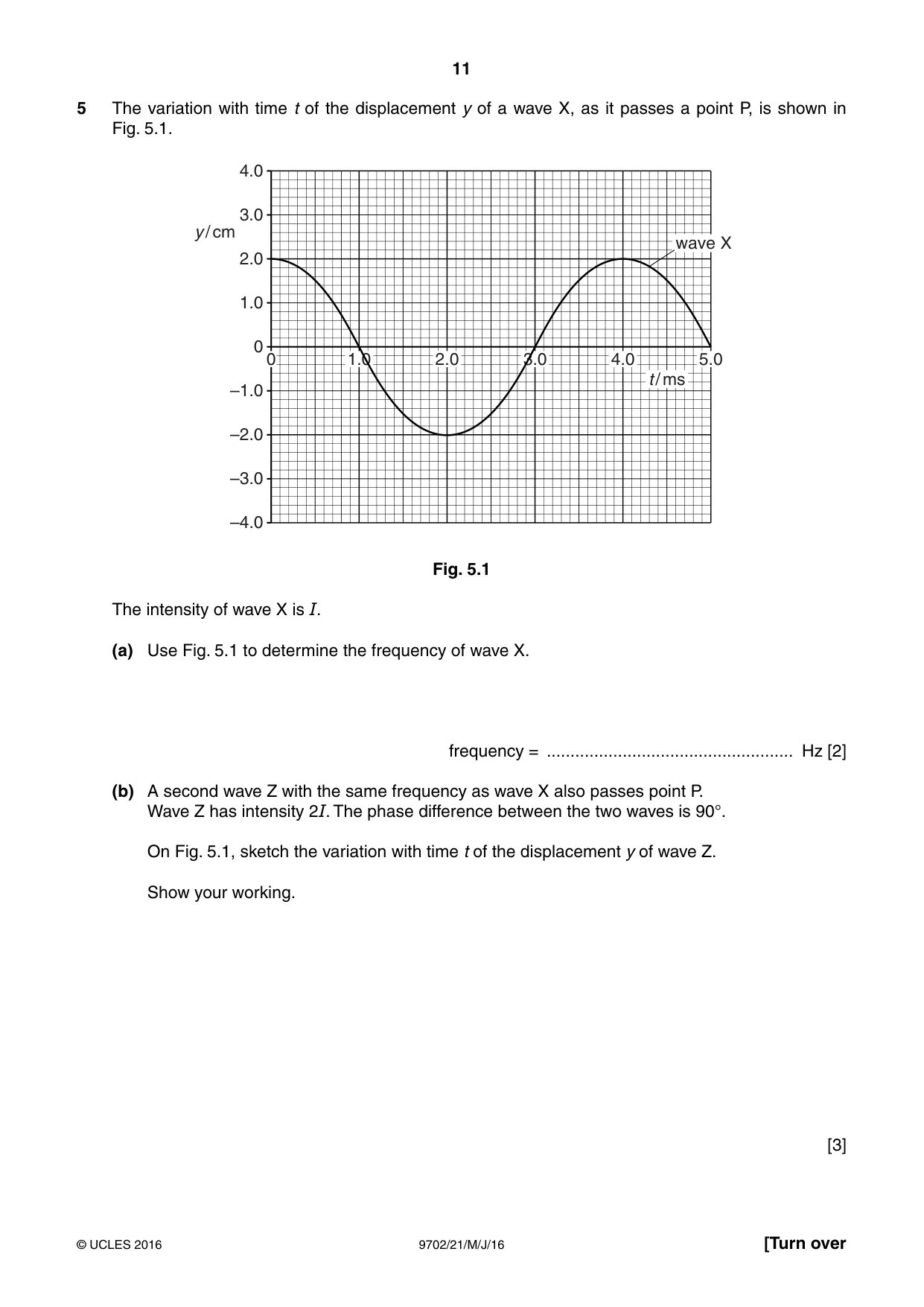
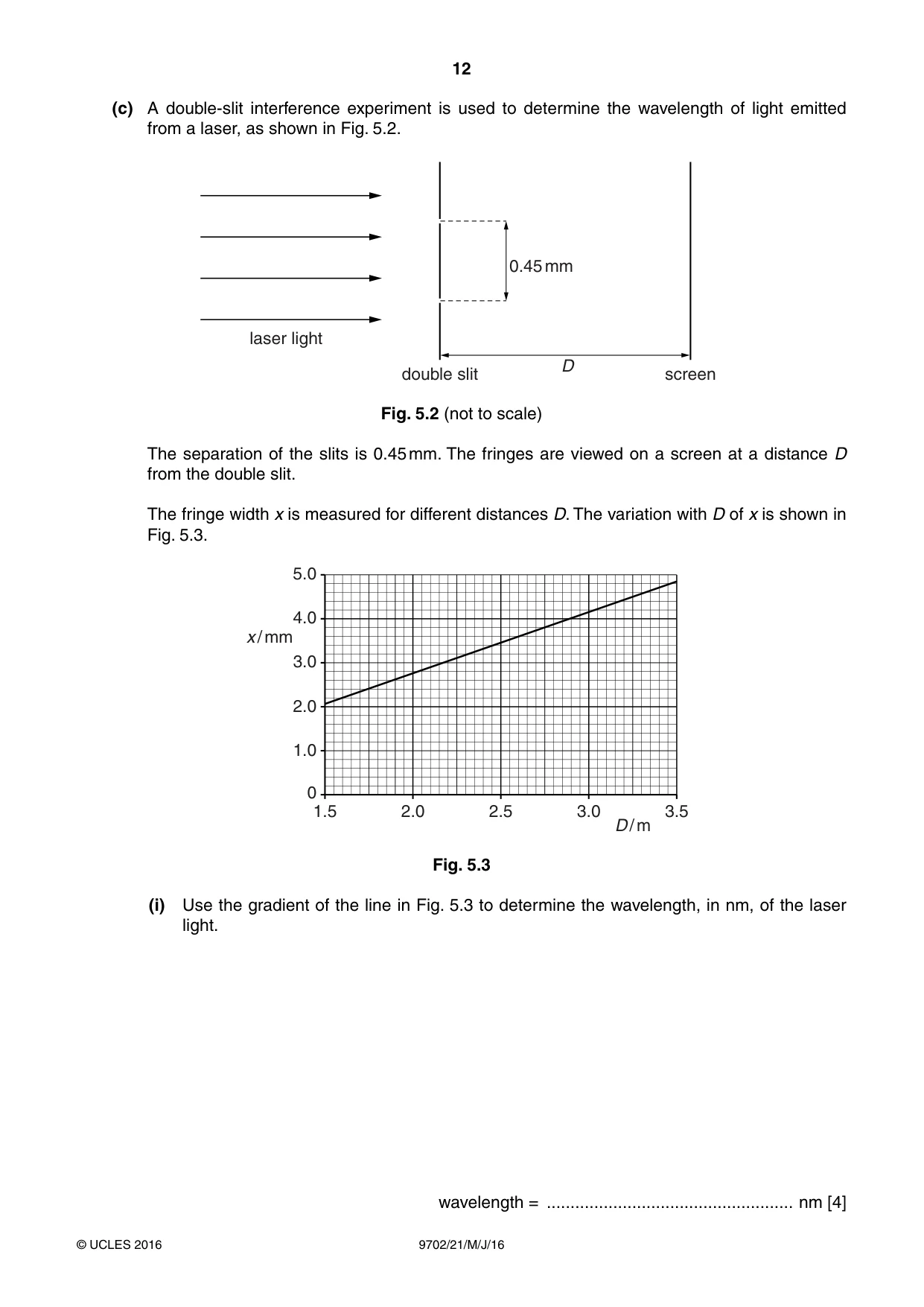
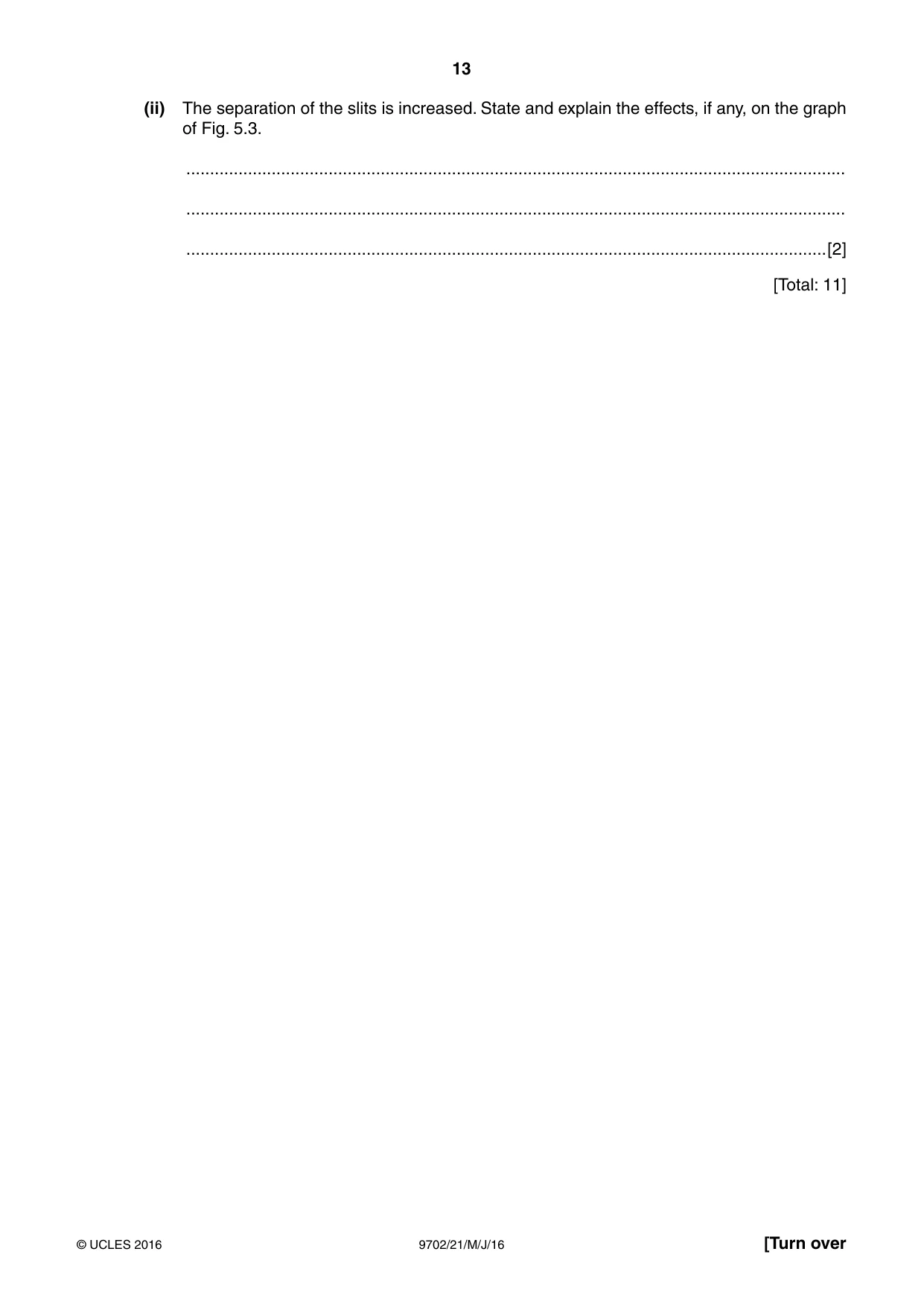
5 The variation with time t of the displacement y of a wave X, as it passes a point P, is shown in Fig. 5.1. 4.0 3.0 \ / cm ZDYH ; 2.0 1.0 0 0 1.0 2.0 3.0 4.0 5.0 W / ms –1.0 –2.0 –3.0 –4.0 Fig. 5.1 The intensity of wave X is I. (a) Use Fig. 5.1 to determine the frequency of wave X. frequency = .................................................... Hz [2] (b) A second wave Z with the same frequency as wave X also passes point P. Wave Z has intensity 2I. The phase difference between the two waves is 90°. On Fig. 5.1, sketch the variation with time t of the displacement y of wave Z. Show your working. [3] (c) A double-slit interference experiment is used to determine the wavelength of light emitted from a laser, as shown in Fig. 5.2. 0.45 mm laser light ' double slit screen Fig. 5.2 (not to scale) The separation of the slits is 0.45 mm. The fringes are viewed on a screen at a distance D from the double slit. The fringe width x is measured for different distances D. The variation with D of x is shown in Fig. 5.3. 5.0 4.0 [ / mm 3.0 2.0 1.0 0 1.5 2.0 2.5 3.0 3.5 ' / m Fig. 5.3 (i) Use the gradient of the line in Fig. 5.3 to determine the wavelength, in nm, of the laser light. wavelength = .................................................... nm [4] (ii) The separation of the slits is increased. State and explain the effects, if any, on the graph of Fig. 5.3. ........................................................................................................................................... ........................................................................................................................................... .......................................................................................................................................[2] [Total: 11]
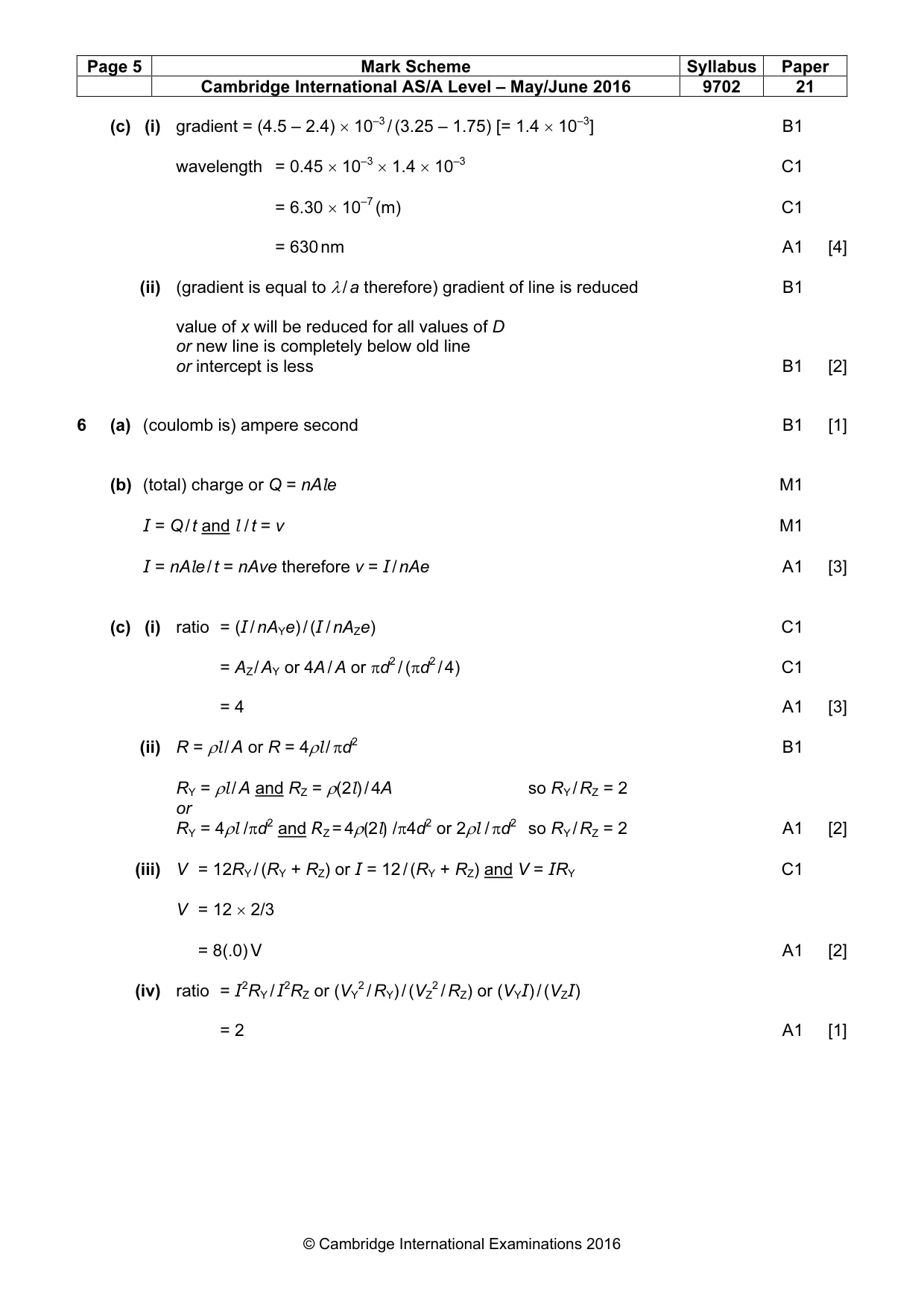
Mark scheme: 5 (a) T = 4 (ms) or 4 × 10⁻³ (s) C1 f = 1 / T = 1 / 0.004 = 250 Hz A1 [2] (b) intensity ∝ (amplitude)2 and amplitude = 2.8 (2.83) (cm) B1 curve with same period and with amplitude 2.8 cm B1 curve shifted 1.0 ms to left or to right of wave X B1 [3] (c) (i) gradient = (4.5 – 2.4) × 10–3 / (3.25 – 1.75) [= 1.4 × 10⁻³] B1 wavelength = 0.45 × 10–3 × 1.4 × 10–3 C1 = 6.30 × 10⁻⁷ (m) C1 = 630 nm A1 [4] (ii) (gradient is equal to λ / a therefore) gradient of line is reduced B1 value of x will be reduced for all values of D or new line is completely below old line or intercept is less B1 [2]
Question 6
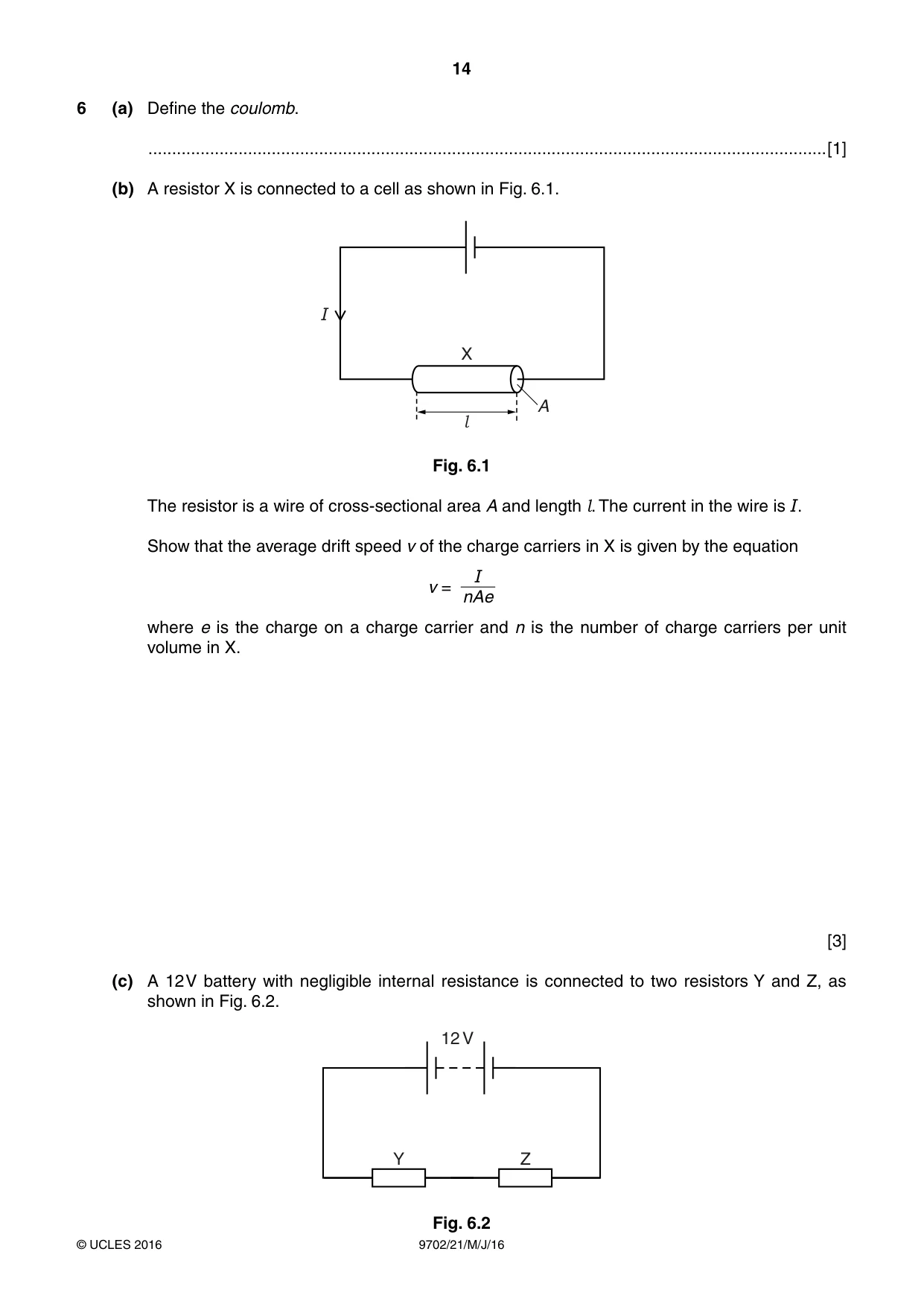
6 (a) Define the coulomb. ...............................................................................................................................................[1] (b) A resistor X is connected to a cell as shown in Fig. 6.1. I ; $ l Fig. 6.1 The resistor is a wire of cross-sectional area A and length l. The current in the wire is I. Show that the average drift speed v of the charge carriers in X is given by the equation I v = nAe where e is the charge on a charge carrier and n is the number of charge carriers per unit volume in X. [3] (c) A 12 V battery with negligible internal resistance is connected to two resistors Y and Z, as shown in Fig. 6.2. 12 V Y Z Fig. 6.2 The resistors are made from wires of the same material. The wire of Y has a diameter d and length l. The wire of Z has a diameter 2d and length 2l. (i) Determine the ratio average drift speed of the charge carriers in Y . average drift speed of the charge carriers in Z ratio = .......................................................... [3] (ii) Show that resistance of Y = 2. resistance of Z [2] (iii) Determine the potential difference across Y. potential difference = ....................................................... V [2] (iv) Determine the ratio power dissipated in Y . power dissipated in Z ratio = .......................................................... [1] [Total: 12]
Mark scheme: 6 (a) (coulomb is) ampere second B1 [1] (b) (total) charge or Q = nAle M1 I = Q / t and l / t = v M1 I = nAle / t = nAve therefore v = I / nAe A1 [3] (c) (i) ratio = (I / nAYe) / (I / nAZe) C1 = AZ / AY or 4A / A or πd2 / (πd2 / 4) C1 = 4 A1 [3] (ii) R = ρl / A or R = 4ρl / πd2 B1 RY = ρl / A and RZ = ρ(2l) / 4A so RY / RZ = 2 or RY = 4ρl /πd2 and RZ = 4ρ(2l) /π4d2 or 2ρl / πd2 so RY / RZ = 2 A1 [2] (iii) V = 12RY / (RY + RZ) or I = 12 / (RY + RZ) and V = IRY C1 V = 12 × 2/3 = 8(.0) V A1 [2] (iv) ratio = I2RY / I2RZ or (VY2 / RY) / (VZ 2 / RZ) or (VYI) / (VZI) = 2 A1 [1]
Q7 · Give one example of a hadron…
7 (a) Give one example of a hadron: ................................................................................................................................... a lepton: .................................................................................................................................... [1] (b) Describe, in terms of the simple quark model, (i) a proton, .......................................................................................................................................[1] (ii) a neutron. .......................................................................................................................................[1] (c) Beta particles may be emitted during the decay of an unstable nucleus of an atom. The emission of a beta particle is due to the decay of a neutron. (i) Complete the following word equation for the particles produced in this reaction. neutron .................................... + .................................... + .................................... [1] (ii) State the change in quark composition of the particles during this reaction. .......................................................................................................................................[1] [Total: 5]
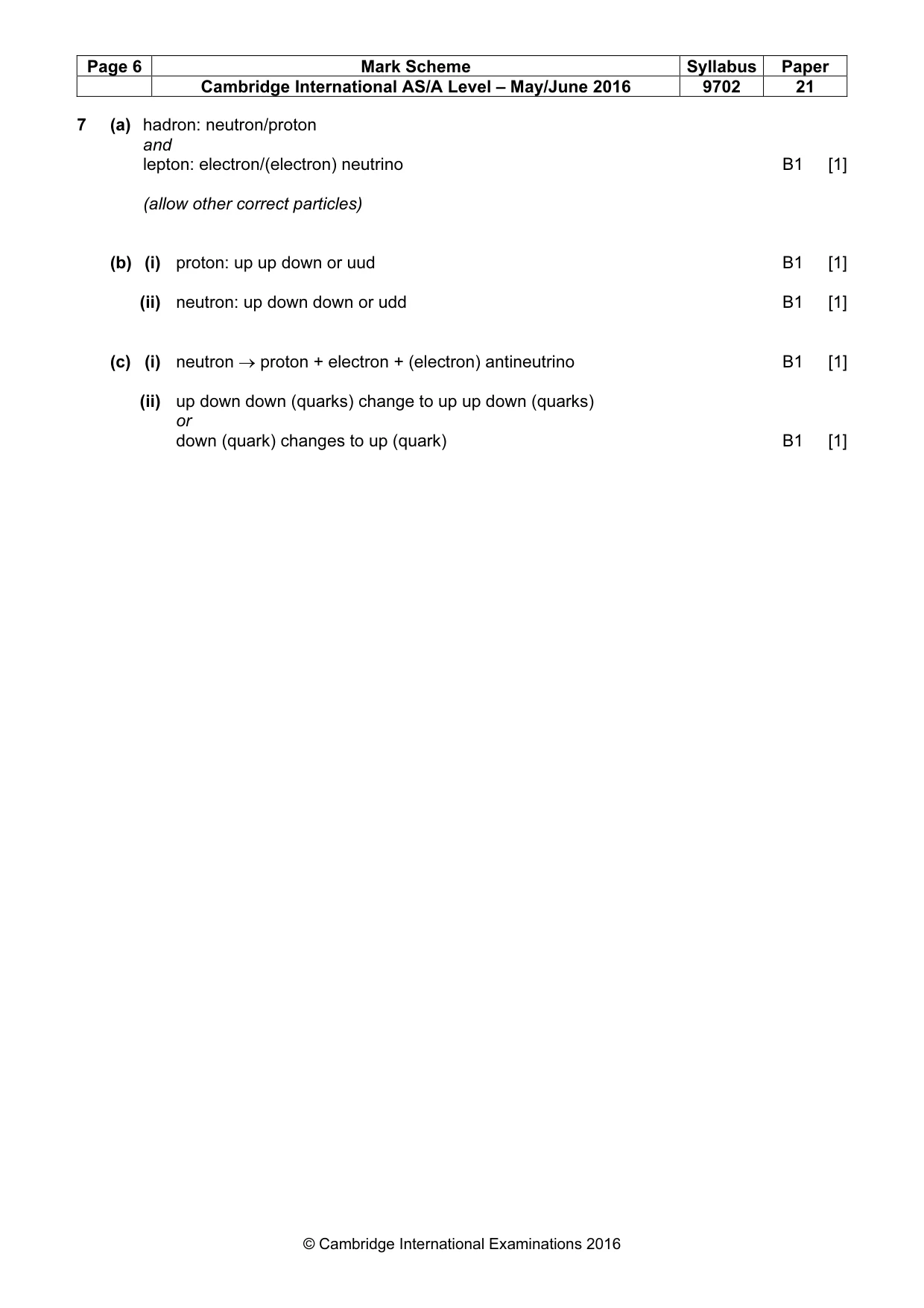
Mark scheme: 7 (a) hadron: neutron/proton and lepton: electron/(electron) neutrino B1 [1] (allow other correct particles) (b) (i) proton: up up down or uud B1 [1] (ii) neutron: up down down or udd B1 [1] (c) (i) neutron → proton + electron + (electron) antineutrino B1 [1] (ii) up down down (quarks) change to up up down (quarks) or down (quark) changes to up (quark) B1 [1]
What was in this paper
The subtopics covered by these 7 questions, and how many questions each got. Open one in a new tab to see every Cambridge question on it.
What you needed in this session
Cambridge’s own grade thresholds for 2016 May/June, Paper 2 · Variant 1. A higher threshold means an easier paper — the bar moves with how the cohort did.