Cambridge A Level Physics 9702 — 2017 Feb/March Paper 2 · Variant 2
9702/22/F/M/17 · 7 questions · 60 marks · ≈68 min
The question paper and its mark scheme, free to read here and free to download. This is Cambridge’s own paper, exactly as it was sat.
Question paper20 pages
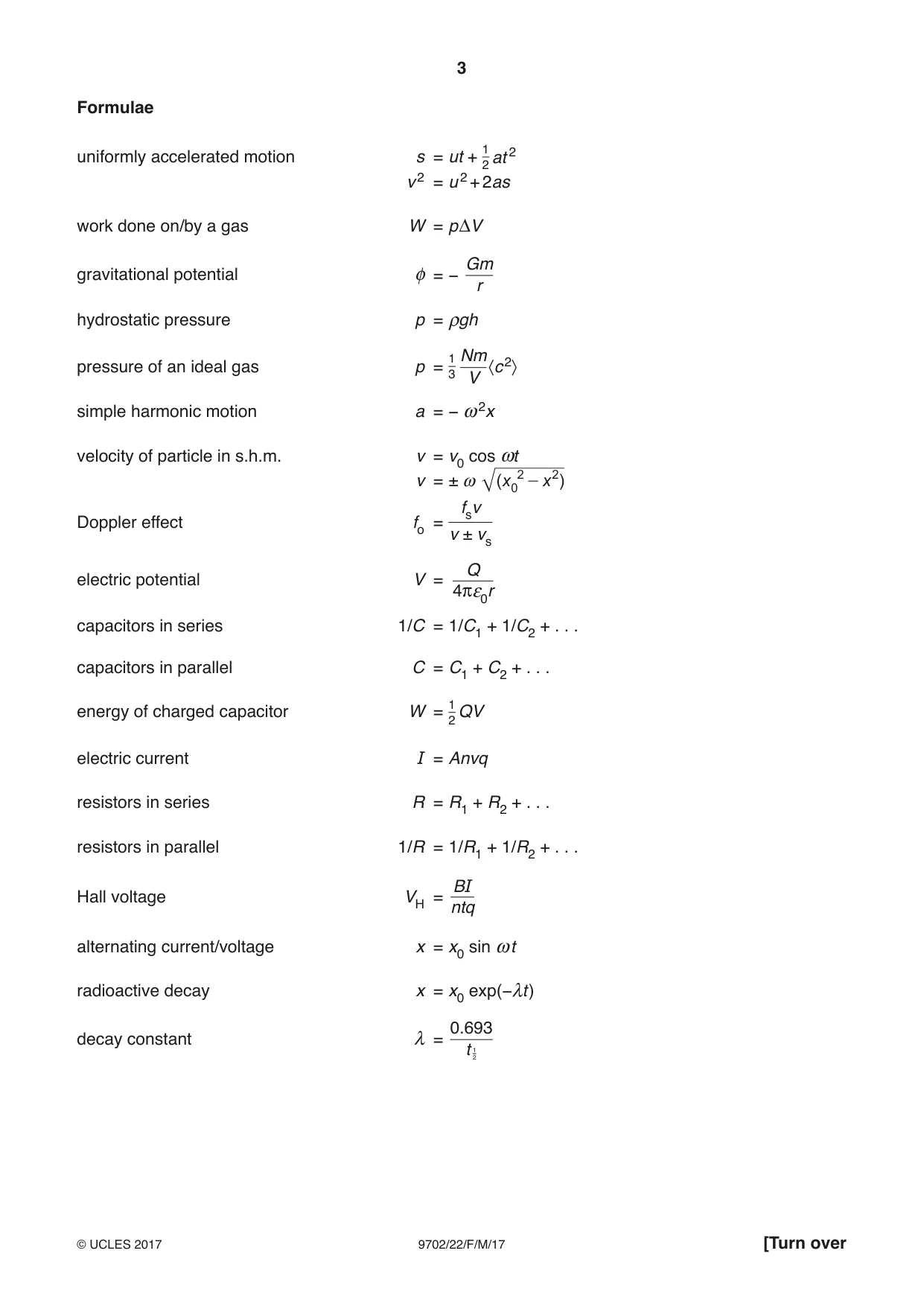



Mark scheme8 pages
Answers below. Sit the paper first if you are practising.
Questions as text
Question 1
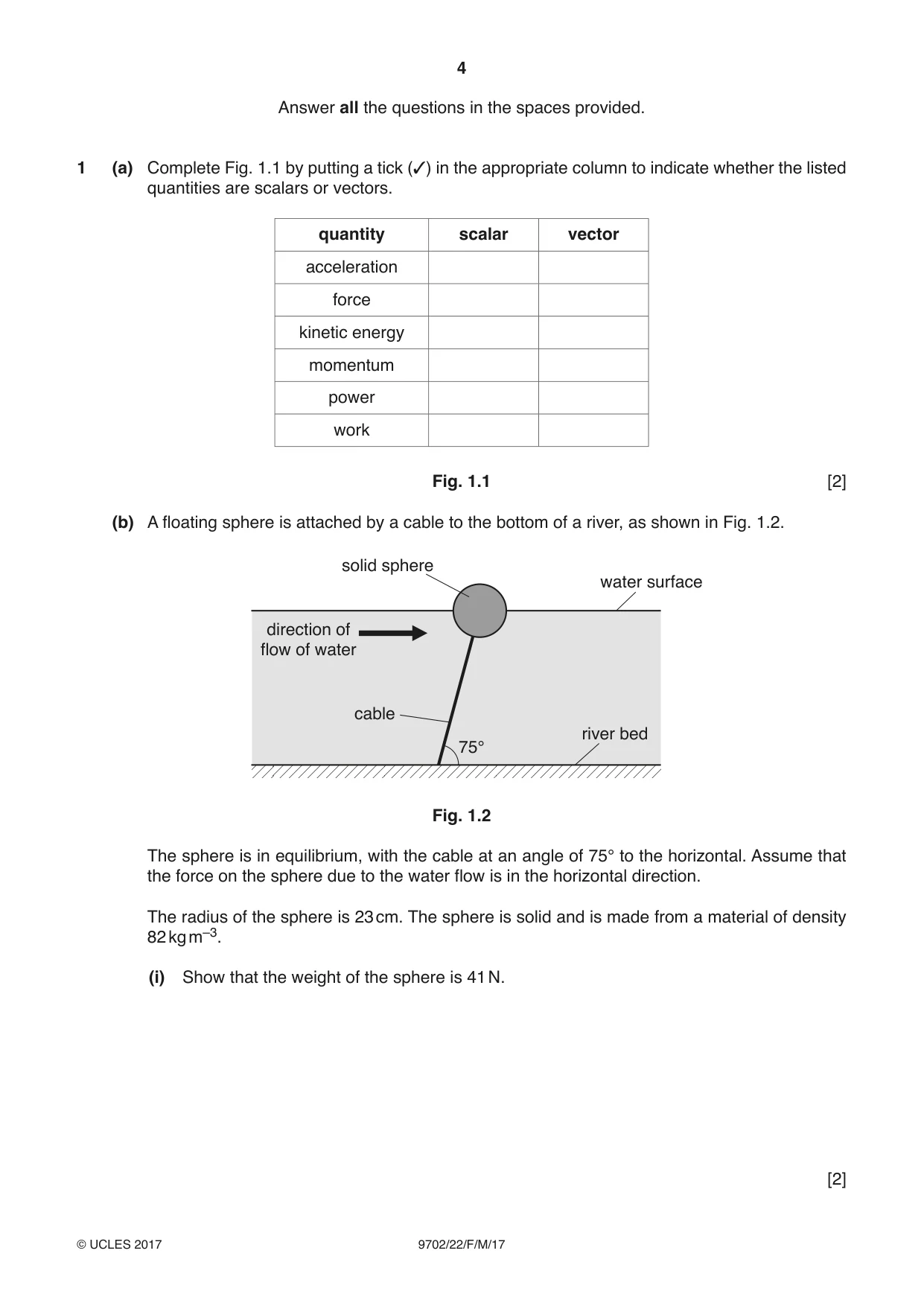
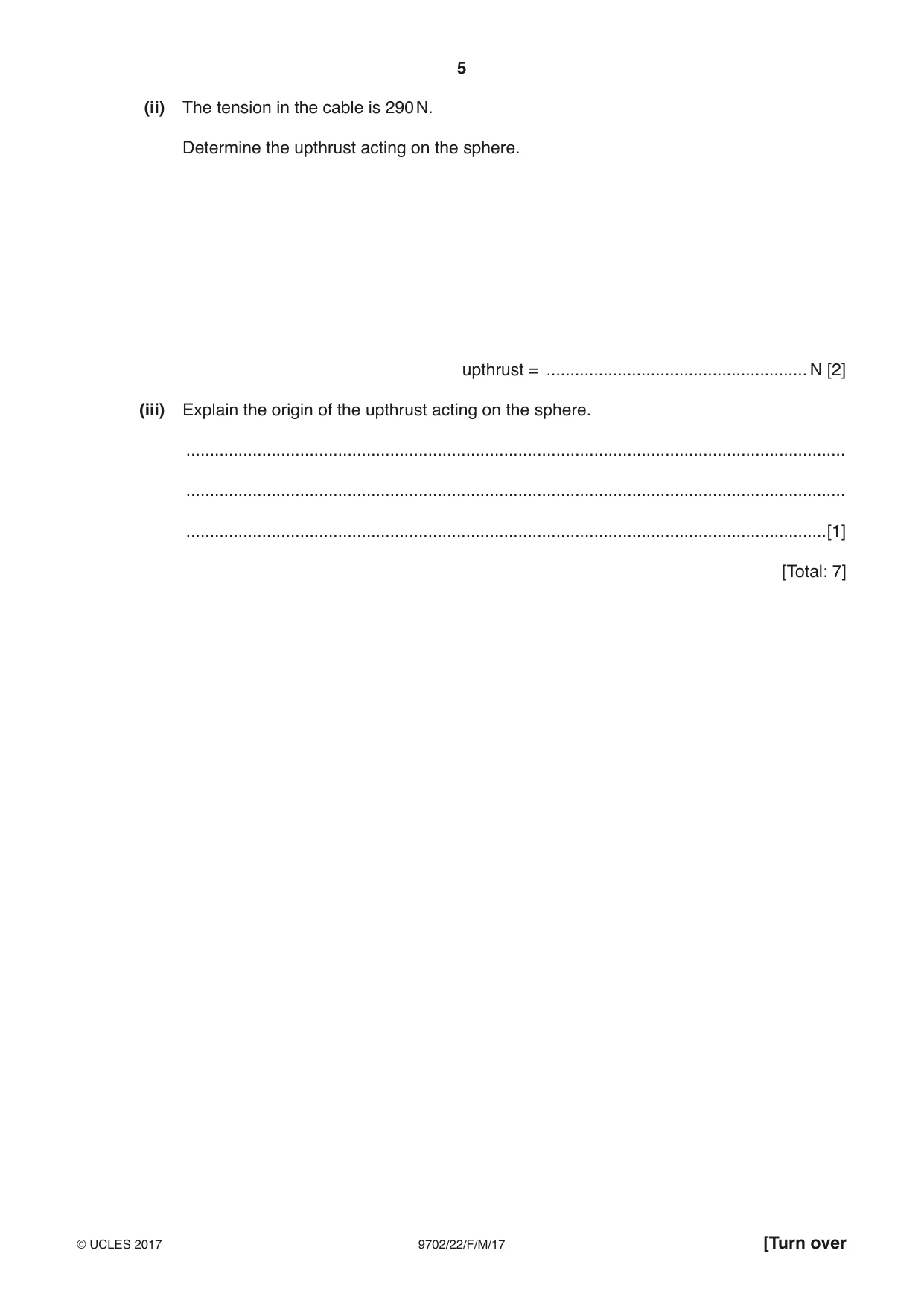
1 (a) Complete Fig. 1.1 by putting a tick (3) in the appropriate column to indicate whether the listed quantities are scalars or vectors. quantity scalar vector acceleration force kinetic energy momentum power work Fig. 1.1 [2] (b) A floating sphere is attached by a cable to the bottom of a river, as shown in Fig. 1.2. solid sphere water surface direction of flow of water cable river bed 75° Fig. 1.2 The sphere is in equilibrium, with the cable at an angle of 75° to the horizontal. Assume that the force on the sphere due to the water flow is in the horizontal direction. The radius of the sphere is 23 cm. The sphere is solid and is made from a material of density 82 kg m–3. (i) Show that the weight of the sphere is 41 N. [2] (ii) The tension in the cable is 290 N. Determine the upthrust acting on the sphere. upthrust = ....................................................... N [2] (iii) Explain the origin of the upthrust acting on the sphere. ........................................................................................................................................... ........................................................................................................................................... .......................................................................................................................................[1] [Total: 7]
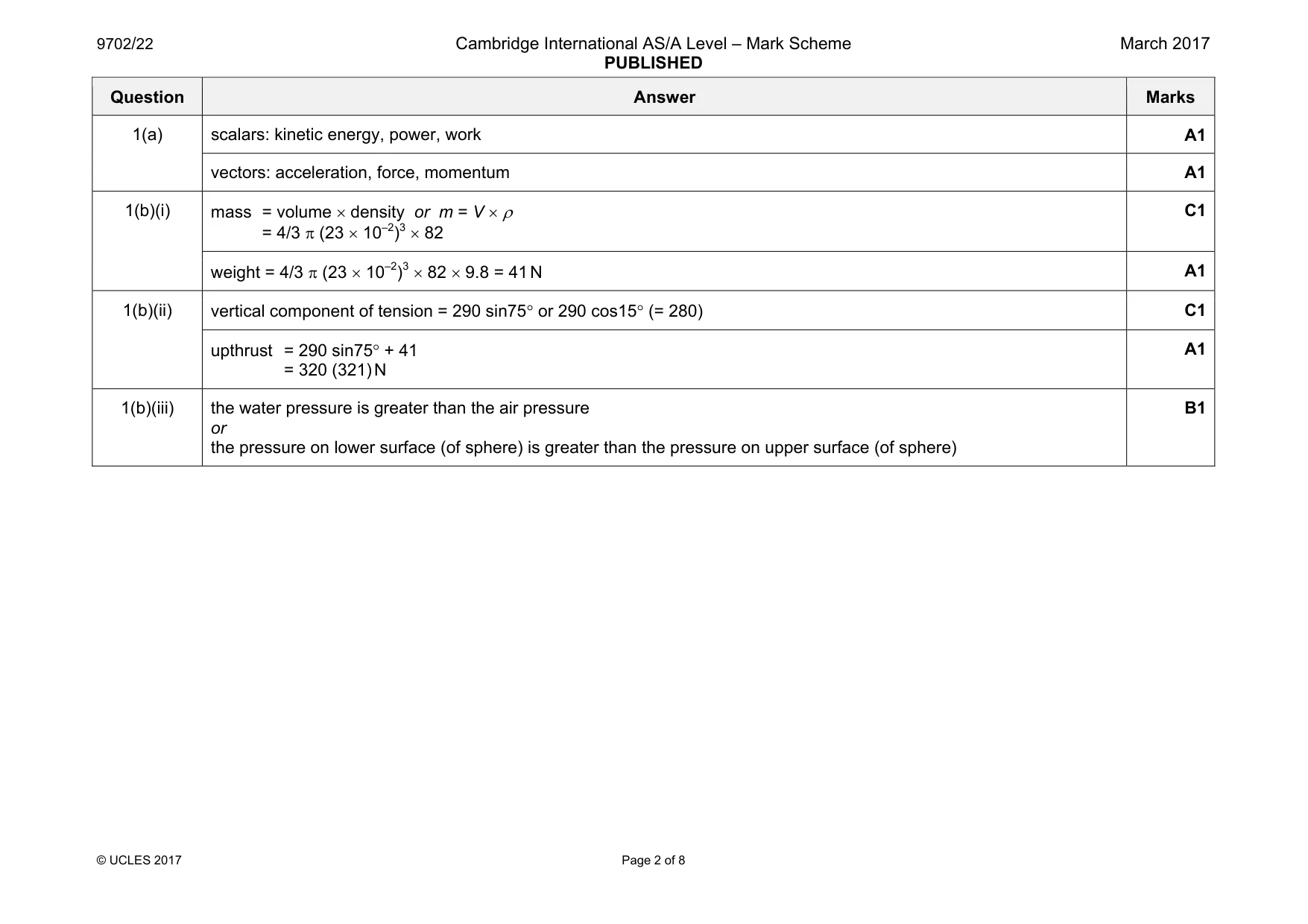
Mark scheme: 1(a) scalars: kinetic energy, power, work A1 vectors: acceleration, force, momentum A1 1(b)(i) mass = volume × density or m = V × ρ = 4/3 π (23 × 10–2)3 × 82 C1 weight = 4/3 π (23 × 10–2)3 × 82 × 9.8 = 41 N A1 1(b)(ii) vertical component of tension = 290 sin75° or 290 cos15° (= 280) C1 upthrust = 290 sin75° + 41 = 320 (321) N A1 1(b)(iii) the water pressure is greater than the air pressure or the pressure on lower surface (of sphere) is greater than the pressure on upper surface (of sphere) B1
Q2 · State the principle of conservation of momentum
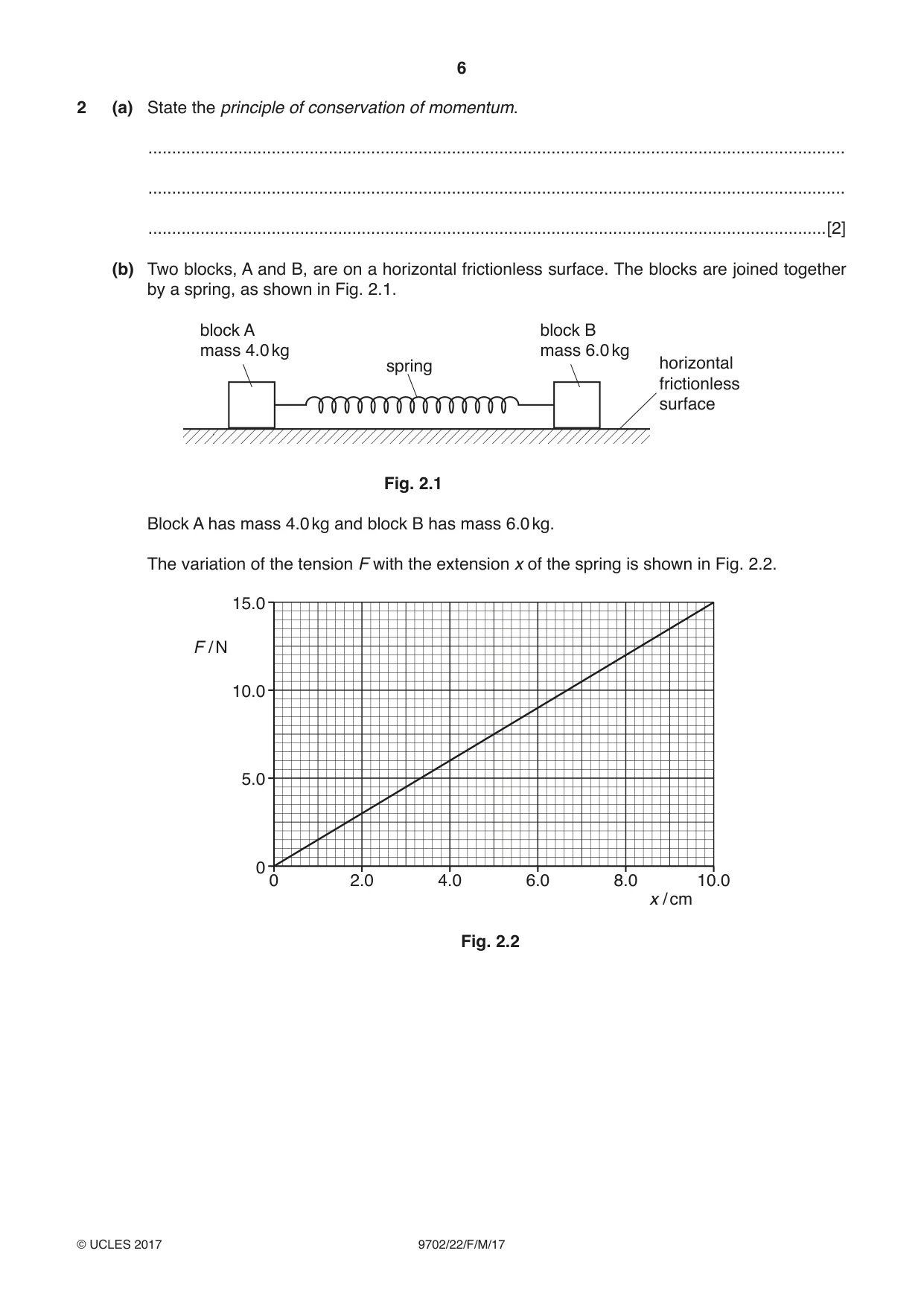
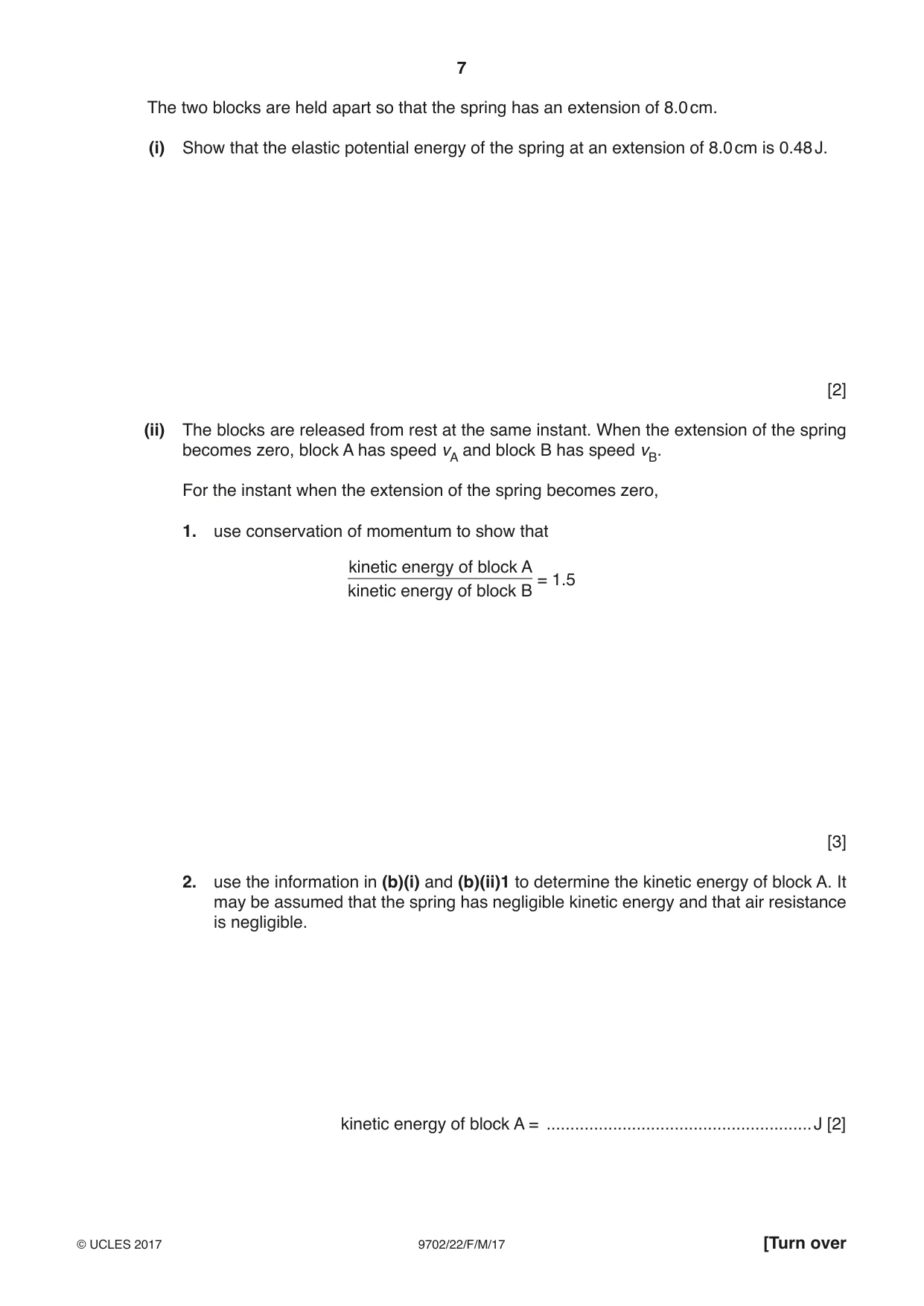
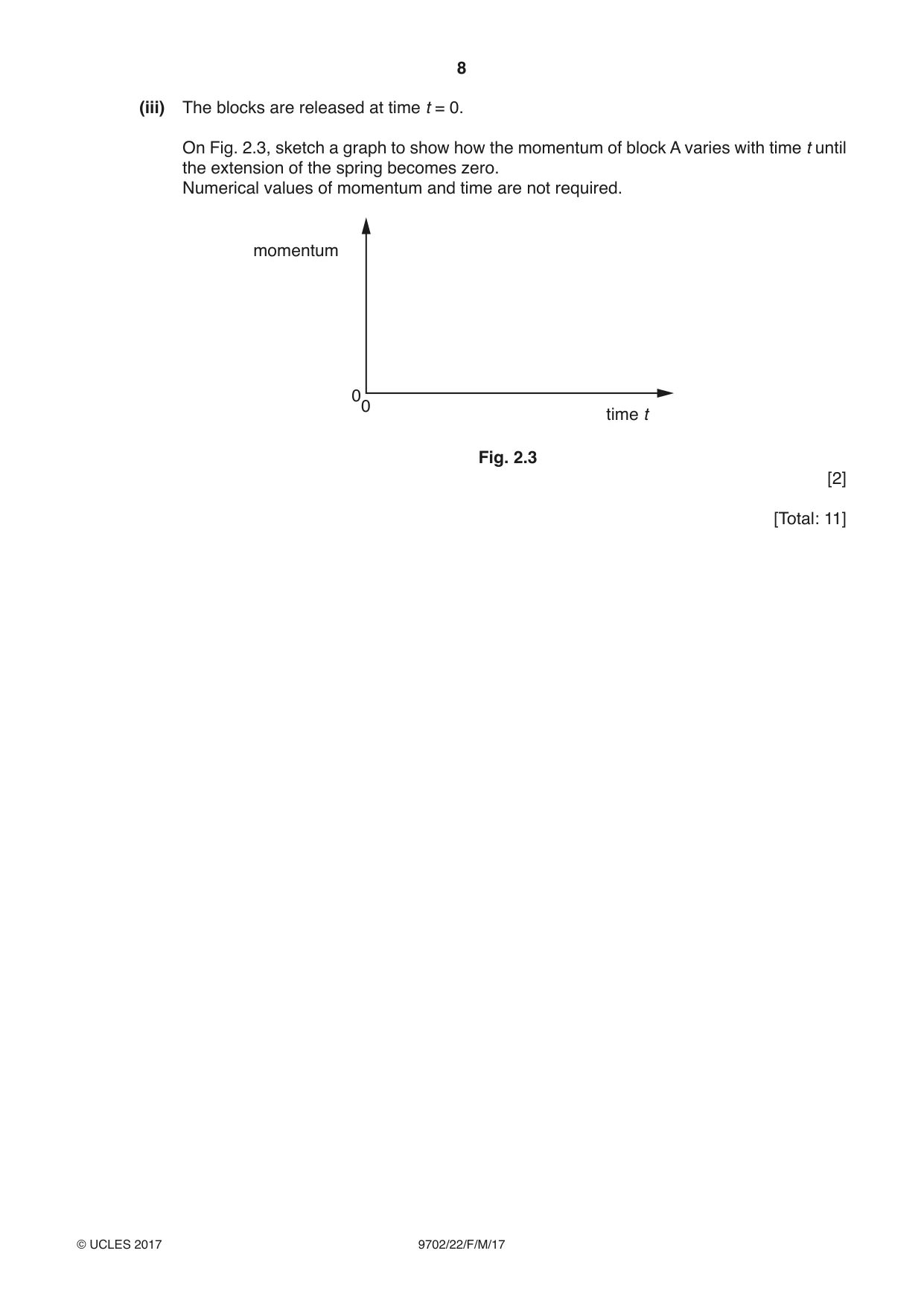
2 (a) State the principle of conservation of momentum. ................................................................................................................................................... ................................................................................................................................................... ...............................................................................................................................................[2] (b) Two blocks, A and B, are on a horizontal frictionless surface. The blocks are joined together by a spring, as shown in Fig. 2.1. block A block B mass 4.0 kg mass 6.0 kg spring horizontal frictionless surface Fig. 2.1 Block A has mass 4.0 kg and block B has mass 6.0 kg. The variation of the tension F with the extension x of the spring is shown in Fig. 2.2. 15.0 F / N 10.0 5.0 0 0 2.0 4.0 6.0 8.0 10.0 x / cm Fig. 2.2 The two blocks are held apart so that the spring has an extension of 8.0 cm. (i) Show that the elastic potential energy of the spring at an extension of 8.0 cm is 0.48 J. [2] (ii) The blocks are released from rest at the same instant. When the extension of the spring becomes zero, block A has speed vA and block B has speed vB. For the instant when the extension of the spring becomes zero, 1. use conservation of momentum to show that kinetic energy of block A = 1.5 kinetic energy of block B [3] 2. use the information in (b)(i) and (b)(ii)1 to determine the kinetic energy of block A. It may be assumed that the spring has negligible kinetic energy and that air resistance is negligible. kinetic energy of block A = ........................................................J [2] (iii) The blocks are released at time t = 0. On Fig. 2.3, sketch a graph to show how the momentum of block A varies with time t until the extension of the spring becomes zero. Numerical values of momentum and time are not required. momentum 0 0 time t Fig. 2.3 [2] [Total: 11]
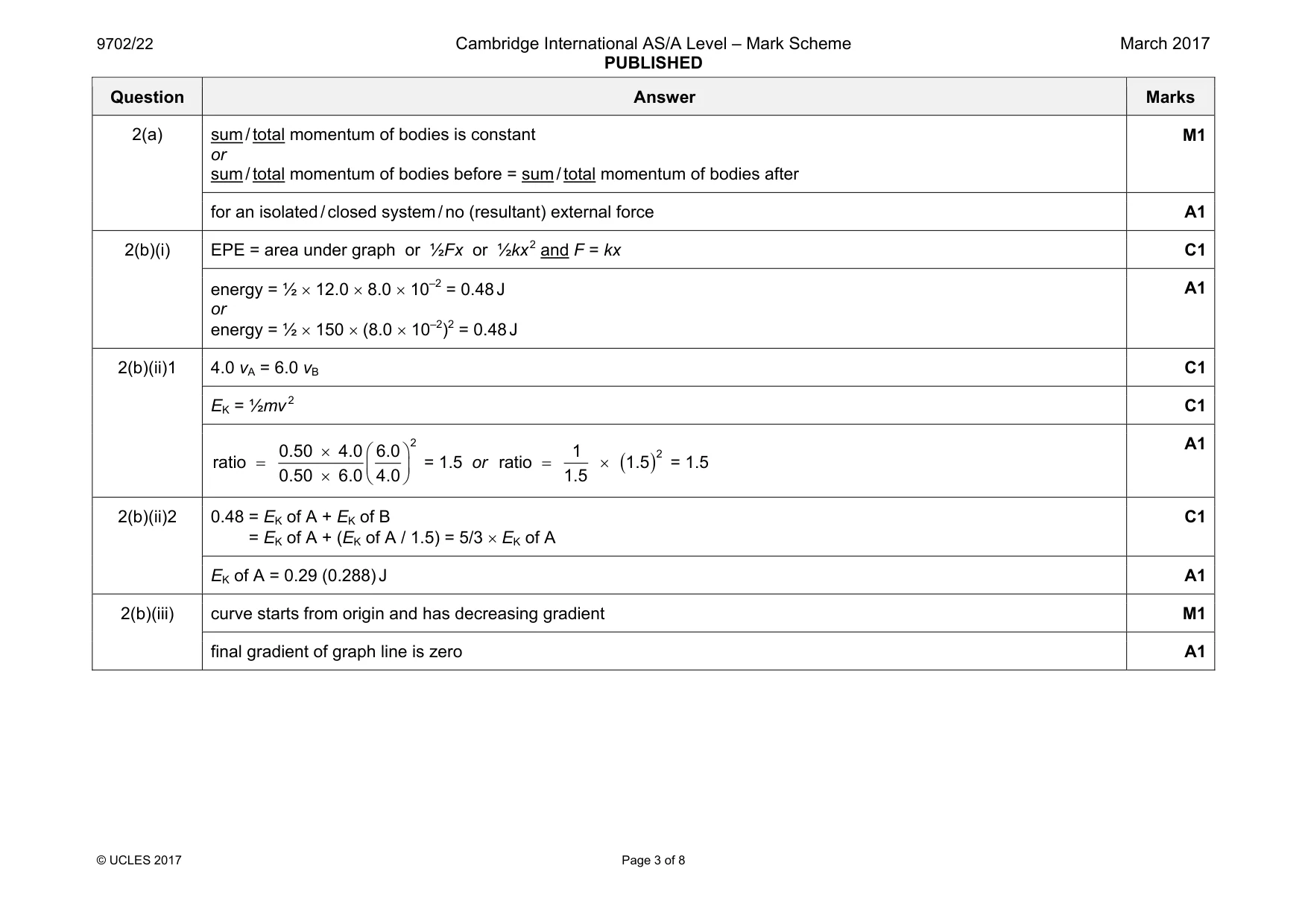
Mark scheme: 2(a) sum / total momentum of bodies is constant or sum / total momentum of bodies before = sum / total momentum of bodies after M1 for an isolated / closed system / no (resultant) external force A1 2(b)(i) EPE = area under graph or ½Fx or ½kx 2 and F = kx C1 energy = ½ × 12.0 × 8.0 × 10–2 = 0.48 J or energy = ½ × 150 × (8.0 × 10–2)2 = 0.48 J A1 2(b)(ii)1 4.0 vA = 6.0 vB C1 EK = ½mv 2 C1 × = × 2 0.50 4.0 6.0 ratio 0.50 6.0 4.0 = 1.5 or ( ) = × 2 1 ratio 1.5 1.5 = 1.5 A1 2(b)(ii)2 0.48 = EK of A + EK of B = EK of A + (EK of A / 1.5) = 5/3 × EK of A C1 EK of A = 0.29 (0.288) J A1 2(b)(iii) curve starts from origin and has decreasing gradient M1 final gradient of graph line is zero A1
Question 3
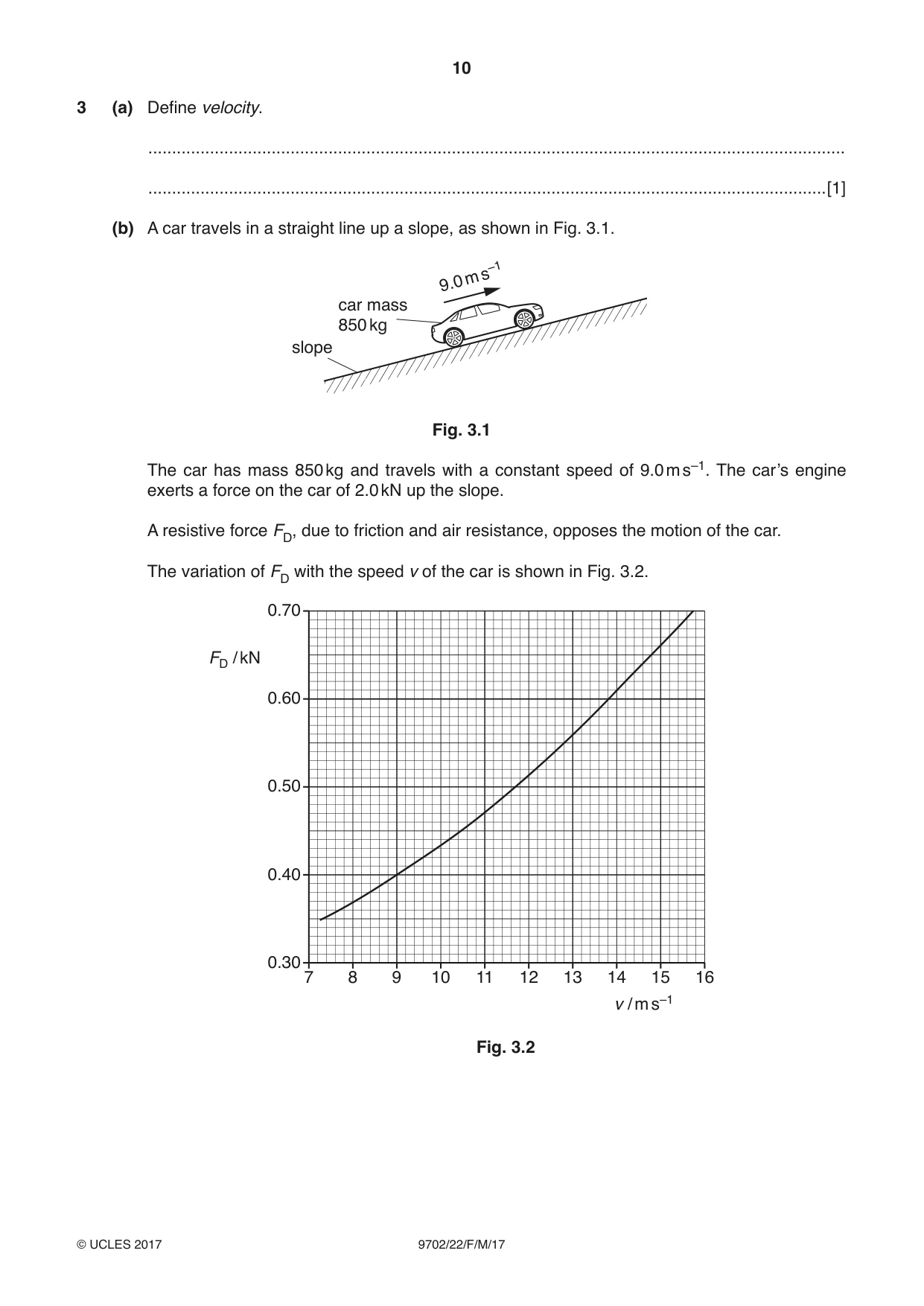
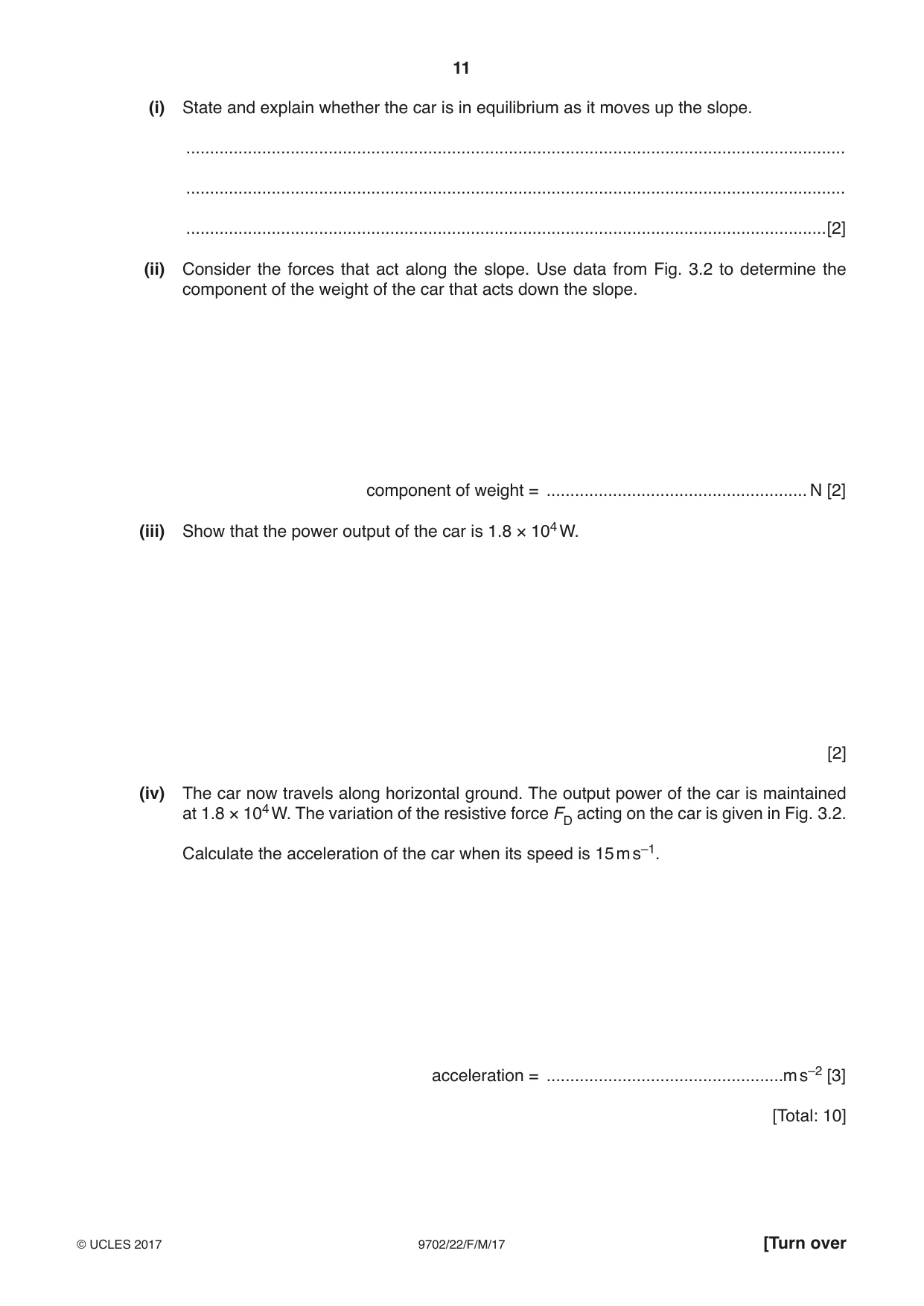
3 (a) Define velocity. ................................................................................................................................................... ...............................................................................................................................................[1] (b) A car travels in a straight line up a slope, as shown in Fig. 3.1. ms–1 9.0 car mass 850 kg slope Fig. 3.1 The car has mass 850 kg and travels with a constant speed of 9.0 m s–1. The car’s engine exerts a force on the car of 2.0 kN up the slope. A resistive force FD, due to friction and air resistance, opposes the motion of the car. The variation of FD with the speed v of the car is shown in Fig. 3.2. 0.70 FD / kN 0.60 0.50 0.40 0.30 7 8 9 10 11 12 13 14 15 16 v / m s–1 Fig. 3.2 (i) State and explain whether the car is in equilibrium as it moves up the slope. ........................................................................................................................................... ........................................................................................................................................... .......................................................................................................................................[2] (ii) Consider the forces that act along the slope. Use data from Fig. 3.2 to determine the component of the weight of the car that acts down the slope. component of weight = ....................................................... N [2] (iii) Show that the power output of the car is 1.8 × 10⁴ W. [2] (iv) The car now travels along horizontal ground. The output power of the car is maintained at 1.8 × 10⁴ W. The variation of the resistive force FD acting on the car is given in Fig. 3.2. Calculate the acceleration of the car when its speed is 15 m s–1. acceleration = ..................................................m s–2 [3] [Total: 10]
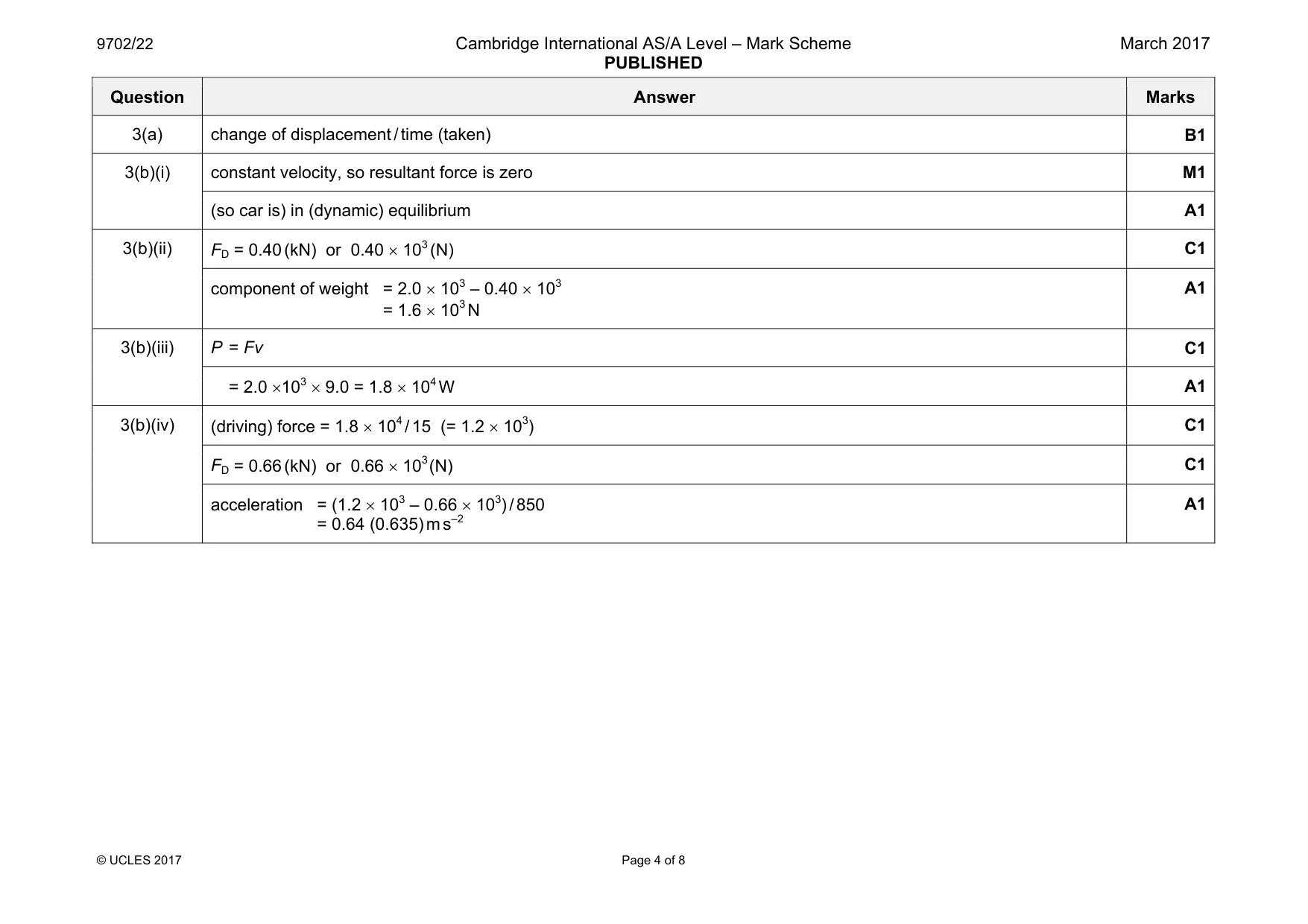
Mark scheme: 3(a) change of displacement / time (taken) B1 3(b)(i) constant velocity, so resultant force is zero M1 (so car is) in (dynamic) equilibrium A1 3(b)(ii) FD = 0.40 (kN) or 0.40 × 10³ (N) C1 component of weight = 2.0 × 10³ – 0.40 × 103 = 1.6 × 10³ N A1 3(b)(iii) P = Fv C1 = 2.0 ×103 × 9.0 = 1.8 × 10⁴ W A1 3(b)(iv) (driving) force = 1.8 × 10⁴ / 15 (= 1.2 × 10³) C1 FD = 0.66 (kN) or 0.66 × 10³ (N) C1 acceleration = (1.2 × 10³ – 0.66 × 10³) / 850 = 0.64 (0.635) m s–2 A1
Q4 · State what is meant by the Doppler effect
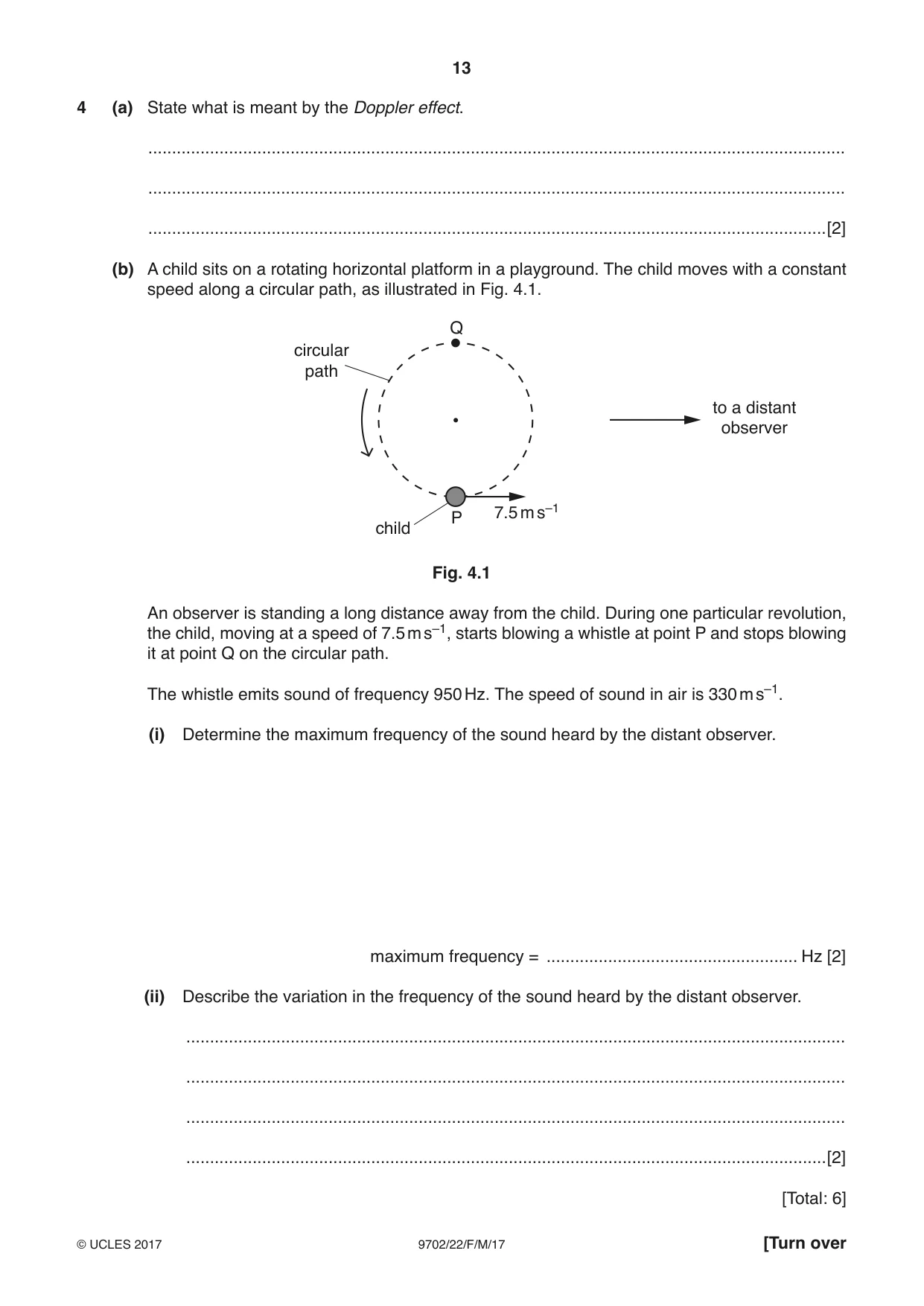
4 (a) State what is meant by the Doppler effect. ................................................................................................................................................... ................................................................................................................................................... ...............................................................................................................................................[2] (b) A child sits on a rotating horizontal platform in a playground. The child moves with a constant speed along a circular path, as illustrated in Fig. 4.1. Q circular path to a distant observer 7.5 m s–1 P child Fig. 4.1 An observer is standing a long distance away from the child. During one particular revolution, the child, moving at a speed of 7.5 m s–1, starts blowing a whistle at point P and stops blowing it at point Q on the circular path. The whistle emits sound of frequency 950 Hz. The speed of sound in air is 330 m s–1. (i) Determine the maximum frequency of the sound heard by the distant observer. maximum frequency = ..................................................... Hz [2] (ii) Describe the variation in the frequency of the sound heard by the distant observer. ........................................................................................................................................... ........................................................................................................................................... ........................................................................................................................................... .......................................................................................................................................[2] [Total: 6]
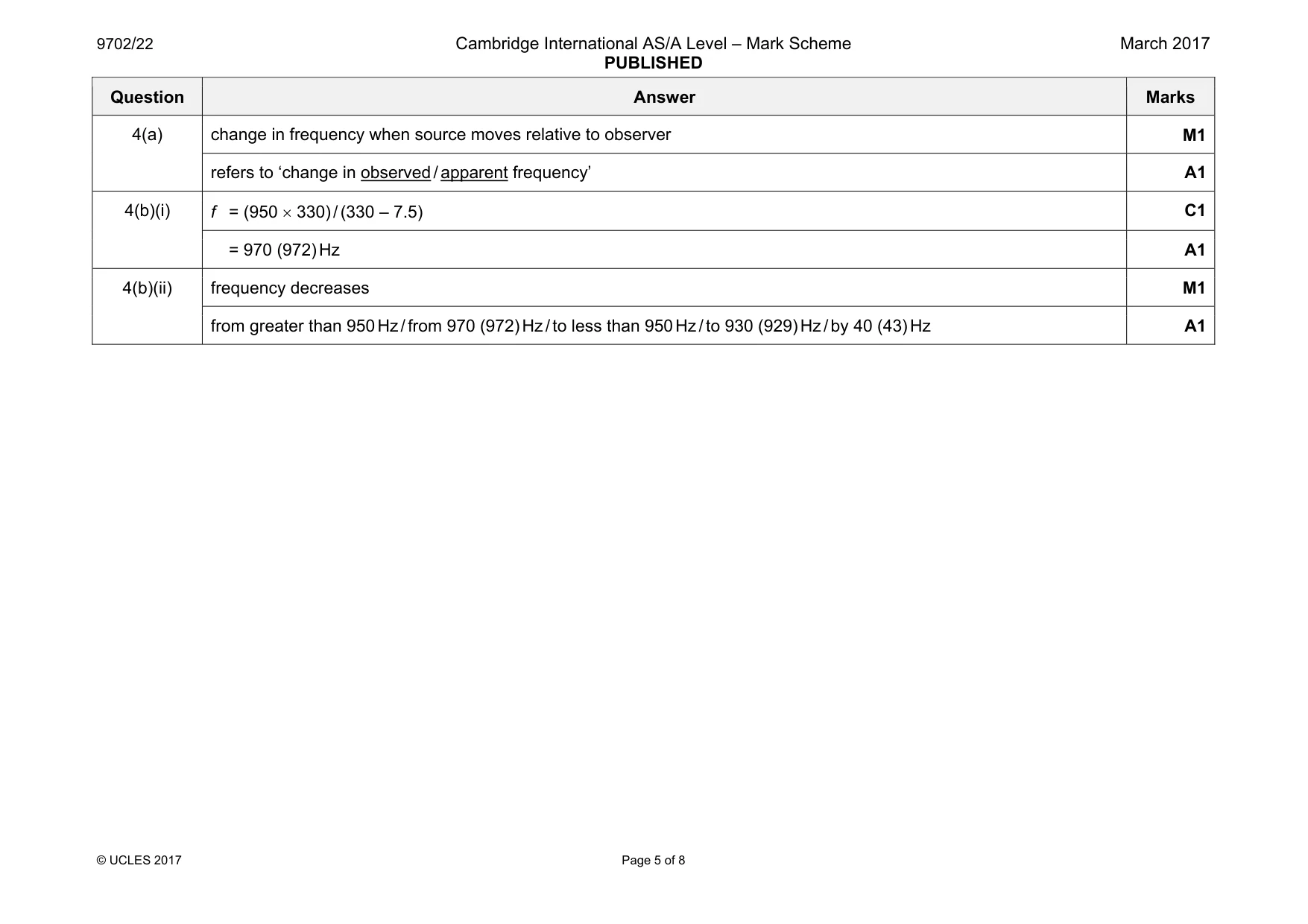
Mark scheme: 4(a) change in frequency when source moves relative to observer M1 refers to ‘change in observed / apparent frequency’ A1 4(b)(i) f = (950 × 330) / (330 – 7.5) C1 = 970 (972) Hz A1 4(b)(ii) frequency decreases M1 from greater than 950 Hz / from 970 (972) Hz / to less than 950 Hz / to 930 (929) Hz / by 40 (43) Hz A1
Q5 · An electron is travelling in a straight line through a vacuum with a constant speed of…
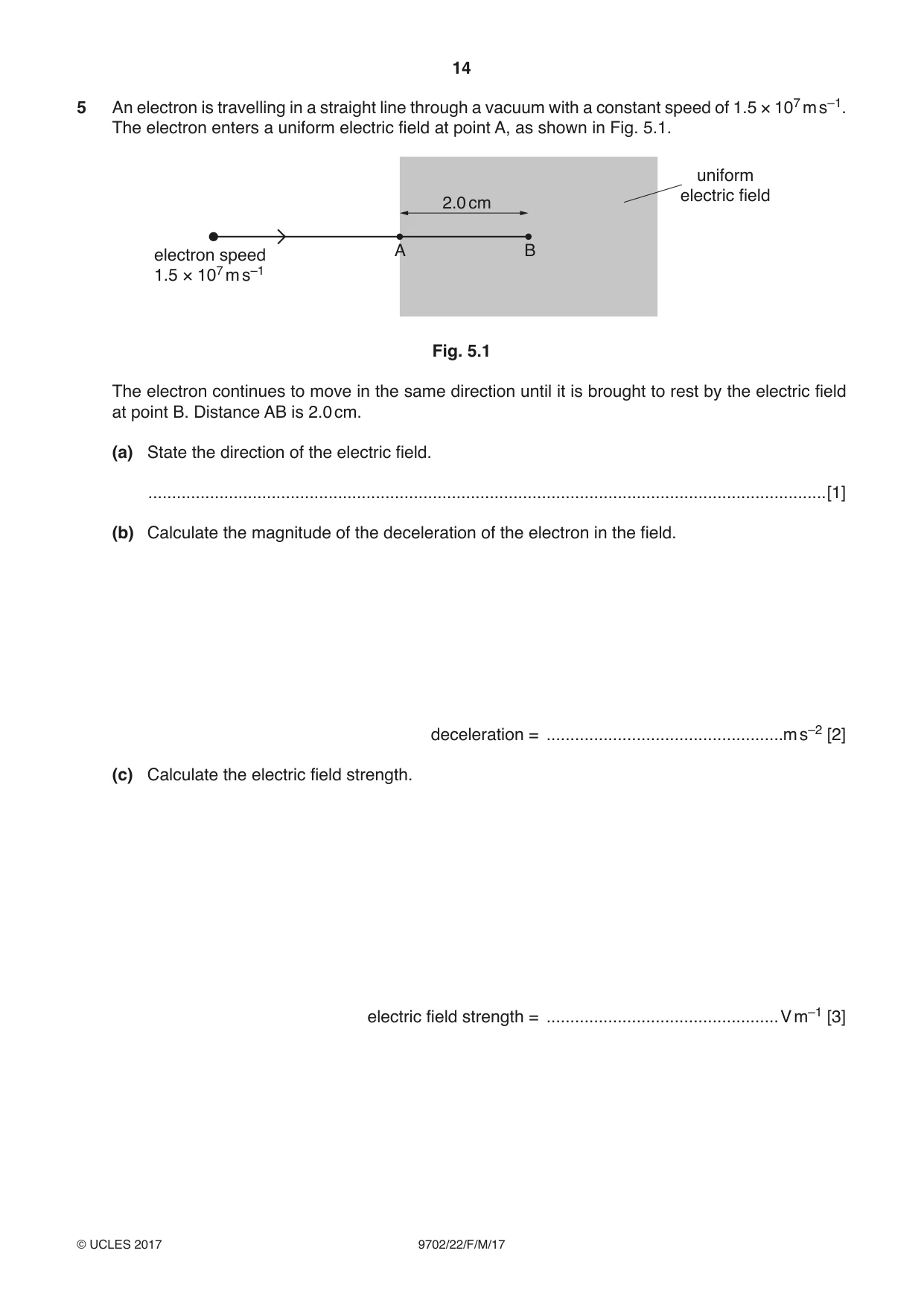
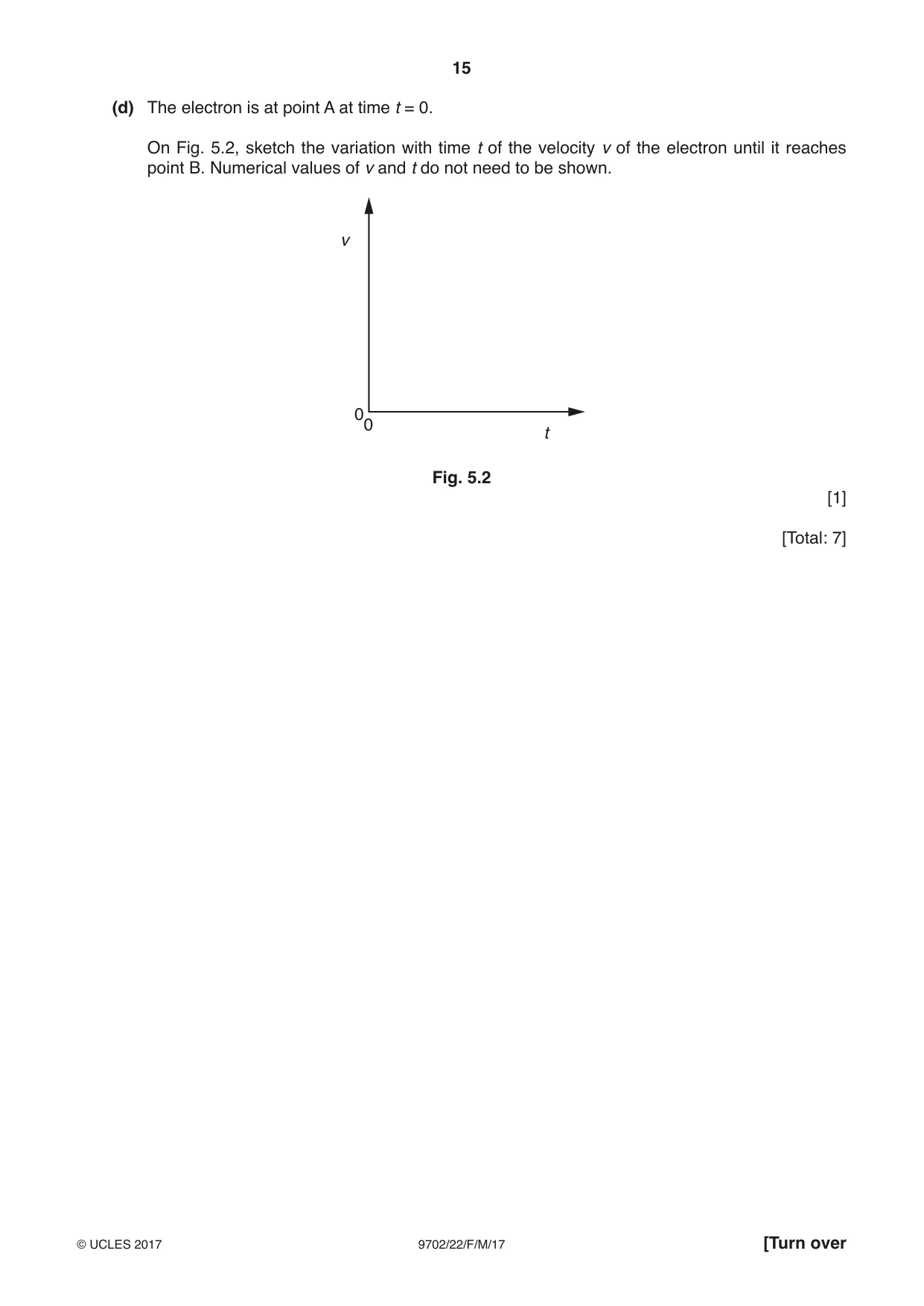
5 An electron is travelling in a straight line through a vacuum with a constant speed of 1.5 × 10⁷ m s–1. The electron enters a uniform electric field at point A, as shown in Fig. 5.1. uniform electric field 2.0 cm electron speed A B 1.5 × 10⁷ m s–1 Fig. 5.1 The electron continues to move in the same direction until it is brought to rest by the electric field at point B. Distance AB is 2.0 cm. (a) State the direction of the electric field. ...............................................................................................................................................[1] (b) Calculate the magnitude of the deceleration of the electron in the field. deceleration = ..................................................m s–2 [2] (c) Calculate the electric field strength. electric field strength = .................................................V m–1 [3] (d) The electron is at point A at time t = 0. On Fig. 5.2, sketch the variation with time t of the velocity v of the electron until it reaches point B. Numerical values of v and t do not need to be shown. v 0 0 t Fig. 5.2 [1] [Total: 7]
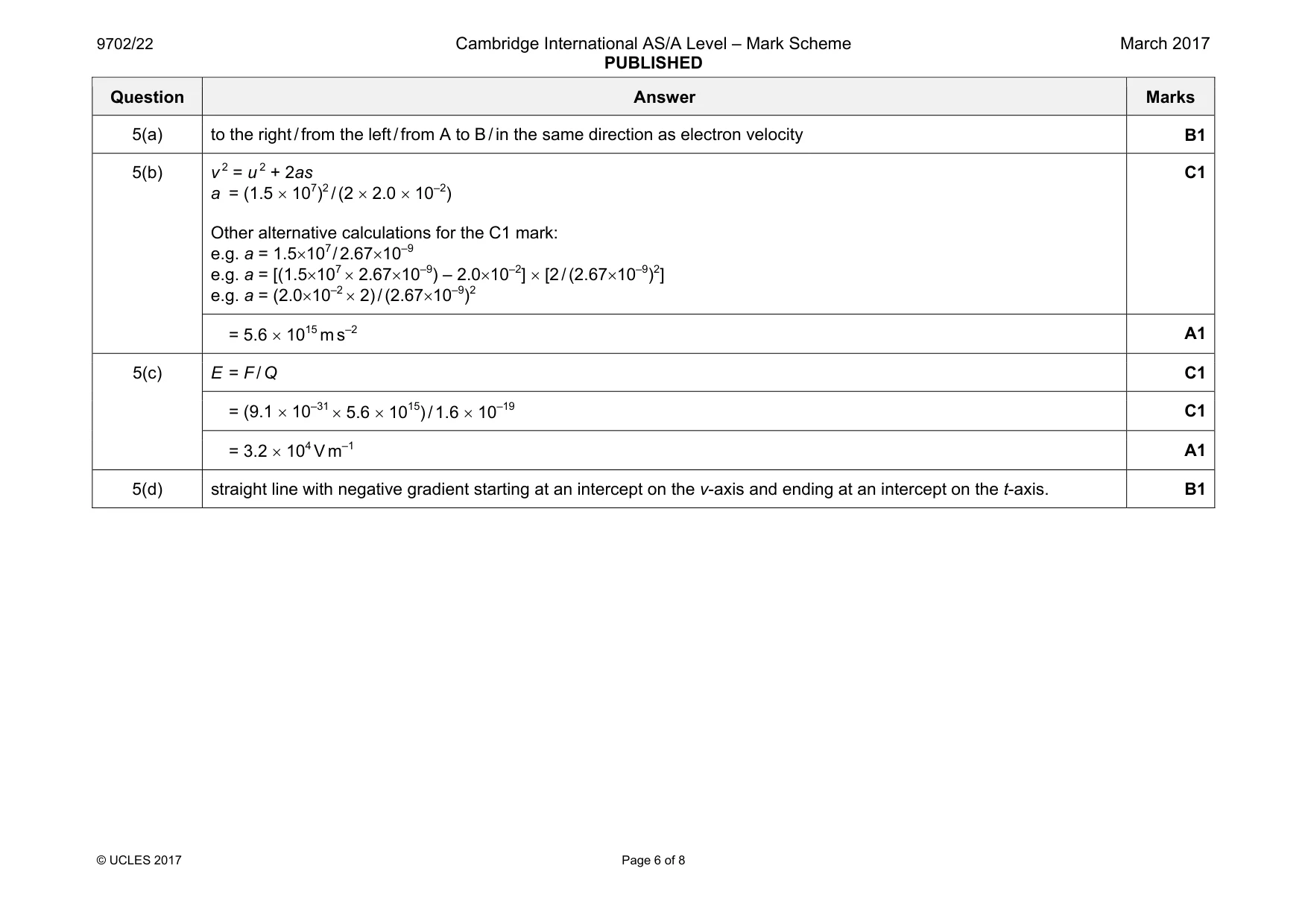
Mark scheme: 5(a) to the right / from the left / from A to B / in the same direction as electron velocity B1 5(b) v 2 = u 2 + 2as a = (1.5 × 10⁷)2 / (2 × 2.0 × 10–2) Other alternative calculations for the C1 mark: e.g. a = 1.5×10⁷ / 2.67×10⁻⁹ e.g. a = [(1.5×107 × 2.67×10–9) – 2.0×10–2] × [2 / (2.67×10⁻⁹)2] e.g. a = (2.0×10–2 × 2) / (2.67×10⁻⁹)2 C1 = 5.6 × 10¹⁵ m s–2 A1 5(c) E = F / Q C1 = (9.1 × 10–31 × 5.6 × 1015) / 1.6 × 10⁻¹⁹ C1 = 3.2 × 10⁴ V m–1 A1 5(d) straight line with negative gradient starting at an intercept on the v-axis and ending at an intercept on the t-axis. B1
Q6 · Three resistors of resistances R1, R2 and R3 are connected as shown in Fig
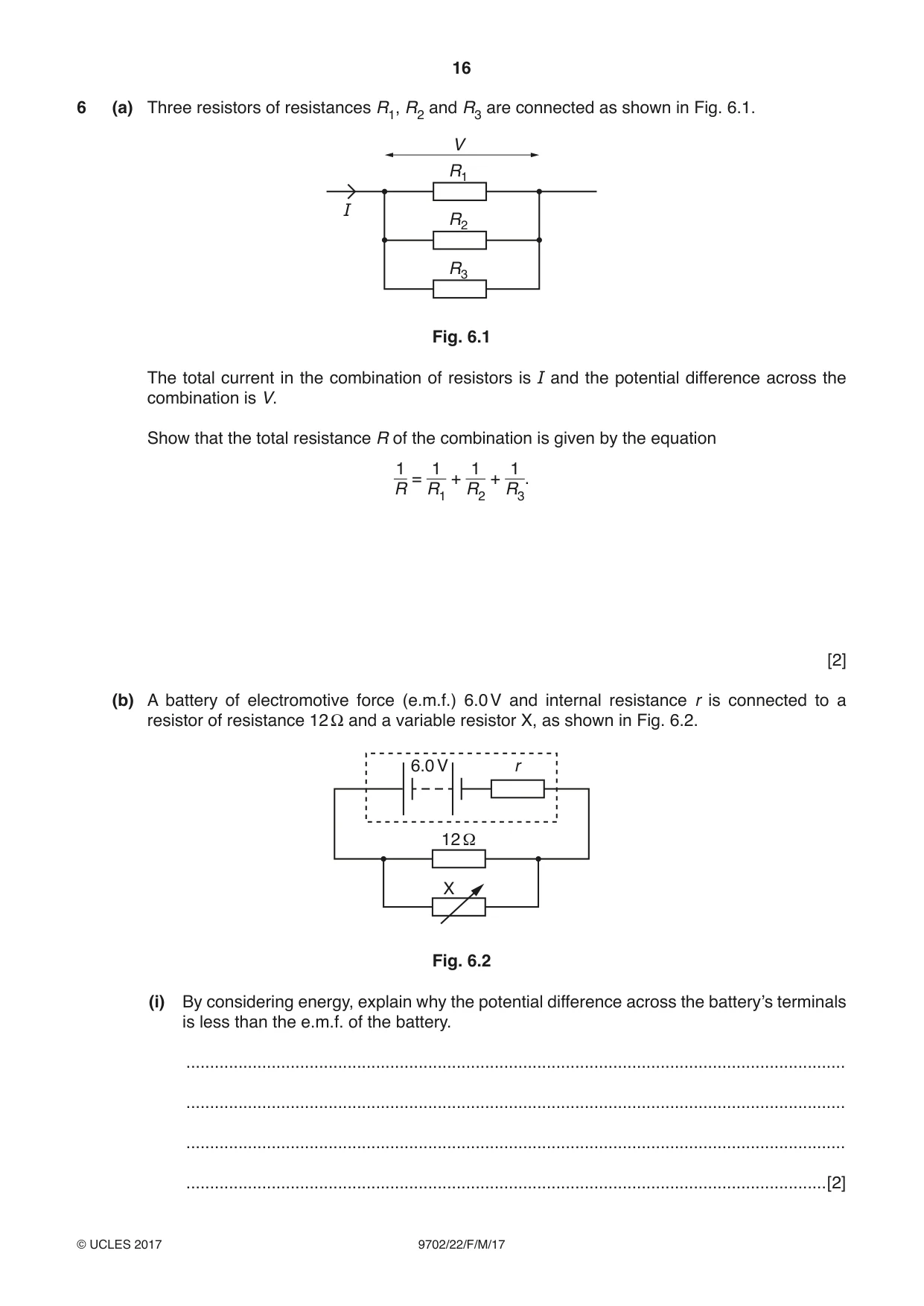
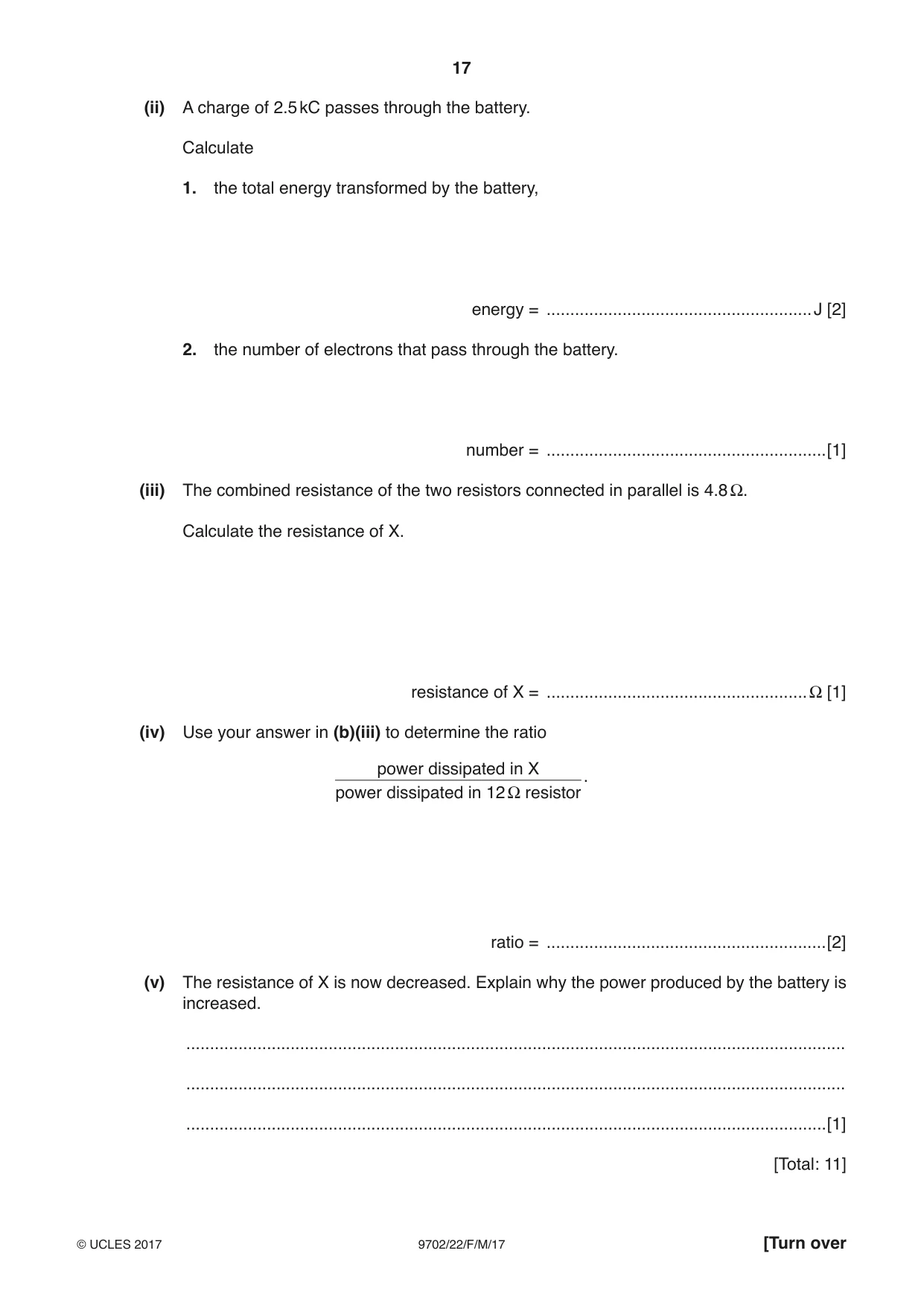
6 (a) Three resistors of resistances R1, R2 and R3 are connected as shown in Fig. 6.1. V R1 I R2 R3 Fig. 6.1 The total current in the combination of resistors is I and the potential difference across the combination is V. Show that the total resistance R of the combination is given by the equation 1 1 1 1 = + + . R R1 R2 R3 [2] (b) A battery of electromotive force (e.m.f.) 6.0 V and internal resistance r is connected to a resistor of resistance 12 Ω and a variable resistor X, as shown in Fig. 6.2. 6.0 V r 12 Ω X Fig. 6.2 (i) By considering energy, explain why the potential difference across the battery’s terminals is less than the e.m.f. of the battery. ........................................................................................................................................... ........................................................................................................................................... ........................................................................................................................................... .......................................................................................................................................[2] (ii) A charge of 2.5 kC passes through the battery. Calculate 1. the total energy transformed by the battery, energy = ........................................................J [2] 2. the number of electrons that pass through the battery. number = ...........................................................[1] (iii) The combined resistance of the two resistors connected in parallel is 4.8 Ω. Calculate the resistance of X. resistance of X = .......................................................Ω [1] (iv) Use your answer in (b)(iii) to determine the ratio power dissipated in X . power dissipated in 12 Ω resistor ratio = ...........................................................[2] (v) The resistance of X is now decreased. Explain why the power produced by the battery is increased. ........................................................................................................................................... ........................................................................................................................................... .......................................................................................................................................[1] [Total: 11]
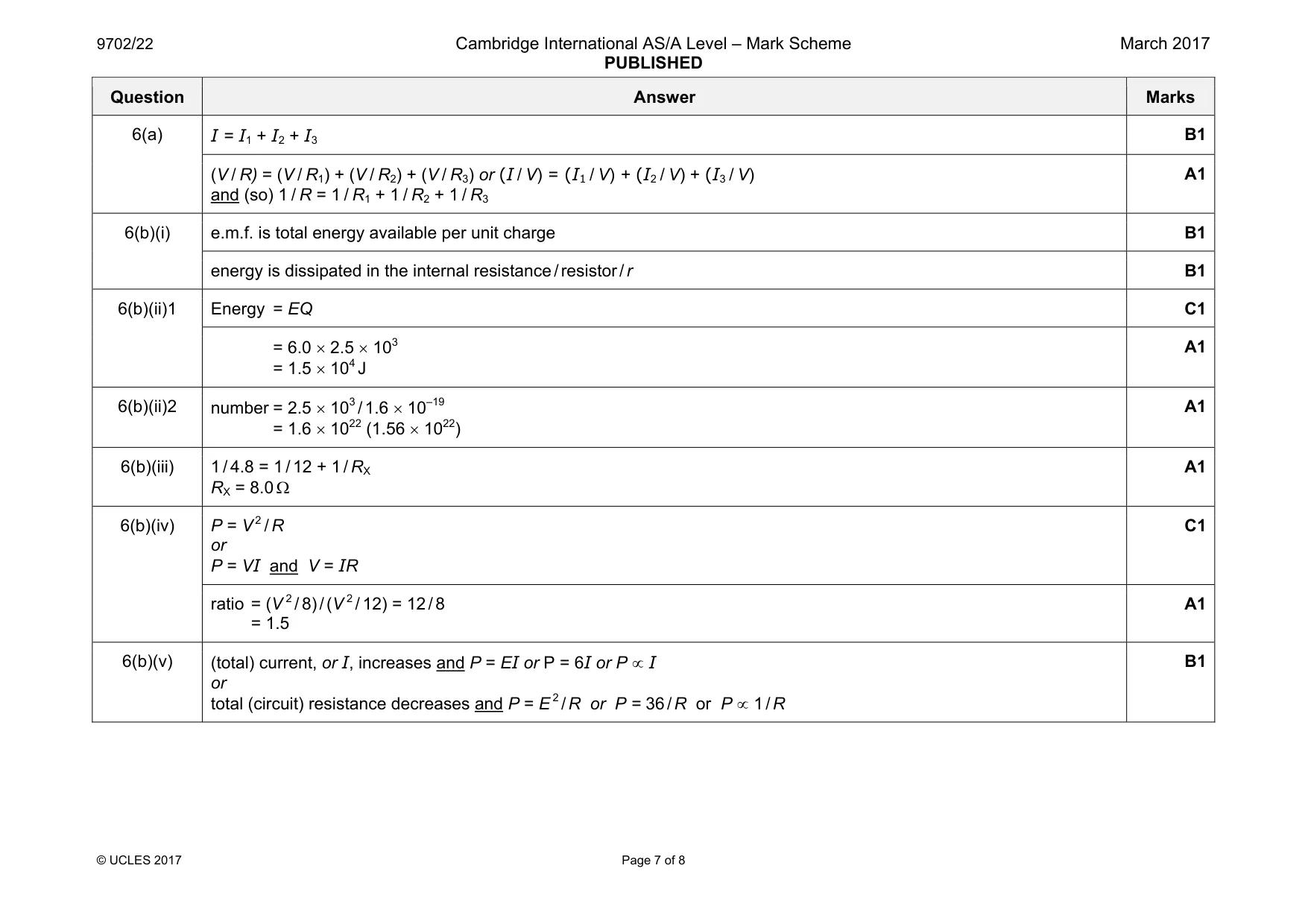
Mark scheme: 6(a) B1 (V / R) = (V / R1) + (V / R2) + (V / R3) or (I / V) = (I1 / V) + (I2 / V) + (I3 / V) and (so) 1 / R = 1 / R1 + 1 / R2 + 1 / R3 A1 6(b)(i) e.m.f. is total energy available per unit charge B1 energy is dissipated in the internal resistance / resistor / r B1 6(b)(ii)1 Energy = EQ C1 = 6.0 × 2.5 × 103 = 1.5 × 10⁴ J A1 6(b)(ii)2 number = 2.5 × 10³ / 1.6 × 10–19 = 1.6 × 10²² (1.56 × 10²²) A1 6(b)(iii) 1 / 4.8 = 1 / 12 + 1 / RX RX = 8.0 Ω A1 6(b)(iv) P = V 2 / R or P = VI and V = IR C1 ratio = (V 2 / 8) / (V 2 / 12) = 12 / 8 = 1.5 A1 6(b)(v) (total) current, or I, increases and P = EI or P = 6I or P ∝ I or total (circuit) resistance decreases and P = E 2 / R or P = 36 / R or P ∝ 1 / R B1
Q7 · A nucleus of bismuth-212 (21823Bi) decays by the emission of an α-particle and γ-radiation
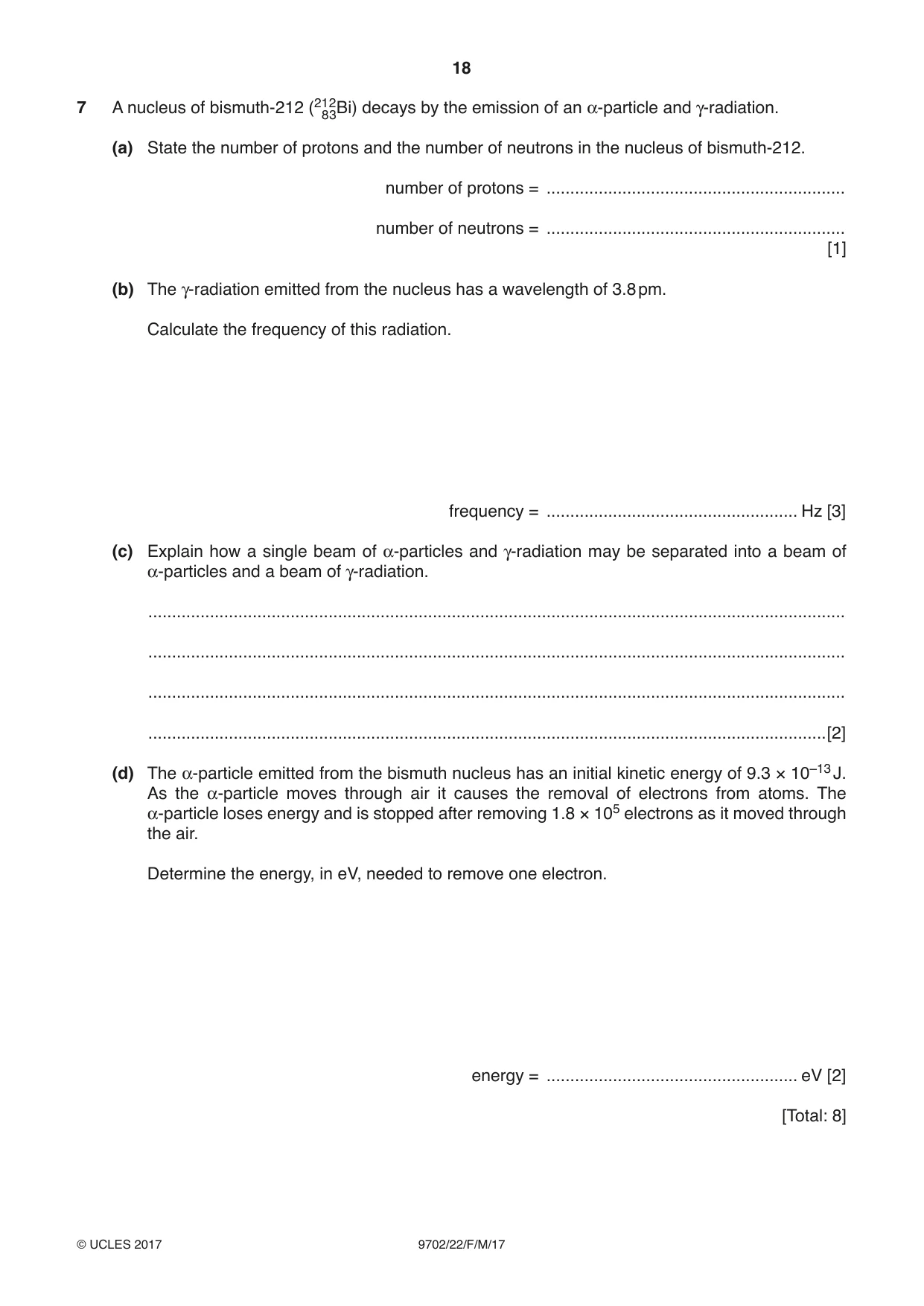
7 A nucleus of bismuth-212 (21823Bi) decays by the emission of an α-particle and γ-radiation. (a) State the number of protons and the number of neutrons in the nucleus of bismuth-212. number of protons = ............................................................... number of neutrons = ............................................................... [1] (b) The γ-radiation emitted from the nucleus has a wavelength of 3.8 pm. Calculate the frequency of this radiation. frequency = ..................................................... Hz [3] (c) Explain how a single beam of α-particles and γ-radiation may be separated into a beam of α-particles and a beam of γ-radiation. ................................................................................................................................................... ................................................................................................................................................... ................................................................................................................................................... ...............................................................................................................................................[2] (d) The α-particle emitted from the bismuth nucleus has an initial kinetic energy of 9.3 × 10⁻¹³ J. As the α-particle moves through air it causes the removal of electrons from atoms. The α-particle loses energy and is stopped after removing 1.8 × 10⁵ electrons as it moved through the air. Determine the energy, in eV, needed to remove one electron. energy = ..................................................... eV [2] [Total: 8]
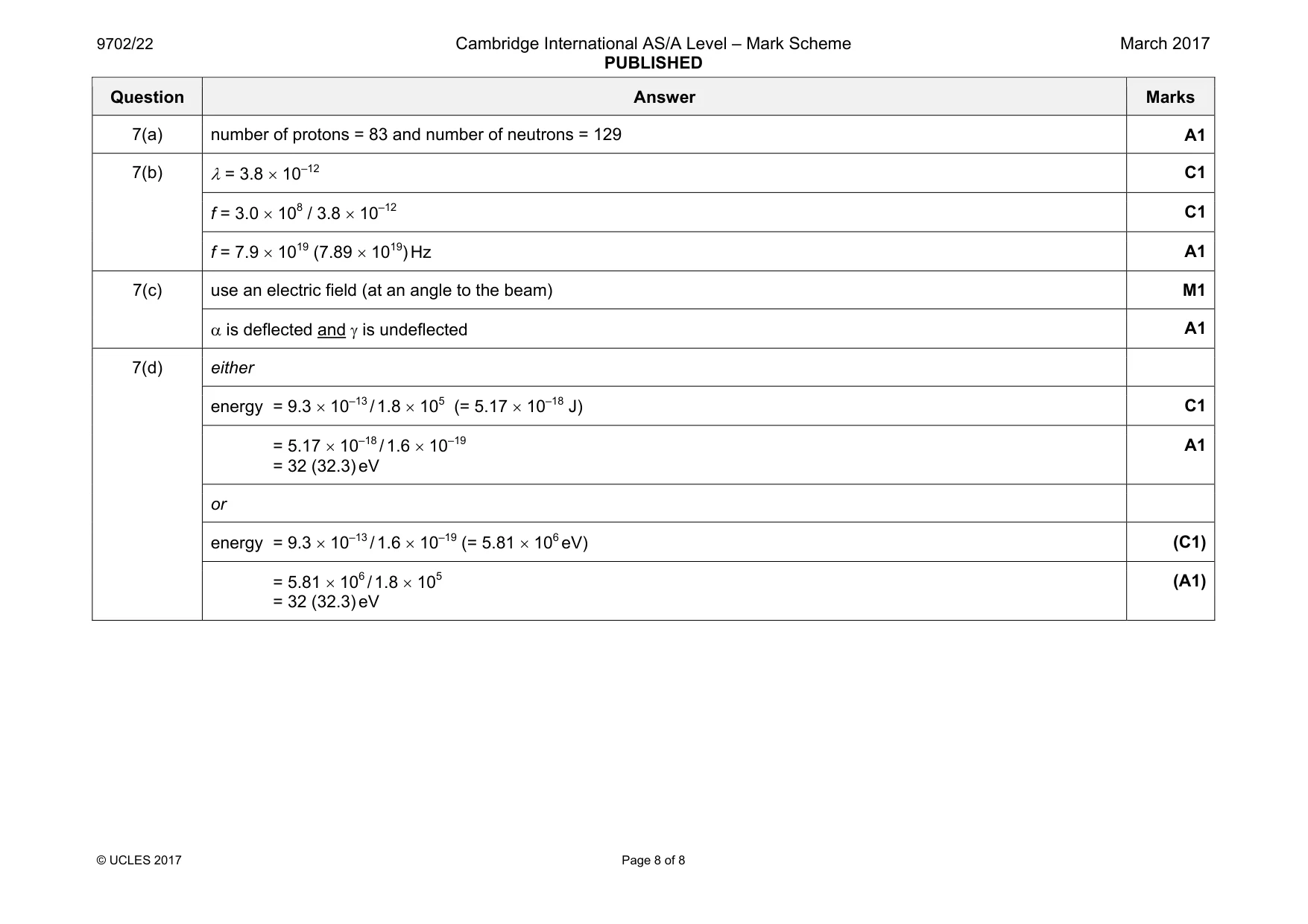
Mark scheme: 7(a) number of protons = 83 and number of neutrons = 129 A1 7(b) λ = 3.8 × 10⁻¹² C1 f = 3.0 × 10⁸ / 3.8 × 10⁻¹² C1 f = 7.9 × 10¹⁹ (7.89 × 10¹⁹) Hz A1 7(c) use an electric field (at an angle to the beam) M1 α is deflected and γ is undeflected A1 7(d) either energy = 9.3 × 10⁻¹³ / 1.8 × 10⁵ (= 5.17 × 10⁻¹⁸ J) C1 = 5.17 × 10⁻¹⁸ / 1.6 × 10–19 = 32 (32.3) eV A1 or energy = 9.3 × 10⁻¹³ / 1.6 × 10⁻¹⁹ (= 5.81 × 10⁶ eV) (C1) = 5.81 × 10⁶ / 1.8 × 105 = 32 (32.3) eV (A1)
What was in this paper
The subtopics covered by these 7 questions, and how many questions each got. Open one in a new tab to see every Cambridge question on it.
What you needed in this session
Cambridge’s own grade thresholds for 2017 Feb/March, Paper 2 · Variant 2. A higher threshold means an easier paper — the bar moves with how the cohort did.