Cambridge A Level Physics 9702 — 2016 Feb/March Paper 2 · Variant 2
9702/22/F/M/16 · 6 questions · 60 marks · ≈68 min
The question paper and its mark scheme, free to read here and free to download. This is Cambridge’s own paper, exactly as it was sat.
Question paper16 pages
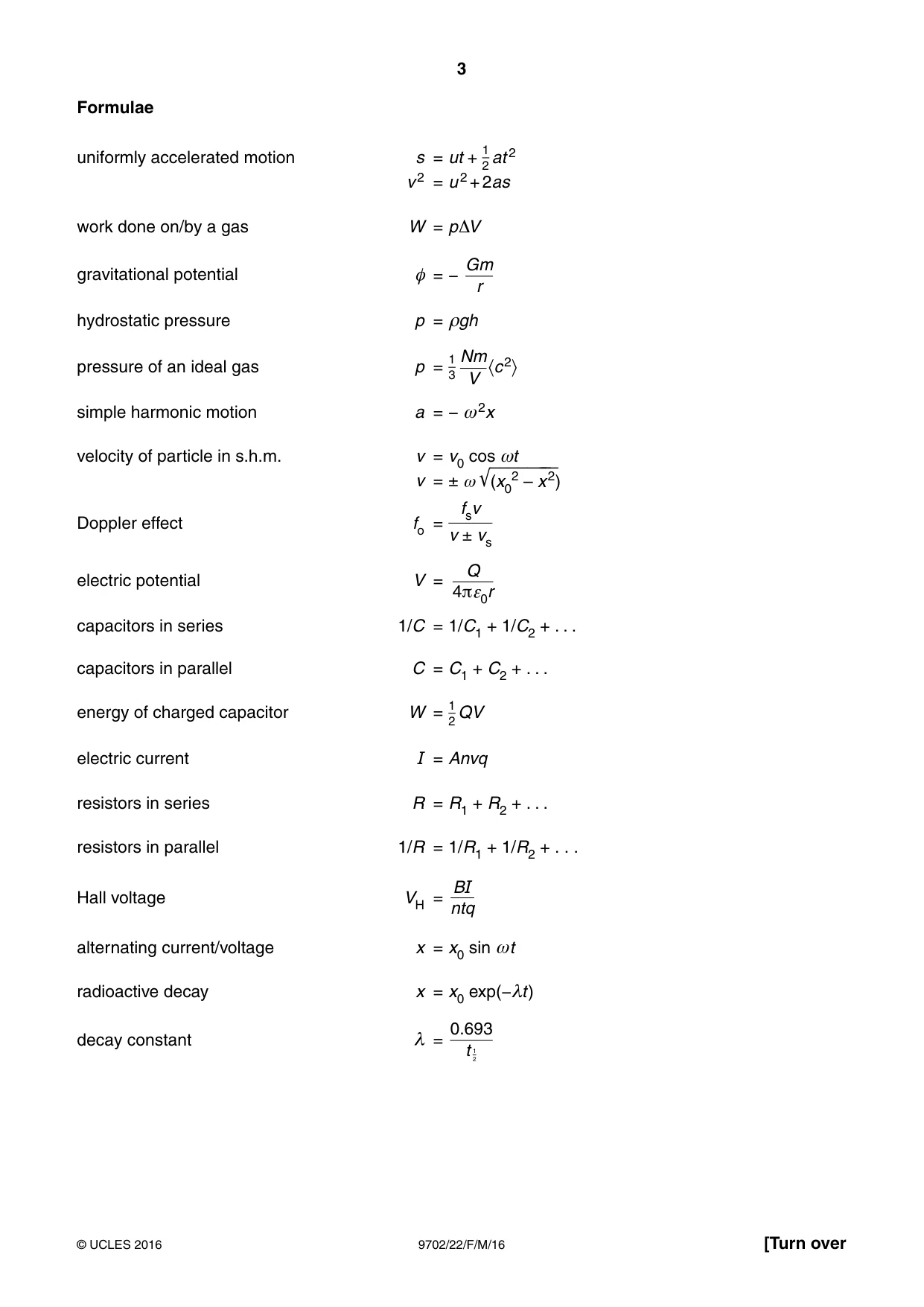


Mark scheme4 pages
Answers below. Sit the paper first if you are practising.
Questions as text
Q1 · The speed v of a transverse wave on a uniform string is given by the expression T l v = m…
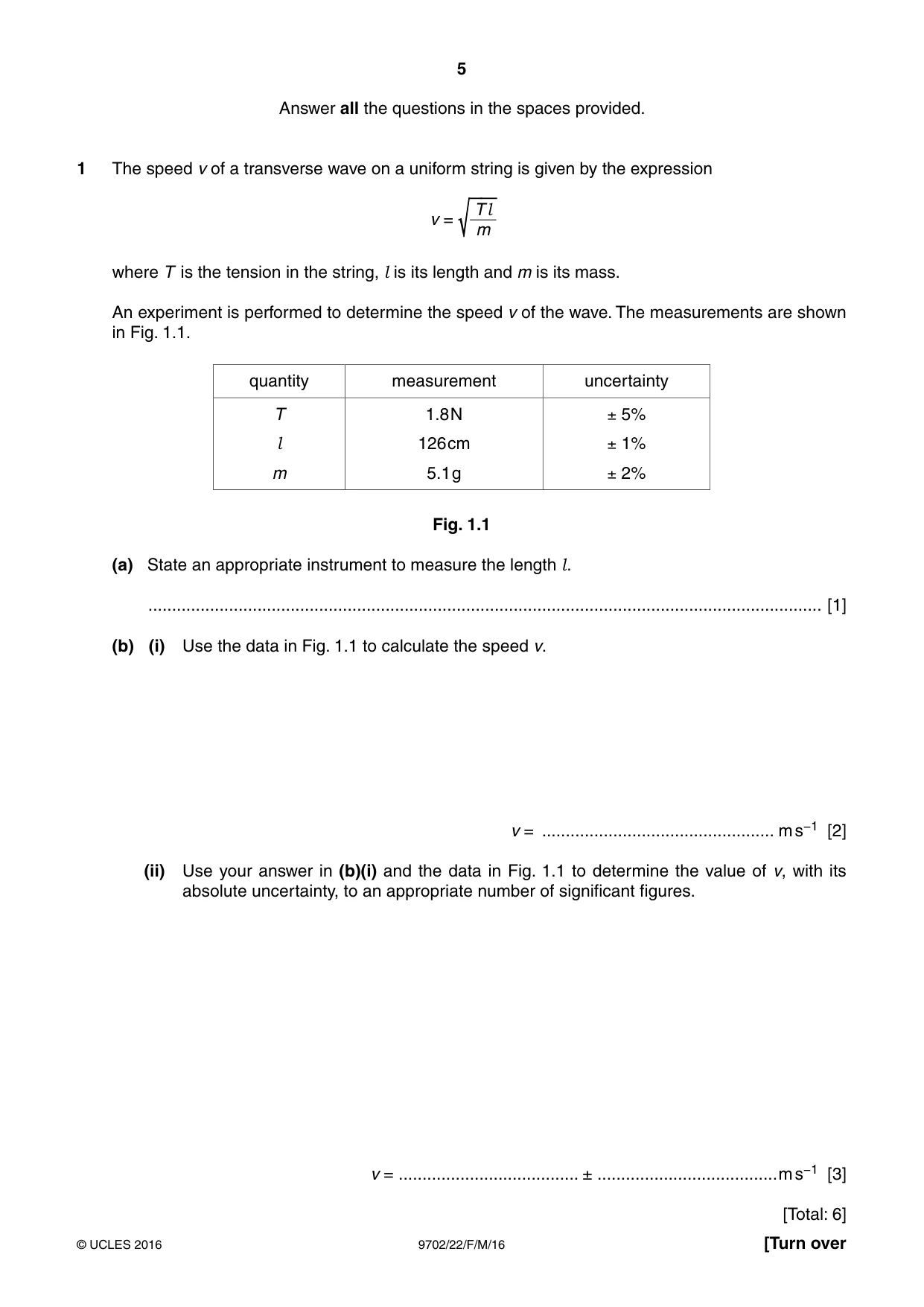
1 The speed v of a transverse wave on a uniform string is given by the expression T l v = m where T is the tension in the string, l is its length and m is its mass. An experiment is performed to determine the speed v of the wave. The measurements are shown in Fig. 1.1. quantity measurement uncertainty T 1.8 N ± 5% l 126 cm ± 1% m 5.1 g ± 2% Fig. 1.1 (a) State an appropriate instrument to measure the length l. .............................................................................................................................................. [1] (b) (i) Use the data in Fig. 1.1 to calculate the speed v. v = ................................................. m s−1 [2] (ii) Use your answer in (b)(i) and the data in Fig. 1.1 to determine the value of v, with its absolute uncertainty, to an appropriate number of significant figures. v = ...................................... ± ...................................... m s−1 [3] [Total: 6]
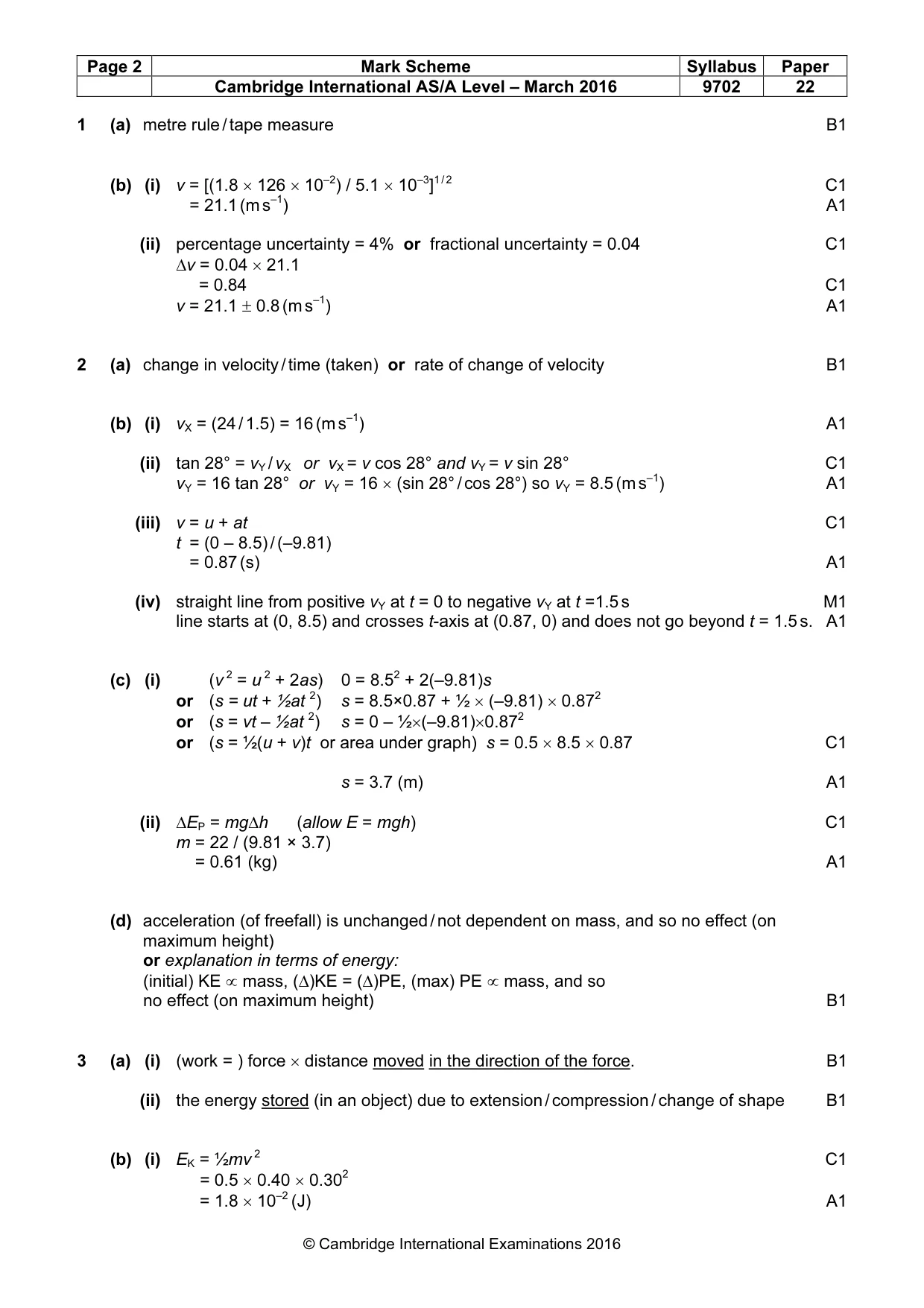
Mark scheme: 1 (a) metre rule / tape measure B1 (b) (i) v = [(1.8 × 126 × 10–2) / 5.1 × 10⁻³]1 / 2 C1 = 21.1 (m s–1) A1 (ii) percentage uncertainty = 4% or fractional uncertainty = 0.04 C1 ∆v = 0.04 × 21.1 = 0.84 C1 v = 21.1 ± 0.8 (m s–1) A1
Question 2
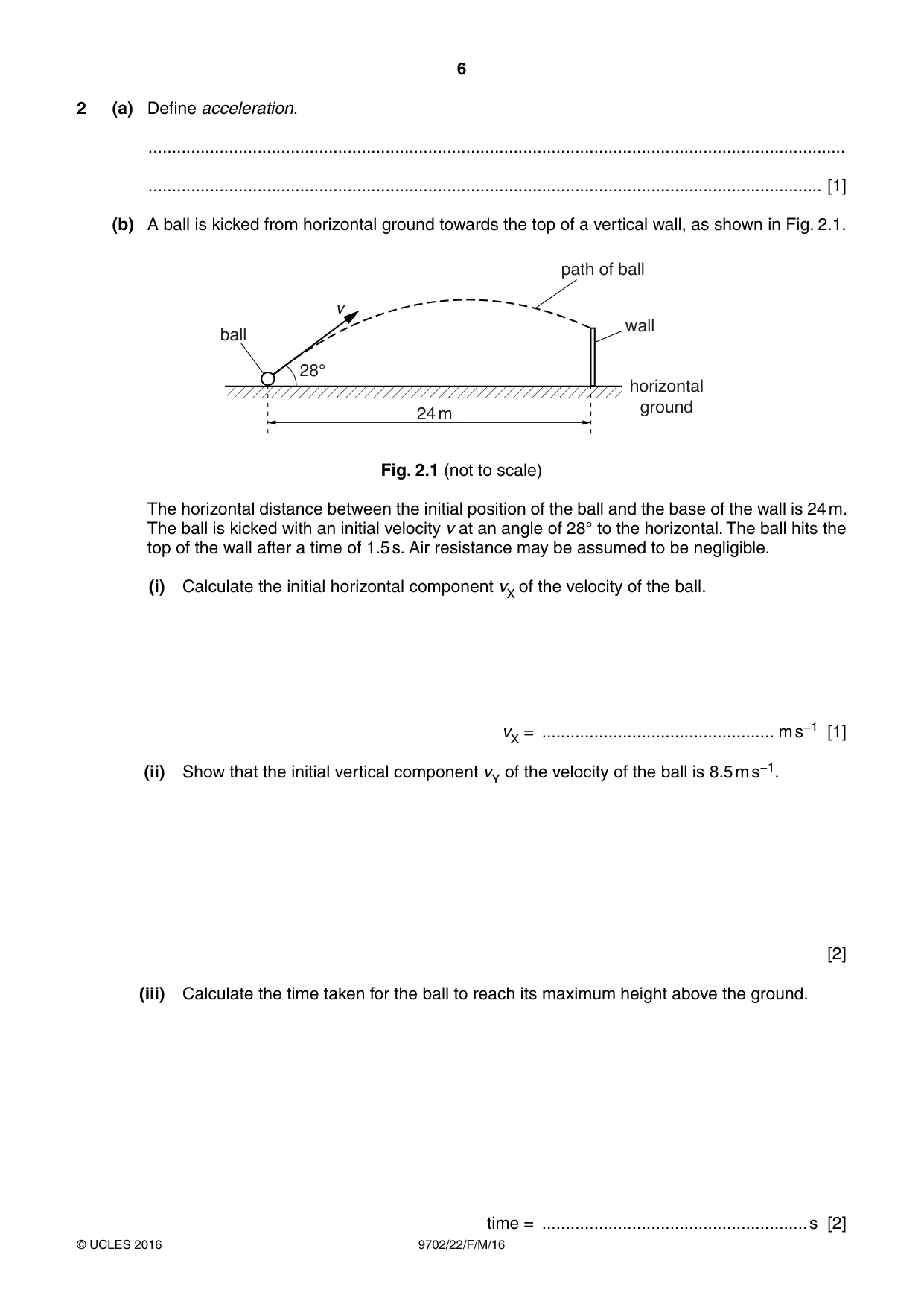
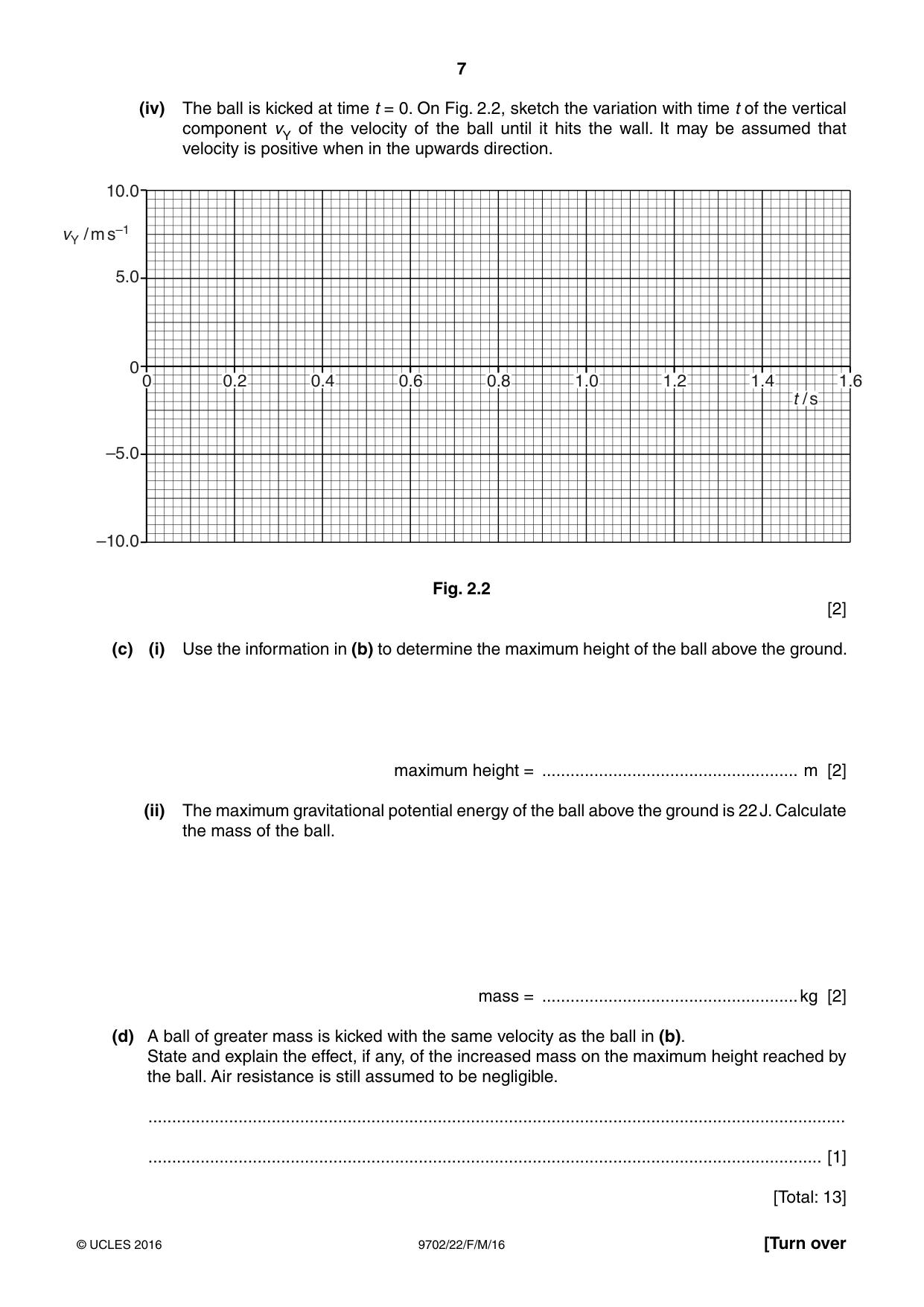
2 (a) Define acceleration. ................................................................................................................................................... .............................................................................................................................................. [1] (b) A ball is kicked from horizontal ground towards the top of a vertical wall, as shown in Fig. 2.1. path of ball v wall ball 28° horizontal ground 24 m Fig. 2.1 (not to scale) The horizontal distance between the initial position of the ball and the base of the wall is 24 m. The ball is kicked with an initial velocity v at an angle of 28° to the horizontal. The ball hits the top of the wall after a time of 1.5 s. Air resistance may be assumed to be negligible. (i) Calculate the initial horizontal component vX of the velocity of the ball. vX = ................................................. m s−1 [1] (ii) Show that the initial vertical component vY of the velocity of the ball is 8.5 m s−1. [2] (iii) Calculate the time taken for the ball to reach its maximum height above the ground. time = ........................................................ s [2] (iv) The ball is kicked at time t = 0. On Fig. 2.2, sketch the variation with time t of the vertical component vY of the velocity of the ball until it hits the wall. It may be assumed that velocity is positive when in the upwards direction. 10.0 vY / m s–1 5.0 0 00 0.2 0.4 0.6 0.8 1.0 1.2 1.4 1.6 t / s –5.0 –10.0 Fig. 2.2 [2] (c) (i) Use the information in (b) to determine the maximum height of the ball above the ground. maximum height = ...................................................... m [2] (ii) The maximum gravitational potential energy of the ball above the ground is 22 J. Calculate the mass of the ball. mass = ...................................................... kg [2] (d) A ball of greater mass is kicked with the same velocity as the ball in (b). State and explain the effect, if any, of the increased mass on the maximum height reached by the ball. Air resistance is still assumed to be negligible. ................................................................................................................................................... .............................................................................................................................................. [1] [Total: 13]
Mark scheme: 2 (a) change in velocity / time (taken) or rate of change of velocity B1 (b) (i) vX = (24 / 1.5) = 16 (m s–1) A1 (ii) tan 28° = vY / vX or vX = v cos 28° and vY = v sin 28° C1 vY = 16 tan 28° or vY = 16 × (sin 28° / cos 28°) so vY = 8.5 (m s–1) A1 (iii) v = u + at C1 t = (0 – 8.5) / (–9.81) = 0.87 (s) A1 (iv) straight line from positive vY at t = 0 to negative vY at t =1.5 s M1 line starts at (0, 8.5) and crosses t-axis at (0.87, 0) and does not go beyond t = 1.5 s. A1 (c) (i) (v 2 = u 2 + 2as) 0 = 8.52 + 2(–9.81)s or (s = ut + ½at 2) s = 8.5×0.87 + ½ × (–9.81) × 0.872 or (s = vt – ½at 2) s = 0 – ½×(–9.81)×0.872 or (s = ½(u + v)t or area under graph) s = 0.5 × 8.5 × 0.87 C1 s = 3.7 (m) A1 (ii) ∆EP = mg∆h (allow E = mgh) C1 m = 22 / (9.81 × 3.7) = 0.61 (kg) A1 (d) acceleration (of freefall) is unchanged / not dependent on mass, and so no effect (on maximum height) or explanation in terms of energy: (initial) KE ∝ mass, (∆)KE = (∆)PE, (max) PE ∝ mass, and so no effect (on maximum height) B1
Q3 · State what is meant by (i) work done…
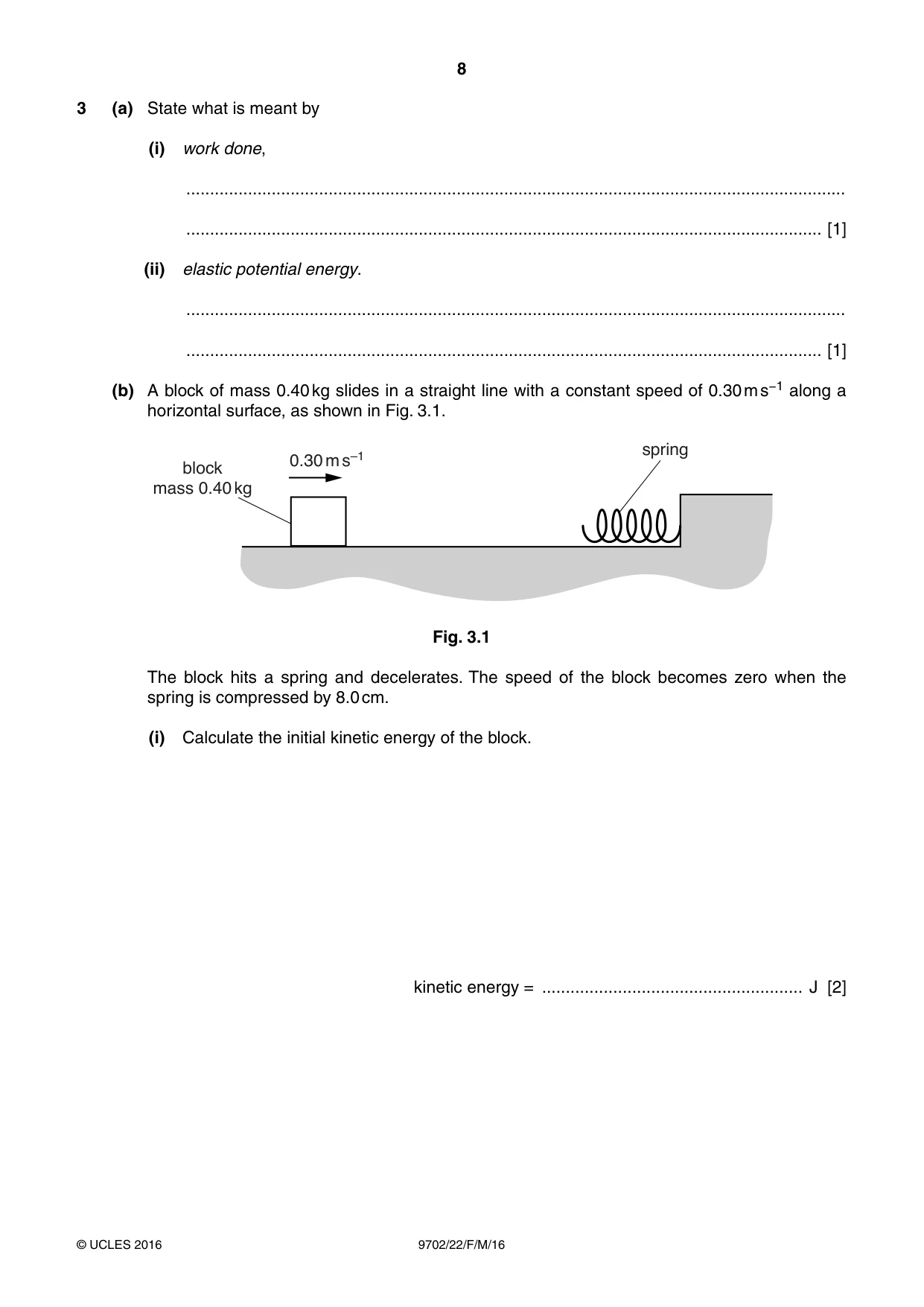
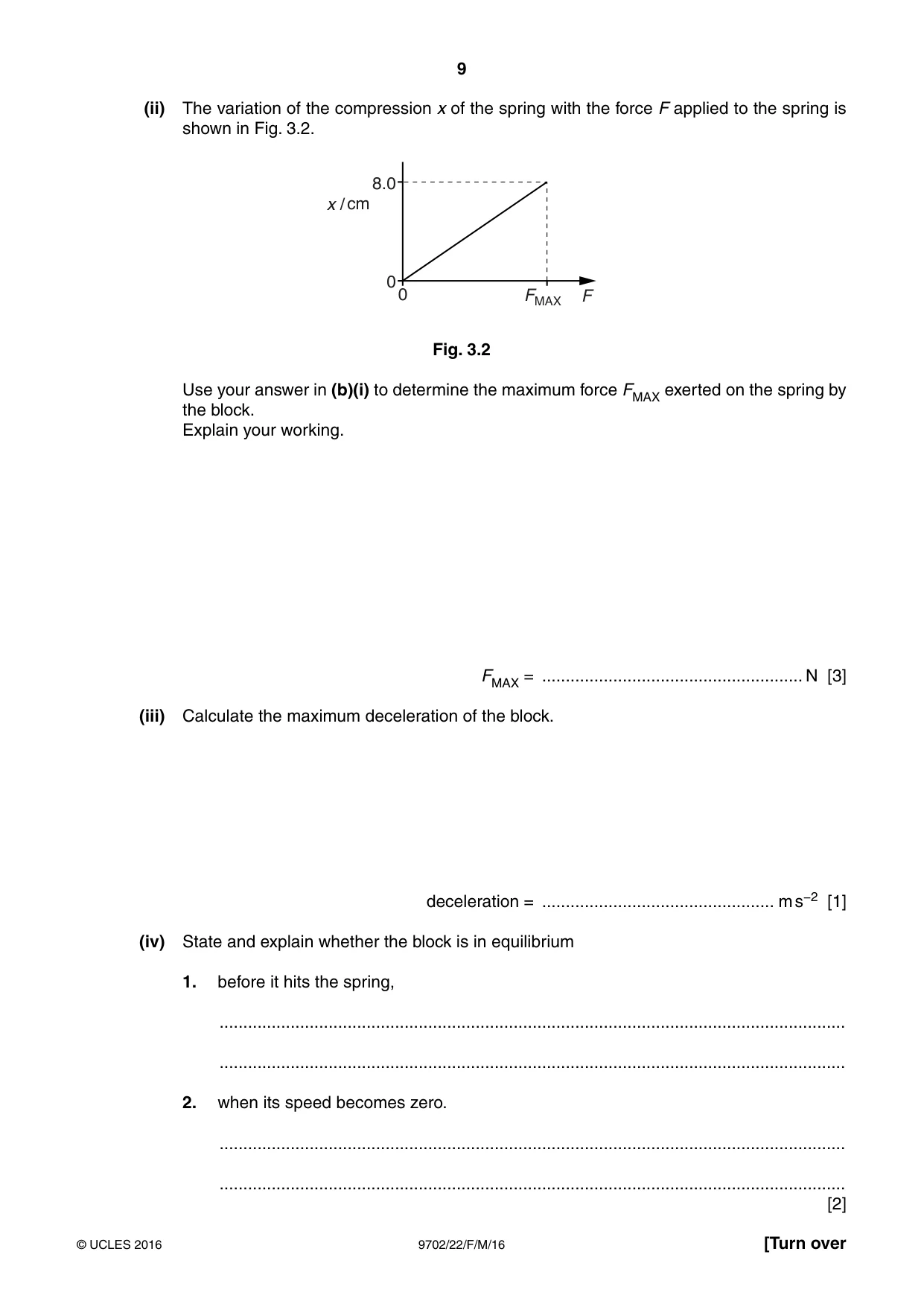
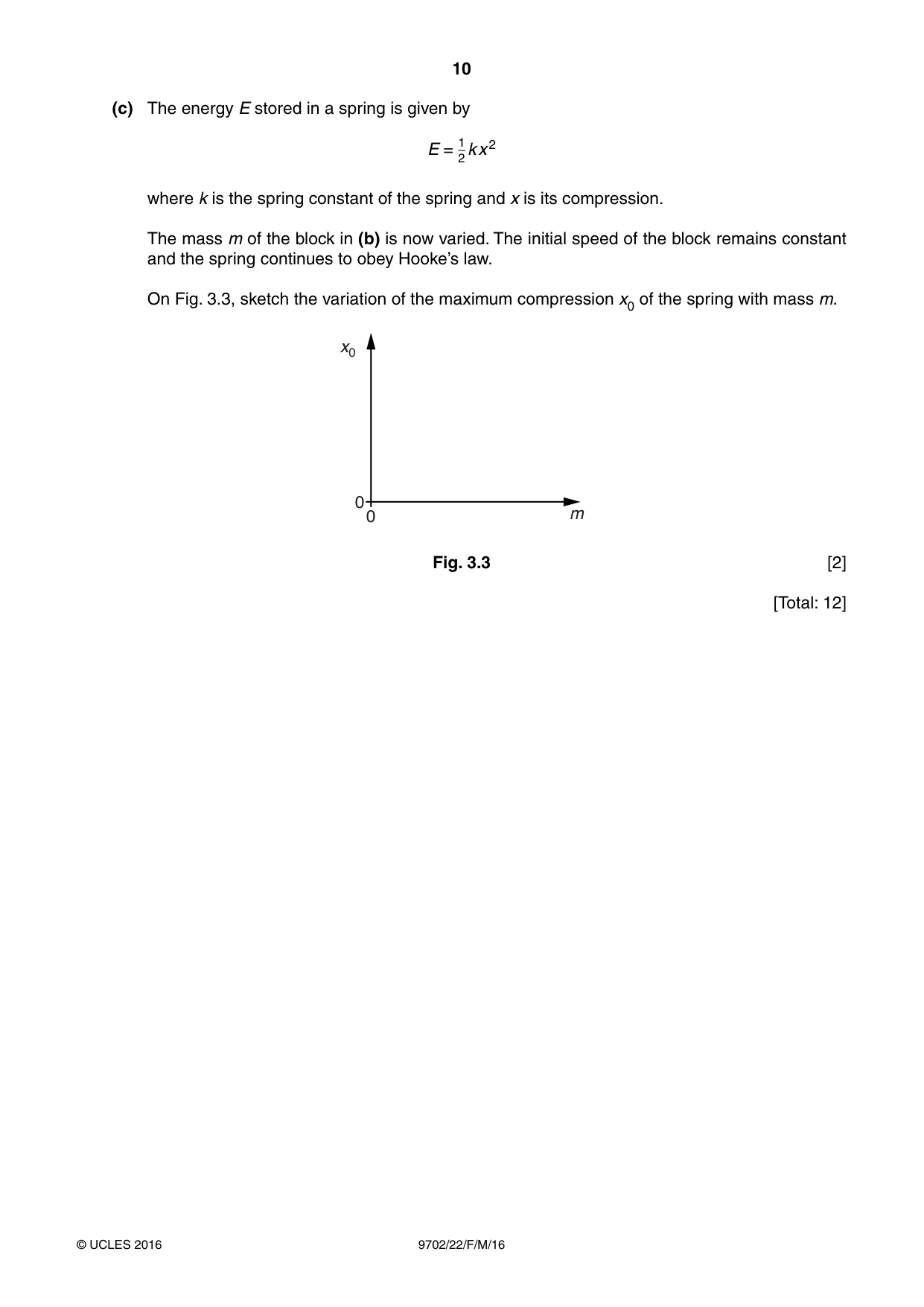
3 (a) State what is meant by (i) work done, ........................................................................................................................................... ...................................................................................................................................... [1] (ii) elastic potential energy. ........................................................................................................................................... ...................................................................................................................................... [1] (b) A block of mass 0.40 kg slides in a straight line with a constant speed of 0.30 m s−1 along a horizontal surface, as shown in Fig. 3.1. spring 0.30 m s–1 block mass 0.40 kg Fig. 3.1 The block hits a spring and decelerates. The speed of the block becomes zero when the spring is compressed by 8.0 cm. (i) Calculate the initial kinetic energy of the block. kinetic energy = ....................................................... J [2] (ii) The variation of the compression x of the spring with the force F applied to the spring is shown in Fig. 3.2. 8.0 x / cm 0 0 FMAX F Fig. 3.2 Use your answer in (b)(i) to determine the maximum force FMAX exerted on the spring by the block. Explain your working. FMAX = ....................................................... N [3] (iii) Calculate the maximum deceleration of the block. deceleration = ................................................. m s−2 [1] (iv) State and explain whether the block is in equilibrium 1. before it hits the spring, .................................................................................................................................... .................................................................................................................................... 2. when its speed becomes zero. .................................................................................................................................... .................................................................................................................................... [2] (c) The energy E stored in a spring is given by E = 1 k x 2 2 where k is the spring constant of the spring and x is its compression. The mass m of the block in (b) is now varied. The initial speed of the block remains constant and the spring continues to obey Hooke’s law. On Fig. 3.3, sketch the variation of the maximum compression x0 of the spring with mass m. x0 0 0 m Fig. 3.3 [2] [Total: 12]
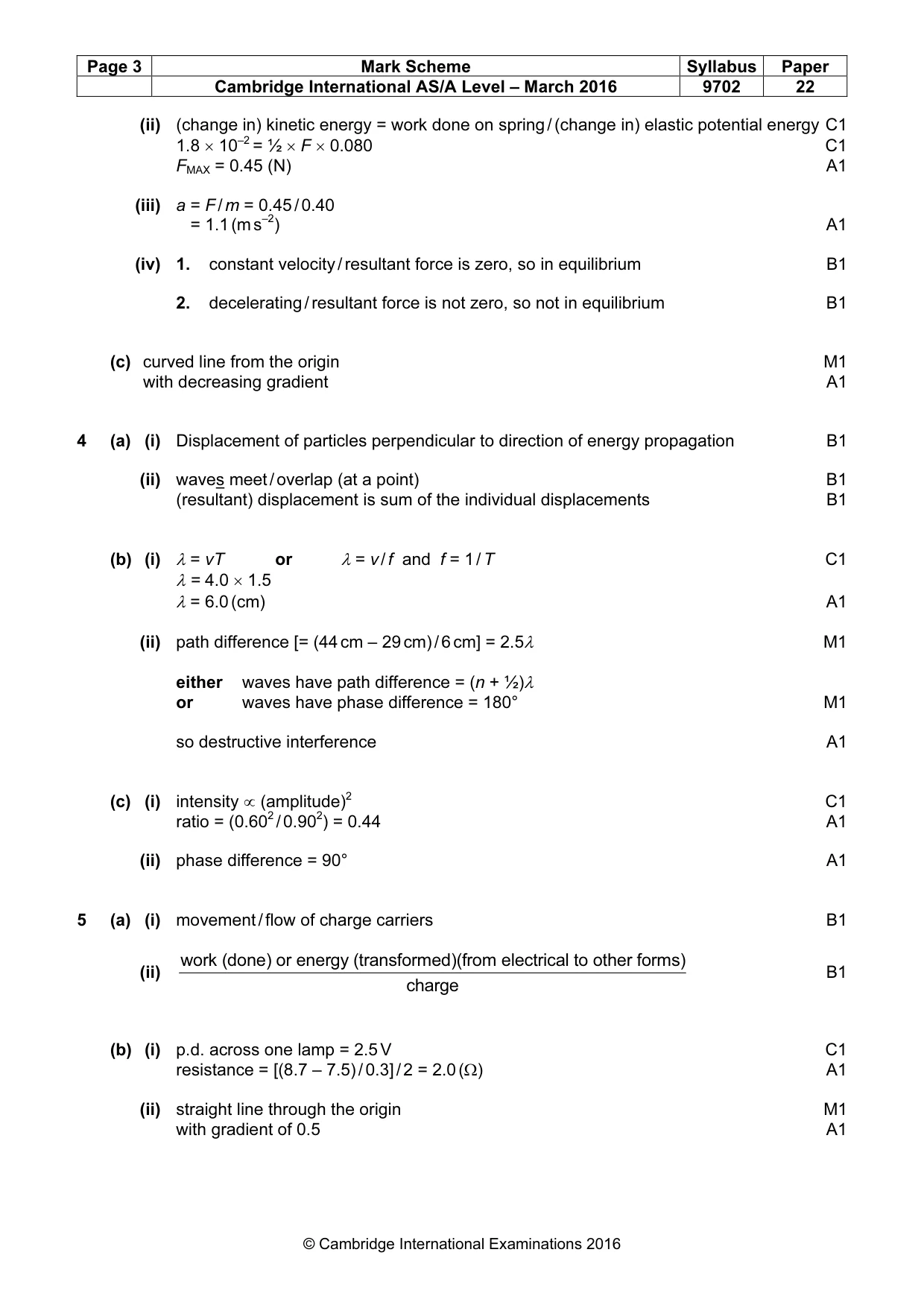
Mark scheme: 3 (a) (i) (work = ) force × distance moved in the direction of the force. B1 (ii) the energy stored (in an object) due to extension / compression / change of shape B1 (b) (i) EK = ½mv 2 C1 = 0.5 × 0.40 × 0.302 = 1.8 × 10⁻² (J) A1 (ii) (change in) kinetic energy = work done on spring / (change in) elastic potential energy C1 1.8 × 10–2 = ½ × F × 0.080 C1 FMAX = 0.45 (N) A1 (iii) a = F / m = 0.45 / 0.40 = 1.1 (m s–2) A1 (iv) 1. constant velocity / resultant force is zero, so in equilibrium B1 2. decelerating / resultant force is not zero, so not in equilibrium B1 (c) curved line from the origin M1 with decreasing gradient A1
More questions on Gravitational potential energy and kinetic energy
Q4 · By reference to the direction of propagation of energy, state what is meant by a…
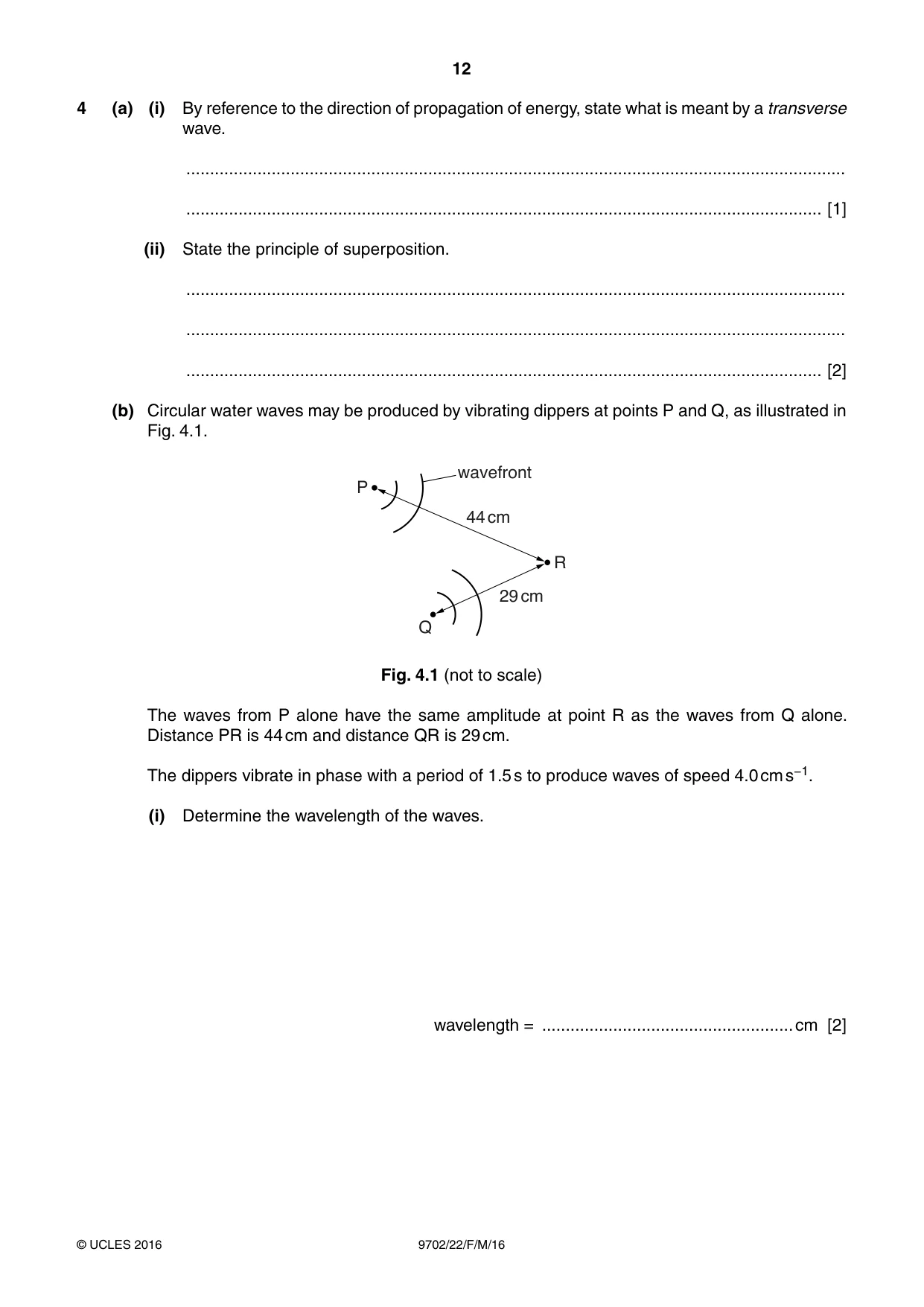
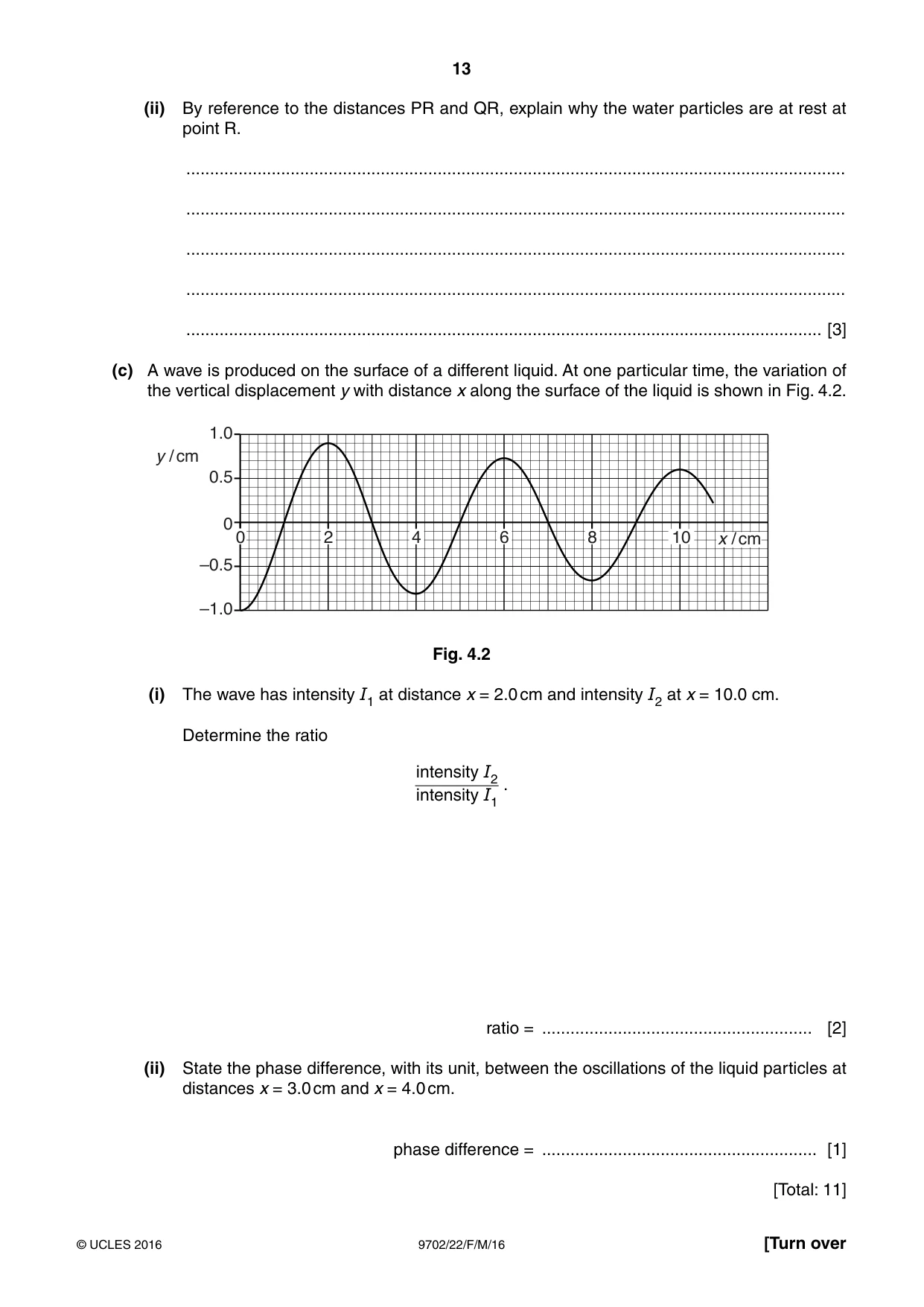
4 (a) (i) By reference to the direction of propagation of energy, state what is meant by a transverse wave. ........................................................................................................................................... ...................................................................................................................................... [1] (ii) State the principle of superposition. ........................................................................................................................................... ........................................................................................................................................... ...................................................................................................................................... [2] (b) Circular water waves may be produced by vibrating dippers at points P and Q, as illustrated in Fig. 4.1. wavefront P 44 cm R 29 cm Q Fig. 4.1 (not to scale) The waves from P alone have the same amplitude at point R as the waves from Q alone. Distance PR is 44 cm and distance QR is 29 cm. The dippers vibrate in phase with a period of 1.5 s to produce waves of speed 4.0 cm s−1. (i) Determine the wavelength of the waves. wavelength = ..................................................... cm [2] (ii) By reference to the distances PR and QR, explain why the water particles are at rest at point R. ........................................................................................................................................... ........................................................................................................................................... ........................................................................................................................................... ........................................................................................................................................... ...................................................................................................................................... [3] (c) A wave is produced on the surface of a different liquid. At one particular time, the variation of the vertical displacement y with distance x along the surface of the liquid is shown in Fig. 4.2. 1.0 y / cm 0.5 0 00 2 4 6 8 10 x / cm –0.5 –1.0 Fig. 4.2 (i) The wave has intensity I1 at distance x = 2.0 cm and intensity I2 at x = 10.0 cm. Determine the ratio intensity I2 . intensity I1 ratio = ......................................................... [2] (ii) State the phase difference, with its unit, between the oscillations of the liquid particles at distances x = 3.0 cm and x = 4.0 cm. phase difference = .......................................................... [1] [Total: 11]
Mark scheme: 4 (a) (i) Displacement of particles perpendicular to direction of energy propagation B1 (ii) waves meet / overlap (at a point) B1 (resultant) displacement is sum of the individual displacements B1 (b) (i) λ = vT or λ = v / f and f = 1 / T C1 λ = 4.0 × 1.5 λ = 6.0 (cm) A1 (ii) path difference [= (44 cm – 29 cm) / 6 cm] = 2.5λ M1 either waves have path difference = (n + ½)λ or waves have phase difference = 180° M1 so destructive interference A1 (c) (i) intensity ∝ (amplitude)2 C1 ratio = (0.602 / 0.902) = 0.44 A1 (ii) phase difference = 90° A1
Q5 · State what is meant by an electric current
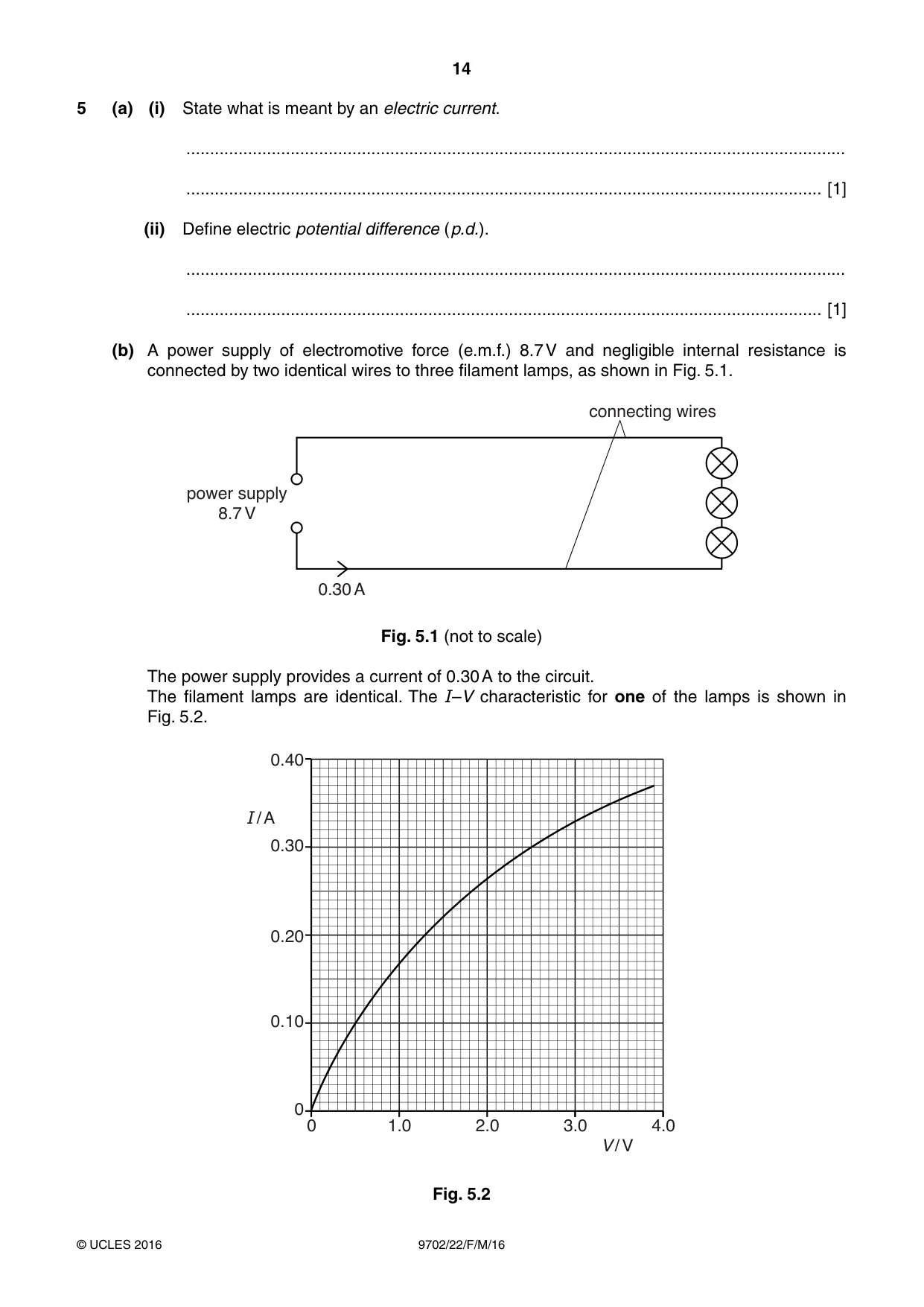
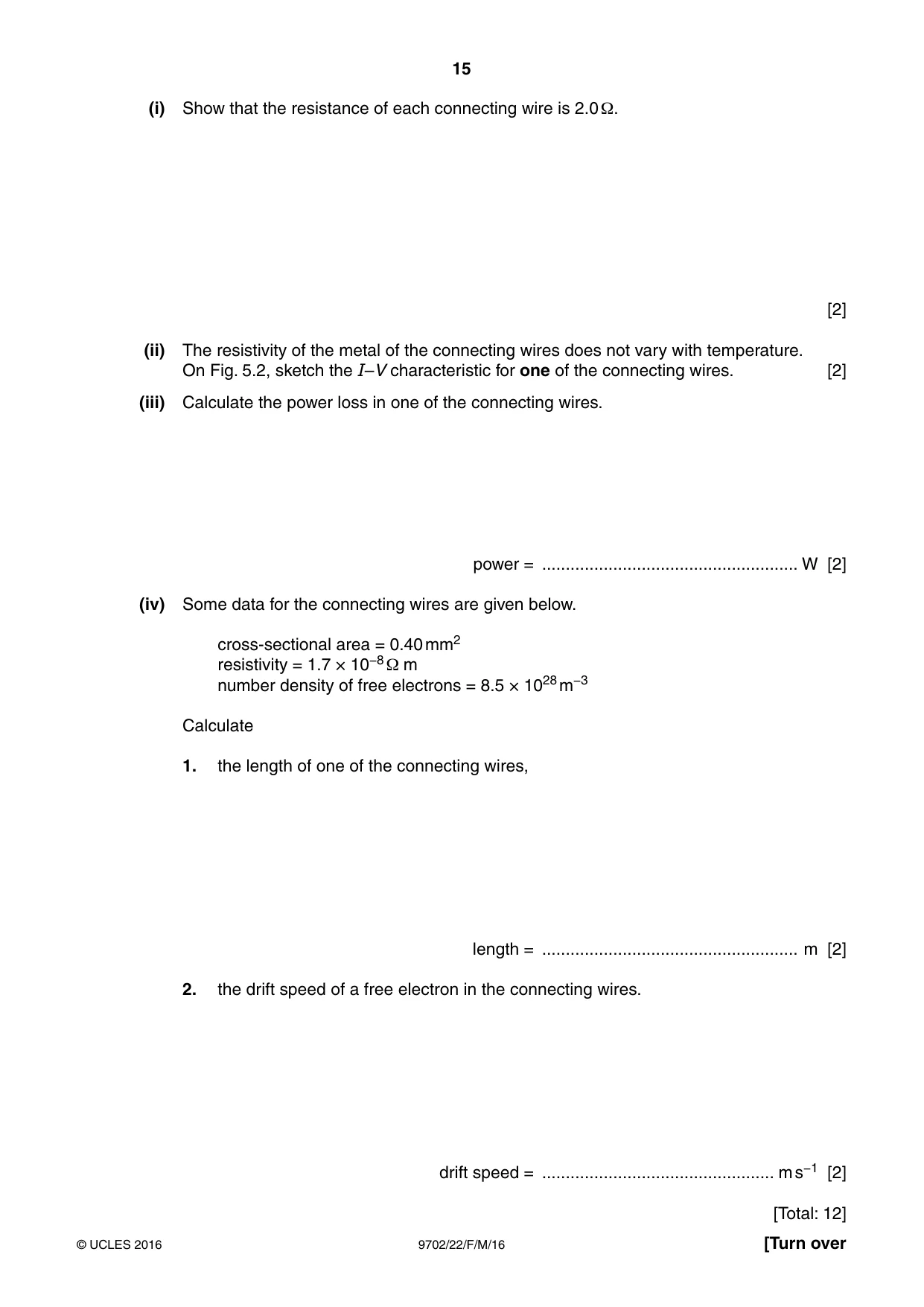
5 (a) (i) State what is meant by an electric current. ........................................................................................................................................... ...................................................................................................................................... [1] (ii) Define electric potential difference (p.d.). ........................................................................................................................................... ...................................................................................................................................... [1] (b) A power supply of electromotive force (e.m.f.) 8.7 V and negligible internal resistance is connected by two identical wires to three filament lamps, as shown in Fig. 5.1. connecting wires power supply 8.7 V 0.30 A Fig. 5.1 (not to scale) The power supply provides a current of 0.30 A to the circuit. The filament lamps are identical. The I–V characteristic for one of the lamps is shown in Fig. 5.2. 0.40 I / A 0.30 0.20 0.10 0 0 1.0 2.0 3.0 4.0 V / V Fig. 5.2 (i) Show that the resistance of each connecting wire is 2.0 Ω. [2] (ii) The resistivity of the metal of the connecting wires does not vary with temperature. On Fig. 5.2, sketch the I–V characteristic for one of the connecting wires. [2] (iii) Calculate the power loss in one of the connecting wires. power = ...................................................... W [2] (iv) Some data for the connecting wires are given below. cross-sectional area = 0.40 mm2 resistivity = 1.7 × 10⁻⁸ Ω m number density of free electrons = 8.5 × 1028 m−3 Calculate 1. the length of one of the connecting wires, length = ...................................................... m [2] 2. the drift speed of a free electron in the connecting wires. drift speed = ................................................. m s−1 [2] [Total: 12]
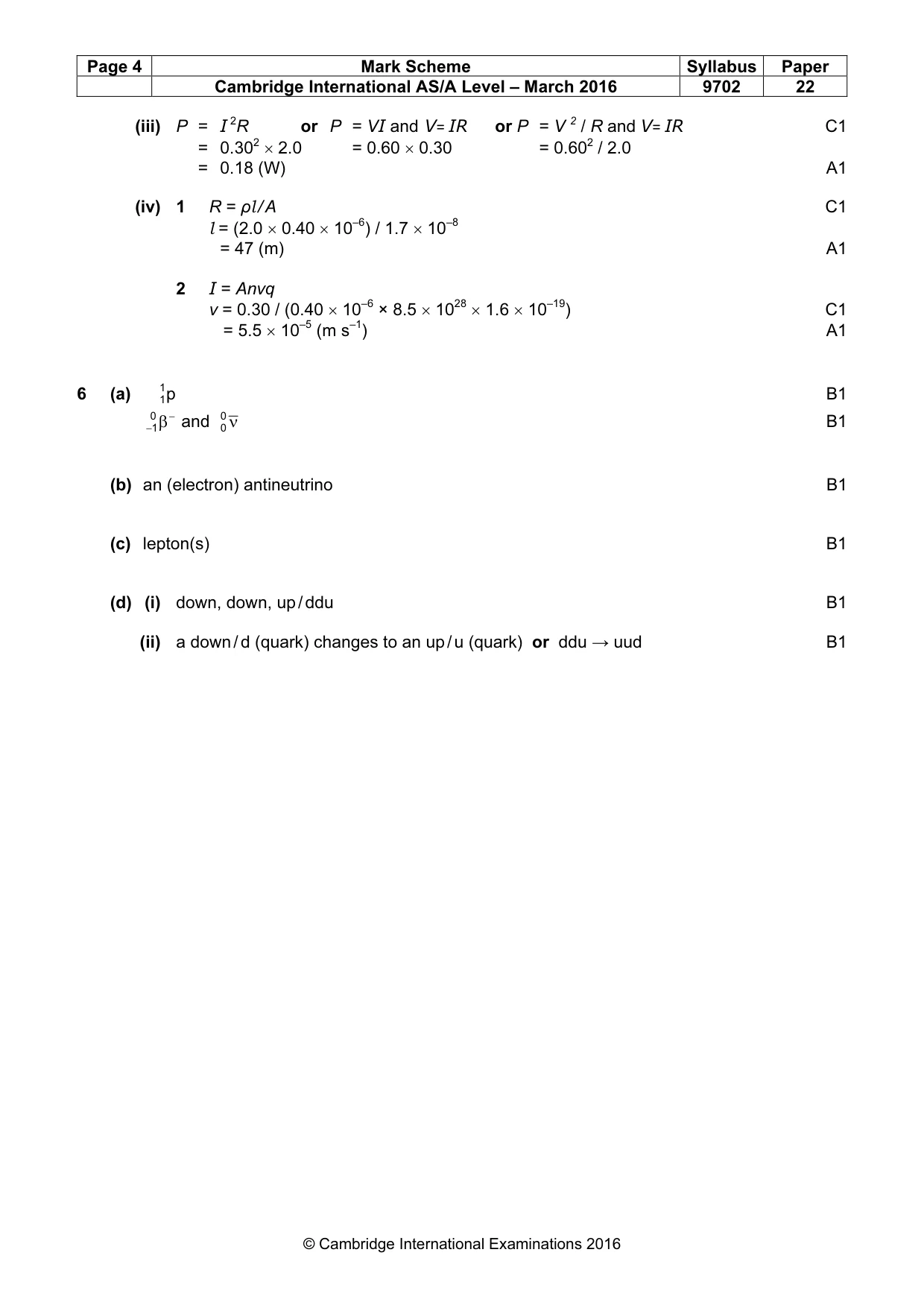
Mark scheme: 5 (a) (i) movement / flow of charge carriers B1 work (done) or energy (transformed)(from electrical to other forms) (ii) B1 charge (b) (i) p.d. across one lamp = 2.5 V C1 resistance = [(8.7 – 7.5) / 0.3] / 2 = 2.0 (Ω) A1 (ii) straight line through the origin M1 with gradient of 0.5 A1 (iii) P = I 2R or P = VI and V= IR or P = V 2 / R and V= IR C1 = 0.302 × 2.0 = 0.60 × 0.30 = 0.602 / 2.0 = 0.18 (W) A1 (iv) 1 R = ρl / A C1 l = (2.0 × 0.40 × 10–6) / 1.7 × 10–8 = 47 (m) A1 2 I = Anvq v = 0.30 / (0.40 × 10–6 × 8.5 × 1028 × 1.6 × 10–19) C1 = 5.5 × 10⁻⁵ (m s–1) A1 1
Q6 · A neutron decays by emitting a β− particle
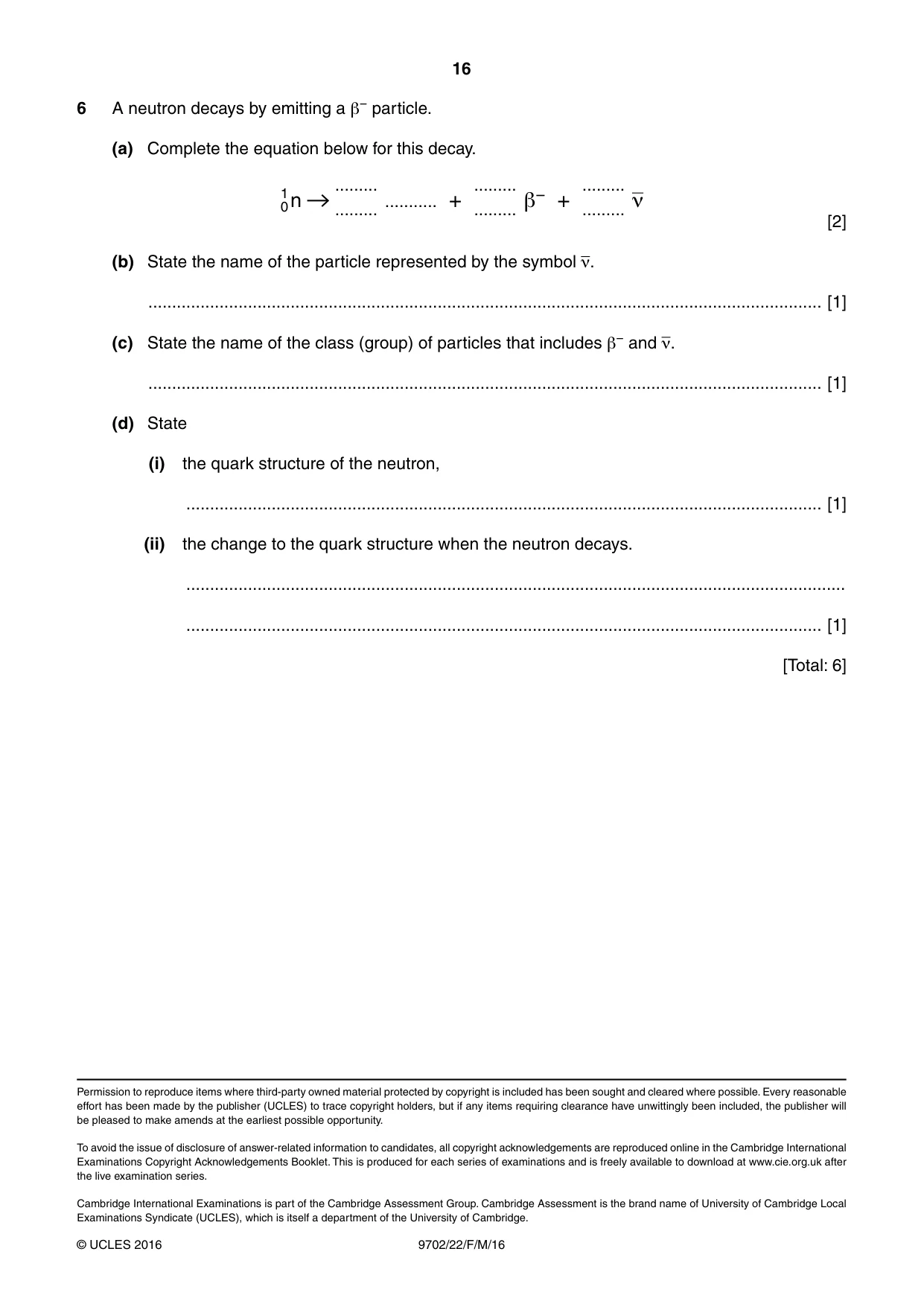
6 A neutron decays by emitting a β− particle. (a) Complete the equation below for this decay. ......... ......... ......... 1 ν 0 n ......... ........... + ......... β− + ......... [2] (b) State the name of the particle represented by the symbol ν. .............................................................................................................................................. [1] (c) State the name of the class (group) of particles that includes β− and ν. .............................................................................................................................................. [1] (d) State (i) the quark structure of the neutron, ...................................................................................................................................... [1] (ii) the change to the quark structure when the neutron decays. ........................................................................................................................................... ...................................................................................................................................... [1] [Total: 6]
Mark scheme: 6 (a) 11 p B1 0 − 1 β− and 00 ν B1 (b) an (electron) antineutrino B1 (c) lepton(s) B1 (d) (i) down, down, up / ddu B1 (ii) a down / d (quark) changes to an up / u (quark) or ddu → uud B1
What was in this paper
The subtopics covered by these 6 questions, and how many questions each got. Open one in a new tab to see every Cambridge question on it.
What you needed in this session
Cambridge’s own grade thresholds for 2016 Feb/March, Paper 2 · Variant 2. A higher threshold means an easier paper — the bar moves with how the cohort did.