Cambridge A Level Physics 9702 — 2010 Oct/Nov Paper 2 · Variant 2
9702/22/O/N/10 · 7 questions · 60 marks · ≈68 min
The question paper and its mark scheme, free to read here and free to download. This is Cambridge’s own paper, exactly as it was sat.
Question paper20 pages
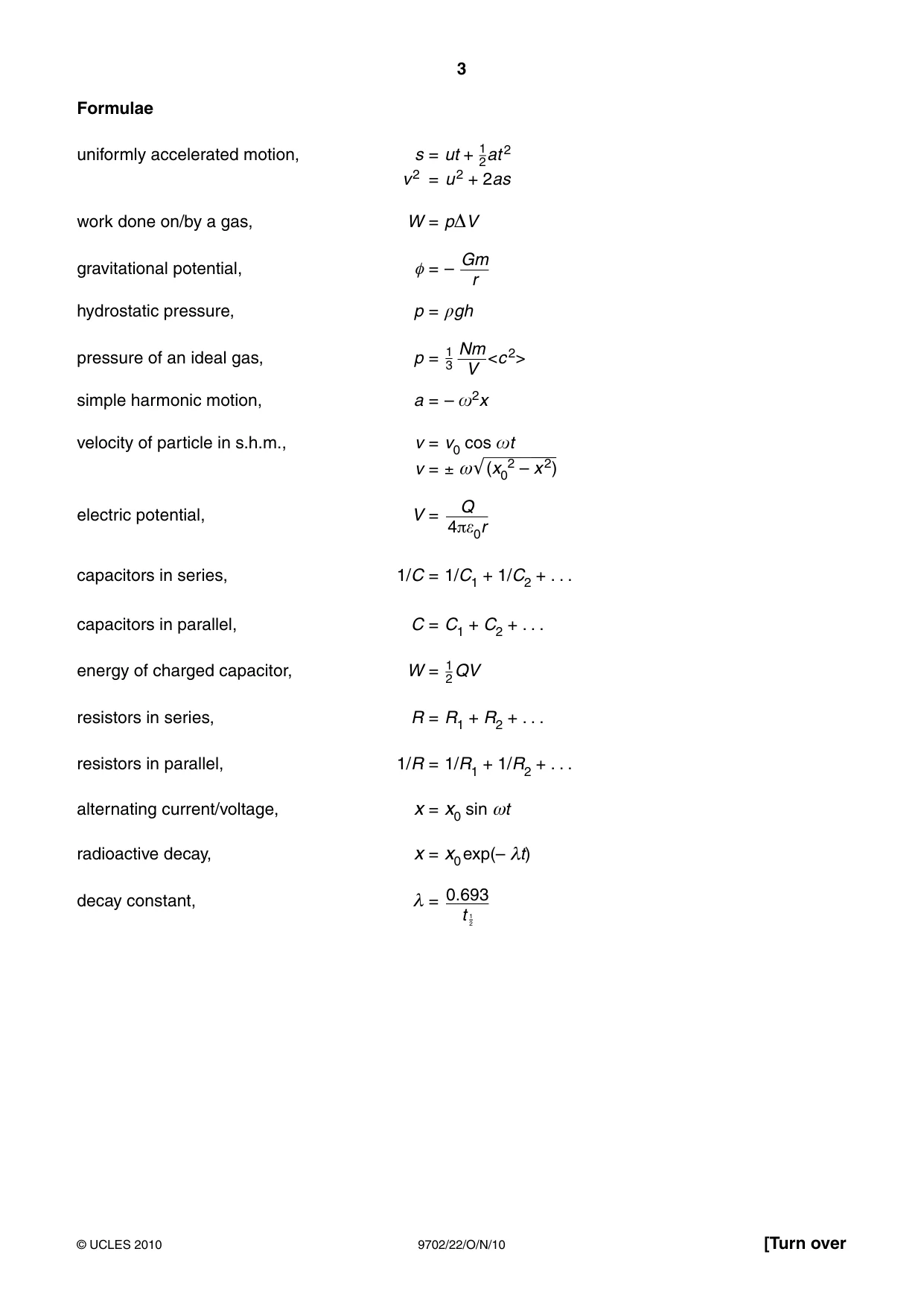
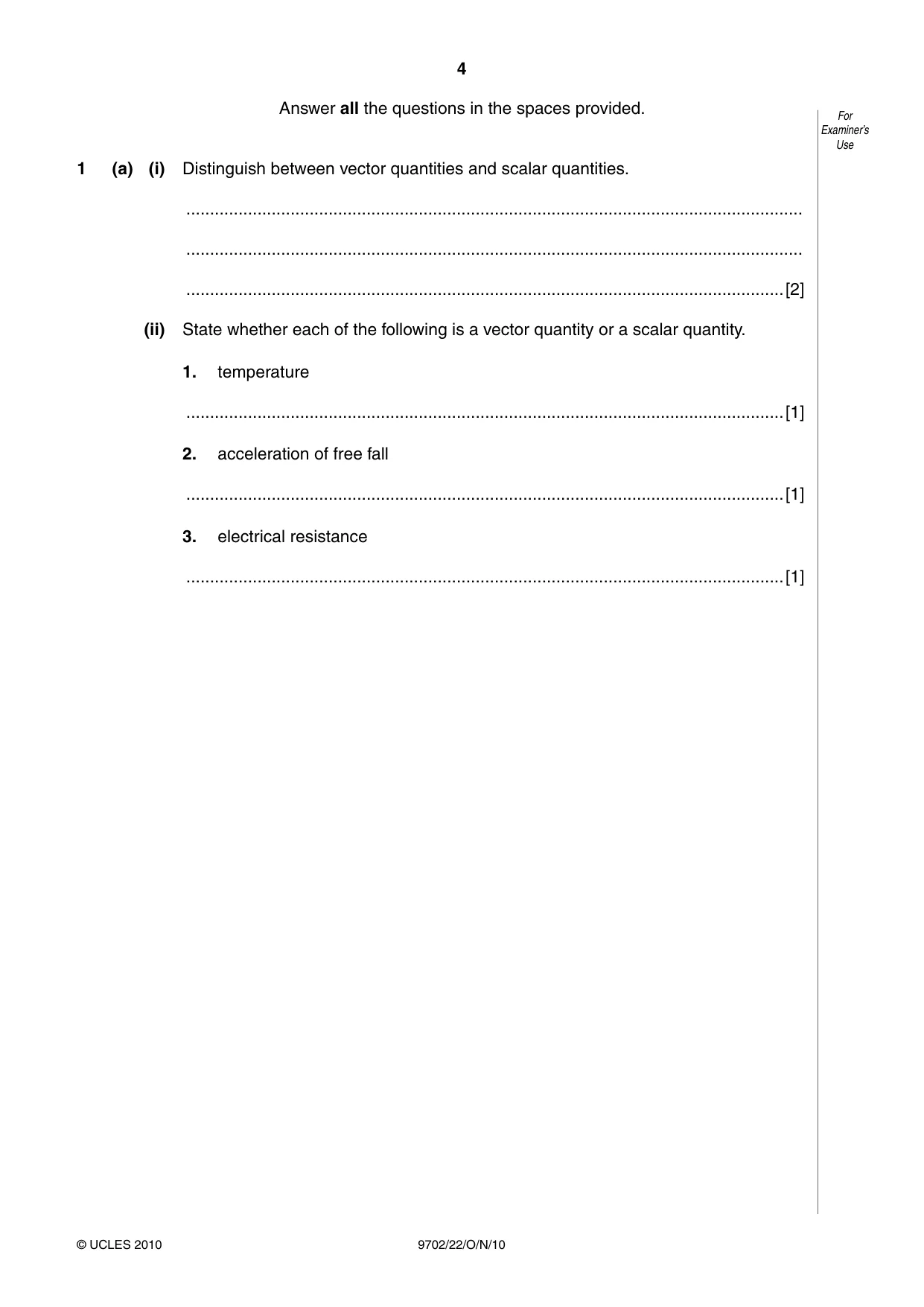


Mark scheme4 pages
Answers below. Sit the paper first if you are practising.
Questions as text
Q1 · Distinguish between vector quantities and scalar quantities
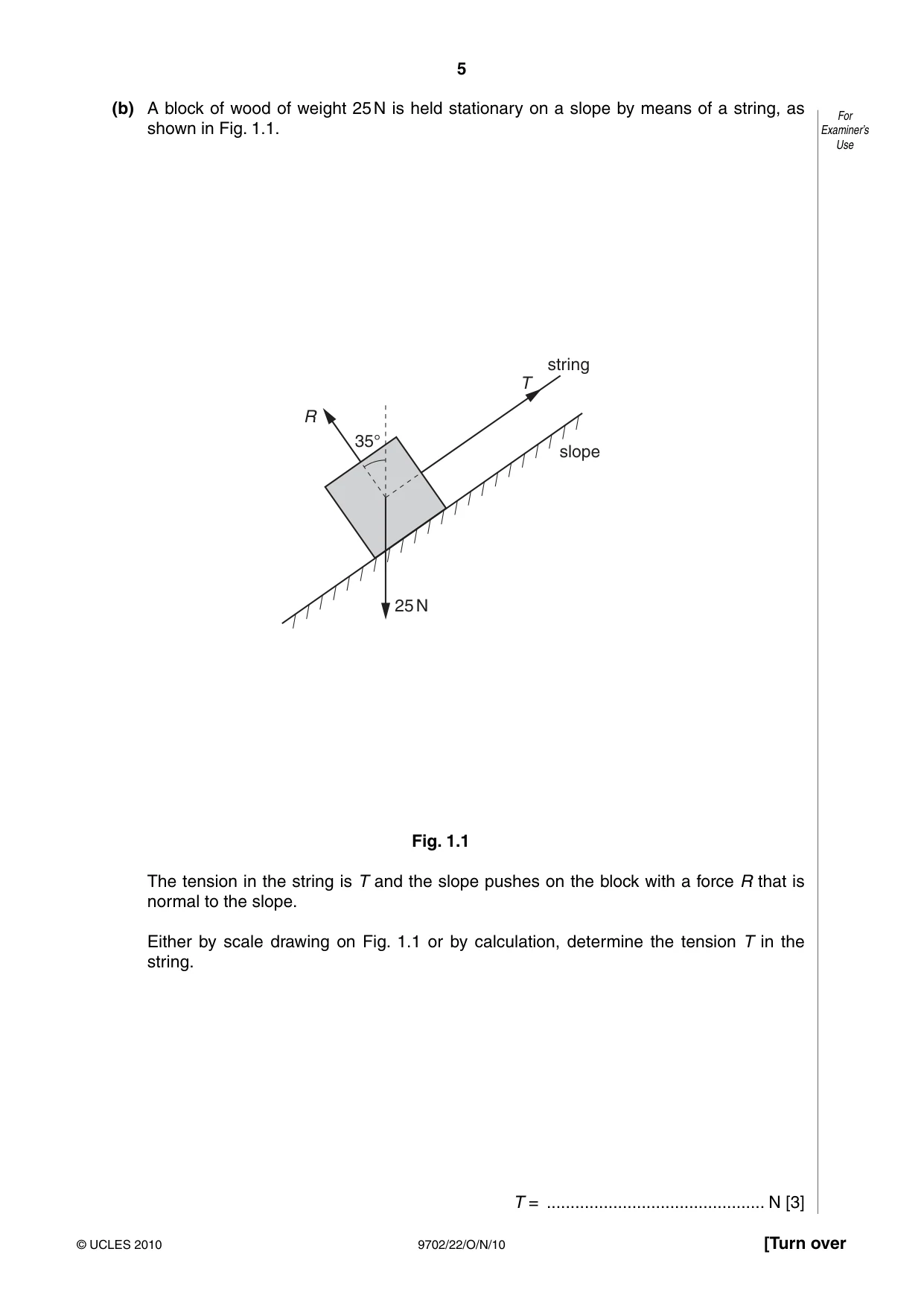
1 (a) (i) Distinguish between vector quantities and scalar quantities. .................................................................................................................................. .................................................................................................................................. ..............................................................................................................................[2] (ii) State whether each of the following is a vector quantity or a scalar quantity. 1. temperature ..............................................................................................................................[1] 2. acceleration of free fall ..............................................................................................................................[1] 3. electrical resistance ..............................................................................................................................[1] (b) A block of wood of weight 25 N is held stationary on a slope by means of a string, as For shown in Fig. 1.1. Examiner’s Use string T R 35° slope 25 N Fig. 1.1 The tension in the string is T and the slope pushes on the block with a force R that is normal to the slope. Either by scale drawing on Fig. 1.1 or by calculation, determine the tension T in the string. T = .............................................. N [3]
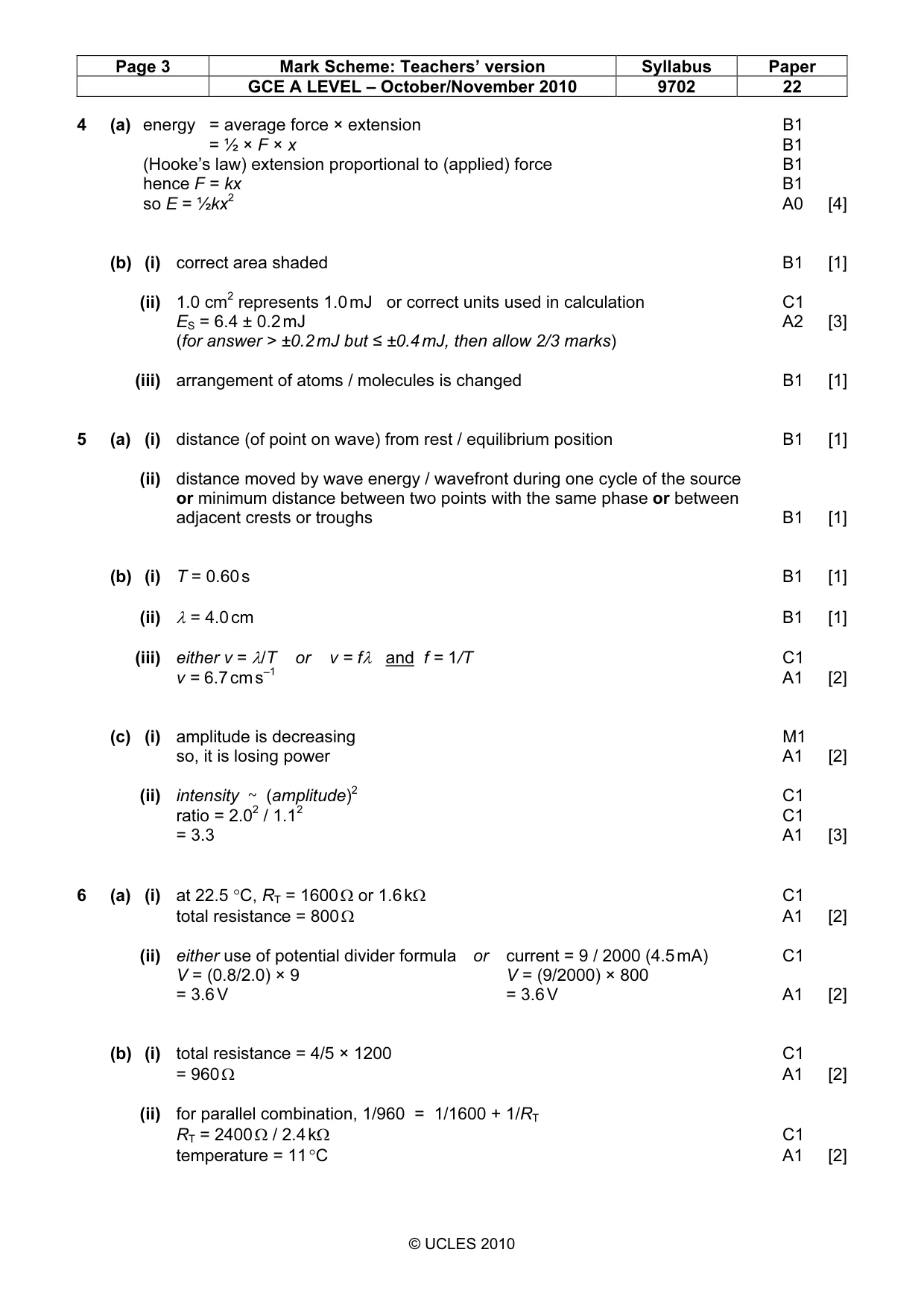
Mark scheme: 1 (a) (i) scalar quantity has magnitude (allow size) B1 vector quantity has magnitude and direction B1 [2] (ii) 1. temperature: scalar B1 [1] 2. acceleration: vector B1 [1] 3. resistance: scalar B1 [1] (b) either triangle / parallelogram with correct shape C1 tension = 14 .3 N (allow ± 0.5 N) A2 [3] (if > ±0.5 N but ≤ ±1 N, allow 1 mark) or R = 25 cos 35° (C1) T = R tan 35° (C1) T = 14.3 N (A1) or T = 25 sin 35° (C2) T = 14.3 N (A1) or R and T resolved vertically and horizontally (C2) leading to T = 14.3 N (A1) 1
Q2 · A ball is thrown from a point P, which is at ground level, as illustrated in Fig
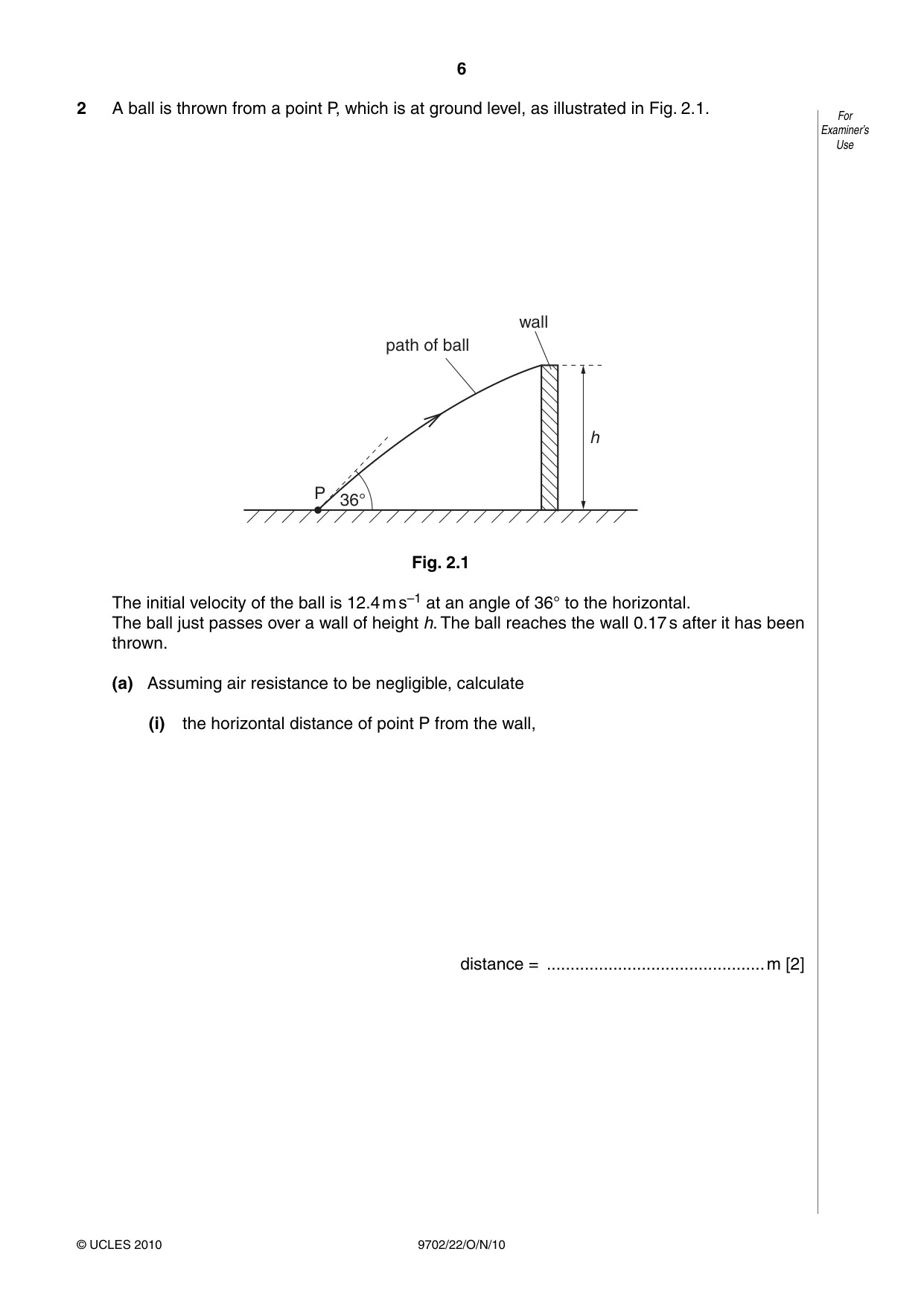
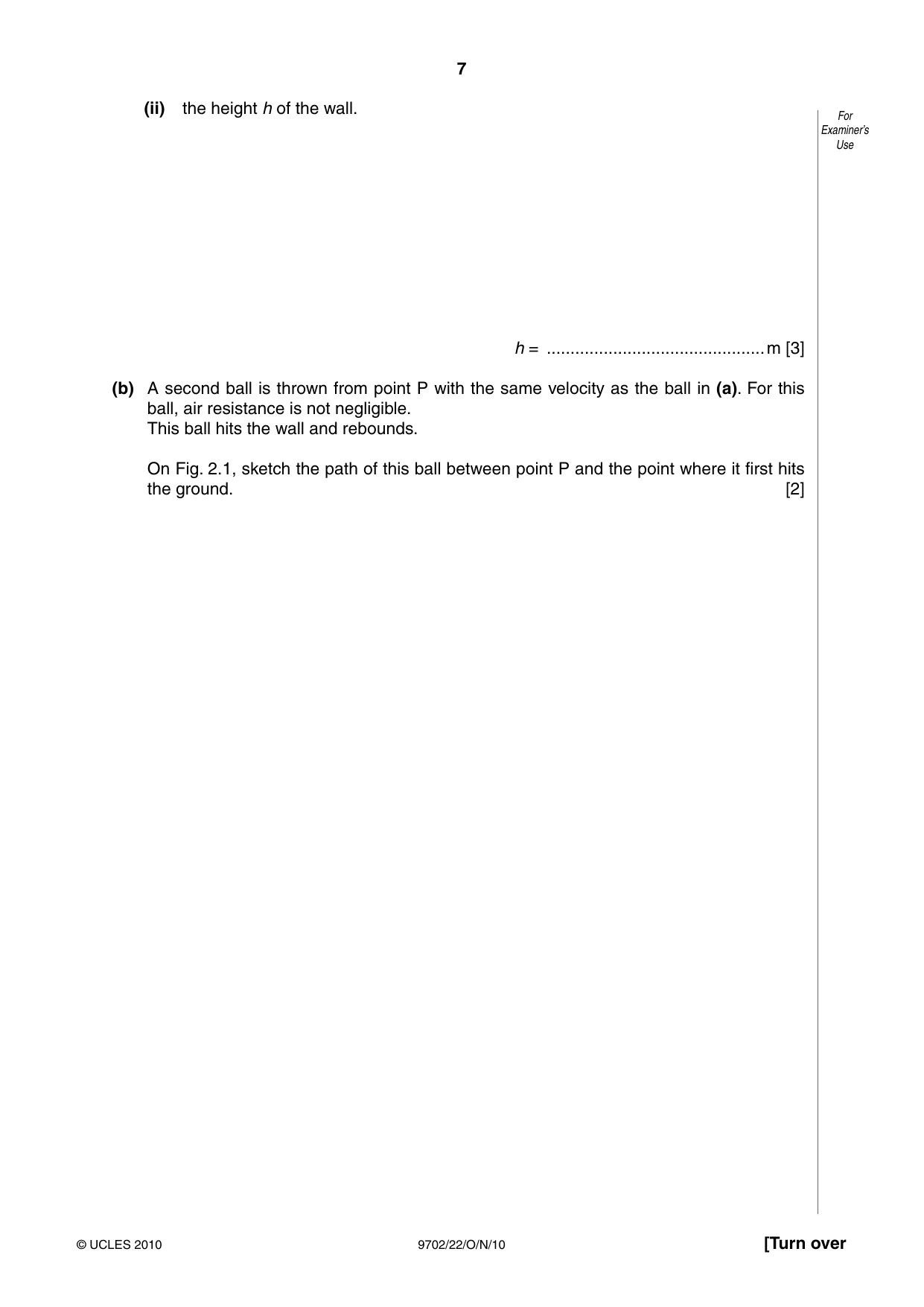
2 A ball is thrown from a point P, which is at ground level, as illustrated in Fig. 2.1. For Examiner’s Use wall path of ball h P 36° Fig. 2.1 The initial velocity of the ball is 12.4 m s–1 at an angle of 36° to the horizontal. The ball just passes over a wall of height h. The ball reaches the wall 0.17 s after it has been thrown. (a) Assuming air resistance to be negligible, calculate (i) the horizontal distance of point P from the wall, distance = ..............................................m [2] (ii) the height h of the wall. For Examiner’s Use h = ..............................................m [3] (b) A second ball is thrown from point P with the same velocity as the ball in (a). For this ball, air resistance is not negligible. This ball hits the wall and rebounds. On Fig. 2.1, sketch the path of this ball between point P and the point where it first hits the ground. [2]
Mark scheme: 2 (a) (i) VH = 12.4 cos 36° (= 10.0 m s–1) C1 distance = 10.0 × 0.17 = 1.7 m A1 [2] (ii) VV = 12.4 sin 36° (= 7.29 m s–1) C1 h = 7.29 × 0.17 – ½ × 9.81 × 0.172 C1 = 1.1 m A1 [3] (b) smooth curve with ball hitting wall below original B1 smooth curve showing rebound to ground with correct reflection at wall B1 [2]
Q3 · State what is meant by the centre of gravity of a body
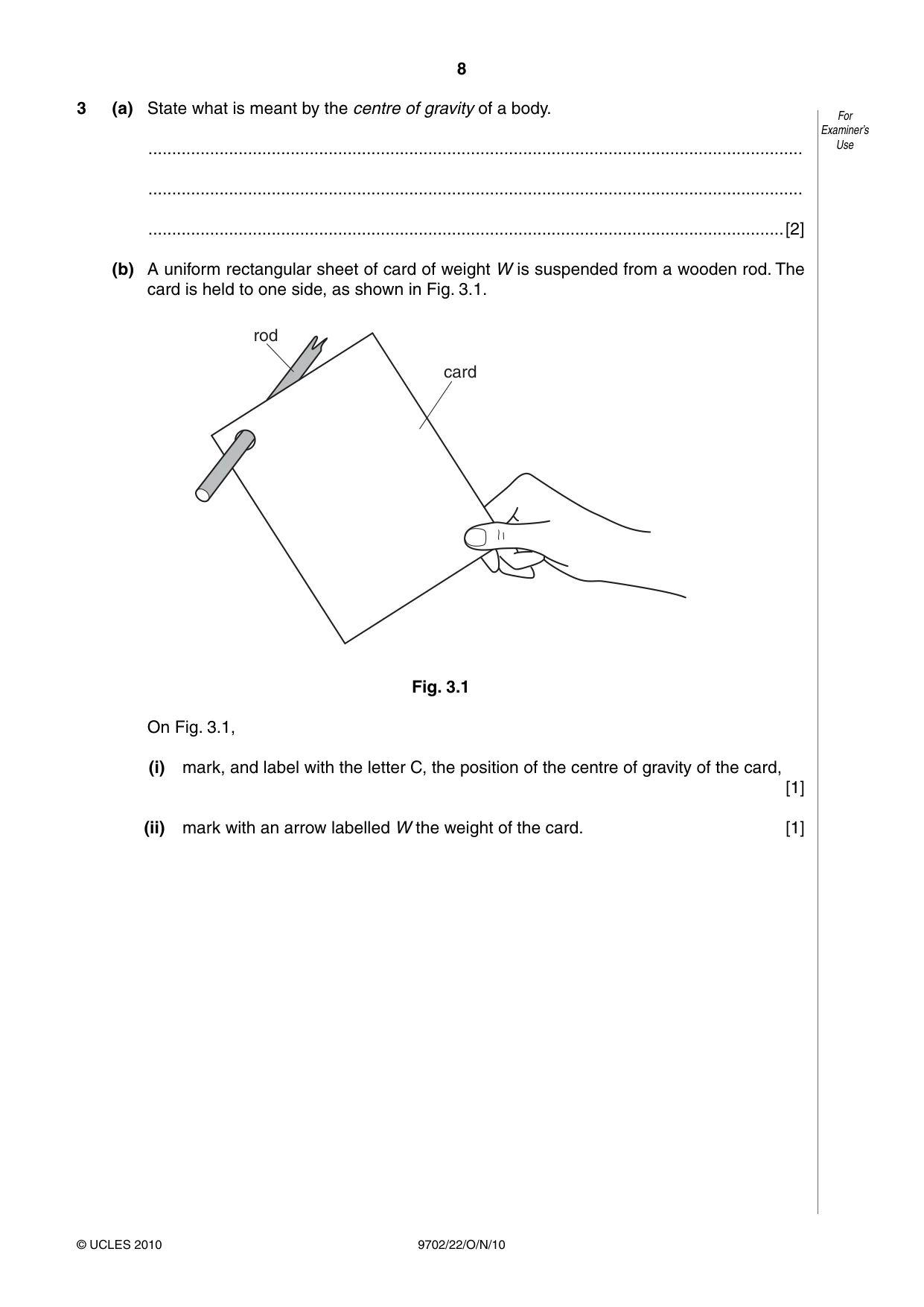
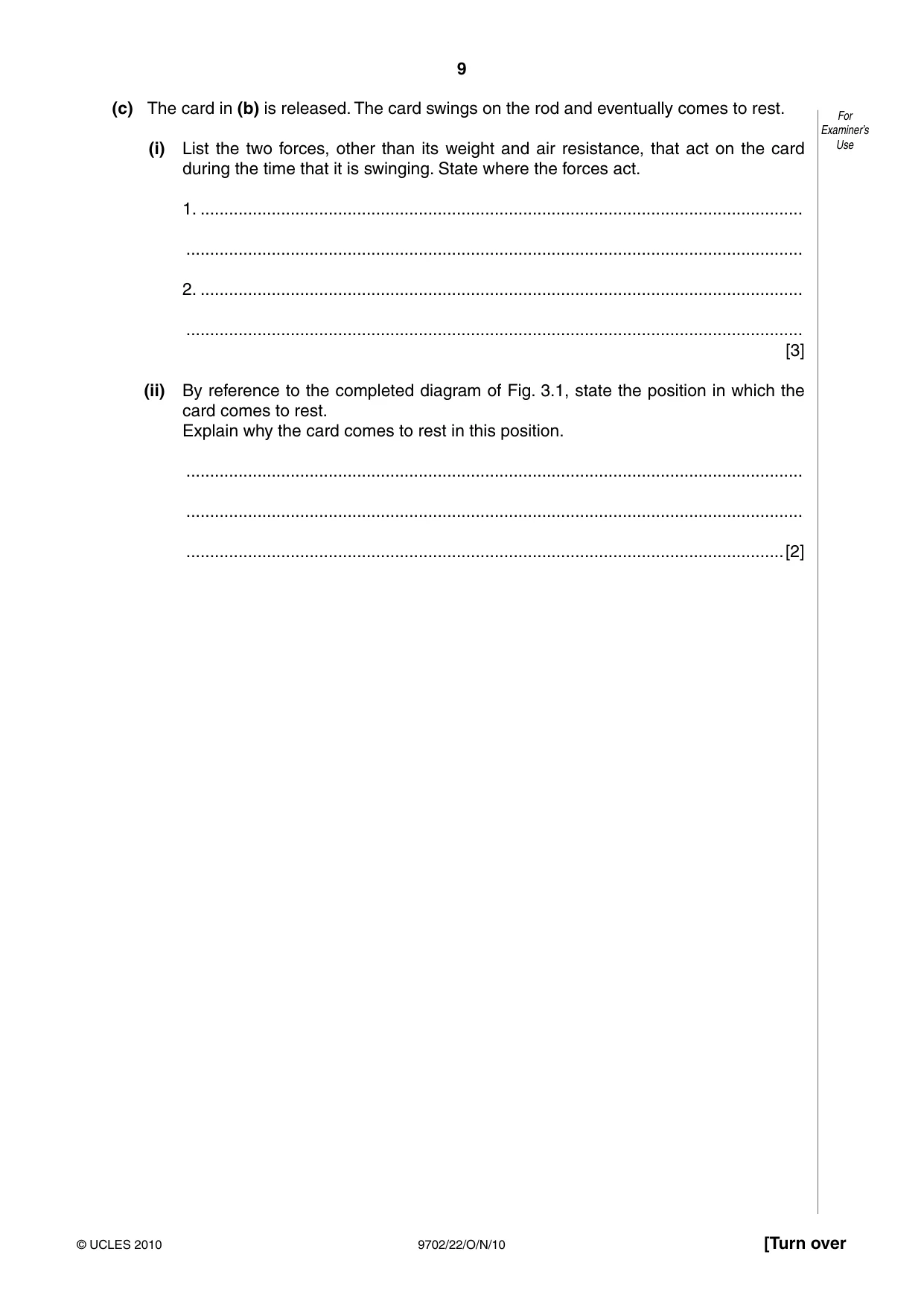
3 (a) State what is meant by the centre of gravity of a body. For Examiner’s .......................................................................................................................................... Use .......................................................................................................................................... ......................................................................................................................................[2] (b) A uniform rectangular sheet of card of weight W is suspended from a wooden rod. The card is held to one side, as shown in Fig. 3.1. rod card Fig. 3.1 On Fig. 3.1, (i) mark, and label with the letter C, the position of the centre of gravity of the card, [1] (ii) mark with an arrow labelled W the weight of the card. [1] (c) The card in (b) is released. The card swings on the rod and eventually comes to rest. For Examiner’s (i) List the two forces, other than its weight and air resistance, that act on the card Use during the time that it is swinging. State where the forces act. 1. ............................................................................................................................... .................................................................................................................................. 2. ............................................................................................................................... .................................................................................................................................. [3] (ii) By reference to the completed diagram of Fig. 3.1, state the position in which the card comes to rest. Explain why the card comes to rest in this position. .................................................................................................................................. .................................................................................................................................. ..............................................................................................................................[2]
Mark scheme: 3 (a) point at which (whole) weight (of body) (allow mass for weight) M1 appears / seems to act ... (for mass need ‘appears to be concentrated’) A1 [2] (b) (i) point C shown at centre of rectangle ± 5 mm B1 [1] (ii) arrow vertically downwards, from C with arrow starting from the same margin of error as in (b)(i) B1 [1] (c) (i) reaction / upwards / supporting / normal reaction force M1 friction M1 force(s) at the rod A1 [3] (ii) comes to rest with (line of action of) weight acting through rod allow C vertically below the rod B1 so that weight does not have a moment about the pivot / rod B1 [2] GCE A LEVEL – October/November 2010 9702 22
Q4 · A metal wire has spring constant k
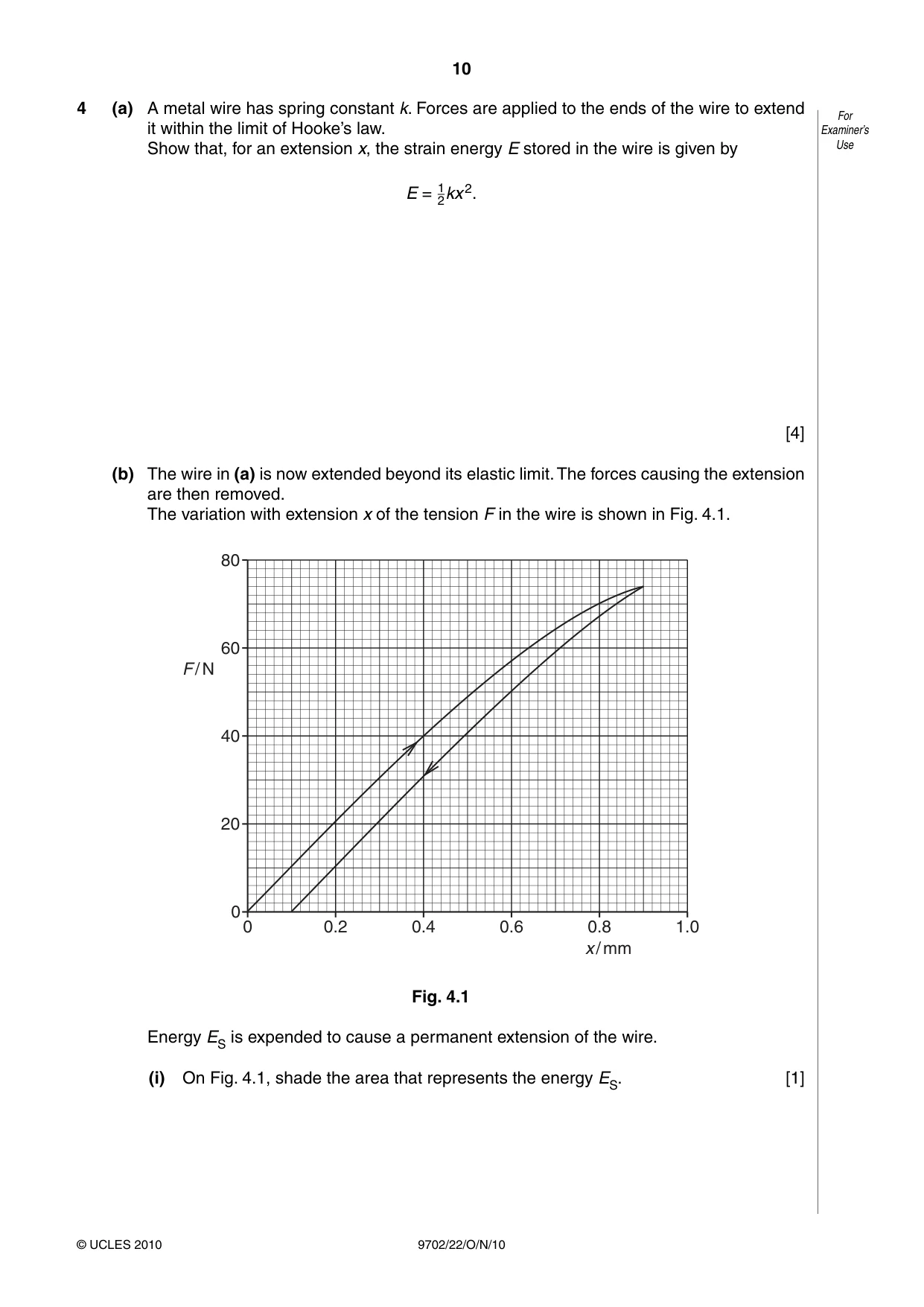
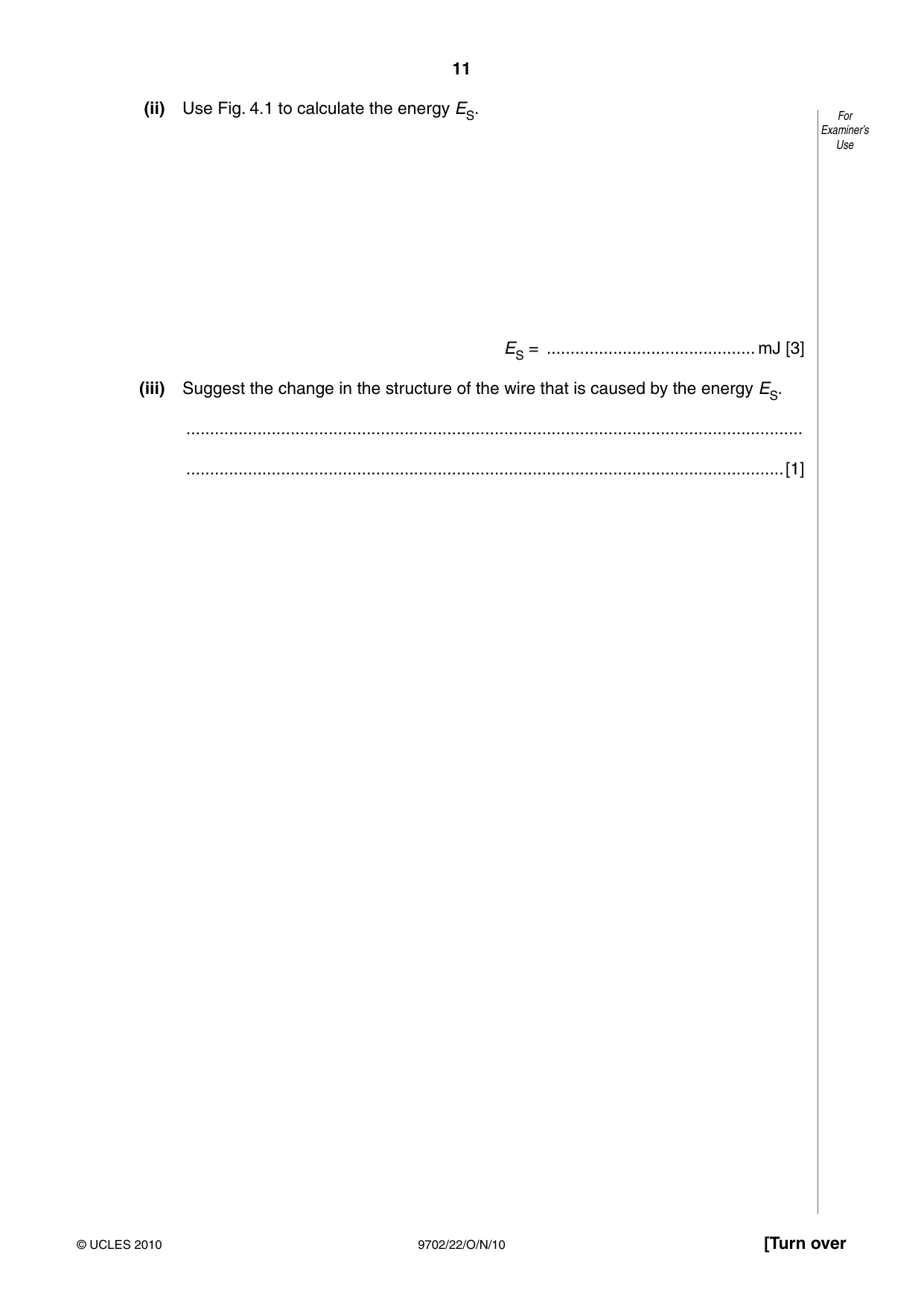
4 (a) A metal wire has spring constant k. Forces are applied to the ends of the wire to extend For it within the limit of Hooke’s law. Examiner’s Show that, for an extension x, the strain energy E stored in the wire is given by Use E = 12kx 2. [4] (b) The wire in (a) is now extended beyond its elastic limit. The forces causing the extension are then removed. The variation with extension x of the tension F in the wire is shown in Fig. 4.1. 80 60 F / N 40 20 0 0 0.2 0.4 0.6 0.8 1.0 x / mm Fig. 4.1 Energy ES is expended to cause a permanent extension of the wire. (i) On Fig. 4.1, shade the area that represents the energy ES. [1] (ii) Use Fig. 4.1 to calculate the energy ES. For Examiner’s Use ES = ............................................ mJ [3] (iii) Suggest the change in the structure of the wire that is caused by the energy ES. .................................................................................................................................. ..............................................................................................................................[1]
Mark scheme: 4 (a) energy = average force × extension B1 = ½ × F × x B1 (Hooke’s law) extension proportional to (applied) force B1 hence F = kx B1 so E = ½kx2 A0 [4] (b) (i) correct area shaded B1 [1] (ii) 1.0 cm2 represents 1.0 mJ or correct units used in calculation C1 ES = 6.4 ± 0.2 mJ A2 [3] (for answer > ±0.2 mJ but ≤ ±0.4 mJ, then allow 2/3 marks) (iii) arrangement of atoms / molecules is changed B1 [1]
Q5 · A student is studying a water wave in which all the wavefronts are parallel to one another
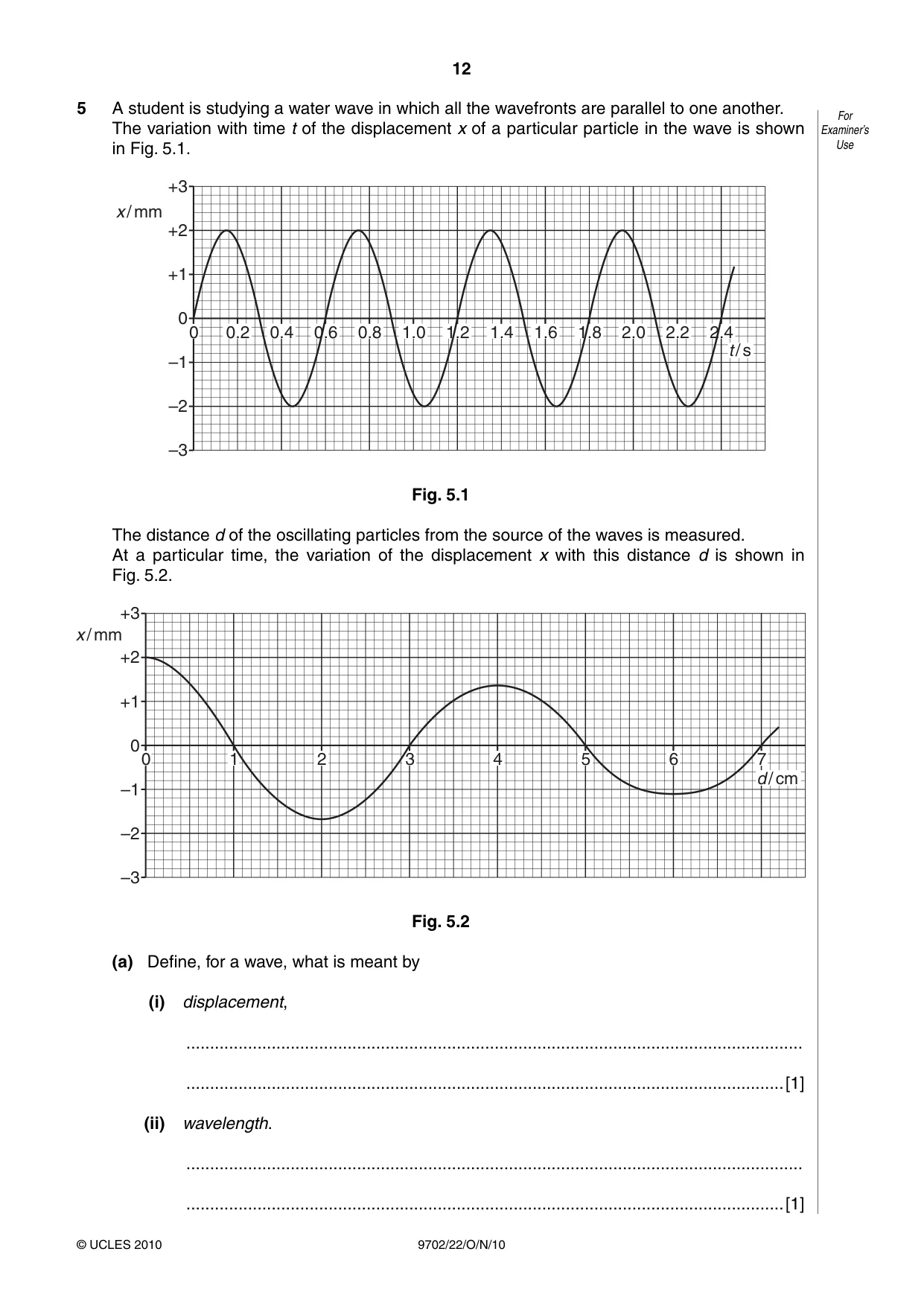
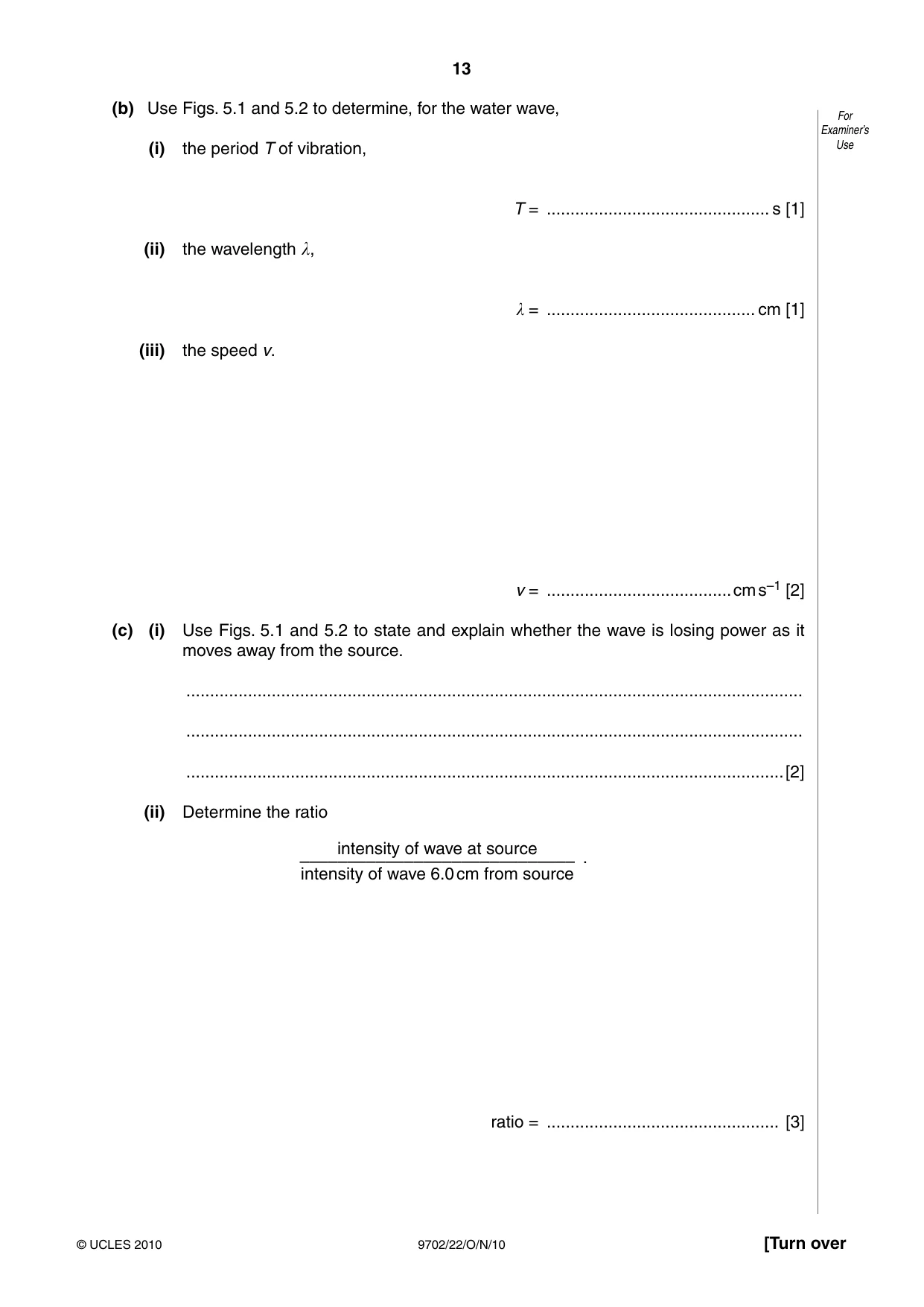
5 A student is studying a water wave in which all the wavefronts are parallel to one another. For The variation with time t of the displacement x of a particular particle in the wave is shown Examiner’s in Fig. 5.1. Use +3 x / mm +2 +1 0 0 0.2 0.4 0.6 0.8 1.0 1.2 1.4 1.6 1.8 2.0 2.2 2.4 t / s –1 –2 –3 Fig. 5.1 The distance d of the oscillating particles from the source of the waves is measured. At a particular time, the variation of the displacement x with this distance d is shown in Fig. 5.2. +3 x / mm +2 +1 0 0 1 2 3 4 5 6 7 d / cm –1 –2 –3 Fig. 5.2 (a) Define, for a wave, what is meant by (i) displacement, .................................................................................................................................. ..............................................................................................................................[1] (ii) wavelength. .................................................................................................................................. ..............................................................................................................................[1] (b) Use Figs. 5.1 and 5.2 to determine, for the water wave, For Examiner’s (i) the period T of vibration, Use T = ............................................... s [1] (ii) the wavelength k, k = ............................................ cm [1] (iii) the speed v. v = .......................................cm s–1 [2] (c) (i) Use Figs. 5.1 and 5.2 to state and explain whether the wave is losing power as it moves away from the source. .................................................................................................................................. .................................................................................................................................. ..............................................................................................................................[2] (ii) Determine the ratio . ratio = ................................................. [3]
Mark scheme: 5 (a) (i) distance (of point on wave) from rest / equilibrium position B1 [1] (ii) distance moved by wave energy / wavefront during one cycle of the source or minimum distance between two points with the same phase or between adjacent crests or troughs B1 [1] (b) (i) T = 0.60 s B1 [1] (ii) λ = 4.0 cm B1 [1] (iii) either v = λ/T or v = fλ and f = 1/T C1 v = 6.7 cm s–1 A1 [2] (c) (i) amplitude is decreasing M1 so, it is losing power A1 [2] (ii) intensity ~ (amplitude)2 C1 ratio = 2.02 / 1.12 C1 = 3.3 A1 [3]
Q6 · The variation with temperature of the resistance RT of a thermistor is shown in Fig
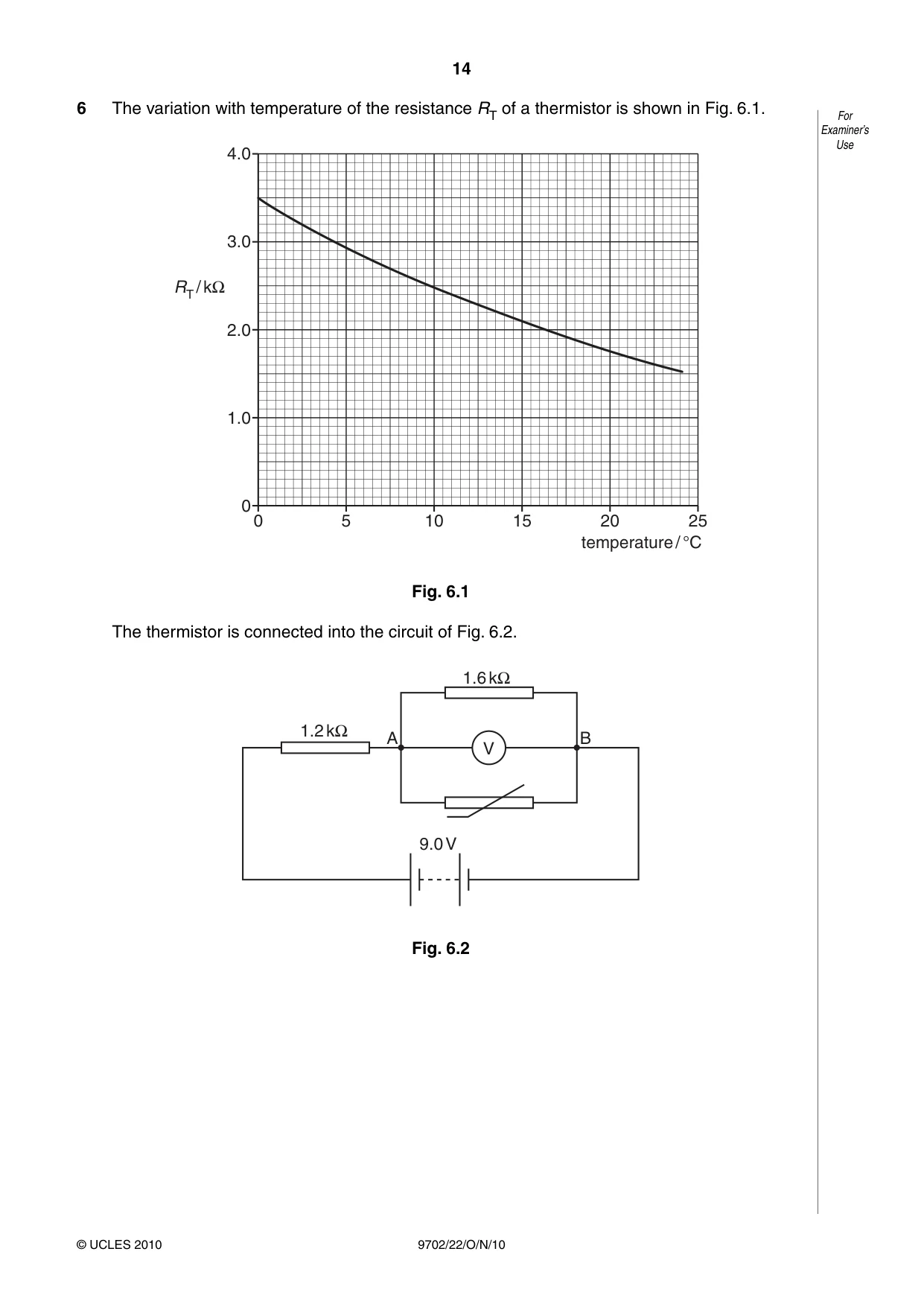
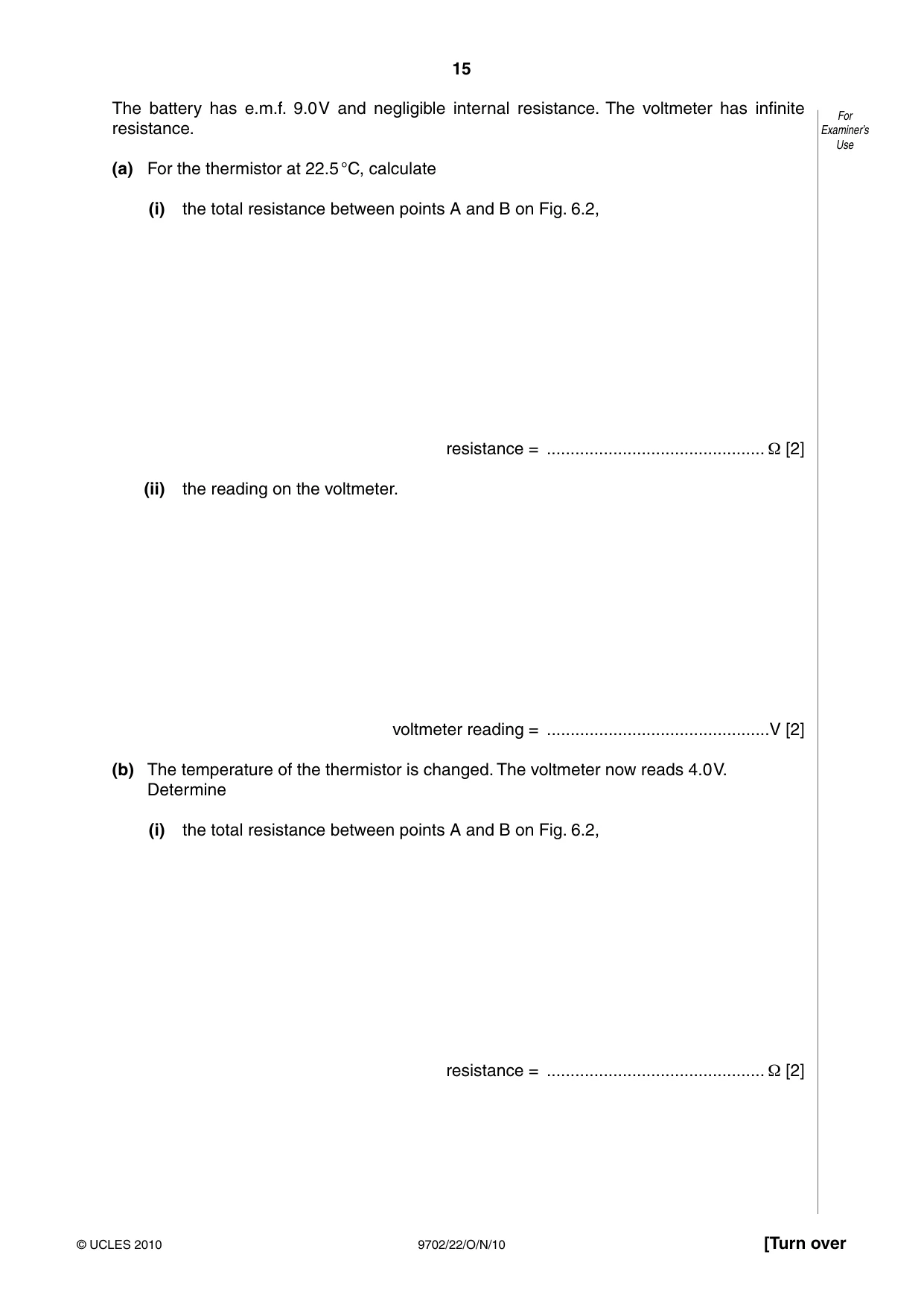
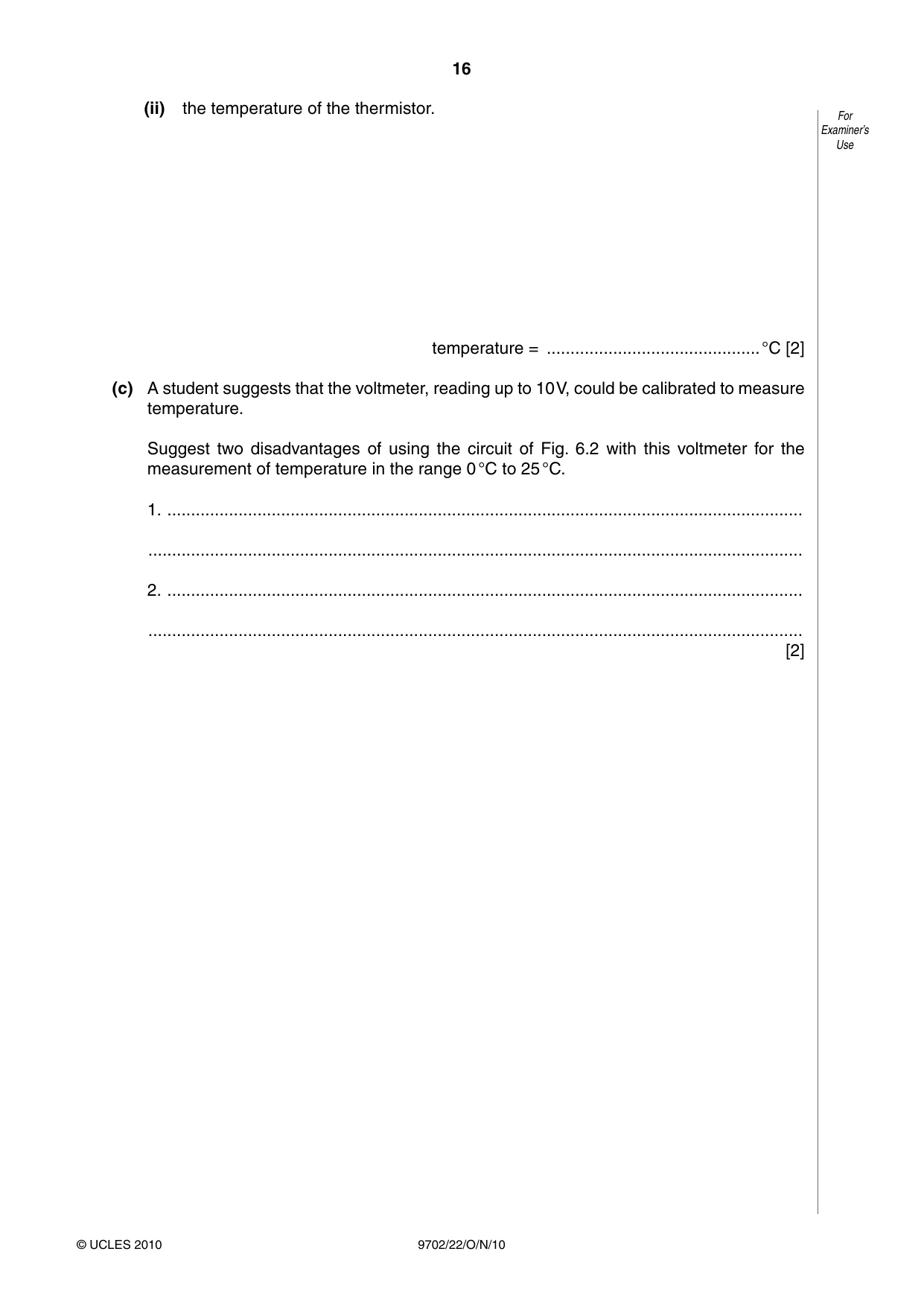
6 The variation with temperature of the resistance RT of a thermistor is shown in Fig. 6.1. For Examiner’s Use 4.0 3.0 RT / kΩ 2.0 1.0 0 0 5 10 15 20 25 temperature / °C Fig. 6.1 The thermistor is connected into the circuit of Fig. 6.2. 1.6 kΩ 1.2 kΩ A B V 9.0 V Fig. 6.2 The battery has e.m.f. 9.0 V and negligible internal resistance. The voltmeter has infinite For resistance. Examiner’s Use (a) For the thermistor at 22.5 °C, calculate (i) the total resistance between points A and B on Fig. 6.2, resistance = .............................................. Ω [2] (ii) the reading on the voltmeter. voltmeter reading = ...............................................V [2] (b) The temperature of the thermistor is changed. The voltmeter now reads 4.0 V. Determine (i) the total resistance between points A and B on Fig. 6.2, resistance = .............................................. Ω [2] (ii) the temperature of the thermistor. For Examiner’s Use temperature = .............................................°C [2] (c) A student suggests that the voltmeter, reading up to 10 V, could be calibrated to measure temperature. Suggest two disadvantages of using the circuit of Fig. 6.2 with this voltmeter for the measurement of temperature in the range 0 °C to 25 °C. 1. ...................................................................................................................................... .......................................................................................................................................... 2. ...................................................................................................................................... .......................................................................................................................................... [2]
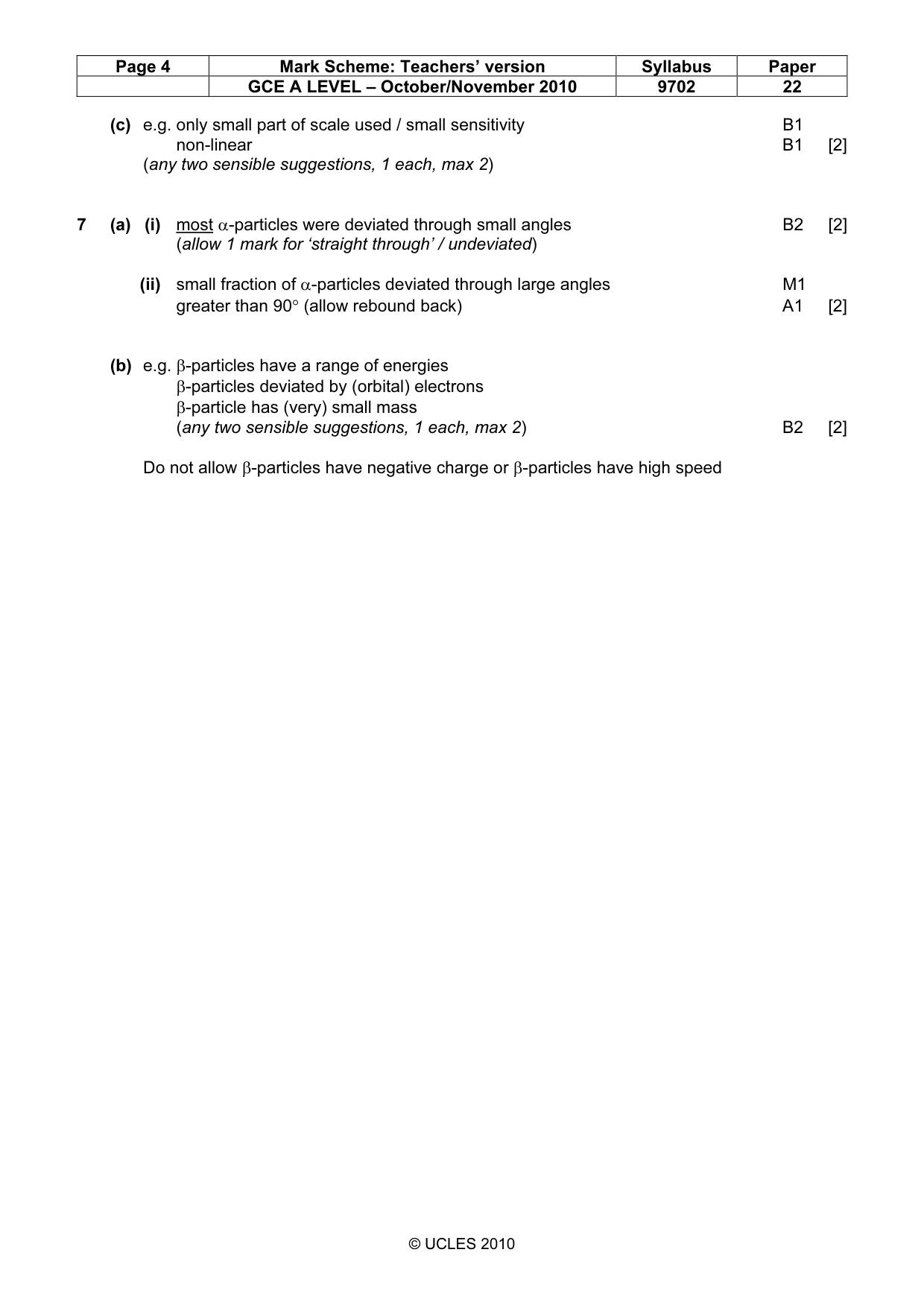
Mark scheme: 6 (a) (i) at 22.5 °C, RT = 1600 Ω or 1.6 kΩ C1 total resistance = 800 Ω A1 [2] (ii) either use of potential divider formula or current = 9 / 2000 (4.5 mA) C1 V = (0.8/2.0) × 9 V = (9/2000) × 800 = 3.6 V = 3.6 V A1 [2] (b) (i) total resistance = 4/5 × 1200 C1 = 960 Ω A1 [2] (ii) for parallel combination, 1/960 = 1/1600 + 1/RT RT = 2400 Ω / 2.4 kΩ C1 temperature = 11 °C A1 [2] GCE A LEVEL – October/November 2010 9702 22 (c) e.g. only small part of scale used / small sensitivity B1 non-linear B1 [2] (any two sensible suggestions, 1 each, max 2)
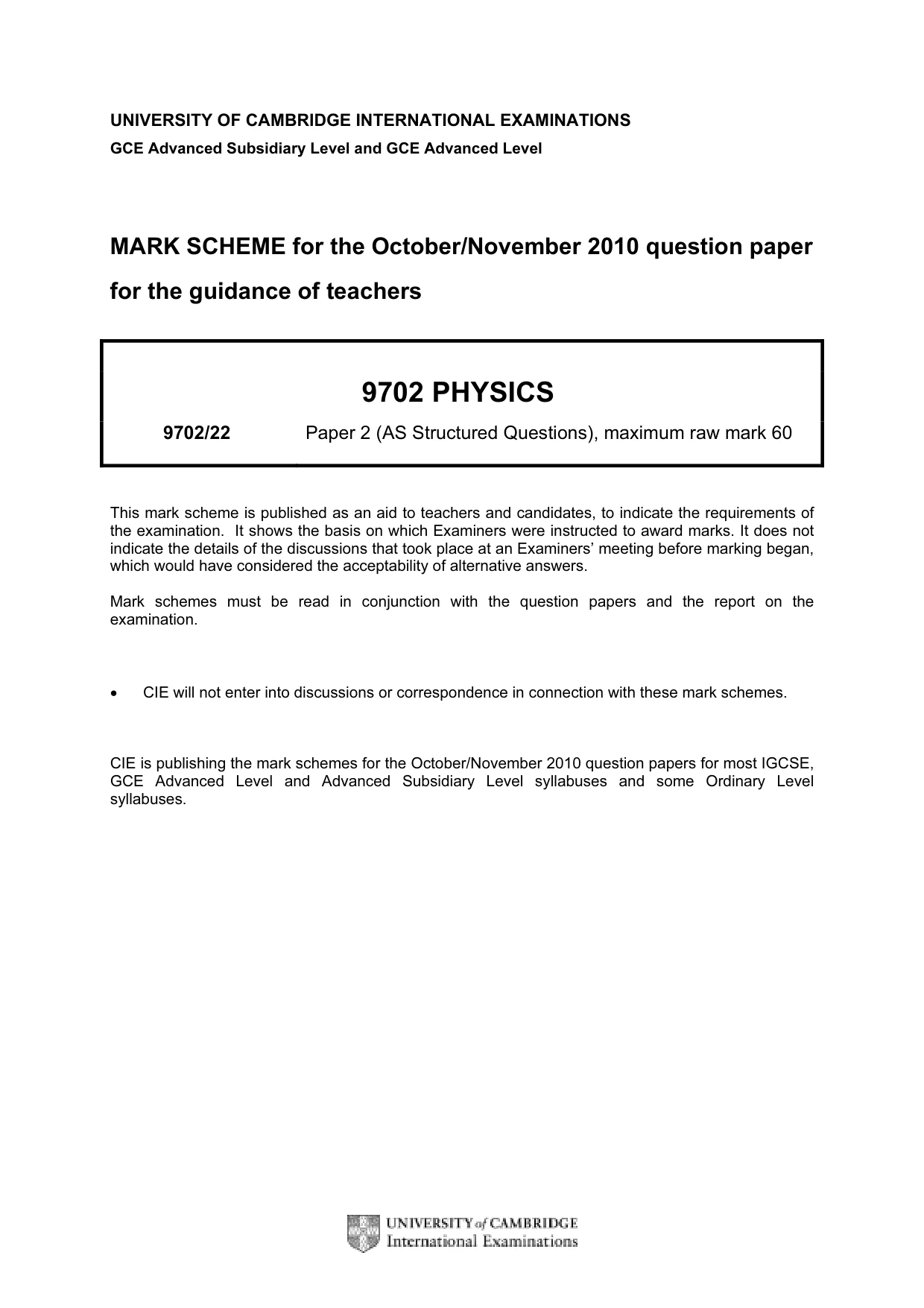
Q7 · The results of the a-particle scattering experiment provided evidence for the existence…
7 The results of the a-particle scattering experiment provided evidence for the existence and For small size of the nucleus. Examiner’s Use (a) State the result that provided evidence for (i) the small size of the nucleus, compared with the atom, .................................................................................................................................. .................................................................................................................................. ..............................................................................................................................[2] (ii) the nucleus being charged and containing the majority of the mass of the atom. .................................................................................................................................. .................................................................................................................................. ..............................................................................................................................[2] (b) The a-particles in this experiment originated from the decay of a radioactive nuclide. Suggest two reasons why b-particles from a radioactive source would be inappropriate for this type of scattering experiment. 1. ...................................................................................................................................... .......................................................................................................................................... 2. ...................................................................................................................................... .......................................................................................................................................... [2]
Mark scheme: 7 (a) (i) most α-particles were deviated through small angles B2 [2] (allow 1 mark for ‘straight through’ / undeviated) (ii) small fraction of α-particles deviated through large angles M1 greater than 90° (allow rebound back) A1 [2] (b) e.g. β-particles have a range of energies β-particles deviated by (orbital) electrons β-particle has (very) small mass (any two sensible suggestions, 1 each, max 2) B2 [2] Do not allow β-particles have negative charge or β-particles have high speed
What was in this paper
The subtopics covered by these 7 questions, and how many questions each got. Open one in a new tab to see every Cambridge question on it.
What you needed in this session
Cambridge’s own grade thresholds for 2010 Oct/Nov, Paper 2 · Variant 2. A higher threshold means an easier paper — the bar moves with how the cohort did.