Cambridge A Level Physics 9702 — 2020 May/June Paper 2 · Variant 2
9702/22/M/J/20 · 7 questions · 60 marks · ≈68 min
The question paper and its mark scheme, free to read here and free to download. This is Cambridge’s own paper, exactly as it was sat.
Question paper16 pages

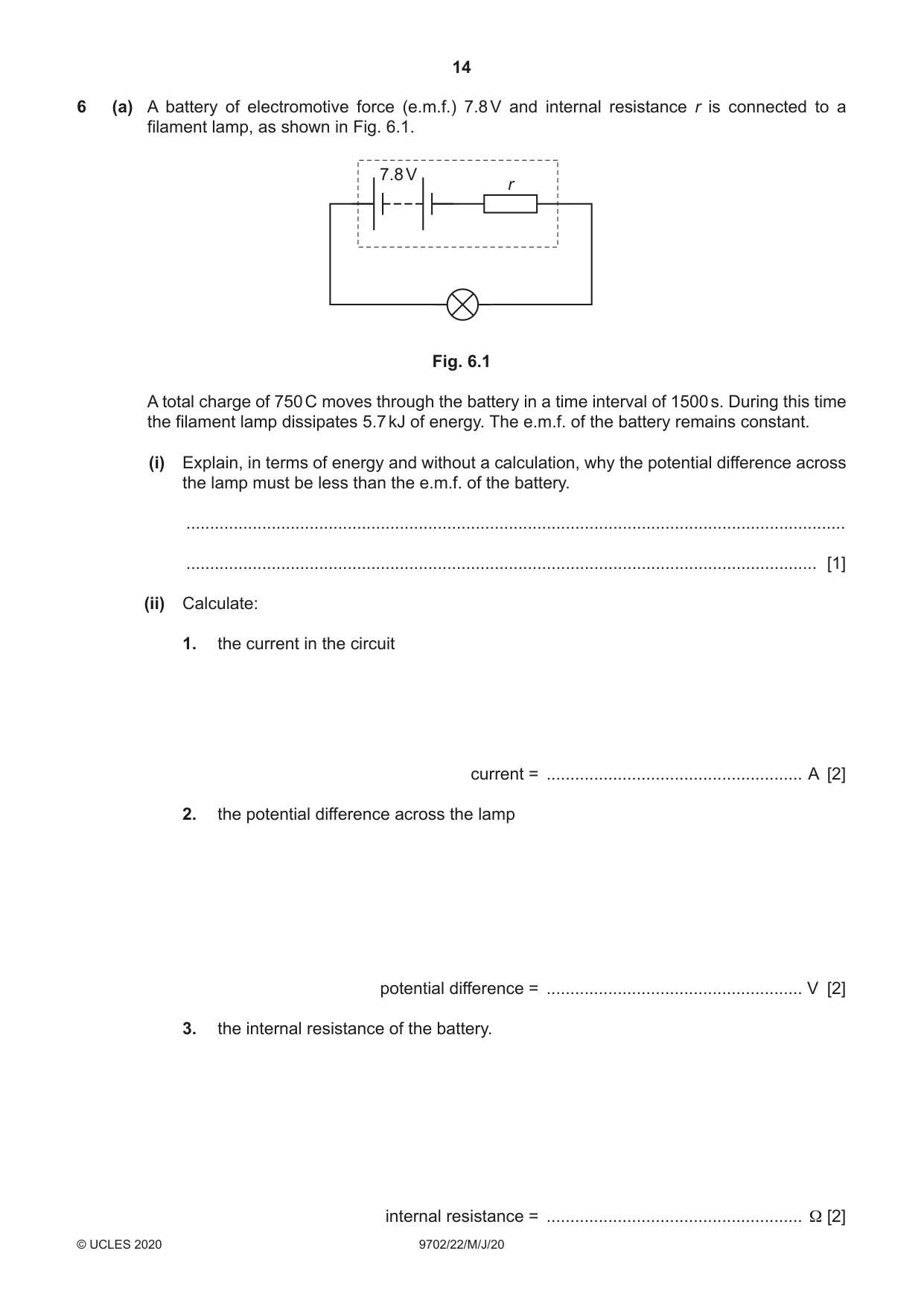
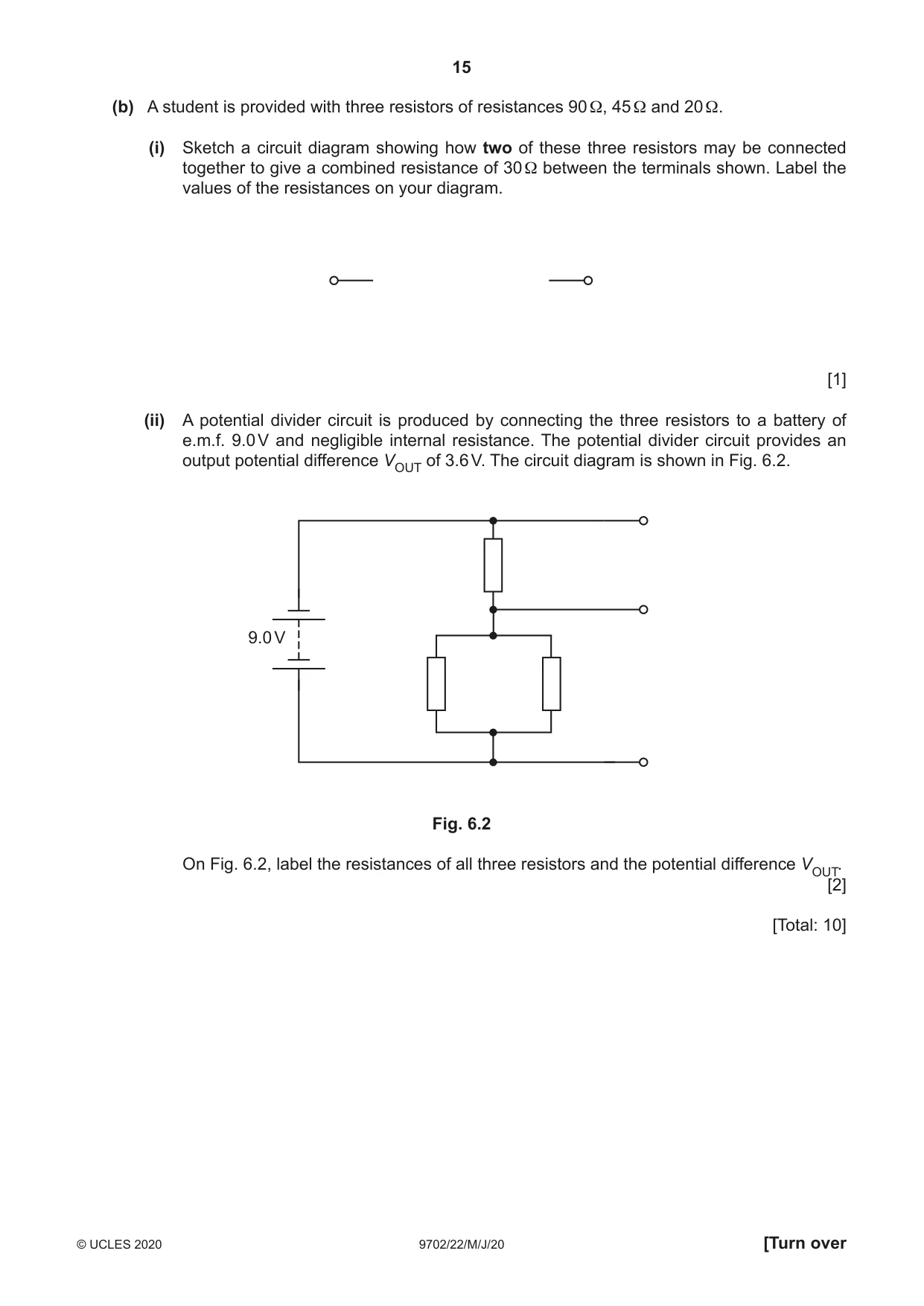
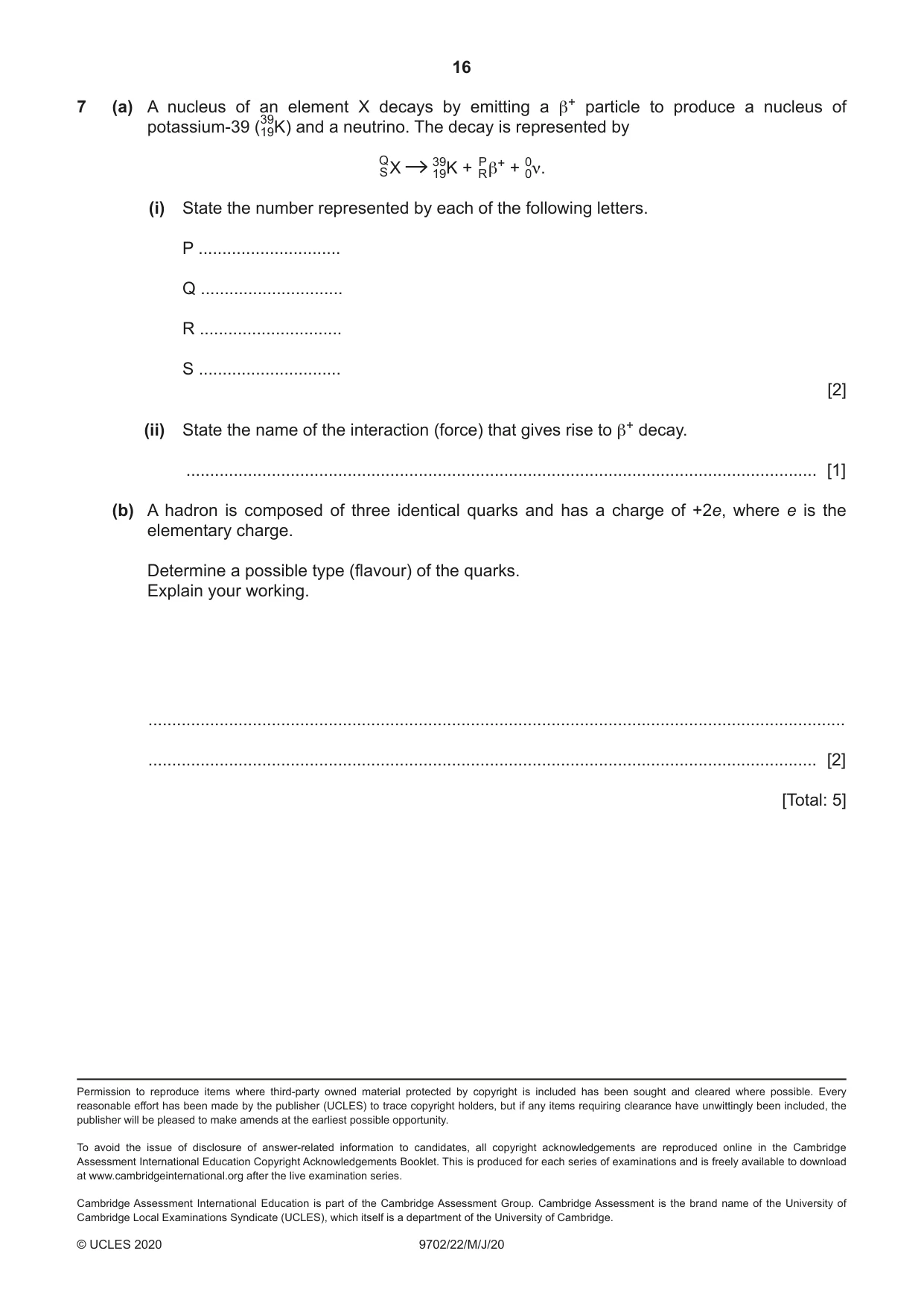
Mark scheme14 pages
Answers below. Sit the paper first if you are practising.
Questions as text
Question 1
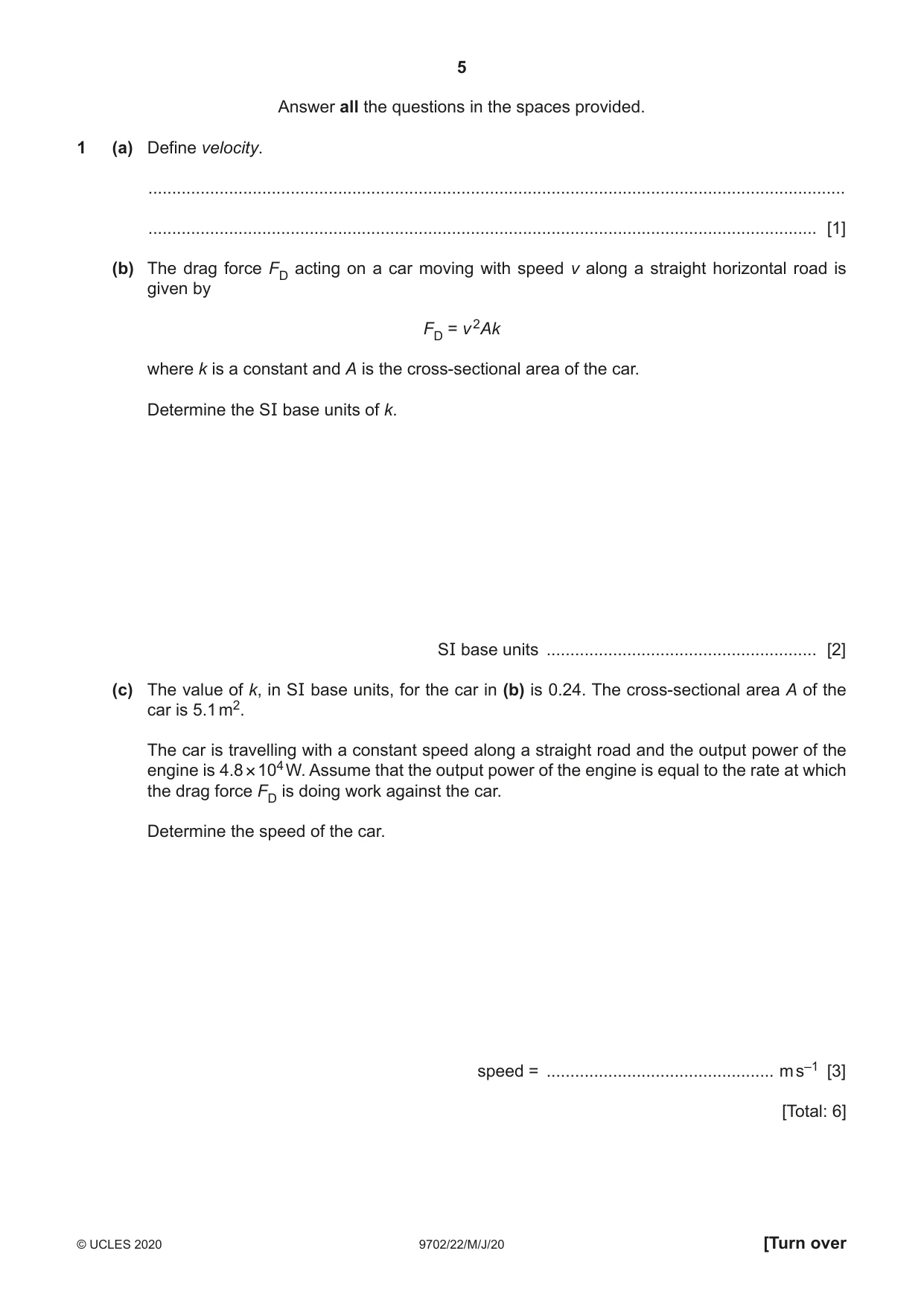
1 (a) Define velocity. ................................................................................................................................................... ............................................................................................................................................. [1] (b) The drag force FD acting on a car moving with speed v along a straight horizontal road is given by FD = v 2Ak where k is a constant and A is the cross-sectional area of the car. Determine the SI base units of k. SI base units ......................................................... [2] (c) The value of k, in SI base units, for the car in (b) is 0.24. The cross-sectional area A of the car is 5.1 m2. The car is travelling with a constant speed along a straight road and the output power of the engine is 4.8 × 10⁴ W. Assume that the output power of the engine is equal to the rate at which the drag force FD is doing work against the car. Determine the speed of the car. speed = ................................................ m s–1 [3] [Total: 6]
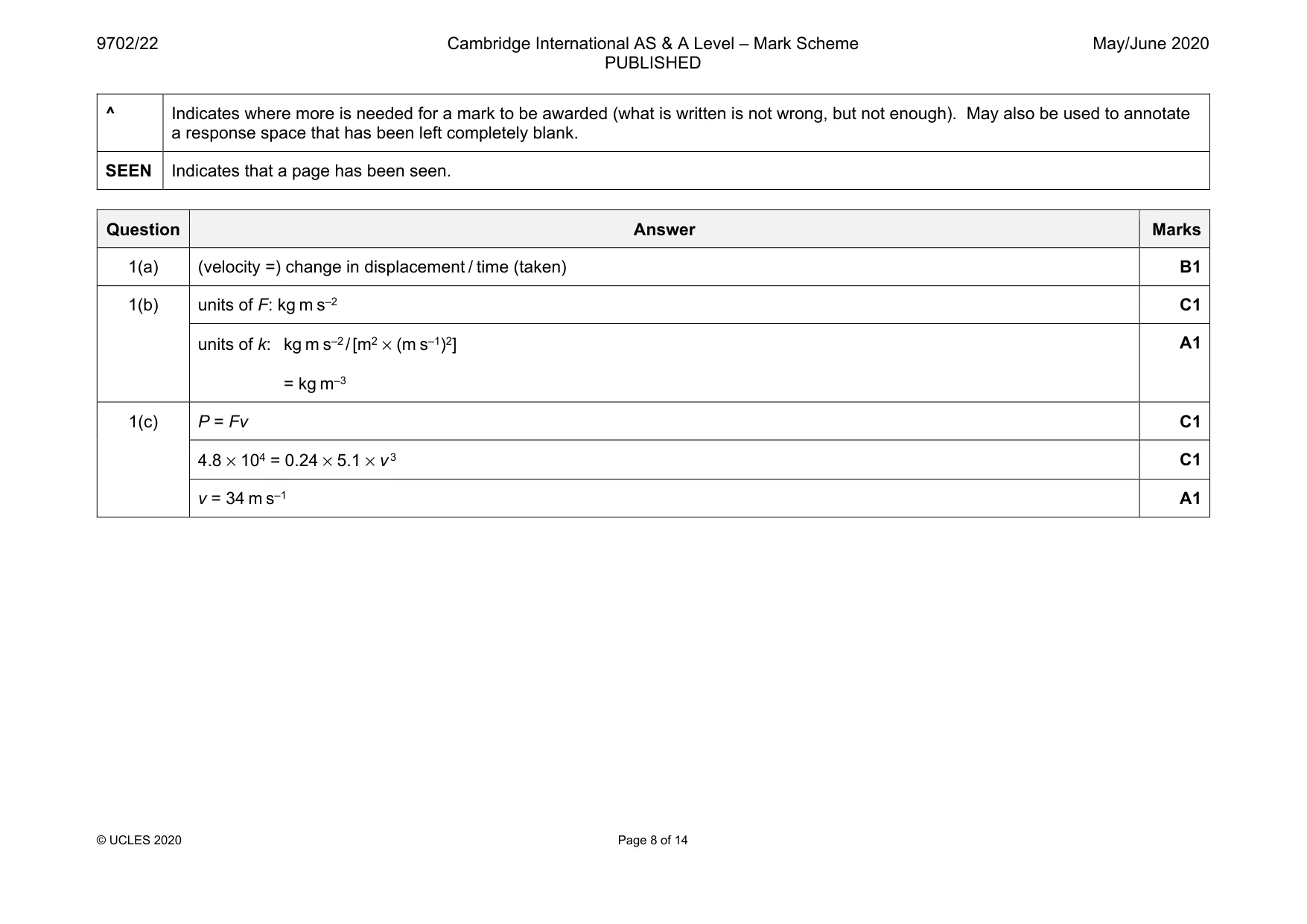
Mark scheme: 1(a) (velocity =) change in displacement / time (taken) B1 1(b) units of F: kg m s–2 C1 units of k: kg m s–2 / [m2 × (m s–1)2] = kg m–3 A1 1(c) P = Fv C1 4.8 × 104 = 0.24 × 5.1 × v 3 C1 v = 34 m s–1 A1
Q2 · The velocity–time graph for an object moving in a straight line
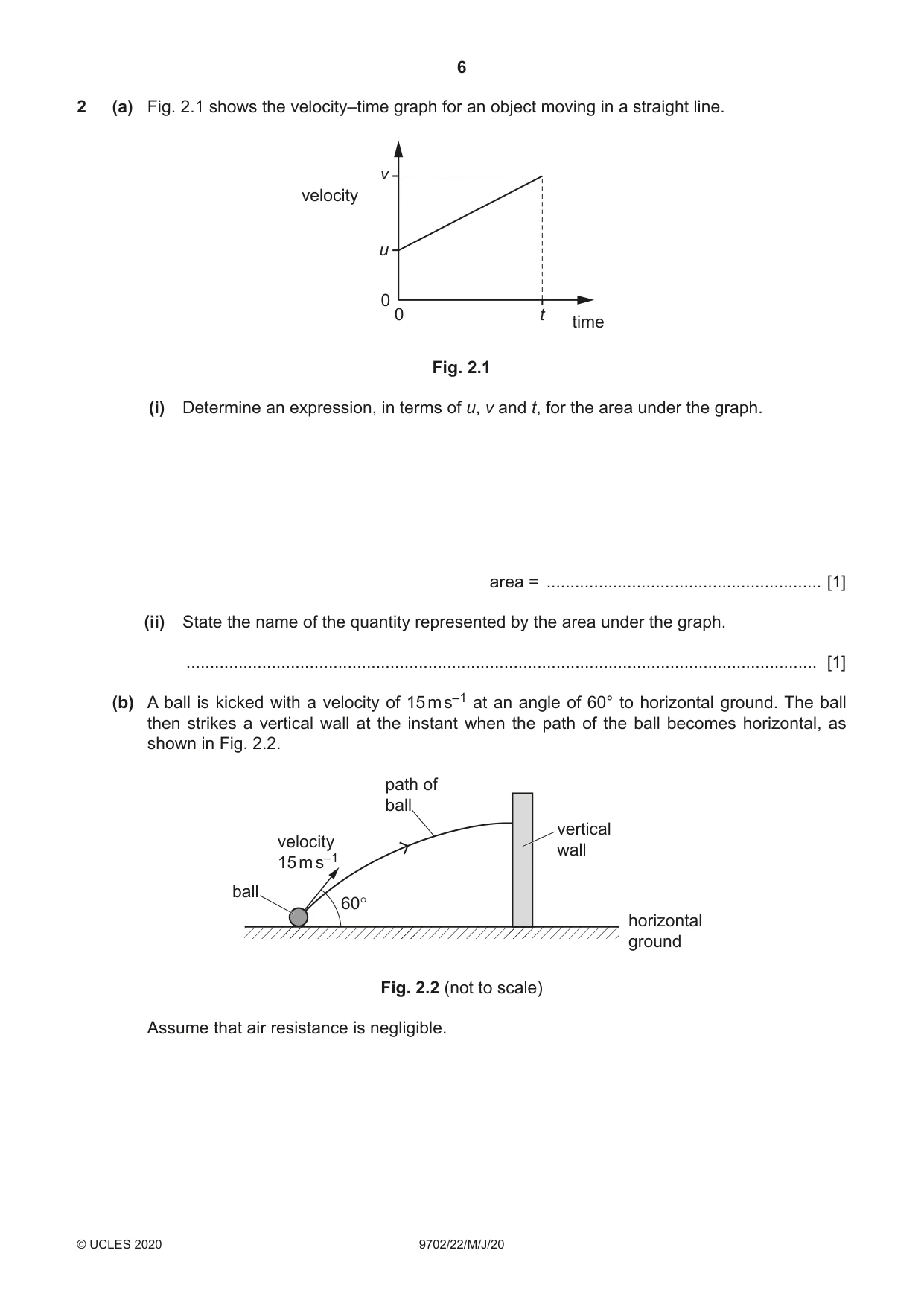
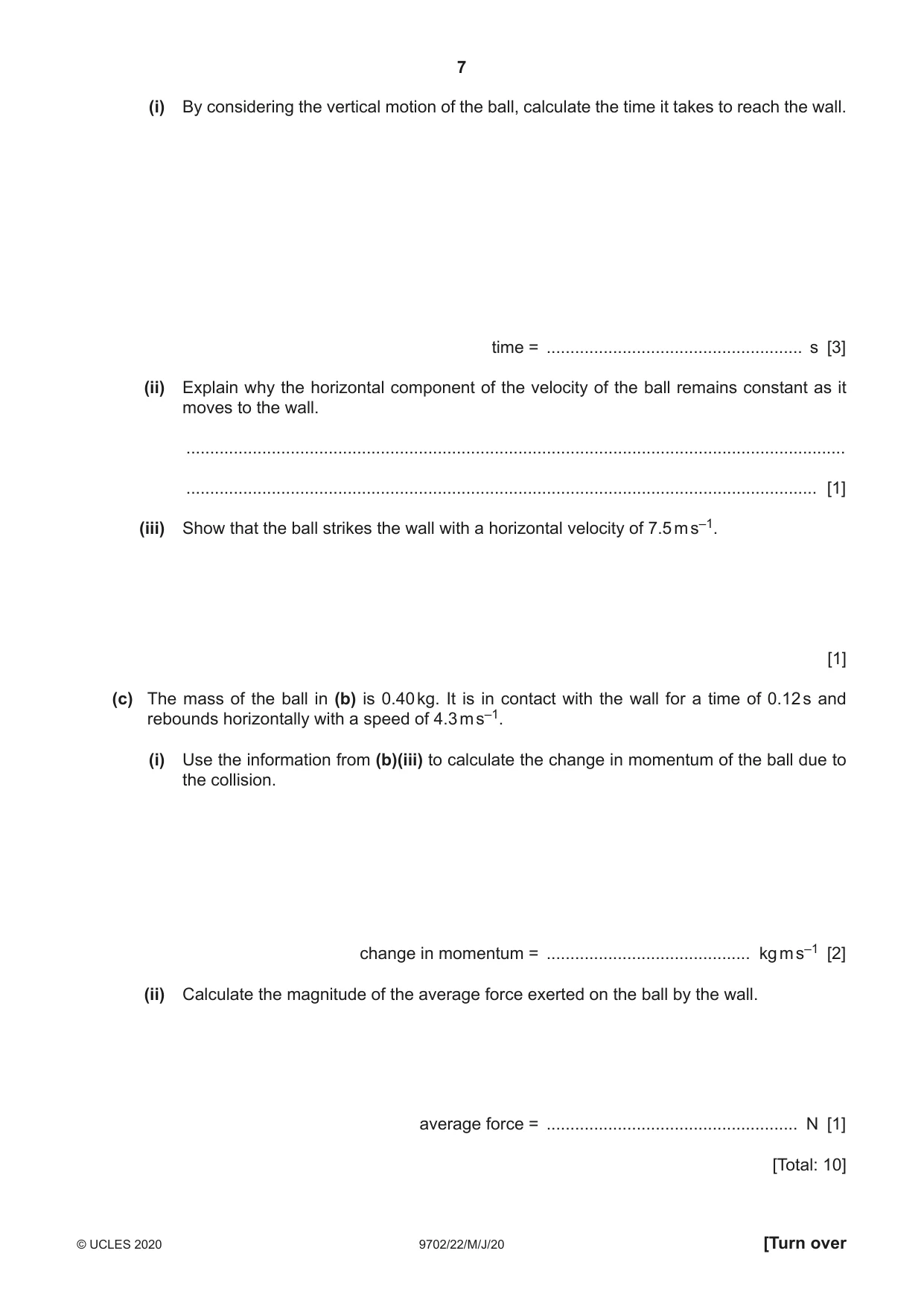
2 (a) Fig. 2.1 shows the velocity–time graph for an object moving in a straight line. v velocity u 0 0 t time Fig. 2.1 (i) Determine an expression, in terms of u, v and t, for the area under the graph. area = .......................................................... [1] (ii) State the name of the quantity represented by the area under the graph. ..................................................................................................................................... [1] (b) A ball is kicked with a velocity of 15 m s–1 at an angle of 60° to horizontal ground. The ball then strikes a vertical wall at the instant when the path of the ball becomes horizontal, as shown in Fig. 2.2. path of ball vertical velocity wall 15 m s–1 ball 60° horizontal ground Fig. 2.2 (not to scale) Assume that air resistance is negligible. (i) By considering the vertical motion of the ball, calculate the time it takes to reach the wall. time = ...................................................... s [3] (ii) Explain why the horizontal component of the velocity of the ball remains constant as it moves to the wall. ........................................................................................................................................... ..................................................................................................................................... [1] (iii) Show that the ball strikes the wall with a horizontal velocity of 7.5 m s–1. [1] (c) The mass of the ball in (b) is 0.40 kg. It is in contact with the wall for a time of 0.12 s and rebounds horizontally with a speed of 4.3 m s–1. (i) Use the information from (b)(iii) to calculate the change in momentum of the ball due to the collision. change in momentum = ........................................... kg m s–1 [2] (ii) Calculate the magnitude of the average force exerted on the ball by the wall. average force = ..................................................... N [1] [Total: 10]
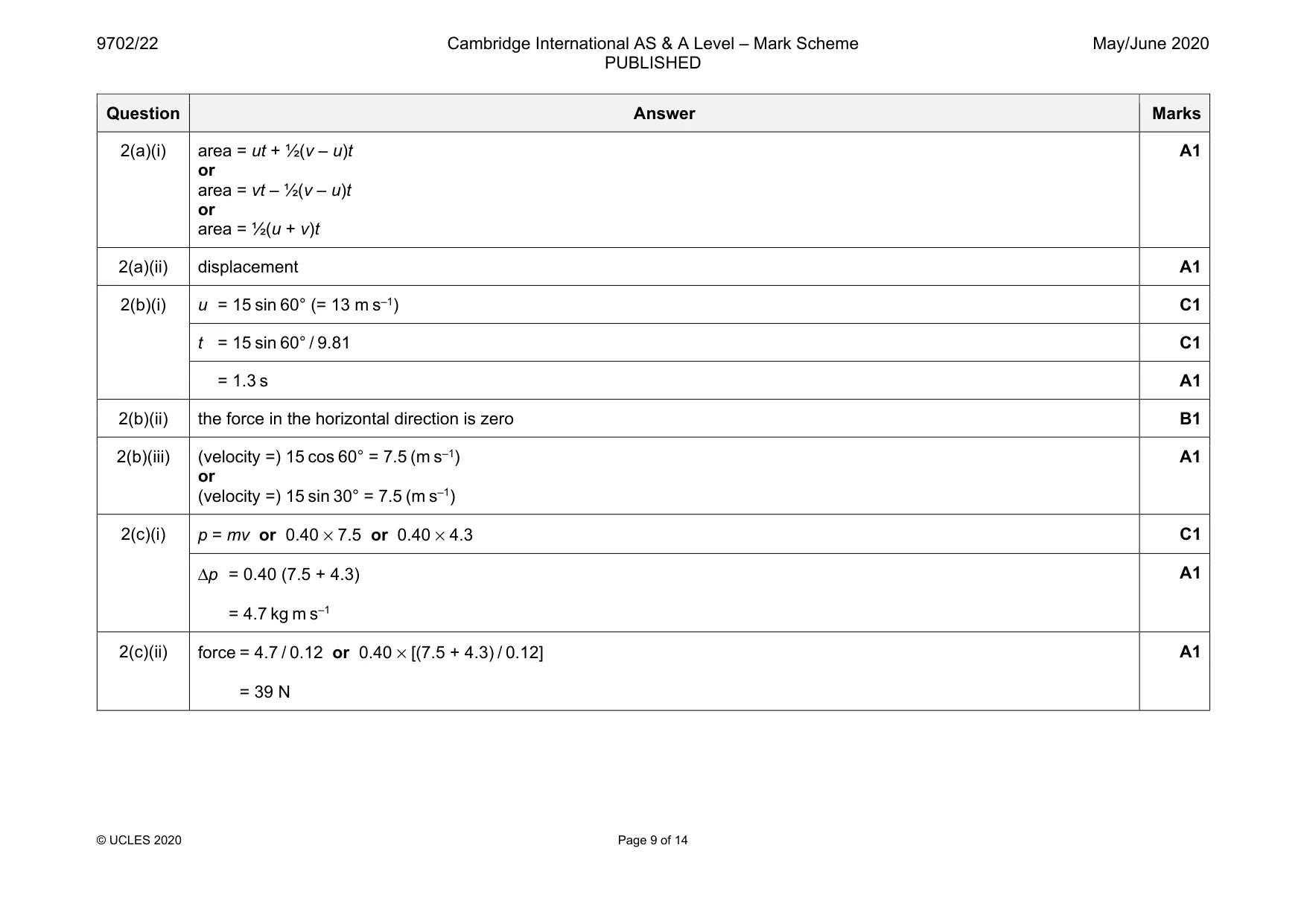
Mark scheme: 2(a)(i) area = ut + ½(v – u)t or area = vt – ½(v – u)t or area = ½(u + v)t 2(a)(ii) displacement A1 2(b)(i) u = 15 sin 60° (= 13 m s–1) C1 t = 15 sin 60° / 9.81 C1 = 1.3 s A1 2(b)(ii) the force in the horizontal direction is zero B1 2(b)(iii) (velocity =) 15 cos 60° = 7.5 (m s–1) or (velocity =) 15 sin 30° = 7.5 (m s–1) A1 2(c)(i) p = mv or 0.40 × 7.5 or 0.40 × 4.3 C1 Δp = 0.40 (7.5 + 4.3) = 4.7 kg m s–1 A1 2(c)(ii) force = 4.7 / 0.12 or 0.40 × [(7.5 + 4.3) / 0.12] = 39 N A1
Q3 · Explain what is meant by work done
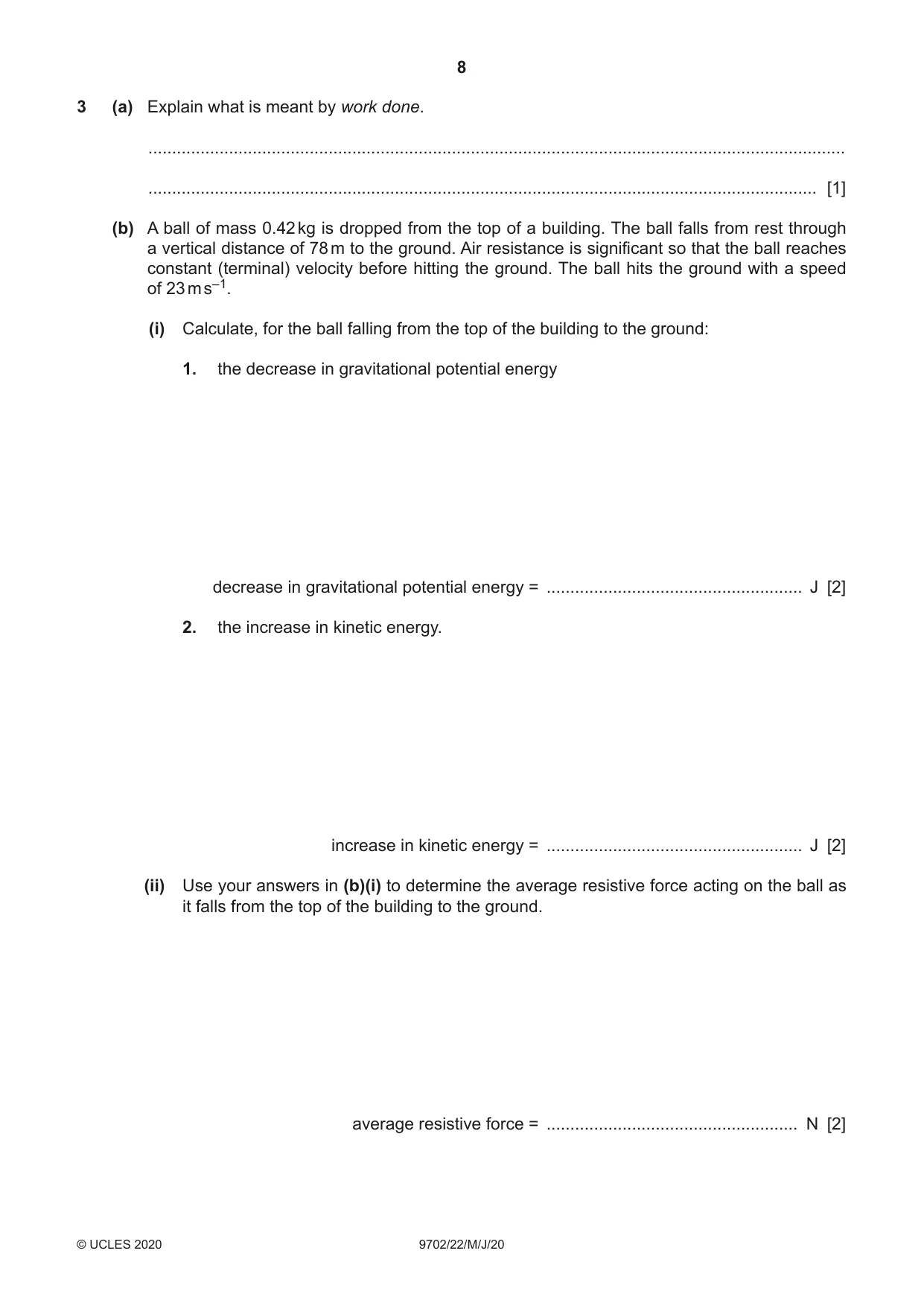
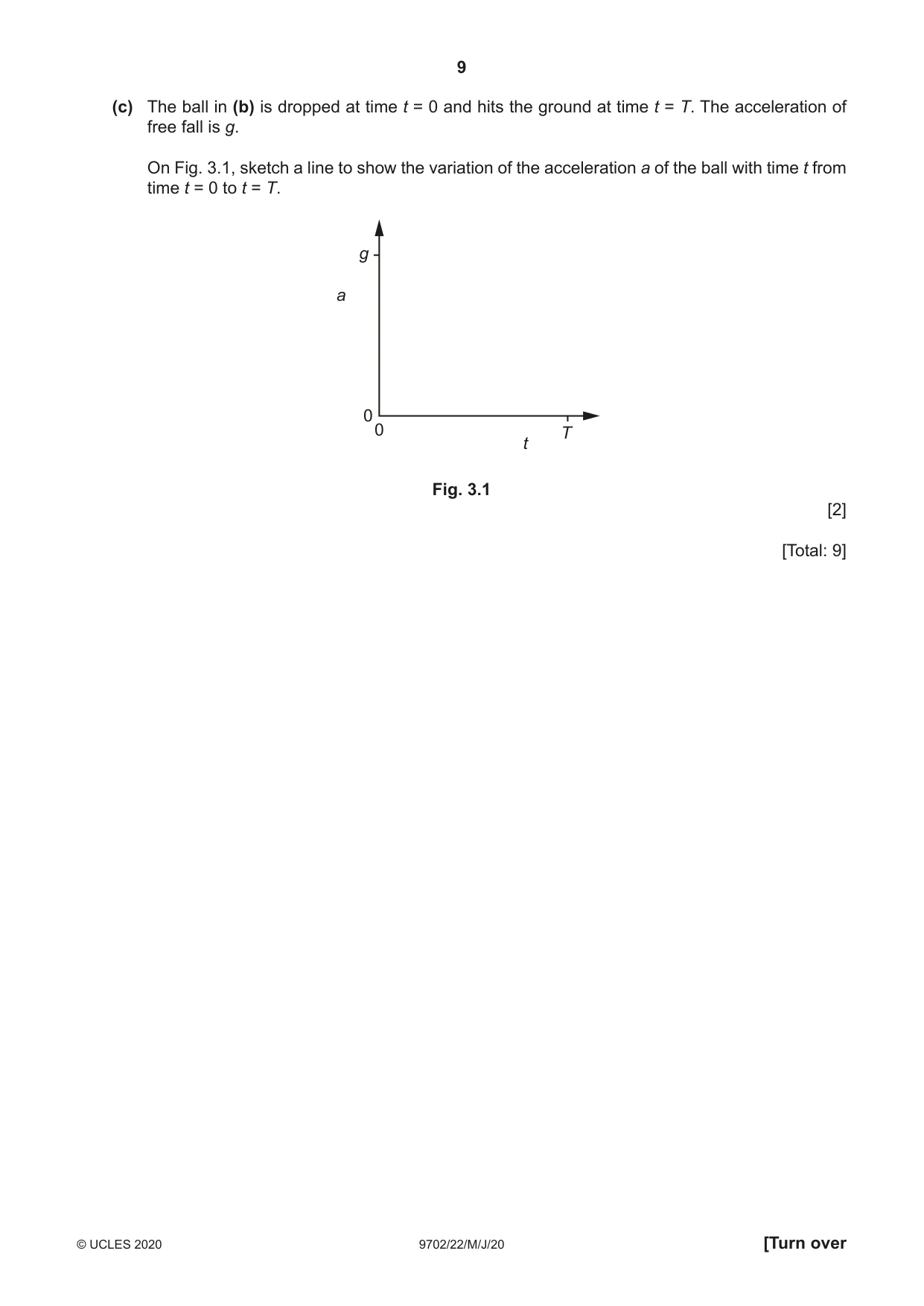
3 (a) Explain what is meant by work done. ................................................................................................................................................... ............................................................................................................................................. [1] (b) A ball of mass 0.42 kg is dropped from the top of a building. The ball falls from rest through a vertical distance of 78 m to the ground. Air resistance is significant so that the ball reaches constant (terminal) velocity before hitting the ground. The ball hits the ground with a speed of 23 m s–1. (i) Calculate, for the ball falling from the top of the building to the ground: 1. the decrease in gravitational potential energy decrease in gravitational potential energy = ...................................................... J [2] 2. the increase in kinetic energy. increase in kinetic energy = ...................................................... J [2] (ii) Use your answers in (b)(i) to determine the average resistive force acting on the ball as it falls from the top of the building to the ground. average resistive force = ..................................................... N [2] (c) The ball in (b) is dropped at time t = 0 and hits the ground at time t = T. The acceleration of free fall is g. On Fig. 3.1, sketch a line to show the variation of the acceleration a of the ball with time t from time t = 0 to t = T. g a 0 0 T t Fig. 3.1 [2] [Total: 9]
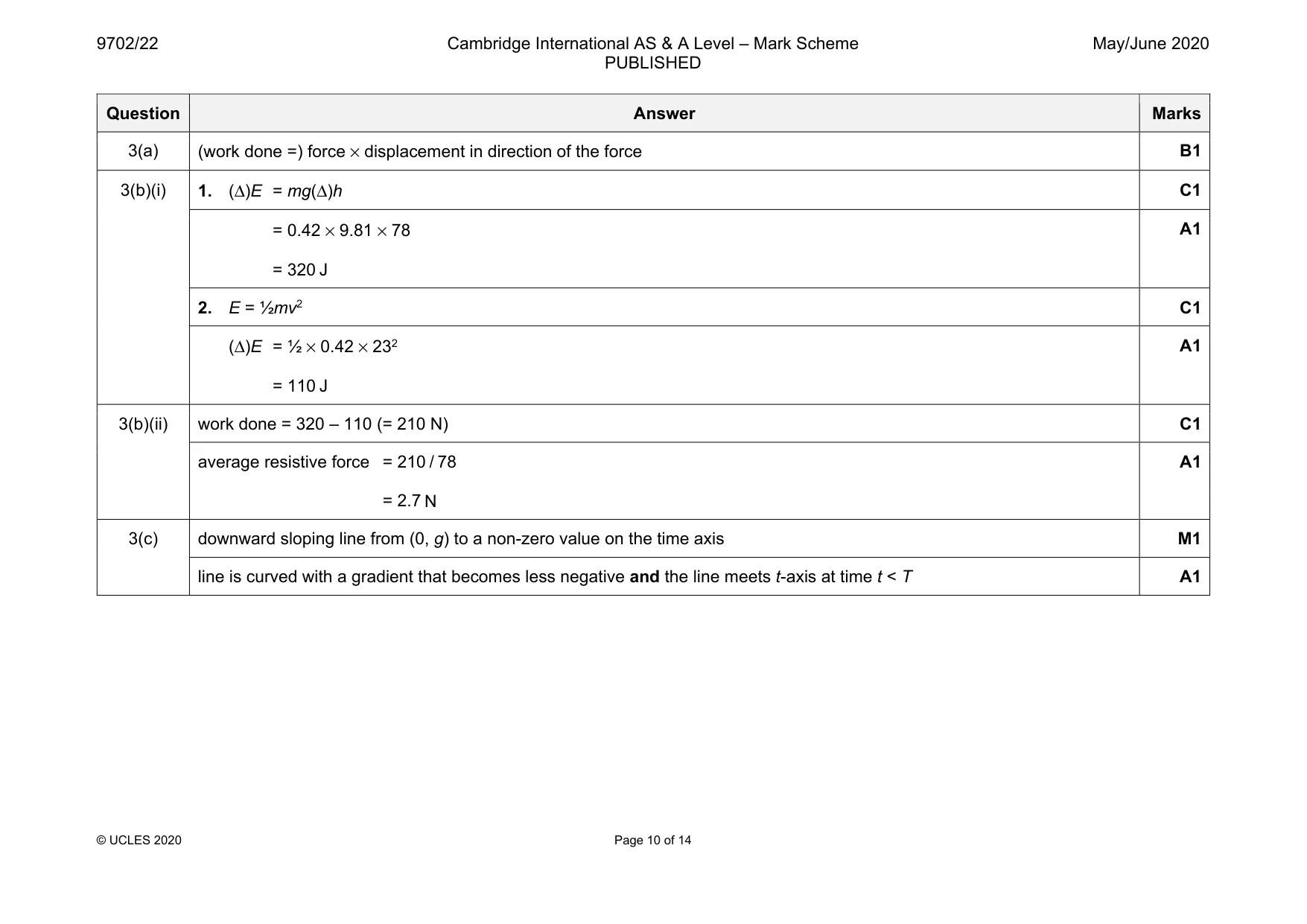
Mark scheme: 3(a) (work done =) force × displacement in direction of the force B1 3(b)(i) 1. (Δ)E = mg(Δ)h C1 = 0.42 × 9.81 × 78 = 320 J A1 2. E = ½mv2 C1 (Δ)E = ½ × 0.42 × 232 = 110 J A1 3(b)(ii) work done = 320 – 110 (= 210 N) C1 average resistive force = 210 / 78 = 2.7 N A1 3(c) downward sloping line from (0, g) to a non-zero value on the time axis M1 line is curved with a gradient that becomes less negative and the line meets t-axis at time t < T A1
More questions on Gravitational potential energy and kinetic energy
Q4 · State the difference between progressive waves and stationary waves in terms of the…
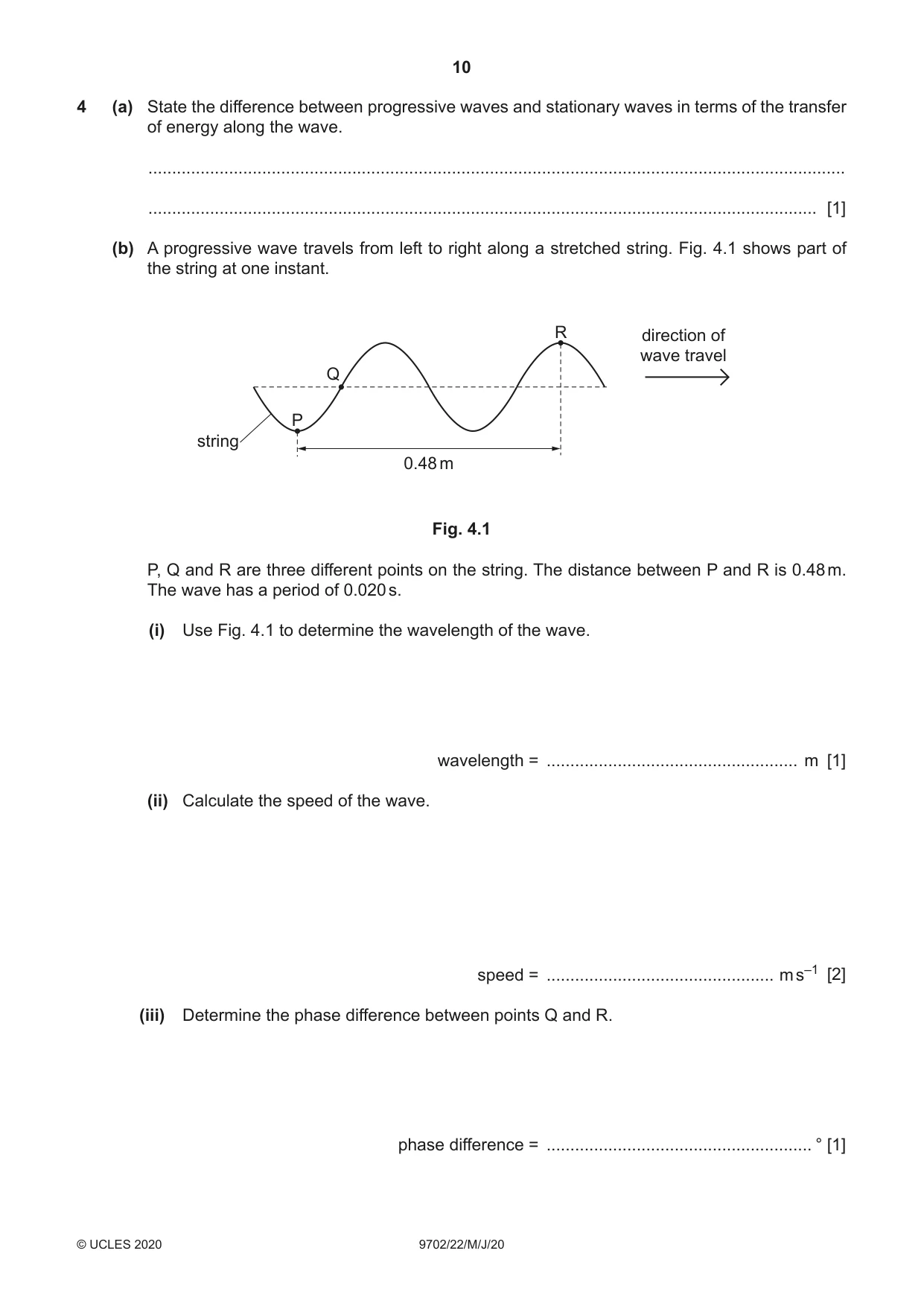
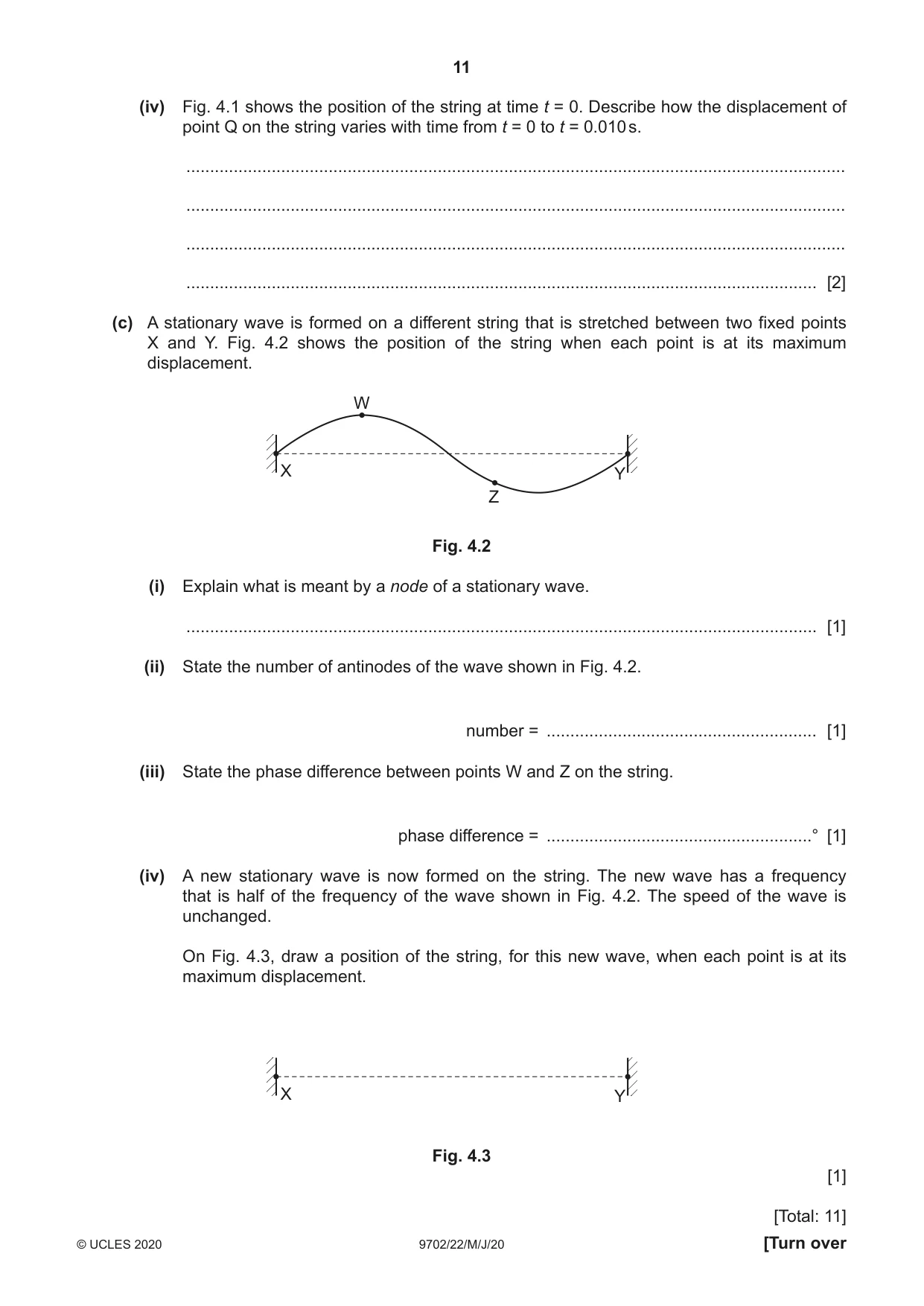
4 (a) State the difference between progressive waves and stationary waves in terms of the transfer of energy along the wave. ................................................................................................................................................... ............................................................................................................................................. [1] (b) A progressive wave travels from left to right along a stretched string. Fig. 4.1 shows part of the string at one instant. R direction of wave travel Q P string 0.48 m Fig. 4.1 P, Q and R are three different points on the string. The distance between P and R is 0.48 m. The wave has a period of 0.020 s. (i) Use Fig. 4.1 to determine the wavelength of the wave. wavelength = ..................................................... m [1] (ii) Calculate the speed of the wave. speed = ................................................ m s–1 [2] (iii) Determine the phase difference between points Q and R. phase difference = ........................................................ ° [1] (iv) Fig. 4.1 shows the position of the string at time t = 0. Describe how the displacement of point Q on the string varies with time from t = 0 to t = 0.010 s. ........................................................................................................................................... ........................................................................................................................................... ........................................................................................................................................... ..................................................................................................................................... [2] (c) A stationary wave is formed on a different string that is stretched between two fixed points X and Y. Fig. 4.2 shows the position of the string when each point is at its maximum displacement. W X Y Z Fig. 4.2 (i) Explain what is meant by a node of a stationary wave. ..................................................................................................................................... [1] (ii) State the number of antinodes of the wave shown in Fig. 4.2. number = ......................................................... [1] (iii) State the phase difference between points W and Z on the string. phase difference = ........................................................° [1] (iv) A new stationary wave is now formed on the string. The new wave has a frequency that is half of the frequency of the wave shown in Fig. 4.2. The speed of the wave is unchanged. On Fig. 4.3, draw a position of the string, for this new wave, when each point is at its maximum displacement. X Y Fig. 4.3 [1] [Total: 11]
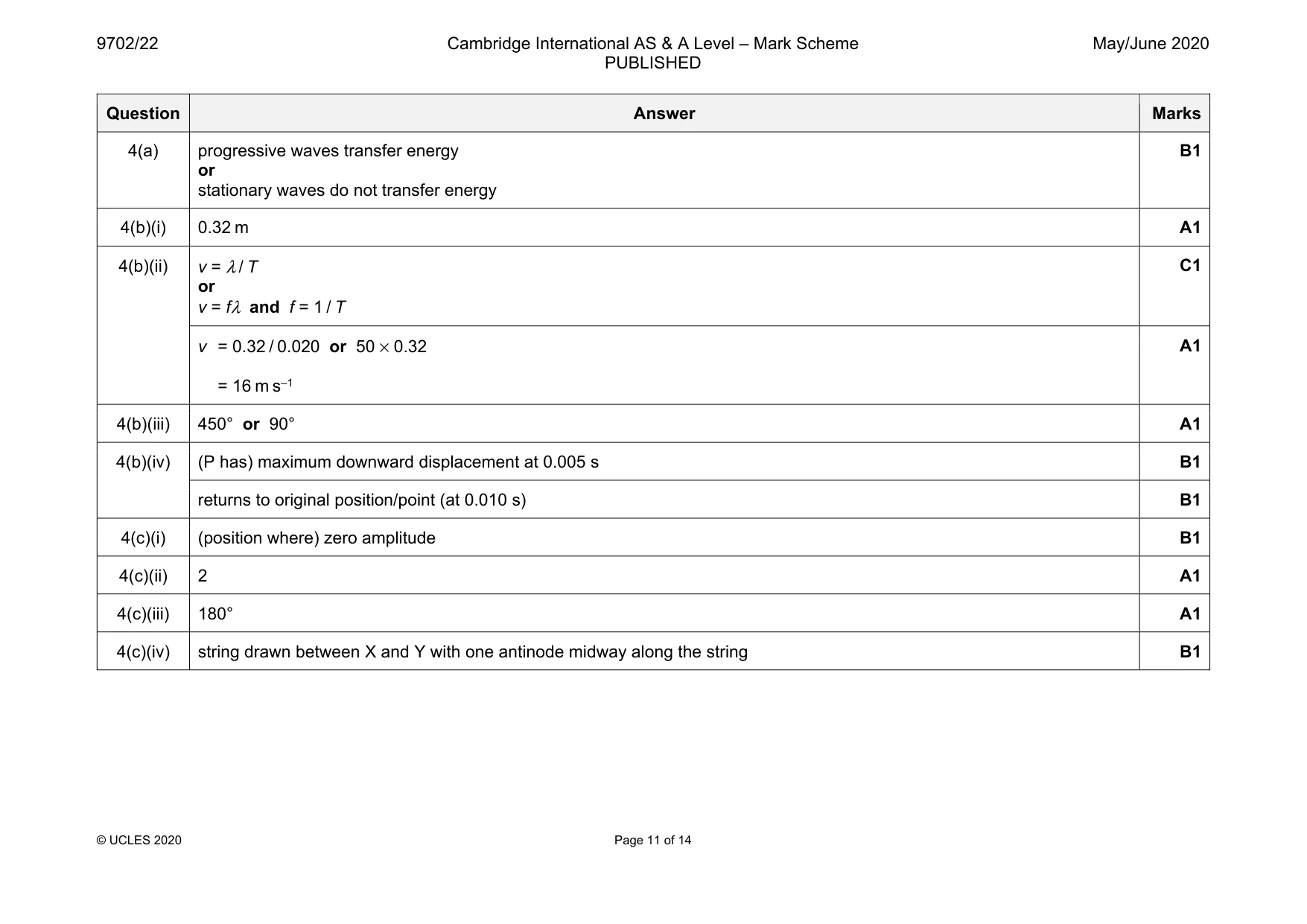
Mark scheme: 4(a) progressive waves transfer energy or stationary waves do not transfer energy B1 4(b)(i) 0.32 m A1 4(b)(ii) v = λ / T or v = fλ and f = 1 / T C1 v = 0.32 / 0.020 or 50 × 0.32 = 16 m s–1 A1 4(b)(iii) 450° or 90° A1 4(b)(iv) (P has) maximum downward displacement at 0.005 s B1 returns to original position/point (at 0.010 s) B1 4(c)(i) (position where) zero amplitude B1 4(c)(ii) 2 A1 4(c)(iii) 180° A1 4(c)(iv) string drawn between X and Y with one antinode midway along the string B1
Q5 · One end of a wire is attached to a fixed point
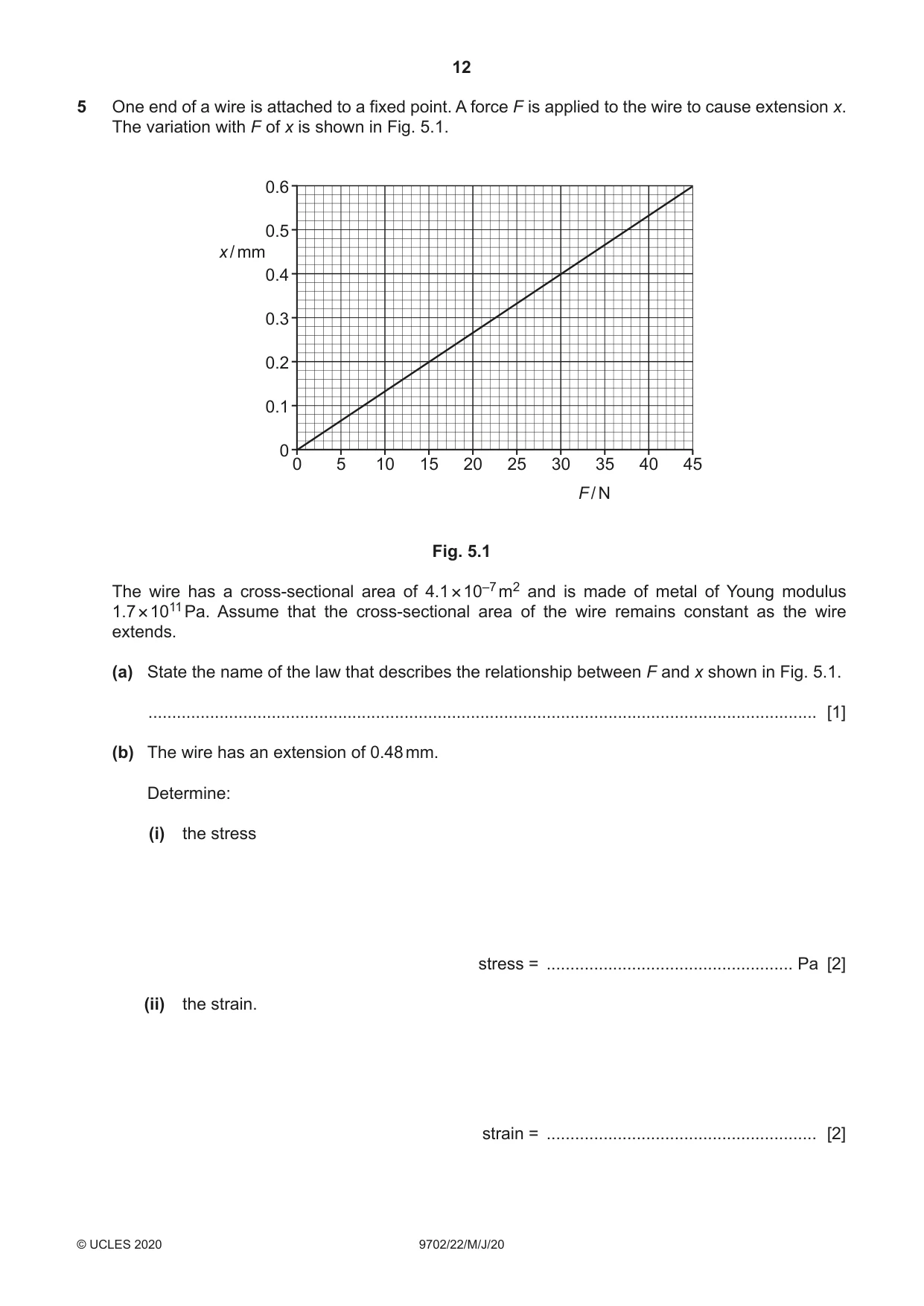
5 One end of a wire is attached to a fixed point. A force F is applied to the wire to cause extension x. The variation with F of x is shown in Fig. 5.1. 0.6 0.5 x / mm 0.4 0.3 0.2 0.1 0 0 5 10 15 20 25 30 35 40 45 F / N Fig. 5.1 The wire has a cross-sectional area of 4.1 × 10⁻⁷ m2 and is made of metal of Young modulus 1.7 × 10¹¹ Pa. Assume that the cross-sectional area of the wire remains constant as the wire extends. (a) State the name of the law that describes the relationship between F and x shown in Fig. 5.1. ............................................................................................................................................. [1] (b) The wire has an extension of 0.48 mm. Determine: (i) the stress stress = .................................................... Pa [2] (ii) the strain. strain = ......................................................... [2] (c) The resistivity of the metal of the wire is 3.7 × 10⁻⁷ Ω m. Determine the change in resistance of the wire when the extension x of the wire changes from x = 0.48 mm to x = 0.60 mm. change in resistance = ..................................................... Ω [3] (d) A force of greater than 45 N is now applied to the wire. Describe how it may be checked that the elastic limit of the wire has not been exceeded. ................................................................................................................................................... ............................................................................................................................................. [1] [Total: 9]
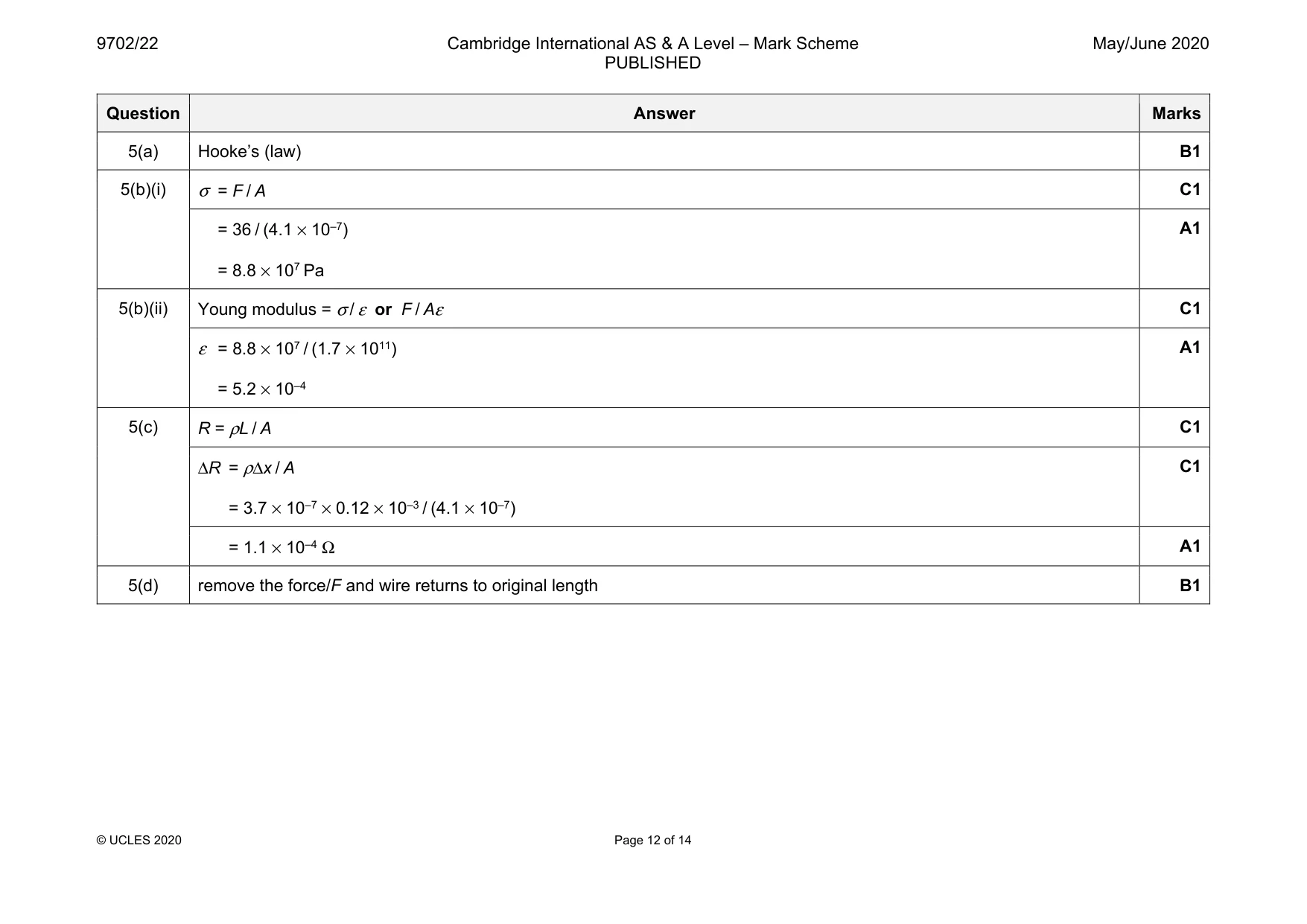
Mark scheme: 5(a) Hooke’s (law) B1 5(b)(i) σ = F / A C1 = 36 / (4.1 × 10⁻⁷) = 8.8 × 10⁷ Pa A1 5(b)(ii) Young modulus = σ / ε or F / Aε C1 ε = 8.8 × 10⁷ / (1.7 × 10¹¹) = 5.2 × 10⁻⁴ A1 5(c) R = ρL / A C1 ΔR = ρΔx / A = 3.7 × 10–7 × 0.12 × 10–3 / (4.1 × 10⁻⁷) C1 = 1.1 × 10⁻⁴ Ω A1 5(d) remove the force/F and wire returns to original length B1
Q6 · A battery of electromotive force (e.m.f.) 7.8 V and internal resistance r is connected to…
6 (a) A battery of electromotive force (e.m.f.) 7.8 V and internal resistance r is connected to a filament lamp, as shown in Fig. 6.1. 7.8 V r Fig. 6.1 A total charge of 750 C moves through the battery in a time interval of 1500 s. During this time the filament lamp dissipates 5.7 kJ of energy. The e.m.f. of the battery remains constant. (i) Explain, in terms of energy and without a calculation, why the potential difference across the lamp must be less than the e.m.f. of the battery. ........................................................................................................................................... ..................................................................................................................................... [1] (ii) Calculate: 1. the current in the circuit current = ...................................................... A [2] 2. the potential difference across the lamp potential difference = ...................................................... V [2] 3. the internal resistance of the battery. internal resistance = ...................................................... Ω [2] (b) A student is provided with three resistors of resistances 90 Ω, 45 Ω and 20 Ω. (i) Sketch a circuit diagram showing how two of these three resistors may be connected together to give a combined resistance of 30 Ω between the terminals shown. Label the values of the resistances on your diagram. [1] (ii) A potential divider circuit is produced by connecting the three resistors to a battery of e.m.f. 9.0 V and negligible internal resistance. The potential divider circuit provides an output potential difference VOUT of 3.6 V. The circuit diagram is shown in Fig. 6.2. 9.0 V Fig. 6.2 On Fig. 6.2, label the resistances of all three resistors and the potential difference V OUT. [2] [Total: 10]
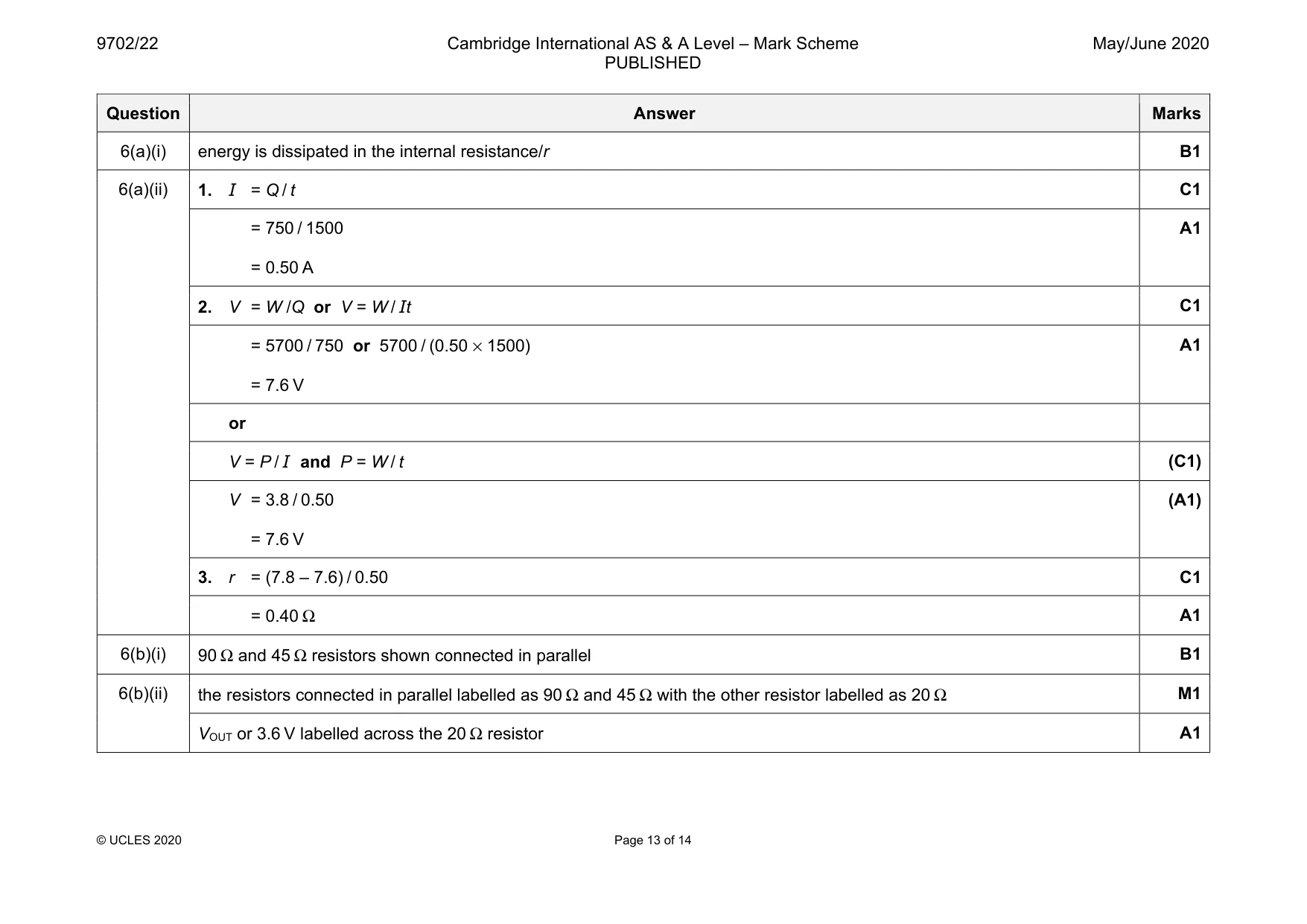
Mark scheme: 6(a)(i) energy is dissipated in the internal resistance/r B1 6(a)(ii) 1. I = Q / t C1 = 750 / 1500 = 0.50 A A1 2. V = W /Q or V = W / It C1 = 5700 / 750 or 5700 / (0.50 × 1500) = 7.6 V A1 or V = P / I and P = W / t (C1) V = 3.8 / 0.50 = 7.6 V (A1) 3. r = (7.8 – 7.6) / 0.50 C1 = 0.40 Ω A1 6(b)(i) 90 Ω and 45 Ω resistors shown connected in parallel B1 6(b)(ii) the resistors connected in parallel labelled as 90 Ω and 45 Ω with the other resistor labelled as 20 Ω M1 VOUT or 3.6 V labelled across the 20 Ω resistor A1
Q7 · A nucleus of an element X decays by emitting a β+ particle to produce a nucleus of…
7 (a) A nucleus of an element X decays by emitting a β+ particle to produce a nucleus of potassium-39 (3919K) and a neutrino. The decay is represented by QSX 3919K + Rβ+P + 00ν. (i) State the number represented by each of the following letters. P .............................. Q .............................. R .............................. S .............................. [2] (ii) State the name of the interaction (force) that gives rise to β+ decay. ..................................................................................................................................... [1] (b) A hadron is composed of three identical quarks and has a charge of +2e, where e is the elementary charge. Determine a possible type (flavour) of the quarks. Explain your working. ................................................................................................................................................... ............................................................................................................................................. [2] [Total: 5]
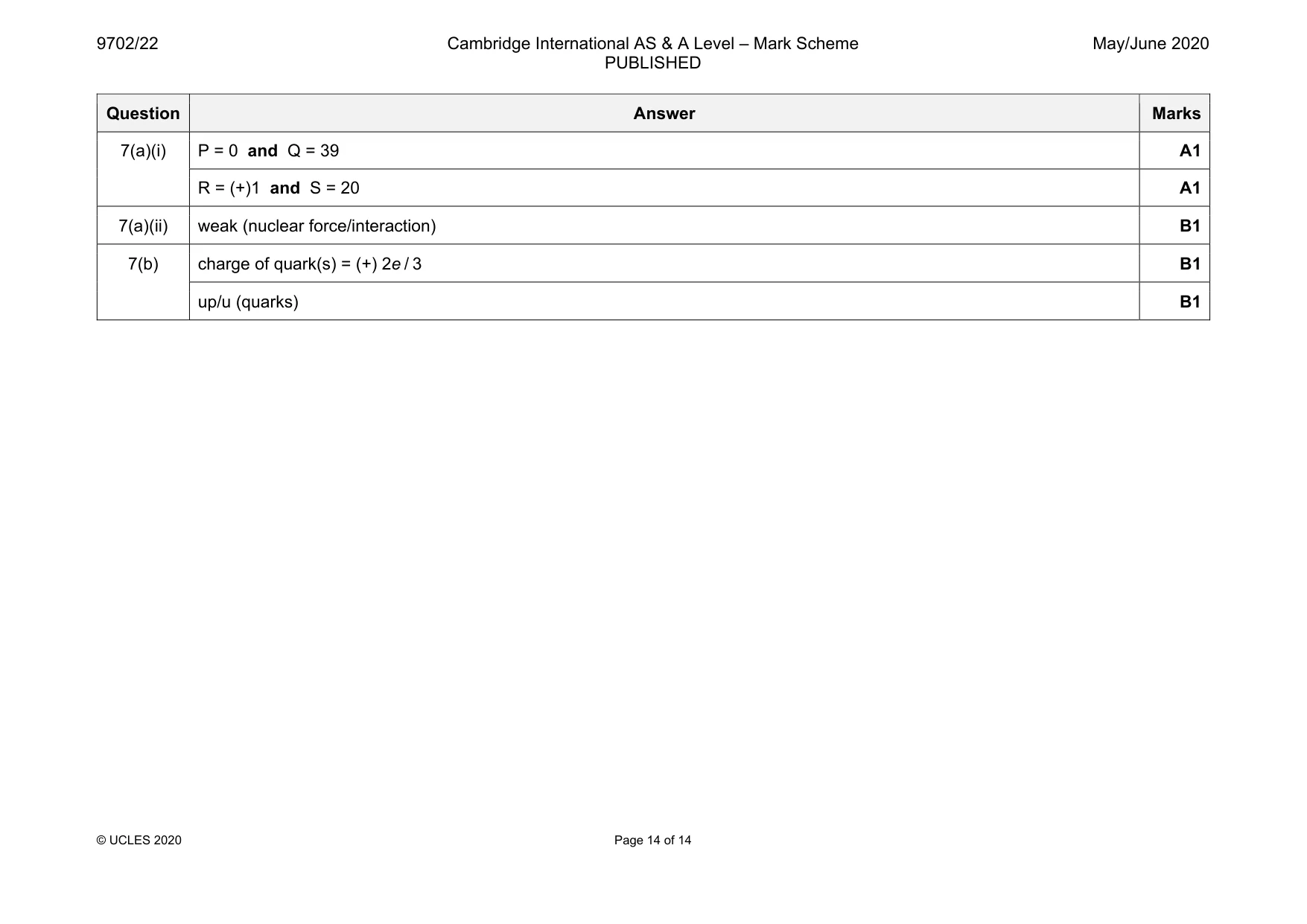
Mark scheme: 7(a)(i) P = 0 and Q = 39 A1 R = (+)1 and S = 20 A1 7(a)(ii) weak (nuclear force/interaction) B1 7(b) charge of quark(s) = (+) 2e / 3 B1 up/u (quarks) B1
What was in this paper
The subtopics covered by these 7 questions, and how many questions each got. Open one in a new tab to see every Cambridge question on it.