Cambridge A Level Physics 9702 — 2012 May/June Paper 2 · Variant 2
9702/22/M/J/12 · 7 questions · 60 marks · ≈68 min
The question paper and its mark scheme, free to read here and free to download. This is Cambridge’s own paper, exactly as it was sat.
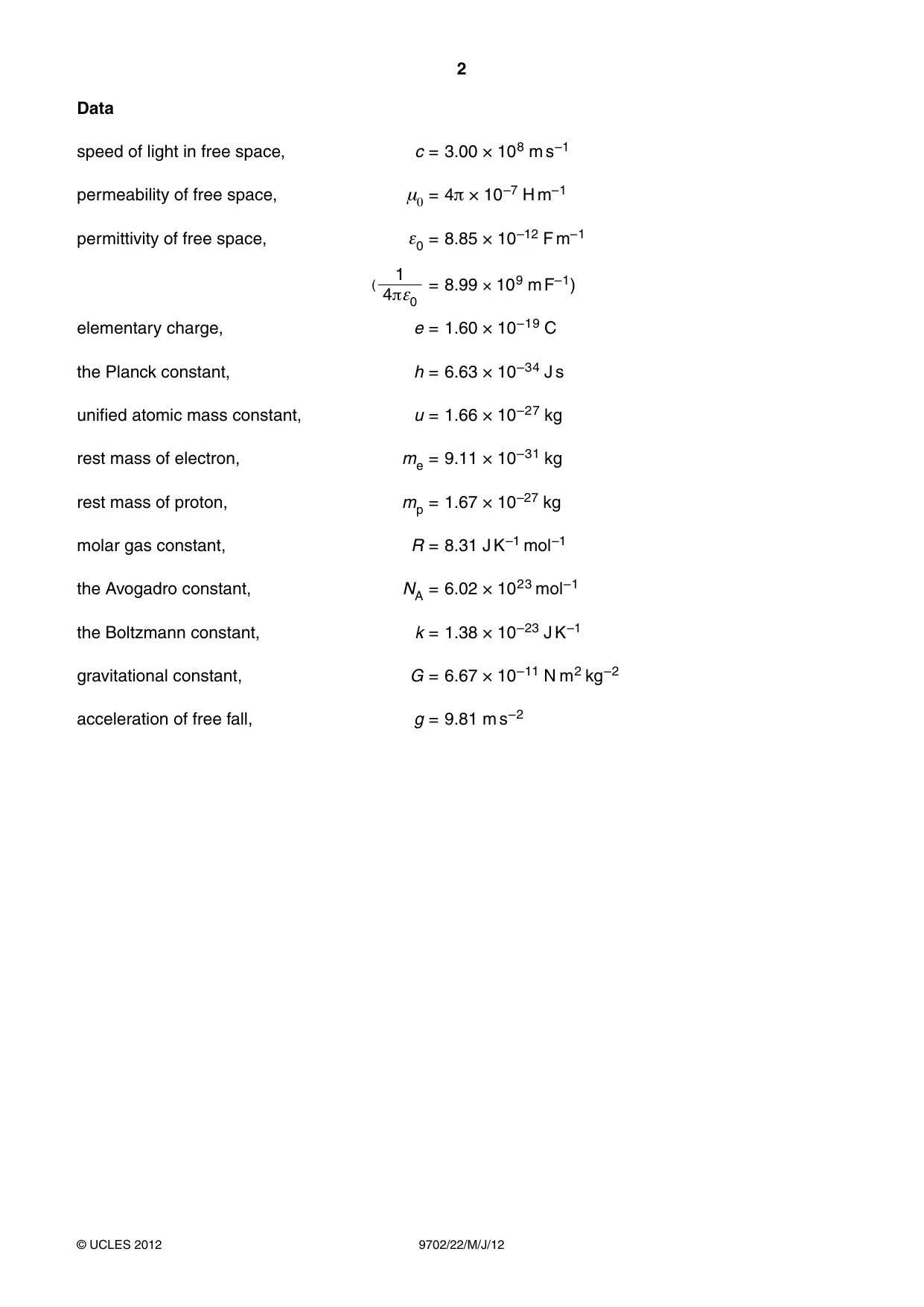
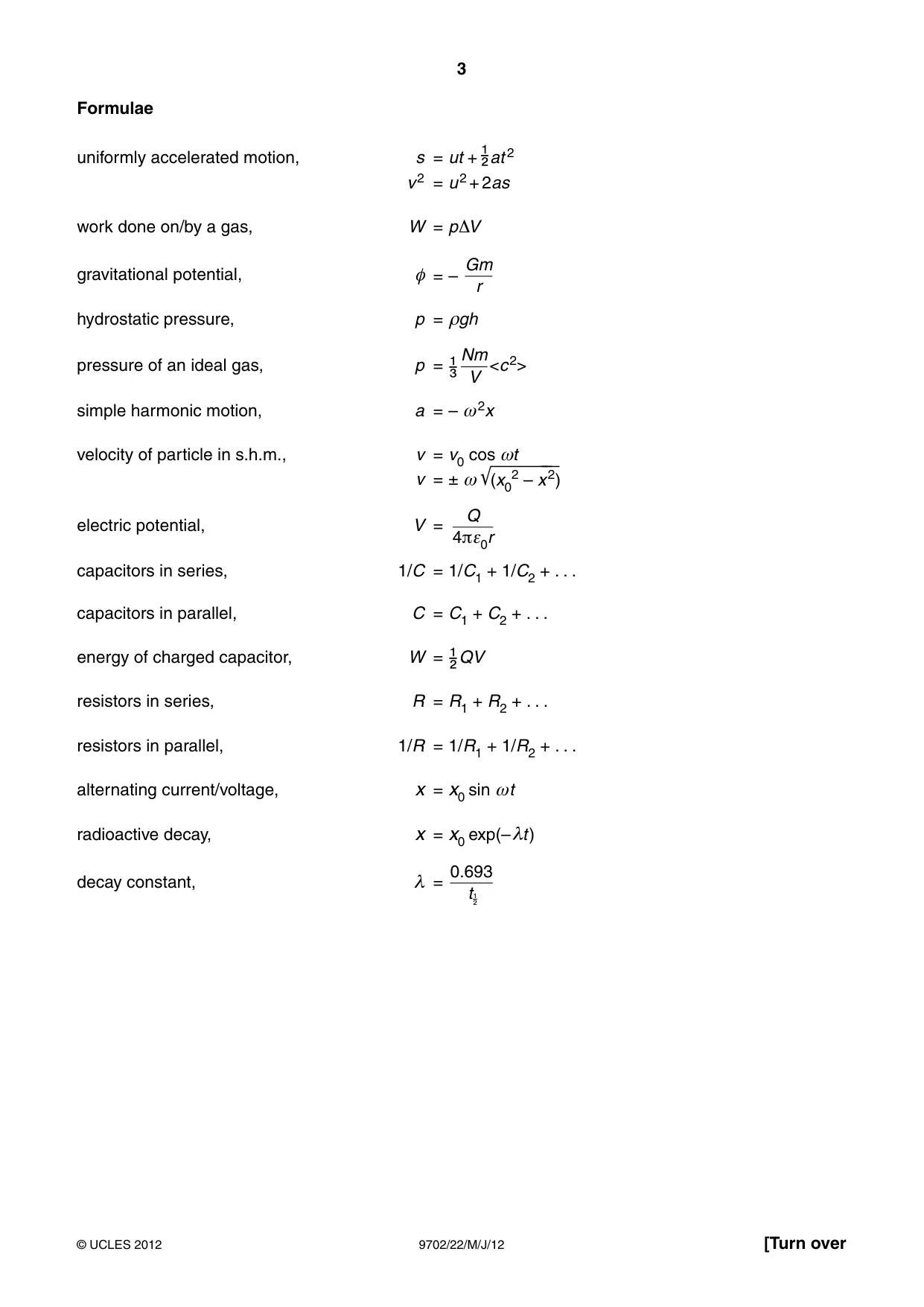
Question paper16 pages

Mark scheme4 pages
Answers below. Sit the paper first if you are practising.
Questions as text
Q1 · The volume V of liquid flowing in time t through a pipe of radius r is given by the…
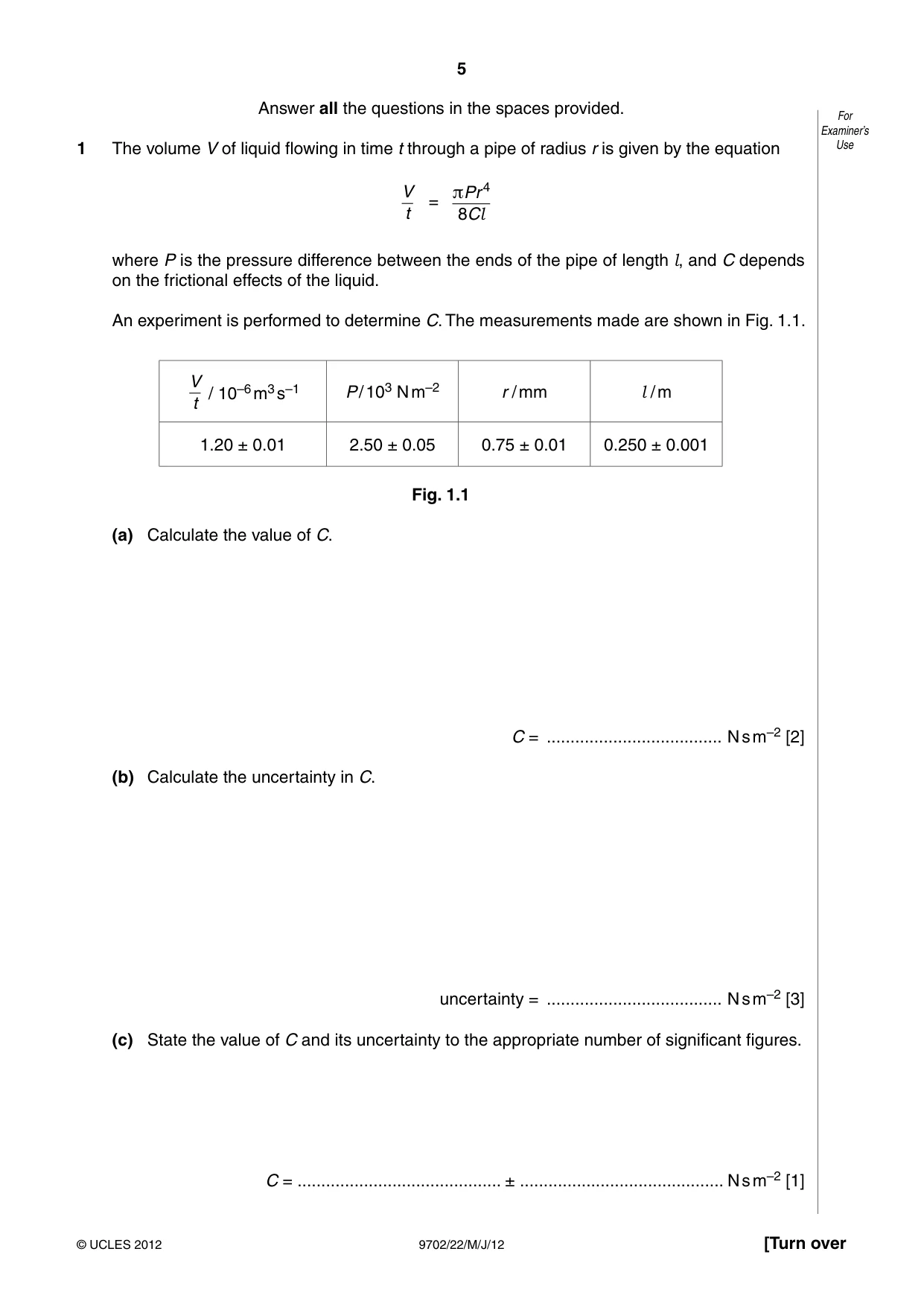
1 The volume V of liquid flowing in time t through a pipe of radius r is given by the equation Use V π Pr 4 = t 8Cl where P is the pressure difference between the ends of the pipe of length l, and C depends on the frictional effects of the liquid. An experiment is performed to determine C. The measurements made are shown in Fig. 1.1. V / 10–6 m3 s–1 P / 103 N m–2 r / mm l / m t 1.20 ± 0.01 2.50 ± 0.05 0.75 ± 0.01 0.250 ± 0.001 Fig. 1.1 (a) Calculate the value of C. C = ..................................... N s m–2 [2] (b) Calculate the uncertainty in C. uncertainty = ..................................... N s m–2 [3] (c) State the value of C and its uncertainty to the appropriate number of significant figures. C = ........................................... ± ........................................... N s m–2 [1]
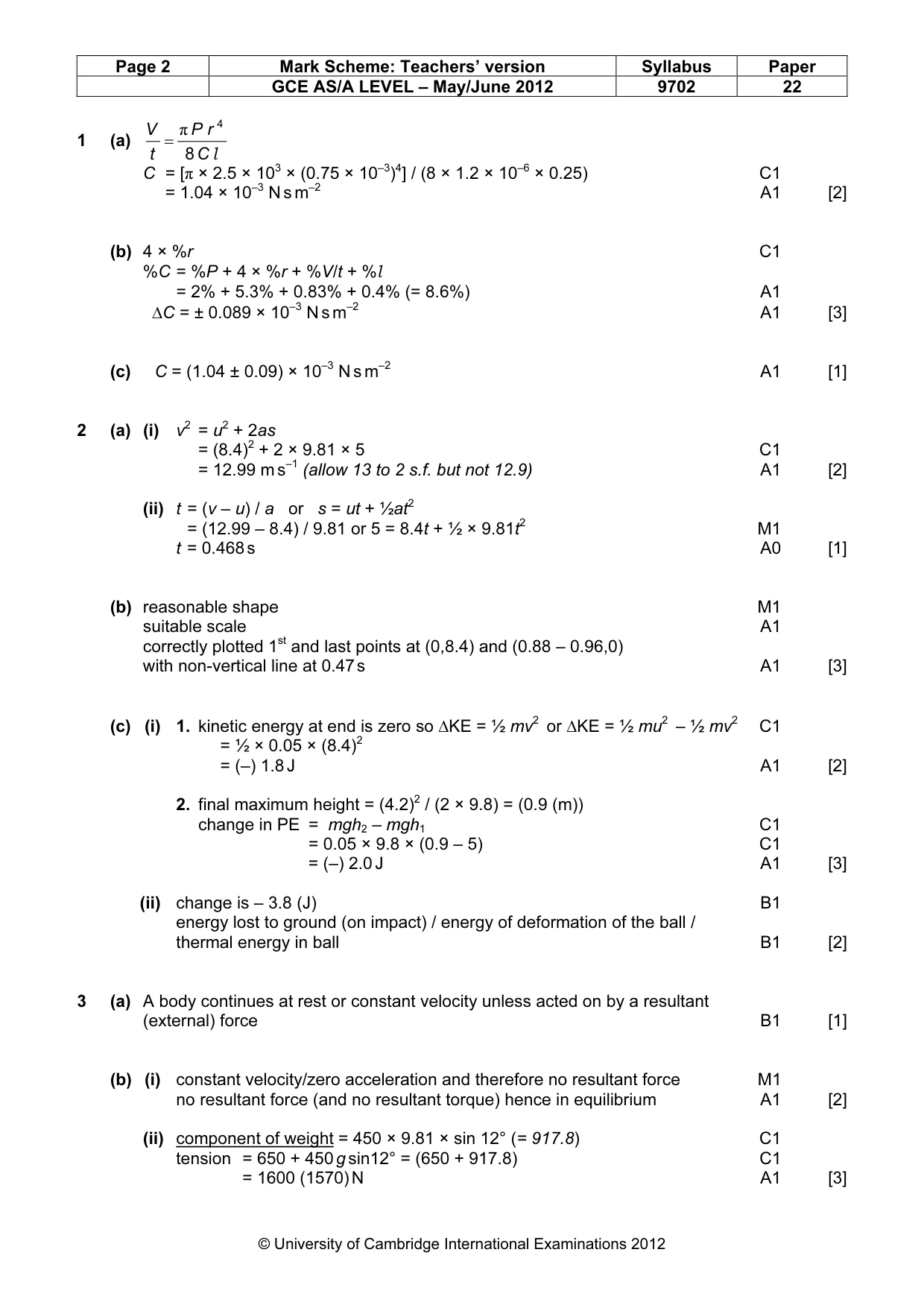
Mark scheme: V π P r 1 (a) = t 8C l C = [π × 2.5 × 103 × (0.75 × 10–3)4] / (8 × 1.2 × 10–6 × 0.25) C1 = 1.04 × 10⁻³ N s m–2 A1 [2] (b) 4 × %r C1 %C = %P + 4 × %r + %V/t + %l = 2% + 5.3% + 0.83% + 0.4% (= 8.6%) A1 ∆C = ± 0.089 × 10⁻³ N s m–2 A1 [3] (c) C = (1.04 ± 0.09) × 10–3 N s m–2 A1 [1] 2 2
Q2 · A ball is thrown vertically down towards the ground and rebounds as illustrated in For Fig
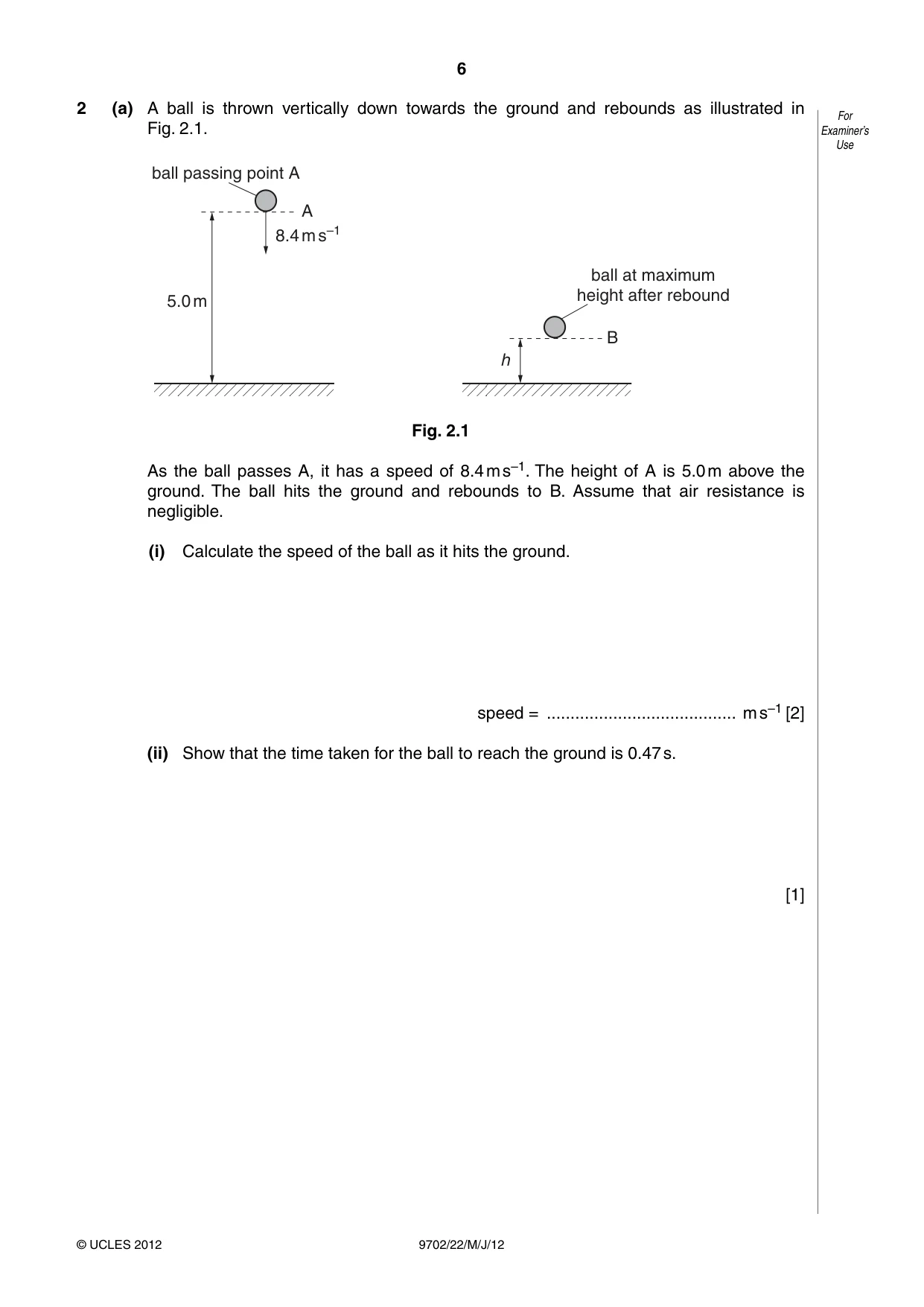
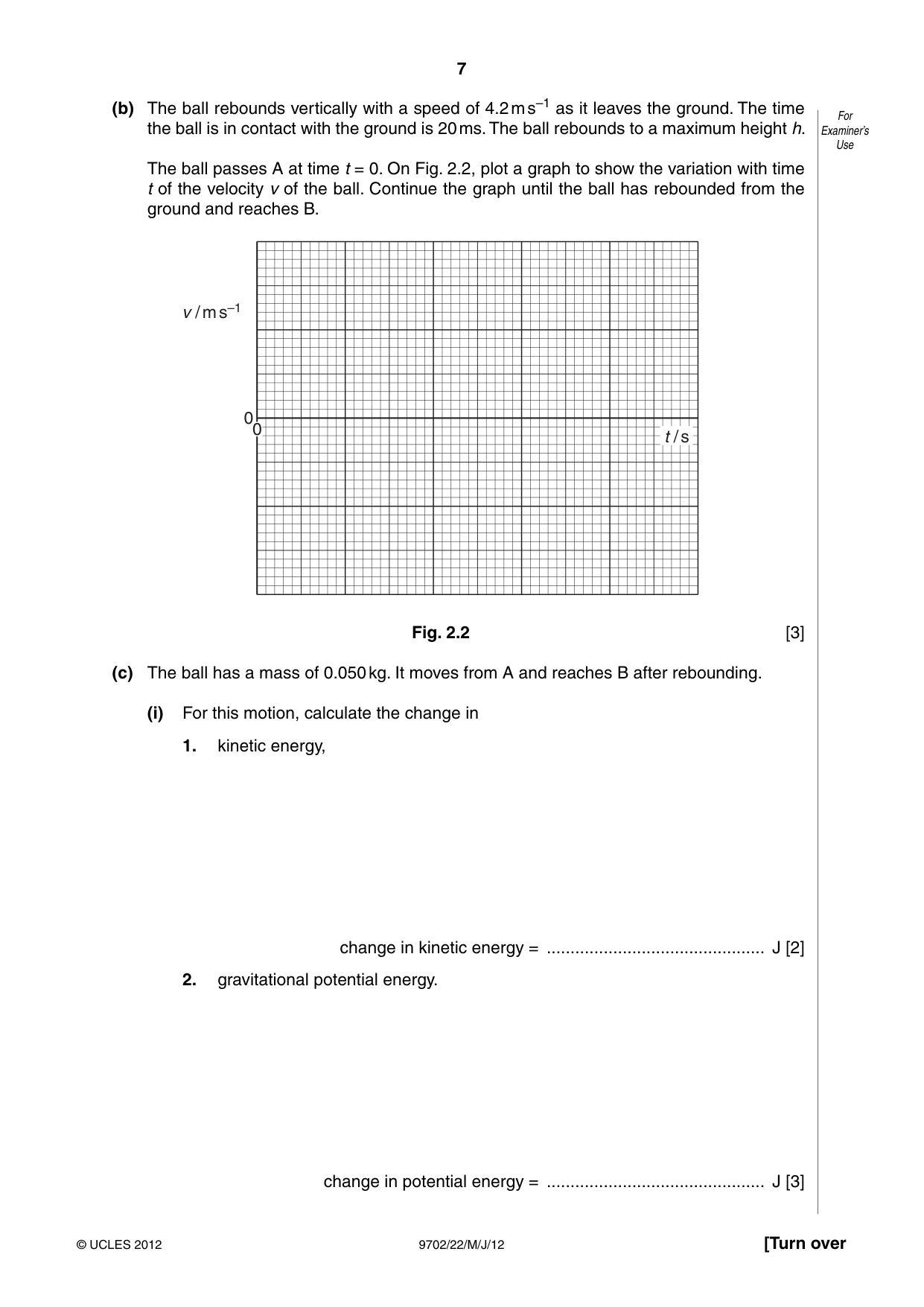
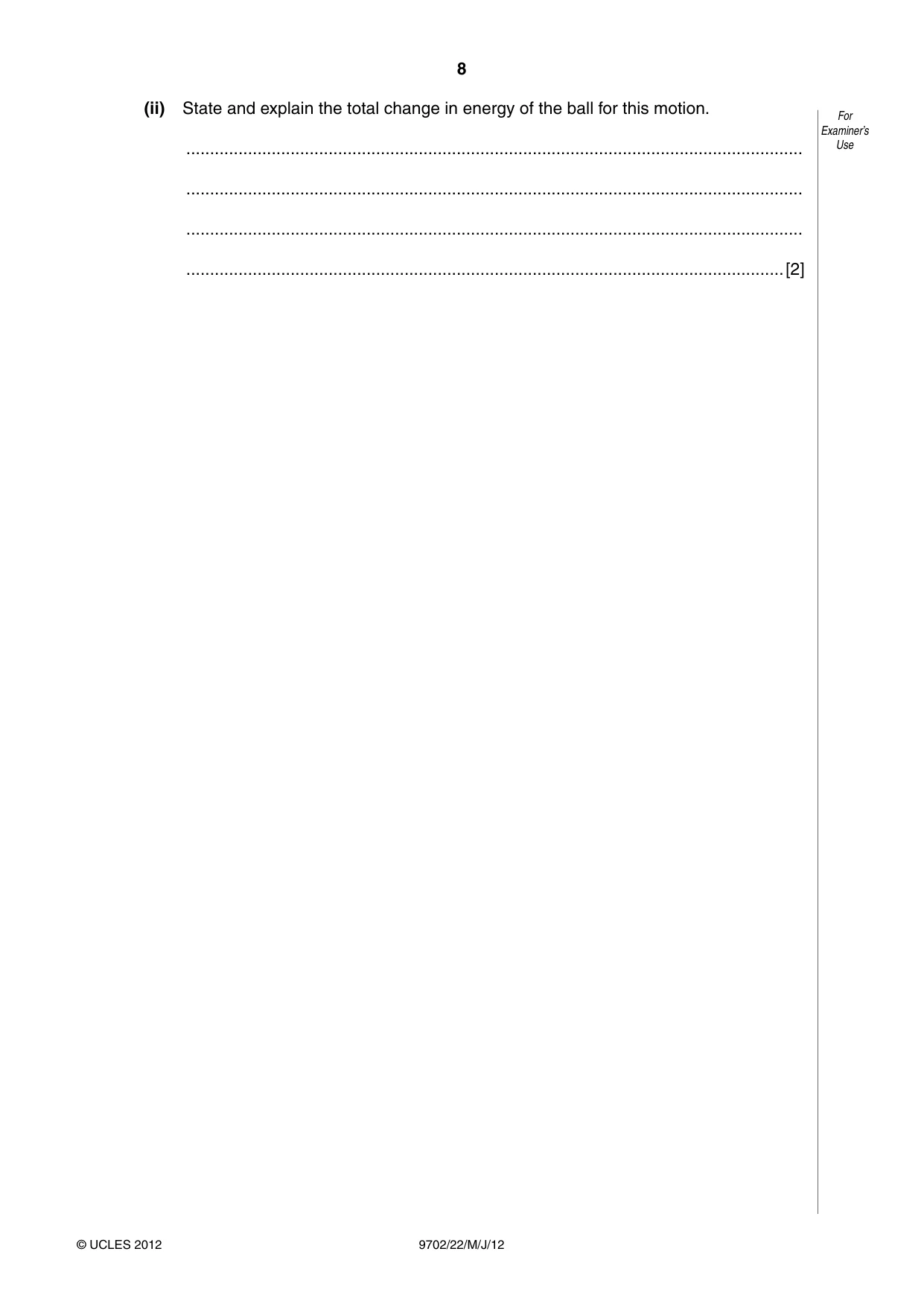
2 (a) A ball is thrown vertically down towards the ground and rebounds as illustrated in For Fig. 2.1. Examiner’s Use ball passing point A A 8.4 m s–1 ball at maximum height after rebound 5.0 m B h Fig. 2.1 As the ball passes A, it has a speed of 8.4 m s–1. The height of A is 5.0 m above the ground. The ball hits the ground and rebounds to B. Assume that air resistance is negligible. (i) Calculate the speed of the ball as it hits the ground. speed = ........................................ m s–1 [2] (ii) Show that the time taken for the ball to reach the ground is 0.47 s. [1] (b) The ball rebounds vertically with a speed of 4.2 m s–1 as it leaves the ground. The time For the ball is in contact with the ground is 20 ms. The ball rebounds to a maximum height h. Examiner’s Use The ball passes A at time t = 0. On Fig. 2.2, plot a graph to show the variation with time t of the velocity v of the ball. Continue the graph until the ball has rebounded from the ground and reaches B. v / m s–1 0 0 t / s Fig. 2.2 [3] (c) The ball has a mass of 0.050 kg. It moves from A and reaches B after rebounding. (i) For this motion, calculate the change in 1. kinetic energy, change in kinetic energy = .............................................. J [2] 2. gravitational potential energy. change in potential energy = .............................................. J [3] (ii) State and explain the total change in energy of the ball for this motion. For Examiner’s .................................................................................................................................. Use .................................................................................................................................. .................................................................................................................................. ..............................................................................................................................[2]
Mark scheme: 2 (a) (i) v2 = u2 + 2as = (8.4)2 + 2 × 9.81 × 5 C1 = 12.99 m s–1 (allow 13 to 2 s.f. but not 12.9) A1 [2] (ii) t = (v – u) / a or s = ut + ½at2 = (12.99 – 8.4) / 9.81 or 5 = 8.4t + ½ × 9.81t2 M1 t = 0.468 s A0 [1] (b) reasonable shape M1 suitable scale A1 correctly plotted 1st and last points at (0,8.4) and (0.88 – 0.96,0) with non-vertical line at 0.47 s A1 [3] (c) (i) 1. kinetic energy at end is zero so ∆KE = ½ mv2 or ∆KE = ½ mu2 – ½ mv2 C1 = ½ × 0.05 × (8.4)2 = (–) 1.8 J A1 [2] 2. final maximum height = (4.2)2 / (2 × 9.8) = (0.9 (m)) change in PE = mgh2 – mgh1 C1 = 0.05 × 9.8 × (0.9 – 5) C1 = (–) 2.0 J A1 [3] (ii) change is – 3.8 (J) B1 energy lost to ground (on impact) / energy of deformation of the ball / thermal energy in ball B1 [2]
More questions on Gravitational potential energy and kinetic energy
Q3 · State Newton’s first law
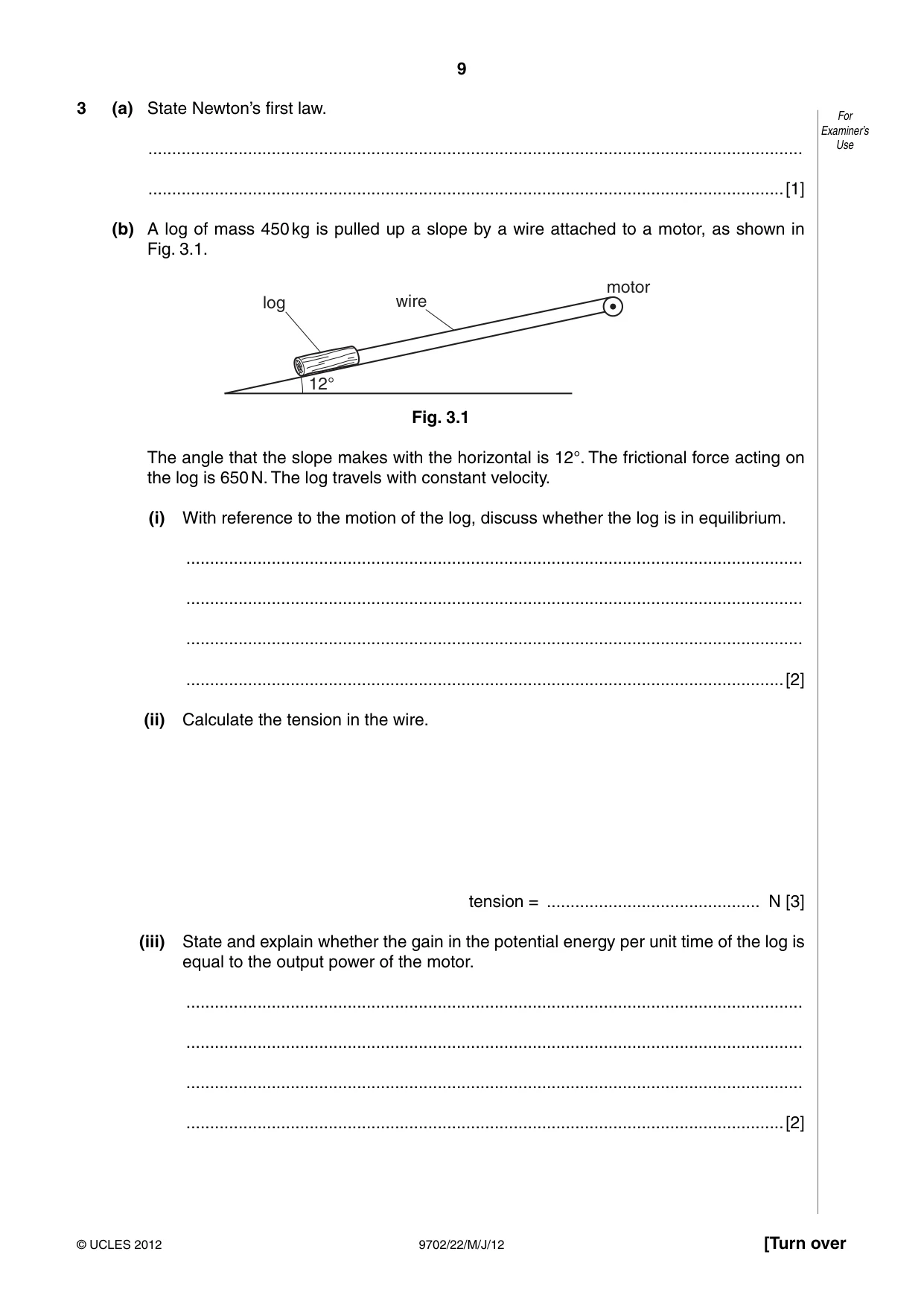
3 (a) State Newton’s first law. For Examiner’s .......................................................................................................................................... Use ......................................................................................................................................[1] (b) A log of mass 450 kg is pulled up a slope by a wire attached to a motor, as shown in Fig. 3.1. motor log wire 12° Fig. 3.1 The angle that the slope makes with the horizontal is 12°. The frictional force acting on the log is 650 N. The log travels with constant velocity. (i) With reference to the motion of the log, discuss whether the log is in equilibrium. .................................................................................................................................. .................................................................................................................................. .................................................................................................................................. ..............................................................................................................................[2] (ii) Calculate the tension in the wire. tension = ............................................. N [3] (iii) State and explain whether the gain in the potential energy per unit time of the log is equal to the output power of the motor. .................................................................................................................................. .................................................................................................................................. .................................................................................................................................. ..............................................................................................................................[2]
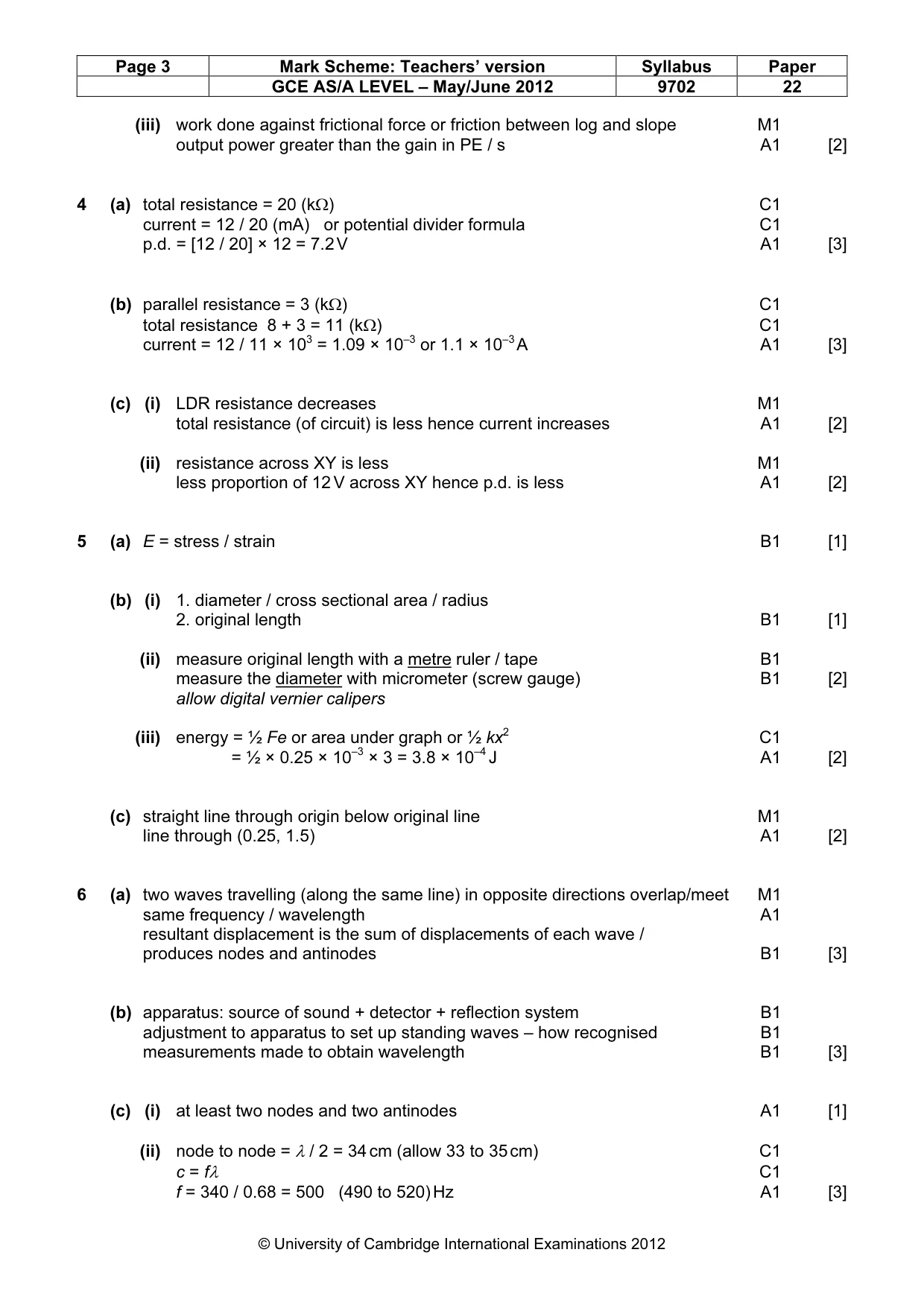
Mark scheme: 3 (a) A body continues at rest or constant velocity unless acted on by a resultant (external) force B1 [1] (b) (i) constant velocity/zero acceleration and therefore no resultant force M1 no resultant force (and no resultant torque) hence in equilibrium A1 [2] (ii) component of weight = 450 × 9.81 × sin 12° (= 917.8) C1 tension = 650 + 450 g sin12° = (650 + 917.8) C1 = 1600 (1570) N A1 [3] GCE AS/A LEVEL – May/June 2012 9702 22 (iii) work done against frictional force or friction between log and slope M1 output power greater than the gain in PE / s A1 [2]
Q4 · A battery of electromotive force 12 V and negligible internal resistance is connected to…
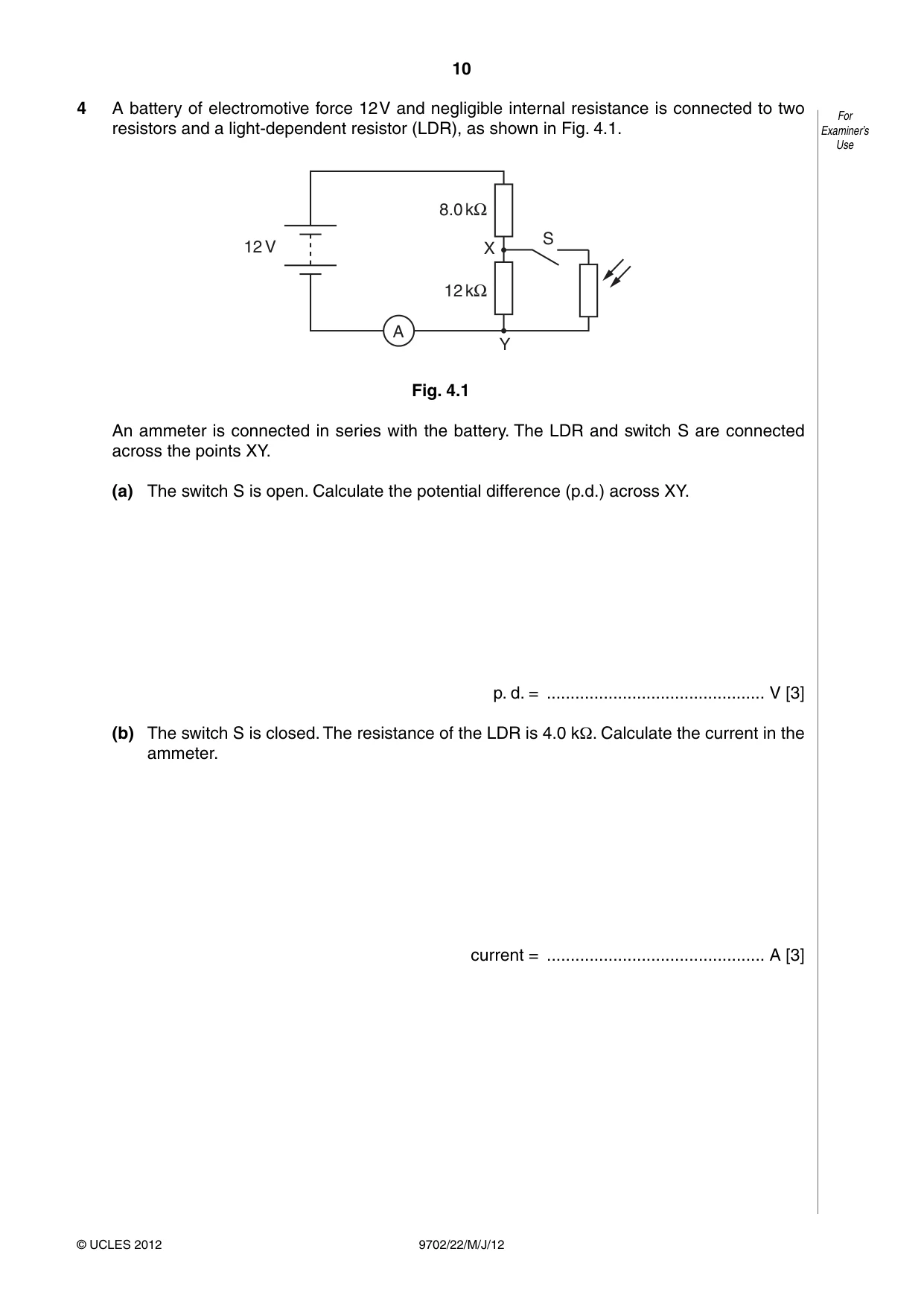
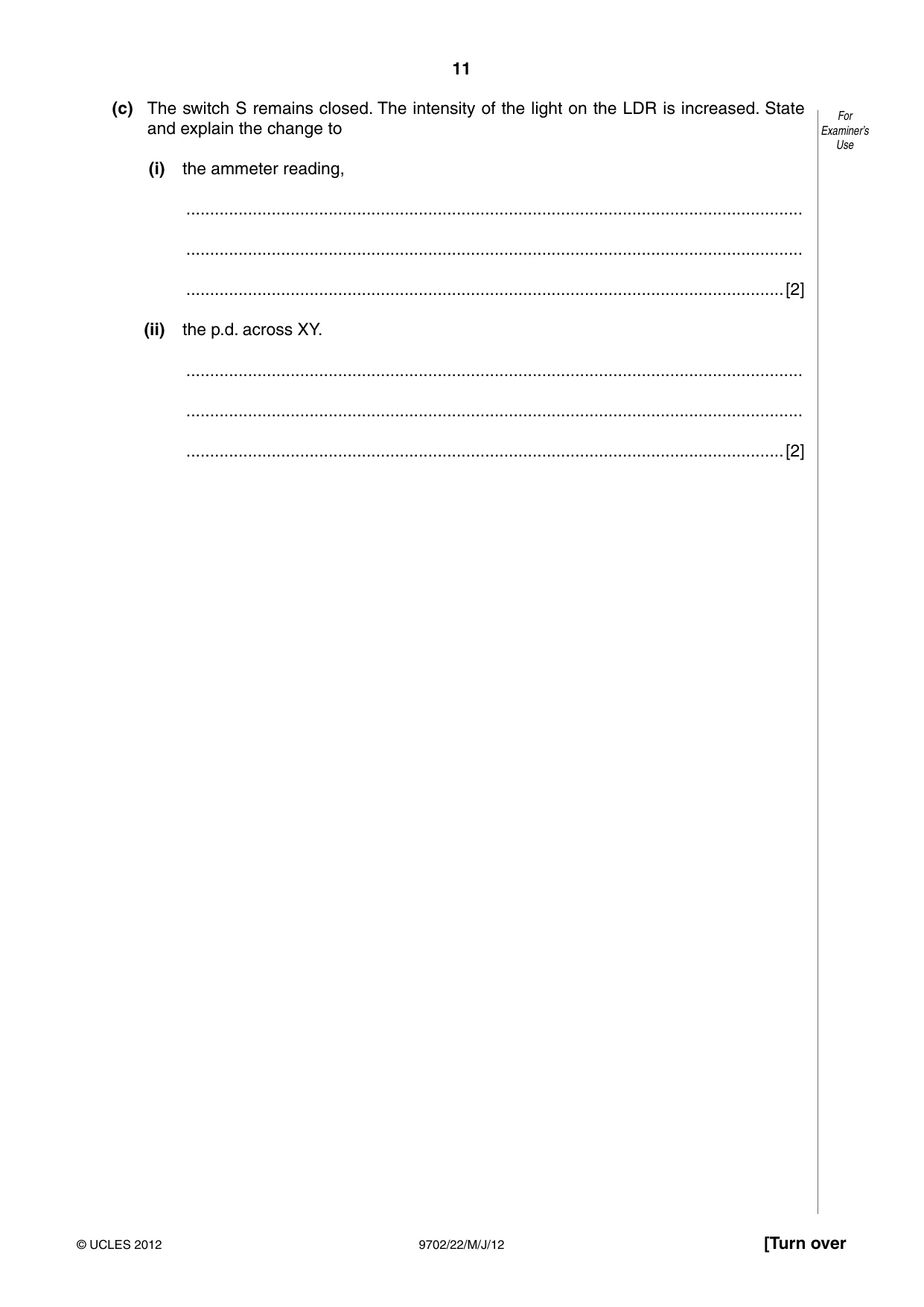
4 A battery of electromotive force 12 V and negligible internal resistance is connected to two For resistors and a light-dependent resistor (LDR), as shown in Fig. 4.1. Examiner’s Use 8.0 kΩ S 12 V X 12 kΩ A Y Fig. 4.1 An ammeter is connected in series with the battery. The LDR and switch S are connected across the points XY. (a) The switch S is open. Calculate the potential difference (p.d.) across XY. p. d. = .............................................. V [3] (b) The switch S is closed. The resistance of the LDR is 4.0 kΩ. Calculate the current in the ammeter. current = .............................................. A [3] (c) The switch S remains closed. The intensity of the light on the LDR is increased. State For and explain the change to Examiner’s Use (i) the ammeter reading, .................................................................................................................................. .................................................................................................................................. ..............................................................................................................................[2] (ii) the p.d. across XY. .................................................................................................................................. .................................................................................................................................. ..............................................................................................................................[2]
Mark scheme: 4 (a) total resistance = 20 (kΩ) C1 current = 12 / 20 (mA) or potential divider formula C1 p.d. = [12 / 20] × 12 = 7.2 V A1 [3] (b) parallel resistance = 3 (kΩ) C1 total resistance 8 + 3 = 11 (kΩ) C1 current = 12 / 11 × 103 = 1.09 × 10⁻³ or 1.1 × 10⁻³ A A1 [3] (c) (i) LDR resistance decreases M1 total resistance (of circuit) is less hence current increases A1 [2] (ii) resistance across XY is less M1 less proportion of 12 V across XY hence p.d. is less A1 [2]
Q5 · Define the Young modulus
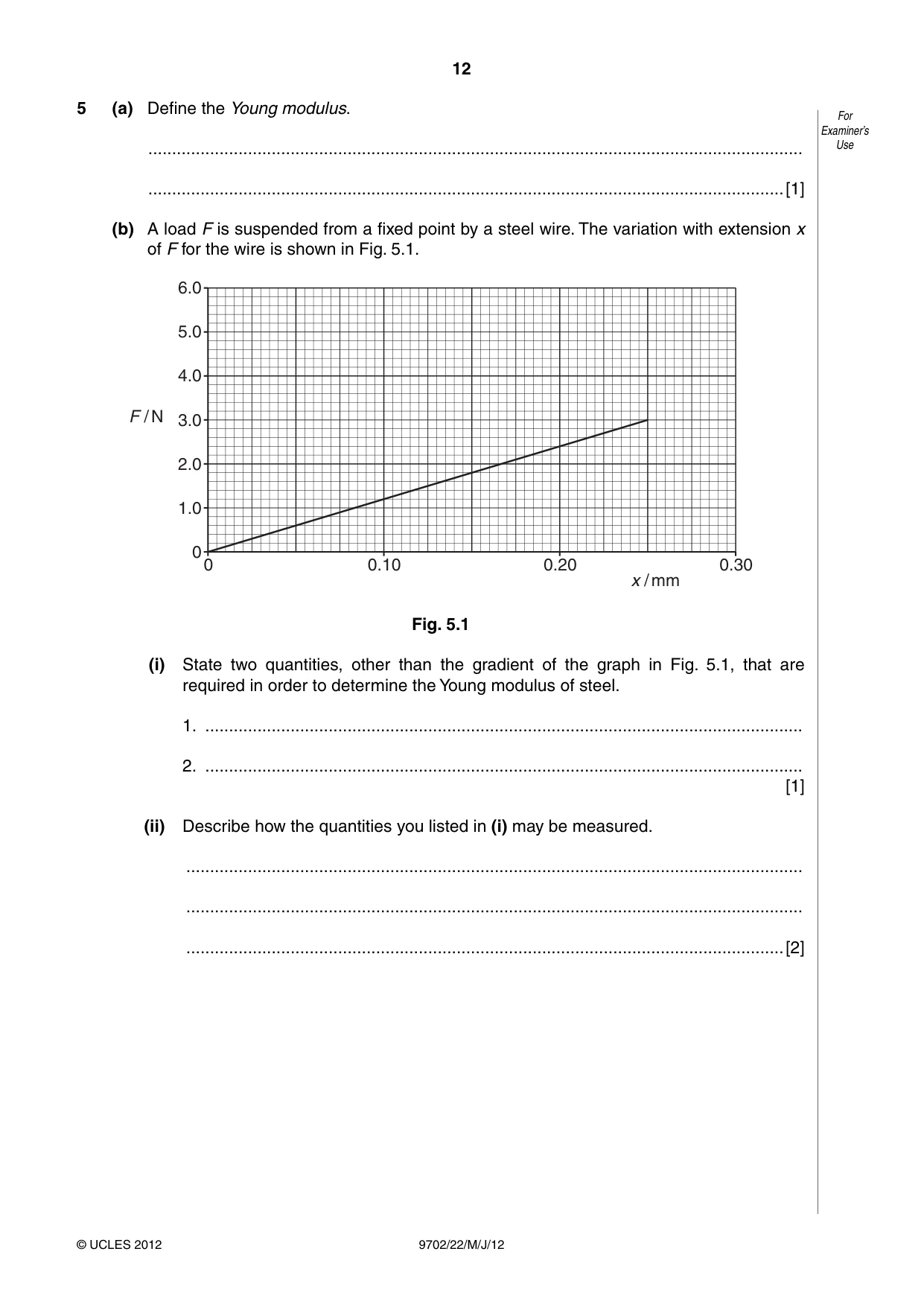
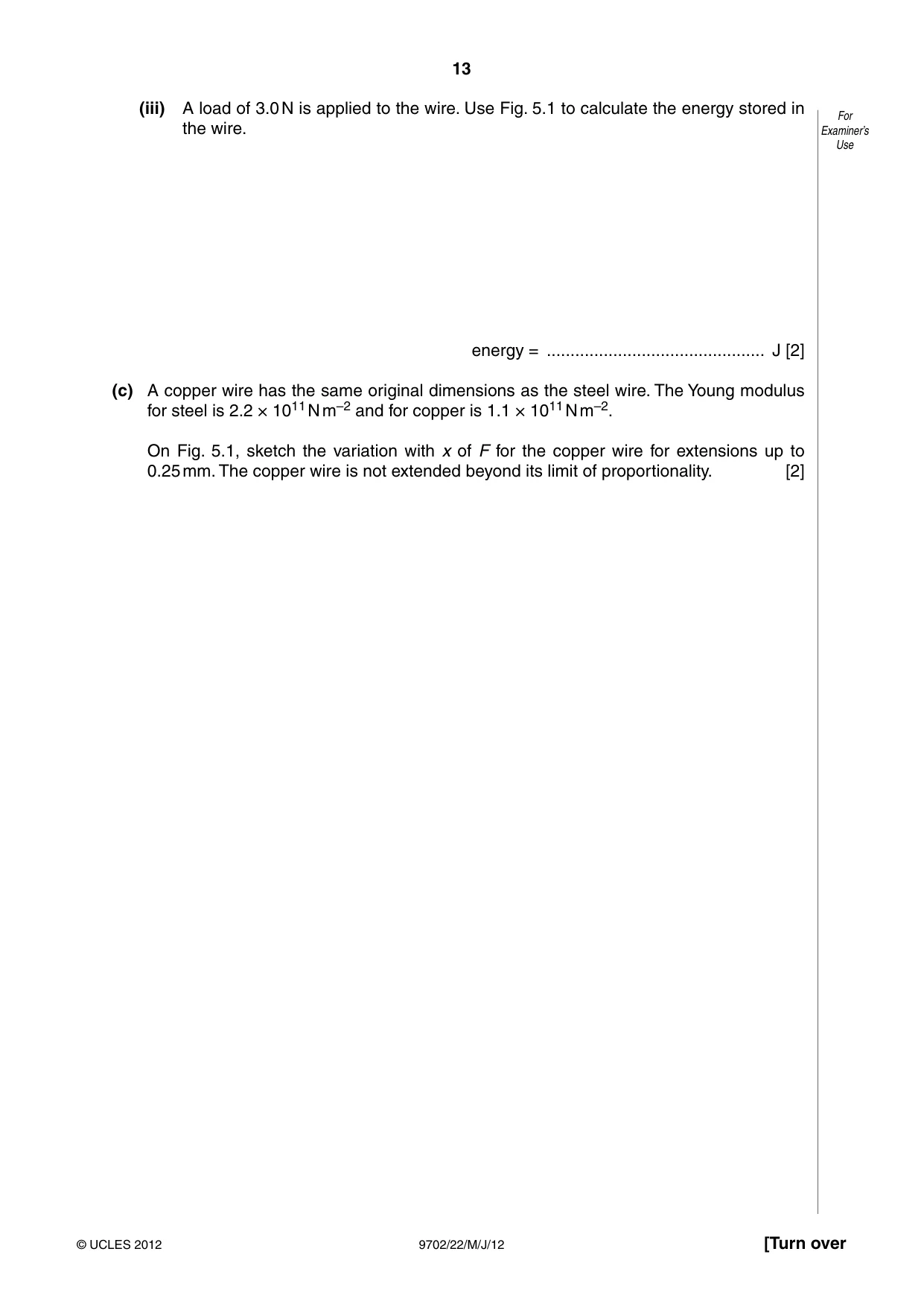
5 (a) Define the Young modulus. For Examiner’s .......................................................................................................................................... Use ......................................................................................................................................[1] (b) A load F is suspended from a fixed point by a steel wire. The variation with extension x of F for the wire is shown in Fig. 5.1. 6.0 5.0 4.0 F / N 3.0 2.0 1.0 00 0.10 0.20 0.30 x / mm Fig. 5.1 (i) State two quantities, other than the gradient of the graph in Fig. 5.1, that are required in order to determine the Young modulus of steel. 1. .............................................................................................................................. 2. .............................................................................................................................. [1] (ii) Describe how the quantities you listed in (i) may be measured. .................................................................................................................................. .................................................................................................................................. ..............................................................................................................................[2] (iii) A load of 3.0 N is applied to the wire. Use Fig. 5.1 to calculate the energy stored in For the wire. Examiner’s Use energy = .............................................. J [2] (c) A copper wire has the same original dimensions as the steel wire. The Young modulus for steel is 2.2 × 10¹¹ N m–2 and for copper is 1.1 × 10¹¹ N m–2. On Fig. 5.1, sketch the variation with x of F for the copper wire for extensions up to 0.25 mm. The copper wire is not extended beyond its limit of proportionality. [2]
Mark scheme: 5 (a) E = stress / strain B1 [1] (b) (i) 1. diameter / cross sectional area / radius 2. original length B1 [1] (ii) measure original length with a metre ruler / tape B1 measure the diameter with micrometer (screw gauge) B1 [2] allow digital vernier calipers (iii) energy = ½ Fe or area under graph or ½ kx2 C1 = ½ × 0.25 × 10–3 × 3 = 3.8 × 10⁻⁴ J A1 [2] (c) straight line through origin below original line M1 line through (0.25, 1.5) A1 [2]
Q6 · Use the principle of superposition to explain the formation of a stationary wave
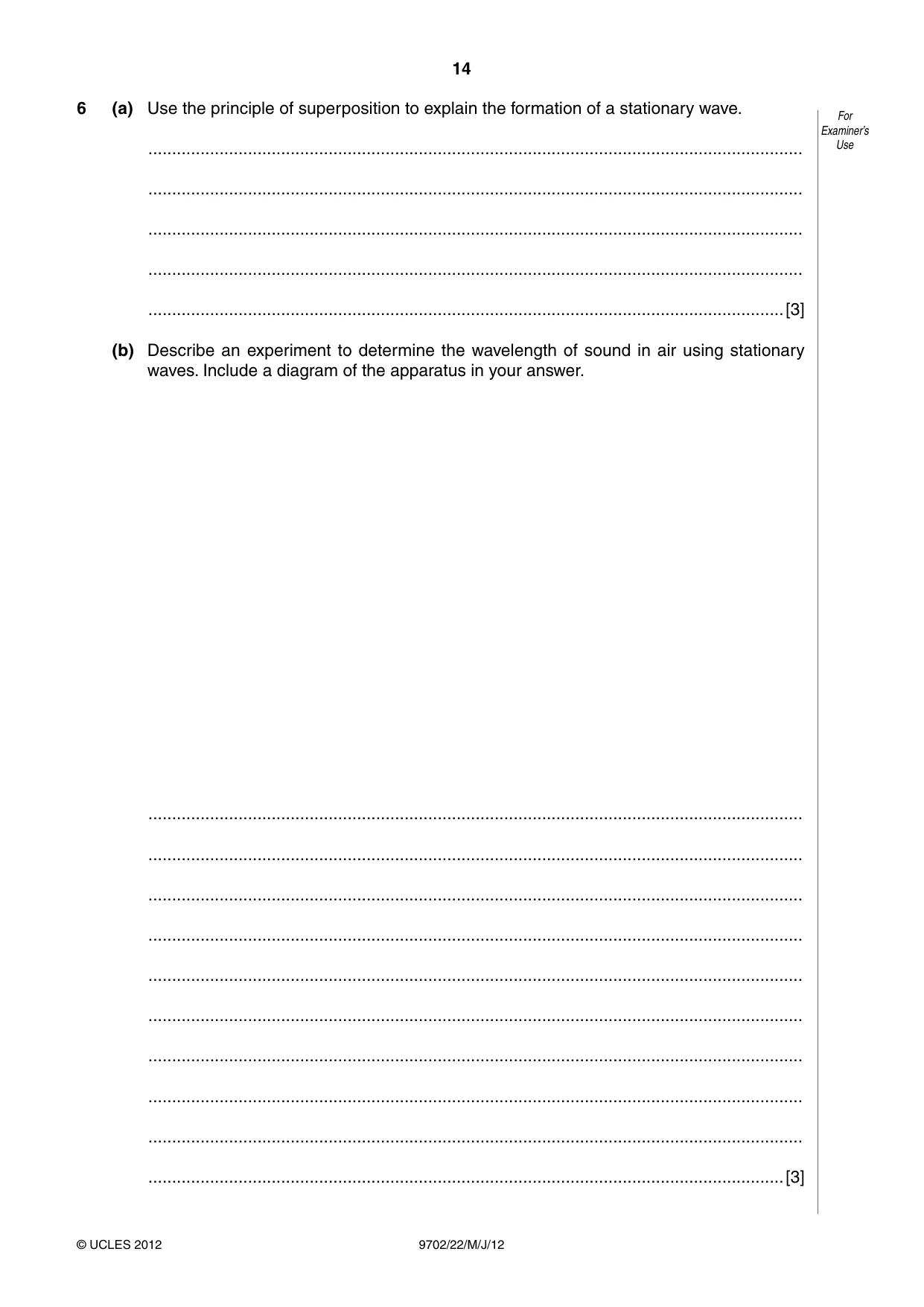
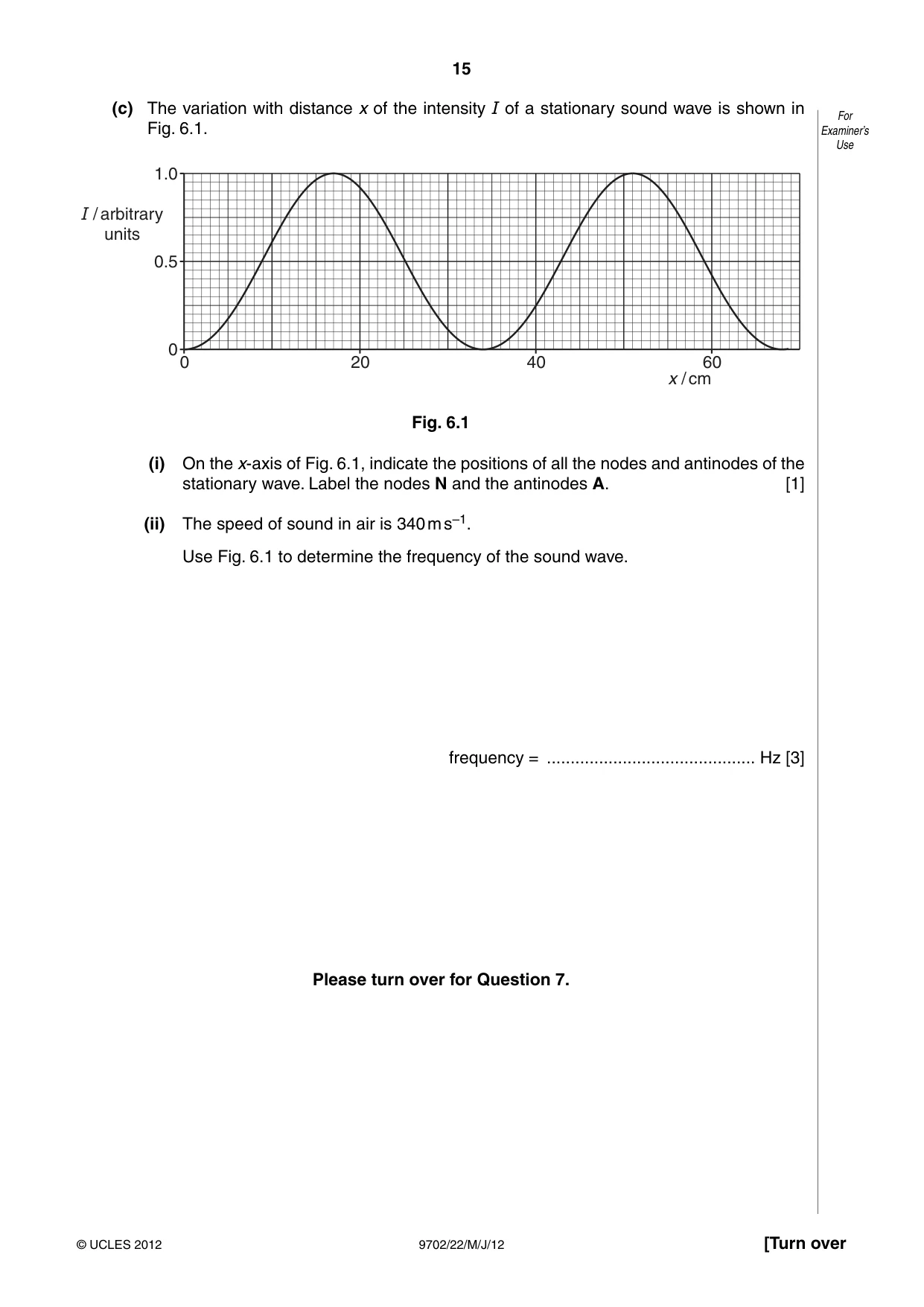
6 (a) Use the principle of superposition to explain the formation of a stationary wave. For Examiner’s .......................................................................................................................................... Use .......................................................................................................................................... .......................................................................................................................................... .......................................................................................................................................... ......................................................................................................................................[3] (b) Describe an experiment to determine the wavelength of sound in air using stationary waves. Include a diagram of the apparatus in your answer. .......................................................................................................................................... .......................................................................................................................................... .......................................................................................................................................... .......................................................................................................................................... .......................................................................................................................................... .......................................................................................................................................... .......................................................................................................................................... .......................................................................................................................................... .......................................................................................................................................... ......................................................................................................................................[3] (c) The variation with distance x of the intensity I of a stationary sound wave is shown in For Fig. 6.1. Examiner’s Use 1.0 I / arbitrary units 0.5 00 20 40 60 x / cm Fig. 6.1 (i) On the x-axis of Fig. 6.1, indicate the positions of all the nodes and antinodes of the stationary wave. Label the nodes N and the antinodes A. [1] (ii) The speed of sound in air is 340 m s–1. Use Fig. 6.1 to determine the frequency of the sound wave. frequency = ............................................ Hz [3] Please turn over for Question 7.
Mark scheme: 6 (a) two waves travelling (along the same line) in opposite directions overlap/meet M1 same frequency / wavelength A1 resultant displacement is the sum of displacements of each wave / produces nodes and antinodes B1 [3] (b) apparatus: source of sound + detector + reflection system B1 adjustment to apparatus to set up standing waves – how recognised B1 measurements made to obtain wavelength B1 [3] (c) (i) at least two nodes and two antinodes A1 [1] (ii) node to node = λ / 2 = 34 cm (allow 33 to 35 cm) C1 c = fλ C1 f = 340 / 0.68 = 500 (490 to 520) Hz A1 [3] GCE AS/A LEVEL – May/June 2012 9702 22
Q7 · A nuclear reaction occurs when a uranium-235 nucleus absorbs a neutron
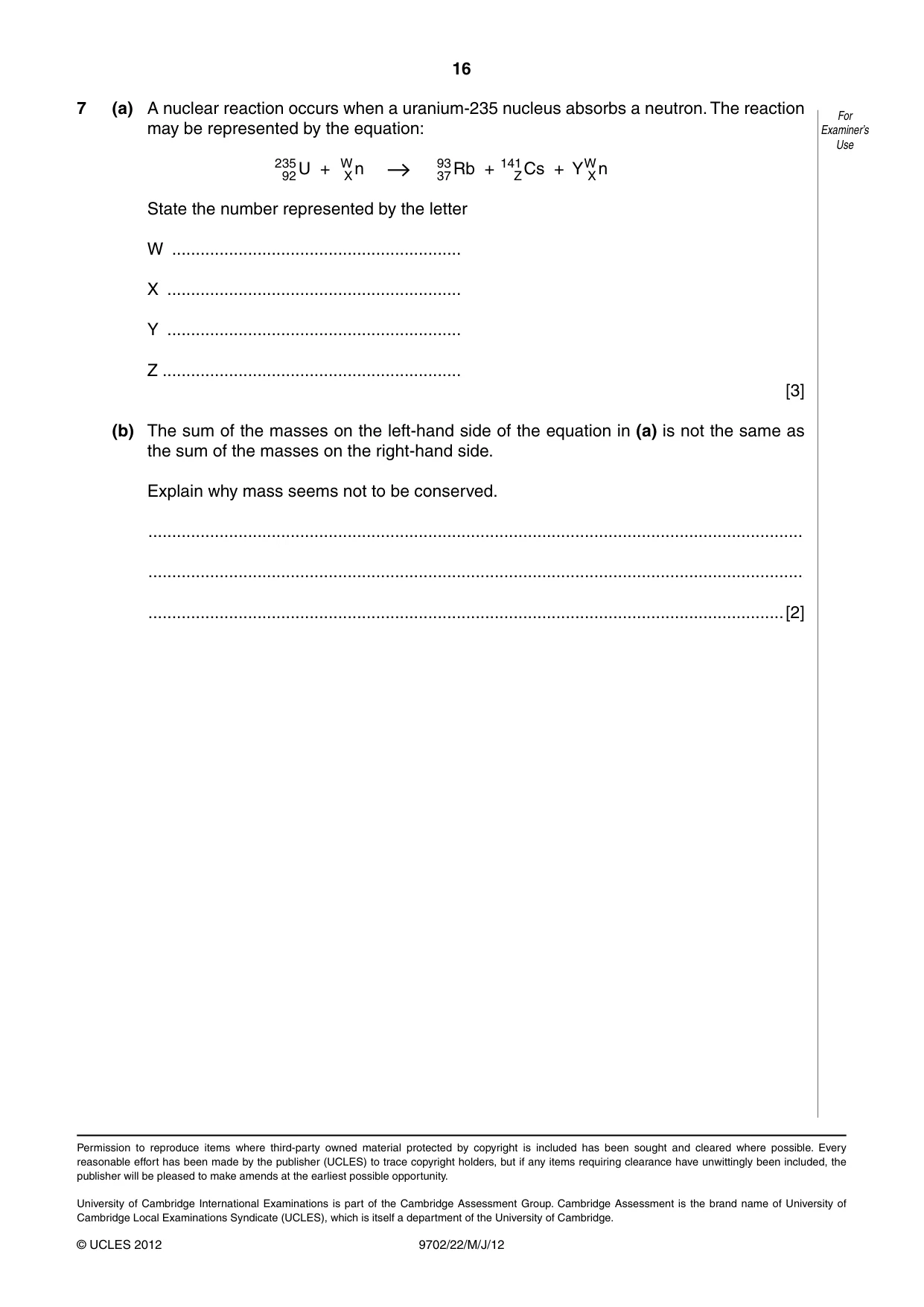
7 (a) A nuclear reaction occurs when a uranium-235 nucleus absorbs a neutron. The reaction For may be represented by the equation: Examiner’s Use 235 U + W n 93 Rb + 141 Cs + YW n 92 X 37 Z X State the number represented by the letter W ............................................................. X .............................................................. Y .............................................................. Z ............................................................... [3] (b) The sum of the masses on the left-hand side of the equation in (a) is not the same as the sum of the masses on the right-hand side. Explain why mass seems not to be conserved. .......................................................................................................................................... .......................................................................................................................................... ......................................................................................................................................[2]
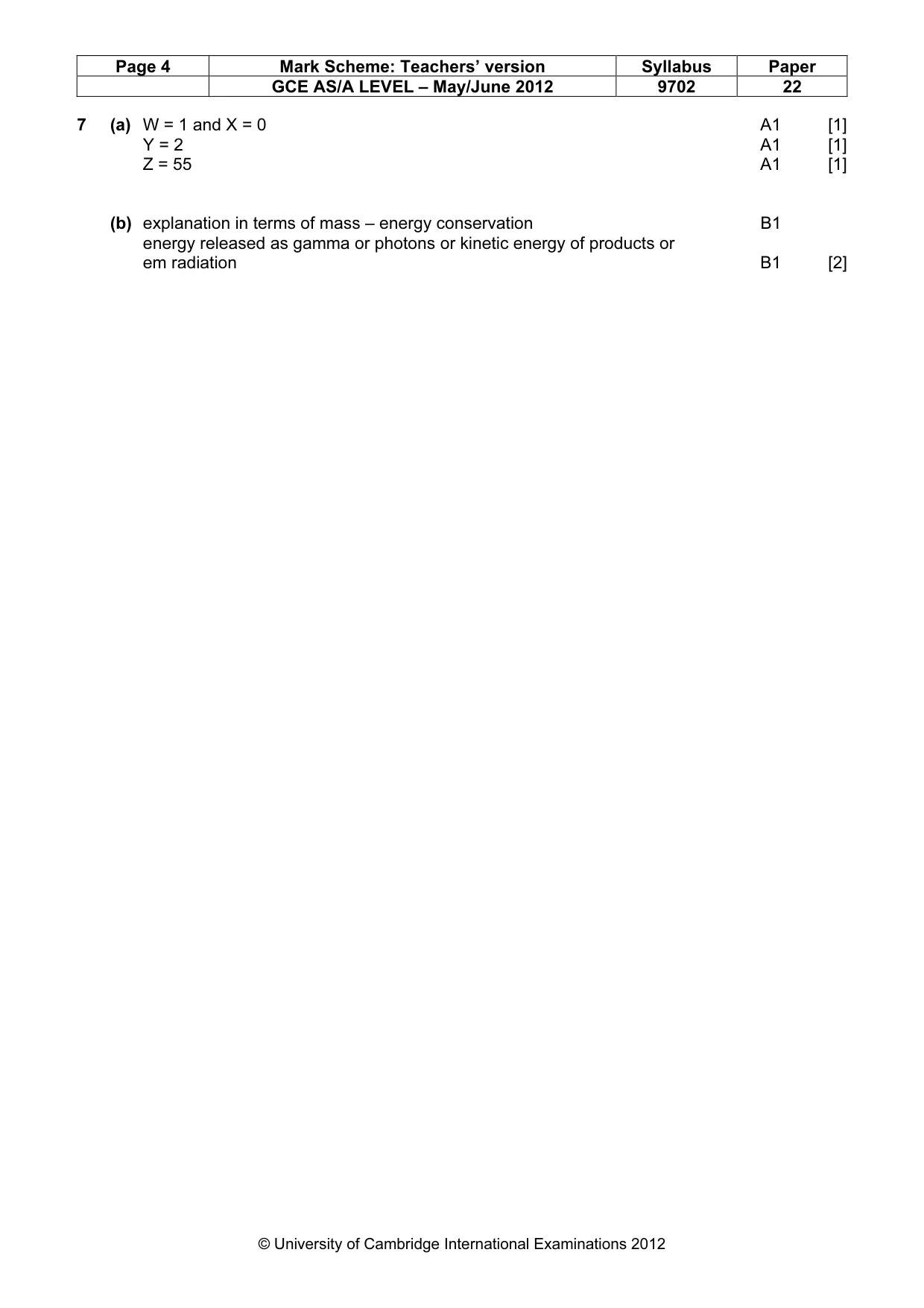
Mark scheme: 7 (a) W = 1 and X = 0 A1 [1] Y = 2 A1 [1] Z = 55 A1 [1] (b) explanation in terms of mass – energy conservation B1 energy released as gamma or photons or kinetic energy of products or em radiation B1 [2]
What was in this paper
The subtopics covered by these 7 questions, and how many questions each got. Open one in a new tab to see every Cambridge question on it.
What you needed in this session
Cambridge’s own grade thresholds for 2012 May/June, Paper 2 · Variant 2. A higher threshold means an easier paper — the bar moves with how the cohort did.