Cambridge A Level Physics 9702 — 2010 May/June Paper 2 · Variant 1
9702/21/M/J/10 · 7 questions · 60 marks · ≈68 min
The question paper and its mark scheme, free to read here and free to download. This is Cambridge’s own paper, exactly as it was sat.
Question paper20 pages


Mark scheme4 pages
Answers below. Sit the paper first if you are practising.
Questions as text
Q1 · A unit is often expressed with a prefix
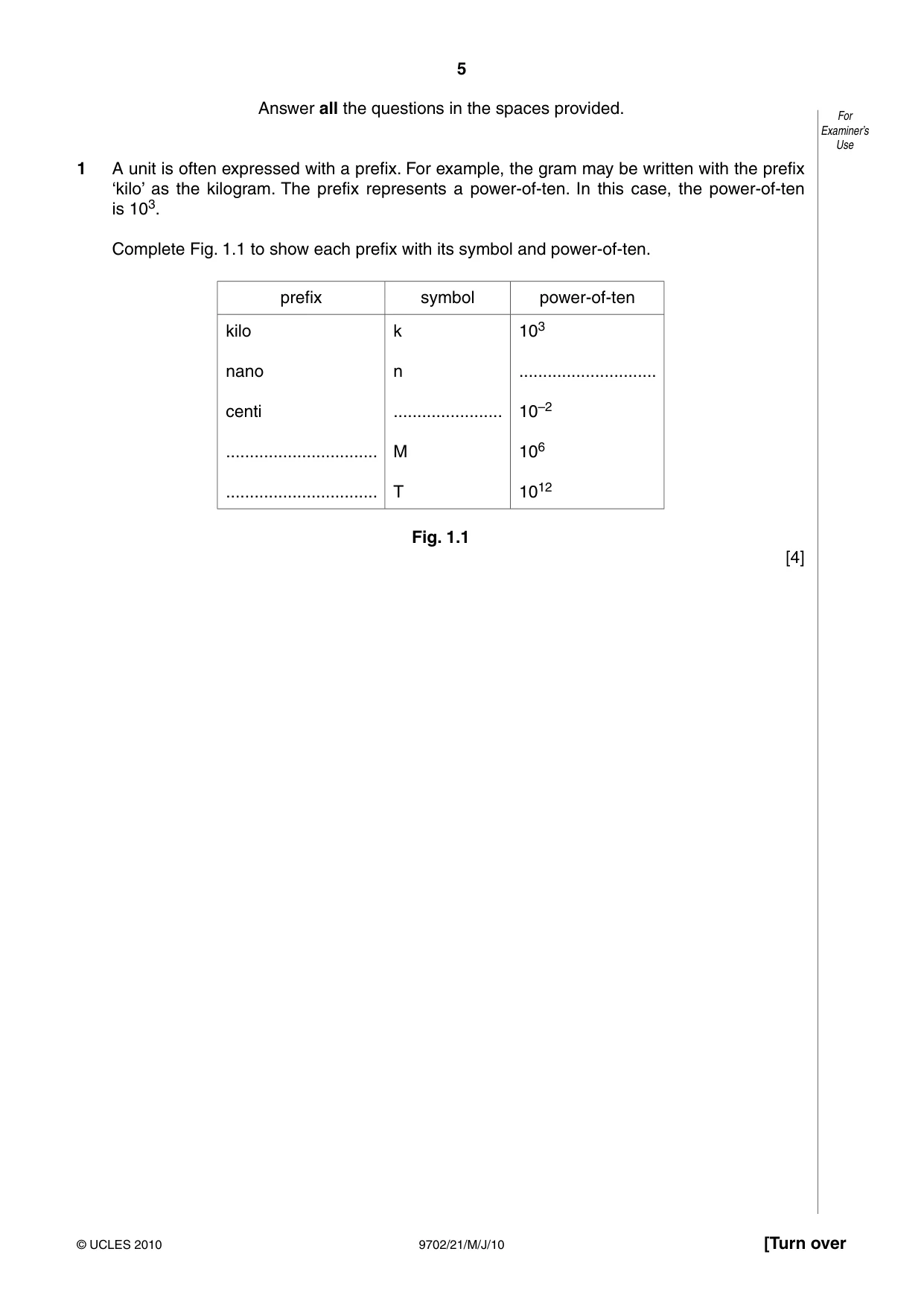
1 A unit is often expressed with a prefix. For example, the gram may be written with the prefix ‘kilo’ as the kilogram. The prefix represents a power-of-ten. In this case, the power-of-ten is 103. Complete Fig. 1.1 to show each prefix with its symbol and power-of-ten. prefix symbol power-of-ten kilo k 103 nano n ............................. centi ....................... 10–2 ................................ M 106 ................................ T 1012 Fig. 1.1 [4]
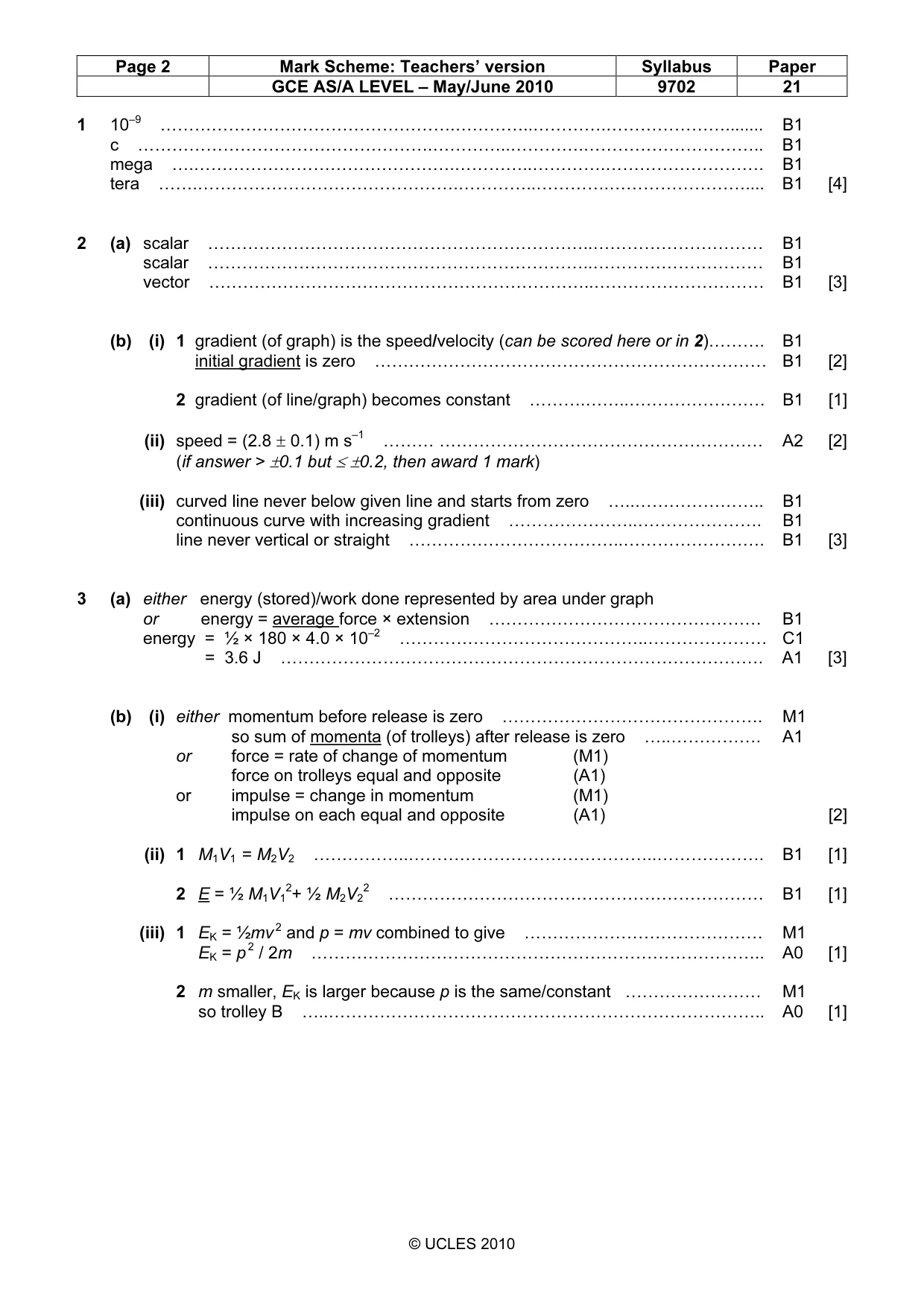
Mark scheme: 1 10–9 …………………………………………….…………..………….…………………........ B1 c …………………………………………….…………..………….………………………….. B1 mega ….……………………………………….…………..………….………………………. B1 tera …….……………………………………….…………..………….…………………….... B1 [4]
Question 2
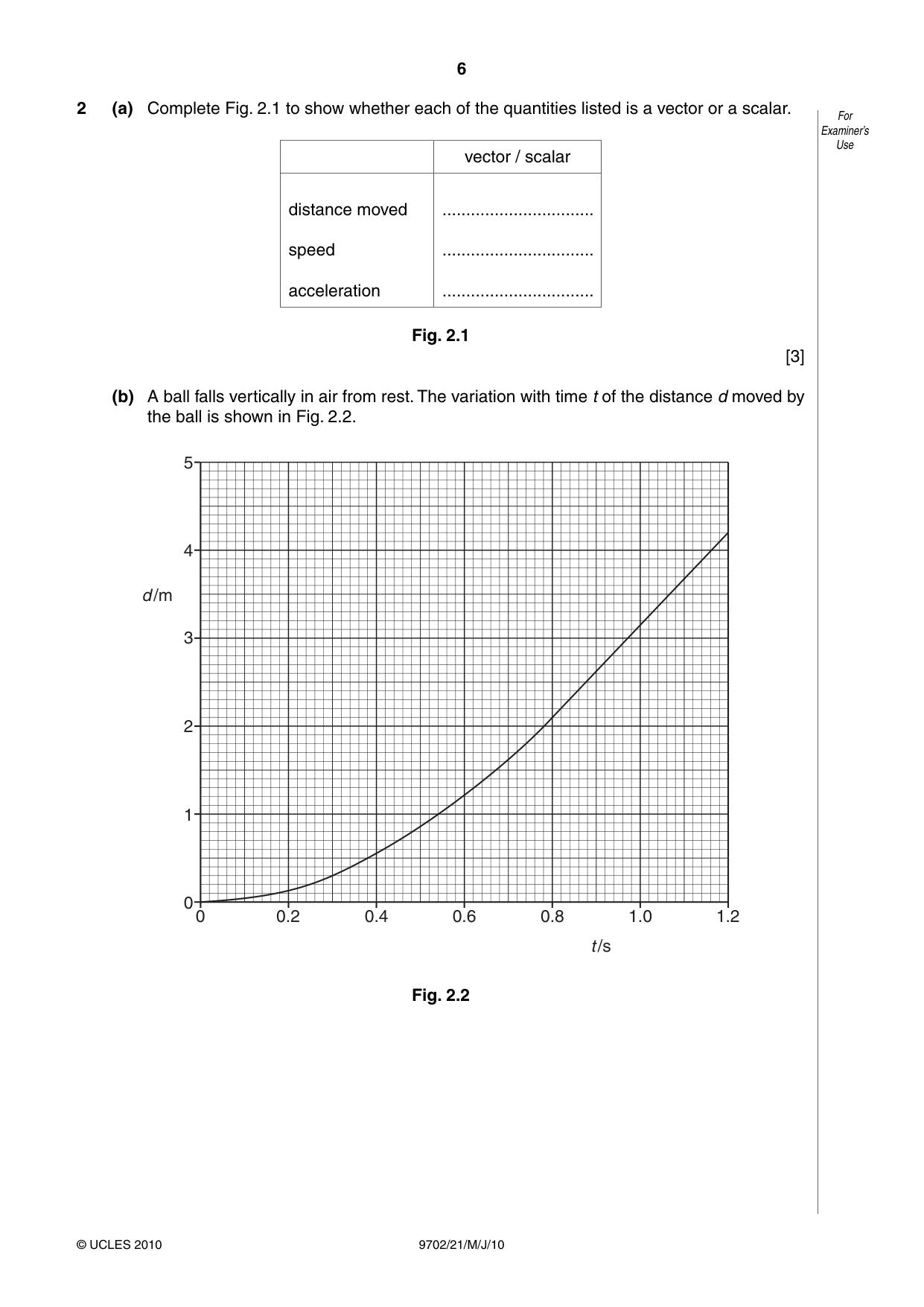
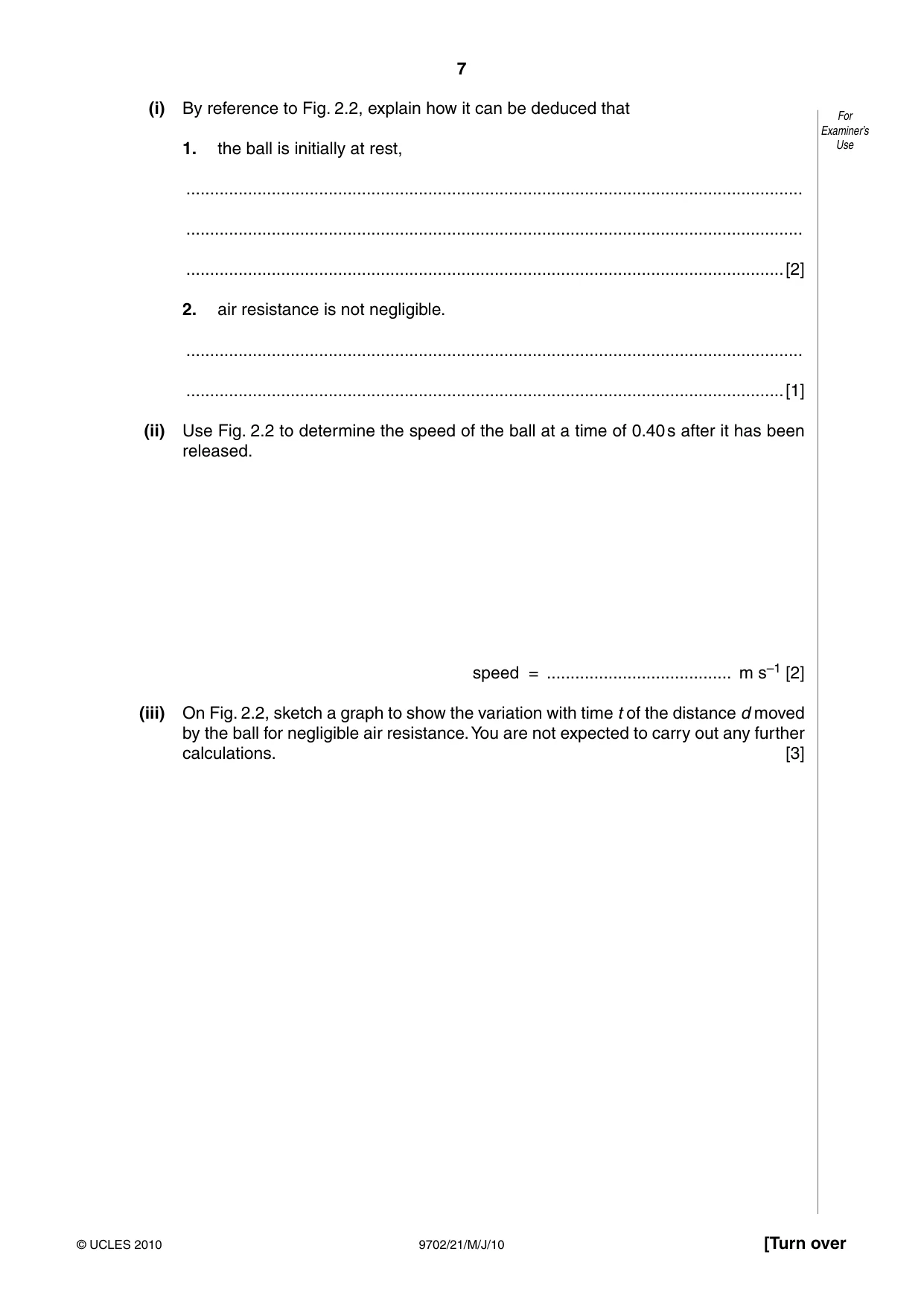
2 (a) Complete Fig. 2.1 to show whether each of the quantities listed is a vector or a scalar. For Examiner’s Use vector / scalar distance moved ................................ speed ................................ acceleration ................................ Fig. 2.1 [3] (b) A ball falls vertically in air from rest. The variation with time t of the distance d moved by the ball is shown in Fig. 2.2. 5 4 d /m 3 2 1 0 0 0.2 0.4 0.6 0.8 1.0 1.2 t /s Fig. 2.2 (i) By reference to Fig. 2.2, explain how it can be deduced that For Examiner’s 1. the ball is initially at rest, Use .................................................................................................................................. .................................................................................................................................. ..............................................................................................................................[2] 2. air resistance is not negligible. .................................................................................................................................. ..............................................................................................................................[1] (ii) Use Fig. 2.2 to determine the speed of the ball at a time of 0.40 s after it has been released. speed = ....................................... m s–1 [2] (iii) On Fig. 2.2, sketch a graph to show the variation with time t of the distance d moved by the ball for negligible air resistance. You are not expected to carry out any further calculations. [3]
Mark scheme: 2 (a) scalar …………………………………………………………..………………………… B1 scalar …………………………………………………………..………………………… B1 vector …………………………………………………………..………………………… B1 [3] (b) (i) 1 gradient (of graph) is the speed/velocity (can be scored here or in 2)………. B1 initial gradient is zero …………………………………………………………… B1 [2] 2 gradient (of line/graph) becomes constant ……….……..…………………… B1 [1] (ii) speed = (2.8 ± 0.1) m s–1 ……… ………………………………………………… A2 [2] (if answer > ±0.1 but ≤ ±0.2, then award 1 mark) (iii) curved line never below given line and starts from zero …..………………….. B1 continuous curve with increasing gradient …………………..…………………. B1 line never vertical or straight ………………………………..……………………. B1 [3]
Q3 · The variation with extension x of the tension F in a spring is shown in Fig
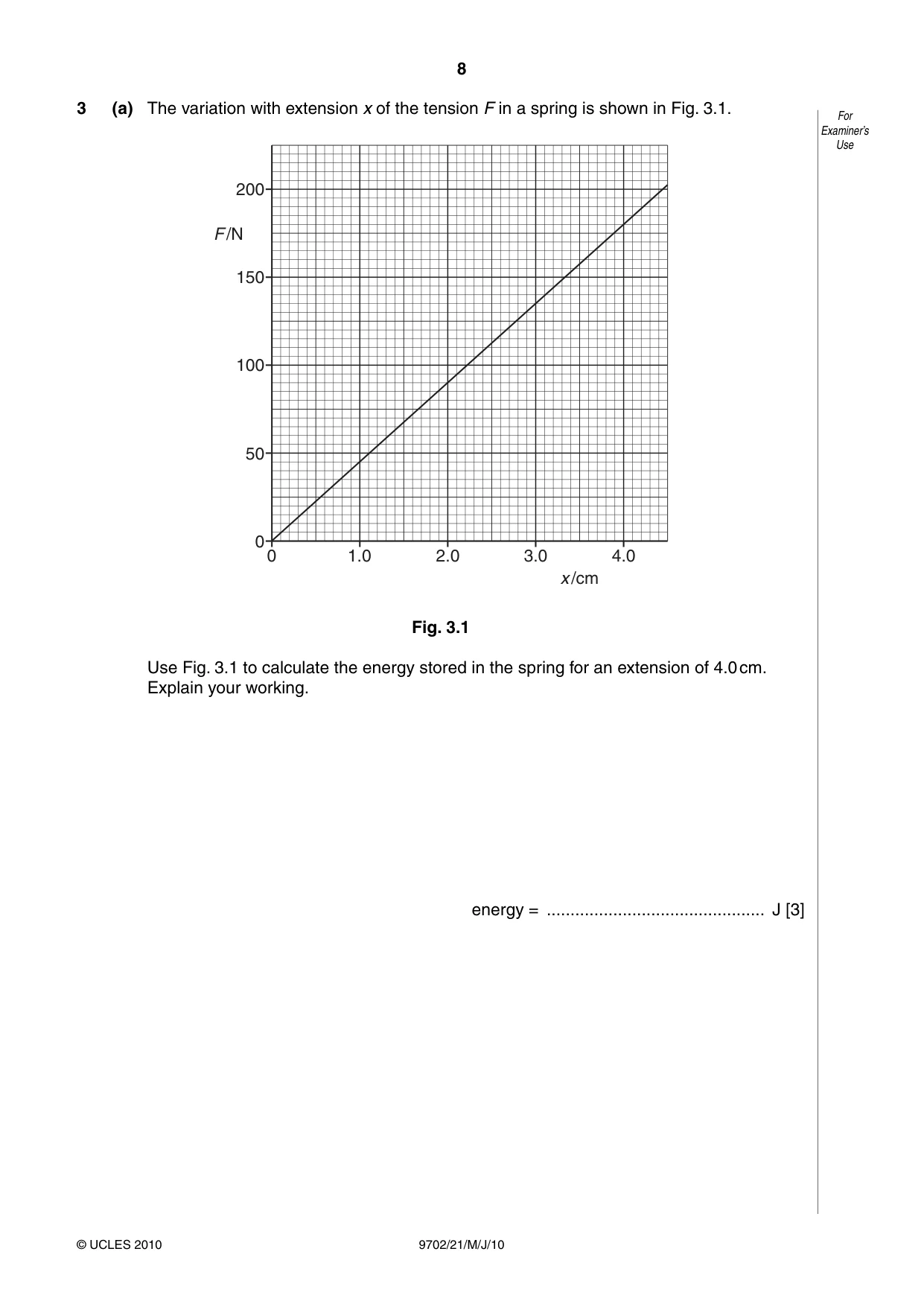
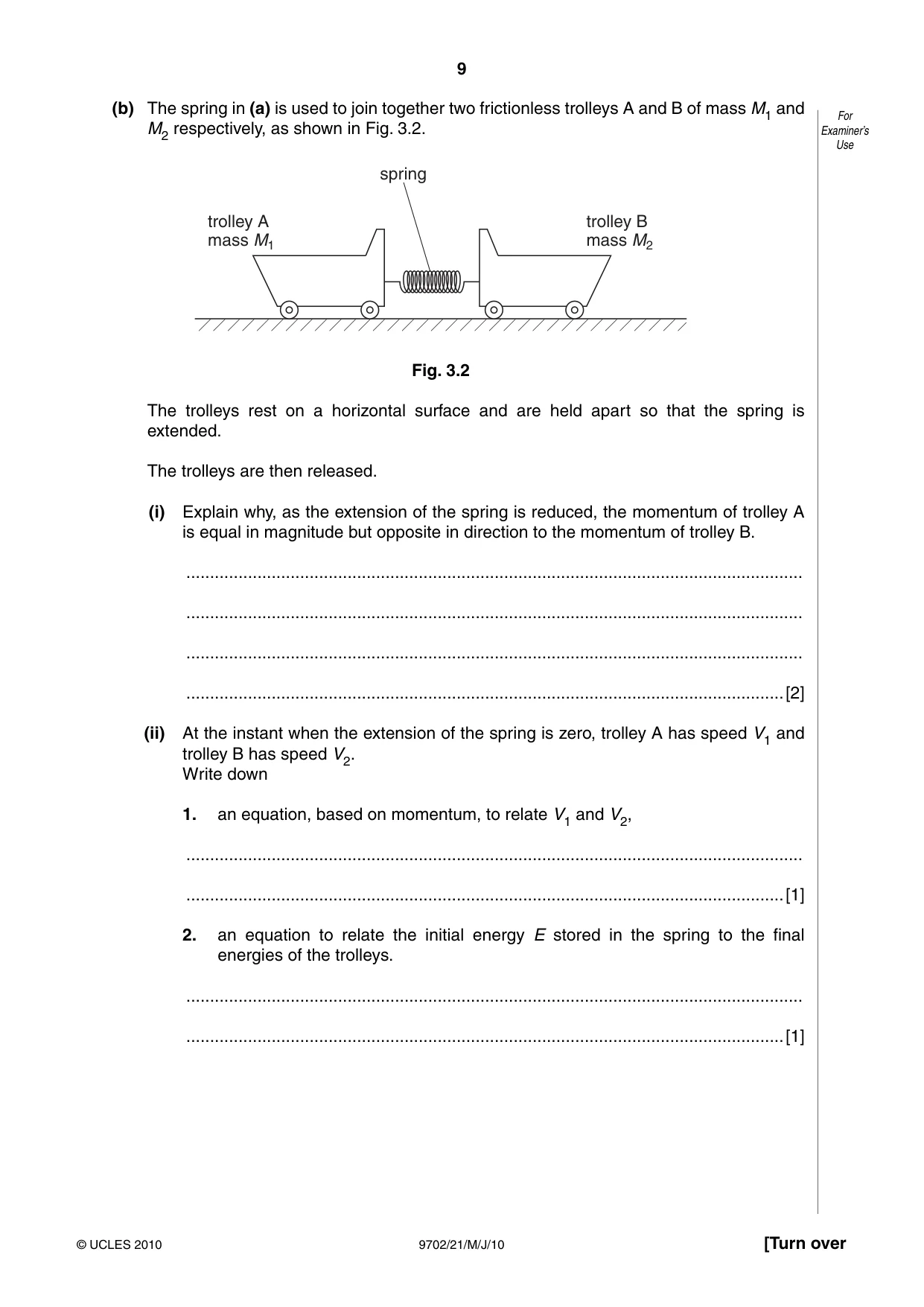
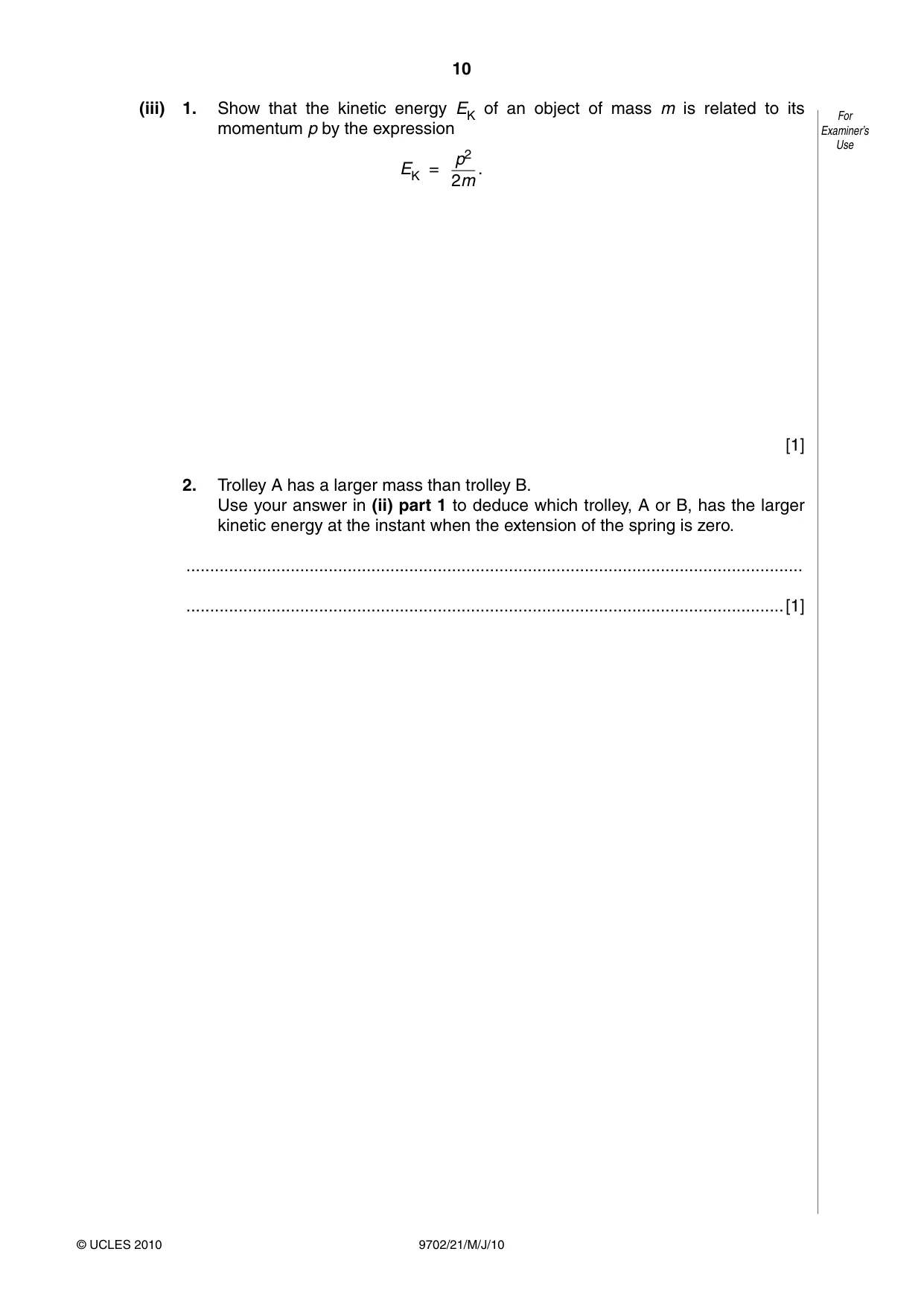
3 (a) The variation with extension x of the tension F in a spring is shown in Fig. 3.1. For Examiner’s Use 200 F /N 150 100 50 0 0 1.0 2.0 3.0 4.0 x /cm Fig. 3.1 Use Fig. 3.1 to calculate the energy stored in the spring for an extension of 4.0 cm. Explain your working. energy = .............................................. J [3] (b) The spring in (a) is used to join together two frictionless trolleys A and B of mass M1 and For Examiner’s M2 respectively, as shown in Fig. 3.2. Use spring trolley A trolley B mass M1 mass M2 Fig. 3.2 The trolleys rest on a horizontal surface and are held apart so that the spring is extended. The trolleys are then released. (i) Explain why, as the extension of the spring is reduced, the momentum of trolley A is equal in magnitude but opposite in direction to the momentum of trolley B. .................................................................................................................................. .................................................................................................................................. .................................................................................................................................. ..............................................................................................................................[2] (ii) At the instant when the extension of the spring is zero, trolley A has speed V1 and trolley B has speed V2. Write down 1. an equation, based on momentum, to relate V1 and V2, .................................................................................................................................. ..............................................................................................................................[1] 2. an equation to relate the initial energy E stored in the spring to the final energies of the trolleys. .................................................................................................................................. ..............................................................................................................................[1] (iii) 1. Show that the kinetic energy EK of an object of mass m is related to its For momentum p by the expression Examiner’s Use p2 EK = . 2m [1] 2. Trolley A has a larger mass than trolley B. Use your answer in (ii) part 1 to deduce which trolley, A or B, has the larger kinetic energy at the instant when the extension of the spring is zero. .................................................................................................................................. ..............................................................................................................................[1]
Mark scheme: 3 (a) either energy (stored)/work done represented by area under graph or energy = average force × extension ………………………………………… B1 energy = ½ × 180 × 4.0 × 10–2 ……………………………………..………………… C1 = 3.6 J …………………………………………………………………………. A1 [3] (b) (i) either momentum before release is zero ………………………………………. M1 so sum of momenta (of trolleys) after release is zero …..……………. A1 or force = rate of change of momentum (M1) force on trolleys equal and opposite (A1) or impulse = change in momentum (M1) impulse on each equal and opposite (A1) [2] (ii) 1 M1V1 = M2V2 ……………..……………………………………..………………. B1 [1] 2 E = ½ M1V12+ ½ M2V22 ………………………………………………………… B1 [1] (iii) 1 EK = ½mv 2 and p = mv combined to give …………………………………… M1 EK = p 2 / 2m …………………………………………………………………….. A0 [1] 2 m smaller, EK is larger because p is the same/constant …………………… M1 so trolley B …..………………………………………………………………….. A0 [1] GCE AS/A LEVEL – May/June 2010 9702 21
Q4 · State what is meant by the diffraction of a wave
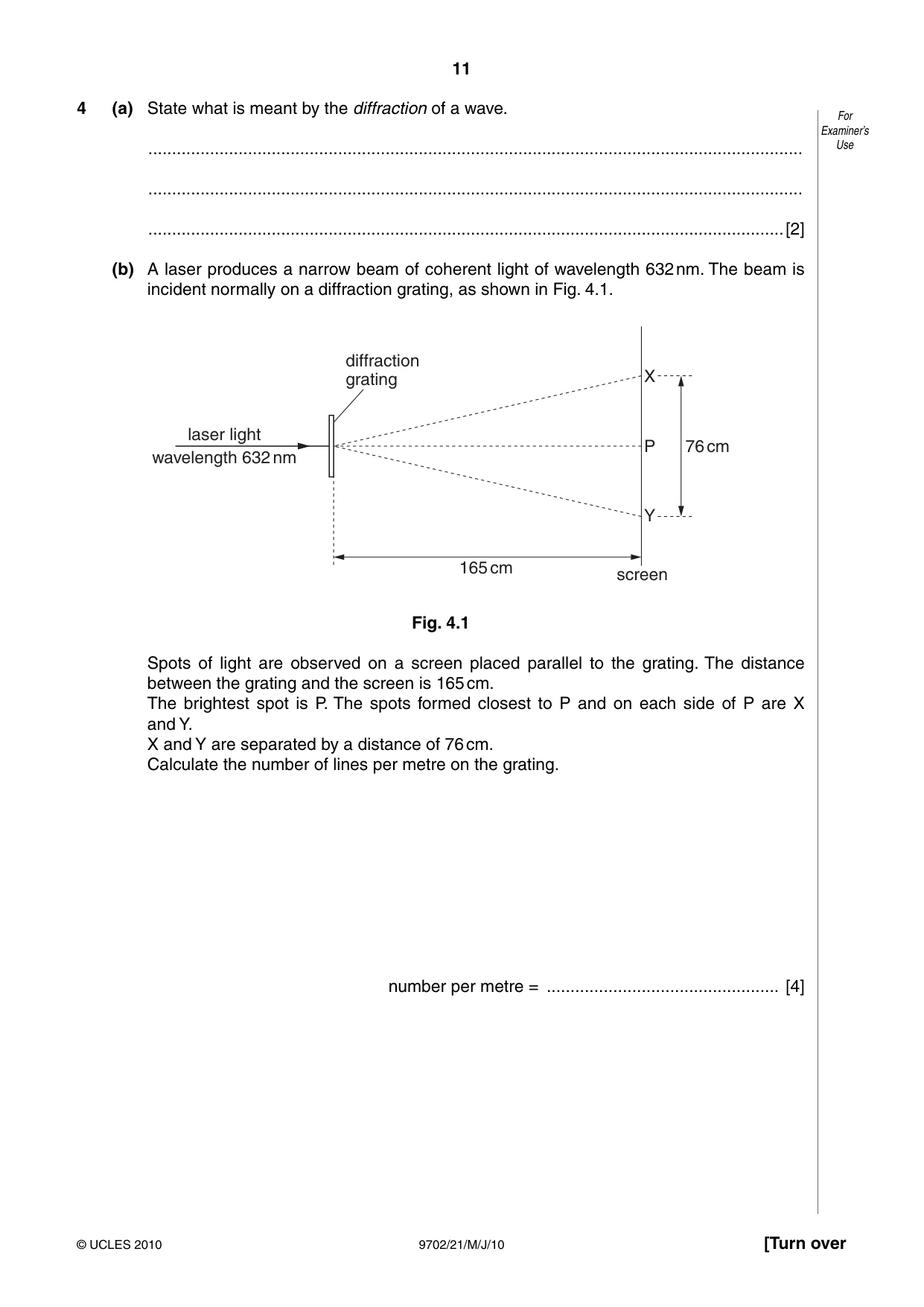
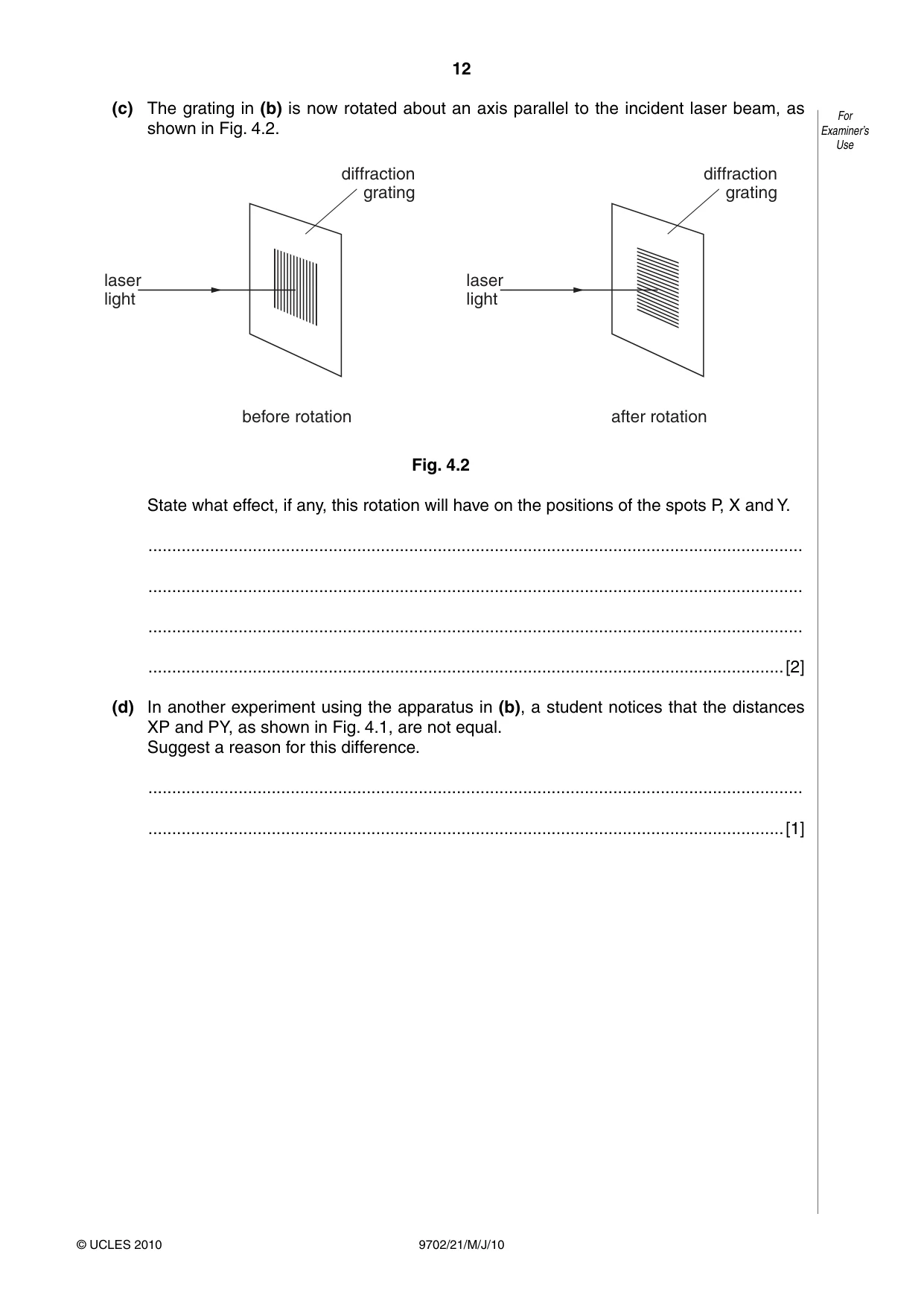
4 (a) State what is meant by the diffraction of a wave. For Examiner’s .......................................................................................................................................... Use .......................................................................................................................................... ......................................................................................................................................[2] (b) A laser produces a narrow beam of coherent light of wavelength 632 nm. The beam is incident normally on a diffraction grating, as shown in Fig. 4.1. diffraction grating X laser light P 76 cm wavelength 632 nm Y 165 cm screen Fig. 4.1 Spots of light are observed on a screen placed parallel to the grating. The distance between the grating and the screen is 165 cm. The brightest spot is P. The spots formed closest to P and on each side of P are X and Y. X and Y are separated by a distance of 76 cm. Calculate the number of lines per metre on the grating. number per metre = ................................................. [4] (c) The grating in (b) is now rotated about an axis parallel to the incident laser beam, as For shown in Fig. 4.2. Examiner’s Use diffraction diffraction grating grating laser laser light light before rotation after rotation Fig. 4.2 State what effect, if any, this rotation will have on the positions of the spots P, X and Y. .......................................................................................................................................... .......................................................................................................................................... .......................................................................................................................................... ......................................................................................................................................[2] (d) In another experiment using the apparatus in (b), a student notices that the distances XP and PY, as shown in Fig. 4.1, are not equal. Suggest a reason for this difference. .......................................................................................................................................... ......................................................................................................................................[1]
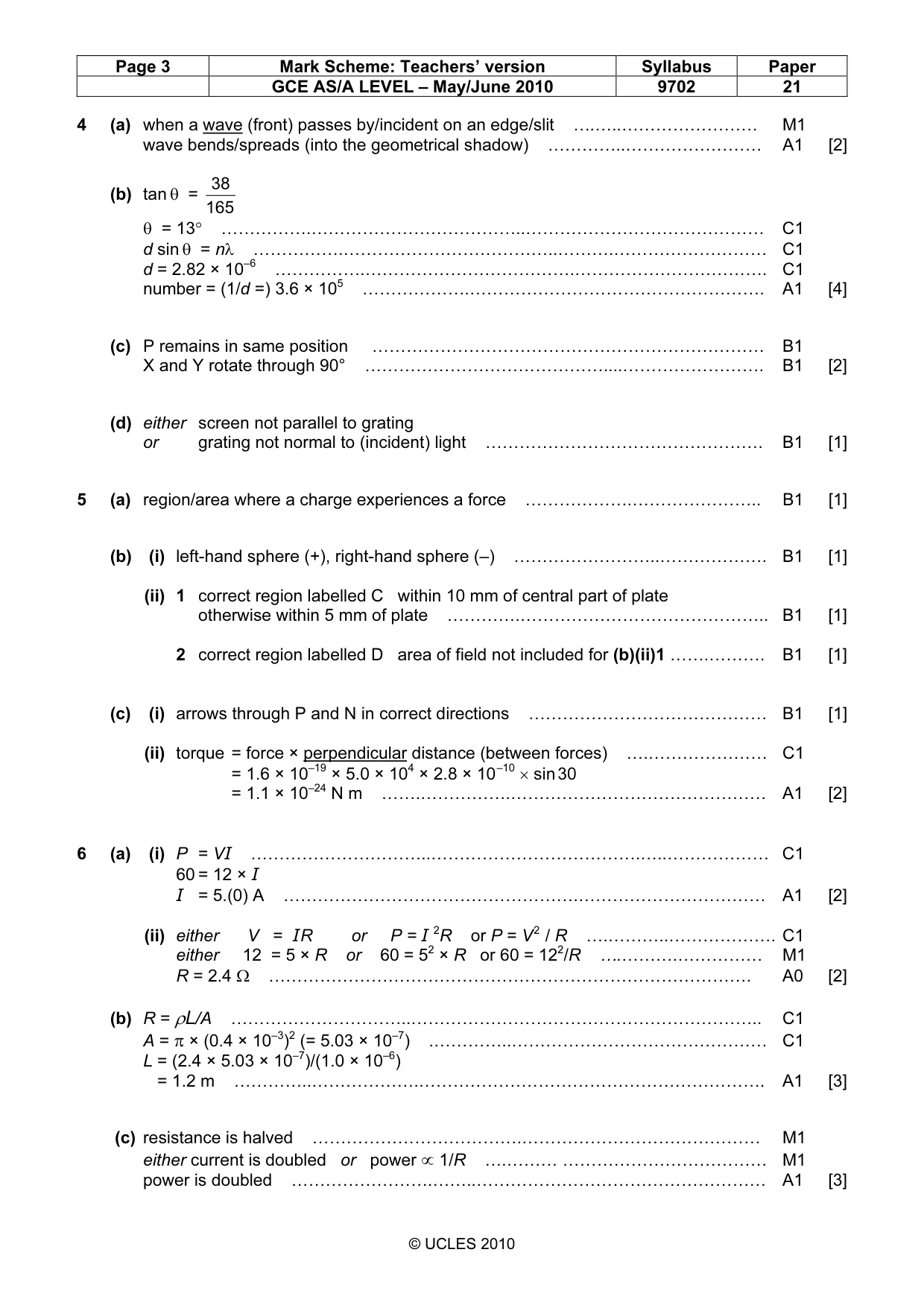
Mark scheme: 4 (a) when a wave (front) passes by/incident on an edge/slit ….…..…………………… M1 wave bends/spreads (into the geometrical shadow) …………..…………………… A1 [2] 38 (b) tan θ = 165 θ = 13° …………….………………………………..…………………………………… C1 d sin θ = nλ …………….………………………………..……….……………………… C1 d = 2.82 × 10⁻⁶ …………….……………………………….……………………………. C1 number = (1/d =) 3.6 × 10⁵ ……………….……………………………………………. A1 [4] (c) P remains in same position …………………………………………………………… B1 X and Y rotate through 90° ……………………………………....……………………. B1 [2] (d) either screen not parallel to grating or grating not normal to (incident) light …………………………………………. B1 [1]
Q5 · State what is meant by an electric field
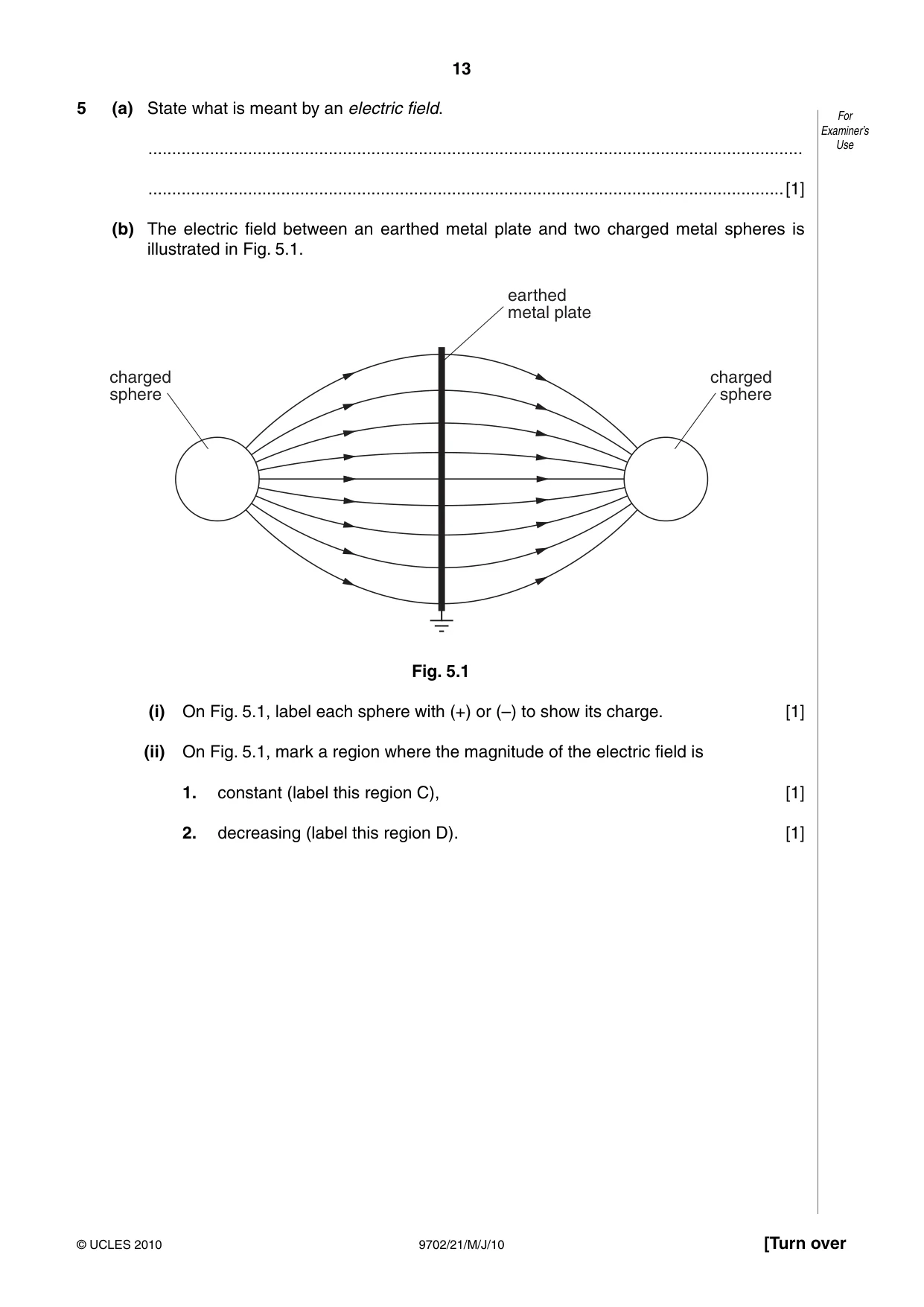
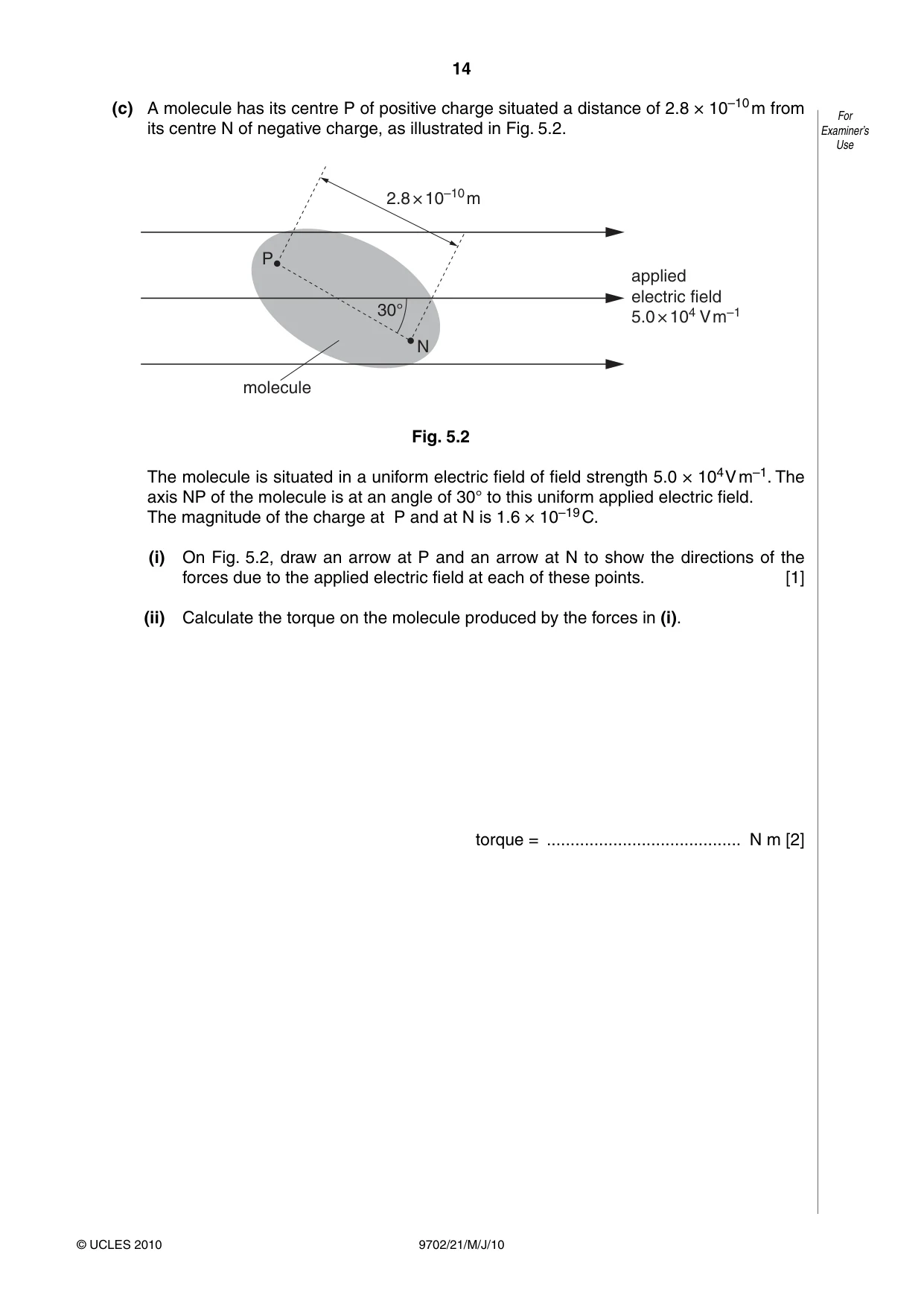
5 (a) State what is meant by an electric field. For Examiner’s .......................................................................................................................................... Use ......................................................................................................................................[1] (b) The electric field between an earthed metal plate and two charged metal spheres is illustrated in Fig. 5.1. earthed metal plate charged charged sphere sphere Fig. 5.1 (i) On Fig. 5.1, label each sphere with (+) or (–) to show its charge. [1] (ii) On Fig. 5.1, mark a region where the magnitude of the electric field is 1. constant (label this region C), [1] 2. decreasing (label this region D). [1] (c) A molecule has its centre P of positive charge situated a distance of 2.8 × 10⁻¹⁰ m from For its centre N of negative charge, as illustrated in Fig. 5.2. Examiner’s Use 2.8 × 10⁻¹⁰ m P applied electric field 30° 5.0 × 10⁴ V m–1 N molecule Fig. 5.2 The molecule is situated in a uniform electric field of field strength 5.0 × 10⁴ V m–1. The axis NP of the molecule is at an angle of 30° to this uniform applied electric field. The magnitude of the charge at P and at N is 1.6 × 10⁻¹⁹ C. (i) On Fig. 5.2, draw an arrow at P and an arrow at N to show the directions of the forces due to the applied electric field at each of these points. [1] (ii) Calculate the torque on the molecule produced by the forces in (i). torque = ......................................... N m [2]
Mark scheme: 5 (a) region/area where a charge experiences a force ……………….………………….. B1 [1] (b) (i) left-hand sphere (+), right-hand sphere (–) ……………………..………………. B1 [1] (ii) 1 correct region labelled C within 10 mm of central part of plate otherwise within 5 mm of plate ………….…………………………………….. B1 [1] 2 correct region labelled D area of field not included for (b)(ii)1 …….………. B1 [1] (c) (i) arrows through P and N in correct directions …………………………………… B1 [1] (ii) torque = force × perpendicular distance (between forces) ….………………… C1 = 1.6 × 10–19 × 5.0 × 104 × 2.8 × 10 –10 × sin 30 = 1.1 × 10⁻²⁴ N m …….…………….……………………………………… A1 [2]
Q6 · An electric heater is to be made from nichrome wire
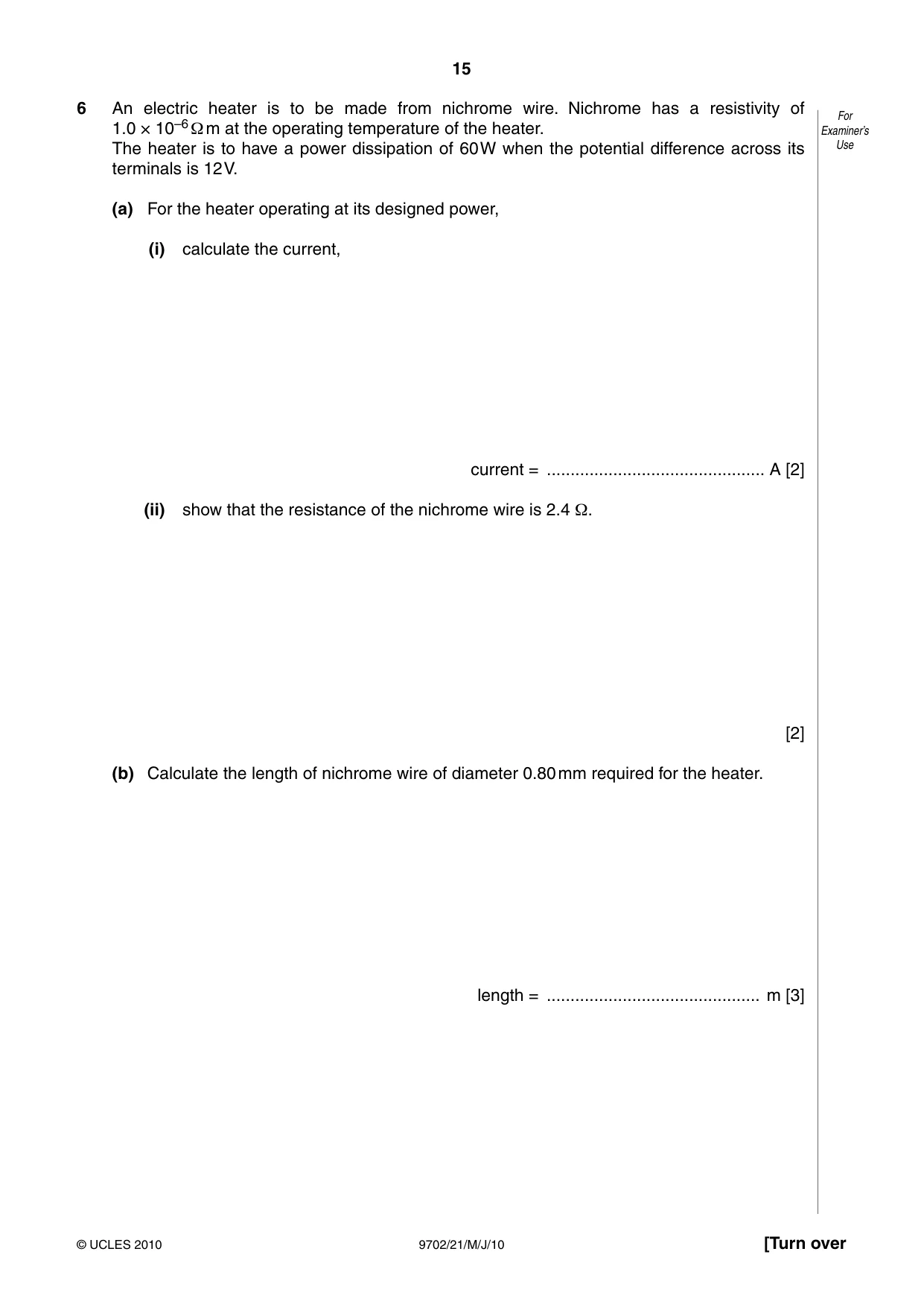
6 An electric heater is to be made from nichrome wire. Nichrome has a resistivity of For 1.0 × 10⁻⁶ Ω m at the operating temperature of the heater. Examiner’s The heater is to have a power dissipation of 60 W when the potential difference across its Use terminals is 12 V. (a) For the heater operating at its designed power, (i) calculate the current, current = .............................................. A [2] (ii) show that the resistance of the nichrome wire is 2.4 Ω. [2] (b) Calculate the length of nichrome wire of diameter 0.80 mm required for the heater. length = ............................................. m [3] (c) A second heater, also designed to operate from a 12 V supply, is constructed using the For same nichrome wire but using half the length of that calculated in (b). Examiner’s Explain quantitatively the effect of this change in length of wire on the power of the Use heater. .......................................................................................................................................... .......................................................................................................................................... .......................................................................................................................................... ......................................................................................................................................[3]
Mark scheme: 6 (a) (i) P = VI …………………………..……………………………….…..……………… C1 60 = 12 × I I = 5.(0) A …………………………………………….…………………………… A1 [2] (ii) either V = IR or P = I 2R or P = V2 / R ….………..………………. C1 either 12 = 5 × R or 60 = 52 × R or 60 = 122/R ….……….…………… M1 R = 2.4 Ω …………………………………………………………………………. A0 [2] (b) R = ρL/A …………………………..…………………………………………………….. C1 A = π × (0.4 × 10⁻³)2 (= 5.03 × 10⁻⁷) .…………..……………………………………… C1 L = (2.4 × 5.03 × 10–7)/(1.0 × 10–6) = 1.2 m …………..……………….……………………………………………………. A1 [3] (c) resistance is halved ……………………………….…………………………………… M1 either current is doubled or power ∝ 1/R ….……… ……………………………… M1 power is doubled …………………….……..…………………………………………… A1 [3] GCE AS/A LEVEL – May/June 2010 9702 21
Q7 · For7 One of the isotopes of uranium is uranium-238 ( 23892U)
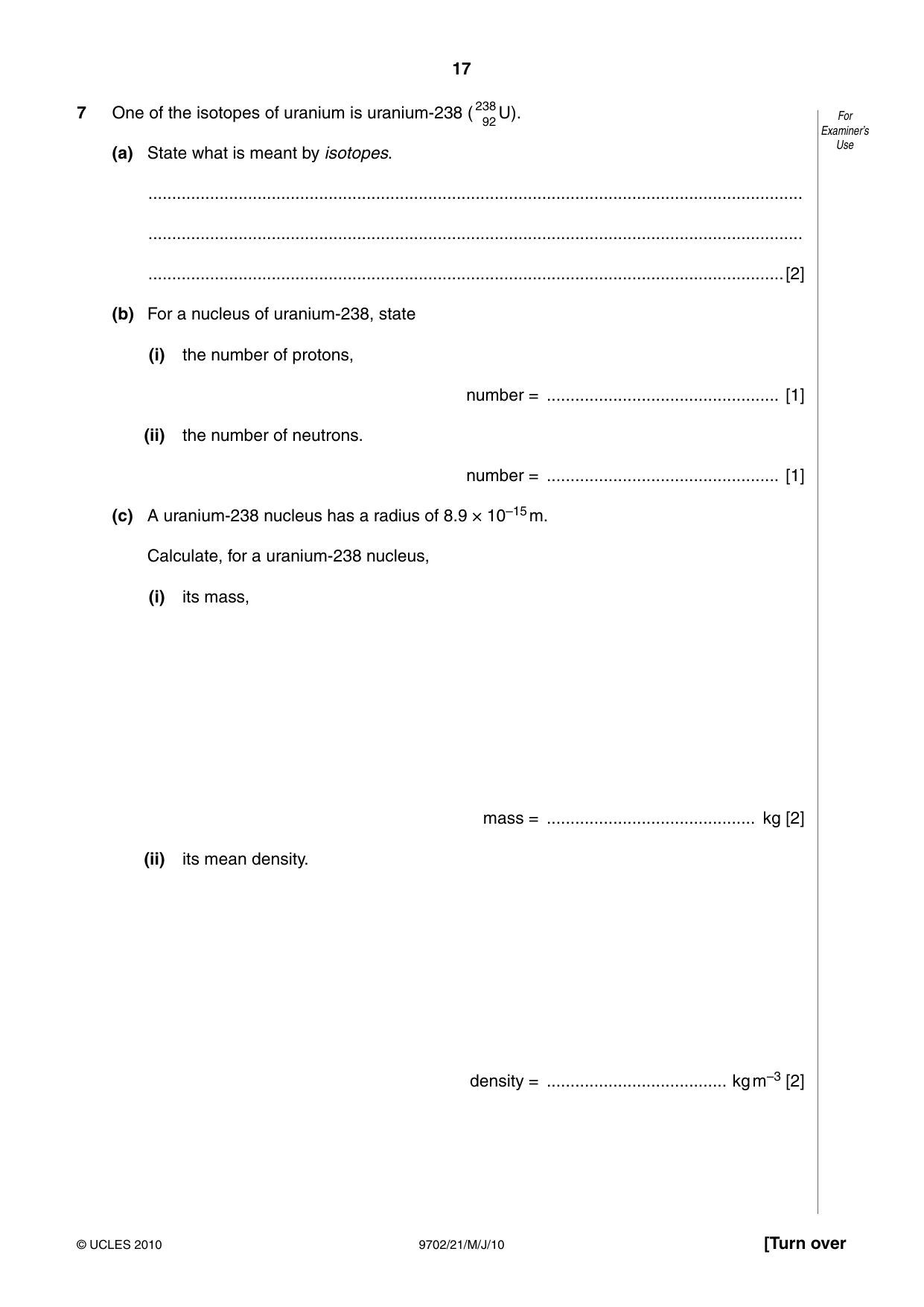
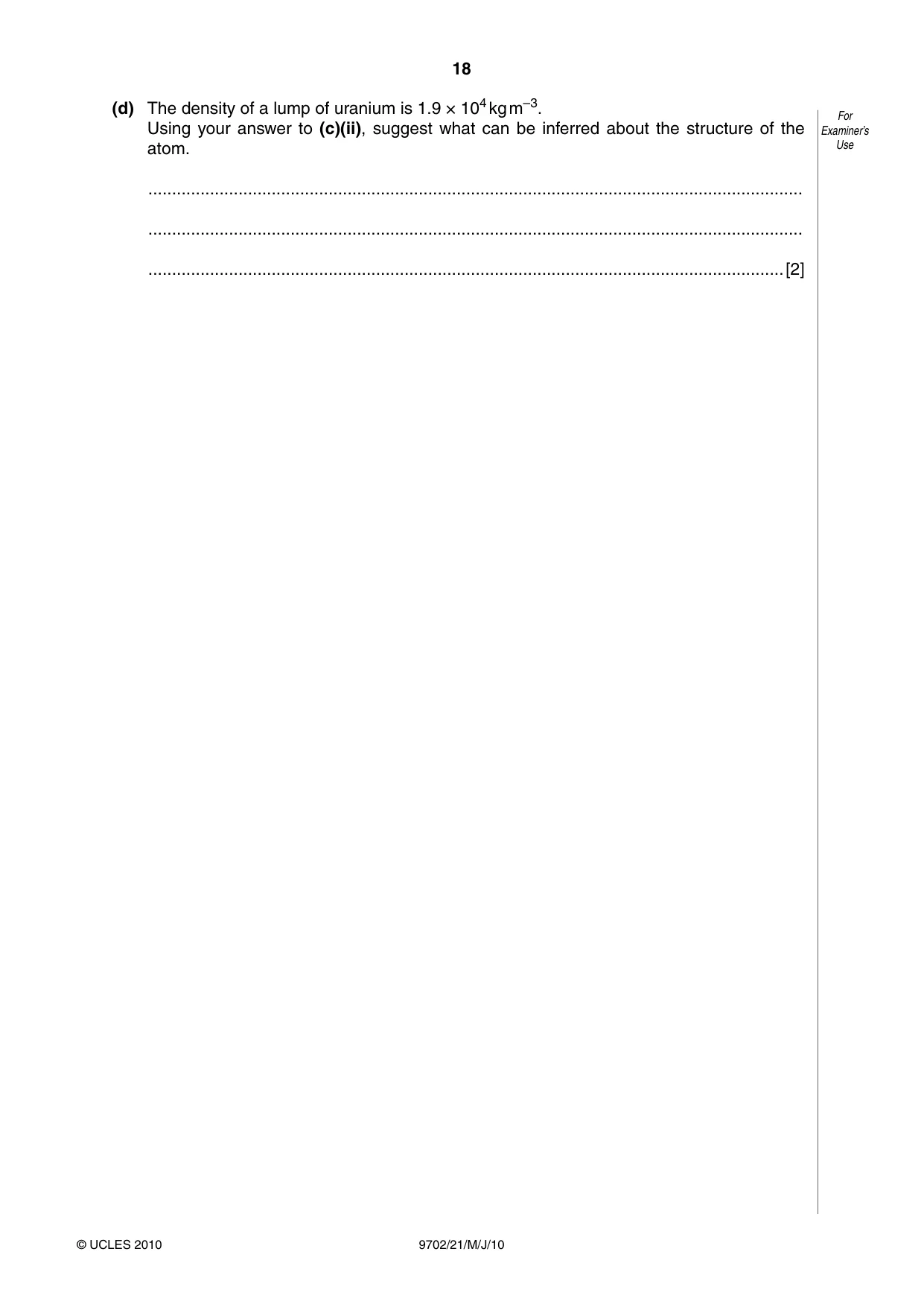
For7 One of the isotopes of uranium is uranium-238 ( 23892U). Examiner’s (a) State what is meant by isotopes. Use .......................................................................................................................................... .......................................................................................................................................... ......................................................................................................................................[2] (b) For a nucleus of uranium-238, state (i) the number of protons, number = ................................................. [1] (ii) the number of neutrons. number = ................................................. [1] (c) A uranium-238 nucleus has a radius of 8.9 × 10⁻¹⁵ m. Calculate, for a uranium-238 nucleus, (i) its mass, mass = ............................................ kg [2] (ii) its mean density. density = ...................................... kg m–3 [2] (d) The density of a lump of uranium is 1.9 × 10⁴ kg m–3. For Using your answer to (c)(ii), suggest what can be inferred about the structure of the Examiner’s atom. Use .......................................................................................................................................... .......................................................................................................................................... ......................................................................................................................................[2]
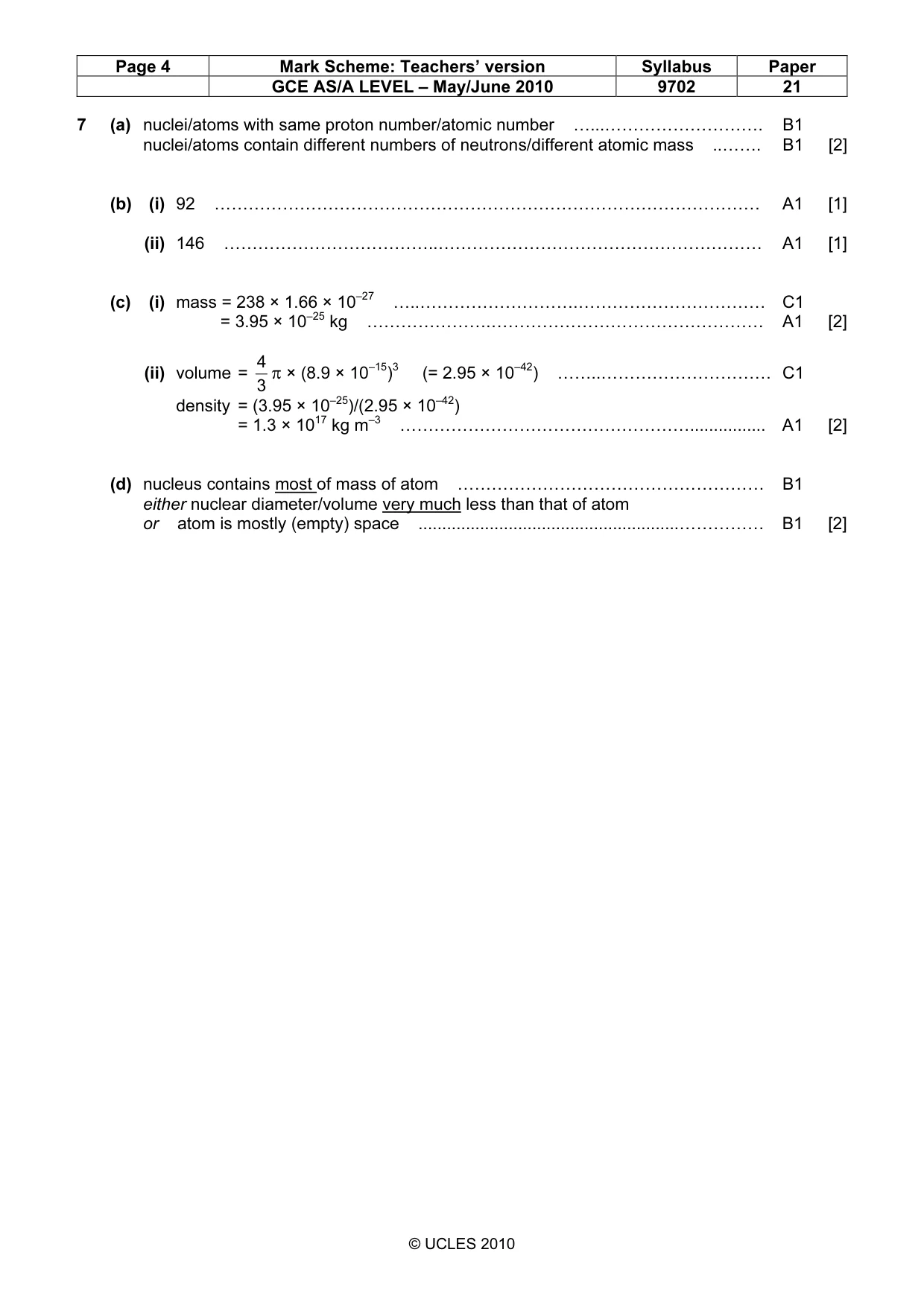
Mark scheme: 7 (a) nuclei/atoms with same proton number/atomic number …...………………………. B1 nuclei/atoms contain different numbers of neutrons/different atomic mass ..……. B1 [2] (b) (i) 92 …………………………………………………………………………………… A1 [1] (ii) 146 ………………………………..………………………………………………… A1 [1] (c) (i) mass = 238 × 1.66 × 10–27 …..……………………….…………………………… C1 = 3.95 × 10⁻²⁵ kg ………………….………………………………………… A1 [2] 4 (ii) volume = π × (8.9 × 10⁻¹⁵)3 (= 2.95 × 10–42) ……..………………………… C1 3 density = (3.95 × 10⁻²⁵)/(2.95 × 10–42) = 1.3 × 10¹⁷ kg m–3 ……………………………………………................ A1 [2] (d) nucleus contains most of mass of atom ……………………………………………… B1 either nuclear diameter/volume very much less than that of atom or atom is mostly (empty) space .......................................................…………… B1 [2]
What was in this paper
The subtopics covered by these 7 questions, and how many questions each got. Open one in a new tab to see every Cambridge question on it.
What you needed in this session
Cambridge’s own grade thresholds for 2010 May/June, Paper 2 · Variant 1. A higher threshold means an easier paper — the bar moves with how the cohort did.