Cambridge A Level Physics 9702 — 2020 Oct/Nov Paper 2 · Variant 1
9702/21/O/N/20 · 8 questions · 60 marks · ≈68 min
The question paper and its mark scheme, free to read here and free to download. This is Cambridge’s own paper, exactly as it was sat.
Question paper16 pages
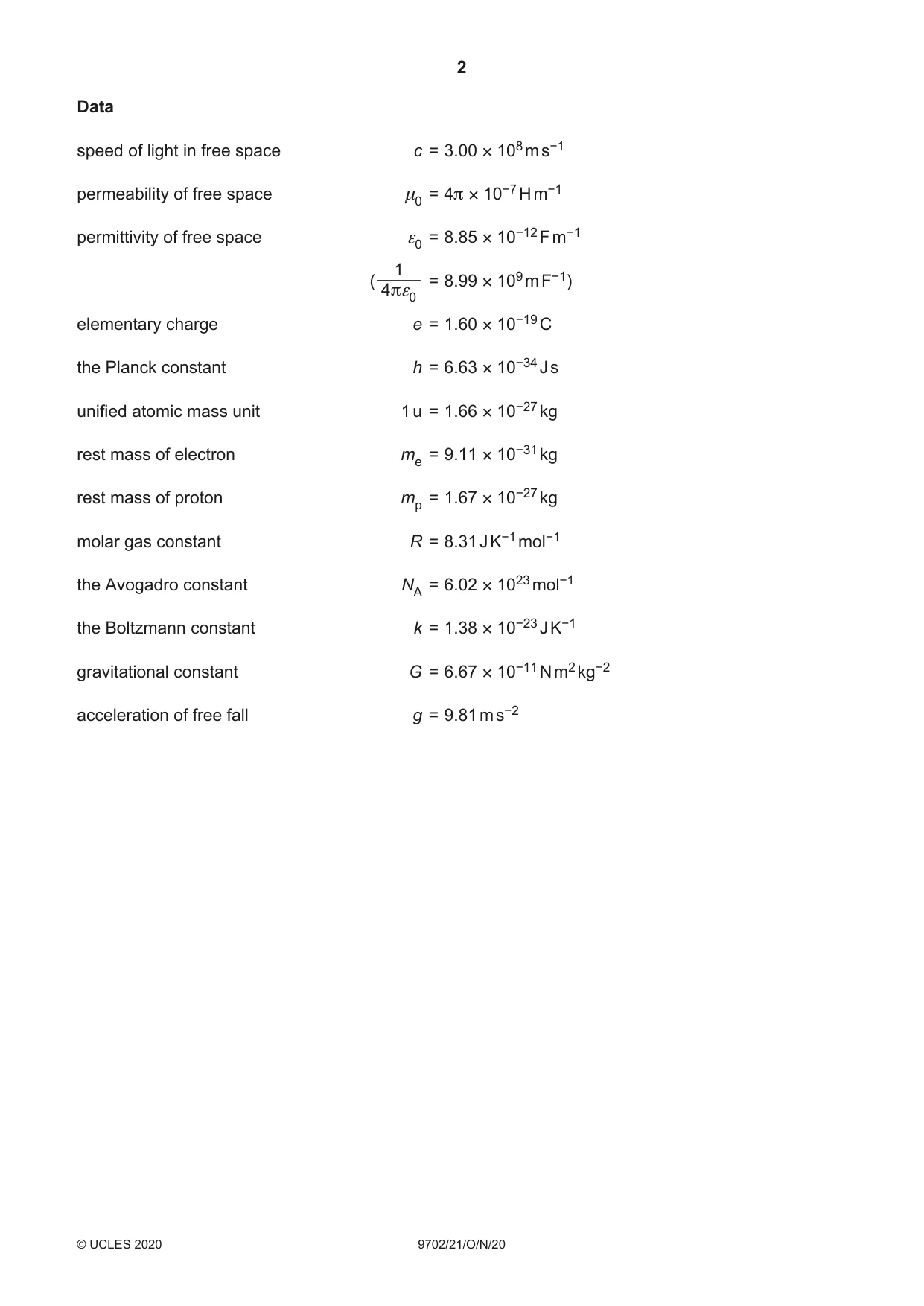
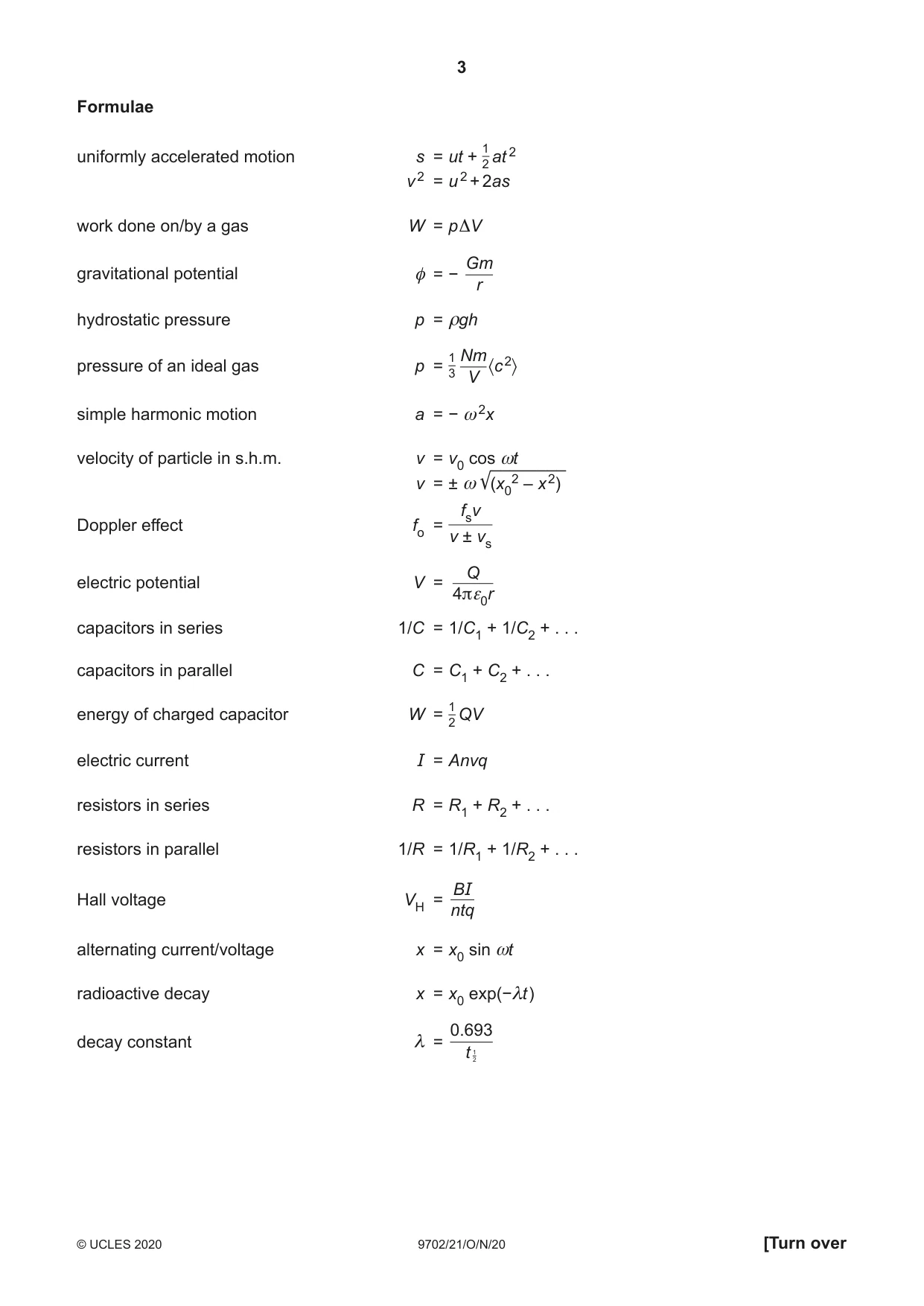
Mark scheme12 pages
Answers below. Sit the paper first if you are practising.
Questions as text
Q1 · Define the moment of a force about a point
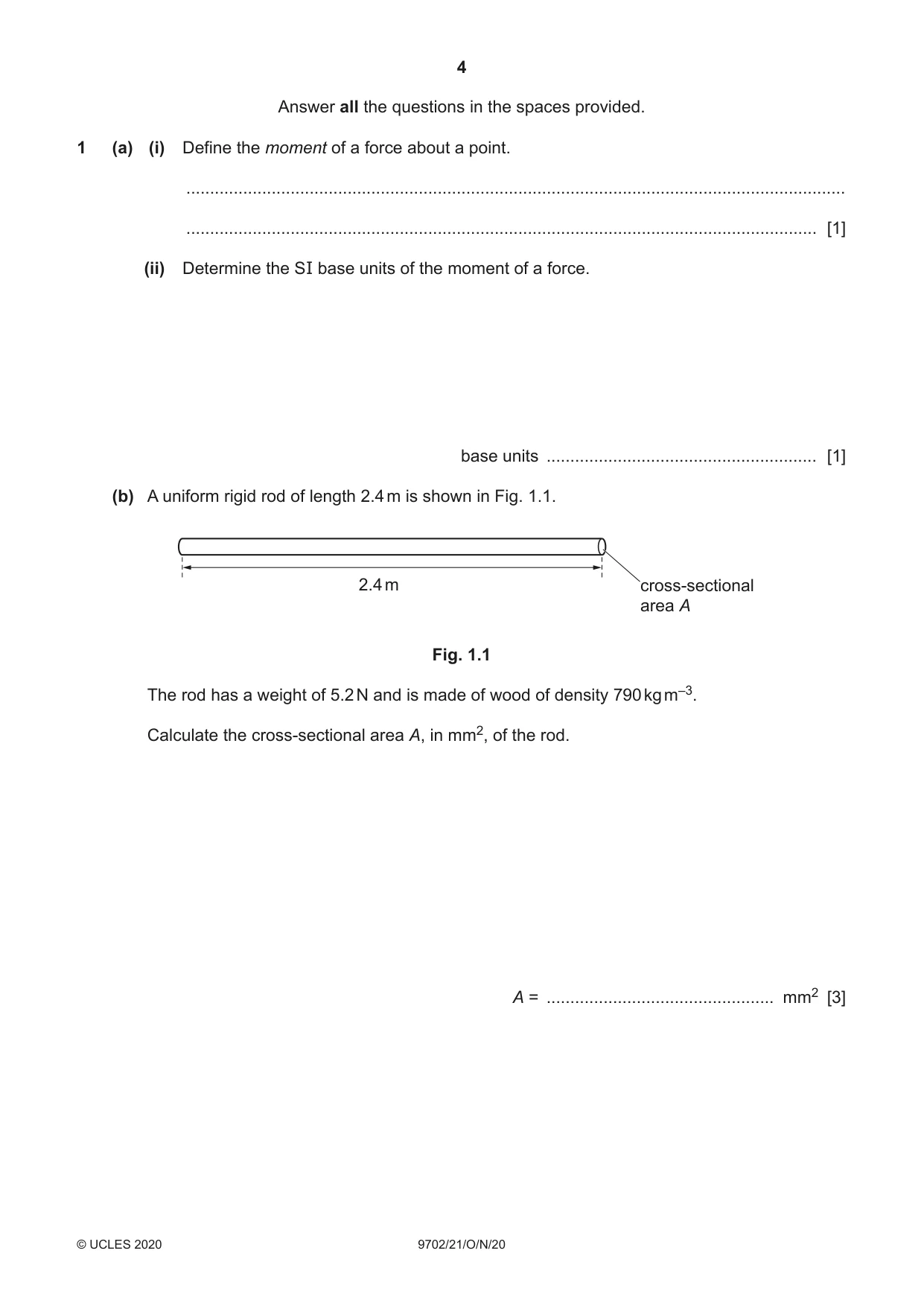
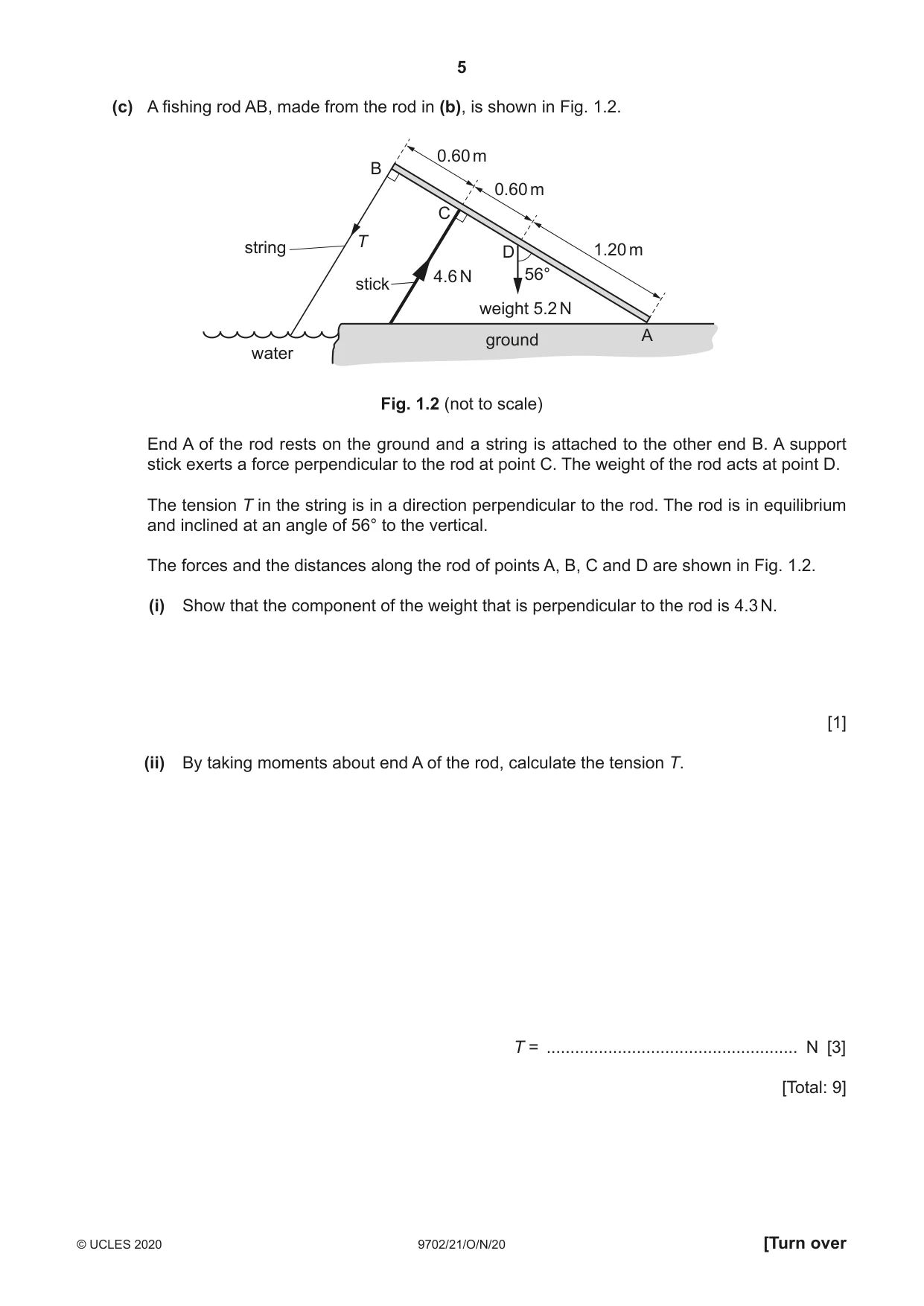
1 (a) (i) Define the moment of a force about a point. ........................................................................................................................................... ..................................................................................................................................... [1] (ii) Determine the SI base units of the moment of a force. base units ......................................................... [1] (b) A uniform rigid rod of length 2.4 m is shown in Fig. 1.1. 2.4 m cross-sectional area A Fig. 1.1 The rod has a weight of 5.2 N and is made of wood of density 790 kg m–3. Calculate the cross-sectional area A, in mm2, of the rod. A = ................................................ mm2 [3] (c) A fishing rod AB, made from the rod in (b), is shown in Fig. 1.2. 0.60 m B 0.60 m C T string D 1.20 m 4.6 N 56° stick weight 5.2 N A ground water Fig. 1.2 (not to scale) End A of the rod rests on the ground and a string is attached to the other end B. A support stick exerts a force perpendicular to the rod at point C. The weight of the rod acts at point D. The tension T in the string is in a direction perpendicular to the rod. The rod is in equilibrium and inclined at an angle of 56° to the vertical. The forces and the distances along the rod of points A, B, C and D are shown in Fig. 1.2. (i) Show that the component of the weight that is perpendicular to the rod is 4.3 N. [1] (ii) By taking moments about end A of the rod, calculate the tension T. T = ..................................................... N [3] [Total: 9]
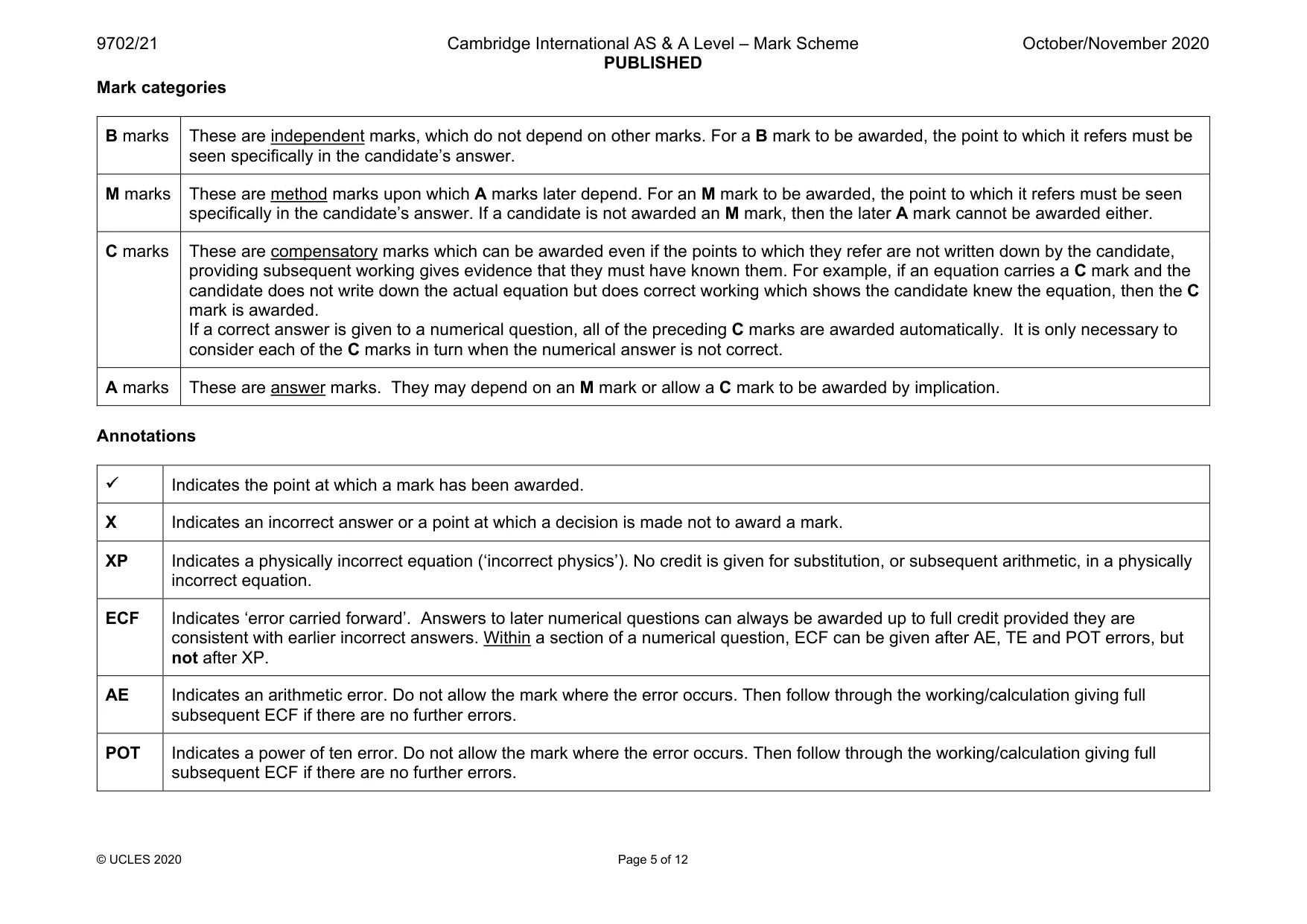
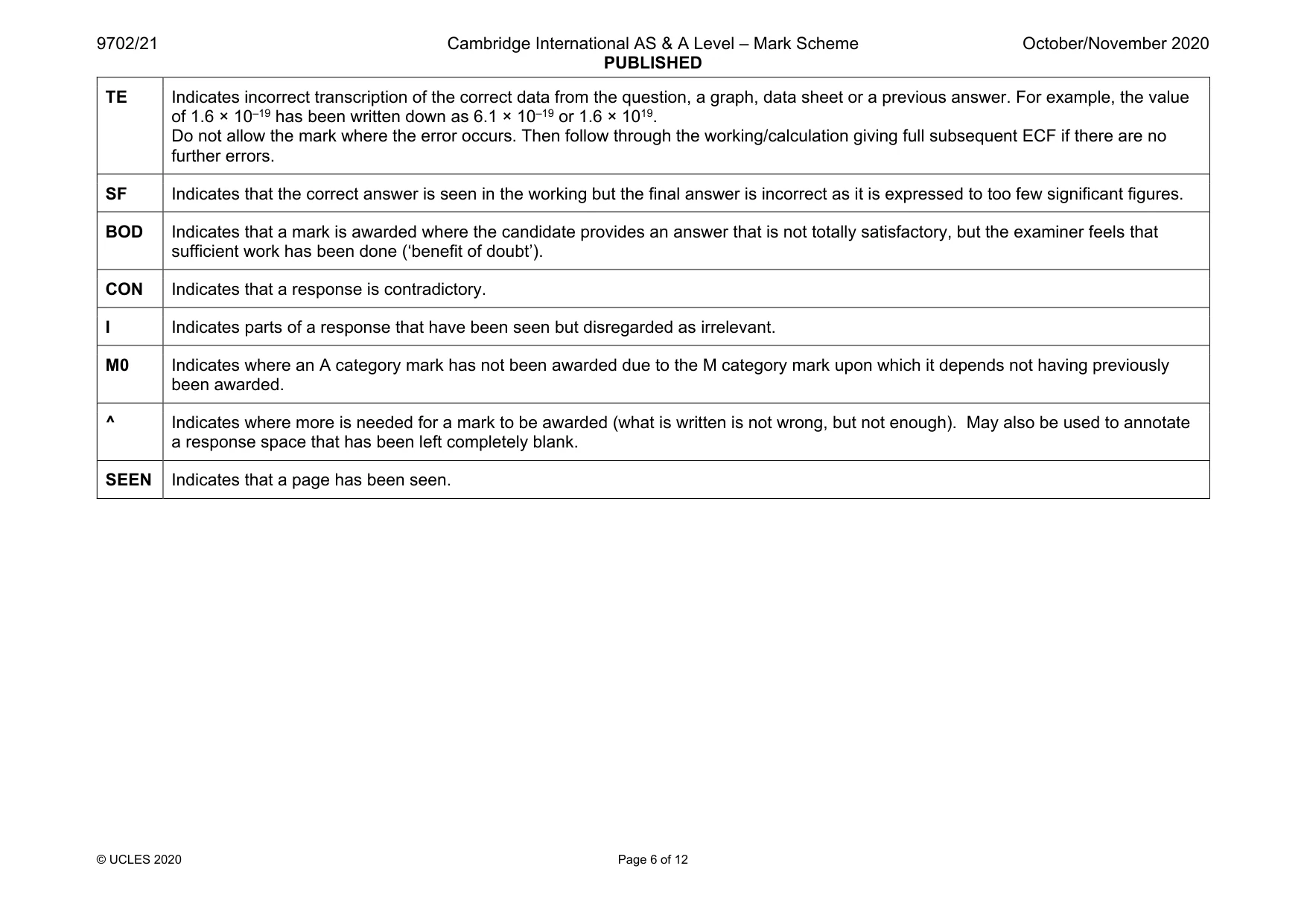
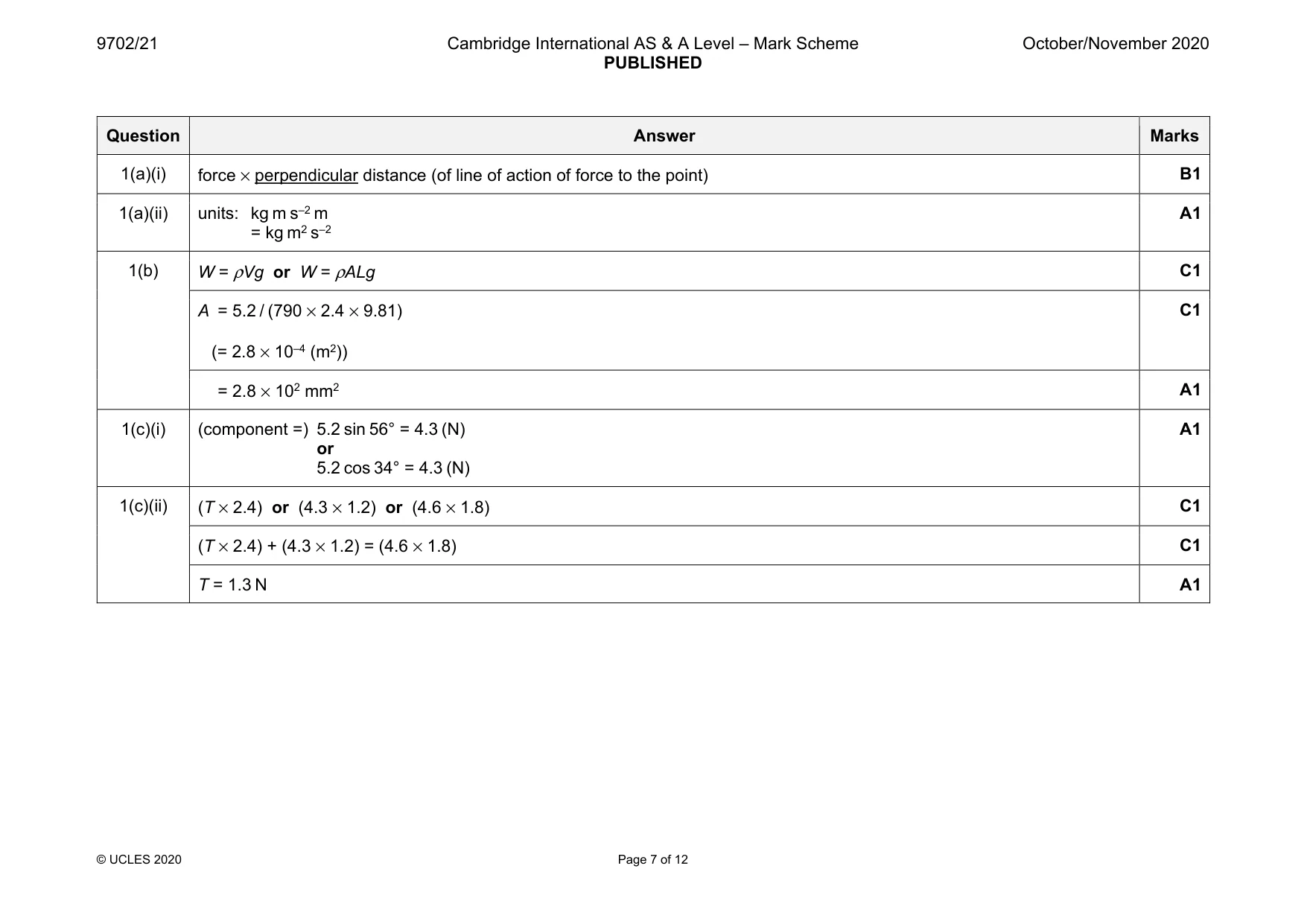
Mark scheme: 1(a)(i) force × perpendicular distance (of line of action of force to the point) B1 1(a)(ii) units: kg m s–2 m = kg m2 s–2 A1 1(b) W = ρVg or W = ρALg C1 A = 5.2 / (790 × 2.4 × 9.81) (= 2.8 × 10⁻⁴ (m2)) C1 = 2.8 × 102 mm2 A1 1(c)(i) (component =) 5.2 sin 56° = 4.3 (N) or 5.2 cos 34° = 4.3 (N) A1 1(c)(ii) (T × 2.4) or (4.3 × 1.2) or (4.6 × 1.8) C1 (T × 2.4) + (4.3 × 1.2) = (4.6 × 1.8) C1 T = 1.3 N A1
Q2 · A small block is lifted vertically upwards by a toy aircraft, as illustrated in Fig
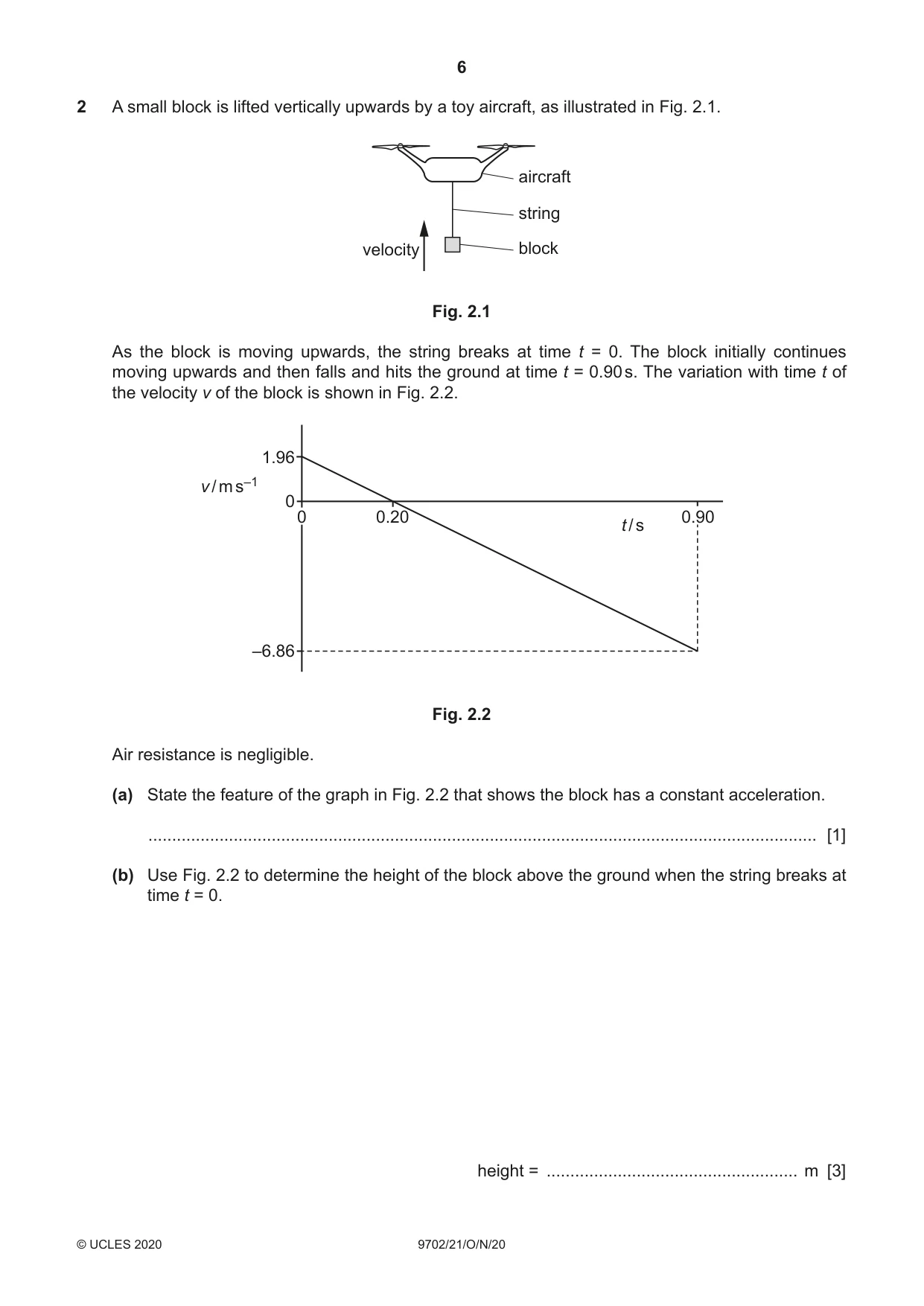
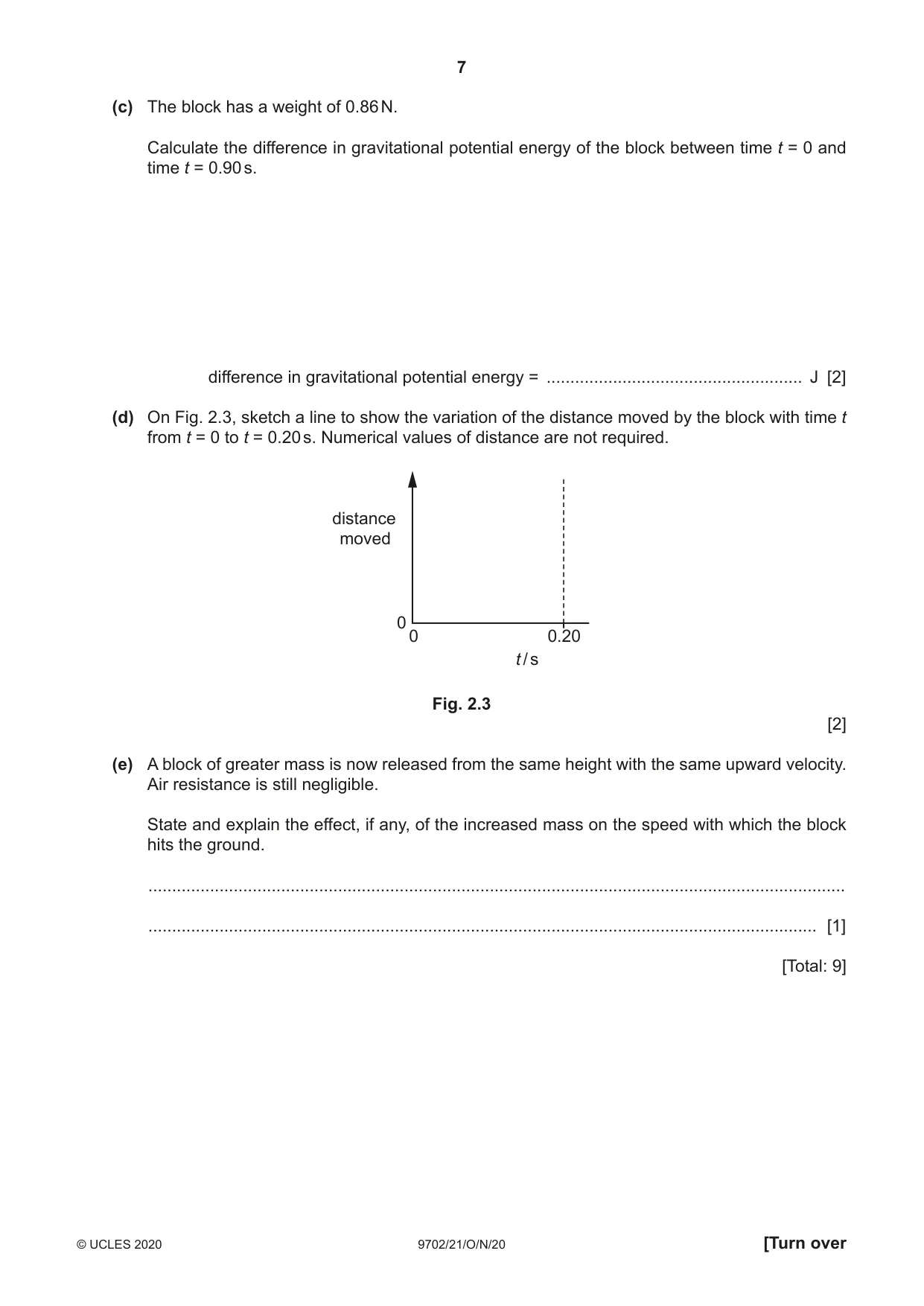
2 A small block is lifted vertically upwards by a toy aircraft, as illustrated in Fig. 2.1. aircraft string velocity block Fig. 2.1 As the block is moving upwards, the string breaks at time t = 0. The block initially continues moving upwards and then falls and hits the ground at time t = 0.90 s. The variation with time t of the velocity v of the block is shown in Fig. 2.2. 1.96 v / m s–1 0 0 0.20 0.900.90 t / s –6.86 Fig. 2.2 Air resistance is negligible. (a) State the feature of the graph in Fig. 2.2 that shows the block has a constant acceleration. ............................................................................................................................................. [1] (b) Use Fig. 2.2 to determine the height of the block above the ground when the string breaks at time t = 0. height = ..................................................... m [3] (c) The block has a weight of 0.86 N. Calculate the difference in gravitational potential energy of the block between time t = 0 and time t = 0.90 s. difference in gravitational potential energy = ...................................................... J [2] (d) On Fig. 2.3, sketch a line to show the variation of the distance moved by the block with time t from t = 0 to t = 0.20 s. Numerical values of distance are not required. distance moved 0 0 0.20 t / s Fig. 2.3 [2] (e) A block of greater mass is now released from the same height with the same upward velocity. Air resistance is still negligible. State and explain the effect, if any, of the increased mass on the speed with which the block hits the ground. ................................................................................................................................................... ............................................................................................................................................. [1] [Total: 9]
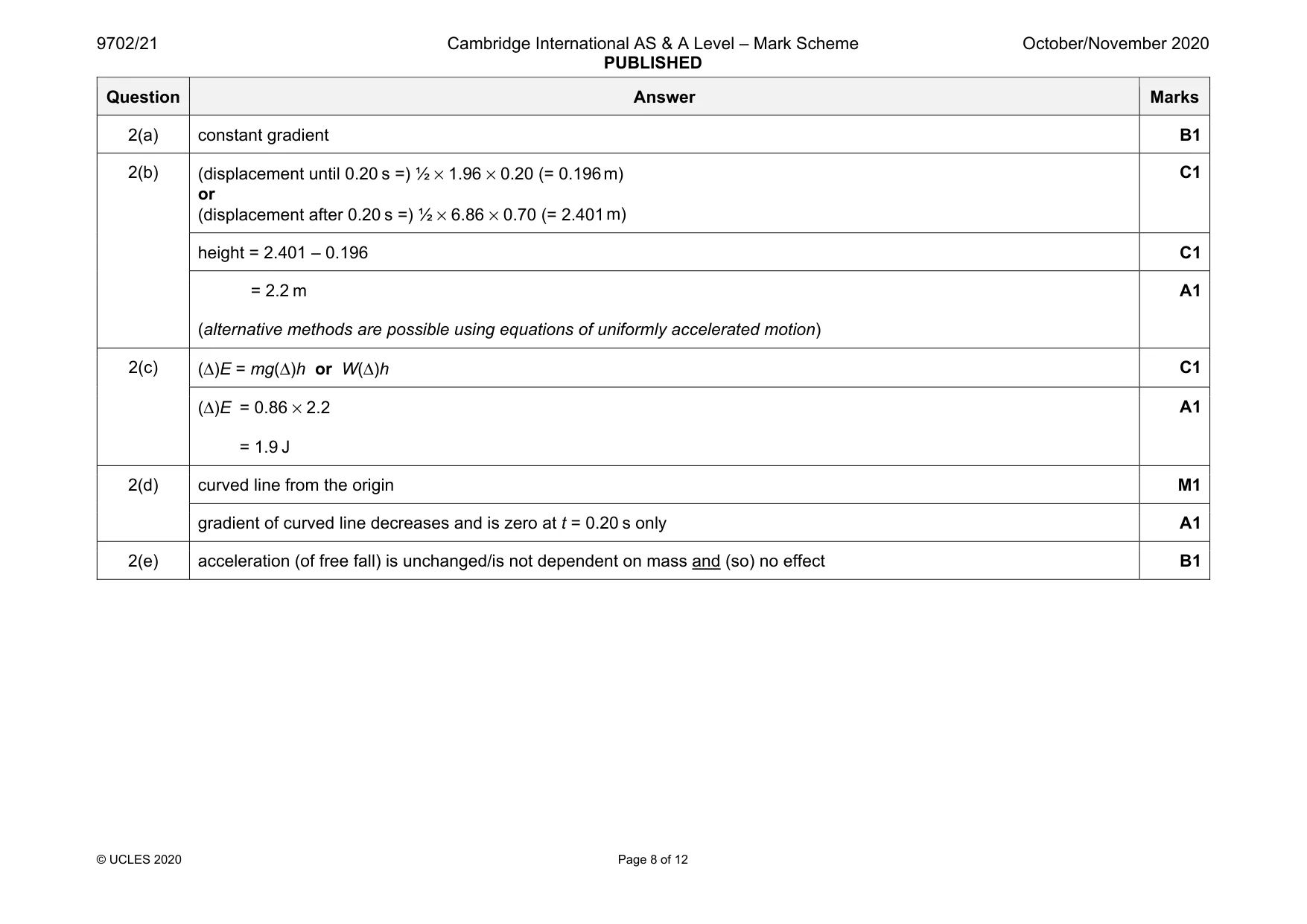
Mark scheme: 2(a) constant gradient B1 2(b) (displacement until 0.20 s =) ½ × 1.96 × 0.20 (= 0.196 m) or (displacement after 0.20 s =) ½ × 6.86 × 0.70 (= 2.401 m) C1 height = 2.401 – 0.196 C1 = 2.2 m (alternative methods are possible using equations of uniformly accelerated motion) A1 2(c) (Δ)E = mg(Δ)h or W(Δ)h C1 (Δ)E = 0.86 × 2.2 = 1.9 J A1 2(d) curved line from the origin M1 gradient of curved line decreases and is zero at t = 0.20 s only A1 2(e) acceleration (of free fall) is unchanged/is not dependent on mass and (so) no effect B1
Question 3
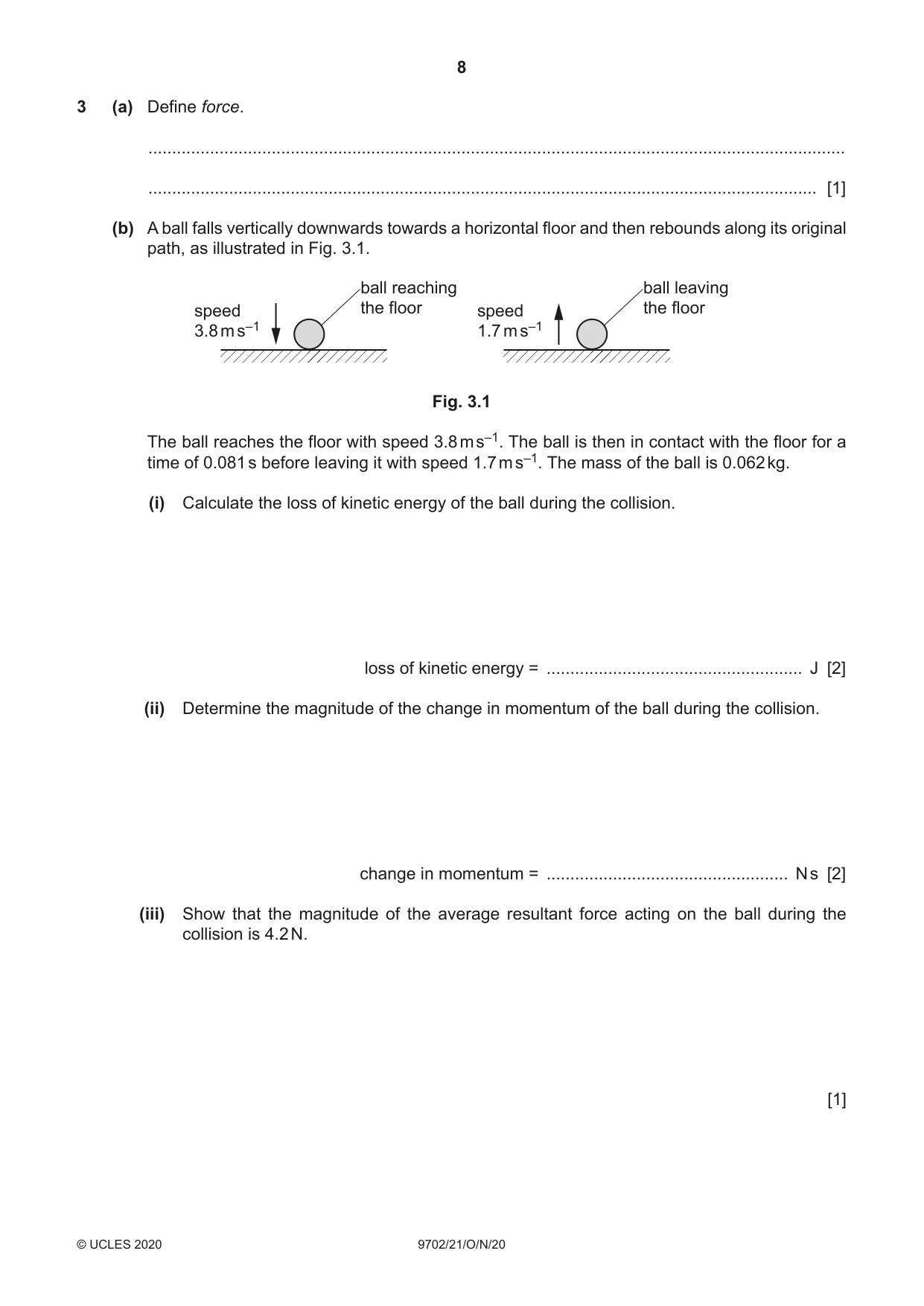
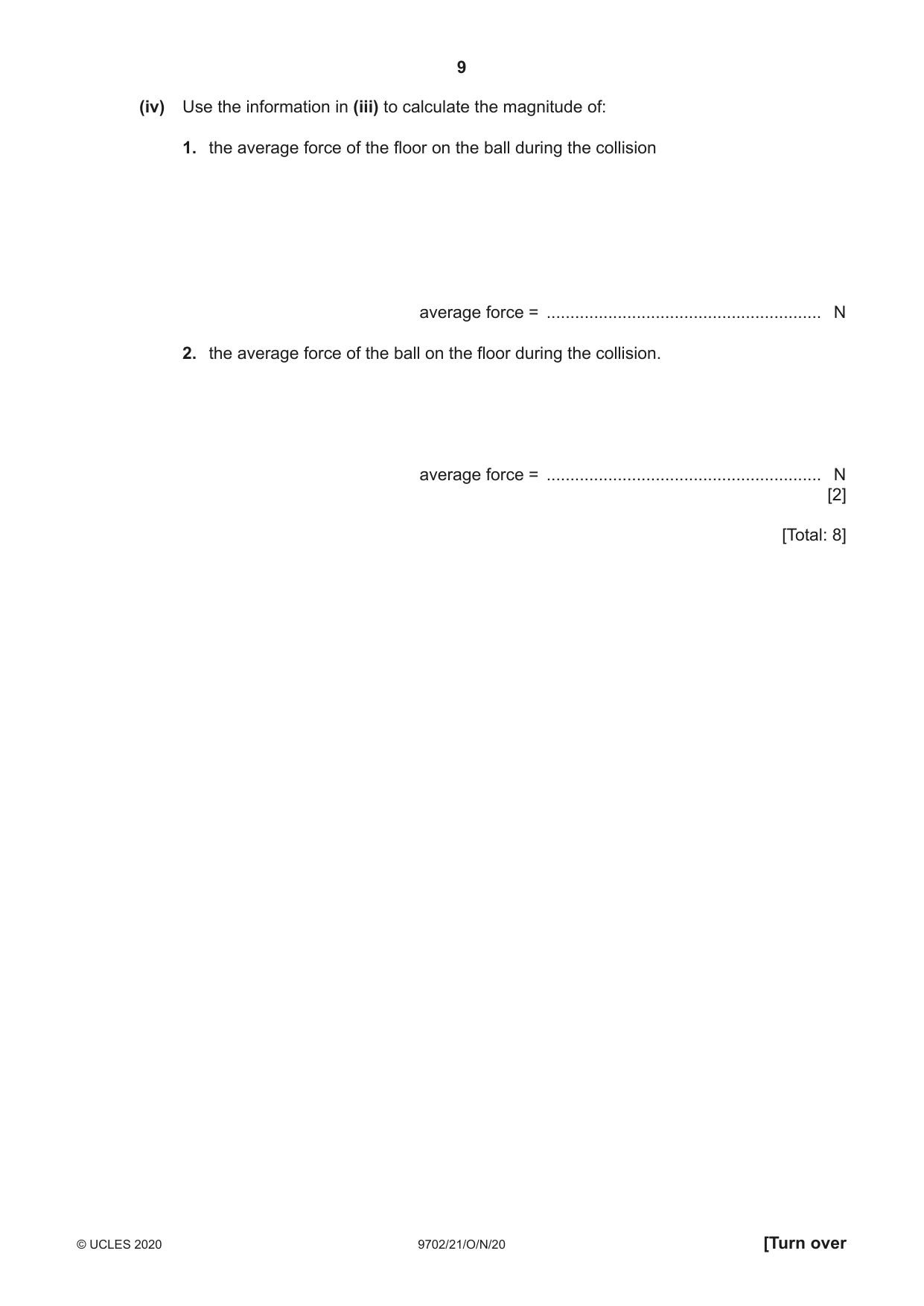
3 (a) Define force. ................................................................................................................................................... ............................................................................................................................................. [1] (b) A ball falls vertically downwards towards a horizontal floor and then rebounds along its original path, as illustrated in Fig. 3.1. ball reaching ball leaving speed the floor speed the floor 3.8 m s–1 1.7 m s–1 Fig. 3.1 The ball reaches the floor with speed 3.8 m s–1. The ball is then in contact with the floor for a time of 0.081 s before leaving it with speed 1.7 m s–1. The mass of the ball is 0.062 kg. (i) Calculate the loss of kinetic energy of the ball during the collision. loss of kinetic energy = ...................................................... J [2] (ii) Determine the magnitude of the change in momentum of the ball during the collision. change in momentum = ................................................... N s [2] (iii) Show that the magnitude of the average resultant force acting on the ball during the collision is 4.2 N. [1] (iv) Use the information in (iii) to calculate the magnitude of: 1. the average force of the floor on the ball during the collision average force = .......................................................... N 2. the average force of the ball on the floor during the collision. average force = .......................................................... N [2] [Total: 8]
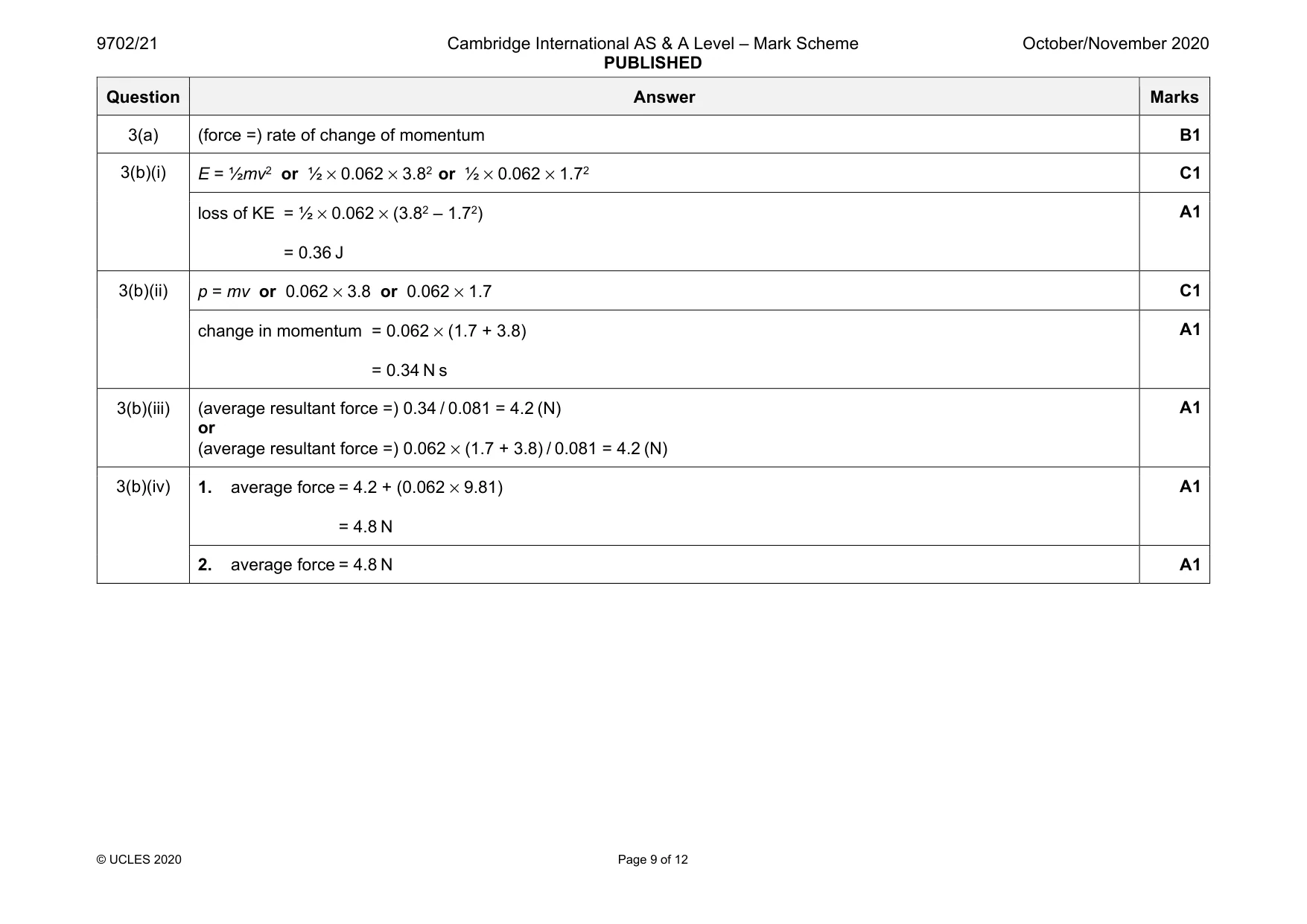
Mark scheme: 3(a) (force =) rate of change of momentum B1 3(b)(i) E = ½mv2 or ½ × 0.062 × 3.82 or ½ × 0.062 × 1.72 C1 loss of KE = ½ × 0.062 × (3.82 – 1.72) = 0.36 J A1 3(b)(ii) p = mv or 0.062 × 3.8 or 0.062 × 1.7 C1 change in momentum = 0.062 × (1.7 + 3.8) = 0.34 N s A1 3(b)(iii) (average resultant force =) 0.34 / 0.081 = 4.2 (N) or (average resultant force =) 0.062 × (1.7 + 3.8) / 0.081 = 4.2 (N) A1 3(b)(iv) 1. average force = 4.2 + (0.062 × 9.81) = 4.8 N A1 2. average force = 4.8 N A1
Q4 · Define, for a wire: (i) stress…
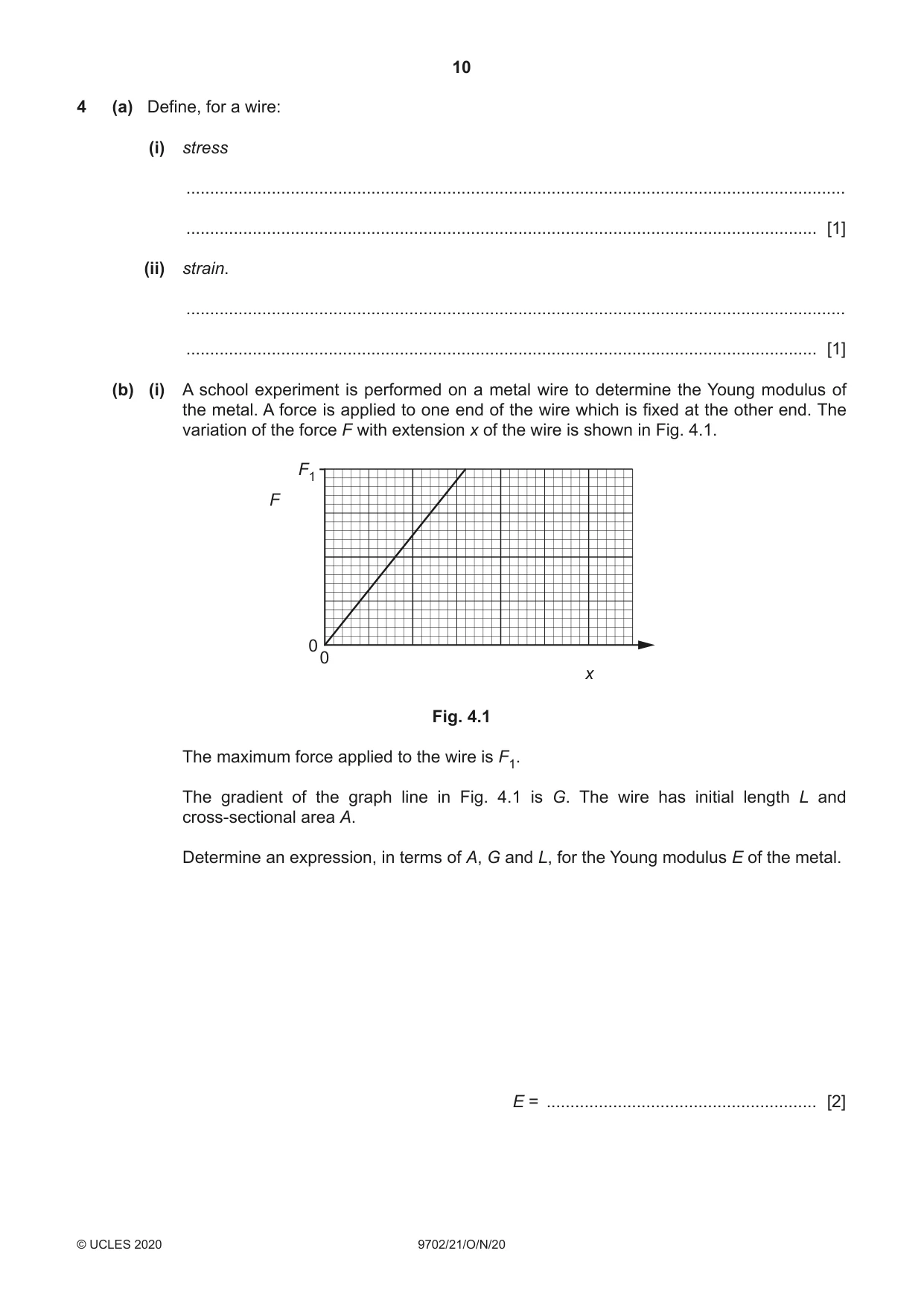
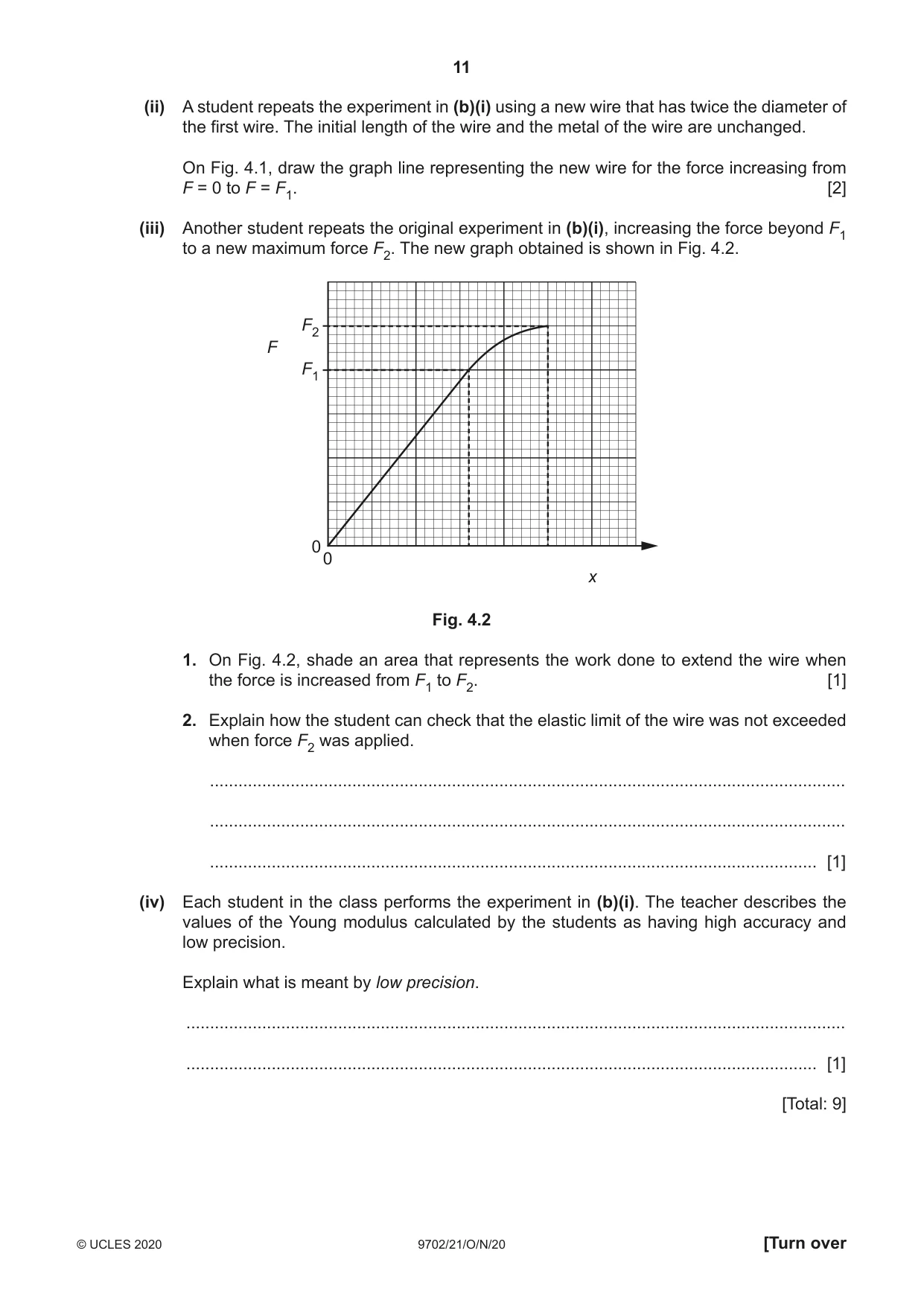
4 (a) Define, for a wire: (i) stress ........................................................................................................................................... ..................................................................................................................................... [1] (ii) strain. ........................................................................................................................................... ..................................................................................................................................... [1] (b) (i) A school experiment is performed on a metal wire to determine the Young modulus of the metal. A force is applied to one end of the wire which is fixed at the other end. The variation of the force F with extension x of the wire is shown in Fig. 4.1. F1 F 00 x Fig. 4.1 The maximum force applied to the wire is F1. The gradient of the graph line in Fig. 4.1 is G. The wire has initial length L and cross-sectional area A. Determine an expression, in terms of A, G and L, for the Young modulus E of the metal. E = ......................................................... [2] (ii) A student repeats the experiment in (b)(i) using a new wire that has twice the diameter of the first wire. The initial length of the wire and the metal of the wire are unchanged. On Fig. 4.1, draw the graph line representing the new wire for the force increasing from F = 0 to F = F1. [2] (iii) Another student repeats the original experiment in (b)(i), increasing the force beyond F1 to a new maximum force F2. The new graph obtained is shown in Fig. 4.2. F2 F F1 00 x Fig. 4.2 1. On Fig. 4.2, shade an area that represents the work done to extend the wire when the force is increased from F1 to F2. [1] 2. Explain how the student can check that the elastic limit of the wire was not exceeded when force F 2 was applied. ...................................................................................................................................... ...................................................................................................................................... ................................................................................................................................ [1] (iv) Each student in the class performs the experiment in (b)(i). The teacher describes the values of the Young modulus calculated by the students as having high accuracy and low precision. Explain what is meant by low precision. ........................................................................................................................................... ..................................................................................................................................... [1] [Total: 9]
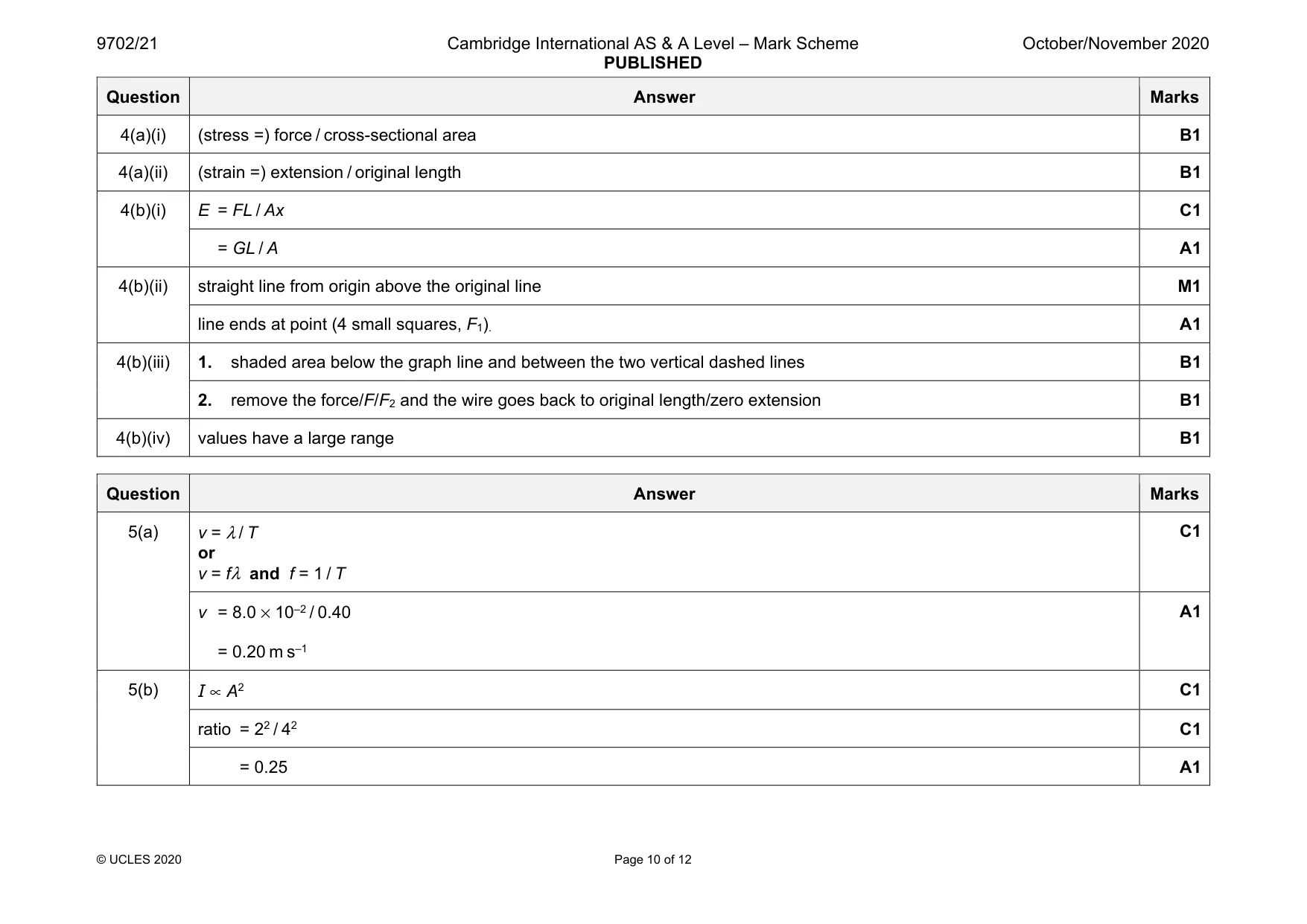
Mark scheme: 4(a)(i) (stress =) force / cross-sectional area B1 4(a)(ii) (strain =) extension / original length B1 4(b)(i) E = FL / Ax C1 = GL / A A1 4(b)(ii) straight line from origin above the original line M1 line ends at point (4 small squares, F1). A1 4(b)(iii) 1. shaded area below the graph line and between the two vertical dashed lines B1 2. remove the force/F/F2 and the wire goes back to original length/zero extension B1 4(b)(iv) values have a large range B1
Q5 · A progressive wave Y passes a point P
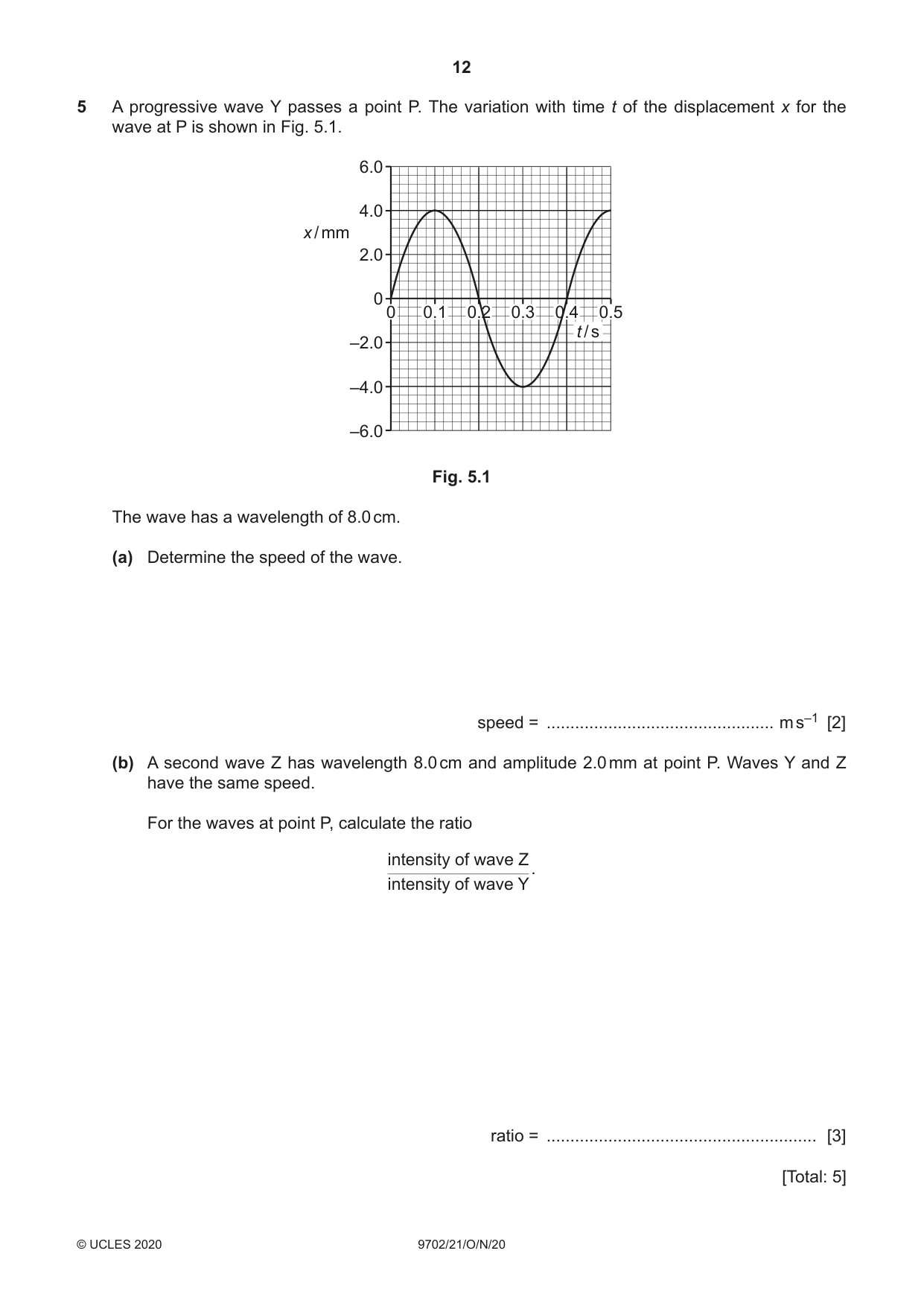
5 A progressive wave Y passes a point P. The variation with time t of the displacement x for the wave at P is shown in Fig. 5.1. 6.0 4.0 x / mm 2.0 0 0 0.1 0.2 0.3 0.4 0.5 t / s –2.0 –4.0 –6.0 Fig. 5.1 The wave has a wavelength of 8.0 cm. (a) Determine the speed of the wave. speed = ................................................ m s–1 [2] (b) A second wave Z has wavelength 8.0 cm and amplitude 2.0 mm at point P. Waves Y and Z have the same speed. For the waves at point P, calculate the ratio intensity of wave Z . intensity of wave Y ratio = ......................................................... [3] [Total: 5]
Mark scheme: 5(a) v = λ / T or v = fλ and f = 1 / T v = 8.0 × 10⁻² / 0.40 = 0.20 m s–1 A1 5(b) I ∝ A2 C1 ratio = 22 / 42 C1 = 0.25 A1
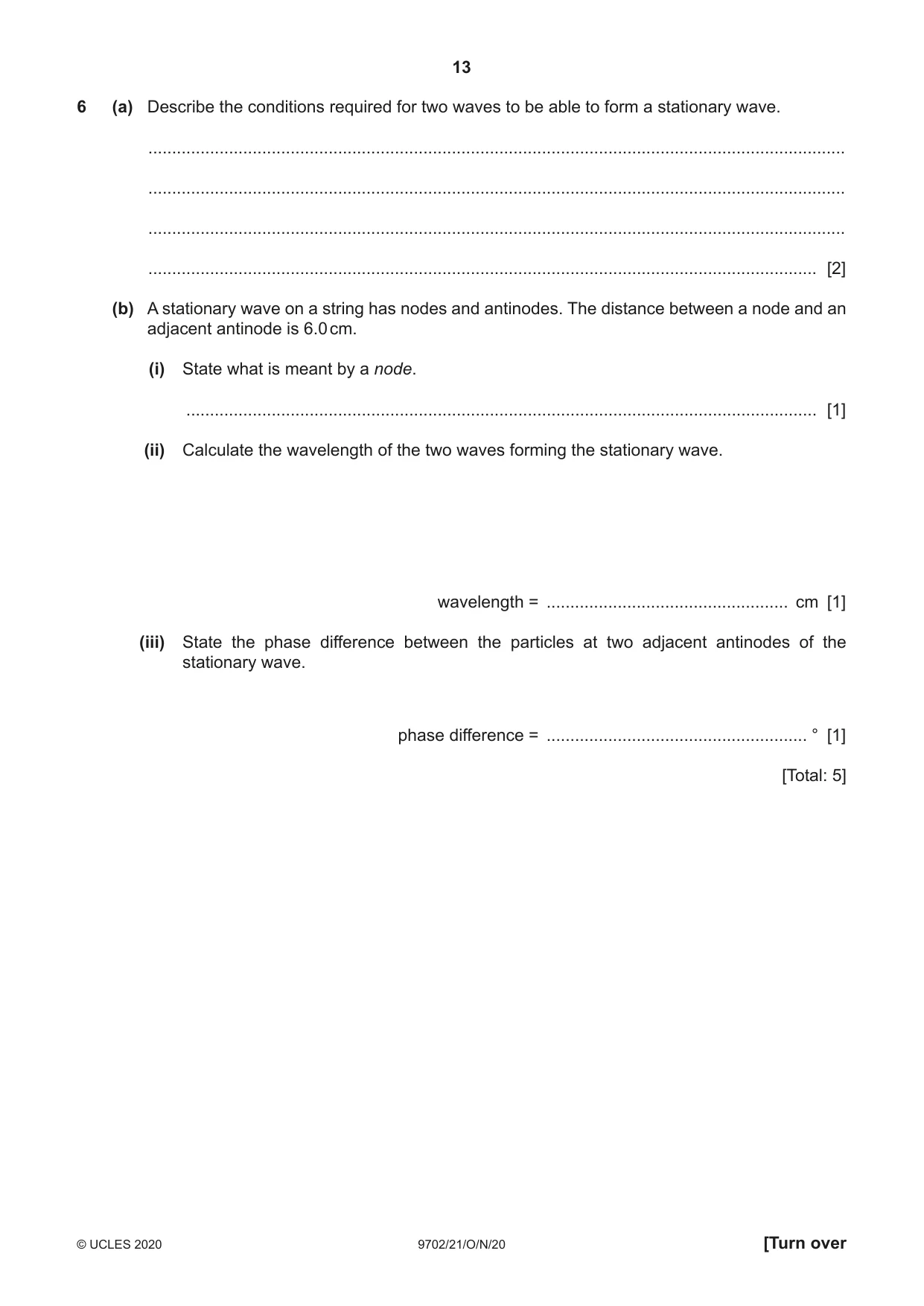
Q6 · Describe the conditions required for two waves to be able to form a stationary wave
6 (a) Describe the conditions required for two waves to be able to form a stationary wave. ................................................................................................................................................... ................................................................................................................................................... ................................................................................................................................................... ............................................................................................................................................. [2] (b) A stationary wave on a string has nodes and antinodes. The distance between a node and an adjacent antinode is 6.0 cm. (i) State what is meant by a node. ..................................................................................................................................... [1] (ii) Calculate the wavelength of the two waves forming the stationary wave. wavelength = ................................................... cm [1] (iii) State the phase difference between the particles at two adjacent antinodes of the stationary wave. phase difference = ....................................................... ° [1] [Total: 5]
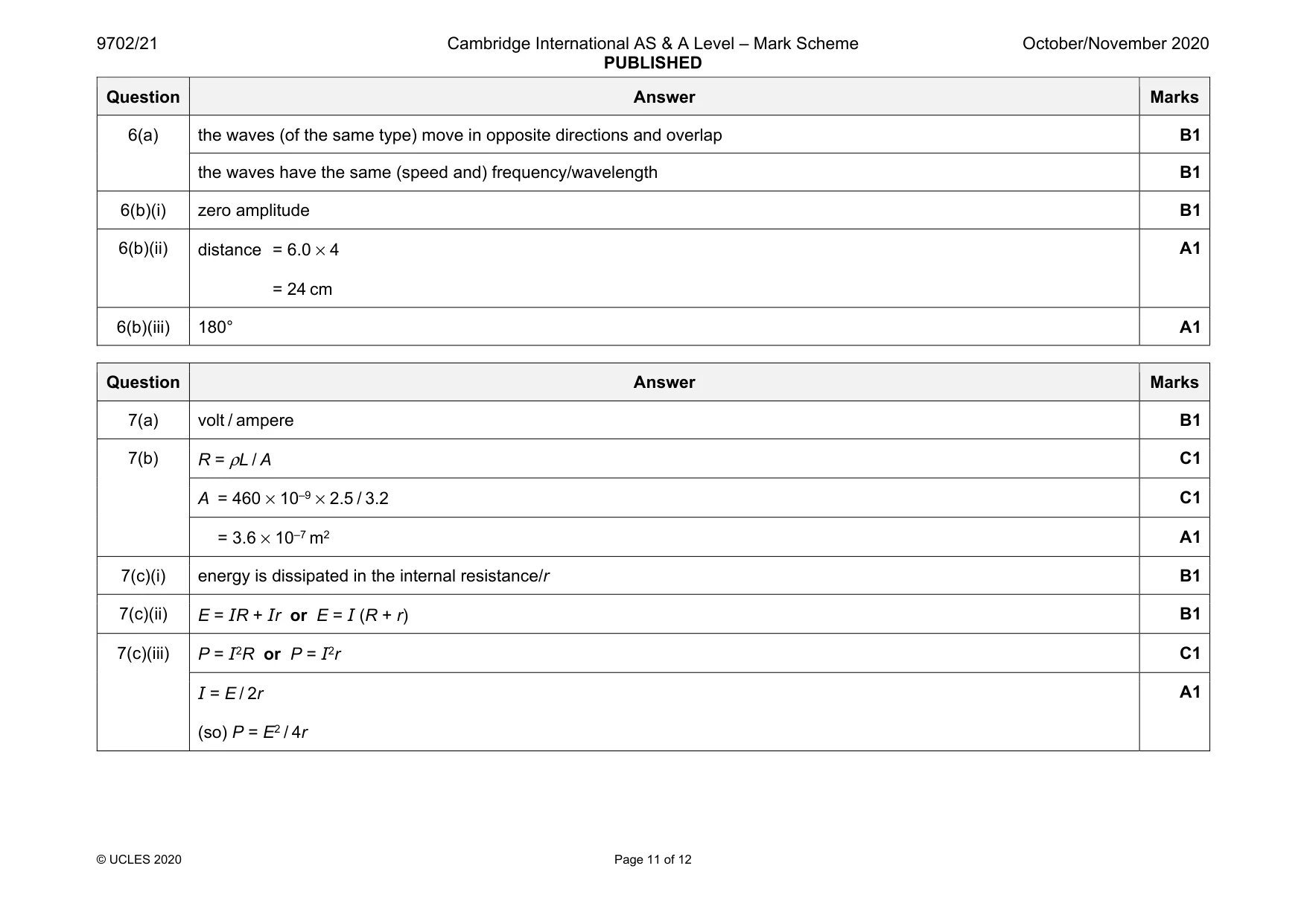
Mark scheme: 6(a) the waves (of the same type) move in opposite directions and overlap B1 the waves have the same (speed and) frequency/wavelength B1 6(b)(i) zero amplitude B1 6(b)(ii) distance = 6.0 × 4 = 24 cm A1 6(b)(iii) 180° A1
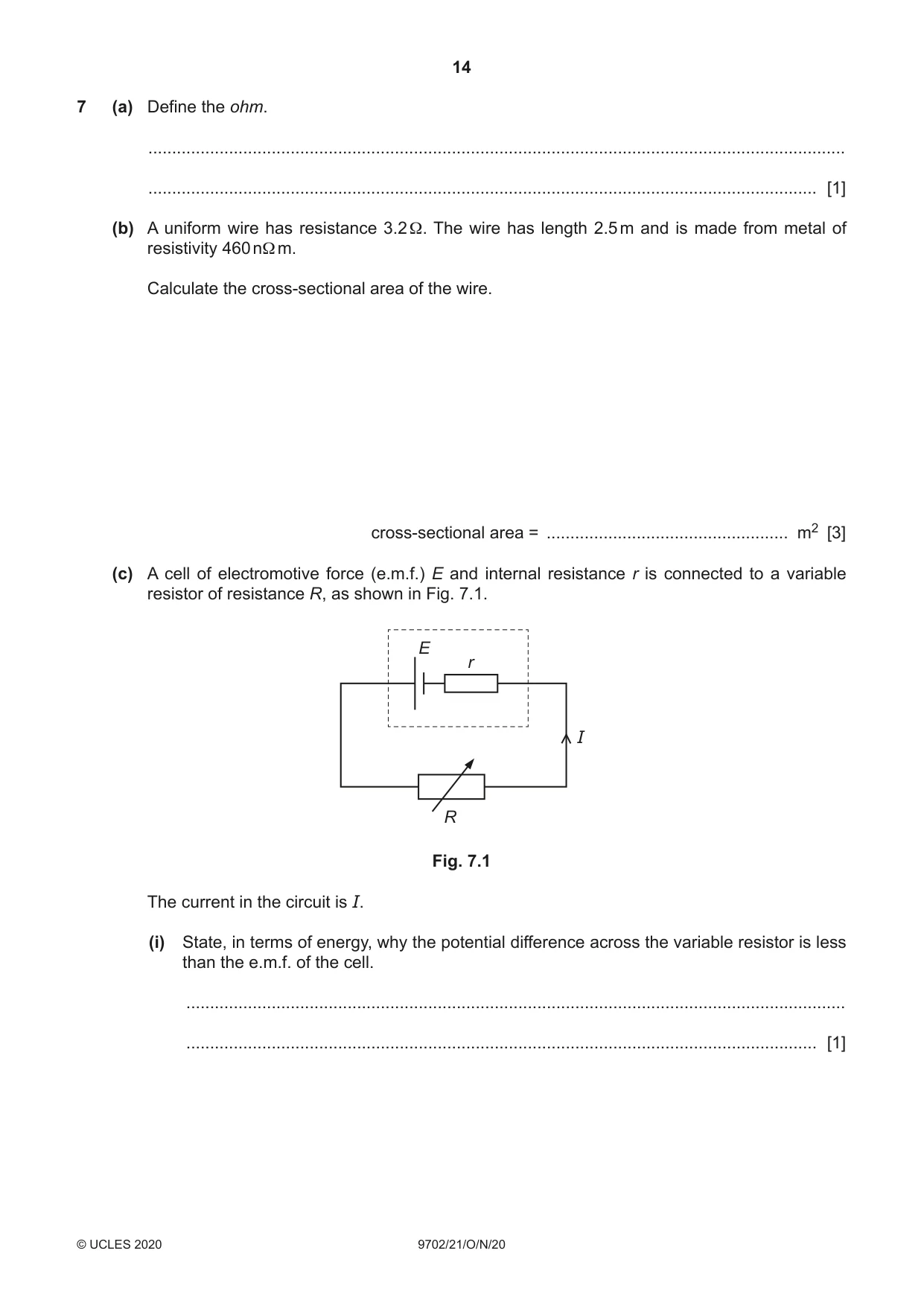
Question 7
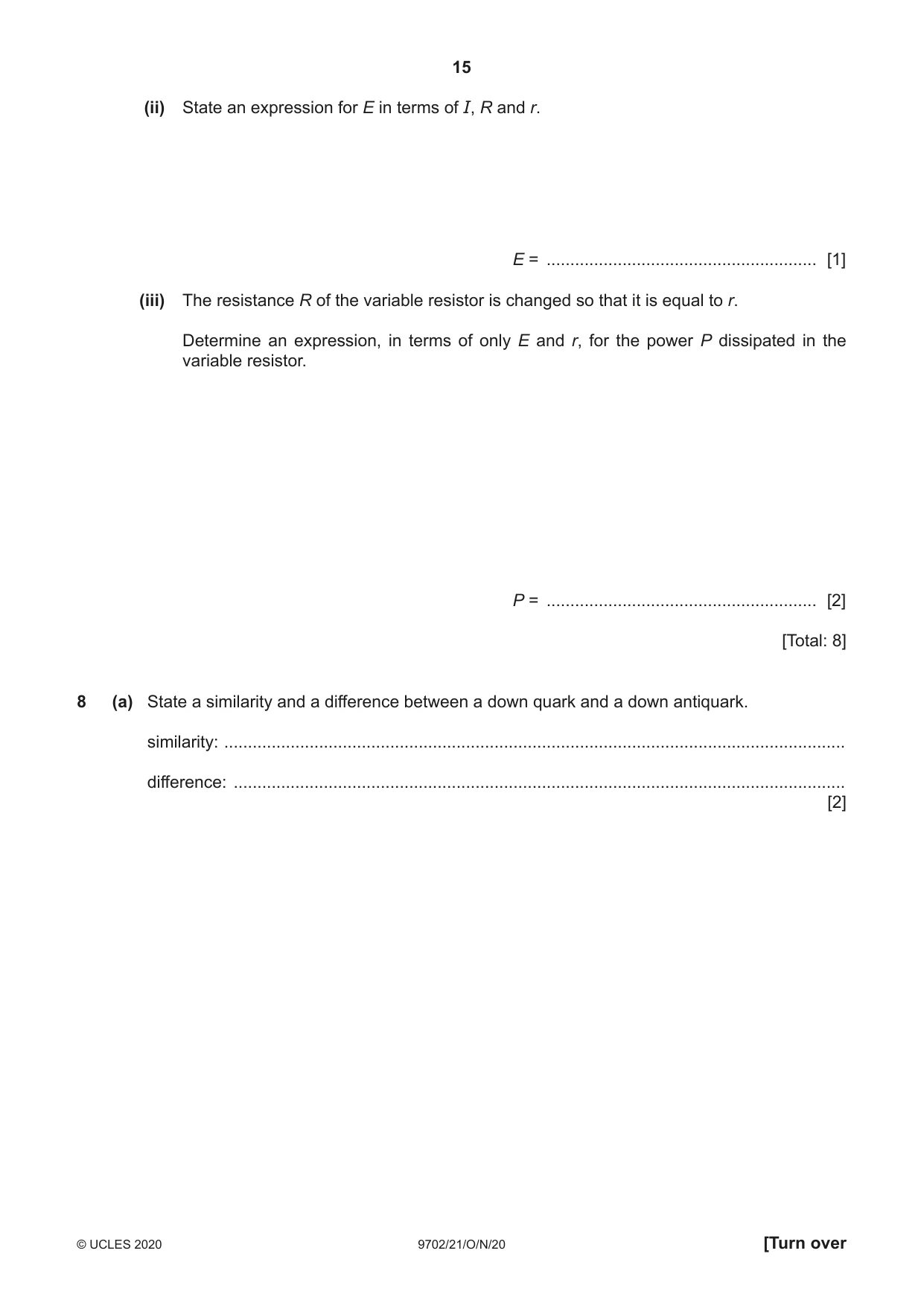
7 (a) Define the ohm. ................................................................................................................................................... ............................................................................................................................................. [1] (b) A uniform wire has resistance 3.2 Ω. The wire has length 2.5 m and is made from metal of resistivity 460 nΩ m. Calculate the cross-sectional area of the wire. cross-sectional area = ................................................... m2 [3] (c) A cell of electromotive force (e.m.f.) E and internal resistance r is connected to a variable resistor of resistance R, as shown in Fig. 7.1. E r I R Fig. 7.1 The current in the circuit is I. (i) State, in terms of energy, why the potential difference across the variable resistor is less than the e.m.f. of the cell. ........................................................................................................................................... ..................................................................................................................................... [1] (ii) State an expression for E in terms of I, R and r. E = ......................................................... [1] (iii) The resistance R of the variable resistor is changed so that it is equal to r. Determine an expression, in terms of only E and r, for the power P dissipated in the variable resistor. P = ......................................................... [2] [Total: 8]
Mark scheme: 7(a) volt / ampere B1 7(b) R = ρL / A C1 A = 460 × 10–9 × 2.5 / 3.2 C1 = 3.6 × 10⁻⁷ m2 A1 7(c)(i) energy is dissipated in the internal resistance/r B1 7(c)(ii) E = IR + Ir or E = I (R + r) B1 7(c)(iii) P = I2R or P = I2r C1 I = E / 2r (so) P = E2 / 4r A1
Q8 · State a similarity and a difference between a down quark and a down antiquark
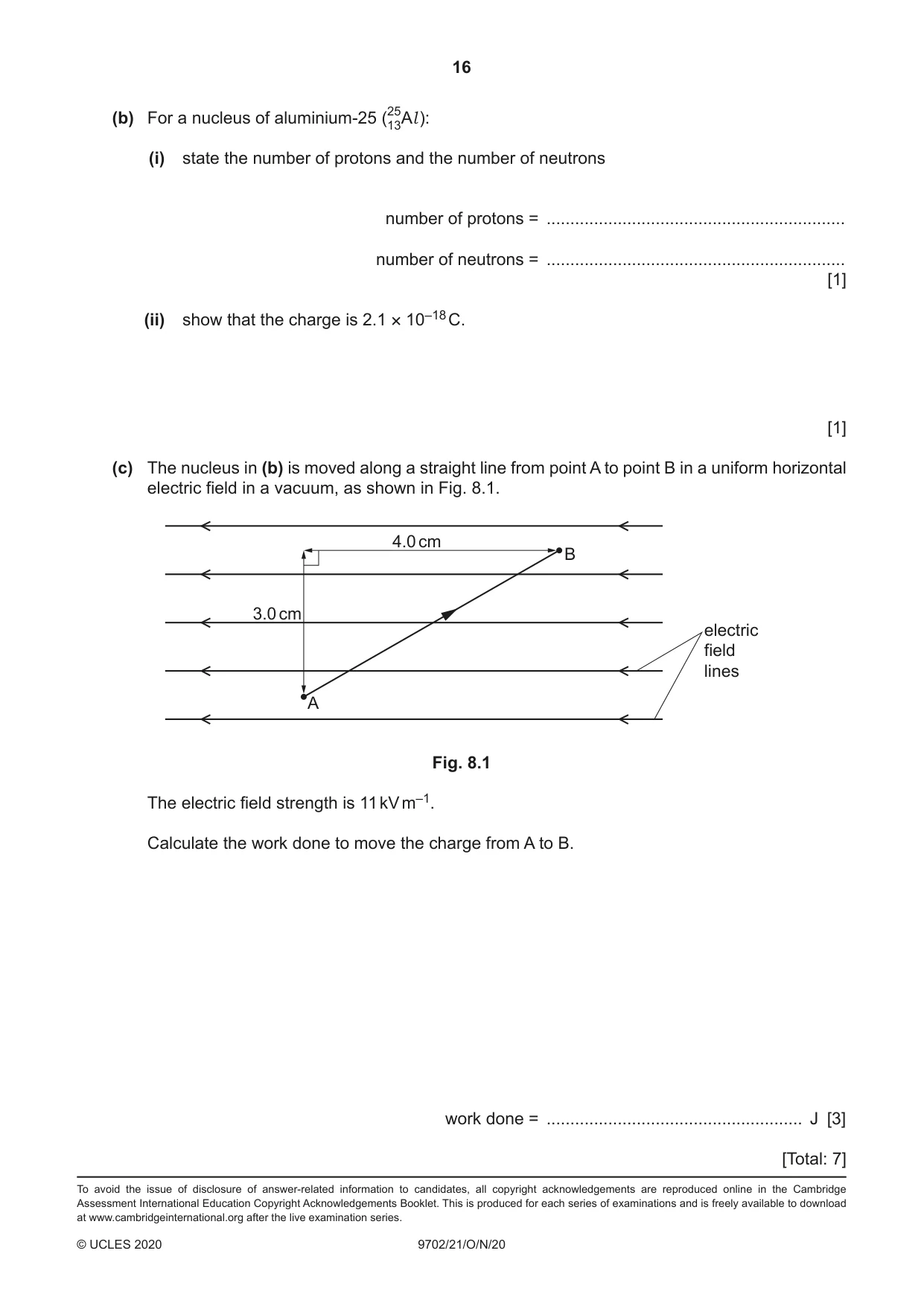
8 (a) State a similarity and a difference between a down quark and a down antiquark. similarity: ................................................................................................................................... difference: ................................................................................................................................. [2] (b) For a nucleus of aluminium-25 (2513Al ): (i) state the number of protons and the number of neutrons number of protons = ............................................................... number of neutrons = ............................................................... [1] (ii) show that the charge is 2.1 × 10⁻¹⁸ C. [1] (c) The nucleus in (b) is moved along a straight line from point A to point B in a uniform horizontal electric field in a vacuum, as shown in Fig. 8.1. 4.0 cm B 3.0 cm electric field lines A Fig. 8.1 The electric field strength is 11 kV m–1. Calculate the work done to move the charge from A to B. work done = ...................................................... J [3] [Total: 7]
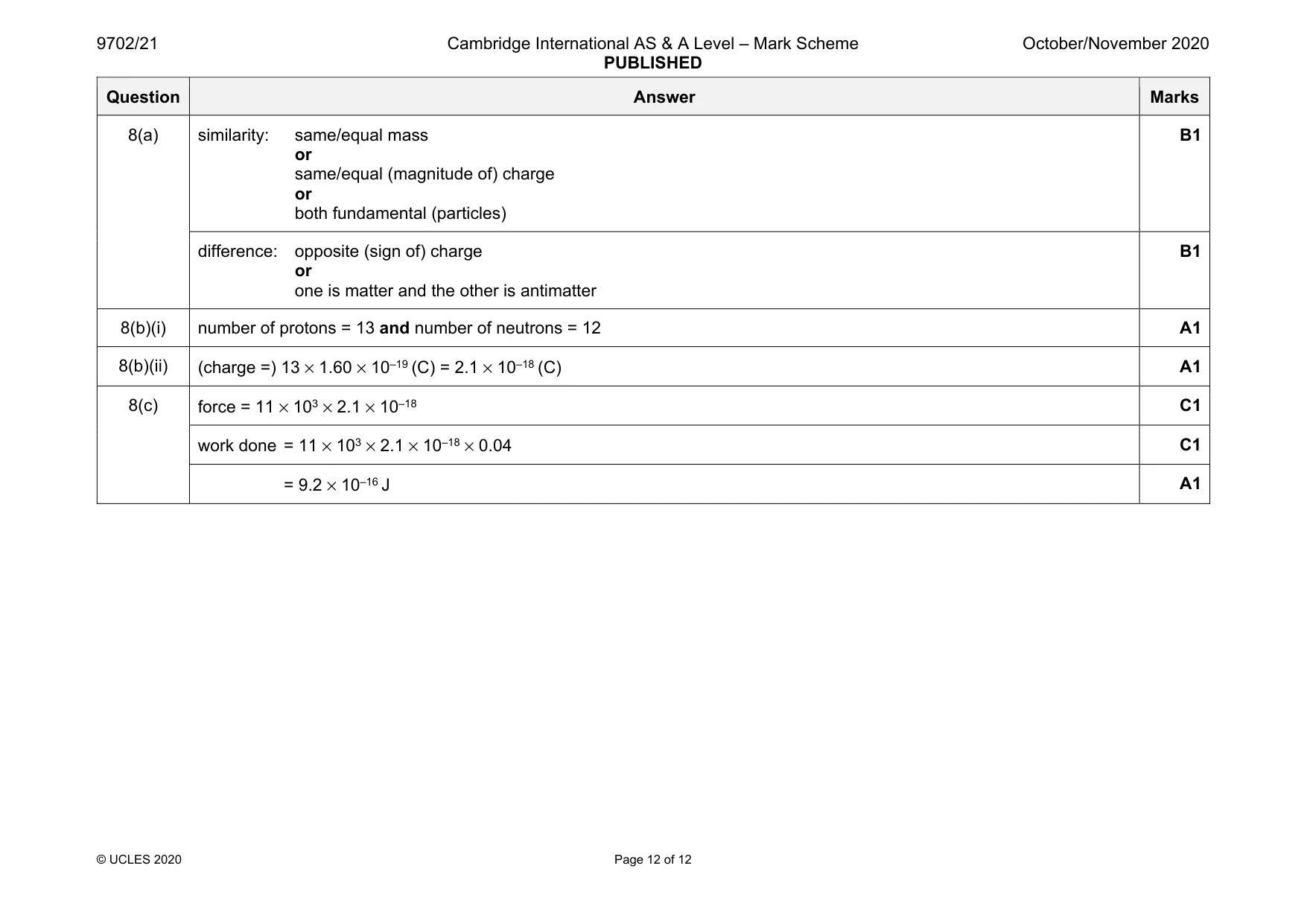
Mark scheme: 8(a) similarity: same/equal mass or same/equal (magnitude of) charge or both fundamental (particles) B1 difference: opposite (sign of) charge or one is matter and the other is antimatter B1 8(b)(i) number of protons = 13 and number of neutrons = 12 A1 8(b)(ii) (charge =) 13 × 1.60 × 10–19 (C) = 2.1 × 10⁻¹⁸ (C) A1 8(c) force = 11 × 103 × 2.1 × 10–18 C1 work done = 11 × 103 × 2.1 × 10–18 × 0.04 C1 = 9.2 × 10⁻¹⁶ J A1
What was in this paper
The subtopics covered by these 8 questions, and how many questions each got. Open one in a new tab to see every Cambridge question on it.
What you needed in this session
Cambridge’s own grade thresholds for 2020 Oct/Nov, Paper 2 · Variant 1. A higher threshold means an easier paper — the bar moves with how the cohort did.