Cambridge A Level Physics 9702 — 2016 May/June Paper 2 · Variant 3
9702/23/M/J/16 · 8 questions · 60 marks · ≈68 min
The question paper and its mark scheme, free to read here and free to download. This is Cambridge’s own paper, exactly as it was sat.
Question paper16 pages
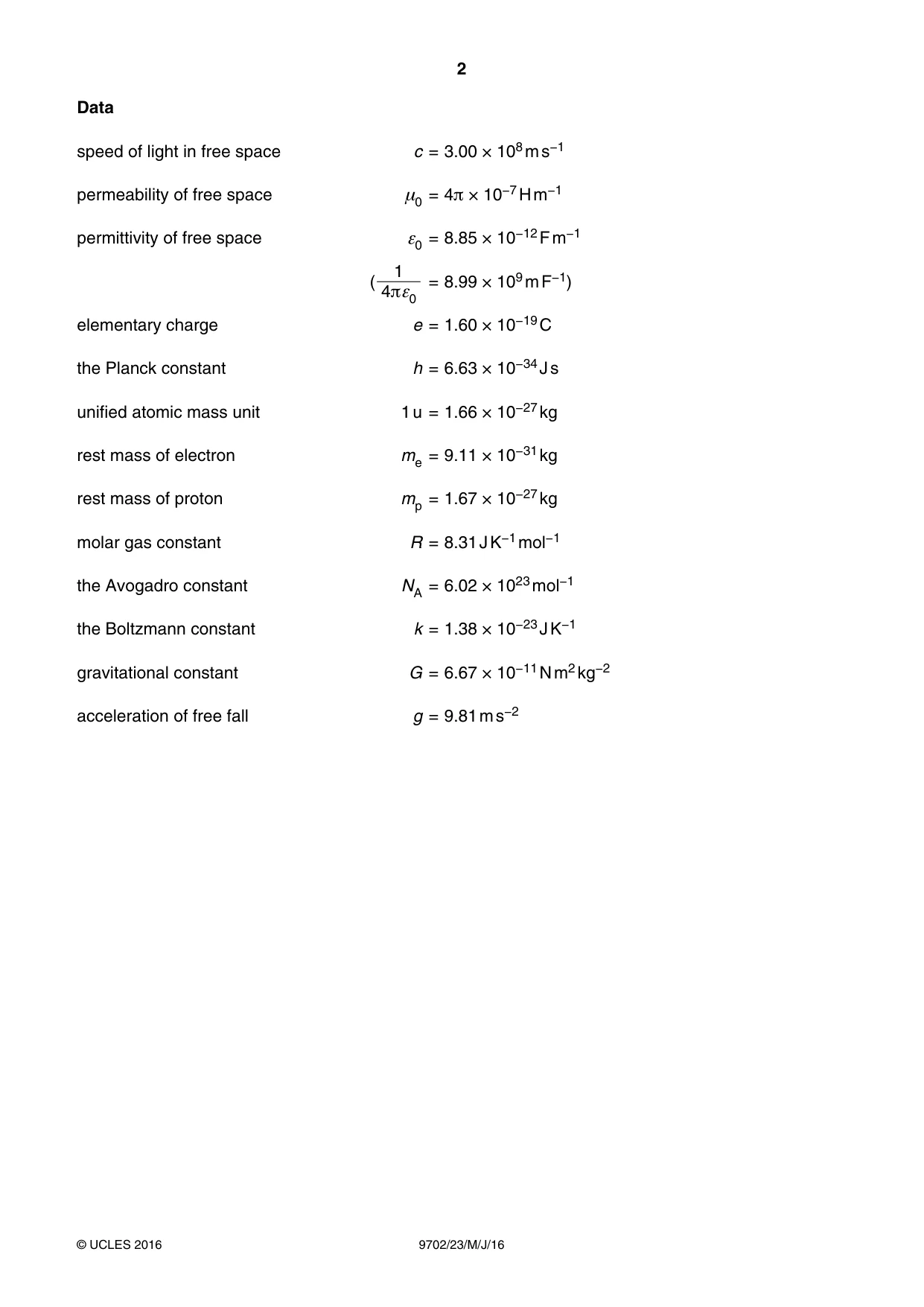
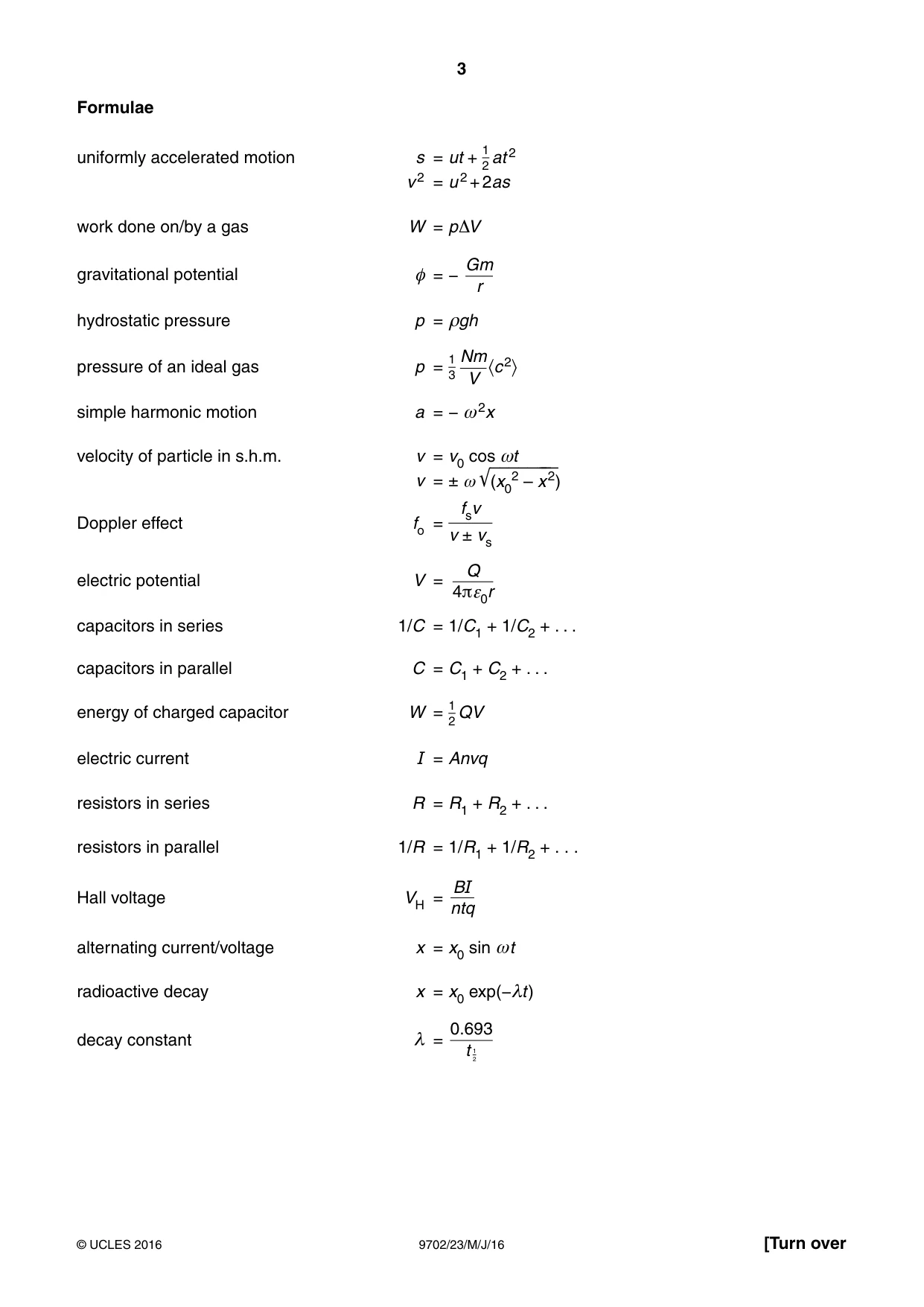
Mark scheme5 pages
Answers below. Sit the paper first if you are practising.
Questions as text
Q1 · A list of quantities that are either scalars or vectors is shown in Fig
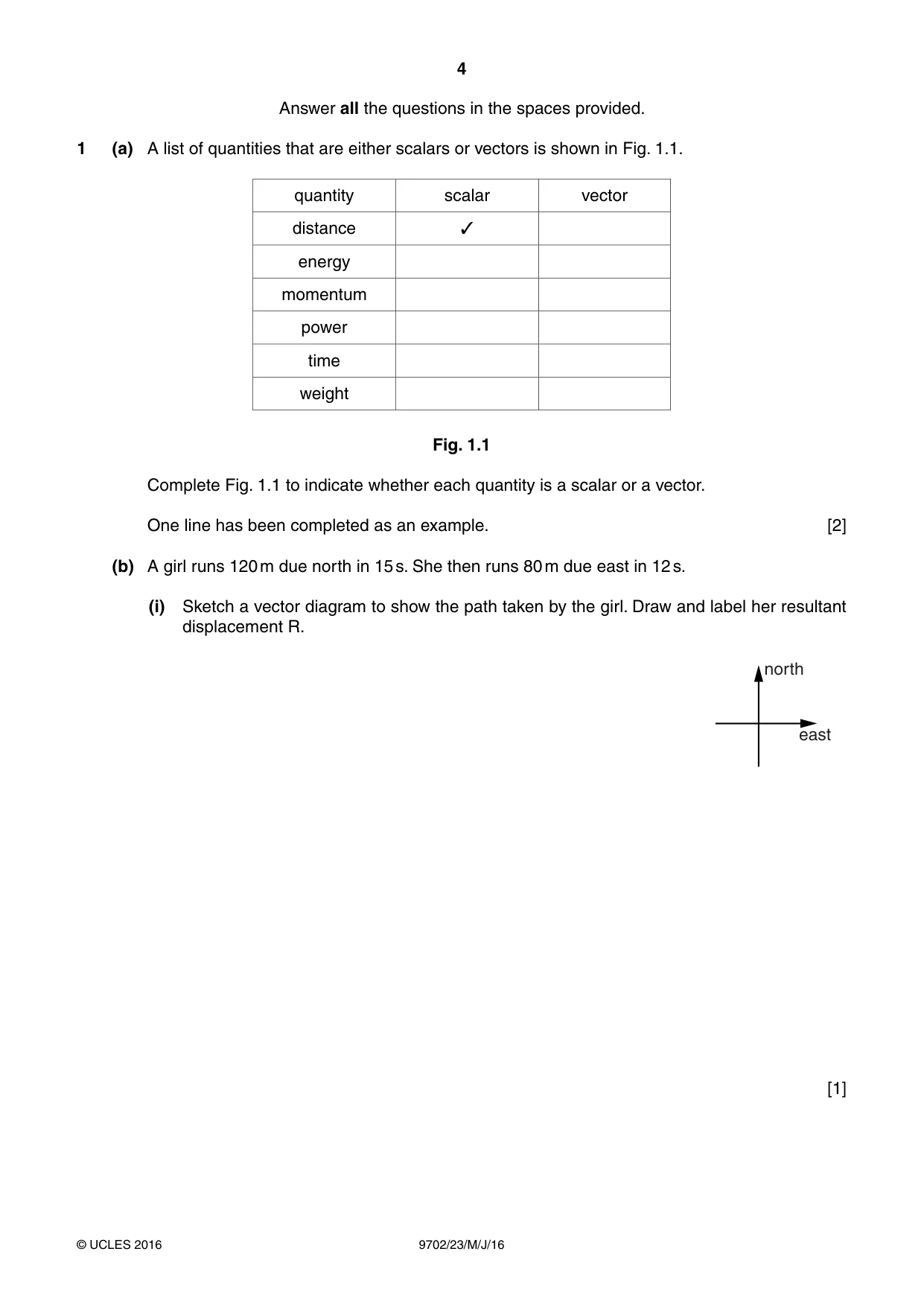
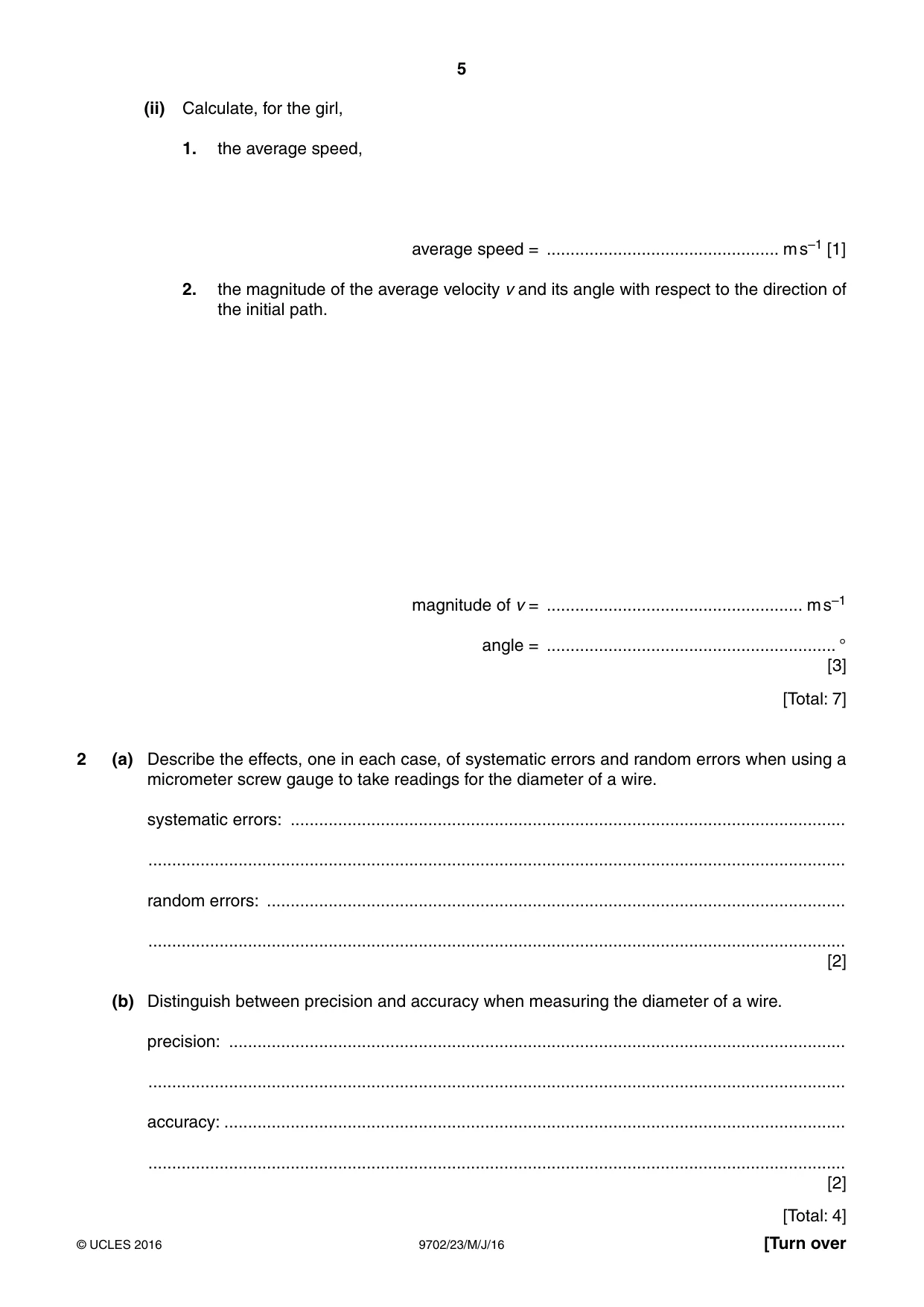
1 (a) A list of quantities that are either scalars or vectors is shown in Fig. 1.1. quantity scalar vector distance ✓ energy momentum power time weight Fig. 1.1 Complete Fig. 1.1 to indicate whether each quantity is a scalar or a vector. One line has been completed as an example. [2] (b) A girl runs 120 m due north in 15 s. She then runs 80 m due east in 12 s. (i) Sketch a vector diagram to show the path taken by the girl. Draw and label her resultant displacement R. north east [1] (ii) Calculate, for the girl, 1. the average speed, average speed = ................................................. m s–1 [1] 2. the magnitude of the average velocity v and its angle with respect to the direction of the initial path. magnitude of v = ...................................................... m s–1 angle = ............................................................. ° [3] [Total: 7]
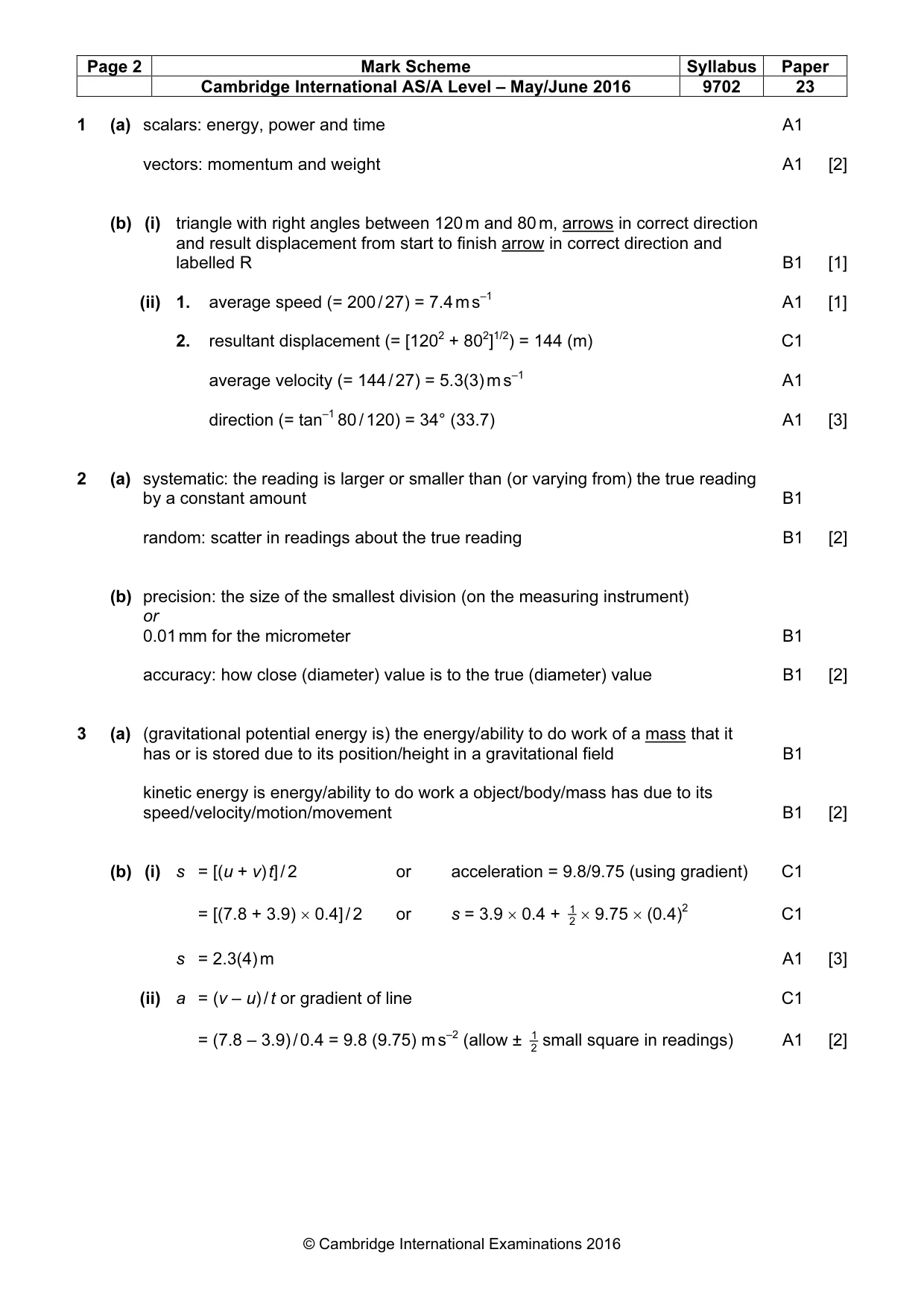
Mark scheme: 1 (a) scalars: energy, power and time A1 vectors: momentum and weight A1 [2] (b) (i) triangle with right angles between 120 m and 80 m, arrows in correct direction and result displacement from start to finish arrow in correct direction and labelled R B1 [1] (ii) 1. average speed (= 200 / 27) = 7.4 m s–1 A1 [1] 2. resultant displacement (= [1202 + 802]1/2) = 144 (m) C1 average velocity (= 144 / 27) = 5.3(3) m s–1 A1 direction (= tan–1 80 / 120) = 34° (33.7) A1 [3]
Q2 · Describe the effects, one in each case, of systematic errors and random errors when using…
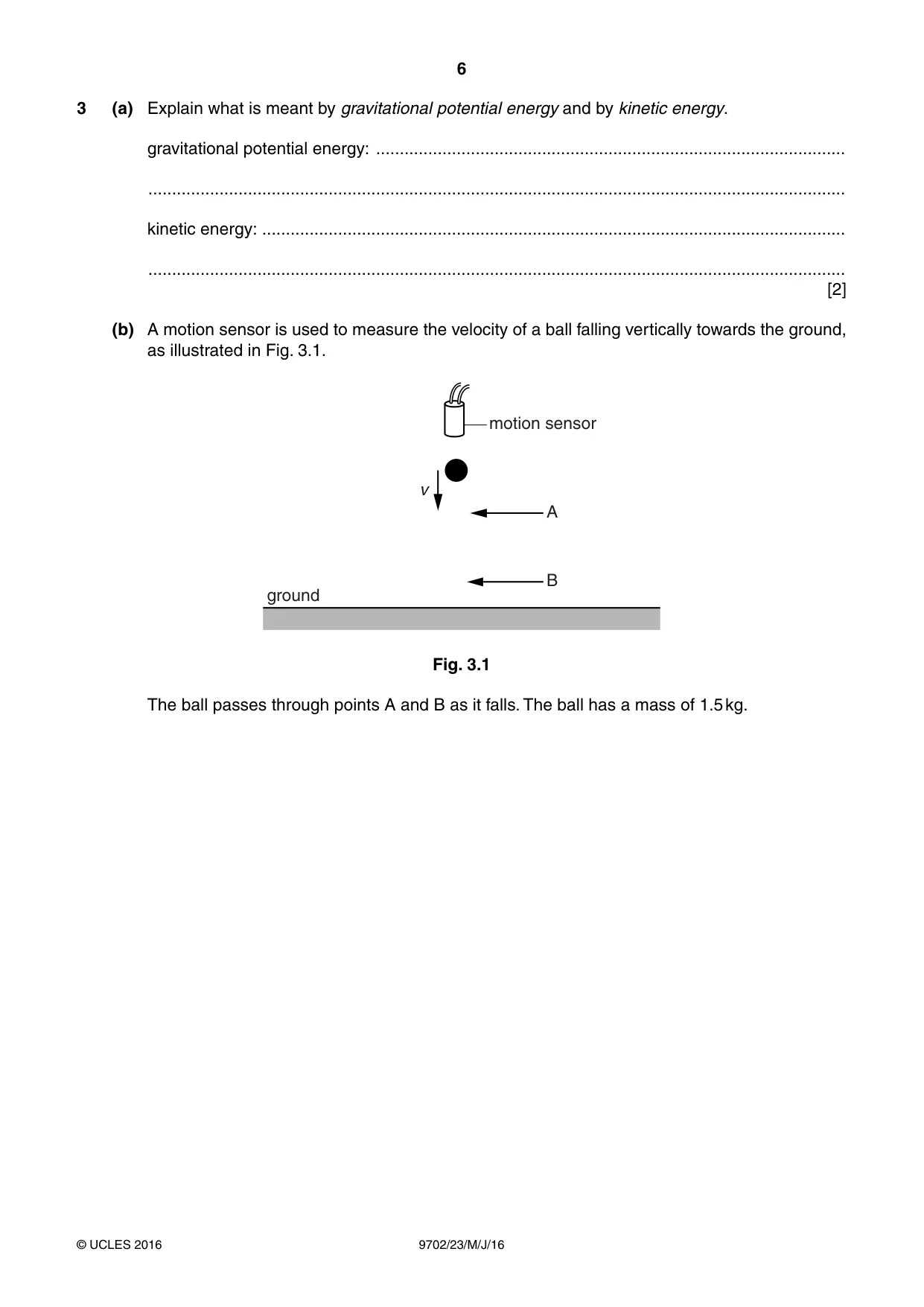
2 (a) Describe the effects, one in each case, of systematic errors and random errors when using a micrometer screw gauge to take readings for the diameter of a wire. systematic errors: ..................................................................................................................... ................................................................................................................................................... random errors: .......................................................................................................................... ................................................................................................................................................... [2] (b) Distinguish between precision and accuracy when measuring the diameter of a wire. precision: .................................................................................................................................. ................................................................................................................................................... accuracy: ................................................................................................................................... ................................................................................................................................................... [2] [Total: 4]
Mark scheme: 2 (a) systematic: the reading is larger or smaller than (or varying from) the true reading by a constant amount B1 random: scatter in readings about the true reading B1 [2] (b) precision: the size of the smallest division (on the measuring instrument) or 0.01 mm for the micrometer B1 accuracy: how close (diameter) value is to the true (diameter) value B1 [2]
Q3 · Explain what is meant by gravitational potential energy and by kinetic energy
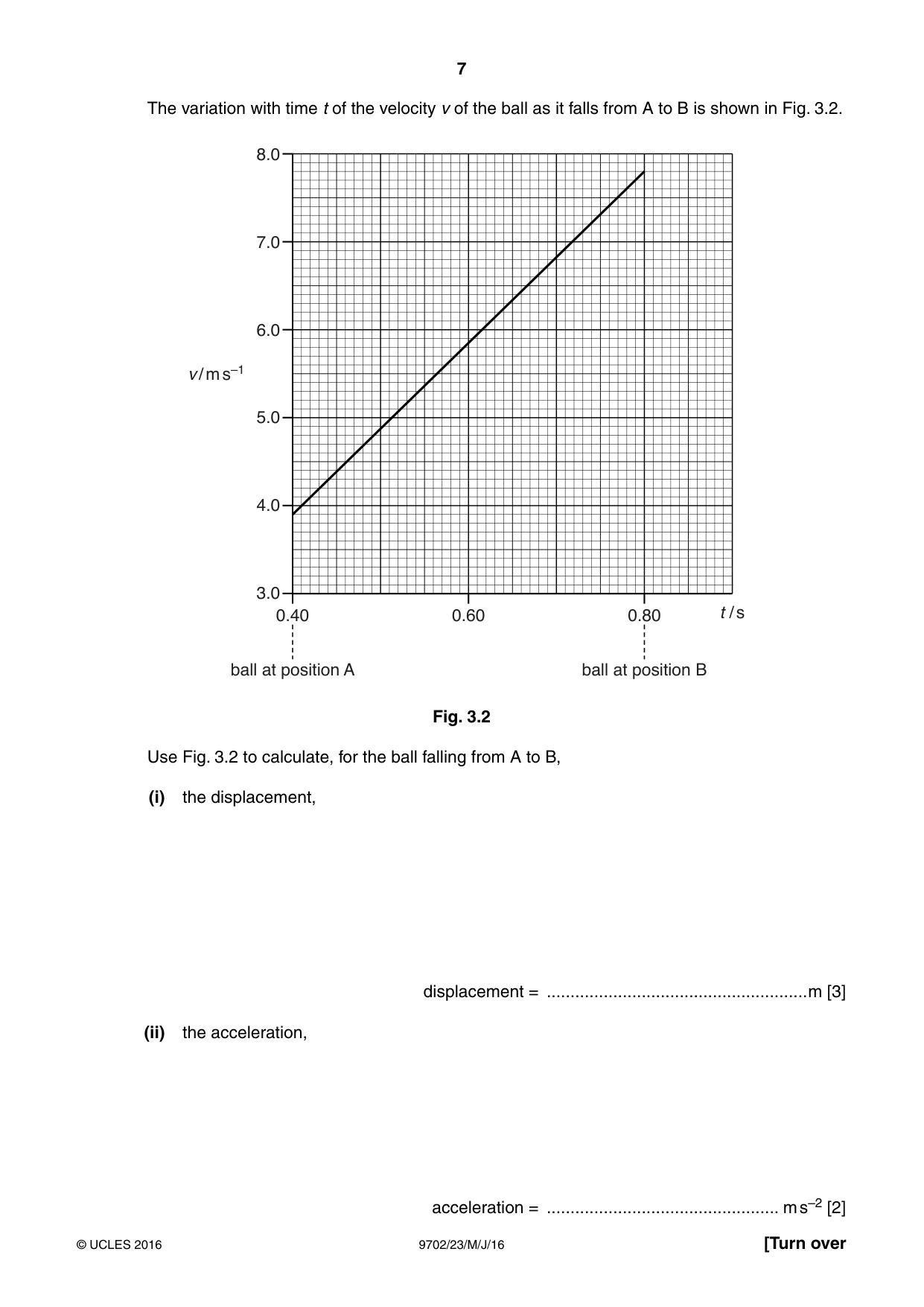
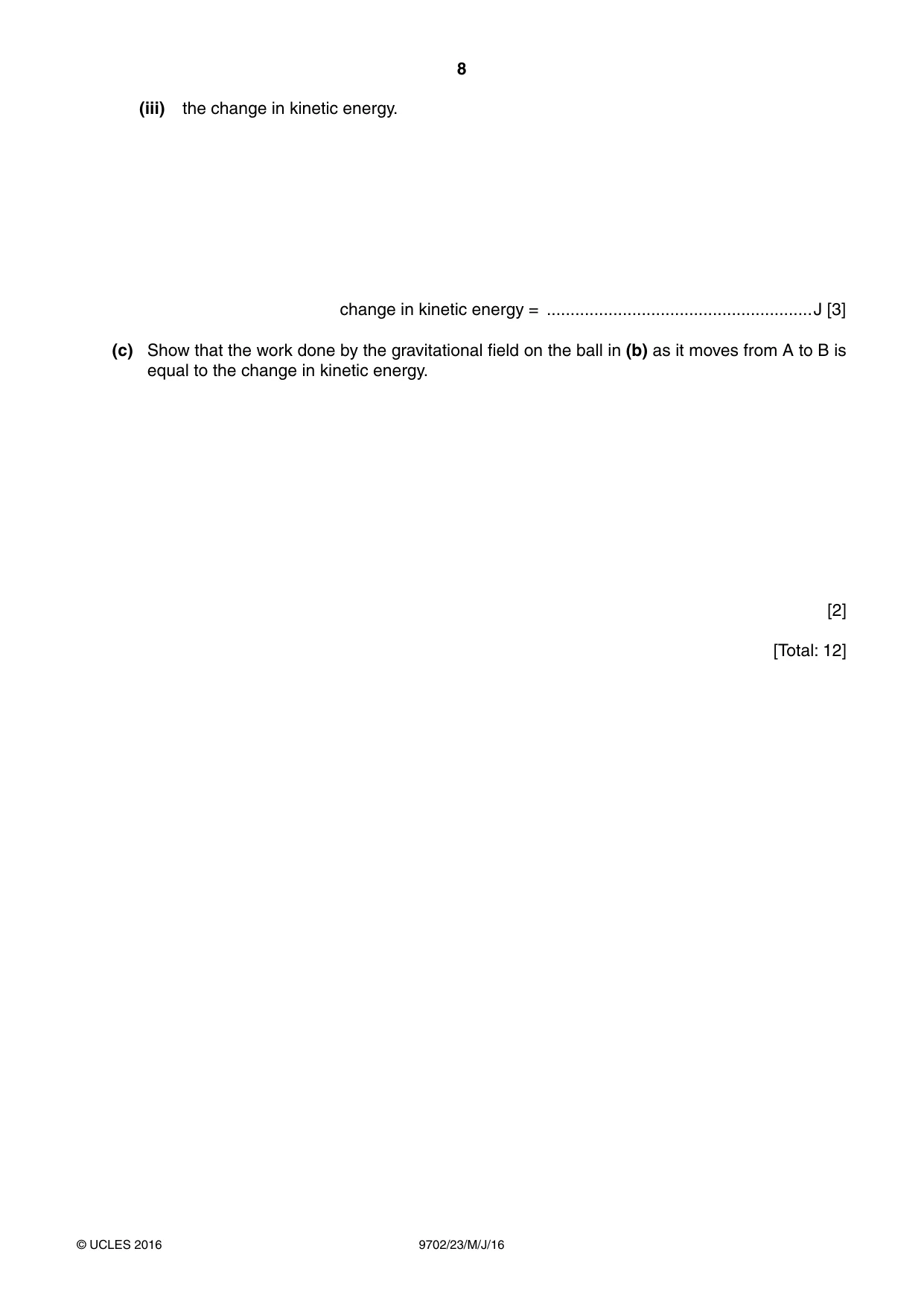
3 (a) Explain what is meant by gravitational potential energy and by kinetic energy. gravitational potential energy: ................................................................................................... ................................................................................................................................................... kinetic energy: ........................................................................................................................... ................................................................................................................................................... [2] (b) A motion sensor is used to measure the velocity of a ball falling vertically towards the ground, as illustrated in Fig. 3.1. motion sensor v A B ground Fig. 3.1 The ball passes through points A and B as it falls. The ball has a mass of 1.5 kg. The variation with time t of the velocity v of the ball as it falls from A to B is shown in Fig. 3.2. 8.0 7.0 6.0 v / m s–1 5.0 4.0 3.0 0.40 0.60 0.80 t / s ball at position A ball at position B Fig. 3.2 Use Fig. 3.2 to calculate, for the ball falling from A to B, (i) the displacement, displacement = .......................................................m [3] (ii) the acceleration, acceleration = ................................................. m s–2 [2] (iii) the change in kinetic energy. change in kinetic energy = ........................................................J [3] (c) Show that the work done by the gravitational field on the ball in (b) as it moves from A to B is equal to the change in kinetic energy. [2] [Total: 12]
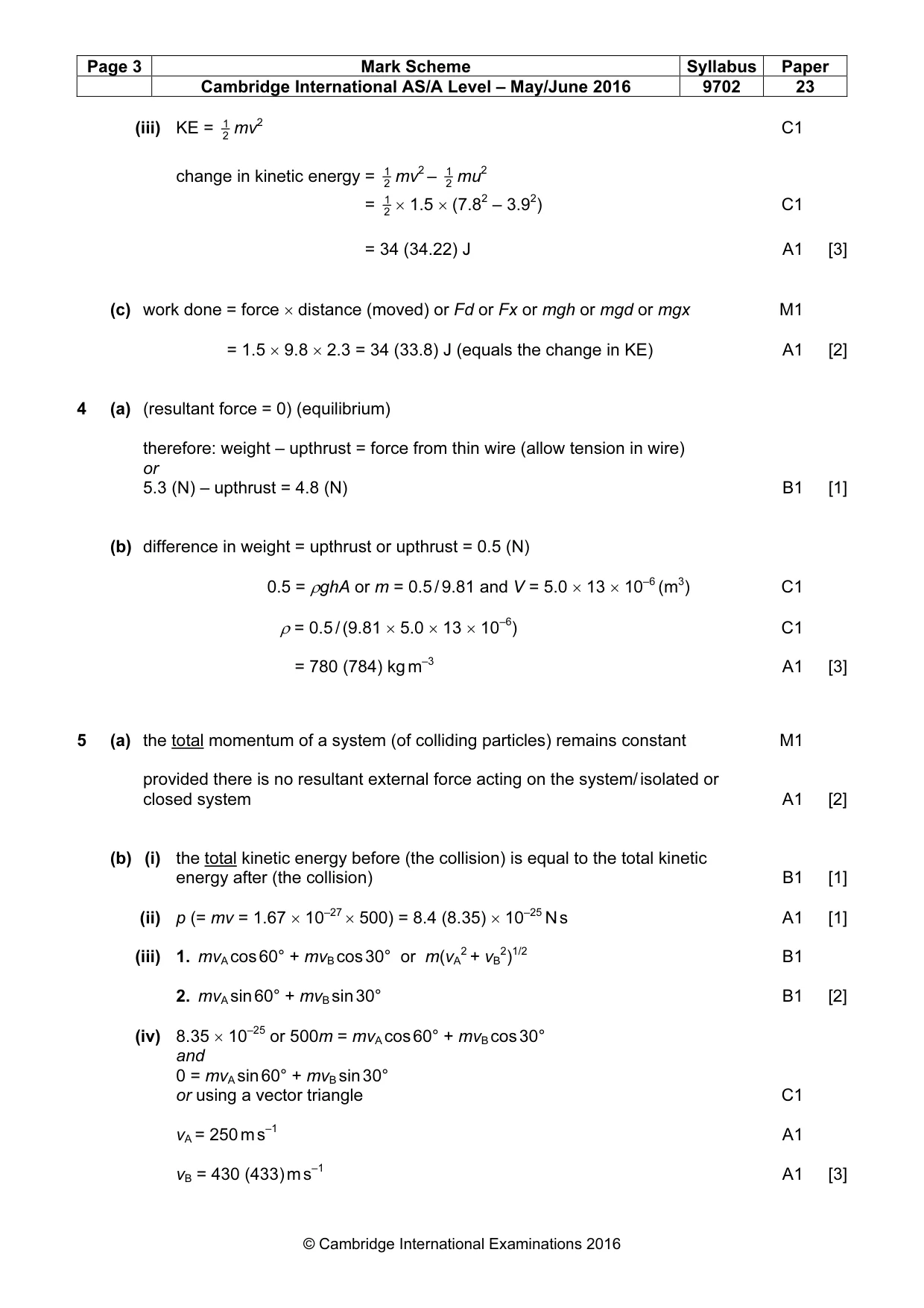
Mark scheme: 3 (a) (gravitational potential energy is) the energy/ability to do work of a mass that it has or is stored due to its position/height in a gravitational field B1 kinetic energy is energy/ability to do work a object/body/mass has due to its speed/velocity/motion/movement B1 [2] (b) (i) s = [(u + v) t] / 2 or acceleration = 9.8/9.75 (using gradient) C1 = [(7.8 + 3.9) × 0.4] / 2 or s = 3.9 × 0.4 + 21 × 9.75 × (0.4)2 C1 s = 2.3(4) m A1 [3] (ii) a = (v – u) / t or gradient of line C1 = (7.8 – 3.9) / 0.4 = 9.8 (9.75) m s–2 (allow ± 21 small square in readings) A1 [2] (iii) KE = 21 mv2 C1 change in kinetic energy = 21 mv2 – 21 mu2 = 21 × 1.5 × (7.82 – 3.92) C1 = 34 (34.22) J A1 [3] (c) work done = force × distance (moved) or Fd or Fx or mgh or mgd or mgx M1 = 1.5 × 9.8 × 2.3 = 34 (33.8) J (equals the change in KE) A1 [2]
Q4 · A spring balance is used to weigh a cylinder that is immersed in oil, as shown in Fig
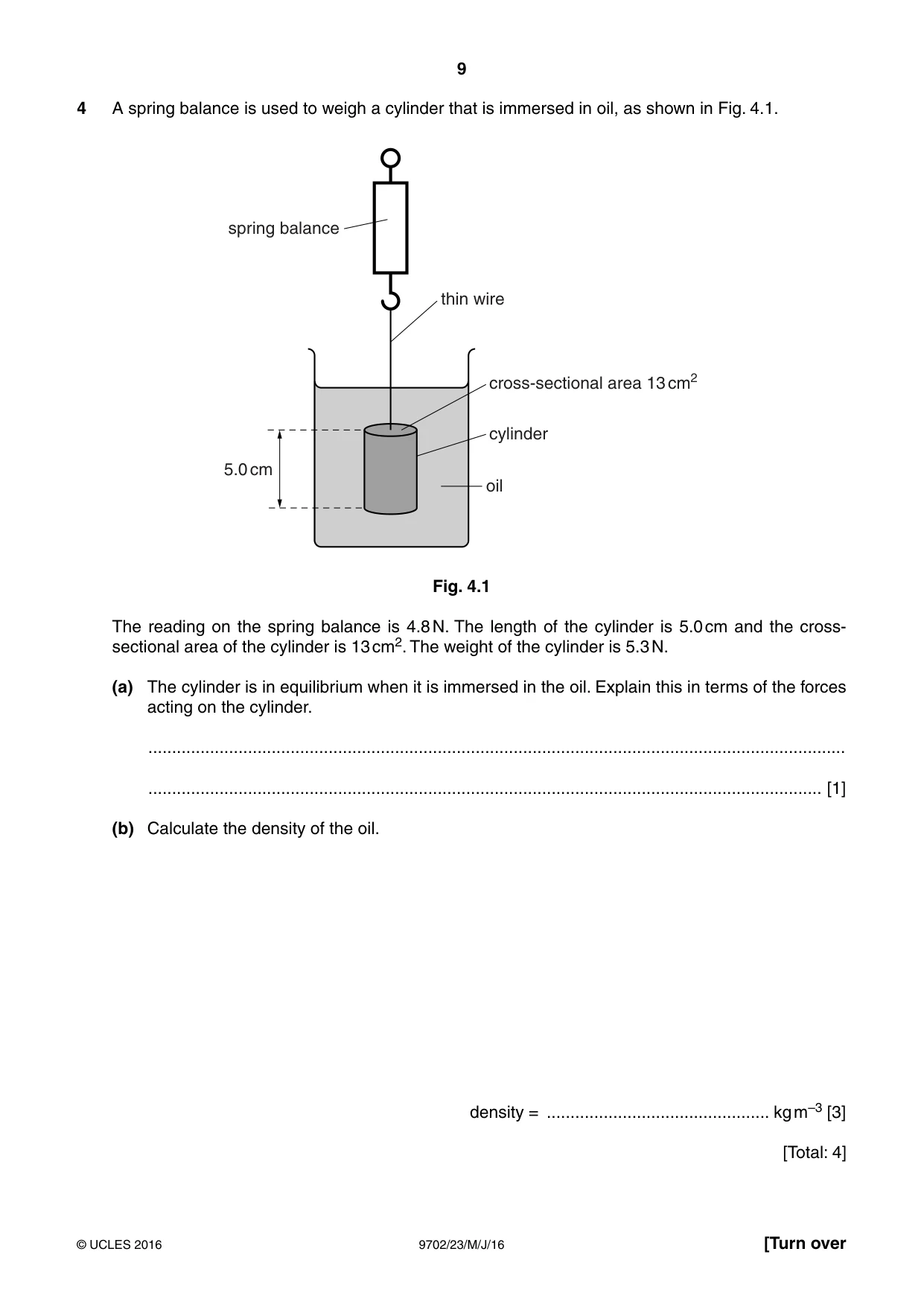
4 A spring balance is used to weigh a cylinder that is immersed in oil, as shown in Fig. 4.1. spring balance thin wire cross-sectional area 13 cm2 cylinder 5.0 cm oil Fig. 4.1 The reading on the spring balance is 4.8 N. The length of the cylinder is 5.0 cm and the cross- sectional area of the cylinder is 13 cm2. The weight of the cylinder is 5.3 N. (a) The cylinder is in equilibrium when it is immersed in the oil. Explain this in terms of the forces acting on the cylinder. ................................................................................................................................................... .............................................................................................................................................. [1] (b) Calculate the density of the oil. density = ............................................... kg m–3 [3] [Total: 4]
Mark scheme: 4 (a) (resultant force = 0) (equilibrium) therefore: weight – upthrust = force from thin wire (allow tension in wire) or 5.3 (N) – upthrust = 4.8 (N) B1 [1] (b) difference in weight = upthrust or upthrust = 0.5 (N) 0.5 = ρghA or m = 0.5 / 9.81 and V = 5.0 × 13 × 10–6 (m3) C1 ρ = 0.5 / (9.81 × 5.0 × 13 × 10–6) C1 = 780 (784) kg m–3 A1 [3]
Q5 · State the law of conservation of momentum
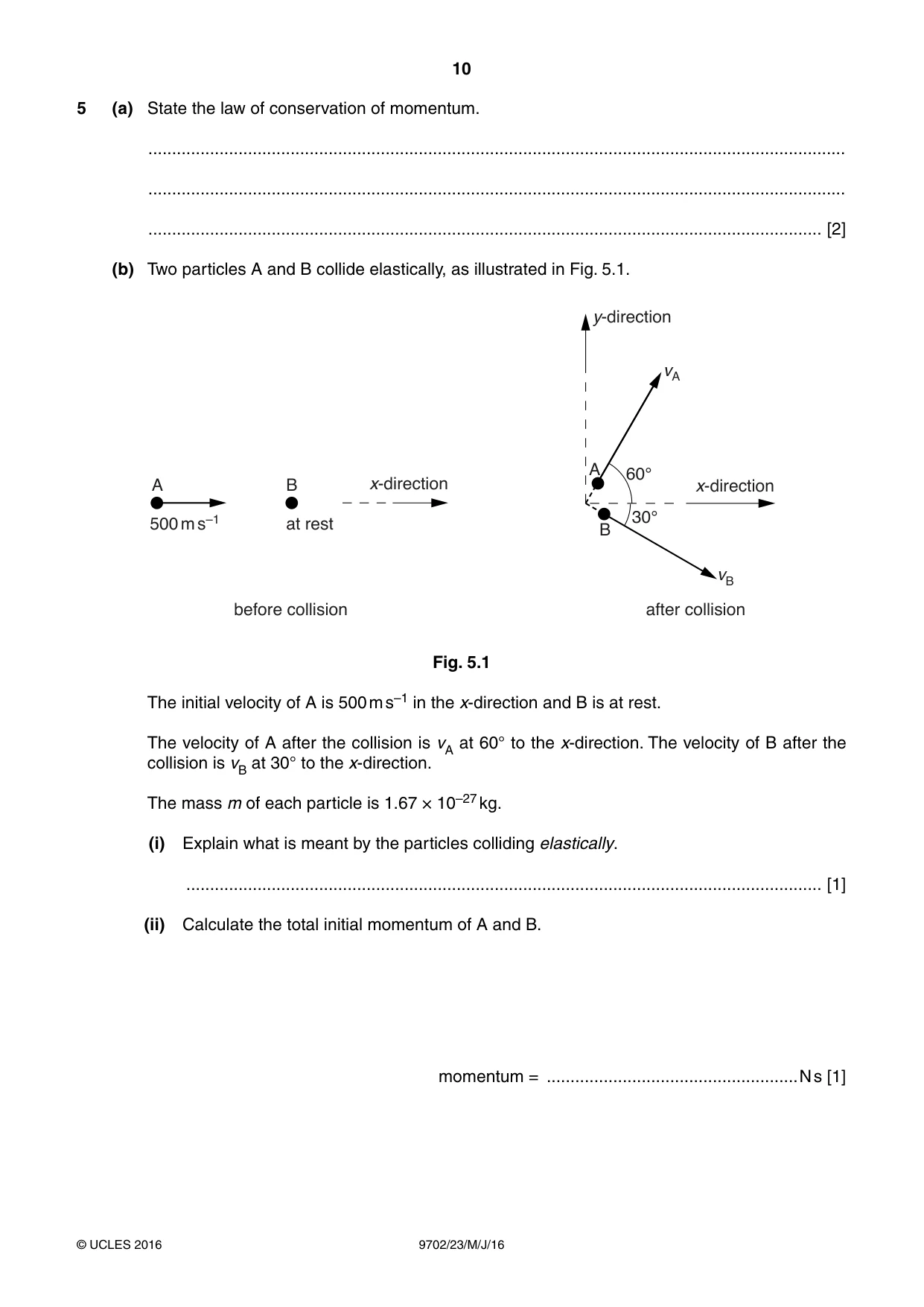
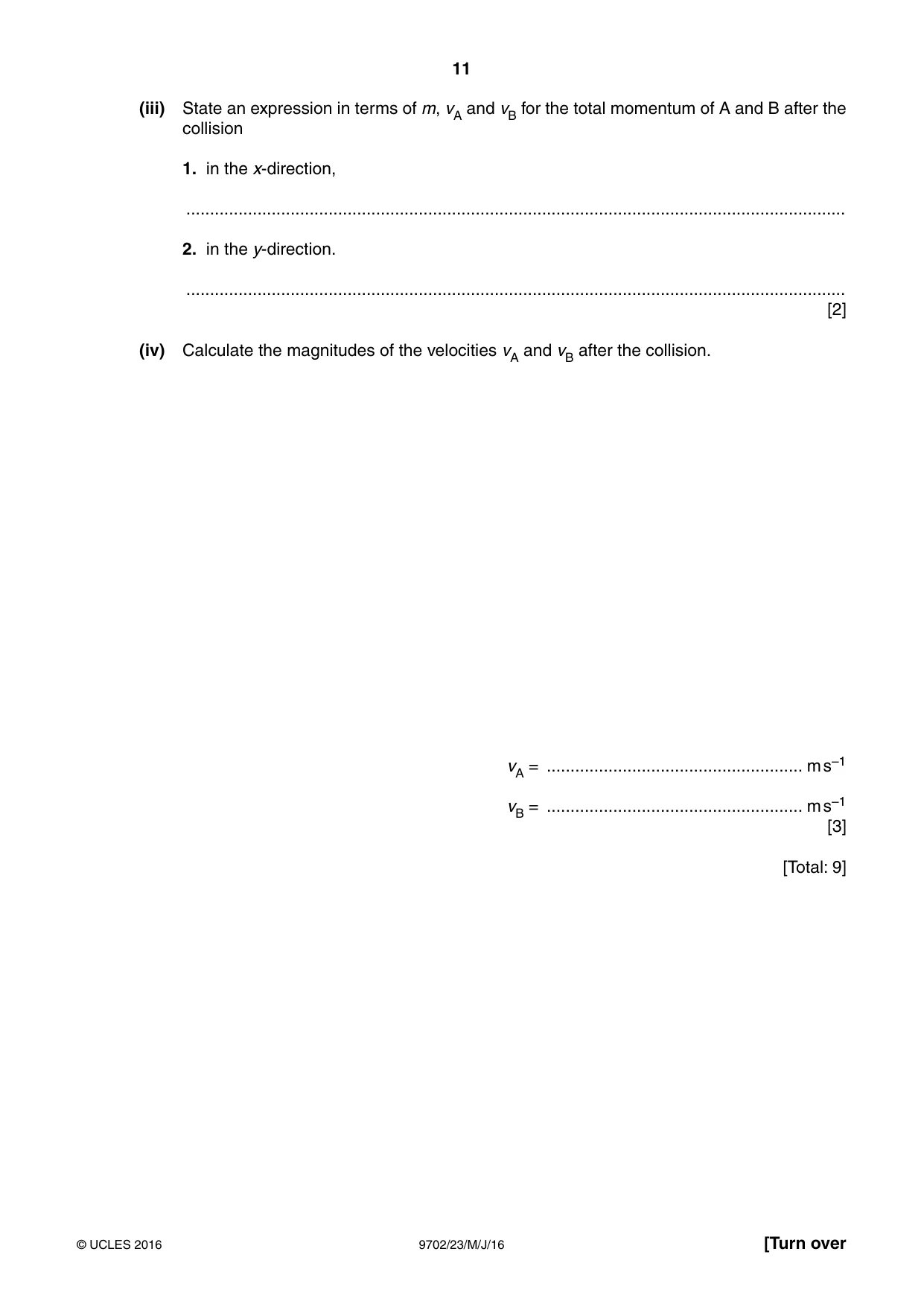
5 (a) State the law of conservation of momentum. ................................................................................................................................................... ................................................................................................................................................... .............................................................................................................................................. [2] (b) Two particles A and B collide elastically, as illustrated in Fig. 5.1. y-direction vA A 60° A B x-direction x-direction 30° 500 m s–1 at rest B vB before collision after collision Fig. 5.1 The initial velocity of A is 500 m s–1 in the x-direction and B is at rest. The velocity of A after the collision is vA at 60° to the x-direction. The velocity of B after the collision is vB at 30° to the x-direction. The mass m of each particle is 1.67 × 10⁻²⁷ kg. (i) Explain what is meant by the particles colliding elastically. ...................................................................................................................................... [1] (ii) Calculate the total initial momentum of A and B. momentum = .....................................................N s [1] (iii) State an expression in terms of m, vA and vB for the total momentum of A and B after the collision 1. in the x-direction, ........................................................................................................................................... 2. in the y-direction. ........................................................................................................................................... [2] (iv) Calculate the magnitudes of the velocities vA and vB after the collision. vA = ...................................................... m s–1 vB = ...................................................... m s–1 [3] [Total: 9]
Mark scheme: 5 (a) the total momentum of a system (of colliding particles) remains constant M1 provided there is no resultant external force acting on the system/ isolated or closed system A1 [2] (b) (i) the total kinetic energy before (the collision) is equal to the total kinetic energy after (the collision) B1 [1] (ii) p (= mv = 1.67 × 10–27 × 500) = 8.4 (8.35) × 10–25 N s A1 [1] (iii) 1. mvA cos 60° + mvB cos 30° or m(vA2 + vB2)1/2 B1 2. mvA sin 60° + mvB sin 30° B1 [2] (iv) 8.35 × 10⁻²⁵ or 500m = mvA cos 60° + mvB cos 30° and 0 = mvA sin 60° + mvB sin 30° or using a vector triangle C1 vA = 250 m s–1 A1 vB = 430 (433) m s–1 A1 [3]
Question 6
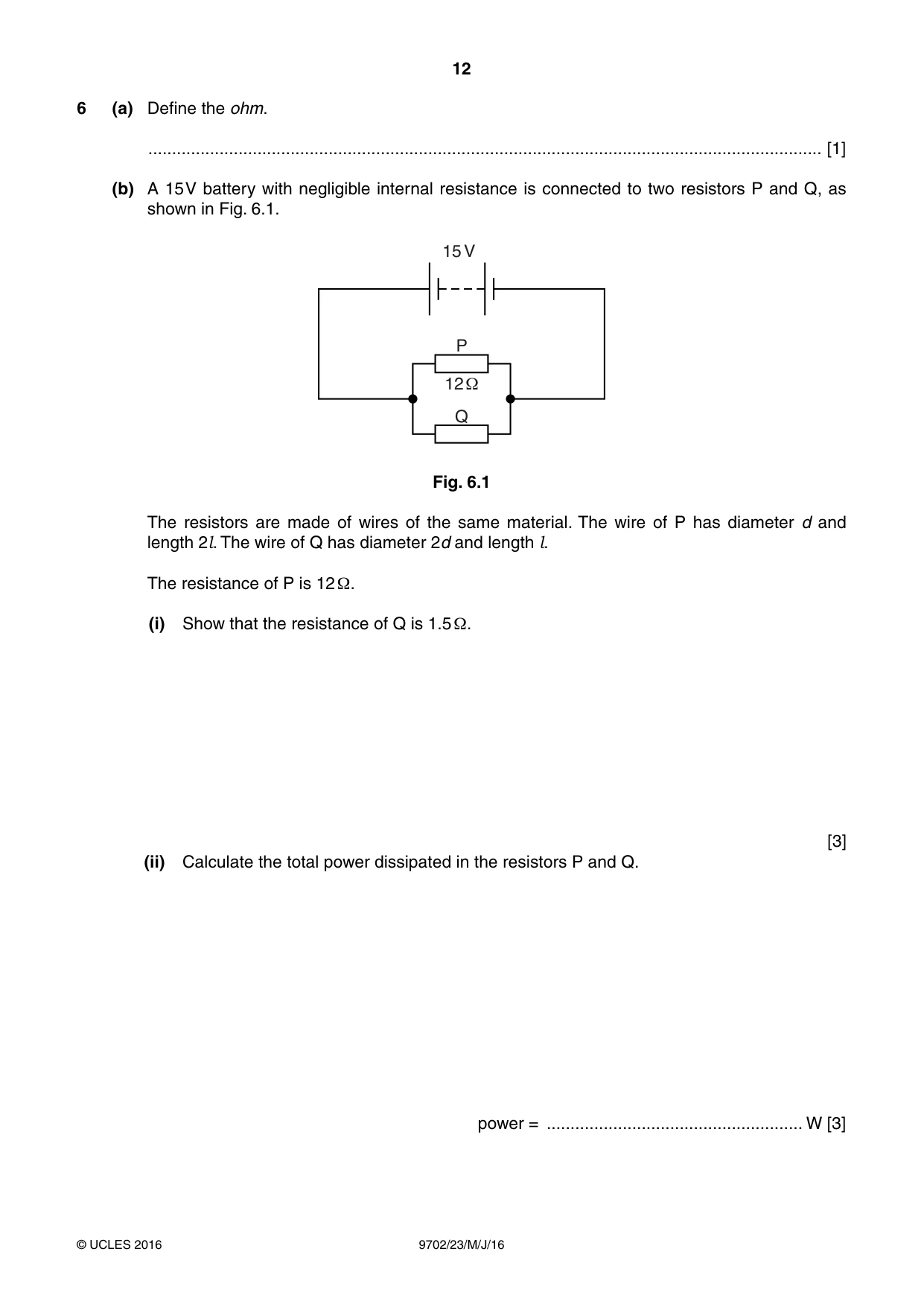
6 (a) Define the ohm. .............................................................................................................................................. [1] (b) A 15 V battery with negligible internal resistance is connected to two resistors P and Q, as shown in Fig. 6.1. 15 V P 12 1 Q Fig. 6.1 The resistors are made of wires of the same material. The wire of P has diameter d and length 2l. The wire of Q has diameter 2d and length l. The resistance of P is 12 Ω. (i) Show that the resistance of Q is 1.5 Ω. [3] (ii) Calculate the total power dissipated in the resistors P and Q. power = ...................................................... W [3] (iii) Determine the ratio average drift speed of the charge carriers in P . average drift speed of the charge carriers in Q ratio = .......................................................... [3] [Total: 10]
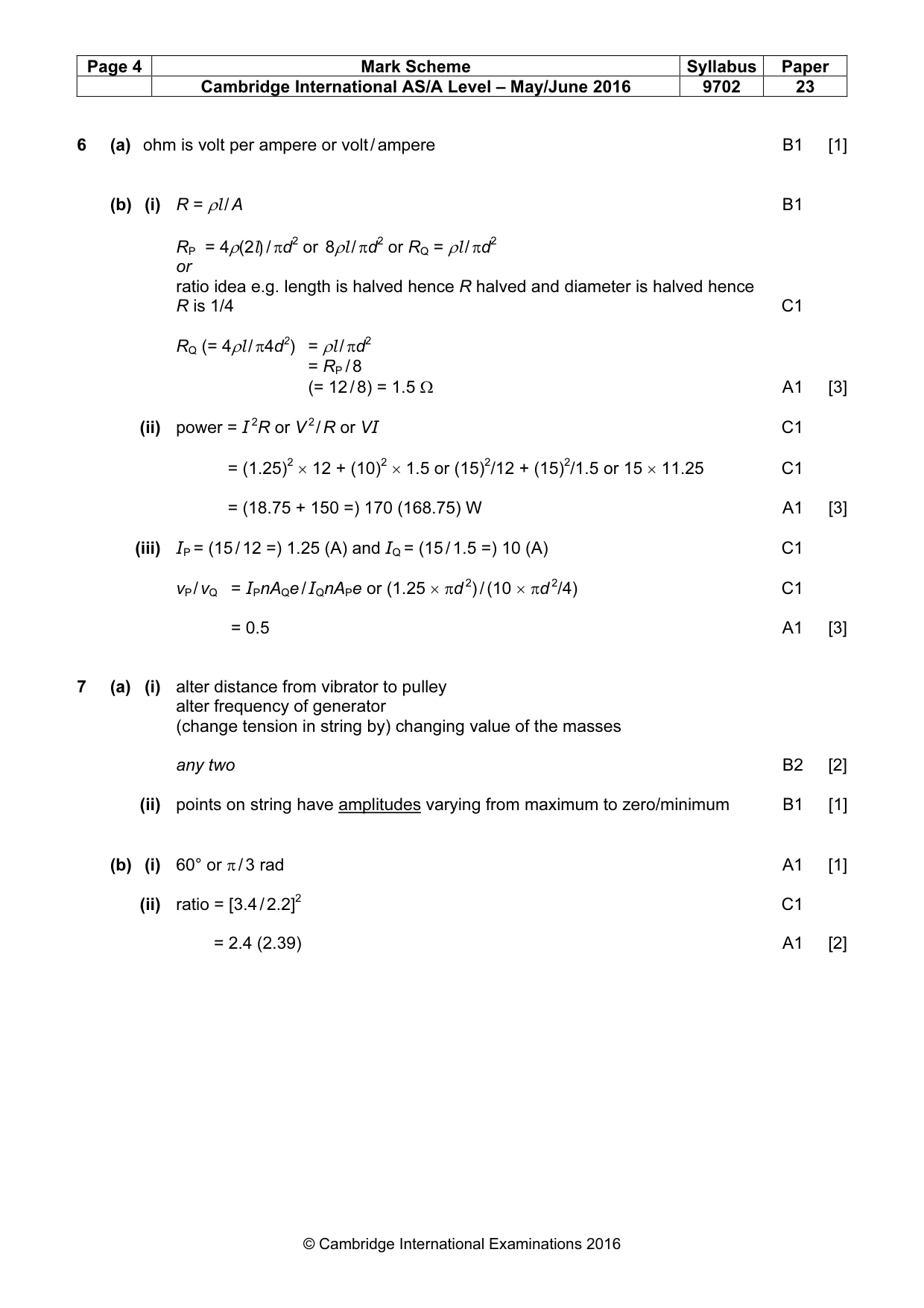
Mark scheme: 6 (a) ohm is volt per ampere or volt / ampere B1 [1] (b) (i) R = ρl / A B1 RP = 4ρ(2l) / πd2 or 8ρl / πd2 or RQ = ρl / πd2 or ratio idea e.g. length is halved hence R halved and diameter is halved hence R is 1/4 C1 RQ (= 4ρl / π4d2) = ρl / πd2 = RP / 8 (= 12 / 8) = 1.5 Ω A1 [3] (ii) power = I 2R or V 2 / R or VI C1 = (1.25)2 × 12 + (10)2 × 1.5 or (15)2/12 + (15)2/1.5 or 15 × 11.25 C1 = (18.75 + 150 =) 170 (168.75) W A1 [3] (iii) IP = (15 / 12 =) 1.25 (A) and IQ = (15 / 1.5 =) 10 (A) C1 vP / vQ = IPnAQe / IQnAPe or (1.25 × πd 2) / (10 × πd 2/4) C1 = 0.5 A1 [3]
Q7 · Apparatus used to produce stationary waves on a stretched string is shown in Fig
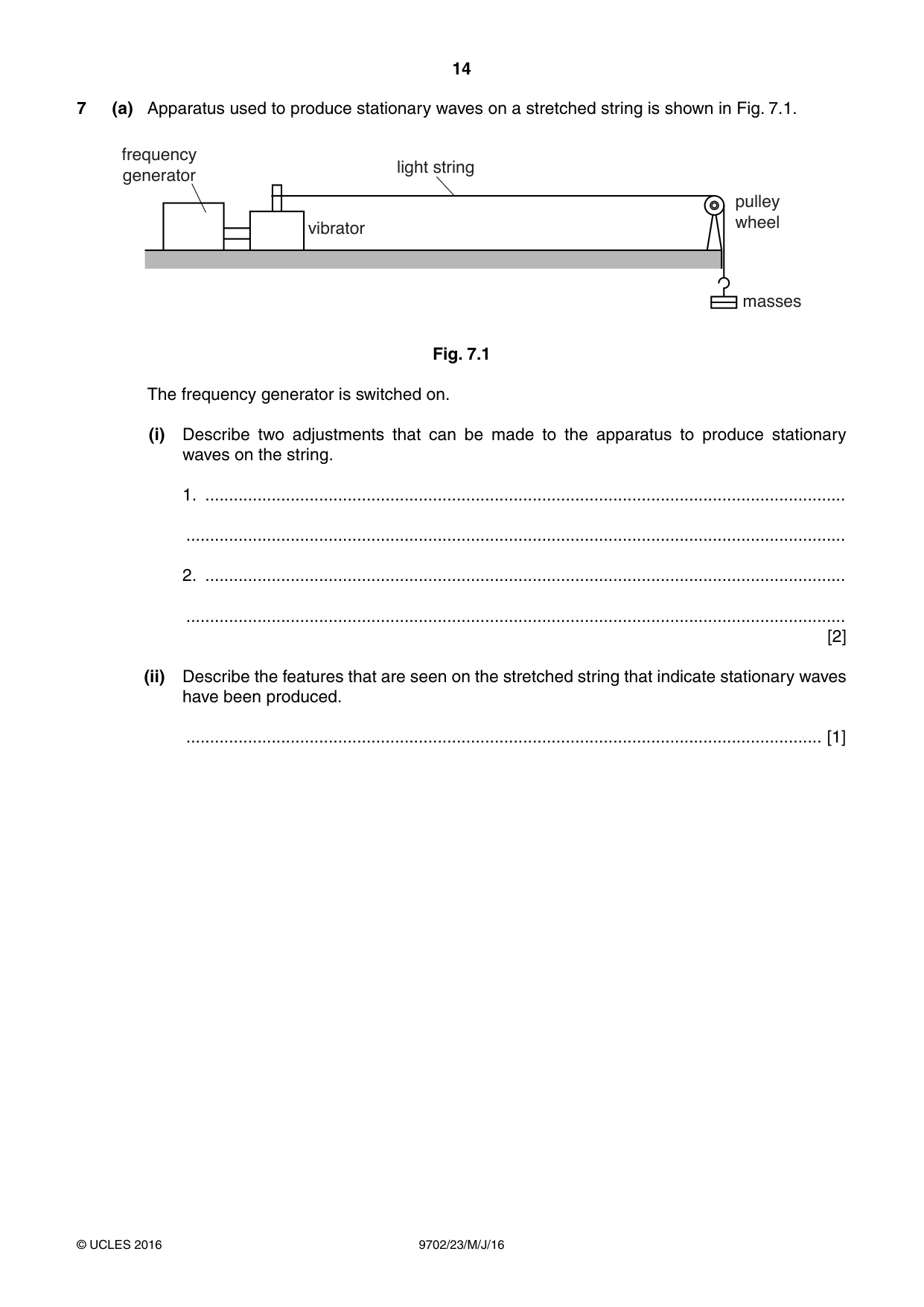
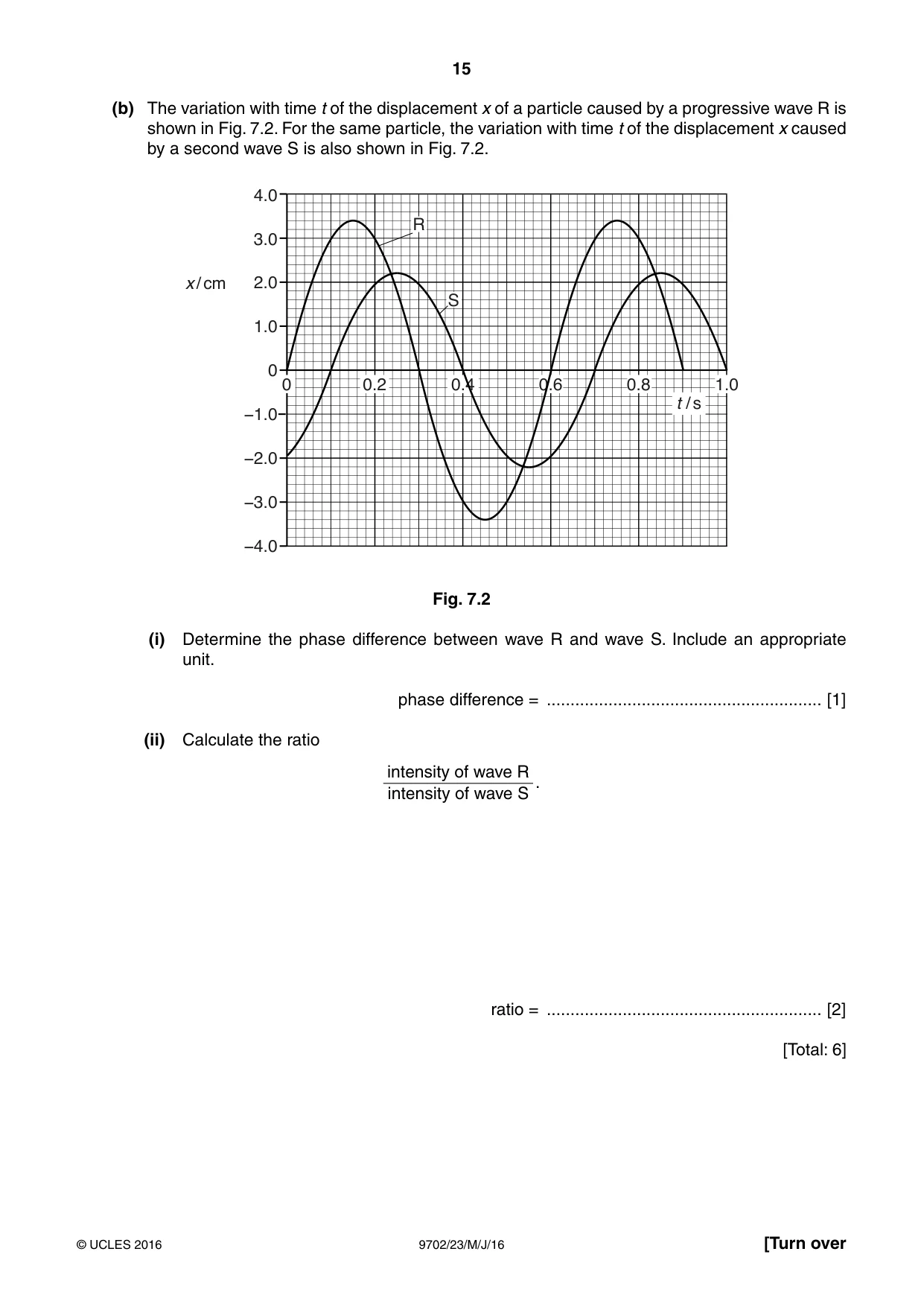
7 (a) Apparatus used to produce stationary waves on a stretched string is shown in Fig. 7.1. frequency light string generator pulley wheel vibrator masses Fig. 7.1 The frequency generator is switched on. (i) Describe two adjustments that can be made to the apparatus to produce stationary waves on the string. 1. ....................................................................................................................................... ........................................................................................................................................... 2. ....................................................................................................................................... ........................................................................................................................................... [2] (ii) Describe the features that are seen on the stretched string that indicate stationary waves have been produced. ...................................................................................................................................... [1] (b) The variation with time t of the displacement x of a particle caused by a progressive wave R is shown in Fig. 7.2. For the same particle, the variation with time t of the displacement x caused by a second wave S is also shown in Fig. 7.2. 4.0 R 3.0 x / cm 2.0 S 1.0 0 0 0.2 0.4 0.6 0.8 1.0 t / s Fig. 7.2 (i) Determine the phase difference between wave R and wave S. Include an appropriate unit. phase difference = .......................................................... [1] (ii) Calculate the ratio intensity of wave R . intensity of wave S ratio = .......................................................... [2] [Total: 6]
Mark scheme: 7 (a) (i) alter distance from vibrator to pulley alter frequency of generator (change tension in string by) changing value of the masses any two B2 [2] (ii) points on string have amplitudes varying from maximum to zero/minimum B1 [1] (b) (i) 60° or π / 3 rad A1 [1] (ii) ratio = [3.4 / 2.2]2 C1 = 2.4 (2.39) A1 [2] +
Q8 · Distinguish between an α-particle and a β+-particle
8 (a) Distinguish between an α-particle and a β+-particle. ................................................................................................................................................... ................................................................................................................................................... ................................................................................................................................................... ................................................................................................................................................... ...............................................................................................................................................[3] (b) State the equation that shows the decay of a particle in a nucleus that results in β+ emission. All particles in the equation should be shown in the notation that is usually used for the representation of nuclides. [2] (c) (i) State the quark composition of 1. a proton, ........................................................................................................................................... 2. a neutron. ........................................................................................................................................... [2] (ii) Use the quark model to explain the charge on a proton. ........................................................................................................................................... ........................................................................................................................................... .......................................................................................................................................[1] [Total: 8]
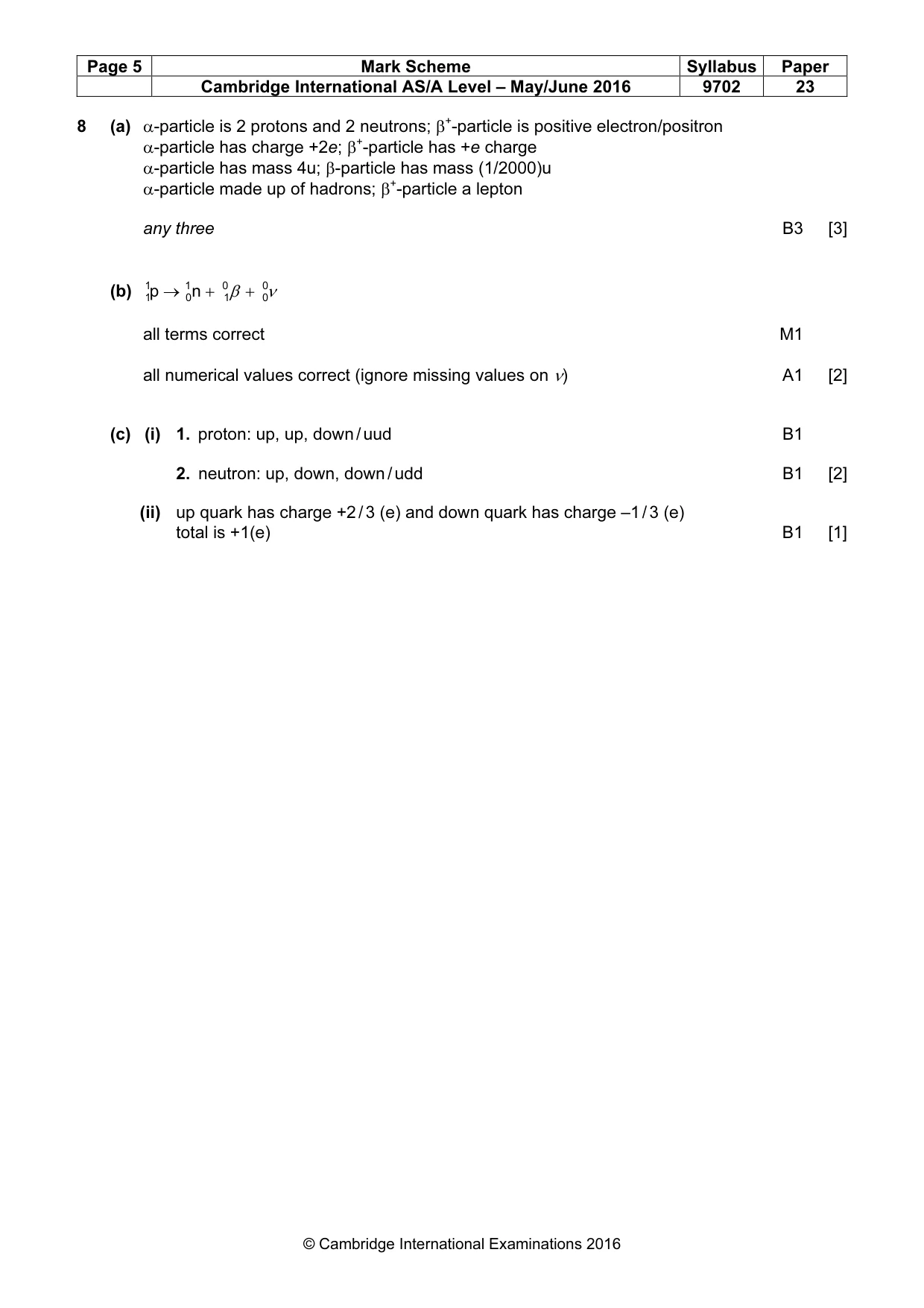
Mark scheme: 8 (a) α-particle is 2 protons and 2 neutrons; β+-particle is positive electron/positron α-particle has charge +2e; β+-particle has +e charge α-particle has mass 4u; β-particle has mass (1/2000)u α-particle made up of hadrons; β+-particle a lepton any three B3 [3] (b) 11p → 10 n + 01β + 00ν all terms correct M1 all numerical values correct (ignore missing values on ν) A1 [2] (c) (i) 1. proton: up, up, down / uud B1 2. neutron: up, down, down / udd B1 [2] (ii) up quark has charge +2 / 3 (e) and down quark has charge –1 / 3 (e) total is +1(e) B1 [1]
What was in this paper
The subtopics covered by these 8 questions, and how many questions each got. Open one in a new tab to see every Cambridge question on it.
What you needed in this session
Cambridge’s own grade thresholds for 2016 May/June, Paper 2 · Variant 3. A higher threshold means an easier paper — the bar moves with how the cohort did.