Cambridge A Level Physics 9702 — 2016 Oct/Nov Paper 2 · Variant 1
9702/21/O/N/16 · 7 questions · 60 marks · ≈68 min
The question paper and its mark scheme, free to read here and free to download. This is Cambridge’s own paper, exactly as it was sat.
Question paper16 pages

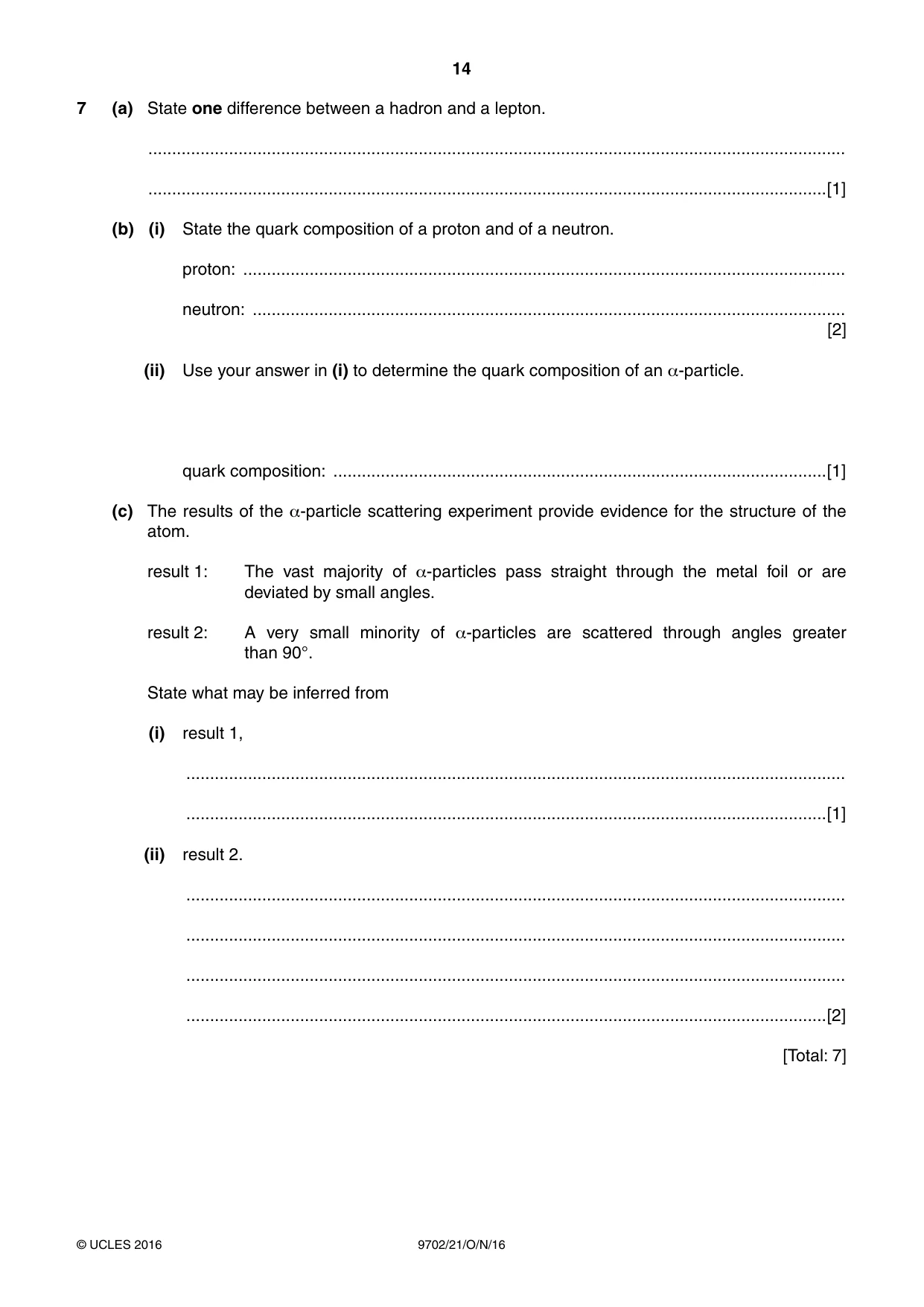

Mark scheme5 pages
Answers below. Sit the paper first if you are practising.
Questions as text
Question 1
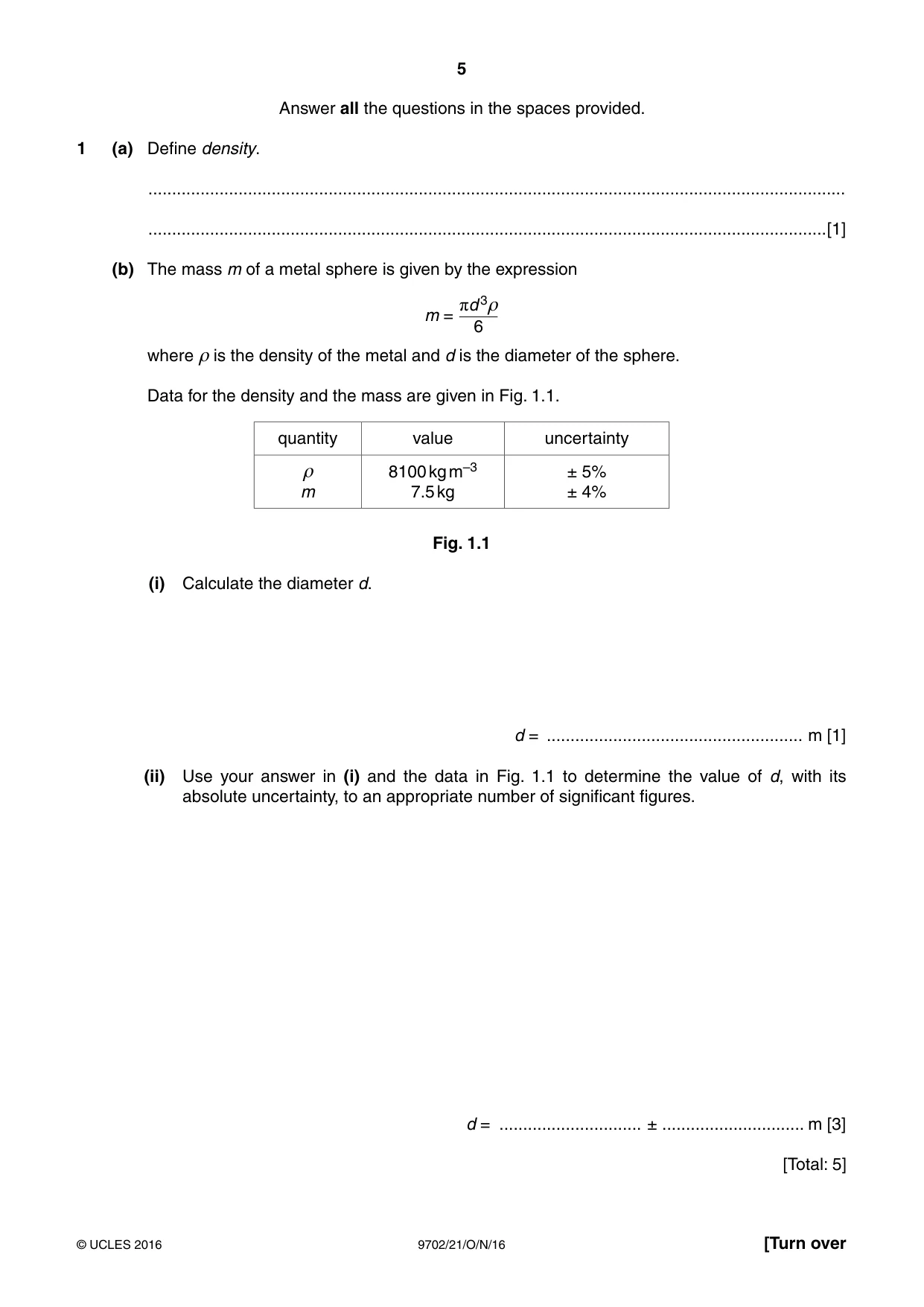
1 (a) Define density. ................................................................................................................................................... ...............................................................................................................................................[1] (b) The mass m of a metal sphere is given by the expression πd 3ρ m = 6 where ρ is the density of the metal and d is the diameter of the sphere. Data for the density and the mass are given in Fig. 1.1. quantity value uncertainty ρ 8100 kg m–3 ± 5% m 7.5 kg ± 4% Fig. 1.1 (i) Calculate the diameter d. d = ...................................................... m [1] (ii) Use your answer in (i) and the data in Fig. 1.1 to determine the value of d, with its absolute uncertainty, to an appropriate number of significant figures. d = .............................. ± .............................. m [3] [Total: 5]
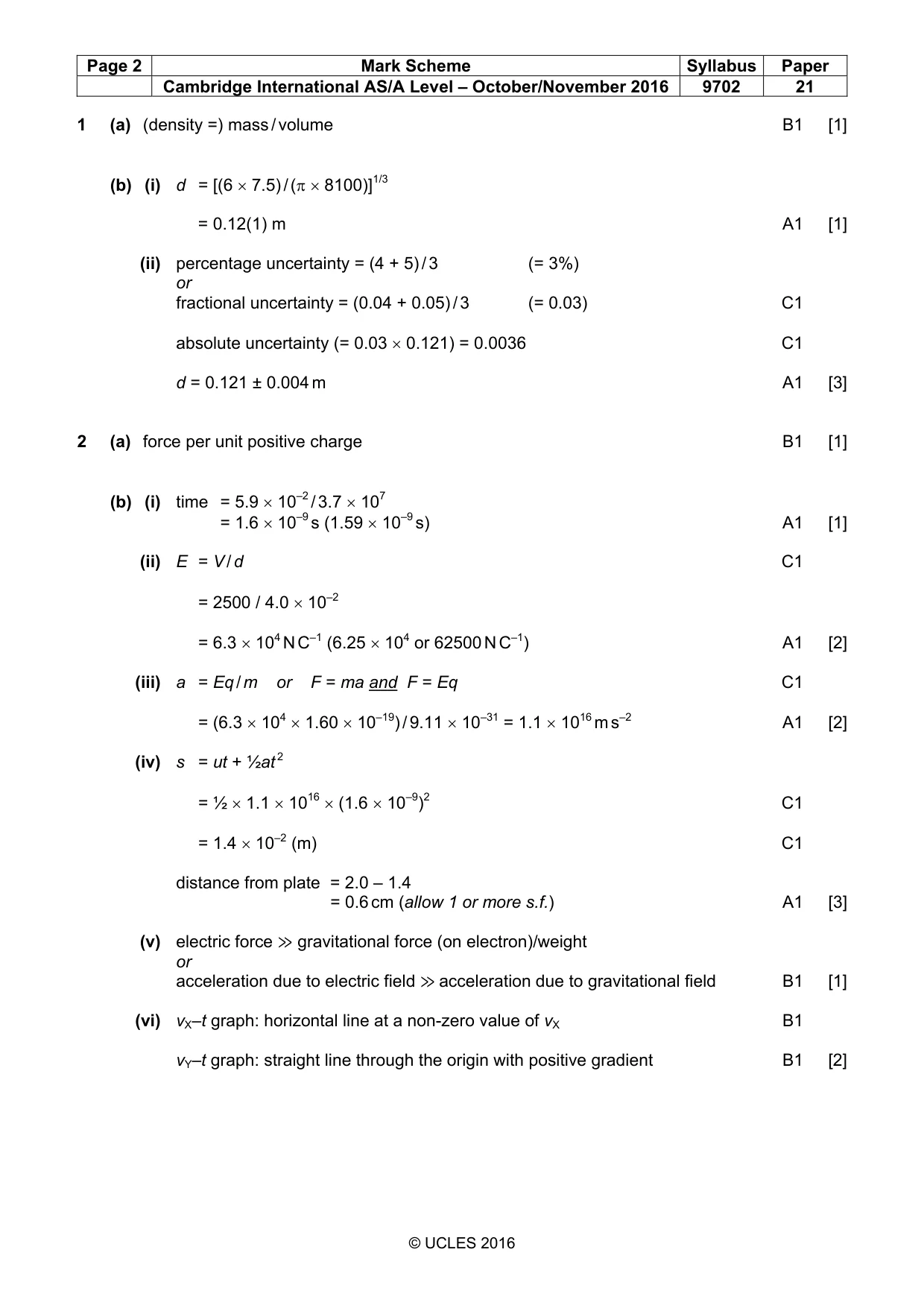
Mark scheme: 1 (a) (density =) mass / volume B1 [1] (b) (i) d = [(6 × 7.5) / (π × 8100)]1/3 = 0.12(1) m A1 [1] (ii) percentage uncertainty = (4 + 5) / 3 (= 3%) or fractional uncertainty = (0.04 + 0.05) / 3 (= 0.03) C1 absolute uncertainty (= 0.03 × 0.121) = 0.0036 C1 d = 0.121 ± 0.004 m A1 [3]
Q2 · Define electric field strength
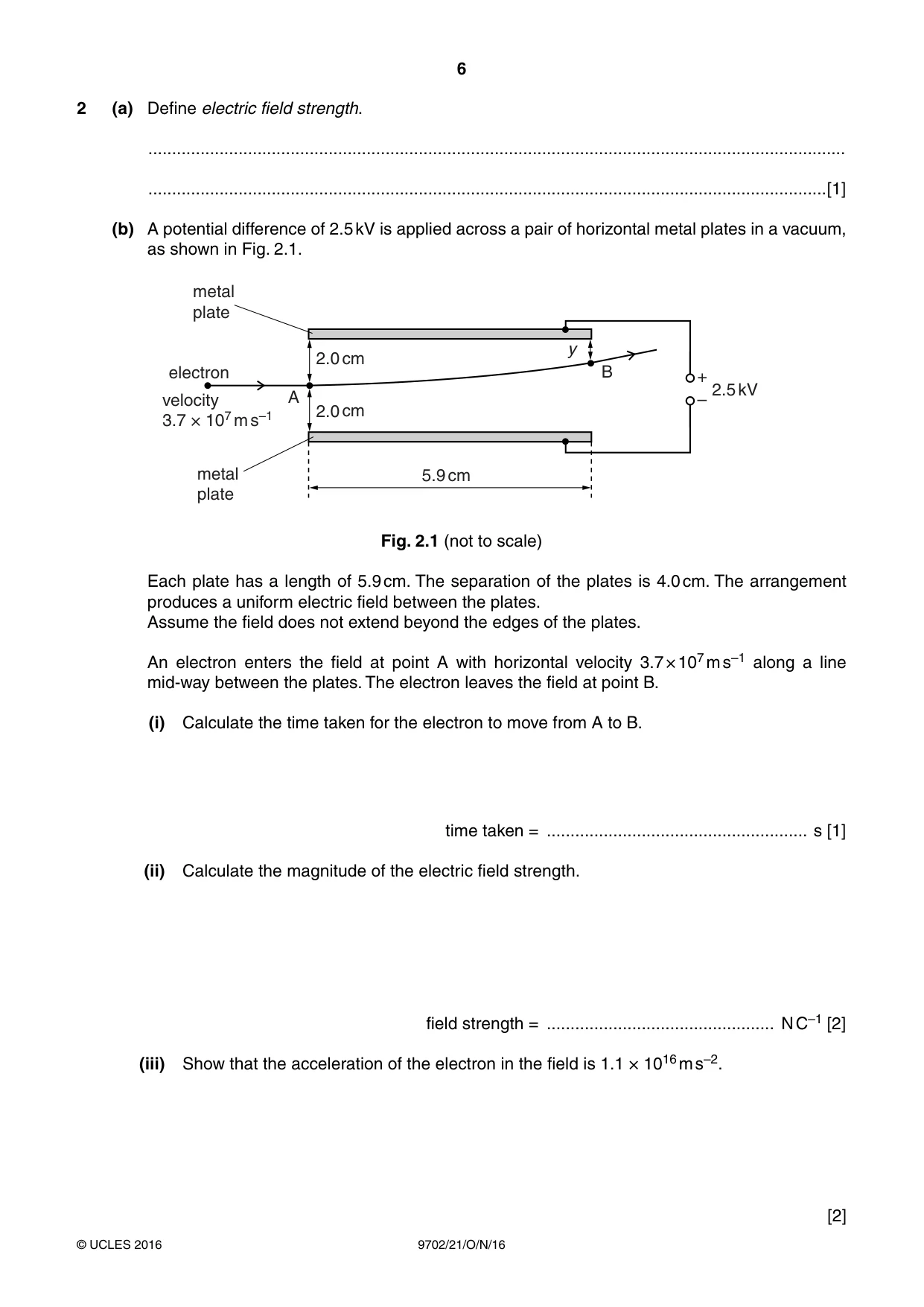
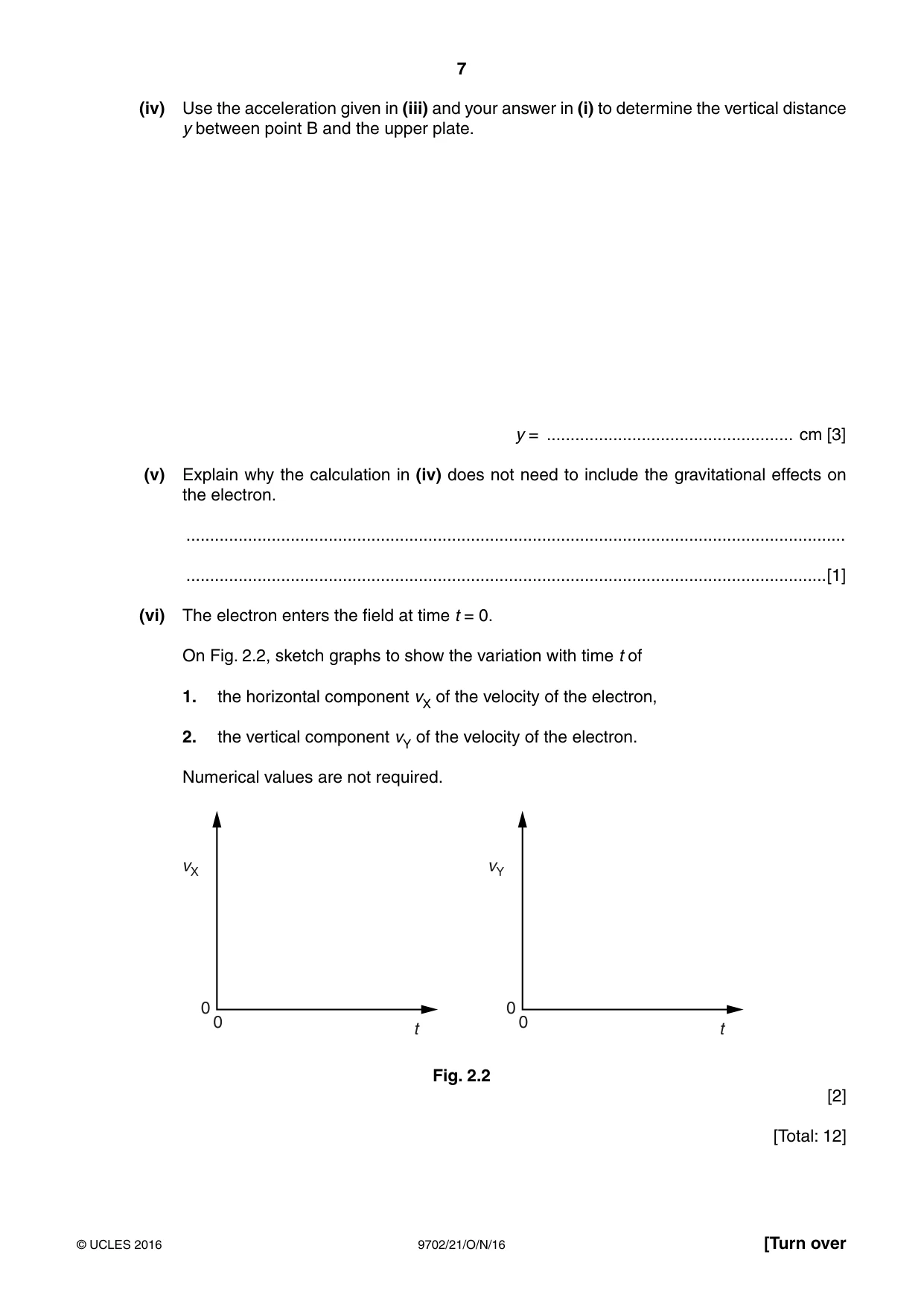
2 (a) Define electric field strength. ................................................................................................................................................... ...............................................................................................................................................[1] (b) A potential difference of 2.5 kV is applied across a pair of horizontal metal plates in a vacuum, as shown in Fig. 2.1. metal plate \ 2.0 cm electron B + 2.5 kV velocity A – 2.0 cm 3.7 × 10⁷ m s–1 metal 5.9 cm plate Fig. 2.1 (not to scale) Each plate has a length of 5.9 cm. The separation of the plates is 4.0 cm. The arrangement produces a uniform electric field between the plates. Assume the field does not extend beyond the edges of the plates. An electron enters the field at point A with horizontal velocity 3.7 × 10⁷ m s–1 along a line mid-way between the plates. The electron leaves the field at point B. (i) Calculate the time taken for the electron to move from A to B. time taken = ....................................................... s [1] (ii) Calculate the magnitude of the electric field strength. field strength = ................................................ N C–1 [2] (iii) Show that the acceleration of the electron in the field is 1.1 × 10¹⁶ m s–2. [2] (iv) Use the acceleration given in (iii) and your answer in (i) to determine the vertical distance y between point B and the upper plate. y = .................................................... cm [3] (v) Explain why the calculation in (iv) does not need to include the gravitational effects on the electron. ........................................................................................................................................... .......................................................................................................................................[1] (vi) The electron enters the field at time t = 0. On Fig. 2.2, sketch graphs to show the variation with time t of 1. the horizontal component vX of the velocity of the electron, 2. the vertical component v of the velocity of the electron. Y Numerical values are not required. vX vY 0 0 0 0 t t Fig. 2.2 [2] [Total: 12]
Mark scheme: 2 (a) force per unit positive charge B1 [1] (b) (i) time = 5.9 × 10⁻² / 3.7 × 107 = 1.6 × 10⁻⁹ s (1.59 × 10⁻⁹ s) A1 [1] (ii) E = V / d C1 = 2500 / 4.0 × 10–2 = 6.3 × 10⁴ N C–1 (6.25 × 10⁴ or 62500 N C–1) A1 [2] (iii) a = Eq / m or F = ma and F = Eq C1 = (6.3 × 104 × 1.60 × 10–19) / 9.11 × 10–31 = 1.1 × 10¹⁶ m s–2 A1 [2] (iv) s = ut + ½at 2 = ½ × 1.1 × 1016 × (1.6 × 10–9)2 C1 = 1.4 × 10⁻² (m) C1 distance from plate = 2.0 – 1.4 = 0.6 cm (allow 1 or more s.f.) A1 [3] (v) electric force ≫ gravitational force (on electron)/weight or acceleration due to electric field ≫ acceleration due to gravitational field B1 [1] (vi) vX–t graph: horizontal line at a non-zero value of vX B1 vY–t graph: straight line through the origin with positive gradient B1 [2]
Question 3
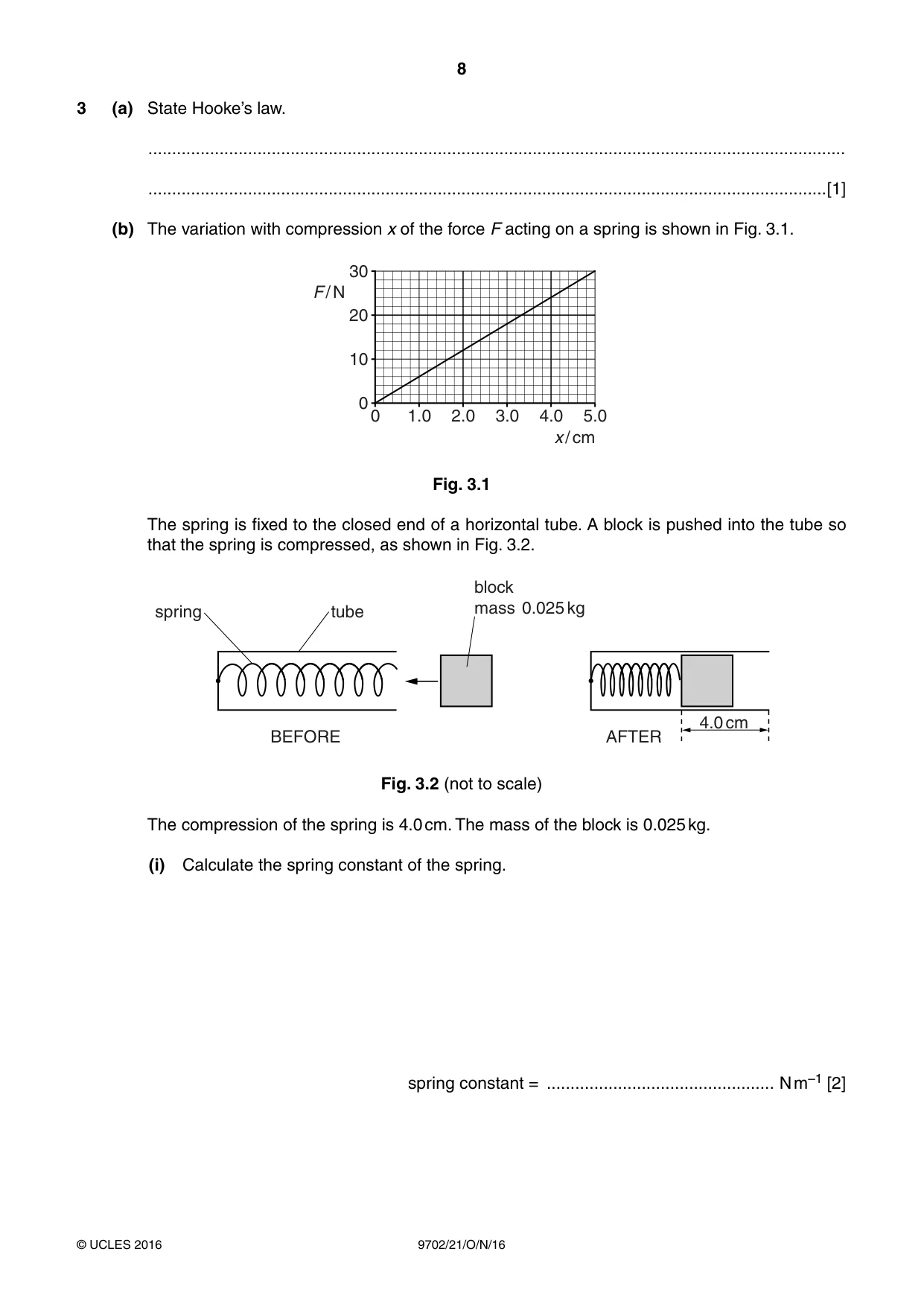
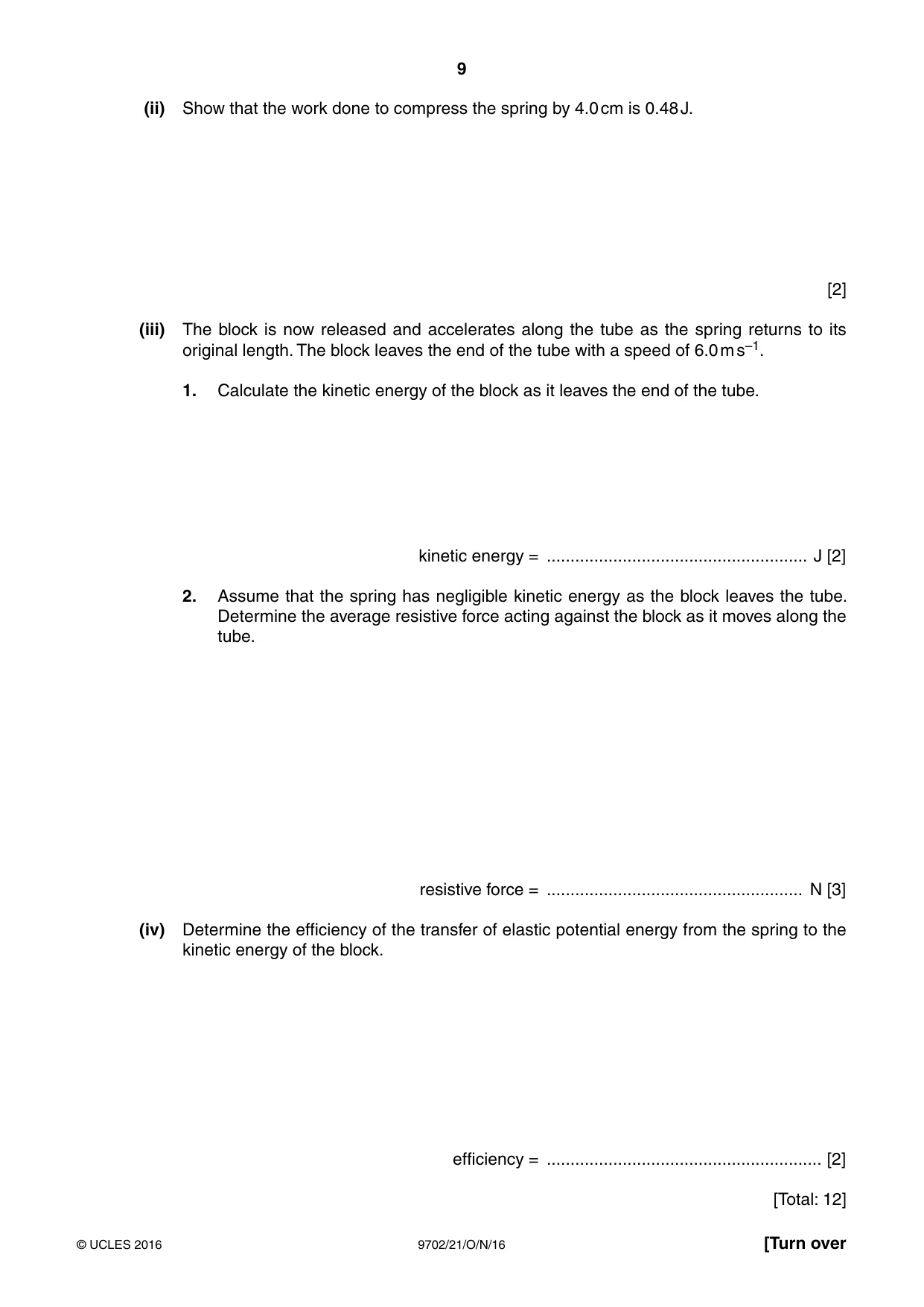
3 (a) State Hooke’s law. ................................................................................................................................................... ...............................................................................................................................................[1] (b) The variation with compression x of the force F acting on a spring is shown in Fig. 3.1. 30 F / N 20 10 0 0 1.0 2.0 3.0 4.0 5.0 x / cm Fig. 3.1 The spring is fixed to the closed end of a horizontal tube. A block is pushed into the tube so that the spring is compressed, as shown in Fig. 3.2. block spring tube mass 0.025 kg 4.0 cm BEFORE AFTER Fig. 3.2 (not to scale) The compression of the spring is 4.0 cm. The mass of the block is 0.025 kg. (i) Calculate the spring constant of the spring. spring constant = ................................................ N m–1 [2] (ii) Show that the work done to compress the spring by 4.0 cm is 0.48 J. [2] (iii) The block is now released and accelerates along the tube as the spring returns to its original length. The block leaves the end of the tube with a speed of 6.0 m s–1. 1. Calculate the kinetic energy of the block as it leaves the end of the tube. kinetic energy = ....................................................... J [2] 2. Assume that the spring has negligible kinetic energy as the block leaves the tube. Determine the average resistive force acting against the block as it moves along the tube. resistive force = ...................................................... N [3] (iv) Determine the efficiency of the transfer of elastic potential energy from the spring to the kinetic energy of the block. efficiency = .......................................................... [2] [Total: 12]
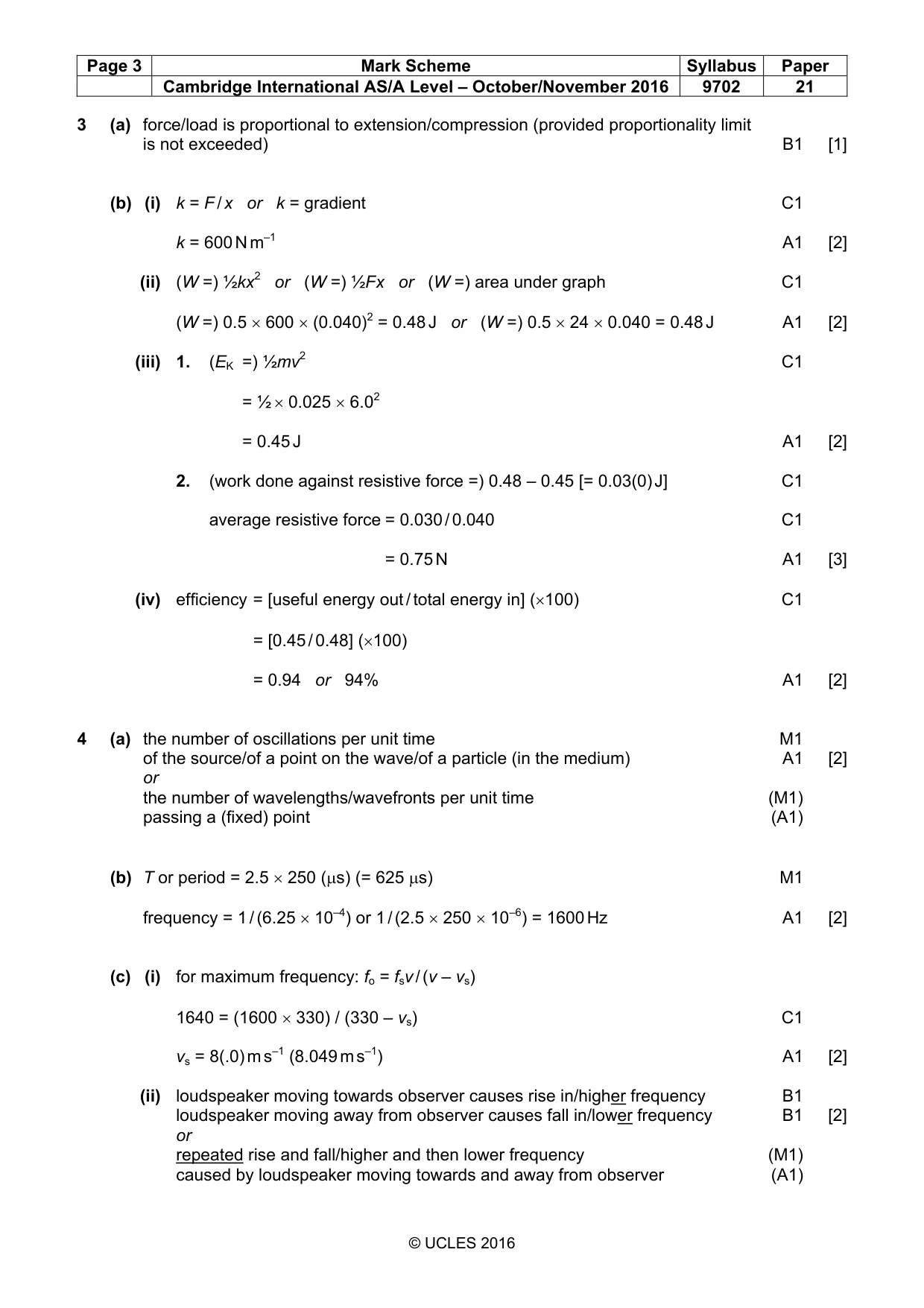
Mark scheme: 3 (a) force/load is proportional to extension/compression (provided proportionality limit is not exceeded) B1 [1] (b) (i) k = F / x or k = gradient C1 k = 600 N m–1 A1 [2] (ii) (W =) ½kx2 or (W =) ½Fx or (W =) area under graph C1 (W =) 0.5 × 600 × (0.040)2 = 0.48 J or (W =) 0.5 × 24 × 0.040 = 0.48 J A1 [2] (iii) 1. (EK =) ½mv2 C1 = ½ × 0.025 × 6.02 = 0.45 J A1 [2] 2. (work done against resistive force =) 0.48 – 0.45 [= 0.03(0) J] C1 average resistive force = 0.030 / 0.040 C1 = 0.75 N A1 [3] (iv) efficiency = [useful energy out / total energy in] (×100) C1 = [0.45 / 0.48] (×100) = 0.94 or 94% A1 [2]
Q4 · State what is meant by the frequency of a progressive wave
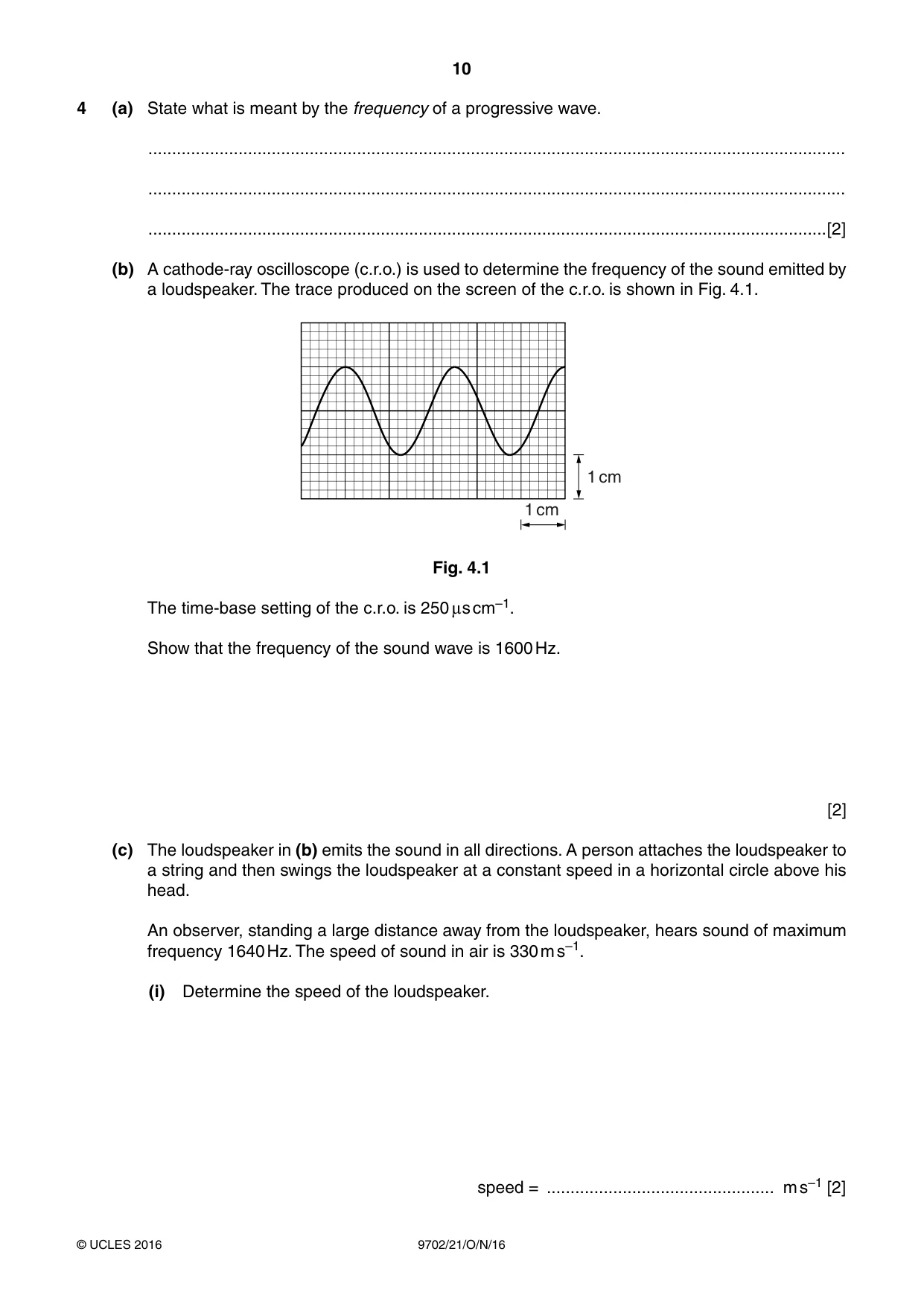
4 (a) State what is meant by the frequency of a progressive wave. ................................................................................................................................................... ................................................................................................................................................... ...............................................................................................................................................[2] (b) A cathode-ray oscilloscope (c.r.o.) is used to determine the frequency of the sound emitted by a loudspeaker. The trace produced on the screen of the c.r.o. is shown in Fig. 4.1. 1 cm 1 cm Fig. 4.1 The time-base setting of the c.r.o. is 250 μs cm–1. Show that the frequency of the sound wave is 1600 Hz. [2] (c) The loudspeaker in (b) emits the sound in all directions. A person attaches the loudspeaker to a string and then swings the loudspeaker at a constant speed in a horizontal circle above his head. An observer, standing a large distance away from the loudspeaker, hears sound of maximum frequency 1640 Hz. The speed of sound in air is 330 m s–1. (i) Determine the speed of the loudspeaker. speed = ................................................ m s–1 [2] (ii) Describe and explain, qualitatively, the variation in the frequency of the sound heard by the observer. ........................................................................................................................................... ........................................................................................................................................... ........................................................................................................................................... ........................................................................................................................................... .......................................................................................................................................[2] [Total: 8]
Mark scheme: 4 (a) the number of oscillations per unit time M1 of the source/of a point on the wave/of a particle (in the medium) A1 [2] or the number of wavelengths/wavefronts per unit time (M1) passing a (fixed) point (A1) (b) T or period = 2.5 × 250 (µs) (= 625 µs) M1 frequency = 1 / (6.25 × 10⁻⁴) or 1 / (2.5 × 250 × 10–6) = 1600 Hz A1 [2] (c) (i) for maximum frequency: fo = fsv / (v – vs) 1640 = (1600 × 330) / (330 – vs) C1 vs = 8(.0) m s–1 (8.049 m s–1) A1 [2] (ii) loudspeaker moving towards observer causes rise in/higher frequency B1 loudspeaker moving away from observer causes fall in/lower frequency B1 [2] or repeated rise and fall/higher and then lower frequency (M1) caused by loudspeaker moving towards and away from observer (A1)
Q5 · State what is meant by the diffraction of a wave
5 (a) State what is meant by the diffraction of a wave. ................................................................................................................................................... ...............................................................................................................................................[2] (b) Laser light of wavelength 500 nm is incident normally on a diffraction grating. The resulting diffraction pattern has diffraction maxima up to and including the fourth-order maximum. Calculate, for the diffraction grating, the minimum possible line spacing. line spacing = ...................................................... m [3] (c) The light in (b) is now replaced with red light. State and explain whether this is likely to result in the formation of a fifth-order diffraction maximum. ................................................................................................................................................... ................................................................................................................................................... ................................................................................................................................................... ...............................................................................................................................................[2] [Total: 7]
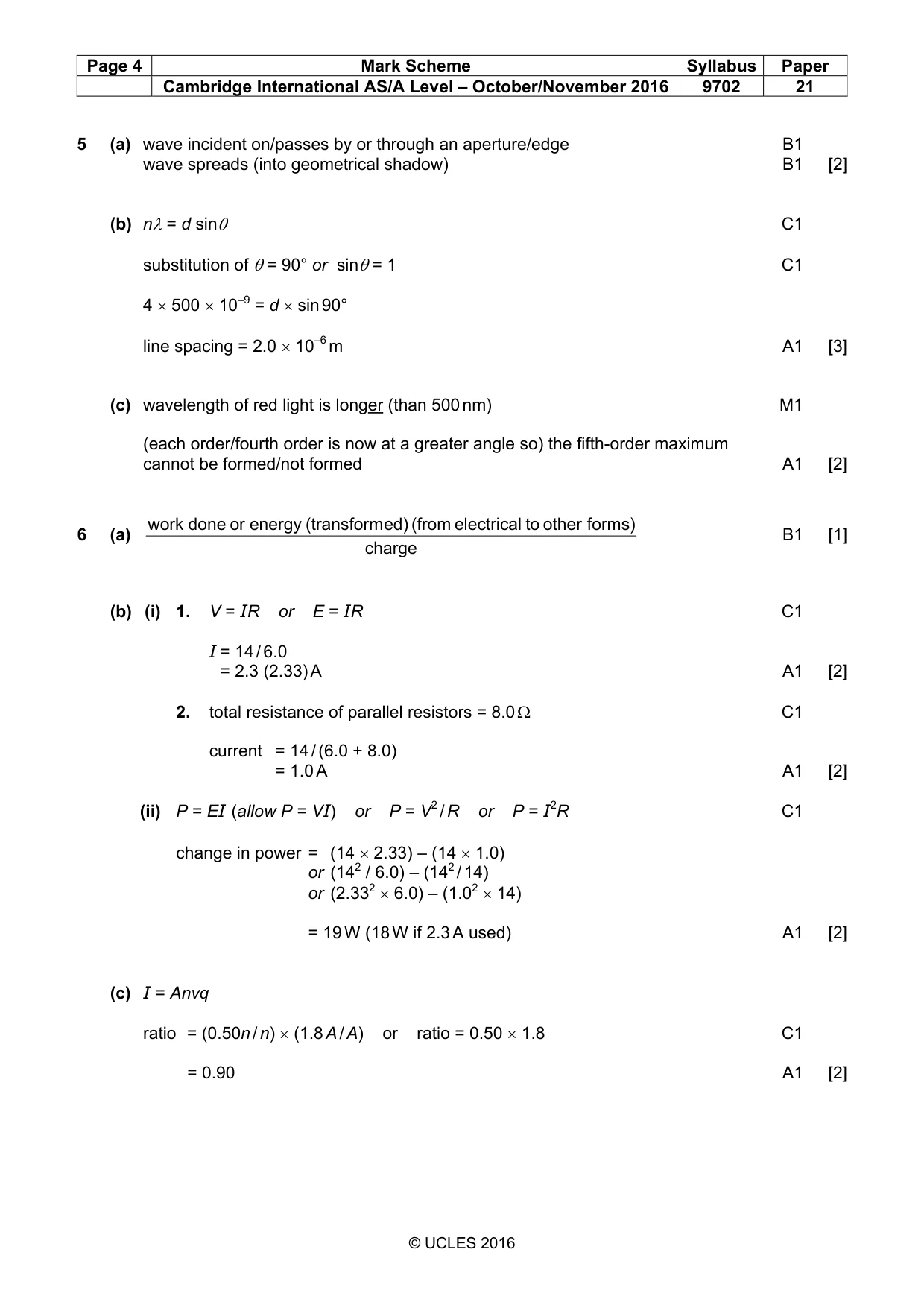
Mark scheme: 5 (a) wave incident on/passes by or through an aperture/edge B1 wave spreads (into geometrical shadow) B1 [2] (b) nλ= d sinθ C1 substitution of θ= 90° or sinθ= 1 C1 4 × 500 × 10–9 = d × sin 90° line spacing = 2.0 × 10⁻⁶ m A1 [3] (c) wavelength of red light is longer (than 500 nm) M1 (each order/fourth order is now at a greater angle so) the fifth-order maximum cannot be formed/not formed A1 [2] work done or energy (transform ed) (from electrical to other forms)
Q6 · Define electric potential difference (p.d.)
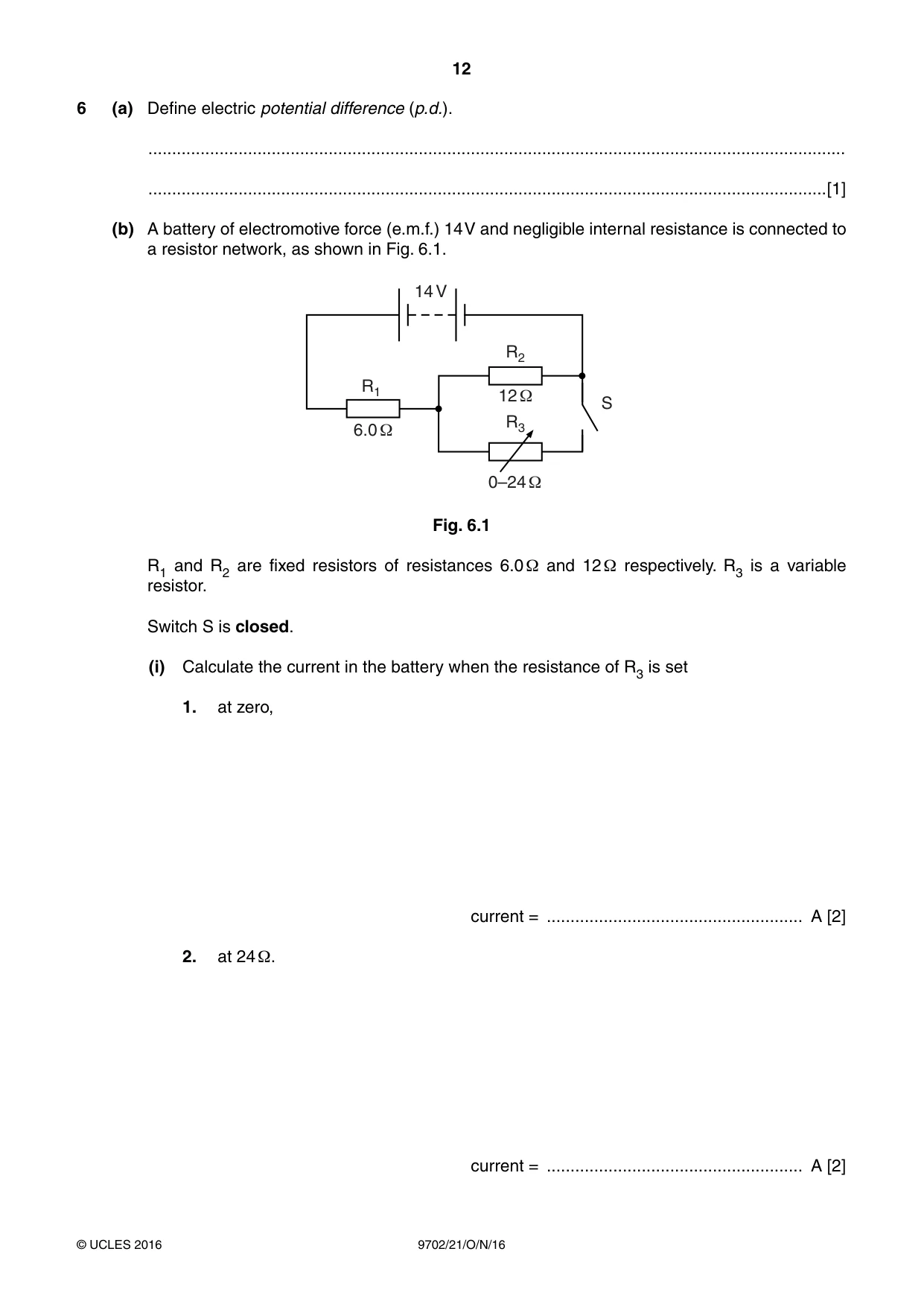
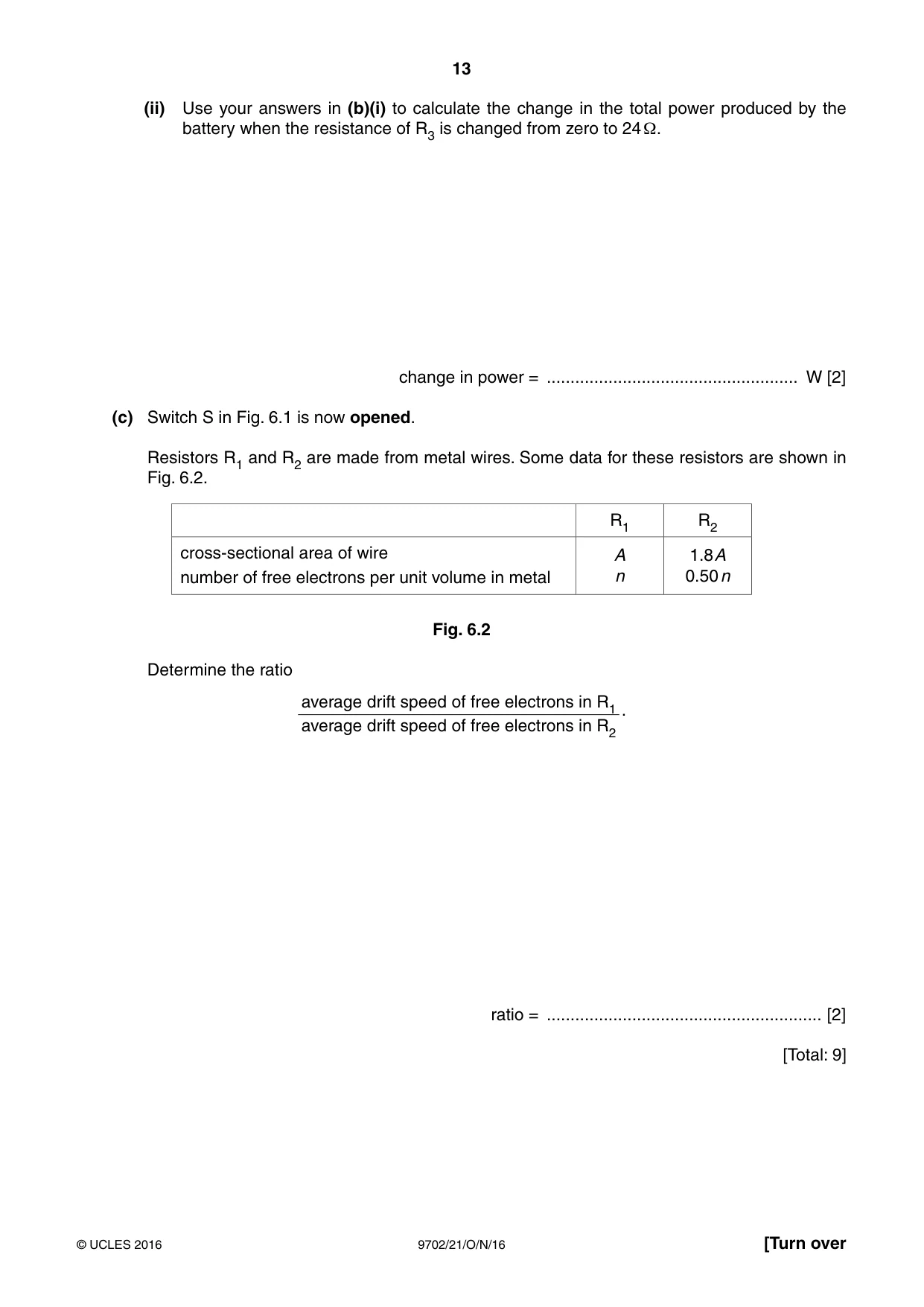
6 (a) Define electric potential difference (p.d.). ................................................................................................................................................... ...............................................................................................................................................[1] (b) A battery of electromotive force (e.m.f.) 14 V and negligible internal resistance is connected to a resistor network, as shown in Fig. 6.1. 14 V R2 R1 12 1 S R3 6.0 1 0–24 1 Fig. 6.1 R1 and R2 are fixed resistors of resistances 6.0 Ω and 12 Ω respectively. R3 is a variable resistor. Switch S is closed. (i) Calculate the current in the battery when the resistance of R3 is set 1. at zero, current = ...................................................... A [2] 2. at 24 Ω. current = ...................................................... A [2] (ii) Use your answers in (b)(i) to calculate the change in the total power produced by the battery when the resistance of R3 is changed from zero to 24 Ω. change in power = ..................................................... W [2] (c) Switch S in Fig. 6.1 is now opened. Resistors R1 and R2 are made from metal wires. Some data for these resistors are shown in Fig. 6.2. R1 R2 cross-sectional area of wire A 1.8 A number of free electrons per unit volume in metal n 0.50 n Fig. 6.2 Determine the ratio average drift speed of free electrons in R1 . average drift speed of free electrons in R2 ratio = .......................................................... [2] [Total: 9]
Mark scheme: work done or energy (transform ed) (from electrical to other forms) 6 (a) B1 [1] charge (b) (i) 1. V = IR or E = IR C1 I = 14 / 6.0 = 2.3 (2.33) A A1 [2] 2. total resistance of parallel resistors = 8.0 Ω C1 current = 14 / (6.0 + 8.0) = 1.0 A A1 [2] (ii) P = EI (allow P = VI) or P = V2 / R or P = I2R C1 change in power = (14 × 2.33) – (14 × 1.0) or (142 / 6.0) – (142 / 14) or (2.332 × 6.0) – (1.02 × 14) = 19 W (18 W if 2.3 A used) A1 [2] (c) I = Anvq ratio = (0.50n / n) × (1.8 A / A) or ratio = 0.50 × 1.8 C1 = 0.90 A1 [2]
Q7 · State one difference between a hadron and a lepton
7 (a) State one difference between a hadron and a lepton. ................................................................................................................................................... ...............................................................................................................................................[1] (b) (i) State the quark composition of a proton and of a neutron. proton: ............................................................................................................................... neutron: ............................................................................................................................. [2] (ii) Use your answer in (i) to determine the quark composition of an α-particle. quark composition: ........................................................................................................[1] (c) The results of the α-particle scattering experiment provide evidence for the structure of the atom. result 1: The vast majority of α-particles pass straight through the metal foil or are deviated by small angles. result 2: A very small minority of α-particles are scattered through angles greater than 90°. State what may be inferred from (i) result 1, ........................................................................................................................................... .......................................................................................................................................[1] (ii) result 2. ........................................................................................................................................... ........................................................................................................................................... ........................................................................................................................................... .......................................................................................................................................[2] [Total: 7]
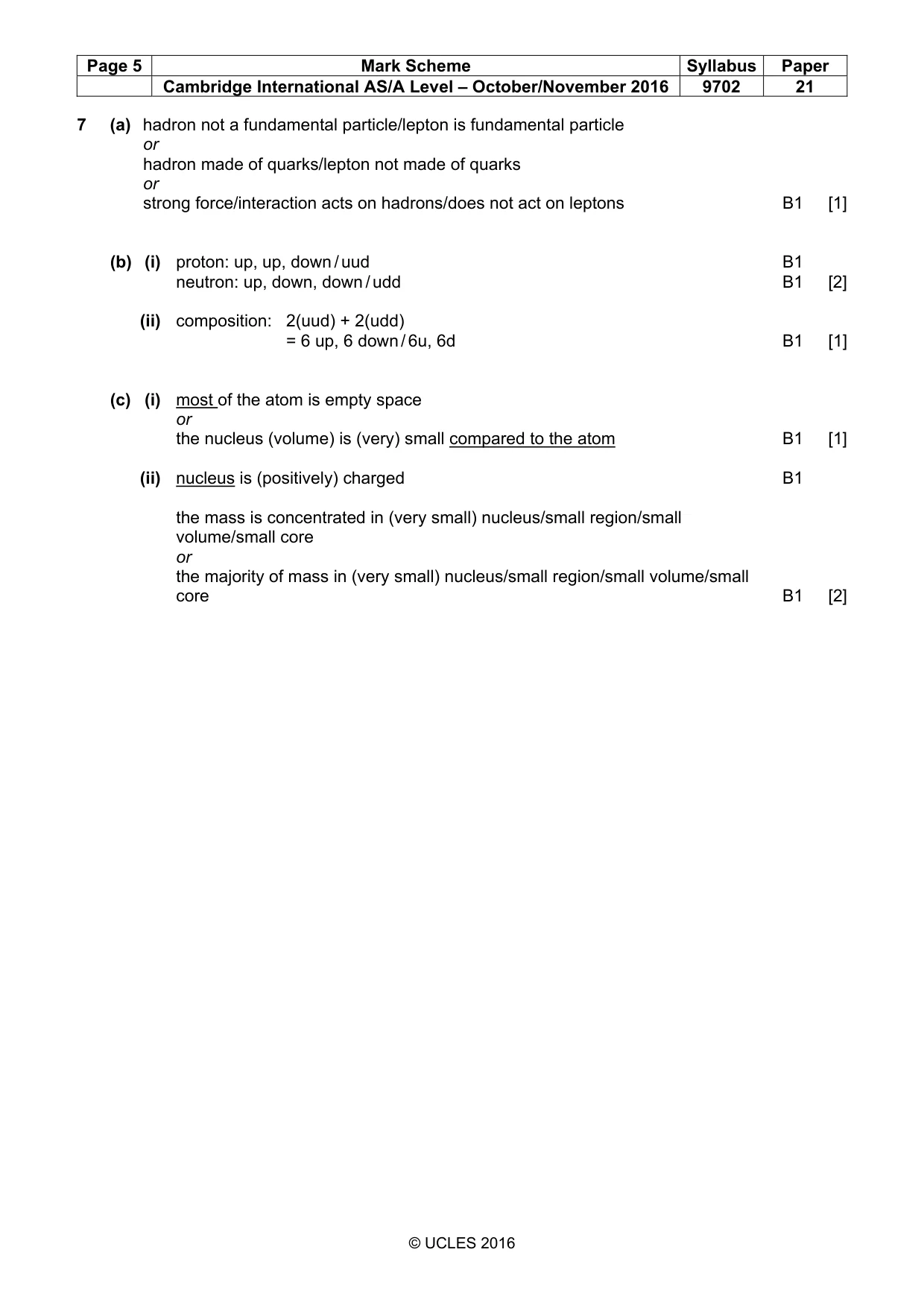
Mark scheme: 7 (a) hadron not a fundamental particle/lepton is fundamental particle or hadron made of quarks/lepton not made of quarks or strong force/interaction acts on hadrons/does not act on leptons B1 [1] (b) (i) proton: up, up, down / uud B1 neutron: up, down, down / udd B1 [2] (ii) composition: 2(uud) + 2(udd) = 6 up, 6 down / 6u, 6d B1 [1] (c) (i) most of the atom is empty space or the nucleus (volume) is (very) small compared to the atom B1 [1] (ii) nucleus is (positively) charged B1 the mass is concentrated in (very small) nucleus/small region/small volume/small core or the majority of mass in (very small) nucleus/small region/small volume/small core B1 [2]
What was in this paper
The subtopics covered by these 7 questions, and how many questions each got. Open one in a new tab to see every Cambridge question on it.
What you needed in this session
Cambridge’s own grade thresholds for 2016 Oct/Nov, Paper 2 · Variant 1. A higher threshold means an easier paper — the bar moves with how the cohort did.