Cambridge A Level Physics 9702 — 2013 May/June Paper 2 · Variant 1
9702/21/M/J/13 · 7 questions · 60 marks · ≈68 min
The question paper and its mark scheme, free to read here and free to download. This is Cambridge’s own paper, exactly as it was sat.
Question paper16 pages
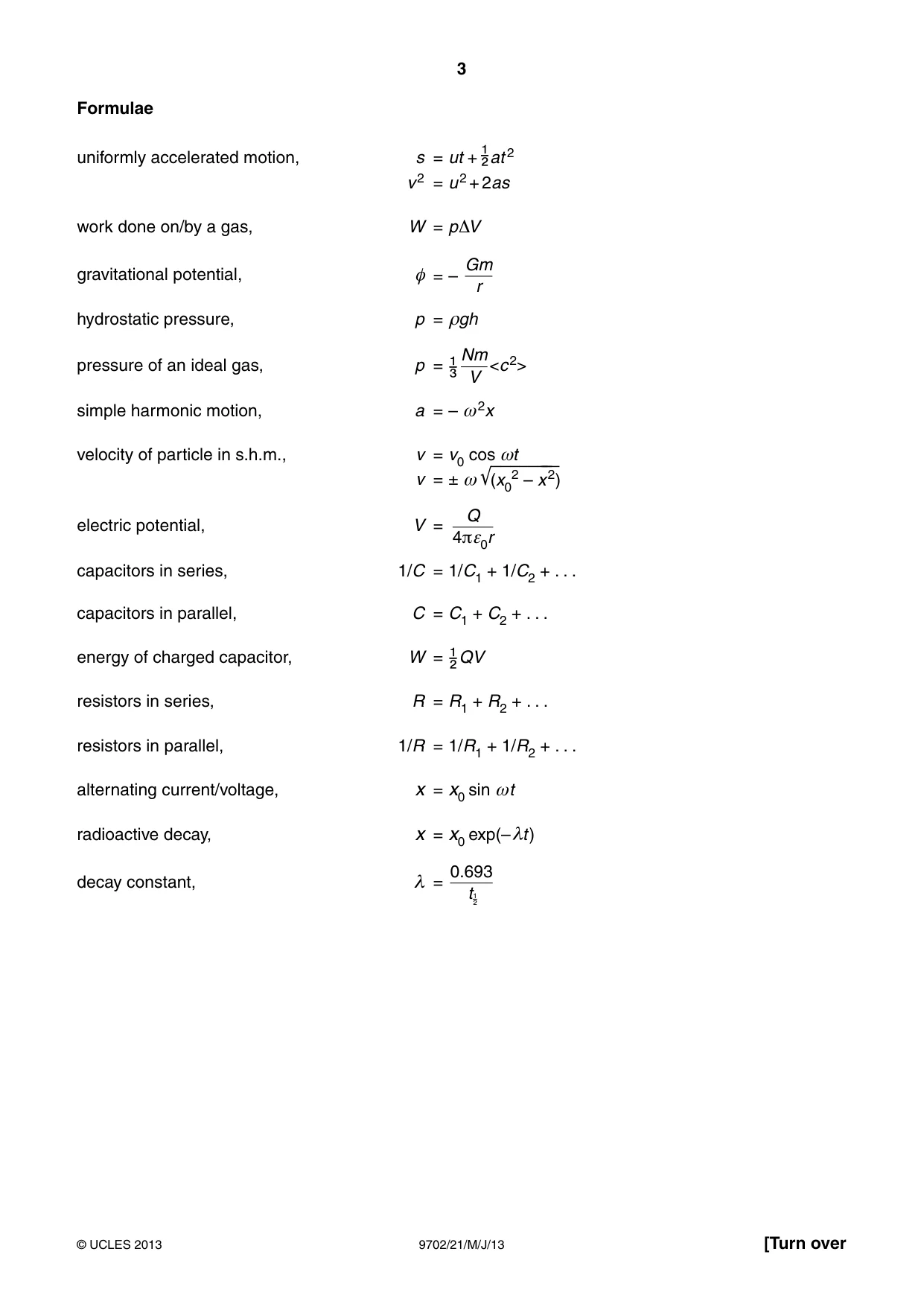


Mark scheme4 pages
Answers below. Sit the paper first if you are practising.
Questions as text
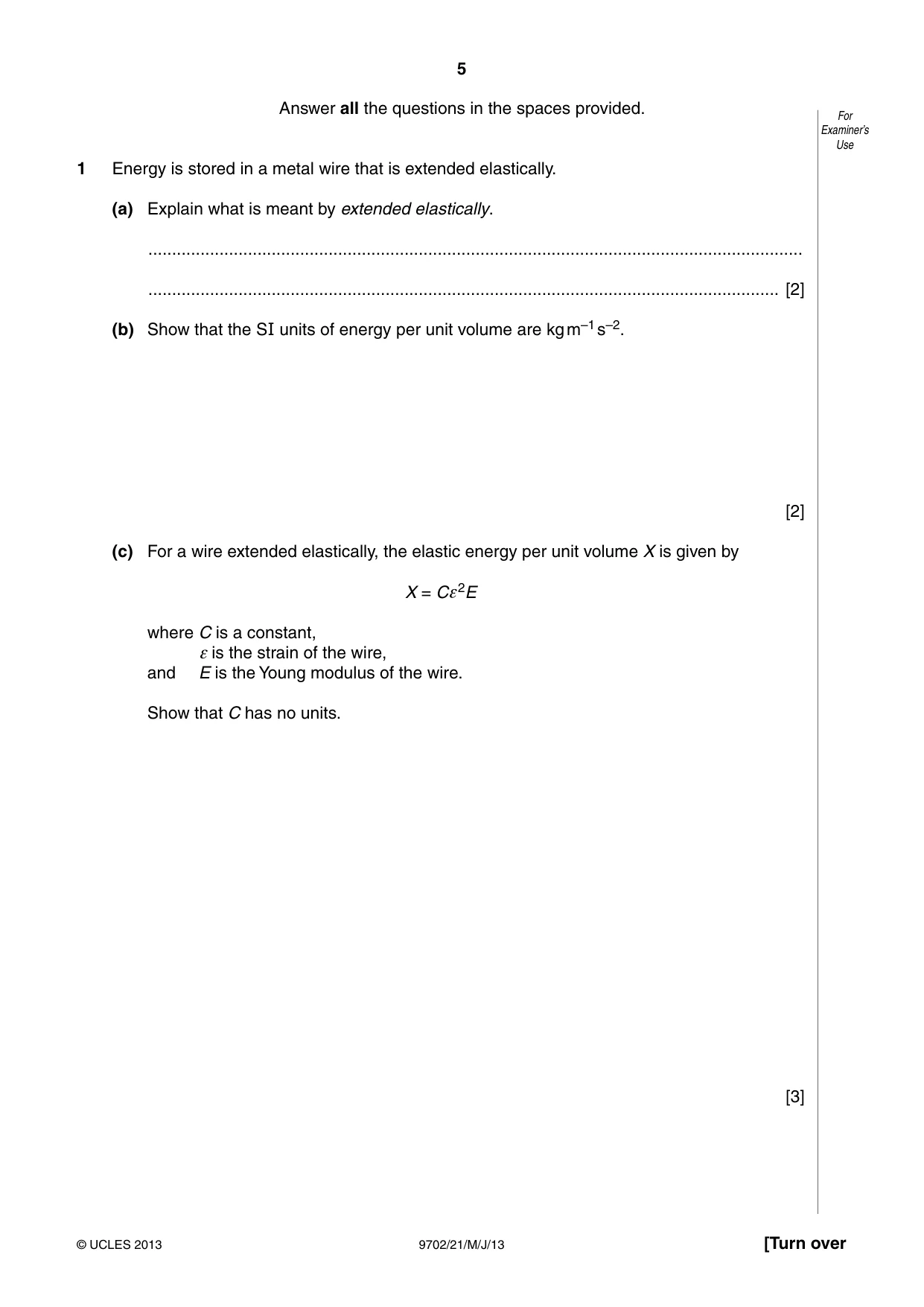
Q1 · Energy is stored in a metal wire that is extended elastically
1 Energy is stored in a metal wire that is extended elastically. (a) Explain what is meant by extended elastically. .......................................................................................................................................... ..................................................................................................................................... [2] (b) Show that the SІ units of energy per unit volume are kg m–1 s–2. [2] (c) For a wire extended elastically, the elastic energy per unit volume X is given by X = Cε2E where C is a constant, ε is the strain of the wire, and E is the Young modulus of the wire. Show that C has no units. [3]
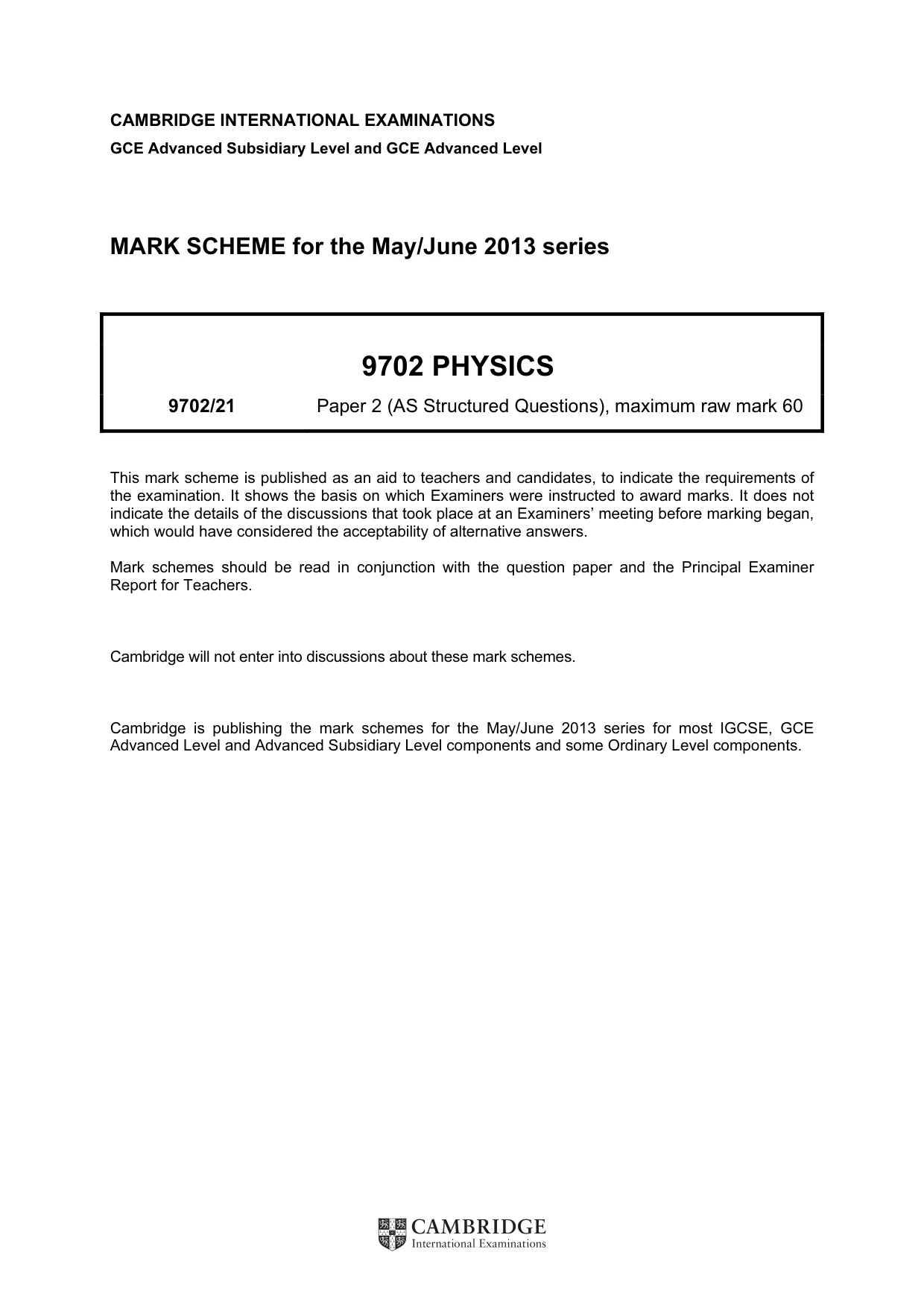
Mark scheme: 1 (a) the wire returns to its original length (not ‘shape’) M1 when the load is removed A1 [2] (b) energy: N m / kg m2 s–2 and volume m3 C1 energy / volume: kg m2 s–2 / m3 M1 energy / volume: kg m–1 s–2 A0 [2] (c) ε has no units B1 E: kg m s–2 m–2 M1 units of RHS: kg m–1 s–2 = LHS units / satisfactory conclusion to show C has no units A1 [3]
Q2 · Distinguish between mass and weight
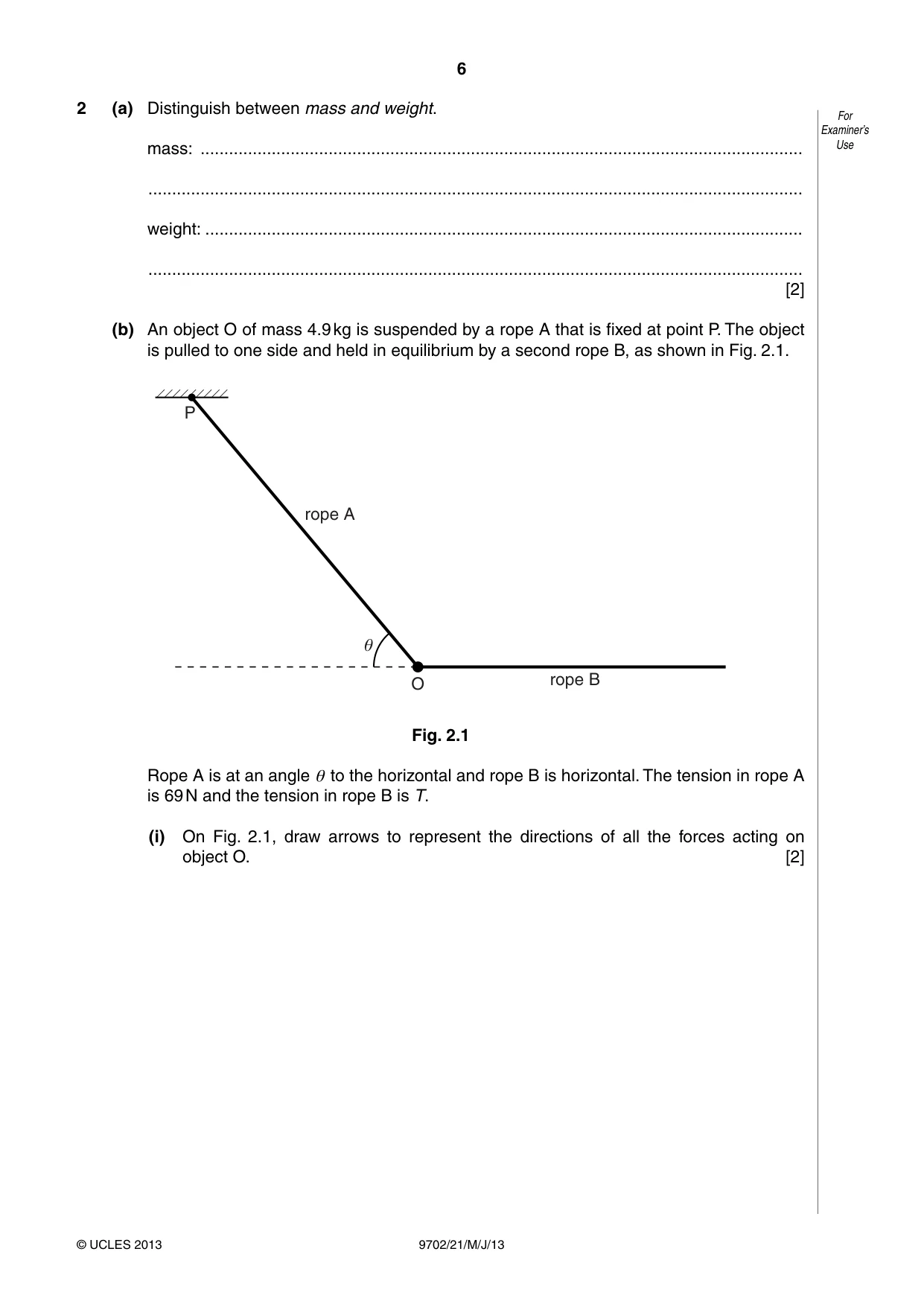
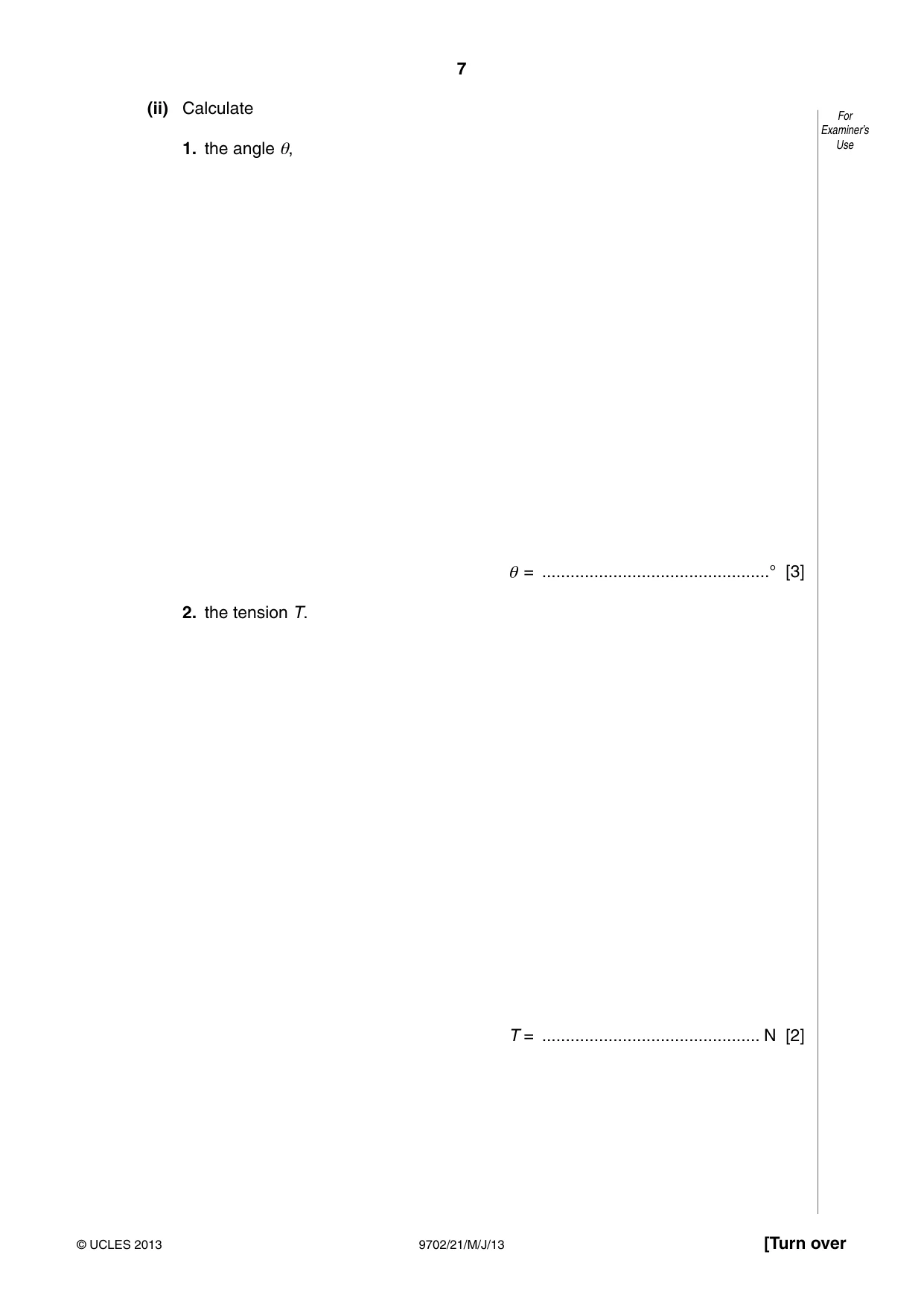
2 (a) Distinguish between mass and weight. For Examiner’s mass: ............................................................................................................................... Use .......................................................................................................................................... weight: .............................................................................................................................. .......................................................................................................................................... [2] (b) An object O of mass 4.9 kg is suspended by a rope A that is fixed at point P. The object is pulled to one side and held in equilibrium by a second rope B, as shown in Fig. 2.1. P rope A Ƨ O rope B Fig. 2.1 Rope A is at an angle θ to the horizontal and rope B is horizontal. The tension in rope A is 69 N and the tension in rope B is T. (i) On Fig. 2.1, draw arrows to represent the directions of all the forces acting on object O. [2] (ii) Calculate For Examiner’s 1. the angle θ, Use θ = ................................................° [3] 2. the tension T. T = .............................................. N [2]
Mark scheme: 2 (a) mass is the property of a body resisting changes in motion / quantity of matter in a body / measure of inertia to changes in motion B1 weight is the force due to the gravitational field/force due to gravity or gravitational force B1 [2] Allow 1/2 for ‘mass is scalar weight is vector’ (b) (i) arrow vertically down through O B1 tension forces in correct direction on rope B1 [2] (ii) 1. weight = mg = 4.9 × 9.81 (= 48.07) C1 69 sin θ = mg C1 θ = 44.(1)° scale drawing allow ± 2° A1 [3] use of cos or tan 1/3 only 2. T = 69 cos θ C1 = 49.6 / 50 N scale drawing 50 ±2 (2/2) 50 ±4 (1/2) A1 [2] correct answers obtained using scale diagram or triangle of forces will score full marks cos in 1. then sin in 2. (2/2)
Q3 · An object falls vertically from rest through air
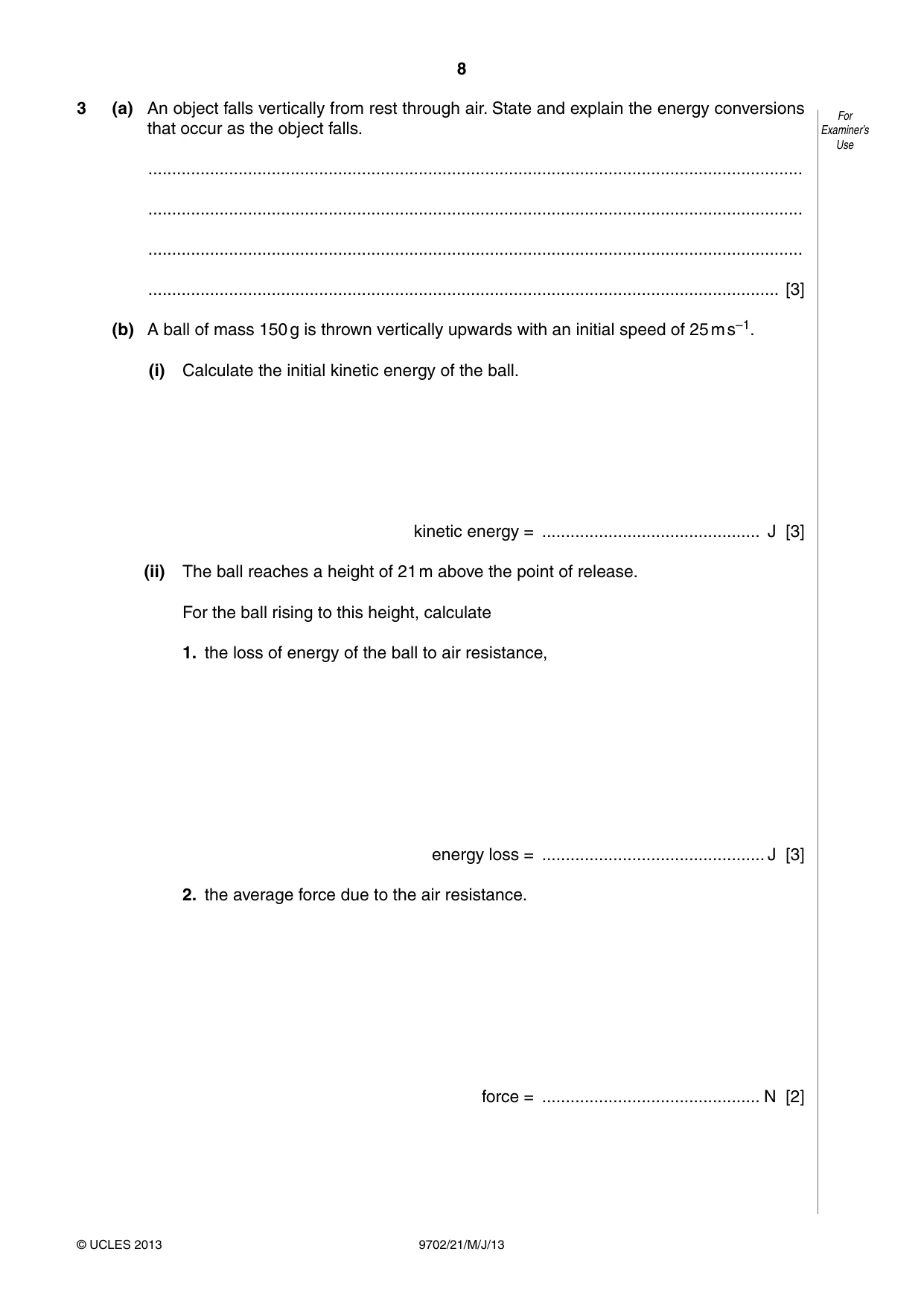
3 (a) An object falls vertically from rest through air. State and explain the energy conversions For that occur as the object falls. Examiner’s Use .......................................................................................................................................... .......................................................................................................................................... .......................................................................................................................................... ..................................................................................................................................... [3] (b) A ball of mass 150 g is thrown vertically upwards with an initial speed of 25 m s–1. (i) Calculate the initial kinetic energy of the ball. kinetic energy = .............................................. J [3] (ii) The ball reaches a height of 21 m above the point of release. For the ball rising to this height, calculate 1. the loss of energy of the ball to air resistance, energy loss = ............................................... J [3] 2. the average force due to the air resistance. force = .............................................. N [2]
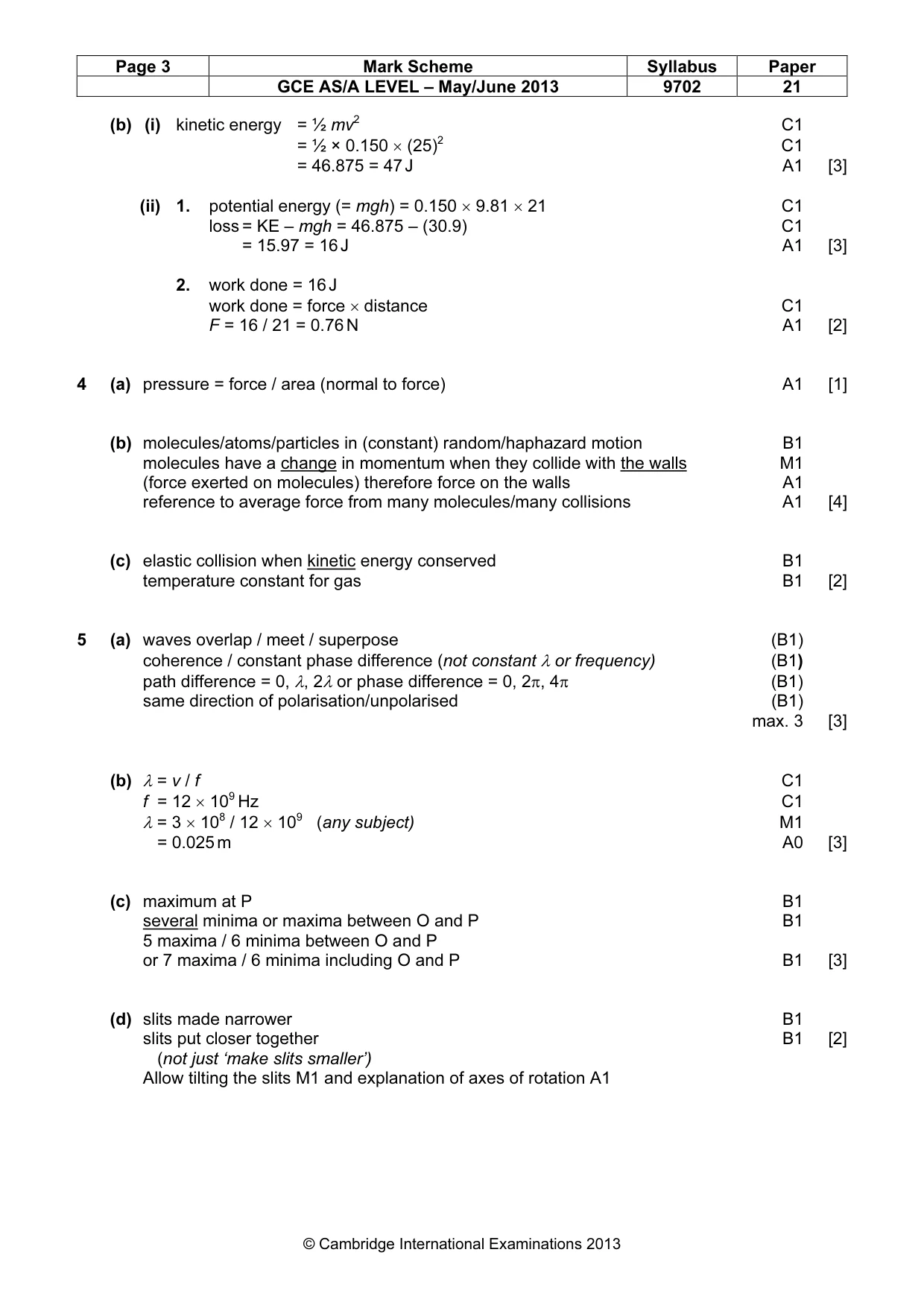
Mark scheme: 3 (a) loss in potential energy due to decrease in height (as P.E. = mgh) (B1) gain in kinetic energy due to increase in speed (as K.E. = ½ mv2) (B1) special case ‘as PE decreases KE increases’ (1/2) increase in thermal energy due to work done against air resistance (B1) loss in P.E. equals gain in K.E. and thermal energy (B1) max. 3 [3] GCE AS/A LEVEL – May/June 2013 9702 21 (b) (i) kinetic energy = ½ mv2 C1 = ½ × 0.150 × (25)2 C1 = 46.875 = 47 J A1 [3] (ii) 1. potential energy (= mgh) = 0.150 × 9.81 × 21 C1 loss = KE – mgh = 46.875 – (30.9) C1 = 15.97 = 16 J A1 [3] 2. work done = 16 J work done = force × distance C1 F = 16 / 21 = 0.76 N A1 [2]
More questions on Gravitational potential energy and kinetic energy
Question 4
4 (a) Define pressure. For Examiner’s .......................................................................................................................................... Use ..................................................................................................................................... [1] (b) Use the kinetic model to explain the pressure exerted by a gas. .......................................................................................................................................... .......................................................................................................................................... .......................................................................................................................................... .......................................................................................................................................... .......................................................................................................................................... ..................................................................................................................................... [4] (c) Explain whether the collisions between the molecules of an ideal gas are elastic or inelastic. .......................................................................................................................................... .......................................................................................................................................... ..................................................................................................................................... [2]
Mark scheme: 4 (a) pressure = force / area (normal to force) A1 [1] (b) molecules/atoms/particles in (constant) random/haphazard motion B1 molecules have a change in momentum when they collide with the walls M1 (force exerted on molecules) therefore force on the walls A1 reference to average force from many molecules/many collisions A1 [4] (c) elastic collision when kinetic energy conserved B1 temperature constant for gas B1 [2]
Q5 · State three conditions required for maxima to be formed in an interference pattern For…
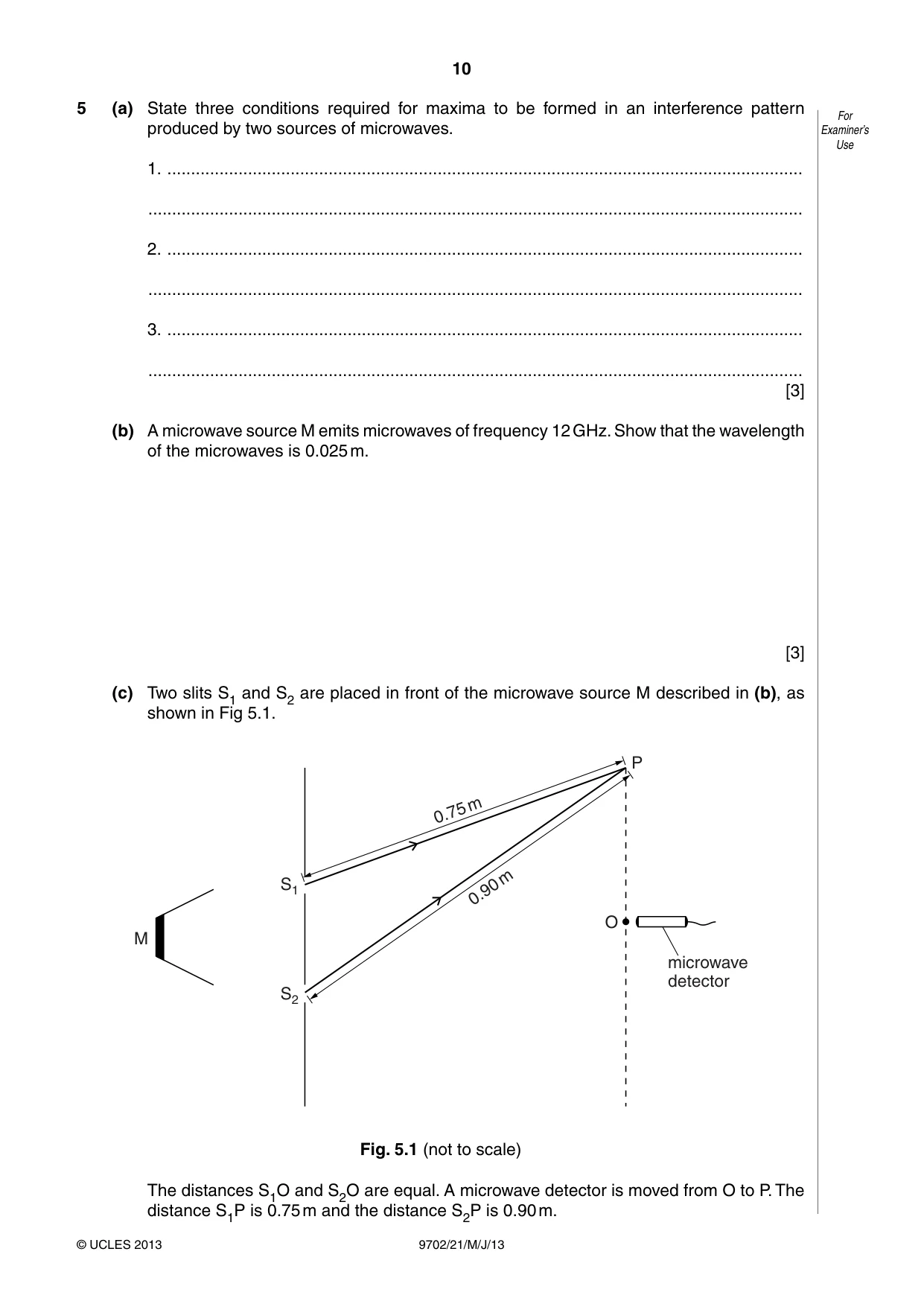
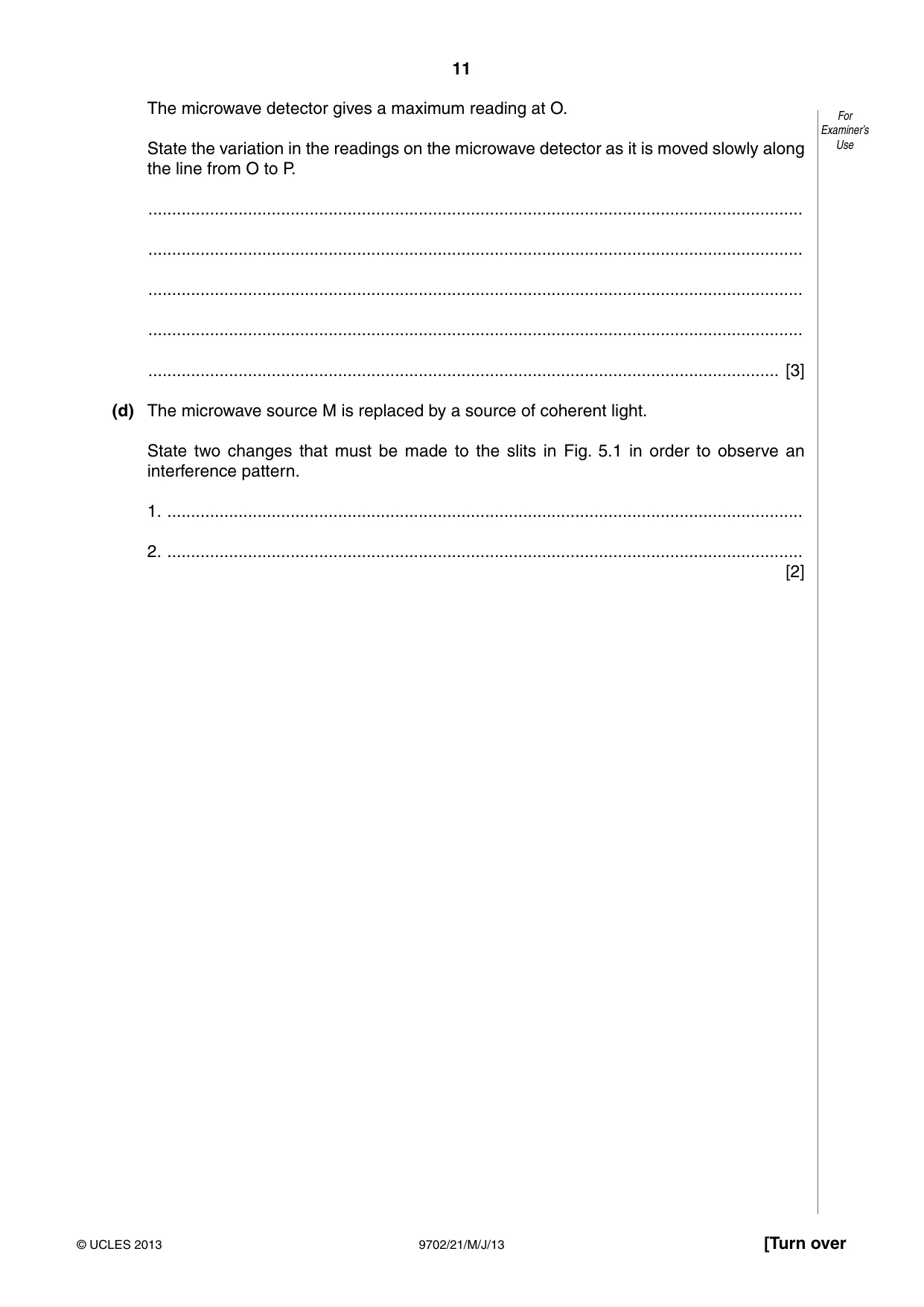
5 (a) State three conditions required for maxima to be formed in an interference pattern For produced by two sources of microwaves. Examiner’s Use 1. ...................................................................................................................................... .......................................................................................................................................... 2. ...................................................................................................................................... .......................................................................................................................................... 3. ...................................................................................................................................... .......................................................................................................................................... [3] (b) A microwave source M emits microwaves of frequency 12 GHz. Show that the wavelength of the microwaves is 0.025 m. [3] (c) Two slits S1 and S2 are placed in front of the microwave source M described in (b), as shown in Fig 5.1. P m 0.75 m S1 0.90 O M microwave detector S2 Fig. 5.1 (not to scale) The distances S1O and S2O are equal. A microwave detector is moved from O to P. The distance S1P is 0.75 m and the distance S2P is 0.90 m. The microwave detector gives a maximum reading at O. For Examiner’s State the variation in the readings on the microwave detector as it is moved slowly along Use the line from O to P. .......................................................................................................................................... .......................................................................................................................................... .......................................................................................................................................... .......................................................................................................................................... ..................................................................................................................................... [3] (d) The microwave source M is replaced by a source of coherent light. State two changes that must be made to the slits in Fig. 5.1 in order to observe an interference pattern. 1. ...................................................................................................................................... 2. ...................................................................................................................................... [2]
Mark scheme: 5 (a) waves overlap / meet / superpose (B1) coherence / constant phase difference (not constant λ or frequency) (B1) path difference = 0, λ, 2λ or phase difference = 0, 2π, 4π (B1) same direction of polarisation/unpolarised (B1) max. 3 [3] (b) λ = v / f C1 f = 12 × 109 Hz C1 λ = 3 × 10⁸ / 12 × 109 (any subject) M1 = 0.025 m A0 [3] (c) maximum at P B1 several minima or maxima between O and P B1 5 maxima / 6 minima between O and P or 7 maxima / 6 minima including O and P B1 [3] (d) slits made narrower B1 slits put closer together B1 [2] (not just ‘make slits smaller’) Allow tilting the slits M1 and explanation of axes of rotation A1 GCE AS/A LEVEL – May/June 2013 9702 21
Q6 · Two resistors A and B have resistances R1 and R2 respectively
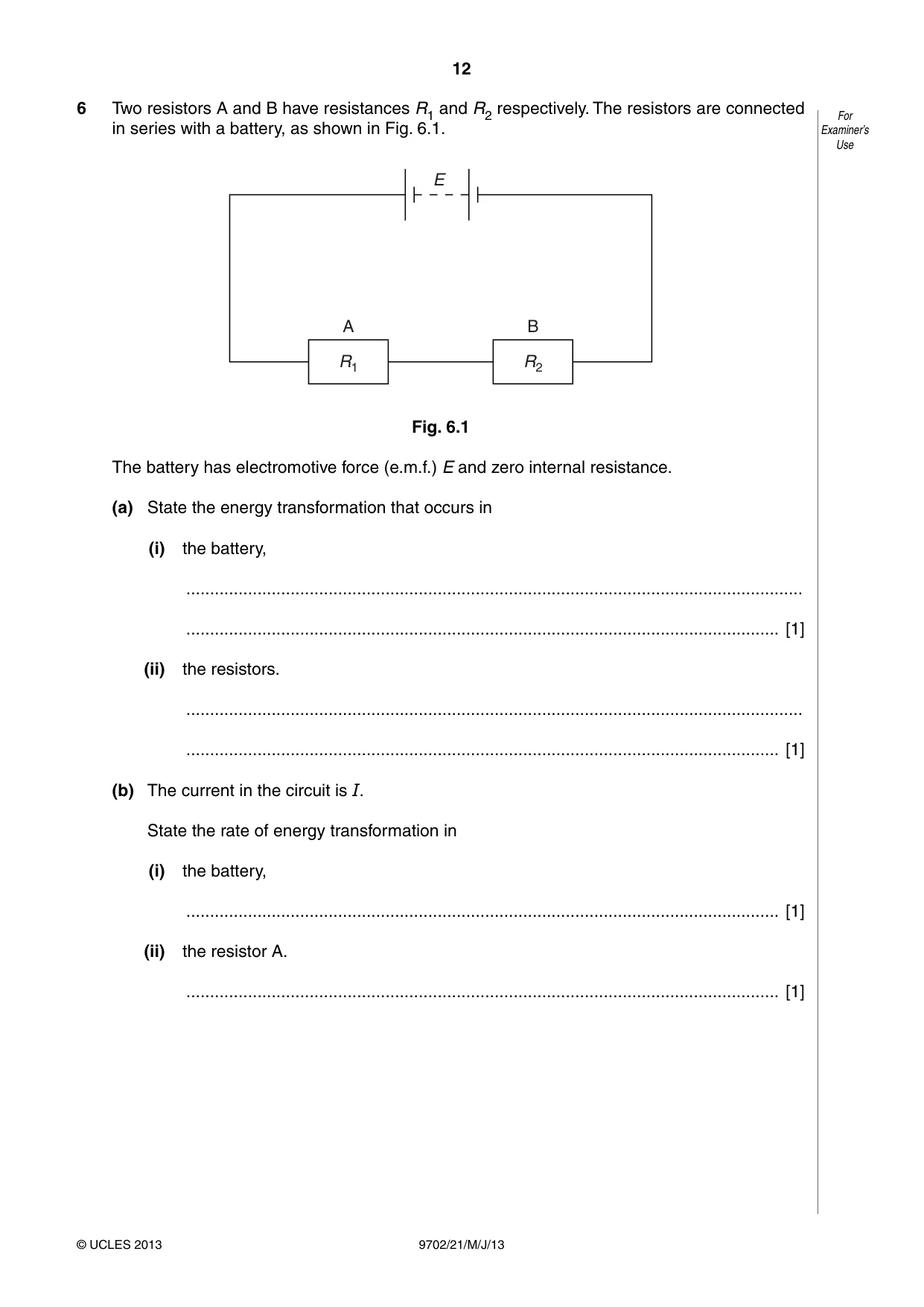
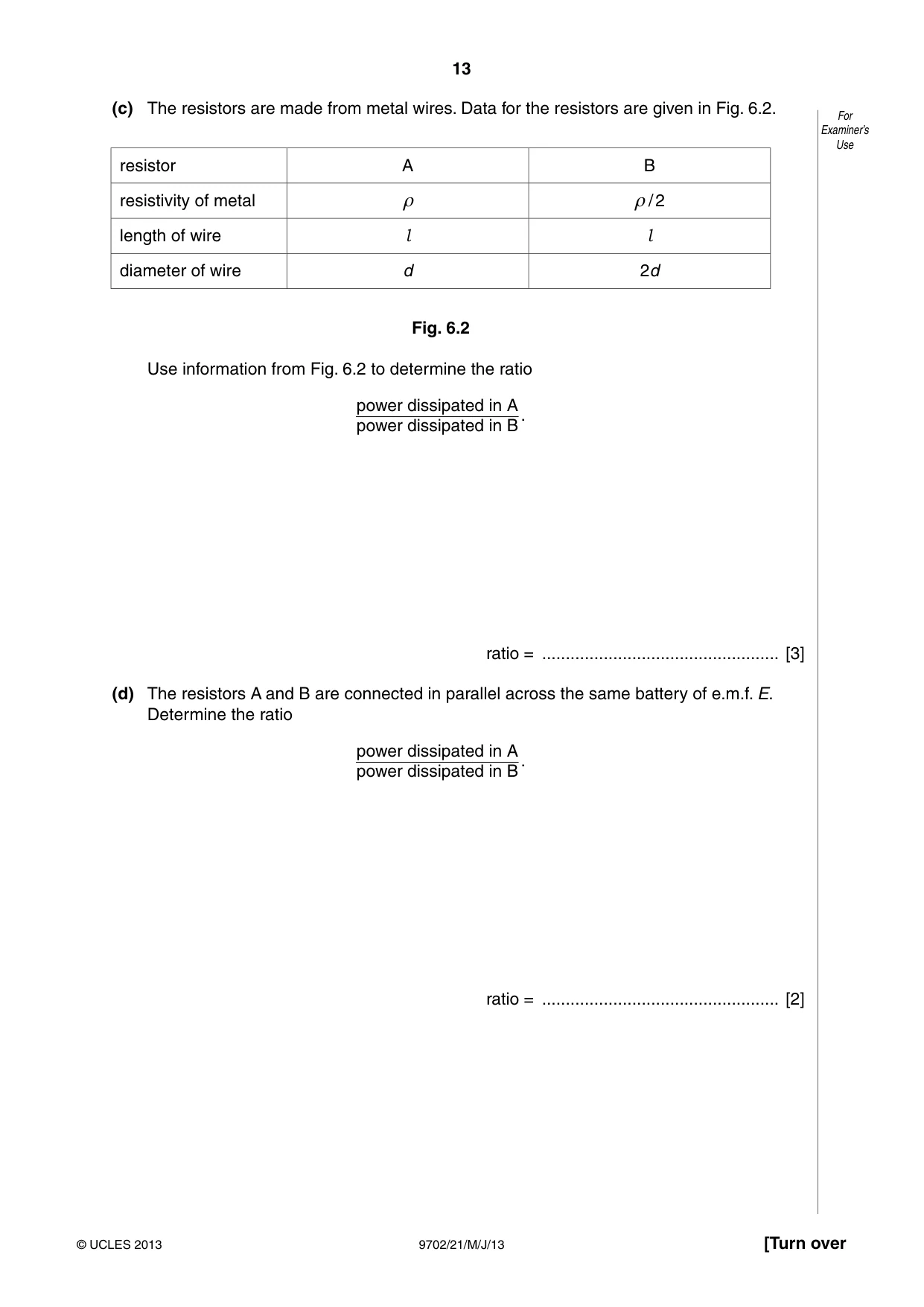
6 Two resistors A and B have resistances R1 and R2 respectively. The resistors are connected For in series with a battery, as shown in Fig. 6.1. Examiner’s Use E A B R1 R2 Fig. 6.1 The battery has electromotive force (e.m.f.) E and zero internal resistance. (a) State the energy transformation that occurs in (i) the battery, .................................................................................................................................. ............................................................................................................................. [1] (ii) the resistors. .................................................................................................................................. ............................................................................................................................. [1] (b) The current in the circuit is Ι. State the rate of energy transformation in (i) the battery, ............................................................................................................................. [1] (ii) the resistor A. ............................................................................................................................. [1] (c) The resistors are made from metal wires. Data for the resistors are given in Fig. 6.2. For Examiner’s Use resistor A B resistivity of metal ρ ρ / 2 length of wire l l diameter of wire d 2d Fig. 6.2 Use information from Fig. 6.2 to determine the ratio power dissipated in A . power dissipated in B ratio = .................................................. [3] (d) The resistors A and B are connected in parallel across the same battery of e.m.f. E. Determine the ratio power dissipated in A . power dissipated in B ratio = .................................................. [2]
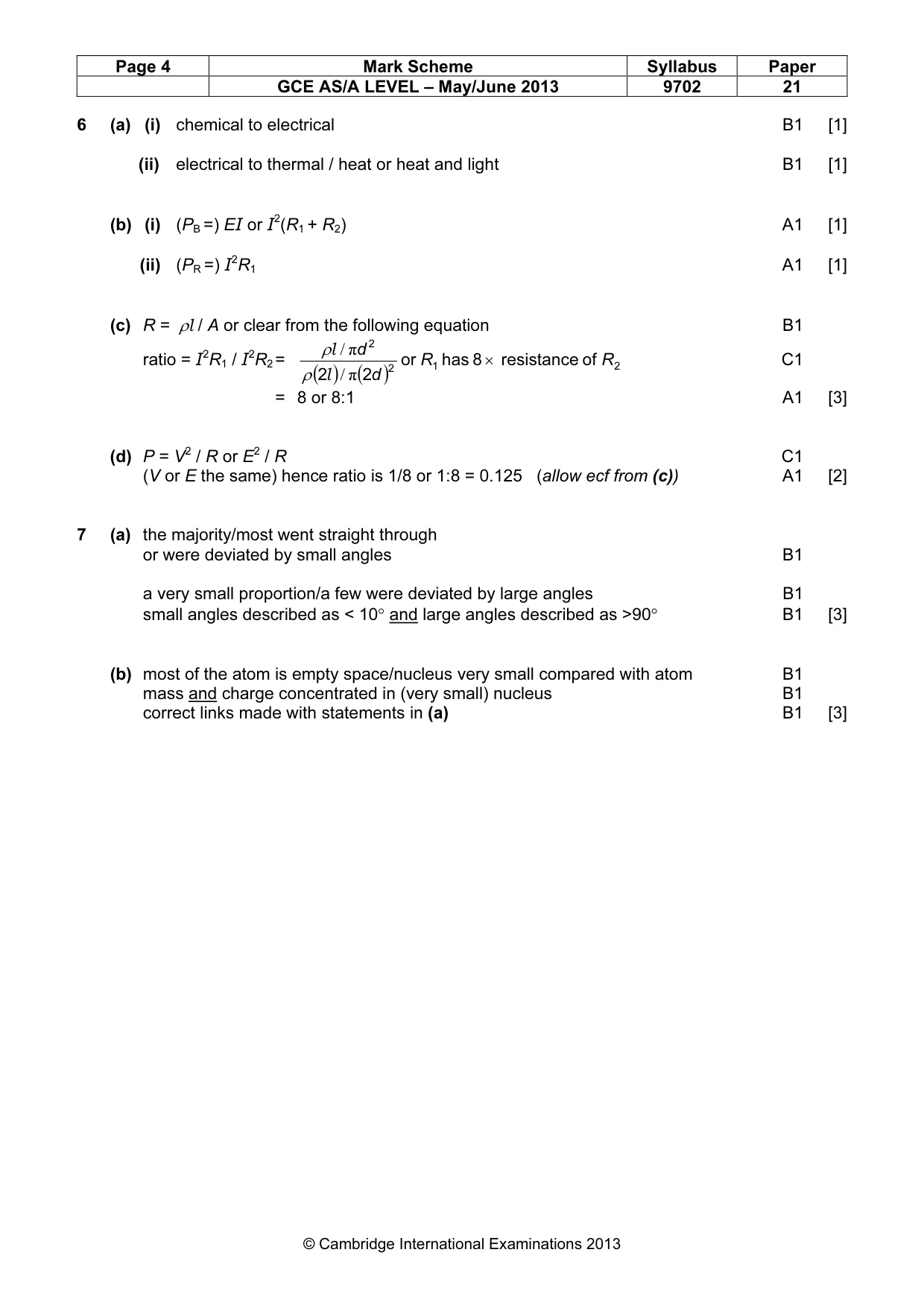
Mark scheme: 6 (a) (i) chemical to electrical B1 [1] (ii) electrical to thermal / heat or heat and light B1 [1] (b) (i) (PB =) EI or I2(R1 + R2) A1 [1] (ii) (PR =) I2R1 A1 [1] (c) R = ρl / A or clear from the following equation B1 ρl / πd 2 ratio = I2R1 / I2R2 = 2 or R1 has 8 × resistance of R 2 C1 ρ (2l ) / π (2d ) = 8 or 8:1 A1 [3] (d) P = V2 / R or E2 / R C1 (V or E the same) hence ratio is 1/8 or 1:8 = 0.125 (allow ecf from (c)) A1 [2]
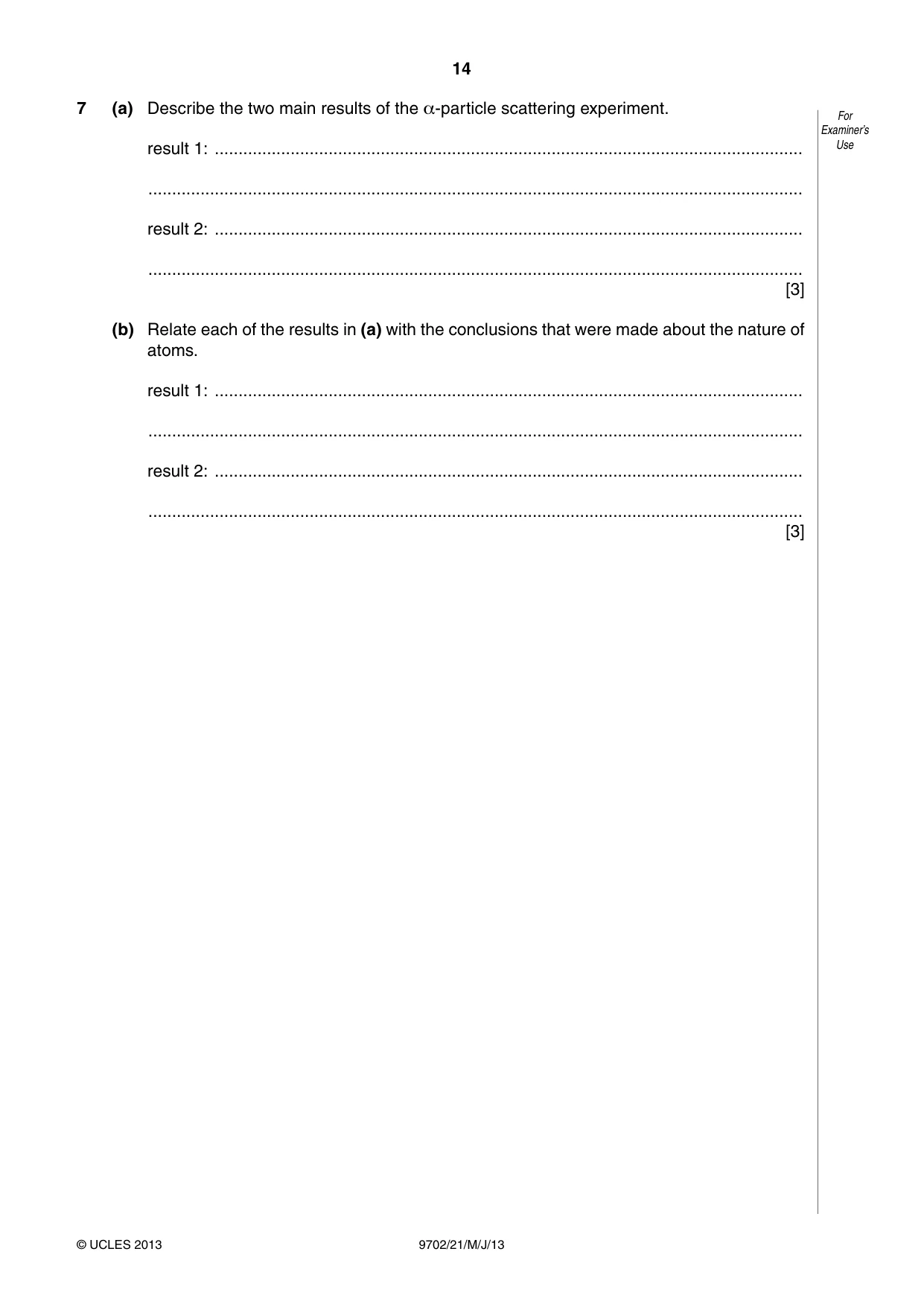
Q7 · Describe the two main results of the α-particle scattering experiment
7 (a) Describe the two main results of the α-particle scattering experiment. For Examiner’s result 1: ............................................................................................................................ Use .......................................................................................................................................... result 2: ............................................................................................................................ .......................................................................................................................................... [3] (b) Relate each of the results in (a) with the conclusions that were made about the nature of atoms. result 1: ............................................................................................................................ .......................................................................................................................................... result 2: ............................................................................................................................ .......................................................................................................................................... [3]
Mark scheme: 7 (a) the majority/most went straight through or were deviated by small angles B1 a very small proportion/a few were deviated by large angles B1 small angles described as < 10° and large angles described as >90° B1 [3] (b) most of the atom is empty space/nucleus very small compared with atom B1 mass and charge concentrated in (very small) nucleus B1 correct links made with statements in (a) B1 [3]
What was in this paper
The subtopics covered by these 7 questions, and how many questions each got. Open one in a new tab to see every Cambridge question on it.
What you needed in this session
Cambridge’s own grade thresholds for 2013 May/June, Paper 2 · Variant 1. A higher threshold means an easier paper — the bar moves with how the cohort did.