Cambridge A Level Physics 9702 — 2019 May/June Paper 2 · Variant 1
9702/21/M/J/19 · 7 questions · 60 marks · ≈68 min
The question paper and its mark scheme, free to read here and free to download. This is Cambridge’s own paper, exactly as it was sat.
Question paper16 pages

Mark scheme10 pages
Answers below. Sit the paper first if you are practising.
Questions as text
Question 1
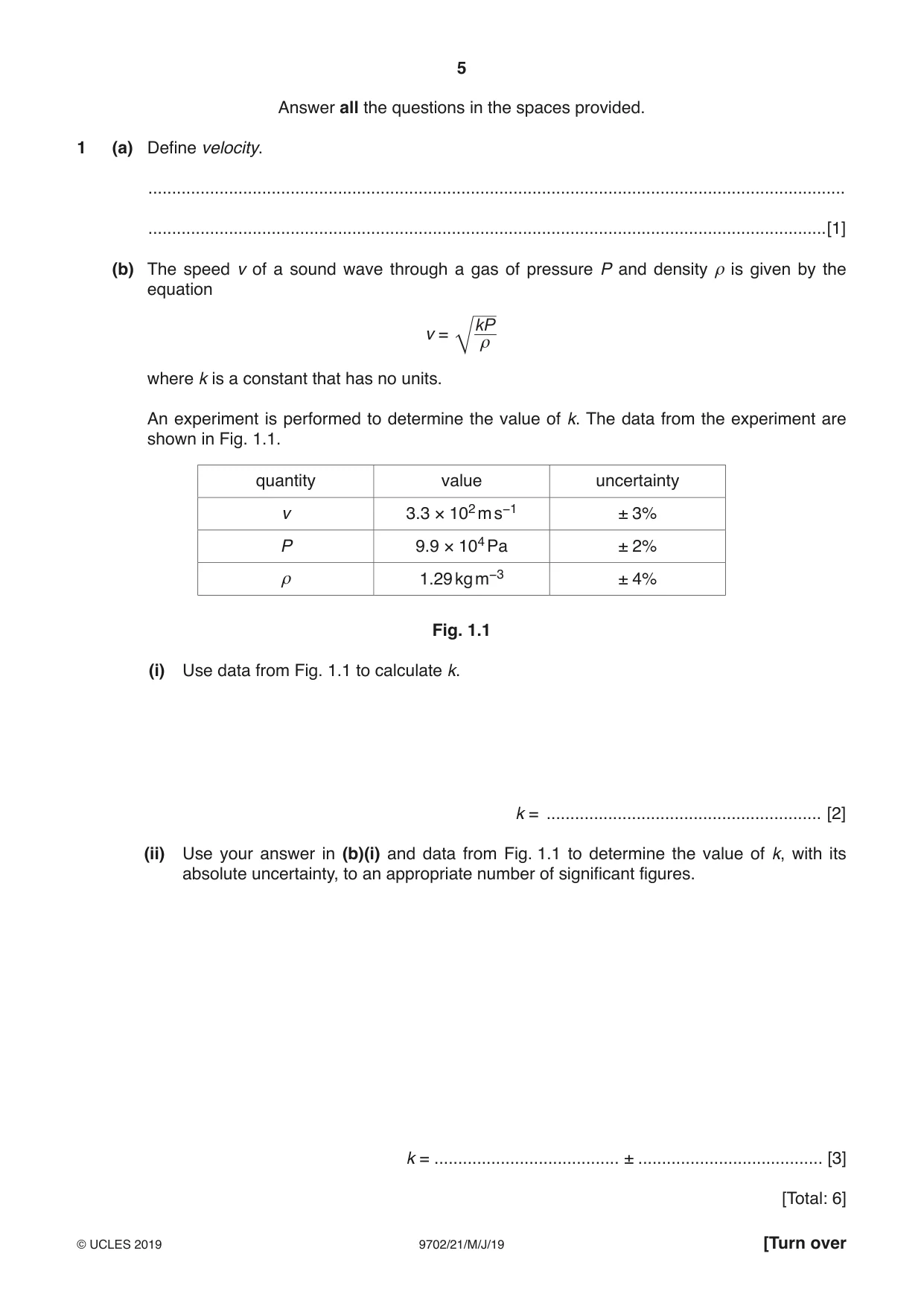
1 (a) Define velocity. ................................................................................................................................................... ...............................................................................................................................................[1] (b) The speed v of a sound wave through a gas of pressure P and density ρ is given by the equation kP v = ρ where k is a constant that has no units. An experiment is performed to determine the value of k. The data from the experiment are shown in Fig. 1.1. quantity value uncertainty v 3.3 × 10² m s−1 ± 3% P 9.9 × 10⁴ Pa ± 2% ρ 1.29 kg m−3 ± 4% Fig. 1.1 (i) Use data from Fig. 1.1 to calculate k. k = .......................................................... [2] (ii) Use your answer in (b)(i) and data from Fig. 1.1 to determine the value of k, with its absolute uncertainty, to an appropriate number of significant figures. k = ....................................... ± ....................................... [3] [Total: 6]
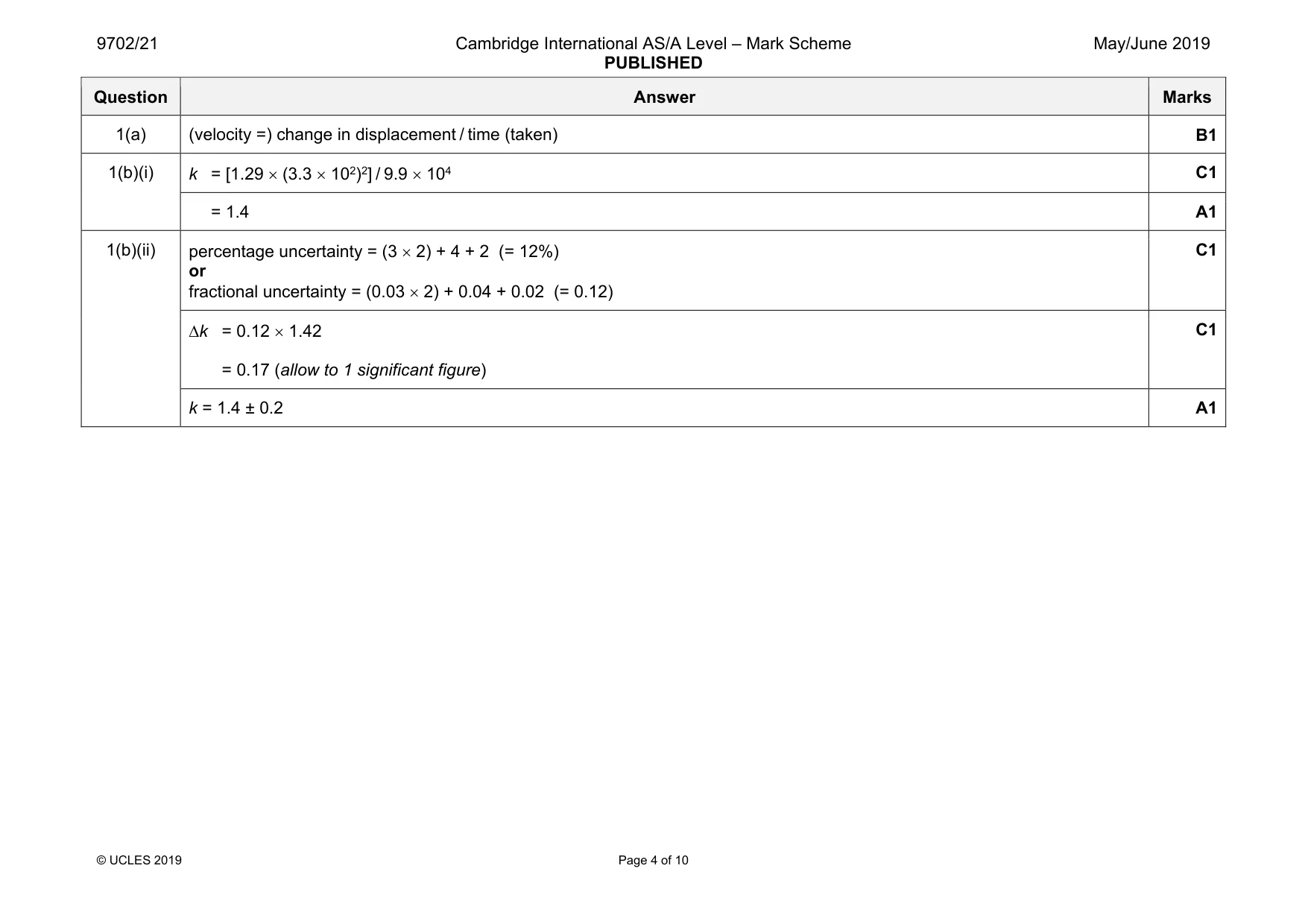
Mark scheme: 1(a) (velocity =) change in displacement / time (taken) B1 1(b)(i) k = [1.29 × (3.3 × 102)2] / 9.9 × 10⁴ C1 = 1.4 A1 1(b)(ii) percentage uncertainty = (3 × 2) + 4 + 2 (= 12%) or fractional uncertainty = (0.03 × 2) + 0.04 + 0.02 (= 0.12) C1 ∆k = 0.12 × 1.42 = 0.17 (allow to 1 significant figure) C1 k = 1.4 ± 0.2 A1
Q2 · A block X slides along a horizontal frictionless surface towards a stationary block Y, as…
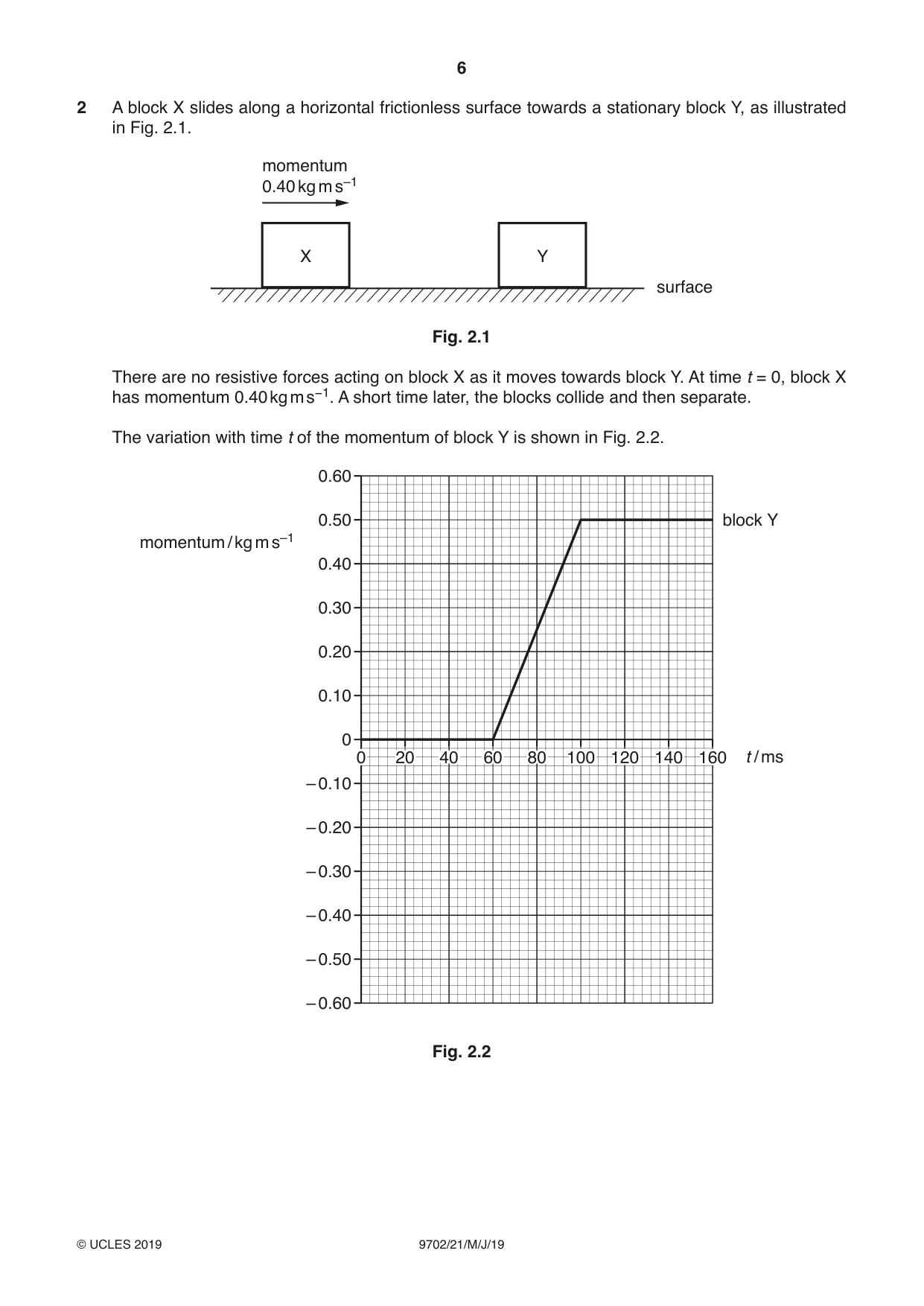
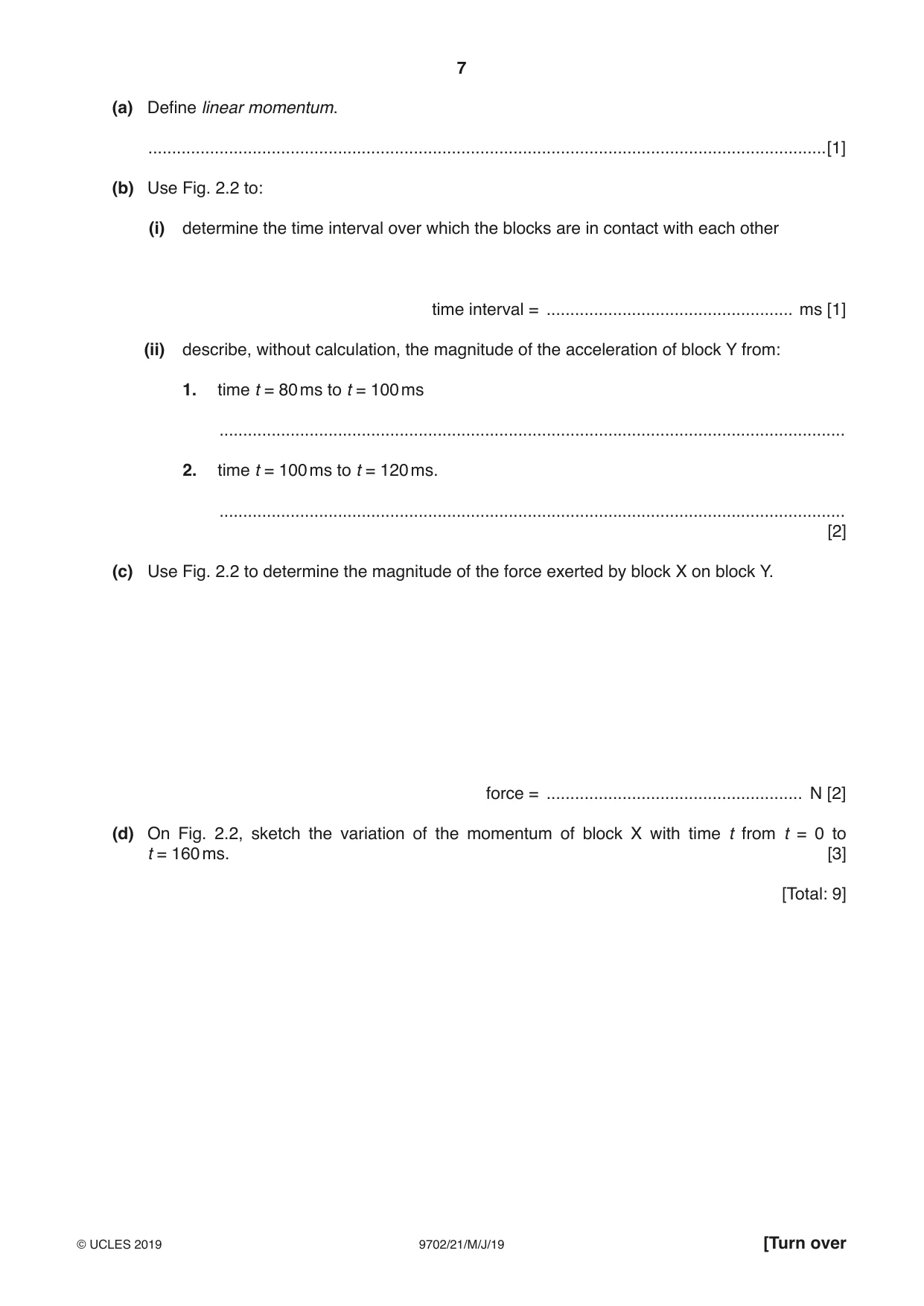
2 A block X slides along a horizontal frictionless surface towards a stationary block Y, as illustrated in Fig. 2.1. momentum 0.40 kg m s–1 X Y surface Fig. 2.1 There are no resistive forces acting on block X as it moves towards block Y. At time t = 0, block X has momentum 0.40 kg m s−1. A short time later, the blocks collide and then separate. The variation with time t of the momentum of block Y is shown in Fig. 2.2. 0.60 0.50 block Y momentum / kg m s–1 0.40 0.30 0.20 0.10 0 0 20 40 60 80 100 120 140 160 t / ms – 0.10 – 0.20 – 0.30 – 0.40 – 0.50 – 0.60 Fig. 2.2 (a) Define linear momentum. ...............................................................................................................................................[1] (b) Use Fig. 2.2 to: (i) determine the time interval over which the blocks are in contact with each other time interval = .................................................... ms [1] (ii) describe, without calculation, the magnitude of the acceleration of block Y from: 1. time t = 80 ms to t = 100 ms .................................................................................................................................... 2. time t = 100 ms to t = 120 ms. .................................................................................................................................... [2] (c) Use Fig. 2.2 to determine the magnitude of the force exerted by block X on block Y. force = ...................................................... N [2] (d) On Fig. 2.2, sketch the variation of the momentum of block X with time t from t = 0 to t = 160 ms. [3] [Total: 9]
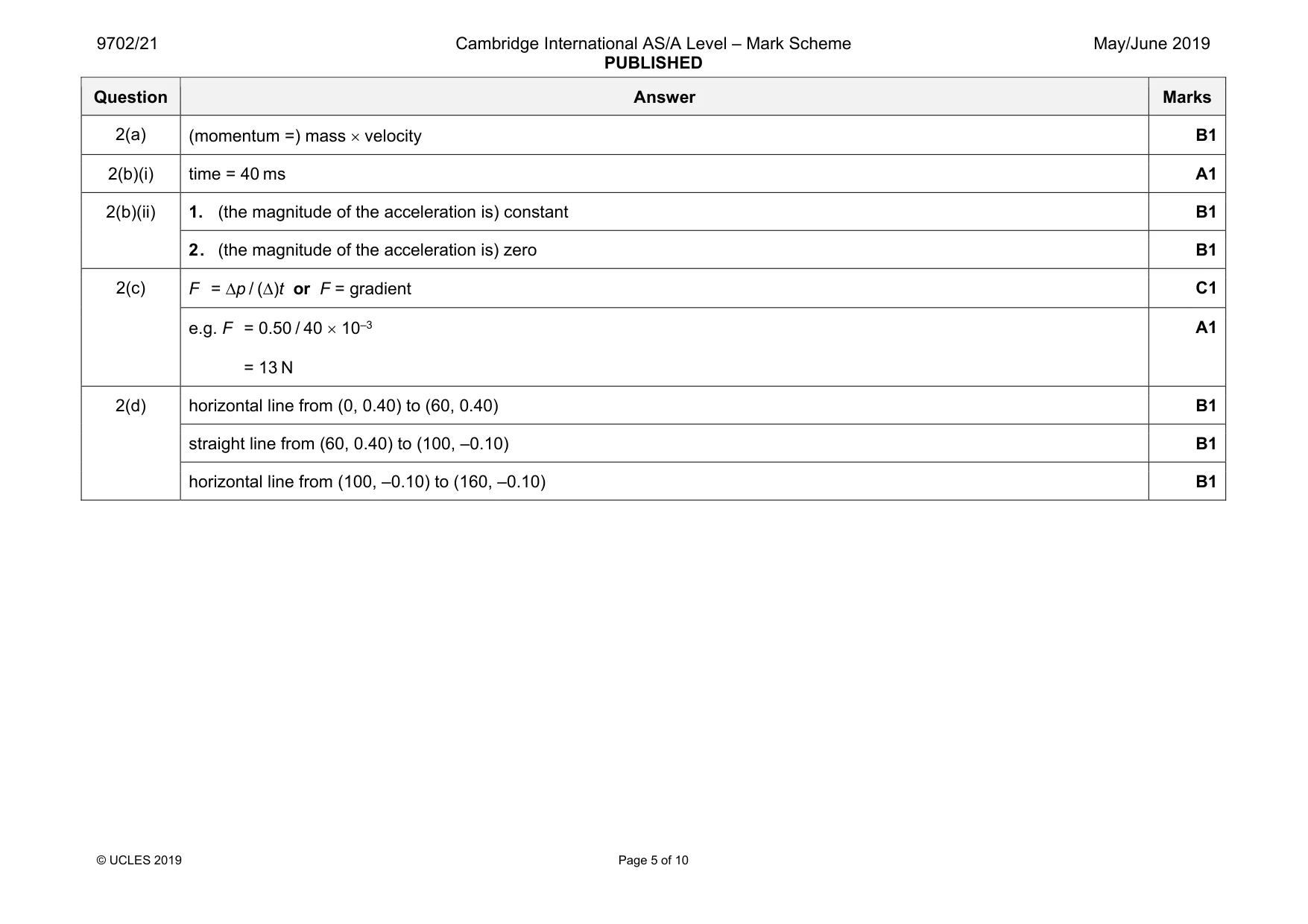
Mark scheme: 2(a) B1 2(b)(i) time = 40 ms A1 2(b)(ii) 1. (the magnitude of the acceleration is) constant B1 2 . (the magnitude of the acceleration is) zero B1 2(c) F = ∆p / (∆)t or F = gradient C1 e.g. F = 0.50 / 40 × 10–3 = 13 N A1 2(d) horizontal line from (0, 0.40) to (60, 0.40) B1 straight line from (60, 0.40) to (100, –0.10) B1 horizontal line from (100, –0.10) to (160, –0.10) B1
Q3 · The variation with extension x of the force F acting on a spring is shown in Fig
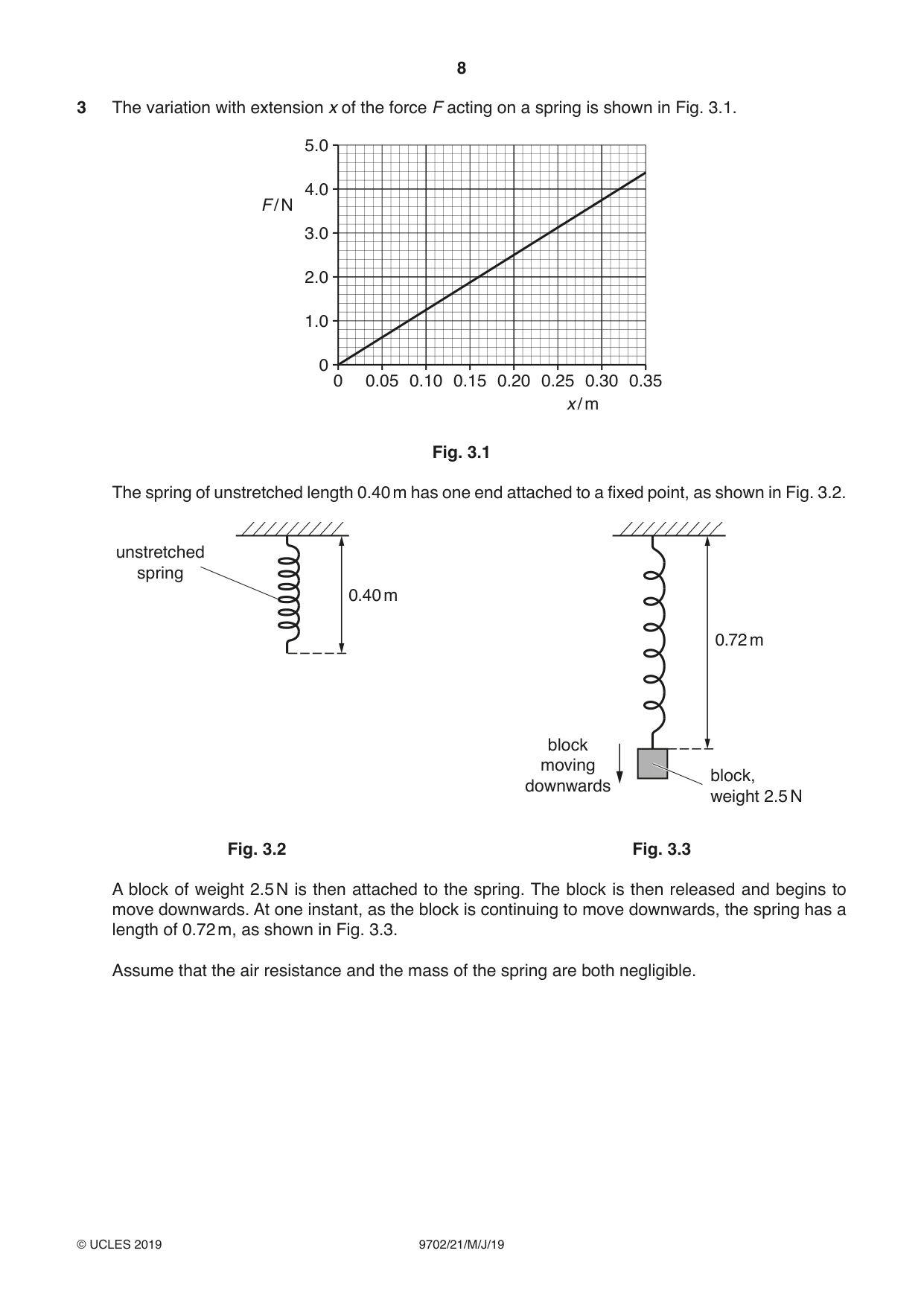
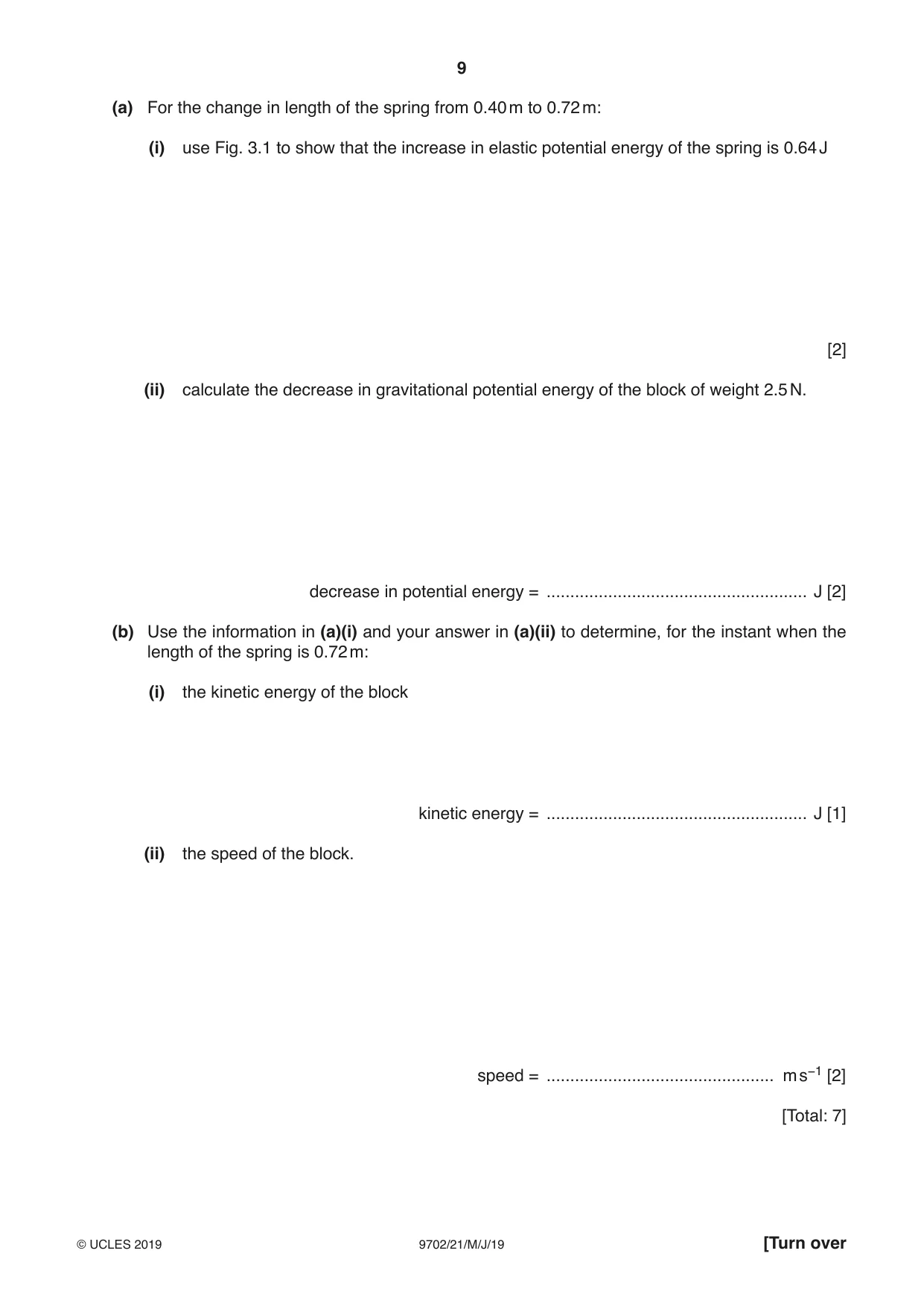
3 The variation with extension x of the force F acting on a spring is shown in Fig. 3.1. 5.0 4.0 F / N 3.0 2.0 1.0 0 0 0.05 0.10 0.15 0.20 0.25 0.30 0.35 x / m Fig. 3.1 The spring of unstretched length 0.40 m has one end attached to a fixed point, as shown in Fig. 3.2. unstretched spring 0.40 m 0.72 m block moving block, downwards weight 2.5 N Fig. 3.2 Fig. 3.3 A block of weight 2.5 N is then attached to the spring. The block is then released and begins to move downwards. At one instant, as the block is continuing to move downwards, the spring has a length of 0.72 m, as shown in Fig. 3.3. Assume that the air resistance and the mass of the spring are both negligible. (a) For the change in length of the spring from 0.40 m to 0.72 m: (i) use Fig. 3.1 to show that the increase in elastic potential energy of the spring is 0.64 J [2] (ii) calculate the decrease in gravitational potential energy of the block of weight 2.5 N. decrease in potential energy = ....................................................... J [2] (b) Use the information in (a)(i) and your answer in (a)(ii) to determine, for the instant when the length of the spring is 0.72 m: (i) the kinetic energy of the block kinetic energy = ....................................................... J [1] (ii) the speed of the block. speed = ................................................ m s−1 [2] [Total: 7]
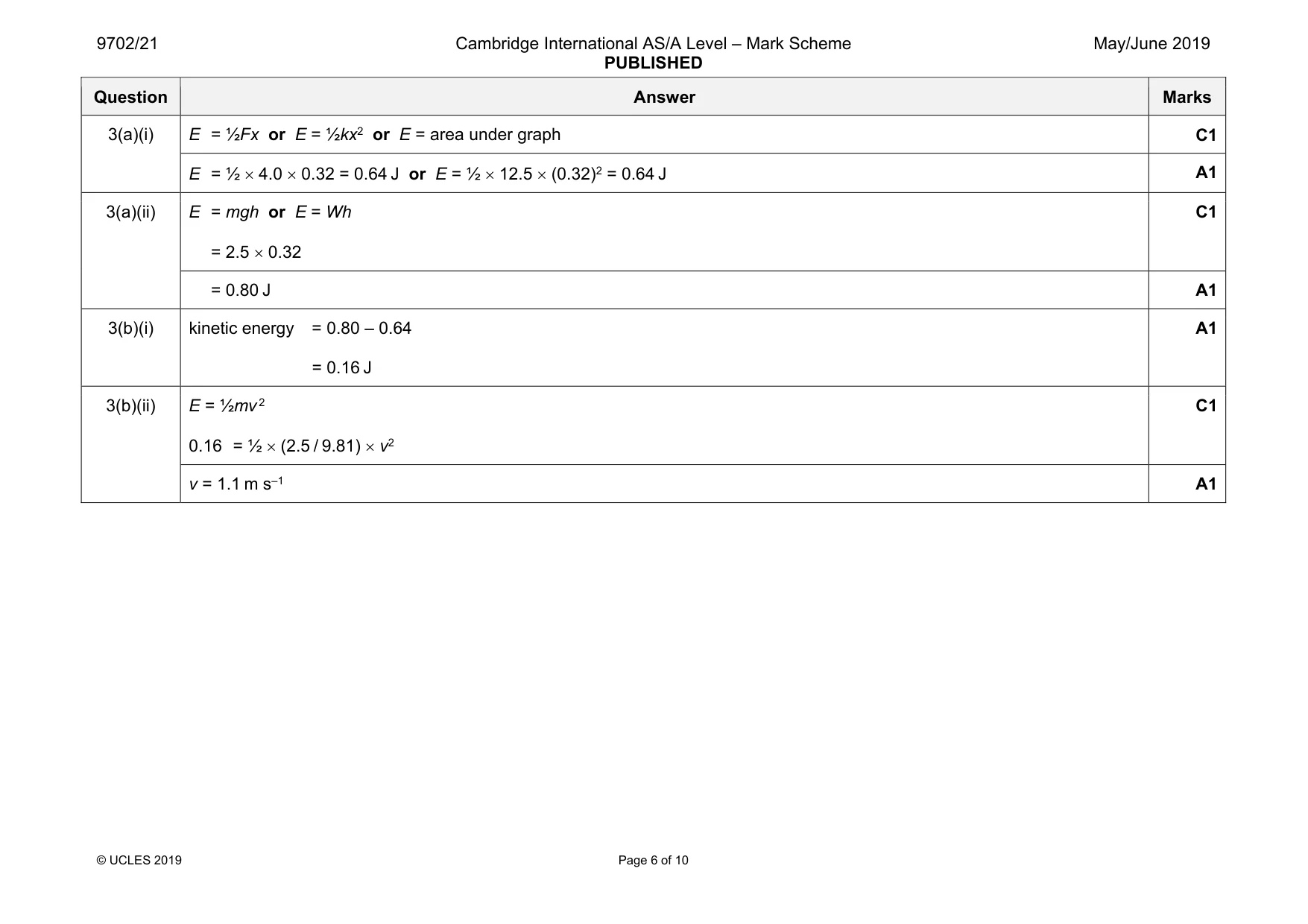
Mark scheme: 3(a)(i) E = ½Fx or E = ½kx2 or E = area under graph C1 E = ½ × 4.0 × 0.32 = 0.64 J or E = ½ × 12.5 × (0.32)2 = 0.64 J A1 3(a)(ii) E = mgh or E = Wh = 2.5 × 0.32 C1 = 0.80 J A1 3(b)(i) kinetic energy = 0.80 – 0.64 = 0.16 J A1 3(b)(ii) E = ½mv 2 0.16 = ½ × (2.5 / 9.81) × v2 C1 v = 1.1 m s–1 A1
More questions on Gravitational potential energy and kinetic energy
Q4 · A spherical oil drop has a radius of 1.2 × 10⁻⁶ m
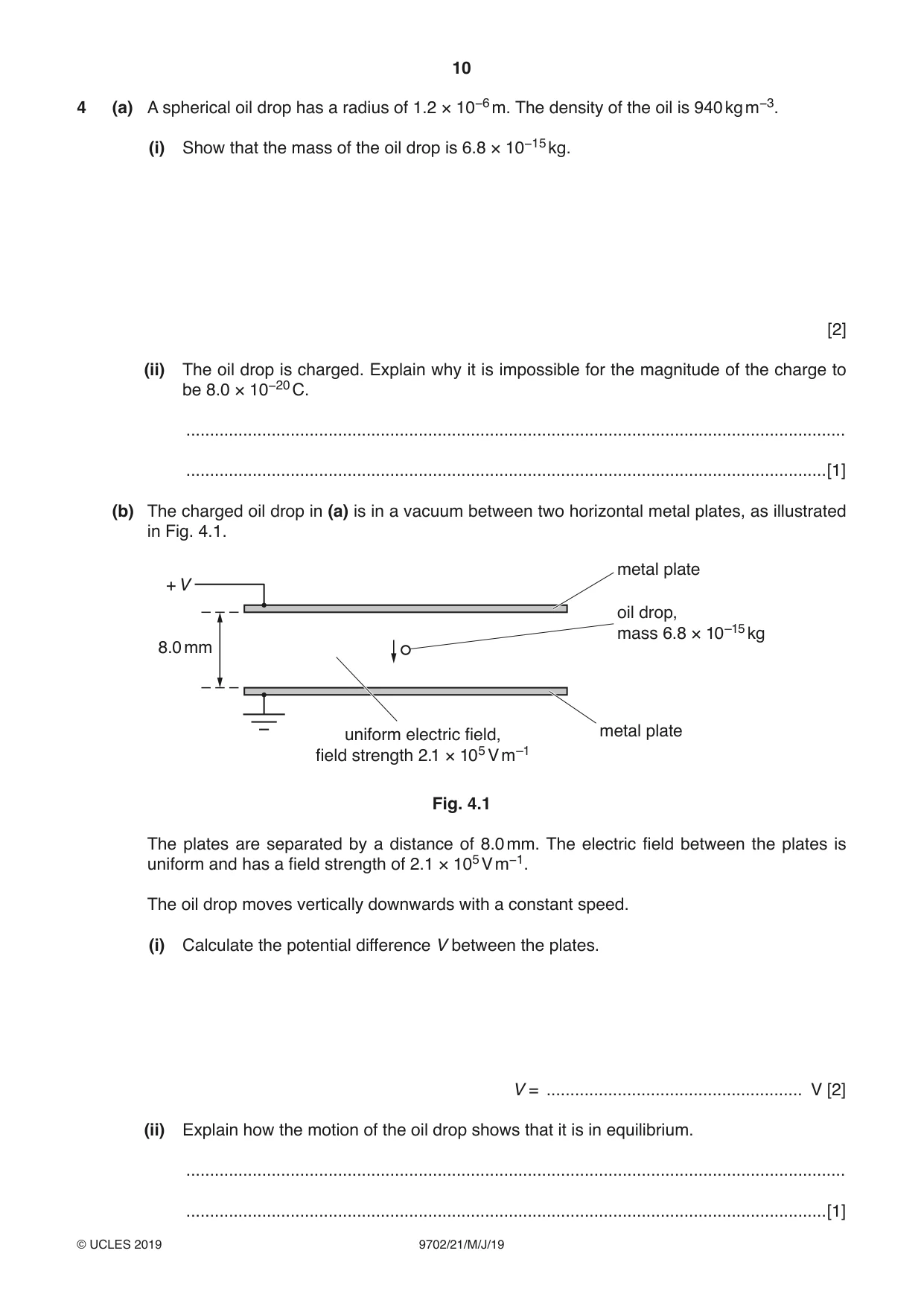
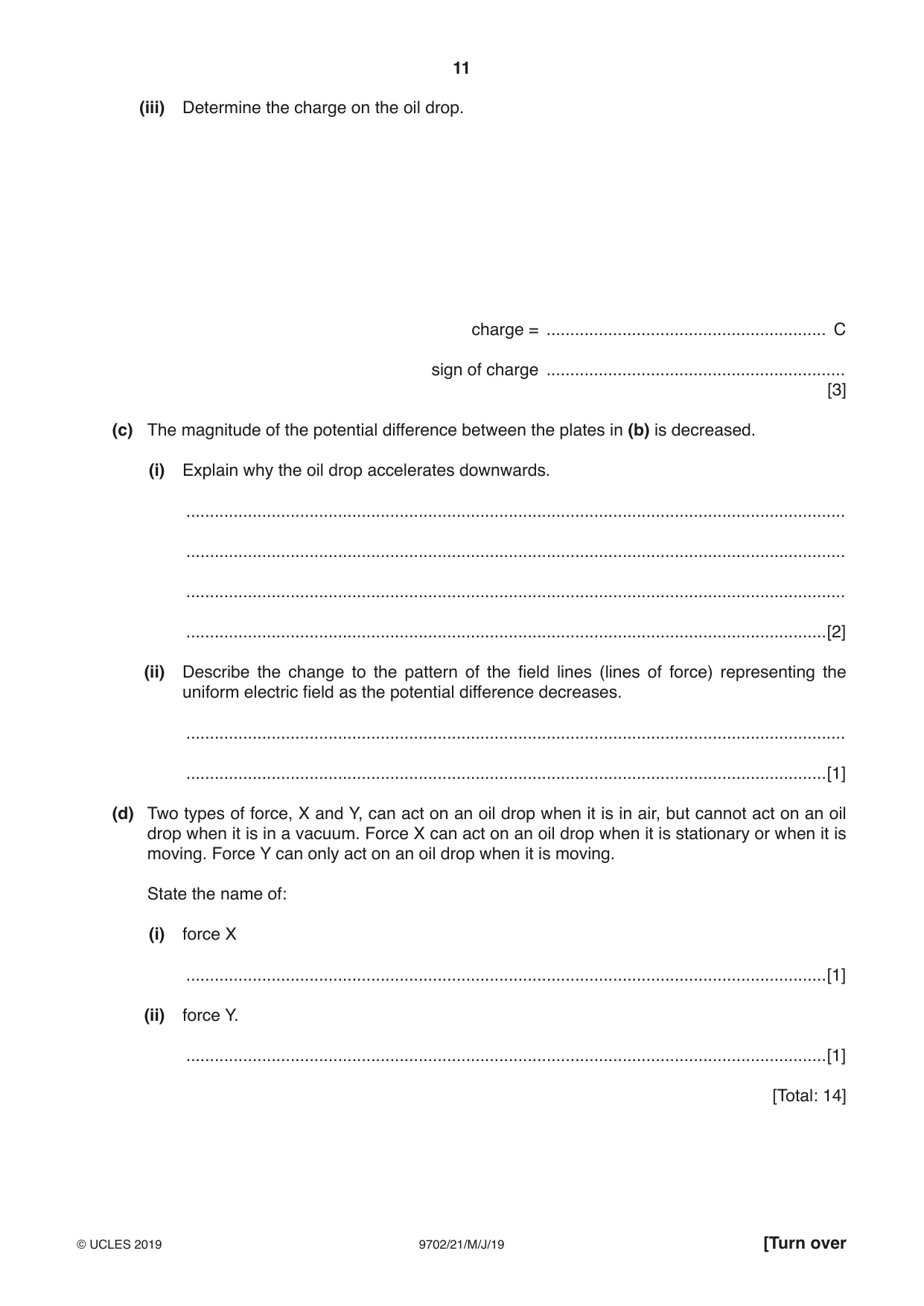
4 (a) A spherical oil drop has a radius of 1.2 × 10⁻⁶ m. The density of the oil is 940 kg m−3. (i) Show that the mass of the oil drop is 6.8 × 10⁻¹⁵ kg. [2] (ii) The oil drop is charged. Explain why it is impossible for the magnitude of the charge to be 8.0 × 10⁻²⁰ C. ........................................................................................................................................... .......................................................................................................................................[1] (b) The charged oil drop in (a) is in a vacuum between two horizontal metal plates, as illustrated in Fig. 4.1. metal plate + V oil drop, mass 6.8 × 10⁻¹⁵ kg 8.0 mm uniform electric field, metal plate field strength 2.1 × 10⁵ V m–1 Fig. 4.1 The plates are separated by a distance of 8.0 mm. The electric field between the plates is uniform and has a field strength of 2.1 × 10⁵ V m−1. The oil drop moves vertically downwards with a constant speed. (i) Calculate the potential difference V between the plates. V = ...................................................... V [2] (ii) Explain how the motion of the oil drop shows that it is in equilibrium. ........................................................................................................................................... .......................................................................................................................................[1] (iii) Determine the charge on the oil drop. charge = ........................................................... C sign of charge ............................................................... [3] (c) The magnitude of the potential difference between the plates in (b) is decreased. (i) Explain why the oil drop accelerates downwards. ........................................................................................................................................... ........................................................................................................................................... ........................................................................................................................................... .......................................................................................................................................[2] (ii) Describe the change to the pattern of the field lines (lines of force) representing the uniform electric field as the potential difference decreases. ........................................................................................................................................... .......................................................................................................................................[1] (d) Two types of force, X and Y, can act on an oil drop when it is in air, but cannot act on an oil drop when it is in a vacuum. Force X can act on an oil drop when it is stationary or when it is moving. Force Y can only act on an oil drop when it is moving. State the name of: (i) force X .......................................................................................................................................[1] (ii) force Y. .......................................................................................................................................[1] [Total: 14]
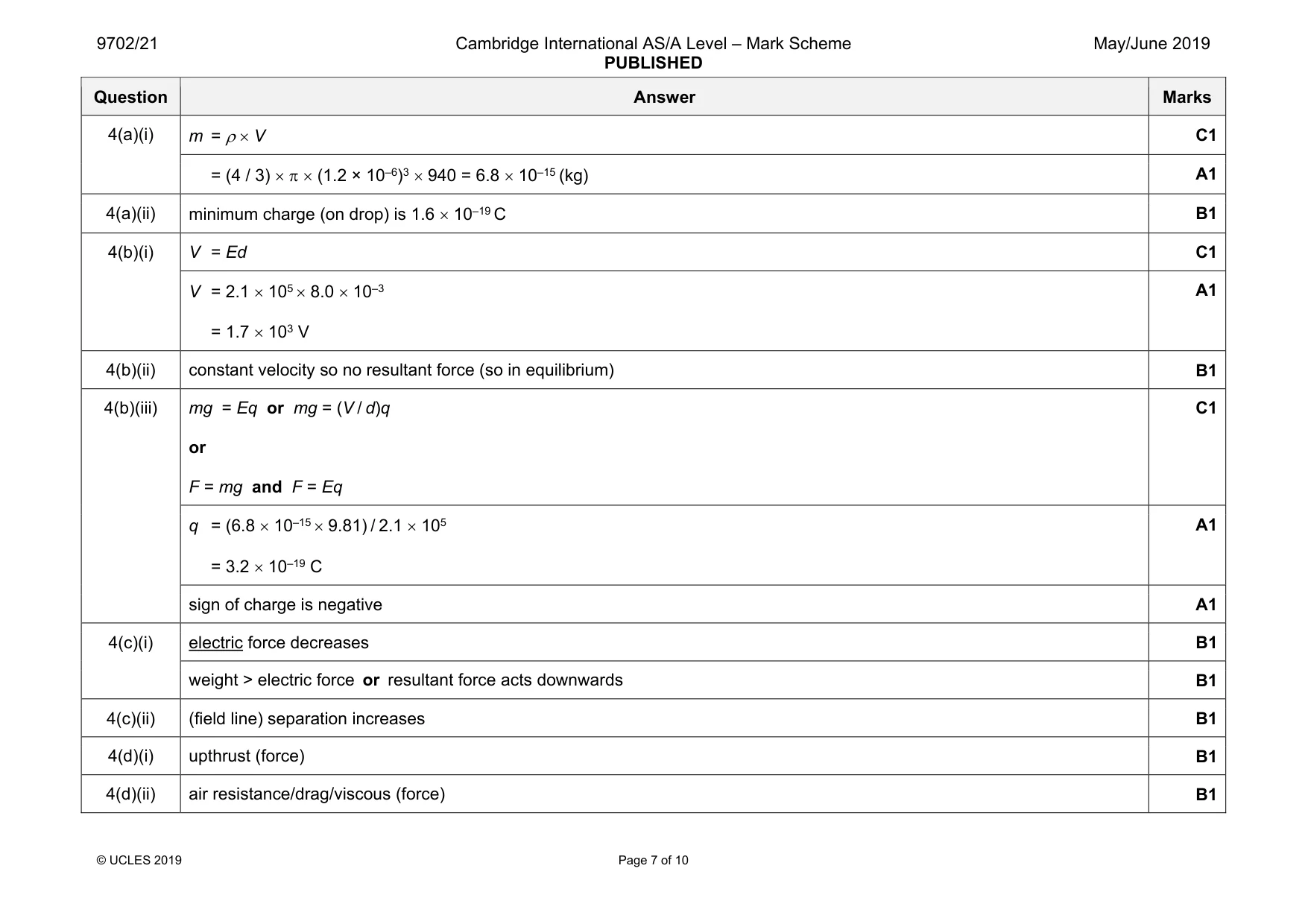
Mark scheme: 4(a)(i) C1 = (4 / 3) × π × (1.2 × 10⁻⁶)3 × 940 = 6.8 × 10⁻¹⁵ (kg) A1 4(a)(ii) minimum charge (on drop) is 1.6 × 10⁻¹⁹ C B1 4(b)(i) V = Ed C1 V = 2.1 × 105 × 8.0 × 10–3 = 1.7 × 10³ V A1 4(b)(ii) constant velocity so no resultant force (so in equilibrium) B1 4(b)(iii) mg = Eq or mg = (V / d)q or F = mg and F = Eq C1 q = (6.8 × 10–15 × 9.81) / 2.1 × 105 = 3.2 × 10⁻¹⁹ C A1 sign of charge is negative A1 4(c)(i) electric force decreases B1 weight > electric force or resultant force acts downwards B1 4(c)(ii) (field line) separation increases B1 4(d)(i) upthrust (force) B1 4(d)(ii) air resistance/drag/viscous (force) B1
Q5 · A loudspeaker oscillates with frequency f to produce sound waves of wavelength λ
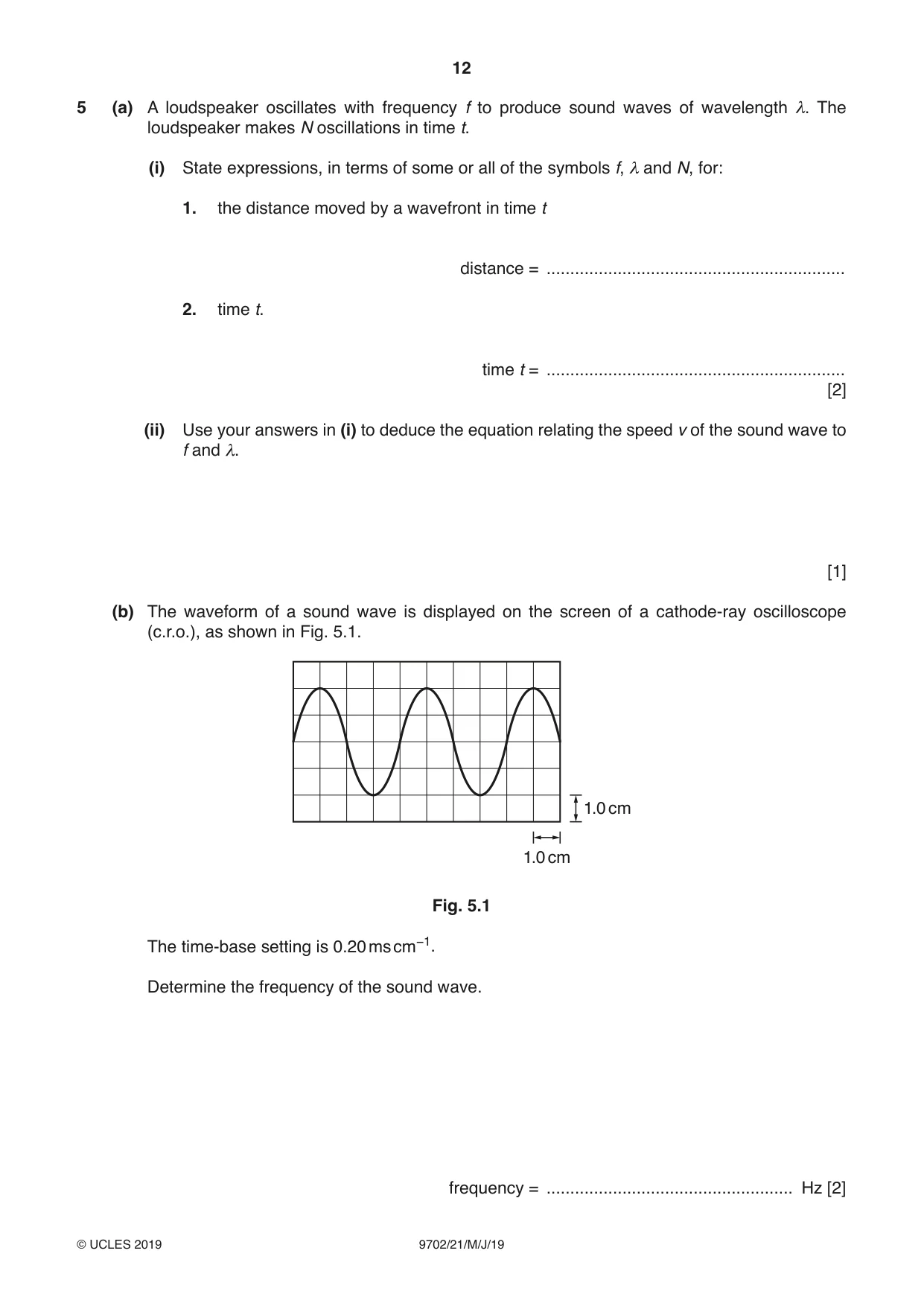
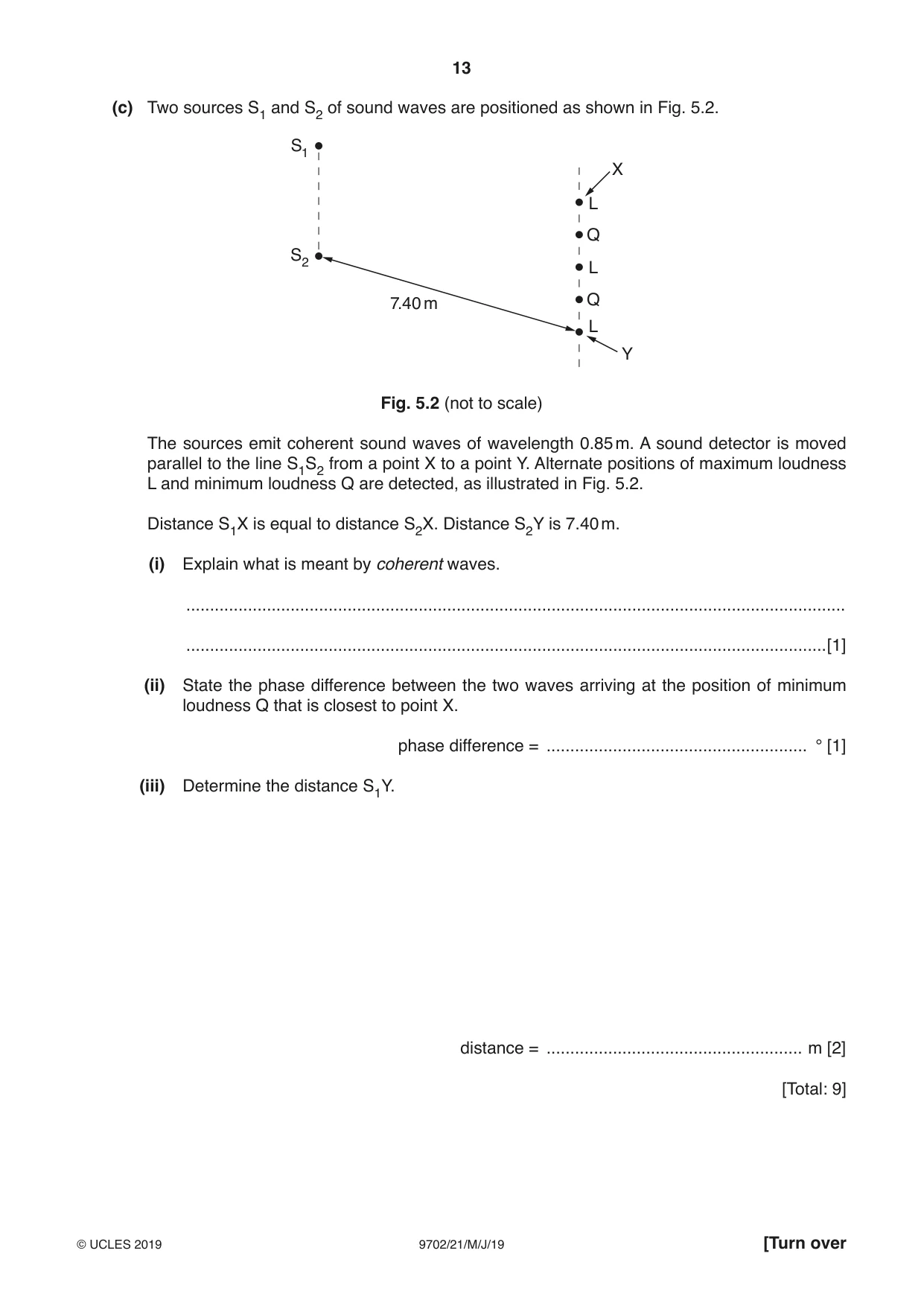
5 (a) A loudspeaker oscillates with frequency f to produce sound waves of wavelength λ. The loudspeaker makes N oscillations in time t. (i) State expressions, in terms of some or all of the symbols f, λ and N, for: 1. the distance moved by a wavefront in time t distance = ............................................................... 2. time t. time t = ............................................................... [2] (ii) Use your answers in (i) to deduce the equation relating the speed v of the sound wave to f and λ. [1] (b) The waveform of a sound wave is displayed on the screen of a cathode-ray oscilloscope (c.r.o.), as shown in Fig. 5.1. 1.0 cm 1.0 cm Fig. 5.1 The time-base setting is 0.20 ms cm−1. Determine the frequency of the sound wave. frequency = .................................................... Hz [2] (c) Two sources S1 and S2 of sound waves are positioned as shown in Fig. 5.2. S1 X L Q S2 L 7.40 m Q L Y Fig. 5.2 (not to scale) The sources emit coherent sound waves of wavelength 0.85 m. A sound detector is moved parallel to the line S1S2 from a point X to a point Y. Alternate positions of maximum loudness L and minimum loudness Q are detected, as illustrated in Fig. 5.2. Distance S1X is equal to distance S2X. Distance S2Y is 7.40 m. (i) Explain what is meant by coherent waves. ........................................................................................................................................... .......................................................................................................................................[1] (ii) State the phase difference between the two waves arriving at the position of minimum loudness Q that is closest to point X. phase difference = ....................................................... ° [1] (iii) Determine the distance S1Y. distance = ...................................................... m [2] [Total: 9]
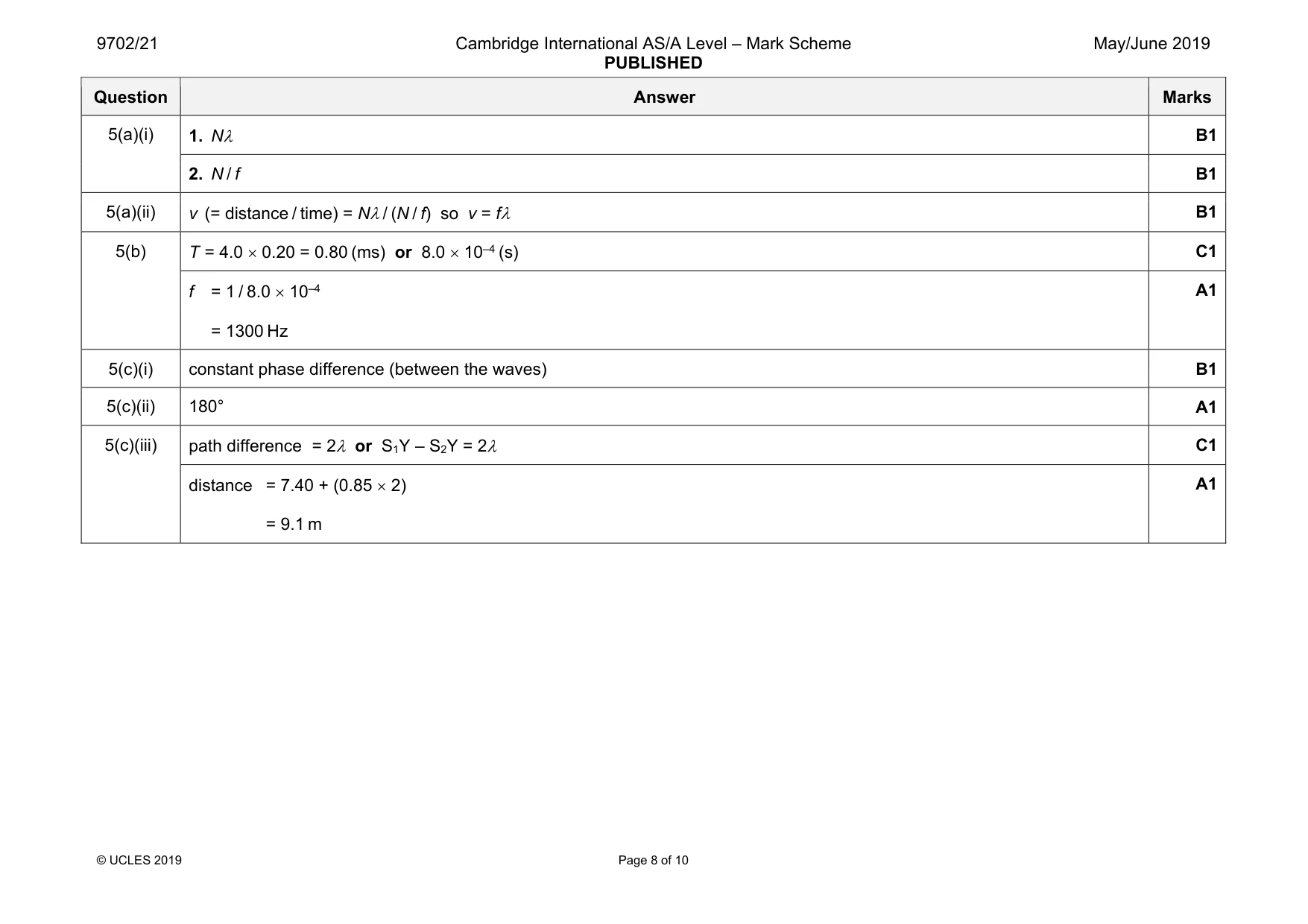
Mark scheme: 5(a)(i) B1 2. N / f B1 5(a)(ii) v (= distance / time) = Nλ / (N / f) so v = fλ B1 5(b) T = 4.0 × 0.20 = 0.80 (ms) or 8.0 × 10⁻⁴ (s) C1 f = 1 / 8.0 × 10–4 = 1300 Hz A1 5(c)(i) constant phase difference (between the waves) B1 5(c)(ii) 180° A1 5(c)(iii) path difference = 2λ or S1Y – S2Y = 2λ C1 distance = 7.40 + (0.85 × 2) = 9.1 m A1
Q6 · A battery of electromotive force (e.m.f.) E and internal resistance r is connected to a…
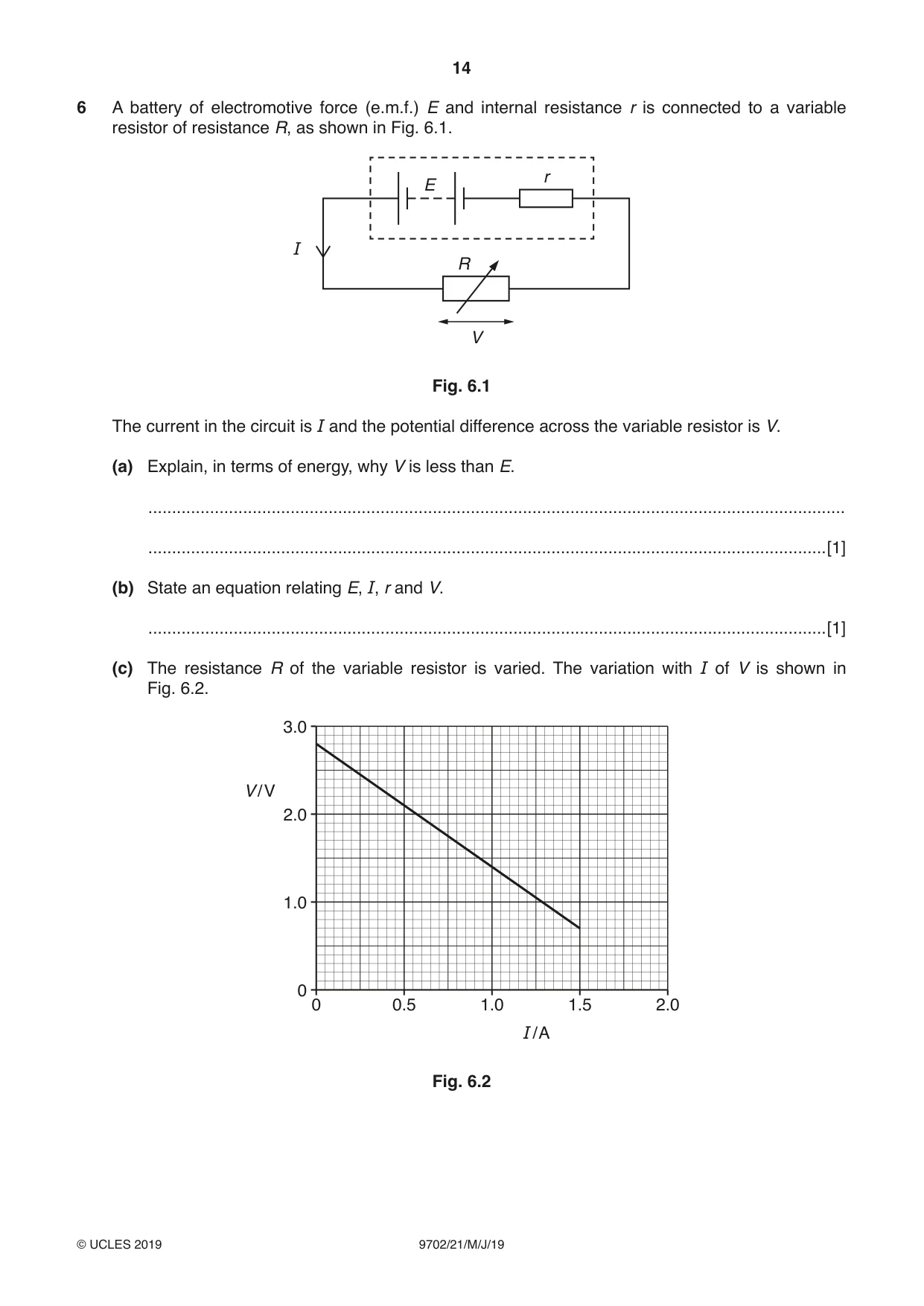
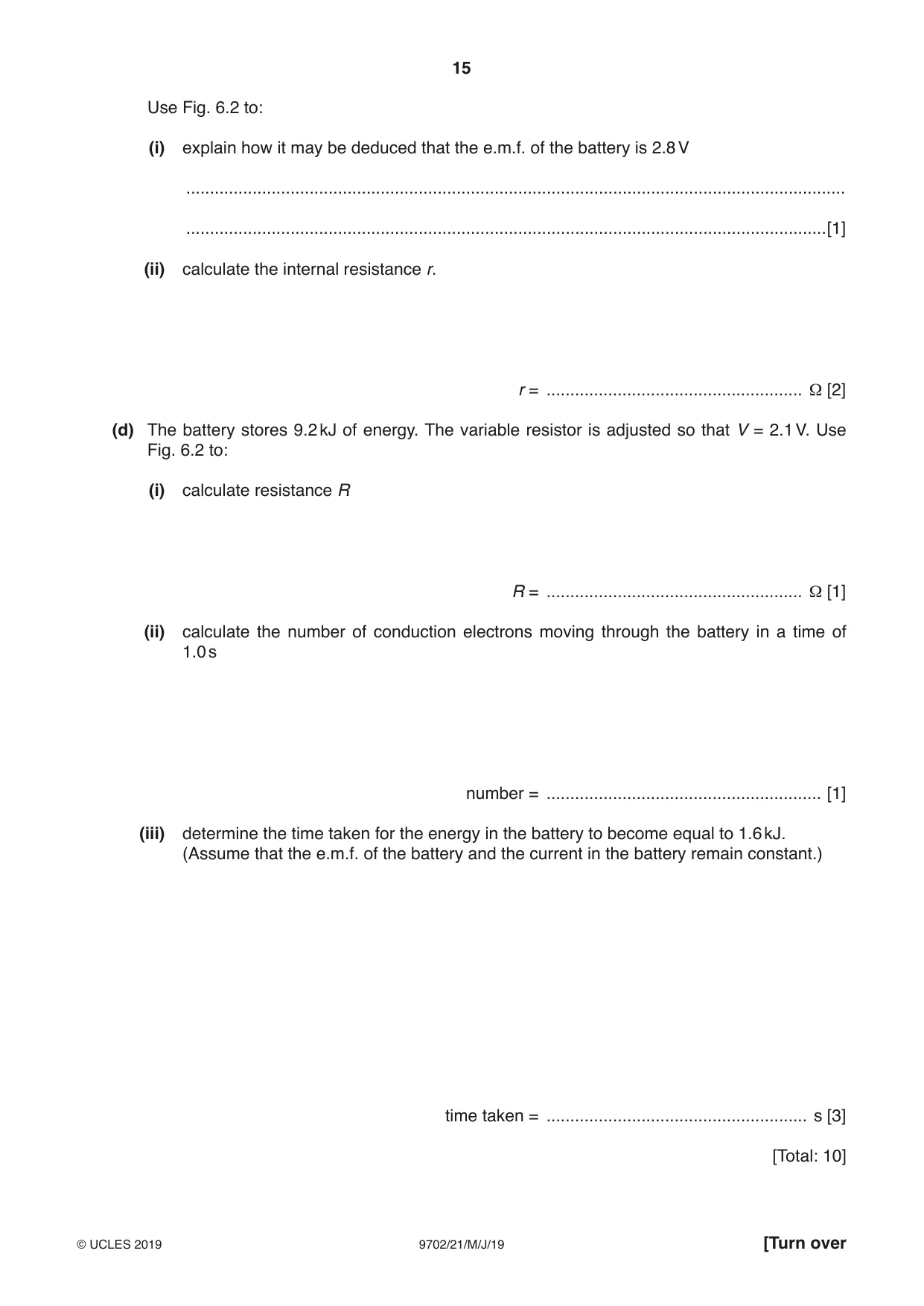
6 A battery of electromotive force (e.m.f.) E and internal resistance r is connected to a variable resistor of resistance R, as shown in Fig. 6.1. r E I R V Fig. 6.1 The current in the circuit is I and the potential difference across the variable resistor is V. (a) Explain, in terms of energy, why V is less than E. ................................................................................................................................................... ...............................................................................................................................................[1] (b) State an equation relating E, I, r and V. ...............................................................................................................................................[1] (c) The resistance R of the variable resistor is varied. The variation with I of V is shown in Fig. 6.2. 3.0 V /V 2.0 1.0 0 0 0.5 1.0 1.5 2.0 I /A Fig. 6.2 Use Fig. 6.2 to: (i) explain how it may be deduced that the e.m.f. of the battery is 2.8 V ........................................................................................................................................... .......................................................................................................................................[1] (ii) calculate the internal resistance r. r = ...................................................... Ω [2] (d) The battery stores 9.2 kJ of energy. The variable resistor is adjusted so that V = 2.1 V. Use Fig. 6.2 to: (i) calculate resistance R R = ...................................................... Ω [1] (ii) calculate the number of conduction electrons moving through the battery in a time of 1.0 s number = .......................................................... [1] (iii) determine the time taken for the energy in the battery to become equal to 1.6 kJ. (Assume that the e.m.f. of the battery and the current in the battery remain constant.) time taken = ....................................................... s [3] [Total: 10]
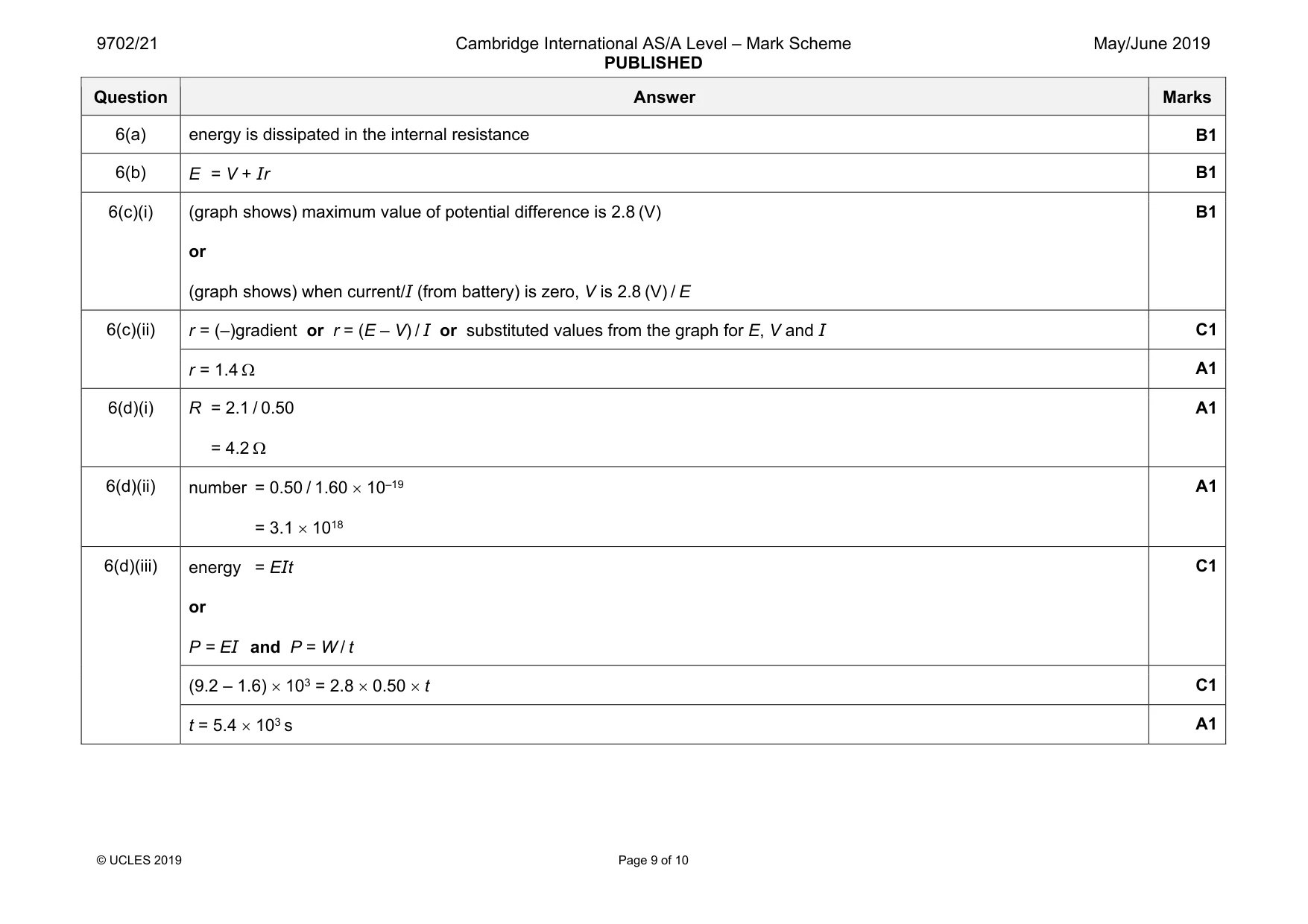
Mark scheme: 6(a) energy is dissipated in the internal resistance B1 6(b) E = V + Ir B1 6(c)(i) (graph shows) maximum value of potential difference is 2.8 (V) or (graph shows) when current/I (from battery) is zero, V is 2.8 (V) / E B1 6(c)(ii) r = (–)gradient or r = (E – V) / I or substituted values from the graph for E, V and I C1 r = 1.4 Ω A1 6(d)(i) R = 2.1 / 0.50 = 4.2 Ω A1 6(d)(ii) number = 0.50 / 1.60 × 10–19 = 3.1 × 10¹⁸ A1 6(d)(iii) energy = EIt or P = EI and P = W / t C1 (9.2 – 1.6) × 103 = 2.8 × 0.50 × t C1 t = 5.4 × 10³ s A1
Q7 · One of the results of the α-particle scattering experiment is that a very small minority…
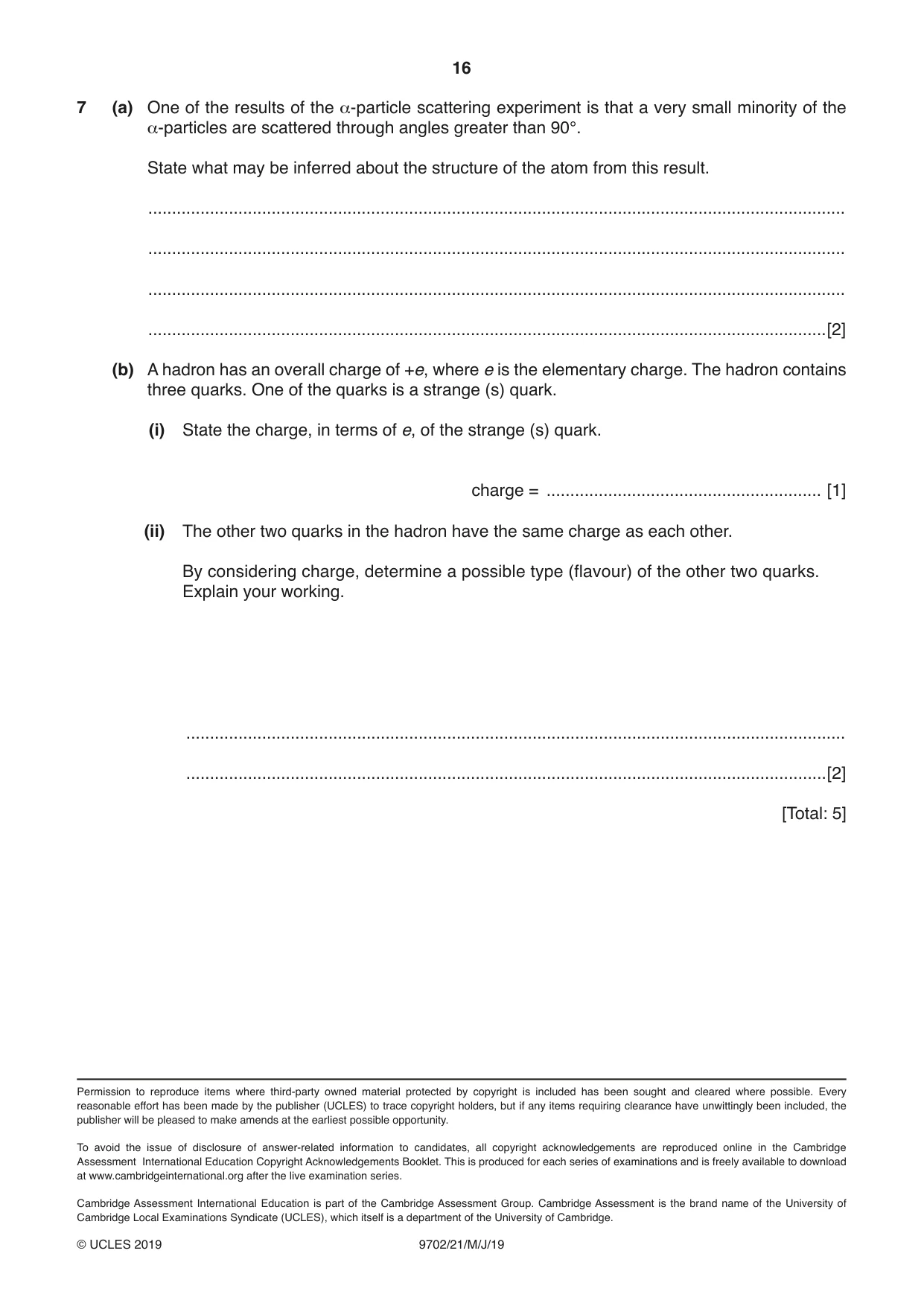
7 (a) One of the results of the α-particle scattering experiment is that a very small minority of the α-particles are scattered through angles greater than 90°. State what may be inferred about the structure of the atom from this result. ................................................................................................................................................... ................................................................................................................................................... ................................................................................................................................................... ...............................................................................................................................................[2] (b) A hadron has an overall charge of +e, where e is the elementary charge. The hadron contains three quarks. One of the quarks is a strange (s) quark. (i) State the charge, in terms of e, of the strange (s) quark. charge = .......................................................... [1] (ii) The other two quarks in the hadron have the same charge as each other. By considering charge, determine a possible type (flavour) of the other two quarks. Explain your working. ........................................................................................................................................... .......................................................................................................................................[2] [Total: 5]
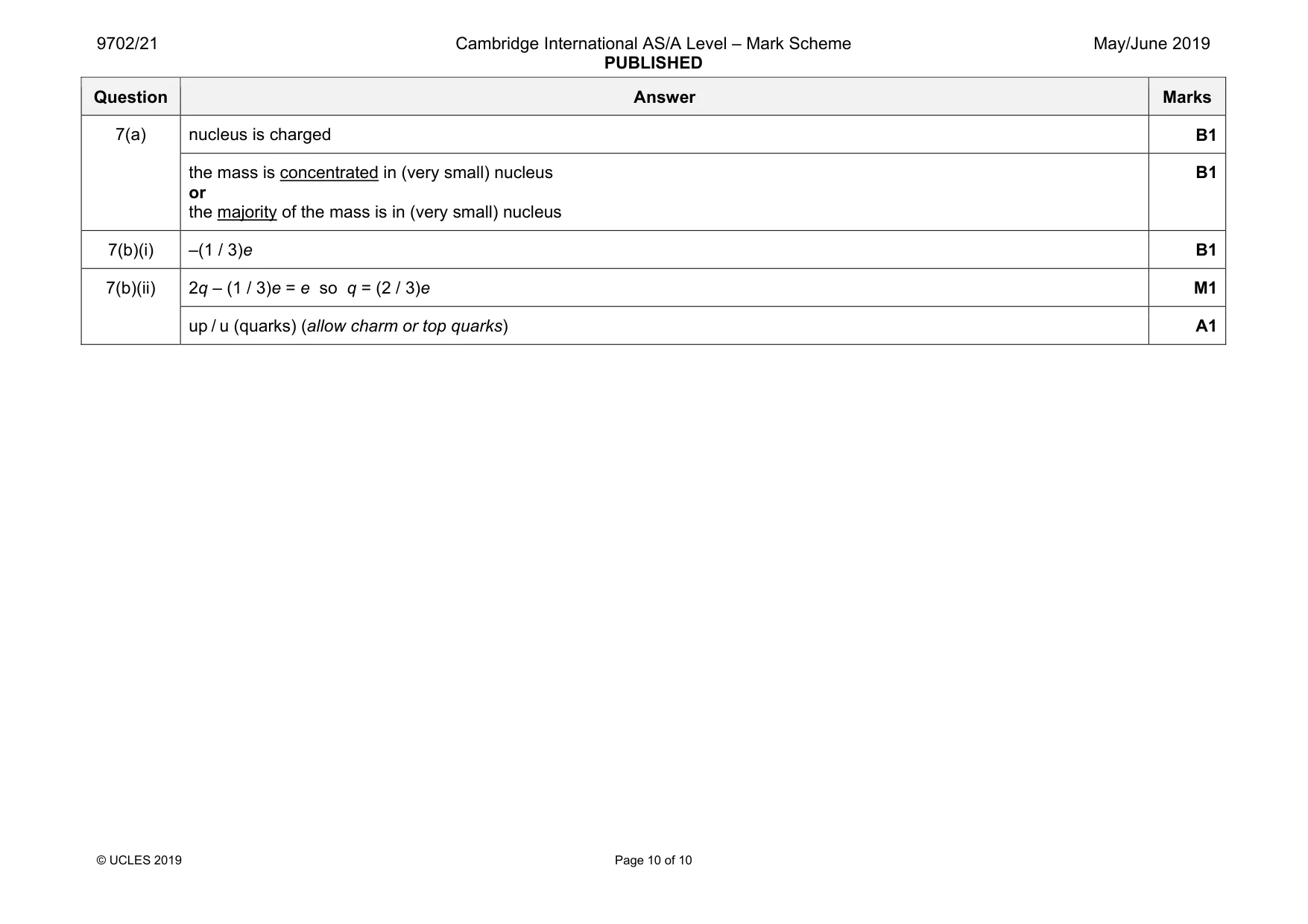
Mark scheme: 7(a) nucleus is charged B1 the mass is concentrated in (very small) nucleus or the majority of the mass is in (very small) nucleus B1 7(b)(i) –(1 / 3)e B1 7(b)(ii) 2q – (1 / 3)e = e so q = (2 / 3)e M1 up / u (quarks) (allow charm or top quarks) A1
What was in this paper
The subtopics covered by these 7 questions, and how many questions each got. Open one in a new tab to see every Cambridge question on it.
What you needed in this session
Cambridge’s own grade thresholds for 2019 May/June, Paper 2 · Variant 1. A higher threshold means an easier paper — the bar moves with how the cohort did.