Cambridge A Level Physics 9702 — 2025 Oct/Nov Paper 2 · Variant 3
9702/23/O/N/25 · 6 questions · 60 marks · 75 min
The question paper and its mark scheme, free to read here and free to download. This is Cambridge’s own paper, exactly as it was sat.
Question paper16 pages
Mark scheme13 pages
Answers below. Sit the paper first if you are practising.
Questions as text
Question 1
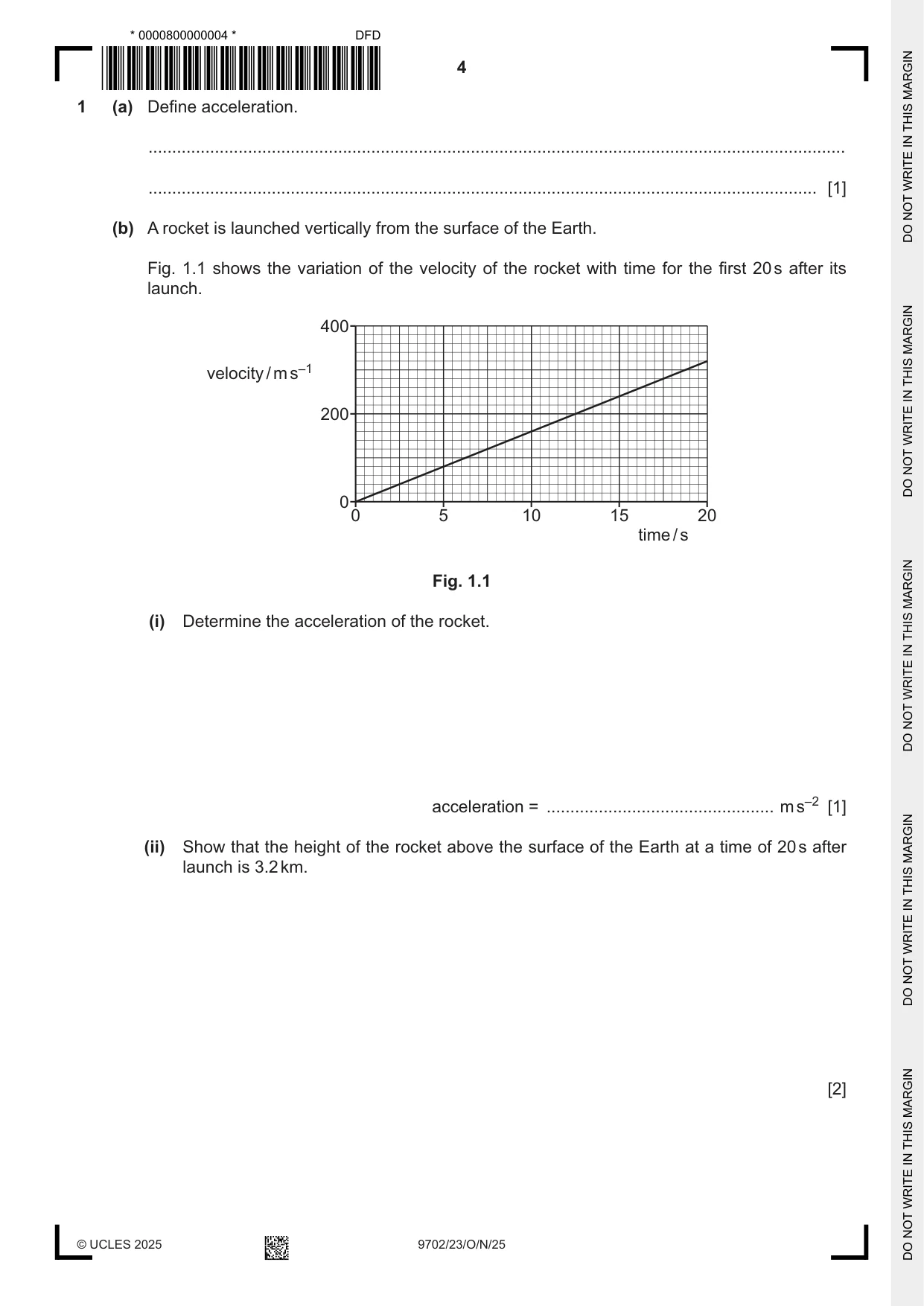
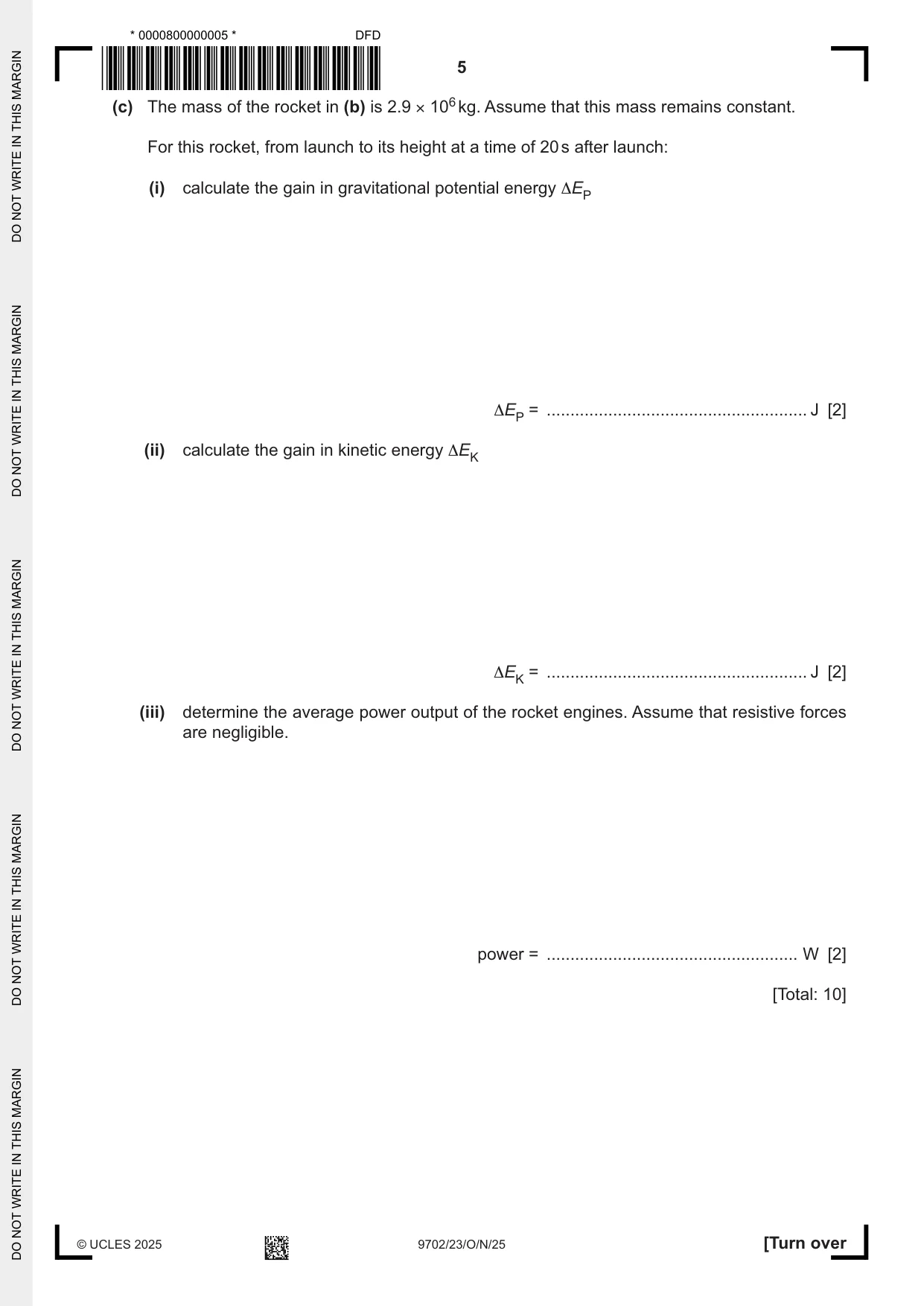
1 (a) Define acceleration. ................................................................................................................................................... ............................................................................................................................................. [1] (b) A rocket is launched vertically from the surface of the Earth. Fig. 1.1 shows the variation of the velocity of the rocket with time for the first 20 s after its launch. 400 velocity / m s–1 200 0 0 5 10 15 20 time / s Fig. 1.1 (i) Determine the acceleration of the rocket. acceleration = ................................................ m s–2 [1] (ii) Show that the height of the rocket above the surface of the Earth at a time of 20 s after launch is 3.2 km. [2] (c) The mass of the rocket in (b) is 2.9 × 10⁶ kg. Assume that this mass remains constant. For this rocket, from launch to its height at a time of 20 s after launch: (i) calculate the gain in gravitational potential energy ΔEP ΔEP = ....................................................... J [2] (ii) calculate the gain in kinetic energy ΔEK ΔEK = ....................................................... J [2] (iii) determine the average power output of the rocket engines. Assume that resistive forces are negligible. power = ..................................................... W [2] [Total: 10]
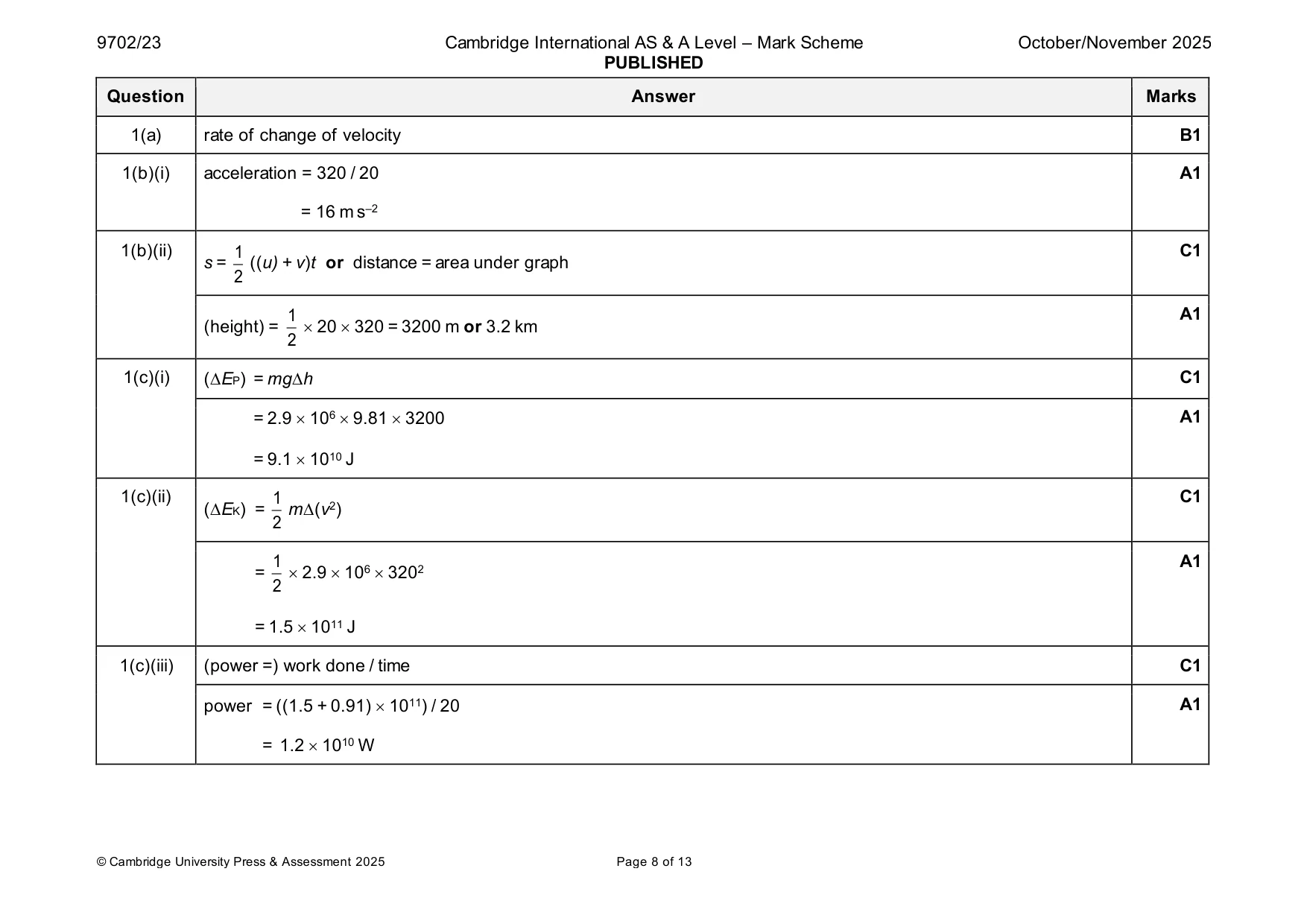
Mark scheme: Question Answer Marks 1(a) rate of change of velocity B1 1(b)(i) acceleration = 320 / 20 A1 = 16 m s–2 1(b)(ii) 1 C1 s = ((u) + v)t or distance = area under graph 2 1 A1 (height) = 20 320 = 3200 m or 3.2 km 2 1(c)(i) (EP) = mgh C1 = 2.9 106 9.81 3200 A1 = 9.1 1010 J 1(c)(ii) 1 C1 (EK) = m(v2) 2 1 A1 = 2.9 106 3202 2 = 1.5 1011 J 1(c)(iii) (power =) work done / time C1 power = ((1.5 + 0.91) 1011) / 20 A1 = 1.2 1010 W
Question 2
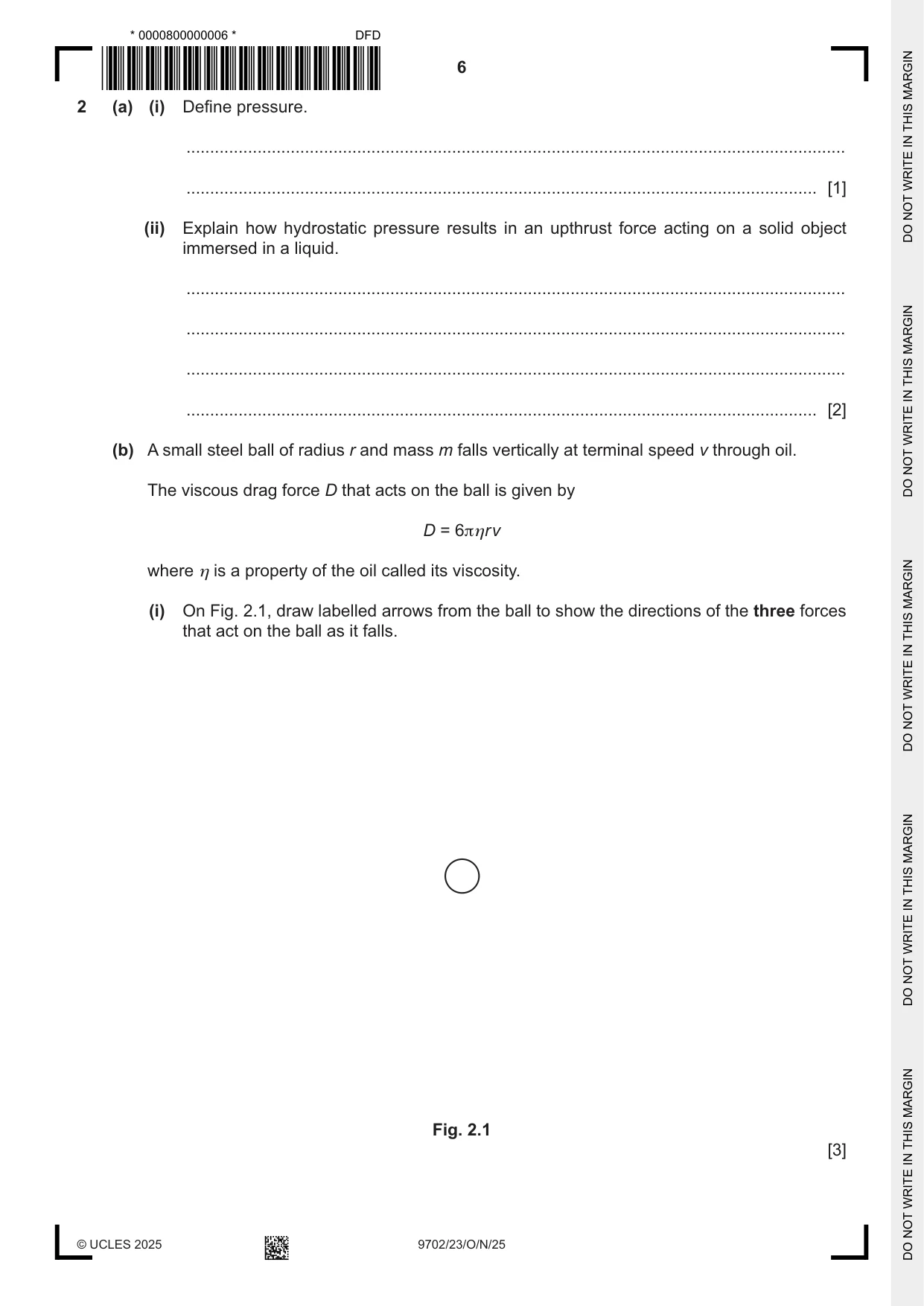
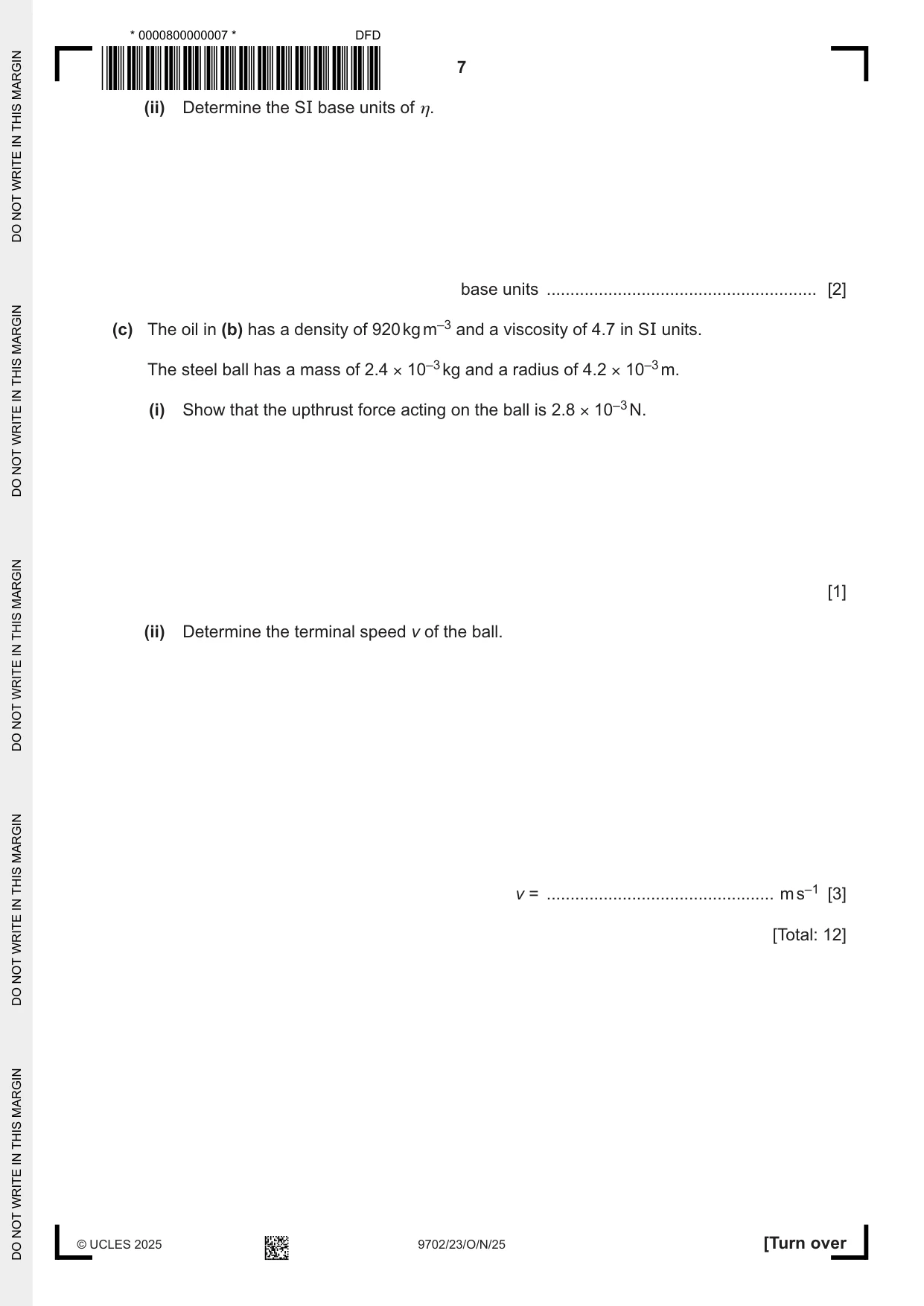
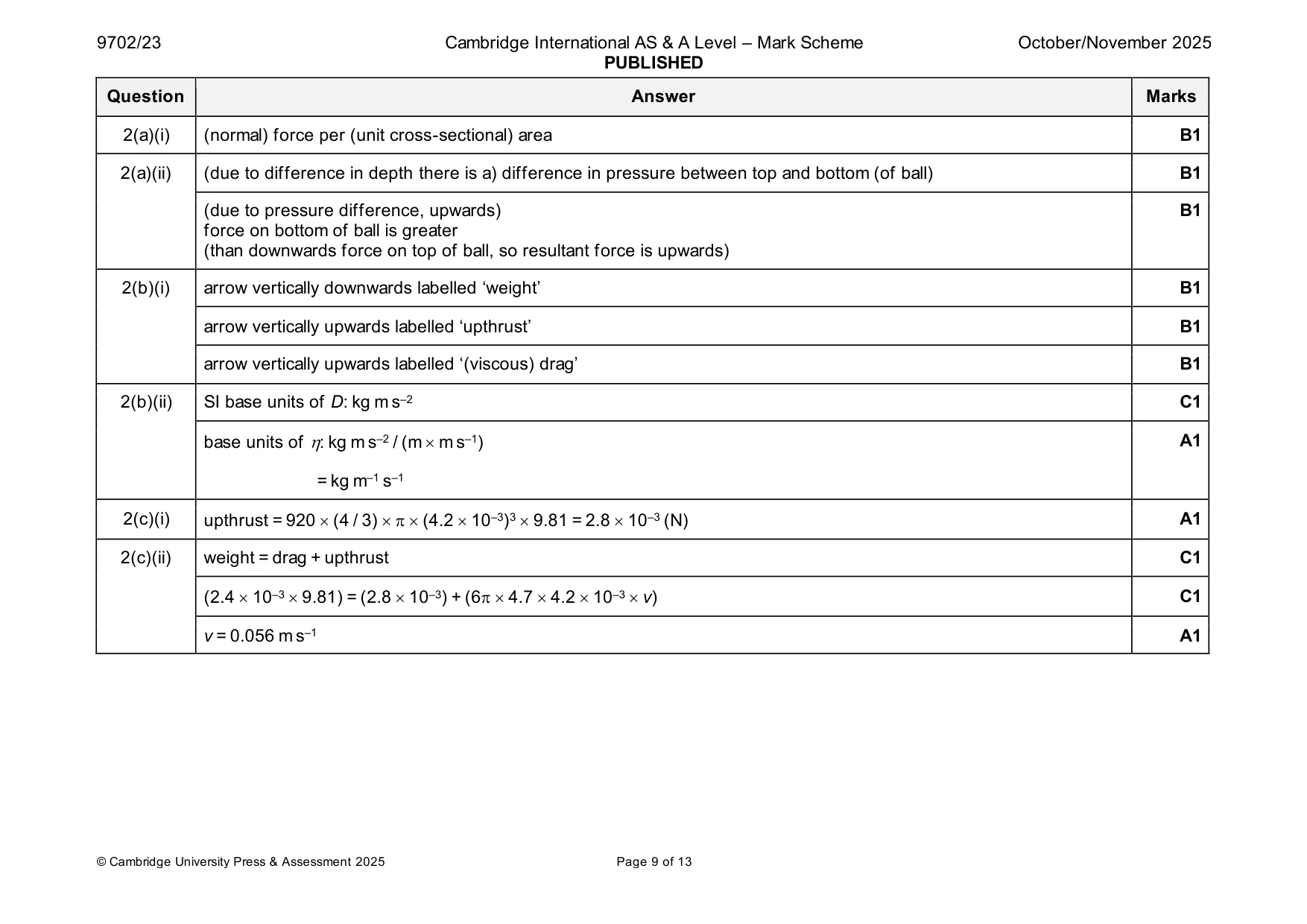
2 (a) (i) Define pressure. ........................................................................................................................................... ..................................................................................................................................... [1] (ii) Explain how hydrostatic pressure results in an upthrust force acting on a solid object immersed in a liquid. ........................................................................................................................................... ........................................................................................................................................... ........................................................................................................................................... ..................................................................................................................................... [2] (b) A small steel ball of radius r and mass m falls vertically at terminal speed v through oil. The viscous drag force D that acts on the ball is given by D = 6πη r v where η is a property of the oil called its viscosity. (i) On Fig. 2.1, draw labelled arrows from the ball to show the directions of the three forces that act on the ball as it falls. Fig. 2.1 [3] (ii) Determine the SI base units of η. base units ......................................................... [2] (c) The oil in (b) has a density of 920 kg m–3 and a viscosity of 4.7 in SI units. The steel ball has a mass of 2.4 × 10⁻³ kg and a radius of 4.2 × 10⁻³ m. (i) Show that the upthrust force acting on the ball is 2.8 × 10⁻³ N. [1] (ii) Determine the terminal speed v of the ball. v = ................................................ m s–1 [3] [Total: 12]
Mark scheme: 2(a)(i) (normal) force per (unit cross-sectional) area B1 2(a)(ii) (due to difference in depth there is a) difference in pressure between top and bottom (of ball) B1 (due to pressure difference, upwards) B1 force on bottom of ball is greater (than downwards force on top of ball, so resultant force is upwards) 2(b)(i) arrow vertically downwards labelled ‘weight’ B1 arrow vertically upwards labelled ‘upthrust’ B1 arrow vertically upwards labelled ‘(viscous) drag’ B1 2(b)(ii) SI base units of D: kg m s–2 C1 base units of : kg m s–2 / (m m s–1) A1 = kg m–1 s–1 2(c)(i) upthrust = 920 (4 / 3) (4.2 10–3)3 9.81 = 2.8 10–3 (N) A1 2(c)(ii) weight = drag + upthrust C1 (2.4 10–3 9.81) = (2.8 10–3) + (6 4.7 4.2 10–3 v) C1 v = 0.056 m s–1 A1
Q3 · A wire has length L and cross-sectional area A
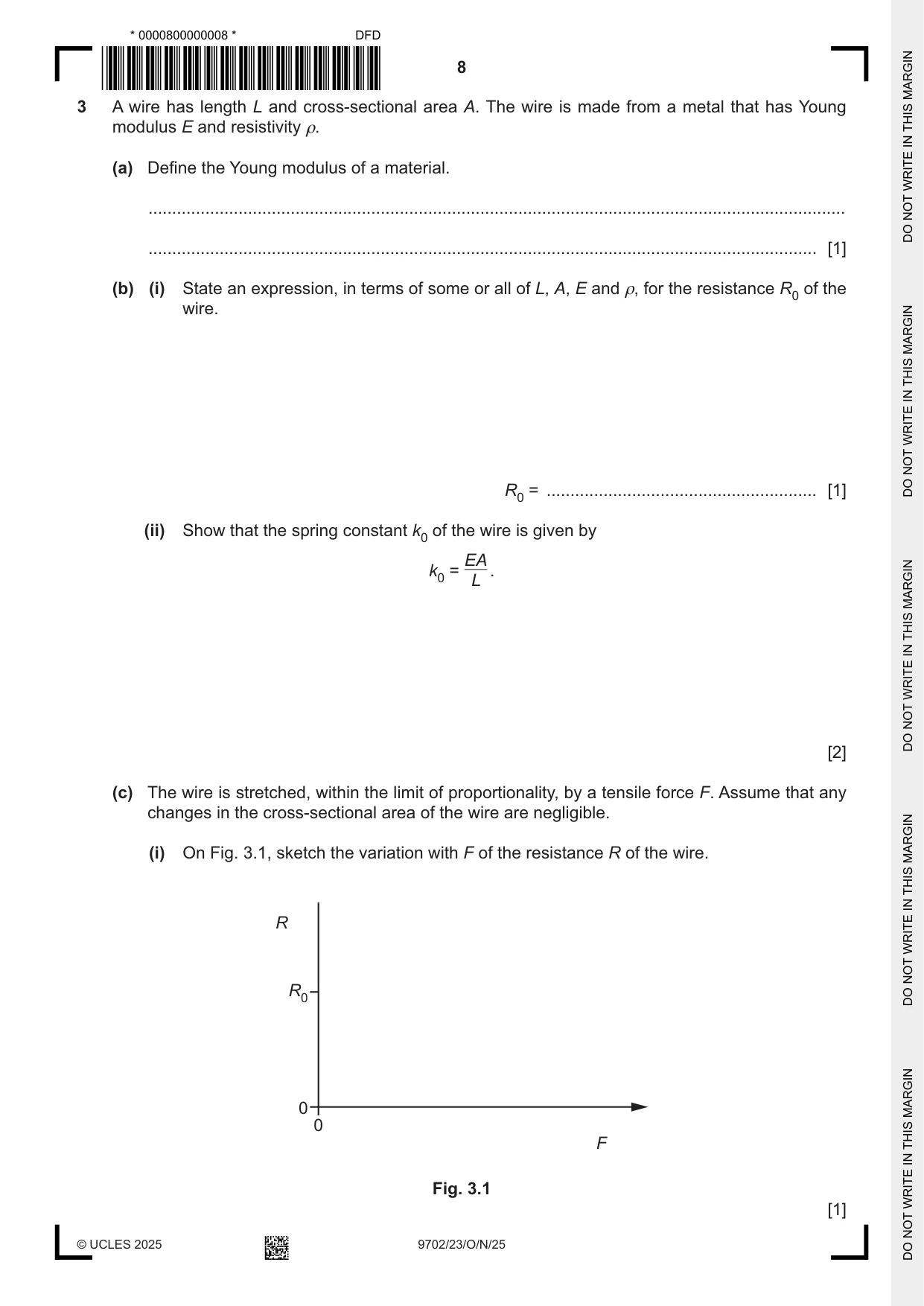
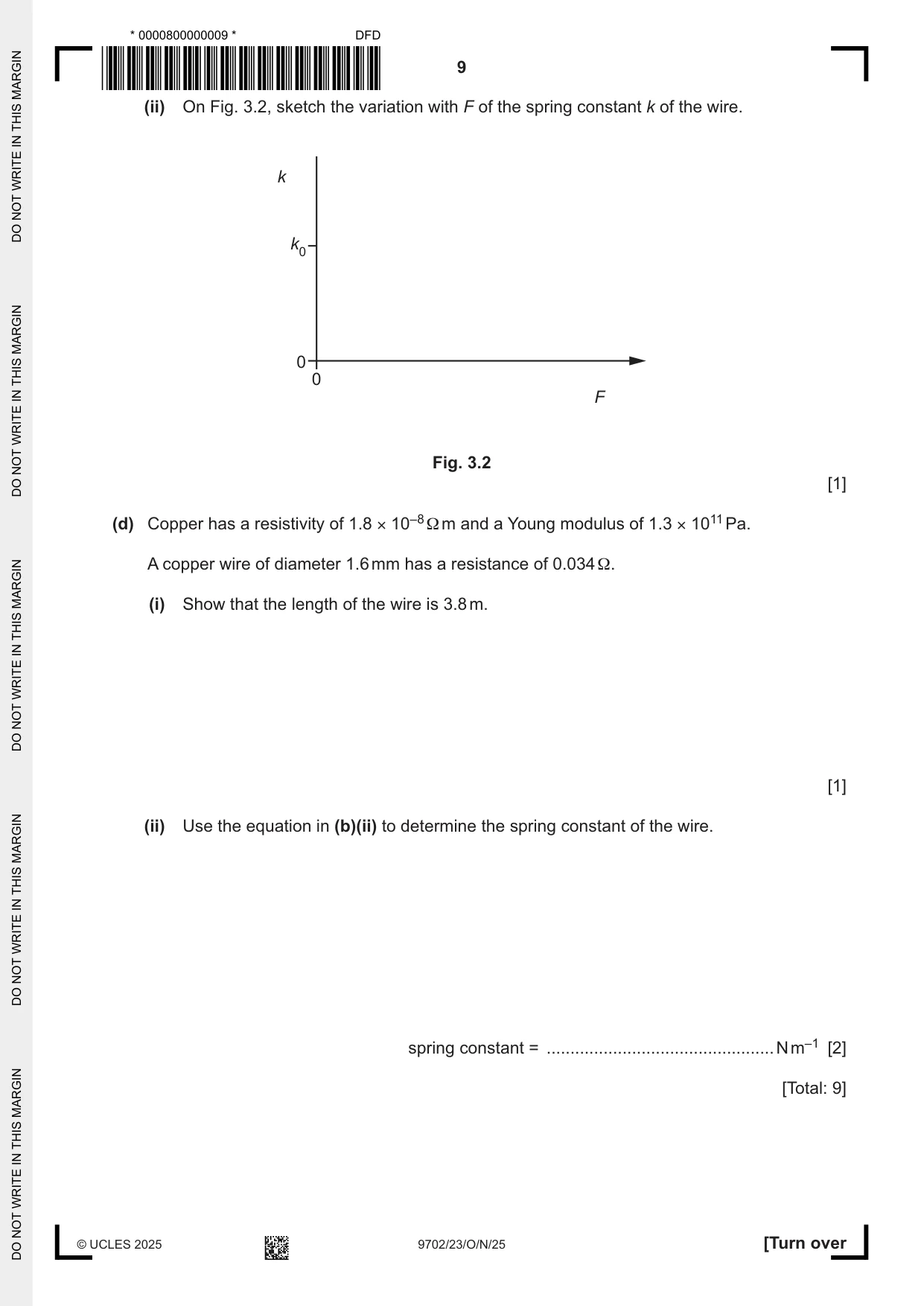
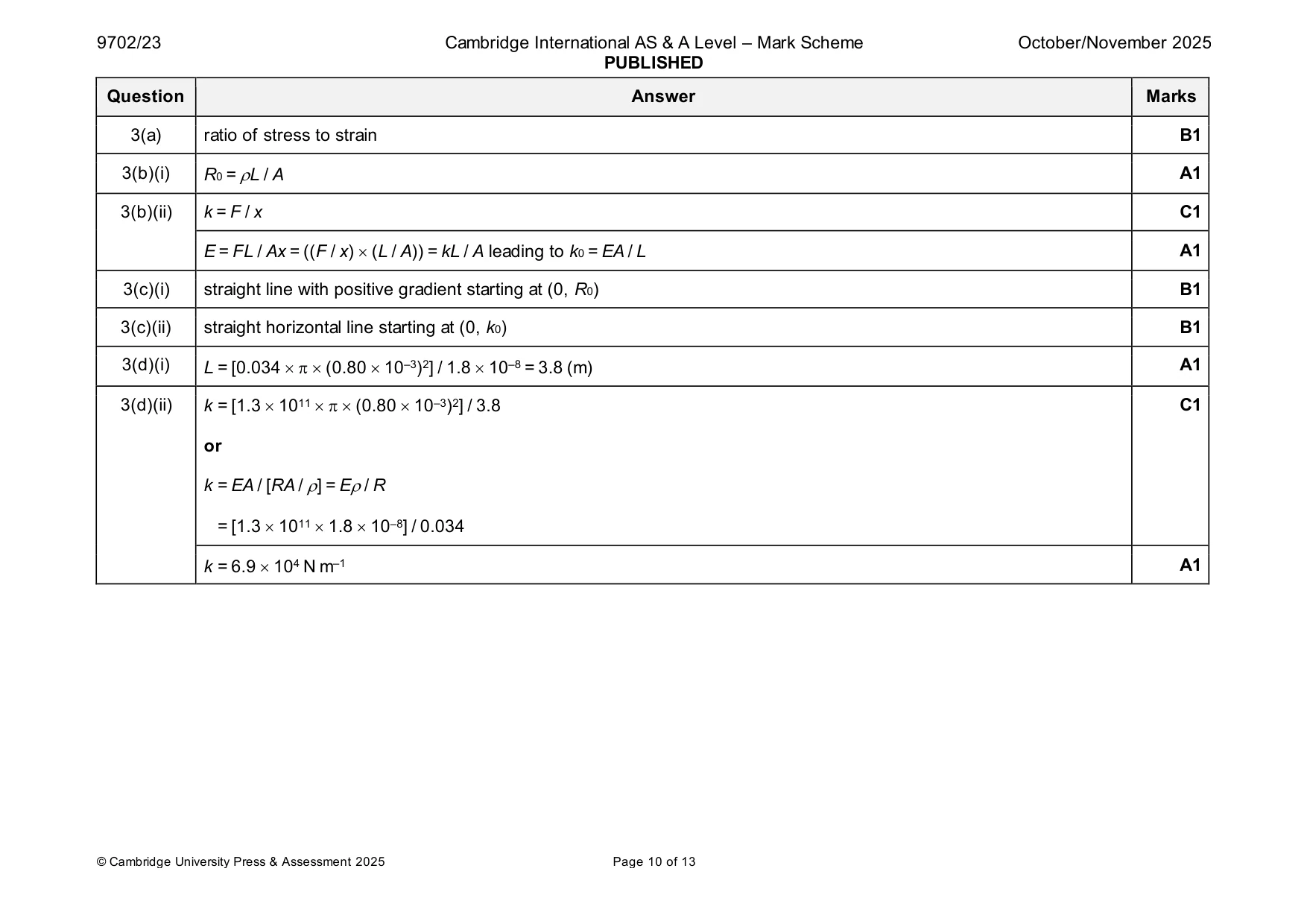
3 A wire has length L and cross-sectional area A. The wire is made from a metal that has Young modulus E and resistivity ρ. (a) Define the Young modulus of a material. ................................................................................................................................................... ............................................................................................................................................. [1] (b) (i) State an expression, in terms of some or all of L, A, E and ρ, for the resistance R0 of the wire. R0 = ......................................................... [1] (ii) Show that the spring constant k0 of the wire is given by EA k0 = L . [2] (c) The wire is stretched, within the limit of proportionality, by a tensile force F. Assume that any changes in the cross-sectional area of the wire are negligible. (i) On Fig. 3.1, sketch the variation with F of the resistance R of the wire. R R0 0 0 F Fig. 3.1 [1] (ii) On Fig. 3.2, sketch the variation with F of the spring constant k of the wire. k k0 0 0 F Fig. 3.2 [1] (d) Copper has a resistivity of 1.8 × 10⁻⁸ Ω m and a Young modulus of 1.3 × 10¹¹ Pa. A copper wire of diameter 1.6 mm has a resistance of 0.034 Ω. (i) Show that the length of the wire is 3.8 m. [1] (ii) Use the equation in (b)(ii) to determine the spring constant of the wire. spring constant = ................................................ N m–1 [2] [Total: 9]
Mark scheme: 3(a) ratio of stress to strain B1 3(b)(i) R0 = L / A A1 3(b)(ii) k = F / x C1 E = FL / Ax = ((F / x) (L / A)) = kL / A leading to k0 = EA / L A1 3(c)(i) straight line with positive gradient starting at (0, R0) B1 3(c)(ii) straight horizontal line starting at (0, k0) B1 3(d)(i) L = [0.034 (0.80 10–3)2] / 1.8 10–8 = 3.8 (m) A1 3(d)(ii) k = [1.3 1011 (0.80 10–3)2] / 3.8 C1 or k = EA / [RA / ] = E / R = [1.3 1011 1.8 10–8] / 0.034 k = 6.9 104 N m–1 A1
Q4 · State what is meant by diffraction of a wave
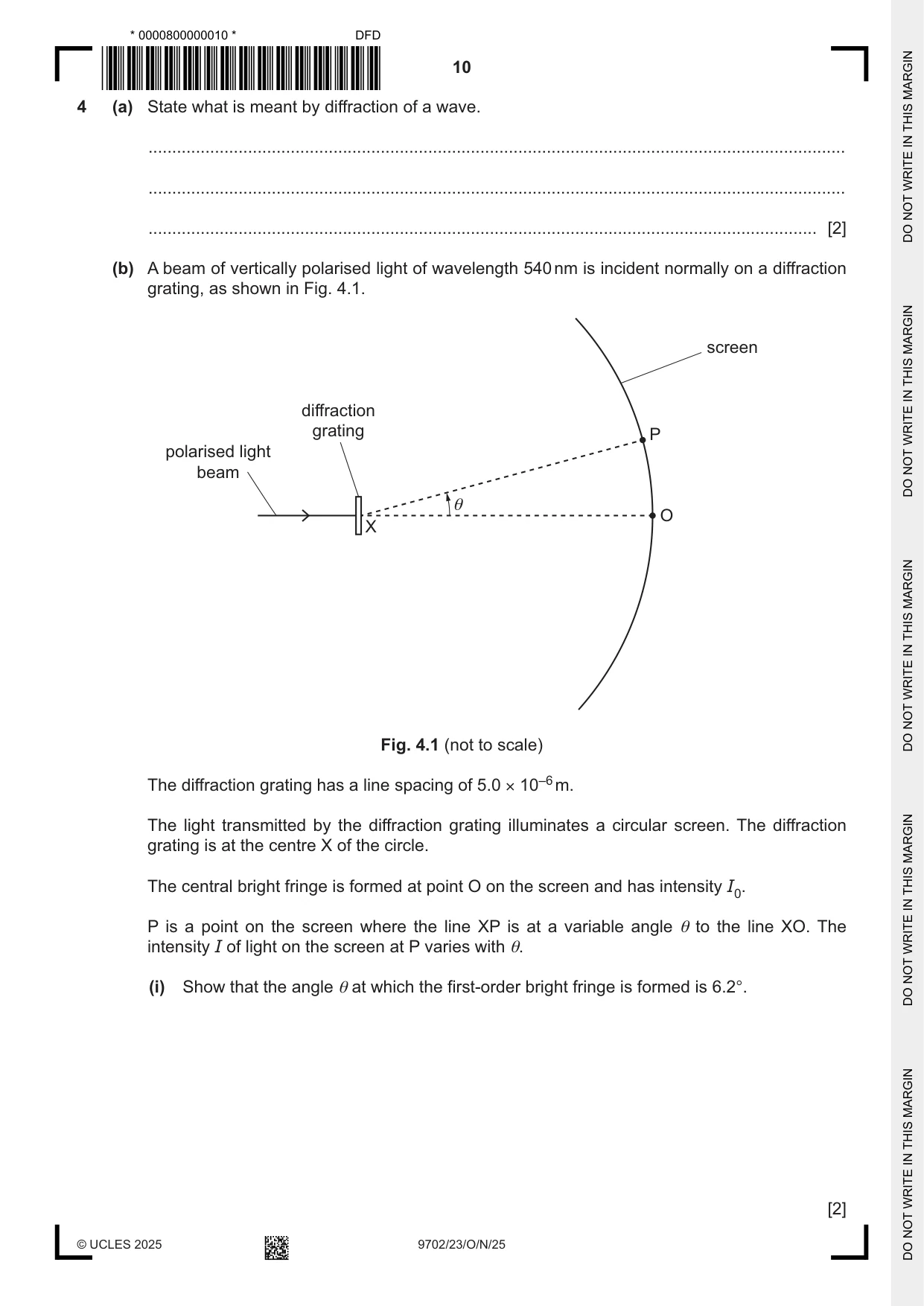
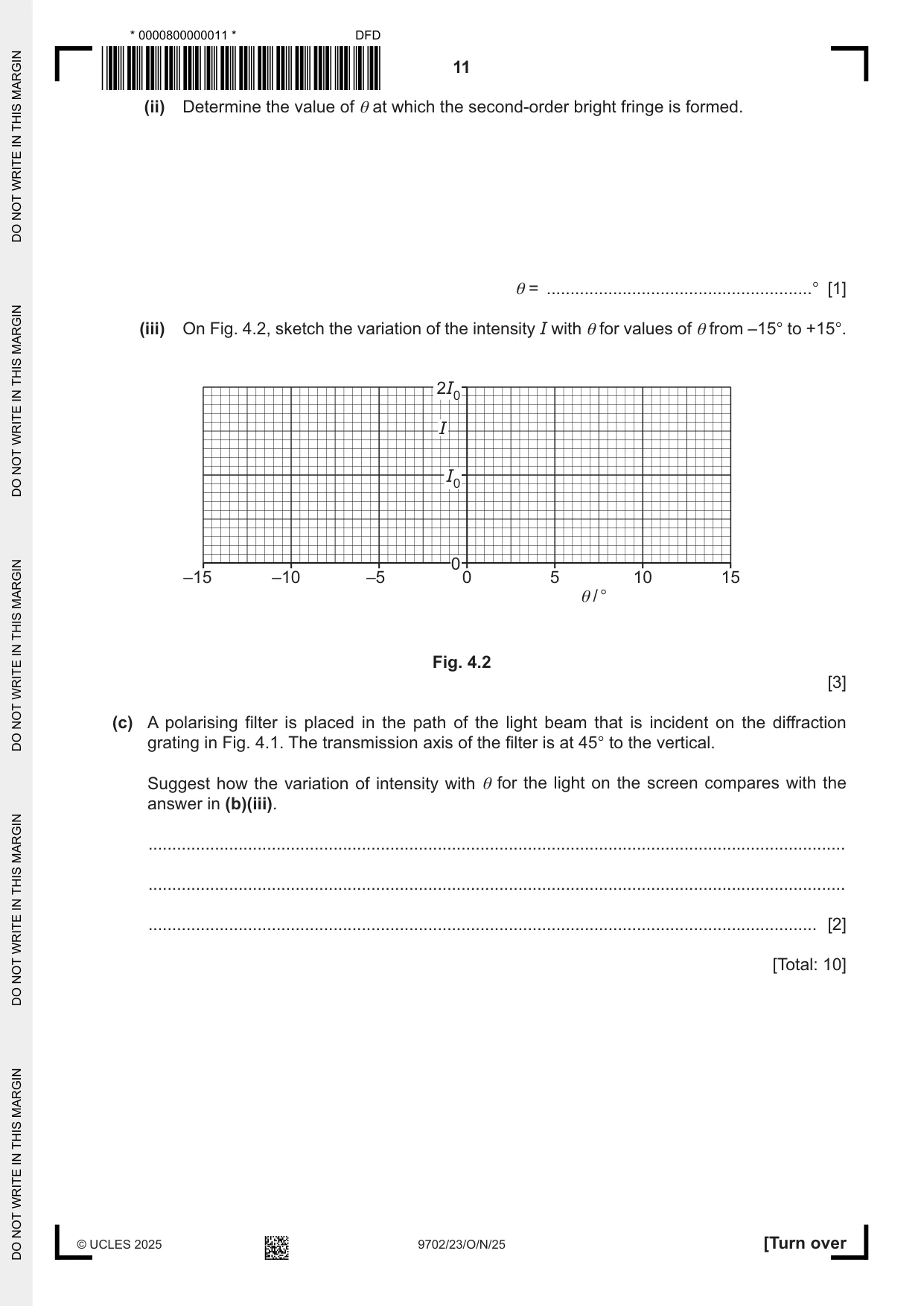
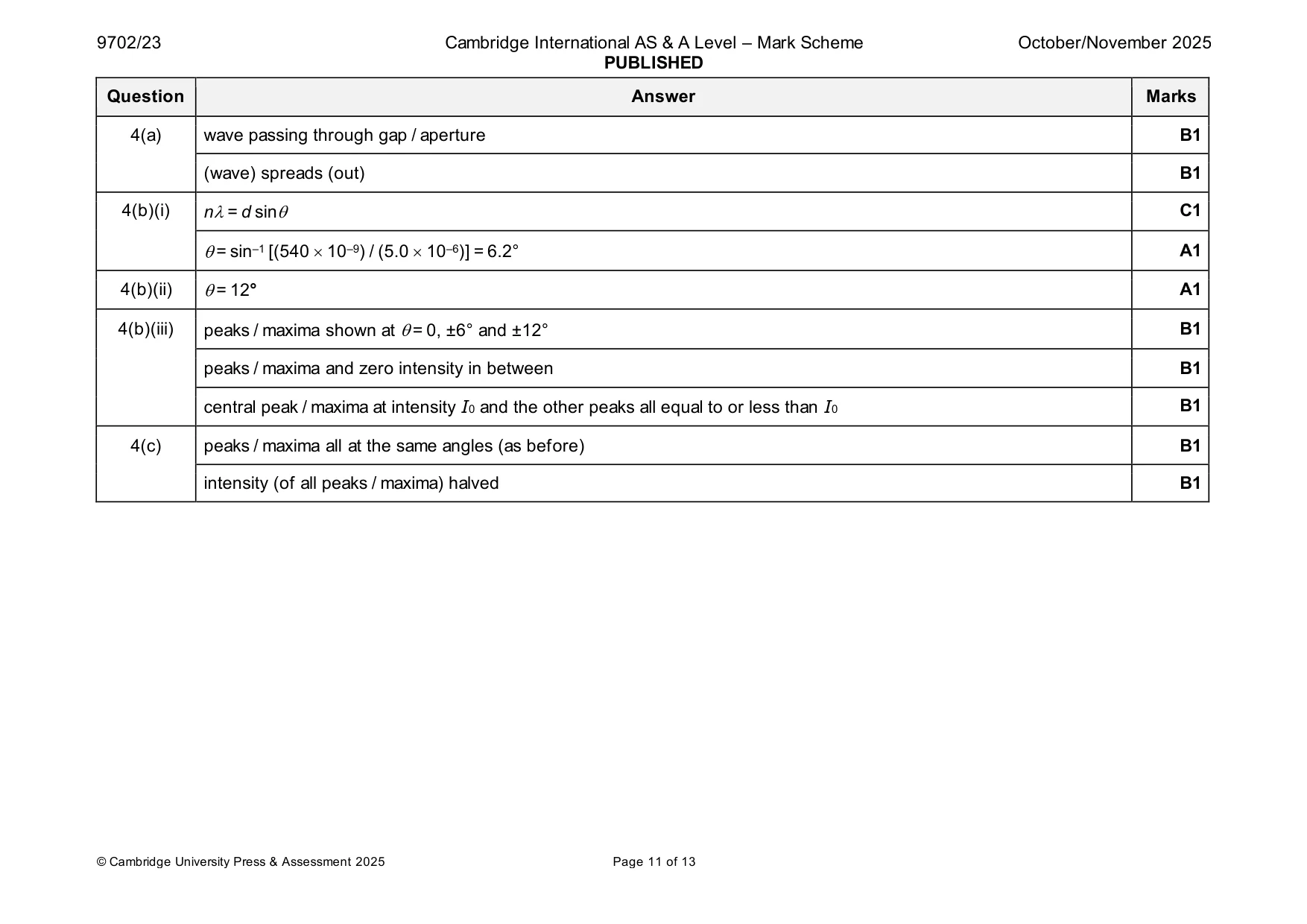
4 (a) State what is meant by diffraction of a wave. ................................................................................................................................................... ................................................................................................................................................... ............................................................................................................................................. [2] (b) A beam of vertically polarised light of wavelength 540 nm is incident normally on a diffraction grating, as shown in Fig. 4.1. screen diffraction grating P polarised light beam θ O X Fig. 4.1 (not to scale) The diffraction grating has a line spacing of 5.0 × 10⁻⁶ m. The light transmitted by the diffraction grating illuminates a circular screen. The diffraction grating is at the centre X of the circle. The central bright fringe is formed at point O on the screen and has intensity I0. P is a point on the screen where the line XP is at a variable angle θ to the line XO. The intensity I of light on the screen at P varies with θ. (i) Show that the angle θ at which the first-order bright fringe is formed is 6.2°. [2] (ii) Determine the value of θ at which the second-order bright fringe is formed. θ = ........................................................° [1] (iii) On Fig. 4.2, sketch the variation of the intensity I with θ for values of θ from –15° to +15°. 2I0 I I0 0 –15 –10 –5 0 5 10 15 θ / ° Fig. 4.2 [3] (c) A polarising filter is placed in the path of the light beam that is incident on the diffraction grating in Fig. 4.1. The transmission axis of the filter is at 45° to the vertical. Suggest how the variation of intensity with θ for the light on the screen compares with the answer in (b)(iii). ................................................................................................................................................... ................................................................................................................................................... ............................................................................................................................................. [2] [Total: 10]
Mark scheme: 4(a) wave passing through gap / aperture B1 (wave) spreads (out) B1 4(b)(i) n = d sin C1 = sin–1 [(540 10–9) / (5.0 10–6)] = 6.2° A1 4(b)(ii) = 12° A1 4(b)(iii) peaks / maxima shown at = 0, ±6° and ±12° B1 peaks / maxima and zero intensity in between B1 central peak / maxima at intensity I0 and the other peaks all equal to or less than I0 B1 4(c) peaks / maxima all at the same angles (as before) B1 intensity (of all peaks / maxima) halved B1
Q5 · State Kirchhoff’s first law
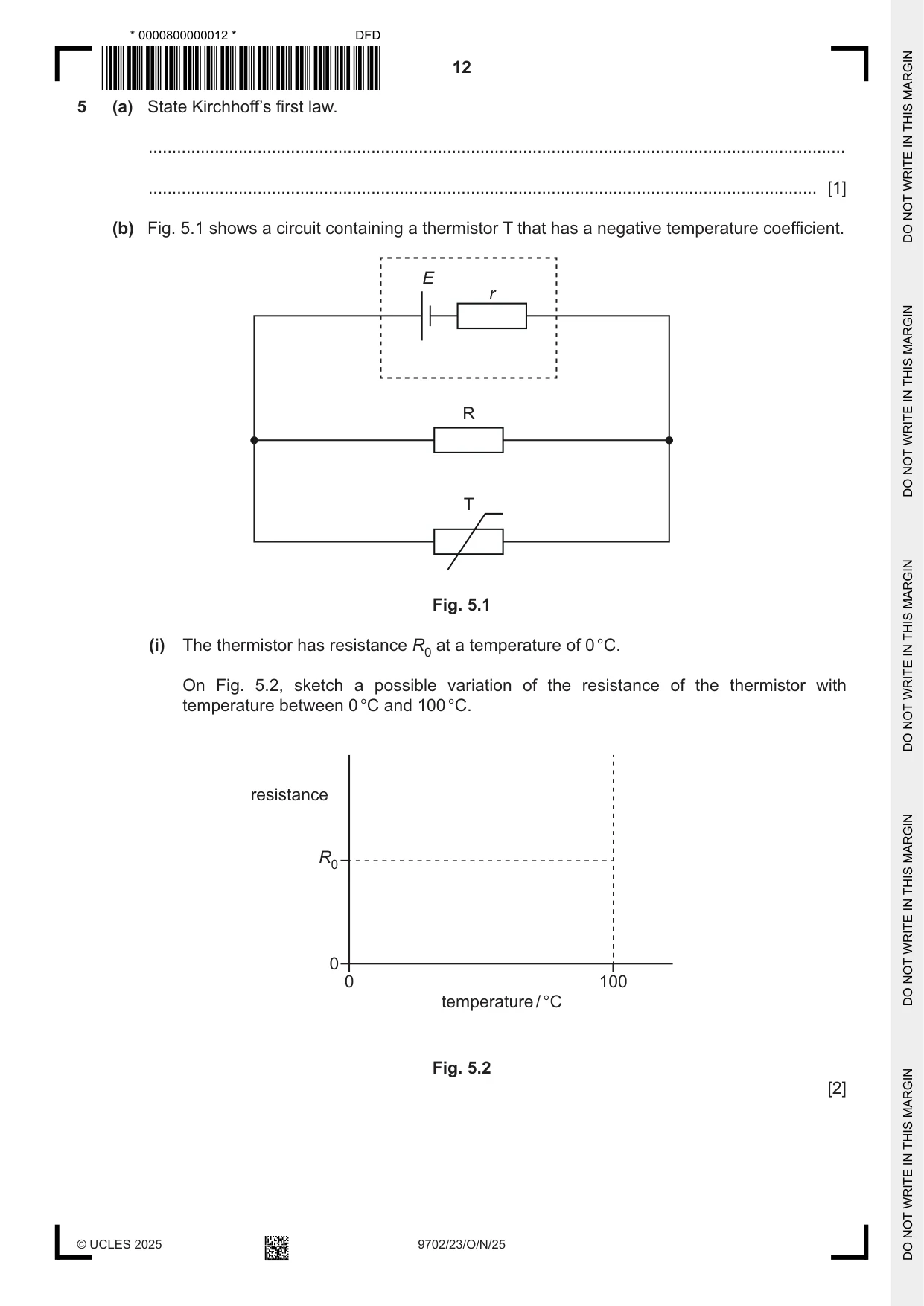
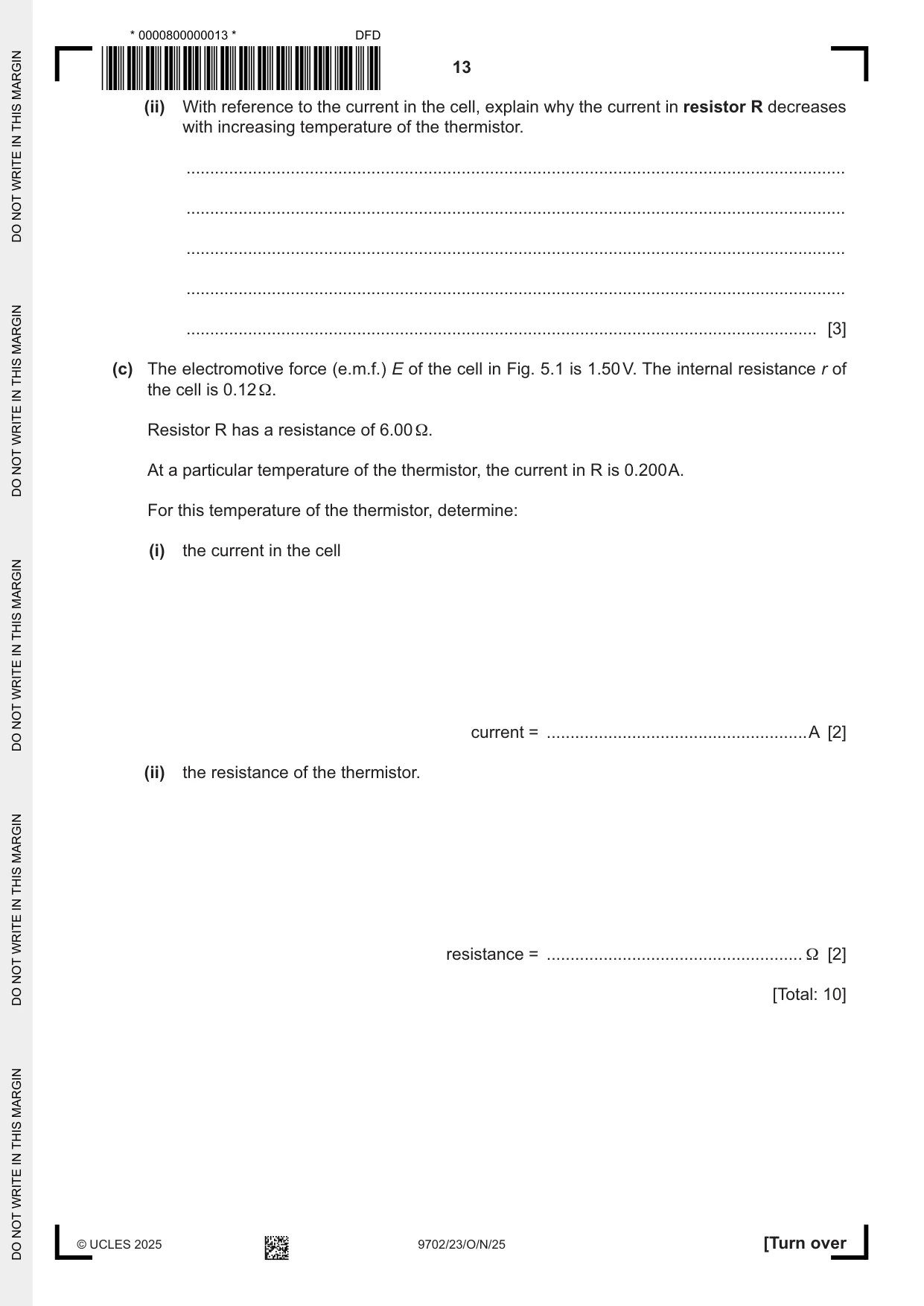
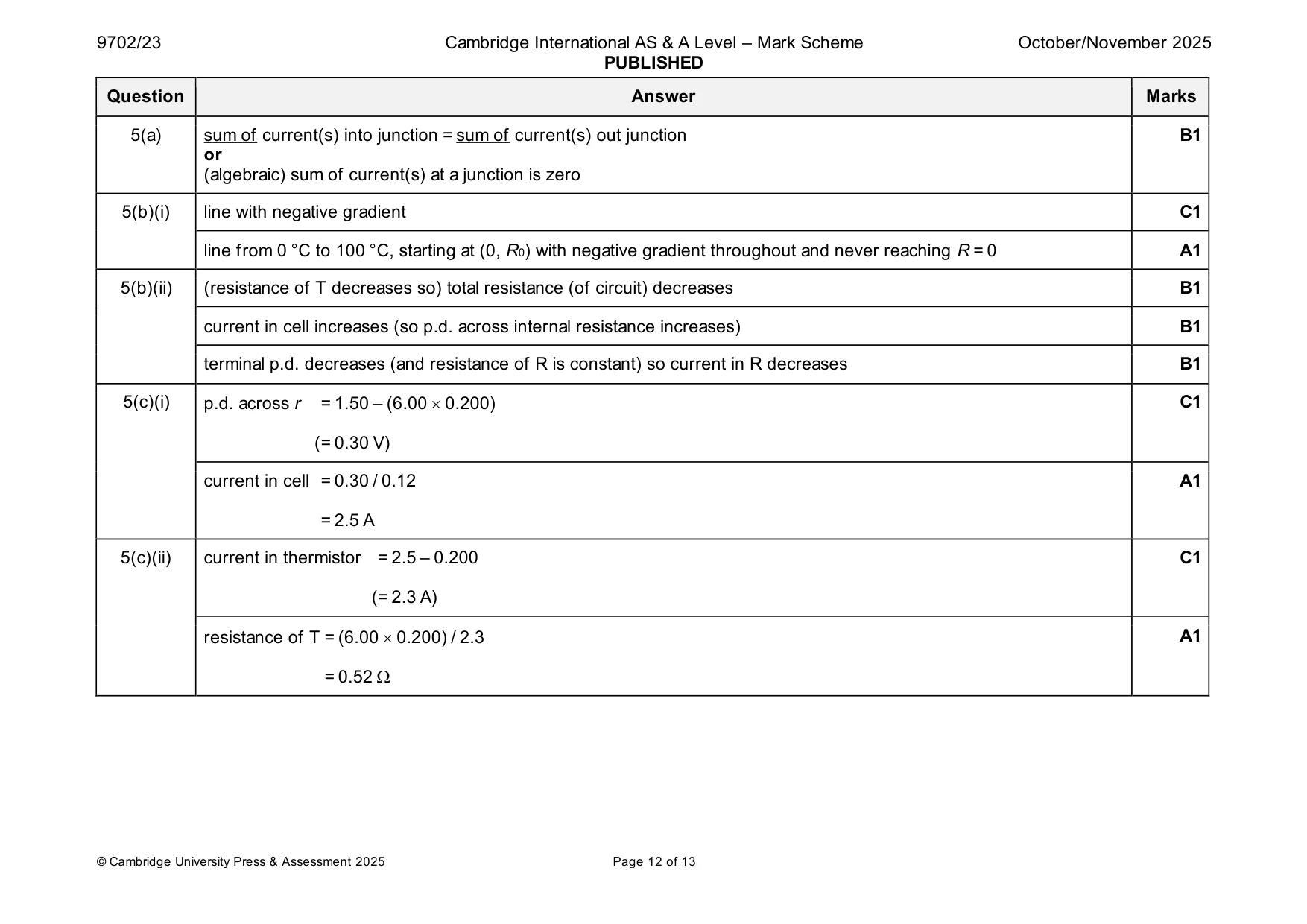
5 (a) State Kirchhoff’s first law. ................................................................................................................................................... ............................................................................................................................................. [1] (b) Fig. 5.1 shows a circuit containing a thermistor T that has a negative temperature coefficient. E r R T Fig. 5.1 (i) The thermistor has resistance R0 at a temperature of 0 °C. On Fig. 5.2, sketch a possible variation of the resistance of the thermistor with temperature between 0 °C and 100 °C. resistance R0 0 0 100 temperature / °C Fig. 5.2 [2] (ii) With reference to the current in the cell, explain why the current in resistor R decreases with increasing temperature of the thermistor. ........................................................................................................................................... ........................................................................................................................................... ........................................................................................................................................... ........................................................................................................................................... ..................................................................................................................................... [3] (c) The electromotive force (e.m.f.) E of the cell in Fig. 5.1 is 1.50 V. The internal resistance r of the cell is 0.12 Ω. Resistor R has a resistance of 6.00 Ω. At a particular temperature of the thermistor, the current in R is 0.200 A. For this temperature of the thermistor, determine: (i) the current in the cell current = ....................................................... A [2] (ii) the resistance of the thermistor. resistance = ...................................................... Ω [2] [Total: 10]
Mark scheme: 5(a) sum of current(s) into junction = sum of current(s) out junction B1 or (algebraic) sum of current(s) at a junction is zero 5(b)(i) line with negative gradient C1 line from 0 °C to 100 °C, starting at (0, R0) with negative gradient throughout and never reaching R = 0 A1 5(b)(ii) (resistance of T decreases so) total resistance (of circuit) decreases B1 current in cell increases (so p.d. across internal resistance increases) B1 terminal p.d. decreases (and resistance of R is constant) so current in R decreases B1 5(c)(i) p.d. across r = 1.50 – (6.00 0.200) C1 (= 0.30 V) current in cell = 0.30 / 0.12 A1 = 2.5 A 5(c)(ii) current in thermistor = 2.5 – 0.200 C1 (= 2.3 A) resistance of T = (6.00 0.200) / 2.3 A1 = 0.52
Q6 · The nuclide 1H is an isotope of hydrogen that is called tritium
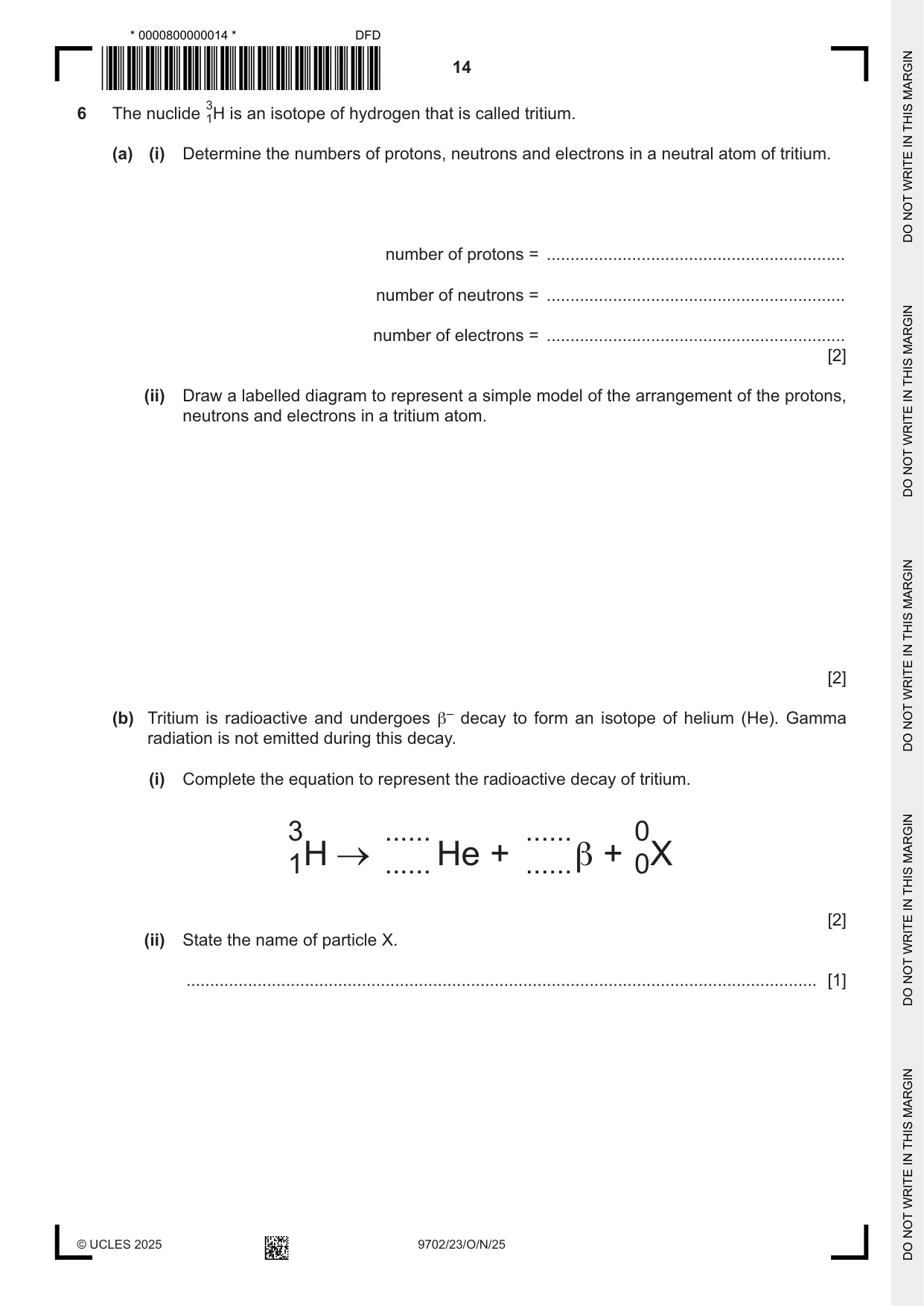
6 The nuclide 1H is an isotope of hydrogen that is called tritium. (a) (i) Determine the numbers of protons, neutrons and electrons in a neutral atom of tritium. number of protons = ............................................................... number of neutrons = ............................................................... number of electrons = ............................................................... [2] (ii) Draw a labelled diagram to represent a simple model of the arrangement of the protons, neutrons and electrons in a tritium atom. [2] (b) Tritium is radioactive and undergoes β– decay to form an isotope of helium (He). Gamma radiation is not emitted during this decay. (i) Complete the equation to represent the radioactive decay of tritium. 3 ...... ...... 0 1H ...... He + ...... β + 0X [2] (ii) State the name of particle X. ..................................................................................................................................... [1] (c) Determine the quark composition of a tritium nucleus. ................................................................................................................................................... ............................................................................................................................................. [2] [Total: 9]
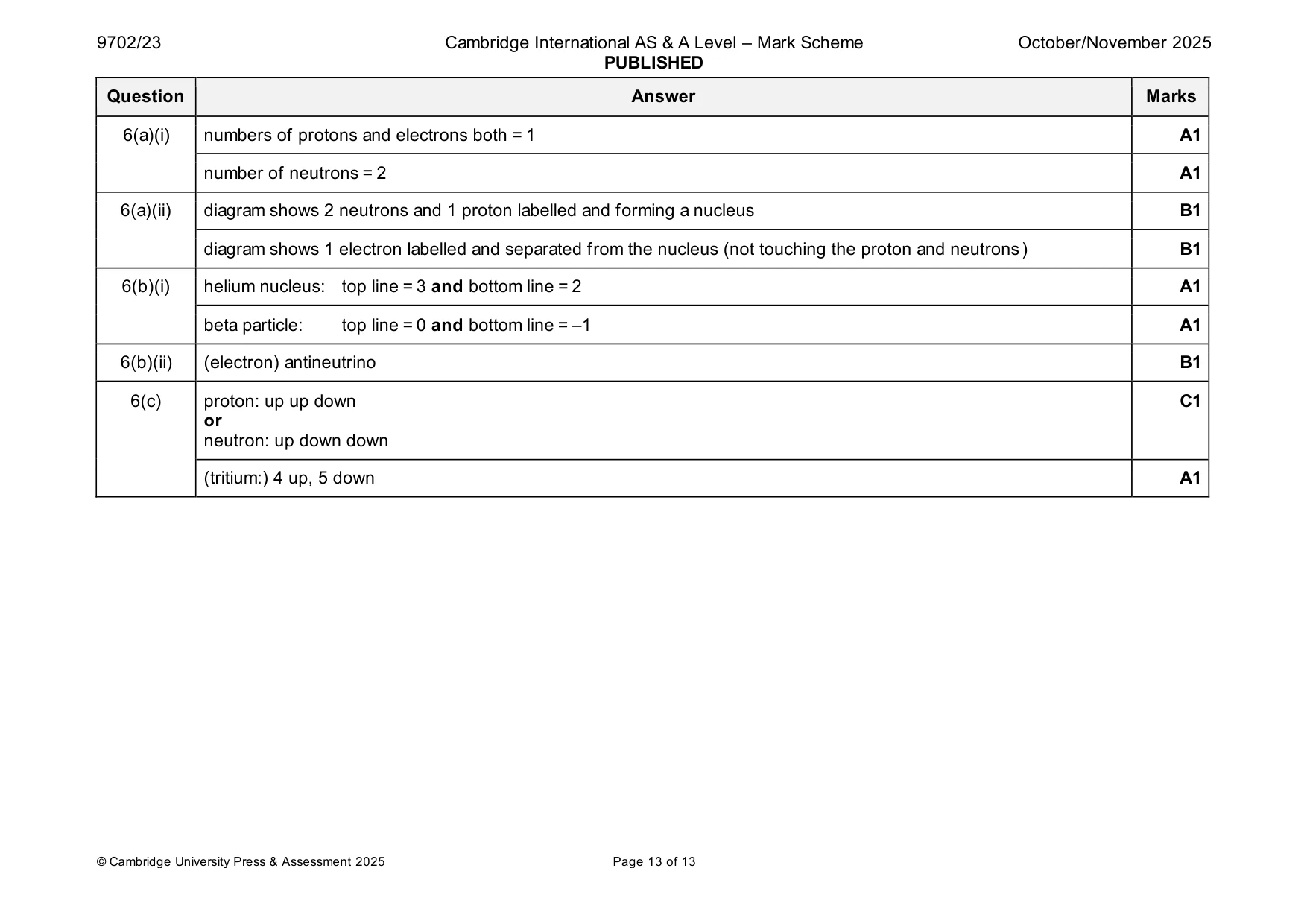
Mark scheme: 6(a)(i) numbers of protons and electrons both = 1 A1 number of neutrons = 2 A1 6(a)(ii) diagram shows 2 neutrons and 1 proton labelled and forming a nucleus B1 diagram shows 1 electron labelled and separated from the nucleus (not touching the proton and neutrons) B1 6(b)(i) helium nucleus: top line = 3 and bottom line = 2 A1 beta particle: top line = 0 and bottom line = –1 A1 6(b)(ii) (electron) antineutrino B1 6(c) proton: up up down C1 or neutron: up down down (tritium:) 4 up, 5 down A1
What was in this paper
The subtopics covered by these 6 questions, and how many questions each got. Open one in a new tab to see every Cambridge question on it.
What you needed in this session
Cambridge’s own grade thresholds for 2025 Oct/Nov, Paper 2 · Variant 3. A higher threshold means an easier paper — the bar moves with how the cohort did.