Cambridge A Level Physics 9702 — 2023 May/June Paper 2 · Variant 1
9702/21/M/J/23 · 8 questions · 60 marks · ≈68 min
The question paper and its mark scheme, free to read here and free to download. This is Cambridge’s own paper, exactly as it was sat.
Question paper20 pages
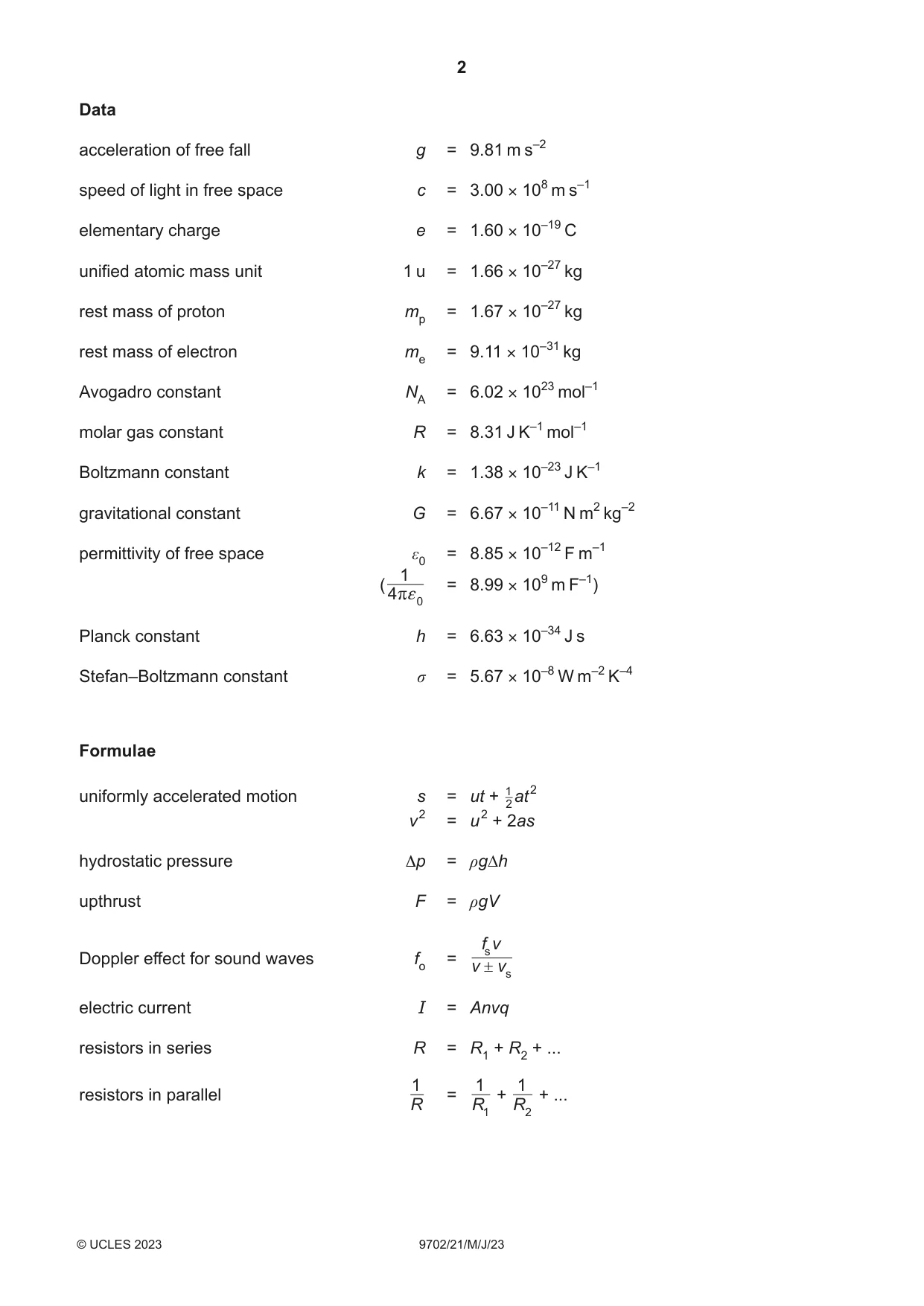
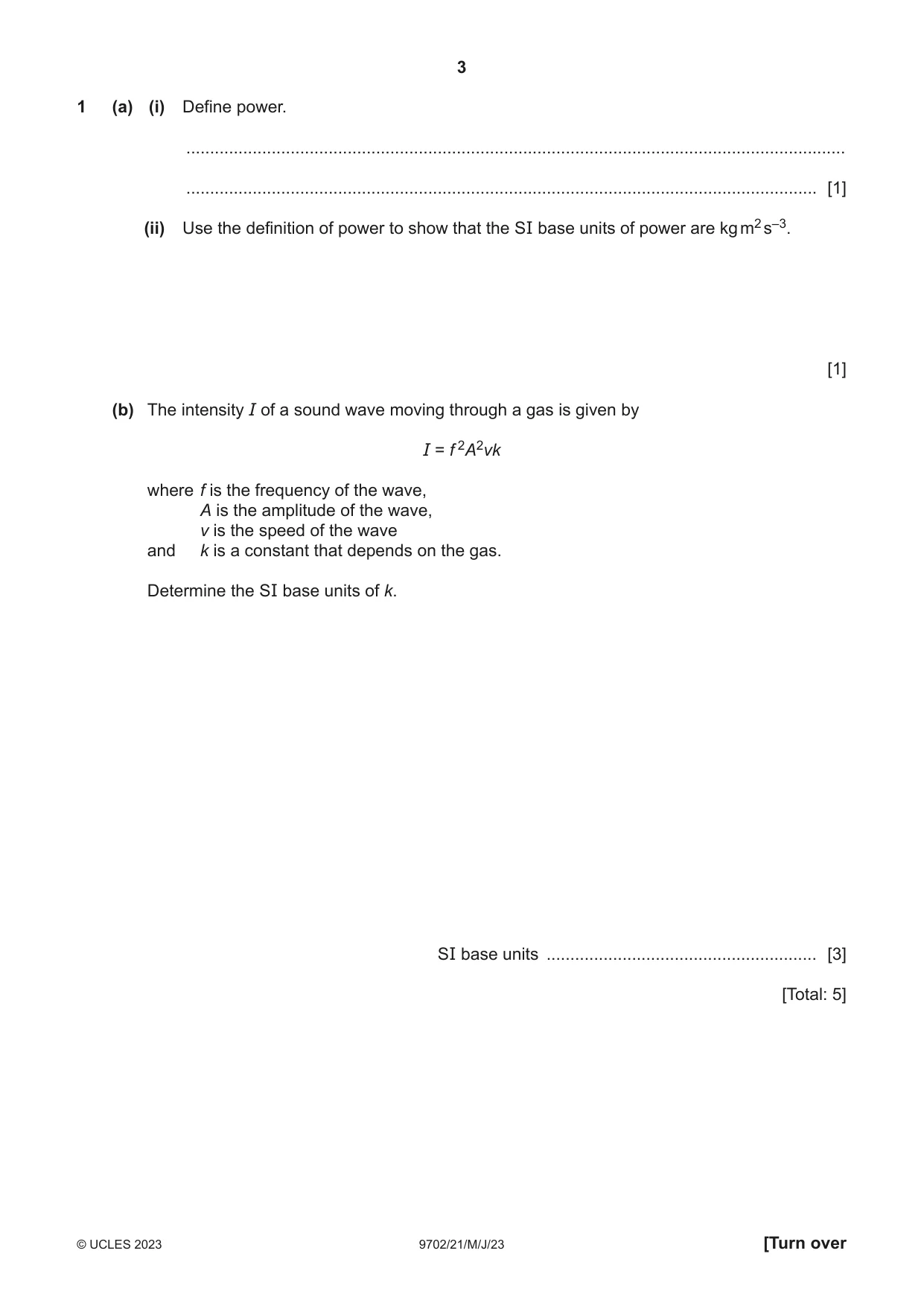
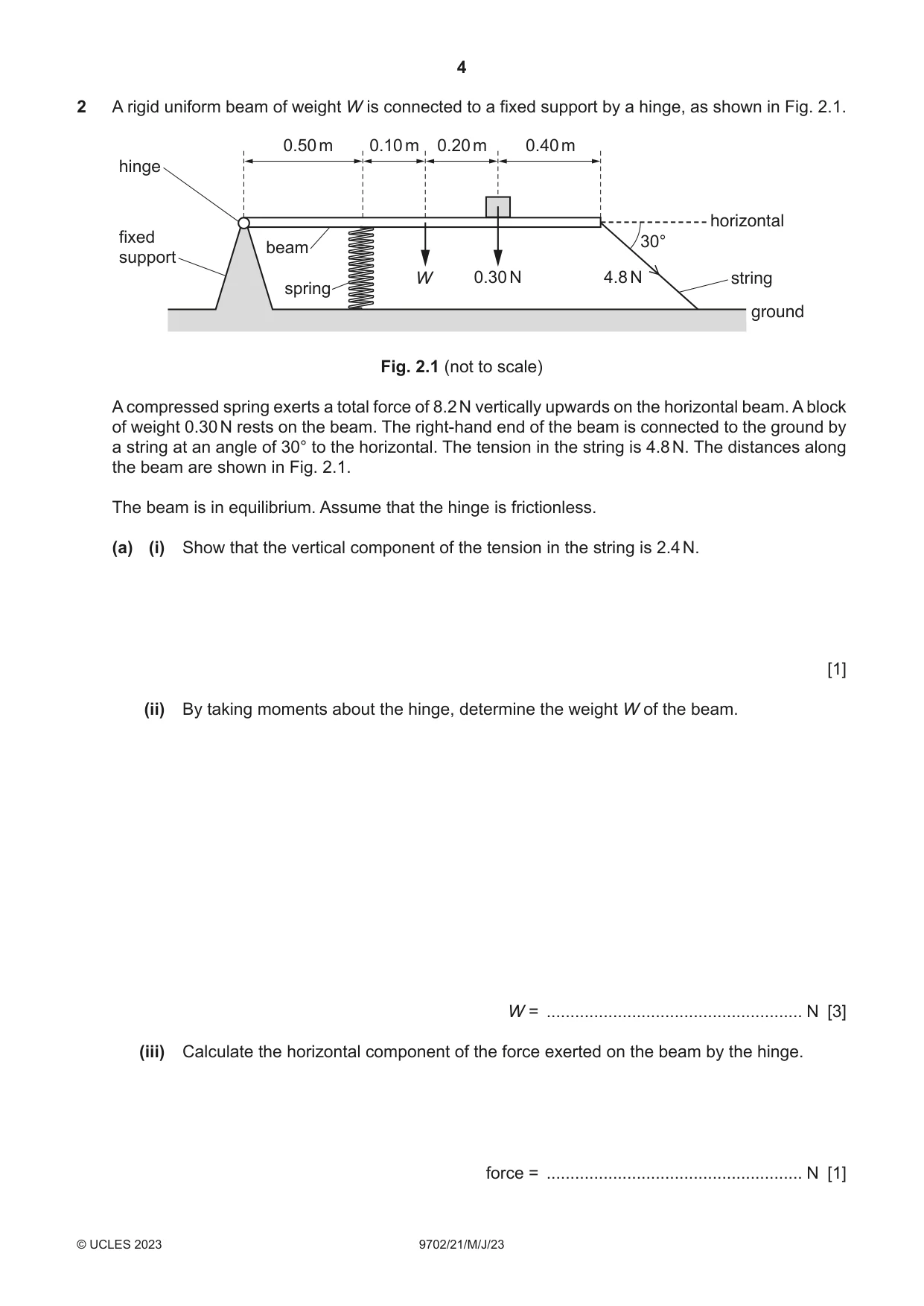
Mark scheme14 pages
Answers below. Sit the paper first if you are practising.
Questions as text
Question 1
1 (a) (i) Define power. ........................................................................................................................................... ..................................................................................................................................... [1] (ii) Use the definition of power to show that the SI base units of power are kg m2 s–3. [1] (b) The intensity I of a sound wave moving through a gas is given by I = f 2A2vk where f is the frequency of the wave, A is the amplitude of the wave, v is the speed of the wave and k is a constant that depends on the gas. Determine the SI base units of k. SI base units ......................................................... [3] [Total: 5]
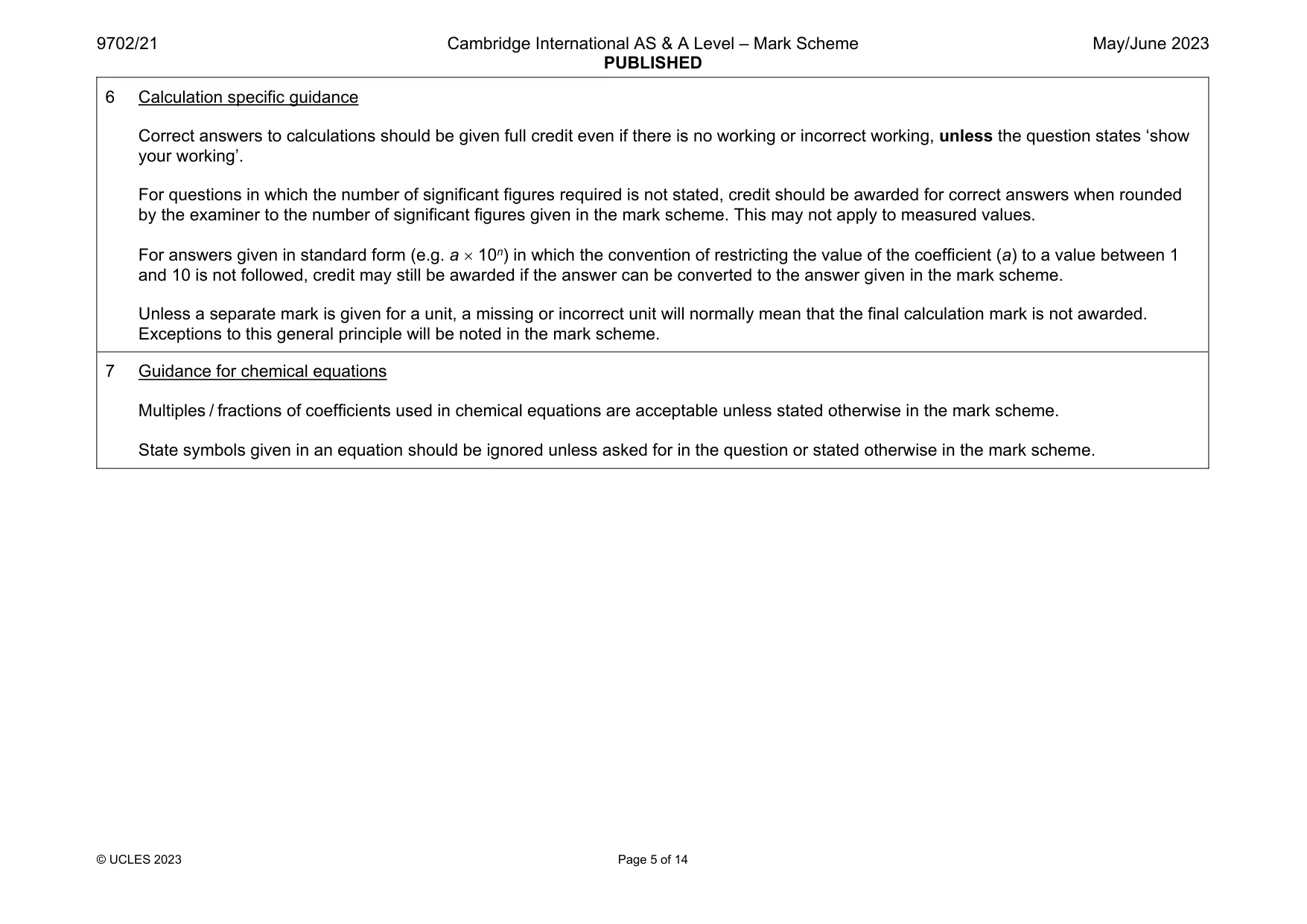
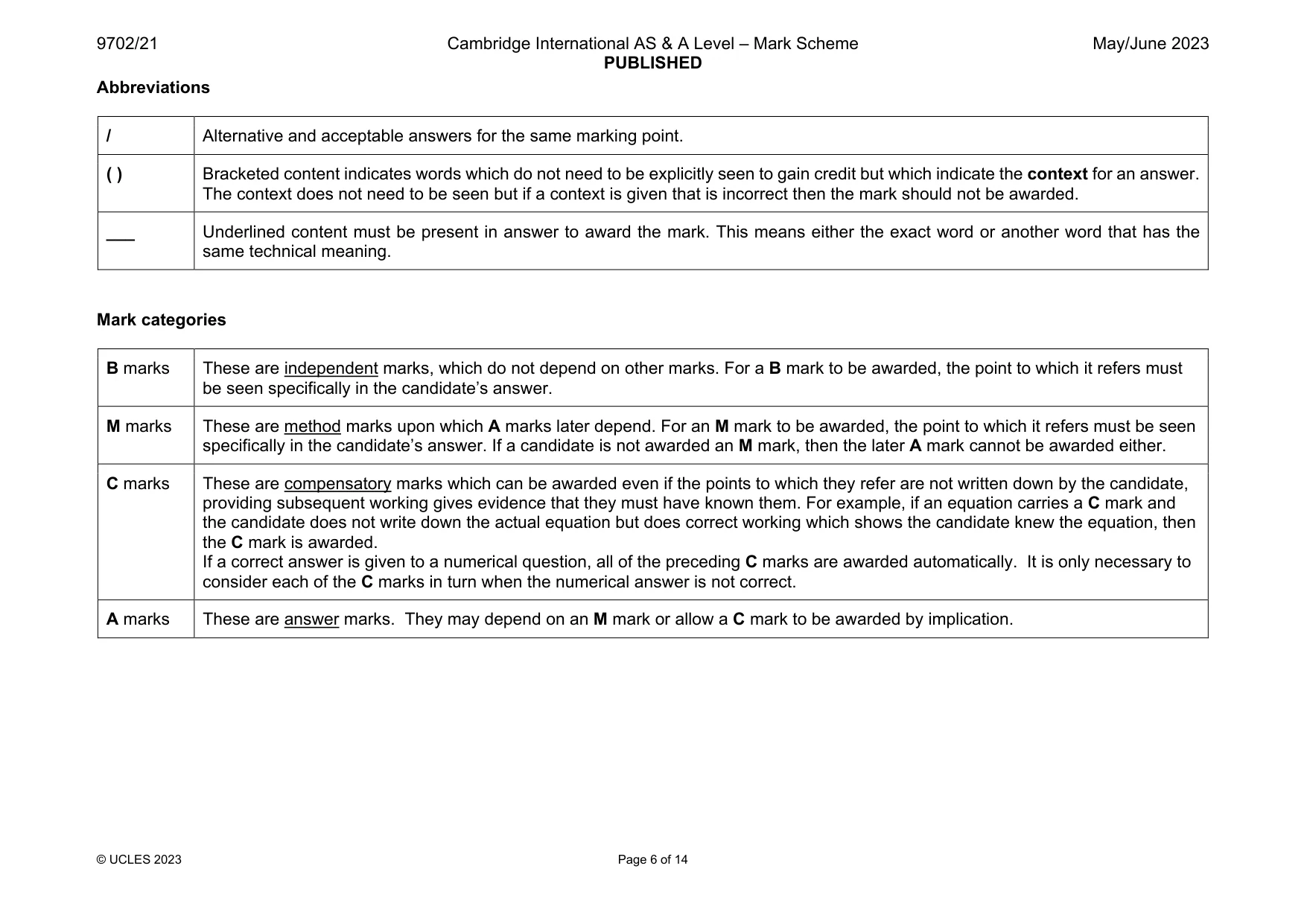
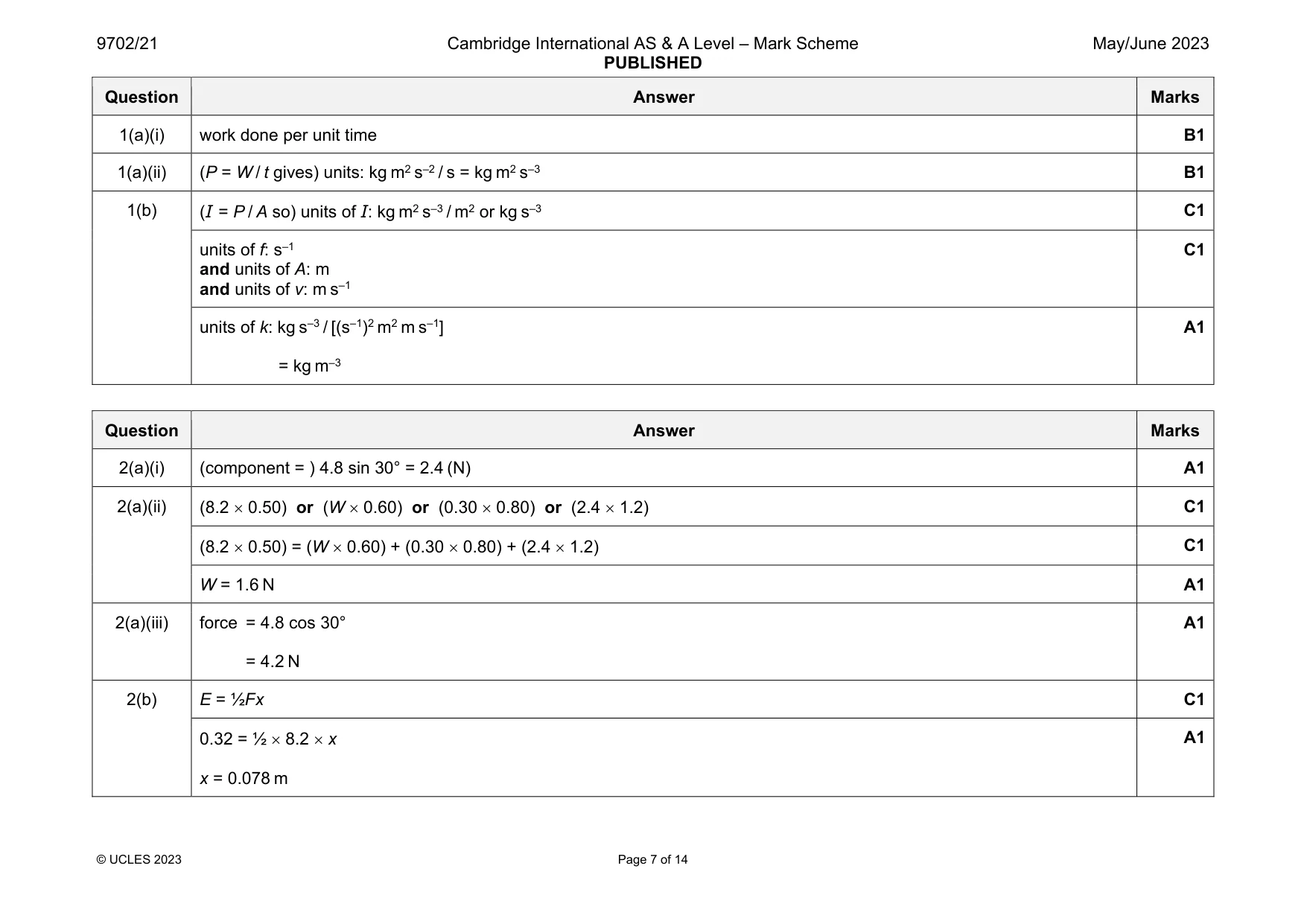
Mark scheme: 1(a)(i) work done per unit time B1 1(a)(ii) (P = W / t gives) units: kg m2 s–2 / s = kg m2 s–3 B1 1(b) (I = P / A so) units of I: kg m2 s–3 / m2 or kg s–3 C1 units of f: s–1 and units of A: m and units of v: m s–1 C1 units of k: kg s–3 / [(s–1)2 m2 m s–1] = kg m–3 A1
Q2 · A rigid uniform beam of weight W is connected to a fixed support by a hinge, as shown in…
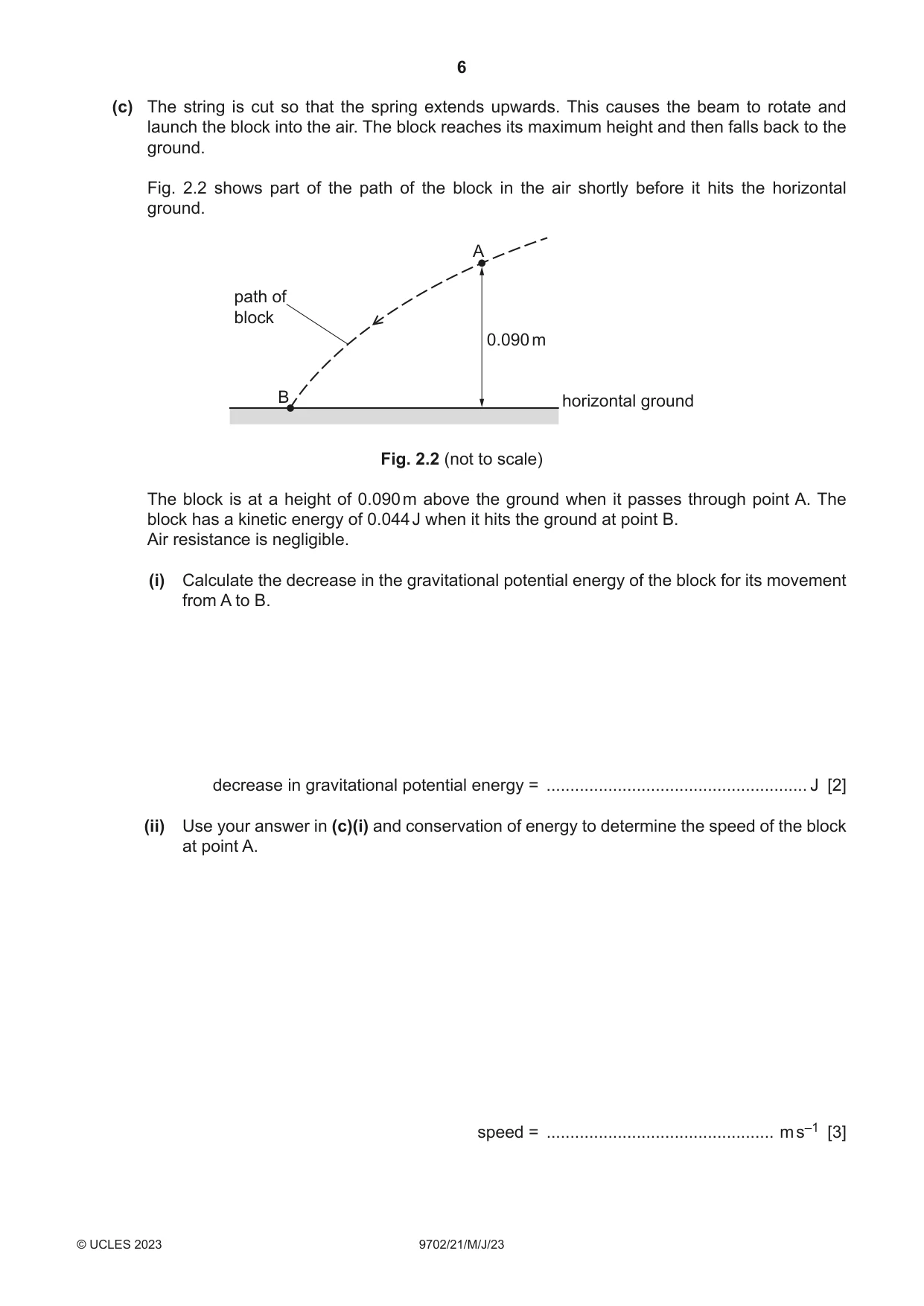
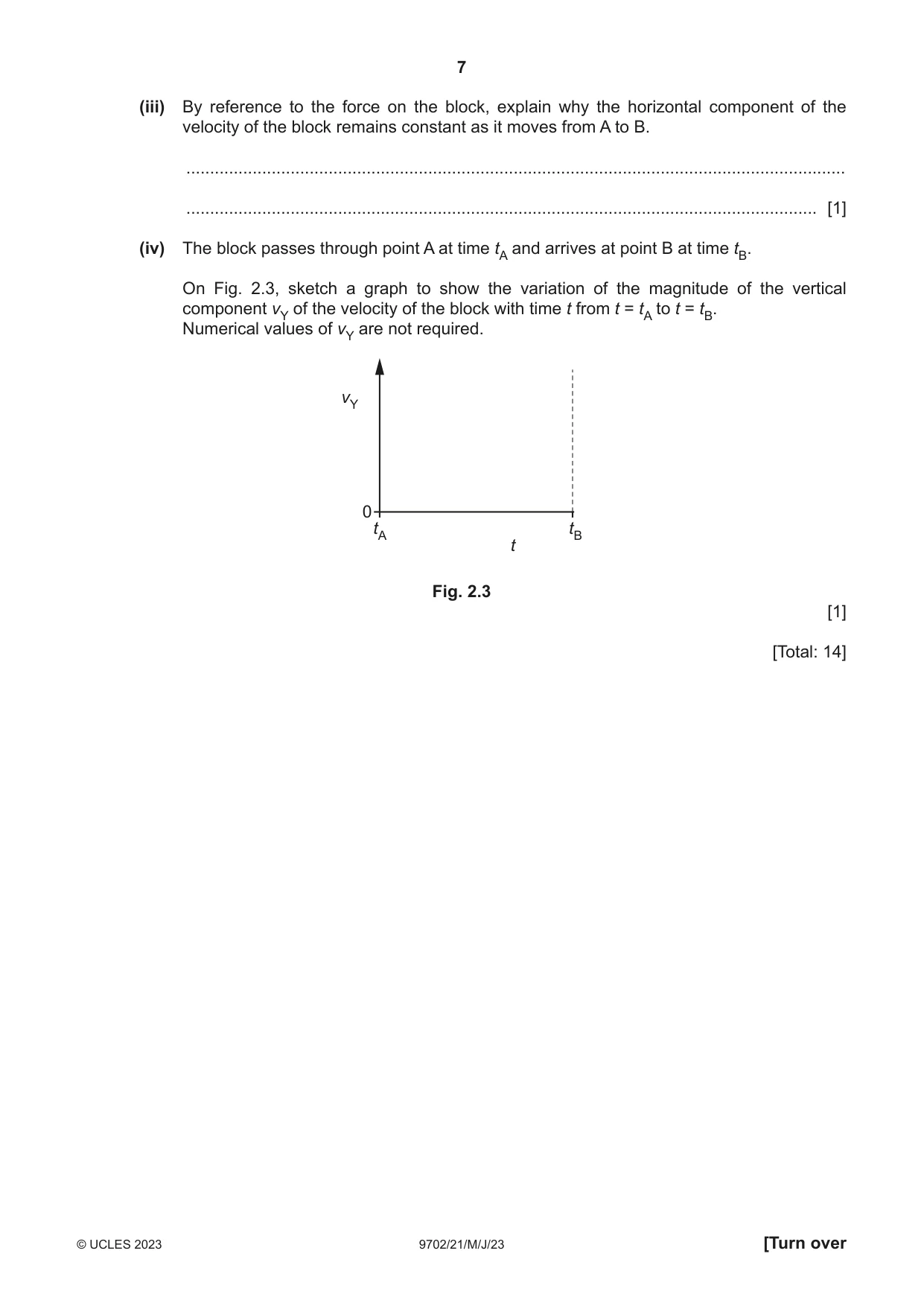
2 A rigid uniform beam of weight W is connected to a fixed support by a hinge, as shown in Fig. 2.1. 0.50 m 0.10 m 0.20 m 0.40 m hinge horizontal fixed 30° beam support W 0.30 N 4.8 N string spring ground Fig. 2.1 (not to scale) A compressed spring exerts a total force of 8.2 N vertically upwards on the horizontal beam. A block of weight 0.30 N rests on the beam. The right‑hand end of the beam is connected to the ground by a string at an angle of 30° to the horizontal. The tension in the string is 4.8 N. The distances along the beam are shown in Fig. 2.1. The beam is in equilibrium. Assume that the hinge is frictionless. (a) (i) Show that the vertical component of the tension in the string is 2.4 N. [1] (ii) By taking moments about the hinge, determine the weight W of the beam. W = ...................................................... N [3] (iii) Calculate the horizontal component of the force exerted on the beam by the hinge. force = ...................................................... N [1] (b) The spring obeys Hooke’s law and has an elastic potential energy of 0.32 J. Calculate the compression of the spring. compression = ...................................................... m [2] (c) The string is cut so that the spring extends upwards. This causes the beam to rotate and launch the block into the air. The block reaches its maximum height and then falls back to the ground. Fig. 2.2 shows part of the path of the block in the air shortly before it hits the horizontal ground. A path of block 0.090 m B horizontal ground Fig. 2.2 (not to scale) The block is at a height of 0.090 m above the ground when it passes through point A. The block has a kinetic energy of 0.044 J when it hits the ground at point B. Air resistance is negligible. (i) Calculate the decrease in the gravitational potential energy of the block for its movement from A to B. decrease in gravitational potential energy = ....................................................... J [2] (ii) Use your answer in (c)(i) and conservation of energy to determine the speed of the block at point A. speed = ................................................ m s–1 [3] (iii) By reference to the force on the block, explain why the horizontal component of the velocity of the block remains constant as it moves from A to B. ........................................................................................................................................... ..................................................................................................................................... [1] (iv) The block passes through point A at time tA and arrives at point B at time tB. On Fig. 2.3, sketch a graph to show the variation of the magnitude of the vertical component vY of the velocity of the block with time t from t = tA to t = tB. Numerical values of vY are not required. vY 0 tA tB t Fig. 2.3 [1] [Total: 14]
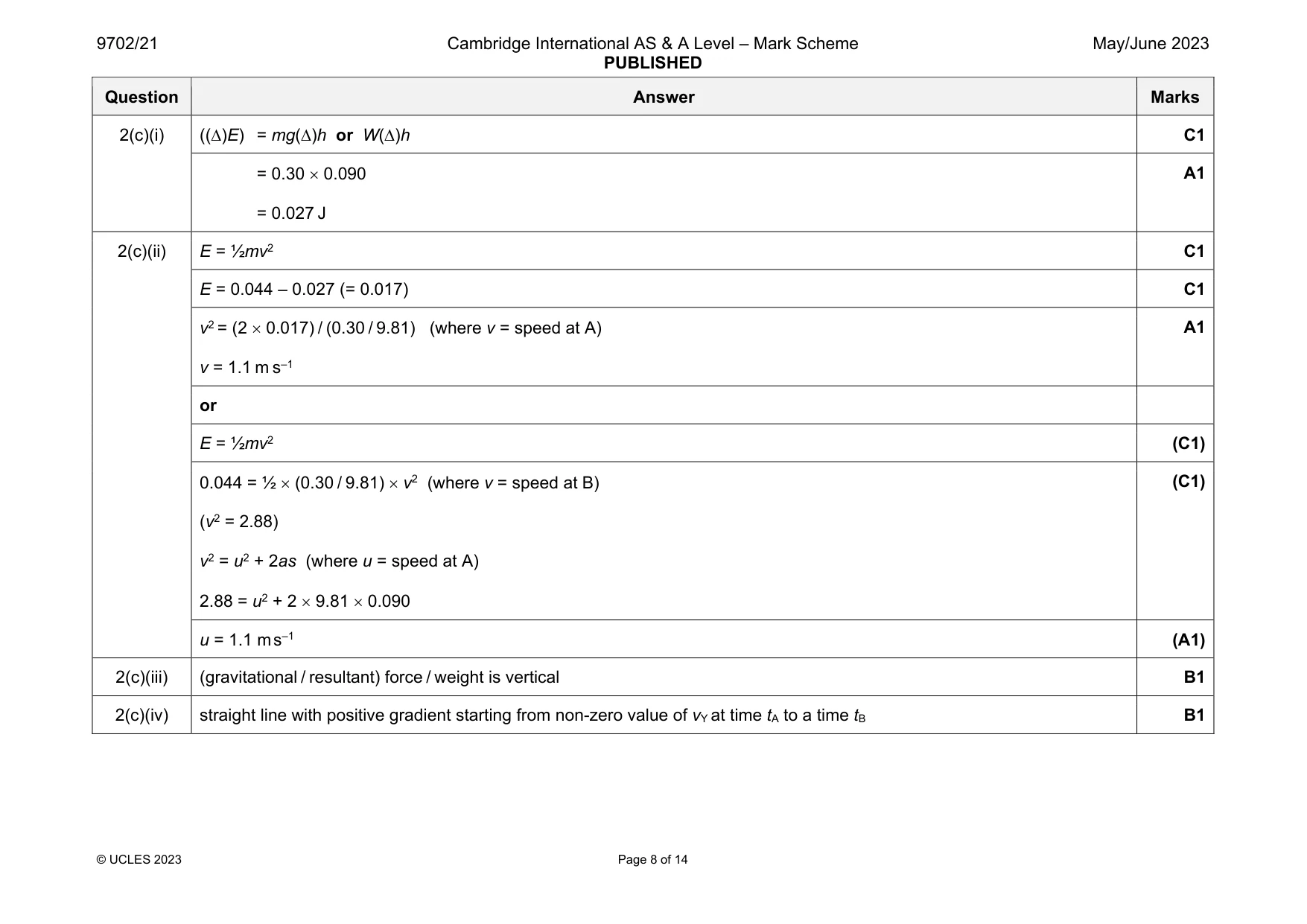
Mark scheme: 2(a)(i) (component = ) 4.8 sin 30° = 2.4 (N) A1 2(a)(ii) (8.2 0.50) or (W 0.60) or (0.30 0.80) or (2.4 1.2) C1 (8.2 0.50) = (W 0.60) + (0.30 0.80) + (2.4 1.2) C1 W = 1.6 N A1 2(a)(iii) force = 4.8 cos 30° = 4.2 N A1 2(b) E = ½Fx C1 0.32 = ½ 8.2 x x = 0.078 m A1 Question Answer Marks 2(c)(i) ((∆)E) = mg(∆)h or W(∆)h C1 = 0.30 0.090 = 0.027 J A1 2(c)(ii) E = ½mv2 C1 E = 0.044 – 0.027 (= 0.017) C1 v2 = (2 0.017) / (0.30 / 9.81) (where v = speed at A) v = 1.1 m s–1 A1 or E = ½mv2 (C1) 0.044 = ½ (0.30 / 9.81) v2 (where v = speed at B) (v2 = 2.88) v2 = u2 + 2as (where u = speed at A) 2.88 = u2 + 2 9.81 0.090 (C1) u = 1.1 m s–1 (A1) 2(c)(iii) (gravitational / resultant) force / weight is vertical B1 2(c)(iv) straight line with positive gradient starting from non-zero value of vY at time tA to a time tB B1
Q3 · A block is pulled in a straight line along a rough horizontal surface by a varying force…
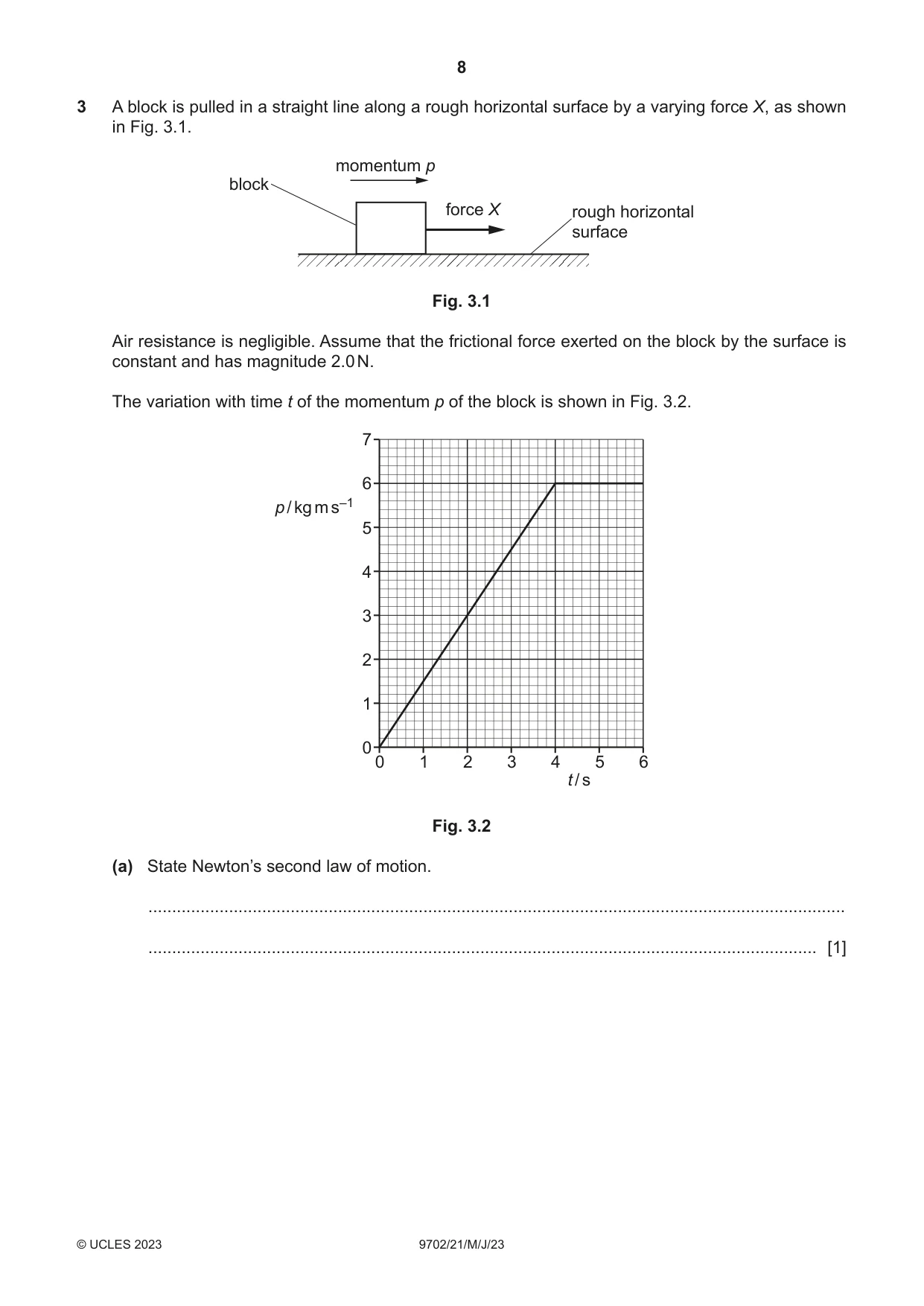
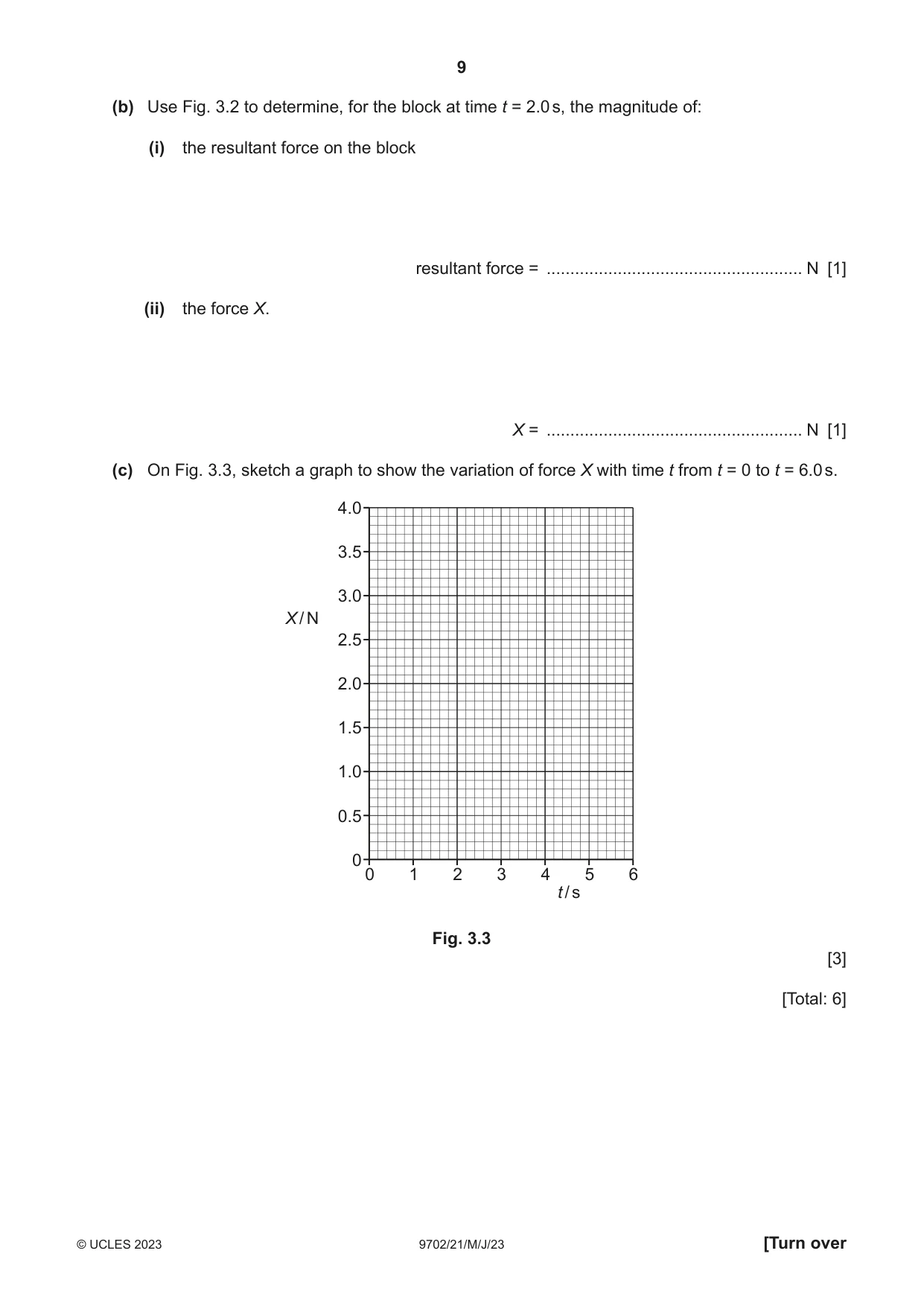
3 A block is pulled in a straight line along a rough horizontal surface by a varying force X, as shown in Fig. 3.1. momentum p block force X rough horizontal surface Fig. 3.1 Air resistance is negligible. Assume that the frictional force exerted on the block by the surface is constant and has magnitude 2.0 N. The variation with time t of the momentum p of the block is shown in Fig. 3.2. 7 6 p / kg m s–1 5 4 3 2 1 0 0 1 2 3 4 5 6 t / s Fig. 3.2 (a) State Newton’s second law of motion. ................................................................................................................................................... ............................................................................................................................................. [1] (b) Use Fig. 3.2 to determine, for the block at time t = 2.0 s, the magnitude of: (i) the resultant force on the block resultant force = ...................................................... N [1] (ii) the force X. X = ...................................................... N [1] (c) On Fig. 3.3, sketch a graph to show the variation of force X with time t from t = 0 to t = 6.0 s. 4.0 3.5 3.0 X / N 2.5 2.0 1.5 1.0 0.5 0 0 1 2 3 4 5 6 t / s Fig. 3.3 [3] [Total: 6]
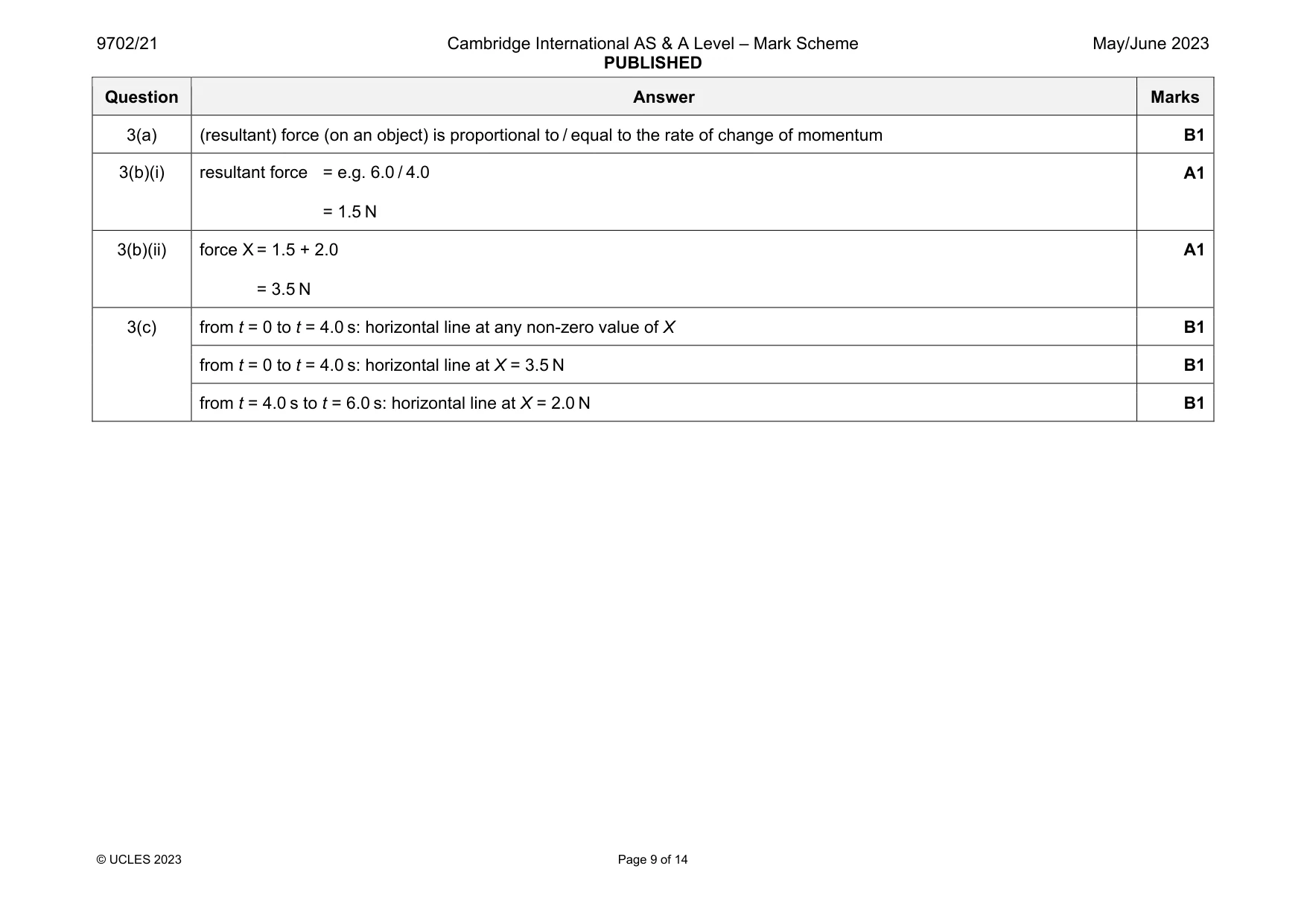
Mark scheme: 3(a) (resultant) force (on an object) is proportional to / equal to the rate of change of momentum B1 3(b)(i) resultant force = e.g. 6.0 / 4.0 = 1.5 N A1 3(b)(ii) force X = 1.5 + 2.0 = 3.5 N A1 3(c) from t = 0 to t = 4.0 s: horizontal line at any non-zero value of X B1 from t = 0 to t = 4.0 s: horizontal line at X = 3.5 N B1 from t = 4.0 s to t = 6.0 s: horizontal line at X = 2.0 N B1
Q4 · A beaker in air contains a liquid
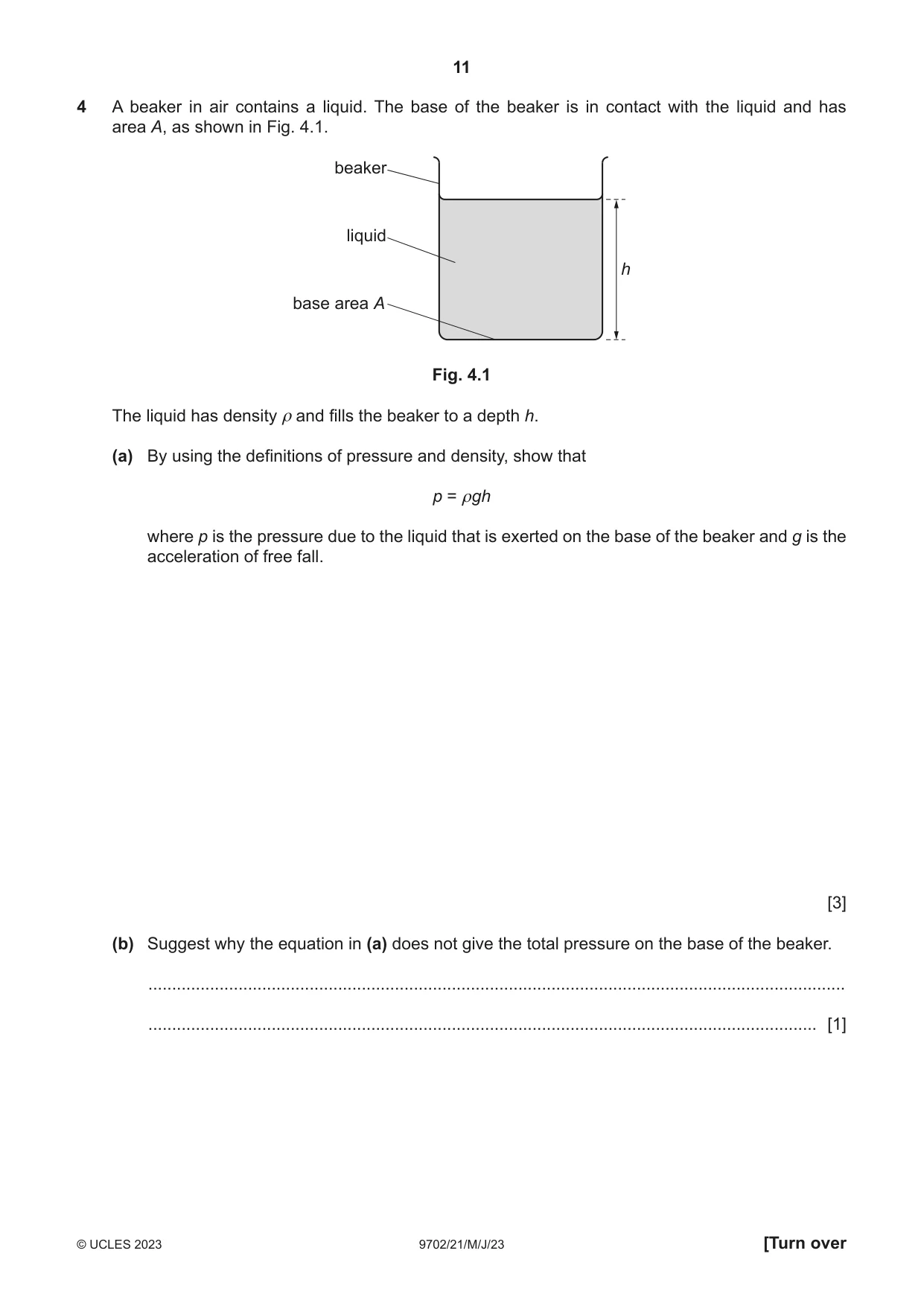
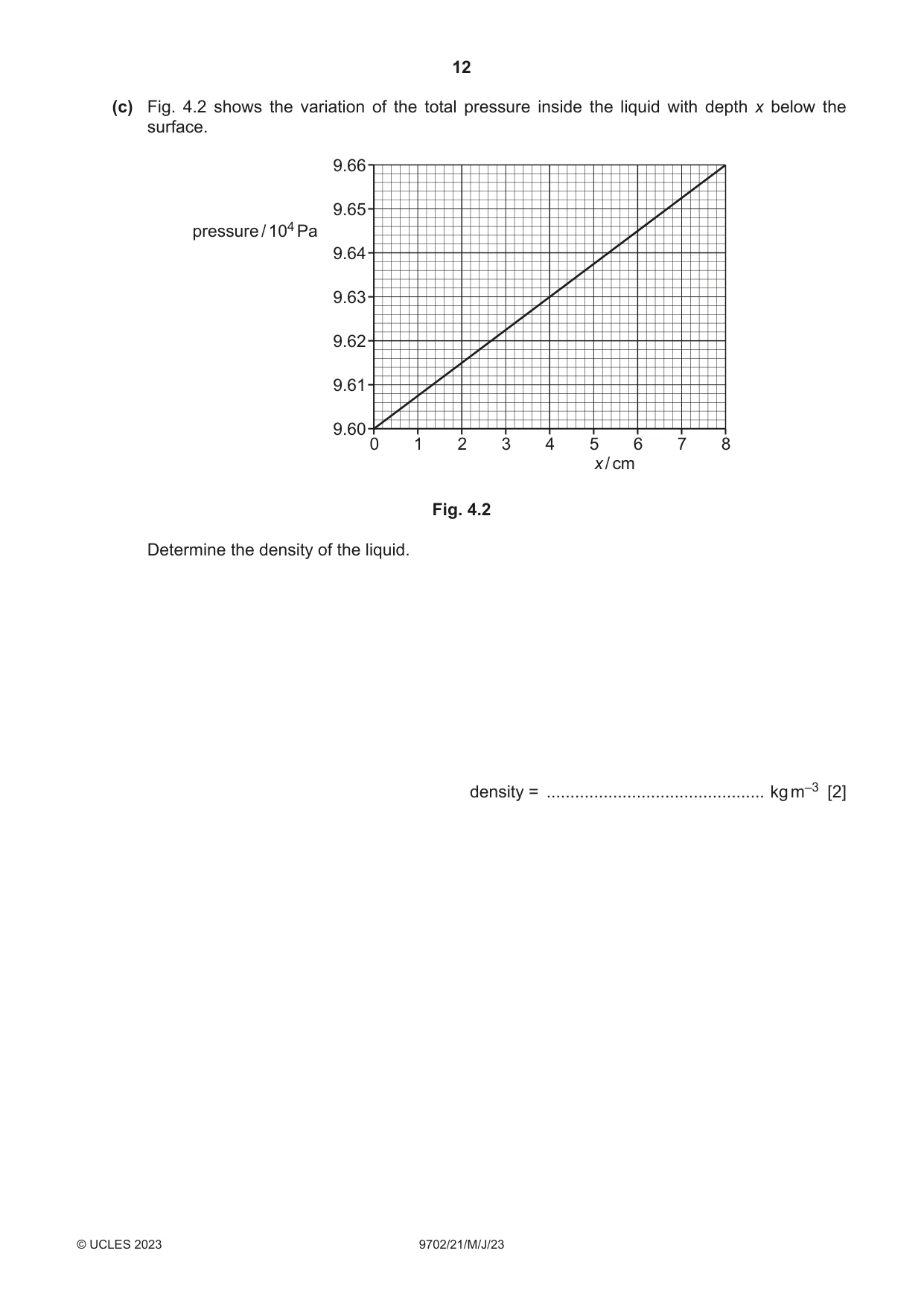
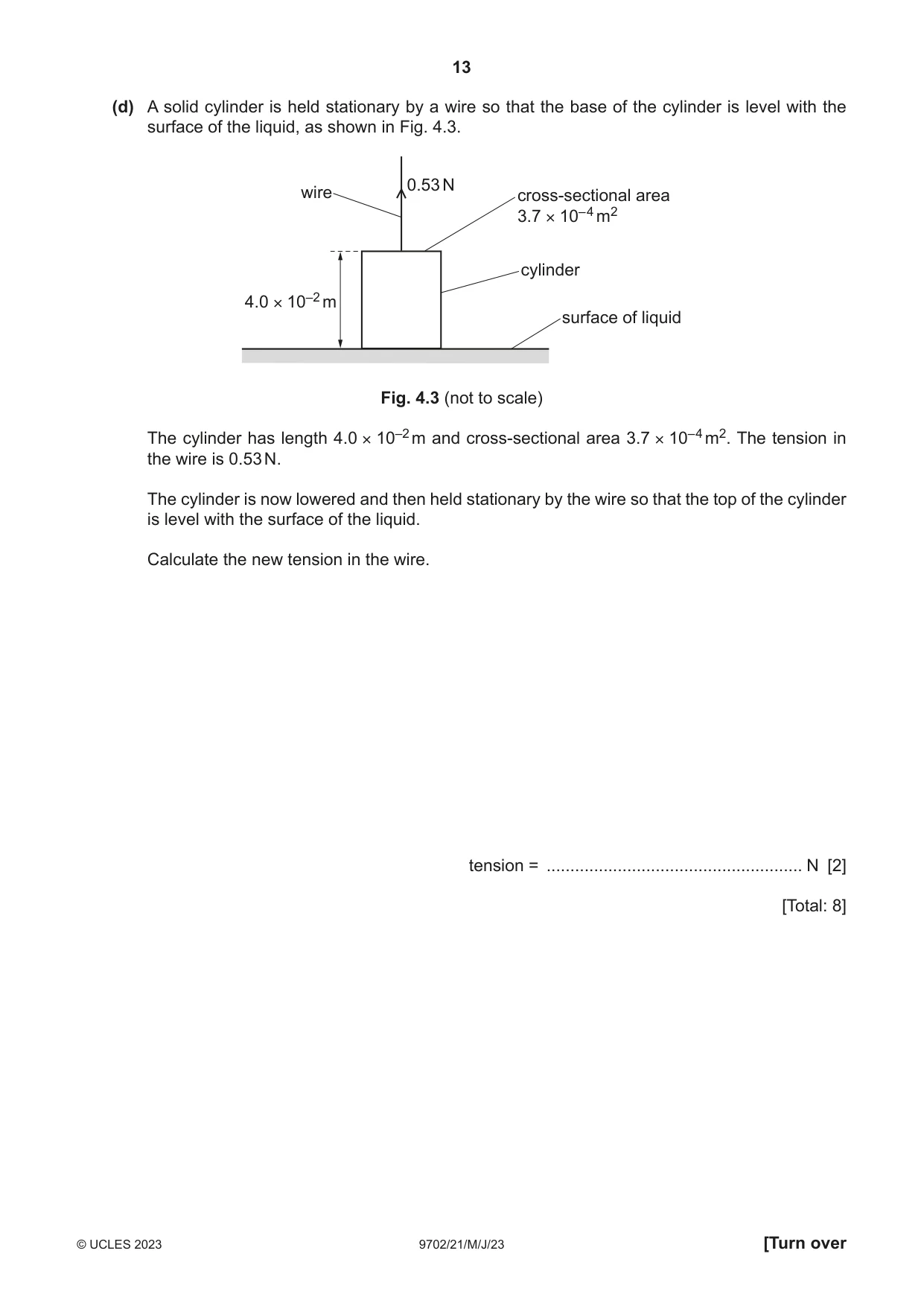
4 A beaker in air contains a liquid. The base of the beaker is in contact with the liquid and has area A, as shown in Fig. 4.1. beaker liquid h base area A Fig. 4.1 The liquid has density ρ and fills the beaker to a depth h. (a) By using the definitions of pressure and density, show that p = ρ gh where p is the pressure due to the liquid that is exerted on the base of the beaker and g is the acceleration of free fall. [3] (b) Suggest why the equation in (a) does not give the total pressure on the base of the beaker. ................................................................................................................................................... ............................................................................................................................................. [1] (c) Fig. 4.2 shows the variation of the total pressure inside the liquid with depth x below the surface. 9.66 9.65 pressure / 104 Pa 9.64 9.63 9.62 9.61 9.60 0 1 2 3 4 5 6 7 8 x / cm Fig. 4.2 Determine the density of the liquid. density = .............................................. kg m–3 [2] (d) A solid cylinder is held stationary by a wire so that the base of the cylinder is level with the surface of the liquid, as shown in Fig. 4.3. 0.53 N wire cross-sectional area 3.7 × 10– 4 m2 cylinder 4.0 × 10⁻² m surface of liquid Fig. 4.3 (not to scale) The cylinder has length 4.0 × 10⁻² m and cross‑sectional area 3.7 × 10⁻⁴ m2. The tension in the wire is 0.53 N. The cylinder is now lowered and then held stationary by the wire so that the top of the cylinder is level with the surface of the liquid. Calculate the new tension in the wire. tension = ...................................................... N [2] [Total: 8]
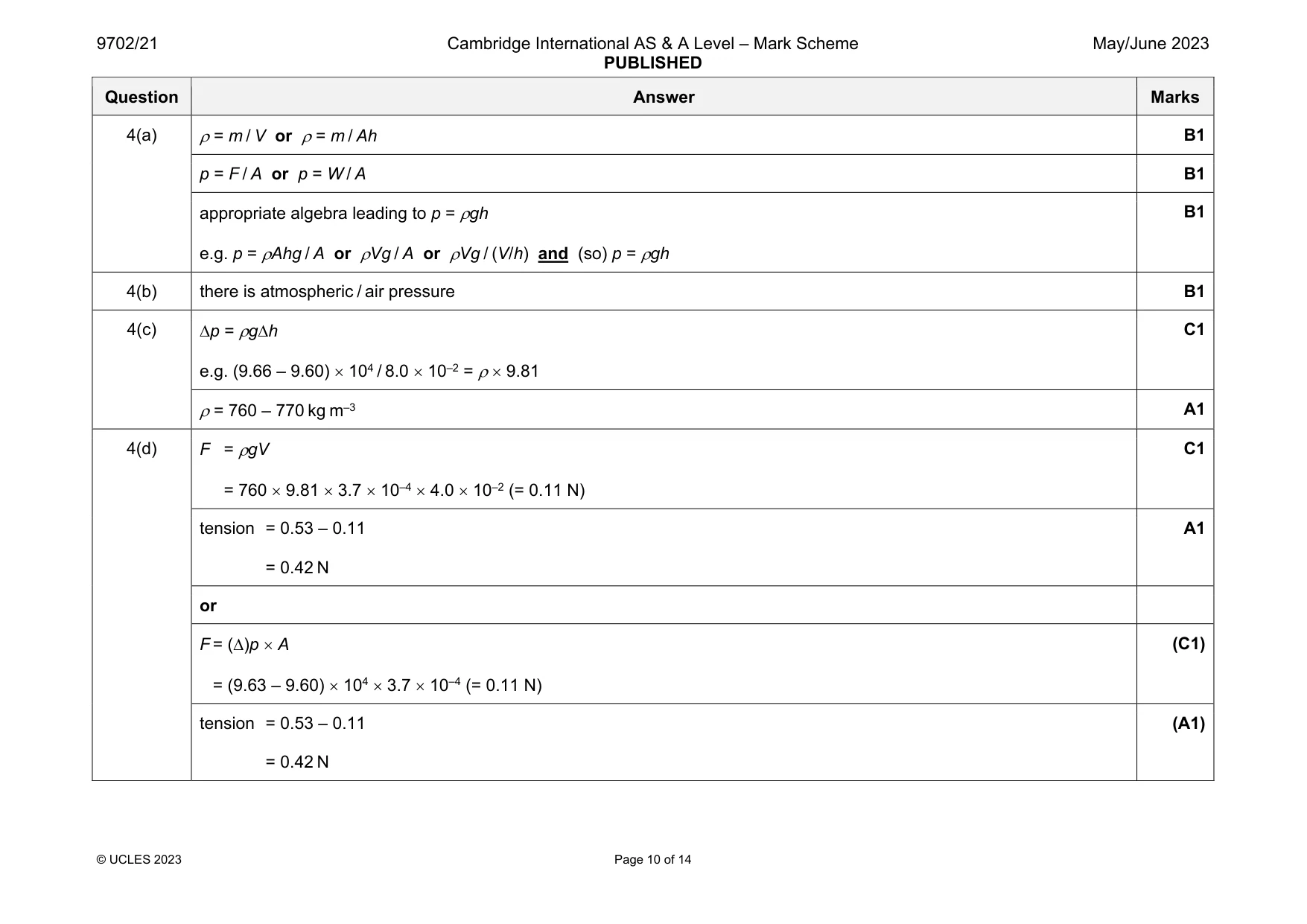
Mark scheme: 4(a) B1 p = F / A or p = W / A B1 appropriate algebra leading to p = gh e.g. p = Ahg / A or Vg / A or Vg / (V/h) and (so) p = gh B1 4(b) there is atmospheric / air pressure B1 4(c) ∆p = g∆h e.g. (9.66 – 9.60) 104 / 8.0 10–2 = 9.81 C1 = 760 – 770 kg m–3 A1 4(d) F = gV = 760 9.81 3.7 10–4 4.0 10–2 (= 0.11 N) C1 tension = 0.53 – 0.11 = 0.42 N A1 or F = (∆)p A = (9.63 – 9.60) 104 3.7 10–4 (= 0.11 N) (C1) tension = 0.53 – 0.11 = 0.42 N (A1)
Q5 · An electromagnetic wave in a vacuum has a wavelength of 8.4 × 10⁻⁶ m
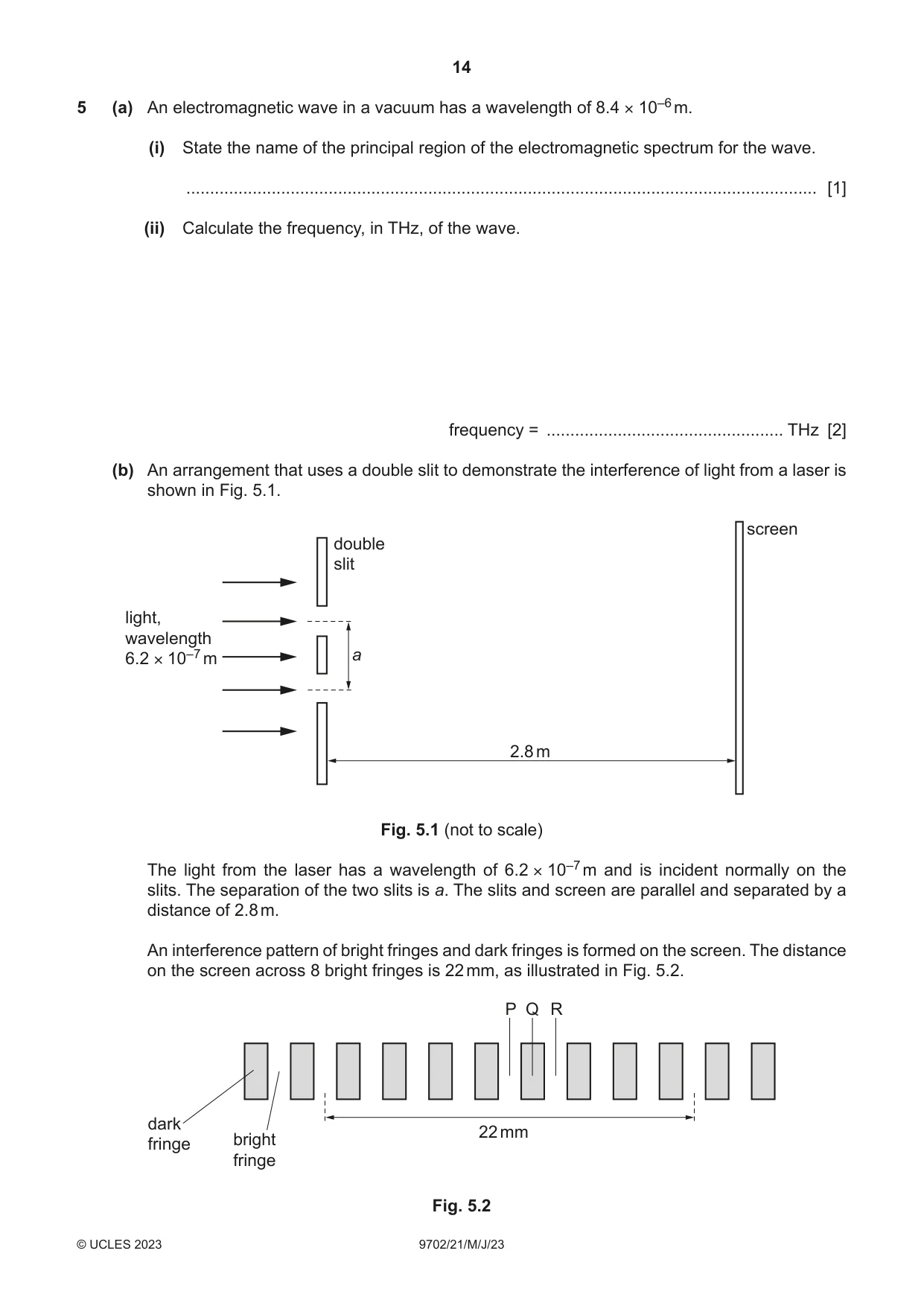
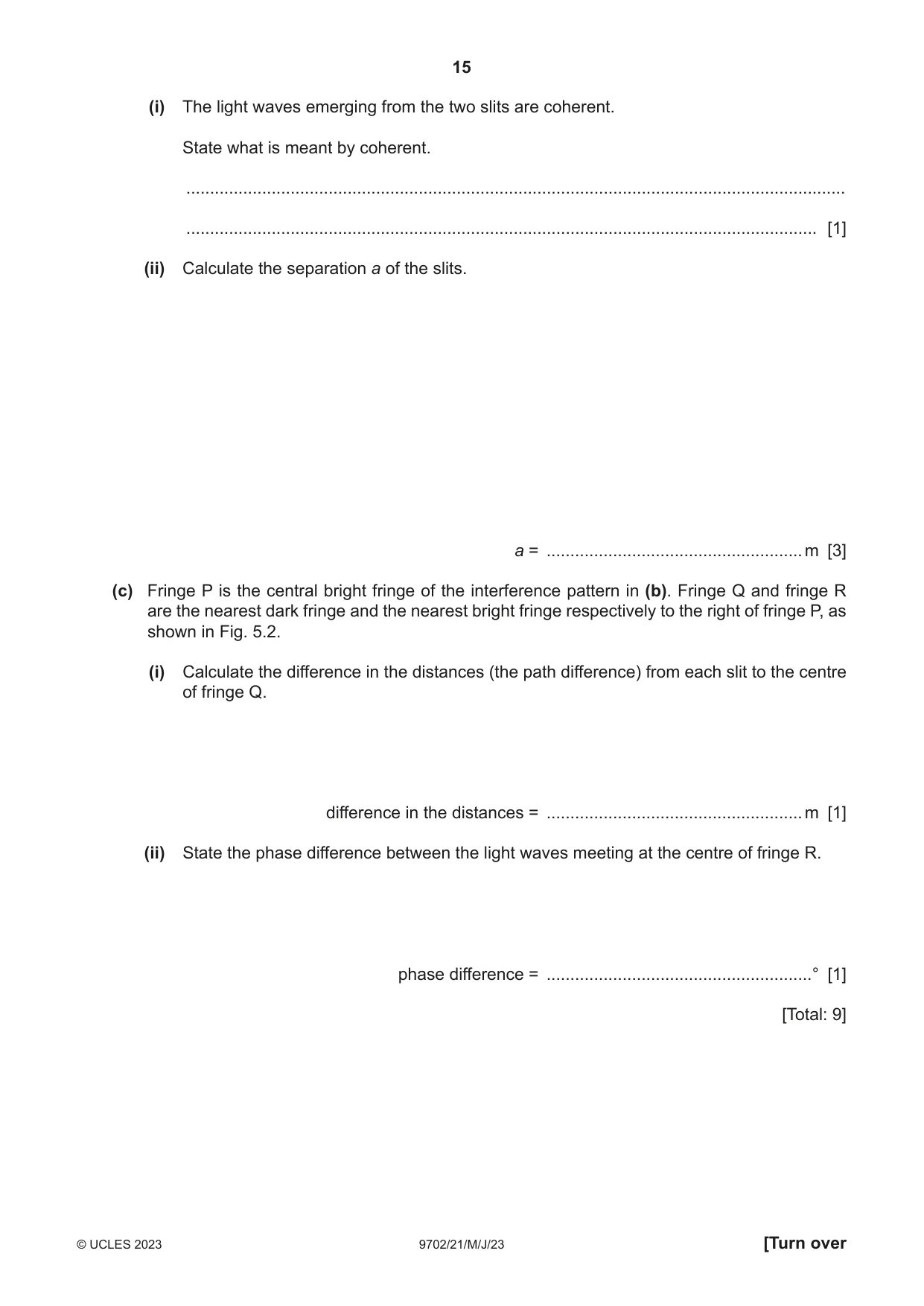
5 (a) An electromagnetic wave in a vacuum has a wavelength of 8.4 × 10⁻⁶ m. (i) State the name of the principal region of the electromagnetic spectrum for the wave. ..................................................................................................................................... [1] (ii) Calculate the frequency, in THz, of the wave. frequency = .................................................. THz [2] (b) An arrangement that uses a double slit to demonstrate the interference of light from a laser is shown in Fig. 5.1. screen double slit light, wavelength 6.2 × 10⁻⁷ m a 2.8 m Fig. 5.1 (not to scale) The light from the laser has a wavelength of 6.2 × 10⁻⁷ m and is incident normally on the slits. The separation of the two slits is a. The slits and screen are parallel and separated by a distance of 2.8 m. An interference pattern of bright fringes and dark fringes is formed on the screen. The distance on the screen across 8 bright fringes is 22 mm, as illustrated in Fig. 5.2. P Q R dark 22 mm fringe bright fringe Fig. 5.2 (i) The light waves emerging from the two slits are coherent. State what is meant by coherent. ........................................................................................................................................... ..................................................................................................................................... [1] (ii) Calculate the separation a of the slits. a = ...................................................... m [3] (c) Fringe P is the central bright fringe of the interference pattern in (b). Fringe Q and fringe R are the nearest dark fringe and the nearest bright fringe respectively to the right of fringe P, as shown in Fig. 5.2. (i) Calculate the difference in the distances (the path difference) from each slit to the centre of fringe Q. difference in the distances = ...................................................... m [1] (ii) State the phase difference between the light waves meeting at the centre of fringe R. phase difference = ........................................................° [1] [Total: 9]
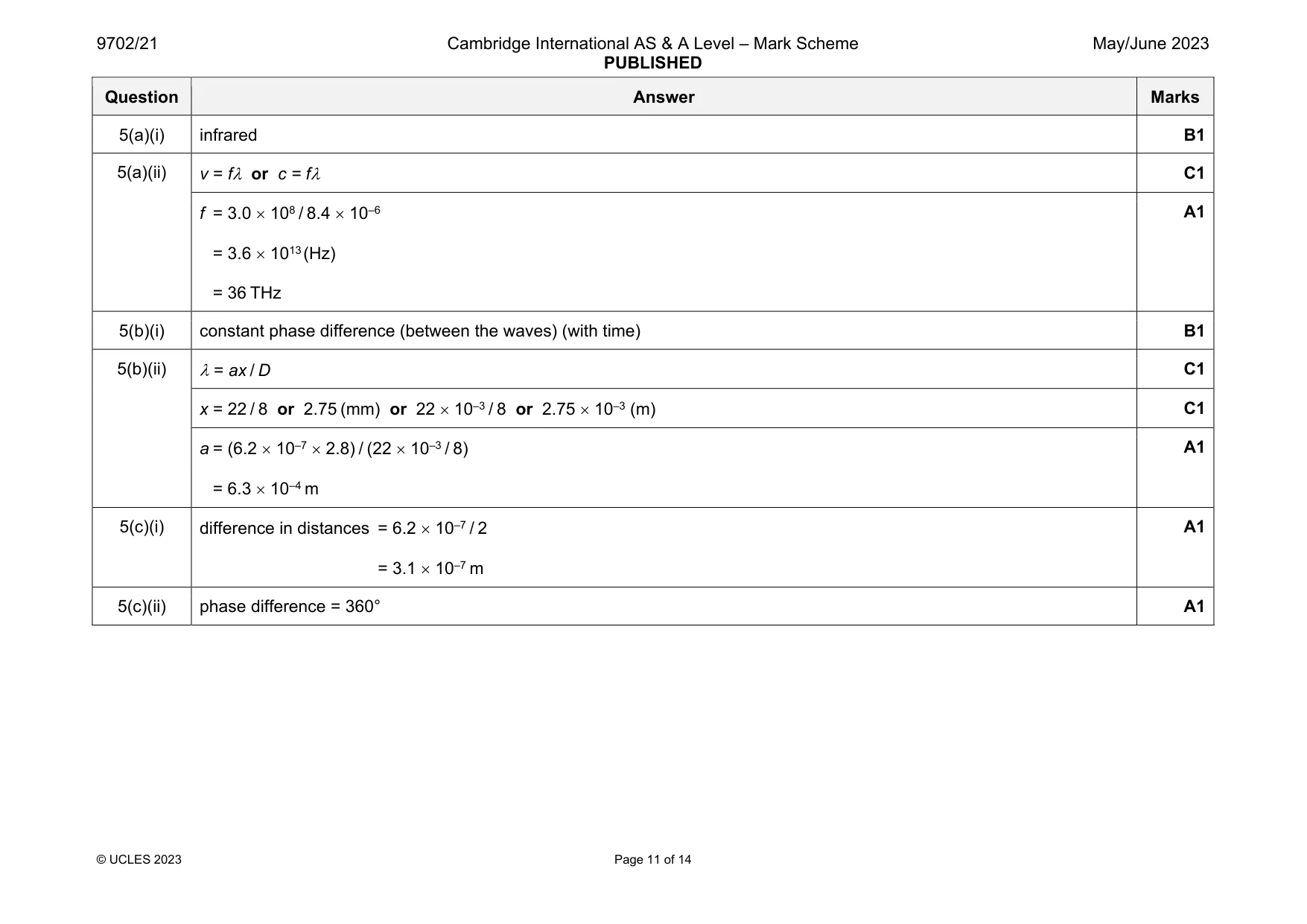
Mark scheme: 5(a)(i) infrared B1 5(a)(ii) v = f or c = f C1 f = 3.0 108 / 8.4 10–6 = 3.6 1013 (Hz) = 36 THz A1 5(b)(i) constant phase difference (between the waves) (with time) B1 5(b)(ii) = ax / D C1 x = 22 / 8 or 2.75 (mm) or 22 10–3 / 8 or 2.75 10–3 (m) C1 a = (6.2 10–7 2.8) / (22 10–3 / 8) = 6.3 10–4 m A1 5(c)(i) difference in distances = 6.2 10–7 / 2 = 3.1 10–7 m A1 5(c)(ii) phase difference = 360° A1
Q6 · A metal wire in a circuit has a length of 1.8 m and a cross‑sectional area of 1.5 × 10⁻⁶…
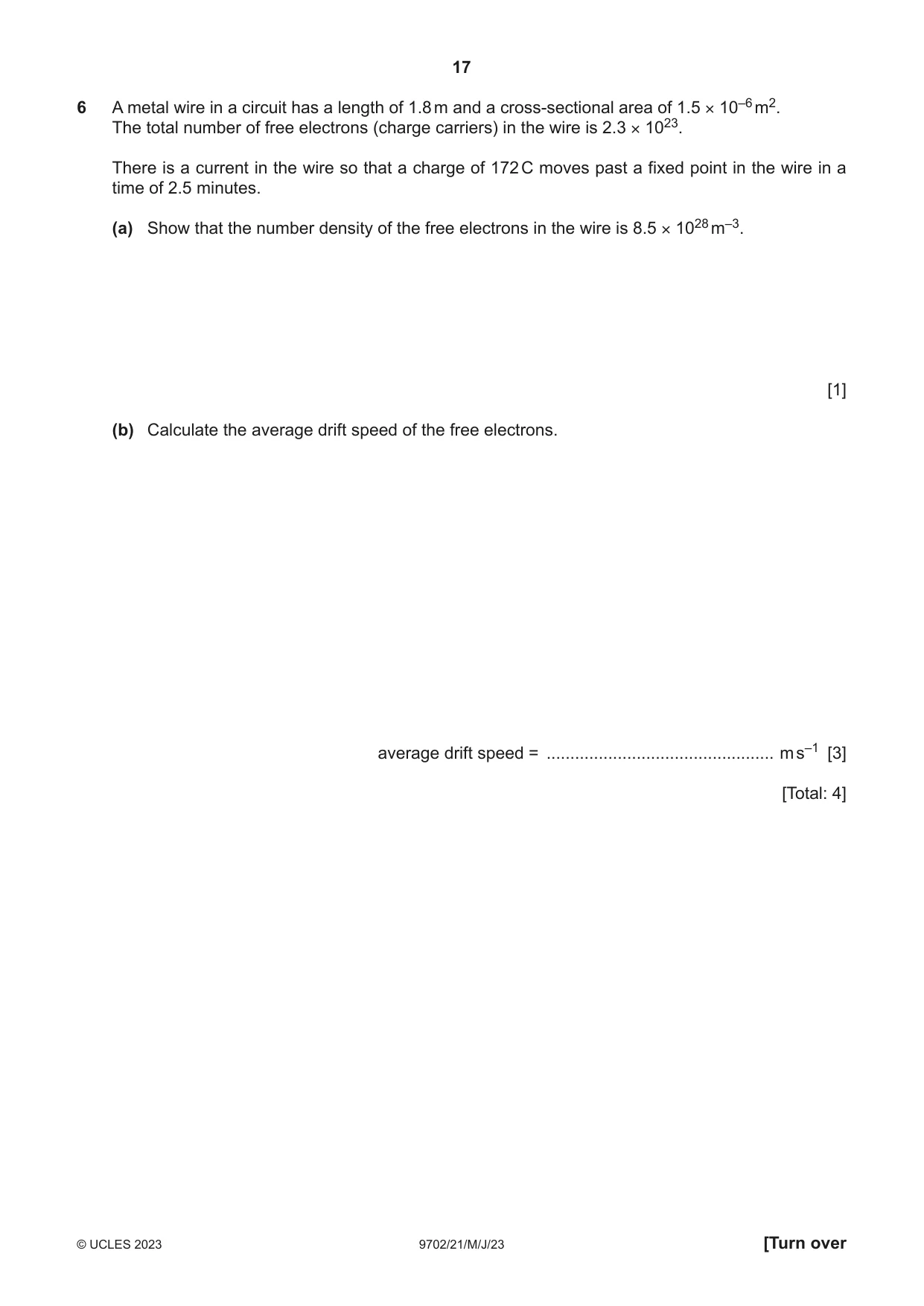
6 A metal wire in a circuit has a length of 1.8 m and a cross‑sectional area of 1.5 × 10⁻⁶ m2. The total number of free electrons (charge carriers) in the wire is 2.3 × 10²³. There is a current in the wire so that a charge of 172 C moves past a fixed point in the wire in a time of 2.5 minutes. (a) Show that the number density of the free electrons in the wire is 8.5 × 1028 m–3. [1] (b) Calculate the average drift speed of the free electrons. average drift speed = ................................................ m s–1 [3] [Total: 4]
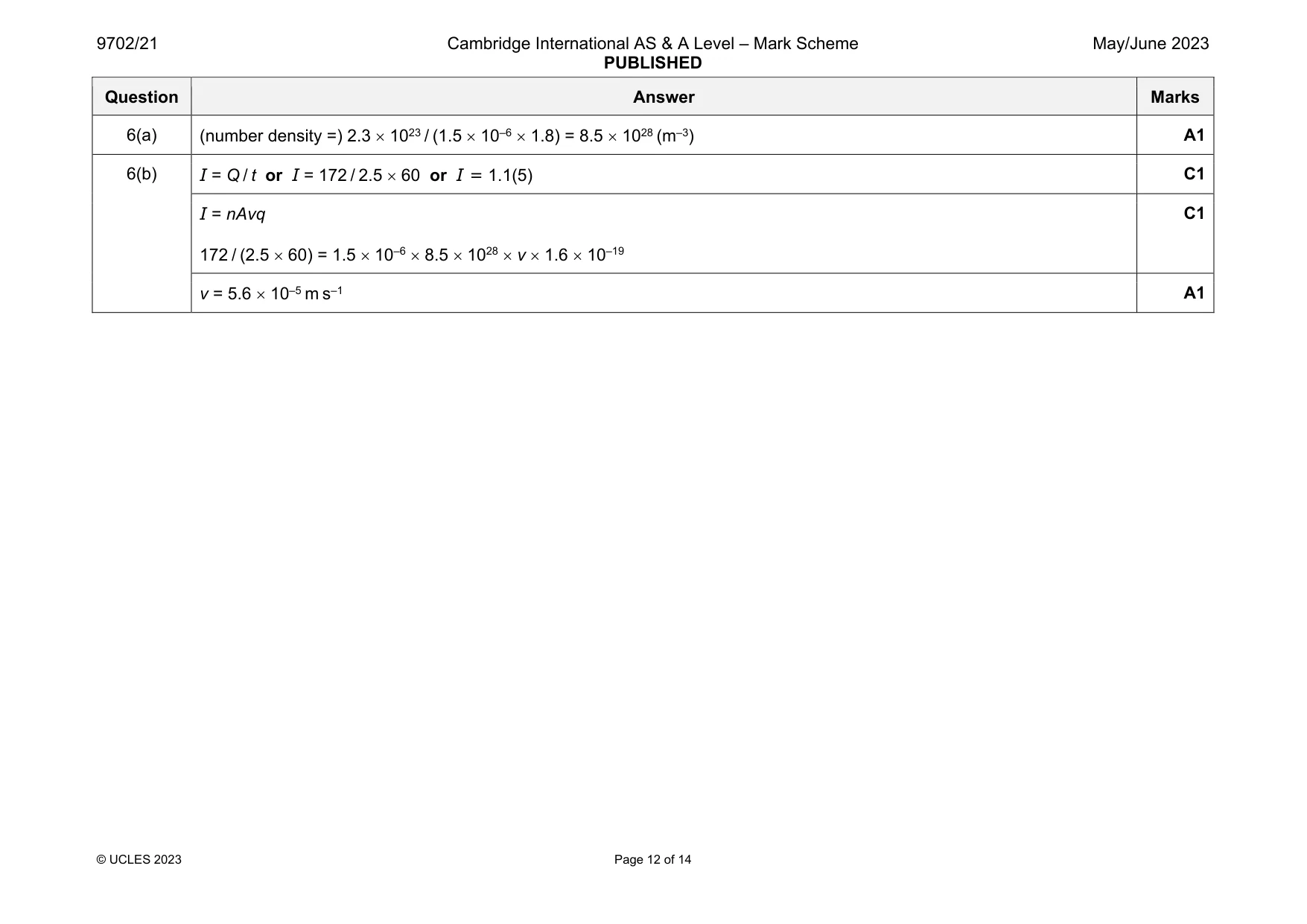
Mark scheme: 6(a) A1 6(b) I = Q / t or I = 172 / 2.5 60 or I = 1.1(5) C1 I = nAvq 172 / (2.5 60) = 1.5 10–6 8.5 1028 v 1.6 10–19 C1 v = 5.6 10–5 m s–1 A1
Q7 · A battery of electromotive force (e.m.f.) 9.6 V and negligible internal resistance is…
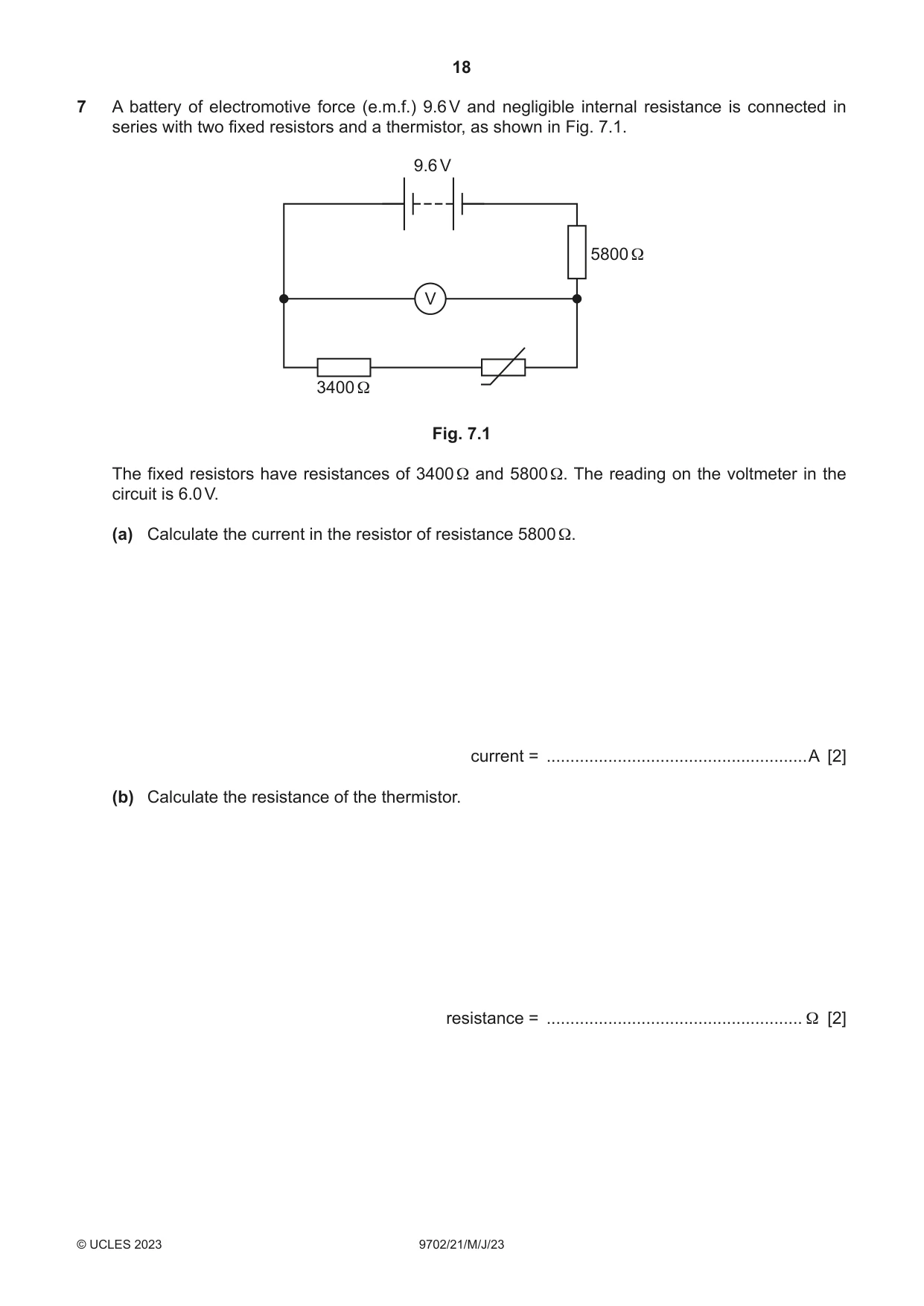
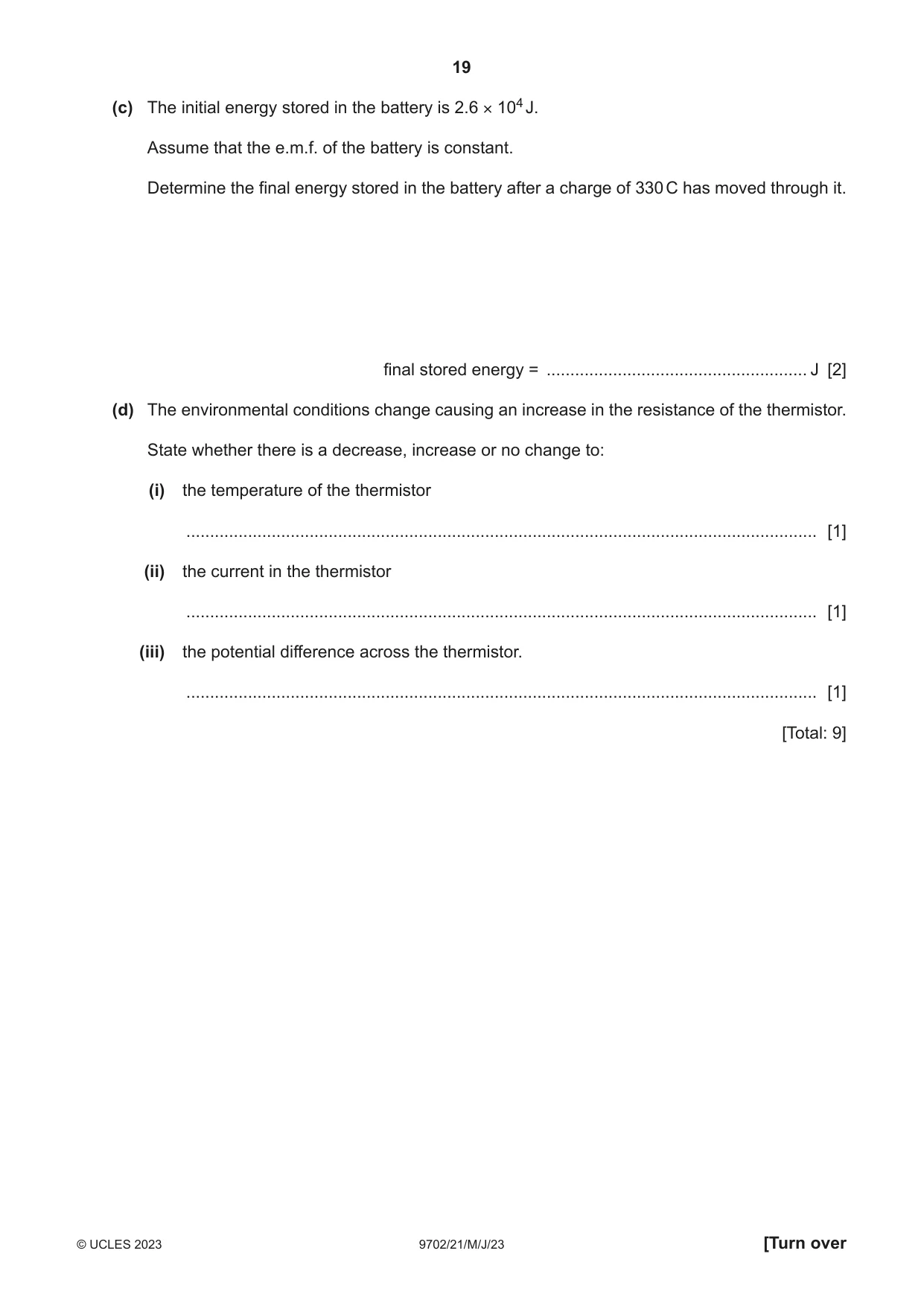
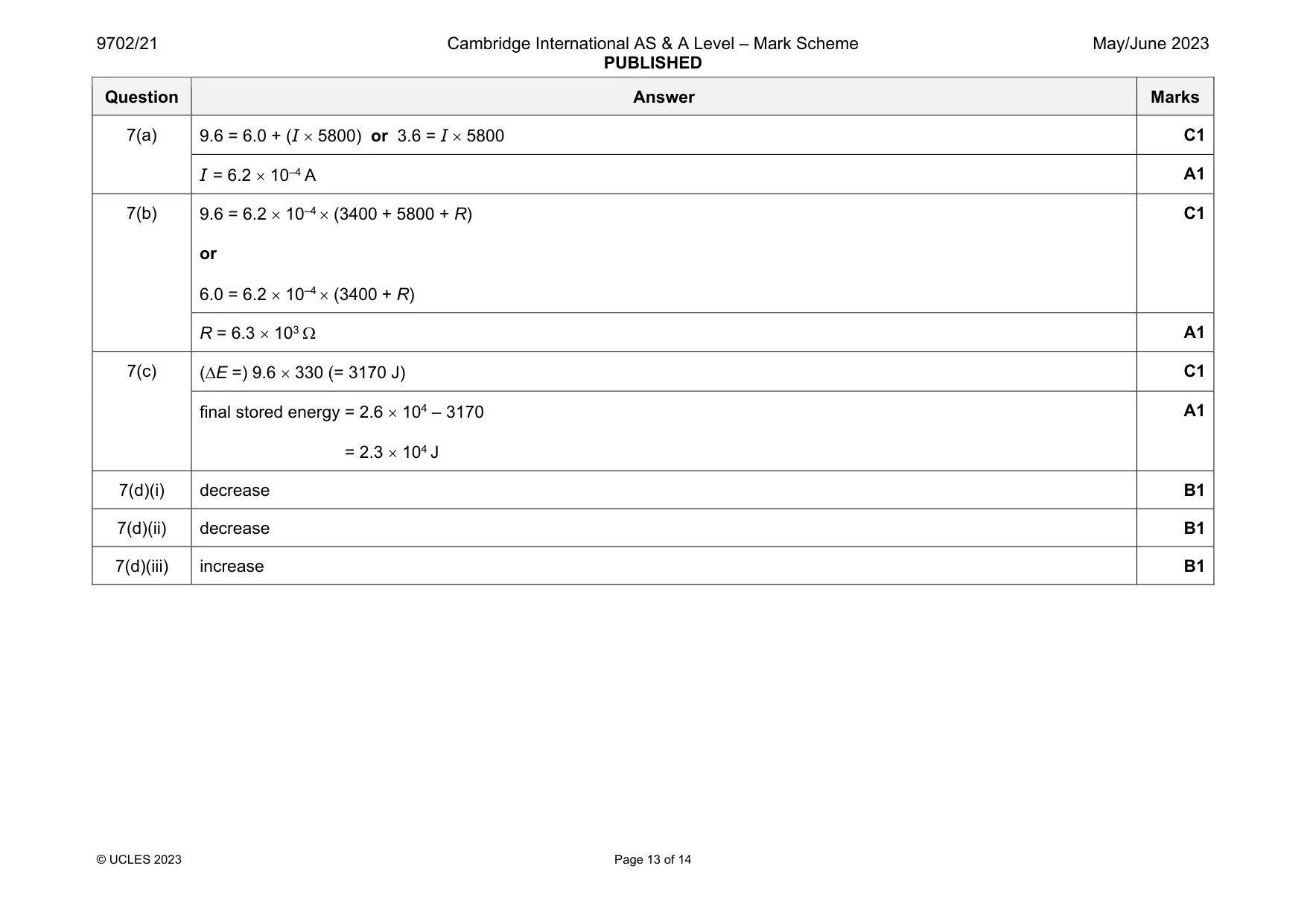
7 A battery of electromotive force (e.m.f.) 9.6 V and negligible internal resistance is connected in series with two fixed resistors and a thermistor, as shown in Fig. 7.1. 9.6 V 5800 Ω V 3400 Ω Fig. 7.1 The fixed resistors have resistances of 3400 Ω and 5800 Ω. The reading on the voltmeter in the circuit is 6.0 V. (a) Calculate the current in the resistor of resistance 5800 Ω. current = ....................................................... A [2] (b) Calculate the resistance of the thermistor. resistance = ...................................................... Ω [2] (c) The initial energy stored in the battery is 2.6 × 10⁴ J. Assume that the e.m.f. of the battery is constant. Determine the final energy stored in the battery after a charge of 330 C has moved through it. final stored energy = ....................................................... J [2] (d) The environmental conditions change causing an increase in the resistance of the thermistor. State whether there is a decrease, increase or no change to: (i) the temperature of the thermistor ..................................................................................................................................... [1] (ii) the current in the thermistor ..................................................................................................................................... [1] (iii) the potential difference across the thermistor. ..................................................................................................................................... [1] [Total: 9]
Mark scheme: 7(a) C1 I = 6.2 10–4 A A1 7(b) 9.6 = 6.2 10–4 (3400 + 5800 + R) or 6.0 = 6.2 10–4 (3400 + R) C1 R = 6.3 103 A1 7(c) (∆E =) 9.6 330 (= 3170 J) C1 final stored energy = 2.6 104 – 3170 = 2.3 104 J A1 7(d)(i) decrease B1 7(d)(ii) decrease B1 7(d)(iii) increase B1
Q8 · An isolated stationary nucleus X decays by emitting an α‑particle to form a nucleus Y
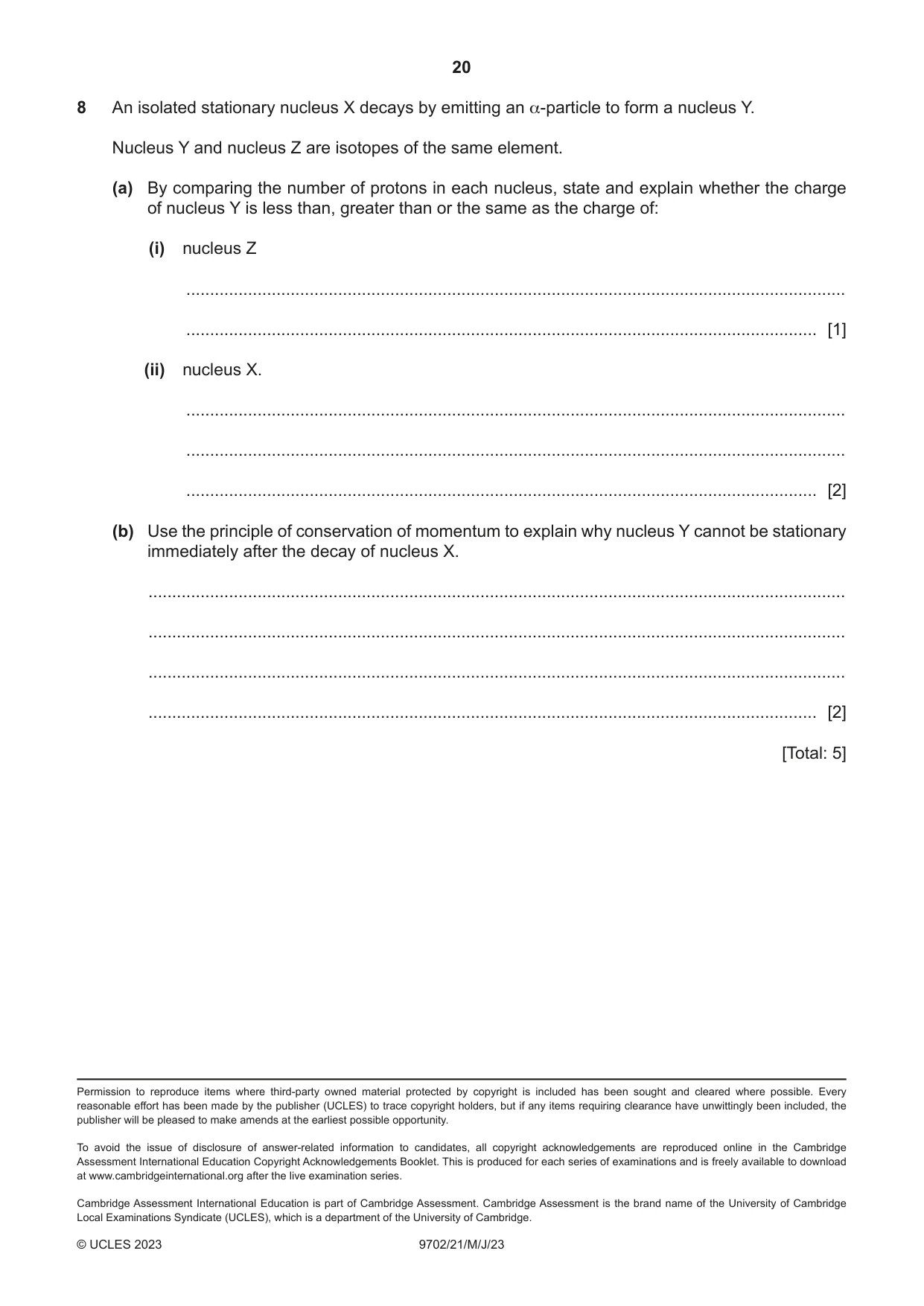
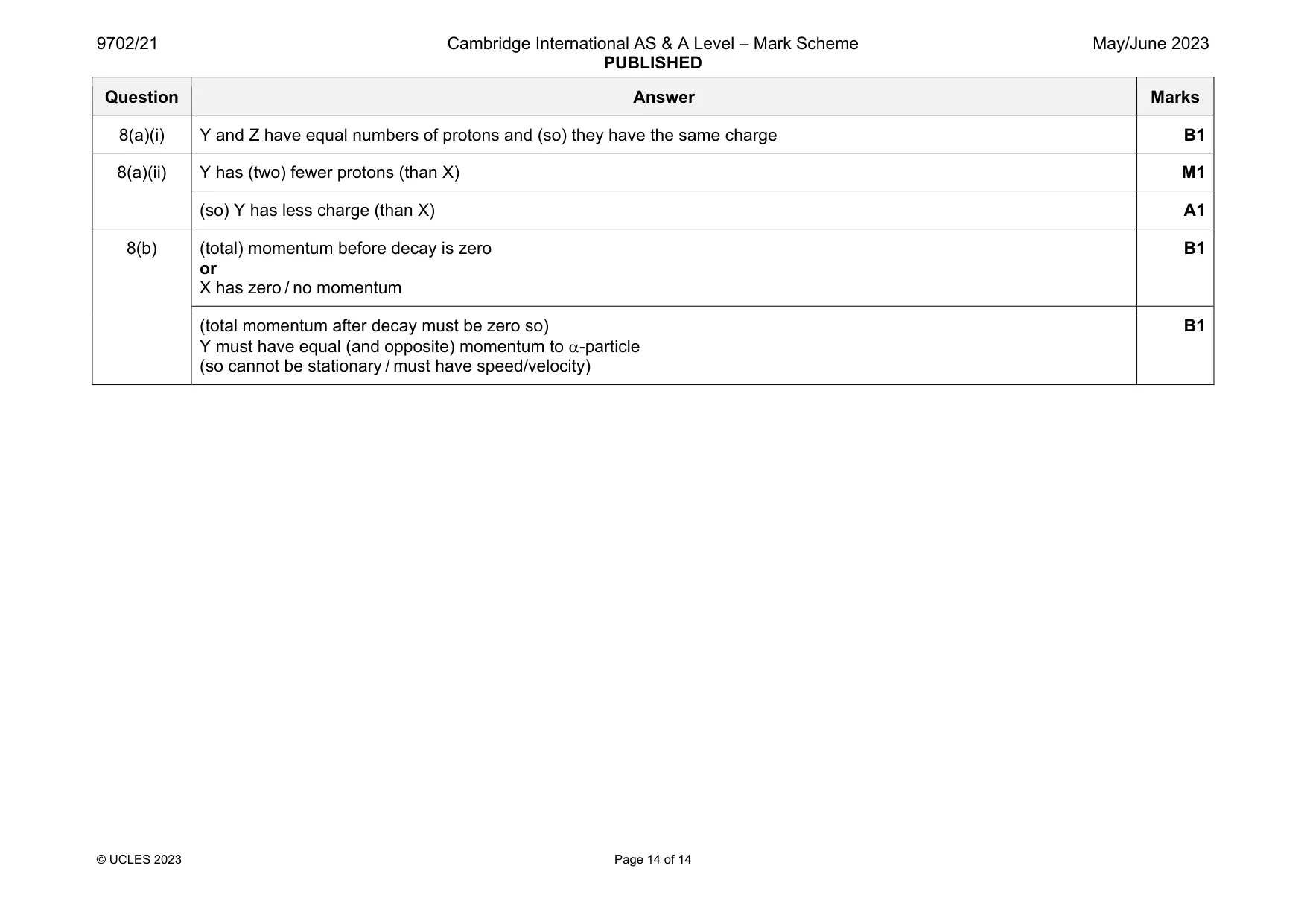
8 An isolated stationary nucleus X decays by emitting an α‑particle to form a nucleus Y. Nucleus Y and nucleus Z are isotopes of the same element. (a) By comparing the number of protons in each nucleus, state and explain whether the charge of nucleus Y is less than, greater than or the same as the charge of: (i) nucleus Z ........................................................................................................................................... ..................................................................................................................................... [1] (ii) nucleus X. ........................................................................................................................................... ........................................................................................................................................... ..................................................................................................................................... [2] (b) Use the principle of conservation of momentum to explain why nucleus Y cannot be stationary immediately after the decay of nucleus X. ................................................................................................................................................... ................................................................................................................................................... ................................................................................................................................................... ............................................................................................................................................. [2] [Total: 5]
Mark scheme: 8(a)(i) Y and Z have equal numbers of protons and (so) they have the same charge B1 8(a)(ii) Y has (two) fewer protons (than X) M1 (so) Y has less charge (than X) A1 8(b) (total) momentum before decay is zero or X has zero / no momentum B1 (total momentum after decay must be zero so) Y must have equal (and opposite) momentum to -particle (so cannot be stationary / must have speed/velocity) B1
What was in this paper
The subtopics covered by these 8 questions, and how many questions each got. Open one in a new tab to see every Cambridge question on it.
What you needed in this session
Cambridge’s own grade thresholds for 2023 May/June, Paper 2 · Variant 1. A higher threshold means an easier paper — the bar moves with how the cohort did.