Cambridge A Level Physics 9702 — 2018 May/June Paper 2 · Variant 2
9702/22/M/J/18 · 7 questions · 60 marks · ≈68 min
The question paper and its mark scheme, free to read here and free to download. This is Cambridge’s own paper, exactly as it was sat.
Question paper16 pages
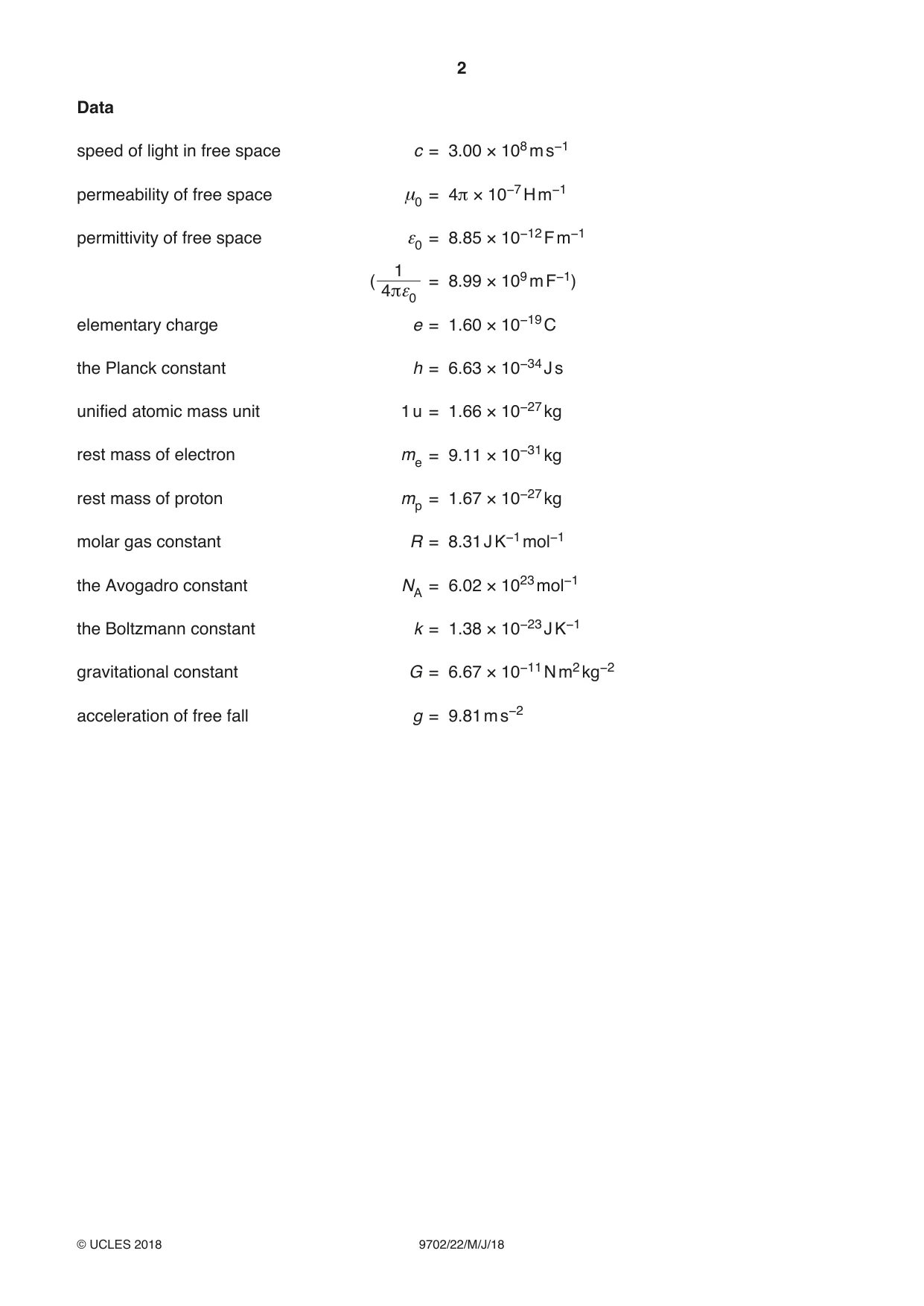
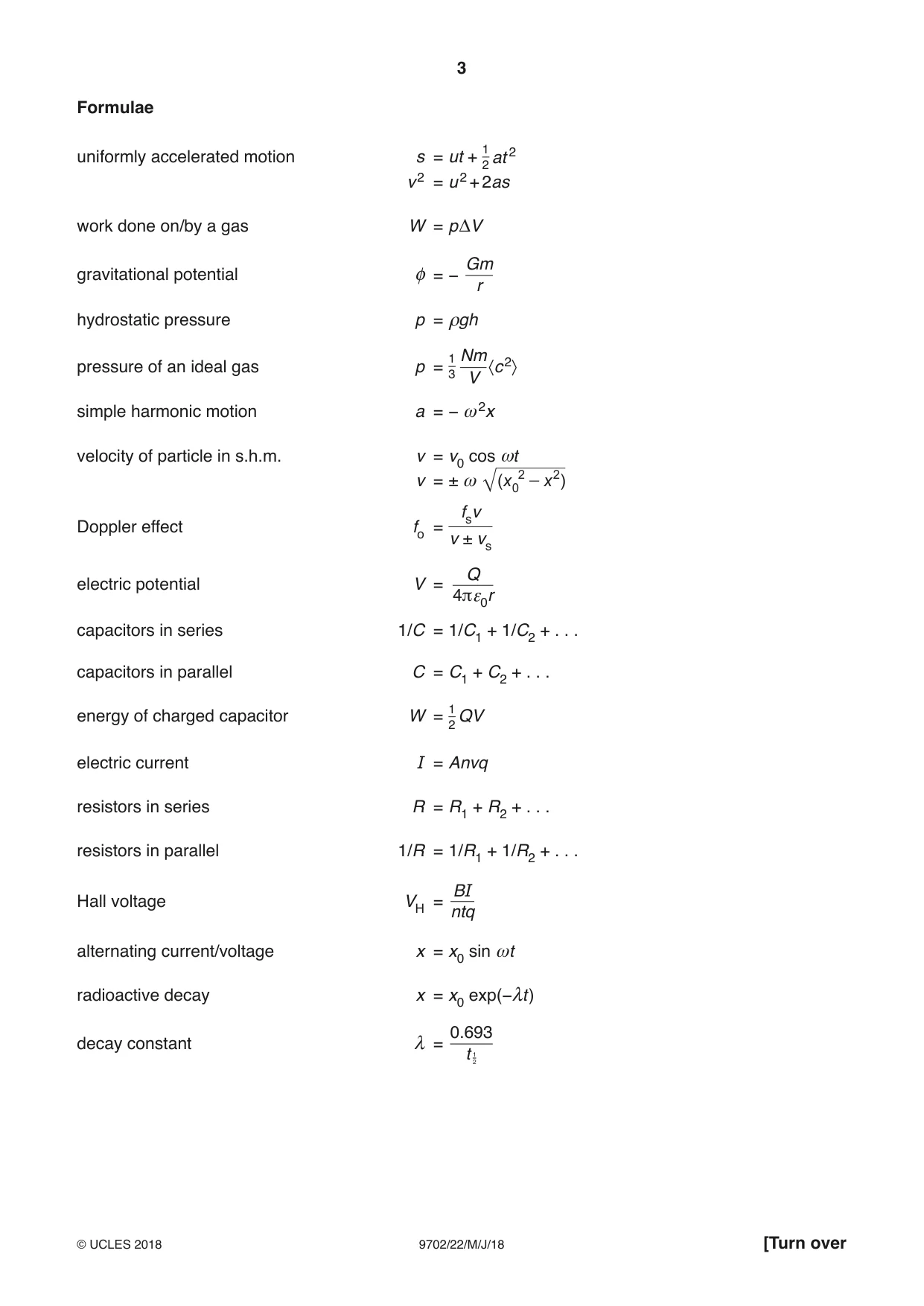
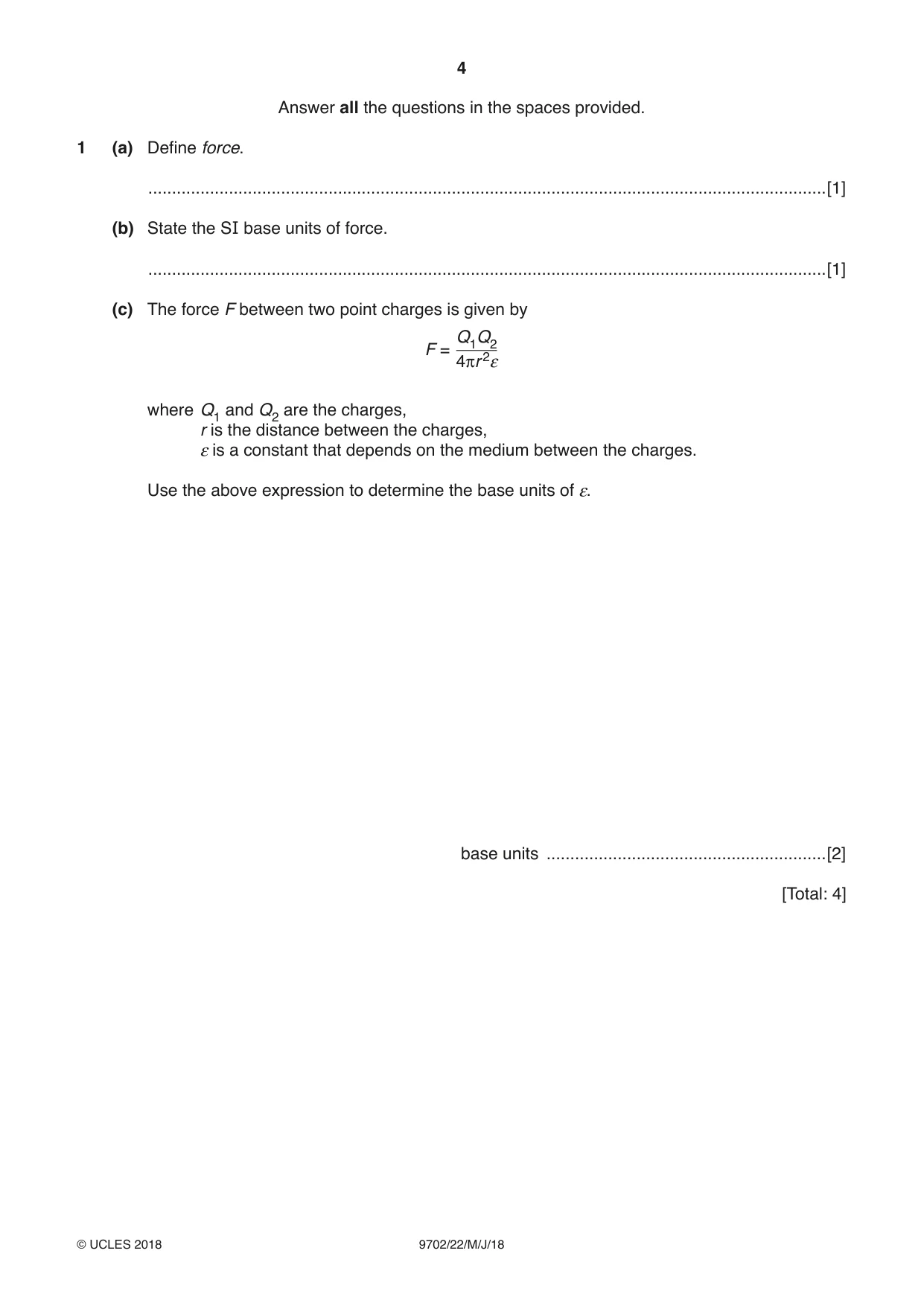

Mark scheme11 pages
Answers below. Sit the paper first if you are practising.
Questions as text
Question 1
1 (a) Define force. ...............................................................................................................................................[1] (b) State the SI base units of force. ...............................................................................................................................................[1] (c) The force F between two point charges is given by Q1Q2 F = 4πr 2ε where Q1 and Q2 are the charges, r is the distance between the charges, ε is a constant that depends on the medium between the charges. Use the above expression to determine the base units of ε. base units ...........................................................[2] [Total: 4]
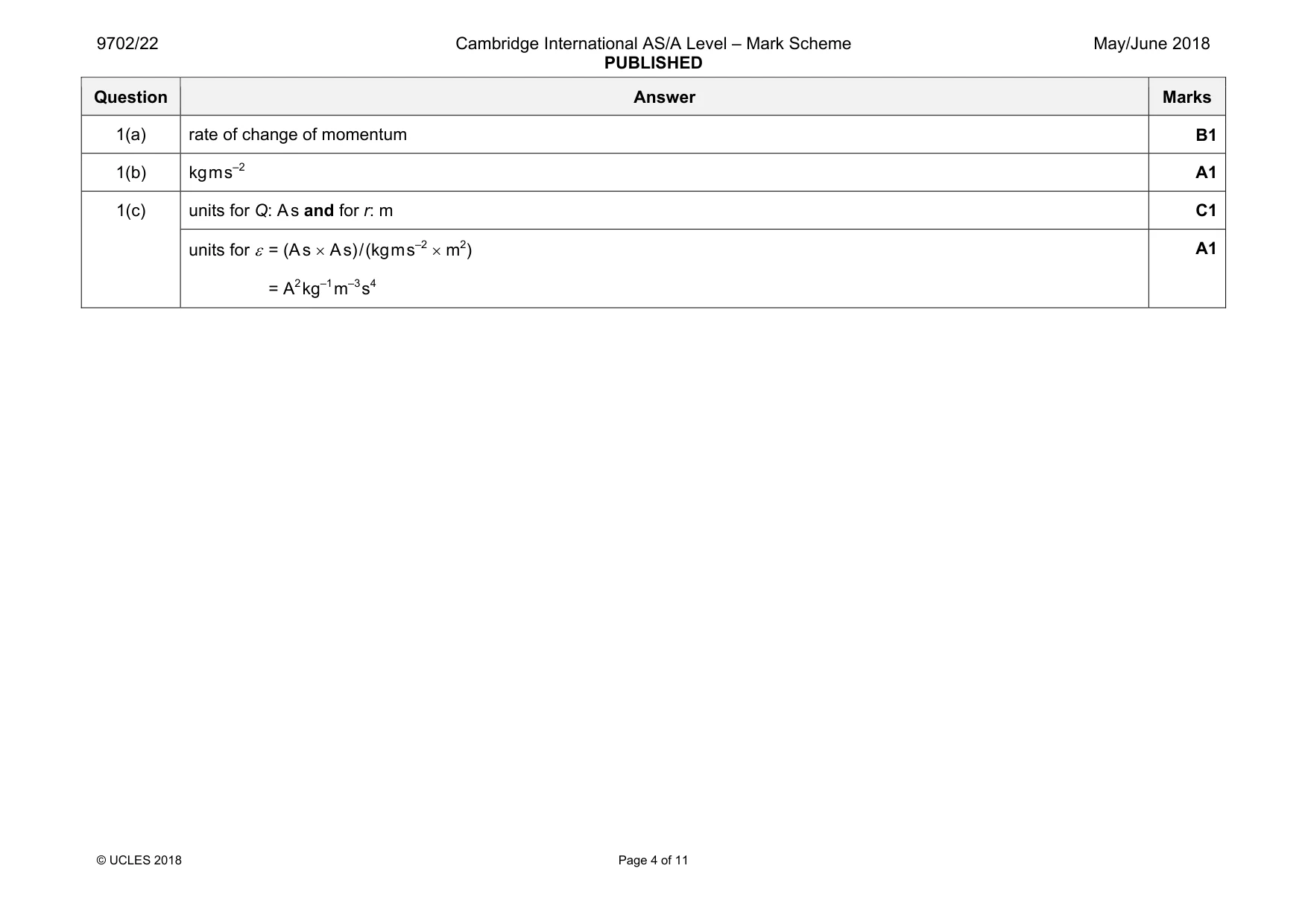
Mark scheme: 1(a) rate of change of momentum B1 1(b) kg m s–2 A1 1(c) units for Q: A s and for r: m C1 units for ε = (A s × A s) / (kg m s–2 × m2) = A2 kg–1 m–3 s4 A1
Q2 · State the principle of conservation of momentum
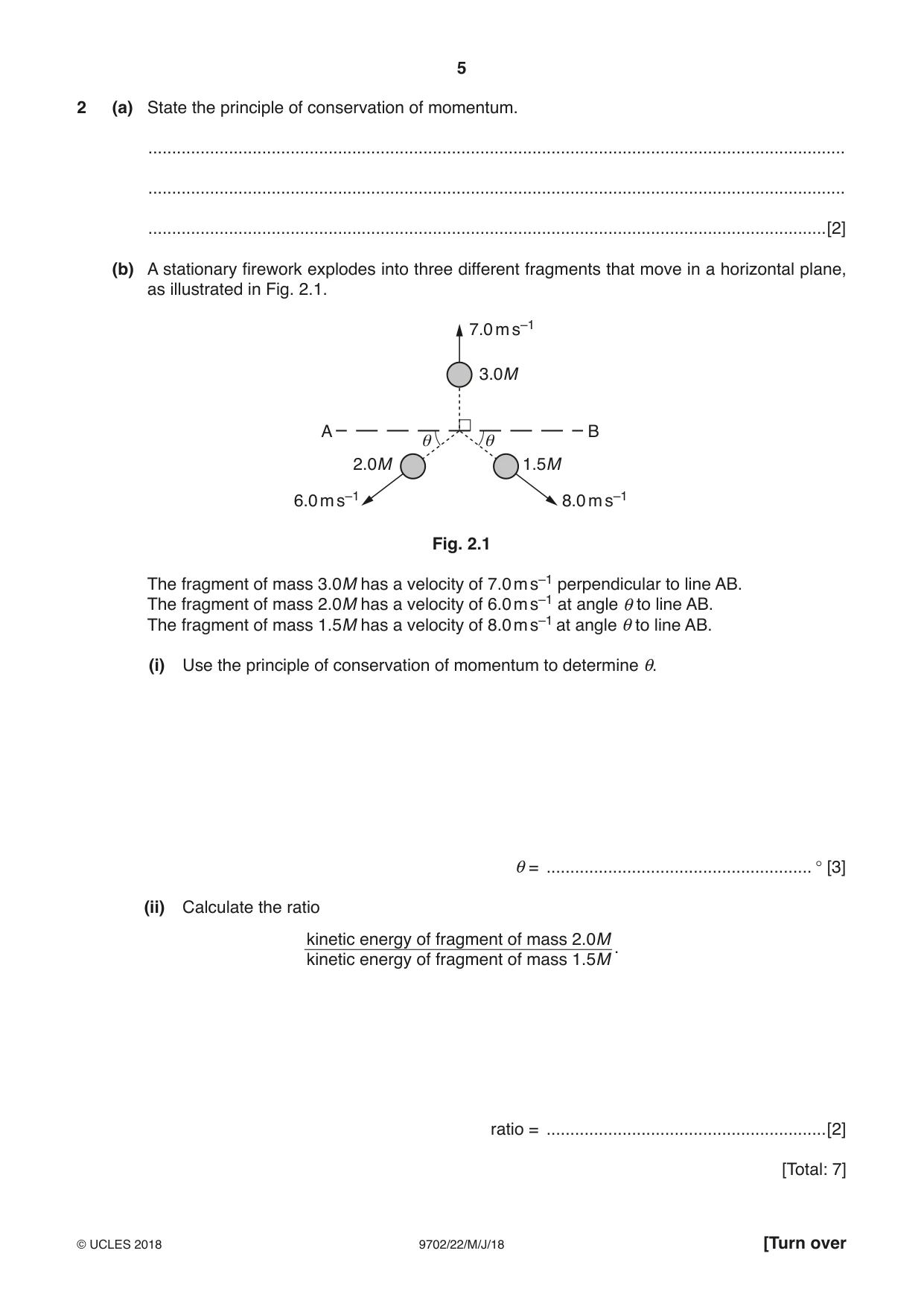
2 (a) State the principle of conservation of momentum. ................................................................................................................................................... ................................................................................................................................................... ...............................................................................................................................................[2] (b) A stationary firework explodes into three different fragments that move in a horizontal plane, as illustrated in Fig. 2.1. 7.0 m s–1 3.0M A B θ θ 2.0M 1.5M 6.0 m s–1 8.0 m s–1 Fig. 2.1 The fragment of mass 3.0M has a velocity of 7.0 m s–1 perpendicular to line AB. The fragment of mass 2.0M has a velocity of 6.0 m s–1 at angle θ to line AB. The fragment of mass 1.5M has a velocity of 8.0 m s–1 at angle θ to line AB. (i) Use the principle of conservation of momentum to determine θ. θ = ........................................................ ° [3] (ii) Calculate the ratio kinetic energy of fragment of mass 2.0M . kinetic energy of fragment of mass 1.5M ratio = ...........................................................[2] [Total: 7]
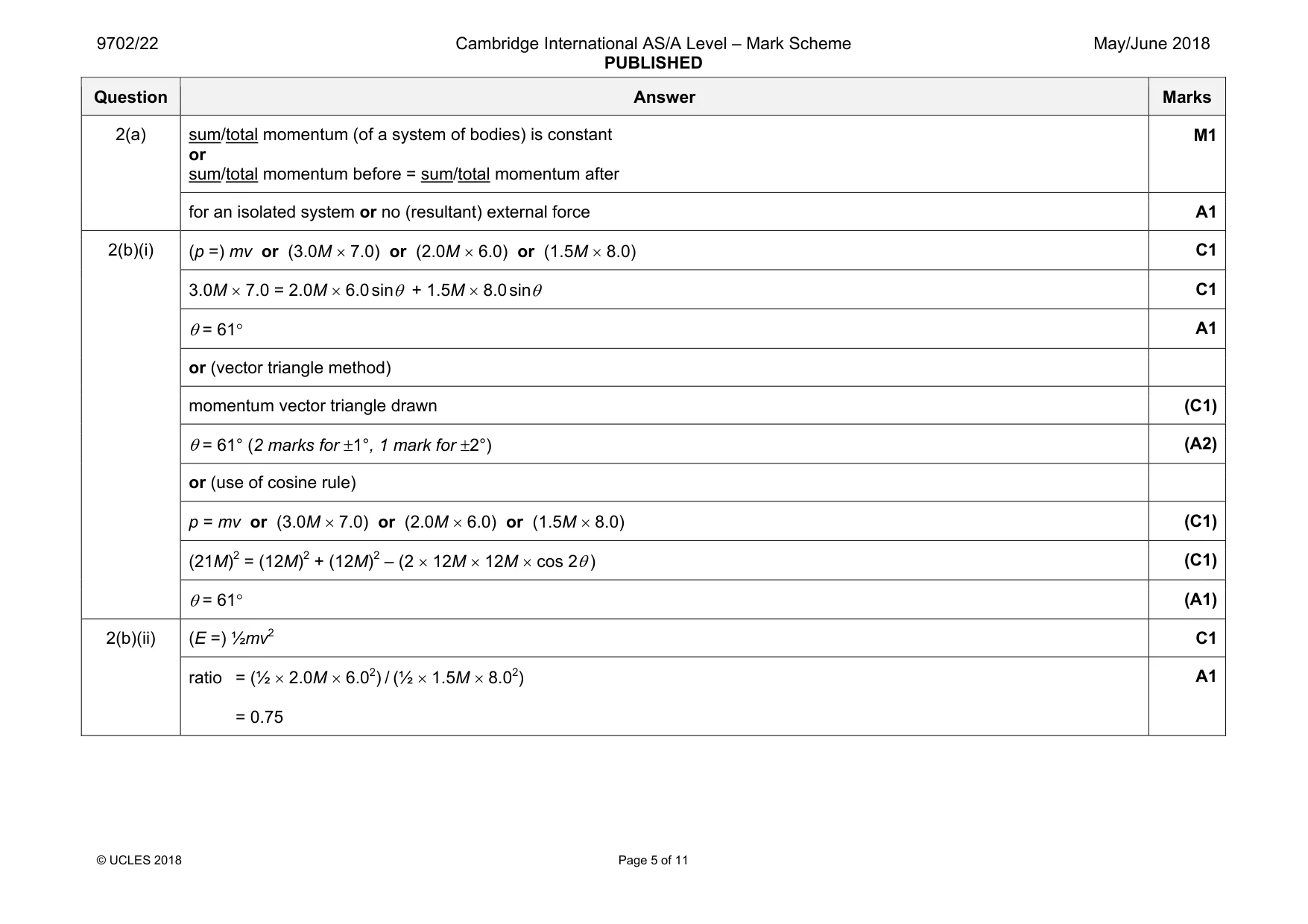
Mark scheme: 2(a) sum/total momentum (of a system of bodies) is constant or sum/total momentum before = sum/total momentum after M1 for an isolated system or no (resultant) external force A1 2(b)(i) (p =) mv or (3.0M × 7.0) or (2.0M × 6.0) or (1.5M × 8.0) C1 3.0M × 7.0 = 2.0M × 6.0 sinθ + 1.5M × 8.0 sinθ C1 θ = 61° A1 or (vector triangle method) momentum vector triangle drawn (C1) θ = 61° (2 marks for ±1°, 1 mark for ±2°) (A2) or (use of cosine rule) p = mv or (3.0M × 7.0) or (2.0M × 6.0) or (1.5M × 8.0) (C1) (21M)2 = (12M)2 + (12M)2 – (2 × 12M × 12M × cos 2θ ) (C1) θ = 61° (A1) 2(b)(ii) (E =) ½mv2 C1 ratio = (½ × 2.0M × 6.02) / (½ × 1.5M × 8.02) = 0.75 A1
Q3 · A child on a sledge slides down a steep hill and then travels in a straight line up an…
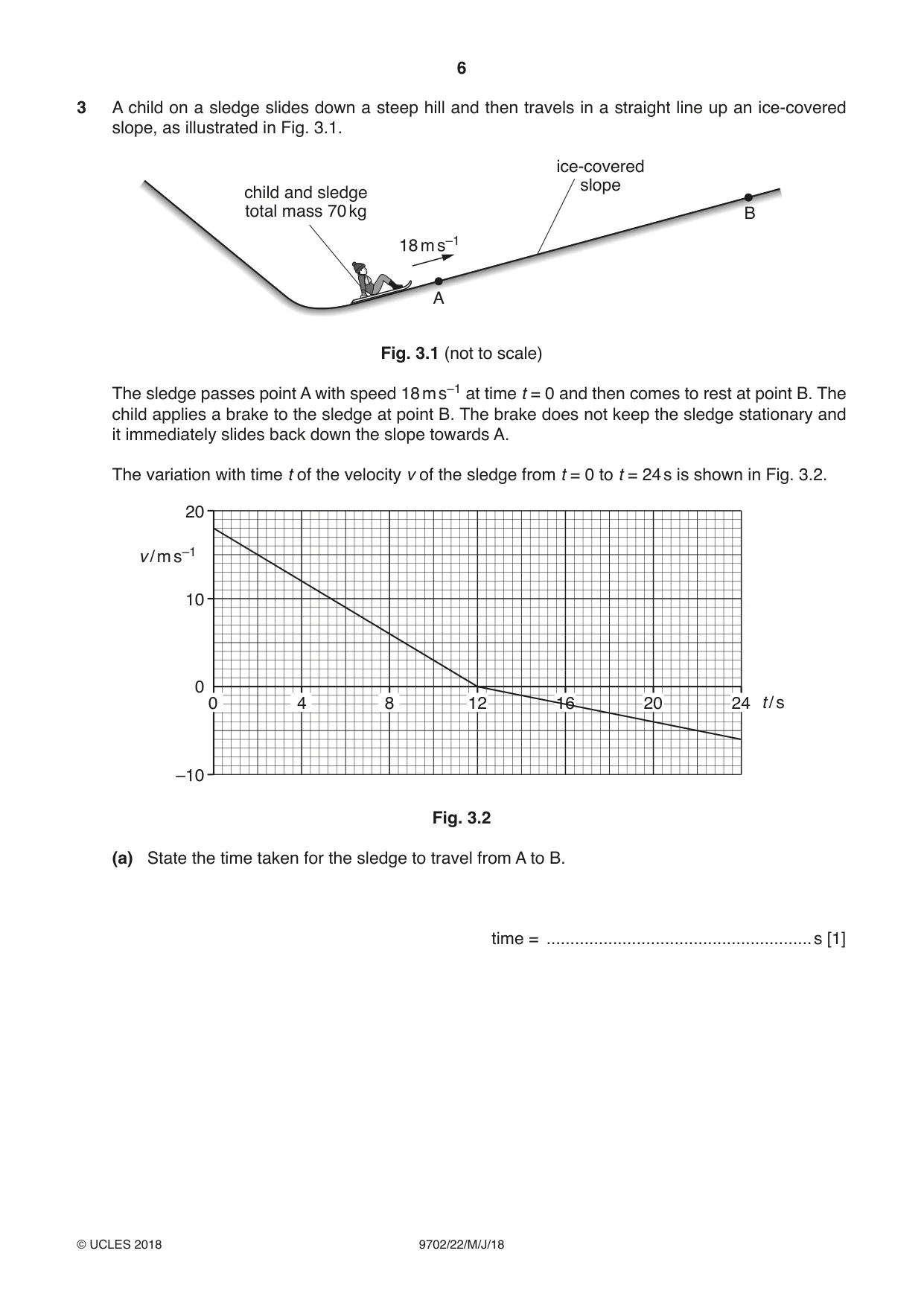
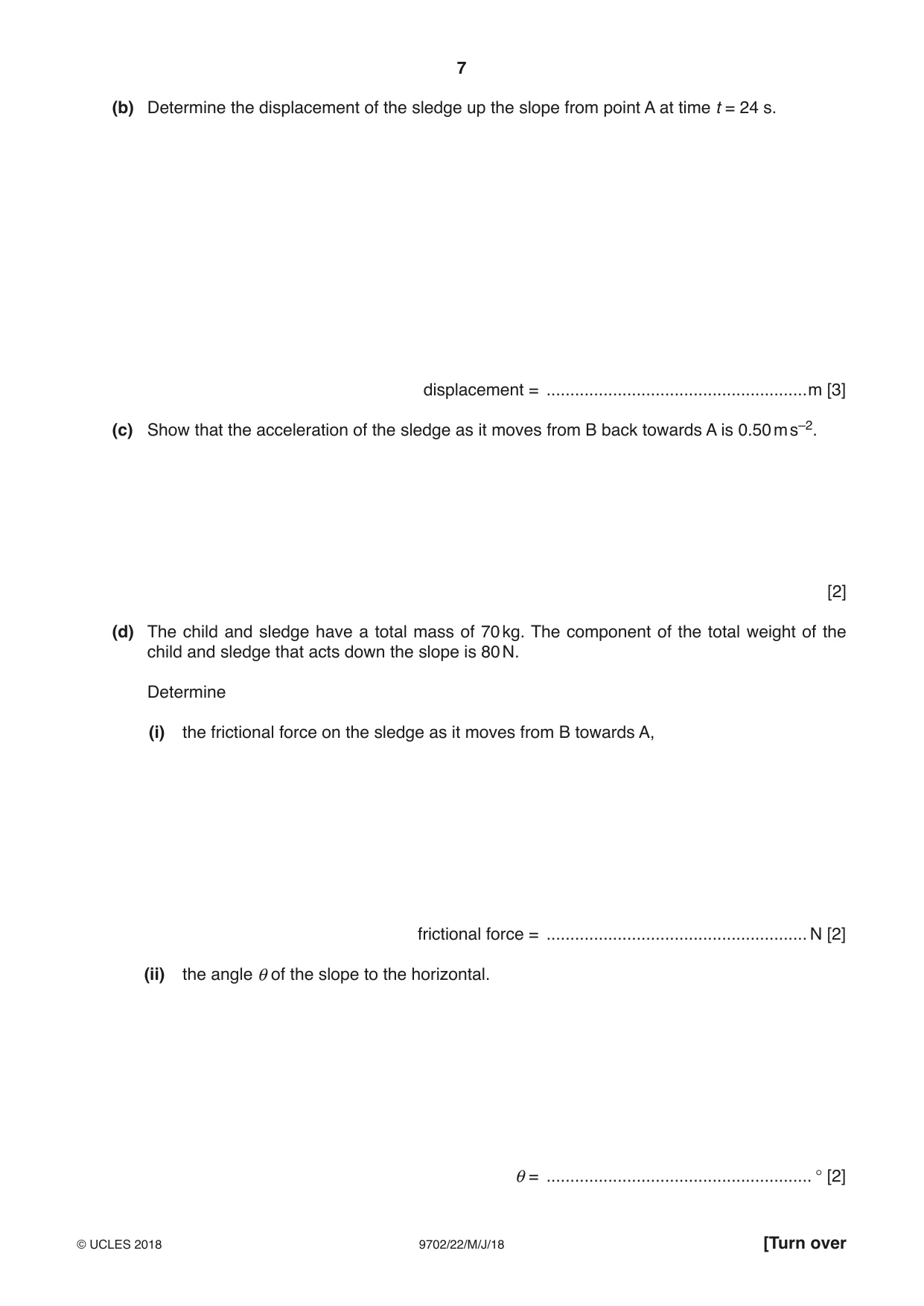
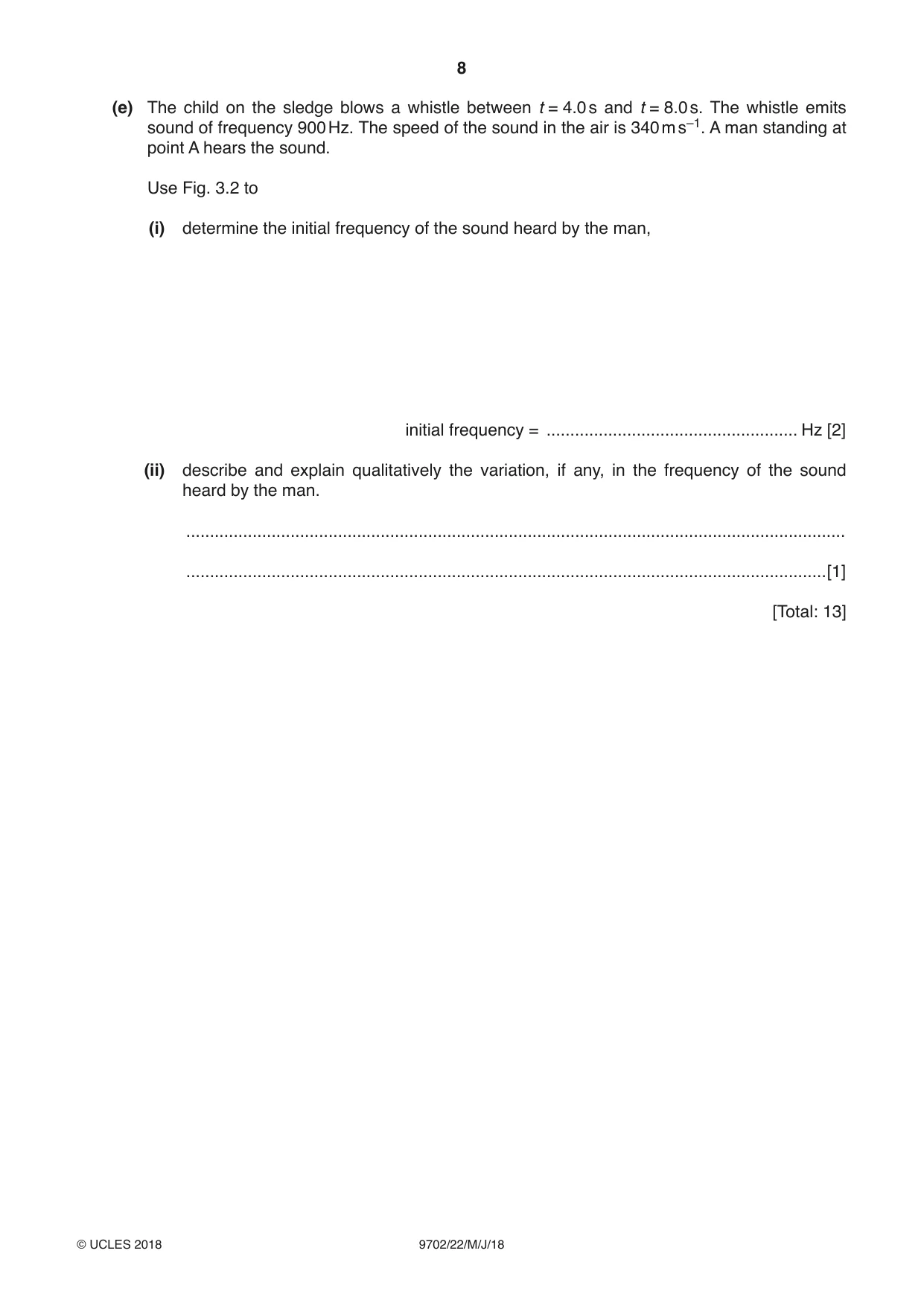
3 A child on a sledge slides down a steep hill and then travels in a straight line up an ice-covered slope, as illustrated in Fig. 3.1. ice-covered slope child and sledge total mass 70 kg B 18 m s–1 A Fig. 3.1 (not to scale) The sledge passes point A with speed 18 m s–1 at time t = 0 and then comes to rest at point B. The child applies a brake to the sledge at point B. The brake does not keep the sledge stationary and it immediately slides back down the slope towards A. The variation with time t of the velocity v of the sledge from t = 0 to t = 24 s is shown in Fig. 3.2. 20 v / m s–1 10 0 0 4 8 12 16 20 24 t / s –10 Fig. 3.2 (a) State the time taken for the sledge to travel from A to B. time = ........................................................s [1] (b) Determine the displacement of the sledge up the slope from point A at time t = 24 s. displacement = .......................................................m [3] (c) Show that the acceleration of the sledge as it moves from B back towards A is 0.50 m s–2. [2] (d) The child and sledge have a total mass of 70 kg. The component of the total weight of the child and sledge that acts down the slope is 80 N. Determine (i) the frictional force on the sledge as it moves from B towards A, frictional force = ....................................................... N [2] (ii) the angle θ of the slope to the horizontal. θ = ........................................................ ° [2] (e) The child on the sledge blows a whistle between t = 4.0 s and t = 8.0 s. The whistle emits sound of frequency 900 Hz. The speed of the sound in the air is 340 m s–1. A man standing at point A hears the sound. Use Fig. 3.2 to (i) determine the initial frequency of the sound heard by the man, initial frequency = ..................................................... Hz [2] (ii) describe and explain qualitatively the variation, if any, in the frequency of the sound heard by the man. ........................................................................................................................................... .......................................................................................................................................[1] [Total: 13]
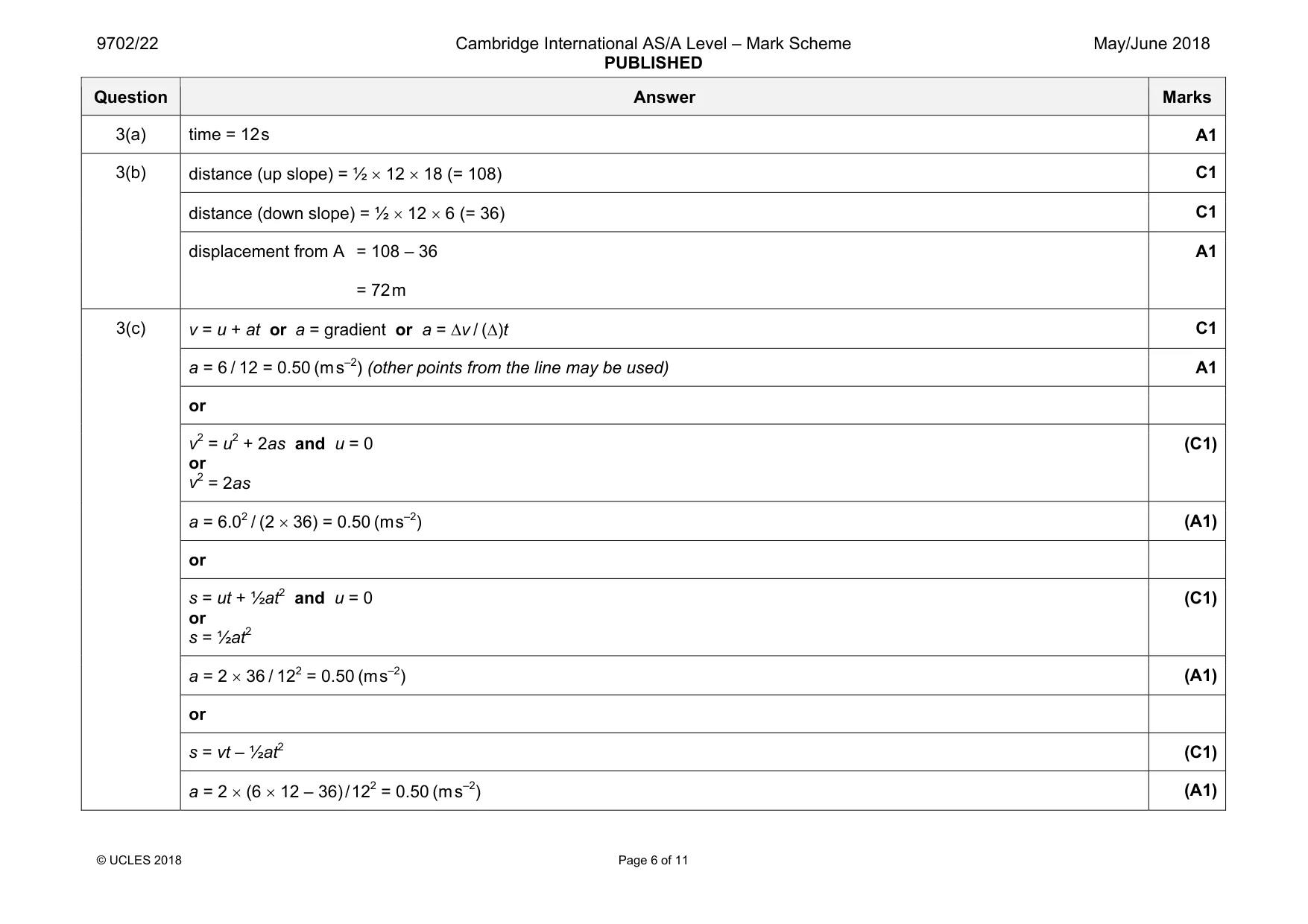
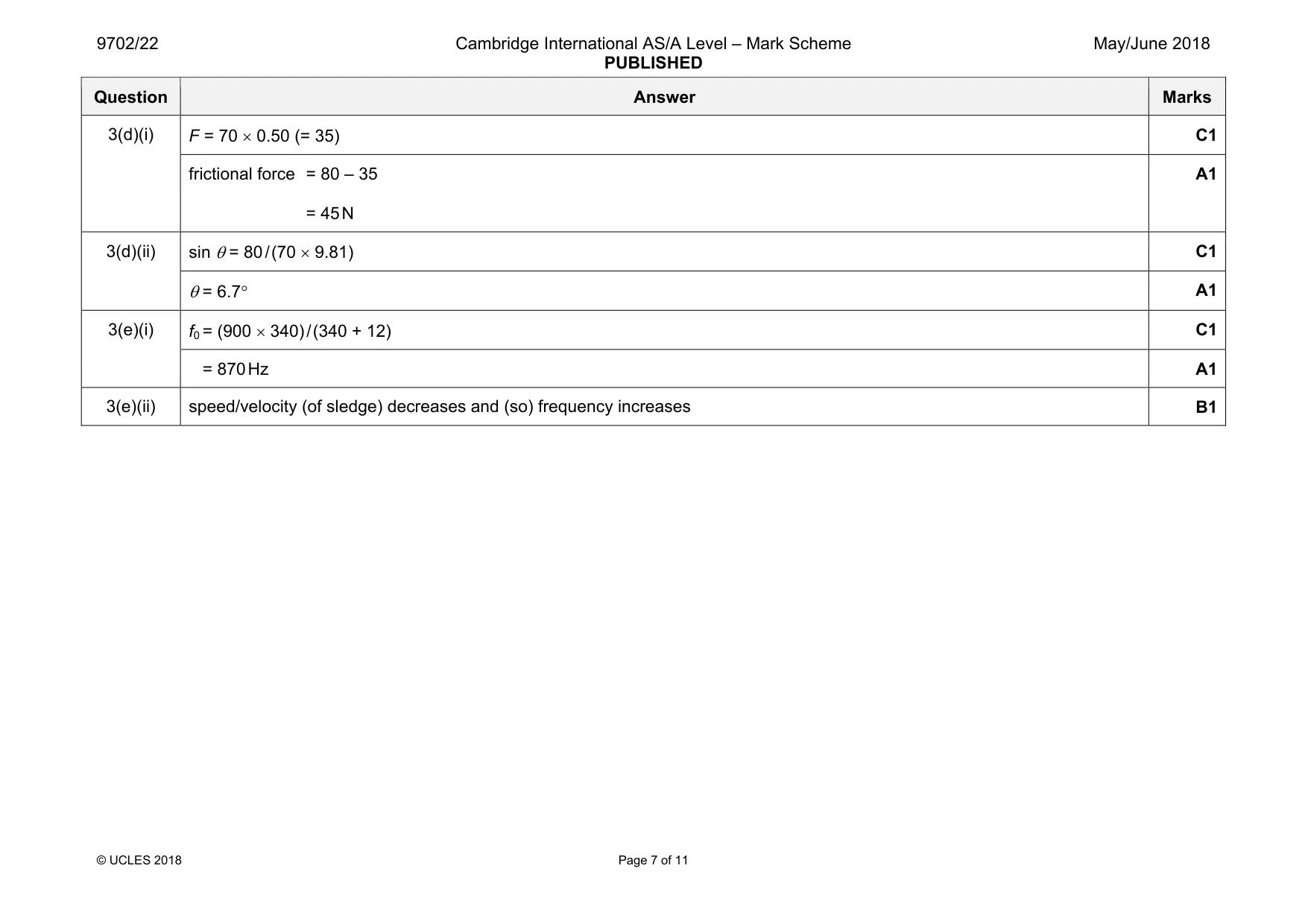
Mark scheme: 3(a) time = 12 s A1 3(b) distance (up slope) = ½ × 12 × 18 (= 108) C1 distance (down slope) = ½ × 12 × 6 (= 36) C1 displacement from A = 108 – 36 = 72 m A1 3(c) v = u + at or a = gradient or a = ∆v / (∆)t C1 a = 6 / 12 = 0.50 (m s–2) (other points from the line may be used) A1 or v2 = u2 + 2as and u = 0 or v2 = 2as (C1) a = 6.02 / (2 × 36) = 0.50 (m s–2) (A1) or s = ut + ½at2 and u = 0 or s = ½at2 (C1) a = 2 × 36 / 122 = 0.50 (m s–2) (A1) or s = vt – ½at2 (C1) a = 2 × (6 × 12 – 36) / 122 = 0.50 (m s–2) (A1) Question Answer Marks 3(d)(i) F = 70 × 0.50 (= 35) C1 frictional force = 80 – 35 = 45 N A1 3(d)(ii) sin θ = 80 / (70 × 9.81) C1 θ = 6.7° A1 3(e)(i) f0 = (900 × 340) / (340 + 12) C1 = 870 Hz A1 3(e)(ii) speed/velocity (of sledge) decreases and (so) frequency increases B1
Q4 · Define the wavelength of a progressive wave
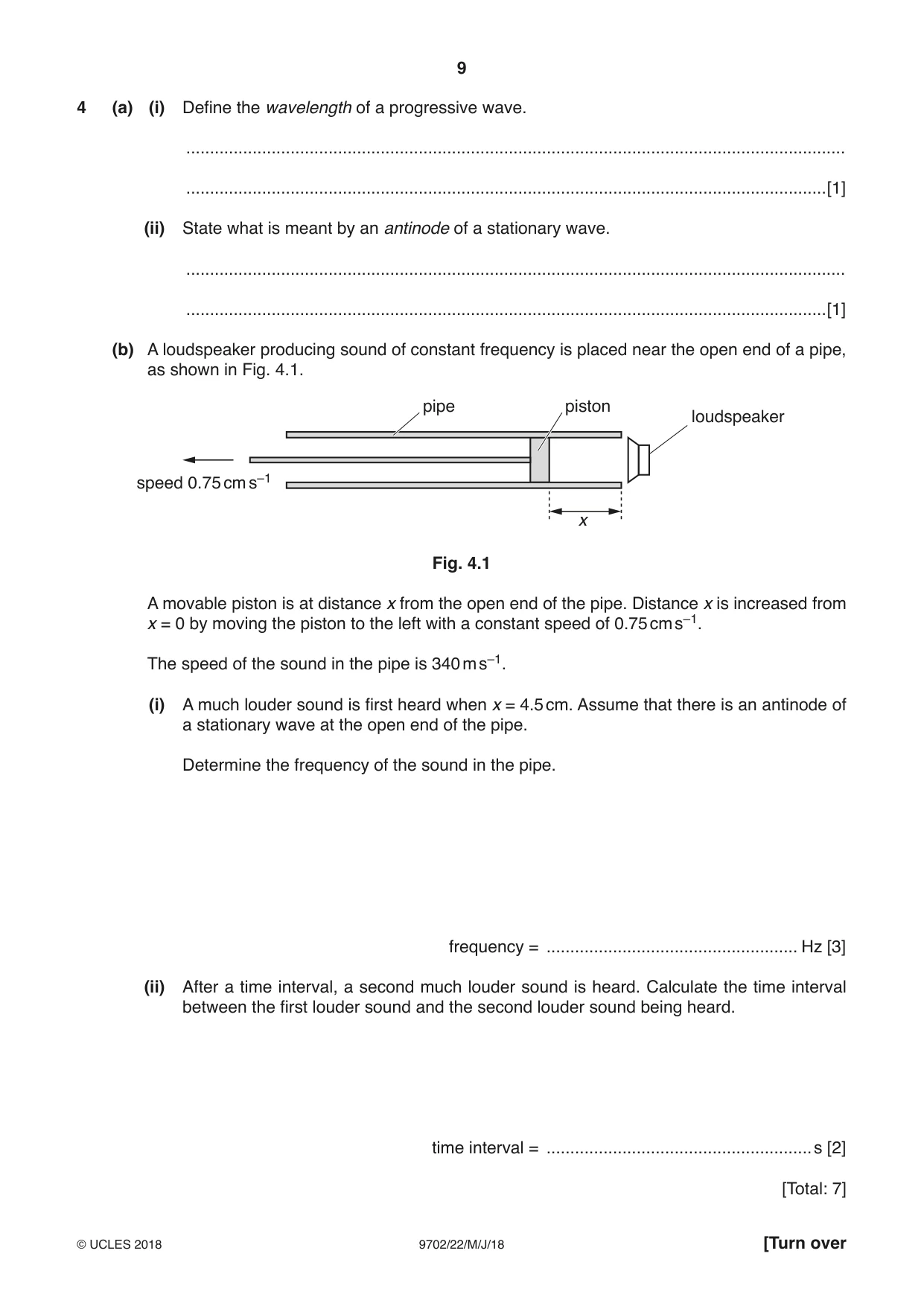
4 (a) (i) Define the wavelength of a progressive wave. ........................................................................................................................................... .......................................................................................................................................[1] (ii) State what is meant by an antinode of a stationary wave. ........................................................................................................................................... .......................................................................................................................................[1] (b) A loudspeaker producing sound of constant frequency is placed near the open end of a pipe, as shown in Fig. 4.1. pipe piston loudspeaker speed 0.75 cm s–1 x Fig. 4.1 A movable piston is at distance x from the open end of the pipe. Distance x is increased from x = 0 by moving the piston to the left with a constant speed of 0.75 cm s–1. The speed of the sound in the pipe is 340 m s–1. (i) A much louder sound is first heard when x = 4.5 cm. Assume that there is an antinode of a stationary wave at the open end of the pipe. Determine the frequency of the sound in the pipe. frequency = ..................................................... Hz [3] (ii) After a time interval, a second much louder sound is heard. Calculate the time interval between the first louder sound and the second louder sound being heard. time interval = ........................................................s [2] [Total: 7]
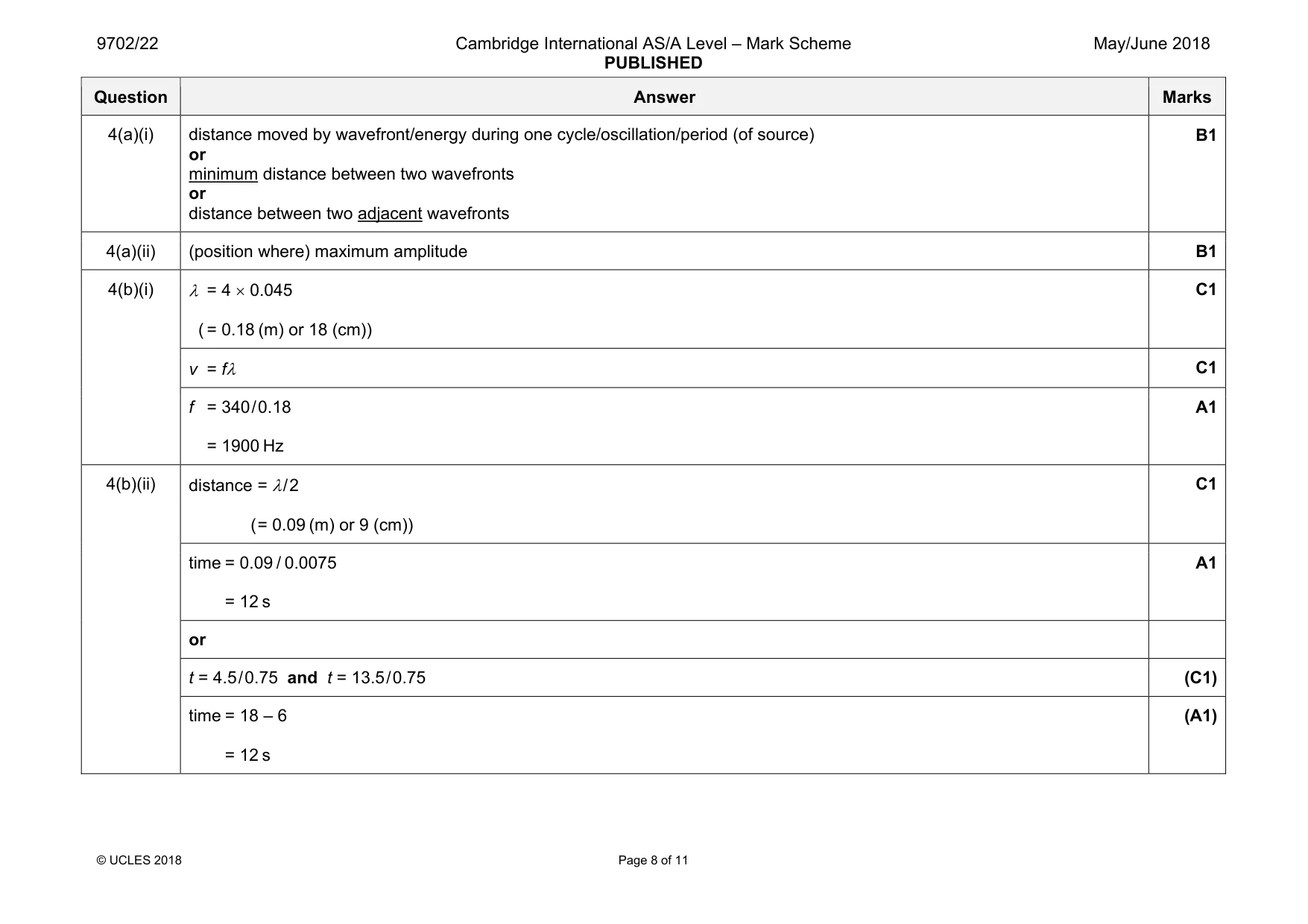
Mark scheme: 4(a)(i) distance moved by wavefront/energy during one cycle/oscillation/period (of source) or minimum distance between two wavefronts or distance between two adjacent wavefronts B1 4(a)(ii) (position where) maximum amplitude B1 4(b)(i) λ = 4 × 0.045 ( = 0.18 (m) or 18 (cm)) C1 v = fλ C1 f = 340 / 0.18 = 1900 Hz A1 4(b)(ii) distance = λ / 2 ( = 0.09 (m) or 9 (cm)) C1 time = 0.09 / 0.0075 = 12 s A1 or t = 4.5 / 0.75 and t = 13.5 / 0.75 (C1) time = 18 – 6 = 12 s (A1)
Q5 · A solid cylinder is lifted out of oil by a wire attached to a motor
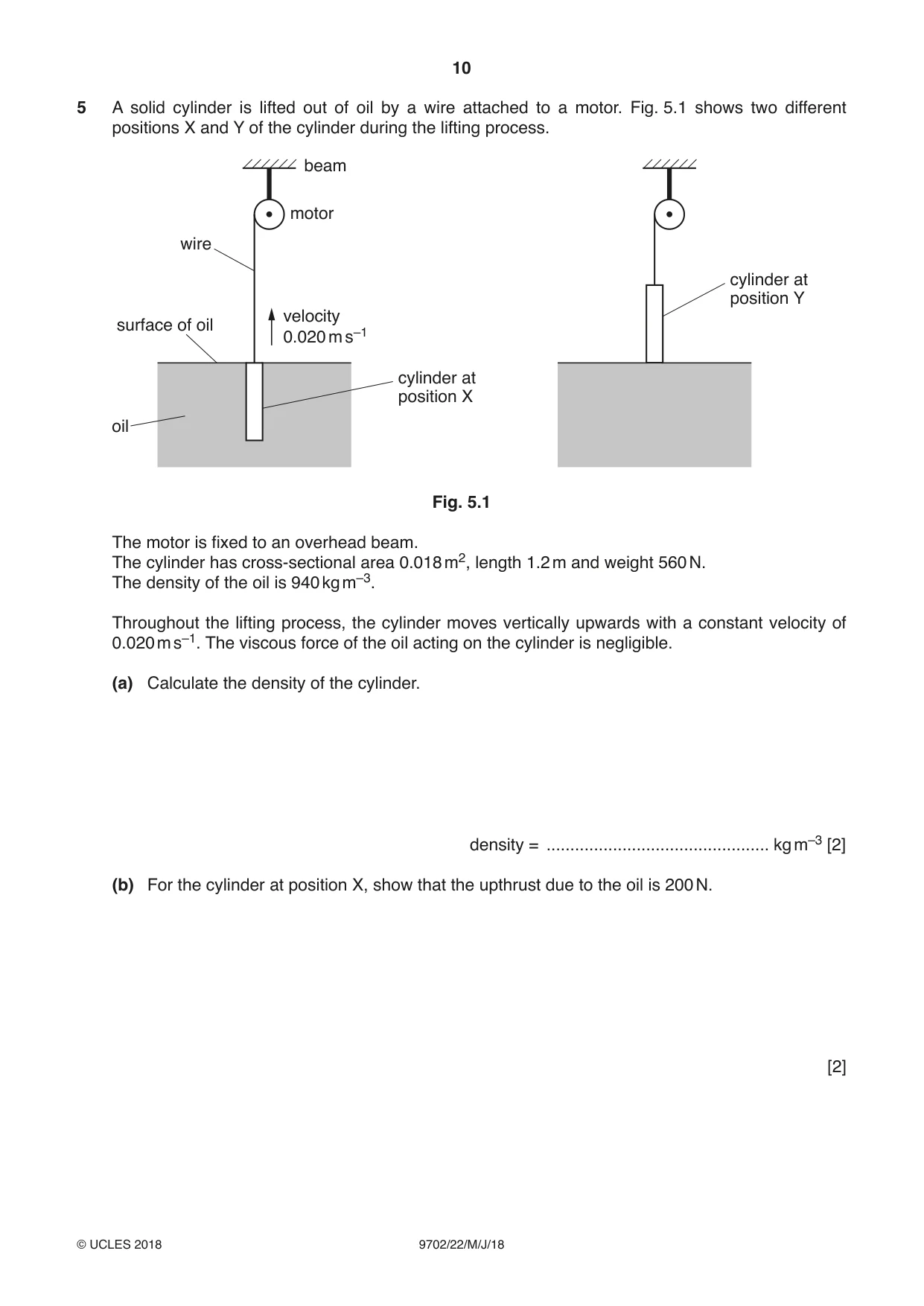
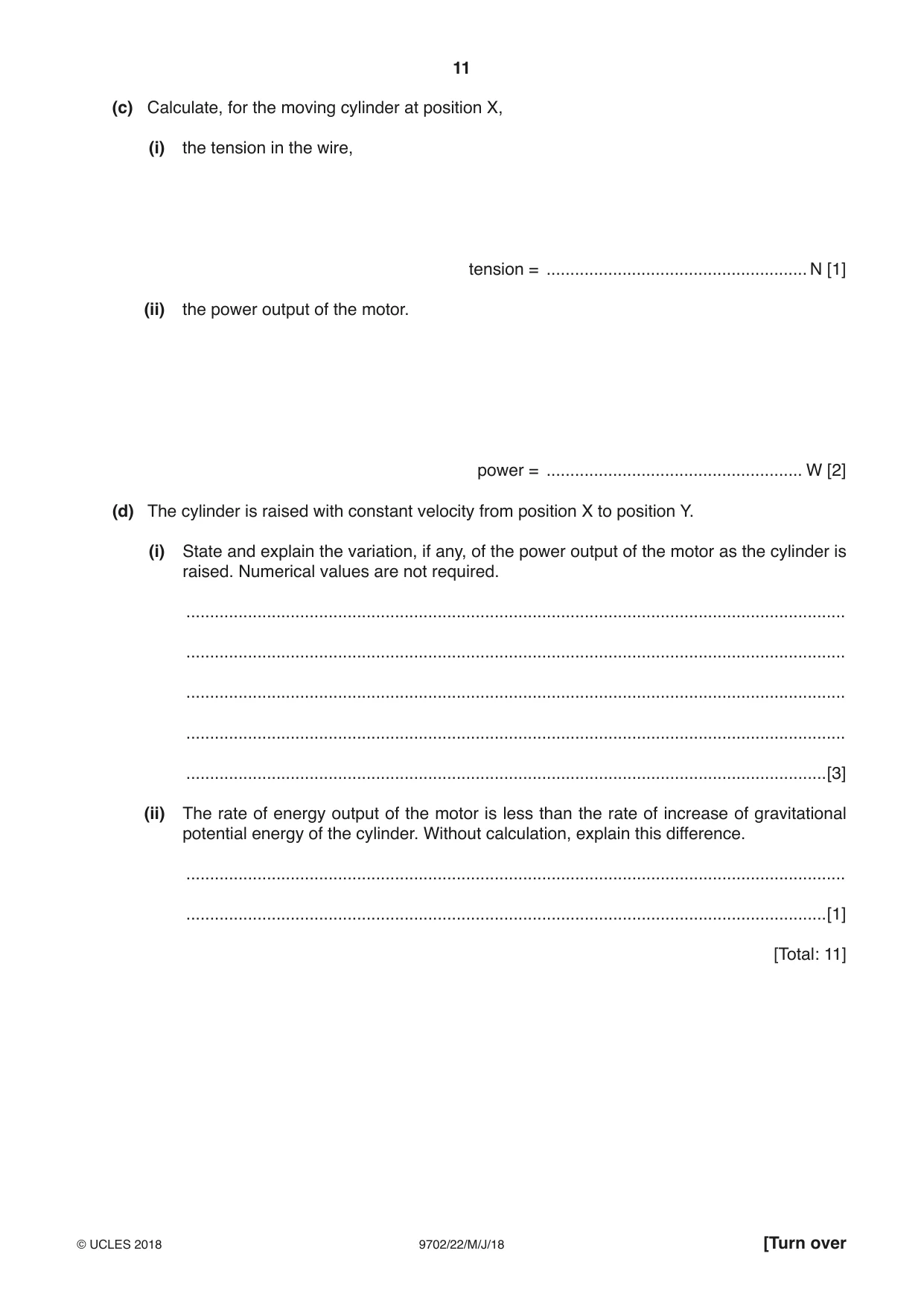
5 A solid cylinder is lifted out of oil by a wire attached to a motor. Fig. 5.1 shows two different positions X and Y of the cylinder during the lifting process. beam motor wire cylinder at position Y velocity surface of oil 0.020 m s–1 cylinder at position X oil Fig. 5.1 The motor is fixed to an overhead beam. The cylinder has cross-sectional area 0.018 m2, length 1.2 m and weight 560 N. The density of the oil is 940 kg m–3. Throughout the lifting process, the cylinder moves vertically upwards with a constant velocity of 0.020 m s–1. The viscous force of the oil acting on the cylinder is negligible. (a) Calculate the density of the cylinder. density = ............................................... kg m–3 [2] (b) For the cylinder at position X, show that the upthrust due to the oil is 200 N. [2] (c) Calculate, for the moving cylinder at position X, (i) the tension in the wire, tension = ....................................................... N [1] (ii) the power output of the motor. power = ...................................................... W [2] (d) The cylinder is raised with constant velocity from position X to position Y. (i) State and explain the variation, if any, of the power output of the motor as the cylinder is raised. Numerical values are not required. ........................................................................................................................................... ........................................................................................................................................... ........................................................................................................................................... ........................................................................................................................................... .......................................................................................................................................[3] (ii) The rate of energy output of the motor is less than the rate of increase of gravitational potential energy of the cylinder. Without calculation, explain this difference. ........................................................................................................................................... .......................................................................................................................................[1] [Total: 11]
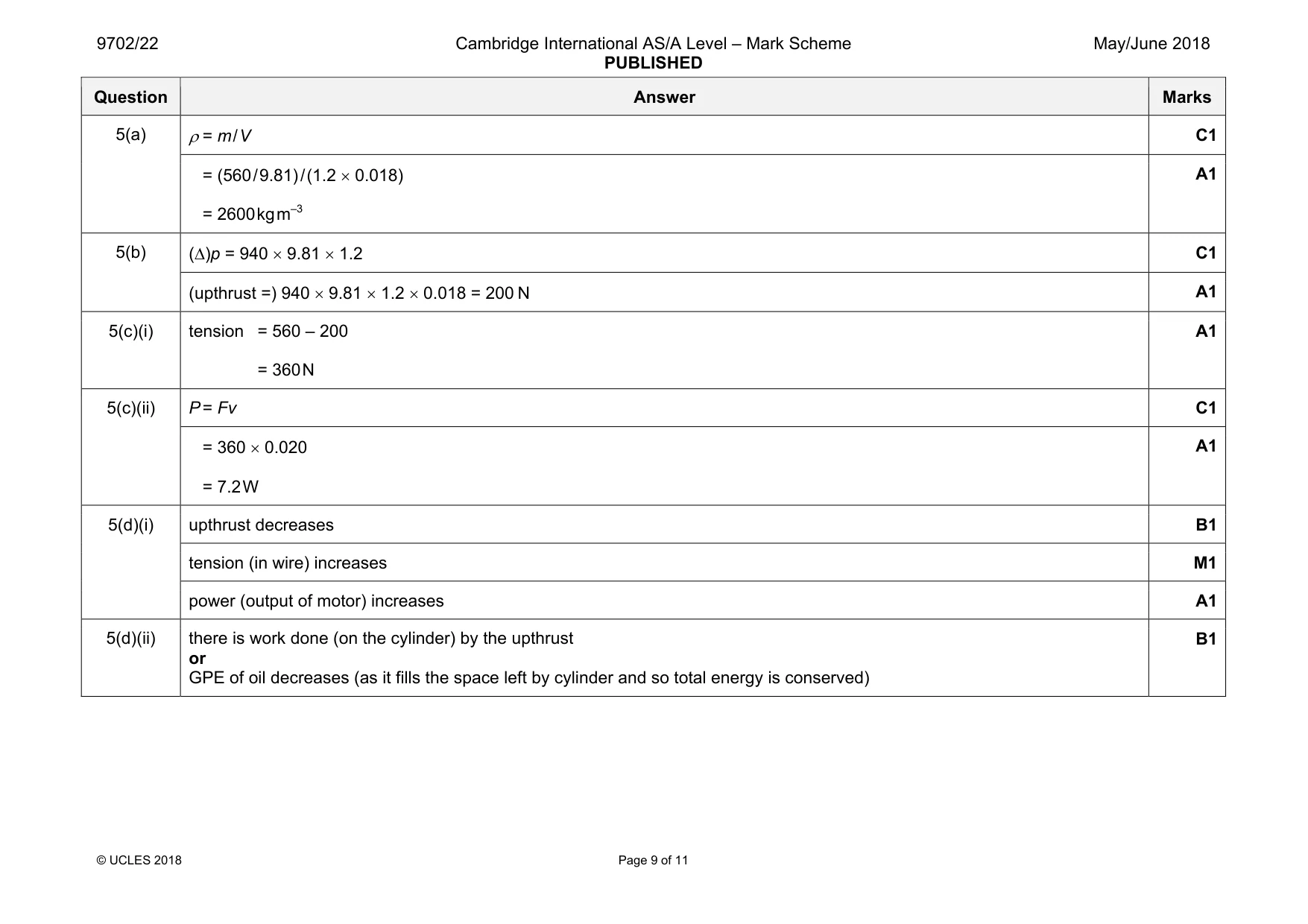
Mark scheme: 5(a) C1 = (560 / 9.81) / (1.2 × 0.018) = 2600 kg m–3 A1 5(b) (∆)p = 940 × 9.81 × 1.2 C1 (upthrust =) 940 × 9.81 × 1.2 × 0.018 = 200 N A1 5(c)(i) tension = 560 – 200 = 360 N A1 5(c)(ii) P = Fv C1 = 360 × 0.020 = 7.2 W A1 5(d)(i) upthrust decreases B1 tension (in wire) increases M1 power (output of motor) increases A1 5(d)(ii) there is work done (on the cylinder) by the upthrust or GPE of oil decreases (as it fills the space left by cylinder and so total energy is conserved) B1
Q6 · State Kirchhoff’s first law
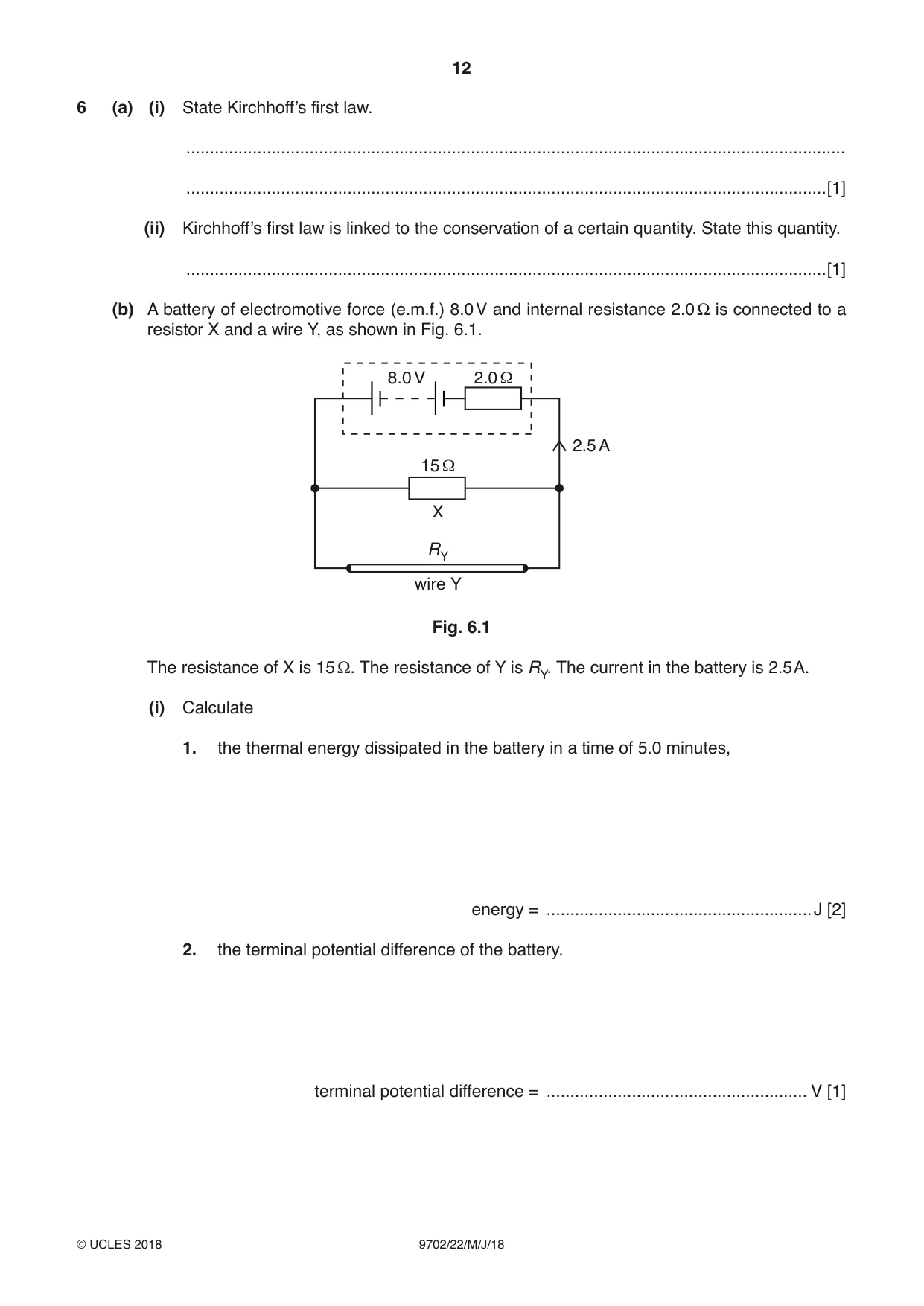
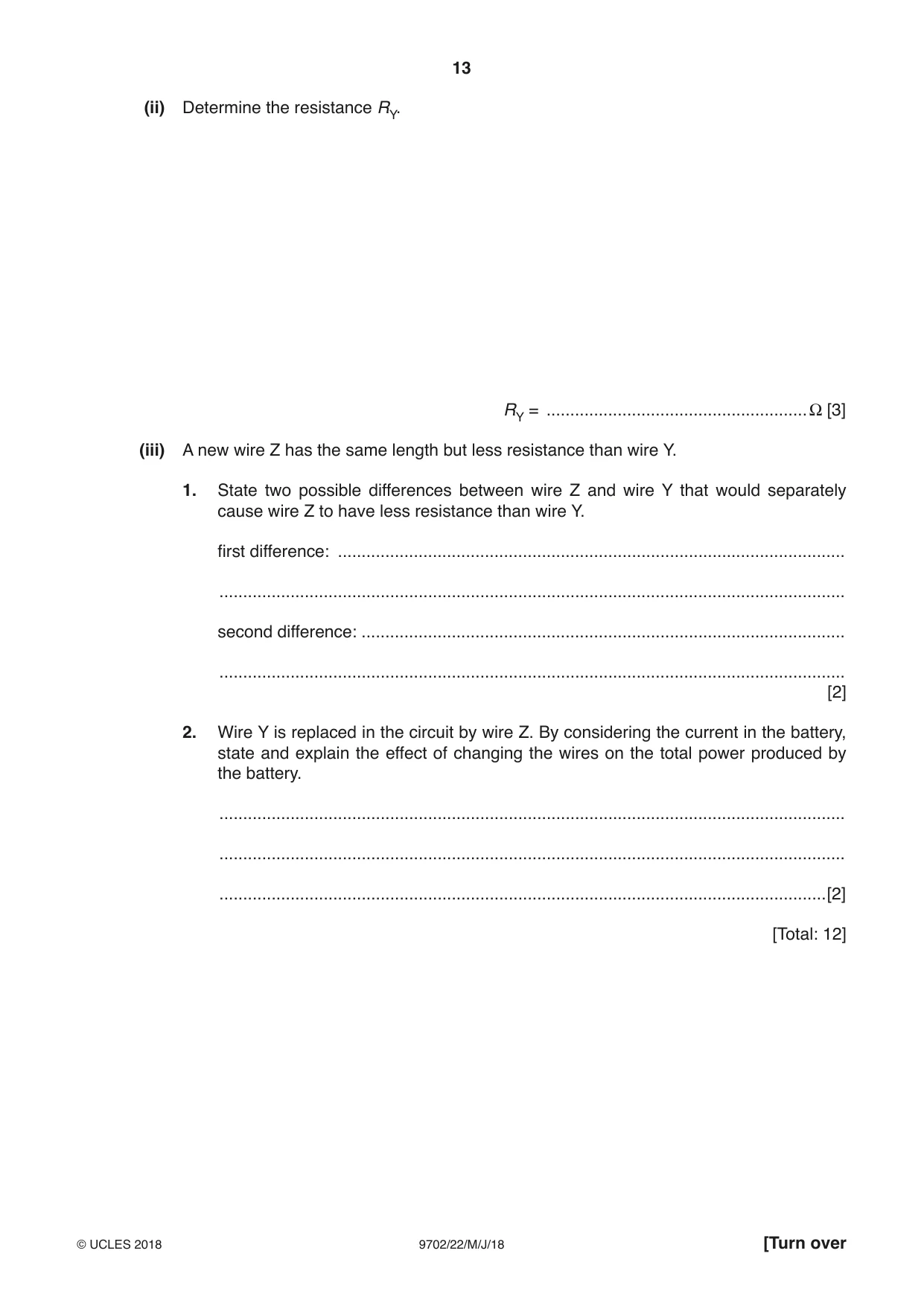
6 (a) (i) State Kirchhoff’s first law. ........................................................................................................................................... .......................................................................................................................................[1] (ii) Kirchhoff’s first law is linked to the conservation of a certain quantity. State this quantity. .......................................................................................................................................[1] (b) A battery of electromotive force (e.m.f.) 8.0 V and internal resistance 2.0 Ω is connected to a resistor X and a wire Y, as shown in Fig. 6.1. 8.0 V 2.0 Ω 2.5 A 15 Ω X RY wire Y Fig. 6.1 The resistance of X is 15 Ω. The resistance of Y is RY. The current in the battery is 2.5 A. (i) Calculate 1. the thermal energy dissipated in the battery in a time of 5.0 minutes, energy = ........................................................J [2] 2. the terminal potential difference of the battery. terminal potential difference = ....................................................... V [1] (ii) Determine the resistance RY. RY = .......................................................Ω [3] (iii) A new wire Z has the same length but less resistance than wire Y. 1. State two possible differences between wire Z and wire Y that would separately cause wire Z to have less resistance than wire Y. first difference: ........................................................................................................... .................................................................................................................................... second difference: ...................................................................................................... .................................................................................................................................... [2] 2. Wire Y is replaced in the circuit by wire Z. By considering the current in the battery, state and explain the effect of changing the wires on the total power produced by the battery. .................................................................................................................................... .................................................................................................................................... ................................................................................................................................[2] [Total: 12]
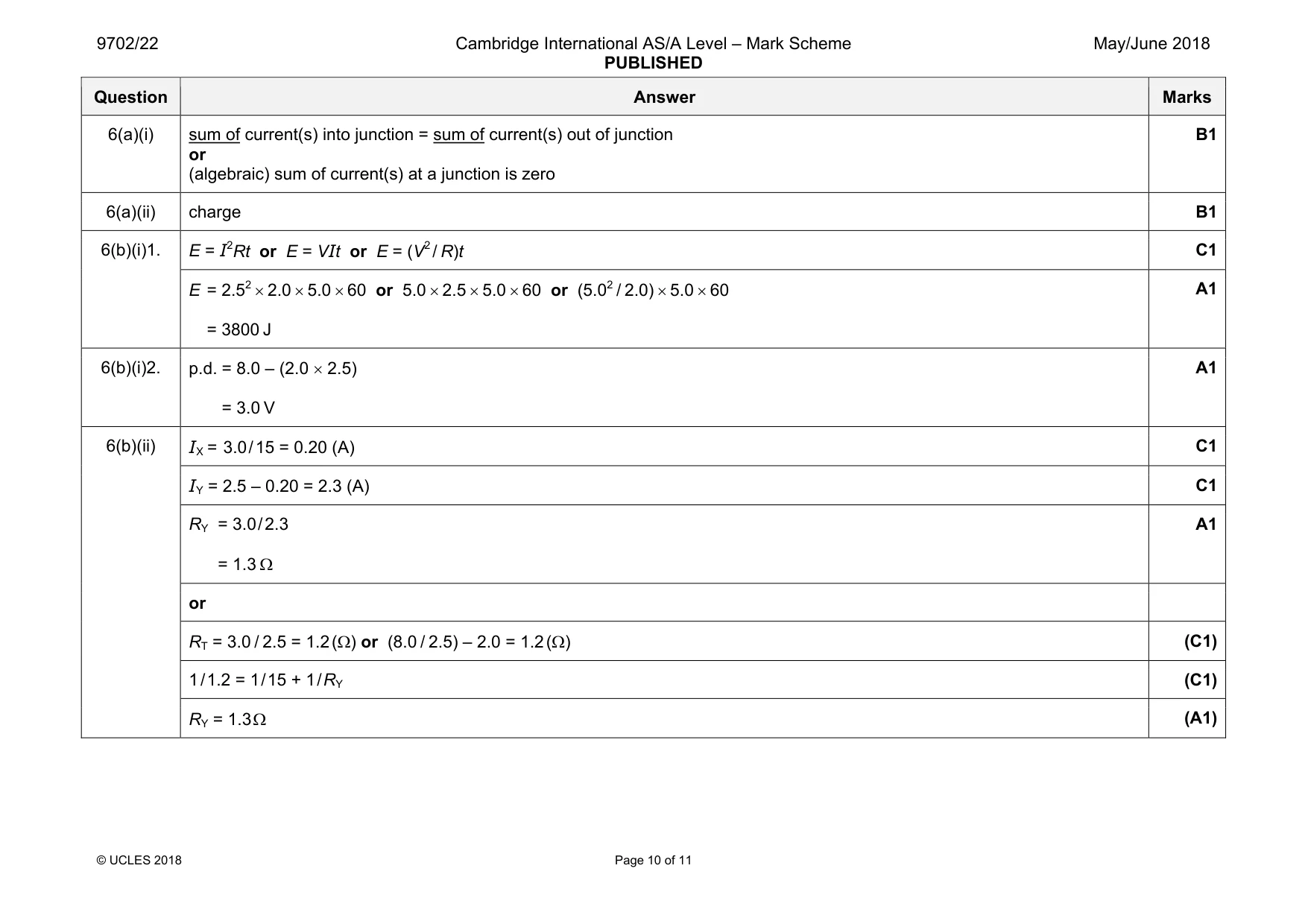
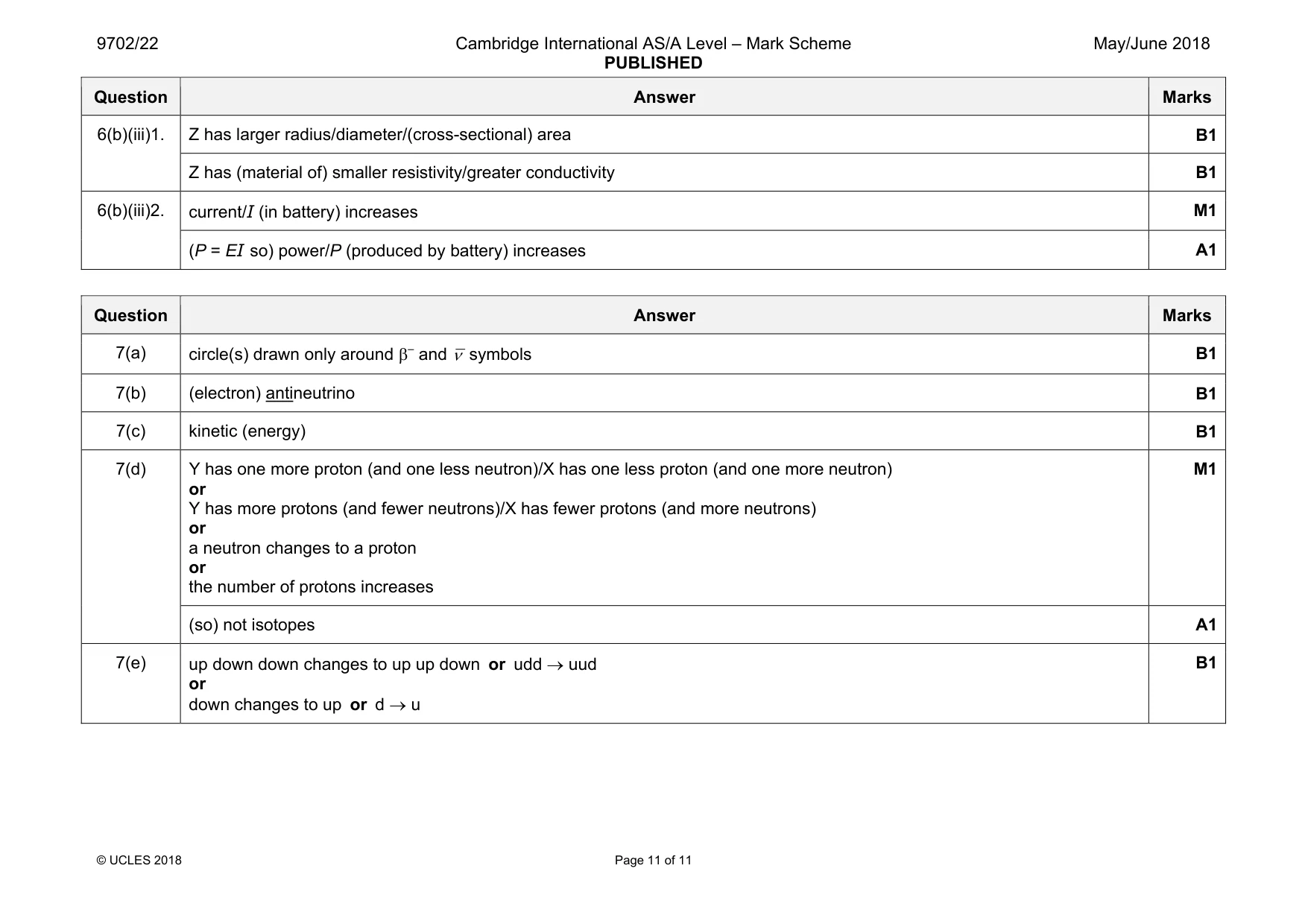
Mark scheme: 6(a)(i) sum of current(s) into junction = sum of current(s) out of junction or (algebraic) sum of current(s) at a junction is zero B1 6(a)(ii) charge B1 6(b)(i)1. E = I2Rt or E = VIt or E = (V2/ R)t C1 E = 2.52 × 2.0 × 5.0 × 60 or 5.0 × 2.5 × 5.0 × 60 or (5.02 / 2.0) × 5.0 × 60 = 3800 J A1 6(b)(i)2. p.d. = 8.0 – (2.0 × 2.5) = 3.0 V A1 6(b)(ii) IX = 3.0 / 15 = 0.20 (A) C1 IY = 2.5 – 0.20 = 2.3 (A) C1 RY = 3.0 / 2.3 = 1.3 Ω A1 or RT = 3.0 / 2.5 = 1.2 (Ω) or (8.0 / 2.5) – 2.0 = 1.2 (Ω) (C1) 1 / 1.2 = 1 / 15 + 1 / RY (C1) RY = 1.3 Ω (A1) Question Answer Marks 6(b)(iii)1. Z has larger radius/diameter/(cross-sectional) area B1 Z has (material of) smaller resistivity/greater conductivity B1 6(b)(iii)2. current/I (in battery) increases M1 (P = EI so) power/P (produced by battery) increases A1
Q7 · A stationary nucleus X decays to form nucleus Y, as shown by the equation X Y + β– + ν
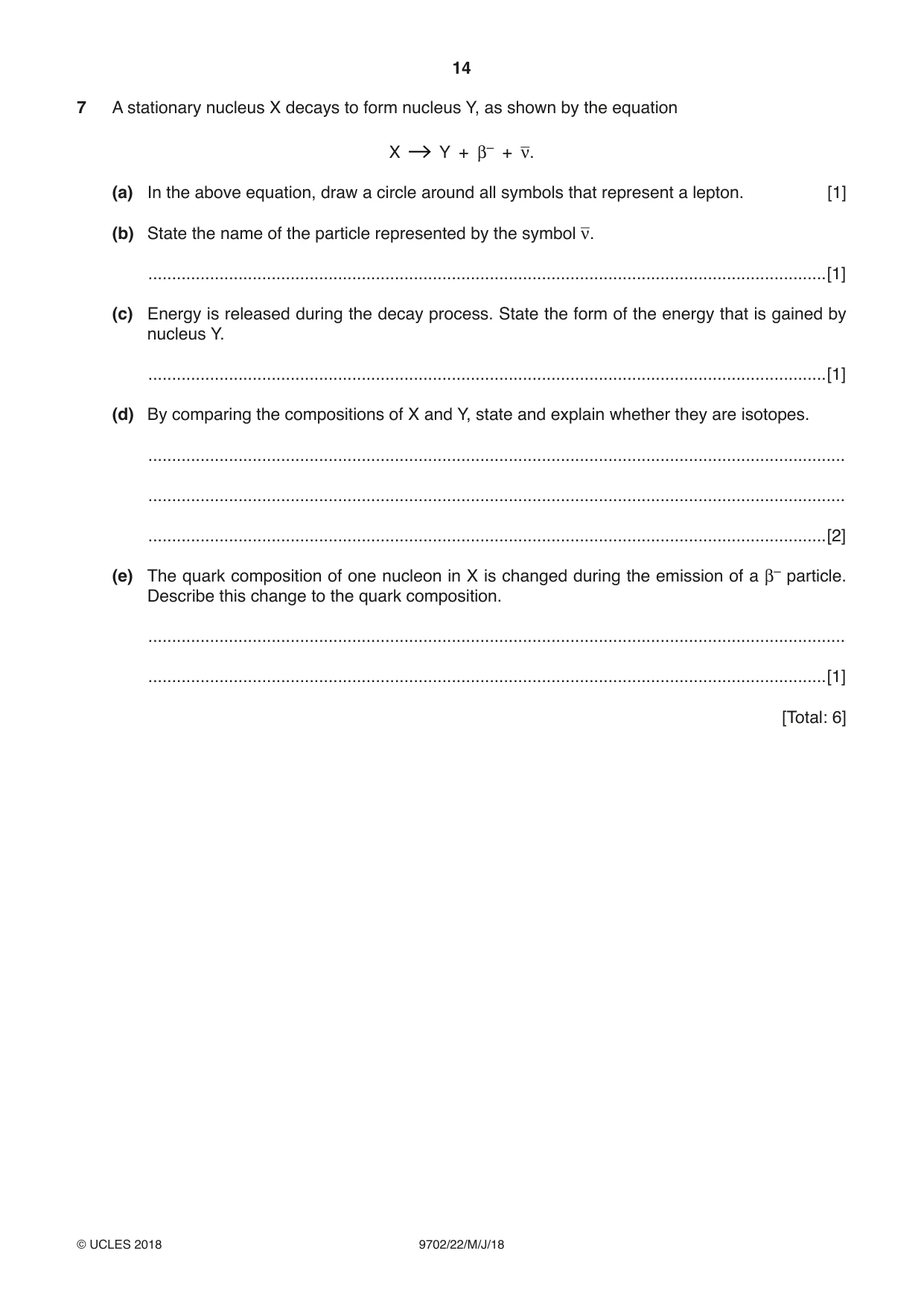
7 A stationary nucleus X decays to form nucleus Y, as shown by the equation X Y + β– + ν. (a) In the above equation, draw a circle around all symbols that represent a lepton. [1] (b) State the name of the particle represented by the symbol ν. ...............................................................................................................................................[1] (c) Energy is released during the decay process. State the form of the energy that is gained by nucleus Y. ...............................................................................................................................................[1] (d) By comparing the compositions of X and Y, state and explain whether they are isotopes. ................................................................................................................................................... ................................................................................................................................................... ...............................................................................................................................................[2] (e) The quark composition of one nucleon in X is changed during the emission of a β– particle. Describe this change to the quark composition. ................................................................................................................................................... ...............................................................................................................................................[1] [Total: 6]
Mark scheme: 7(a) B1 7(b) (electron) antineutrino B1 7(c) kinetic (energy) B1 7(d) Y has one more proton (and one less neutron)/X has one less proton (and one more neutron) or Y has more protons (and fewer neutrons)/X has fewer protons (and more neutrons) or a neutron changes to a proton or the number of protons increases M1 (so) not isotopes A1 7(e) up down down changes to up up down or udd → uud or down changes to up or d → u B1
What was in this paper
The subtopics covered by these 7 questions, and how many questions each got. Open one in a new tab to see every Cambridge question on it.
What you needed in this session
Cambridge’s own grade thresholds for 2018 May/June, Paper 2 · Variant 2. A higher threshold means an easier paper — the bar moves with how the cohort did.