Cambridge A Level Physics 9702 — 2021 May/June Paper 2 · Variant 1
9702/21/M/J/21 · 6 questions · 60 marks · ≈68 min
The question paper and its mark scheme, free to read here and free to download. This is Cambridge’s own paper, exactly as it was sat.
Question paper16 pages

Mark scheme12 pages
Answers below. Sit the paper first if you are practising.
Questions as text
Question 1
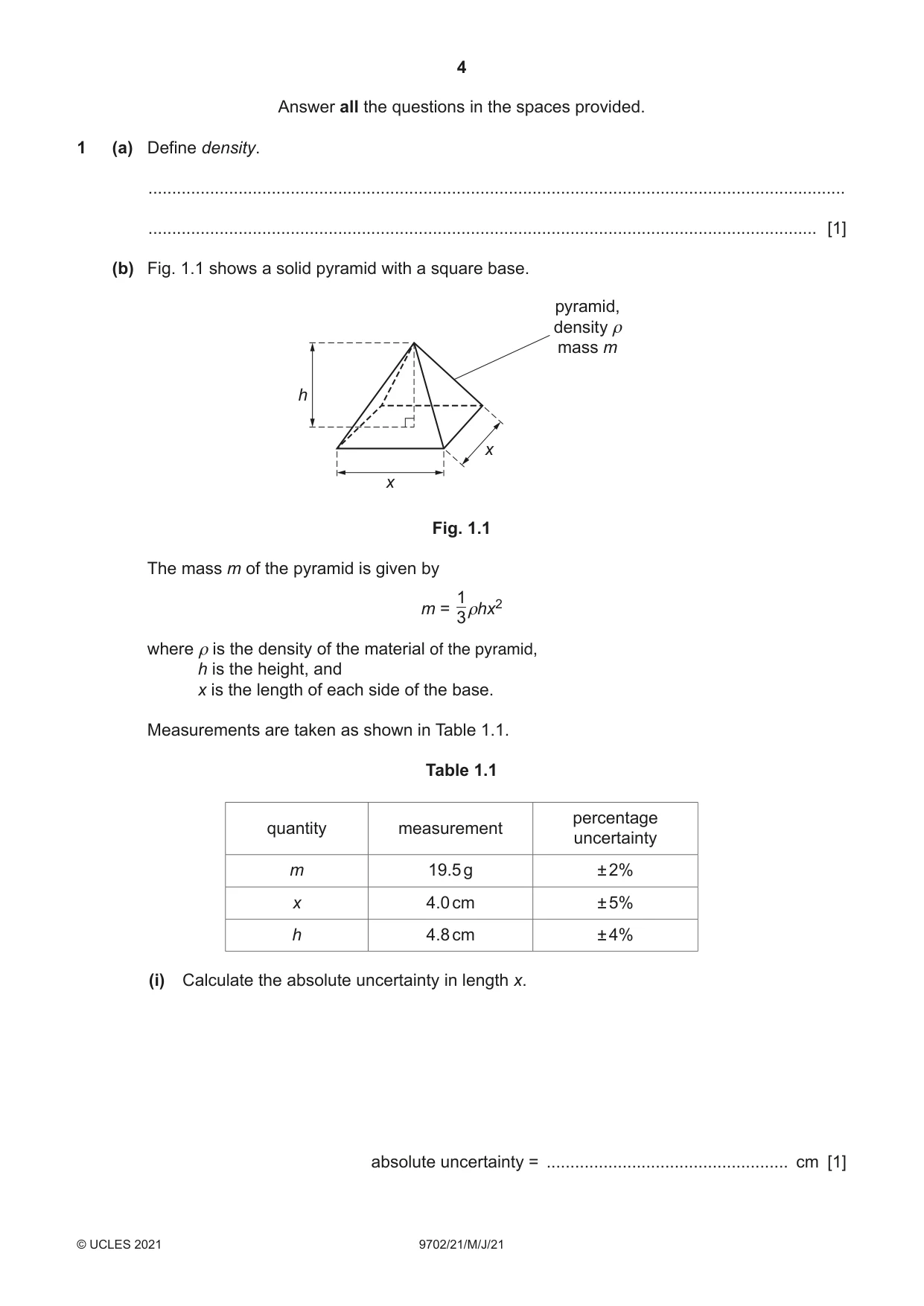
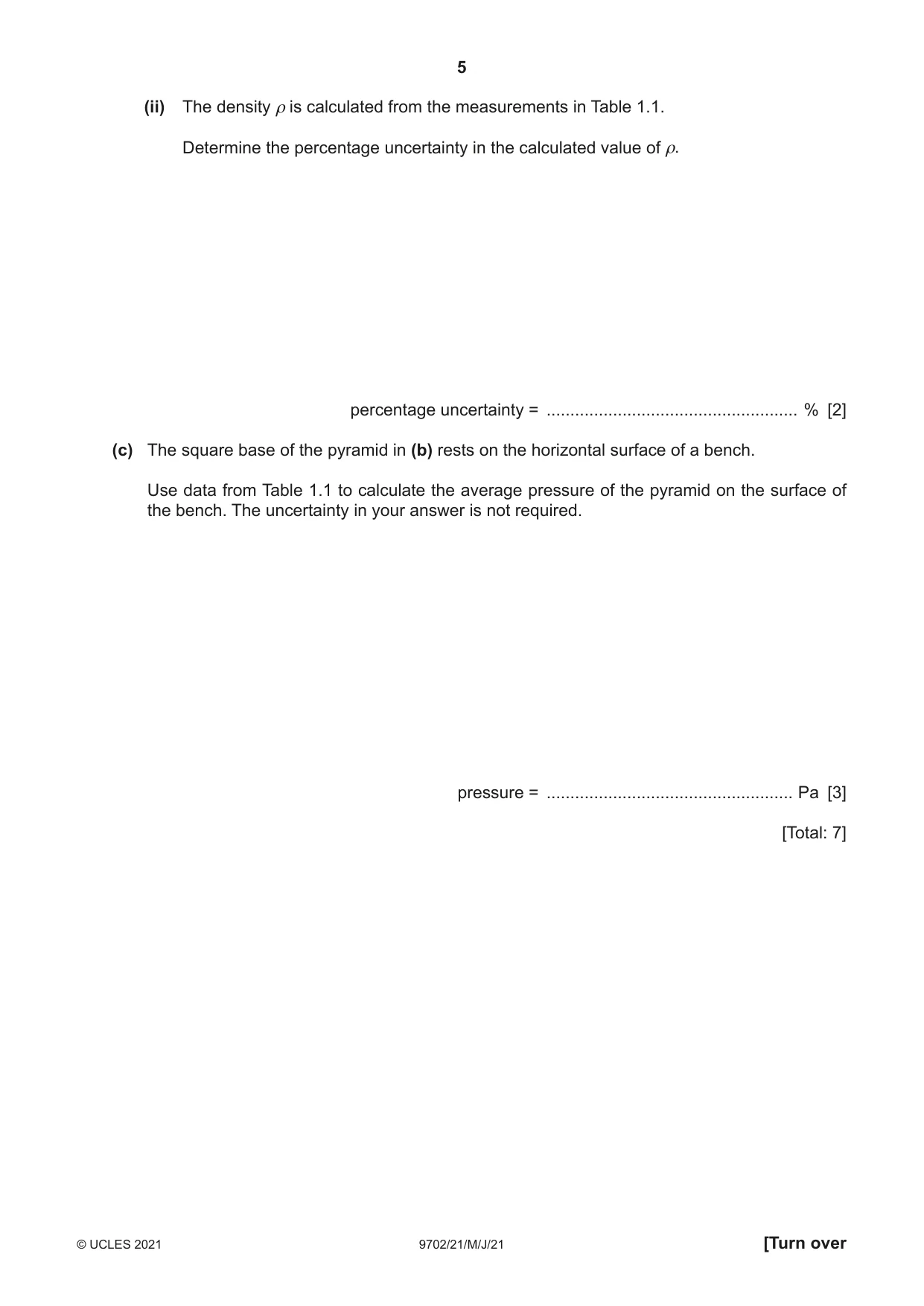
1 (a) Define density. ................................................................................................................................................... ............................................................................................................................................. [1] (b) Fig. 1.1 shows a solid pyramid with a square base. pyramid, density ρ mass m h x x Fig. 1.1 The mass m of the pyramid is given by 1 m = 3ρhx2 where ρ is the density of the material of the pyramid, h is the height, and x is the length of each side of the base. Measurements are taken as shown in Table 1.1. Table 1.1 percentage quantity measurement uncertainty m 19.5 g ± 2% x 4.0 cm ± 5% h 4.8 cm ± 4% (i) Calculate the absolute uncertainty in length x. absolute uncertainty = ................................................... cm [1] (ii) The density ρ is calculated from the measurements in Table 1.1. Determine the percentage uncertainty in the calculated value of ρ. percentage uncertainty = ..................................................... % [2] (c) The square base of the pyramid in (b) rests on the horizontal surface of a bench. Use data from Table 1.1 to calculate the average pressure of the pyramid on the surface of the bench. The uncertainty in your answer is not required. pressure = .................................................... Pa [3] [Total: 7]
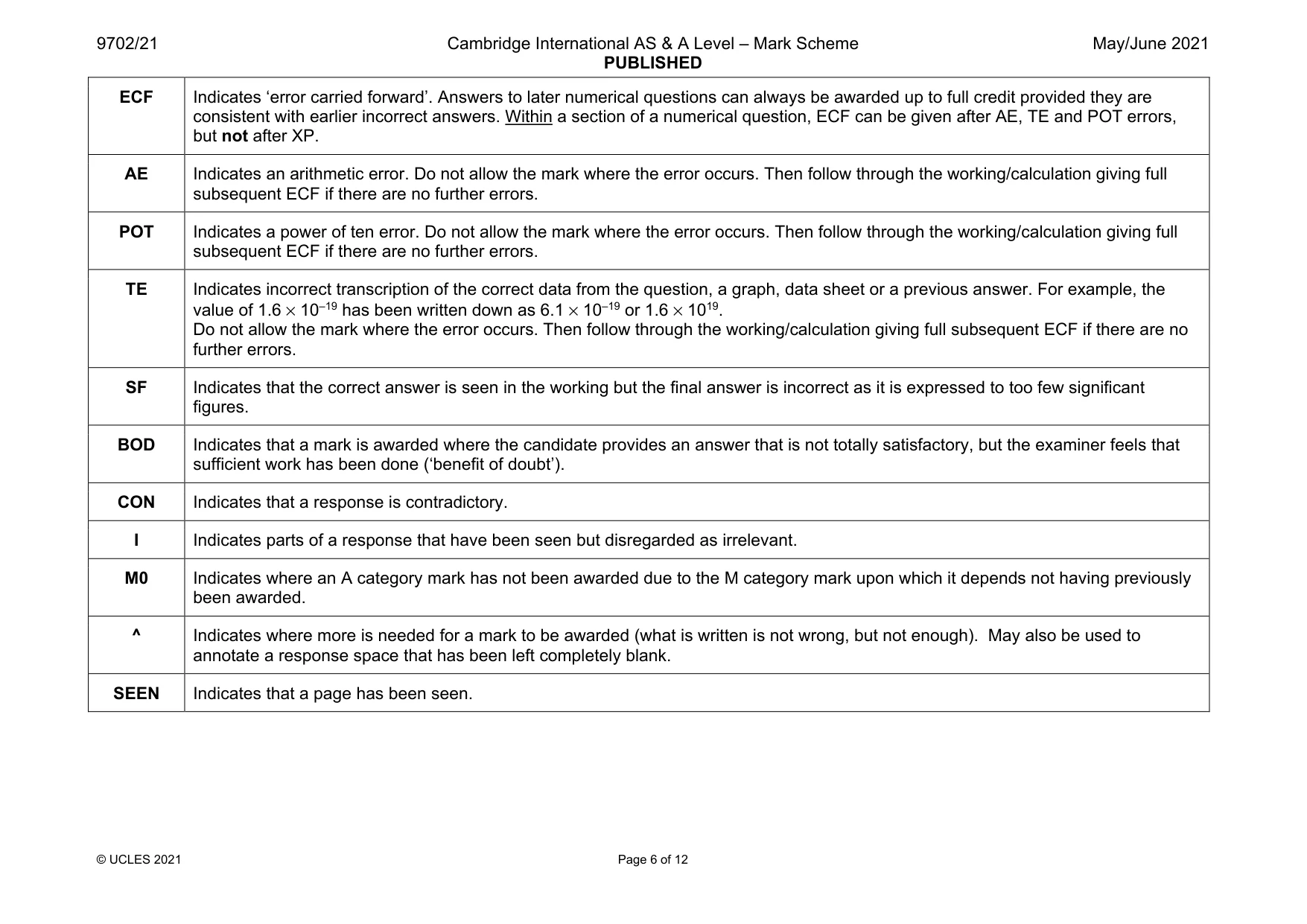
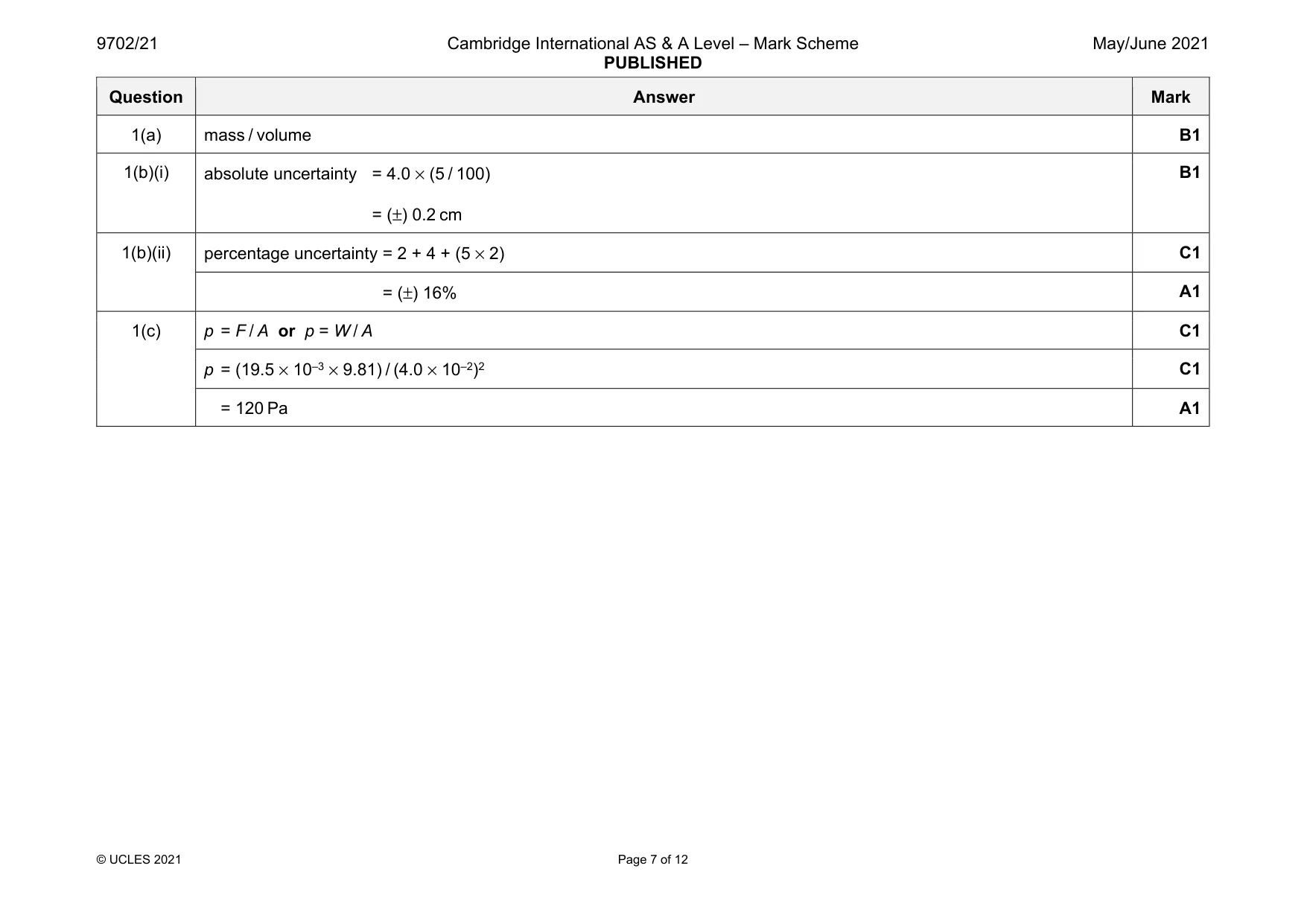
Mark scheme: 1(a) mass / volume B1 1(b)(i) absolute uncertainty = 4.0 × (5 / 100) = (±) 0.2 cm B1 1(b)(ii) percentage uncertainty = 2 + 4 + (5 × 2) C1 = (±) 16% A1 1(c) p = F / A or p = W / A C1 p = (19.5 × 10–3 × 9.81) / (4.0 × 10⁻²)2 C1 = 120 Pa A1
Q2 · A person uses a trolley to move suitcases at an airport
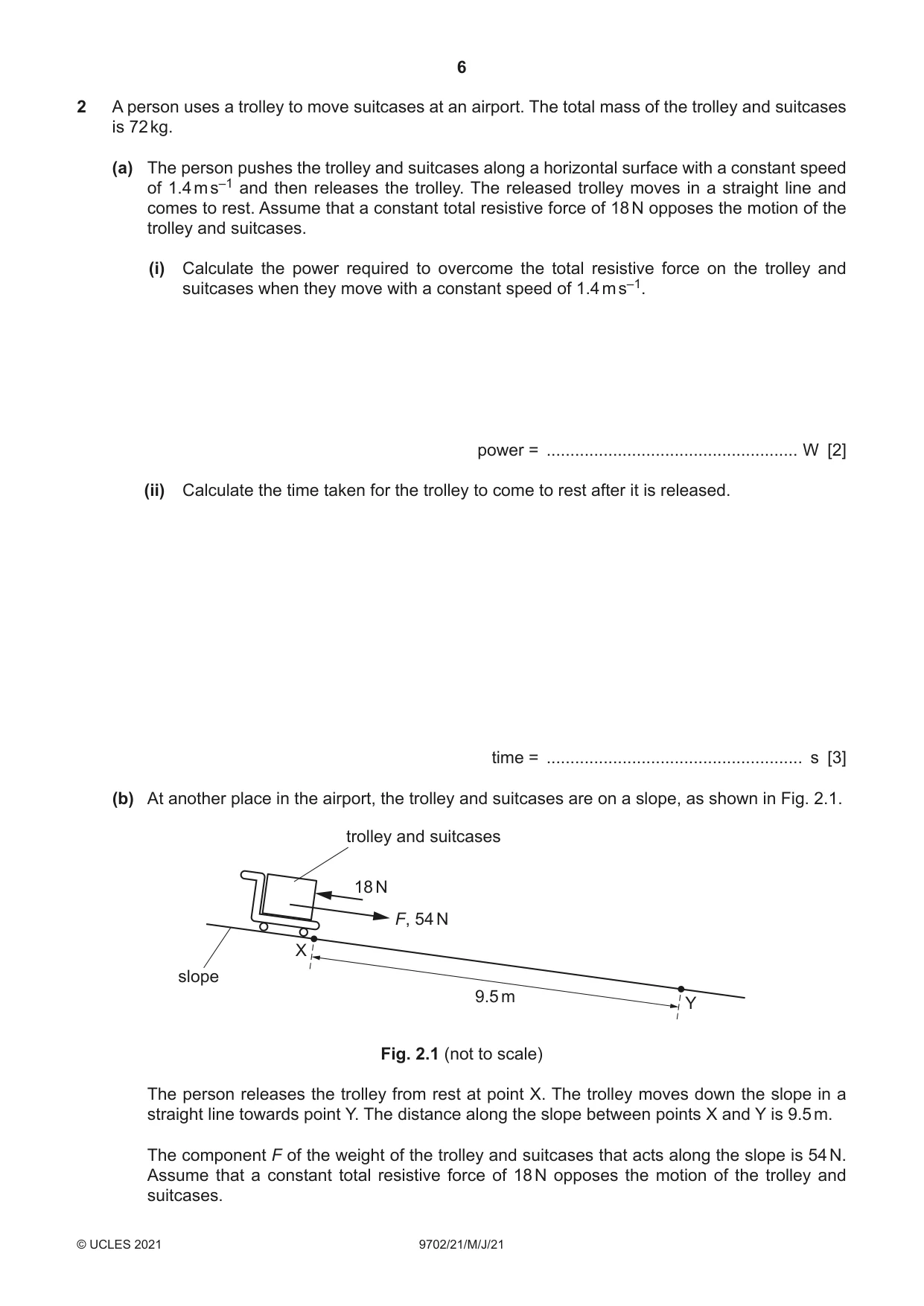
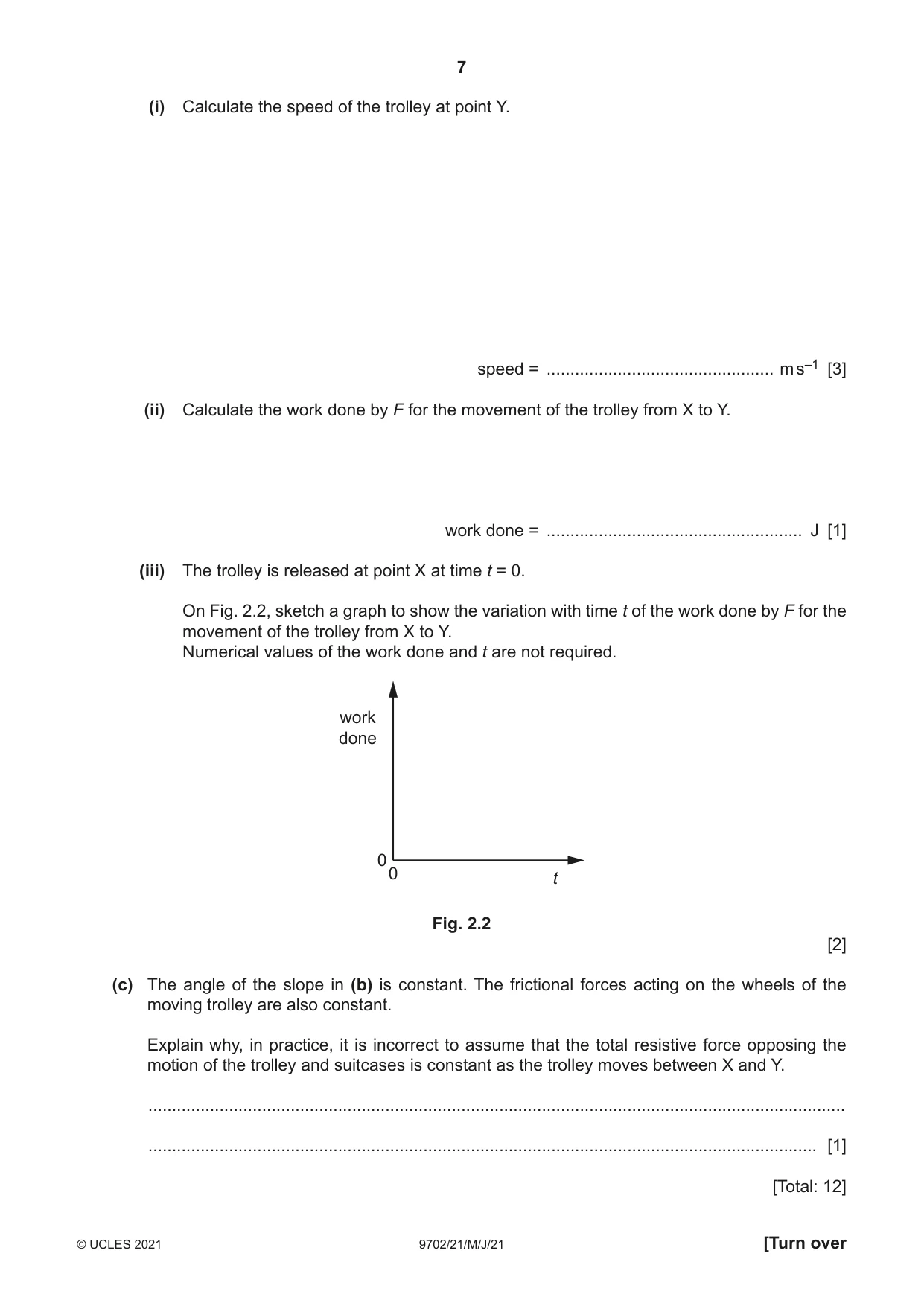
2 A person uses a trolley to move suitcases at an airport. The total mass of the trolley and suitcases is 72 kg. (a) The person pushes the trolley and suitcases along a horizontal surface with a constant speed of 1.4 m s–1 and then releases the trolley. The released trolley moves in a straight line and comes to rest. Assume that a constant total resistive force of 18 N opposes the motion of the trolley and suitcases. (i) Calculate the power required to overcome the total resistive force on the trolley and suitcases when they move with a constant speed of 1.4 m s–1. power = ..................................................... W [2] (ii) Calculate the time taken for the trolley to come to rest after it is released. time = ...................................................... s [3] (b) At another place in the airport, the trolley and suitcases are on a slope, as shown in Fig. 2.1. trolley and suitcases 18 N F, 54 N X slope 9.5 m Y Fig. 2.1 (not to scale) The person releases the trolley from rest at point X. The trolley moves down the slope in a straight line towards point Y. The distance along the slope between points X and Y is 9.5 m. The component F of the weight of the trolley and suitcases that acts along the slope is 54 N. Assume that a constant total resistive force of 18 N opposes the motion of the trolley and suitcases. (i) Calculate the speed of the trolley at point Y. speed = ................................................ m s–1 [3] (ii) Calculate the work done by F for the movement of the trolley from X to Y. work done = ...................................................... J [1] (iii) The trolley is released at point X at time t = 0. On Fig. 2.2, sketch a graph to show the variation with time t of the work done by F for the movement of the trolley from X to Y. Numerical values of the work done and t are not required. work done 0 0 t Fig. 2.2 [2] (c) The angle of the slope in (b) is constant. The frictional forces acting on the wheels of the moving trolley are also constant. Explain why, in practice, it is incorrect to assume that the total resistive force opposing the motion of the trolley and suitcases is constant as the trolley moves between X and Y. ................................................................................................................................................... ............................................................................................................................................. [1] [Total: 12]
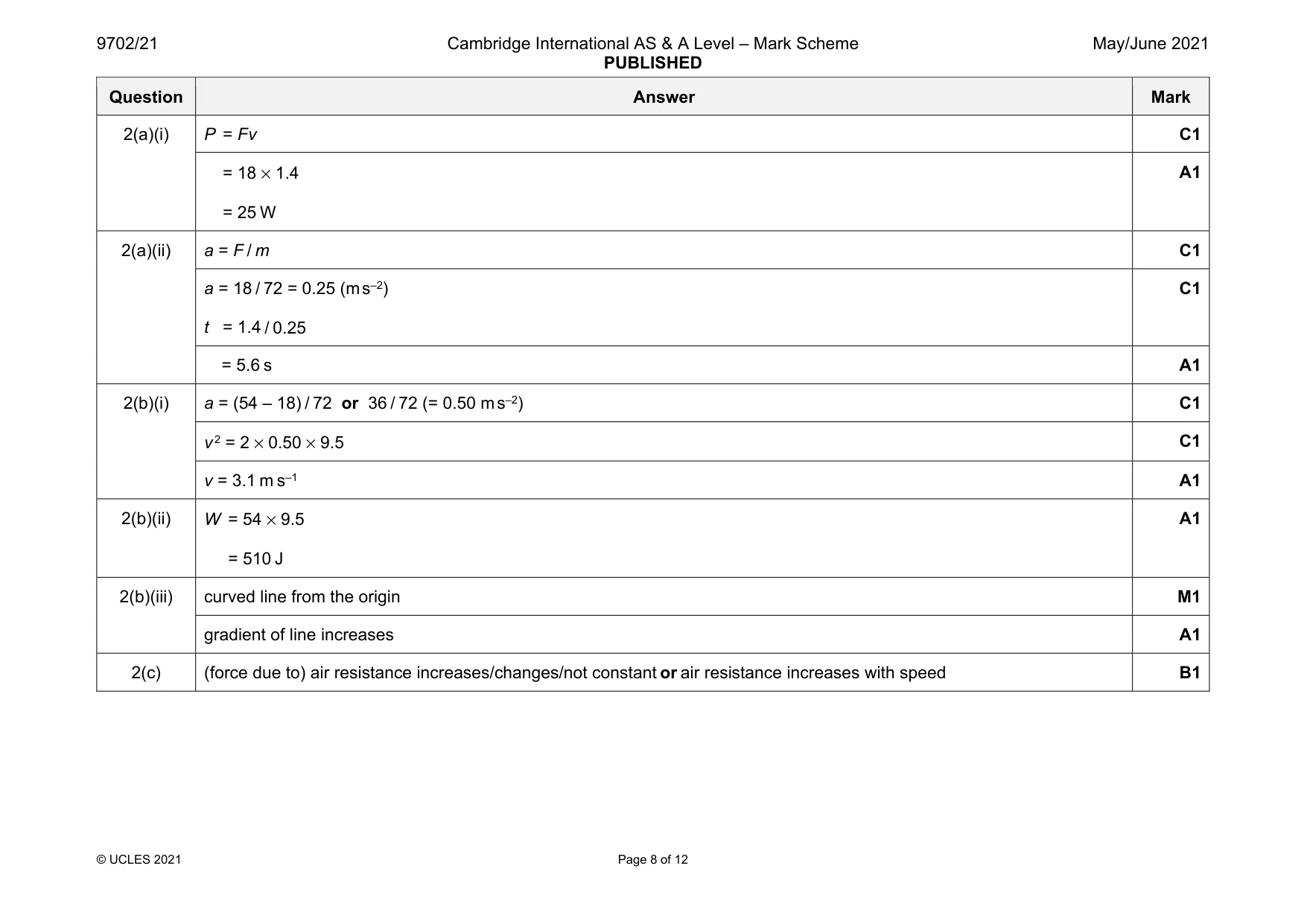
Mark scheme: 2(a)(i) P = Fv C1 = 18 × 1.4 = 25 W A1 2(a)(ii) a = F / m C1 a = 18 / 72 = 0.25 (m s–2) t = 1.4 / 0.25 C1 = 5.6 s A1 2(b)(i) a = (54 – 18) / 72 or 36 / 72 (= 0.50 m s–2) C1 v 2 = 2 × 0.50 × 9.5 C1 v = 3.1 m s–1 A1 2(b)(ii) W = 54 × 9.5 = 510 J A1 2(b)(iii) curved line from the origin M1 gradient of line increases A1 2(c) (force due to) air resistance increases/changes/not constant or air resistance increases with speed B1
Q3 · A pendulum consists of a solid sphere suspended by a string from a fixed point P, as…
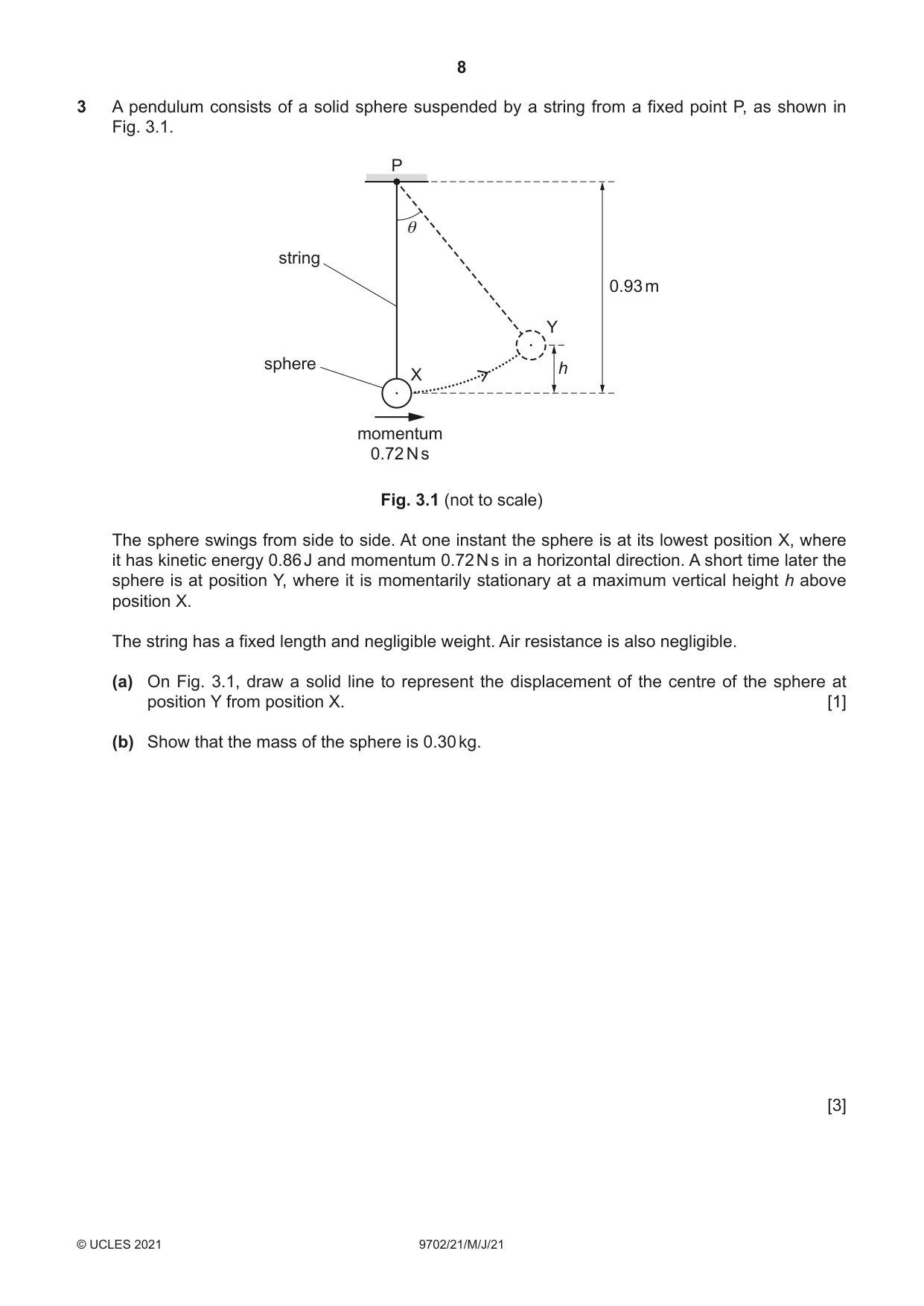
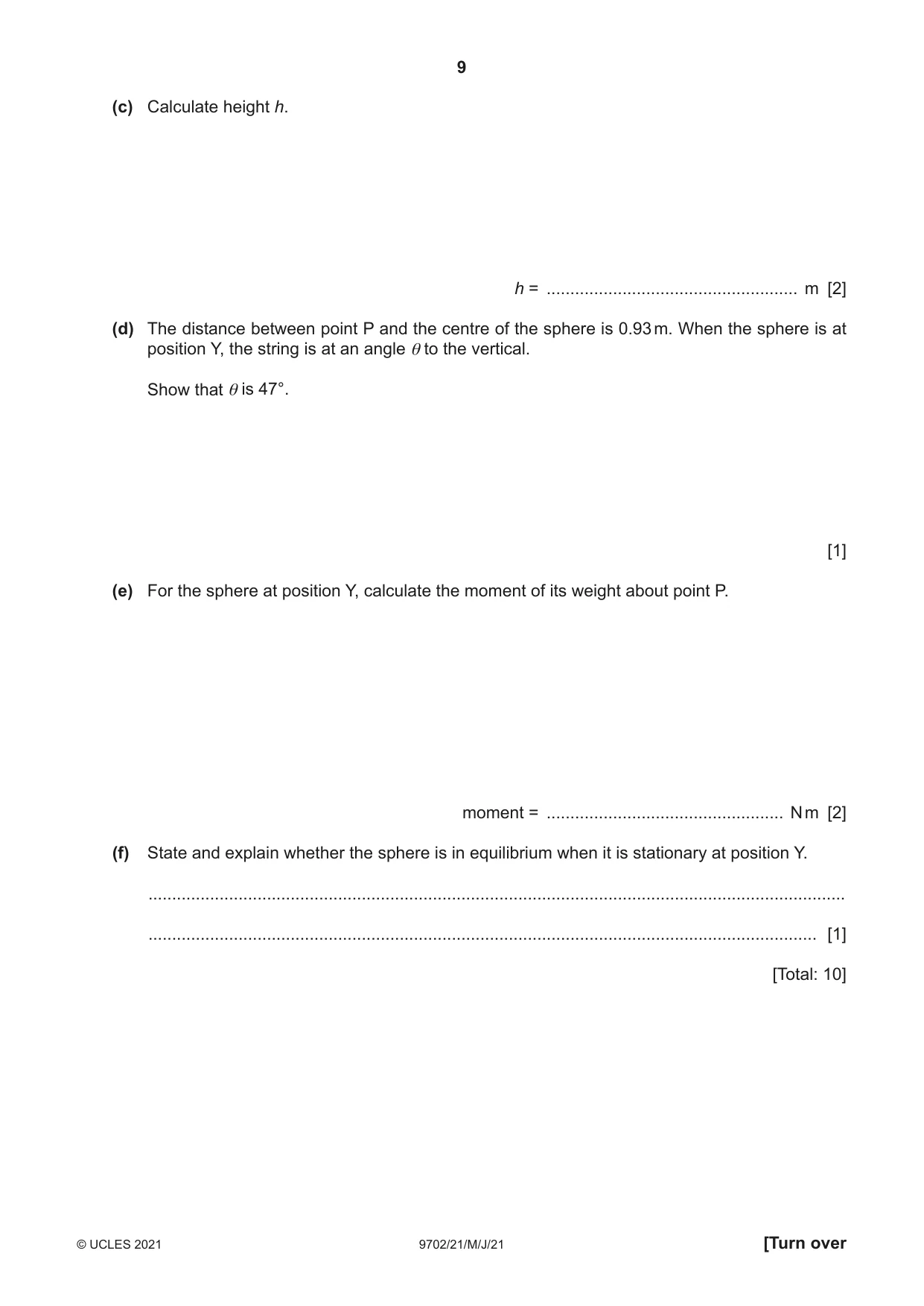
3 A pendulum consists of a solid sphere suspended by a string from a fixed point P, as shown in Fig. 3.1. P θ string 0.93 m Y sphere h X momentum 0.72 N s Fig. 3.1 (not to scale) The sphere swings from side to side. At one instant the sphere is at its lowest position X, where it has kinetic energy 0.86 J and momentum 0.72 N s in a horizontal direction. A short time later the sphere is at position Y, where it is momentarily stationary at a maximum vertical height h above position X. The string has a fixed length and negligible weight. Air resistance is also negligible. (a) On Fig. 3.1, draw a solid line to represent the displacement of the centre of the sphere at position Y from position X. [1] (b) Show that the mass of the sphere is 0.30 kg. [3] (c) Calculate height h. h = ..................................................... m [2] (d) The distance between point P and the centre of the sphere is 0.93 m. When the sphere is at position Y, the string is at an angle θ to the vertical. Show that θ is 47°. [1] (e) For the sphere at position Y, calculate the moment of its weight about point P. moment = .................................................. N m [2] (f) State and explain whether the sphere is in equilibrium when it is stationary at position Y. ................................................................................................................................................... ............................................................................................................................................. [1] [Total: 10]
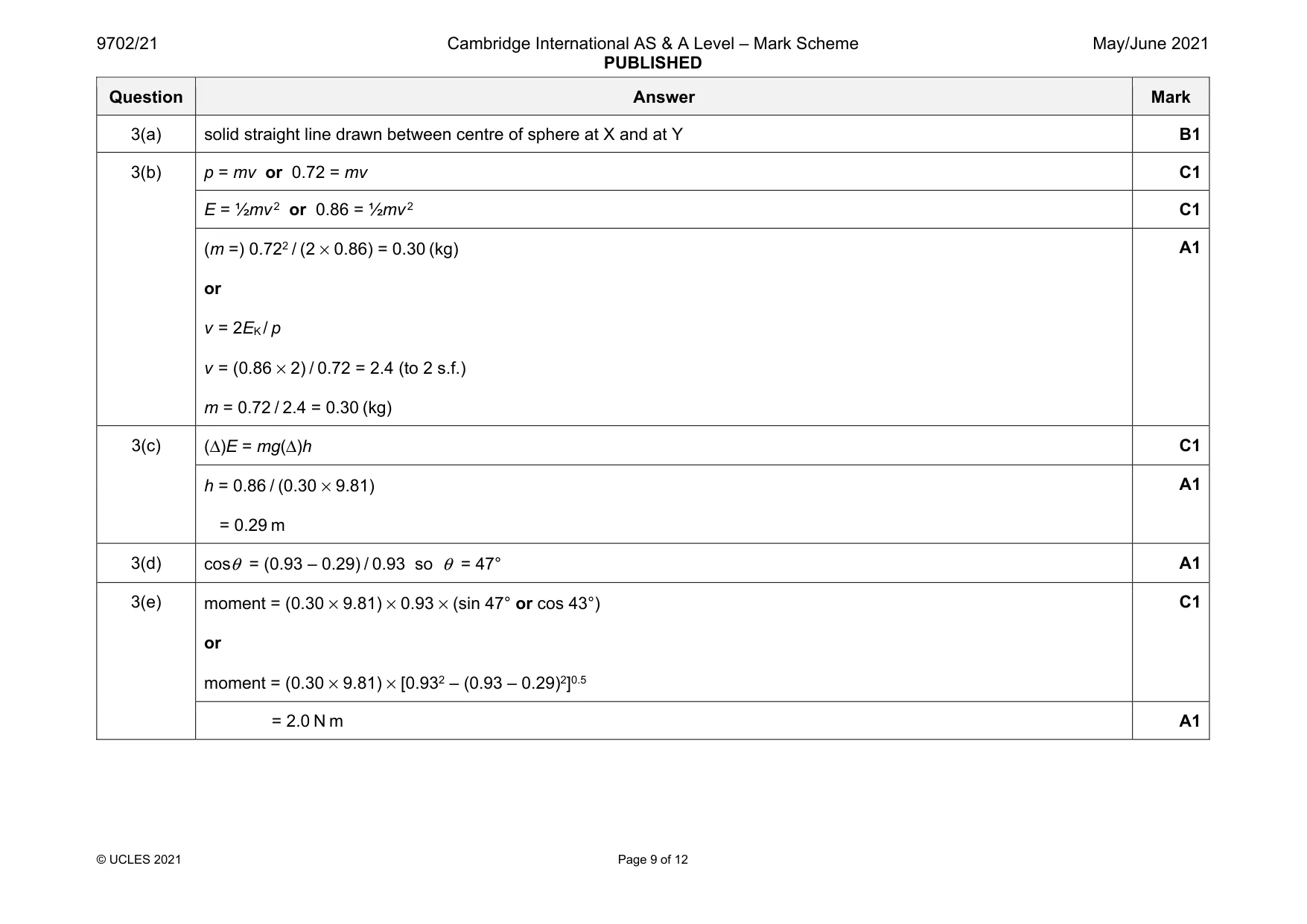
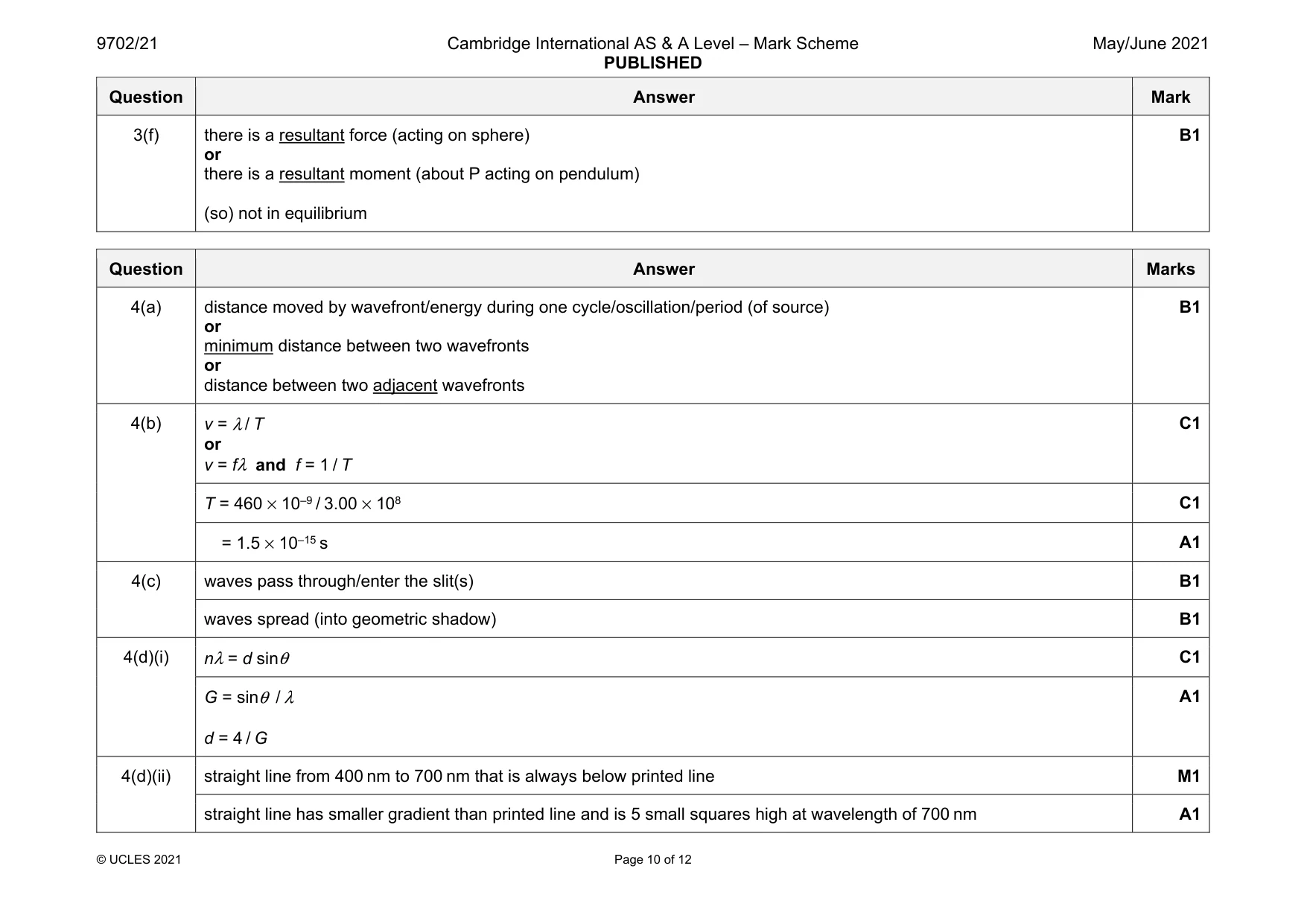
Mark scheme: 3(a) solid straight line drawn between centre of sphere at X and at Y B1 3(b) p = mv or 0.72 = mv C1 E = ½mv 2 or 0.86 = ½mv 2 C1 (m =) 0.722 / (2 × 0.86) = 0.30 (kg) or v = 2EK / p v = (0.86 × 2) / 0.72 = 2.4 (to 2 s.f.) m = 0.72 / 2.4 = 0.30 (kg) A1 3(c) (Δ)E = mg(Δ)h C1 h = 0.86 / (0.30 × 9.81) = 0.29 m A1 3(d) cosθ = (0.93 – 0.29) / 0.93 so θ = 47° A1 3(e) moment = (0.30 × 9.81) × 0.93 × (sin 47° or cos 43°) or moment = (0.30 × 9.81) × [0.932 – (0.93 – 0.29)2]0.5 C1 = 2.0 N m A1 Question Answer Mark 3(f) there is a resultant force (acting on sphere) or there is a resultant moment (about P acting on pendulum) (so) not in equilibrium B1
Q4 · For a progressive wave, state what is meant by wavelength
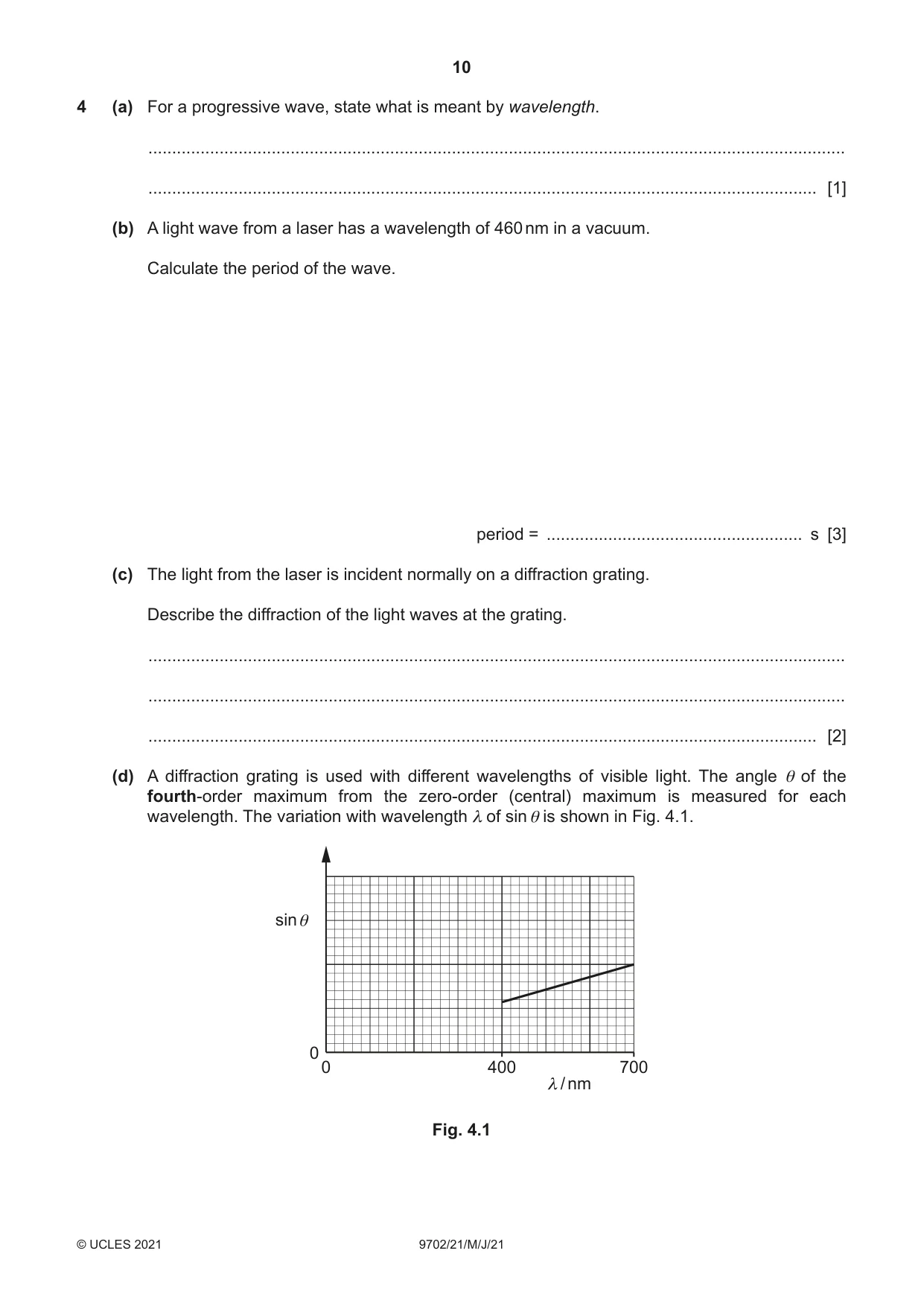
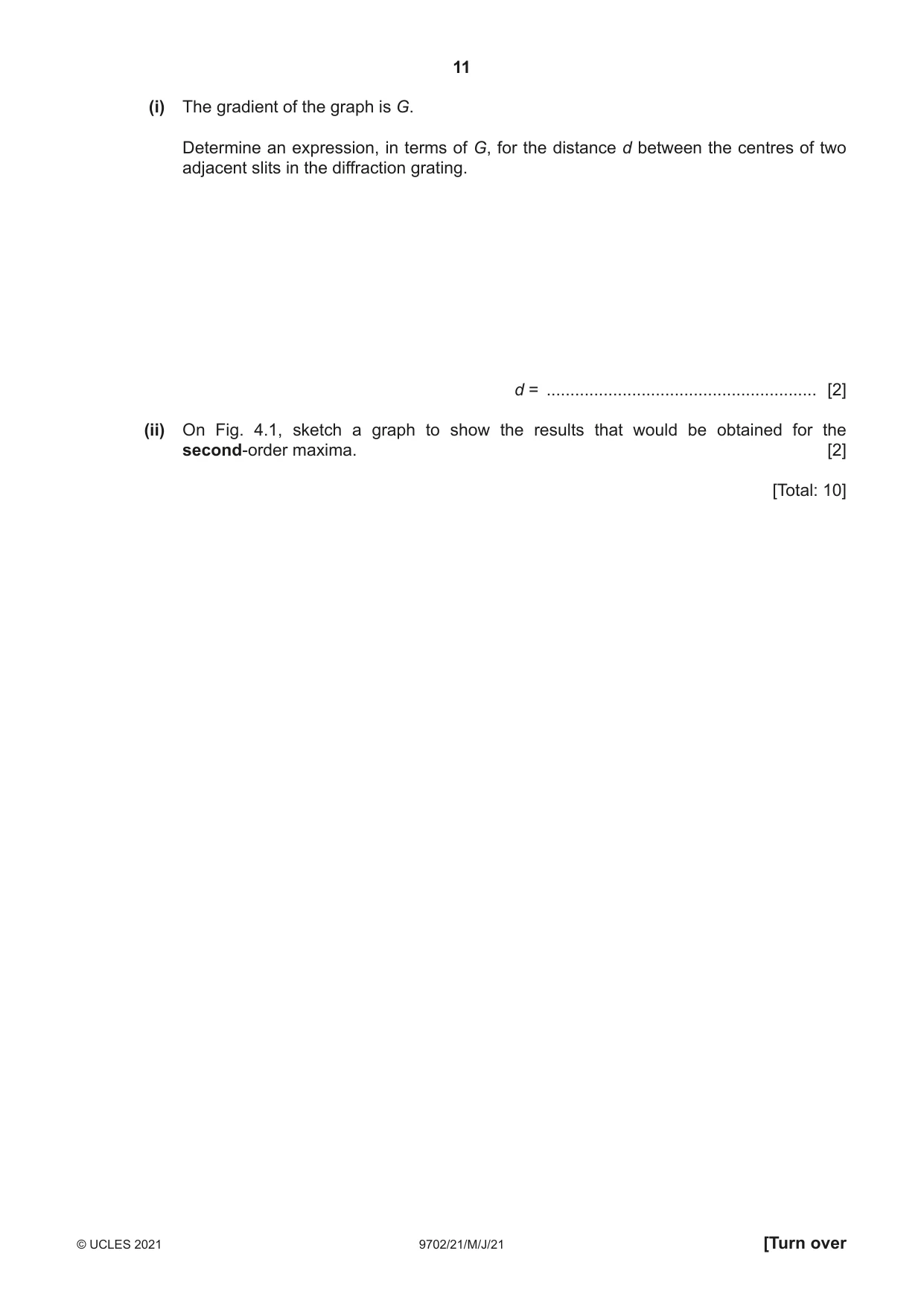
4 (a) For a progressive wave, state what is meant by wavelength. ................................................................................................................................................... ............................................................................................................................................. [1] (b) A light wave from a laser has a wavelength of 460 nm in a vacuum. Calculate the period of the wave. period = ...................................................... s [3] (c) The light from the laser is incident normally on a diffraction grating. Describe the diffraction of the light waves at the grating. ................................................................................................................................................... ................................................................................................................................................... ............................................................................................................................................. [2] (d) A diffraction grating is used with different wavelengths of visible light. The angle θ of the fourth-order maximum from the zero-order (central) maximum is measured for each wavelength. The variation with wavelength λ of sin θ is shown in Fig. 4.1. sin θ 0 0 400 700 λ/ nm Fig. 4.1 (i) The gradient of the graph is G. Determine an expression, in terms of G, for the distance d between the centres of two adjacent slits in the diffraction grating. d = ......................................................... [2] (ii) On Fig. 4.1, sketch a graph to show the results that would be obtained for the second-order maxima. [2] [Total: 10]
Mark scheme: 4(a) distance moved by wavefront/energy during one cycle/oscillation/period (of source) or minimum distance between two wavefronts or distance between two adjacent wavefronts B1 4(b) v = λ / T or v = fλ and f = 1 / T C1 T = 460 × 10–9 / 3.00 × 10⁸ C1 = 1.5 × 10⁻¹⁵ s A1 4(c) waves pass through/enter the slit(s) B1 waves spread (into geometric shadow) B1 4(d)(i) nλ = d sinθ C1 G = sinθ / λ d = 4 / G A1 4(d)(ii) straight line from 400 nm to 700 nm that is always below printed line M1 straight line has smaller gradient than printed line and is 5 small squares high at wavelength of 700 nm A1
Q5 · State Kirchhoff’s second law
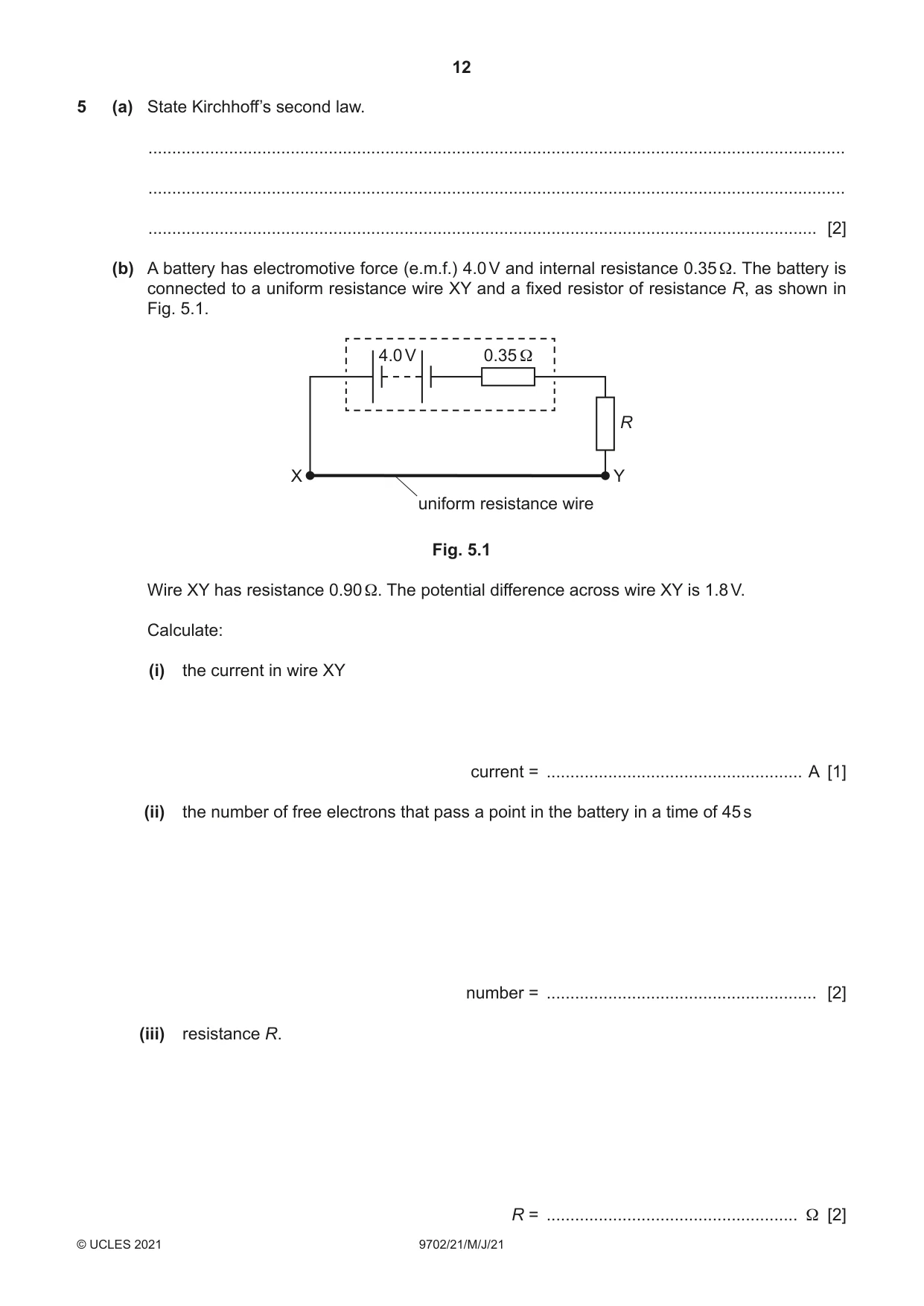
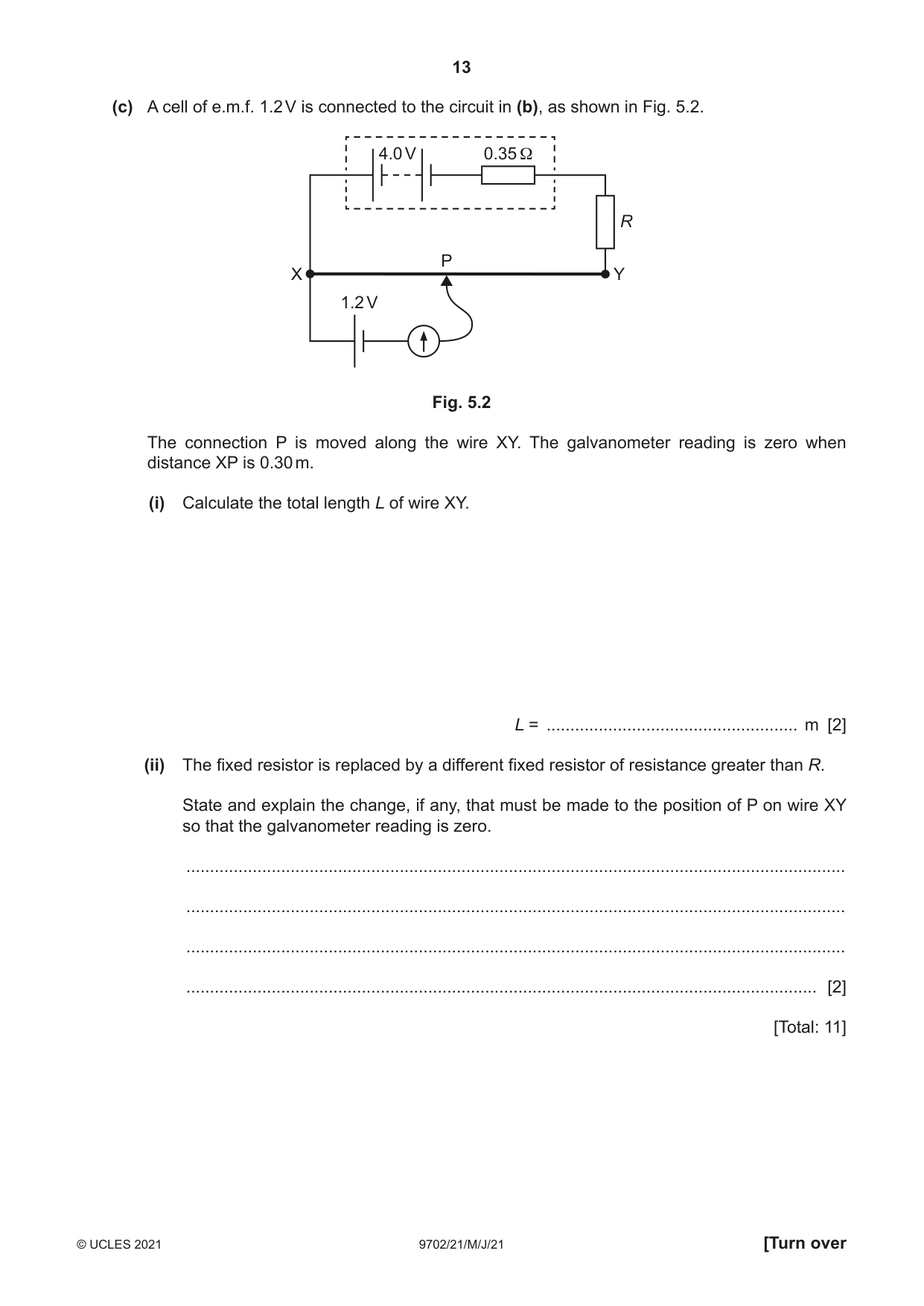
5 (a) State Kirchhoff’s second law. ................................................................................................................................................... ................................................................................................................................................... ............................................................................................................................................. [2] (b) A battery has electromotive force (e.m.f.) 4.0 V and internal resistance 0.35 Ω. The battery is connected to a uniform resistance wire XY and a fixed resistor of resistance R, as shown in Fig. 5.1. 4.0 V 0.35 Ω R X Y uniform resistance wire Fig. 5.1 Wire XY has resistance 0.90 Ω. The potential difference across wire XY is 1.8 V. Calculate: (i) the current in wire XY current = ...................................................... A [1] (ii) the number of free electrons that pass a point in the battery in a time of 45 s number = ......................................................... [2] (iii) resistance R. R = ..................................................... Ω [2] (c) A cell of e.m.f. 1.2 V is connected to the circuit in (b), as shown in Fig. 5.2. 4.0 V 0.35 Ω R P X Y 1.2 V Fig. 5.2 The connection P is moved along the wire XY. The galvanometer reading is zero when distance XP is 0.30 m. (i) Calculate the total length L of wire XY. L = ..................................................... m [2] (ii) The fixed resistor is replaced by a different fixed resistor of resistance greater than R. State and explain the change, if any, that must be made to the position of P on wire XY so that the galvanometer reading is zero. ........................................................................................................................................... ........................................................................................................................................... ........................................................................................................................................... ..................................................................................................................................... [2] [Total: 11]
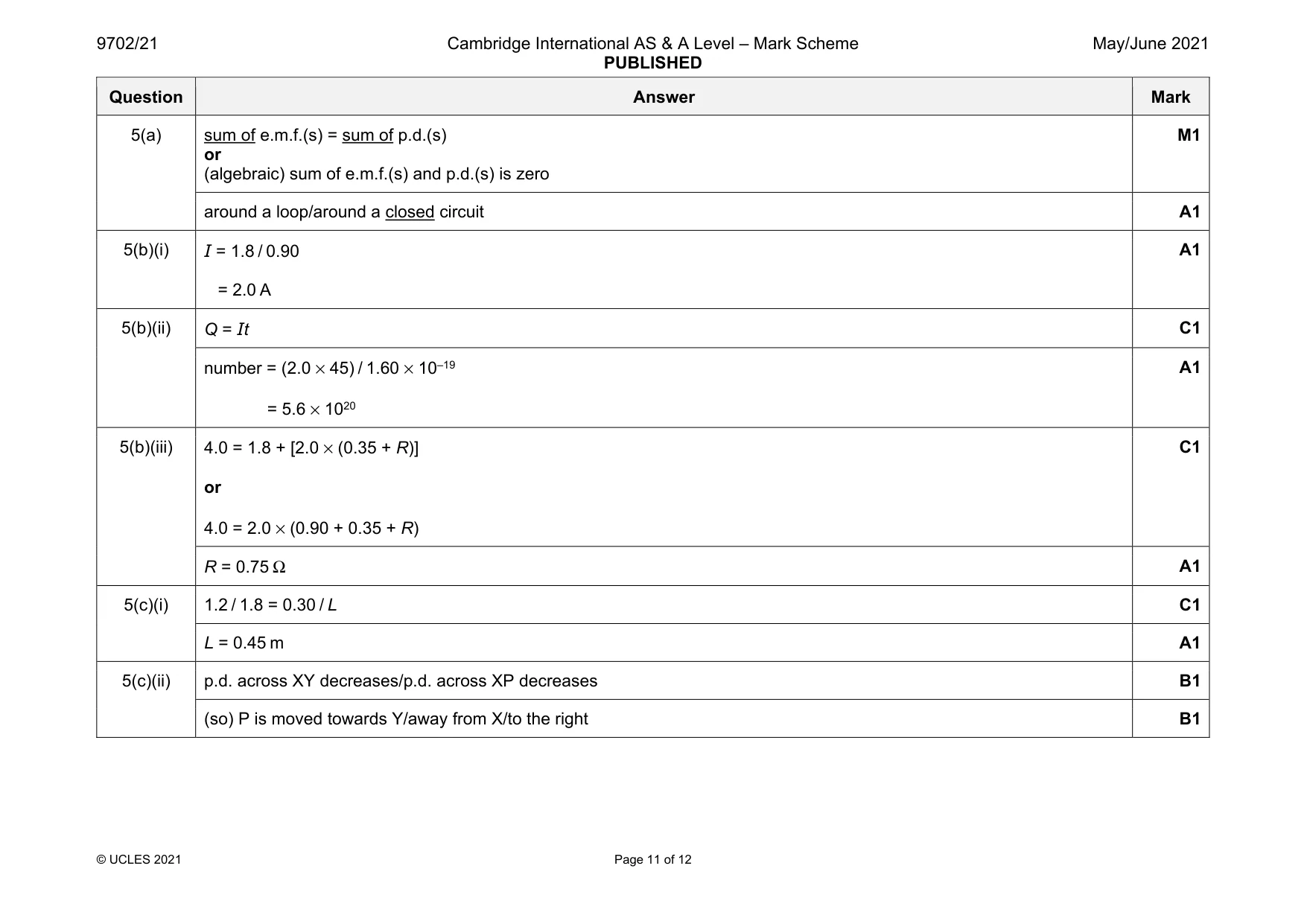
Mark scheme: 5(a) sum of e.m.f.(s) = sum of p.d.(s) or (algebraic) sum of e.m.f.(s) and p.d.(s) is zero M1 around a loop/around a closed circuit A1 5(b)(i) I = 1.8 / 0.90 = 2.0 A A1 5(b)(ii) Q = It C1 number = (2.0 × 45) / 1.60 × 10–19 = 5.6 × 10²⁰ A1 5(b)(iii) 4.0 = 1.8 + [2.0 × (0.35 + R)] or 4.0 = 2.0 × (0.90 + 0.35 + R) C1 R = 0.75 Ω A1 5(c)(i) 1.2 / 1.8 = 0.30 / L C1 L = 0.45 m A1 5(c)(ii) p.d. across XY decreases/p.d. across XP decreases B1 (so) P is moved towards Y/away from X/to the right B1
Q6 · A proton in a nucleus decays to form a neutron and a β+ particle
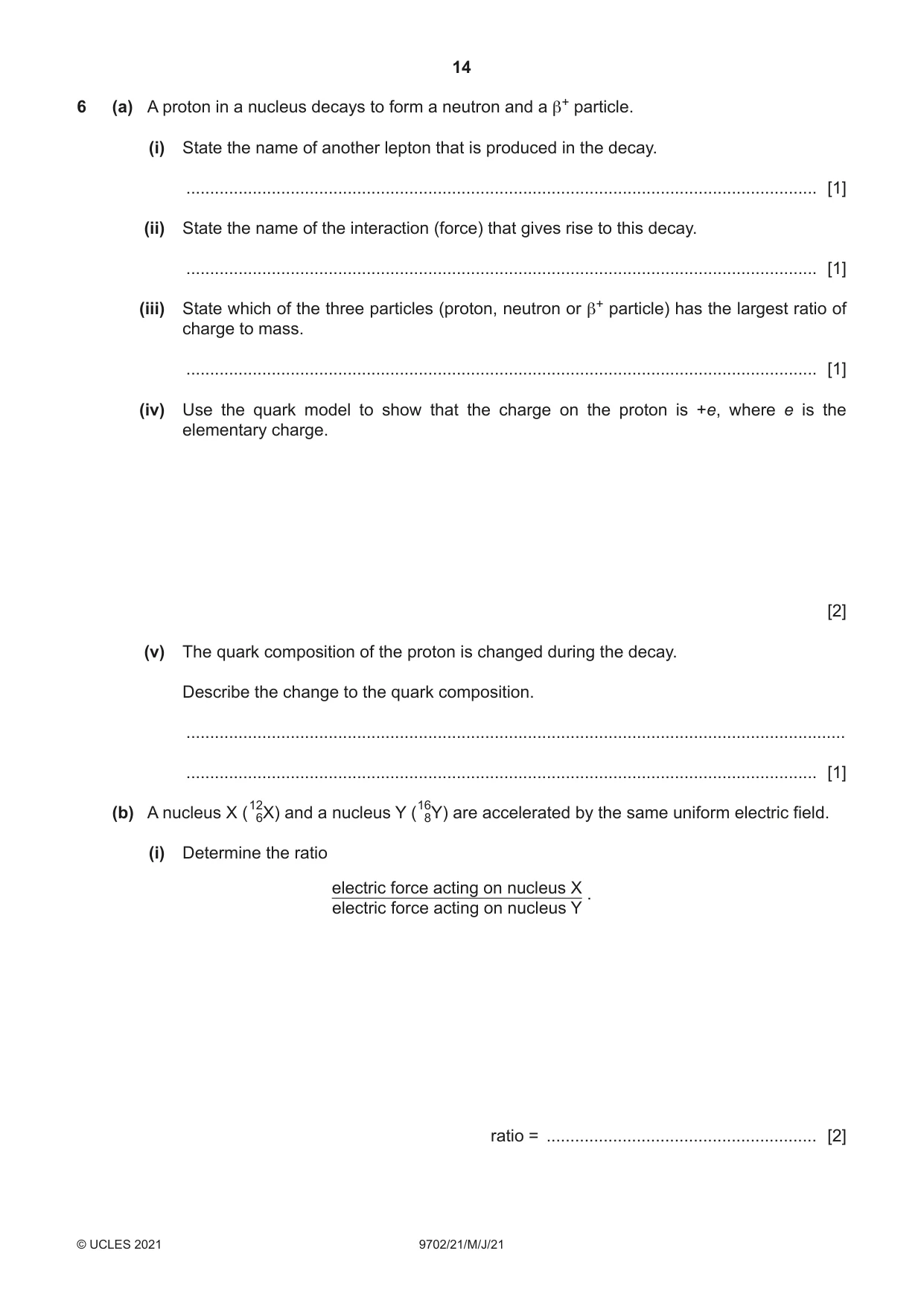
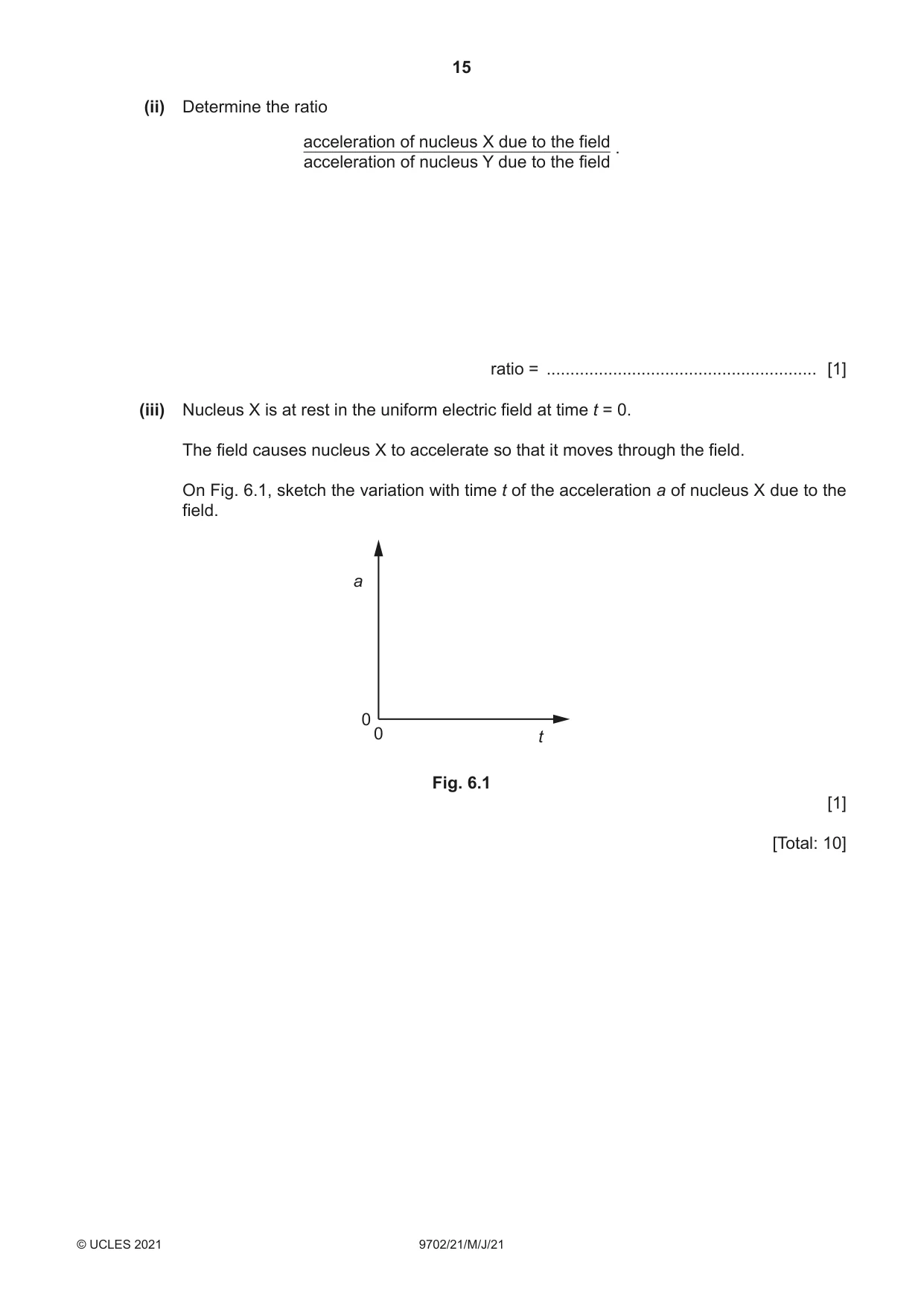
6 (a) A proton in a nucleus decays to form a neutron and a β+ particle. (i) State the name of another lepton that is produced in the decay. ..................................................................................................................................... [1] (ii) State the name of the interaction (force) that gives rise to this decay. ..................................................................................................................................... [1] (iii) State which of the three particles (proton, neutron or β+ particle) has the largest ratio of charge to mass. ..................................................................................................................................... [1] (iv) Use the quark model to show that the charge on the proton is +e, where e is the elementary charge. [2] (v) The quark composition of the proton is changed during the decay. Describe the change to the quark composition. ........................................................................................................................................... ..................................................................................................................................... [1] (b) A nucleus X (126X) and a nucleus Y (168Y) are accelerated by the same uniform electric field. (i) Determine the ratio electric force acting on nucleus X . electric force acting on nucleus Y ratio = ......................................................... [2] (ii) Determine the ratio acceleration of nucleus X due to the field . acceleration of nucleus Y due to the field ratio = ......................................................... [1] (iii) Nucleus X is at rest in the uniform electric field at time t = 0. The field causes nucleus X to accelerate so that it moves through the field. On Fig. 6.1, sketch the variation with time t of the acceleration a of nucleus X due to the field. a 0 0 t Fig. 6.1 [1] [Total: 10]
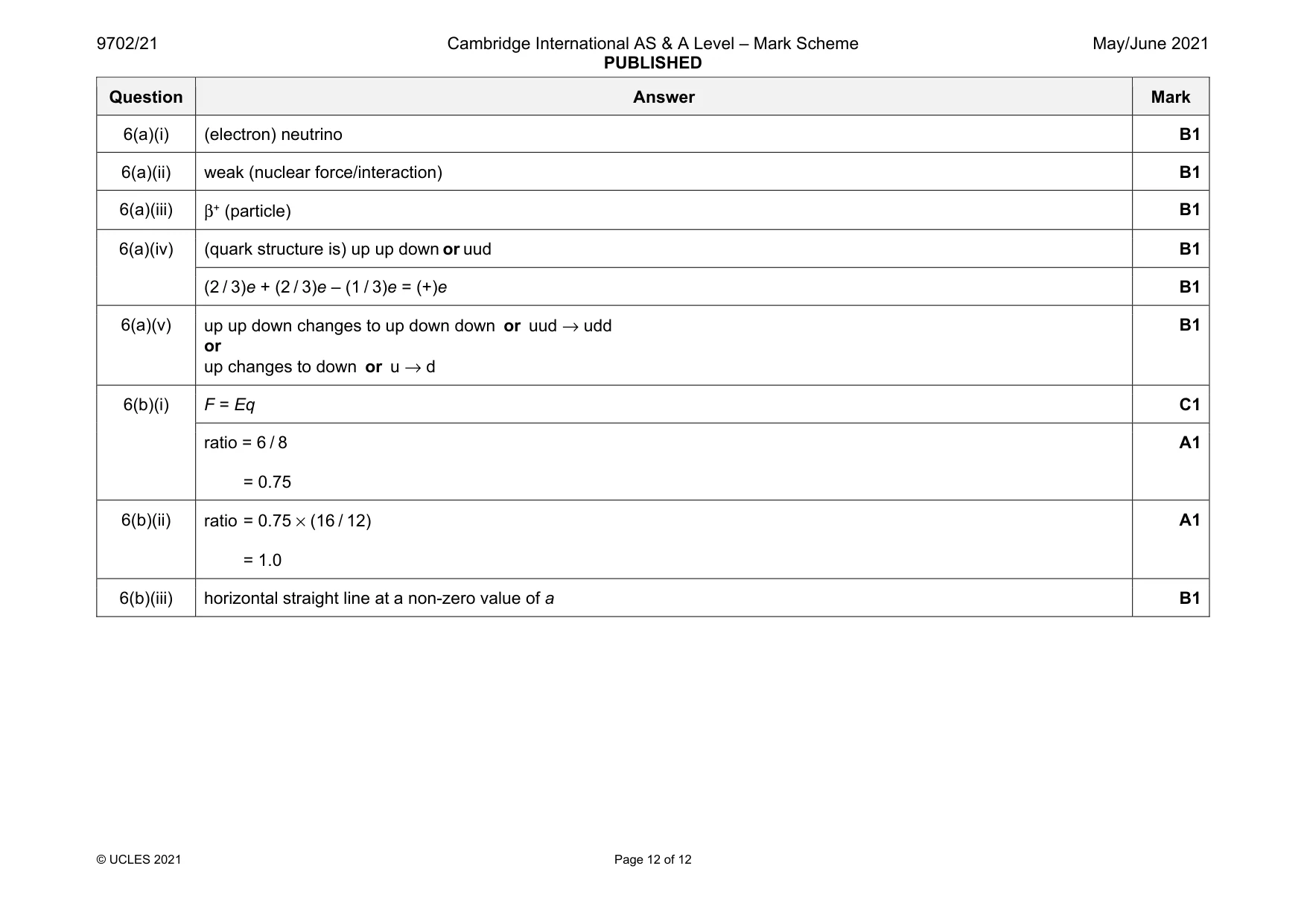
Mark scheme: 6(a)(i) (electron) neutrino B1 6(a)(ii) weak (nuclear force/interaction) B1 6(a)(iii) β+ (particle) B1 6(a)(iv) (quark structure is) up up down or uud B1 (2 / 3)e + (2 / 3)e – (1 / 3)e = (+)e B1 6(a)(v) up up down changes to up down down or uud → udd or up changes to down or u → d B1 6(b)(i) F = Eq C1 ratio = 6 / 8 = 0.75 A1 6(b)(ii) ratio = 0.75 × (16 / 12) = 1.0 A1 6(b)(iii) horizontal straight line at a non-zero value of a B1
What was in this paper
The subtopics covered by these 6 questions, and how many questions each got. Open one in a new tab to see every Cambridge question on it.
What you needed in this session
Cambridge’s own grade thresholds for 2021 May/June, Paper 2 · Variant 1. A higher threshold means an easier paper — the bar moves with how the cohort did.