Cambridge A Level Physics 9702 — 2023 Feb/March Paper 2 · Variant 2
9702/22/F/M/23 · 7 questions · 60 marks · ≈68 min
The question paper and its mark scheme, free to read here and free to download. This is Cambridge’s own paper, exactly as it was sat.
Question paper20 pages



Mark scheme12 pages
Answers below. Sit the paper first if you are practising.
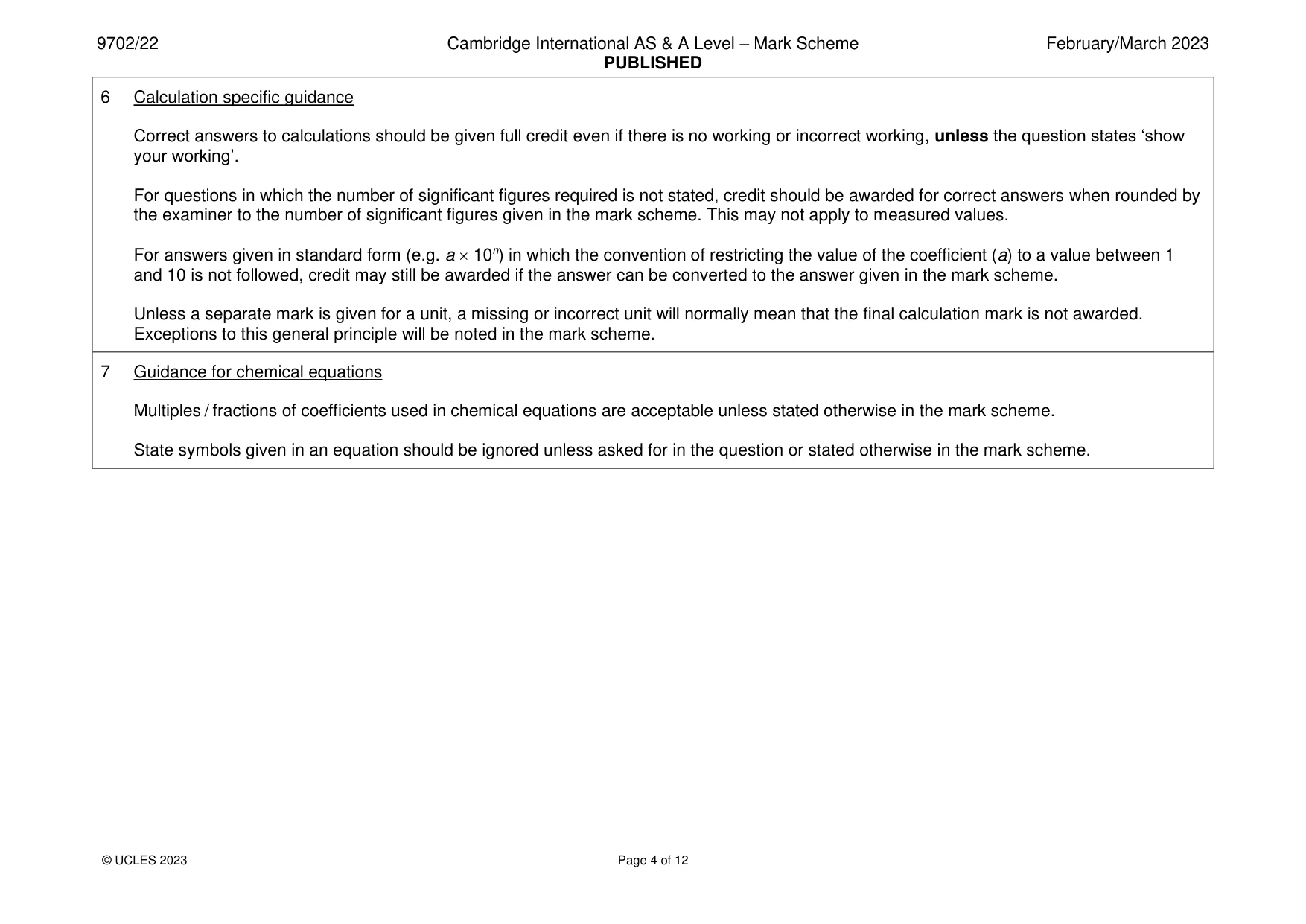
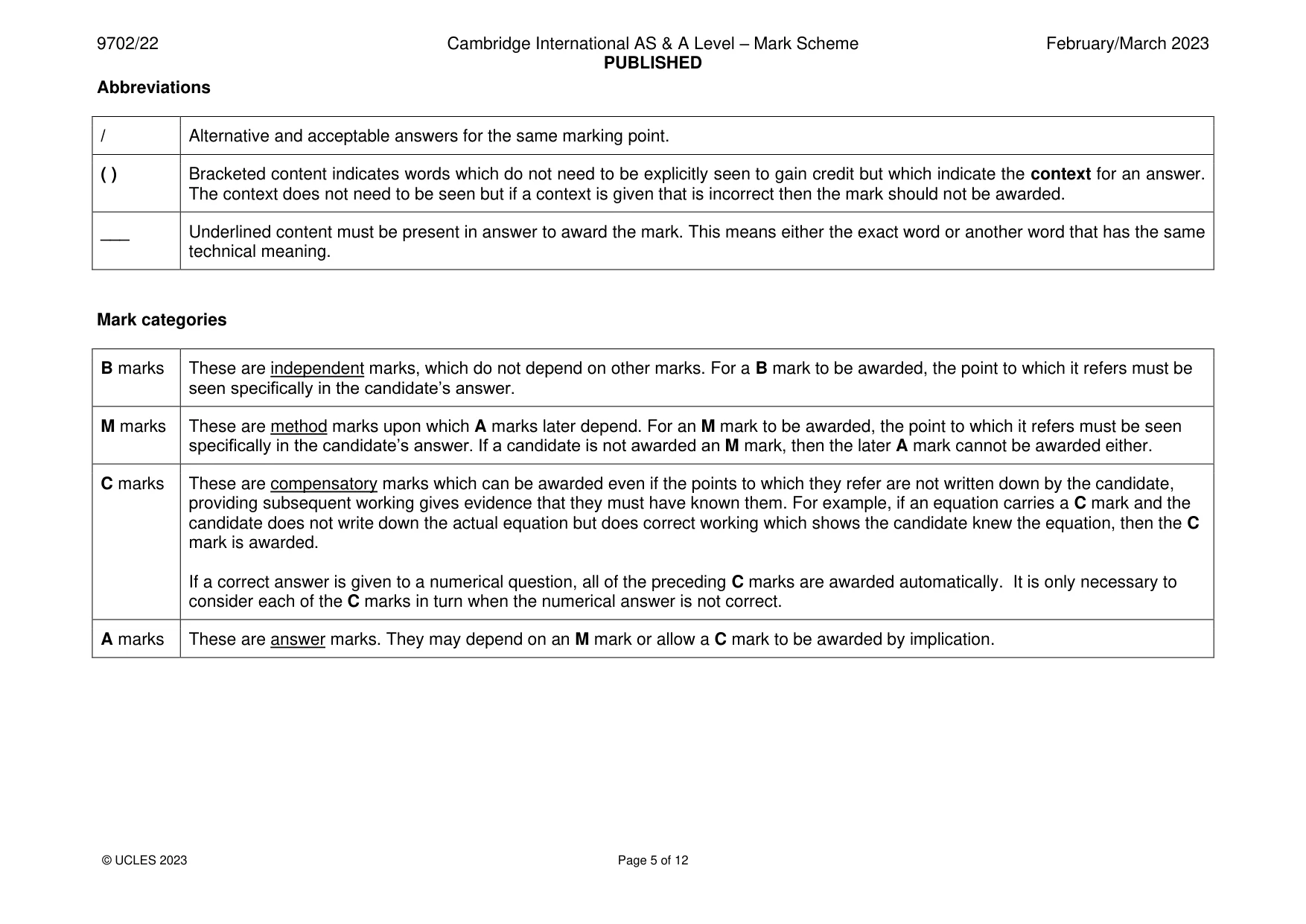
Questions as text
Q1 · Underline all the SI base units in the following list
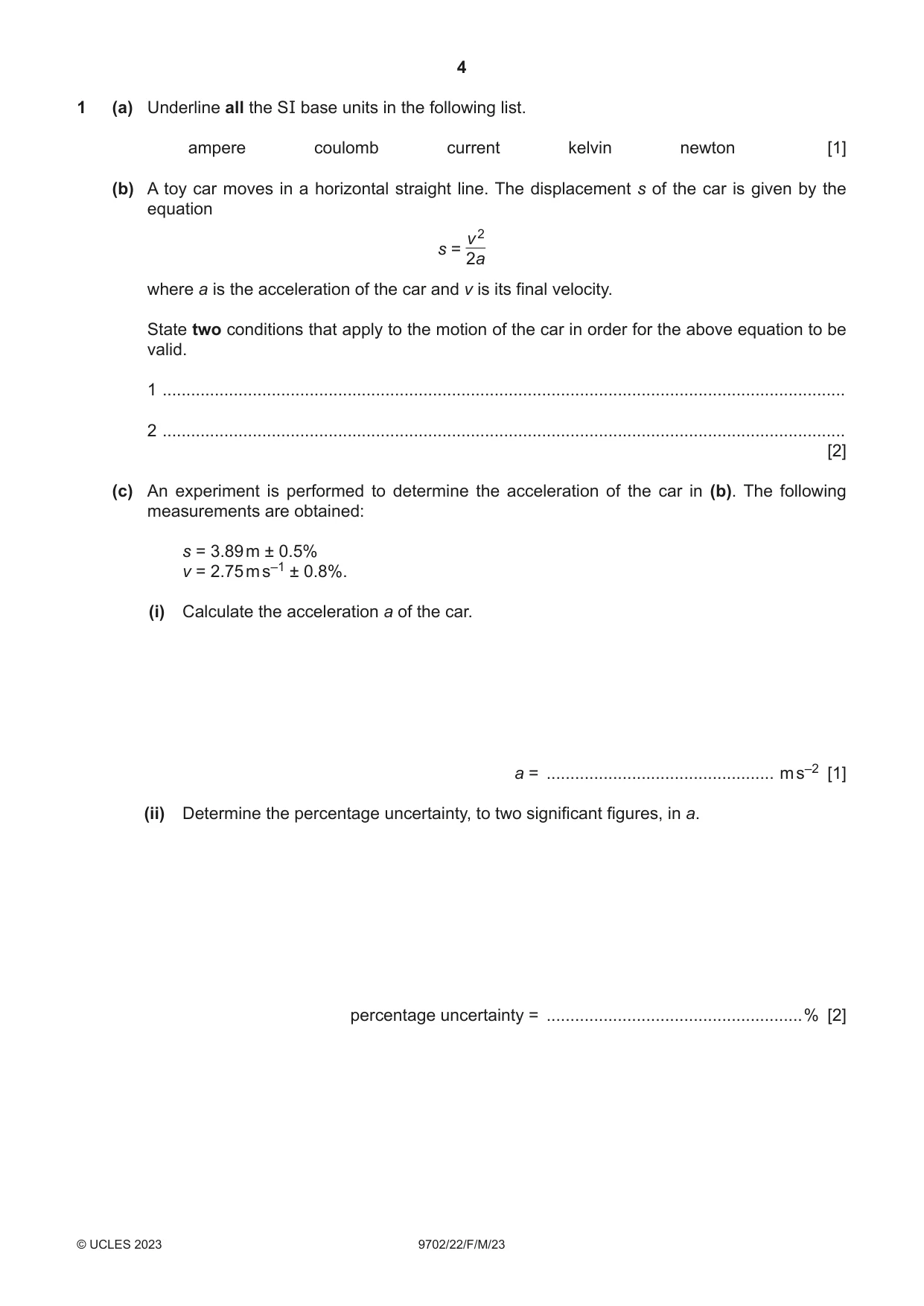
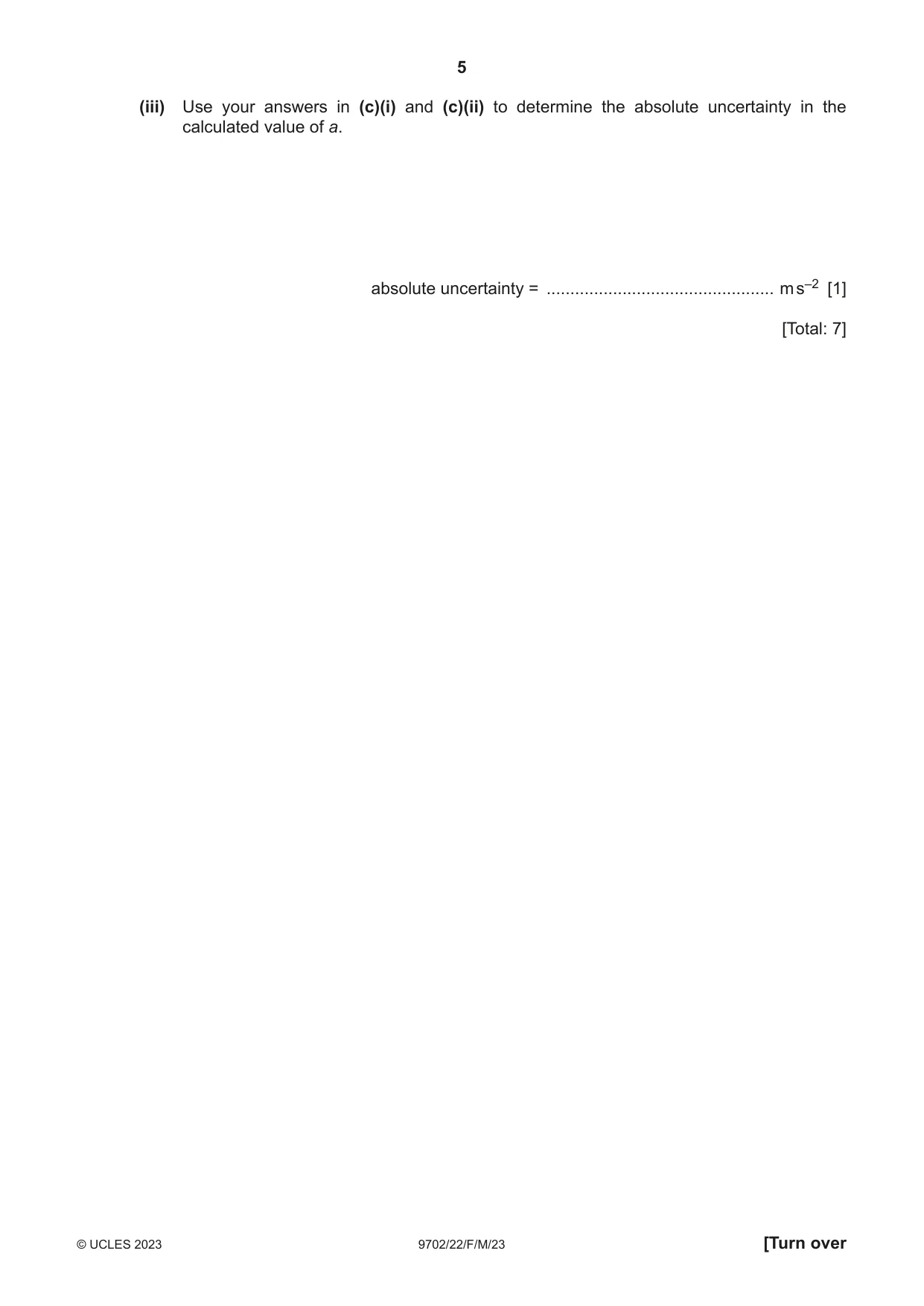
1 (a) Underline all the SI base units in the following list. ampere coulomb current kelvin newton [1] (b) A toy car moves in a horizontal straight line. The displacement s of the car is given by the equation v 2 s = 2a where a is the acceleration of the car and v is its final velocity. State two conditions that apply to the motion of the car in order for the above equation to be valid. 1 ................................................................................................................................................ 2 ................................................................................................................................................ [2] (c) An experiment is performed to determine the acceleration of the car in (b). The following measurements are obtained: s = 3.89 m ± 0.5% v = 2.75 m s–1 ± 0.8%. (i) Calculate the acceleration a of the car. a = ................................................ m s–2 [1] (ii) Determine the percentage uncertainty, to two significant figures, in a. percentage uncertainty = ......................................................% [2] (iii) Use your answers in (c)(i) and (c)(ii) to determine the absolute uncertainty in the calculated value of a. absolute uncertainty = ................................................ m s–2 [1] [Total: 7]
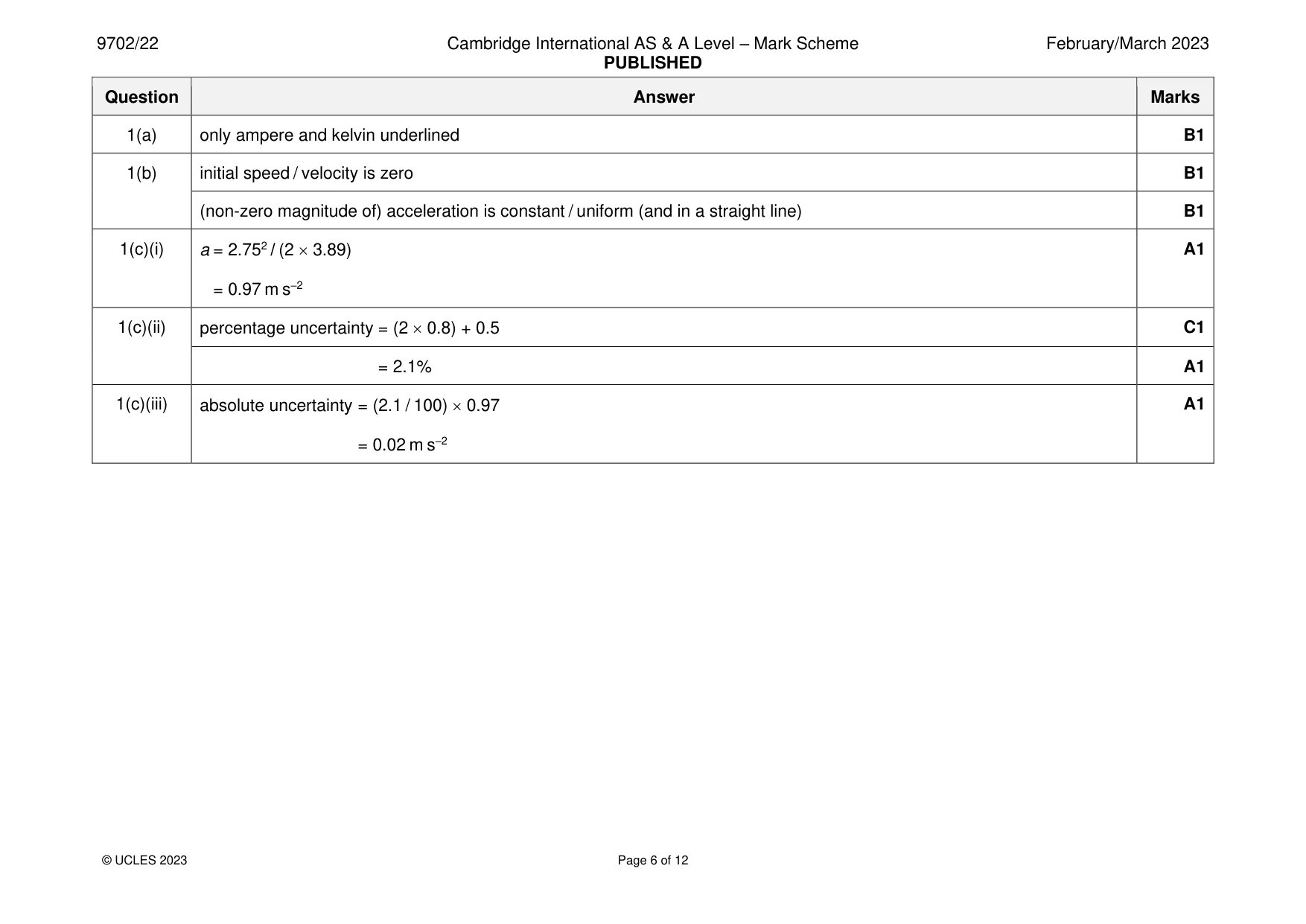
Mark scheme: Question Answer Marks 1(a) only ampere and kelvin underlined B1 1(b) initial speed / velocity is zero B1 (non-zero magnitude of) acceleration is constant / uniform (and in a straight line) B1 1(c)(i) a = 2.752 / (2 3.89) A1 = 0.97 m s–2 1(c)(ii) percentage uncertainty = (2 0.8) + 0.5 C1 = 2.1% A1 1(c)(iii) absolute uncertainty = (2.1 / 100) 0.97 A1 = 0.02 m s–2
Q2 · A motor uses a wire to raise a block, as illustrated in Fig
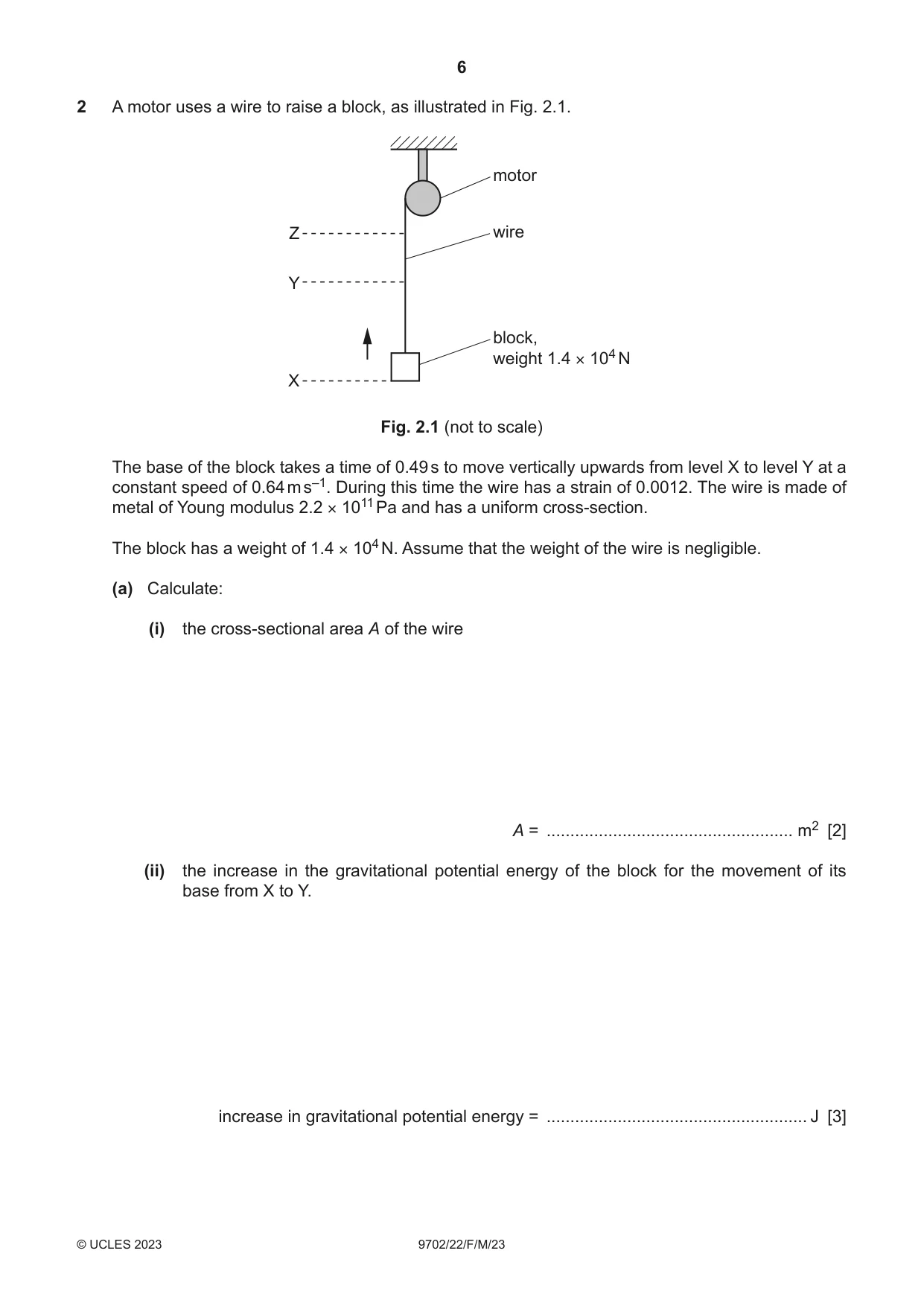
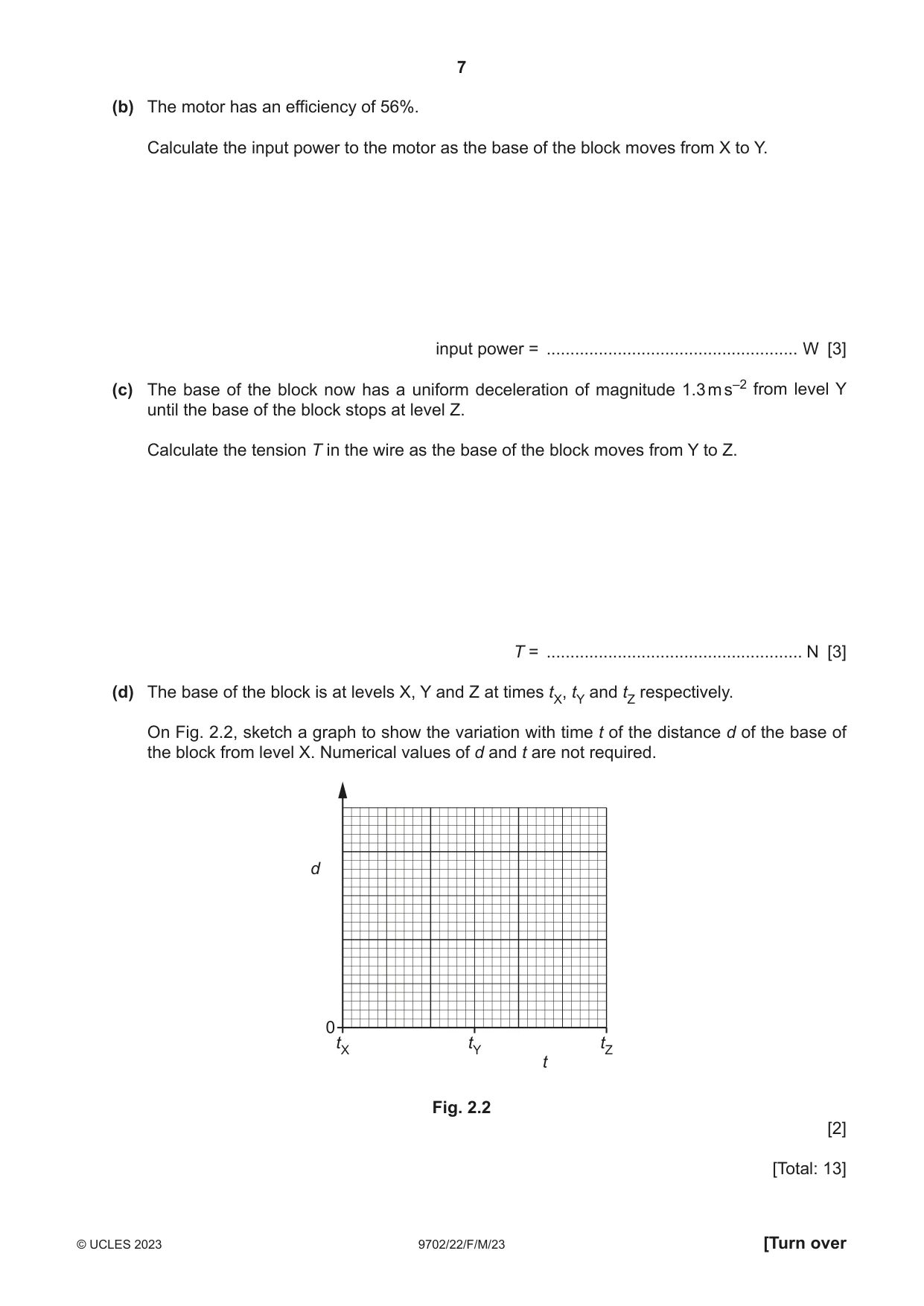
2 A motor uses a wire to raise a block, as illustrated in Fig. 2.1. motor Z wire Y block, weight 1.4 × 10⁴ N X Fig. 2.1 (not to scale) The base of the block takes a time of 0.49 s to move vertically upwards from level X to level Y at a constant speed of 0.64 m s–1. During this time the wire has a strain of 0.0012. The wire is made of metal of Young modulus 2.2 × 10¹¹ Pa and has a uniform cross-section. The block has a weight of 1.4 × 10⁴ N. Assume that the weight of the wire is negligible. (a) Calculate: (i) the cross-sectional area A of the wire A = .................................................... m2 [2] (ii) the increase in the gravitational potential energy of the block for the movement of its base from X to Y. increase in gravitational potential energy = ....................................................... J [3] (b) The motor has an efficiency of 56%. Calculate the input power to the motor as the base of the block moves from X to Y. input power = ..................................................... W [3] (c) The base of the block now has a uniform deceleration of magnitude 1.3 m s–2 from level Y until the base of the block stops at level Z. Calculate the tension T in the wire as the base of the block moves from Y to Z. T = ...................................................... N [3] (d) The base of the block is at levels X, Y and Z at times tX, tY and tZ respectively. On Fig. 2.2, sketch a graph to show the variation with time t of the distance d of the base of the block from level X. Numerical values of d and t are not required. d 0 tX tY tZ t Fig. 2.2 [2] [Total: 13]
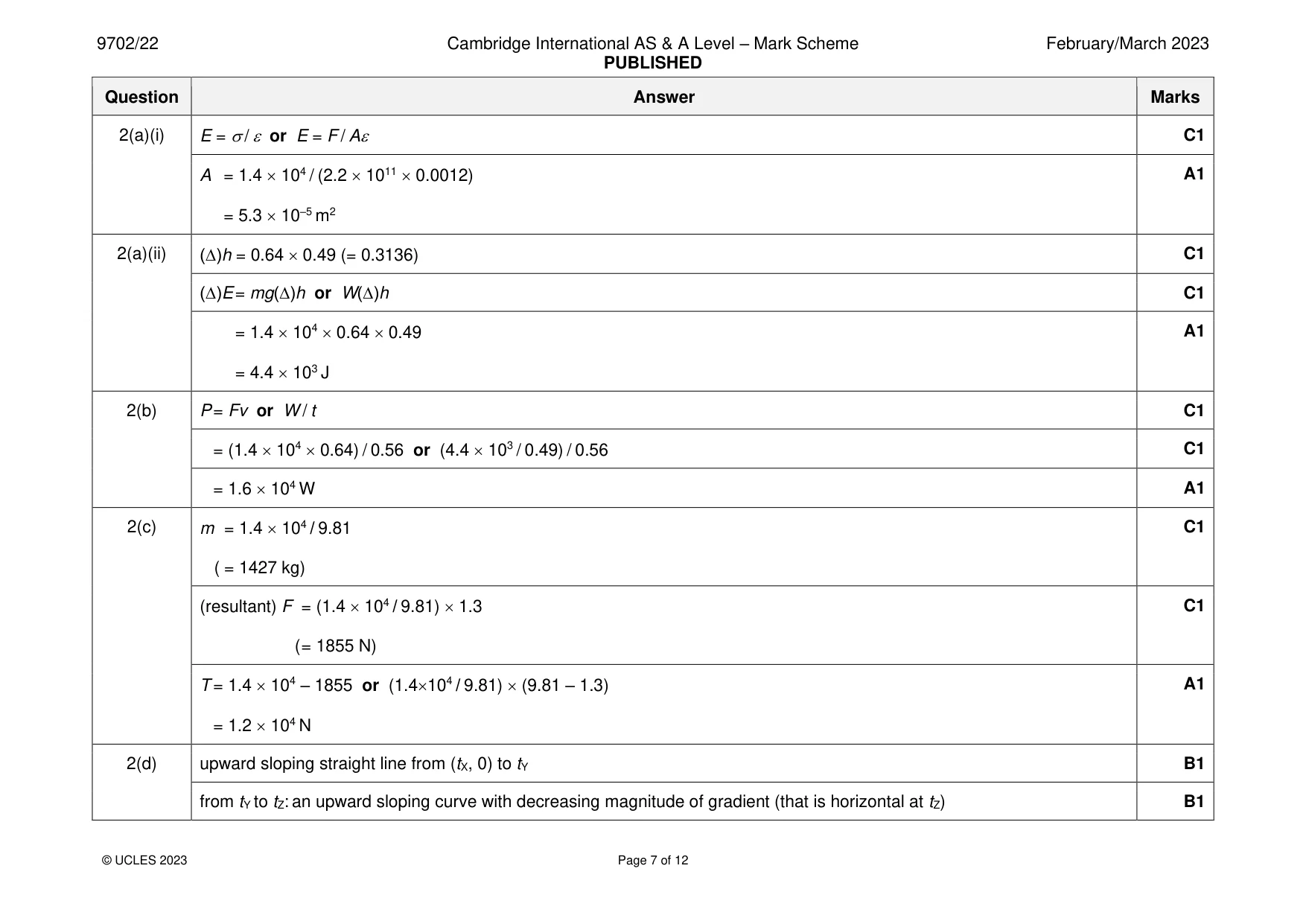
Mark scheme: 2(a)(i) E = / or E = F / A C1 A = 1.4 104 / (2.2 1011 0.0012) A1 = 5.3 10–5 m2 2(a)(ii) (∆)h = 0.64 0.49 (= 0.3136) C1 (∆)E = mg(∆)h or W(∆)h C1 = 1.4 104 0.64 0.49 A1 = 4.4 103 J 2(b) P = Fv or W / t C1 = (1.4 104 0.64) / 0.56 or (4.4 103 / 0.49) / 0.56 C1 = 1.6 104 W A1 2(c) m = 1.4 104 / 9.81 C1 ( = 1427 kg) (resultant) F = (1.4 104 / 9.81) 1.3 C1 ( = 1855 N) T = 1.4 104 – 1855 or (1.4104 / 9.81) (9.81 – 1.3) A1 = 1.2 104 N 2(d) upward sloping straight line from (tX, 0) to tY B1 from tY to tZ: an upward sloping curve with decreasing magnitude of gradient (that is horizontal at tZ) B1
Q3 · A uniform beam AB is attached by a hinge to a wall at end A, as shown in Fig
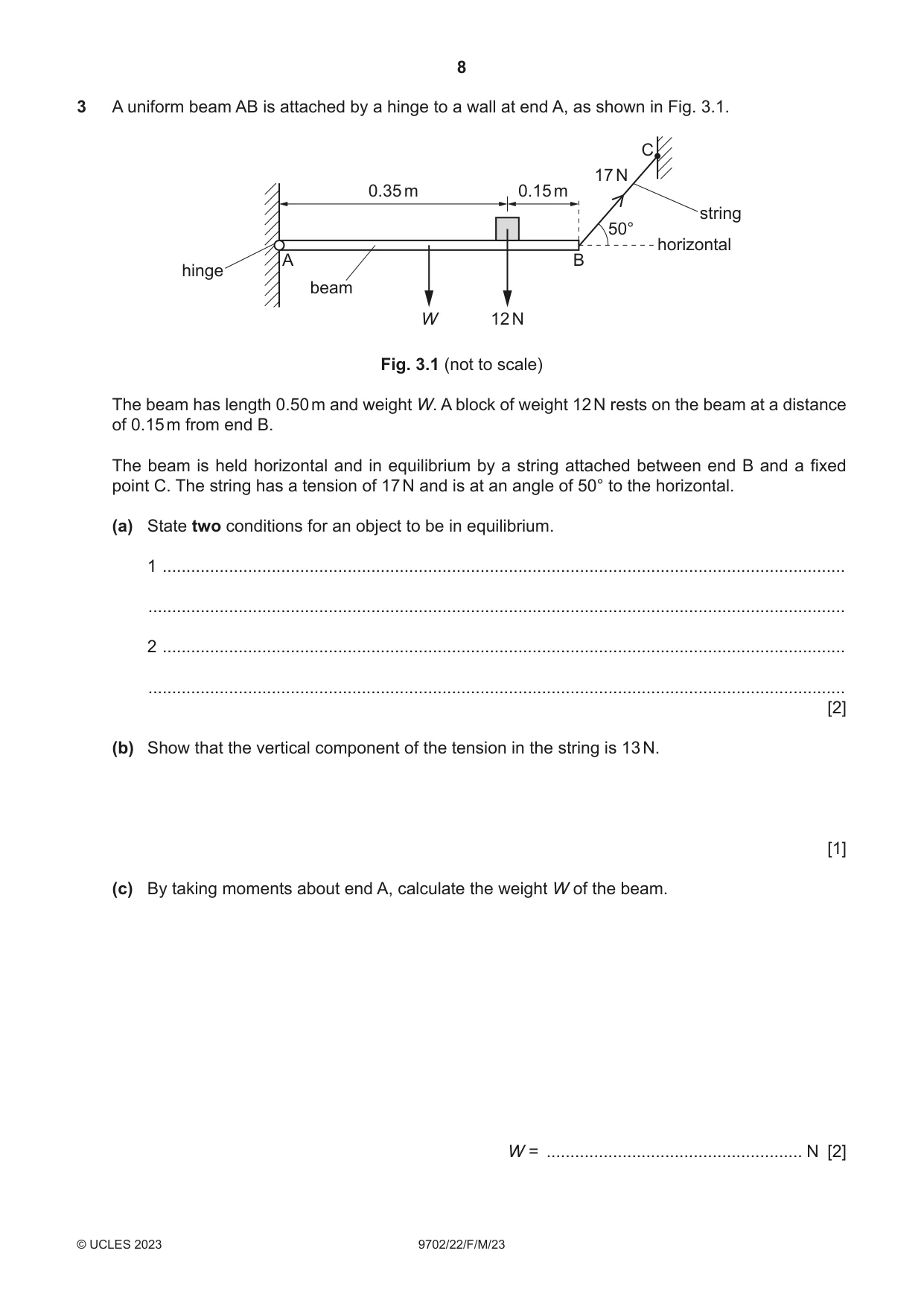
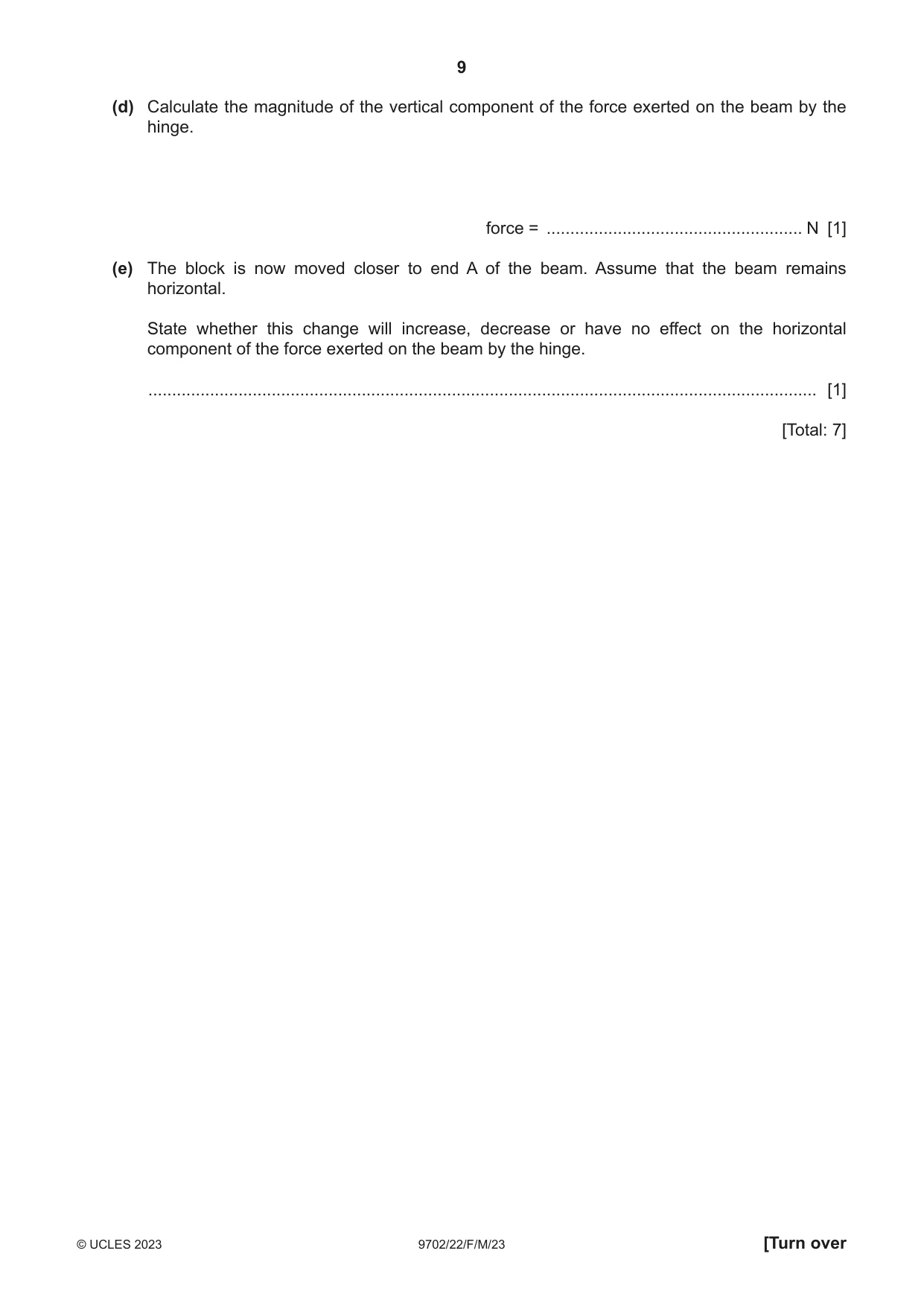
3 A uniform beam AB is attached by a hinge to a wall at end A, as shown in Fig. 3.1. C 17 N 0.35 m 0.15 m string 50° horizontal A B hinge beam W 12 N Fig. 3.1 (not to scale) The beam has length 0.50 m and weight W. A block of weight 12 N rests on the beam at a distance of 0.15 m from end B. The beam is held horizontal and in equilibrium by a string attached between end B and a fixed point C. The string has a tension of 17 N and is at an angle of 50° to the horizontal. (a) State two conditions for an object to be in equilibrium. 1 ................................................................................................................................................ ................................................................................................................................................... 2 ................................................................................................................................................ ................................................................................................................................................... [2] (b) Show that the vertical component of the tension in the string is 13 N. [1] (c) By taking moments about end A, calculate the weight W of the beam. W = ...................................................... N [2] (d) Calculate the magnitude of the vertical component of the force exerted on the beam by the hinge. force = ...................................................... N [1] (e) The block is now moved closer to end A of the beam. Assume that the beam remains horizontal. State whether this change will increase, decrease or have no effect on the horizontal component of the force exerted on the beam by the hinge. ............................................................................................................................................. [1] [Total: 7]
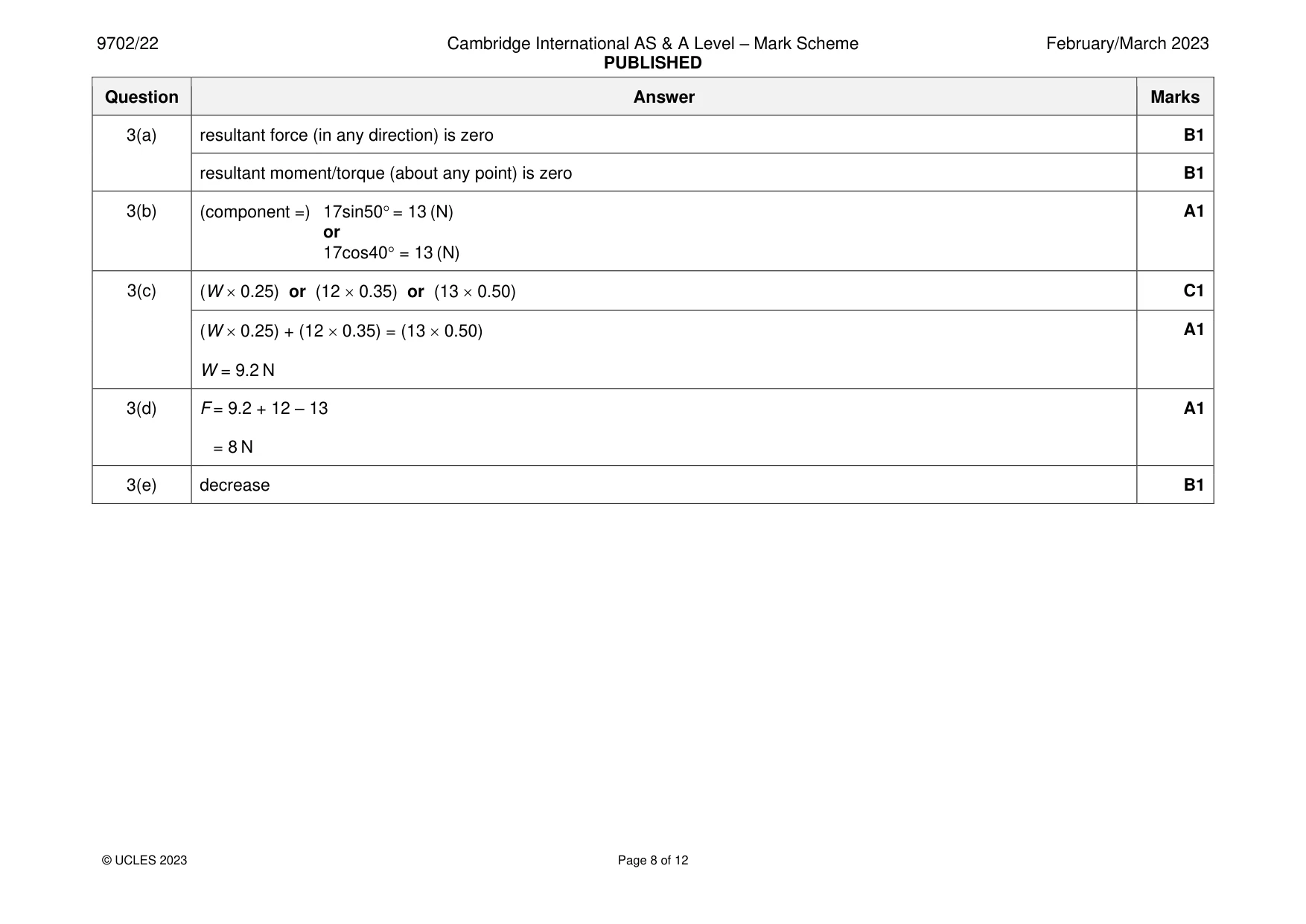
Mark scheme: 3(a) resultant force (in any direction) is zero B1 resultant moment/torque (about any point) is zero B1 3(b) (component =) 17sin50 = 13 (N) A1 or 17cos40 = 13 (N) 3(c) (W 0.25) or (12 0.35) or (13 0.50) C1 (W 0.25) + (12 0.35) = (13 0.50) A1 W = 9.2 N 3(d) F = 9.2 + 12 – 13 A1 = 8 N 3(e) decrease B1
Q4 · Two blocks slide directly towards each other along a frictionless horizontal surface, as…
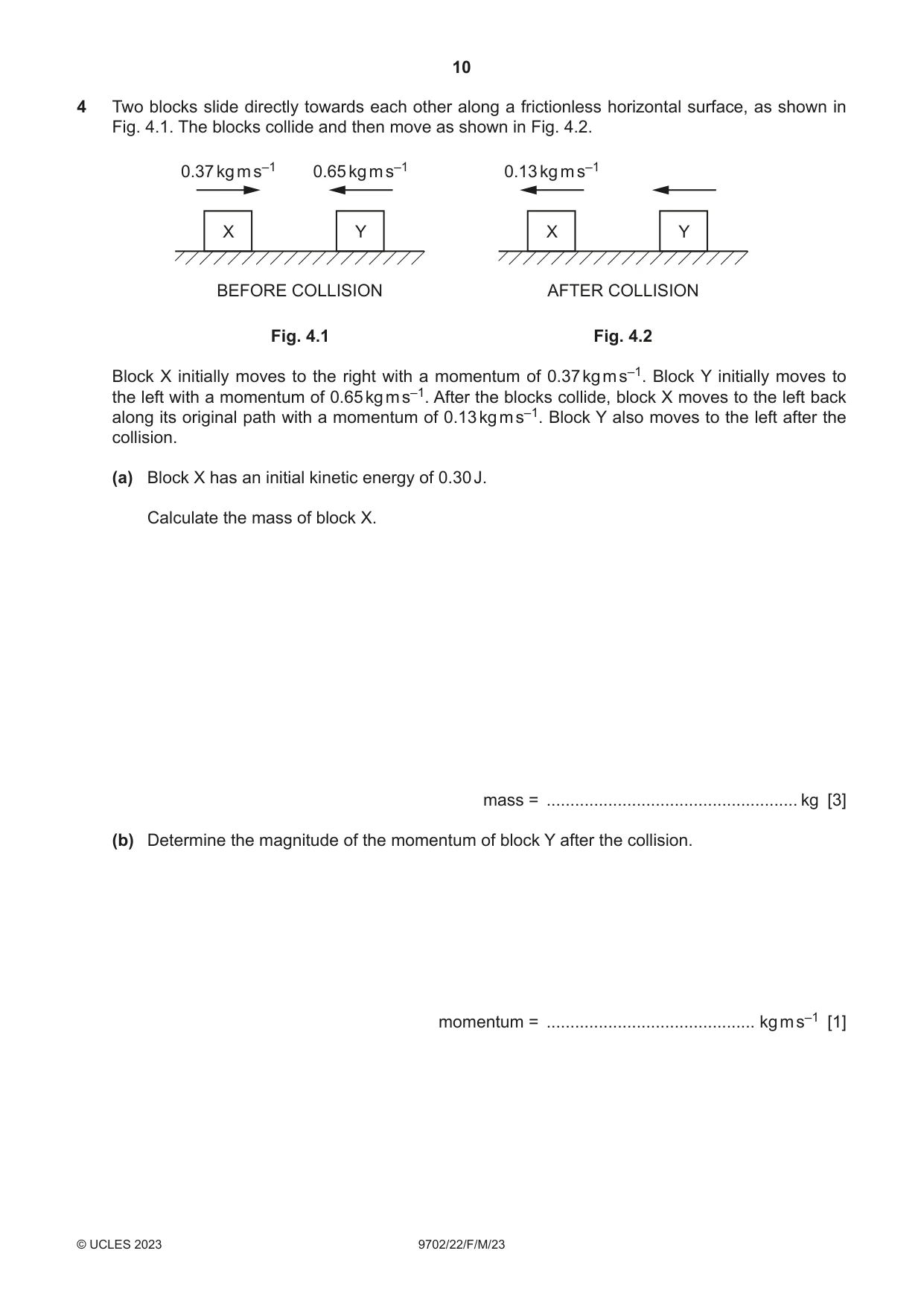
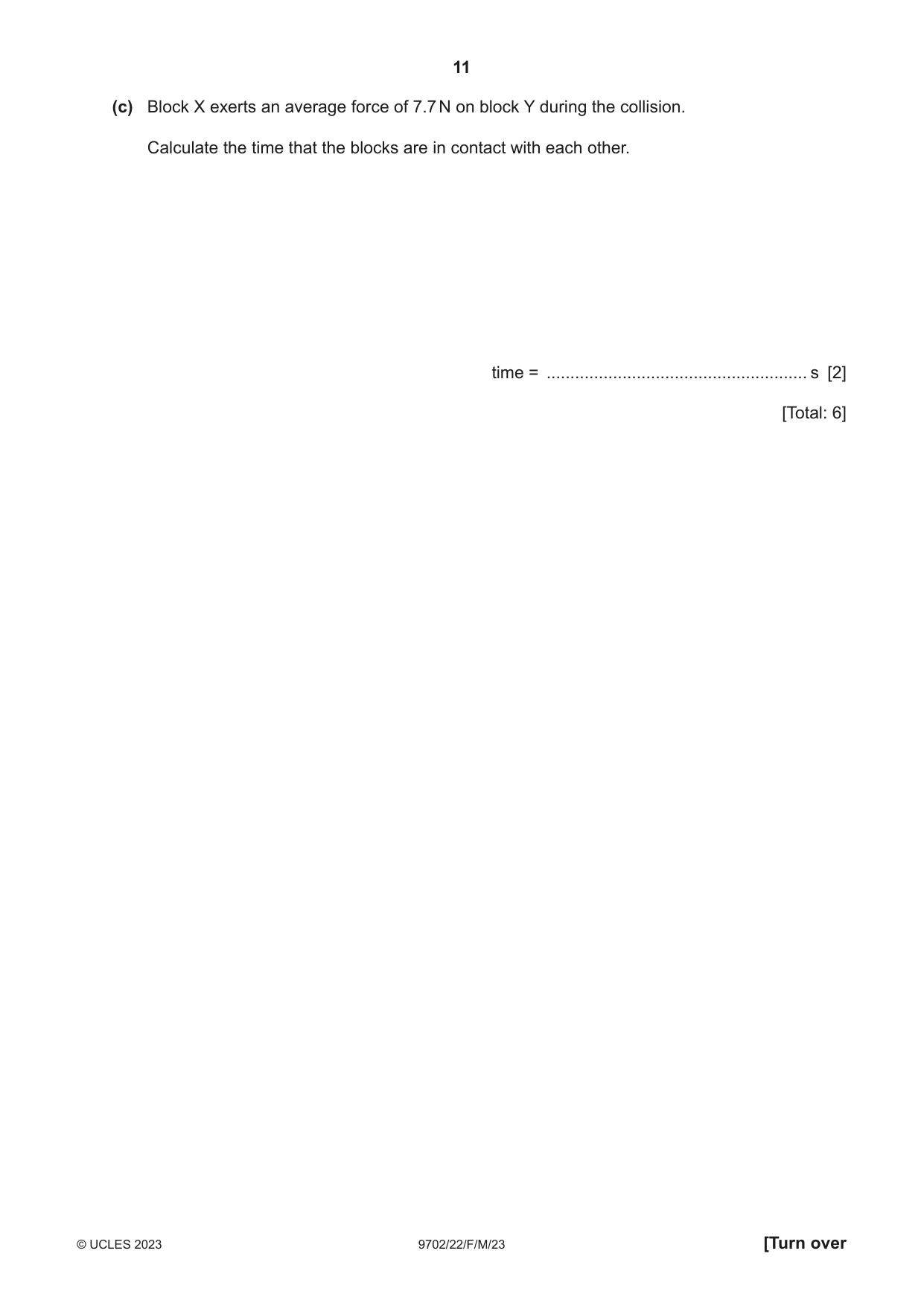
4 Two blocks slide directly towards each other along a frictionless horizontal surface, as shown in Fig. 4.1. The blocks collide and then move as shown in Fig. 4.2. 0.37 kg m s–1 0.65 kg m s–1 0.13 kg m s–1 X Y X Y BEFORE COLLISION AFTER COLLISION Fig. 4.1 Fig. 4.2 Block X initially moves to the right with a momentum of 0.37 kg m s–1. Block Y initially moves to the left with a momentum of 0.65 kg m s–1. After the blocks collide, block X moves to the left back along its original path with a momentum of 0.13 kg m s–1. Block Y also moves to the left after the collision. (a) Block X has an initial kinetic energy of 0.30 J. Calculate the mass of block X. mass = ..................................................... kg [3] (b) Determine the magnitude of the momentum of block Y after the collision. momentum = ............................................ kg m s–1 [1] (c) Block X exerts an average force of 7.7 N on block Y during the collision. Calculate the time that the blocks are in contact with each other. time = ....................................................... s [2] [Total: 6]
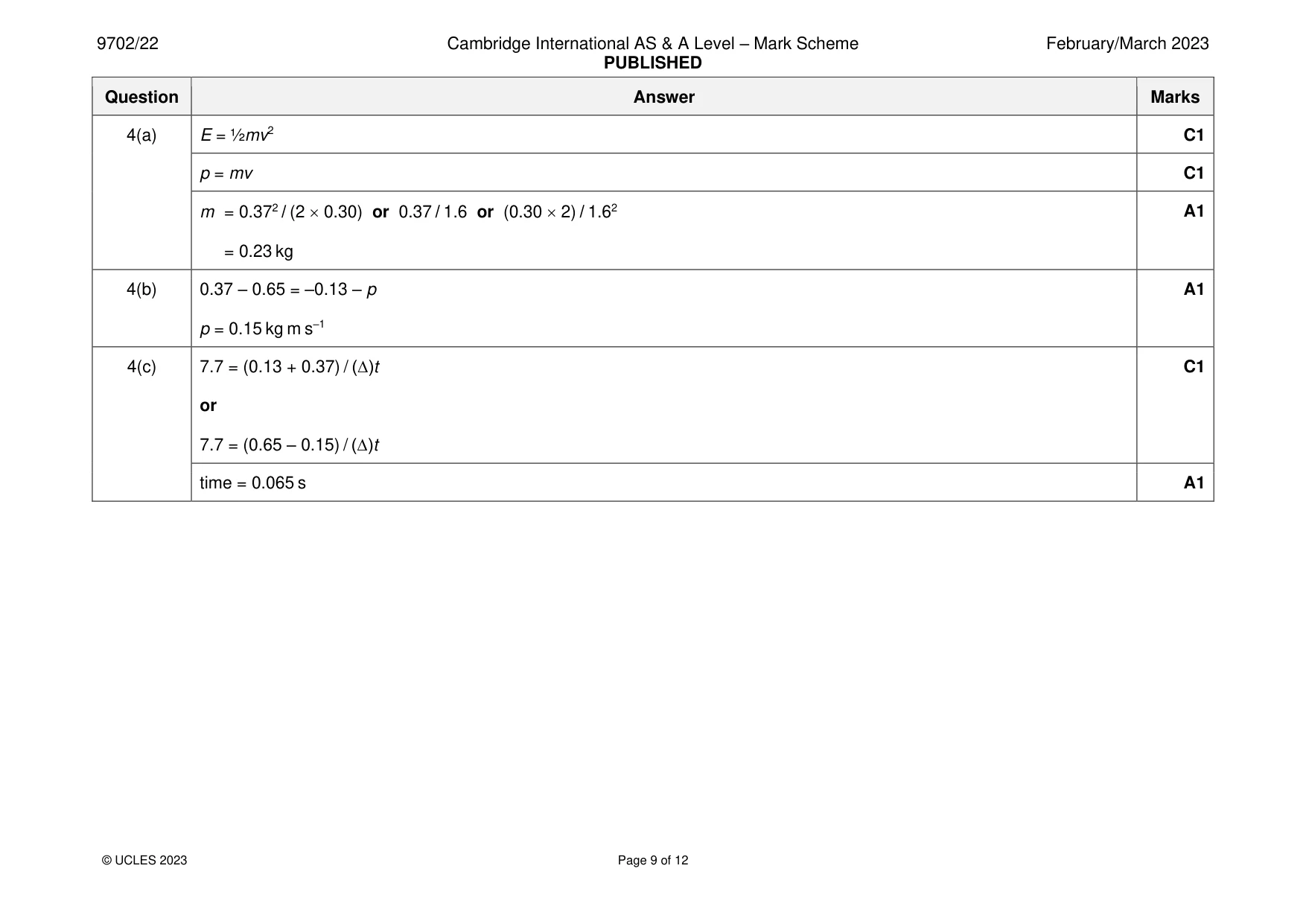
Mark scheme: 4(a) E = ½mv2 C1 p = mv C1 m = 0.372 / (2 0.30) or 0.37 / 1.6 or (0.30 2) / 1.62 A1 = 0.23 kg 4(b) 0.37 – 0.65 = –0.13 – p A1 p = 0.15 kg m s–1 4(c) 7.7 = (0.13 + 0.37) / (∆)t C1 or 7.7 = (0.65 – 0.15) / (∆)t time = 0.065 s A1
Q5 · A microphone and cathode-ray oscilloscope (CRO) are used to analyse a sound wave of…
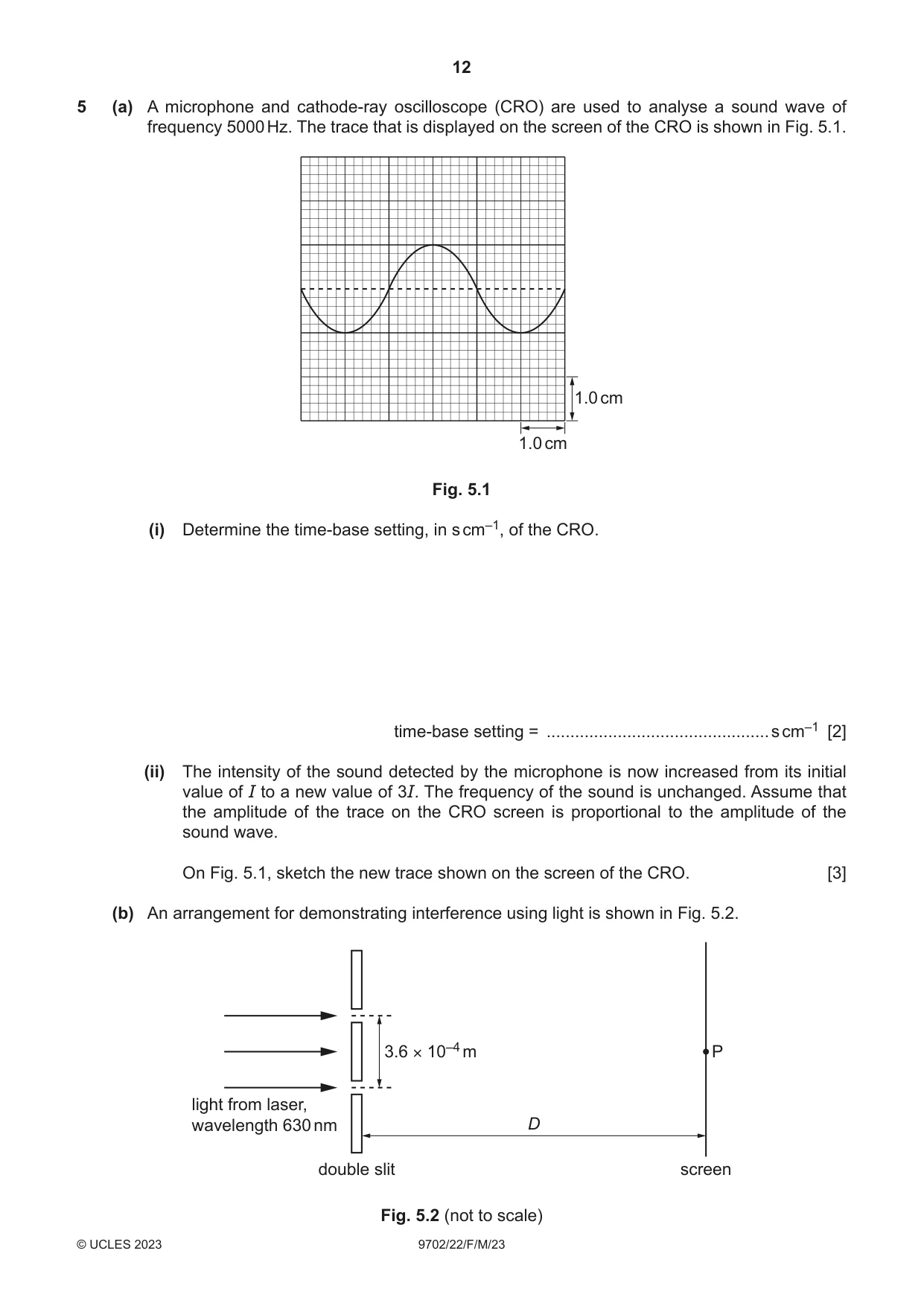
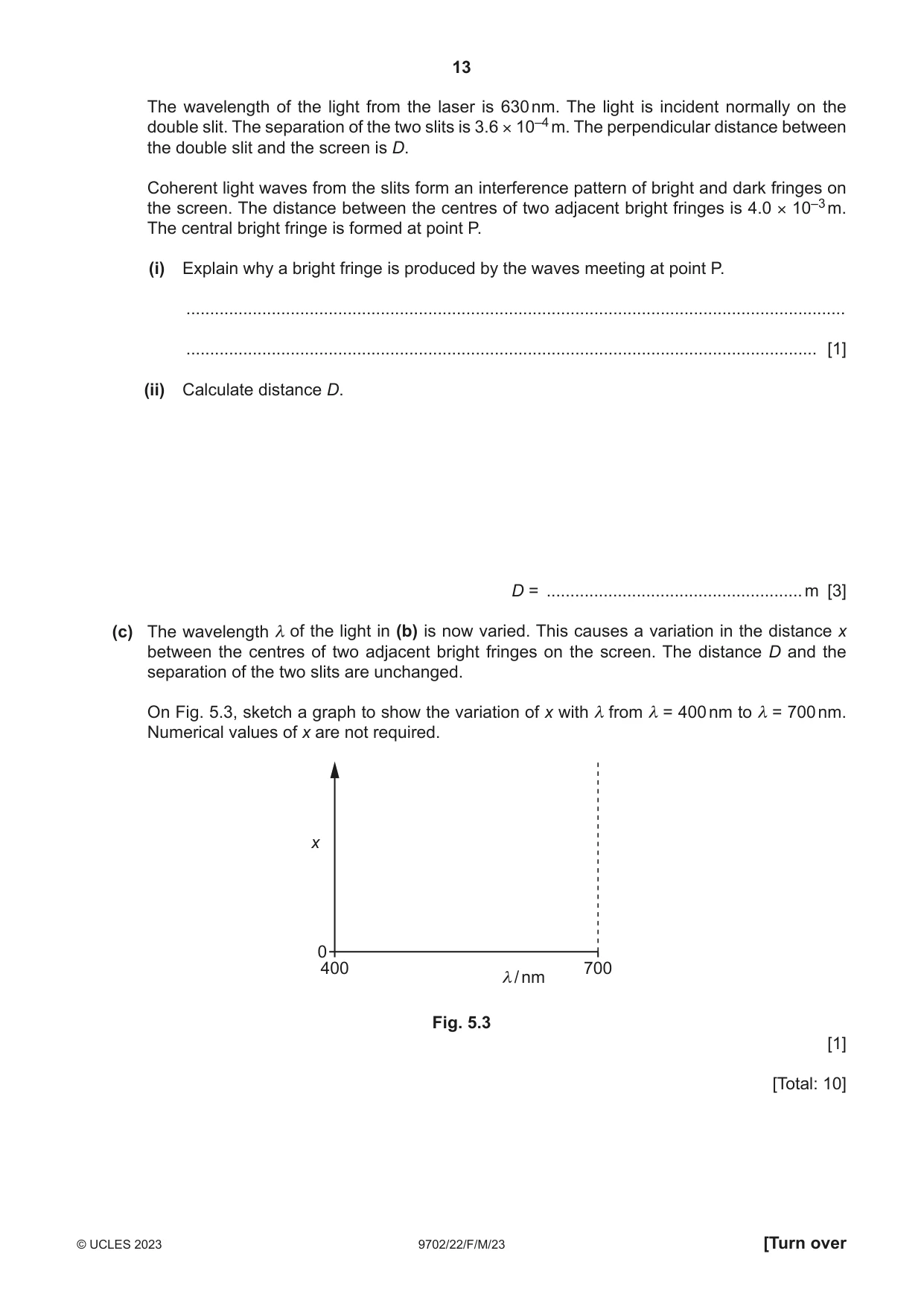
5 (a) A microphone and cathode-ray oscilloscope (CRO) are used to analyse a sound wave of frequency 5000 Hz. The trace that is displayed on the screen of the CRO is shown in Fig. 5.1. 1.0 cm 1.0 cm Fig. 5.1 (i) Determine the time-base setting, in s cm–1, of the CRO. time-base setting = ............................................... s cm–1 [2] (ii) The intensity of the sound detected by the microphone is now increased from its initial value of I to a new value of 3I. The frequency of the sound is unchanged. Assume that the amplitude of the trace on the CRO screen is proportional to the amplitude of the sound wave. On Fig. 5.1, sketch the new trace shown on the screen of the CRO. [3] (b) An arrangement for demonstrating interference using light is shown in Fig. 5.2. 3.6 × 10⁻⁴ m P light from laser, wavelength 630 nm D double slit screen Fig. 5.2 (not to scale) The wavelength of the light from the laser is 630 nm. The light is incident normally on the double slit. The separation of the two slits is 3.6 × 10⁻⁴ m. The perpendicular distance between the double slit and the screen is D. Coherent light waves from the slits form an interference pattern of bright and dark fringes on the screen. The distance between the centres of two adjacent bright fringes is 4.0 × 10⁻³ m. The central bright fringe is formed at point P. (i) Explain why a bright fringe is produced by the waves meeting at point P. ........................................................................................................................................... ..................................................................................................................................... [1] (ii) Calculate distance D. D = ...................................................... m [3] (c) The wavelength λ of the light in (b) is now varied. This causes a variation in the distance x between the centres of two adjacent bright fringes on the screen. The distance D and the separation of the two slits are unchanged. On Fig. 5.3, sketch a graph to show the variation of x with λ from λ = 400 nm to λ = 700 nm. Numerical values of x are not required. x 0 400 700 λ/ nm Fig. 5.3 [1] [Total: 10]
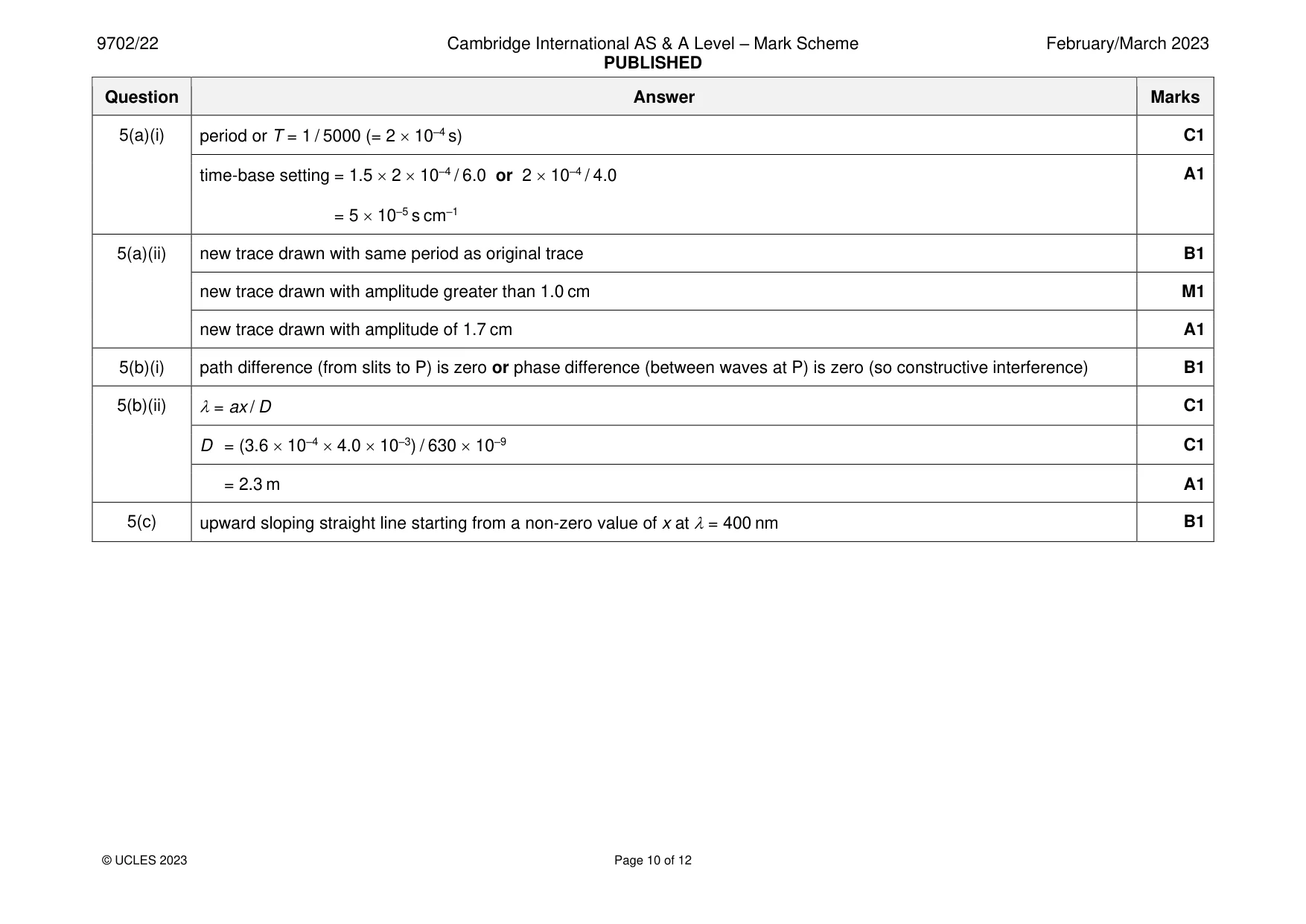
Mark scheme: 5(a)(i) period or T = 1 / 5000 (= 2 10–4 s) C1 time-base setting = 1.5 2 10–4 / 6.0 or 2 10–4 / 4.0 A1 = 5 10–5 s cm–1 5(a)(ii) new trace drawn with same period as original trace B1 new trace drawn with amplitude greater than 1.0 cm M1 new trace drawn with amplitude of 1.7 cm A1 5(b)(i) path difference (from slits to P) is zero or phase difference (between waves at P) is zero (so constructive interference) B1 5(b)(ii) = ax / D C1 D = (3.6 10–4 4.0 10–3) / 630 10–9 C1 = 2.3 m A1 5(c) upward sloping straight line starting from a non-zero value of x at = 400 nm B1
Q6 · Define the potential difference across a component
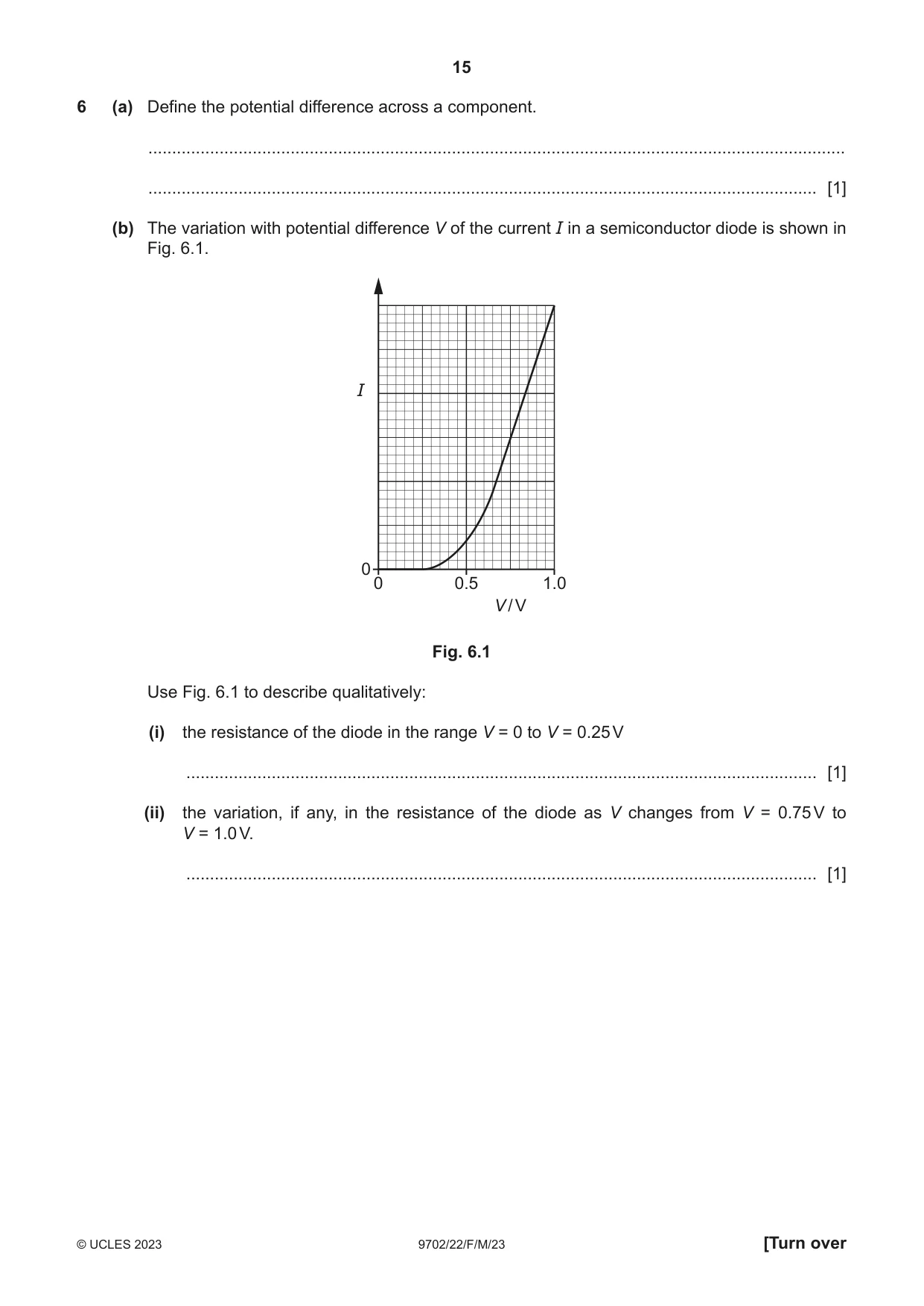
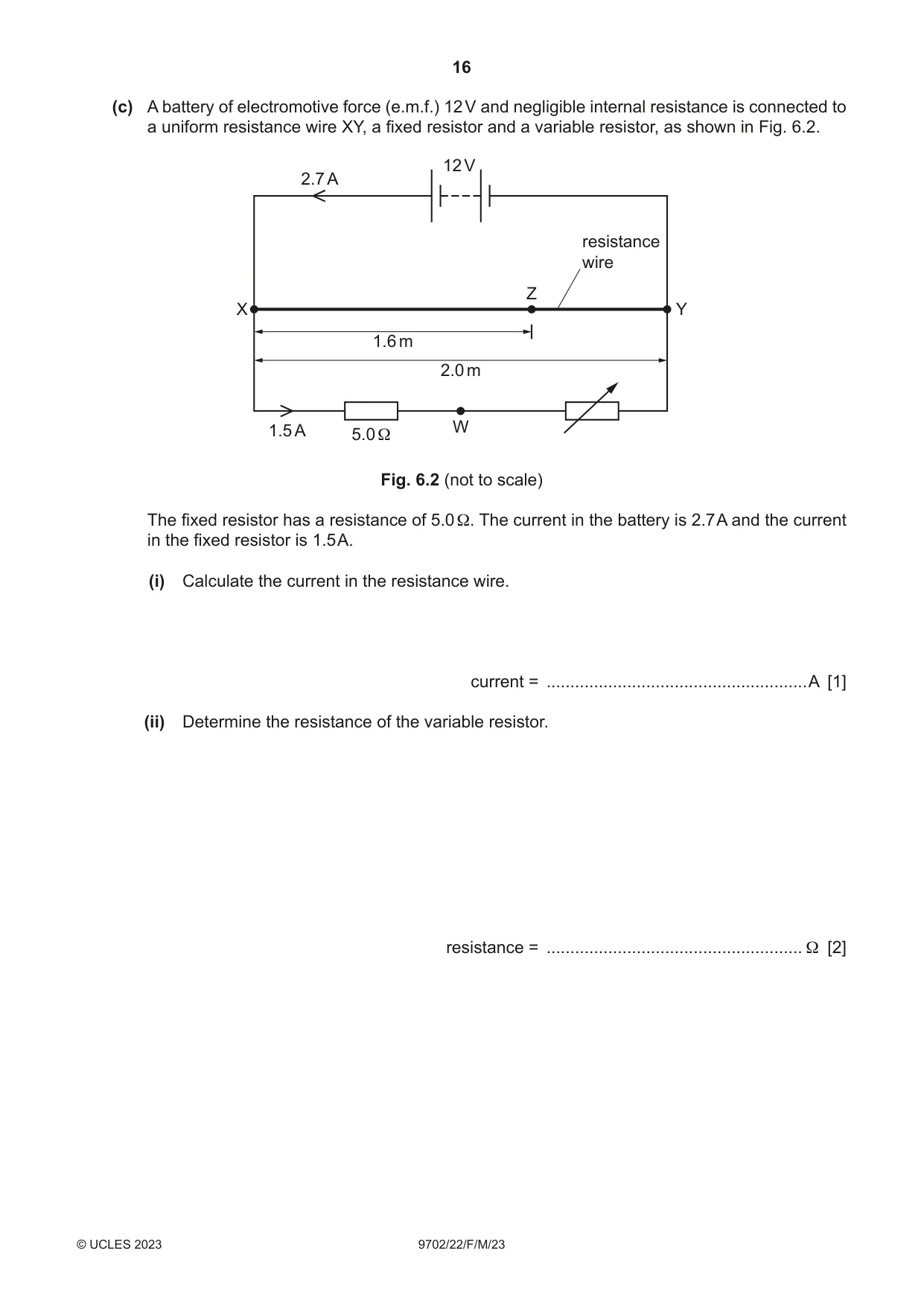
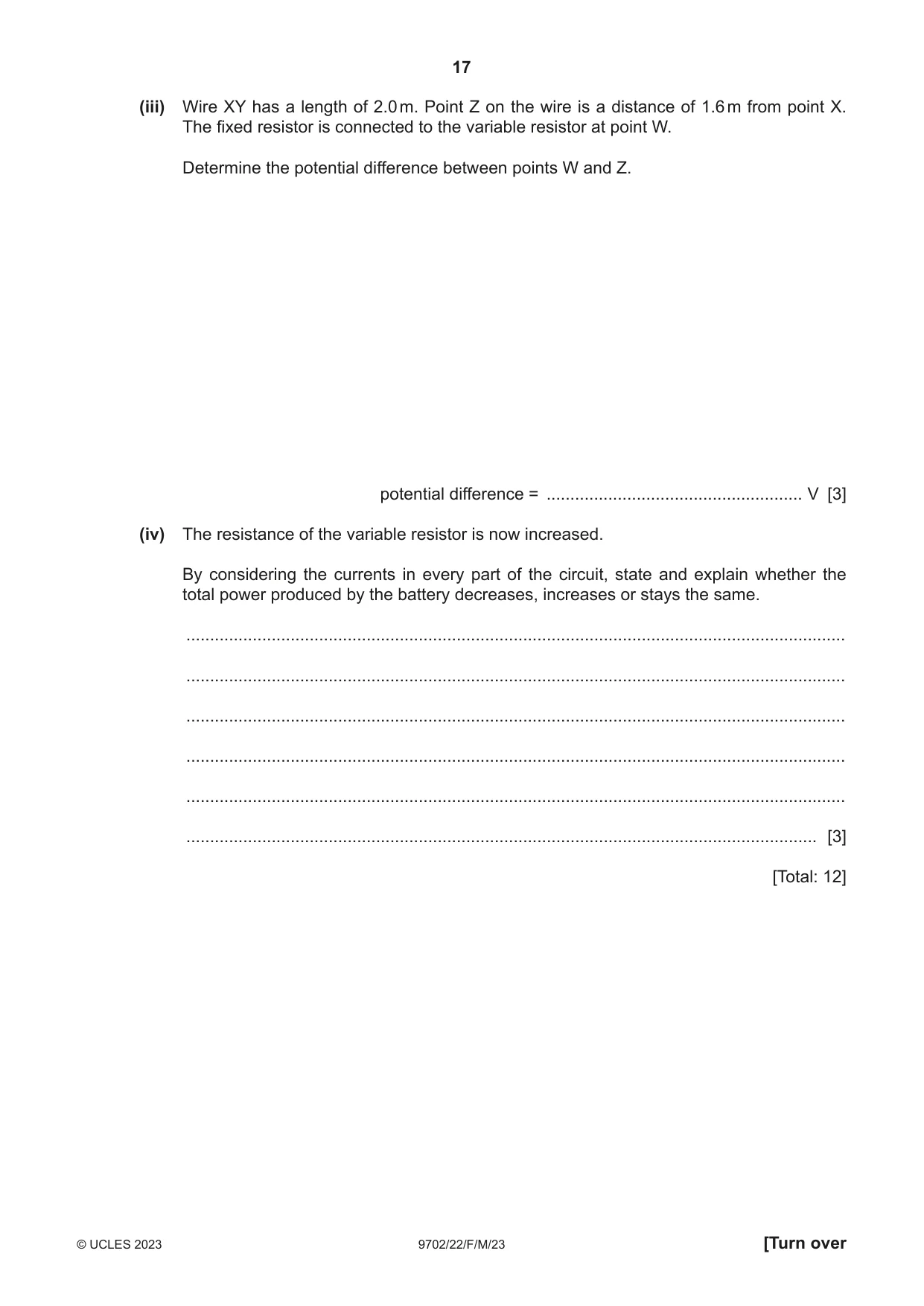
6 (a) Define the potential difference across a component. ................................................................................................................................................... ............................................................................................................................................. [1] (b) The variation with potential difference V of the current I in a semiconductor diode is shown in Fig. 6.1. I 0 0 0.5 1.0 V / V Fig. 6.1 Use Fig. 6.1 to describe qualitatively: (i) the resistance of the diode in the range V = 0 to V = 0.25 V ..................................................................................................................................... [1] (ii) the variation, if any, in the resistance of the diode as V changes from V = 0.75 V to V = 1.0 V. ..................................................................................................................................... [1] (c) A battery of electromotive force (e.m.f.) 12 V and negligible internal resistance is connected to a uniform resistance wire XY, a fixed resistor and a variable resistor, as shown in Fig. 6.2. 12 V 2.7 A resistance wire Z X Y 1.6 m 2.0 m 1.5 A 5.0 Ω W Fig. 6.2 (not to scale) The fixed resistor has a resistance of 5.0 Ω. The current in the battery is 2.7 A and the current in the fixed resistor is 1.5 A. (i) Calculate the current in the resistance wire. current = ....................................................... A [1] (ii) Determine the resistance of the variable resistor. resistance = ...................................................... Ω [2] (iii) Wire XY has a length of 2.0 m. Point Z on the wire is a distance of 1.6 m from point X. The fixed resistor is connected to the variable resistor at point W. Determine the potential difference between points W and Z. potential difference = ...................................................... V [3] (iv) The resistance of the variable resistor is now increased. By considering the currents in every part of the circuit, state and explain whether the total power produced by the battery decreases, increases or stays the same. ........................................................................................................................................... ........................................................................................................................................... ........................................................................................................................................... ........................................................................................................................................... ........................................................................................................................................... ..................................................................................................................................... [3] [Total: 12]
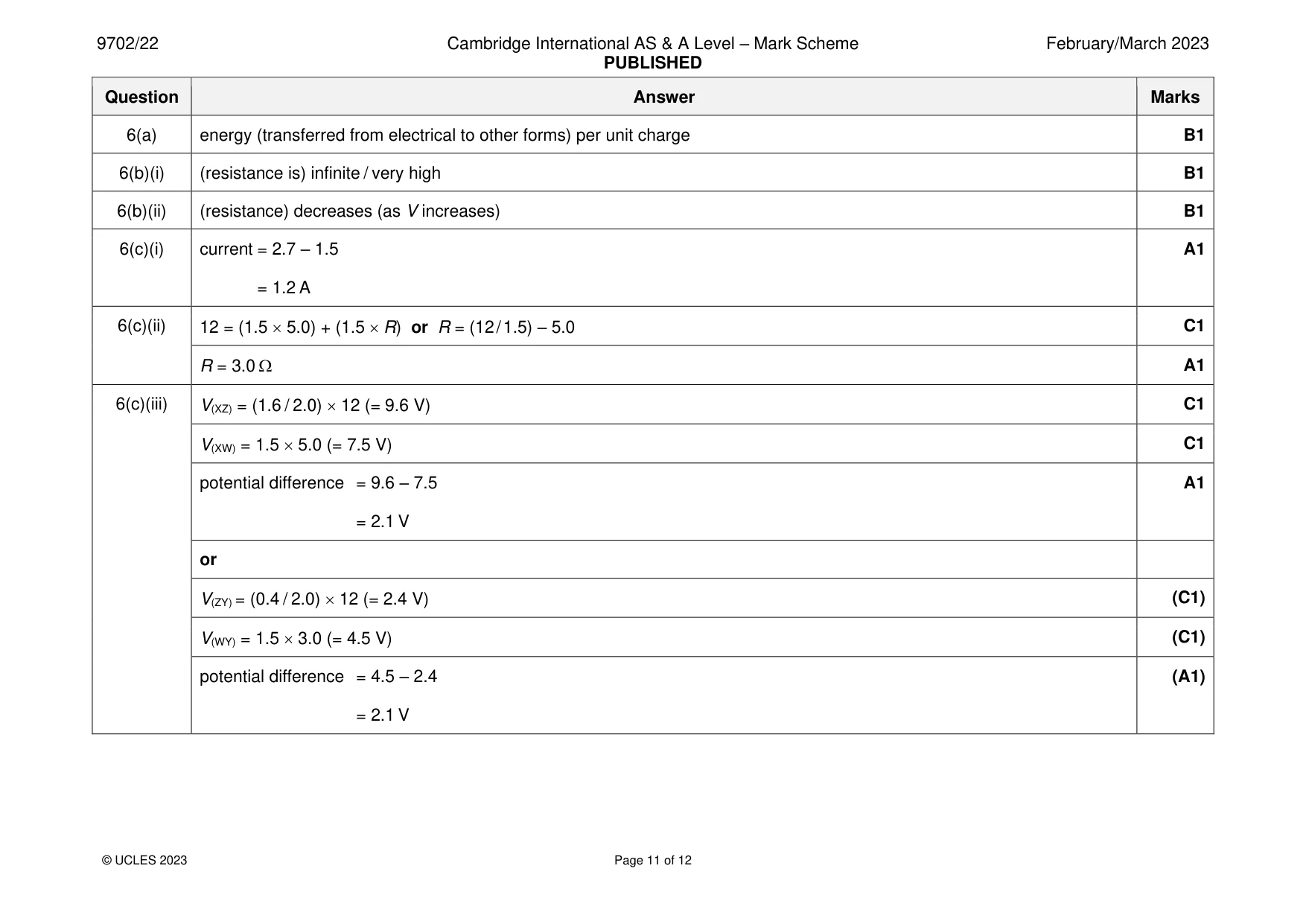
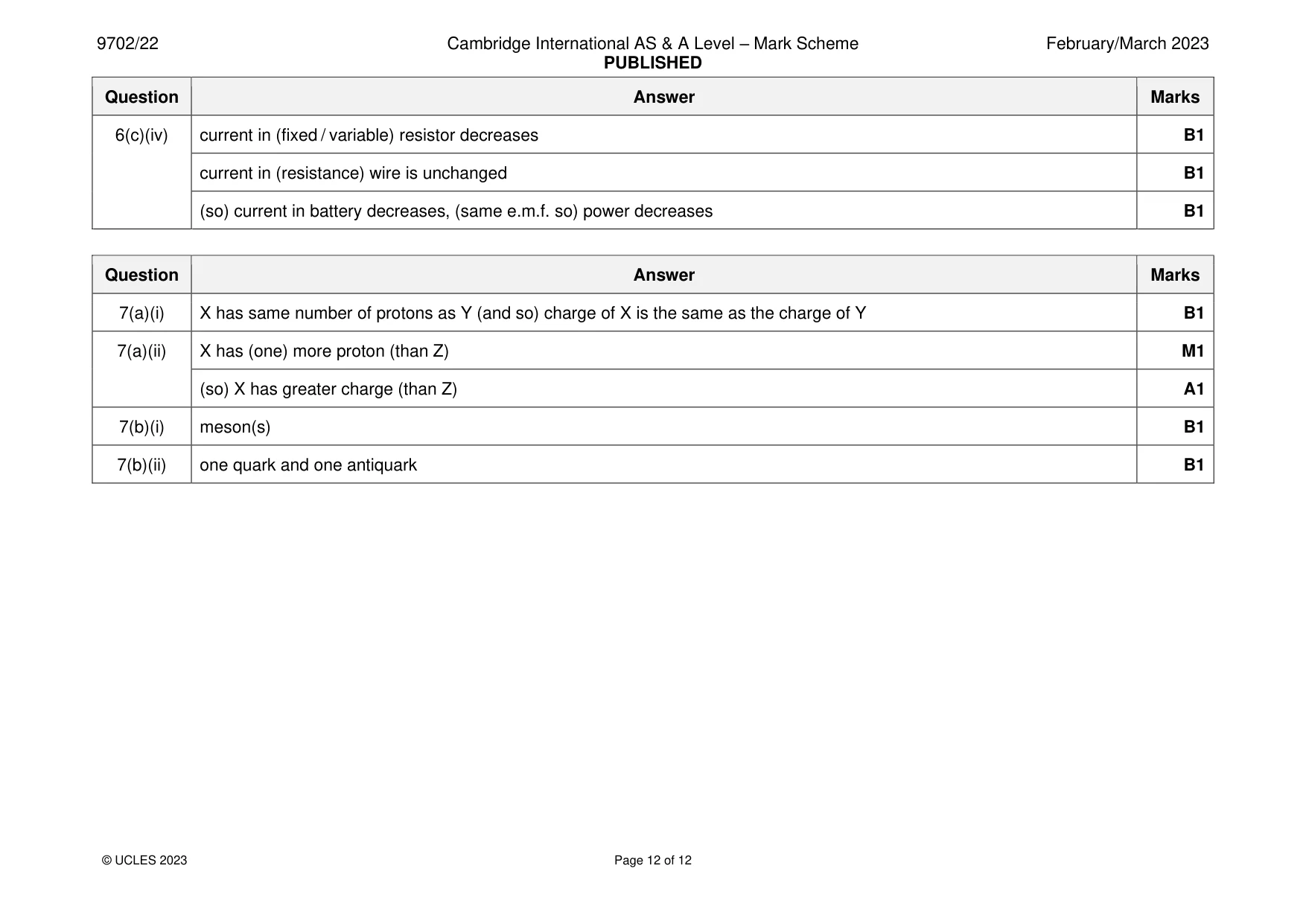
Mark scheme: 6(a) energy (transferred from electrical to other forms) per unit charge B1 6(b)(i) (resistance is) infinite / very high B1 6(b)(ii) (resistance) decreases (as V increases) B1 6(c)(i) current = 2.7 – 1.5 A1 = 1.2 A 6(c)(ii) 12 = (1.5 5.0) + (1.5 R) or R = (12 / 1.5) – 5.0 C1 R = 3.0 A1 6(c)(iii) V(XZ) = (1.6 / 2.0) 12 (= 9.6 V) C1 V(XW) = 1.5 5.0 (= 7.5 V) C1 potential difference = 9.6 – 7.5 A1 = 2.1 V or V(ZY) = (0.4 / 2.0) 12 (= 2.4 V) (C1) V(WY) = 1.5 3.0 (= 4.5 V) (C1) potential difference = 4.5 – 2.4 (A1) = 2.1 V 6(c)(iv) current in (fixed / variable) resistor decreases B1 current in (resistance) wire is unchanged B1 (so) current in battery decreases, (same e.m.f. so) power decreases B1
Q7 · Nuclei X and Y are different isotopes of the same element
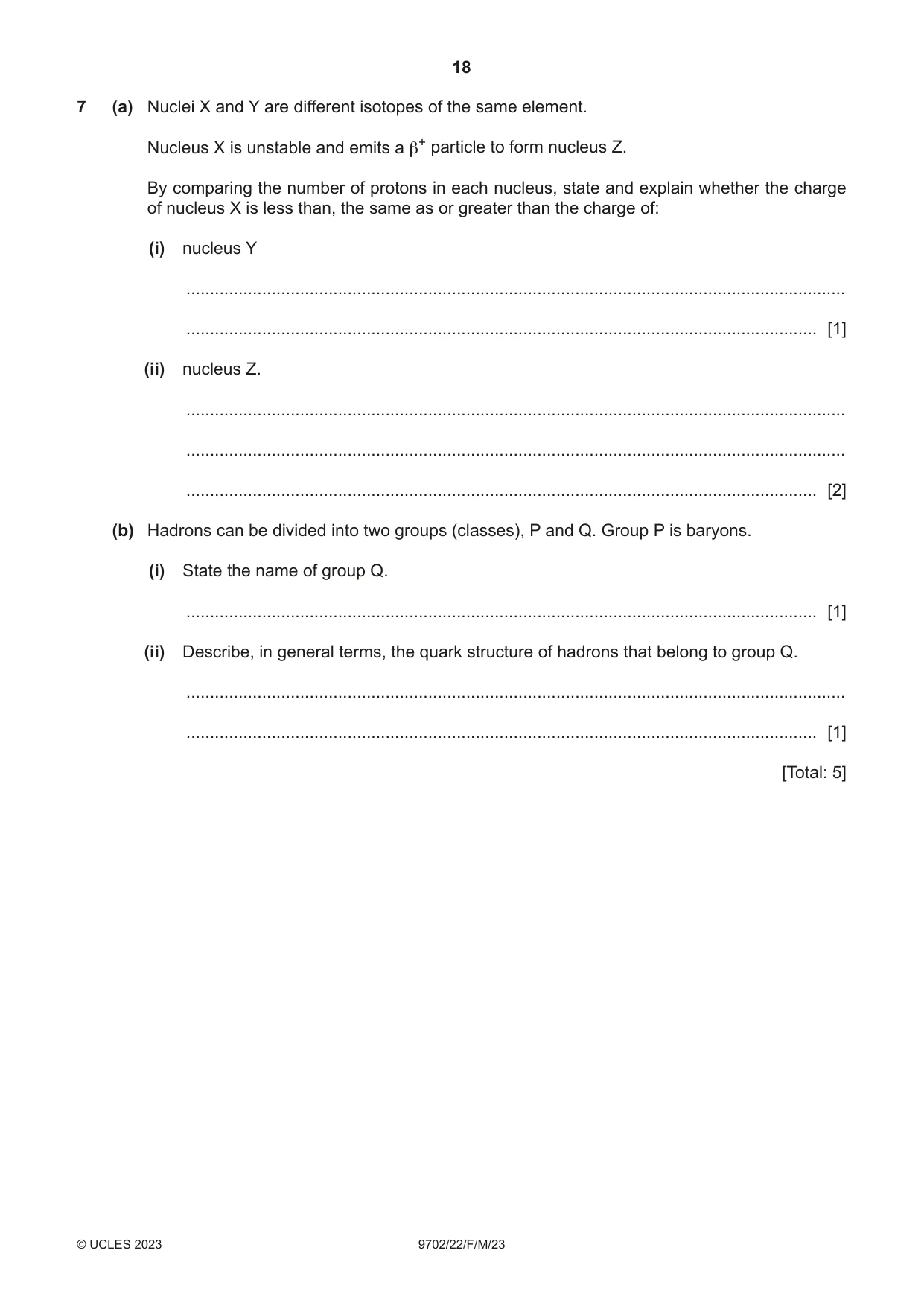
7 (a) Nuclei X and Y are different isotopes of the same element. Nucleus X is unstable and emits a β+ particle to form nucleus Z. By comparing the number of protons in each nucleus, state and explain whether the charge of nucleus X is less than, the same as or greater than the charge of: (i) nucleus Y ........................................................................................................................................... ..................................................................................................................................... [1] (ii) nucleus Z. ........................................................................................................................................... ........................................................................................................................................... ..................................................................................................................................... [2] (b) Hadrons can be divided into two groups (classes), P and Q. Group P is baryons. (i) State the name of group Q. ..................................................................................................................................... [1] (ii) Describe, in general terms, the quark structure of hadrons that belong to group Q. ........................................................................................................................................... ..................................................................................................................................... [1] [Total: 5]
Mark scheme: 7(a)(i) X has same number of protons as Y (and so) charge of X is the same as the charge of Y B1 7(a)(ii) X has (one) more proton (than Z) M1 (so) X has greater charge (than Z) A1 7(b)(i) meson(s) B1 7(b)(ii) one quark and one antiquark B1
What was in this paper
The subtopics covered by these 7 questions, and how many questions each got. Open one in a new tab to see every Cambridge question on it.
What you needed in this session
Cambridge’s own grade thresholds for 2023 Feb/March, Paper 2 · Variant 2. A higher threshold means an easier paper — the bar moves with how the cohort did.