Cambridge A Level Physics 9702 — 2013 May/June Paper 2 · Variant 3
9702/23/M/J/13 · 7 questions · 60 marks · ≈68 min
The question paper and its mark scheme, free to read here and free to download. This is Cambridge’s own paper, exactly as it was sat.
Question paper16 pages
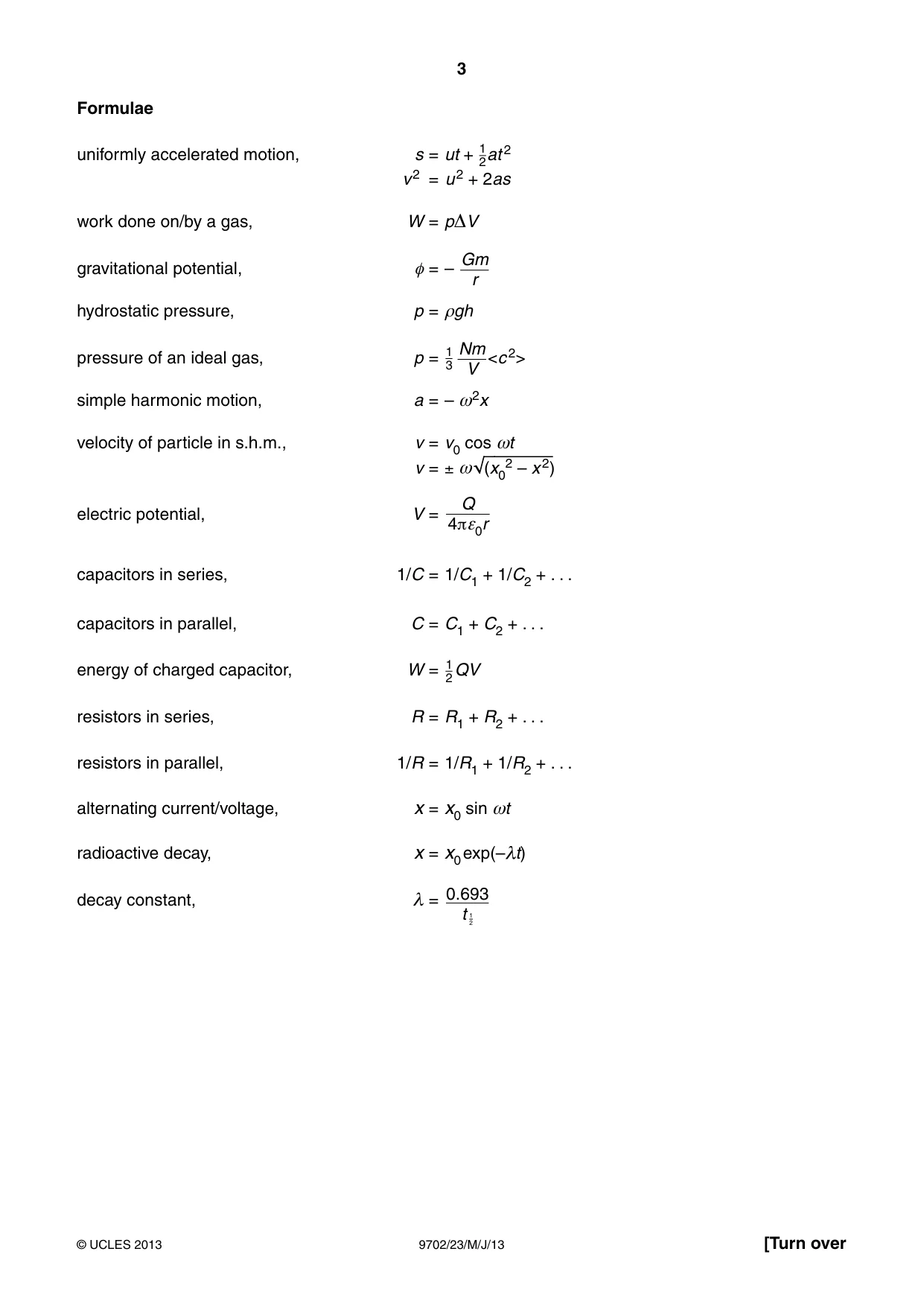


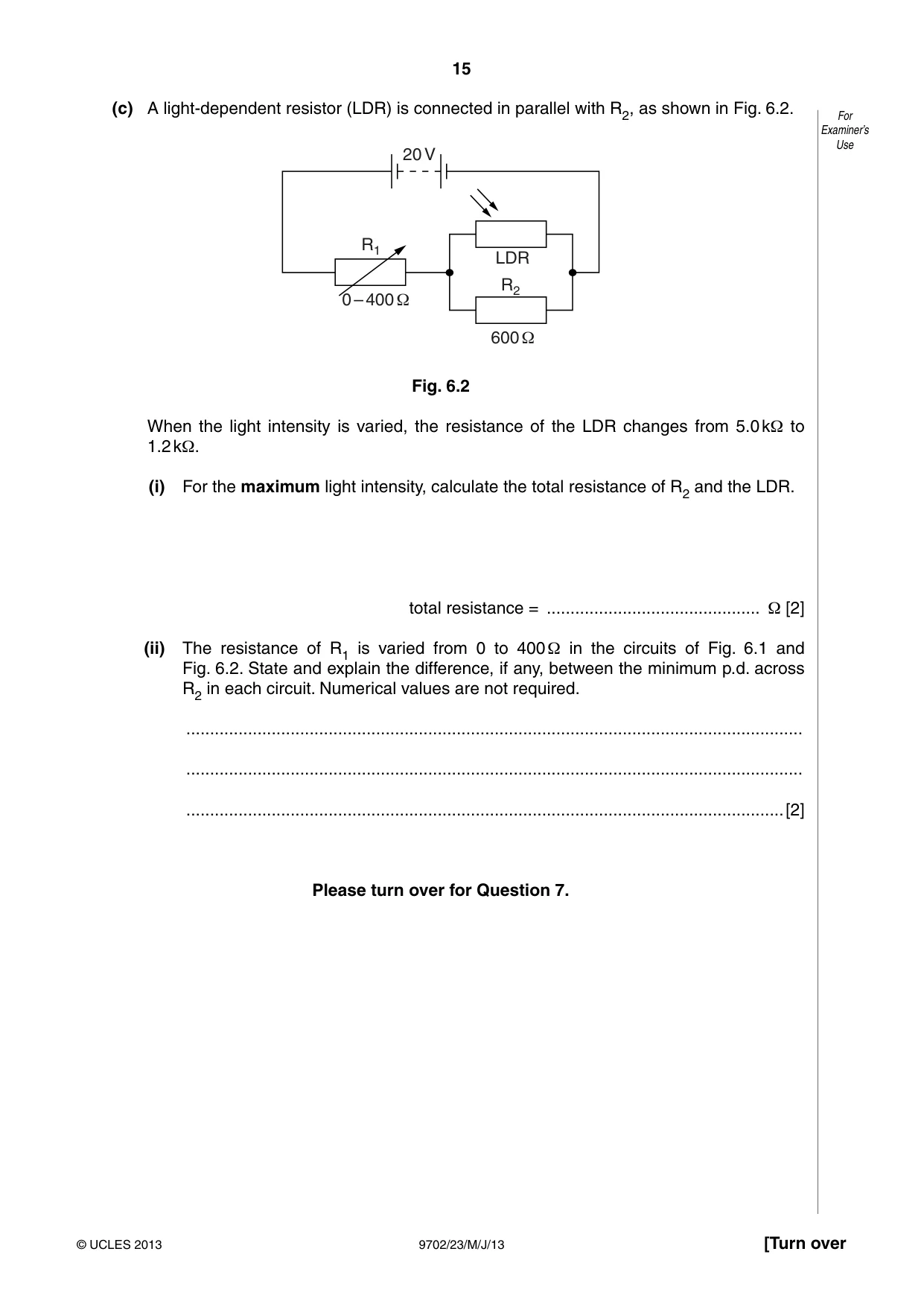
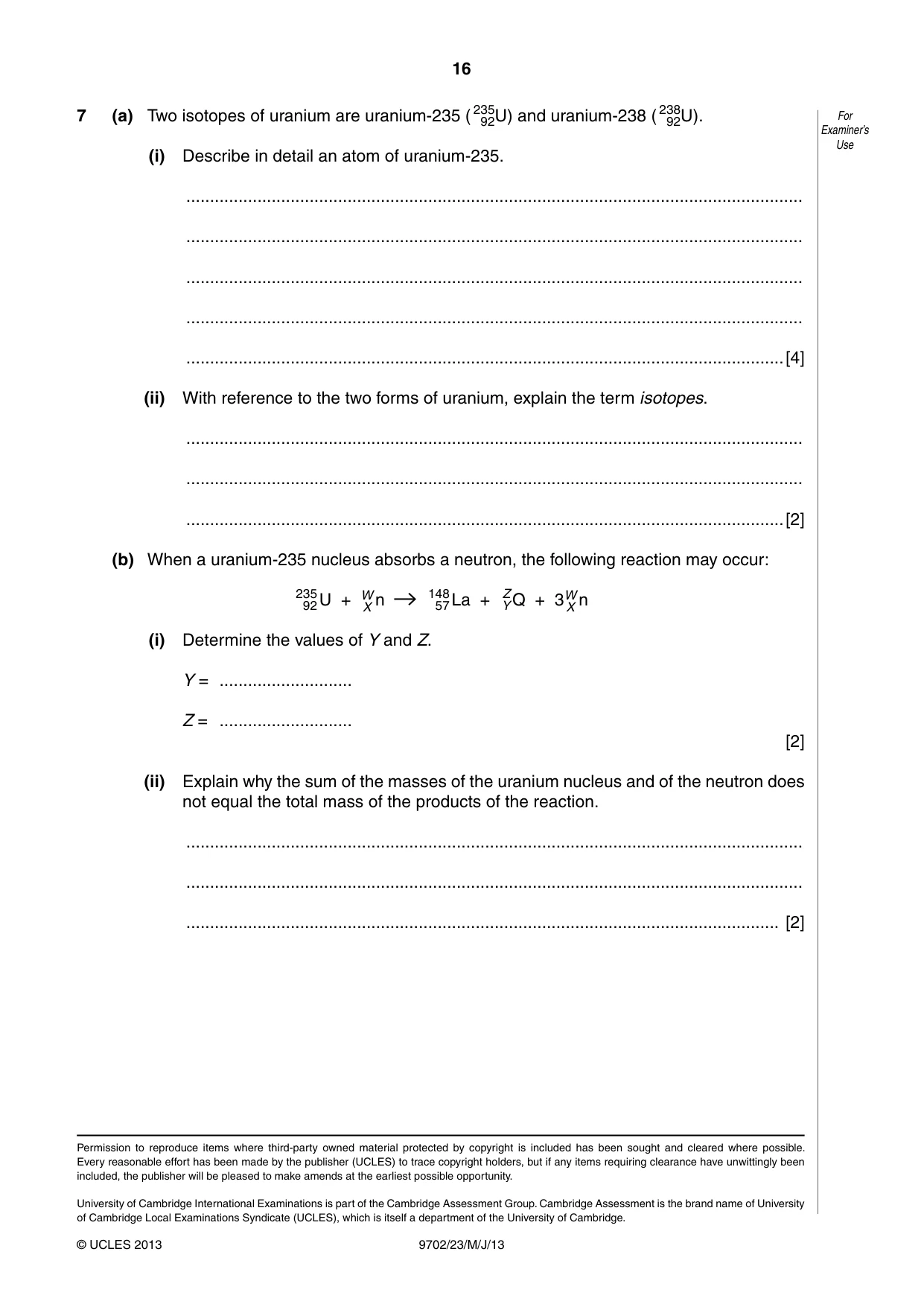
Mark scheme4 pages
Answers below. Sit the paper first if you are practising.
Questions as text
Q1 · State the SI base units of force
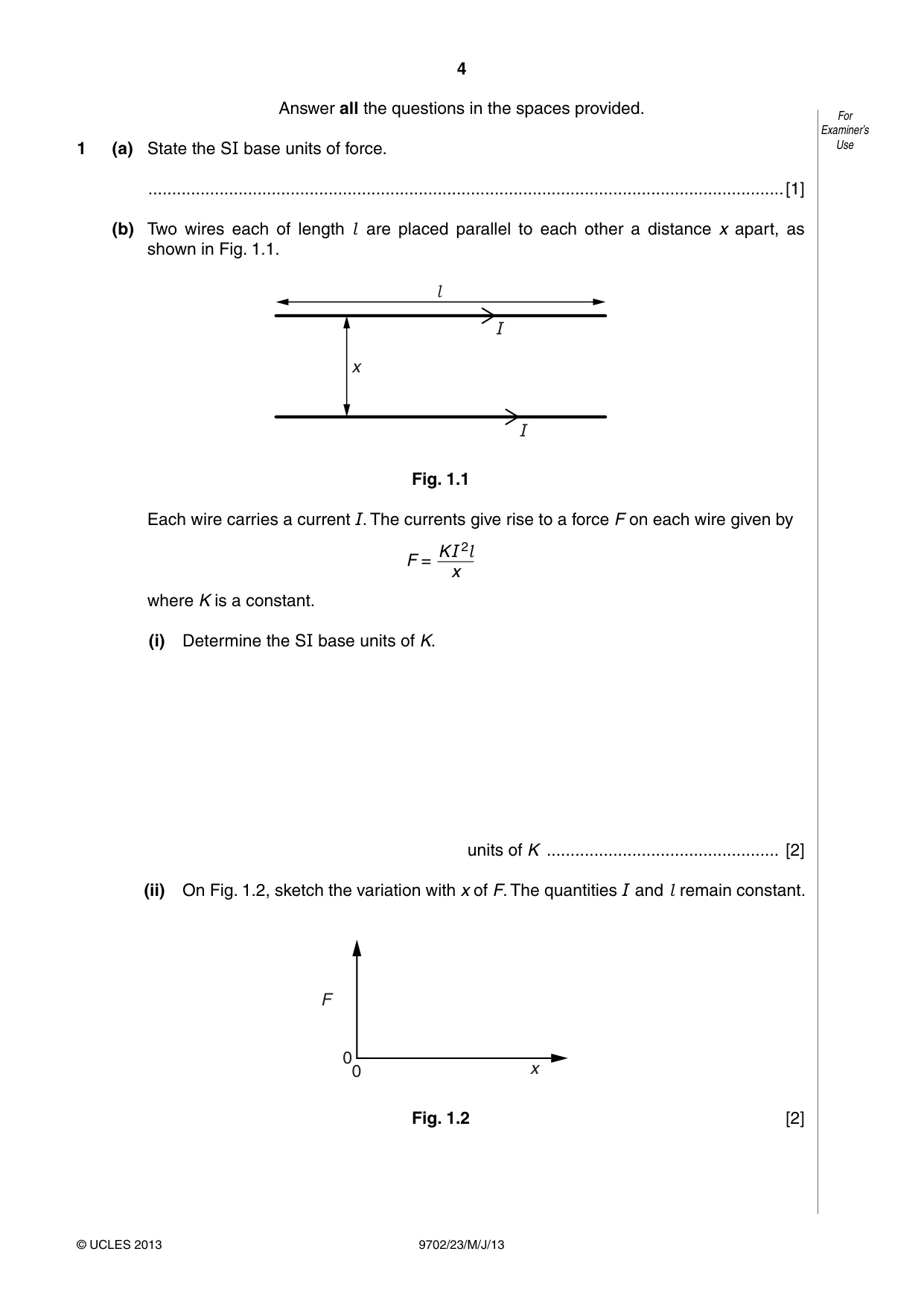
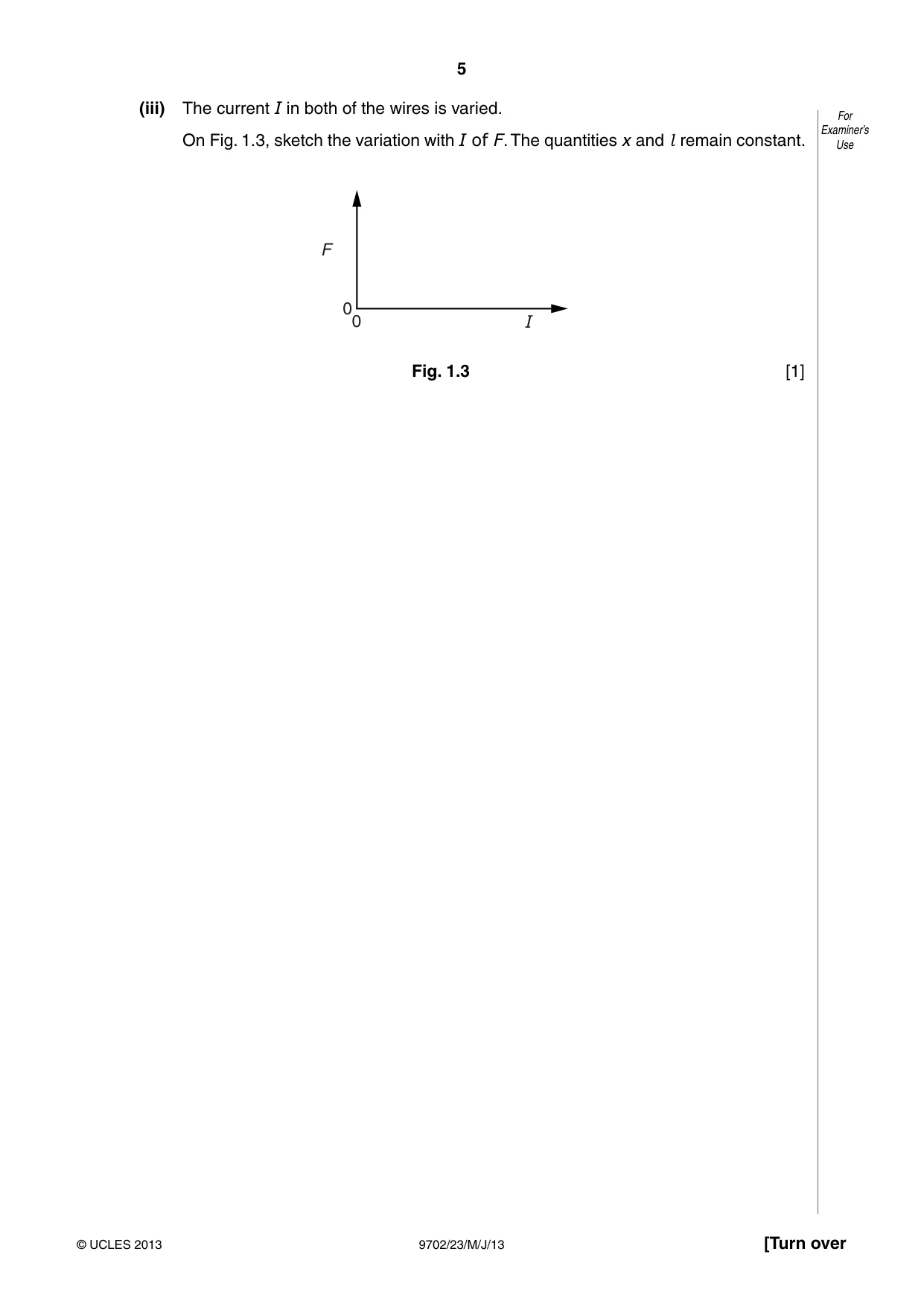
1 (a) State the SI base units of force. Use ......................................................................................................................................[1] (b) Two wires each of length l are placed parallel to each other a distance x apart, as shown in Fig. 1.1. l I x I Fig. 1.1 Each wire carries a current I. The currents give rise to a force F on each wire given by K I 2l F = x where K is a constant. (i) Determine the SI base units of K. units of K ................................................. [2] (ii) On Fig. 1.2, sketch the variation with x of F. The quantities I and l remain constant. F 0 0 x Fig. 1.2 [2] (iii) The current I in both of the wires is varied. For On Fig. 1.3, sketch the variation with I of F. The quantities x and l remain constant. Examiner’sUse F 0 0 I Fig. 1.3 [1]
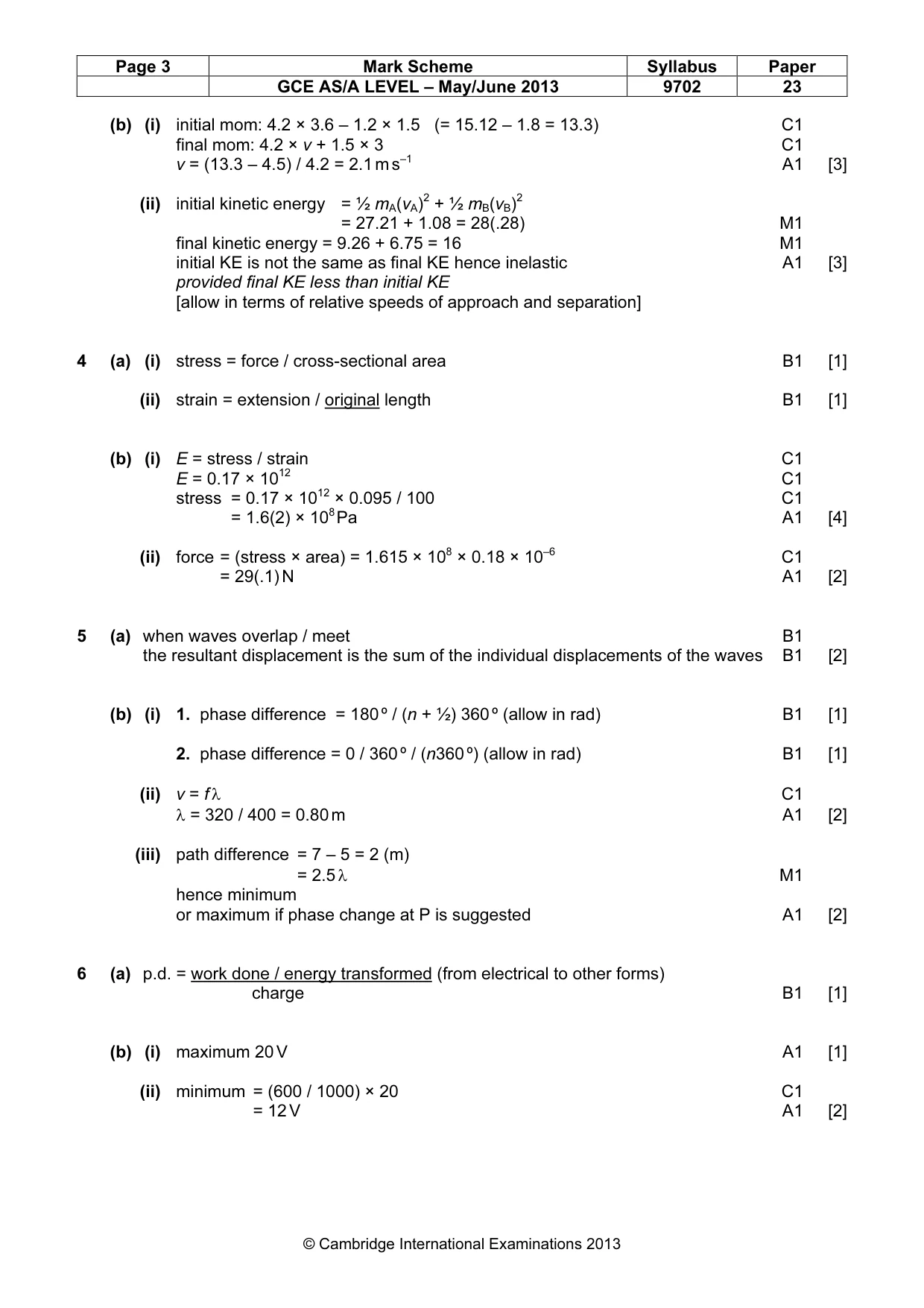
Mark scheme: 1 (a) force: kg m s–2 A1 [1] (b) (i) I2: A2 l: m x: m C1 K: kg m s–2 A–2 A1 [2] (ii) curve of the correct shape (for inverse proportionality) M1 clearly approaching each axis but never touching the axis A1 [2] (iii) curving upwards and through origin A1 [1]
Q2 · A student walks from A to B along the path shown in Fig
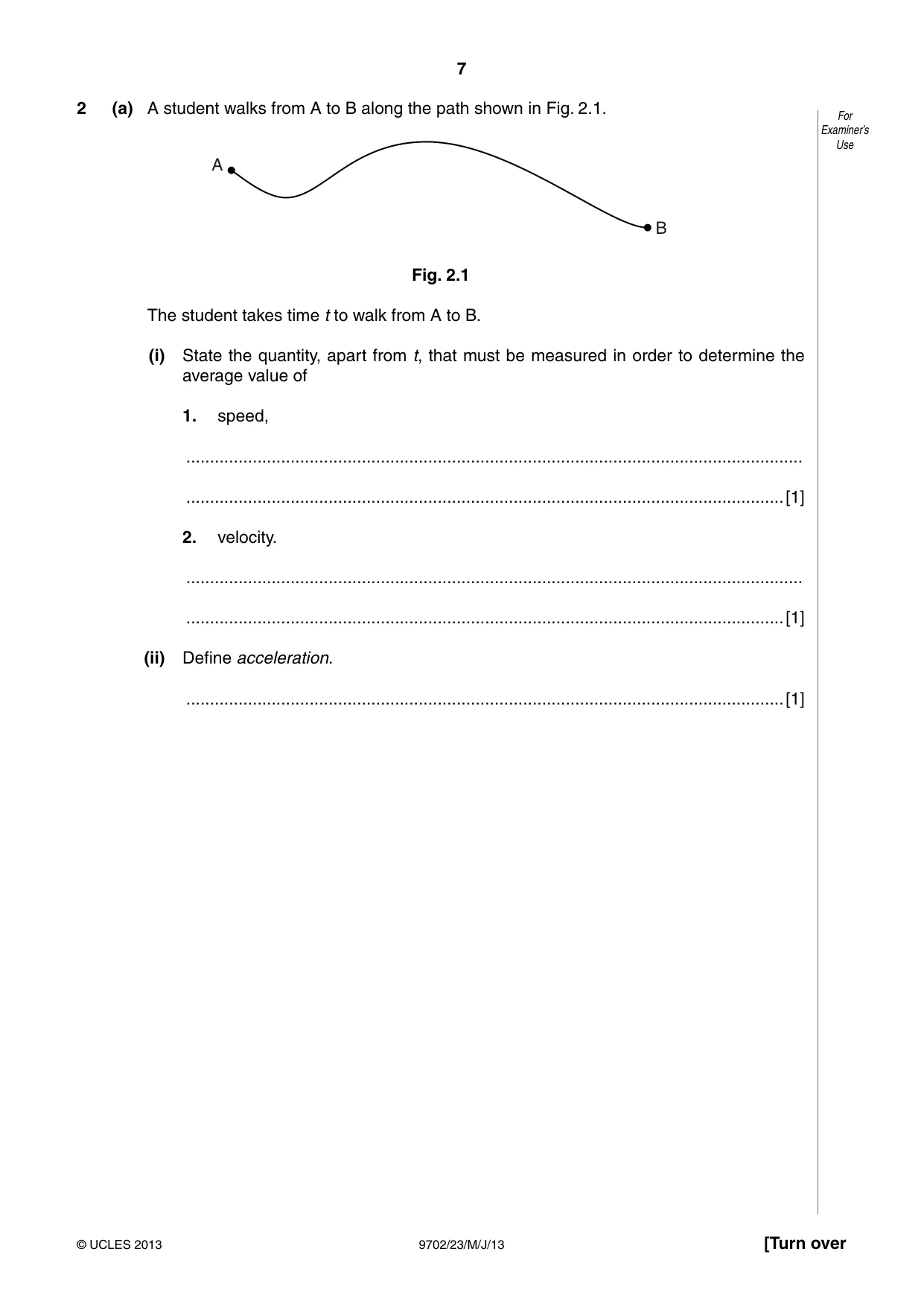
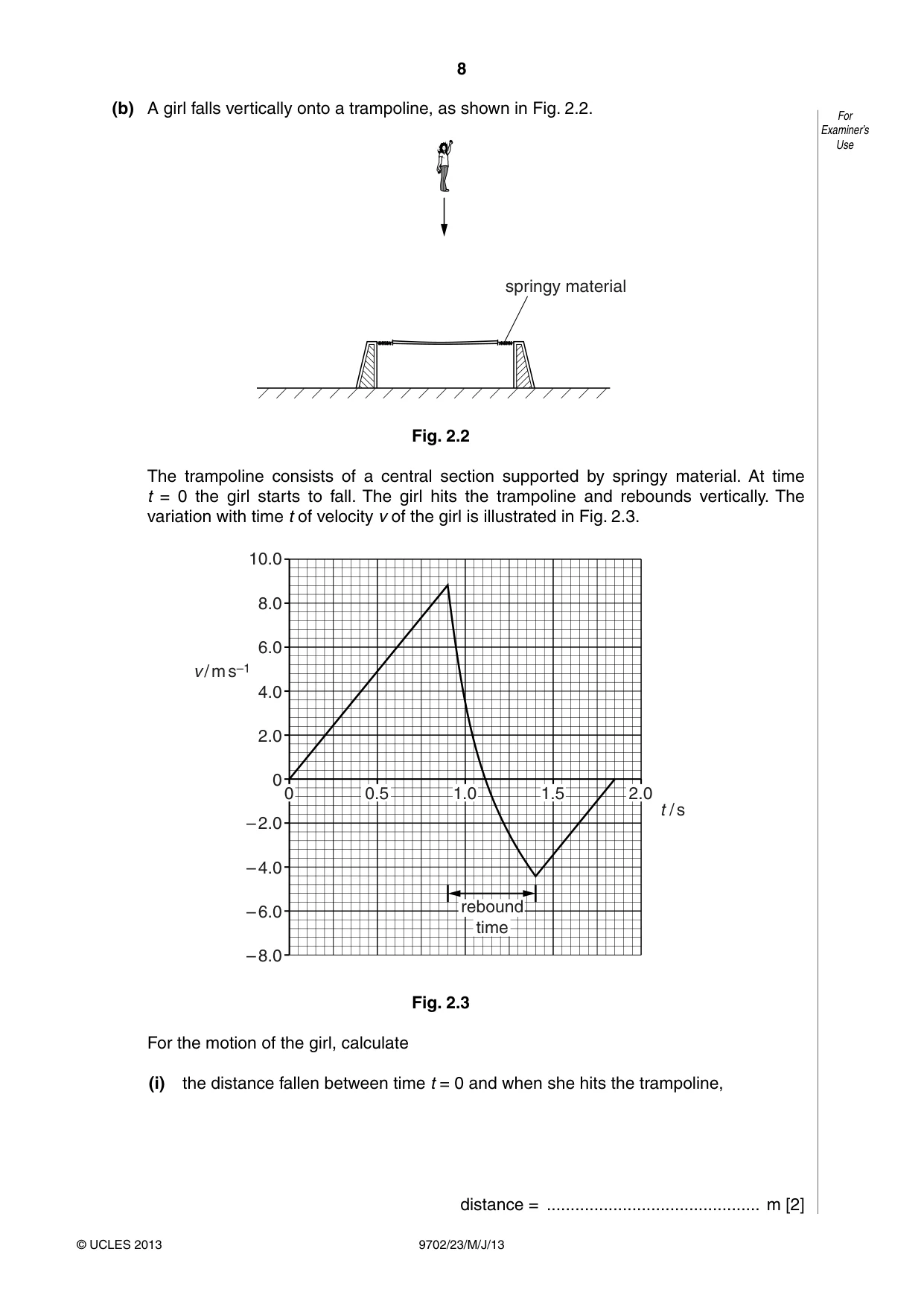
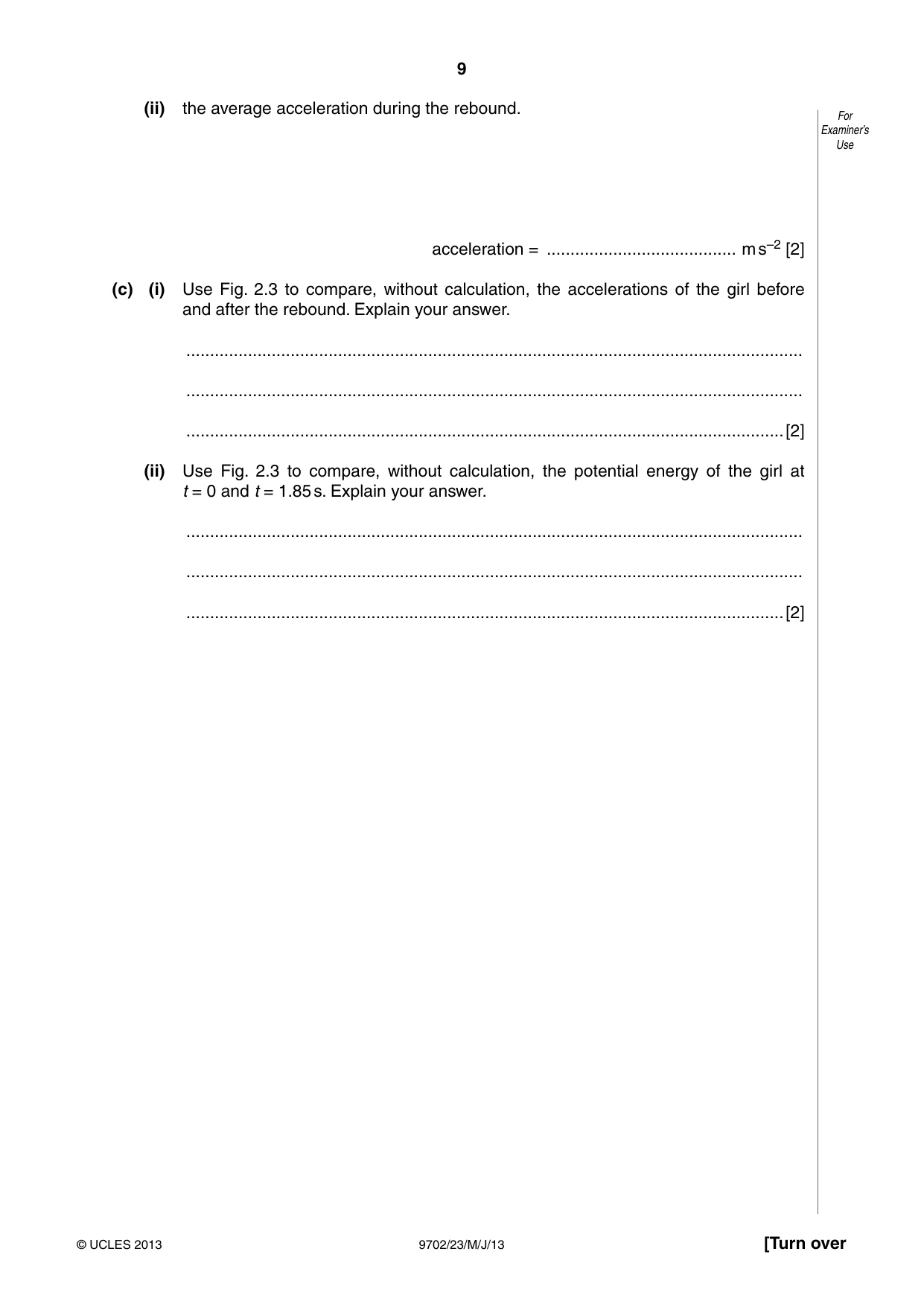
2 (a) A student walks from A to B along the path shown in Fig. 2.1. For Examiner’s Use A B Fig. 2.1 The student takes time t to walk from A to B. (i) State the quantity, apart from t, that must be measured in order to determine the average value of 1. speed, .................................................................................................................................. ..............................................................................................................................[1] 2. velocity. .................................................................................................................................. ..............................................................................................................................[1] (ii) Define acceleration. ..............................................................................................................................[1] (b) A girl falls vertically onto a trampoline, as shown in Fig. 2.2. For Examiner’s Use springy material Fig. 2.2 The trampoline consists of a central section supported by springy material. At time t = 0 the girl starts to fall. The girl hits the trampoline and rebounds vertically. The variation with time t of velocity v of the girl is illustrated in Fig. 2.3. 10.0 8.0 6.0 v / m s–1 4.0 2.0 0 0 0.5 1.0 1.5 2.0 t / s – 2.0 – 4.0 rebound – 6.0 time – 8.0 Fig. 2.3 For the motion of the girl, calculate (i) the distance fallen between time t = 0 and when she hits the trampoline, distance = ............................................. m [2] (ii) the average acceleration during the rebound. For Examiner’s Use acceleration = ........................................ m s–2 [2] (c) (i) Use Fig. 2.3 to compare, without calculation, the accelerations of the girl before and after the rebound. Explain your answer. .................................................................................................................................. .................................................................................................................................. ..............................................................................................................................[2] (ii) Use Fig. 2.3 to compare, without calculation, the potential energy of the girl at t = 0 and t = 1.85 s. Explain your answer. .................................................................................................................................. .................................................................................................................................. ..............................................................................................................................[2]
Mark scheme: 2 (a) (i) 1. distance of path / along line AB B1 [1] 2. shortest distance between AB / distance in straight line between AB or displacement from A to B B1 [1] (ii) acceleration = rate of change of velocity A1 [1] (b) (i) distance = area under line or (v/2)t or s = (8.8)2 / (2 × 9.81) C1 = 8.8 / 2 × 0.90 = 3.96 m or s = 3.95 m = 4(.0) m A1 [2] (ii) acceleration = (– 4.4 – 8.8) / 0.50 C1 = (–) 26(.4) m s–2 A1 [2] (c) (i) the accelerations are constant as straight lines B1 the accelerations are the same as same gradient or no air resistance as acceleration is constant or change of speed in opposite directions (one speeds up one slows down) B1 [2] (ii) area under the lines represents height or KE at trampoline equals PE at maximum height B1 second area is smaller / velocity after rebound smaller hence KE less B1 hence less height means loss in potential energy A0 [2]
Q3 · State the principle of conservation of momentum
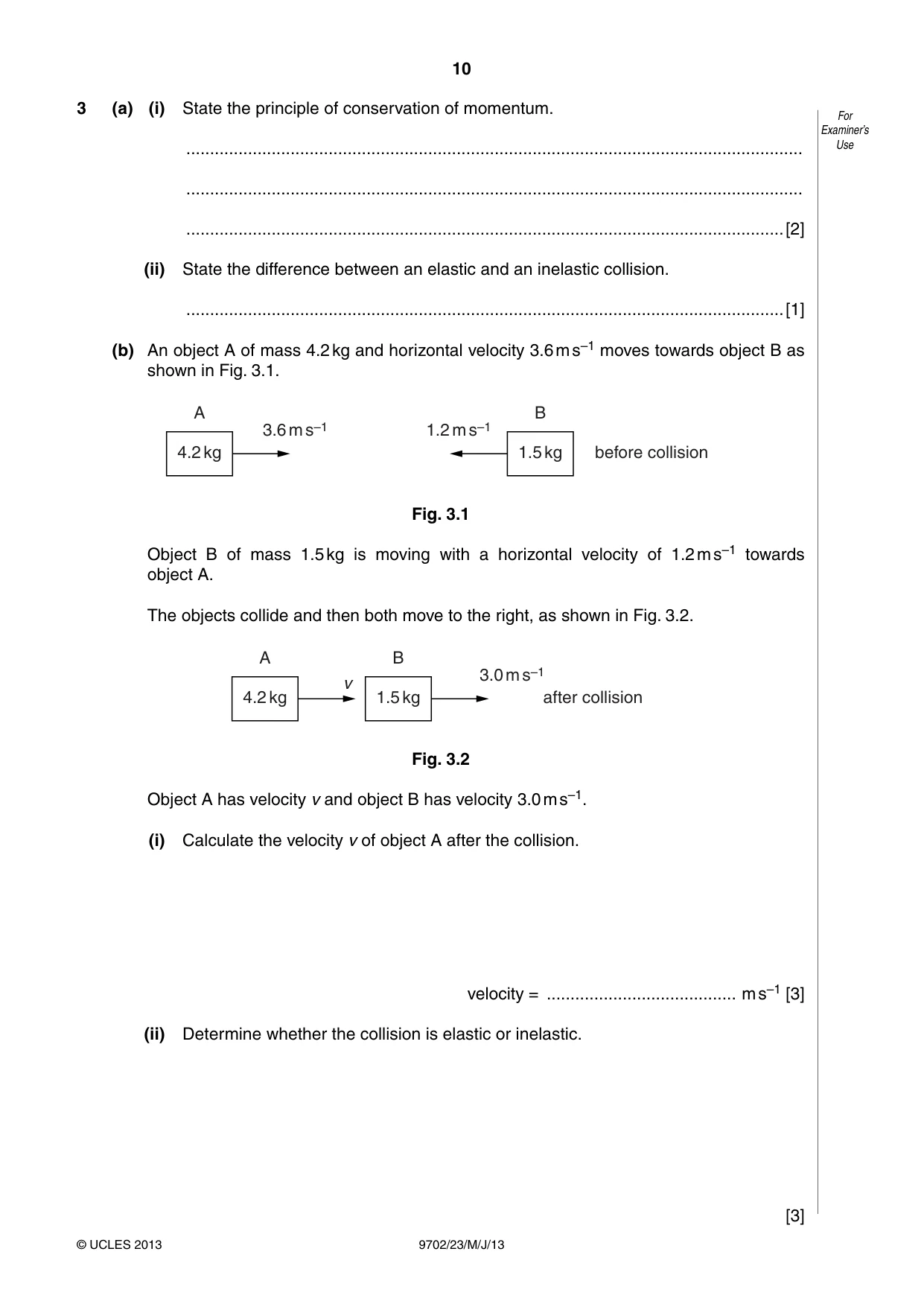
3 (a) (i) State the principle of conservation of momentum. For Examiner’s .................................................................................................................................. Use .................................................................................................................................. ..............................................................................................................................[2] (ii) State the difference between an elastic and an inelastic collision. ..............................................................................................................................[1] (b) An object A of mass 4.2 kg and horizontal velocity 3.6 m s–1 moves towards object B as shown in Fig. 3.1. A B 3.6 m s–1 1.2 m s–1 4.2 kg 1.5 kg before collision Fig. 3.1 Object B of mass 1.5 kg is moving with a horizontal velocity of 1.2 m s–1 towards object A. The objects collide and then both move to the right, as shown in Fig. 3.2. A B 3.0 m s–1 v 4.2 kg 1.5 kg after collision Fig. 3.2 Object A has velocity v and object B has velocity 3.0 m s–1. (i) Calculate the velocity v of object A after the collision. velocity = ........................................ m s–1 [3] (ii) Determine whether the collision is elastic or inelastic. [3]
Mark scheme: 3 (a) (i) the total momentum of a system (of interacting bodies) remains constant M1 provided there are no resultant external forces / isolated system A1 [2] (ii) elastic: total kinetic energy is conserved, inelastic: loss of kinetic energy B1 [1] [allow elastic: relative speed of approach equals relative speed of separation] GCE AS/A LEVEL – May/June 2013 9702 23 (b) (i) initial mom: 4.2 × 3.6 – 1.2 × 1.5 (= 15.12 – 1.8 = 13.3) C1 final mom: 4.2 × v + 1.5 × 3 C1 v = (13.3 – 4.5) / 4.2 = 2.1 m s–1 A1 [3] (ii) initial kinetic energy = ½ mA(vA)2 + ½ mB(vB)2 = 27.21 + 1.08 = 28(.28) M1 final kinetic energy = 9.26 + 6.75 = 16 M1 initial KE is not the same as final KE hence inelastic A1 [3] provided final KE less than initial KE [allow in terms of relative speeds of approach and separation]
Q4 · Define For Examiner’s (i) stress, Use…
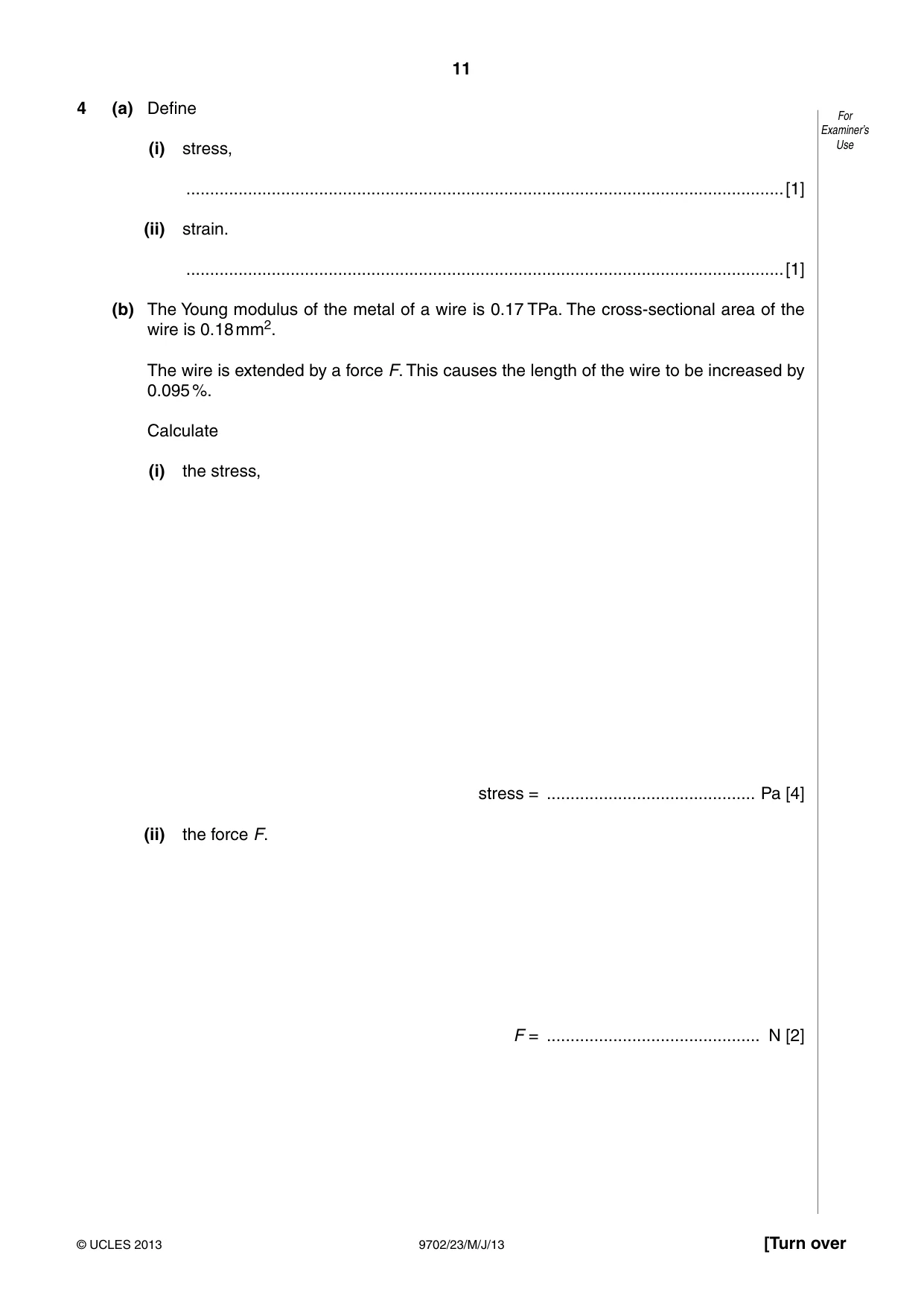
4 (a) Define For Examiner’s (i) stress, Use ..............................................................................................................................[1] (ii) strain. ..............................................................................................................................[1] (b) The Young modulus of the metal of a wire is 0.17 TPa. The cross-sectional area of the wire is 0.18 mm2. The wire is extended by a force F. This causes the length of the wire to be increased by 0.095 %. Calculate (i) the stress, stress = ............................................ Pa [4] (ii) the force F. F = ............................................. N [2]
Mark scheme: 4 (a) (i) stress = force / cross-sectional area B1 [1] (ii) strain = extension / original length B1 [1] (b) (i) E = stress / strain C1 E = 0.17 × 10¹² C1 stress = 0.17 × 1012 × 0.095 / 100 C1 = 1.6(2) × 108 Pa A1 [4] (ii) force = (stress × area) = 1.615 × 108 × 0.18 × 10–6 C1 = 29(.1) N A1 [2]
Q5 · Explain the principle of superposition
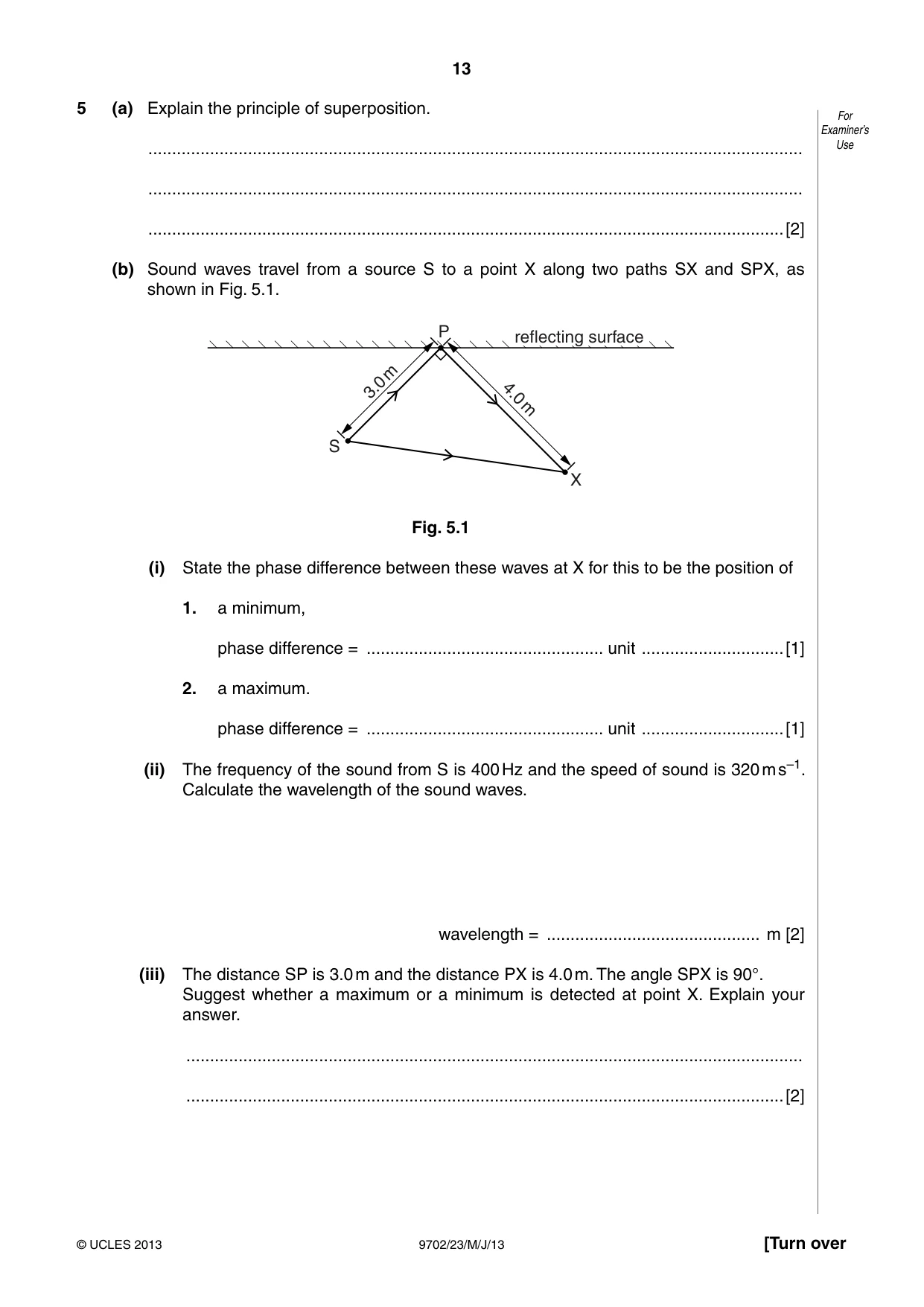
5 (a) Explain the principle of superposition. For Examiner’s .......................................................................................................................................... Use .......................................................................................................................................... ......................................................................................................................................[2] (b) Sound waves travel from a source S to a point X along two paths SX and SPX, as shown in Fig. 5.1. P reflecting surface m 3.0 4.0 m S X Fig. 5.1 (i) State the phase difference between these waves at X for this to be the position of 1. a minimum, phase difference = .................................................. unit ..............................[1] 2. a maximum. phase difference = .................................................. unit ..............................[1] (ii) The frequency of the sound from S is 400 Hz and the speed of sound is 320 m s–1. Calculate the wavelength of the sound waves. wavelength = ............................................. m [2] (iii) The distance SP is 3.0 m and the distance PX is 4.0 m. The angle SPX is 90°. Suggest whether a maximum or a minimum is detected at point X. Explain your answer. .................................................................................................................................. ..............................................................................................................................[2]
Mark scheme: 5 (a) when waves overlap / meet B1 the resultant displacement is the sum of the individual displacements of the waves B1 [2] (b) (i) 1. phase difference = 180 º / (n + ½) 360 º (allow in rad) B1 [1] 2. phase difference = 0 / 360 º / (n360 º) (allow in rad) B1 [1] (ii) v = f λ C1 λ = 320 / 400 = 0.80 m A1 [2] (iii) path difference = 7 – 5 = 2 (m) = 2.5 λ M1 hence minimum or maximum if phase change at P is suggested A1 [2]
Q6 · Define potential difference (p.d.)
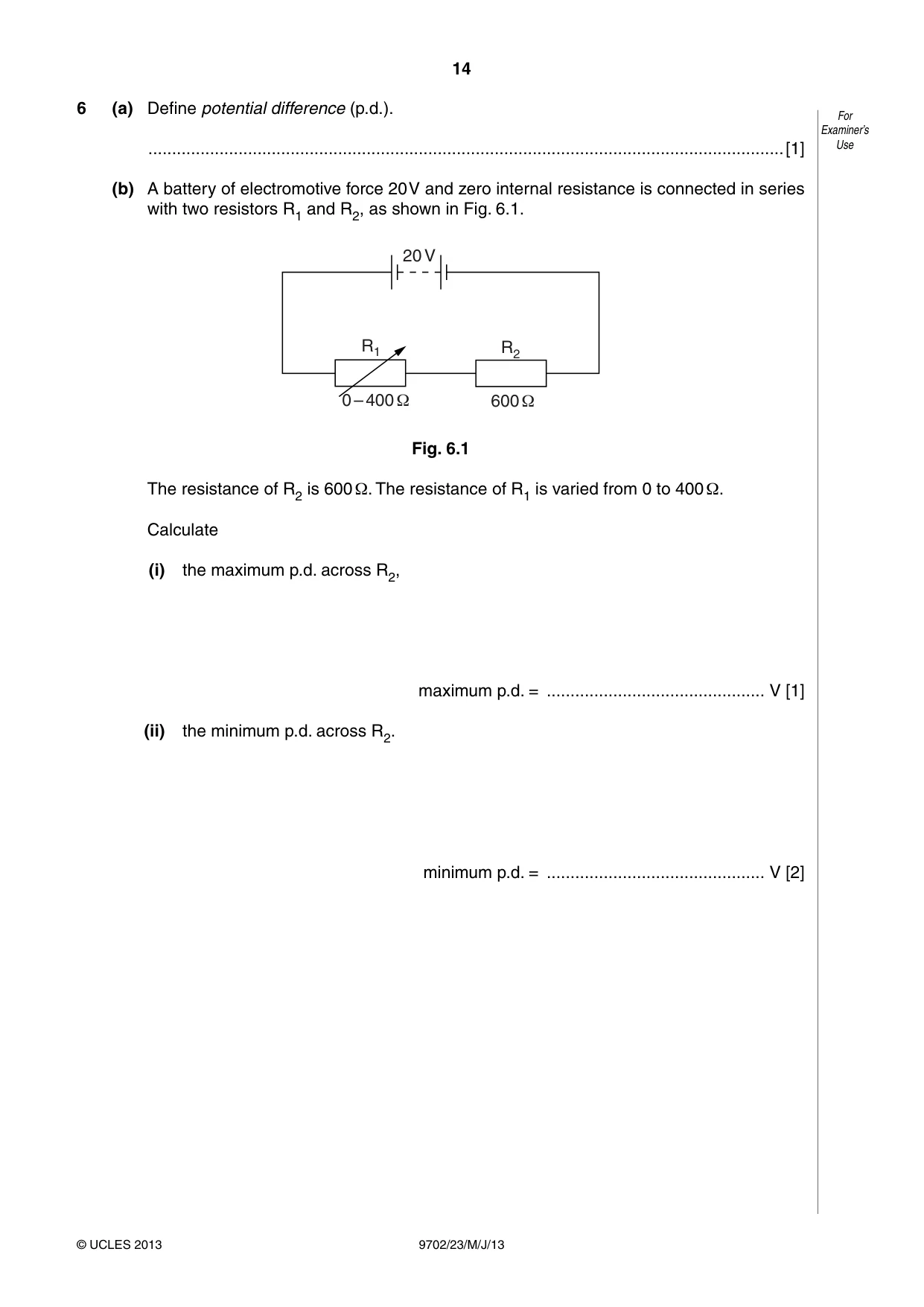
6 (a) Define potential difference (p.d.). For Examiner’s ......................................................................................................................................[1] Use (b) A battery of electromotive force 20 V and zero internal resistance is connected in series with two resistors R1 and R2, as shown in Fig. 6.1. 20 9 R1 R2 0 – 400 1 600 1 Fig. 6.1 The resistance of R2 is 600 Ω. The resistance of R1 is varied from 0 to 400 Ω. Calculate (i) the maximum p.d. across R2, maximum p.d. = .............................................. V [1] (ii) the minimum p.d. across R2. minimum p.d. = .............................................. V [2] (c) A light-dependent resistor (LDR) is connected in parallel with R2, as shown in Fig. 6.2. For Examiner’s Use 20 9 R1 R2 LDR R2 0 – 400 1 600 1 Fig. 6.2 When the light intensity is varied, the resistance of the LDR changes from 5.0 kΩ to 1.2 kΩ. (i) For the maximum light intensity, calculate the total resistance of R2 and the LDR. total resistance = ............................................. Ω [2] (ii) The resistance of R1 is varied from 0 to 400 Ω in the circuits of Fig. 6.1 and Fig. 6.2. State and explain the difference, if any, between the minimum p.d. across R2 in each circuit. Numerical values are not required. .................................................................................................................................. .................................................................................................................................. ..............................................................................................................................[2] Please turn over for Question 7.
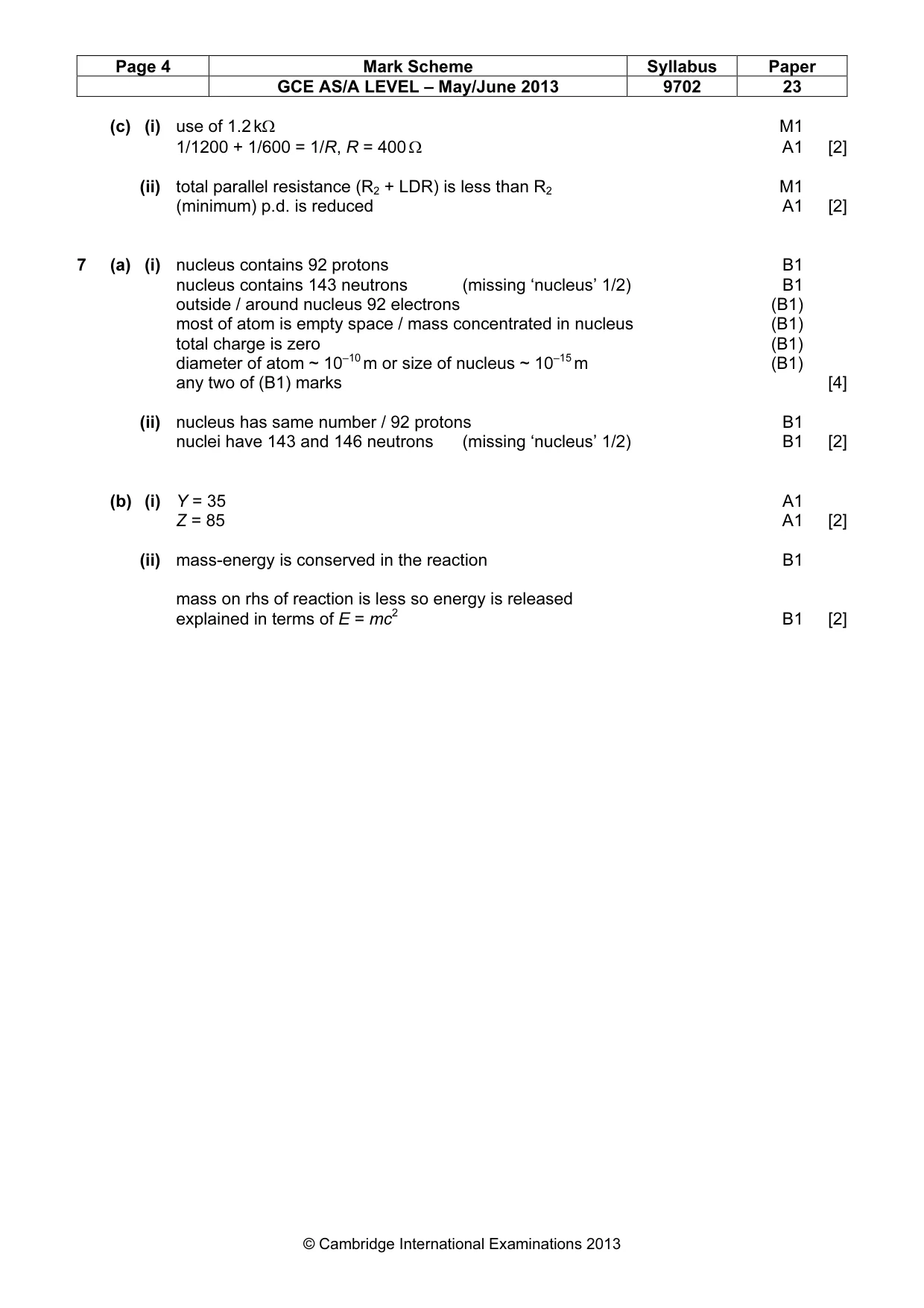
Mark scheme: 6 (a) p.d. = work done / energy transformed (from electrical to other forms) charge B1 [1] (b) (i) maximum 20 V A1 [1] (ii) minimum = (600 / 1000) × 20 C1 = 12 V A1 [2] GCE AS/A LEVEL – May/June 2013 9702 23 (c) (i) use of 1.2 kΩ M1 1/1200 + 1/600 = 1/R, R = 400 Ω A1 [2] (ii) total parallel resistance (R2 + LDR) is less than R2 M1 (minimum) p.d. is reduced A1 [2]
Q7 · For7 (a) Two isotopes of uranium are uranium-235 ( 23592U) and uranium-238 ( 23892U)
For7 (a) Two isotopes of uranium are uranium-235 ( 23592U) and uranium-238 ( 23892U). Examiner’s Use (i) Describe in detail an atom of uranium-235. .................................................................................................................................. .................................................................................................................................. .................................................................................................................................. .................................................................................................................................. ..............................................................................................................................[4] (ii) With reference to the two forms of uranium, explain the term isotopes. .................................................................................................................................. .................................................................................................................................. ..............................................................................................................................[2] (b) When a uranium-235 nucleus absorbs a neutron, the following reaction may occur: 235 92 U + WX n 14857 La + YZ Q + 3WX n (i) Determine the values of Y and Z. Y = ............................ Z = ............................ [2] (ii) Explain why the sum of the masses of the uranium nucleus and of the neutron does not equal the total mass of the products of the reaction. .................................................................................................................................. .................................................................................................................................. ............................................................................................................................. [2]
Mark scheme: 7 (a) (i) nucleus contains 92 protons B1 nucleus contains 143 neutrons (missing ‘nucleus’ 1/2) B1 outside / around nucleus 92 electrons (B1) most of atom is empty space / mass concentrated in nucleus (B1) total charge is zero (B1) diameter of atom ~ 10–10 m or size of nucleus ~ 10–15 m (B1) any two of (B1) marks [4] (ii) nucleus has same number / 92 protons B1 nuclei have 143 and 146 neutrons (missing ‘nucleus’ 1/2) B1 [2] (b) (i) Y = 35 A1 Z = 85 A1 [2] (ii) mass-energy is conserved in the reaction B1 mass on rhs of reaction is less so energy is released explained in terms of E = mc2 B1 [2]
What was in this paper
The subtopics covered by these 7 questions, and how many questions each got. Open one in a new tab to see every Cambridge question on it.
What you needed in this session
Cambridge’s own grade thresholds for 2013 May/June, Paper 2 · Variant 3. A higher threshold means an easier paper — the bar moves with how the cohort did.