Cambridge A Level Physics 9702 — 2010 Oct/Nov Paper 2 · Variant 1
9702/21/O/N/10 · 7 questions · 60 marks · ≈68 min
The question paper and its mark scheme, free to read here and free to download. This is Cambridge’s own paper, exactly as it was sat.
Question paper16 pages
Mark scheme4 pages
Answers below. Sit the paper first if you are practising.
Questions as text
Q1 · Two of the SI base quantities are mass and time
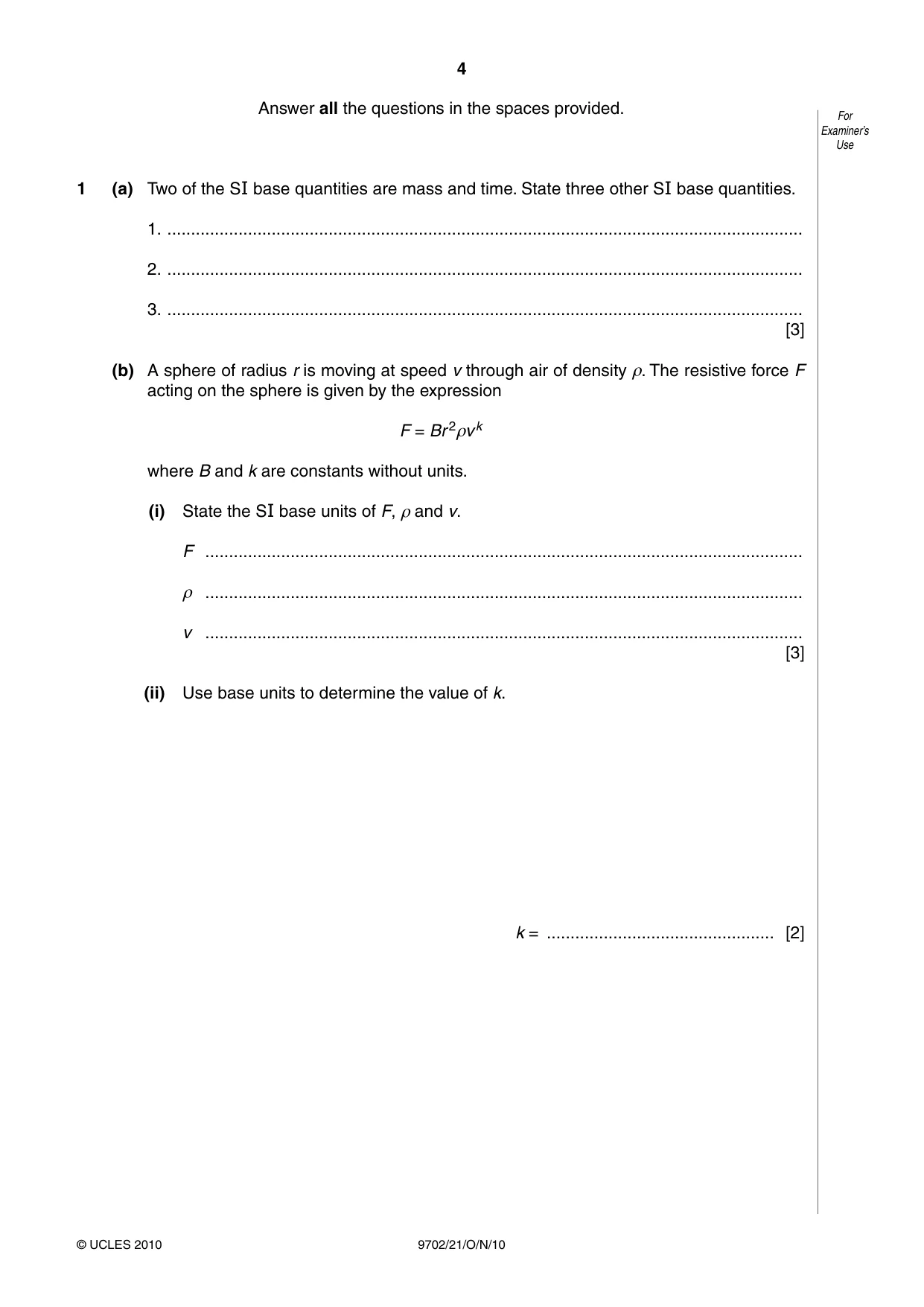
1 (a) Two of the SI base quantities are mass and time. State three other SI base quantities. 1. ...................................................................................................................................... 2. ...................................................................................................................................... 3. ...................................................................................................................................... [3] (b) A sphere of radius r is moving at speed v through air of density ρ. The resistive force F acting on the sphere is given by the expression F = Br 2ρvk where B and k are constants without units. (i) State the SI base units of F, ρ and v. F .............................................................................................................................. ρ .............................................................................................................................. v .............................................................................................................................. [3] (ii) Use base units to determine the value of k. k = ................................................ [2]
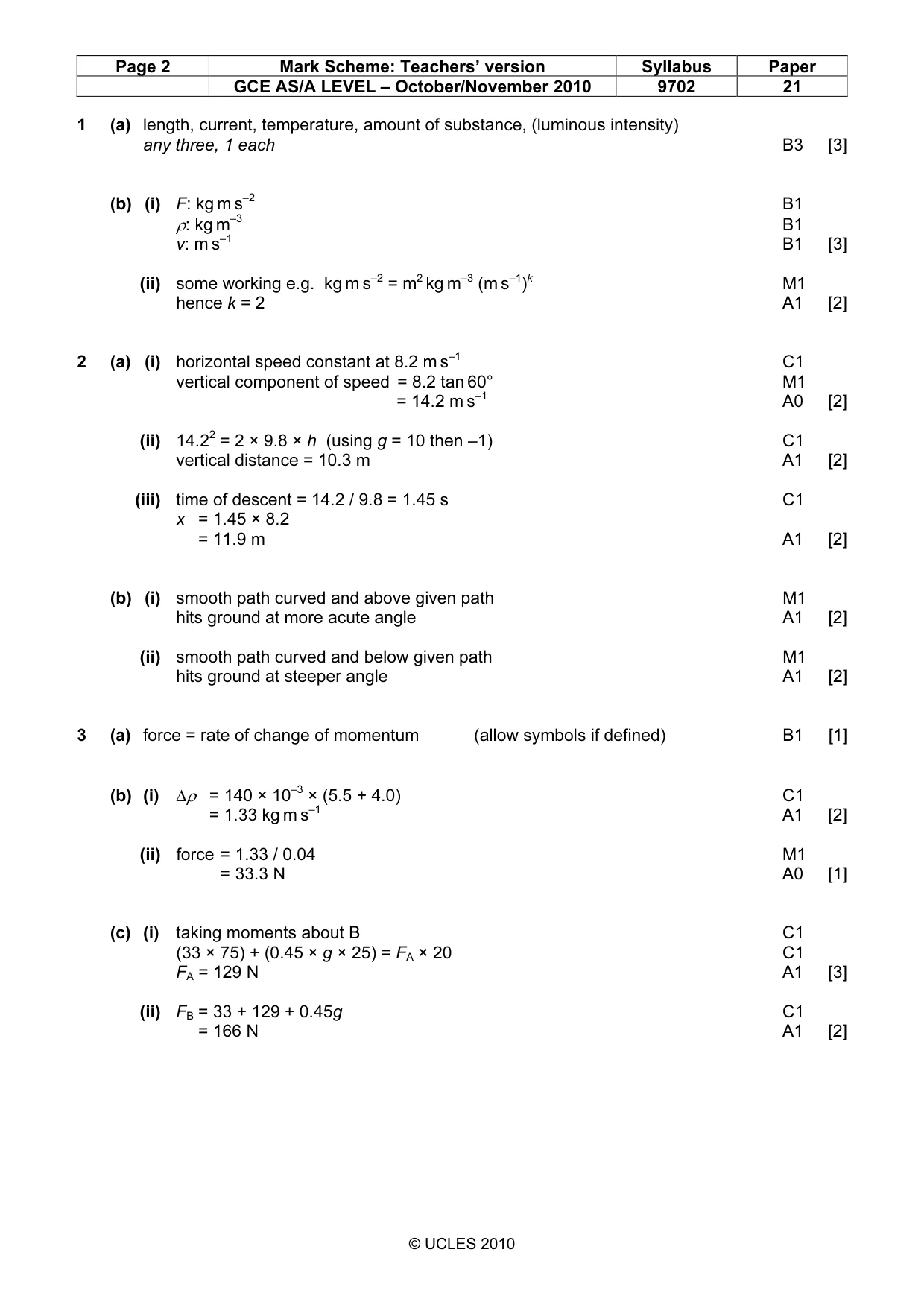
Mark scheme: 1 (a) length, current, temperature, amount of substance, (luminous intensity) any three, 1 each B3 [3] (b) (i) F: kg m s–2 B1 ρ: kg m–3 B1 v: m s–1 B1 [3] (ii) some working e.g. kg m s–2 = m2 kg m–3 (m s–1)k M1 hence k = 2 A1 [2] 1
Q2 · A ball is thrown horizontally from the top of a building, as shown in Fig
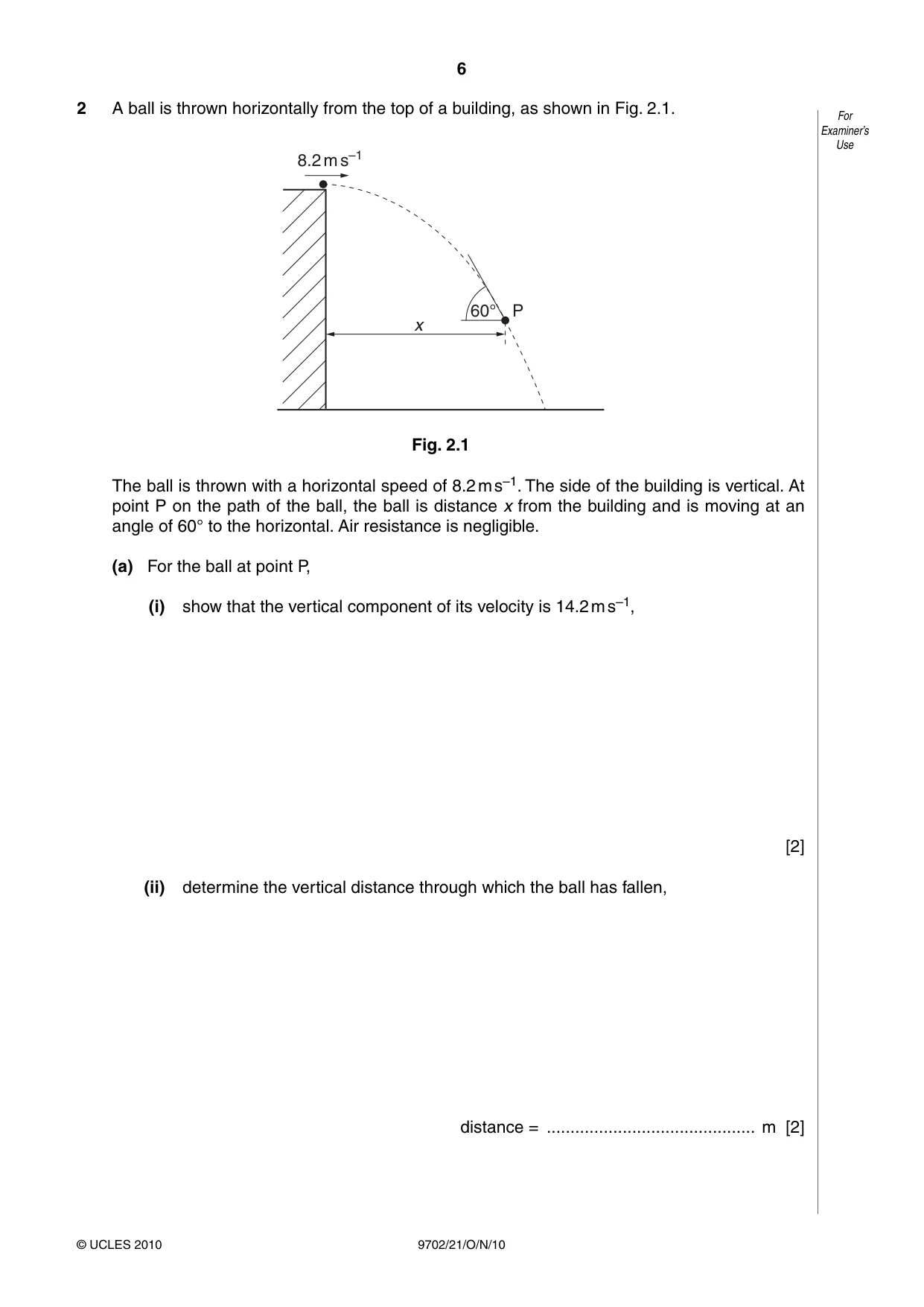
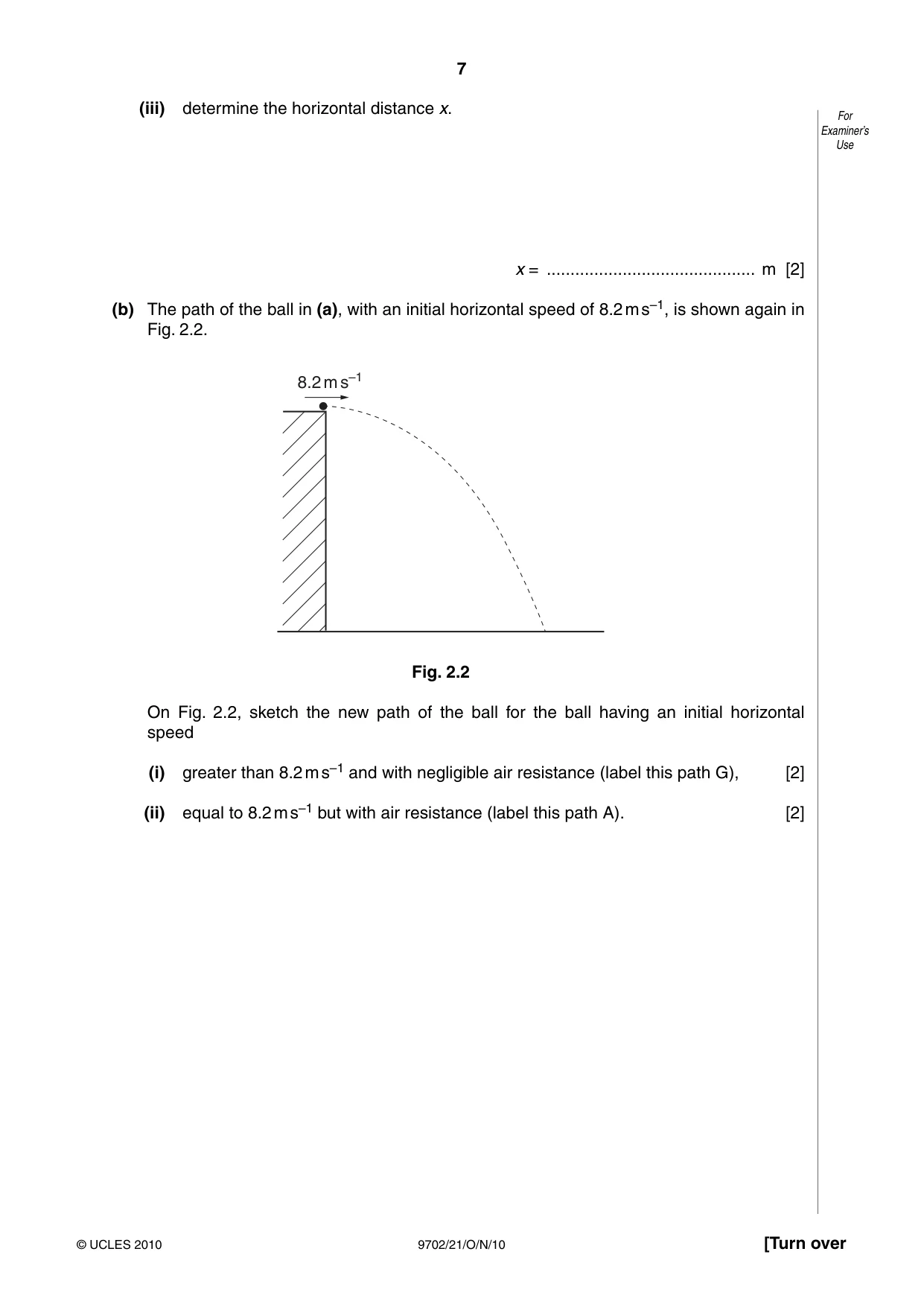
2 A ball is thrown horizontally from the top of a building, as shown in Fig. 2.1. For Examiner’s Use 8.2 m s–1 60° P x Fig. 2.1 The ball is thrown with a horizontal speed of 8.2 m s–1. The side of the building is vertical. At point P on the path of the ball, the ball is distance x from the building and is moving at an angle of 60° to the horizontal. Air resistance is negligible. (a) For the ball at point P, (i) show that the vertical component of its velocity is 14.2 m s–1, [2] (ii) determine the vertical distance through which the ball has fallen, distance = ............................................ m [2] (iii) determine the horizontal distance x. For Examiner’s Use x = ............................................ m [2] (b) The path of the ball in (a), with an initial horizontal speed of 8.2 m s–1, is shown again in Fig. 2.2. 8.2 m s–1 Fig. 2.2 On Fig. 2.2, sketch the new path of the ball for the ball having an initial horizontal speed (i) greater than 8.2 m s–1 and with negligible air resistance (label this path G), [2] (ii) equal to 8.2 m s–1 but with air resistance (label this path A). [2]
Mark scheme: 2 (a) (i) horizontal speed constant at 8.2 m s–1 C1 vertical component of speed = 8.2 tan 60° M1 = 14.2 m s–1 A0 [2] (ii) 14.22 = 2 × 9.8 × h (using g = 10 then –1) C1 vertical distance = 10.3 m A1 [2] (iii) time of descent = 14.2 / 9.8 = 1.45 s C1 x = 1.45 × 8.2 = 11.9 m A1 [2] (b) (i) smooth path curved and above given path M1 hits ground at more acute angle A1 [2] (ii) smooth path curved and below given path M1 hits ground at steeper angle A1 [2]
Q3 · State the relation between force and momentum
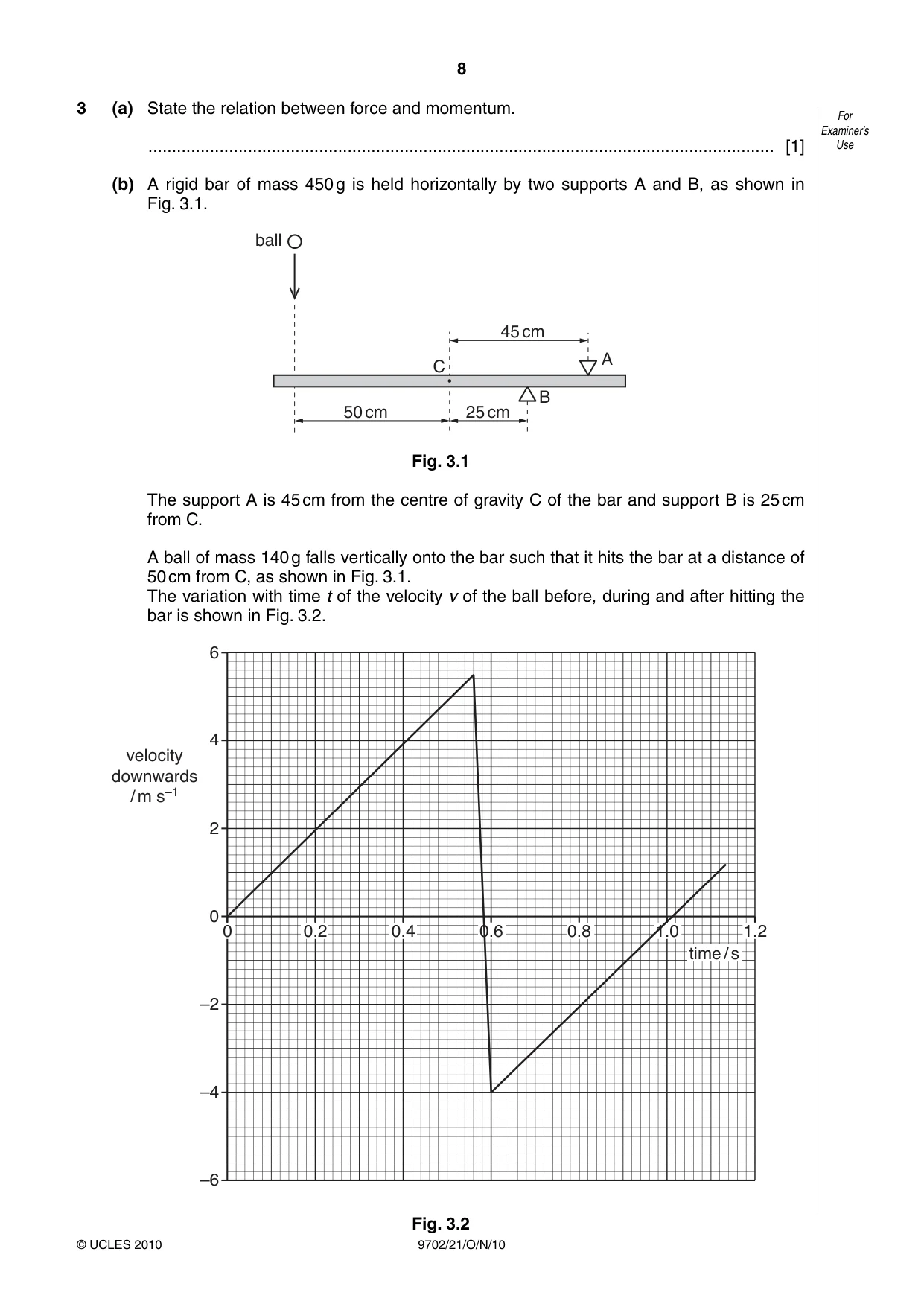
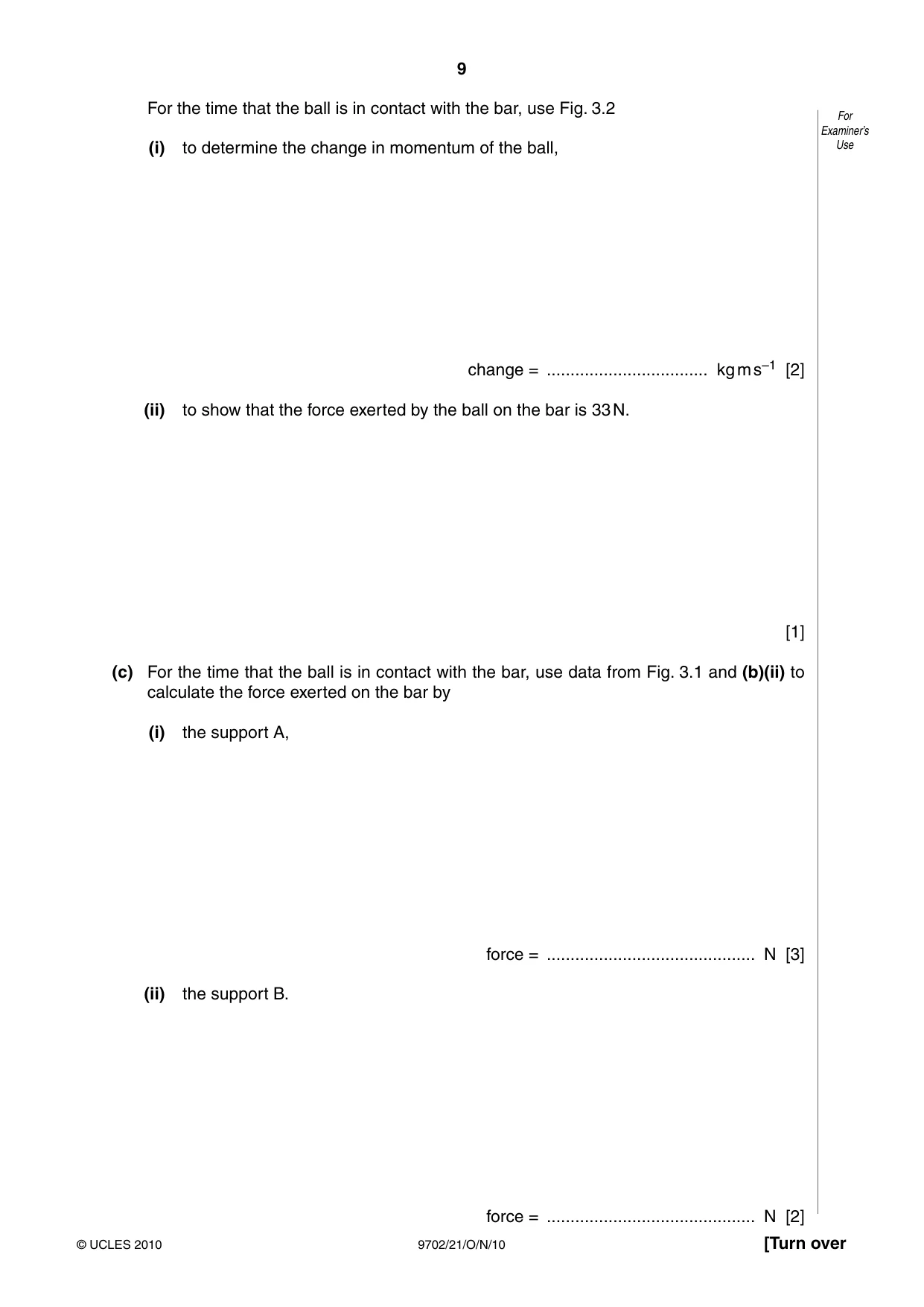
3 (a) State the relation between force and momentum. For Examiner’s .................................................................................................................................... [1] Use (b) A rigid bar of mass 450 g is held horizontally by two supports A and B, as shown in Fig. 3.1. ball 45 cm A C B 50 cm 25 cm Fig. 3.1 The support A is 45 cm from the centre of gravity C of the bar and support B is 25 cm from C. A ball of mass 140 g falls vertically onto the bar such that it hits the bar at a distance of 50 cm from C, as shown in Fig. 3.1. The variation with time t of the velocity v of the ball before, during and after hitting the bar is shown in Fig. 3.2. 6 4 velocity downwards / m s–1 2 0 0 0.2 0.4 0.6 0.8 1.0 1.2 time / s –2 –4 –6 Fig. 3.2 For the time that the ball is in contact with the bar, use Fig. 3.2 For Examiner’s (i) to determine the change in momentum of the ball, Use change = .................................. kg m s–1 [2] (ii) to show that the force exerted by the ball on the bar is 33 N. [1] (c) For the time that the ball is in contact with the bar, use data from Fig. 3.1 and (b)(ii) to calculate the force exerted on the bar by (i) the support A, force = ............................................ N [3] (ii) the support B. force = ............................................ N [2]
Mark scheme: 3 (a) force = rate of change of momentum (allow symbols if defined) B1 [1] (b) (i) ∆ρ = 140 × 10–3 × (5.5 + 4.0) C1 = 1.33 kg m s–1 A1 [2] (ii) force = 1.33 / 0.04 M1 = 33.3 N A0 [1] (c) (i) taking moments about B C1 (33 × 75) + (0.45 × g × 25) = FA × 20 C1 FA = 129 N A1 [3] (ii) FB = 33 + 129 + 0.45g C1 = 166 N A1 [2] GCE AS/A LEVEL – October/November 2010 9702 21
Q4 · A uniform wire has length L and constant area of cross-section A
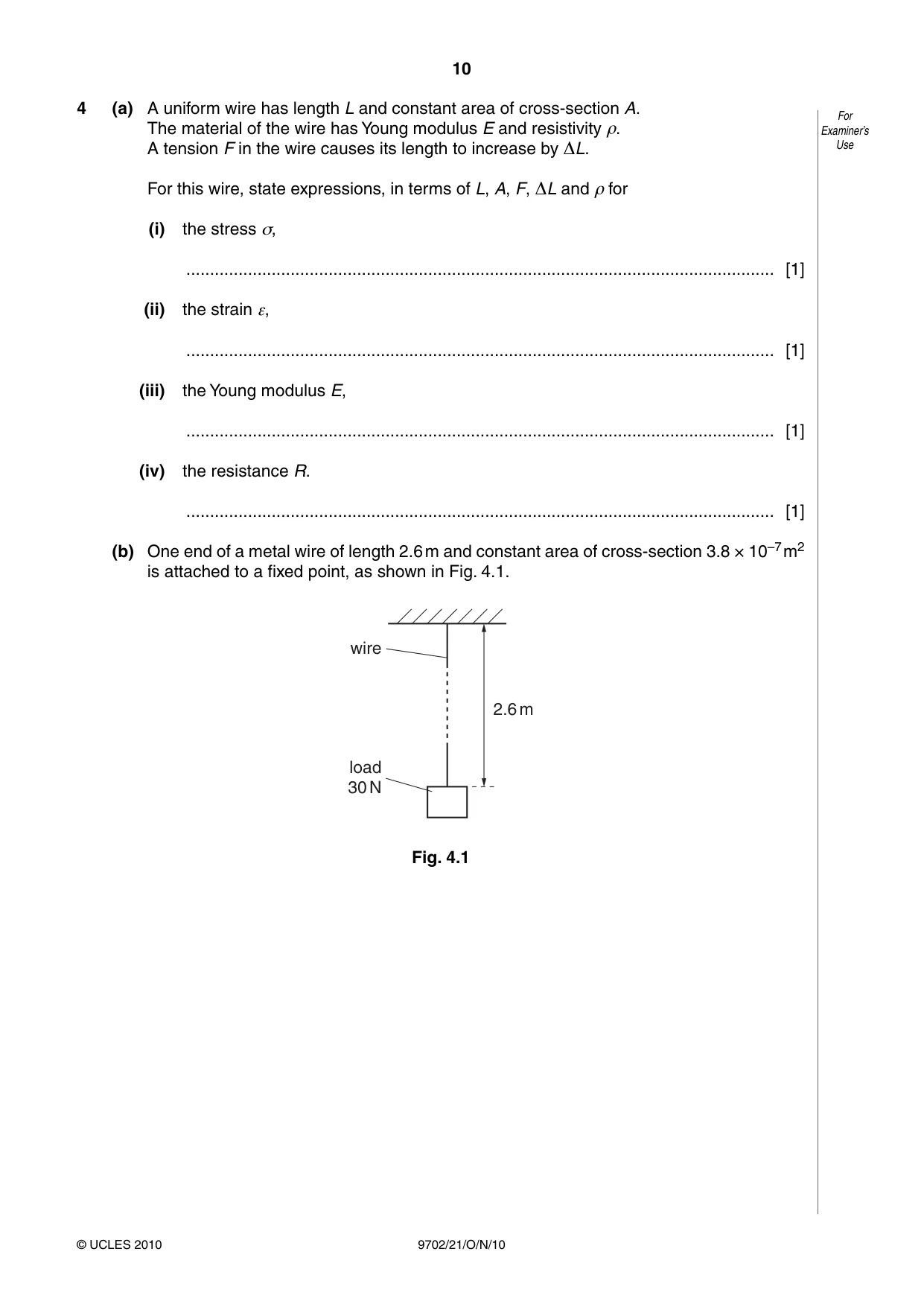
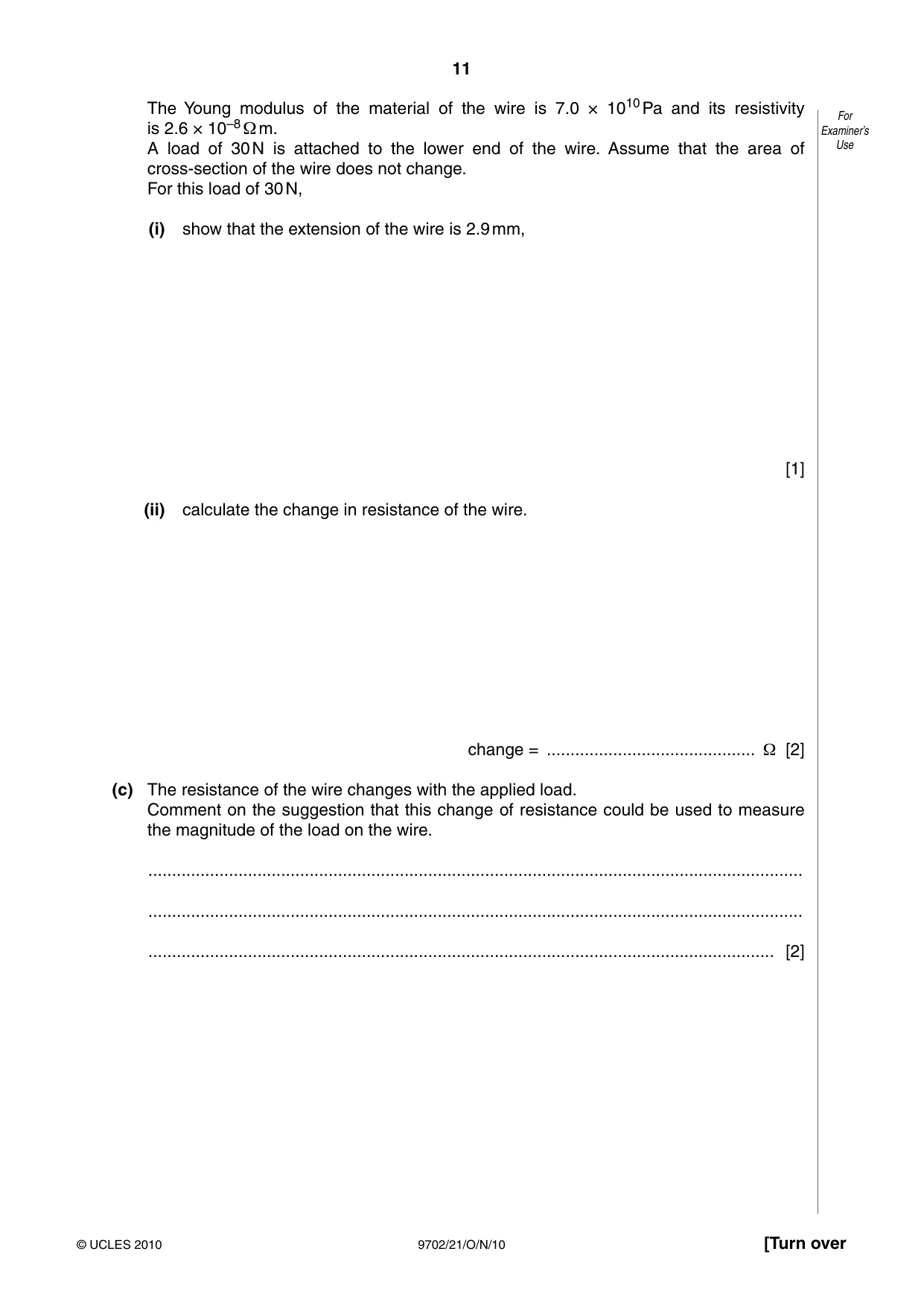
4 (a) A uniform wire has length L and constant area of cross-section A. For The material of the wire has Young modulus E and resistivity ρ. Examiner’s A tension F in the wire causes its length to increase by DL. Use For this wire, state expressions, in terms of L, A, F, DL and ρ for (i) the stress σ, ............................................................................................................................ [1] (ii) the strain ε, ............................................................................................................................ [1] (iii) the Young modulus E, ............................................................................................................................ [1] (iv) the resistance R. ............................................................................................................................ [1] (b) One end of a metal wire of length 2.6 m and constant area of cross-section 3.8 × 10⁻⁷ m2 is attached to a fixed point, as shown in Fig. 4.1. wire 2.6 m load 30 N Fig. 4.1 The Young modulus of the material of the wire is 7.0 × 10¹⁰ Pa and its resistivity For is 2.6 × 10⁻⁸ Ω m. Examiner’s A load of 30 N is attached to the lower end of the wire. Assume that the area of Use cross-section of the wire does not change. For this load of 30 N, (i) show that the extension of the wire is 2.9 mm, [1] (ii) calculate the change in resistance of the wire. change = ............................................ Ω [2] (c) The resistance of the wire changes with the applied load. Comment on the suggestion that this change of resistance could be used to measure the magnitude of the load on the wire. .......................................................................................................................................... .......................................................................................................................................... .................................................................................................................................... [2]
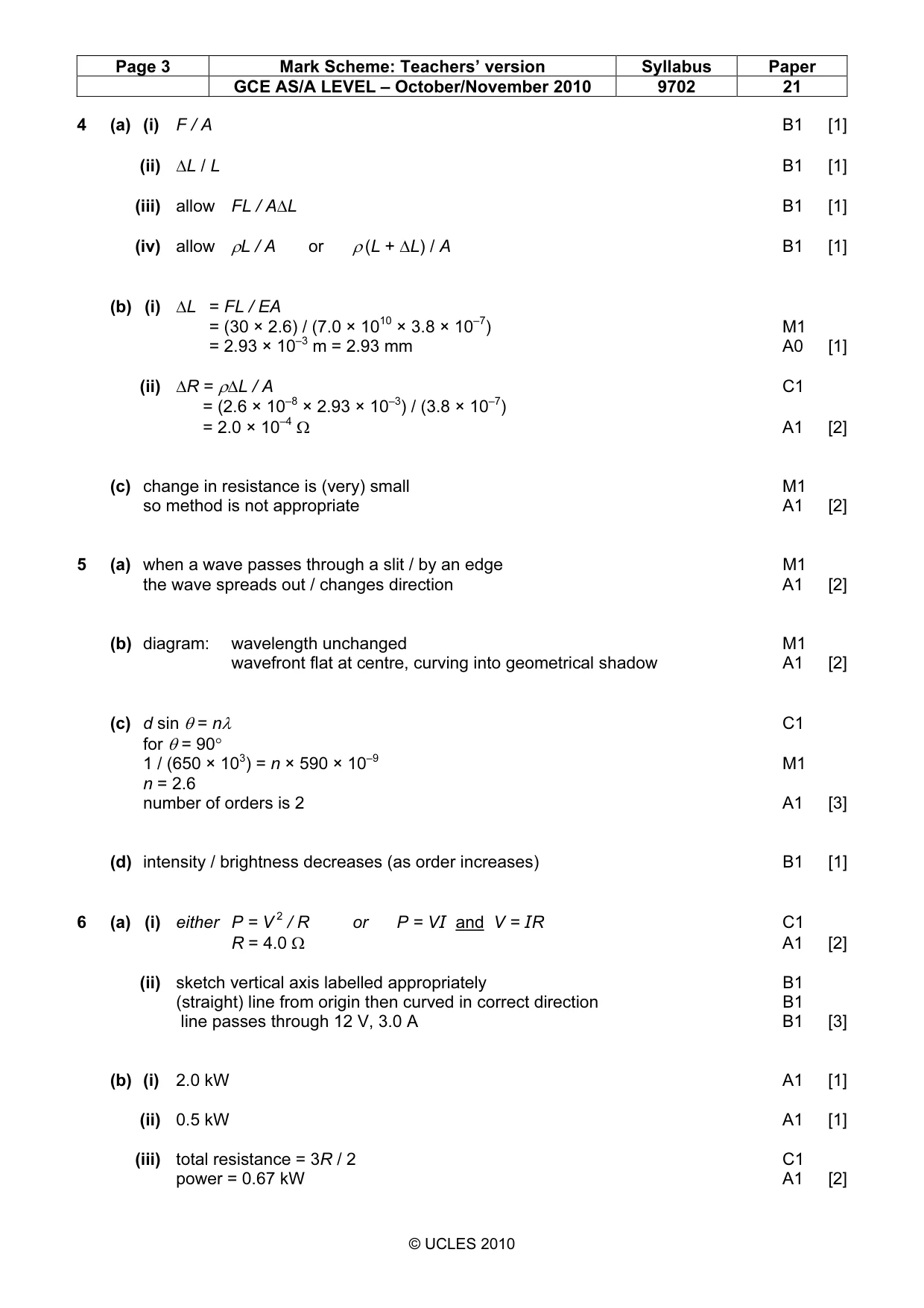
Mark scheme: 4 (a) (i) F / A B1 [1] (ii) ∆L / L B1 [1] (iii) allow FL / A∆L B1 [1] (iv) allow ρL / A or ρ (L + ∆L) / A B1 [1] (b) (i) ∆L = FL / EA = (30 × 2.6) / (7.0 × 1010 × 3.8 × 10–7) M1 = 2.93 × 10⁻³ m = 2.93 mm A0 [1] (ii) ∆R = ρ∆L / A C1 = (2.6 × 10–8 × 2.93 × 10–3) / (3.8 × 10⁻⁷) = 2.0 × 10⁻⁴ Ω A1 [2] (c) change in resistance is (very) small M1 so method is not appropriate A1 [2]
Q5 · State what is meant by the diffraction of a wave
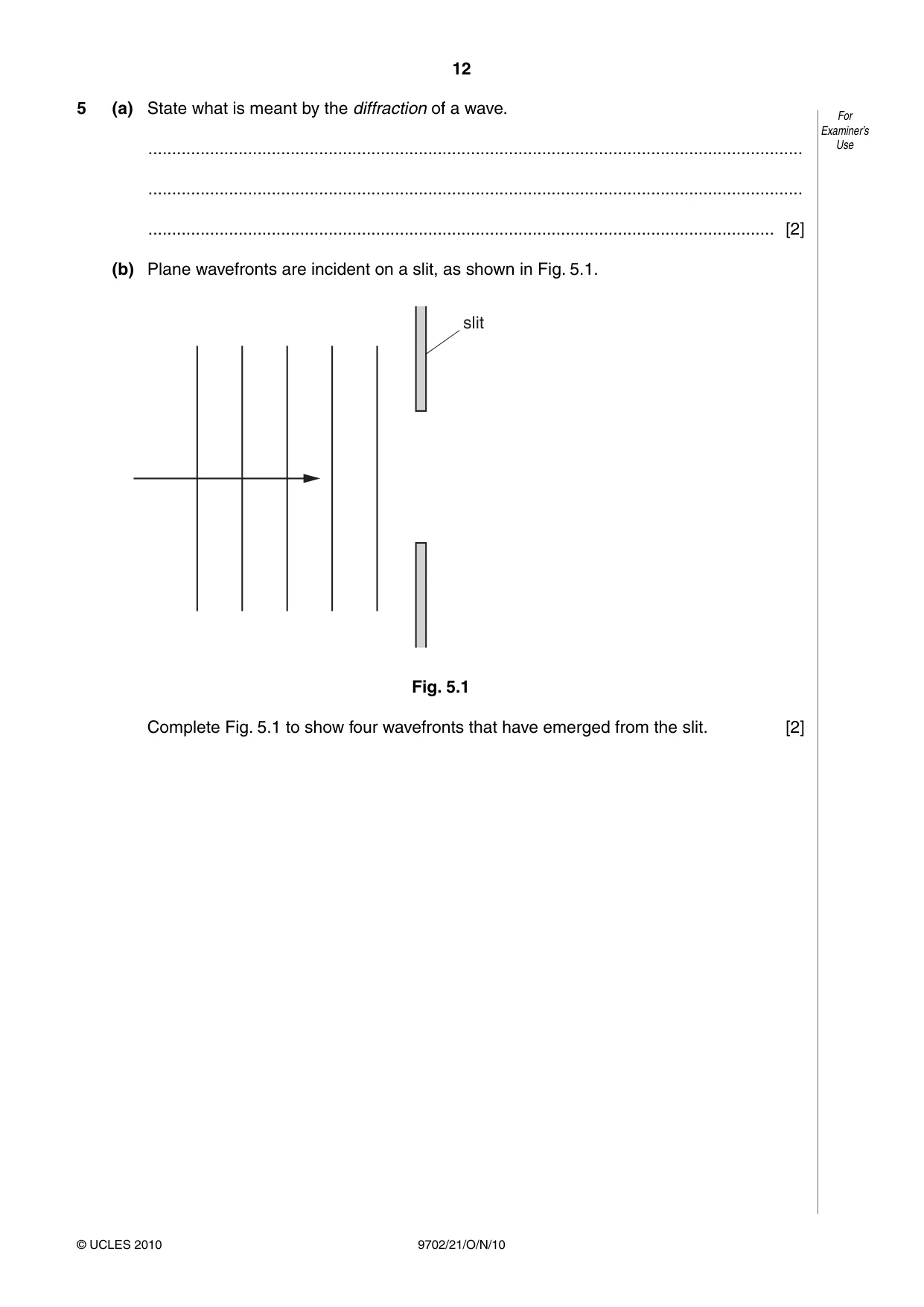
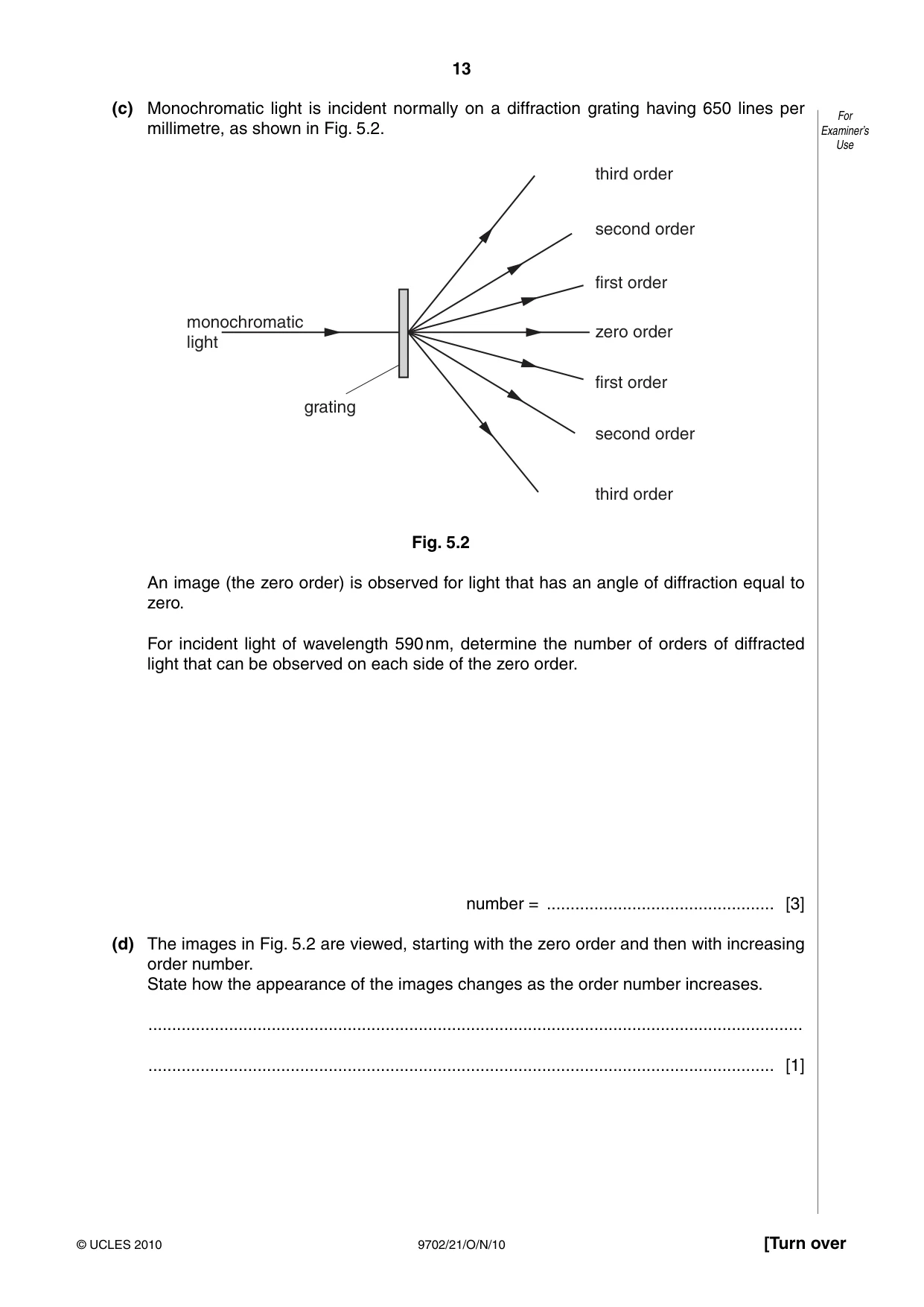
5 (a) State what is meant by the diffraction of a wave. For Examiner’s .......................................................................................................................................... Use .......................................................................................................................................... .................................................................................................................................... [2] (b) Plane wavefronts are incident on a slit, as shown in Fig. 5.1. slit Fig. 5.1 Complete Fig. 5.1 to show four wavefronts that have emerged from the slit. [2] (c) Monochromatic light is incident normally on a diffraction grating having 650 lines per For millimetre, as shown in Fig. 5.2. Examiner’s Use third order second order first order monochromatic zero order light first order grating second order third order Fig. 5.2 An image (the zero order) is observed for light that has an angle of diffraction equal to zero. For incident light of wavelength 590 nm, determine the number of orders of diffracted light that can be observed on each side of the zero order. number = ................................................ [3] (d) The images in Fig. 5.2 are viewed, starting with the zero order and then with increasing order number. State how the appearance of the images changes as the order number increases. .......................................................................................................................................... .................................................................................................................................... [1]
Mark scheme: 5 (a) when a wave passes through a slit / by an edge M1 the wave spreads out / changes direction A1 [2] (b) diagram: wavelength unchanged M1 wavefront flat at centre, curving into geometrical shadow A1 [2] (c) d sin θ = nλ C1 for θ = 90° 1 / (650 × 103) = n × 590 × 10–9 M1 n = 2.6 number of orders is 2 A1 [3] (d) intensity / brightness decreases (as order increases) B1 [1] 2
Q6 · A lamp is rated as 12 V, 36 W
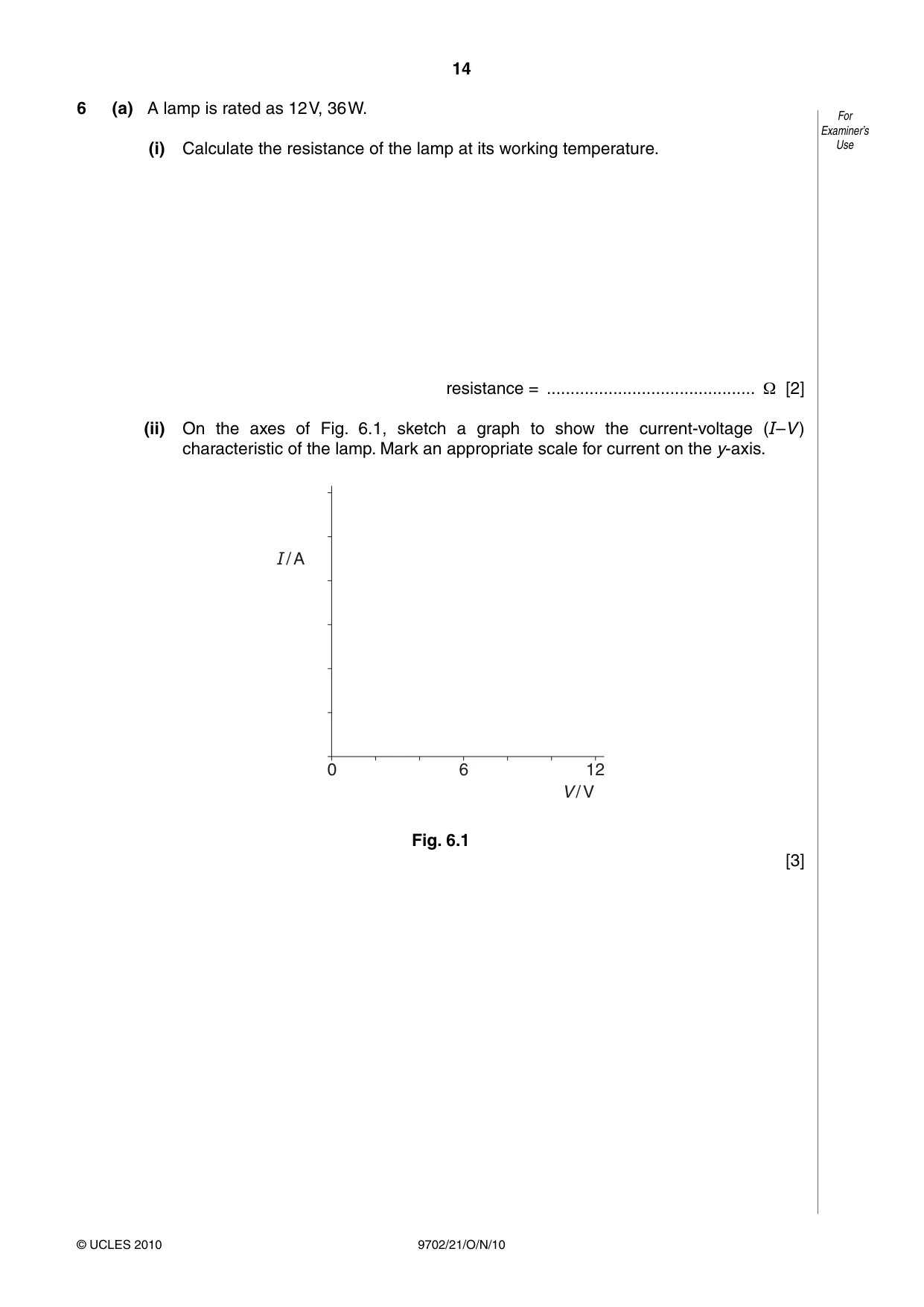
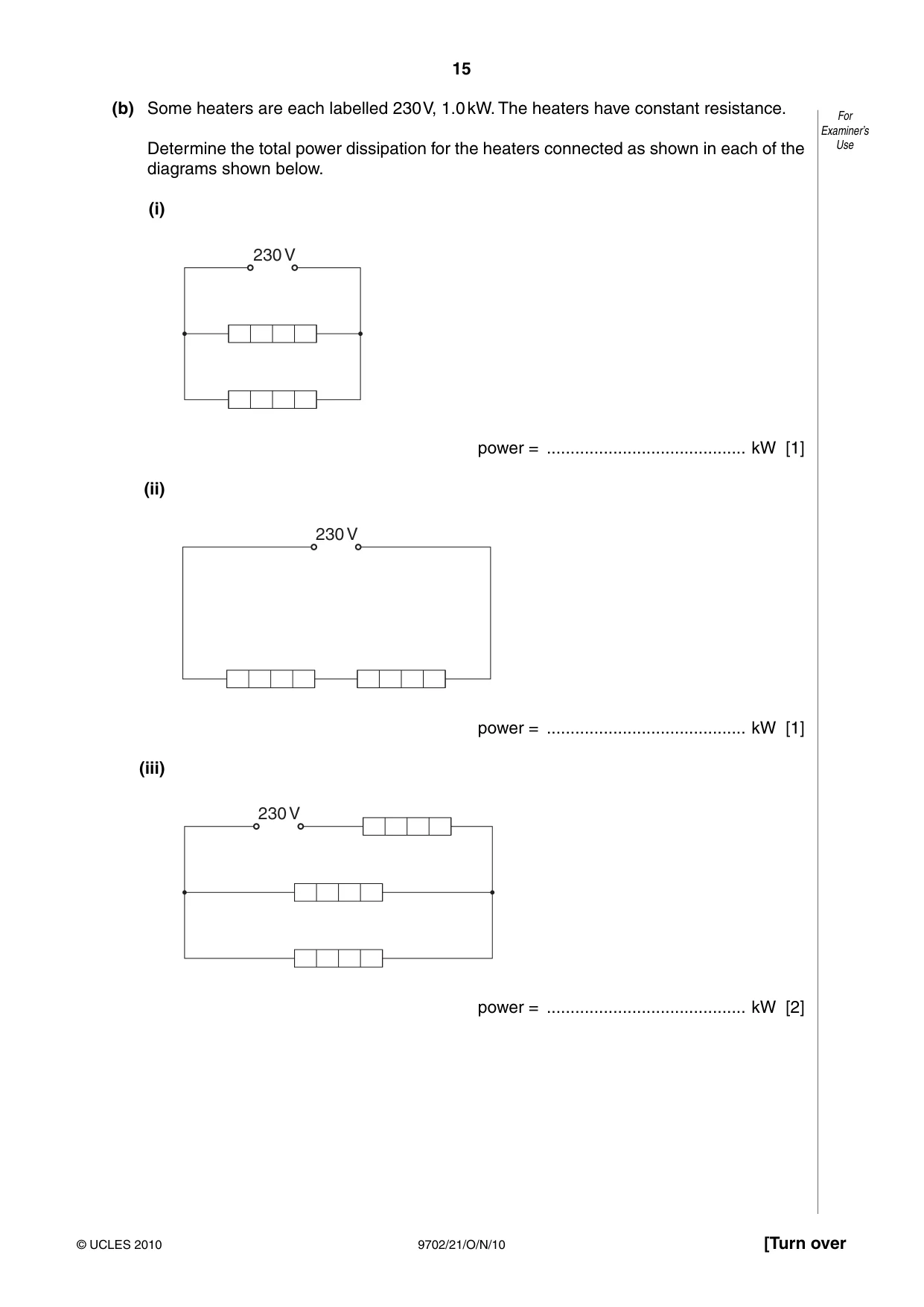
6 (a) A lamp is rated as 12 V, 36 W. For Examiner’s (i) Calculate the resistance of the lamp at its working temperature. Use resistance = ............................................ Ω [2] (ii) On the axes of Fig. 6.1, sketch a graph to show the current-voltage (I–V) characteristic of the lamp. Mark an appropriate scale for current on the y-axis. I / A 0 6 12 V / V Fig. 6.1 [3] (b) Some heaters are each labelled 230 V, 1.0 kW. The heaters have constant resistance. For Examiner’s Determine the total power dissipation for the heaters connected as shown in each of the Use diagrams shown below. (i) 230 V power = .......................................... kW [1] (ii) 230 V power = .......................................... kW [1] (iii) 230 V power = .......................................... kW [2]
Mark scheme: 6 (a) (i) either P = V 2 / R or P = VI and V = IR C1 R = 4.0 Ω A1 [2] (ii) sketch vertical axis labelled appropriately B1 (straight) line from origin then curved in correct direction B1 line passes through 12 V, 3.0 A B1 [3] (b) (i) 2.0 kW A1 [1] (ii) 0.5 kW A1 [1] (iii) total resistance = 3R / 2 C1 power = 0.67 kW A1 [2] GCE AS/A LEVEL – October/November 2010 9702 21
Q7 · Uranium (U) has at least fourteen isotopes
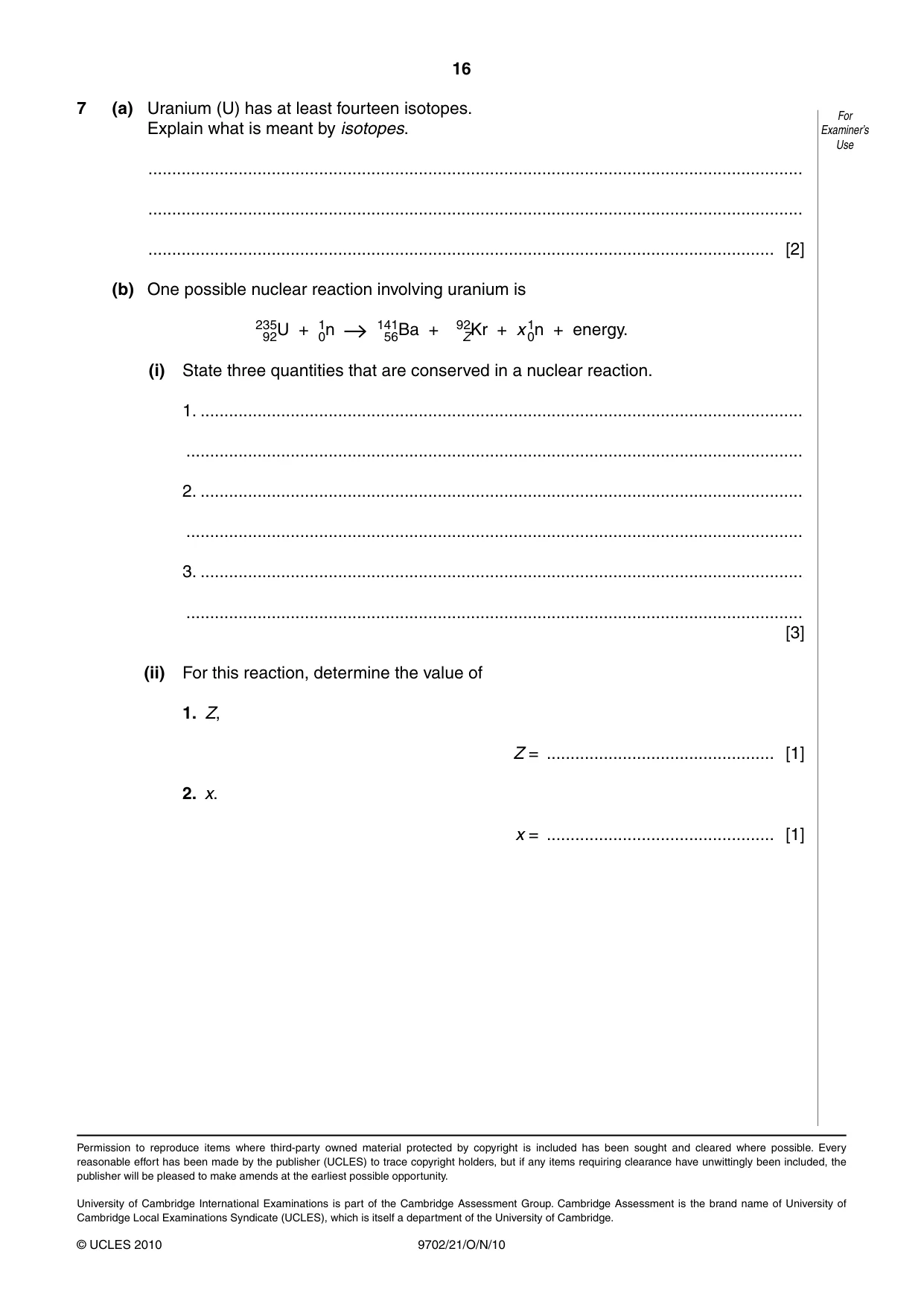
7 (a) Uranium (U) has at least fourteen isotopes. For Explain what is meant by isotopes. Examiner’s Use .......................................................................................................................................... .......................................................................................................................................... .................................................................................................................................... [2] (b) One possible nuclear reaction involving uranium is 23592U + 10n 14156Ba + 92ZKr + x 10n + energy. (i) State three quantities that are conserved in a nuclear reaction. 1. ............................................................................................................................... .................................................................................................................................. 2. ............................................................................................................................... .................................................................................................................................. 3. ............................................................................................................................... .................................................................................................................................. [3] (ii) For this reaction, determine the value of 1. Z, Z = ................................................ [1] 2. x. x = ................................................ [1]
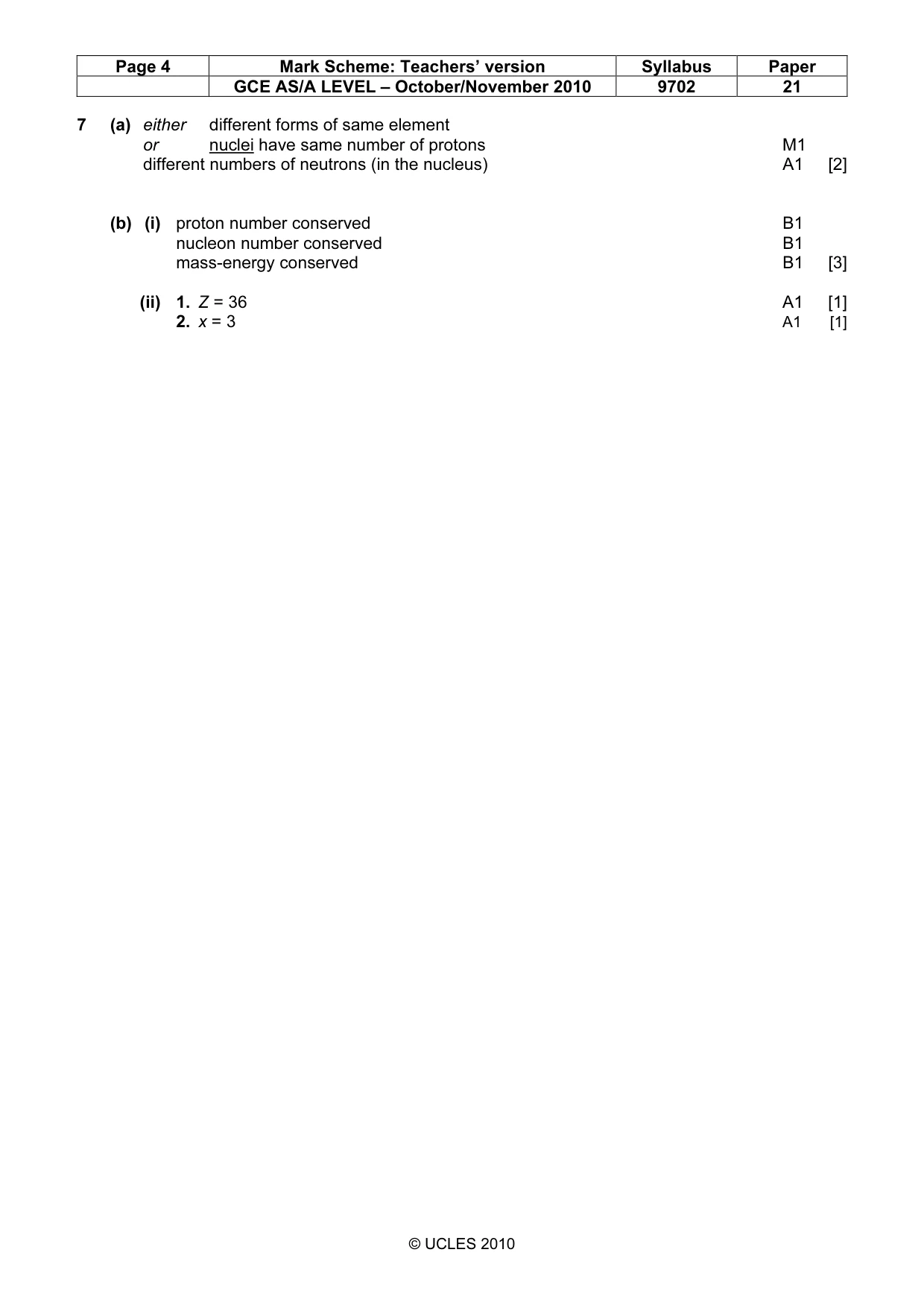
Mark scheme: 7 (a) either different forms of same element or nuclei have same number of protons M1 different numbers of neutrons (in the nucleus) A1 [2] (b) (i) proton number conserved B1 nucleon number conserved B1 mass-energy conserved B1 [3] (ii) 1. Z = 36 A1 [1] 2. x = 3 A1 [1]
What was in this paper
The subtopics covered by these 7 questions, and how many questions each got. Open one in a new tab to see every Cambridge question on it.
What you needed in this session
Cambridge’s own grade thresholds for 2010 Oct/Nov, Paper 2 · Variant 1. A higher threshold means an easier paper — the bar moves with how the cohort did.