Cambridge A Level Physics 9702 — 2014 May/June Paper 2 · Variant 1
9702/21/M/J/14 · 7 questions · 60 marks · ≈68 min
The question paper and its mark scheme, free to read here and free to download. This is Cambridge’s own paper, exactly as it was sat.
Question paper16 pages
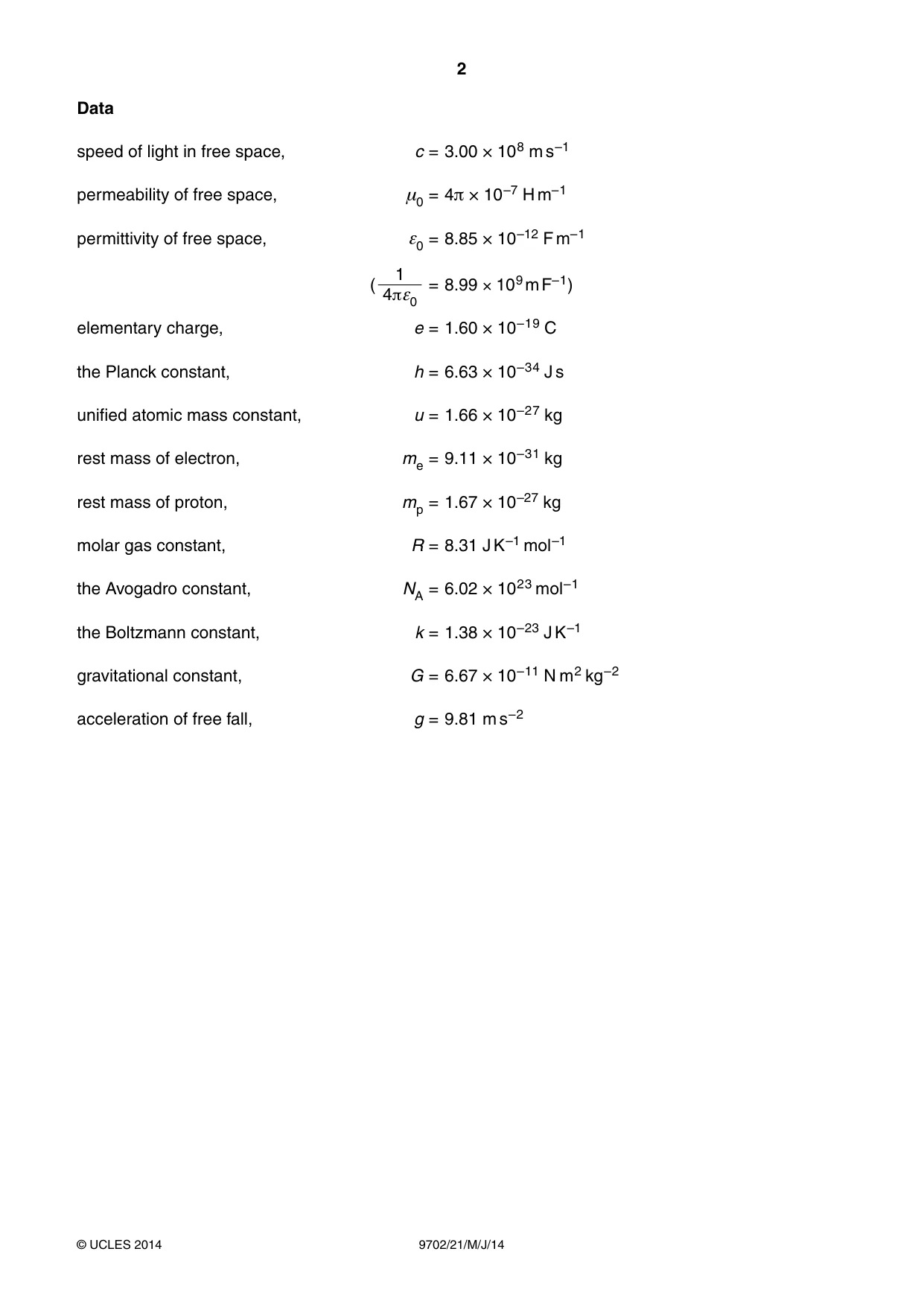
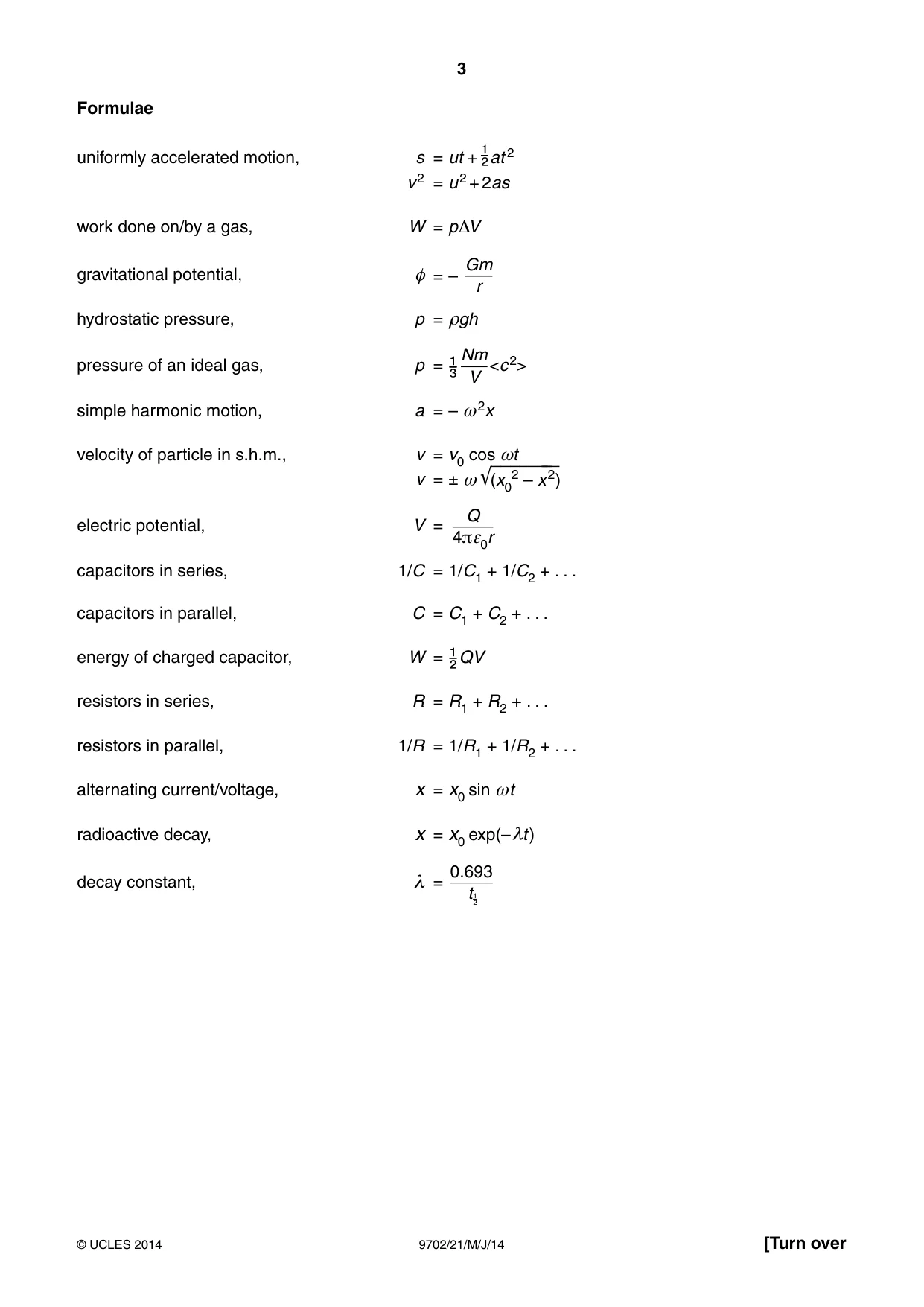

Mark scheme4 pages
Answers below. Sit the paper first if you are practising.
Questions as text
Question 1
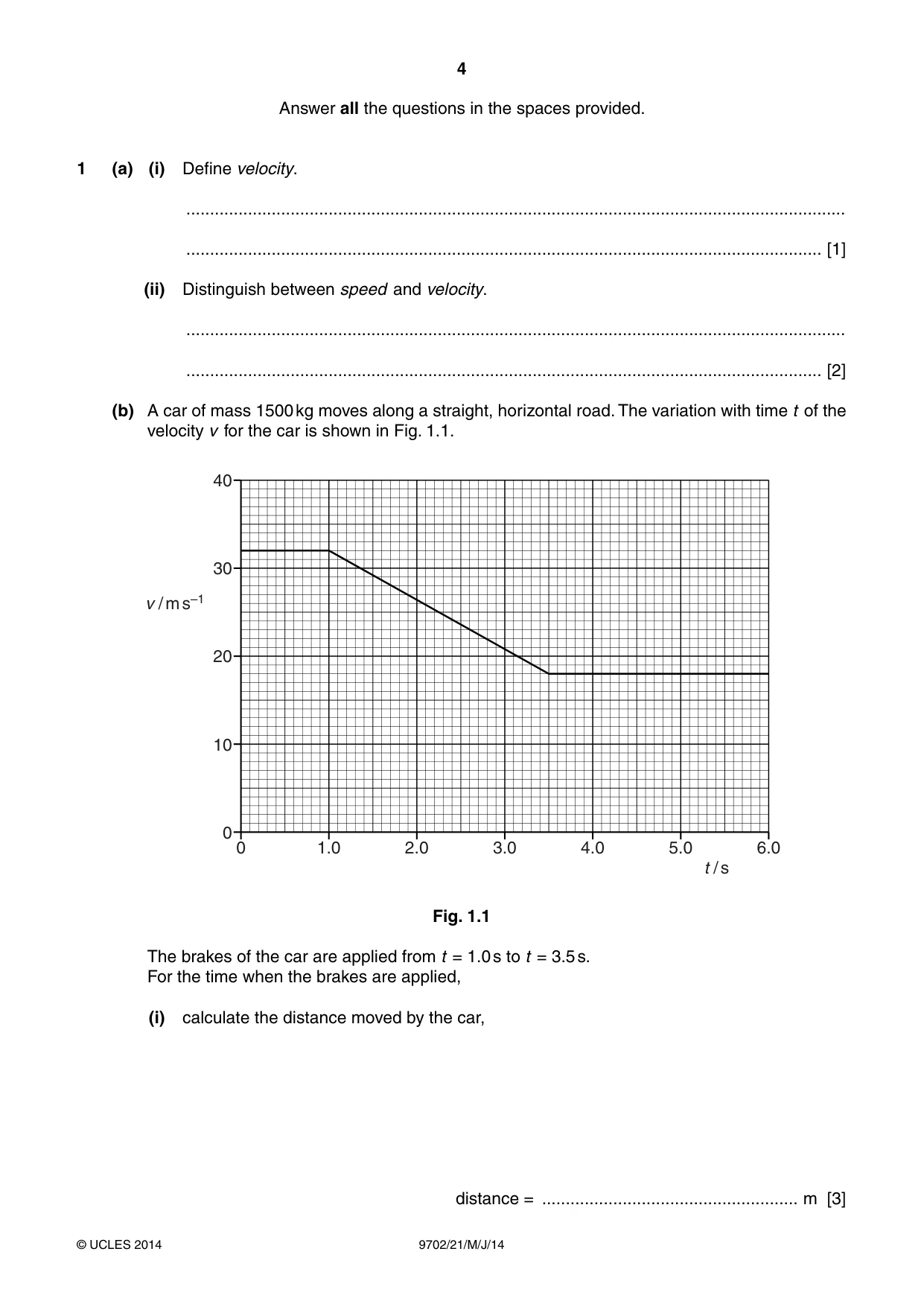
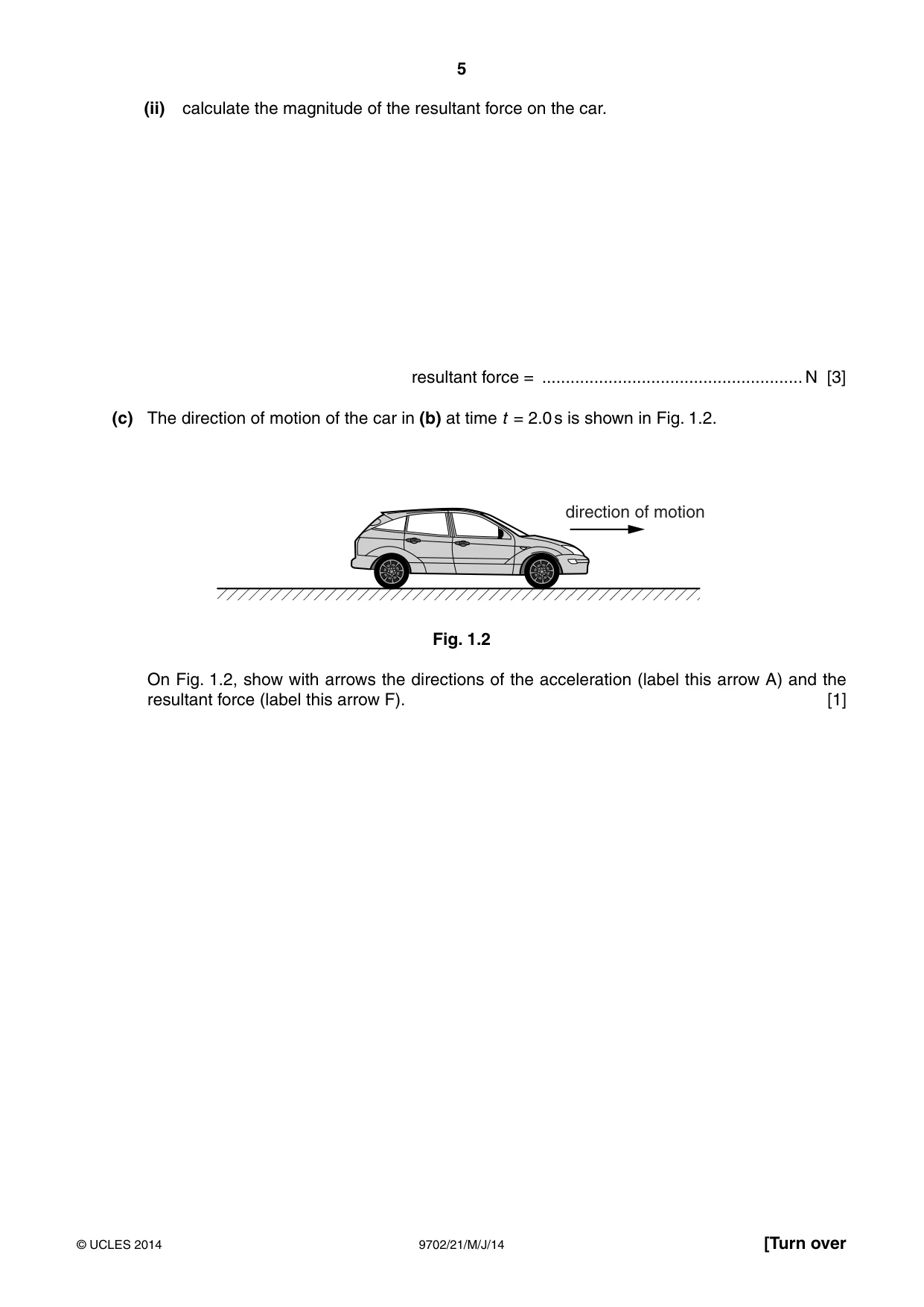
1 (a) (i) Define velocity. ........................................................................................................................................... ...................................................................................................................................... [1] (ii) Distinguish between speed and velocity. ........................................................................................................................................... ...................................................................................................................................... [2] (b) A car of mass 1500 kg moves along a straight, horizontal road. The variation with time t of the velocity v for the car is shown in Fig. 1.1. 40 30 v / m s–1 20 10 0 0 1.0 2.0 3.0 4.0 5.0 6.0 t / s Fig. 1.1 The brakes of the car are applied from t = 1.0 s to t = 3.5 s. For the time when the brakes are applied, (i) calculate the distance moved by the car, distance = ...................................................... m [3] (ii) calculate the magnitude of the resultant force on the car. resultant force = ....................................................... N [3] (c) The direction of motion of the car in (b) at time t = 2.0 s is shown in Fig. 1.2. direction of motion Fig. 1.2 On Fig. 1.2, show with arrows the directions of the acceleration (label this arrow A) and the resultant force (label this arrow F). [1]
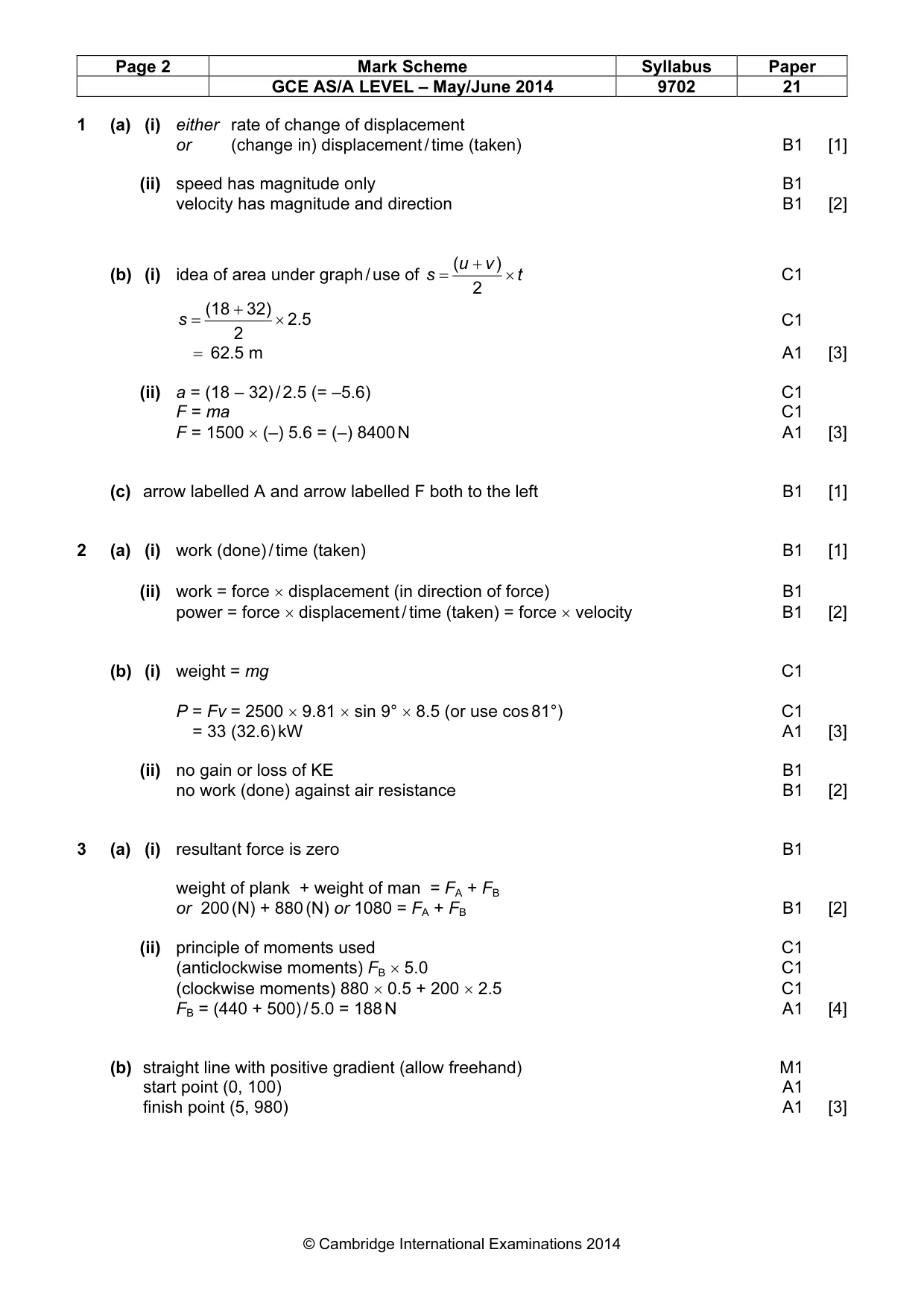
Mark scheme: 1 (a) (i) either rate of change of displacement or (change in) displacement / time (taken) B1 [1] (ii) speed has magnitude only B1 velocity has magnitude and direction B1 [2] (u + v ) (b) (i) idea of area under graph / use of s = × t C1 2 (18 + 32) s = × 2.5 C1 2 = 62.5 m A1 [3] (ii) a = (18 – 32) / 2.5 (= –5.6) C1 F = ma C1 F = 1500 × (–) 5.6 = (–) 8400 N A1 [3] (c) arrow labelled A and arrow labelled F both to the left B1 [1]
Question 2
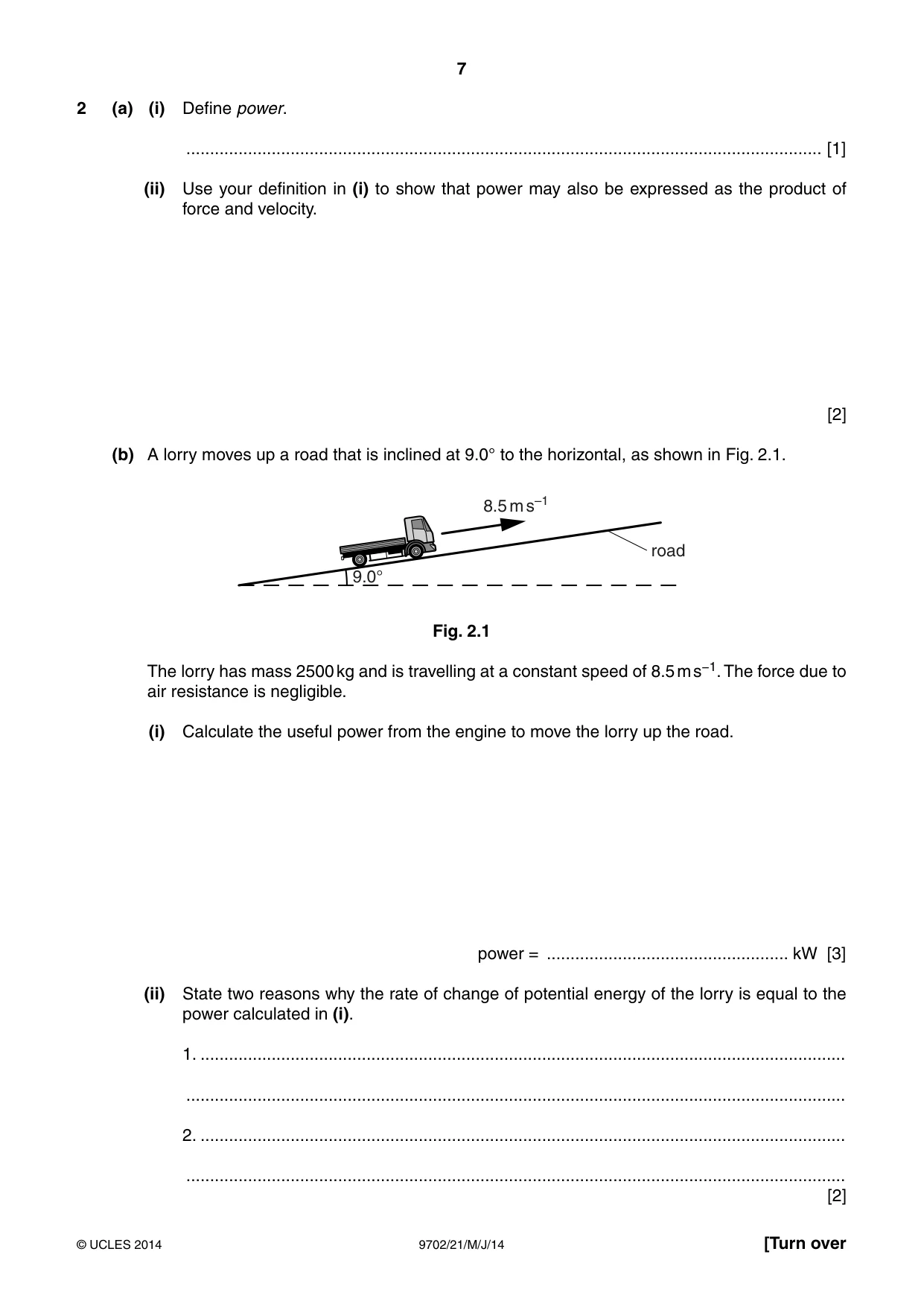
2 (a) (i) Define power. ...................................................................................................................................... [1] (ii) Use your definition in (i) to show that power may also be expressed as the product of force and velocity. [2] (b) A lorry moves up a road that is inclined at 9.0° to the horizontal, as shown in Fig. 2.1. 8.5 m s–1 road 9.0° Fig. 2.1 The lorry has mass 2500 kg and is travelling at a constant speed of 8.5 m s−1. The force due to air resistance is negligible. (i) Calculate the useful power from the engine to move the lorry up the road. power = ................................................... kW [3] (ii) State two reasons why the rate of change of potential energy of the lorry is equal to the power calculated in (i). 1. ........................................................................................................................................ ........................................................................................................................................... 2. ........................................................................................................................................ ........................................................................................................................................... [2]
Mark scheme: 2 (a) (i) work (done) / time (taken) B1 [1] (ii) work = force × displacement (in direction of force) B1 power = force × displacement / time (taken) = force × velocity B1 [2] (b) (i) weight = mg C1 P = Fv = 2500 × 9.81 × sin 9° × 8.5 (or use cos 81°) C1 = 33 (32.6) kW A1 [3] (ii) no gain or loss of KE B1 no work (done) against air resistance B1 [2]
Q3 · A uniform plank AB of length 5.0 m and weight 200 N is placed across a stream, as shown…
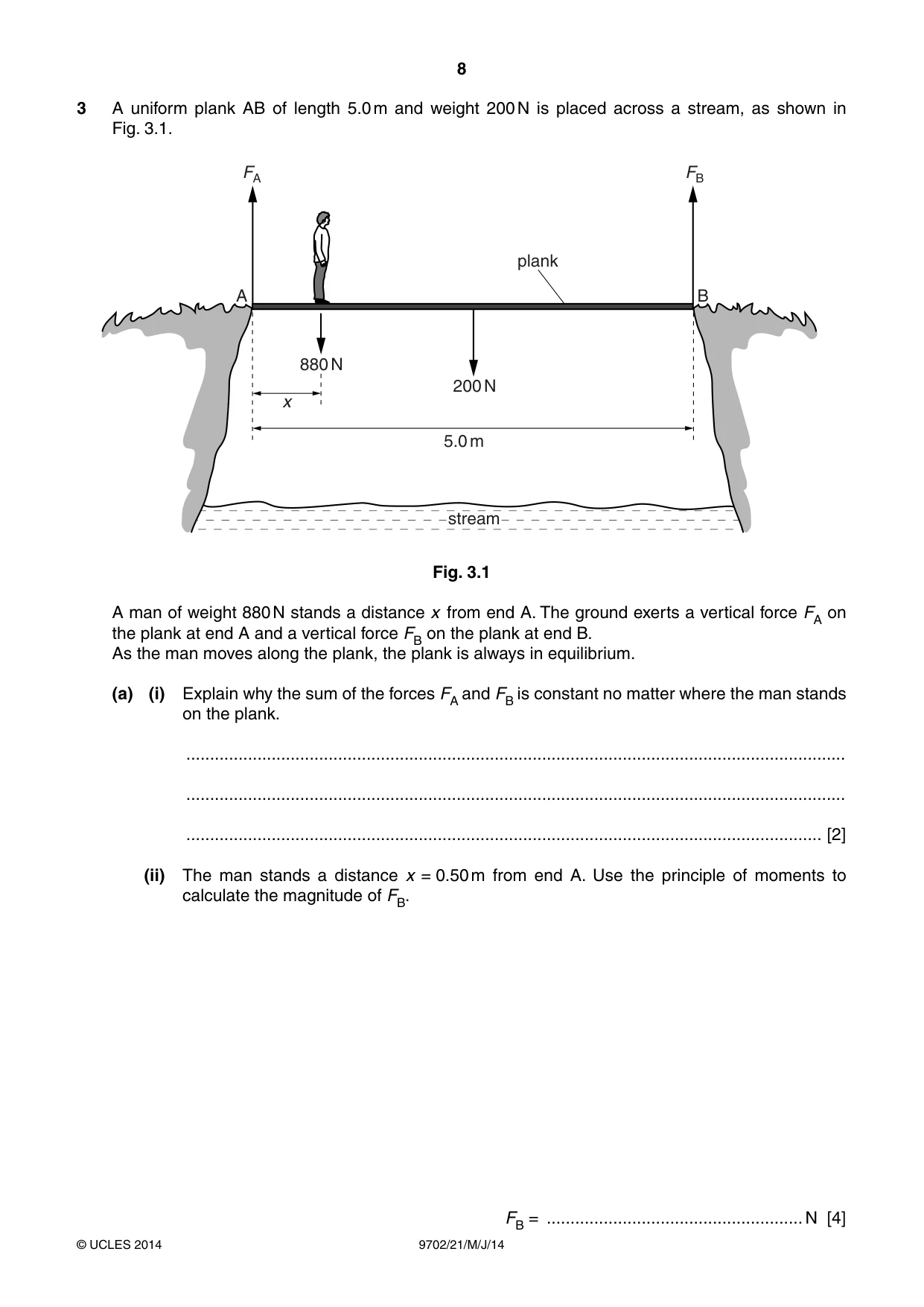
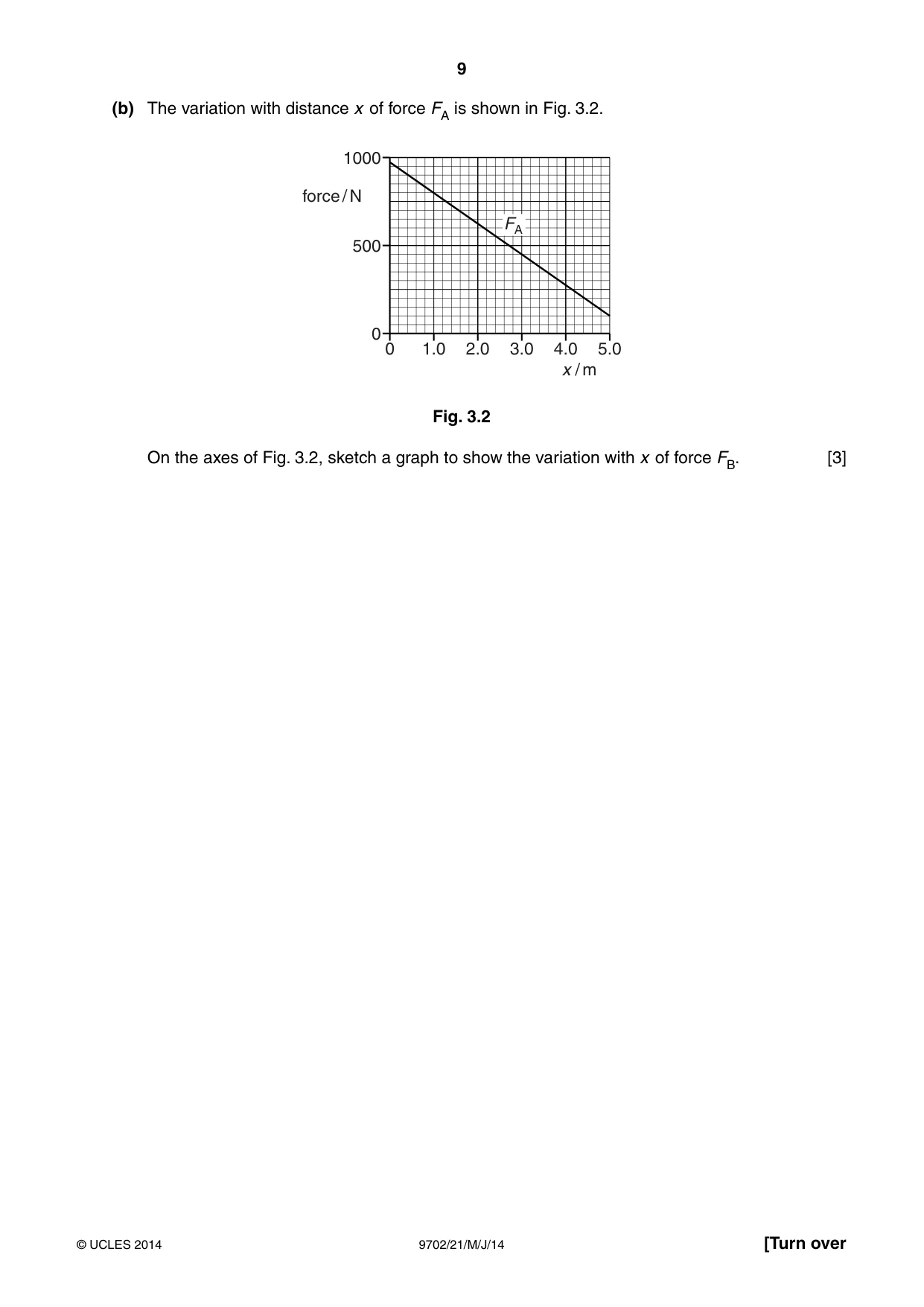
3 A uniform plank AB of length 5.0 m and weight 200 N is placed across a stream, as shown in Fig. 3.1. FA FB plank A B 880 N 200 N x 5.0 m stream Fig. 3.1 A man of weight 880 N stands a distance x from end A. The ground exerts a vertical force FA on the plank at end A and a vertical force FB on the plank at end B. As the man moves along the plank, the plank is always in equilibrium. (a) (i) Explain why the sum of the forces FA and FB is constant no matter where the man stands on the plank. ........................................................................................................................................... ........................................................................................................................................... ...................................................................................................................................... [2] (ii) The man stands a distance x = 0.50 m from end A. Use the principle of moments to calculate the magnitude of FB. FB = ...................................................... N [4] (b) The variation with distance x of force FA is shown in Fig. 3.2. 1000 force / N FA 500 0 0 1.0 2.0 3.0 4.0 5.0 x / m Fig. 3.2 On the axes of Fig. 3.2, sketch a graph to show the variation with x of force FB. [3]
Mark scheme: 3 (a) (i) resultant force is zero B1 weight of plank + weight of man = FA + FB or 200 (N) + 880 (N) or 1080 = FA + FB B1 [2] (ii) principle of moments used C1 (anticlockwise moments) FB × 5.0 C1 (clockwise moments) 880 × 0.5 + 200 × 2.5 C1 FB = (440 + 500) / 5.0 = 188 N A1 [4] (b) straight line with positive gradient (allow freehand) M1 start point (0, 100) A1 finish point (5, 980) A1 [3] GCE AS/A LEVEL – May/June 2014 9702 21 2
Q4 · A metal ball of mass 40 g falls vertically onto a spring, as shown in Fig
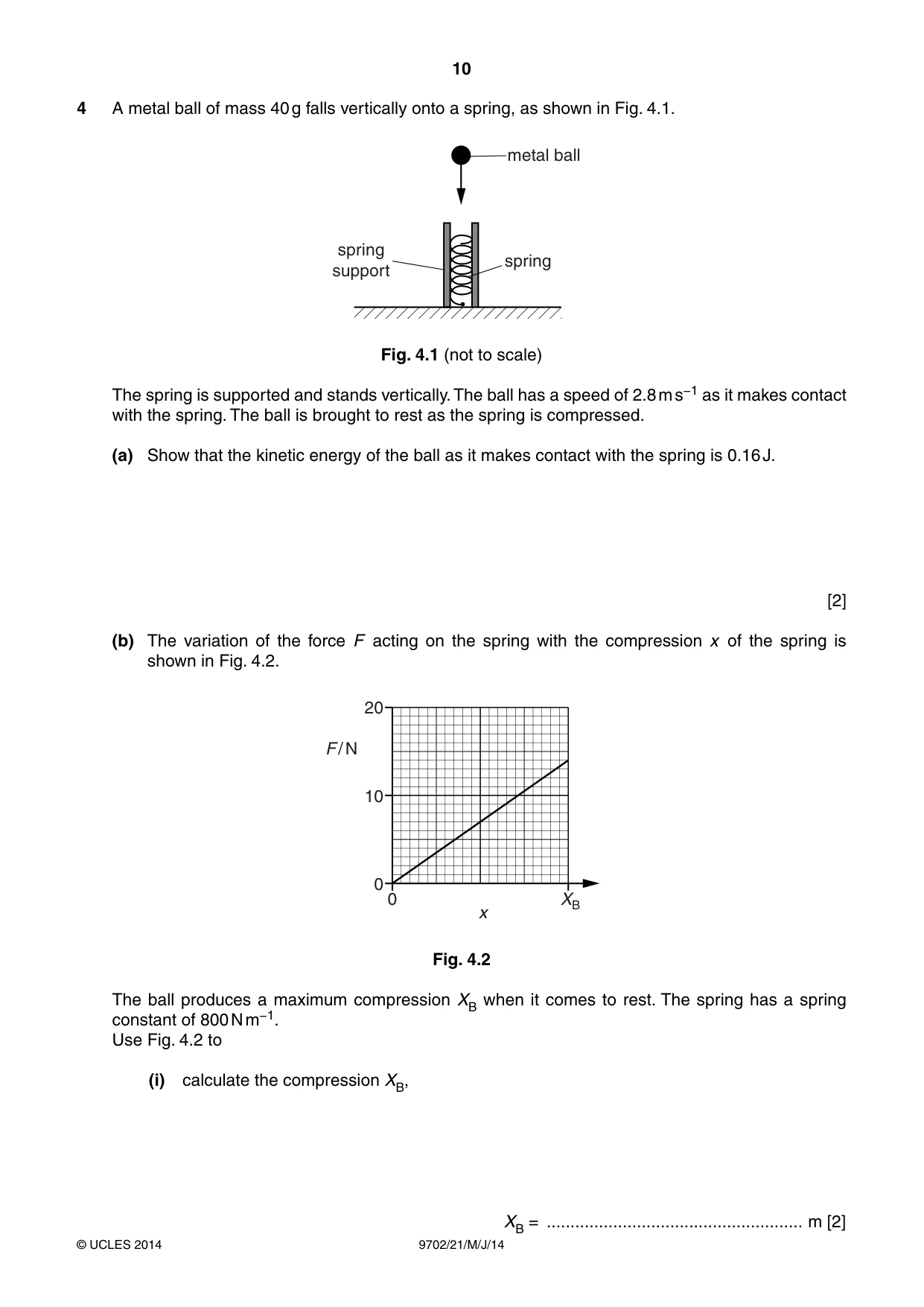
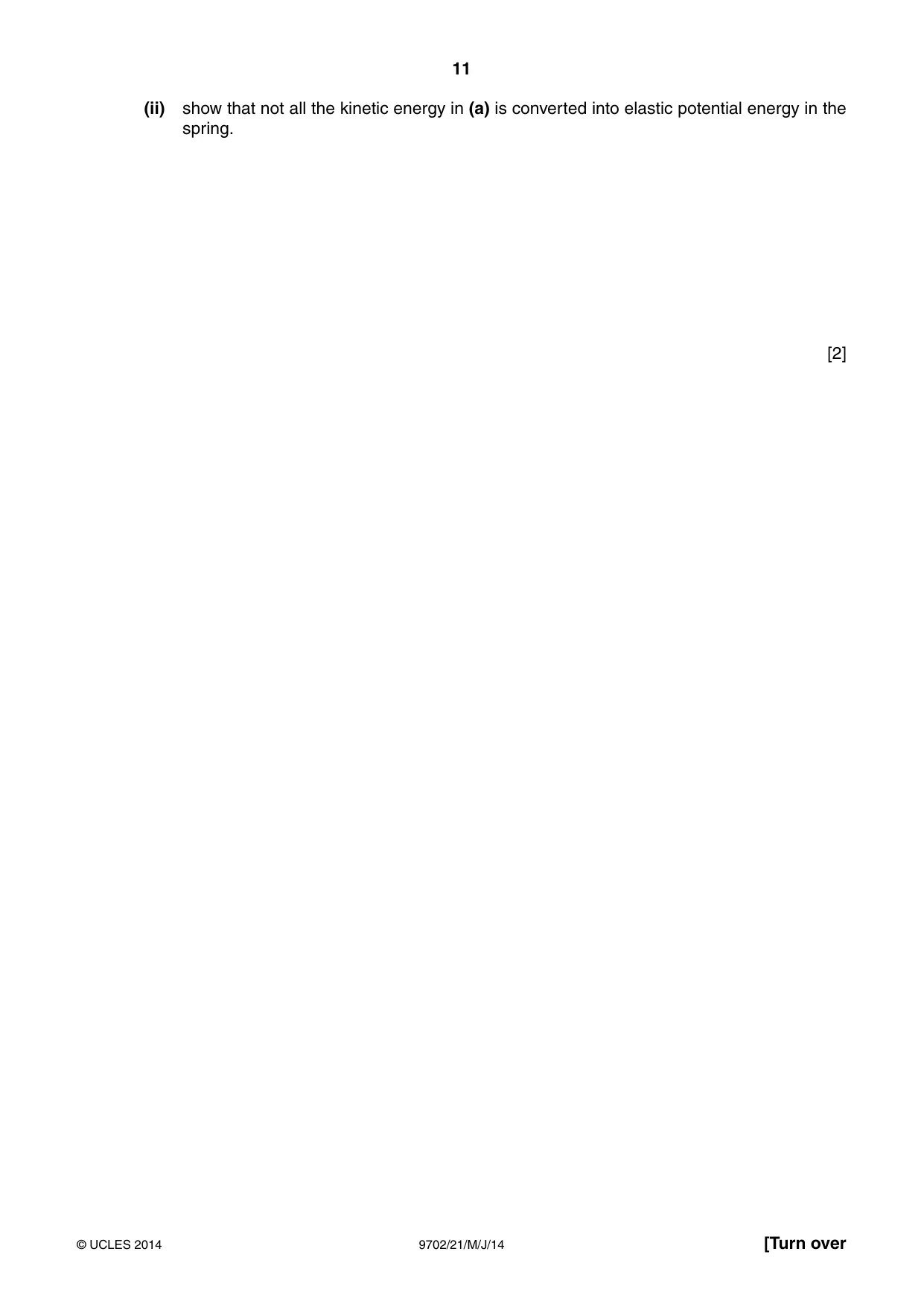
4 A metal ball of mass 40 g falls vertically onto a spring, as shown in Fig. 4.1. metal ball spring spring support Fig. 4.1 (not to scale) The spring is supported and stands vertically. The ball has a speed of 2.8 m s−1 as it makes contact with the spring. The ball is brought to rest as the spring is compressed. (a) Show that the kinetic energy of the ball as it makes contact with the spring is 0.16 J. [2] (b) The variation of the force F acting on the spring with the compression x of the spring is shown in Fig. 4.2. 20 F / N 10 0 0 XB x Fig. 4.2 The ball produces a maximum compression XB when it comes to rest. The spring has a spring constant of 800 N m−1. Use Fig. 4.2 to (i) calculate the compression XB, XB = ...................................................... m [2] (ii) show that not all the kinetic energy in (a) is converted into elastic potential energy in the spring. [2]
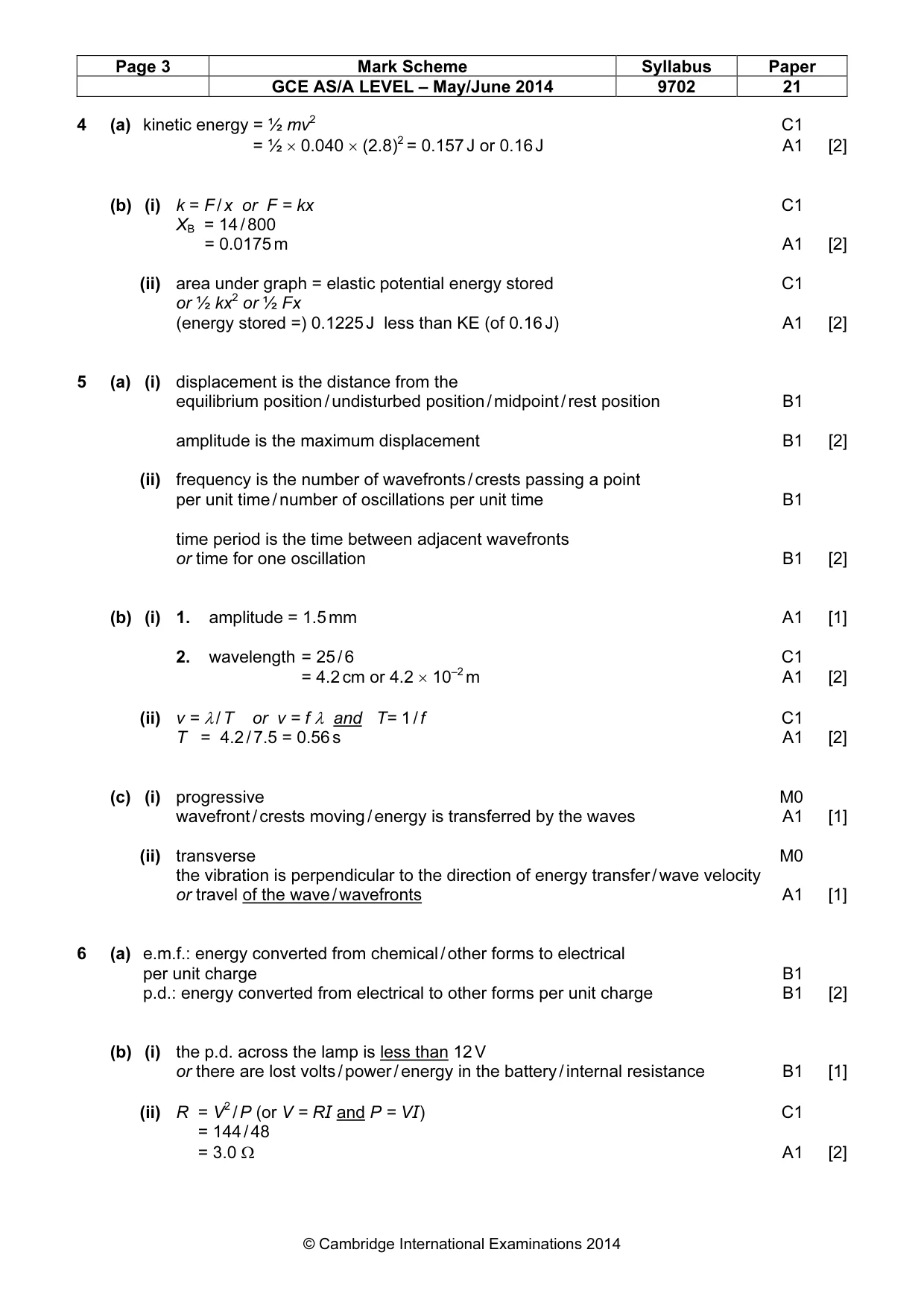
Mark scheme: 4 (a) kinetic energy = ½ mv2 C1 = ½ × 0.040 × (2.8)2 = 0.157 J or 0.16 J A1 [2] (b) (i) k = F / x or F = kx C1 XB = 14 / 800 = 0.0175 m A1 [2] (ii) area under graph = elastic potential energy stored C1 or ½ kx2 or ½ Fx (energy stored =) 0.1225 J less than KE (of 0.16 J) A1 [2]
More questions on Gravitational potential energy and kinetic energy
Q5 · Explain what is meant by the following quantities for a wave on the surface of water: (i)…
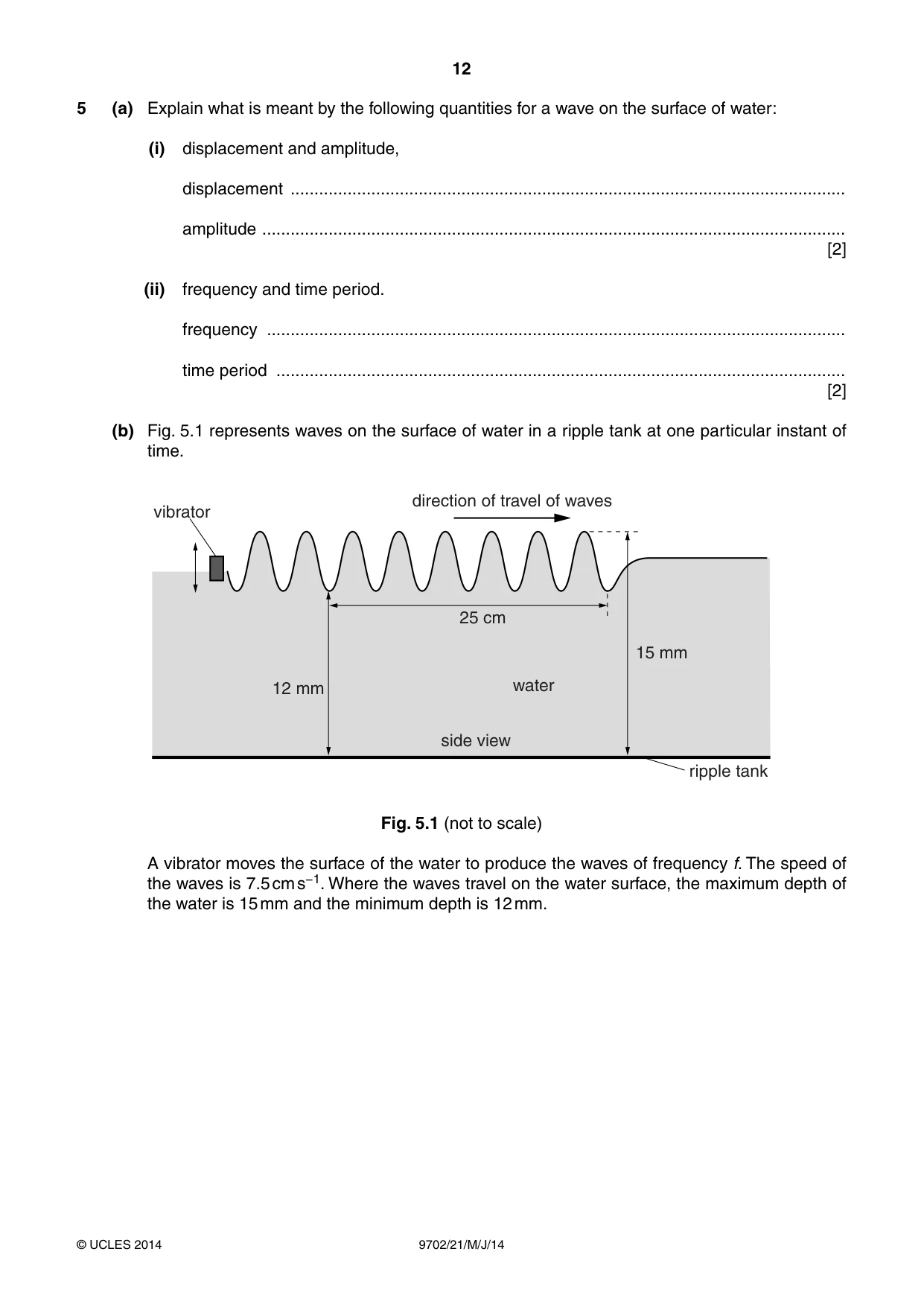
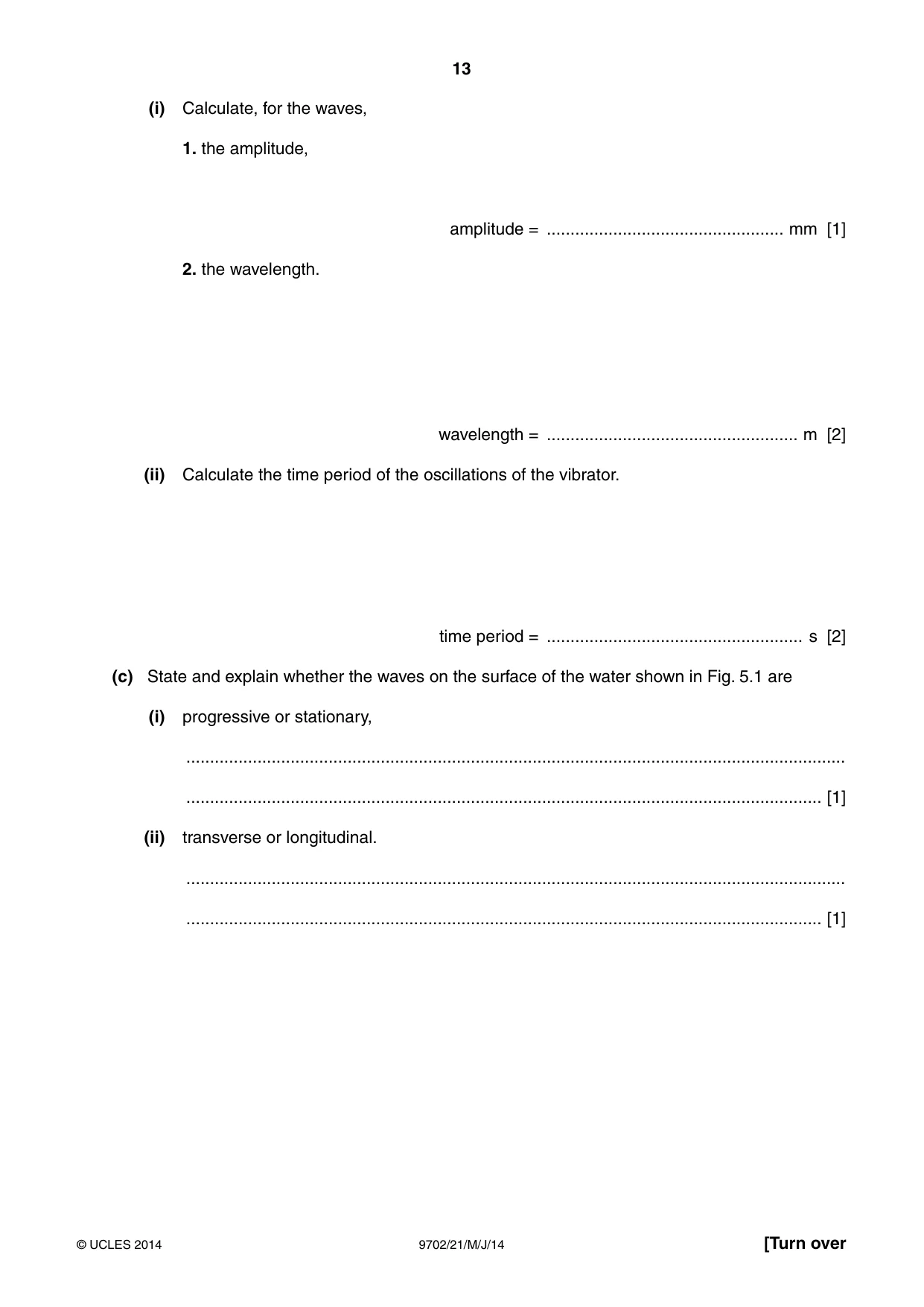
5 (a) Explain what is meant by the following quantities for a wave on the surface of water: (i) displacement and amplitude, displacement ..................................................................................................................... amplitude ........................................................................................................................... [2] (ii) frequency and time period. frequency .......................................................................................................................... time period ........................................................................................................................ [2] (b) Fig. 5.1 represents waves on the surface of water in a ripple tank at one particular instant of time. direction of travel of waves vibrator 25 cm 15 mm 12 mm water side view ripple tank Fig. 5.1 (not to scale) A vibrator moves the surface of the water to produce the waves of frequency f. The speed of the waves is 7.5 cm s−1. Where the waves travel on the water surface, the maximum depth of the water is 15 mm and the minimum depth is 12 mm. (i) Calculate, for the waves, 1. the amplitude, amplitude = .................................................. mm [1] 2. the wavelength. wavelength = ..................................................... m [2] (ii) Calculate the time period of the oscillations of the vibrator. time period = ...................................................... s [2] (c) State and explain whether the waves on the surface of the water shown in Fig. 5.1 are (i) progressive or stationary, ........................................................................................................................................... ...................................................................................................................................... [1] (ii) transverse or longitudinal. ........................................................................................................................................... ...................................................................................................................................... [1]
Mark scheme: 5 (a) (i) displacement is the distance from the equilibrium position / undisturbed position / midpoint / rest position B1 amplitude is the maximum displacement B1 [2] (ii) frequency is the number of wavefronts / crests passing a point per unit time / number of oscillations per unit time B1 time period is the time between adjacent wavefronts or time for one oscillation B1 [2] (b) (i) 1. amplitude = 1.5 mm A1 [1] 2. wavelength = 25 / 6 C1 = 4.2 cm or 4.2 × 10⁻² m A1 [2] (ii) v = λ / T or v = f λ and T= 1 / f C1 T = 4.2 / 7.5 = 0.56 s A1 [2] (c) (i) progressive M0 wavefront / crests moving / energy is transferred by the waves A1 [1] (ii) transverse M0 the vibration is perpendicular to the direction of energy transfer / wave velocity or travel of the wave / wavefronts A1 [1]
Q6 · Distinguish between electromotive force (e.m.f.) and potential difference (p.d.)
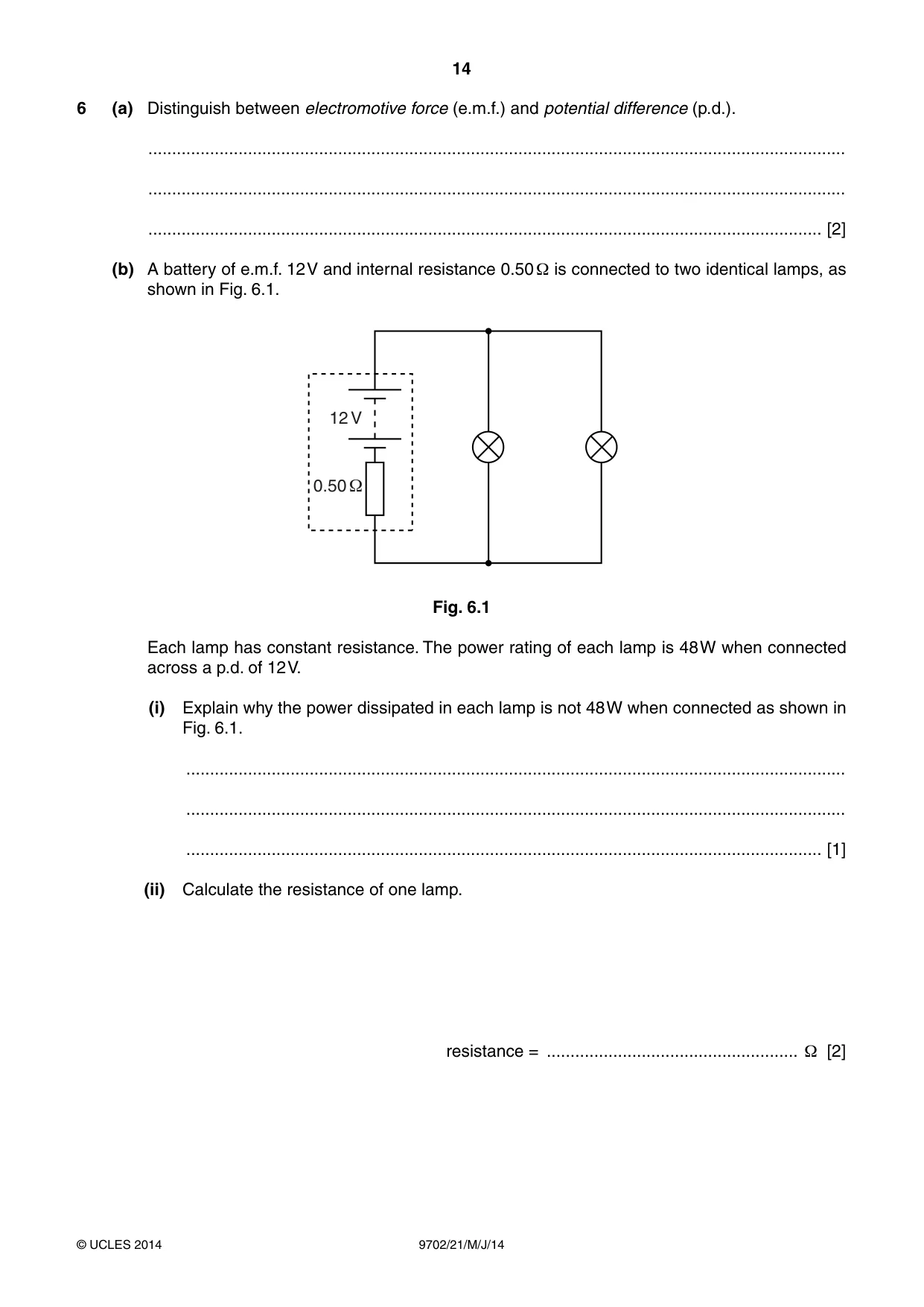
6 (a) Distinguish between electromotive force (e.m.f.) and potential difference (p.d.). ................................................................................................................................................... ................................................................................................................................................... .............................................................................................................................................. [2] (b) A battery of e.m.f. 12 V and internal resistance 0.50 Ω is connected to two identical lamps, as shown in Fig. 6.1. 12 V 0.50 1 Fig. 6.1 Each lamp has constant resistance. The power rating of each lamp is 48 W when connected across a p.d. of 12 V. (i) Explain why the power dissipated in each lamp is not 48 W when connected as shown in Fig. 6.1. ........................................................................................................................................... ........................................................................................................................................... ...................................................................................................................................... [1] (ii) Calculate the resistance of one lamp. resistance = ..................................................... Ω [2] (iii) Calculate the current in the battery. current = ...................................................... A [2] (iv) Calculate the power dissipated in one lamp. power = ..................................................... W [2] (c) A third identical lamp is placed in parallel with the battery in the circuit of Fig. 6.1. Describe and explain the effect on the terminal p.d. of the battery. ................................................................................................................................................... ................................................................................................................................................... ................................................................................................................................................... .............................................................................................................................................. [2] Please turn over for Question 7.
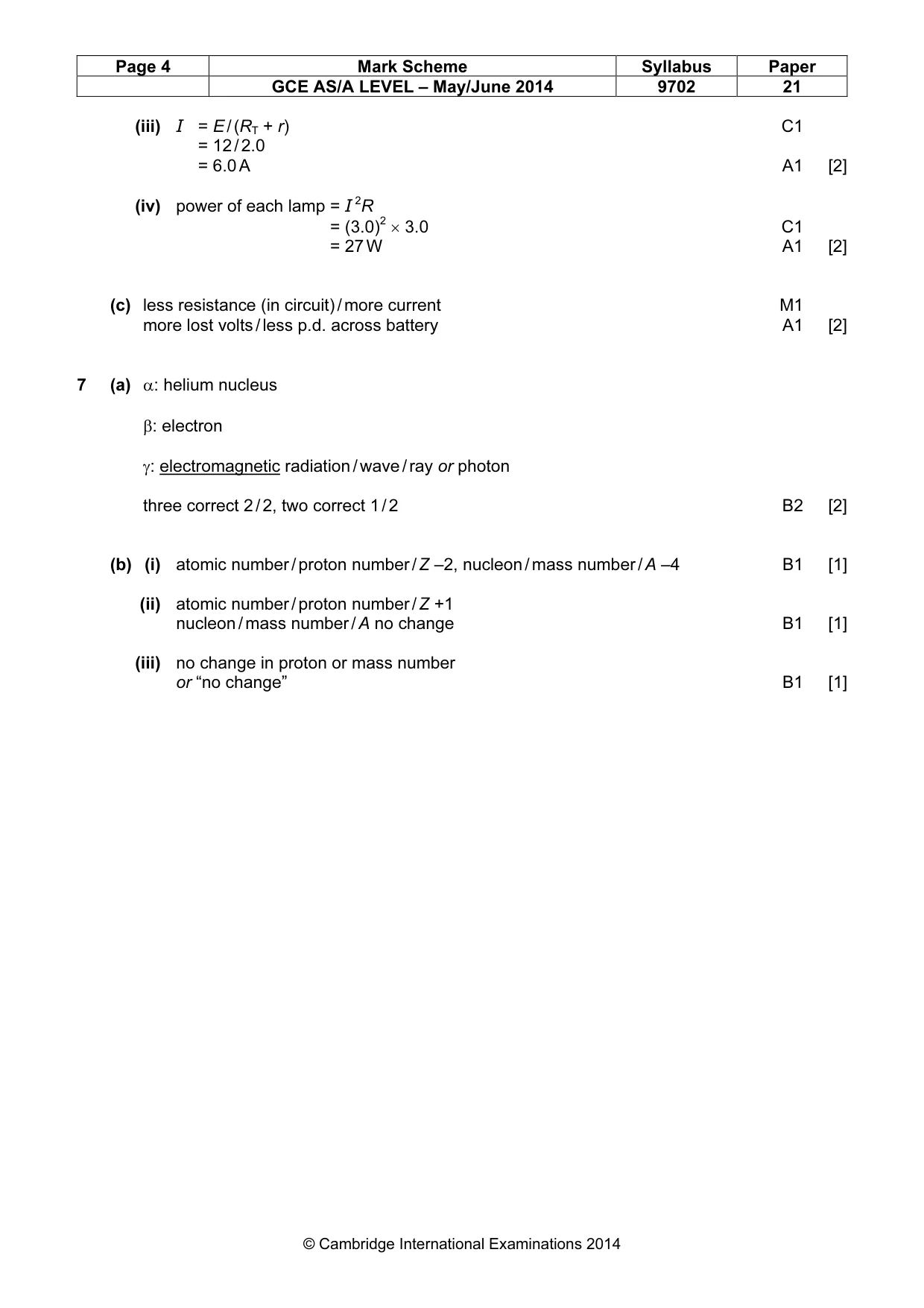
Mark scheme: 6 (a) e.m.f.: energy converted from chemical / other forms to electrical per unit charge B1 p.d.: energy converted from electrical to other forms per unit charge B1 [2] (b) (i) the p.d. across the lamp is less than 12 V or there are lost volts / power / energy in the battery / internal resistance B1 [1] (ii) R = V2 / P (or V = RI and P = VI) C1 = 144 / 48 = 3.0 Ω A1 [2] GCE AS/A LEVEL – May/June 2014 9702 21 (iii) I = E / (RT + r) C1 = 12 / 2.0 = 6.0 A A1 [2] (iv) power of each lamp = I 2R = (3.0)2 × 3.0 C1 = 27 W A1 [2] (c) less resistance (in circuit) / more current M1 more lost volts / less p.d. across battery A1 [2]
Q7 · State what is meant by α-particle…
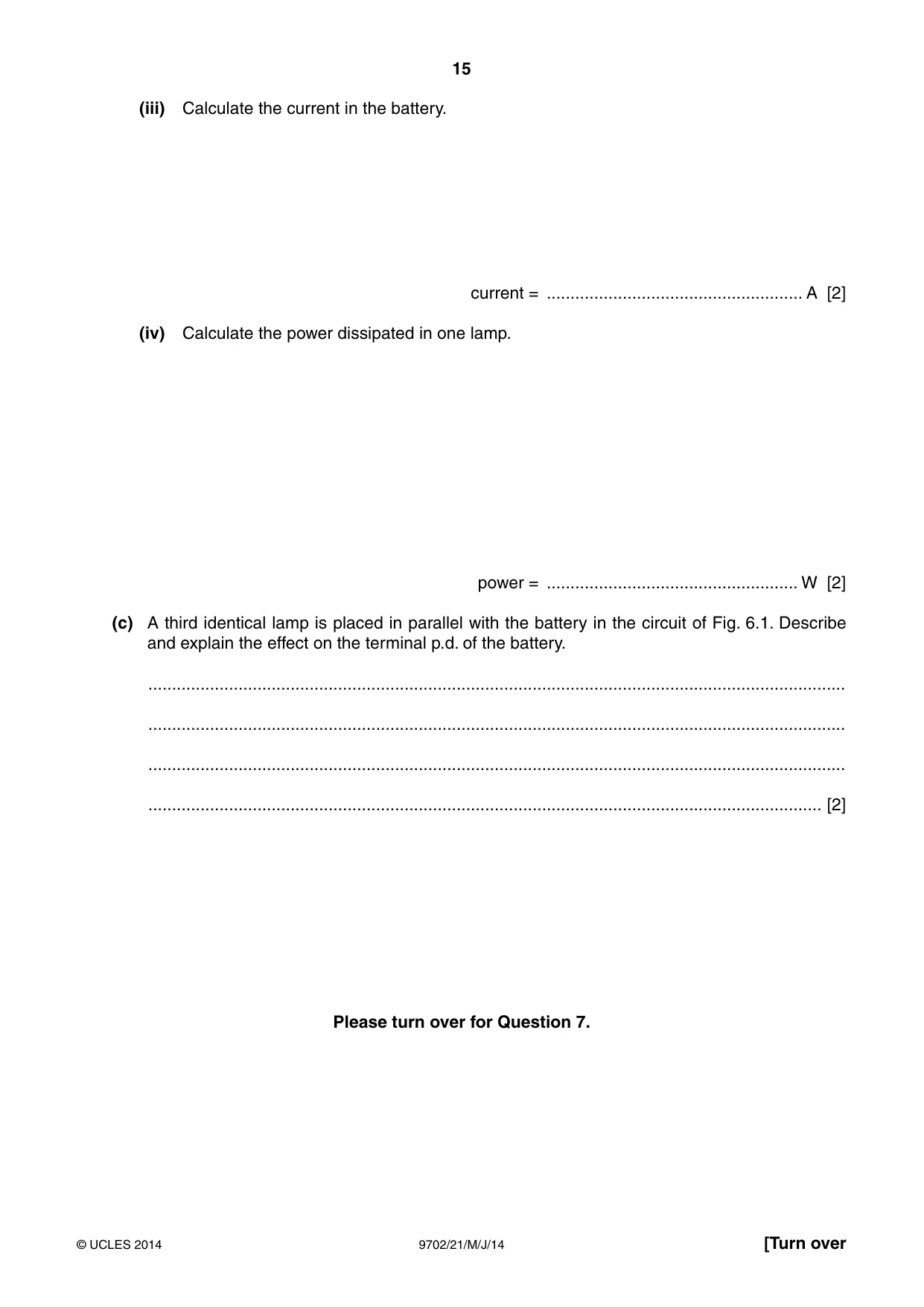
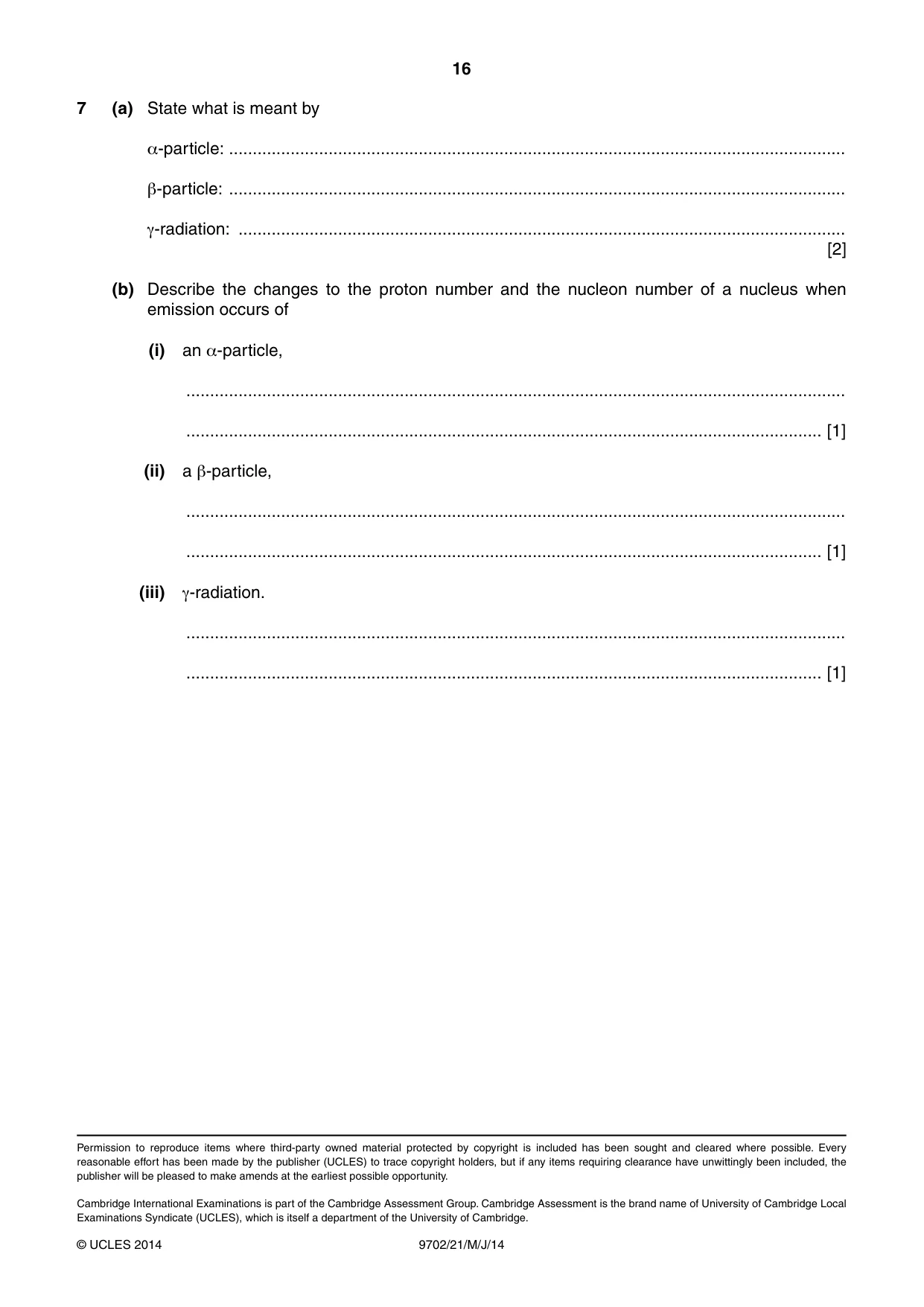
7 (a) State what is meant by α-particle: .................................................................................................................................. β-particle: .................................................................................................................................. γ-radiation: ................................................................................................................................ [2] (b) Describe the changes to the proton number and the nucleon number of a nucleus when emission occurs of (i) an α-particle, ........................................................................................................................................... ...................................................................................................................................... [1] (ii) a β-particle, ........................................................................................................................................... ...................................................................................................................................... [1] (iii) γ-radiation. ........................................................................................................................................... ...................................................................................................................................... [1]
Mark scheme: 7 (a) α: helium nucleus β: electron γ: electromagnetic radiation / wave / ray or photon three correct 2 / 2, two correct 1 / 2 B2 [2] (b) (i) atomic number / proton number / Z –2, nucleon / mass number / A –4 B1 [1] (ii) atomic number / proton number / Z +1 nucleon / mass number / A no change B1 [1] (iii) no change in proton or mass number or “no change” B1 [1]
What was in this paper
The subtopics covered by these 7 questions, and how many questions each got. Open one in a new tab to see every Cambridge question on it.
What you needed in this session
Cambridge’s own grade thresholds for 2014 May/June, Paper 2 · Variant 1. A higher threshold means an easier paper — the bar moves with how the cohort did.