Cambridge A Level Physics 9702 — 2009 Oct/Nov Paper 2 · Variant 1
9702/21/O/N/09 · 7 questions · 60 marks · ≈68 min
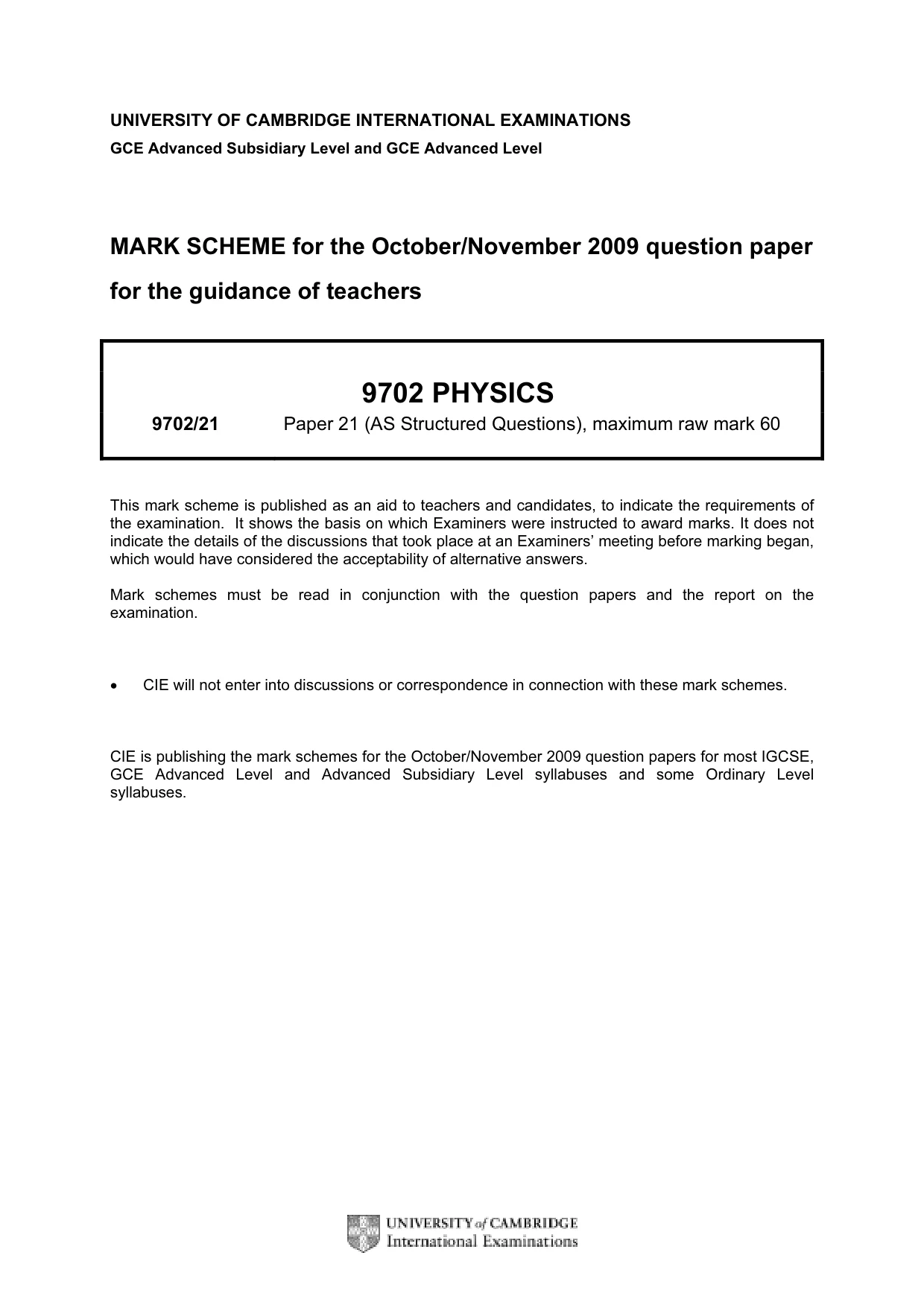
The question paper and its mark scheme, free to read here and free to download. This is Cambridge’s own paper, exactly as it was sat.
Question paper16 pages
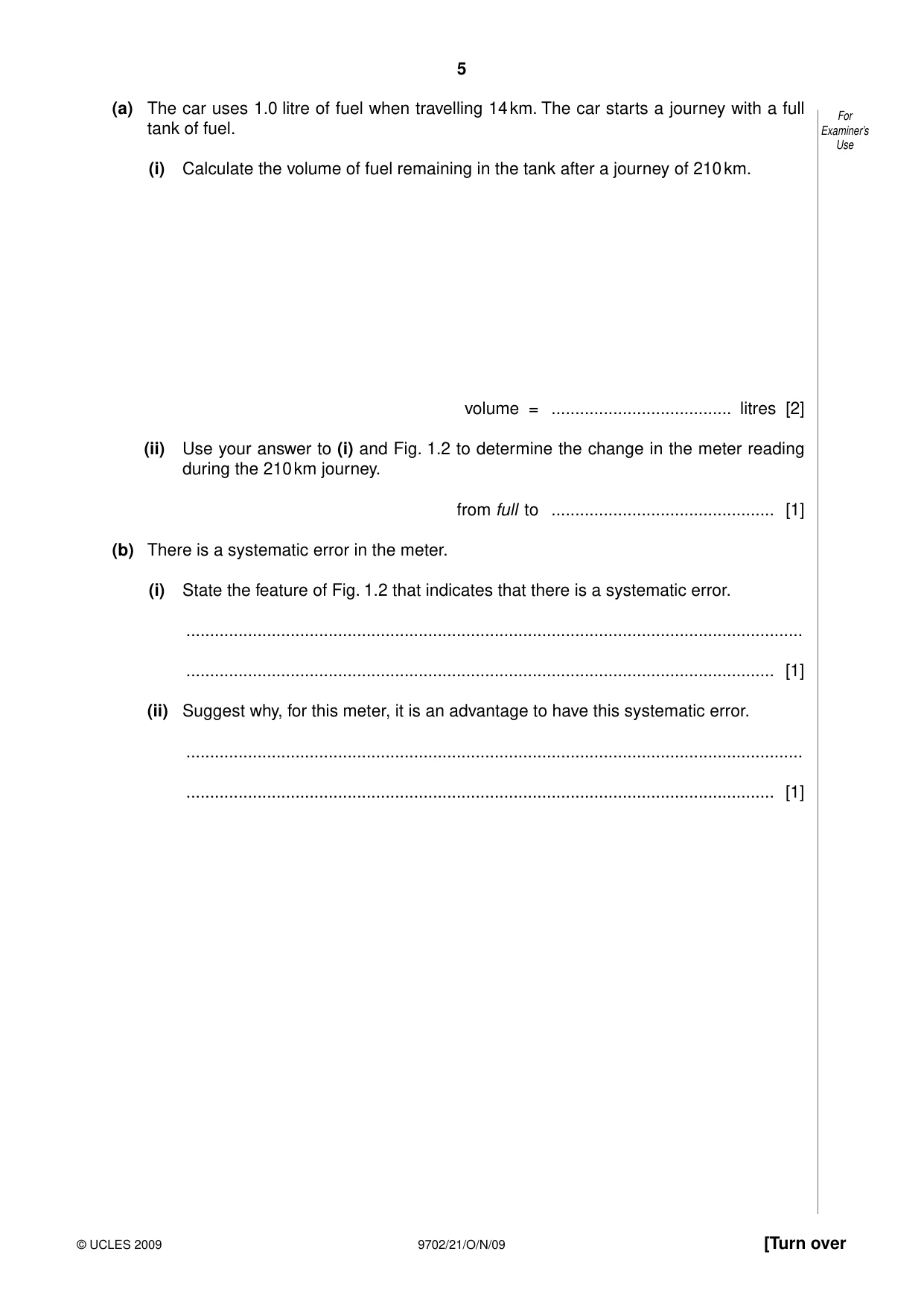
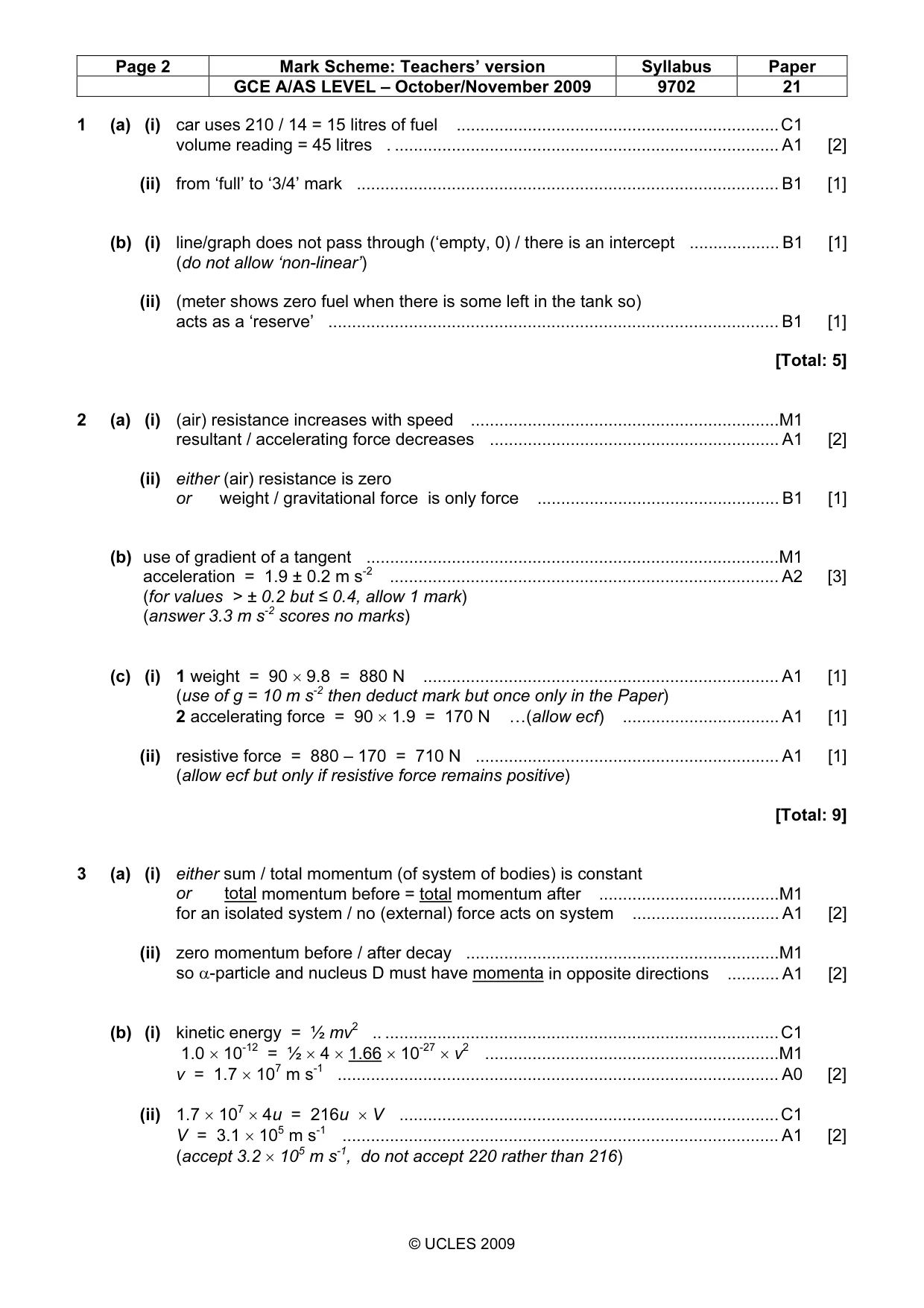
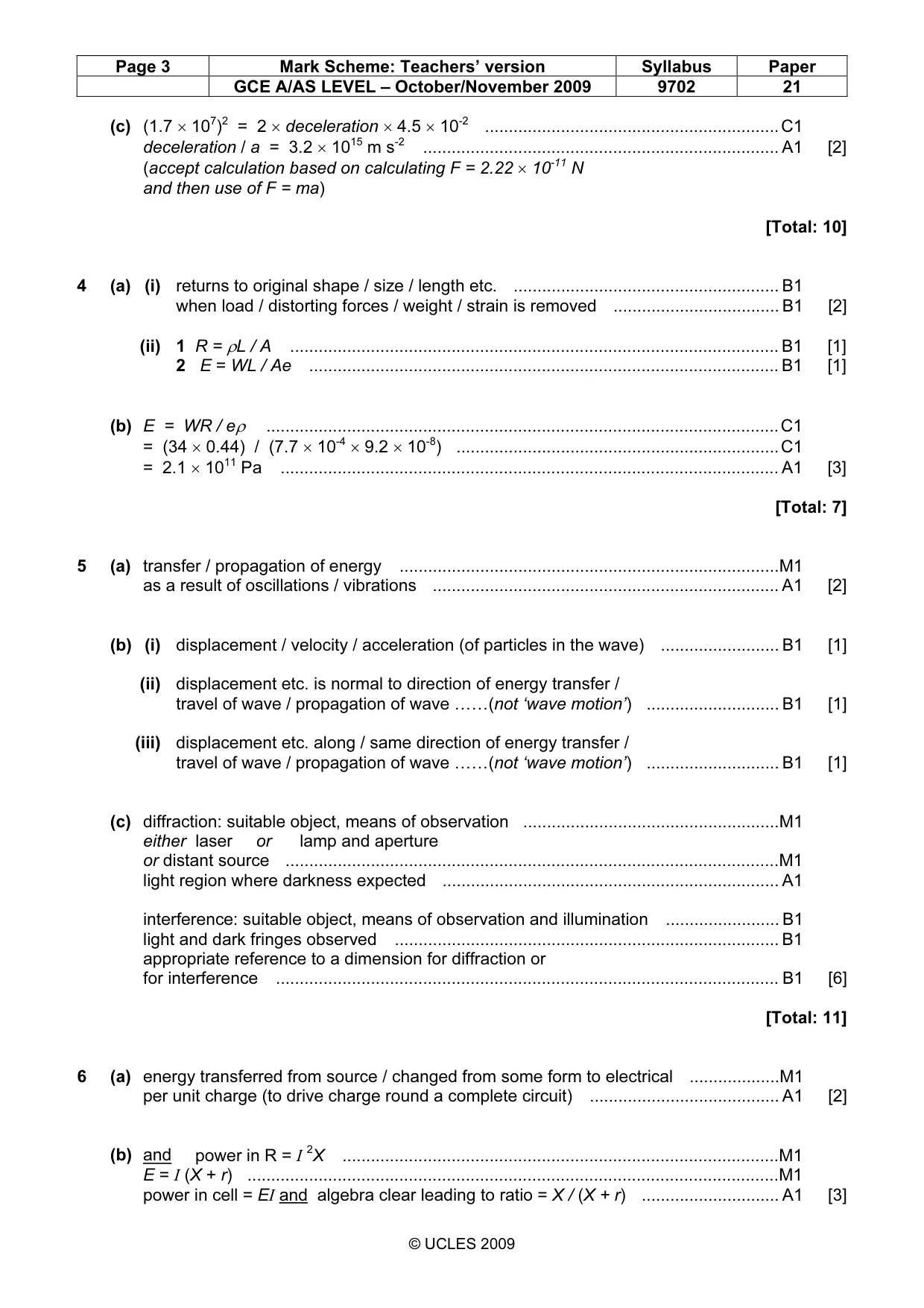
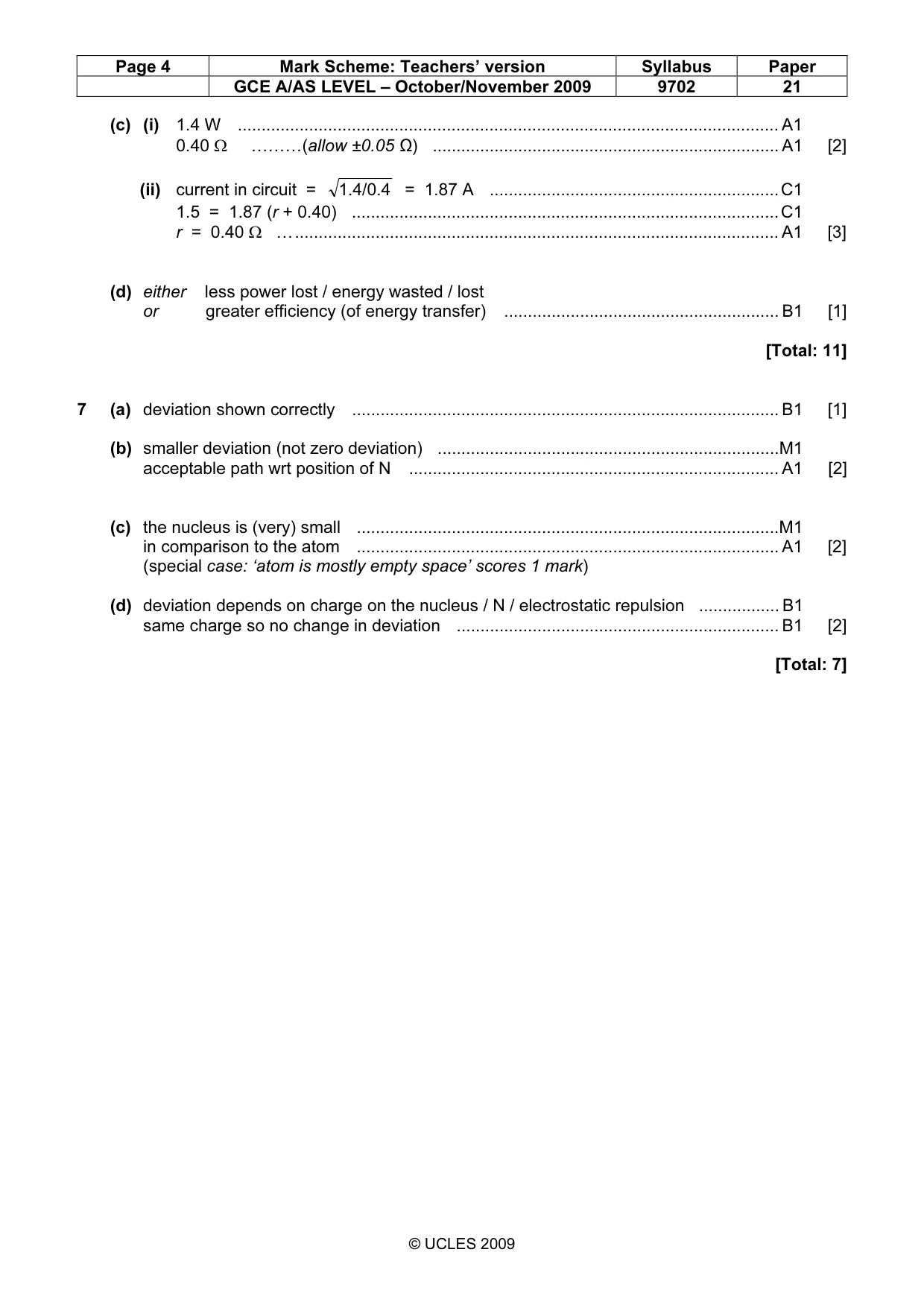
Mark scheme4 pages
Answers below. Sit the paper first if you are practising.
Questions as text
Q1 · The volume of fuel in the tank of a car is monitored using a meter as illustrated in Fig
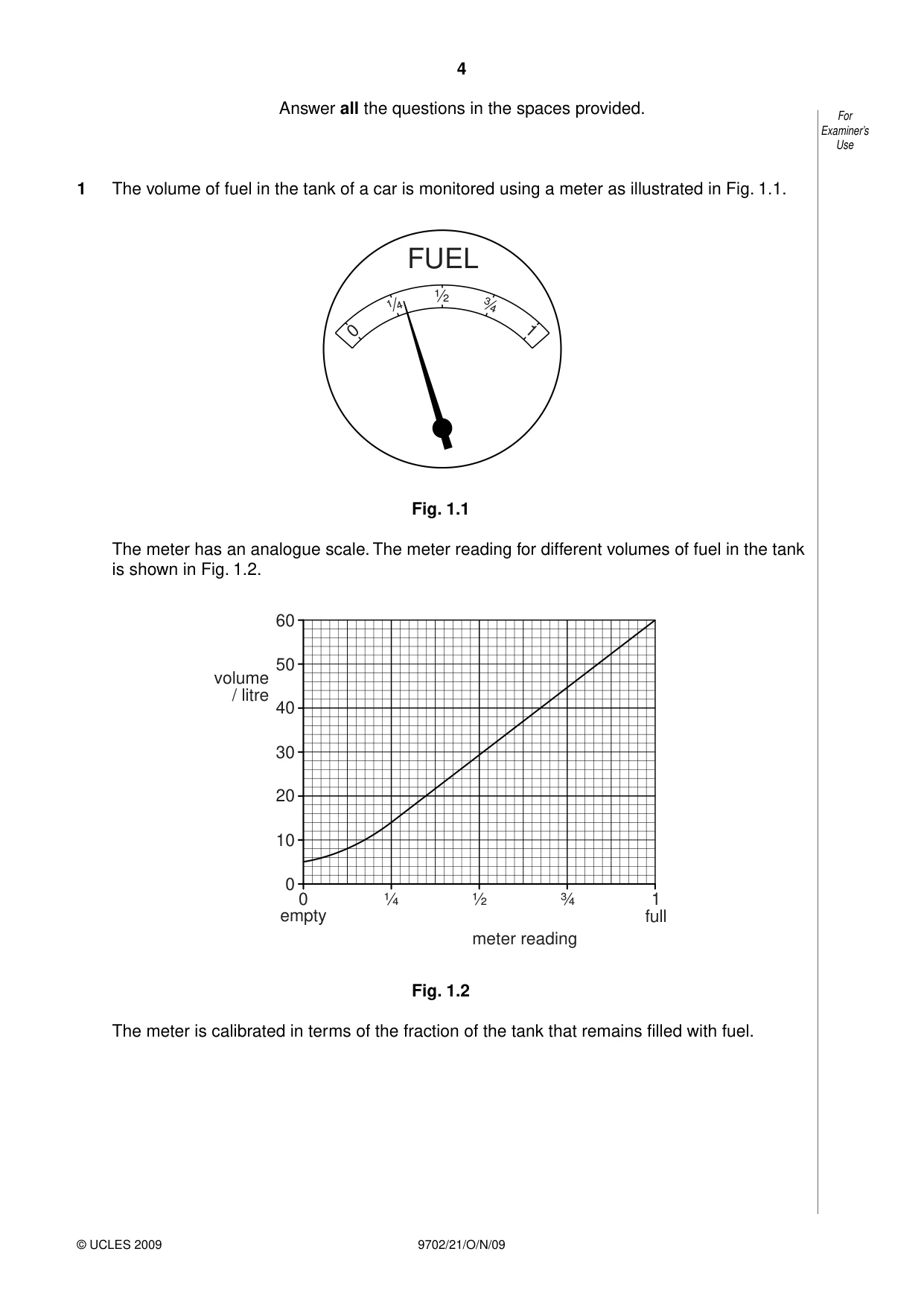
1 The volume of fuel in the tank of a car is monitored using a meter as illustrated in Fig. 1.1. FUEL ½ ¼ ¾ 0 1 Fig. 1.1 The meter has an analogue scale. The meter reading for different volumes of fuel in the tank is shown in Fig. 1.2. 60 50 volume / litre 40 30 20 10 0 0 ¼ ½ ¾ 1 empty full meter reading Fig. 1.2 The meter is calibrated in terms of the fraction of the tank that remains filled with fuel. (a) The car uses 1.0 litre of fuel when travelling 14 km. The car starts a journey with a full For tank of fuel. Examiner’s Use (i) Calculate the volume of fuel remaining in the tank after a journey of 210 km. volume = ...................................... litres [2] (ii) Use your answer to (i) and Fig. 1.2 to determine the change in the meter reading during the 210 km journey. from full to ............................................... [1] (b) There is a systematic error in the meter. (i) State the feature of Fig. 1.2 that indicates that there is a systematic error. .................................................................................................................................. ............................................................................................................................ [1] (ii) Suggest why, for this meter, it is an advantage to have this systematic error. .................................................................................................................................. ............................................................................................................................ [1]
Mark scheme: 1 (a) (i) car uses 210 / 14 = 15 litres of fuel ....................................................................C1 volume reading = 45 litres . ................................................................................. A1 [2] (ii) from ‘full’ to ‘3/4’ mark ......................................................................................... B1 [1] (b) (i) line/graph does not pass through (‘empty, 0) / there is an intercept ................... B1 [1] (do not allow ‘non-linear’) (ii) (meter shows zero fuel when there is some left in the tank so) acts as a ‘reserve’ ............................................................................................... B1 [1] [Total: 5]
Q2 · A sky-diver jumps from a high-altitude balloon
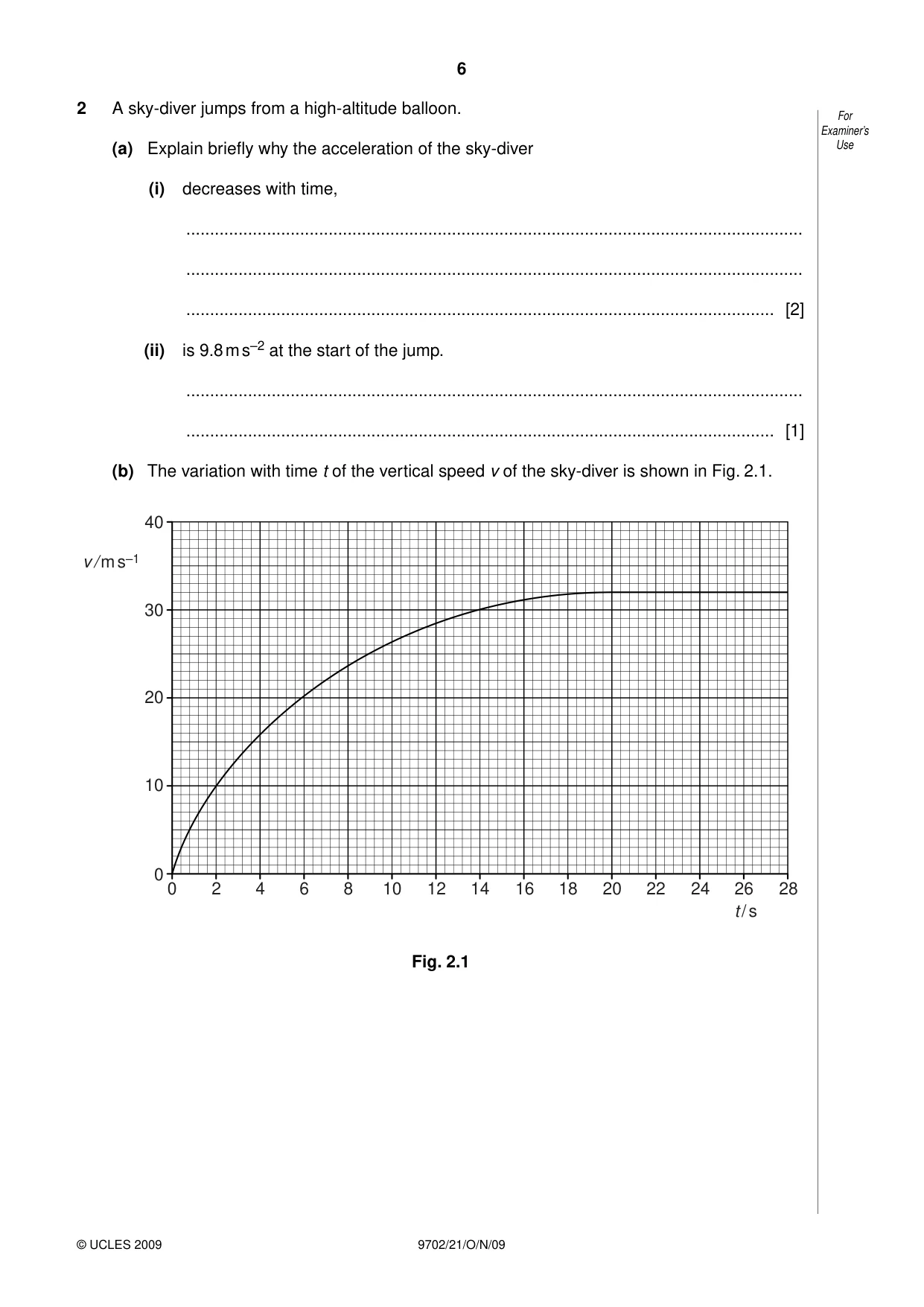
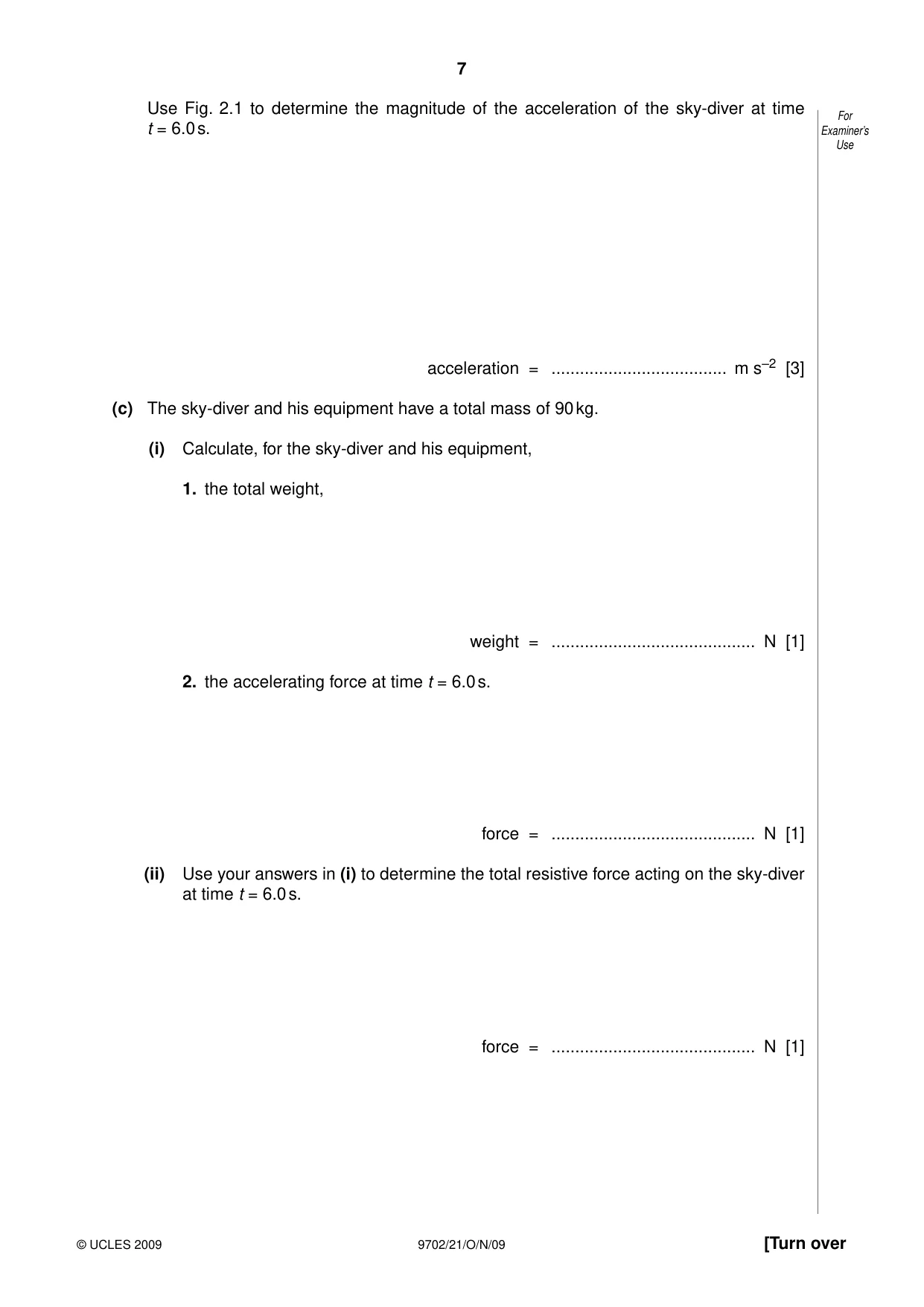
2 A sky-diver jumps from a high-altitude balloon. For Examiner’s (a) Explain briefly why the acceleration of the sky-diver Use (i) decreases with time, .................................................................................................................................. .................................................................................................................................. ............................................................................................................................ [2] (ii) is 9.8 m s–2 at the start of the jump. .................................................................................................................................. ............................................................................................................................ [1] (b) The variation with time t of the vertical speed v of the sky-diver is shown in Fig. 2.1. 40 v / m s–1 30 20 10 0 0 2 4 6 8 10 12 14 16 18 20 22 24 26 28 t / s Fig. 2.1 Use Fig. 2.1 to determine the magnitude of the acceleration of the sky-diver at time For t = 6.0 s. Examiner’s Use acceleration = ..................................... m s–2 [3] (c) The sky-diver and his equipment have a total mass of 90 kg. (i) Calculate, for the sky-diver and his equipment, 1. the total weight, weight = ........................................... N [1] 2. the accelerating force at time t = 6.0 s. force = ........................................... N [1] (ii) Use your answers in (i) to determine the total resistive force acting on the sky-diver at time t = 6.0 s. force = ........................................... N [1]
Mark scheme: 2 (a) (i) (air) resistance increases with speed .................................................................M1 resultant / accelerating force decreases ............................................................. A1 [2] (ii) either (air) resistance is zero or weight / gravitational force is only force ................................................... B1 [1] (b) use of gradient of a tangent .......................................................................................M1 acceleration = 1.9 ± 0.2 m s-2 .................................................................................. A2 [3] (for values > ± 0.2 but ≤ 0.4, allow 1 mark) (answer 3.3 m s-2 scores no marks) (c) (i) 1 weight = 90 × 9.8 = 880 N ........................................................................... A1 [1] (use of g = 10 m s-2 then deduct mark but once only in the Paper) 2 accelerating force = 90 × 1.9 = 170 N …(allow ecf) ................................. A1 [1] (ii) resistive force = 880 – 170 = 710 N ................................................................ A1 [1] (allow ecf but only if resistive force remains positive) [Total: 9]
Q3 · A stationary nucleus of mass 220u undergoes radioactive decay to produce a nucleus D of…
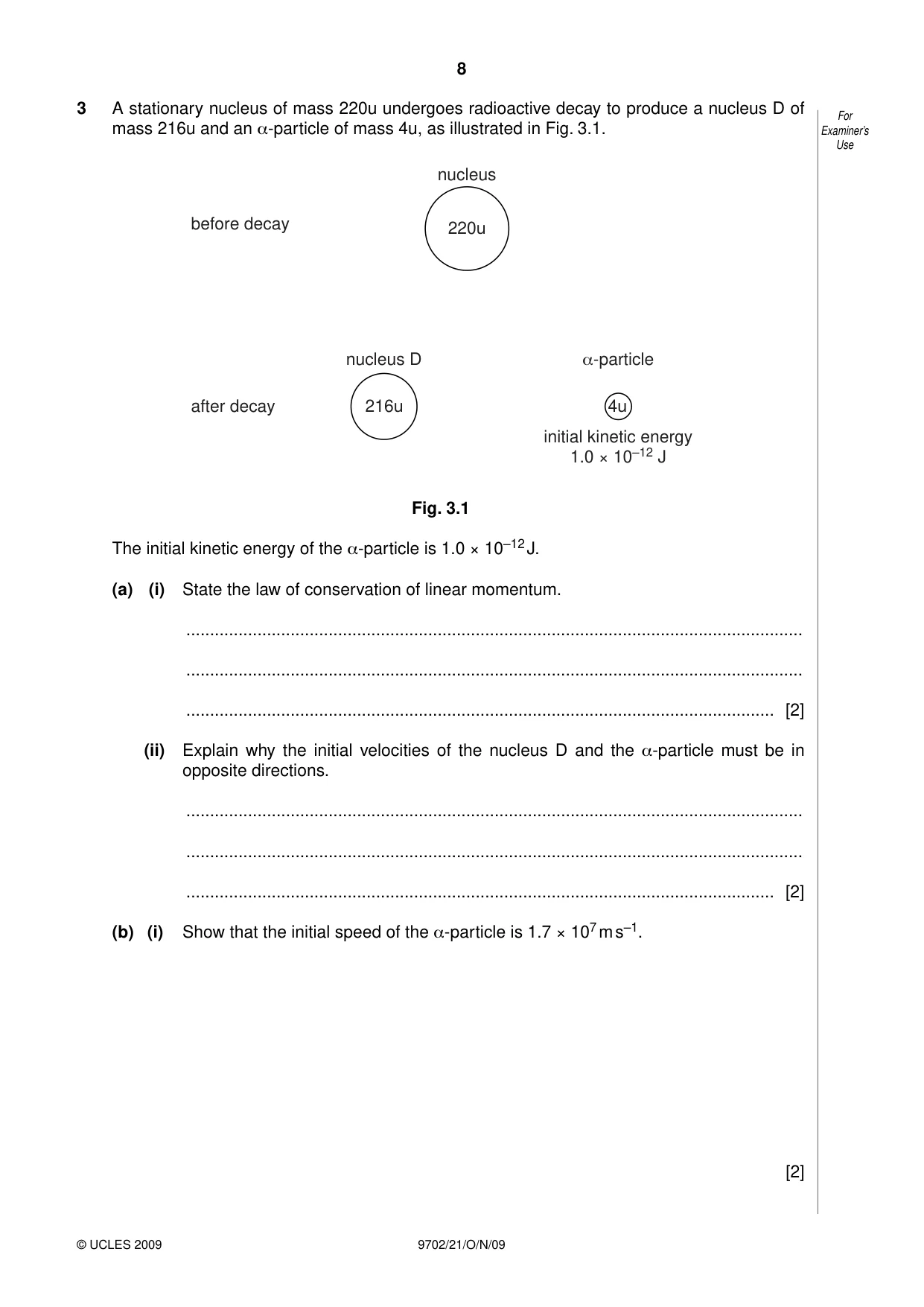
3 A stationary nucleus of mass 220u undergoes radioactive decay to produce a nucleus D of For mass 216u and an α-particle of mass 4u, as illustrated in Fig. 3.1. Examiner’s Use nucleus before decay 220u nucleus D α-particle after decay 216u 4u initial kinetic energy 1.0 × 10⁻¹² J Fig. 3.1 The initial kinetic energy of the α-particle is 1.0 × 10⁻¹² J. (a) (i) State the law of conservation of linear momentum. .................................................................................................................................. .................................................................................................................................. ............................................................................................................................ [2] (ii) Explain why the initial velocities of the nucleus D and the α-particle must be in opposite directions. .................................................................................................................................. .................................................................................................................................. ............................................................................................................................ [2] (b) (i) Show that the initial speed of the α-particle is 1.7 × 10⁷ m s–1. [2] (ii) Calculate the initial speed of nucleus D. For Examiner’s Use speed = ...................................... m s–1 [2] (c) The range in air of the emitted α-particle is 4.5 cm. Calculate the average deceleration of the α-particle as it is stopped by the air. deceleration = ...................................... m s–2 [2]
Mark scheme: 3 (a) (i) either sum / total momentum (of system of bodies) is constant or total momentum before = total momentum after ......................................M1 for an isolated system / no (external) force acts on system ............................... A1 [2] (ii) zero momentum before / after decay ..................................................................M1 so α-particle and nucleus D must have momenta in opposite directions ........... A1 [2] (b) (i) kinetic energy = ½ mv2 .. ...................................................................................C1 1.0 × 10-12 = ½ × 4 × 1.66 × 10-27 × v2 ..............................................................M1 v = 1.7 × 10⁷ m s-1 ............................................................................................. A0 [2] (ii) 1.7 × 107 × 4u = 216u × V ................................................................................C1 V = 3.1 × 10⁵ m s-1 ............................................................................................ A1 [2] (accept 3.2 × 10⁵ m s-1, do not accept 220 rather than 216) GCE A/AS LEVEL – October/November 2009 9702 21 (c) (1.7 × 10⁷)2 = 2 × deceleration × 4.5 × 10⁻² ..............................................................C1 deceleration / a = 3.2 × 10¹⁵ m s-2 ........................................................................... A1 [2] (accept calculation based on calculating F = 2.22 × 10⁻¹¹ N and then use of F = ma) [Total: 10]
Q4 · A uniform wire has length L and area of cross-section A
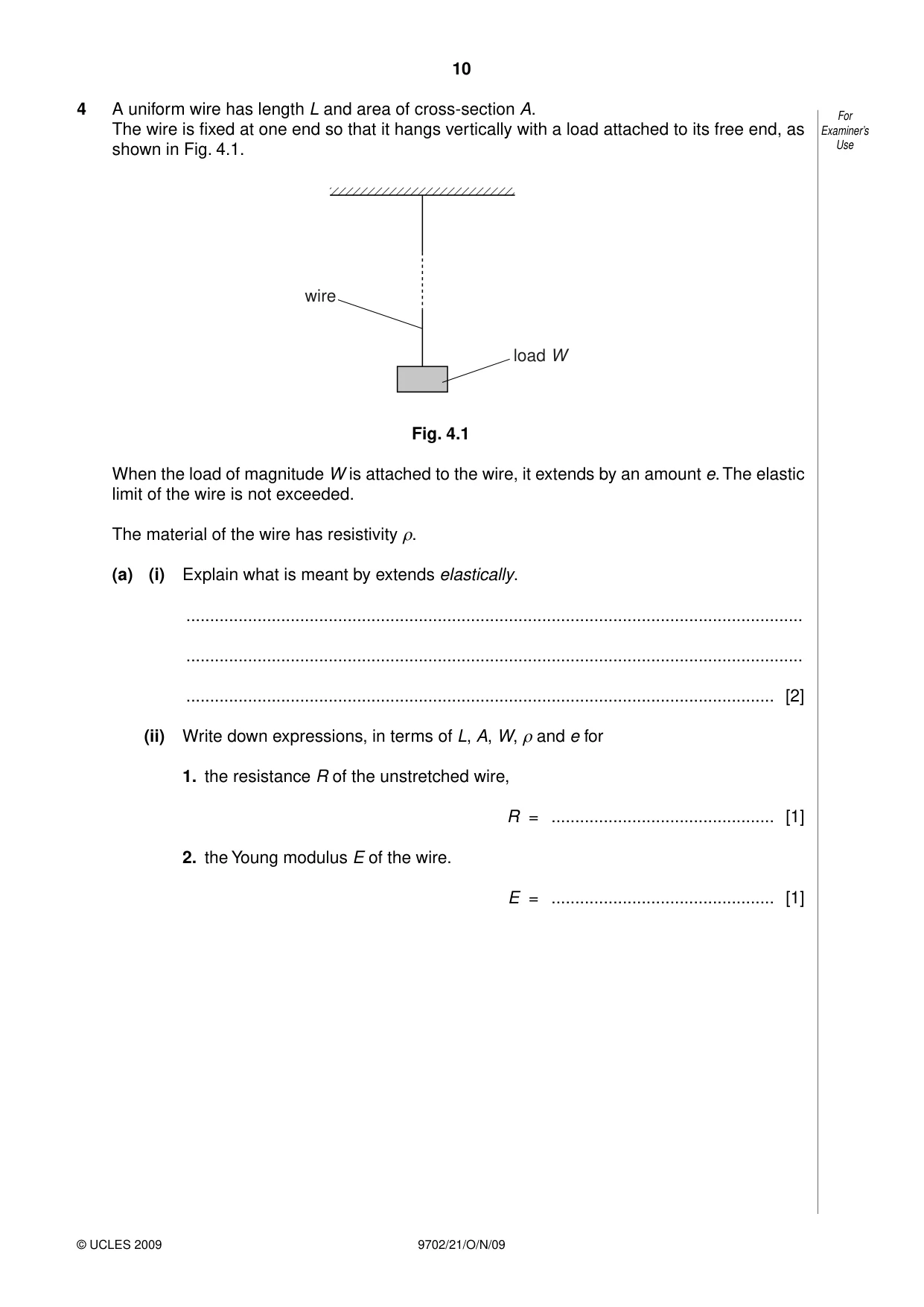
4 A uniform wire has length L and area of cross-section A. For The wire is fixed at one end so that it hangs vertically with a load attached to its free end, as Examiner’s shown in Fig. 4.1. Use wire load W Fig. 4.1 When the load of magnitude W is attached to the wire, it extends by an amount e. The elastic limit of the wire is not exceeded. The material of the wire has resistivity ρ. (a) (i) Explain what is meant by extends elastically. .................................................................................................................................. .................................................................................................................................. ............................................................................................................................ [2] (ii) Write down expressions, in terms of L, A, W, ρ and e for 1. the resistance R of the unstretched wire, R = ............................................... [1] 2. the Young modulus E of the wire. E = ............................................... [1] (b) A steel wire has resistance 0.44 Ω. Steel has resistivity 9.2 × 10⁻⁸ Ω m. For Examiner’s A load of 34 N hung from the end of the wire causes an extension of 7.7 × 10⁻⁴ m. Use Using your answers in (a)(ii), calculate the Young modulus E of steel. E = .......................................... Pa [3]
Mark scheme: 4 (a) (i) returns to original shape / size / length etc. ........................................................ B1 when load / distorting forces / weight / strain is removed ................................... B1 [2] (ii) 1 R = ρL / A ....................................................................................................... B1 [1] 2 E = WL / Ae ................................................................................................... B1 [1] (b) E = WR / eρ ............................................................................................................C1 = (34 × 0.44) / (7.7 × 10-4 × 9.2 × 10-8) ....................................................................C1 = 2.1 × 10¹¹ Pa ......................................................................................................... A1 [3] [Total: 7]
Q5 · State what is meant by a progressive wave
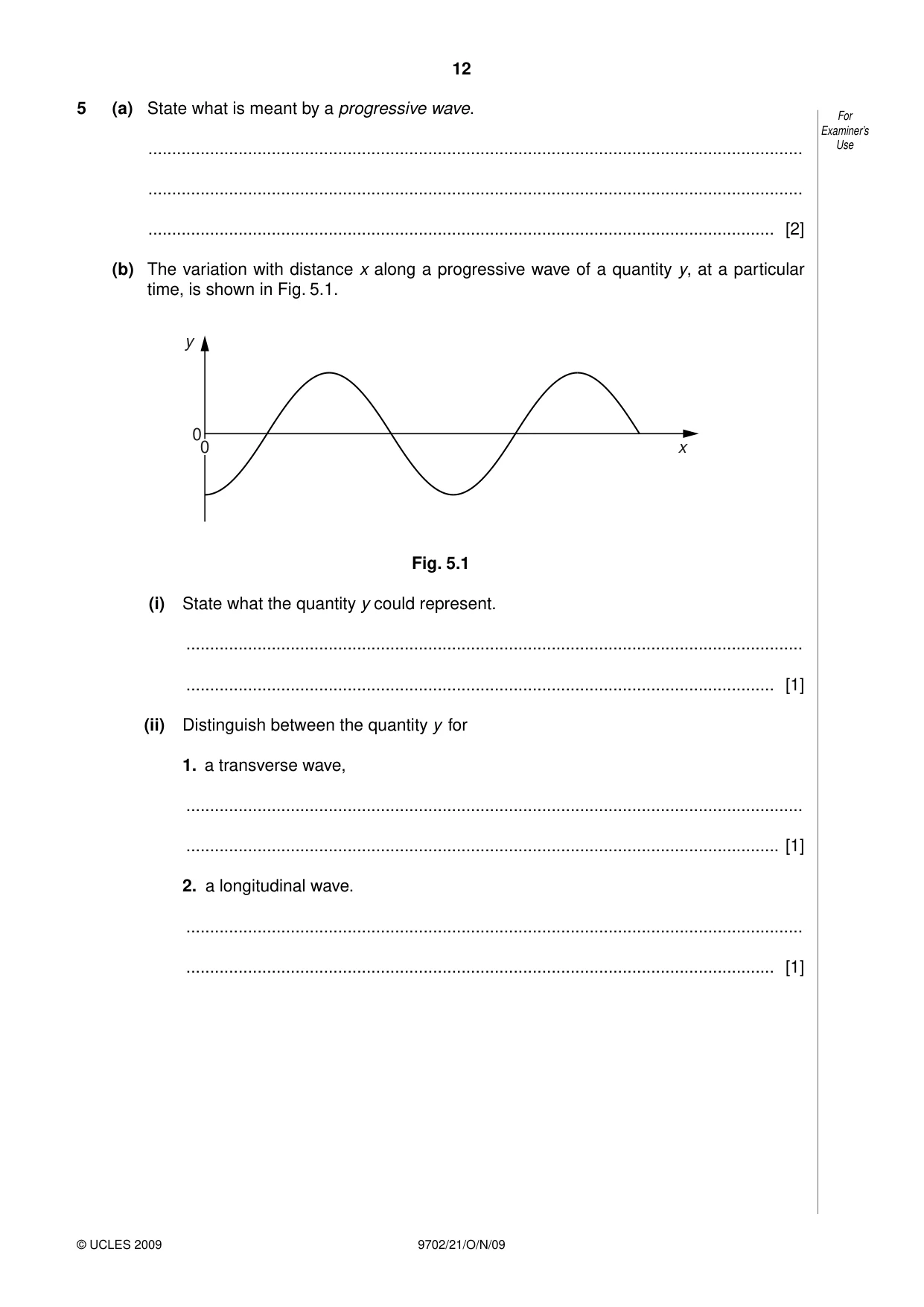
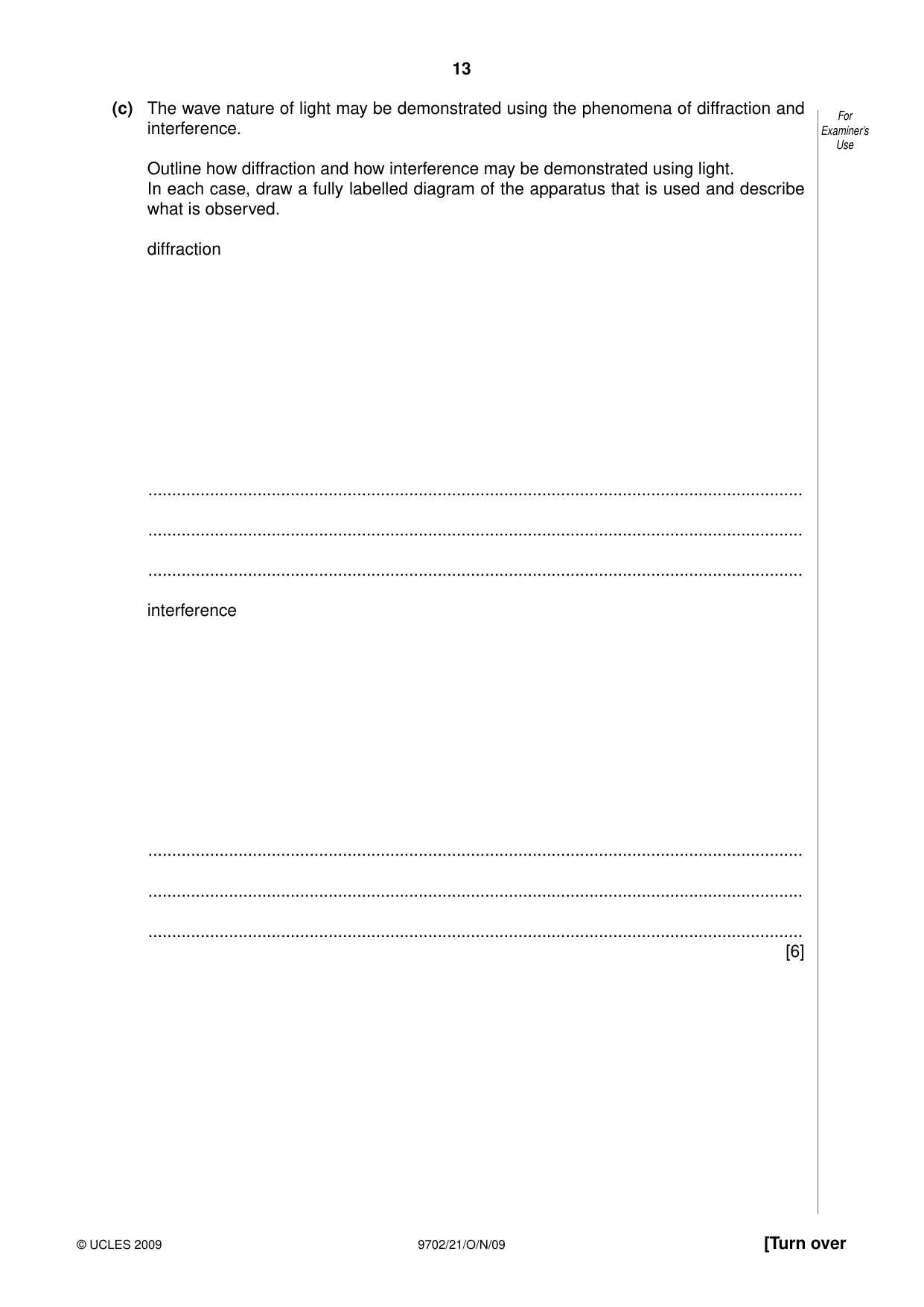
5 (a) State what is meant by a progressive wave. For Examiner’s .......................................................................................................................................... Use .......................................................................................................................................... .................................................................................................................................... [2] (b) The variation with distance x along a progressive wave of a quantity y, at a particular time, is shown in Fig. 5.1. y 0 0 x Fig. 5.1 (i) State what the quantity y could represent. .................................................................................................................................. ............................................................................................................................ [1] (ii) Distinguish between the quantity y for 1. a transverse wave, .................................................................................................................................. ............................................................................................................................. [1] 2. a longitudinal wave. .................................................................................................................................. ............................................................................................................................ [1] (c) The wave nature of light may be demonstrated using the phenomena of diffraction and For interference. Examiner’s Use Outline how diffraction and how interference may be demonstrated using light. In each case, draw a fully labelled diagram of the apparatus that is used and describe what is observed. diffraction .......................................................................................................................................... .......................................................................................................................................... .......................................................................................................................................... interference .......................................................................................................................................... .......................................................................................................................................... .......................................................................................................................................... [6]
Mark scheme: 5 (a) transfer / propagation of energy ................................................................................M1 as a result of oscillations / vibrations ......................................................................... A1 [2] (b) (i) displacement / velocity / acceleration (of particles in the wave) ......................... B1 [1] (ii) displacement etc. is normal to direction of energy transfer / travel of wave / propagation of wave ……(not ‘wave motion’) ............................ B1 [1] (iii) displacement etc. along / same direction of energy transfer / travel of wave / propagation of wave ……(not ‘wave motion’) ............................ B1 [1] (c) diffraction: suitable object, means of observation ......................................................M1 either laser or lamp and aperture or distant source ........................................................................................................M1 light region where darkness expected ....................................................................... A1 interference: suitable object, means of observation and illumination ........................ B1 light and dark fringes observed ................................................................................. B1 appropriate reference to a dimension for diffraction or for interference .......................................................................................................... B1 [6] [Total: 11]
Q6 · A cell has electromotive force (e.m.f.) E and internal resistance r
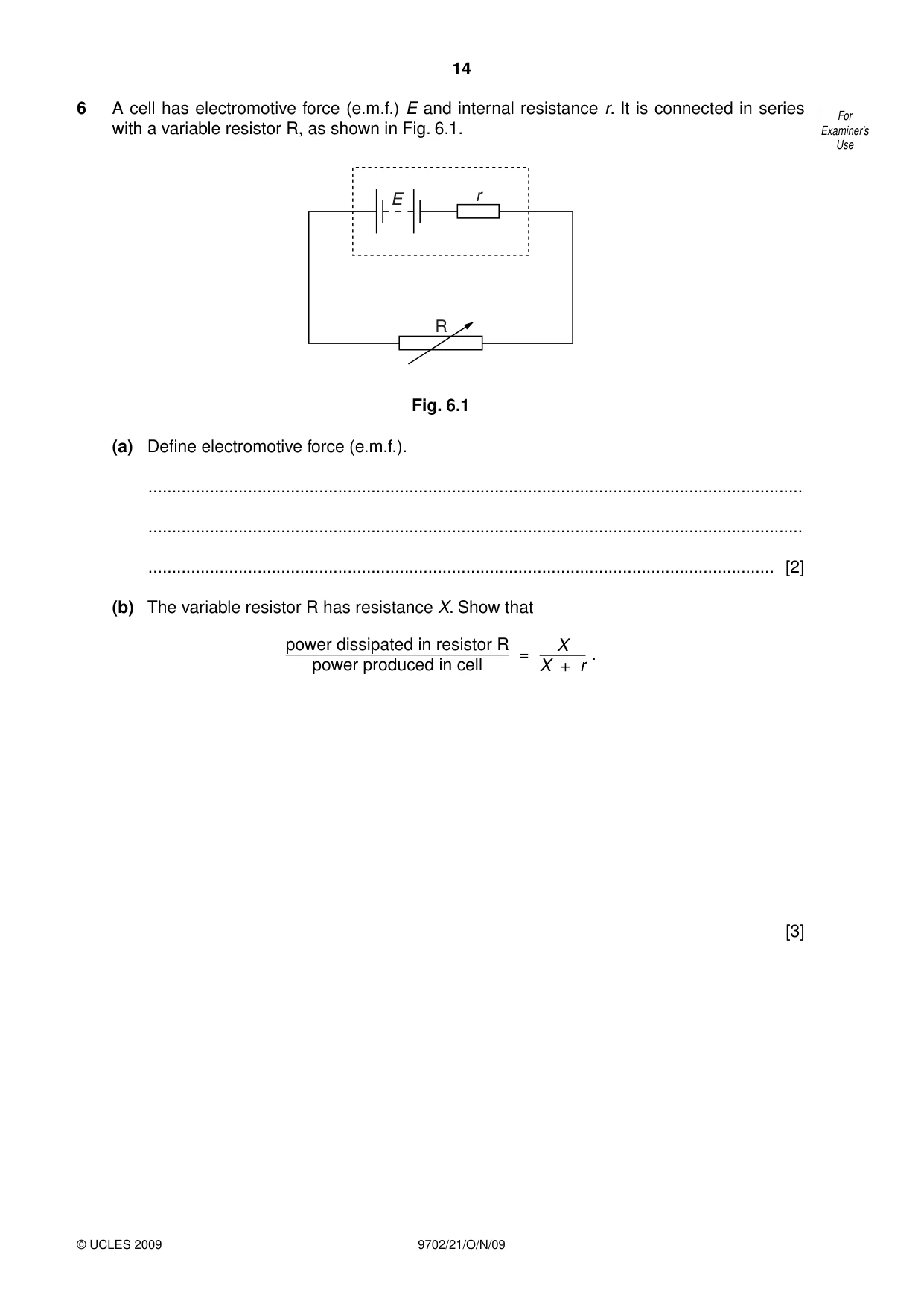
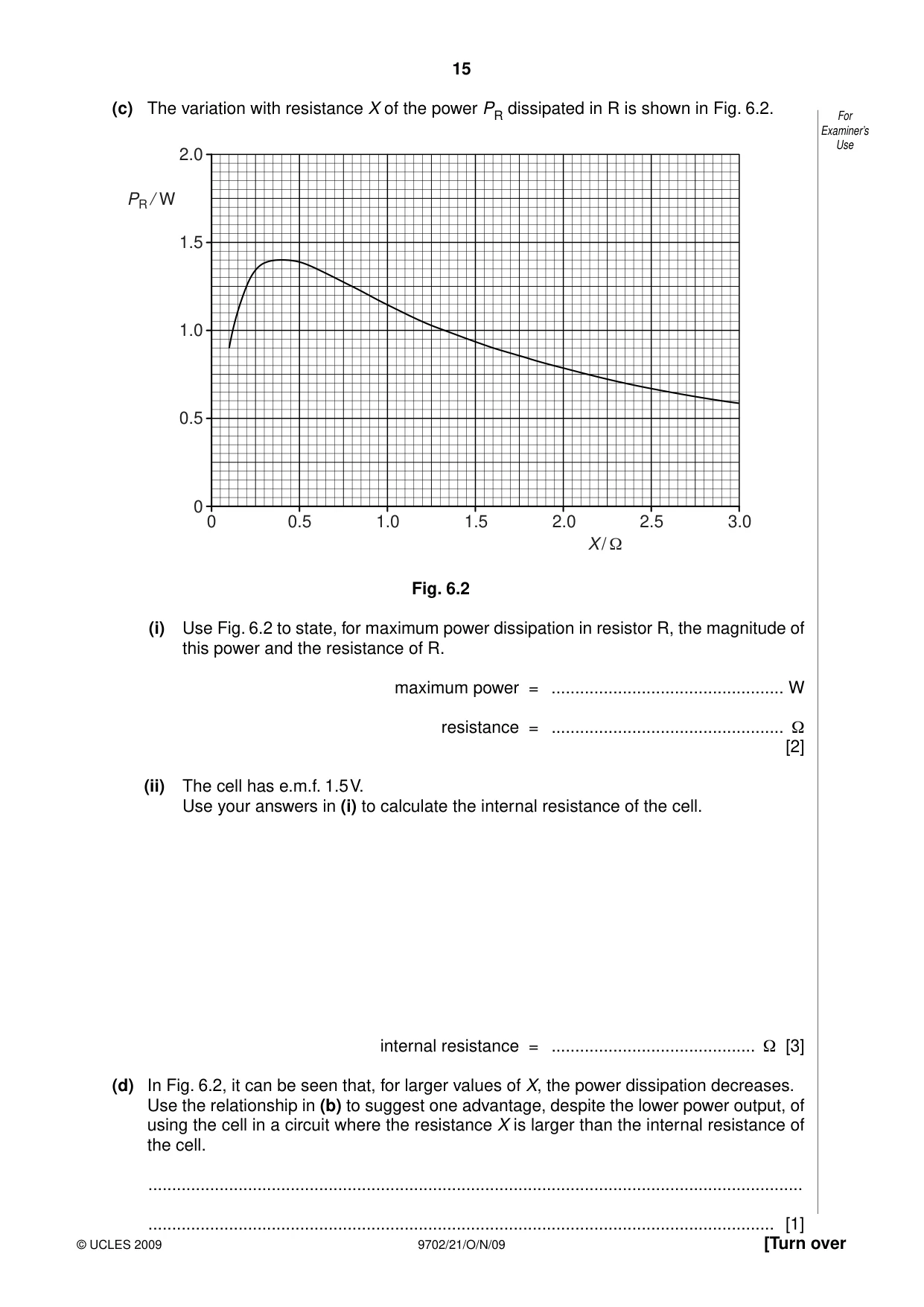
6 A cell has electromotive force (e.m.f.) E and internal resistance r. It is connected in series For with a variable resistor R, as shown in Fig. 6.1. Examiner’s Use E r R Fig. 6.1 (a) Define electromotive force (e.m.f.). .......................................................................................................................................... .......................................................................................................................................... .................................................................................................................................... [2] (b) The variable resistor R has resistance X. Show that power dissipated in resistor R X = . power produced in cell X + r [3] (c) The variation with resistance X of the power PR dissipated in R is shown in Fig. 6.2. For Examiner’s Use 2.0 PR / W 1.5 1.0 0.5 0 0 0.5 1.0 1.5 2.0 2.5 3.0 X / Ω Fig. 6.2 (i) Use Fig. 6.2 to state, for maximum power dissipation in resistor R, the magnitude of this power and the resistance of R. maximum power = ................................................. W resistance = ................................................. Ω [2] (ii) The cell has e.m.f. 1.5 V. Use your answers in (i) to calculate the internal resistance of the cell. internal resistance = ........................................... Ω [3] (d) In Fig. 6.2, it can be seen that, for larger values of X, the power dissipation decreases. Use the relationship in (b) to suggest one advantage, despite the lower power output, of using the cell in a circuit where the resistance X is larger than the internal resistance of the cell. .......................................................................................................................................... .................................................................................................................................... [1]
Mark scheme: 6 (a) energy transferred from source / changed from some form to electrical ...................M1 per unit charge (to drive charge round a complete circuit) ........................................ A1 [2] (b) and power in R = I 2X ............................................................................................M1 E = I (X + r) ................................................................................................................M1 power in cell = EI and algebra clear leading to ratio = X / (X + r) ............................. A1 [3] GCE A/AS LEVEL – October/November 2009 9702 21 (c) (i) 1.4 W .................................................................................................................. A1 0.40 Ω ………(allow ±0.05 Ω) ......................................................................... A1 [2] (ii) current in circuit = 1.4/0.4 = 1.87 A .............................................................C1 1.5 = 1.87 (r + 0.40) ..........................................................................................C1 r = 0.40 Ω …...................................................................................................... A1 [3] (d) either less power lost / energy wasted / lost or greater efficiency (of energy transfer) .......................................................... B1 [1] [Total: 11]
Q7 · An α-particle A approaches and passes by a stationary gold nucleus N
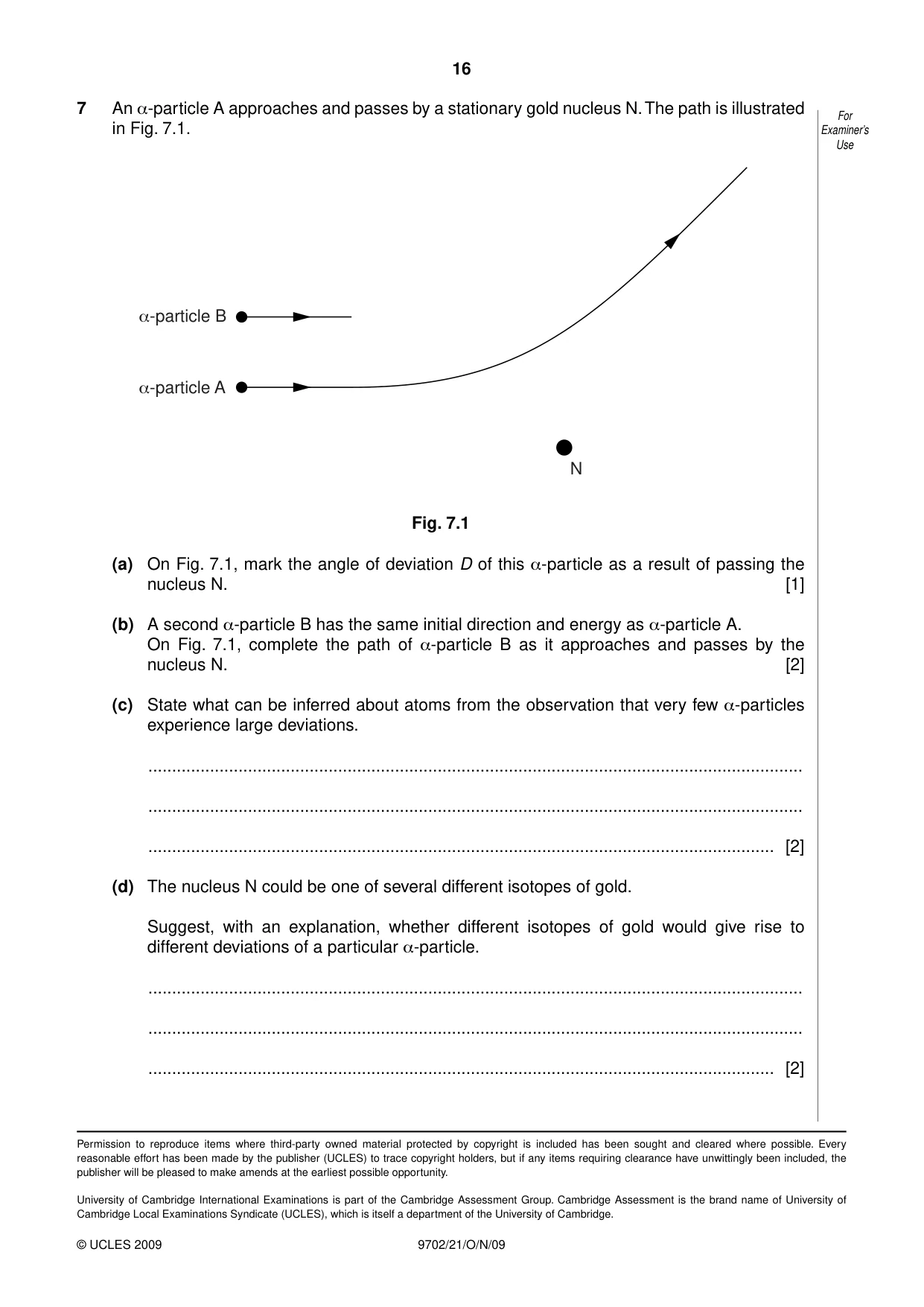
7 An α-particle A approaches and passes by a stationary gold nucleus N. The path is illustrated For in Fig. 7.1. Examiner’s Use α-particle B α-particle A N Fig. 7.1 (a) On Fig. 7.1, mark the angle of deviation D of this α-particle as a result of passing the nucleus N. [1] (b) A second α-particle B has the same initial direction and energy as α-particle A. On Fig. 7.1, complete the path of α-particle B as it approaches and passes by the nucleus N. [2] (c) State what can be inferred about atoms from the observation that very few α-particles experience large deviations. .......................................................................................................................................... .......................................................................................................................................... .................................................................................................................................... [2] (d) The nucleus N could be one of several different isotopes of gold. Suggest, with an explanation, whether different isotopes of gold would give rise to different deviations of a particular α-particle. .......................................................................................................................................... .......................................................................................................................................... .................................................................................................................................... [2]
Mark scheme: 7 (a) deviation shown correctly .......................................................................................... B1 [1] (b) smaller deviation (not zero deviation) ........................................................................M1 acceptable path wrt position of N .............................................................................. A1 [2] (c) the nucleus is (very) small .........................................................................................M1 in comparison to the atom ......................................................................................... A1 [2] (special case: ‘atom is mostly empty space’ scores 1 mark) (d) deviation depends on charge on the nucleus / N / electrostatic repulsion ................. B1 same charge so no change in deviation .................................................................... B1 [2] [Total: 7]
What was in this paper
The subtopics covered by these 7 questions, and how many questions each got. Open one in a new tab to see every Cambridge question on it.
What you needed in this session
Cambridge’s own grade thresholds for 2009 Oct/Nov, Paper 2 · Variant 1. A higher threshold means an easier paper — the bar moves with how the cohort did.