Cambridge A Level Physics 9702 — 2017 Oct/Nov Paper 2 · Variant 3
9702/23/O/N/17 · 7 questions · 60 marks · ≈68 min
The question paper and its mark scheme, free to read here and free to download. This is Cambridge’s own paper, exactly as it was sat.
Question paper16 pages

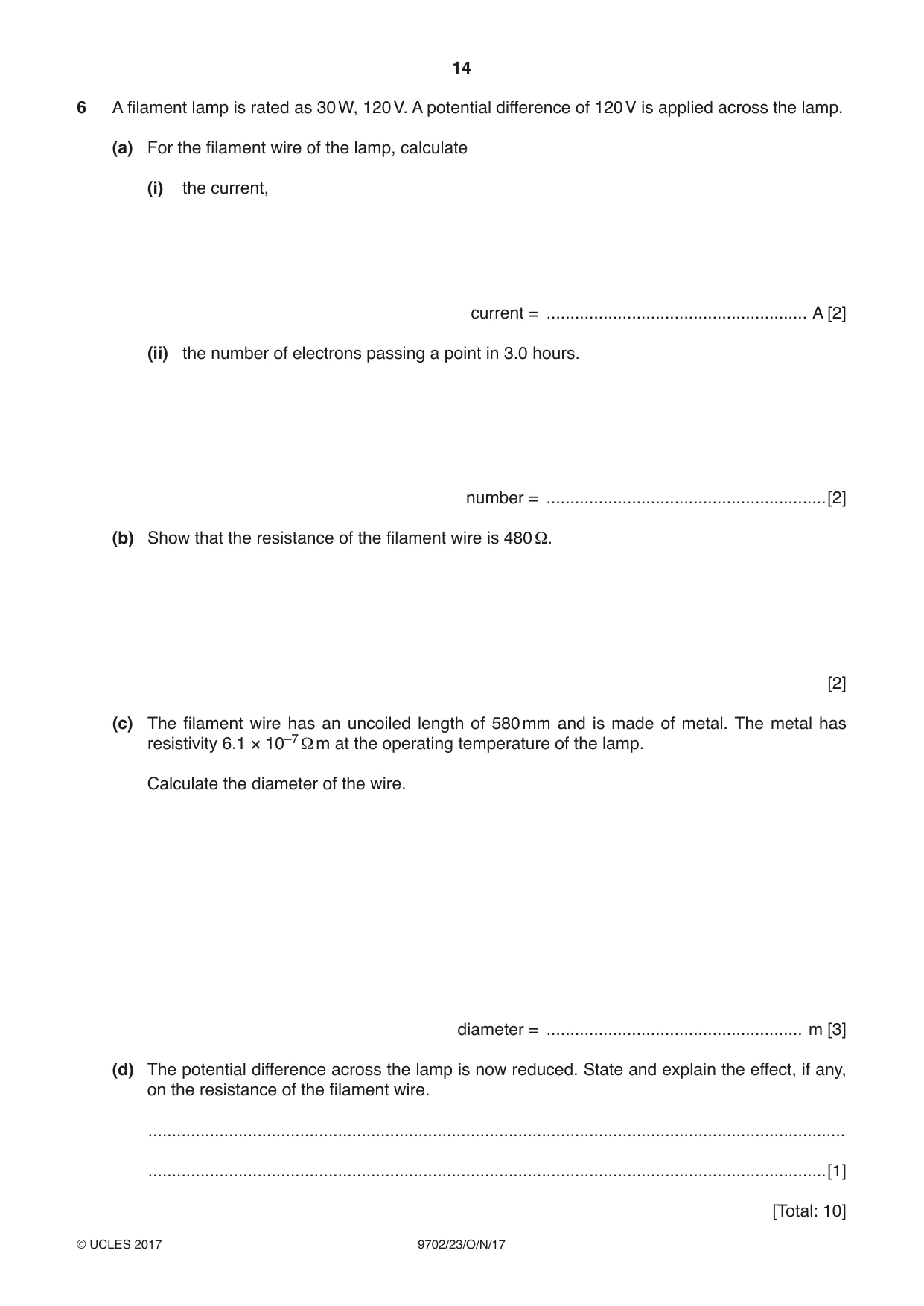
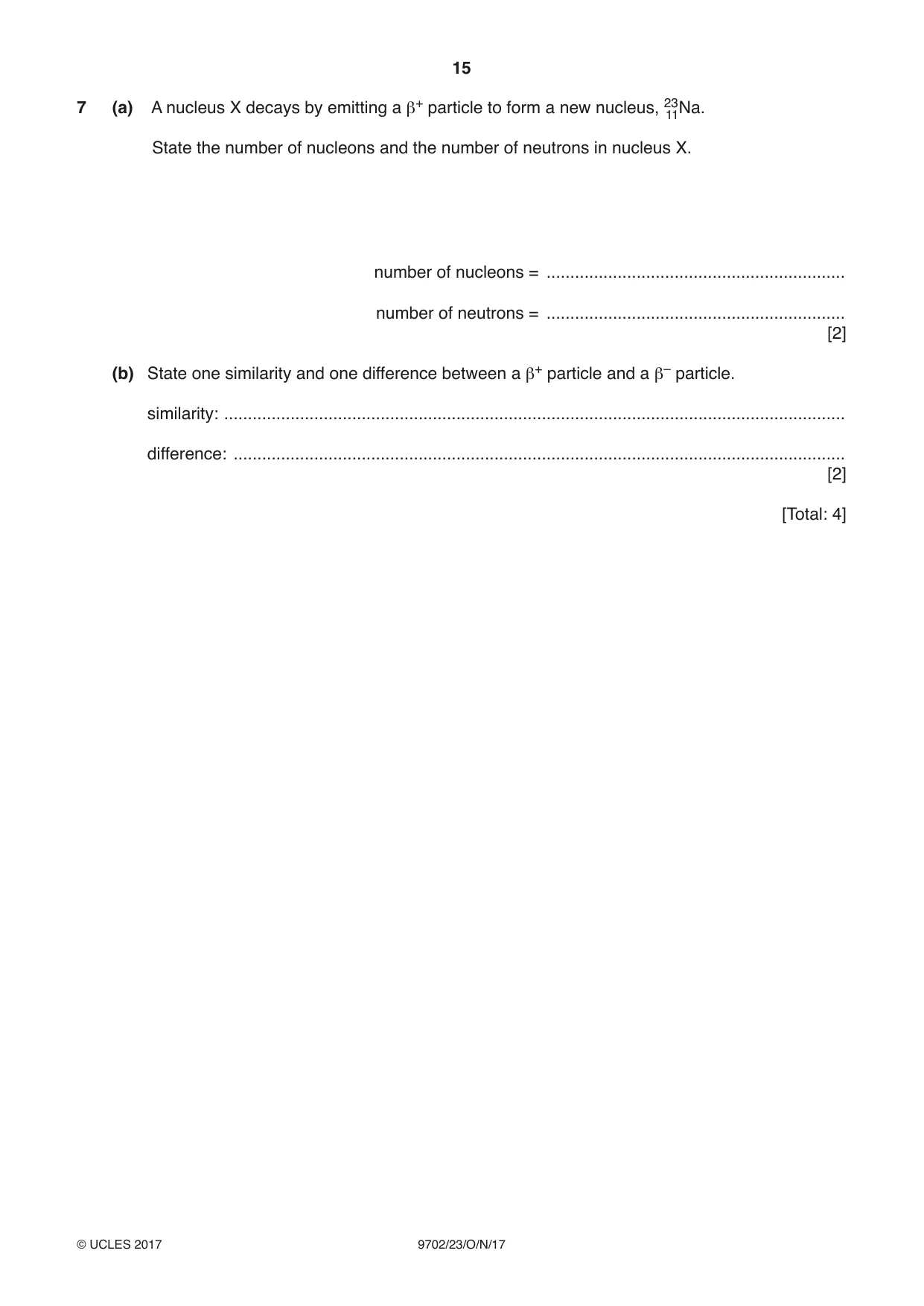
Mark scheme7 pages
Answers below. Sit the paper first if you are practising.
Questions as text
Question 1
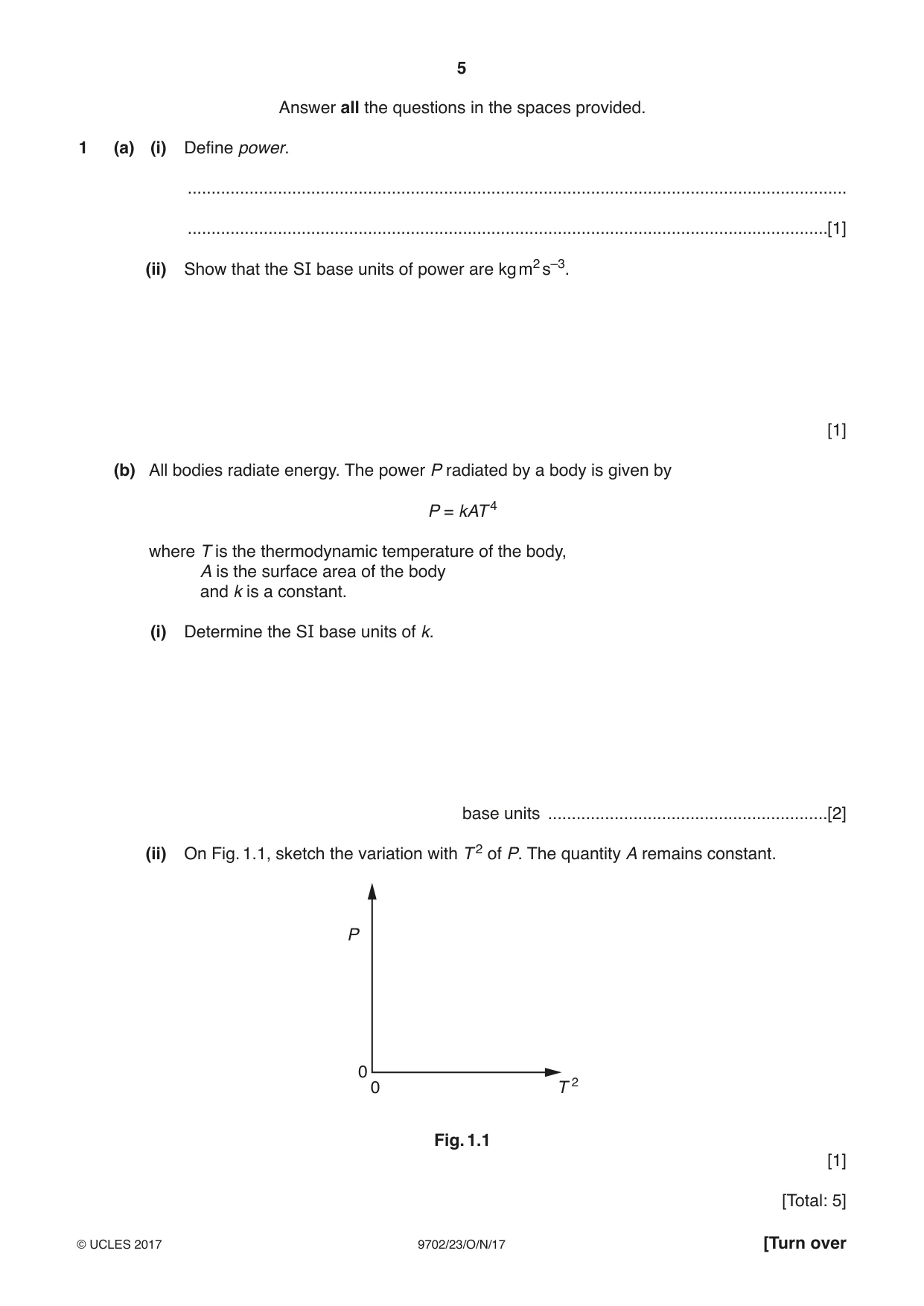
1 (a) (i) Define power. ........................................................................................................................................... .......................................................................................................................................[1] (ii) Show that the SI base units of power are kg m2 s–3. [1] (b) All bodies radiate energy. The power P radiated by a body is given by P = kAT 4 where T is the thermodynamic temperature of the body, A is the surface area of the body and k is a constant. (i) Determine the SI base units of k. base units ...........................................................[2] (ii) On Fig. 1.1, sketch the variation with T 2 of P. The quantity A remains constant. P 0 0 T 2 Fig. 1.1 [1] [Total: 5]
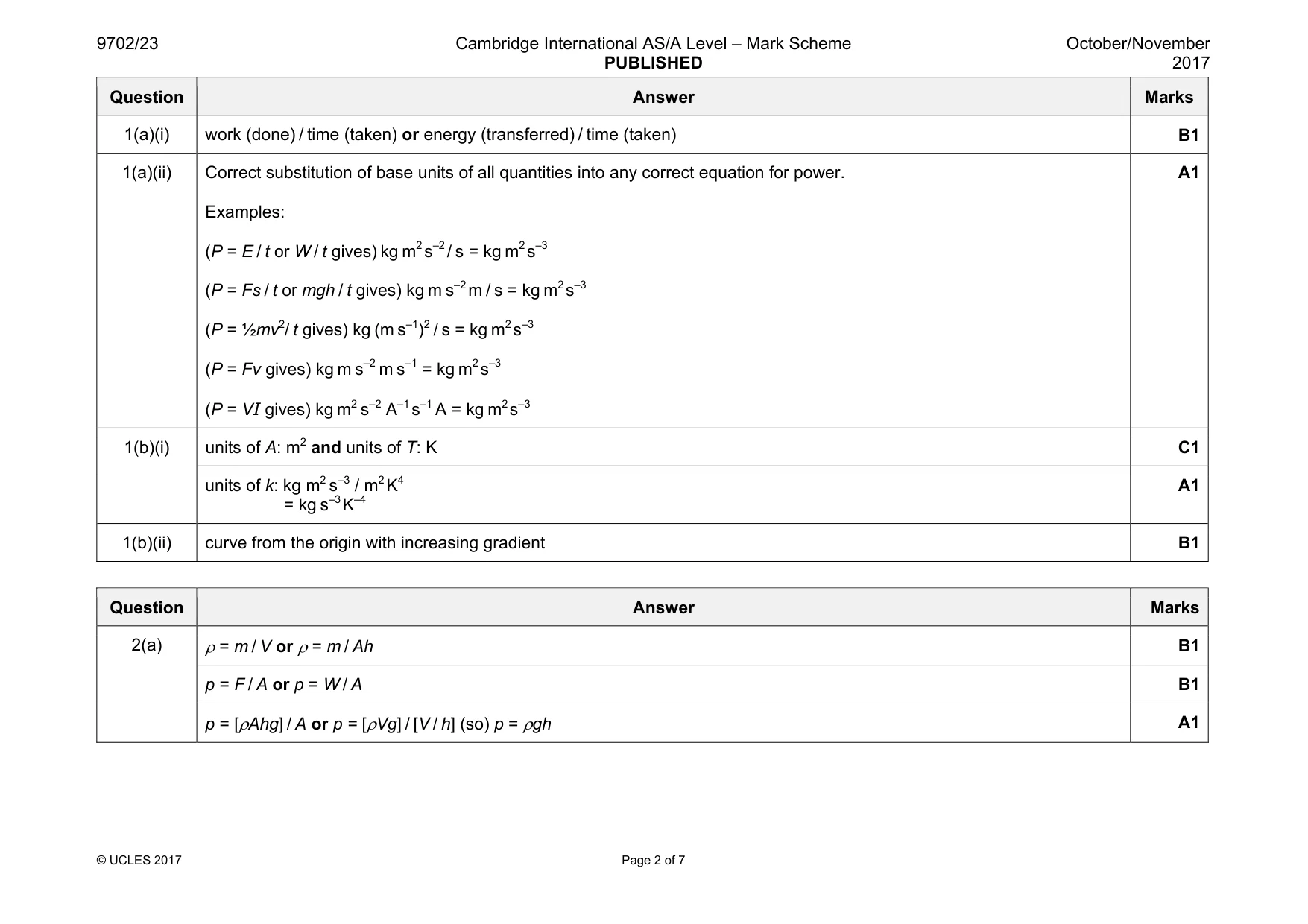
Mark scheme: 1(a)(i) work (done) / time (taken) or energy (transferred) / time (taken) B1 1(a)(ii) Correct substitution of base units of all quantities into any correct equation for power. Examples: (P = E / t or W / t gives) kg m2 s–2 / s = kg m2 s–3 (P = Fs / t or mgh / t gives) kg m s–2 m / s = kg m2 s–3 (P = ½mv2/ t gives) kg (m s–1)2 / s = kg m2 s–3 (P = Fv gives) kg m s–2 m s–1 = kg m2 s–3 (P = VI gives) kg m2 s–2 A–1 s–1 A = kg m2 s–3 A1 1(b)(i) units of A: m2 and units of T: K C1 units of k: kg m2 s–3 / m2 K4 = kg s–3 K–4 A1 1(b)(ii) curve from the origin with increasing gradient B1
Q2 · A liquid of density ρ fills a container to a depth h, as shown in Fig
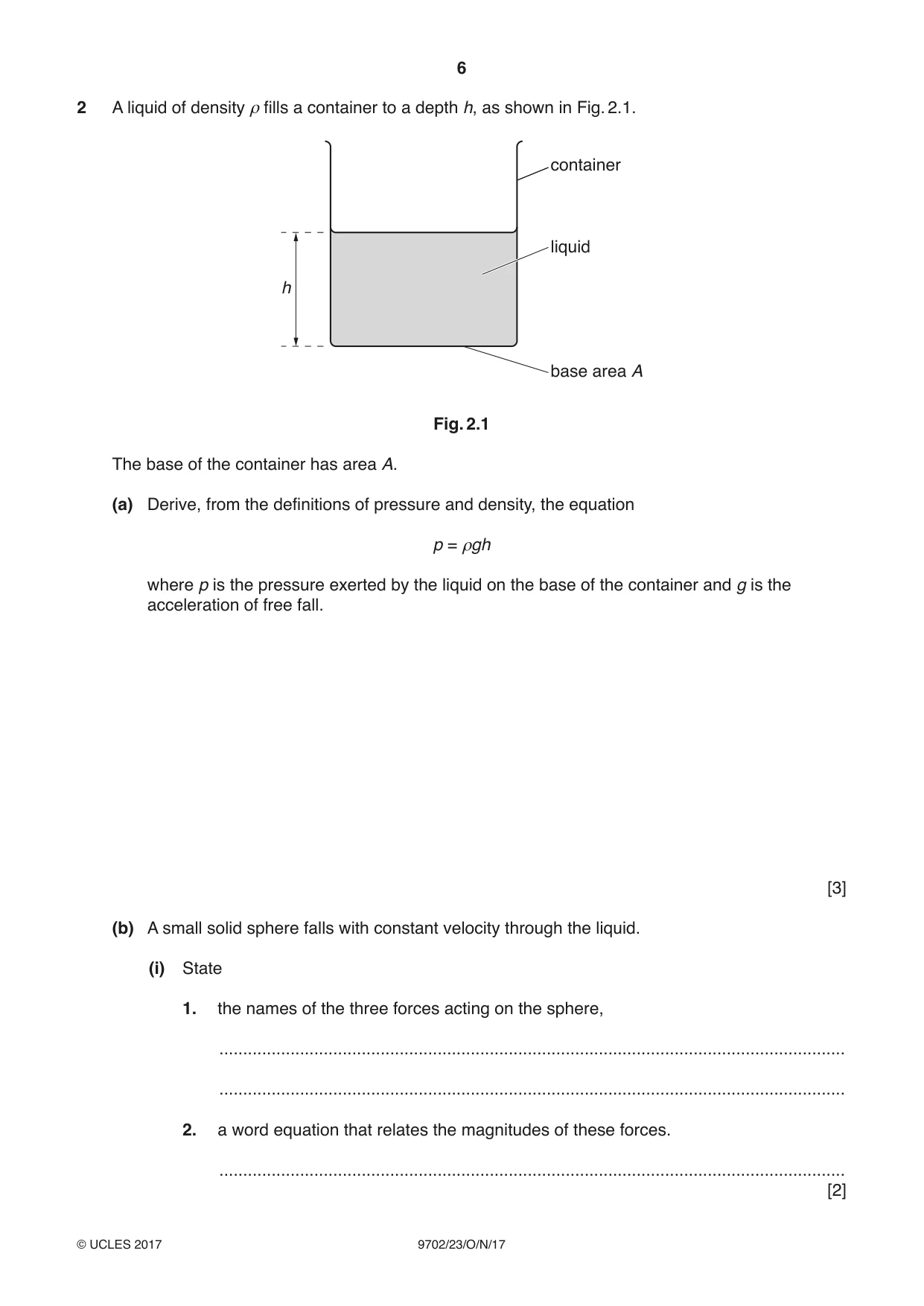
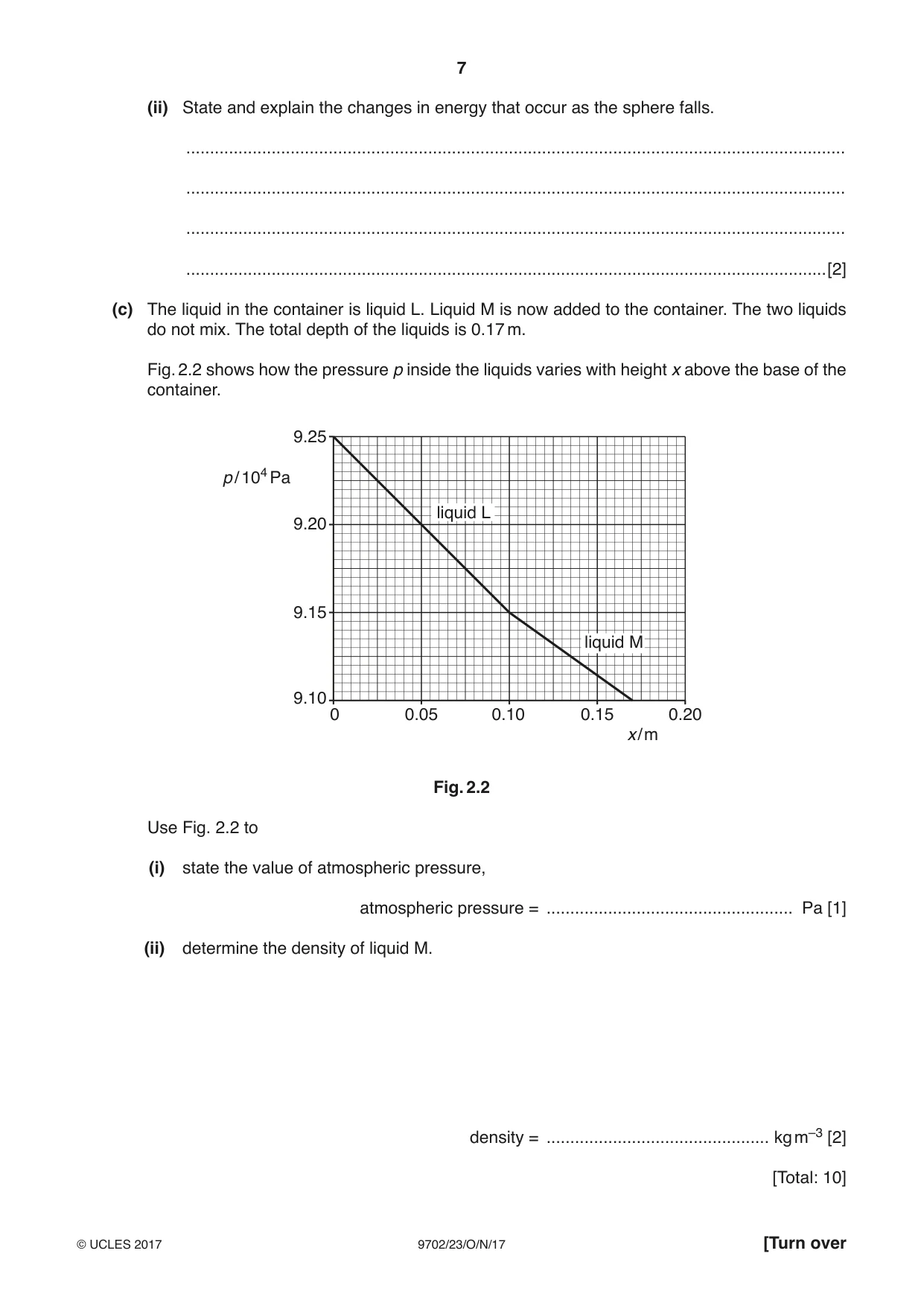
2 A liquid of density ρ fills a container to a depth h, as shown in Fig. 2.1. container liquid h base area A Fig. 2.1 The base of the container has area A. (a) Derive, from the definitions of pressure and density, the equation p = ρgh where p is the pressure exerted by the liquid on the base of the container and g is the acceleration of free fall. [3] (b) A small solid sphere falls with constant velocity through the liquid. (i) State 1. the names of the three forces acting on the sphere, .................................................................................................................................... .................................................................................................................................... 2. a word equation that relates the magnitudes of these forces. .................................................................................................................................... [2] (ii) State and explain the changes in energy that occur as the sphere falls. ........................................................................................................................................... ........................................................................................................................................... ........................................................................................................................................... .......................................................................................................................................[2] (c) The liquid in the container is liquid L. Liquid M is now added to the container. The two liquids do not mix. The total depth of the liquids is 0.17 m. Fig. 2.2 shows how the pressure p inside the liquids varies with height x above the base of the container. 9.25 p / 104 Pa liquid L 9.20 9.15 liquid M 9.10 0 0.05 0.10 0.15 0.20 x / m Fig. 2.2 Use Fig. 2.2 to (i) state the value of atmospheric pressure, atmospheric pressure = .................................................... Pa [1] (ii) determine the density of liquid M. density = ............................................... kg m–3 [2] [Total: 10]
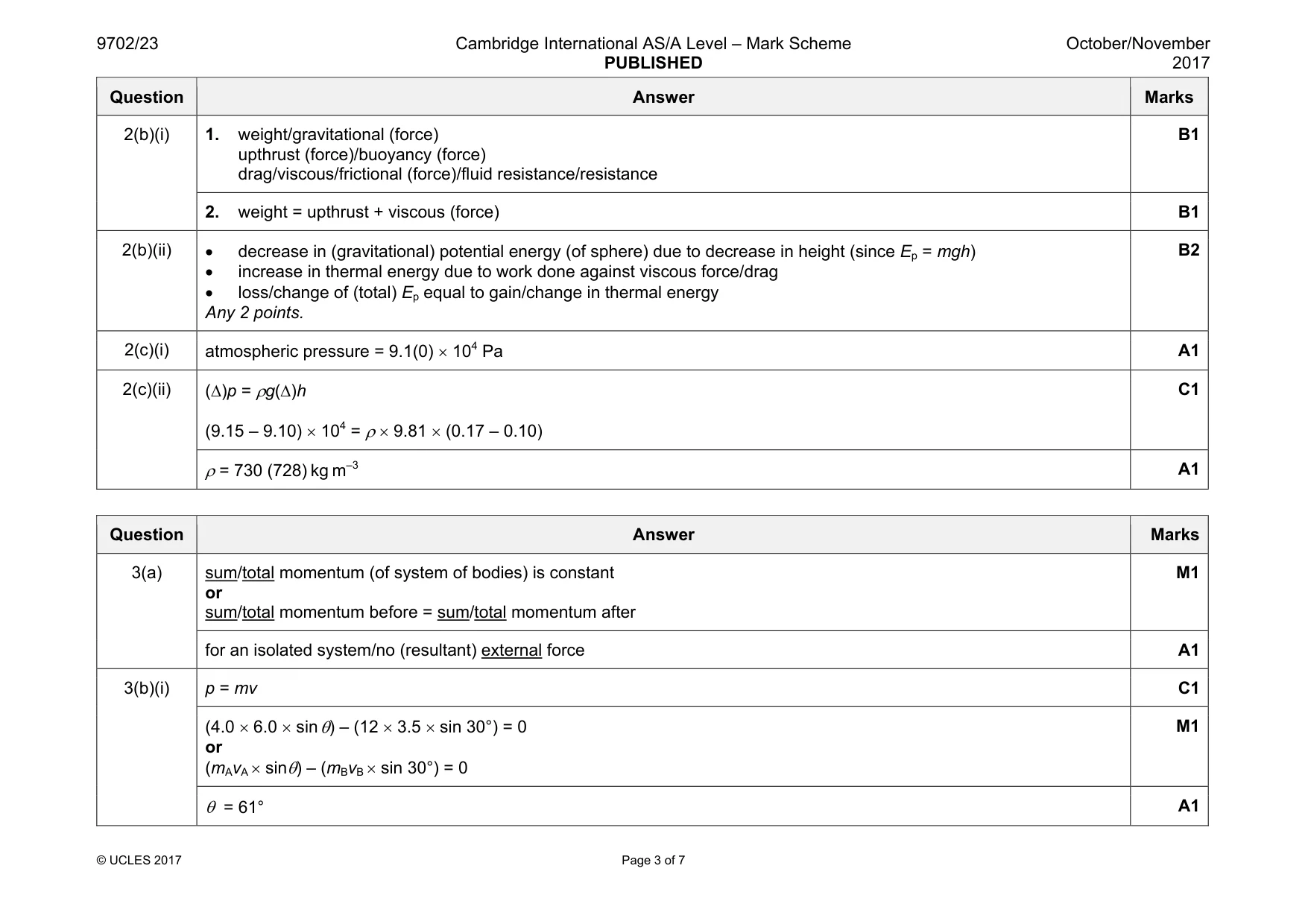
Mark scheme: 2(a) B1 p = F / A or p = W / A B1 p = [ρAhg] / A or p = [ρVg] / [V / h] (so) p = ρgh A1 Question Answer Marks 2(b)(i) 1. weight/gravitational (force) upthrust (force)/buoyancy (force) drag/viscous/frictional (force)/fluid resistance/resistance B1 2. weight = upthrust + viscous (force) B1 2(b)(ii) • decrease in (gravitational) potential energy (of sphere) due to decrease in height (since Ep = mgh) • increase in thermal energy due to work done against viscous force/drag • loss/change of (total) Ep equal to gain/change in thermal energy Any 2 points. B2 2(c)(i) atmospheric pressure = 9.1(0) × 104 Pa A1 2(c)(ii) (∆)p = ρg(∆)h (9.15 – 9.10) × 104 = ρ × 9.81 × (0.17 – 0.10) C1 ρ = 730 (728) kg m–3 A1
Q3 · State the principle of conservation of momentum
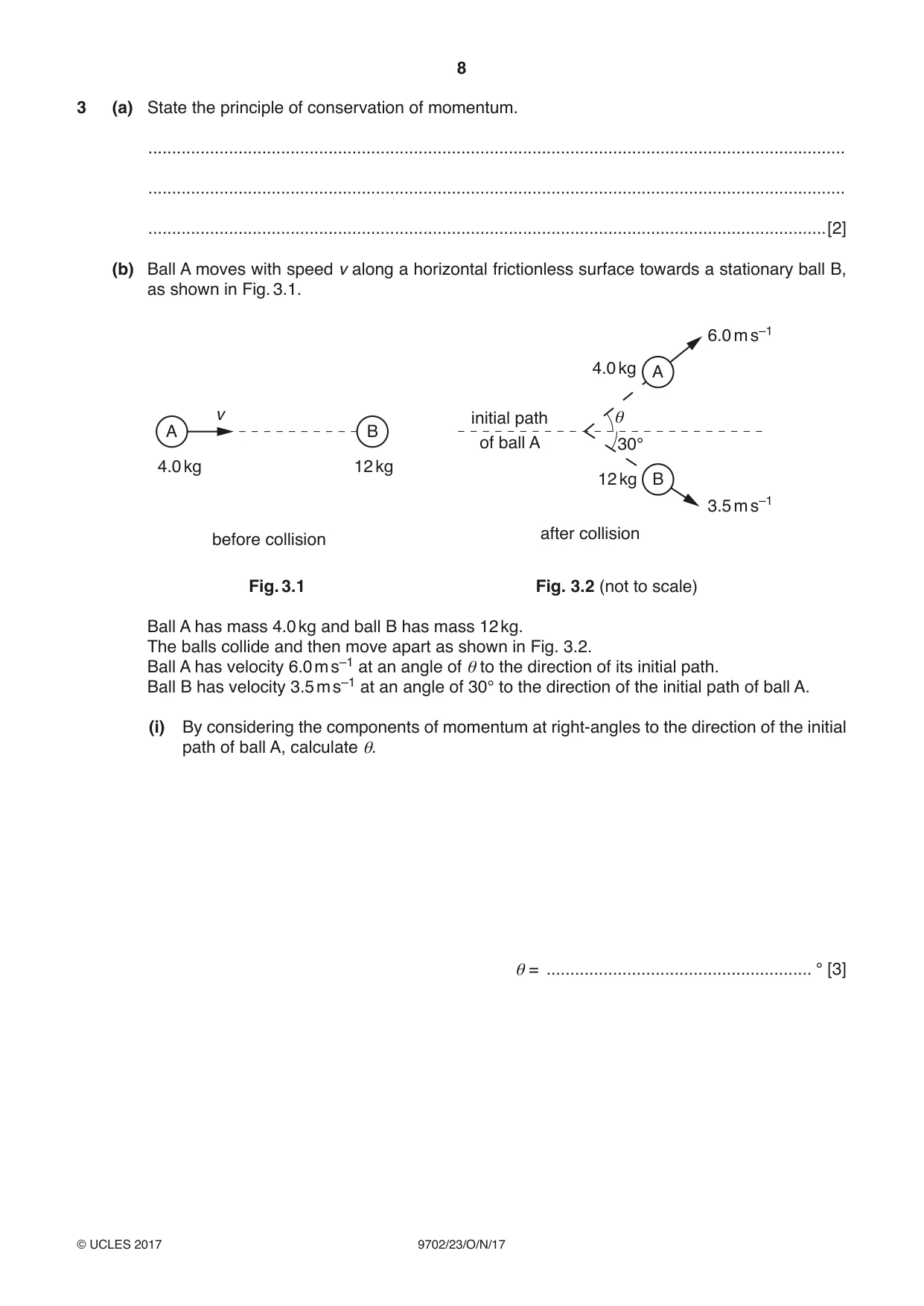
3 (a) State the principle of conservation of momentum. ................................................................................................................................................... ................................................................................................................................................... ...............................................................................................................................................[2] (b) Ball A moves with speed v along a horizontal frictionless surface towards a stationary ball B, as shown in Fig. 3.1. 6.0 m s–1 4.0 kg A v initial path θ A B of ball A 30° 4.0 kg 12 kg 12 kg B 3.5 m s–1 after collision before collision Fig. 3.1 Fig. 3.2 (not to scale) Ball A has mass 4.0 kg and ball B has mass 12 kg. The balls collide and then move apart as shown in Fig. 3.2. Ball A has velocity 6.0 m s–1 at an angle of θ to the direction of its initial path. Ball B has velocity 3.5 m s–1 at an angle of 30° to the direction of the initial path of ball A. (i) By considering the components of momentum at right-angles to the direction of the initial path of ball A, calculate θ. θ = ........................................................ ° [3] (ii) Use your answer in (i) to show that the initial speed v of ball A is 12 m s–1. Explain your working. [2] (iii) By calculation of kinetic energies, state and explain whether the collision is elastic or inelastic. ........................................................................................................................................... .......................................................................................................................................[3] [Total: 10]
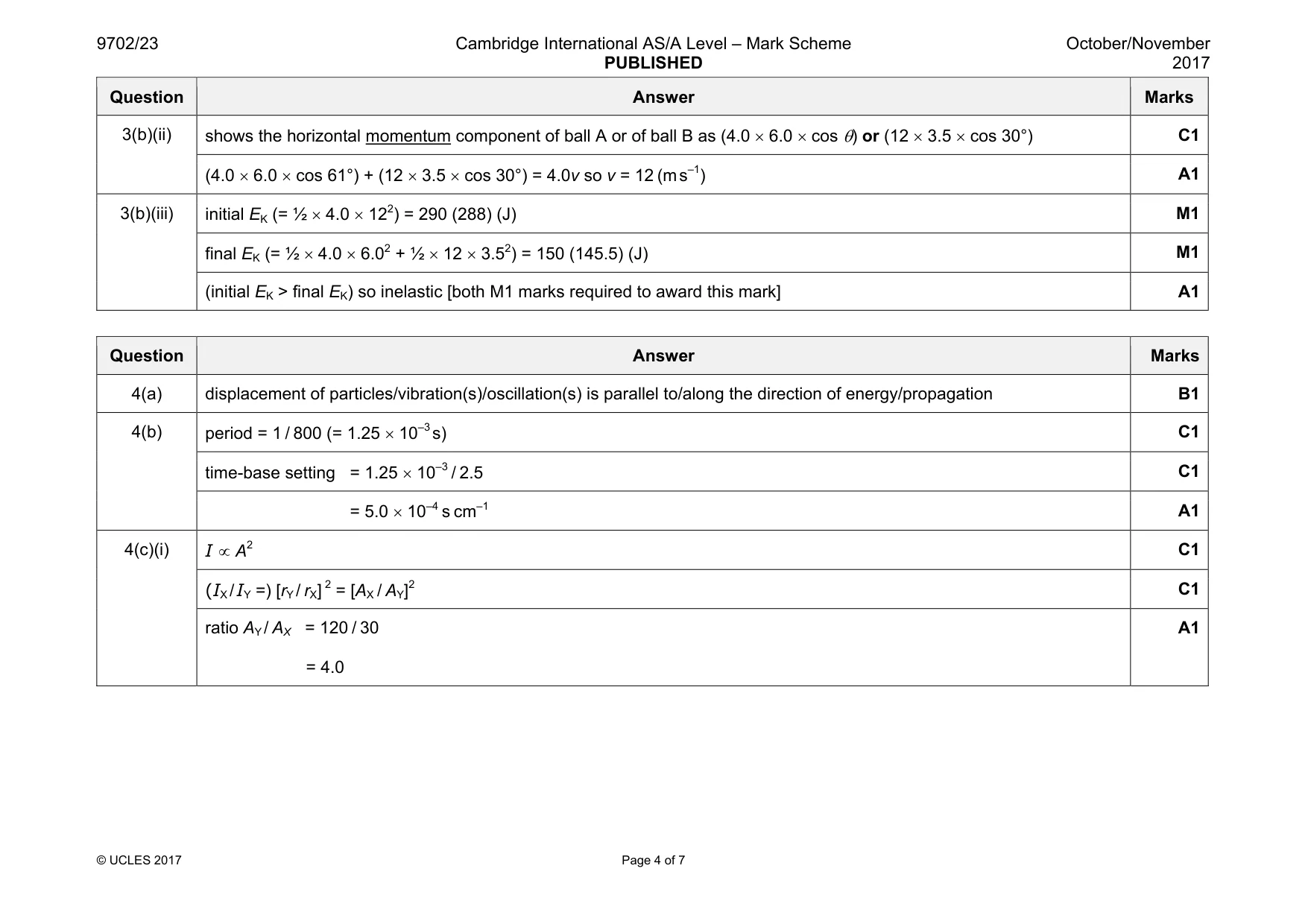
Mark scheme: 3(a) sum/total momentum (of system of bodies) is constant or sum/total momentum before = sum/total momentum after M1 for an isolated system/no (resultant) external force A1 3(b)(i) p = mv C1 (4.0 × 6.0 × sin θ) – (12 × 3.5 × sin 30°) = 0 or (mAvA × sinθ) – (mBvB × sin 30°) = 0 M1 θ = 61° A1 Question Answer Marks 3(b)(ii) shows the horizontal momentum component of ball A or of ball B as (4.0 × 6.0 × cos θ) or (12 × 3.5 × cos 30°) C1 (4.0 × 6.0 × cos 61°) + (12 × 3.5 × cos 30°) = 4.0v so v = 12 (m s–1) A1 3(b)(iii) initial EK (= ½ × 4.0 × 122) = 290 (288) (J) M1 final EK (= ½ × 4.0 × 6.02 + ½ × 12 × 3.52) = 150 (145.5) (J) M1 (initial EK > final EK) so inelastic [both M1 marks required to award this mark] A1
Q4 · By reference to the direction of propagation of energy, explain what is meant by a…
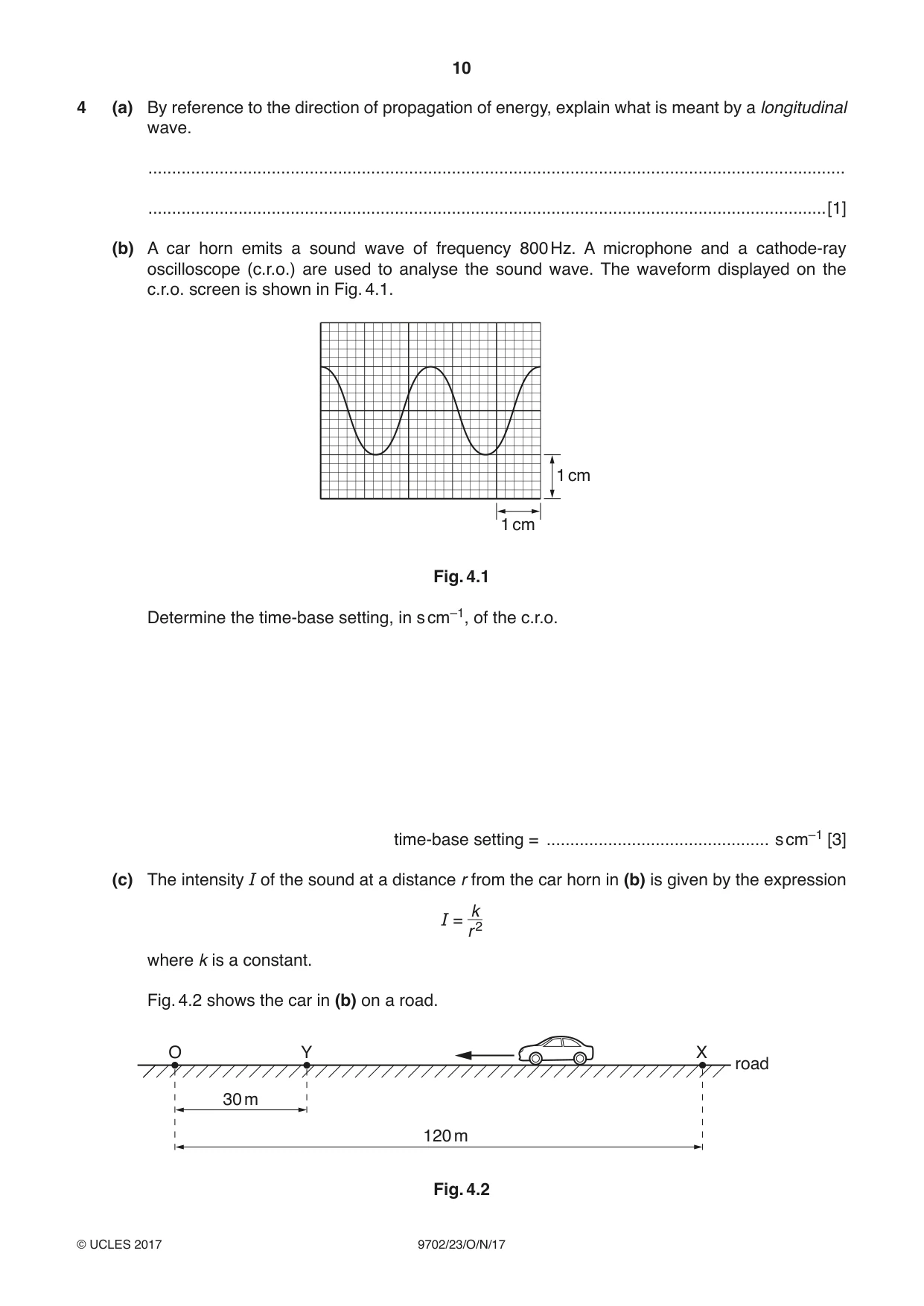
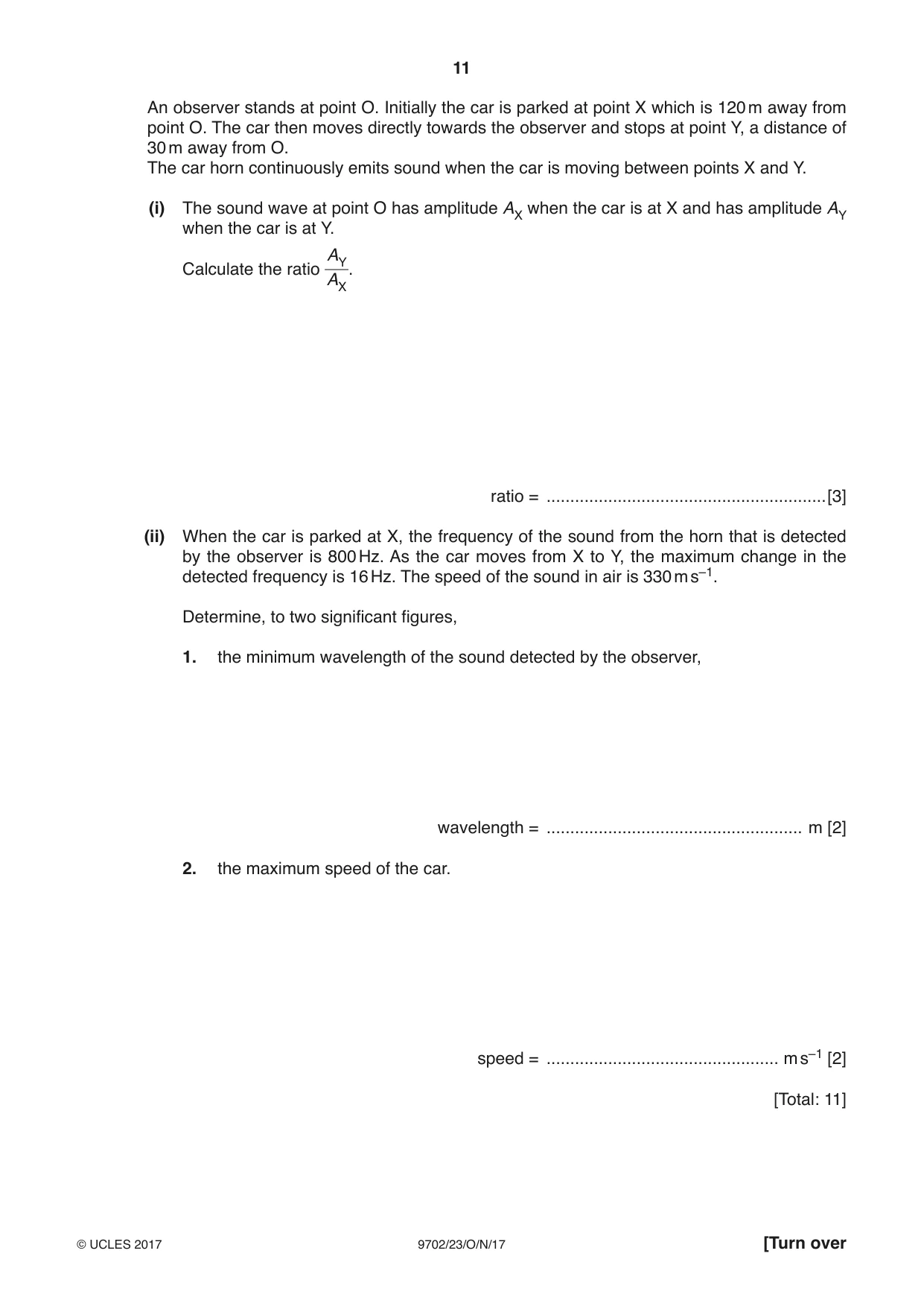
4 (a) By reference to the direction of propagation of energy, explain what is meant by a longitudinal wave. ................................................................................................................................................... ...............................................................................................................................................[1] (b) A car horn emits a sound wave of frequency 800 Hz. A microphone and a cathode-ray oscilloscope (c.r.o.) are used to analyse the sound wave. The waveform displayed on the c.r.o. screen is shown in Fig. 4.1. 1 cm 1 cm Fig. 4.1 Determine the time-base setting, in s cm–1, of the c.r.o. time-base setting = ............................................... s cm–1 [3] (c) The intensity I of the sound at a distance r from the car horn in (b) is given by the expression k I = 2 r where k is a constant. Fig. 4.2 shows the car in (b) on a road. O Y X road 30 m 120 m Fig. 4.2 An observer stands at point O. Initially the car is parked at point X which is 120 m away from point O. The car then moves directly towards the observer and stops at point Y, a distance of 30 m away from O. The car horn continuously emits sound when the car is moving between points X and Y. (i) The sound wave at point O has amplitude AX when the car is at X and has amplitude AY when the car is at Y. AY Calculate the ratio . AX ratio = ...........................................................[3] (ii) When the car is parked at X, the frequency of the sound from the horn that is detected by the observer is 800 Hz. As the car moves from X to Y, the maximum change in the detected frequency is 16 Hz. The speed of the sound in air is 330 m s–1. Determine, to two significant figures, 1. the minimum wavelength of the sound detected by the observer, wavelength = ...................................................... m [2] 2. the maximum speed of the car. speed = ................................................. m s–1 [2] [Total: 11]
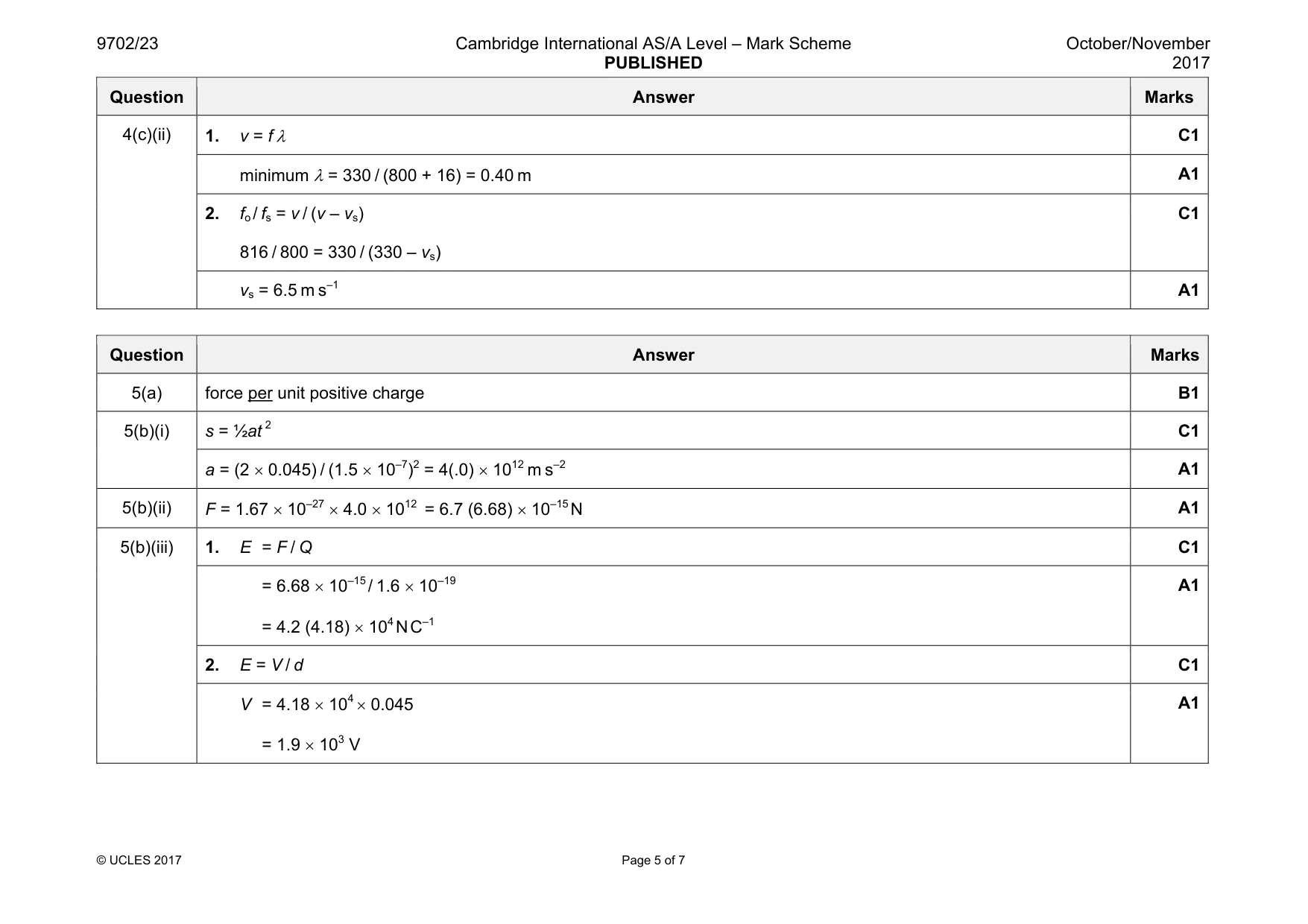
Mark scheme: 4(a) displacement of particles/vibration(s)/oscillation(s) is parallel to/along the direction of energy/propagation B1 4(b) period = 1 / 800 (= 1.25 × 10⁻³ s) C1 time-base setting = 1.25 × 10⁻³ / 2.5 C1 = 5.0 × 10⁻⁴ s cm–1 A1 4(c)(i) I ∝ A2 C1 (IX / IY =) [rY / rX] 2 = [AX / AY]2 C1 ratio AY / AX = 120 / 30 = 4.0 A1 Question Answer Marks 4(c)(ii) 1. v = f λ C1 minimum λ = 330 / (800 + 16) = 0.40 m A1 2. fo / fs = v / (v – vs) 816 / 800 = 330 / (330 – vs) C1 vs = 6.5 m s–1 A1
Q5 · Define electric field strength
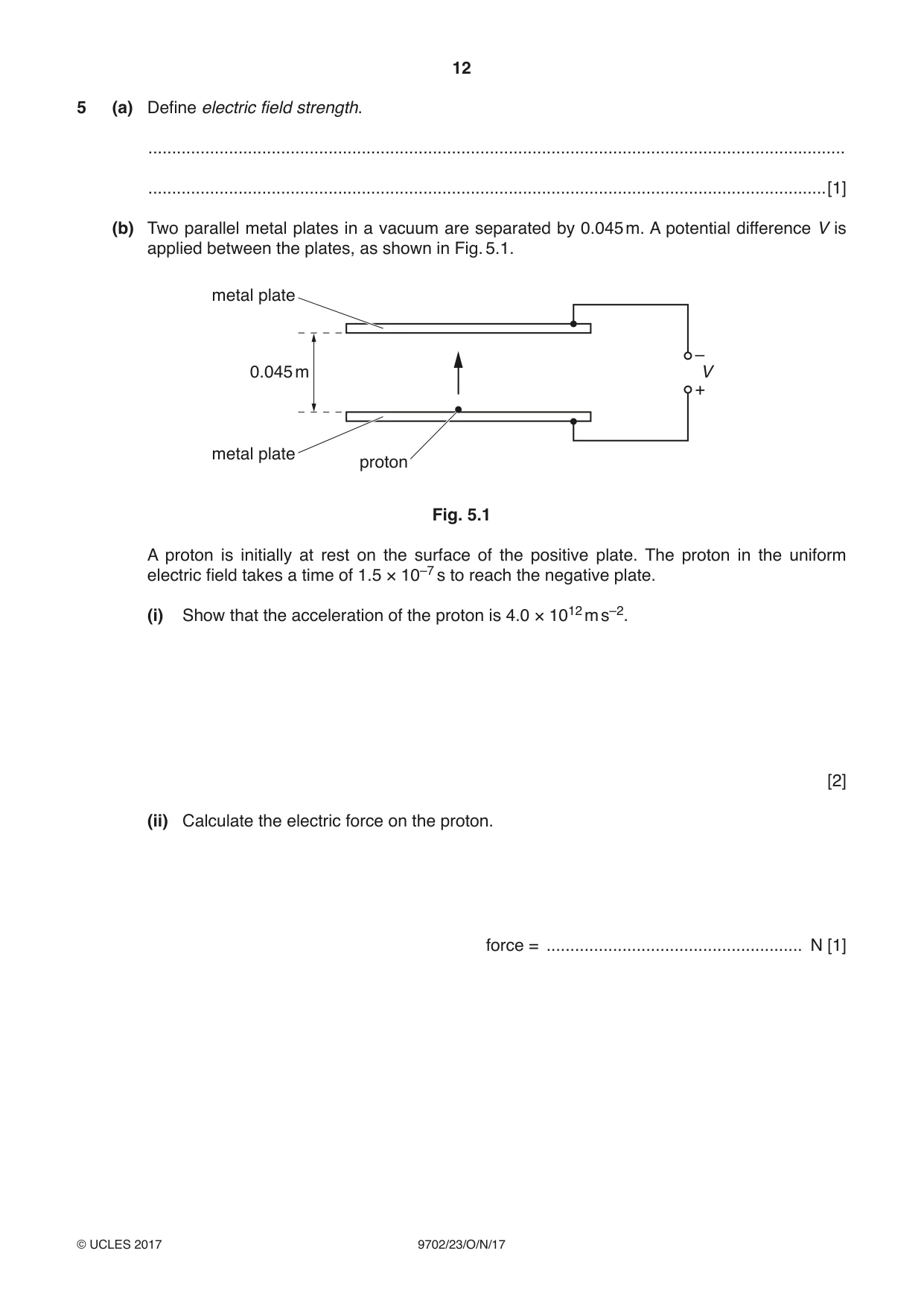
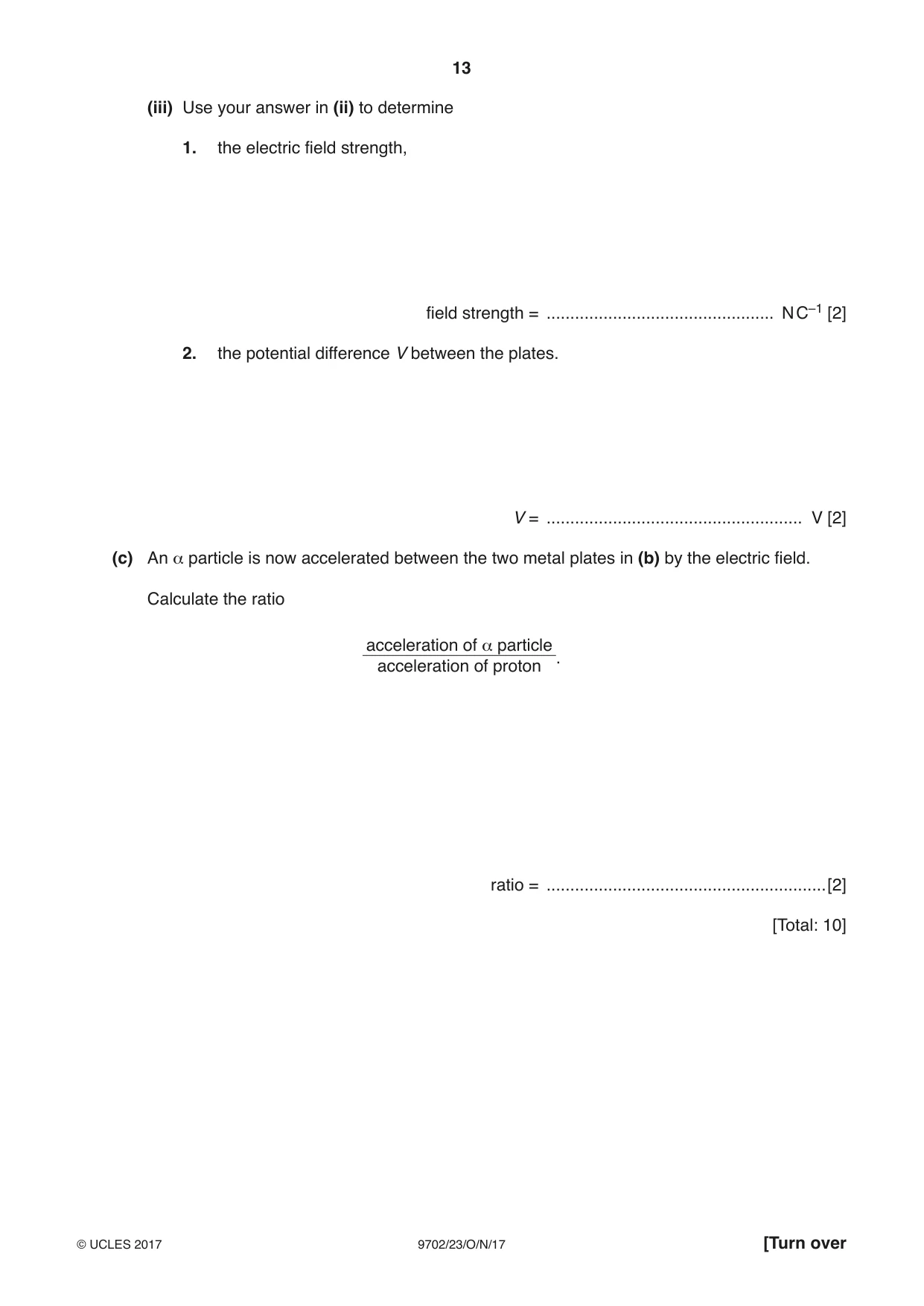
5 (a) Define electric field strength. ................................................................................................................................................... ...............................................................................................................................................[1] (b) Two parallel metal plates in a vacuum are separated by 0.045 m. A potential difference V is applied between the plates, as shown in Fig. 5.1. metal plate – 0.045 m V + metal plate proton Fig. 5.1 A proton is initially at rest on the surface of the positive plate. The proton in the uniform electric field takes a time of 1.5 × 10⁻⁷ s to reach the negative plate. (i) Show that the acceleration of the proton is 4.0 × 10¹² m s–2. [2] (ii) Calculate the electric force on the proton. force = ...................................................... N [1] (iii) Use your answer in (ii) to determine 1. the electric field strength, field strength = ................................................ N C–1 [2] 2. the potential difference V between the plates. V = ...................................................... V [2] (c) An α particle is now accelerated between the two metal plates in (b) by the electric field. Calculate the ratio acceleration of α particle . acceleration of proton ratio = ...........................................................[2] [Total: 10]
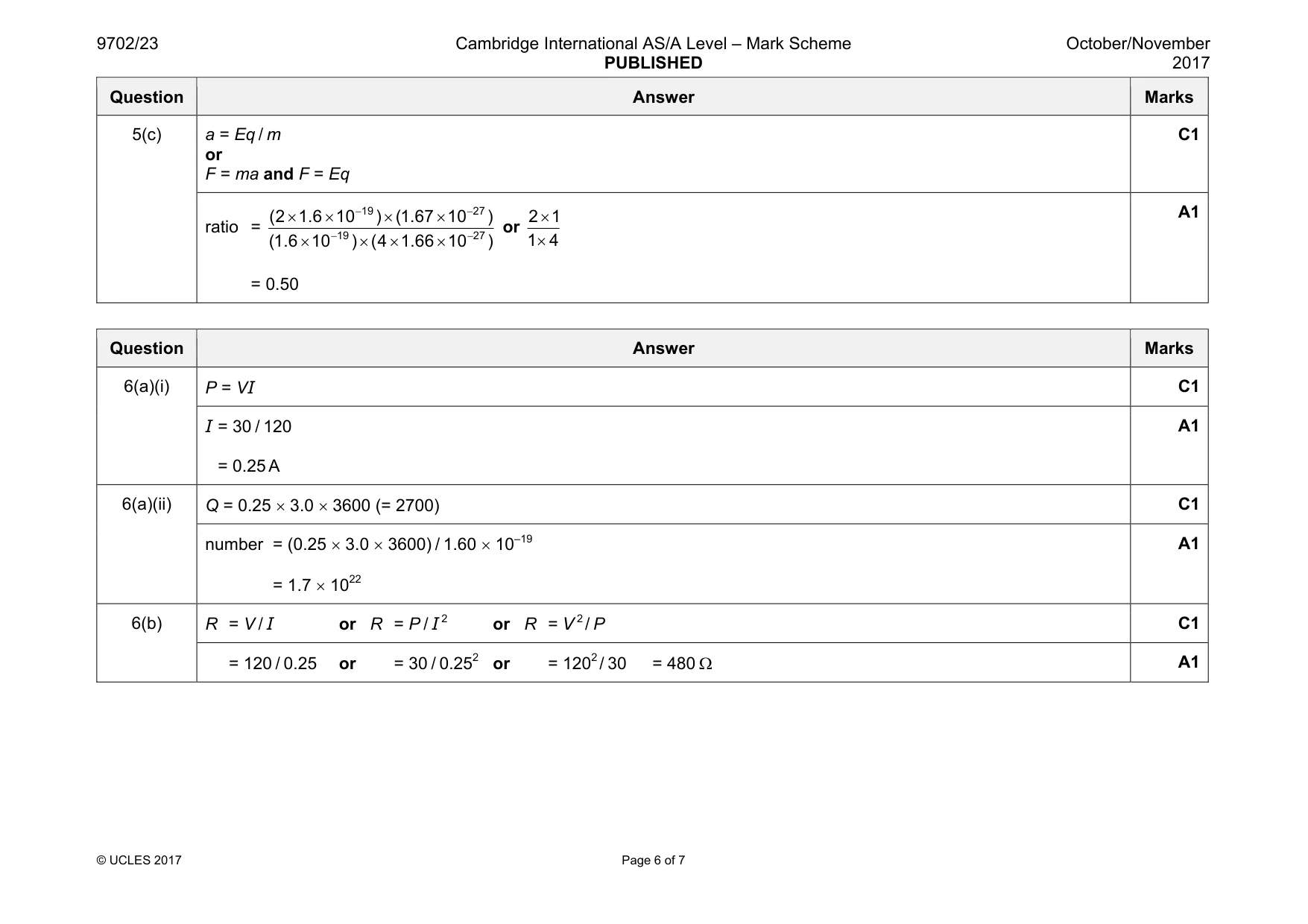
Mark scheme: 5(a) force per unit positive charge B1 5(b)(i) s = ½at 2 C1 a = (2 × 0.045) / (1.5 × 10⁻⁷)2 = 4(.0) × 1012 m s–2 A1 5(b)(ii) F = 1.67 × 10–27 × 4.0 × 1012 = 6.7 (6.68) × 10–15N A1 5(b)(iii) 1. E = F / Q C1 = 6.68 × 10⁻¹⁵ / 1.6 × 10–19 = 4.2 (4.18) × 104 N C–1 A1 2. E = V / d C1 V = 4.18 × 104 × 0.045 = 1.9 × 10³ V A1 Question Answer Marks 5(c) a = Eq / m or F = ma and F = Eq C1 ratio = − − − − × × × × × × × × 19 27 19 27 (2 1.6 10 ) (1.67 10 ) (1.6 10 ) (4 1.66 10 ) or × × 2 1 1 4 = 0.50 A1
Q6 · A filament lamp is rated as 30 W, 120 V
6 A filament lamp is rated as 30 W, 120 V. A potential difference of 120 V is applied across the lamp. (a) For the filament wire of the lamp, calculate (i) the current, current = ....................................................... A [2] (ii) the number of electrons passing a point in 3.0 hours. number = ...........................................................[2] (b) Show that the resistance of the filament wire is 480 Ω. [2] (c) The filament wire has an uncoiled length of 580 mm and is made of metal. The metal has resistivity 6.1 × 10⁻⁷ Ω m at the operating temperature of the lamp. Calculate the diameter of the wire. diameter = ...................................................... m [3] (d) The potential difference across the lamp is now reduced. State and explain the effect, if any, on the resistance of the filament wire. ................................................................................................................................................... ...............................................................................................................................................[1] [Total: 10]
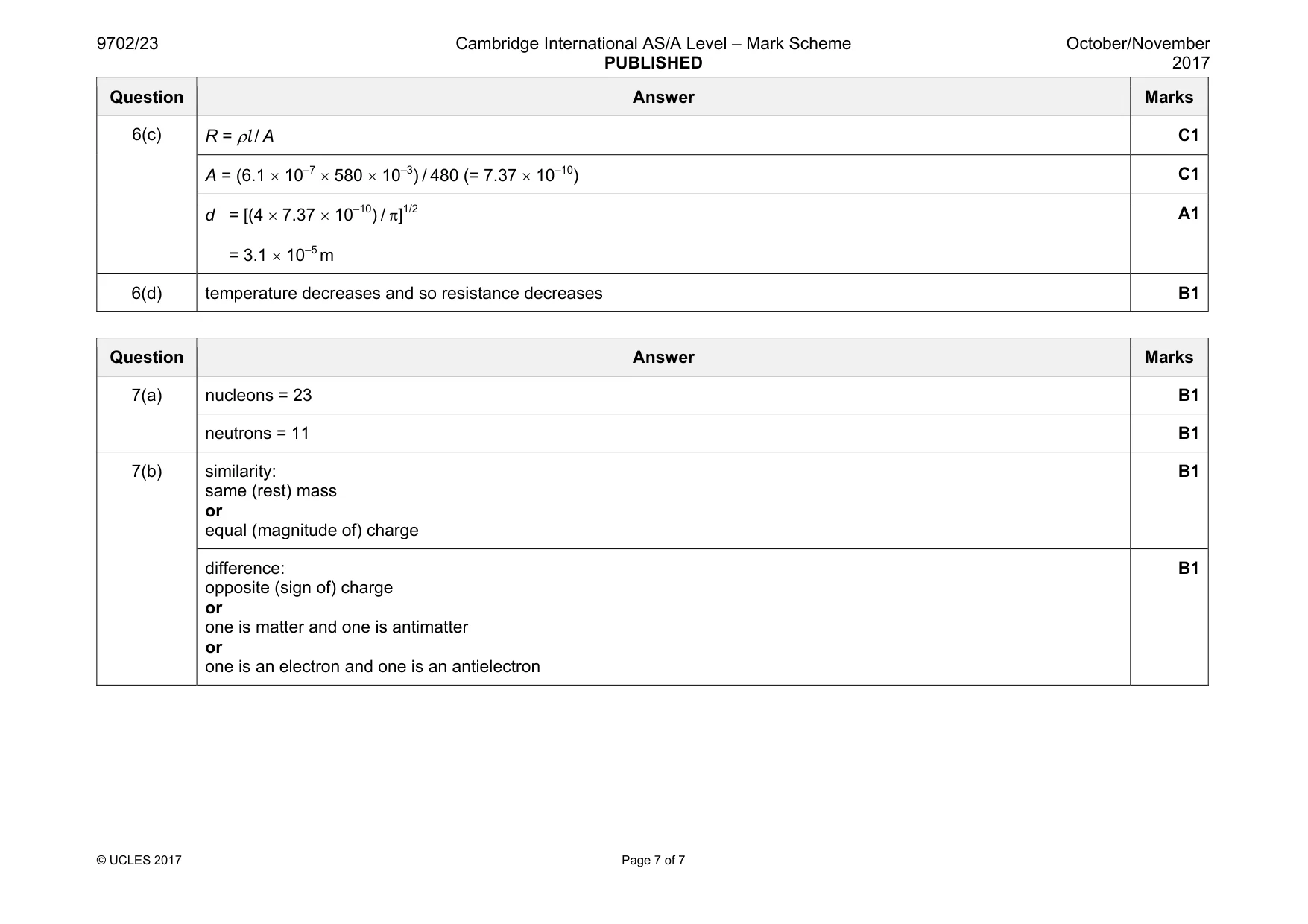
Mark scheme: 6(a)(i) C1 I = 30 / 120 = 0.25 A A1 6(a)(ii) Q = 0.25 × 3.0 × 3600 (= 2700) C1 number = (0.25 × 3.0 × 3600) / 1.60 × 10–19 = 1.7 × 10²² A1 6(b) R = V / I or R = P / I 2 or R = V 2/ P C1 = 120 / 0.25 or = 30 / 0.252 or = 1202/ 30 = 480 Ω A1 Question Answer Marks 6(c) R = ρl / A C1 A = (6.1 × 10–7 × 580 × 10–3) / 480 (= 7.37 × 10⁻¹⁰) C1 d = [(4 × 7.37 × 10–10) / π]1/2 = 3.1 × 10⁻⁵ m A1 6(d) temperature decreases and so resistance decreases B1
Q7 · A nucleus X decays by emitting a β+ particle to form a new nucleus, 2311Na
7 (a) A nucleus X decays by emitting a β+ particle to form a new nucleus, 2311Na. State the number of nucleons and the number of neutrons in nucleus X. number of nucleons = ............................................................... number of neutrons = ............................................................... [2] (b) State one similarity and one difference between a β+ particle and a β– particle. similarity: ................................................................................................................................... difference: ................................................................................................................................. [2] [Total: 4]
Mark scheme: 7(a) nucleons = 23 B1 neutrons = 11 B1 7(b) similarity: same (rest) mass or equal (magnitude of) charge B1 difference: opposite (sign of) charge or one is matter and one is antimatter or one is an electron and one is an antielectron B1
What was in this paper
The subtopics covered by these 7 questions, and how many questions each got. Open one in a new tab to see every Cambridge question on it.
What you needed in this session
Cambridge’s own grade thresholds for 2017 Oct/Nov, Paper 2 · Variant 3. A higher threshold means an easier paper — the bar moves with how the cohort did.