Cambridge A Level Physics 9702 — 2022 Oct/Nov Paper 2 · Variant 2
9702/22/O/N/22 · 7 questions · 60 marks · ≈68 min
The question paper and its mark scheme, free to read here and free to download. This is Cambridge’s own paper, exactly as it was sat.
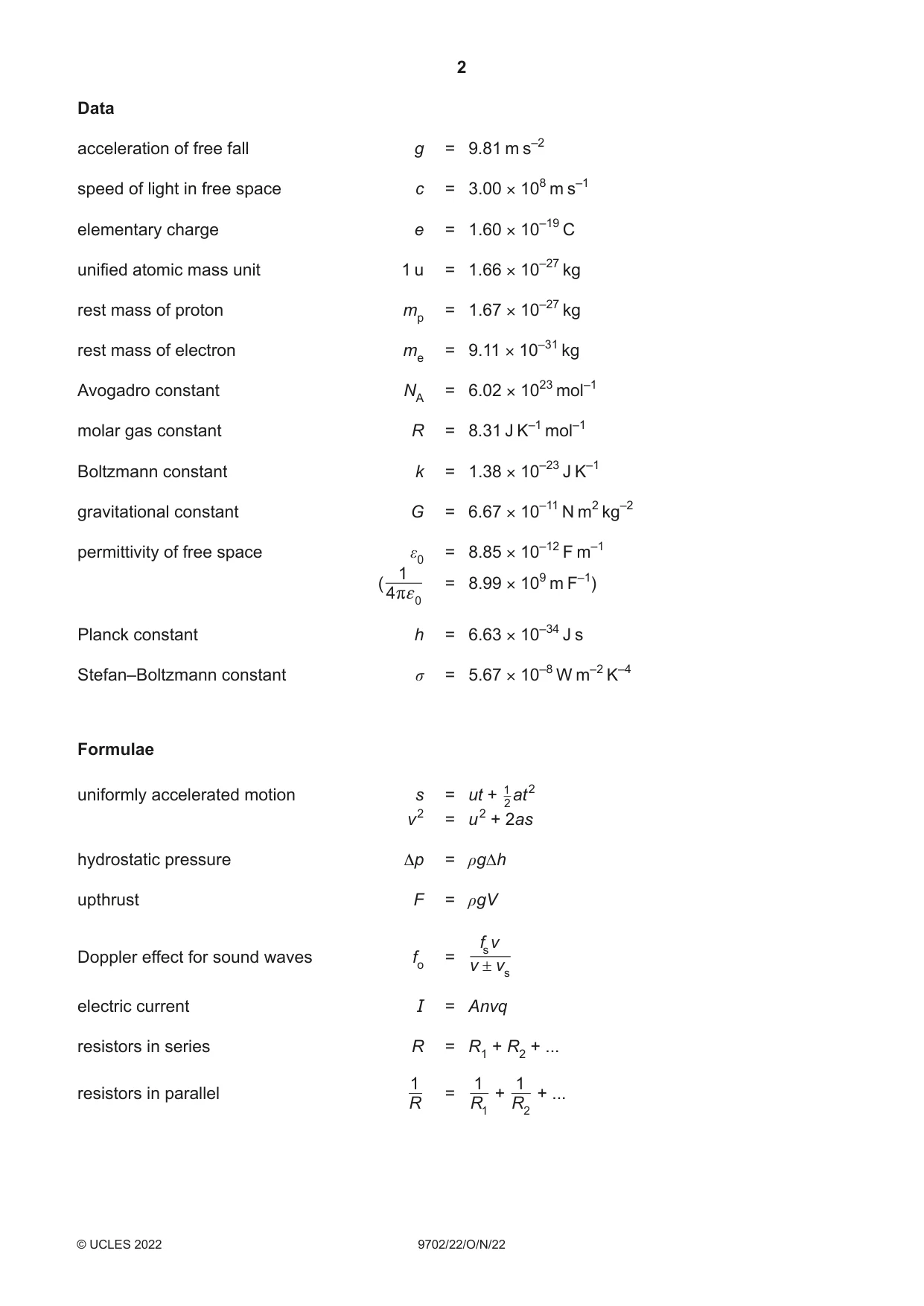
Question paper16 pages

Mark scheme12 pages
Answers below. Sit the paper first if you are practising.
Questions as text
Q1 · State what is meant by work done
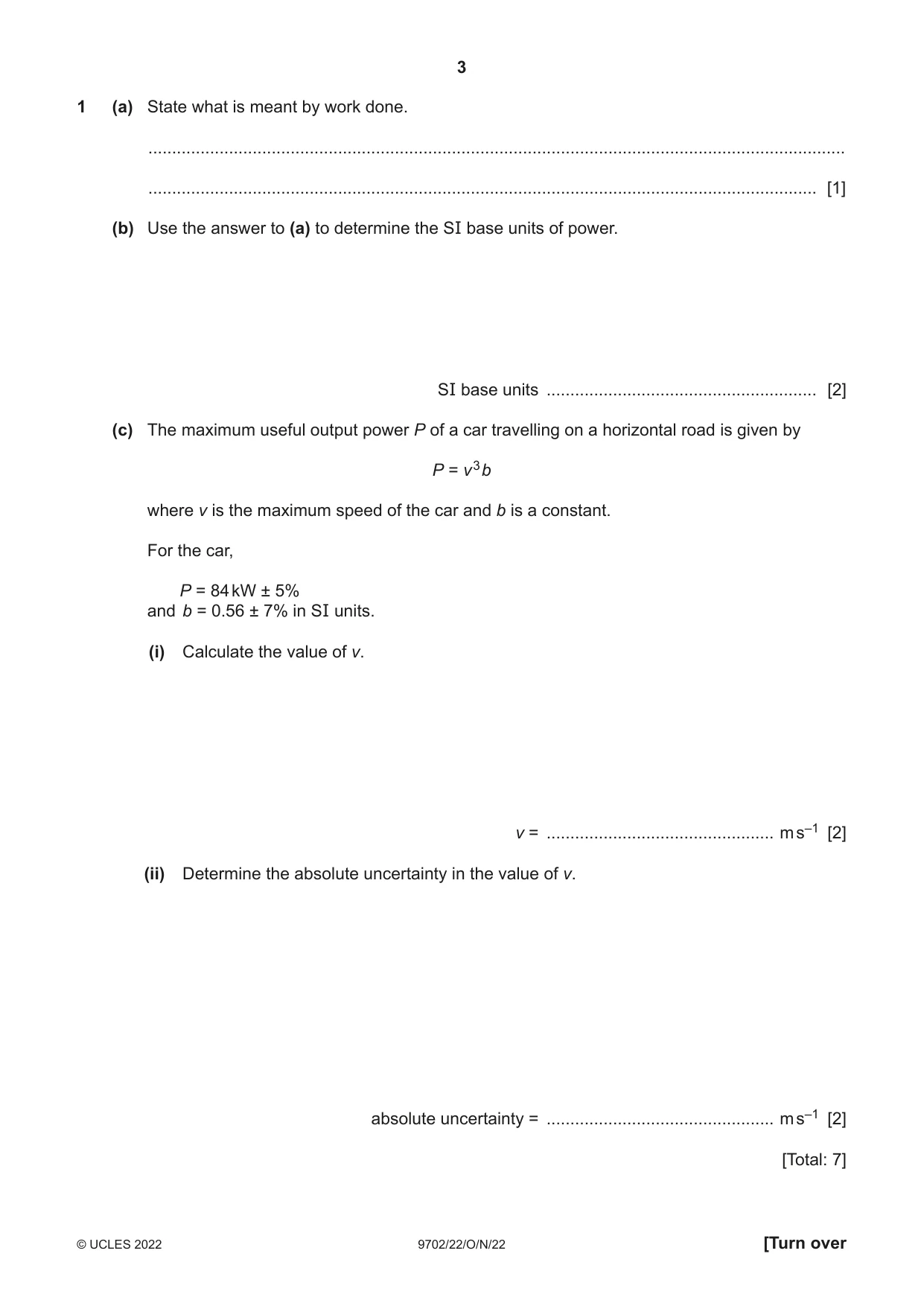
1 (a) State what is meant by work done. ................................................................................................................................................... ............................................................................................................................................. [1] (b) Use the answer to (a) to determine the SI base units of power. SI base units ......................................................... [2] (c) The maximum useful output power P of a car travelling on a horizontal road is given by P = v 3 b where v is the maximum speed of the car and b is a constant. For the car, P = 84 kW ± 5% and b = 0.56 ± 7% in SI units. (i) Calculate the value of v. v = ................................................ m s–1 [2] (ii) Determine the absolute uncertainty in the value of v. absolute uncertainty = ................................................ m s–1 [2] [Total: 7]
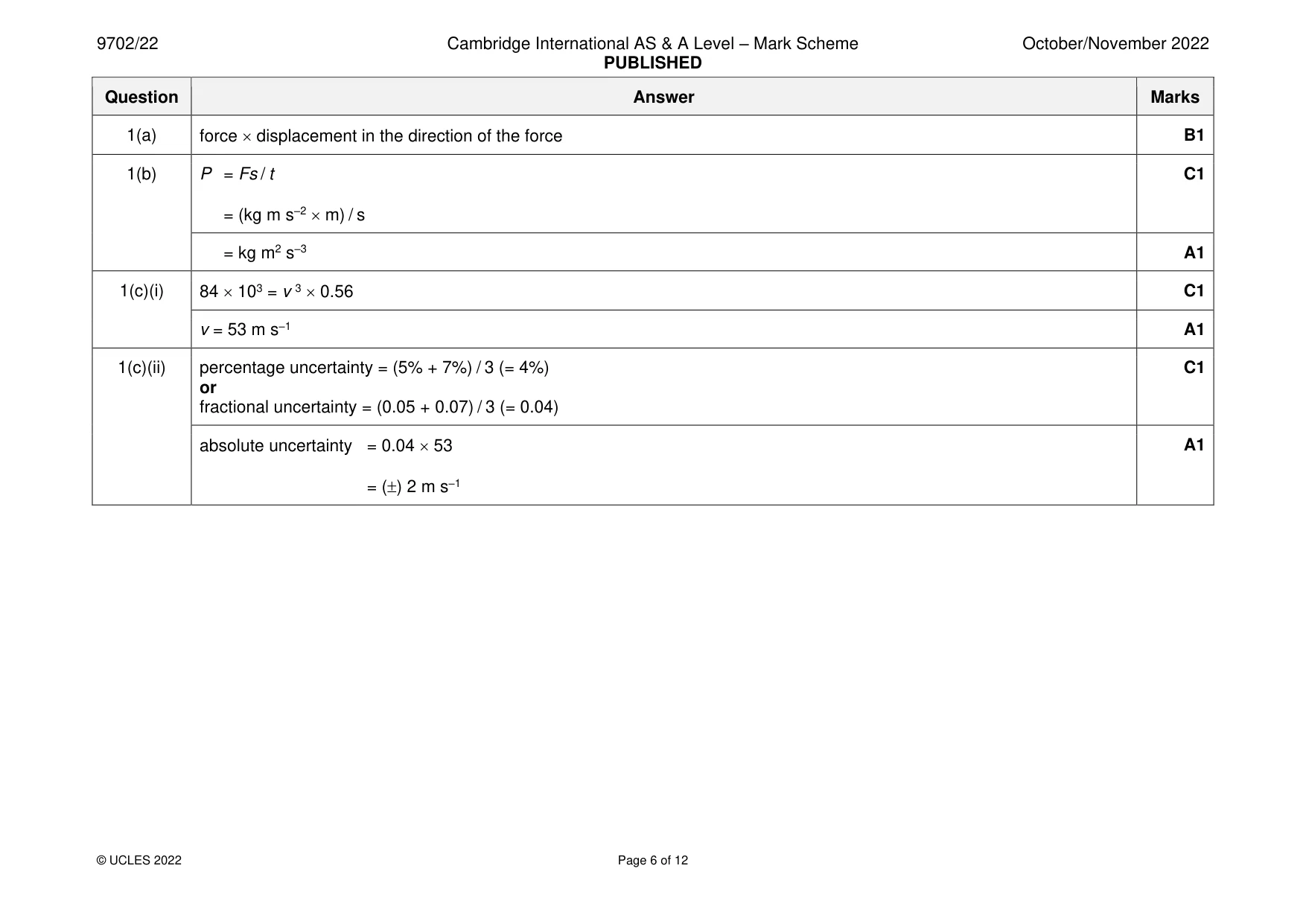
Mark scheme: Question Answer Marks 1(a) force displacement in the direction of the force B1 1(b) P = Fs / t C1 = (kg m s–2 m) / s = kg m2 s–3 A1 1(c)(i) 84 103 = v 3 0.56 C1 v = 53 m s–1 A1 1(c)(ii) percentage uncertainty = (5% + 7%) / 3 (= 4%) C1 or fractional uncertainty = (0.05 + 0.07) / 3 (= 0.04) absolute uncertainty = 0.04 53 A1 = () 2 m s–1
Q2 · A spherical balloon is filled with a fixed mass of gas
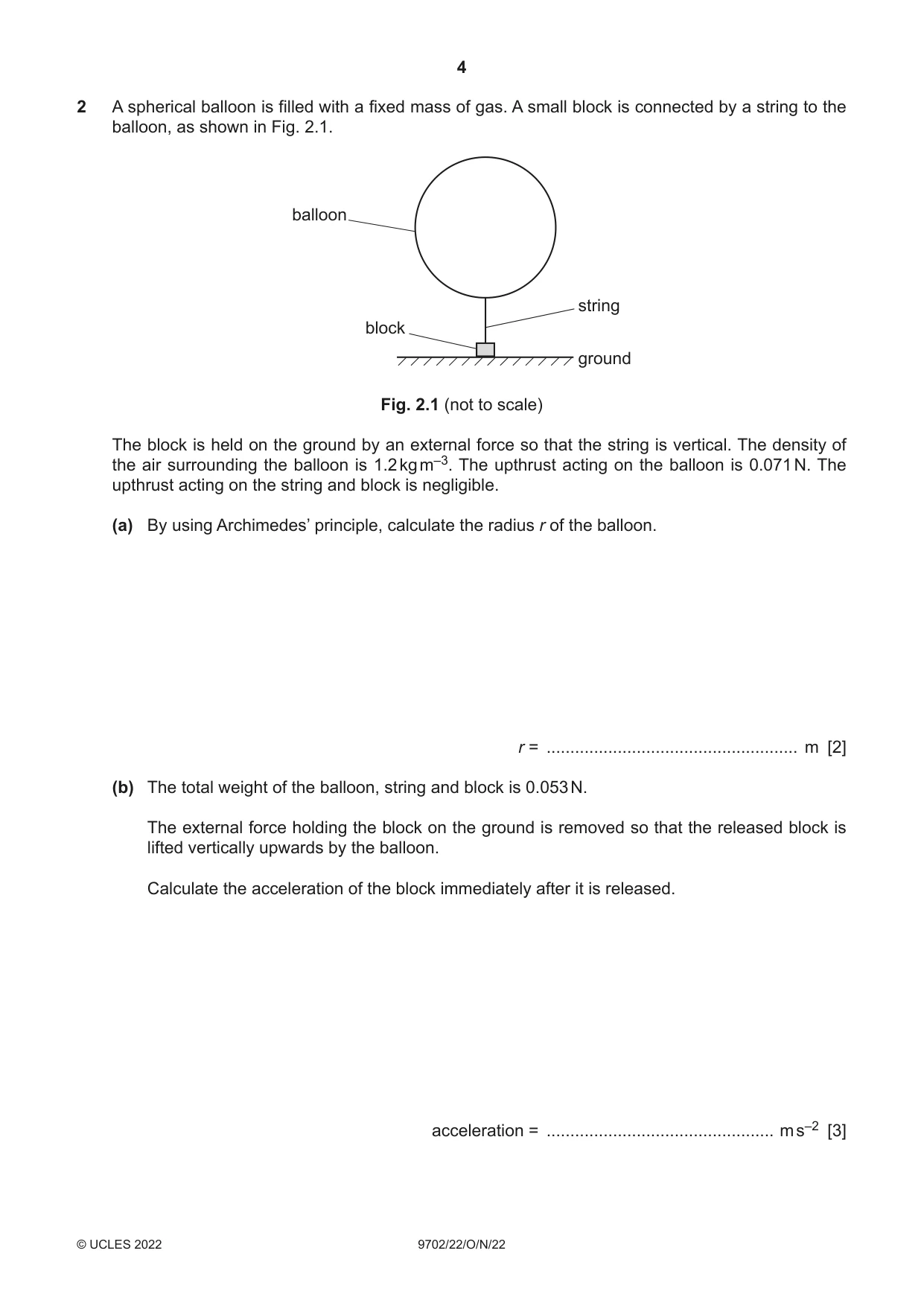
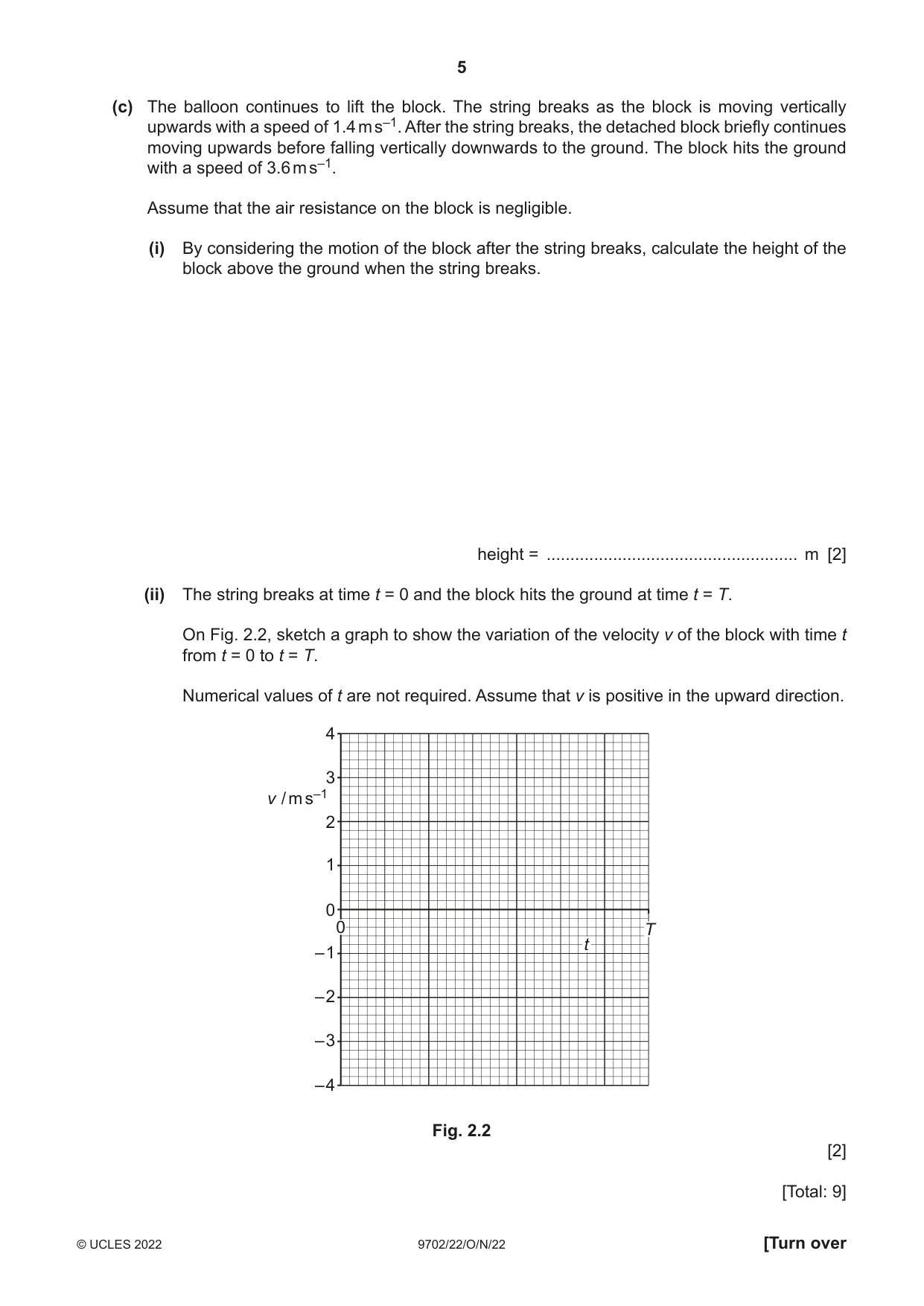
2 A spherical balloon is filled with a fixed mass of gas. A small block is connected by a string to the balloon, as shown in Fig. 2.1. balloon string block ground Fig. 2.1 (not to scale) The block is held on the ground by an external force so that the string is vertical. The density of the air surrounding the balloon is 1.2 kg m–3. The upthrust acting on the balloon is 0.071 N. The upthrust acting on the string and block is negligible. (a) By using Archimedes’ principle, calculate the radius r of the balloon. r = ..................................................... m [2] (b) The total weight of the balloon, string and block is 0.053 N. The external force holding the block on the ground is removed so that the released block is lifted vertically upwards by the balloon. Calculate the acceleration of the block immediately after it is released. acceleration = ................................................ m s–2 [3] (c) The balloon continues to lift the block. The string breaks as the block is moving vertically upwards with a speed of 1.4 m s–1. After the string breaks, the detached block briefly continues moving upwards before falling vertically downwards to the ground. The block hits the ground with a speed of 3.6 m s–1. Assume that the air resistance on the block is negligible. (i) By considering the motion of the block after the string breaks, calculate the height of the block above the ground when the string breaks. height = ..................................................... m [2] (ii) The string breaks at time t = 0 and the block hits the ground at time t = T. On Fig. 2.2, sketch a graph to show the variation of the velocity v of the block with time t from t = 0 to t = T. Numerical values of t are not required. Assume that v is positive in the upward direction. 4 3 v / m s–1 2 1 0 0 T t – 1 – 2 – 3 – 4 Fig. 2.2 [2] [Total: 9]
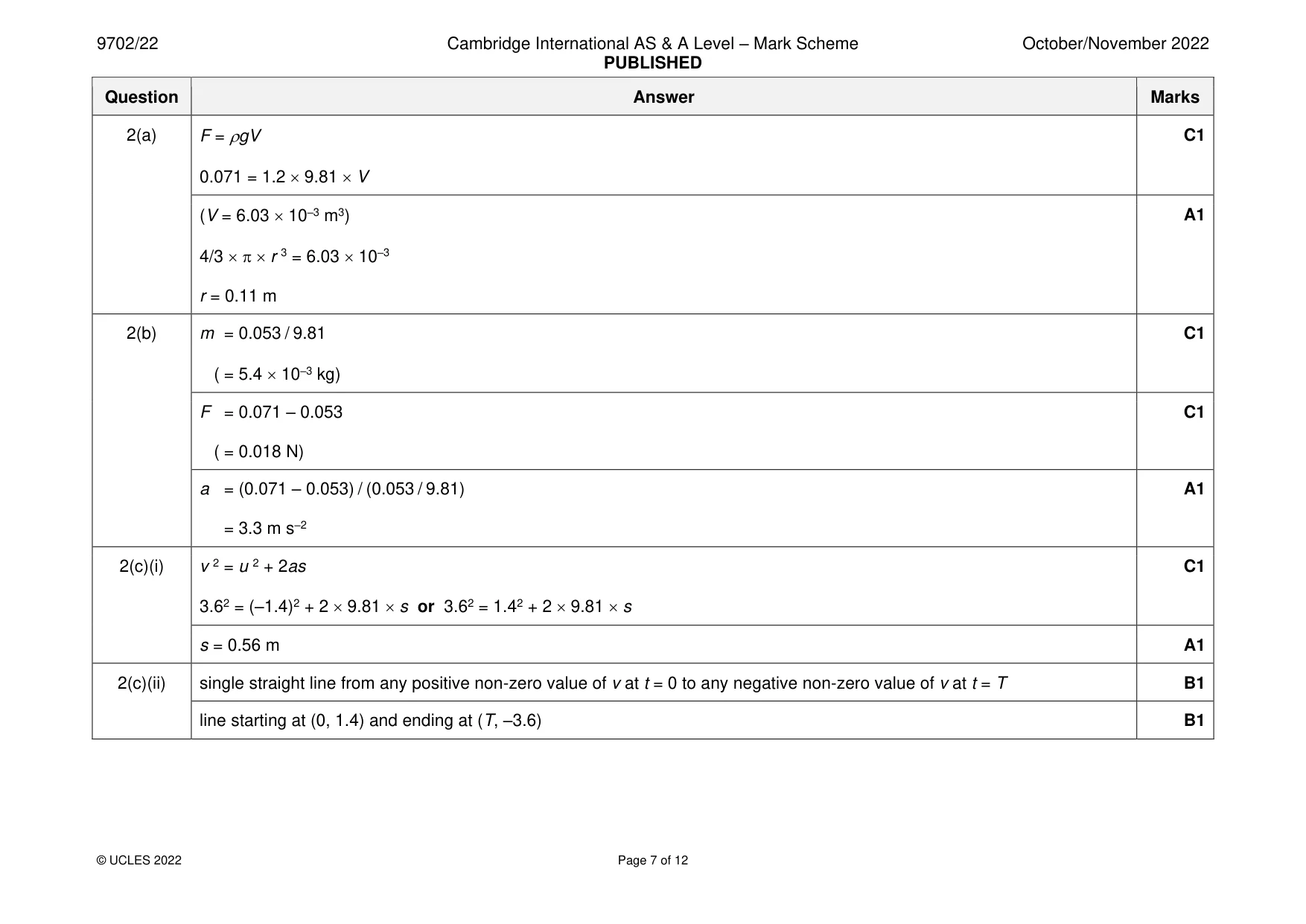
Mark scheme: 2(a) F = gV C1 0.071 = 1.2 9.81 V (V = 6.03 10–3 m3) A1 4/3 r 3 = 6.03 10–3 r = 0.11 m 2(b) m = 0.053 / 9.81 C1 ( = 5.4 10–3 kg) F = 0.071 – 0.053 C1 ( = 0.018 N) a = (0.071 – 0.053) / (0.053 / 9.81) A1 = 3.3 m s–2 2(c)(i) v 2 = u 2 + 2as C1 3.62 = (–1.4)2 + 2 9.81 s or 3.62 = 1.42 + 2 9.81 s s = 0.56 m A1 2(c)(ii) single straight line from any positive non-zero value of v at t = 0 to any negative non-zero value of v at t = T B1 line starting at (0, 1.4) and ending at (T, –3.6) B1
Q3 · State what is meant by the centre of gravity of an object
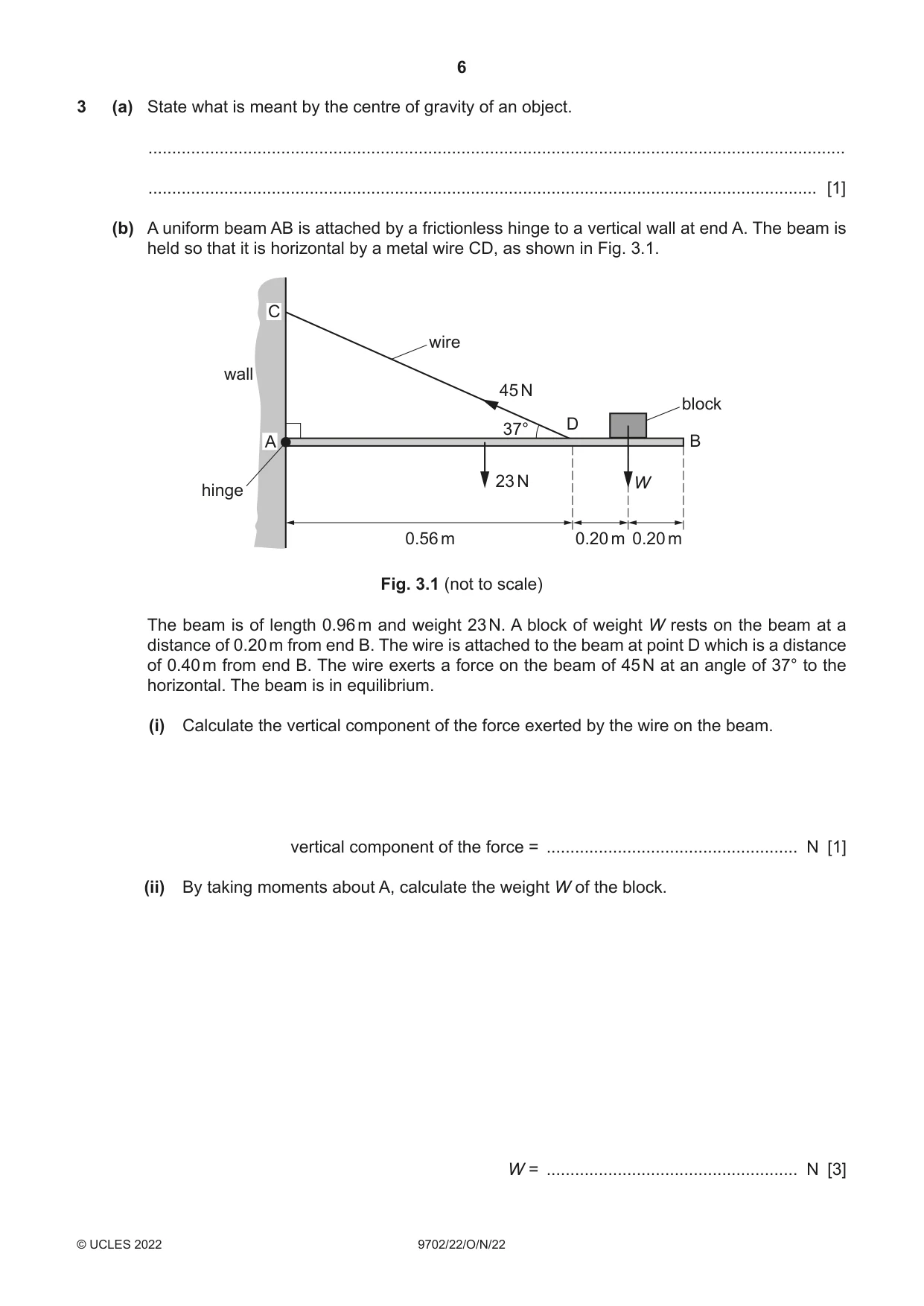
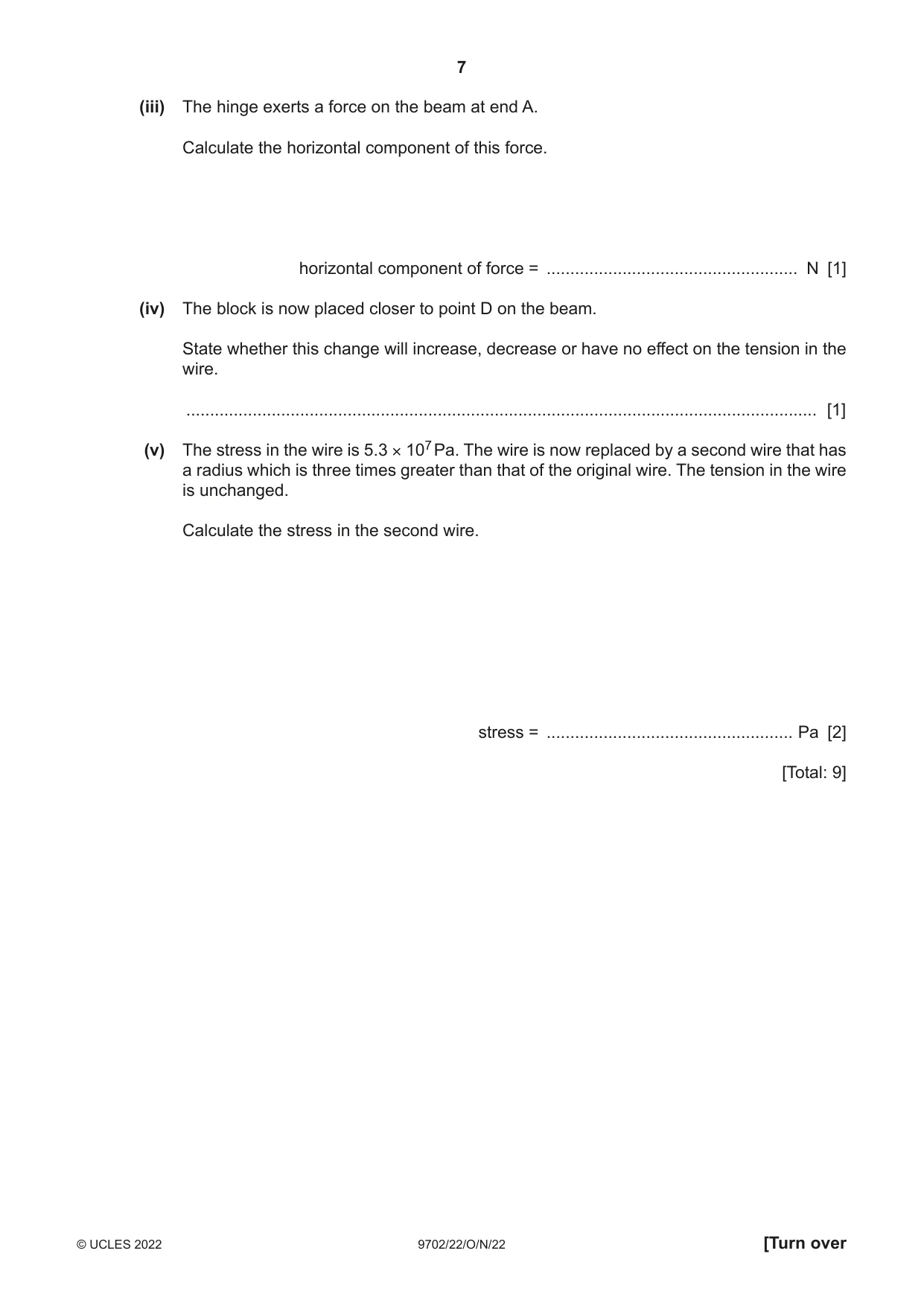
3 (a) State what is meant by the centre of gravity of an object. ................................................................................................................................................... ............................................................................................................................................. [1] (b) A uniform beam AB is attached by a frictionless hinge to a vertical wall at end A. The beam is held so that it is horizontal by a metal wire CD, as shown in Fig. 3.1. C wire wall 45 N block D 37° A B 23 N W hinge 0.56 m 0.20 m 0.20 m Fig. 3.1 (not to scale) The beam is of length 0.96 m and weight 23 N. A block of weight W rests on the beam at a distance of 0.20 m from end B. The wire is attached to the beam at point D which is a distance of 0.40 m from end B. The wire exerts a force on the beam of 45 N at an angle of 37° to the horizontal. The beam is in equilibrium. (i) Calculate the vertical component of the force exerted by the wire on the beam. vertical component of the force = ..................................................... N [1] (ii) By taking moments about A, calculate the weight W of the block. W = ..................................................... N [3] (iii) The hinge exerts a force on the beam at end A. Calculate the horizontal component of this force. horizontal component of force = ..................................................... N [1] (iv) The block is now placed closer to point D on the beam. State whether this change will increase, decrease or have no effect on the tension in the wire. ..................................................................................................................................... [1] (v) The stress in the wire is 5.3 × 10⁷ Pa. The wire is now replaced by a second wire that has a radius which is three times greater than that of the original wire. The tension in the wire is unchanged. Calculate the stress in the second wire. stress = .................................................... Pa [2] [Total: 9]
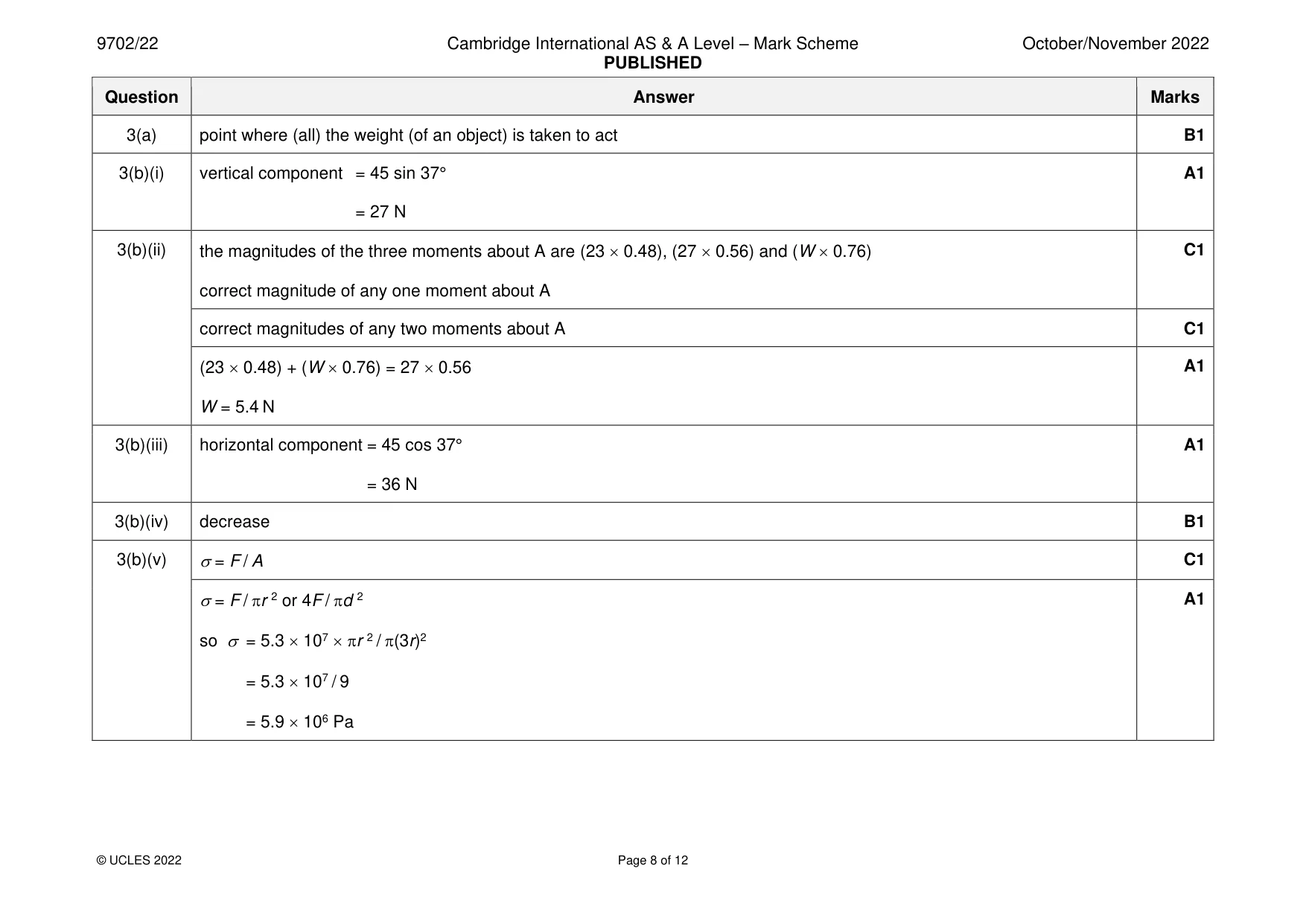
Mark scheme: 3(a) point where (all) the weight (of an object) is taken to act B1 3(b)(i) vertical component = 45 sin 37° A1 = 27 N 3(b)(ii) the magnitudes of the three moments about A are (23 0.48), (27 0.56) and (W 0.76) C1 correct magnitude of any one moment about A correct magnitudes of any two moments about A C1 (23 0.48) + (W 0.76) = 27 0.56 A1 W = 5.4 N 3(b)(iii) horizontal component = 45 cos 37° A1 = 36 N 3(b)(iv) decrease B1 3(b)(v) = F / A C1 = F / r 2 or 4F / d 2 A1 so = 5.3 107 r 2 / (3r)2 = 5.3 107 / 9 = 5.9 106 Pa
Q4 · A horizontal spring is fixed at one end
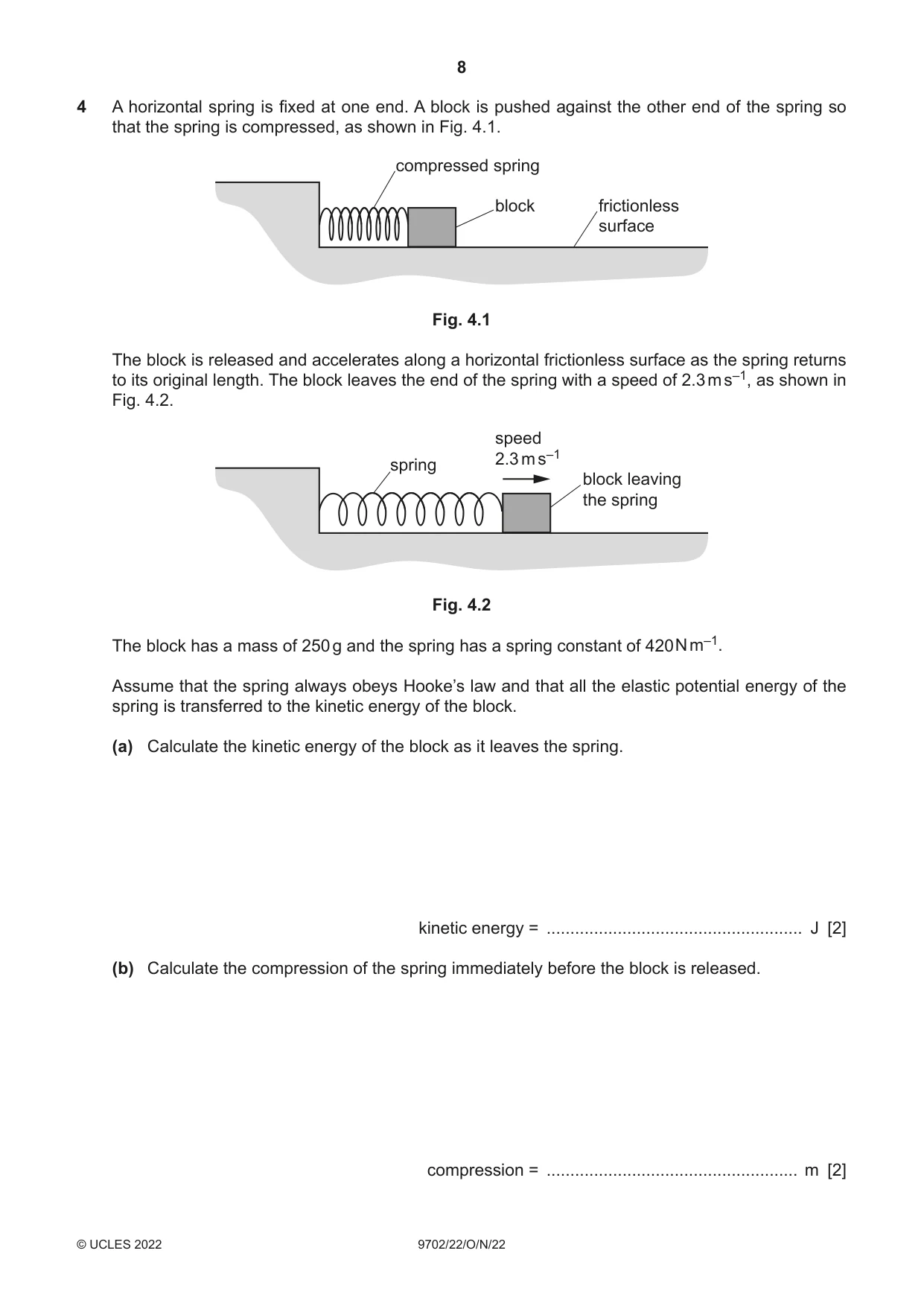
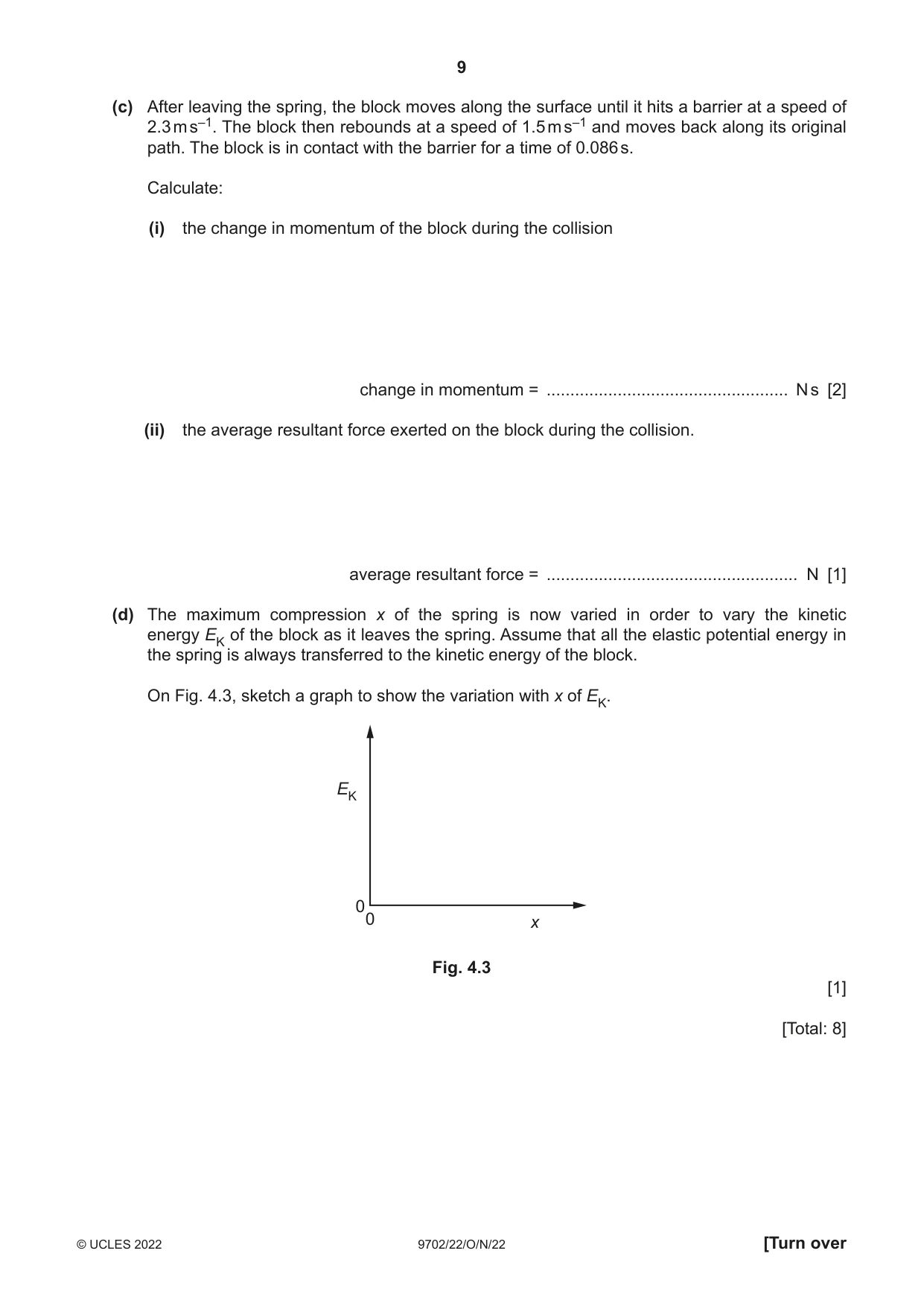
4 A horizontal spring is fixed at one end. A block is pushed against the other end of the spring so that the spring is compressed, as shown in Fig. 4.1. compressed spring block frictionless surface Fig. 4.1 The block is released and accelerates along a horizontal frictionless surface as the spring returns to its original length. The block leaves the end of the spring with a speed of 2.3 m s–1, as shown in Fig. 4.2. speed 2.3 m s–1 spring block leaving the spring Fig. 4.2 The block has a mass of 250 g and the spring has a spring constant of 420 N m–1. Assume that the spring always obeys Hooke’s law and that all the elastic potential energy of the spring is transferred to the kinetic energy of the block. (a) Calculate the kinetic energy of the block as it leaves the spring. kinetic energy = ...................................................... J [2] (b) Calculate the compression of the spring immediately before the block is released. compression = ..................................................... m [2] (c) After leaving the spring, the block moves along the surface until it hits a barrier at a speed of 2.3 m s–1. The block then rebounds at a speed of 1.5 m s–1 and moves back along its original path. The block is in contact with the barrier for a time of 0.086 s. Calculate: (i) the change in momentum of the block during the collision change in momentum = ................................................... N s [2] (ii) the average resultant force exerted on the block during the collision. average resultant force = ..................................................... N [1] (d) The maximum compression x of the spring is now varied in order to vary the kinetic energy EK of the block as it leaves the spring. Assume that all the elastic potential energy in the spring is always transferred to the kinetic energy of the block. On Fig. 4.3, sketch a graph to show the variation with x of EK. EK 00 x Fig. 4.3 [1] [Total: 8]
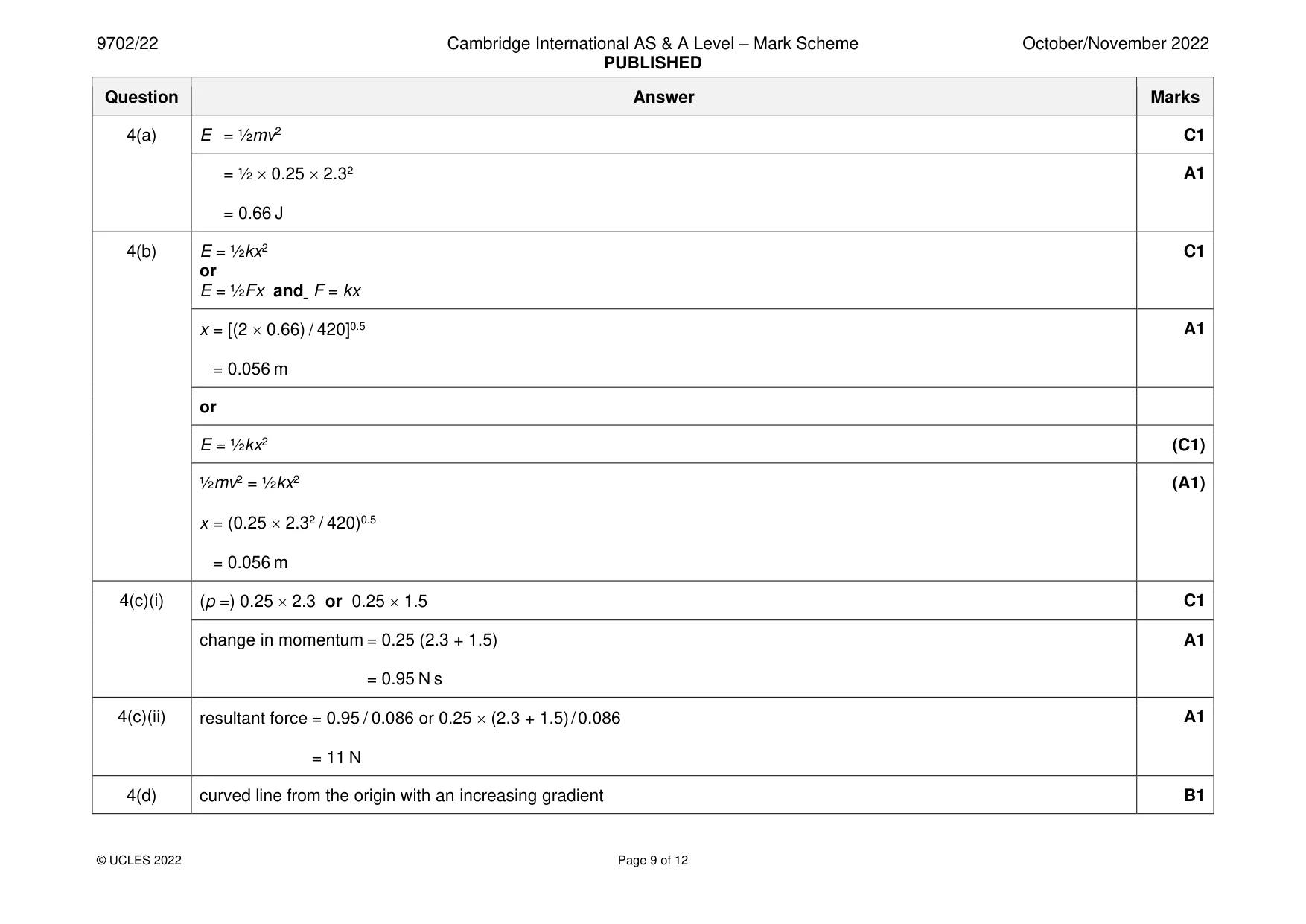
Mark scheme: 4(a) E = ½mv2 C1 = ½ 0.25 2.32 A1 = 0.66 J 4(b) E = ½kx2 C1 or E = ½Fx and F = kx x = [(2 0.66) / 420]0.5 A1 = 0.056 m or E = ½kx2 (C1) ½mv2 = ½kx2 (A1) x = (0.25 2.32 / 420)0.5 = 0.056 m 4(c)(i) (p =) 0.25 2.3 or 0.25 1.5 C1 change in momentum = 0.25 (2.3 + 1.5) A1 = 0.95 N s 4(c)(ii) resultant force = 0.95 / 0.086 or 0.25 (2.3 + 1.5) / 0.086 A1 = 11 N 4(d) curved line from the origin with an increasing gradient B1
More questions on Gravitational potential energy and kinetic energy
Q5 · Two progressive sound waves meet to form a stationary wave
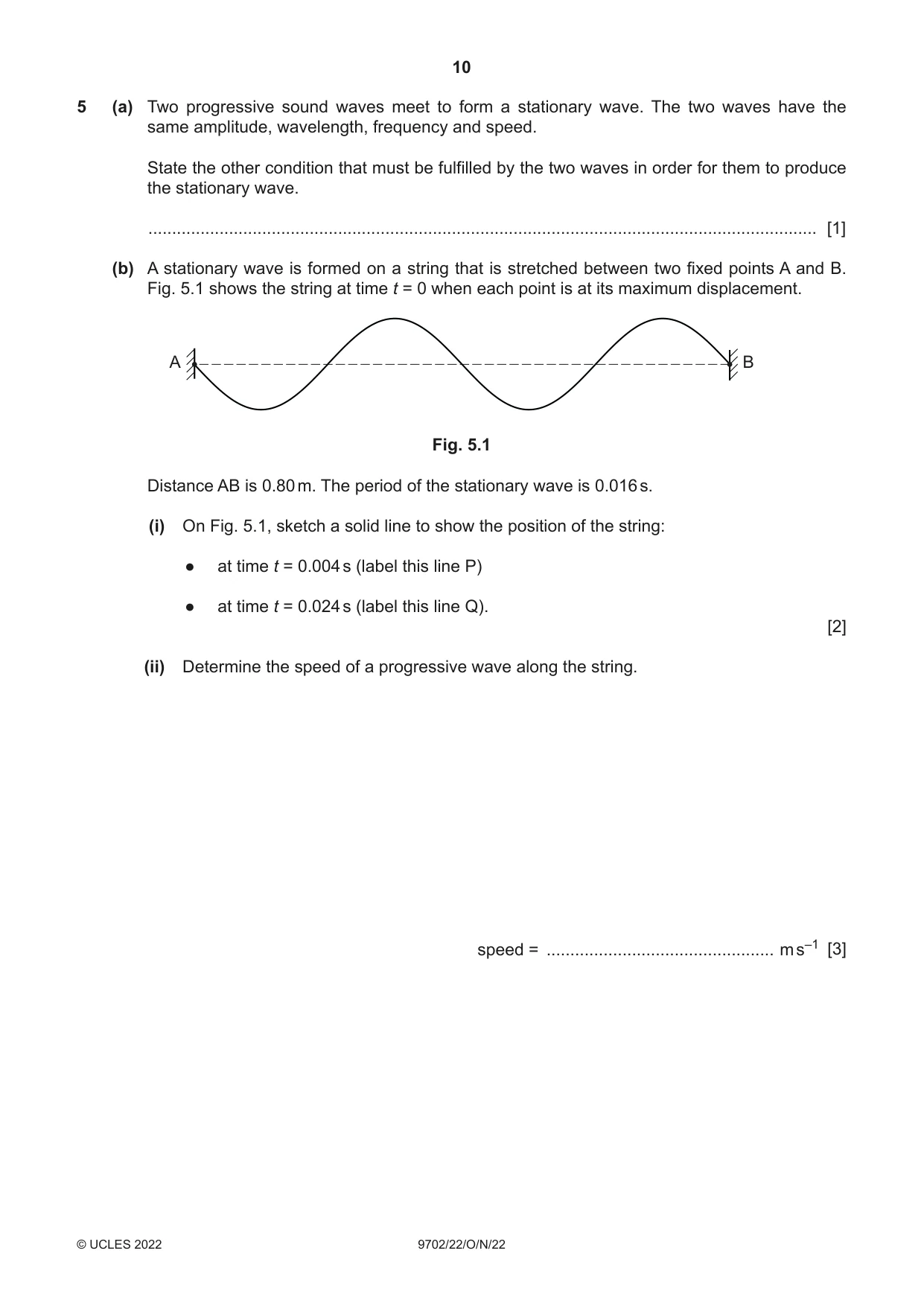
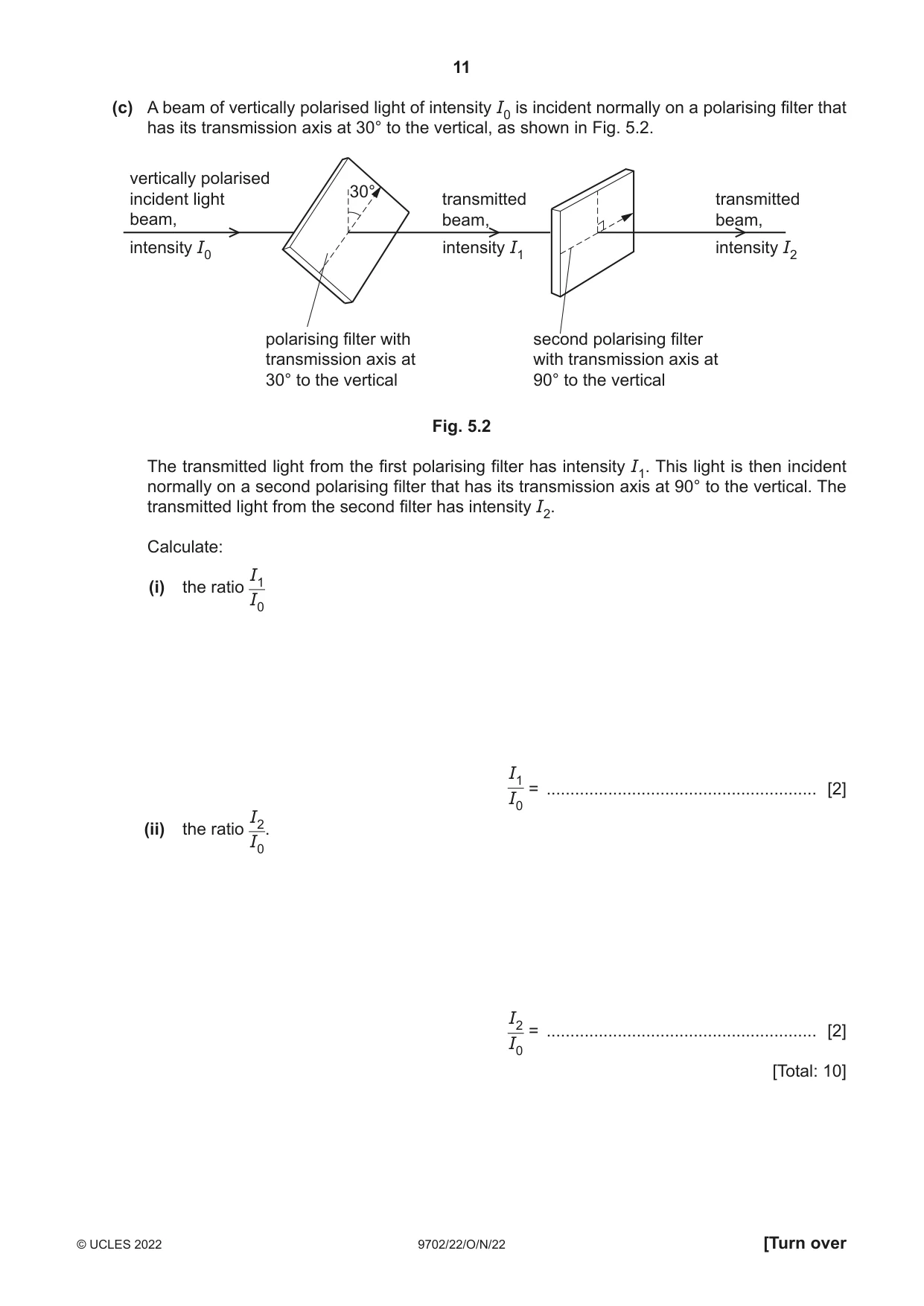
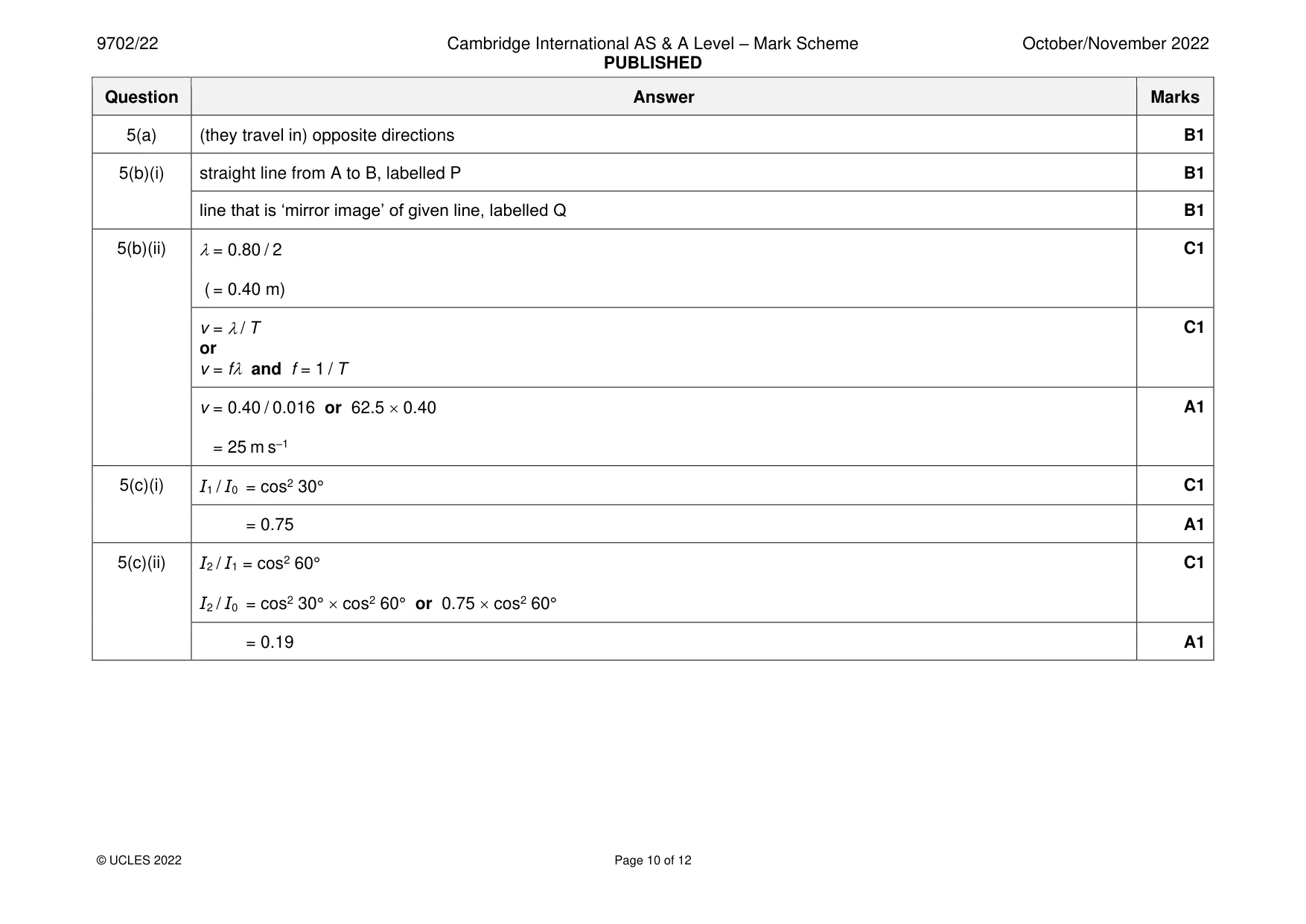
5 (a) Two progressive sound waves meet to form a stationary wave. The two waves have the same amplitude, wavelength, frequency and speed. State the other condition that must be fulfilled by the two waves in order for them to produce the stationary wave. ............................................................................................................................................. [1] (b) A stationary wave is formed on a string that is stretched between two fixed points A and B. Fig. 5.1 shows the string at time t = 0 when each point is at its maximum displacement. A B Fig. 5.1 Distance AB is 0.80 m. The period of the stationary wave is 0.016 s. (i) On Fig. 5.1, sketch a solid line to show the position of the string: ● at time t = 0.004 s (label this line P) ● at time t = 0.024 s (label this line Q). [2] (ii) Determine the speed of a progressive wave along the string. speed = ................................................ m s–1 [3] (c) A beam of vertically polarised light of intensity I0 is incident normally on a polarising filter that has its transmission axis at 30° to the vertical, as shown in Fig. 5.2. vertically polarised 30° incident light transmitted transmitted beam, beam, beam, intensity I0 intensity I1 intensity I2 polarising filter with second polarising filter transmission axis at with transmission axis at 30° to the vertical 90° to the vertical Fig. 5.2 The transmitted light from the first polarising filter has intensity I1. This light is then incident normally on a second polarising filter that has its transmission axis at 90° to the vertical. The transmitted light from the second filter has intensity I2. Calculate: I1 (i) the ratio I0 I1 = ......................................................... [2] I0 I2 (ii) the ratio . I0 I2 = ......................................................... [2] I0 [Total: 10]
Mark scheme: 5(a) (they travel in) opposite directions B1 5(b)(i) straight line from A to B, labelled P B1 line that is ‘mirror image’ of given line, labelled Q B1 5(b)(ii) = 0.80 / 2 C1 ( = 0.40 m) v = / T C1 or v = f and f = 1 / T v = 0.40 / 0.016 or 62.5 0.40 A1 = 25 m s–1 5(c)(i) I1 / I0 = cos2 30° C1 = 0.75 A1 5(c)(ii) I2 / I1 = cos2 60° C1 I2 / I0 = cos2 30° cos2 60° or 0.75 cos2 60° = 0.19 A1
Q6 · Define electric potential difference
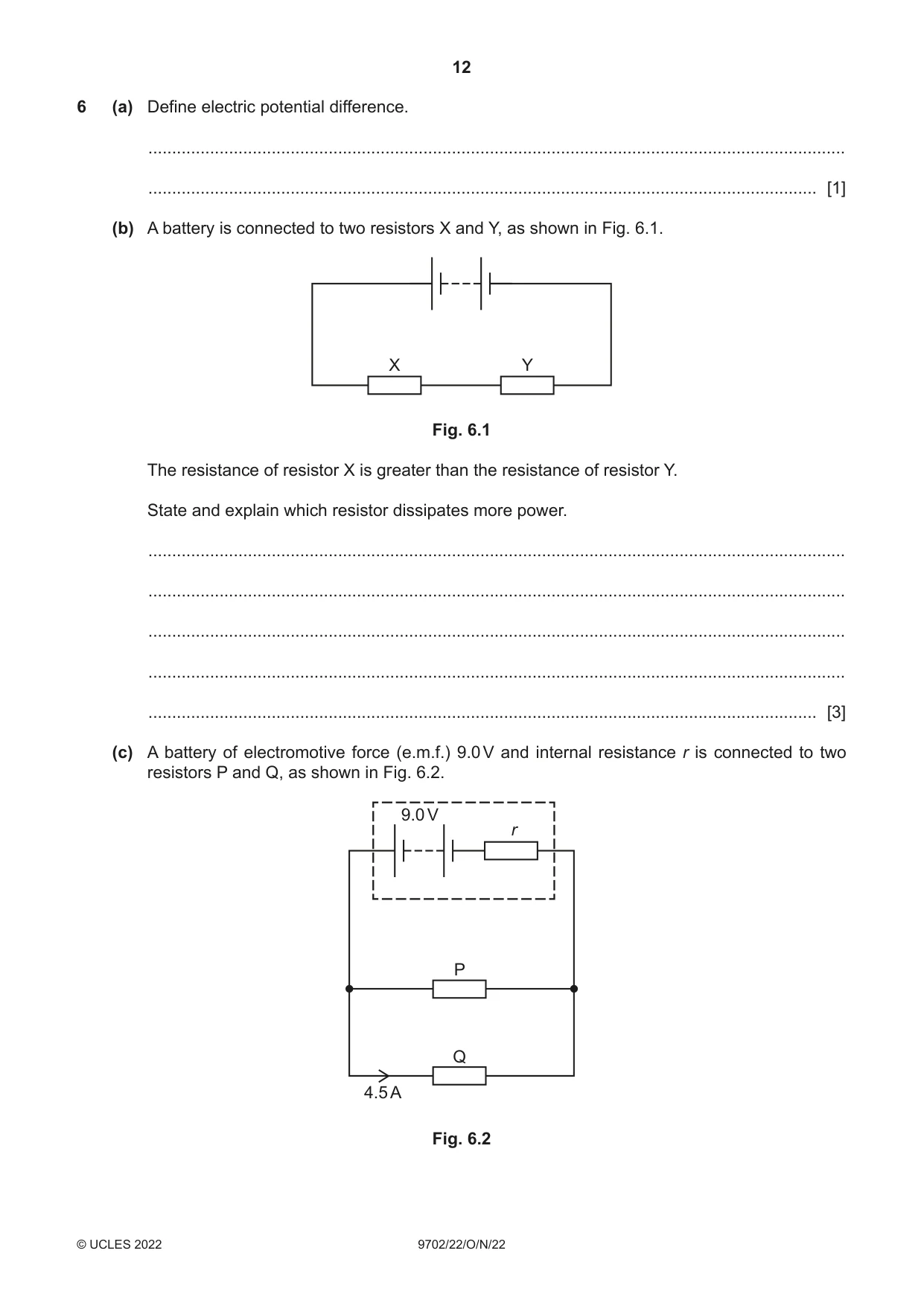
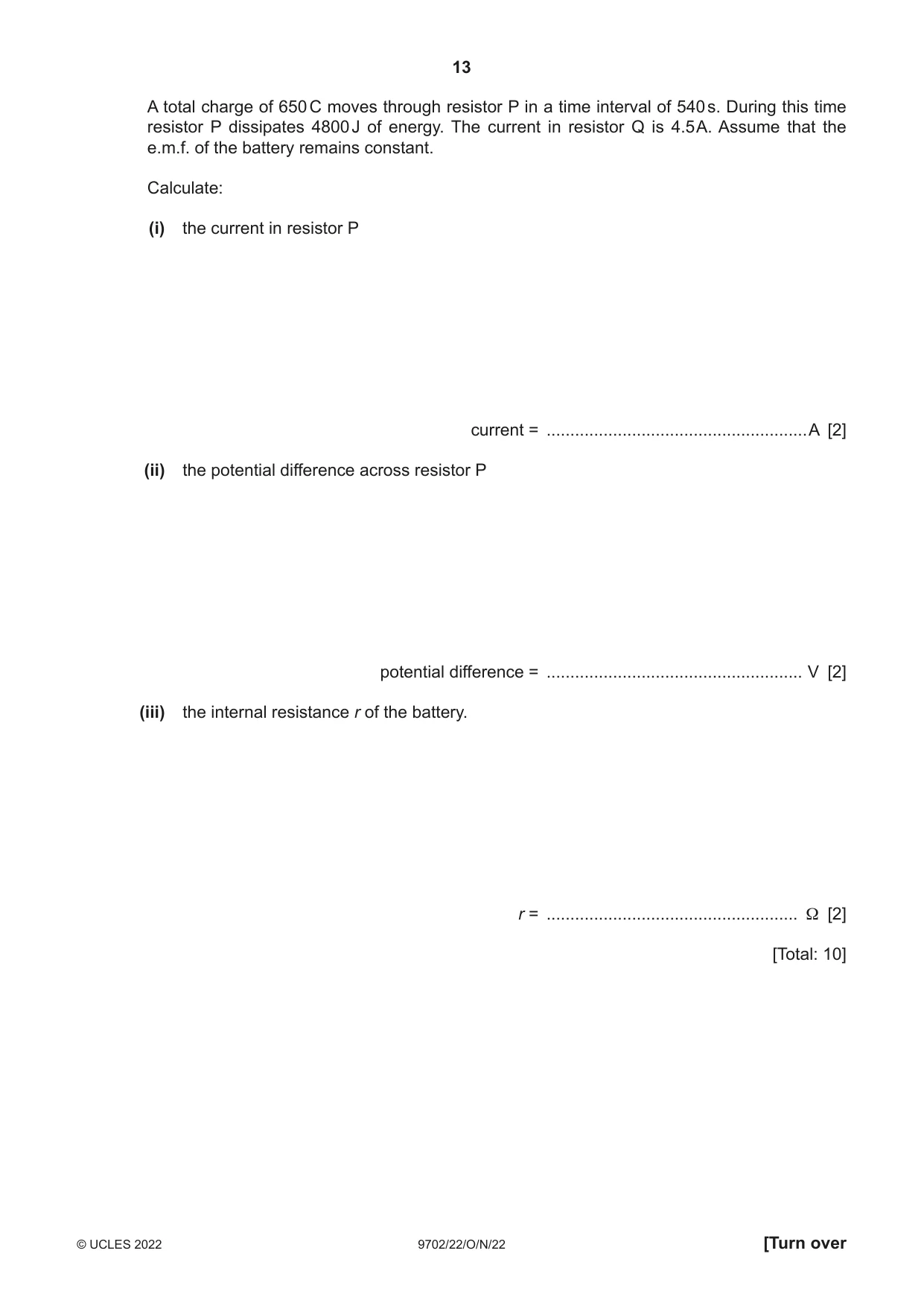
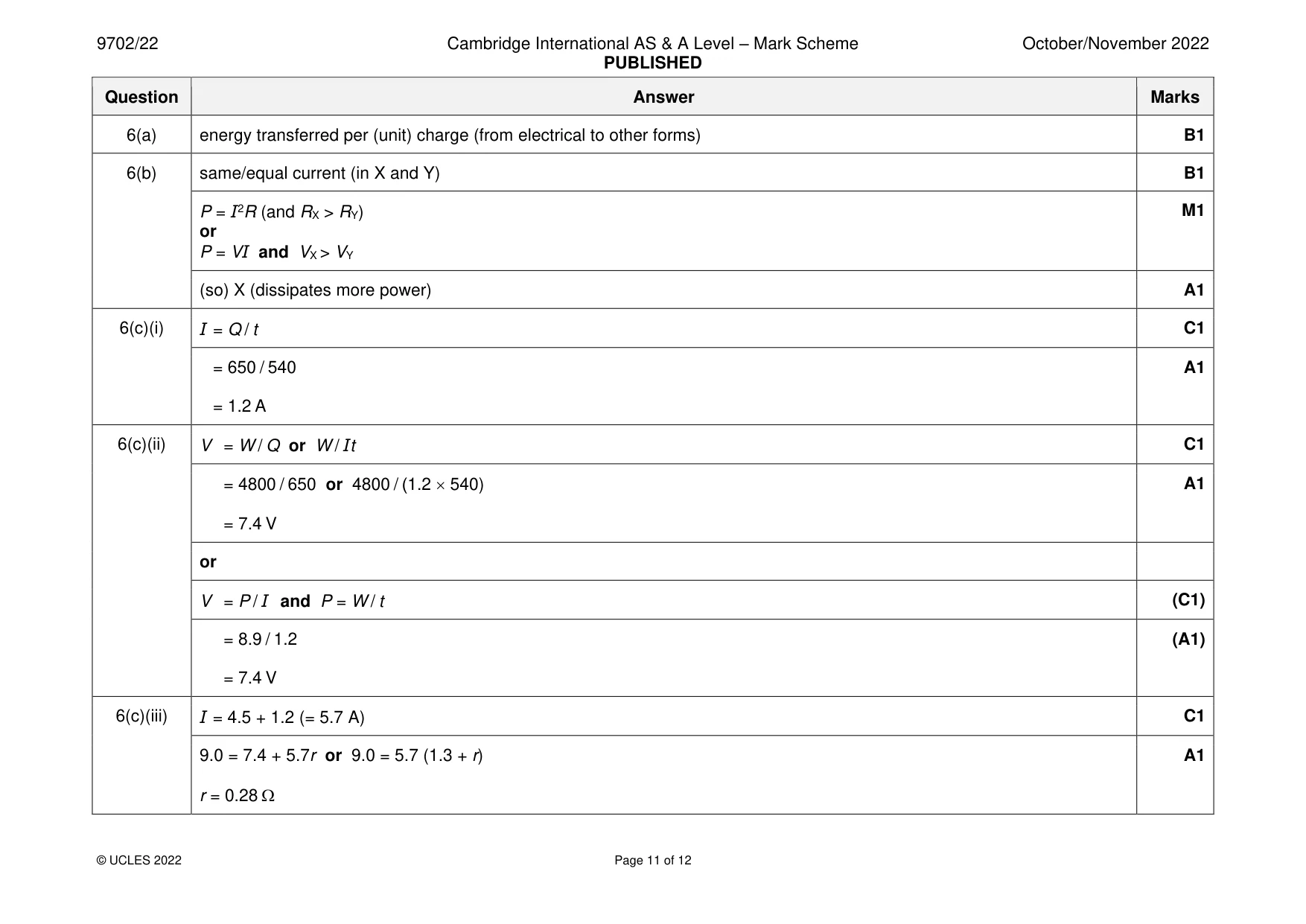
6 (a) Define electric potential difference. ................................................................................................................................................... ............................................................................................................................................. [1] (b) A battery is connected to two resistors X and Y, as shown in Fig. 6.1. X Y Fig. 6.1 The resistance of resistor X is greater than the resistance of resistor Y. State and explain which resistor dissipates more power. ................................................................................................................................................... ................................................................................................................................................... ................................................................................................................................................... ................................................................................................................................................... ............................................................................................................................................. [3] (c) A battery of electromotive force (e.m.f.) 9.0 V and internal resistance r is connected to two resistors P and Q, as shown in Fig. 6.2. 9.0 V r P Q 4.5 A Fig. 6.2 A total charge of 650 C moves through resistor P in a time interval of 540 s. During this time resistor P dissipates 4800 J of energy. The current in resistor Q is 4.5 A. Assume that the e.m.f. of the battery remains constant. Calculate: (i) the current in resistor P current = .......................................................A [2] (ii) the potential difference across resistor P potential difference = ...................................................... V [2] (iii) the internal resistance r of the battery. r = ..................................................... Ω [2] [Total: 10]
Mark scheme: 6(a) energy transferred per (unit) charge (from electrical to other forms) B1 6(b) same/equal current (in X and Y) B1 P = I2R (and RX > RY) M1 or P = VI and VX > VY (so) X (dissipates more power) A1 6(c)(i) I = Q / t C1 = 650 / 540 A1 = 1.2 A 6(c)(ii) V = W / Q or W / It C1 = 4800 / 650 or 4800 / (1.2 540) A1 = 7.4 V or V = P / I and P = W / t (C1) = 8.9 / 1.2 (A1) = 7.4 V 6(c)(iii) I = 4.5 + 1.2 (= 5.7 A) C1 9.0 = 7.4 + 5.7r or 9.0 = 5.7 (1.3 + r) A1 r = 0.28
Q7 · Describe the structure of an atom of uranium-238, 23892U
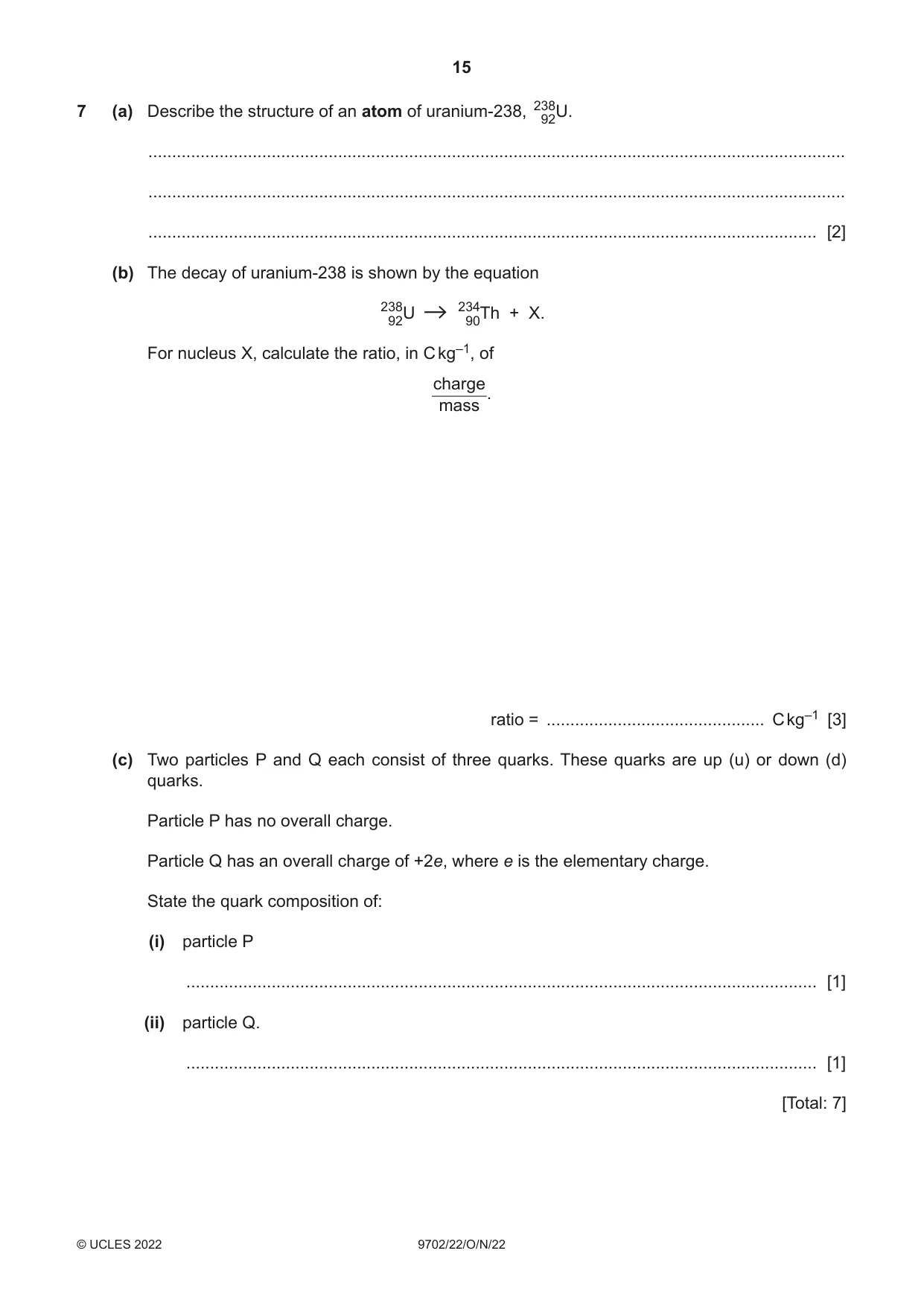
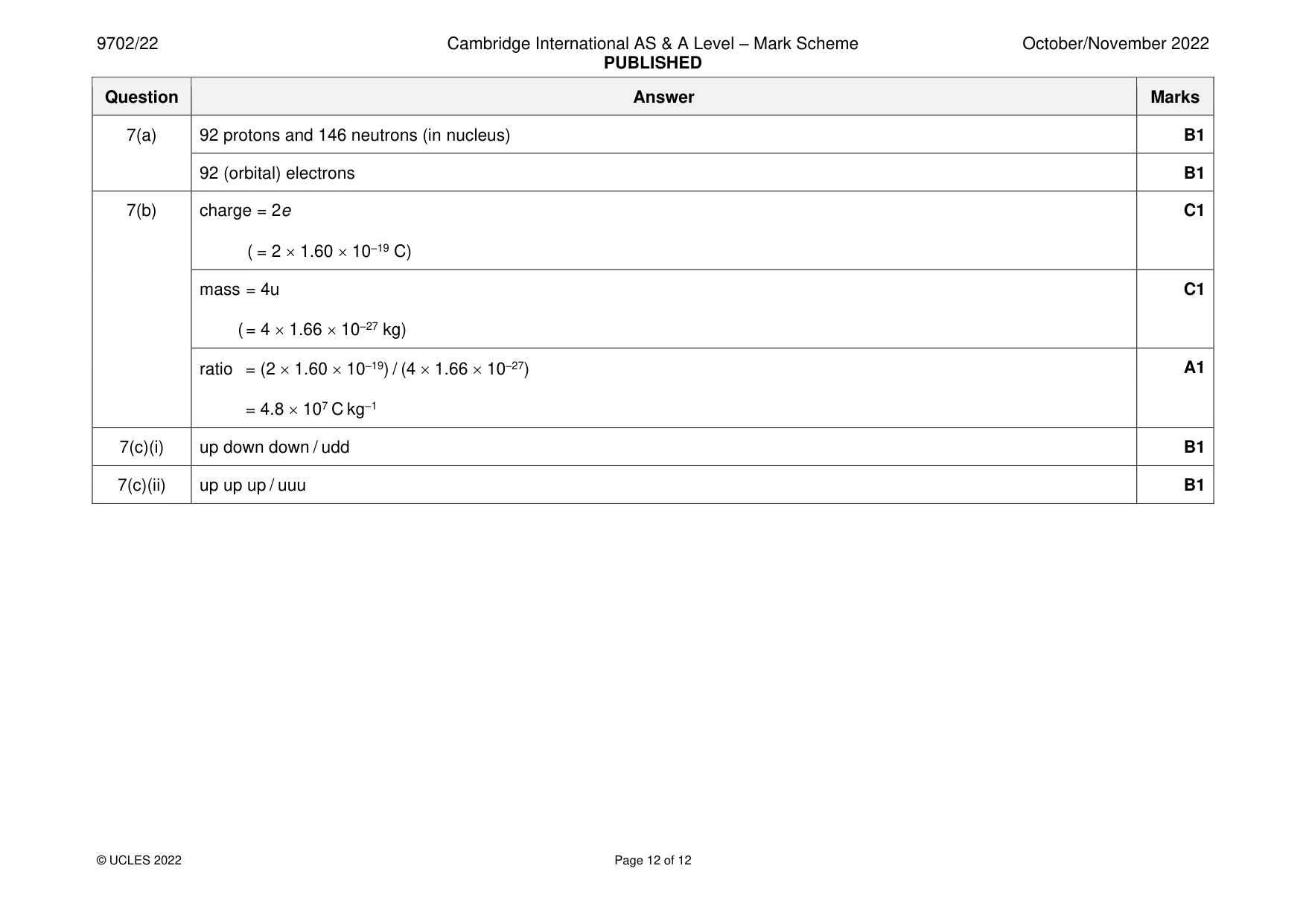
7 (a) Describe the structure of an atom of uranium-238, 23892U. ................................................................................................................................................... ................................................................................................................................................... ............................................................................................................................................. [2] (b) The decay of uranium-238 is shown by the equation 23892U 23490Th + X. For nucleus X, calculate the ratio, in C kg–1, of charge . mass ratio = .............................................. C kg–1 [3] (c) Two particles P and Q each consist of three quarks. These quarks are up (u) or down (d) quarks. Particle P has no overall charge. Particle Q has an overall charge of +2e, where e is the elementary charge. State the quark composition of: (i) particle P ..................................................................................................................................... [1] (ii) particle Q. ..................................................................................................................................... [1] [Total: 7]
Mark scheme: 7(a) 92 protons and 146 neutrons (in nucleus) B1 92 (orbital) electrons B1 7(b) charge = 2e C1 ( = 2 1.60 10–19 C) mass = 4u C1 ( = 4 1.66 10–27 kg) ratio = (2 1.60 10–19) / (4 1.66 10–27) A1 = 4.8 107 C kg–1 7(c)(i) up down down / udd B1 7(c)(ii) up up up / uuu B1
What was in this paper
The subtopics covered by these 7 questions, and how many questions each got. Open one in a new tab to see every Cambridge question on it.
What you needed in this session
Cambridge’s own grade thresholds for 2022 Oct/Nov, Paper 2 · Variant 2. A higher threshold means an easier paper — the bar moves with how the cohort did.