Cambridge A Level Physics 9702 — 2010 Oct/Nov Paper 2 · Variant 3
9702/23/O/N/10 · 9 questions · 60 marks · ≈68 min
The question paper and its mark scheme, free to read here and free to download. This is Cambridge’s own paper, exactly as it was sat.
Question paper16 pages


Mark scheme4 pages
Answers below. Sit the paper first if you are practising.
Questions as text
Q1 · Make estimates of the following quantities
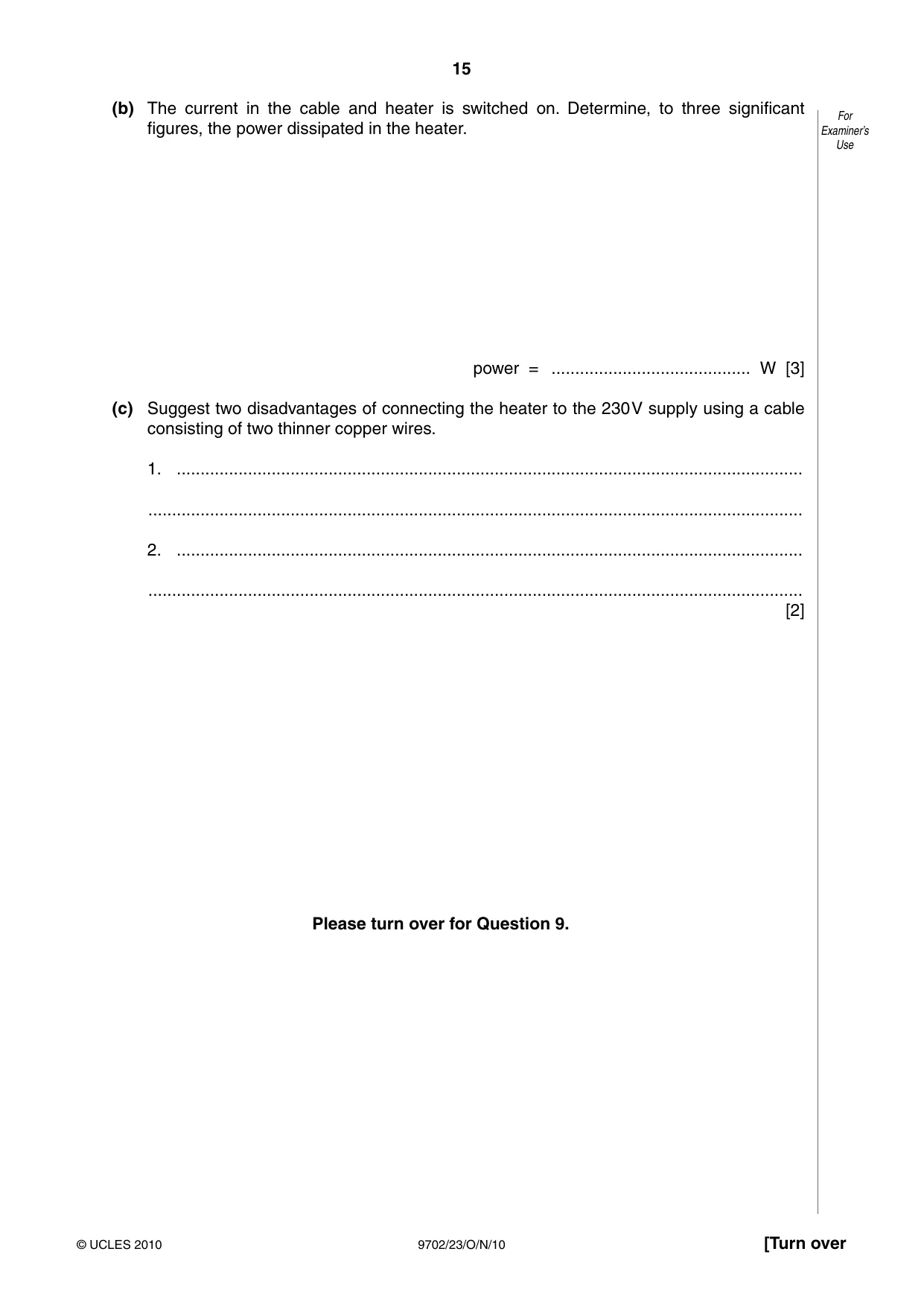
1 Make estimates of the following quantities. (a) the thickness of a sheet of paper thickness = ....................................... mm [1] (b) the time for sound to travel 100 m in air time = ........................................... s [1] (c) the weight of 1000 cm3 of water weight = .......................................... N [1]
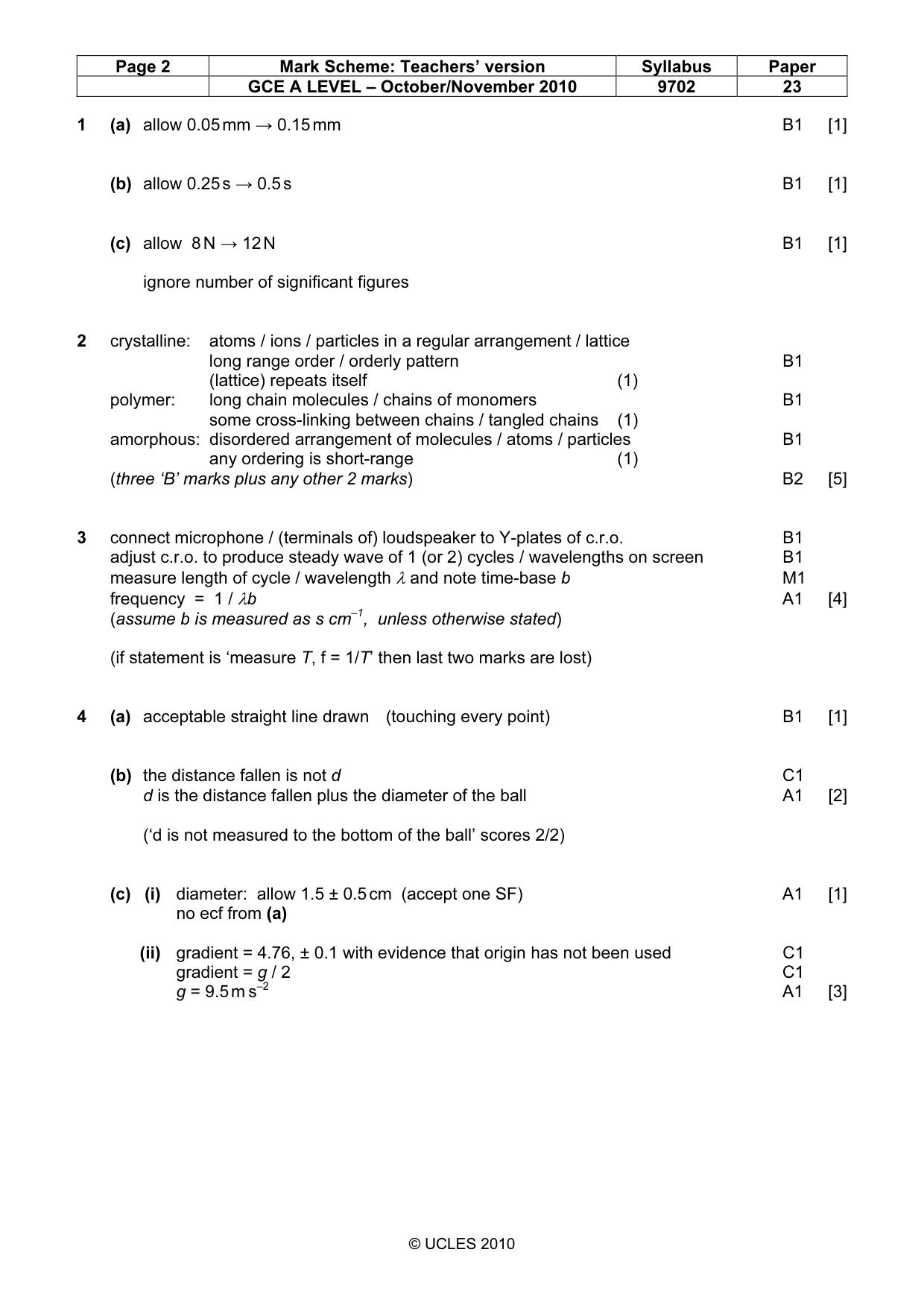
Mark scheme: 1 (a) allow 0.05 mm → 0.15 mm B1 [1] (b) allow 0.25 s → 0.5 s B1 [1] (c) allow 8 N → 12 N B1 [1] ignore number of significant figures
Q2 · Briefly describe the structures of crystalline solids, polymers and amorphous materials
2 Briefly describe the structures of crystalline solids, polymers and amorphous materials. crystalline solids ...................................................................................................................... ................................................................................................................................................. ................................................................................................................................................. polymers .................................................................................................................................. ................................................................................................................................................. ................................................................................................................................................. amorphous materials .............................................................................................................. ................................................................................................................................................. ................................................................................................................................................. [5]
Mark scheme: 2 crystalline: atoms / ions / particles in a regular arrangement / lattice long range order / orderly pattern B1 (lattice) repeats itself (1) polymer: long chain molecules / chains of monomers B1 some cross-linking between chains / tangled chains (1) amorphous: disordered arrangement of molecules / atoms / particles B1 any ordering is short-range (1) (three ‘B’ marks plus any other 2 marks) B2 [5]
Q3 · A loudspeaker produces a sound wave of constant frequency
3 A loudspeaker produces a sound wave of constant frequency. For Examiner’s Outline how a cathode-ray oscilloscope (c.r.o.) may be used to determine this frequency. Use ................................................................................................................................................. ................................................................................................................................................. ................................................................................................................................................. ................................................................................................................................................. ........................................................................................................................................... [4]
Mark scheme: 3 connect microphone / (terminals of) loudspeaker to Y-plates of c.r.o. B1 adjust c.r.o. to produce steady wave of 1 (or 2) cycles / wavelengths on screen B1 measure length of cycle / wavelength λ and note time-base b M1 frequency = 1 / λb A1 [4] (assume b is measured as s cm–1, unless otherwise stated) (if statement is ‘measure T, f = 1/T’ then last two marks are lost)
Q4 · A student takes measurements to determine a value for the acceleration of free fall
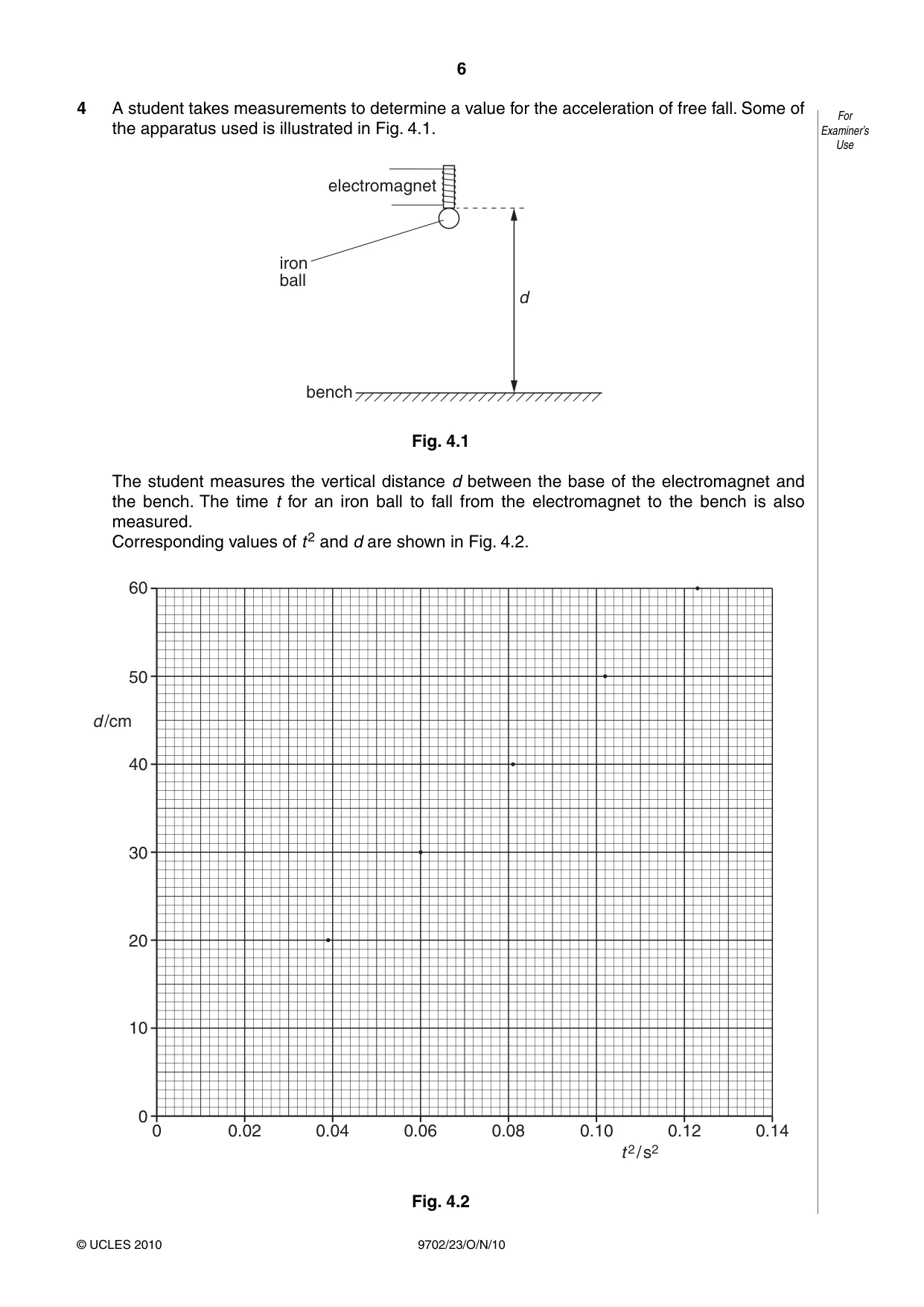
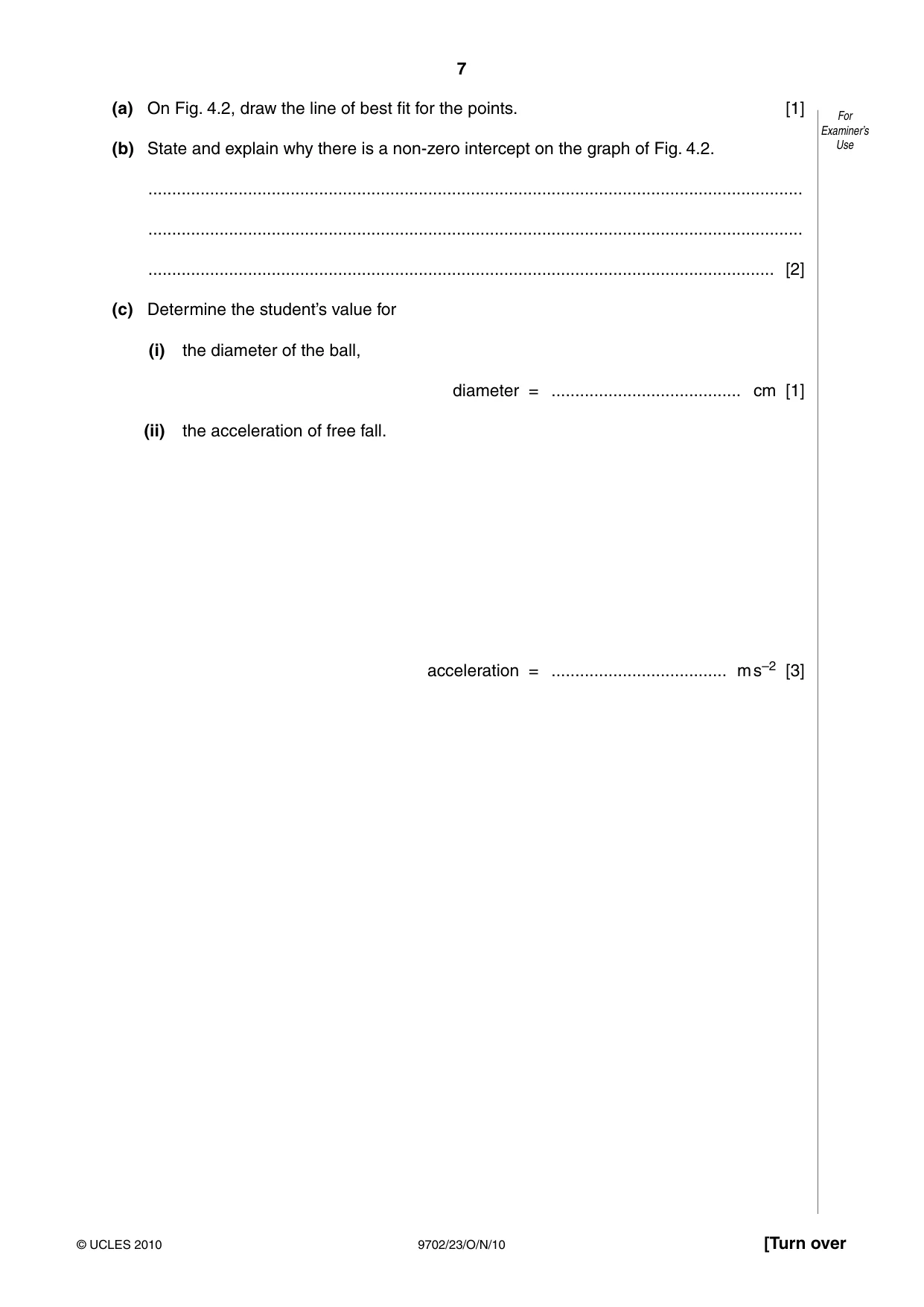
4 A student takes measurements to determine a value for the acceleration of free fall. Some of For the apparatus used is illustrated in Fig. 4.1. Examiner’s Use electromagnet iron ball d bench Fig. 4.1 The student measures the vertical distance d between the base of the electromagnet and the bench. The time t for an iron ball to fall from the electromagnet to the bench is also measured. Corresponding values of t2 and d are shown in Fig. 4.2. 60 50 d /cm 40 30 20 10 0 0 0.02 0.04 0.06 0.08 0.10 0.12 0.14 t 2 / s2 Fig. 4.2 (a) On Fig. 4.2, draw the line of best fit for the points. [1] For Examiner’s (b) State and explain why there is a non-zero intercept on the graph of Fig. 4.2. Use .......................................................................................................................................... .......................................................................................................................................... .................................................................................................................................... [2] (c) Determine the student’s value for (i) the diameter of the ball, diameter = ........................................ cm [1] (ii) the acceleration of free fall. acceleration = ..................................... m s–2 [3]
Mark scheme: 4 (a) acceptable straight line drawn (touching every point) B1 [1] (b) the distance fallen is not d C1 d is the distance fallen plus the diameter of the ball A1 [2] (‘d is not measured to the bottom of the ball’ scores 2/2) (c) (i) diameter: allow 1.5 ± 0.5 cm (accept one SF) A1 [1] no ecf from (a) (ii) gradient = 4.76, ± 0.1 with evidence that origin has not been used C1 gradient = g / 2 C1 g = 9.5 m s–2 A1 [3] GCE A LEVEL – October/November 2010 9702 23
Q5 · A spring hangs vertically from a fixed point and a mass of 94 g is suspended from the…
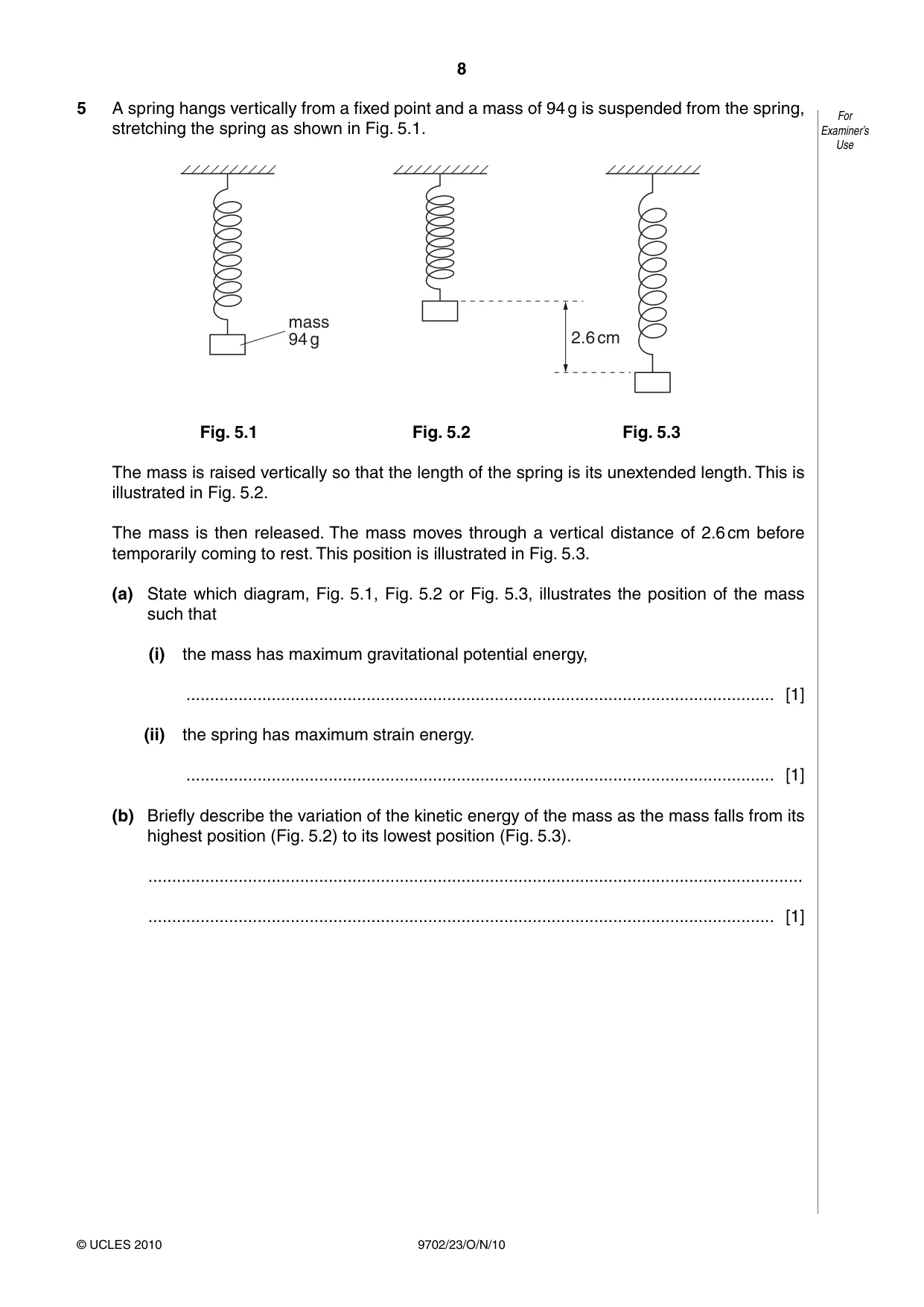
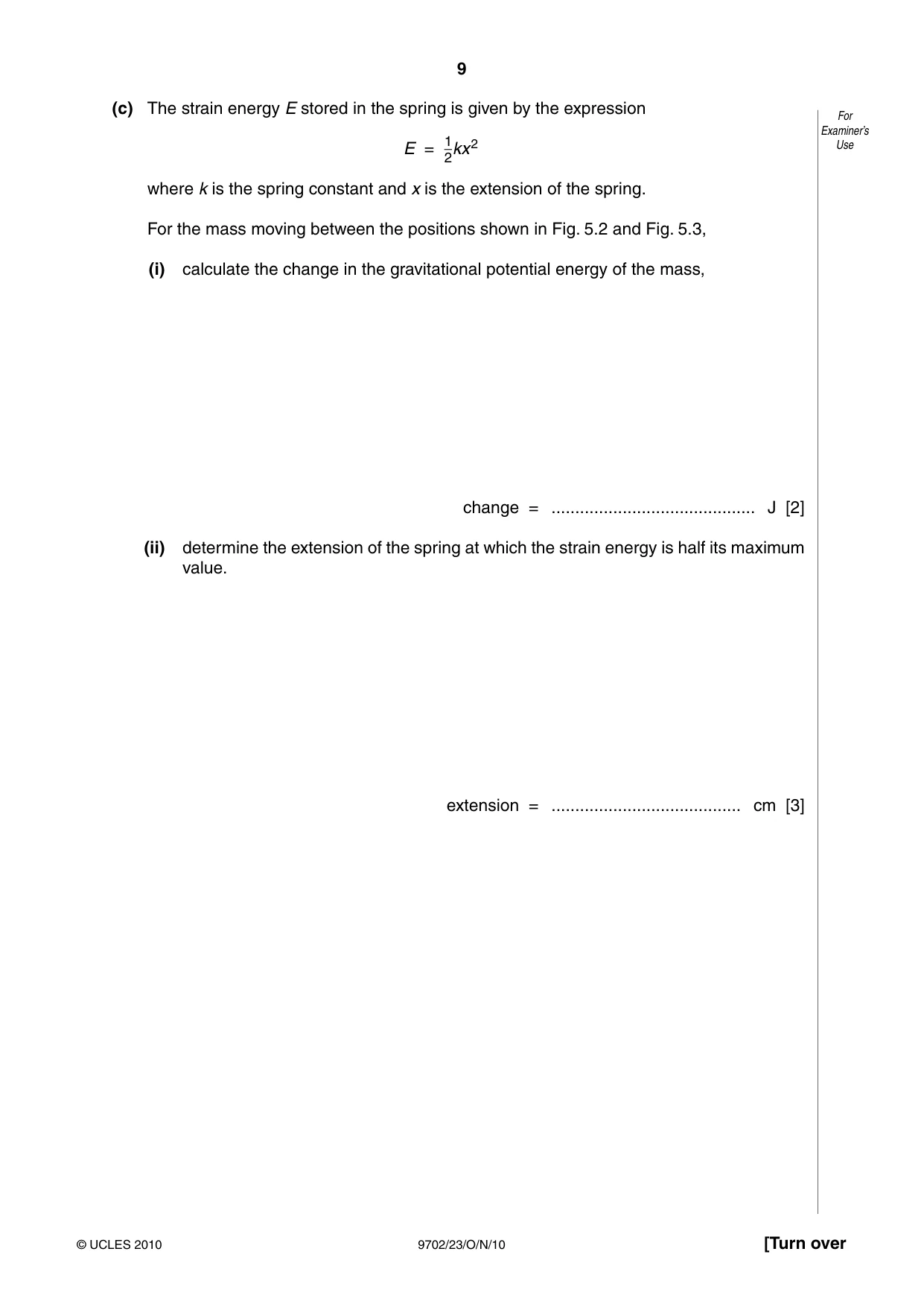
5 A spring hangs vertically from a fixed point and a mass of 94 g is suspended from the spring, For stretching the spring as shown in Fig. 5.1. Examiner’s Use mass 94 g 2.6 cm Fig. 5.1 Fig. 5.2 Fig. 5.3 The mass is raised vertically so that the length of the spring is its unextended length. This is illustrated in Fig. 5.2. The mass is then released. The mass moves through a vertical distance of 2.6 cm before temporarily coming to rest. This position is illustrated in Fig. 5.3. (a) State which diagram, Fig. 5.1, Fig. 5.2 or Fig. 5.3, illustrates the position of the mass such that (i) the mass has maximum gravitational potential energy, ............................................................................................................................ [1] (ii) the spring has maximum strain energy. ............................................................................................................................ [1] (b) Briefly describe the variation of the kinetic energy of the mass as the mass falls from its highest position (Fig. 5.2) to its lowest position (Fig. 5.3). .......................................................................................................................................... .................................................................................................................................... [1] (c) The strain energy E stored in the spring is given by the expression For Examiner’s 1 Use E = 2kx2 where k is the spring constant and x is the extension of the spring. For the mass moving between the positions shown in Fig. 5.2 and Fig. 5.3, (i) calculate the change in the gravitational potential energy of the mass, change = ........................................... J [2] (ii) determine the extension of the spring at which the strain energy is half its maximum value. extension = ........................................ cm [3]
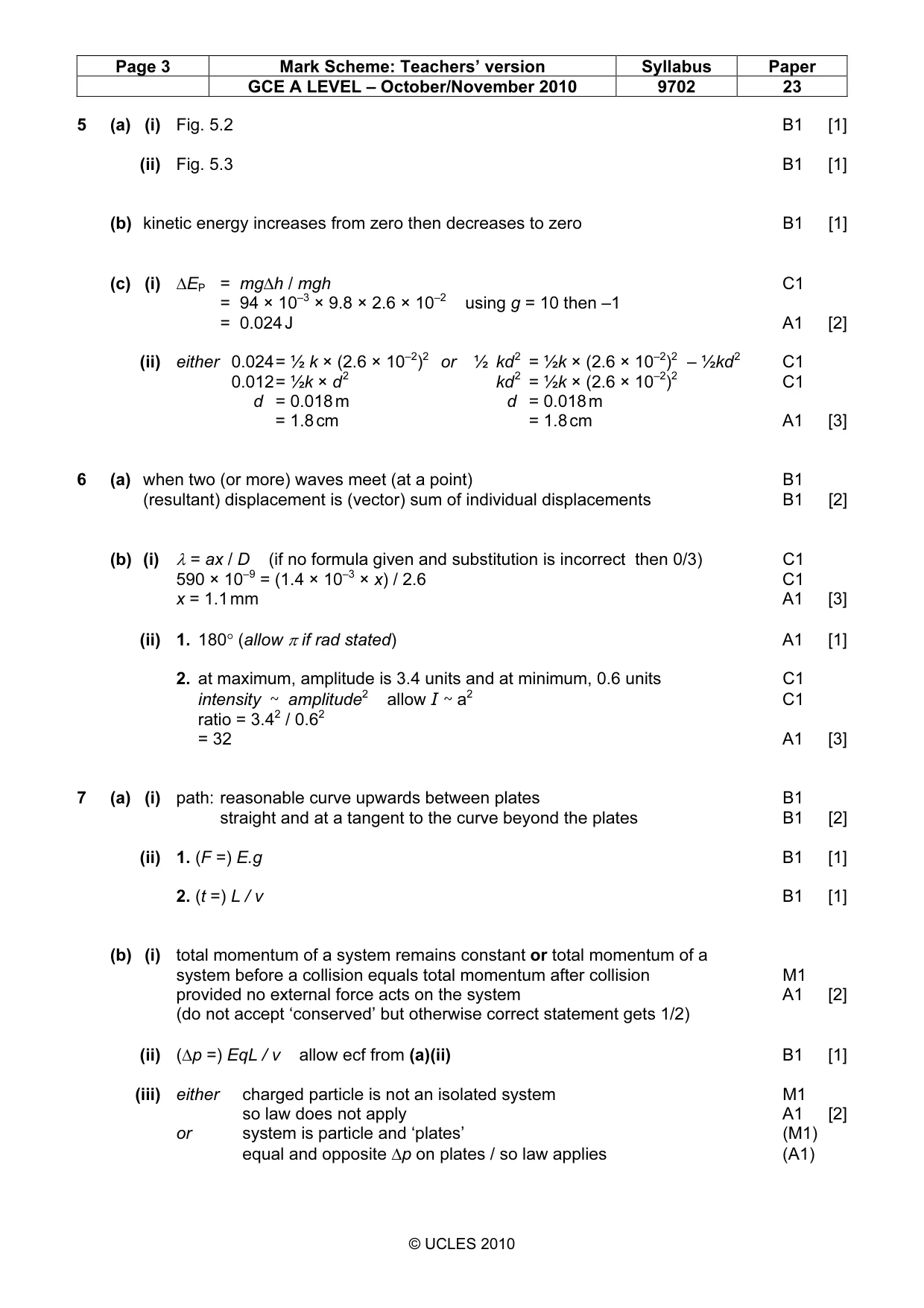
Mark scheme: 5 (a) (i) Fig. 5.2 B1 [1] (ii) Fig. 5.3 B1 [1] (b) kinetic energy increases from zero then decreases to zero B1 [1] (c) (i) ∆EP = mg∆h / mgh C1 = 94 × 10–3 × 9.8 × 2.6 × 10–2 using g = 10 then –1 = 0.024 J A1 [2] (ii) either 0.024 = ½ k × (2.6 × 10⁻²)2 or ½ kd2 = ½k × (2.6 × 10⁻²)2 – ½kd2 C1 0.012 = ½k × d2 kd2 = ½k × (2.6 × 10⁻²)2 C1 d = 0.018 m d = 0.018 m = 1.8 cm = 1.8 cm A1 [3]
More questions on Gravitational potential energy and kinetic energy
Q6 · State the principle of superposition
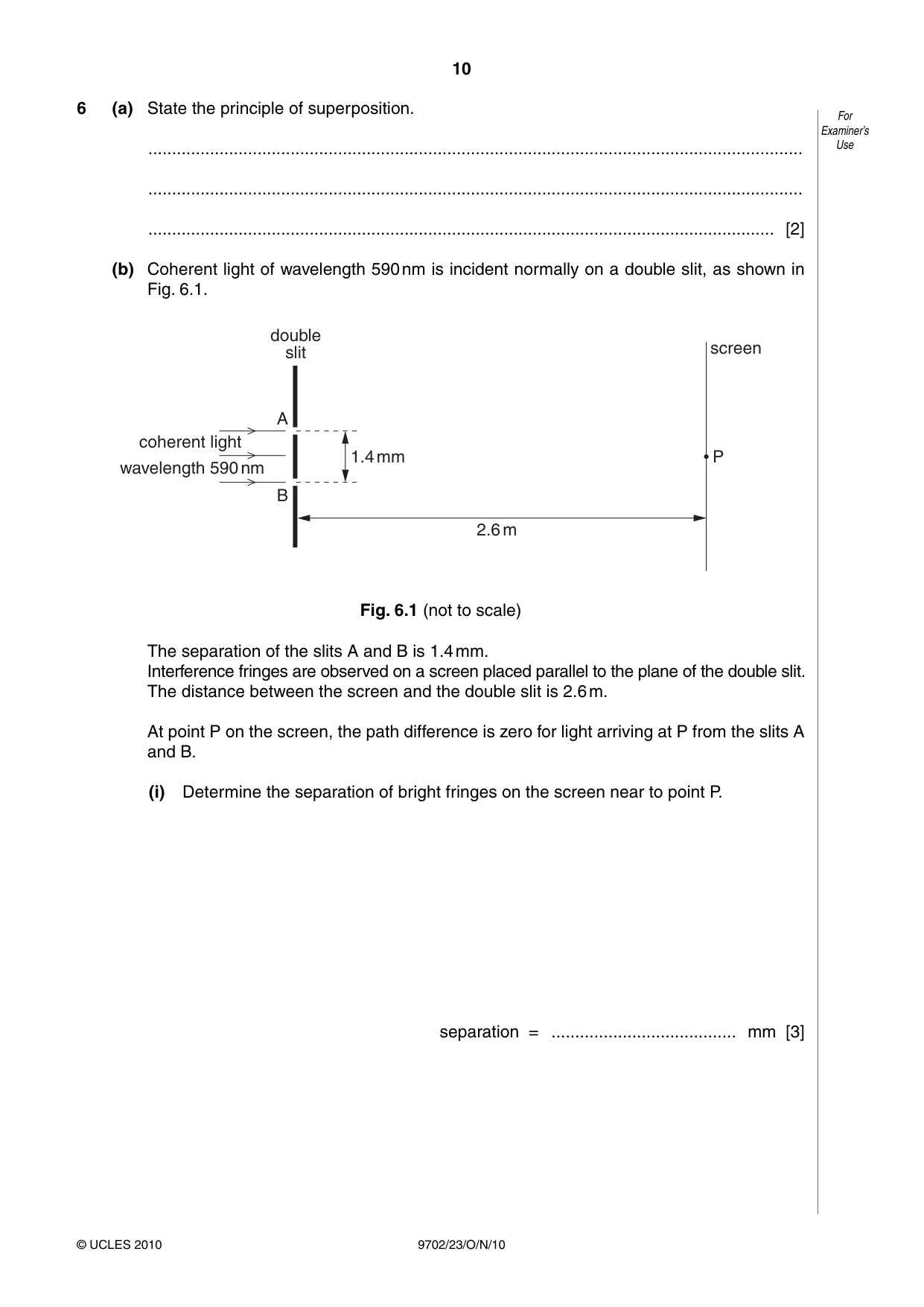
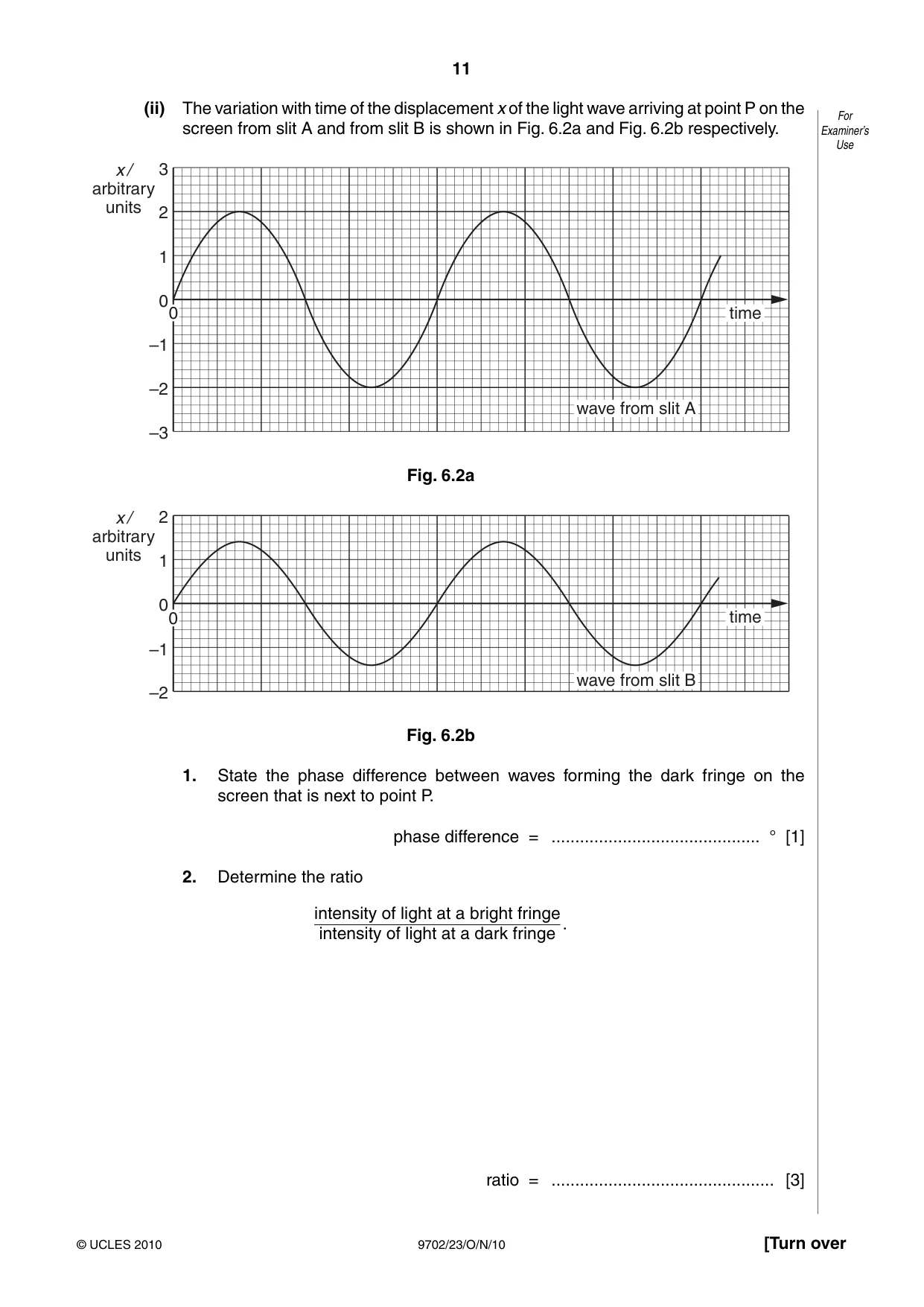
6 (a) State the principle of superposition. For Examiner’s .......................................................................................................................................... Use .......................................................................................................................................... .................................................................................................................................... [2] (b) Coherent light of wavelength 590 nm is incident normally on a double slit, as shown in Fig. 6.1. double screen slit A coherent light 1.4 mm P wavelength 590 nm B 2.6 m Fig. 6.1 (not to scale) The separation of the slits A and B is 1.4 mm. Interference fringes are observed on a screen placed parallel to the plane of the double slit. The distance between the screen and the double slit is 2.6 m. At point P on the screen, the path difference is zero for light arriving at P from the slits A and B. (i) Determine the separation of bright fringes on the screen near to point P. separation = ....................................... mm [3] (ii) The variation with time of the displacement x of the light wave arriving at point P on the For screen from slit A and from slit B is shown in Fig. 6.2a and Fig. 6.2b respectively. Examiner’s Use x / 3 arbitrary units 2 1 0 0 time –1 –2 wave from slit A –3 Fig. 6.2a x / 2 arbitrary units 1 0 0 time –1 wave from slit B –2 Fig. 6.2b 1. State the phase difference between waves forming the dark fringe on the screen that is next to point P. phase difference = ............................................ ° [1] 2. Determine the ratio intensity of light at a bright fringe . intensity of light at a dark fringe ratio = ............................................... [3]
Mark scheme: 6 (a) when two (or more) waves meet (at a point) B1 (resultant) displacement is (vector) sum of individual displacements B1 [2] (b) (i) λ = ax / D (if no formula given and substitution is incorrect then 0/3) C1 590 × 10–9 = (1.4 × 10⁻³ × x) / 2.6 C1 x = 1.1 mm A1 [3] (ii) 1. 180° (allow π if rad stated) A1 [1] 2. at maximum, amplitude is 3.4 units and at minimum, 0.6 units C1 intensity ~ amplitude2 allow I ~ a2 C1 ratio = 3.42 / 0.62 = 32 A1 [3]
Q7 · Two oppositely-charged parallel metal plates are situated in a vacuum, as shown in Fig
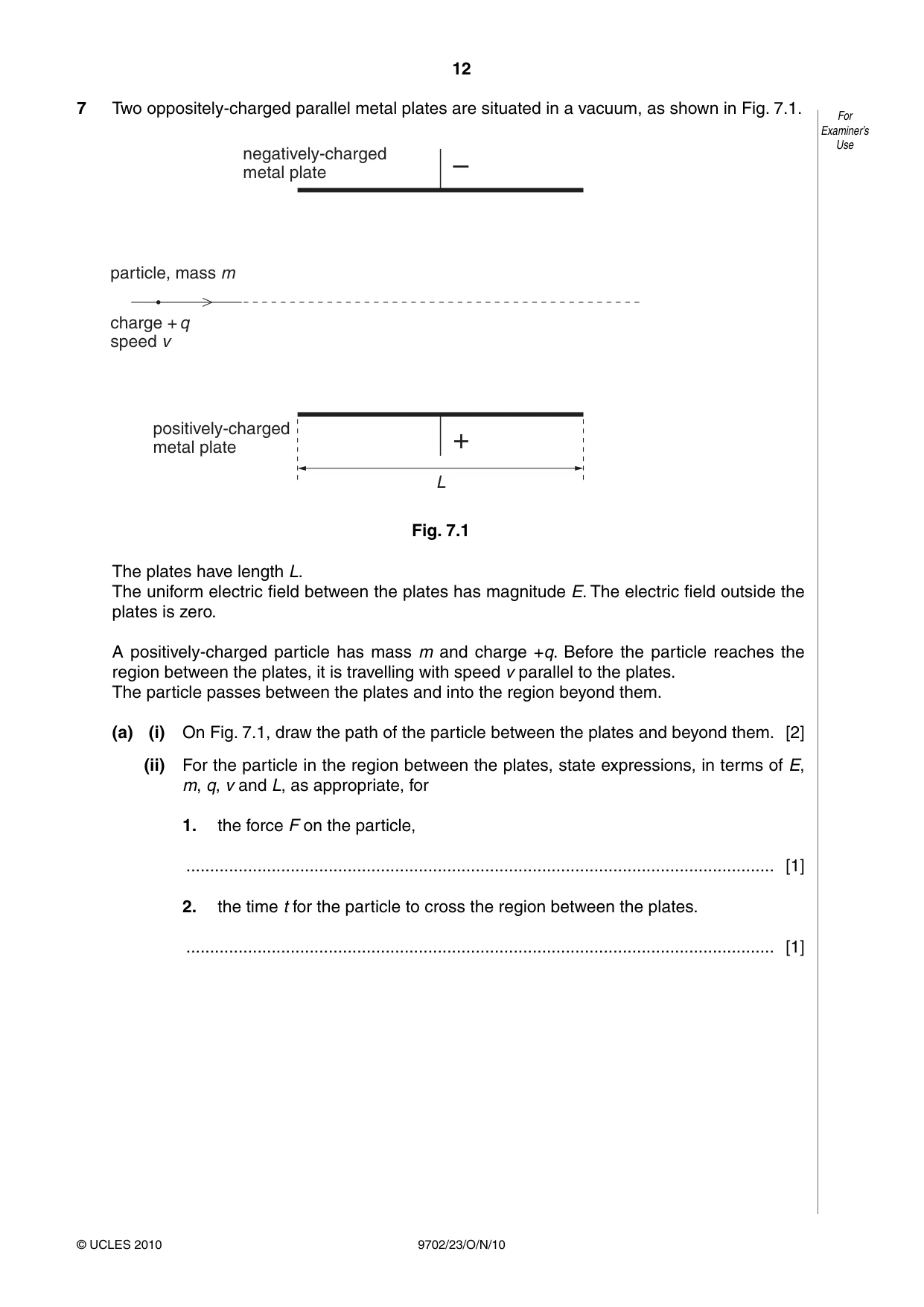
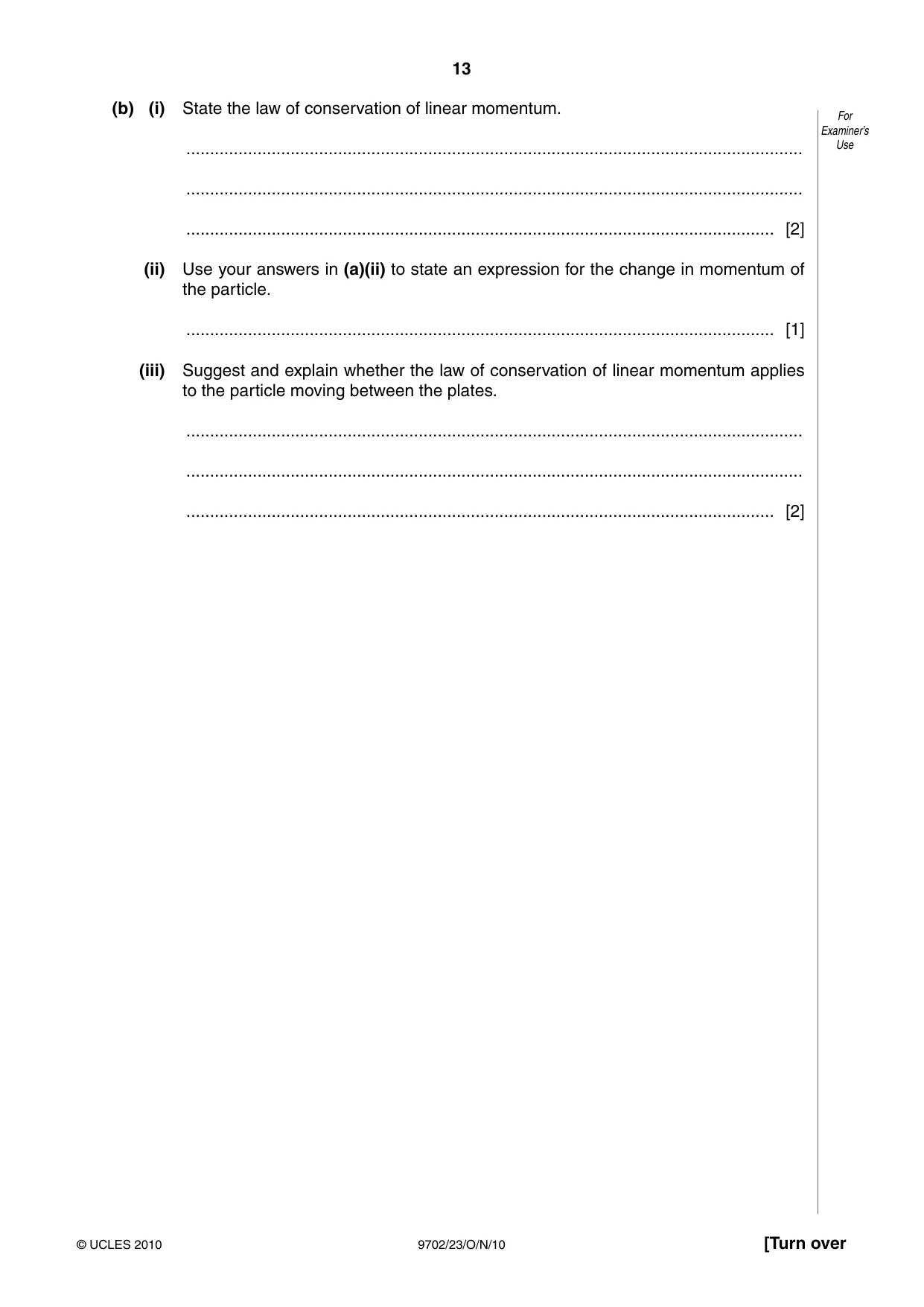
7 Two oppositely-charged parallel metal plates are situated in a vacuum, as shown in Fig. 7.1. For Examiner’s Use negatively-charged metal plate – particle, mass m charge + q speed v positively-charged metal plate + L Fig. 7.1 The plates have length L. The uniform electric field between the plates has magnitude E. The electric field outside the plates is zero. A positively-charged particle has mass m and charge +q. Before the particle reaches the region between the plates, it is travelling with speed v parallel to the plates. The particle passes between the plates and into the region beyond them. (a) (i) On Fig. 7.1, draw the path of the particle between the plates and beyond them. [2] (ii) For the particle in the region between the plates, state expressions, in terms of E, m, q, v and L, as appropriate, for 1. the force F on the particle, ............................................................................................................................ [1] 2. the time t for the particle to cross the region between the plates. ............................................................................................................................ [1] (b) (i) State the law of conservation of linear momentum. For Examiner’s .................................................................................................................................. Use .................................................................................................................................. ............................................................................................................................ [2] (ii) Use your answers in (a)(ii) to state an expression for the change in momentum of the particle. ............................................................................................................................ [1] (iii) Suggest and explain whether the law of conservation of linear momentum applies to the particle moving between the plates. .................................................................................................................................. .................................................................................................................................. ............................................................................................................................ [2]
Mark scheme: 7 (a) (i) path: reasonable curve upwards between plates B1 straight and at a tangent to the curve beyond the plates B1 [2] (ii) 1. (F =) E.g B1 [1] 2. (t =) L / v B1 [1] (b) (i) total momentum of a system remains constant or total momentum of a system before a collision equals total momentum after collision M1 provided no external force acts on the system A1 [2] (do not accept ‘conserved’ but otherwise correct statement gets 1/2) (ii) (∆p =) EqL / v allow ecf from (a)(ii) B1 [1] (iii) either charged particle is not an isolated system M1 so law does not apply A1 [2] or system is particle and ‘plates’ (M1) equal and opposite ∆p on plates / so law applies (A1) GCE A LEVEL – October/November 2010 9702 23 2
Q8 · An electric heater has a constant resistance and is rated as 1.20 kW, 230 V
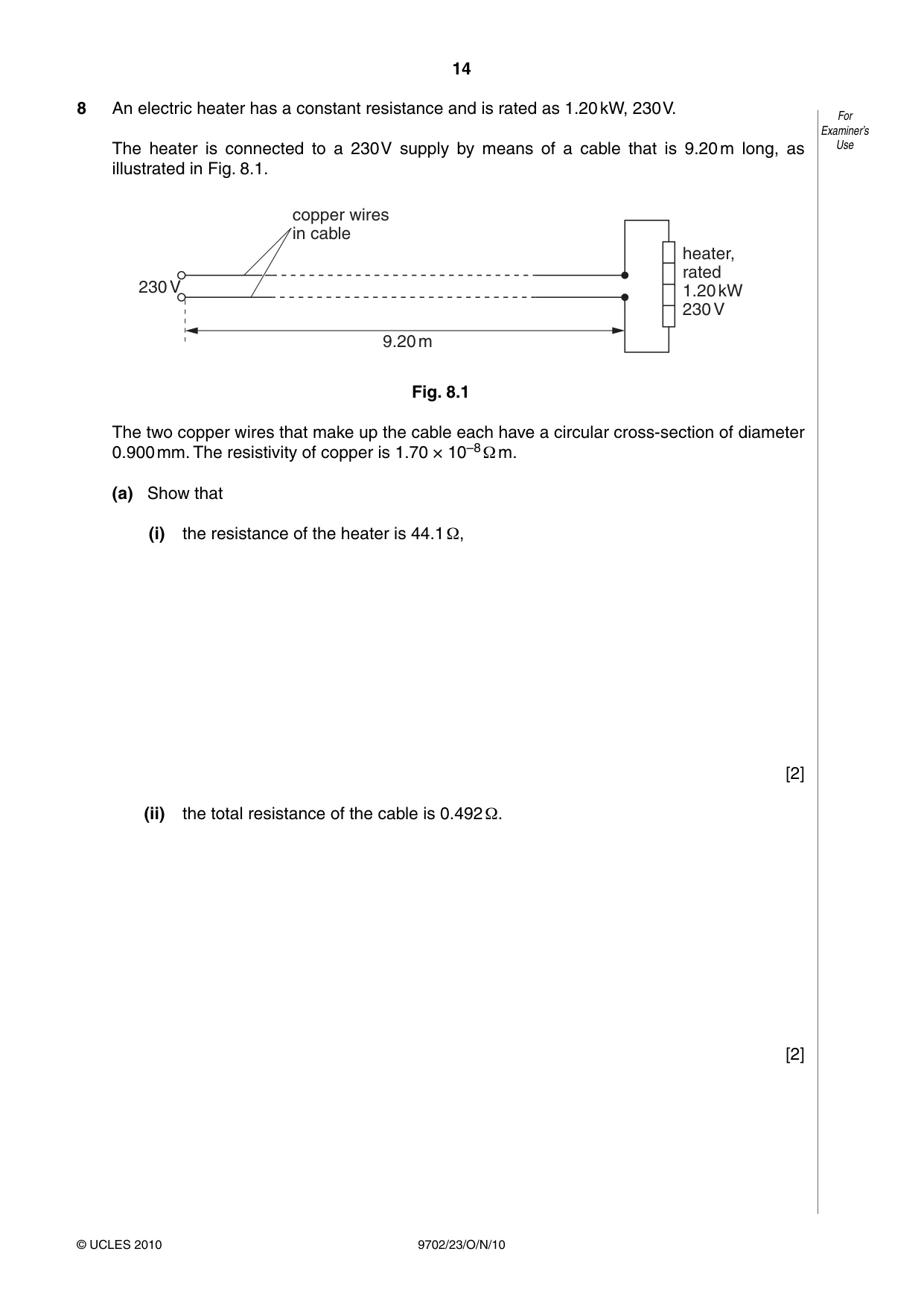
8 An electric heater has a constant resistance and is rated as 1.20 kW, 230 V. For Examiner’s The heater is connected to a 230 V supply by means of a cable that is 9.20 m long, as Use illustrated in Fig. 8.1. copper wires in cable heater, rated 230 V 1.20 kW 230 V 9.20 m Fig. 8.1 The two copper wires that make up the cable each have a circular cross-section of diameter 0.900 mm. The resistivity of copper is 1.70 × 10⁻⁸ Ω m. (a) Show that (i) the resistance of the heater is 44.1 Ω, [2] (ii) the total resistance of the cable is 0.492 Ω. [2] (b) The current in the cable and heater is switched on. Determine, to three significant For figures, the power dissipated in the heater. Examiner’s Use power = .......................................... W [3] (c) Suggest two disadvantages of connecting the heater to the 230 V supply using a cable consisting of two thinner copper wires. 1. .................................................................................................................................... .......................................................................................................................................... 2. .................................................................................................................................... .......................................................................................................................................... [2] Please turn over for Question 9.
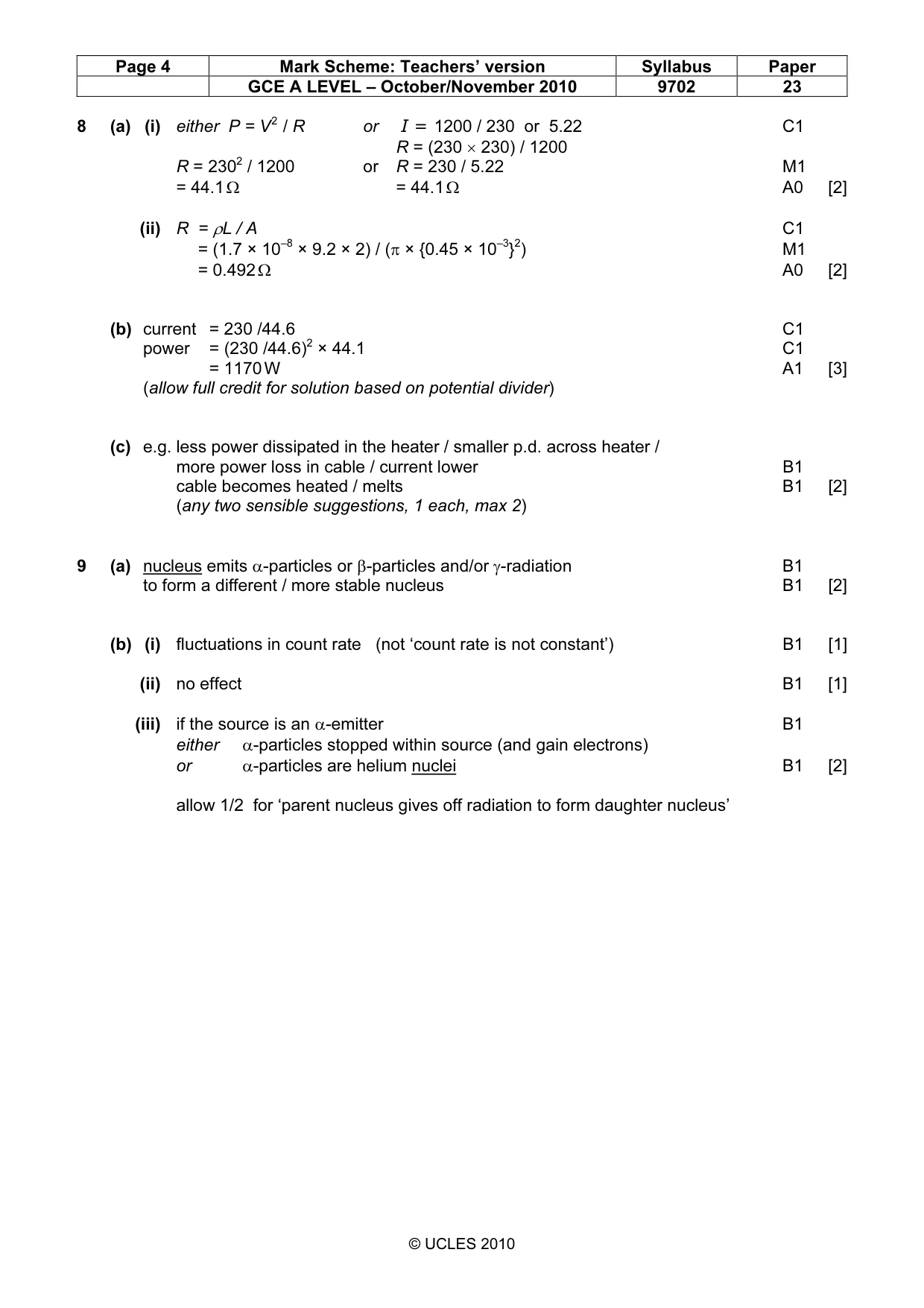
Mark scheme: 8 (a) (i) either P = V2 / R or I = 1200 / 230 or 5.22 C1 R = (230 × 230) / 1200 R = 2302 / 1200 or R = 230 / 5.22 M1 = 44.1 Ω = 44.1 Ω A0 [2] (ii) R = ρL / A C1 = (1.7 × 10–8 × 9.2 × 2) / (π × {0.45 × 10⁻³}2) M1 = 0.492 Ω A0 [2] (b) current = 230 /44.6 C1 power = (230 /44.6)2 × 44.1 C1 = 1170 W A1 [3] (allow full credit for solution based on potential divider) (c) e.g. less power dissipated in the heater / smaller p.d. across heater / more power loss in cable / current lower B1 cable becomes heated / melts B1 [2] (any two sensible suggestions, 1 each, max 2)
Q9 · Explain what is meant by radioactive decay
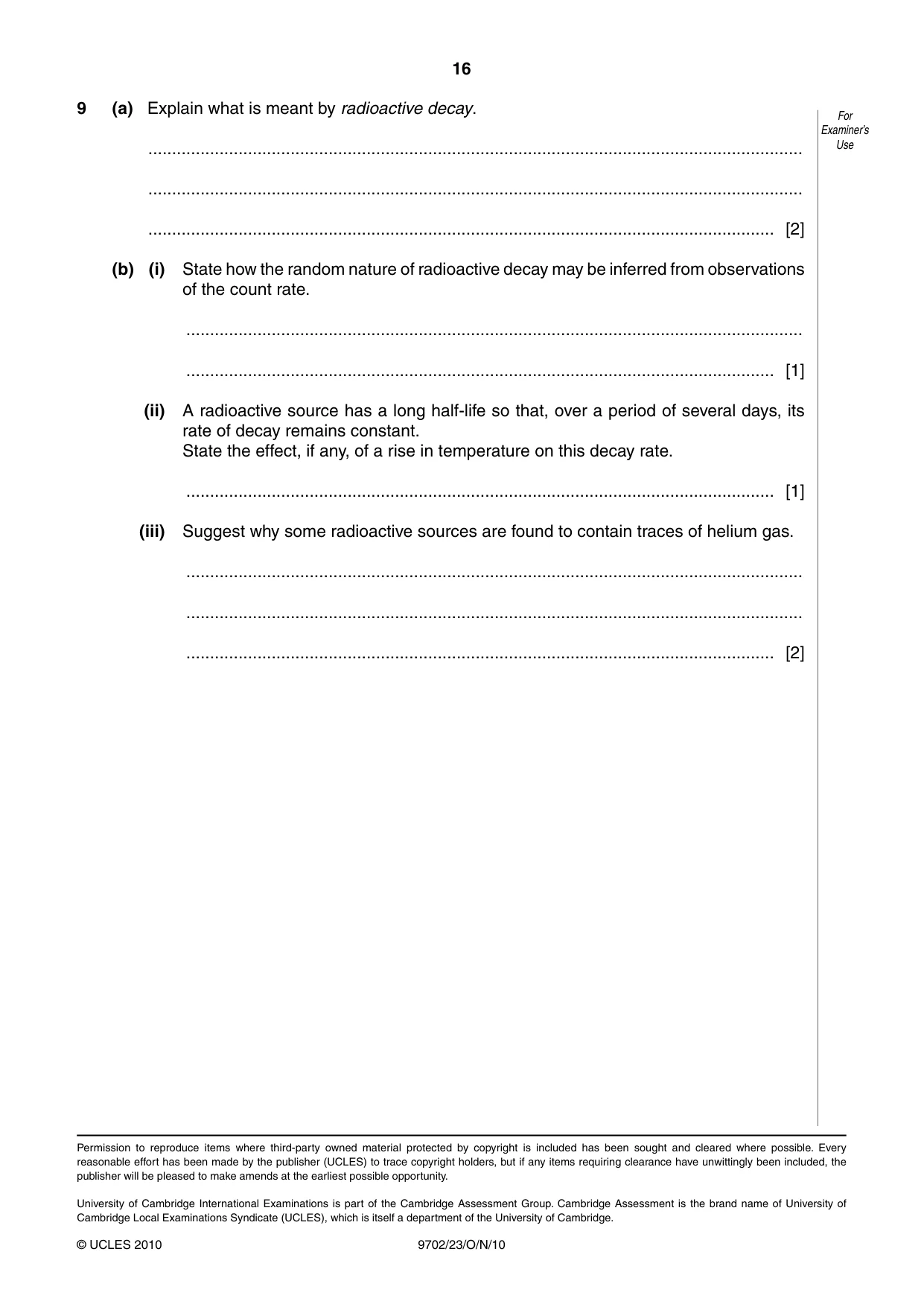
9 (a) Explain what is meant by radioactive decay. For Examiner’s .......................................................................................................................................... Use .......................................................................................................................................... .................................................................................................................................... [2] (b) (i) State how the random nature of radioactive decay may be inferred from observations of the count rate. .................................................................................................................................. ............................................................................................................................ [1] (ii) A radioactive source has a long half-life so that, over a period of several days, its rate of decay remains constant. State the effect, if any, of a rise in temperature on this decay rate. ............................................................................................................................ [1] (iii) Suggest why some radioactive sources are found to contain traces of helium gas. .................................................................................................................................. .................................................................................................................................. ............................................................................................................................ [2]
Mark scheme: 9 (a) nucleus emits α-particles or β-particles and/or γ-radiation B1 to form a different / more stable nucleus B1 [2] (b) (i) fluctuations in count rate (not ‘count rate is not constant’) B1 [1] (ii) no effect B1 [1] (iii) if the source is an α-emitter B1 either α-particles stopped within source (and gain electrons) or α-particles are helium nuclei B1 [2] allow 1/2 for ‘parent nucleus gives off radiation to form daughter nucleus’
What was in this paper
The subtopics covered by these 9 questions, and how many questions each got. Open one in a new tab to see every Cambridge question on it.
What you needed in this session
Cambridge’s own grade thresholds for 2010 Oct/Nov, Paper 2 · Variant 3. A higher threshold means an easier paper — the bar moves with how the cohort did.