Cambridge A Level Physics 9702 — 2021 Feb/March Paper 2 · Variant 2
9702/22/F/M/21 · 7 questions · 60 marks · ≈68 min
The question paper and its mark scheme, free to read here and free to download. This is Cambridge’s own paper, exactly as it was sat.
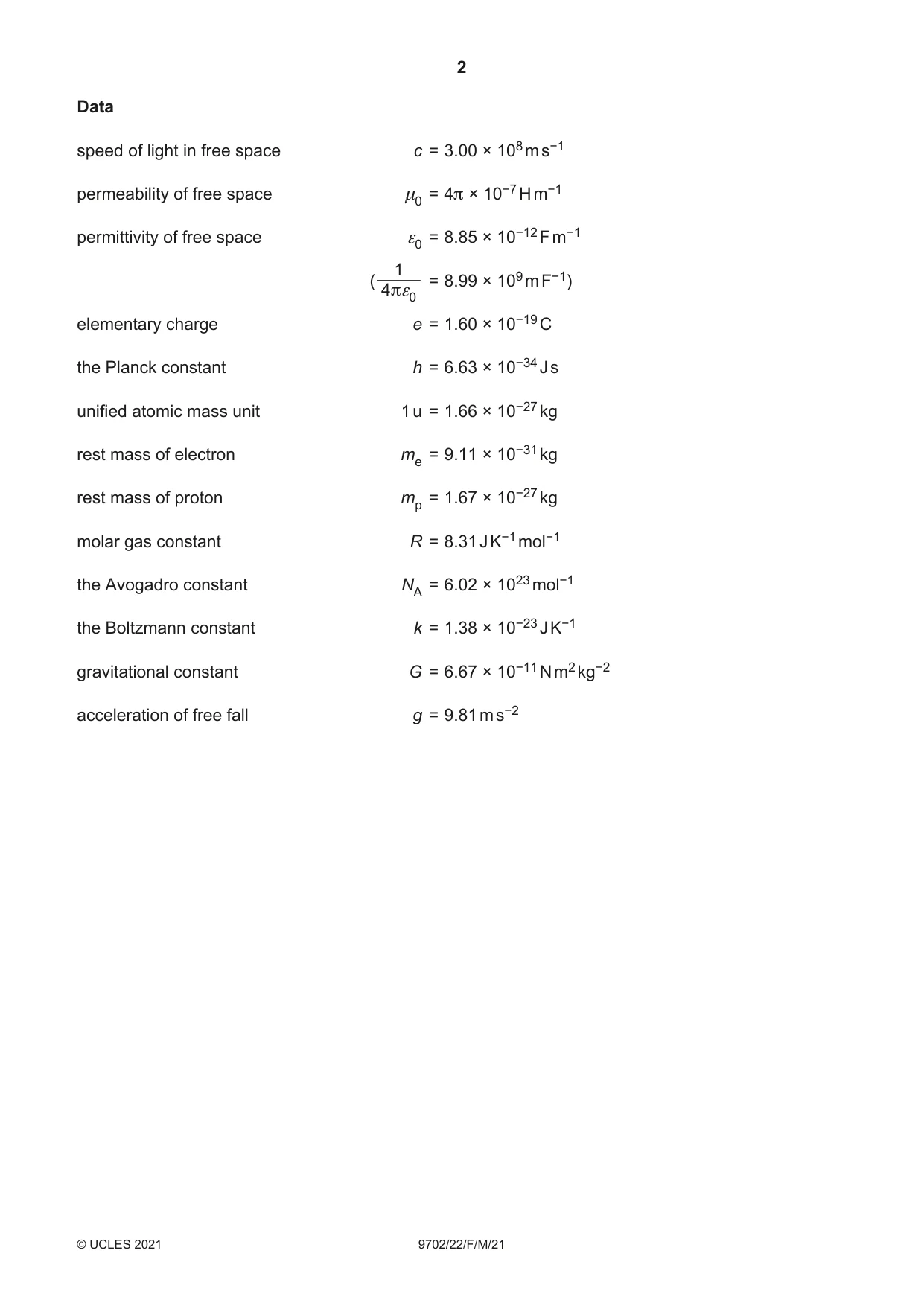
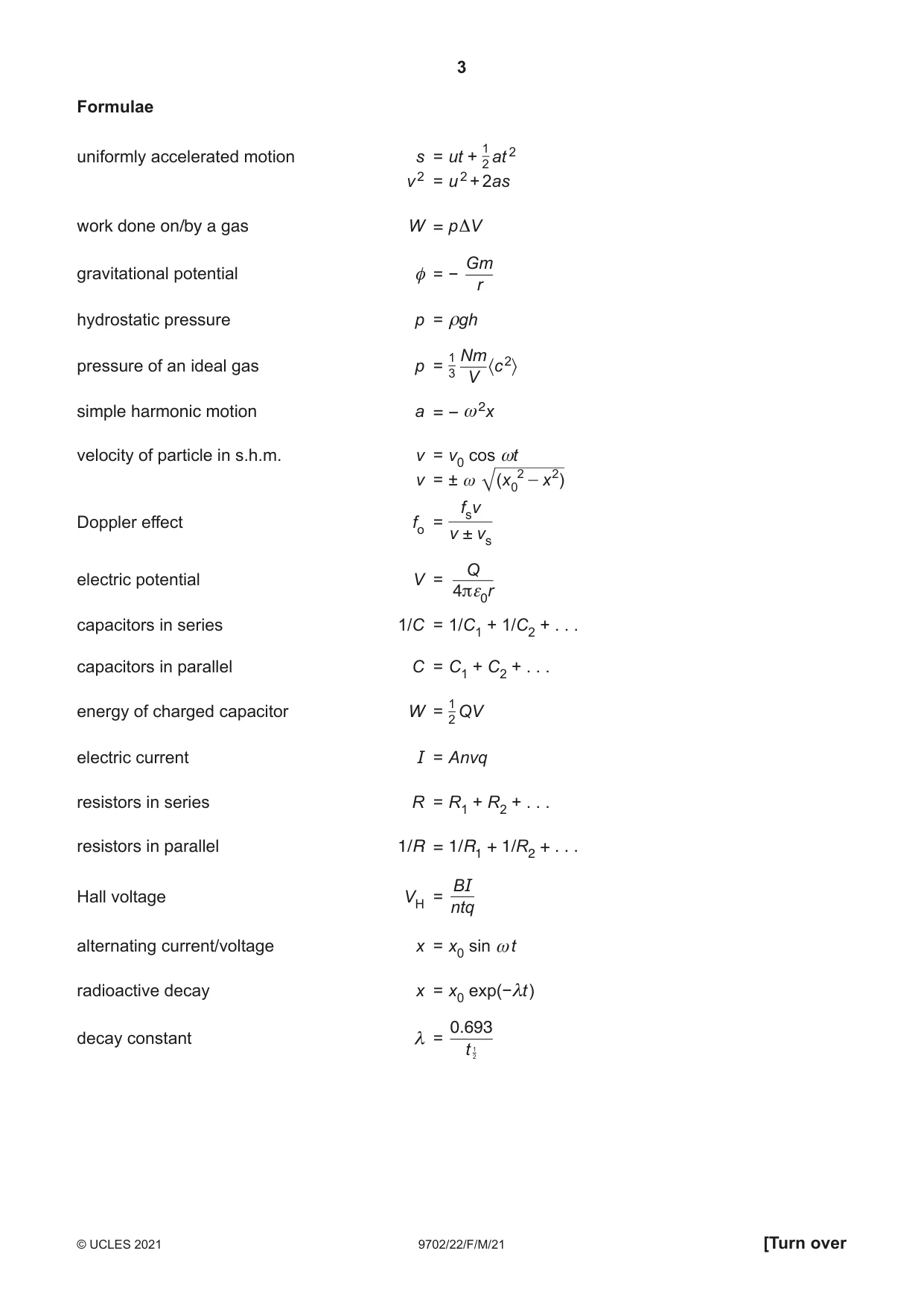
Question paper20 pages


Mark scheme13 pages
Answers below. Sit the paper first if you are practising.
Questions as text
Q1 · Complete Table 1.1 by stating whether each of the quantities is a vector or a scalar
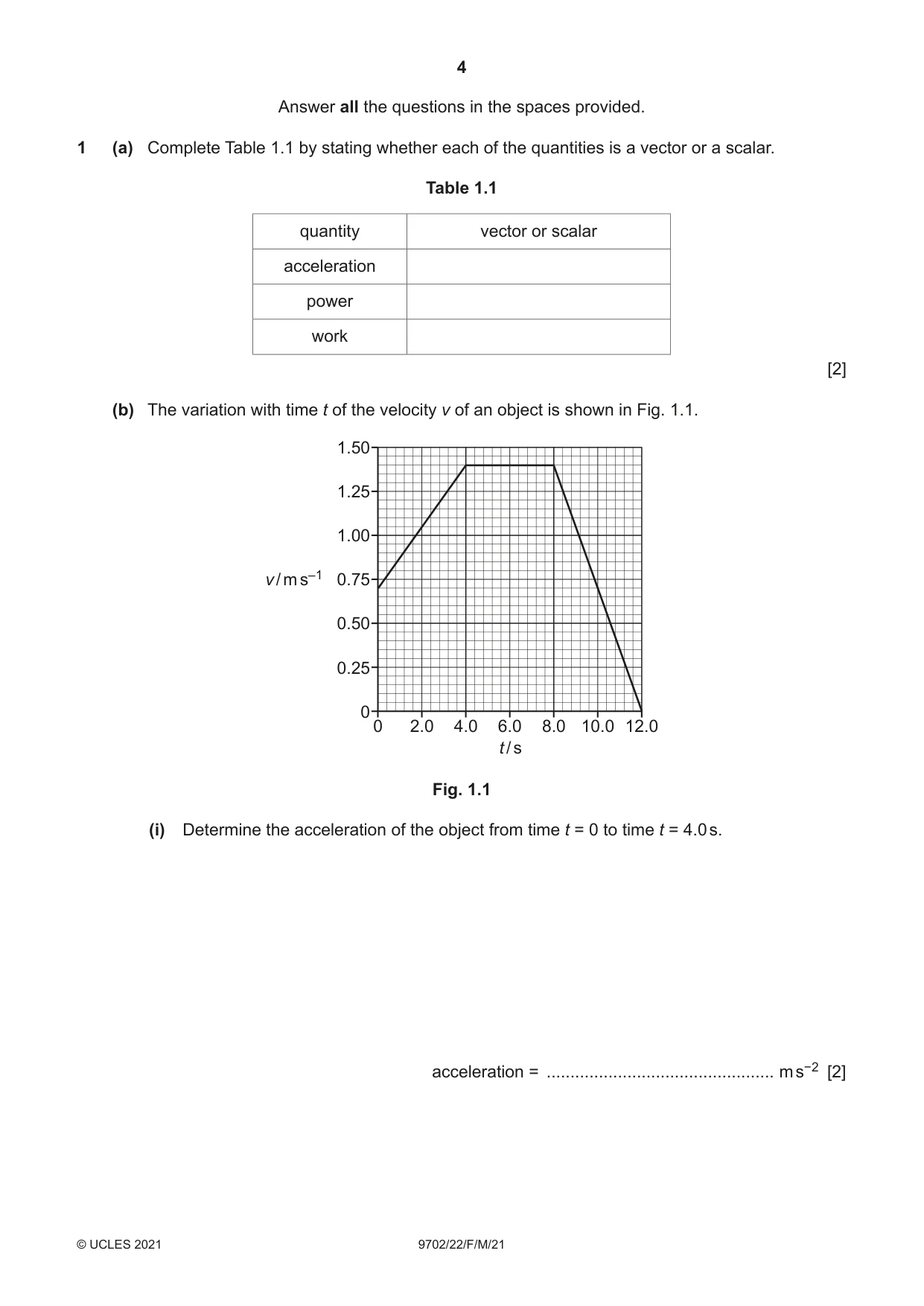
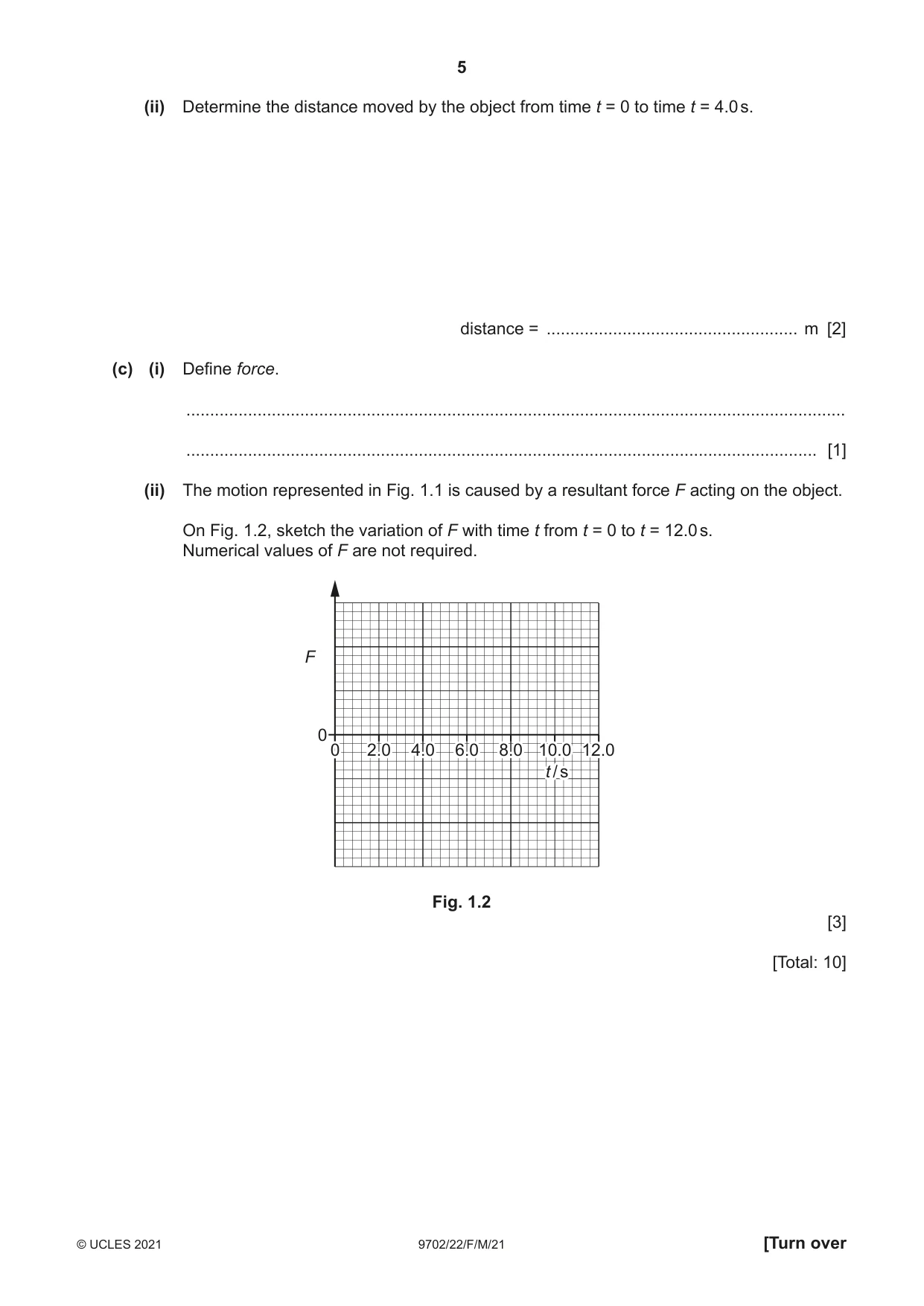
1 (a) Complete Table 1.1 by stating whether each of the quantities is a vector or a scalar. Table 1.1 quantity vector or scalar acceleration power work [2] (b) The variation with time t of the velocity v of an object is shown in Fig. 1.1. 1.50 1.25 1.00 v / m s–1 0.75 0.50 0.25 0 0 2.0 4.0 6.0 8.0 10.0 12.0 t / s Fig. 1.1 (i) Determine the acceleration of the object from time t = 0 to time t = 4.0 s. acceleration = ................................................ m s−2 [2] (ii) Determine the distance moved by the object from time t = 0 to time t = 4.0 s. distance = ..................................................... m [2] (c) (i) Define force. ........................................................................................................................................... ..................................................................................................................................... [1] (ii) The motion represented in Fig. 1.1 is caused by a resultant force F acting on the object. On Fig. 1.2, sketch the variation of F with time t from t = 0 to t = 12.0 s. Numerical values of F are not required. F 0 00 2.02.0 4.04.0 6.06.0 8.08.0 10.010.0 12.012.0 tt // ss Fig. 1.2 [3] [Total: 10]
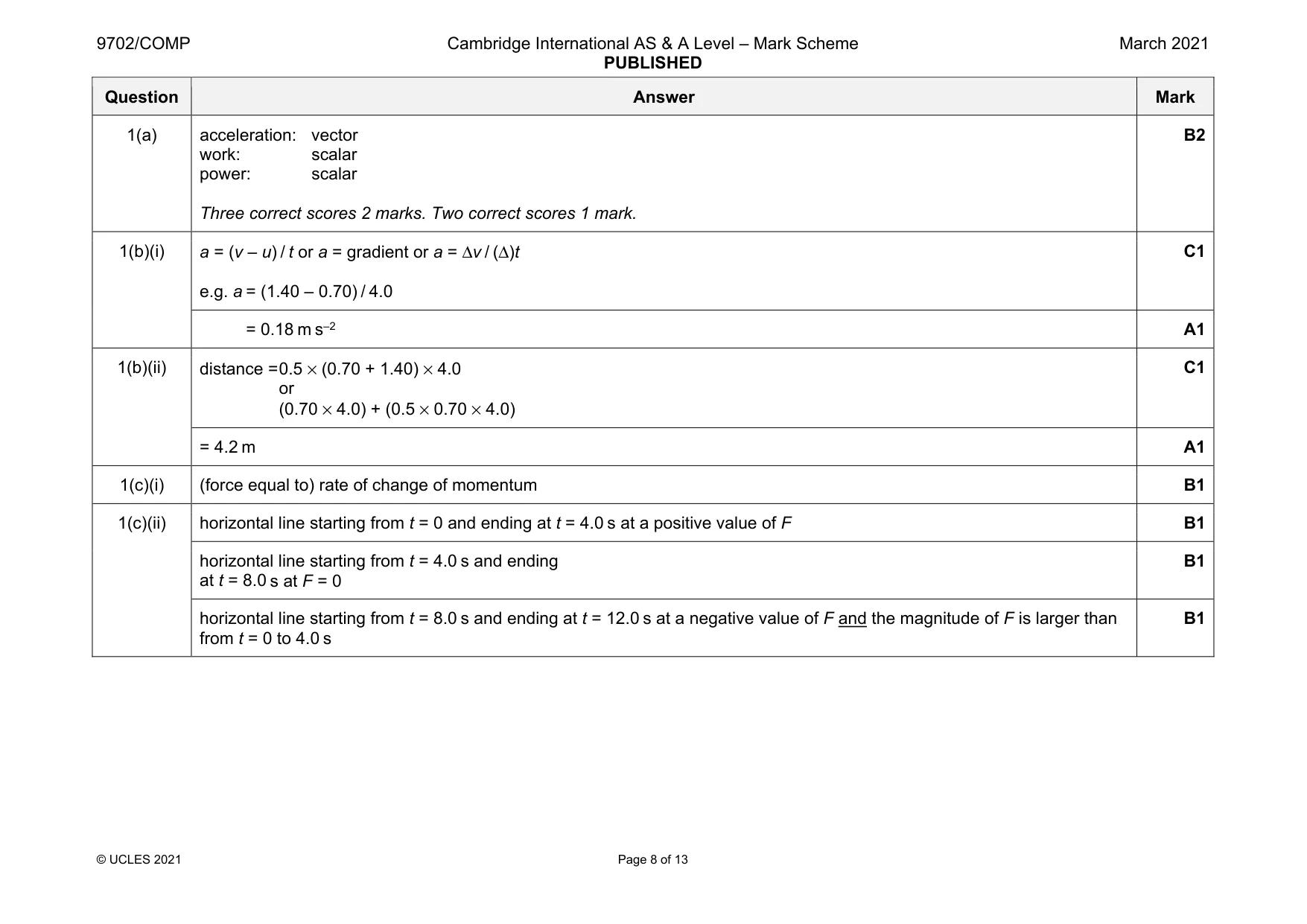
Mark scheme: 1(a) acceleration: vector work: scalar power: scalar Three correct scores 2 marks. Two correct scores 1 mark. B2 1(b)(i) a = (v – u) / t or a = gradient or a = Δv / (Δ)t e.g. a = (1.40 – 0.70) / 4.0 C1 = 0.18 m s–2 A1 1(b)(ii) distance = 0.5 × (0.70 + 1.40) × 4.0 or (0.70 × 4.0) + (0.5 × 0.70 × 4.0) C1 = 4.2 m A1 1(c)(i) (force equal to) rate of change of momentum B1 1(c)(ii) horizontal line starting from t = 0 and ending at t = 4.0 s at a positive value of F B1 horizontal line starting from t = 4.0 s and ending at t = 8.0 s at F = 0 B1 horizontal line starting from t = 8.0 s and ending at t = 12.0 s at a negative value of F and the magnitude of F is larger than from t = 0 to 4.0 s B1
Q2 · State what is meant by work done
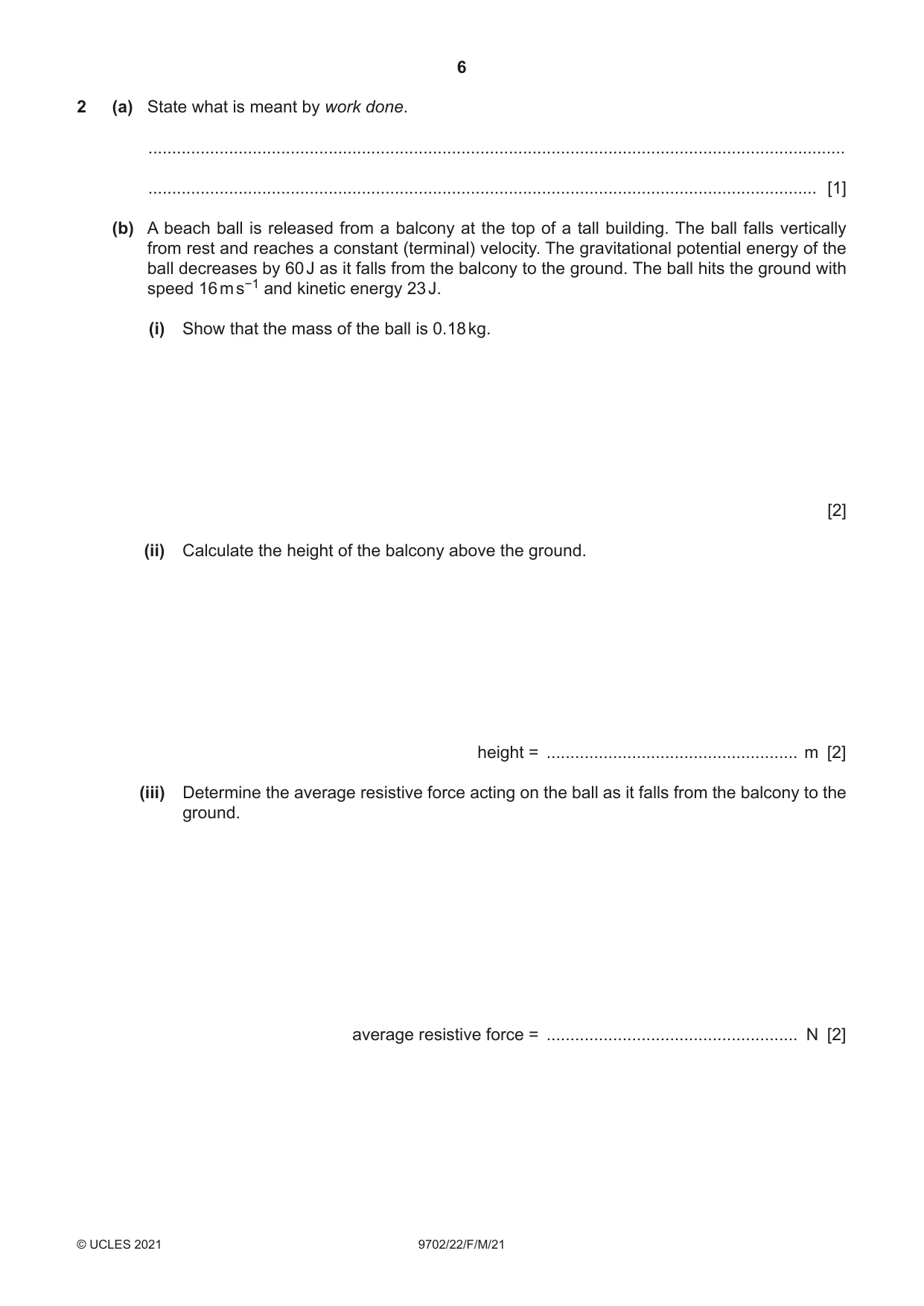
2 (a) State what is meant by work done. ................................................................................................................................................... ............................................................................................................................................. [1] (b) A beach ball is released from a balcony at the top of a tall building. The ball falls vertically from rest and reaches a constant (terminal) velocity. The gravitational potential energy of the ball decreases by 60 J as it falls from the balcony to the ground. The ball hits the ground with speed 16 m s−1 and kinetic energy 23 J. (i) Show that the mass of the ball is 0.18 kg. [2] (ii) Calculate the height of the balcony above the ground. height = ..................................................... m [2] (iii) Determine the average resistive force acting on the ball as it falls from the balcony to the ground. average resistive force = ..................................................... N [2] (c) State and explain the variation, if any, in the magnitude of the acceleration of the ball in (b) during the time interval when the ball is moving downwards before it reaches constant (terminal) velocity. ................................................................................................................................................... ................................................................................................................................................... ................................................................................................................................................... ................................................................................................................................................... ................................................................................................................................................... ............................................................................................................................................. [3] [Total: 10]
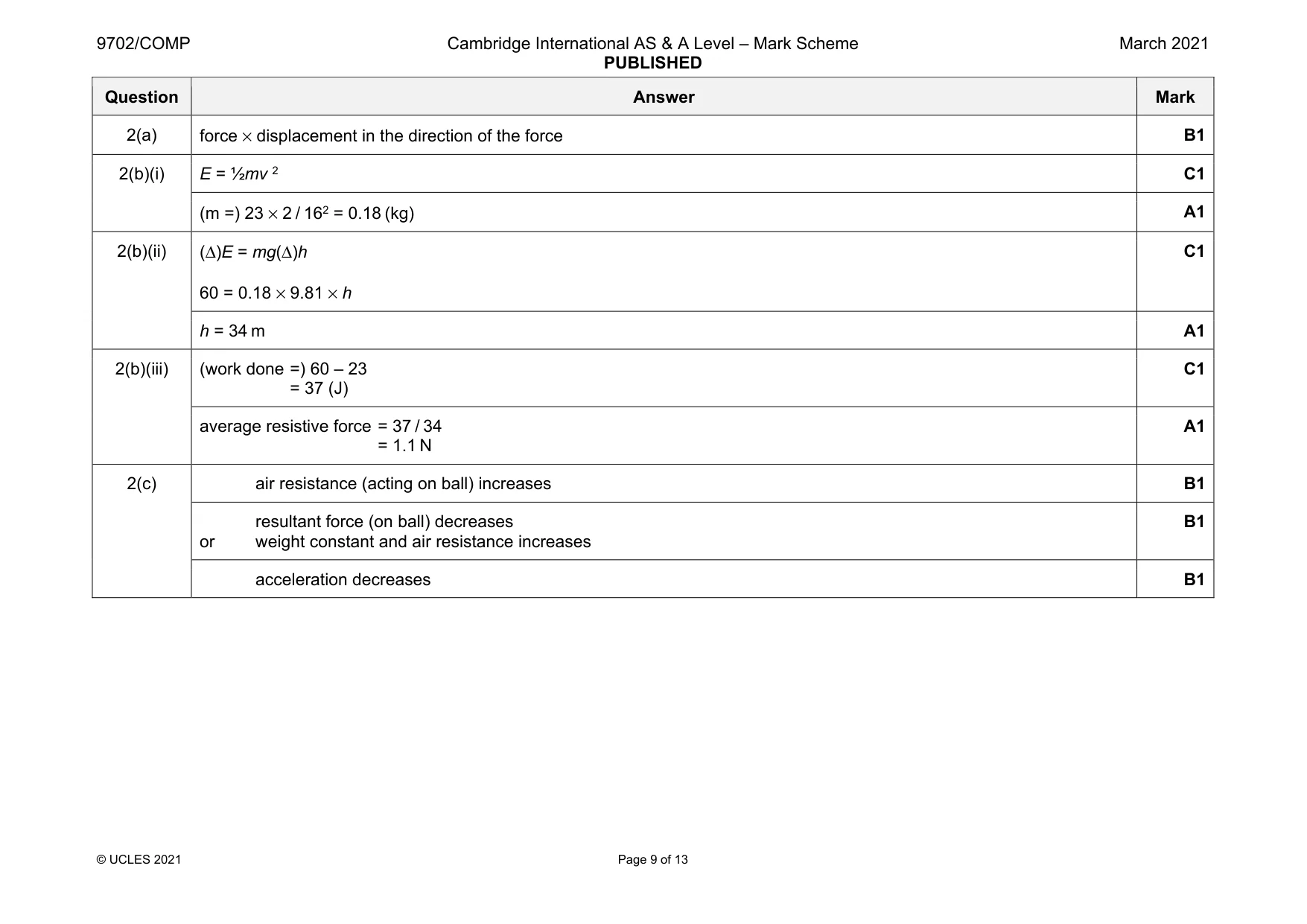
Mark scheme: 2(a) force × displacement in the direction of the force B1 2(b)(i) E = ½mv 2 C1 (m =) 23 × 2 / 162 = 0.18 (kg) A1 2(b)(ii) (Δ)E = mg(Δ)h 60 = 0.18 × 9.81 × h C1 h = 34 m A1 2(b)(iii) (work done =) 60 – 23 = 37 (J) C1 average resistive force = 37 / 34 = 1.1 N A1 2(c) air resistance (acting on ball) increases B1 resultant force (on ball) decreases or weight constant and air resistance increases B1 acceleration decreases B1
More questions on Gravitational potential energy and kinetic energy
Q3 · A spring is extended by a force
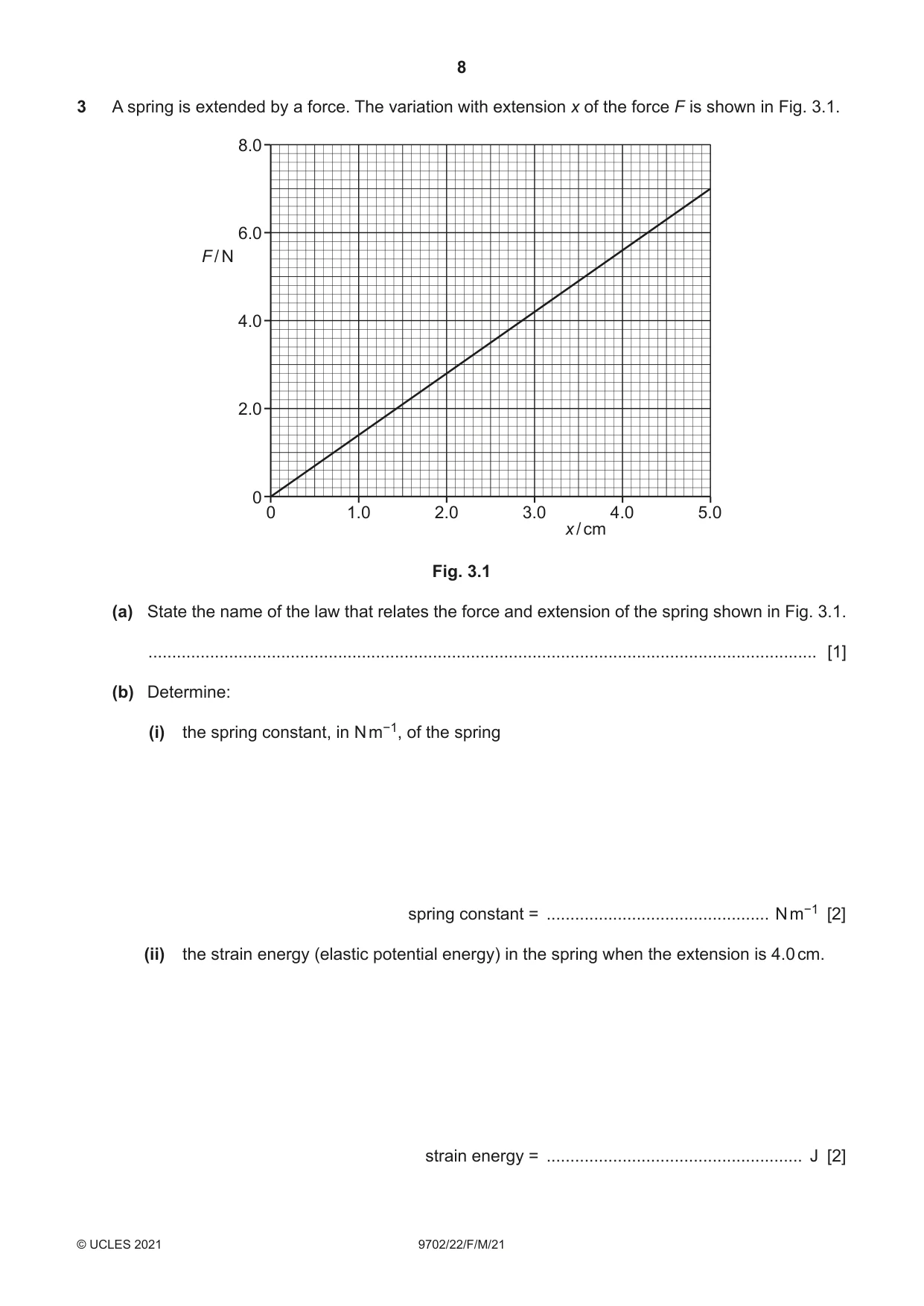
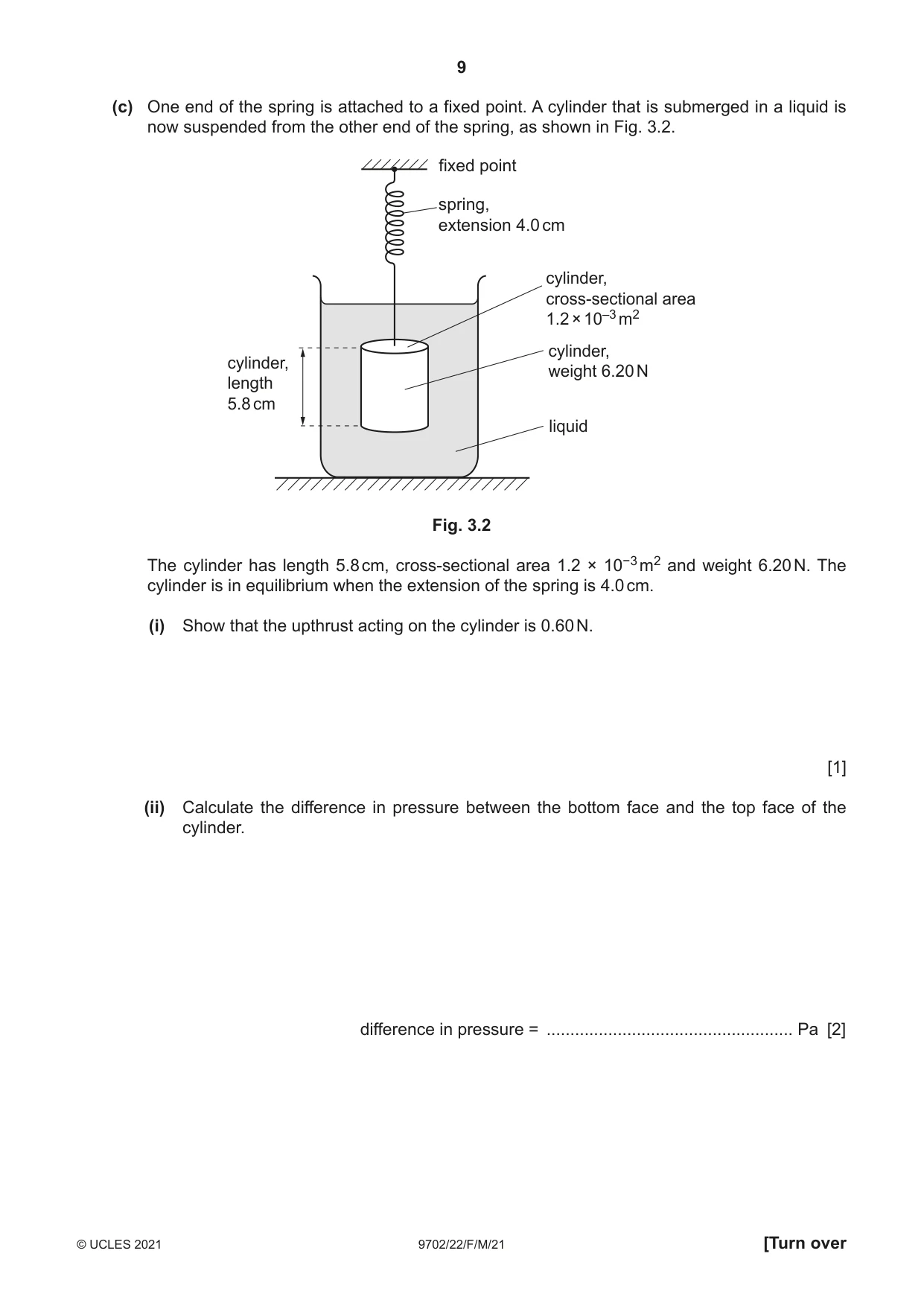
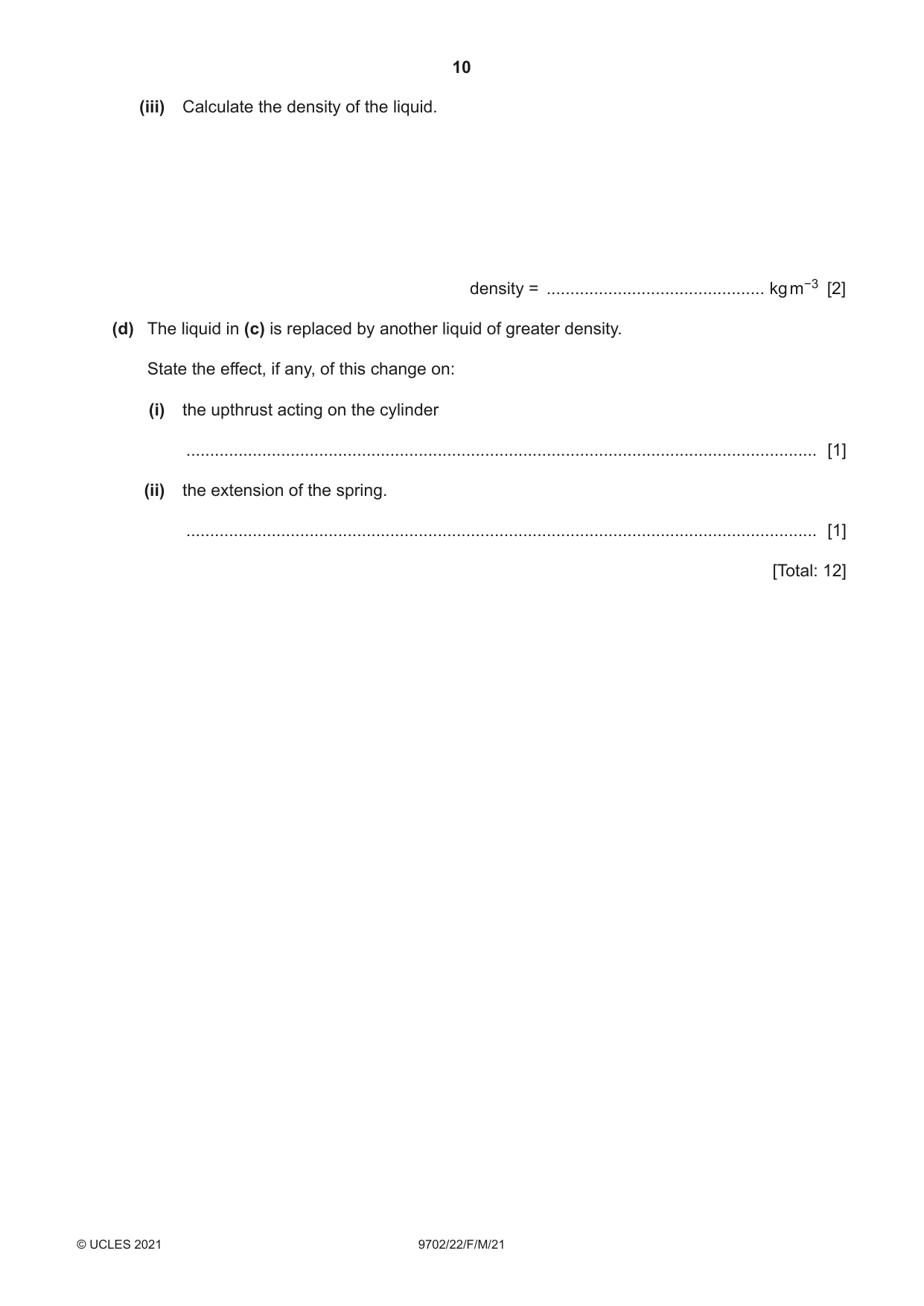
3 A spring is extended by a force. The variation with extension x of the force F is shown in Fig. 3.1. 8.0 6.0 F / N 4.0 2.0 0 0 1.0 2.0 3.0 4.0 5.0 x / cm Fig. 3.1 (a) State the name of the law that relates the force and extension of the spring shown in Fig. 3.1. ............................................................................................................................................. [1] (b) Determine: (i) the spring constant, in N m−1, of the spring spring constant = ............................................... N m−1 [2] (ii) the strain energy (elastic potential energy) in the spring when the extension is 4.0 cm. strain energy = ...................................................... J [2] (c) One end of the spring is attached to a fixed point. A cylinder that is submerged in a liquid is now suspended from the other end of the spring, as shown in Fig. 3.2. fixed point spring, extension 4.0 cm cylinder, cross-sectional area 1.2 × 10⁻³ m2 cylinder, cylinder, weight 6.20 N length 5.8 cm liquid Fig. 3.2 The cylinder has length 5.8 cm, cross-sectional area 1.2 × 10⁻³ m2 and weight 6.20 N. The cylinder is in equilibrium when the extension of the spring is 4.0 cm. (i) Show that the upthrust acting on the cylinder is 0.60 N. [1] (ii) Calculate the difference in pressure between the bottom face and the top face of the cylinder. difference in pressure = .................................................... Pa [2] (iii) Calculate the density of the liquid. density = .............................................. kg m−3 [2] (d) The liquid in (c) is replaced by another liquid of greater density. State the effect, if any, of this change on: (i) the upthrust acting on the cylinder ..................................................................................................................................... [1] (ii) the extension of the spring. ..................................................................................................................................... [1] [Total: 12]
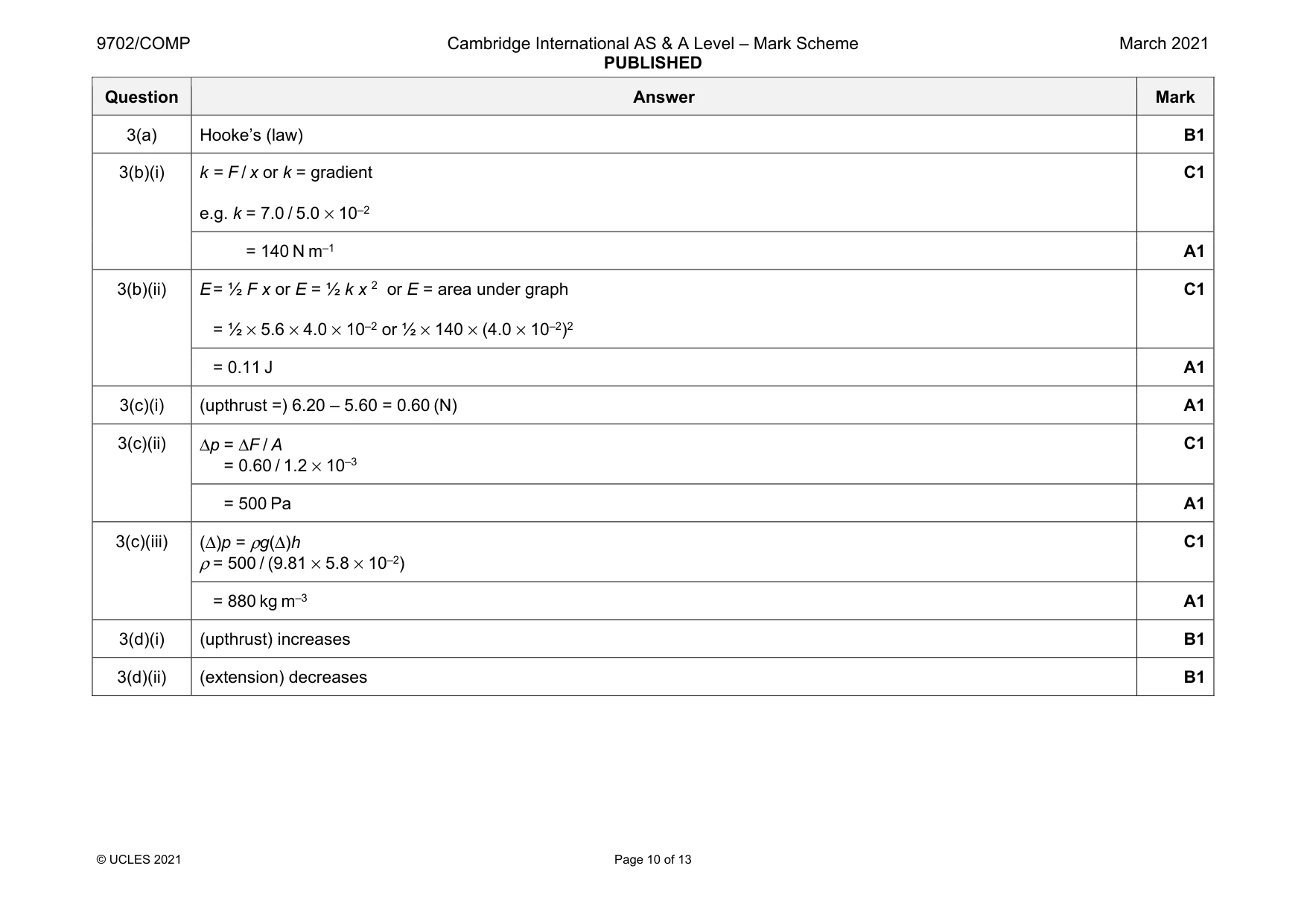
Mark scheme: 3(a) Hooke’s (law) B1 3(b)(i) k = F / x or k = gradient e.g. k = 7.0 / 5.0 × 10⁻² C1 = 140 N m–1 A1 3(b)(ii) E = ½ F x or E = ½ k x 2 or E = area under graph = ½ × 5.6 × 4.0 × 10–2 or ½ × 140 × (4.0 × 10–2)2 C1 = 0.11 J A1 3(c)(i) (upthrust =) 6.20 – 5.60 = 0.60 (N) A1 3(c)(ii) Δp = ΔF / A = 0.60 / 1.2 × 10⁻³ C1 = 500 Pa A1 3(c)(iii) (Δ)p = ρg(Δ)h ρ = 500 / (9.81 × 5.8 × 10–2) C1 = 880 kg m–3 A1 3(d)(i) (upthrust) increases B1 3(d)(ii) (extension) decreases B1
Q4 · State the principle of superposition
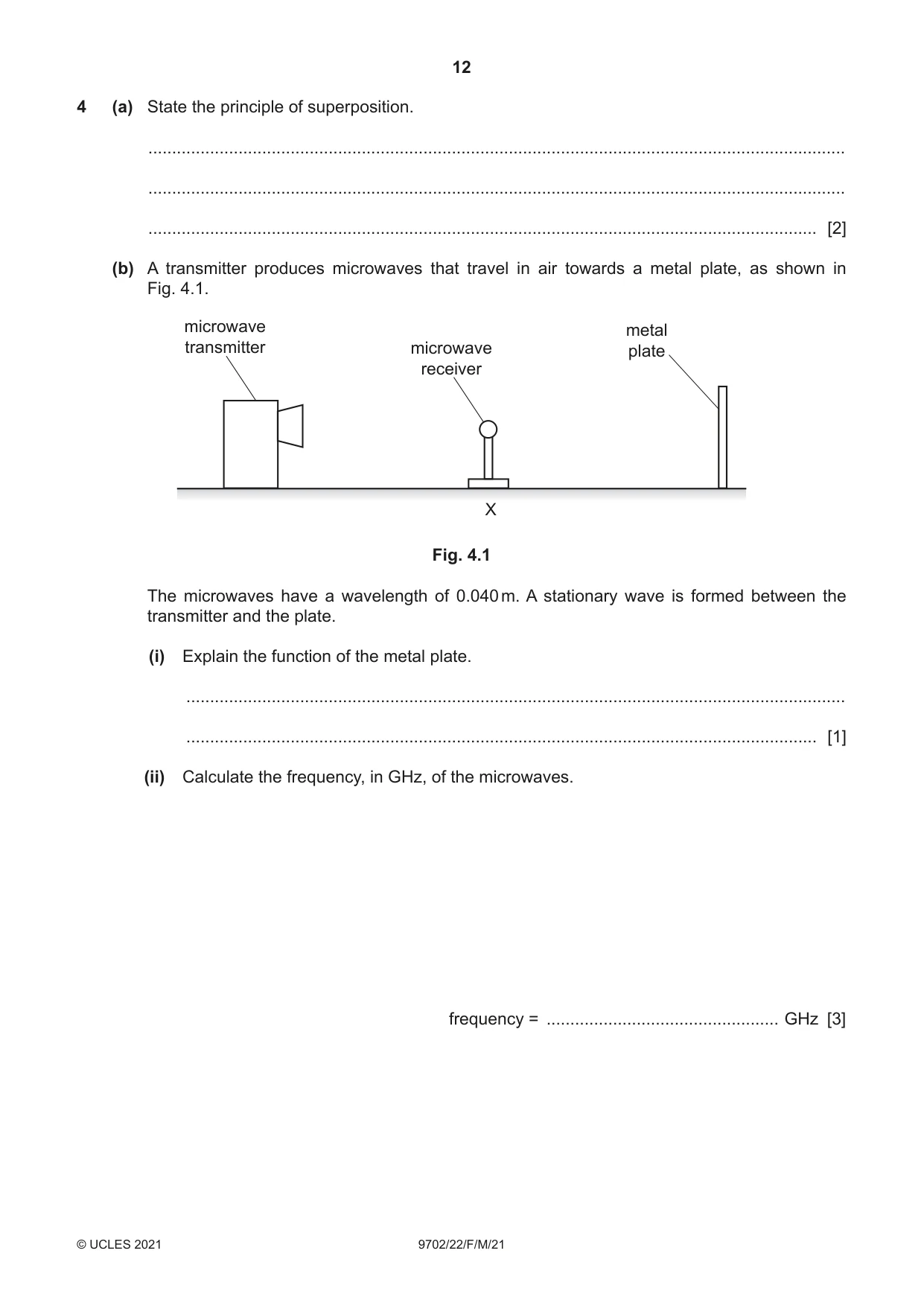
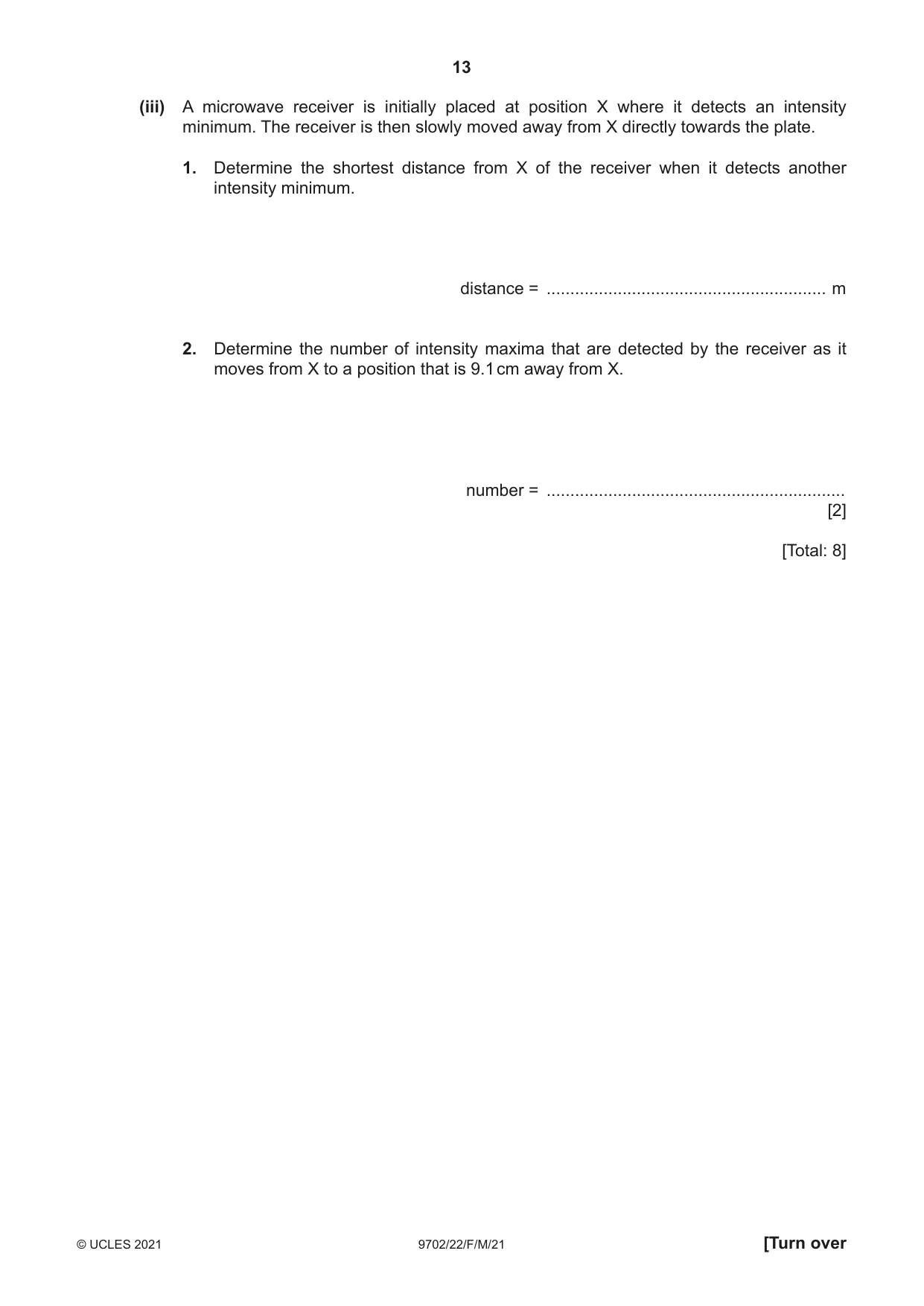
4 (a) State the principle of superposition. ................................................................................................................................................... ................................................................................................................................................... ............................................................................................................................................. [2] (b) A transmitter produces microwaves that travel in air towards a metal plate, as shown in Fig. 4.1. microwave metal transmitter microwave plate receiver X Fig. 4.1 The microwaves have a wavelength of 0.040 m. A stationary wave is formed between the transmitter and the plate. (i) Explain the function of the metal plate. ........................................................................................................................................... ..................................................................................................................................... [1] (ii) Calculate the frequency, in GHz, of the microwaves. frequency = ................................................. GHz [3] (iii) A microwave receiver is initially placed at position X where it detects an intensity minimum. The receiver is then slowly moved away from X directly towards the plate. 1. Determine the shortest distance from X of the receiver when it detects another intensity minimum. distance = ........................................................... m 2. Determine the number of intensity maxima that are detected by the receiver as it moves from X to a position that is 9.1 cm away from X. number = ............................................................... [2] [Total: 8]
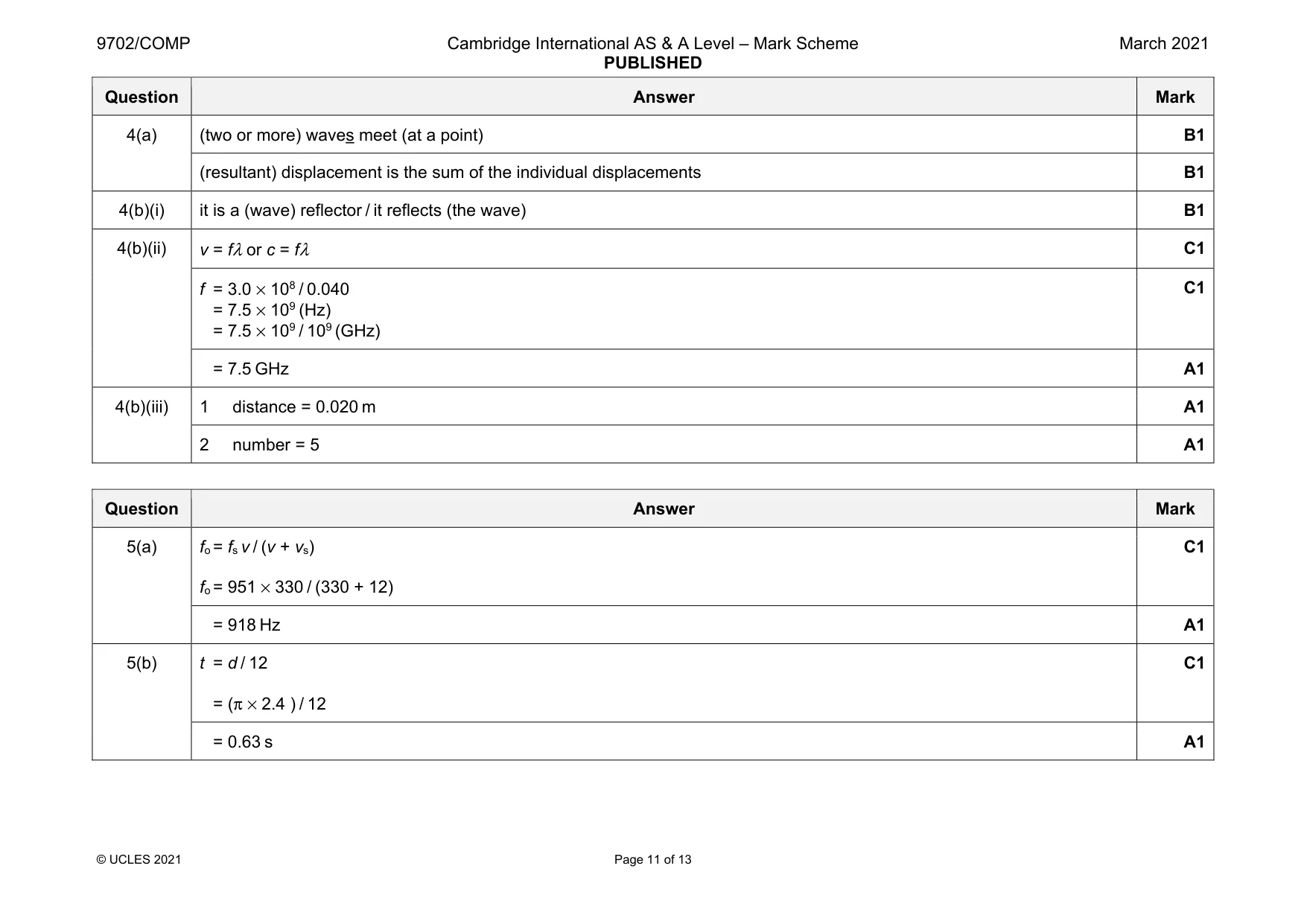
Mark scheme: 4(a) (two or more) waves meet (at a point) B1 (resultant) displacement is the sum of the individual displacements B1 4(b)(i) it is a (wave) reflector / it reflects (the wave) B1 4(b)(ii) v = fλ or c = fλ C1 f = 3.0 × 10⁸ / 0.040 = 7.5 × 10⁹ (Hz) = 7.5 × 10⁹ / 109 (GHz) C1 = 7.5 GHz A1 4(b)(iii) 1 distance = 0.020 m A1 2 number = 5 A1
Q5 · A source of sound is attached to a rope and then swung at a constant speed in a…
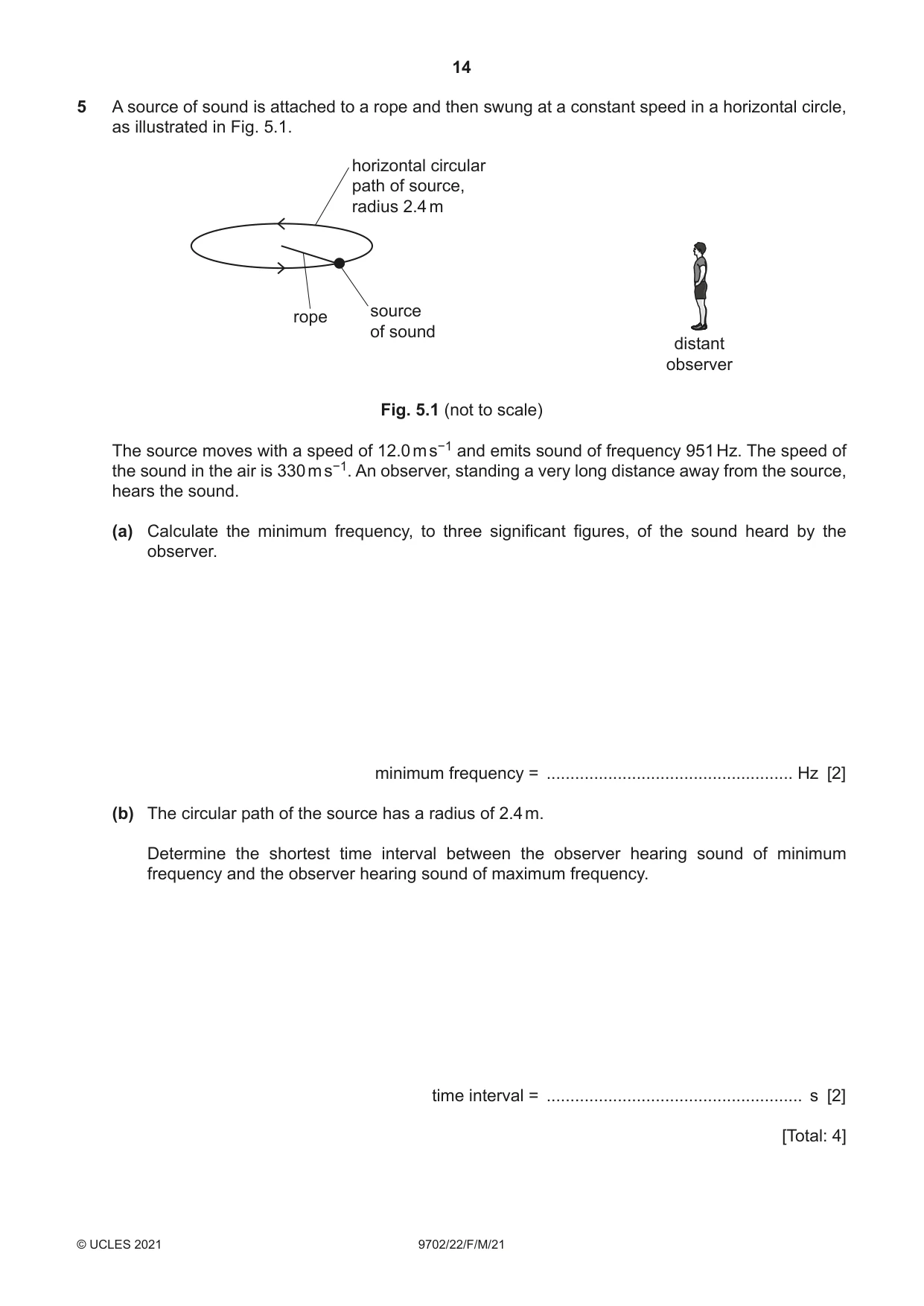
5 A source of sound is attached to a rope and then swung at a constant speed in a horizontal circle, as illustrated in Fig. 5.1. horizontal circular path of source, radius 2.4 m source rope of sound distant observer Fig. 5.1 (not to scale) The source moves with a speed of 12.0 m s−1 and emits sound of frequency 951 Hz. The speed of the sound in the air is 330 m s−1. An observer, standing a very long distance away from the source, hears the sound. (a) Calculate the minimum frequency, to three significant figures, of the sound heard by the observer. minimum frequency = .................................................... Hz [2] (b) The circular path of the source has a radius of 2.4 m. Determine the shortest time interval between the observer hearing sound of minimum frequency and the observer hearing sound of maximum frequency. time interval = ...................................................... s [2] [Total: 4]
Mark scheme: 5(a) fo = fs v / (v + vs) fo = 951 × 330 / (330 + 12) = 918 Hz A1 5(b) t = d / 12 = (π × 2.4 ) / 12 C1 = 0.63 s A1
Q6 · State Kirchhoff’s first law
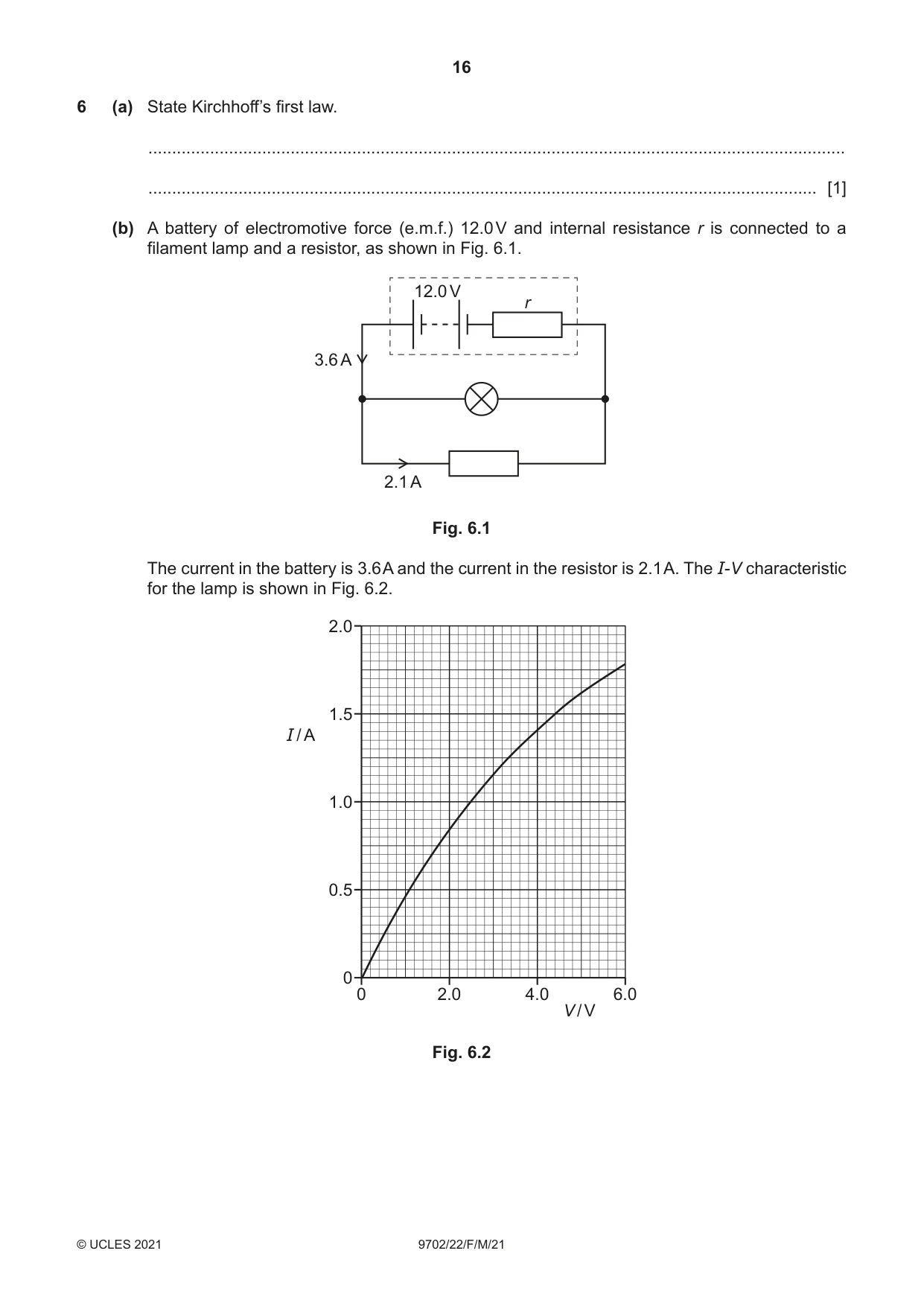
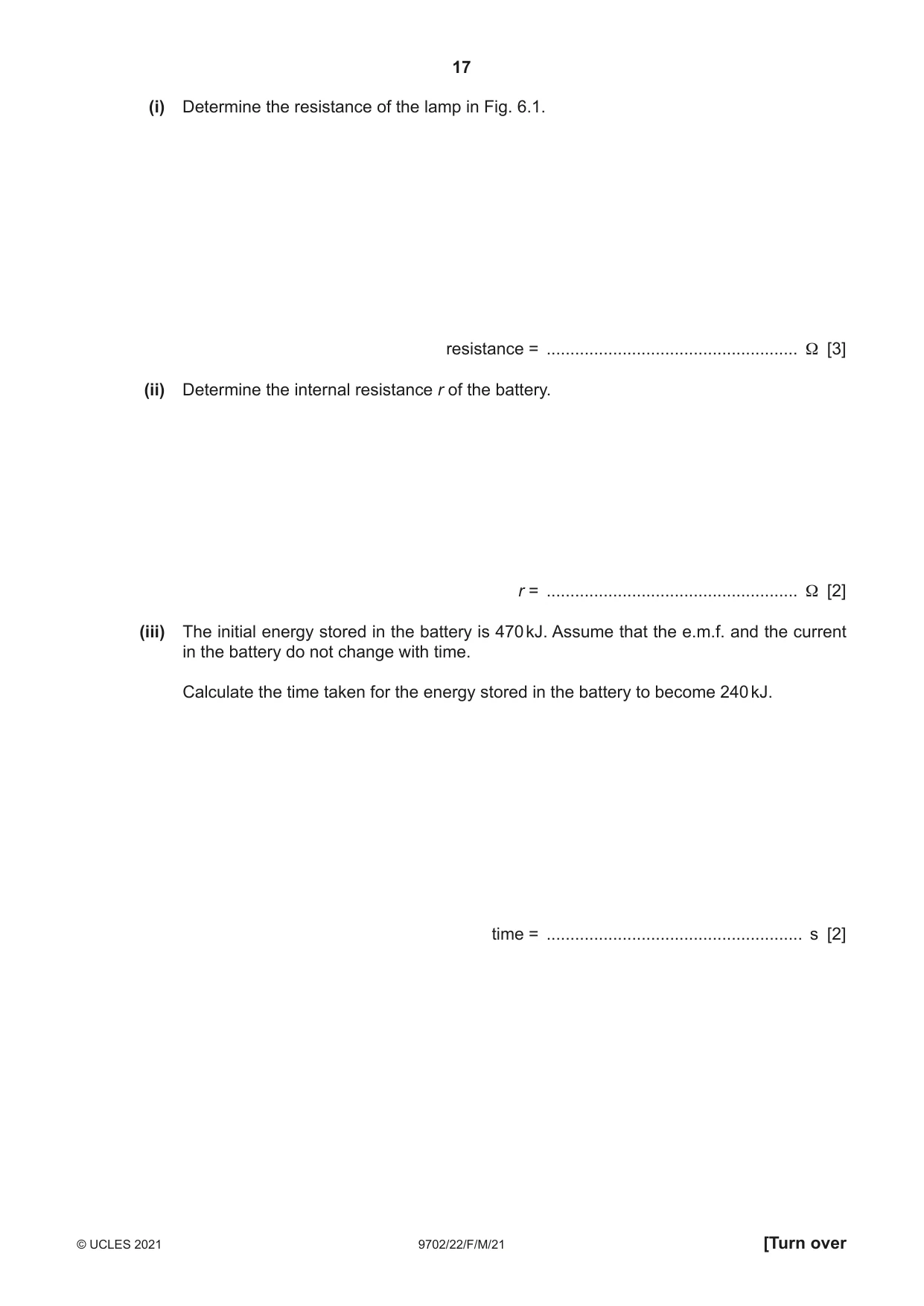
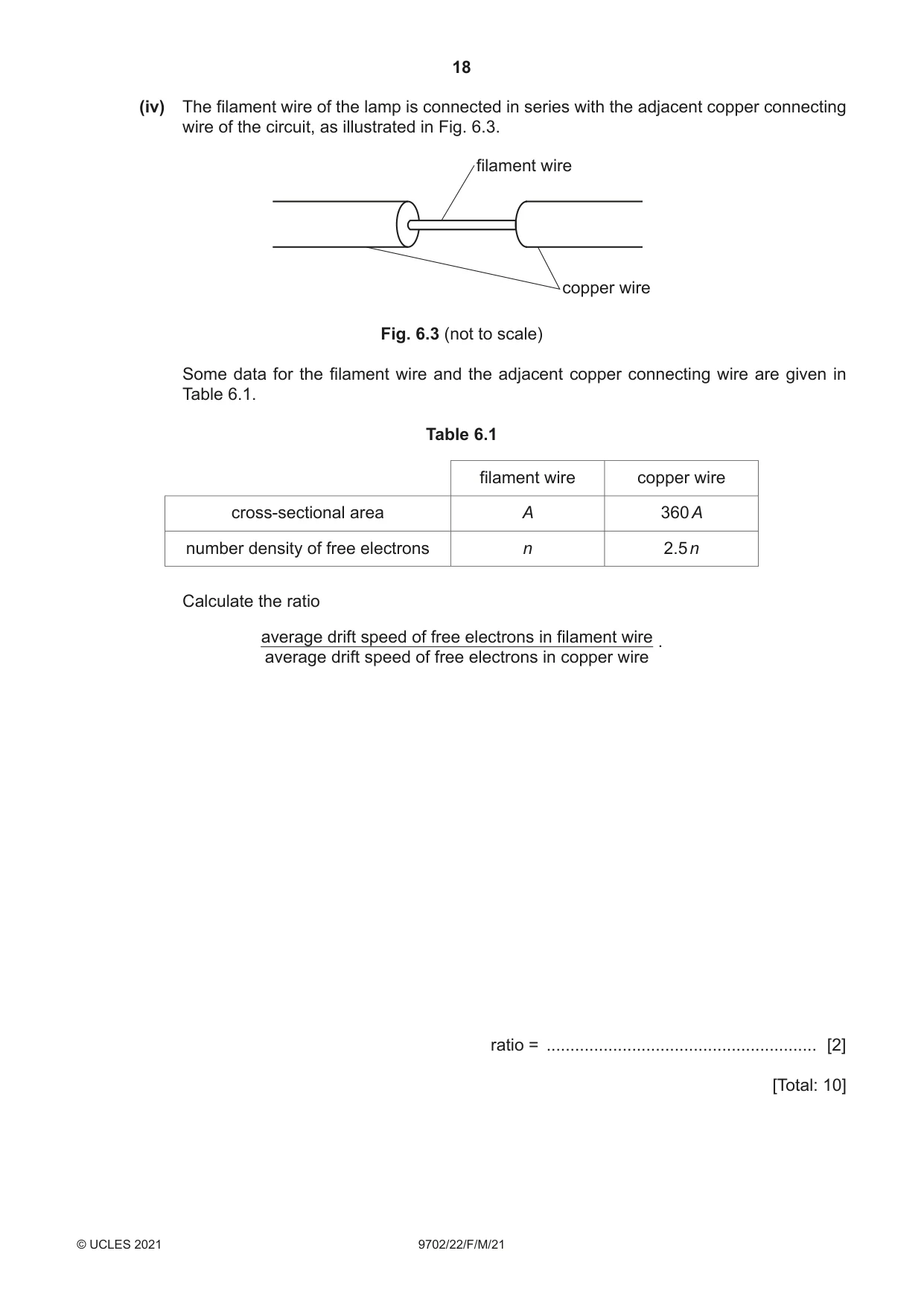
6 (a) State Kirchhoff’s first law. ................................................................................................................................................... ............................................................................................................................................. [1] (b) A battery of electromotive force (e.m.f.) 12.0 V and internal resistance r is connected to a filament lamp and a resistor, as shown in Fig. 6.1. 12.0 V r 3.6 A 2.1 A Fig. 6.1 The current in the battery is 3.6 A and the current in the resistor is 2.1 A. The I-V characteristic for the lamp is shown in Fig. 6.2. 2.0 1.5 I / A 1.0 0.5 0 0 2.0 4.0 6.0 V / V Fig. 6.2 (i) Determine the resistance of the lamp in Fig. 6.1. resistance = ..................................................... Ω [3] (ii) Determine the internal resistance r of the battery. r = ..................................................... Ω [2] (iii) The initial energy stored in the battery is 470 kJ. Assume that the e.m.f. and the current in the battery do not change with time. Calculate the time taken for the energy stored in the battery to become 240 kJ. time = ...................................................... s [2] (iv) The filament wire of the lamp is connected in series with the adjacent copper connecting wire of the circuit, as illustrated in Fig. 6.3. filament wire copper wire Fig. 6.3 (not to scale) Some data for the filament wire and the adjacent copper connecting wire are given in Table 6.1. Table 6.1 filament wire copper wire cross-sectional area A 360 A number density of free electrons n 2.5 n Calculate the ratio average drift speed of free electrons in filament wire . average drift speed of free electrons in copper wire ratio = ......................................................... [2] [Total: 10]
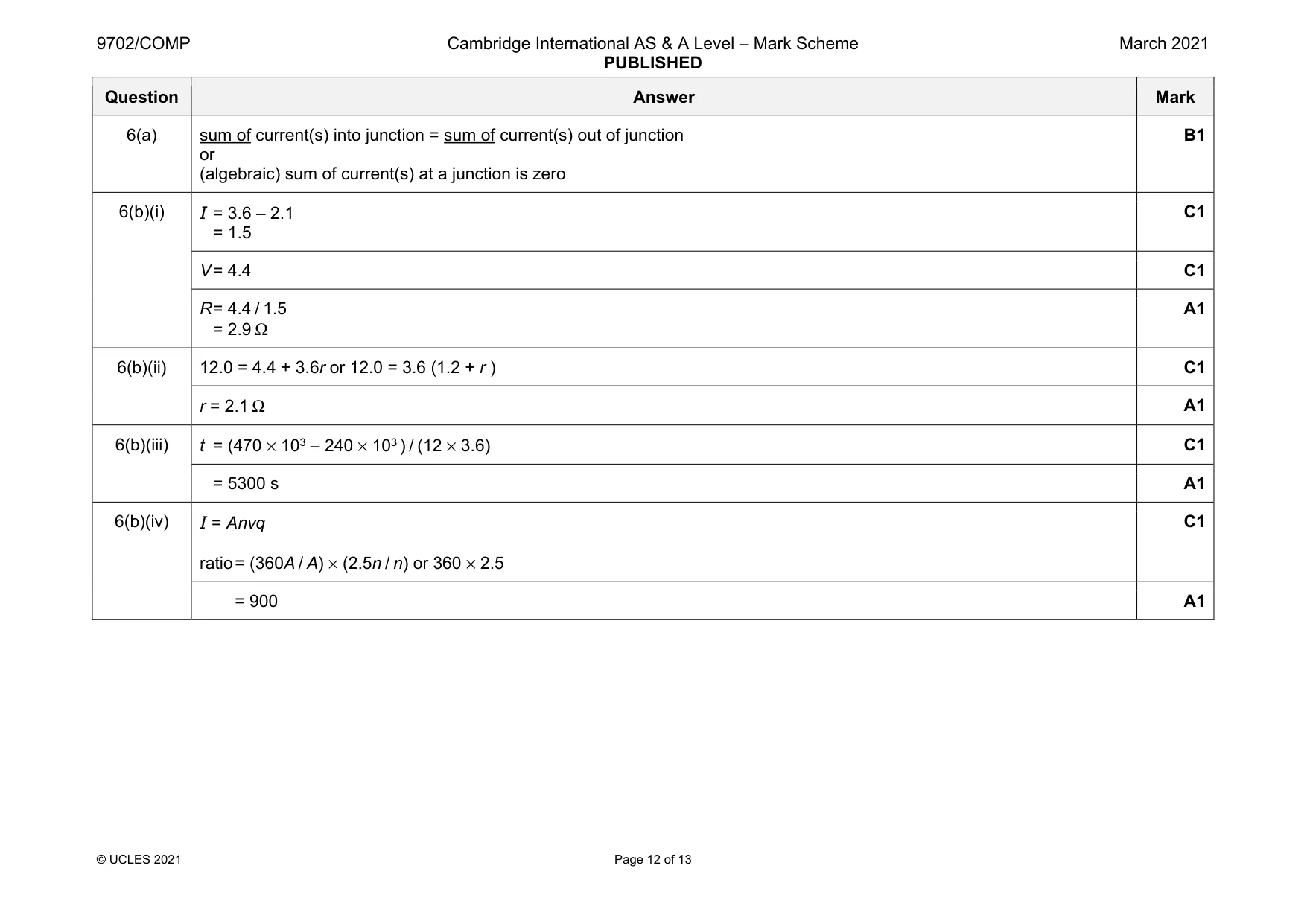
Mark scheme: 6(a) sum of current(s) into junction = sum of current(s) out of junction or (algebraic) sum of current(s) at a junction is zero B1 6(b)(i) I = 3.6 – 2.1 = 1.5 C1 V = 4.4 C1 R = 4.4 / 1.5 = 2.9 Ω A1 6(b)(ii) 12.0 = 4.4 + 3.6r or 12.0 = 3.6 (1.2 + r ) C1 r = 2.1 Ω A1 6(b)(iii) t = (470 × 103 – 240 × 103 ) / (12 × 3.6) C1 = 5300 s A1 6(b)(iv) I = Anvq ratio = (360A / A) × (2.5n / n) or 360 × 2.5 C1 = 900 A1
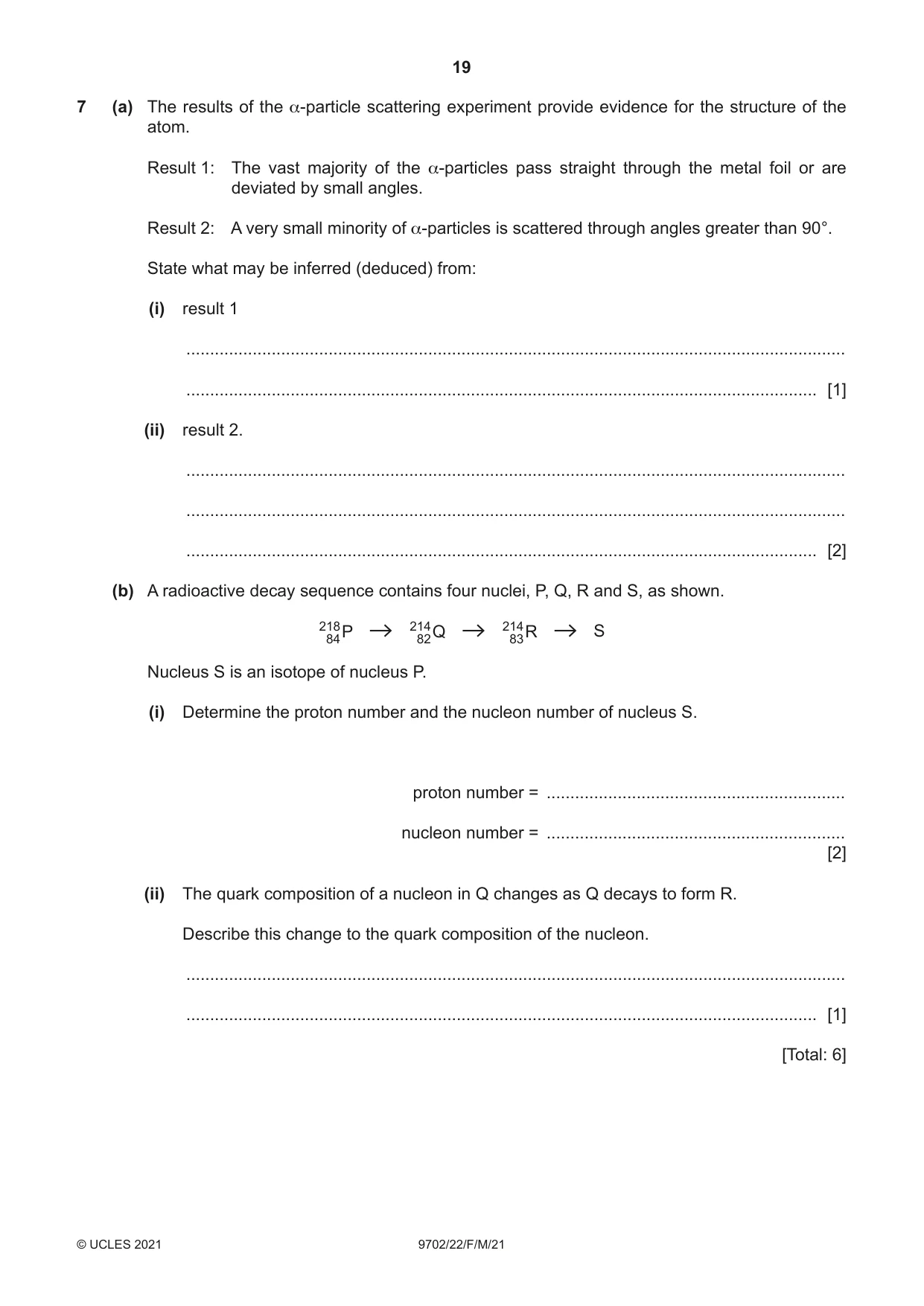
Q7 · The results of the α-particle scattering experiment provide evidence for the structure of…
7 (a) The results of the α-particle scattering experiment provide evidence for the structure of the atom. Result 1: The vast majority of the α-particles pass straight through the metal foil or are deviated by small angles. Result 2: A very small minority of α-particles is scattered through angles greater than 90°. State what may be inferred (deduced) from: (i) result 1 ........................................................................................................................................... ..................................................................................................................................... [1] (ii) result 2. ........................................................................................................................................... ........................................................................................................................................... ..................................................................................................................................... [2] (b) A radioactive decay sequence contains four nuclei, P, Q, R and S, as shown. 21884 P 21482 Q 21483 R S Nucleus S is an isotope of nucleus P. (i) Determine the proton number and the nucleon number of nucleus S. proton number = ............................................................... nucleon number = ............................................................... [2] (ii) The quark composition of a nucleon in Q changes as Q decays to form R. Describe this change to the quark composition of the nucleon. ........................................................................................................................................... ..................................................................................................................................... [1] [Total: 6]
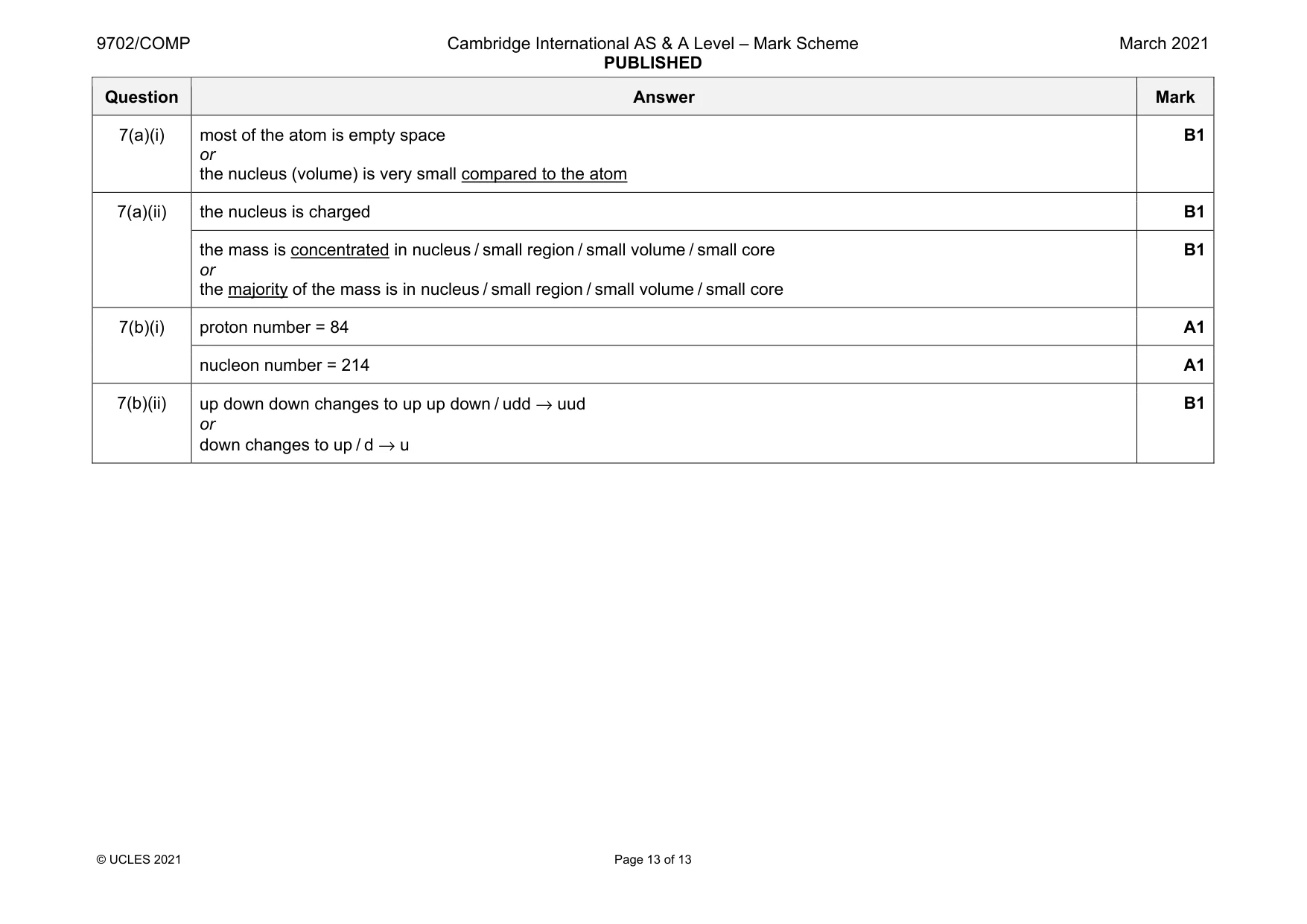
Mark scheme: 7(a)(i) most of the atom is empty space or the nucleus (volume) is very small compared to the atom B1 7(a)(ii) the nucleus is charged B1 the mass is concentrated in nucleus / small region / small volume / small core or the majority of the mass is in nucleus / small region / small volume / small core B1 7(b)(i) proton number = 84 A1 nucleon number = 214 A1 7(b)(ii) up down down changes to up up down / udd → uud or down changes to up / d → u B1
What was in this paper
The subtopics covered by these 7 questions, and how many questions each got. Open one in a new tab to see every Cambridge question on it.
What you needed in this session
Cambridge’s own grade thresholds for 2021 Feb/March, Paper 2 · Variant 2. A higher threshold means an easier paper — the bar moves with how the cohort did.