Cambridge A Level Physics 9702 — 2021 Oct/Nov Paper 2 · Variant 1
9702/21/O/N/21 · 6 questions · 60 marks · ≈68 min
The question paper and its mark scheme, free to read here and free to download. This is Cambridge’s own paper, exactly as it was sat.
Question paper16 pages


Mark scheme12 pages
Answers below. Sit the paper first if you are practising.
Questions as text
Question 1
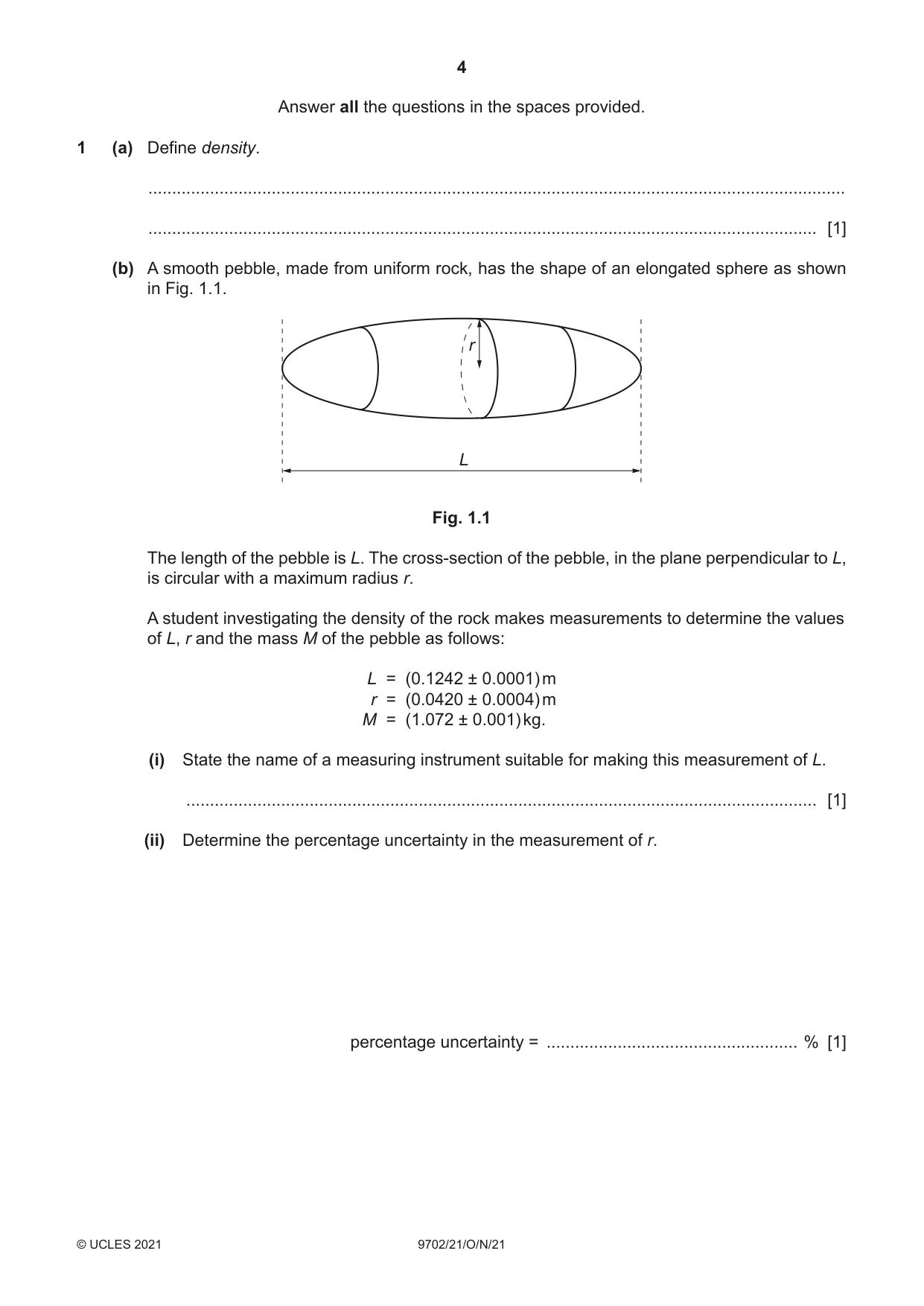
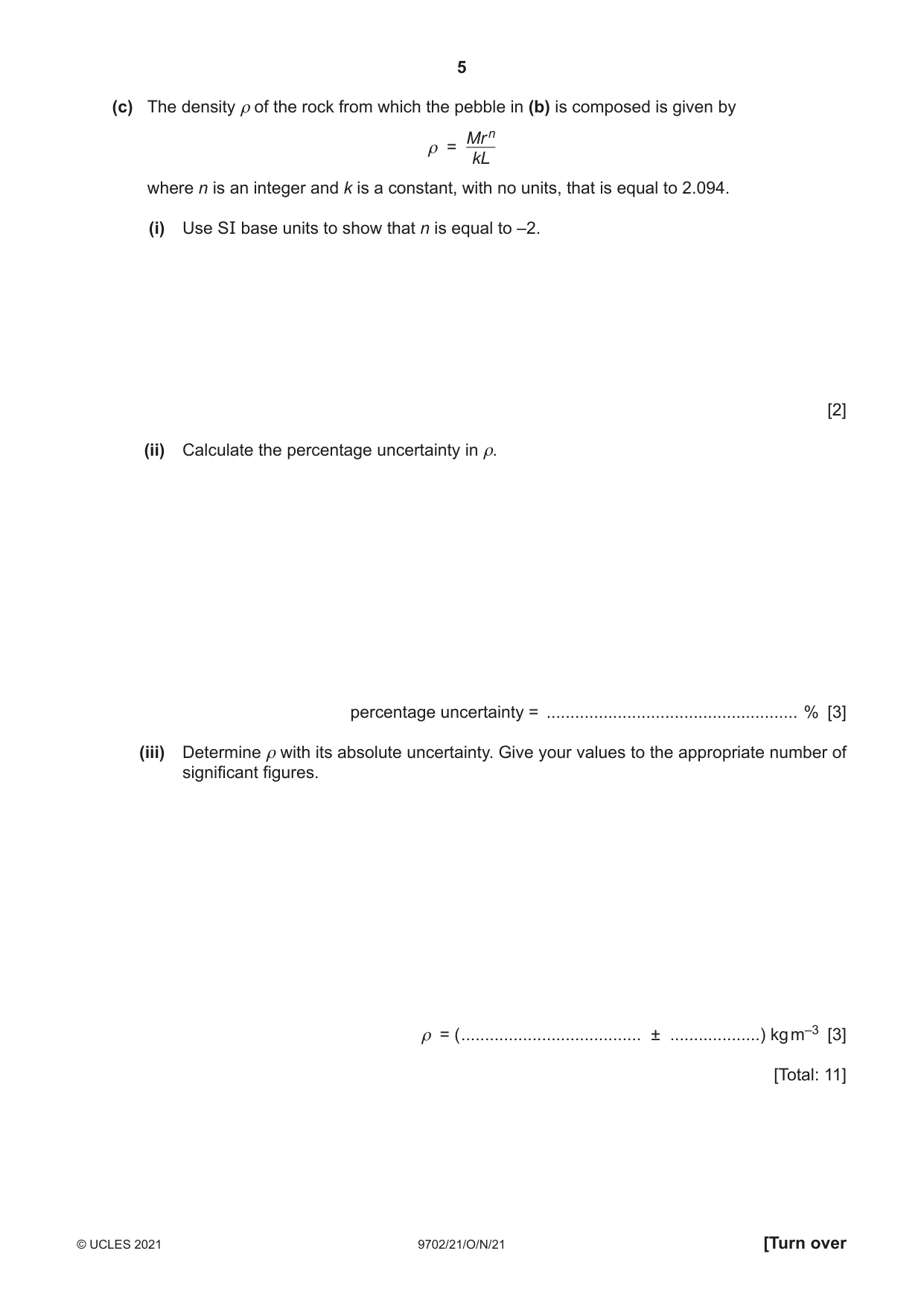
1 (a) Define density. ................................................................................................................................................... ............................................................................................................................................. [1] (b) A smooth pebble, made from uniform rock, has the shape of an elongated sphere as shown in Fig. 1.1. r L Fig. 1.1 The length of the pebble is L. The cross-section of the pebble, in the plane perpendicular to L, is circular with a maximum radius r. A student investigating the density of the rock makes measurements to determine the values of L, r and the mass M of the pebble as follows: L = (0.1242 ± 0.0001) m r = (0.0420 ± 0.0004) m M = (1.072 ± 0.001) kg. (i) State the name of a measuring instrument suitable for making this measurement of L. ..................................................................................................................................... [1] (ii) Determine the percentage uncertainty in the measurement of r. percentage uncertainty = ..................................................... % [1] (c) The density ρ of the rock from which the pebble in (b) is composed is given by Mr n ρ = kL where n is an integer and k is a constant, with no units, that is equal to 2.094. (i) Use SI base units to show that n is equal to –2. [2] (ii) Calculate the percentage uncertainty in ρ. percentage uncertainty = ..................................................... % [3] (iii) Determine ρ with its absolute uncertainty. Give your values to the appropriate number of significant figures. ρ = ( ...................................... ± ...................) kg m–3 [3] [Total: 11]
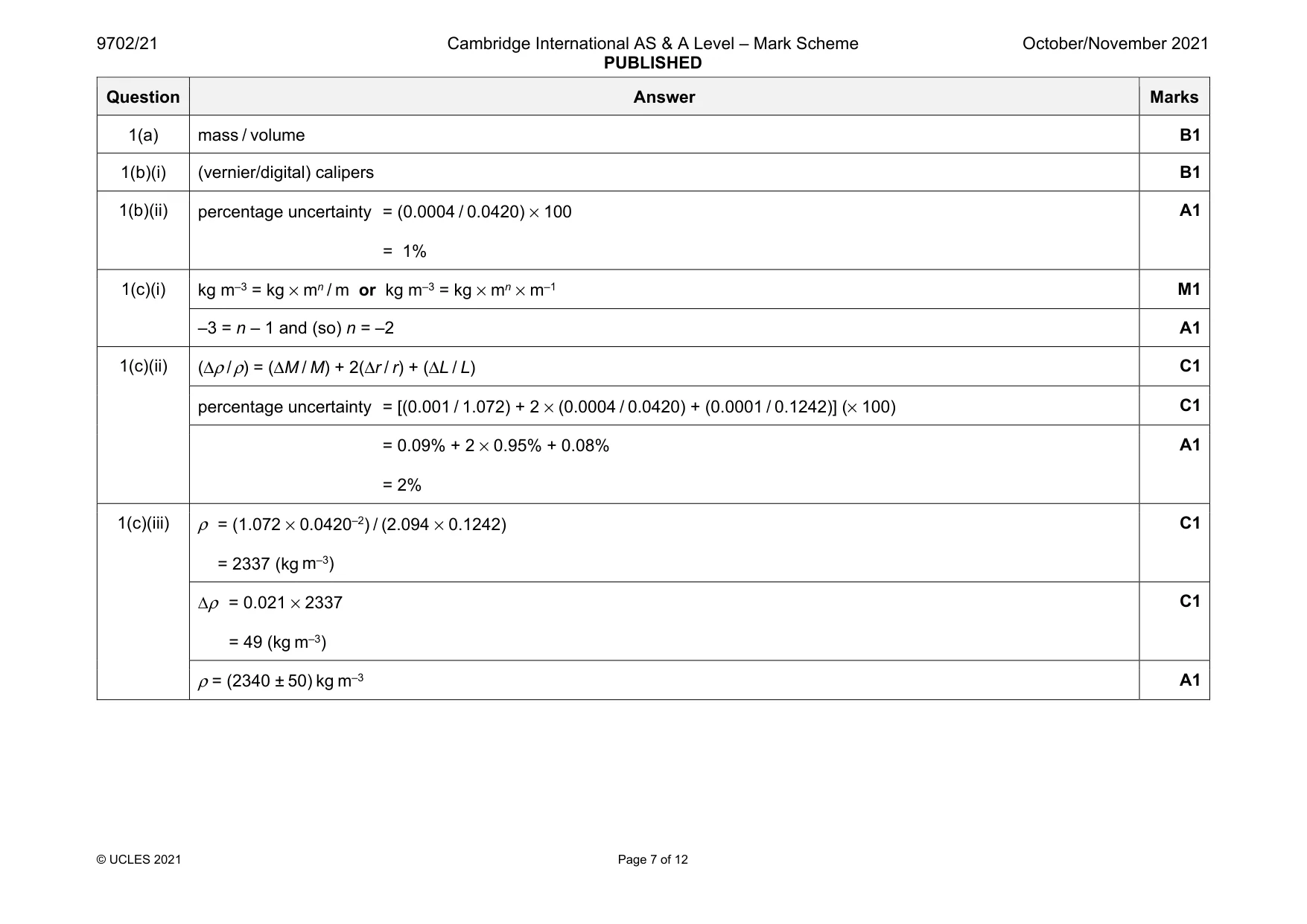
Mark scheme: 1(a) mass / volume B1 1(b)(i) (vernier/digital) calipers B1 1(b)(ii) percentage uncertainty = (0.0004 / 0.0420) × 100 = 1% A1 1(c)(i) kg m–3 = kg × mn / m or kg m–3 = kg × mn × m–1 M1 –3 = n – 1 and (so) n = –2 A1 1(c)(ii) (Δρ / ρ) = (ΔM / M) + 2(Δr / r) + (ΔL / L) C1 percentage uncertainty = [(0.001 / 1.072) + 2 × (0.0004 / 0.0420) + (0.0001 / 0.1242)] (× 100) C1 = 0.09% + 2 × 0.95% + 0.08% = 2% A1 1(c)(iii) ρ = (1.072 × 0.0420–2) / (2.094 × 0.1242) = 2337 (kg m–3) C1 ∆ρ = 0.021 × 2337 = 49 (kg m–3) C1 ρ = (2340 ± 50) kg m–3 A1
Question 2
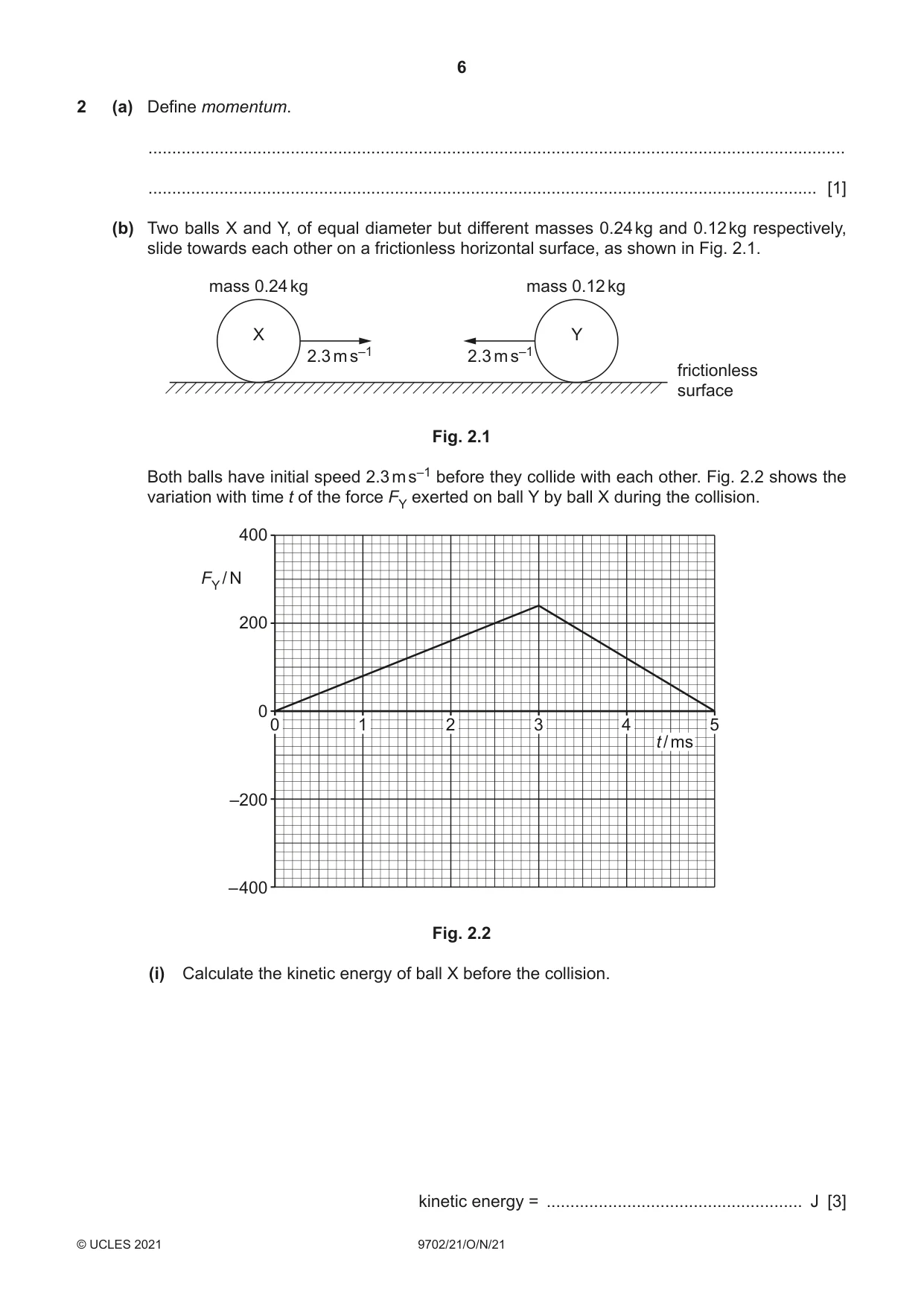
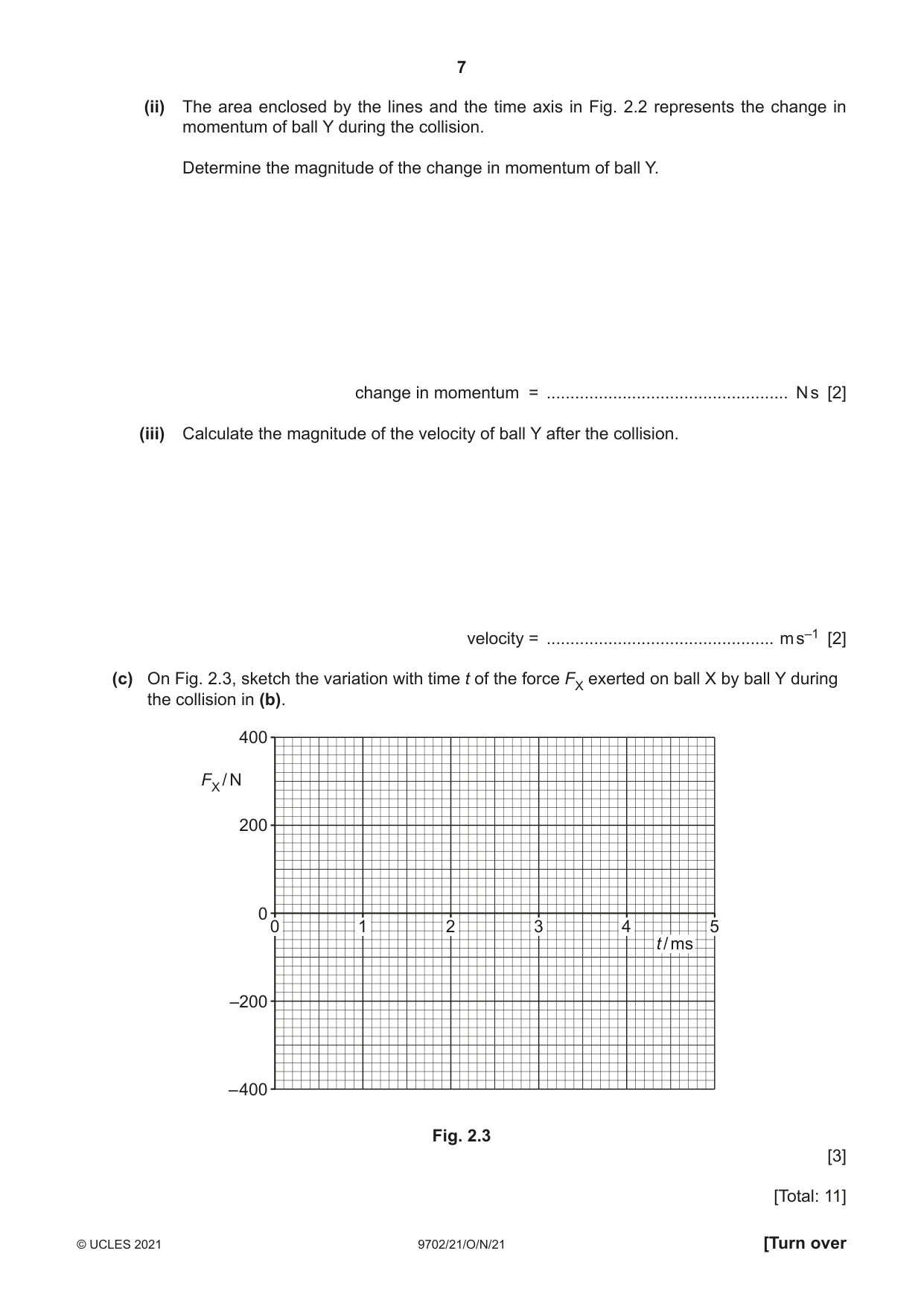
2 (a) Define momentum. ................................................................................................................................................... ............................................................................................................................................. [1] (b) Two balls X and Y, of equal diameter but different masses 0.24 kg and 0.12 kg respectively, slide towards each other on a frictionless horizontal surface, as shown in Fig. 2.1. mass 0.24 kg mass 0.12 kg X Y 2.3 m s–1 2.3 m s–1 frictionless surface Fig. 2.1 Both balls have initial speed 2.3 m s–1 before they collide with each other. Fig. 2.2 shows the variation with time t of the force FY exerted on ball Y by ball X during the collision. 400 FY / N 200 0 0 1 2 3 4 5 t / ms –200 – 400 Fig. 2.2 (i) Calculate the kinetic energy of ball X before the collision. kinetic energy = ...................................................... J [3] (ii) The area enclosed by the lines and the time axis in Fig. 2.2 represents the change in momentum of ball Y during the collision. Determine the magnitude of the change in momentum of ball Y. change in momentum = ................................................... N s [2] (iii) Calculate the magnitude of the velocity of ball Y after the collision. velocity = ................................................ m s–1 [2] (c) On Fig. 2.3, sketch the variation with time t of the force FX exerted on ball X by ball Y during the collision in (b). 400 FX / N 200 0 0 1 2 3 4 5 t / ms –200 – 400 Fig. 2.3 [3] [Total: 11]
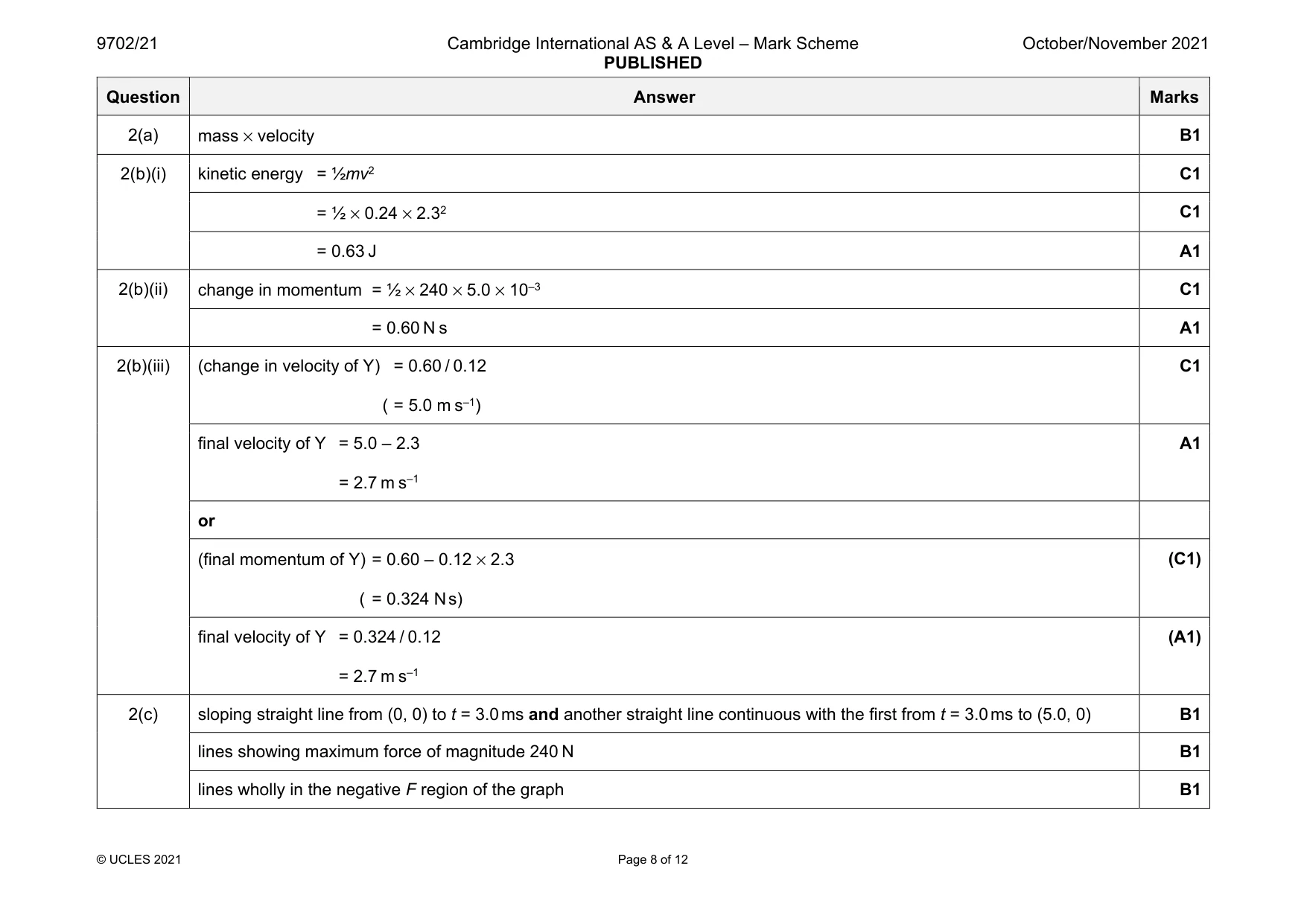
Mark scheme: 2(a) mass × velocity B1 2(b)(i) kinetic energy = ½mv2 C1 = ½ × 0.24 × 2.32 C1 = 0.63 J A1 2(b)(ii) change in momentum = ½ × 240 × 5.0 × 10–3 C1 = 0.60 N s A1 2(b)(iii) (change in velocity of Y) = 0.60 / 0.12 ( = 5.0 m s–1) C1 final velocity of Y = 5.0 – 2.3 = 2.7 m s–1 A1 or (final momentum of Y) = 0.60 – 0.12 × 2.3 ( = 0.324 N s) (C1) final velocity of Y = 0.324 / 0.12 = 2.7 m s–1 (A1) 2(c) sloping straight line from (0, 0) to t = 3.0 ms and another straight line continuous with the first from t = 3.0 ms to (5.0, 0) B1 lines showing maximum force of magnitude 240 N B1 lines wholly in the negative F region of the graph B1
More questions on Gravitational potential energy and kinetic energy
Q3 · A uniform metal bar, initially unstretched, has sides of length w, x and y, as shown in…
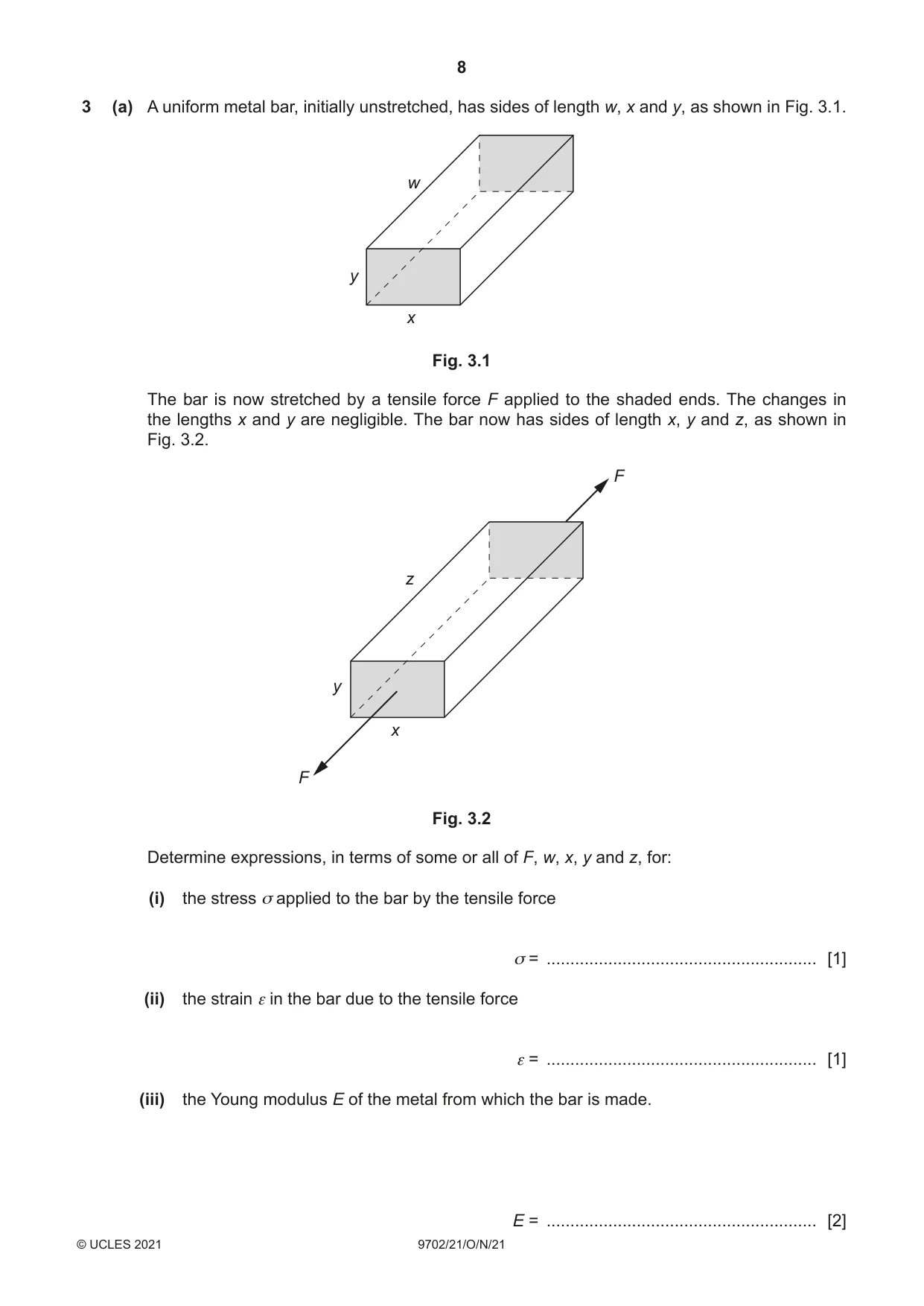
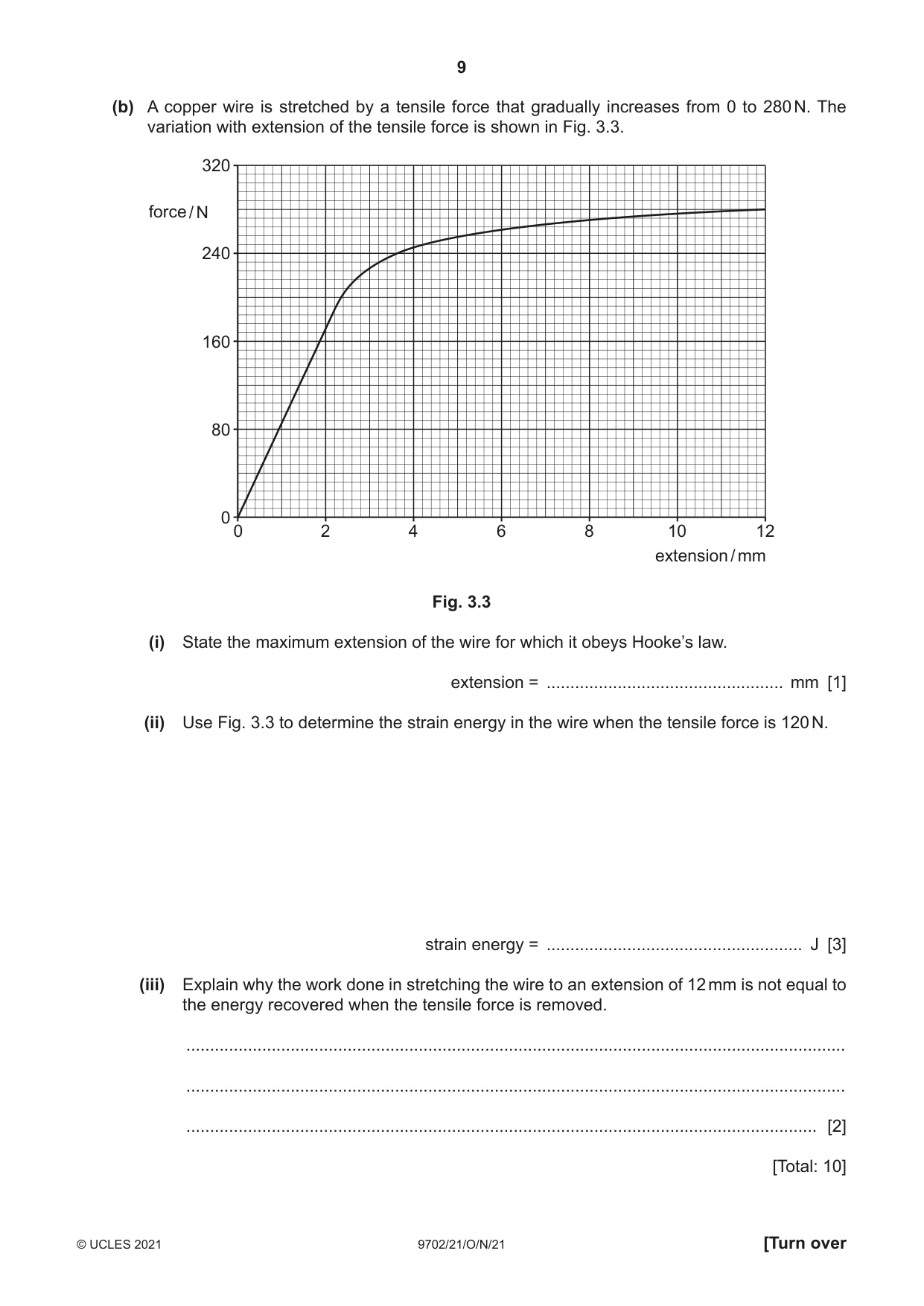
3 (a) A uniform metal bar, initially unstretched, has sides of length w, x and y, as shown in Fig. 3.1. w y x Fig. 3.1 The bar is now stretched by a tensile force F applied to the shaded ends. The changes in the lengths x and y are negligible. The bar now has sides of length x, y and z, as shown in Fig. 3.2. F z y x F Fig. 3.2 Determine expressions, in terms of some or all of F, w, x, y and z, for: (i) the stress σ applied to the bar by the tensile force σ = ......................................................... [1] (ii) the strain ε in the bar due to the tensile force ε = ......................................................... [1] (iii) the Young modulus E of the metal from which the bar is made. E = ......................................................... [2] (b) A copper wire is stretched by a tensile force that gradually increases from 0 to 280 N. The variation with extension of the tensile force is shown in Fig. 3.3. 320 force / N 240 160 80 0 0 2 4 6 8 10 12 extension / mm Fig. 3.3 (i) State the maximum extension of the wire for which it obeys Hooke’s law. extension = .................................................. mm [1] (ii) Use Fig. 3.3 to determine the strain energy in the wire when the tensile force is 120 N. strain energy = ...................................................... J [3] (iii) Explain why the work done in stretching the wire to an extension of 12 mm is not equal to the energy recovered when the tensile force is removed. ........................................................................................................................................... ........................................................................................................................................... ..................................................................................................................................... [2] [Total: 10]
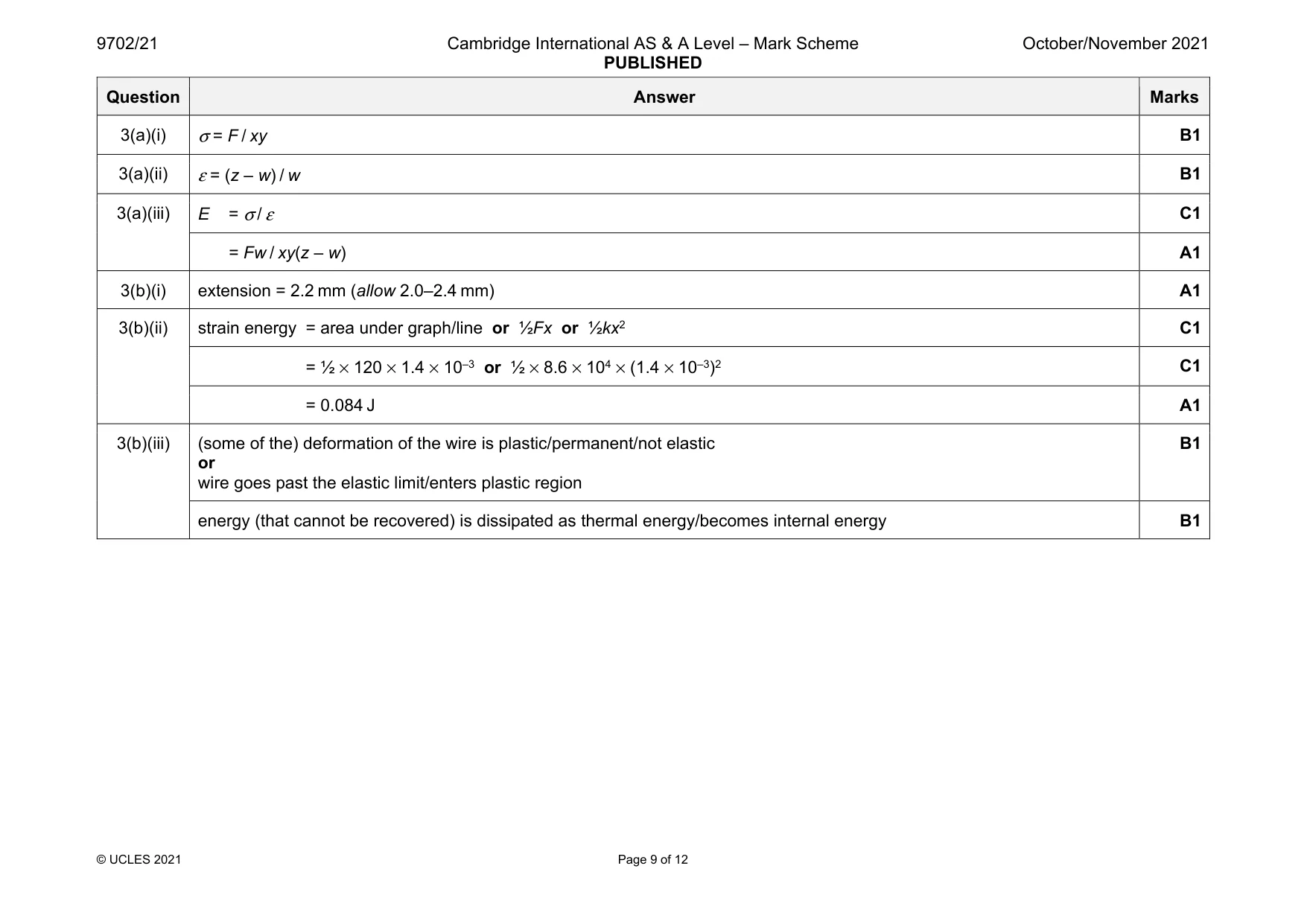
Mark scheme: 3(a)(i) σ = F / xy B1 3(a)(ii) ε = (z – w) / w B1 3(a)(iii) E = σ / ε C1 = Fw / xy(z – w) A1 3(b)(i) extension = 2.2 mm (allow 2.0–2.4 mm) A1 3(b)(ii) strain energy = area under graph/line or ½Fx or ½kx2 C1 = ½ × 120 × 1.4 × 10–3 or ½ × 8.6 × 104 × (1.4 × 10–3)2 C1 = 0.084 J A1 3(b)(iii) (some of the) deformation of the wire is plastic/permanent/not elastic or wire goes past the elastic limit/enters plastic region B1 energy (that cannot be recovered) is dissipated as thermal energy/becomes internal energy B1
Q4 · By reference to the direction of transfer of energy, state what is meant by a…
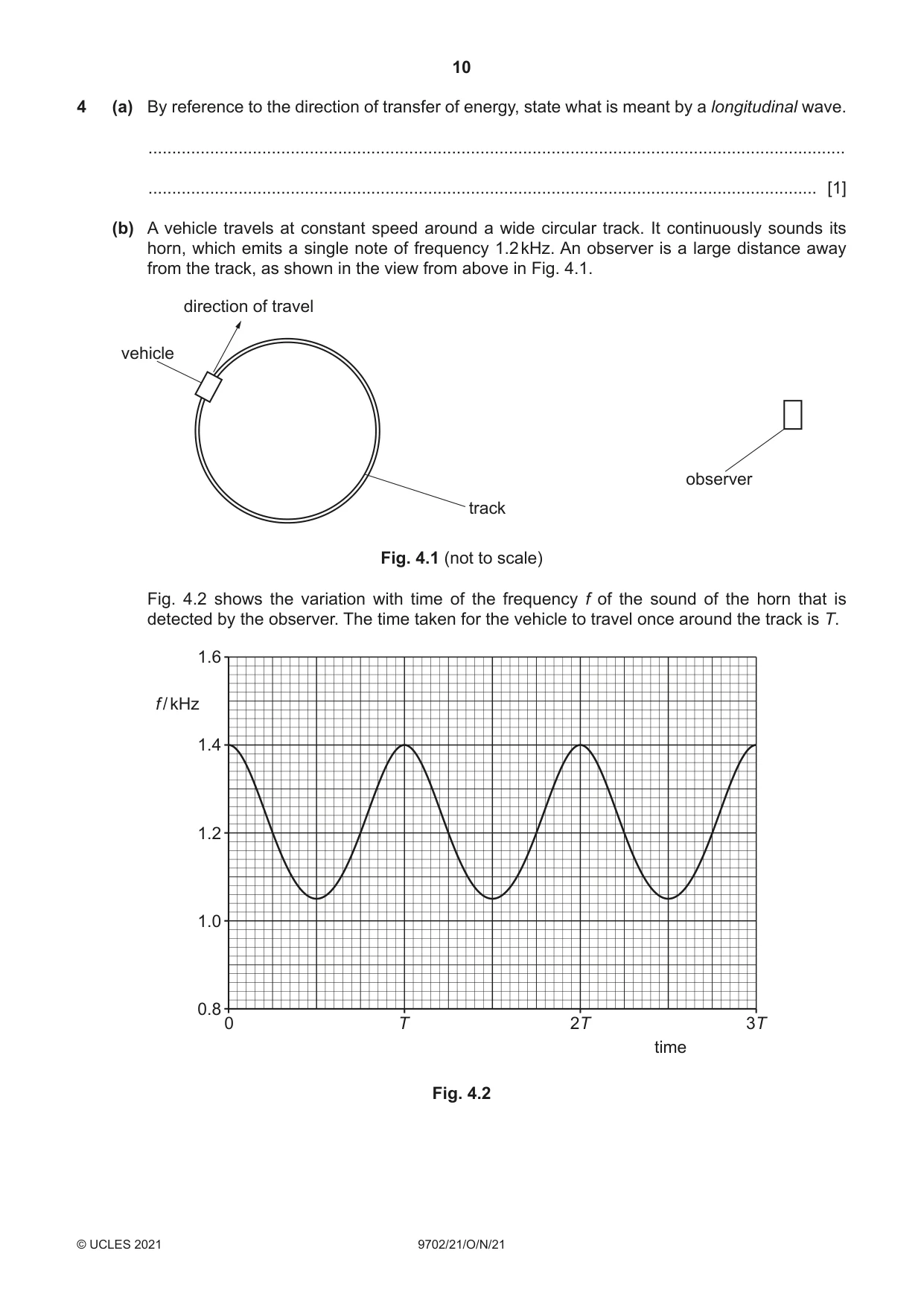
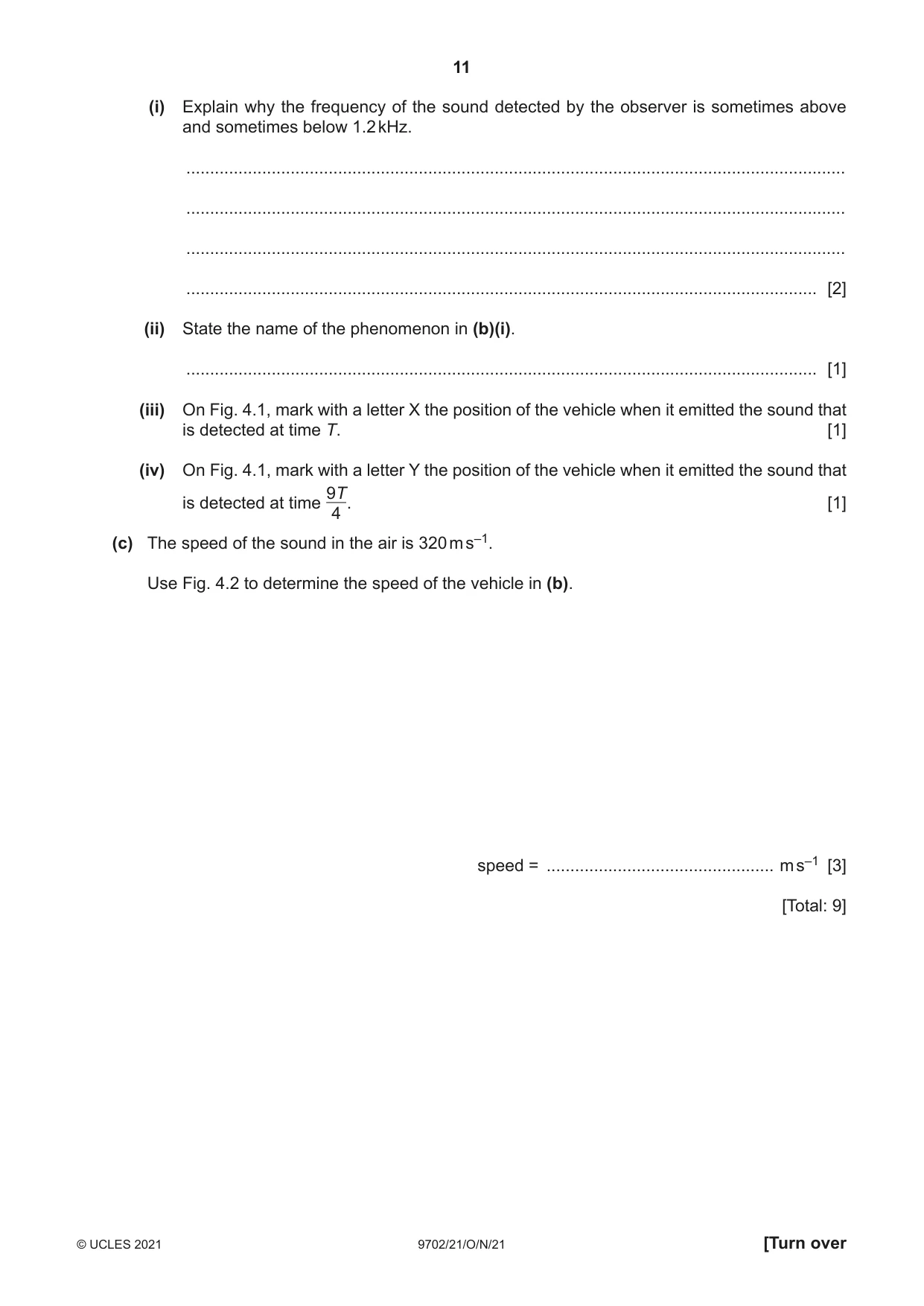
4 (a) By reference to the direction of transfer of energy, state what is meant by a longitudinal wave. ................................................................................................................................................... ............................................................................................................................................. [1] (b) A vehicle travels at constant speed around a wide circular track. It continuously sounds its horn, which emits a single note of frequency 1.2 kHz. An observer is a large distance away from the track, as shown in the view from above in Fig. 4.1. direction of travel vehicle observer track Fig. 4.1 (not to scale) Fig. 4.2 shows the variation with time of the frequency f of the sound of the horn that is detected by the observer. The time taken for the vehicle to travel once around the track is T. 1.6 f / kHz 1.4 1.2 1.0 0.8 0 T 2T 3T time Fig. 4.2 (i) Explain why the frequency of the sound detected by the observer is sometimes above and sometimes below 1.2 kHz. ........................................................................................................................................... ........................................................................................................................................... ........................................................................................................................................... ..................................................................................................................................... [2] (ii) State the name of the phenomenon in (b)(i). ..................................................................................................................................... [1] (iii) On Fig. 4.1, mark with a letter X the position of the vehicle when it emitted the sound that is detected at time T. [1] (iv) On Fig. 4.1, mark with a letter Y the position of the vehicle when it emitted the sound that 9T is detected at time . [1] 4 (c) The speed of the sound in the air is 320 m s–1. Use Fig. 4.2 to determine the speed of the vehicle in (b). speed = ................................................ m s–1 [3] [Total: 9]
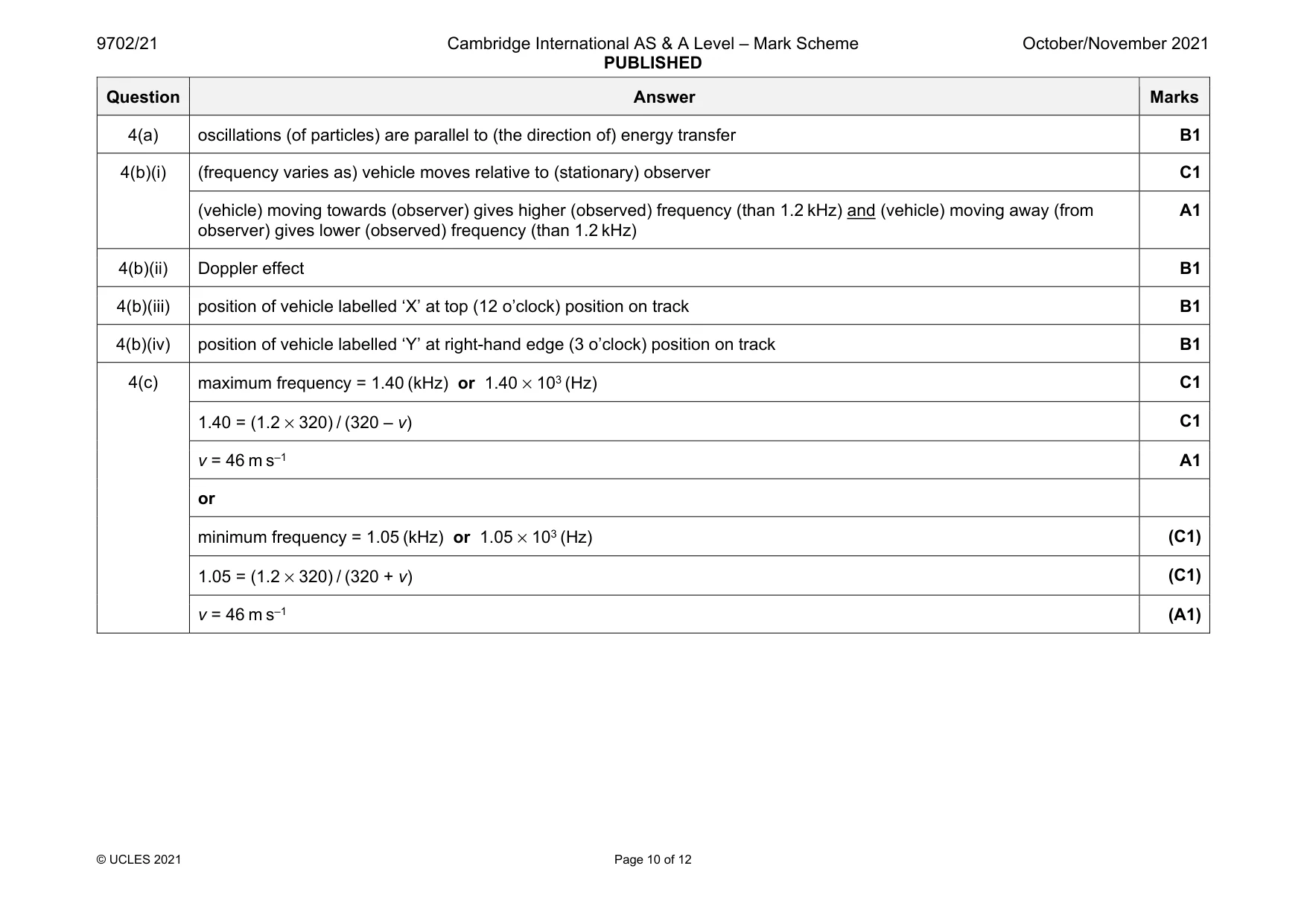
Mark scheme: 4(a) oscillations (of particles) are parallel to (the direction of) energy transfer B1 4(b)(i) (frequency varies as) vehicle moves relative to (stationary) observer C1 (vehicle) moving towards (observer) gives higher (observed) frequency (than 1.2 kHz) and (vehicle) moving away (from observer) gives lower (observed) frequency (than 1.2 kHz) A1 4(b)(ii) Doppler effect B1 4(b)(iii) position of vehicle labelled ‘X’ at top (12 o’clock) position on track B1 4(b)(iv) position of vehicle labelled ‘Y’ at right-hand edge (3 o’clock) position on track B1 4(c) maximum frequency = 1.40 (kHz) or 1.40 × 10³ (Hz) C1 1.40 = (1.2 × 320) / (320 – v) C1 v = 46 m s–1 A1 or minimum frequency = 1.05 (kHz) or 1.05 × 10³ (Hz) (C1) 1.05 = (1.2 × 320) / (320 + v) (C1) v = 46 m s–1 (A1)
Q5 · State Kirchhoff’s first law
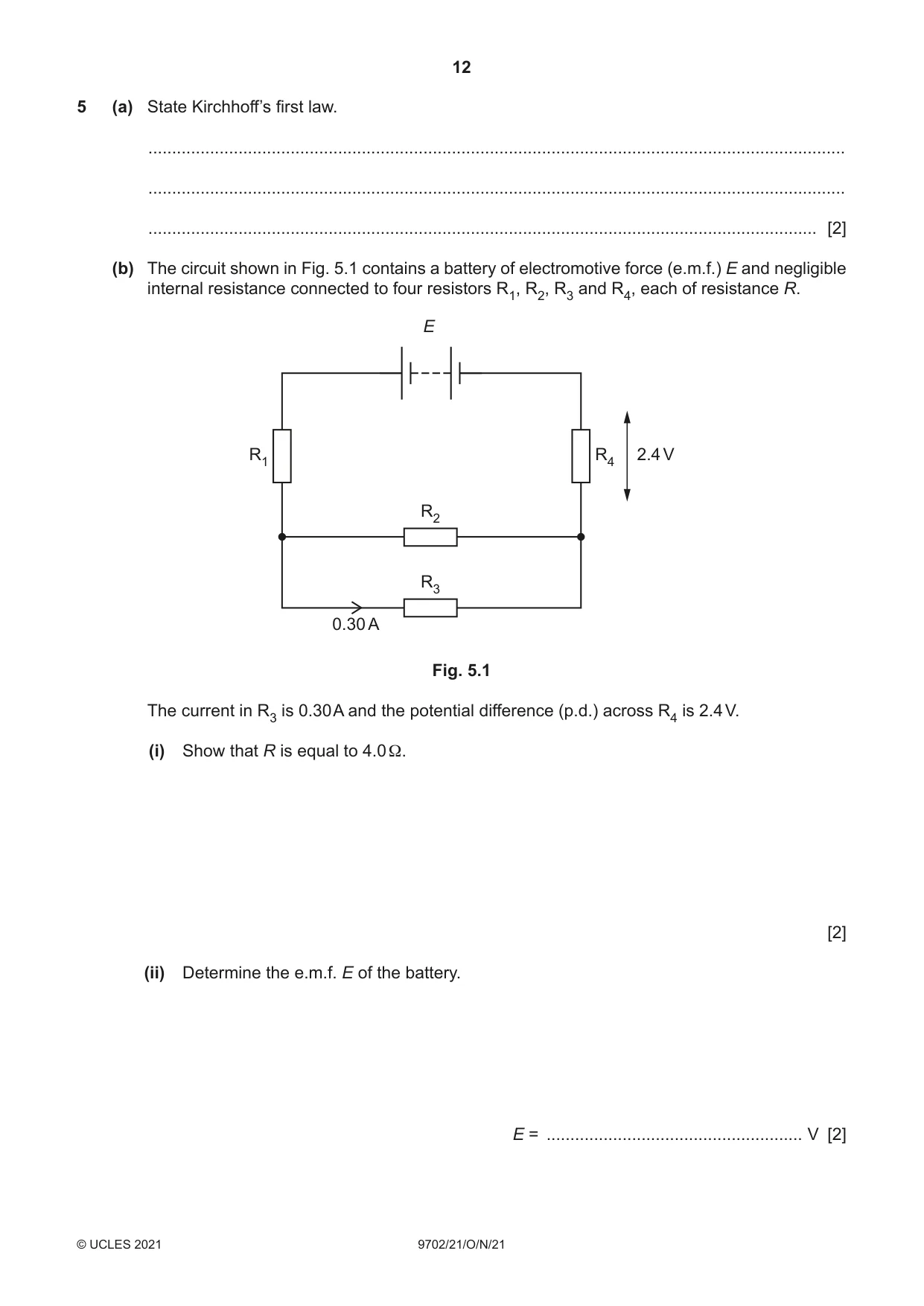
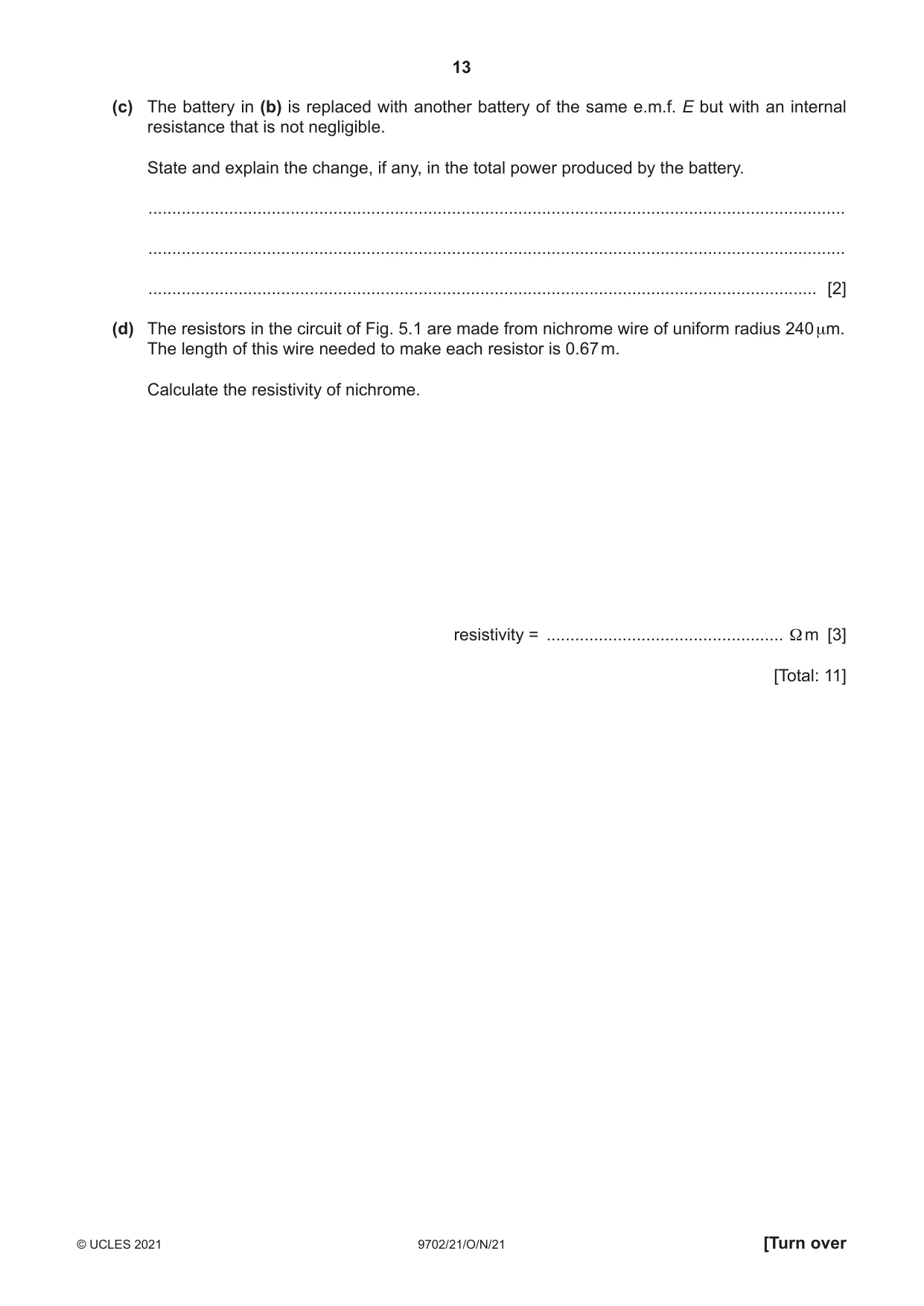
5 (a) State Kirchhoff’s first law. ................................................................................................................................................... ................................................................................................................................................... ............................................................................................................................................. [2] (b) The circuit shown in Fig. 5.1 contains a battery of electromotive force (e.m.f.) E and negligible internal resistance connected to four resistors R1, R2, R3 and R4, each of resistance R. E R1 R4 2.4 V R2 R3 0.30 A Fig. 5.1 The current in R3 is 0.30 A and the potential difference (p.d.) across R4 is 2.4 V. (i) Show that R is equal to 4.0 Ω. [2] (ii) Determine the e.m.f. E of the battery. E = ...................................................... V [2] (c) The battery in (b) is replaced with another battery of the same e.m.f. E but with an internal resistance that is not negligible. State and explain the change, if any, in the total power produced by the battery. ................................................................................................................................................... ................................................................................................................................................... ............................................................................................................................................. [2] (d) The resistors in the circuit of Fig. 5.1 are made from nichrome wire of uniform radius 240 μm. The length of this wire needed to make each resistor is 0.67 m. Calculate the resistivity of nichrome. resistivity = .................................................. Ω m [3] [Total: 11]
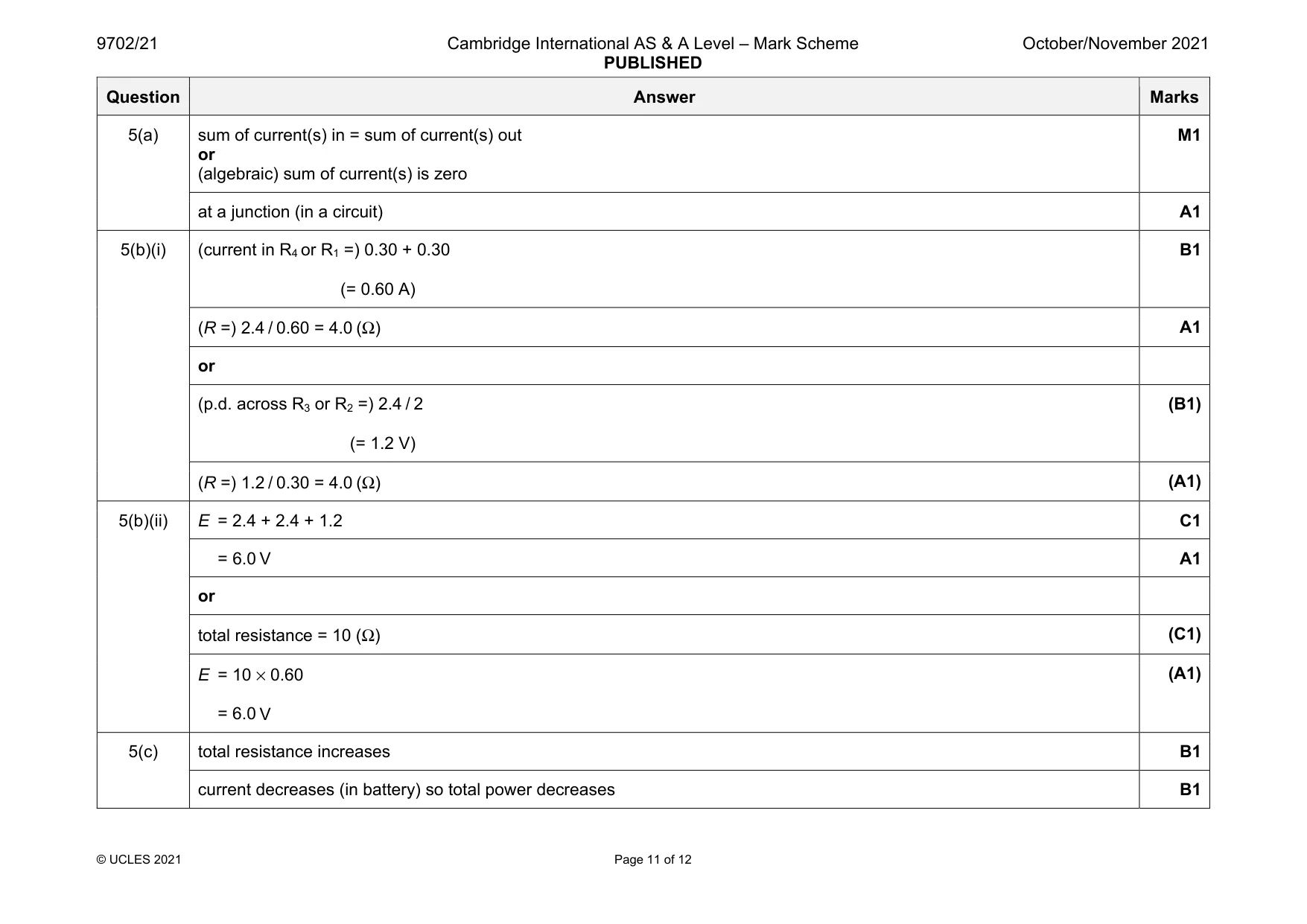
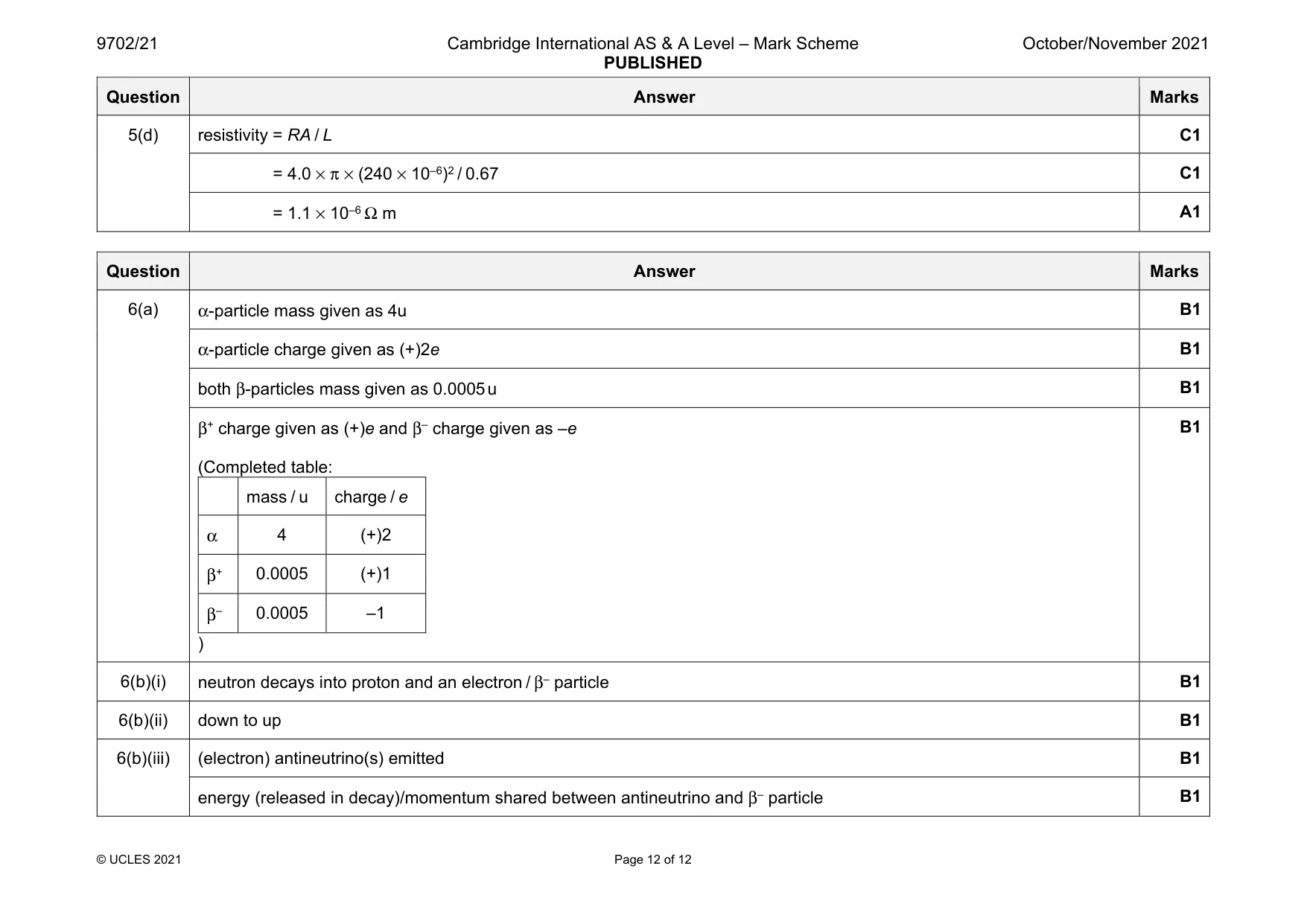
Mark scheme: 5(a) sum of current(s) in = sum of current(s) out or (algebraic) sum of current(s) is zero M1 at a junction (in a circuit) A1 5(b)(i) (current in R4 or R1 =) 0.30 + 0.30 (= 0.60 A) B1 (R =) 2.4 / 0.60 = 4.0 (Ω) A1 or (p.d. across R3 or R2 =) 2.4 / 2 (= 1.2 V) (B1) (R =) 1.2 / 0.30 = 4.0 (Ω) (A1) 5(b)(ii) E = 2.4 + 2.4 + 1.2 C1 = 6.0 V A1 or total resistance = 10 (Ω) (C1) E = 10 × 0.60 = 6.0 V (A1) 5(c) total resistance increases B1 current decreases (in battery) so total power decreases B1 Question Answer Marks 5(d) resistivity = RA / L C1 = 4.0 × π × (240 × 10–6)2 / 0.67 C1 = 1.1 × 10⁻⁶ Ω m A1
Q6 · Complete Table 6.1 to show the masses (in terms of the unified atomic mass unit u) and…
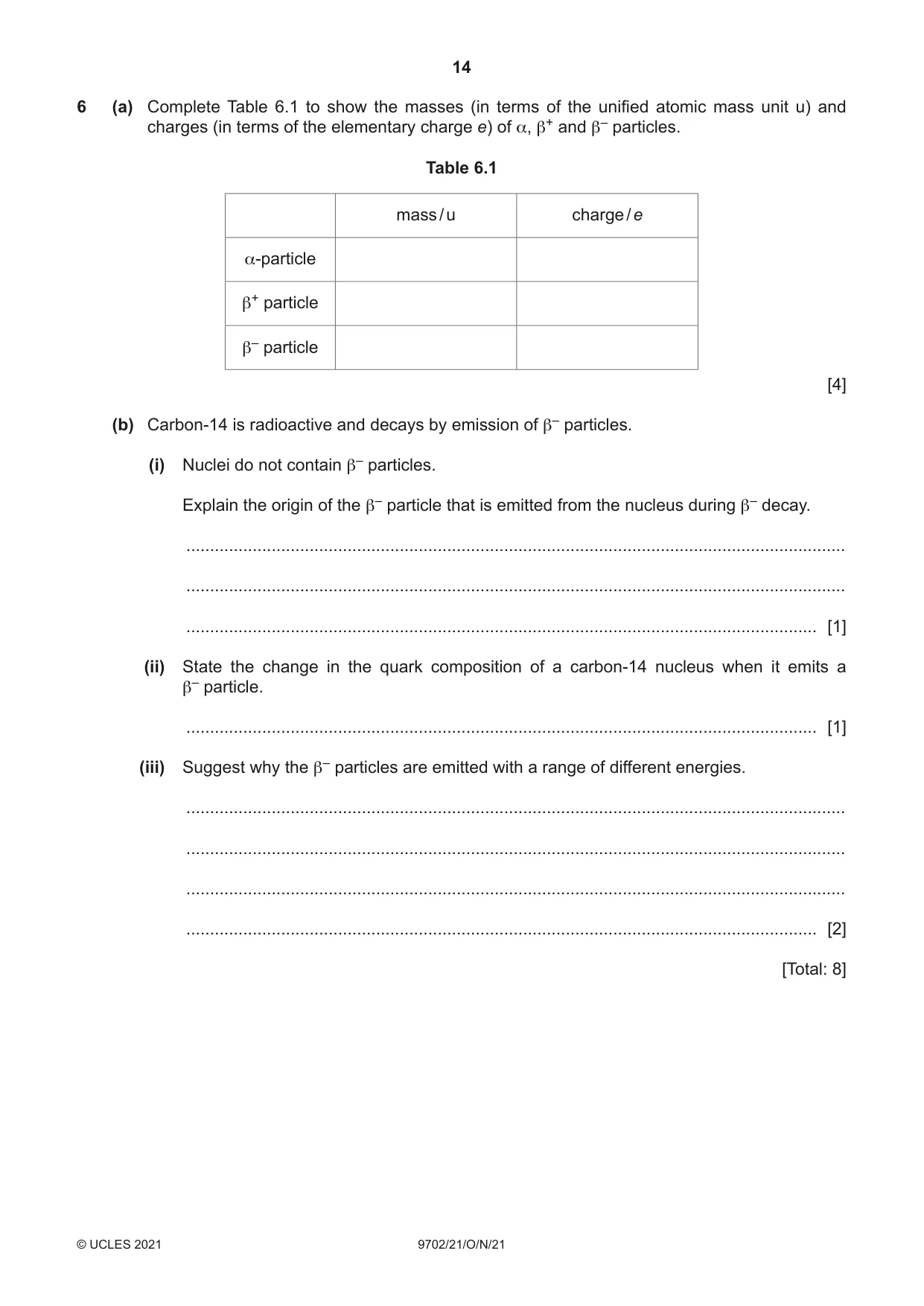
6 (a) Complete Table 6.1 to show the masses (in terms of the unified atomic mass unit u) and charges (in terms of the elementary charge e) of α, β+ and β– particles. Table 6.1 mass / u charge / e α-particle β+ particle β– particle [4] (b) Carbon-14 is radioactive and decays by emission of β– particles. (i) Nuclei do not contain β– particles. Explain the origin of the β– particle that is emitted from the nucleus during β– decay. ........................................................................................................................................... ........................................................................................................................................... ..................................................................................................................................... [1] (ii) State the change in the quark composition of a carbon-14 nucleus when it emits a β– particle. ..................................................................................................................................... [1] (iii) Suggest why the β– particles are emitted with a range of different energies. ........................................................................................................................................... ........................................................................................................................................... ........................................................................................................................................... ..................................................................................................................................... [2] [Total: 8]
Mark scheme: 6(a) α-particle mass given as 4u B1 α-particle charge given as (+)2e B1 both β-particles mass given as 0.0005 u B1 β+ charge given as (+)e and β– charge given as –e (Completed table: mass / u charge / e α 4 (+)2 β+ 0.0005 (+)1 β– 0.0005 –1 ) B1 6(b)(i) neutron decays into proton and an electron / β– particle B1 6(b)(ii) down to up B1 6(b)(iii) (electron) antineutrino(s) emitted B1 energy (released in decay)/momentum shared between antineutrino and β– particle B1
What was in this paper
The subtopics covered by these 6 questions, and how many questions each got. Open one in a new tab to see every Cambridge question on it.
What you needed in this session
Cambridge’s own grade thresholds for 2021 Oct/Nov, Paper 2 · Variant 1. A higher threshold means an easier paper — the bar moves with how the cohort did.