Cambridge A Level Physics 9702 — 2017 May/June Paper 2 · Variant 2
9702/22/M/J/17 · 8 questions · 60 marks · ≈68 min
The question paper and its mark scheme, free to read here and free to download. This is Cambridge’s own paper, exactly as it was sat.
Question paper16 pages

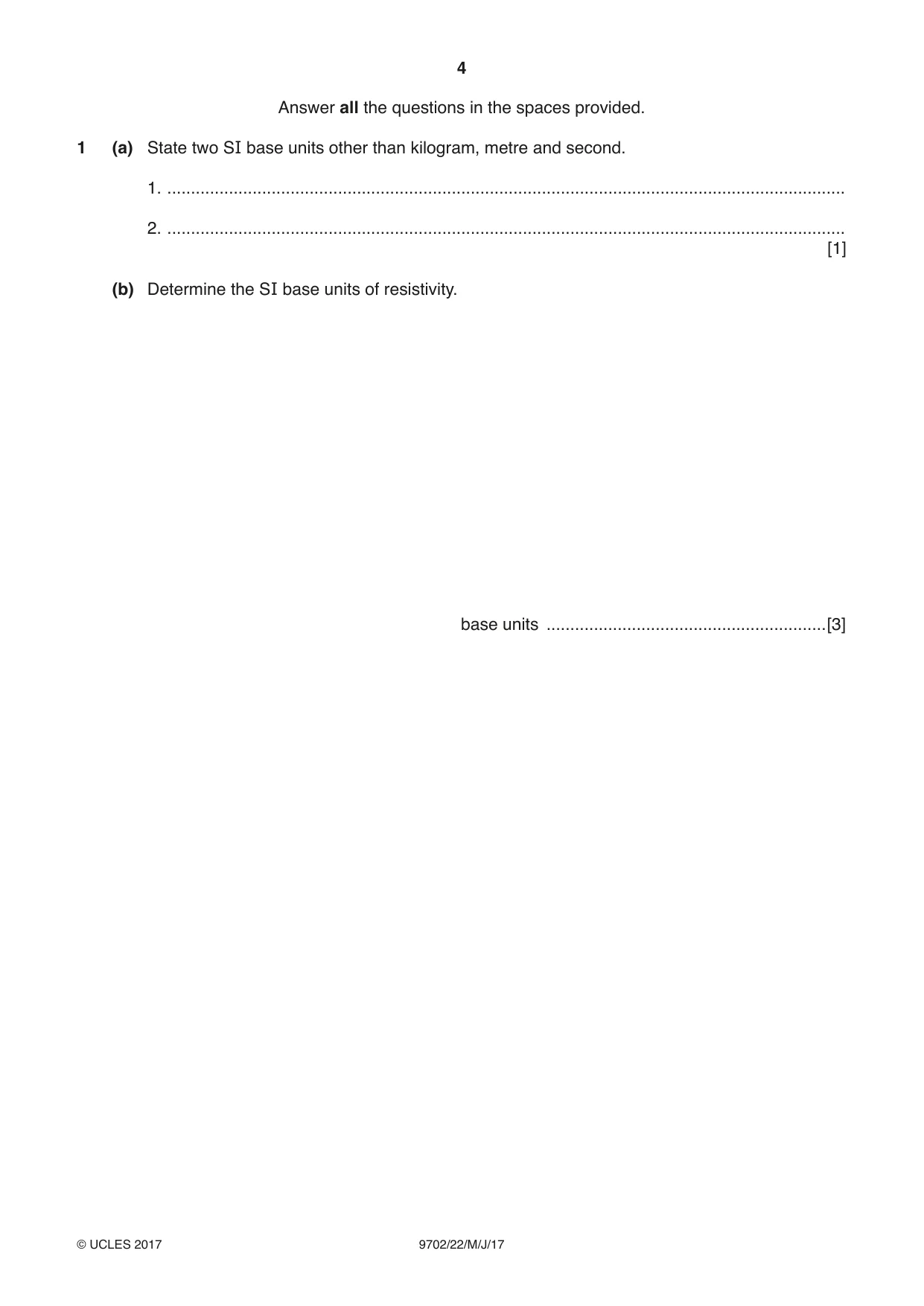
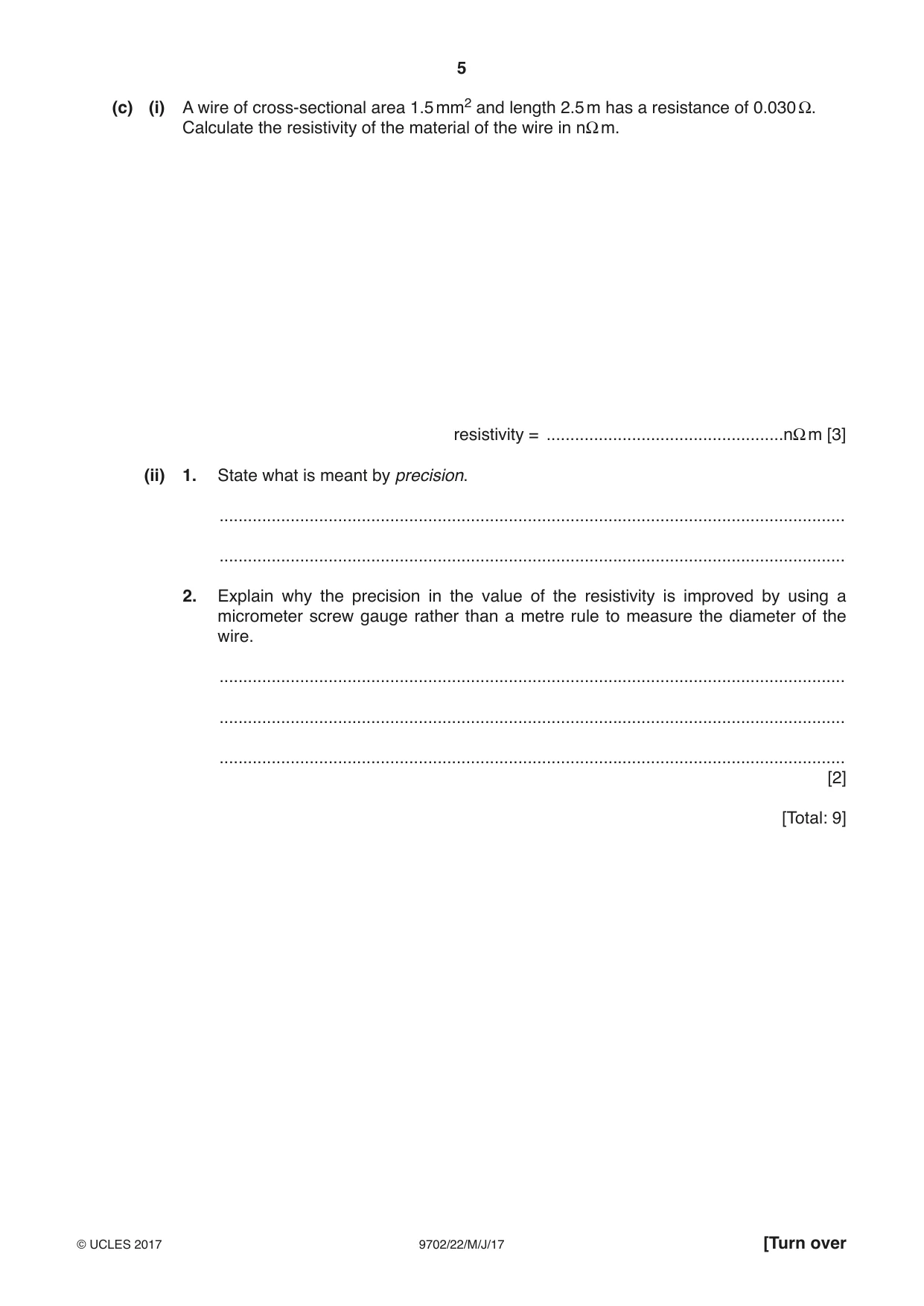
Mark scheme7 pages
Answers below. Sit the paper first if you are practising.
Questions as text
Q1 · State two SI base units other than kilogram, metre and second
1 (a) State two SI base units other than kilogram, metre and second. 1. ............................................................................................................................................... 2. ............................................................................................................................................... [1] (b) Determine the SI base units of resistivity. base units ...........................................................[3] (c) (i) A wire of cross-sectional area 1.5 mm2 and length 2.5 m has a resistance of 0.030 Ω. Calculate the resistivity of the material of the wire in nΩ m. resistivity = ..................................................nΩ m [3] (ii) 1. State what is meant by precision. .................................................................................................................................... .................................................................................................................................... 2. Explain why the precision in the value of the resistivity is improved by using a micrometer screw gauge rather than a metre rule to measure the diameter of the wire. .................................................................................................................................... .................................................................................................................................... .................................................................................................................................... [2] [Total: 9]
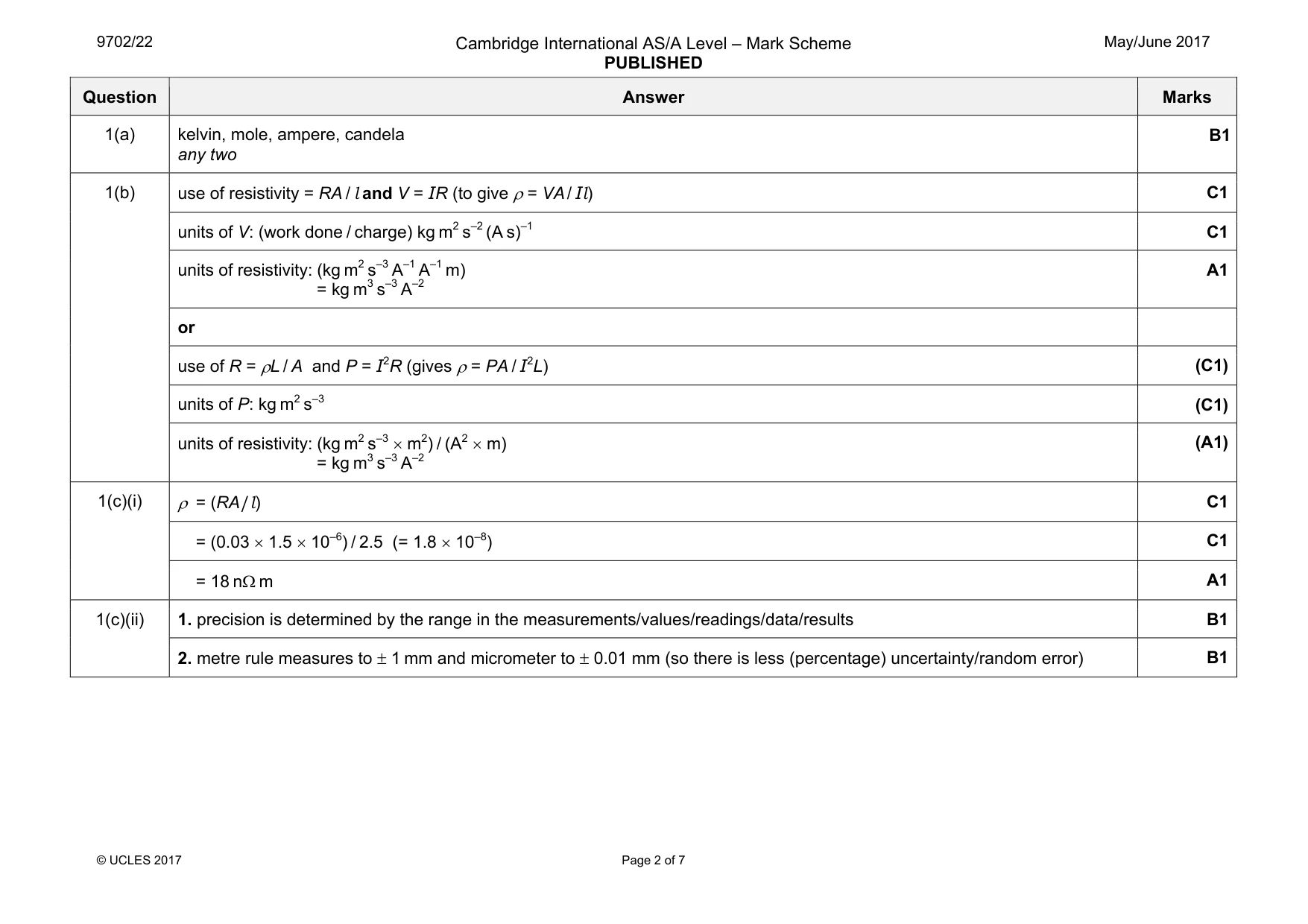
Mark scheme: 1(a) kelvin, mole, ampere, candela any two B1 1(b) use of resistivity = RA / l and V = IR (to give ρ = VA/ Il) C1 units of V: (work done / charge) kg m2 s–2 (A s)–1 C1 units of resistivity: (kg m2 s–3 A–1 A–1 m) = kg m3 s–3 A–2 A1 or use of R = ρL / A and P = I2R (gives ρ = PA / I2L) (C1) units of P: kg m2 s–3 (C1) units of resistivity: (kg m2 s–3 × m2) / (A2 × m) = kg m3 s–3 A–2 (A1) 1(c)(i) ρ = (RA/l) C1 = (0.03 × 1.5 × 10–6) / 2.5 (= 1.8 × 10⁻⁸) C1 = 18 nΩ m A1 1(c)(ii) 1. precision is determined by the range in the measurements/values/readings/data/results B1 2. metre rule measures to ± 1 mm and micrometer to ± 0.01 mm (so there is less (percentage) uncertainty/random error) B1
Question 2
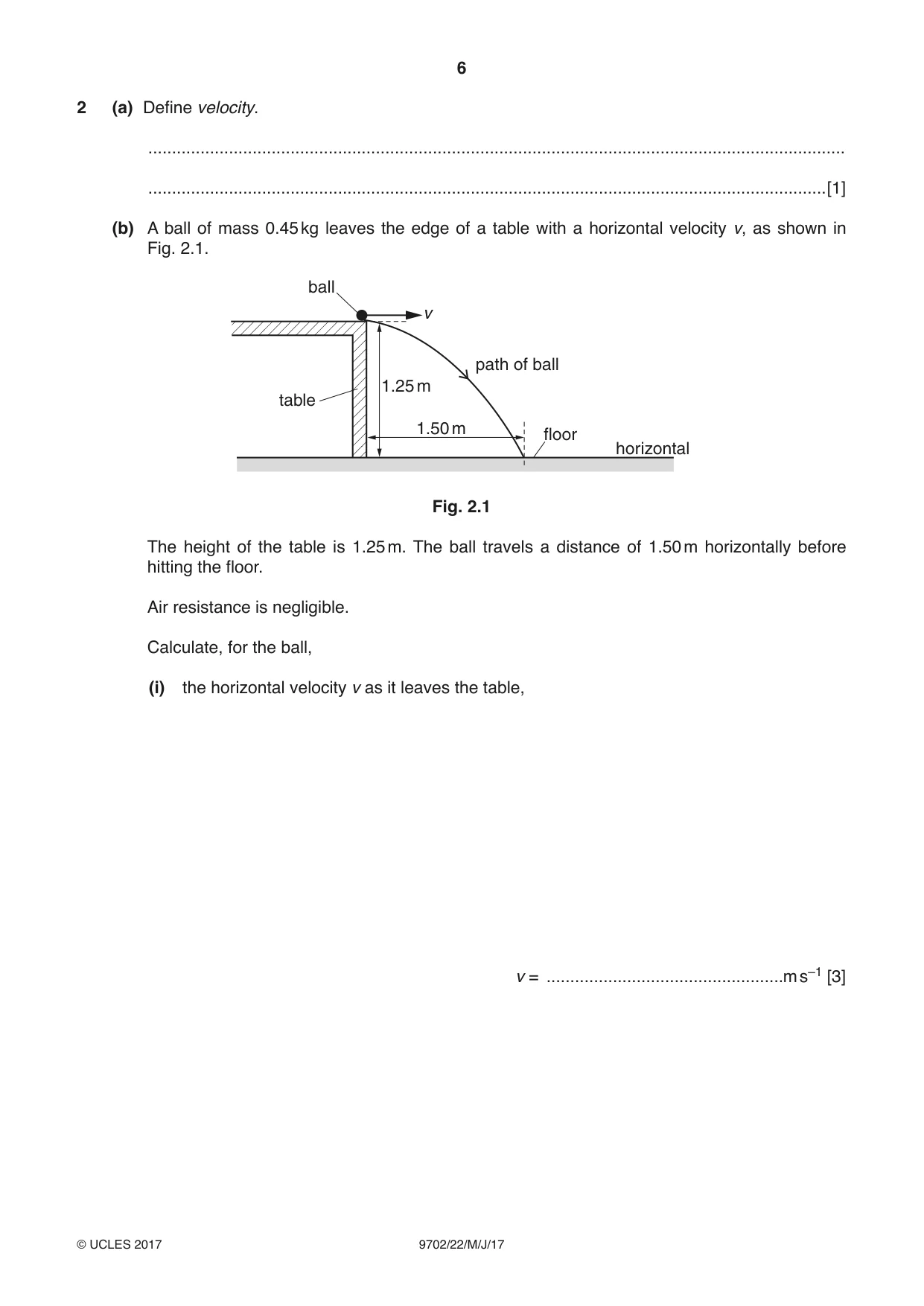
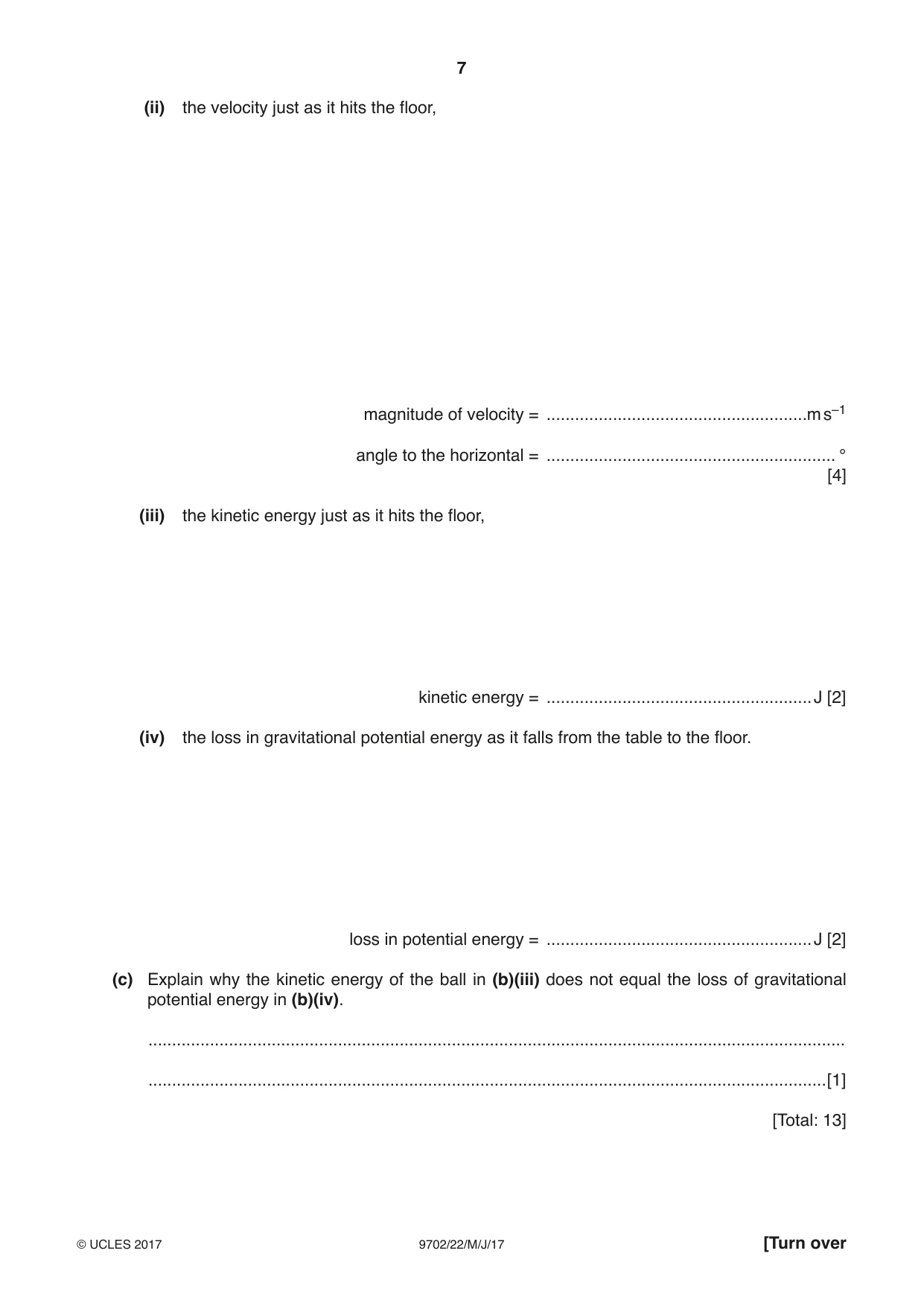
2 (a) Define velocity. ................................................................................................................................................... ...............................................................................................................................................[1] (b) A ball of mass 0.45 kg leaves the edge of a table with a horizontal velocity v, as shown in Fig. 2.1. ball v path of ball 1.25 m table 1.50 m floor horizontal Fig. 2.1 The height of the table is 1.25 m. The ball travels a distance of 1.50 m horizontally before hitting the floor. Air resistance is negligible. Calculate, for the ball, (i) the horizontal velocity v as it leaves the table, v = ..................................................m s–1 [3] (ii) the velocity just as it hits the floor, magnitude of velocity = .......................................................m s–1 angle to the horizontal = ............................................................. ° [4] (iii) the kinetic energy just as it hits the floor, kinetic energy = ........................................................J [2] (iv) the loss in gravitational potential energy as it falls from the table to the floor. loss in potential energy = ........................................................J [2] (c) Explain why the kinetic energy of the ball in (b)(iii) does not equal the loss of gravitational potential energy in (b)(iv). ................................................................................................................................................... ...............................................................................................................................................[1] [Total: 13]
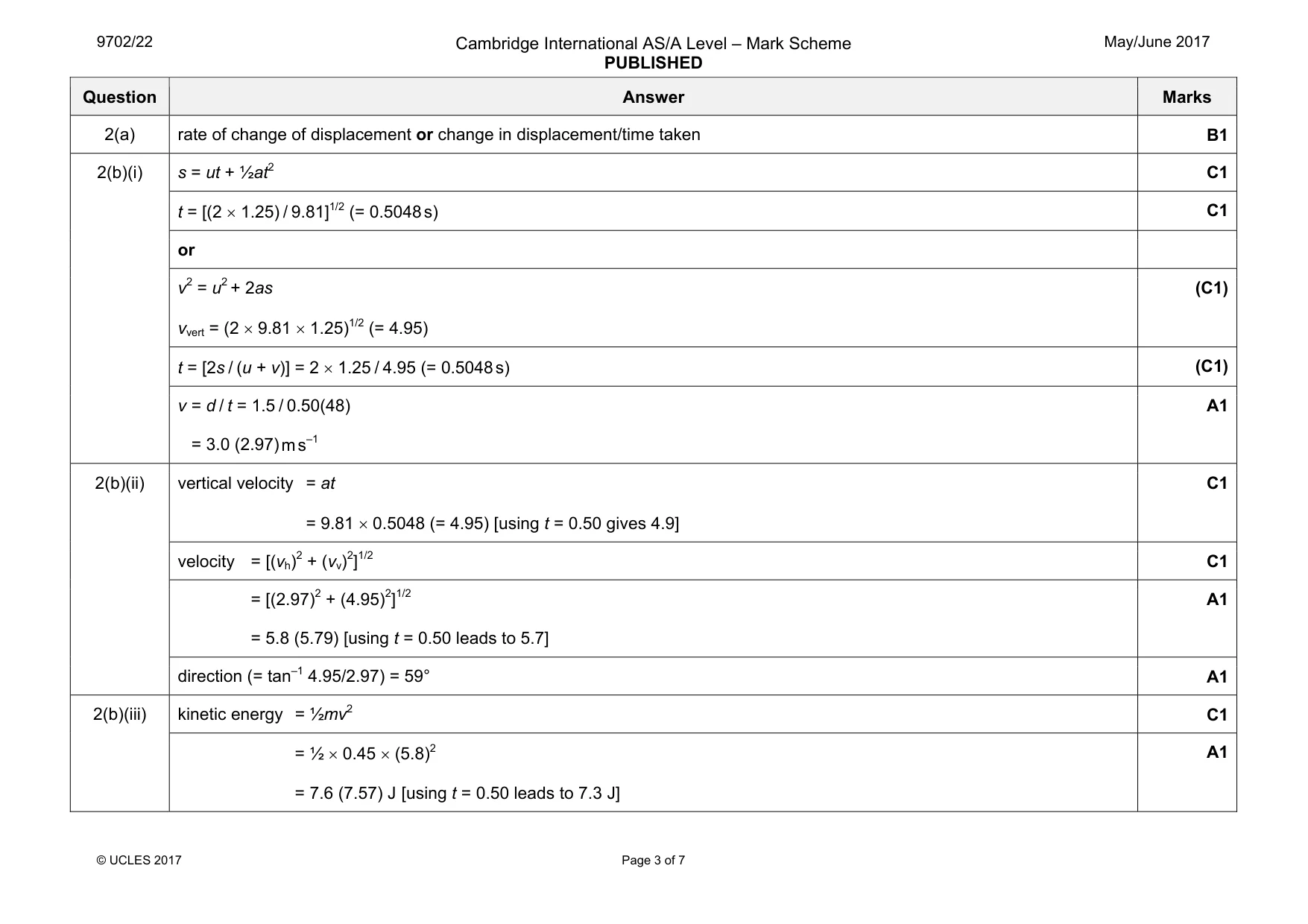
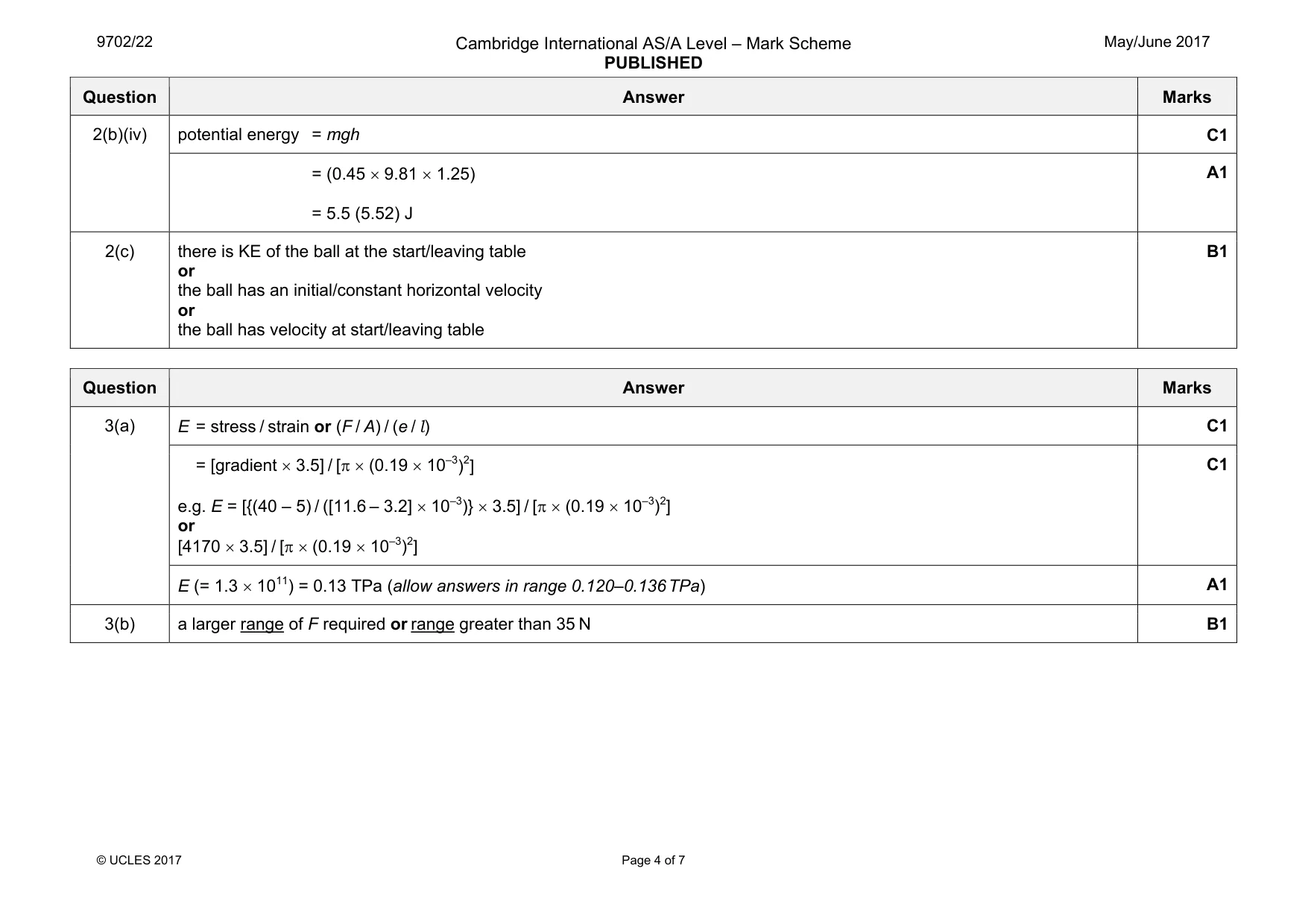
Mark scheme: 2(a) rate of change of displacement or change in displacement/time taken B1 2(b)(i) s = ut + ½at2 C1 t = [(2 × 1.25) / 9.81]1/2 (= 0.5048 s) C1 or v2 = u2 + 2as vvert = (2 × 9.81 × 1.25)1/2 (= 4.95) (C1) t = [2s / (u + v)] = 2 × 1.25 / 4.95 (= 0.5048 s) (C1) v = d / t = 1.5 / 0.50(48) = 3.0 (2.97) m s–1 A1 2(b)(ii) vertical velocity = at = 9.81 × 0.5048 (= 4.95) [using t = 0.50 gives 4.9] C1 velocity = [(vh)2 + (vv)2]1/2 C1 = [(2.97)2 + (4.95)2]1/2 = 5.8 (5.79) [using t = 0.50 leads to 5.7] A1 direction (= tan–1 4.95/2.97) = 59° A1 2(b)(iii) kinetic energy = ½mv2 C1 = ½ × 0.45 × (5.8)2 = 7.6 (7.57) J [using t = 0.50 leads to 7.3 J] A1 Question Answer Marks 2(b)(iv) potential energy = mgh C1 = (0.45 × 9.81 × 1.25) = 5.5 (5.52) J A1 2(c) there is KE of the ball at the start/leaving table or the ball has an initial/constant horizontal velocity or the ball has velocity at start/leaving table B1
Q3 · The Young modulus of the material of a wire can be determined using the apparatus shown…
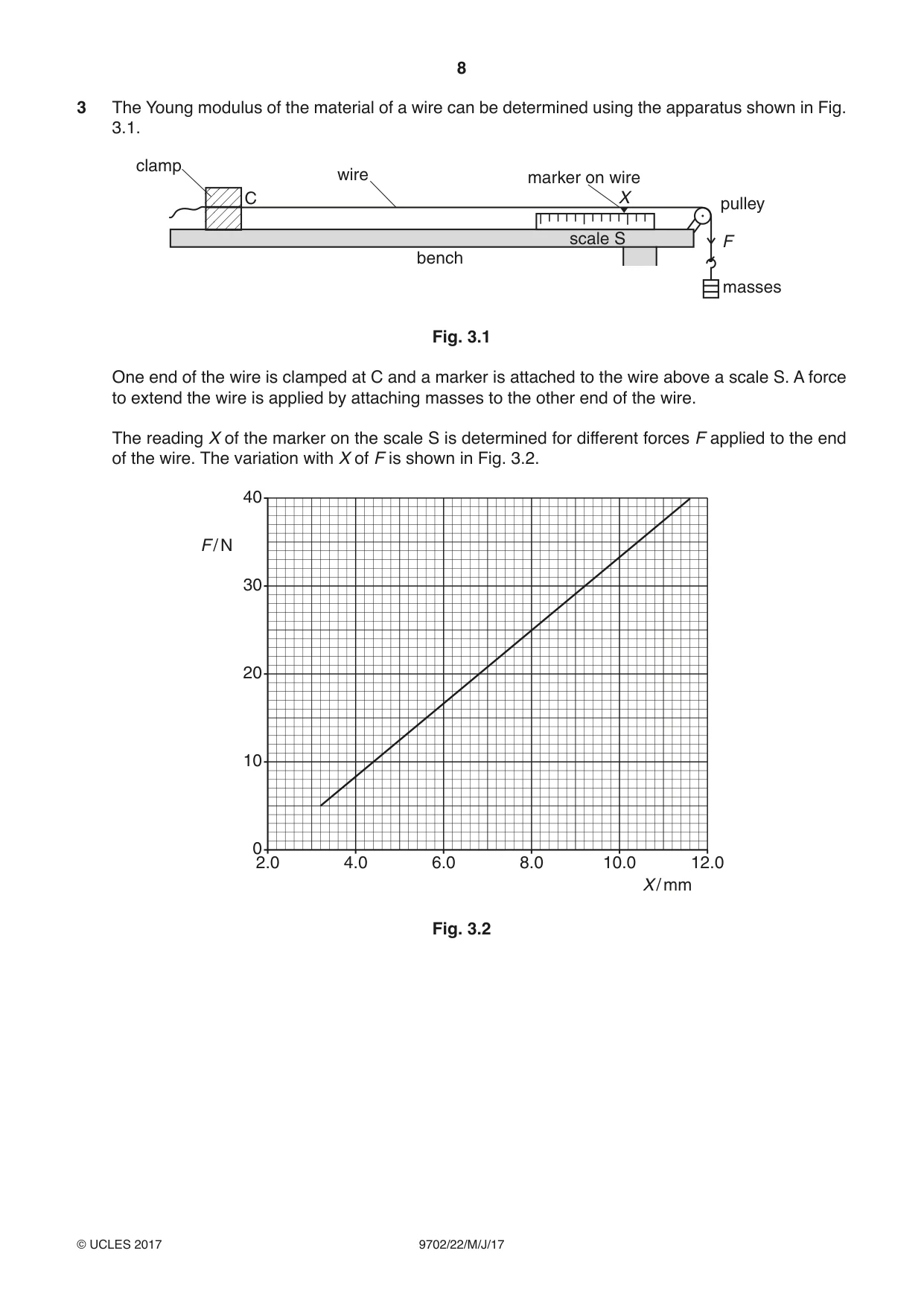
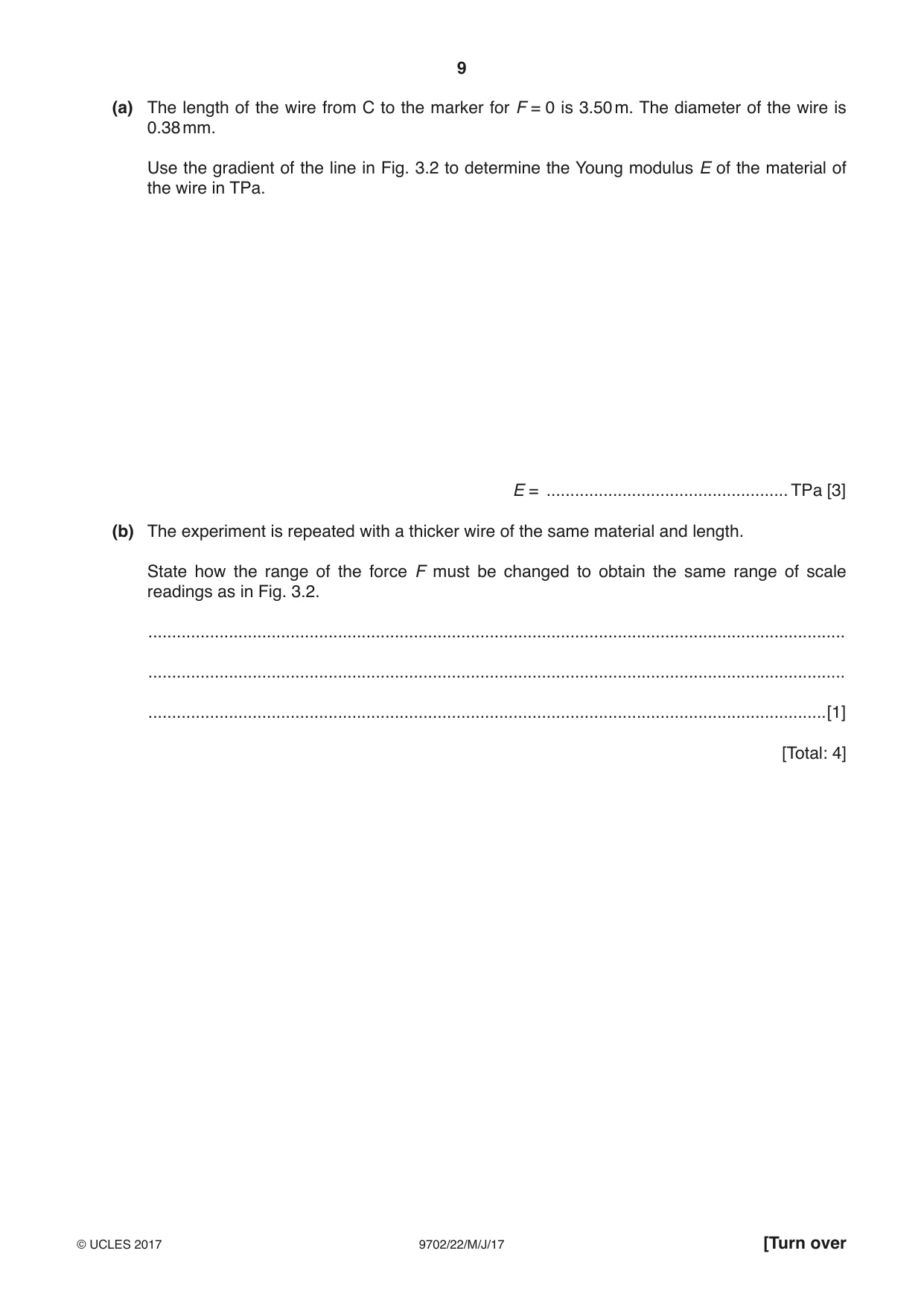
3 The Young modulus of the material of a wire can be determined using the apparatus shown in Fig. 3.1. clamp wire marker on wire C X pulley scale S F bench masses Fig. 3.1 One end of the wire is clamped at C and a marker is attached to the wire above a scale S. A force to extend the wire is applied by attaching masses to the other end of the wire. The reading X of the marker on the scale S is determined for different forces F applied to the end of the wire. The variation with X of F is shown in Fig. 3.2. 40 F / N 30 20 10 0 2.0 4.0 6.0 8.0 10.0 12.0 X / mm Fig. 3.2 (a) The length of the wire from C to the marker for F = 0 is 3.50 m. The diameter of the wire is 0.38 mm. Use the gradient of the line in Fig. 3.2 to determine the Young modulus E of the material of the wire in TPa. E = ................................................... TPa [3] (b) The experiment is repeated with a thicker wire of the same material and length. State how the range of the force F must be changed to obtain the same range of scale readings as in Fig. 3.2. ................................................................................................................................................... ................................................................................................................................................... ...............................................................................................................................................[1] [Total: 4]
Mark scheme: 3(a) C1 = [gradient × 3.5] / [π × (0.19 × 10⁻³)2] e.g. E = [{(40 – 5) / ([11.6 – 3.2] × 10–3)} × 3.5] / [π × (0.19 × 10⁻³)2] or [4170 × 3.5] / [π × (0.19 × 10⁻³)2] C1 E (= 1.3 × 10¹¹) = 0.13 TPa (allow answers in range 0.120–0.136 TPa) A1 3(b) a larger range of F required or range greater than 35 N B1
Q4 · State Newton’s first law of motion
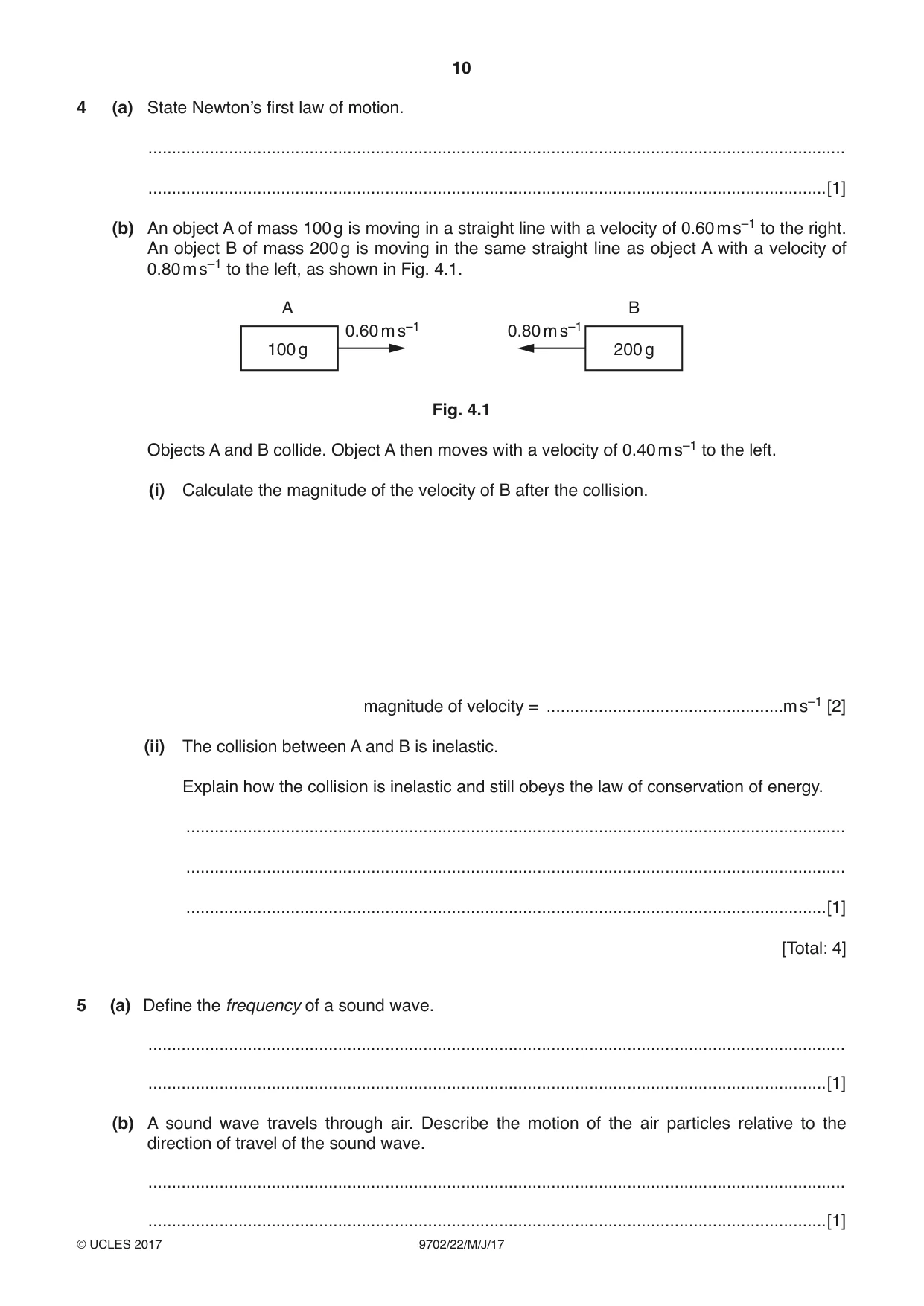
4 (a) State Newton’s first law of motion. ................................................................................................................................................... ...............................................................................................................................................[1] (b) An object A of mass 100 g is moving in a straight line with a velocity of 0.60 m s–1 to the right. An object B of mass 200 g is moving in the same straight line as object A with a velocity of 0.80 m s–1 to the left, as shown in Fig. 4.1. A B 0.60 m s–1 0.80 m s–1 100 g 200 g Fig. 4.1 Objects A and B collide. Object A then moves with a velocity of 0.40 m s–1 to the left. (i) Calculate the magnitude of the velocity of B after the collision. magnitude of velocity = ..................................................m s–1 [2] (ii) The collision between A and B is inelastic. Explain how the collision is inelastic and still obeys the law of conservation of energy. ........................................................................................................................................... ........................................................................................................................................... .......................................................................................................................................[1] [Total: 4]
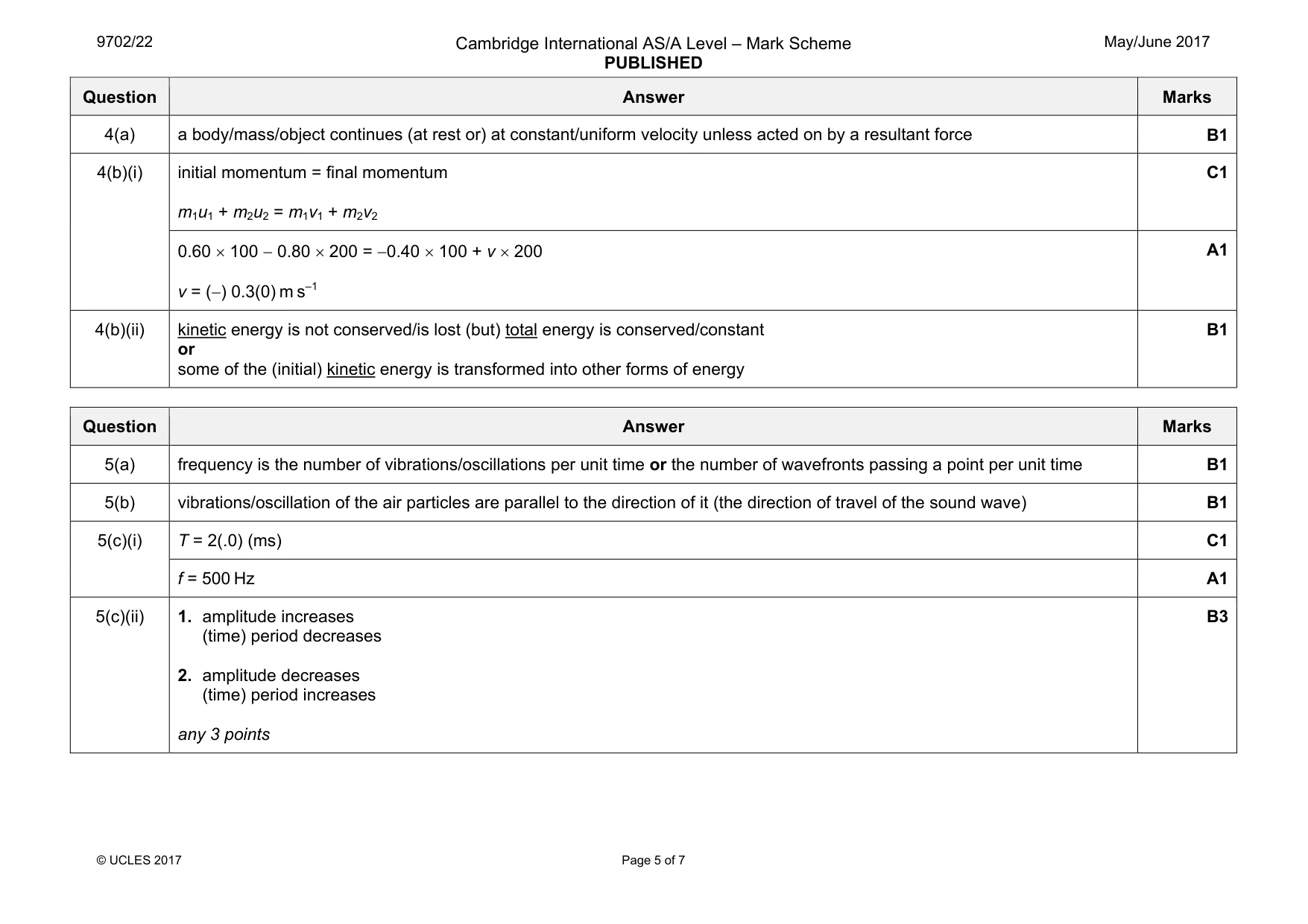
Mark scheme: 4(a) a body/mass/object continues (at rest or) at constant/uniform velocity unless acted on by a resultant force B1 4(b)(i) initial momentum = final momentum m1u1 + m2u2 = m1v1 + m2v2 C1 0.60 × 100 − 0.80 × 200 = −0.40 × 100 + v × 200 v = (−) 0.3(0) m s–1 A1 4(b)(ii) kinetic energy is not conserved/is lost (but) total energy is conserved/constant or some of the (initial) kinetic energy is transformed into other forms of energy B1
Q5 · Define the frequency of a sound wave
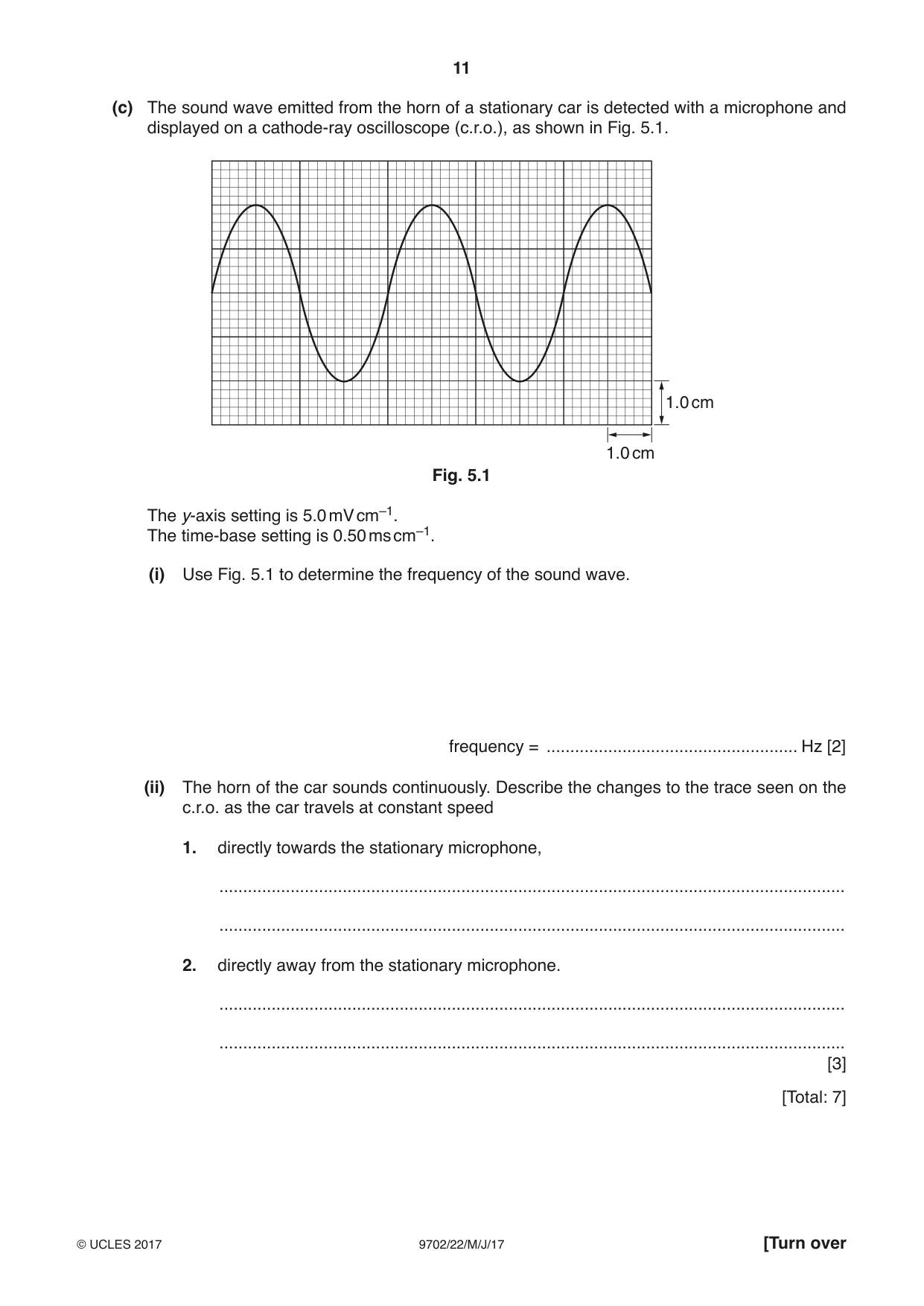
5 (a) Define the frequency of a sound wave. ................................................................................................................................................... ...............................................................................................................................................[1] (b) A sound wave travels through air. Describe the motion of the air particles relative to the direction of travel of the sound wave. ................................................................................................................................................... ...............................................................................................................................................[1] (c) The sound wave emitted from the horn of a stationary car is detected with a microphone and displayed on a cathode-ray oscilloscope (c.r.o.), as shown in Fig. 5.1. 1.0 cm 1.0 cm Fig. 5.1 The y-axis setting is 5.0 mV cm–1. The time-base setting is 0.50 ms cm–1. (i) Use Fig. 5.1 to determine the frequency of the sound wave. frequency = ..................................................... Hz [2] (ii) The horn of the car sounds continuously. Describe the changes to the trace seen on the c.r.o. as the car travels at constant speed 1. directly towards the stationary microphone, .................................................................................................................................... .................................................................................................................................... 2. directly away from the stationary microphone. .................................................................................................................................... .................................................................................................................................... [3] [Total: 7]
Mark scheme: 5(a) frequency is the number of vibrations/oscillations per unit time or the number of wavefronts passing a point per unit time B1 5(b) vibrations/oscillation of the air particles are parallel to the direction of it (the direction of travel of the sound wave) B1 5(c)(i) T = 2(.0) (ms) C1 f = 500 Hz A1 5(c)(ii) 1. amplitude increases (time) period decreases 2. amplitude decreases (time) period increases any 3 points B3
Q6 · Interference fringes may be observed using a light-emitting laser to illuminate a double…
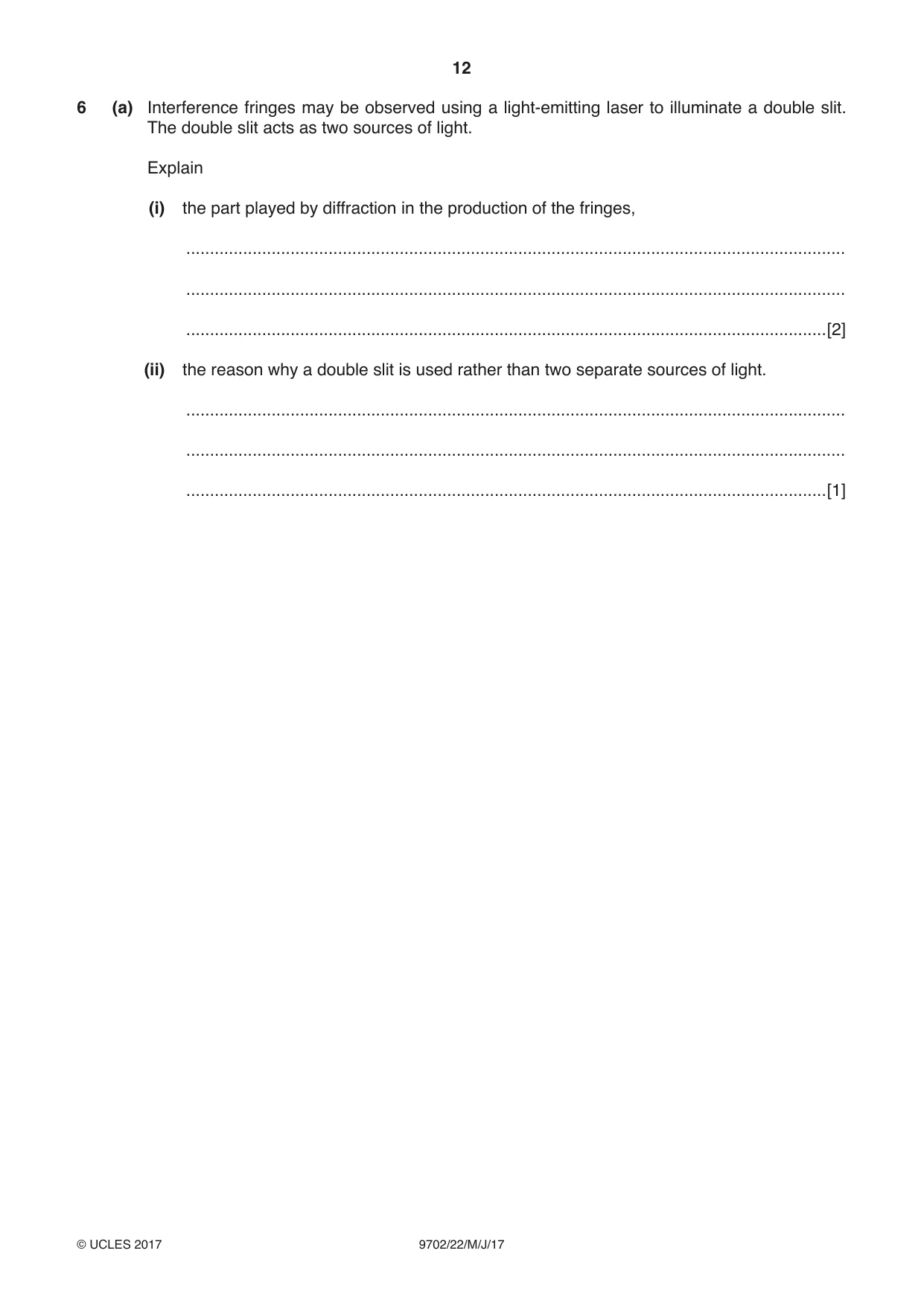
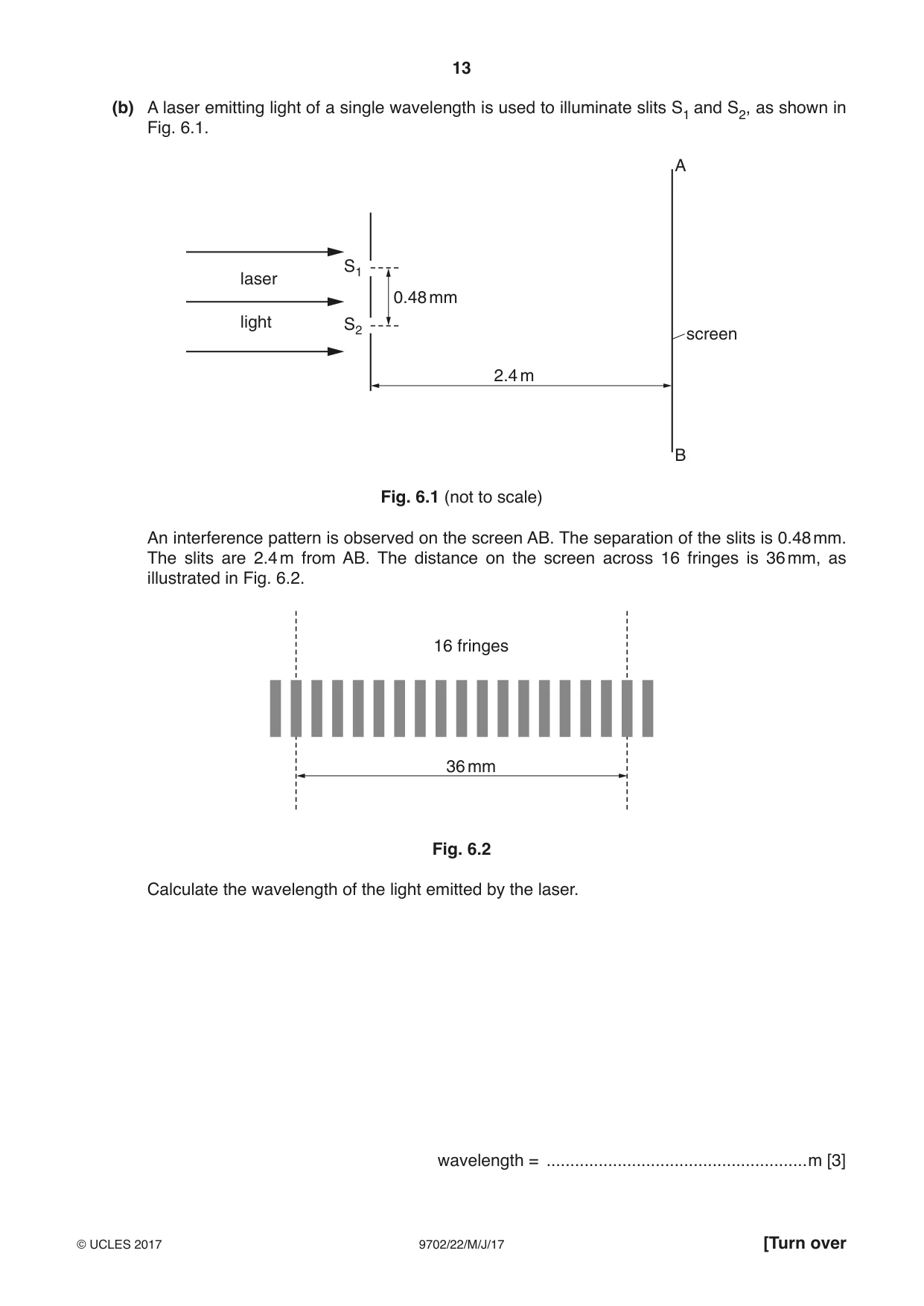
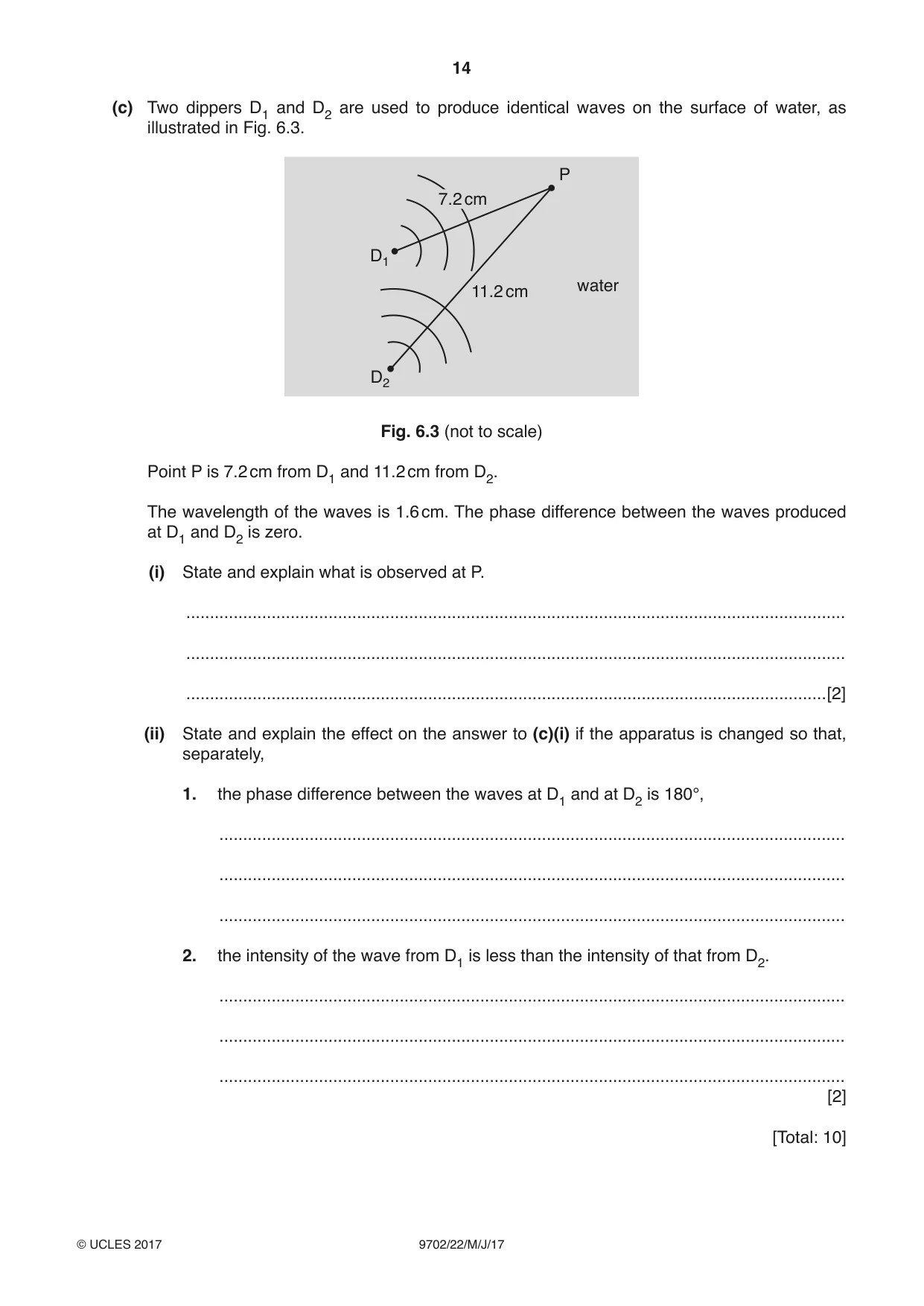
6 (a) Interference fringes may be observed using a light-emitting laser to illuminate a double slit. The double slit acts as two sources of light. Explain (i) the part played by diffraction in the production of the fringes, ........................................................................................................................................... ........................................................................................................................................... .......................................................................................................................................[2] (ii) the reason why a double slit is used rather than two separate sources of light. ........................................................................................................................................... ........................................................................................................................................... .......................................................................................................................................[1] (b) A laser emitting light of a single wavelength is used to illuminate slits S1 and S2, as shown in Fig. 6.1. A S1 laser 0.48 mm light S2 screen 2.4 m B Fig. 6.1 (not to scale) An interference pattern is observed on the screen AB. The separation of the slits is 0.48 mm. The slits are 2.4 m from AB. The distance on the screen across 16 fringes is 36 mm, as illustrated in Fig. 6.2. 16 fringes 36 mm Fig. 6.2 Calculate the wavelength of the light emitted by the laser. wavelength = .......................................................m [3] (c) Two dippers D1 and D2 are used to produce identical waves on the surface of water, as illustrated in Fig. 6.3. P 7.27.2 cmcm D1 water 11.2 cm D2 Fig. 6.3 (not to scale) Point P is 7.2 cm from D1 and 11.2 cm from D2. The wavelength of the waves is 1.6 cm. The phase difference between the waves produced at D1 and D2 is zero. (i) State and explain what is observed at P. ........................................................................................................................................... ........................................................................................................................................... .......................................................................................................................................[2] (ii) State and explain the effect on the answer to (c)(i) if the apparatus is changed so that, separately, 1. the phase difference between the waves at D1 and at D2 is 180°, .................................................................................................................................... .................................................................................................................................... .................................................................................................................................... 2. the intensity of the wave from D1 is less than the intensity of that from D2. .................................................................................................................................... .................................................................................................................................... .................................................................................................................................... [2] [Total: 10]
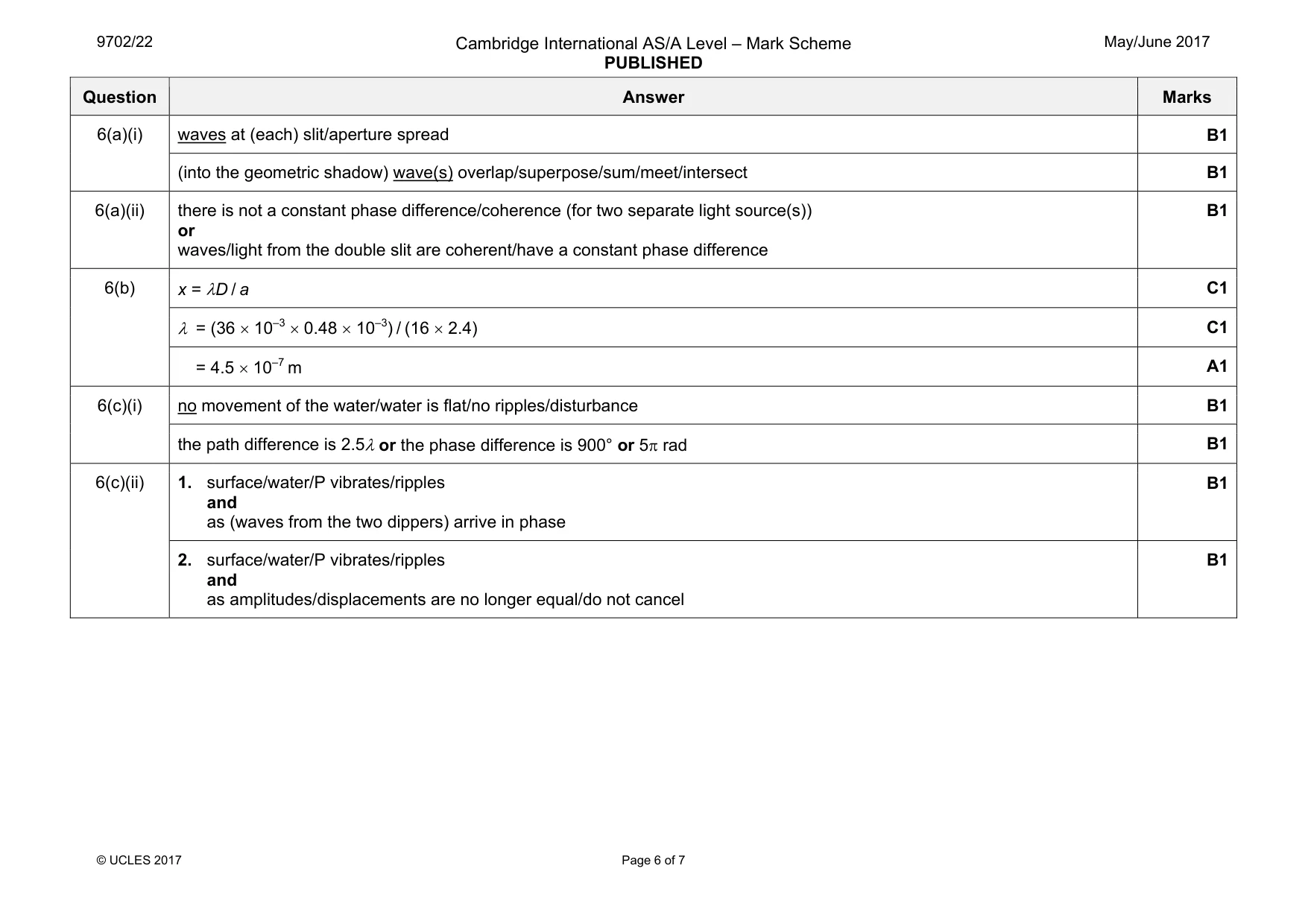
Mark scheme: 6(a)(i) waves at (each) slit/aperture spread B1 (into the geometric shadow) wave(s) overlap/superpose/sum/meet/intersect B1 6(a)(ii) there is not a constant phase difference/coherence (for two separate light source(s)) or waves/light from the double slit are coherent/have a constant phase difference B1 6(b) x = λD / a C1 λ = (36 × 10–3 × 0.48 × 10–3) / (16 × 2.4) C1 = 4.5 × 10⁻⁷ m A1 6(c)(i) no movement of the water/water is flat/no ripples/disturbance B1 the path difference is 2.5λ or the phase difference is 900° or 5π rad B1 6(c)(ii) 1. surface/water/P vibrates/ripples and as (waves from the two dippers) arrive in phase B1 2. surface/water/P vibrates/ripples and as amplitudes/displacements are no longer equal/do not cancel B1
Q7 · Define electromotive force (e.m.f.) of a cell
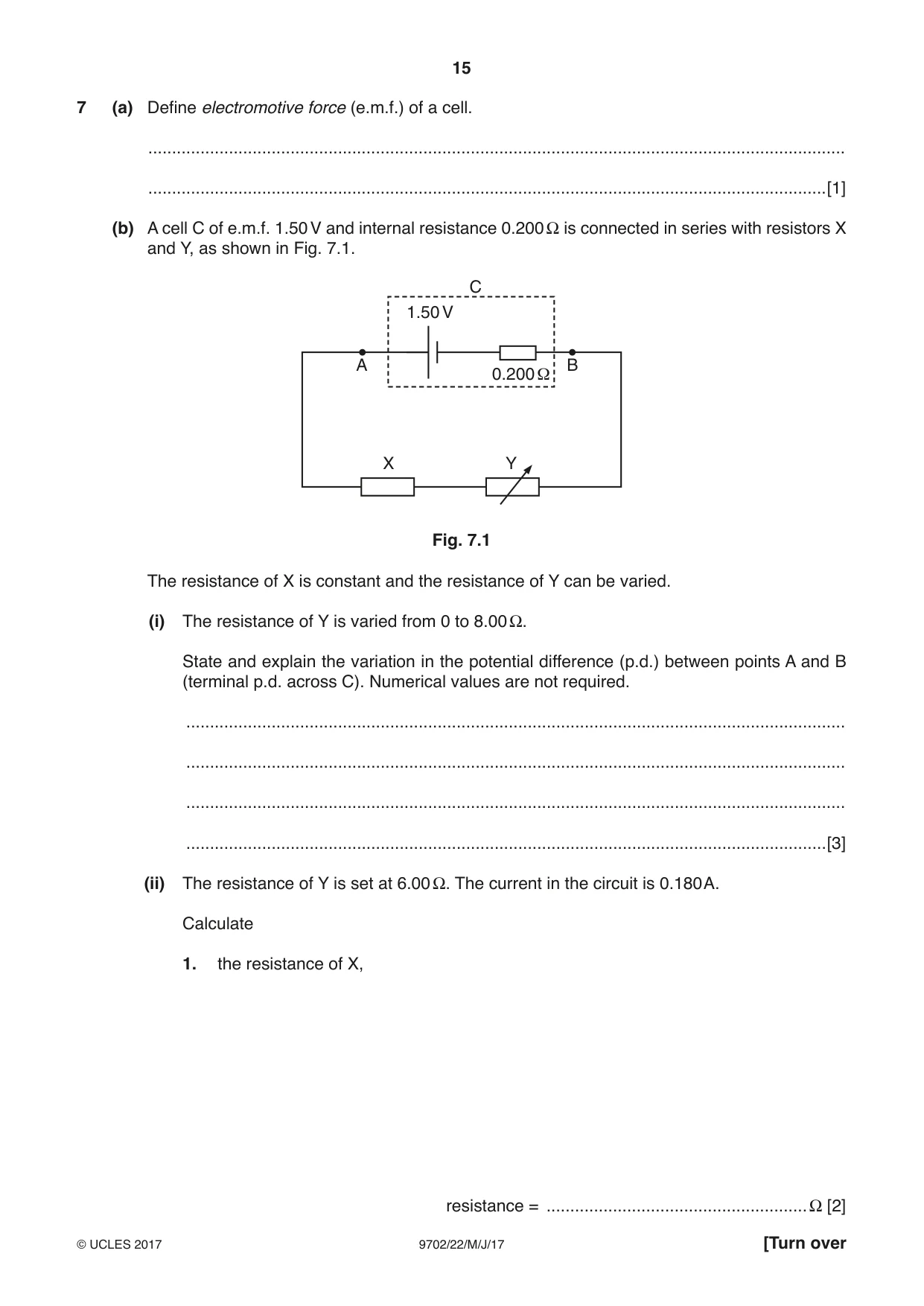
7 (a) Define electromotive force (e.m.f.) of a cell. ................................................................................................................................................... ...............................................................................................................................................[1] (b) A cell C of e.m.f. 1.50 V and internal resistance 0.200 Ω is connected in series with resistors X and Y, as shown in Fig. 7.1. C 1.50 V A B 0.200 Ω X Y Fig. 7.1 The resistance of X is constant and the resistance of Y can be varied. (i) The resistance of Y is varied from 0 to 8.00 Ω. State and explain the variation in the potential difference (p.d.) between points A and B (terminal p.d. across C). Numerical values are not required. ........................................................................................................................................... ........................................................................................................................................... ........................................................................................................................................... .......................................................................................................................................[3] (ii) The resistance of Y is set at 6.00 Ω. The current in the circuit is 0.180 A. Calculate 1. the resistance of X, resistance = ....................................................... Ω [2] 2. the p.d. between points A and B, p.d. = ....................................................... V [2] 3. the efficiency of the cell. efficiency = ...........................................................[2] [Total: 10]
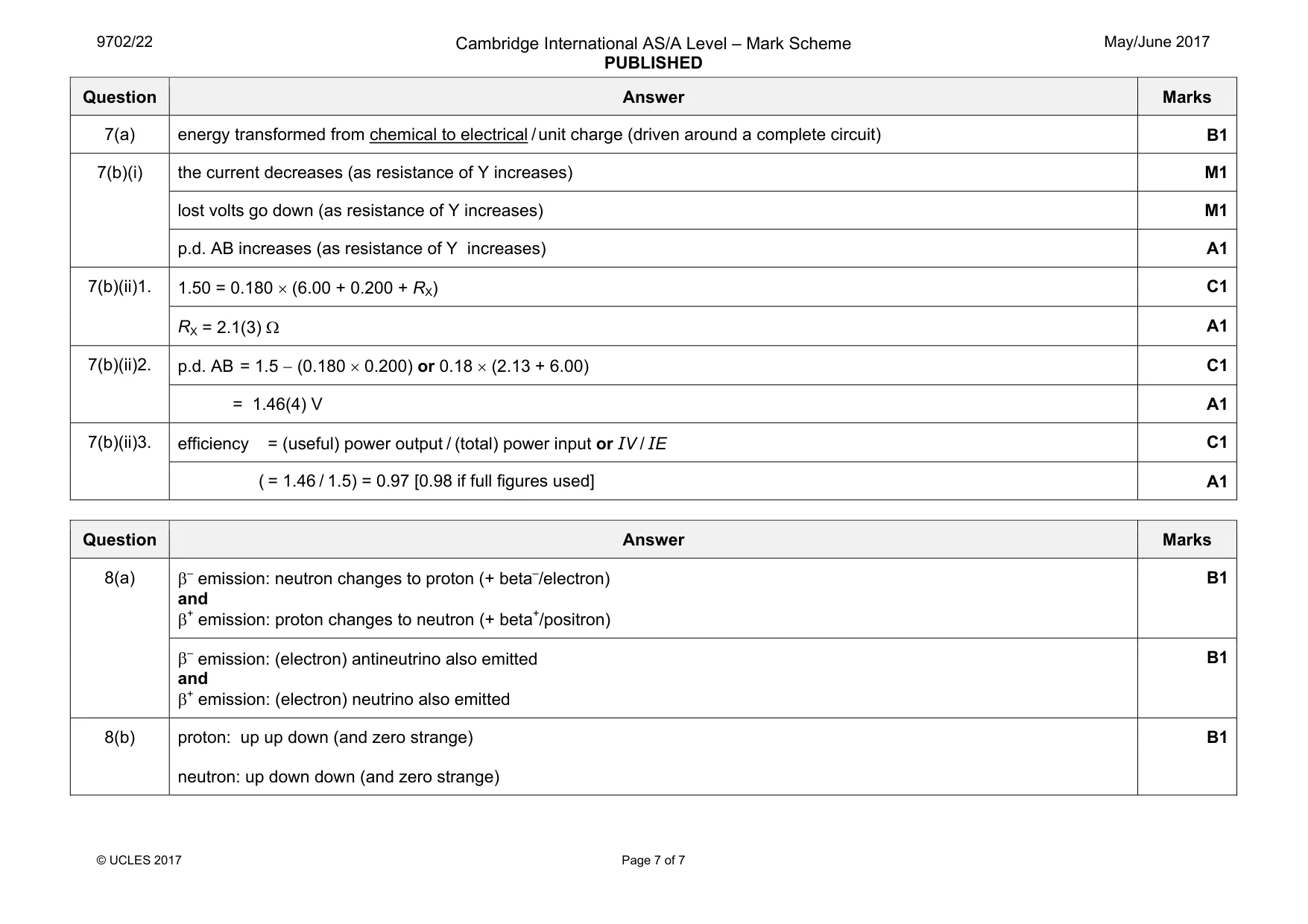
Mark scheme: 7(a) energy transformed from chemical to electrical / unit charge (driven around a complete circuit) B1 7(b)(i) the current decreases (as resistance of Y increases) M1 lost volts go down (as resistance of Y increases) M1 p.d. AB increases (as resistance of Y increases) A1 7(b)(ii)1. 1.50 = 0.180 × (6.00 + 0.200 + RX) C1 RX = 2.1(3) Ω A1 7(b)(ii)2. p.d. AB = 1.5 − (0.180 × 0.200) or 0.18 × (2.13 + 6.00) C1 = 1.46(4) V A1 7(b)(ii)3. efficiency = (useful) power output / (total) power input or IV / IE C1 ( = 1.46 / 1.5) = 0.97 [0.98 if full figures used] A1
Q8 · Describe two differences between the decay of a nucleus that emits a β– particle and the…
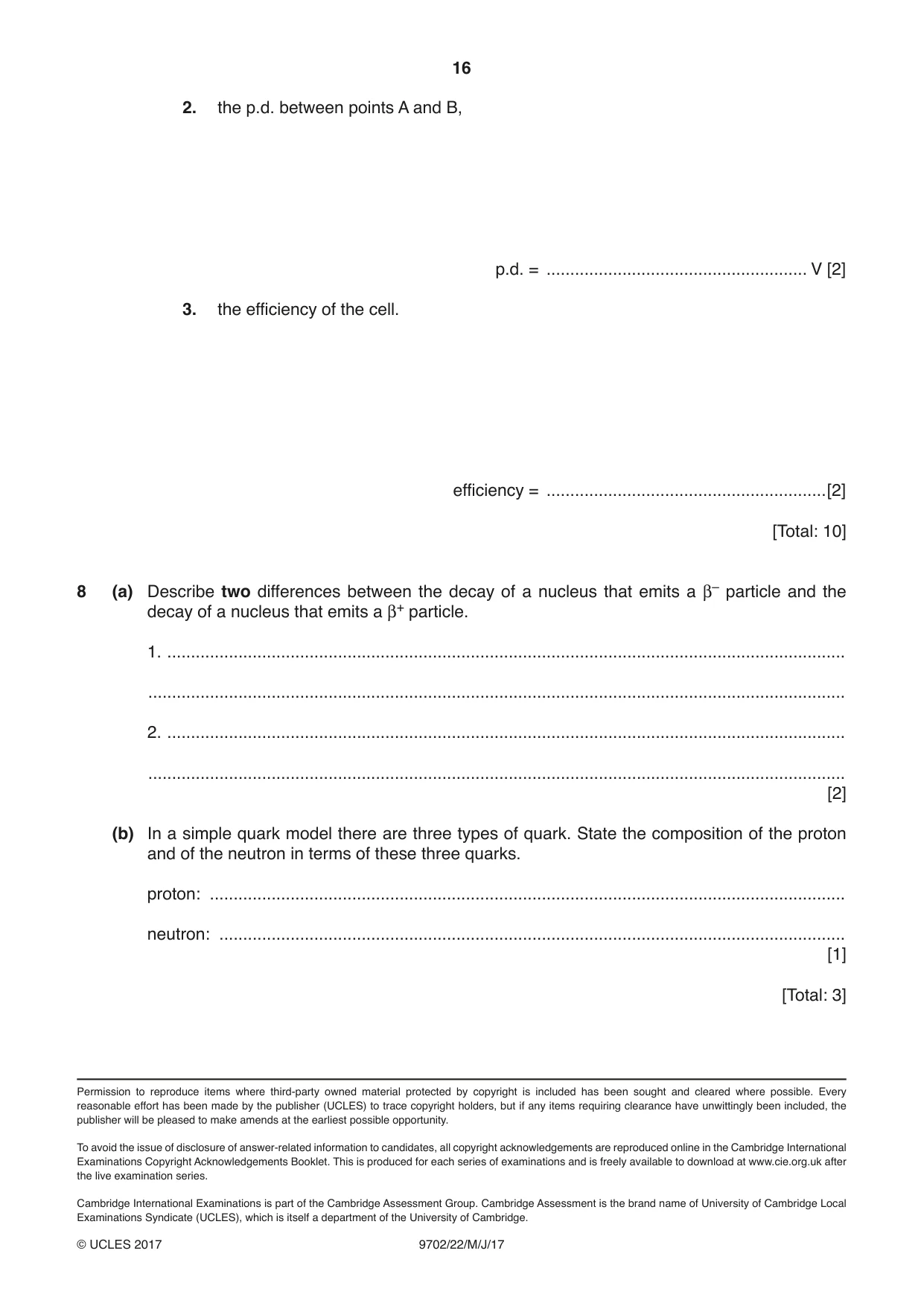
8 (a) Describe two differences between the decay of a nucleus that emits a β– particle and the decay of a nucleus that emits a β+ particle. 1. ............................................................................................................................................... ................................................................................................................................................... 2. ............................................................................................................................................... ................................................................................................................................................... [2] (b) In a simple quark model there are three types of quark. State the composition of the proton and of the neutron in terms of these three quarks. proton: ...................................................................................................................................... neutron: .................................................................................................................................... [1] [Total: 3]
Mark scheme: 8(a) and β+ emission: proton changes to neutron (+ beta+/positron) B1 β– emission: (electron) antineutrino also emitted and β+ emission: (electron) neutrino also emitted B1 8(b) proton: up up down (and zero strange) neutron: up down down (and zero strange) B1
What was in this paper
The subtopics covered by these 8 questions, and how many questions each got. Open one in a new tab to see every Cambridge question on it.
What you needed in this session
Cambridge’s own grade thresholds for 2017 May/June, Paper 2 · Variant 2. A higher threshold means an easier paper — the bar moves with how the cohort did.