Cambridge A Level Physics 9702 — 2022 May/June Paper 2 · Variant 1
9702/21/M/J/22 · 7 questions · 60 marks · ≈68 min
The question paper and its mark scheme, free to read here and free to download. This is Cambridge’s own paper, exactly as it was sat.
Question paper16 pages

Mark scheme13 pages
Answers below. Sit the paper first if you are practising.
Questions as text
Question 1
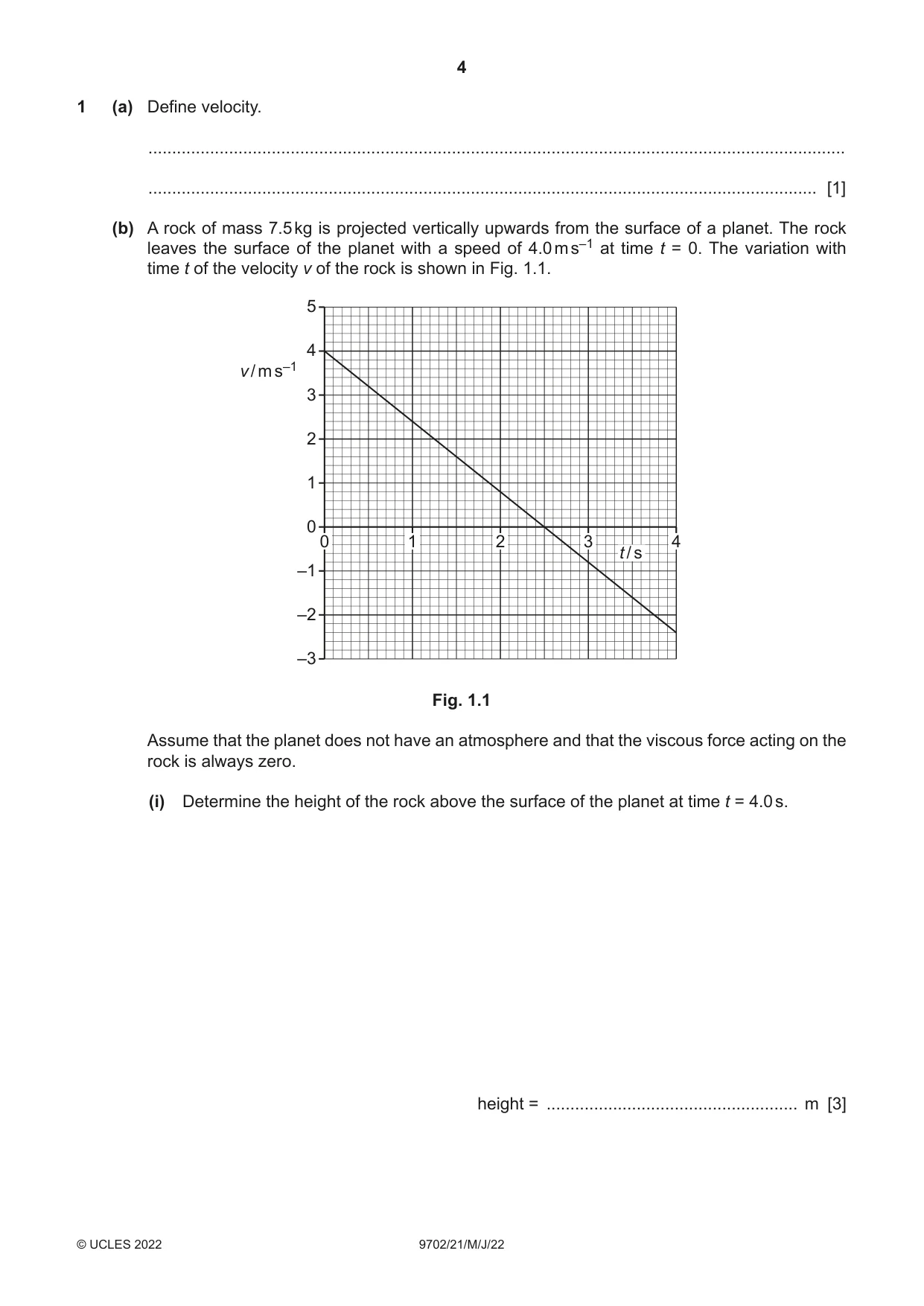
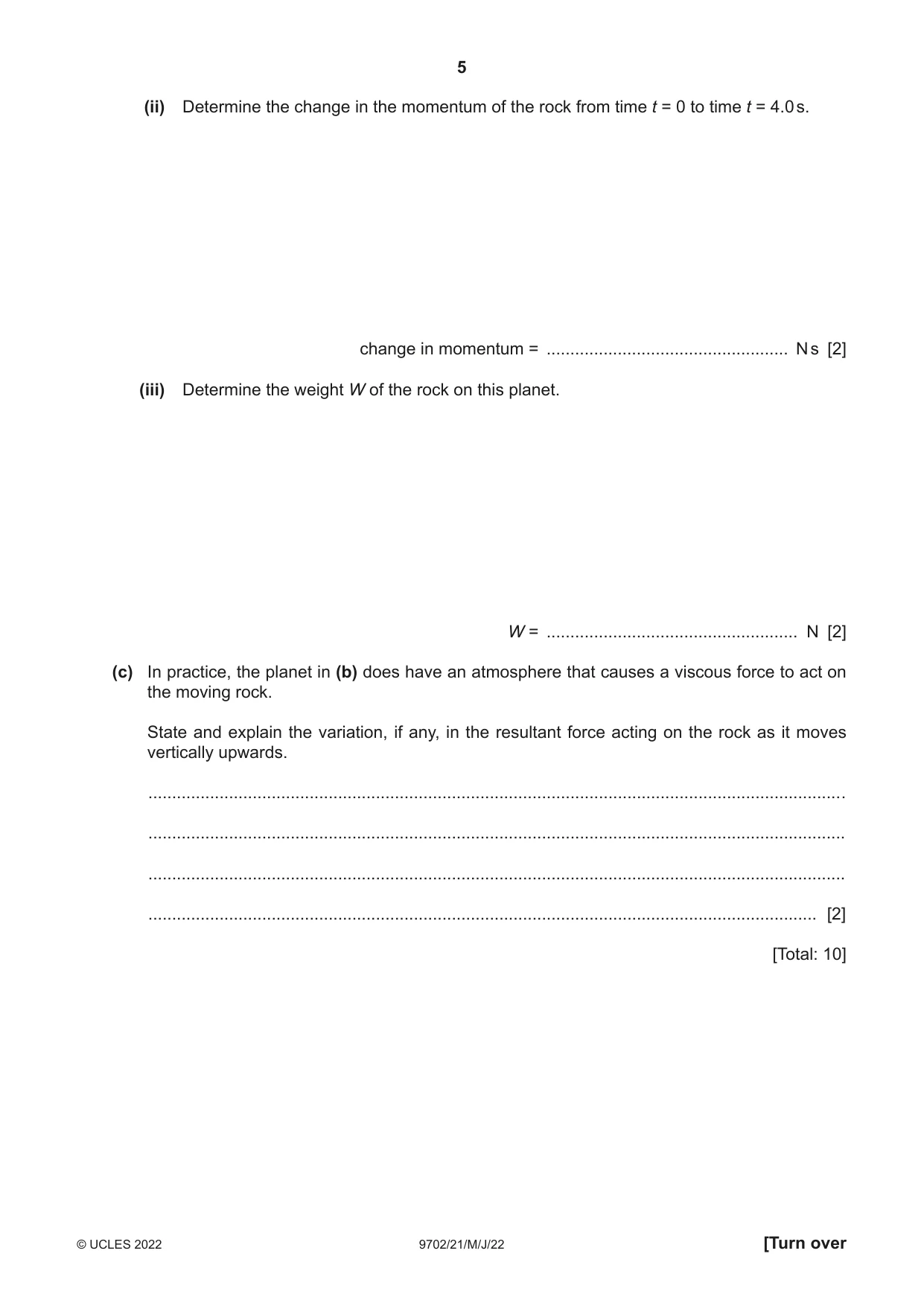
1 (a) Define velocity. ................................................................................................................................................... ............................................................................................................................................. [1] (b) A rock of mass 7.5 kg is projected vertically upwards from the surface of a planet. The rock leaves the surface of the planet with a speed of 4.0 m s–1 at time t = 0. The variation with time t of the velocity v of the rock is shown in Fig. 1.1. 5 4 v / m s–1 3 2 1 0 0 1 2 3 4 t / s –1 –2 –3 Fig. 1.1 Assume that the planet does not have an atmosphere and that the viscous force acting on the rock is always zero. (i) Determine the height of the rock above the surface of the planet at time t = 4.0 s. height = ..................................................... m [3] (ii) Determine the change in the momentum of the rock from time t = 0 to time t = 4.0 s. change in momentum = ................................................... N s [2] (iii) Determine the weight W of the rock on this planet. W = ..................................................... N [2] (c) In practice, the planet in (b) does have an atmosphere that causes a viscous force to act on the moving rock. State and explain the variation, if any, in the resultant force acting on the rock as it moves vertically upwards. ................................................................................................................................................... ................................................................................................................................................... ................................................................................................................................................... ............................................................................................................................................. [2] [Total: 10]
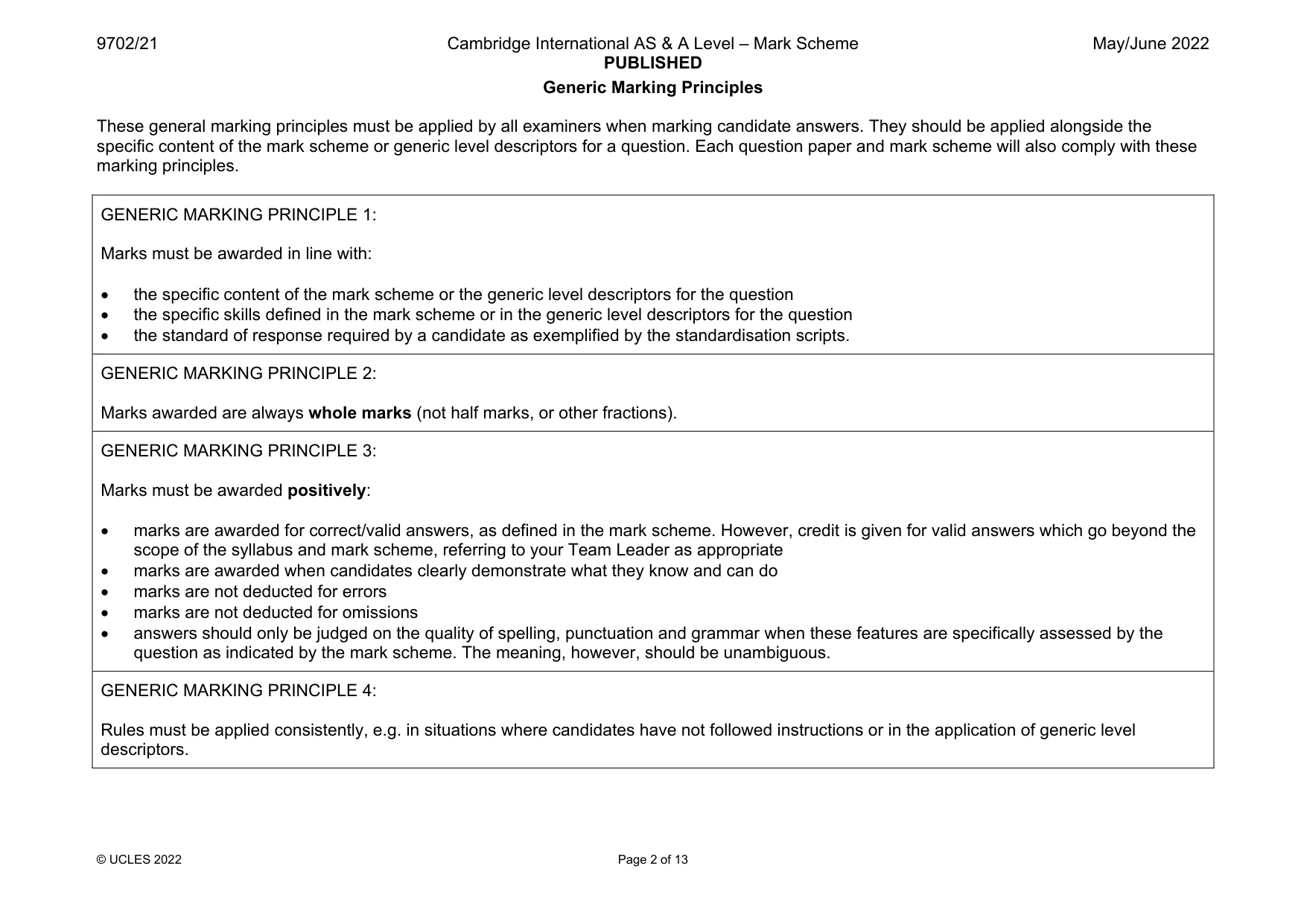
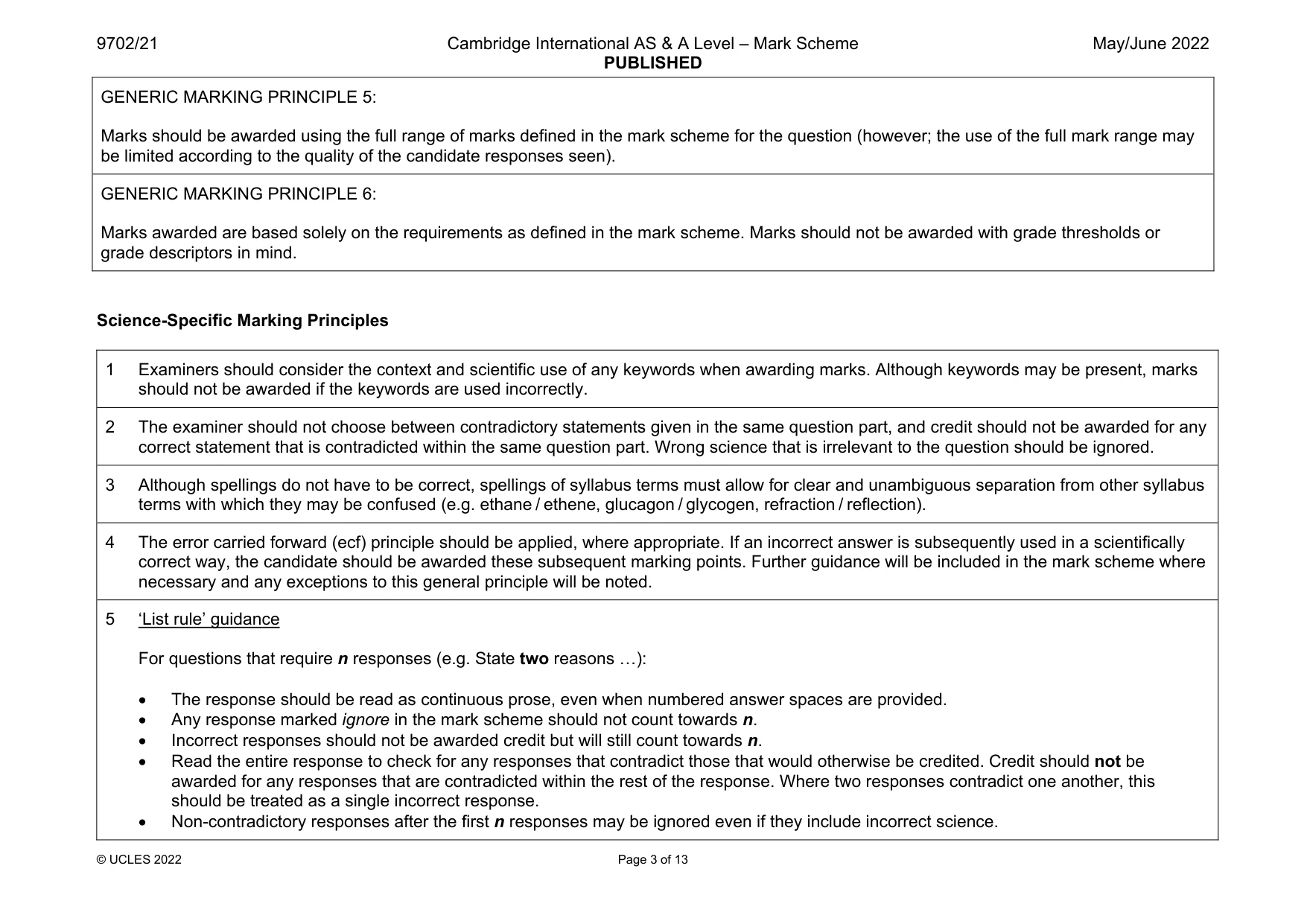
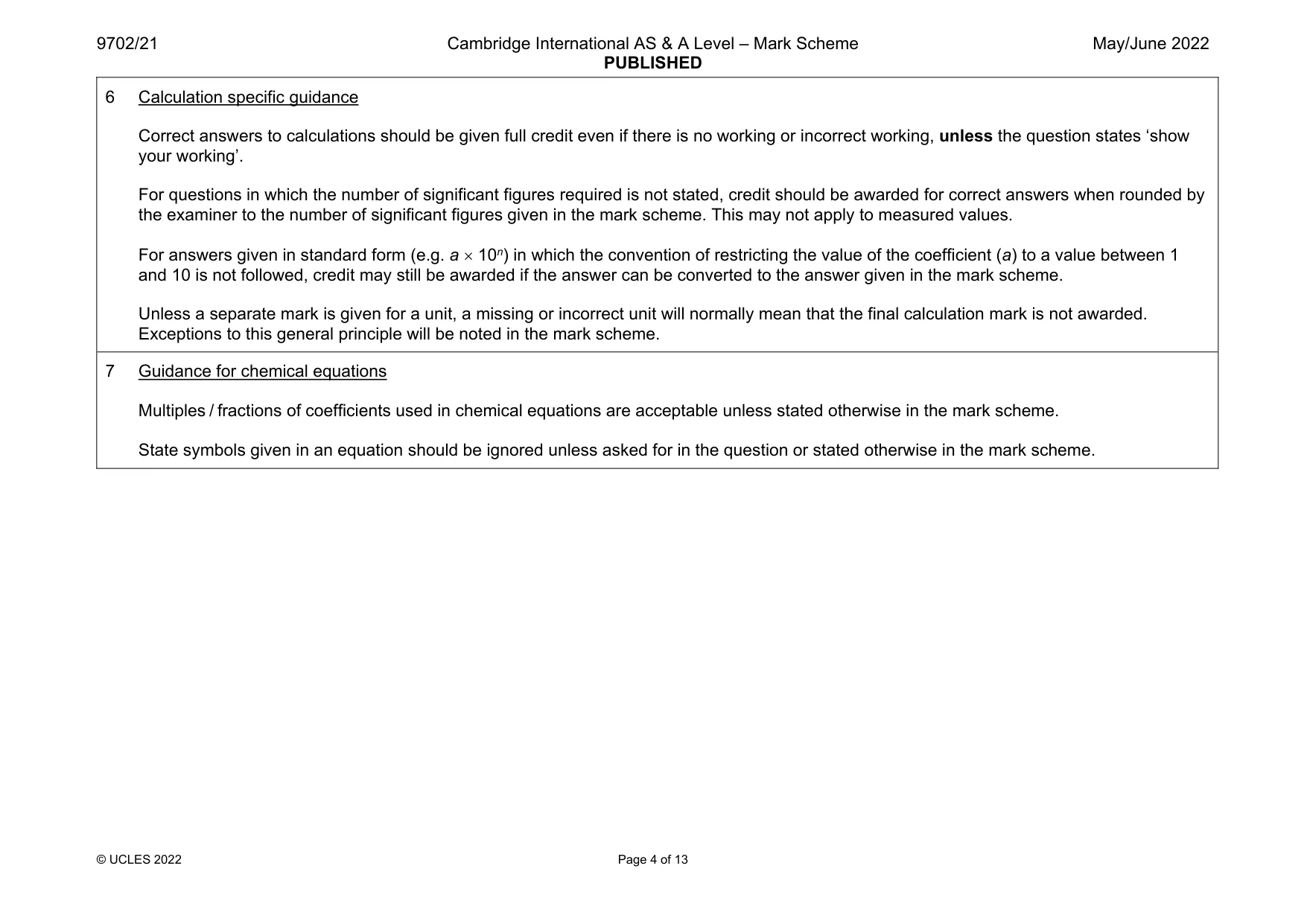
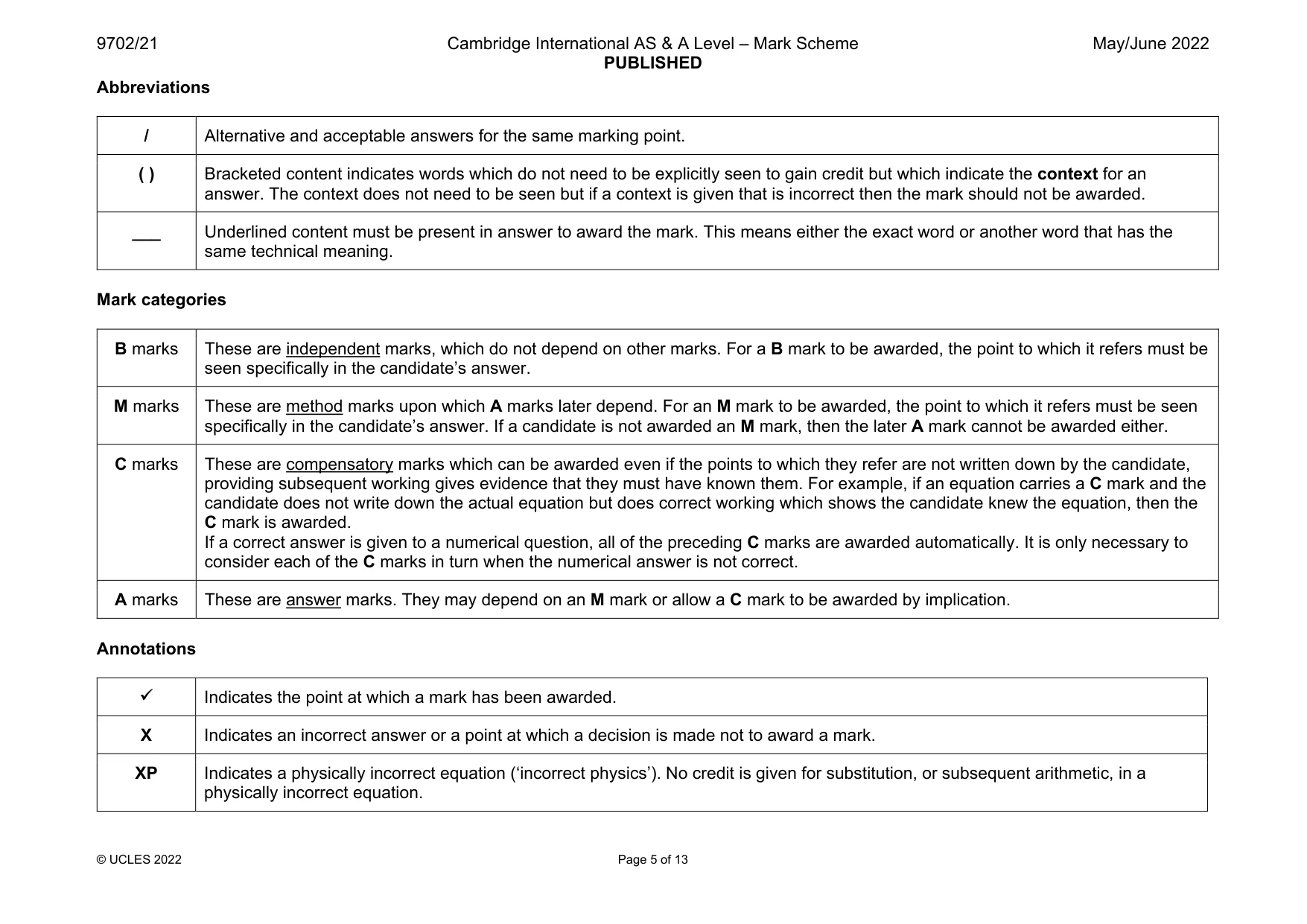
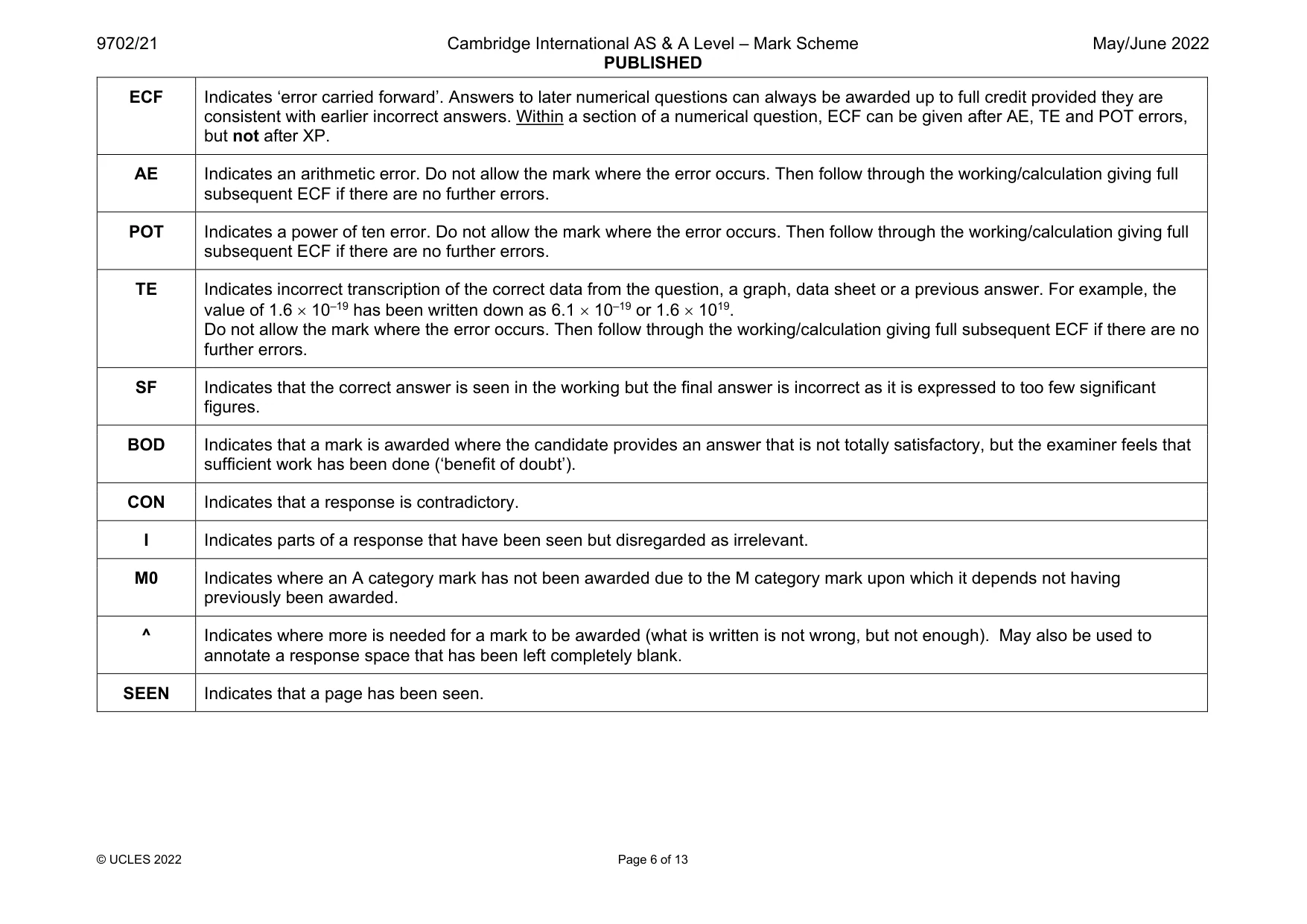
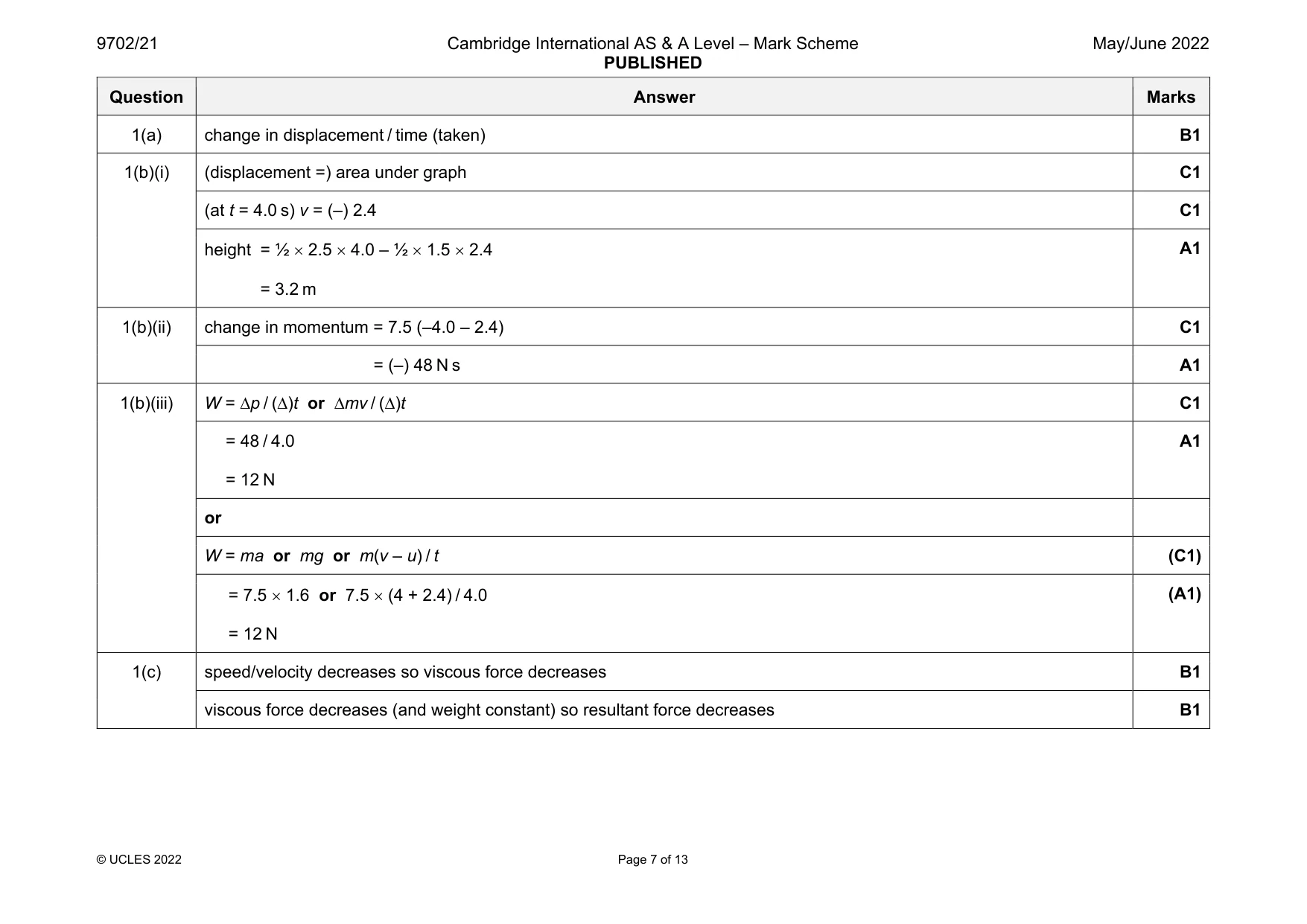
Mark scheme: 1(a) change in displacement / time (taken) B1 1(b)(i) (displacement =) area under graph C1 (at t = 4.0 s) v = (–) 2.4 C1 height = ½ 2.5 4.0 – ½ 1.5 2.4 = 3.2 m A1 1(b)(ii) change in momentum = 7.5 (–4.0 – 2.4) C1 = (–) 48 N s A1 1(b)(iii) W = ∆p / (∆)t or ∆mv / (∆)t C1 = 48 / 4.0 = 12 N A1 or W = ma or mg or m(v – u) / t (C1) = 7.5 1.6 or 7.5 (4 + 2.4) / 4.0 = 12 N (A1) 1(c) speed/velocity decreases so viscous force decreases B1 viscous force decreases (and weight constant) so resultant force decreases B1
Q2 · State what is meant by the centre of gravity of an object
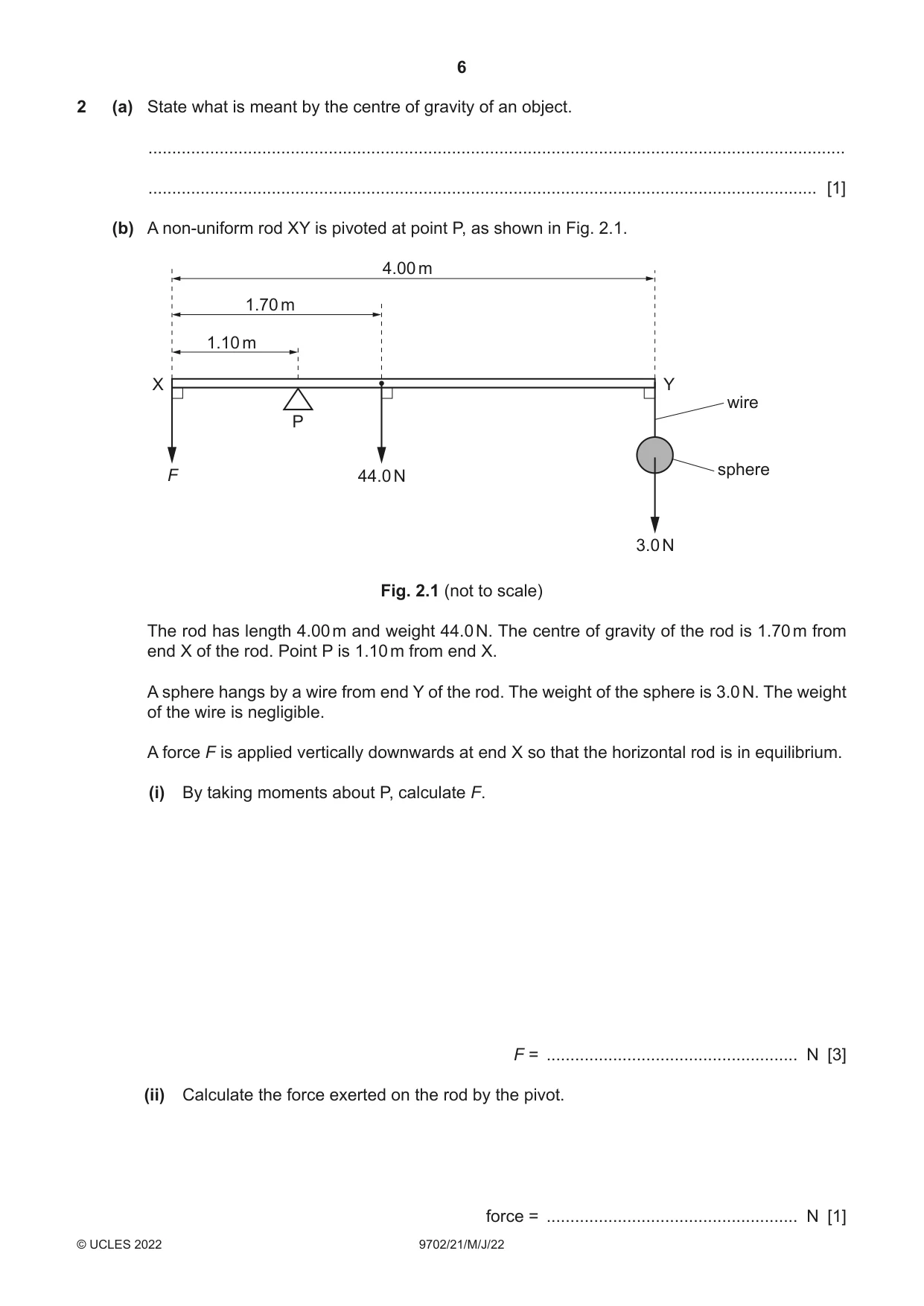
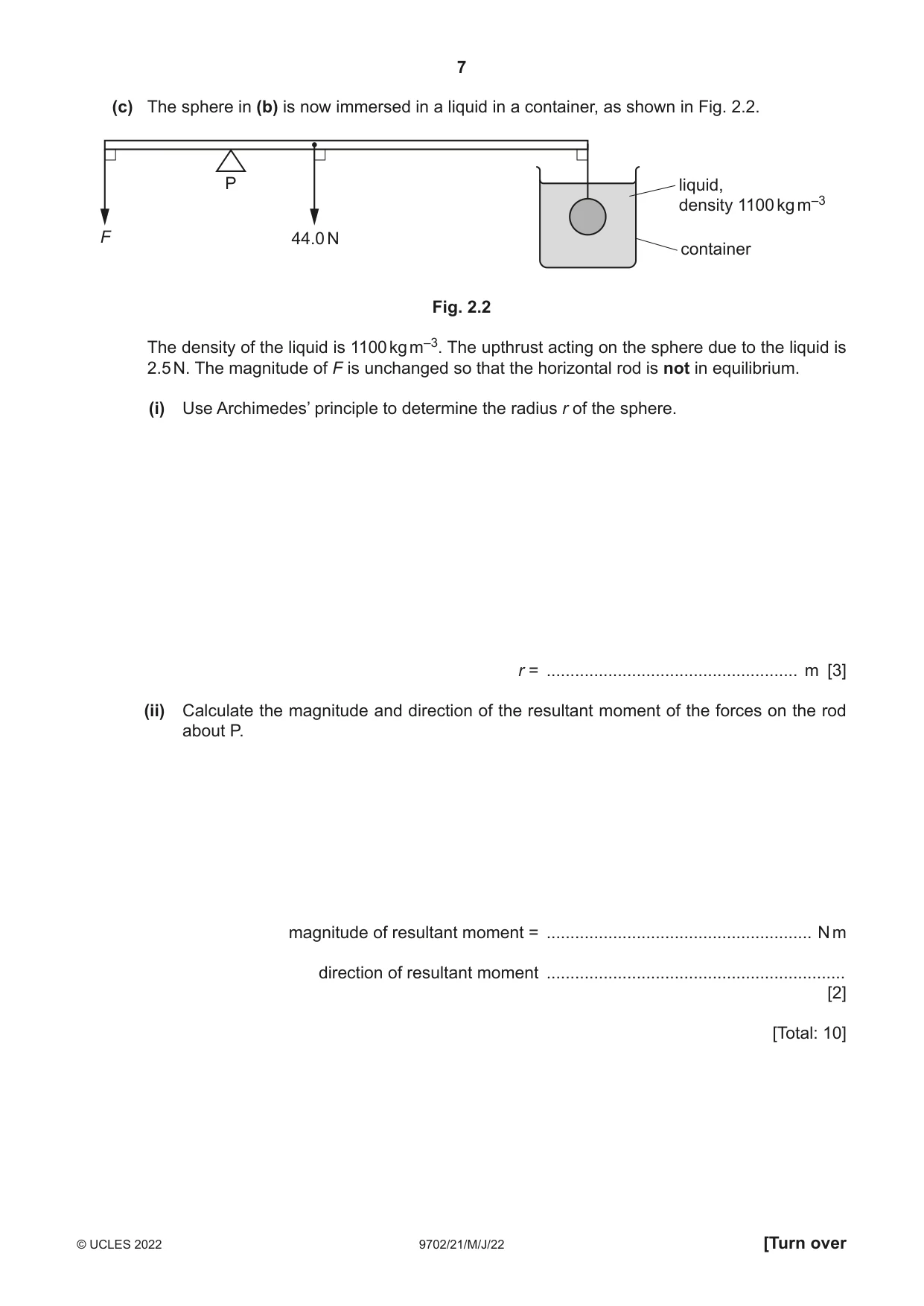
2 (a) State what is meant by the centre of gravity of an object. ................................................................................................................................................... ............................................................................................................................................. [1] (b) A non-uniform rod XY is pivoted at point P, as shown in Fig. 2.1. 4.00 m 1.70 m 1.10 m X Y wire P sphere F 44.0 N 3.0 N Fig. 2.1 (not to scale) The rod has length 4.00 m and weight 44.0 N. The centre of gravity of the rod is 1.70 m from end X of the rod. Point P is 1.10 m from end X. A sphere hangs by a wire from end Y of the rod. The weight of the sphere is 3.0 N. The weight of the wire is negligible. A force F is applied vertically downwards at end X so that the horizontal rod is in equilibrium. (i) By taking moments about P, calculate F. F = ..................................................... N [3] (ii) Calculate the force exerted on the rod by the pivot. force = ..................................................... N [1] (c) The sphere in (b) is now immersed in a liquid in a container, as shown in Fig. 2.2. P liquid, density 1100 kg m–3 F 44.0 N container Fig. 2.2 The density of the liquid is 1100 kg m–3. The upthrust acting on the sphere due to the liquid is 2.5 N. The magnitude of F is unchanged so that the horizontal rod is not in equilibrium. (i) Use Archimedes’ principle to determine the radius r of the sphere. r = ..................................................... m [3] (ii) Calculate the magnitude and direction of the resultant moment of the forces on the rod about P. magnitude of resultant moment = ........................................................ N m direction of resultant moment ............................................................... [2] [Total: 10]
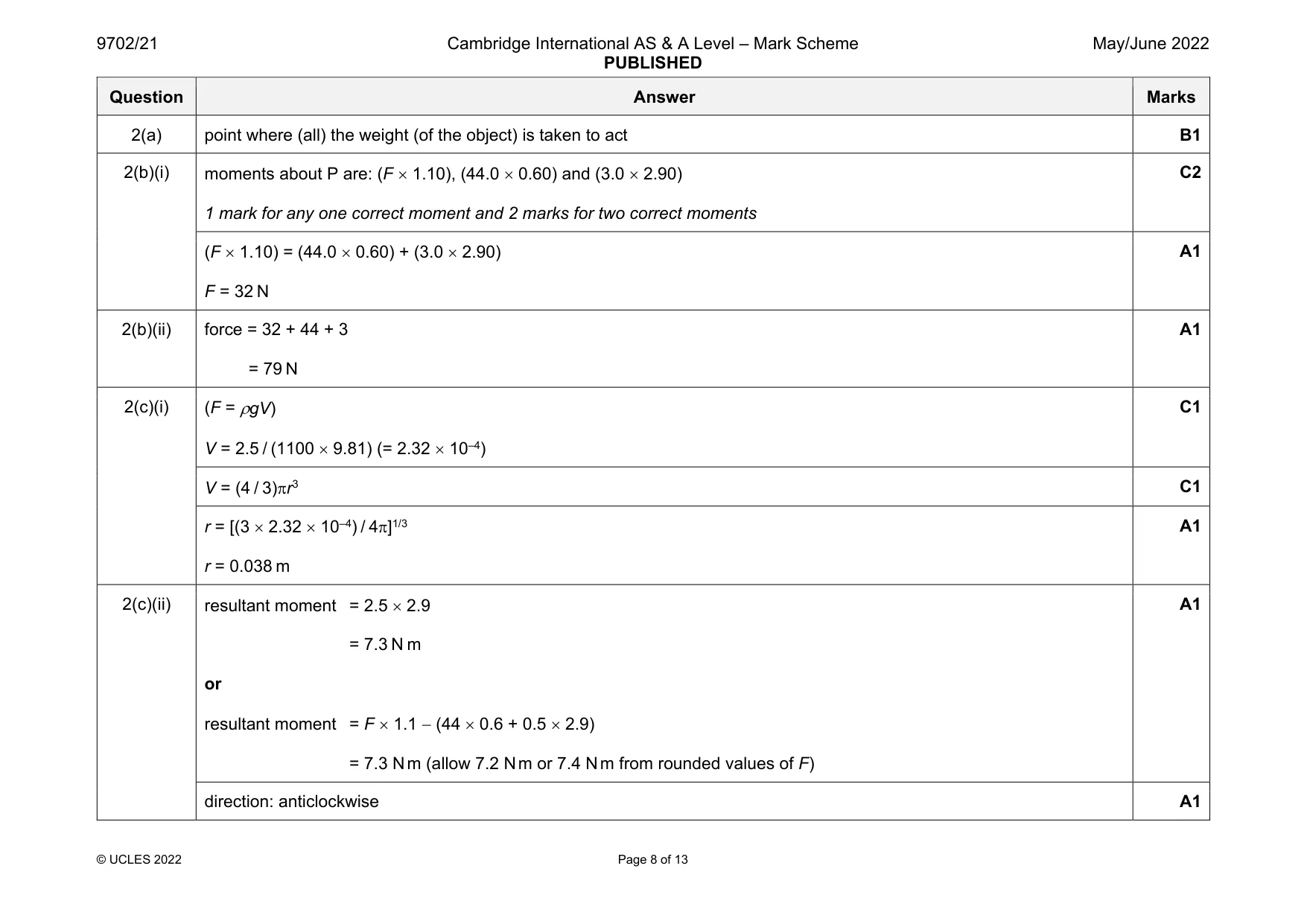
Mark scheme: 2(a) point where (all) the weight (of the object) is taken to act B1 2(b)(i) moments about P are: (F 1.10), (44.0 0.60) and (3.0 2.90) 1 mark for any one correct moment and 2 marks for two correct moments C2 (F 1.10) = (44.0 0.60) + (3.0 2.90) F = 32 N A1 2(b)(ii) force = 32 + 44 + 3 = 79 N A1 2(c)(i) (F = gV) V = 2.5 / (1100 9.81) (= 2.32 10–4) C1 V = (4 / 3)r3 C1 r = [(3 2.32 10–4) / 4]1/3 r = 0.038 m A1 2(c)(ii) resultant moment = 2.5 2.9 = 7.3 N m or resultant moment = F 1.1 (44 0.6 + 0.5 2.9) = 7.3 N m (allow 7.2 N m or 7.4 N m from rounded values of F) A1 direction: anticlockwise A1
Question 3
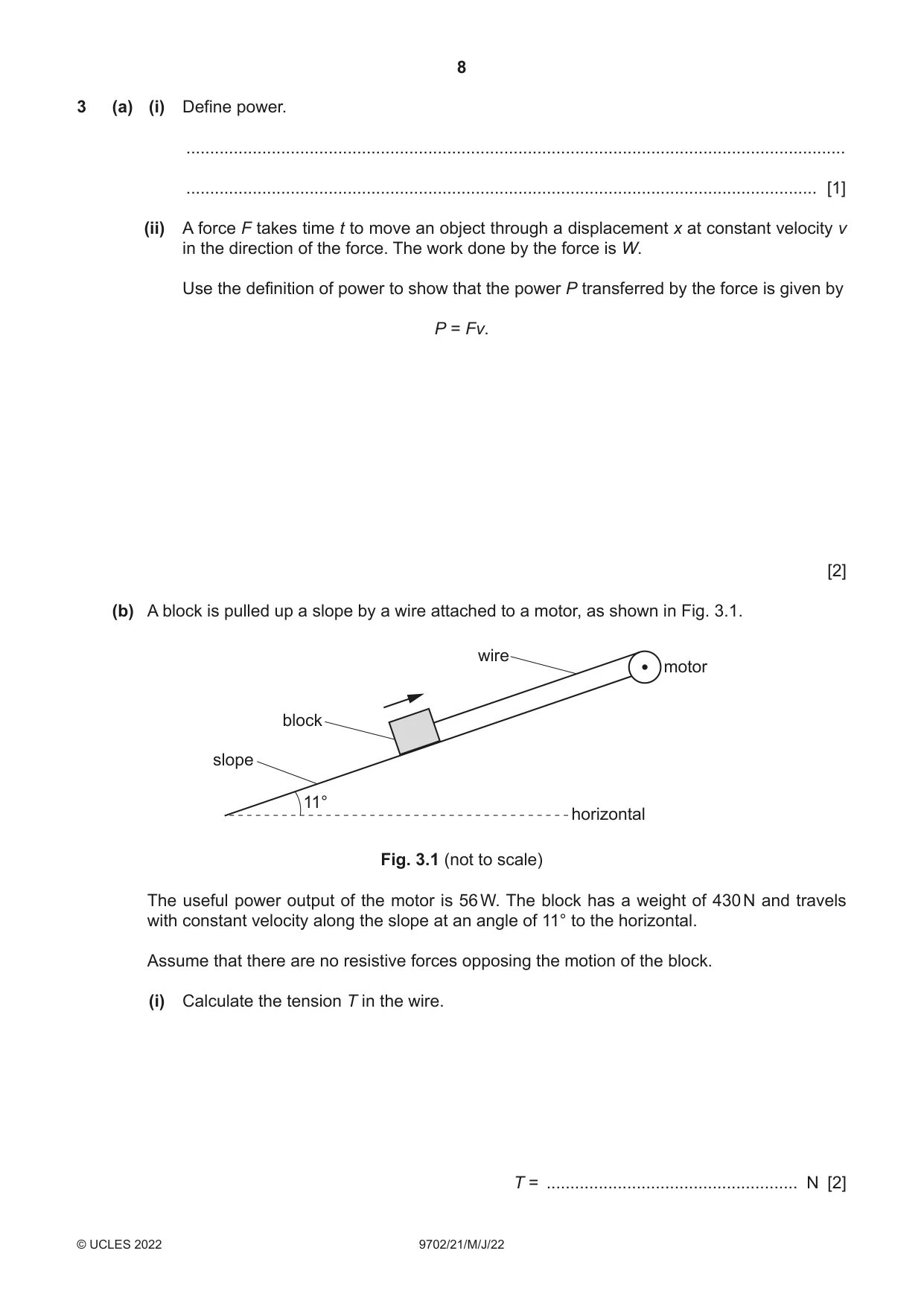
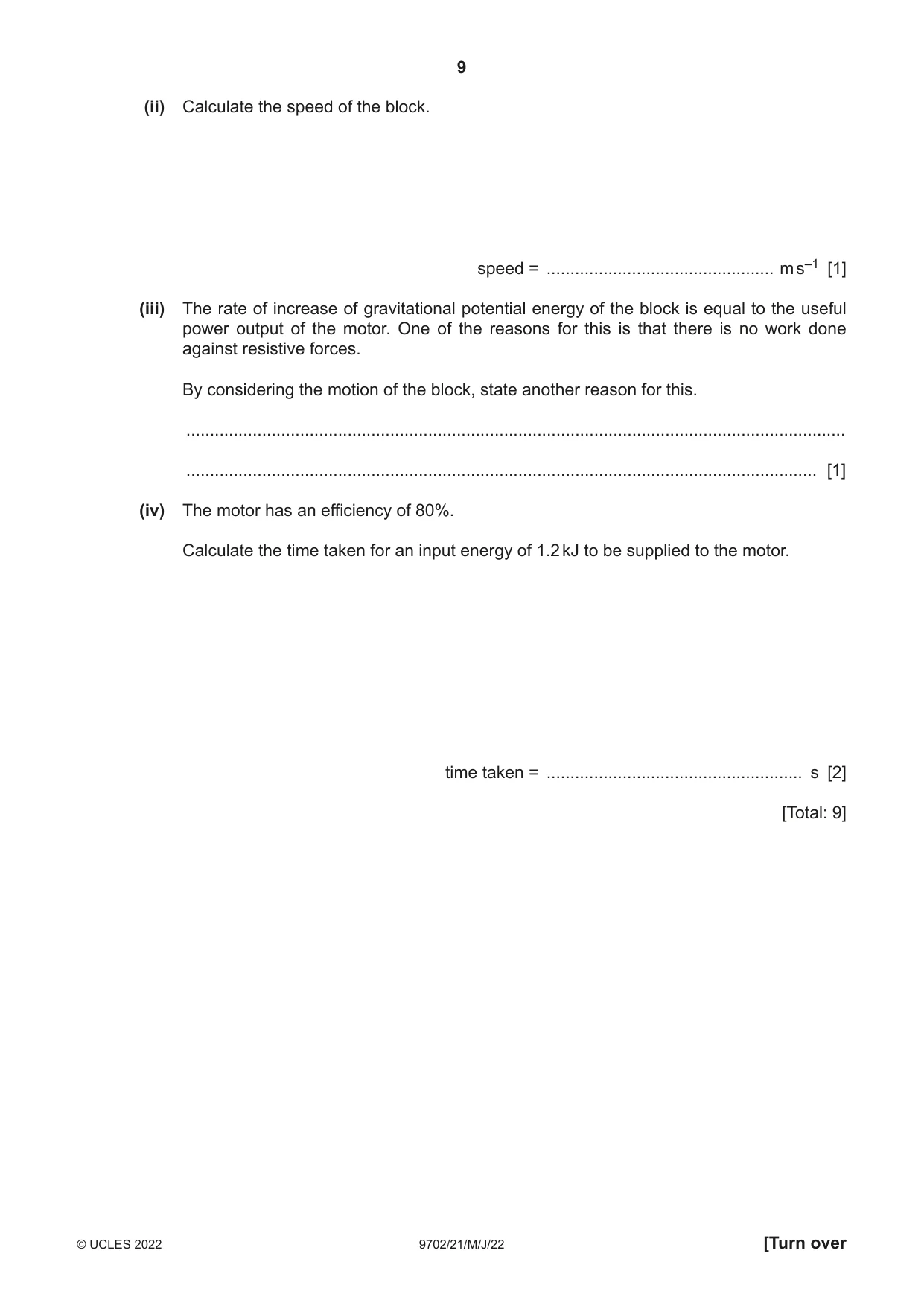
3 (a) (i) Define power. ........................................................................................................................................... ..................................................................................................................................... [1] (ii) A force F takes time t to move an object through a displacement x at constant velocity v in the direction of the force. The work done by the force is W. Use the definition of power to show that the power P transferred by the force is given by P = Fv. [2] (b) A block is pulled up a slope by a wire attached to a motor, as shown in Fig. 3.1. wire motor block slope 11° horizontal Fig. 3.1 (not to scale) The useful power output of the motor is 56 W. The block has a weight of 430 N and travels with constant velocity along the slope at an angle of 11° to the horizontal. Assume that there are no resistive forces opposing the motion of the block. (i) Calculate the tension T in the wire. T = ..................................................... N [2] (ii) Calculate the speed of the block. speed = ................................................ m s–1 [1] (iii) The rate of increase of gravitational potential energy of the block is equal to the useful power output of the motor. One of the reasons for this is that there is no work done against resistive forces. By considering the motion of the block, state another reason for this. ........................................................................................................................................... ..................................................................................................................................... [1] (iv) The motor has an efficiency of 80%. Calculate the time taken for an input energy of 1.2 kJ to be supplied to the motor. time taken = ...................................................... s [2] [Total: 9]
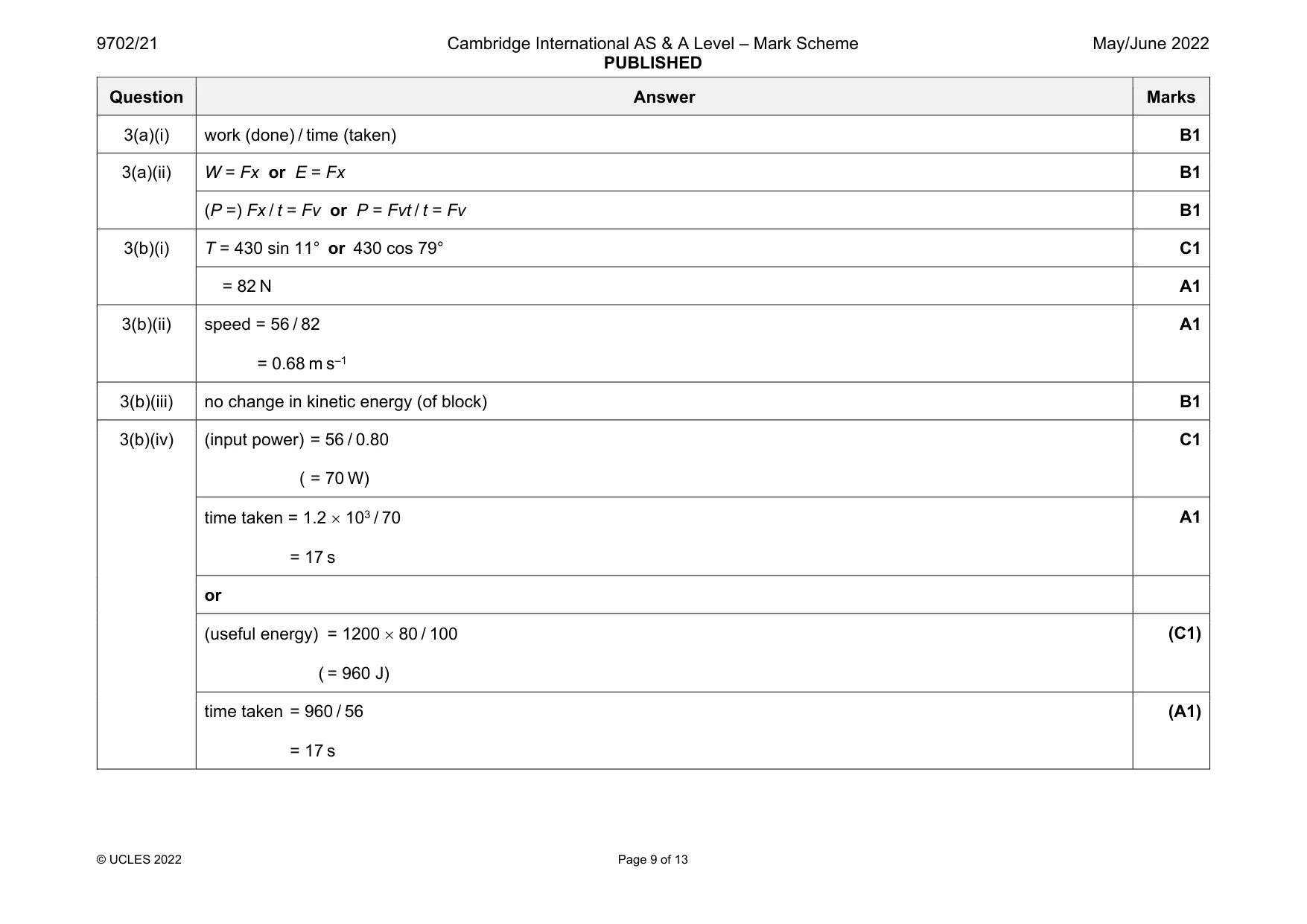
Mark scheme: 3(a)(i) work (done) / time (taken) B1 3(a)(ii) W = Fx or E = Fx B1 (P =) Fx / t = Fv or P = Fvt / t = Fv B1 3(b)(i) T = 430 sin 11° or 430 cos 79° C1 = 82 N A1 3(b)(ii) speed = 56 / 82 = 0.68 m s–1 A1 3(b)(iii) no change in kinetic energy (of block) B1 3(b)(iv) (input power) = 56 / 0.80 ( = 70 W) C1 time taken = 1.2 103 / 70 = 17 s A1 or (useful energy) = 1200 80 / 100 ( = 960 J) (C1) time taken = 960 / 56 = 17 s (A1)
Q4 · A spring is suspended from a fixed point at one end and a vertical force is applied to…
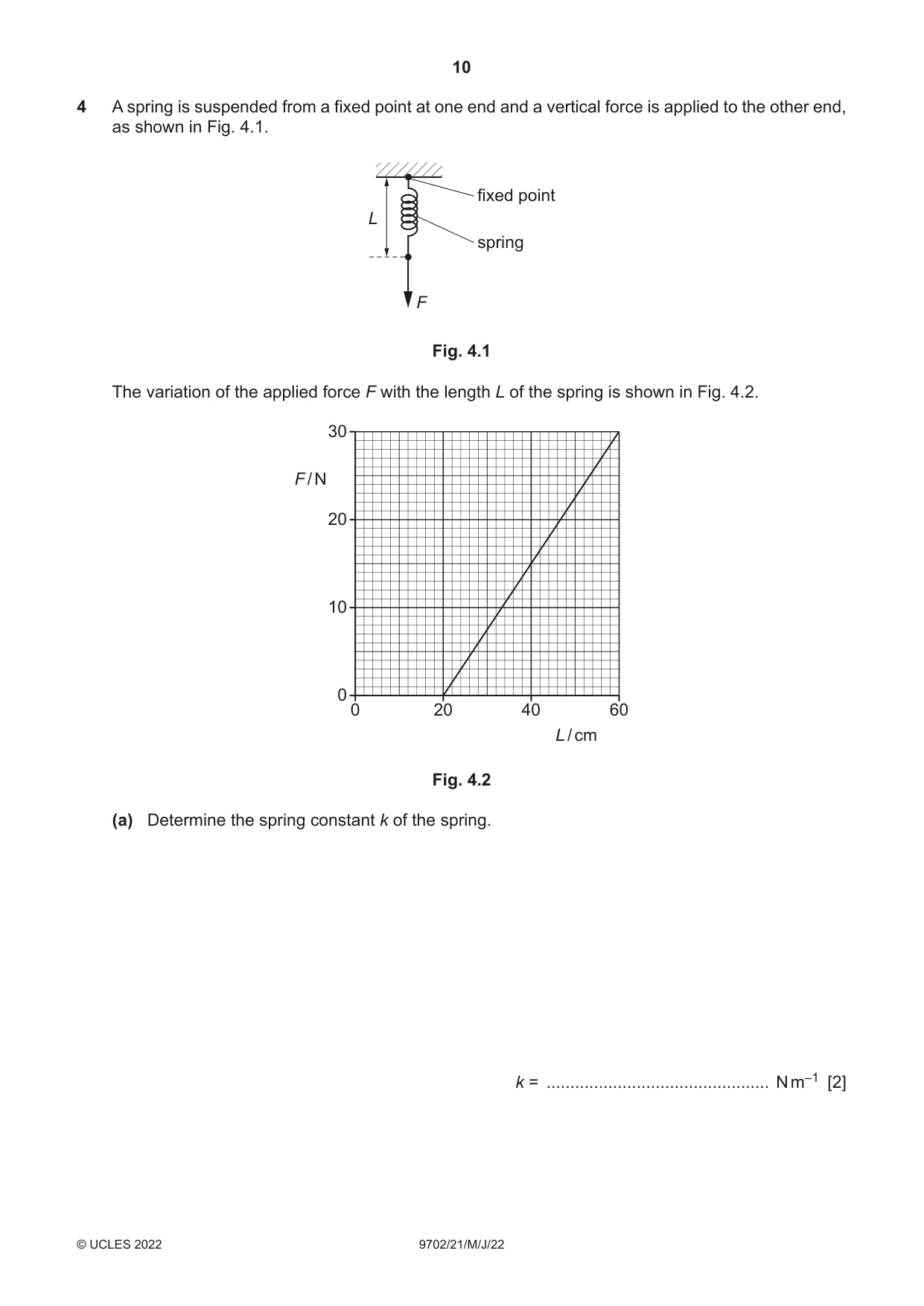
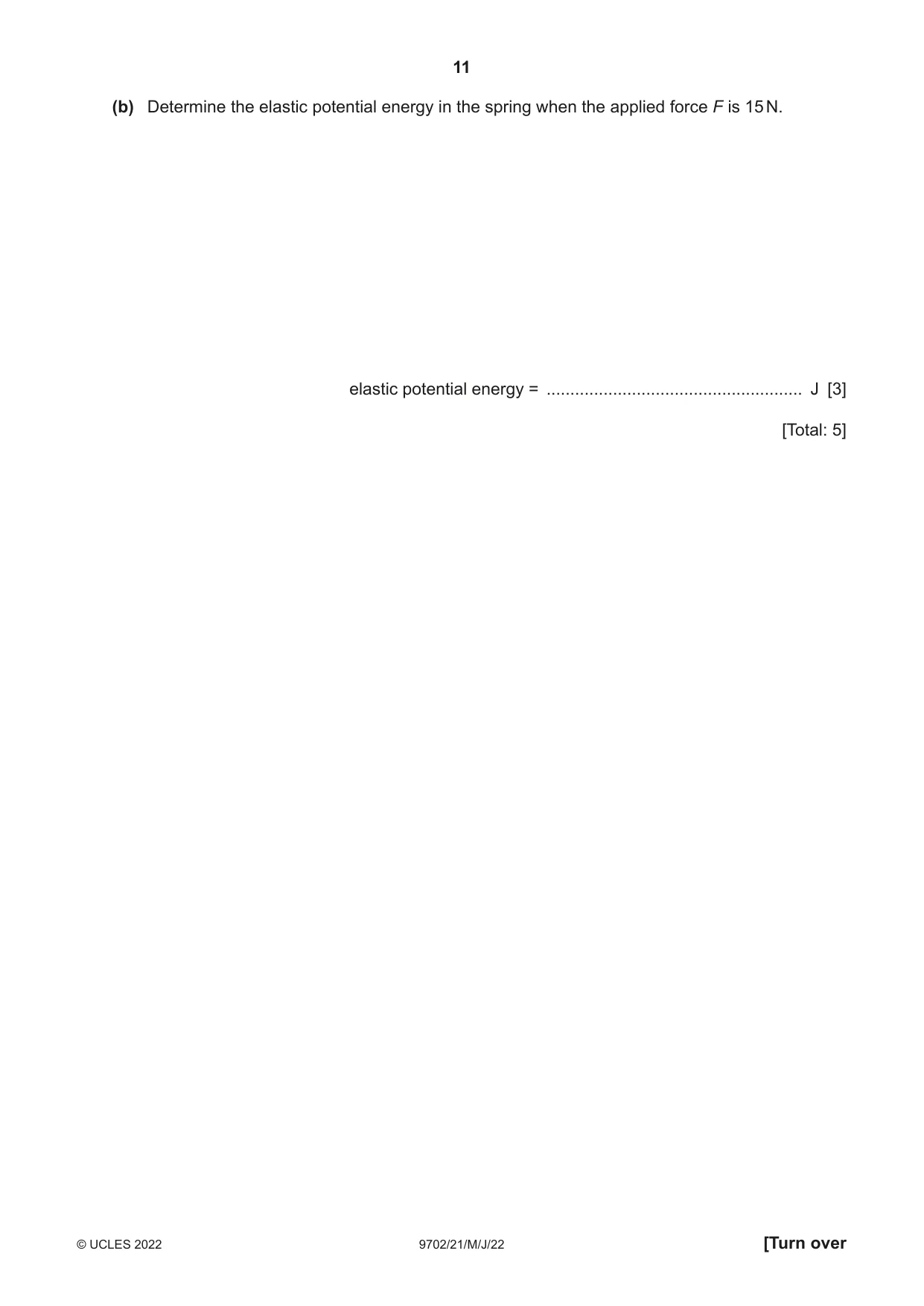
4 A spring is suspended from a fixed point at one end and a vertical force is applied to the other end, as shown in Fig. 4.1. fixed point L spring F Fig. 4.1 The variation of the applied force F with the length L of the spring is shown in Fig. 4.2. 30 F / N 20 10 0 0 20 40 60 L / cm Fig. 4.2 (a) Determine the spring constant k of the spring. k = ............................................... N m–1 [2] (b) Determine the elastic potential energy in the spring when the applied force F is 15 N. elastic potential energy = ...................................................... J [3] [Total: 5]
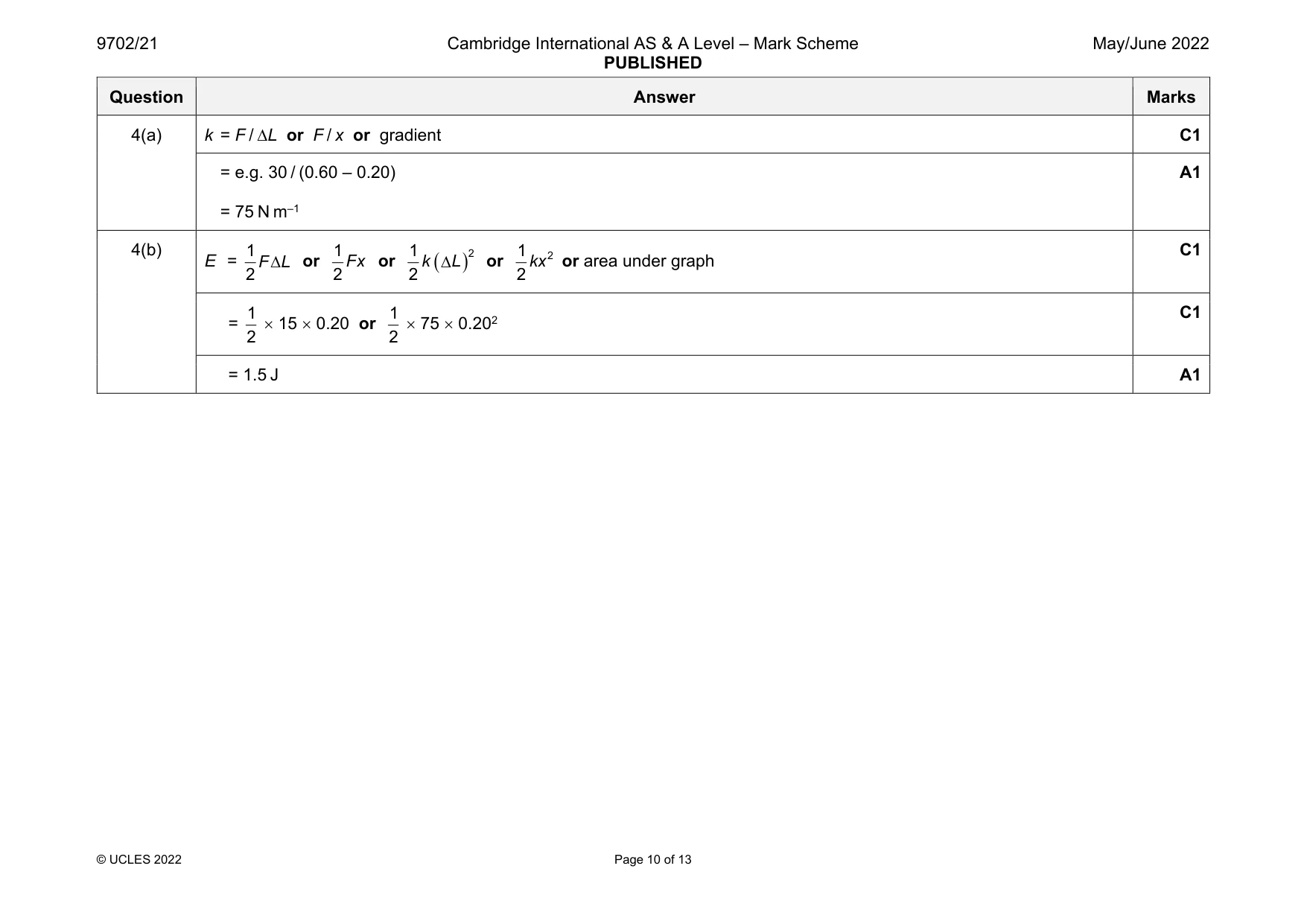
Mark scheme: 4(a) k = F / ∆L or F / x or gradient C1 = e.g. 30 / (0.60 – 0.20) = 75 N m–1 A1 4(b) E = 1 2 F L or 1 2 Fx or 2 1 2 k L or 2 1 2 kx or area under graph C1 = 1 2 15 0.20 or 1 2 75 0.202 C1 = 1.5 J A1
More questions on Gravitational potential energy and kinetic energy
Q5 · A horizontal string is stretched between two fixed points A and B
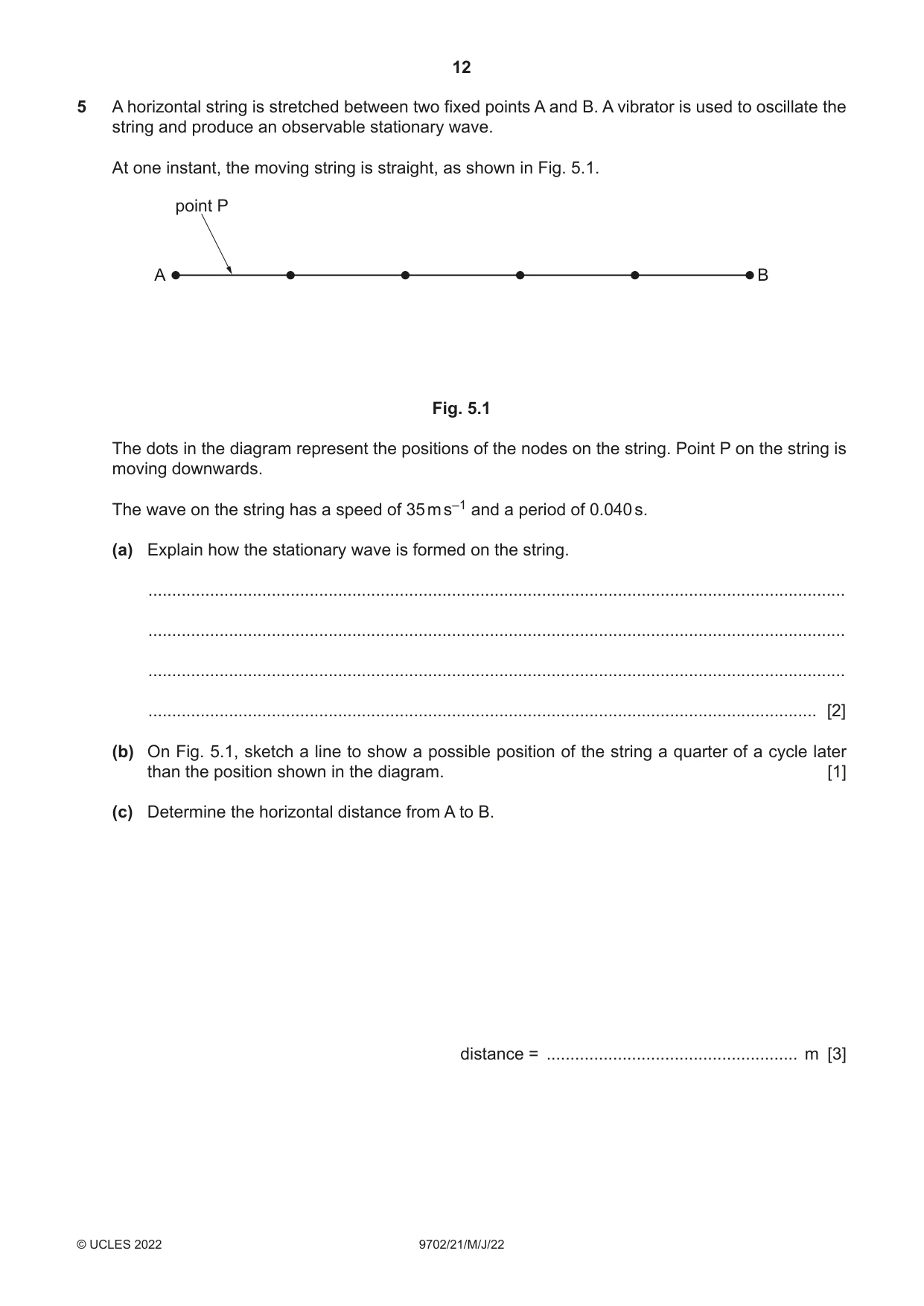
5 A horizontal string is stretched between two fixed points A and B. A vibrator is used to oscillate the string and produce an observable stationary wave. At one instant, the moving string is straight, as shown in Fig. 5.1. point P A B Fig. 5.1 The dots in the diagram represent the positions of the nodes on the string. Point P on the string is moving downwards. The wave on the string has a speed of 35 m s–1 and a period of 0.040 s. (a) Explain how the stationary wave is formed on the string. ................................................................................................................................................... ................................................................................................................................................... ................................................................................................................................................... ............................................................................................................................................. [2] (b) On Fig. 5.1, sketch a line to show a possible position of the string a quarter of a cycle later than the position shown in the diagram. [1] (c) Determine the horizontal distance from A to B. distance = ..................................................... m [3] (d) A particle on the string has zero displacement at time t = 0. From time t = 0 to time t = 0.060 s, the particle moves through a total distance of 72 mm. Calculate the amplitude of oscillation of the particle. amplitude = .................................................. mm [2] [Total: 8]
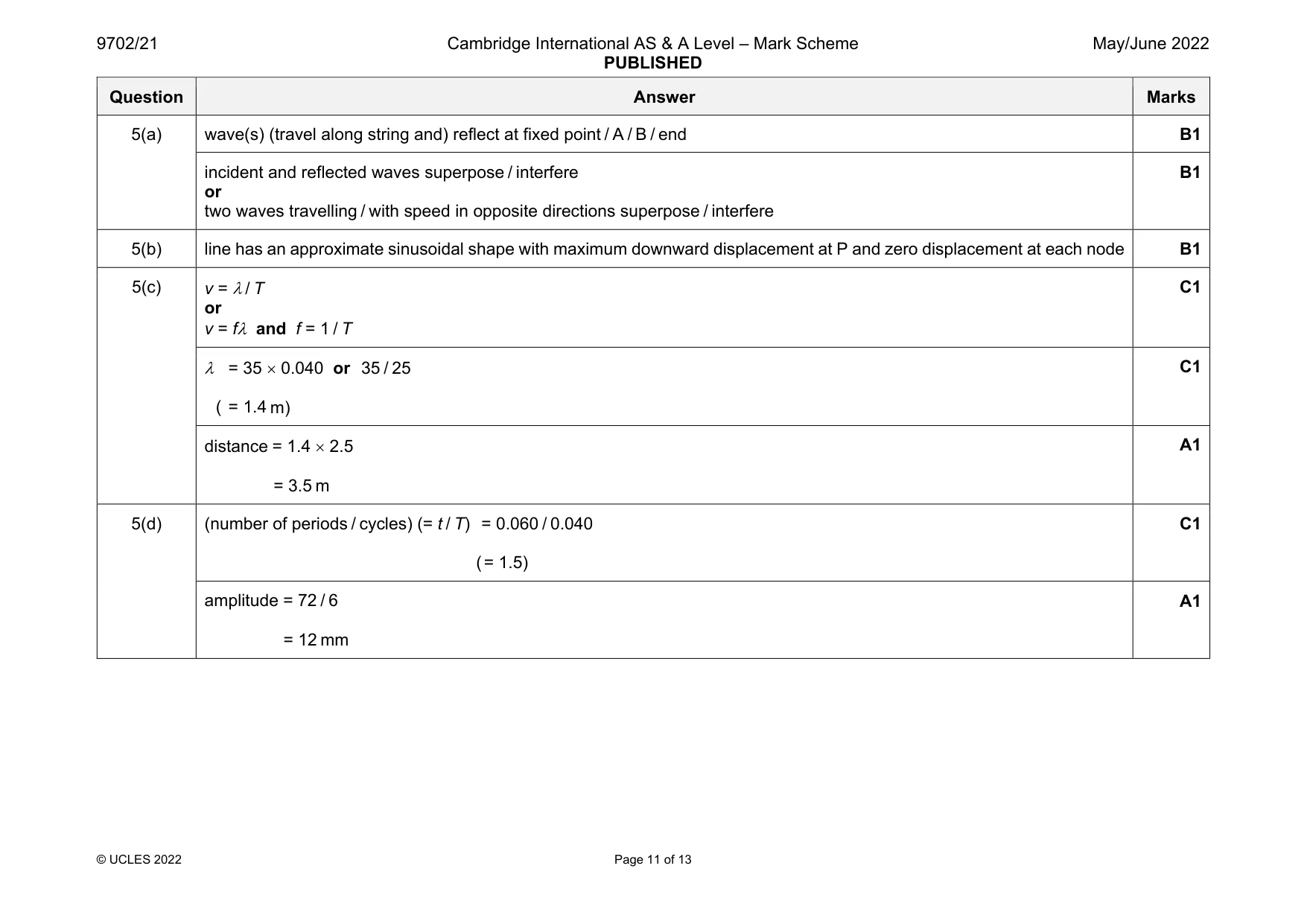
Mark scheme: 5(a) wave(s) (travel along string and) reflect at fixed point / A / B / end B1 incident and reflected waves superpose / interfere or two waves travelling / with speed in opposite directions superpose / interfere B1 5(b) line has an approximate sinusoidal shape with maximum downward displacement at P and zero displacement at each node B1 5(c) v = / T or v = f and f = 1 / T C1 = 35 0.040 or 35 / 25 ( = 1.4 m) C1 distance = 1.4 2.5 = 3.5 m A1 5(d) (number of periods / cycles) (= t / T) = 0.060 / 0.040 ( = 1.5) C1 amplitude = 72 / 6 = 12 mm A1
Q6 · State Kirchhoff’s first law
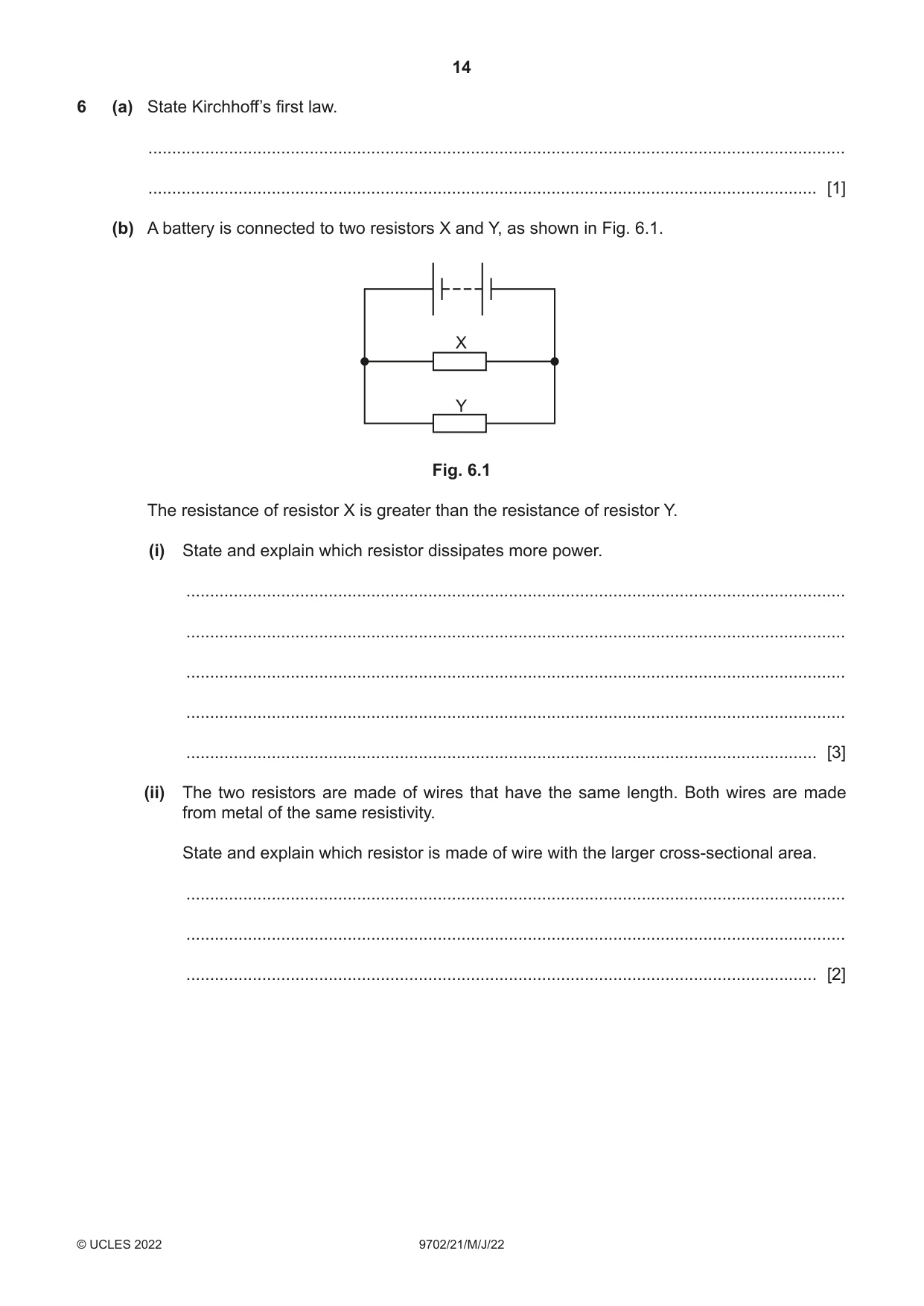
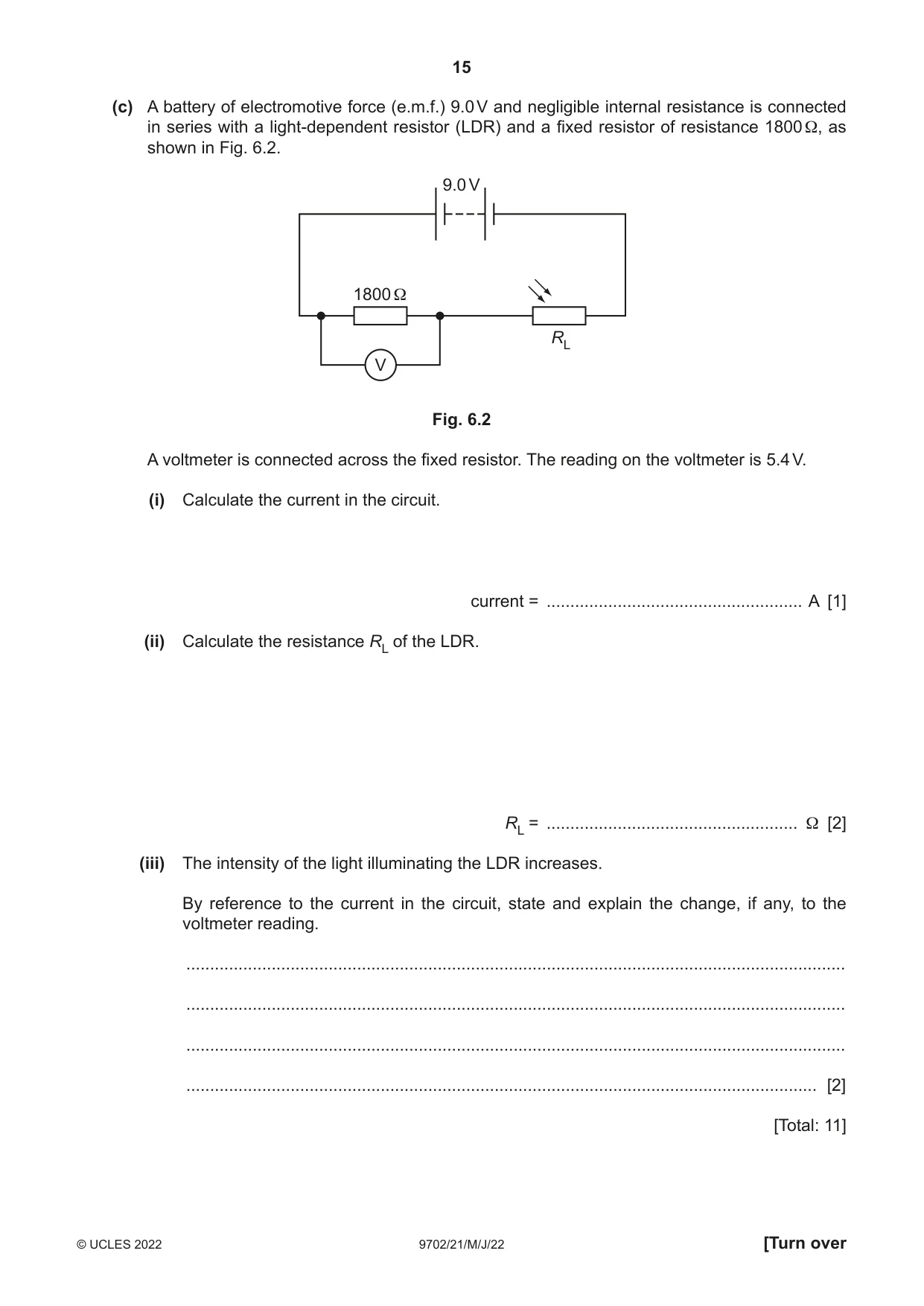
6 (a) State Kirchhoff’s first law. ................................................................................................................................................... ............................................................................................................................................. [1] (b) A battery is connected to two resistors X and Y, as shown in Fig. 6.1. X Y Fig. 6.1 The resistance of resistor X is greater than the resistance of resistor Y. (i) State and explain which resistor dissipates more power. ........................................................................................................................................... ........................................................................................................................................... ........................................................................................................................................... ........................................................................................................................................... ..................................................................................................................................... [3] (ii) The two resistors are made of wires that have the same length. Both wires are made from metal of the same resistivity. State and explain which resistor is made of wire with the larger cross-sectional area. ........................................................................................................................................... ........................................................................................................................................... ..................................................................................................................................... [2] (c) A battery of electromotive force (e.m.f.) 9.0 V and negligible internal resistance is connected in series with a light-dependent resistor (LDR) and a fixed resistor of resistance 1800 Ω, as shown in Fig. 6.2. 9.0 V 1800 Ω RL V Fig. 6.2 A voltmeter is connected across the fixed resistor. The reading on the voltmeter is 5.4 V. (i) Calculate the current in the circuit. current = ...................................................... A [1] (ii) Calculate the resistance RL of the LDR. RL = ..................................................... Ω [2] (iii) The intensity of the light illuminating the LDR increases. By reference to the current in the circuit, state and explain the change, if any, to the voltmeter reading. ........................................................................................................................................... ........................................................................................................................................... ........................................................................................................................................... ..................................................................................................................................... [2] [Total: 11]
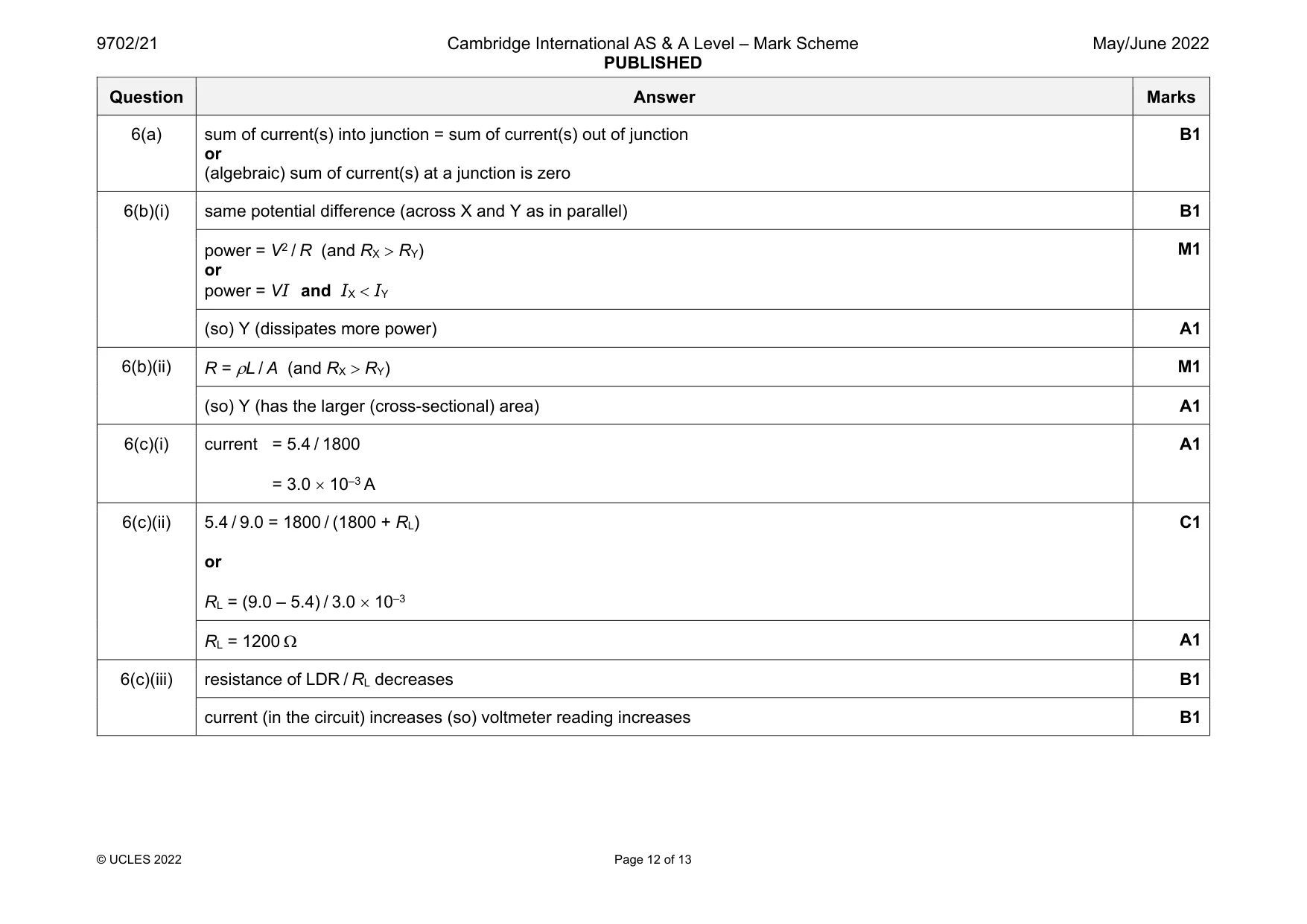
Mark scheme: 6(a) sum of current(s) into junction = sum of current(s) out of junction or (algebraic) sum of current(s) at a junction is zero B1 6(b)(i) same potential difference (across X and Y as in parallel) B1 power = V2 / R (and RX RY) or power = VI and IX IY M1 (so) Y (dissipates more power) A1 6(b)(ii) R = L / A (and RX RY) M1 (so) Y (has the larger (cross-sectional) area) A1 6(c)(i) current = 5.4 / 1800 = 3.0 10–3 A A1 6(c)(ii) 5.4 / 9.0 = 1800 / (1800 + RL) or RL = (9.0 – 5.4) / 3.0 10–3 C1 RL = 1200 A1 6(c)(iii) resistance of LDR / RL decreases B1 current (in the circuit) increases (so) voltmeter reading increases B1
Q7 · An unstable nucleus AZX decays by emitting a β– particle
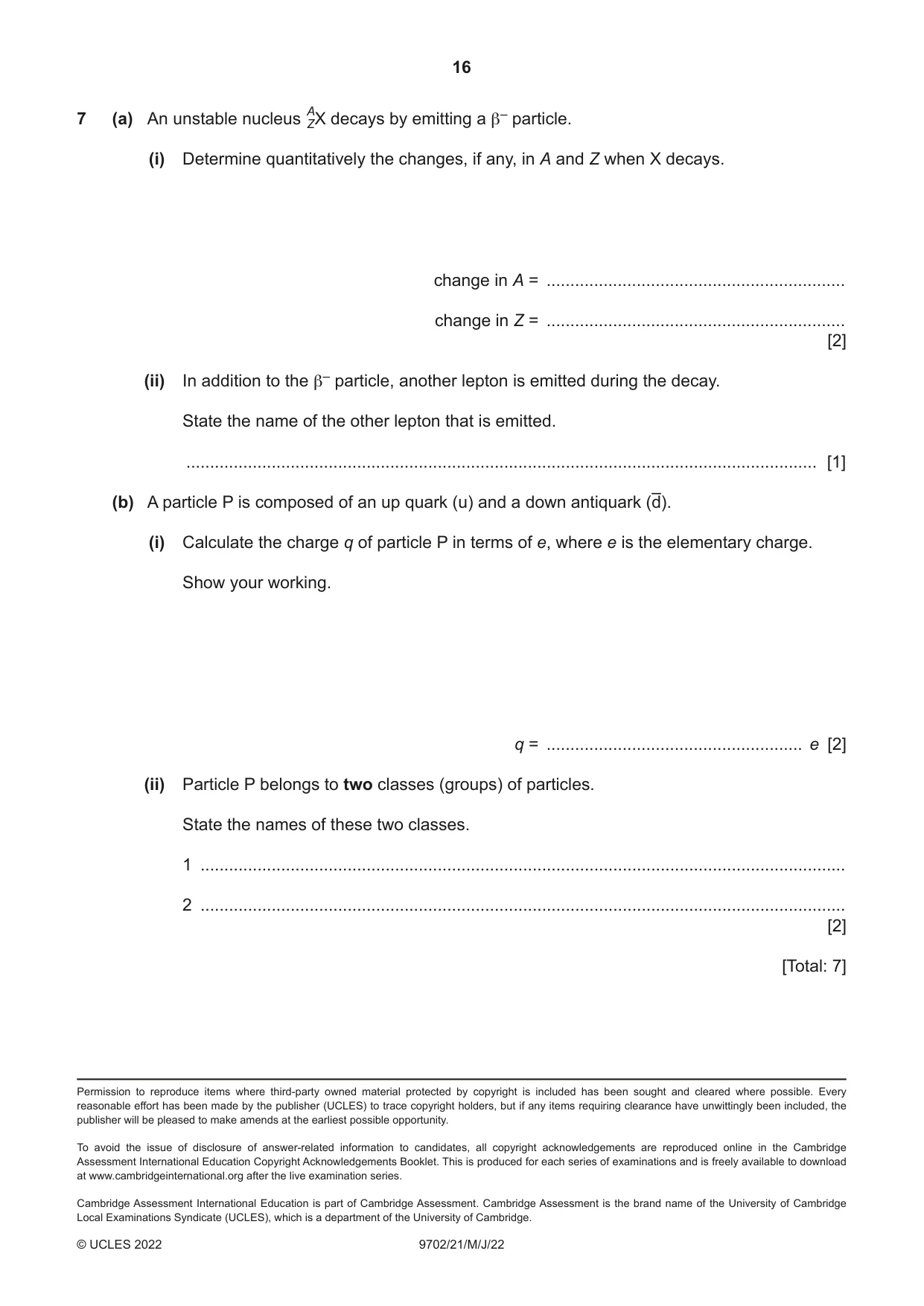
7 (a) An unstable nucleus AZX decays by emitting a β– particle. (i) Determine quantitatively the changes, if any, in A and Z when X decays. change in A = ............................................................... change in Z = ............................................................... [2] (ii) In addition to the β– particle, another lepton is emitted during the decay. State the name of the other lepton that is emitted. ..................................................................................................................................... [1] (b) A particle P is composed of an up quark (u) and a down antiquark (d). (i) Calculate the charge q of particle P in terms of e, where e is the elementary charge. Show your working. q = ...................................................... e [2] (ii) Particle P belongs to two classes (groups) of particles. State the names of these two classes. 1 ........................................................................................................................................ 2 ........................................................................................................................................ [2] [Total: 7]
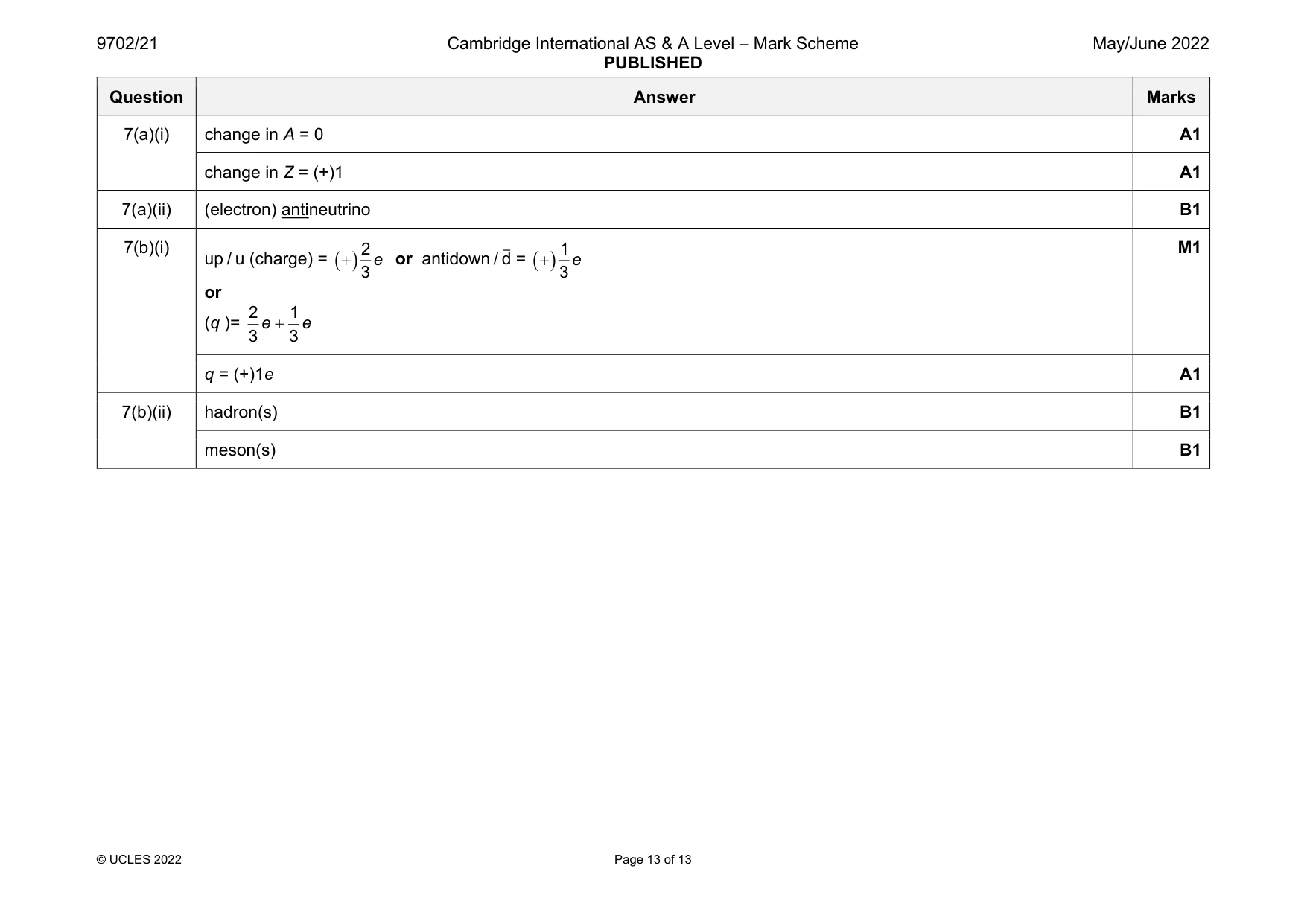
Mark scheme: 7(a)(i) change in A = 0 A1 change in Z = (+)1 A1 7(a)(ii) (electron) antineutrino B1 7(b)(i) up / u (charge) = 2 3 e or antidown / dത = 1 3 e or (q )= 2 1 3 3 e e M1 q = (+)1e A1 7(b)(ii) hadron(s) B1 meson(s) B1
What was in this paper
The subtopics covered by these 7 questions, and how many questions each got. Open one in a new tab to see every Cambridge question on it.
What you needed in this session
Cambridge’s own grade thresholds for 2022 May/June, Paper 2 · Variant 1. A higher threshold means an easier paper — the bar moves with how the cohort did.