Cambridge A Level Physics 9702 — 2018 Oct/Nov Paper 2 · Variant 3
9702/23/O/N/18 · 7 questions · 60 marks · ≈68 min
The question paper and its mark scheme, free to read here and free to download. This is Cambridge’s own paper, exactly as it was sat.
Question paper16 pages
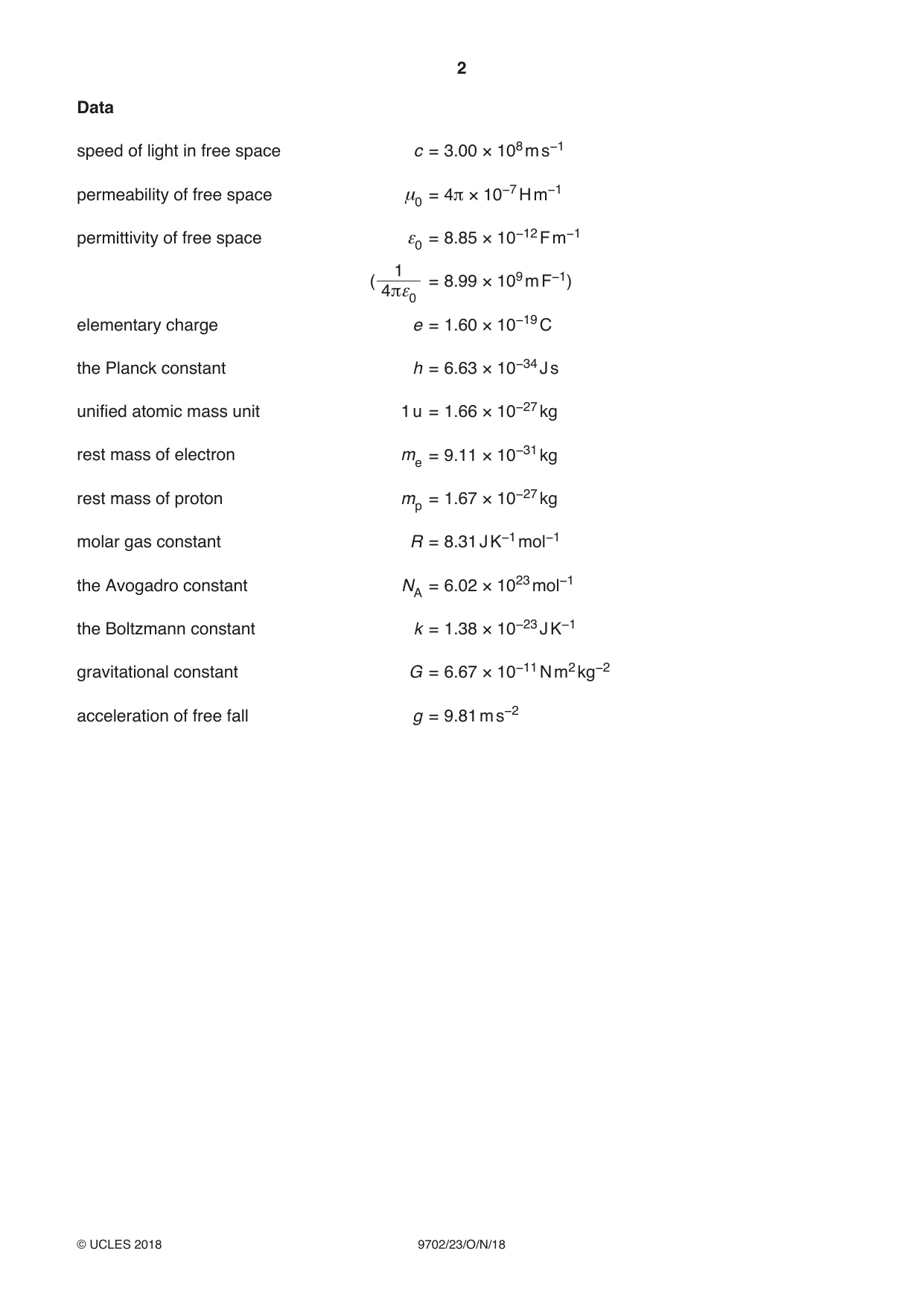
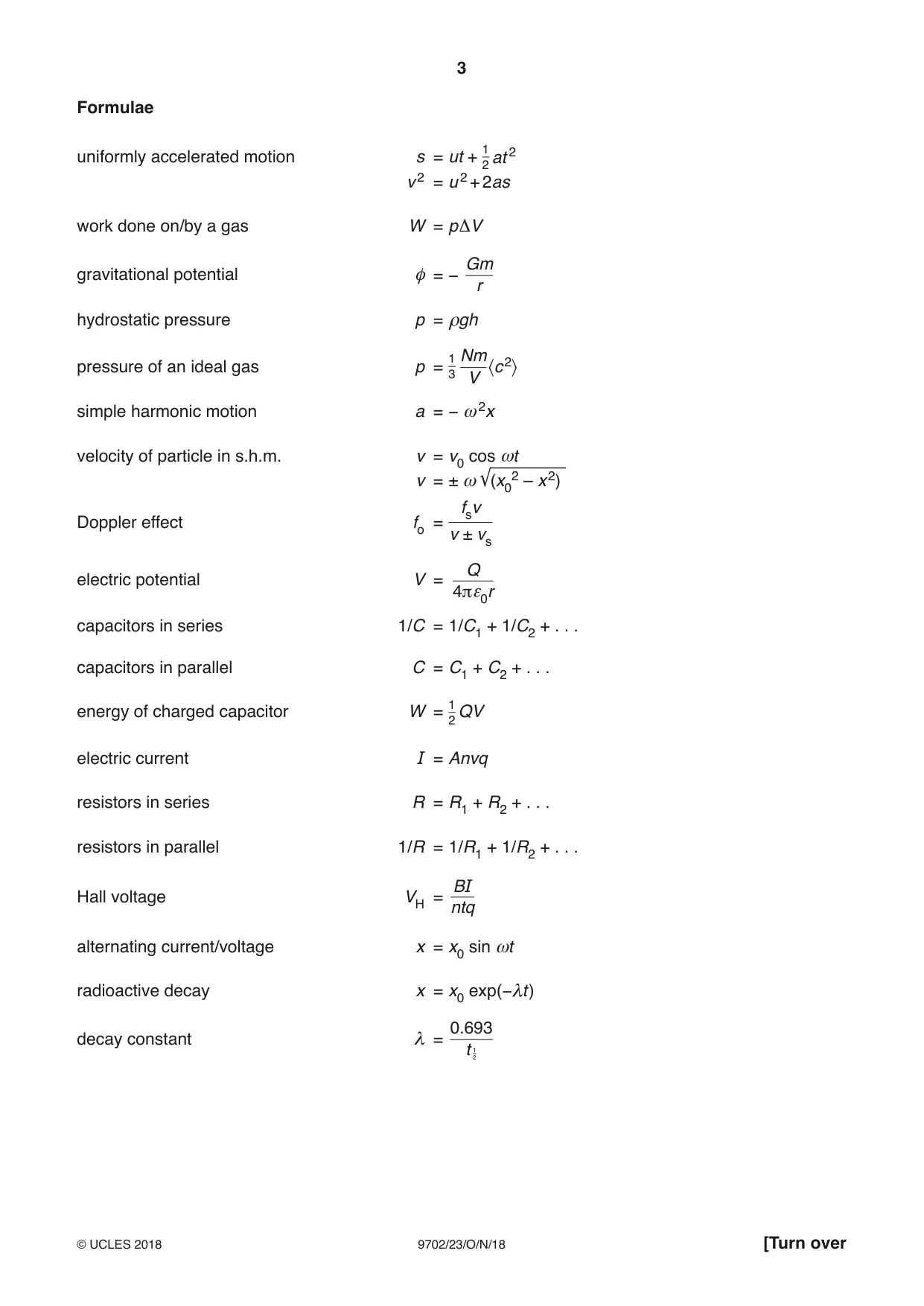
Mark scheme9 pages
Answers below. Sit the paper first if you are practising.
Questions as text
Q1 · Mass, length and time are all SI base quantities
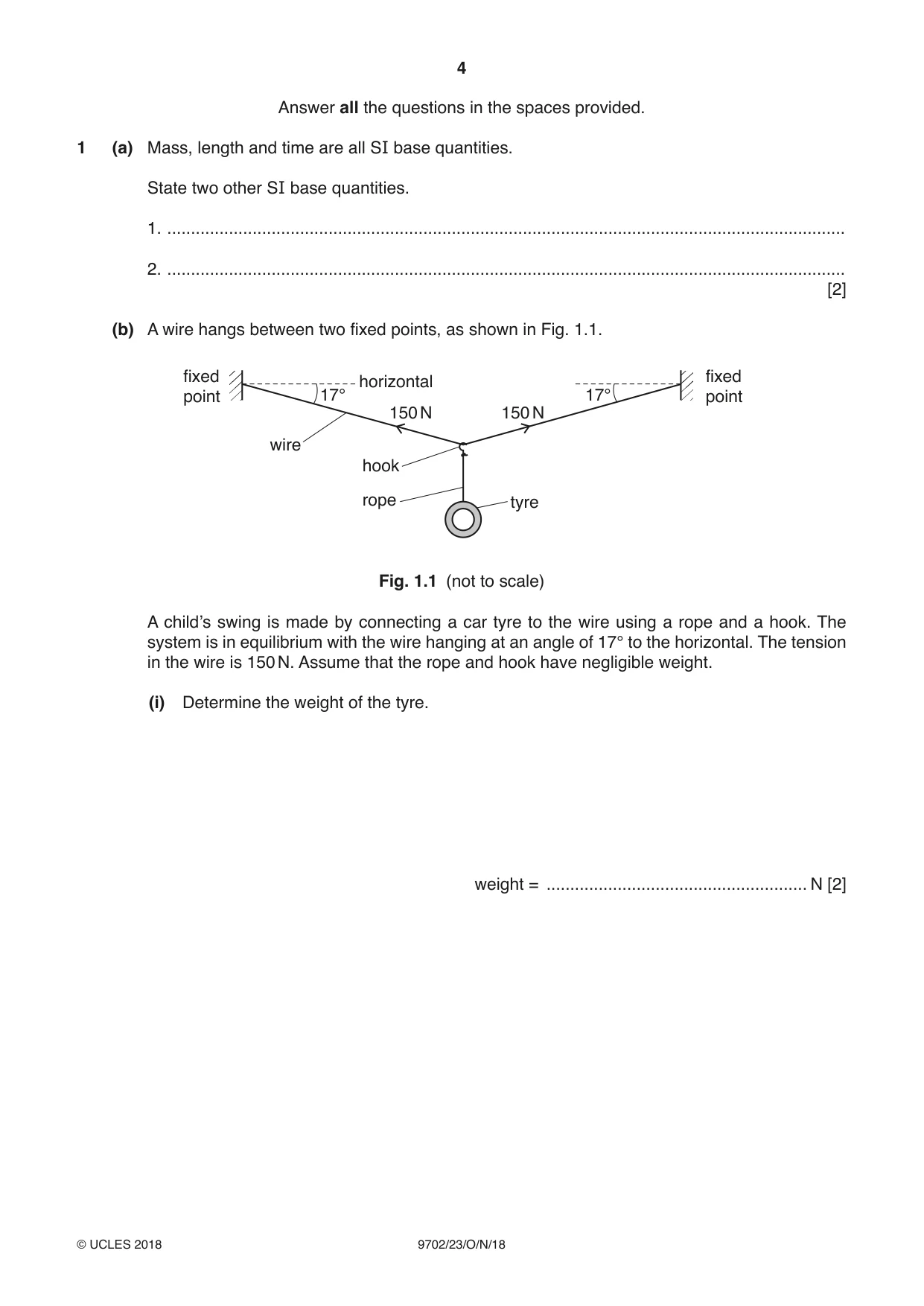
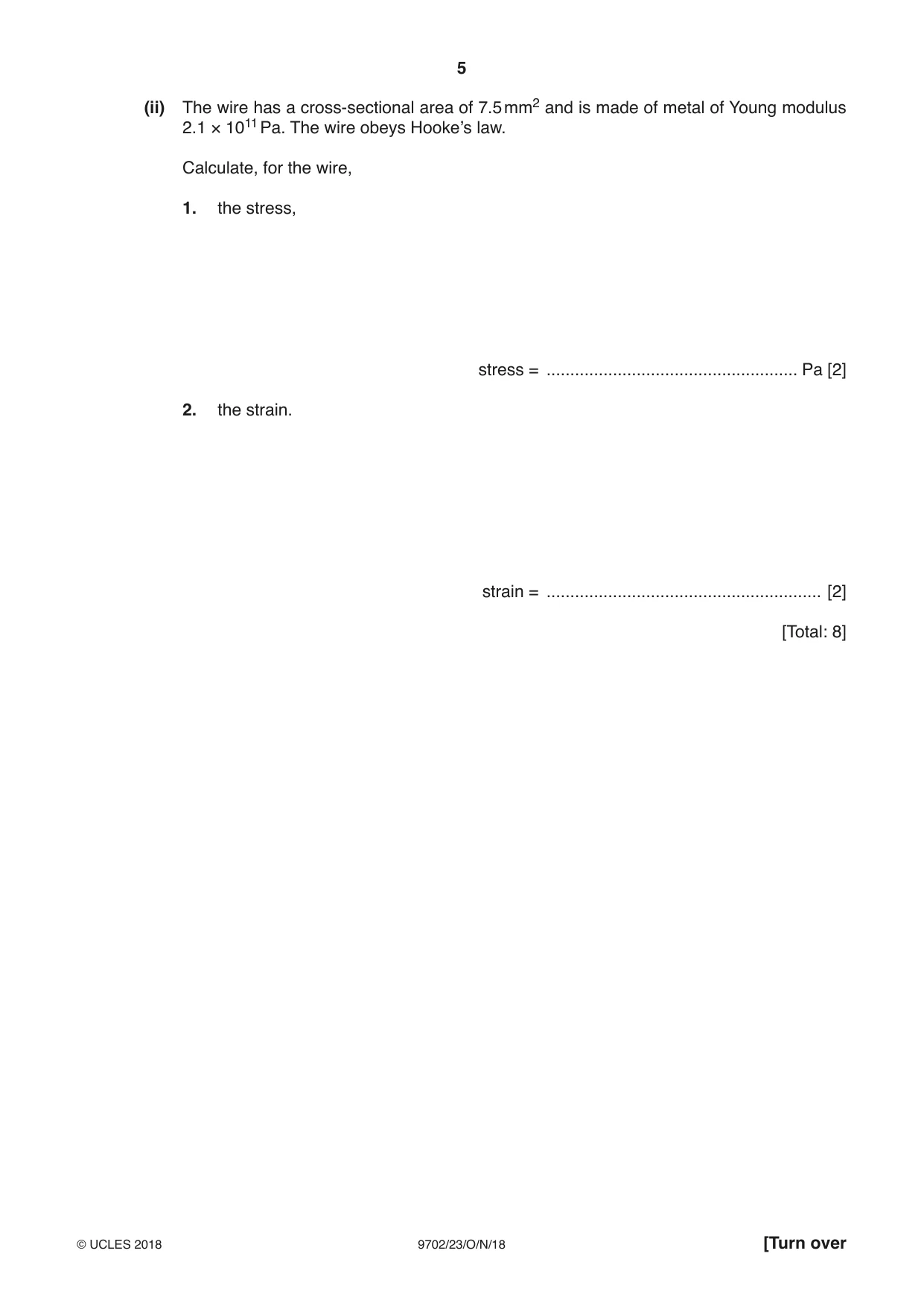
1 (a) Mass, length and time are all SI base quantities. State two other SI base quantities. 1. ............................................................................................................................................... 2. ............................................................................................................................................... [2] (b) A wire hangs between two fixed points, as shown in Fig. 1.1. fixed fixed horizontal point 17° 17° point 150 N 150 N wire hook rope tyre Fig. 1.1 (not to scale) A child’s swing is made by connecting a car tyre to the wire using a rope and a hook. The system is in equilibrium with the wire hanging at an angle of 17° to the horizontal. The tension in the wire is 150 N. Assume that the rope and hook have negligible weight. (i) Determine the weight of the tyre. weight = ....................................................... N [2] (ii) The wire has a cross-sectional area of 7.5 mm2 and is made of metal of Young modulus 2.1 × 10¹¹ Pa. The wire obeys Hooke’s law. Calculate, for the wire, 1. the stress, stress = ..................................................... Pa [2] 2. the strain. strain = .......................................................... [2] [Total: 8]
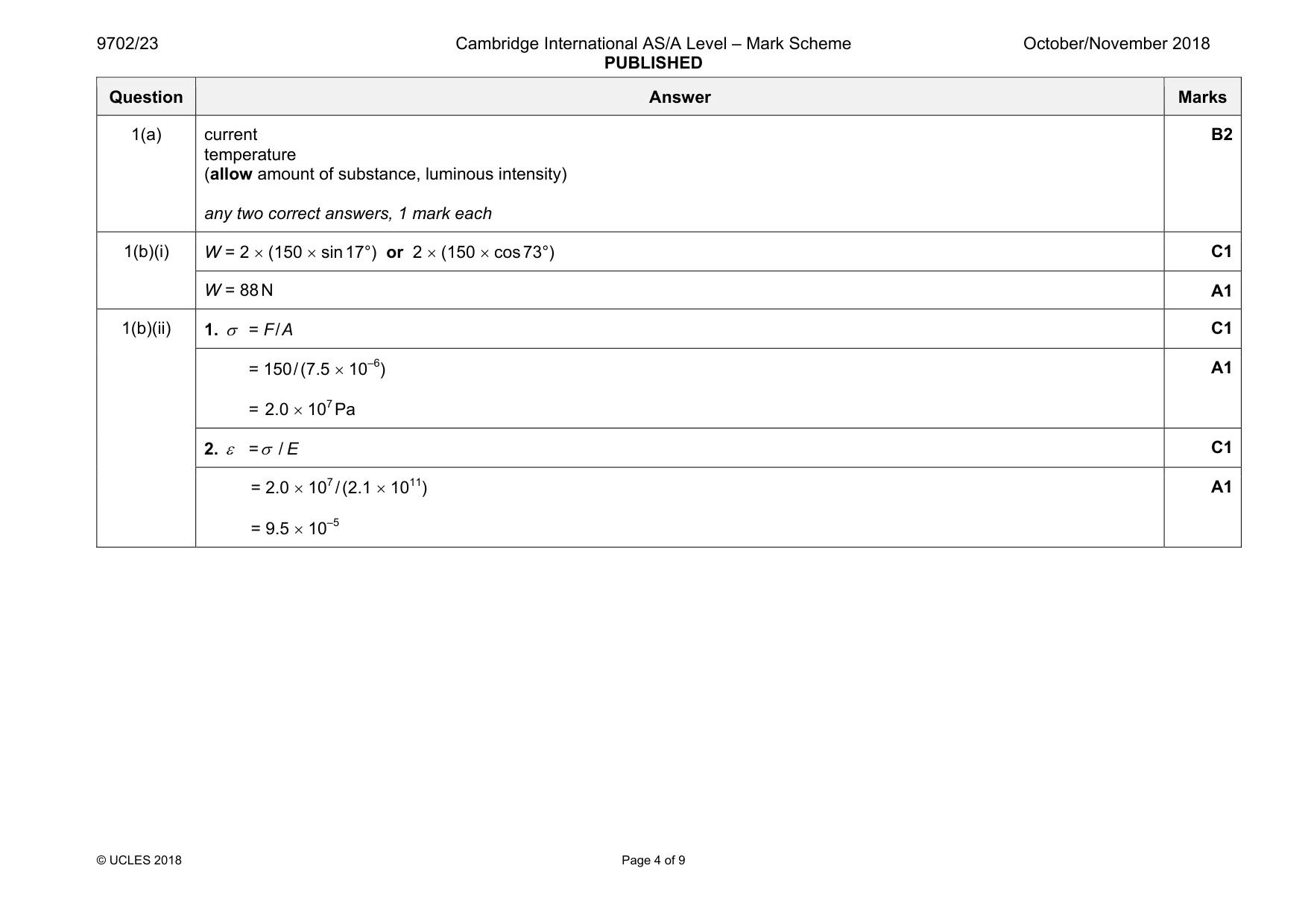
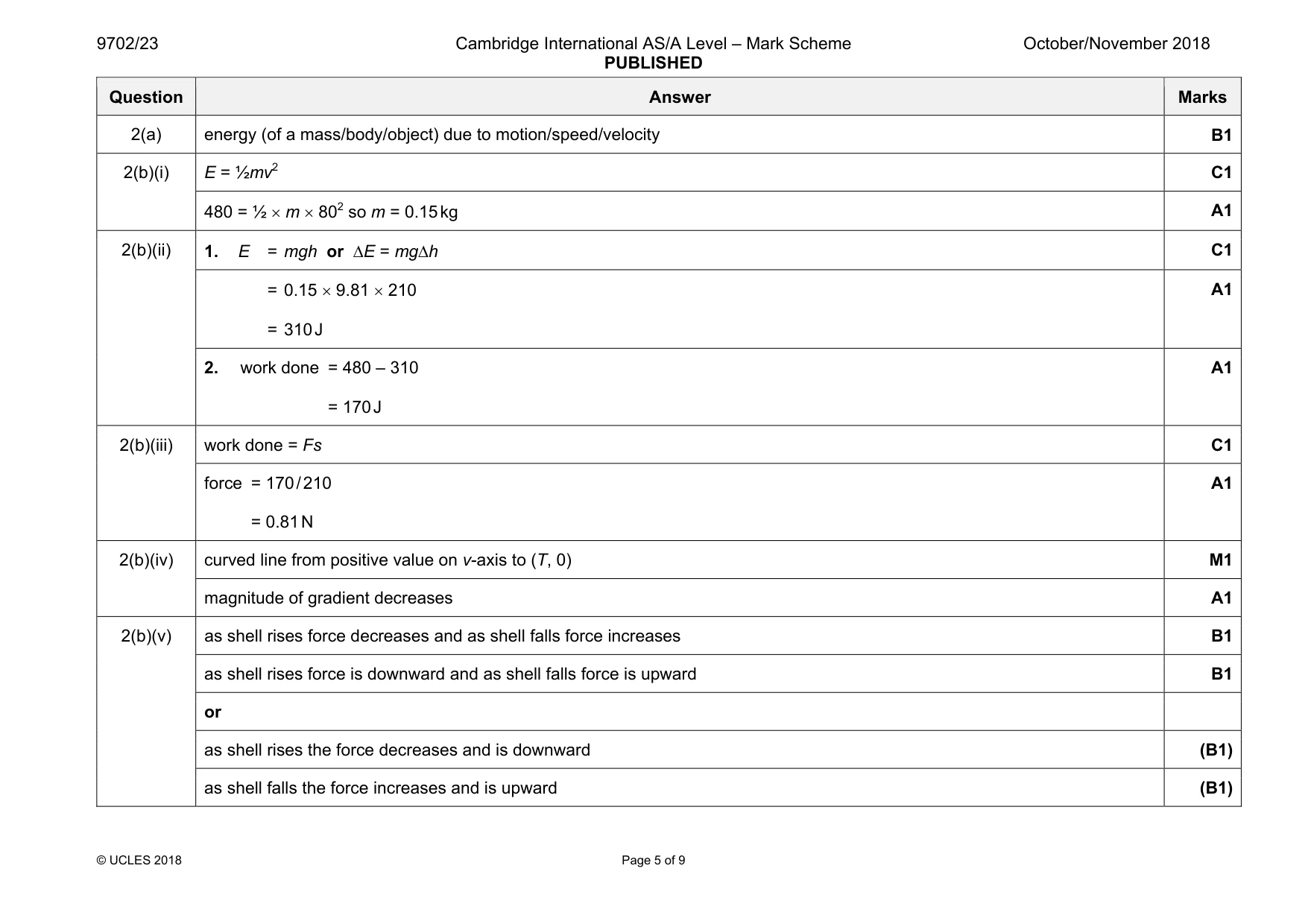
Mark scheme: 1(a) current temperature (allow amount of substance, luminous intensity) any two correct answers, 1 mark each B2 1(b)(i) W = 2 × (150 × sin 17°) or 2 × (150 × cos 73°) C1 W = 88 N A1 1(b)(ii) 1. σ = F / A C1 = 150 / (7.5 × 10⁻⁶) = 2.0 × 10⁷ Pa A1 2. ε = σ / E C1 = 2.0 × 10⁷ / (2.1 × 10¹¹) = 9.5 × 10⁻⁵ A1
Q2 · State what is meant by kinetic energy
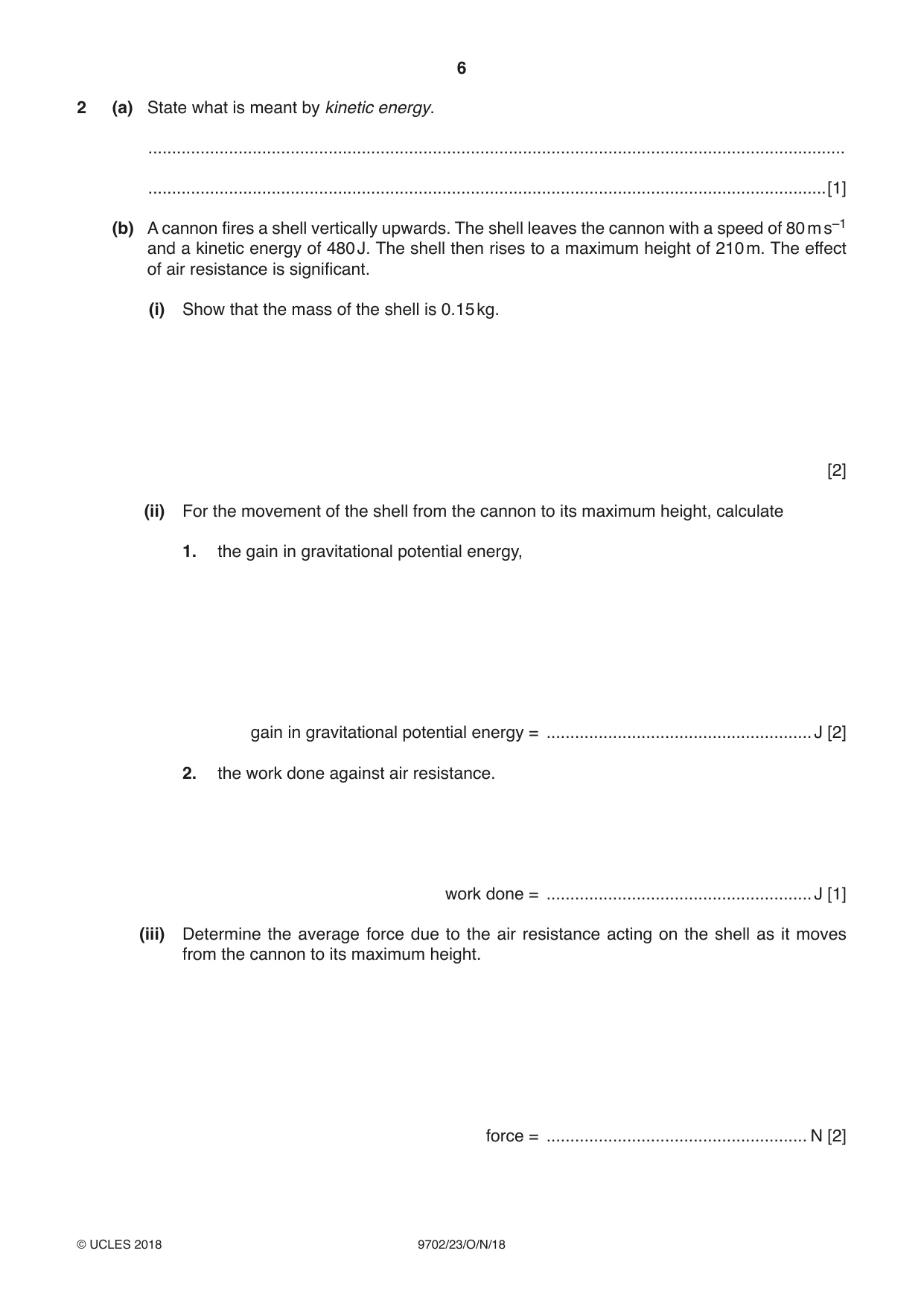
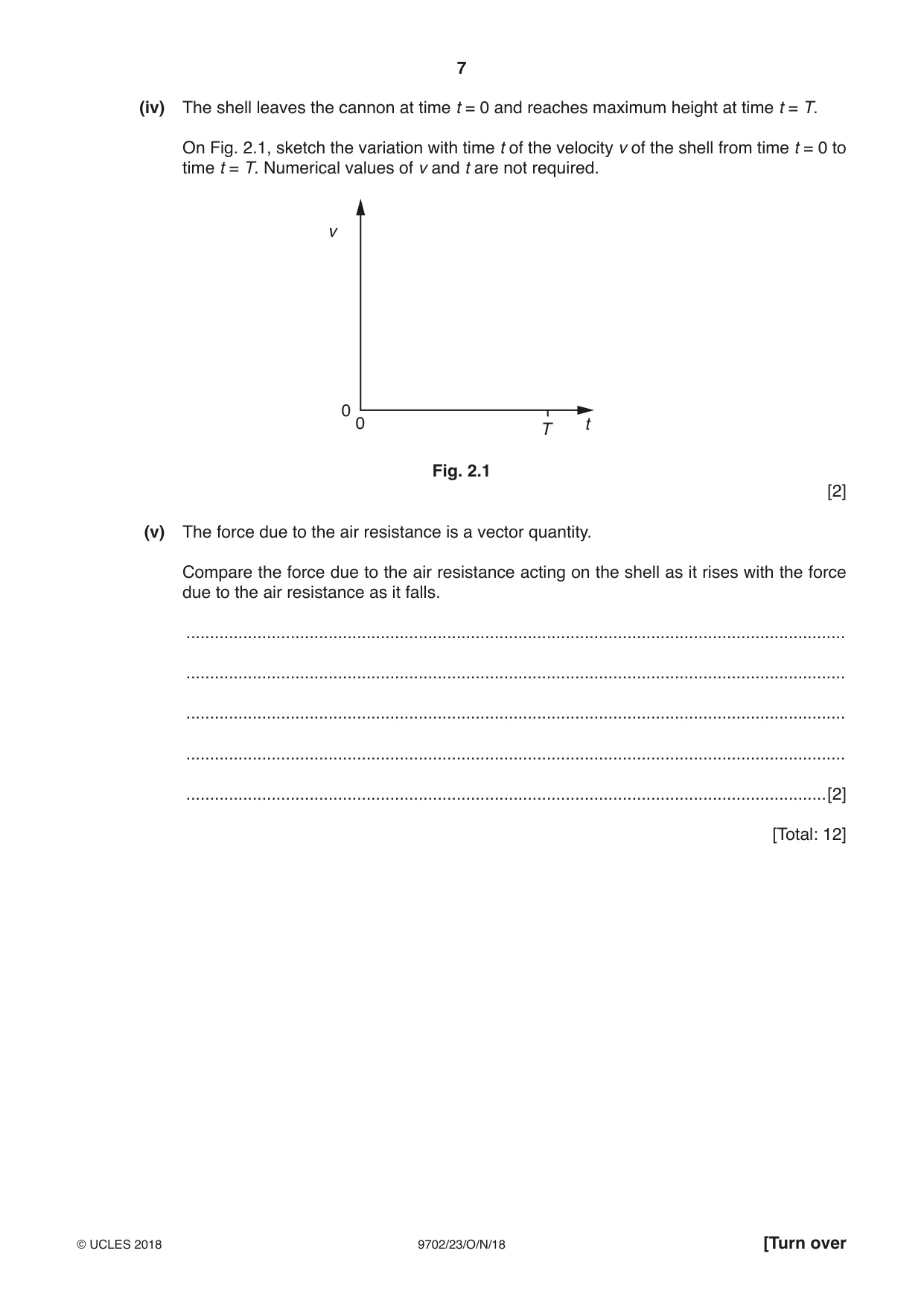
2 (a) State what is meant by kinetic energy. ................................................................................................................................................... ...............................................................................................................................................[1] (b) A cannon fires a shell vertically upwards. The shell leaves the cannon with a speed of 80 m s–1 and a kinetic energy of 480 J. The shell then rises to a maximum height of 210 m. The effect of air resistance is significant. (i) Show that the mass of the shell is 0.15 kg. [2] (ii) For the movement of the shell from the cannon to its maximum height, calculate 1. the gain in gravitational potential energy, gain in gravitational potential energy = ........................................................ J [2] 2. the work done against air resistance. work done = ........................................................ J [1] (iii) Determine the average force due to the air resistance acting on the shell as it moves from the cannon to its maximum height. force = ....................................................... N [2] (iv) The shell leaves the cannon at time t = 0 and reaches maximum height at time t = T. On Fig. 2.1, sketch the variation with time t of the velocity v of the shell from time t = 0 to time t = T. Numerical values of v and t are not required. v 0 0 t T Fig. 2.1 [2] (v) The force due to the air resistance is a vector quantity. Compare the force due to the air resistance acting on the shell as it rises with the force due to the air resistance as it falls. ........................................................................................................................................... ........................................................................................................................................... ........................................................................................................................................... ........................................................................................................................................... .......................................................................................................................................[2] [Total: 12]
Mark scheme: 2(a) energy (of a mass/body/object) due to motion/speed/velocity B1 2(b)(i) E = ½mv2 C1 480 = ½ × m × 802 so m = 0.15 kg A1 2(b)(ii) 1. E = mgh or ∆E = mg∆h C1 = 0.15 × 9.81 × 210 = 310 J A1 2. work done = 480 – 310 = 170 J A1 2(b)(iii) work done = Fs C1 force = 170 / 210 = 0.81 N A1 2(b)(iv) curved line from positive value on v-axis to (T, 0) M1 magnitude of gradient decreases A1 2(b)(v) as shell rises force decreases and as shell falls force increases B1 as shell rises force is downward and as shell falls force is upward B1 or as shell rises the force decreases and is downward (B1) as shell falls the force increases and is upward (B1)
Q3 · State Newton’s second law of motion
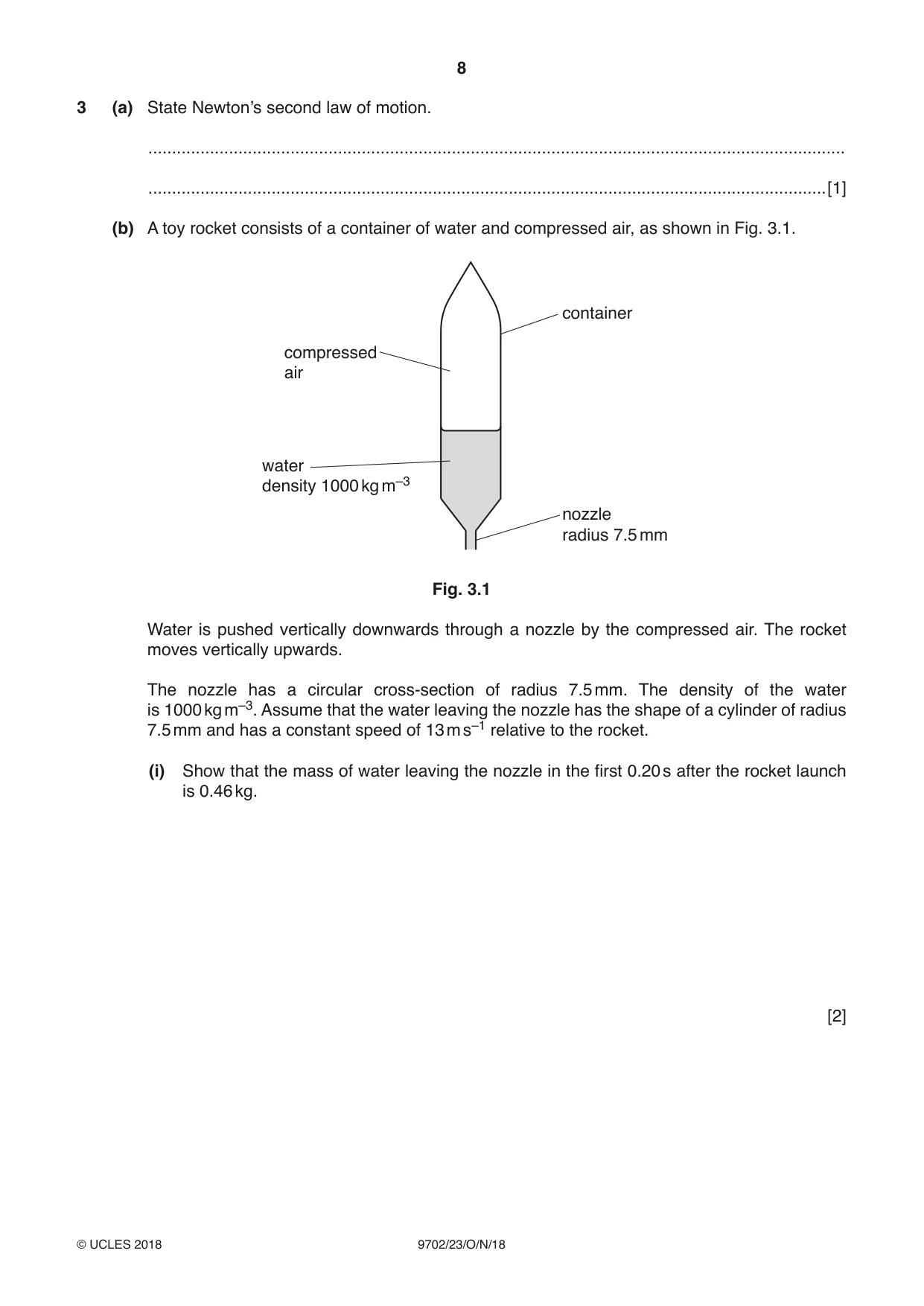
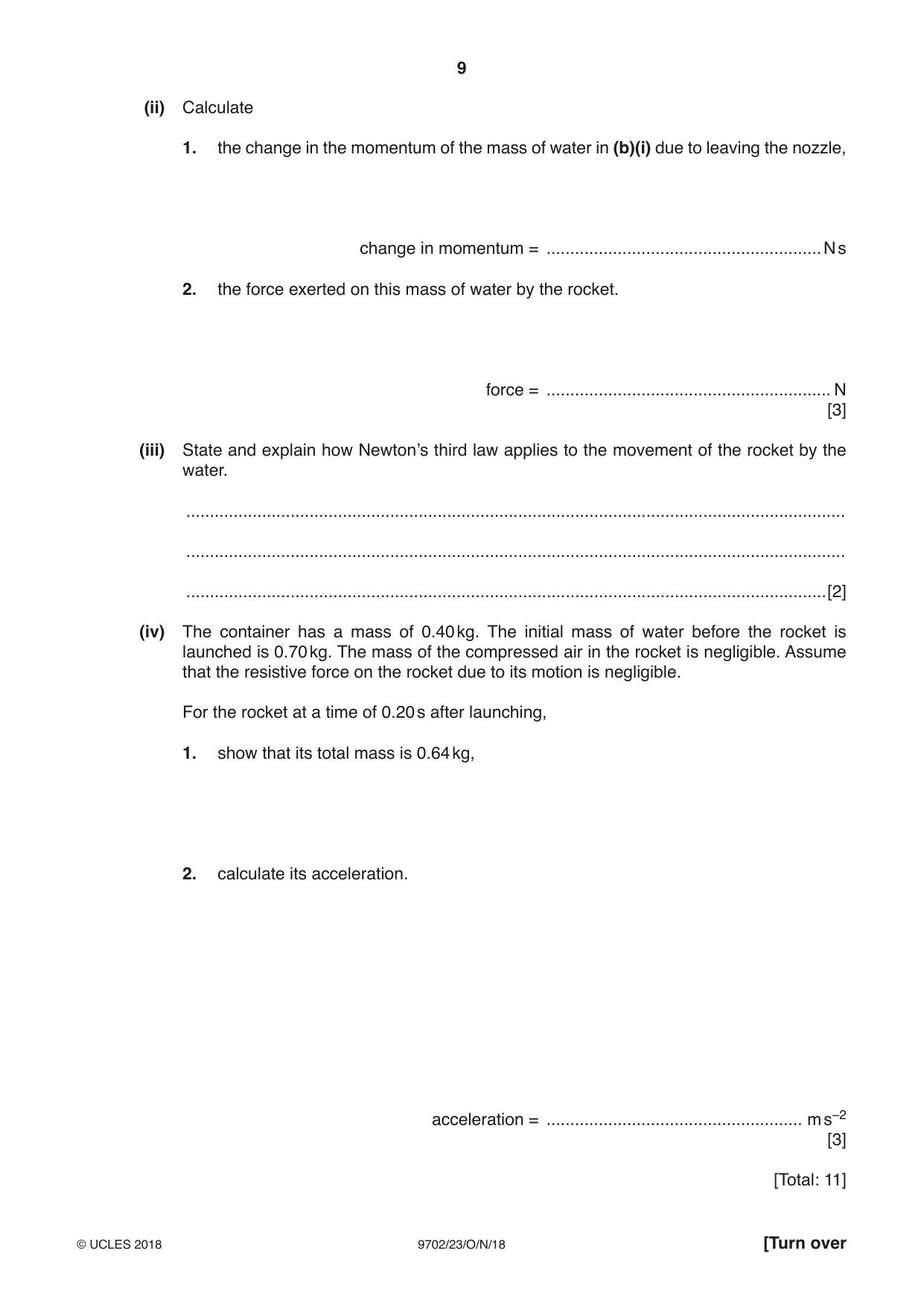
3 (a) State Newton’s second law of motion. ................................................................................................................................................... ...............................................................................................................................................[1] (b) A toy rocket consists of a container of water and compressed air, as shown in Fig. 3.1. container compressed air water density 1000 kg m–3 nozzle radius 7.5 mm Fig. 3.1 Water is pushed vertically downwards through a nozzle by the compressed air. The rocket moves vertically upwards. The nozzle has a circular cross-section of radius 7.5 mm. The density of the water is 1000 kg m–3. Assume that the water leaving the nozzle has the shape of a cylinder of radius 7.5 mm and has a constant speed of 13 m s–1 relative to the rocket. (i) Show that the mass of water leaving the nozzle in the first 0.20 s after the rocket launch is 0.46 kg. [2] (ii) Calculate 1. the change in the momentum of the mass of water in (b)(i) due to leaving the nozzle, change in momentum = .......................................................... N s 2. the force exerted on this mass of water by the rocket. force = ............................................................ N [3] (iii) State and explain how Newton’s third law applies to the movement of the rocket by the water. ........................................................................................................................................... ........................................................................................................................................... .......................................................................................................................................[2] (iv) The container has a mass of 0.40 kg. The initial mass of water before the rocket is launched is 0.70 kg. The mass of the compressed air in the rocket is negligible. Assume that the resistive force on the rocket due to its motion is negligible. For the rocket at a time of 0.20 s after launching, 1. show that its total mass is 0.64 kg, 2. calculate its acceleration. acceleration = ...................................................... m s–2 [3] [Total: 11]
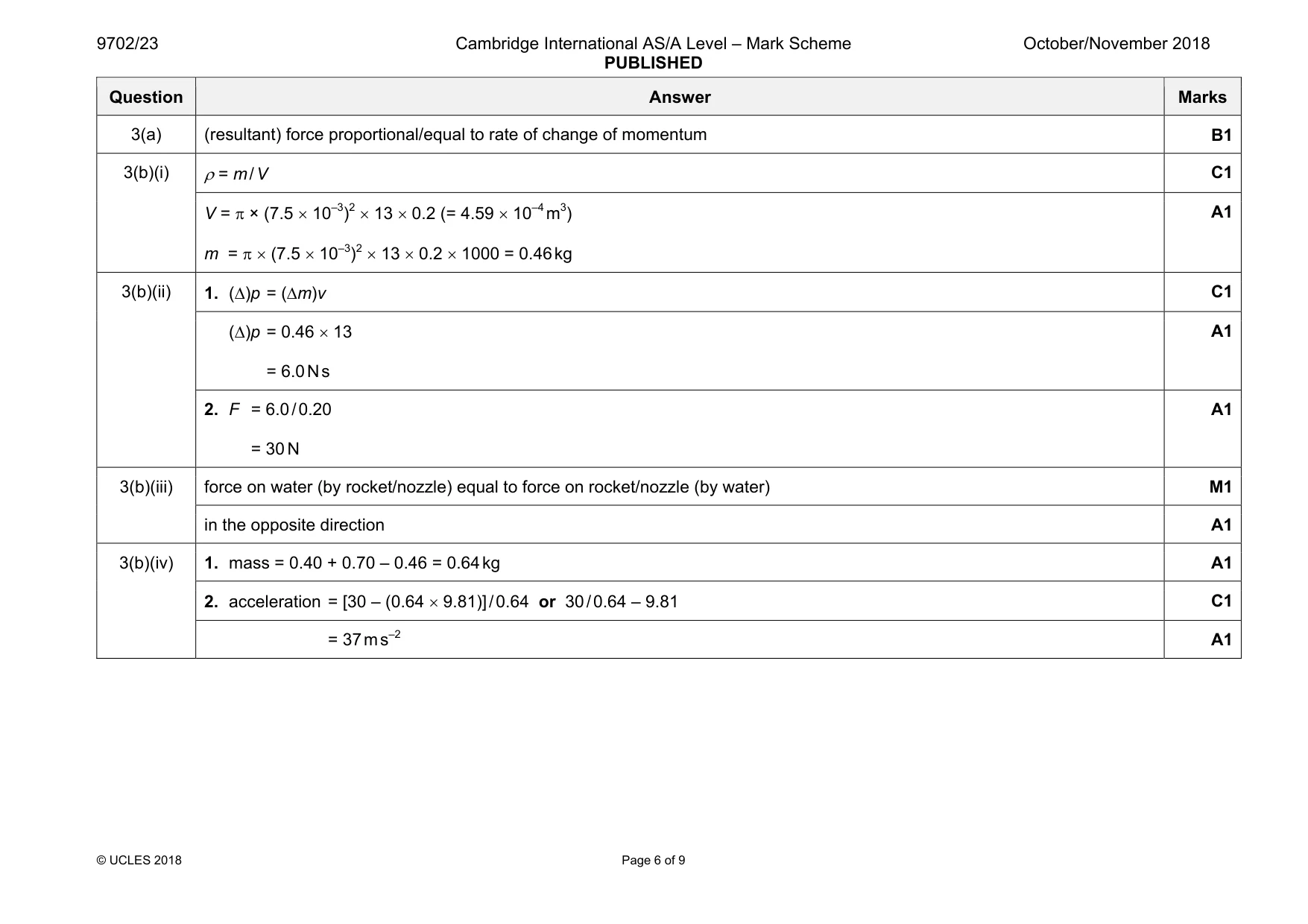
Mark scheme: 3(a) (resultant) force proportional/equal to rate of change of momentum B1 3(b)(i) ρ = m / V C1 V = π × (7.5 × 10⁻³)2 × 13 × 0.2 (= 4.59 × 10⁻⁴ m3) m = π × (7.5 × 10⁻³)2 × 13 × 0.2 × 1000 = 0.46 kg A1 3(b)(ii) 1. (∆)p = (∆m)v C1 (∆)p = 0.46 × 13 = 6.0 N s A1 2. F = 6.0 / 0.20 = 30 N A1 3(b)(iii) force on water (by rocket/nozzle) equal to force on rocket/nozzle (by water) M1 in the opposite direction A1 3(b)(iv) 1. mass = 0.40 + 0.70 – 0.46 = 0.64 kg A1 2. acceleration = [30 – (0.64 × 9.81)] / 0.64 or 30 / 0.64 – 9.81 C1 = 37 m s–2 A1
Question 4
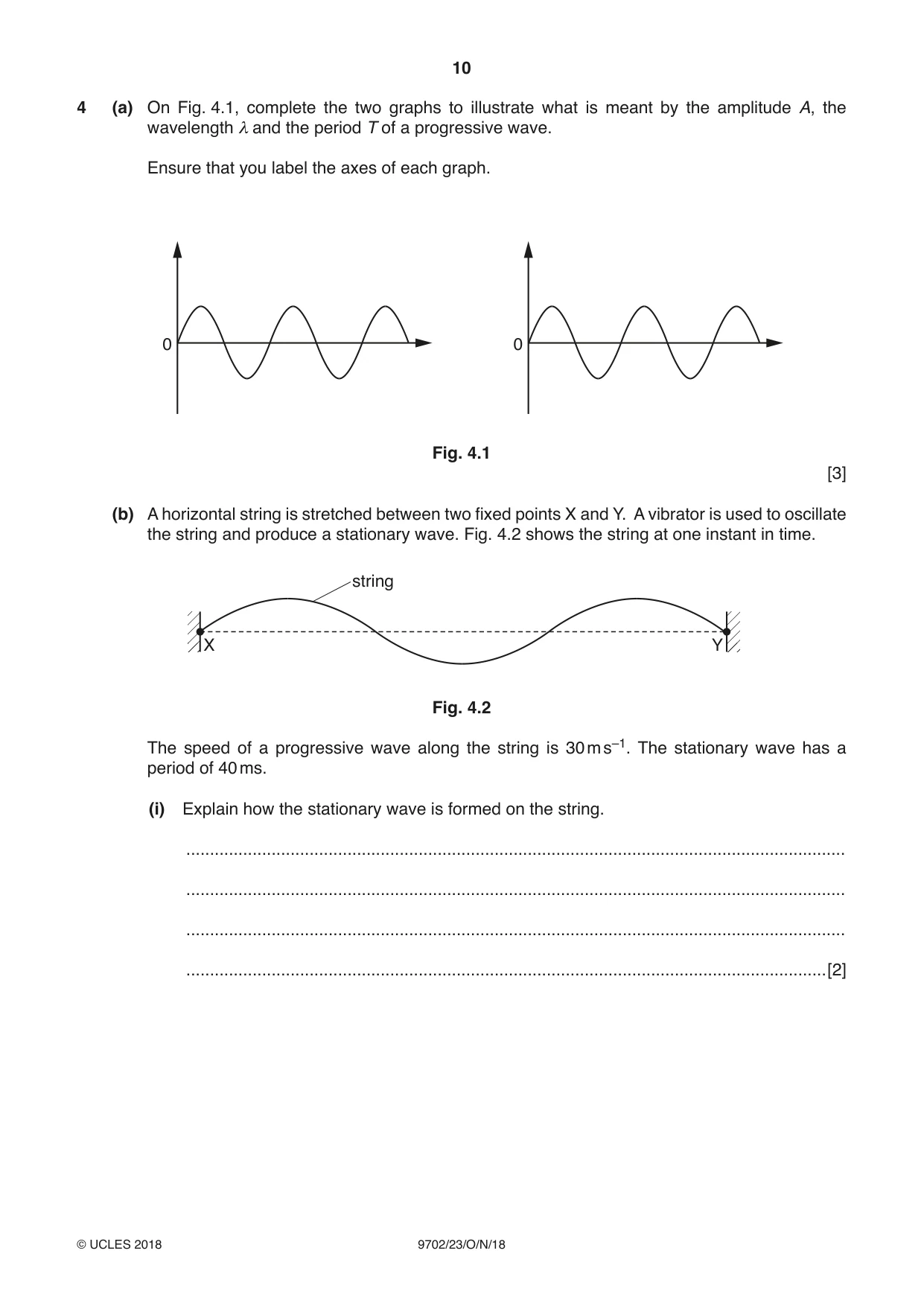
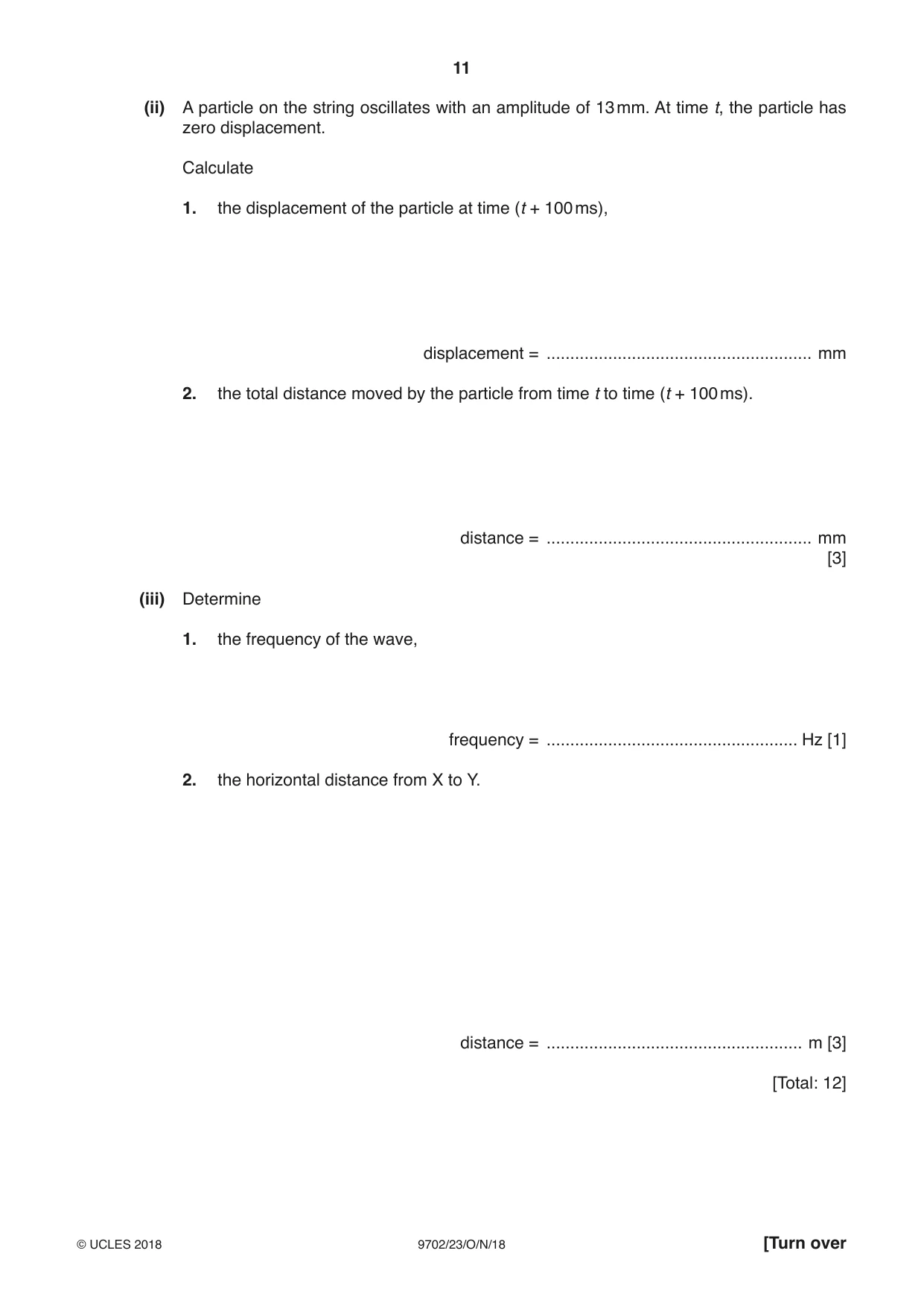
4 (a) On Fig. 4.1, complete the two graphs to illustrate what is meant by the amplitude A, the wavelength λ and the period T of a progressive wave. Ensure that you label the axes of each graph. 0 0 Fig. 4.1 [3] (b) A horizontal string is stretched between two fixed points X and Y. A vibrator is used to oscillate the string and produce a stationary wave. Fig. 4.2 shows the string at one instant in time. string X Y Fig. 4.2 The speed of a progressive wave along the string is 30 m s–1. The stationary wave has a period of 40 ms. (i) Explain how the stationary wave is formed on the string. ........................................................................................................................................... ........................................................................................................................................... ........................................................................................................................................... .......................................................................................................................................[2] (ii) A particle on the string oscillates with an amplitude of 13 mm. At time t, the particle has zero displacement. Calculate 1. the displacement of the particle at time (t + 100 ms), displacement = ........................................................ mm 2. the total distance moved by the particle from time t to time (t + 100 ms). distance = ........................................................ mm [3] (iii) Determine 1. the frequency of the wave, frequency = ..................................................... Hz [1] 2. the horizontal distance from X to Y. distance = ...................................................... m [3] [Total: 12]
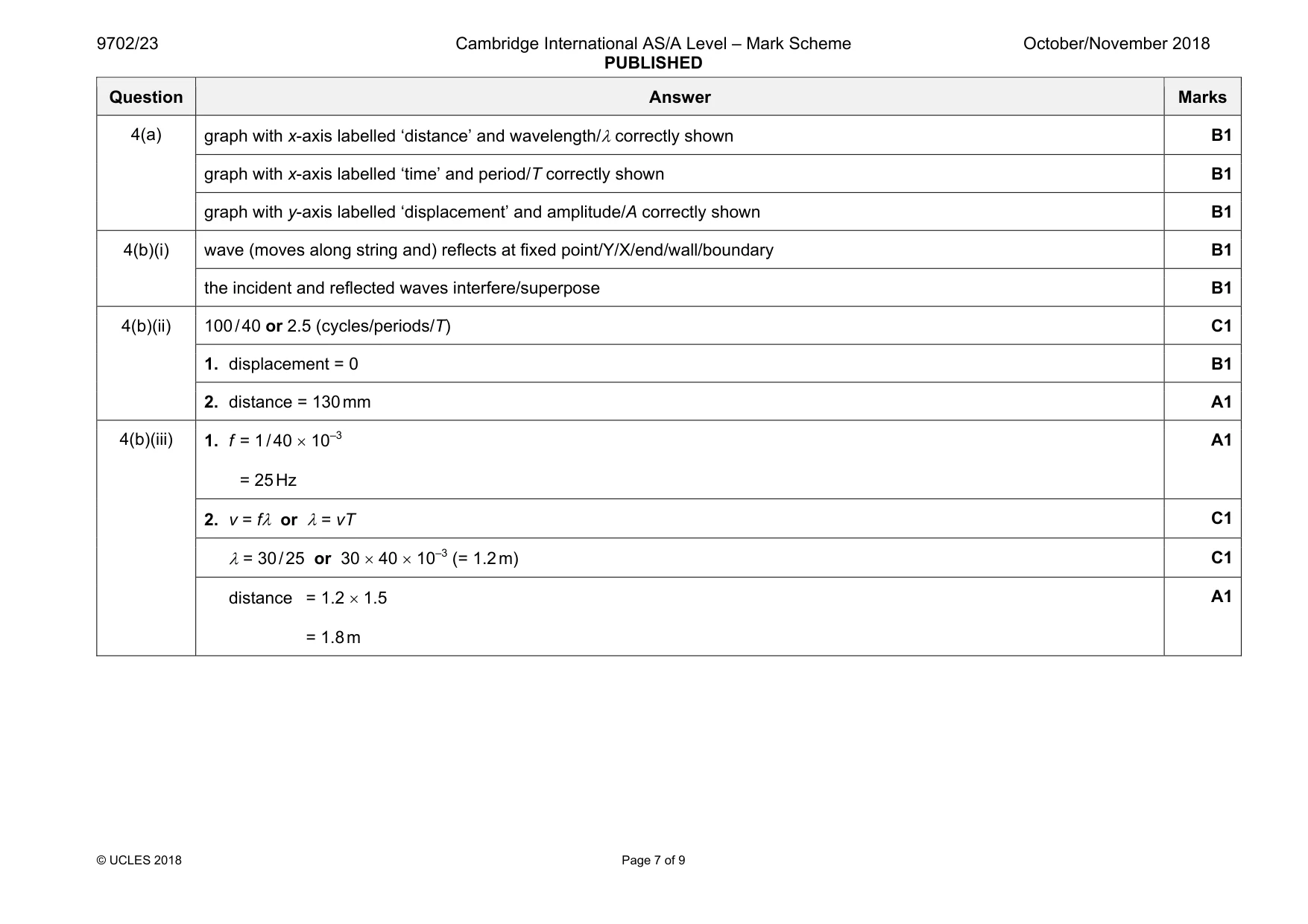
Mark scheme: 4(a) B1 graph with x-axis labelled ‘time’ and period/T correctly shown B1 graph with y-axis labelled ‘displacement’ and amplitude/A correctly shown B1 4(b)(i) wave (moves along string and) reflects at fixed point/Y/X/end/wall/boundary B1 the incident and reflected waves interfere/superpose B1 4(b)(ii) 100 / 40 or 2.5 (cycles/periods/T) C1 1. displacement = 0 B1 2. distance = 130 mm A1 4(b)(iii) 1. f = 1 / 40 × 10–3 = 25 Hz A1 2. v = fλ or λ = vT C1 λ = 30 / 25 or 30 × 40 × 10–3 (= 1.2 m) C1 distance = 1.2 × 1.5 = 1.8 m A1
Q5 · A particle of mass m and charge q is in a uniform electric field of strength E
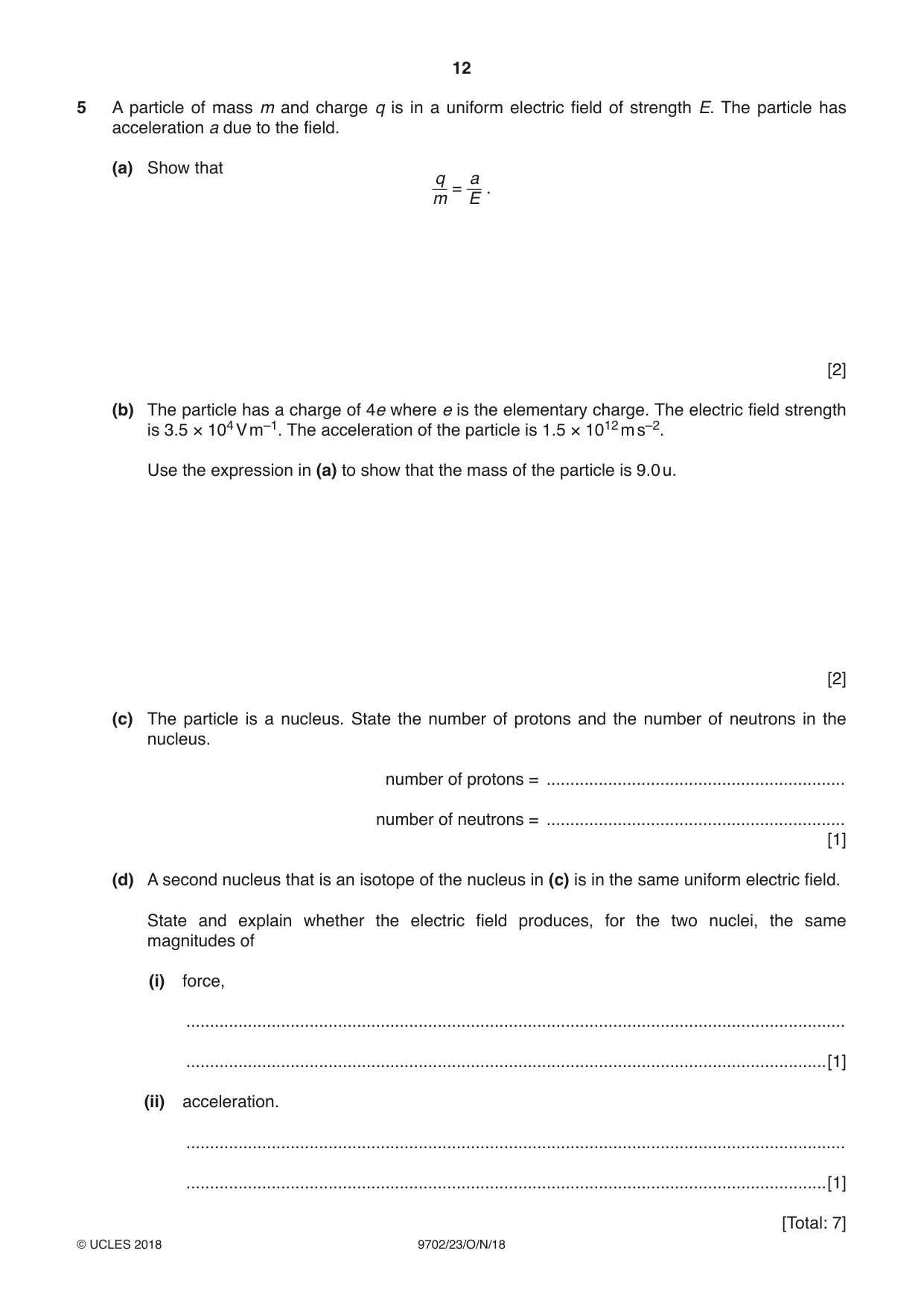
5 A particle of mass m and charge q is in a uniform electric field of strength E. The particle has acceleration a due to the field. (a) Show that q a = . m E [2] (b) The particle has a charge of 4e where e is the elementary charge. The electric field strength is 3.5 × 10⁴ V m–1. The acceleration of the particle is 1.5 × 10¹² m s–2. Use the expression in (a) to show that the mass of the particle is 9.0 u. [2] (c) The particle is a nucleus. State the number of protons and the number of neutrons in the nucleus. number of protons = ............................................................... number of neutrons = ............................................................... [1] (d) A second nucleus that is an isotope of the nucleus in (c) is in the same uniform electric field. State and explain whether the electric field produces, for the two nuclei, the same magnitudes of (i) force, ........................................................................................................................................... .......................................................................................................................................[1] (ii) acceleration. ........................................................................................................................................... .......................................................................................................................................[1] [Total: 7]
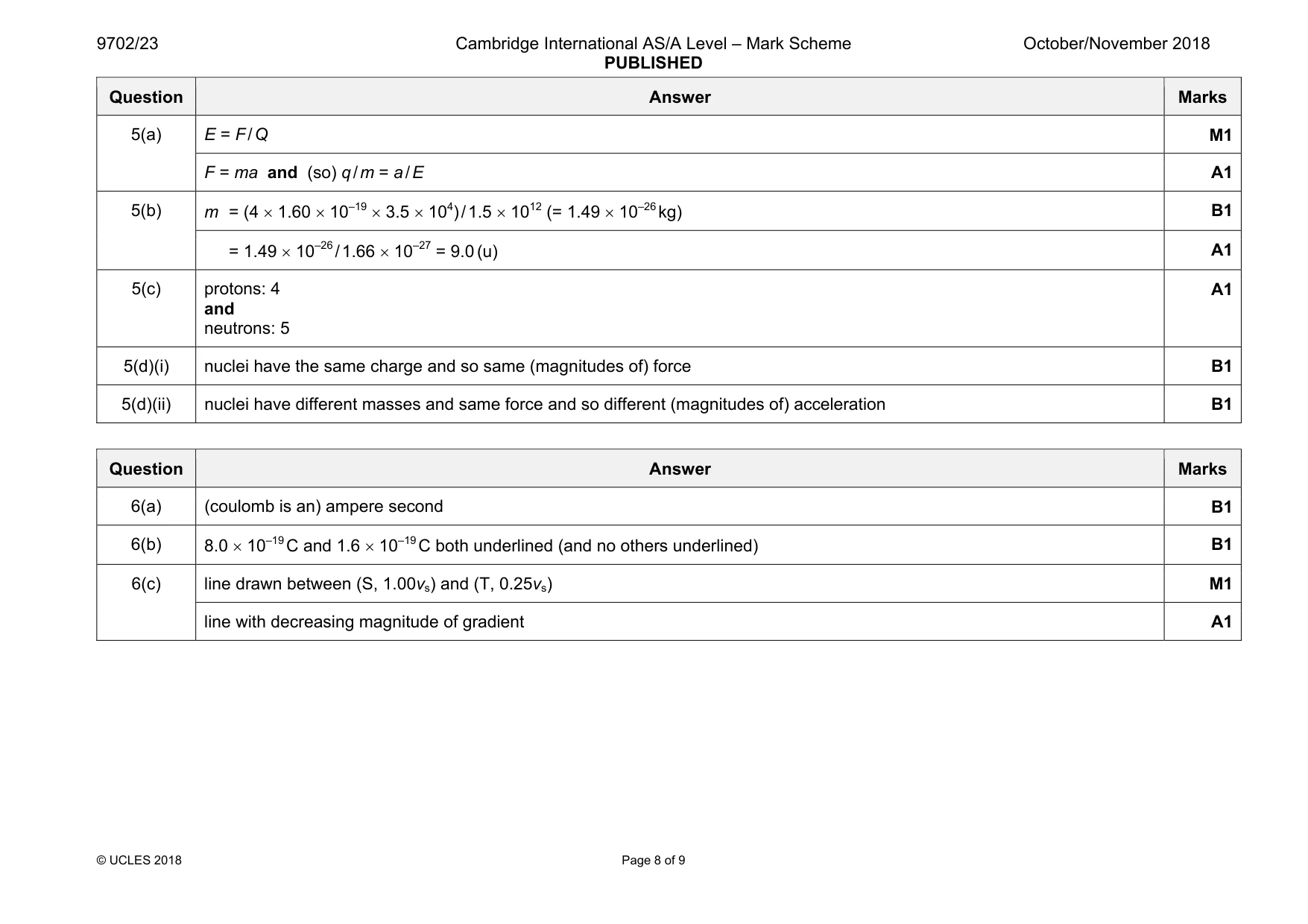
Mark scheme: 5(a) E = F / Q M1 F = ma and (so) q / m = a / E A1 5(b) m = (4 × 1.60 × 10–19 × 3.5 × 104) / 1.5 × 10¹² (= 1.49 × 10⁻²⁶kg) B1 = 1.49 × 10⁻²⁶ / 1.66 × 10–27 = 9.0 (u) A1 5(c) protons: 4 and neutrons: 5 A1 5(d)(i) nuclei have the same charge and so same (magnitudes of) force B1 5(d)(ii) nuclei have different masses and same force and so different (magnitudes of) acceleration B1
Question 6
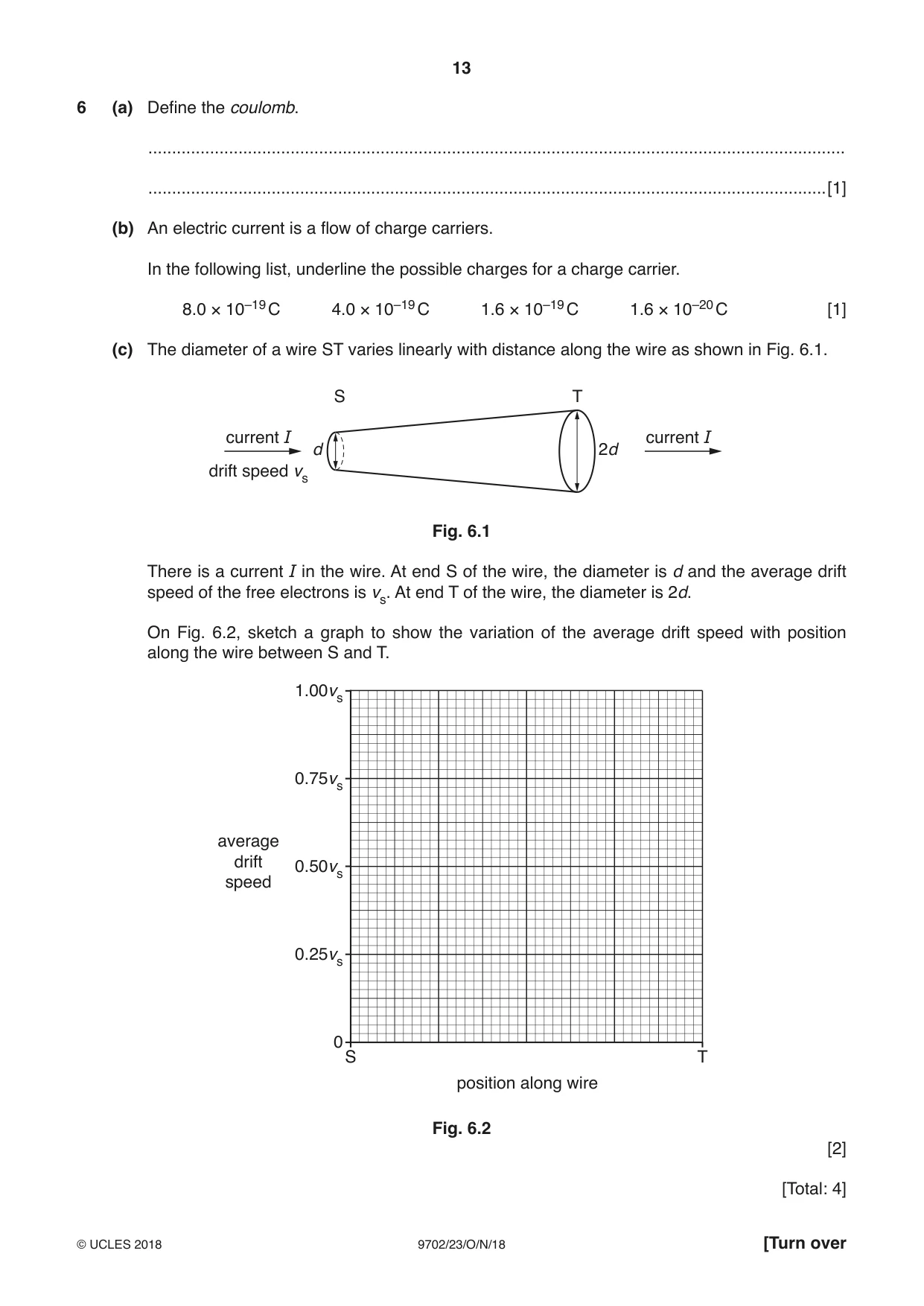
6 (a) Define the coulomb. ................................................................................................................................................... ...............................................................................................................................................[1] (b) An electric current is a flow of charge carriers. In the following list, underline the possible charges for a charge carrier. 8.0 × 10⁻¹⁹ C 4.0 × 10⁻¹⁹ C 1.6 × 10⁻¹⁹ C 1.6 × 10⁻²⁰ C [1] (c) The diameter of a wire ST varies linearly with distance along the wire as shown in Fig. 6.1. S T current I current I d 2d drift speed vs Fig. 6.1 There is a current I in the wire. At end S of the wire, the diameter is d and the average drift speed of the free electrons is vs. At end T of the wire, the diameter is 2d. On Fig. 6.2, sketch a graph to show the variation of the average drift speed with position along the wire between S and T. 1.00vs 0.75vs average drift 0.50vs speed 0.25vs 0 S T position along wire Fig. 6.2 [2] [Total: 4]
Mark scheme: 6(a) (coulomb is an) ampere second B1 6(b) 8.0 × 10⁻¹⁹ C and 1.6 × 10⁻¹⁹ C both underlined (and no others underlined) B1 6(c) line drawn between (S, 1.00vs) and (T, 0.25vs) M1 line with decreasing magnitude of gradient A1
Q7 · State Kirchhoff’s first law
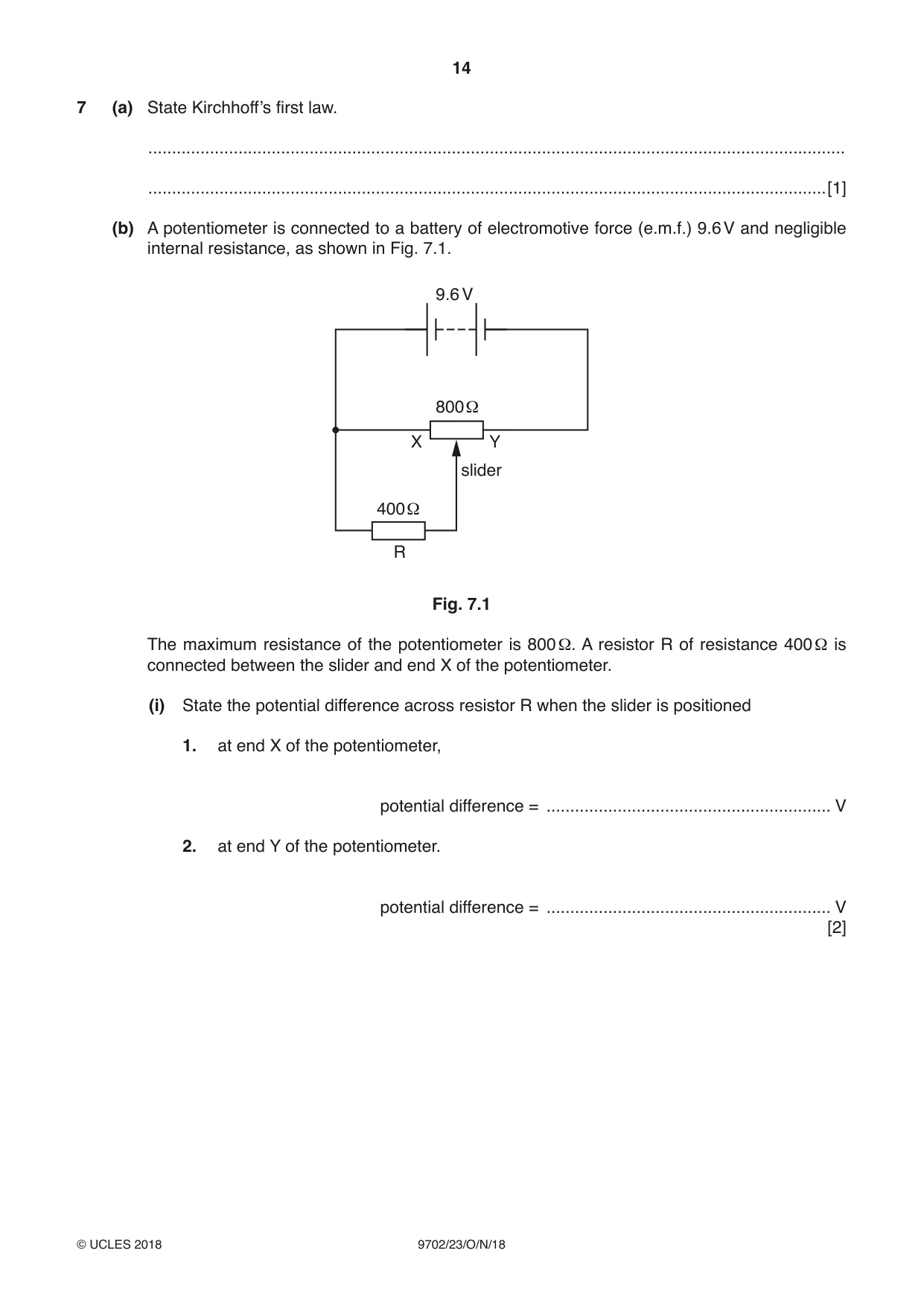
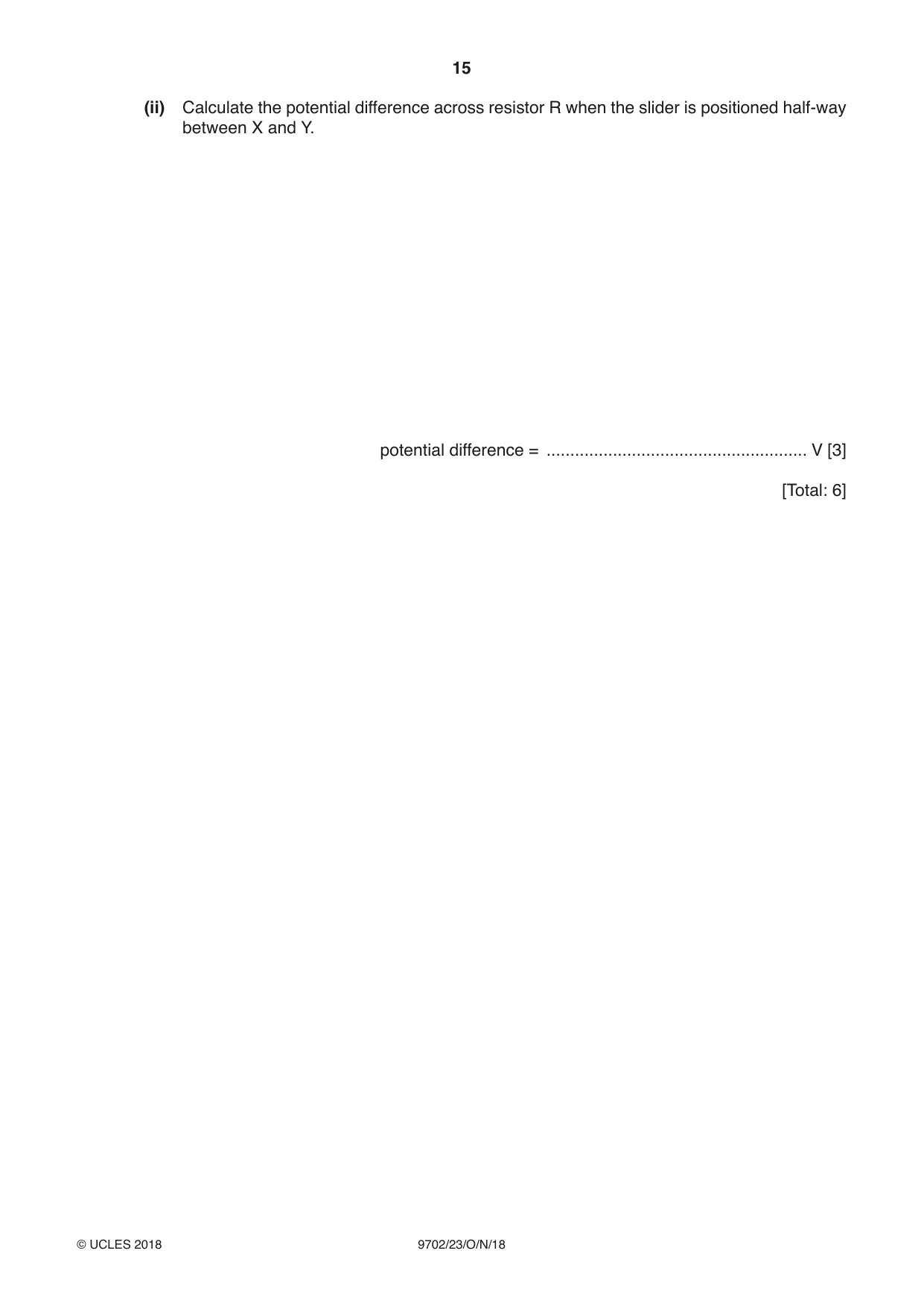
7 (a) State Kirchhoff’s first law. ................................................................................................................................................... ...............................................................................................................................................[1] (b) A potentiometer is connected to a battery of electromotive force (e.m.f.) 9.6 V and negligible internal resistance, as shown in Fig. 7.1. 9.6 V 800 Ω X Y slider 400Ω R Fig. 7.1 The maximum resistance of the potentiometer is 800 Ω. A resistor R of resistance 400 Ω is connected between the slider and end X of the potentiometer. (i) State the potential difference across resistor R when the slider is positioned 1. at end X of the potentiometer, potential difference = ............................................................ V 2. at end Y of the potentiometer. potential difference = ............................................................ V [2] (ii) Calculate the potential difference across resistor R when the slider is positioned half-way between X and Y. potential difference = ....................................................... V [3] [Total: 6]
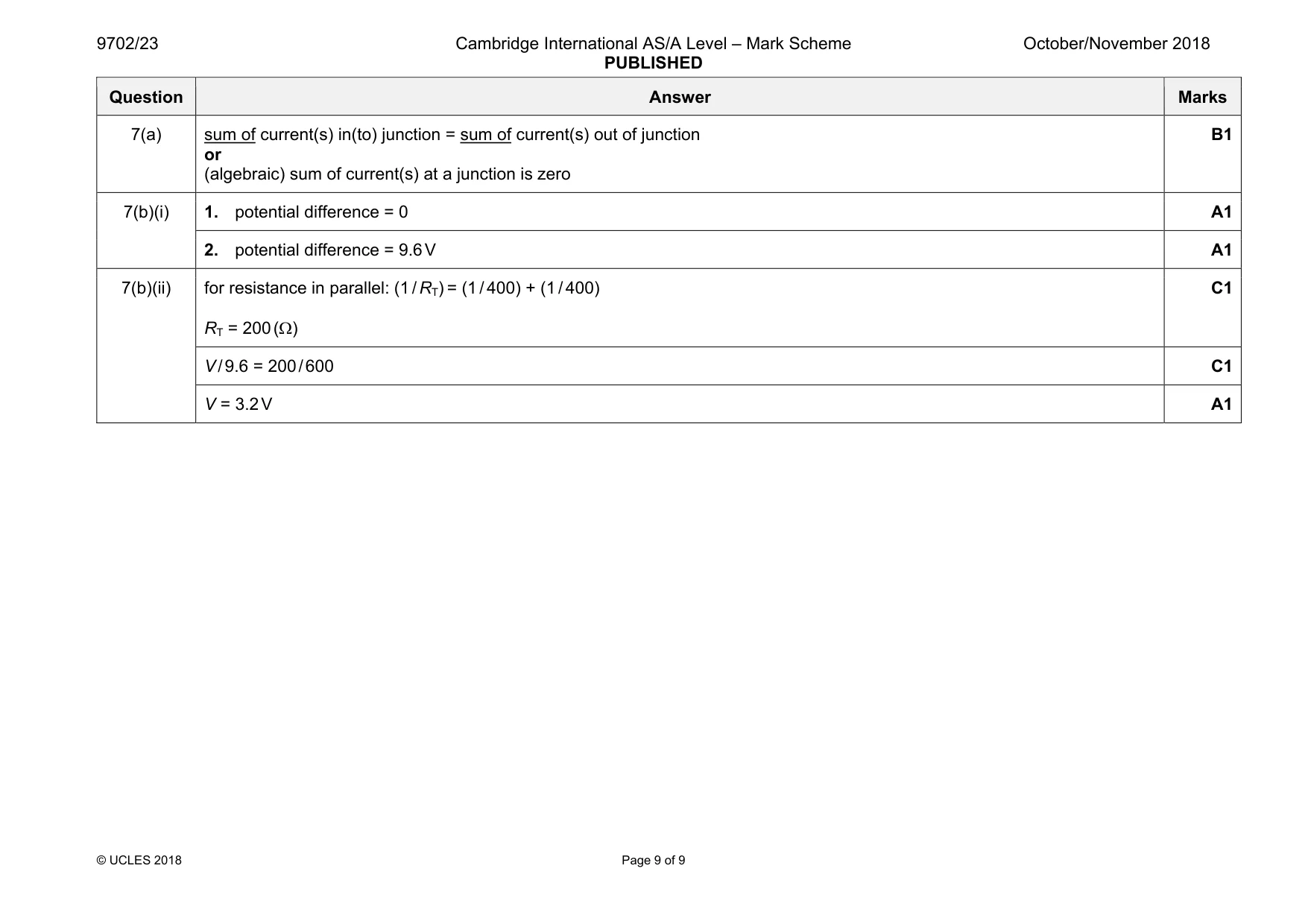
Mark scheme: 7(a) sum of current(s) in(to) junction = sum of current(s) out of junction or (algebraic) sum of current(s) at a junction is zero B1 7(b)(i) 1. potential difference = 0 A1 2. potential difference = 9.6 V A1 7(b)(ii) for resistance in parallel: (1 / RT) = (1 / 400) + (1 / 400) RT = 200 (Ω) C1 V / 9.6 = 200 / 600 C1 V = 3.2 V A1
What was in this paper
The subtopics covered by these 7 questions, and how many questions each got. Open one in a new tab to see every Cambridge question on it.
What you needed in this session
Cambridge’s own grade thresholds for 2018 Oct/Nov, Paper 2 · Variant 3. A higher threshold means an easier paper — the bar moves with how the cohort did.