Cambridge A Level Physics 9702 — 2022 Feb/March Paper 2 · Variant 2
9702/22/F/M/22 · 7 questions · 60 marks · ≈68 min
The question paper and its mark scheme, free to read here and free to download. This is Cambridge’s own paper, exactly as it was sat.
Question paper20 pages

Mark scheme12 pages
Answers below. Sit the paper first if you are practising.
Questions as text
Q1 · A sphere of radius 2.1 mm falls with terminal (constant) velocity through a liquid, as…
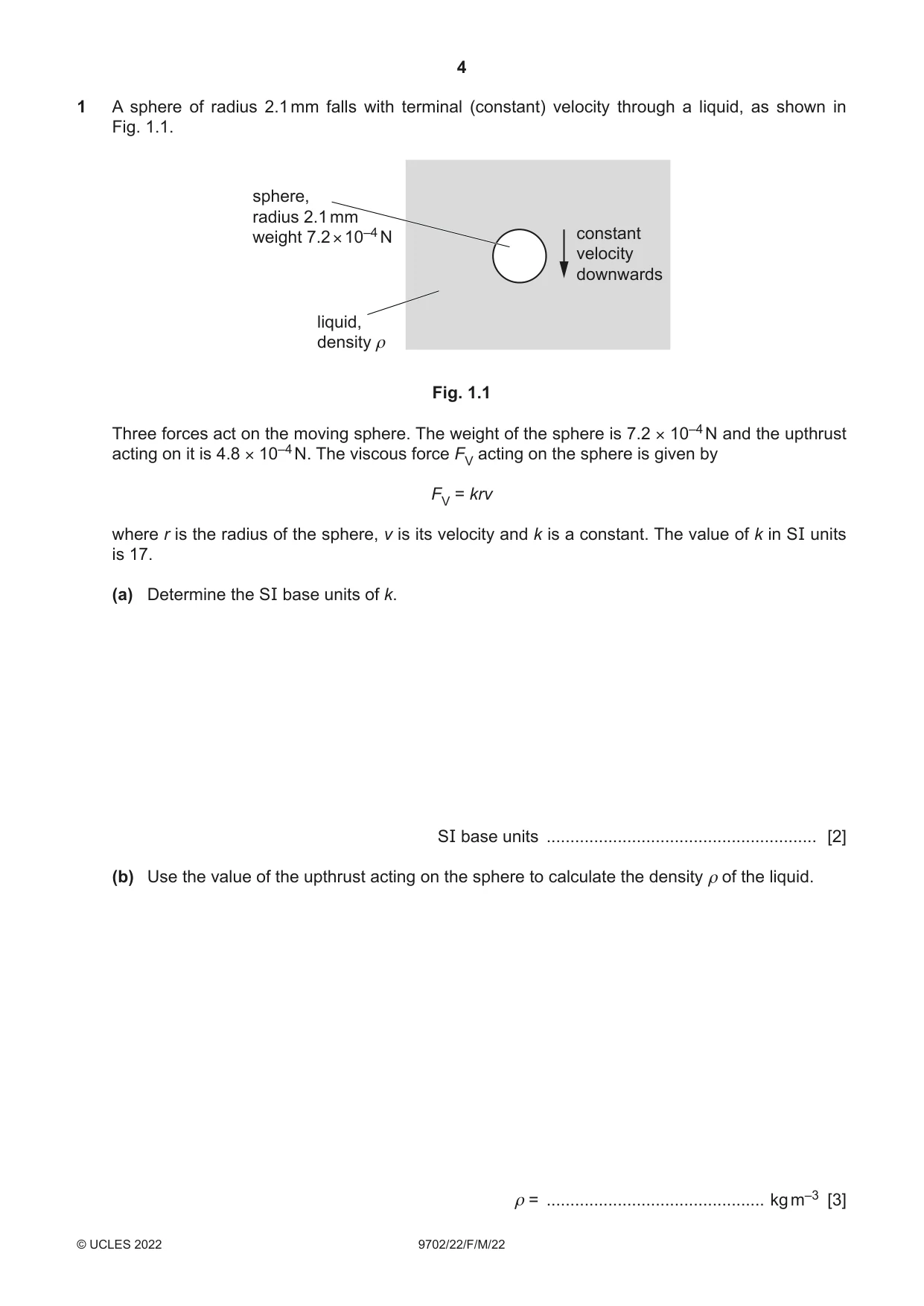
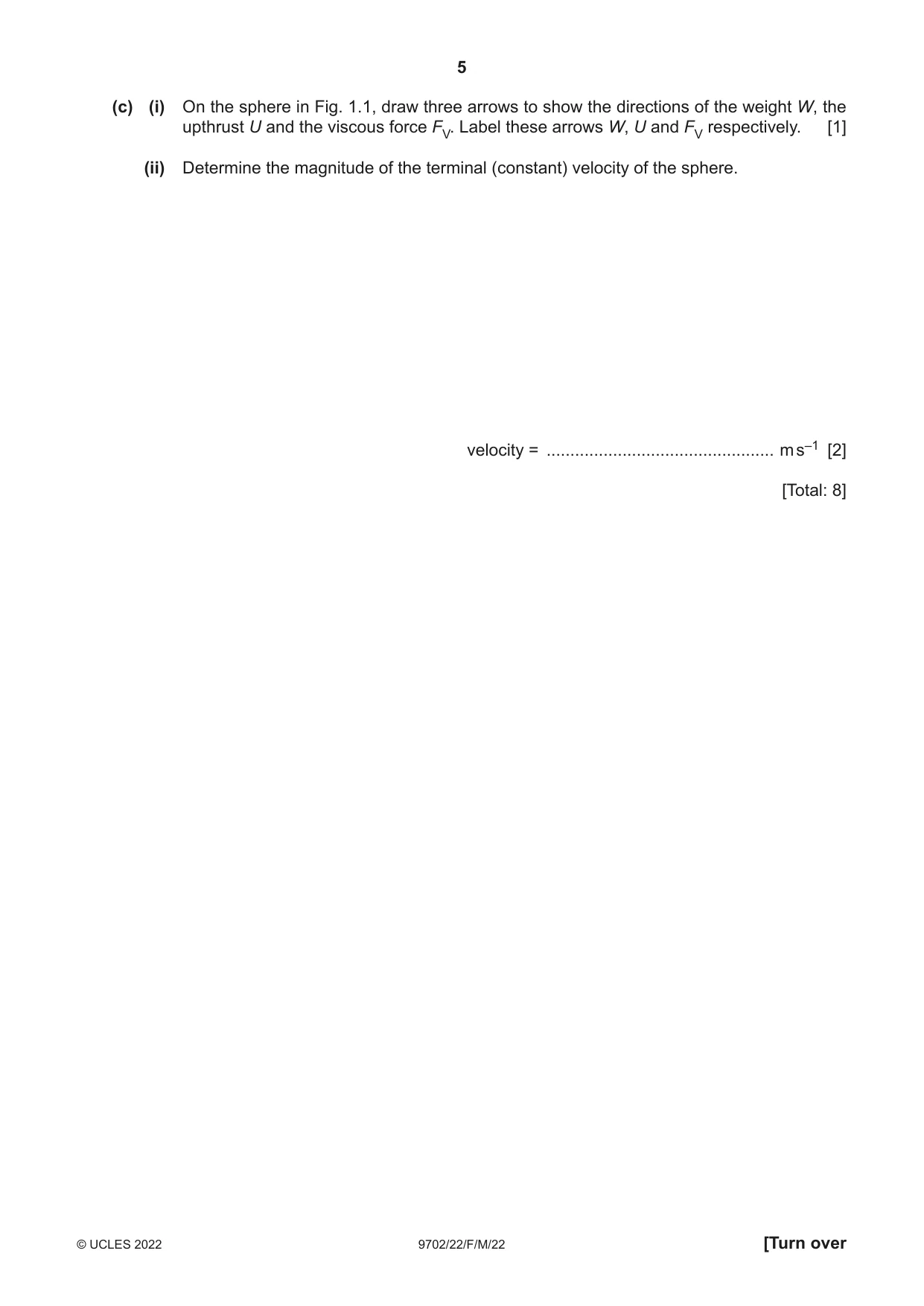
1 A sphere of radius 2.1 mm falls with terminal (constant) velocity through a liquid, as shown in Fig. 1.1. sphere, radius 2.1 mm weight 7.2 × 10⁻⁴ N constant velocity downwards liquid, density ρ Fig. 1.1 Three forces act on the moving sphere. The weight of the sphere is 7.2 × 10⁻⁴ N and the upthrust acting on it is 4.8 × 10⁻⁴ N. The viscous force FV acting on the sphere is given by FV = krv where r is the radius of the sphere, v is its velocity and k is a constant. The value of k in SI units is 17. (a) Determine the SI base units of k. SI base units ......................................................... [2] (b) Use the value of the upthrust acting on the sphere to calculate the density ρ of the liquid. ρ = .............................................. kg m–3 [3] (c) (i) On the sphere in Fig. 1.1, draw three arrows to show the directions of the weight W, the upthrust U and the viscous force FV. Label these arrows W, U and FV respectively. [1] (ii) Determine the magnitude of the terminal (constant) velocity of the sphere. velocity = ................................................ m s–1 [2] [Total: 8]
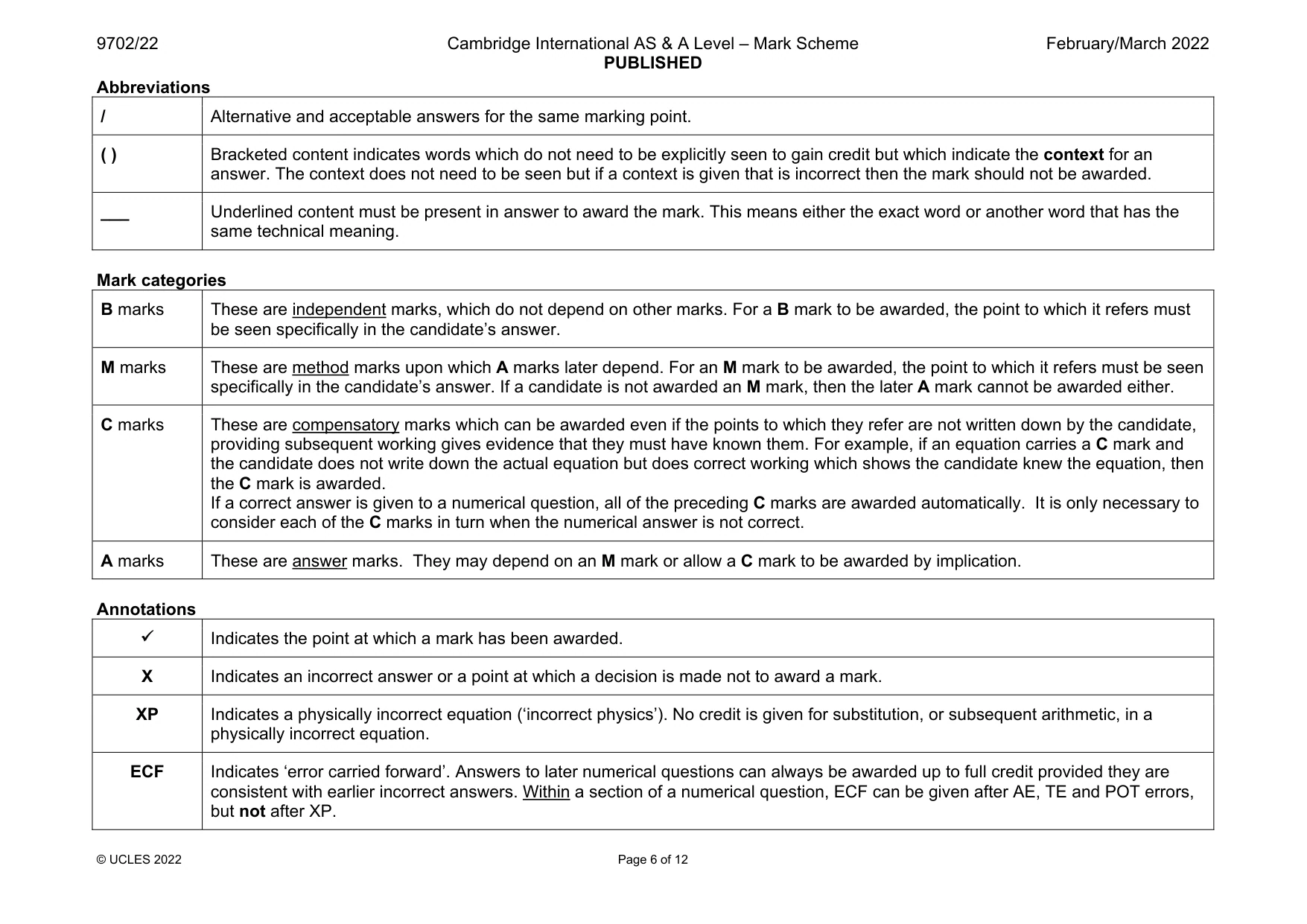
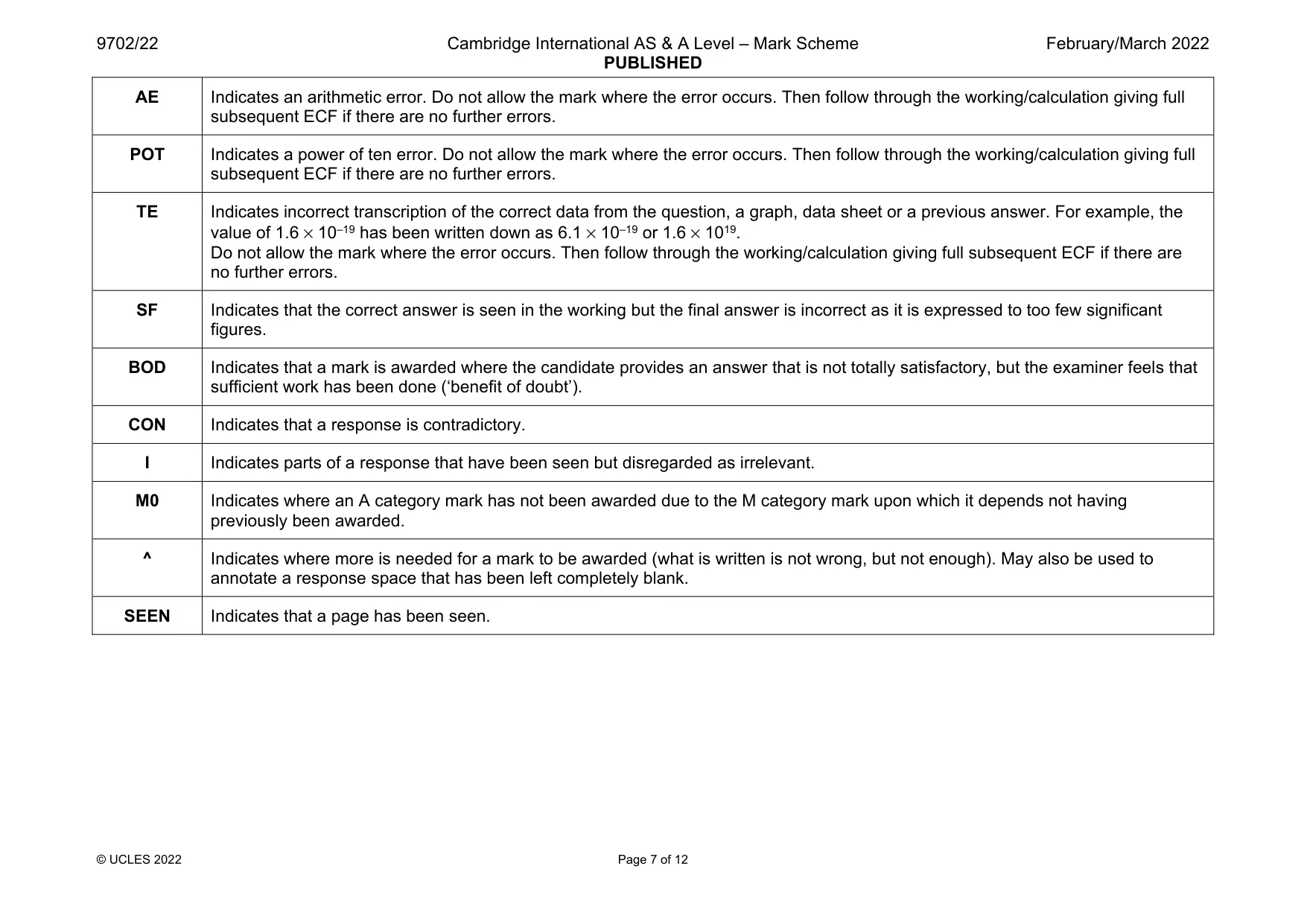
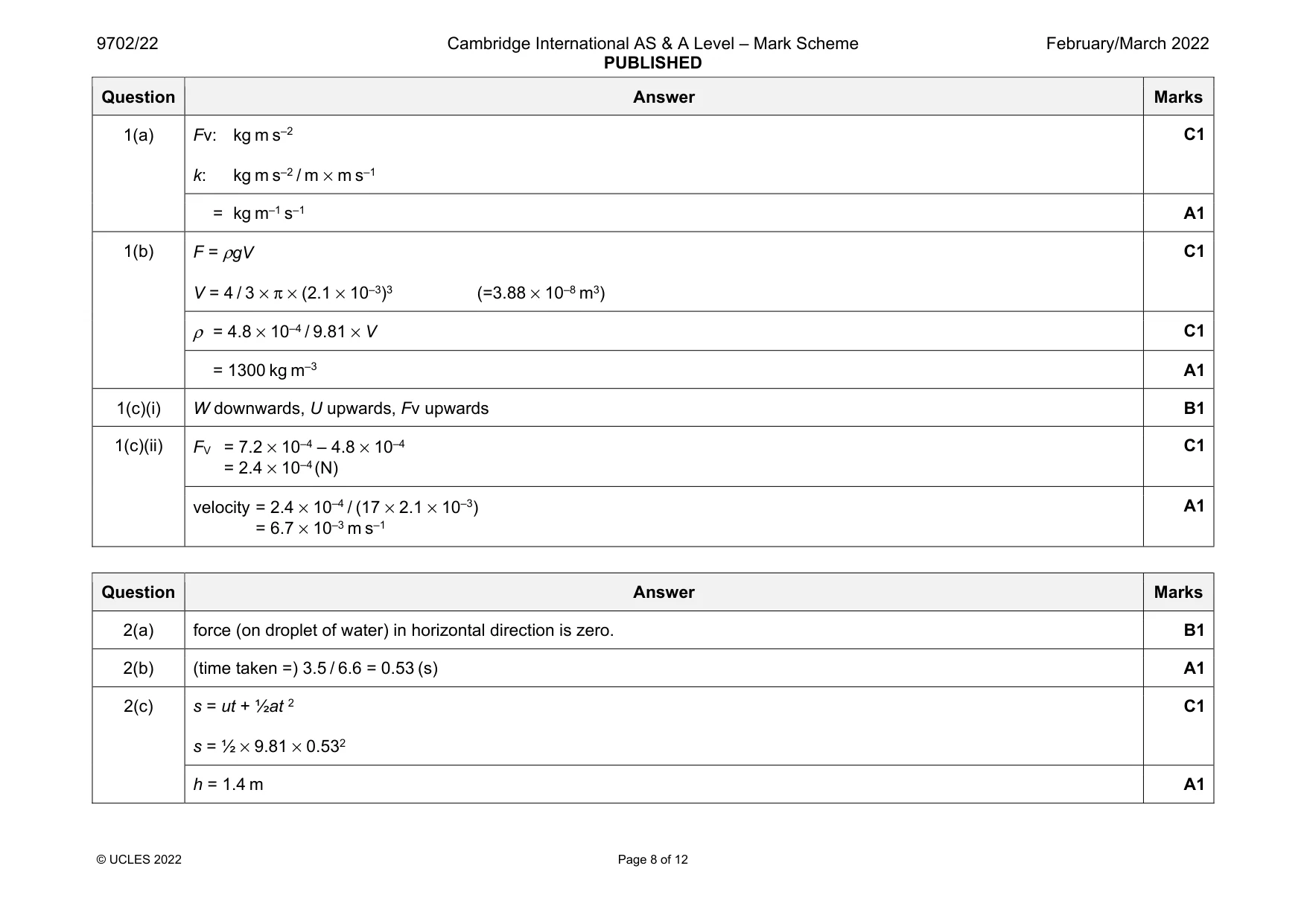
Mark scheme: 1(a) Fv: kg m s–2 k: kg m s–2 / m × m s–1 = kg m–1 s–1 A1 1(b) F = ρgV V = 4 / 3 × π × (2.1 × 10⁻³)3 (=3.88 × 10⁻⁸ m3) C1 ρ = 4.8 × 10⁻⁴ / 9.81 × V C1 = 1300 kg m–3 A1 1(c)(i) W downwards, U upwards, Fv upwards B1 1(c)(ii) FV = 7.2 × 10⁻⁴ – 4.8 × 10–4 = 2.4 × 10⁻⁴ (N) C1 velocity = 2.4 × 10⁻⁴ / (17 × 2.1 × 10–3) = 6.7 × 10⁻³ m s–1 A1
Q2 · Water leaves the end of a hose pipe at point P with a horizontal velocity of 6.6 m s–1…
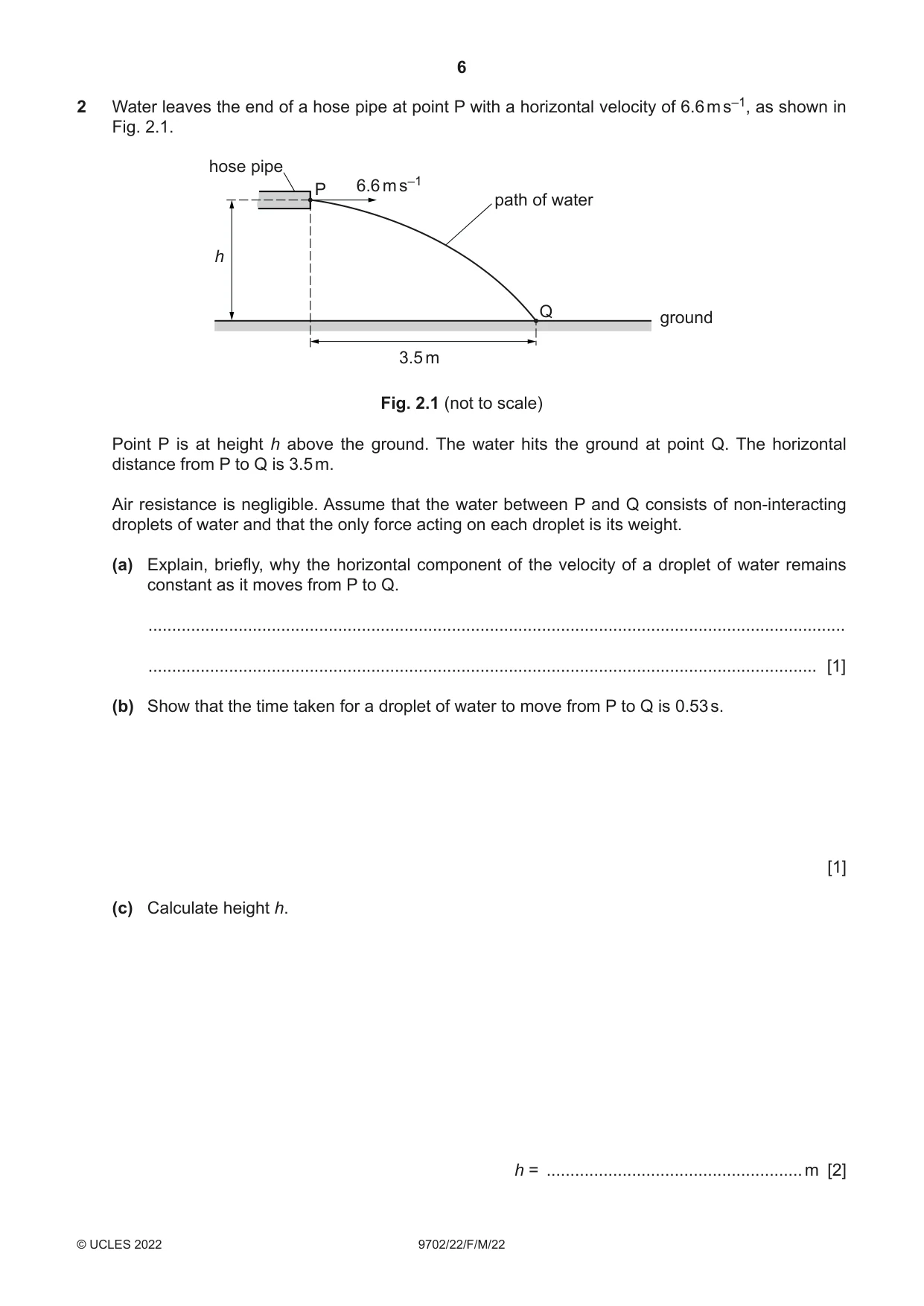
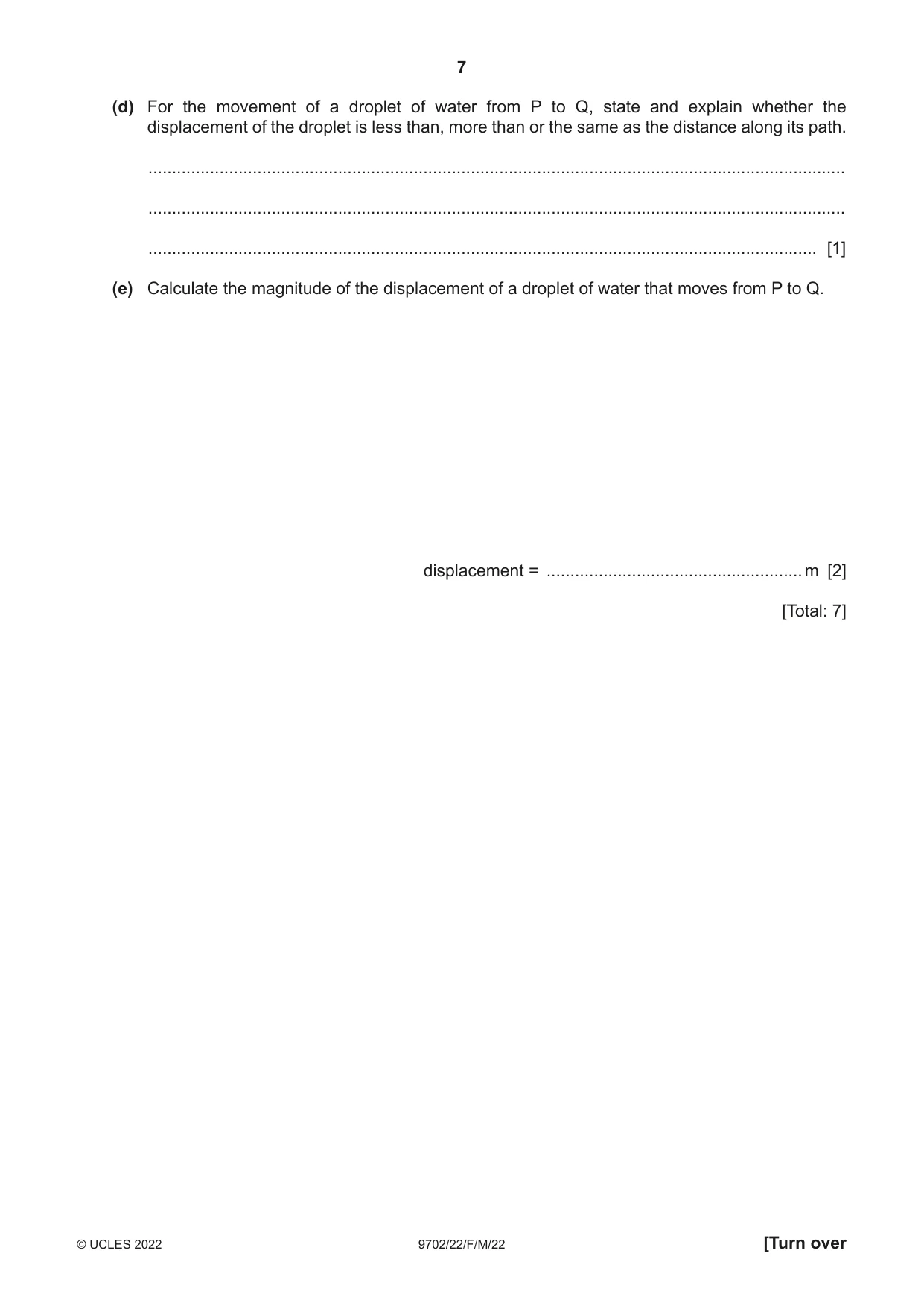
2 Water leaves the end of a hose pipe at point P with a horizontal velocity of 6.6 m s–1, as shown in Fig. 2.1. hose pipe P 6.6 m s–1 path of water h Q ground 3.5 m Fig. 2.1 (not to scale) Point P is at height h above the ground. The water hits the ground at point Q. The horizontal distance from P to Q is 3.5 m. Air resistance is negligible. Assume that the water between P and Q consists of non-interacting droplets of water and that the only force acting on each droplet is its weight. (a) Explain, briefly, why the horizontal component of the velocity of a droplet of water remains constant as it moves from P to Q. ................................................................................................................................................... ............................................................................................................................................. [1] (b) Show that the time taken for a droplet of water to move from P to Q is 0.53 s. [1] (c) Calculate height h. h = ...................................................... m [2] (d) For the movement of a droplet of water from P to Q, state and explain whether the displacement of the droplet is less than, more than or the same as the distance along its path. ................................................................................................................................................... ................................................................................................................................................... ............................................................................................................................................. [1] (e) Calculate the magnitude of the displacement of a droplet of water that moves from P to Q. displacement = ...................................................... m [2] [Total: 7]
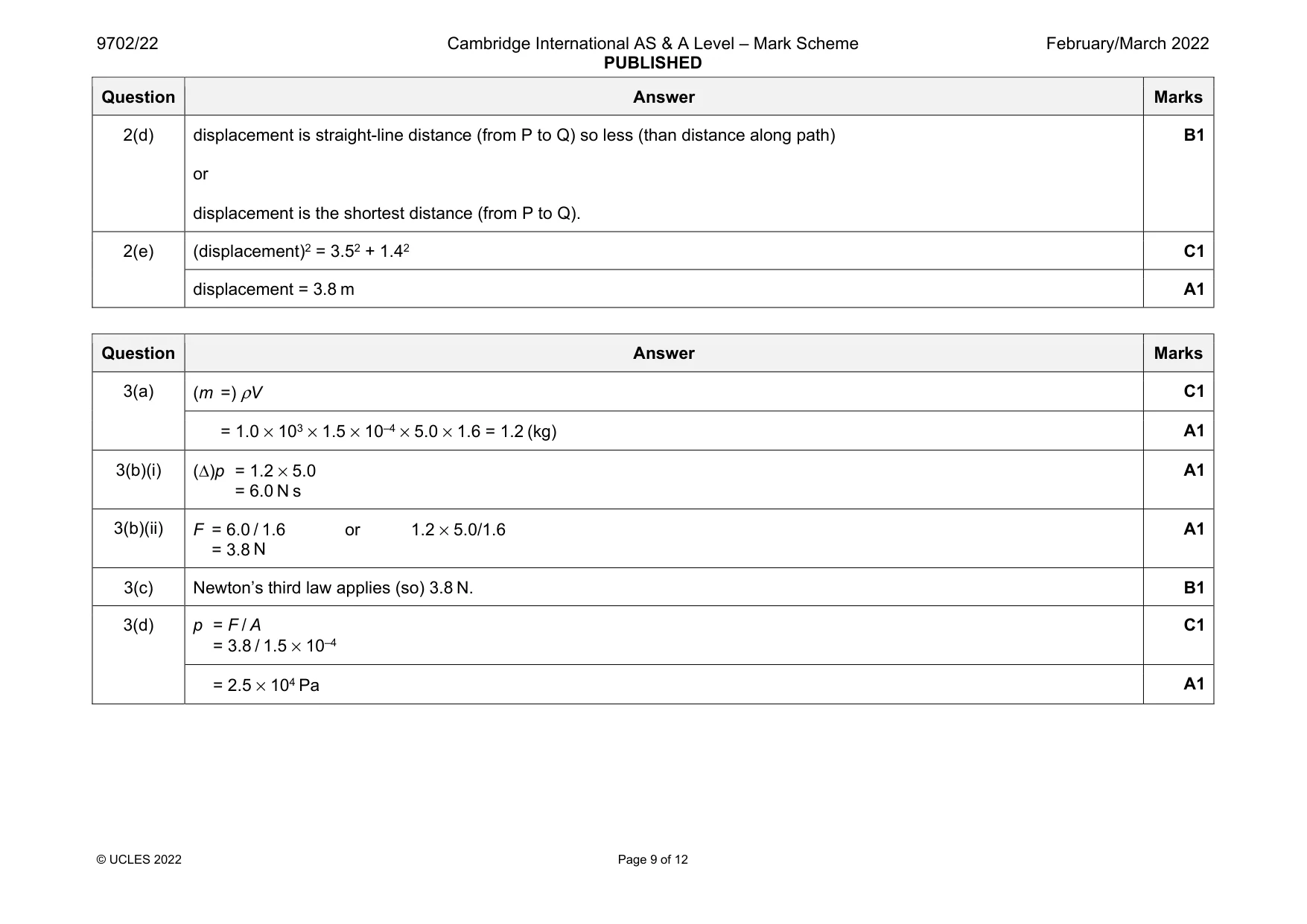
Mark scheme: 2(a) force (on droplet of water) in horizontal direction is zero. B1 2(b) (time taken =) 3.5 / 6.6 = 0.53 (s) A1 2(c) s = ut + ½at 2 s = ½ × 9.81 × 0.532 C1 h = 1.4 m A1 Question Answer Marks 2(d) displacement is straight-line distance (from P to Q) so less (than distance along path) or displacement is the shortest distance (from P to Q). B1 2(e) (displacement)2 = 3.52 + 1.42 C1 displacement = 3.8 m A1
Q3 · A jet of water hits a vertical wall at right angles, as shown in Fig
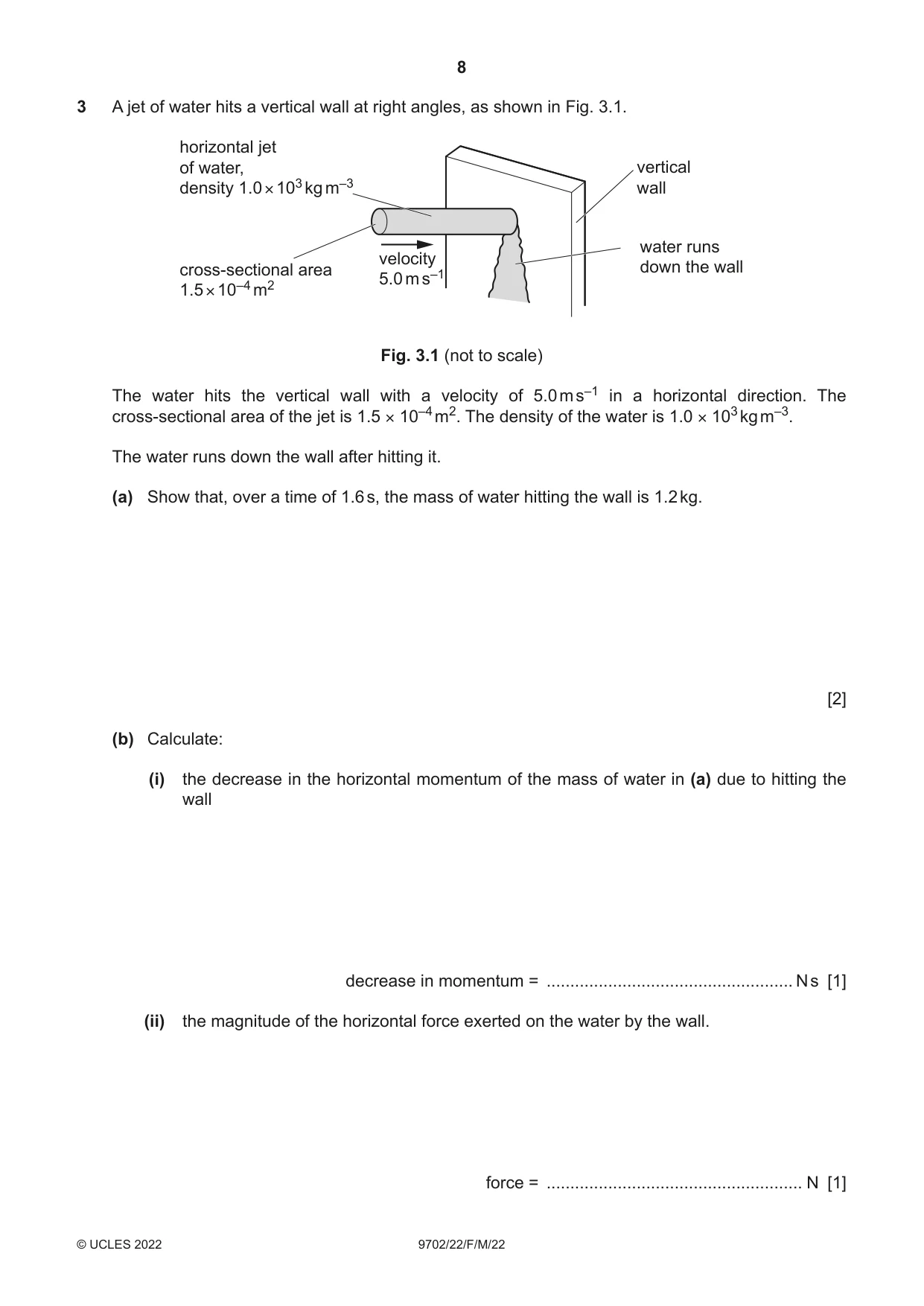
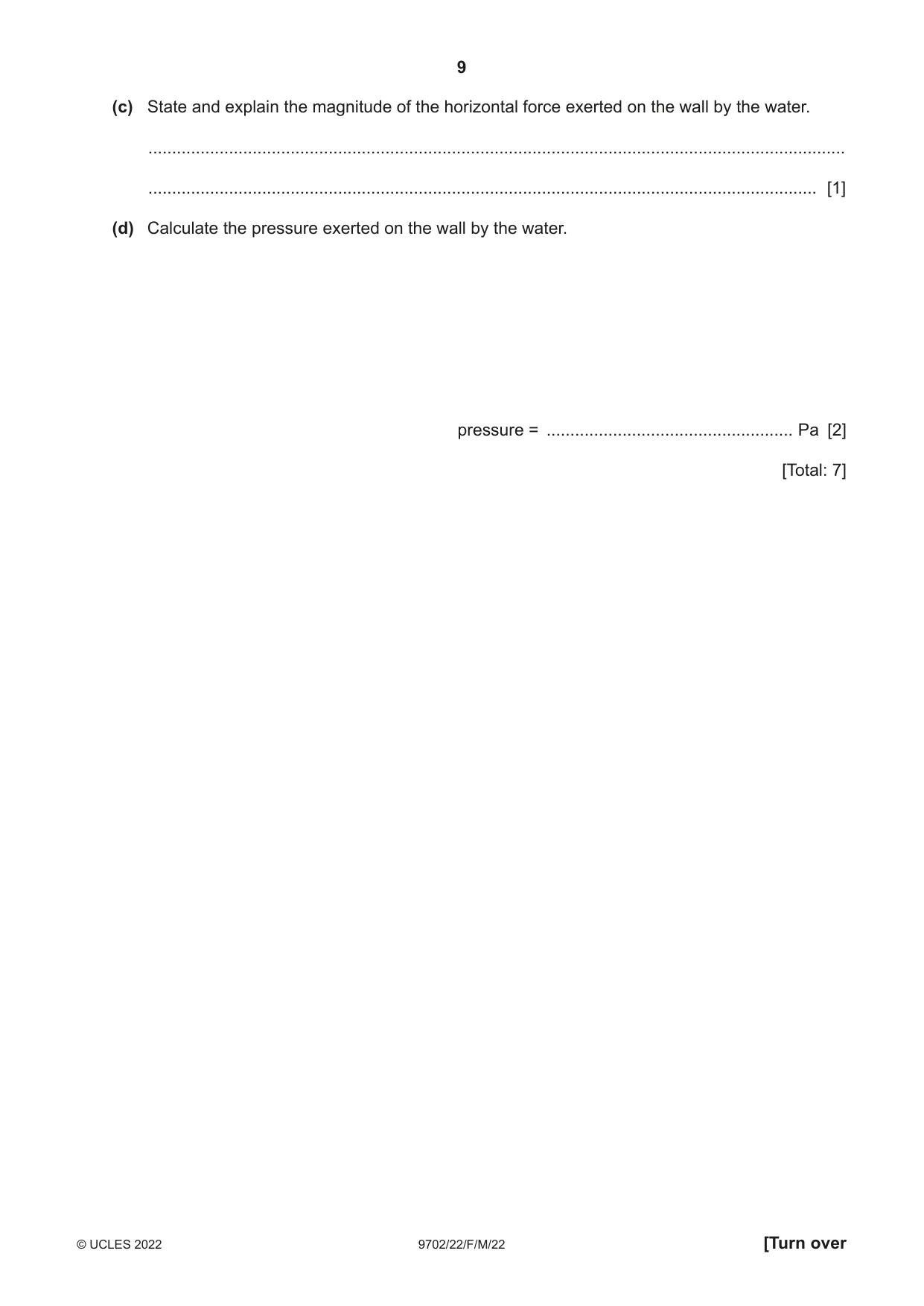
3 A jet of water hits a vertical wall at right angles, as shown in Fig. 3.1. horizontal jet of water, vertical density 1.0 × 10³ kg m–3 wall water runs velocity cross-sectional area down the wall 5.0 m s–1 1.5 × 10⁻⁴ m2 Fig. 3.1 (not to scale) The water hits the vertical wall with a velocity of 5.0 m s–1 in a horizontal direction. The cross-sectional area of the jet is 1.5 × 10⁻⁴ m2. The density of the water is 1.0 × 10³ kg m–3. The water runs down the wall after hitting it. (a) Show that, over a time of 1.6 s, the mass of water hitting the wall is 1.2 kg. [2] (b) Calculate: (i) the decrease in the horizontal momentum of the mass of water in (a) due to hitting the wall decrease in momentum = .................................................... N s [1] (ii) the magnitude of the horizontal force exerted on the water by the wall. force = ...................................................... N [1] (c) State and explain the magnitude of the horizontal force exerted on the wall by the water. ................................................................................................................................................... ............................................................................................................................................. [1] (d) Calculate the pressure exerted on the wall by the water. pressure = .................................................... Pa [2] [Total: 7]
Mark scheme: 3(a) (m =) ρV C1 = 1.0 × 103 × 1.5 × 10–4 × 5.0 × 1.6 = 1.2 (kg) A1 3(b)(i) (∆)p = 1.2 × 5.0 = 6.0 N s A1 3(b)(ii) F = 6.0 / 1.6 or 1.2 × 5.0/1.6 = 3.8 N A1 3(c) Newton’s third law applies (so) 3.8 N. B1 3(d) p = F / A = 3.8 / 1.5 × 10⁻⁴ C1 = 2.5 × 10⁴ Pa A1
Q4 · A child moves down a long slide, as shown in Fig
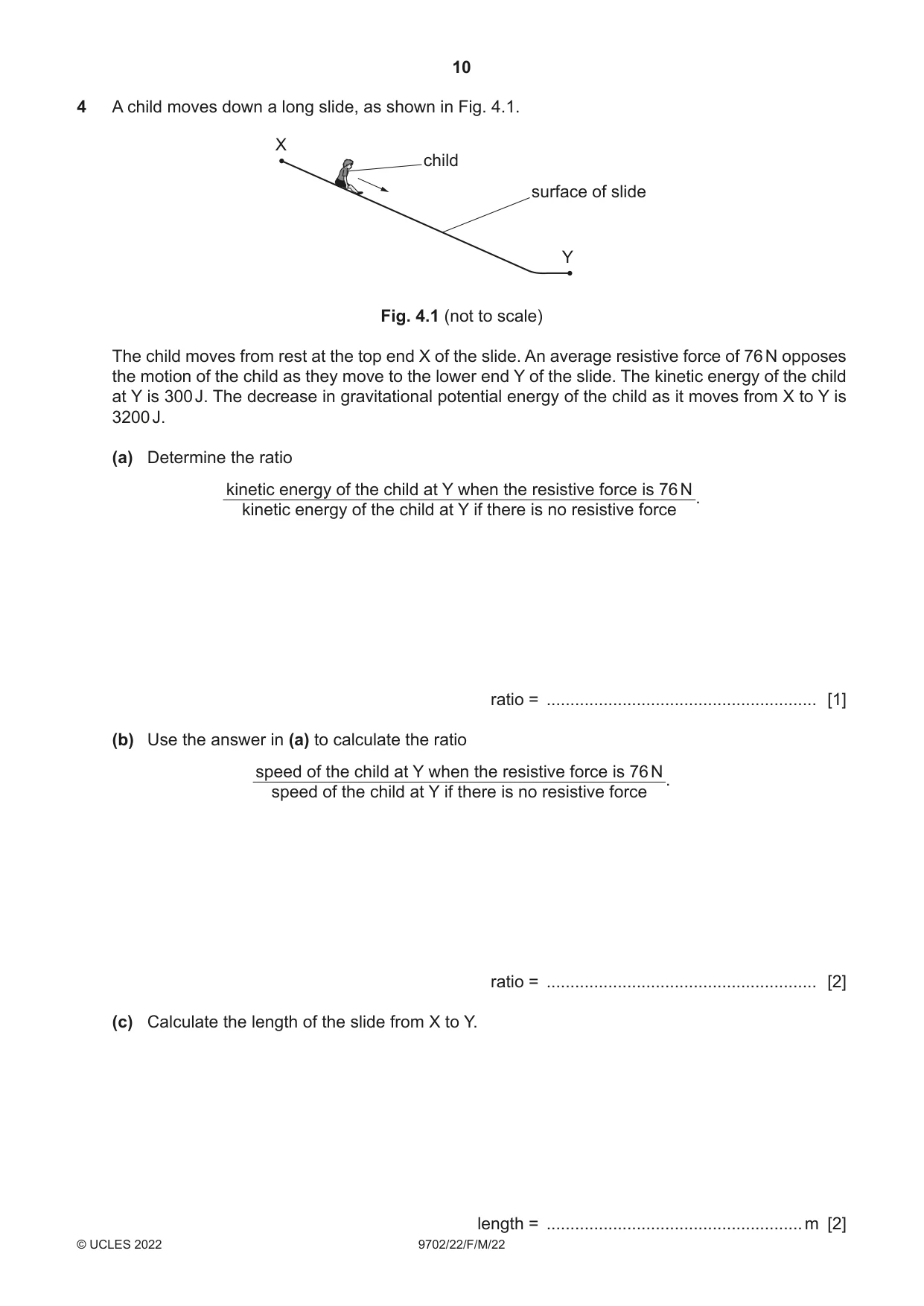
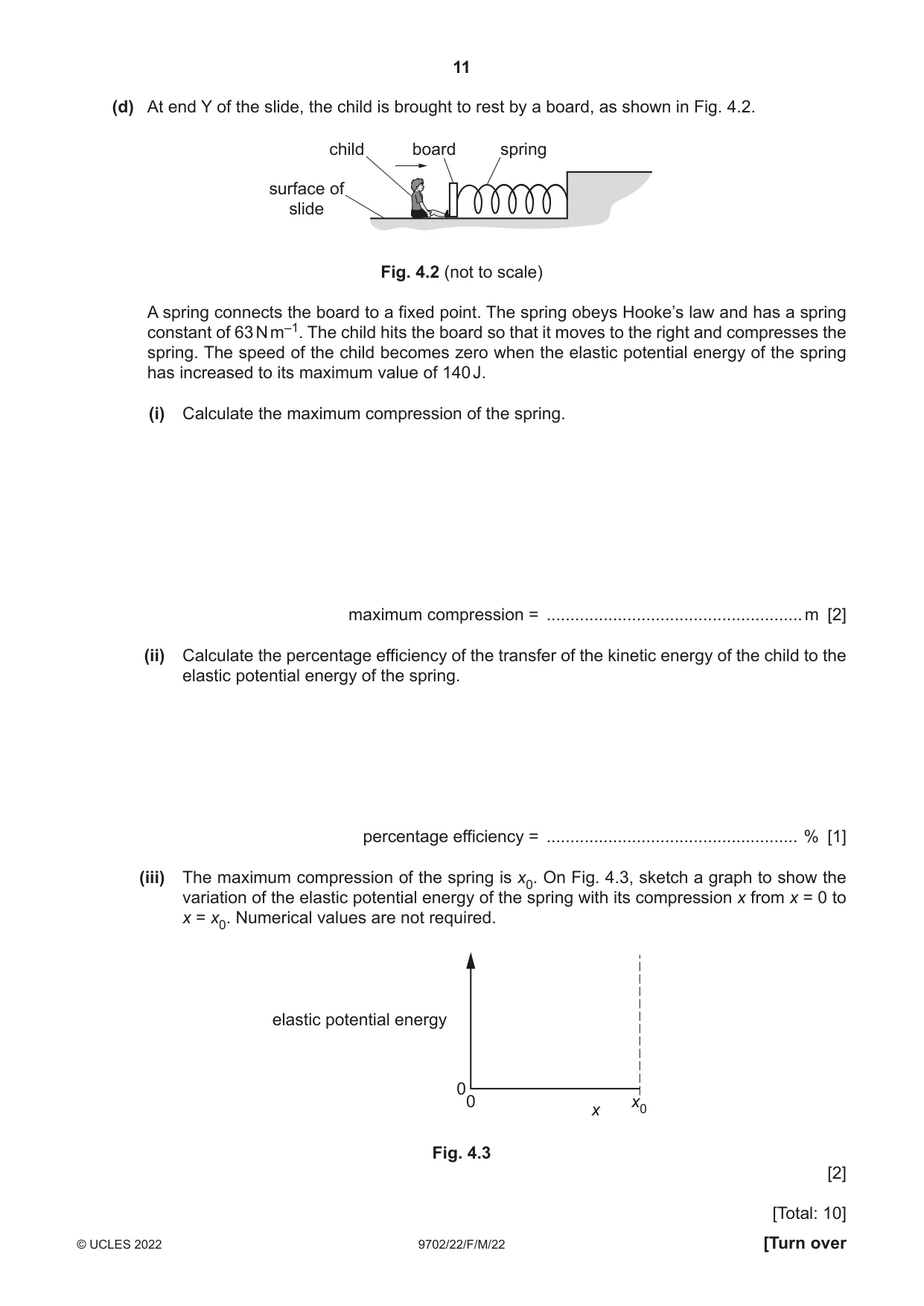
4 A child moves down a long slide, as shown in Fig. 4.1. X child surface of slide Y Fig. 4.1 (not to scale) The child moves from rest at the top end X of the slide. An average resistive force of 76 N opposes the motion of the child as they move to the lower end Y of the slide. The kinetic energy of the child at Y is 300 J. The decrease in gravitational potential energy of the child as it moves from X to Y is 3200 J. (a) Determine the ratio kinetic energy of the child at Y when the resistive force is 76 N . kinetic energy of the child at Y if there is no resistive force ratio = ......................................................... [1] (b) Use the answer in (a) to calculate the ratio speed of the child at Y when the resistive force is 76 N . speed of the child at Y if there is no resistive force ratio = ......................................................... [2] (c) Calculate the length of the slide from X to Y. length = ...................................................... m [2] (d) At end Y of the slide, the child is brought to rest by a board, as shown in Fig. 4.2. child board spring surface of slide Fig. 4.2 (not to scale) A spring connects the board to a fixed point. The spring obeys Hooke’s law and has a spring constant of 63 N m–1. The child hits the board so that it moves to the right and compresses the spring. The speed of the child becomes zero when the elastic potential energy of the spring has increased to its maximum value of 140 J. (i) Calculate the maximum compression of the spring. maximum compression = ...................................................... m [2] (ii) Calculate the percentage efficiency of the transfer of the kinetic energy of the child to the elastic potential energy of the spring. percentage efficiency = ..................................................... % [1] (iii) The maximum compression of the spring is x0. On Fig. 4.3, sketch a graph to show the variation of the elastic potential energy of the spring with its compression x from x = 0 to x = x0. Numerical values are not required. elastic potential energy 00 x x0 Fig. 4.3 [2] [Total: 10]
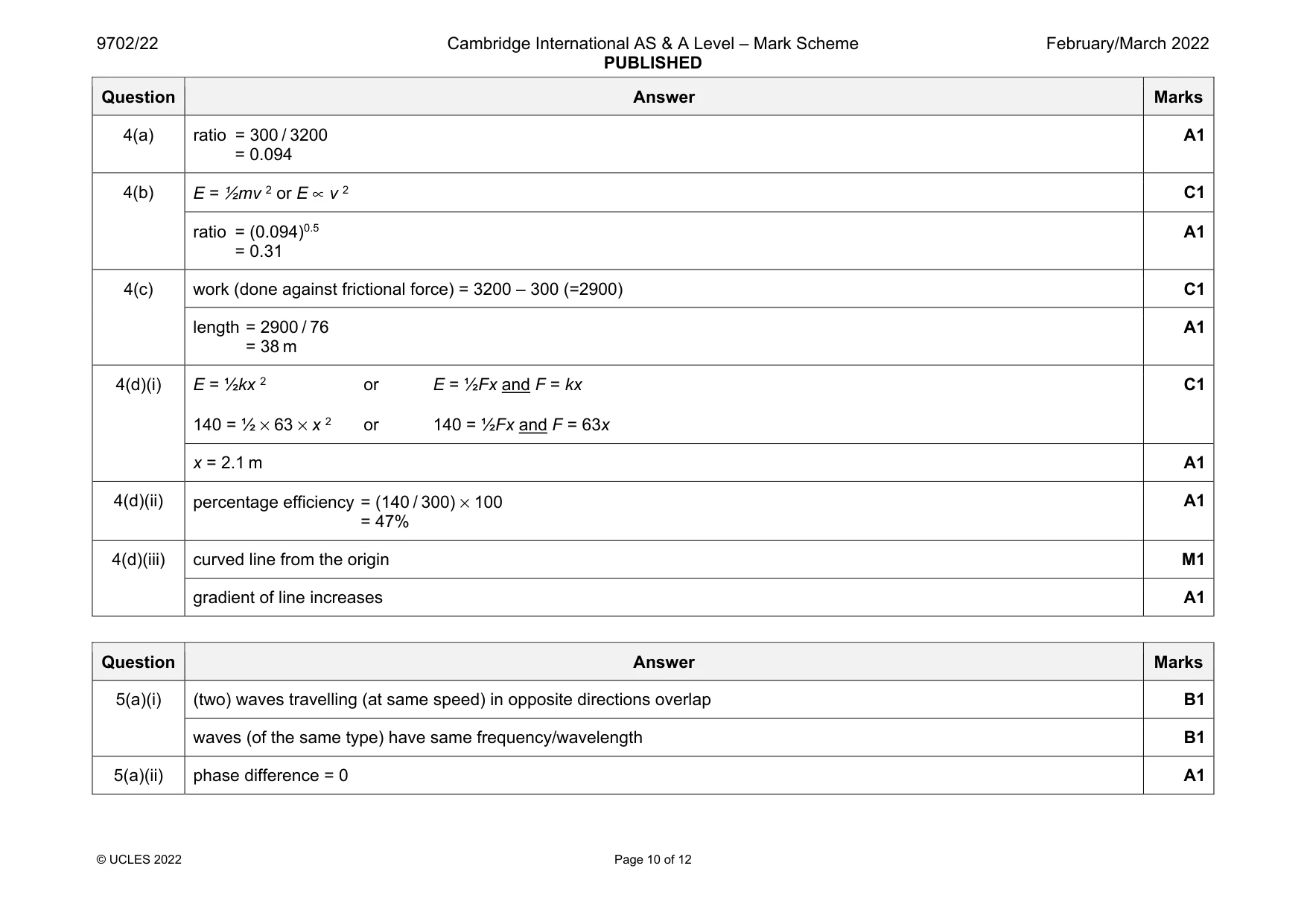
Mark scheme: 4(a) ratio = 300 / 3200 = 0.094 A1 4(b) E = ½mv 2 or E ∝ v 2 C1 ratio = (0.094)0.5 = 0.31 A1 4(c) work (done against frictional force) = 3200 – 300 (=2900) C1 length = 2900 / 76 = 38 m A1 4(d)(i) E = ½kx 2 or E = ½Fx and F = kx 140 = ½ × 63 × x 2 or 140 = ½Fx and F = 63x C1 x = 2.1 m A1 4(d)(ii) percentage efficiency = (140 / 300) × 100 = 47% A1 4(d)(iii) curved line from the origin M1 gradient of line increases A1
Q5 · State the conditions required for the formation of a stationary wave
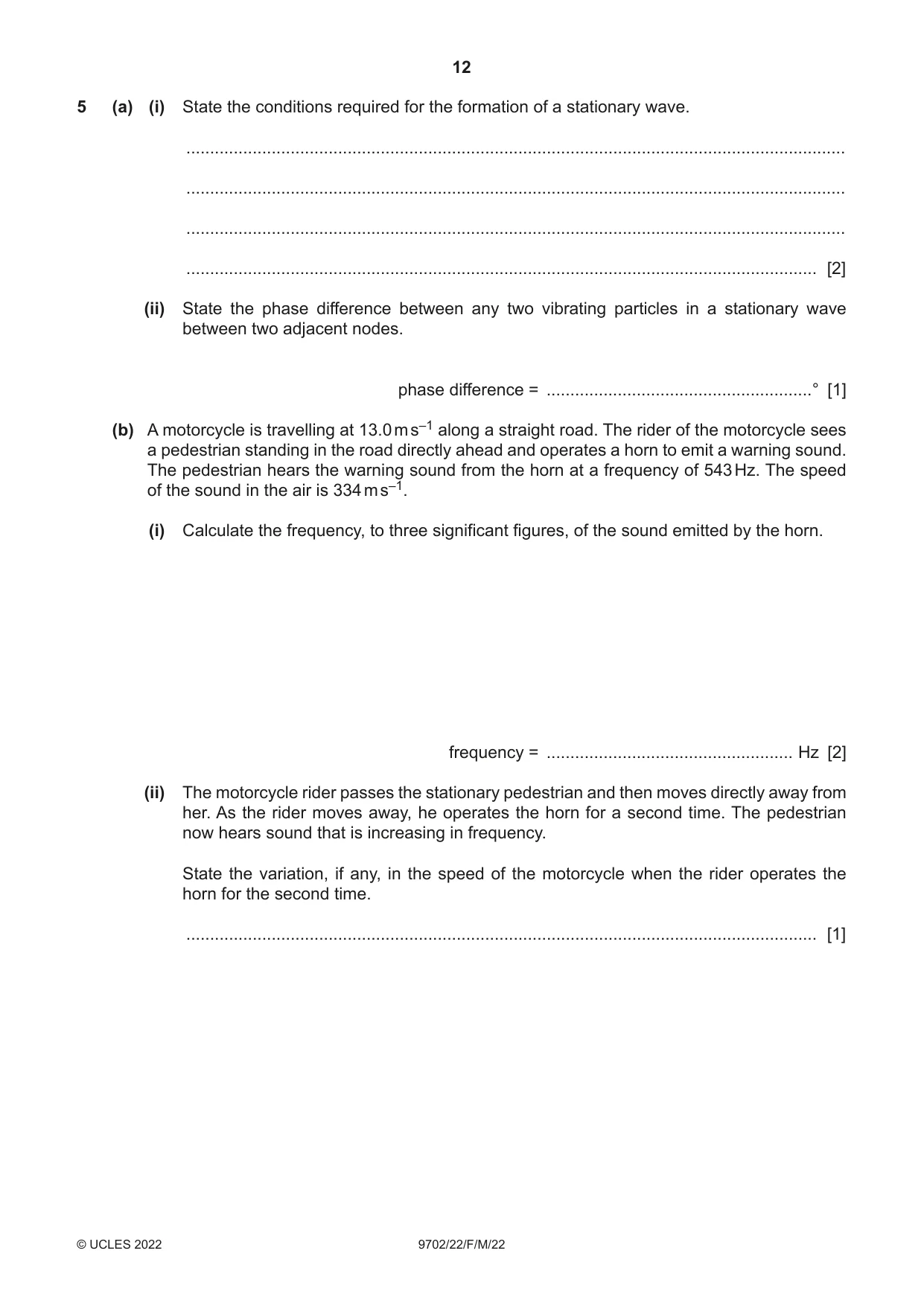
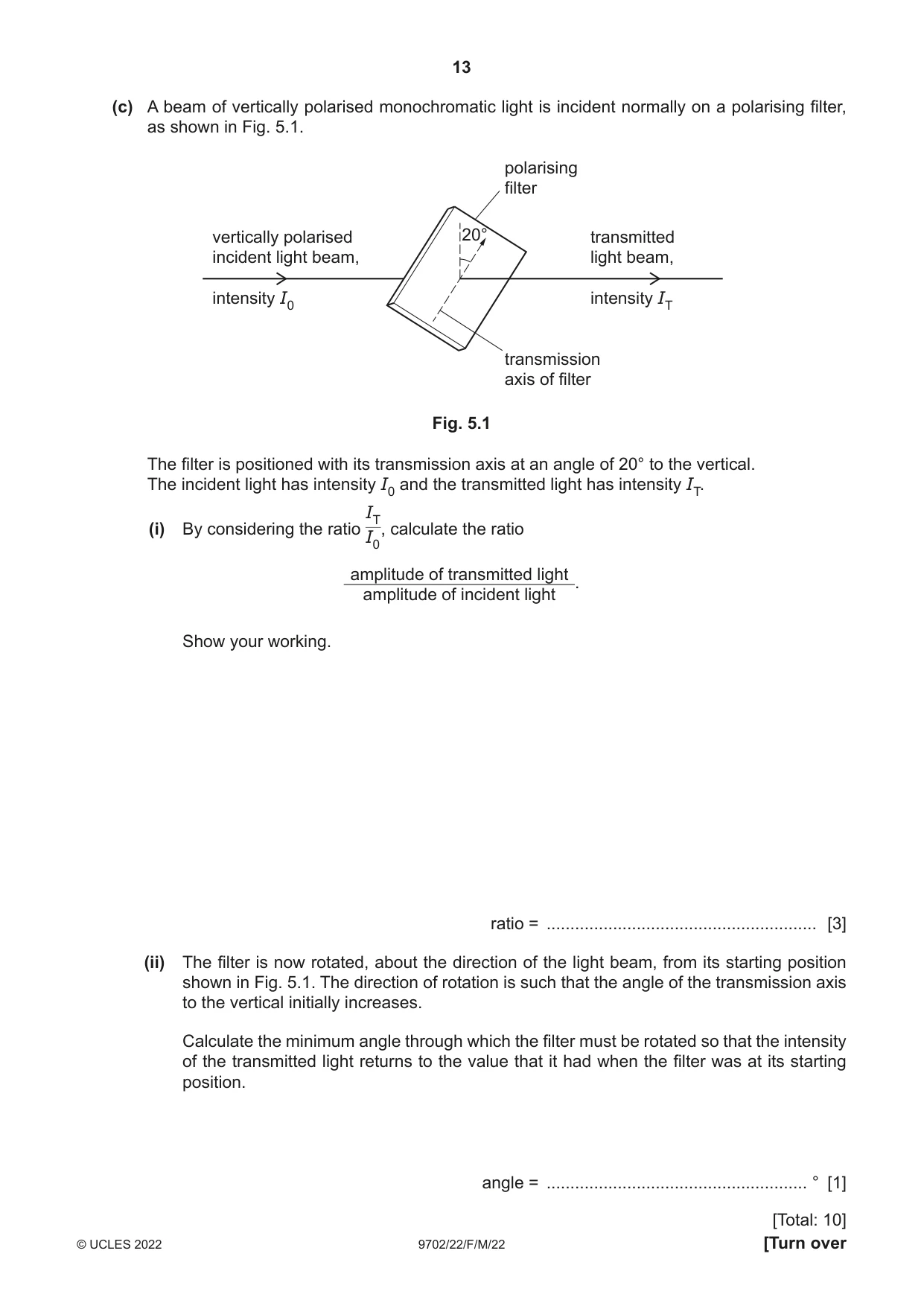
5 (a) (i) State the conditions required for the formation of a stationary wave. ........................................................................................................................................... ........................................................................................................................................... ........................................................................................................................................... ..................................................................................................................................... [2] (ii) State the phase difference between any two vibrating particles in a stationary wave between two adjacent nodes. phase difference = ........................................................° [1] (b) A motorcycle is travelling at 13.0 m s–1 along a straight road. The rider of the motorcycle sees a pedestrian standing in the road directly ahead and operates a horn to emit a warning sound. The pedestrian hears the warning sound from the horn at a frequency of 543 Hz. The speed of the sound in the air is 334 m s–1. (i) Calculate the frequency, to three significant figures, of the sound emitted by the horn. frequency = .................................................... Hz [2] (ii) The motorcycle rider passes the stationary pedestrian and then moves directly away from her. As the rider moves away, he operates the horn for a second time. The pedestrian now hears sound that is increasing in frequency. State the variation, if any, in the speed of the motorcycle when the rider operates the horn for the second time. ..................................................................................................................................... [1] (c) A beam of vertically polarised monochromatic light is incident normally on a polarising filter, as shown in Fig. 5.1. polarising filter vertically polarised 20° transmitted incident light beam, light beam, intensity I0 intensity IT transmission axis of filter Fig. 5.1 The filter is positioned with its transmission axis at an angle of 20° to the vertical. The incident light has intensity I0 and the transmitted light has intensity IT. IT (i) By considering the ratio , calculate the ratio I0 amplitude of transmitted light . amplitude of incident light Show your working. ratio = ......................................................... [3] (ii) The filter is now rotated, about the direction of the light beam, from its starting position shown in Fig. 5.1. The direction of rotation is such that the angle of the transmission axis to the vertical initially increases. Calculate the minimum angle through which the filter must be rotated so that the intensity of the transmitted light returns to the value that it had when the filter was at its starting position. angle = ....................................................... ° [1] [Total: 10]
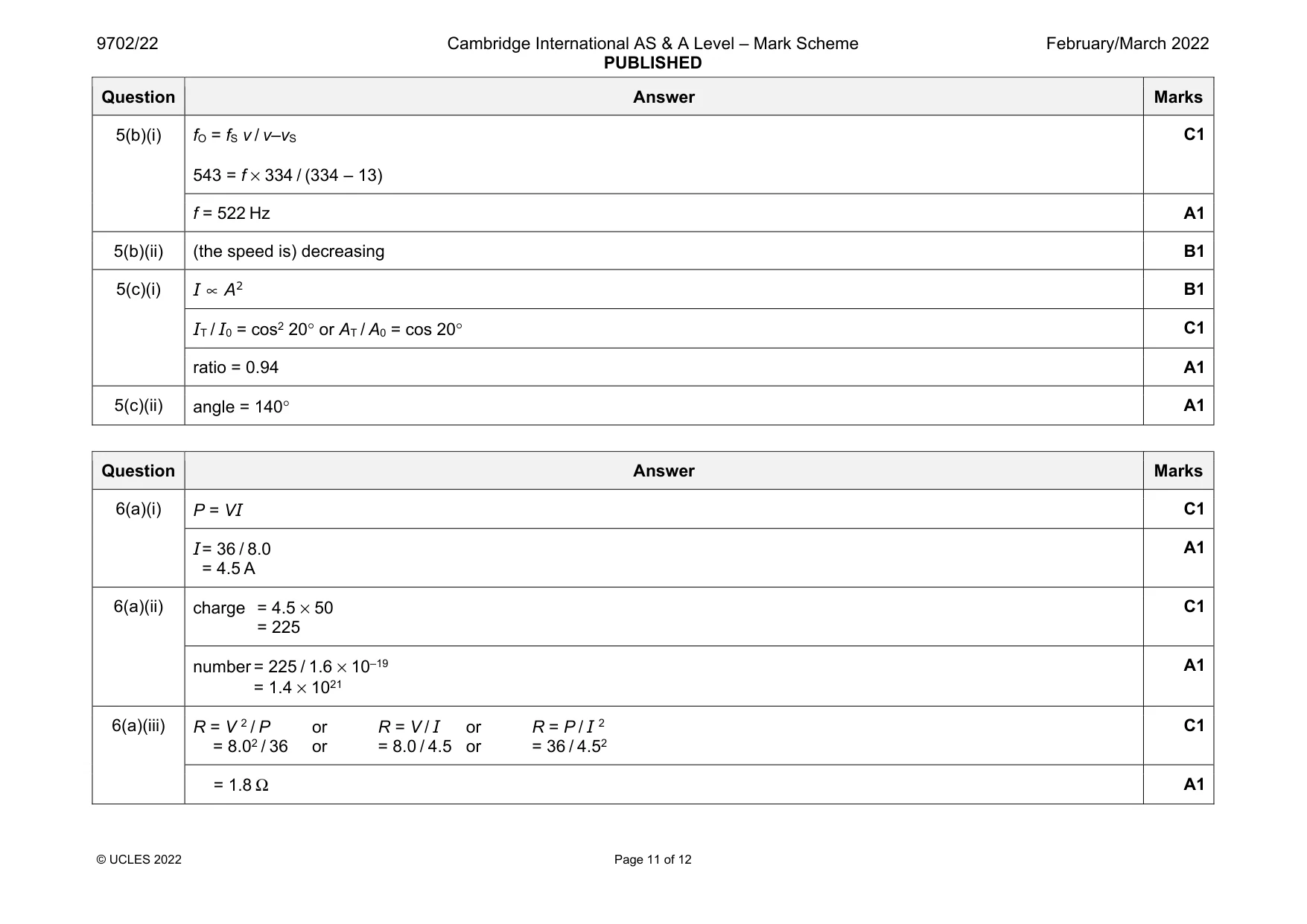
Mark scheme: 5(a)(i) (two) waves travelling (at same speed) in opposite directions overlap B1 waves (of the same type) have same frequency/wavelength B1 5(a)(ii) phase difference = 0 A1 Question Answer Marks 5(b)(i) fO = fS v / v–vS 543 = f × 334 / (334 – 13) C1 f = 522 Hz A1 5(b)(ii) (the speed is) decreasing B1 5(c)(i) I ∝ A2 B1 IT / I0 = cos2 20° or AT / A0 = cos 20° C1 ratio = 0.94 A1 5(c)(ii) angle = 140° A1
Q6 · The ends of a metal resistance wire are connected to a battery of electromotive force…
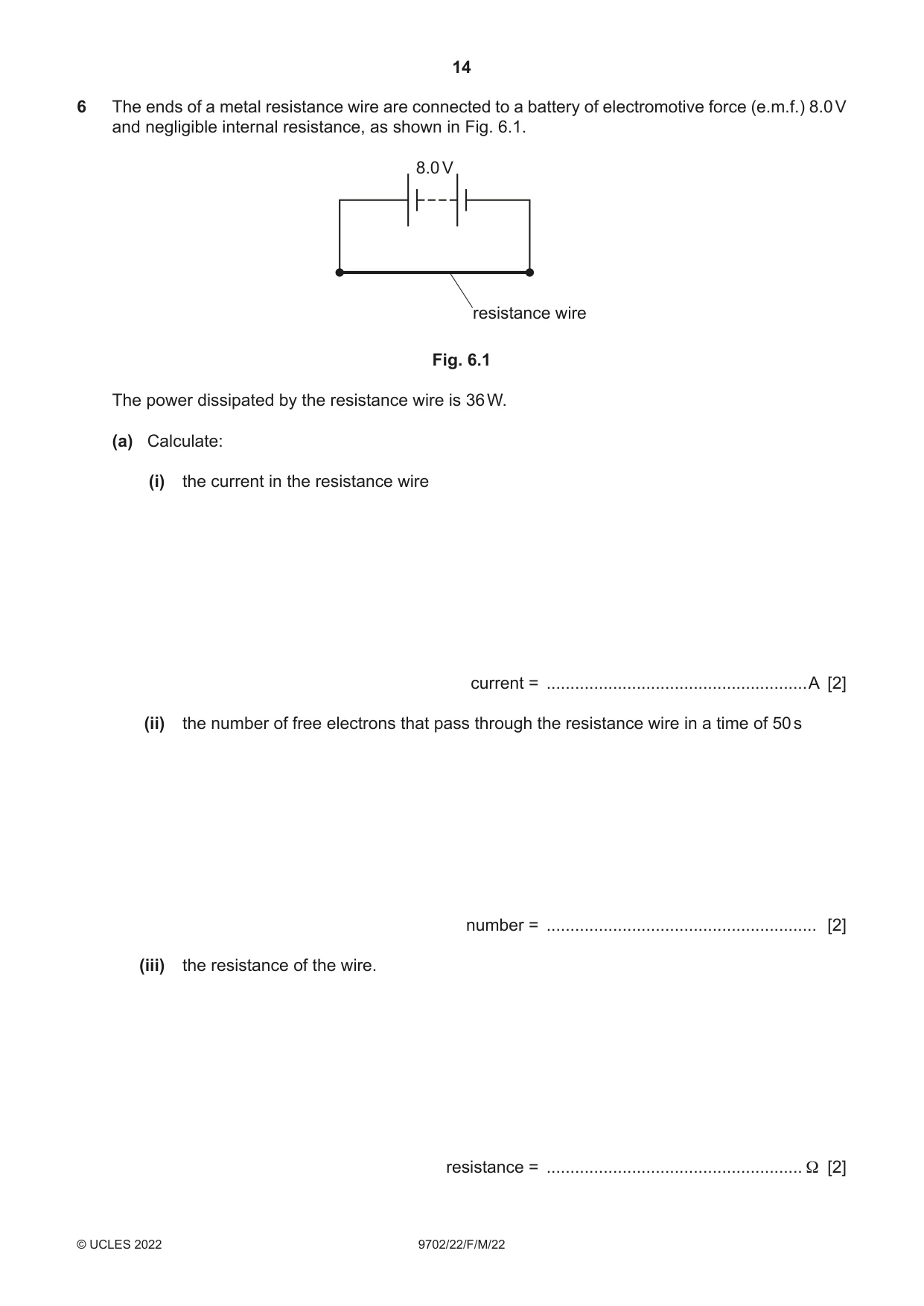
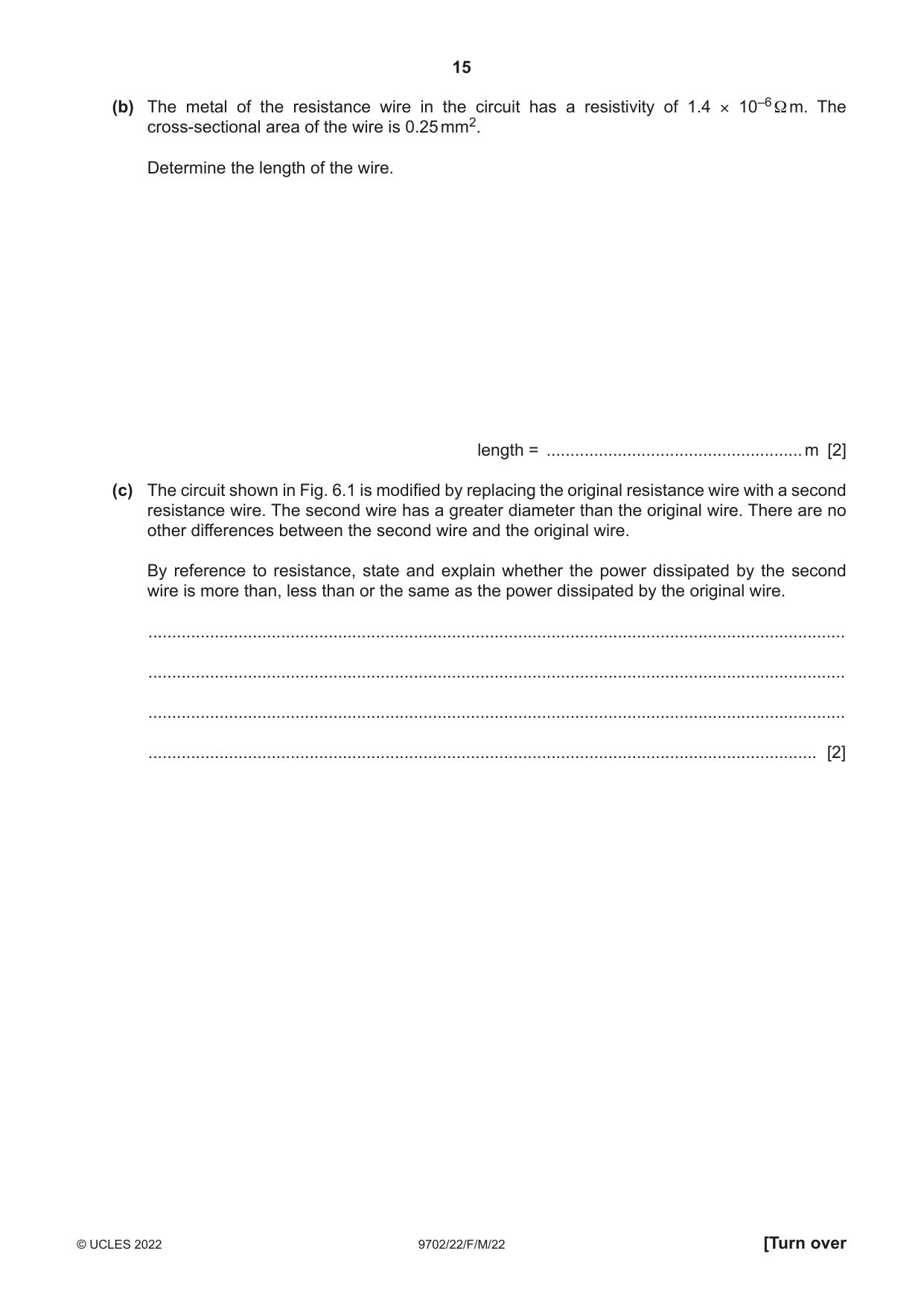
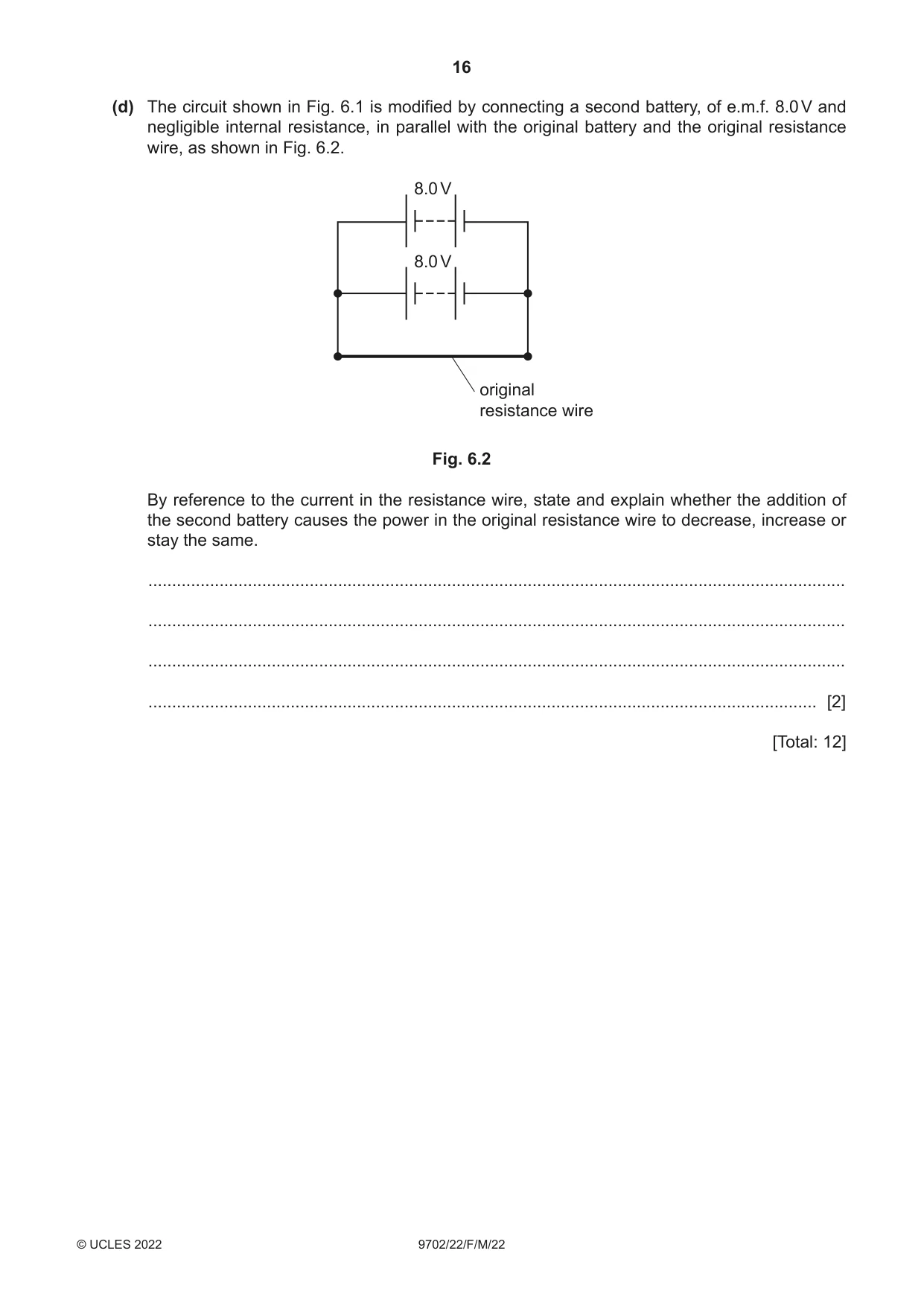
6 The ends of a metal resistance wire are connected to a battery of electromotive force (e.m.f.) 8.0 V and negligible internal resistance, as shown in Fig. 6.1. 8.0 V resistance wire Fig. 6.1 The power dissipated by the resistance wire is 36 W. (a) Calculate: (i) the current in the resistance wire current = ....................................................... A [2] (ii) the number of free electrons that pass through the resistance wire in a time of 50 s number = ......................................................... [2] (iii) the resistance of the wire. resistance = ...................................................... Ω [2] (b) The metal of the resistance wire in the circuit has a resistivity of 1.4 × 10⁻⁶ Ω m. The cross-sectional area of the wire is 0.25 mm2. Determine the length of the wire. length = ...................................................... m [2] (c) The circuit shown in Fig. 6.1 is modified by replacing the original resistance wire with a second resistance wire. The second wire has a greater diameter than the original wire. There are no other differences between the second wire and the original wire. By reference to resistance, state and explain whether the power dissipated by the second wire is more than, less than or the same as the power dissipated by the original wire. ................................................................................................................................................... ................................................................................................................................................... ................................................................................................................................................... ............................................................................................................................................. [2] (d) The circuit shown in Fig. 6.1 is modified by connecting a second battery, of e.m.f. 8.0 V and negligible internal resistance, in parallel with the original battery and the original resistance wire, as shown in Fig. 6.2. 8.0 V 8.0 V original resistance wire Fig. 6.2 By reference to the current in the resistance wire, state and explain whether the addition of the second battery causes the power in the original resistance wire to decrease, increase or stay the same. ................................................................................................................................................... ................................................................................................................................................... ................................................................................................................................................... ............................................................................................................................................. [2] [Total: 12]
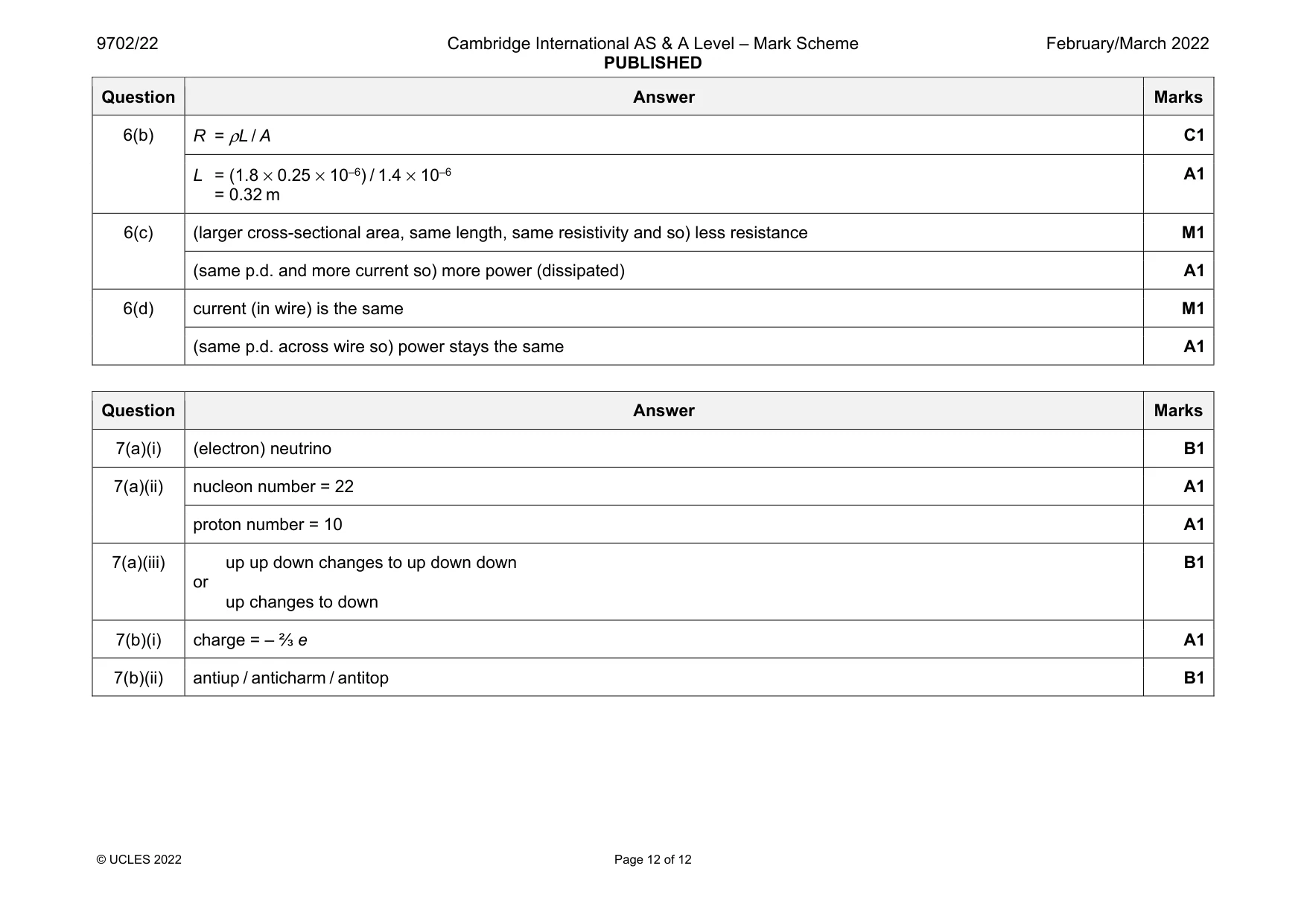
Mark scheme: 6(a)(i) C1 I = 36 / 8.0 = 4.5 A A1 6(a)(ii) charge = 4.5 × 50 = 225 C1 number = 225 / 1.6 × 10–19 = 1.4 × 10²¹ A1 6(a)(iii) R = V 2 / P or R = V / I or R = P / I 2 = 8.02 / 36 or = 8.0 / 4.5 or = 36 / 4.52 C1 = 1.8 Ω A1 Question Answer Marks 6(b) R = ρL / A C1 L = (1.8 × 0.25 × 10–6) / 1.4 × 10–6 = 0.32 m A1 6(c) (larger cross-sectional area, same length, same resistivity and so) less resistance M1 (same p.d. and more current so) more power (dissipated) A1 6(d) current (in wire) is the same M1 (same p.d. across wire so) power stays the same A1
Q7 · A nucleus of sodium-22 (2211Na) decays by emitting a β+ particle
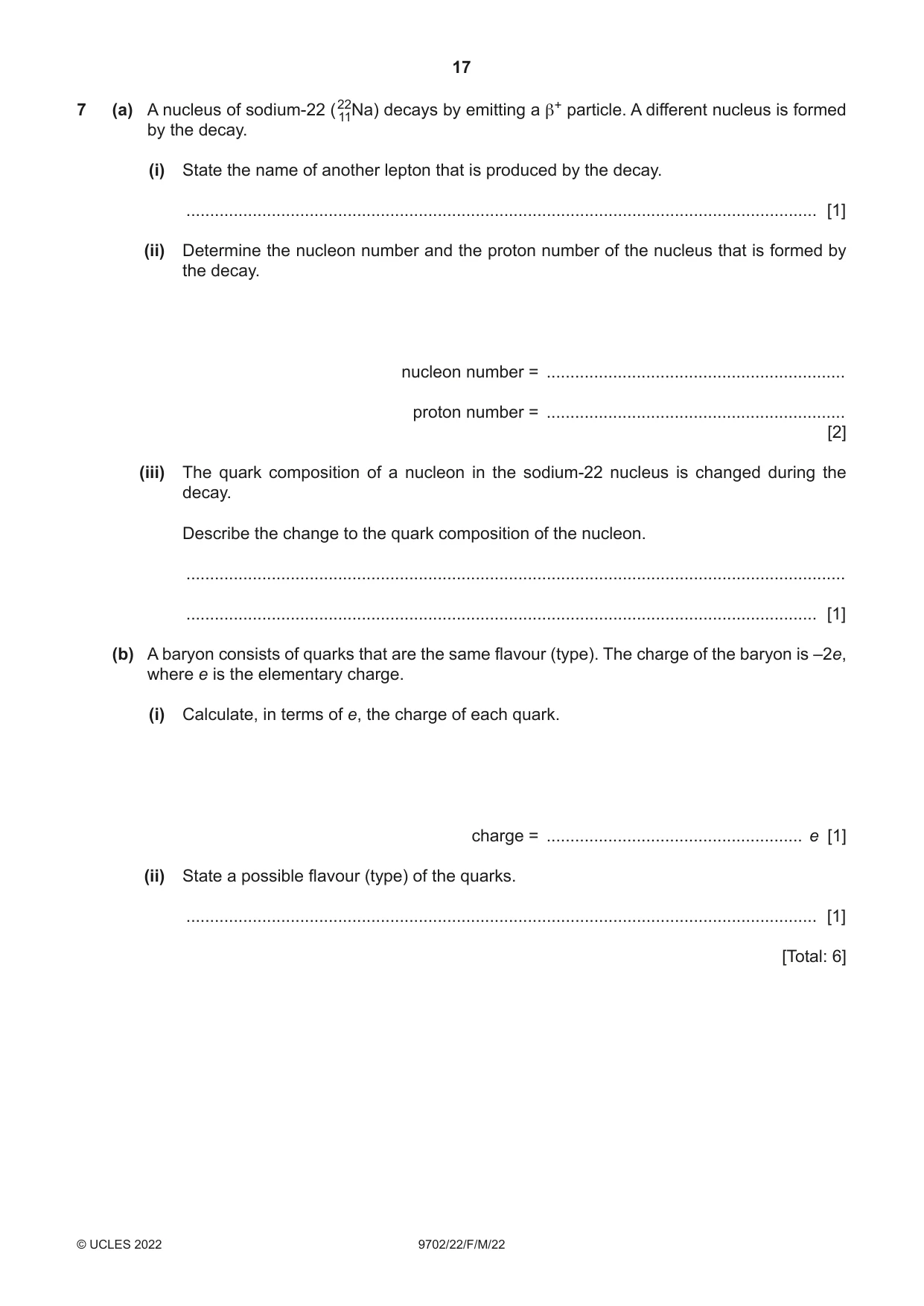
7 (a) A nucleus of sodium-22 (2211Na) decays by emitting a β+ particle. A different nucleus is formed by the decay. (i) State the name of another lepton that is produced by the decay. ..................................................................................................................................... [1] (ii) Determine the nucleon number and the proton number of the nucleus that is formed by the decay. nucleon number = ............................................................... proton number = ............................................................... [2] (iii) The quark composition of a nucleon in the sodium-22 nucleus is changed during the decay. Describe the change to the quark composition of the nucleon. ........................................................................................................................................... ..................................................................................................................................... [1] (b) A baryon consists of quarks that are the same flavour (type). The charge of the baryon is –2e, where e is the elementary charge. (i) Calculate, in terms of e, the charge of each quark. charge = ...................................................... e [1] (ii) State a possible flavour (type) of the quarks. ..................................................................................................................................... [1] [Total: 6]
Mark scheme: 7(a)(i) (electron) neutrino B1 7(a)(ii) nucleon number = 22 A1 proton number = 10 A1 7(a)(iii) up up down changes to up down down or up changes to down B1 7(b)(i) charge = – ⅔ e A1 7(b)(ii) antiup / anticharm / antitop B1
What was in this paper
The subtopics covered by these 7 questions, and how many questions each got. Open one in a new tab to see every Cambridge question on it.
What you needed in this session
Cambridge’s own grade thresholds for 2022 Feb/March, Paper 2 · Variant 2. A higher threshold means an easier paper — the bar moves with how the cohort did.