Cambridge A Level Physics 9702 — 2024 Oct/Nov Paper 2 · Variant 1
9702/21/O/N/24 · 7 questions · 60 marks · ≈68 min
The question paper and its mark scheme, free to read here and free to download. This is Cambridge’s own paper, exactly as it was sat.
Question paper16 pages
Mark scheme11 pages
Answers below. Sit the paper first if you are practising.

Questions as text
Question 1
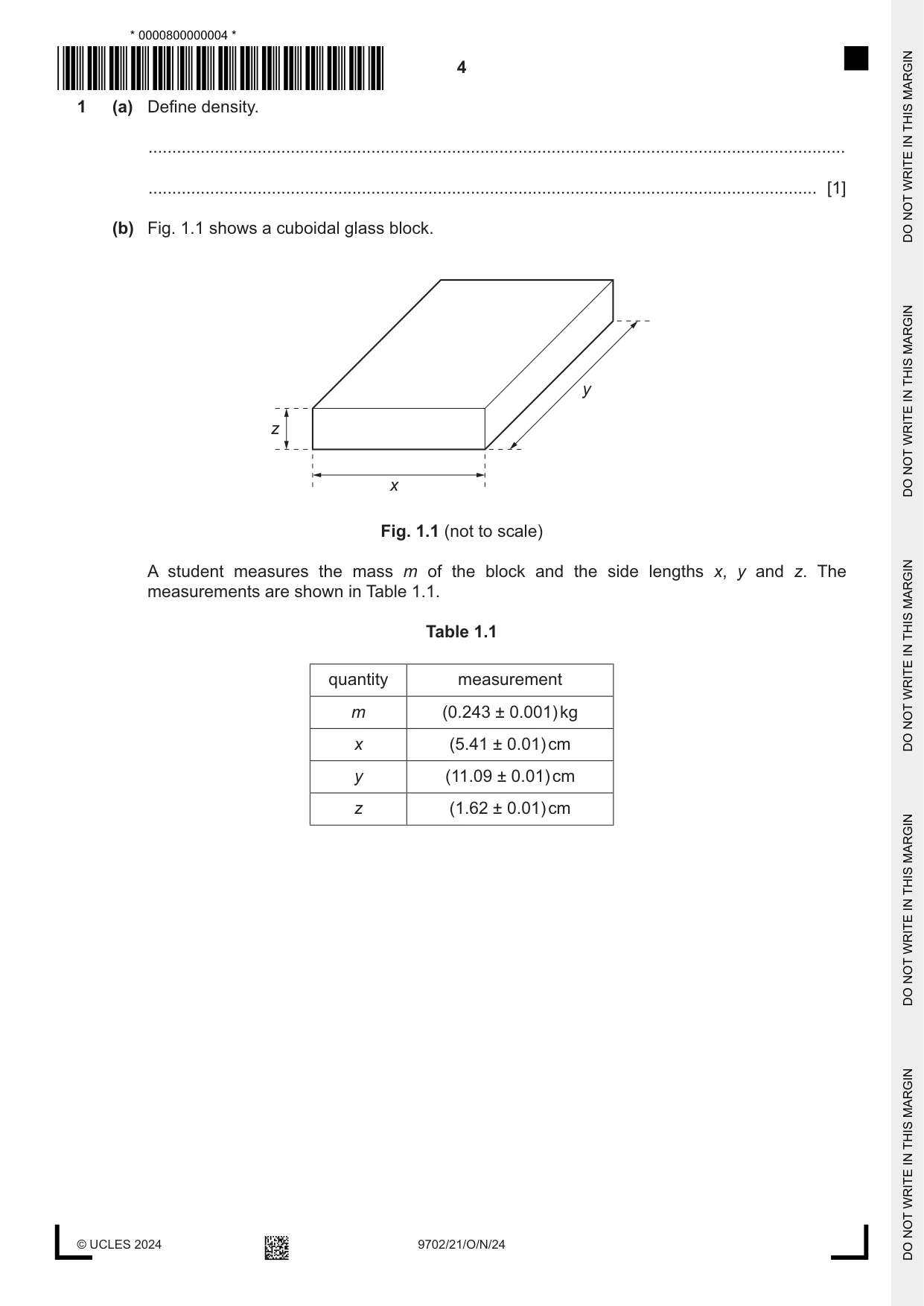
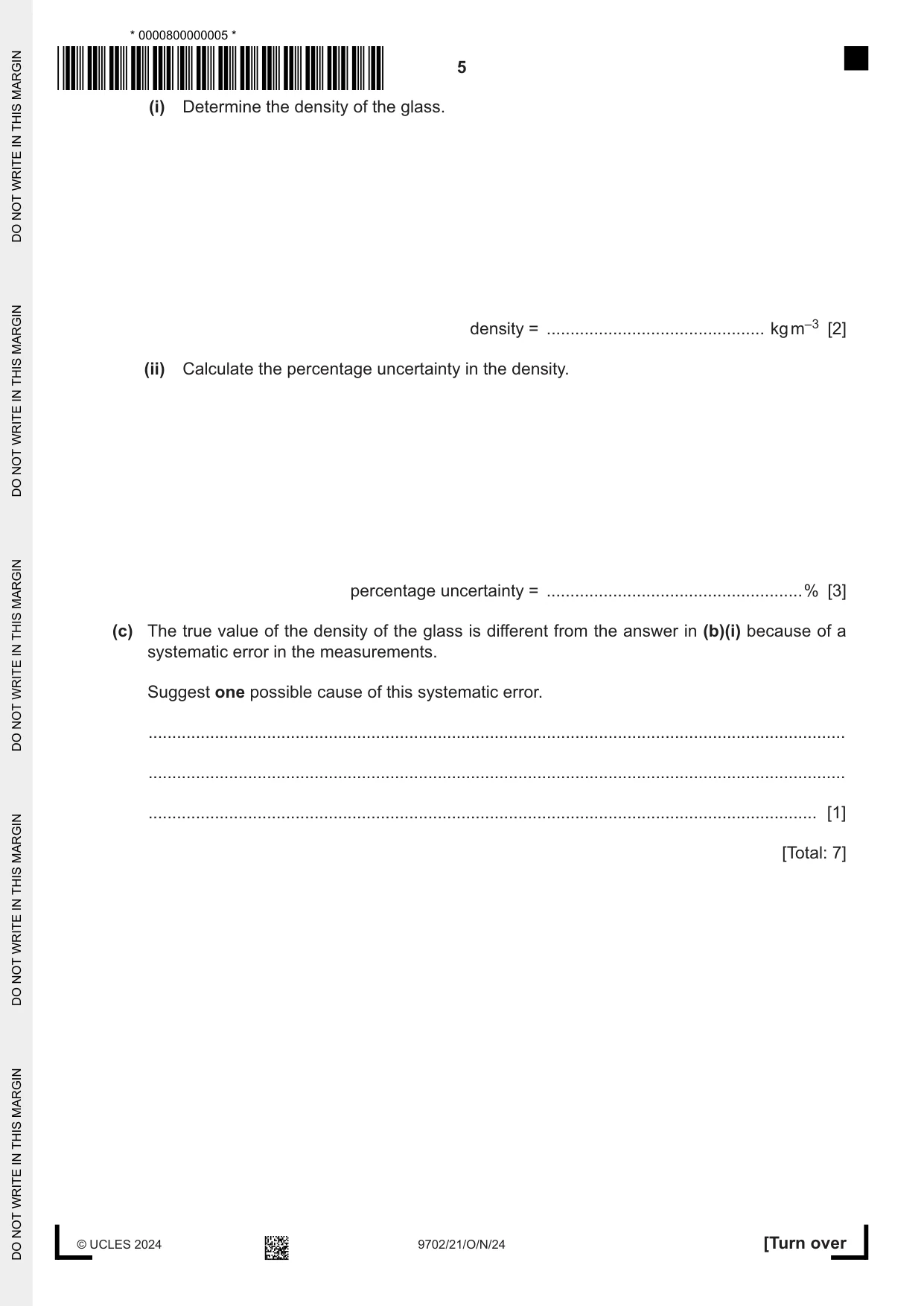
1 (a) Define density. ................................................................................................................................................... ............................................................................................................................................. [1] (b) Fig. 1.1 shows a cuboidal glass block. y z x Fig. 1.1 (not to scale) A student measures the mass m of the block and the side lengths x, y and z. The measurements are shown in Table 1.1. Table 1.1 quantity measurement m (0.243 ± 0.001) kg x (5.41 ± 0.01) cm y (11.09 ± 0.01) cm z (1.62 ± 0.01) cm (i) Determine the density of the glass. density = .............................................. kg m–3 [2] (ii) Calculate the percentage uncertainty in the density. percentage uncertainty = ......................................................% [3] (c) The true value of the density of the glass is different from the answer in (b)(i) because of a systematic error in the measurements. Suggest one possible cause of this systematic error. ................................................................................................................................................... ................................................................................................................................................... ............................................................................................................................................. [1] [Total: 7]
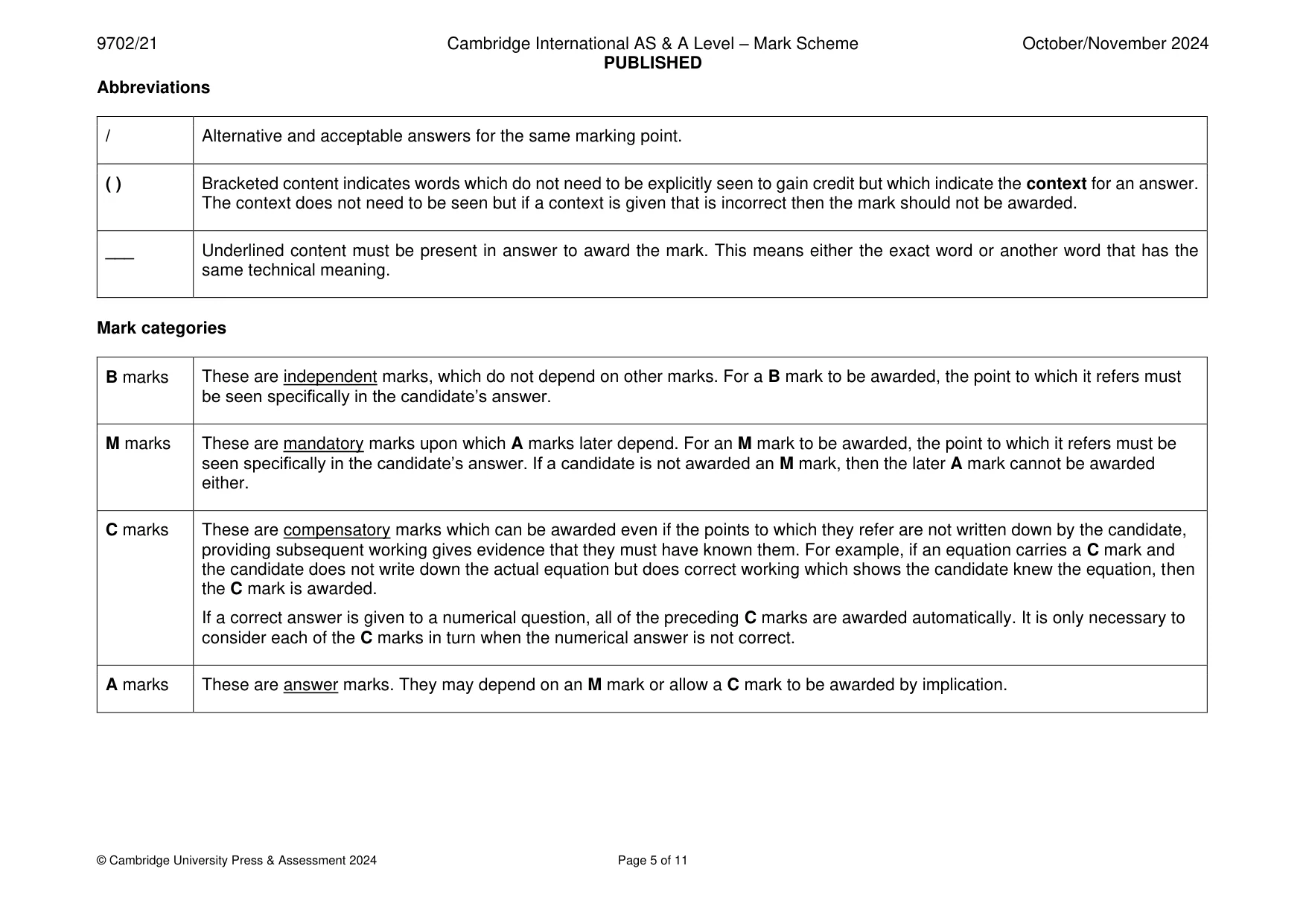
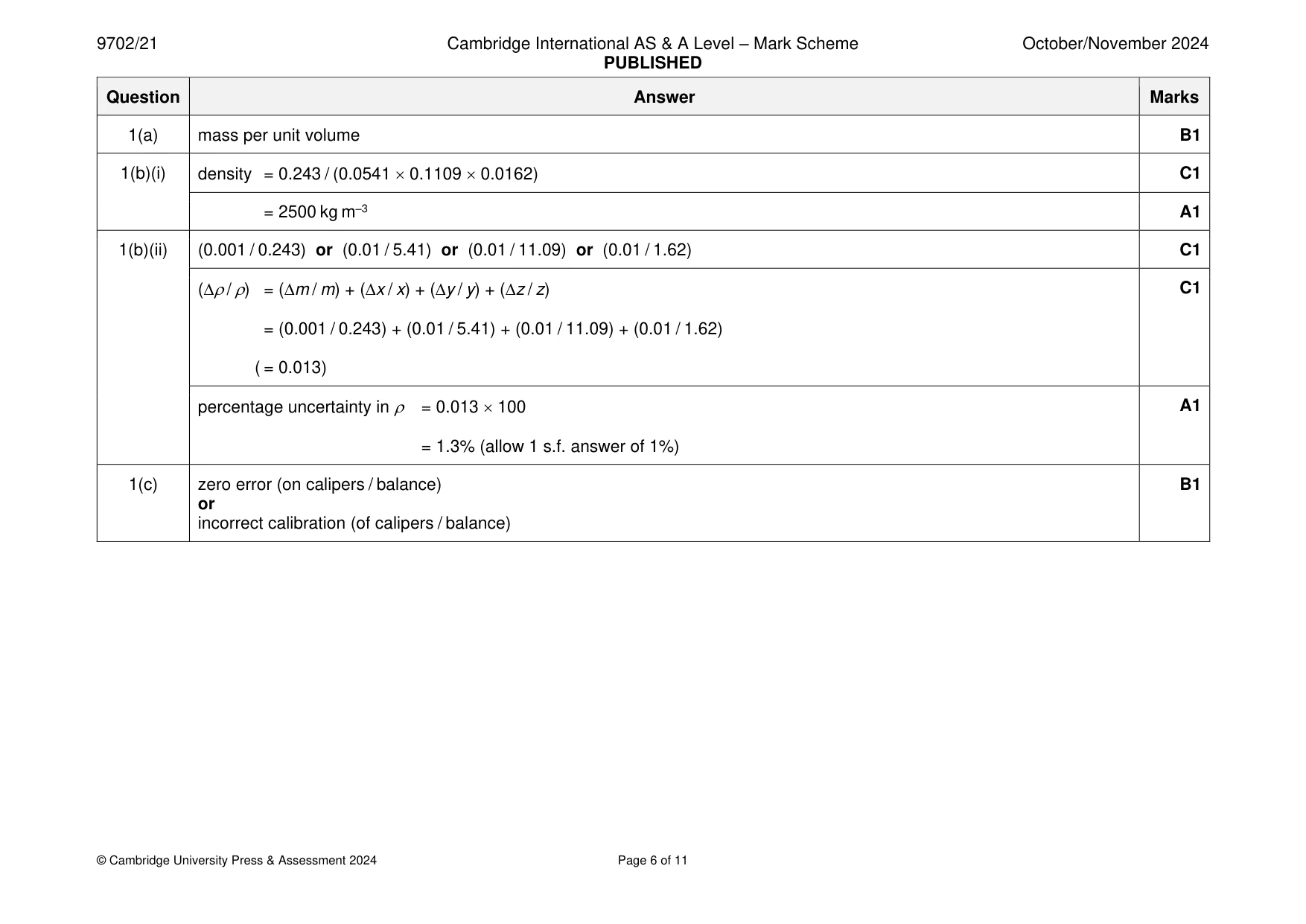
Mark scheme: Question Answer Marks 1(a) mass per unit volume B1 1(b)(i) density = 0.243 / (0.0541 0.1109 0.0162) C1 = 2500 kg m–3 A1 1(b)(ii) (0.001 / 0.243) or (0.01 / 5.41) or (0.01 / 11.09) or (0.01 / 1.62) C1 ( / ) = (m / m) + (x / x) + (y / y) + (z / z) C1 = (0.001 / 0.243) + (0.01 / 5.41) + (0.01 / 11.09) + (0.01 / 1.62) ( = 0.013) percentage uncertainty in = 0.013 100 A1 = 1.3% (allow 1 s.f. answer of 1%) 1(c) zero error (on calipers / balance) B1 or incorrect calibration (of calipers / balance)
Question 2
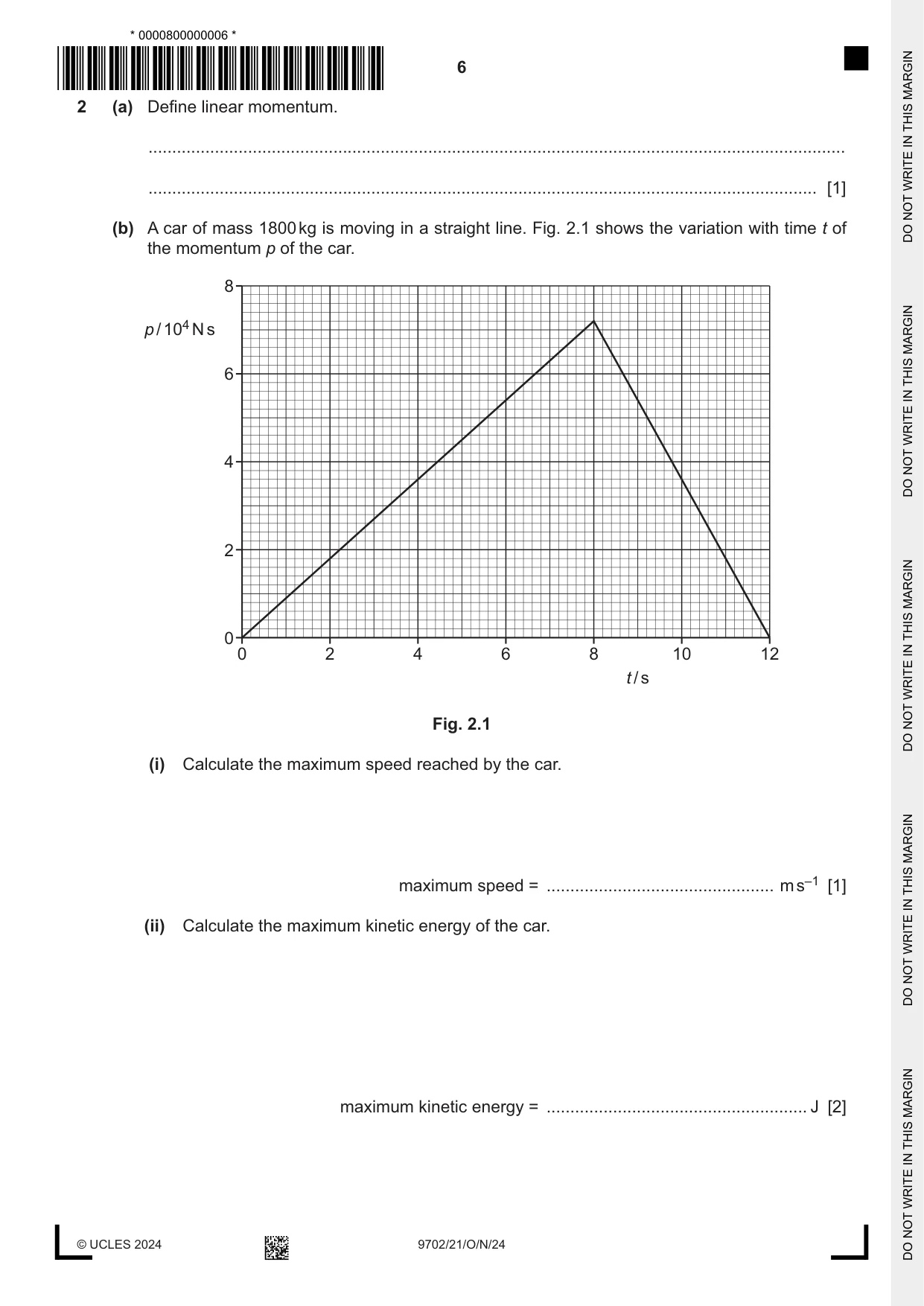
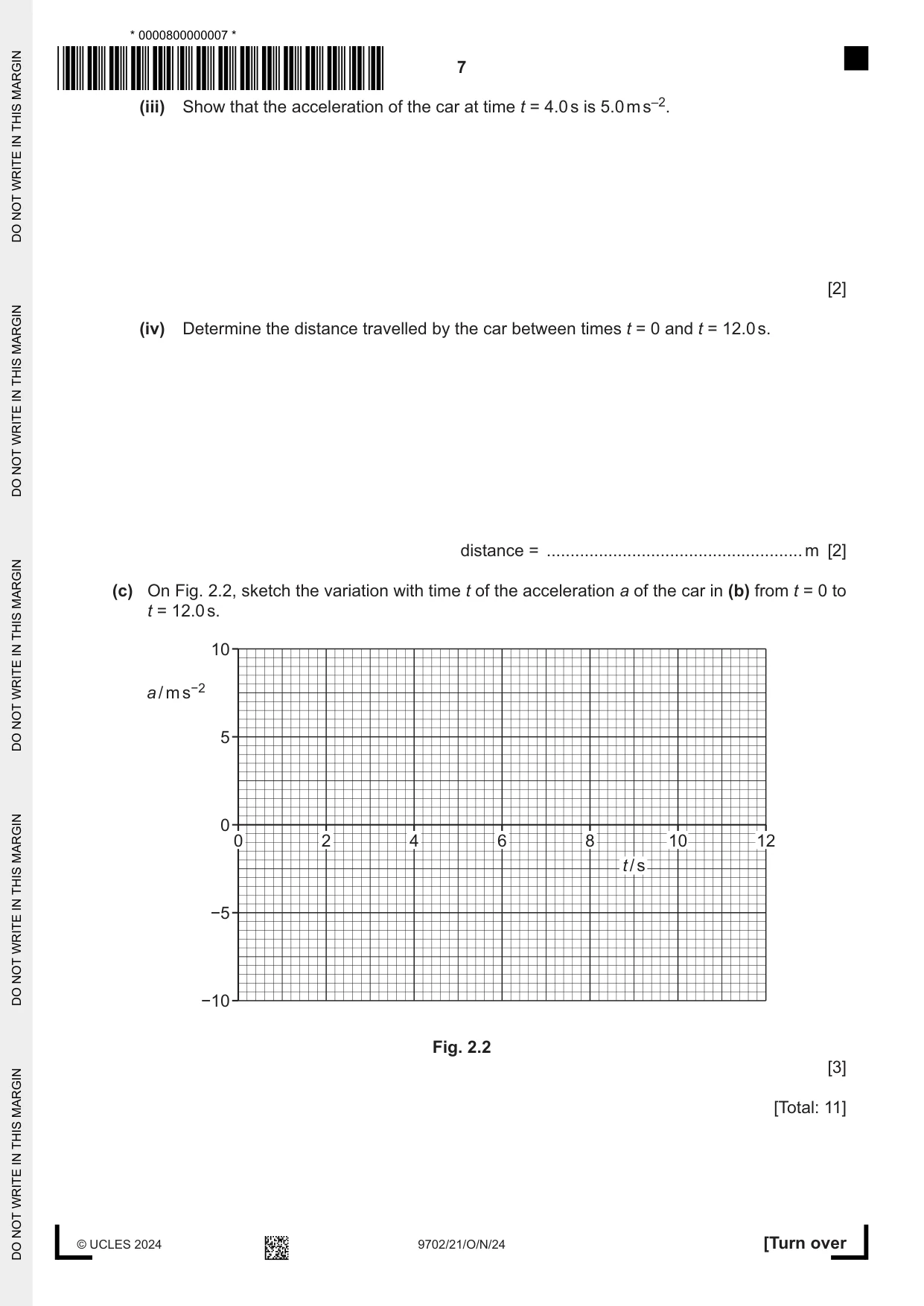
2 (a) Define linear momentum. ................................................................................................................................................... ............................................................................................................................................. [1] (b) A car of mass 1800 kg is moving in a straight line. Fig. 2.1 shows the variation with time t of the momentum p of the car. 8 p / 104 N s 6 4 2 0 0 2 4 6 8 10 12 t / s Fig. 2.1 (i) Calculate the maximum speed reached by the car. maximum speed = ................................................ m s–1 [1] (ii) Calculate the maximum kinetic energy of the car. maximum kinetic energy = ....................................................... J [2] (iii) Show that the acceleration of the car at time t = 4.0 s is 5.0 m s–2. [2] (iv) Determine the distance travelled by the car between times t = 0 and t = 12.0 s. distance = ...................................................... m [2] (c) On Fig. 2.2, sketch the variation with time t of the acceleration a of the car in (b) from t = 0 to t = 12.0 s. 10 a / m s−2 5 0 0 2 4 6 8 10 12 t / s −5 −10 Fig. 2.2 [3] [Total: 11]
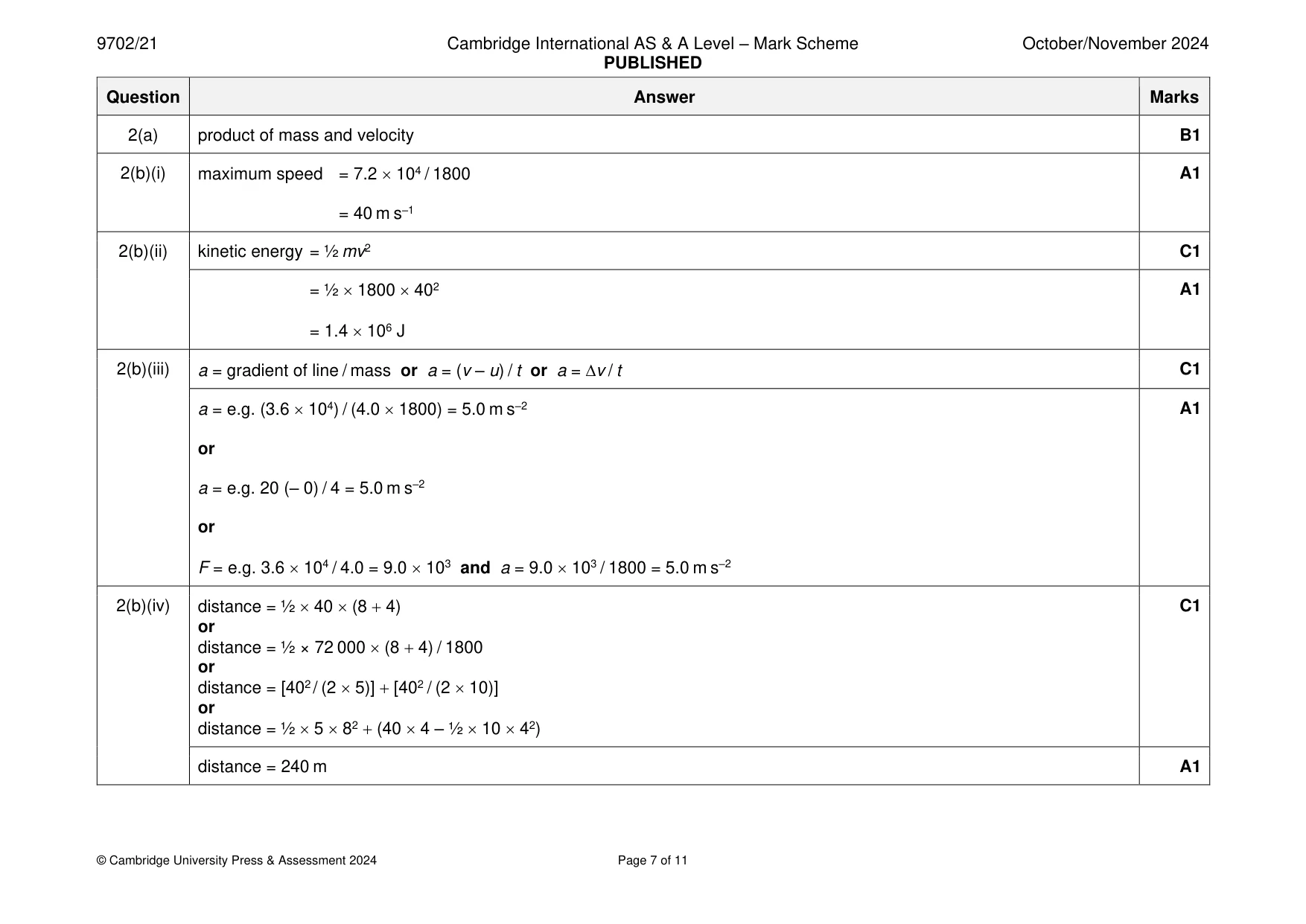
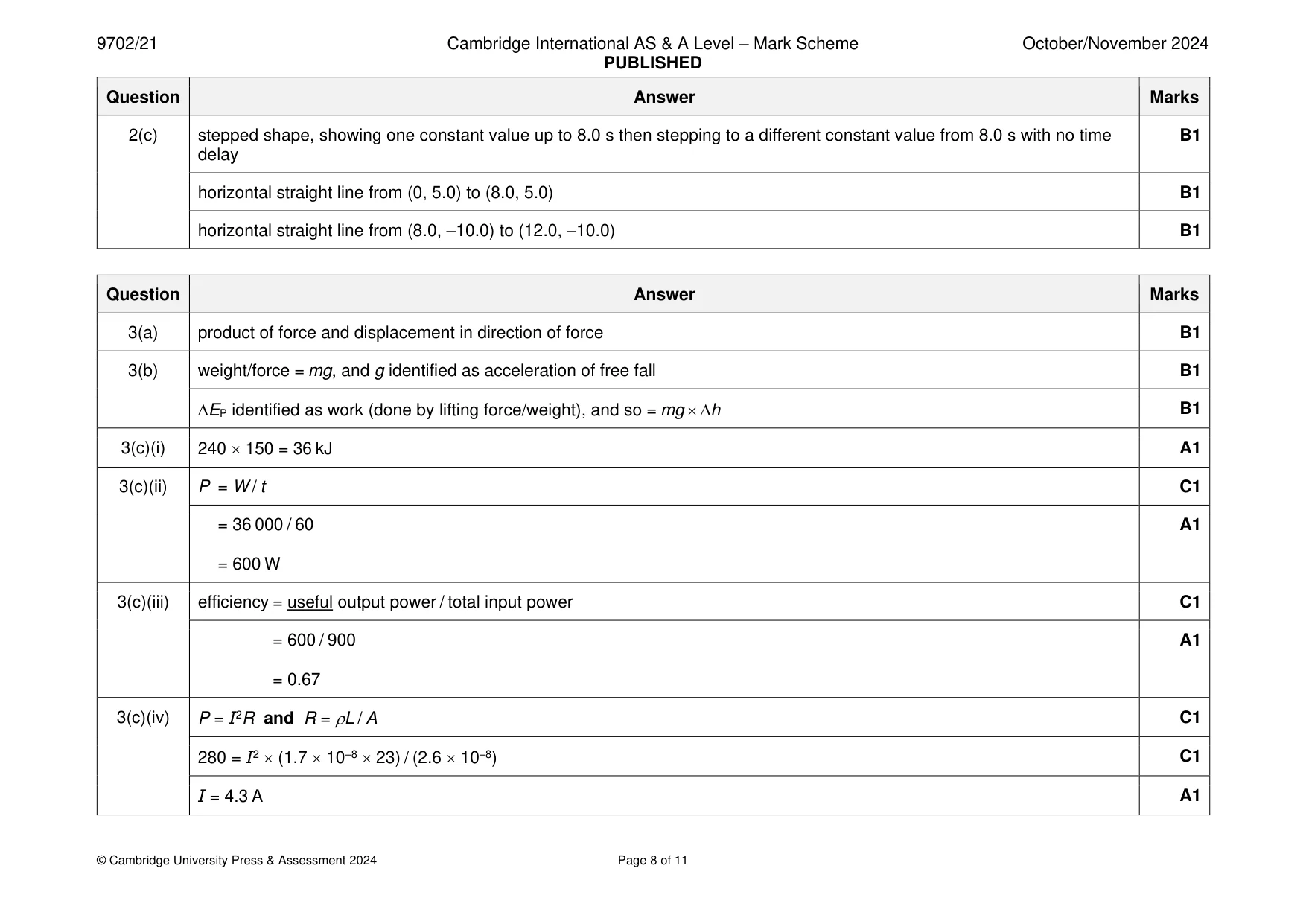
Mark scheme: 2(a) product of mass and velocity B1 2(b)(i) maximum speed = 7.2 104 / 1800 A1 = 40 m s–1 2(b)(ii) kinetic energy = ½ mv2 C1 = ½ 1800 402 A1 = 1.4 106 J 2(b)(iii) a = gradient of line / mass or a = (v – u) / t or a = v / t C1 a = e.g. (3.6 104) / (4.0 1800) = 5.0 m s–2 A1 or a = e.g. 20 (– 0) / 4 = 5.0 m s–2 or F = e.g. 3.6 104 / 4.0 = 9.0 103 and a = 9.0 103 / 1800 = 5.0 m s–2 2(b)(iv) distance = ½ 40 (8 + 4) C1 or distance = ½ × 72 000 (8 + 4) / 1800 or distance = [402 / (2 5)] + [402 / (2 10)] or distance = ½ 5 82 + (40 4 – ½ 10 42) distance = 240 m A1 2(c) stepped shape, showing one constant value up to 8.0 s then stepping to a different constant value from 8.0 s with no time B1 delay horizontal straight line from (0, 5.0) to (8.0, 5.0) B1 horizontal straight line from (8.0, –10.0) to (12.0, –10.0) B1
Q3 · State what is meant by the work done by a force
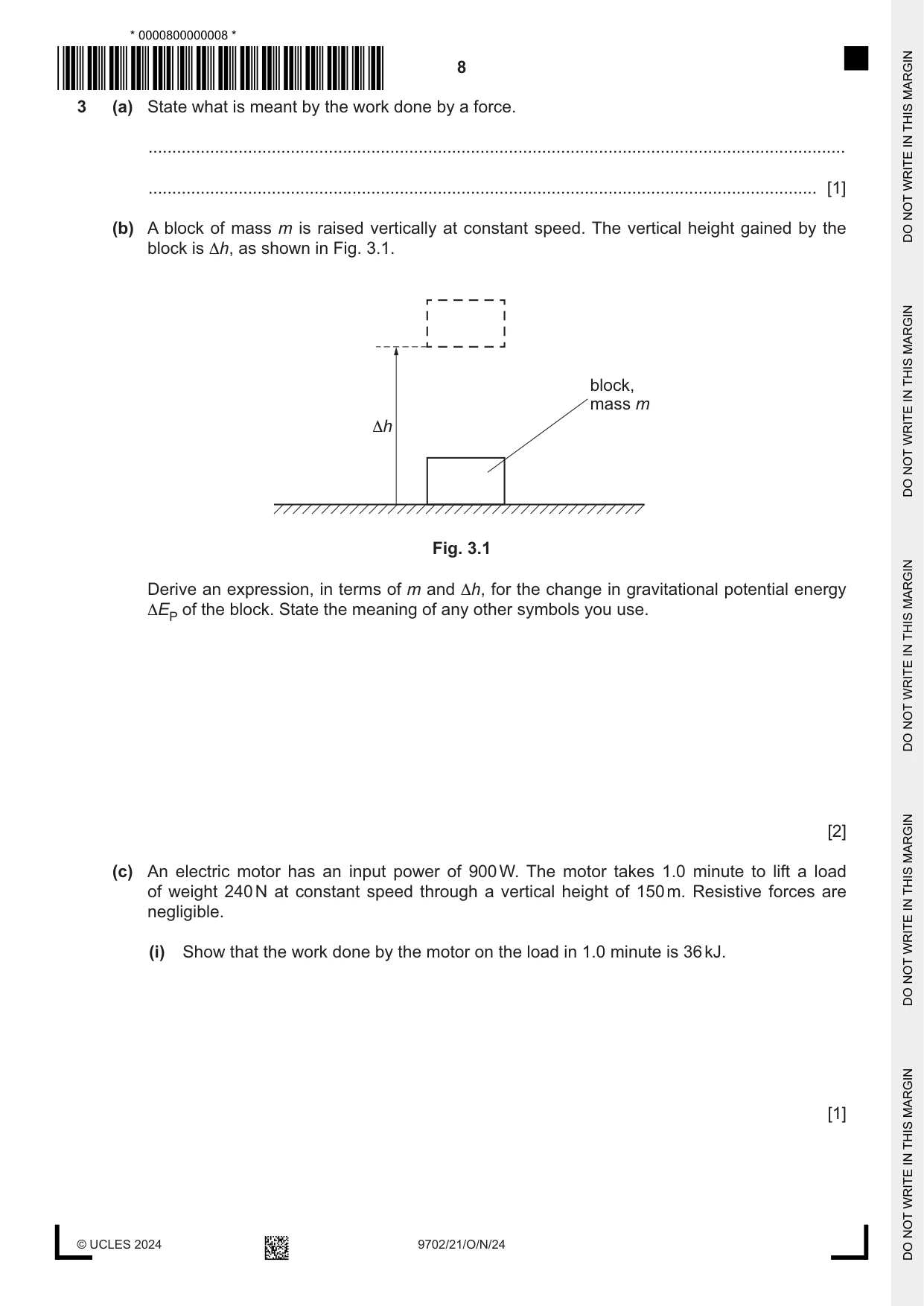
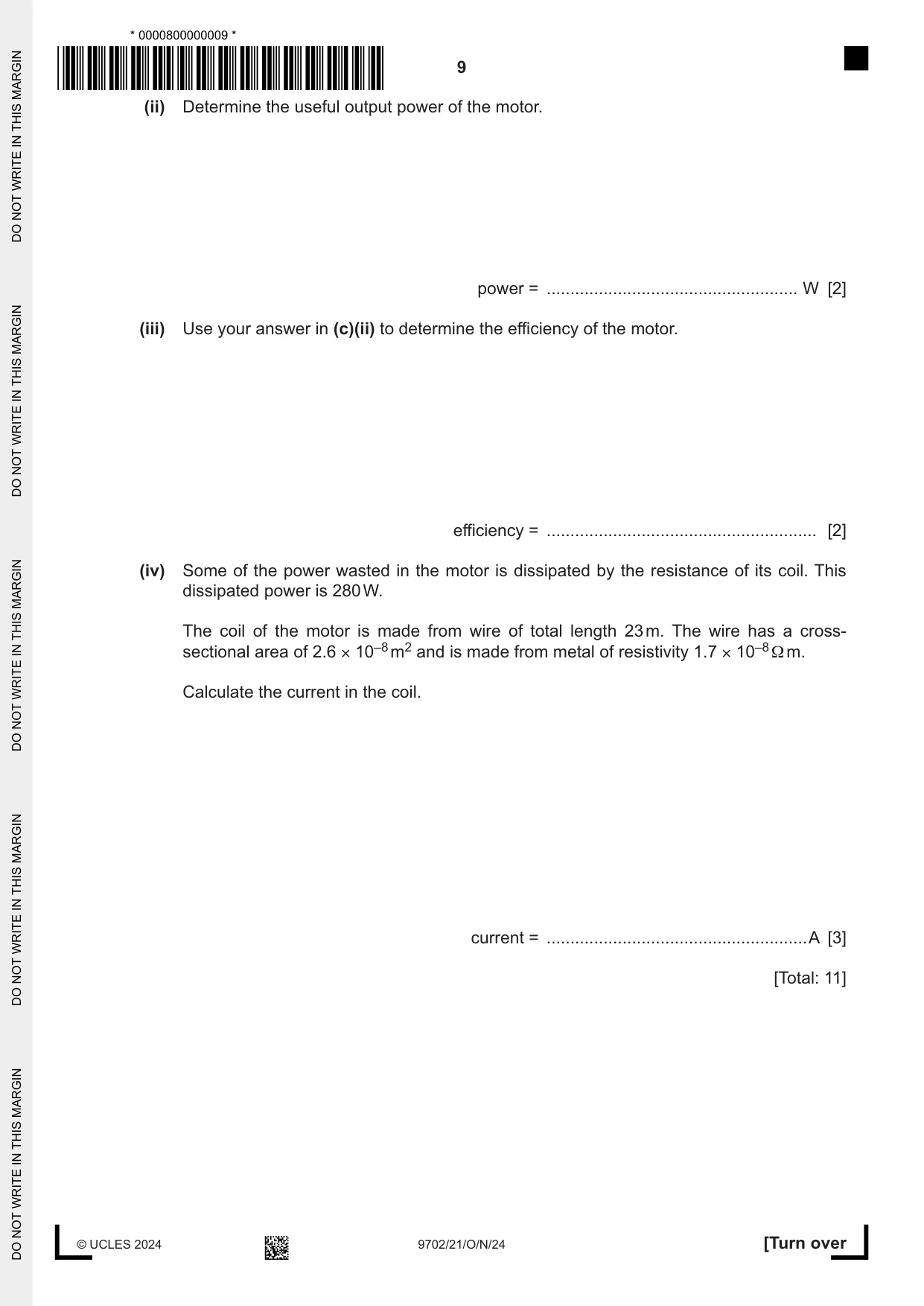
3 (a) State what is meant by the work done by a force. ................................................................................................................................................... ............................................................................................................................................. [1] (b) A block of mass m is raised vertically at constant speed. The vertical height gained by the block is Δh, as shown in Fig. 3.1. block, mass m Δh Fig. 3.1 Derive an expression, in terms of m and Δh, for the change in gravitational potential energy ΔEP of the block. State the meaning of any other symbols you use. [2] (c) An electric motor has an input power of 900 W. The motor takes 1.0 minute to lift a load of weight 240 N at constant speed through a vertical height of 150 m. Resistive forces are negligible. (i) Show that the work done by the motor on the load in 1.0 minute is 36 kJ. [1] (ii) Determine the useful output power of the motor. power = ..................................................... W [2] (iii) Use your answer in (c)(ii) to determine the efficiency of the motor. efficiency = ......................................................... [2] (iv) Some of the power wasted in the motor is dissipated by the resistance of its coil. This dissipated power is 280 W. The coil of the motor is made from wire of total length 23 m. The wire has a cross- sectional area of 2.6 × 10⁻⁸ m2 and is made from metal of resistivity 1.7 × 10⁻⁸ Ω m. Calculate the current in the coil. current = ....................................................... A [3] [Total: 11]
Mark scheme: 3(a) product of force and displacement in direction of force B1 3(b) weight/force = mg, and g identified as acceleration of free fall B1 EP identified as work (done by lifting force/weight), and so = mg h B1 3(c)(i) 240 150 = 36 kJ A1 3(c)(ii) P = W / t C1 = 36 000 / 60 A1 = 600 W 3(c)(iii) efficiency = useful output power / total input power C1 = 600 / 900 A1 = 0.67 3(c)(iv) P = I2R and R = L / A C1 280 = I2 (1.7 10–8 23) / (2.6 10–8) C1 I = 4.3 A A1
Q4 · Define the Young modulus of a material
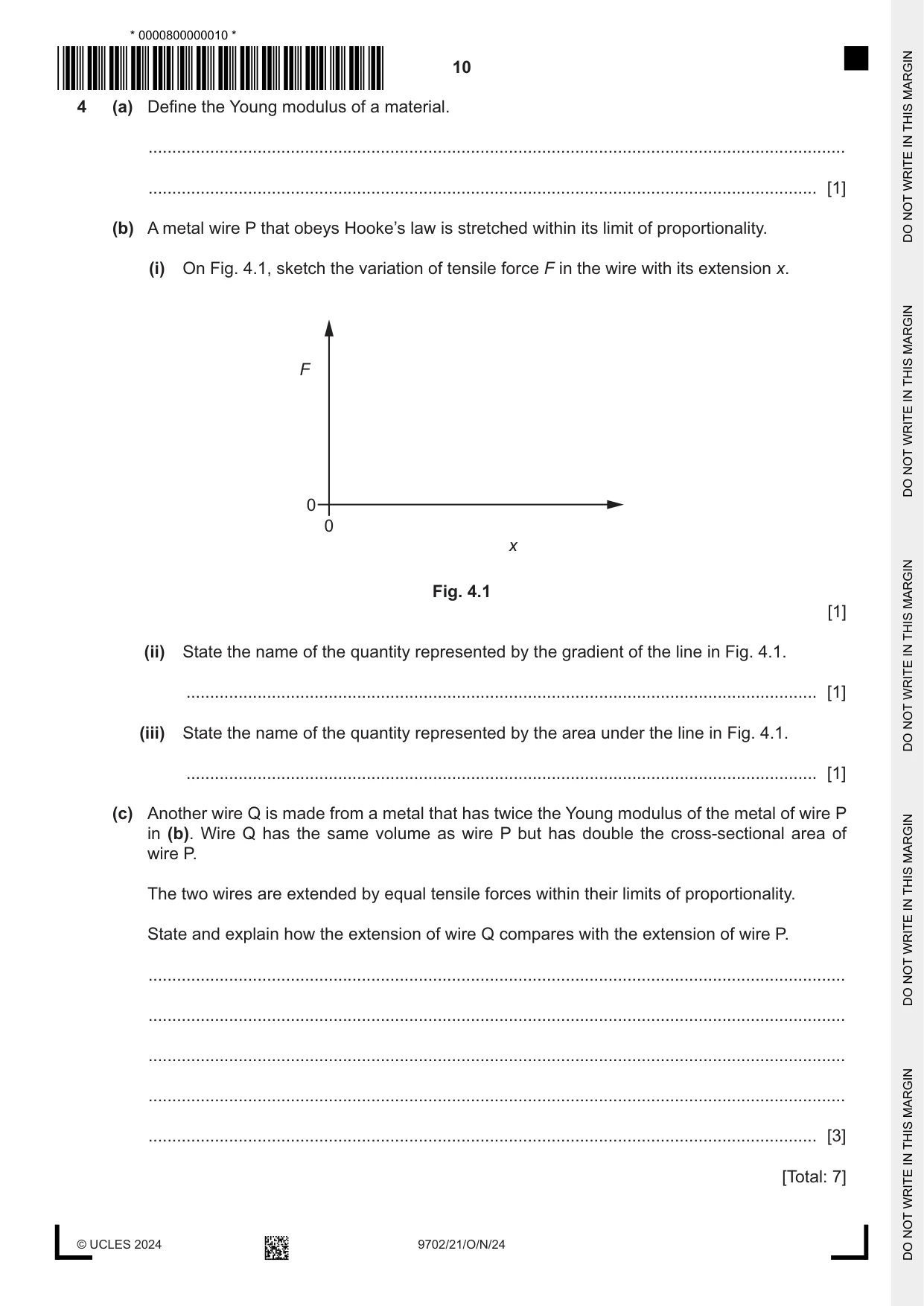
4 (a) Define the Young modulus of a material. ................................................................................................................................................... ............................................................................................................................................. [1] (b) A metal wire P that obeys Hooke’s law is stretched within its limit of proportionality. (i) On Fig. 4.1, sketch the variation of tensile force F in the wire with its extension x. F 0 0 x Fig. 4.1 [1] (ii) State the name of the quantity represented by the gradient of the line in Fig. 4.1. ..................................................................................................................................... [1] (iii) State the name of the quantity represented by the area under the line in Fig. 4.1. ..................................................................................................................................... [1] (c) Another wire Q is made from a metal that has twice the Young modulus of the metal of wire P in (b). Wire Q has the same volume as wire P but has double the cross-sectional area of wire P. The two wires are extended by equal tensile forces within their limits of proportionality. State and explain how the extension of wire Q compares with the extension of wire P. ................................................................................................................................................... ................................................................................................................................................... ................................................................................................................................................... ................................................................................................................................................... ............................................................................................................................................. [3] [Total: 7]
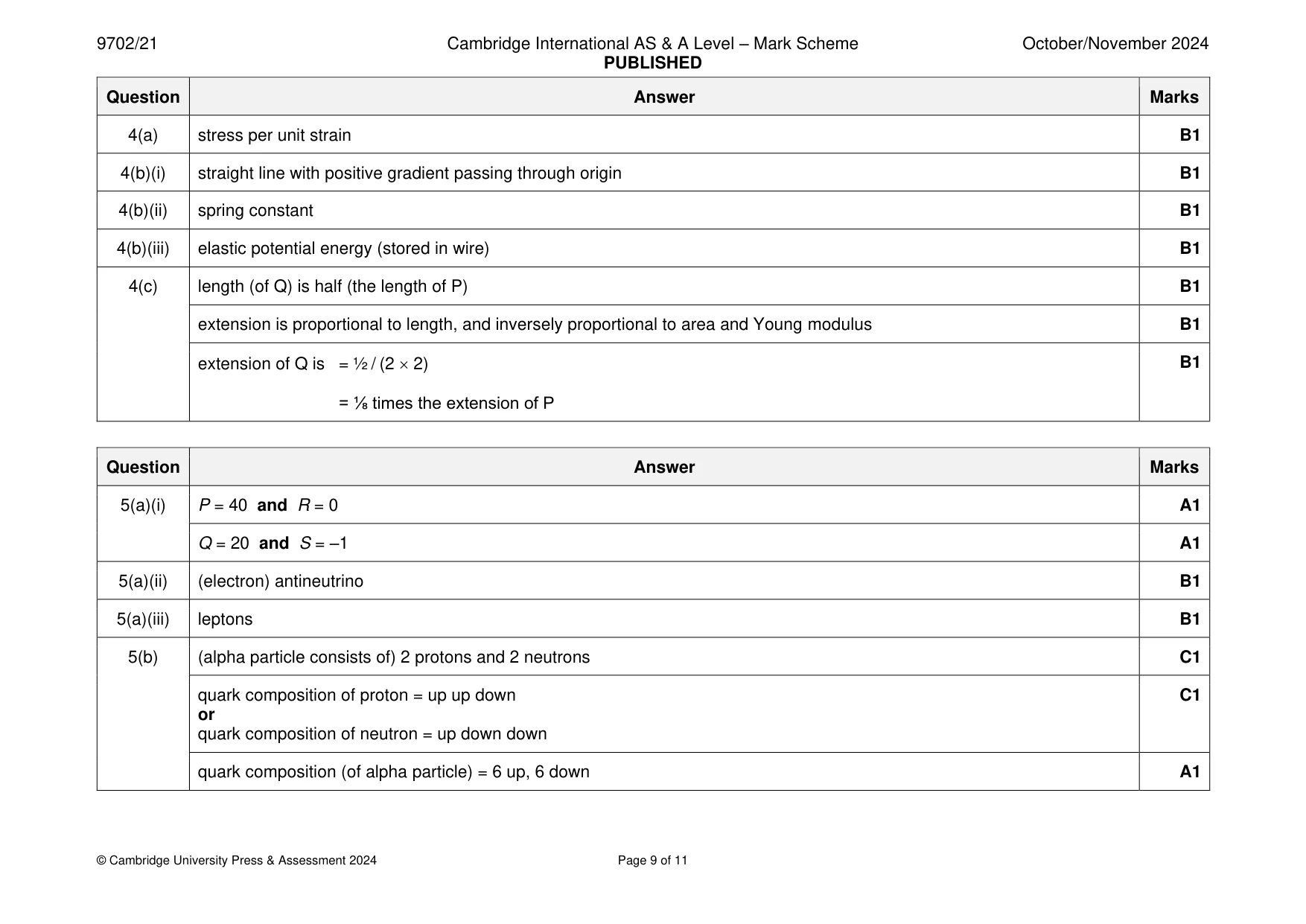
Mark scheme: 4(a) stress per unit strain B1 4(b)(i) straight line with positive gradient passing through origin B1 4(b)(ii) spring constant B1 4(b)(iii) elastic potential energy (stored in wire) B1 4(c) length (of Q) is half (the length of P) B1 extension is proportional to length, and inversely proportional to area and Young modulus B1 extension of Q is = ½ / (2 2) B1 = ⅛ times the extension of P
Q5 · Potassium-40 (4019K) undergoes β– decay to form a nuclide of element X
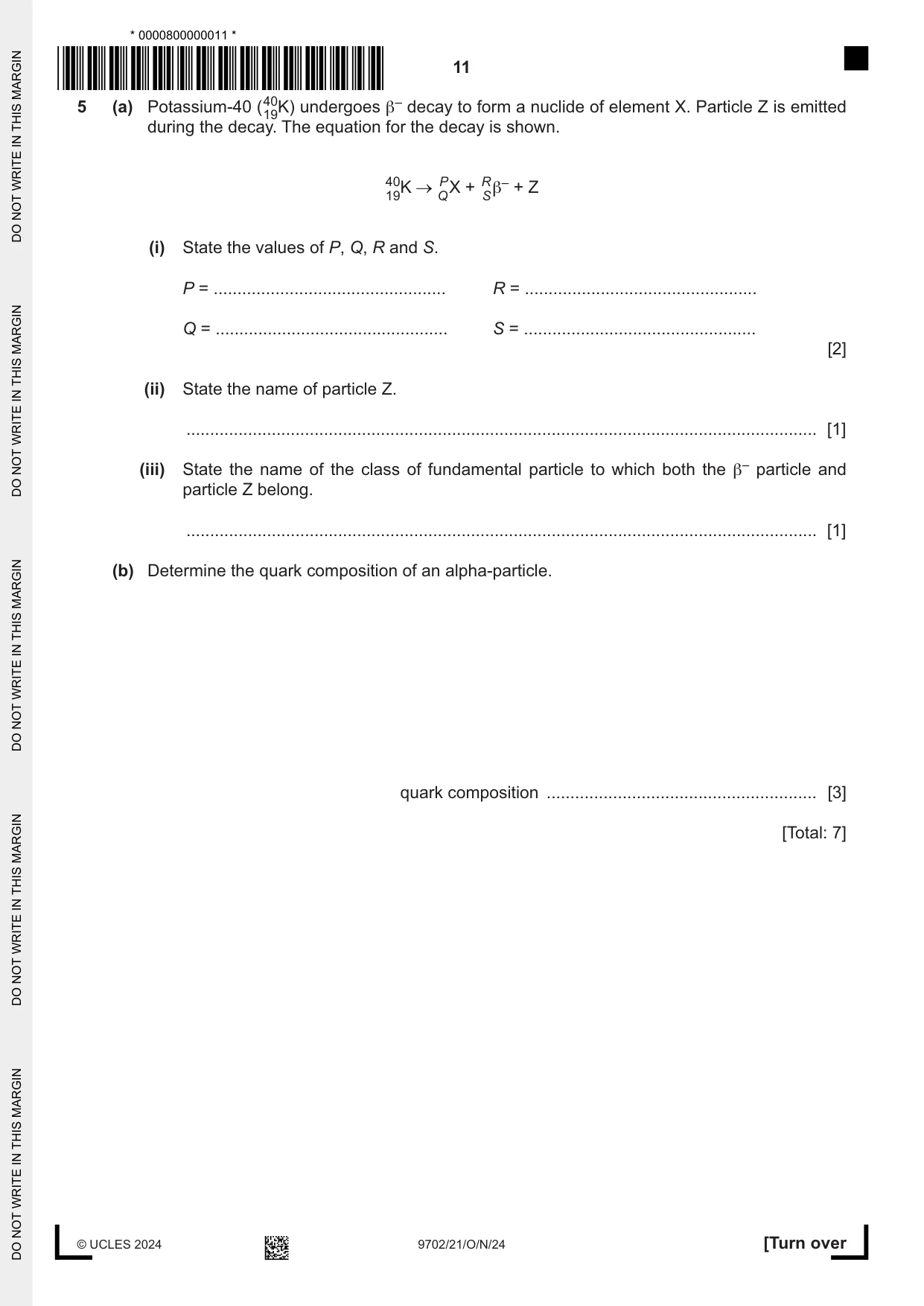
5 (a) Potassium-40 (4019K) undergoes β– decay to form a nuclide of element X. Particle Z is emitted during the decay. The equation for the decay is shown. 4019K Q XP + RS β– + Z (i) State the values of P, Q, R and S. P = ................................................. R = ................................................. Q = ................................................. S = ................................................. [2] (ii) State the name of particle Z. ..................................................................................................................................... [1] (iii) State the name of the class of fundamental particle to which both the β– particle and particle Z belong. ..................................................................................................................................... [1] (b) Determine the quark composition of an alpha-particle. quark composition ......................................................... [3] [Total: 7]
Mark scheme: 5(a)(i) P = 40 and R = 0 A1 Q = 20 and S = –1 A1 5(a)(ii) (electron) antineutrino B1 5(a)(iii) leptons B1 5(b) (alpha particle consists of) 2 protons and 2 neutrons C1 quark composition of proton = up up down C1 or quark composition of neutron = up down down quark composition (of alpha particle) = 6 up, 6 down A1
Q6 · Two coherent sources X and Y of microwaves of frequency 2.5 × 10¹⁰ Hz are a distance of…
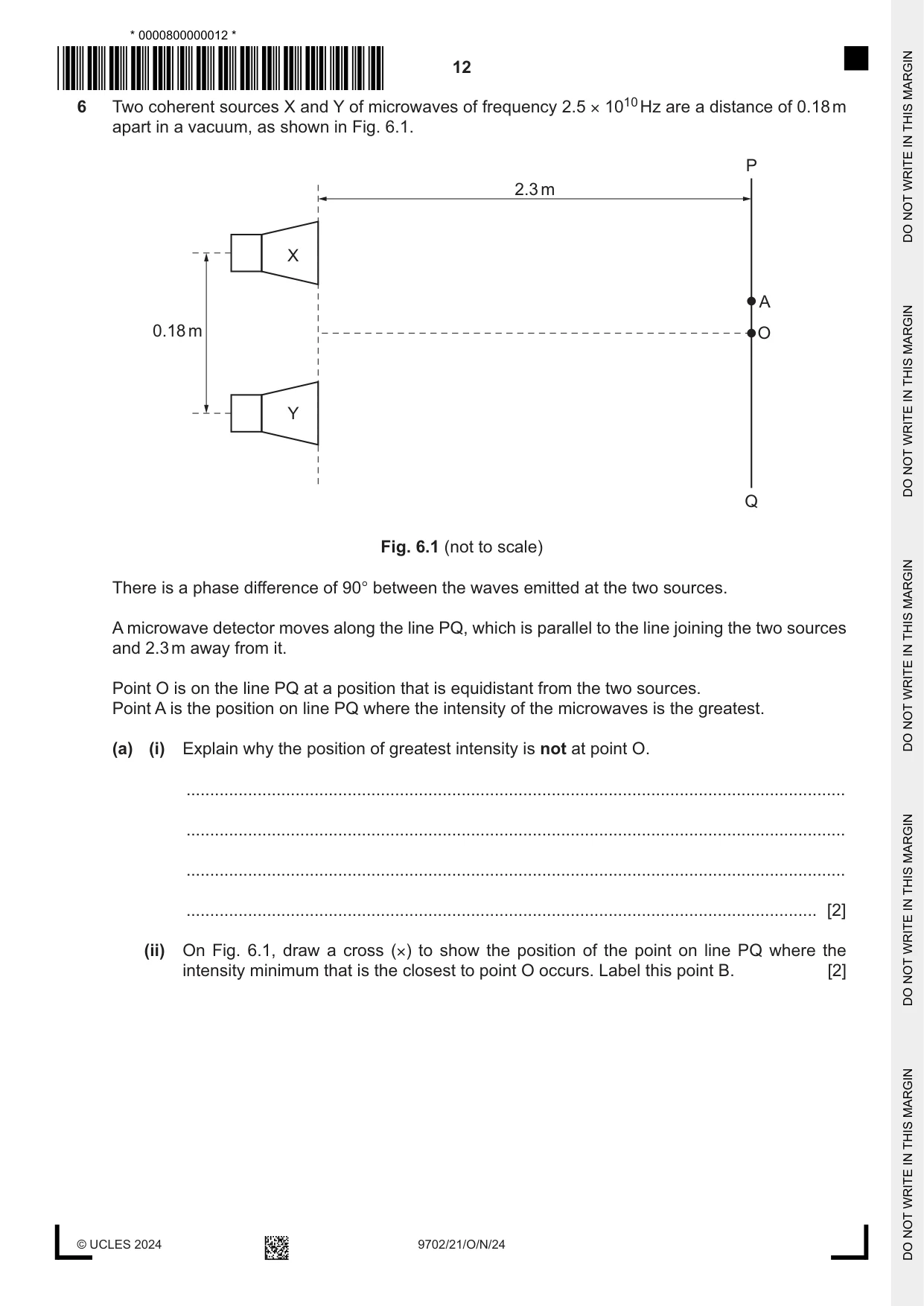
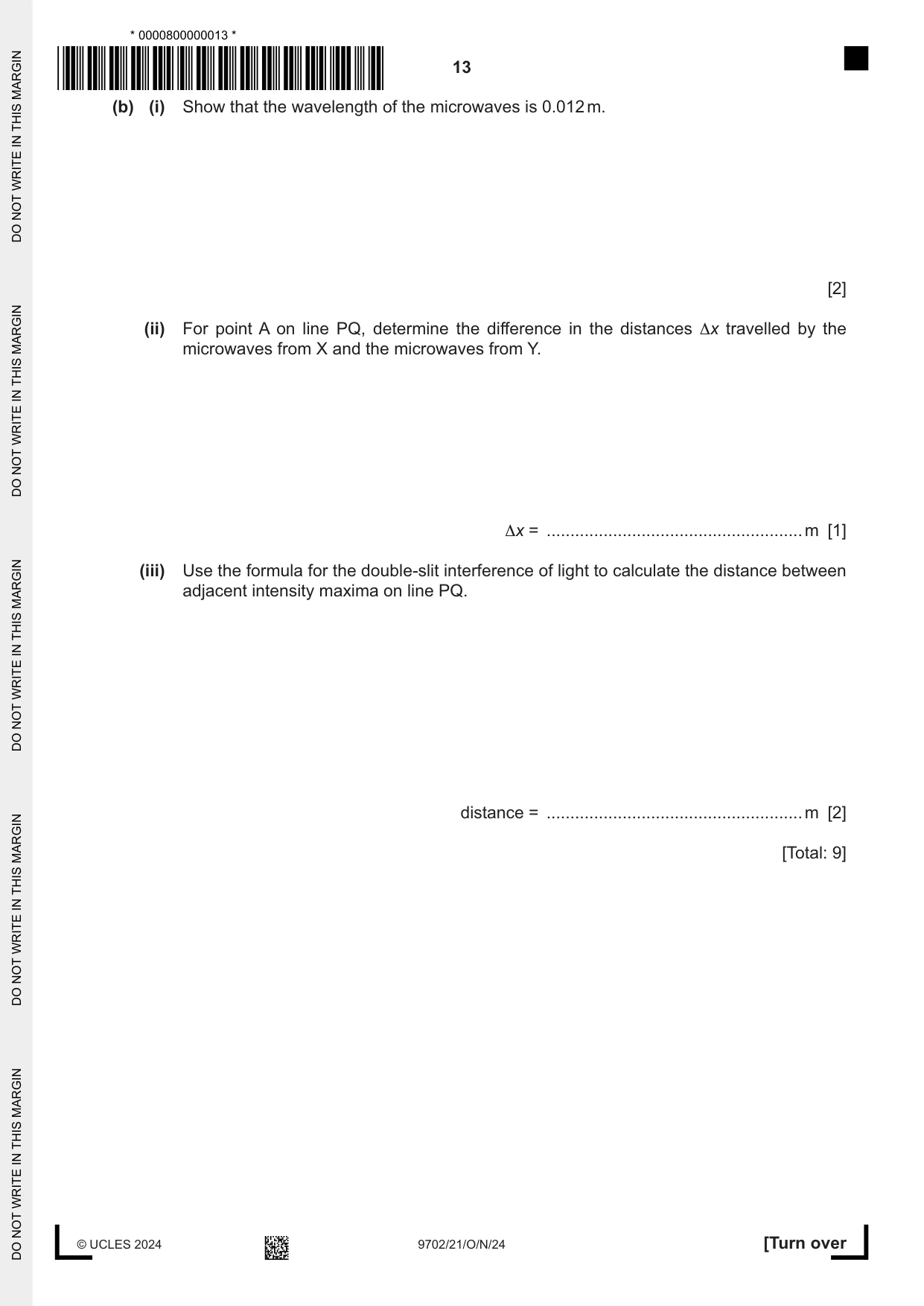
6 Two coherent sources X and Y of microwaves of frequency 2.5 × 10¹⁰ Hz are a distance of 0.18 m apart in a vacuum, as shown in Fig. 6.1. P 2.3 m X A 0.18 m O Y Q Fig. 6.1 (not to scale) There is a phase difference of 90° between the waves emitted at the two sources. A microwave detector moves along the line PQ, which is parallel to the line joining the two sources and 2.3 m away from it. Point O is on the line PQ at a position that is equidistant from the two sources. Point A is the position on line PQ where the intensity of the microwaves is the greatest. (a) (i) Explain why the position of greatest intensity is not at point O. ........................................................................................................................................... ........................................................................................................................................... ........................................................................................................................................... ..................................................................................................................................... [2] (ii) On Fig. 6.1, draw a cross (×) to show the position of the point on line PQ where the intensity minimum that is the closest to point O occurs. Label this point B. [2] (b) (i) Show that the wavelength of the microwaves is 0.012 m. [2] (ii) For point A on line PQ, determine the difference in the distances Δx travelled by the microwaves from X and the microwaves from Y. Δx = ...................................................... m [1] (iii) Use the formula for the double-slit interference of light to calculate the distance between adjacent intensity maxima on line PQ. distance = ...................................................... m [2] [Total: 9]
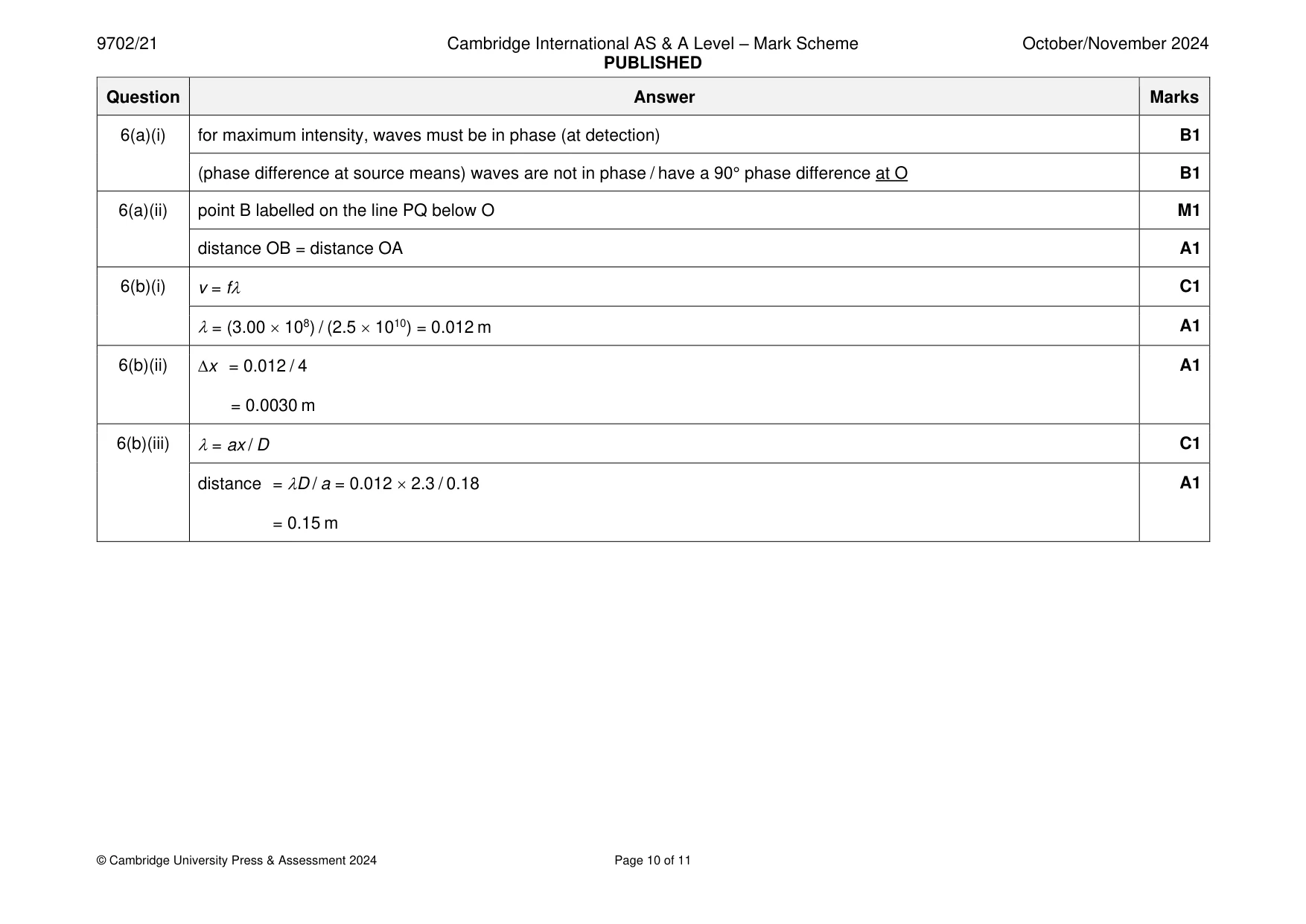
Mark scheme: 6(a)(i) for maximum intensity, waves must be in phase (at detection) B1 (phase difference at source means) waves are not in phase / have a 90° phase difference at O B1 6(a)(ii) point B labelled on the line PQ below O M1 distance OB = distance OA A1 6(b)(i) v = f C1 = (3.00 108) / (2.5 1010) = 0.012 m A1 6(b)(ii) x = 0.012 / 4 A1 = 0.0030 m 6(b)(iii) = ax / D C1 distance = D / a = 0.012 2.3 / 0.18 A1 = 0.15 m
Q7 · Two resistors connected in series with a cell of electromotive force (e.m.f.) 1.50 V and…
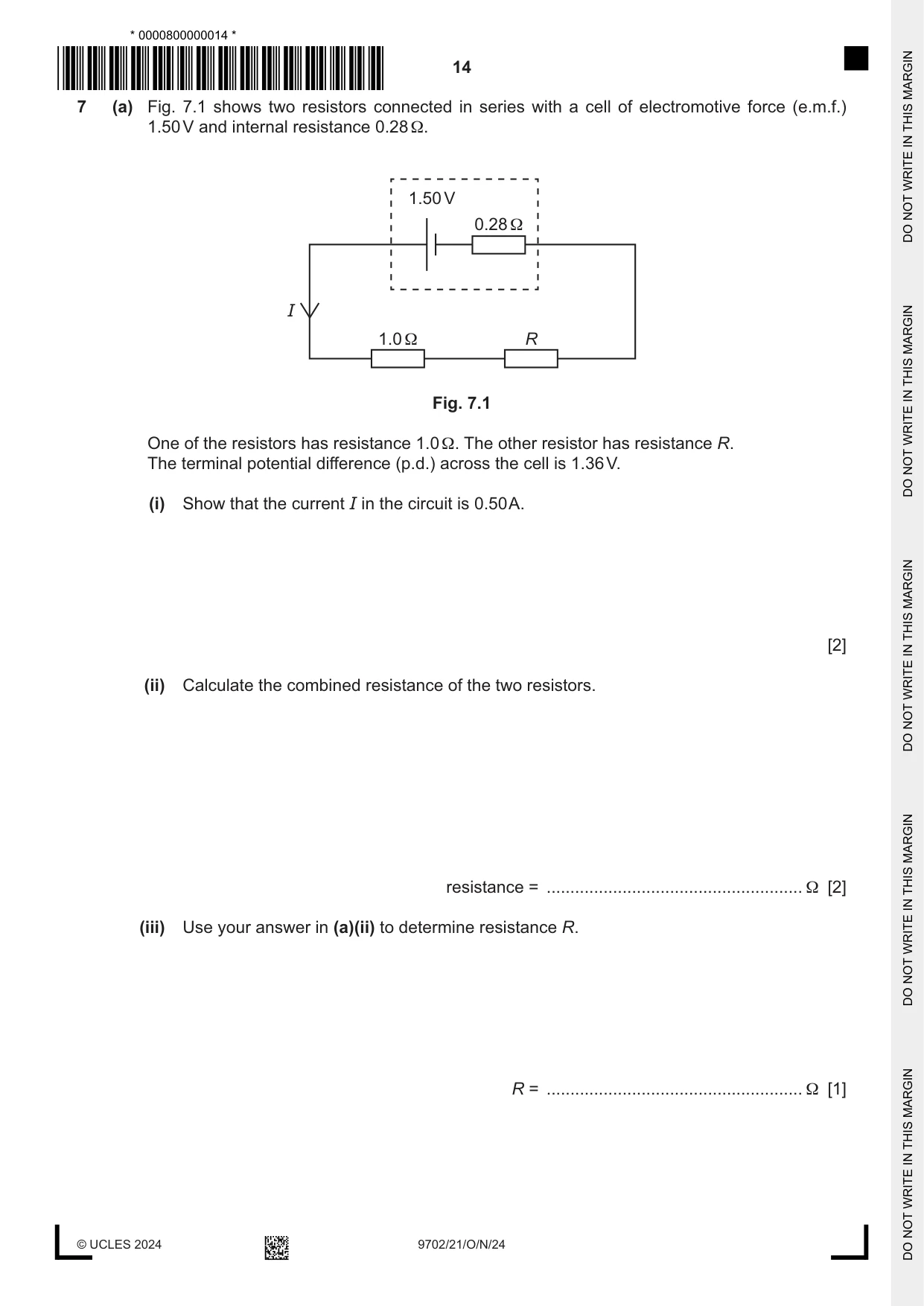
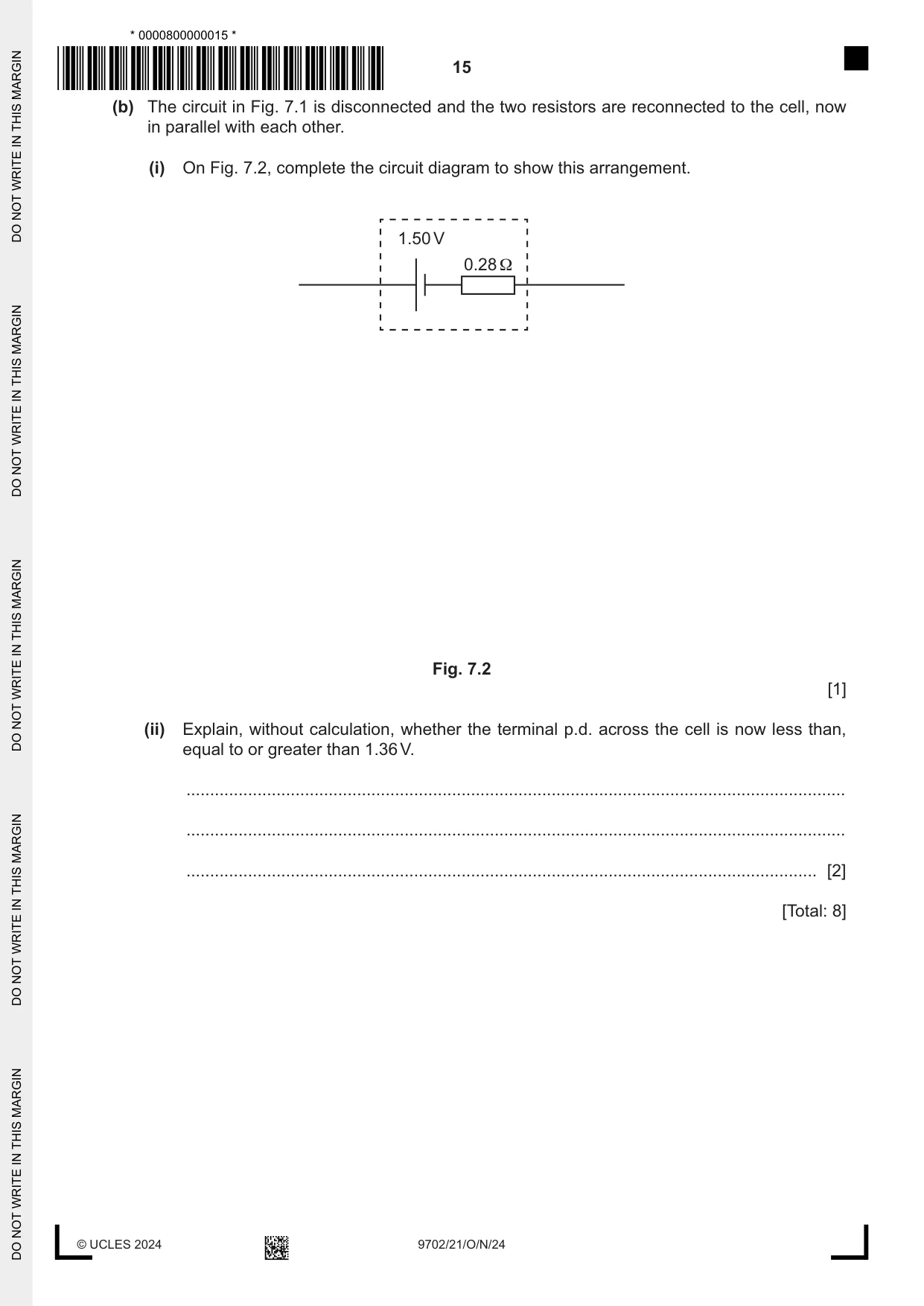
7 (a) Fig. 7.1 shows two resistors connected in series with a cell of electromotive force (e.m.f.) 1.50 V and internal resistance 0.28 Ω. 1.50 V 0.28 Ω I 1.0 Ω R Fig. 7.1 One of the resistors has resistance 1.0 Ω. The other resistor has resistance R. The terminal potential difference (p.d.) across the cell is 1.36 V. (i) Show that the current I in the circuit is 0.50 A. [2] (ii) Calculate the combined resistance of the two resistors. resistance = ...................................................... Ω [2] (iii) Use your answer in (a)(ii) to determine resistance R. R = ...................................................... Ω [1] (b) The circuit in Fig. 7.1 is disconnected and the two resistors are reconnected to the cell, now in parallel with each other. (i) On Fig. 7.2, complete the circuit diagram to show this arrangement. 1.50 V 0.28 Ω Fig. 7.2 [1] (ii) Explain, without calculation, whether the terminal p.d. across the cell is now less than, equal to or greater than 1.36 V. ........................................................................................................................................... ........................................................................................................................................... ..................................................................................................................................... [2] [Total: 8]
Mark scheme: 7(a)(i) (V =) 1.50 – 1.36 B1 (= 0.14 V) current = V / R A1 = 0.14 / 0.28 = 0.50 A 7(a)(ii) resistance = V / I C1 = 1.36 / 0.50 A1 = 2.7 7(a)(iii) R = 2.7 – 1.0 A1 = 1.7 7(b)(i) two resistors correctly shown in parallel with cell and no other components B1 7(b)(ii) (external) resistance is now smaller B1 and (so) current (in cell) is greater / (external) resistance smaller fraction of total resistance / internal resistance larger fraction of total resistance (greater p.d. across internal resistance so) terminal p.d. is less B1
What was in this paper
The subtopics covered by these 7 questions, and how many questions each got. Open one in a new tab to see every Cambridge question on it.
What you needed in this session
Cambridge’s own grade thresholds for 2024 Oct/Nov, Paper 2 · Variant 1. A higher threshold means an easier paper — the bar moves with how the cohort did.