Cambridge A Level Physics 9702 — 2025 Oct/Nov Paper 2 · Variant 2
9702/22/O/N/25 · 6 questions · 60 marks · 75 min
The question paper and its mark scheme, free to read here and free to download. This is Cambridge’s own paper, exactly as it was sat.
Question paper16 pages

Mark scheme15 pages
Answers below. Sit the paper first if you are practising.


Questions as text
Q1 · Scientists are investigating the variation in air pressure at different locations on a…
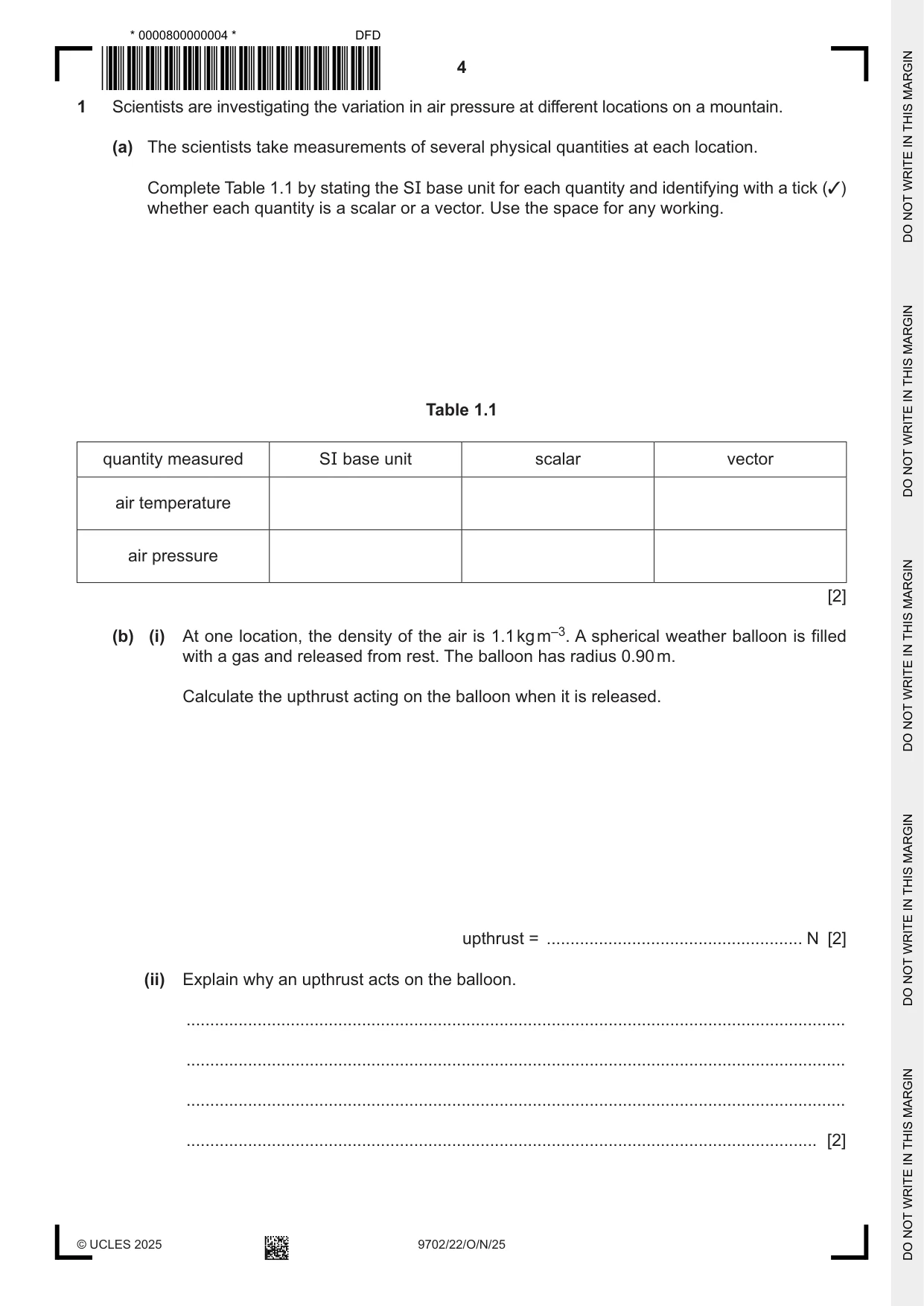
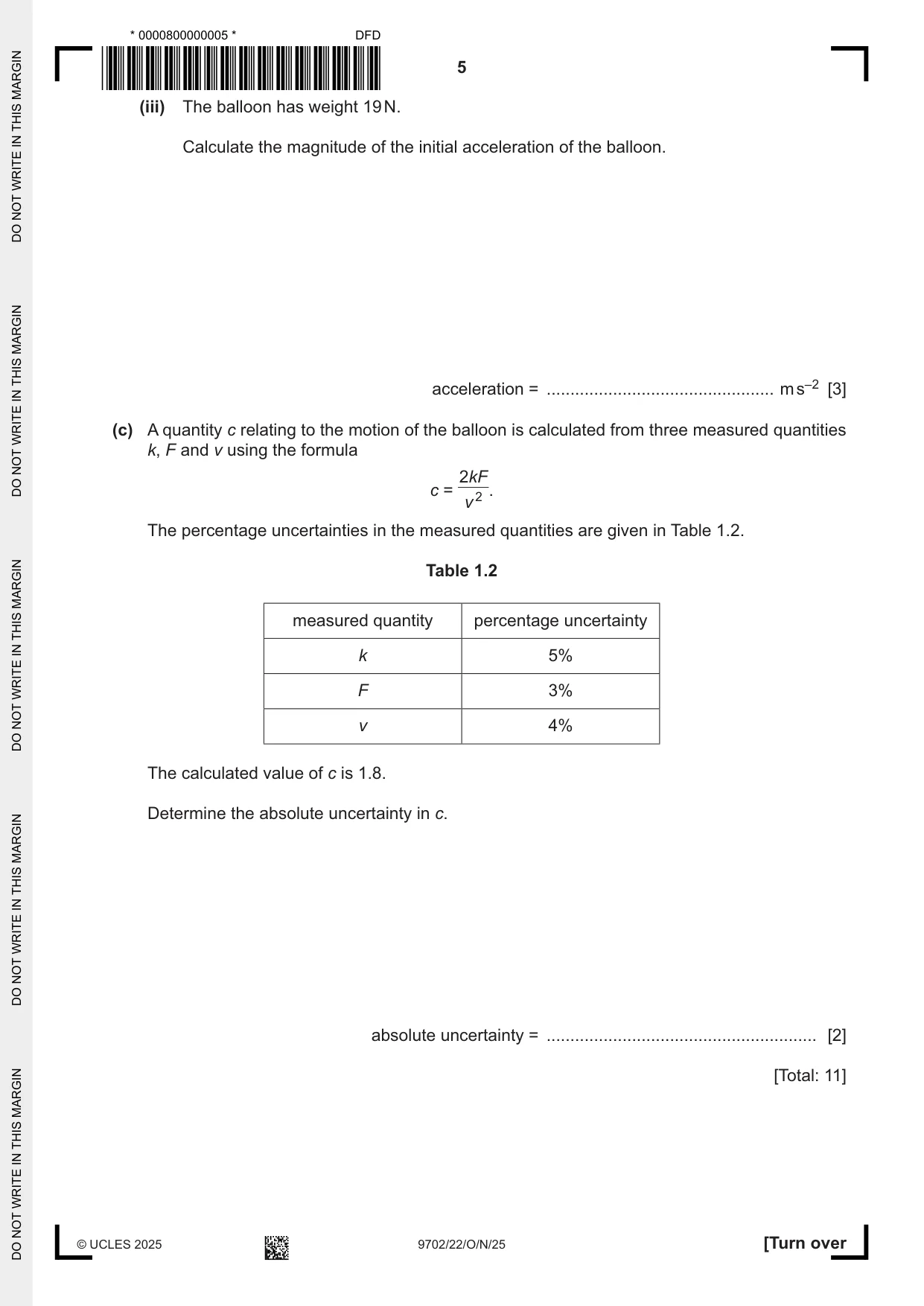
1 Scientists are investigating the variation in air pressure at different locations on a mountain. (a) The scientists take measurements of several physical quantities at each location. Complete Table 1.1 by stating the SI base unit for each quantity and identifying with a tick (3) whether each quantity is a scalar or a vector. Use the space for any working. Table 1.1 quantity measured SI base unit scalar vector air temperature air pressure [2] (b) (i) At one location, the density of the air is 1.1 kg m–3. A spherical weather balloon is filled with a gas and released from rest. The balloon has radius 0.90 m. Calculate the upthrust acting on the balloon when it is released. upthrust = ...................................................... N [2] (ii) Explain why an upthrust acts on the balloon. ........................................................................................................................................... ........................................................................................................................................... ........................................................................................................................................... ..................................................................................................................................... [2] (iii) The balloon has weight 19 N. Calculate the magnitude of the initial acceleration of the balloon. acceleration = ................................................ m s–2 [3] (c) A quantity c relating to the motion of the balloon is calculated from three measured quantities k, F and v using the formula 2kF c = . v 2 The percentage uncertainties in the measured quantities are given in Table 1.2. Table 1.2 measured quantity percentage uncertainty k 5% F 3% v 4% The calculated value of c is 1.8. Determine the absolute uncertainty in c. absolute uncertainty = ......................................................... [2] [Total: 11]
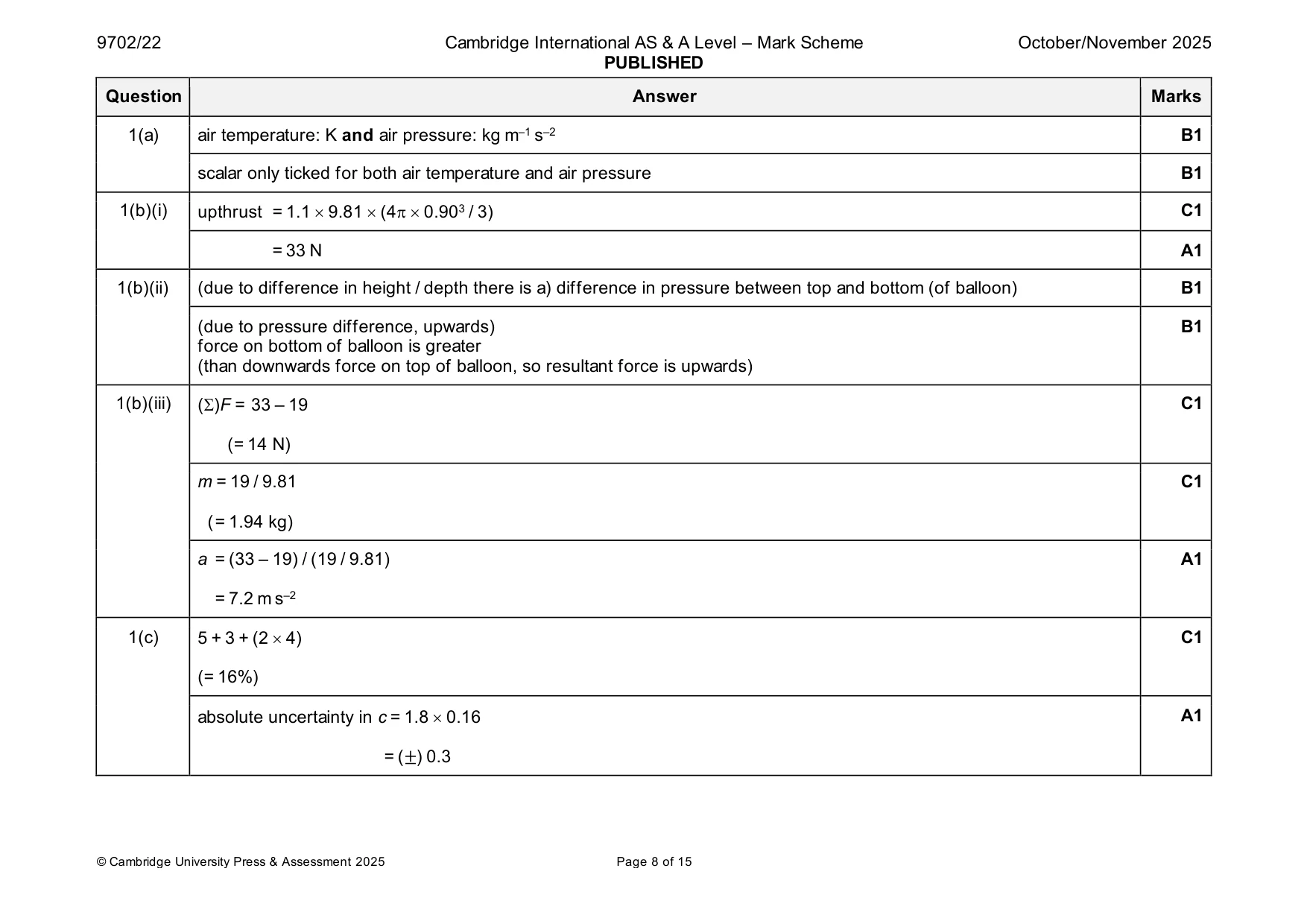
Mark scheme: Question Answer Marks 1(a) air temperature: K and air pressure: kg m–1 s–2 B1 scalar only ticked for both air temperature and air pressure B1 1(b)(i) upthrust = 1.1 9.81 (4 0.903 / 3) C1 = 33 N A1 1(b)(ii) (due to difference in height / depth there is a) difference in pressure between top and bottom (of balloon) B1 (due to pressure difference, upwards) B1 force on bottom of balloon is greater (than downwards force on top of balloon, so resultant force is upwards) 1(b)(iii) ()F = 33 – 19 C1 (= 14 N) m = 19 / 9.81 C1 ( = 1.94 kg) a = (33 – 19) / (19 / 9.81) A1 = 7.2 m s–2 1(c) 5 + 3 + (2 4) C1 (= 16%) absolute uncertainty in c = 1.8 0.16 A1 = (±) 0.3
Q2 · A spacecraft in deep space uses jets of hot gas from its thrusters to change its velocity
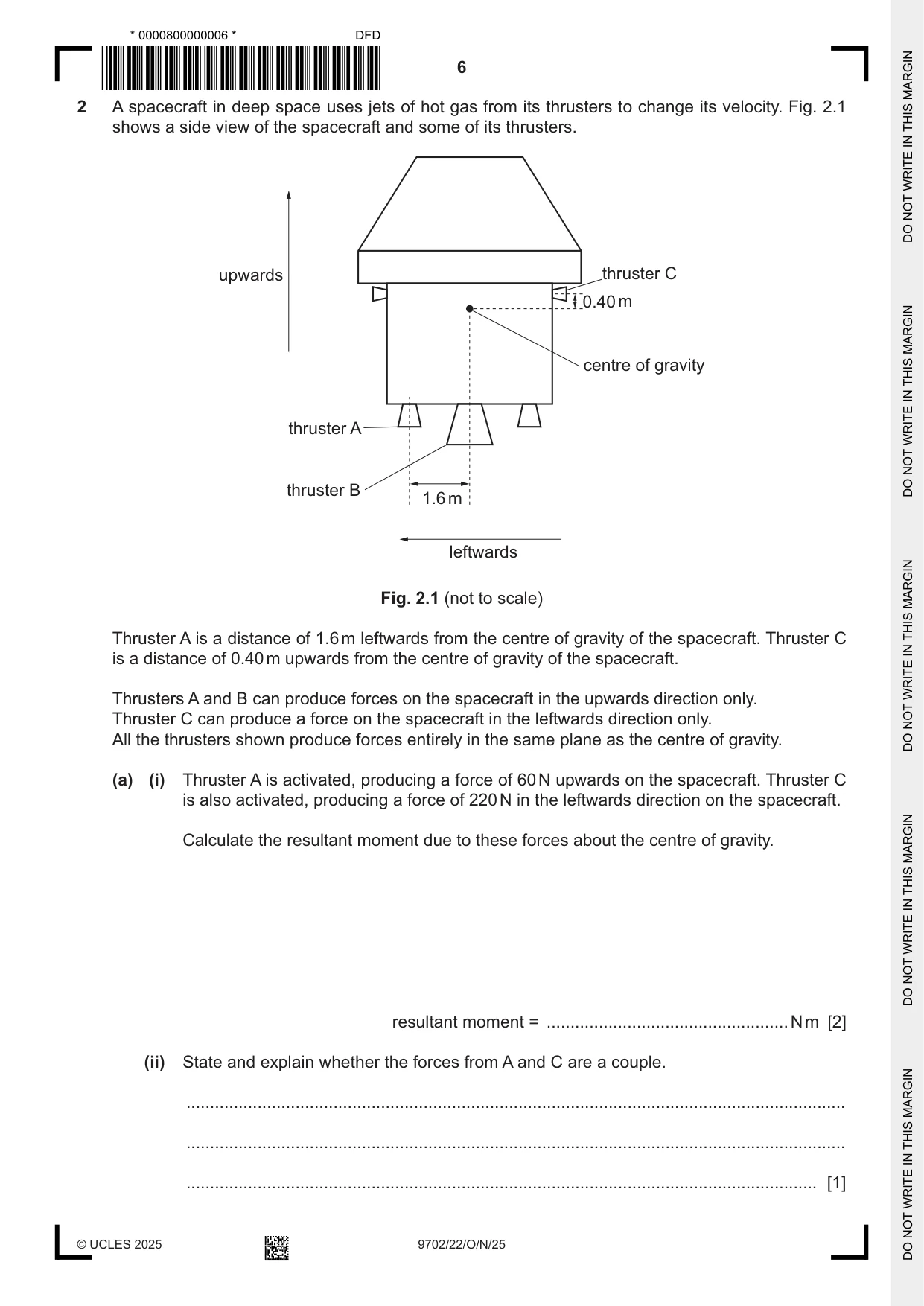
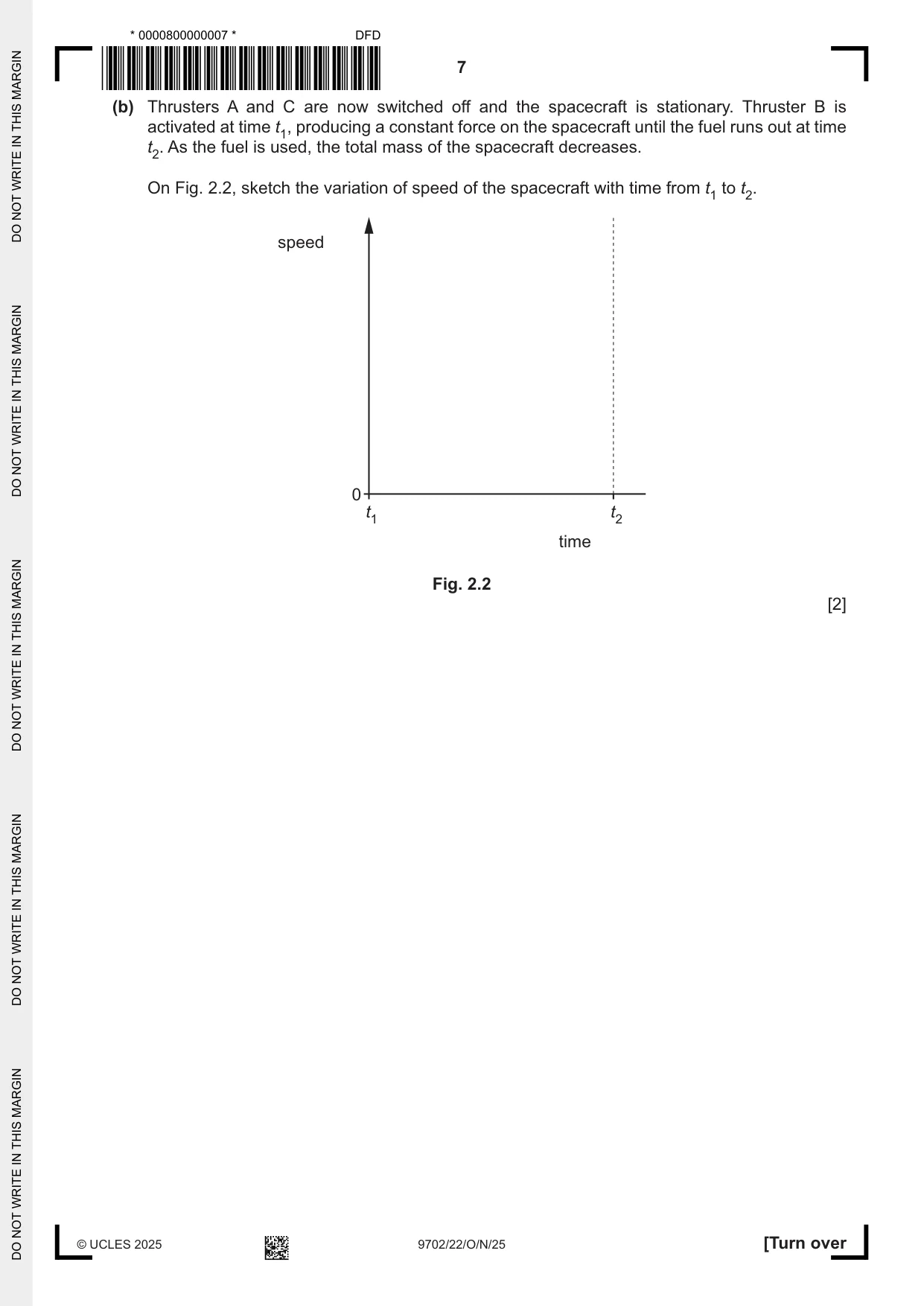
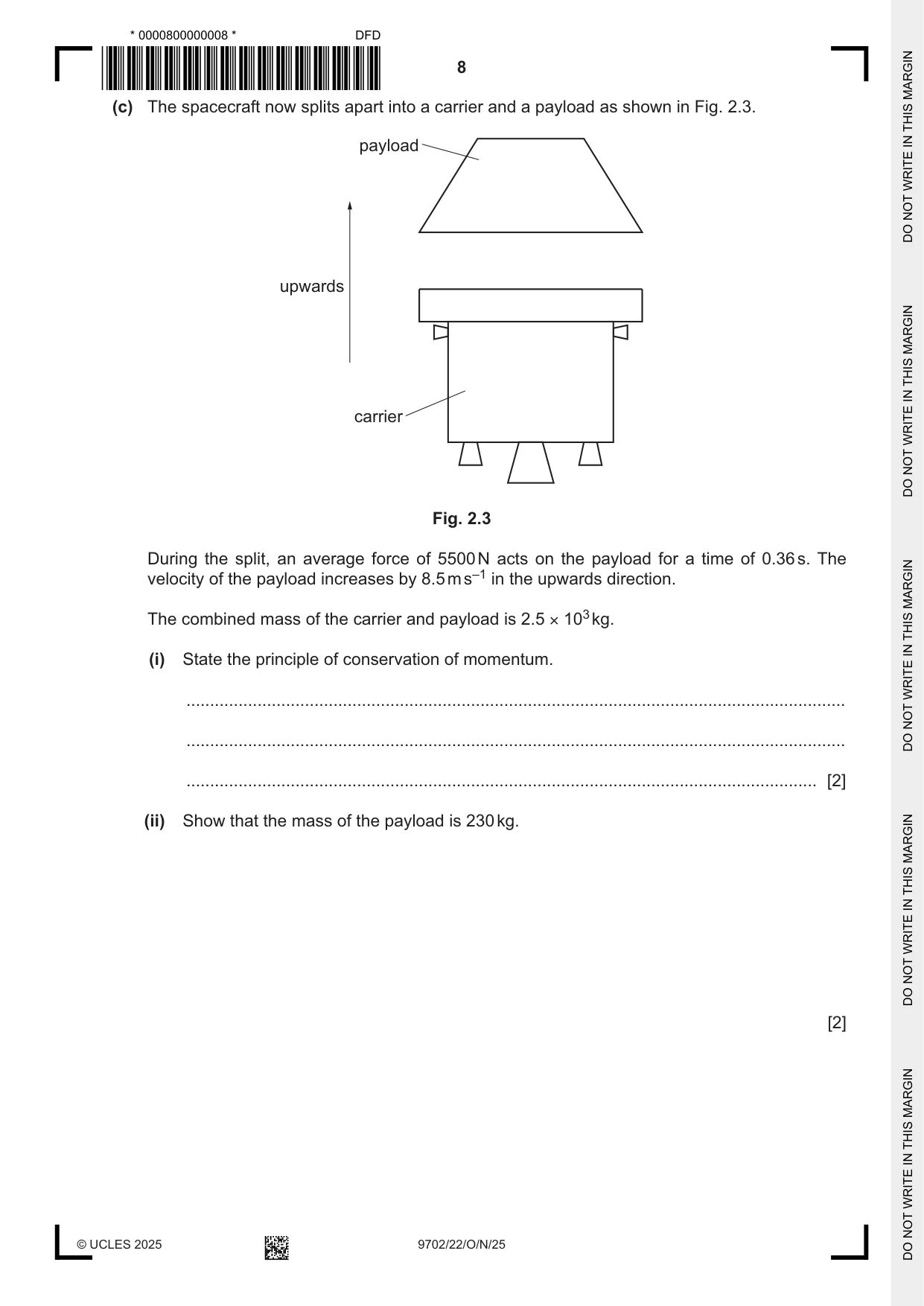
2 A spacecraft in deep space uses jets of hot gas from its thrusters to change its velocity. Fig. 2.1 shows a side view of the spacecraft and some of its thrusters. upwards thruster C 0.40 m centre of gravity thruster A thruster B 1.6 m leftwards Fig. 2.1 (not to scale) Thruster A is a distance of 1.6 m leftwards from the centre of gravity of the spacecraft. Thruster C is a distance of 0.40 m upwards from the centre of gravity of the spacecraft. Thrusters A and B can produce forces on the spacecraft in the upwards direction only. Thruster C can produce a force on the spacecraft in the leftwards direction only. All the thrusters shown produce forces entirely in the same plane as the centre of gravity. (a) (i) Thruster A is activated, producing a force of 60 N upwards on the spacecraft. Thruster C is also activated, producing a force of 220 N in the leftwards direction on the spacecraft. Calculate the resultant moment due to these forces about the centre of gravity. resultant moment = ................................................... N m [2] (ii) State and explain whether the forces from A and C are a couple. ........................................................................................................................................... ........................................................................................................................................... ..................................................................................................................................... [1] (b) Thrusters A and C are now switched off and the spacecraft is stationary. Thruster B is activated at time t1, producing a constant force on the spacecraft until the fuel runs out at time t2. As the fuel is used, the total mass of the spacecraft decreases. On Fig. 2.2, sketch the variation of speed of the spacecraft with time from t1 to t2. speed 0 t1 t2 time Fig. 2.2 [2] (c) The spacecraft now splits apart into a carrier and a payload as shown in Fig. 2.3. payload upwards carrier Fig. 2.3 During the split, an average force of 5500 N acts on the payload for a time of 0.36 s. The velocity of the payload increases by 8.5 m s–1 in the upwards direction. The combined mass of the carrier and payload is 2.5 × 10³ kg. (i) State the principle of conservation of momentum. ........................................................................................................................................... ........................................................................................................................................... ..................................................................................................................................... [2] (ii) Show that the mass of the payload is 230 kg. [2] (iii) Calculate the magnitude of the change in velocity of the carrier. change in velocity = ................................................ m s–1 [3] [Total: 12]
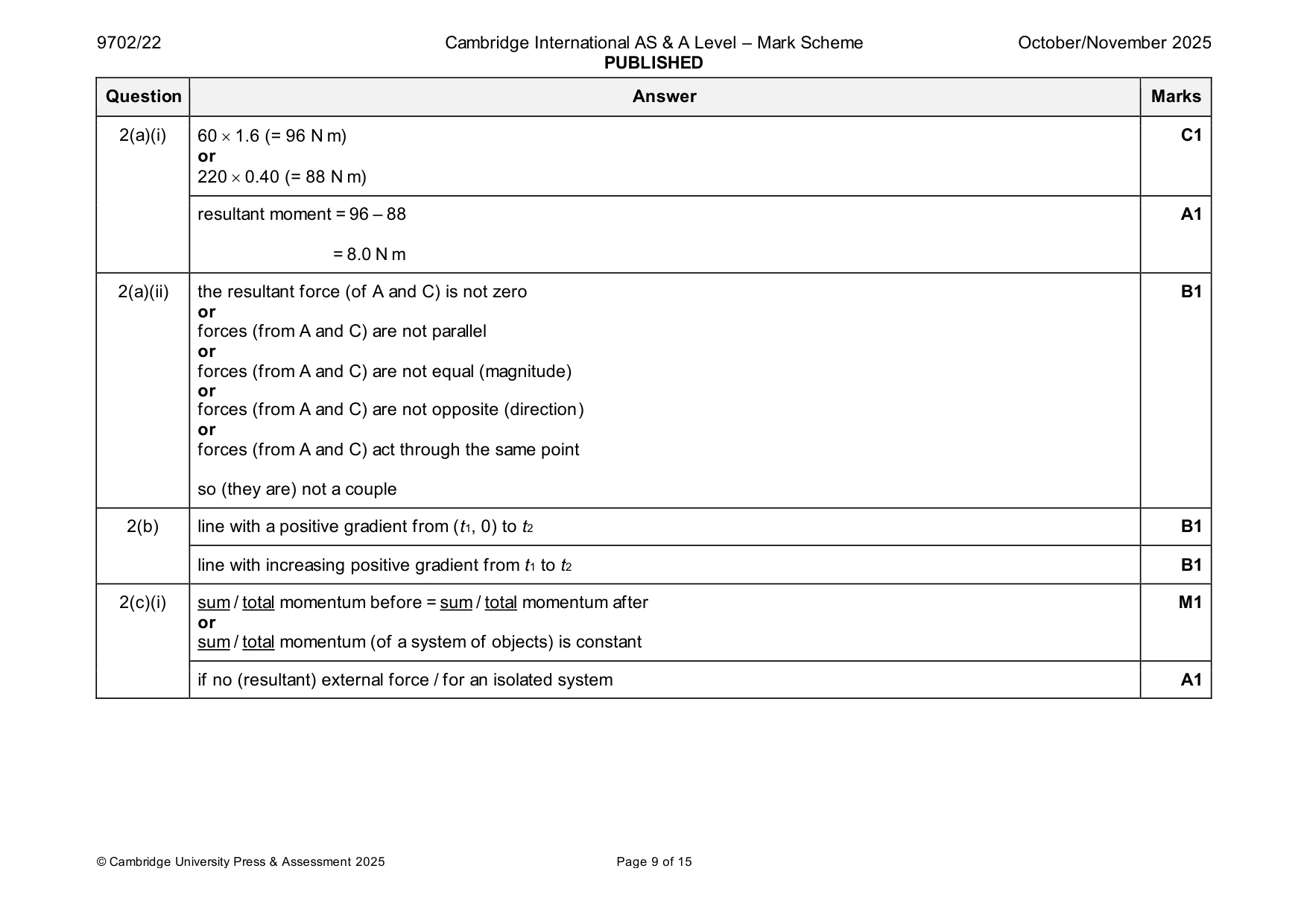
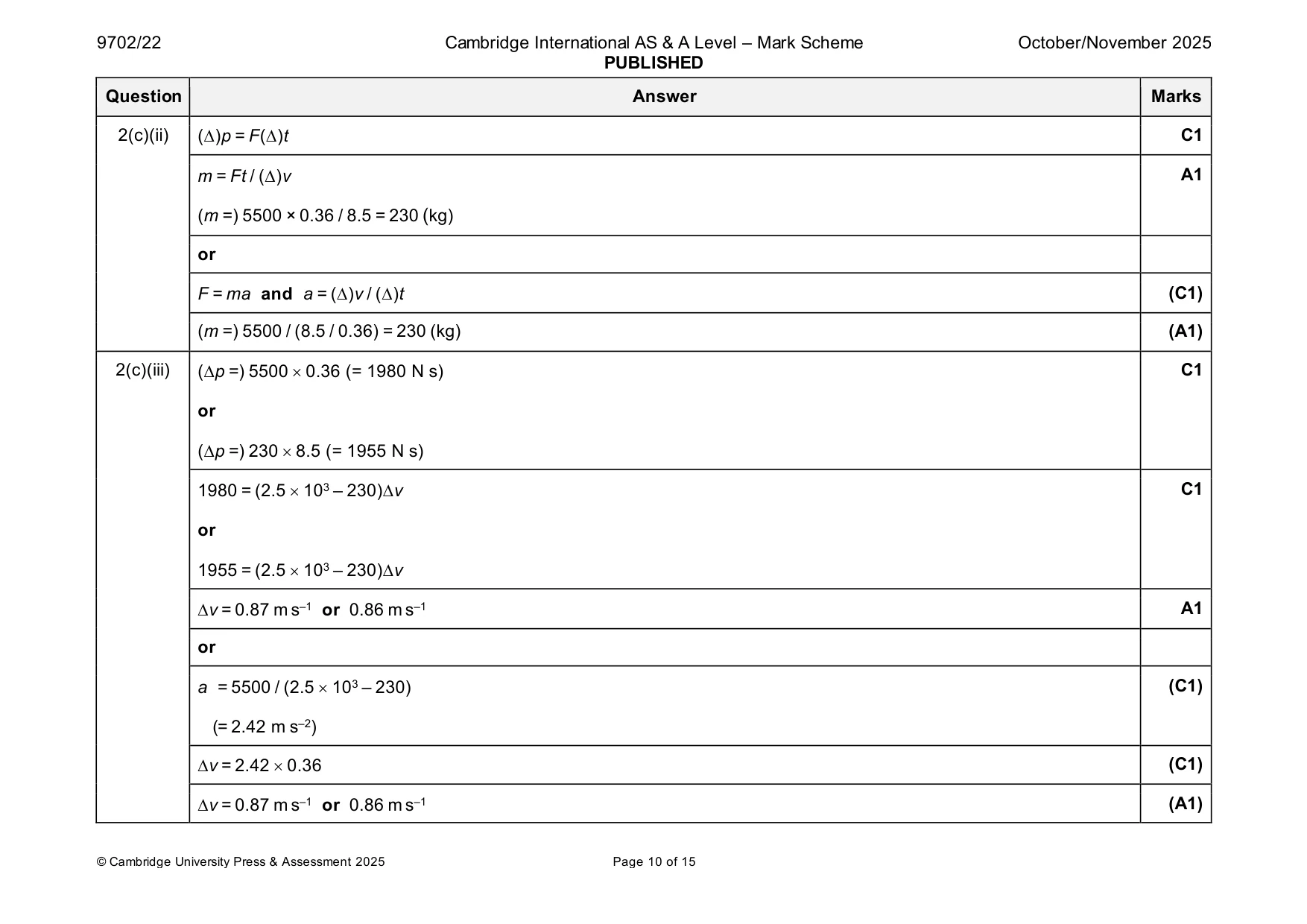
Mark scheme: 2(a)(i) 60 1.6 (= 96 N m) C1 or 220 0.40 (= 88 N m) resultant moment = 96 – 88 A1 = 8.0 N m 2(a)(ii) the resultant force (of A and C) is not zero B1 or forces (from A and C) are not parallel or forces (from A and C) are not equal (magnitude) or forces (from A and C) are not opposite (direction) or forces (from A and C) act through the same point so (they are) not a couple 2(b) line with a positive gradient from (t1, 0) to t2 B1 line with increasing positive gradient from t1 to t2 B1 2(c)(i) sum / total momentum before = sum / total momentum after M1 or sum / total momentum (of a system of objects) is constant if no (resultant) external force / for an isolated system A1 2(c)(ii) ()p = F()t C1 m = Ft / ()v A1 (m =) 5500 × 0.36 / 8.5 = 230 (kg) or F = ma and a = ()v / ()t (C1) (m =) 5500 / (8.5 / 0.36) = 230 (kg) (A1) 2(c)(iii) (p =) 5500 0.36 (= 1980 N s) C1 or (p =) 230 8.5 (= 1955 N s) 1980 = (2.5 103 – 230)v C1 or 1955 = (2.5 103 – 230)v v = 0.87 m s–1 or 0.86 m s–1 A1 or a = 5500 / (2.5 103 – 230) (C1) (= 2.42 m s–2) v = 2.42 0.36 (C1) v = 0.87 m s–1 or 0.86 m s–1 (A1)
Q3 · A spring is fixed at one end and attached to the frame of a pulley at the other end
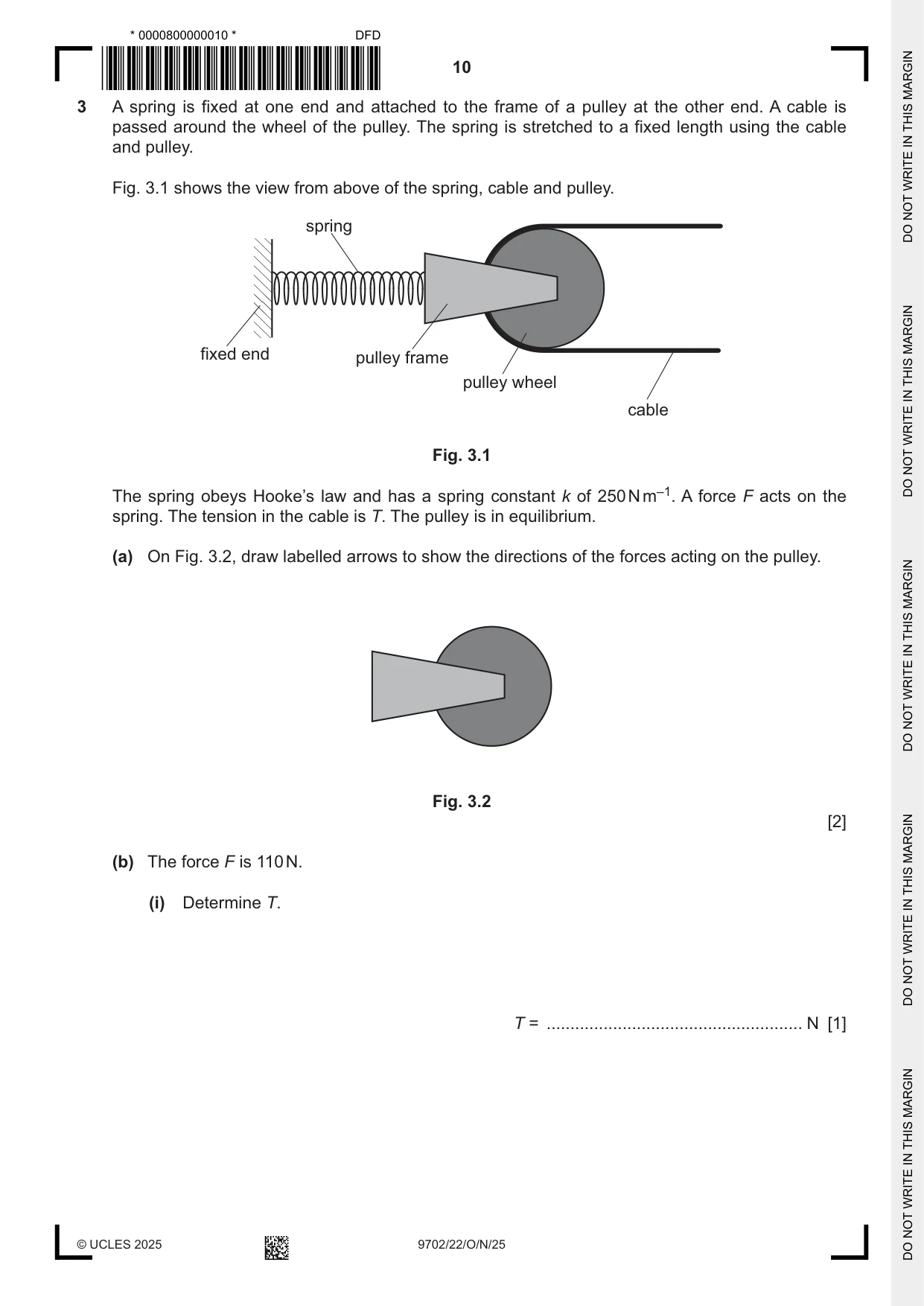
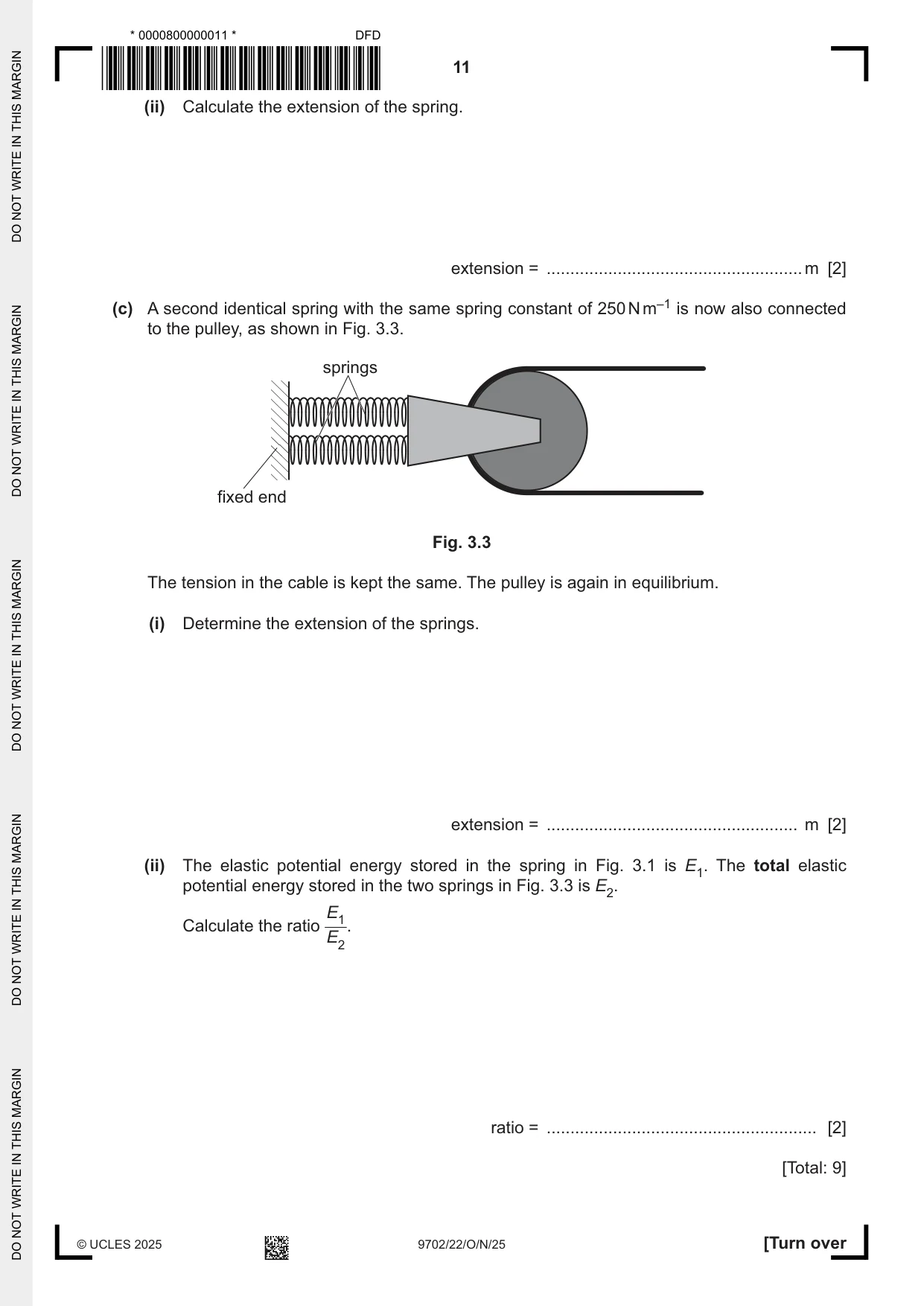
3 A spring is fixed at one end and attached to the frame of a pulley at the other end. A cable is passed around the wheel of the pulley. The spring is stretched to a fixed length using the cable and pulley. Fig. 3.1 shows the view from above of the spring, cable and pulley. spring fixed end pulley frame pulley wheel cable Fig. 3.1 The spring obeys Hooke’s law and has a spring constant k of 250 N m–1. A force F acts on the spring. The tension in the cable is T. The pulley is in equilibrium. (a) On Fig. 3.2, draw labelled arrows to show the directions of the forces acting on the pulley. Fig. 3.2 [2] (b) The force F is 110 N. (i) Determine T. T = ...................................................... N [1] (ii) Calculate the extension of the spring. extension = ...................................................... m [2] (c) A second identical spring with the same spring constant of 250 N m–1 is now also connected to the pulley, as shown in Fig. 3.3. springs fixed end Fig. 3.3 The tension in the cable is kept the same. The pulley is again in equilibrium. (i) Determine the extension of the springs. extension = ..................................................... m [2] (ii) The elastic potential energy stored in the spring in Fig. 3.1 is E1. The total elastic potential energy stored in the two springs in Fig. 3.3 is E2. E1 Calculate the ratio . E2 ratio = ......................................................... [2] [Total: 9]
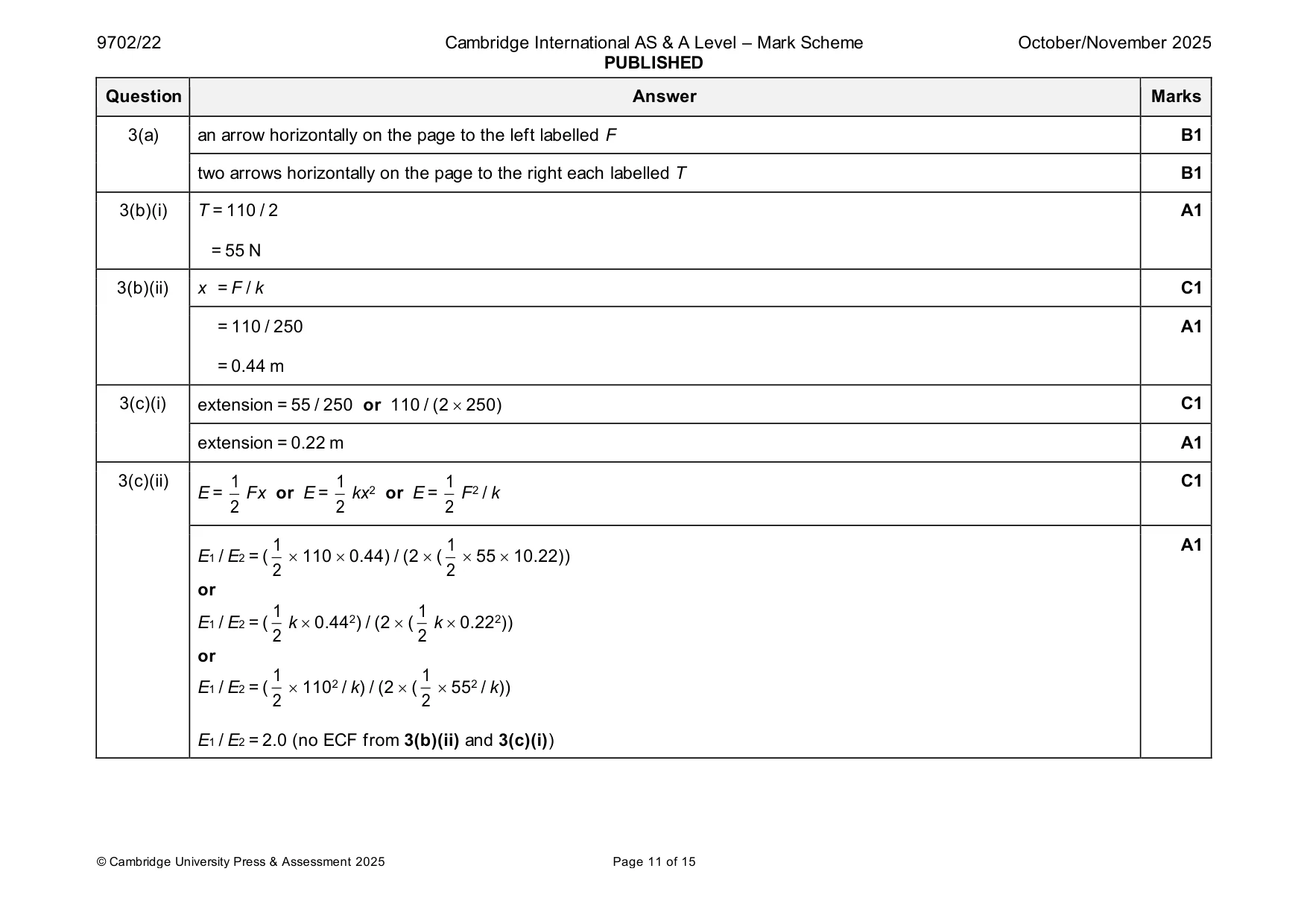
Mark scheme: 3(a) an arrow horizontally on the page to the left labelled F B1 two arrows horizontally on the page to the right each labelled T B1 3(b)(i) T = 110 / 2 A1 = 55 N 3(b)(ii) x = F / k C1 = 110 / 250 A1 = 0.44 m 3(c)(i) extension = 55 / 250 or 110 / (2 250) C1 extension = 0.22 m A1 3(c)(ii) 1 1 1 C1 E = Fx or E = kx2 or E = F2 / k 2 2 2 1 1 A1 E1 / E2 = ( 110 0.44) / (2 ( 55 10.22)) 2 2 or 1 1 E1 / E2 = ( k 0.442) / (2 ( k 0.222)) 2 2 or 1 1 E1 / E2 = ( 1102 / k) / (2 ( 552 / k)) 2 2 E1 / E2 = 2.0 (no ECF from 3(b)(ii) and 3(c)(i))
Q4 · A laser emits visible light of a single frequency in a vacuum
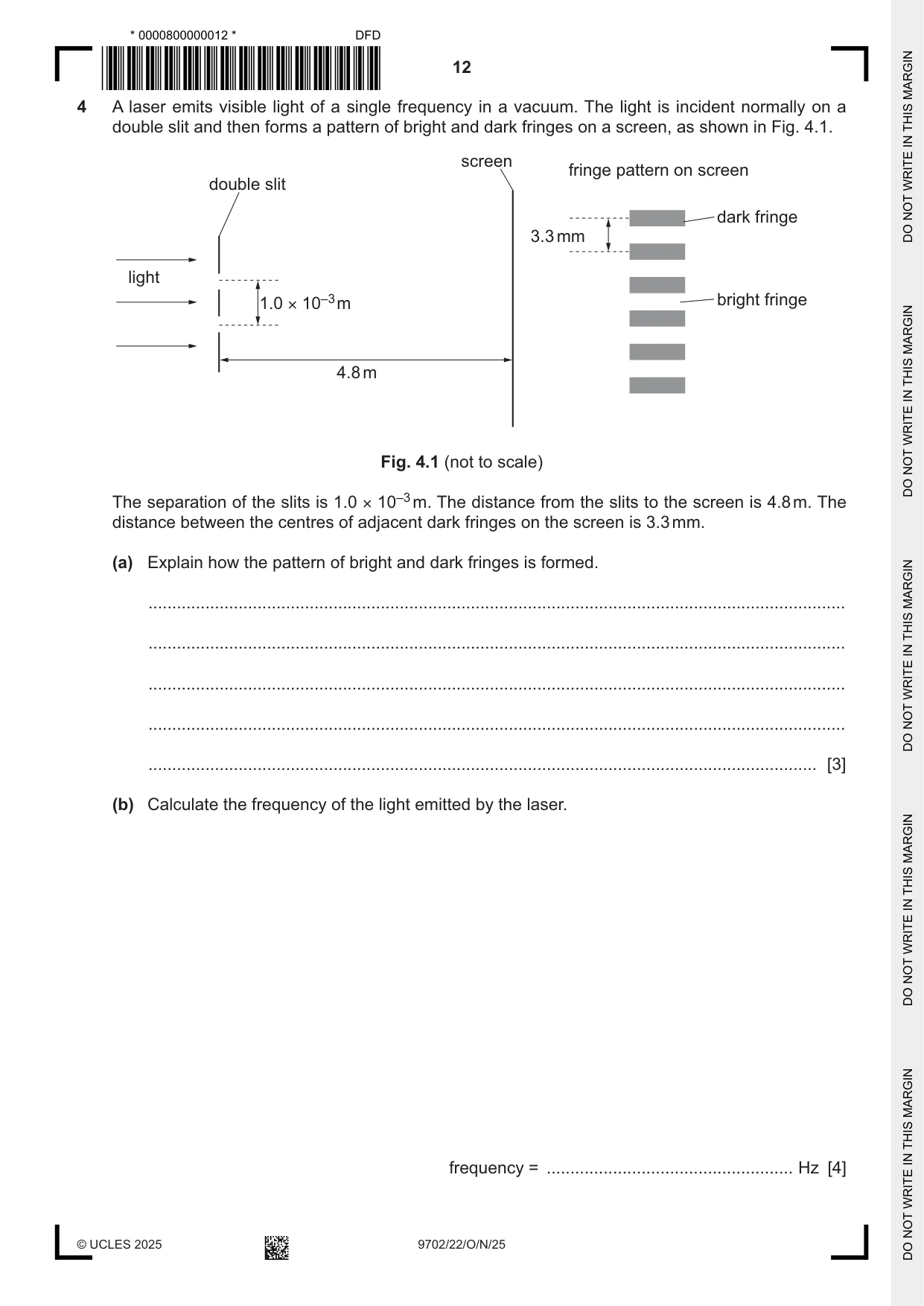
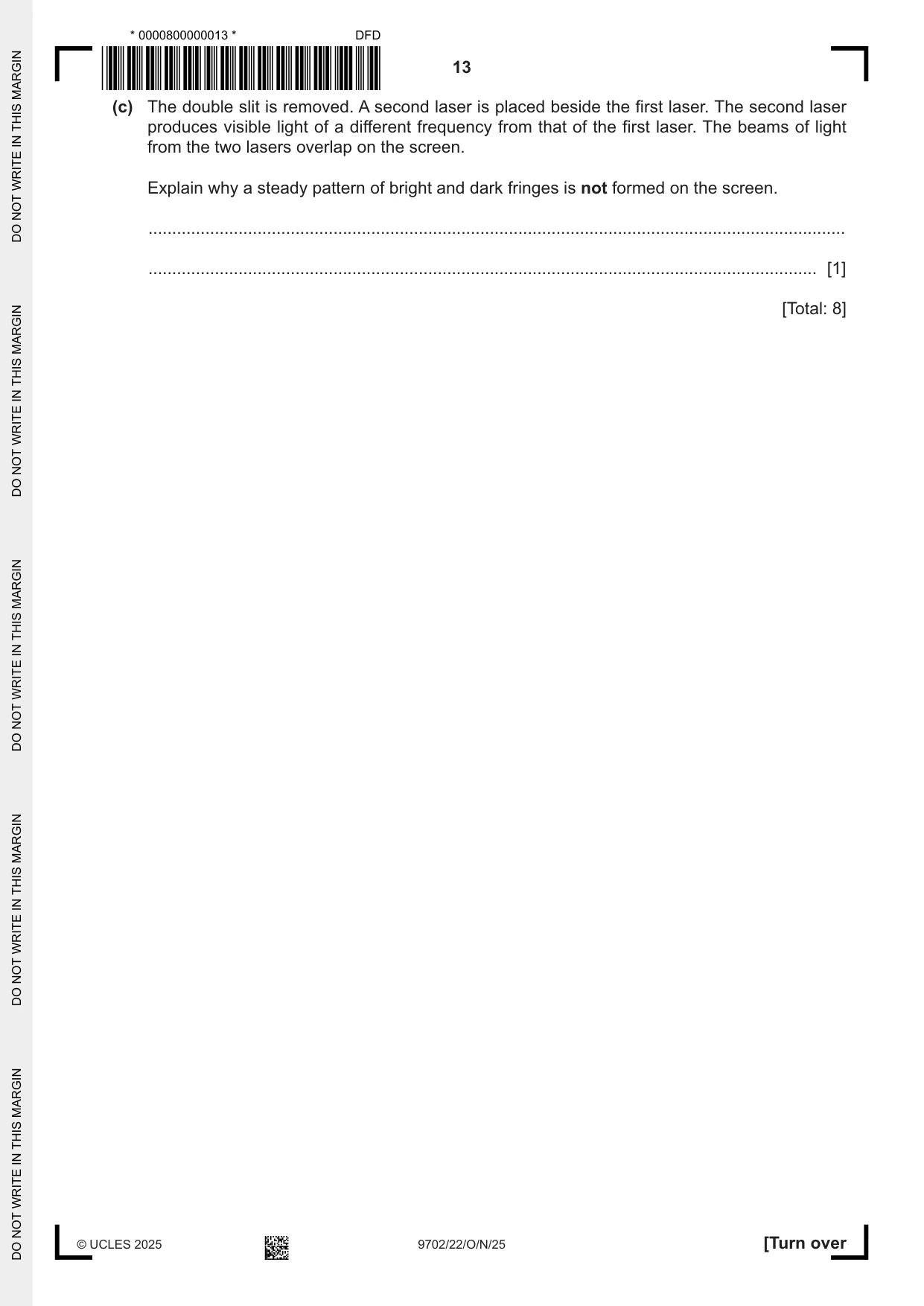
4 A laser emits visible light of a single frequency in a vacuum. The light is incident normally on a double slit and then forms a pattern of bright and dark fringes on a screen, as shown in Fig. 4.1. screen fringe pattern on screen double slit dark fringe 3.3 mm light 1.0 × 10⁻³ m bright fringe 4.8 m Fig. 4.1 (not to scale) The separation of the slits is 1.0 × 10⁻³ m. The distance from the slits to the screen is 4.8 m. The distance between the centres of adjacent dark fringes on the screen is 3.3 mm. (a) Explain how the pattern of bright and dark fringes is formed. ................................................................................................................................................... ................................................................................................................................................... ................................................................................................................................................... ................................................................................................................................................... ............................................................................................................................................. [3] (b) Calculate the frequency of the light emitted by the laser. frequency = .................................................... Hz [4] (c) The double slit is removed. A second laser is placed beside the first laser. The second laser produces visible light of a different frequency from that of the first laser. The beams of light from the two lasers overlap on the screen. Explain why a steady pattern of bright and dark fringes is not formed on the screen. ................................................................................................................................................... ............................................................................................................................................. [1] [Total: 8]
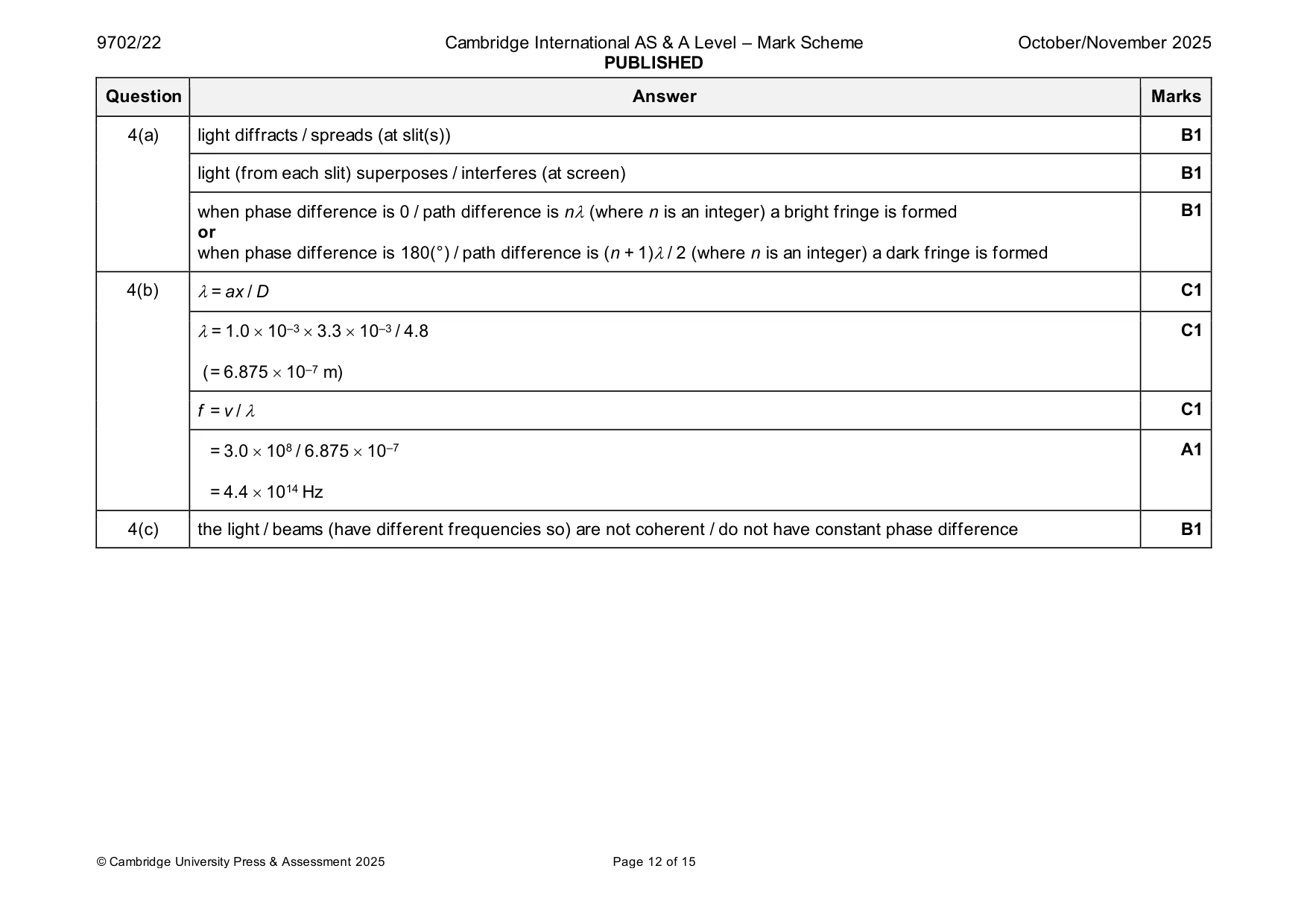
Mark scheme: 4(a) light diffracts / spreads (at slit(s)) B1 light (from each slit) superposes / interferes (at screen) B1 when phase difference is 0 / path difference is n(where n is an integer) a bright fringe is formed B1 or when phase difference is 180(°) / path difference is (n + 1) / 2 (where n is an integer) a dark fringe is formed 4(b) = ax / D C1 = 1.0 10–3 3.3 10–3 / 4.8 C1 ( = 6.875 10–7 m) f = v / C1 = 3.0 108 / 6.875 10–7 A1 = 4.4 1014 Hz 4(c) the light / beams (have different frequencies so) are not coherent / do not have constant phase difference B1
Q5 · A circuit containing a battery, two fixed resistors X and Y, and a light-dependent…
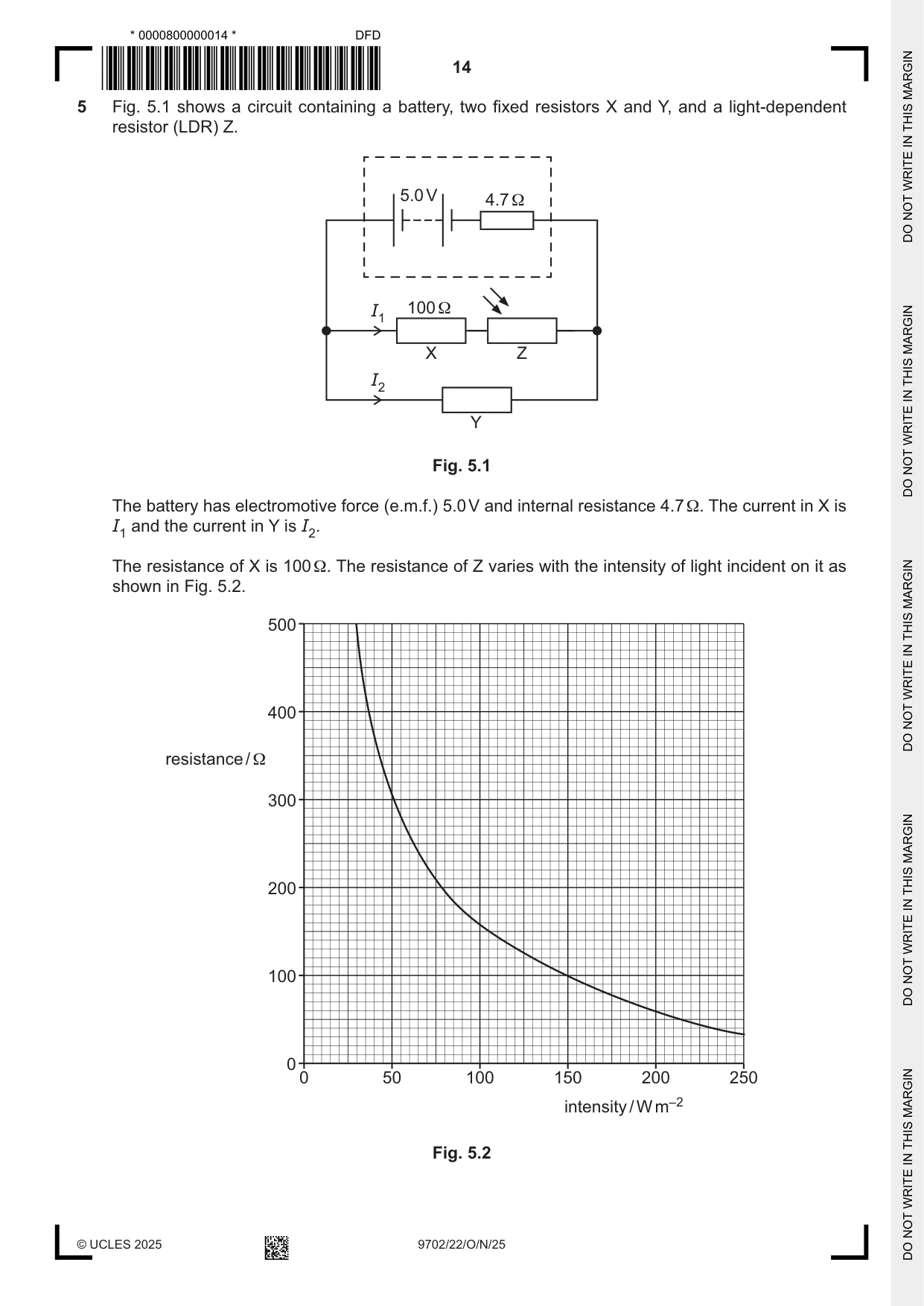
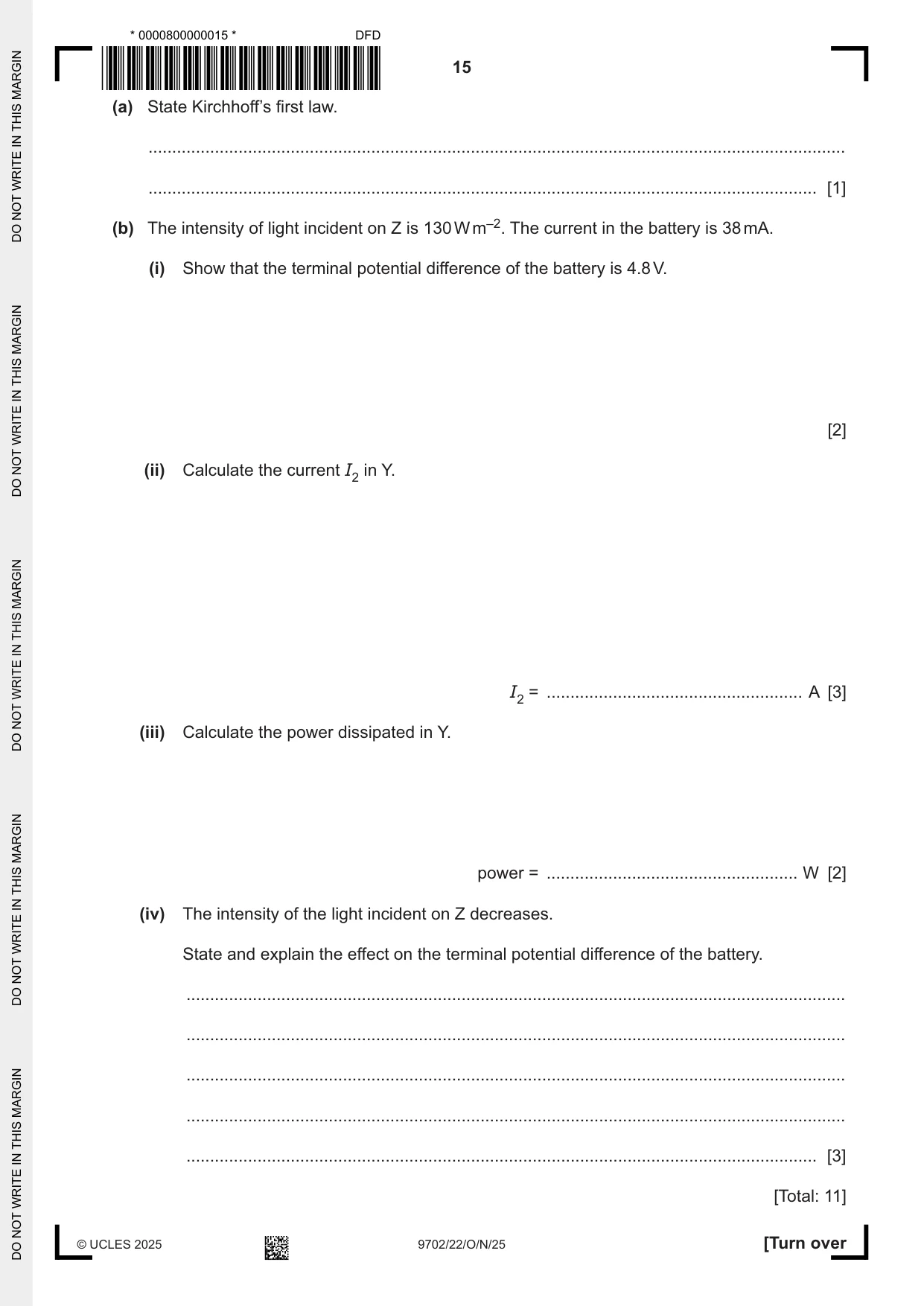
5 Fig. 5.1 shows a circuit containing a battery, two fixed resistors X and Y, and a light-dependent resistor (LDR) Z. 5.0 V 4.7 Ω I1 100 Ω X Z I2 Y Fig. 5.1 The battery has electromotive force (e.m.f.) 5.0 V and internal resistance 4.7 Ω. The current in X is I1 and the current in Y is I2. The resistance of X is 100 Ω. The resistance of Z varies with the intensity of light incident on it as shown in Fig. 5.2. 500 400 resistance / Ω 300 200 100 0 0 50 100 150 200 250 intensity / W m–2 Fig. 5.2 (a) State Kirchhoff’s first law. ................................................................................................................................................... ............................................................................................................................................. [1] (b) The intensity of light incident on Z is 130 W m–2. The current in the battery is 38 mA. (i) Show that the terminal potential difference of the battery is 4.8 V. [2] (ii) Calculate the current I2 in Y. I2 = ...................................................... A [3] (iii) Calculate the power dissipated in Y. power = ..................................................... W [2] (iv) The intensity of the light incident on Z decreases. State and explain the effect on the terminal potential difference of the battery. ........................................................................................................................................... ........................................................................................................................................... ........................................................................................................................................... ........................................................................................................................................... ..................................................................................................................................... [3] [Total: 11]
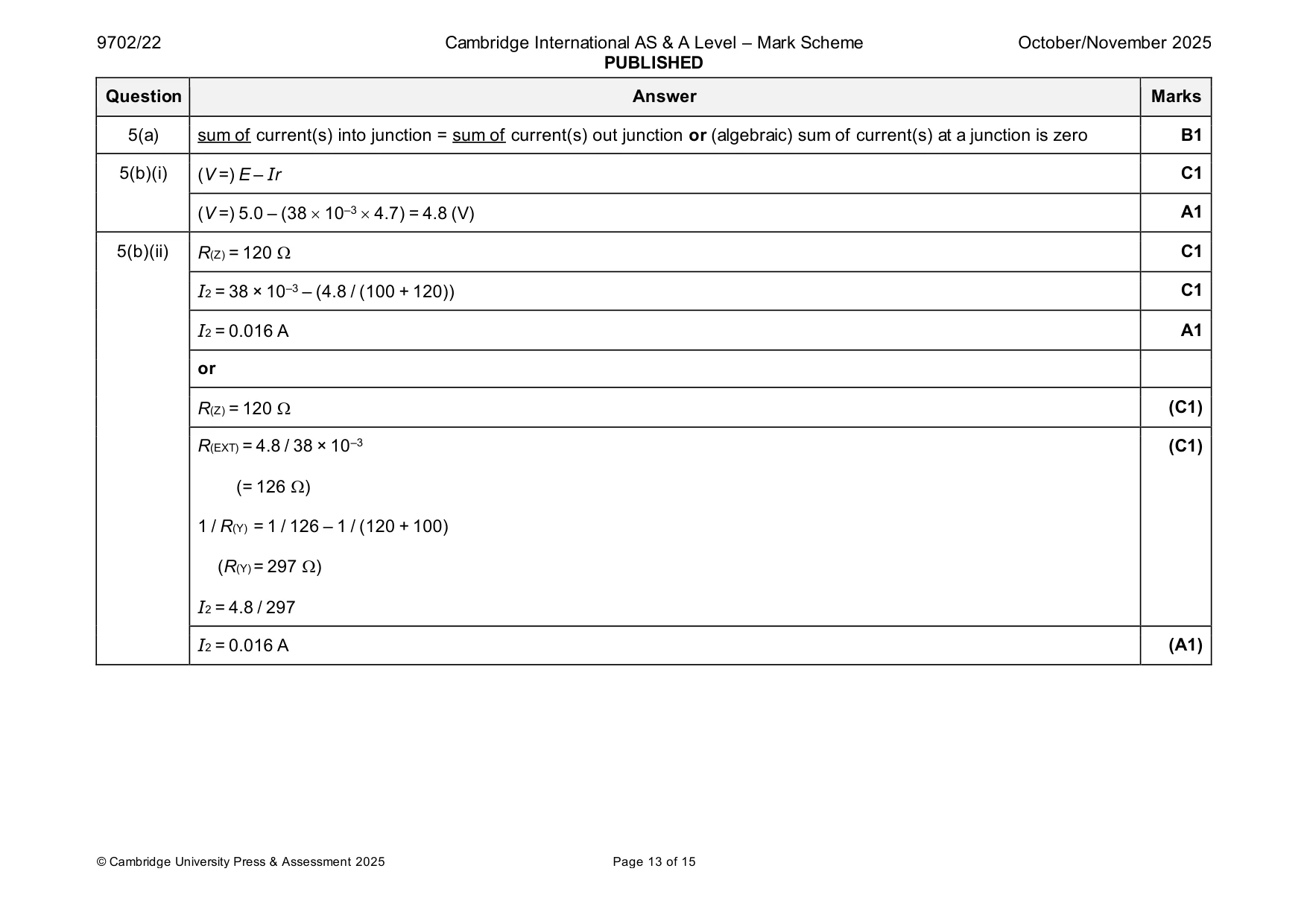
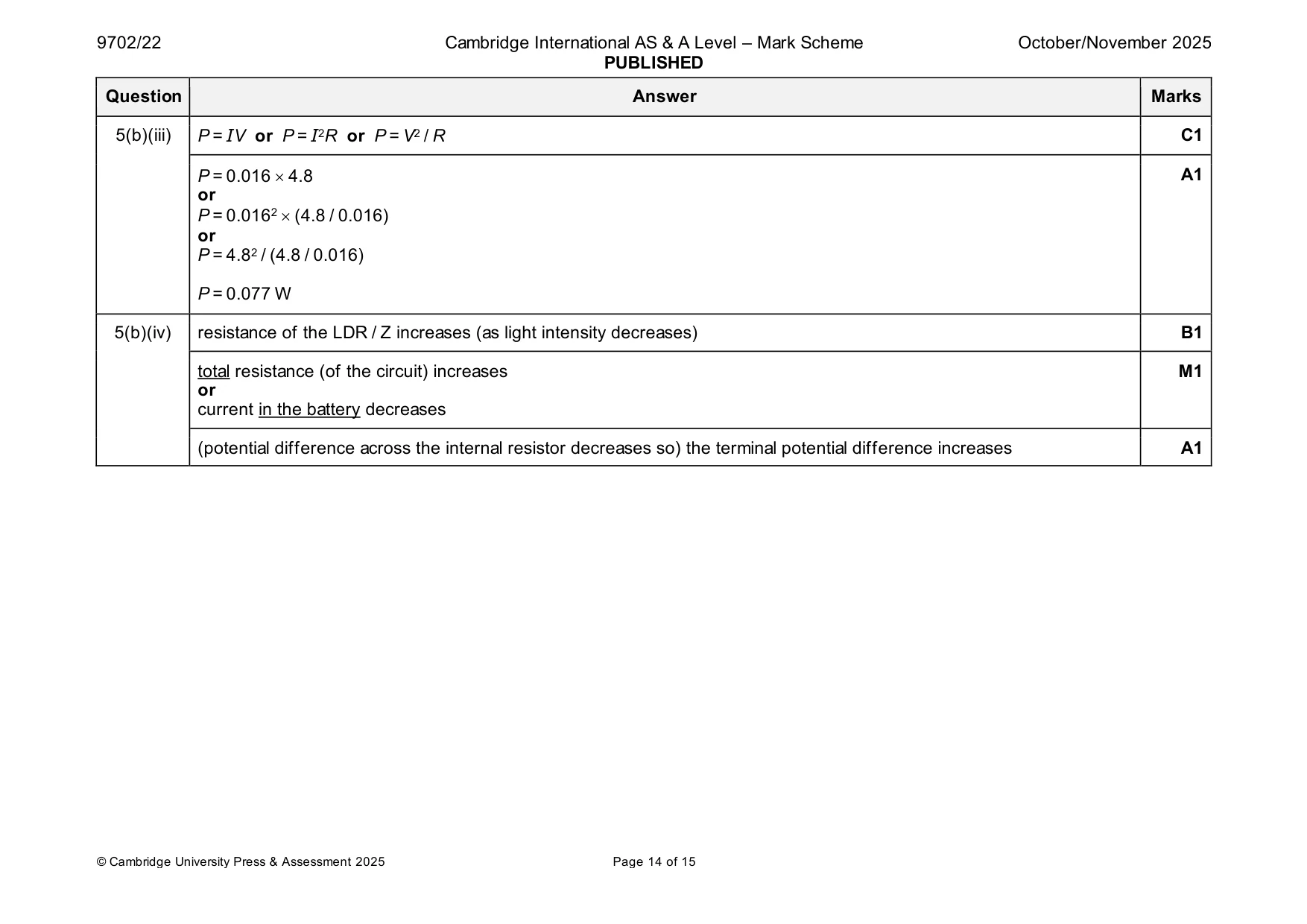
Mark scheme: 5(a) sum of current(s) into junction = sum of current(s) out junction or (algebraic) sum of current(s) at a junction is zero B1 5(b)(i) (V =) E – Ir C1 (V =) 5.0 – (38 10–3 4.7) = 4.8 (V) A1 5(b)(ii) R(Z) = 120 C1 I2 = 38 × 10–3 – (4.8 / (100 + 120)) C1 I2 = 0.016 A A1 or R(Z) = 120 (C1) R(EXT) = 4.8 / 38 × 10–3 (C1) (= 126 ) 1 / R(Y) = 1 / 126 – 1 / (120 + 100) (R(Y) = 297 ) I2 = 4.8 / 297 I2 = 0.016 A (A1) 5(b)(iii) P = IV or P = I2R or P = V2 / R C1 P = 0.016 4.8 A1 or P = 0.0162 (4.8 / 0.016) or P = 4.82 / (4.8 / 0.016) P = 0.077 W 5(b)(iv) resistance of the LDR / Z increases (as light intensity decreases) B1 total resistance (of the circuit) increases M1 or current in the battery decreases (potential difference across the internal resistor decreases so) the terminal potential difference increases A1
Q6 · State what is meant by a fundamental particle
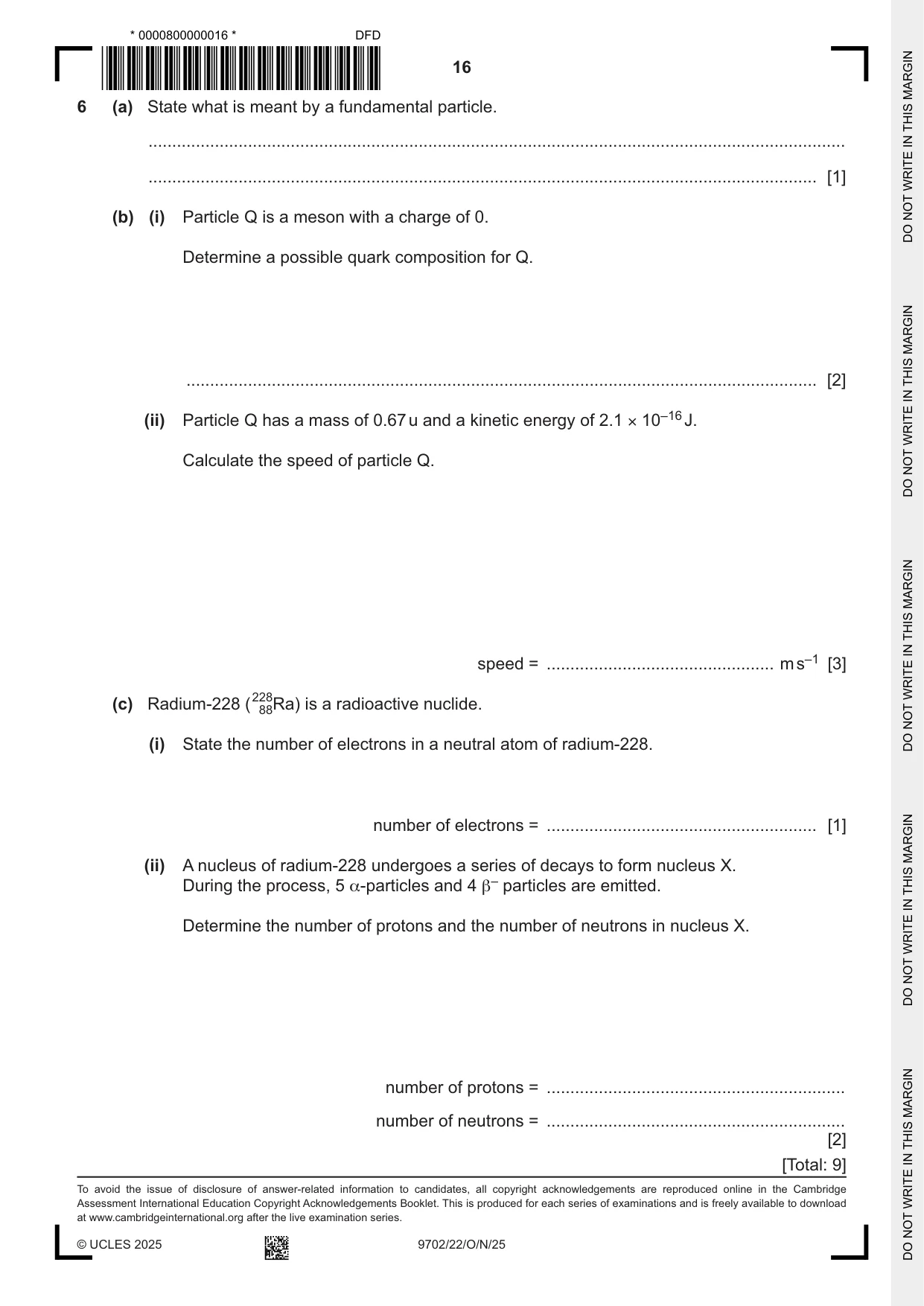
6 (a) State what is meant by a fundamental particle. ................................................................................................................................................... ............................................................................................................................................. [1] (b) (i) Particle Q is a meson with a charge of 0. Determine a possible quark composition for Q. ..................................................................................................................................... [2] (ii) Particle Q has a mass of 0.67 u and a kinetic energy of 2.1 × 10⁻¹⁶ J. Calculate the speed of particle Q. speed = ................................................ m s–1 [3] (c) Radium-228 (22888Ra) is a radioactive nuclide. (i) State the number of electrons in a neutral atom of radium-228. number of electrons = ......................................................... [1] (ii) A nucleus of radium-228 undergoes a series of decays to form nucleus X. During the process, 5 α-particles and 4 β– particles are emitted. Determine the number of protons and the number of neutrons in nucleus X. number of protons = ............................................................... number of neutrons = ............................................................... [2] [Total: 9]
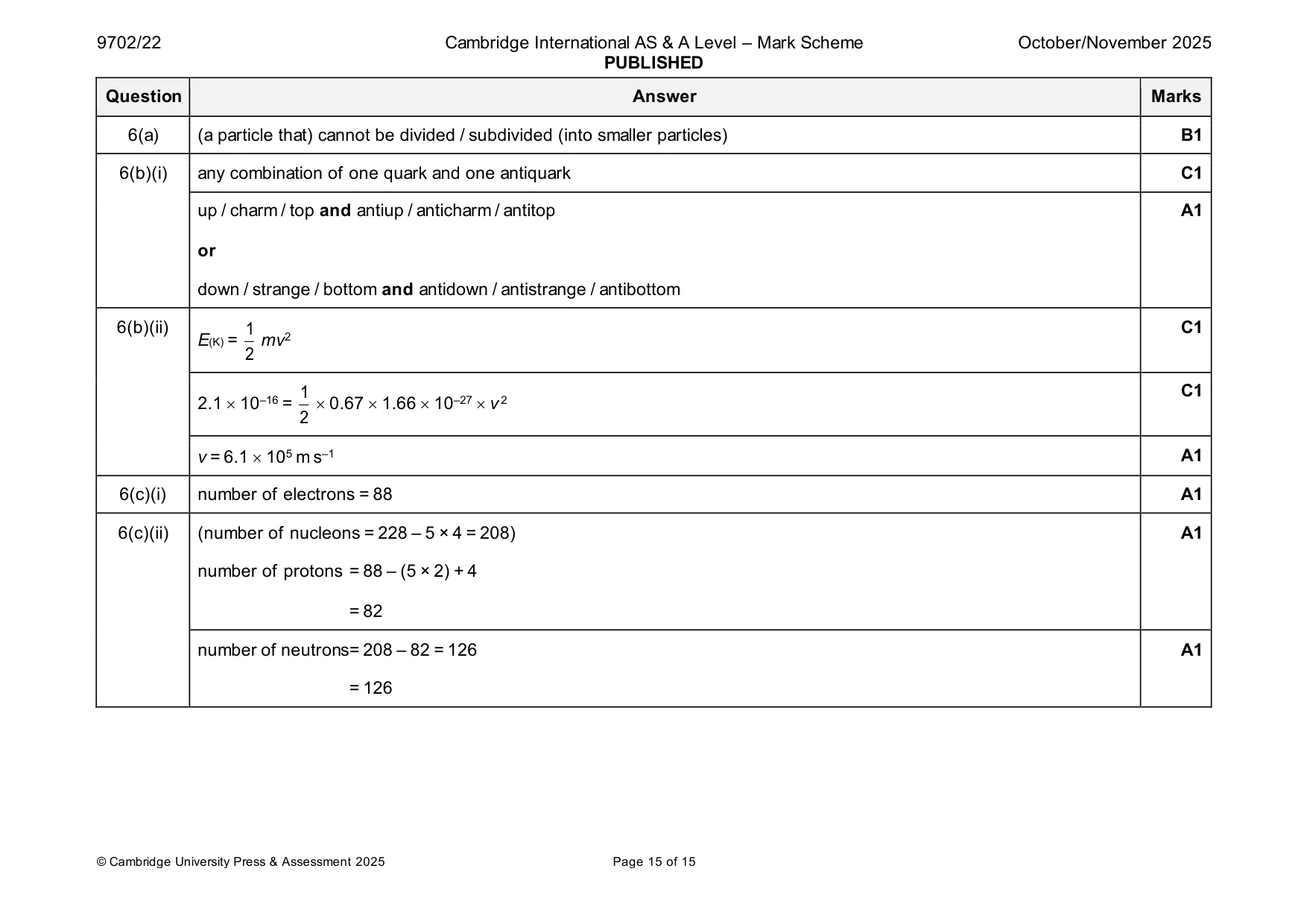
Mark scheme: 6(a) (a particle that) cannot be divided / subdivided (into smaller particles) B1 6(b)(i) any combination of one quark and one antiquark C1 up / charm / top and antiup / anticharm / antitop A1 or down / strange / bottom and antidown / antistrange / antibottom 6(b)(ii) 1 C1 E(K) = mv2 2 1 2 C1 2.1 10–16 = 0.67 1.66 10–27 v 2 v = 6.1 105 m s–1 A1 6(c)(i) number of electrons = 88 A1 6(c)(ii) (number of nucleons = 228 – 5 × 4 = 208) A1 number of protons = 88 – (5 × 2) + 4 = 82 number of neutrons= 208 – 82 = 126 A1 = 126
What was in this paper
The subtopics covered by these 6 questions, and how many questions each got. Open one in a new tab to see every Cambridge question on it.
What you needed in this session
Cambridge’s own grade thresholds for 2025 Oct/Nov, Paper 2 · Variant 2. A higher threshold means an easier paper — the bar moves with how the cohort did.