Cambridge A Level Physics 9702 — 2024 Oct/Nov Paper 2 · Variant 2
9702/22/O/N/24 · 6 questions · 60 marks · ≈68 min
The question paper and its mark scheme, free to read here and free to download. This is Cambridge’s own paper, exactly as it was sat.
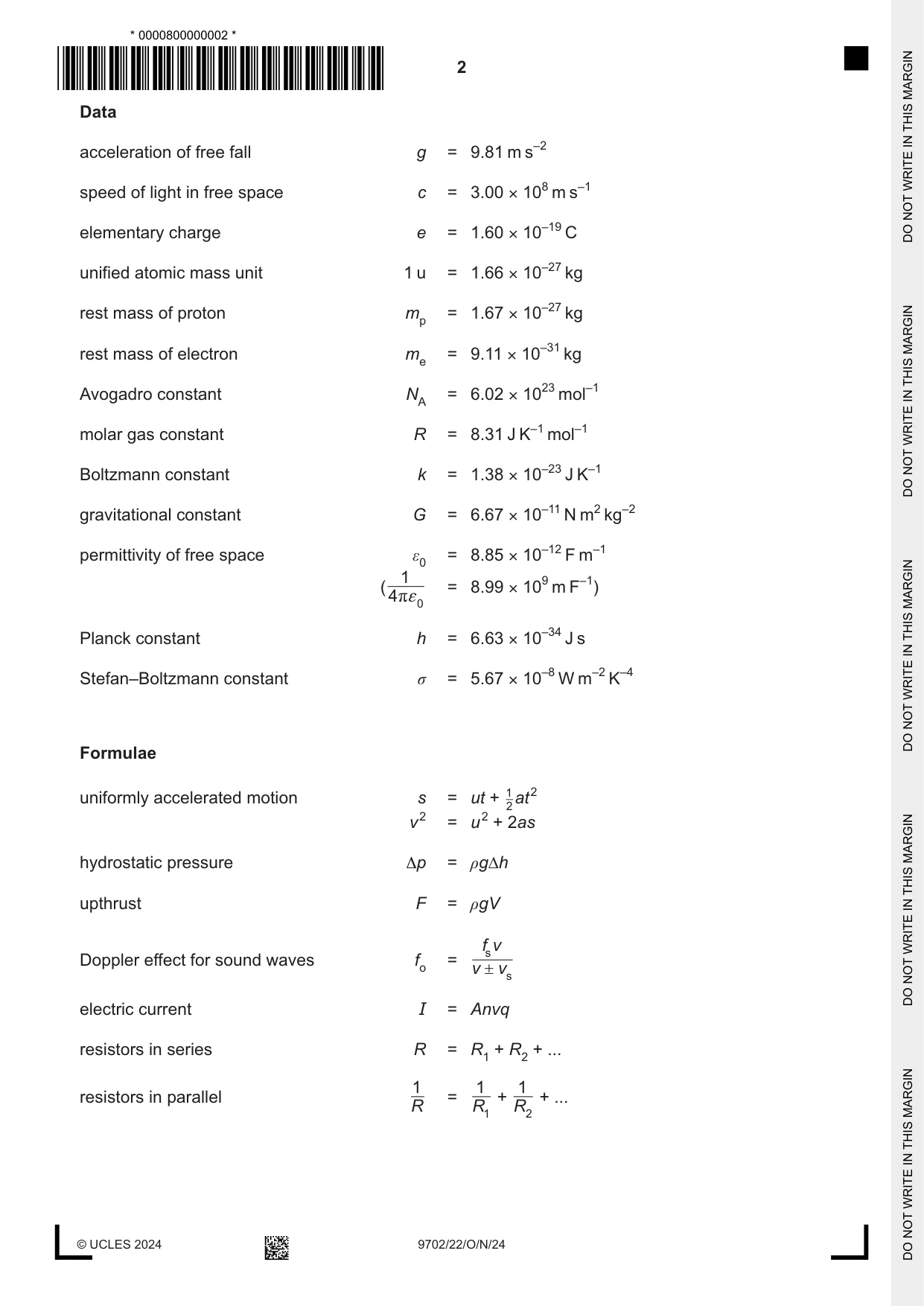
Question paper16 pages
Mark scheme11 pages
Answers below. Sit the paper first if you are practising.
Questions as text
Q1 · State what is meant by a vector quantity
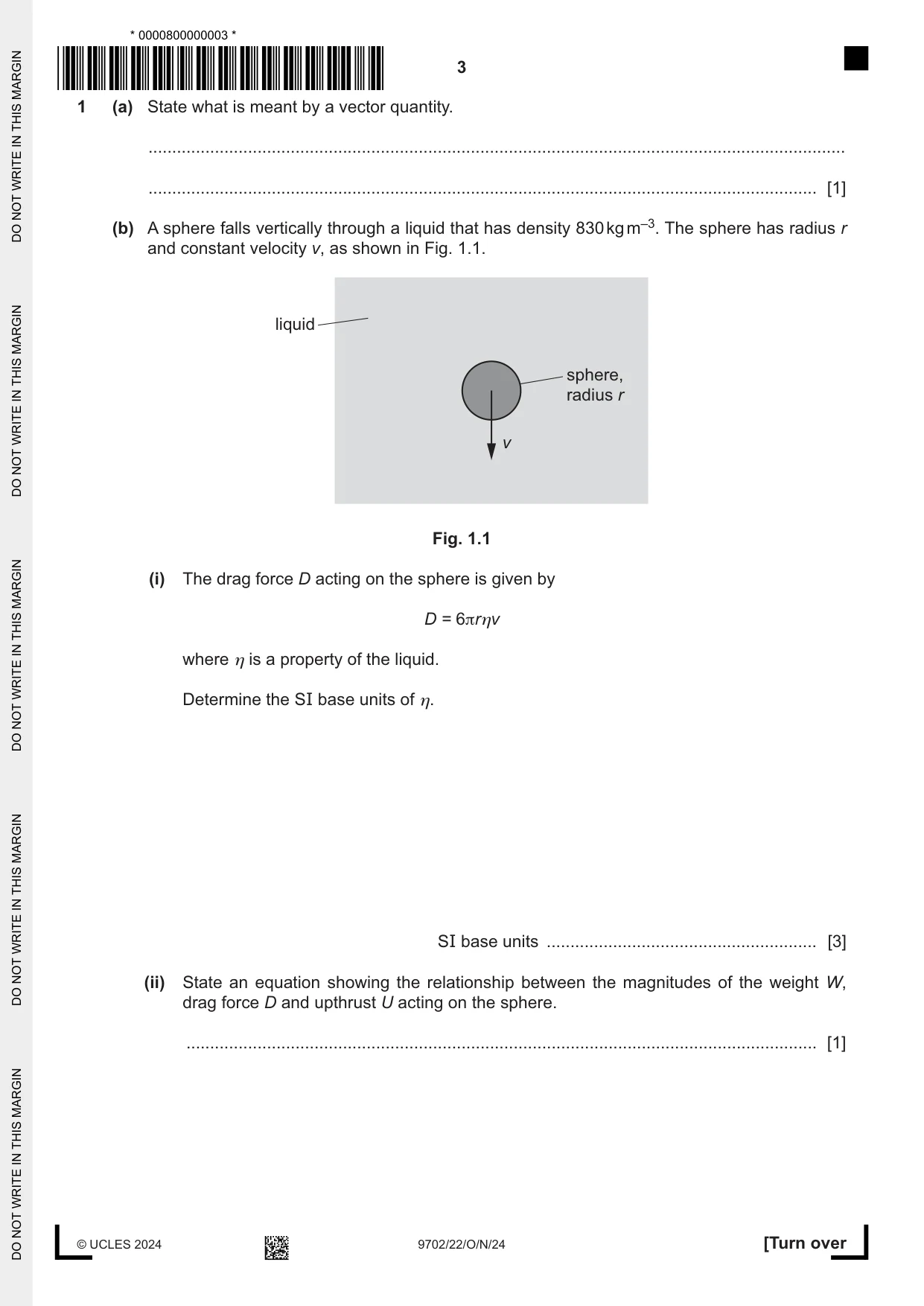
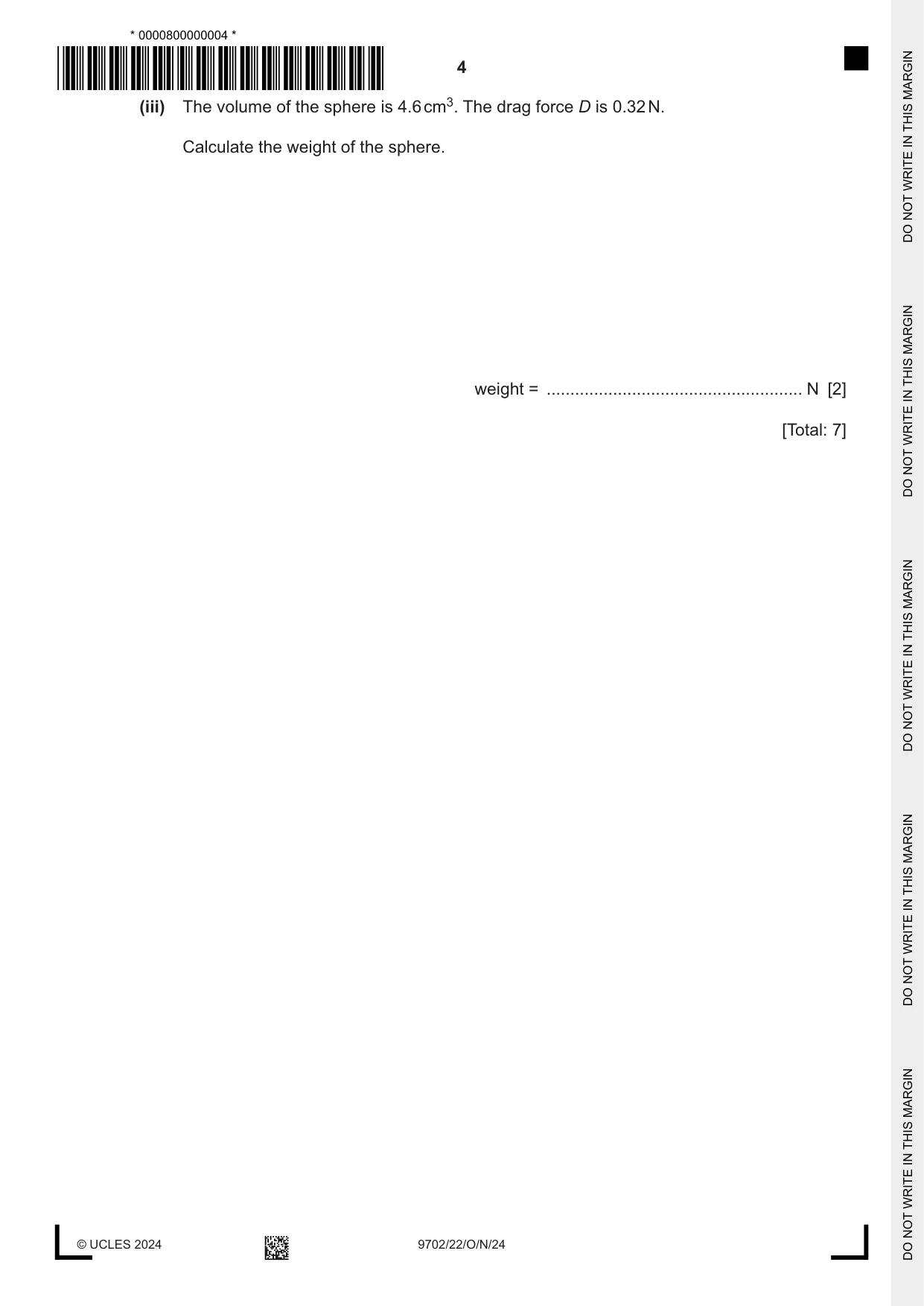
1 (a) State what is meant by a vector quantity. ................................................................................................................................................... ............................................................................................................................................. [1] (b) A sphere falls vertically through a liquid that has density 830 kg m–3. The sphere has radius r and constant velocity v, as shown in Fig. 1.1. liquid sphere, radius r v Fig. 1.1 (i) The drag force D acting on the sphere is given by D = 6πrηv where η is a property of the liquid. Determine the SI base units of η. SI base units ......................................................... [3] (ii) State an equation showing the relationship between the magnitudes of the weight W, drag force D and upthrust U acting on the sphere. ..................................................................................................................................... [1] (iii) The volume of the sphere is 4.6 cm3. The drag force D is 0.32 N. Calculate the weight of the sphere. weight = ...................................................... N [2] [Total: 7]
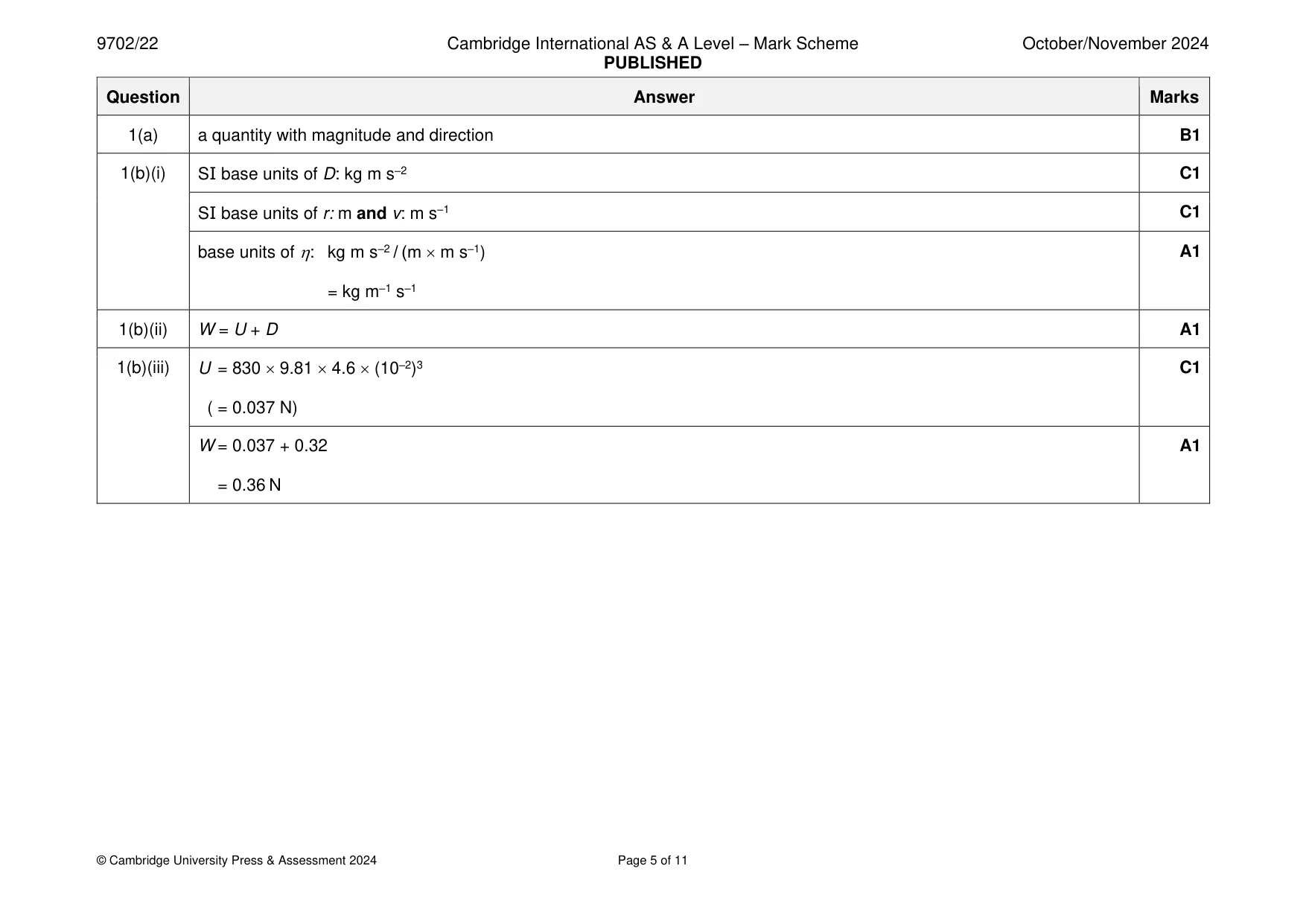
Mark scheme: Question Answer Marks 1(a) a quantity with magnitude and direction B1 1(b)(i) SI base units of D: kg m s–2 C1 SI base units of r: m and v: m s–1 C1 base units of : kg m s–2 / (m m s–1) A1 = kg m–1 s–1 1(b)(ii) W = U + D A1 1(b)(iii) U = 830 9.81 4.6 (10–2)3 C1 ( = 0.037 N) W = 0.037 + 0.32 A1 = 0.36 N
Question 2
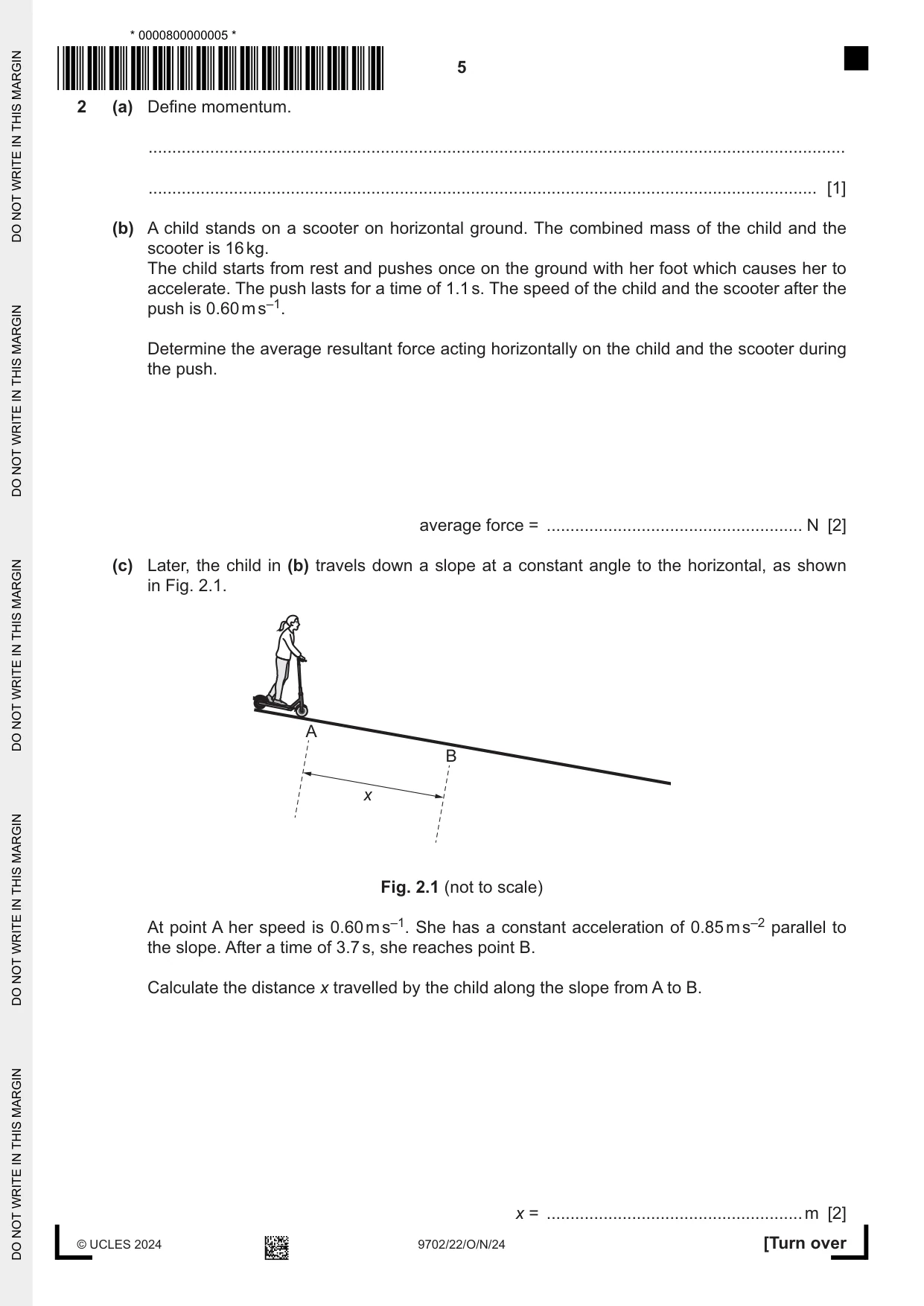
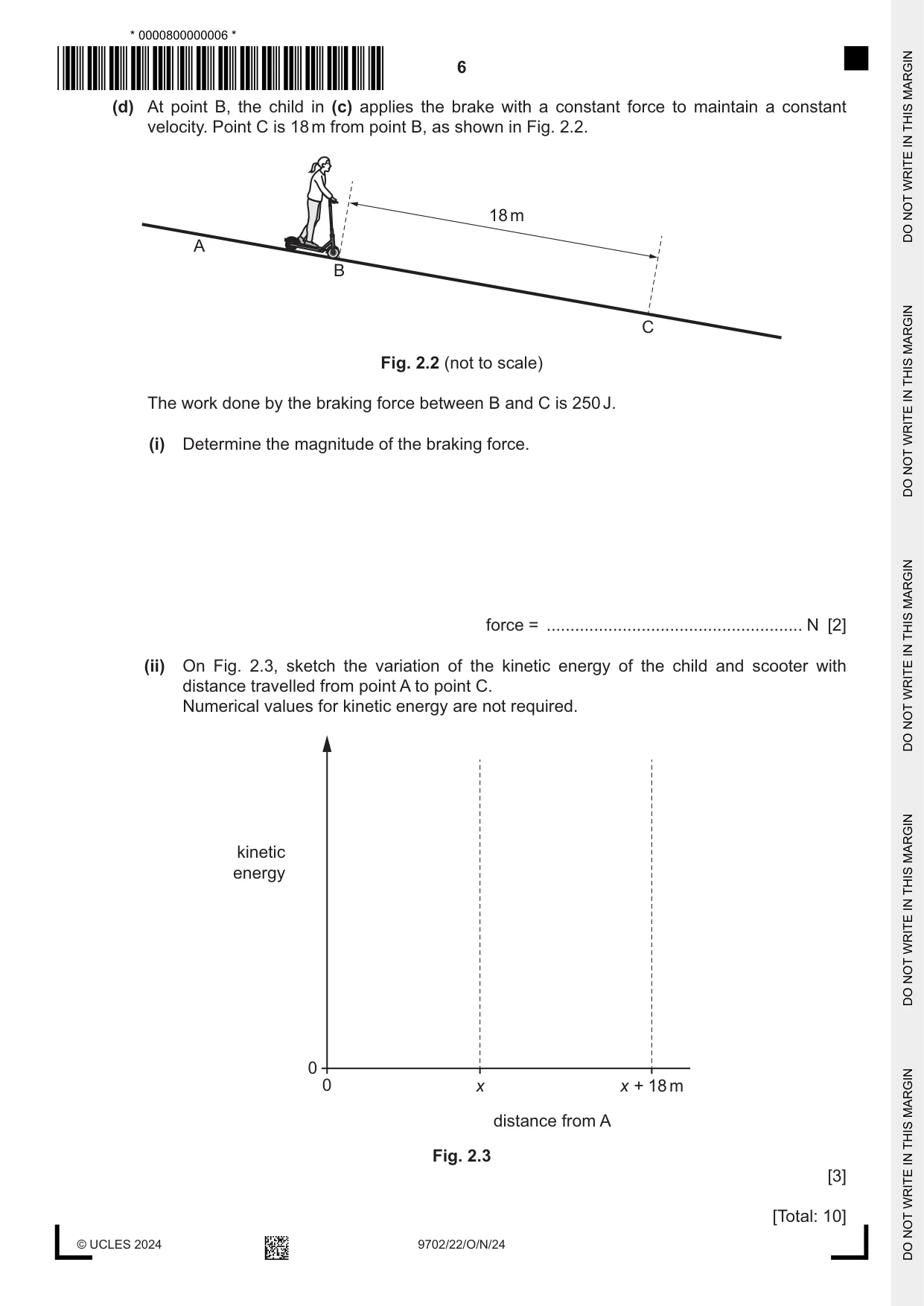
2 (a) Define momentum. ................................................................................................................................................... ............................................................................................................................................. [1] (b) A child stands on a scooter on horizontal ground. The combined mass of the child and the scooter is 16 kg. The child starts from rest and pushes once on the ground with her foot which causes her to accelerate. The push lasts for a time of 1.1 s. The speed of the child and the scooter after the push is 0.60 m s–1. Determine the average resultant force acting horizontally on the child and the scooter during the push. average force = ...................................................... N [2] (c) Later, the child in (b) travels down a slope at a constant angle to the horizontal, as shown in Fig. 2.1. A B x Fig. 2.1 (not to scale) At point A her speed is 0.60 m s–1. She has a constant acceleration of 0.85 m s–2 parallel to the slope. After a time of 3.7 s, she reaches point B. Calculate the distance x travelled by the child along the slope from A to B. x = ...................................................... m [2] (d) At point B, the child in (c) applies the brake with a constant force to maintain a constant velocity. Point C is 18 m from point B, as shown in Fig. 2.2. 18 m A B C Fig. 2.2 (not to scale) The work done by the braking force between B and C is 250 J. (i) Determine the magnitude of the braking force. force = ...................................................... N [2] (ii) On Fig. 2.3, sketch the variation of the kinetic energy of the child and scooter with distance travelled from point A to point C. Numerical values for kinetic energy are not required. kinetic energy 0 0 x x + 18 m distance from A Fig. 2.3 [3] [Total: 10]
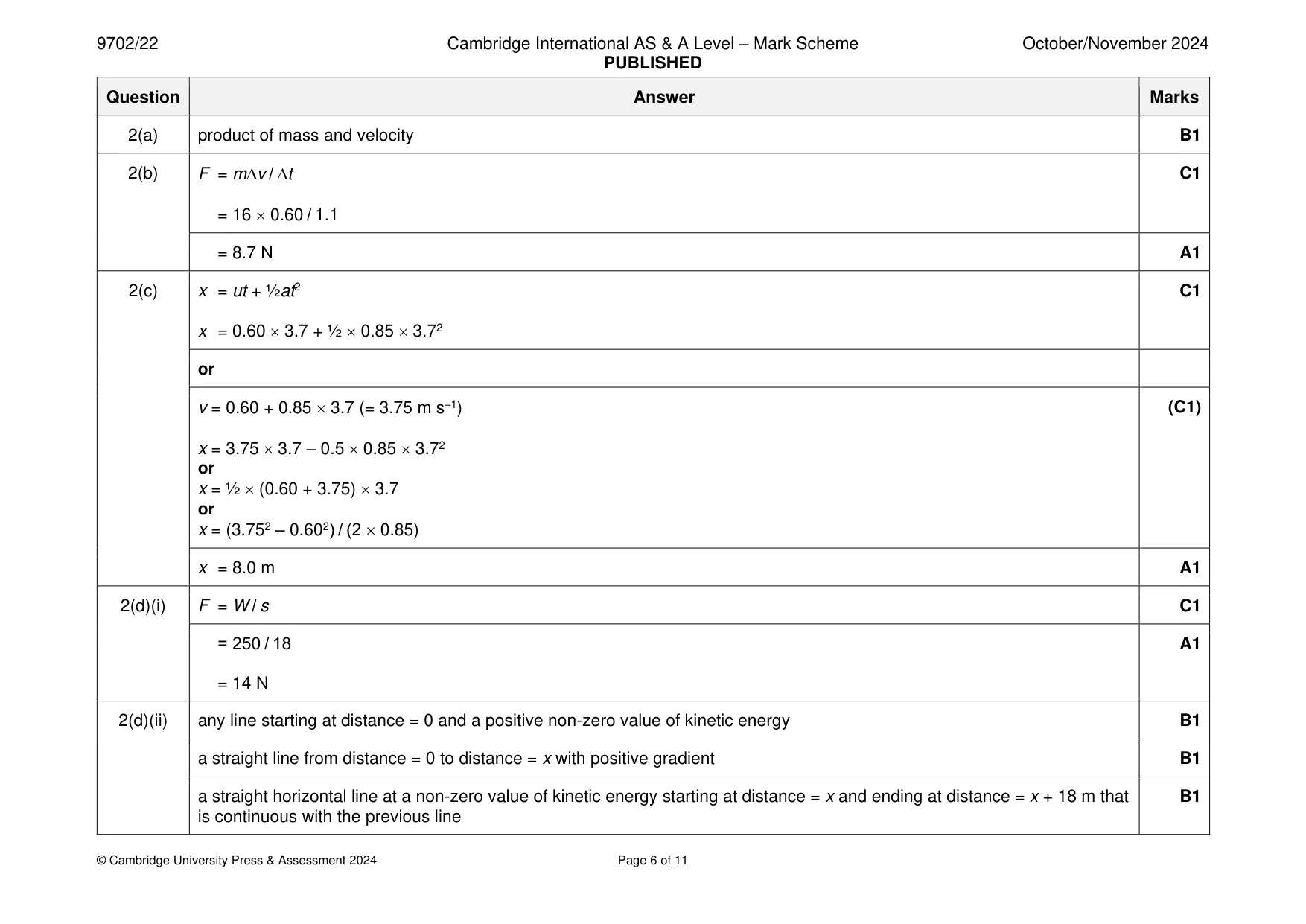
Mark scheme: 2(a) product of mass and velocity B1 2(b) F = mv / t C1 = 16 0.60 / 1.1 = 8.7 N A1 2(c) x = ut + ½at2 C1 x = 0.60 3.7 + ½ 0.85 3.72 or v = 0.60 + 0.85 3.7 (= 3.75 m s–1) (C1) x = 3.75 3.7 – 0.5 0.85 3.72 or x = ½ (0.60 + 3.75) 3.7 or x = (3.752 – 0.602) / (2 0.85) x = 8.0 m A1 2(d)(i) F = W / s C1 = 250 / 18 A1 = 14 N 2(d)(ii) any line starting at distance = 0 and a positive non-zero value of kinetic energy B1 a straight line from distance = 0 to distance = x with positive gradient B1 a straight horizontal line at a non-zero value of kinetic energy starting at distance = x and ending at distance = x + 18 m that B1 is continuous with the previous line
Q3 · The variation of stress with strain for a metal P is shown in Fig
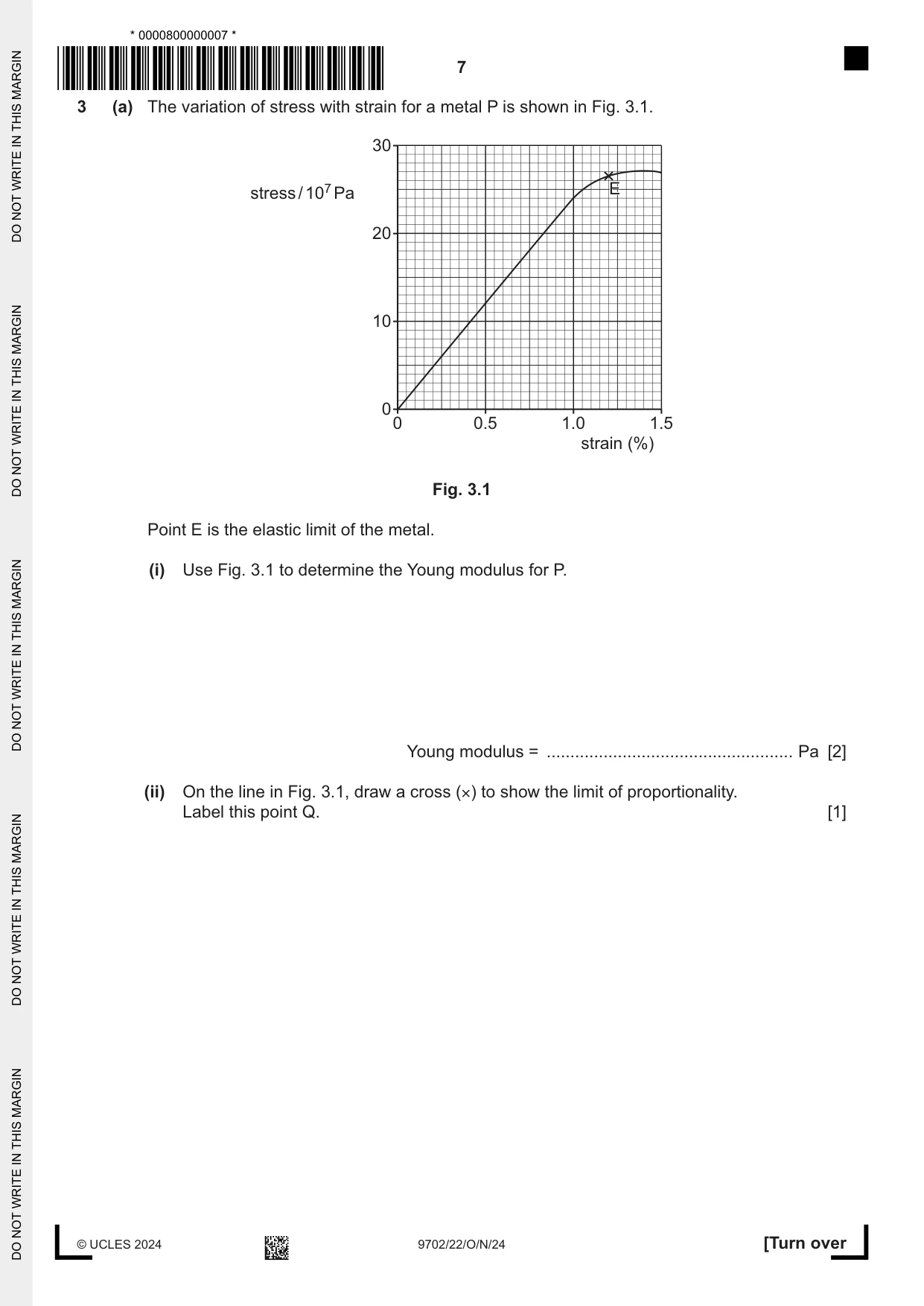
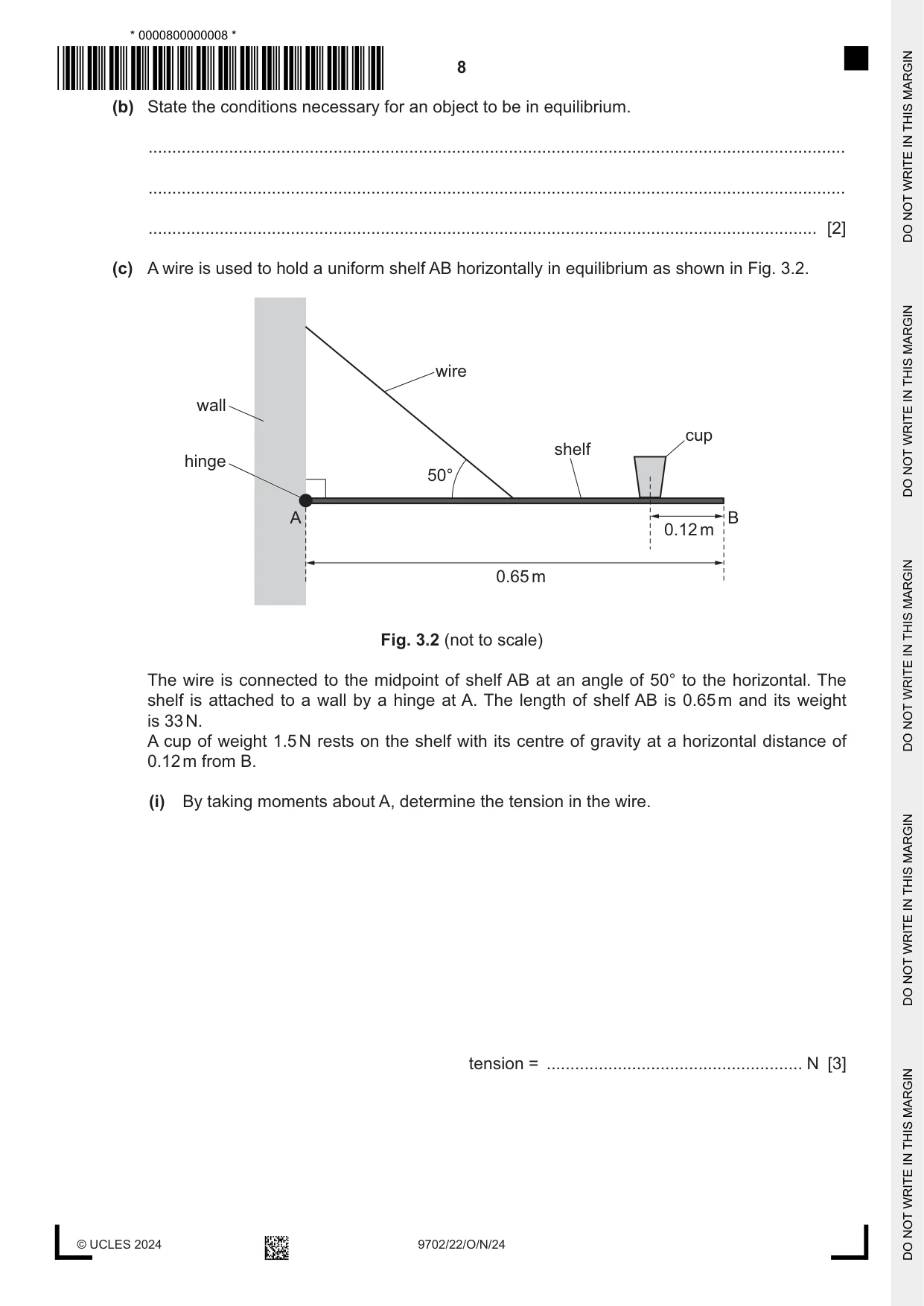
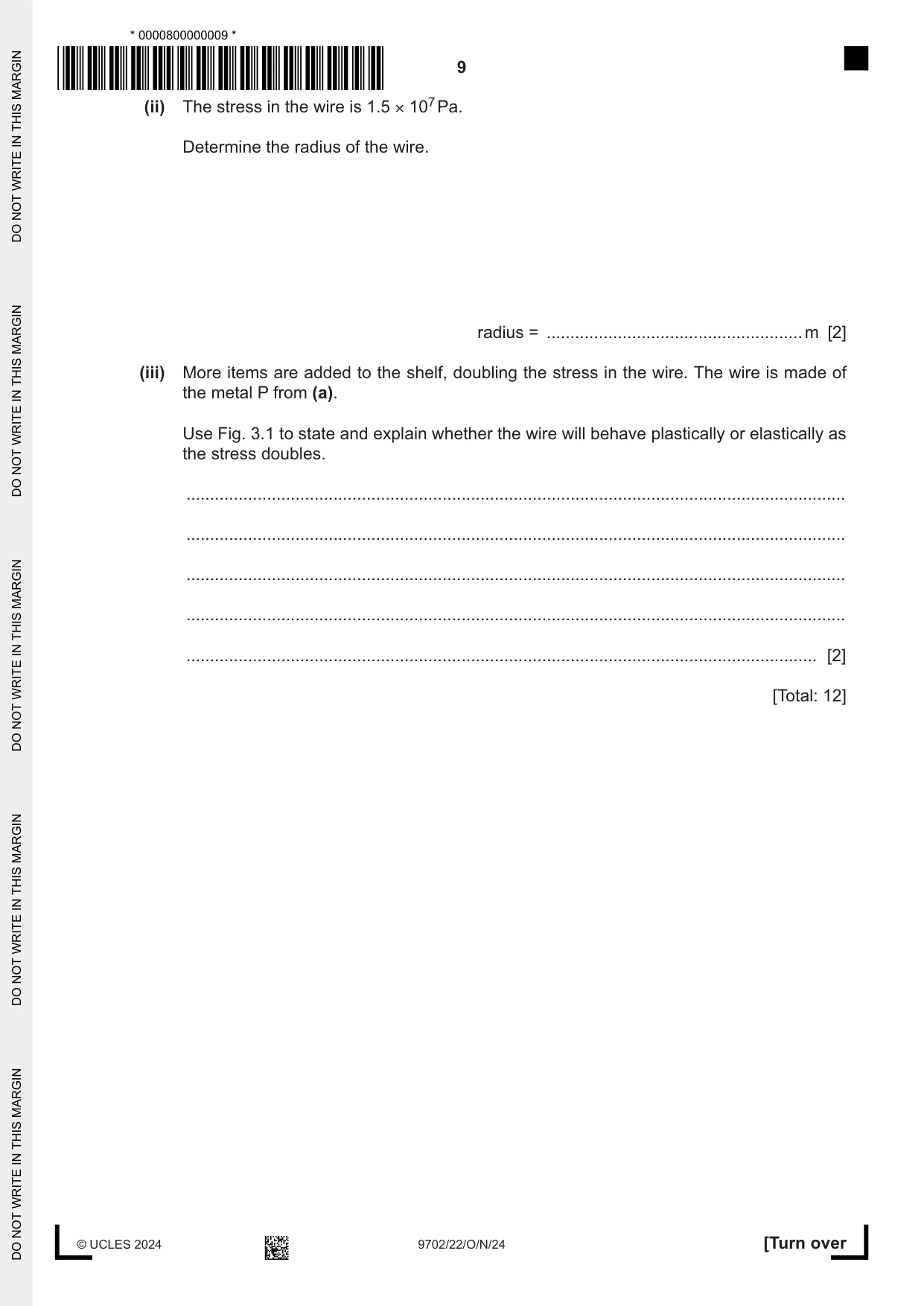
3 (a) The variation of stress with strain for a metal P is shown in Fig. 3.1. 30 stress / 107 Pa E 20 10 0 0 0.5 1.0 1.5 strain (%) Fig. 3.1 Point E is the elastic limit of the metal. (i) Use Fig. 3.1 to determine the Young modulus for P. Young modulus = .................................................... Pa [2] (ii) On the line in Fig. 3.1, draw a cross (×) to show the limit of proportionality. Label this point Q. [1] (b) State the conditions necessary for an object to be in equilibrium. ................................................................................................................................................... ................................................................................................................................................... ............................................................................................................................................. [2] (c) A wire is used to hold a uniform shelf AB horizontally in equilibrium as shown in Fig. 3.2. wire wall cup shelf hinge 50° A B 0.12 m 0.65 m Fig. 3.2 (not to scale) The wire is connected to the midpoint of shelf AB at an angle of 50° to the horizontal. The shelf is attached to a wall by a hinge at A. The length of shelf AB is 0.65 m and its weight is 33 N. A cup of weight 1.5 N rests on the shelf with its centre of gravity at a horizontal distance of 0.12 m from B. (i) By taking moments about A, determine the tension in the wire. tension = ...................................................... N [3] (ii) The stress in the wire is 1.5 × 10⁷ Pa. Determine the radius of the wire. radius = ...................................................... m [2] (iii) More items are added to the shelf, doubling the stress in the wire. The wire is made of the metal P from (a). Use Fig. 3.1 to state and explain whether the wire will behave plastically or elastically as the stress doubles. ........................................................................................................................................... ........................................................................................................................................... ........................................................................................................................................... ........................................................................................................................................... ..................................................................................................................................... [2] [Total: 12]
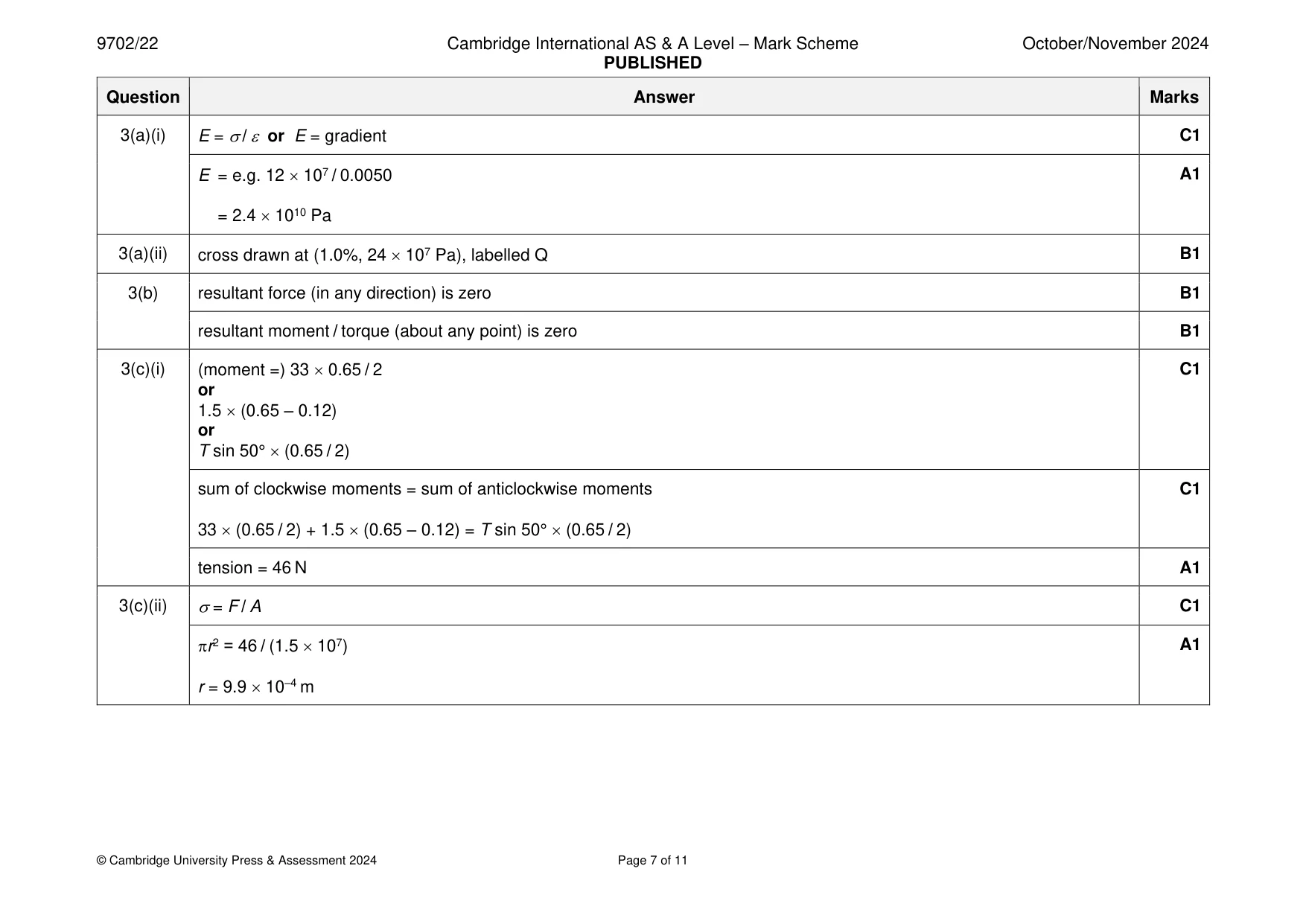
Mark scheme: 3(a)(i) E = / or E = gradient C1 E = e.g. 12 107 / 0.0050 A1 = 2.4 1010 Pa 3(a)(ii) cross drawn at (1.0%, 24 107 Pa), labelled Q B1 3(b) resultant force (in any direction) is zero B1 resultant moment / torque (about any point) is zero B1 3(c)(i) (moment =) 33 0.65 / 2 C1 or 1.5 (0.65 – 0.12) or T sin 50° (0.65 / 2) sum of clockwise moments = sum of anticlockwise moments C1 33 (0.65 / 2) + 1.5 (0.65 – 0.12) = T sin 50° (0.65 / 2) tension = 46 N A1 3(c)(ii) = F / A C1 r2 = 46 / (1.5 107) A1 r = 9.9 10–4 m 3(c)(iii) elastic limit is not reached M1 or (new) stress is less than (stress at) elastic limit or (new) strain is less than (strain at) elastic limit (so the wire behaves) elastically A1
Q4 · With reference to the direction of transfer of energy, compare the oscillations of…
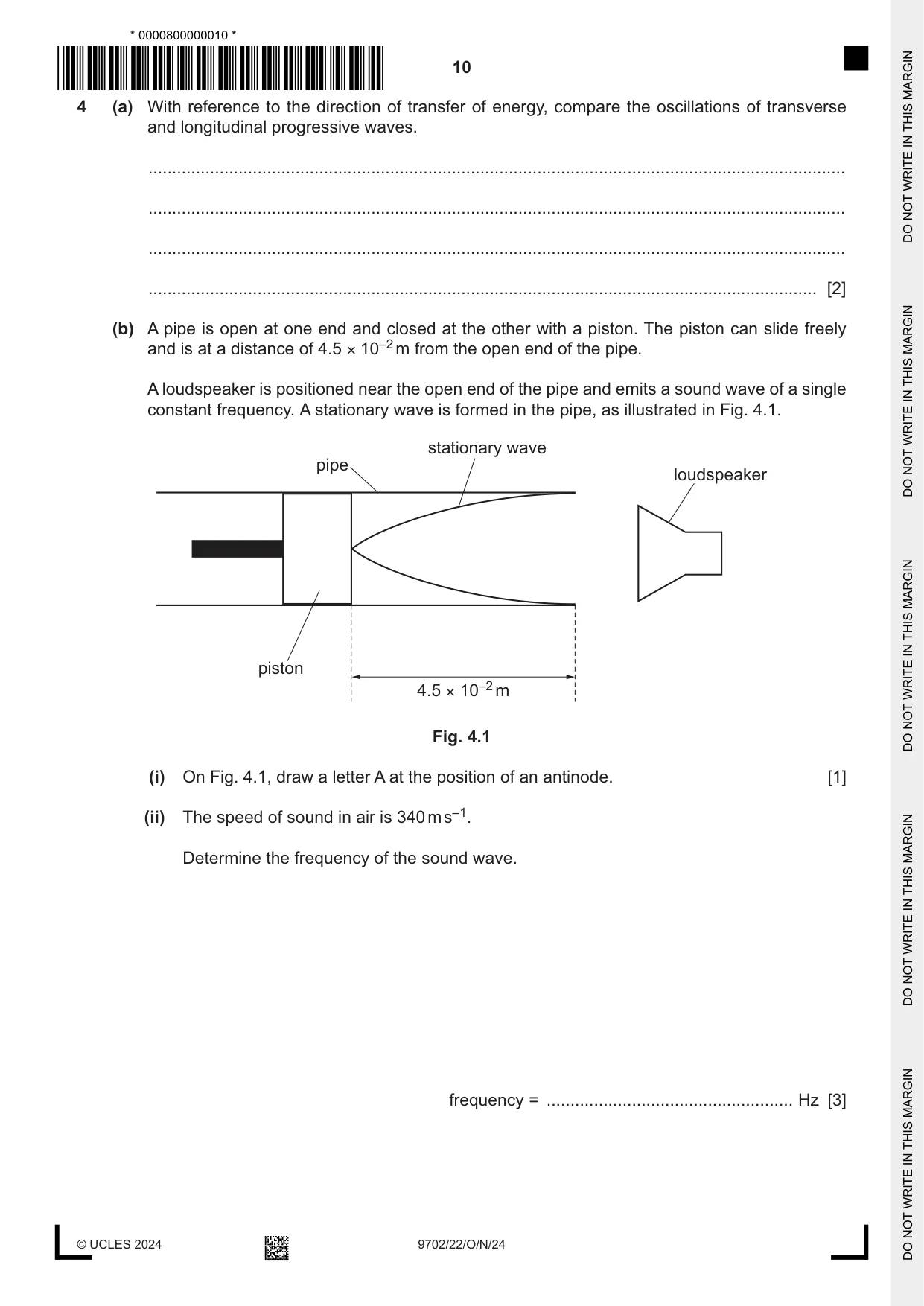
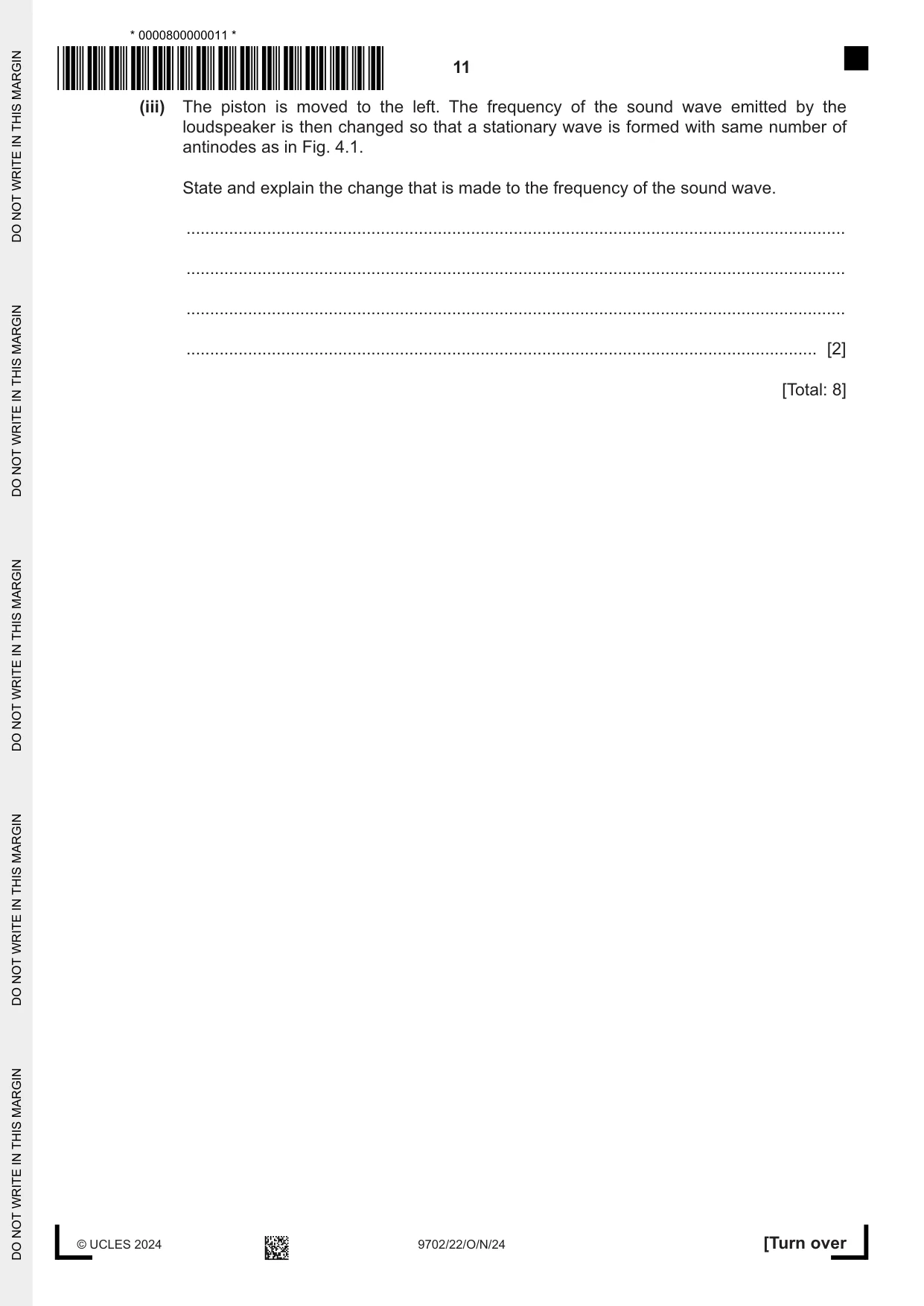
4 (a) With reference to the direction of transfer of energy, compare the oscillations of transverse and longitudinal progressive waves. ................................................................................................................................................... ................................................................................................................................................... ................................................................................................................................................... ............................................................................................................................................. [2] (b) A pipe is open at one end and closed at the other with a piston. The piston can slide freely and is at a distance of 4.5 × 10⁻² m from the open end of the pipe. A loudspeaker is positioned near the open end of the pipe and emits a sound wave of a single constant frequency. A stationary wave is formed in the pipe, as illustrated in Fig. 4.1. stationary wave pipe loudspeaker piston 4.5 × 10⁻² m Fig. 4.1 (i) On Fig. 4.1, draw a letter A at the position of an antinode. [1] (ii) The speed of sound in air is 340 m s–1. Determine the frequency of the sound wave. frequency = .................................................... Hz [3] (iii) The piston is moved to the left. The frequency of the sound wave emitted by the loudspeaker is then changed so that a stationary wave is formed with same number of antinodes as in Fig. 4.1. State and explain the change that is made to the frequency of the sound wave. ........................................................................................................................................... ........................................................................................................................................... ........................................................................................................................................... ..................................................................................................................................... [2] [Total: 8]
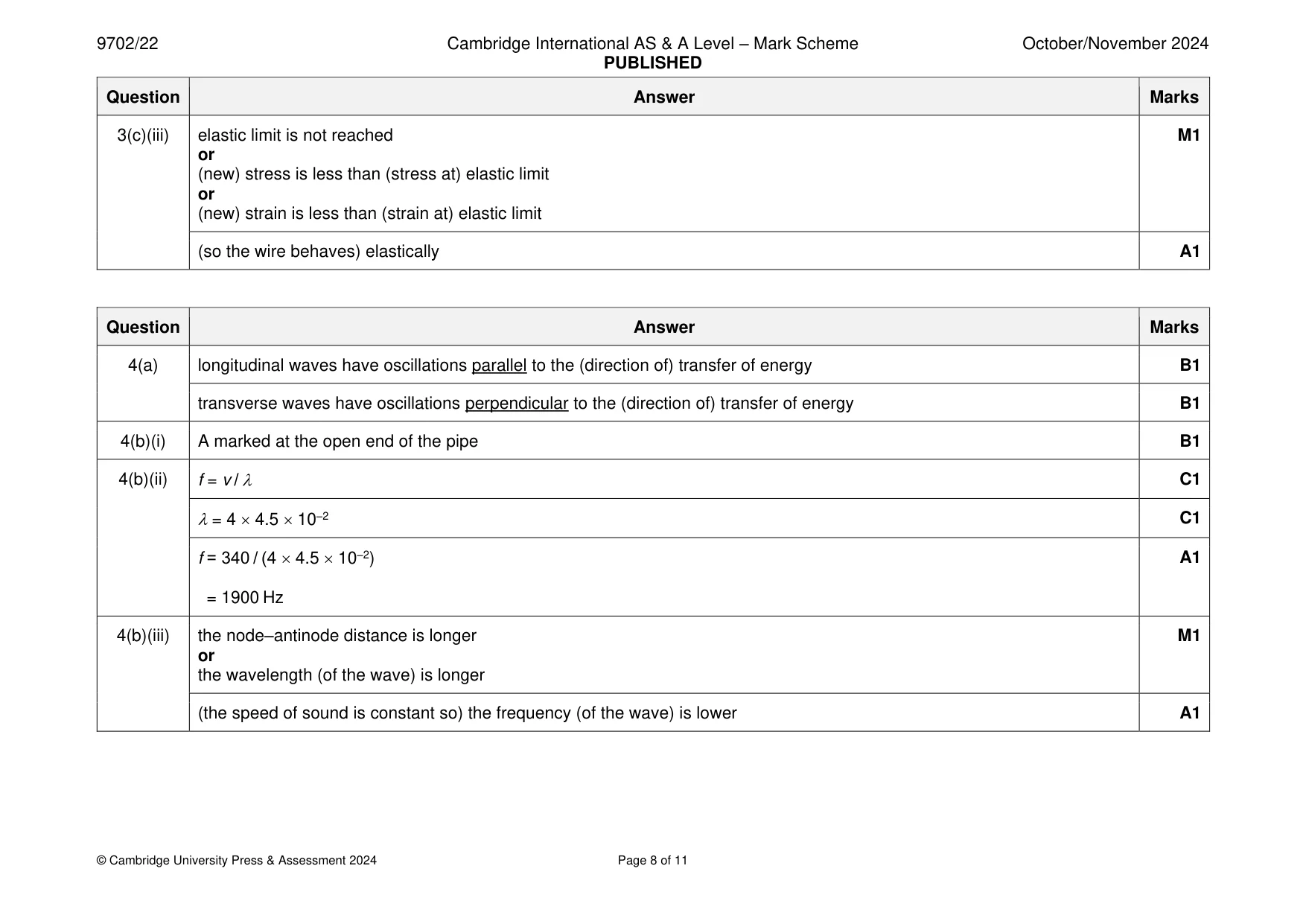
Mark scheme: 4(a) longitudinal waves have oscillations parallel to the (direction of) transfer of energy B1 transverse waves have oscillations perpendicular to the (direction of) transfer of energy B1 4(b)(i) A marked at the open end of the pipe B1 4(b)(ii) f = v / C1 = 4 4.5 10–2 C1 f = 340 / (4 4.5 10–2) A1 = 1900 Hz 4(b)(iii) the node–antinode distance is longer M1 or the wavelength (of the wave) is longer (the speed of sound is constant so) the frequency (of the wave) is lower A1
Q5 · Define electric potential difference (p.d.)
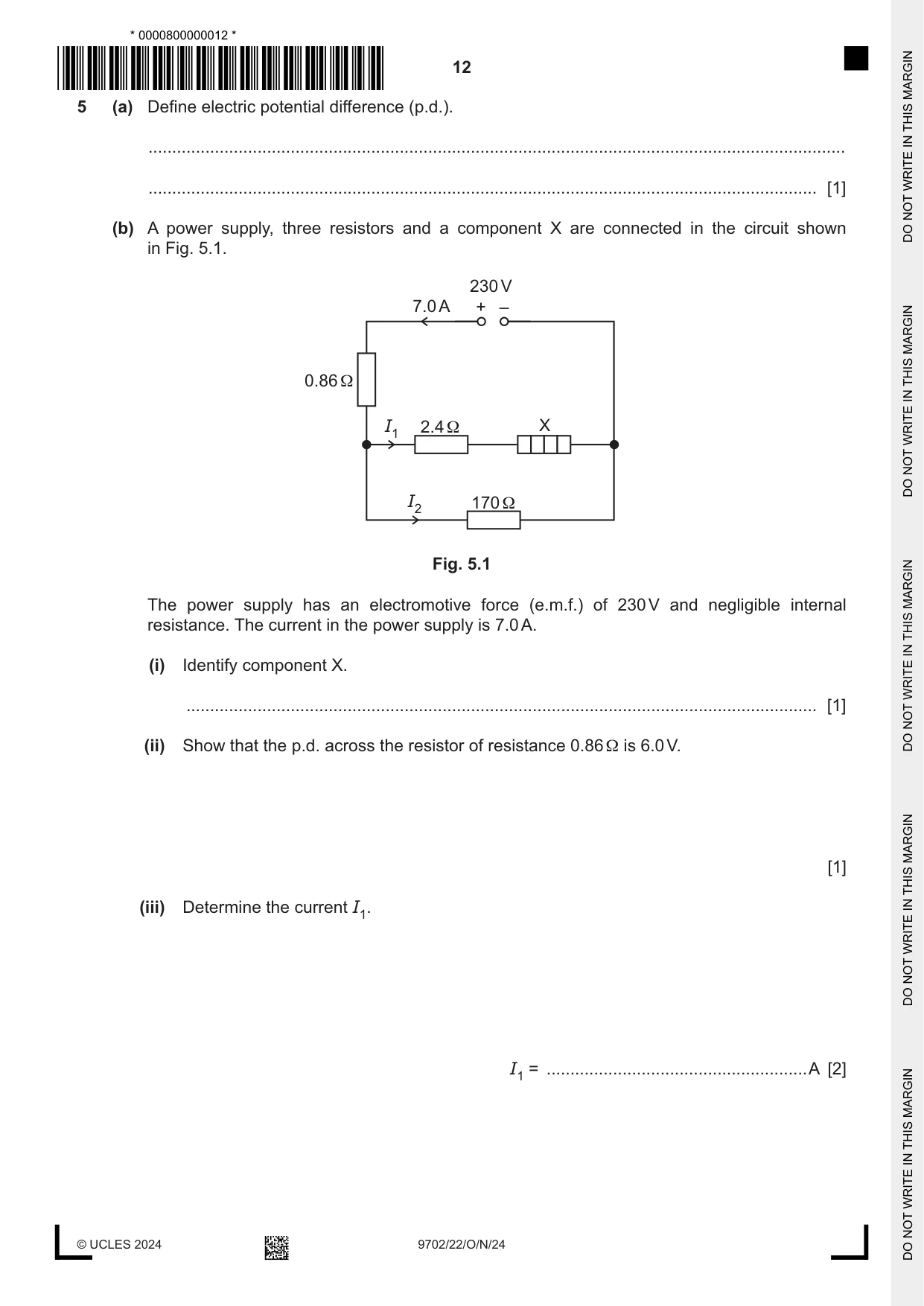
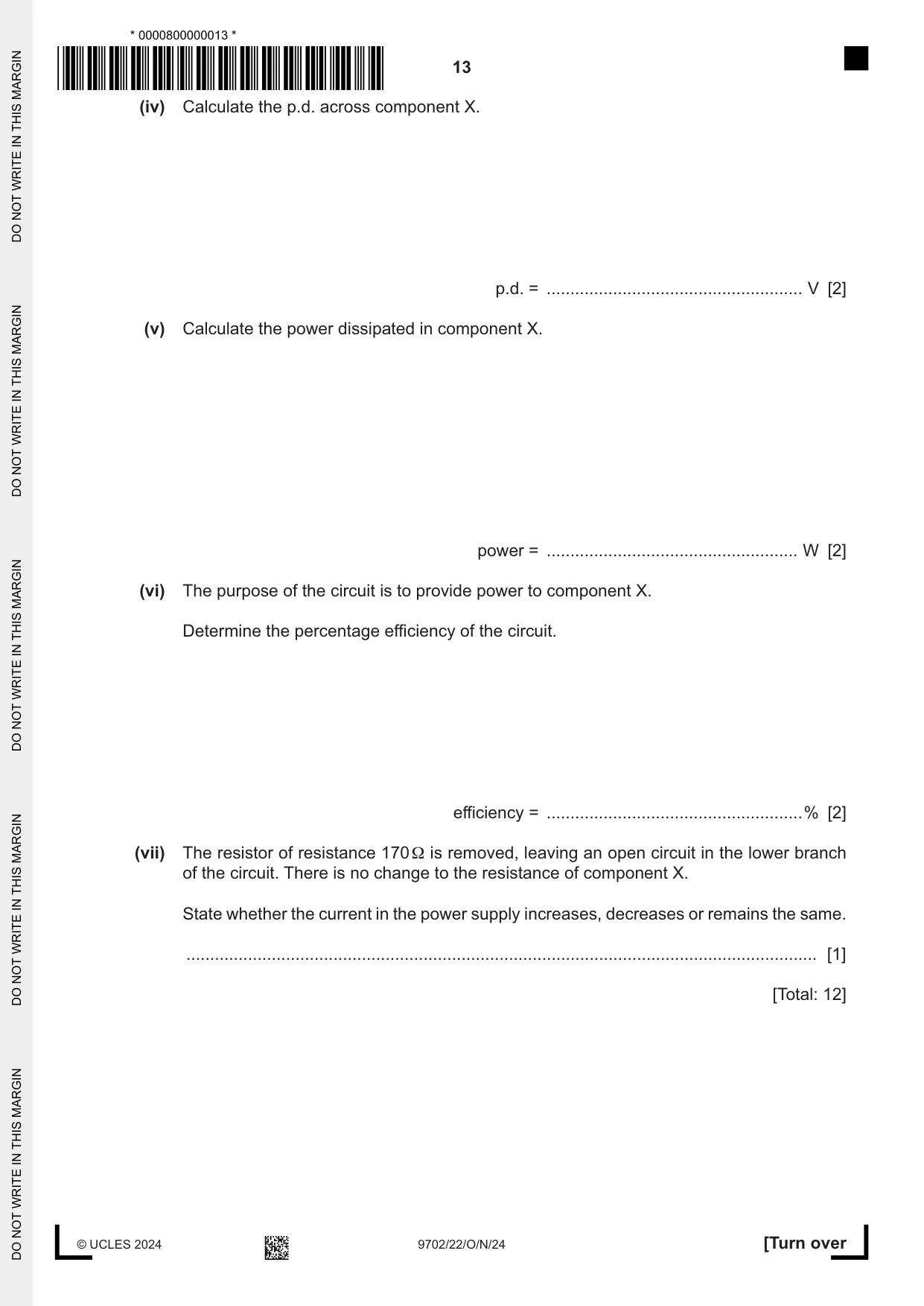
5 (a) Define electric potential difference (p.d.). ................................................................................................................................................... ............................................................................................................................................. [1] (b) A power supply, three resistors and a component X are connected in the circuit shown in Fig. 5.1. 230 V 7.0 A + – 0.86 Ω I1 2.4 Ω X I2 170 Ω Fig. 5.1 The power supply has an electromotive force (e.m.f.) of 230 V and negligible internal resistance. The current in the power supply is 7.0 A. (i) Identify component X. ..................................................................................................................................... [1] (ii) Show that the p.d. across the resistor of resistance 0.86 Ω is 6.0 V. [1] (iii) Determine the current I1. I1 = ....................................................... A [2] (iv) Calculate the p.d. across component X. p.d. = ...................................................... V [2] (v) Calculate the power dissipated in component X. power = ..................................................... W [2] (vi) The purpose of the circuit is to provide power to component X. Determine the percentage efficiency of the circuit. efficiency = ......................................................% [2] (vii) The resistor of resistance 170 Ω is removed, leaving an open circuit in the lower branch of the circuit. There is no change to the resistance of component X. State whether the current in the power supply increases, decreases or remains the same. ..................................................................................................................................... [1] [Total: 12]
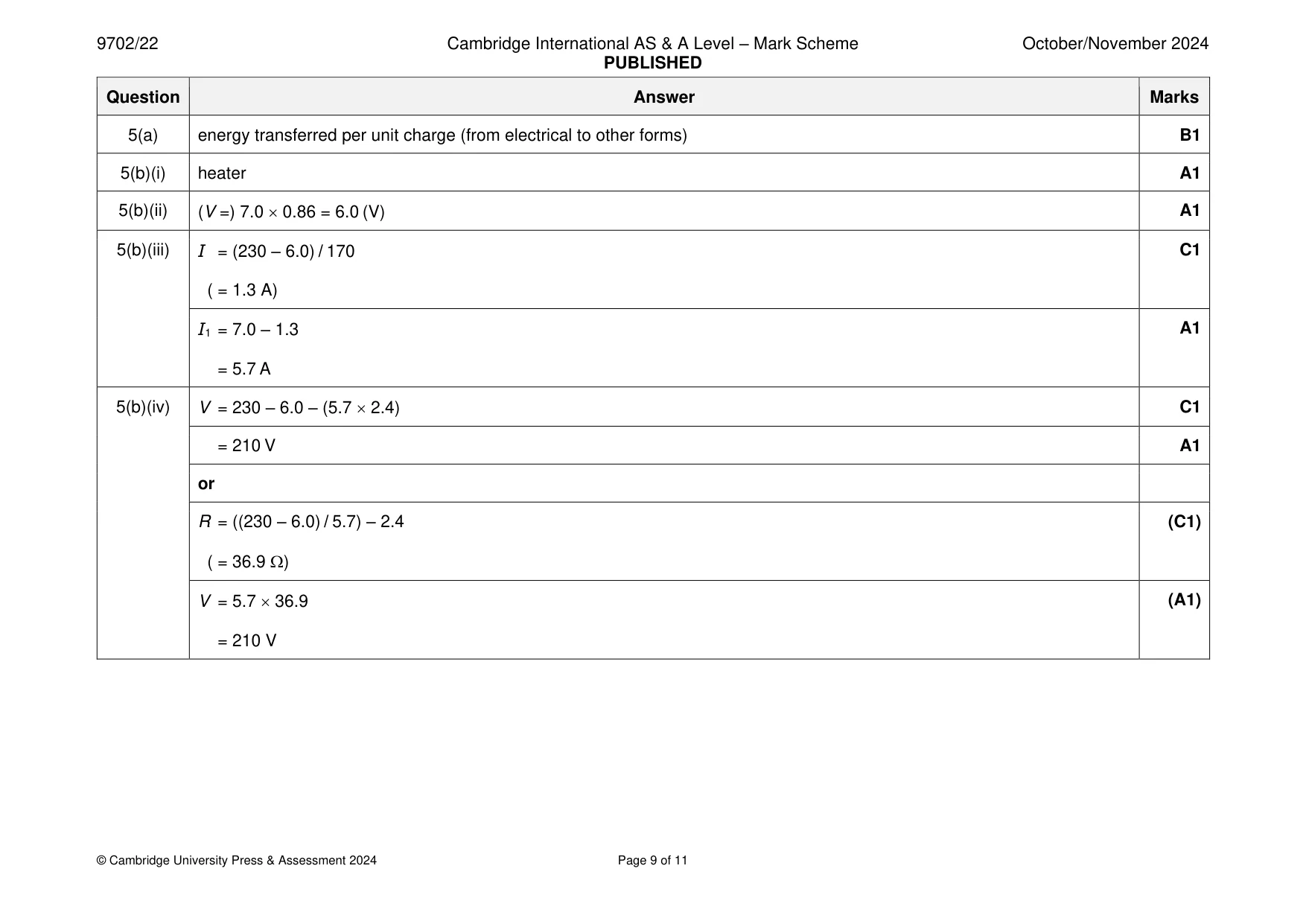
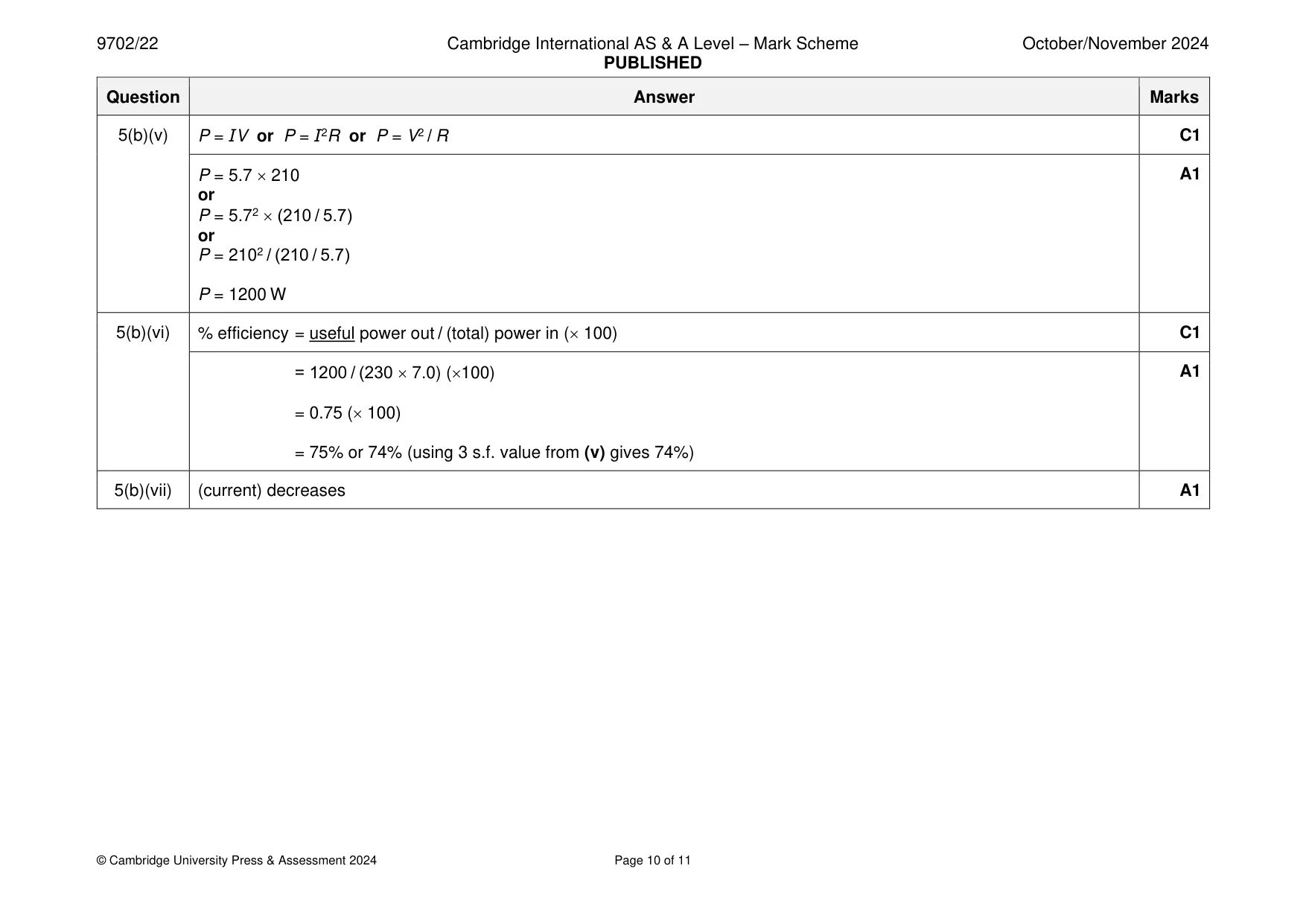
Mark scheme: 5(a) energy transferred per unit charge (from electrical to other forms) B1 5(b)(i) heater A1 5(b)(ii) (V =) 7.0 0.86 = 6.0 (V) A1 5(b)(iii) I = (230 – 6.0) / 170 C1 ( = 1.3 A) I1 = 7.0 – 1.3 A1 = 5.7 A 5(b)(iv) V = 230 – 6.0 – (5.7 2.4) C1 = 210 V A1 or R = ((230 – 6.0) / 5.7) – 2.4 (C1) ( = 36.9 ) V = 5.7 36.9 (A1) = 210 V 5(b)(v) P = IV or P = I2R or P = V2 / R C1 P = 5.7 210 A1 or P = 5.72 (210 / 5.7) or P = 2102 / (210 / 5.7) P = 1200 W 5(b)(vi) % efficiency = useful power out / (total) power in ( 100) C1 = 1200 / (230 7.0) (100) A1 = 0.75 ( 100) = 75% or 74% (using 3 s.f. value from (v) gives 74%) 5(b)(vii) (current) decreases A1
Q6 · Compare an α‑particle with a β+ particle in terms of their masses and charges
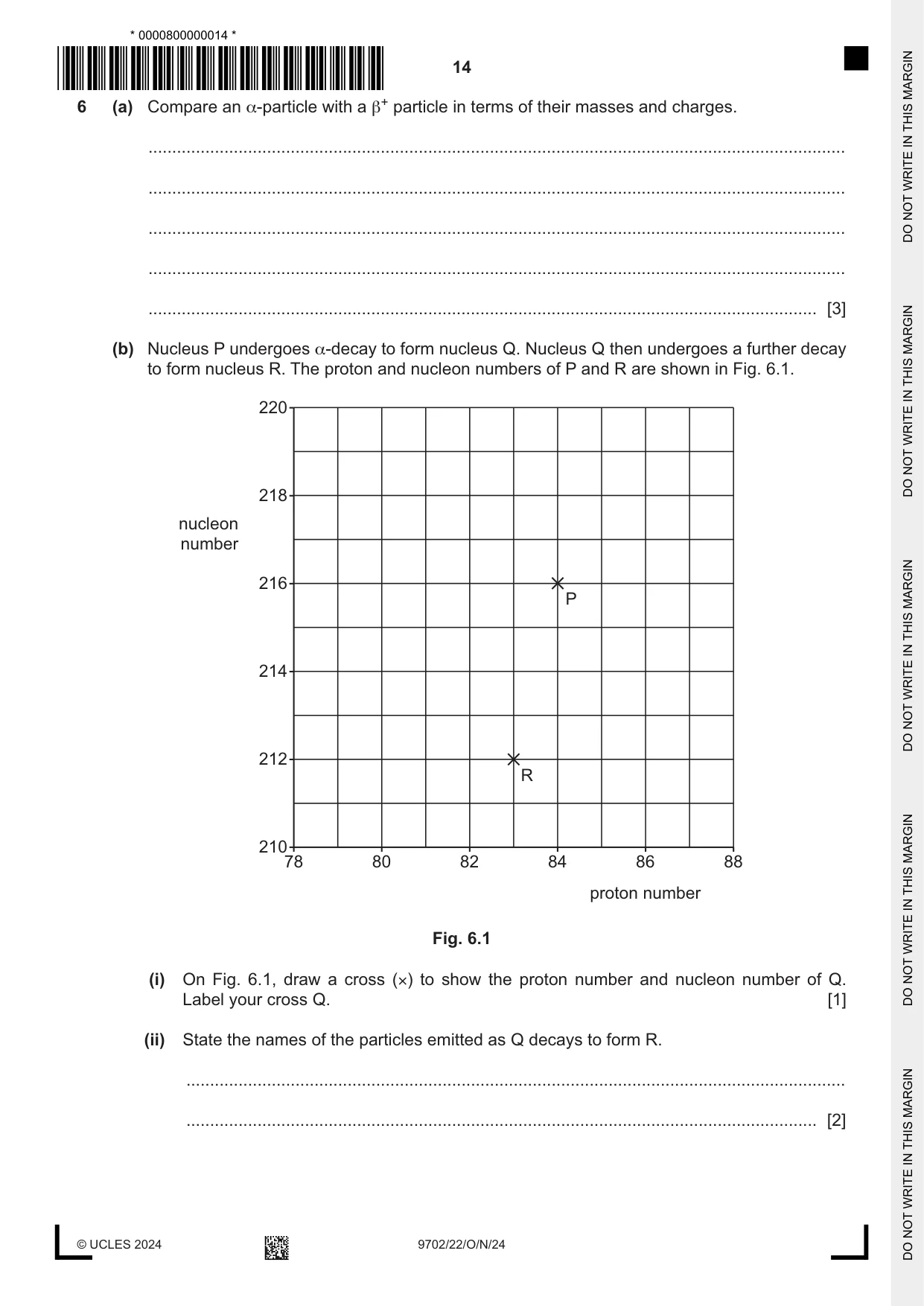
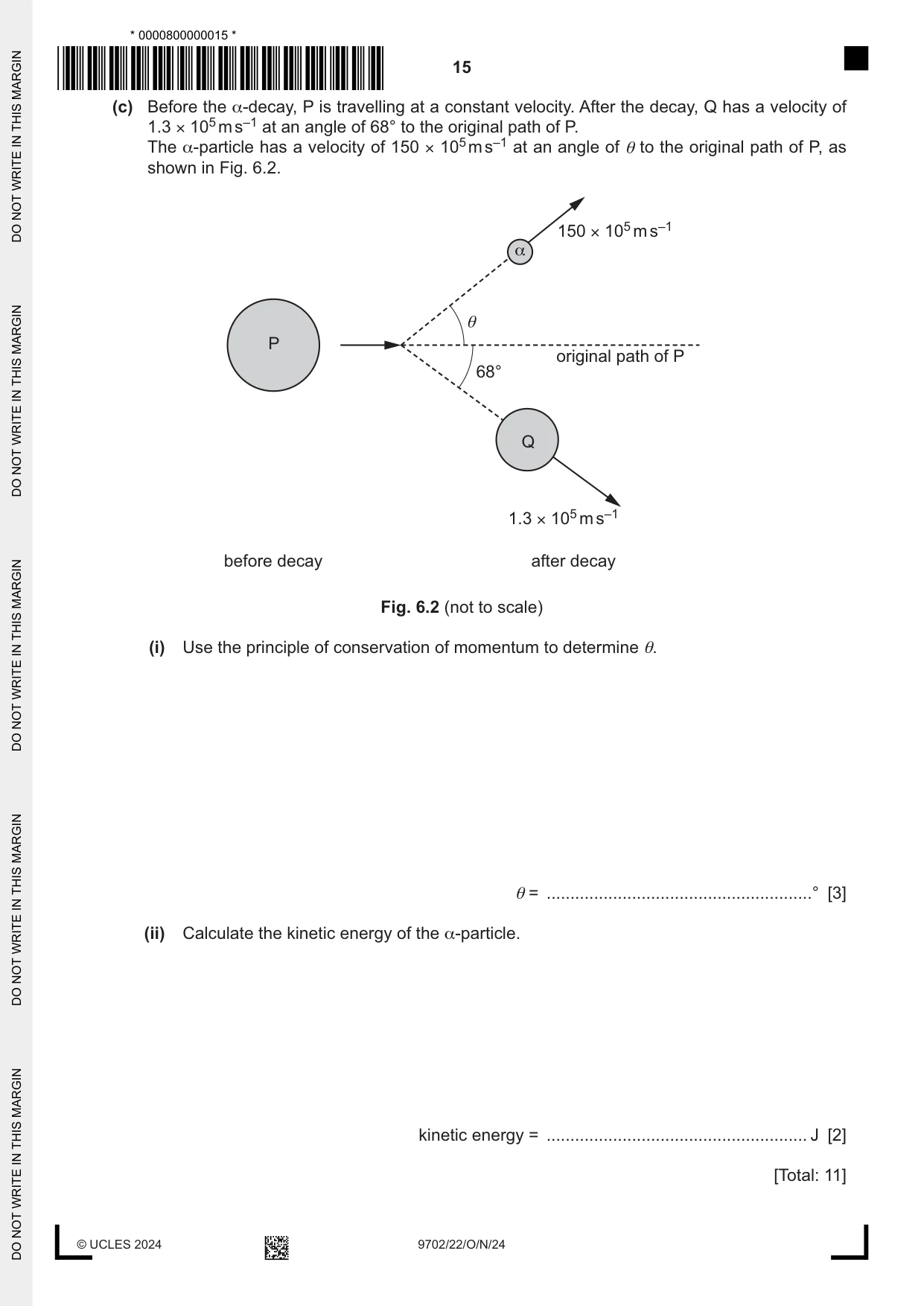
6 (a) Compare an α‑particle with a β+ particle in terms of their masses and charges. ................................................................................................................................................... ................................................................................................................................................... ................................................................................................................................................... ................................................................................................................................................... ............................................................................................................................................. [3] (b) Nucleus P undergoes α‑decay to form nucleus Q. Nucleus Q then undergoes a further decay to form nucleus R. The proton and nucleon numbers of P and R are shown in Fig. 6.1. 220 218 nucleon number 216 P 214 212 R 210 78 80 82 84 86 88 proton number Fig. 6.1 (i) On Fig. 6.1, draw a cross (×) to show the proton number and nucleon number of Q. Label your cross Q. [1] (ii) State the names of the particles emitted as Q decays to form R. ........................................................................................................................................... ..................................................................................................................................... [2] (c) Before the α‑decay, P is travelling at a constant velocity. After the decay, Q has a velocity of 1.3 × 10⁵ m s–1 at an angle of 68° to the original path of P. The α‑particle has a velocity of 150 × 105 m s–1 at an angle of θ to the original path of P, as shown in Fig. 6.2. 150 × 105 m s–1 α θ P original path of P 68° Q 1.3 × 10⁵ m s–1 before decay after decay Fig. 6.2 (not to scale) (i) Use the principle of conservation of momentum to determine θ. θ = ........................................................° [3] (ii) Calculate the kinetic energy of the α‑particle. kinetic energy = ....................................................... J [2] [Total: 11]
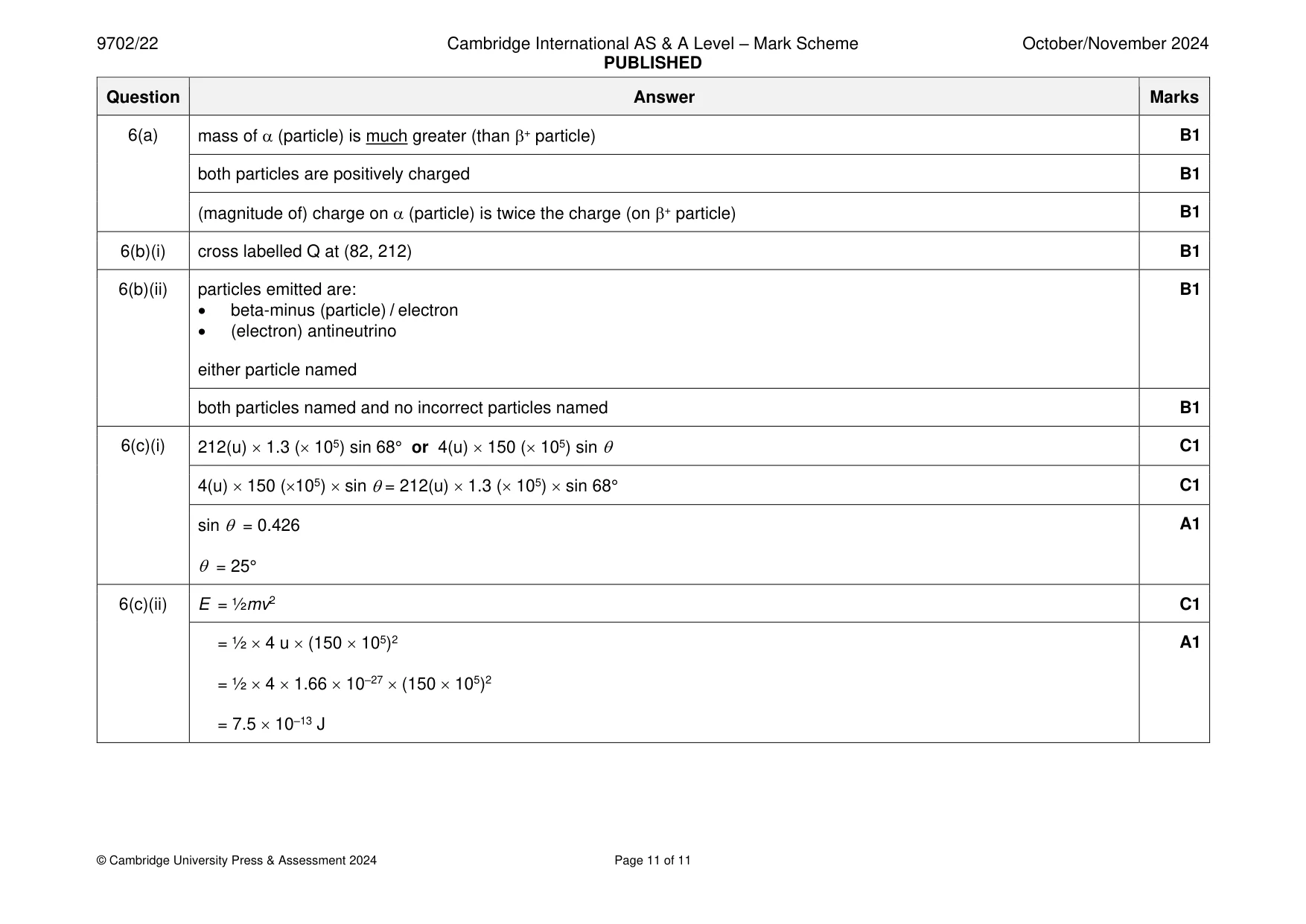
Mark scheme: 6(a) mass of (particle) is much greater (than + particle) B1 both particles are positively charged B1 (magnitude of) charge on (particle) is twice the charge (on + particle) B1 6(b)(i) cross labelled Q at (82, 212) B1 6(b)(ii) particles emitted are: B1 • beta-minus (particle) / electron • (electron) antineutrino either particle named both particles named and no incorrect particles named B1 6(c)(i) 212(u) 1.3 ( 105) sin 68° or 4(u) 150 ( 105) sin C1 4(u) 150 (105) sin = 212(u) 1.3 ( 105) sin 68° C1 sin = 0.426 A1 = 25° 6(c)(ii) E = ½mv2 C1 = ½ 4 u (150 105)2 A1 = ½ 4 1.66 10–27 (150 105)2 = 7.5 10–13 J
What was in this paper
The subtopics covered by these 6 questions, and how many questions each got. Open one in a new tab to see every Cambridge question on it.
What you needed in this session
Cambridge’s own grade thresholds for 2024 Oct/Nov, Paper 2 · Variant 2. A higher threshold means an easier paper — the bar moves with how the cohort did.