Questions as text
Q1 · The molecular energy distribution curve represents the variation in energy of the… 9701/11 May/June 2008
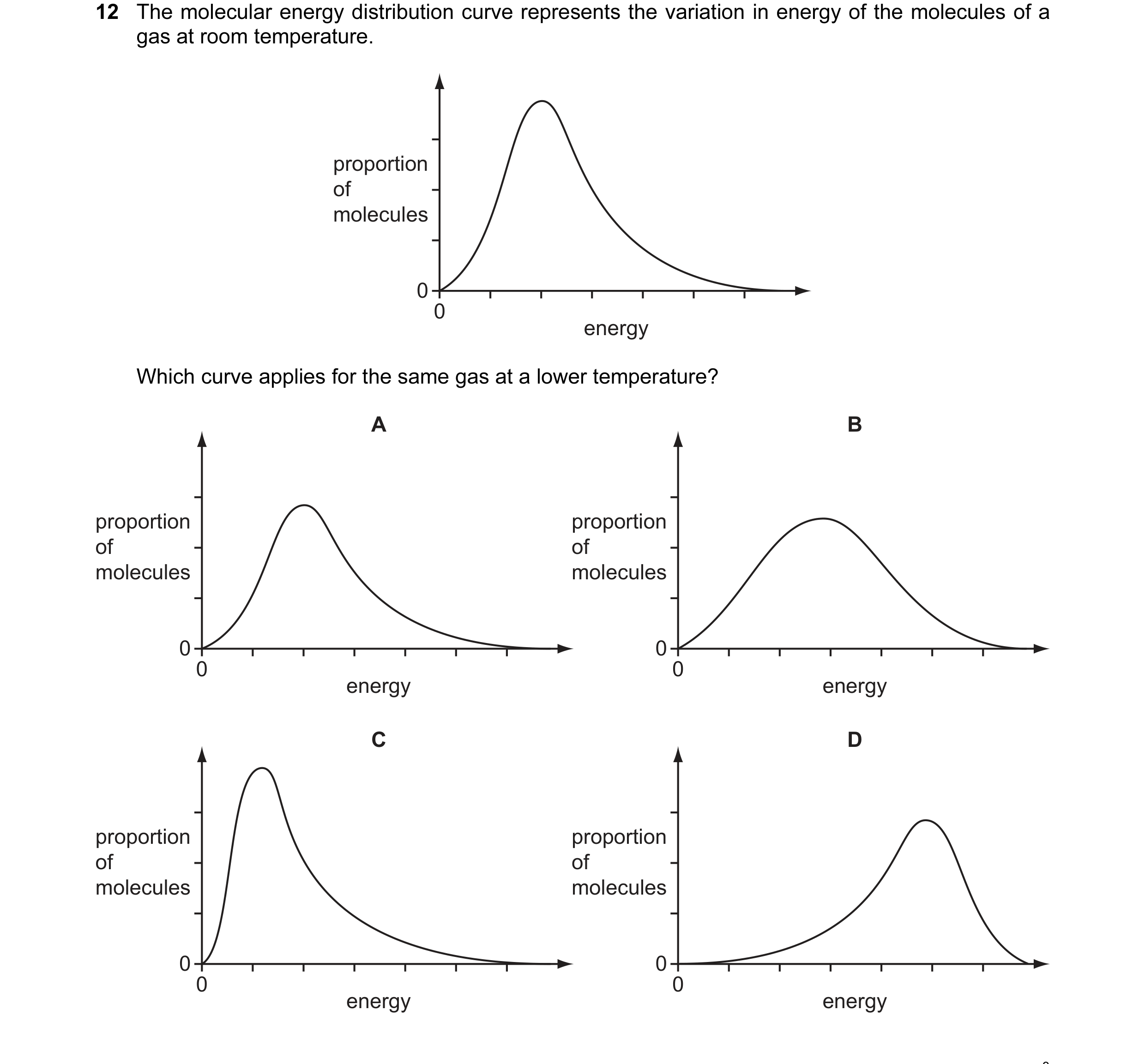
12 The molecular energy distribution curve represents the variation in energy of the molecules of a gas at room temperature. proportion of molecules 0 0 energy Which curve applies for the same gas at a lower temperature? A B proportion proportion of of molecules molecules 0 0 0 0 energy energy C D proportion proportion of of molecules molecules 0 0 0 0 energy energy
1 marks
Answer: C
This question in 9701/11 May/June 2008
Q2 · The Haber process for the manufacture of ammonia is represented by the following equation 9701/11 May/June 2010
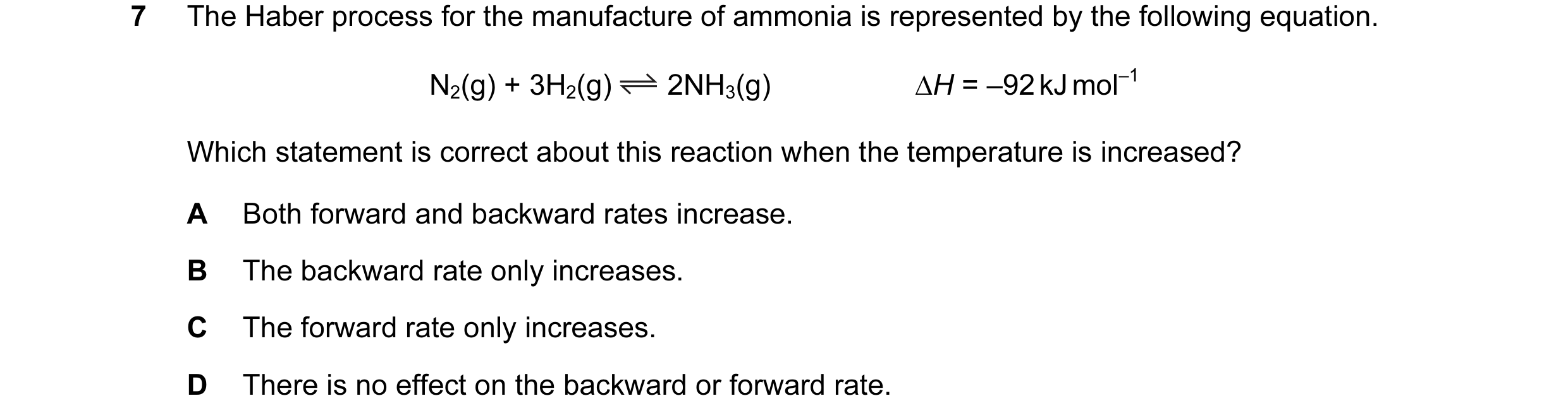
7 The Haber process for the manufacture of ammonia is represented by the following equation. N2(g) + 3H2(g) 2NH3(g) ∆H = –92 kJ mol–1 Which statement is correct about this reaction when the temperature is increased? A Both forward and backward rates increase. B The backward rate only increases. C The forward rate only increases. D There is no effect on the backward or forward rate.
1 marks
Answer: A
This question in 9701/11 May/June 2010
Q3 · Na2S2O3 reacts with dilute HCl to give a pale yellow precipitate 9701/11 May/June 2010
12 Na2S2O3 reacts with dilute HCl to give a pale yellow precipitate. If 1 cm3 of 0.1 mol dm–3 HCl is added to 10 cm3 of 0.02 mol dm–3 Na2S2O3 the precipitate forms slowly. If the experiment is repeated with 1 cm3 of 0.1 mol dm–3 HCl and 10 cm3 of 0.05 mol dm–3 Na2S2O3 the precipitate forms more quickly. Why is this? A The activation energy of the reaction is lower when 0.05 mol dm–3 Na2S2O3 is used. B The reaction proceeds by a different pathway when 0.05 mol dm–3 Na2S2O3 is used. C The collisions between reactant particles are more violent when 0.05 mol dm–3 Na2S2O3 is used. D The reactant particles collide more frequently when 0.05 mol dm–3 Na2S2O3 is used.
1 marks
Answer: D
This question in 9701/11 May/June 2010
Q4 · The Haber process for the manufacture of ammonia is represented by the following equation 9701/12 May/June 2010
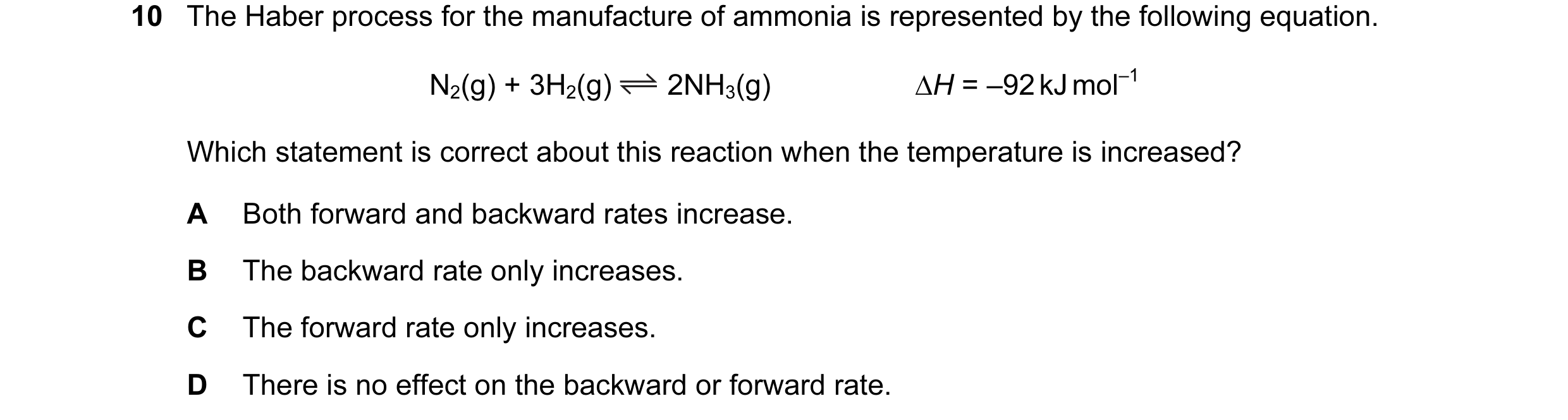
10 The Haber process for the manufacture of ammonia is represented by the following equation. N2(g) + 3H2(g) 2NH3(g) ∆H = –92 kJ mol–1 Which statement is correct about this reaction when the temperature is increased? A Both forward and backward rates increase. B The backward rate only increases. C The forward rate only increases. D There is no effect on the backward or forward rate.
1 marks
Answer: A
This question in 9701/12 May/June 2010
Q5 · Na2S2O3 reacts with dilute HCl to give a pale yellow precipitate 9701/12 May/June 2010
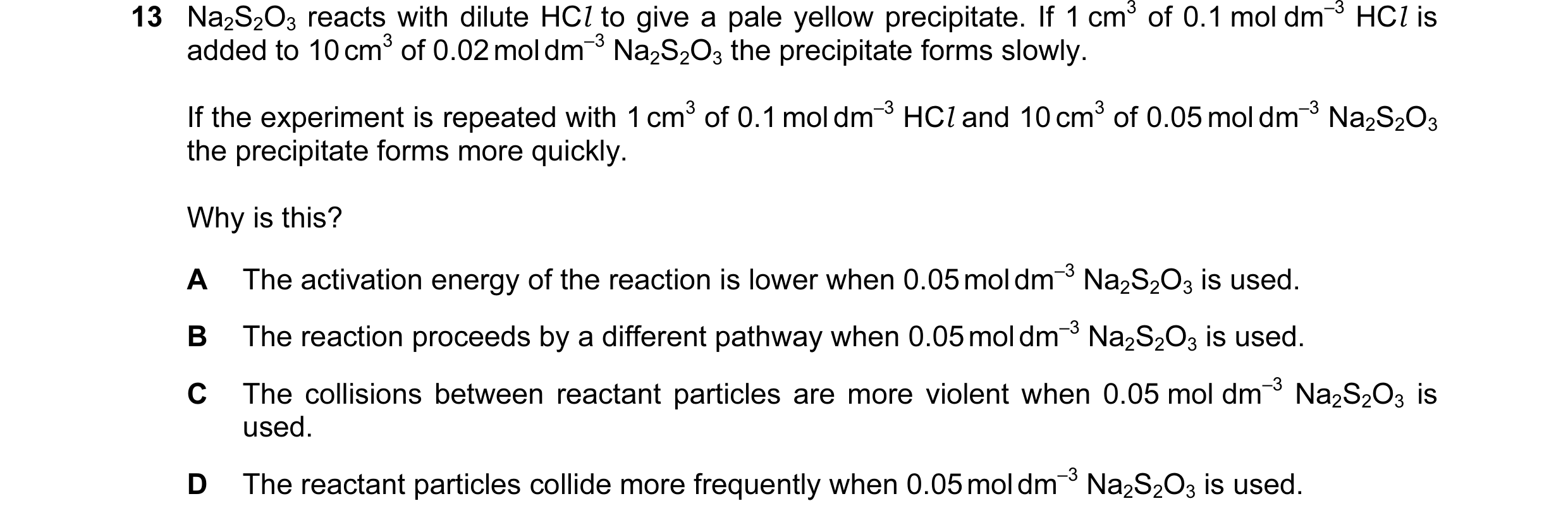
13 Na2S2O3 reacts with dilute HCl to give a pale yellow precipitate. If 1 cm3 of 0.1 mol dm–3 HCl is added to 10 cm3 of 0.02 mol dm–3 Na2S2O3 the precipitate forms slowly. If the experiment is repeated with 1 cm3 of 0.1 mol dm–3 HCl and 10 cm3 of 0.05 mol dm–3 Na2S2O3 the precipitate forms more quickly. Why is this? A The activation energy of the reaction is lower when 0.05 mol dm–3 Na2S2O3 is used. B The reaction proceeds by a different pathway when 0.05 mol dm–3 Na2S2O3 is used. C The collisions between reactant particles are more violent when 0.05 mol dm–3 Na2S2O3 is used. D The reactant particles collide more frequently when 0.05 mol dm–3 Na2S2O3 is used.
1 marks
Answer: D
This question in 9701/12 May/June 2010
Q6 · Na2S2O3 reacts with dilute HCl to give a pale yellow precipitate 9701/13 May/June 2010
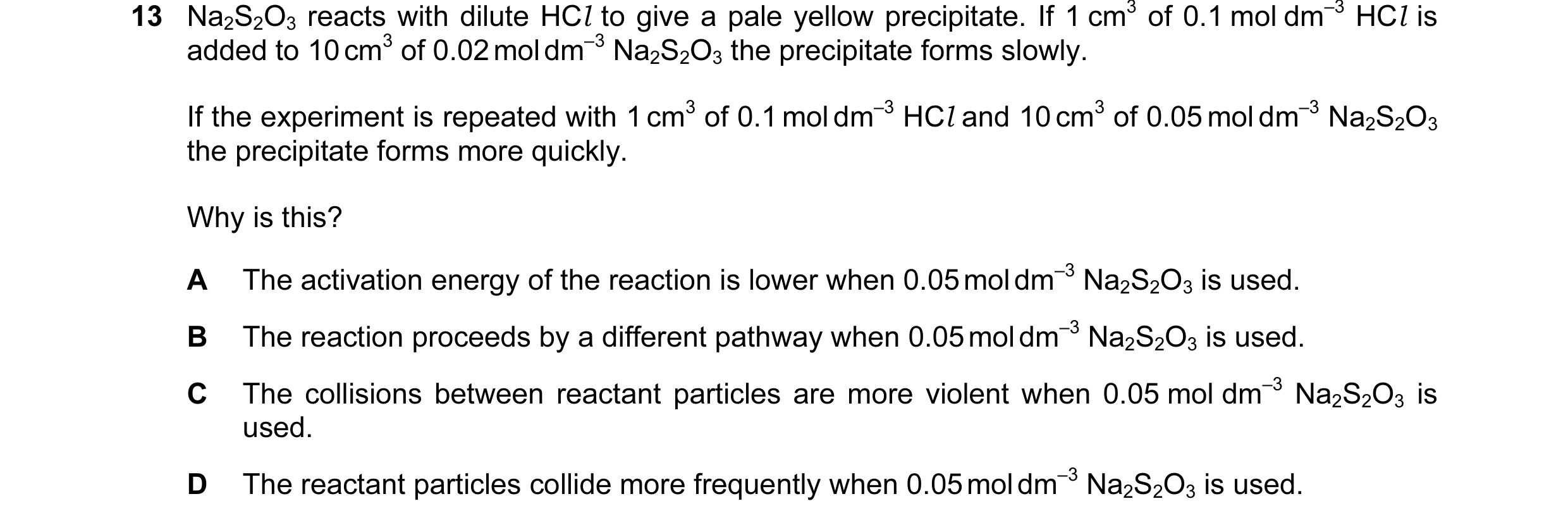
13 Na2S2O3 reacts with dilute HCl to give a pale yellow precipitate. If 1 cm3 of 0.1 mol dm–3 HCl is added to 10 cm3 of 0.02 mol dm–3 Na2S2O3 the precipitate forms slowly. If the experiment is repeated with 1 cm3 of 0.1 mol dm–3 HCl and 10 cm3 of 0.05 mol dm–3 Na2S2O3 the precipitate forms more quickly. Why is this? A The activation energy of the reaction is lower when 0.05 mol dm–3 Na2S2O3 is used. B The reaction proceeds by a different pathway when 0.05 mol dm–3 Na2S2O3 is used. C The collisions between reactant particles are more violent when 0.05 mol dm–3 Na2S2O3 is used. D The reactant particles collide more frequently when 0.05 mol dm–3 Na2S2O3 is used.
1 marks
Answer: D
This question in 9701/13 May/June 2010
Q7 · Ethanol is manufactured by reacting ethene gas and steam in the presence of phosphoric(V)… 9701/11 Oct/Nov 2010
31 Ethanol is manufactured by reacting ethene gas and steam in the presence of phosphoric(V) acid. C2H4(g) + H2O(g) C2H5OH(g) ∆H = –45 kJ mol–1 The reaction is carried out at 570 K and 60 atm. What would be the consequences of carrying out the reaction at the same temperature but at a pressure of 200 atm? 1 The manufacturing costs would increase. 2 The maximum yield at equilibrium would be higher. 3 The reaction would proceed at a faster rate.
1 marks
Answer: A
This question in 9701/11 Oct/Nov 2010
Q8 · A student puts 10 cm3 of 0.100 mol dm–3 sulfuric acid into one test-tube and 10 cm3 of… 9701/12 Oct/Nov 2010
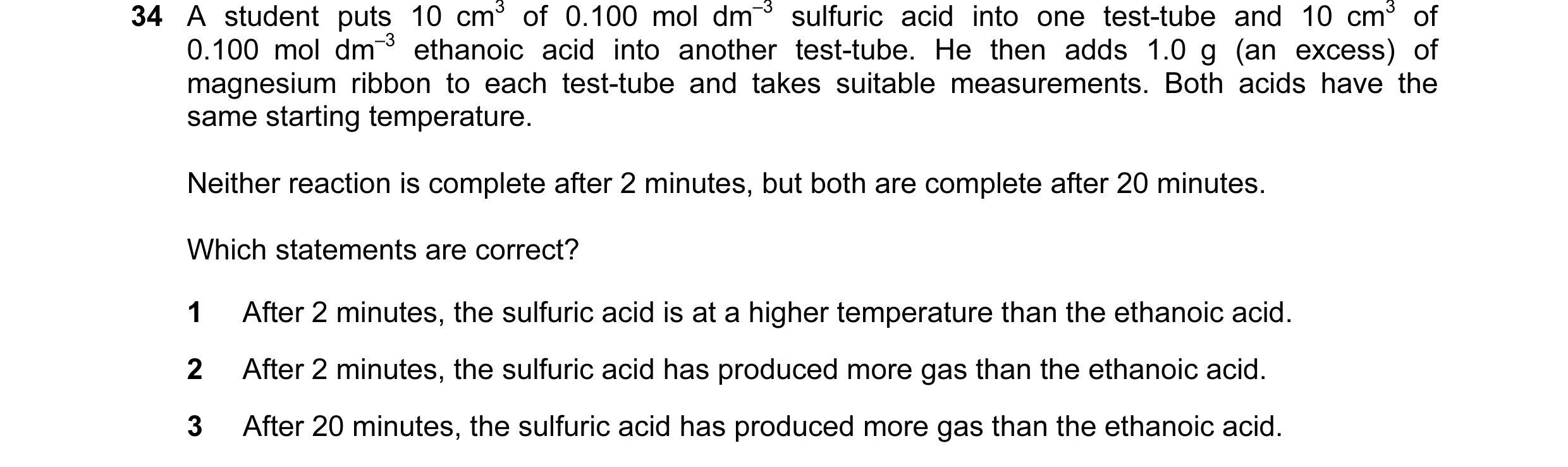
34 A student puts 10 cm3 of 0.100 mol dm–3 sulfuric acid into one test-tube and 10 cm3 of 0.100 mol dm–3 ethanoic acid into another test-tube. He then adds 1.0 g (an excess) of magnesium ribbon to each test-tube and takes suitable measurements. Both acids have the same starting temperature. Neither reaction is complete after 2 minutes, but both are complete after 20 minutes. Which statements are correct? 1 After 2 minutes, the sulfuric acid is at a higher temperature than the ethanoic acid. 2 After 2 minutes, the sulfuric acid has produced more gas than the ethanoic acid. 3 After 20 minutes, the sulfuric acid has produced more gas than the ethanoic acid.
1 marks
Answer: A
This question in 9701/12 Oct/Nov 2010
Q9 · A reaction pathway diagram is shown 9701/12 Oct/Nov 2010
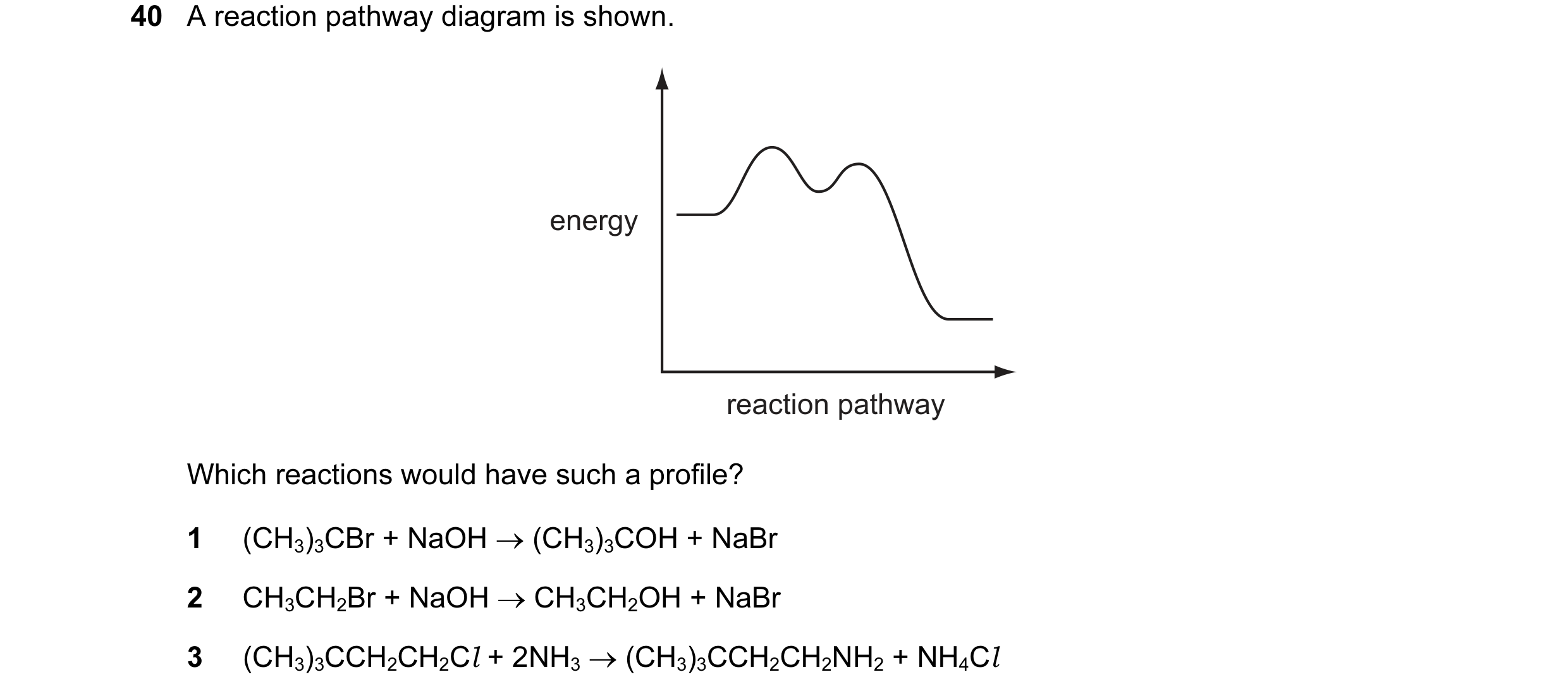
40 A reaction pathway diagram is shown. energy reaction pathway Which reactions would have such a profile? 1 (CH3)3CBr + NaOH → (CH3)3COH + NaBr 2 CH3CH2Br + NaOH → CH3CH2OH + NaBr 3 (CH3)3CCH2CH2Cl + 2NH3 → (CH3)3CCH2CH2NH2 + NH4Cl
1 marks
Answer: D
This question in 9701/12 Oct/Nov 2010
Q10 · Ethanol is manufactured by reacting ethene gas and steam in the presence of phosphoric(V)… 9701/13 Oct/Nov 2010
32 Ethanol is manufactured by reacting ethene gas and steam in the presence of phosphoric(V) acid. C2H4(g) + H2O(g) C2H5OH(g) ∆H = –45 kJ mol–1 The reaction is carried out at 570 K and 60 atm. What would be the consequences of carrying out the reaction at the same temperature but at a pressure of 200 atm? 1 The manufacturing costs would increase. 2 The maximum yield at equilibrium would be higher. 3 The reaction would proceed at a faster rate.
1 marks
Answer: A
This question in 9701/13 Oct/Nov 2010
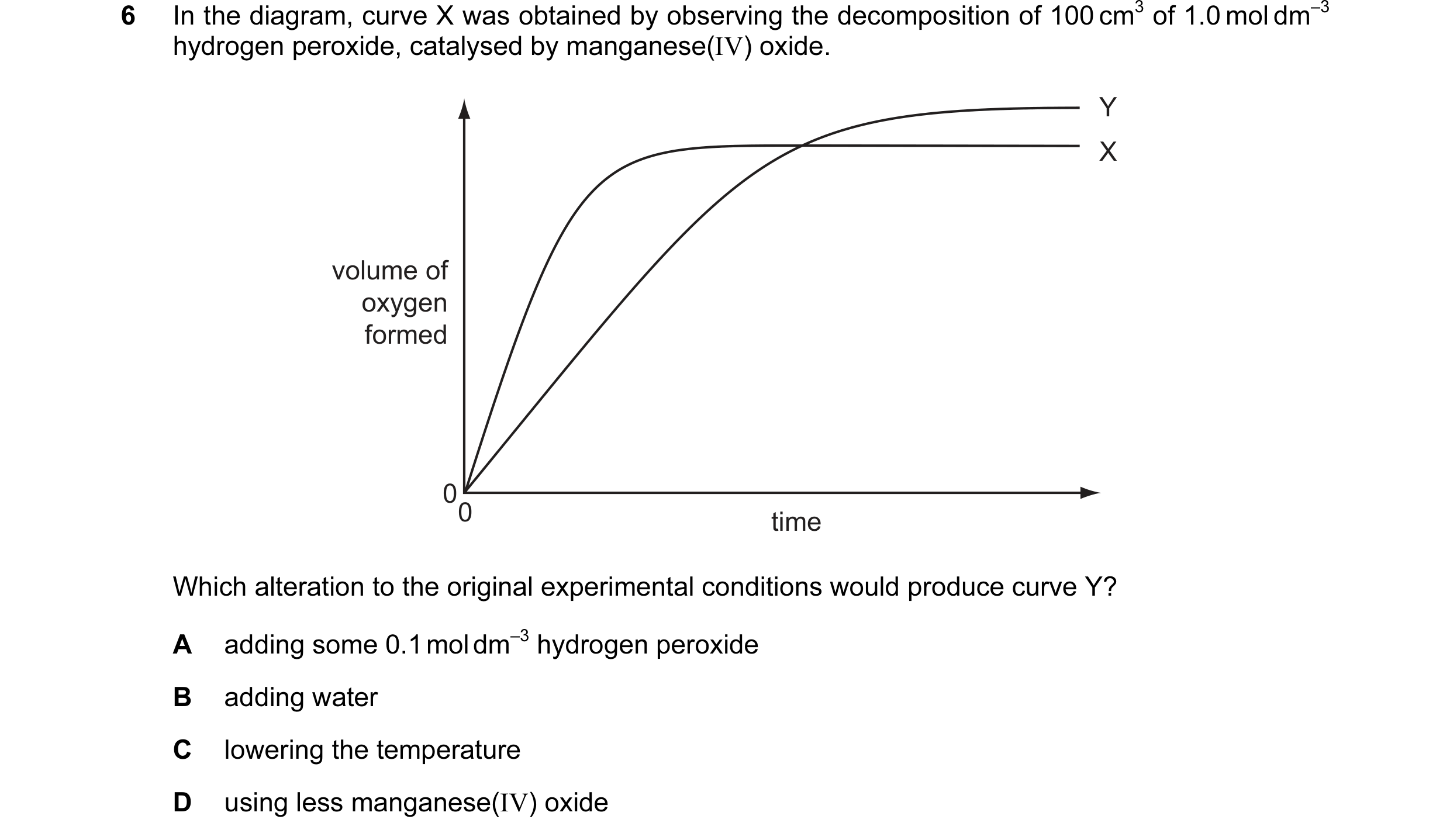
Q11 · In the diagram, curve X was obtained by observing the decomposition of 100 cm3 of 1.0 mol… 9701/11 May/June 2011
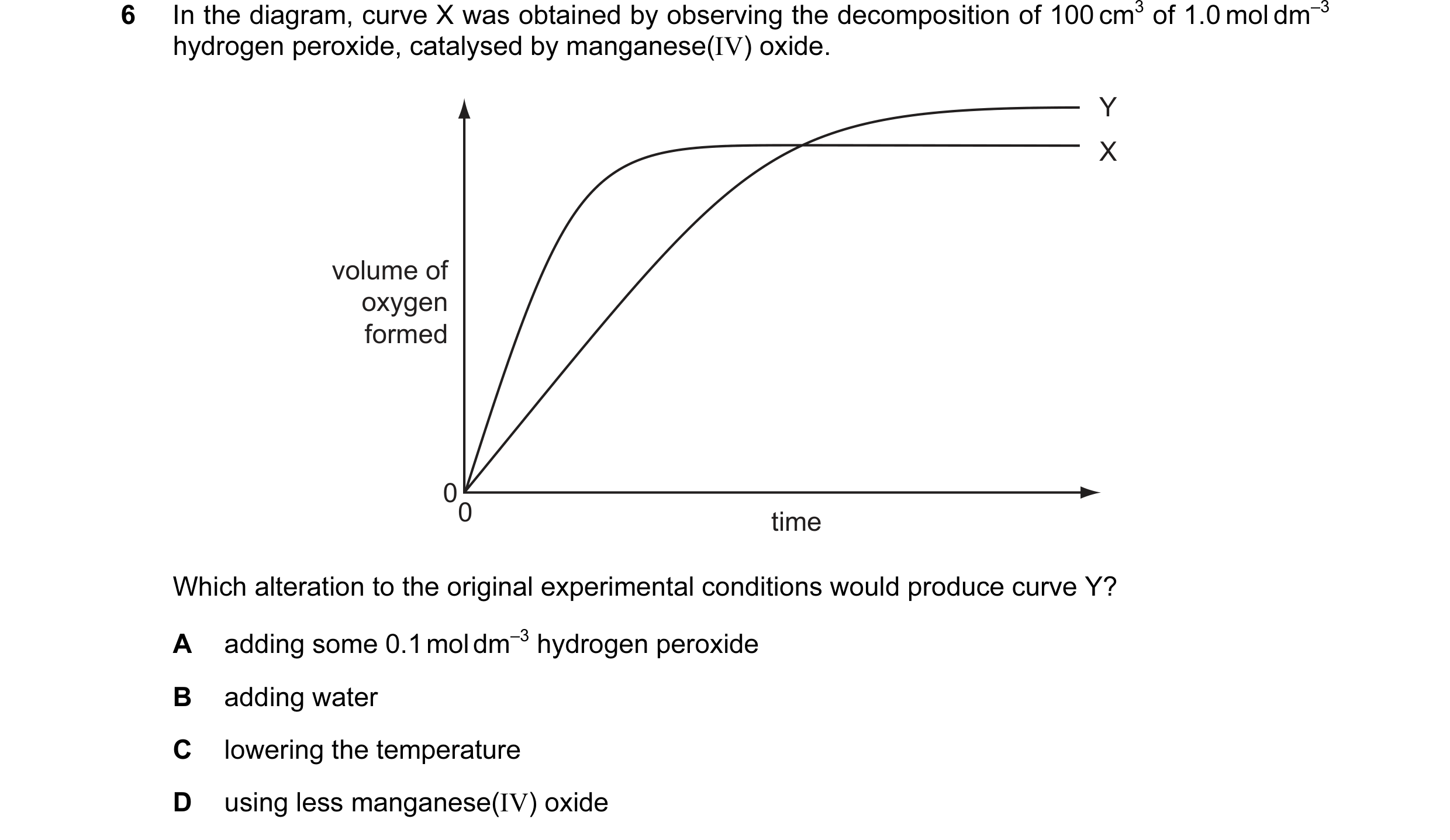
6 In the diagram, curve X was obtained by observing the decomposition of 100 cm3 of 1.0 mol dm–3 hydrogen peroxide, catalysed by manganese(IV) oxide. Y X volume of oxygen formed 00 time Which alteration to the original experimental conditions would produce curve Y? A adding some 0.1 mol dm–3 hydrogen peroxide B adding water C lowering the temperature D using less manganese(IV) oxide
1 marks
Answer: A
This question in 9701/11 May/June 2011
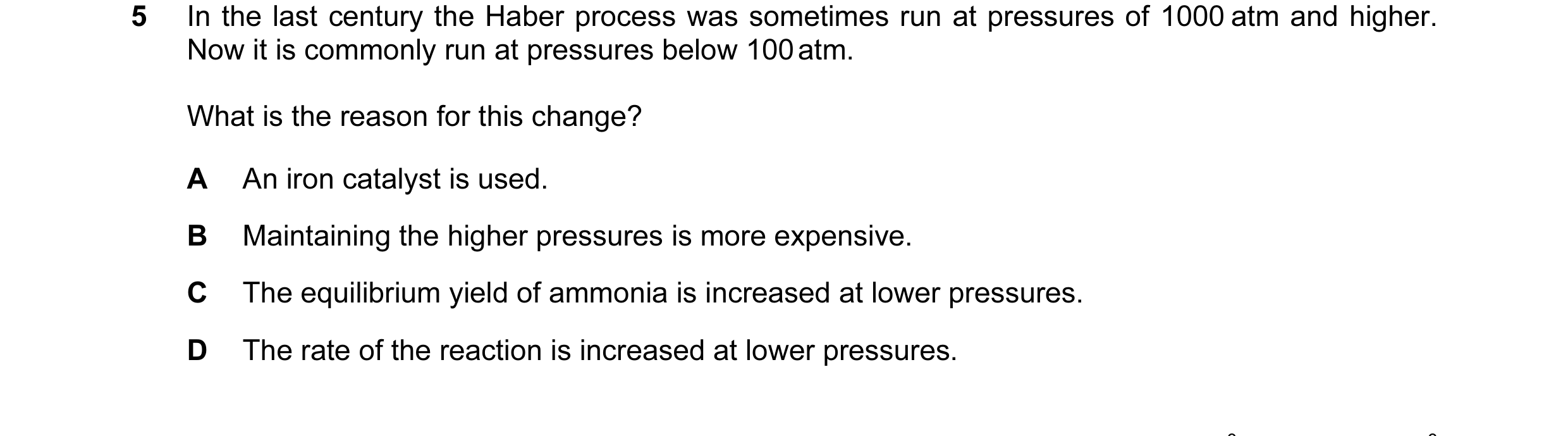
Q12 · In the last century the Haber process was sometimes run at pressures of 1000 atm and… 9701/11 May/June 2011
7 In the last century the Haber process was sometimes run at pressures of 1000 atm and higher. Now it is commonly run at pressures below 100 atm. What is the reason for this change? A An iron catalyst is used. B Maintaining the higher pressures is more expensive. C The equilibrium yield of ammonia is increased at lower pressures. D The rate of the reaction is increased at lower pressures.
1 marks
Answer: B
This question in 9701/11 May/June 2011
Q13 · Solid calcium carbonate is added to 100 cm3 of dilute hydrochloric acid and the rate of… 9701/12 May/June 2011
31 Solid calcium carbonate is added to 100 cm3 of dilute hydrochloric acid and the rate of the reaction is measured. 100 cm3 of distilled water is then added to a second 100 cm3 portion of the acid, and the experiment repeated under the same conditions. Why does the addition of water decrease the rate of the reaction? 1 Adding water reduces the frequency of collisions between reactant molecules. 2 Adding water reduces the proportion of effective collisions between reactant molecules. 3 Adding water reduces the proportion of reactant molecules possessing the activation energy.
1 marks
Answer: D
This question in 9701/12 May/June 2011
Q14 · In the last century the Haber process was sometimes run at pressures of 1000 atm and… 9701/13 May/June 2011
5 In the last century the Haber process was sometimes run at pressures of 1000 atm and higher. Now it is commonly run at pressures below 100 atm. What is the reason for this change? A An iron catalyst is used. B Maintaining the higher pressures is more expensive. C The equilibrium yield of ammonia is increased at lower pressures. D The rate of the reaction is increased at lower pressures.
1 marks
Answer: B
This question in 9701/13 May/June 2011
Q15 · In the diagram, curve X was obtained by observing the decomposition of 100 cm3 of 1.0 mol… 9701/13 May/June 2011
6 In the diagram, curve X was obtained by observing the decomposition of 100 cm3 of 1.0 mol dm–3 hydrogen peroxide, catalysed by manganese(IV) oxide. Y X volume of oxygen formed 00 time Which alteration to the original experimental conditions would produce curve Y? A adding some 0.1 mol dm–3 hydrogen peroxide B adding water C lowering the temperature D using less manganese(IV) oxide
1 marks
Answer: A
This question in 9701/13 May/June 2011
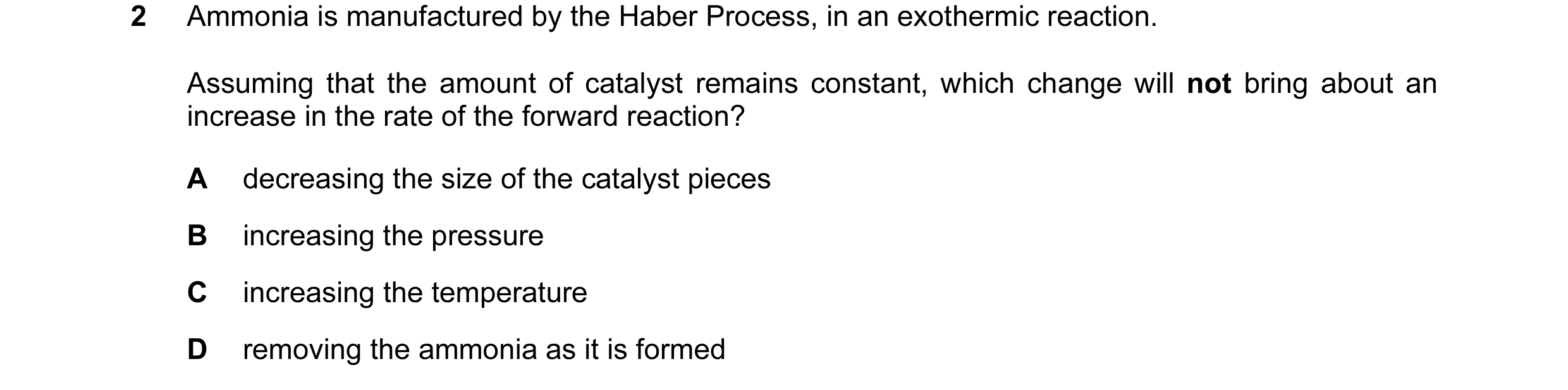
Q16 · Ammonia is manufactured by the Haber Process, in an exothermic reaction 9701/11 May/June 2012
2 Ammonia is manufactured by the Haber Process, in an exothermic reaction. Assuming that the amount of catalyst remains constant, which change will not bring about an increase in the rate of the forward reaction? A decreasing the size of the catalyst pieces B increasing the pressure C increasing the temperature D removing the ammonia as it is formed
1 marks
Answer: D
This question in 9701/11 May/June 2012
Q17 · In the manufacture of sulfuric acid the reaction 2SO2(g) + O2(g) 2SO3(g) usually takes… 9701/11 May/June 2012
36 In the manufacture of sulfuric acid the reaction 2SO2(g) + O2(g) 2SO3(g) usually takes place at 400 °C and 1 atm pressure. In one industrial plant, it is decided to change the pressure to 20 atm. What will be the consequences of this change? 1 increased running costs 2 an increased percentage of sulfur trioxide in the equilibrium mixture 3 the rate of the backward reaction increases
1 marks
Answer: A
This question in 9701/11 May/June 2012
Q18 · Ammonia is manufactured by the Haber Process, in an exothermic reaction 9701/13 May/June 2012
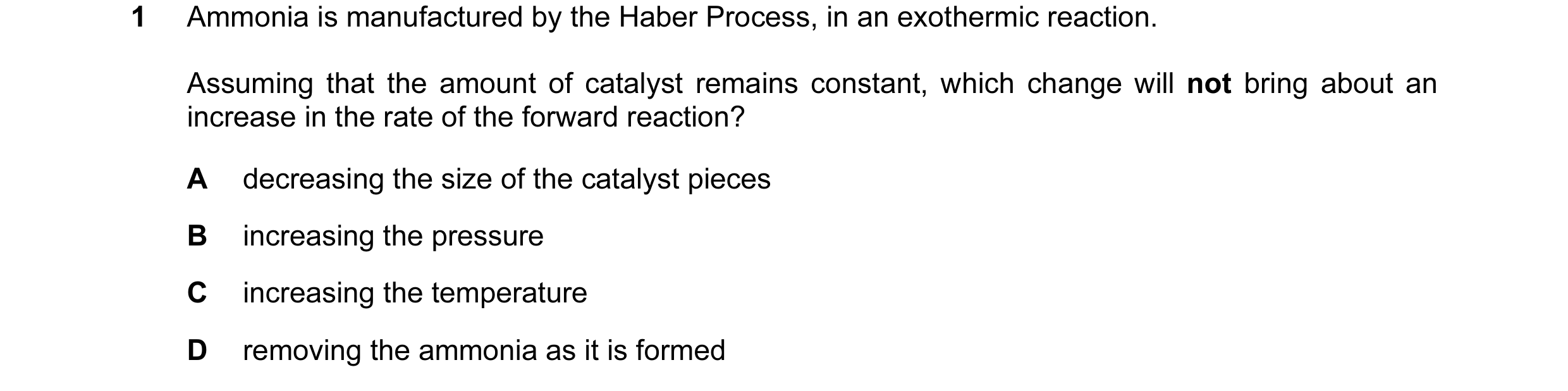
1 Ammonia is manufactured by the Haber Process, in an exothermic reaction. Assuming that the amount of catalyst remains constant, which change will not bring about an increase in the rate of the forward reaction? A decreasing the size of the catalyst pieces B increasing the pressure C increasing the temperature D removing the ammonia as it is formed
1 marks
Answer: D
This question in 9701/13 May/June 2012
Q19 · In the manufacture of sulfuric acid the reaction 2SO2(g) + O2(g) 2SO3(g) usually takes… 9701/13 May/June 2012
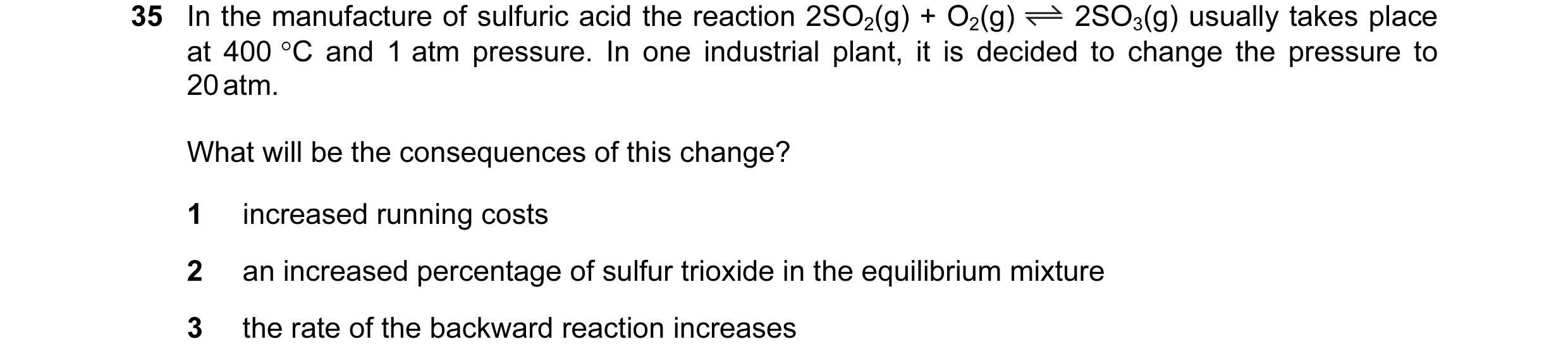
35 In the manufacture of sulfuric acid the reaction 2SO2(g) + O2(g) 2SO3(g) usually takes place at 400 °C and 1 atm pressure. In one industrial plant, it is decided to change the pressure to 20 atm. What will be the consequences of this change? 1 increased running costs 2 an increased percentage of sulfur trioxide in the equilibrium mixture 3 the rate of the backward reaction increases
1 marks
Answer: A
This question in 9701/13 May/June 2012
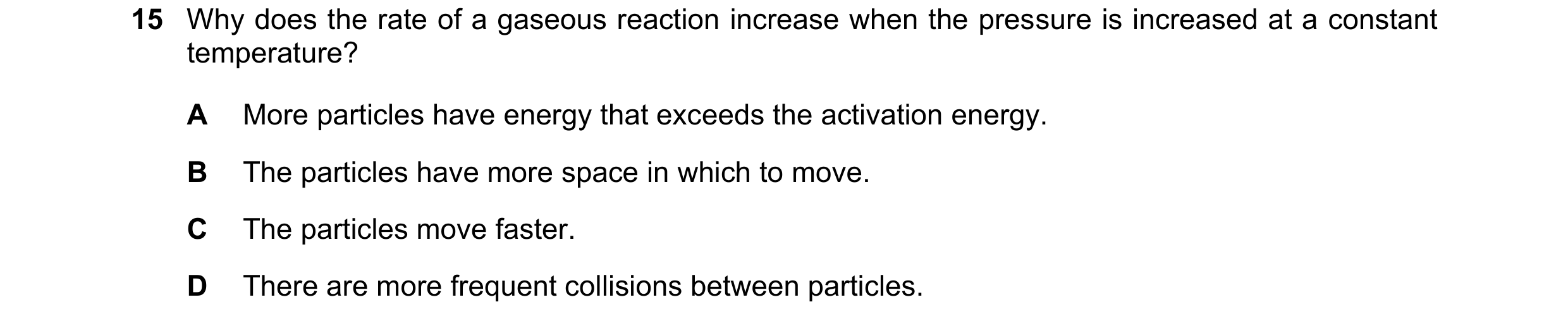
Q20 · Why does the rate of a gaseous reaction increase when the pressure is increased at a… 9701/11 May/June 2013
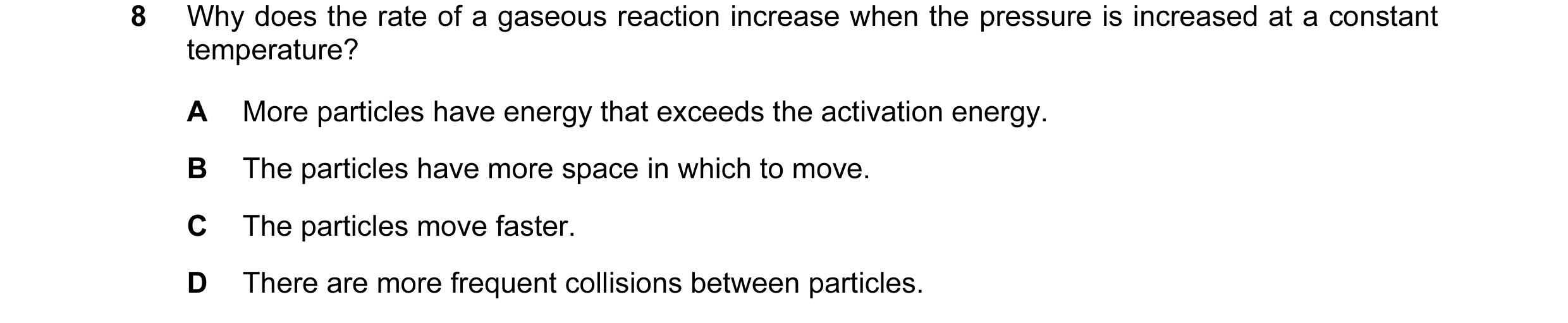
8 Why does the rate of a gaseous reaction increase when the pressure is increased at a constant temperature? A More particles have energy that exceeds the activation energy. B The particles have more space in which to move. C The particles move faster. D There are more frequent collisions between particles.
1 marks
Answer: D
This question in 9701/11 May/June 2013
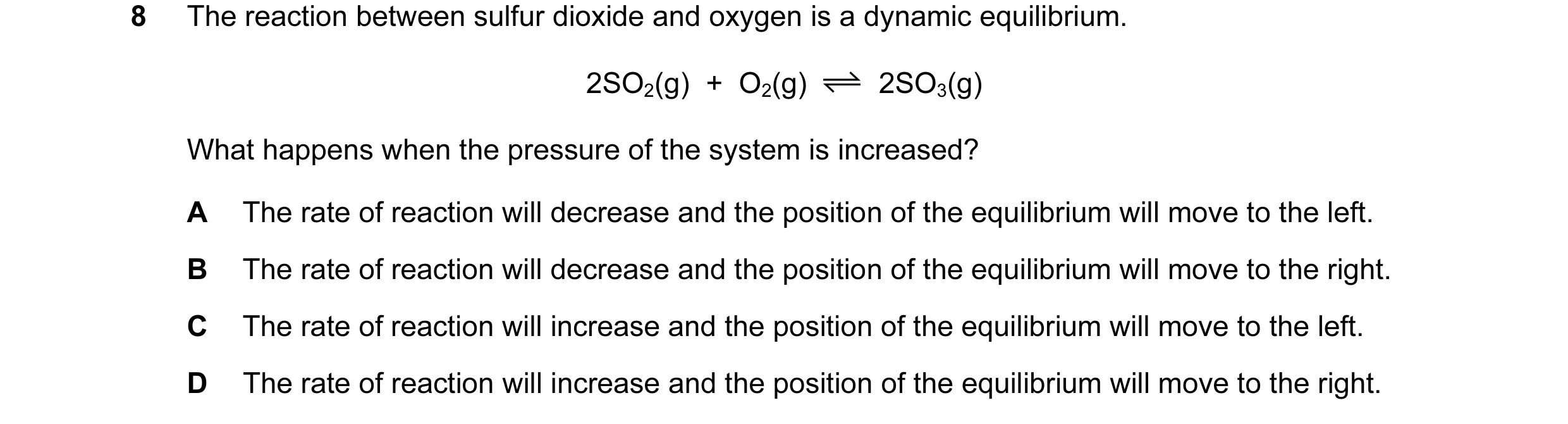
Q21 · The reaction between sulfur dioxide and oxygen is a dynamic equilibrium 9701/12 May/June 2013
8 The reaction between sulfur dioxide and oxygen is a dynamic equilibrium. 2SO2(g) + O2(g) 2SO3(g) What happens when the pressure of the system is increased? A The rate of reaction will decrease and the position of the equilibrium will move to the left. B The rate of reaction will decrease and the position of the equilibrium will move to the right. C The rate of reaction will increase and the position of the equilibrium will move to the left. D The rate of reaction will increase and the position of the equilibrium will move to the right.
1 marks
Answer: D
This question in 9701/12 May/June 2013
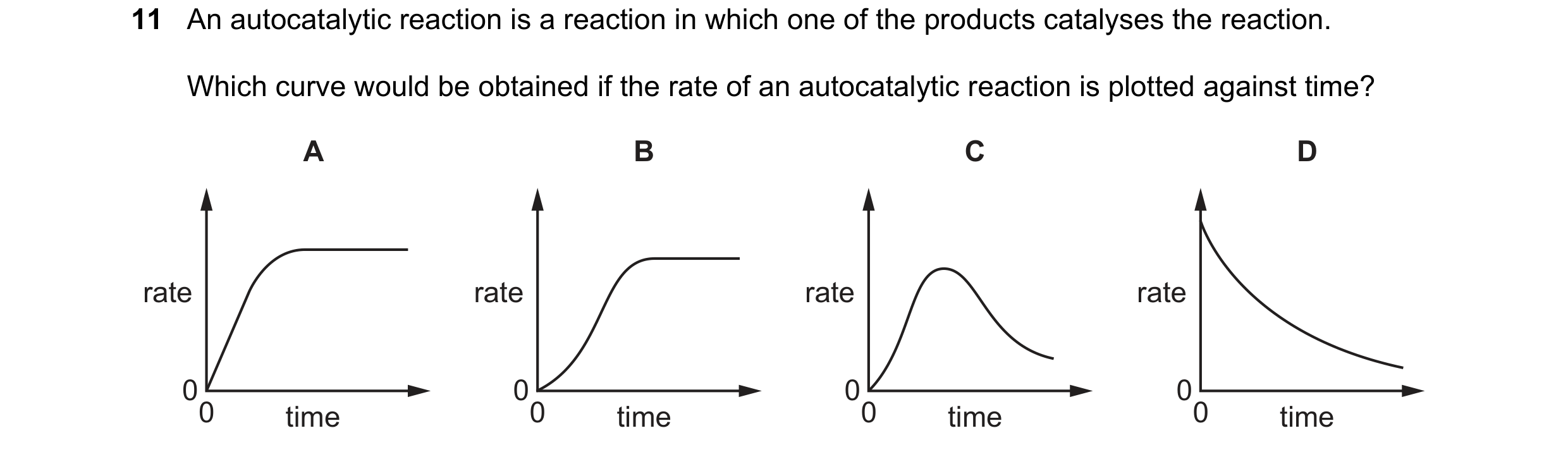
Q22 · An autocatalytic reaction is a reaction in which one of the products catalyses the… 9701/11 Oct/Nov 2013
5 An autocatalytic reaction is a reaction in which one of the products catalyses the reaction. Which curve was obtained if the rate of reaction was plotted against time for an autocatalytic reaction? A B C D rate rate rate rate 00 00 00 00 time time time time
1 marks
Answer: C
This question in 9701/11 Oct/Nov 2013
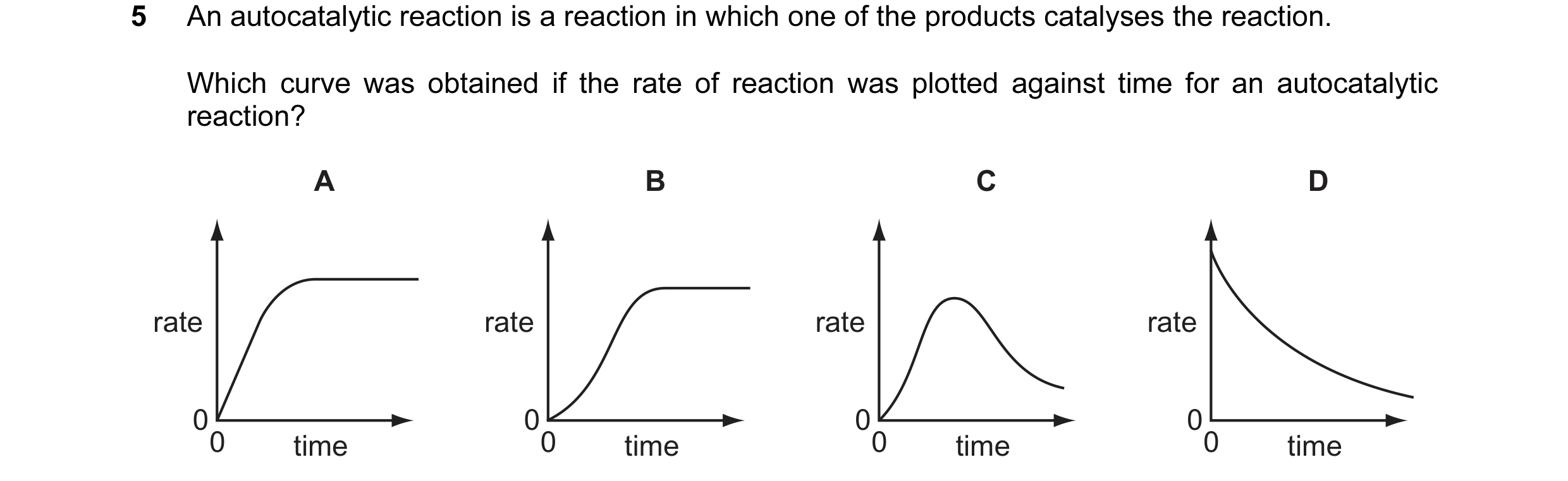
Q23 · An autocatalytic reaction is a reaction in which one of the products catalyses the… 9701/12 Oct/Nov 2013
5 An autocatalytic reaction is a reaction in which one of the products catalyses the reaction. Which curve was obtained if the rate of reaction was plotted against time for an autocatalytic reaction? A B C D rate rate rate rate 00 00 00 00 time time time time
1 marks
Answer: C
This question in 9701/12 Oct/Nov 2013
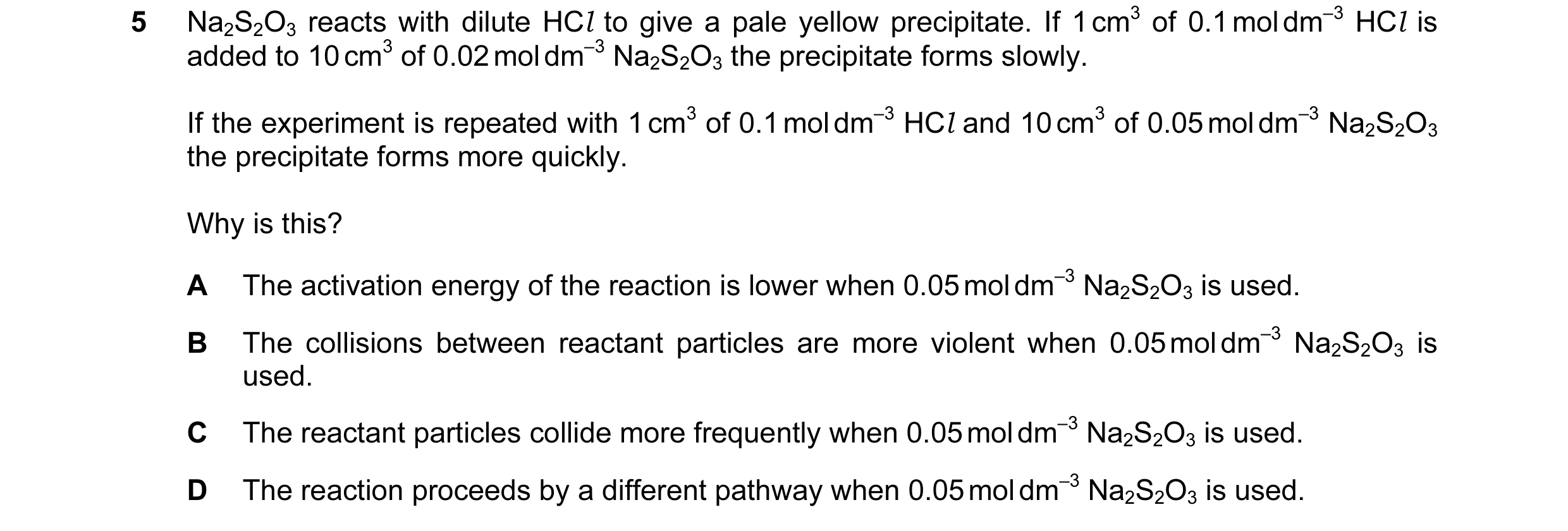
Q24 · Na2S2O3 reacts with dilute HCl to give a pale yellow precipitate 9701/13 Oct/Nov 2013
5 Na2S2O3 reacts with dilute HCl to give a pale yellow precipitate. If 1 cm3 of 0.1 mol dm–3 HCl is added to 10 cm3 of 0.02 mol dm–3 Na2S2O3 the precipitate forms slowly. If the experiment is repeated with 1 cm3 of 0.1 mol dm–3 HCl and 10 cm3 of 0.05 mol dm–3 Na2S2O3 the precipitate forms more quickly. Why is this? A The activation energy of the reaction is lower when 0.05 mol dm–3 Na2S2O3 is used. B The collisions between reactant particles are more violent when 0.05 mol dm–3 Na2S2O3 is used. C The reactant particles collide more frequently when 0.05 mol dm–3 Na2S2O3 is used. D The reaction proceeds by a different pathway when 0.05 mol dm–3 Na2S2O3 is used.
1 marks
Answer: C
This question in 9701/13 Oct/Nov 2013
Q25 · The diagram represents the Boltzmann distribution of molecular energies at a given… 9701/13 Oct/Nov 2013
32 The diagram represents the Boltzmann distribution of molecular energies at a given temperature. number of molecules energy Which of the factors that affect the rate of a reaction can be explained using such a Boltzmann distribution? 1 increasing the concentration of reactants 2 increasing the temperature 3 the addition of a catalyst
1 marks
Answer: C
This question in 9701/13 Oct/Nov 2013
Q26 · When making sparkler fireworks, a mixture of barium nitrate powder with aluminium powder… 9701/11 May/June 2014
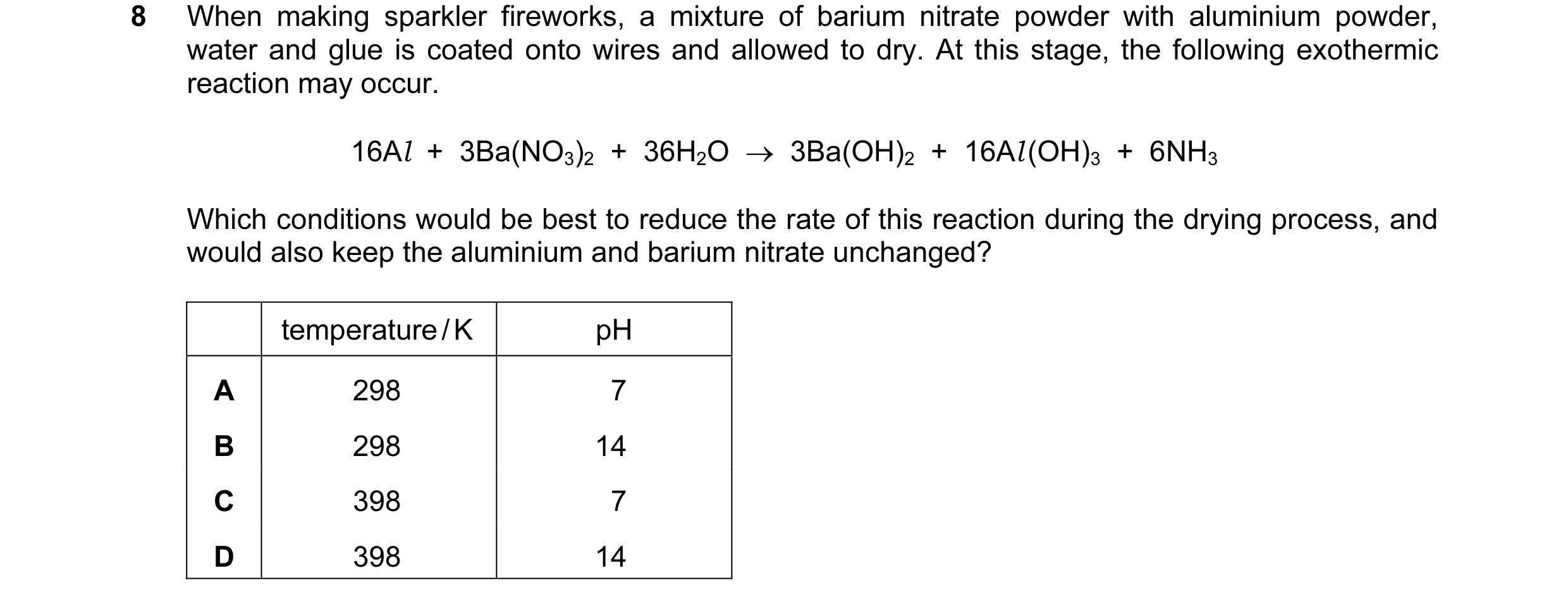
8 When making sparkler fireworks, a mixture of barium nitrate powder with aluminium powder, water and glue is coated onto wires and allowed to dry. At this stage, the following exothermic reaction may occur. 16Al + 3Ba(NO3)2 + 36H2O → 3Ba(OH)2 + 16Al (OH)3 + 6NH3 Which conditions would be best to reduce the rate of this reaction during the drying process, and would also keep the aluminium and barium nitrate unchanged? temperature / K pH A 298 7 B 298 14 C 398 7 D 398 14
1 marks
Answer: A
This question in 9701/11 May/June 2014
Q27 · R and S react together 9701/11 May/June 2014
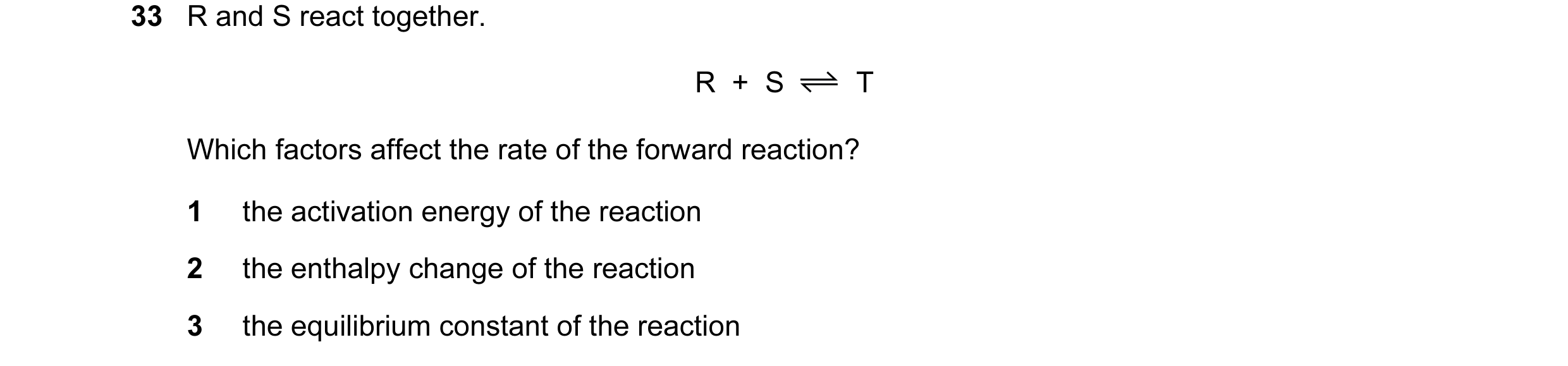
33 R and S react together. R + S T Which factors affect the rate of the forward reaction? 1 the activation energy of the reaction 2 the enthalpy change of the reaction 3 the equilibrium constant of the reaction
1 marks
Answer: D
This question in 9701/11 May/June 2014
Q28 · The stoichiometry of a catalysed reaction is shown by the equation below 9701/13 May/June 2014
34 The stoichiometry of a catalysed reaction is shown by the equation below. P (g) + Q (g) R (g) + S (l) Two experiments were carried out in which the rate of production of R was measured. The results are shown in the diagram below. experiment 1 amount experiment 2 of R 00 time Which changes in the conditions might explain the results shown? 1 A lower pressure was used in experiment 2. 2 A different catalyst was used in experiment 2. 3 Product S was continuously removed from the reaction vessel in experiment 2.
1 marks
Answer: B
This question in 9701/13 May/June 2014
Q29 · A reaction pathway diagram is shown 9701/11 Oct/Nov 2014
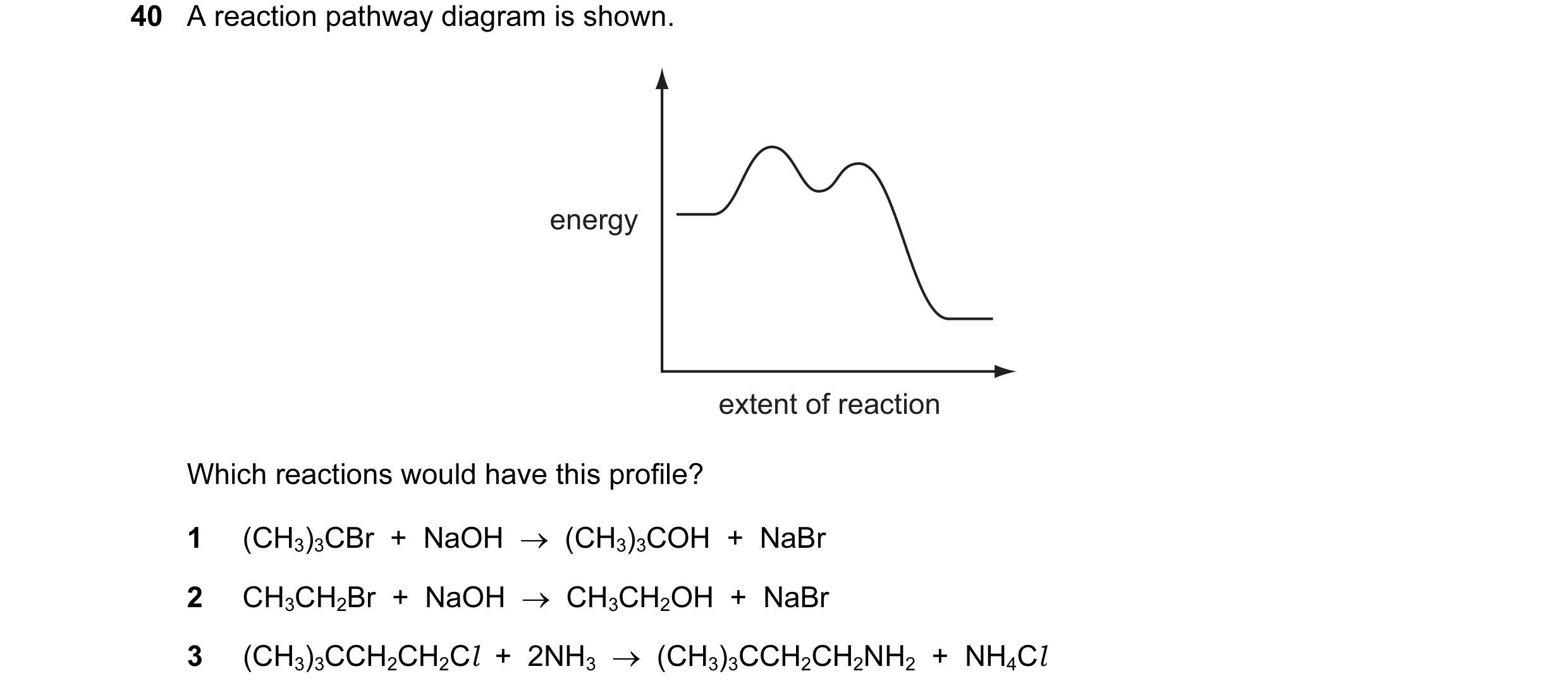
40 A reaction pathway diagram is shown. energy extent of reaction Which reactions would have this profile? 1 (CH3)3CBr + NaOH → (CH3)3COH + NaBr 2 CH3CH2Br + NaOH → CH3CH2OH + NaBr 3 (CH3)3CCH2CH2Cl + 2NH3 → (CH3)3CCH2CH2NH2 + NH4Cl
1 marks
Answer: D
This question in 9701/11 Oct/Nov 2014
Q30 · Why does raising the pressure of a fixed mass of gaseous reactants at a constant… 9701/11 May/June 2015
34 Why does raising the pressure of a fixed mass of gaseous reactants at a constant temperature cause an increase in the rate of reaction? 1 More collisions occur per second when the pressure is increased. 2 More molecules have energy greater than the activation energy at the higher pressure. 3 Raising the pressure lowers the activation energy.
1 marks
Answer: D
This question in 9701/11 May/June 2015
Q31 · A chemist puts a sample of dilute aqueous hydrochloric acid into beaker 1 9701/12 Feb/March 2016
34 A chemist puts a sample of dilute aqueous hydrochloric acid into beaker 1. She adds a sample of zinc and measures the rate of production of hydrogen gas. She then puts a different sample of dilute aqueous hydrochloric acid into beaker 2. She adds a different sample of zinc and measures the rate of production of hydrogen gas. The rate of the reaction in beaker 2 is greater than the rate of the reaction in beaker 1. Which factors could help to explain this observation? 1 The reaction in beaker 1 has a higher activation energy than the reaction in beaker 2. 2 The zinc in beaker 1 is in larger pieces than the zinc in beaker 2. 3 The acid in beaker 1 is at a lower concentration than the acid in beaker 2.
1 marks
Answer: C
This question in 9701/12 Feb/March 2016
Q32 · The equation shows a gas phase reaction 9701/11 May/June 2016
37 The equation shows a gas phase reaction. X(g) → 2Y(g) The diagram shows the Boltzmann distribution of a fixed mass of X(g) at temperature T in the absence of a catalyst. The line EA indicates the activation energy. proportion of molecules with a given energy 00 EA molecular energy Which diagrams correctly show the effect of the following changes made separately and independently? 1 adding a catalyst proportion of molecules with a given energy 00 EA molecular energy 2 increasing the pressure of X(g) proportion of molecules with a given energy 00 EA molecular energy 3 increasing the temperature of X(g) proportion of temperature T ' molecules (T ' > T ) with a given temperature T energy 00 EA molecular energy
1 marks
Answer: B
This question in 9701/11 May/June 2016
Q33 · Which stage in the free radical substitution of ethane by chlorine has the lowest… 9701/12 May/June 2016
11 Which stage in the free radical substitution of ethane by chlorine has the lowest activation energy? A Cl 2 → 2Cl ● B Cl ● + C2H6 → C2H5● + HCl C C2H5● + Cl 2 → C2H5Cl + Cl ● D Cl ● + C2H5● → C2H5Cl
1 marks
Answer: D
This question in 9701/12 May/June 2016
Q34 · In this question, all gases can be assumed to behave ideally 9701/12 May/June 2016
33 In this question, all gases can be assumed to behave ideally. A chemist heats a mixture of nitrogen and oxygen gases in a sealed container at a constant temperature until the mixture reaches a dynamic equilibrium containing N2(g), O2(g) and NO(g). N2(g) + O2(g) 2NO(g) The chemist repeats the experiment at the same temperature using the same initial amounts of N2(g) and O2(g), but at a much higher pressure. Which statements about the second experiment at higher pressure are correct? 1 At higher pressure, there are more particles per unit volume. 2 The composition of the equilibrium mixture does not change. 3 There are more collisions per second so equilibrium is reached faster.
1 marks
Answer: A
This question in 9701/12 May/June 2016
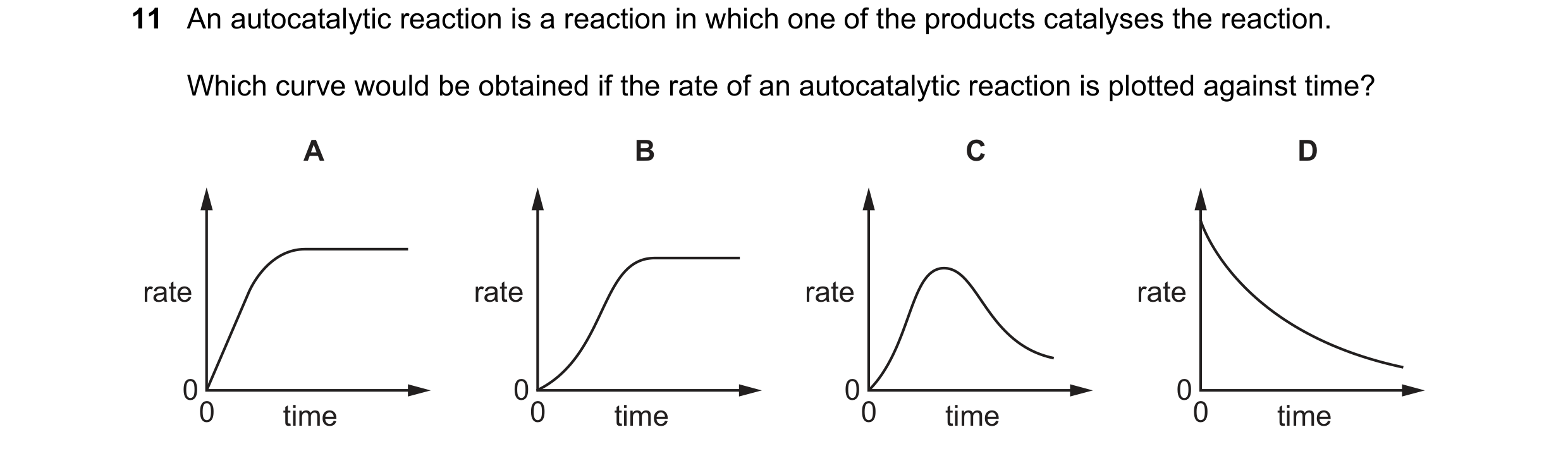
Q35 · An autocatalytic reaction is a reaction in which one of the products catalyses the… 9701/11 Oct/Nov 2016
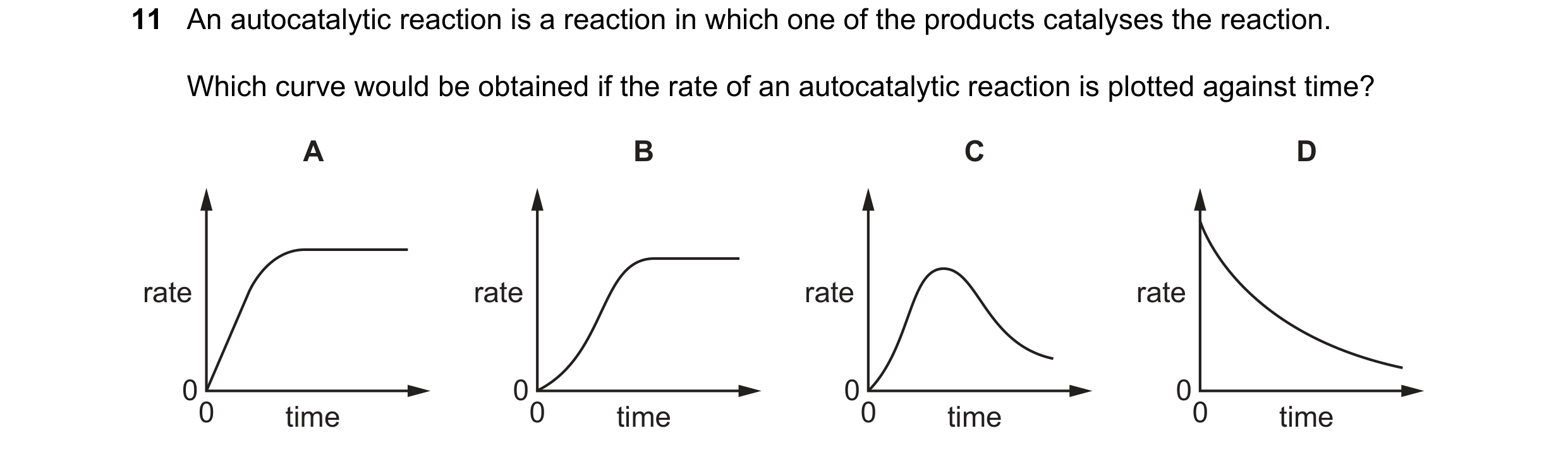
11 An autocatalytic reaction is a reaction in which one of the products catalyses the reaction. Which curve would be obtained if the rate of an autocatalytic reaction is plotted against time? A B C D rate rate rate rate 0 0 0 0 0 0 0 0 time time time time
1 marks
Answer: C
This question in 9701/11 Oct/Nov 2016
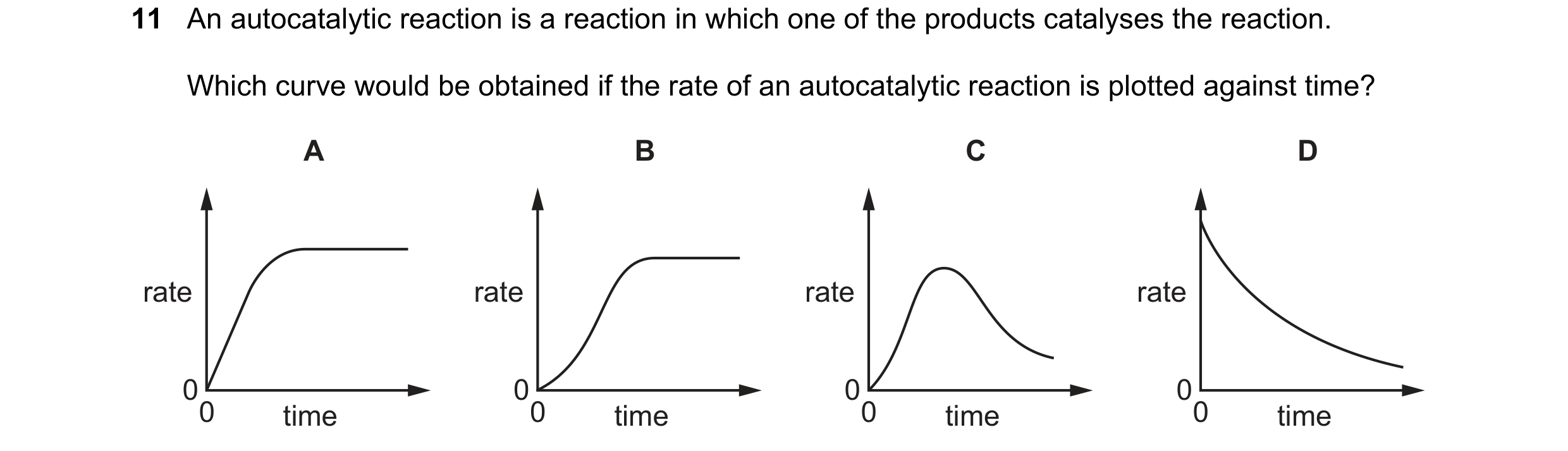
Q36 · An autocatalytic reaction is a reaction in which one of the products catalyses the… 9701/13 Oct/Nov 2016
11 An autocatalytic reaction is a reaction in which one of the products catalyses the reaction. Which curve would be obtained if the rate of an autocatalytic reaction is plotted against time? A B C D rate rate rate rate 0 0 0 0 0 0 0 0 time time time time
1 marks
Answer: C
This question in 9701/13 Oct/Nov 2016
Q37 · A student carried out two experiments using MnO2 as a catalyst to decompose hydrogen… 9701/13 May/June 2017
34 A student carried out two experiments using MnO2 as a catalyst to decompose hydrogen peroxide. The equation for this reaction is shown. 2H2O2(aq) → 2H2O(l) + O2(g) The student’s results are recorded in the table. mass MnO2 conditions vol H2O2 final vol O2 time taken experiment 1 0.25 g room conditions 10.0 cm3 480 cm3 200 s experiment 2 0.25 g room conditions 10.0 cm3 480 cm3 500 s Which statements are correct? 1 The activation energy was the same for both experiments. 2 The concentration of the hydrogen peroxide solution used was 4.0 mol dm–3. 3 The MnO2 used in experiment 1 was in larger pieces than the MnO2 used in experiment 2.
1 marks
Answer: B
This question in 9701/13 May/June 2017
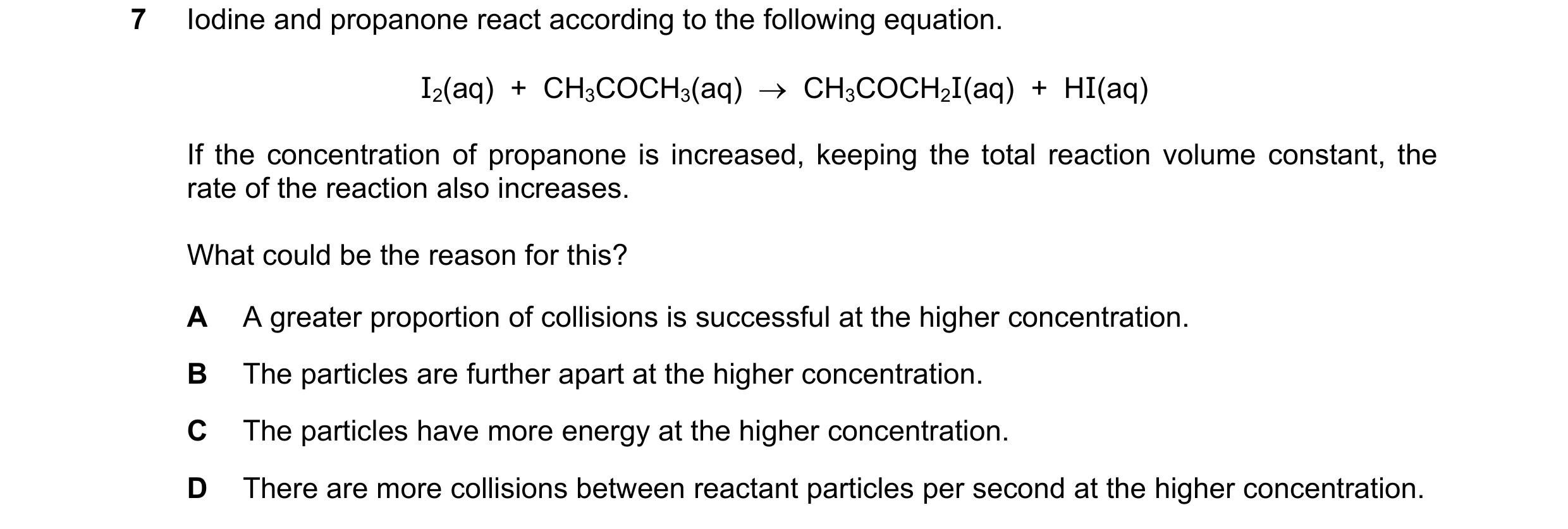
Q38 · Iodine and propanone react according to the following equation 9701/11 Oct/Nov 2017
7 Iodine and propanone react according to the following equation. I2(aq) + CH3COCH3(aq) → CH3COCH2I(aq) + HI(aq) If the concentration of propanone is increased, keeping the total reaction volume constant, the rate of the reaction also increases. What could be the reason for this? A A greater proportion of collisions is successful at the higher concentration. B The particles are further apart at the higher concentration. C The particles have more energy at the higher concentration. D There are more collisions between reactant particles per second at the higher concentration.
1 marks
Answer: D
This question in 9701/11 Oct/Nov 2017
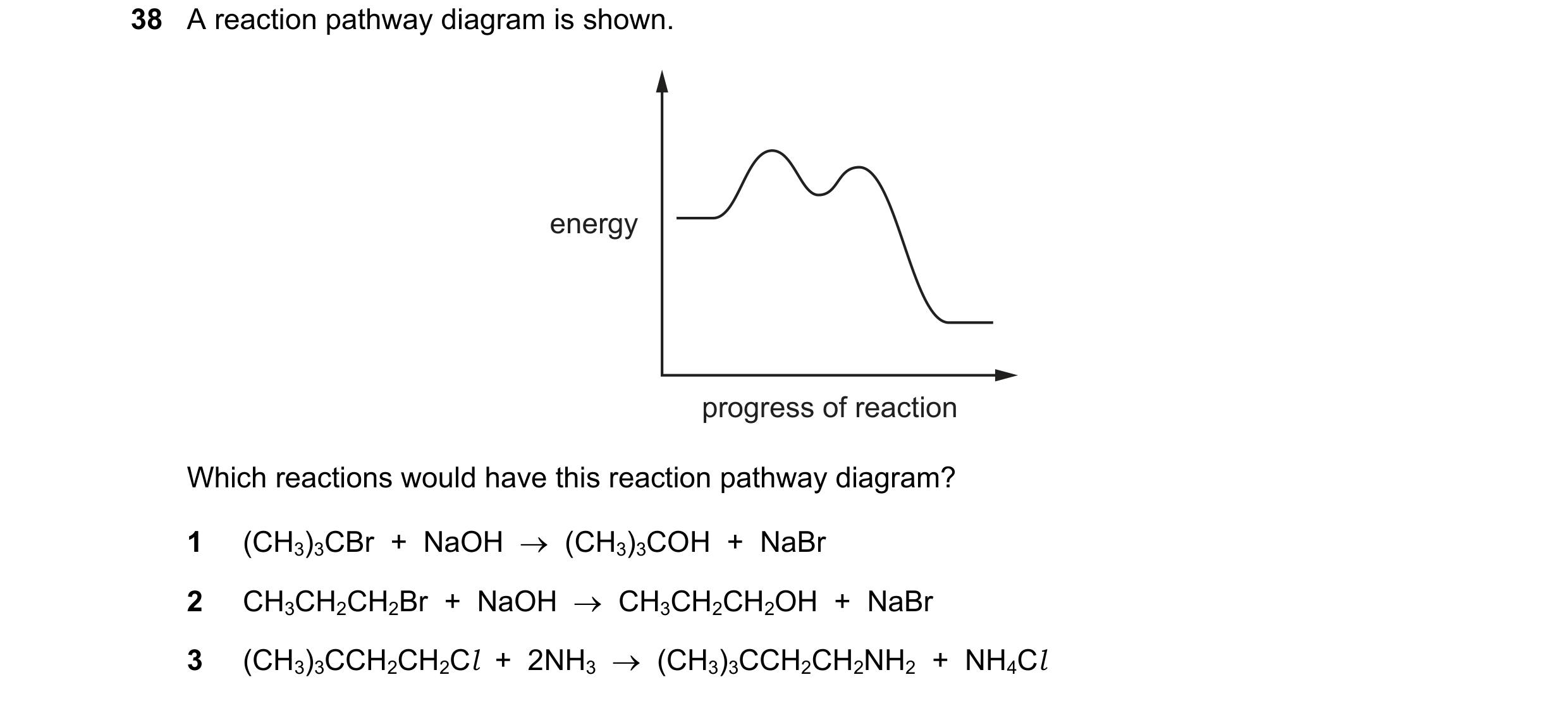
Q39 · A reaction pathway diagram is shown 9701/11 Oct/Nov 2017
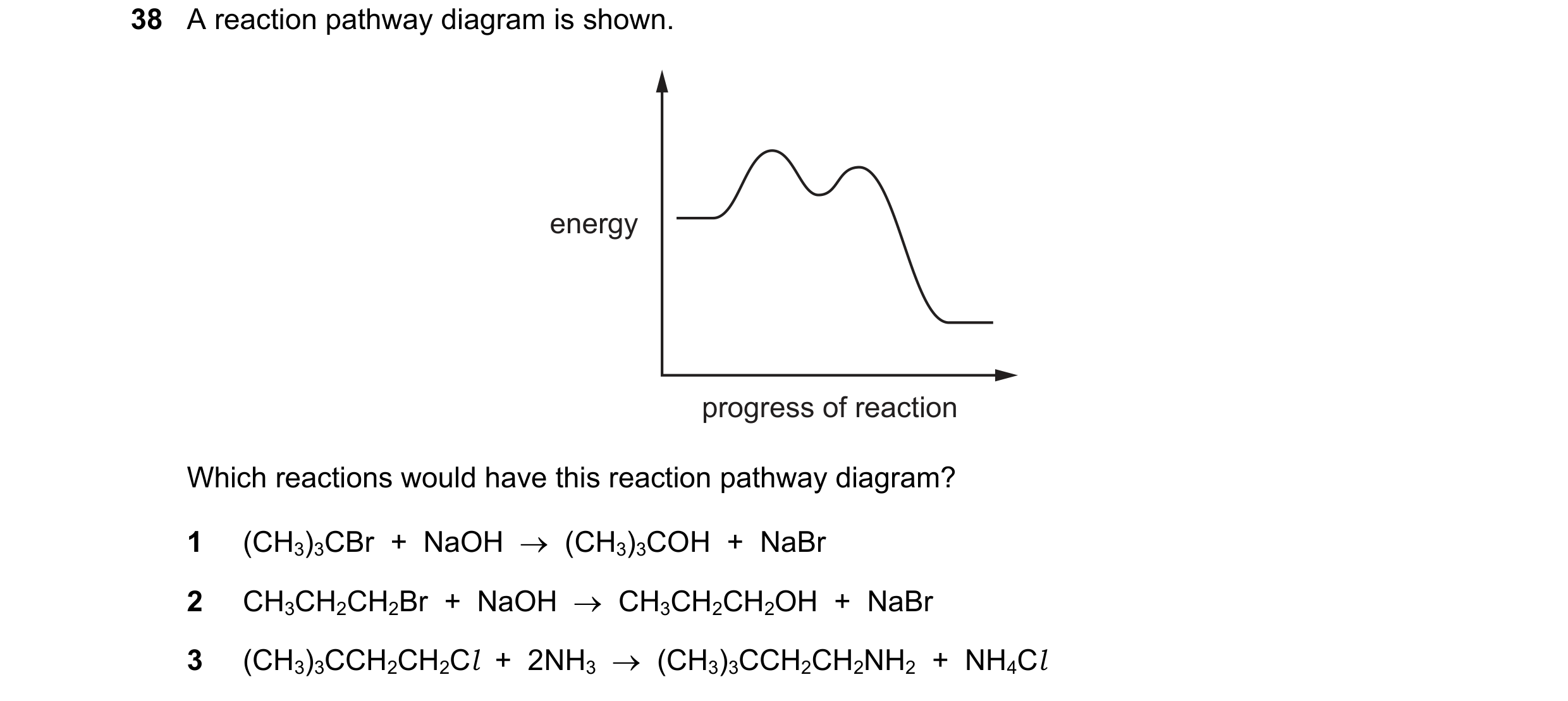
38 A reaction pathway diagram is shown. energy progress of reaction Which reactions would have this reaction pathway diagram? 1 (CH3)3CBr + NaOH → (CH3)3COH + NaBr 2 CH3CH2CH2Br + NaOH → CH3CH2CH2OH + NaBr 3 (CH3)3CCH2CH2Cl + 2NH3 → (CH3)3CCH2CH2NH2 + NH4Cl
1 marks
Answer: D
This question in 9701/11 Oct/Nov 2017
Q40 · A large excess of marble chips was reacted with 25 cm3 of 1.0 mol dm–3 hydrochloric acid… 9701/12 Oct/Nov 2017
10 A large excess of marble chips was reacted with 25 cm3 of 1.0 mol dm–3 hydrochloric acid at 40 °C. How will the result be different when the reaction is repeated with 60 cm3 of 0.5 mol dm–3 hydrochloric acid at 40 °C? A The reaction is faster and less of the products are made. B The reaction is faster and more of the products are made. C The reaction is slower and less of the products are made. D The reaction is slower and more of the products are made.
1 marks
Answer: D
This question in 9701/12 Oct/Nov 2017
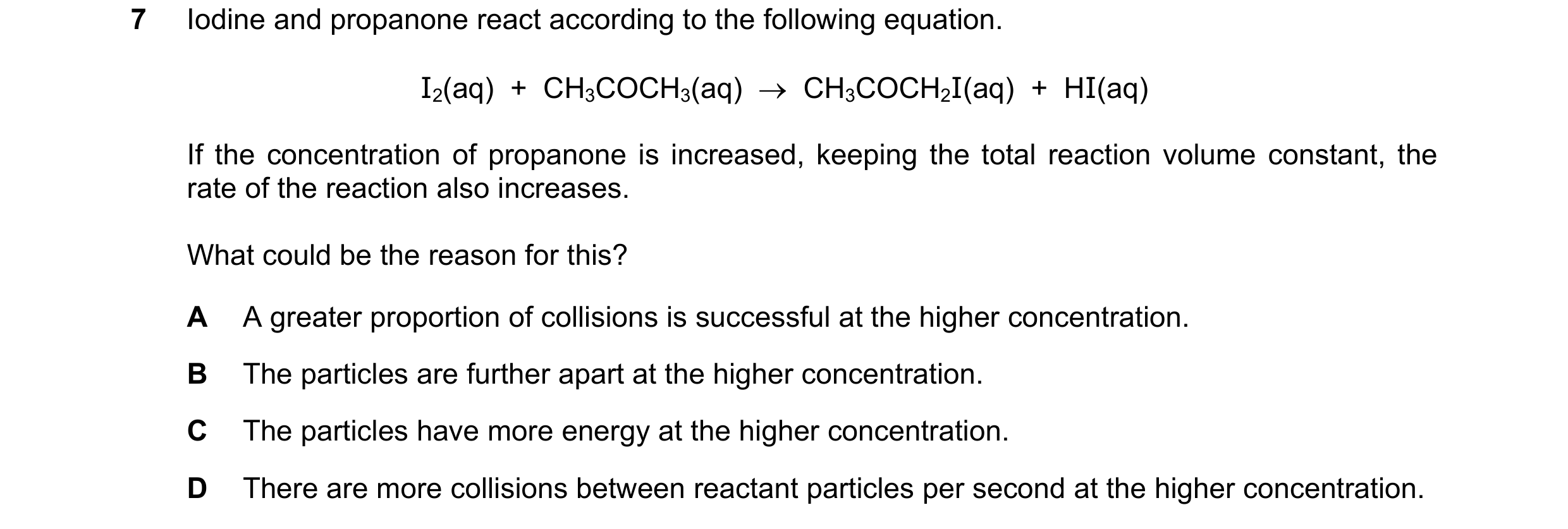
Q41 · Iodine and propanone react according to the following equation 9701/13 Oct/Nov 2017
7 Iodine and propanone react according to the following equation. I2(aq) + CH3COCH3(aq) → CH3COCH2I(aq) + HI(aq) If the concentration of propanone is increased, keeping the total reaction volume constant, the rate of the reaction also increases. What could be the reason for this? A A greater proportion of collisions is successful at the higher concentration. B The particles are further apart at the higher concentration. C The particles have more energy at the higher concentration. D There are more collisions between reactant particles per second at the higher concentration.
1 marks
Answer: D
This question in 9701/13 Oct/Nov 2017
Q42 · A reaction pathway diagram is shown 9701/13 Oct/Nov 2017
38 A reaction pathway diagram is shown. energy progress of reaction Which reactions would have this reaction pathway diagram? 1 (CH3)3CBr + NaOH → (CH3)3COH + NaBr 2 CH3CH2CH2Br + NaOH → CH3CH2CH2OH + NaBr 3 (CH3)3CCH2CH2Cl + 2NH3 → (CH3)3CCH2CH2NH2 + NH4Cl
1 marks
Answer: D
This question in 9701/13 Oct/Nov 2017
Q43 · The factors affecting the rate of reaction between aqueous sodium thiosulfate and… 9701/11 Oct/Nov 2018
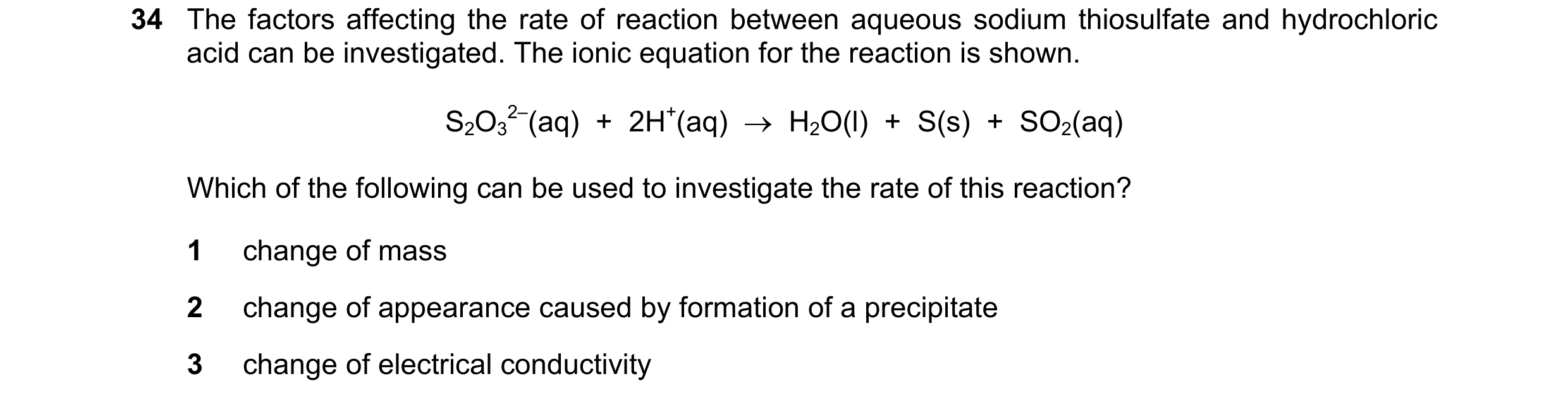
34 The factors affecting the rate of reaction between aqueous sodium thiosulfate and hydrochloric acid can be investigated. The ionic equation for the reaction is shown. S2O3 2–(aq) + 2H+(aq) → H2O(l) + S(s) + SO2(aq) Which of the following can be used to investigate the rate of this reaction? 1 change of mass 2 change of appearance caused by formation of a precipitate 3 change of electrical conductivity
1 marks
Answer: C
This question in 9701/11 Oct/Nov 2018
Q44 · The factors affecting the rate of reaction between aqueous sodium thiosulfate and… 9701/13 Oct/Nov 2018
34 The factors affecting the rate of reaction between aqueous sodium thiosulfate and hydrochloric acid can be investigated. The ionic equation for the reaction is shown. S2O3 2–(aq) + 2H+(aq) → H2O(l) + S(s) + SO2(aq) Which of the following can be used to investigate the rate of this reaction? 1 change of mass 2 change of appearance caused by formation of a precipitate 3 change of electrical conductivity
1 marks
Answer: C
This question in 9701/13 Oct/Nov 2018
Q45 · The volume of carbon dioxide collected by reacting 0.100 mol of magnesium carbonate with… 9701/13 May/June 2019
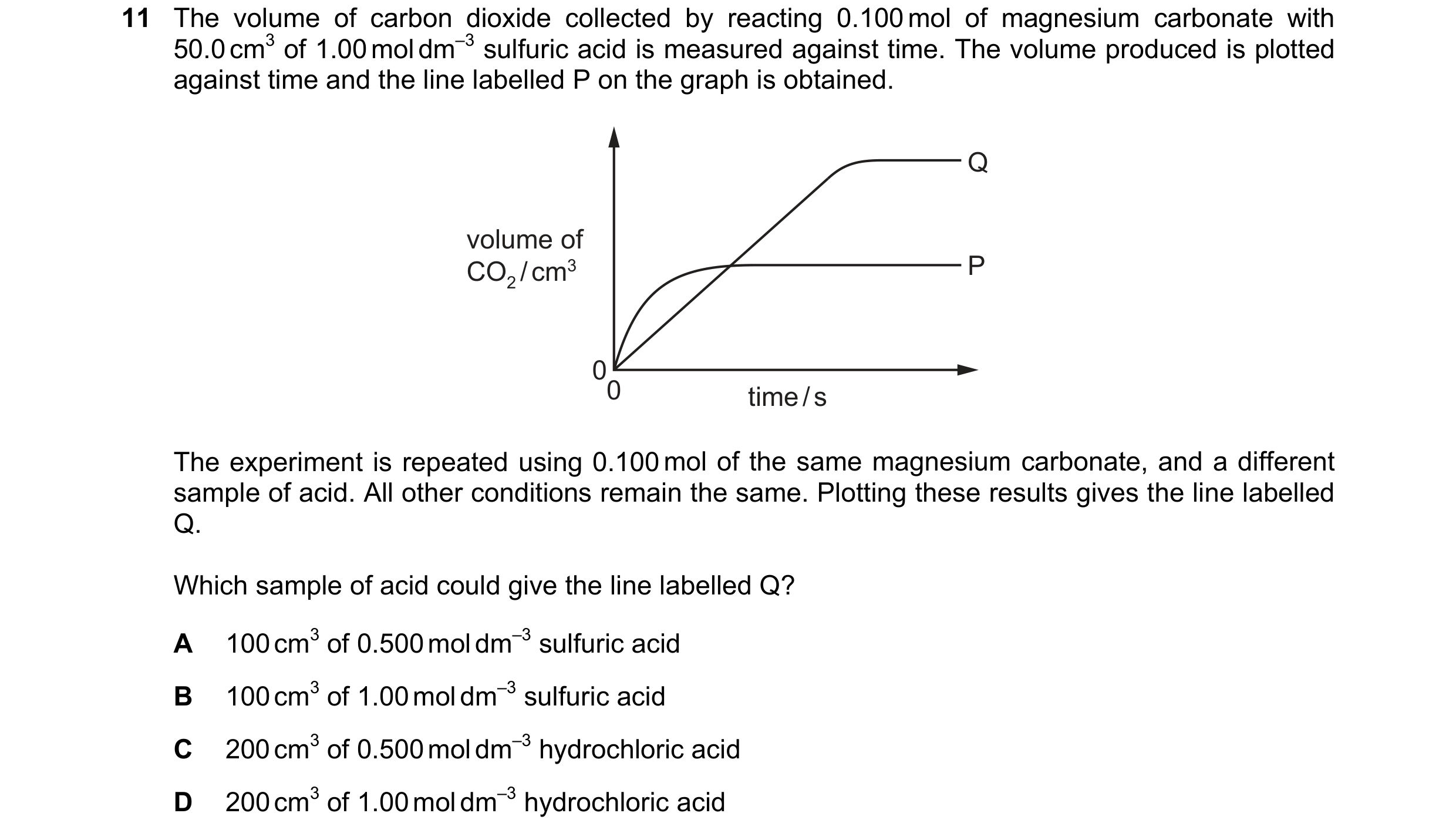
11 The volume of carbon dioxide collected by reacting 0.100 mol of magnesium carbonate with 50.0 cm3 of 1.00 mol dm–3 sulfuric acid is measured against time. The volume produced is plotted against time and the line labelled P on the graph is obtained. Q volume of CO2 / cm3 P 0 0 time / s The experiment is repeated using 0.100 mol of the same magnesium carbonate, and a different sample of acid. All other conditions remain the same. Plotting these results gives the line labelled Q. Which sample of acid could give the line labelled Q? A 100 cm3 of 0.500 mol dm–3 sulfuric acid B 100 cm3 of 1.00 mol dm–3 sulfuric acid C 200 cm3 of 0.500 mol dm–3 hydrochloric acid D 200 cm3 of 1.00 mol dm–3 hydrochloric acid
1 marks
Answer: D
This question in 9701/13 May/June 2019
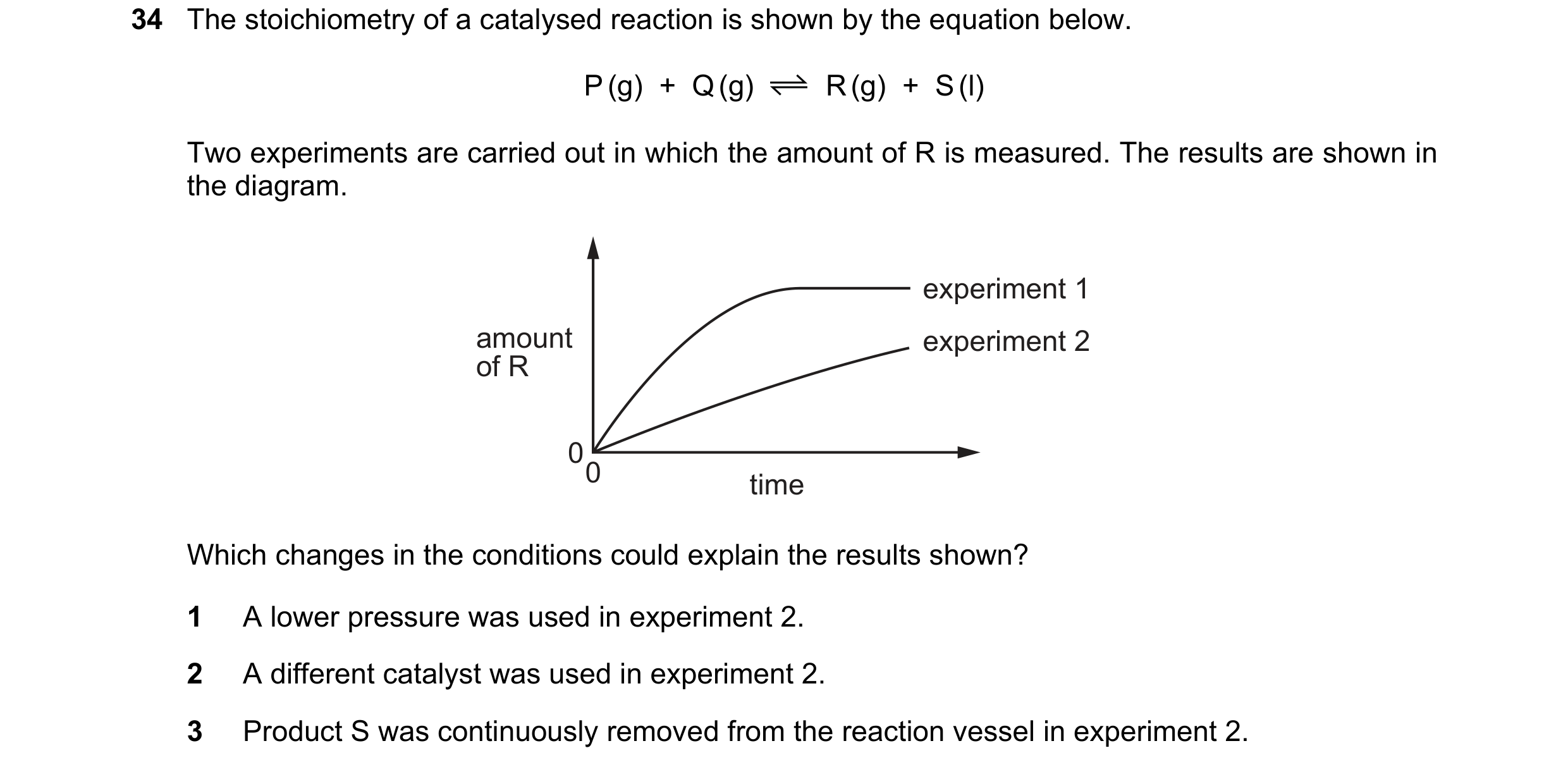
Q46 · The stoichiometry of a catalysed reaction is shown by the equation below 9701/11 Oct/Nov 2019
34 The stoichiometry of a catalysed reaction is shown by the equation below. P (g) + Q (g) R (g) + S (l) Two experiments are carried out in which the amount of R is measured. The results are shown in the diagram. experiment 1 amount experiment 2 of R 00 time Which changes in the conditions could explain the results shown? 1 A lower pressure was used in experiment 2. 2 A different catalyst was used in experiment 2. 3 Product S was continuously removed from the reaction vessel in experiment 2.
1 marks
Answer: B
This question in 9701/11 Oct/Nov 2019
Q47 · The decomposition of SO3(g) is a dynamic equilibrium 9701/12 Oct/Nov 2019
10 The decomposition of SO3(g) is a dynamic equilibrium. 2SO3(g) 2SO2(g) + O2(g) What happens when the pressure of the system is increased? A The rate of reaction will decrease and the position of the equilibrium will move to the left. B The rate of reaction will decrease and the position of the equilibrium will move to the right. C The rate of reaction will increase and the position of the equilibrium will move to the left. D The rate of reaction will increase and the position of the equilibrium will move to the right.
1 marks
Answer: C
This question in 9701/12 Oct/Nov 2019
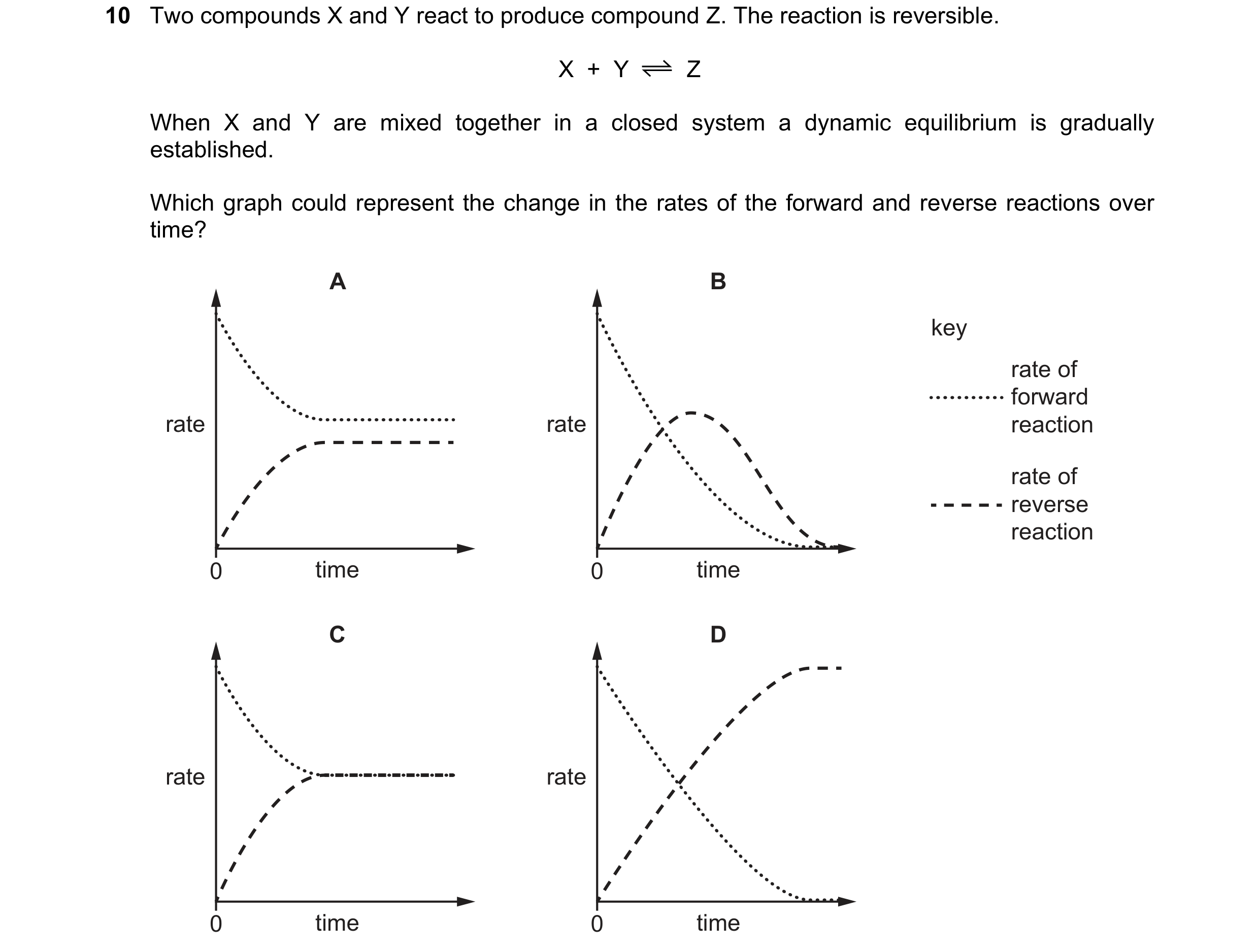
Q48 · Two compounds X and Y react to produce compound Z 9701/13 Oct/Nov 2019
10 Two compounds X and Y react to produce compound Z. The reaction is reversible. X + Y Z When X and Y are mixed together in a closed system a dynamic equilibrium is gradually established. Which graph could represent the change in the rates of the forward and reverse reactions over time? A B key rate of forward rate rate reaction rate of reverse reaction 0 time 0 time C D rate rate 0 time 0 time
1 marks
Answer: C
This question in 9701/13 Oct/Nov 2019
Q49 · The stoichiometry of a catalysed reaction is shown by the equation below 9701/13 Oct/Nov 2019
34 The stoichiometry of a catalysed reaction is shown by the equation below. P (g) + Q (g) R (g) + S (l) Two experiments are carried out in which the amount of R is measured. The results are shown in the diagram. experiment 1 amount experiment 2 of R 00 time Which changes in the conditions could explain the results shown? 1 A lower pressure was used in experiment 2. 2 A different catalyst was used in experiment 2. 3 Product S was continuously removed from the reaction vessel in experiment 2.
1 marks
Answer: B
This question in 9701/13 Oct/Nov 2019
Q50 · Hydrochloric acid reacts with zinc 9701/12 Feb/March 2020
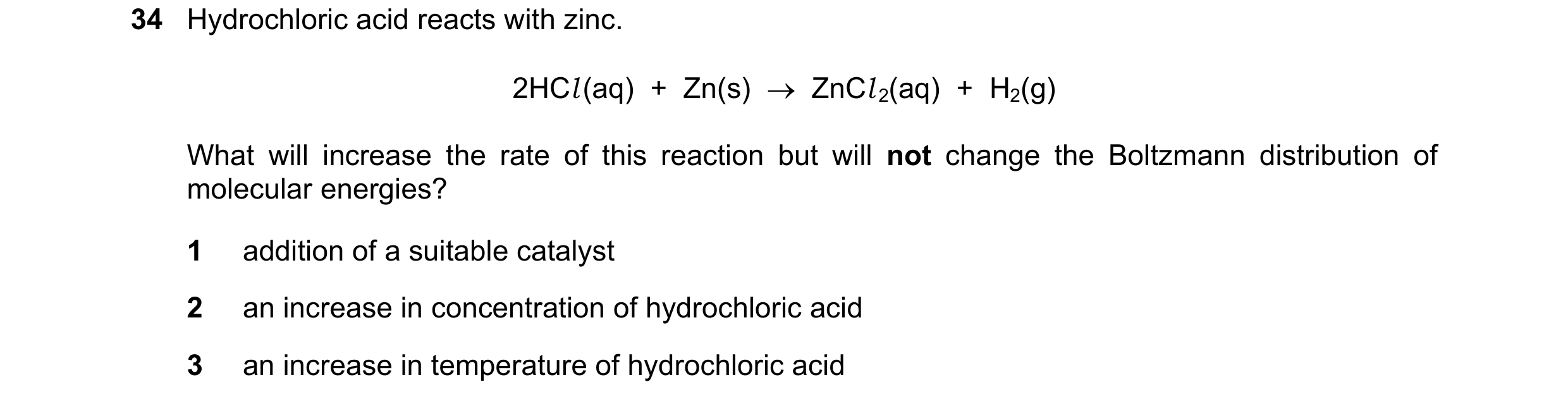
34 Hydrochloric acid reacts with zinc. 2HCl (aq) + Zn(s) → ZnCl 2(aq) + H2(g) What will increase the rate of this reaction but will not change the Boltzmann distribution of molecular energies? 1 addition of a suitable catalyst 2 an increase in concentration of hydrochloric acid 3 an increase in temperature of hydrochloric acid
1 marks
Answer: B
This question in 9701/12 Feb/March 2020
Q51 · Which factors can lead to an increase in the rate of a reaction? 9701/12 May/June 2020
33 Which factors can lead to an increase in the rate of a reaction? 1 a lower activation energy 2 an increase in temperature 3 an increase in the concentration of a reactant
1 marks
Answer: A
This question in 9701/12 May/June 2020
Q52 · An autocatalytic reaction is a reaction in which one of the products catalyses the… 9701/11 Oct/Nov 2020
11 An autocatalytic reaction is a reaction in which one of the products catalyses the reaction. Which curve would be obtained if the rate of an autocatalytic reaction is plotted against time? A B C D rate rate rate rate 00 00 00 00 time time time time
1 marks
Answer: C
This question in 9701/11 Oct/Nov 2020
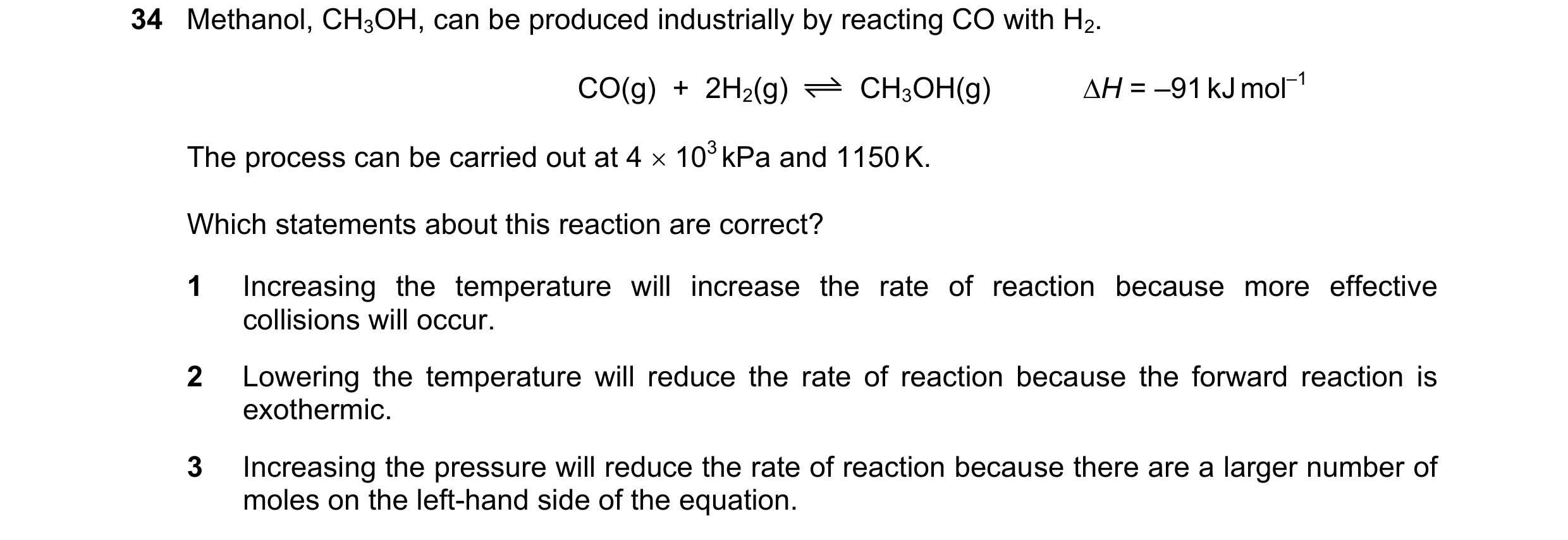
Q53 · Methanol, CH3OH, can be produced industrially by reacting CO with H2 9701/11 Oct/Nov 2020
34 Methanol, CH3OH, can be produced industrially by reacting CO with H2. CO(g) + 2H2(g) CH3OH(g) H = –91 kJ mol–1 The process can be carried out at 4 103 kPa and 1150 K. Which statements about this reaction are correct? 1 Increasing the temperature will increase the rate of reaction because more effective collisions will occur. 2 Lowering the temperature will reduce the rate of reaction because the forward reaction is exothermic. 3 Increasing the pressure will reduce the rate of reaction because there are a larger number of moles on the left-hand side of the equation.
1 marks
Answer: D
This question in 9701/11 Oct/Nov 2020
Q54 · Ammonia is made by the Haber process 9701/12 Oct/Nov 2020
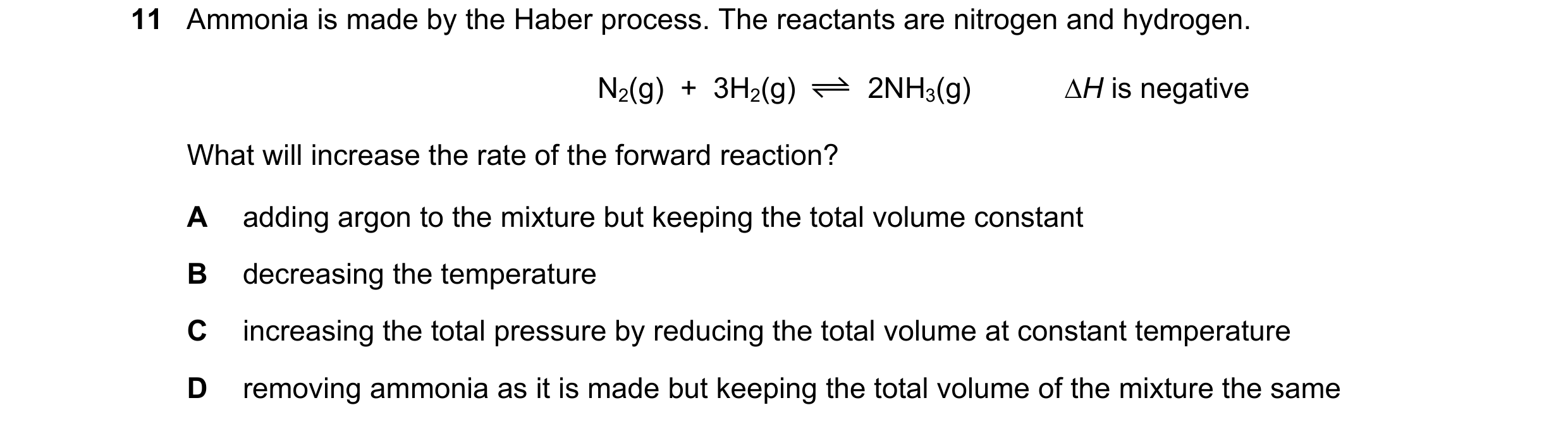
11 Ammonia is made by the Haber process. The reactants are nitrogen and hydrogen. N2(g) + 3H2(g) 2NH3(g) ∆H is negative What will increase the rate of the forward reaction? A adding argon to the mixture but keeping the total volume constant B decreasing the temperature C increasing the total pressure by reducing the total volume at constant temperature D removing ammonia as it is made but keeping the total volume of the mixture the same
1 marks
Answer: C
This question in 9701/12 Oct/Nov 2020
Q55 · An autocatalytic reaction is a reaction in which one of the products catalyses the… 9701/13 Oct/Nov 2020
11 An autocatalytic reaction is a reaction in which one of the products catalyses the reaction. Which curve would be obtained if the rate of an autocatalytic reaction is plotted against time? A B C D rate rate rate rate 00 00 00 00 time time time time
1 marks
Answer: C
This question in 9701/13 Oct/Nov 2020
Q56 · Methanol, CH3OH, can be produced industrially by reacting CO with H2 9701/13 Oct/Nov 2020
34 Methanol, CH3OH, can be produced industrially by reacting CO with H2. CO(g) + 2H2(g) CH3OH(g) H = –91 kJ mol–1 The process can be carried out at 4 103 kPa and 1150 K. Which statements about this reaction are correct? 1 Increasing the temperature will increase the rate of reaction because more effective collisions will occur. 2 Lowering the temperature will reduce the rate of reaction because the forward reaction is exothermic. 3 Increasing the pressure will reduce the rate of reaction because there are a larger number of moles on the left-hand side of the equation.
1 marks
Answer: D
This question in 9701/13 Oct/Nov 2020
Q57 · A large excess of marble chips is reacted with 25 cm3 of 1.0 mol dm–3 hydrochloric acid… 9701/12 Feb/March 2021
10 A large excess of marble chips is reacted with 25 cm3 of 1.0 mol dm–3 hydrochloric acid at 40 C. How is the result different when the reaction is repeated with 60 cm3 of 0.5 mol dm–3 hydrochloric acid at 40 C? A The reaction is faster and more of the products are made when the reaction is complete. B The reaction is faster and less of the products are made when the reaction is complete. C The reaction is slower and more of the products are made when the reaction is complete. D The reaction is slower and less of the products are made when the reaction is complete.
1 marks
Answer: C
This question in 9701/12 Feb/March 2021
Q58 · Which changes can be used to measure the rates of chemical reactions? 9701/11 Oct/Nov 2021
31 Which changes can be used to measure the rates of chemical reactions? 1 the decrease in concentration of a reactant per unit time 2 the rate of appearance of a product 3 the increase in total volume of gas per unit time at constant pressure
1 marks
Answer: A
This question in 9701/11 Oct/Nov 2021
Q59 · Which changes can be used to measure the rates of chemical reactions? 9701/13 Oct/Nov 2021
31 Which changes can be used to measure the rates of chemical reactions? 1 the decrease in concentration of a reactant per unit time 2 the rate of appearance of a product 3 the increase in total volume of gas per unit time at constant pressure
1 marks
Answer: A
This question in 9701/13 Oct/Nov 2021
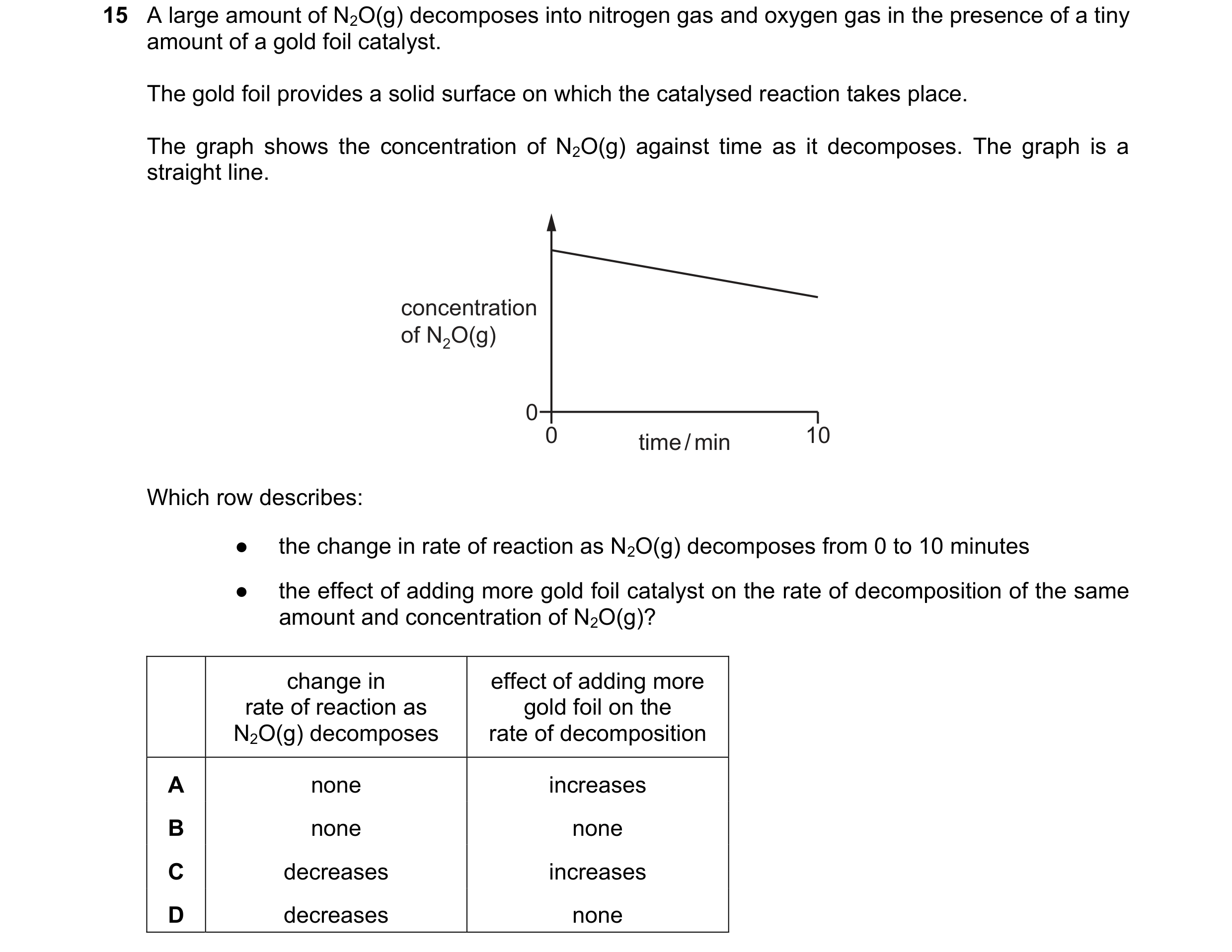
Q60 · A large amount of N2O(g) decomposes into nitrogen gas and oxygen gas in the presence of a… 9701/12 May/June 2022
15 A large amount of N2O(g) decomposes into nitrogen gas and oxygen gas in the presence of a tiny amount of a gold foil catalyst. The gold foil provides a solid surface on which the catalysed reaction takes place. The graph shows the concentration of N2O(g) against time as it decomposes. The graph is a straight line. concentration of N2O(g) 0 0 time / min 10 Which row describes: ● the change in rate of reaction as N2O(g) decomposes from 0 to 10 minutes ● the effect of adding more gold foil catalyst on the rate of decomposition of the same amount and concentration of N2O(g)? change in effect of adding more rate of reaction as gold foil on the N2O(g) decomposes rate of decomposition A none increases B none none C decreases increases D decreases none
1 marks
Answer: A
This question in 9701/12 May/June 2022
Q61 · The Boltzmann distribution of the particles in a mixture of gas X and gas Y is shown in… 9701/13 May/June 2022
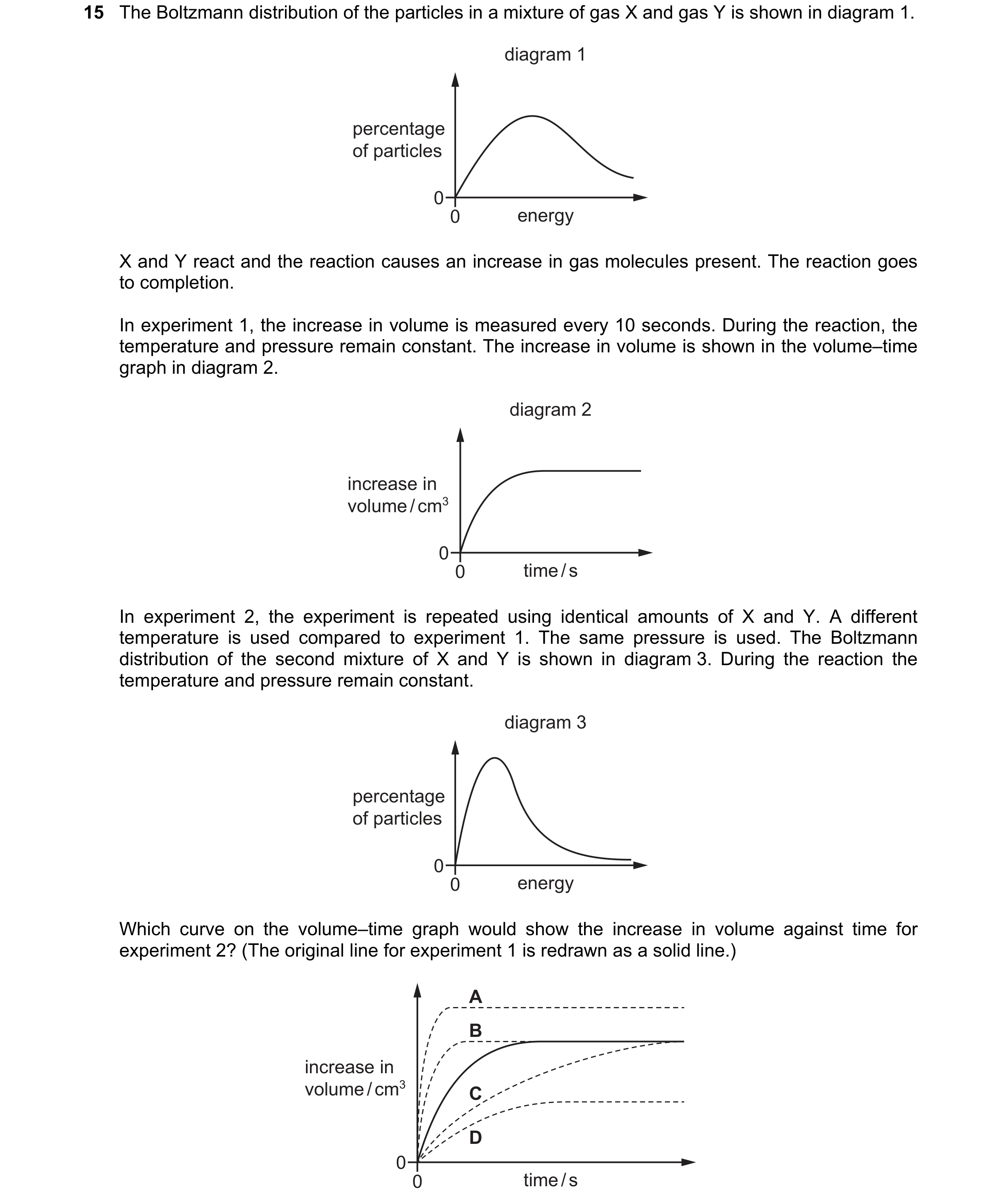
15 The Boltzmann distribution of the particles in a mixture of gas X and gas Y is shown in diagram 1. diagram 1 percentage of particles 0 0 energy X and Y react and the reaction causes an increase in gas molecules present. The reaction goes to completion. In experiment 1, the increase in volume is measured every 10 seconds. During the reaction, the temperature and pressure remain constant. The increase in volume is shown in the volume–time graph in diagram 2. diagram 2 increase in volume / cm3 0 0 time / s In experiment 2, the experiment is repeated using identical amounts of X and Y. A different temperature is used compared to experiment 1. The same pressure is used. The Boltzmann distribution of the second mixture of X and Y is shown in diagram 3. During the reaction the temperature and pressure remain constant. diagram 3 percentage of particles 0 0 energy Which curve on the volume–time graph would show the increase in volume against time for experiment 2? (The original line for experiment 1 is redrawn as a solid line.) A B increase in volume / cm3 C D 0 0 time / s
1 marks
Answer: D
This question in 9701/13 May/June 2022
Q62 · A large excess of magnesium ribbon is added to dilute hydrochloric acid and the volume of… 9701/11 Oct/Nov 2022
15 A large excess of magnesium ribbon is added to dilute hydrochloric acid and the volume of hydrogen gas produced is measured as the reaction proceeds. The reaction is exothermic. The results are shown. R total volume Q / cm3 P time / s Which row explains the changes in the rate of reaction between points P and Q and between points Q and R? between points P and Q between points Q and R A the reaction temperature is increasing the acid concentration is falling B the reaction temperature is increasing the magnesium has been used up C magnesium’s surface area is decreasing the acid concentration is falling D magnesium’s surface area is decreasing the magnesium has been used up
1 marks
Answer: A
This question in 9701/11 Oct/Nov 2022
Q63 · A large excess of magnesium ribbon is added to dilute hydrochloric acid and the volume of… 9701/13 Oct/Nov 2022
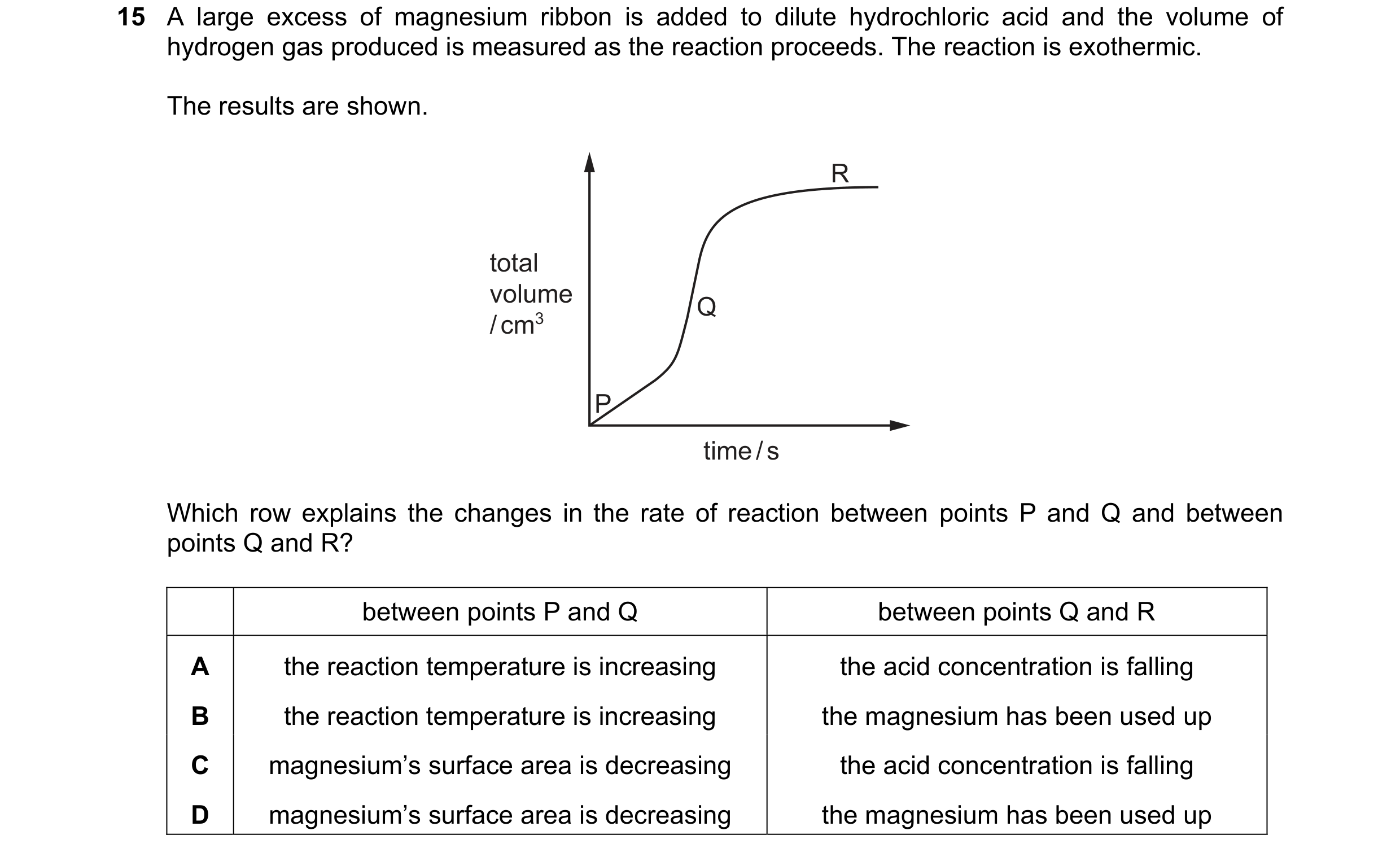
15 A large excess of magnesium ribbon is added to dilute hydrochloric acid and the volume of hydrogen gas produced is measured as the reaction proceeds. The reaction is exothermic. The results are shown. R total volume Q / cm3 P time / s Which row explains the changes in the rate of reaction between points P and Q and between points Q and R? between points P and Q between points Q and R A the reaction temperature is increasing the acid concentration is falling B the reaction temperature is increasing the magnesium has been used up C magnesium’s surface area is decreasing the acid concentration is falling D magnesium’s surface area is decreasing the magnesium has been used up
1 marks
Answer: A
This question in 9701/13 Oct/Nov 2022
Q64 · A student carries out four experiments to investigate the rate of reaction between 3.0g… 9701/12 Feb/March 2023
3 A student carries out four experiments to investigate the rate of reaction between 3.0g of calciumcarbonate and hydrochloric acid. CaCO3(s) + 2HCl(aq) →CaCl 2(aq) + CO2(g) + H2O(l) CaCO3 powder + 2.0moldm–3 HCl at 35°C experiment 1 CaCO3 powder + 2.0moldm–3 HCl at 35°C experiment 2 large chips of CaCO3 + 1.0moldm–3 HCl at room temperature experiment 3 large chips of CaCO3 + 1.0moldm–3 HCl at 35°C experiment 4 The student collects the CO2(g) and times how long it takes to produce the same volume of gas for each experiment. What could be the correct times for the four experiments? experiment 1 experiment 2 experiment 3 experiment 4 /s /s /s /s A 5 10 30 95 B 5 10 95 30 C 5 30 95 10 D 95 30 10 5
1 marks
Answer: B
This question in 9701/12 Feb/March 2023
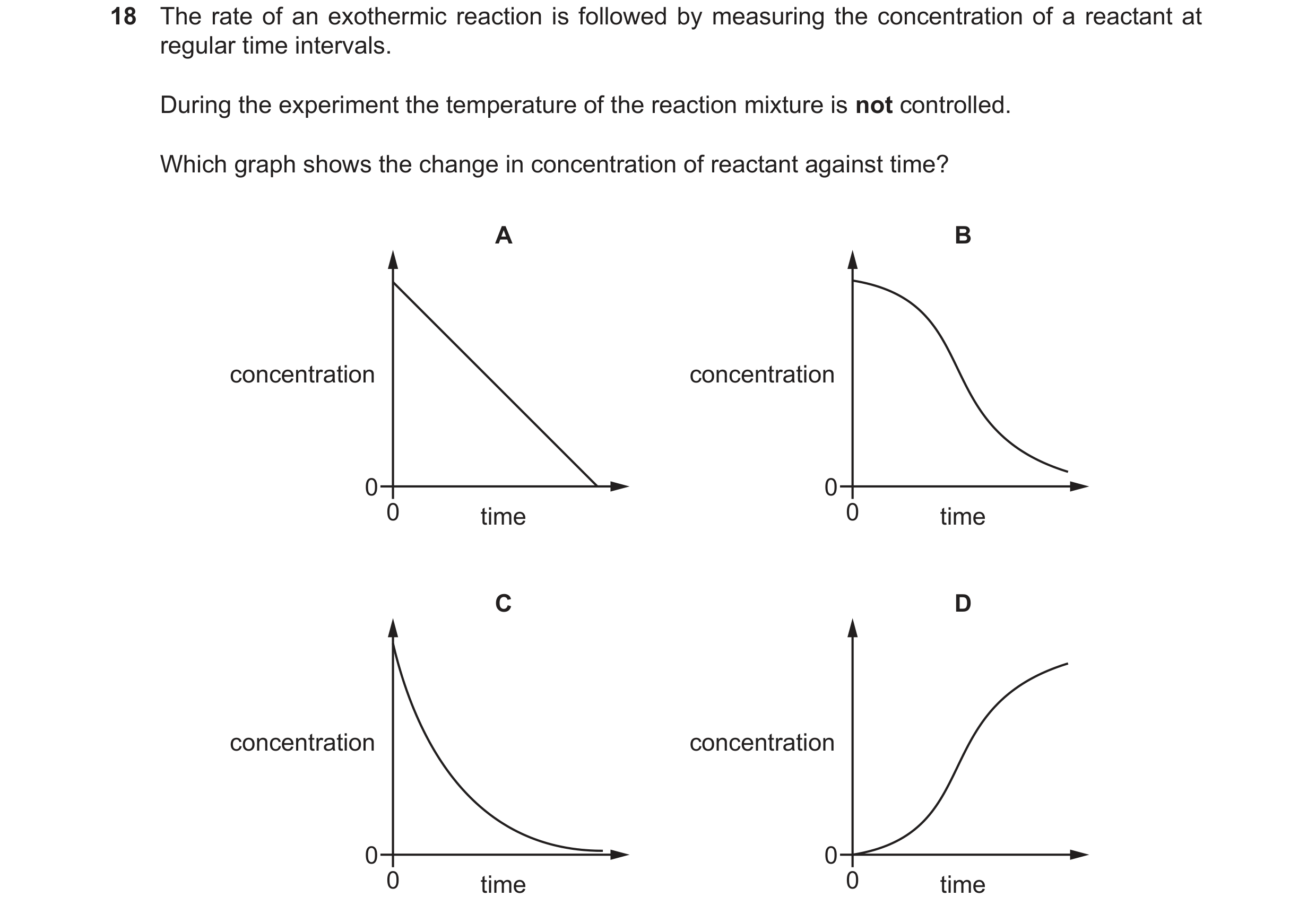
Q65 · The rate of an exothermic reaction is followed by measuring the concentration of a… 9701/13 May/June 2023
18 The rate of an exothermic reaction is followed by measuring the concentration of a reactant at
regular time intervals.
During the experiment the temperature of the reaction mixture is not controlled.
Which graph shows the change in concentration of reactant against time?
concentration concentration
iN 0
time 0 time
concentration concentration
KO 0
time 0 time
1 marks
Answer: B
This question in 9701/13 May/June 2023
Q66 · In reaction 1, a student measures the initial rate of production of CO2(g) when CuCO3(s)… 9701/11 Oct/Nov 2023
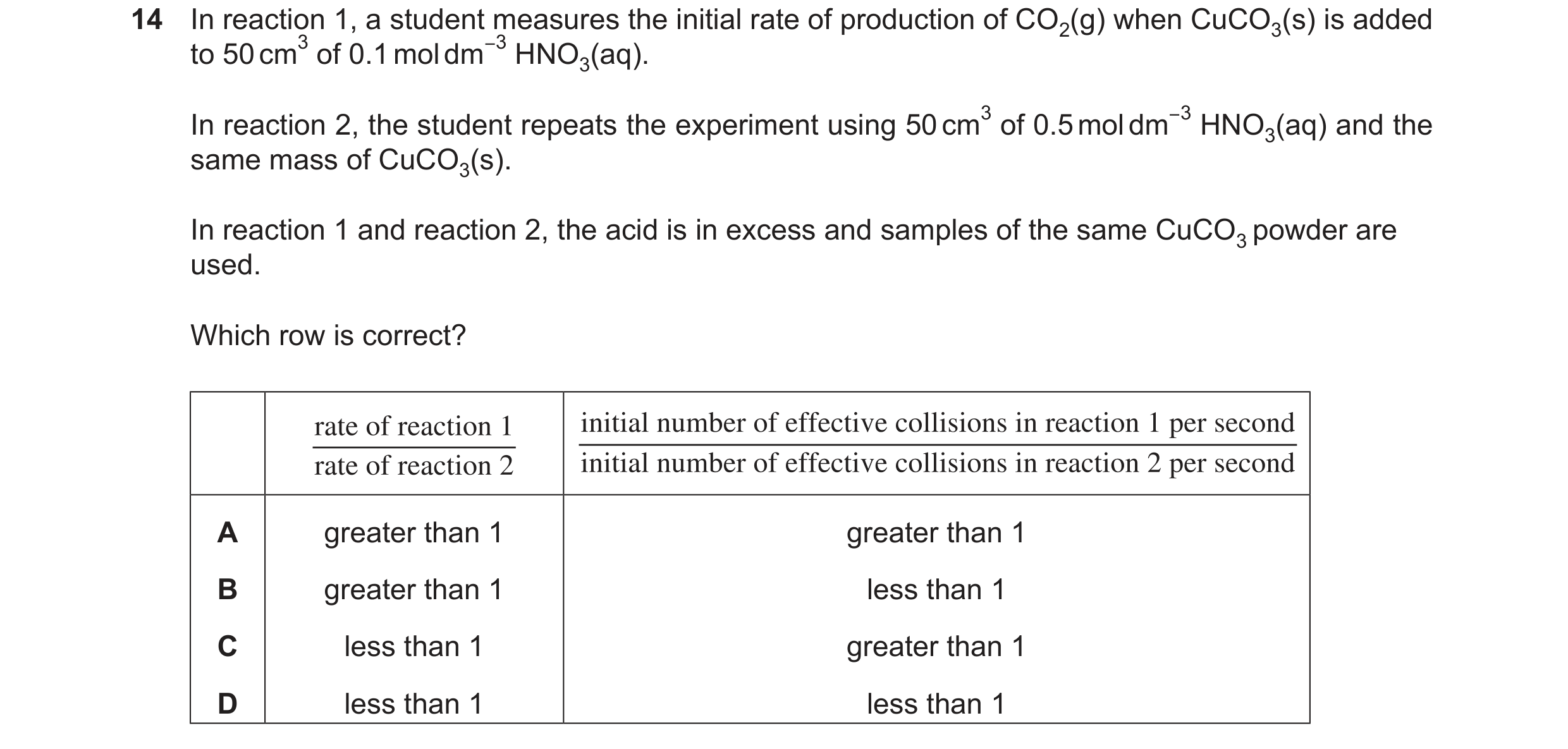
14 In reaction 1, a student measures the initial rate of production of CO2(g) when CuCO3(s) is added to 50cm3 of 0.1moldm−3 HNO3(aq). In reaction 2, the student repeats the experiment using 50cm3 of 0.5moldm−3 HNO3(aq) and the same mass of CuCO3(s). In reaction 1 and reaction 2, the acid is in excess and samples of the same CuCO3 powder are used. Which row is correct? A greater than 1 greater than 1 B greater than 1 less than 1 C less than 1 greater than 1 D less than 1 less than 1
1 marks
Answer: D
This question in 9701/11 Oct/Nov 2023
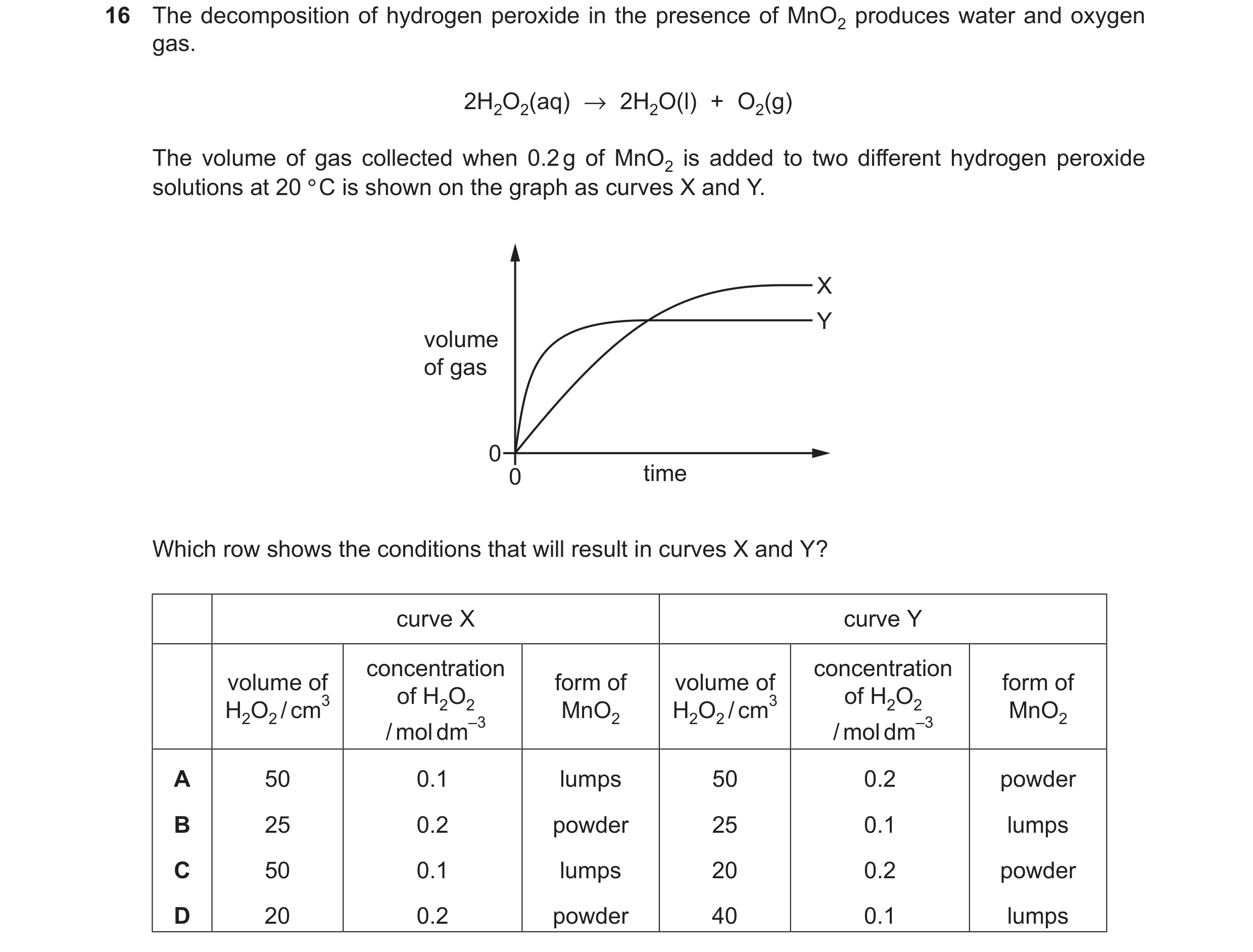
Q67 · The decomposition of hydrogen peroxide in the presence of MnO, produces water and oxygen… 9701/12 Oct/Nov 2023
16 The decomposition of hydrogen peroxide in the presence of MnO, produces water and oxygen
gas.
2H,0,(aq) — 2H,O(!) + O,(g)
The volume of gas collected when 0.2g of MnO, is added to two different hydrogen peroxide
solutions at 20 °C is shown on the graph as curves X and Y.
< x
volume
of gas
0) time
Which row shows the conditions that will result in curves X and Y?
curve X curve Y
concentration concentration
volume of of H.O form of volume of of H.O form of
H,0,/cm* an MnO, | H,0,/cm* 22, MnO,
/moldm /moldm
A 50 0.1 lumps 50 0.2 powder
B 25 0.2 powder 25 0.1 lumps
Cc 50 0.1 lumps 20 0.2 powder
D 20 0.2 powder 40 0.1 lumps
1 marks
Answer: C
This question in 9701/12 Oct/Nov 2023
Q68 · The diagram shows a gas syringe with a free-moving piston 9701/12 Oct/Nov 2023
17 The diagram shows a gas syringe with a free-moving piston. The syringe contains gaseous hydrogen, gaseous iodine and gaseous hydrogen iodide at equilibrium. gaseous hydrogen, gaseous iodine and gaseous hydrogen iodide sealed end piston H2(g) + I2(g) ⇋2HI(g) Three changes are listed. 1 increasing the total pressure by adding an inert gas and keeping the volume constant 2 increasing the pressure by adding more gaseous hydrogen iodide and keeping the volume constant 3 decreasing the volume by pushing the piston to the left Which changes will result in an equilibrium position at which the rate of the forward reaction has increased? A 2 only B 1 and 2 C 1 and 3 D 2 and 3
1 marks
Answer: D
This question in 9701/12 Oct/Nov 2023
Q69 · In reaction 1, a student measures the initial rate of production of CO2(g) when CuCO3(s)… 9701/13 Oct/Nov 2023
14 In reaction 1, a student measures the initial rate of production of CO2(g) when CuCO3(s) is added to 50cm3 of 0.1moldm−3 HNO3(aq). In reaction 2, the student repeats the experiment using 50cm3 of 0.5moldm−3 HNO3(aq) and the same mass of CuCO3(s). In reaction 1 and reaction 2, the acid is in excess and samples of the same CuCO3 powder are used. Which row is correct? A greater than 1 greater than 1 B greater than 1 less than 1 C less than 1 greater than 1 D less than 1 less than 1
1 marks
Answer: D
This question in 9701/13 Oct/Nov 2023
Q70 · A mixture of hydrogen gas and iodine gas is placed in a reaction vessel of volume V at… 9701/12 Feb/March 2024
14 A mixture of hydrogen gas and iodine gas is placed in a reaction vessel of volume V at temperature T. The reaction H2 + I2 2HI is allowed to come to equilibrium. All substances remain in the gaseous state. Argon gas is then pumped into the reaction vessel. The temperature in the vessel is maintained at T. How are the rate of the forward reaction and the partial pressure of HI at equilibrium affected? rate of partial pressure of forward reaction HI at equilibrium A increased increased B increased unaffected C unaffected increased D unaffected unaffected
1 marks
Answer: D
This question in 9701/12 Feb/March 2024
Q71 · Two experiments are carried out to study the reaction between zinc and sulfuric acid 9701/12 Feb/March 2024
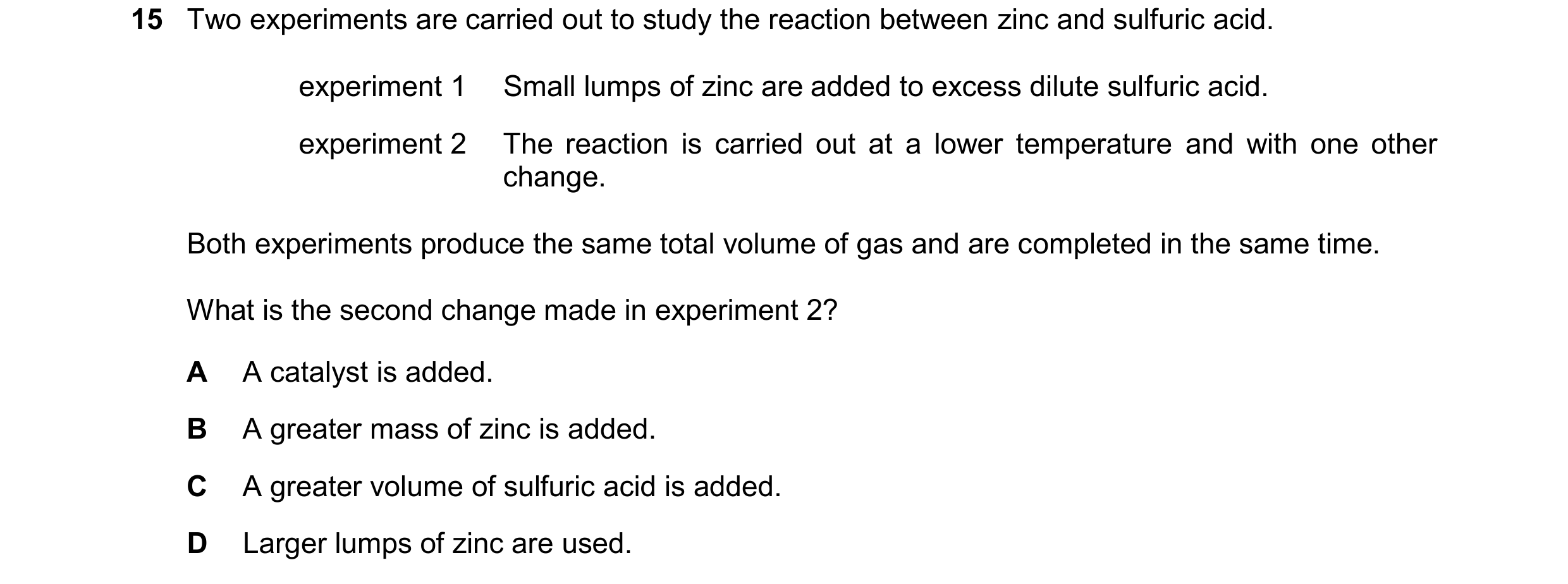
15 Two experiments are carried out to study the reaction between zinc and sulfuric acid. experiment 1 Small lumps of zinc are added to excess dilute sulfuric acid. experiment 2 The reaction is carried out at a lower temperature and with one other change. Both experiments produce the same total volume of gas and are completed in the same time. What is the second change made in experiment 2? A A catalyst is added. B A greater mass of zinc is added. C A greater volume of sulfuric acid is added. D Larger lumps of zinc are used.
1 marks
Answer: A
This question in 9701/12 Feb/March 2024
Q72 · In acidic conditions, iodine reacts with propanone in a substitution reaction 9701/11 Oct/Nov 2024
14 In acidic conditions, iodine reacts with propanone in a substitution reaction.
CHsCOCH3(aq) + I,(aq) — CH3COCH2I(aq) + HI(aq)
The kinetics of the reaction are investigated using a colorimeter. As the I, reacts, the
yellow/brown colour of the I,(aq) fades to colourless, changing the absorbance of the solution.
Known concentrations of I2(aq) are used to prepare a calibration curve graph and the absorbance
is then measured as the reaction proceeds.
calibration curve using known
concentrations of I,(aq) absorbance during reaction
0.30 0.6
0.25 0.5
concentration 0.20 0.4
of iodine 0.15 absorbance 0.3
x 10°moldm™ 9.10 0.2
0.05 0.1
0 0
0 0.1 0.2 0.3 0.4 0.5 0.6 0 20 30 40 50 60
absorbance time/s
What is the rate of reaction at 20s?
A 5x10°%moldm?s™
1x 10° moldm?s"
5 x 10°°moldm?s™
0 Oo DW
1 x 10° moldm“s
1 marks
Answer: A
This question in 9701/11 Oct/Nov 2024
Q73 · Why does the rate of a gaseous reaction increase when the pressure is increased at a… 9701/12 Oct/Nov 2024
15 Why does the rate of a gaseous reaction increase when the pressure is increased at a constant temperature? A More particles have energy that exceeds the activation energy. B The particles have more space in which to move. C The particles move faster. D There are more frequent collisions between particles.
1 marks
Answer: D
This question in 9701/12 Oct/Nov 2024
Q74 · In acidic conditions, iodine reacts with propanone in a substitution reaction 9701/13 Oct/Nov 2024
14 In acidic conditions, iodine reacts with propanone in a substitution reaction.
CHsCOCH3(aq) + I,(aq) — CH3COCH2I(aq) + HI(aq)
The kinetics of the reaction are investigated using a colorimeter. As the I, reacts, the
yellow/brown colour of the I,(aq) fades to colourless, changing the absorbance of the solution.
Known concentrations of I2(aq) are used to prepare a calibration curve graph and the absorbance
is then measured as the reaction proceeds.
calibration curve using known
concentrations of I,(aq) absorbance during reaction
0.30 0.6
0.25 0.5
concentration 0.20 0.4
of iodine 0.15 absorbance 0.3
x 10°moldm™ 9.10 0.2
0.05 0.1
0 0
0 0.1 0.2 0.3 0.4 0.5 0.6 0 20 30 40 50 60
absorbance time/s
What is the rate of reaction at 20s?
A 5x10°%moldm?s™
1x 10° moldm?s"
5 x 10°°moldm?s™
0 Oo DW
1 x 10° moldm“s
1 marks
Answer: A
This question in 9701/13 Oct/Nov 2024
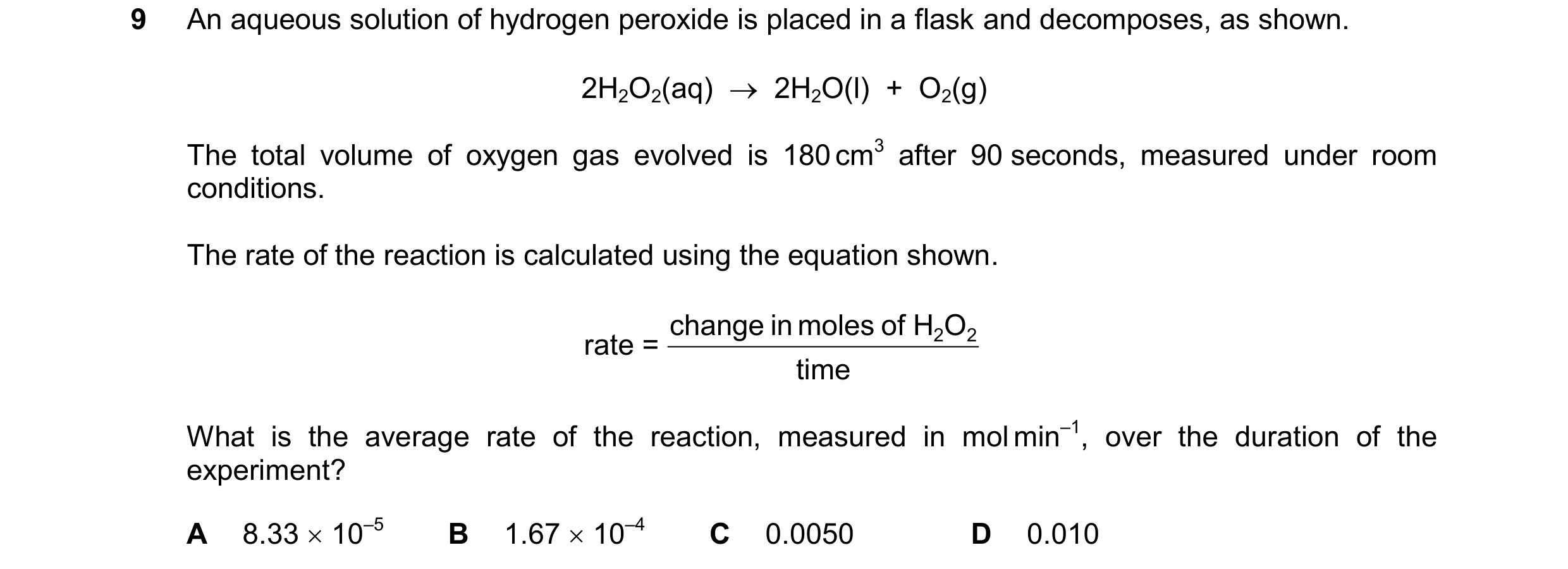
Q75 · An aqueous solution of hydrogen peroxide is placed in a flask and decomposes, as shown 9701/12 Feb/March 2025
9 An aqueous solution of hydrogen peroxide is placed in a flask and decomposes, as shown. 2H2O2(aq) 2H2O(l) + O2(g) The total volume of oxygen gas evolved is 180 cm3 after 90 seconds, measured under room conditions. The rate of the reaction is calculated using the equation shown. change in moles of H O rate = 2 2 time What is the average rate of the reaction, measured in mol min–1, over the duration of the experiment? A 8.33 10–5 B 1.67 10–4 C 0.0050 D 0.010
1 marks
Answer: D
This question in 9701/12 Feb/March 2025
Q76 · The rate of the reaction between a reactive metal and an excess of a dilute acid is… 9701/11 May/June 2025
2 The rate of the reaction between a reactive metal and an excess of a dilute acid is investigated. The total volume of hydrogen gas produced is recorded every 30 seconds for 3 minutes. time/s total volume of hydrogen gas/cm3 0 0 30 64 60 105 90 132 120 151 150 161 180 167 The average rate of reaction during the first 30 seconds is P. The average rate of reaction during the last 30 seconds is Q. What is the value of P – Q? A 1.21cm3 s–1 B 1.93cm3 s–1 C 2.13cm3 s–1 D 3.43cm3 s–1
1 marks
Answer: B
This question in 9701/11 May/June 2025
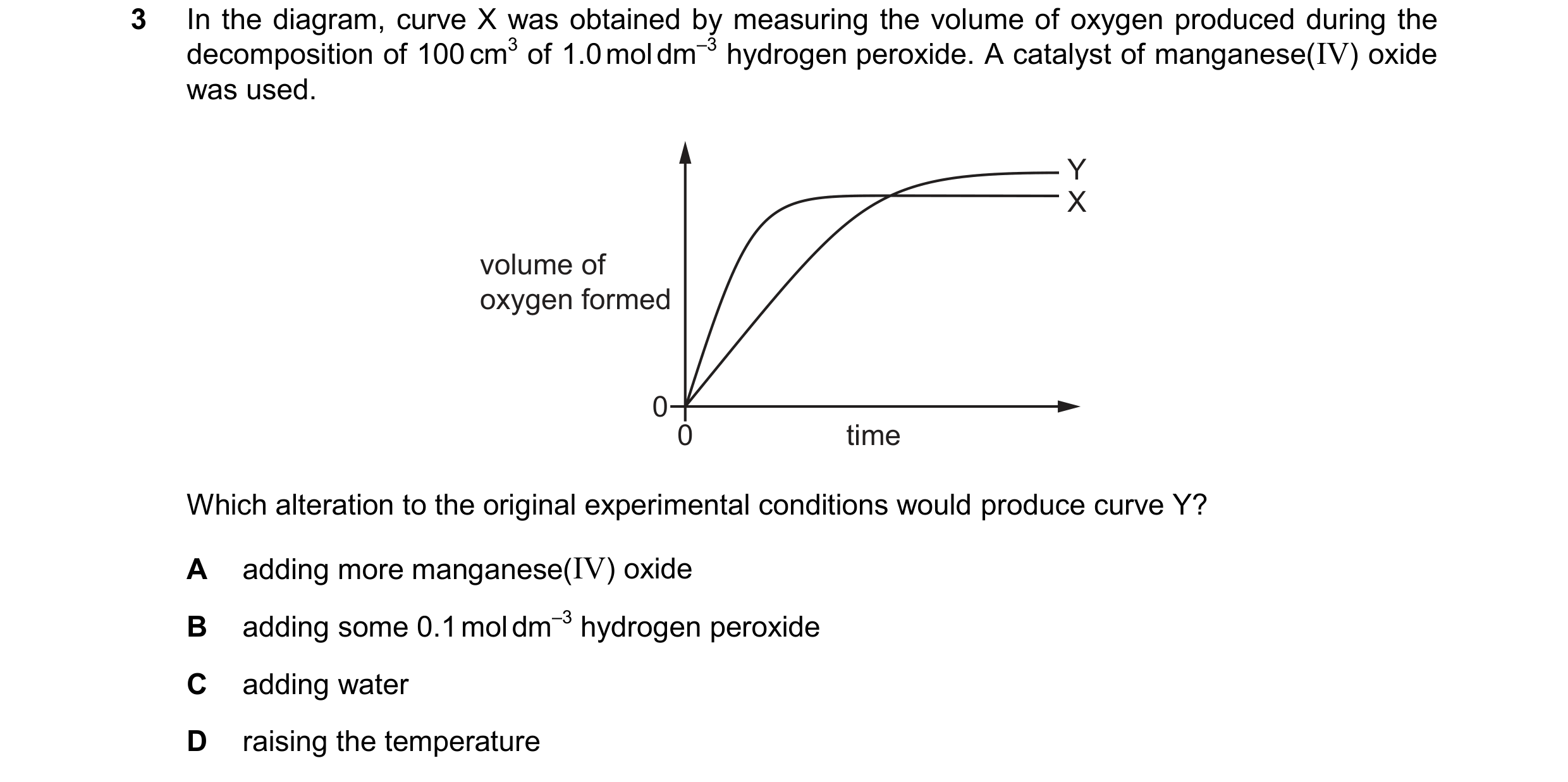
Q77 · In the diagram, curve X was obtained by measuring the volume of oxygen produced during… 9701/11 May/June 2025
3 In the diagram, curve X was obtained by measuring the volume of oxygen produced during the decomposition of 100cm3 of 1.0moldm–3 hydrogen peroxide. A catalyst of manganese(IV) oxide was used. volume of oxygen formed 0 0 time Y X Which alteration to the original experimental conditions would produce curve Y? A adding more manganese(IV) oxide B adding some 0.1moldm–3 hydrogen peroxide C adding water D raising the temperature
1 marks
Answer: B
This question in 9701/11 May/June 2025
Q78 · Aqueous hydrogen peroxide, H2O2, decomposes into water and oxygen in the presence of a… 9701/12 May/June 2025
9 Aqueous hydrogen peroxide, H2O2, decomposes into water and oxygen in the presence of a suitable catalyst. 50 cm3 of a 0.50 mol dm–3 solution of hydrogen peroxide produced 120 cm3 of oxygen in 2.0 minutes. The volume of gas was measured at room conditions. What is the average rate of decomposition of hydrogen peroxide during this 2.0 minute period? A 0.000083 mol dm–3 s–1 B 0.00083 mol dm–3 s–1 C 0.0017 mol dm–3 s–1 D 0.10 mol dm–3 s–1
1 marks
Answer: C
This question in 9701/12 May/June 2025
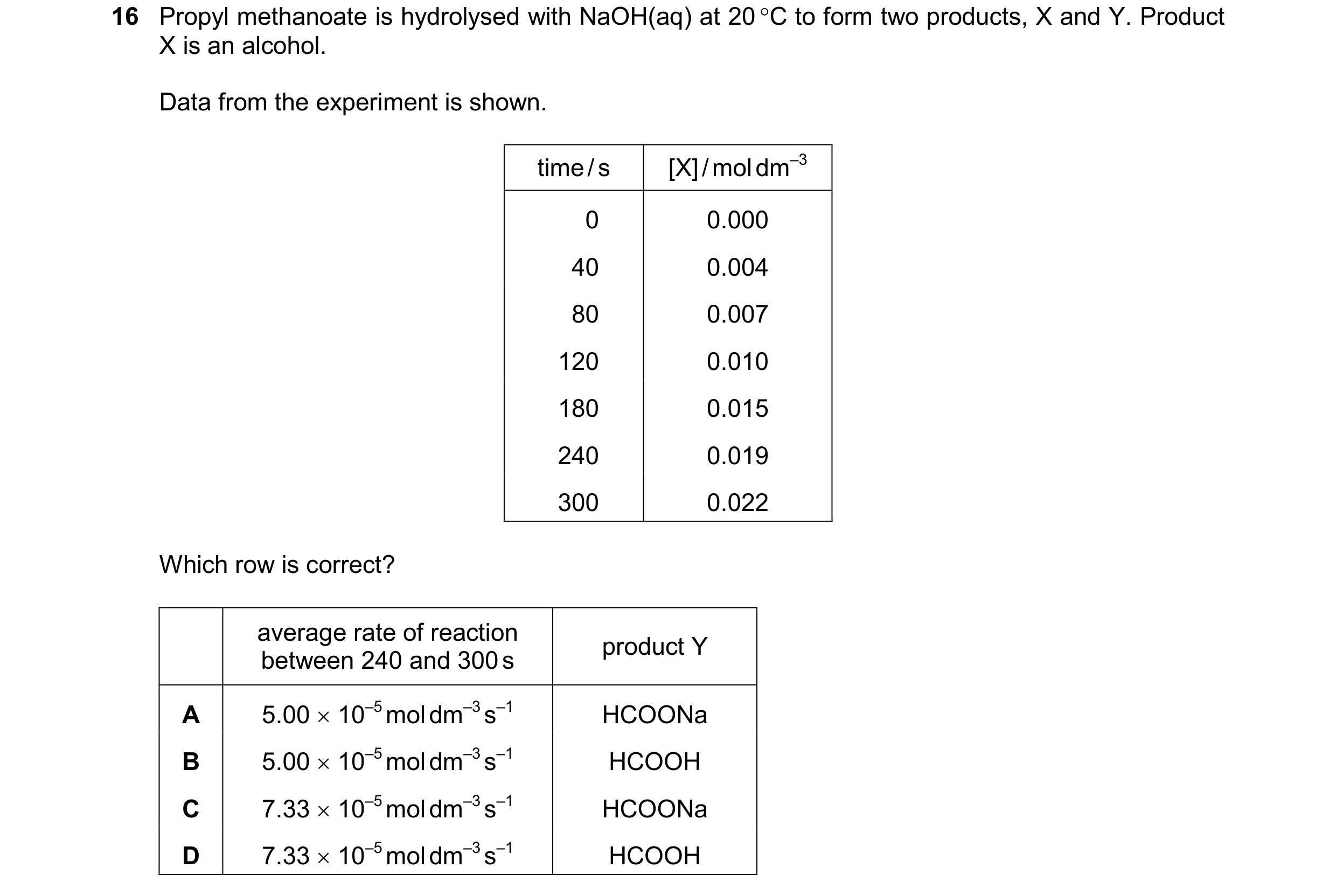
Q79 · Propyl methanoate is hydrolysed with NaOH(aq) at 20 C to form two products, X and Y 9701/14 May/June 2025
16 Propyl methanoate is hydrolysed with NaOH(aq) at 20 C to form two products, X and Y. Product X is an alcohol. Data from the experiment is shown. time / s [X] / mol dm–3 0 0.000 40 0.004 80 0.007 120 0.010 180 0.015 240 0.019 300 0.022 Which row is correct? average rate of reaction product Y between 240 and 300 s A 5.00 10–5 mol dm–3 s–1 HCOONa B 5.00 10–5 mol dm–3 s–1 HCOOH C 7.33 10–5 mol dm–3 s–1 HCOONa D 7.33 10–5 mol dm–3 s–1 HCOOH
1 marks
Answer: A
This question in 9701/14 May/June 2025
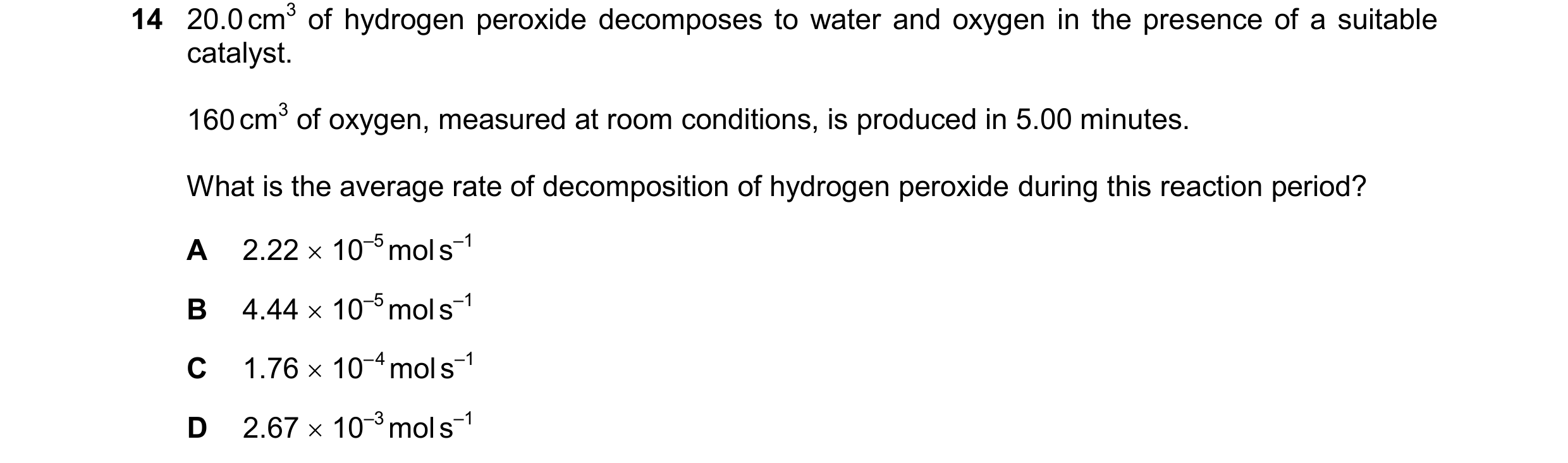
Q80 · 20.0 cm3 of hydrogen peroxide decomposes to water and oxygen in the presence of a… 9701/12 Oct/Nov 2025
14 20.0 cm3 of hydrogen peroxide decomposes to water and oxygen in the presence of a suitable catalyst. 160 cm3 of oxygen, measured at room conditions, is produced in 5.00 minutes. What is the average rate of decomposition of hydrogen peroxide during this reaction period? A 2.22 10–5 mol s–1 B 4.44 10–5 mol s–1 C 1.76 10– 4 mol s–1 D 2.67 10–3 mol s–1
1 marks
Answer: B
This question in 9701/12 Oct/Nov 2025
 1 / 29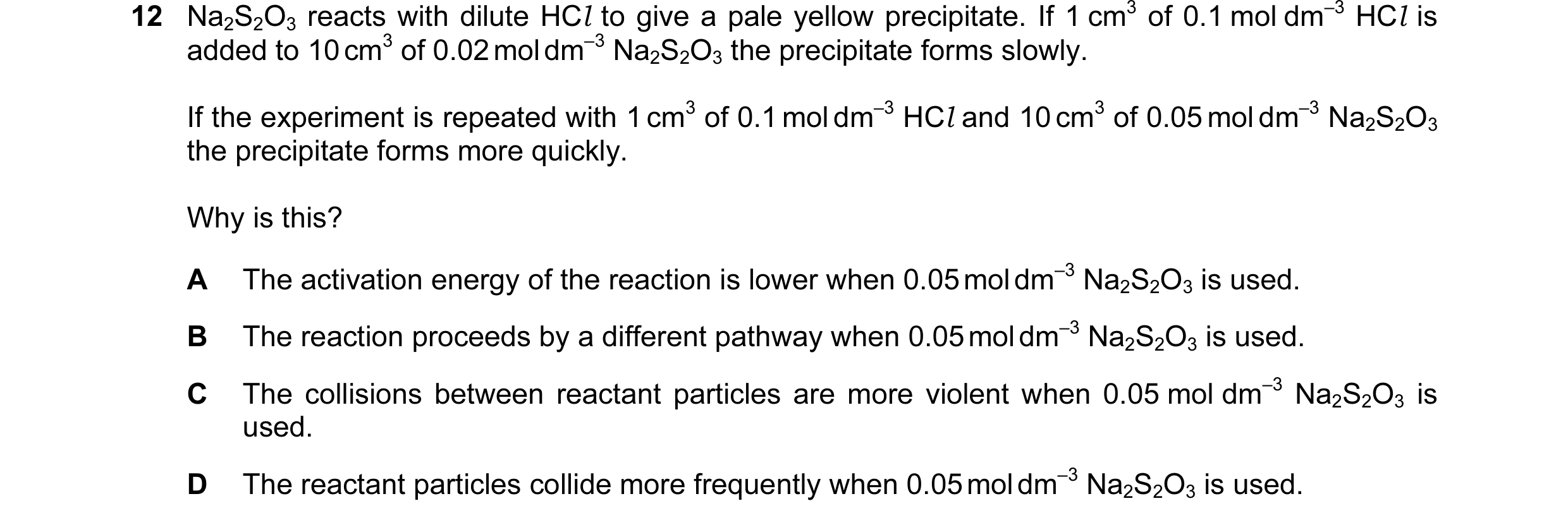
 2 / 29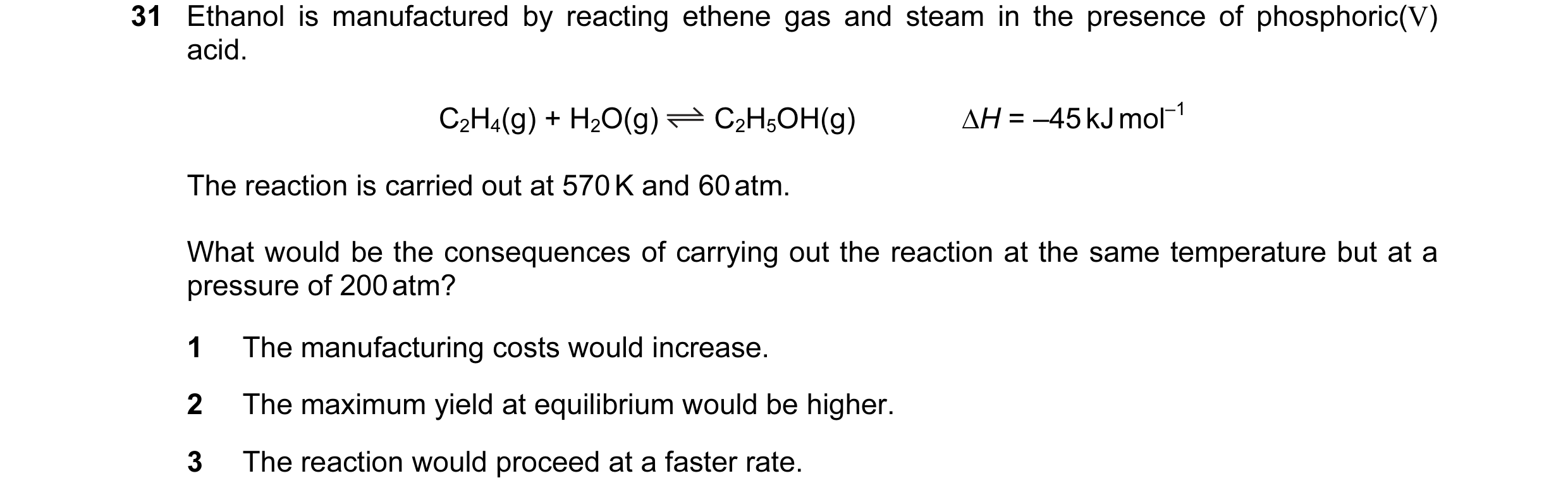
 3 / 29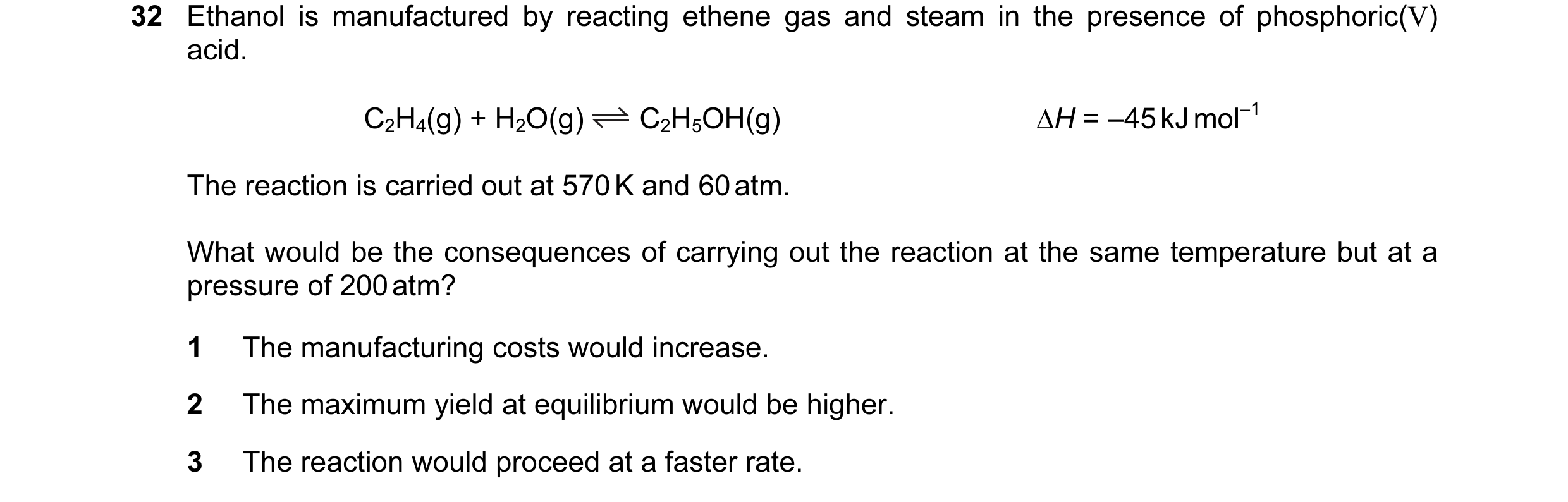
 4 / 29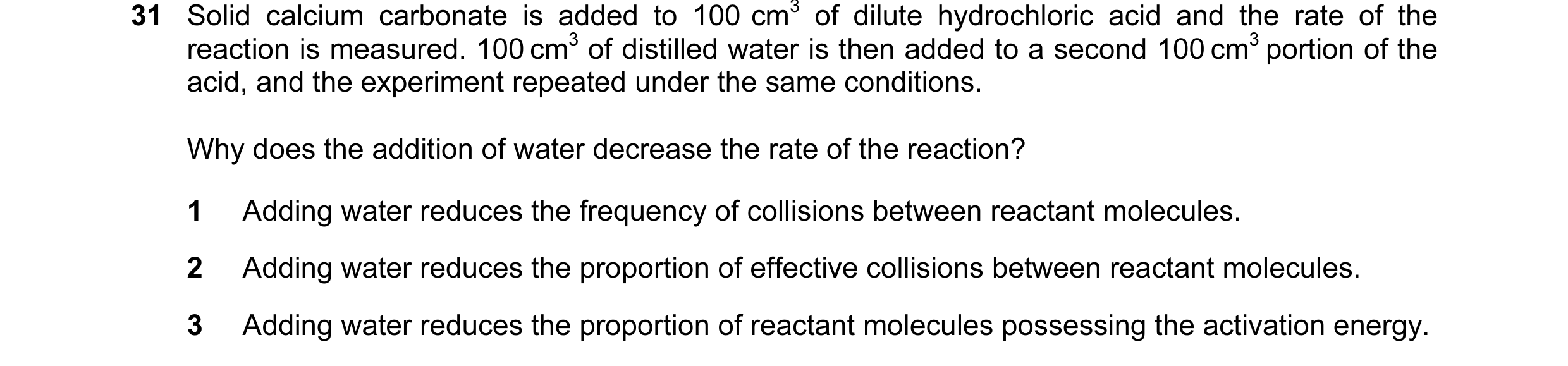
 5 / 29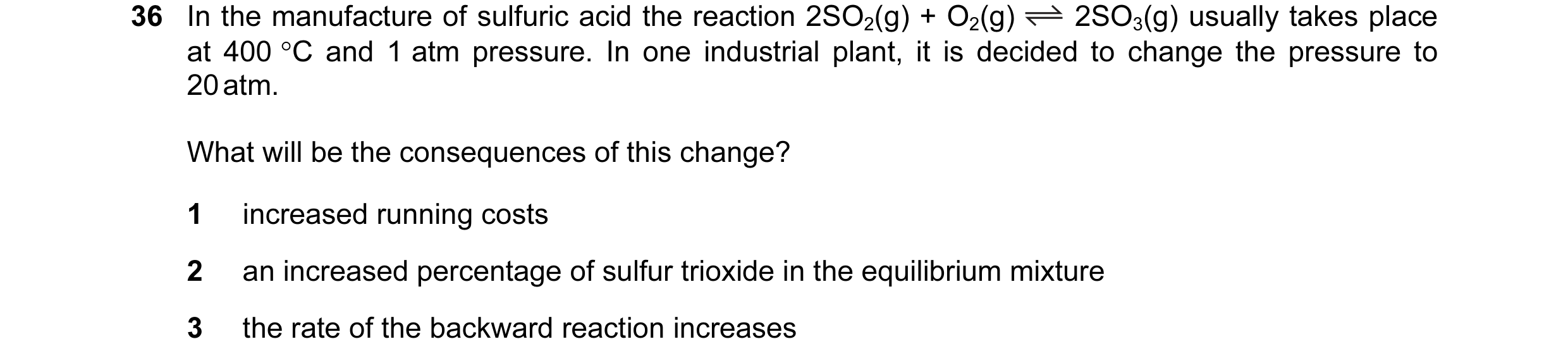
 6 / 29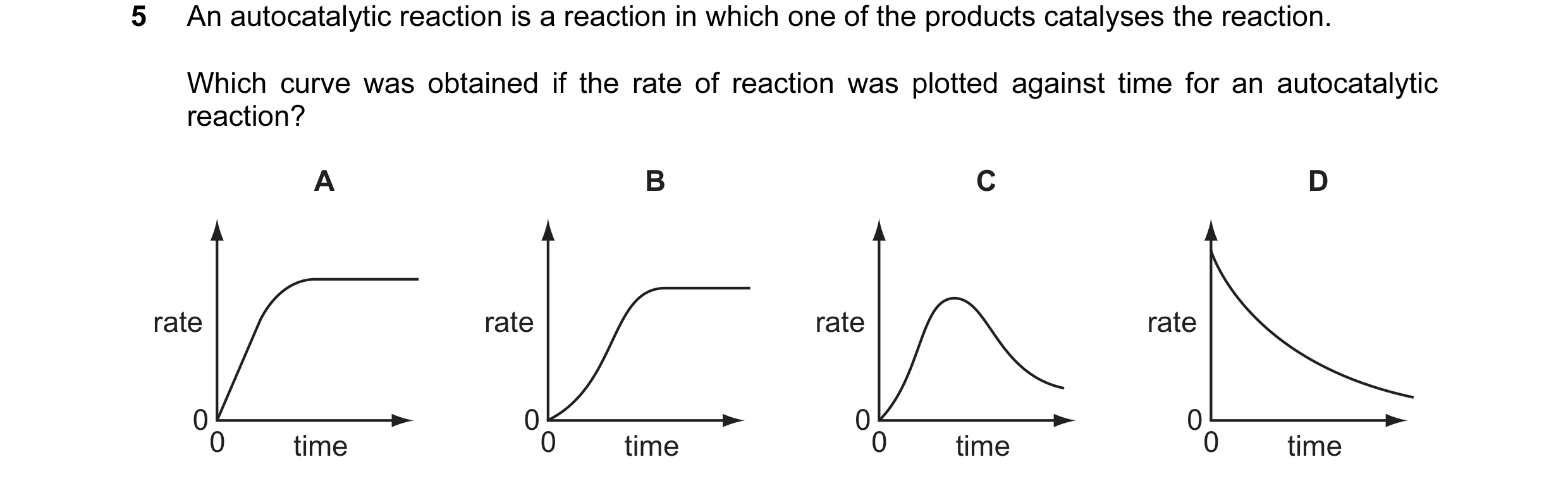
 7 / 29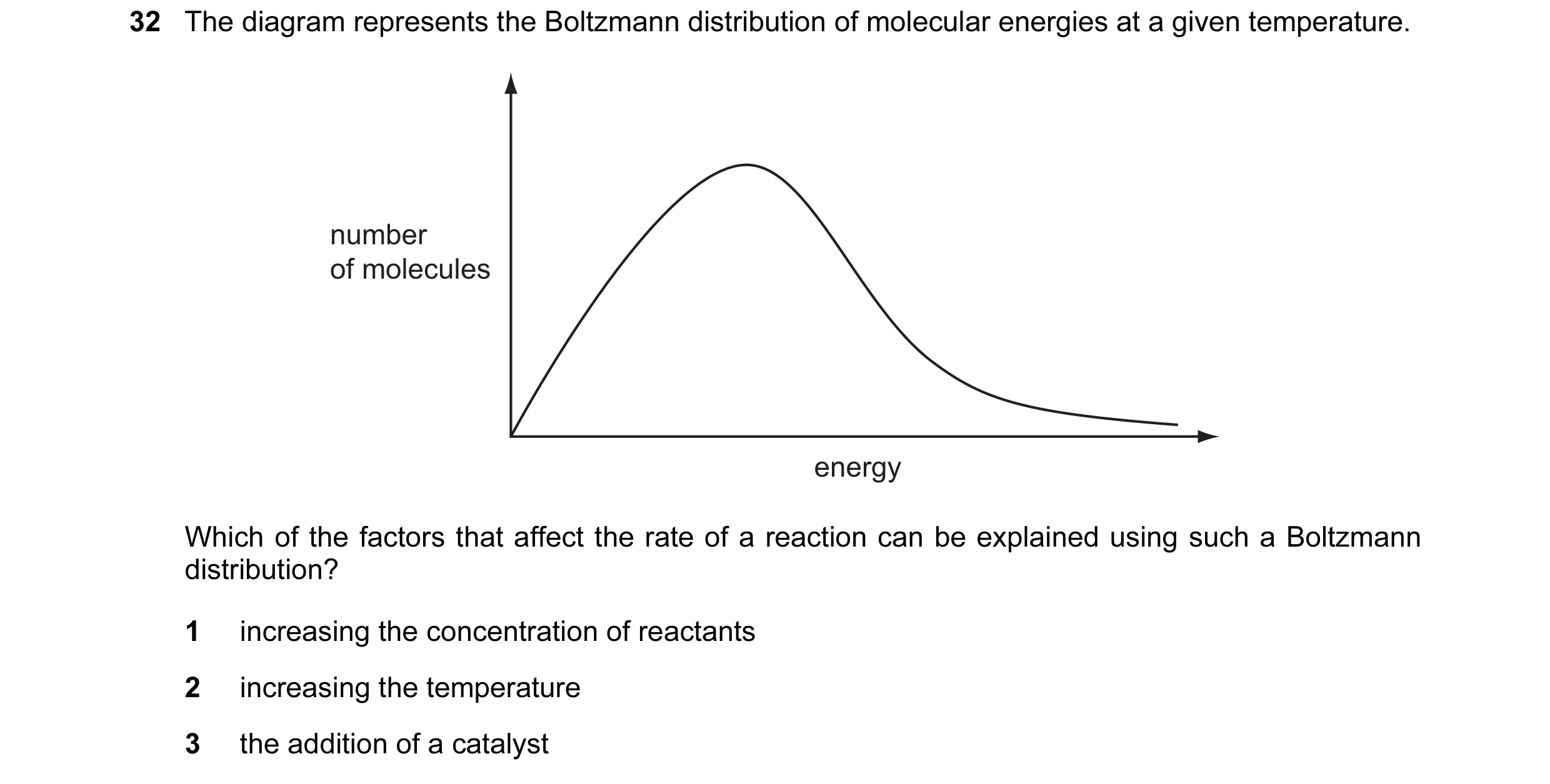
 8 / 29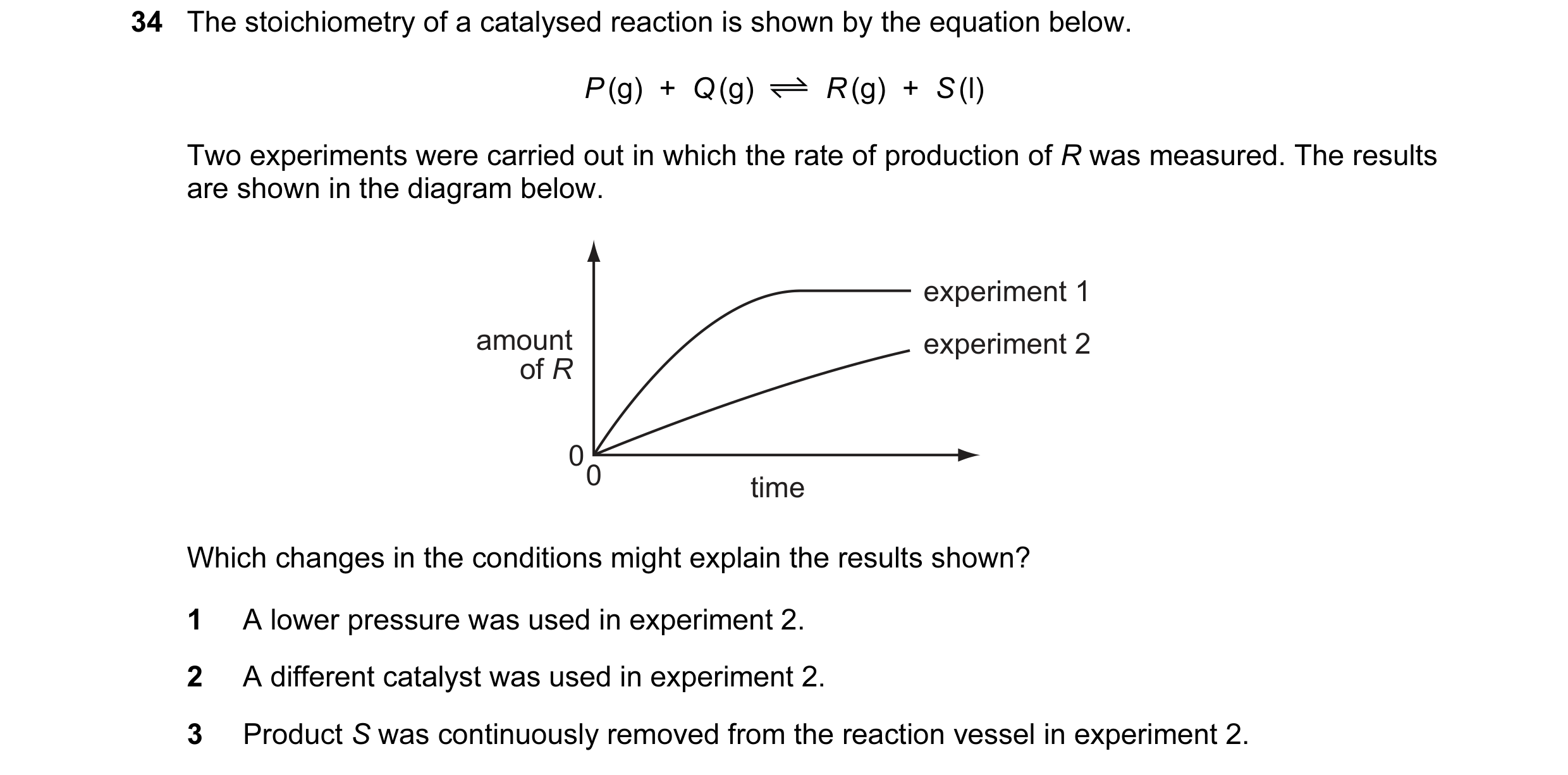
 9 / 29
 10 / 29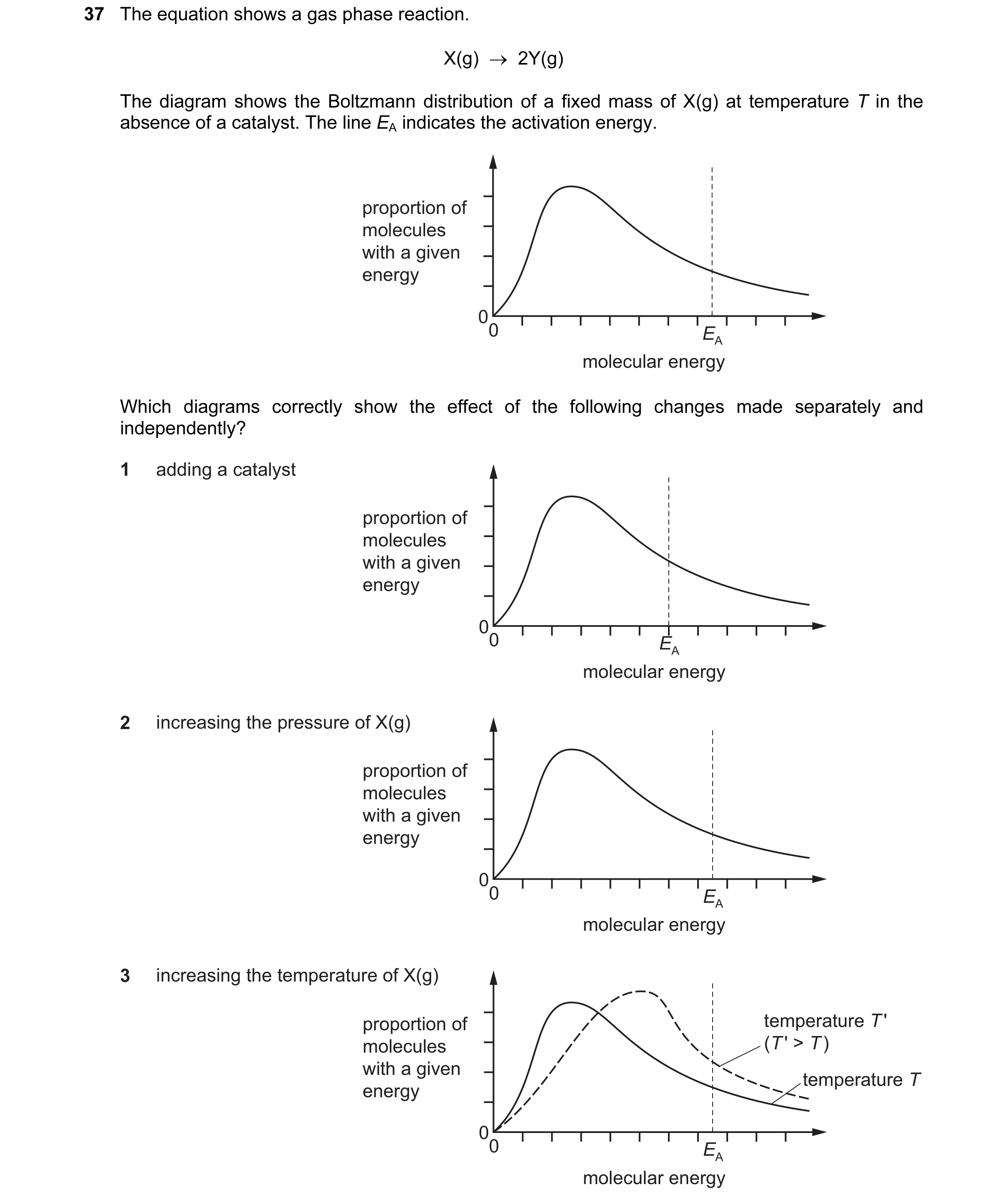
 11 / 29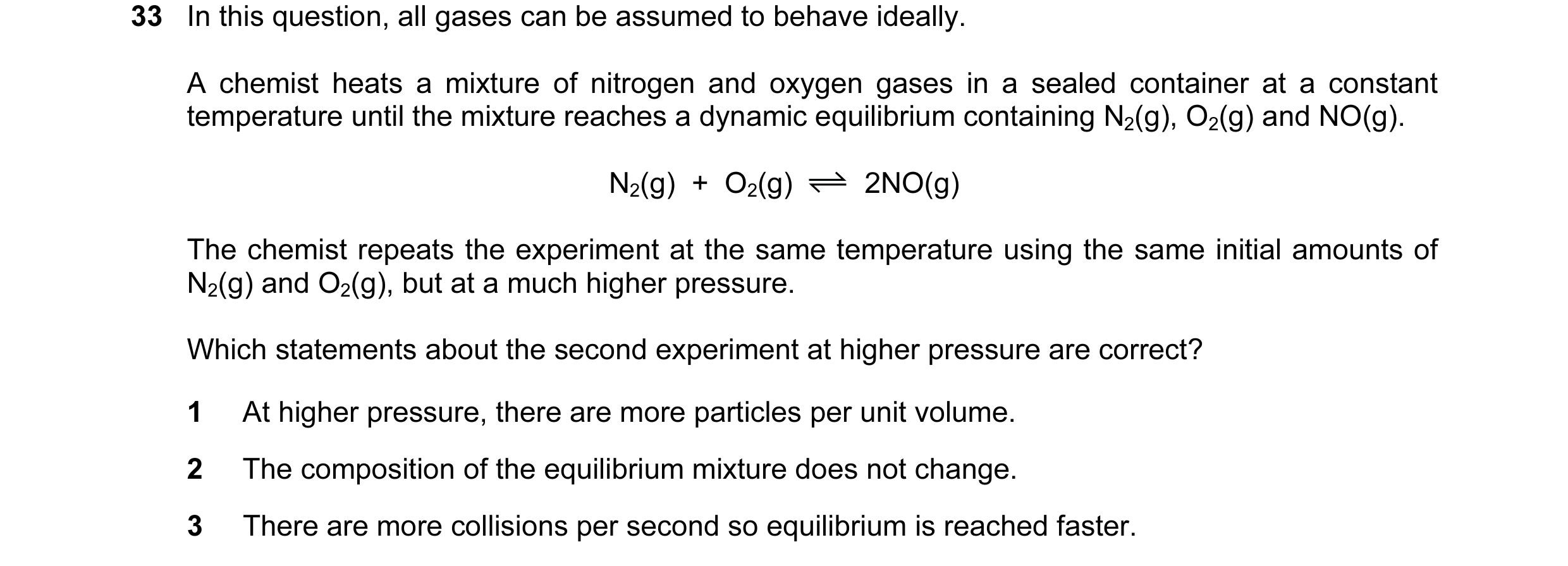
 12 / 29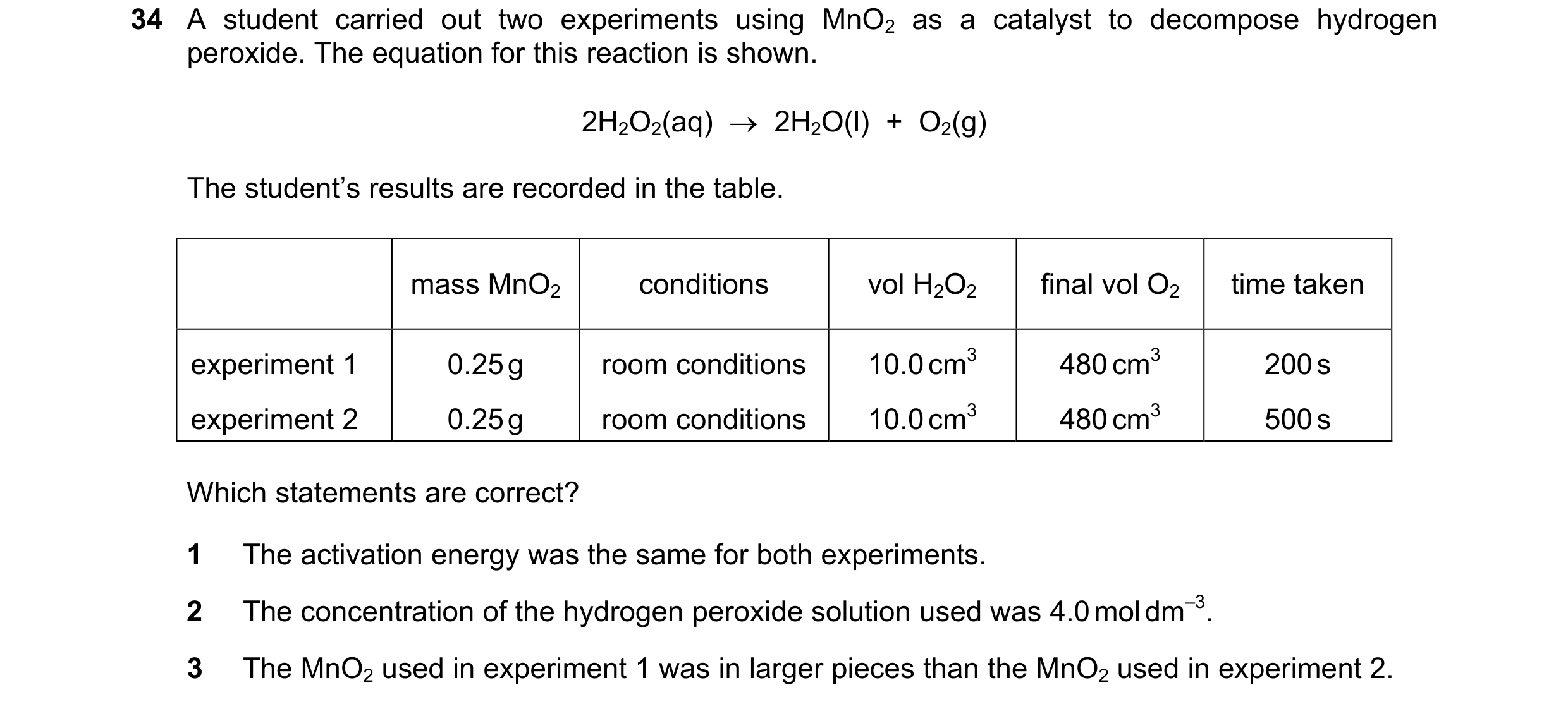
 13 / 29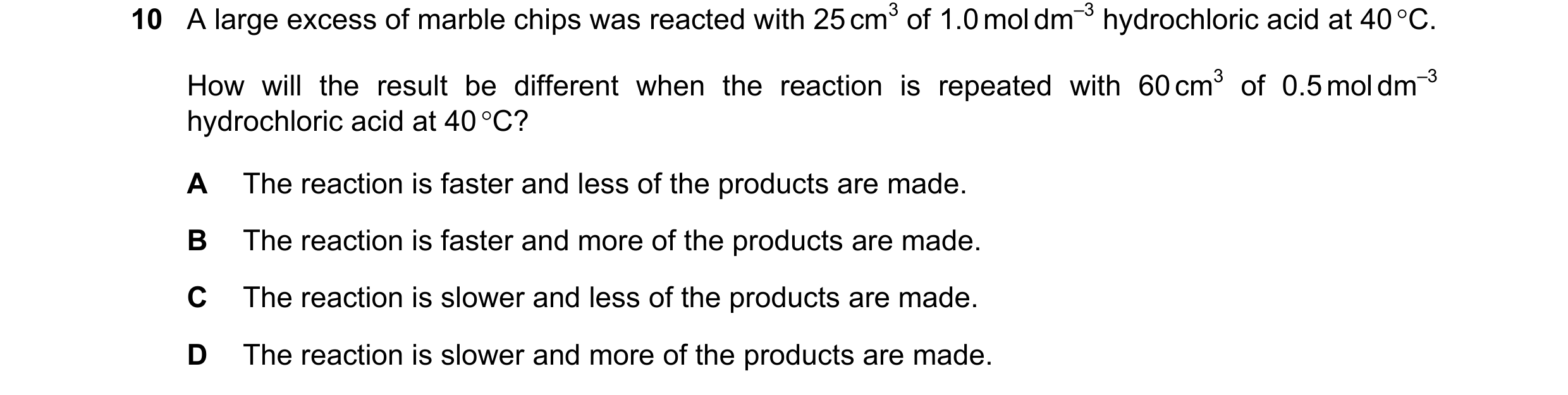
 14 / 29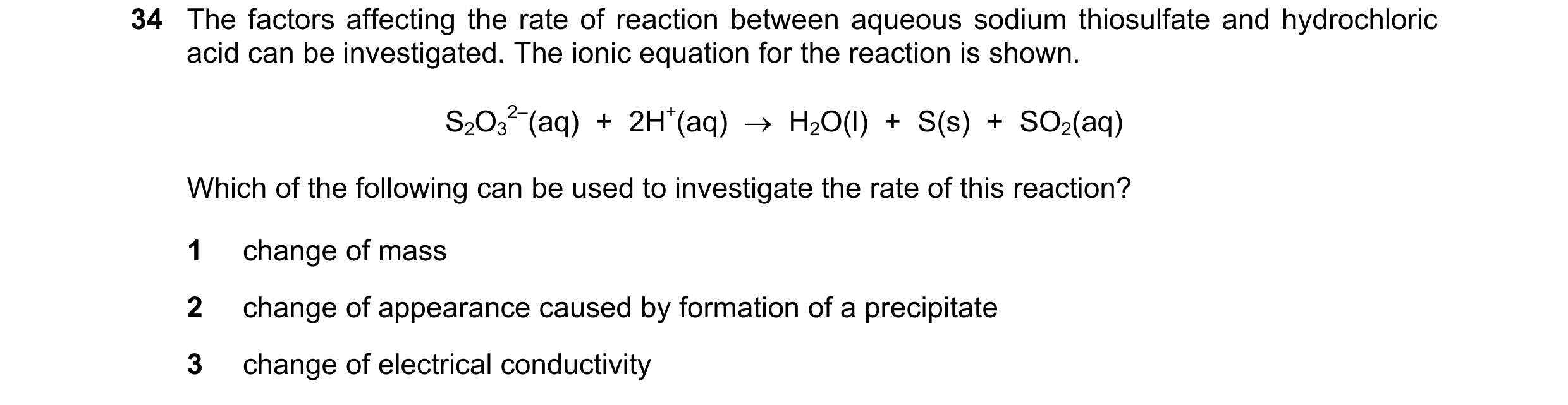
 15 / 29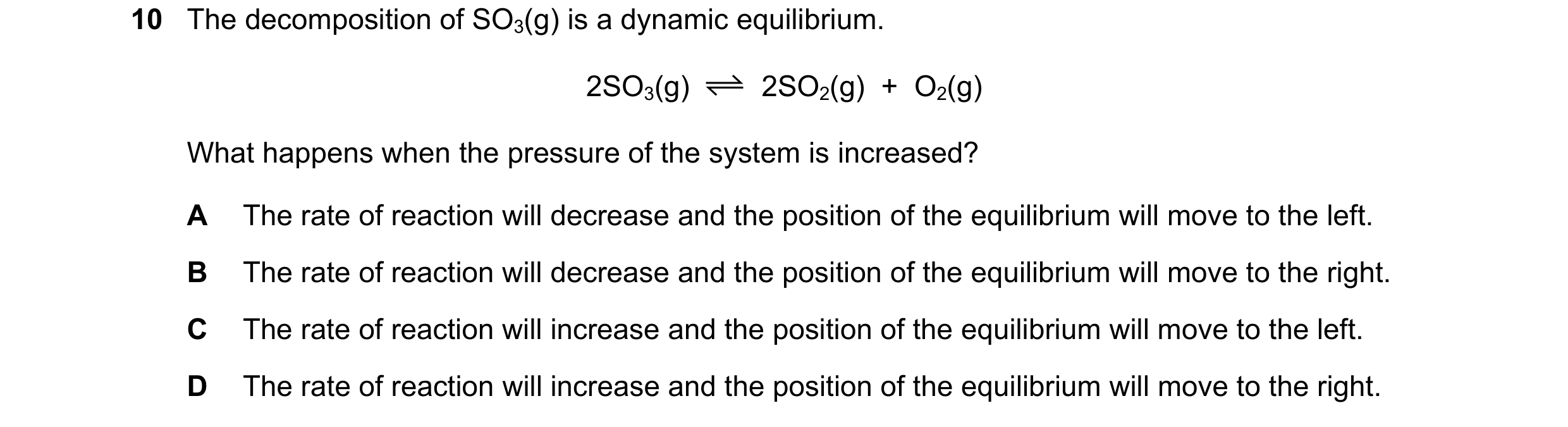
 16 / 29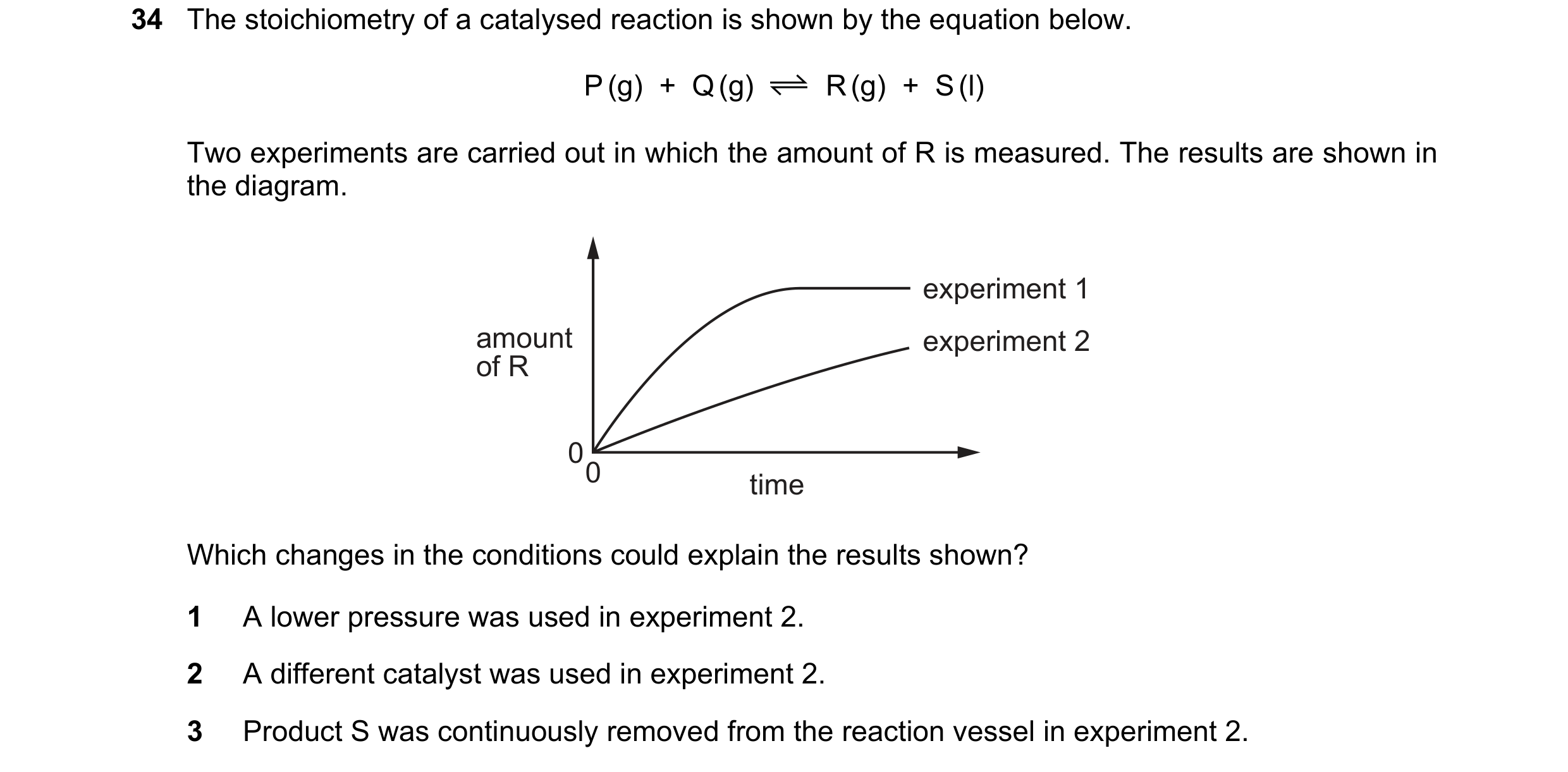

 17 / 29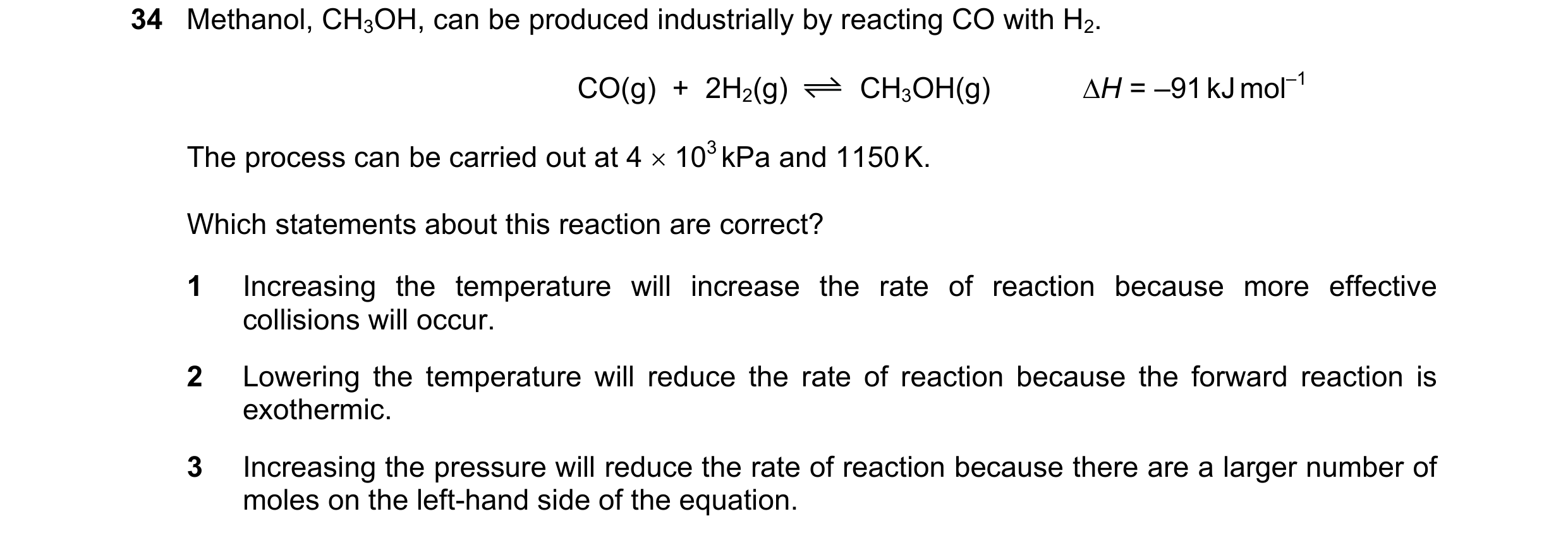
 18 / 29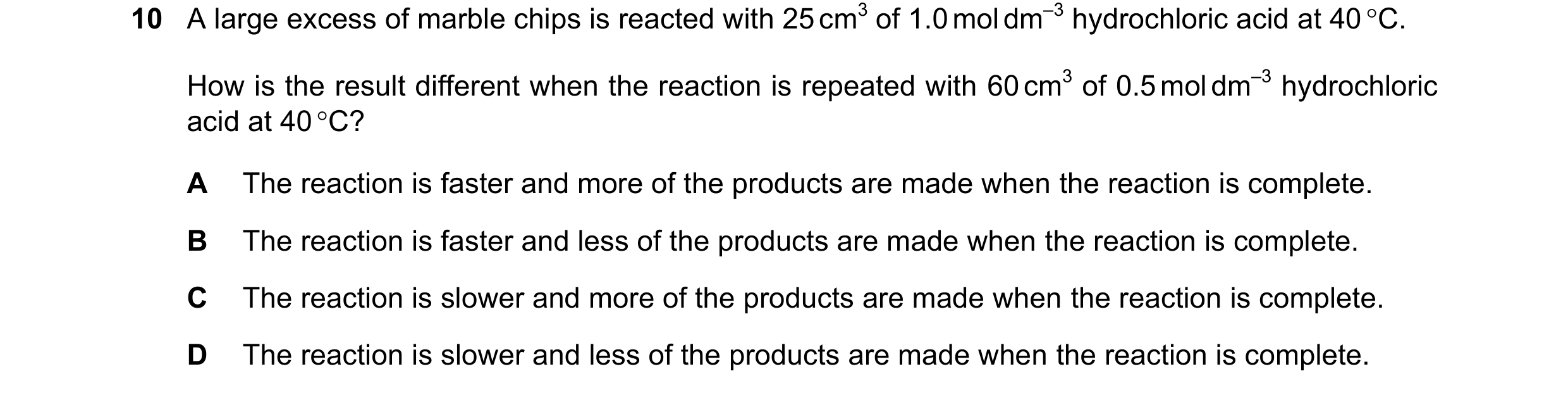


 19 / 29
 20 / 29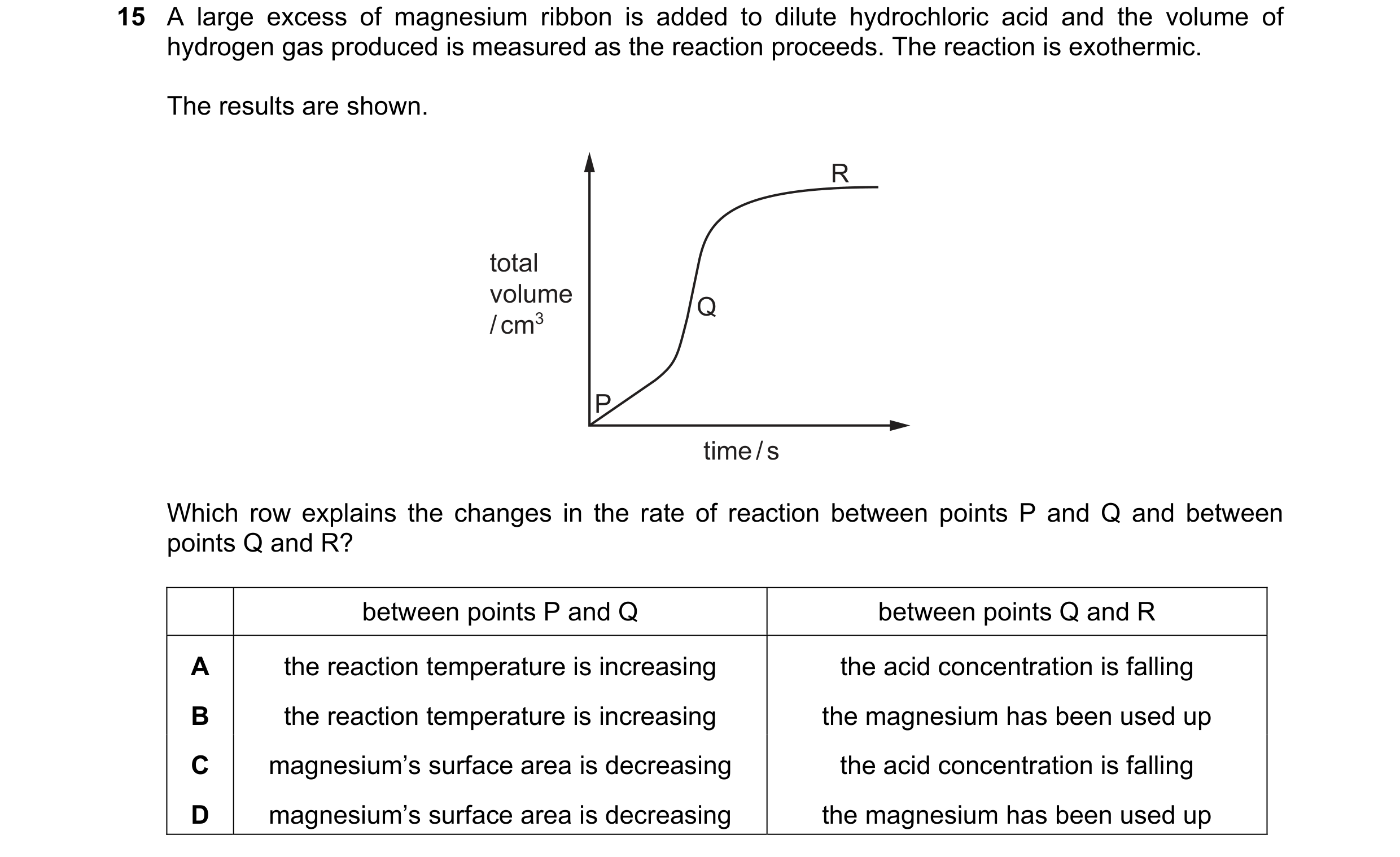
 21 / 29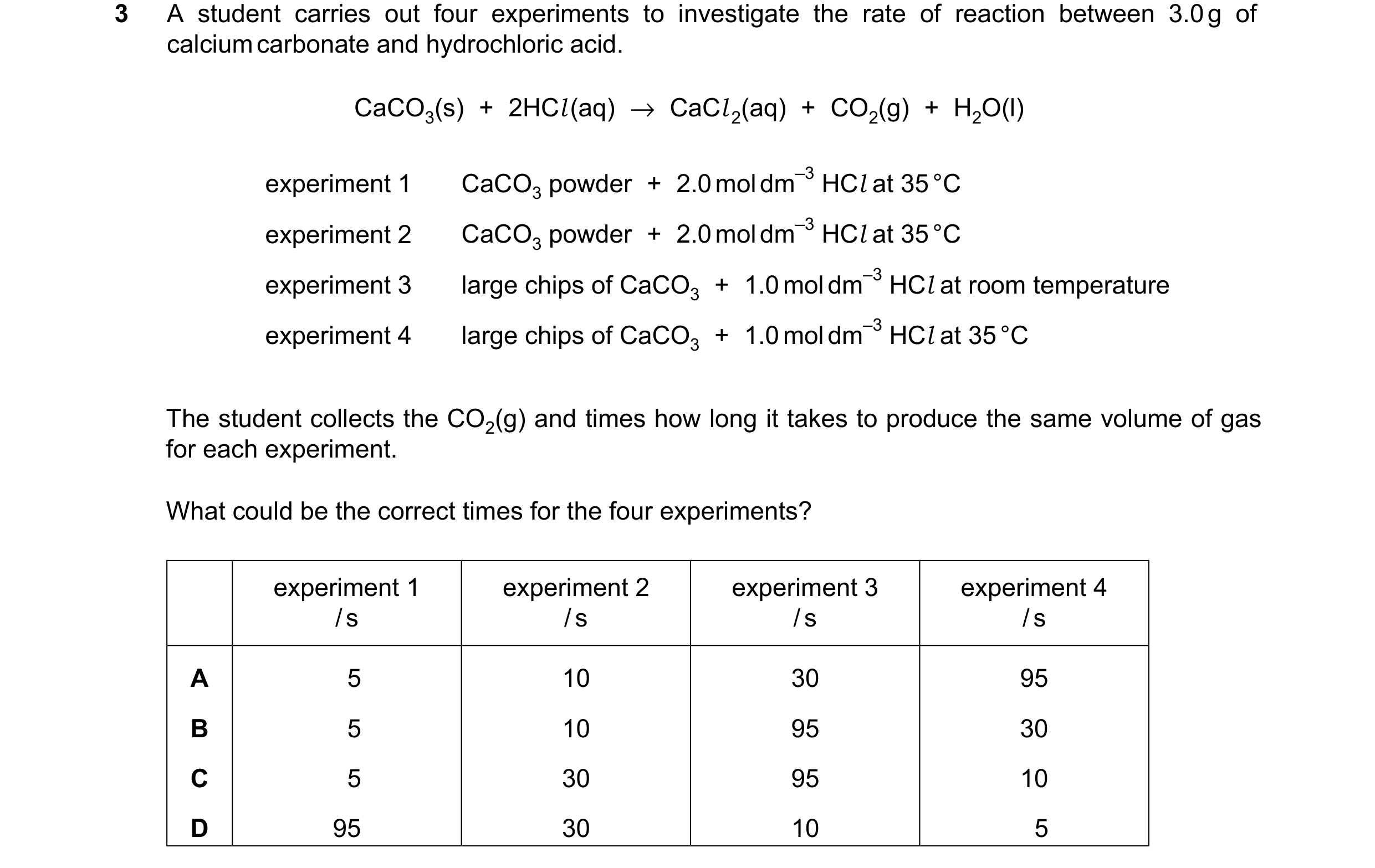
 22 / 29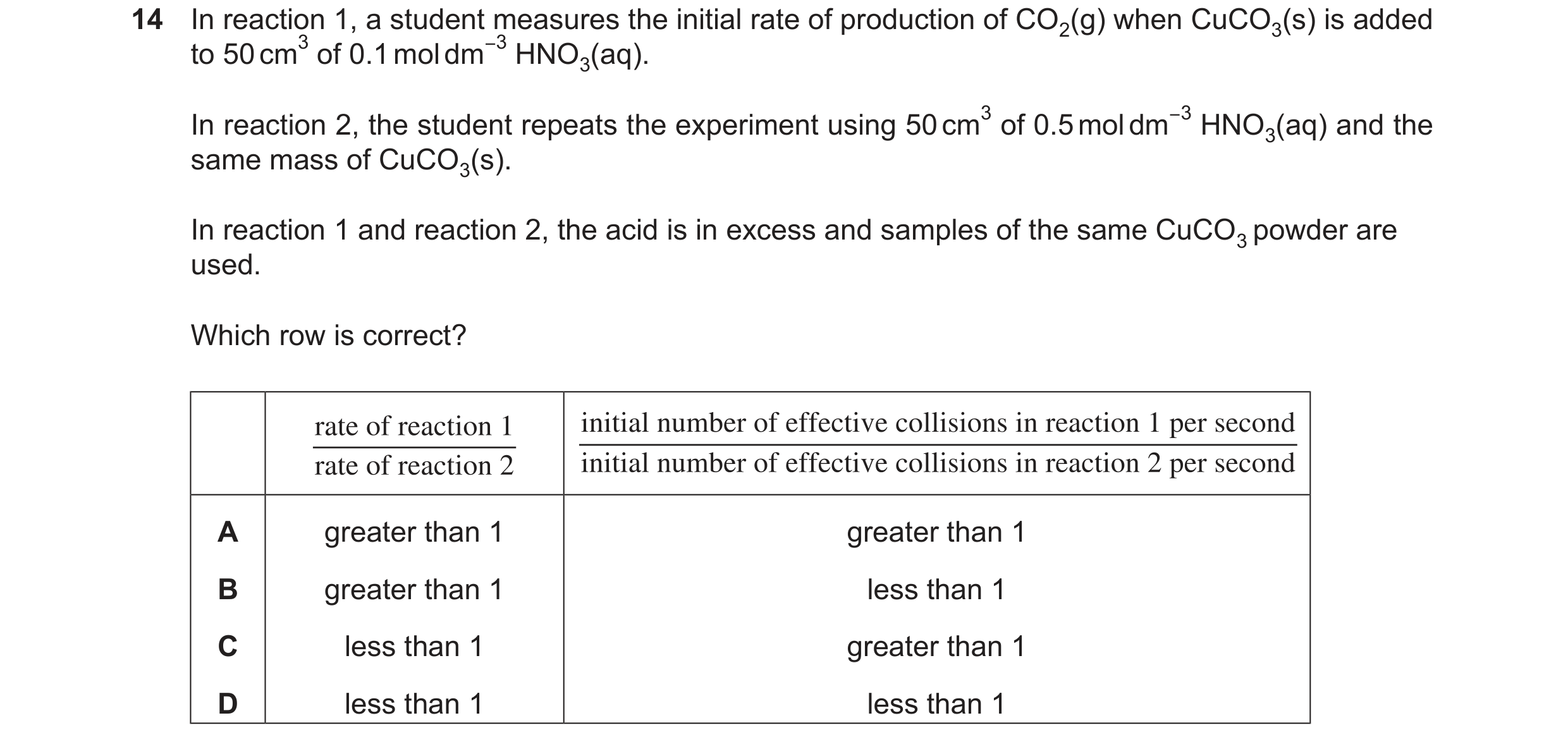
 23 / 29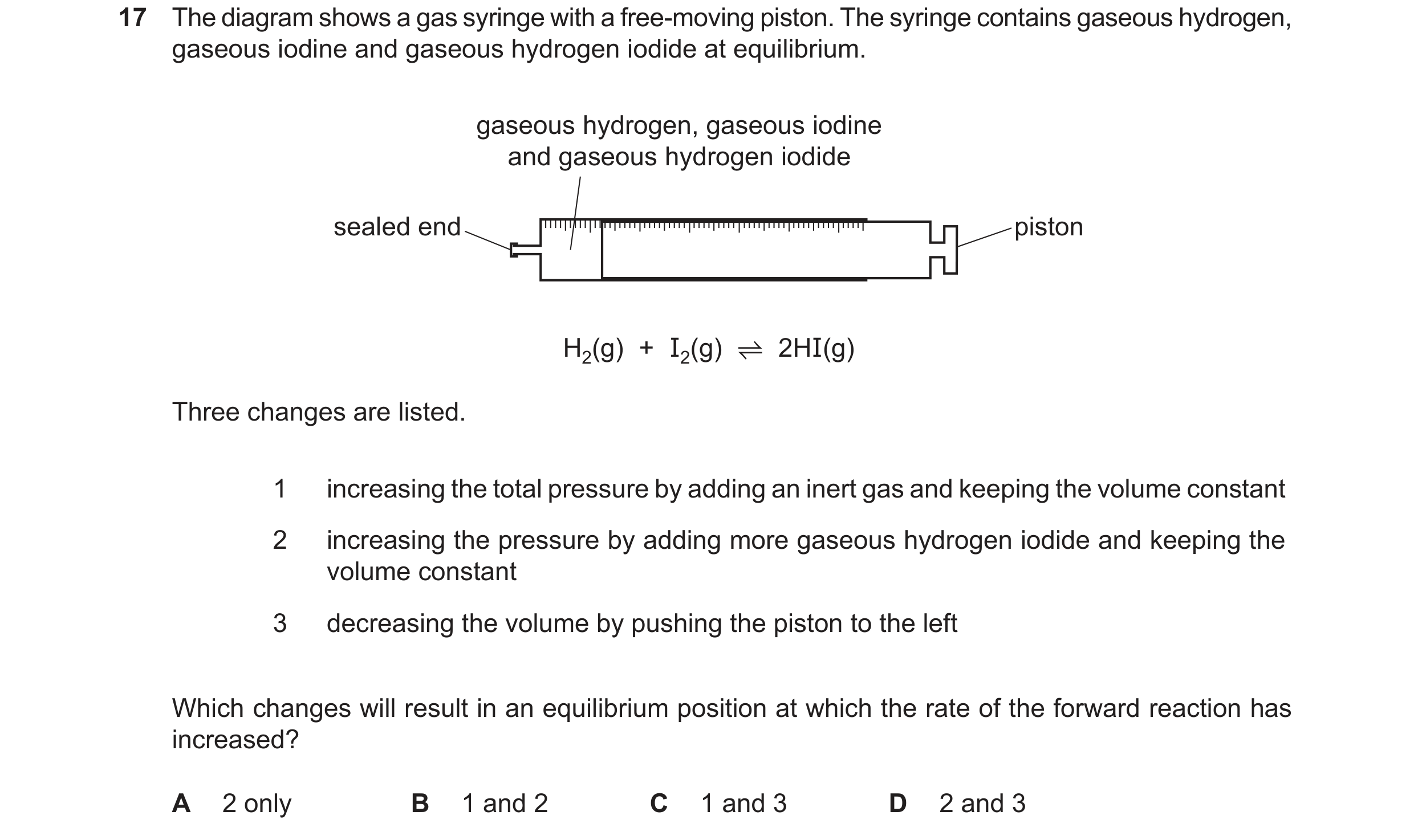
 24 / 29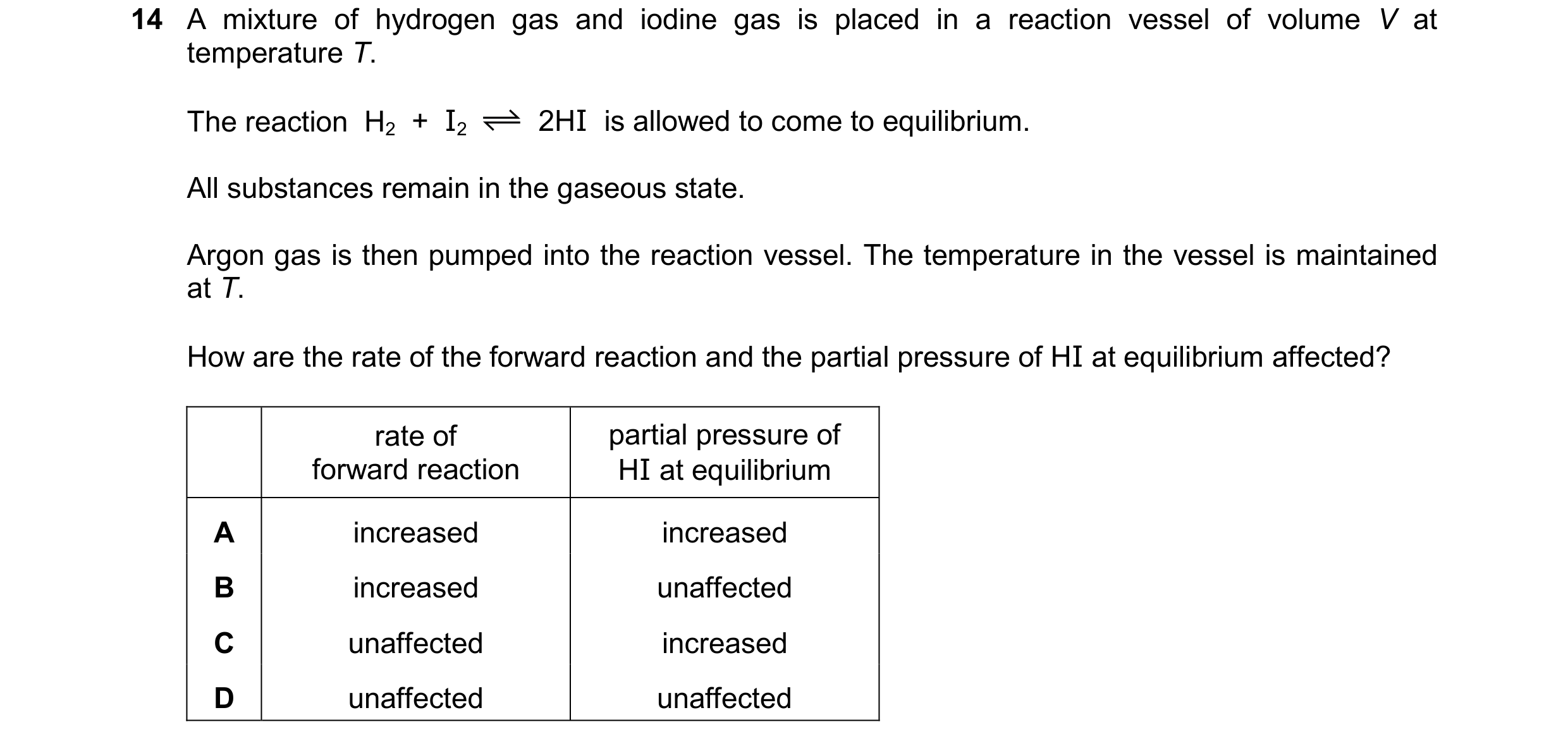
 25 / 29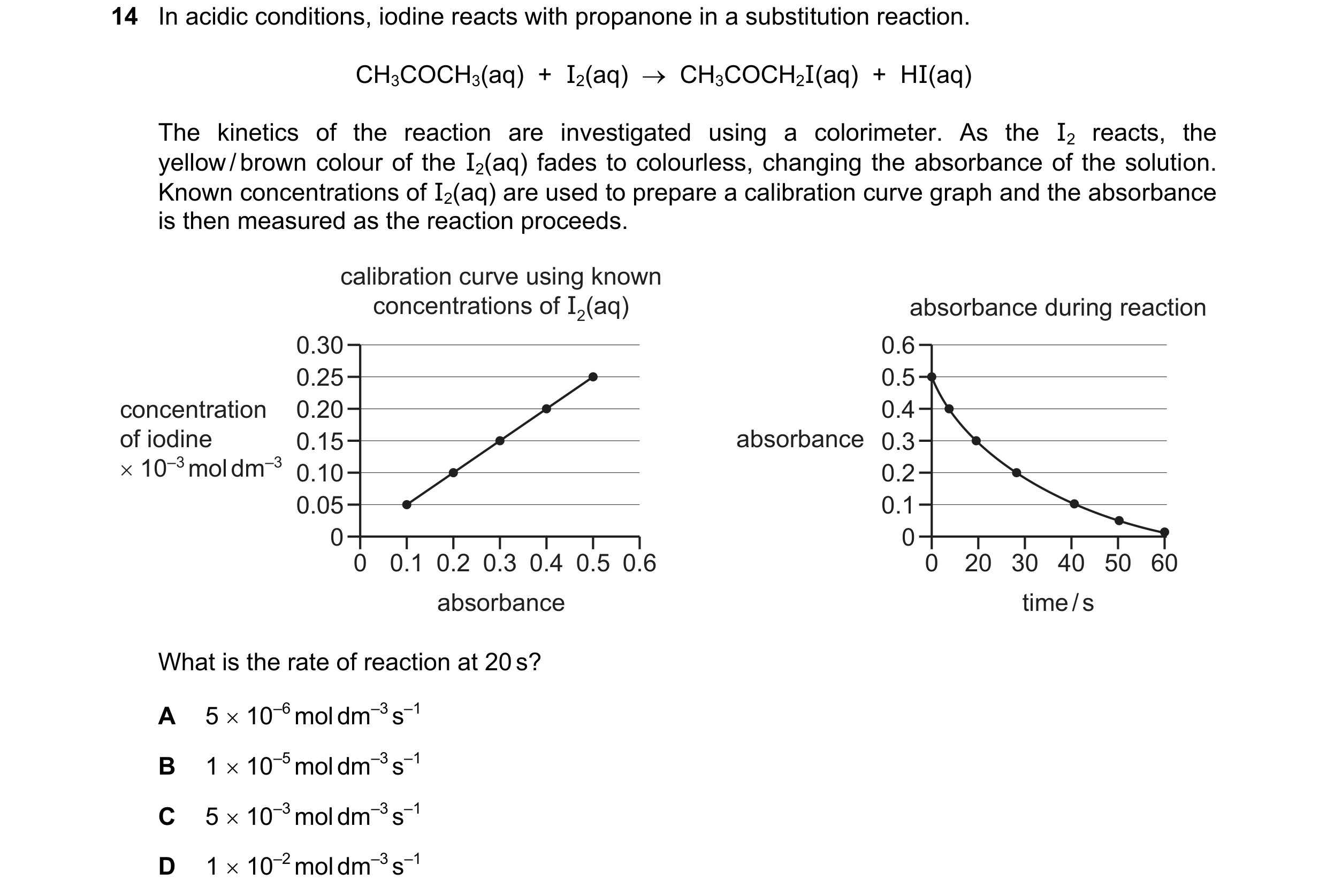
 26 / 29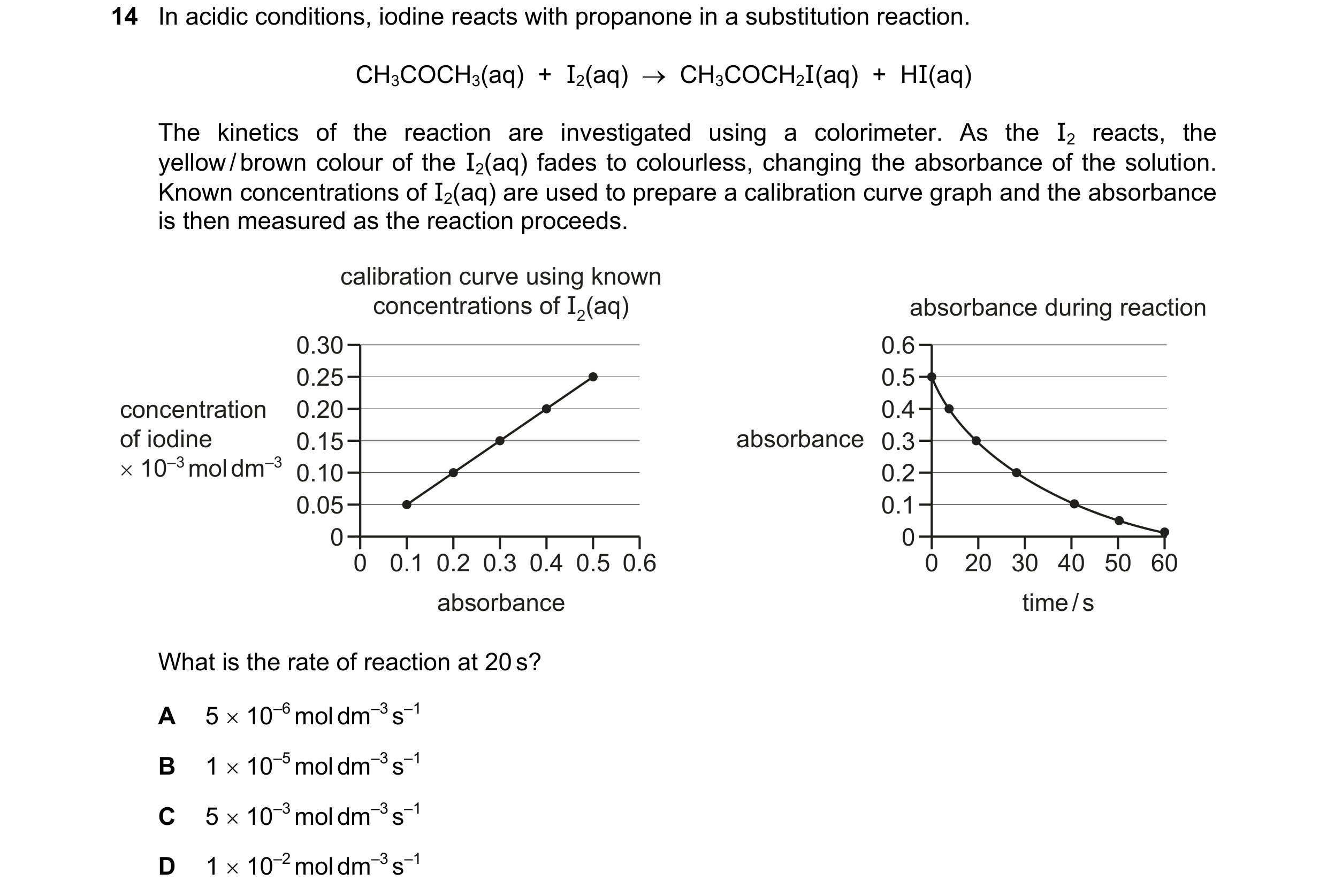
 27 / 29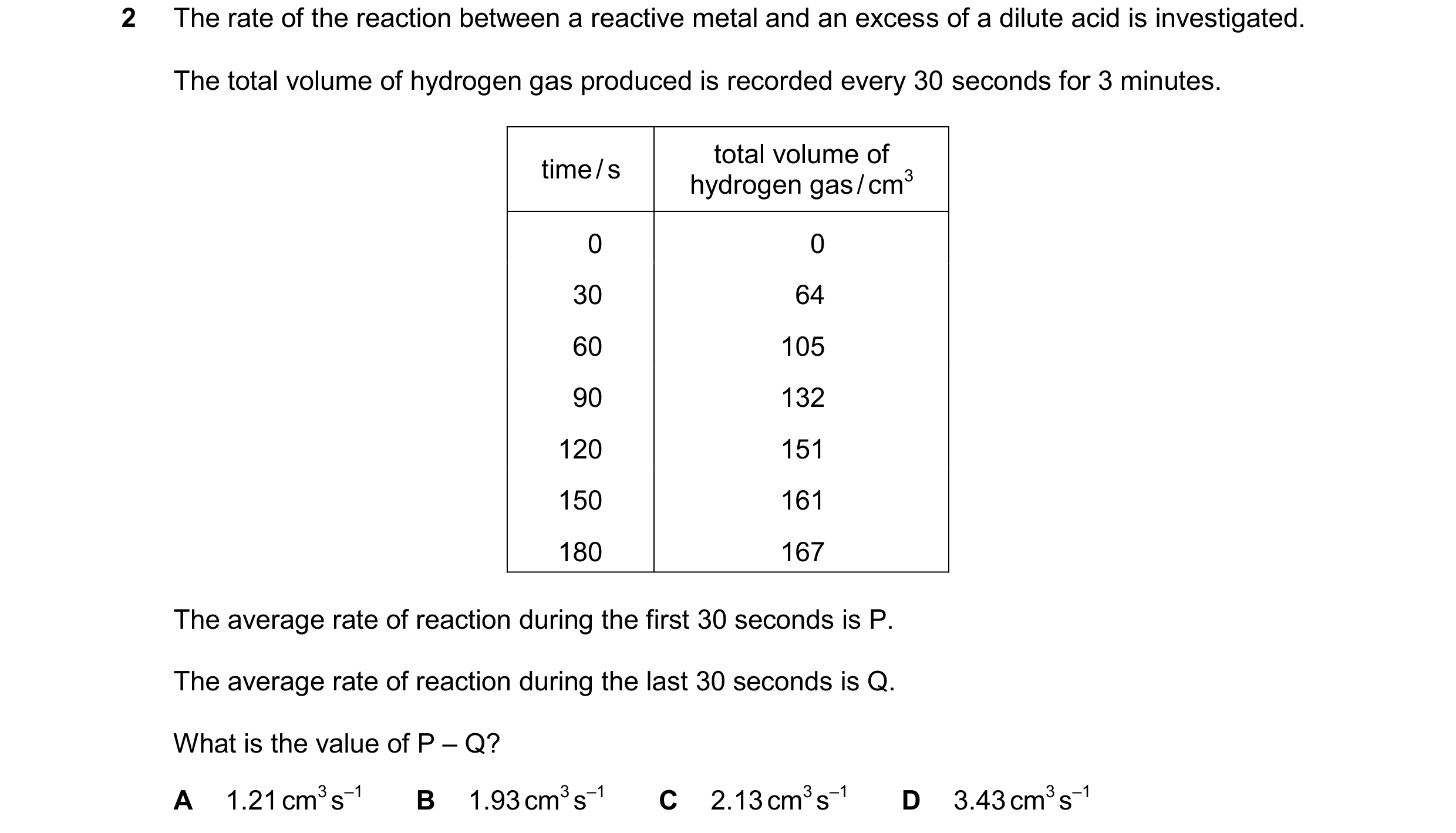
 28 / 29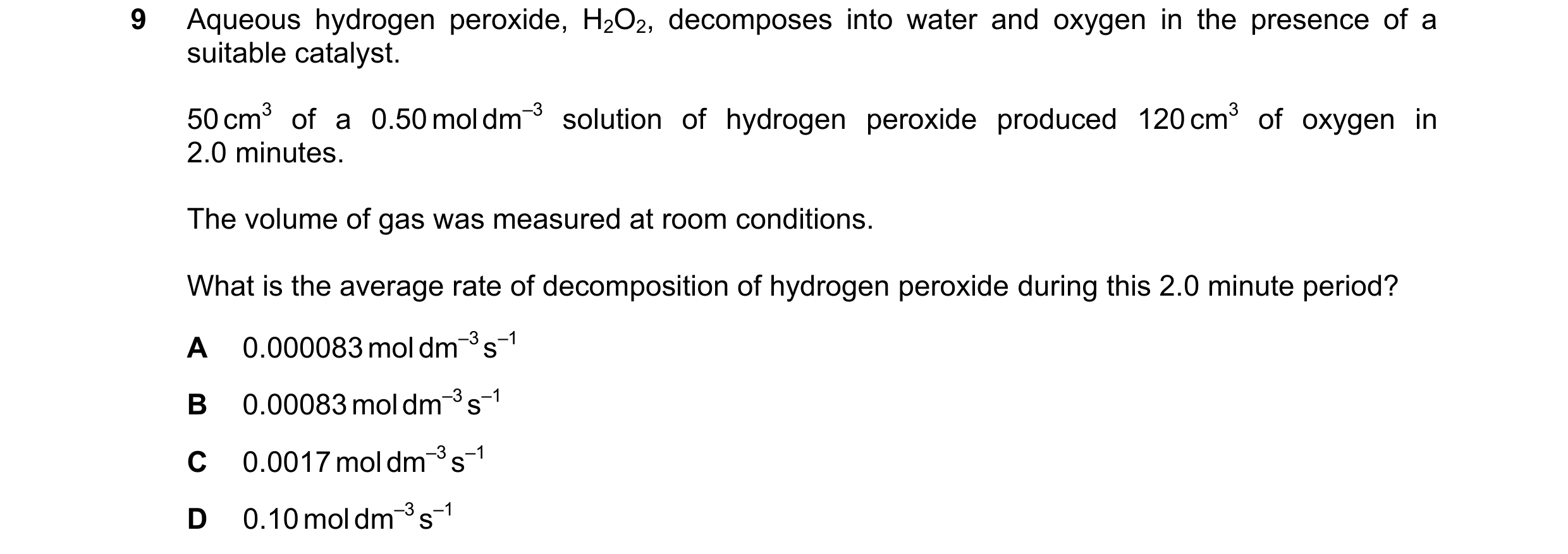
 29 / 29